Posted in MARIAN TITLES, SAINT of the DAY

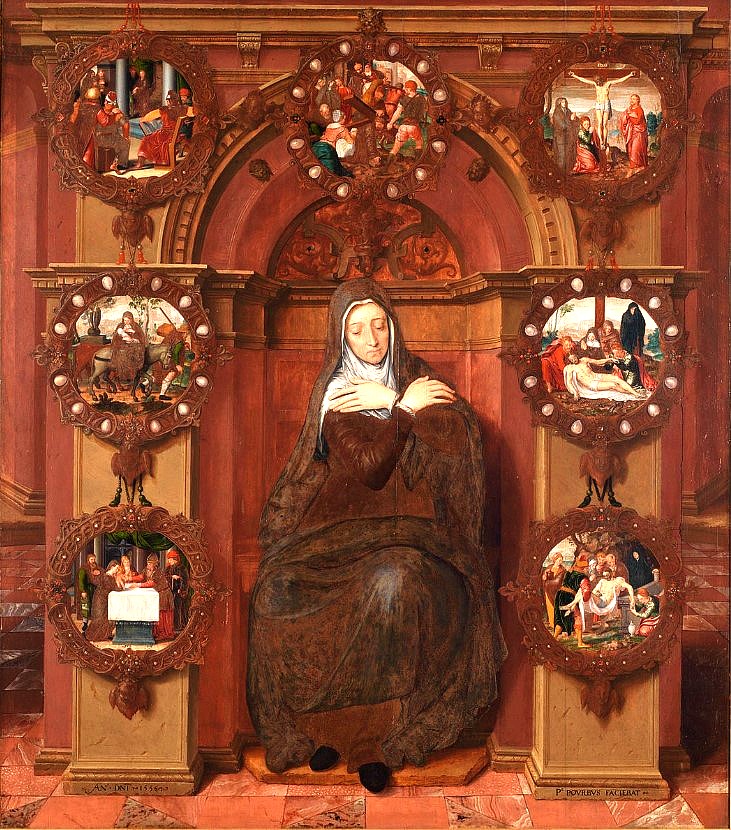
Notre-Dame-des-Vertus / Our Lady of Power, Aubervilliers, France (1336) and Memorials of the Saints – 12 May

Wednesday of the Sixth week of Easter +2021

Notre-Dame-des-Vertus / Our Lady of Power, Aubervilliers, France (1336) – 12 May:

The Abbot Orsini wrote: “This image has wrought so many miracles in this Church, that it is called Our Lady of Power, though the Church is dedicated to Saint Christopher.”

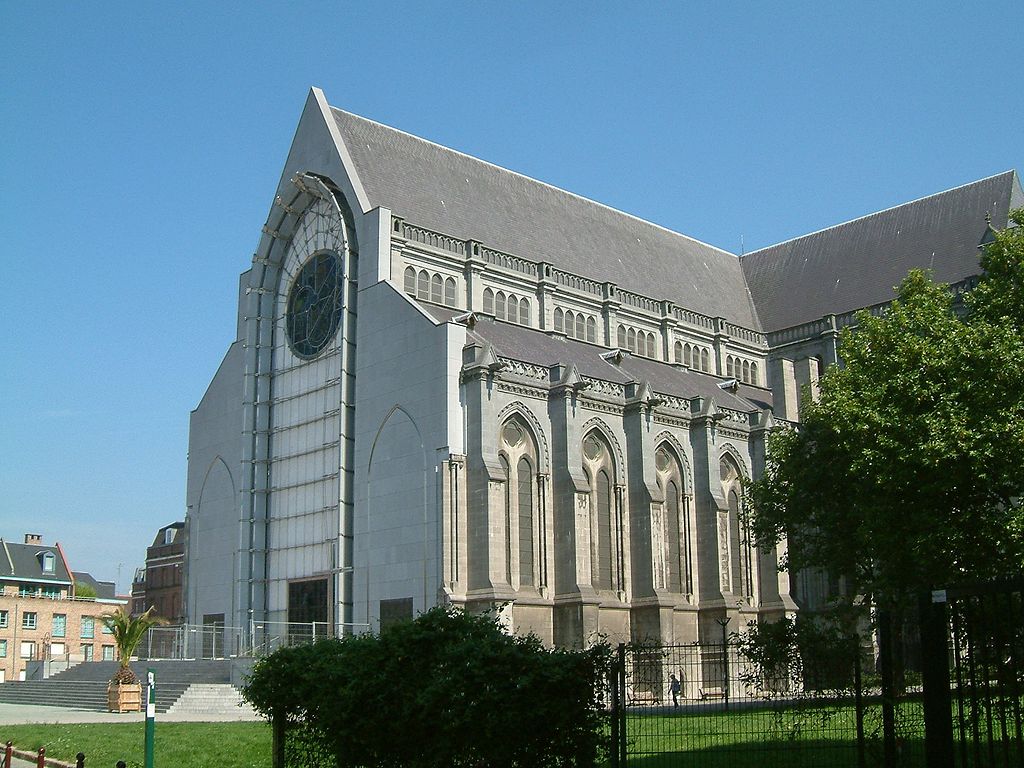
Known now as Notre-Dame-des-Vertus, this is the 14th century Church in Aubervilliers that is the very location that experienced so many miracles during the Middle Ages. As noted by the Abbot Orsini, the Church was originally dedicated to Saint Christopher, yet the name soon changed to honour the Mother of God, in recognition of the graces and miracles obtained there due to the intercession of the Blessed Virgin Mary. The Parish had been built around the Saint Christopher Chapel and after whom the road leading to the Church is named.
The first miracle occurred on 14 May 1336 and is known locally as the Miracle of Rain. It was during a time of terrible drought when a small girl entered the Church of Saint Christopher with flowers to adorn the Statue of the Blessed Virgin Mary. While praying that Our Lady would send rain to save the crops, the girl suddenly noticed, that the Statue had become covered, with what appeared to be drops of sweat and the sky turned dark, as the weather began to turn.

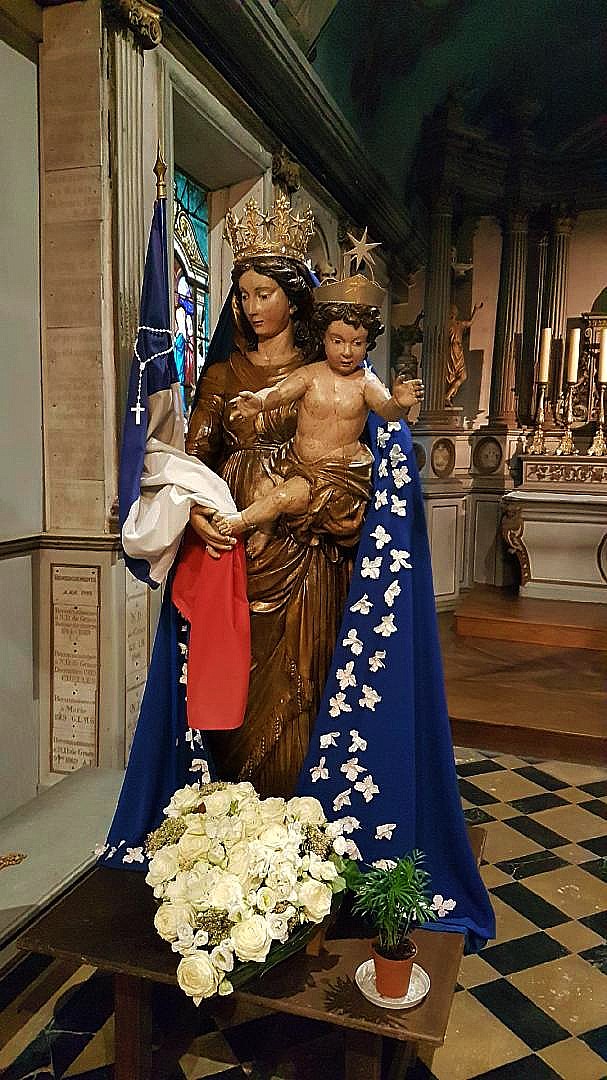
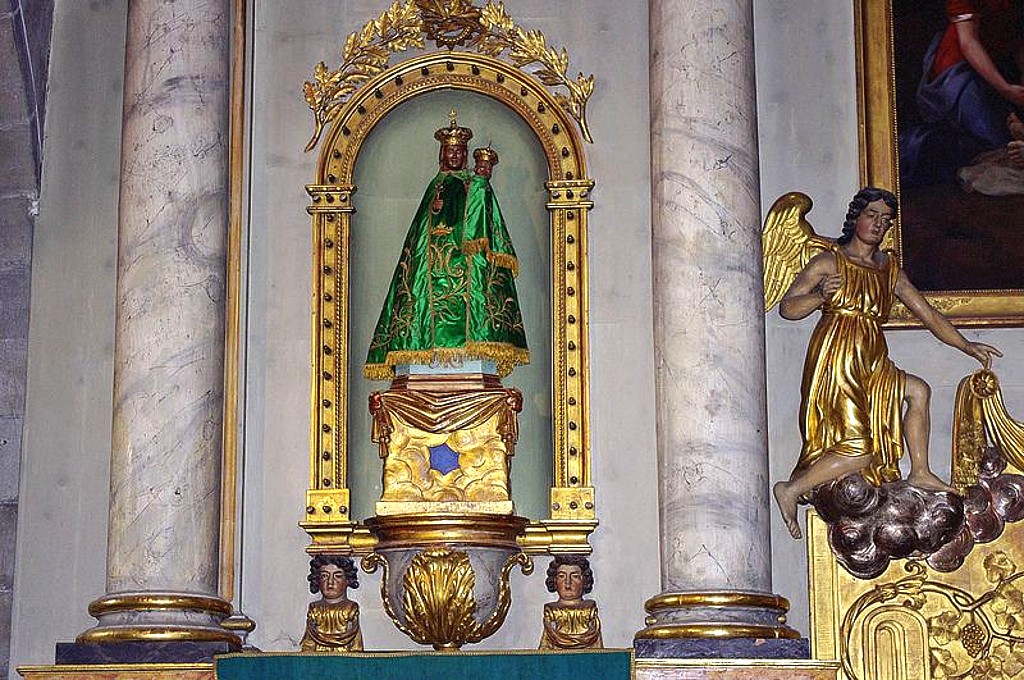
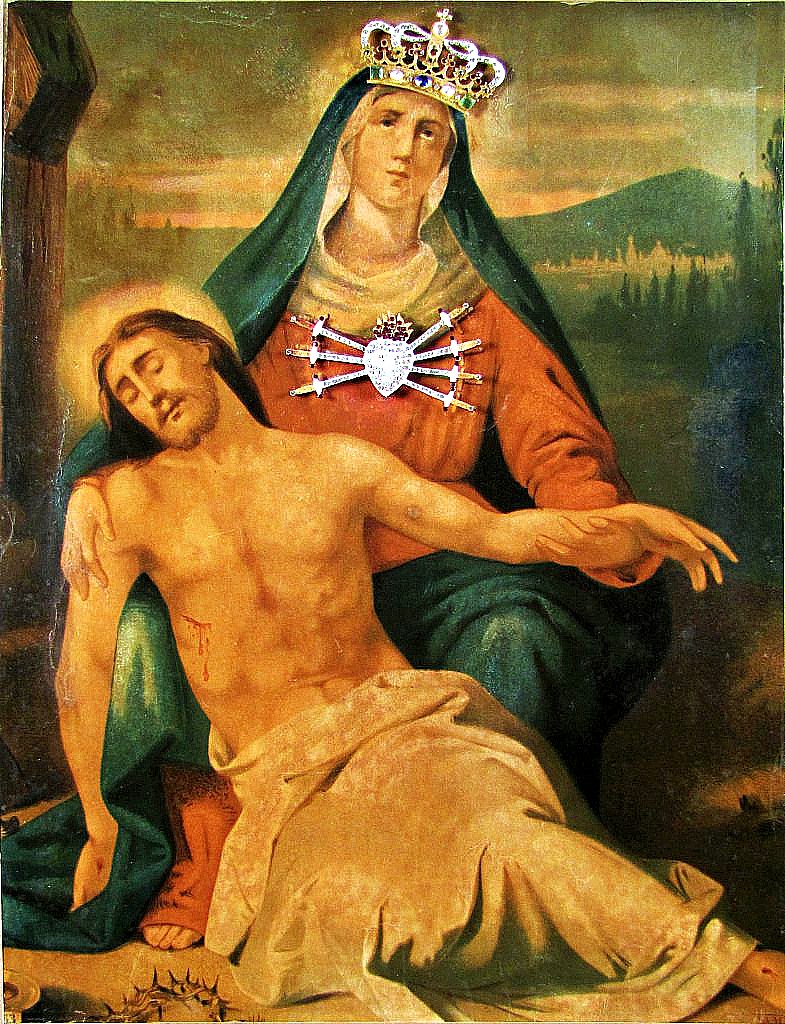
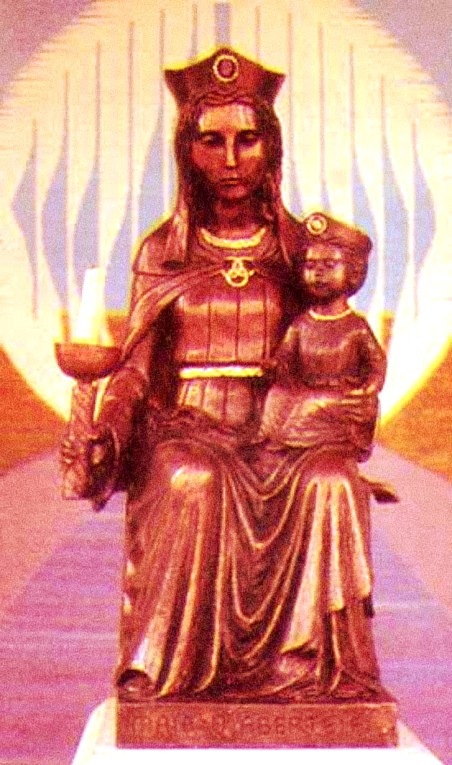
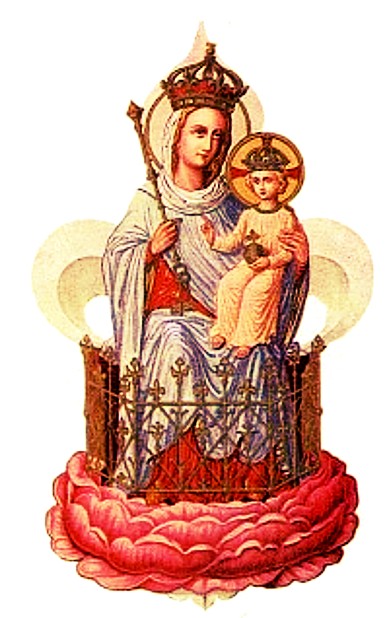
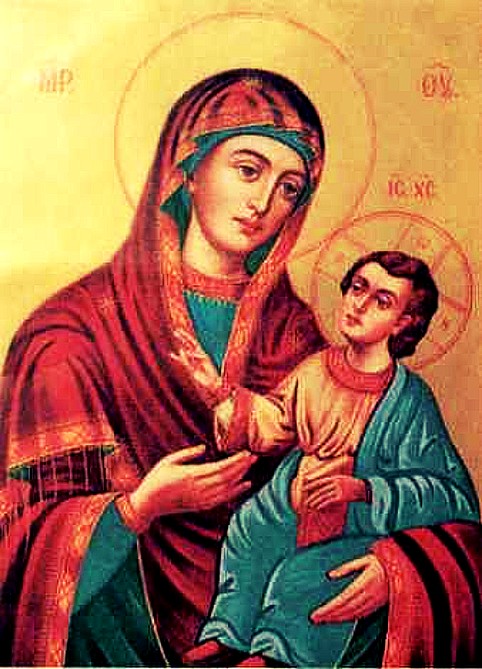
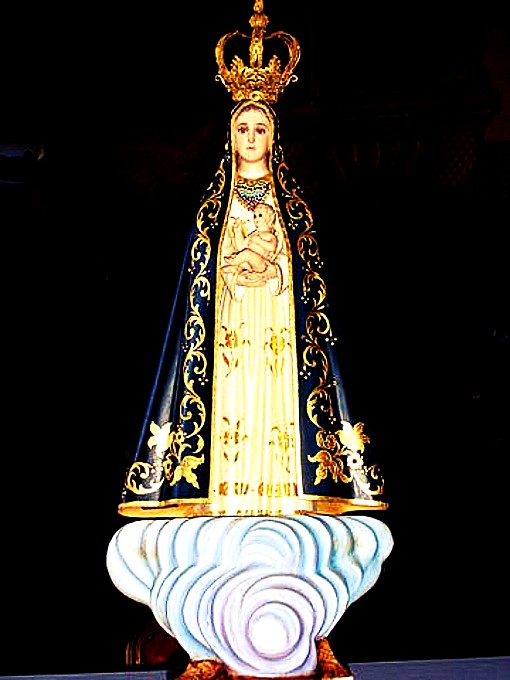
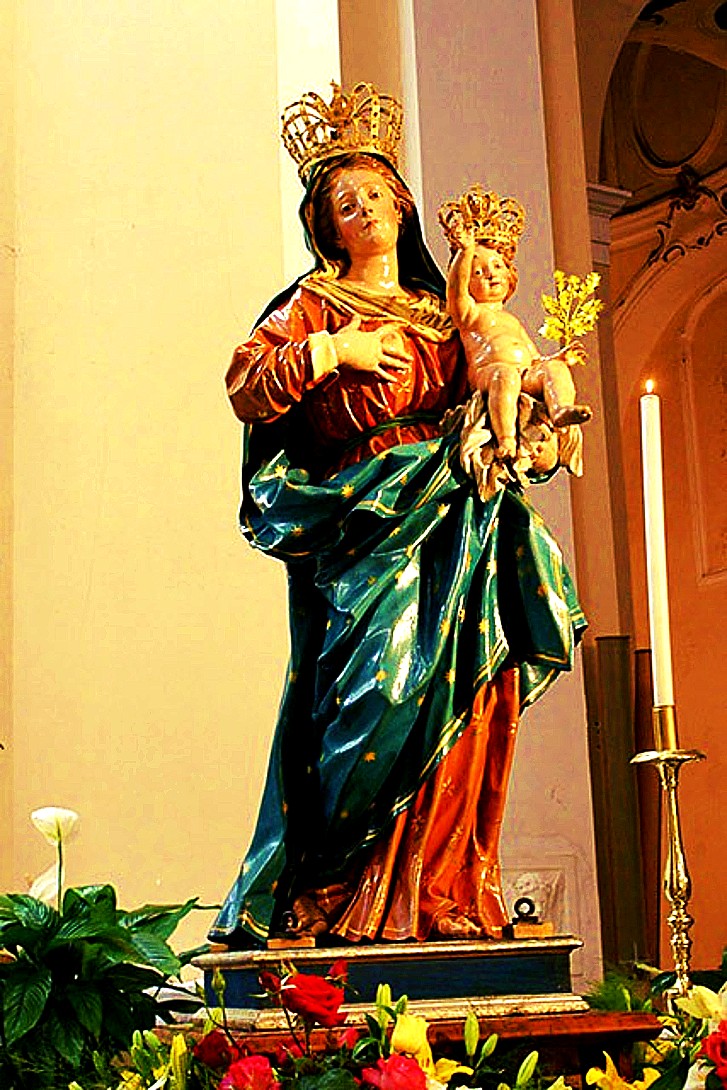
This, I believe, is a Holy Card of the original Statue which was desecrated during the French Revolution

The inhabitants of the Parish flocked to the Church, alerted by the sound of the Church bell, to see the wonder and give thanks to God for this miracle. This was but the beginning of the pilgrimages to the Church that began almost immediately, especially from the Parishes of Paris. These pilgrimages were encouraged by the authorities of the Church, as well as by the example of the many distinguished visitors and the continued occurrences of many other miracles over the following centuries. These miracles included many cures, as well as the miracles of two children who were brought back to life. Kings and Queens were among the many pilgrims who came during the Middle Ages, including King Louis XIII, who came to pray for the capture of Rochelle.
The Archbishop of Paris confirmed the celebration of the festival on the second Tuesday of May, which is the month of Mary. After all these miracles, the Chapel was far too small to contain the influx of pilgrims, in particular the processions coming from Paris to the Basilica that stopped at the miraculous little Chapel on their way.

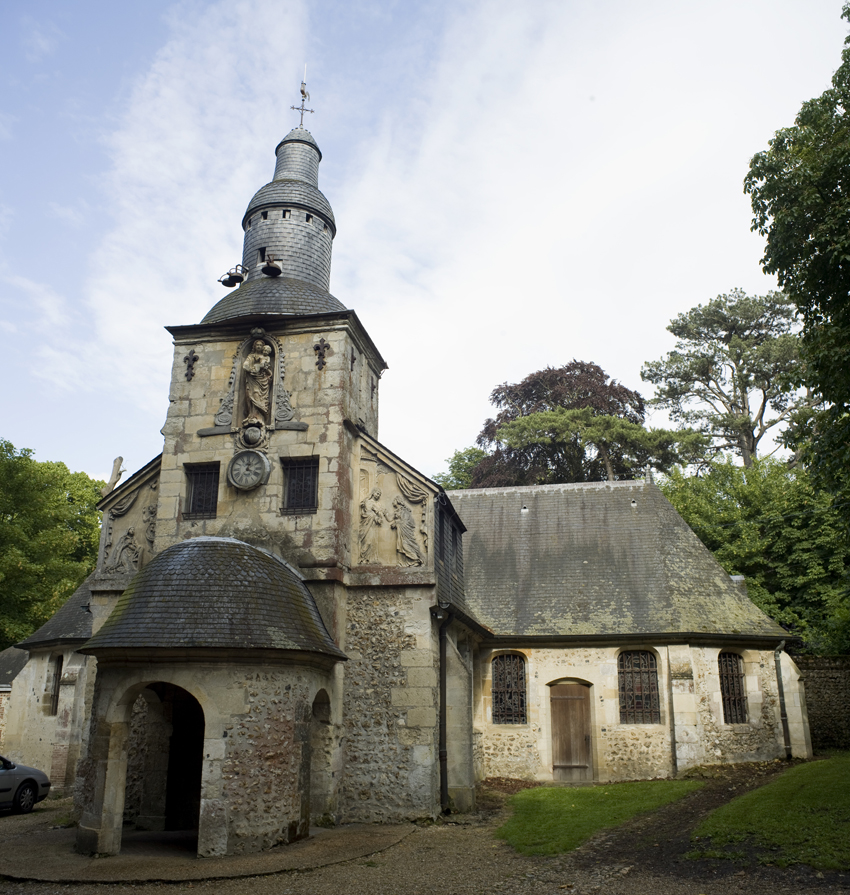
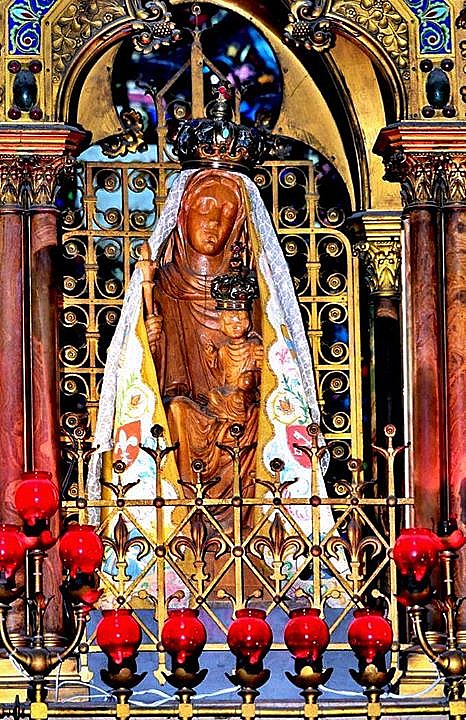
This is our Blessed Lady on the Facade

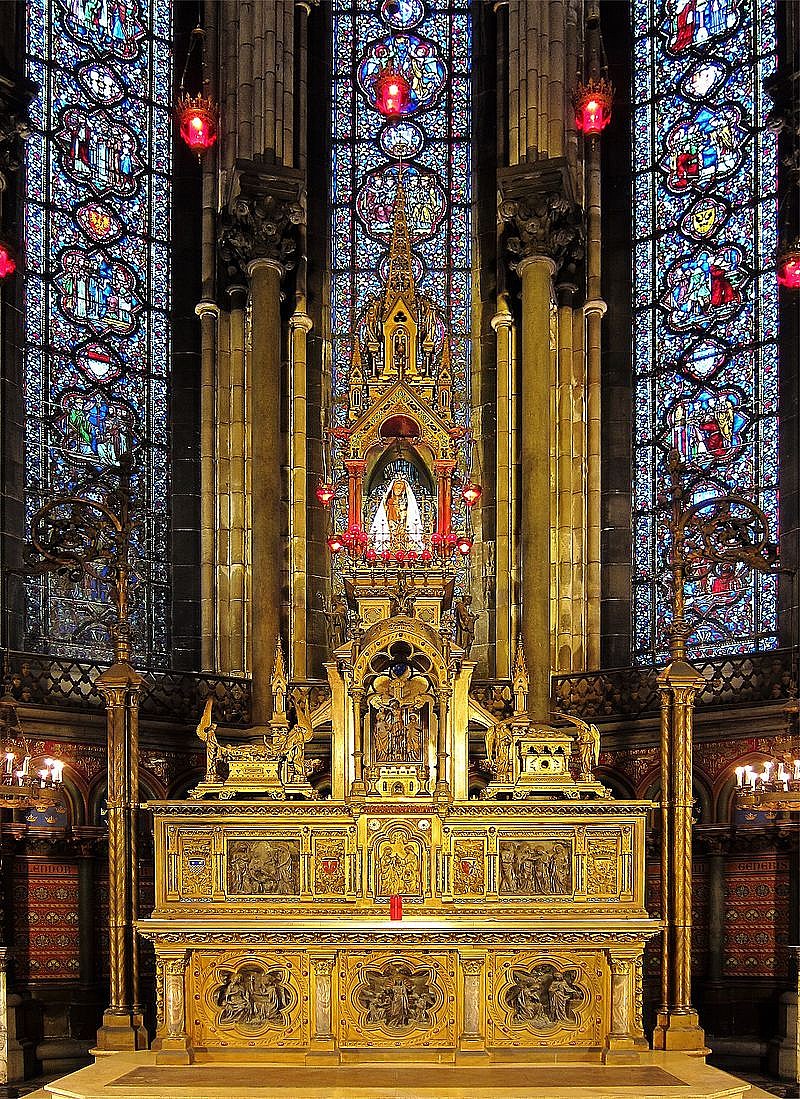
The small Sanctuary was later replaced by a more imposing Church whose construction began in the fifteenth century. Particularly remarkable are the stained glass windows that adorn the Church and remind the visitor of the extraordinary history of this place, for they relate to the many different miracles performed by the Blessed Virgin in the Chapel, of which there were many. Virtually every great Saint is depicted in these windows too – if you wish to see them, although they are not professional photographs, go here: https://www.tripadvisor.com/Attraction_Review-g3347617-d10980848-Reviews-Eglise_Notre_Dame_des_Vertus- There are numerous Statues and Altars of the Blessed Virgin in the Sanctuary, all of them highly venerated by pilgrims.

During the French revolution, in 1789, the Statue of the miraculous Virgin was profaned. It was dragged on the road leading to Saint Denis with a rope around its neck; the Sans-Culottes movement burned it singing the French song “Carmagnole et Ah! Ca ira!” proof of the Satanic roots of the French Revolution. One of her hands was saved from the flames and was preserved.
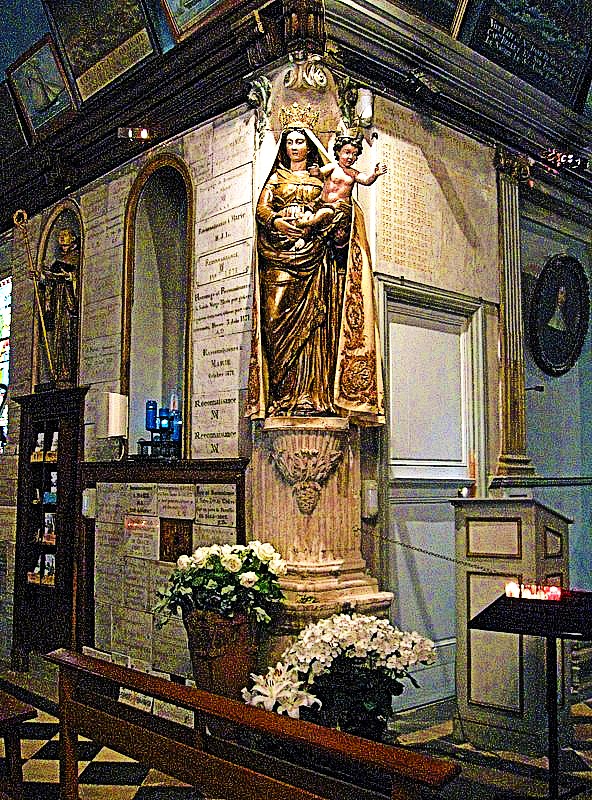
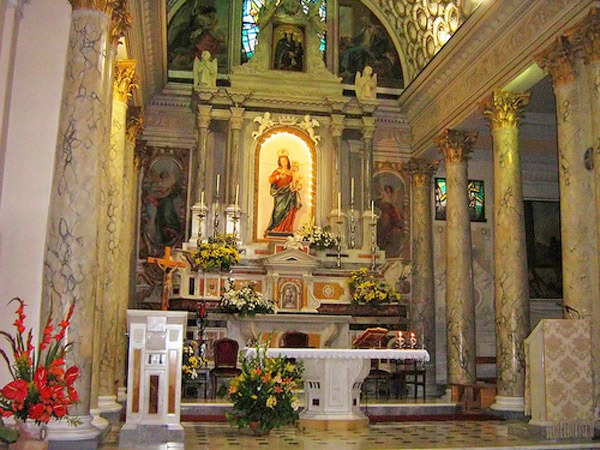
The present Statue of the Virgin, located in the left Chapel, was sculpted in wood by Baffet House in 1873. It is a copy of an ancient Statue found that year in the Chapel Saint-Julien-Le-Pauvre at Hotel-Dieu. It was inserted into a Neo Gothic frame, flanked by two angels holding phylacteries, (a coiled-end speech scroll bearing legends) which recall the miracle in 1582 when the Virgin restored a stillborn child to life.

St Achilleus of Terracina Martyr (Optional Memorial)
AND –
St Nereus of Terracina Martyr (Optional Memorial)
About:
https://anastpaul.wordpress.com/2018/05/12/saints-of-the-day-12-may-sts-nereus-and-achilleus/
Together with St Flavia Domitilla, their mistress and fellow hermit, were Martyred for Christ:
St Flavia here:

https://anastpaul.com/2021/05/07/saint-of-the-day-7-may-saint-flavia-domitilla-of-terracina-1st-century-virgin-and-martyr/

St Pancras of Rome (c 289 – c 303) Martyr Child of 14, Roman Convert (Optional Memorial)
Biography:

https://anastpaul.com/2017/05/12/saint-of-the-day-st-pancras/

St Crispoldus
St Cyril of Galatz
St Dedë Malaj
St Diomma of Kildimo
St Dionysius of Asia
St Dominic de la Calzada
St Ejëll Deda
St Ephrem of Jerusalem

St Epiphanius (c 315 – 403) Bishop of Salamis (Cyprus) known as the Oracle of Palestine, Church Father, Theologian, Confessor, Writer, Defender of the Faith, Monk and Ascetic.
His story:

https://anastpaul.com/2019/05/12/saint-of-the-day-saint-epiphanius-c-315-403-the-oracle-of-palestine/

St Erc Nasca of Tullylish
St Ethelhard of Canterbury
St Euphrosyna of Terracina
Bl Francis Patrizzi of Siena
Bl Gemma of Goriano
St Germanus of Constantinople (c 640-733) Bishop

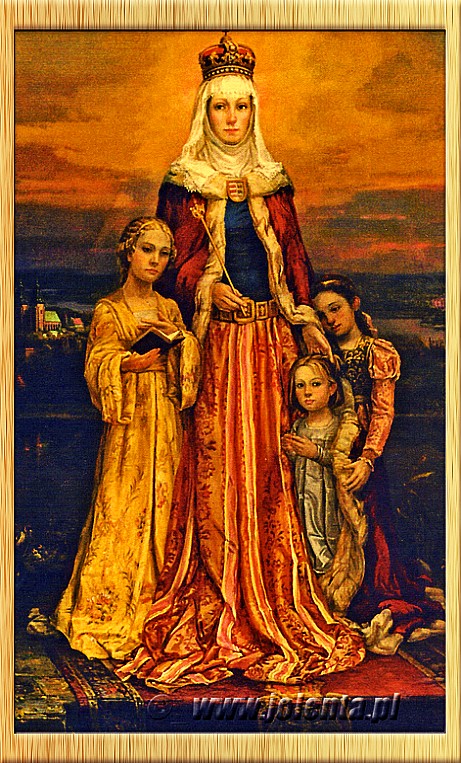
Blessed Joanna of Portugal OP (1452-1490) Religious of the Second Order of St Dominic, Virgin, Princess of Portugal of the House of Aviz, daughter of King Afonso V of Portugal and his first wife Isabella of Coimbra, Penitent.
About Blessed Joanna whom the Portuguese called “Saint Princess Joanna”:

https://anastpaul.com/2020/05/12/saint-of-the-day-12-may-blessed-joanna-of-portugal-1452-1490/

Bl Juan de Segalars
St Lucien Galan

St Maria Domenica Mazzarello

St Modoald of Trier
St Palladius of Rome
St Philip of Agira
St Richrudis of Marchiennes
St Theodora of Terracina
St Thomas Khampheuane Inthirath

Posted in SAINT of the DAY

Saint of the Day – 11 May – Saint Mayeul of Cluny (c 906–994)

Saint of the Day – 11 May – Saint Mayeul of Cluny (c 906–994) Priest, Abbot, the 4th Abbot of Cluny, Reformer., miracle-worker. Born in c 906 in Avignon, France and died in 994 at Souvigny, France en route to Paris, of natural causes. He is also known as Majolus, Maieul, Mayeul, Mayeule.

Mayeul was revered in his own time as a holy man. He spent much time in prayer and solitude, he rebuked sinners, he disliked public praise and high honours but he would do much good in secret, away from the eyes of the public. Whenever he went on a journey, he would have an open book in his hand, which could be either a spiritual or philosophical work, which he would read as he rode. He had great knowledge of the Sacred Scriptures and other subjects but would never offer his knowledge unsolicited. He would only speak when asked his opinion. He always spoke very briefly. He drank a little wine. He was said to be a very gentle and kind person, although strict and unwavering when required.

Mayeul was very active in reforming individual communities of Monks and Canons; first, as a personal commission, requested and authorised by the Emperor or other nobility. Later, he found it more effective to affiliate some of the foundations to the motherhouse at Cluny to lessen the likelihood of later relapse. He travelled widely and was highly regarded as a person of influence, both in Rome and at the Imperial Court. He is buried at the Priory of Souvigny, along with St Odilo, the 5th bbot of Cluny and commemorated individually on 11 May and also on 29 April with four other early Abbots of Cluny.

Mayeul’s father, named “Fulcher,” was from a wealthy provincial family of Avignon. His mother was named Raimodis. They had two sons. Mayeul and Cynricus. It is not known for sure which was the older but traditionally, the younger sons of noble families were given to the Church and the elder sons were made the heirs to the father’s estate, hence because Mayeul became a Monk, it is sometimes assumed he is the younger. Around 916, Mayeul fled his family’s estates near Rietz to stay with relatives at Mâcon due to the feudal wars. Both his parents died during his absence, while he was still very young.

Mayeul studied the liberal arts at Lyon and became Canon and later Archdeacon of Mâcon; his Ordination to the Priesthood was in Mâcon. While there, he gave free lessons to a large body of clerks. He built a small Oratory on the opposite side of the river from the Town, where he would retire for prayer. In personal habits he was always kind, never telling lies, detraction or flattery and he was severe against sinners, if it was necessary to call them to repent. He gained a reputation among the local people as a holy person and so, when Besançon needed a new Bishop, many people, called on him to become their Bishop but he refused.

There was a famine at the time and Mayeul prayed for help for those begging for food. One day as he prayed, seven gold coins appeared in front of him. He was afraid that this was a trick of the devil or that the money was lost and he wouldn’t touch it. But when he discovered the money was real and no-one claimed it, he then used it to buy food for the starving peoples.

He decided then to enter Cluny Abbey, which he had visited previously. Aymard of Cluny was Abbot at the time. Aymard appointed Mayeul “armarius” (book-keeper and master of ceremonies). He was later made librarian. He had read the poems of Virgil and he considered that Monks should not read these works but that the Sacred Scriptures alone was enough for them. He was very strict in the discipline he applied to new monks.

He was sent with a fellow monk from Cluny to Rome, on one occasion and on the return journey his companion became sick. Mayeul waited by the suffering Monk for three days with much anxiety and on the third night, he dreamed that he saw a white-haired old man who said ‘Why art thou cast down in idle grief? Hast thou forgotten what my brother James orders for the sick?’ He awoke and realised, that the dream was referring to the Sacrament of Extreme Unction mentioned in the letter of James (5:14-15). He then anointed his brother-monk with the holy oil. The sick Monk then started to recover from his illness. This miracle was then told at Cluny and the Monks held Mayeul in veneration.

Around 948, Mayeul became co-adjutor to Abbot Aymard. Aymard became blind and he resigned his Abbacy, recommending that the Monks choose to elect a new Abbot and suggested they choose Mayeul but he refused. However, Mayeul again had a dream in which St Benedict appeared to him and told him to accept the responsibility of the office and that the Sacred book would be his guide. The next day, Mayeul addressed the Monks and said, “Now in Him who is able to smooth over rough places, to raise up heavy burdens and to overthrow the adversary, I place my hope and submit myself to your unchanged command.” Mayeul became Abbot about the year 954.

The construction of Cluny II, c 955–981, begun after the destructive Hungarian raids of 953,. The replacement Abbey Church of Cluny II was consecrated in 981. The relics of Peter and Paul were taken from Rome to Cluny during Mayeul’s Abbacy. Under him, a network of Monasteries dependent on Cluny’s leadership, began to develop and would continue under his successors Odilo and Hugh.
Statue of St Mayeul at Souvigny Monastery

Mayeul was graced by God with miracles during his lifetime and after his death. He cured the sick, restored sight to the blind, healed those bitten by serpents, dogs or wolves, he also miraculously rescued people from death by drowning or fire. Among the stories of miracles attributed to him, the following are here related:

Once when Mayeul was returning from Aquitaine, he decided to visit a Monastery along the way and sent a messenger ahead of him to say he was on his way. The Monks of this Monastery were happy that he was coming but the purveyor felt concerned because they had run out of fish. However, he asked the Monks to go down to the river and call on God by the name of Mayeul and when they did, they caught an enormously large salmon.
The water that Mayeul used to wash his hands was said to have miraculous powers. Once in Vallavaense a blind beggar caught hold of Mayeul’s bridle as he was leaving the Town and begged him to bless water in a jar he had brought. Mayeul was moved by this show of faith and so he blessed the water. The beggar then washed his eyes with the water and received his sight.

After his death several pilgrims, when returning from his tomb, reached the Loire river and they could not cross it because the boat was on the other side. Tthe boatman refused to come over for them. They called on Mayeul to intercede for them and the boat crossed over by itself to them and took them, without being rowed, to the other side.

A woman who brought her dead child to Mayeul’s tomb in Souvigny where she placed the child’s body in front of the altar, where it remained the whole night. At nine o’clock in the morning, the eyes of the boy opened and the boy called for his mother.

Mayeul lived to the old age of 84. Two years before he died, he gave up the Abbacy and made Odilo his co-adjutor, just as Aymard had done with him about 50 earlier. He retired to one of the smaller Cluniac houses where he devoted time to serving the brothers there by instruction, correction and inspiration. He continued to work even into his old age and he died on his way to reform Saint-Denis in Paris. He did not get far and stopped at Souvigny Priory, where he died and was buried. After he died, the Monks at Cluny wanted to bring him to Cluny but the Monks at Sovigny protested and insisted that he remain there. The tomb of St Majolus became the focus of pilgrimages and miracles.

Tombs of Sts Mayeul and Odilo, Souvigny
Posted in MARIAN TITLES, SAINT of the DAY

Madonna dello Scoglio / Madonna of the Rock, Placanica, Reggio Calabria, Calabria, Italy – and Memorials of the Saints – 11 May

Monday of the Sixth week of Easter

Madonna dello Scoglio / Madonna of the Rock, Placanica, Reggio Calabria, Calabria, Italy (mid 1900s) – 11 May:

Fratel Cosimo Fragomeni was born in 1950 in Santa Domenica di Placanica, a village of Calabria, one of the poorest regions in Italy. From an early age he was a committed Roman Catholic and when he was 18, he reported to the village priest, Don Rocco Gregorace, having had four visions in which the Mother of God, standing on a rock (scoglio), appeared to him. The first of these visions took place on the 11th May 1968. The Virgin Mary asked Cosimo to transform the valley into a Shrine in order to bring people closer to God.

For that reason, on the rock of the apparition, Cosimo built a little Chapel,and called the Shrine “Madonna dello Scoglio” (Our Lady of The Rock) because the Virgin Mary appeared to him on the top of the rock. He also placed a marble Statue of Our Lady on the rock of the apparitions. Pilgrims come from all over the world to pray and touch the sacred rock, through the metal fencing that circumscribes it, testifying great miracles and conversions.

Shortly after the apparitions of the Virgin Mary, Cosimo began to lead prayer devotions for pilgrims and many people were cured from diseases. Although he had received little formal education, he was admitted to the lay order of the Franciscan brothers with the name of “Fratel Cosimo.” He led a mystical life, living in solitude in a house near the apparition rock, fasting and praying and avoiding any sense of celebrity.

Fratel Cosimo was a man of God, appreciated by his Bishop for his obedience and humility to the Catholic Church. He emphasised prayer as the primary vehicle for opening oneself to God and for receiving spiritual and physical renewal through the Divine Physician and His Holy Mother.
Thanks to the donations of the pilgrims, the Shrine grounds and facilities have been expanded. A foundation and a rosary prayer group have been established and on the 8th December 2007, the local Bishop Mnsgr Morosini, declared the “Scoglio” an official Catholic shrine.

St Anastasius of Lérida
St Anthimus of Rome
St Bassus of Sabina
St Bertilla
St Criotan of MacReddin
Bl Diego of Saldaña
St Evellius of Pisa
St Fabius of Sabina
St Fremund of Dunstable
St Gengulphus of Burgundy

Blessed Gregory Celli of Verucchio OSA (1225-1343) Priest of the Order of St Augustine , renowned Preacher, Contemplative, Hermit
His Life:

https://anastpaul.com/2020/05/11/saint-of-the-day-11-may-blessed-gregory-celli-of-verucchio-osa-c-1225-1343/

St Gualberto

St Ignatius of Laconi OFM Cap. (1701-1781) Frair of the Order of Friars Minor Capuchin. Known as “the Holy Friar,” “the Apostle of the Streets, “ “the Wonder-worker,” “the Miracle-Worker” and “Padre Santo.”
Biography:

https://anastpaul.wordpress.com/2018/05/11/saint-of-the-day-11-may-st-ignatius-of-laconi-o-f-m-cap-1701-1781/

Bl Illuminatus
St Illuminatus of San Severino
Bl James Walworth
Bl John Rochester
St Maiulo of Hadrumetum

St Mamertus (Died c 477) Bishop
His Life:
https://anastpaul.com/2019/05/11/saint-of-the-day-11-may-st-mamertus-died-c-475/

St Maximus of Sabina
St Mayeul of Cluny (c 906–994) Priest and Abbot
St Mozio of Constantinople
St Possessor of Verdun
St Principia of Rome
St Tudy
St Vincent L’Hénoret
Bl Vivaldus
St Walbert of Hainault

Martyrs of Camerino: An imperial Roman official, his wife, their children and servants, all of whom were converts and martyrs: Anastasius, Aradius, Callisto, Eufemia, Evodius, Felice, Primitiva, Theopista.

Posted in EYES - Diseases, of the BLIND, SAINT of the DAY

Saint of the Day – 10 May – Saint Catald of Taranto (Died c 685)

Saint of the Day – 10 May – Saint Catald of Taranto (Died c 685) Bishop, Monk, miracle-worker. Born in the 7th century Munster, Ireland and died in c. 85 in Taranto, Italy of natural causes. Also known as – Catald of Tarentum, Catald of Rachau, Cataldus, Cathal, Cattaldo, Cathaluds, Cathaldus, Cataldo. Patronages – against blindness, against drought, against epilepsy, against hernias, against paralysis, against plague, against storms, blind people, drought relief, epileptics, paralyzed people, Massa Lubrense, Italy, Taranto, Italy.

Born in Munster, Ireland, Catald was a pupil, then the headmaster of the monastic school of Lismore in Waterford, after the death of its founder, St Carthage.

Upon his return from a pilgrimage to the Holy Land, he was shipwrecked at Taranto in southern Italy and ,chosen by the people as their Bishop and then Archbishop of the Diocese.

Some of the miracles claimed in Catald’s name include protecting the City against the plague and floods that, apparently, had occurred in neighbouring areas.

He is the titular of Taranto’s Cathedral and the principal Patron of the Diocese. This epitaph is given under an image of Saint Catald in Rome:

Statue of Saint Catald at Taranto

Me tulit Hiberne, Solyme traxere,
Tarentum Nunc tenet: huic ritus,
dogmata, jura dedi.

This has been loosely translated as:
Hibernia gave me birth,
thence wafted over,
I sought the sacred Solymean shore.
To thee Tarentum, holy rites I gave, Precepts divine
and thou to me a grave.
(Hibernia is the classical Latin name for Ireland).

It is odd that an Irishman, should be so honoured throughout Italy, Malta,and France but have almost no recognition in his homeland. His Irish origins were discovered only two or three centuries after his death, when his relics were recovered during the renovation of the Cathedral of Taranto. When his coffin was open at that time, a pastoral staff of Irish workmanship was found with the inscription Cathaldus Rachau. Further investigations identified him with Cathal, the teacher of Lismore.

Veneration to Catald spread, especially in southern Italy, after the 10 May 1017, translation of his relics when the Cathedral was being rebuilt, following its destruction at the hands of Saracens in 927. Four remarkable cures occurred as the relics were moved to the new Cathedral. There is a Town of San Cataldo in Sicily and another on the southeast coast of Italy .

Cathedral of St Catald in Taranto, Italy

Saint Catald is depicted in art as an early Christian Bishop with a mitre and pallium in a 12th century mosaic at Palermo (Roeder). He is the subject of a painting on the 8th pillar of the nave ,on the left in the Basilica of the Nativity in Bethlehem There are also 12th-century mosaics in Palermo and Monreale depicting the Saint.

Posted in MARIAN TITLES, SAINT of the DAY

Madonna della Rovere, Roble San Bartolomeo al Mare, Italy and Memorials of the Saints – 10 May

Monday of the Sixth Week of Easter +2021

Madonna della Rovere, Roble San Bartolomeo al Mare, Italy (1671) – 19 May (Additional Memorial 18 April):

“The Madonna della Rovere is an ancient devotion from an image that was found in a village called Oak. There were two apparitions of the Virgin Mary and several miracles in the seventeenth century.
San Bartolomeo al Mare is a Town in the Province of Imperia, Liguria region in northwest Italy. The ancient and vast territory in the medieval village of Oak is located between the Towns of Cervo and Diano. In the pre-Roman era it was called “Lucus Bormani” where “Lucus” means “sacred forest,”,”Bor” to “source” and “man,” whereby the “Lucus Bormani” means “ sacred grove dedicated to the god Borman “the god of springs, cruel and bloodthirsty. The Romans also devoted to the jungle forests, Diana, goddess of the hunt, so the Town of Diano called “Pagus Dianius”.
The five oak trees that still surround the Shrine of Robre are the last remnants of the ancient forest. It is said that the Statue was found in an oak but perhaps more true is that the Statue was made of oak timber.

Perato Giacinto di Rollo, aged 50, on the night of 3 April 1671, after working all day in the fields, called his wife, saying his arm was hurt. The left arm was dead, insensible to pinching and medical punctures. After several attempts at restoring his arm, it remained insensitive.
A few days later, on 18 April, with his arm in a sling, Perato took his donkey to graze in the area of the Town of Armea. Below is his miraculous tale:
“A few hours before noon, a few steps ahead of me, I saw a woman dressed in turquoise shining like the sun … She told me that I should trust the Madonna to help me . “

On 19 April 1671, Giacinto, riding on his donkey, went to the Shrine of Our Lady of the Oak, with his wife and Don Damián Tagliaferro.
During the Mass, at the moment of Consecration, his eyes glazed over and he fell to the ground unconscious. When after three quarters of an hour he awoke and with the support of his wife, rose slowly, his arm functioned again. He was completely healed. This miracle has been recorded under oath by seven people, including a doctor, a lawyer and six priests. The documents are stored in the Curia of the Diocese of Albenga.

On 10 May 1671 Our Lady appeared to cure a peasant and asked him to build a Chapel in the place where she had appeared. The Church was built immediately, the faithful and clergy of the surrounding areas all being piously devoted to Our Lady.” (The above has been translated from Italian).

St John of Avila (1499-1569) “Apostle of Andalusia”– Doctor of the Church, known as “Father Master Avila”
About St John:

https://anastpaul.wordpress.com/2018/05/10/saint-of-the-day-10-may-st-john-of-avila-1499-1569-apostle-of-andalusia-known-as-father-master-avila-doctor-of-the-church/

St Joseph de Veuster SS.CC. (1840-1889) – St Damian of Molokai “The Martyr of Molokai,” Priest of the Congregation of the Sacred Hearts of Jesus and Mary, Missionary – known as “Martyr of Molokai”, “Martyr of Charity”, “Apostle to the Lepers” – Patron of lepers. (Optional Memorial)
St Damian’s life:

https://anastpaul.wordpress.com/2017/05/10/10-may-the-memorial-of-st-damian-de-veuster-de-molokai/

Robert Louis Stevenson and St Damian: https://anastpaul.wordpress.com/2017/05/10/blessed-memorial-of-s-damian-de-veuster-de-molokai/

St Alphius of Lentini
Bl Amalarius of Metz
Bl Antonio of Norcia
St Aurelian of Limoges
Bl Beatrix d’Este the Elder
St Blanda of Rome
St Calepodius of Rome
St Catald of Taranto (Died c 685) Bishop
St Comgall of Bangor
St Cyrinus of Lentini
St Dioscorides of Smyrna

Blessed Enrico Rebuschini MI (1860-1938) Priest of the Camillians [Clerics Regular, Ministers to the Sick, also known as the “Hospitallers” the Order founded by St Camillus de Lellis’ (1550-1614)]
His Story:

https://anastpaul.com/2020/05/10/saint-of-the-day-10-may-blessed-enrico-rebuschini-mi-1860-1938/
(The video shows great images of Italy).

St Epimachus of Rome
St Felix of Rome
Bl Giusto Santgelp
St Gordian the Judge

Blessed Ivan Merz MI (1896-1928) Layman, Teacher, Professor, Apostle of the Blessed Sacrament and of prayer, Founder of Youth Movements in Croatia
Biography:

https://anastpaul.com/2019/05/10/saint-of-the-day-10-may-blessed-ivan-merz-1896-1928/

Bl Nicholas Albergati
St Palmatius of Rome
St Philadelphus of Lentini
St Quartus of Capua
St Quintus of Capua
St Simplicius of Rome
St Solange of Bourges
St Thecla
Bl William of Pontnoise

Posted in SAINT of the DAY

Saint of the Day – 9 May – Blessed Thomas Pickering OSB (c 1621-1679) Martyr

Saint of the Day – 9 May – Blessed Thomas Pickering OSB (c 1621-1679) Martyr, Benedictine Lay Brother. bBorn in c 1621 in Westmorland, England and died by being hanged, drawn and quartered on 9 May 1679 at Tyburn, London, England. He was one of the 107 martyrs Beatified by Pope Pius XI on 15 December 1929 and is, therefore, remembered with them all on 4 May. In character, he was described, as the most charitable and sweet-tempered of men.

Thomas was a member of an old Westmoreland family. He was sent to the Benedictine Monastery of St Gregory at Douai, where he took vows as a lay brother in 1660.

In 1665 he was sent to London, where, as steward or procurator to the little community of Benedictines who served the Queen’s Chapel Royal, Catherine of Braganza, the Catholic wife of King Charles II. Thomas became personally known to the Queen and Charles II and when in 1675, urged by the Parliament, Charles issued a proclamation ordering the Benedictines to leave England within a fixed time, Pickering was allowed to remain, probably on the grounds that he was not a Priest.

In 1678 came the infernal concocted fabricaltion of Titus Oates, claims of a Catholic plot against the King’s life. In consequence, Thomas was accused of conspiring to murder the King. At his trial on 17 December 1678, no evidence of treasonwas produced except Oates’s mere word and Pickering’s Housekeeper, the formidable Ellen Rigby, testified that Oates had only seen Pickering once in his life, when he had been begging for alms at the Benedictine’s London house in the summer of 1678. She also testified that he had a personal grudge against Pickering, who, despite his habitual charity and good temper, told her “never to let that man come in again.” Pickering’s innocence was so obvious, that the Queen publicly announced her belief in him, saying that she could not accept that he was a risk to the royal family: “I should have more fear to be alone in my chamber with a mouse.” But, the jury found him guilty and with two others, William Ireland and John Grove, he was condemned to be hanged, drawn and quartered.

The King, who himself had Catholic leanings, was divided between the wish to save the innocent men and fear of the popular clamour, which loudly demanded the death of Oates’s victims and twice, within a month, the three prisoners were ordered for execution and then reprieved.

At length Charles remitted the execution of the other two, hoping that this would satisfy the people and save Pickering from his fate. The contrary took place, however and on 26 April 1679, the House of Commons petitioned for Pickering’s execution. Charles yielded and the long-deferred sentence was carried out on the ninth of May.

A small piece of cloth stained with his blood is preserved among the relics at Downside Abbey.

Posted in MARIAN TITLES, SAINT of the DAY

Madonna del Bosco / Our Lady of the Woods, Imbersago, Como, Lombardia, Italy (1617) and Memorials of the Saints

Saturday of the Fifth Week of Easter +2021

Madonna del Bosco / Our Lady of the Woods, Imbersago, Como, Lombardy, Italy (1617) – 9 May:

On 8 May 1617, three shepherds, one named Peter, saw the Madonna near a large tree, a chestnut tree to be exact. They reported that the apparition rose up and disappeared into the sky.
They were believed immediately as that particular and only chestnut tree, was found full of fruit out of its normal season. In 1632 at the site, visited by the Virgin, a Chapel was erected, then replaced with a large and most beautiful Church in 1677., which has since been raised to the status of a Minor Basilica. In it we honor what is called the Madonna del Bosco (The Our Lady of the Woods).u
Two years before this apparition, some had seen, in the same place, a lady bathed in light hovering on top of those chestnut trees and heard beautiful songs coming from the spot. Many other miracles occured here, the most well-known being that of a mother whose child was being attacked by wolves, which were very prevalent in the area. She called to the Virgin, who appeared and saved the child from the wolf-attack. The Statue within the Sanctuary commemorates these miracle.s

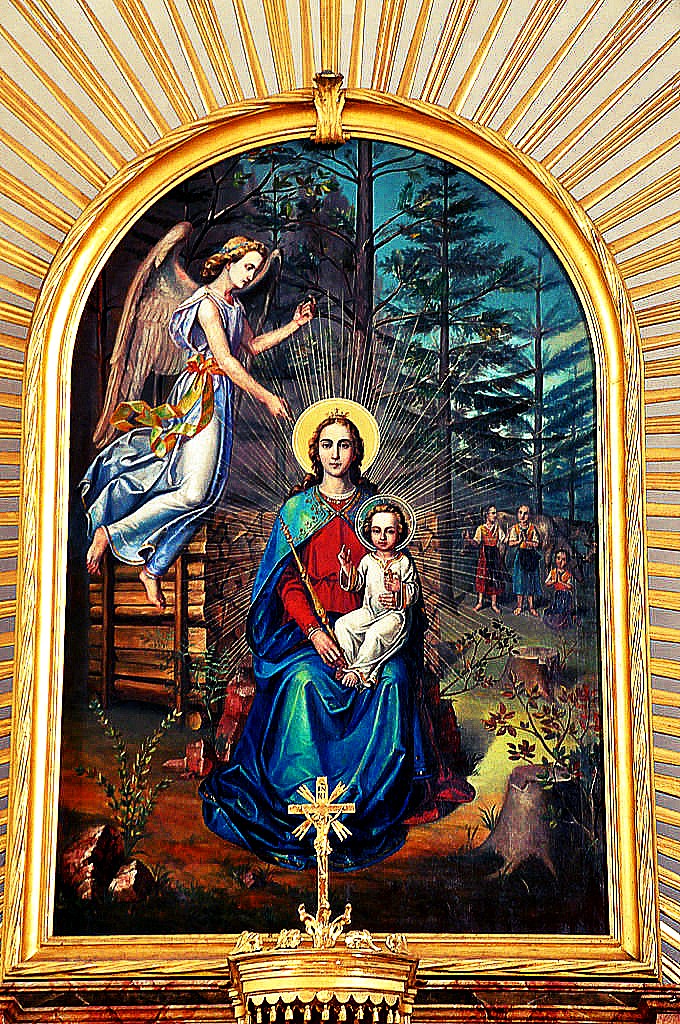
The main Altarpiece is a depiction of the Madonna and Child above a grove of Chestnut trees (1888).

The Sanctuary can be accessed via the 392 steps of the Scala Santa. Most are linear steps until the end with a scenic sweep of two accesses.

St Banban the Wise
St Beatus of Laon
St Beatus of Lungern
St Brynoth of Scara
St Dionysius of Vienne
Bl Fortis Gabrielli
St Gerontius of Cervia

Blessed Giovanni Benincasa of Montepulciano OSM (1375-1426) Religious Friar of the Servite Order, Hermit, Mystic, Penitent
Biography:

https://anastpaul.com/2020/05/09/saint-of-the-day-9-may-blessed-giovanni-benincasa-of-montepulciano-osm-1375-1426/

St Giuse Hien
St Gorfor of Llanover

St Gregory Nazianzen (330-390) Father, Doctor, Theologian
His Feast has since 1960, been conbined with that of St Basil the Great – “Two Bodies one Spirit” on 2 January.
Their lives here:

https://anastpaul.com/2019/01/02/saint-s-of-the-day-2-january-st-basil-the-great-329-379-and-st-gregory-of-nazianzen-330-390-two-bodies-one-spirit/

St Gregory of Ostia
St Hermas of Rome
Isaiah the Prophet
St John of Châlon

Blessed Theresa of Jesus/Karolina Gerhardinger SSND (1797-1879) Religious Sister, Foundress
Biography:

https://anastpaul.wordpress.com/2018/05/09/saint-of-the-day-9-may-blessed-theresa-of-jesus-karolina-gerhardinger-1797-1879/

St Maria del Carmen Rendiles Martinez (1903-1977) Religious and Foundress of the Servants of the Eucharist
Biography:

https://anastpaul.com/2019/05/09/saint-of-the-day-9-may-blessed-maria-carmen-rendiles-1903-1977/
St Sanctan of Kill-da-Les

Blessed Thomas Pickering (c 1621-1679) Martyr, Benedictine Lay Brother

St Vincent of Montes

Martyrs of Persia: 310 Christians murdered together for their faith in Persia. No details about them have survived.

20 Mercedarian Martyrs of Riscala: 20 Mercedarian friars who were murdered by Huguenot heretics for refusing to denounce their faith. 16th century at the Santa Maria convent at Riscala, France.

Posted in SAINT of the DAY

Saint of the Day – 8 May – Saint Pope Boniface IV (c 550-615)

Saint of the Day – 8 May – Saint Pope Boniface IV (c 550-615) Bishop of Rome from 608 until his death, Deacon, Assistant and dDsciple of St Pope Gregory the Great, Papal Treasurer under Pope Gregory. Born c 550 at Valeria, Abruzzi, Italy and died in 615 at Rome, Italy of natural causes.

Boniface was the son of a man named Johannes, a Physician, from the area of Maria and town of Valeria. It is assumed that he was a student of Pope Gregory I. Around 591, Boniface was ordained a Cardinal-Deacon. Under that office, he served Gregory as treasurer . In other words, he was the first official in connection with the administration of papal property.

Boniface IV was elected to succeed Boniface III but a vacancy of over nine months ensued, awaiting imperial confirmation from Constantinople. He was consecrated on 25 September 608.

Like his mentor, he ran the Lateran Palace as a Monastery. As Pope, he encouraged Monasticism. With imperial permission, he converted the Pantheon into a Church. This was the first pagan temple in Rome to be transformed. On 13 May 609, the Pantheon was consecrated to the Blessed Virgin and all the Christian Martyrs. Boniface ordered 28 cartloads of bones from the Catacombs to be reburied under the high Altar of the new Church.

In 610, St Mellitus, the first Bishop of London, went to Rome “to consult the pope on important matters relative to the newly established English Church.” While in Rome, he assisted at a Synod concerning certain questions on “the life and monastic peace of monks” and, on his departure, took to England the Decree of the Council together with letters from the Pope to Archbishop Laurence of Canterbury and to all the clergy, to King Æthelberht of Kent and to all the Anglo-Saxons.

Inspired by Gregory the Great, he converted his home into a Monastery and divided his time between the Monk’s life and the Papal life until he died. He was buried at his Monastery and reburied several times, the last time at the new St Peter’s Basilica on 21 October 1603.

Posted in MARIAN TITLES, MIRACLES, SAINT of the DAY

Apparition of St Michael the Archangel at Monte Gargano, Italy (492), Nuestra Señora de Luján, Argentina / Our Lady of Luján: (1600s) and Memorials of the Saints – 8 May 2021

Apparition of St Michael the Archangel at Monte Gargano, Italy (492)
About this Apparition:

https://anastpaul.wordpress.com/2018/05/08/saint-of-the-day-8-may-apparition-of-michael-the-archangel-at-monte-gargano-italy-492/

Nuestra Señora de Luján, Argentina / Our Lady of Luján: (1600s) – 8 May:

The Virgin is a two feet tall terracotta Statue of Our Lady. It was made in Brazil and sent to Argentina in May 1630. Its original appearance seemed inspired by Murillo’s Immaculates. In 1887, to preserve and protect it, the image was given a solid silver covering.
It is usually clothed with a white robe and sky blue cloak, the colours of the Argentinian flag. Only the dark oval face with big blue eyes and the hands folded in prayer are now visible.
Tradition tells us that a settler ordered the image of Mary Immaculate in 1630 because he intended to create a Shrine in her honour to help reinvigorate the Catholic faith in Santiago del Estero, his region. After embarking from the Port of Buenos Aires, the caravan carrying the image stopped at the residence of Don Rosendo Oramas, located in the present town of Zelaya.
When the caravan wanted to resume the journey, the oxen refused to move. Once the crate containing the image were removed, the animals started to move again. Given the evidence of a miracle, people believed the Virgin wished to remain there. The image was venerated in a primitive Chapel for 40 years. Then the image was acquired by Ana de Matos and carried to Luján, where it currently resides. A Basilica was built in its honour, where the image now resides above the high Altar.

Among the Popes who have honoured Our Lady of Luján are Clement XI, Clement XIV, Pius VI, Pius IX, Leo XIII, Pius XI, Pius XII, and John Paul II. In 1824, Fr John Mastai Ferretti, visited the Shrine on his way to Chile. He later became Blessed Pope Pius IX and defined the dogma of the Immaculate Conception on 8 December 1854.
Cardinal Eugenio Pacelli served as the Papal Legate to the XXXII International Eucharistic Congress ,held in Buenos Aires in October 1934 and visited the Basilica on 15 October. When he became Pope Pius XII, he made a radio address to the pilgrims in Luján on the occasion of the First Marian Congress in Argentina in 1947.
In 1982, during the Falklands War, John Paul II became the first Pope to visit Our Lady of Luján. During this visit the Pope celebrated an outdoor Mass in the square of the Basilica of Our Lady of Luján and bestowed upon her the Golden Rose. Both in his homily of 11 June and his Angelus back in Rome reflecting on the trip, he commented on Our Lady’s never failing maternal solicitude for the faithful in times of distress. On 11 June 1982, John Paul II personally bestowed a Papal Golden Rose on Our Lady of Luján.

St Acacius of Byzantium
Bl Aloysius Luis Rabata
St Amatus Ronconi
Bl Angelo of Massaccio
St Arsenio of Mount Scete
St Benedict II, Pope
St Boniface IV, Pope (c 550-615) Bishop of Rome fro 608 until his death

Bl essed Clara Fey (1815-1894) Religious Sister and Founder of the Sisters of the Poor Child Jesus.
Her Life:

https://anastpaul.com/2019/05/08/saint-of-the-day-8-may-blessed-clara-fey-1815-1894/

St Desideratus of Bourges
Bl Domenico di San Pietro
St Gibrian
St Helladius of Auxerre

Blessed Henri Vergès FMS (1930-1994) Martyr, Religious Brother of the Order of Marist Brothers, Teacher, Missionary, one of the Nineteen Martyrs of Algeria
His Life and Death:

https://anastpaul.com/2020/05/08/saint-of-the-day-8-may-blessed-henri-verges-fms-1930-1994-martyr/

St Ida of Nivelles
St Martin of Saujon
St Metrone of Verona
St Odrian of Waterford
St Otger of Utrecht
St Peter of Besançon
Bl Pietro de Alos
Bl Raymond of Toulouse
Bl Teresa Demjanovich
Bl Ulrika Fransiska Nisch
St Victor Maurus
St Wiro of Utrecht

Posted in SAINT of the DAY

Saint of the Day – 7 May – Saint Flavia Domitilla of Terracina (1st Century) Virgin and Martyr

Saint of the Day – 7 May – Saint Flavia Domitilla of Terracina (1st Century) Virgin and Martyr.

The Roman Martyrology states of her today: “At Terracina, in Campania, the birthday of blessed Flavia Domitilla, Virgin and Martyr, niece of the Consul Flavius Clemens. She received the religious veil at the hands of St Clement and in the persecution of Domitian, was exiled with many others to the island of Pontia, where she endured a long Martyrdom for Christ. Taken afterwards to Terracina, she converted many to the faith of Christ by her teaching and miracles. The judge ordered the chamber in which she was, with the virgins Euphrosina and Theodora, to be set on fire and she thus consummated her glorious Martyrdom. She is also mentioned with the holy Martyrs Nereus and Achilleus, on the 12th of this month.”

Sts Euphrosina and Theodora with St Flavia in the centre

Flavia was niece to the consul and Martyr St Flavius Clemens, being the daughter of his sister as Eusebius testifies; “consequently she was little niece of the Emperor Domitian, who, having put to death her illustrious uncle, banished her for her faith into Pontia. There she lived with her holy eunuchs, Nereus and Achilleus, in exercises of devotion, they all dwelling in separate cells which remained standing three hundred years after. “

Sts Nereus and Achilleus with St Flavia

St.Jerome tells us, that St Paula, going from Rome to Jerusalem, took this is and in her way, visited them with respect and devotion,and, by the sight of them, was animated with fervour. That holy Father , St Jerome, calls her banishment ,a long Martyrdom.

The acts of Sts Nereus and Achilleu say ,that she returned to Terracina and was there burnt under Trajan because she refused to sacrifice to idols. Her relics are kept together with those of Sts Nereus and Achilleus; who, though her servants here on earth, enjoy an equal honour and condition with her, in glory.

This royal virgin found true happiness and joy in suffering for virtue, whilst worldly pomp and honours are only masks which often cover the basest slavery,and much inward bitterness. Sinners who seem the most fortunate in the eyes of the world, feel in their own breasts, frequent returns of fear, anxiety and remorse. They are only enemies to solitude and retirement and, to all serious and calm reflection because they cannot bear to look into themselves and tremble at the very sight of their own frightful wounds. To turn their eyes from themselves, they study to drown their faculties in a hurry of dissipation, business, or diversion. Nay, though nauseated and tired with a dull and tasteless repetition of follies, they choose to repeat them still, for fear of being left alone, at liberty to think of themselves. But what becomes of them when sickness, disasters, or a wakeful hour forces them to take a view of their own miserable state and the dangers which hang over them? Their gaudy show of happiness is merely exterior and only imposes upon others but their pangs and agonies, are interior, these they themselves feel.

The servant of God, who in his sweet love enjoys an inward peace and comfort which the whole world cannot rob him of, carries his paradise within his own breast, whatever storms hover about him. – Fr Alban Butler (1711–1773).

Posted in SAINT of the DAY

Apparition of the Holy Cross over Jerusalem and Memorials of the Saints – 7 May

Friday of the Fifth Week of Easter +2021

Apparition of the Holy Cross over Jerusalem: Commemorates the appearance on 7 May 351, Pentecost that year, of a luminous image of the Holy Cross in Jerusalem. It stretched from Mount Golgotha to the Mount of Olives (about two miles / three kilometers), was brighter than the sun, lasted several hours and was seen by the entire City. It led to many conversions and was reported in a letter attributed to Saint Cyril of Jerusalem.

St Abba

St Agostino Roscelli ( 1818–1902) Priest, Founder of the Institute of Sisters of the Immaculata
Biography:

https://anastpaul.com/2019/05/07/saint-of-the-day-7-may-st-agostino-roscelli-1818-1902/

Blessed Alberto of Bergamo OP (1214-1279) Layman, Widow, Apostle of Charity, Pilgrim, Third Order Dominican. Beatified by Pope Benedict IV in 1748.
His Life:

https://anastpaul.com/2020/05/07/saint-of-the-day-7-may-blessed-alberto-of-bergamo-op-1214-1279/

Bl Agnellus of Pisa OFM (c 1195-1236)
Bl Antonio de Agramunt
St Augustine of Nicomedia
St Augustus of Nicomedia
St Cerenico of Spoleto
St Domitian of Huy
St Duje
St Flavia Domitilla of Terracina (1st Century) Virgin Martyr
St Flavius of Nicomedia
Bl Francesco Paleari
Bl Gisela of Ungarn
Bl Jan Eugeniusz Bajewski
St John of Beverley
St Juvenal of Benevento
St Maurelius of Voghenza-Ferrara
Bl Miqael of Ulompo
St Peter of Pavia
St Placid of Autun
St Quadratus of Herbipolis
St Quadratus of Nicomedia

St Rose Venerini MPV (1656-1728) Religious, Foundress of the Religious Teachers Venerini (the Venerini Sisters).
About St Rose:

https://anastpaul.wordpress.com/2018/05/07/saint-of-the-day-7-may-st-rose-venerini-1656-1728/

St Serenicus of Hyesmes
St Serenus of Hyesmes
Bl Villanus of Gubbio

Posted in SAINT of the DAY, The APOSTLES & EVANGELISTS

Saint of the Day – 6 May – St John the Evangelist before the Latin Gate.

Saint of the Day – 6 May – St John the Evangelist before the Latin Gate. St John the Apostle and Evangelist – “The Disciple whom Jesus Loved” – (died c 101).

The Roman Martyrology States of this feast today: “At Rome, the feast of St John before the Latin Gate. Being bound and brought to Rome from Ephesus by the order of Domitian, he was condemned by the Senate to be cast, near the said gate, into a vessel of boiling oil, from which he came out more healthy nd vigorous than before!

“The seething oil was changed for him into an invigorating bath and the Saint came out more refreshed than when he had entered the cauldron.”

Abbot Dom Prosper Gueranger (1805-1875) relates the story for us.

“The Beloved Disciple John, whom we saw standing near the crib of the Babe of Bethlehem, comes before us again today and this time, he is paying his delighted homage to the glorious Conqueror of death and hell. Like Philip and James, he too is clad in the scarlet robe of martyrdom. The month of May, so rich in saints, was to be graced with the Palm of St John.

Salome one day presented her two sons to Jesus,and, with a mother’s ambition, had asked Him to grant them the highest places in His kingdom. The Saviour, in His reply, spoke of the Chalice which He Himself had to drink,and foretold ,that these two Disciples would also drink of it. The elder, James the Greater, was the first to give His Master this proof of his love; we shall celebrate his victory when the sun is in Leo; it was today that John, the younger Brother, offered his life in testimony of Jesus’ Divinity.

But the Martyrdom of such an Apostle, called for a scene worthy of the event. Asia Minor, which his zeal had evangelised, was not a sufficiently glorious land for such a combat. Rome, whither Peter had transferred his Chair and where he died on his cross and where Paul had bowed down his venerable head beneath the sword, Rome alone deserved the honour of seeing the Beloved Disciple march onto Martyrdom, with that dignity and sweetness which are the characteristics of this veteran of the Apostolic College.

Domitian was then Emperor, the tyrant over Rome and the world. Whether it were that John undertook this journey of his own free choice and from a wish to visit the Mother-Church, or .that he was led thither bound with chains, in obedience to an imperial edict, John, the august founder of the Seven Churches of Asia Minor, appeared before the Tribunal of pagan Rome. He was convicted of having propagated, in a vast province of the Empire, the worship of a Jew that had been Crucified under Pontius Pilate. He was a superstitious and rebellious man and it was time to rid Asia of his presence. He was, therefore, sentenced to an ignominious and cruel death. He had somehow escaped Nero’s power but he should not elude the vengeance of Caesar Domitian!

A huge cauldron of boiling oil was prepared in front of the Latin Gate. The sentence ordered that the preacher of Christ be plunged into this bath. The hour was come for the second son of Salome ,to partake of his Master’s Chalice. John’s heart leaped with joy, at the thought that he, the most dear to Jesus and yet, the only Apostle that had not suffered death for Him, was, at last, permitted to give Him this earnest of his love.

LeBrun, Martyrdom of St John Evangelist at Porta Latina

After cruelly scourging him, the executioners seize dthe old man and threw him into the cauldron but, lo! the boiling liquid had lost all its heat, the Apostle felt no scalding, on the contrary,, when they took him out again, he felt all the vigour of his youthful years restored to him. The Praetor’s cruelty was foiled,and John, the Martyr in desire, was to be left to the Church for some few years longer.

An imperial decree banished him to the rugged Isle of Patmos, where God revealed to him, the future of the Church, even to the end of time.

St John on Patmos

The Church of Rome, which counts the abode and Martyrdom of St John as one of her most glorious memories, has marked, with a Basilica, the spot where the Apostle bore his noble testimony to the Christian Faith. This Basilica stands near the Latin Gate and gives a title to one of the Cardinals.” 

O singular happiness of St John to have stood under the Cross of Christ, so near His divine person, when the other disciples had all forsaken Him! O extraordinary privilege, to have suffered Martyrdom in the person of Jesus and been eye-witness of all He did or endured and of all that happened to Him, in that great sacrifice and mystery. Here he drank of his cup; this was truly a Martyrdom and our Saviour exempted all those who had assisted at the Martyrdom of His Cross, from suffering death by the hands of persecutors. St John, nevertheless, received also the crown of this second Martyrdom, to which the sacrifice of his will, was not wanting but only the execution.

Posted in MARIAN TITLES, SAINT of the DAY

Santa Maria Della Pace / Our Lady of Peace in the Church of Our Lady of Peace, Rome (1483) and Memorials of the Saints – 6 May

Thursday of the Fifth Week of Easter +2021

Santa Maria Della Pace / Our Lady of Peace in the Church of Our Lady of Peace, Rome (also called Our Lady of Miracles) (1483) – 6 May:

The Abbot Orsini wrote: “It is related ,that in the year 1483, a man who had lost his money by gaming, after blaspheming at this picture, gave it four stabs with a dagger and that it bled so copiously, that the miracle was at once divulged all over the City. This picture is still preserved in the Church of Our Lady of Peace, where it is to be seen at the high Altar, framed in marble.”

The present cCurch of Our Lady of Peace, or Santa Maria Della Pace, in Rome, Italy, is still standing. It was built by Pope Sixtus IV after the City of Rome had been under siege by the Duke of Calabria. The Pope had made a vow ,that he would build a new Church in Rome in honour of Our Lady , if peace would somehow be re-established between his Papal States and the Cities of Florence, Milan and Naples. Construction actually started in 1482 as an act of thanksgiving to the Blessed Virgin but the work was not completed until the time of Pope Innocent VIII (1432-1492) who was Pope from 1484 until his death.
According to various traditions, the particular site for the Church was chosen because of an incident, in which a drunken soldier had stabbed a statue of the Madonna in the breast, at which the figure had started bleeding as if it were alive. There is also another legend that perhaps a stone was thrown at the image of Our Lady of Miracles, that currently hangs over the high Altar in the Church of Our Lady of Peace, which subsequently started bleeding. In any event, the Church was in fact built, on the foundations of an earlier Church, known as Saint Andrea de Aquarizariis.
The venerated painting of Our Lady of Miracles depicts the Blessed Virgin holding the Divine Child. It currently hangs over the high Altar at the Church, which was specifically designed by Carlo Maderno to display and enshrine the famous painting.

The now famous image was once believed to have been venerated in the portico of St Andrew’s of the Watercarriers. There is also another famous fresco inside the Church known as the Four Sibyls, which was painted by Raphael in the year 1514.

Santa Maria Della Pace in Rome

St John the Evangelist before the Latin Gate

St John’s Feast Day here:
https://anastpaul.com/2017/12/27/saint-of-the-day-27-december-st-john-the-apostle-and-evangelist/

St Acuta

Blessed Anna Rosa Gattorno (1831-1900) Wife, Mother, Widow, Religious, Foundress of the Daughters of St Anne, Stigmatist, Mystic.
Biography:

https://anastpaul.wordpress.com/2018/05/06/saint-of-the-day-6-may-blessed-anna-rosa-gattorno-1831-1900/

Bl Anthony Middleton
Bl Bartolomeo Pucci-Franceschi
St Benedicta of Rome
St Colman Mac Ui Cluasigh of Cork
St Colman of Loch Eichin
St Dominic Savio
St Edbert of Lindisfarne
Bl Edward Jones
St Evodius of Antioch

St Francis-Xavier de Montmorency Laval (1623-1708) Bishop, Missionary
His Life:

https://anastpaul.com/2019/05/06/saint-of-the-day-6-may-st-francis-xavier-de-montmorency-laval-francois-laval-1623-1708/

St Heliodorus
Bl Henryk Kaczorowski
St James of Numidia
St Justus of Vienne
Bl Kazimierz Gostynski
St Lucius of Cyrene

Blessed Maria Catalina of Saint Rose Troiani (1813-1997) Virgin, Nun, Missionary, Founder of the Franciscan Missionaries of the Immaculate Heart of Mary, Third Order Franciscan.
Her Story:

https://anastpaul.com/2020/05/06/saint-of-the-day-6-may-blessed-maria-catalina-of-saint-rose-troiani-1813-1997/

St Marianus of Lambesa
Bl Peter de Tornamira
St Petronax of Monte Cassino
St Protogenes of Syria
Bl Prudence Castori
St Theodotus of Kyrenia
St Venerius of Milan
St Venustus of Africa
St Venustus of Milan
Bl William Tandi

Posted in DOCTORS of the Church, FATHERS of the Church, SAINT of the DAY

Saint of the Day – 5 May – Feast of the Conversion of St Augustine (354-430)

Saint of the Day – 5 May – Feast of the Conversion of St Augustine (354-430) Bishop, Father and Doctor of Grace. Born on 13 November 354 at Tagaste, Numidia, North Africa (Souk-Ahras, Algeria) as Aurelius Augustinus Hipponensis and died on 28 August 430 at Hippo, North Africa, which date is his primary Feast day. The Augustinians celebrated today’s memorial on 24 April. St Augustine is the Patron of against sore eyes, against vermin, brewers, printers, theologians, 7 Dioceses, 7 Cities

The Roman Martyrology states of today’s memorial: “In Milan, the Conversion of St Augustine, Bishop and Doctor of the Church, whom the blessed Bishop St Ambrose instructed in the Catholic Faith and baptised on this day.”

The story of a soul’s journey to God is what we celebrate today in the feast of the Conversion of Saint Augustine. Or, perhaps, we might also say, the story of God’s tireless pursuit of His beloved and the attentiveness and openness of that soul at last to God’s love. Conversion, or the turning to God, is a movement that is possible for us at every moment of our journey – not simply once and forever but continually and ever more deeply.

During the Easter Vigil, on the night between 4 and 5 April 387, Augustine was baptised by Bishop Ambrose in the Cathedral of Milan ,together with his son, Adeodatus and a small group of friends, including the ‘brother of (his) heart,’ Alypius. Thus was brought to its happy end, the long and tiring journey of Augustine’s conversion to the Catholic faith. Augustine himself records, in Book 8 of the Confessions, the climactic moment in which he surrendered to God’s grace and was relieved of the doubts and fears, which had so long kept him imprisoned.

Baptism of St Augustine

How many things came together now, in one moment, to bring him freedom: – the story of a visiting countryman, the song of a young child, repeating Tolle Lege, Tolle LegeTake up, read. Take up, read, moving him to pick up St Paul’s Letter to the Romans, to find there, the response to his heart’s longing.

“I found myself weeping in the bitter sorrow of my heart.   And suddenly I heard a voice from a nearby house, a child’s voice, boy or girl I do not know – but it was sort of a sing song that repeated over and over again.   ‘Take and read, take and read.’   Wiping away my tears I took this as a divine command and opened the Scriptures and in silence read the passage on which my eyes first fell – ‘Not in rioting and drunkenness, not in debauchery and impurity, not in contention and envy but put on the Lord Jesus…’”

“How sweet did it suddenly become to me to be free of the sweets of folly -things that I once feared to lose, it was now joy to put away. You cast them forth from me, You the true and highest sweetness, You cast them forth and in their stead, You entered in, sweeter than every pleasure…” (Conf. 9, 1).

Certainly the story of Augustine’s conversion, numbers among the most well-known and most significant of all of Christian history – well-known, through Augustine’s own recording of it in his Confessions; significant, not only for the impact which his life of faith – as Monk, Bishop and Theologian – has had on the Catholic Church ever since but also, on the many men and women of every period, whose own personal lives have been altered by reading it and then hastening to go on and read and read and read the words of love of St Augustine!

Let us now thank God for the great light that shines out from St Augustine’s wisdom and humility and pray the Lord to give to us all, day after day, the conversion we need to lead us toward true life. And we ask our beloved Father and Doctor of Grace, St Augustine, to not forget us in his supplications and intercessions. as he gazes on the Face of God. Amen.

Posted in MARIAN TITLES, SAINT of the DAY

Nuestra Señora de Europa / Our Lady of Europe, Gibraltar (1492) and Memorials of the Saints – 5 May

Wednesday of the Fifth Week of Easter +2021

Nuestra Señora de Europa / Our Lady of Europe, Gibraltar (1492) – 5 May:

Together with Saint Bernard of Clairvaux, Our Lady is the Catholic patron Saint of Gibraltar and as such, protector of the whole of Europe.

In thanksgiving for the reconquest of Spain by Christian forces in 1492, the Catholics of Gibraltar converted a mosque into the Shrine of Nuestra Señora de Europa. Beneath a lighthouse tower, Our Lady presided over the Straits, its mariners and the continent of Europe for over two centuries. But in 1704, the British captured Gibraltar and pillaged the Shrine. They mutilated the wooden statue of the Virgin and Child and threw it over the cliff. A fisherman found the floating pieces and took them to Father Juan Romero de Figueroa at the Church on Main Street (now the Catholic Cathedral of St Mary the Crowned), who carried them to Spain for safekeeping, while the Church of Our Lady of Europe served as a British guardroom.

There across the bay in Algeciras, the Capillita de Europa housing the repaired Statue became a focus of devotion. A replica was placed in Gibraltar’s Cathedral.

In 1864, the Bishop attended the First Vatican Council, where he interested Blessed Pope Pius IX in building a new Shrine to Our Lady of Europe. Two years later,, the new Church was completed. The Vicar Apostolic John Baptist Scandella arranged for the original Statue to be returned to Gibraltar from Algeciras, where a replica replaced it.

This is the replica Statue

But military occupation during two World Wars left the Shrine in such disrepair, that in 1960 it was torn down for construction of the Old People’s Home. In 1961, the Government of Gibraltar returned the original Chapel, the former mosque, to the Catholic Church. In 1962, it was renovated and reopened as the Shrine of Our Lady of Europe, where the Statue was reinstalled on 17 October 1961. In 1979 Pope John Paul II proclaimed the Most Blessed Virgin Mary, Principal Patroness of the Diocese of Gibraltar under this title.

The feast of Our Lady of Europe was celebrated on 30 May until 1980, when the Vatican authorised its transfer to 5 May, then celebrated as Europe Day in honour of the Council of Europe’s founding on 5 May 1949.

Plague on the Shrine of Our Lady of Europe

Conversion of Saint Augustine of Hippo (354-430)

ALSO HERE:
https://anastpaul.com/2020/08/28/the-memorial-of-saint-augustine-servant-of-god-28-august/

St Pope Pius V OP (1504-1573) (optional memorial) changed in 1969 this feast which had been celebrated on this day of his birth into Heaven since 1713.
Bishop of Rome, Ruler of the Papal States, Pope of the Council of Trent, the Counter-Reformation, the Battle of Lepanto, the Holy Rosary and the Pope who declared St Thomas Aquinas as a Doctor of the Church
(Optional Memorial)
The Roman Martyrology states of St Pius V today: “At Rome, Pope St Pius V, of the Order of Preachers, who laboured zealously and successfully for the re-establishment of Ecclesiastical discipline, the extirpation of heresies, the destruction of the enemies of the Christian name and, governed the Catholic Church by holy laws and the example of a saintly lfe.”
His Life:
https://anastpaul.com/2019/04/30/saint-of-the-day-saint-pope-pius-v-1504-1572/
Lepanto by G K Chesterton:
https://anastpaul.com/2019/04/30/lepanto-30-april/

St Angelus of Jerusalem O.Carm (1185-1220) Priest, Martyr, Hermit, Mystic, Reformer, Thaumaturge, Missionary, convert from Judaism and a professed Priest of the Order of the Brothers of the Blessed Virgin Mary of Mount Carmel – The 800th Anniversary of his death – 5 MAY 2020..
His Life and Death:

https://anastpaul.com/2020/05/05/saint-of-the-day-5-may-the-800th-anniversary-of-the-martyrdom-of-saint-angelus-of-jerusalem-o-carm-1185-1220-priest-martyr/

St Avertinus of Tours
Bl Benvenuto Mareni
St Britto of Trier

Blessed Caterina Cittadini (1801-1857) Italian Sister from Bergamo who established the Ursuline Sisters of Saint Jerome Emiliani.
Biography:

https://anastpaul.com/2018/05/05/saint-of-the-day-5-may-blessed-caterina-cittadini-1801-1857/

St Crescentiana
St Echa of Crayke
St Eulogius of Edessa
St Euthymius of Alexandria
St Geruntius of Milan
St Godehard of Hildesheim
Bl Grzegorz Boleslaw Frackowiak
St Hilary of Arles
St Hydroc
St Irenaeus of Thessalonica
St Irenes of Thessalonica
Bl John Haile
St Jovinian of Auxerre
St Jutta Kulmsee
St Leo of Africo
St Maurontius of Douai
St Maximus of Jerusalem
St Nectarius of Vienne
St Nicetas of Vienne

St Nunzio/Nuntius Sulprizio (1917-1836) Aged 19
St Nunzio’s very short life:

https://anastpaul.com/2019/05/05/saint-of-the-day-5-may-saint-nunzio-sulprizio-1917-1836/

St Peregrinus of Thessalonica
St Sacerdos of Limoges
St Sacerdos of Saguntum
St Silvanus of Rome
St Theodore of Bologna
St Waldrada of Metz

Posted in franciscan OFM, SAINT of the DAY

Saint of the Day – 4 May – Blessed Ladislas of Gielniów OFM Cap (c 1440-1505)

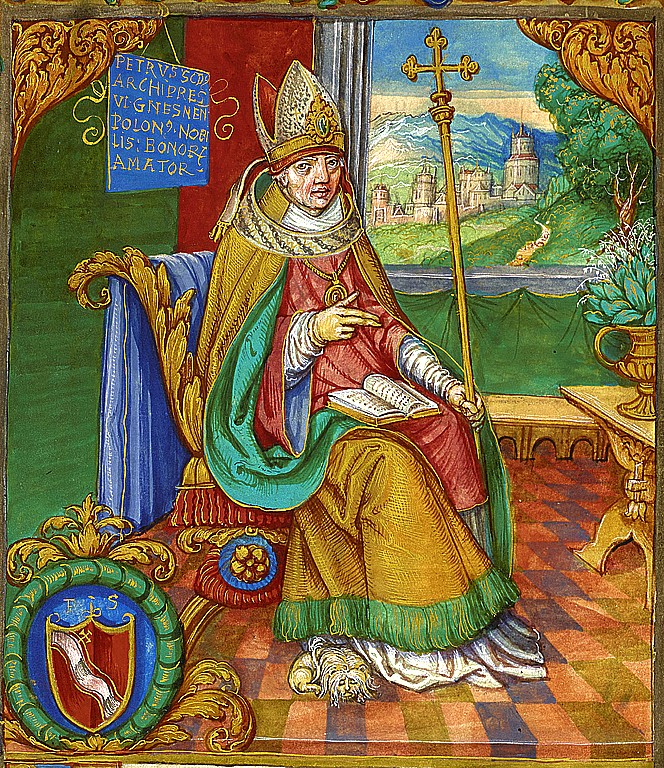
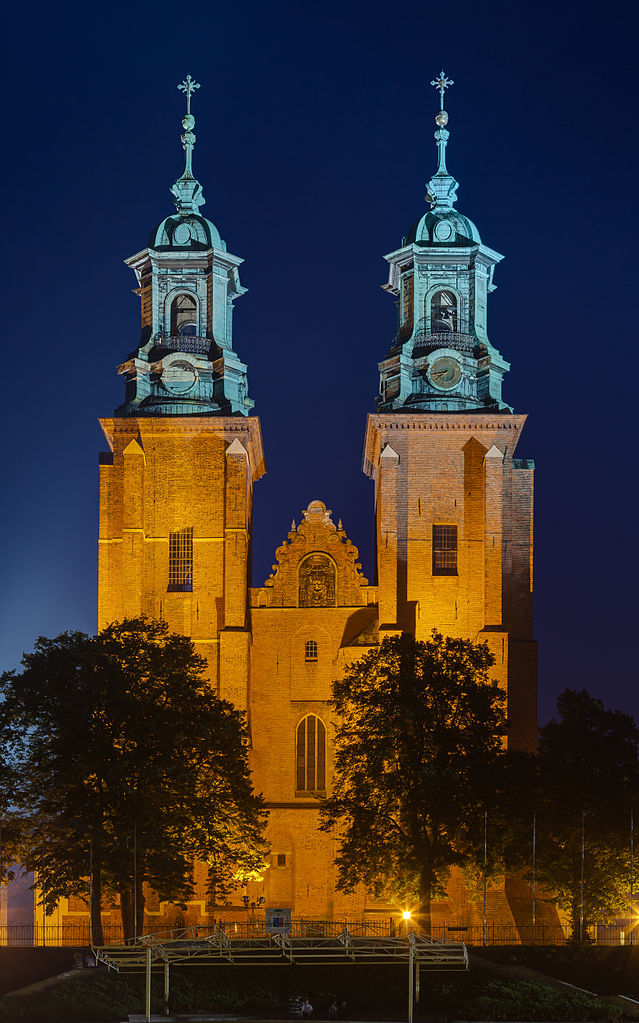
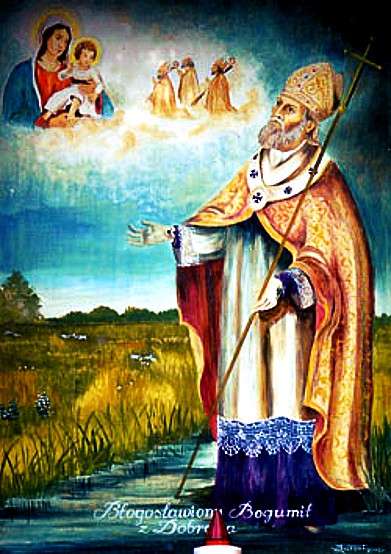
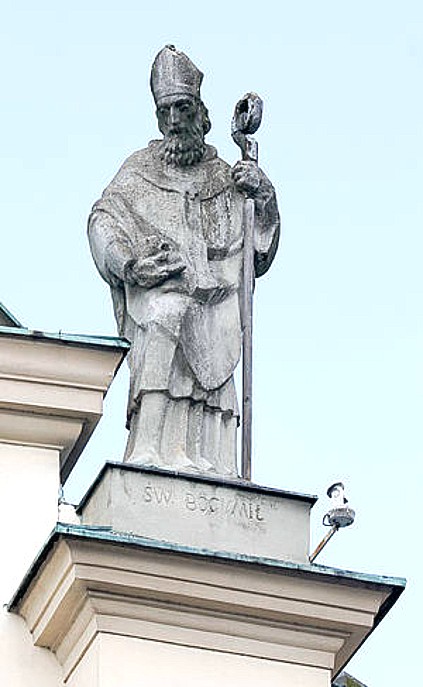
Saint of the Day – 4 May – Blessed Ladislas of Gielniów OFM Cap (c 1440-1505) “The Apostle of Lithuania,” Priest of the Order of Friars Minor Capuchin, zealous and tireless Evangelist, renowned Preacher, Poet and Hymnist, disciple of St Bernardine of Siena and his Apostolate of the Most Holy Name of Jesus and a devotee of the Passio of Christ. Ladislas served his Order in various capacities which included both a Doorkeeper and as its Provincial. He travelled across Poland to evangelise and was a noted preacher. Born in c 1440 in Gniezno, Poland and died on 4 May 1505 of natural causes. Patronages – Lithuania (chosen in August 1753), Poland (chosen in August 1753)m Galicia (eastern Europe), Warsaw, Poland (chosen in August 1753). He is also known as – “The Apostle of Lithuania,” Lithuanian Apostle,” Wladyslaw of Gielniów.

The Roman Martyrology states of him: “In Warsaw in Poland, Blessed Ladislaus of Gielniów, Priest of the Order of Minors, who preached the Passion of the Lord with extraordinary zeal and celebrated it with pious hymns.”

He worked to build up the fledgling Order in Poland and Lithuania, often in the face of resistance from the larger and more established Conventual Franciscans, with their considerably more relaxed way of religious life. The Observants’ very rigorous asceticism and strict interpretation of Franciscan poverty, constantly threatened to open old wounds among the followers of St. Francis and public controversies, between the two groups, often broke out in the fifteenth century.

Blessed Ladislas was born in the Polish City of Gielniow. He attended the University of Warsaw and then entered the City Convent of the Franciscan Friars Minor reformed by St John of Capestrano.

Within a few years ,he was elected Provincial Superior of the Order, a position he held for a long time, promoting the revision of the constitutions, which were then approved by the General Chapter of the Order, which was held in Urbino in 1498.

He carefully selected the most suitable Friars to send to Lithuania for the evangelisation of that Country. However, he reminded them of the greater importance to be attributed to personal holiness, which must always be placed before the proclamation of the Gospel to others. This initiative succeeded in reconciling several schismatics with the Church and also obtained the conversion of numerous pagans,

Ladislas was an ardent and eloquent preacher, He was much sought after and appreciated by the people. His homilies, as the Martyrologium Romanum also recalls, used to emphasise, in a particular way, the salvific value intrinsic to the Passion of Christ. Below is one of his devotional Hymns on the Passion:

Jesus, Judas sold away, for just wretched money
God the Father gave His Son, for our souls’ salvation
Jesus at the paschal feast, gave out His own body,
soothed His sad Apostles’ grief, with His very life blood.

To the garden Jesus went, with His friends, His loved ones
Thrice His Father he implored, on behalf of sinners
Bloody sweat out from Him poured, in His heavy struggle
O my soul, so very loved, look on Him, who loves you so.

He was the author of various hymns on this theme, intended for singing in Vespers. It was precisely religious song and poetry, in fact, that would become Ladislas’s most lasting legacy to Polish religious culture. He is the first major Polish Poet known by name, to write sometimes in the vernacular, rather than exclusively in the learned language of Latin.

His songs and verse represent well, his own piety, as well as those of his Order. Frequently, they illustrate the popular orientation of both. For instance, the simple poverty of Christ and Mary ,is sometimes stressed, in a gentle and colourful way, which, nonetheless, puts across the Gospel story’s emotional weight. Consider these verses from his vernacular song on the Nativity:

A town not large called Bethlehem
Around that time had many guests,
There Joseph with his new-found bride
Arrived, his Mary great with child.

Because these two possessed no wealth
No welcome could they find in town,
So to a stable off they went,
And there they dwelt in poverty
.

The purest Virgin Mary thus
To Jesus Christ the Lord gave birth.
At midnight, God Himself was born,
And all the universe rejoiced.

And when the Babe began to cry,
Upon bare earth itself He lay
Before Him there, His Mother knelt
And so to her small Child gave praise.

‘Wa, wa, wa, wa,’ the baby cried,
Lamenting all our human sins,
His mom then took Him up from earth,
And wrapped Him up in swaddling bands.

Because the stable was too tight,
A manger into crib she made.
No nursemaid there was found with her,
To come to that poor Mother’s aid.

Some, lying, have been known to claim
(And thus that Mother they insult!)
That serving maids abounded there
And gave that Mother lots of help.

When in 1498 Poland found itself having to face an invasion by the Tartars and Turks, an army of 70,000 men in all, Ladislas led a prayer crusade to invoke divine intervention. Tradition attributes the consequent extraordinary floods of the Dnepr and Prut rivers to this, which blocked the foreign invaders. This particular intercession, increased his reputation as a great man of prayer.

He strongly upheld the Bernadine mission of preaching to the laity and poor in accessible, moving and often colourful and even entertaining sermons, although always with forceful appeal to keep and live the Christian faith in all its rigour.

It is also reported that, during the last Good Friday of his life, while he was meditating, he levitated into the air, assuming the position of Christ on the Cross. When he returned to the ground, he collapsed and was confined to his bed. He remained bed-ridden until his death on 4 May 1505 a few weeks later.

Ladislas was Beatified in 1586 by Pope Sixtus V and on 11 February 1750, Pope Benedict XIV his cult received official confirmation.

His relics are interred in the Chapel of Blesed Ladislas in Warsaw, see below.

Posted in franciscan OFM, JESUIT SJ, MARIAN TITLES, SAINT of the DAY

Notre-Dame de Gray, Gray, Haute-Saône, Franche-Comté, France (1400s) and Memorials of the Saints – 4 May

Tuesday of the Fifth Week of Easter +2021

Notre-Dame de Gray, Gray, Haute-Saône, Franche-Comté, France / Our Lady of Gray (1400s) – 4 May

By the 1200s, a cruciform oak tree had become a place of devotion in the Flemish Town of Scherpenheuvel.(Montaigu in French) In the early 1400s, the Shrine became famous after a Statue of the Virgin placed on the tree, fell down and could not be moved from the spot.

The copy of the orginal Statue, made in 1613

But Protestants destroyed the Sanctuary in 1568 and in 1604 the tree was cut down. In 1613, a poor widow, Jeanne Bonnet, made a pilgrimage to Montaigu at the age of 70. She brought a piece of the sacred oak home to Salins-les-Bains in eastern France, where sculptor Jean Brange, carved a Statue of the Virgin from it, copying the Belgian original from the description.

From 1616 until the French Revolution, this Statue presided over a long series of miracles at the Capuchin Monastery in the Town of Gray, 37 miles away. When the revolutionaries expelled the Monks and pillaged the Monastery, a family hid the holy image until it could be safely installed in the Basilica at Gray.

In thanksgiving for the end of the 1849 cholera epidemic, Cardinal Mathieu, Archbishop of Besançon, gave the Shrine a silver Statue covered in gold and jewels, which he dedicated on 4 May 1851, at a ceremony attended by 92 Priests, throngs of the faithful, artillery salvos and the ringing of all the bells in Town. Afterwards, the Parish celebrated the feast of Our Lady of Gray with a procession every 4 May.

The new Statue dating from 1849

St Albian of Albée
Bl Angela Bartolomea dei Ranzi
Bl Angela Isabella dei Ranzi
St Antonia of Constantinople
St Antonina of Nicaea
St Antonia of Nicomedia
St Antonius of Rocher
St Arbeo of Freising
St Augustine Webster
St Cunegund of Regensburg
St Curcodomus of Auxerre
St Cyriacus of Ancona
St Enéour
St Ethelred of Bardney
St Florian of Lorch
Bl Hilsindis

Blessed Jean-Martin Moyë (1730-1793) Priest, Missionary, Founder
Biography:

https://anastpaul.wordpress.com/2018/05/04/saint-of-the-day-4-may-blessed-jean-martin-moye-1730-1793/

St Jose Maria Rubio y Peralta SJ (1864-1929) “the Apostle of Madrid” and “Father of the Poor,” Confessor
His Life:

https://anastpaul.com/2019/05/04/saint-of-the-day-4-may-saint-jose-maria-rubio-y-peralta-sj-1864-1929-the-apostle-of-madrid/

St Judas Cyriacus
Blessed Ladislas of Gielniów OFM Cap (c 1440-1505) Priest
St Luca da Toro
Bl Margareta Kratz
Bl Michal Giedroyc
St Nepotian of Altino
Bl Paolino Bigazzini
St Paulinus of Cologne
St Paulinus of Senigallia
St Pelagia of Tarsus
St Porphyrius of Camerino Rino
St Richard Reynolds
St Robert Lawrence
St Silvanus of Gaza

Blessed Tommaso da Olera OFM Cap (1563-1631) Lay Brother of the the Order of Friars Minor Capuchin, Spiritual Advisor, Confessor, Apostle of Charity, Writer, Mystic, Penitent and Ascetic.
His Life:

https://anastpaul.com/2020/05/04/saint-of-the-day-4-may-blessed-tommaso-da-olera-ofm-cap-1563-1631/


Carthusian Martyrs: A group of Carthusian monks who were hanged, drawn and quartered between 19 June 1535 and 20 September 1537 for refusing to acknowledge the English royalty as head of the Church:
• Blessed Humphrey Middlemore
• Blessed James Walworth
• Blessed John Davy
• Blessed John Rochester
• Blessed Richard Bere
• Blessed Robert Salt
• Blessed Sebastian Newdigate
• Blessed Thomas Green
• Blessed Thomas Johnson
• Blessed Thomas Redyng
• Blessed Thomas Scryven
• Blessed Walter Pierson
• Blessed William Exmew
• Blessed William Greenwood
• Blessed William Horne
• Saint Augustine Webster
• Saint John Houghton
• Saint Robert Lawrence

Martyrs of Cirta: Also known as
• Martyrs of Cirtha
• Martyrs of Tzirta
A group of clergy and laity martyred together in Cirta, Numidia (in modern Tunisia) in the persecutions of Valerian. They were – Agapius, Antonia, Emilian, Secundinus and Tertula, along with a woman and her twin children whose names have not come down to us.

Martyrs of England: 85 English, Scottish and Welsh Catholics who were martyred during the persecutions by Protestants in the 16th and 17th centuries. They are commemorated together on 22 November.
• Blessed Alexander Blake • Blessed Alexander Crow • Blessed Antony Page • Blessed Arthur Bell • Blessed Charles Meehan • Blessed Christopher Robinson • Blessed Christopher Wharton • Blessed Edmund Duke • Blessed Edmund Sykes • Blessed Edward Bamber • Blessed Edward Burden • Blessed Edward Osbaldeston • Blessed Edward Thwing • Blessed Francis Ingleby • Blessed George Beesley • Blessed George Douglas • Blessed George Errington • Blessed George Haydock • Blessed George Nichols • Blessed Henry Heath • Blessed Henry Webley • Blessed Hugh Taylor • Blessed Humphrey Pritchard • Blessed John Adams • Blessed John Bretton • Blessed John Fingley • Blessed John Hambley • Blessed John Hogg • Blessed John Lowe • Blessed John Norton • Blessed John Sandys • Blessed John Sugar • Blessed John Talbot • Blessed John Thules • Blessed John Woodcock • Blessed Joseph Lambton • Blessed Marmaduke Bowes • Blessed Matthew Flathers • Blessed Montfort Scott • Blessed Nicholas Garlick • Blessed Nicholas Horner • Blessed Nicholas Postgate • Blessed Nicholas Woodfen • Blessed Peter Snow • Blessed Ralph Grimston • Blessed Richard Flower • Blessed Richard Hill • Blessed Richard Holiday • Blessed Richard Sergeant • Blessed Richard Simpson • Blessed Richard Yaxley • Blessed Robert Bickerdike • Blessed Robert Dibdale • Blessed Robert Drury • Blessed Robert Grissold • Blessed Robert Hardesty • Blessed Robert Ludlam • Blessed Robert Middleton • Blessed Robert Nutter • Blessed Robert Sutton • Blessed Robert Sutton • Blessed Robert Thorpe • Blessed Roger Cadwallador • Blessed Roger Filcock • Blessed Roger Wrenno • Blessed Stephen Rowsham • Blessed Thomas Atkinson • Blessed Thomas Belson • Blessed Thomas Bullaker • Blessed Thomas Hunt • Blessed Thomas Palaser • Blessed Thomas Pilcher • Blessed Thomas Pormort • Blessed Thomas Sprott • Blessed Thomas Watkinson • Blessed Thomas Whitaker • Blessed Thurstan Hunt • Blessed William Carter • Blessed William Davies • Blessed William Gibson • Blessed William Knight • Blessed William Lampley • Blessed William Pike • Blessed William Southerne • Blessed William Spenser • Blessed William Thomson •
They were Beatified on 22 November 1987 by Pope John Paul II.

Martyrs of Novellara: A bishop and several his flock who were martyred together in the persecutions of Diocletian and whose relics were kept and enshrined together. We know nothing else about them but the names – Apollo, Bono, Cassiano, Castoro, Damiano, Dionisio, Leonida, Lucilla, Poliano, Tecla, Teodora and Vespasiano. They were Martyred on 26 March 303. Their relics were enshrined in the parish of Saint Stephen in Novellara, Italy in 1603.

Posted in CHRIST the WORD and WISDOM, DOCTORS of the Church, FATHERS of the Church, SAINT of the DAY, The APOSTLES & EVANGELISTS, The MOST HOLY & BLESSED TRINITY, The WORD

One Minute Reflection – 3 May – ‘Whoever has seen me has seen the Father. ‘ – John 14:9

One Minute Reflection – 3 May – “Mary’s Month” – Monday of the Fifth Week of Easter, Readings: First: First Corinthians 15: 1-8; Psalm: Psalms 19: 2-3, 4-5; Gospel: John 14: 6-14 and the Feast of Sts Philip and James Apostles and Martyrs

“Jesus said to him, “Have I been with you for so long a time and you still do not know me, Philip? Whoever has seen me has seen the Father. How can you say, ‘Show us the Father’? …” -John 14:9

REFLECTION – “In the Church, I know of only one image, that is, the image of the unseen God. God has said about this image, “Let us make man [humankind] in our image.” Of this image it is written that Christ is the “effulgence of the glory and impress of His hypostasis.” In that image, I perceive the Father, as the Lord Jesus Himself has said, “The one who has seen me has seen the Father.” For this image is not separated from the Father, which indeed, has taught me the unity of the Trinity, saying, “I and the Father are one” and again, “All things whatever the Father has are mine.” [In this image, also perceive] the Holy Spirit, seeing that the Spirit is Christ’s and has received of Christ, as it is written, “He shall receive of mine and shall announce it to you.” – St Ambrose (340-397) Bishop of Milan, Father and one of the original four Doctors of the Latin Church( – Sermon Against Auxentius, 32)

PRAYER – Lord God, each year You grant us the blessing of celebrating with joy, the feast day of Your Apostles and Martyrs Saints Philip and James. Make us partners with them by their prayers, in the Passion and Resurrection of Your only-begotten Son, so that we may come, with them, to the eternal vision of Your glory. We make our prayer through Jesus Christ, our Lord in the unity of the Holy Spirit, one God now and forever, amen.

Posted in SAINT of the DAY

Saint of the Day – 3 May – Saint Ansfrid of Utrecht (c 940-1010)

Saint of the Day – 3 May – Saint Ansfrid of Utrecht (c 940-1010) Bishop, Count of Huy and the sword-bearer and Knight for Otto I, Holy Roman Emperor. He became Bishop of Utrecht in 995. He appears to have been the son or grandson of Lambert, a nobleman of the Maasgau, the area where he later founded the Abbeys of Thorn and Heiligenberg and to have been related to various important contemporaries including the royal family. Born in c 940 in the Brabant region of the Netherlands and died on 3 May 1010 in Amersfoort, Netherlands of natural causes. Patronage – Amersfoort. He is also known as Ansfridus, Ansfried, Ansfrido.

The young Knight St Ansfrid in the Abbey Church of Heiligenberg

The principal source of information regarding Ansfrid is the De diversitatem temporum by the Benedictine Albert of Metz, written around 1022.

Ansfrid had the same name as a paternal uncle, Ansfrid the elder, a Count who held 15 counties. The young Ansfrid studied secular and clerical subjects under another paternal uncle, Robert, Archbishop of Trier, before attending the Cathedral school at Cologne.

In 961, Otto I took Ansfrid into his personal service and made him his swordbearer. When Otto was in Rome the following year to be crowned Holy Roman Emperor, he directed Ansfrid to keep close at hand ,with the sword as a precaution against any unforeseen eventualities.

Because of his Christian commitment, he was highly respected and an important Knight of the Emperor’s circle, holding rich possessions along the Meuse, in Brabant and Gelderland. Possibly all or some of his counties were inherited from his paternal uncle of the same name. As Count, he had considerable success in suppressing piracy and armed robbery. In 985, Otto III granted Ansfrid the right to mint coins at Medemblik, on the north-south shipping route through the Vlie, as well as, the income from tolls and tax collecting.

He was married to Heresuint or Hilsondis. They had one child, Benedicta. He founded a Romanesque Abbey Church on his wife’s estate at Thorn under the patronage of St Michael. The Abbey itself had a double cloister that housed both man and women religious. Ansfrid planned it as a place of retirement for himself and his family after he left public service. His wife was to be the first Abbess but she died on her way there and Benedicta, their daughter, took her place.

sT Ansfrid and Hilsondis. Stained glass windows in the Abbey of Thorn

After his wife’s death, Ansfrid desired to retire and become a Monk. However, in 995, Emperor Otto III and Bishop Notker of Liège persuaded the reluctant Ansfrid to assume the then vacant Aee of Utrecht. Ansfrid objected that as he had borne weapons as a Knight, he was unworthy of the office but the Emperor prevailed. The elderly Count laid down his sword on the Altar of St Mary in Aachen and was Ordained Priest and Consecratedas the eighteenth Bishop of Utrecht, in the same ceremony. Bishop Ansfrid never took a commission in the royal army, in contrast to Notger and the Bishop of Cologne.

In 1006 Bishop Ansfrid founded the Abbey of Heiligenberg, also under the patronage of St Michael. Toward the end of his life he became increasingly weakened through fasting and retired there as a Monk, caring for the sick, although almost blind himself.

Upon his death, during the funeral, the faithful of Heiligenberg took possession of his body, while the people of Utrecht were extinguishing a not coincidental fire. The Abbess of Thorn mediated and Ansfrid was buried in the Cathedral of Saint Martin in Utrecht.

St Ansfrid, fine bronze of the fountain “Li bassinia” in Huy
Posted in FEASTS and SOLEMNITIES, MARIAN TITLES, QUOTES on the CROSS of CHRIST, SAINT of the DAY, The APOSTLES & EVANGELISTS, The HOLY CROSS, The STATIONS of the CROSS

The Feast of the Finding of the Holy Cross, Feast St James and St Philip, Apostles of Christ, Virgen de la Carrasca, Bordón, Teruel, Aragón, Spain (1212) and Memorials of the Saints – 3 May

THE FEAST of the FINDING OF THE HOLY CROSS

St James the Lesser Apostle (Feast)
St Philip the Apostle (Feast)
Sts James and Philip:

https://anastpaul.wordpress.com/2018/05/03/3-may-feast-of-sts-philip-and-james-apostles-and-martyrs/

Virgen de la Carrasca, Bordón, Teruel, Aragón, Spain (1212) 3 May:

Commemorated on First Monday of May

In 1212, a herder found an image of the Virgin in a holm oak (carrasca) in the rocky countryside of Aragón in Spaon. There are several stories about what happened then, all of them ending with a Shrine in Bordón. Templars carried the Statue to Castellote, 12 miles north but the next day the image was back in the oak, the Virgin made those carrying her to Castellote keep turning toward Bordón and springs arose at each turn.

Original Statue

In the place where it was found, a hermitage was built to house it, which would later be replaced by the building that today is the Parish Church of Bordón, built in 1306 by the Templar Order (The Order was dissolved by Pope Clement V in 1312 ).

Although its exterior hardly stands out, its interior is magical and fascinating, a place full of mystery. In one of the Chapels inside, the Templar novices who previously made a pilgrimage on foot from Castellote, capital of the Templar Commandery, performed initiation rites to become Knights of the Order.

In the 18th century, the interior of the Church was covered with marvellous frescoes, which have been recently restored. Unfortunately, the venerated carving of the Black Virgin of the Carrasca was lost during the Civil War, along with another very famous Romanesque carving with a reputation for miraculously calming storms, the Virgin of the Spider, only a series of photographs being preserved, which allowed the making a replica.

Replica Statue

On the first Monday in May, the faithful from the three towns to the south—Tronchón, Olocau del Rey and Mirambel—conduct a processional pilgrimage to the Virgin de la Carrasca. They have done this “from time immemorial,” according to a document of 1390 in the Parish archives of Tronchón.

St Adalsindis of Bèze
Bl Adam of Cantalupo in Sabina
St Ahmed the Calligrapher
St Aldwine of Peartney
St Pope Alexander I
St Alexander of Constantinople
Bl Alexander of Foigny
St Alexander of Rome
Bl Alexander Vincioli
St Ansfrid of Utrecht (c 940-1010) Bishop
St Antonina of Constantinople
St Diodorus the Deacon

Blessed Edoardo Giuseppe Rosaz TOSF (1877-1903) Bishop of Susa from 1877 until his death, Founder of Franciscan Mission Sisters of Susa, Third Order Franciscan.
His Life:

https://anastpaul.com/2020/05/03/saint-of-the-day-3-may-blessed-edoardo-giuseppe-rosaz-tosf-1877-1903/

St Ethelwin of Lindsey
St Eventius of Rome
St Fumac
St Gabriel Gowdel
St Juvenal of Narni
Bl Maria Leonia Paradis
St Maura of Antinoe
St Peter of Argos
St Philip of Zell
Bl Ramon Oromí Sullà
St Rhodopianus the Deacon
St Scannal of Cell-Coleraine
Bl Sostenaeus

St Stanislas Kazimierczyk CRL (1433–1489)
His Life:

https://anastpaul.com/2019/05/03/saint-of-the-day-3-may-saint-stanislaw-kazimierczyk-crl-1433-1489/

St Theodolus of Rome
St Timothy of Antinoe
Bl Uguccio
Bl Zechariah

Posted in "Follow Me", CHRIST the KING, CHRIST, the WAY,TRUTH,LIFE, DOCTORS of the Church, EASTER, FATHERS of the Church, MARIAN QUOTES, MAY - The Blessed Virgin MARY'S MONTH, QUOTES for CHRIST, SAINT of the DAY

Quote/s of the Day – 2 May – St Athanasius

Quote/s of the Day – 2 May – “Mary’s Month” – and the Memorial of St Athanasius (297-373) Father & Doctor of the Church

“If we follow Christ closely we shall be allowed,
even on this earth,
to stand, as it were,
on the threshold of the heavenly Jerusalem
and enjoy the contemplation,
pf that everlasting feast,
like the blessed Apostles,
who, in following the Saviour as their leader,
showed and still show,
the way to obtain the same gift from God.
They said – See, we have left all things and followed You.
We too follow the Lord
and we keep His feast
by deeds rather than by words.”

“He cries out, saying:
See, I am with you all the days of this age.
He is Himself the shepherd,
the high priest,
the way and the door,
and has become all things at once for us.”

Mary, Mother of Grace,
it becomes you to be mindful of us,
as you stand near Him who granted you
all graces, for you are the Mother of God
and our Queen.
Help us for the sake of the King,
the Lord God and Master,
Who was born of you.

More Here:
https://anastpaul.com/2020/05/02/quote-s-of-the-day-2-may/

St Athanasius (297-373)
Father & Doctor of the Church

Posted in "Follow Me", DOCTORS of the Church, ONE Minute REFLECTION, SAINT of the DAY, The WORD

One Minute Reflection – 2 May – Bearing fruit — John 15:1-8

One Minute Reflection – 2 May – The Fifth Sunday of Easter, Readings: Acts 9:26-31, Psalm: Psalms 22: 26-27, 28, 30, 31-32 (26a), Second: First John 3: 18-24, Gospel: John 15: 1-8 and the Memorial of St Athanasius (297-373)

I am the vine, you the branches; he that abides in me and I in him, the same bears much fruit; for without me you can do nothing.” – John 15:5

REFLECTION – “I must warn each of you about His vine – for who has never cut back everything that is superfluous in himself ,to the point of thinking that there is nothing more to cut?

Believe me, what has been cut, grows back; the vices that have been chased away return and we see tendencies that had gone to sleep, waking up again. It is, therefore, not enough to cut one’s vine once; rather, we have to do it again and often and if possible, even without ceasing. For if you are sincere, you ceaselessly find in yourself ,something to cut…

Virtue cannot grow among the vices; for virtue to develop, we must prevent the vices from increasing. So suppress what is superfluous; then the necessary will be able to spring up.

For us, Brothers, it is always the time for cutting, it is always necessary. For I am sure that we have already left winter behind us, we have left behind the fear without love, which introduces us all to wisdom but which doesn’t let anyone grow in perfection. When love comes, it chases away that fear just as the summer chases away the winter… So may the winter rains stop, that is say, the tears of anguish that arise because of the memory of your sins and the fear of judgement… If “the winter is over” and “the rain has topped” (Song 2:11)… the sweetness of the spring of spiritual grace shows us, that the time has come to cut our vine. What else is there for us to do other than to become entirely committed to this work?” – St Bernard (1091-1153) Mellifluous Doctor of the Church – Sermon 58 on the Song of Songs

PRAYER – Holy God and Father, help us to discern through prayer and meditation what You truly want of us. Then enable us to offer it to You and indeed, to offer ourselves and all we have and all we are, to You. When You bring us sufferings to mould us closer and make us more like You, help us to accept them and offer them back to You. Following Your divine Son, let us pick up those crosses in peace and love. Our Lady Holy Mother of Our Lord and our own, pray for us! St Athanasius, pray for us. Through Christ our Lord, with the Holy Spirit, God now and forever, amen.

Posted in SAINT of the DAY

Saint of the Day – 2 May – St Zoe of Pamphylia (Died 127) Martyr

Saint of the Day – 2 May – Saint St Zoe of Pamphylia (Died 127) Martyr, Laywoman, Wife and Mother. The Roman Martyrology states of her and her family: “The holy mMartyrs , Exuperius and Zoe, his wife, with their sons, Cyriacus and Theodolus, who suffered under the Emperior Adrian.”

Zoe was married to Saint Exuperius. They had 2 sons, Saint Cyriacus and Saint Theodulus.

They were slaves, and were owned by a rich devout worshipper of the ancient Roman gods in Atalia, Pamphylia. One of Zoe’s duties was to tend the house dogs and prevent them from biting visitors. She rarely saw her husband as he worked the fields, a distance from the house.

Since she worked near a roadway, she gave of her own meagre rations to those even poorer than herself. One pagan feast day, the slaves were given meat to sacrifice to an idol. They refused and the entire family was tortured and murdered.

They were burned to death c 127.

Posted in MARIAN TITLES, SAINT of the DAY

The Fifth Sunday of Easter, Nuestra Señora de Oviedo / Our Lady of Oviedo, Spain (711) and Memorials of the Saints – 2 May

The Fifth Sunday of Easter +2021

Nuestra Señora de Oviedo / Our Lady of Oviedo, Spain (711) – 2 May:

The Abbot Orsini wrote: “Our Lady of Oviedo, Spain, where they possess some of the Blessed Virgin’s hair.”

The Cathedral of Oviedo was founded in 781 AD, and enlarged by Alfonso the Chaste, who made Oviedo the Capital of the Kingdom of Asturias. The Chapel was once called the Sancta Ovetensis, owing to the quantity and quality of relics contained in the Camara Santa (Holy Chamber).

There is in the City of Oviedo a Holy Chest that contains many and varied relics. It rests in the Town where King Alfonso II, the Chaste, built a Shrine to house it and there it can be seen even today as it was well over a millennium ago. Like the Arc of the Covenant, or the Holy Grail, it is a singular thing the like of which is almost utterly unknown in the entire history of mankind.

This Holy Chest is made of oak and was skillfully constructed without the use of any nails. It measures roughly four feet by three feet by two feet and has been venerated, by faithful Catholics, since apostolic times. Indeed, it is believed to have been fashioned by devoted disciples of the twelve Apostles. Many men and woman throughout history have given their entire lives in service to the holy relics contained therein, or to save the chest from pagans who sought its destruction.
The chest originated in the Holy City of Jerusalem. When the Persain’s attacked and conquered Jerusalem in 614, many priceless relics from the region were gathered and placed in it for protection, as the Persians sought relics to destroy them. The chest was taken for safekeeping to a small community of Catholiacs in Alexandria, Egypt. A short time later, Alexandria was also sacked by the Muslims and the chest was taken across the Mediterranean Sea to Spain, where St Isidore kept it in Seville. Upon St. Isidore’s death, the chest was transferred to the City of Toledo, which was then becoming an important centre in Spain. When the wave of Muslim aggression reached even Toledo in 711, the Holy Chest was taken to the Asturias and hidden in a well in Pelayo’s mountain.
The chest has a lock and key but by the time of the eleventh century it had not been opened for hundreds of years. The last time it was known to have been opened was when it was done by a living saint, St Ildephonsus, for in it he had placed a chasuble that the Mother of God herself had given him during an apparition.
By the year 1030, the exact contents of the Holy Chest were no longer known. Bishop Ponce of Oviedo and with him many clerics, determined to examine the chest to unlock its secrets. As soon as the lid was raised only the slightest bit, “there burst forth so stupendous a light that the terrified clerics, some of them stricken blind, dropped the lid and fled, leaving the mystery unsolved.”
After Mass, on Friday, 13 March 1075, the key was again placed in the lock. On this occasion, God was pleased to reveal the contents of the Holy Chest. The chest contained the Sudarium, mentioned by St John the Evangelist in his Gospel, as the cloth that covered the face of Christ, after the crucifixion. On it can be seen the bloodstains of Our Lord that evidence his passion and death. It alone is a treasure without reckoning…
The chest also contained a piece of the True Cross of Our Lord, a small stone of the sepulcher in which He was buried, some of the cloths in which He was wrapped in the manger, several thorns from the Crucifixion, a piece of the earth of Mount Olivet touched by His feet when He ascended into heaven, one of the thirty coins given to Judas, a lock of the Blessed Mother’s hair, the chasuble given by the Virgin Mary to Saint Ildephonsus, a chest of gold and precious stones containing the forehead of St John the Baptist and his hair and a host of other relics from many saints and prophets, including St Stephen, the first martyr, St Mary Magdalene, St Peter the Apostle, St Vincent and the rod of Moses which parted the Red Sea and the manna supplied from heaven during the Exodus from Egypt, and many other priceless relics.

King Alfonso VI commissioned a silversmith to sheath the Holy Chest in gilded silver, adorning it with figures of Our Lord and His angels and saints. It can still be seen even today.”

Cathedral of Oviedo

There are numerous Marian images, in their different invocations, which can be seen in the Cathedral of Oviedo. The month of May dedicated to the Virgin inspires a tour of different chapels and altarpieces in which the Immaculate, Virgin Asuntas are preserved, also affectionate Mothers with a Child in their arms, without forgetting the suffering Mothers of the Piedades and ,of course ,the Virgin from Covadonga, our Santina.
In the Chapel of Santa María del Rey Casto a small Altarpiece houses one of the most precious Marian images of the Cathedral of Oviedo and which, perhaps, due to its modest size, goes unnoticed. The Altarpiece of Our Lady of Light . This Altarpiece was donated in 1552 by Gutierre González de Cienfuegos, magistrate of Medina del Campo and Salamanca and was placed in the retrochoir of the Cathedral, where it served as an Altar.

OLYMPUS DIGITAL CAMERA

St Athanasius (c 295-373) – Father and Doctor of the Church, “Father of Orthodoxy,” Bishop of Alexandria, Defender of the true faith, throughout his life he opposed the Arian heresy. (Memorial)
Biography:

https://anastpaul.wordpress.com/2018/05/02/saint-of-the-day-2-may-st-athanasius-c295-373-father-and-doctor-of-the-church-father-of-orthodoxy/

St Antoninus of Florence OP (1389-1459) “Antoninus the Counsellor,” Dominican Priest, Bishop, Confessor
His Life:

https://anastpaul.com/2019/05/02/saint-of-the-day-2-may-saint-antoninus-of-florence-op-1389-1459-antoninus-the-counsellor/

Bl Bernard of Seville
St Bertinus the Younger
Bl Boleslas Strzelecki
Bl Conrad of Seldenbüren
St Cyriacus of Pamphylia
St Eugenius of Africa
St Exsuperius of Pamphylia
St Felix of Seville
St Fiorenzo of Algeria
St Gennys of Cornwall
St Germanus of Normandy (Died c 460)
St Gluvias
St Guistano of Sardinia

St José María Rubio y Peralta SJ (1864-1929) “The Apostle of Madrid” and “Father of the Poor,” Jesuit Priest, Confessor, Professor, Preacher, Spiritual Director, Apostle of Eucharistic Adoration.
His Life:

https://anastpaul.com/2019/05/04/saint-of-the-day-4-may-saint-jose-maria-rubio-y-peralta-sj-1864-1929-the-apostle-of-madrid/

St Joseph Luu
Bl Juan de Verdegallo
St Longinus of Africa
St Neachtain of Cill-Uinche
St Theodulus of Pamphylia
St Ultan of Péronne
St Vindemialis of Africa
St Waldebert of Luxeuil

St Wiborada of Saint Gallen OSB (Died 926) Martyr, Virgin, Benedictine Nun, Anchorite,ascetic, gifted with the charism of prophecy and miracles
Her Life and Death:

https://anastpaul.com/2020/05/02/saint-of-the-day-2-may-saint-wiborada-of-saint-gallen-osb-died-926-martyr/

Bl William Tirry
St Zoe of Pamphylia (Died 127) Martyr, Laywoman

Martyrs of Alexandria – 4 saints: A group of Christians marytred together in the persecutions of Diocletian. We know little more than their names – Celestine, Germanus, Neopolus and Saturninus. 304 in Alexandria, Egyp

Posted in SAINT of the DAY

Saint of the Day – 1 May – St Sigismund of Burgundy (Died 524) King and Martyr.

Saint of the Day – 1 May – St Sigismund of Burgundy (Died 524) King and Martyr. King of the Burgundians from 516 until his death, Reforemer, Penitent, apostle of the needy and the poor. Patronages – Czech Republic, Monarchs, Germanic peoples, bibliophiles, Monasteries.

The Roman Martyrology states of him today: “At Siom, i Switzerland, Saint Sigismund, King of the Burgundians, who was drowned in a well and afterwards became renowned for miracles.”

Sigismund succeeded his father Gundobad asKking of the Burgundians in 516. At the time, Burgundy was perhaps the most powerful of all the kingdoms of Gaul – not least because of its strong links with the Byzantine court – and both the Franks and the Ostrogoths were keen to limit Burgundian power.

Sigismund soon established his reputation as a statesman and lawmaker by issuing (in 517) a legal compendium, the Lex Gundobada (more properly known as the Liber Constitutionum). He was equally enthusiastic about reforming the Church and, in the same year, he convened a Council of Burgundiam Bishops with a view to establishing ecclesiastical discipline and dismantling the infrastructure of the Arian Church in Burgundy.

Gundobad had been an Arian, though he seems to have contemplated conversion to Catholicism,and Sigismund converted by 515 – thanks in large part to his association with the Catholic Bishop of Vienne, St Avitus (a poet and man of letters who remained a beacon of classical civilisation in a barbarian world), with whom he maintained a correspondence.

Shortly after his conversion, Sigismund founded the Monastery of St Maurice at Agaune, where he instituted the practice of the laus perennis, according to which (as happened in other royal monasteries in the Germanic world) groups of Monks would chant the psalms in relays in an unceasing round of praise (the sixth century equivalent of perpetual adoration).

In spite of such positive beginnings, Sigismund’s relationship with his Bishops deteriorated. Much more seriously, in 522 his second wife persuaded him that Sigistrix, his son by his deceased first wife, was plotting against him with the intention of killing him and taking control not only of Burgundy but also of Italy.

In a fit of uncontrolled rage, Sigismund had Sigistrix strangled. Once his anger had subsided, he was appalled at the enormity of his crime and retired to St Maurice to do penance, devoting himself to the poor in whose service he distributed part of his wealth.

Whatever he undertook by way of reparation, however, seemed wholly inadequate in view of the horrific nature of the murder of his own son and Sigismund came to believe, that only by suffering some equivalent calamity, could he atone for his sin.

Such a calamity duly occurred when Burgundy was attacked by Chlodomer, the King of Orleans, together with his brothers Childebert and Chlothar (the three brothers were the sons of the Frankish King Clovis whose father had been murdered by Sigismund’s father Gundobad). Sigismund escaped, disguising himself as a monk and hiding in a cell at Agaune, but was captured and taken to Orleans as a prisoner where he was executed (524), by being thrown down a well.

His bones having been recovered, a shrine developed at Agaune and he was soon recognised as a Martyr, though strictly speaking he did not die for his faith, as the motives for his assassination had to do with politics and blood-feuds, rather than with Arian persecution of Catholics.

St Sigismund: Fresco by Piero della Francesca

In fact, he is best remembered not primarily as a Martyr (for all that he endured death in a spirit of faith and courage) but as one of the great penitents – as a man whose profound repentance, culiminating in a death, which at some level he seems to have sought (at least in prayer) by way of atonement for his gravest of crimes, was rightly perceived not only by his contemporaries but also by subsequent generations as a paradigm of a particular kind of Christian sanctity.

A bust of St Sigismund n Plock

His body was kept honourably at Agaune, until it was removed to the Cathedral of Prague by the Emperor Charles IV. His tomb has been venerated for centuries and has been famous for many miracles. He became a Patron of the Czech Republic, see his Statue on Charles Bridge in Prague, below.

St Sigismund on the right
Posted in MARIAN TITLES, SAINT of the DAY

Madonna of Giubino, Sicily (1655) and Memorials of the Saints – 1 May

Saturday of the Fourth Week of Easter +2021

Maria Santissima di Giubino, Siciliy / Madonna of Giubino, Sicily (1655) – 1 May:

The Church of the Madonna of Giubino was built in 1721 to house a miraculous marble-relief icon of the Madonna. (A copy of the relief is housed in the Church of St Joseph in Brooklyn, New York, giving testimony to the large emigrant community of Calatafimesi who lived in Brooklyn in the early 20th century).
The Church of Maria Santissima di Giubino is dedicated to the Patroness of the Town. It has a single nave, with an elegant barrel vault decorated with frescoes and ornamental motifs. Inside there are some important works – the painting with the Assumption, Our Lady with Angels and Saints dated 1617, the Altarpiece of All Saints, an 18th-century wooden organ and a 15th-century marble alto-rilievo representing Madonna of Giubino with the Infant Jesus.
In 1655 an invasion of grasshoppers was destroying all the crops in the countryside of Calatafimi. The people, assembled in a Church, decided that, after putting all the names of the Saints who had an aAtar in Town inside a ballot box, they would choose as a Patron that one whose name had been drawn. After they invoked the Holy Ghost, it was chosen the name of Maria Santissima di Giubino by lots.
The central part of the triptych with the image of the Virgin was soon taken out from the wall in the country Church of Giubino and taken in procession: with prayer and Holy Mass and thereafter, Calatafimi was free from grasshoppers.

Maria Santissima di Giubino was elected Patroness of the Town (25 April 1655) and the bas-relief of the Virgin of Giubino was then placed on the high Altar of the new Church, designed by Giovanni Biagio Amico (the same planner of the Church of Santissimo Crocifisso) in 1721.
In 1931 the triptych was recomposed in the Town Sanctuary and restored.

St Joseph the Worker (Optional Memorial)
About this Memorial, which was established by Pope Pius XII in 1955:

https://anastpaul.wordpress.com/2018/05/01/memorial-of-st-joseph-the-worker-1-may/

AND here:
https://anastpaul.wordpress.com/2017/05/01/saint-of-the-day-1-may-st-joseph-the-worker/

St Aceolus of Amiens
St Acius of Amiens
St Aldebrandus of Fossombrone
St Amator of Auxerre
St Ambrose of Ferentino
St Andeolus of Smyrna
Bl Arigius of Gap
St Arnold of Hiltensweiler
St Asaph of Llanelwy
St Augustine Schöffler
St Benedict of Szkalka OSB (Died 1012) Monk and Hermit
St Bertha of Avenay
St Bertha of Kent
St Brieuc of Brittany
St Ceallach of Killala
St Cominus of Catania
Evermarus of Rousson
Bl Felim O’Hara
St Grata of Bergamo
St Isidora of Egypt
St Jeremiah the Prophet
St John-Louis Bonnard
Bl Klymentii Sheptytskyi
St Marculf
St Orentius of Auch
St Orentius of Loret
St Patientia of Loret

St Peregrine Laziosi OSM (1260-1345) The “Angel of Good Counsel,” Priest of the Servite Order (The Order of Servants of Mary )
Beautiful St Peregrine:

https://anastpaul.com/2020/05/01/saint-of-the-day-1-may-saint-peregrine-laziosi-osm-1260-1345-today-is-the-675th-anniversary-of-his-death/

Bl Petronilla of Moncel

St Richard Pampuri OH (1897-1930) aged 33 – Religious of the Hospitallers of St John of God, Medical Doctor, Founder of the Band of Pius X (a Youth movement)
Biography:

https://anastpaul.com/2019/05/01/saint-of-the-day-1-may-saint-richard-pampuri-oh-1897-1930/

St Romanus of Baghdad
St Sigismund of Burgundy (Died 524) King and Martyr
St Theodard of Narbonne
St Thorette
St Torquatus of Guadix
Blessed Vivald of Gimignano

Martyrs of Amiens:
Aceolus
Acius

Martyrs of Loret:
Orentius
Patientia

Martyrs of Vietnam:
Augustine Schöffler
John-Louis Bonnard

Posted in NOTES to Followers, QUOTES on Lukewarmness, SAINT of the DAY

No Internet

My heart was very sorrowful today as I missed the great St Pius V’s feast day 😪😪😪

Posted in franciscan OFM, SAINT of the DAY

Saint of the Day – 30 April – Blessed Benedict Passionei of Urbino OFM Cap (1560– 1625)

Saint of the Day – 30 April – Blessed Benedict Passionei of Urbino OFM Cap (1560– 1625) Priest of the Order of the Friars Minor of St Francis, Capuchin, Missionary, apostle of the poor, renowned preacher, doctor of civil and canon law. Born on 13 September 1560 in Urbino, Duchy of Urbino, Papal States (part of modern Italy) as Marco Passionei and died on 30 April 1625 in Fossombrone, Pesaro-Urbino, Italy of complications following surgery. Also known as – Benedetto da Urbino, Benito of Urbino. Marco Passionei. Patronage – Missionaries.

It is most striking today, to see a scion of one of the richest and noblest families of Umbria give himself to strenuous manual work in various Friaries. He was sensitive to the poor and full of compassion for them, without distinction. He wanted to preach only in insignificant little towns. He abounded in piety and devotion, poverty and penance, humility and simplicity. He was indeed a ‘classic’ Capuchin friar.

Marco was born into the noble family of the Passioneis in the duchy of Urbino. He was baptised Marco in 1560. He was orphaned by the age of seven and was put into the care of tutors with his ten brothers and sisters. He received the Doctor of Law at the University of Perugia and then rejoined his family, now living at Fossombrone. He made friends with the Capuchin brother questors and was attracted by their charism. Because of his poor health this was opposed by the local superior but, after waiting a year, the newly elected Provincial allowed him to join in 1584. Named Benedict he soon found his place among the preachers and joined St Lawrence of Brindisi in his missionary work in Bohemia. He thrived on it especially when preaching to the poor. He died in Fossombrone in 1625 and was Beatified by Blessed Pius IX on 15 January 1867.

Nearly all the information we have for the life of Blessed Benedict derives from a manuscript biography compiled by Brother Ludovico da Rocca Contrada (†1654) immediately after Benedetto’s death. This biography is the one and only actual contemporary witness and was used in the processes necessary for his Beatification. It is has an enormous documentary value thanks to its reliability and the seriousness of the information gathered, from the most direct sources, whom the author often consulted personally. And the author was, moreover, guardian of the Friary of San Giovanni Battista in Fossombrone. He was present for the happenings at the end of his holy confrere’s life and was present at his deathbed. Therefore, his account is very detailed in its telling of Benedetto’s final sickness and death and of the uninhibited expressions of popular piety regarding Benedetto’s body.

Born on 13 November 1560 in the duchy of Urbino, he was the seventh of the eleven children in the noble family of Domenico Passionei and Maddalena Cibo. He was orphaned while still young and led his life in Cagli where he did his first study at home. At seventeen he then went to Perugia and onto Padua for higher studies. On 28 May 1582, at just twenty two years, he received a degree in Civil and Church law. His career began in the Roman court of Cardinal Pier Girolamo Albani. He found this disagreeable.

Marco Passionei returned to the Marches and settled in Fossombrone where his family had meanwhile taken up residence. He was nourishing a secret call of the spirit and longed for the humble and austere life of the Capuchins. Above Metauro the Capuchins had built a devout hermitage. However, it was not easy for him to get permission both from the family and from the friars until the new provincial minister, Giacomo da Pietrarubbia who, according to the wish of the chapter, admitted him to the novitiate of San Cristina in Fano. His fragile health made his novitiate year difficult. In fact, after a few months, he became ill to the point that his superiors had him leave Fano to go to the friary in Fossombrone. After three months it was considered to send him home but his indomitable will won out in the end. He said that he had been clothed in the habit to live and to die as a Capuchin: “If they had sent him out from one door he would have come back in again through another.” He entrusted himself to prayer and obtained the grace of healing. And so he was able to make his religious profession at the end of May 1585, much to the consolation of the poor who, on the occasion, benefitted economically. He continued his religious formation in Ancona. By 1590 he was already a Priest, a humble preacher, in various Friaries such as Fano and Ostra.

In 1600 the General Minister, Girolamo da Castelferretti, included him in the mission band led by Saint Lorenzo da Brindisi to spread the Order in Bohemia and reinforce there the Catholic faith. Although he had not asked to go he was ready to leave immediately. Exemplary and capable men were needed and the General Minister, also from the Marches, knew him well and considered him suitable for the difficult undertaking. Benedetto confided his difficulties to a letter. However he was very obedient under the guidance of Lorenzo da Brindisi. He had to endure many injuries from heretics who hated him. At the end of the triennium (1602) he was called back to the province where he travelled around various Friaries as preacher, superior and as a simple Friar. He also went questing, both in the city and in the countryside. He said, “It is better to carry the weight of bread rather than sins.” He was so humble, and loved silence so much, that he seemed naïve and uneducated. When he was guardian in the friary in Pesaro the duke of Urbino went to visit him. Accustomed to help in the kitchen after lunch, Benedetto let the illustrious visitor wait until he had finished washing the dishes.

His devotion was carefully organised around night and daylight hours of prayer which extended beyond the pious exercises of the fraternity. As all his biographers relate, he used to begin his day with one or two hours of prayer in the Church before the community recitation of matins. After the office he returned to his cell to rest for half an hour. Then he would be in the church again where he prayed the rosary on his knees. After the rosary he did the discipline and then immersed himself in mental prayer until dawn. He never tired of prayer. Each day he recited the Office of the Blessed Virgin Mary, as well as the seven penitential psalms, the Office of the Holy Spirit and of the Holy Cross, many decades of the rosary and Our Fathers. He spent most of his time in spiritual reading, making the Stations of the Cross, visiting the tabernacle and the Our Lady altar. Frail, emaciated and weak he seemed to derive his strength from prayer. If sometimes he arrived late to meditation, he would turn the hour glass the recoup the time for prayer. In this he was very exacting, even with the others. As superior he never dispensed the Friars from the two hours of mental prayer each day. Even when he was not in the Friary he maintained his strict and austere style.

For his preaching he said he preferred the towns that had a public clock that struck the hours day and night. In this way he was able to organise his practices of prayer and penance as he did in the friary. He was enamoured of the Crucifix, the Passion, the Eucharist and the Blessed Virgin who he affectionately called “mamma.” He invented many gestures of love, such as an hour of prostration on the ground, his “prayer in the garden” with his arms open and face down on the floor. His continuous meditation on the Passion filled his heart with an intense contrition which urged him to go often to confession, as often as three times a week. His confessors however did not see sufficient matter for absolution.

Austere and heroic in his bodily penance he never gave into himself in anything. He was emaciated and weak in appearance, with hunger pangs and kidney stones that prostrated him. His first biographer noted that “he seemed to suck in his breath through his teeth, as they say. But as for his spiritual exercises he seemed like a man of steel.” Always on his feet in his frequent preaching, he had to drag himself along with annoying wounds on his legs. He had to undergo fifteen hernia operations. But he never stopped. He always started up again with courage.

He did not like big cities. If, rarely, he had to preach in Pesaro (1612), and in Urbino and Genoa (1619), he preferred those remote, humble and “little places” hardly mentioned on the general maps. More than once he took on the task of building or restoring churches, as in Barchi and Castelleone. He did not write his talks. He confined himself to brief schemas on scraps of paper. His preaching came from the heart, like a humble exhortation for the humble, but nonetheless all was the word of God, able to move and convert. He preached his last Lent in Saccorvaro.

The journey was all on foot and he had to stop in Urbania due to starvation. After about ten sermons in Saccorvaro he had to stop. He was taken to Urbino and then to Fossombrone. He had to undergo yet another hernia operation which this time brought him to the end of his life. He had a crucifix placed on a little table. He kept his gaze fixed on it, his spirit focused there. If anyone blocked his view he immediately gestured that they should move. He remained silent in this way as if he were resting quietly, so much so that the Friars barely realised when his life faded like a gently quenched candle on 30 April 1625 in the light of the Passion which he wanted read to him. He was nearly sixty five years old, and had lived forty one years of religious life with immense love and joy.

Prayer

Holy Father,
the depth of Your love for us,
revealed in the Cross of Jesus,
transformed Benedict
into a warm and loving minister of your Gospel.
May we experience Your love
and be eager to share it with others.
Through our Lord Jesus Christ, Your Son,
who lives and reigns with You and the Holy Spirit,
God, for ver and ever.
Amen

Posted in MARIAN TITLES, SAINT of the DAY

Onze Liewe-Vrouw van Afrika / Heilige Maria van Afrika / Notre Dame d’Afrique/ Our Lady of Africa , Algiers (1876) and Memorials of the Saints – 30 April

Friday of the Fourth Weekof Easter +2021

Onze Liewe-Vrouw van Afrika / Heilige Maria van Afrika / Notre Dame d’Afrique / Our Lady of Africa , Algiers (1876) (Feast) – 30 April:

North Africa, the land of Saints Monica, Augustine, among others, as part of Roman Empire began to become Christian in the 3rd century under Emperor Constantine. It remained Christian until the Arab invasions in later centuries. The French re-established themselves early in the 19th century.
The first Bishop, Bishop Dupuch, found it impossible to build a Church because the local population was hostile to the French. He went back to France for assistance. The Sodality of Our Lady in Lyon offered the Bishop a bronze statue of the Immaculate Conception ,with the understanding, that she would be the Protectress of both the Mohammedans and the natives. It was brought from France in 1840 and was entrusted to the Cistercian Monks of Staueli. Later, Cardinal Lavigiers, Founder of the White Sisters, enshrined it in the new Basilica at Algiers, where in 1876 the image was crowned. This bronze statue, very dark in colour, is known as Onze Liewe-Vrouw van Afrika / Heilige Maria van Afrika / Our Lady of Africa.
Pilgrims began to come to venerate the image where the lame, the blind and the crippled were miraculously cured and sailors came also, to beg for protection of their long and perilous voyages.

The Basilica of Our Lady of Africa, or Notre Dame d’Afrique, was eventually built, and is situated on a height overlooking the Bay of Algiers. It took fourteen years to construct in an attractive Neo-Byzantine style and was consecrated in the year 1872.

The Statue venerated in Algiers today, is this same bronze image, very dark in colour but with European features. The walls of the basilica are now covered with votive offerings testifying to the assistance the faithful have received from the Mother of Mercy.

At this and other North African Shrines the veneration given to Mary by Mohammedans is very marked. The full name of Cardinal Lavigiers’ congregation of White Sisters is Missionary Sisters of Our Lady of Africa. There is an indulgenced prayer to Mary under that title for the conversion of the Africans on the apse: Notre Dame d’Afrique priez pour nous et pour les Musulmans (Our Lady of Africa, pray for us and for the Muslims.)

This feast commemorates the crowning of the Algiers statue.

St Marie Guyart of the Incarnation OSU (1599-1672) Ursuline Religious and Missionary ( Optional Memorial)
Biography:
https://anastpaul.wordpress.com/2017/04/30/saint-of-the-day-30-april-st-marie-guyart-of-the-incarnation-o-s-u/

St Pope Pius V (1504-1572) Bishop of Rome, Ruler of the Papal States, Pope of the Council of Trent, the Counter-Reformation, the Battle of Lepanto, the Holy Rosary and the Pope who declared St Thomas Aquinas as a Doctor of the Church (Optional Memorial)
Wonderful blessed St Pius V:

https://anastpaul.com/2019/04/30/saint-of-the-day-saint-pope-pius-v-1504-1572/

St Adjutor of Vernon
St Aimo of Savigny
St Amator of Córdoba
St Aphrodisius of Alexandria
Blessed Benedict Passionei of Urbino OFM Cap (1560– 1625) Priest
St Cynwl
St Dedë Plani
St Diodoro of Aphrodisias
St Donatus of Euraea

St Erconwald of London (Died c 693) Bishop, Monk, Abbot, Confessor, “The Light of London”
About this “The Light of London”
:
https://anastpaul.com/2020/04/30/saint-of-the-day-30-april-saint-erconwald-of-london-died-c-693-the-light-of-london/

St Eutropius of Saintes
St Forannan
St Genistus of Limoges
St Giuse Tuân
Bl Gualfardus of Augsburg
Bl Hildegard the Empress

St Joseph Benedict Cottolengo (1786-1842) Priest, Founder, Confessor, Apostle of Charity.
About St Joseph Cottolengo:

https://anastpaul.wordpress.com/2018/04/30/saint-of-the-day-30-april-st-joseph-benedict-cottolengo-1786-1842-an-intense-day-of-love/

St Lawrence of Novara
St Louis of Córdoba
St Mariano of Acerenza
St Maximus of Ephesus
St Mercurialis of Forlì
St Peter of Córdoba
St Pomponius of Naples
St Quirinus of Rome
St Rodopiano of Aphrodisias
St Sophia of Fermo
St Swithbert the Younger
Bl Ventura of Spello
Bl William Southerne

Posted in DOCTORS of the Church, DOMINICAN OP, QUOTES on COURAGE, QUOTES on FAITH, QUOTES on LOVE, QUOTES on LOVE of GOD, QUOTES on MERIT, QUOTES on PERSECUTION, QUOTES on PERSEVERANCE, QUOTES on SELF-DENIAL, QUOTES on SILENCE, QUOTES on TRUTH, SAINT of the DAY

Quote/s of the Day – 29 April – St Catherine of Siena

Quote/s of the Day – 29 April – The Memorial of St Catherine of Siena (1347-1380) Doctor of the Church

“Speak the truth in a million voices.
It is silence that kill
s!”

“Be strong and kill yourself
with the sword of hate and love,
then you will not hear the insults
and abuse. which the enemies
of the Church throw at you.
Your eyes will not see anything,
which seems impossible,
or the sufferings,
which may follow
but only the light of faith
and in that light ,
everything is
possible
and remember ,
God never lays greater burdens
on us than we can bear.”

“You are rewarded,
not according to your work,
or your time
but according to the measure
of your love.”

St Catherine of Siena (1347-1380)
Doctor of the Church

MORE HERE:
https://anastpaul.com/2018/04/29/quote-s-of-the-day-29-april-fifth-sunday-of-eastertide-and-the-memorial-of-st-catherine-of-siena-1347-1380-doctor-of-the-church/