St Adolphus of Osnabrück
St Alpinian of Limoges
St Alrick the Hermit
Bl Ambrose de Feis
Bl Anthony de Tremoulières
Bl Arnulf of Villers
St Austriclinian of Limoges
St Basilides of Alexandria
St Bertrand of Le Mans
St Clotsindis of Marchiennes
Bl Elisabeth Heimburg
St Emiliana of Rome
St Erentrude
St Eurgain
St Gaius Bl Gennaro Maria Sarnelli C.Ss.R. (1702–1743) Biography: https://anastpaul.com/2019/06/30/saint-of-the-day-30-june-blessed-gennaro-maria-sarnelli-c-ss-r-1702-1743/
Bl Jacob Clou
St Leo the Deacon
St Lucina of Rome
St Lucina of the Callistus Catacombs
St Marcian of Pampeluna
St Martial of Limoges
St Ostianus
St Otto of Bamberg
St Peter of Asti
St Petrus Li Quanhui Blessed Philip Powell OSB (1594 – 1646) Priest and Martyr
St Raimundus Li Quanzhen Bl Raymond Lull TOSF (c 1232 – c 1315) Martyr His Life: https://anastpaul.com/2018/06/30/saint-of-the-day-30-june-blessed-raymond-lull-t-o-s-f-c-1232-c1315-martyr/
St Theobald of Provins
St Vihn Son Ðo Yen
Bl Zenon Kovalyk
—
Martyrs of Africa – 7 saints: Seven Christians martyred together. No detail about them have surived but the names – Cursicus, Gelatus, Italica, Leo, Timotheus, Zoilus, and Zoticus. Date and precise location in Africa unknown.
Thought for the Day – 29 June – “Month of the Sacred Heart” – Meditations with Antonio Cardinal Bacci (1881-1971)
St Peter, Prince of the Apostles
St Paul, the Apostle to the Gentiles
“Jesus was walking one day along the shoe of the Sea of Galilee, when He saw two fishermen casting their nets into the water.
He approached them and said: “Come, follow me and I will make you fishers of men” (Mk 1:17).
These two fishermen were brothers named, Simon and Andrew.
The divine Master won their hearts immediately, so that they left their boat and their nets and followed Jesus.
Simon was later called Peter and became the leader of the Apostles.
Peter’s generosity and great love for Jesus are evident in the pages of the Gospel.
When Our Lord foretold the institution of the Blessed Eucharist, many of His disciples were scandalised and left Him. “Do you also wish to go away?” Jesus asked His Apostles.
St Peter answered Him without delay. “Lord, to whom shall we go? Thou has the words of everlasting life and we have come to believe and to know, that Thou are the Christ, the Son of God” (Jn 6:69).
On another occasion, Jesus asked His disciples – “Who do men say the Son of Man is?” The Apostles hesitated and began to suggest the names of various Prophets.
But St Peter was inspired to make the reply: “Thou are the Christ, the Son of the living God.”
Then Our Lord appointed him Head of the Church. “Blessed are thou, Simon Bar-Jona … thou are Peter and upon this rock I will build my Church and the gates of hell, shall not prevail against it. And I will give thee the keys of the kingdom of heaven and whatever you shall bind on earth shall be bound in heaven” (Mt 16:15-19).
By these words there was instituted the loftiest and most ancient of the dynasties, the Papacy.
The successor of St Peter will rule the Church to the end of time and no power, neither persecution nor heresy, neither human tyranny nor false civilisation, will ever succeed in destroying this citadel of truth and goodness!”
St Paul, the Apostle to the Gentiles
“St Paul was by nature, fiery and zealous.
Once he discovered the truth, he was ready to die for it.
Originally he was convinced that Judaism contained the whole truth and, for this reason he hated the Christians, whom he regarded as a sect which had corrupted the sacred Hebrew tradition.
The deacon Stephen was the first victim of his persecuting zeal.
As he was being stoned and beaten to death this saintly young man prayed for his persecutors.
It may be that in this moment his eyes, shining with faith and love, encountered those of the man who hated him.
Soon afterwards, Saul (this was Paul’s real name), left Jerusalem for Damascus, carrying letters investing him with new powers for the persecution of the infant Church.
On the way, this headstrong but sincere enemy of Christianity was suddenly dazzled by a light from Heaven.
He fell to the ground and heard a mysterious voice saying: “Saul, Saul, why do thou persecute me?”
Terrified he answered: “Who are thou, Lord?” “I am Jesus,” the voice said, “whom thou are persecuting” (Acts 9:1-15).
From that day, Saul was changed completely.
Under the influence of divine grace, he became the Apostle to the Gentiles.
Before he set out on his missionary journeys, Paul wet apart into the desert of Arabia (Cf Gal 1:17), where, he remained sometime in prayer and recollection.
Then he went to Jerusalem to pay homage to the Prince of the Apostles, St Peter (Gal 1:18).
After this, he began his apostolic travels, in the course of which, he encountered all kinds of hardships and dangers.
The Jews frequently hunted him, in order to put him to death.
He was often cruelly scourged and flung into prison and, several times, he was shipwrecked and had miraculous escapes from death (CF 2 Cor 11:23-27).
He bore everything joyfully however, in order to prove his liove for Jesus Christ.
Charity was always his main incentive. “The love of Christ impels us” (2 Cor 5:14).
Charity, he said himself, “Believes all things, hopes all things,edues all things” (Cf 1 Cor 13:4-13).
His charity was so great, that he could truthfully say: “Who is weak and I am not weak? Who is made to stumble and I am not inflamed?” (2 Cor 11:29).
St Paul could make this claim because his heart had become identified with the Heart of Jesus.
Therefore, he could say: “It is now no longer I that live but Christ lives in me,” (Gal 2:20) and: “For me to live is Christ and to die is gain,” (Phil 1:21) and: “I am hard pressed from both sides, desiring to depart and to be with Christ, a lot by far the better; yet, to stay on in the flesh is necessary, for your sake” (Phil 1:23-24).
Let us meditate on this ardent love of God.
Let us cast aside our coldness and indifference and ask St Paul, to set us on fire with divine charity.” Amen
Quote/s of the Day – 29 June – “Month of the Sacred Heart” – The Solemnity of Saints Peter and Paul
“Their sound has gone out into all the earth and their words to the ends of the world”
Psalm 19:5
“On this rock I will build my church”
Matthew 16:18
“I assure you, brothers, the gospel I proclaimed to you is no mere human invention. I did not receive it from any man, nor was I schooled in it. It came by revelation from Jesus Christ.”
Galatians 1:11-12
“….but we rejoice in our sufferings because we know, that suffering produces perseverance, perseverance, character and character, hope.”
Romans 5:4
“Paul, more than anyone else, has shown us what man really is and in what our nobility consists and of what virtue this particular animal is capable. Each day he aimed ever higher, each day he rose up with greater ardour and faced with new eagerness, the dangers that threatened him. He summed up his attitude in the words: I forget what is behind me and push on to what lies ahead. … The most important thing of all to him, however, was that he knew himself to be loved by Christ. Enjoying this love, he considered himself happier than anyone else …”
“The most important thing of all to him, however, was that he knew himself to be loved by Christ. … To be separated from that love was, in his eyes, the greatest and most extraordinary of torments, the pain of that loss would alone, have been hell and endless, unbearable torture.”
St John Chrysostom (347-407)
Father and Doctor of the Church
“There must be general rejoicing, dearly beloved, over this holy company whom God has appointed for our example in patience and for our confirmation in faith. But we must glory even more in the excellence of their fathers, Peter and Paul, whom the grace of God has raised to such a height among all the members of the Church that He has set them like twin lights of eyes in that Body whose head is Christ.”
“Out of the whole world one man, Peter, is chosen to preside at the head of all nations and to be set over all the apostles and all the fathers of the church. Though there are, in God’s people, many bishops and many shepherds, Peter is thus appointed to rule in his own person, those whom Christ also rules as the original ruler.”
Saint Pope Leo the Great (400-461)
Father Doctor unitatis Ecclesiae
“…They said that, [the] Mediator had come and gone but, had left behind Him, what was to be His representative till the end of all things, His Mystical Body, the Church, in joining which, lay the salvation of the world.”
St John Henry Newman (1801-1890)
O God, who on the Solemnity of the Apostles Peter and Paul give us a noble and holy joy of this day. Grant, we pray, that Your Church may in all things follow the teaching of those through whom she received the beginnings of right religion. Grant that we may be sustained by the intercession of the blessed Apostles Peter and Paul and that Your Church, may ever stand firm upon the one foundation, which is Jesus Christ our Lord; who lives and reigns with You, in the unity of the Holy Spirit, one God, for ever and ever. Amen
“Simon Peter replied, “You are the Christ, the Son of the living God.” … Jesus said to him in reply … And so I say to you, you are Peter and upon this rock I will build my church and the gates of the hell shall not prevail against it. I will give you the keys to the kingdom of heaven. Whatever you bind on earth shall be bound in heaven; and whatever you loose on earth shall be loosed in heaven.” … Matthew 16:16,17,18-19
REFLECTION – “Christ the Mediator “ committed no sin and no deceit was found in his mouth” (1Pt 2:22). How could I venture to draw near Him, I who am a sinner, a grievous sinner whose sins are more numerous than the sands of the sea? He is all that is most pure, I am all that is most impure … This is the reason why God has given me these apostles, men and sinners – very grievous sinners – who learnt for themselves, through their own experience, how merciful they should be to others. Guilty themselves of great offences, they will grant a ready pardon to great offences and repay us according to the measure meted out to them (Lk 6:38).
The apostle Peter committed a very great sin, possibly the greatest of all. He received a forgiveness for it that was as swift as it was ready, even to not losing anything of the privilege of his primacy. And Paul, who unleashed unrestrained aggression against the newborn Church, was brought to faith at the call of God’s Son Himself. In return for so many evils, he was filled with such great blessings that he became “a chosen instrument to carry the Lord’s name before Gentiles, kings and Israelites” (Acts 9:15) (…)
Peter and Paul are our teachers – they learned the way of life fully from the one Teacher of all and continue to teach us today.” … St Bernard (1091-1153) Cistercian Monk, Theologian, Mellifluous Doctor
PRAYER – O God, who on the Solemnity of the Apostles Peter and Paul give us the noble and holy joy of this day, grant, we pray, that your Church may in all things follow the teaching of those through whom she received the beginnings of right religion. Through our Lord Jesus Christ, your Son,who lives and reigns with you in the unity of the Holy Spirit, one God, forever and ever. Amen

A Blessed and Holy Solemnity of Saints Peter and Paul, the Pillars of the Church! – 29 June
These are the ones who, living in the flesh, planted the Church with their blood; they drank the chalice of the Lord and became the friends of God.
O God, who on the Solemnity of the Apostles Peter and Paul give us the noble and joy of this day, grant we pray, that your Church may in all things follow the teaching of those through whom she received the beginnings of right religion.
Veneration of the two great Apostles, Peter and Paul, has its roots in the very foundations of the Church. They are the solid rock on which the Church is built. They are at the origin of her faith and will forever remain her protectors and her guides. To them, Rome owes her true greatness, for it was under God’s providential guidance that they were led to make the capital of the Empire, sanctified by their Martyrdom, the centre of the Christian world whence should radiate the preaching of the Gospel.
St Peter suffered Martyrdom under Nero, in 66 or 67. He was buried on the hill of the Vatican where recent excavations have revealed his tomb on the very site of the Basilica of St Peter’s. St Paul was beheaded in the Via Ostia on the spot where now stands the Basilica bearing his name. Down the centuries, Christian people in their thousands have gone on pilgrimage to the tombs of these Apostles. In the second and third centuries the Roman Church already stood pre-eminent by reason of her apostolicity, the infallible truth of her teaching and her two great figures, Sts Peter and Paul.
A partial indulgence may be gained today by anyone who makes devout use of a religious article blessed by any priest but “if the article of devotion has been blessed by the Sovereign Pontiff or by any Bishop, the faithful, using it, can also gain a plenary indulgence, provided they also make a profession of faith (e.g. the Apostles Creed), as long as the usual conditions are satisfied.”
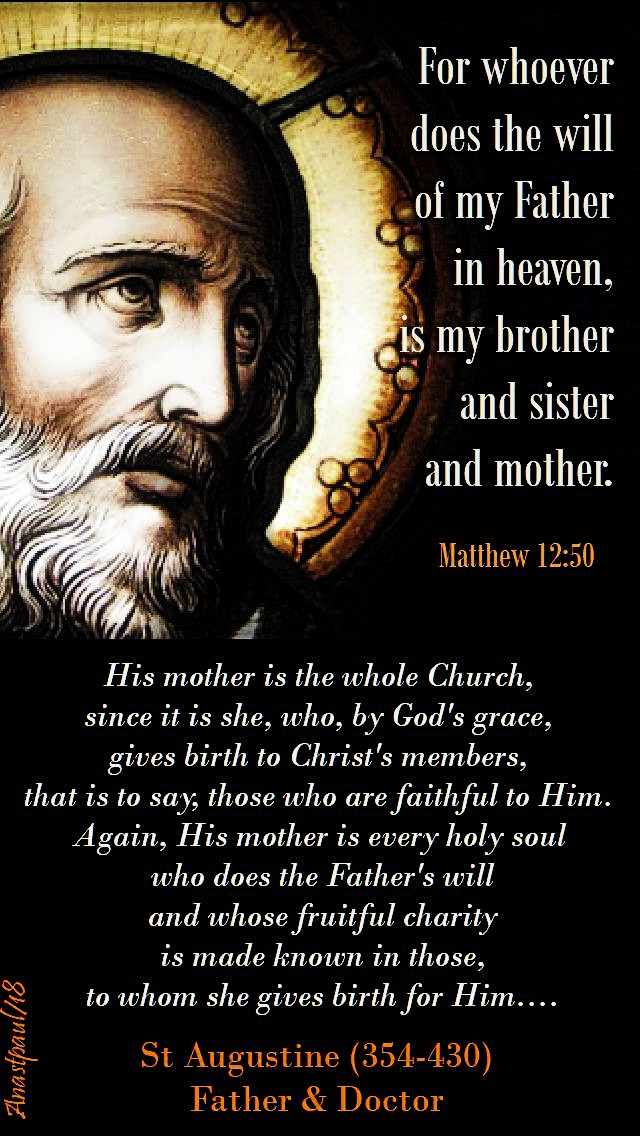
“There is one day for the passion of two apostles. But these two also were as one; although they suffered on different days, they were as one. Peter went first, Paul followed. We are celebrating a feast day, consecrated for us by the blood of the apostles. Let us love their faith, their lives, their labours, their sufferings, their confession of faith, their preaching.”
St Augustine (354-430) Father & Doctor of the Church
St Anastasius of Bourges
St Benedicta of Sens
St Cassius of Narni
St Ciwg ap Arawn
St Cocha
St Ilud Ferch Brychan
St Judith of Niederaltaich
St Marcellus of Bourges
St Mary, the Mother of John Mark
St Salome of Niederaltaich
St Syrus of Genoa
Bl William of Sann
—
Martyrs of China
Ioannes Baptista Wu Mantang
Magdalena Du Fengju
Maria Du Tianshi
Paulus Wu Anju
Paulus Wu Wanshu
Quote/s of the Day – 28 June – “Month of the Sacred Heart” – The Memorial of Blessed Paolo Giustiniani ECMC (1476-1528) – Monk, Hermit and Founder of the Congregation of the Camaldolese Hermits of Monte Corona
“The supreme goal to which the monk tends, the summit of the perfection of his heart, is indeed the union of his heart with his Lord.”
St John Cassian (c 360-435)
Monk, Father of the Church and Founder of Monasteries Disciple of St John Chrysostom
“O Hermitage, only those who know you, who rest sweetly in your arms, can tell of your grandeur and chant your praises. As for me, I only know this and affirm it in all sincerity – Whoever forces himself with perseverance to enter more and more into the desire to love You, will finally enter Your mystery and, at the same time, the mystery of God.”
St Peter Damian (1007-1072)
Benedictine Monk
Doctor of the Church
“Go to Church for the work of God, not by habit or duty, but rather driven, by the interior desire to praise our Creator.”
“Celebrate holy Mass in the joy of the Spirit.”
“I desire to serve my Lord Jesus Christ. However, I blindly entrust the manner of service to His decision – in action or in contemplation, in peace and quiet or in suffering and tribulation, in the quiet of the cell or else in wearisome wanderings. So long as I am serving Him, I have no preference or taste of my own.”
“To me it appears incontrovertible, that, above the light and discourse of reason, there is another light. It is clearer and more evident, given by God to those human minds that do not refuse to receive it and by means of it, God can be properly understood. …. This is the light of faith.“
Prayer of Blessed Paolo Giustiniani “Lord, I dare not say to You: “Show me the light that I may believe in Your Light” but it is enough for me, that You make me see my darkness … Bring me back to myself. In my misery I have distanced myself not only from You but from myself, becoming a stranger to myself. Make me know my darkness, that then I may look at the light. Yes, I tell You and repeat to You incessantly, Show me to myself, so that I may know my sins.”
“Until I was alone I never really lived. Until I was alone, I was not with myself. Until I was alone, I never drew near to my creator.”
One Minute Reflection – 28 June – “Month of the Sacred Heart” – Thirteenth Sunday in Ordinary Time, Year A, Readings: 2 Kings 4:8-11, 14-16, Psalm 89:2-3,16-19, Romans 6:3-4, 8-11, Matthew 10:37-42 and the Memorial of St Ireneaus (c 130 – 202) Father and Doctor of the Church
“Whoever receives you, receives me and whoever receives me, receives the one who sent me.” … Matthew 10:40
REFLECTION – “The Lord said: “Whoever welcomes this little child on my account welcomes me.” (Lk 9:48) The smaller our brother is, the more Christ is present. For when we welcome a great personality, we often do so out of vainglory but the person who welcomes someone unimportant, does so, with a pure intention and for Christ. He said: “I was a stranger and you welcomed me.” And again: “As often as you did it for one of my least brothers, you did it for me.” (Mt 25:35.40) Since He is talking about a believer and a brother, no matter how unimportant he is, Christ comes in with him. Open your house and welcome him.
“He who welcomes a prophet because he bears the name of prophet receives a prophet’s reward.” Thus, the person who welcomes Christ will receive the reward of Christ’s hospitality. Do not doubt His words, trust them. He himself told us: “In them, I am presenting myself.” And so that you do not doubt them, He decreed the punishment for those who do not welcome Him and the honours for those who do welcome Him (Mt 25:31). He would not do this if He were not personally touched by honour or scorn. He says: ‘You welcomed Me into your house, I will welcome you in the Kingdom of my Father. You freed Me from hunger, I will free you from your sins. You saw Me in chains, I will let you see your liberation. You saw Me a stranger, I will make of you a citizen of heaven. You gave Me bread, I will give you the Kingdom as your inheritance that is entirely yours. You helped Me in secret, I will proclaim it publicly and I will say that you are My benefactor and that I am in your debt.’” … St John Chrysostom (345-407) Bishop of Constantinople, Father and Doctor of the Church – Homilies on the Acts of the Apostles, no. 45
PRAYER – O Lamb of God By St Irenaeus (c 130 – 202)
O Lamb of God,
who takes away the sin of the world,
look upon us and have mercy upon us;
You who art Yourself, both victim and Priest,
Yourself, both Reward and Redeemer,
keep safe from all evil
those whom You have redeemed,
O Saviour of the world.
Amen
Saint of the Day – 28 June – Blessed Paolo Giustiniani ECMC (1476-1528) – Priest, Monk and Founder of the Congregation of the Camaldolese Hermits of Monte Corona, Reformer – born as Tommaso Giustiniani on 14 June in Venice, Italy and died on 28 June 1528, aged 52 in Monte Soratte.
He was a member of the noble Giustiniani family of Venice and was born there in 1476, the son of Francesco Giustiniani and Paola Malipiero. He studied theology, philosophy and law, at the University of Padua. when he had completed his studies, in 1507, he made a pilgrimage to the Holy Land and upon his return he felt a call to follow the life of a the religious.
He joined the Order of the Camàldula, the Camaldolese, in 1510. The superior of the order, Pietro Delfino, asked him to assist in ending the irregularities that existed in some communities of the order, caused by the autonomy of each house and the lack of authority of the Prior General. Especially, the conventual branch (of cenobitic life) had relaxed in the application of the rule. In 1513, Pope Leo X, at the request of Giustiniani and Delfino, convened a General Chapter of the Camaldolese that decided the creation of the united congregation of the Sacred Hermitage and San Michele de Murano, with temporary general Priors and with a balance between the Conventual and Hermit branches.
In 1516 he was elected Prior of the Hermitage of Camaldoli until 1520 and in 1518 he was Ordained a Priest. Desiring a more hermit-like type of life and faithful to the primitive rule of the order, he obtained from Pope Leo X, permission to found other communities, which would follow the original rule of St Romuald. Pope Leo X granted him the necessary permission and allowed him to found a differentiated congregation, free from the jurisdiction of the Camaldolese Prior General and with its own constitutions, called the Company of Hermits of Saint Romuald, which would later be the Congregation of the Camaldolese Hermits of Monte Corona. This Order would come to considered as the most faithful expression of the original Charism of the Order of St Romuald.
On his return from Rome with permission, Giustiniani resigned as Prior and with a companion, Oliverio da Cortona, went to seek the spiritual guidance of a Hermit who lived in Monte Corona, near Perugia. Together with a Dominican, they went to live alone in a place in the Apennines, Pascialupo, where they lived in a Chapel and in 1521 founded the Hermitage of Monte Cucco.
Allegory of the Camaldolese Hermitages by El Greco
Paolo was left alone with the Camaldolese monk who had accompanied him, as the other companion did not want to adopt the rule of St Romuald. The monks of Camaldoli asked him to be closer to them and he soon moved to a Hermitage near Massaccio, where he was joined by other monks of Camaldoli. These first Hermitages were followed by those of Cupramontana, San Leonardo de Monte Volubrio (diocese of Fermo) and San Benedetto de Monte Conero, near Ancona .
In 1522, Giustiniani drafted the constitutions of the new congregation, which consisted of the rigorous application of the original rule, modifying only the habit.
In 1523, the Order recognised the congregation of Monte Corona as independent, remaining in the Camaldolese family and in 1524 the first Chapter of the four hermitages of the congregation took place, which elected the Founder as Prior General. In 1527 he went to Rome for matters of order and was taken prisoner by the soldiers of the army of Charles V who occupied the city. with Gaietà de Thiene , also a prisoner, he was tortured but released. He returned to Venice and then to Massaccio.
In 1528 he returned to Rome and visited the Pope, obtaining confirmation of some privileges of the Order. In Viterbo he contracted the plague. He went to San Silvestro de Monte Soratte, near Rome, an ancient Benedictine Abbey that had been given to the Hermits of Monte Corona. He died there on 28 June 1528.
San Silvestro de Monte Soratte, where Blessed Paolo died
He was succeeded as the Prior General of the congregation by Agostino di Basciano.
He was buried in the crypt of San Silvestro. His relics were lost during the abandonment of the Hermitage and were only rediscovered in 1932. Although he has never been formally Beatified, he had always been considered a saint and was decribed as a “beati.” His cultus was formally confirmed allowing special veneration in his order.
Blessed Paolo Giustiniani’s Camaldolese Hermits of Monte Corona lives solely in Hermitages, usually with a very small number of monks comprising the community. There are three houses in Italy, two in Poland and one each in Spain, the United States and Colombia, as well as a new foundation in Venezuela. Unlike the other congregation, it is not a member of the larger Benedictine Confederation.
Bl Almus of Balmerino
St Argymirus of Córdoba
St Attilio of Trino
St Austell of Cornwall
St Benignus of Utrecht
St Crummine
Bl Damian of Campania
St Egilo
St Heimrad
St Lupercio
St Papias the Martyr Blessed Paolo Giustiniani ECMC (1476-1528)
St Pope Paul I
St Theodichildis St Vincenza Gerosa (1784–1847) Her life: https://anastpaul.com/2019/06/28/saint-of-the-day-28-june-st-vincenza-gerosa-1784-1847/
—
Martyrs of Africa – 27 saints: 27 Christians martyred together. The only details about them to survive are the names – Afesius, Alexander, Amfamon, Apollonius, Arion, Capitolinus, Capitulinus, Crescens, Dionusius, Dioscorus, Elafa, Eunuchus, Fabian, Felix, Fisocius, Gurdinus, Hinus, Meleus, Nica, Nisia, Pannus, Panubrius, Plebrius, Pleosus, Theoma, Tubonus and Venustus. Unknown location in Africa, date unknown.
Martyrs of Alexandria – 8 saints: A group of spiritual students of Origen who were martyred together in the persecutions of emperor Septimius Severus – Heraclides, Heron, Marcella, Plutarch, Potamiaena the Elder, Rhais, Serenus and Serenus. They were burned to death c.206 in Alexandria, Egypt.
Quote/s of the Day – 27 June – “Month of the Sacred Heart” – Memorial of St Cyril of Alexandria (376-444) and Blessed Louise-Thérèse de Montaignac de Chauvance OSHJ (1820-1885) “Apostle of the Sacred Heart”
“You work for God, without doubt but one must work IN God.”
“Love dies where there is no humility.”
“To hand onto your children.
the faith you received from your parents,
is your first duty
and your greatest privilege as parents.
The home should be the first school of religion,
as it must be the first school of prayer.”
Prayer of Bl Louise-Thérèse “O Jesus, Eternal Life in the womb of the Father, Life of souls made in Your likeness, In the name of Your Love, make Your Heart known and revealed.”
Blessed Louise-Thérèse de Montaignac de Chauvance (1820-1885)
“Apostle of the Sacred Heart”
“By nature, each one of us is enclosed, in his own personality but supernaturally, we are all one. We are made one body in Christ because we are nourished by one flesh. As Christ is indivisible, we are all one in Him. Therefore, He asked His Father “that they may all be One, as We also are one.”
“We have passed over the waves of this present life like a sea, with its commotion and insane bustle. We have eaten spiritual manna, the bread that came down from heaven giving life to the world.”
“Christ, has dominion over all creatures, a dominion not seized by violence nor usurped but His, by essence and by nature.
“The mark of Christ’s sheep is their willingness to hear and obey, just as disobedience is the mark of those who are not His. We take the word ‘hear’ to imply obedience to what has been said.”
“We must note, therefore, that he that does things pleasing to God, serves Christ but he that follows his own wishes, is a follower, rather of himself and not of God.”
“Our lives are all controlled by the Spirit now and are not confined to this physical world that is subject to corruption. The light of the Only-begotten has shone on us and we have been transformed into the Word, the source of all life.”
St Cyril of Alexandria (376-444)
Father and Doctor of the Incarnation
One Minute Reflection – 27 June – “Month of the Sacred Heart”- Saturday of the Twelfth week in Ordinary Time, Year A, Readings: Lamentations 2:2, 10-14, 18-19, Psalm 74:1-7, 20-21, Matthew 8:5-17 and the Feast of Our Mother of Perpetual Succour and the Memorial of St Cyril of Alexandria (376-444) – Doctor of the Church “The Pillar of Faith” & “Seal of all the Fathers” – Doctor Incarnationis (Doctor of the Incarnation) and Bl Louise-Thérèse de Montaignac de Chauvance OSHJ (1820-1885)
“Lord, I am not worthy that you should enter under my roof” … Matthew 8:8
REFLECTION – “When the Lord promised to go to the centurion’s house to heal his servant, the centurion answered, “Lord, I am not worthy to have you come under my roof but only say the word and my servant will be healed.” By viewing himself as unworthy, he showed himself worthy for Christ to come, not merely into his house but also into his heart. He would not have said this with such great faith and humility, if he had not already welcomed in his heart, the One who came into his house. It would have been no great joy for the Lord Jesus to enter into his house and not to enter his heart. For the Master of humility, both by word and example, sat down also in the house of a certain proud Pharisee, Simon and, though He sat down in his house, there was no place in his heart. For in his heart the Son of Man could not lay his head.” – St Augustine (354-430) Father and Doctor of Grace – Sermon 62
PRAYER – God our Father, You open the gates of the kingdom of heaven to those who are born again of water and the Holy Spirit. Increase the grace You have given, so that the people who have been purified from all sin, may not forfeit the promised blessing of Your love. Grant that we may ever keep Your Son, the Lord Jesus Christ, before our eyes and do all in Him and through Him and for Him and may the prayers of our Mother of Perpetual Succour may ever guide and bear us in her care and may Your Saints pray for Holy Mother Church and us all! We make our pray through Christ, our Lord, in union with You and the Holy Spirit, one God forever, amen.
Saint of the Day – 27 June – Blessed Louise-Thérèse de Montaignac de Chauvance OSHJ (1820-1885) Religious Sister and Founder of the Pious Union of Oblates of the Sacred Heart of Jesus. She was known for her staunch devotion to the Sacred Heart of Jesus. Her life witnessed her dedication to Catechetical formation and promoting the Sacred Heart in France. Born on 14 May 1820 in Le Havre-de-Grâce, Seine Maritime, France and died on 27 June 1885 in Moulins, Allier, France of natural causes, aged 65. Patronage – Oblates of the Heart of Jesus.
“In this nineteenth century, when there is so much division, frequently even within families, our mission is to unite… To firmly unite souls in a bond of true devotion to the Sacred Heart of Jesus.” These heartfelt words of Blessed Louise-Thérèse de Montaignac reveal the spirit of the Foundress of the Oblates of the Heart of Jesus. “A daughter of the Church and a woman in the Church,” said Saint John Paul II, “Louise-Thérèse wished to serve the Lord and the Church, which are one. Animated by an ardent apostolic desire and sustained by a great devotion to the Heart of Jesus, she began the work in close cooperation with her Bishop, with the Priests of her parish and with the lay faithful. She founded the Oblates who, through their union among themselves, were called to be agents of unity.” (Beatification Homily, 4 November 1990)
Louise-Thérèse was born in Le Havre on 14 May 1820, to a profoundly Christian family, who passed on the faith to her as a precious heritance. She was Baptised the next day. Later, she would express her happiness at being a daughter of God and would celebrate each anniversary of her Baptism.
From her father, Raymond de Montaignac de Chauvance, a civil servant and her mother, Anne de Raffin, Louise-Thérèse received the example of a life open to all. She was very close to her older sister Anna and her four brothers, she worked to make them happy. As a child, Louise was lively, spontaneous, always active: “I was made to love, so I desperately clung to all that was good ….” Her spontaneous nature played tricks on her; she made lots of foolish mistakes and did stupid things but her confidence disarmed all severity. The little girl loved to pray. One day, after a long search, she was found snuggled in a closet. “I was saying my prayers,” she said and when asked the reason for this strange behaviour, she explained, “It’s so that I don’t do any wrong to God.”
In 1827, Louise went off to boarding school in Châteauroux, at the Monastery of the Faithful Companions of Jesus and then, for the following two years, at the des Oiseaux convent, run by the Daughters of Our Lady. Boarding school rules did not suit her in the least. During her first stay, she was still afraid of punishments. However, she received a grace at Christmas – in contemplating the crèche she discovered the touching mystery of a God-child, poor and suffering. She allowed herself to be taken by Him and began to love Him. At des Oiseaux, she was “so scatterbrained that she was always in penance and in tears.” In class, she “consented to study only because her companions were ahead of her.” In the chapel, she made commendable efforts to be recollected but her good resolutions were always short lived. Louise would, nevertheless, always keep from these years the memory of happy days, in which her heart opened to God through her confessions as a child, her confidences to the Mother Superior “Mama Sophie” and her first friendships. But, it must be acknowledged, her studies scarcely progressed. A change was needed; her parents entrusted her to her aunt, Madame de Raffin, who was also her godmother. Over the years, the affection that united the young woman and her goddaughter would turn into a profound closeness. For fifteen years, Louise lived in the Raffin home, sometimes in Nevers, sometimes in the country, without losing the bond with her family. “It was,”she would say, “one of the greatest graces of my life.”
Her First Communion took place on 6 June 1833. “The little girl, the reediest there ever was,” she would say, had changed into a serious adolescent: “Since my First Communion, I have always remained under divine action.” The Eucharist became the centre of her life. Madame de Raffin was a woman of tempered faith but more energetic than tender. In school, Louise learned to control her natural energy without destroying its dynamism. She received a solid education, cultivated her artistic gifts and started learning the role of lady of the house. Under the direction of Father Gaume (1802-1879), the Director of the Minor Seminary, then Vicar General of the Diocese of Nevers, she likewise benefited from a spiritual and doctrinal formation. Louise immersed herself in the Gospels, the Psalms and read the Fathers of the Church and Saint Teresa of Avila, who became her main patroness. In 1837, when she returned to the des Oiseaux convent, she re-found the force of the faith that was the mark of this house, which radiated devotion to the Heart of Jesus. She was received into the Children of Mary. The Most Blessed Virgin, to whom “she confided all her sorrows”when she was a child, would from then on be her “teacher at every moment.”
On Christmas 1836, Louise-Thérèse came out of midnight Mass, with her friend Camille de Breathier, who was murmuring the verse from Revelations: it is these who follow the Lamb wherever He goes (Rev. 14:4). Louise was overcome… To follow Jesus wherever He goes! From that moment on, the white light of the Lamb illumined her steps, tracing out the radiant path on which she strove to follow Him. On 21 November 1838, Father Gaume gave her permission to take the vow of virginity. Four years later, at the age of twenty-two, Louise-Thérèse was bedridden for ten months with a bone disease – the first health ordeal which would unite her more intimately with God. Madame de Raffin helped her to live this time of suffering in recognition that in all things, “God’s will is pure love.” Following this illness, her aunt asked Louise-Thérèse this blunt question: “If Our Lord said to you: ‘Do you wish to be attached to the Cross with Me up to the point of death,’ would you accept?” “Yes,” she replied, “and with all my heart!” She would fully live out this “folly of love that does not calculate, does not reason, that runs without resting after the Saviour.”
In the era following the Revolution, in a world contaminated by scepticism, many people’s faith was shaken. In response, fervent Christians dedicated themselves to God through a vow to the Sacred Heart. The formula of this vow, written by Father Roothaan, the Father General of the Jesuits, spread throughout France. From this source sprang a veritable spiritual renewal. Madame de Raffin had heard about it from Father Ronsin, the spiritual director for the des Oiseaux Convent and, in 1841, she made the consecration. On 8 September 1843, Louise-Thérèse also made it. This vow is a response of our love to God’s first loving us, revealed by the Heart of Jesus, a response that engages the whole person in carrying out the Father’s plan. It was already the Oblation that would make the future Oblates. Forty years later, Louise-Thérèse could not recall the memory of this blessed day without profound emotion: “The vow to the Sacred Heart made my life. It was for me the source of all graces, of all joys.”
To revive the faith, Madame de Raffin conceived a vast plan of uniting Christian women in devotion to the Heart of Jesus: “Little scattered pieces of coal,” she said, “can produce neither flame, nor warmth: gathered together, they can light a great fire capable of illumining and reheating the world.” Initially associated with the project, Louise-Thérèse took it over with the death of her aunt in 1845. She recalled it’s inspiration in light of the Gospel: “I came to cast fire upon the earth and would that it were already kindled!” (Lk. 12:49). She dreamed of entering Carmel but gave it up, on Father Gaume’s recommendation: “Your vocation,” he told her, “is to carry Carmel into the midst of the world.”
The Revolution of 1848 shook France. Monsieur de Montaignac resigned as a civil servant. The family left Paris and settled in Montluçon, in the province of Bourbonnais, where it’s real roots were. Louise-Thérèse wondered how to awaken the faith in this city that was rapidly growing but marked by religious indifference. Everyday, she spent two hours in prayer in the deserted parish Church. Steadfast Christian groups were active in Montluçon, organised by a Priest with a fervent heart, Father Guilhomet. Louise-Thérèse joined forces with him and agreed to lead the Congregation of the Children of Mary. She founded the Orphanage of the Sacred Heart and enlisted friends to teach Catechism to the most abandoned. Having witnessed the abandonment of Churches in the countryside, she established the Charity of Poor Churches, helped spread Adoration of the Blessed Sacrament, organised retreats and endeavoured to develop her aunt’s project—the association of Christian women. Thanks to support from her Bishop, Bishop de Dreux-Brézé and from her parish Priest, these works spread in the Diocese of Moulins and beyond. However, at this time, the bone disease in her legs that Louise-Thérèse had been stricken with, returned. For more than thirty years, suffering became her “inseparable companion.” Handicapped, she could move only with crutches or transported in a little carriage. She needed all the energy of love to remain tirelessly devoted to others and to maintain the overflowing activity, that characterised her life.
In 1859, Mademoiselle de Montaignac met Father Gautrelet, a Jesuit, who in 1844 had founded the Apostolate of Prayer. Seeing his Seminarians’ impatience to enter missionary life, this Priest had told them: “Be apostles right now, apostles of prayer! Offer what you do each day in union with the Heart of Our Lord Jesus Christ and for what He wants – the spread of the Kingdom of God for the salvation of souls.” A Priest with a great deal of experience, Father Gautrelet would be Louise-Thérèse’s adviser for more than twenty-five years. With humility, he admitted: “I have great confidence in the direction of the Holy Spirit, the first of all directors!” That same year, he put Louise-Thérèse in touch with his confrere, Father Ramière, who had just taken over the leadership of the Apostolate of Prayer. An ardent Apostle of the Sacred Heart, Father Ramière launched Louise-Thérèse full sail into this movement. Louise-Thérèse saw in this spirituality the “most universal means for the sanctification of souls,” and found his organisation to be “an excellent way to penetrate society.”
At the beginning of the 1860s, Louise-Thérèse began the construction of a beautiful Chapel in the heart of Montluçon, to “unceasingly remind us of the love of the heart of Jesus.” Dedicated on 31 May 1864, it would become the Chapel of the Mother house of the Association of Christian Women. The same year, an attempt was made to unite this organisation with the Missionaries of the Sacred Heart in Issoudun. But in 1874, the Association broke off and became the Pious Union of the Oblates of the Heart of Jesus, under its own rule approved by the Bishop of Moulins. These years were fruitful – the Christian women consecrated by vow to the Heart of Jesus, were growing in number. In December 1875, Louise-Thérèse was appointed secretary general of the Apostolate of Prayer. Her correspondence—more than 1800 letters have been preserved—testifies to the quality of these relationships. Very practical, she entered with her innate common sense into the most minute details of material life, the organisation of houses, health and quite naturally, with tact and discretion, she became a spiritual guide who taught how to live in the light of faith. Strong friendships, born from these exchanges, marked her life: “Saint Teresa of Avila,”she said, “greatly loved her friends and this has always encouraged me to warmly love my friends.”
Bl Louise-Thérèse’s Chapel of the Sacred Heart
In Montluçon, a small team surrounded Louise-Thérèse. These first companions led a common life of prayer and hospitality, for they received many individuals. The Chapel was a centre for retreats, for spiritual encounters. Thus a first community took shape. Soon, a House was founded in Paray-le-Monial, then another in Paris. At the start of the 1880s, the future face of the institute took shape—two different forms of the Oblation for women destined to serve God and neighbour were proposed. Some, married or not, would remain in their environment, harmonising their family obligations with quite varied forms of apostolate. They formed “Re-unions” in the true sense of the word: “re-uniting,” that is meeting again, in a group regularly to pray together and practice fraternal charity; these are secular oblates. The others made vows of religion, poverty, chastity and obedience, in accordance with Louise-Thérèse’s inspiration. These professed oblates lived in community in the Houses, which were houses of prayer, intended first and foremost for the revitalisation of the secular oblates. Each of the Houses took on one or more apostolates.
On 17 May 1880, Louise-Thérèse was elected Superior General. Her role was to ensure “unity of spirit and tendencies, freedom in works and deeds, whether collective or individual.” The oblates’ chapter defined the mission of the institute: “To unite souls strongly through the bond of a true devotion to the Sacred Heart of Jesus, drawing them to prayer, reparation and devotion in union with Him and manifesting their love in the performance of works for His glory.” For the Foundress, devotion to the Heart of Jesus is a life of union and conformity with Him Who is eternal life which was with the Father (1 Jn. 1:2). “Our primary code of life,”she said, “is Jesus’ priestly Prayer,”which appears in Chapter 17 of Saint John’s Gospel: that they may be one even as we are one. On 4 October 1881, this mission was officially recognised by Pope Leo XIII. The communities multiplied: Lyon, Montélimar…
In the last years of her life, Louise-Thérèse experienced an even greater intimacy with Our Lord and grew in her service to others. Restricted to her chair or sickbed, she burned with a fervour more infectious than ever. “I am,” she gaily said, “like a young, frisky horse that has all four hooves tied down but is whipped to make it walk. … When I see all the work that Our Lord presents to me, I wish to do everything, to undertake everything.” In Montluçon, newcomers had taken the place of the workers of the first hour. Louise-Thérèse made formation of these daughters a priority, for they would have to pass on, that which they had received, as in a family.
Louise-Thérèse invites us to “an intimate communication, continual and full of love, with God, to a respectful and filial familiarity… God must be the breath of our soul, we must move and act only in Him…. True contemplation consists of having one’s mind and heart united with Jesus, speaking, acting, thinking like Him. What life could be more active and yet more contemplative than His? Always united to His Father, He is our model, our sole guide. Such are the fervent and energetic souls who are called to make the greatest progress in contemplative life. Such are the ones, who best carry out Our Lord’s plans. What is the use of contemplating a model, if one does not have the energy to reproduce it? The active soul acts on the fruit of one’s prayer, puts into action the lights it has received. It works in prayer, in humility, in devotion, in self-sacrifice. This is the true way of putting the life of Jesus into practice.” If someone close to her was a little stressed by external occupations, she would calm her: “You work for God, without doubt but one must work IN God.” The formation she gave was completely directed toward the freedom of love: “There is no barrier between Jesus and the oblate. Every soul goes where the Spirit leads it; Love is its only guide.” She also demanded that all be treated with respect, attention paid to each and to what God wanted of each. Returning to this humility that is the welcome of God, that He has a place for all, she noted, “Love dies where there is no humility.”
Christmas was a special time each year for Louise-Thérèse. In 1882, as this feast drew near, she invited the youngest of the oblates to follow “this little Child Who calls us to His crèche to lead us to Calvary where His Heart is always open.” And she vigorously insisted: “How could we resist Him? He shows Himself always to be the Saviour. Let us be it with Him as his littlest disciples.”This sums up Louise-Thérèse’s entire life. Struck by the person of Jesus in the mystery of His Incarnation, she handed herself over to Him so that He might live in her, so that He might continue His mission in her. By patiently enduring her intensely painful illness, which left her little respite, she united herself ever more closely with the Saviour’s Passion. “If You wish for me to continue to suffer, I will not complain,” she told Him in 1881. She nevertheless, had to undergo a night of the spirit: “I see nothing, I feel nothing. But I have faith in You and that is enough for me.” During the last hours of her life, she relied upon her Saviour: “I am counting on Divine Mercy, I will say: I have loved.” On 27 June 1885, she died as she was replying simply to the name of Jesus that someone close to her was saying: “My all!”
The institute soon saw a rapid expansion. The secular oblates’ first foundations were established abroad – Portugal (1887), El Salvador and Poland (1894) and Nicaragua (1903). Today, the institute is also established in Belgium, South America and Africa.
“Let us ask Blessed Louise-Thérèse of Montaignac de Chauvance to help us recognise the love of the Heart of Jesus and to remind men and women of it unceasingly, as she did so well during her life” (Saint John Paul II).
St Adeodato of Naples
St Aedh McLugack
St Anectus of Caesarea
St Arialdus of Milan
St Arianell of Wales
Bl Benvenutus of Gubbio
St Brogan
St Crescens of Galatia
St Crescentius of Mainz
Bl Daniel of Schönau
Bl Davanzato of Poggibonsi
St Desideratus of Gourdon
St Dimman
St Felix of Rome
St Ferdinand of Aragon
St Gudene of Carthage
Blessed Maria Pia Mastena
St Sampson of Constantinople
St Spinella of Rome
St Tôma Toán
St Zoilus of Cordoba
—
Martyrs Killed Under Communist Regimes in Eastern Europe: Among the thousands of Christians murdered by various Communist regimes in their hatred of the faith, there were 25 members of the Ukrainian Greek Catholic Church and Russian Byzantine Catholic Church, priests, bishops, sisters and lay people, whose stories are sufficiently well documented that we know they were murdered specifically for their faith in eastern Europe and whose Causes for Canonization were opened. Their Causes were combined and they were beatified together. They have separate memorials but are remembered together today. They are –
• Andrii Ischak • Hryhorii Khomyshyn • Hryhorii Lakota • Ivan Sleziuk • Ivan Ziatyk • Klymentii Sheptytskyi • Leonid Feodorov • Levkadia Harasymiv • Mykola Konrad • Mykola Tsehelskyi • Mykolai Charnetskyi • Mykyta Budka • Oleksa Zarytskyi • Ol’Ha Bida • Ol’Ha Matskiv • Petro Verhun • Roman Lysko • Stepan Baranyk • Symeon Lukach • Vasyl Vsevolod Velychkovskyi • Volodomyr Bairak • Volodymyr Ivanovych Pryima • Yakym Senkivsky • Yosafat Kotsylovskyi • Zenon Kovalyk
Beatified – 27 June 2001 by Pope John Paul II in Ukraine
Quote/s of the Day – 26 June – Tthe Memorial of Blessed Jacques Ghazir Haddad OFM Cap (1875-1954) “The Apostle of Lebanon” “The Apostle of the Cross”
“… Just as a person, who denies a single point of dogma, has lost his faith, so, to hate a single person, means that you have lost charity.”
“The Holy Spirit gives his grace to everyone, as long as they do not refuse it.”
“God gives us an example. He makes His sun rise on good and evil alike. His Son died for all men and women. … Let us imitate the sun.”
“Let us imitate the fountain. It does not say to a thirsty man: Before I give you a drink, tell me what country you come from!”
“May our heart be gentle, Christ‐like, towards the wretched and those who suffer. May they be to us, sons and daughters. How sweet this service, how precious this life, when it is consecrated to the love of God and of neighbour, His visible image on earth.”
One Minute Reflection – 26 June – “Month of the Sacred Heart” – Friday of the Twelfth week in Ordinary Time, Year A, Readings 2 Kings 25:1-12, Psalm 137:1-6, Matthew 8:1-4 and the Memorial of Blessed Andrea Giacinto Longhin OFM.Cap (1863 – 1936) Bishop
“Then Jesus said to him, ‘See that you tell no-one but go show yourself to the priest and offer the gift that Moses prescribed; that will be proof for them.’” … Matthew 8:4
REFLECTION – “What then was the gift that was to be brought by the leper according to the law? “Two small birds,” one of which the priest killed “over running water.” Taking “cedar wood and broken scarlet and hyssop” and the living bird, he dipped them “in the blood of the slain bird, over running water.” He anointed the right ear, hand and foot of the leper who was cleansed. He sent the living bird outside the city, “into the open field.”
Observe, therefore, how perfectly Christ depicts these things for us. By the living bird you may understand the living, heavenly Word.
By the blood of the slain bird, you should understand the blood of our suffering Lord, for whom, we say, that He suffered “in the flesh,” rather than “in his own body.”
The cedar is a wood not prone to rot. The incorruptible flesh, the body of Christ, “did not see corruption.”
Hyssop symbolises the effervescence, activity and power of the Spirit.
Scarlet intends the confession of the covenant made with blood.
The running water signifies the life-creating gift of baptism.
Through this baptism, whoever has become a leper through sin may be cleansed.
The sending of the living bird outside of the city teaches us to abandon this world, as did Christ in His ascension into heaven.
Having thus come into the presence of God the Father, He makes intercession for all of us and we, therefore, shall be cleansed.
By the anointing of the leper’s right ear, hand and foot, we are taught that we must be, in contemplation and in action and in our way of life, in touch with divine things.” … St Cyril of Alexandria (376-444) Father known as “The Pillar of the Faith” Doctor of the Incarnation (Fragment 93)
PRAYER – Enable me loving Father, to live a life of purity that will make me live in You. Let me be so united with You that whatever I might ask will be in total accord with Your will for me. Bl Andrea Giacinto Longhin, your tireless work and preaching for the glory of the Kingdom show us the way to sanctification, please intercede for us all. May Mary our Mother of Compassion, be our constant companion. We make our prayer through Christ our Lord, with the Holy Spirit, one God for all eternity, amen.
Saint of the Day – 26 June – Blessed Andrea Giacinto Longhin OFM.Cap (1863 – 1936) Bishop of Treviso, Italy from 1904 until his death, Priest of the Order of Friars Minor Capuchin, Teacher, renowned Preacher, Reformer, Spiritual guide, Apostolic Visitor – born as Hyacinth Bonaventure Longhin on 23 November 1863 in Fiumicello di Campodarsego, Province and Diocese of Padua, Italy and died on Friday 26 June 1936 in Treviso, Italy of natural causes following an eight-month illness. Patronage – Diocese of Treviso.
Blessed Andrea held various roles of leadership within his Order following his Ordination such as acting as a Professor in Udine and acting as the Provincial Minister for his Order. He became close friends with the Patriarch of Venice, Giuseppe Melchiorre Sarto. The latter became Pope Pius X in 1903 who made his old friend Andrea, the new Bishop for the vacant Treviso episcopal see.
The Bishop became noted for his devotion to pastoral reform initiatives, that sought to strengthen the spiritual formation for Seminarians and ongoing formation for the Diocesan Priests. He was active in organising and collaborating in relief initiatives during World War I and was even awarded the Cross of Merit for his activism.
Bishop Andrea Longhin, a Capuchin religious of deep spirituality and solid doctrine, was a gift of Pope Pius X to the Diocese of Treviso, his place of origin. Together with the Church entrusted to him, he lived heroically in one of the most difficult and exciting times of Catholicism in Italy in the 19th and 20th centuries.
He was born on 23rd November 1863 in Fiumicello di Campodarsego (Province and Diocese of Padua) into the family of the poor and very religious tenant farmers, Matthew and Judith Marin and given the names Hyacinth Bonaventure at his Baptism. Early on, he showed signs of a vocation to the Priesthood and religious life. At the age of 16 he entered the novitiate of the Capuchin Order under the name of Andrea of Campodarsego and then completed his humanistic studies in Padua and the theological studies in Venice. On 19th June 1886, only 23 years old, he was Ordained a Priest. For 18 years he held the office of spiritual director and instructor of the young religious and proved himself a firm guide and an enlightened teacher. In 1902 he was elected Provincial Minister of the Capuchins of Venice. In this period at Venice the Patriarch Sarto “discovered” him and charged him with the ministry of preaching and a variety of delicate tasks in the service of the Diocese.
Just a few months after becoming Pope, Pius X on 13th April 1904, personally appointed Fr Andrea as Bishop of Treviso and wanted him to be Consecrated in Rome. The Consecration, by Cardinal Rafael Merry del Val, took place a few days later in the Church of Trinità dei Monti in Rome. Before the new shepherd moved into his Diocese on the following 6th August, he had issued two pastoral letters that outlined his reform programme. The following year he began his first pastoral visit which lasted almost five years – he wanted to know his church, which belongs to the largest and most peopled of the Venetian region; he wanted to establish a personal contact with his clergy, who would take first place in his pastoral care; he also intended to be close to the lay associations, which at the time, were exposed to severe trials in the field of the Catholic social movement. He concluded the visit with the celebration of the Synod, which had, as it’s aim, the implementation in the Diocese, the reforms initiated by Pius X, to equip the local church to be “militant” and to call all, clergy and lay people, to a life in holiness.
He reformed the Diocesan Seminary by improving the quality of studies and the spiritual formation. He promoted spiritual retreats for the clergy and prepared, every year personally, a programme of ongoing formation. He guided the Priests in their pastoral activity with precise guidelines and verified their application in three further pastoral visits.
At the outbreak of the First World War (1915-1918), Treviso was on the frontline; it suffered invasions and the first aerial attacks, which destroyed the town and over 50 parishes. Bishop Longhin remained at his post even when the civilian authorities escaped to safer places. He wanted his Priests to do the same, unless they had to accompany their people on flight. He led the destiny of the town with heroic courage, was the point of reference in religious, moral and civilian matters for a whole community in turmoil. He organised assistance for the soldiers, the sick and the poor. Encouraging everybody, he never fell prey to partisanship or war rhetoric, yet he was accused of defeatism and some of his Priests were tried in court and sentenced.
In the difficult years of the material and spiritual reconstruction, the Bishop resumed the second pastoral visit which had been interrupted. He was a firm leader at a time of grave social tensions, which divided the Catholics among themselves. He insisted, with evangelical firmness, that justice and social peace, demanded the straight road of non-violence and the unity of all Catholics. The fascist movement was growing at the time and had its instances of violence in Treviso, especially against Catholic organisations. From 1926 to 1934 Bishop Longhin made his third pastoral visit, to strengthen the faith of the parish communities – in his understanding, the militant Church was a Church fully geared towards holiness and prepared for martyrdom!
Pope Pius XI held Bishop Longhin in great esteem; he entrusted him with the delicate task of Apostolic Visitor, first in Padua, then in Udine, in order to bring back peace to those Dioceses, suffering from divisions between the Priests and their Bishop.
God wanted to purify his faithful servant and afflicted him with an illness that deprived him progressively of his mental faculties. Longhin endured his suffering with extraordinary faith and total abandonment into the will of God. He died on 26th June 1936. His remains are interred in the Cathedral of Treviso.
He had been known for his holiness, his heroic charity and his wise evangelical guidance when still alive. With his death the devotion to the saintly shepherd grew stronger and quickly spread, especially in the Dioceses of Treviso and Padua and also in the Capuchin Order. The devotion exalted his virtues and implored his intercession. The process of Beatification was introduced in 1964. In the same year the young Dino Stella was cured of diffuse peritonitis on the intercession of Longhin. It is this miracle that was recognised for his Beatification.
His spiritual Heritage:
The unique connection of Bishop Andrea Giacinto Longhin with St Pope Pius X, was fundamentally of spiritual nature – the holiness of one, reminds and, in a way, produces the holiness of the other. Both have lived for the Church and with the Church, conceiving the pastoral ministry as a formation to holiness and, the whole life of the Church, as a call to be “holy and immaculate.” Both were driven to make themselves “models of the flock” in the footsteps of Christ the Good Shepherd. Bishop Longhin identified himself with his Church to the point of taking up the burden of all vicissitudes of history, living them in the first person and paying the price for so doing.
Franciscan spirituality, in the rigorous form of the Capuchin Order, always guided Bishop Longhin, not only in a his life that was ascetical, exacting and faithfully observant (prayer and penitence) but also, in an evangelical commitment without compromise – God as the Supreme, “religious” obedience towards the Church, poverty lived as freedom, respect for all things of the world.
His reform efforts brought him also cross and suffering, from the part of the clergy that was not willing to follow him on the path of renewal, as well as, from the laity that was either fixed on their material interests or taking sides with partisan positions. He was opposed by Fascism, which preferred to avenge itself on the Priests and the organised laity, thus inflicting on the pastor greater pain than if it had turned against his person. Right until his end, he remained the leader of a militant church that did not give in, neither to violence nor to flattery. In his charity, which he exercised with extraordinary dedication, he showed no weakness, being convinced that charity always called for truth. In him, firmness and humility appeared wonderfully united. The fruit of his testimony of holiness and of his courageous pastoral leadership, is the fact, that the church of Treviso, in that period of it’s history, has produced numerous saints among the Priests, religious and laity. Praise be to God! Amen … Vatican.va
St Pope John Paul II Beatified Andrea Longhin on 20 Octoer 2002 in Saint Peter’s Square.
Blessed Virgin of Potente del Trompone:
Visionary: Domenica di Miglianotto on 26 June 1562
2nd Visionary: St Peter of Alcantara (1499-1562) – seen below:
Our Lady of Longing: Matka Boża Tęskniąca / Longing Mother of God, Warsaw, Poland – One of the oldest churches in the Archdiocese of Warsaw is St Elizabeth Powsin Located on the main altar is a painting of Our Lady of Longing – artist unknown – from the first half of the seventeenth century. At either side, the image is surrounded by statues of Saints Adalbert and Stanislaus – Polish bishops and martyrs . The testimony of miracles and graces relating to the Our Lady of Longing icon have been collected at least since the mid-seventeenth century. On 28 June 1998, the image became the fourth image of Mary in the Archdiocese of Warsaw to be canonically crowned.
St Acteie of Rome
St Albinus of Rome Blessed Andrea Giacinto Longhin OFM. Cap(1863 – 1936) Bishop
Bl Andrii Ischak
St Anthelm of Belley
St Babolenus of Stavelot-Malmédy
St Barbolenus of Fossés
Bl Bartholomew of Vir
St Corbican
St David of Thessalonica
St Deodatus of Nola
St Dionysius of Bulgaria
St Edburga of Gloucester
St Hermogius of Tuy
St Iosephus Ma Taishun
St John of Rome
St John of the Goths
St José Maria Robles Hurtado St Josemaria Escriva (1902-1975) Biography: https://anastpaul.com/2018/06/26/saint-of-the-day-26-june-st-josemaria-escriva-de-balaguer-y-albas-1902-1975-the-saint-of-ordinary-life/
Blessed Jacques Ghazir Haddad OFM Cap (1875-1954) Beautiful Blessed Jacques: https://anastpaul.com/2019/06/26/saint-of-the-day-blessed-jacques-ghazir-haddad-ofm-cap-1875-1954/
St Maxentius of Poitou
St Medico of Otricoli
Bl Mykola Konrad
St Paul of Rome
St Pelagius of Oviedo
St Perseveranda of Poitiers
Bl Raymond Petiniaud de Jourgnac
St Salvius
Bl Sebastian de Burgherre
St Soadbair
St Superius
St Terence of Rome
St Vigilius of Trent
Bl Volodymyr Ivanovych Pryima
—
Martyrs of Africa – 4 saints: Four Christians who were martyred together – Agapitus, Emerita, Felix and Gaudentius at an unknown location in Africa, date unknown.
Martyrs of Alexandria – 3 saints: Three Christians who were martyred together, but we really know little more that the names – Agatho, Diogenes and Luceja. They were martyred in Alexandria, Egypt, date unknown.
Martyrs of Cambrai – 4 beati: Four Daughters of Charity of Saint Vincent de Paul nuns at Arras, France. Imprisoned together in 1792 and executed together two years later in the anti-Catholic excesses of the French Revolution. They were:
• Jeanne Gerard
• Marie-Françoise Lanel
• Marie-Madeleine Fontaine
• Thérèse-Madeleine Fantou
They were guillotined on 26 June 1794 at Cambrai, Nord, France and Beatified in June 1920 by Pope Benedict XV.
Saint of the Day – 25 June – Saint Moluag of Lismore (c 520–592) Bishop of Lismore, Missionary to Scotland and a contemporary of St Columba, Founder of Monasteries, Apostle of the Picts, Patron Saint of Argyll – born as Lughaidh in c 520 in Northern Ireland and died on 25 June 592 in Rosemarkie, Scotland of natural causes. Saint Lughaidh, better known by his pet name of Moluag, was an Irish noble of the Dál nAraide (one of the main tribes of the Ulaid in what we now call Ulster). He is also known as Lua, Luan, Luanus, Lugaid of Les Mór, Lugaidh, Lugide Lis Moer, Luoch, Mallock, Molaug, Molluog, Moloag, Molua, Moluag, Murlach. St Moluag, the Founder of over a hundred Monasteries, was a Bishop active during the period of the First Order of Celtic Saints and known as ‘The Clear and Brilliant, The Sun of Lismore in Alba.’ The First Order were ‘most holy – shining like the sun.’ This is a clear reference to his membership of the First Order. Saint Moluag was the first Patron Saint of Argyll, as evidenced by a charter in 1544, from the Earl of Argyll, which states “in honour of God Omnipotent, the blessed Virgin, and Saint Moloc, our Patron.”
St Moluag was born between 500 and 520. We know that he was a Bishop in about 552 and that he Ordained St Comgal (c 510–520 – 597/602), his close kinsman, initially as a Deacon then as a Priest. Moluag persuaded St Comgal to found Bangor Abbey, in modern day Ulster.
Having helped St Comgal set up this Abbey, perhaps the greatest of all Abbeys of its time, he took the road of white martyrdom and left with twelve followers to lead the life of a missionary. In 562 he founded his great community on the large island of the Lyn of Lorn in Argyll now called the Isle of Lismore (Lios mor is ancient Gaelic for ‘great monastery’ hence the reason Moluag is also kown as St Lios mor).
Lismore was the most important religious spot to the pagan kings of the area. It was, therefore, the most desirable site for a missionary. The Lismore Abbey lands were once very extensive and included the ancient parish of Lismore which embraced Appin (the Abbey Lands), Eilean Mund and Kingairloch and Morvern districts.
St Moluag truly evangelised the Picts. From Lismore, St Moluag went on to found two other great centres in the land of the Picts – at Rosemarkie and Mortlach. These were his three centres of teaching (we would now call them universities) and, it is significant, that all three were to become the seats of the Roman Catholic Sees of the Isles, Ross and Aberdeen.
St Moluag became the Patron Saint of the Royal House of Lorne and was acknowledged as such by, Somerled, King of Argyll and the Isles and the later Lords of Lorn and the Earls (now Dukes) of Argyll. From a 1544 charter it can be seen that The Earl of Argyll, having inherited the MacDougall Lordship of Lorn, refers to St Moluag as his family’s Patron Saint ‘in honour of God Omnipotent, the blessed Virgin, and Saint Moloc, our Patron.’
St Moluag was probably also Patron Saint of Rushen, on the Isle of Man and, according to Lismore tradition, the whole island. This is plausible as Somerled, a supporter of St Moluag, married Raghnild, daughter of Olaf, King of Man. Moluag was also the original dedicatee of the Manx Monastery of Rushen founded in 1134. In the 12th century, the Isle of Man was united with Sodor or the Sudreys, as the Norse called the ‘southern isles’ of the Hebrides, in the Diocese of Sodor and Man. A very ancient inscription on a paten found at Kirk-Malew (Malew is a corruption of Moluag), preserves the invocation of the Patron Saint, ‘St Maloua, ora pro nobis’: St Moluag, pray for us. Malew is the largest parish in Rushen and includes Castletown, the ancient capitol of the Island.
By the time of his death in 592, five years before St Augustine arrived at Canterbury, he had founded over 120 Monasteries and converted the Picts of Alba. Saints Moluag and Comgall, together with their famous disciples which included, Mael-ruba of Applecross, St Mirran, first Abbot of Paisley, Moluag’s kinsman St Catan of Kingarth on Bute and Catan’s nephew St Blaan, had a major influence on the spread of Christianity in North Britain.
The “Coarb” (Successor) of a Celtic Abbot was the heir of the Abbot in his ecclesiastical functions and abbatical mensal territory. St Moluag as the Abbot of Lismore and the Abbots of the 100 or so Monasteries which emanated from St Moluag, followed the rule of the Successor. The Successor of St Moluag provided the authority of the Church to support the Kings of Dalriada and the Lords of Lorn.
The Successorship of St Moluag is the oldest office in the country – the Abbey of Lismore was founded in 562. In the Celtic tradition it remains an hereditary office.
Moluag lived to extreme old age and died on 25 June 592 in the Garioch and was buried at his Monastery in Rosemarkie, Ross-shire, Scotland. The Annals of Ulster record the death of Lugaid of Les Mór in 592 – Obitus Lugide Lis Moer. His remains were later transported to Lismore and honoured in the Cathedral which bears his name.
Lismore Cathedral
The feast day of Saint Moluag was restored in 1898 by Pope Leo XIII. He is one of the 48 saints referred to in the Lorrha Missal used by Churches of Ireland, Scotland, Britain, France, Germany, Switzerland and northern Italy – “Saint Lua of Lismore, Pray for us.”
St Adalbert of Egmond
St Amand of Coly
Bl Burchard of Mallersdorf
St Cyneburga of Gloucester
St Domingo Henares de Zafra Cubero
Bl Dorothy of Montau
St Eurosia of Jaca
St Febronia of Nisibis
Bl Fulgentius de Lara
St Gallicanus of Embrun
St Gallicanus of Ostia
St Gohard of Nantes
Bl Guy Maramaldi
Bl Henry Zdick
Bl John the Spaniard
St Luceias and Companions St Maximus of Turin (? – c 420) Biography: https://anastpaul.com/2018/06/25/saint-of-the-day-25-june-st-maximus-of-turin-c-420-father-of-the-church/
Saint of the Day – 24 June – Saint Bartholomew of Farne OSB (Died 1193) Priest, Monk, Hermit – born in the 12th century at Whitby, Northumbria, England as Tostig and died on 1193 at Farne, England of natural causes.
Bartholomew was born early in the 12th century near Whitby. His parents, who were Scandinavian, gave him the Viking name of Tostig. But when his young friends laughed at him he changed it to the more acceptable Anglo-Norman name of William.
Apparently, as a young man, he was wild but then, after receiving visions of Christ and the apostles, he went to Norway to contemplate his life. There, he was Ordained Deacon and Priest. Many Priests in Norway were married but, when a certain Norseman tried to get William to marry his daughter, William fled back to England.
He worked as a Parish Priest for three years and then became a Monk at in the Benedictine Monastery at Durham, taking the name of Bartholomew. He had a further vision in which St Cuthbert (c 634 – 687) appeared to him and showed him the Island called the Inner Farne. Soon afterwards, he became a hermit there and lived on the Inner Farne for the remaining 42 years of his life, inhabiting St Cuthbert’s cell.
The mother-house at Durham, had not yet established the House of Farne as a regular daughter-house with two monks – that came later in 1255. However, when Bartholomew went, there was already a Monk there called Aelwin who found his new companion impossible and tried to irritate him into leaving. Bartholomew weathered this and it was Aelwin who left.
For the next 12 years Bartholomew was alone on the Island, then he was joined by the previous Prior of Durham, Thomas, who had been deposed after a row with the Bishop. The two Hermits did not get on very well at first, as Thomas was very clean and fastidious and Bartholomew was not. However, they eventually became friends and Bartholomew nursed Thomas through his last illness and death.
Bartholomew was very austere, wearing skins, sleeping leaning up against the rocks, living on bread from his own corn and milk from his own cow. He cultivated his own crops all the while singing psalms all round the Island in a ringing voice. He spent his nights in prayer and study of the Holy Scriptures. He was cheerful and friendly and had many visitors, including some of the rich and powerful whom he persuaded to change their sinful ways.
In his old age the monks of Lindisfarne cared for him as much as possible. He died in 1193 and was buried in his oratory on the Inner Fame. People said that miracles at his tomb, proved that he was a Saint and had reached the heavenly kingdom. Amen.
Madonna della Navicella – 24 June:
On 24 June 1508, in the afternoon, a strong storm, with disastrous effects, hit the inhabited area of Chioggia and Sottomarina. Rain, wind and storm had lashed the coast for a few hours. In the evening, fortunately, the storm stopped and the weather got better.
A greengrocer, Baldissera Zalon, went to the vegetable gardens, where the sanctuary stands today, to see for himself the damage that the strong storm had caused. Baldissera was a simple man, a peasant, who lived near his fields and lived on his work in the vegetable gardens.
As soon as he left the house, after scanning the clouds of the sky that were moving away and the setting sun was peeping, he heard himself called by name. After the first moments of amazement, Baldissera turned and saw a majestic Lady, all dressed in black, who sat on a trunk thrown on the beach by the waves of the stormy sea.
The greengrocer was stunned to say the least, so much so that he was about to pass out, when the Lady revealed to her that she was the Mother of Jesus , giving him courage and inviting him to go to the Bishop to warn him that the sins of the Chioggia challenged the justice of God and that penance had to be preached tenaciously to avoid worse punishment.
Then the Lady got on a craft that was near the shore but before leaving and disappearing, she opened her cloak showing the wounded and bleeding body of Jesus, making it clear that it had also been reduced by the sins of the Chioggiotti.
Baldiserra wasted no time and went to the Bishop, who organised a pilgrimage to the place of the apparition and the turnout of the faithful became more and more consistent day after day. In a short time, a Chapel was built on the spot and then, in 1515, a sanctuary which was, however, destroyed in 1814.
The current Church was built between 1952 and 1958 and was Consecrated on 24-25 June 1958 by Bishop Piasentini.
The miraculous image was found, according to popular belief, a few days after the apparition, together with the log on which the Madonna would sit when she appeared to Baldissera. The image and the LOG from 15 November 1806 are preserved and are visible in the Basilica of San Giacomo.
This slideshow requires JavaScript.
St Aglibert of Créteil
St Agoard of Créteil
St Alena of Brussels
St Amphibalus of Verulam St Bartholomew of Farne OSB (Died 1193)
Bl Christopher de Albarran
St Erembert I of Kremsmünster
St Faustus of Rome and Companions
St Festus of Rome
St Germoc
St Gohardus of Nantes
Bl Henry of Auxerre/the Hagiographer
St Ivan of Bohemia
St John of Rome
St John of Tuy
St Joseph Yuan Zaide
Bl Maksymilian Binkiewicz St Maria Guadalupe García Zavala (1878-1963) Biography: https://anastpaul.com/2019/06/24/saint-of-the-day-st-maria-guadalupe-garcia-zavala-1878-1963/
St Rumold
St Simplicio of Autun
Bl Theodgar of Vestervig
St Theodulphus of Lobbes
—
Martyrs of Satala: Seven Christian brothers who were soldiers in the imperial Roman army. They were kicked out of the military, exiled and eventually martyred in the persecutions of Maximian. We know little more about them than their names – Cyriacus, Firminus, Firmus, Longinus, Pharnacius, Heros and Orentius. The martyrdoms occurred in c 311 at assorted locations around the Black Sea.
Saint of the Day – 23 June – Saint Lanfranco Beccari (c 1134-1198) Bishop of Pavia, Italy, Defender of the Rights of the Church, Apostle of prayer of the poor and those in situations of distress, miracle-worker – born in c 1124 at Gropello, Pavia, Italy and died on 23 June 1198 at the Vallombrosan Monastery of the Holy Sepulchre near Pavia, Italy of natural causes.Also known as St Lanfrancoof Pavia.
Born of a noble family in Gropello in the province of Pavia around 1134, Lanfranco was assigned the role of Bishop for his city by Alexander III.
Very kind to good people but uncompromising to the unjust, he led an exemplary life, characterised by devoted life of intense prayer and charity towards the needy.
He had heated discussions against the city civil authorities who wanted to take possession of various ecclesiastical goods. For this reason, finding himself almost forced to leave Pavia, he went to Rome to find comfort and support from the Pope.
When he returned to Pavia, now tired of the constant problems that public life was giving him, he decided to retire to the Vallombrosan Monastery of the Holy Sepuchre, where he remained until his death, which took place on 23 June 1198.
The above passage comes from what is written in the letter sent by Pope Innocent III to the Bishop of Faenza, Bernardo, on 8 August 1198, in which the passage to the Diocese of Pavia, Bernardo was proposed as successor to the late Lanfranco. And it was Bernardo himself who, as successor Bishop, wrote the first biography of Lanfranco.
St Lanfranco di Pavia between saints Giovanni Battista and Liberius, Cima da Conegliano, Fitzwilliam Museum , Cambridge
There is little information relating to the first years of the Monastery’s life. The most significant period coincided with the years in which Lanfranco Beccari was Bishop of Pavia. Lanfranco, Consecrated Bishop of Pavia by Pope Alexander III in 1159, was often a guest of the Monastery. Lanfranco decided to spend the last years of his life in the Monastery and was buried here, in a reputation for holiness. After his death on 23 June 1198, the Church and Monastery were dedicated to him.
Facade of the Church and Monastery
In the Church there is a sepulchral marble ark which houses the body of San Lanfranco Beccari. It is the work of Giovanni Antonio Amadeo , the great Italian sculptor and architect who worked in Pavia for both the Certosa and the Cathedral together with Bramante. The construction of the ark dates back to 1489 and took place on commission of the abbot and cardinal Pietro Pallavicini de ‘Scipione.
The sarcophagus is divided into squares with depictions of the Saint’s life:
On the left: Lanfranco heals a mute young man. On the front: In the Atrium of San Siro he receives the consuls (you can see the two cathedrals and the statue of the Regisole). On his return from exile, he is welcomed by the new consuls (the character on the right, half hidden by a figure from behind, would have the appearance of Amadeo). Praying to the Virgin in her retreat with the Vallombrosan monks . Right: The young Gelasia condemned on the false charge of poisoning her brother comes out of the stake . In the back: Healing of the Pavese jurisconsult Pietro Negri; Giovanni Brunelli attacked by brigands and tied in the bush, manages to untie himself with the help of the Saint. Alberto da Novara, a repentant criminal, is saved from hanging .
There are also other relief panels with scenes from the life of Christ and the Blessed Virgin – the Annunciation , the Visitation , the Nativity , the Presentation in the temple , Jesus healing the sick , the Crucifixion.
In the central nave, in the middle of the right side, a fresco, unfortunately only partially extant, painted between 1173 and 1198 is particularly interesting. It depicts the assassination of the Archbishop of Canterbury St Thomas á Becket on 29 December 1170 in Canterbury Cathedral, at the hands of some assassins sent by King Henry II of England. The king decided to commission the murder as Becket, much loved by the people and once his special adviser, had begun to reproach him for his dissolute and violent life and divorce choices. In the fresco there are three knights with a sword in the act of killing the Archbishop.
The fresco was created to indicate the parallel between the events of the life of St Thomas á Becket and those of the Pavese Bishop Lanfranco Beccari – as Becket had opposed King Henry of England who limited the freedom of the English clergy, an opposition that pushed him to Rome to ask help to the Pope and who, in the end, paid with his life. In the same way, St Lanfranco, a few decades later, came into sharp conflict with the Pavia authorities and was forced to ask the Pope for help – he was not killed but retired to the Monastery leading a solitary life.
Next to Becket’s fresco, on the left, the figure of the same Bishop Lanfranco is repeated, with red chasuble and pallium, mitre and pastoral, in a blessing gesture with ring finger and little finger joined to the Greek.
St Lanfranco Beccari (c 1134-1198) Bishop
Bl Lupo de Paredes
Bl Mary of Oignies
St Moeliai of Nendrum
Bl Peter of Juilly
Bl Thomas Corsini of Orvieto
St Thomas Garnet
Bl Walhere of Dinant
St Zenas of Philadelphia
St Zeno of Philadelphia
—
Martyrs of Ancyra: A family of converts who were arrested, tortured and sent in chains to Ancyra, Galatia (modern Ankara, Turkey) where he was tortured more by order of governor Agrippinus during the persecutions of Diocletian. Martyr. They were – Eustochius, Gaius, Lollia, Probus, Urban. They were roasted over a fire and finally beheaded c 300 in Ancyra, Galatia (modern Ankara, Turkey).
Martyrs of Nicomedia: During the persecutions of Diocletian, many Christians fled their homes to live in caves in the area of Nicomedia. In 303 troops descended on the area, systematically hunted them down and murdered all they could find.
Second Thought for the Day – 22 June – On the Memorial of Saints John Fisher and Thomas More, Martyrs – A Papal Masterpiece
Sermon Delivered by Pope Pius XI (1857-1939) on the Occasion of the Papal Mass in St Peter’s for the Canonisation of St John Fisher (1469-1535) and St Thomas More (1478-1535) Martyrs, on 19 May 1935
As Jesus Christ, according to the words of St Paul, is eternal and immutable, “yesterday and today and the same forever,” so the Church founded by Him, is destined never to perish. Generations follow and succeed each other with their perennial vicissitudes. But whereas human institutions give way and disappear before the levelling tide of time and human sciences, reflecting inconstant light, undergo repeated transformations, the Cross of Christ, reared steadfast above the engulfing billows, never ceases to illumine mankind with the beneficent splendour of Eternal Truth.
From time to time, new heresies make their appearance and, under the guise of truth, gain strength and popularity but, the seamless garment of Christ can never be rent in twain. Unbelievers and enemies of the Catholic faith, blinded by presumption, may indeed constantly renew their violent attacks against the Christian name but. in wresting from the bosom of the militant Church, those whom they put to death, they become the instruments of their martyrdom and of their heavenly glory.
No less beautiful than true are the words of St Leo the Great: “The religion of Christ, founded on the mystery of the Cross, cannot be destroyed by any sort of cruelty – persecutions do not weaken, they strengthen the Church. The field of the Lord is ever ripening with new harvests, while the grains shaken loose by the tempest take root and are multiplied.”
These thoughts, full of hope and comfort, spring up in Our mind as We, in this majestic Vatican Basilica, are about to proclaim briefly the praises of our two new Saints after having raised them to the honours of the altar. They, the bright champions and the glory of their nation, were given to the Christian people, in the words of the prophet Jeremias, “as a fortified city and a pillar of iron, and a wall of brass.” Therefore, they could not be shaken by the fallacies of heretics, nor frightened by the threats of the powerful. They were, so to speak, the leaders and chieftains of that illustrious band of men who, from all classes of the people and from every part of Great Britain, resisted the new errors with unflinching spirit and in shedding their blood, testified their loyal devotedness to the Holy See.
John Fisher, gifted by nature with a most gentle disposition, thoroughly versed in both sacred and profane lore, so distinguished himself among his contemporaries by his wisdom and his virtue, that under the patronage of the King of England himself, he was elected Bishop of Rochester. In the fulfilment of this high office, so ardent was he in his piety towards God and in charity towards his neighbour and so zealous in defending the integrity of Catholic doctrine, that his episcopal residence seemed rather a Church and a University for studies, than a private dwelling.
He was wont to afflict his delicate body with fastings, scourges, and hair cloth; nothing was dearer to him than to be able to visit the poor, in order to comfort them in their miseries and to succour them in their needs. When he found someone frightened at the thought of his faults and terrified by chastisements to come, he brought comfort to the erring soul by restoring confidence in God’s mercy. Often, when celebrating the Eucharistic Sacrifice, he was seen shedding abundant tears, while his eyes were raised to heaven in an ecstatic expression of love. When he preached to the multitudes of the faithful that crowded round to hear him, he seemed neither a man nor a herald of men but an angel of God clothed in human flesh.
Nevertheless, whilst he was meek and affable towards the afflicted and the suffering, whenever there was question of defending the integrity of faith and morals, like a second Precursor of the Lord, in whose name he gloried, he was not afraid to proclaim the truth openly and to defend by every means in his power, the divine teachings of the Church. You are well aware, Venerable Brethren and Beloved Sons, of the reason why John Fisher was called in judgement and obliged to undergo the supreme test of martyrdom. It was because of his courageous determination to defend the sacred bond of Christian marriage—a bond indissoluble for all, even for those who wear the royal diadem—and to vindicate the Primacy with which the Roman Pontiffs are invested by divine command.
That is why he was imprisoned and afterwards led to death. Serenely he advanced toward the scaffold and with the words of the Te Deum on his lips, he rendered thanks to God, for being granted the grace of having his mortal life crowned with the glory of martyrdom and, he raised up to the Divine Throne, a fervent prayer of supplication for himself, for his people and for his King. Thus did he give another clear proof that the Catholic Religion does not weaken but increases the love of one’s country.
When finally he mounted the scaffold, whilst a ray of sunlight cast a halo of splendour about his venerable grey hairs, he exclaimed with a smile: “Come ye to Him and be enlightened and your faces shall not be confounded.” (Ps. xxxiii, 6.) Most assuredly the heavenly hosts of angels and saints hastened in joy to meet his holy soul, freed at last from the fetters of the body and winging flight toward eternal joys.
The other star of sanctity that traced a luminous path across that dark period of history was Thomas More, Lord Chancellor of the King of England. Endowed with the keenest of minds and supreme versatility in every kind of knowledge, he enjoyed such esteem and favour among his fellow-citizens, that he was soon able to reach the highest grades of public office. But, he was no less distinguished for his desire of Christian perfection and his zeal for the salvation of souls. Of this we have testimony in the ardour of his prayer, in the fervour with which he recited, whenever he could, even the Canonical Hours, in the practice of those penances by which he kept his body in subjection and finally, in the numerous and renowned accomplishments of both the spoken and the written word which he achieved, for the defence of the Catholic faith and for the safeguarding of Christian morality.
A strong and courageous spirit, like John Fisher, when he saw that the doctrines of the Church were gravely endangered, he knew how to despise resolutely the flattery of human respect, how to resist, in accordance with his duty, the supreme head of the State when there was question of things commanded by God and the Church and how to renounce with dignity, the high office with which he was invested. It was for these motives that he too was imprisoned, nor could the tears of his wife and children make him swerve from the path of truth and virtue. In that terrible hour of trial he raised his eyes to heaven and proved himself a bright example of Christian fortitude. Thus it was that he who not many years before had written a work emphasising the duty of Catholics to defend their faith, even at the cost of their lives, was seen to walk cheerful and confident from his prison to death and thence to take his flight to the joys of eternal beatitude.
Here, Venerable Brethren and Beloved Sons, we may justly repeat the well-known saying of St Cyprian, Martyr: “O blessed prison which conveys men to heaven! O blessed enchained feet, which with salutary steps are directed towards paradise!”
It was supremely fitting that these holy Martyrs who shed their blood for the Christian faith and for the defence of the sacred rights of the Roman Pontiff, should receive, together with the aureole of sanctity, their due glorification here in the very centre of the Catholic world, close to the glorious sepulchre of the Prince of the Apostles, through the instrumentality of Us who are the heir and successor of St Peter.
And now, it only remains for Us to exhort, with paternal heart, all of you who filled with veneration are grouped around Us, as well as those who, wherever they may be, profess themselves Our sons in Christ. We exhort you to imitate with all diligence the great virtues of these holy Martyrs and to implore for yourselves and for the Church militant, their powerful protection. If all of us are not called to shed our blood for the defence of the holy laws of God, all nonetheless, according to the expression of St Basil, with evangelical abnegation, with Christian mortification of their bodies, with energetic striving after virtue, “must be Martyrs of desire, in order to share with the Martyrs their celestial reward.”
We desire, moreover, that with your ardent prayers, invoking the patronage of the new Saints, you ask of the Lord that which is so dear to Our heart, namely, that England, in the words of St. Paul, “meditating the happy consummation which crowned the life” of those two Martyrs, may “follow them in their faith” and return to the Father’s house “in the unity of faith and of the knowledge of the Son of God.”
Let those who are still separated from Us, consider attentively the ancient glories of their Church which were at once a reflection and an increment of the glories of the Church of Rome. Let them consider, moreover and remember, that this Apostolic See has been waiting for them so long and so anxiously, not as coming to a strange dwelling place but as finally returning to their paternal home.
In conclusion, let us repeat the divine prayer of Our Lord Jesus Christ: “Holy Father, keep them in Thy name whom Thou hast given me, that they may be one as we also are.” Amen.
Quote/s of the Day – 22 June – The Memorial of St John Fisher (1469-1535) Bishop, Martyr
“I reckon in this realm, no one man, in wisdom, learning and long approved virtue together, meet to be matched and compared with him.”
St Thomas More speaking of St John Fisher
“A good man is not a perfect man; a good man is an honest man, faithful and unhesitatingly responsive to the voice of God in his life.”
“Contrition is to have sorrow at heart and great repentance of all his sins and to have steadfast purpose to keep and abstain him from all deadly sins. For who has intention to return him to deadly sin, his confession avails him nothing!”
“Penance is a needful thing to the sinner, who desires to recover health of his soul. And, in doing penance, there be three things to be considered: serious compunction of heart, confession of mouth and satisfaction by deed.”
“As St Paul has said, for our justification, He [Christ], gave to man all that was necessary – His Blood to wash us, His Body to redeem us. In His Passion, Justice and peace have met each other.”
“Beware of those prophets who speak unto you and deceive you! They prophecy nothing but the imaginations and forgings of their own minds and not the truth of Holy Scripture!”
One Minute Reflection – 22 June – “Month of the Sacred Heart” – Monday of the Twelfth week in Ordinary Time, Year A, Readings: 2 Kings 17:5-8, 13-15, 18, Psalm 60:3-5, 12-13, Matthew 7:1-5 and the Memorial of St John Fisher (1469-1535) Bishop, Martyr
“You hypocrite, remove the wooden beam from your eye first; then you will see clearly to remove the splinter from your brother’s eye.” … Matthew 7:5
REFLECTION – “The word hypocrite is aptly employed here, since the denouncing of evils is best viewed as a matter only for upright persons of goodwill. When the wicked engage in it, they are like impersonators, masqueraders, hiding their real selves behind a mask, while they portray another’s character through the mask. The word hypocrites, in fact, signifies pretenders.
Hence we ought especially to avoid that meddlesome class of pretenders who, under the pretence of seeking advice, undertake the censure of all kinds of vices. They are often moved by hatred and malice.
Rather, whenever necessity compels one to reprove or rebuke another, we ought to proceed with godly discernment and caution.
First of all, let us consider whether the other fault is such, as we ourselves have never had, or whether it is one that we have overcome.
Then, if we have never had such a fault, let us remember that we are human and could have had it. But if we have had it and are rid of it now, let us remember our common frailty, in order that mercy, not hatred, may lead us to the giving of correction and admonition.
In this way, whether the admonition occasions the amendment, or the worsening of the one for whose sake we are offering it, (for the result cannot be foreseen), we ourselves shall be made safe through singleness of eye. But if on reflection we find that we ourselves have the same fault as the one we are about to reprove, let us neither correct nor rebuke that one. Rather, let us bemoan the fault ourselves and induce that person to a similar concern, without asking him to submit to our correction.”… St Augustine (354-430) Father and Doctor of Grace – Sermon on the Mount, 2
PRAYER – As we pray before You Lord, we ask You, in Your loving kindness, for the grace always to ponder in our hearts what we proclaim with our lips. Keep us in Your commandments and strengthen us by the prayers of St John Fisher, Your Martyr, that we may live by a holy conscience and never flinch from the protection of truth. Grant this we pray through Jesus Christ, Your Son, our Lord, in the love and unity of the Holy Spirit, God for always and forever, amen.
Saint of the Day – 22 June – Saint John Fisher (1469-1535) Bishop, Martyr, Cardinal, Theologian, Academic, Writer – born in 1469 at Beverly, Yorkshire, England and died on 22 June 1535, aged 65, on Tower Hill, Tyburn, London, England, by beheading. Fisher was executed by order of Henry VIII during the English Reformation for refusing to accept him as the supreme head of the Church of England and for upholding the Catholic Church’s doctrine of Papal supremacy. Patronages – Diocese of Rochester, Catholic students at Cambridge.
He was condemned to be hanged, drawn and quartered at Tyburn, however, a public outcry was brewing among the London populace who saw a sinister irony in the parallels between the conviction of Fisher and that of his patronal namesake, Saint John the Baptist, who was executed by King Herod Antipas for challenging the validity of Herod’s marriage to his brother’s divorcée Herodias. For fear of John Fisher’s living through his Patronal feast day, that of the Nativity of St. John the Baptist on 24 June and of attracting too much public sympathy, King Henry commuted the sentence to that of beheading, to be accomplished before 23 June, the Vigil of the feast of the Nativity of St John the Baptist. He was executed on Tower Hill on 22 June 1535. The execution had the opposite effect from that which King Henry VIII intended, as it created yet another parallel with that of the martyrdom of St John the Baptist, who was also beheaded; his death also happened on the feast day of Saint Alban, the first martyr of Britain.
St John Fisher by Gerard Valck, after Adriaen van der Werff, 1697.
John Fisher was born in Beverley, Yorkshire, in 1469, the eldest son of Robert Fisher, a modestly prosperous merchant of Beverley and Agnes, his wife. He was one of four children. His father died when John was eight. His mother remarried and had five more children by her second husband, William White. Fisher seems to have had close contacts with his extended family all his life. Fisher’s early education was probably received in the school attached to the collegiate church in his home town.
He was educated at Cambridge, from which he received his Master of Arts degree in 1491. John received a Papal dispensation to enter the Priesthood despite being under canonical age. He was Ordained into the Priesthood on 17 December 1491 – the same year that he was elected a fellow of his college. He occupied the vicarage of Northallerton, 1491-1494, then he became Proctor of Cambridge University. In 1497, he was appointed Confessor to Lady Margaret Beaufort, mother of Henry VII and became closely associated in her endowments to Cambridge with which he created scholarships, introduced Greek and Hebrew into the curriculum and brought in the world-famous Erasmus (1466-1536) to visit Cambridge, as professor of Divinity and Greek. As a Catholic priest, Erasmus was an important figure in classical scholarship who wrote in a pure Latin style.
By papal bull dated 14 October 1504, Fisher was appointed the Bishop of Rochester at the personal insistence of Henry VII. Rochester was then the poorest Diocese in England and usually seen as a first step on an ecclesiastical career. Nonetheless, Fisher stayed there, presumably by his own choice, for the remaining 31 years of his life. At the same time, like any English Bishop of his day, Fisher had certain state duties. In particular, he maintained a passionate interest in the University of Cambridge. In 1504 he was elected the university’s Chancellor. Re-elected annually for 10 years, Fisher ultimately received a lifetime appointment. At this date he also acted as tutor to the future King, Henry VIII.
As a preacher his reputation was so great, that Fisher was appointed to preach the funeral oration for King Henry VII and the Lady Margaret, both of whom died in 1509, the texts being extant. Besides his share in the Lady Margaret’s foundations, Fisher gave further proof of his zeal for learning, by inducing Erasmus.
Despite his fame and eloquence, it was not long before Fisher came into conflict with the new King, his former pupil. The dispute arose over funds left by the Lady Margaret, the King’s grandmother, for financing foundations at Cambridge.
In 1512 Fisher was nominated as one of the English representatives at the Fifth Council of the Lateran, then sitting, but his journey to Rome was postponed, and finally abandoned.
Fisher has also been named, as the true Author of the royal Treatise against Martin Luther entitled “Assertio septem sacramentorum”Defence of the Seven Sacraments, published in 1521, which won for King Henry VIII the title “Fidei Defensor” – Defender of the Faith. On 11 February 1526, at the King’s command, he preached a famous sermon against Luther at St Paul’s Cross, the open-air pulpit outside St Paul’s Cathedral in London.
From 1527, this humble servant of God actively opposed the King’s divorce proceedings against Catherine, his wife in the sight of God and steadfastly resisted the encroachment of Henry on the Church. Unlike the other Bishops of the realm, St John refused to take the oath of succession which acknowledged the issue of Henry and Anne as the legitimate heir to the throne and he was imprisoned in the tower in April 1534.
The next year he was made a Cardinal by Paul III and Henry retaliated by having him beheaded within a month. A half hour before his execution, this dedicated scholar and churchman opened his New Testament for the last time and his eyes fell on the following words from St John’s Gospel: “Eternal life is this – to know You, the only true God and Him Whom You have sent, Jesus Christ. I have given you glory on earth by finishing the work you gave me to do. Do you now, Father, give me glory at your side.” Closing the book, he observed: “There is enough learning in that to last me the rest of my life.”
St John’s last moments were in keeping with his life. He met death with a calm dignified courage which profoundly impressed those present. His body was treated with particular rancour, apparently on Henry’s orders, being stripped and left on the scaffold until the evening, when it was taken on pikes and thrown naked into a rough grave in the churchyard of All Hallows’ Barking, also known as All Hallows-by-the-Tower. There was no funeral prayer. A fortnight later, his body was laid beside that of Sir Thomas More in the chapel of St Peter ad Vincula within the Tower of London.
A stern and austere man, Fisher was known to place a human skull on the altar during Mass and on the table during meals. Erasmus said of John Fisher: “He is the one man at this time, who is incomparable for uprightness of life, for learning and for greatness of soul.”
John was Beatified by Pope Leo XIII with Thomas More and 52 other English Martyrs on 29 December 1886. In the Decree of Beatification issued on 29 December 1886 by Pope Leo XIII, when 53 English martyrs were Beatified, the greatest place was given to Fisher. He was Canonised, with Thomas More, on 19 May 1935 by Pope Pius XI. His feast day, for celebration jointly with St Thomas More, is today, 22 June (the date of St John Fisher’s execution).
St Aaron of Brettany
St Aaron of Pais-de-Laon
St Alban of Britain
Bl Altrude of Rome
St Consortia
St Cronan of Ferns
St Eberhard of Salzburg
St Eusebius of Samosata
St Exuperantius of Como
St Flavius Clemens
St Gregory of Agrigento
St Heraclius the Soldier
St Hespérius of Metz
Bl Pope Innocent V
St John IV of Naples
St Julius of Pais-de-Laon
Bl Kristina Hamm
Bl Marie Lhuilier
St Nicetas of Remesiana
St Precia of Epinal
St Rotrudis of Saint-Omer
St Rufinus of Alexandria
—
Martyrs of Samaria – 1480 saints: 1480 Christians massacred in and near Samaria during the war between the Greek Emperor Heraclius and the pagan Chosroas of Persia. c 614 in the vicinity of Samaria, Palestine.
One Minute Reflection – 21 June – “Month of the Sacred Heart” – Twelfth Sunday in Ordinary Time, Year A, Readings: Jeremiah 20:10-13, Psalm 69:8-10, 14, 17, 33-35, Romans 5:12-15, Matthew 10:26-33 and the Memorial of St Aloysius de Gonzaga SJ (1568-1591)
“What you hear whispered, proclaim on the housetops.” … Matthew 10:27
REFLECTION – “It is not I who undertook this work but, it is Christ the Lord who commanded me to come to be with these Irish pagans for the rest of my life, if the Lord shall will it and shield me from every evil … But I do not trust myself “as long as I am in this mortal body” (2 Pt 1:13; Rm 7:24) … I did not lead a perfect life like other believers but I confess to my Lord and do not blush in His sight because I am not lying, from the time when I came to know Him in my youth, the love of God and fear of Him increased in me and right up until now, by God’s favour, “I have kept the faith” (2 Tm 4:7).
What is more, let anyone laugh and taunt if he so wishes. I am not keeping silent, nor am I hiding “the signs and wonders” (Dn 6:27) that were shown to me by the Lord many years before they happened, He who knew everything, even before the beginning of time. Thus, I should give thanks unceasingly to God, who has frequently forgiven my folly and my negligence, in more than one instance and has never been angry with me, who am placed as His helper, though I did not easily assent to what had been revealed to me, as the Spirit was urging. The Lord “took pity” on me “thousands upon thousands” of times, (Ex 20:6) because He saw within me, that I was prepared to serve Him. … Many were trying to prevent this mission, they were talking among themselves behind my back and saying, “Why is this fellow throwing himself into danger among enemies who do not know God?” Not from malice did they say this, as I myself can testify, they perceived my rusticity. And I was not quick to recognise the grace that was then in me, I now know, that I should have done so earlier.
Now I have put it frankly to my brothers and co-workers, who have believed me because of what “I have proclaimed and still proclaim” (2 Co 13:2) to strengthen and reinforce your faith. I wish only, that you too, would make greater and better efforts. This will be my pride, for “a wise son makes a proud father.” (Pr 10:1)” … St Patrick (c 385-461) – The Confessions, # 43-47
PRAYER – Lord God, teach us to fear and love Your Holy Name, for You never withdraw Your guiding hand, from those You establish in Your love. Guide our ways and direct our hearts, live in us and walk before us. May the intercession of St Aloysius Gonzaga help us to fully utilise the many gifts our Almighty God has bestowed on us as we journey home. We make our prayer through Jesus Christ our Lord, in union with You and the Holy Spirit, one God forever, amen.
You must be logged in to post a comment.