Quote/s of the Day – 4 October – The Memorial of St Francis of Assisi (c 1181–1226)
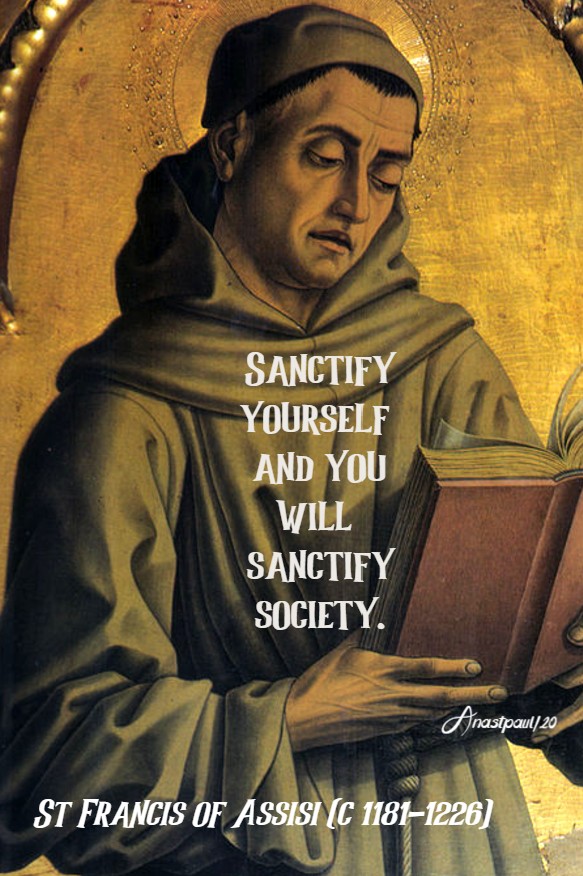
“Sanctify yourself and you will sanctify society.”
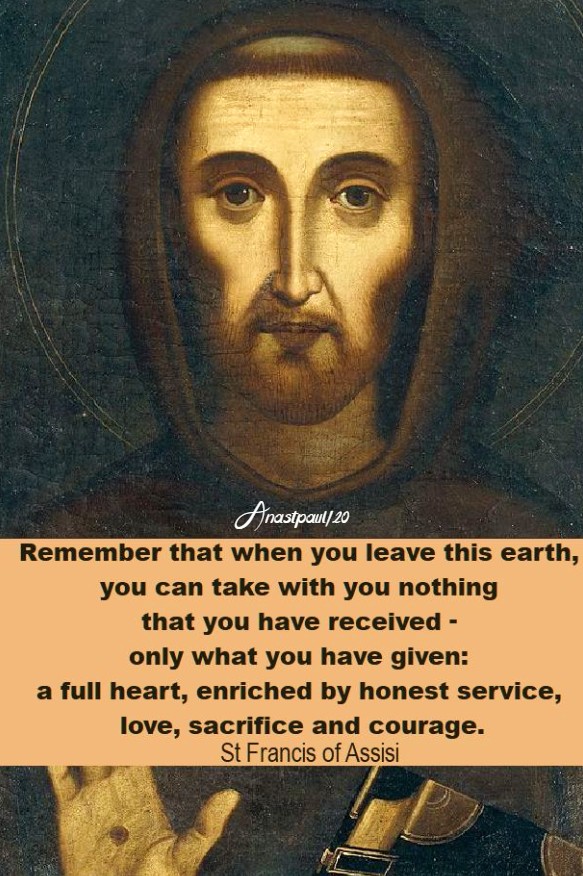
“Remember that when you leave this earth, you can take with you, nothing that you have received— only what you have given – a full heart, enriched by honest service, love, sacrifice and courage.”
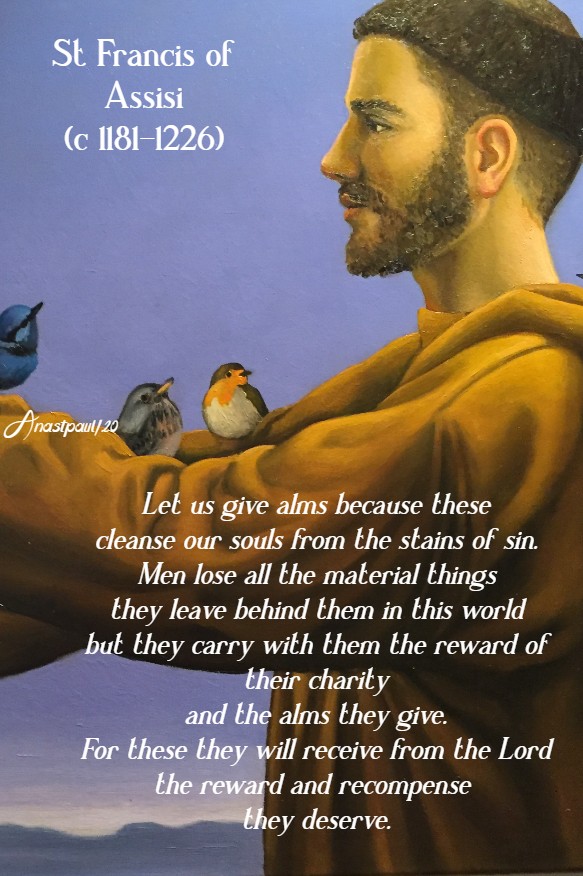
“Let us give alms because these cleanse our souls from the stains of sin. Men lose all the material things they leave behind them in this world but they carry with them the reward of their charity and the alms they give. For these they will receive from the Lord the reward and recompense they deserve.”
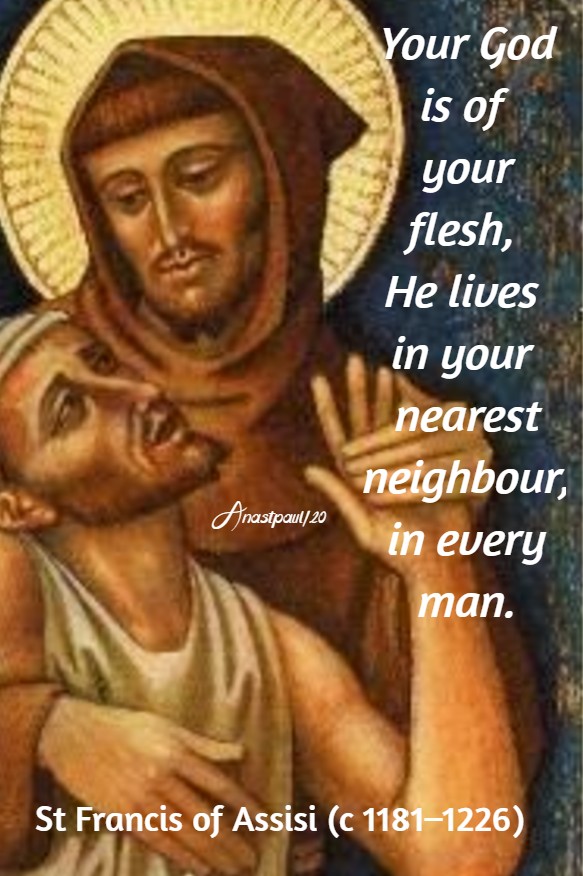
“Your God is of your flesh, He lives in your nearest neighbour, in every man.”
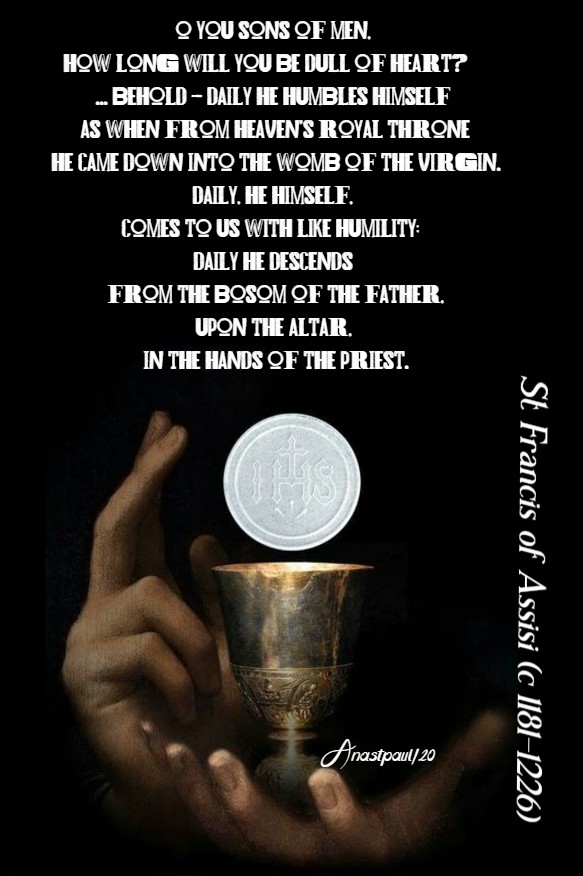
“O you sons of men, how long will you be dull of heart? … Behold – daily He humbles Himself as when from heaven’s royal throne He came down into the womb of the Virgin. Daily, He Himself, comes to us with like humility; daily He descends from the bosom of the Father, upon the altar, in the hands of the priest.”
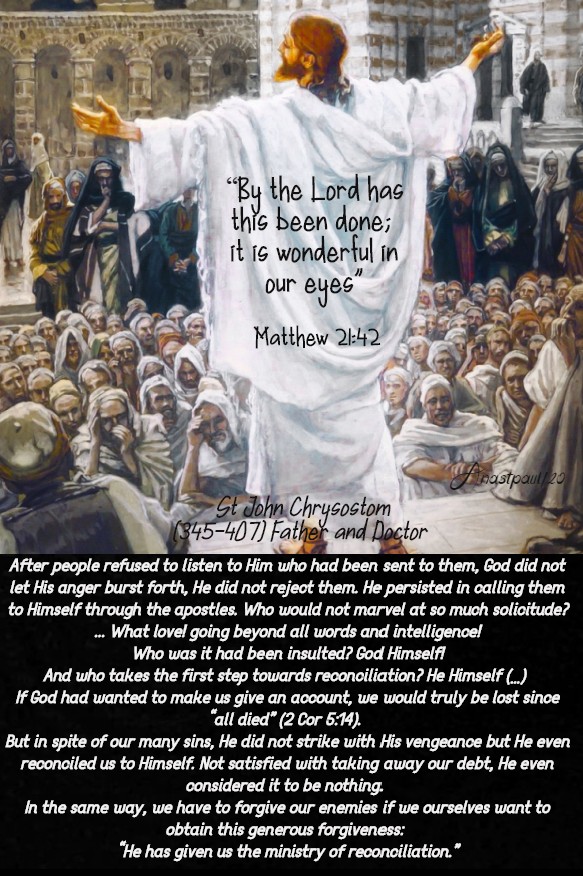
“By the Lord has this been done; it is wonderful in our eyes” … Matthew 21:42
REFLECTION – “Christ has given us the ministry of reconciliation.” (2 Cor 5:18) Saint Paul thus brings out the greatness of the apostles, by showing us the ministry that was entrusted to them and at the same time, he shows us the love with which God loved us. After people refused to listen to Him who had been sent to them, God did not let His anger burst forth, He did not reject them. He persisted in calling them to Himself through the apostles. Who would not marvel at so much solicitude?
They killed the Son who had come to reconcile them, who was the only Son and of the same nature as the Father. The Father did not turn away from the murderers, He did not say: “I sent them my Son, and they, not satisfied with not having listened to Him, put Him to death and crucified Him. So now, it is only just that I abandon them.” He did the opposite. And after Christ had left earth, it is we, His ministers, who have the responsibility to replace Him. “He has given us the ministry of reconciliation. I mean that God, in Christ, was reconciling the world to himself, not counting men’s transgressions against them.”
What love! going beyond all words and intelligence! Who was it had been insulted? God Himself! And who takes the first step towards reconciliation? He Himself (…) If God had wanted to make us give an account, we would truly be lost since “all died” (2 Cor 5:14). But in spite of our many sins, He did not strike with His vengeance but He even reconciled us to Himself. Not satisfied with taking away our debt, He even considered it to be nothing. In the same way, we have to forgive our enemies if we ourselves want to obtain this generous forgiveness: “He has given us the ministry of reconciliation.” … St John Chrysostom (345-407) Father and Doctor – Homily 11 on the Second Letter to the Corinthians, 4-5
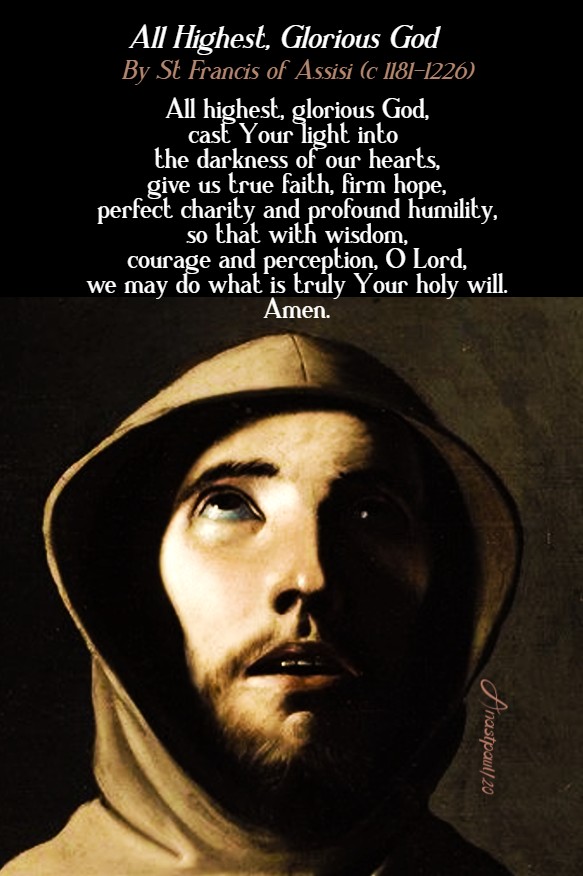
PRAYER – All highest, glorious God, cast Your light into the darkness of our hearts, give us true faith, firm hope, perfect charity and profound humility, so that with wisdom, courage and perception, O Lord, we may do what is truly Your holy will. Amen. By St Francis of Assisi
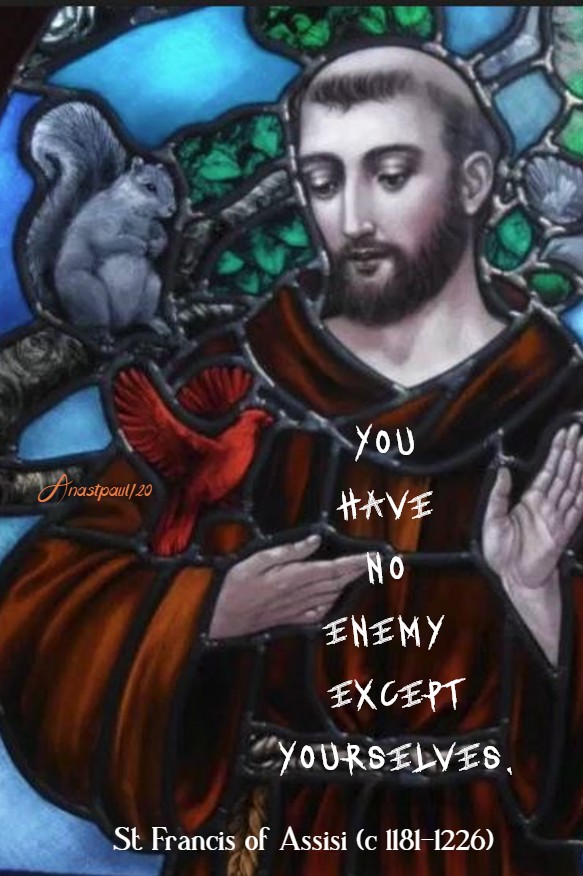
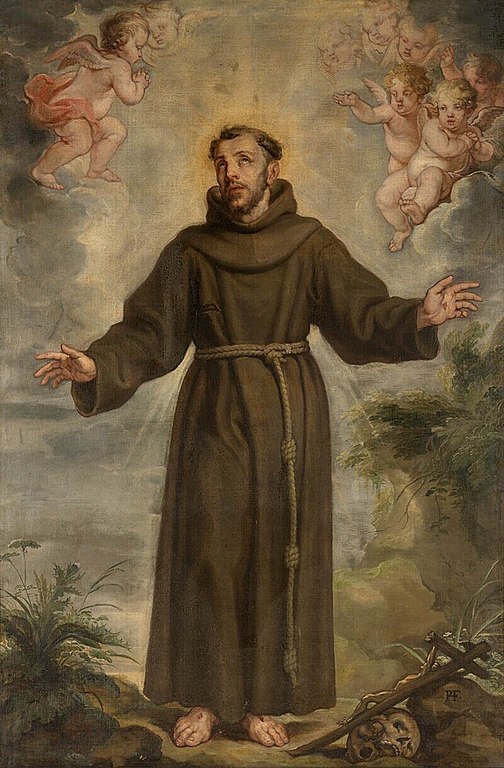
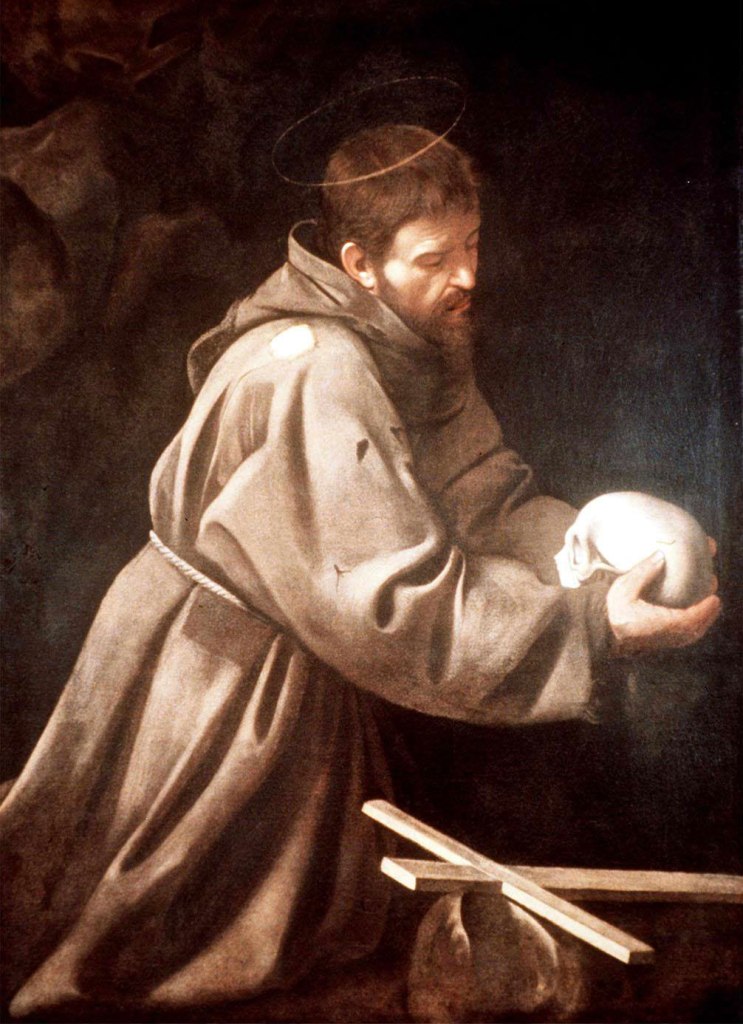
Saint of the Day – 4 October – St Francis of Assisi OFM (c 1181–1226)- Founder of the Franciscan Order, Confessor of the Faith, Stigmatist. Francis set out to imitate Christ and literally carry out His work. This is vital in understanding Francis’ character, his affinity for the Eucharist and respect for the priests who carried out the sacrament. He preached: “Your God is of your flesh, He lives in your nearest neighbour, in every man.”
He and his followers celebrated and even venerated poverty, which was so central to his character that in his last written work, the Testament, he said, that absolute personal and corporate poverty was the essential lifestyle for the members of his order.
St Francis of Assisi was the living embodiment of Jesus Christ. He left home, riches and family to be with the poor and the destitute. In all creation he saw the image of God. In imitating Jesus Christ, his self-denial led to the foundation of orders and movements of evangelical poverty. Not to mention, his love was so total that – when he had nothing left to give – but gave more, he received the stigmata.
St Francis was the son of a cloth merchant. His worldly successes culminated in a career as a soldier. While preparing for a second campaign, St Francis received a vision. The moment was life-changing in that he realised he had been called apart. Climbing to the “Mount Tabor” of prayer to discern the will of God, he received another prompting; whereupon the once affluent man began to imitate the poor so that he might preach to them. When, at last, he took his father’s cloth to sell for alms that the Church of San Damiano may be restored, his father took him to court for relieving him of his possessions. In that moment, in the presence of the Bishop, St Francis went all in; doubling down on his mission by stripping off his garments and declaring that now he had no possessions.
Fully committed to imitating Jesus by administering to them exactly as He had done, St Francis preached to the poor – going barefoot and quite literally “(taking) no gold, nor silver, nor money in your belts, no bag for your journey, nor two tunics, nor sandals, nor a staff…” Submitting to papal authority since Tradition was handed to the Apostles by Jesus, St Francis encountered an obstruction in Pope Innocent III but the latter gave consent for St Francis’ Order after seeing, in a dream, St Francis holding up the Church of San Giovanni in Laterano. The rule of poverty and preaching Friars raised up altars where churches once lay abandoned. The order of the Poor Clares and Franciscan lay movements, also stemmed from St Francis’ apostolate. He refined his rule to include complete poverty and self-denial to live and be with Christ.
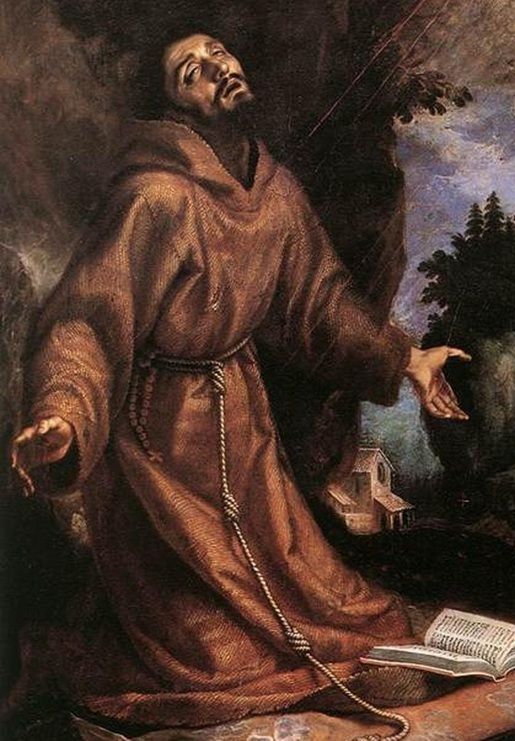
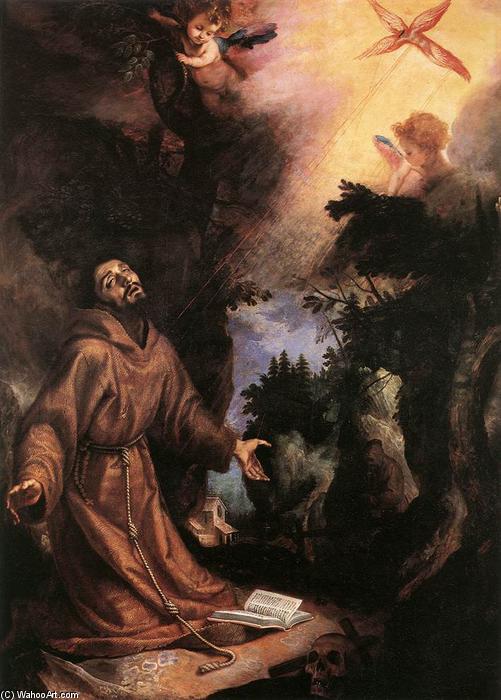
St Francis’ missions even brought him to Egypt, where an audience with the Sultan during the Crusades resulted in the Franciscan order gaining privileged access to Jerusalem. St Francis was a tireless worker; practicing prayer, penance, mortification and works to the extreme that Christ would go. Jesus fell asleep in the stern of a boat while the storm was raging – so exhausted was He. Then in 1224, while preparing for the feast of the Exaltation of the Cross, St Francis asked in prayer how to best please God. In that moment, as recorded by St Francis’ biographers and those he was with, he saw a vision of a man coming down from heaven, with 2 wings above his head, 2 outstretched in fligh, and 2 covering his body; whose face was beautiful beyond earthly description and who smiled gently upon St Francis; making him see, that not in bodily martyrdom but in mind and heart he should conform to Christ. The brilliance of that vision never left St. Francis. Brimming with life, he received the stigmata.
St Francis receives the Stigmata – detail – Cigoli
At the time St Francis received the stigmata, he was feeble and blind. He sought to give more when he had absolutely nothing. Honouring him by not creating needs for ourselves, being humbled by others and bearing it for Christ, rejecting hedonism and conforming our will and intellect to that of the Divine, is how we can celebrate this mystic who forever rejoices by the side of and in-step with Jesus Christ.
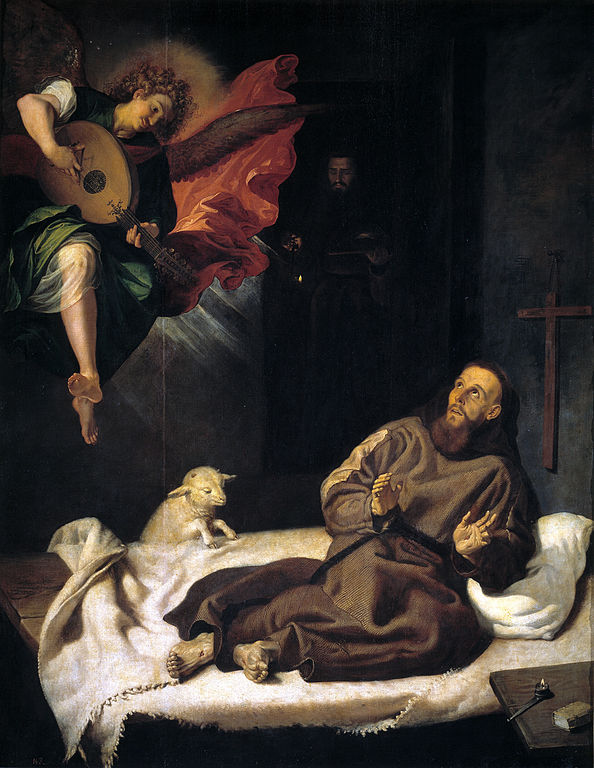
Francis Serenaded by an Angel – Francisco Ribalta (1565–1628)
On 18 June 1939, Pope Pius XII named Francis a joint Patron Saint of Italy along with Saint Catherine of Siena with the apostolic letter “Licet Commissa.”
St Francis is the patron of animals, merchants and ecology. He is also considered the patron saint against dying alone; patron saint against fire; patron saint of the Franciscan Order and Catholic Action; patron saint of families, peace, and needleworkers. He is the patron saint of many dioceses and other locations around the world, including – Italy; San Pawl il-Bahar, Malta; Freising, Germany; Lancaster, England; Kottapuram, India; San Francisco de Malabon, Philippines (General Trias City); San Francisco, California; Santa Fe, New Mexico; Colorado; Salina, Kansas; Metuchen, New Jersey and Quibdó, Colombia.
St Adauctus of Ephesus Bl Alfonso Tabela St Aurea St Berenice St Caius of Corinth St Callisthene of Ephesus St Crispus of Corinth St Damaris of Athens St Diogenes of Milan St Domnina St Hierotheus Bl Julian Majali St Lucius of Alexandria St Peter of Damascus St Petronius (Died c 450) About St Petronius: https://anastpaul.com/2019/10/04/saint-of-the-day-4-october-saint-petronius-died-c-450/ St Prosdoce St Quintius of Tours — Martyrs of Alexandria – 2+ saints: A group of Christians, men and women, young and old, murdered together for their faith. The only names that have come down to us are the brothers Mark and Marcian.
Martyred in the Spanish Civil War: • Blessed Alfredo Pellicer Muñoz • Blessed Avelí Martínez de Arenzana Candela • Blessed Dionisio Ibáñez López • Blessed Francisco Martínez Granero • Blessed Fulgencio Martínez García • Blessed José Aloy Doménech • Blessed José Gafo Muñiz • Blessed José Miguel Peñarroya Dolz • Blessed Juan de Francisco Pío • Blessed Juan José Orayen Aizcorbe • Blessed Martina Vázquez Gordo • Blessed Publio Fernández González • Blessed Tomás Barrios Pérez
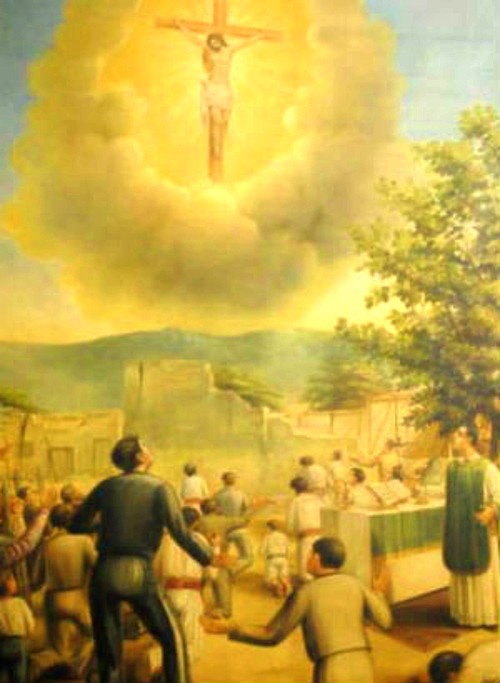
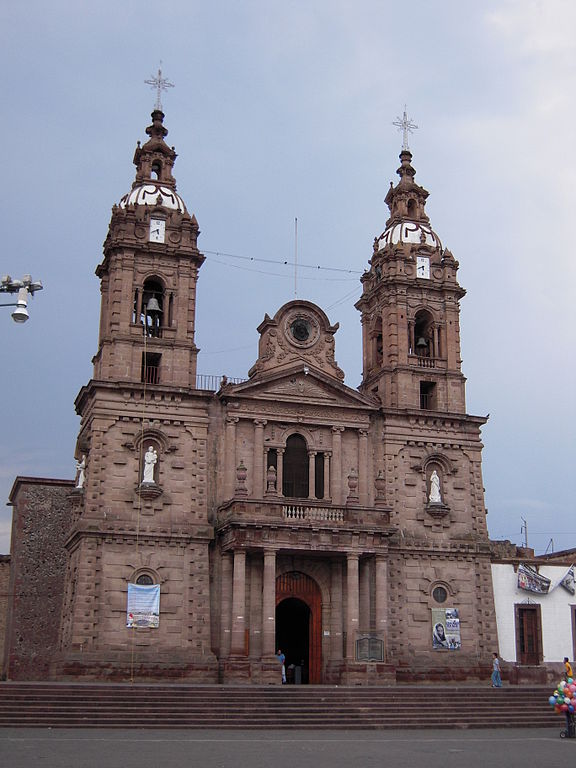
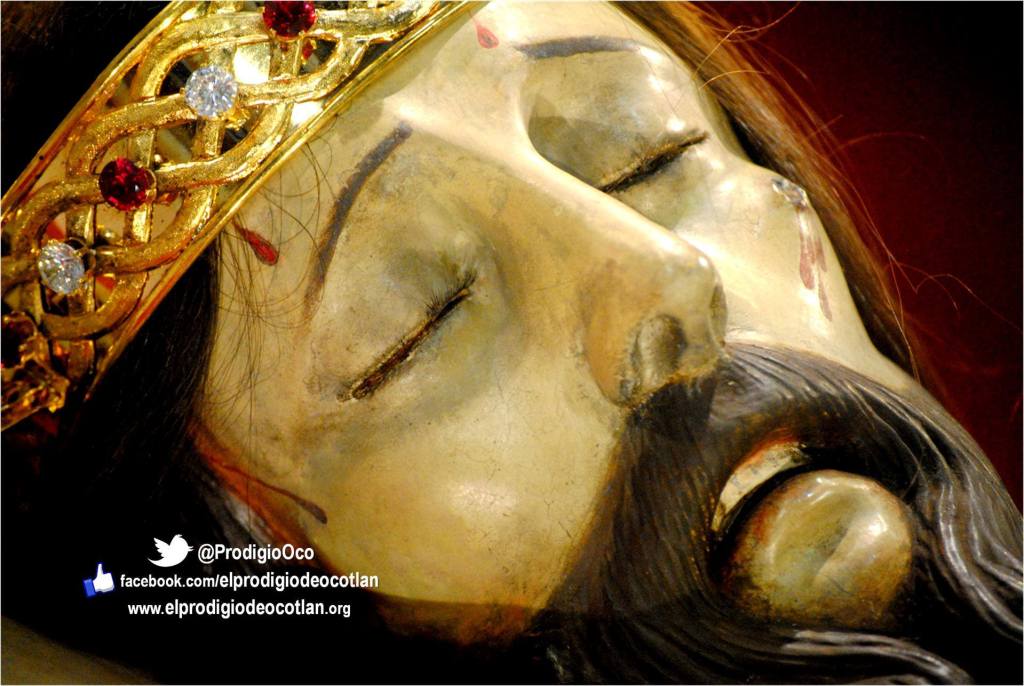
Feast of The Miracle of Ocotlán – Our Lord of Mercy – 3 October. This is a major miracle that you’ve probably never heard of, the appearance of Christ in the clouds, in Ocotlan, Mexico, in 1847. This historical event – approved by the Archdiocese of Guadalajara in 1911 – is known as “The Prodigy of Ocotlán“
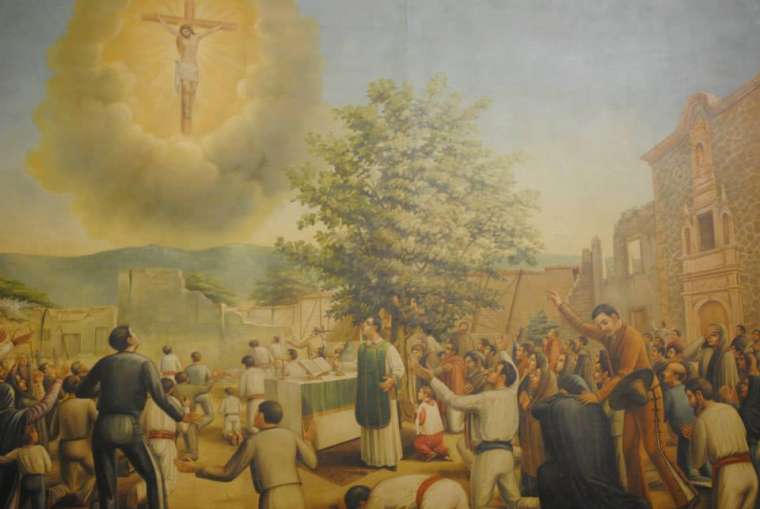
On Saturday 2 October 1847, a massive earthquake hit the region of the town of Ocotlán, Mexico; much of the city was destroyed and 40 people died. The next day, Sunday 3 October 1847, before a Mass was celebrated in the cemetery of the Chapel of La Purísima Concepción in the city of Ocotlán, more than 2,000 people witnessed a perfect image of Jesus Christ Crucified that appeared in the skies for more than 30 minutes.
Before Mass began that 3 October which would be presided over by the parochial vicar, Fr Julián Navarro, two very white clouds began to join in the north-west of the sky and in the middle of them the image of Christ appeared.
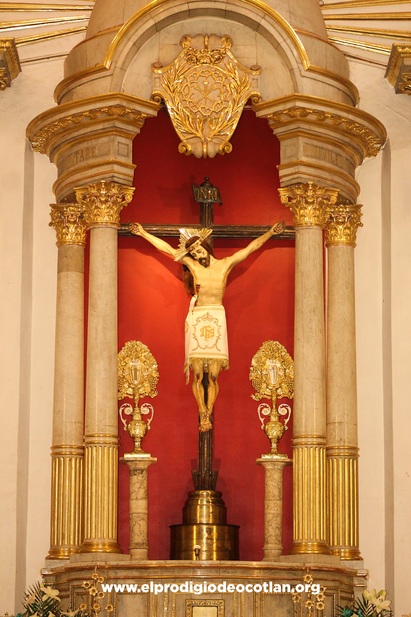
Those present and those in nearby towns were moved, made acts of contrition and shouted for “Mercy to the Lord.” For this reason this Christ was named the “Lord of Mercy” and in his honour, in September 1875, a new Church dedicated to Him was blessed and consecrated.
Among the faithful who witnessed the prodigy were also Fr Julián Martín del Campo, Parish Priest of the community and Antonio Jiménez, the Mayor of the city. Both sent letters to their respective superiors telling what happened.
In addition, after the miracle, a file was prepared with 30 eyewitness testimonies by order of the layman Lic. Miguel Castellanos. Fifty years later, in 1897, under the order of the then Archbishop of Guadalajara, Mons. Pedro Loza y Pardavé, a new file was drawn up with 30 more people, including 5 priests.
On 29 September 1911, the Archbishop of Guadalajara at that time. Mnsgr José de Jesús Ortiz y Rodríguez. signed the document that endorsed the appearance of Jesus Christ in Ocotlán and the worship and veneration that the faithful of that town carry out to the venerated image of the Lord of Mercy located in the Sanctuary of the same name.
“We must recognise as a perfectly proven historical fact the appearance of the blessed image of Jesus Christ Crucified (…) and that it could not have been the work of hallucination or fraud, since it was verified in broad daylight, in view of more than two thousand people, ” said the Archbishop.
He also pointed out that so that the Mercy of the Lord is never forgotten, the faithful should “congregate in the way possible, after purifying their consciences with the holy sacraments of Penance and Holy Communion and solemnly swear in the presence of God, for himself and his descendants, that year by year they will celebrate the anniversary of 3 October. ”
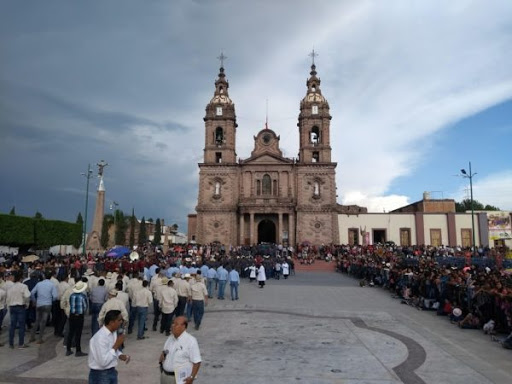
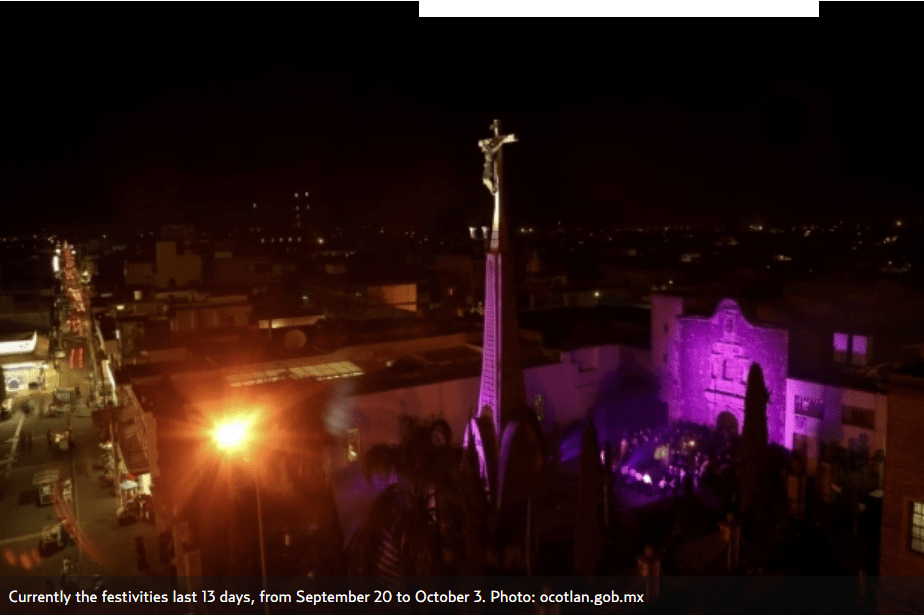
In 1912, after approval and to comply with the provisions of the Archbishop of Guadalajara, the public festivities began in honour of the Lord of Mercy, remembering the Prodigy of 1847. Currently the festivities last 13 days, from September 20 to September 3. October.
In 1997, John Paul II sent his Apostolic Blessing to the town of Ocotlán for the 150th anniversary of the prodigy and asked to celebrate their festivals in a holy way, living the sacraments.
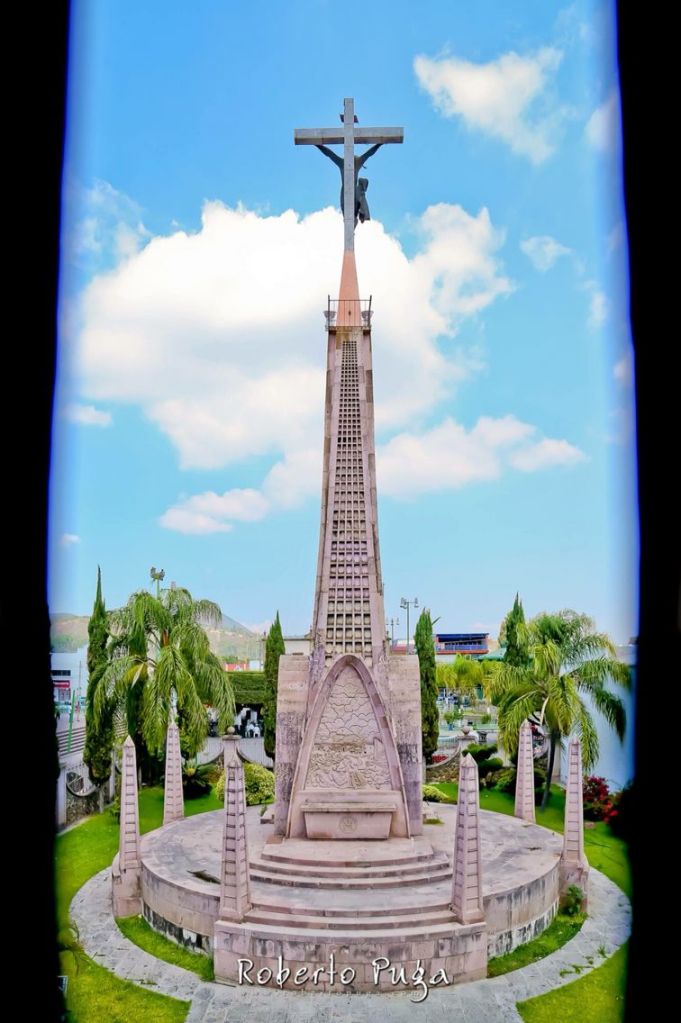
To commemorate the event, a monument, which is entirely carved in pink quarry. On the eastern altar there is a scene of the destruction of the town by the 1847 earthquake and on the western altar there is a representation of the prodigy with the Lord of Mercy in the centre. It has a height of approximately 20 meters.
Prayer to Our Lord of Mercy
Oh Lord of Mercy, Father and King of joyful Ocotlán; our assembled people adore You and a fervent song raise to You. For our people sinned and their sin provoked divine justice and a tremor left nothing but ruins of what was the lovely Ocotlán but the people repented and from Heavens, You came lovingly and with outstretched arms You gave us, a safe haven of peace … Amen
Bl Utto of Metten St Widradus — Martyrs of Alexandria – 9 saints: A number of Christian martyrs remembered together. We know the names Caius, Cheremone, Dionysius, Eusebio, Fausto, Lucio, Maximus, Paul, Peter and that there were at least two more whose names have not come down to us, and that’s about all we know.
Martyrs of Brazil – 30 beati: On 25 December 1597 an expedition of colonists, with two Jesuit and two Franciscan evangelists, arrived at Natal, Rio Grande do Norte, Brazil. The region was colonized by Portuguese Catholics but was invaded by Dutch Calvinists who soon took over the whole territory. They immediately made a policy of the persecution of Catholics. On Sunday 16 July 1645 at Cunhau, Brazil, 69 people were gathered in the Chapel of Our Lady of the Candles for Mass celebrated by Father Andre de Soveral. At the moment of the elevation a group of Dutch soldiers attack the Chapel, murdering many of the faithful including Father Andre; the parishioners died professing their faith and asking pardon for their sins. On 3 October 1645, 200 armed Indians and a band of Flemish troops, led by a fanatical Calvinist convert, hacked to death an unknown number of people of Rio Grande including: • Blessed Ambrosio Francisco Ferro • Blessed André de Soveral • Blessed Antônio Baracho • Blessed Antônio Vilela • Blessed Antônio Vilela Cid • Blessed Diogo Pereira • Blessed Domingos Carvalho • Blessed Estêvão Machado de Miranda • Blessed Francisco de Bastos • Blessed Francisco Mendes Pereira • Blessed João da Silveira • Blessed João Lostau Navarro • Blessed João Martins • Blessed José do Porto • Blessed Manuel Rodrigues de Moura • Blessed Mateus Moreira • Blessed Simão Correia • Blessed Vicente de Souza Pereira and other lay people whose names have not come down to us. They were Beatified on 5 March 2000 at Rome, Italy by Pope John Paul II.
Martyred in the Spanish Civil War: • Blessed Crescencio García Pobo • Blessed José María González Solís • Blessed José María Poyatos-Ruiz • Blessed Manuel Lucas Ibañez • Blessed Raimundo Joaquín Castaño González
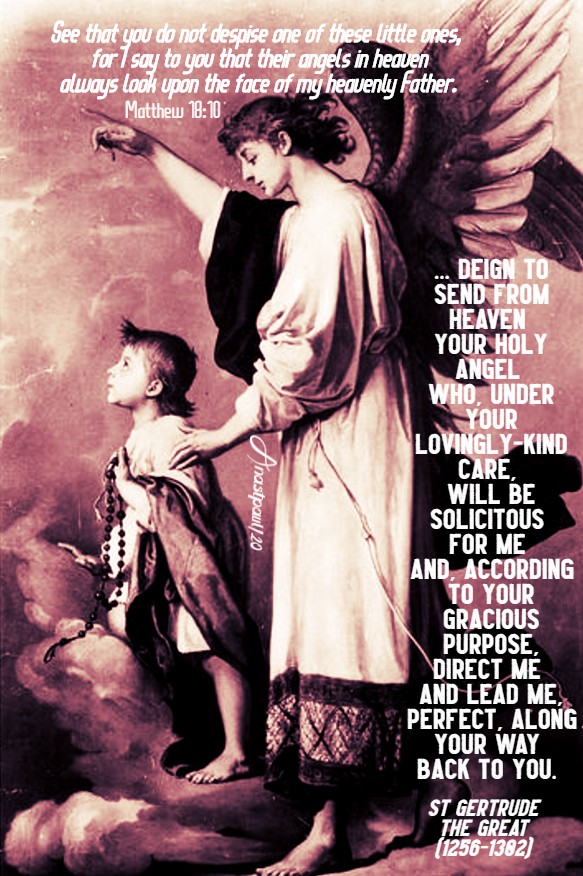
One Minute Reflection – 2 October – Wednesday of the Twenty Sixth Week in Ordinary Time, Readings: Job 38:1, 12-21; 40: 3-5, Psalms 139:1-3, 7-8, 9-10, 13-14, Matthew 18:1-5, 10 and The Memorial of the Holy Guardian Angels
“See that you do not despise one of these little ones, for I say to you that their angels in heaven always look upon the face of my heavenly Father.” …Matthew 18:10
REFLECTION – “Ah, Jesus, Prince of Peace and Angel of great counsel, may You Yourself always be the guide at my right and the guardian of my pilgrimage, lest I move away and stray from You. And deign to send from heaven, Your holy angel who, under Your lovingly-kind care, will be solicitous for me and, according to Your gracious purpose, direct me and lead me, perfect, along Your way back to You. (Ex 23:20).” … St Gertrude the Great (1256-1302) Benedictine nun – Exercises I.60-63, 71-76, 78-86, 99-103.
PRAYER – Lord God of hosts, in Your all-wise providence, You send angels to guard and protect us. Surround us with their watchful care on earth and give us the joy of their company, forever in heaven. We make our prayer through Christ, our Lord, with th Holy Spirit, God for all eternity, amen.
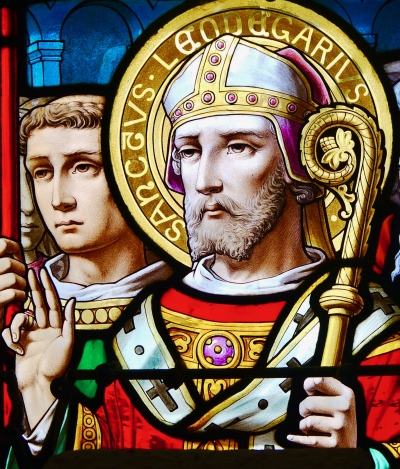
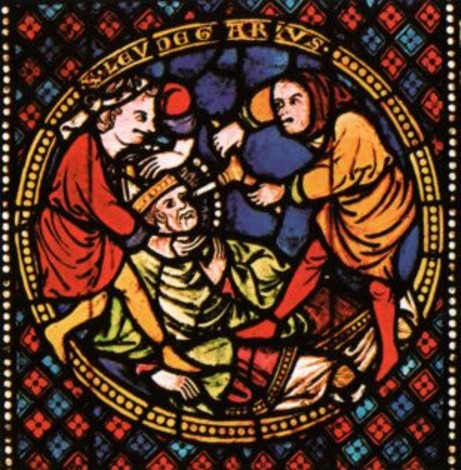
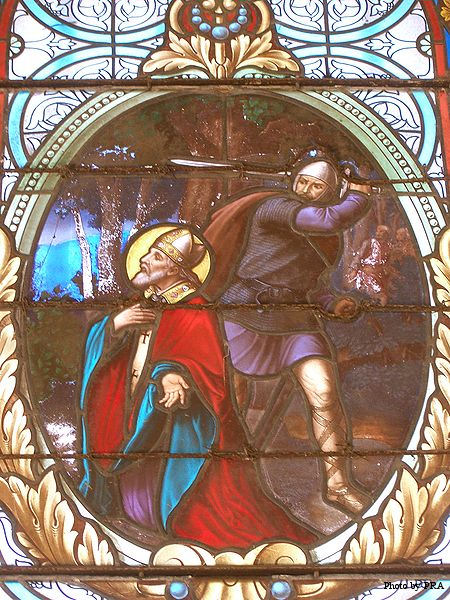
Saint of the Day – 2 October – Saint Leodegar of Autun (c 625-679) Bishop of Autun, France and Martyr, Monk, Abbot, Reformer, apostle of the poor – born in c 615 in Autun, Saône-et-Loire, Burgundy, France and died on 2 October 679 by being murdered in 678 in the woods in Sarcing, Somme, Picardie, France. Patronages – Millers, invoked against blindness, Eye disease, Eye problems, Sore eyes and 5 cities. He was the son of Saint Sigrada, his mother and the brother of Saint Warinus and is also known as St Leodegarius and St Leger.
Leodegar was the son of a high-ranking Burgundian nobleman, Bodilon, Count of Poitiers and Paris and St Sigrada of Alsace, who later became a nun at Sainte-Marie de Soissons.
He spent his childhood in Paris at the court of Clotaire II, King of the Franks and was educated at the palace school. When he was older he was sent to Poitiers, where there was a long-established Cathedral school, to study under his maternal uncle, Desiderius (Dido), Bishop of Poitiers. At the age of 20 his uncle made him an Archdeacon.
Shortly afterwards he became a Priest and in 650, with the Bishop’s permission, became a Monk at the Monastery of St Maxentius in Poitou. He was soon elected Abbot and initiated reforms including the introduction of the Benedictine rule.
Around 656, about the time of the usurpation of Grimoald in Austrasia and the banishment of the boy-heir Dagobert II, Leodegar was called to the Neustrian court by the widowed Queen Bathilde to assist in the government of the united kingdoms and in the education of her children. Then in 659 he was named to the See of Autun, in Burgundy. He again undertook the work of reform and held a council at Autun in 661. The council denounced Manichaeism and was the first to adopt the Trinitarian Athanasian Creed. He made reforms among the secular clergy and in the religious communities and had three baptisteries erected in the city. The Church of Saint-Nazaire was enlarged and embellished and a refuge established for the indigent. Leodegar also caused the public buildings to be repaired and the old Roman walls of Autun to be restored. His authority at Autun placed him as a leader among the Franco-Burgundian nobles.
Meanwhile, in 660 the Austrasian nobles demanded a king and young prince Childeric II was sent to them through the influence of Ebroin, the mayor of the palace in Neustria. The queen withdrew, from a court that was Ebroin’s in all but name, to an abbey she had founded at Chelles, near Paris. On the death of King Clotaire III in 673, a dynastic struggle ensued, with rival claimants as pawns; Ebroin raised Theoderic to the throne but Leodegar and the other Bishops supported the claims of his elder brother Childeric II, who, by the help of the Austrasians and Burgundians, was eventually made king. Ebroin was interned at Luxeuil and Theoderic sent to St Denis.
Leodegar remained at court, guiding the young king. In 673 or 675, however, Leodegar was also sent to Luxeuil. The cause, a protest against the marriage of Childeric and his first cousin, is a hagiographic convention; as a leader of the Austrasian and Burgundian nobles, Leodegar was easily represented as a danger by his enemies. When Childeric II was murdered at Bondi in 675, by a disaffected Frank, Theoderic III was installed as king in Neustria, making Leudesius his mayor. Ebroin took advantage of the chaos to make his escape from Luxeuil and hasten to the court. In a short time Ebroin caused Leudesius to be murdered and became mayor once again, still Leodegar’s implacable enemy.
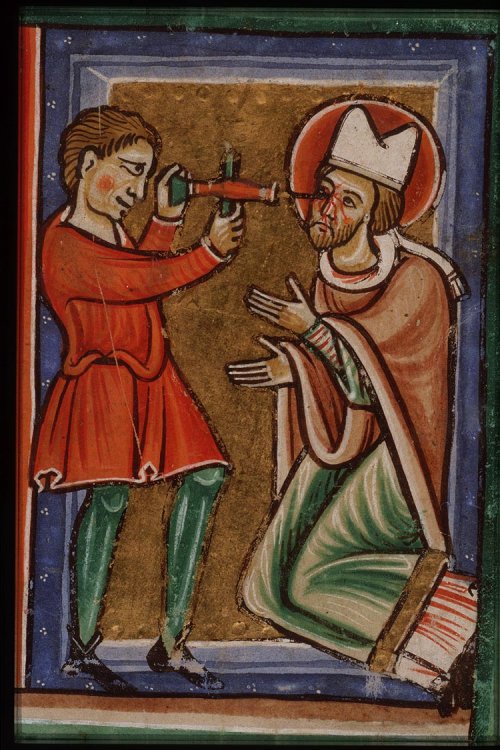
About 675 the Duke of Champagne, the Bishop of Châlons-sur-Marne and the Bishop of Valence, stirred up by Ebroin, attacked Autun and Leodegar fell into their hands. At Ebroin’s instigation, Leodegar’s eyes were gouged out and the sockets cauterized and his tongue was cut out. Some years later Ebroin persuaded the king that Childeric had been assassinated at the instigation of Leodegar. The Bishop was seized again and, after a mock trial, was degraded and condemned to further exile, at Fécamp, in Normandy. Near Sarcing he was led out into a forest on Ebroin’s order and beheaded.
A dubious testament drawn up at the time of the council of Autun has been preserved as well as the Acts of the council. A letter which he caused to be sent to his mother after his mutilation is likewise extant.
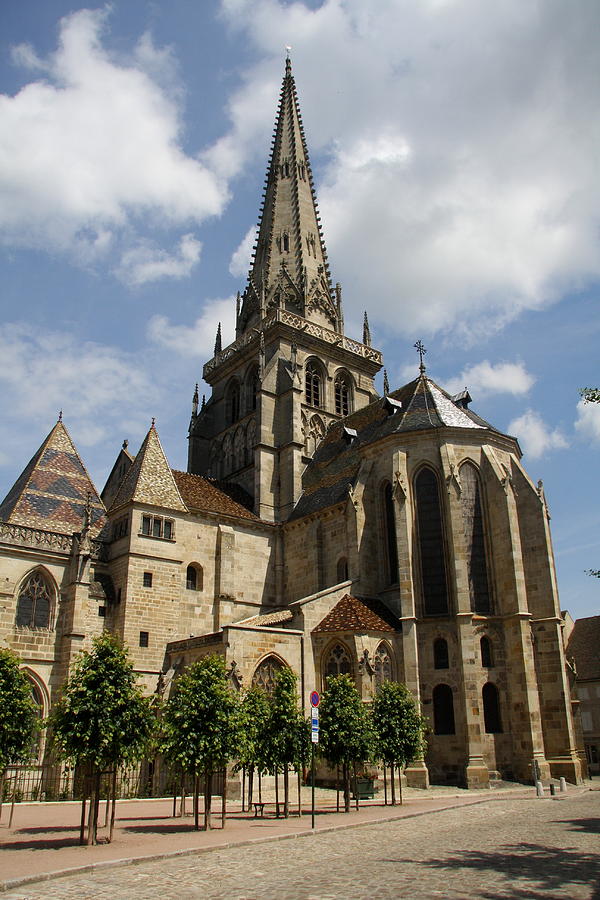
In 782, his relics were translated from the site of his death, Sarcing in Artois, to the site of his earliest hagiography – the Abbey of St Maxentius (Saint-Maixent) near Poitiers. Later they were removed to Rennes and thence to Ebreuil, which place took the name of Saint-Léger in his honour. Some relics are still kept in the Cathedral of Autun and the Grand Séminaire of Soissons. In 1458 Cardinal Rolin caused his feast day to be observed as a holy day of obligation.
Auton Cathedral
For sources to his biography, there are two early Lives, drawn from the same lost source (Krusch 1891) and also two later ones (one of them in verse).
Historically there was a custom among wealthy British merchants to sell in May, spend the summer outside of London, then to return on St Leger’s Day. This gave rise to the saying used in regards to financial trading markets, “Sell in May and go away and come on back on St Leger’s Day.”
St Alfonso del Rio St Andrea Ximenez Blessed Antoine Chevrier TOSF (1825-1879) About Blessed Antoince: https://anastpaul.com/2018/10/02/saint-of-the-day-2-october-blessed-antoine-chevrier-t-o-s-f-1825-1879/ St Beregisius St Eleutherius of Nicomedia Bl Georges-Edme René St Gerinus St Leodegar of Autun OSB (c 625-679) Bishop and Martyr St Leudomer St Maria Antonina Kratochwil St Modesto of Sardinia St Saturius of Soria St Theophilus of Bulgaria St Ursicinus II — Martyred in Antioch, Syria: Martyred in one of the early persecutions, date unknown. St Cyril of Antioch St Primus of Antioch St Secundarius of Antioch
Martyred in Nagasaki, Japan: A husband, wife and two sons, who were all martyred together in the persecutions in Japan. They were beheaded on 2 October 1622 in Nagasaki, Japan and Beatified by Pope Pius IX on 7 May 1867. • Blessed Andreas Yakichi • Blessed Franciscus Yakichi • Blessed Lucia Yakichi • Blessed Ludovicus Yakichi
Martyred in the Spanish Civil War: • Blessed Elías Carbonell Molla • Blessed Enrique Sáiz-Aparicio • Blesssed Felipe González de Heredia Barahona • Blessed Francisco Carceller Galindo • Blessed Isidoro Bover Oliver • Blessed Juan Carbonell Molla • Blessed Juan Iñiguez de Ciriano Abechuco • Blessed Manuel Borrajo Míguez • Blessed María Francisca Ricart Olmos • Blessed Mateu Garrolera Masferrer • Blessed Pedro Artolozaga Mellique • Blessed Pedro Salcedo Puchades
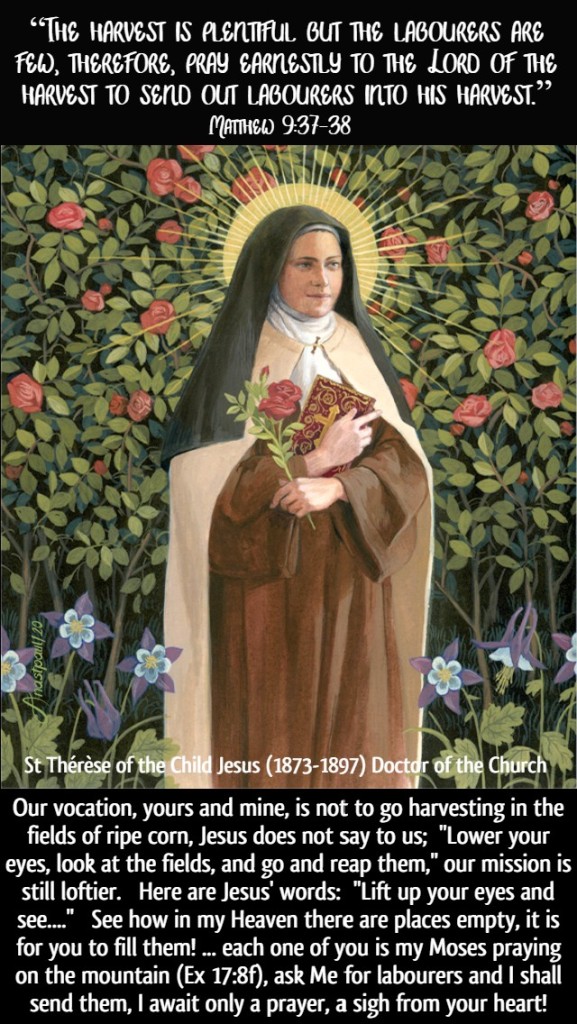
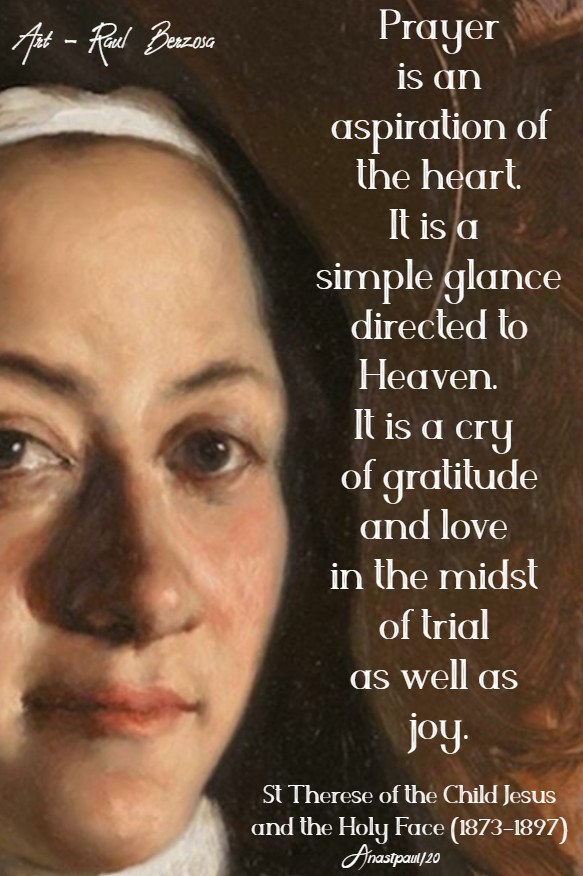
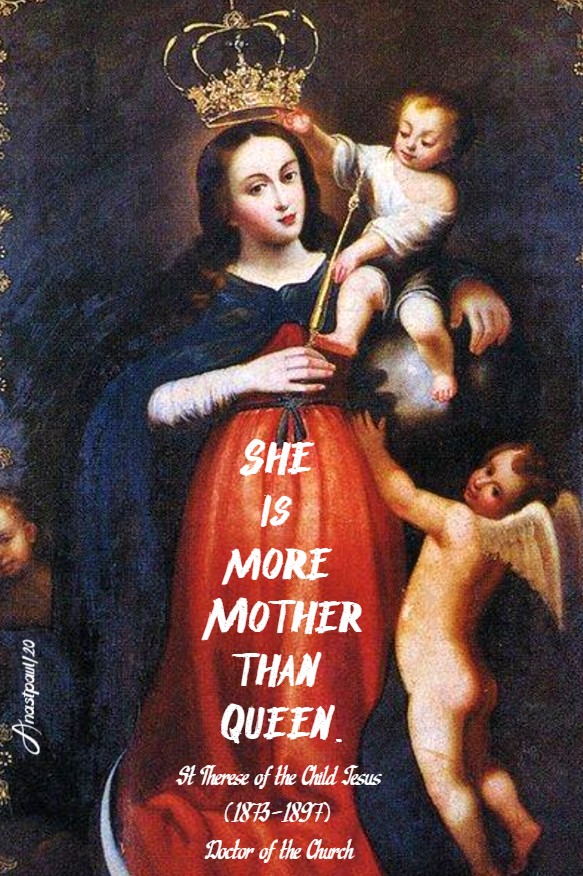
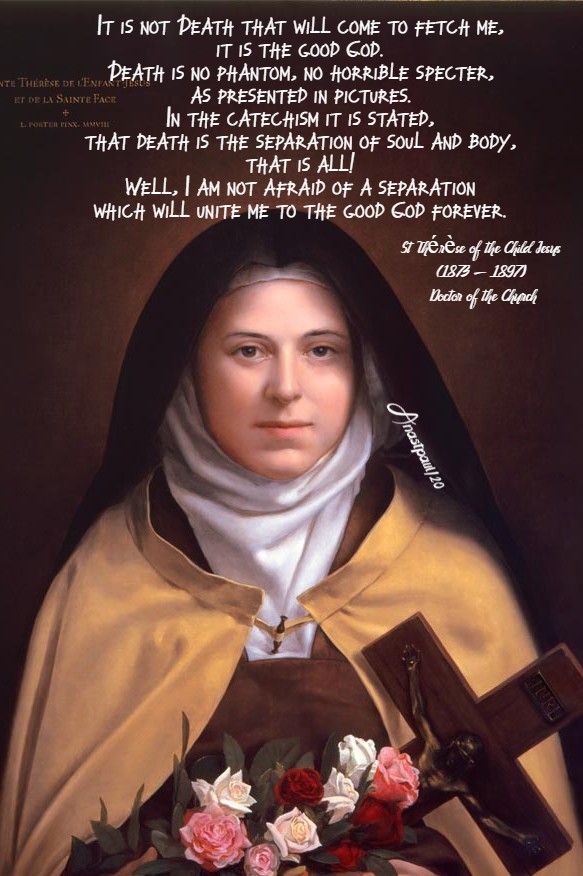
Quote/s of the Day – 1 October – Thursday of the Twenty Sixth week in Ordinary Time, Readings: Job 19:21-27, Psalms 27:7-8, 8-9, 13-14, Luke 10:1-12 and The Memorial of St Romanos the Melodios (c 490-c 556) and St Thérèse of the Child Jesus/Lisieux OCD (1873 – 1897) Doctor of the Church
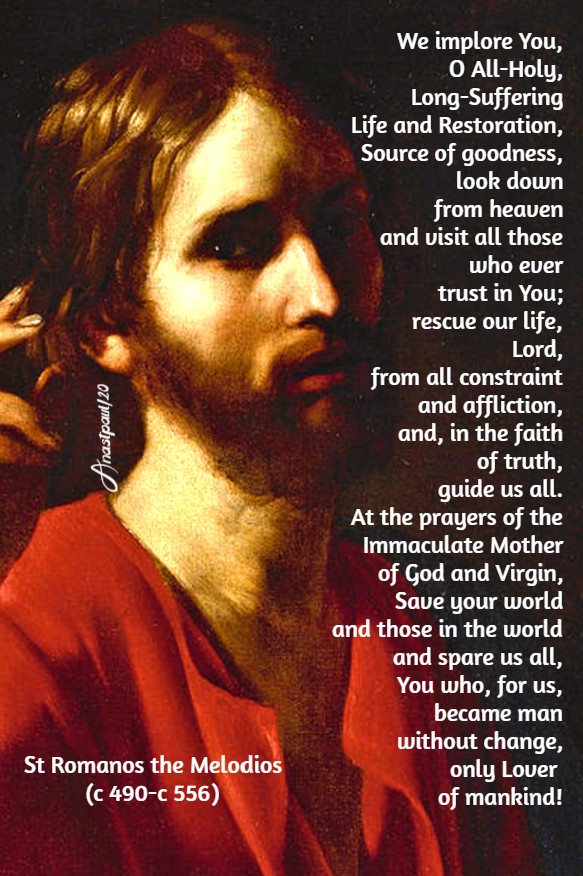
“We implore You, O All-Holy, Long-Suffering Life and Restoration, Source of goodness, look down from heaven and visit all those who ever trust in You; rescue our life, Lord, from all constraint and affliction, and, in the faith of truth, guide us all. At the prayers of the Immaculate Mother of God and Virgin, Save your world and those in the world and spare us all, You who, for us, became man without change, only Lover of mankind.”
St Romanos the Melodios (c 490-c 556) (On the Life of Christ, Feast of the Presentation of the Lord)
“Our vocation, yours and mine, is not to go harvesting in the fields of ripe corn, Jesus does not say to us; “Lower your eyes, look at the fields and go and reap them,” our mission is still loftier. Here are Jesus’ words: “Lift up your eyes and see….” See how in My Heaven there are places empty, it is for you to fill them! … each one of you is my Moses praying on the mountain (Ex 17:8f), ask Me for labourers and I shall send them, I await only a prayer, a sigh from your heart!”
“Prayer is an aspiration of the heart. It is a simple glance directed to Heaven. It is a cry of gratitude and love in the midst of trial as well as joy.”
“She is more mother than Queen.”
“It is not Death that will come to fetch me, it is the good God. Death is no phantom, no horrible specter, as presented in pictures. In the catechism it is stated, that death is the separation of soul and body, that is all! Well, I am not afraid of a separation which will unite me to the good God forever.”
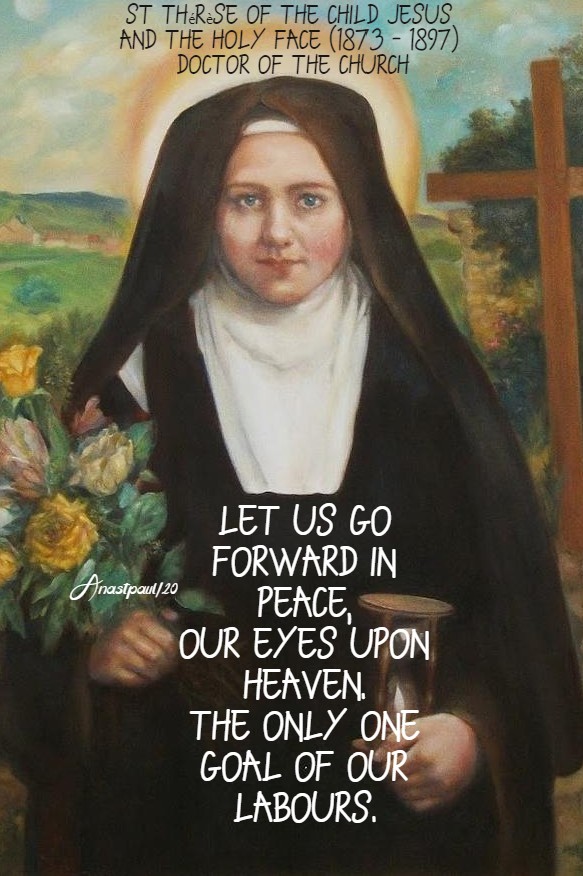
“Let us go forward in peace, our eyes upon heaven. the only one goal of our labours.”
One Minute Reflection – 1 October – Thursday of the Twenty Sixth week in Ordinary Time, Readings: Job 19:21-27, Psalms 27:7-8, 8-9, 13-14, Luke 10:1-12 and the Memorial of St Romanos the Melodios (c 490-c 556) and St Thérèse of the Child Jesus/Lisieux OCD (1873 – 1897) Doctor of the Church
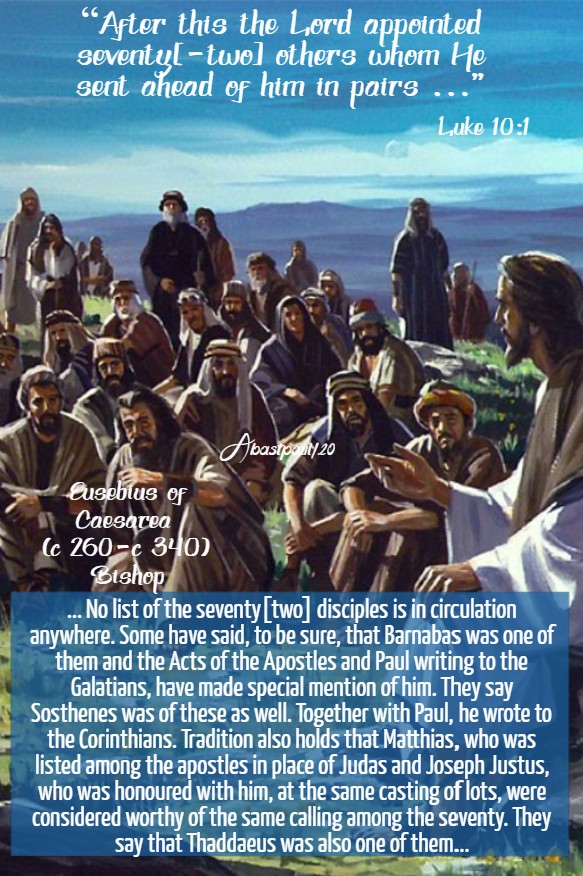
“After this the Lord appointed seventy [-two] others whom He sent ahead of him in pairs to every town and place He intended to visit…” … Luke 10:1
REFLECTION – “The names of the apostles of the Saviour are clear to everyone from the Gospels but no list of the seventy[two] disciples is in circulation anywhere. Some have said, to be sure, that Barnabas was one of them and the Acts of the Apostles and Paul writing to the Galatians, have made special mention of him. They say Sosthenes was of these as well. Together with Paul, he wrote to the Corinthians. Tradition also holds that Matthias, who was listed among the apostles in place of Judas and Joseph Justus, who was honoured with him, at the same casting of lots, were considered worthy of the same calling among the seventy. They say that Thaddaeus was also one of them, about whom I shall presently relate a story which has come down to us.
On observation, you would find that the disciples of the Saviour appear to have been more than the seventy [two]. Paul says that after the resurrection from the dead Cephas saw him first, then the Twelve. After these saw him, he was seen by more than five hundred brothers all at once, some of whom he says had fallen asleep, although the majority were still alive at the time that this account was being composed by him.” … Eusebius of Caesarea (c 260-c 340) Bishop, Historian, Theologian – (Ecclesiastical History, 1.)
PRAYER – God, our Father, Your promised Your Kingdom to the little ones and the humble of heart. Give us grace to walk confidently in the way of St Romanos and St Thérèse, so that helped by their prayers, we may see Your eternal glory. Through Christ our Lord, in the unity of the Holy Spirit, one God forever, amen.
Our Morning Offering – 1 October – Thursday of the Twenty Sixth week in Ordinary Time and the Memorial of St Thérèse of the Child Jesus/Lisieux O.C.D. (1873 – 1897) Doctor of the Church
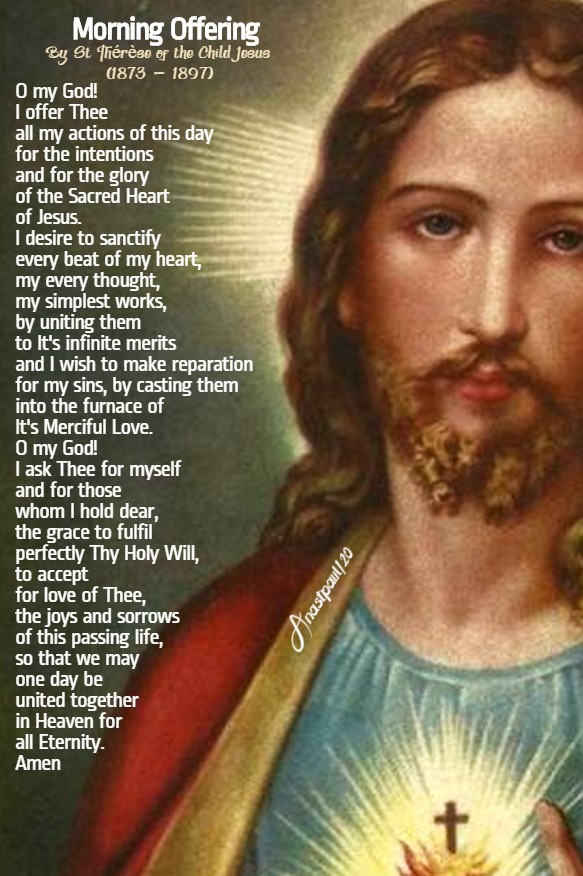
Morning Offering By St Thérèse of the Child Jesus
O my God! I offer Thee all my actions of this day for the intentions and for the glory of the Sacred Heart of Jesus. I desire to sanctify every beat of my heart, my every thought, my simplest works, by uniting them to It’s infinite merits and I wish to make reparation for my sins, by casting them into the furnace of It’s Merciful Love. O my God! I ask Thee for myself and for those whom I hold dear, the grace to fulfil perfectly Thy Holy Will, to accept for love of Thee, the joys and sorrows of this passing life, so that we may one day be united together in Heaven for all Eternity. Amen
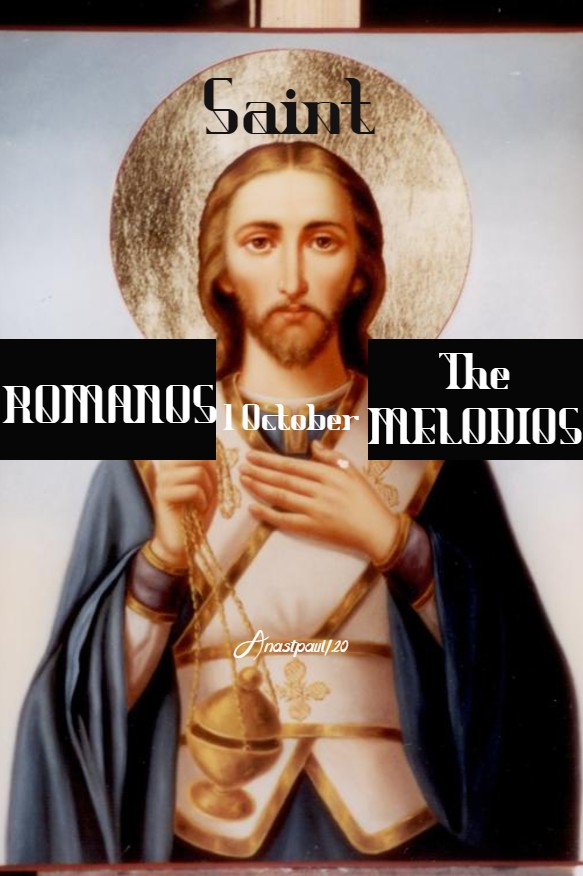
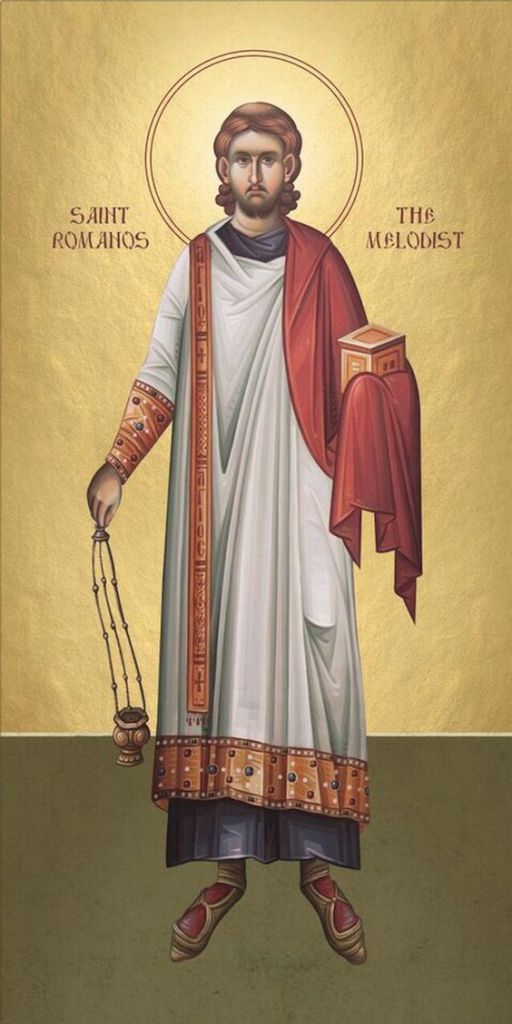
Saint of the Day – 1 October – St Romanos the Melodios (c 490-c 556) Deacon, Hymnographer, Poet, Writer – born in c 490 in Syria and died in c 556 of natural causes in Constantinople. Patronages – Cantors. Also known as – Romanos the Melodist, Romanus l’Hymnographe, Romanos Melodhos, Romanos Melode, Psaitis Dhikeosinis, Sweet Singer, Romain, Romano, Romanus, Glykophonos.
St Romanos was born to a Jewish family in either Emesa (modern-day Homs) or Damascus in Syria. He was baptised as a young boy (though whether or not his parents also converted is uncertain).
When he grew old enough he became an altar boy and then a singer, a reader and finally a Deacon – at first in his home town of Beirut and later in Constantinople where his family had moved. Romanos wanted to serve God to the best of his ability; he prayed a great deal and was the first to come to Church and the last to leave, thus served as a Sacristan in the greatest Church of Contantinople, the Hagia Sophia (Holy Wisdom). He lit the vigil lights with great reverence for he loved Holy Virgin and the Saints, before whose images they burned. Most of all, he like the Church choir and was always happy when he was allowed to sing.
According to legend, Romanos was not at first considered to be either a talented reader or singer. He was, however, loved by the Bishop of Constantinople because of his great humility.
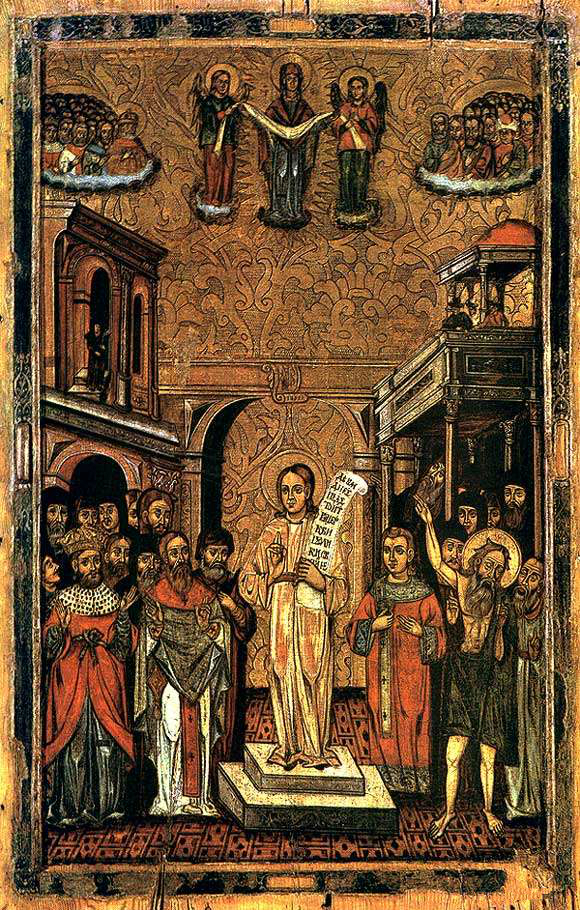
Once, around the year 518, while serving during the All-Night Vigil for the Feast of the Nativity of Christ, he was assigned to read from the Psalter. He read so poorly that another reader had to take his place. Some of the lesser clergy ridiculed Romanus for this and being humiliated he sat down in one of the choir stalls. Overcome by weariness and sorrow, he soon fell asleep. As he slept, the Blessed Virgin Mary appeared to him with a scroll in her hand. She commanded him to eat the scroll and as soon as he did so, he awoke.
He immediately received a blessing from the Bishop, mounted the ambo and chanted his famous Hymn of the Nativity, “Today the Virgin gives birth to Him Who is above all being….” The Emperor, the Bishop, the clergy and the entire congregation were amazed, both at the profound theology of the Hymn and Romanos’ clear, sonorous voice as he sang.
According to tradition, this was the very first Hymn (kontakion) ever sung. The Greek word “kontakion” refers to the shaft on which a scroll is wound, hence the significance of the Blessed Mother’s command for him to swallow a scroll, indicating that his compositions were by divine inspiration. The scene of Romanos’s first performance is often shown in icons.
Romanos wrote in a literary dialect—i.e., he had a popular but elevated style—and abundant Semiticisms support the view that he was of Jewish origin. Arresting imagery, sharp metaphors and similes, bold comparisons, antitheses, coining of successful maxims and vivid dramatisation characterize his style.
He is said to have composed more than 1,000 hymns celebrating various festivals of the ecclesiastical year, the lives of the saints and other sacred subjects, some 60 to 80 of which survive.
Among his most well-known Hymns are: The Nativity of Christ The Martyrdom of St Stephen The Death of a Monk The Last Judgment The Prodigal Son The Raising of Lazarus (for Lazarus Saturday, the day before Palm Sunday) Adam’s Lament (for Palm Sunday) The Treachery of Judas
St Romanos served in the Hagia Sophia, to the end of his life at the Monastery of Kyros, where he was buried along with his disciple St Ananias.
St Aizan of Abyssinia St Albaud of Toul Bl Andrew Sushinda Bl Antoni Rewera St Aretas of Rome St Bavo of Ghent Bl Cecilia Eusepi Bl Christopher Buxton St Crescens of Tomi St Dodo Bl Dominic of Villanova Bl Edward James St Evagrius of Tomi St Fidharleus Bl Gaspar Fisogiro St Gregory the Illuminator St John Kukuzelis Bl John Robinson Blessed Juan de Palafox Mendoza (1600–1659) His Life: https://anastpaul.com/2019/10/01/saint-of-the-day-1-october-blessed-juan-de-palafox-mendoza-1600-1659/ St Julia of Lisbon
St Maxima of Lisbon Bl Nikita Budka St Piaton of Tournai St Priscus of Tomi Bl Ralph Crockett Bl Robert Widmerpool Bl Robert Wilcox St Romanos the Melodist (c 490-c 556) St Sazan of Abyssinia St Verissimus of Lisbon St Virila St Wasnulf — Martyred in the Spanish Civil War: • Blessed Carmelo Juan Pérez Rodríguez • Blessed Higinio Mata Díez • Blessed Juan Mata Díez • Blessed Álvaro Sanjuán Canet • Blessed Florencia Caerols Martínez
Quote/s of the Day – 30 September – The Memorial of St Jerome (347-419) Father and Doctor, “The Man of the Bible”
A Light for Our Path By St Jerome
O Lord, You have given us Your word for a light to shine upon our path, grant us so to meditate on that word and follow its teaching, that we may find in it, the light that shines more and more until the perfect day. Amen
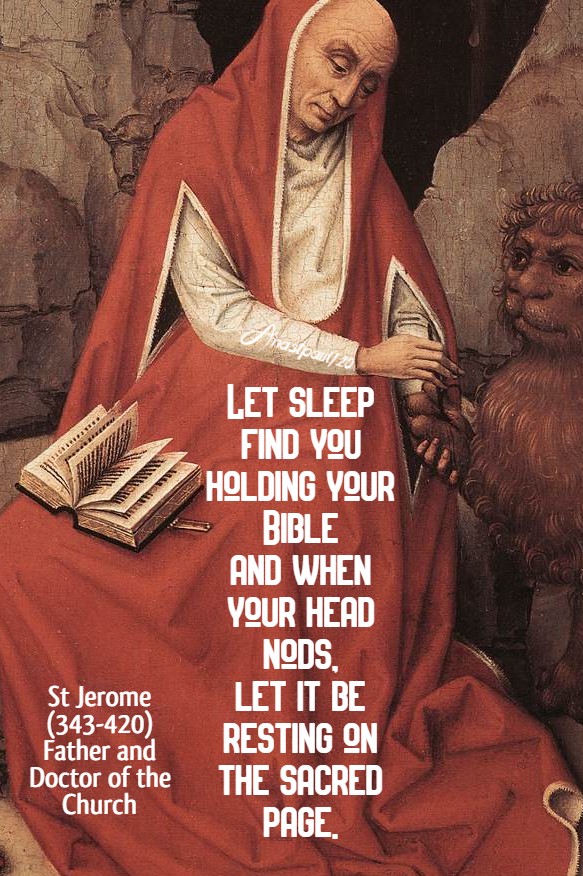
“Let sleep find you holding your Bible and when your head nods, let it be resting on the sacred page.”
“Someone who shows no clemency, who is not clothed with the bowels of mercy and tears, no matter what sort of student he is in spirituality, such a one does not fulfil the law of Christ.”
“Instead of speaking saintly words, we must act them.”
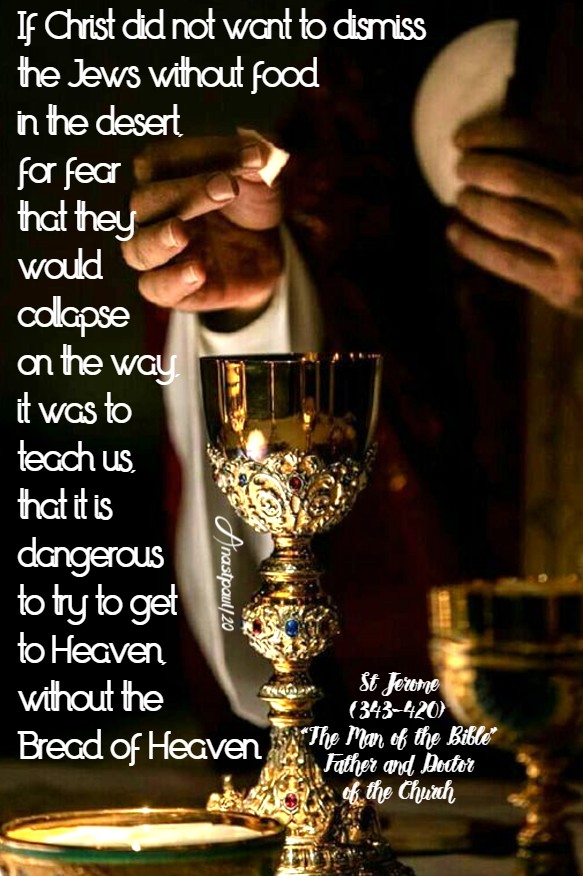
“If Christ did not want to dismiss the Jews without food in the desert, for fear that they would collapse on the way, it was to teach us, that it is dangerous to try to get to Heaven, without the Bread of Heaven.”
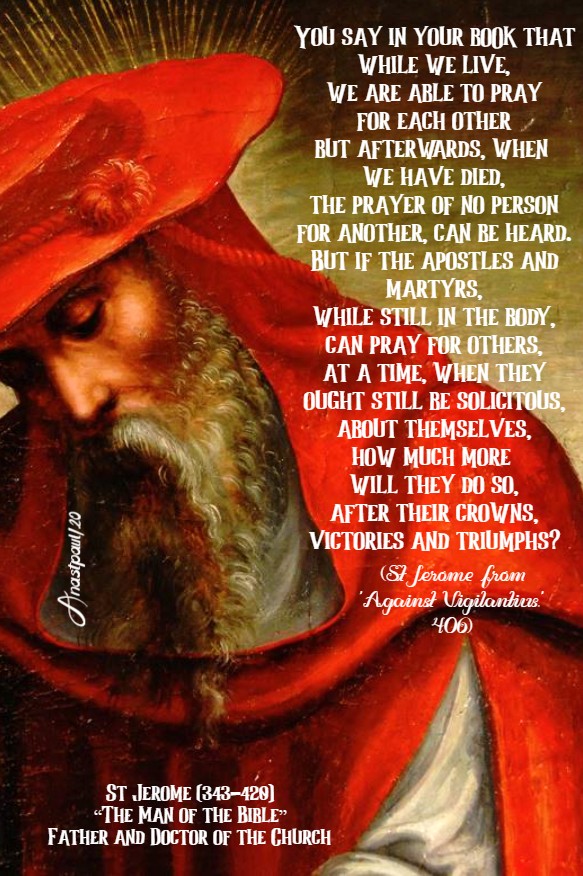
“You say in your book that while we live, we are able to pray for each other but afterwards, when we have died, the prayer of no person for another, can be heard. But if the apostles and martyrs, while still in the body, can pray for others, at a time, when they ought still be solicitous, about themselves, how much more will they do so, after their crowns, victories and triumphs?” (St Jerome from ‘Against Vigilantius,’ 406)
St Jerome wrote to Augustine in 418: “You are known throughout the world; Catholics honour and esteem you as the one who has established anew the ancient Faith.”
One Minute Reflection – 30 September – Wednesday of the Twenty Sixth week in Ordinary Time, Readings: Job 9:1-12, 14-16, Psalms 88:10-11, 12-13, 14-15, Luke 9:57-62 and the Memorial of St Jerome (347-419) Father and Doctor
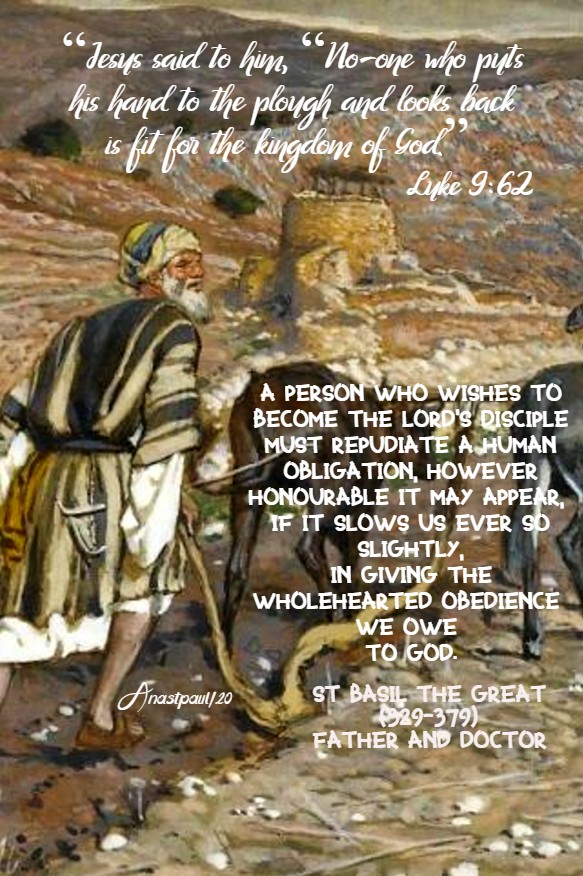
“Jesus said to him, “No-one who puts his hand to the plough and looks back is fit for the kingdom of God.” … Luke 9:62
REFLECTION – “The man said, “Allow me first to go and bury my father.” The Lord replied, “Let the dead bury their dead but go and preach the kingdom of God.” Another man said, “Let me first arrange my affairs at home.” He rebuked him with a stern threat, saying, “No man, putting his hand to the plough and looking back, is fit for the kingdom of God.” A person who wishes to become the Lord’s disciple must repudiate a human obligation, however honourable it may appear, if it slows us, ever so slightly, in giving the wholehearted obedience we owe to God.” … St Basil the Great (329-379) – Concerning Baptism
PRAYER – Almighty, ever-living God, You endowed Saint Jerome with a deep reverence and understanding of Holy Scripture, which he loved with all his heart. Sustain us evermore with Your word and teach us by their precepts. Help us to follow each word which Jesus, Your Son, our Redeemer, uttered that we may find therein the source of life. May the prayers of St Jerome assist us in our love and faithfulness. We ask this through Jesus our Lord, with the Holy Spirit, one God forever, Amen.
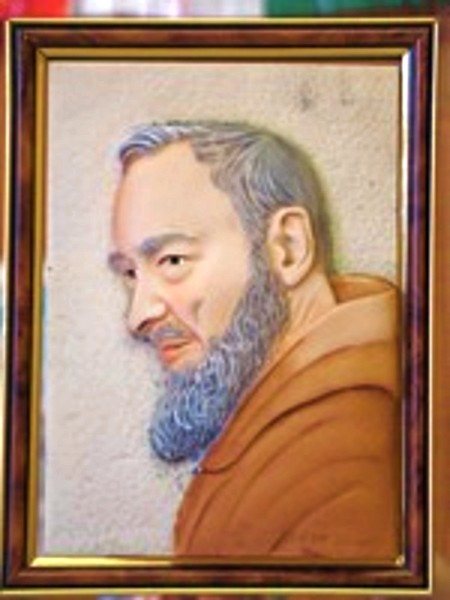
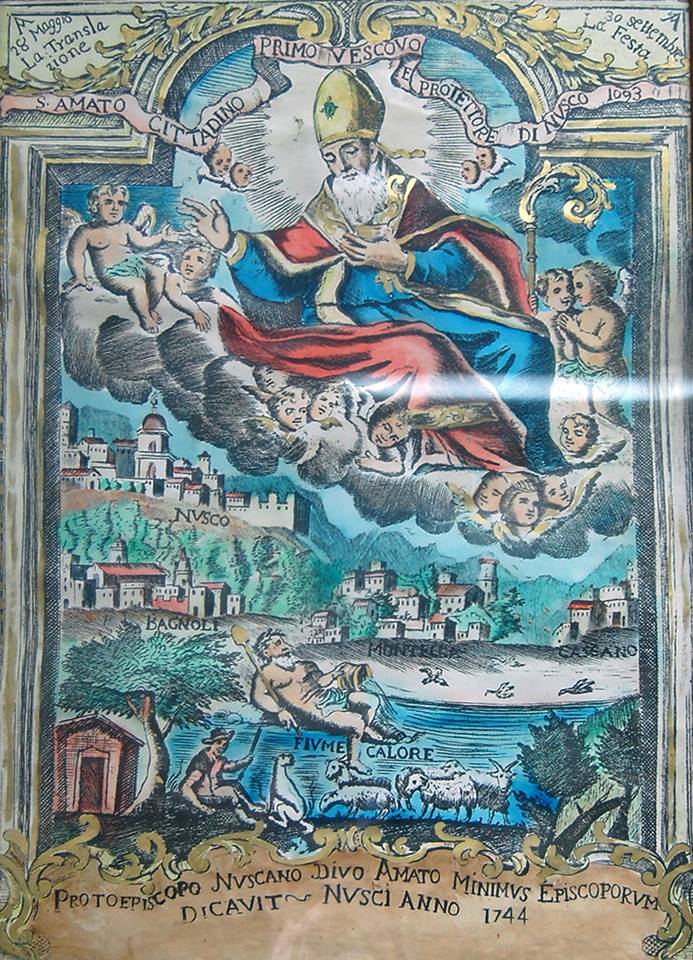
Saint of the Day – 30 September – Saint Amato of Nusco (c 1003-1093) Bishop, Monk, Apostle of the poor, Confessor and evangeliser. Born in c 1003 in Nusco, Italy and died on 30 September 1093 of natural causes. Patronages – Nusco, against earthquakes.
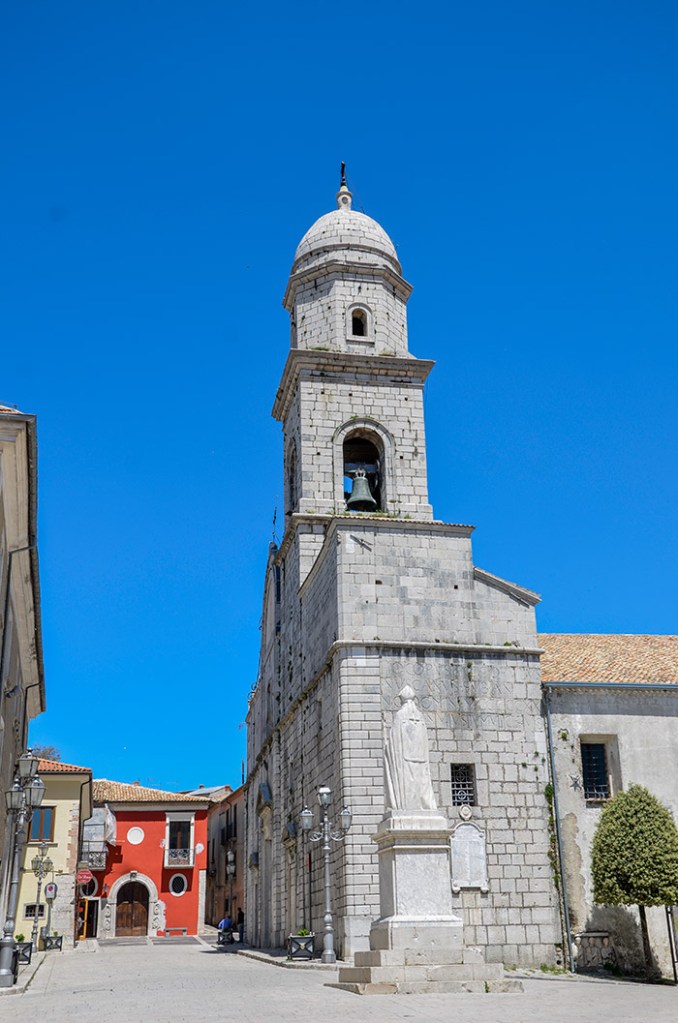
Amato was born in Nusco, the third highest town in the province of Avellino which stands on an isolated mountain in the Irpinia Apennine chain, between the Ofanto and Calore valleys and for its panoramic position it is called a “Balcony of Irpinia.”
His birth took place around 1003, into a wealthy family. As soon as he was able, he destributed all his worldly goods to the poor and entered a Seminary. He was Ordained at a very young age and in 1048, thanks to his great zeal in evangelisation and assistance to the poor, he was Consecrated as the first Bishop of the city of Nusco, by the Archbishop of Salerno Alfano I.
Nusco, already inhabited in very ancient times, probably developed in the Lombard period, near a castle, around which Saint Amato as Bishop gathered the inhabitants of the surrounding villages.
He restored many pre-existing Churches and built many new ones, including the Cathedral dedicated to the protomartyr St Stephen, to whom he was devoted.. He worked tirelessly to assist the poor and to evangelise his Diocese. His mortal remains are now kept and venerated in the crypt of the Cathedral of Nusco, see below.
He died on 30 September 1093 and left all his possessions to the newly formed diocese of Nusco as shown in his will, a small parchment (15 cm x 55 cm) the so-called Chartula Iudicati, still preserved in the Cathedral archives.
At his sepulchre numerous miraculous cures took place, which procured for him the cult of a saint, his successor Ruggero dedicated a Church to him for this.
After having demonstrated the authenticity of his will, it was possible to set the date of his death at 30 September 1093, in contrast to the opinion of the Benedictine monks of Montevergine, who wanting to classify him at any cost as a disciple of their founder St Guglielmo da Vercelli (1085-1142), did not hesitate to move the date of his death to 31 August 1193, therefore 100 years later.
In addition to the anniversary of the saint’s death , the feast of the transfer of his bones from the first sepulchre to the current one in the crypt of the Cathedral is also celebrated in Nusco on 28 May.
The Bishop of Nusco Gaetano De Arco, in the Instructio Synodica seu Synodus pro Dioecesis Nuscanae Tyrcinio published in 1752 in Naples, wrote that there were originally three annual feasts in honour of Saint Amato – the translation of the bones ( 28 May ), the Patronage (last Sunday in July) and death ( 30 September .
Patron of the City of Nusco is invoked against earthquakes, a recurring natural disaster in the Irpini mountains.
The ‘Roman Martyrology’ celebrates his Memorial today, 30 September.
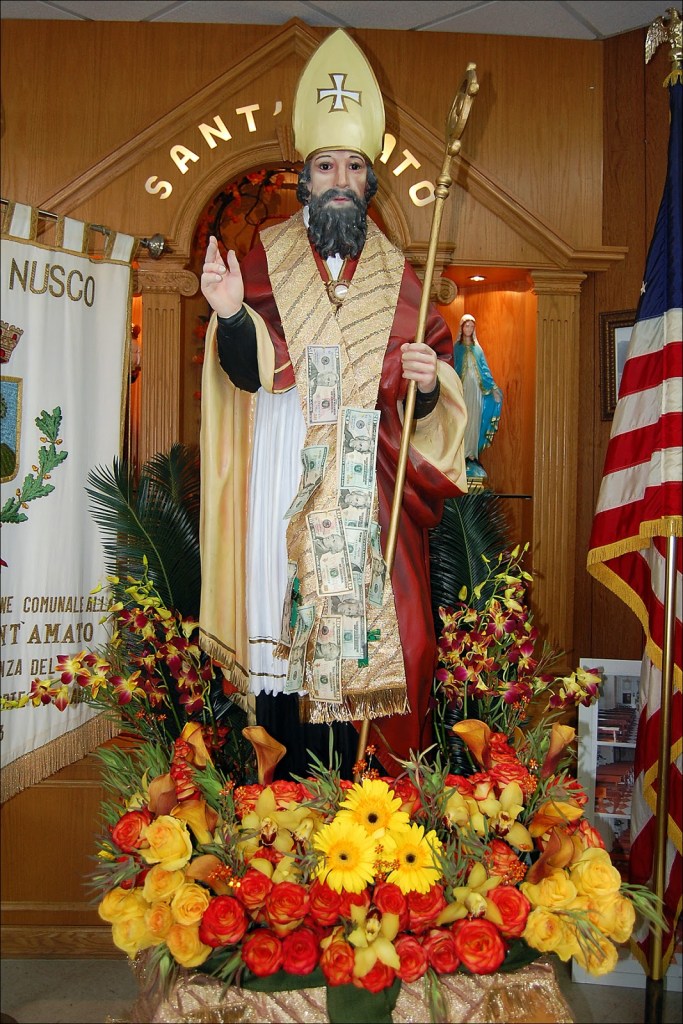
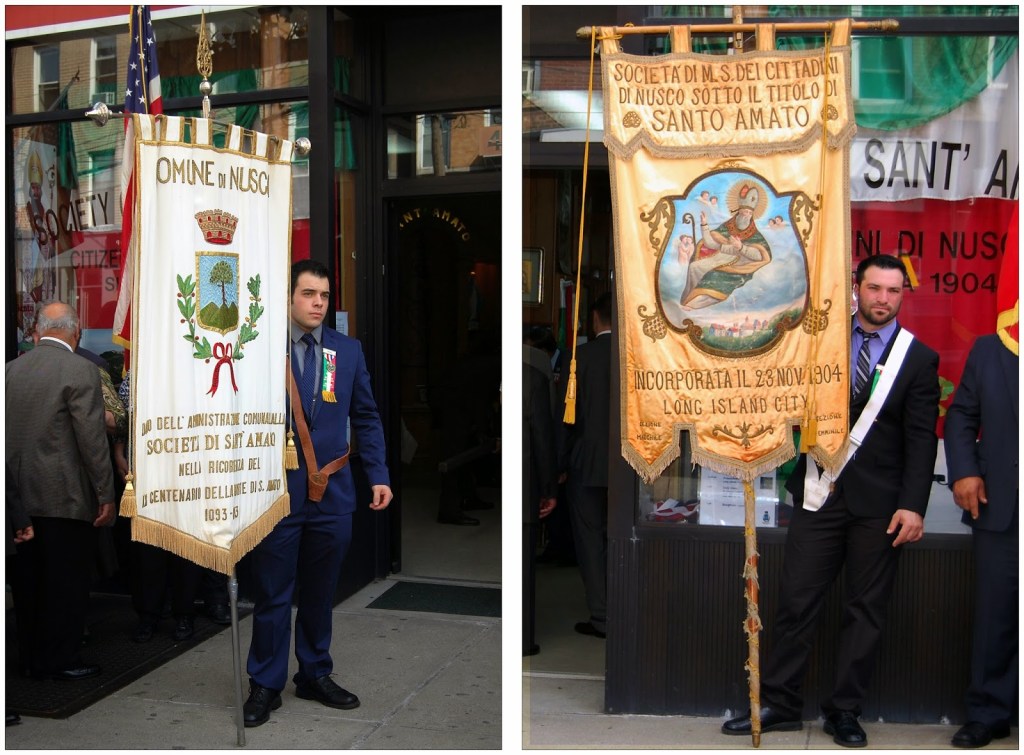
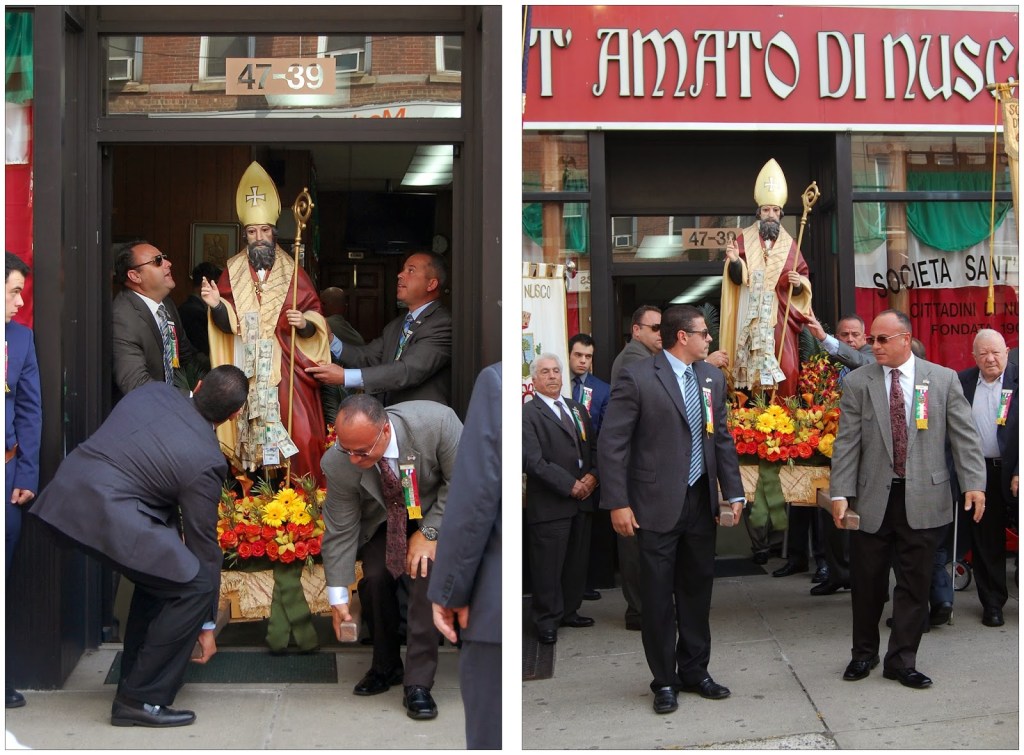
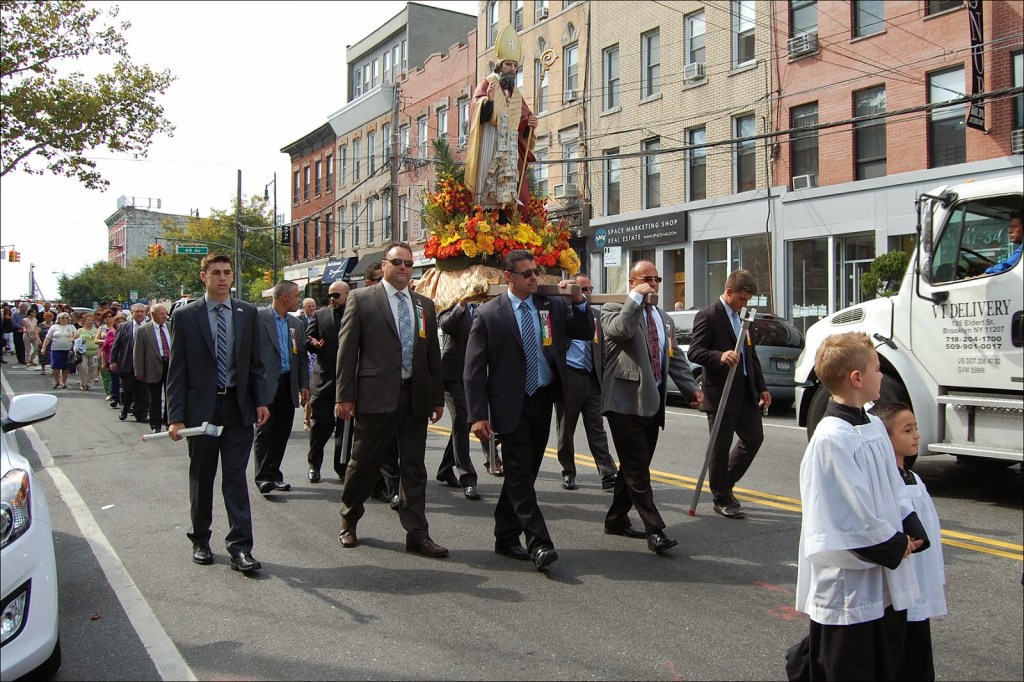
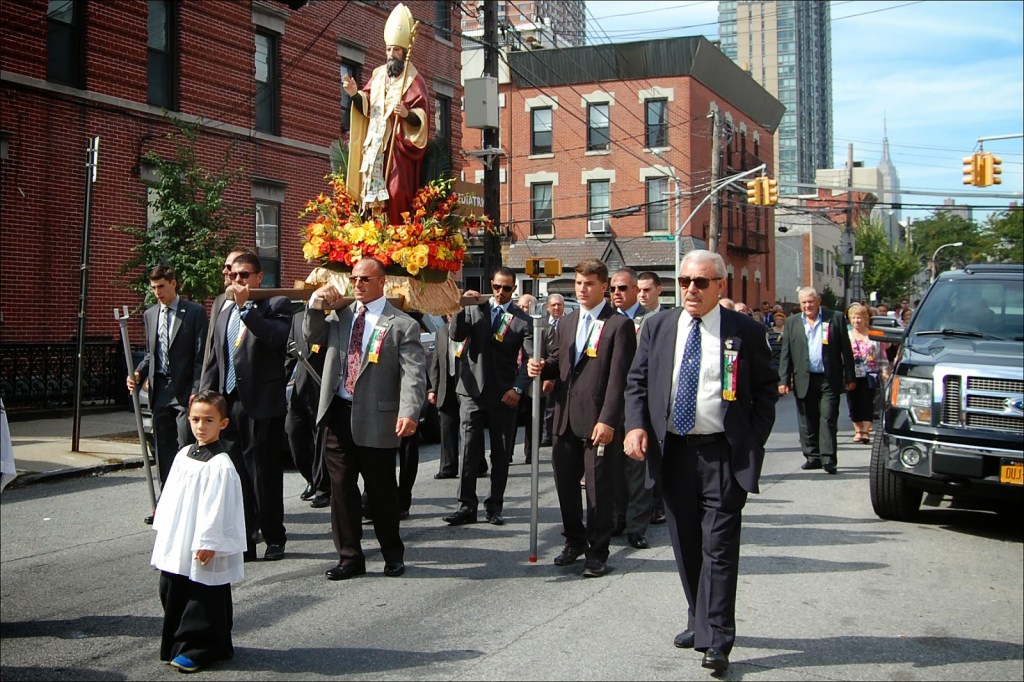
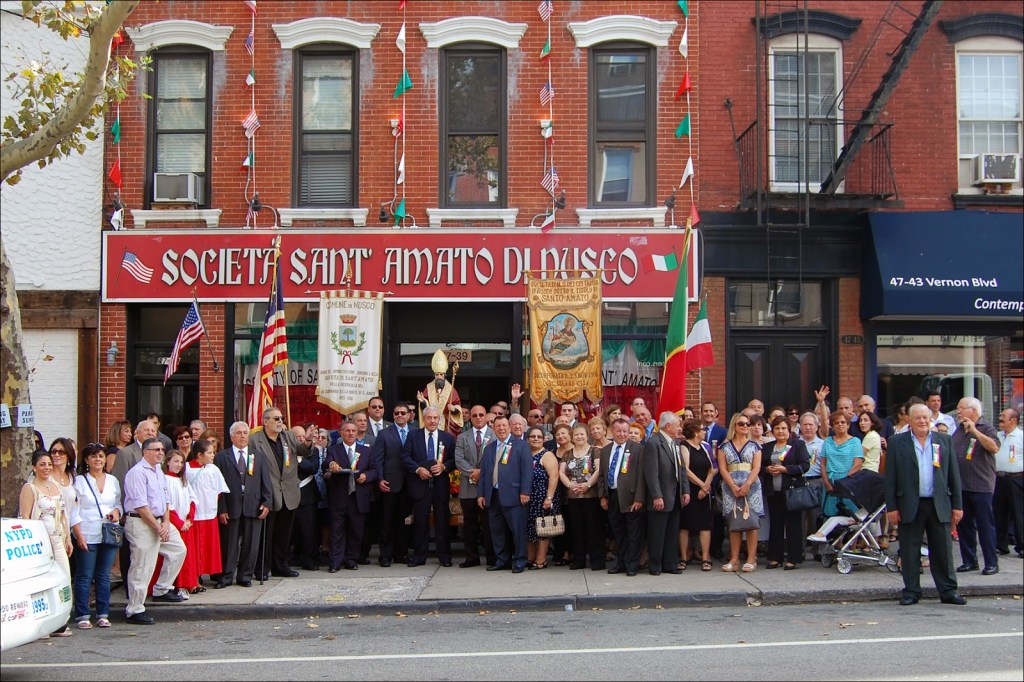
The Società Sant’Amato di Nusco of Long Island City, New York celebrates the Annual Mass and Procession in honour of Saint Amato, Patron Saint of Nusco, Avellino. St Amato’s Memorial is celebrated at Saint Mary’s Church (10-08 49th Avenue), with great aplomb and festivities. The pictures below show the great love and veneration with which our Saint is held, so far from his native home. I believe these images were taken at the celebration a few years ago.
St Honoratus of Canterbury St Ismidone of Die Bl Jean-Nicolas Cordier St Laurus St Leopardus the Slave Bl Ludwik Gietyngier St Midan of Anglesey St Simon of Crépy St Ursus the Theban St Victor the Theban — Martyrs of Valsery Abbey: An unknown number of Premonstratensian monks at the Abbey of Notre-Dame de Valsery, Picardie, France who were martyred by Calvinists. They were martyred in 1567 at Valsery, Pircardy, France
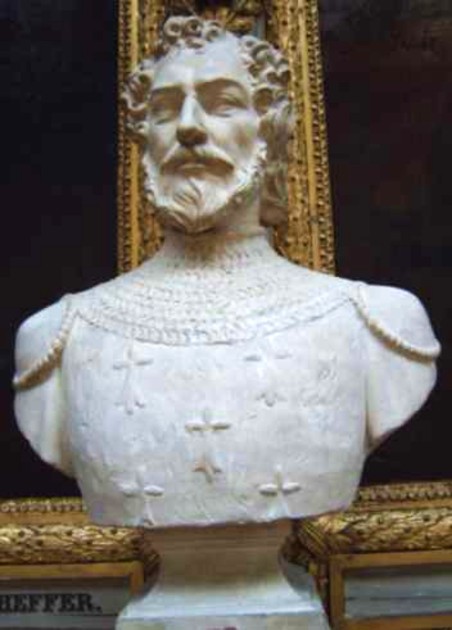
Saint of the Day – 29 September – Blessed Charles de Blois TOSF (1319–1364) French nobleman, Knight, ascetic, Franciscan tertiary, Duke of Brittany, Count of Penthièvre and Goëllo and Viscount of Limoges. He was born in 1319 and was killed at the Battle of Auray on this day in 1364. Patronage -Army soldiers, Agricultural workers.
Charles was born in Blois, son of Guy de Châtillon, Count of Blois, by Margaret of Valois, a sister of king Philip VI of France. A devout ascetic from an early age, he showed interest in religious books but was forbidden from reading them by his father, as they did not seem appropriate to his position as a Knight. As he grew older, Charles took piety to the extreme of mortifying his own flesh. He placed pebbles in his shoes, slept on straw instead of a bed, confessed every night in fear of sleeping in a state of sin and wore a cilice (a spiked garter) under his armour in battle. He was nevertheless an accomplished military leader, who inspired loyalty by his religious fervour.
OLYMPUS DIGITAL CAMERA
On 4 June 1337 in Paris, he married Joanna of Penthièvre, heiress and niece of duke John III. Together, Charles and Joanna de Châtillon fought the House of Montfort in the Breton War of Succession (1341–1364), with the support of the crown of France. After initial successes, Charles was taken prisoner by the English in 1347. His official captor was Thomas Dagworth.
He stayed nine years as prisoner in the Kingdom of England. During that time, he used to visit English graveyards, where he prayed and recited Psalm 130 much to the chagrin of his own squire. When Charles asked the squire to take part in the prayer, the younger man refused, saying that the men who were buried at the English graveyards had killed his parents and friends and burned their houses.
Charles was released against a ransom of about half a million écus in 1356. Upon returning to France, he decided to travel barefoot in winter from La Roche-Derrien to Tréguier Cathedral out of devotion to Saint Ivo of Kermartin. When the common people heard of his plan, they placed straw and blankets on the street but Charles promptly took another way. His feet became so sore that he could not walk for 15 weeks. He then resumed the war against the Montforts. Charles was eventually killed in combat during the Battle of Auray in 1364, which with the second treaty of Guerande in 1381, determined the end of the Breton War of Succession as a victory for the Montforts.
Battle of Auray 1364
By his marriage to Joanna, he had five children: John I, Count of Penthièvre (1340–1404) Guy Henry (d. 1400) Mary (1345–1404), Lady of Guise, married in 1360 Louis I, Duke of Anjou Margaret, married in 1351 Charles de la Cerda (d. 1354)
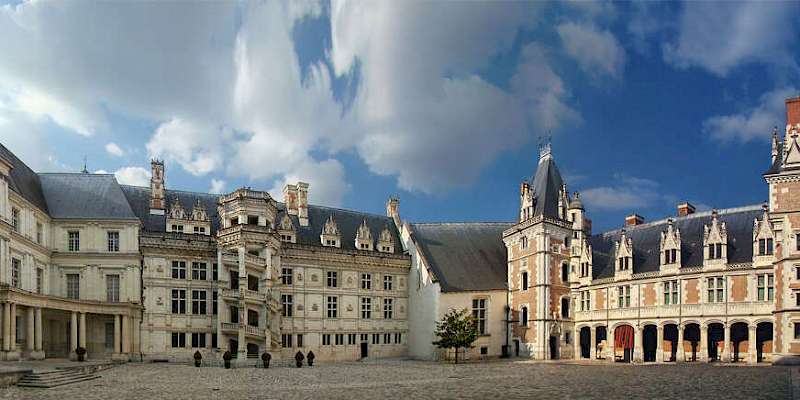
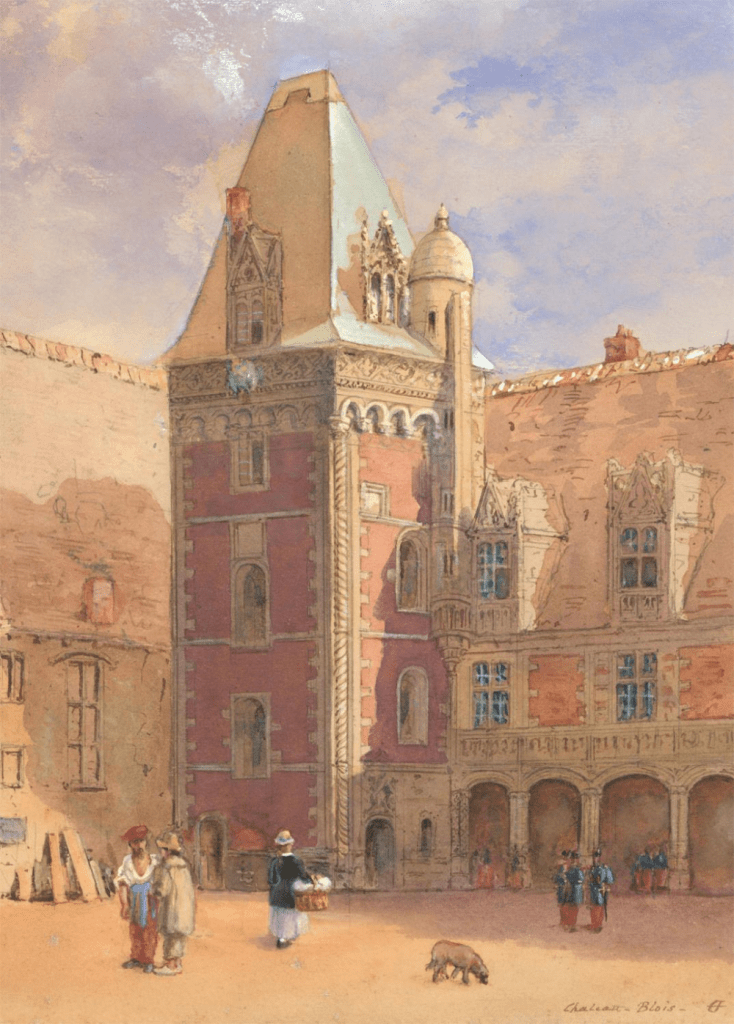
Chateau de Blois
Charles was buried at Guingamp, where the Franciscans actively promoted his unapproved cult as saint and martyr. Such variety of ex votos bedecked his tomb, that in 1368 Duke John IV of Brittany persuaded Pope Urban V to issue a bull directing the Breton Bishops to stop this. But the Bishops failed to enforce it.
Nonetheless, his family successfully lobbied for his Canonisation as a Saint of the Roman Catholic church for his devotion to religion. Pope Urban authorised a commission to study the matter but died before it’s completion. Urban died December 1370 to be succeeded by Pope Gregory XI. The commission held its first meeting in Angers in September 1371 and forwarded its report to Avignon the following January. Gregory appointed three Cardinals to review the matter. The Pope returned to Italy in September 1376, arriving in Rome in November 1377; he died the following March. Gregory was succeeded in Avignon by Clement VII but the documents were probably in Rome with Pope Urban VI. There appears to be no record of further activity regarding Charles’ cause for Canonisation at this time. In 1454, Charles’ grandson urged his relatives to continue to advocate for his recognition.
The process was re-opened in 1894 and in 1904, Charles de Blois-Châtillon was Beatified by St Pope Pius X, as Blessed Charles de Blois.
Bl Alericus St Anno of Eichstätt St Casdoe of Persia St Catholdus of Eichstätt Blessed Charles de Blois TOSF (1319–1364) Duke of Brittany St Dadas of Persia St Diethardus of Eichstätt St Fraternus of Auxerre St Gabdelas of Persia St Grimoaldus of Pontecorvo St Gudelia St Guillermo Courtet Blessed Jean de Montmirail / Baron de Montmirail, O. Cist (1165 – 1217) His Life: https://anastpaul.com/2019/09/29/saint-of-the-day-29-september-blessed-jean-de-montmirail-o-cist-1165-1217/ Bl John of Ghent St Lazaro of Kyoto St Liutwin of Trier Blessed Luigi Monza (1898 – 1954) Biography: https://anastpaul.com/2018/09/29/saint-of-the-day-29-september-blessed-luigi-monza-1898-1954/ St Miguel de Aozaraza St Quiriacus of Palestine St Rene Goupil St Rhipsime Bl Richard Rolle St Sapor of Persia St Theodota of Thrace St Vicente Shiwozuka de la Cruz — Martyrs of Thrace – 3 saints: Three Christian men murdered in Thrace for their faith. They are – Eutychius, Heracleas and Plautus.
Martyred in the Spanish Civil War: • Blessed Antonio Arribas Hortigüela • Blessed Antonio Martínez López • Blessed Dario Hernández Morató • Blessed Francesc de Paula Castelló Aleu • Blessed Francisco Edreira Mosquera • Blessed José Villanova Tormo • Blessed Pau Bori Puig • Blessed Vicente Sales Genovés • Blessed Virgilio Edreira Mosquera
Quote/s of the Day – 28 September – The Memorial of St Wenceslaus (907-935) King of Bohemia, Martyr
St Wenceslas was considered a Martyr and a Saint immediately after his death, when a cult of Wenceslas grew up in Bohemia and in England. Within a few decades of Wenceslas’ death, four biographies of him were in circulation. These hagiographies had a powerful influence on the High Middle Ages conceptualisation of the rex justus, or “righteous king”, that is, a monarch whose power stems mainly from his great piety, as well as from his princely vigour. The chronicler Cosmas of Prague, writing in about the year 1119, states:
“But his deeds I think you know better than I could tell you; for, as is read in his Passion, no-one doubts that, rising every night from his noble bed, with bare feet and only one chamberlain, he went around to God’s churches and gave alms generously to widows, orphans, those in prison and afflicted by every difficulty, so much so, that he was considered, not a prince but the father of all the wretched.”
Several centuries later the legend was claimed as fact by Pope Pius II.
The hymn “Svatý Václave” (Saint Wenceslas) or “Saint Wenceslas Chorale” is one of the oldest known Czech hymns in history. It’s roots can be found in the 12th century and it still belongs to the most popular religious songs to this day. In 1918, in the beginning of the Czechoslovak state, the song was discussed as one of the possible choices for the national anthem. His feast day is celebrated today, while the translation of his relics, which took place in 938, is commemorated on 4 March.
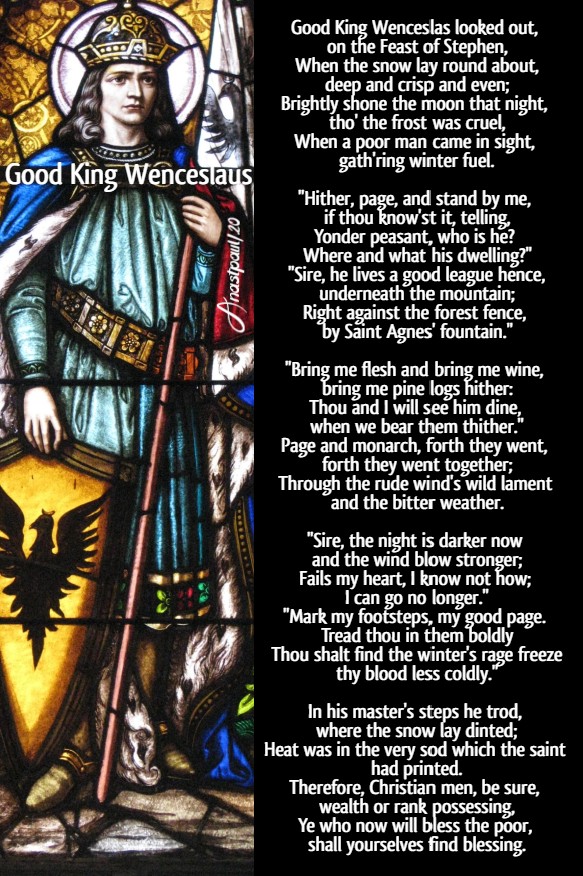
Good King Wenceslaus
Good King Wenceslas looked out, on the Feast of Stephen, When the snow lay round about, deep and crisp and even; Brightly shone the moon that night, tho’ the frost was cruel, When a poor man came in sight, gath’ring winter fuel.
“Hither, page, and stand by me, if thou know’st it, telling, Yonder peasant, who is he? Where and what his dwelling?” “Sire, he lives a good league hence, underneath the mountain; Right against the forest fence, by Saint Agnes’ fountain.”
“Bring me flesh and bring me wine, bring me pine logs hither: Thou and I will see him dine, when we bear them thither.” Page and monarch, forth they went, forth they went together; Through the rude wind’s wild lament and the bitter weather.
“Sire, the night is darker now and the wind blow stronger; Fails my heart, I know not how; I can go no longer.” “Mark my footsteps, my good page. Tread thou in them boldly Thou shalt find the winter’s rage freeze thy blood less coldly.”
In his master’s steps he trod, where the snow lay dinted; Heat was in the very sod which the saint had printed. Therefore, Christian men, be sure, wealth or rank possessing, Ye who now will bless the poor, shall yourselves find blessing.
One Minute Reflection – 28 September – Monday of the Twenty Sixth week in Ordinary Time, Readings: Job 1:6-22, Psalms 17:1, 2-3, 6-7, Luke 9:46-50 and The Memorial of Blessed Bernardine of Feltre OFM (1439-1494)
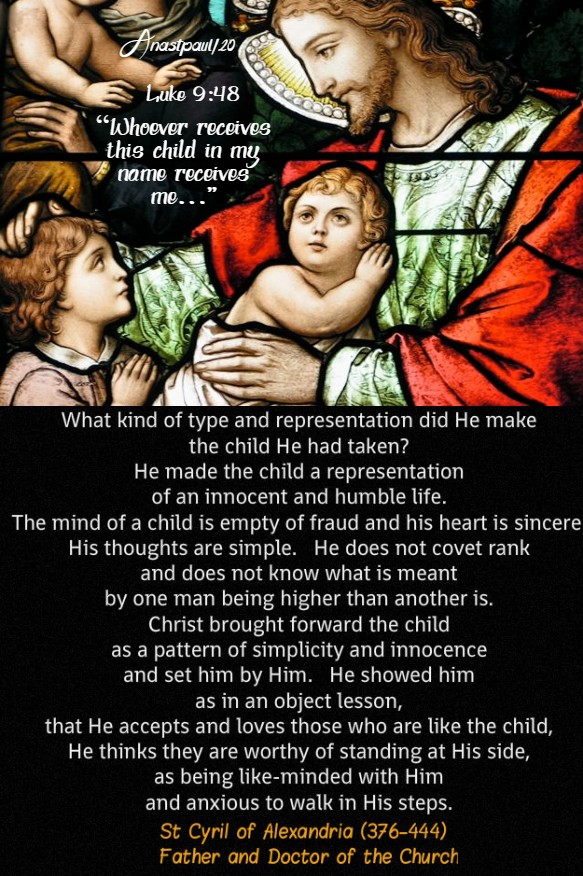
“Whoever receives this child in my name receives me and whoever receives me, receives him who sent me, for he who is least among you all, is the one who is great.” … Luke 9:48
REFLECTION – “The passion and lust of pride attacked some of the holy apostles. The mere argument about who of them was the greatest is the mark of an ambitious person, eager to stand at the head of the rest. Christ, who did not sleep, knows how to deliver. He saw this thought in the disciple’s mind, springing up, in the words of Scripture, like some bitter plant. He saw the weeds, the work of the wicked sower. Before it grew up tall, struck its root down deep, grew strong and took possession of the heart, He tears up the evil by the very root. In what way does the Physician of souls amputate pride’s passion? How does He deliver the beloved disciple from being the prey of the enemy and from a thing hateful to God and man? “He took a child,” it says, “and set it by him.” He made the event a means of benefiting both the holy apostles themselves and us their successors. This illness, as a rule, preys upon all those who are in any respect superior to other people.
What kind of type and representation did He make the child He had taken? He made the child a representation of an innocent and humble life. The mind of a child is empty of fraud and his heart is sincere. His thoughts are simple. He does not covet rank and does not know what is meant by one man being higher than another is. Christ brought forward the child as a pattern of simplicity and innocence and set him by Him. He showed him as in an object lesson, that He accepts and loves those who are like the child. He thinks they are worthy of standing at His side, as being like-minded with Him and anxious to walk in His steps.” … St Cyril of Alexandria (376-444) Father and Doctor of the Church – Commentary on Luke, Homily 54
PRAYER – Lord God, You hold out the Light of Your Word to those who do not know You. Strengthen in our hearts, the faith You have given us and the Credo we profess, so that no trials and pride may quench the fire Your Spirit has kindled in us. May the intercession of Blessed Bernardine of Feltre, grant us the grace of following the way of the Cross, to stand beneath it with our Mother, the Mother of God, Ave Maria! We make our prayer through Jesus Christ with the Holy Spirit, one God forever, amen.
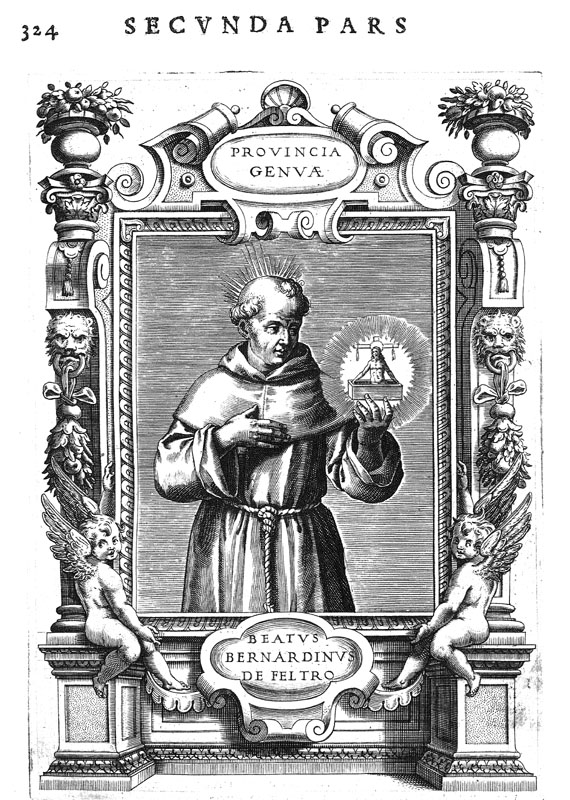
Saint of the Day – 28 September – Blessed Bernardine of Feltre OFM (1439-1494) Priest, Franciscan Friar, Missionary Preacher, Poet, peace-maker, Civil protestor against the practice of usury, defender of the poor. He was a true ‘child prodigy’ – by the time he was 12 he was fluent in Latin and at the age of 15 he composed a poem and read it in the Town Square to celebrate a local peace treaty. He is remembered most especially, in connection with the “Monti di Pietà” “Mount of Piety” of which he was the reorganiser and, in a certain sense, the Founder, together with the Blesseds Francisco Piani and Michele Carcano. Born as Martin Tomitani in 1439 at Feltre, Italy and died on 28 September 1494 of natural causes. Patronages – bankers, pawnbrokers. He is also sometimes known as Bernardino of Feltre or Martin Tomitani.
A “Mount of Piety” is an institutional pawnbroker run as a charity in Europe from Renaissance times until today. Similar institutions were established in the colonies of Catholic countries; the Mexican Nacional Monte de Piedad is still in operation. It gave poor people access to loans with reasonable interest rates. It used funds from charitable donors as capital and made loans to the poor so they could avoid going to exploitative lenders. Borrowers offered valuables as collateral, making the Mount of Piety more like a pawn shop than a bank. The Monte di Pietà was developed on the principle of charity. It was designed to aid less fortunate people by providing an alternative to the socially unaccepted Jewish money lending system.
Obligation of the Monte di Pietà della Citta di Firenze, issued 21 October 1719
Martin Tomitani was born to the noble family of Tomitano and was the eldest of nine children. He achieved acclaim in his studies and to please his father he proceeded to study law. In 1456, while a law student in Padua, he heard St James of the Marches preach the Lenten course and was inspired to enter the Franciscan order. St James of the Marches himself, gave him the name Bernardine, after St Bernardine of Siena.
In May that year he joined the “Observantine” Franciscans, an austere branch of the Franciscan friars. He completed successfully his studies at Mantua and was Ordained Priest in 1463. He was small, shy and stammered but his superiors assigned him to preach home-missions. Cured of an impediment in his speech, Bernardine began his apostolate up and down the Italian peninsula. Every city of note and every province from Lombardy in the north to Sardinia and the provinces of the south became successively the scene of his missionary labours.
He was an extremely popular preacher because he spoke simply and powerfully against the vanity, ambition and greed rife at the time. The crowds that flocked to hear him were too large for the local churches, so he addressed them in the city squares and the fields. Like many other missionaries of his century, he had made a vast outdoor bonfire called “burning the Devil’s stronghold.” The crowds were asked to throw into the fire all objects of vanity and sin such as playing cards, dice, pornographic books and pictures, jewelry, wigs, superstitious charms, cosmetics and so forth.
Bernardine was able to reconcile warring communities. He also sought civic legislation to correct public injustices such as usury, the charging of excessive interest for loans, which was especially onerous on the poor.
In 1484, Bernardine established the charitable credit organisation, “Monti di Pietà” “Mount of Piety,” run by a joint committee of clergy and laymen. The institution was founded as an alternative to the high interest loans of the money lenders and Lombard travelling bankers of the Middle Ages.
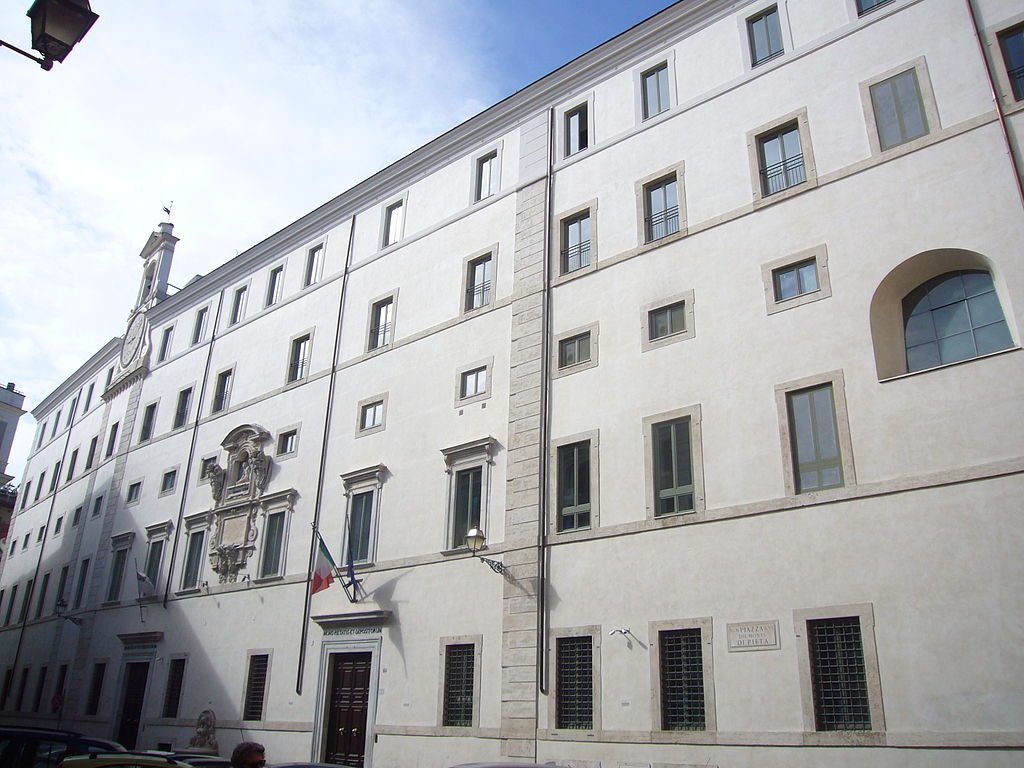
Monte di Pietà Offices in Rome
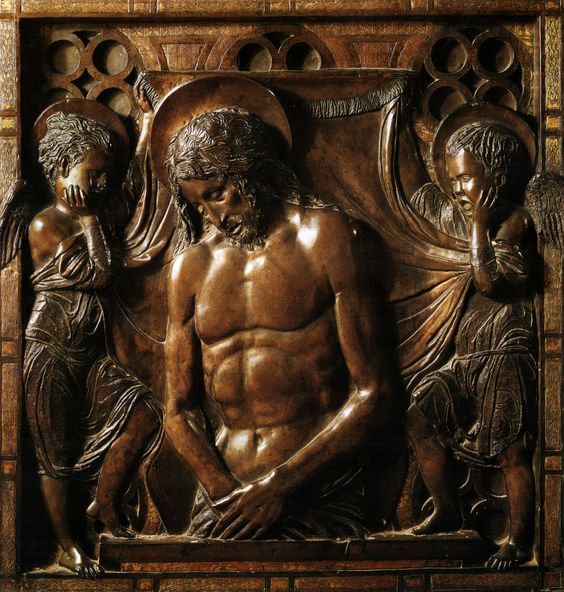
His fund raising drives were generally preceded with a procession featuring an image of either the Man of Sorrows or Pietà to encourage charitable donations. His insistence on charging a low interest to protect the institution’s permanency raised a controversy among the theologians who thought it promoted the continuance of usury. (In 1515, Pope Leo X declared the institution meritorious and it spread rapidly throughout France, Italy and Spain.)
Donatello (Italian, 1386–1466), “The Dead Christ Supported by Angels,” 1446–50. Bronze relief, 58 × 56 cm. Basilica di Sant’Antonio, Padua, Italy. Carved for the high altar. Includes two wings, not shown. https://www.pinterest.com/pin/467248530063361702/
In 1491, Bernardine was expelled from Milan by Ludovico Sforza for contesting with the Duke’s astrologer.
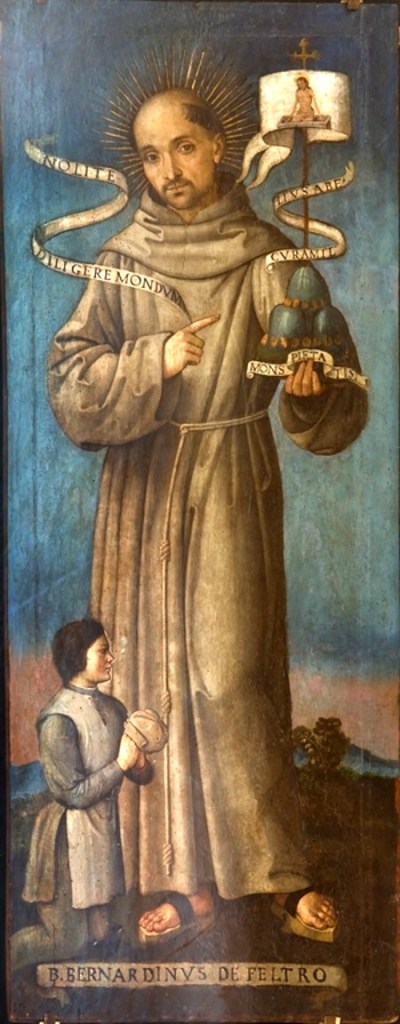
Bernardine is generally represented in iconography as carrying in his hand a Monti di Pietà, that is, a little green hill composed of three mounds and on the top either a cross or a standard with the inscription Curam illius habe‘Take care of’ (a snippet from the Vulgate translation of the Gospel of Luke’s Parable of the Good Samaritan).
The authorship of the well-known Anima Christi has as often as not been ascribed to Bernardine of Feltre. The fact, however, that the Anima Christi was composed sometime before 1439 disproves any claim that he might have of being its author, though much like St Ignatius of Loyola, Bernardine made frequent use of it and recommended it to his brethren.
On 13 April 1654, Pope Innocent X confirmed the culktus of Blessed Bernardine and he was formally Beatified in 1728 by Pope Benedict XIII.
Bl Aaron of Auxerre St Alodius of Auxerre St Annemond of Lyons St Bardomianus Blessed Bernardine of Feltre OFM (1439-1494) Priest
St Chariton of Palestine Bl Christian Franco St Conval of Strathclyde St Eucarpus St Eustochium St Exuperius of Toulouse St Faustus of Riez St John of Dukla St Laurence of North Africa St Lioba of Bischofsheim St Machan St Martial of North Africa St Martin of Moyenmoutier St Paternus of Auch St Privatus of Rome St Salonius of Geneva St Silvinus of Brescia St Simón de Rojas O.SS. (1552-1624) Apostle of the Ave Maria About St Simon: https://anastpaul.com/2018/09/28/saint-of-the-day-28-september-st-simon-de-rojas-o-ss-1552-1624-father-ave-maria-apostle-of-the-ave-maria/ St Solomon of Genoa St Stacteus St Tetta of Wimborne Bl Thiemo St Willigod of Moyenmoutier St Zama of Bologna — Augustinian Martyrs of Japan: The first Augustinian missionaries arrived in Japan in 1602 and met with immediate success; many were brought to the faith; many of them became Augustinians; and many of them were martyred in the periodic persecutions of Christians. This memorial commemorates all of them, whether they have a sanctioned Cause for Canonisation or not. They include: • Blessed Bartolomé Gutiérrez Rodríguez • Blessed Ferdinand Ayala • Blessed Francisco Terrero de Ortega Pérez • Blessed Ioannes Mukuno Chozaburo • Blessed Laurentius Kaida Hachizo • Blessed Mancius Yukimoto Ichizaemon • Blessed Martín Lumbreras Peralta • Blessed Melchor Sánchez Pérez • Blessed Michaël Ichinose Sukezaemon • Blessed Pedro de Zúñiga • Blessed Petrus Sawaguchi Kuhyoe • Blessed Thomas Jihyoe of Saint Augustine • Blessed Thomas Terai Kahyoe • Blessed Vicente Simões de Carvalho • Saint Magdalena of Nagasaki
Martyrs of Antioch – 37 saints: A group of 30 soldiers and 7 civilians who were murdered together for their faith. The names that have come down to us are – Alexander, Alphinus, Heliodorus, Mark, Neon, Nicon and Zosumus. c 303 at Antioch, Pisidia (in modern Turkey).
Martyrs of China – 120 saints: A common memorial for the hundreds of the faithful, lay and clergy, who have died for their faith in the last couple of centuries in China. They were Canonised on 1 October 2000 by Pope John Paul II.
Martyred in the Spanish Civil War: • Blessed Amalia Abad Casasempere de Maestre • Blessed Francesc Xavier Ponsa Casallach • Blessed Josep Casas Juliá • Blessed Josep Casas Ros • Blessed Josep Tarrats Comaposada • Blessed María Fenollosa Alcaina
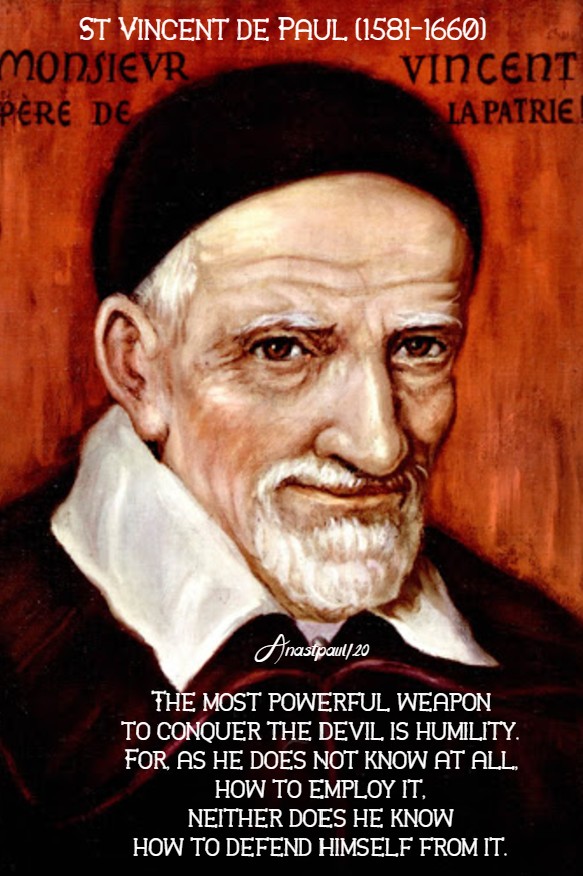
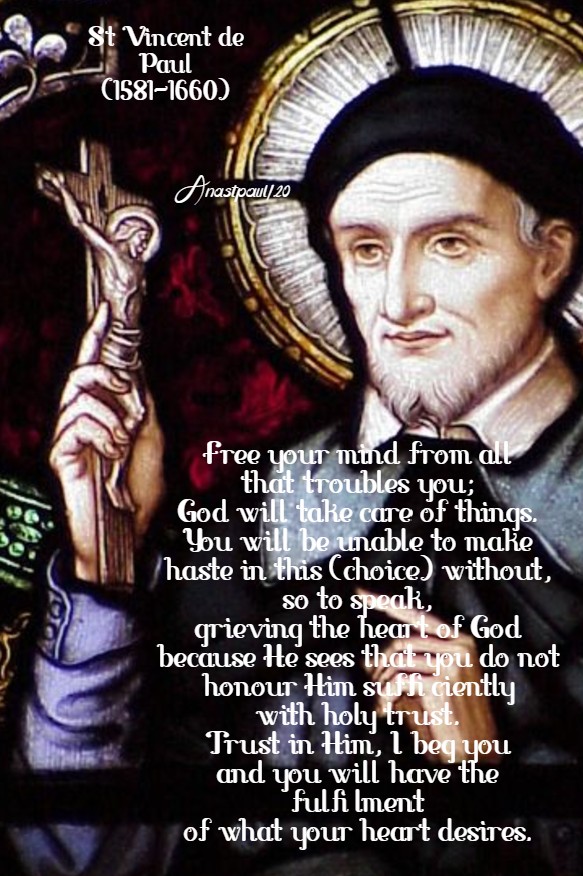
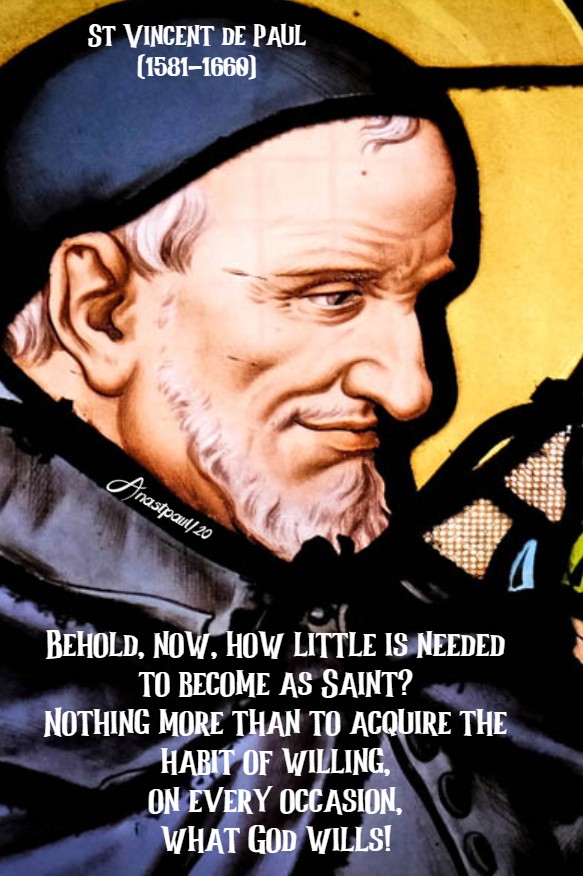
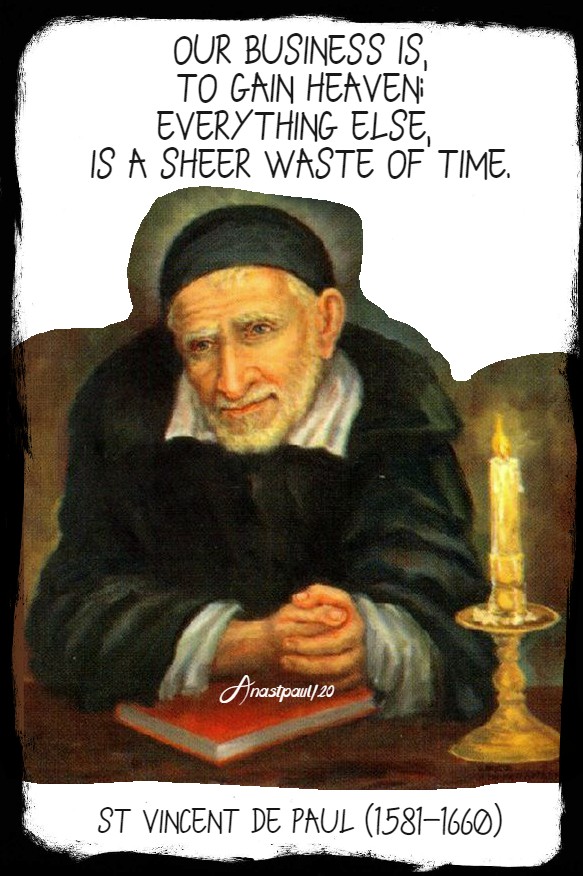
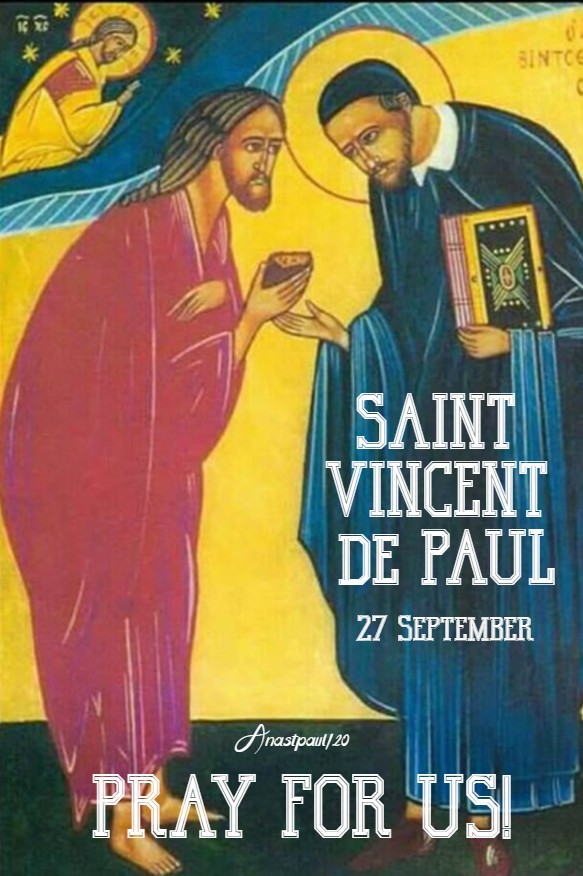
Quote/s of the Day – 27 September – The Memorial of St Vincent de Paul (1581-1660)
“The most powerful weapon to conquer the devil is humility. For, as he does not know at all, how to employ it, neither does he know how to defend himself from it.”
“Free your mind from all that troubles you; God will take care of things. You will be unable to make haste in this (choice) without, so to speak, grieving the heart of God because He sees that you do not honour Him sufficiently with holy trust. Trust in Him, I beg you and you will have the fulfilment of what your heart desires.”
“He who allows himself to be ruled or guided by the lower and animal part of his nature, deserves to be called a beast, rather than a man.”
“Perfection consists in one thing alone, which is doing the will of God. For, according to Our Lord’s words, it suffices for perfection to deny self, to take up the cross and to follow Him. Now who denies himself and takes up his cross and follows Christ better, than he who seeks not to do his own will but always that of God? Behold, now, how little is needed to become as Saint? Nothing more than to acquire the habit of willing, on every occasion, what God wills.”
“Our business is, to gain heaven; everything else, is a sheer waste of time.”
One Minute Reflection – 27 September – Twenty Sixth Sunday in Ordinary Time, Readings: Ezekiel 18:25-28, Psalms 25:4-5, 6-7, 8-9, Philippians 2:1-11, Matthew 21:28-32 and the Memorial of St Vincent de Paul (1581-1660)
‘Son, go and work in the vineyard today.’ … Matthew 21:28
REFLECTION – “My brethren, this is the time for each one of us to go out, for our part, from the place our sin. Let us go out from our Babylon to meet God our Saviour, as the prophet warns us: “Prepare to meet God our Saviour, O Israel, for he comes!” (cf Am 4:12). Let us leave the depth of our sin and consent to set out towards the Lord, who assumed “the likeness of our sinful flesh” (cf Rm 8:3). Let us leave sin’s will and set out to do penance for our sins. Then we shall find Christ – He Himself made expiation for the sin He had certainly not committed. Then He who saves the repentant will grant us salvation: “He shows mercy to those who are converted” (Sir 12:3).
But you are going to say to me (…): “Who is able to depart from sin by himself?” Indeed, it is true, the greatest sin is the love of sin, the desire to sin. Therefore, leave this desire (…), hate sin and see yourself departed from sin. If you hate sin, you have met Christ where He is to be found. To whoever hates sin, (…) Christ forgives their fault while waiting to root out our evil habits.
But you will say that even this is a great deal for you and that, without the grace of God, it is impossible to hate one’s sin and desire justice: “Let them thank the Lord for his mercy, such wondrous deeds for the children of Adam!” (Ps 106[107]:8). (…) O Lord, with a mighty hand, Jesus all-powerful, come to free my captive reason from the demon of ignorance and snatch my sick will, from the plague of it’s lusts. Free my capacities, so that I may act with strength as I desire to do with all my heart.”… Bl Isaac of Stella O.Cist (c 1100 – c 1170) Cistercian Monk, Abbot, Theologian, Philosopher – Sermon for Lent
PRAYER – Lord God, You hold out the Light of Your Word to those who do not know You. Strengthen in our hearts, the faith You have given us and the Credo we profess, so that no trials may quench the fire Your Spirit has kindled in us. May the intercession of St Vincent de Paul, grant us the grace of following the way of the Cross, to stand beneath it with our Mother, the Mother of God, Ave Maria! We make our prayer through Jesus Christ with the Holy Spirit, one God forever, amen.
Our Morning Offering – 27 September – Twenty Sixth Sunday in Ordinary Time and the Memorial of St Vincent de Paul (1581-1660)
Lord, Teach me How to Pray By St Vincent de Paul
Oh Lord, You selected the poor and simple people to be Your Apostles. Look upon Your poor servant kneeling before You now. I recognise that I am simple and poor too. Dear Lord, please teach me how to pray as You taught Your disciples upon their humble request. If it pleases You in Your goodness to grant me that grace, I shall be able to pray well and much better than I could ever hope for if left to my own efforts. Lord, I trust that You will bless me with the fulfilment of this request. Amen
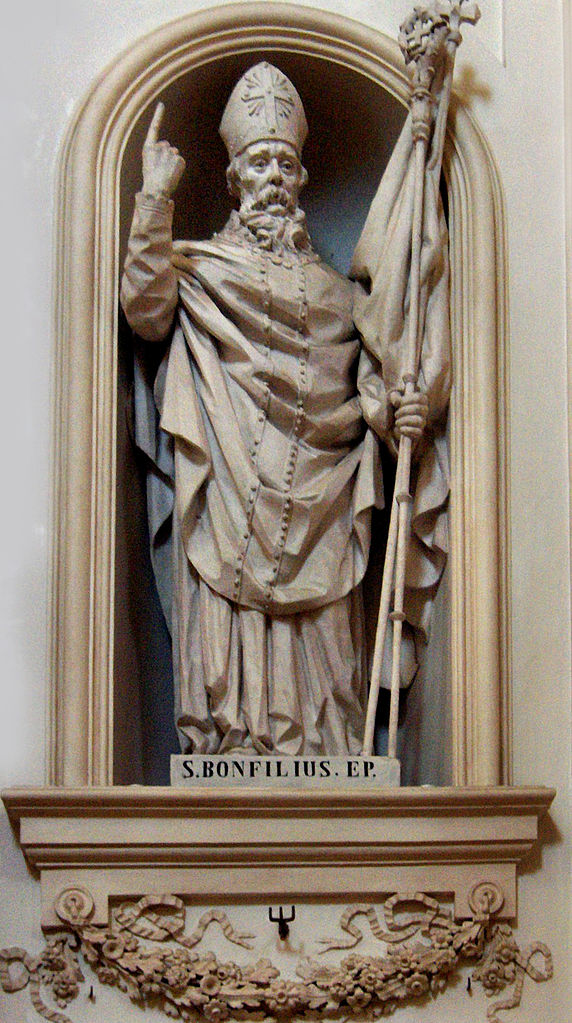
Saint of the Day – 27 September – Saint Bonfilius of Foligno OSB (1040-1125) Bishop of Foligno, Benedictine Monk and Abbot – born in 1040 in Osimo, Italy and died 0n 27 September 1125 of natural causes. Patronage – Foligno, Italy. Additional memorial – 28 September in Folgino, so as not to clash with the feast of St Vincent de Paul on 27 September.
Bonfilius was born in 1040 in Osimo, in the Marche, of a noble family. He entered the Abbey of Santa Maria di Storaco of which, later, he became Abbot.
He was Bishop of Foligno and succeeded Azzo around 1070. His life was written by San Silvestro Guzzolini, Founder of the Benedictine monastic congregation of Silvestrina and his first biographer, a century after the saint’s death.
Bonfilius, as Bishop, took part in the crusade in the Holy Land, where he remained from 1096 to 1104, leading a penitent life in perfect solitude.
Returning to Italy, he went to Rome, then returned to his Diocese of Foligno but found it occupied by the young Bishop Andrea, appointed by the Pope at the request of the people, who for a long time had received no news from their Bishop. Bonfilius humbly recognised the new Bishop’s election and retired to the Abbey of Storaco.
Here, some of his Monks made his life impossible and he was forced to flee to the hermitage of Nostra Signora della Fara, in the Diocese of Cingoli and died, worn out by austerity and penance, on 27 September 1125.
The Roman Martyrology states: In Fara near Cingoli in the Marche, St. Bonfilius, who, after being Bishop of Foligno, spent ten years in the Holy Land. He then returned to Italy, lived as a monk in the Monastery of Storaco, of which he had been Abbot in the past and finally died in solitude.
St Adheritus St Adolphus of Cordoba St Antonio de Torres St Barrog the Hermit St Bonfilius of Foligno OSB (1040-1125) Bishop, Abbot St Ceraunus of Paris St Chiara of the Resurrection Blessed Delphine TOSF St Deodatus of Sora St Elzear TOSF St Epicharis St Fidentius of Todi St Florentinus the Hermit St Gaius of Milan St Hilary the Hermit St Hiltrude of Liessies Bl Jean-Baptiste Laborie du Vivier St John of Cordoba Blessed Lorenzo of Ripafratta OP (c 1373-1456) About Blessed Lorenzo: https://anastpaul.com/2019/09/27/saint-of-the-day-27-september-blessed-lorenzo-of-ripafratta-op-c-1373-1456/ St Marcellus of Saint Gall St Terence of Todi — Martyrs of Aegea – (3 saints)
Martyred in the Spanish Civil War: • Blessed Crescencia Valls Espí • Blessed Herminia Martínez Amigó de Martínez • Blessed José Fenollosa Alcaina • Blessed Maria Carme Fradera Ferragutcasas • Blessed Maria Magdalena Fradera Ferragutcasas • Blessed Maria Rosa Fradera Ferragutcasas
One Minute Reflection – 26 September – Saturday of the Twenty Fifth week in Ordinary Time, Readings: Ecclesiastes 11:9–12:8, Psalms 90:3-4, 5-6, 12-13, 14,17, Luke 9:43-45 and the Memorial of St Nilus the Younger (910-1005)
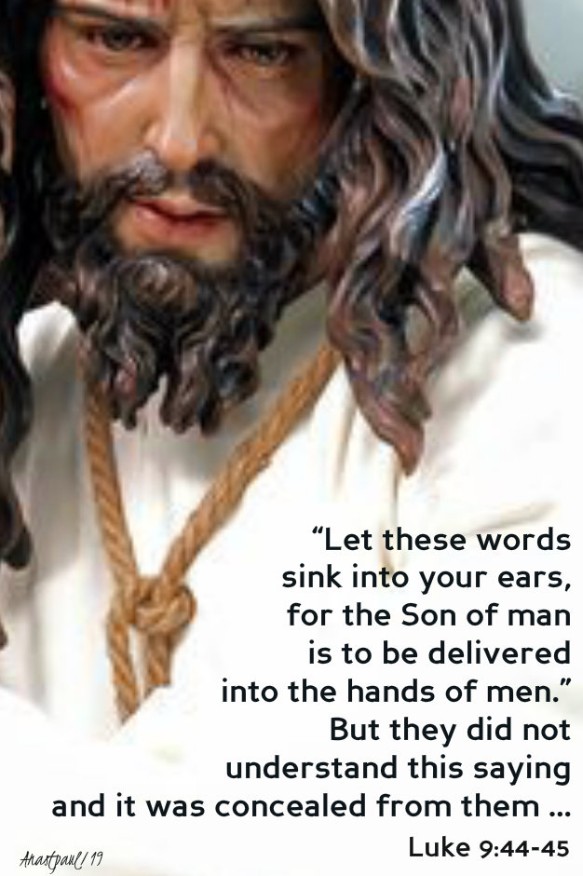
“Let these words sink into your ears, for the Son of man is to be delivered into the hands of men.” But they did not understand this saying and it was concealed from them … Luke 9:44-45
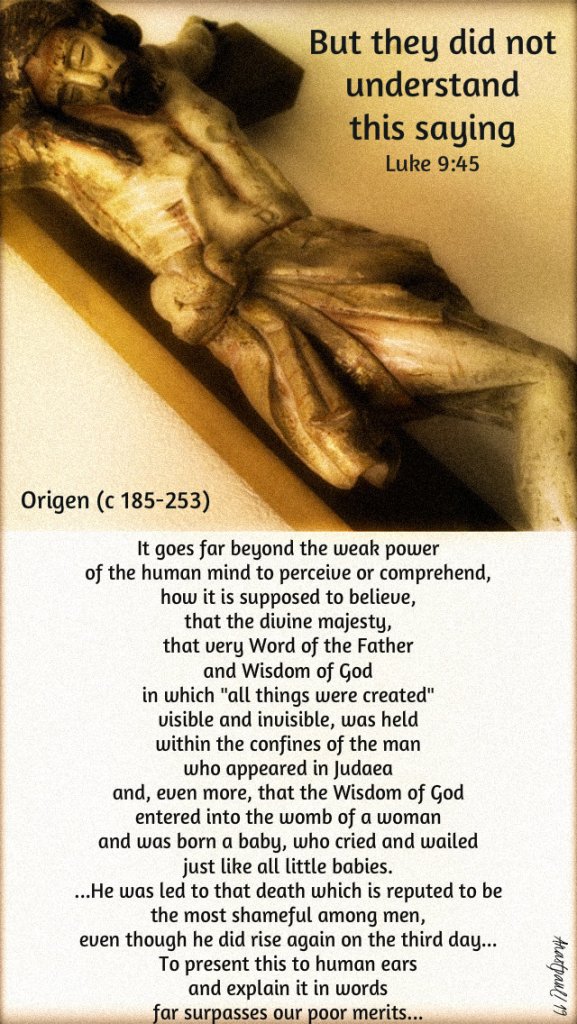
REFLECTION – “Of all Christ’s miracles and mighty acts, it is this one that far exceeds the limits of human wonder. It goes far beyond the weak power of the human mind to perceive or comprehend, how it is supposed to believe, that the divine majesty, that very Word of the Father (Jn 1:1) and Wisdom of God in which “all things were created, visible and invisible” (cf. Col 1:15), was held within the confines of the man who appeared in Judaea and, even more, that the Wisdom of God entered into the womb of a woman and was born a baby, who cried and wailed just like all little babies. And it is further reported that He suffered the anguish of death, as He Himself admitted by saying: “My soul is very sorrowful, even to death” (Mt 26:38 par) and in the end, He was led to that death which is reputed to be the most shameful among men, even though He did rise again on the third day…
To present this to human ears and explain it in words far surpasses our poor merits… Indeed the explanation of this mystery is probably beyond the grasp even of the whole creation of heavenly powers.” … Origen (c 185-253) Priest, Theologian, Father – Treatise on First Principles
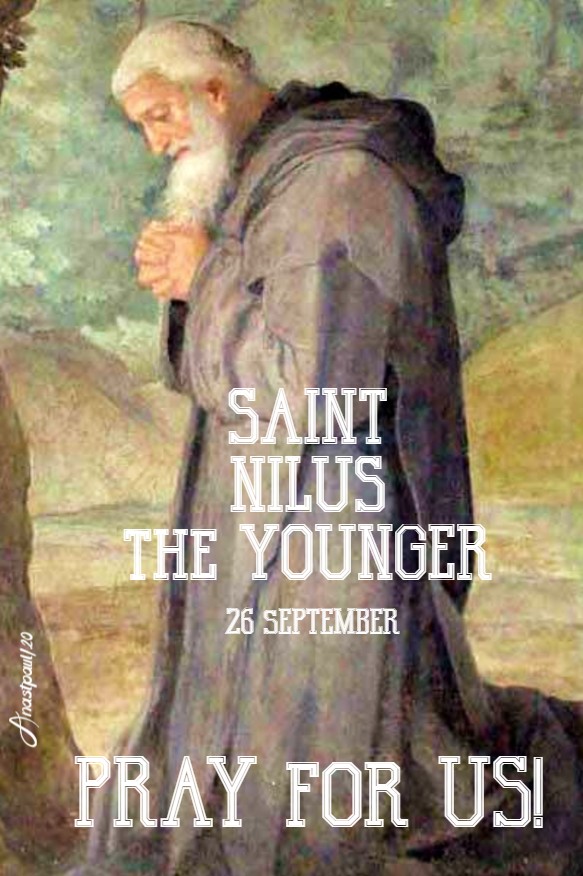
PRAYER – Holy God, help me to amend my life constantly and be sincerely converted to You. Let me seek Your interests rather than my own and be ever more closely united with You. Send Your Spirit of understanding to enkindle our minds but most of all, fill us with Your grace of faith, that whether we understand or not, our love and obedience, is our only guide. St Nilus, you constantly sought to bring all to Christ, your beloved, please pray for us. We make our prayer through Christ our Lord, in the unity of the Holy Spirit, God for all eternity, amen.
























You must be logged in to post a comment.