Posted in FATHERS of the Church, LENT 2019, LENTEN THOUGHTS, QUOTES of the SAINTS, QUOTES on REPENTANCE, QUOTES on SANCTITY, SAINT of the DAY

Lenten Thoughts – 30 March – The Ladder of Divine Ascent – The Steps

Lenten Thoughts – 30 March – Saturday of the Third week of Lent, Year C and the Memorial of St John Climacus (c 525-606)

The Ladder of Divine Ascent is an ascetical treatise on avoiding vice and practising virtue so that at the end, salvation can be obtained. Written by Saint John Climacus initially for monastics, it has become one of the most highly influential and important works used by the Church as far as guiding the faithful to a God-centred life, second only to Holy Scripture.

Structure and Purpose:
The aim of the treatise is to be a guide for practising a life completely and wholly devoted to God.   The ladder metaphor—not dissimilar to the vision that the Patriarch Jacob received—is used to describe how one may ascend into heaven by first renouncing the world and finally ending up in heaven with God.   There are thirty chapter,; each covers a particular vice or virtue.   They were originally called logoi, but in the present day, they are referred to as “steps.”   The sayings are not so much rules and regulations, as with the Law that St Moses received at Sinai, but rather observations about what is being practised.   Metaphorical language is employed frequently, to better illustrate the nature of virtue and vice.   Overall, the treatise does follow a progression that transitions from start (renunciation of the world) to finish (a life lived in love).the 30 steps of the ladder of divine ascent - 30 march 2019.jpg
The steps are:
On renunciation of the world
On detachment
On exile or pilgrimage – concerning dreams that beginners have
On blessed and ever-memorable obedience (in addition to episodes involving many individuals)
On painstaking and true repentance which constitutes the life of the holy convicts; and about the Prison
On remembrance of death
On joy-making mourning
On freedom from anger and on meekness
On remembrance of wrongs
On slander or calumny
On talkativeness and silence
On lying
On despondency
On that clamorous mistress, the stomach
On incorruptible purity and chastity, to which the corruptible attain by toil and sweat
On love of money, or avarice
On non-possessiveness (that hastens one Heavenwards)
On insensibility, that is, deadening of the soul and the death of the mind before the death of the body
On sleep, prayer and psalmody with the brotherhood
On bodily vigil and how to use it to attain spiritual vigil, and how to practise it
On unmanly and puerile cowardice
On the many forms of vainglory
On mad pride and (in the same Step) on unclean blasphemous thoughts; concerning unmentionable blasphemous thoughts
On meekness, simplicity, and guilelessness which come not from nature but from conscious effort, and about guile
On the destroyer of the passions, most sublime humility, which is rooted in spiritual perception
On discernment of thoughts, passions and virtues; on expert discernment; brief summary of all aforementioned
On holy stillness of body and soul; different aspects of stillness and how to distinguish them
On holy and blessed prayer, the mother of virtues, and on the attitude of mind and body in prayer
Concerning Heaven on earth, or Godlike dispassion and perfection, and the resurrection of the soul before the general resurrection
Concerning the linking together of the supreme trinity among the virtues; a brief exhortation summarising all that has said at length in this book.

Read the book, here

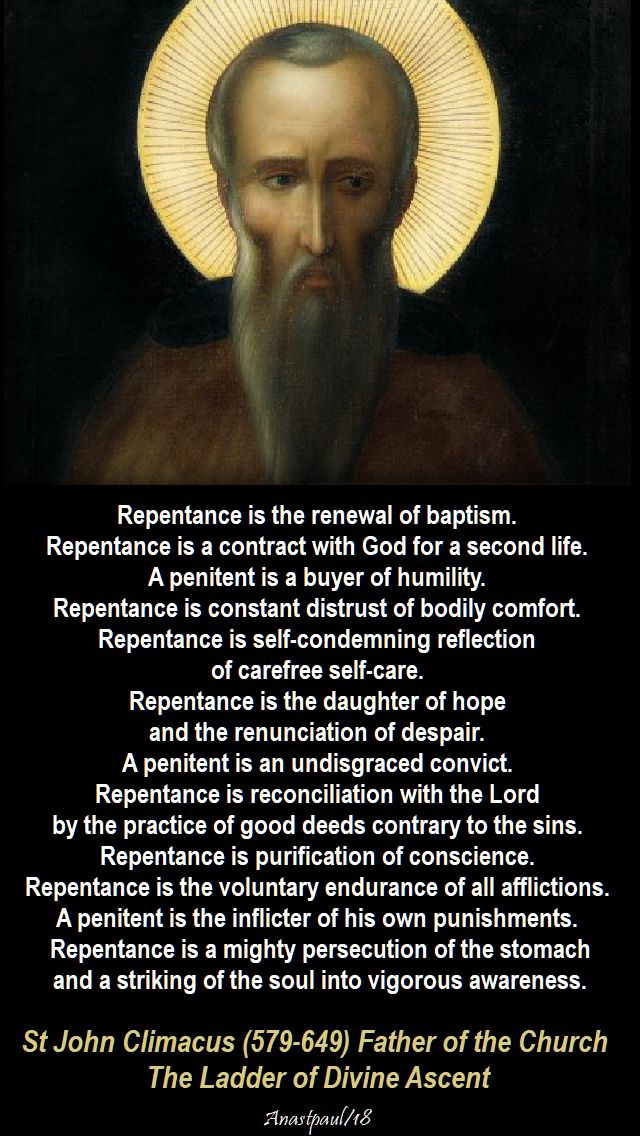
“Repentance is the renewal of baptism. 
Repentance is a contract with God for a second life. 
A penitent is a buyer of humility. 
Repentance is constant distrust of bodily comfort. 
Repentance is self-condemning reflection of carefree self-care. 
Repentance is the daughter of hope and the renunciation of despair. 
A penitent is an undisgraced convict. 
Repentance is reconciliation with the Lord 
by the practice of good deeds contrary to the sins. 
Repentance is purification of conscience. 
Repentance is the voluntary endurance of all afflictions. 
A penitent is the inflicter of his own punishments. 
Repentance is a mighty persecution of the stomach
and a striking of the soul into vigorous awareness.”repentance-is-the-renewal-of-baptism-st-john-climacus-and 30 march 2019 - 29-jan-2019.jpg
Posted in FATHERS of the Church, LENT 2019, QUOTES of the SAINTS, QUOTES on PRAYER, SAINT of the DAY

Quote of the Day – 30 March – St John Climacus – On Prayer

Quote of the Day – 30 March – Saturday of the Third week of Lent, Year C, Gospel: Luke 18:9–14 and the Memorial of St John Climacus (c 525-606)

On Prayer

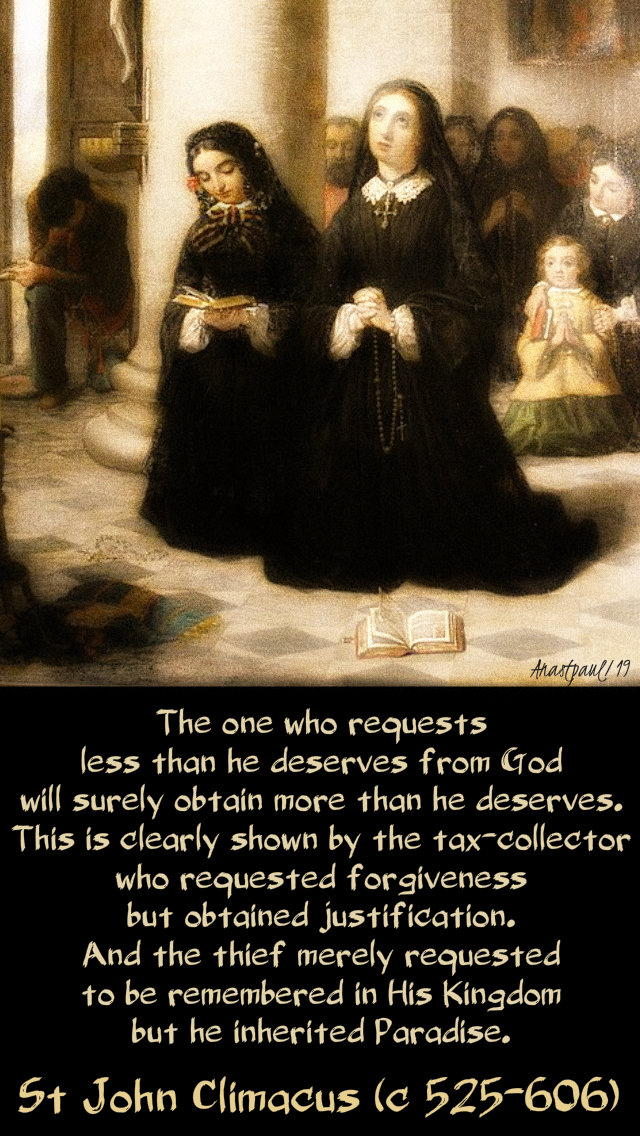
“The one who requests less than he deserves from God will surely obtain more than he deserves.   

This is clearly shown by the tax-collector who requested forgiveness but obtained justification.   

And the thief merely requested to be remembered in His Kingdom, but he inherited Paradise.”

St John Climacuste one who requests less - st john climacus 30march 2019.jpg

Posted in LENT 2019, QUOTES on PRAYER, SAINT of the DAY, The WORD

Lenten Reflection – 30 March

Lenten Reflection – 30 March – Saturday of the Third week of Lent, Year C and the Memorial of St John Climacus (c 525-606)

The Readings
Hosea 6:1-6; Psalms 51:3-4, 18-19, 20-21AB; Luke 18:9-14 

On sobriety in prayer

St John Climacus

Do not be over-sophisticated in the words you use when praying, because the simple and unadorned lisping of children has often won the heart of their heavenly Father.   Do not attempt to talk much when you pray, lest your mind be distracted in searching for words. One word of the publican propitiated God and one cry of faith saved the thief.  Loquacity in prayer often distracts the mind and leads to fantasy, whereas brevity- makes for concentration.   If you feel sweetness or compunction at some word of your prayer, dwell on it, for then our guardian angel is praying with us.

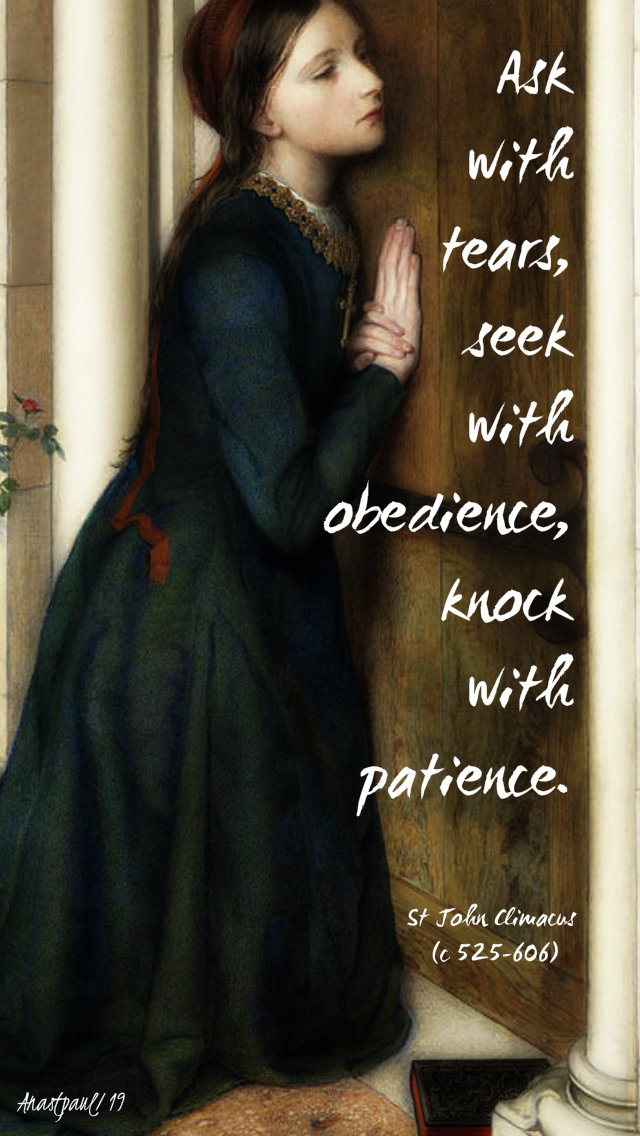
Ask with tears, seek with obedience, knock with patience.   For thus the one who asks, receives and the one who seeks, finds and to anyone who knocks it will be opened.

Those who keep constant hold of the staff of prayer will not stumble.   And even if they do, their fall will not be fatal.   For prayer is a devout coercion of God.ask with tears knock with - st john climacus.jpg

Daily Meditation:
Fill our hearts with Your love.

Our lesson today reminds us again of God’s love and Jesus’ desire
that we love one another as we are loved.
On this journey, we are learning why this is a challenge for us.
We are experiencing our human weaknesses and practising ways to be freer,
to open our hearts more fully to God’s love
and to give ourselves in fidelity, every day.

You ask us to express our thanks by self-denial.
“Come, let us return to the Lord,
for he has torn, that he may heal us,
he has stricken and he will bind us up.”
Hosea 6:1

Closing Prayer:
God of infinite love,
You shower me with limitless gifts in my life.
In my every thought and action today
guide me to the bright and loving light of Your kingdom.
Help me to be aware of
the many ways You allow me
to share in Your life so intimately today.
Thank You for the gifts You have placed in my life.
Let me be grateful every moment of this day..

May the Lord bless us,
protect us from all evil
and bring us to everlasting life.
Amen.Sat of the thirs week lent 30 march 2019.jpg

Posted in LENT 2019, MARIAN QUOTES, MORNING Prayers, QUOTES on PRAYER, SAINT of the DAY, The WORD

One Minute Reflection – 30 March –

One Minute Reflection – 30 March – Saturday of the Third week of Lent, Year C, Gospel: Luke 18:9–14

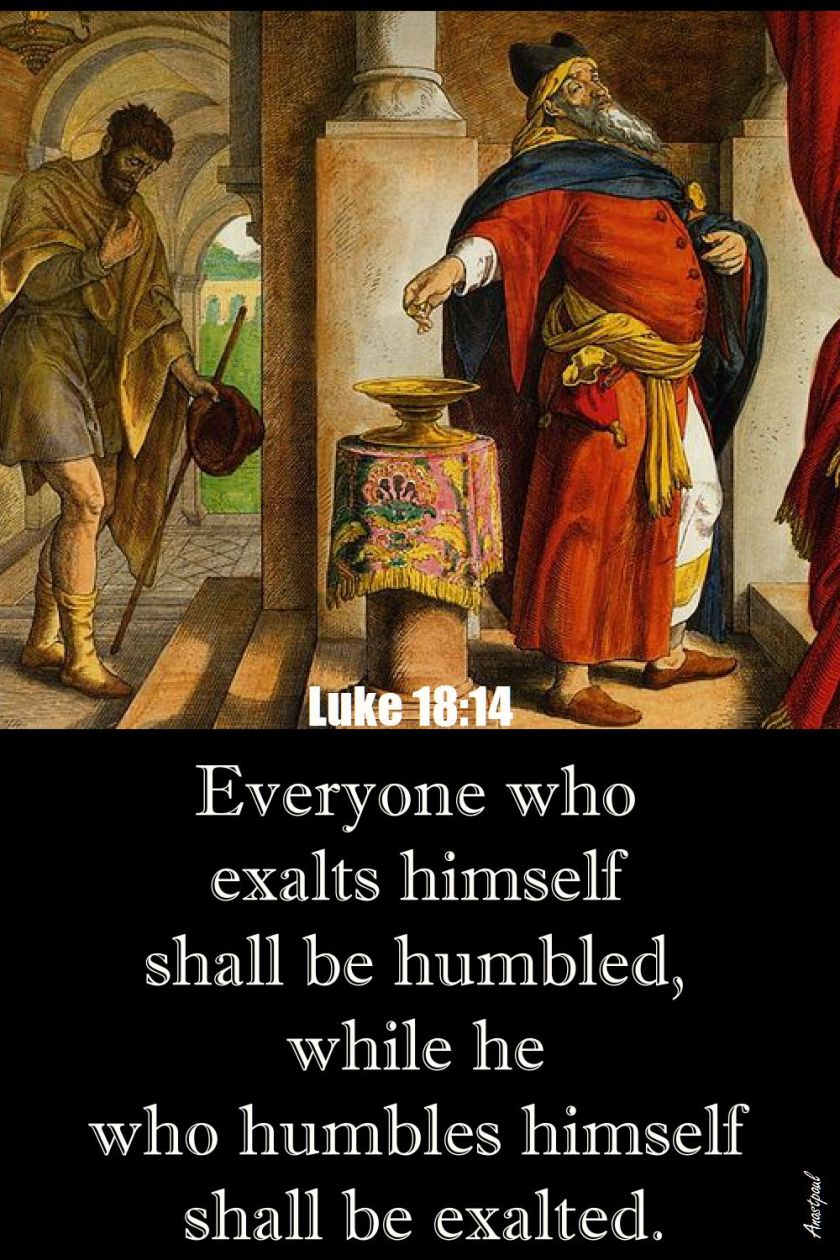
“…For everyone who exalts himself will be humbled but he who humbles himself, will be exalted.”...Luke 18:14luke-18-14-everuone who exalts himself shall be humbled.jpg

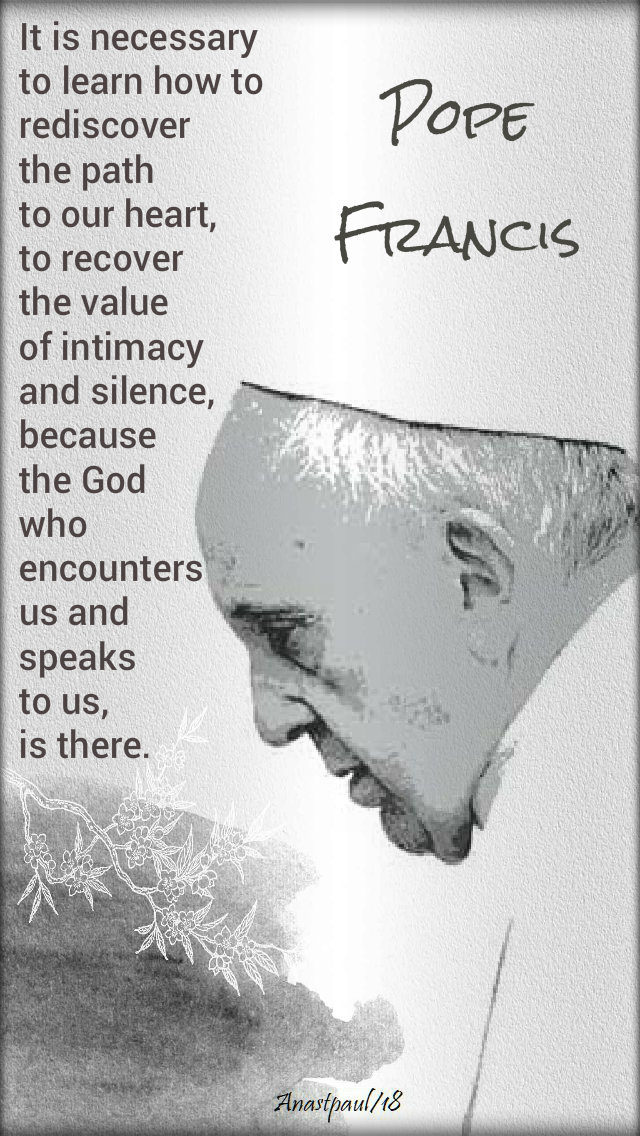
REFLECTION – “We must only pray by placing ourselves before God just as we are.   Not like the pharisee who prays with arrogance and hypocrisy.   We are all taken up by the frenetic pace of daily life, often at the mercy of feelings, dazed and confused.   It is necessary to learn how to rediscover the path to our heart, to recover the value of intimacy and silence, because the God who encounters us and speaks to us, is there.  Only by beginning there can we, in our turn, encounter others and speak with them.”…Pope Francis – General Audience, 1 June 2016it is necessary to learn how to pope francis 30 march 2019.jpg

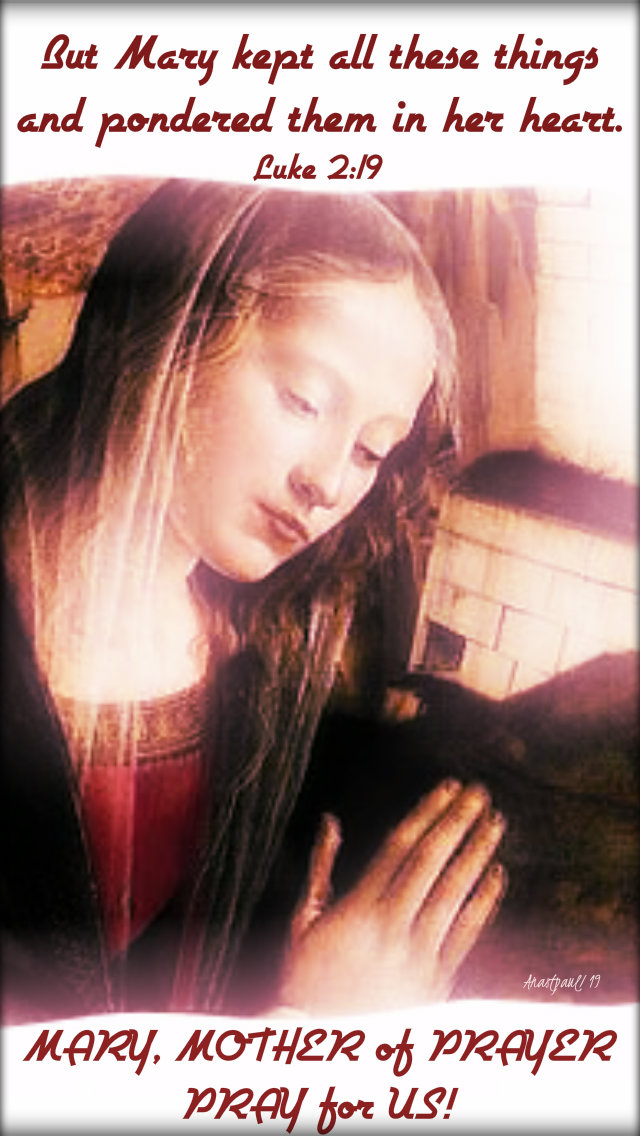
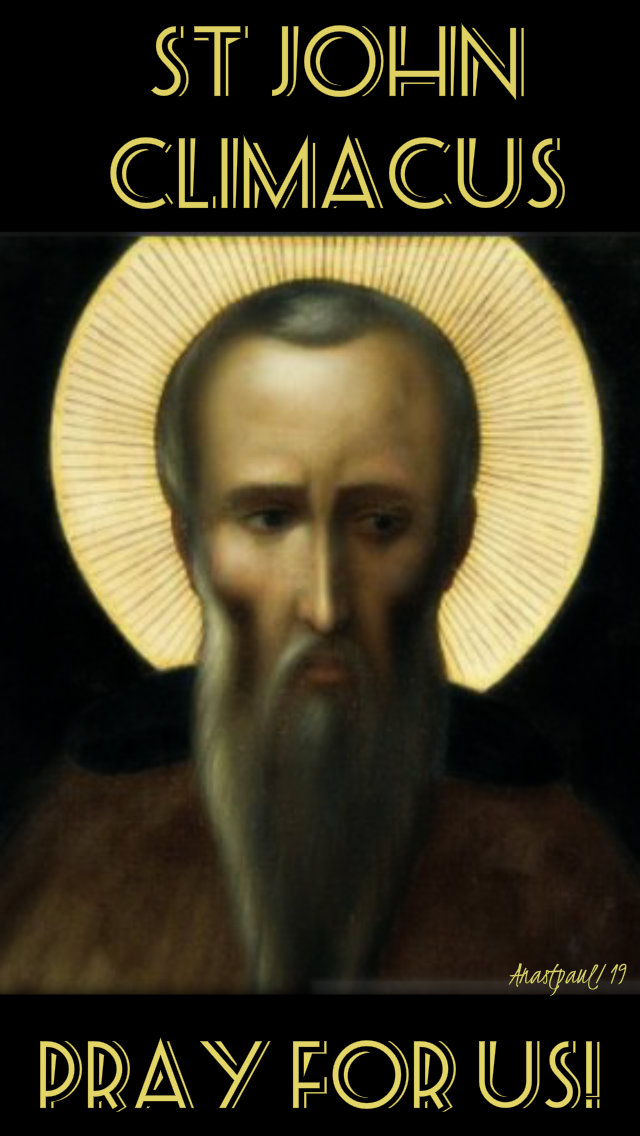
PRAYER – We turn to You our God and Father and seek Your comfort and assurance. Jesus, our Lord, Your Son, taught us how to pray and all we need to be and do, to reach You.   Be patient good Father, as we grow by Your grace.   May such a master of prayer, St John Climacus, be heard together with the Mother of Christ and of Prayer, as they pray on our behalf.   Through Jesus our Lord, in union with the Holy Spirit, God now and forever, amen.luke 2 19 but mary kept all these things mary mother of prayer pray for us 30 march 2019.jpg

st john climacus pray for us 30 march 2019.jpg

Posted in FATHERS of the Church, SAINT of the DAY

Saint of the Day – 30 March – St John Climacus (c 525-606)

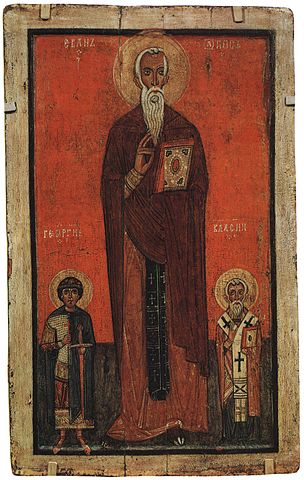
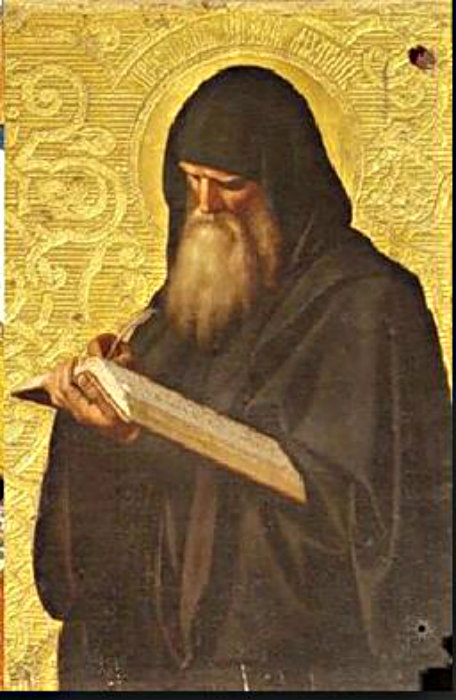
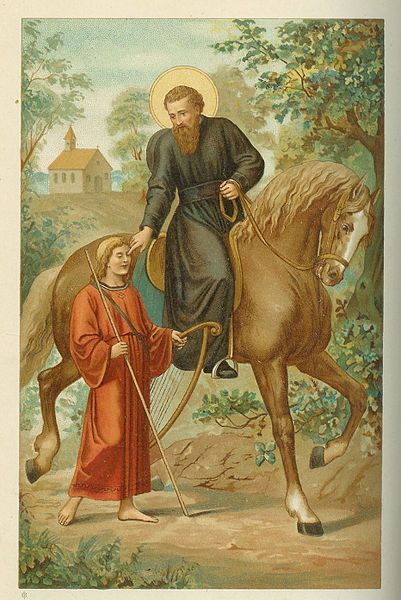
Saint of the Day – 30 March – St John Climacus (c 525-606) aged 80-81 – Anchorite Monk, Mystic, Poet, Writer, Ascetic – also known as St John of the Ladder, John Scholasticus, John the Sinaita. John made, while still young, such progress in learning that he was called the Scholastic.

A native of Palestine, at sixteen, John entered a monastery in the Palestinian desert.  After four years of training in a community, he took the vows and an aged abbot foretold that he would some day be one of the greatest lights of the Church.snipped out getty st john climacus.JPG

Nineteen years later, on the death of his director, he withdrew into a deeper solitude, where he studied the lives and writings of the Saints and was raised to an unusual height of contemplation.   The fame of his holiness and practical wisdom drew crowds around him for advice and consolation.   For his greater profit he visited the solitudes of Egypt. He lived forty years as a hermit.   Like other desert fathers, he broke his near-total solitude only on Saturdays and Sundays to worship with other hermits and counsel his followers.

Early in his monastic career John decided that as a mark of submision to God he would receive all criticism as true.   Once, for example, some monks reproached him for wasting time in idle conversation.   So, to correct what he regarded as a serious fault, for a year John observed absolute silence.   Only when his disciples insisted that they needed his spiritual teaching did the saint start speaking again.st john climacus 304px-Św_Jan_Klimak,_Jerzy_i_Błażej

He was induced by a brother abbot to write the rules by which he had guided his life and his book called the Climax, or Ladder of Perfection/The Ladder of Divine Ascent, has been prized in all ages for its wisdom, its clearness and its unction.  He took his name Climacus or “ladder” from his book .   The reader who climbed The Ladder ascended thirty steps to holiness.   According to St John, the goal was to reach a state of apatheia or passive disinterestedness in earthly life, so as to anticipate the wonders of heaven.my snip - st john climacus

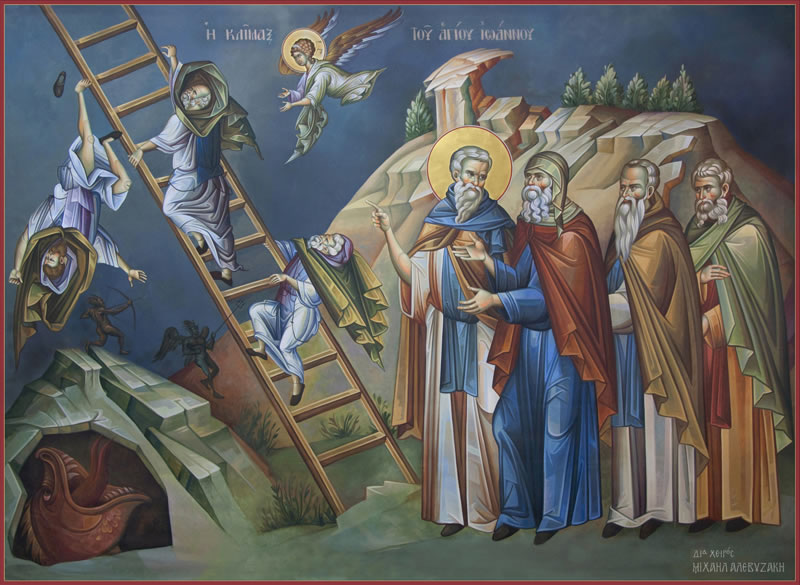
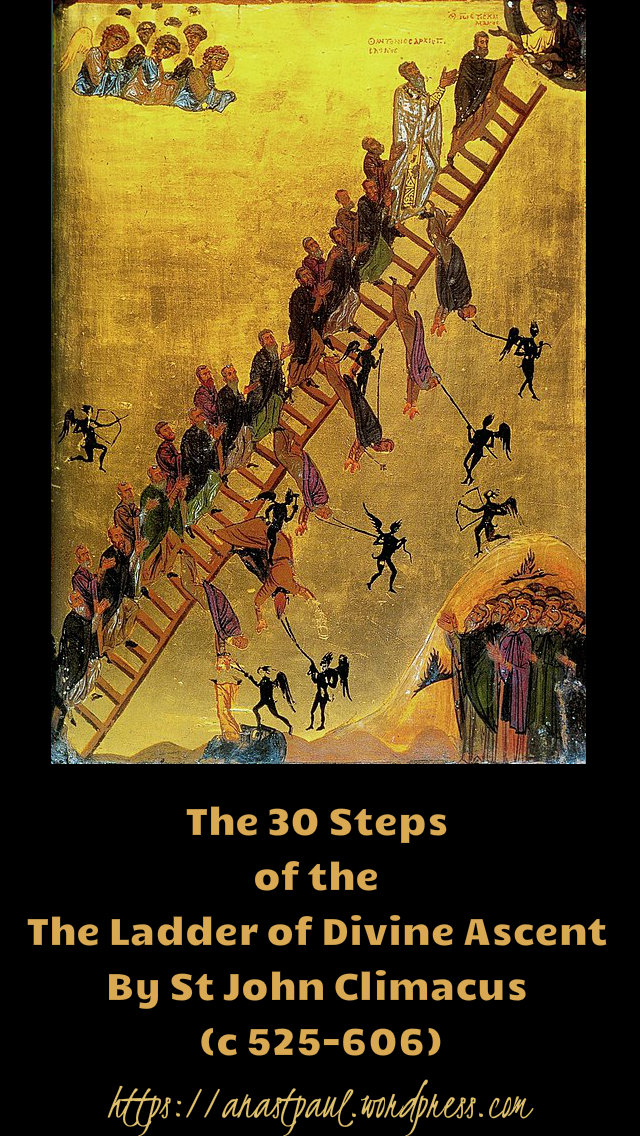
Each step communicates some practical insight into Christian living that twenty-first-century readers will still find beneficial.   An icon known by the same title, Ladder of Divine Ascent, depicts a ladder extending from earth to heaven (cf. Genesis 28:12) Several monks are depicted climbing a ladder; at the top is Jesus, prepared to receive them into Heaven.   Also shown are angels helping the climbers and demons attempting to shoot with arrows or drag down the climbers, no matter how high up the ladder they may be.   Most versions of the icon show at least one person falling.   Often, in the lower right corner St John Climacus himself is shown, gesturing towards the ladder, with rows of monastics behind him.

536px-The_Ladder_of_Divine_Ascent_Monastery_of_St_Catherine_Sinai_12th_century
12th century icon (Saint Catherine’s Monastery, Mount Sinai, Egypt)

When John was seventy he was elected abbot of the monastery at Mount Sinai.   That was an appropriate choice, for many monks saw John as a Moses who had received Christian commandments from God and recorded them in his Ladder.   After four years in office, John retired to his cell and died there c 606 at around eighty years of age.

St John’s feast day is 30 March in both the East and West.   The Eastern Orthodox Church and the Byzantine Catholic Churches additionally commemorate him on the Fourth Sunday of Great Lent.   Many churches are dedicated to him in Russia, including a church and belltower in the Moscow Kremlin.john-of-the-ladder.jpg

Posted in SAINT of the DAY

Memorials of the Saints – 30 March

Bl Amadeus of Savoy
St Clinius of Pontecorvo
St Cronan Mochua
St Damiano
St Domnino of Thessalonica
St Fergus of Downpatrick
St Irene of Rome
Bl Joachim of Fiore
St John Climacus (c 525-606) aged 80-81

St Julio Álvarez Mendoza
St Leonard Murialdo
St Ludovico of Casoria
St Mamertinus of Auxerre
St Marie-Nicolas-Antoine Daveluy
Bl Maria Restituta Kafka
St Osburga of Coventry
St Pastor of Orléans
St Patto of Werden
St Peter Regulatus
St Quirinus the Jailer
St Regulus of Scotland
St Regulus of Senlis
St Secundus of Asti
St Tola
St Zozimus of Syracuse

Martyrs of Constantinople: ourth-century Christians who were exiled, branded on the forehead, imprisoned, tortured, impoverished and murdered during the multi-year persecutions of the Arian Emperor Constantius. They were martyred
between 351 and 359 in Constantinople.

Martyrs of Korea:
Marie-Nicolas-Antoine Daveluy
Iosephus Chang Chu-gi
Lucas Hwang Sok-tu
Martin-Luc Huin
Pierre Aumaître

Posted in GOD the FATHER, QUOTES of the SAINTS, QUOTES on ETERNAL LIFE, SAINT of the DAY

Quote of the Day – 29 March – O great and good God

Quote of the Day – 29 March – Friday of the Third week of Lent, Year C and the Memorial of St Ludolf of Ratzeburg O.Praem. (Died 1250) Martyr

“O great and good God,
allow me,
Your useless servant,
to belong to You
for all eternity.”

St Ludolf of Ratzeburg (Died 1250) Martyr
His last wordso great and good god - st ludolf of ratzeburg 29 march 2019.jpg

Posted in SAINT of the DAY

Saint of the Day – 29 March – St Ludolf of Ratzeburg O.Praem. (Died 1250) Martyr

Saint of the Day – 29 March – St Ludolf of Ratzeburg O.Praem. (Died 1250) Bishop and Martyr, Preacher and founder of a community of Norbertine Sisters, Reformer and Counseller.   St Ludolf was a Priest of the Premonstratensian (Norbertines) Order, particularly invoked as a martyr for the freedom of the Church.576px-Altenmarkt_Chorgestühl_-_St.Ludolf.jpg

Ludolph was a Norbertine Canon who was appointed to the See of the newly-formed Prince-Bishopric of Ratzeburg in 1236.   He led such a strict religious life that his community was nicknamed the “carcer ordinis” (Prison of the Order).

Nothing is known of the early years of Ludolph.   He joined the Norbertine Cathedral Chapter of Ratzeburg where he was treasurer before being elected eighth bishop of Ratzeburg in 1236.   He was renowned for his exemplary religious life and powerful preaching of the word of God.   He also founded a community of Norbertine sisters at Rehna.

Like the Good Shepherd, Ludolph focused all his energies on the care of souls.   He preached and made pastoral visitations.   The pope entrusted him with several political missions, forcing him to fight for the rights and freedom of the Church.   His most difficult trial involved standing up to Prince Albert, the “Bear of Saxony,” who had taken possession of cathedral properties—an act that Ludolph resisted.   The prince’s insults and threats did not intimidate him.   The Duke had him imprisoned, where he was beaten and later sent into exile.   Albert consequently ordered Ludolph thrown into a dungeon, where he had to suffer severe tortures.   Realising that his treatment of the bishop was unpopular, the prince decided to set Ludolph free.   After his release from prison, he was brought half-dead to the Franciscans at Wismar but he died shortly after.ludolph

It was during this exile that Ludolph, weighed down by the infirmities suffered in prison and by his advancing old age, fell gravely ill.   He celebrated his last Mass on Holy Thursday.   His final words were “O great and good God, allow me, your useless servant, to belong to you for all eternity.”

His body was returned to Ratzeburg for burial.   As the procession passed through Schlagsdorf, the bells of the city were said to ring of their own accord.   At the command of the Duke, Ludolph’s body was carried from the bridge to the cathedral by the nobility of Ratzeburg.   Ludolph’s confreres carried him into the cathedral themselves where he found his final resting place.   Ludolph is honoured as a “Bishop and a Martyr for the Rights and Freedom of the Church.”   He is portrayed with the regalia of a bishop, bearing the shackles that bound him in prison and holding the palm of martyrdom.

After his death, those who visited his grave in the Cathedral of Ratzeburg reported numerous favours received.   The centuries-old veneration of Ludolph was confirmed and extended to the whole order by Pope Benedict XIII on 12 April 1728.

The head of Ludolph was kept in the possession of the Norbertine nuns of Meer in Prussia, beginning in the 17th century.   After the secularisation of this convent, the relic came into the possession the abbot of Hamborn in 1826.  Saint Ludolph of RatzeburgOn 5 March 1984, the Congregation for Divine Worship granted permission for the public veneration of the three Norbertine bishop-saints of Ratzeburg, see image right – Ludolph, Evermode and Isfrid.
Concerning the “punishment”, the Apostle says:   “Because through many trials it is fitting that we enter the kingdom of God”.   And again: “The sufferings of this time are not worthy to be compared to the future glory which will be revealed in us”.

Concerning the “cause”, we read:  “It is not the punishment that makes the martyr but the cause”.   In this regard we read in the Gospel:  “Blessed are those who suffer persecution for the sake of justice”.

– Life of St Norbert, Vita B, Chapter V

Almighty God, you made the bishop and martyr Ludolph a zealous and fearless witness of your Church.   Through his intercession grant that we may be filled with patience in all the trials of life and be found worthy to belong to you for all eternity.   We ask this through Christ our Lord, AMEN.

Posted in SAINT of the DAY

Memorials of the Saints – 29 March

St Acacia of Antioch
St Archmimus of Africa
St Armogastes of Africa
St Barachasius
Bl Bertold of Mount Carmel
St Constantine of Monte Cassino
St Eustachio of Naples
St Firminus of Viviers
St Gladys
St Gwynllyw
Bl Hugh of Vaucelles
Bl John Hambley
St Jonas of Hubaham
St Lasar
St Ludolf of Ratzeburg O.Praem. (Died 1250) Martyr
St Mark of Arethusa
St Masculas of Africa
St Pastor of Nicomedia
St Saturus of Africa
St Simplicius of Monte Cassino
St Victorinus of Nicomedia
St William Tempier

Posted in DOMINICAN OP, SAINT of the DAY

Saint of the Day – 28 March – Blessed Venturino of Bergamo OP (1304-1346)

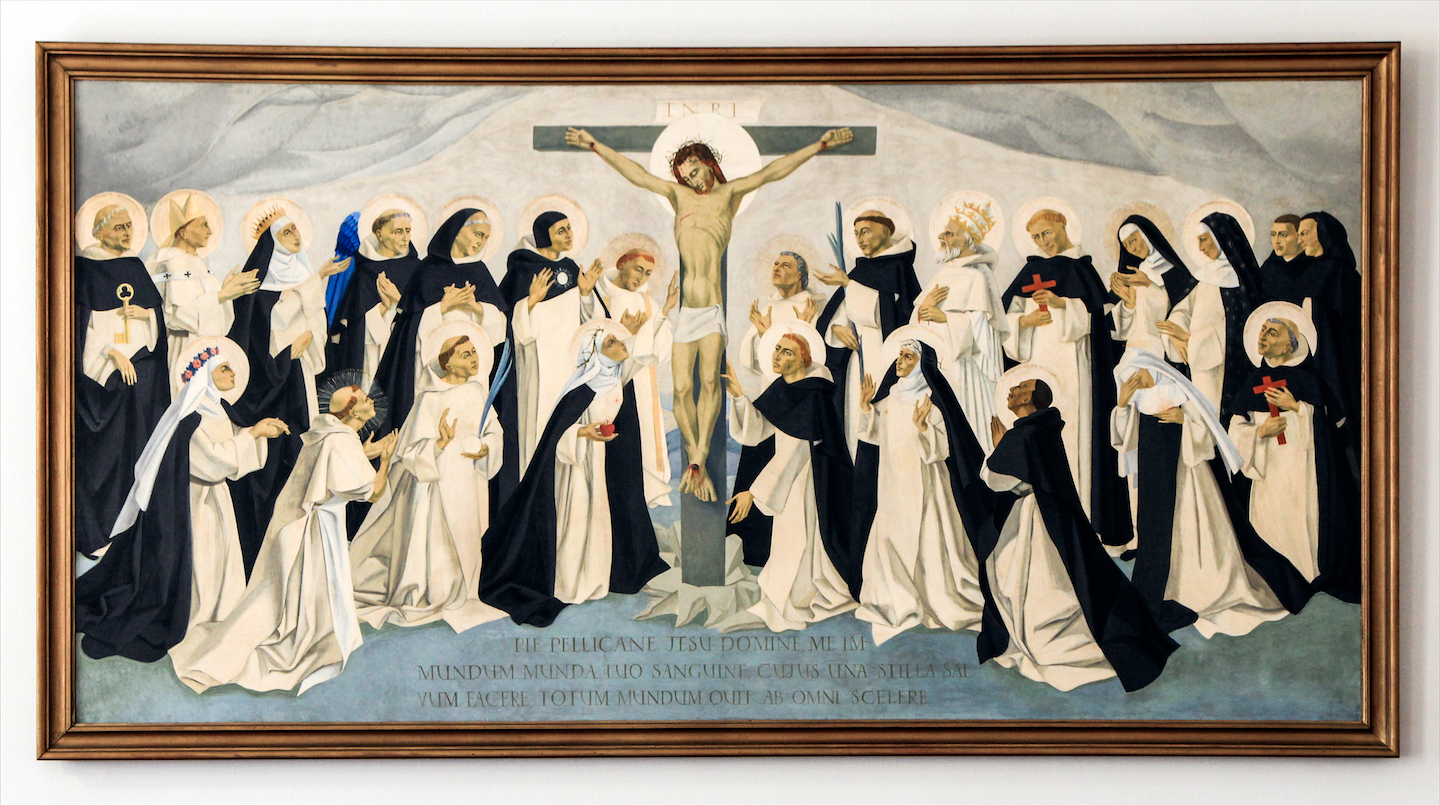
Saint of the Day – 28 March – Blessed Venturino of Bergamo OP (1304-1346) – Priest, Friar of the Order of Preachers of St Dominic, Preacher, Missionary Preacher of the Crusades, Writer. Born on 9 April 1304 in Bergamo, Italy as Lorenzo de Apibus and died on 28 March 1346 at Smyrna, Asia Minor (in modern Turkey) of natural causes. Also known as – Venturinus, Lorenzo de Apibus.dominican saints.jpg

He was born at Bergamo and received the habit of the Order of Friars Preachers at the convent of St Stephen, Bergamo, on 22 January 1319.

His rich spiritual life, given expression in his treatise De profectu spirituali, suggests the mystical idea of penance propagated by Saint Vincent Ferrer OP.   He founded the Convent of nuns, St Mary’s in Bergamo.   From 1328 to 1335 he soon distinguished himself as a brilliant preacher, attracting huge crowds throughout northern Italy.

dominican

In February 1335, he planned to make a penitential pilgrimage to Rome with about thirty thousand of his converts.   His purpose was misunderstood and Pope Benedict XII, then residing at Avignon, thought that Venturino wished to make himself pope  . He wrote letters to Giovanni Pagnotti, Bishop of Anagni, his spiritual vicar, to the Canons of St Peter’s and St John Lateran’s and to the Roman senators empowering them to stop the pilgrimage.

This complaint to the Dominican Master General resulted in an ordinance of the Chapter of London (1335) condemning such pilgrimages.   The pope’s letters and commands, however, did not reach Venturino and he arrived in Rome on 21 March 1335.   He was well received and preached in various churches.   Twelve days later he left Rome, as the news of the Ordinance of the Dominican Master General and the Pope had reached him and the pilgrimage ended.

st-dominic-de-guzman-pedro-berruguete.jpg
St Dominic (1170-1221)

In June, he requested an audience with Benedict XII at Avignon, in order to explain the intentions of the pilgrimage but he was seized and cast into prison (1335–43), where he was kept for eight years!   He was restored to favour by Pope Clement VI, who appointed him to preach a crusade against the Turks on 4 January 1344.    His success was remarkable.   He urged the pope to appoint Humbert II of Dauphiné, whose friend and spiritual adviser he had been, leader of the crusade, but Humbert proved incapable and the crusade came to nothing.

Venturino’s writings consist of sermons (now lost) and letters.   He died at Smyrna and although called “Blessed” he was never formally Beatified.

P.S.  The only image available is NOT Blessed Venturino but is, in fact, St Raymond of Pennafort.

OPCrestWindowV
Dominican Crest
Posted in DOMINICAN OP, SAINT of the DAY

Memorials of the Saints – 28 March

St Alkelda of Middleham
Bl Antonio Patrizi
St Castor of Tarsus
Bl Christopher Wharton
Bl Conon of Naso
St Cyril the Deacon
Bl Dedë Maçaj
St Donal O’Neylan
St Dorotheus of Tarsus
St Gundelindis of Niedermünster
St Guntramnus
St Hesychius of Jerusalem
St Hilarion of Pelecete
Bl Jean-Baptiste Malo
Bl Jeanne Marie de Maille
St Proterius of Alexandria
Bl Renée-Marie Feillatreau épouse Dumont
St Rogatus the Martyr
St Successus the Martyr
St Tutilo of Saint-Gall
Bl Venturino of Bergamo OP (1304-1346)

Posted in SAINT of the DAY

Saint of the Day – 27 March – St Rupert of Salzburg (c 660–710)

Saint of the Day – 27 March – St Rupert of Salzburg (c 660–710) Bishop and Abbot Apostle to Bavaria and Austria – born c 660 probably in France and died in 710 in Salzburg, Austria. Patronages – Salzburg, Austria, city of and Salzburg, Austria, province of.

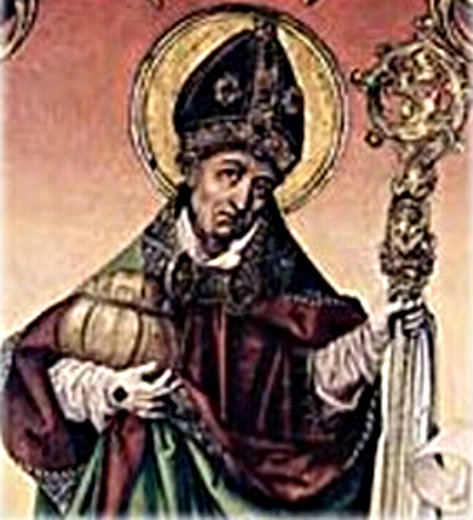
SaintRupert_zps5cf741e0.jpg
St Rupert with a barral of salt

Holy tradition states that Rupert was a scion of the Frankish royal Merovingian dynasty. He was possibly related to the Robertians, most likely a descendant of Count Palatine Chrodbert II.

As Worms bishop, Rupert was at first accepted as a wise and devout dignitary, however, the mostly pagan community eventually came to reject him and forced him out of the city.   By the end of the 7th century, Duke Theodo of Bavaria requested that he come to his residence at Regensburg (Ratisbon) to help spread the Christian faith among the Bavarian tribes.

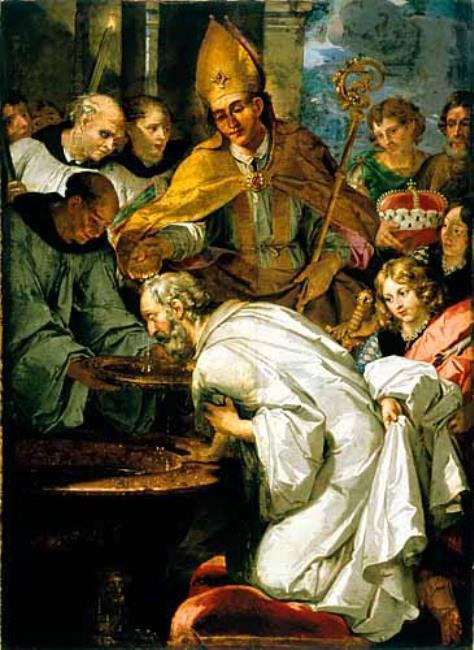
Franciscus_de_Neve_(II)_-_De_H._Rupert_doopt_de_Beijerse_hertog_Theodo.jpeg
Baptism of Duke Theodo by Bishop Rupert, Franciscus de Neve (II) (c 1670)

Rupert then moved to Altötting, where he converted the locals.   He sailed down the Danube river, visiting many towns, villages and forts.   Soon he had converted a large area along the Danube southeastward to the Bavarian border.   Here he stayed at Lorch,  where an Early Christian church—the present Basilica of St Lawrence—already existed.

Warlike conditions in the borderlands made him abandon plans of missionary work there.   Instead he proceeded along the Roman road to the ruined city of Juvavum, where he made his base and renamed the city “Salzburg”.   Like in Lorch, Rupert was able to build on ancient Early Christian traditions that were already in place.   He re-established the convent at St Peter’s Abbey and laid the foundations of Salzburg Cathedral that was finished by his successor St Vergilius (c 700-784).   He also founded the Benedictine nunnery of Nonnberg beneath the Festungsberg fortifications (later Hohensalzburg Castle), where his niece Erentrude became the first abbess.Rupert-Salzburg.jpg

Rupert also introduced education and other reforms.   From the hands of Duke Theodo of Bavaria, his bishopric received estates around, where he promoted the development of the local saltworks.  Rupert’s mission work also spread into the Alps, where a first monastic cell was founded about 711.

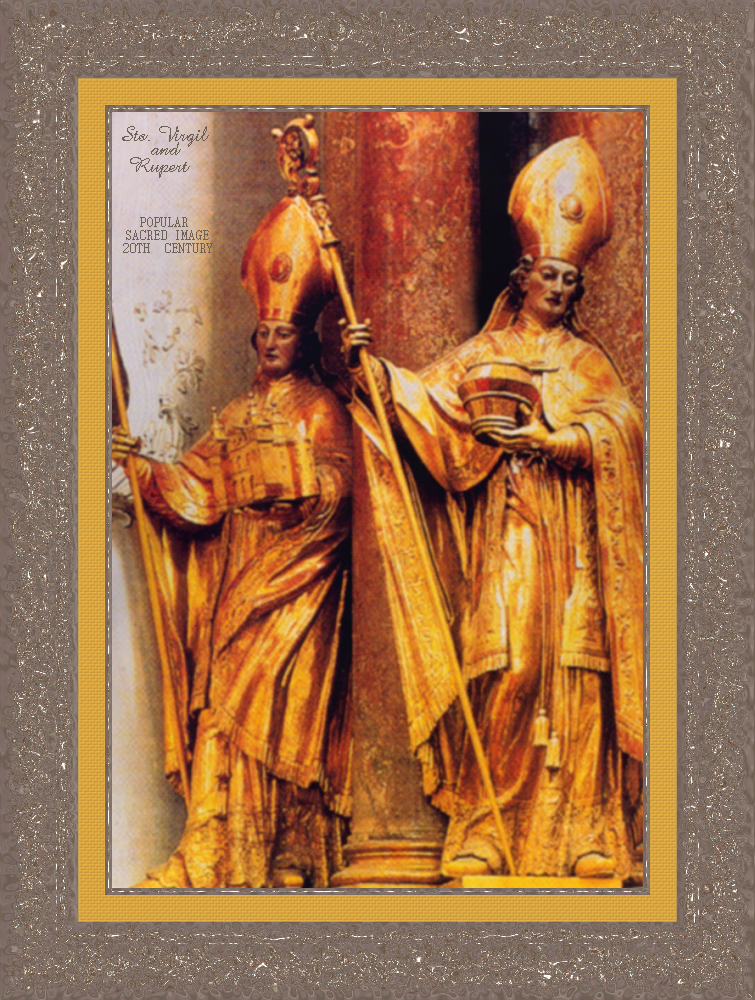
Rupert reportedly died on Easter Sunday in 710.   His mortal remains were transferred to Salzburg Cathedral by Bishop Vergilius on 24 September 774.virgil and rupert.jpg

Rupert’s life and mission work is documented in medieval chronicles.   In accordance with Christian tradition, St Rupert’s feast day is celebrated on the anniversary of his repose, 27 March.   In Austria, it is 24 September commemorating the translation of his relics to Salzburg Cathedral.   Rupertitag is also a public holiday in the State of Salzburg, associated with popular Volksfest events.

Rupert is the patron saint of the State of Salzburg, the Roman Catholic Archdiocese of Salzburg (together with his successor Vergilius) and of the adjacent Bavarian Rupertiwinkel region.   He is also known as the “Apostle of the Bavarians” and patron of several settlements like Sankt Ruprecht in Styria or Šentrupert in Slovenia and of numerous church buildings.

Posted in SAINT of the DAY

Memorials of the Saints – 27 March

Bl Aimone of Halberstadt
St Amphilochius of Illyria
St Alexander of Drizipara
St Alexander of Pannonia
St Alkeld the Martyr
St Amator the Hermit
St Augusta of Treviso
St Claudio Gallo
St Cronidas of Illyria
St Ensfrid of Cologne
Bl Francesco Faà di Bruno
Bl Frowin of Engelberg
St Gelasius of Armagh
St John of Lycopolis

Bl Louis-Édouard Cestac (1801-1868)
Blessed Louis’s Story: https://anastpaul.wordpress.com/2018/03/27/saint-of-the-day-27-march-blessed-louis-edouard-cestac-1801-1868/

St Matthew of Beauvais
St Macedo of Illyria
St Panacea de’Muzzi of Quarona
Bl Pellegrino of Falerone
Bl Peter Jo Yong-sam
St Philetus
St Romulus the Abbot
St Rupert of Salzburg (c 660–710)
St Suairlech of Fore
St Theoprepius

Martyrs of Bardiaboch: A group of Christians who were arrested, tortured and executed together for their faith during the persecutions of Persian king Shapur II. Martyrs. – Abibus, Helias, Lazarus, Mares, Maruthas, Narses, Sabas, Sembeeth and Zanitas. 27 March 326 at Bardiaboch, Persia.

Posted in SAINT of the DAY

Saint of the Day – 26 March – St Ludger (c 742-809) –

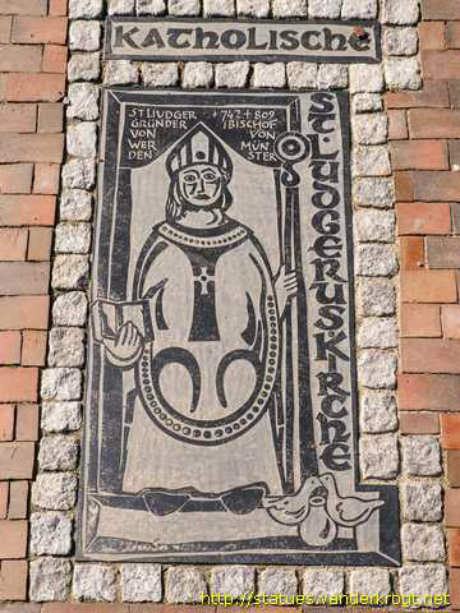
Saint of the Day – 26 March – St Ludger (c 742-809) – Bishop, Missionary, Founder, Abbot, Writer – born at Zuilen near Utrecht c 742 and died on in the evening of Passion Sunday, 26 March 809 of natural causes at Billerbeck, Germany.  Following in the footsteps of the English missionary St Boniface, St Ludger, who was a native Netherlander, brought the faith to the people of Frisia in Holland and the Saxons of north-west Germany.    He founded the Werden Abbey and was the first Bishop of Münster in Westphalia, Germany.  Patronages – Groningen, Netherlands, Deventer, Netherland, East Frisia, Diocese of Münster, Germany, Werden, Germany.st ludger wall frieze

St Ludger was born in Friesland about the year 742.   His father, a nobleman of the first rank, at the child’s own request, committed him very young to the care of St Gregory, the disciple of St Boniface and his successors in the government of the see of Utrecht. Gregory educated him in his monastery and gave him the clerical tonsure.   Ludger, desirous of further improvement, went to England and spent four years under Blessed Alcuin, who was rector of a famous school at York.

In 773 he returned home and when St Gregory died in 776 St Ludger wrote his biography. His successor, Alberic,  ordained Ludger to the priesthood and employed him for several years in preaching the Word of God in Friesland, where he converted great numbers, founded several monasteries and built many churches.Saintliudger

The pagan Saxons ravaging the country, Ludger travelled to Rome to consult Pope Adrian II, on what course to take and what he thought God required of him.   He then retired for around three years to the Monastery of St Benedict at Monte Casino, where he wore the habit of the Order and conformed to the practice of the rule during his stay but made no religious vows.

At this time Charlemagne was forcefully converting the Frisians and Saxons to Christianity, with the Saxon leader Widukind providing serious opposition.   When Ludger returned to the area in 787, Charlemagne entrusted him with the evangelisation of the Saxons in Westphalia.   His preaching of the gospel had more success than Charlemagne’s repressive measures.   He is reported to have cured the blindness of and thus caused the conversion of, the blind pagan bard Berulef.Saint_Ludger_Liudger.jpg

Ludger made his headquarters in the place now called Münster, meaning “monastery”. Here in 795 he founded a community of canons regular, following the Rule of St Chordegang of Metz.    In 799 he established a monastery at Werden on the Rhur and became its first abbot.   Around 803 he was consecrated bishop of Münster.   His principal concern was to have a good and efficient clergy.   To a great extent he educated his students personally and generally took some of them on his missionary tours.

St Ludger was favoured with the gifts of miracles and prophecy.   His last illness did not hinder him from continuing his functions to the very last day of his life, which was Passion Sunday, on which day he preached very early in the morning, said Mass towards nine and preached again before night, telling those that were about him that he should die the following night and asking them to bury him in his monastery of Werden.

He died accordingly on 26 March, at midnight.   He was buried at Werden, Germany.   His relics are also at Münster and Billerbeck, Germany. st ludger statue

Posted in SAINT of the DAY

Memorials of the Saints – 26 March

St Basil the Younger
St Bathus
St Bercharius
St Braulio (590-651)
Biography: https://anastpaul.wordpress.com/2018/03/26/saint-of-the-day-26-march-braulio-590-651/

St Castulus of Rome
St Eutychius of Alexandria
St Felicitas of Padua
St Felix of Trier
St Garbhan
St Govan
St Ludger (c 742-809)
Bl Maddalena Caterina Morano
St Maxima the Martyr
St Mochelloc of Kilmallock
St Montanus the Martyr
St Peter of Sebaste
St Sabino of Anatolia
St Sincheall of Killeigh
St Wereka

Martyrs of Rome – 5 saints: A group of Christians martyred together. The only details to survive are the names – Cassian, Jovinus, Marcian, Peter and Thecla. Rome, Italy, date unknown.

Posted in FEASTS and SOLEMNITIES, MARIAN DEVOTIONS, SAINT of the DAY, The INCARNATION

The Solemnity of the Annunciation of the Lord, the Memorial of Our Lady of Betania & of the Saints – 25 March

The Annunciation of the Lord (Solemnity)

Actually the name Betania means Bethany in Spanish. It was originally given this name by Maria Esperanza and was the site of their farm, in Venezuela. Apparitions of the Blessed Virgin Mary were reported and eventually a small chapel was built here and the faithful began to gather, especially on Feast Days but throughout the year.

St Alfwold of Sherborne
St Barontius of Pistoia
St Desiderius of Pistoia
St Dismas
St Dula the Slave
Bl Emilian Kovch (1884-1944) Priest, Martyr
About St Emilian: https://anastpaul.wordpress.com/2018/03/25/saint-of-the-day-25-march-blessed-emilian-kovch-1884-1944-martyr/

Bl Everard of Nellenburg
Bl Herman of Zahringen
St Hermenland
St Humbert of Pelagius
Bl James Bird
Bl Josaphata Mykhailyna Hordashevska
St Kennocha of Fife
St Lucia Filippini
St Margaret Clitherow
Bl Margaretha Flesch
St Mariam Sultaneh Danil Ghattas
St Matrona of Barcelona
St Matrona of Thessaloniki
St Mona of Milan
St Ndre Zadeja
Bl Pawel Januszewski
St Pelagius of Laodicea
Bl Placido Riccardi
St Procopius
St Quirinus of Rome
Bl Tommaso of Costacciaro

262 Martyrs of Rome: A group 262 Christians martyred together in Rome. We know nothing else about them, not even their names.

Posted in LENT 2019, LENTEN THOUGHTS, PRACTISING CATHOLIC, QUOTES of the SAINTS, QUOTES on ETERNAL LIFE, QUOTES on HOPE, QUOTES on OBEDIENCE, QUOTES on PATIENCE, QUOTES on PEACE, QUOTES on PERSEVERANCE, QUOTES on SANCTITY, QUOTES on SUFFERING, QUOTES on the CHURCH, SAINT of the DAY

Lenten Thoughts – 24 March – Take a step back

Lenten Thoughts – 24 March – The Third Sunday of Lent, Year C, Gospel: Luke 13:1-9 (The fruitless vine) and The Memorial of Bl Óscar Arnulfo Romero y Galdámez (1917–1980) Martyr

Every now and then it helps us to take a step back and to see things from a distance.

Every now and then it helps us to take a step back
and to see things from a distance.
The Kingdom is not only beyond our efforts,
it is also beyond our visions.
In our lives, we manage to achieve only a small part
of the marvellous plan that is God’s work.
Nothing that we do is complete,
which is to say that the Kingdom is greater than ourselves.
No statement says everything that can be said.
No prayer completely expresses the faith.
No Creed brings perfection.
No pastoral visit solves every problem.
No programme fully accomplishes the mission of the Church.
No goal or purpose ever reaches completion.
This is what it is about:
We plant seeds that one day will grow.
We water seeds already planted,
knowing that others will watch over them.
We lay the foundations of something that will develop.
We add the yeast which will multiply our possibilities.
We cannot do everything,
yet it is liberating to begin.
This gives us the strength to do something and to do it well.
It may remain incomplete but it is a beginning, a step along the way.
It is an opportunity for the grace of God to enter and to do the rest.
It may be that we will never see its completion
but that is the difference between the master and the labourer.
We are labourers, not master builders,
servants, not the Messiah.
We are prophets of a future that does not belong to us.

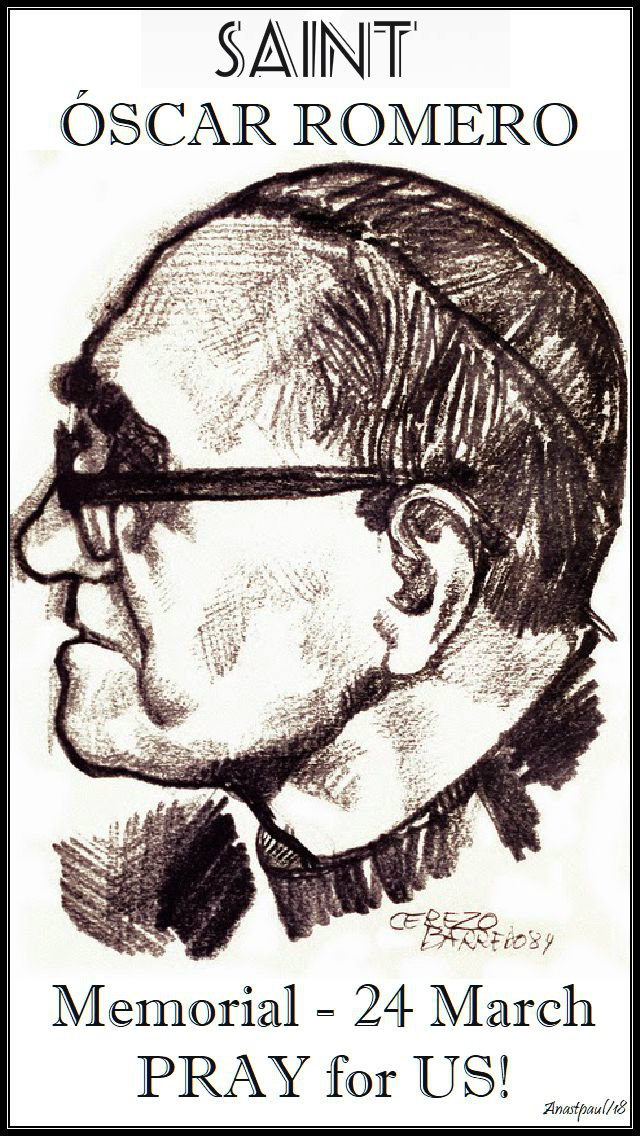
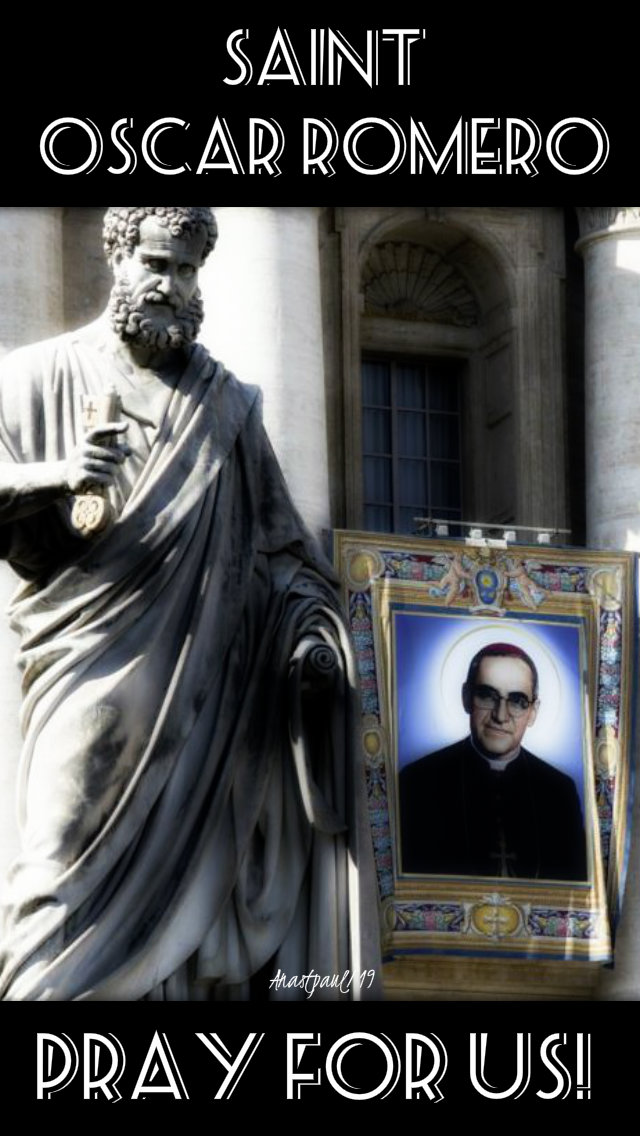
Saint Óscar Romero (1917–1980) Martyr, Pray for us!

st-oscar-romero-pray-for-us-no-2-24-march-2019.jpg


Posted in ON the SAINTS, QUOTES of the SAINTS, QUOTES on CONSCIENCE, QUOTES on CONVERSION, QUOTES on HUMAN DIGNITY, QUOTES on PEACE, QUOTES on REPENTANCE, QUOTES on SIN, QUOTES on the DEVIL/EVIL, SAINT of the DAY, The TEN COMMANDMENTS

Thought for the Day – 24 March – An Incarnational Faith must be expressed publicly

Thought for the Day – 24 March – The Third Sunday of Lent, Year C and The Memorial of Bl Óscar Arnulfo Romero y Galdámez (1917–1980) Martyr

The night before he was murdered while celebrating Mass, Archbishop Oscar Romero of San Salvador said on the radio:

“I would like to appeal in a special way to the men of the army and in particular to the troops of the National Guard, the police and the garrisons. Brothers, you belong to our own people.   You kill your own brother peasants and in the face of an order to kill that is given by a man, the law of God that says ‘Do not kill!’ should prevail.

No soldier is obliged to obey an order counter to the law of God.   No-one has to comply with an immoral law.   It is the time now that you recover your conscience and obey its dictates rather than the command of sin. . . . Therefore, in the name of God and in the name of this long-suffering people, whose laments rise to heaven every day more tumultuous, I beseech you, I beg you, I command you!   In the name of God: ‘Cease the repression!’”

Simultaneously, Romero had eloquently upheld the gospel and effectively signed his own death warrant.

When a military junta seized control of the national government in 1979, Archbishop Romero publicly criticised the US government for backing the junta.  His weekly radio sermons, broadcast throughout the country, were regarded by many as the most trustworthy source of news available.

Romero’s funeral was celebrated in the plaza outside the cathedral and drew an estimated 250,000 mourners.

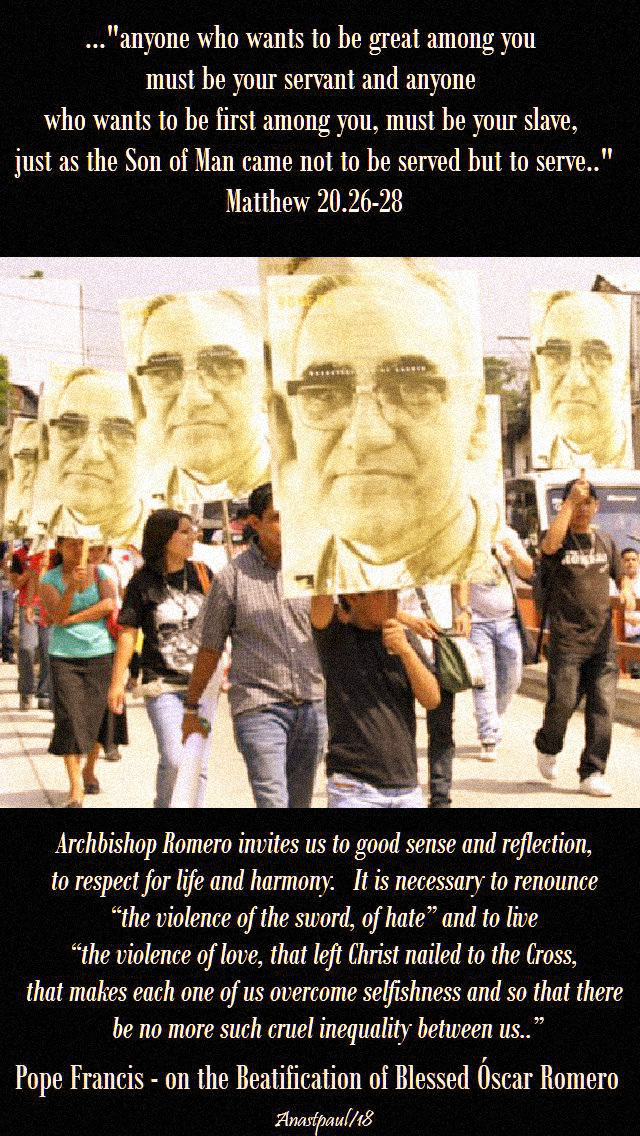
His tomb in the cathedral crypt soon drew thousands of visitors each year.   On 3 February 2015, Pope Francis authorised a decree recognising Oscar Romero as a martyr for the faith.   His beatification took place in San Salvador on 23 May 2015.   He was canonized on 14 October 2018.archbishop-romero-invites-us-to-good-sense-pope-francis-24-march-2019.jpg

Oscar Romero and many other Latin American martyrs for the faith were falsely accused of advocating a Marxist-inspired “theology of liberation.”   Following Jesus always requires choices.   Romero’s fiercest critics conveniently dismissed his choices as politically inspired.   An incarnational faith must be expressed publicly.

St Oscar Romero, Pray for Us!ast oscar romero pray for us 24 march 2019.jpg

Posted in QUOTES of the SAINTS, QUOTES on PEACE, QUOTES on SACRIFICE, QUOTES on SUFFERING, SAINT of the DAY

Quote/s of the Day – 24 March – St Óscar Arnulfo Romero

Quote/s of the Day – 24 March – The Third Sunday of Lent, Year C and The Memorial of St Óscar Arnulfo Romero y Galdámez (1917–1980) Martyr

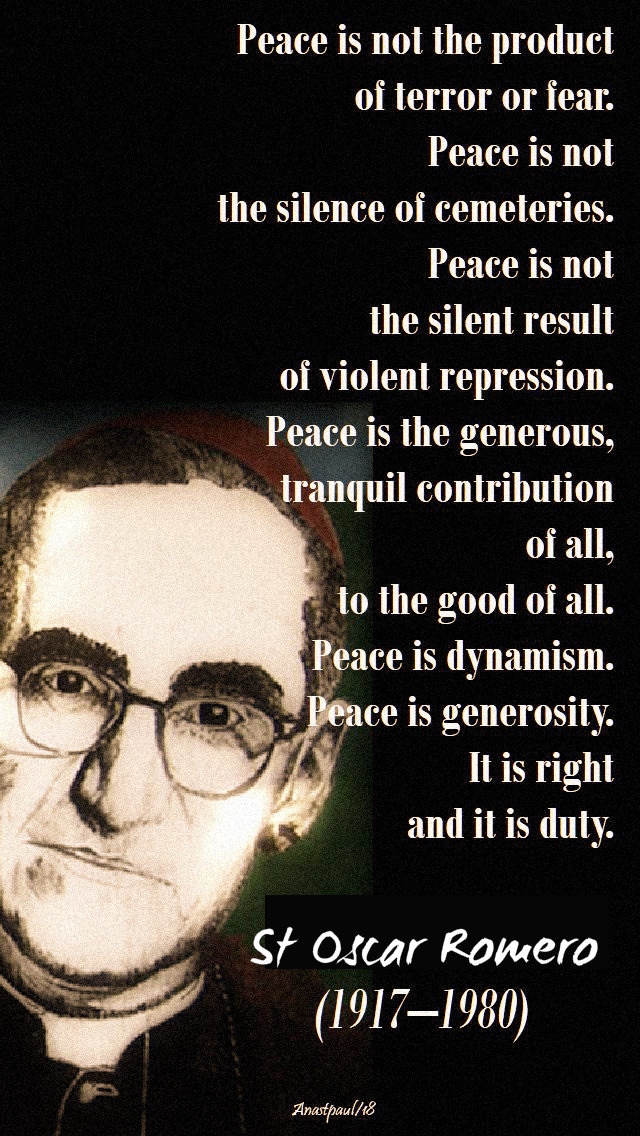
“Peace is not the product of terror or fear.
Peace is not the silence of cemeteries.
Peace is not the silent result of violent repression.
Peace is the generous, tranquil contribution of all to the good of all.
Peace is dynamism.
Peace is generosity.
It is right and it is duty.”peace-is-not-st-oscar-romero-24-march-2019.jpg

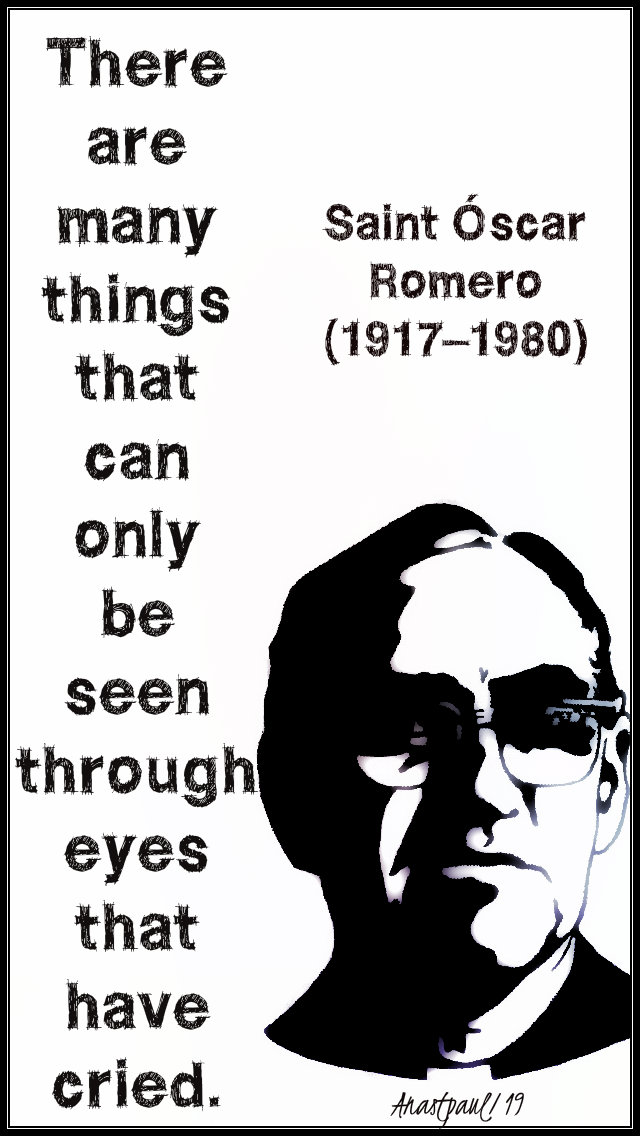
“There are many things
that can only be seen
through eyes that have cried.”

Saint Óscar Romero (1917–1980)there are many things that can only be seen - st oscar romero 24 march 2019.jpg

Posted in PRAYERS for VARIOUS NEEDS, PRAYERS to the SAINTS, SAINT of the DAY

Saint of the Day – 24 March – St Catherine of Sweden (1331-1381)

Saint of the Day – 24 March – St Catherine of Sweden (1331-1381) – Widow, Religious of the Brigittine Order also called the Order of St Saviour, Abbess – born in 1331 in Sweden and died of natural causes on 24 March 1381 (aged 50). Her cultus was confirmed by Pope Innocent VIII in 1484.   Patronage – unborn children, mothers who suffer miscarriage, expectant mothers and those praying to conceive.web3-catherine-of-sweden-saint

St Catherine was the fourth child of Saint Bridget of Sweden.   At the time of her death St Catherine was head of the convent of Wadstena, founded by her mother hence the name, Catherine Vastanensis, by which she is occasionally called.

At the age of seven she was sent to the abbess of the convent of Riseberg to be educated and soon showed, like her mother, a desire for a life of self-mortification and devotion to spiritual things.

At the command of her father, when about thirteen or fourteen years old, she married a noble of German descent, Eggart von Kürnen.   She at once persuaded her husband, who was a very religious man, to join her in a vow of chastity.   Both lived in a state of virginity and devoted themselves to the exercise of Christian perfection and active charity.   In spite of her deep love for her husband, Catherine accompanied her mother to Rome, where St Bridget went in 1349.Santa_Caterina_di_Svezia_B

Soon after her arrival in that city Catherine received news of the death of her husband in Sweden.   She now lived constantly with her mother, took an active part in St Bridget’s fruitful labours and zealously imitated her mother’s ascetic life.

Although the distinguished and beautiful young widow was surrounded by suitors, she steadily refused all offers of marriage.

In 1372 St Catherine and her brother, Birger, accompanied their mother on a pilgrimage to the Holy Land.   After their return to Rome St Catherine was with her mother in the latter’s last illness and death.   In 1374, in obedience to St Bridget’s wish, Catherine brought back her mother’s body to Sweden for burial at Wadstena, of which foundation she now became the head.   It was the motherhouse of the Brigittine Order, also called the Order of St Saviour.   Catherine managed the convent with great skill and made the life there one in harmony with the principles laid down by its founder.

After some years, she returned to Rome to work for her mother’s canonisation.   She stayed there five years and formed a close friendship with St Catherine of Siena (1347-1380).

Catherine died on 24 March 1381, mourned like her mother by the whole of Sweden.   In 1484 Innocent VIII gave permission for her veneration as a saint.
Catherine wrote a devotional work entitled “Consolation of the Soul” (Sielinna Troest), largely composed of citations from the Scriptures and from early religious books but no copy is known to exist.   Generally she is represented with a hind at her side, which is said to have come to her aid when unchaste youths sought to ensnare her.stcatherinesweeden

Although she never experienced the pain of miscarriage herself, Catherine counselled women who had suffered a miscarriage or were experiencing complications in their pregnancy.

A traditional prayer to St Catherine reads:

Prayer to St Catherine for Consolation after a Miscarriage

Dear St Catherine,
patron of those who have suffered a miscarriage,
you know the dangers that await unborn infants.
Please intercede for me
that I may receive consolation from the loss I have suffered.
My soul has been deprived of peace
and I have forgotten what true happiness is.
As I mourn the loss of my child,
I place myself in the hands of God
and ask for strength to accept His will in all things,
for consolation in my grief
and for peace in my sorrow.
Glorious St Catherine,
hear my prayers and ask that God,
in good time,
grant me a healthy baby
who will become a true child of God.
Amenprayer to st catherine for consolation after a miscarriage 24 march 2019.jpg

Posted in LENT 2019, SAINT of the DAY

The Third Sunday of Lent, Year C and Memorials of the Saints – 24 March

Third Sunday of Lent, Year C (2019)

St Agapitus of Synnada
St Aldemar the Wise
St Bernulf of Mondovi
Bl Bertha de’Alberti of Cavriglia
Bl Bertrada of Laon
Bl Brian O’Carolan
St Caimin of Lough Derg
St Cairlon of Cashel
St Catherine of Sweden (1331-1381)
Bl Diego José of Cádiz
St Domangard of Maghera
St Epicharis of Rome
St Epigmenius of Rome
St Hildelith of Barking
Bl John del Bastone
St Latinus of Brescia
St Macartan of Clogher
Bl Maria Serafina of the Sacred Heart
St Mark of Rome
Bl Óscar Arnulfo Romero y Galdámez (1917–1980)
Before he was a Saint (Canonised on 14 Oct 2018): https://anastpaul.wordpress.com/2018/03/24/saint-of-the-day-24-march-blessed-oscar-arnulfo-romero-y-galdamez-1917-1980-martyr/

St Pigmenius of Rome
St Romulus of North Africa
St Secundus of North Africa
St Seleucus of Syria
St Severo of Catania
St Timothy of Rome

Martyrs of Africa – 9 saints: A group of Christians murdered for their faith in Africa, date unknown. The only details about their that survive are the names – Aprilis, Autus, Catula, Coliondola, Joseph, Rogatus, Salitor, Saturninus and Victorinus. .

Martyrs of Caesarea – 6 saints: A group of Christians martyred together in the persecutions of Diocletian. We know little else but six of their names – Agapius, Alexander, Dionysius, Pausis, Romulus and Timolaus. They were martyred by beheading in 303 at Caesarea, Palestine.

Posted in SAINT of the DAY

Thought for the Day – 23 March – The Lord writes straight with crooked lines

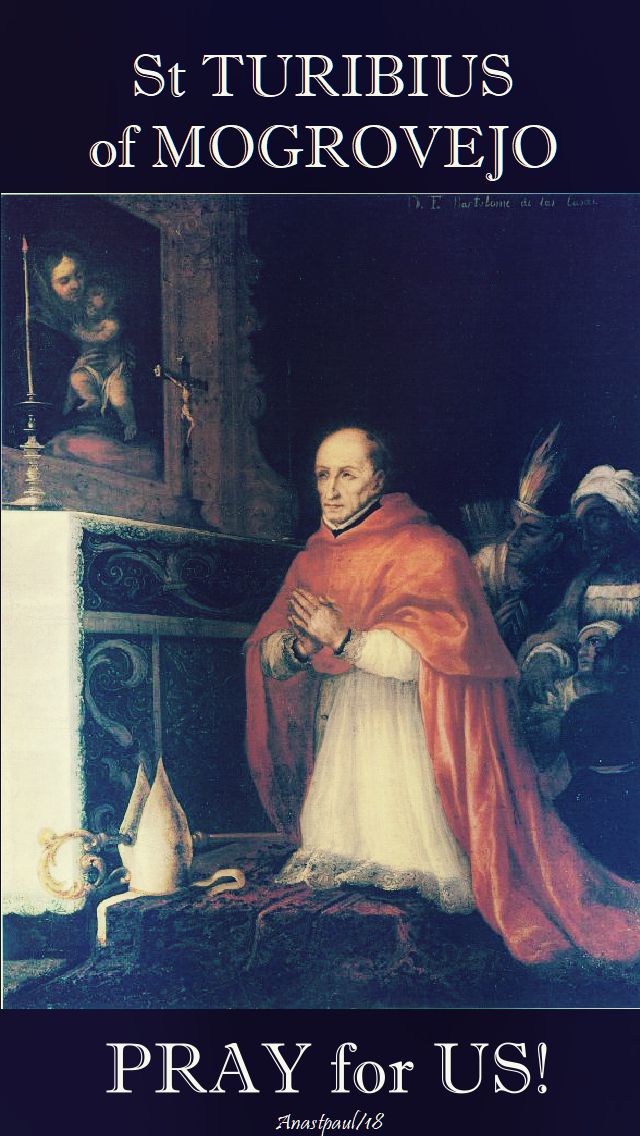
Thought for the Day – 23 March – Saturday of the Second Week of Lent, Year C and The Memorial of St Turibius of Mogrovejo (1538-1606)

Turibius Alphonsus Mongrovejo, whose feast the Church honours today, was born on 6 November 1538, at Mayorga in the kingdom of Leon in Spain.   Brought up in a pious family where devotion was hereditary, his youth was a model to all who knew him. All his leisure was given to devotion or to works of charity.   His austerities were great and he frequently made long pilgrimages on foot.

The fame of Turibius as a master of canon and civil law soon reached the ears of King Philip II, who made him judge at Granada.   About that time the see of Lima, in Peru, fell vacant and among those proposed Philip found no one who seemed better endowed than our Saint with all the qualities that were required at that city, where much was to be done for religion.   He sent to Rome the name of the holy judge and the Sovereign Pontiff confirmed his choice.   Turibius in vain sought to avoid the honour.  The Pope, in reply, directed him to prepare to receive Holy Orders and be consecrated.   Yielding at last by direction of his confessor, he was ordained priest and consecrated.

He arrived at Lima in 1587 and entered on his duties.   All was soon edification and order in his episcopal city.   A model of all virtue himself, he confessed daily and prepared for Mass by long meditation.   St Turibius then began a visitation of his vast diocese, which he traversed three times, his first visitation lasting seven years and his second four.   He held provincial councils, framing decrees of such wisdom that his regulations were adopted in many countries.   Almost his entire revenues were bestowed on his creditors, as he styled the poor.

While discharging with zeal his duties he was seized with a fatal illness during his third visitation and died on 23 March 1606, at Santa, exclaiming, as he received the sacred Viaticum: “I rejoiced in the things that were said to me – ‘We shall go into the house of the Lord.'”

The proofs of his holy life and of the favours granted through his intercession induced Pope Innocent XI to Beatify him and he was Canonised by Pope Benedict XIII in the year 1726.

The Lord indeed writes straight with crooked lines.   Against his will, and from the unlikely springboard of an Inquisition tribunal, this man became the Christlike shepherd of a poor and oppressed people.   God gave him the gift of loving others as they needed it, with all fervour and total self-giving, a Saint for Lent, indeed!

St Turibius, Pray for Us!st-turibius-pray-for-us-23-march-2018-no-2 (1).jpg

Posted in QUOTES of the SAINTS, QUOTES on TIME, QUOTES on TRUTH, SAINT of the DAY

Quote/s of the Day – 23 March – St Turibius

Quote/s of the Day – 23 March – Saturday of the Second Week of Lent, Year C and The Memorial of St Turibius of Mogrovejo (1538-1606)

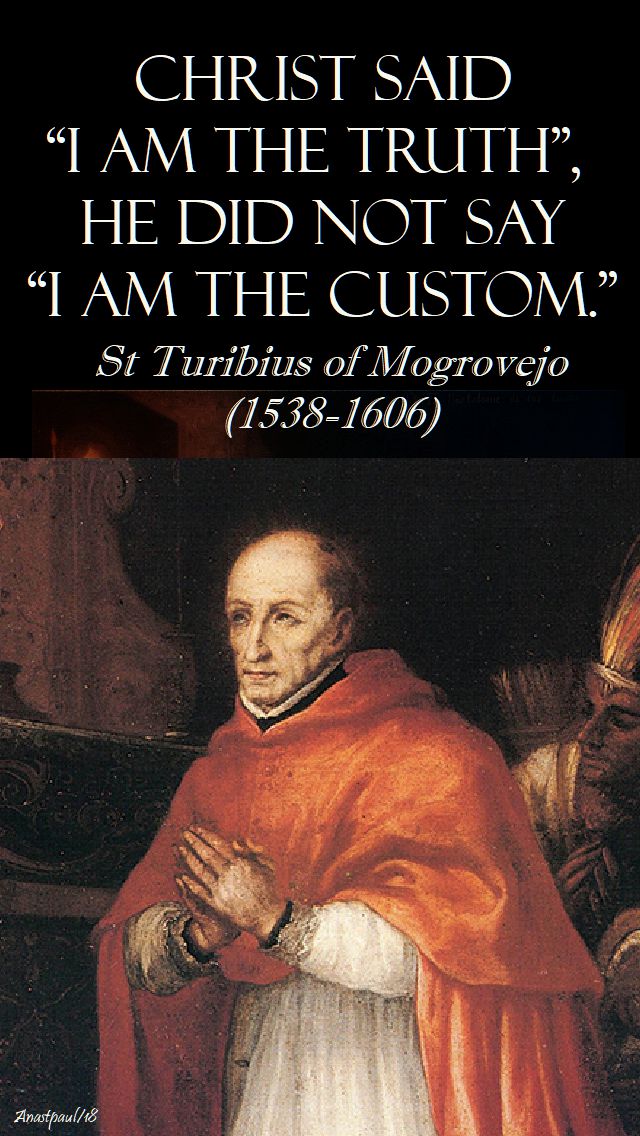
“Christ said ‘I am the Truth’,
He did not say ‘I am the custom’.”christ-said-i-am-the-truth-st-turibius-of-mogrovejo-23-march-2018

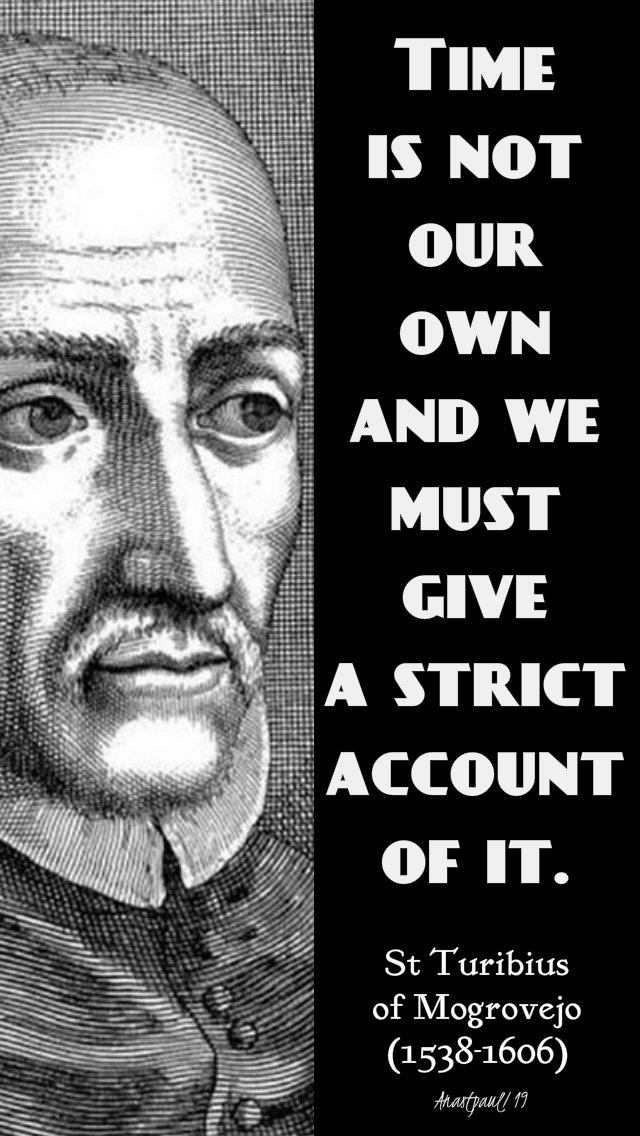
“Time is not our own
and we must give
a strict account of it.”

St Turibius of Mogrovejo (1538-1606)time is not our own - st turibius 23 march 2019

Posted in SAINT of the DAY

Saint of the Day – 23 March – St Joseph Oriol (1650-1702)

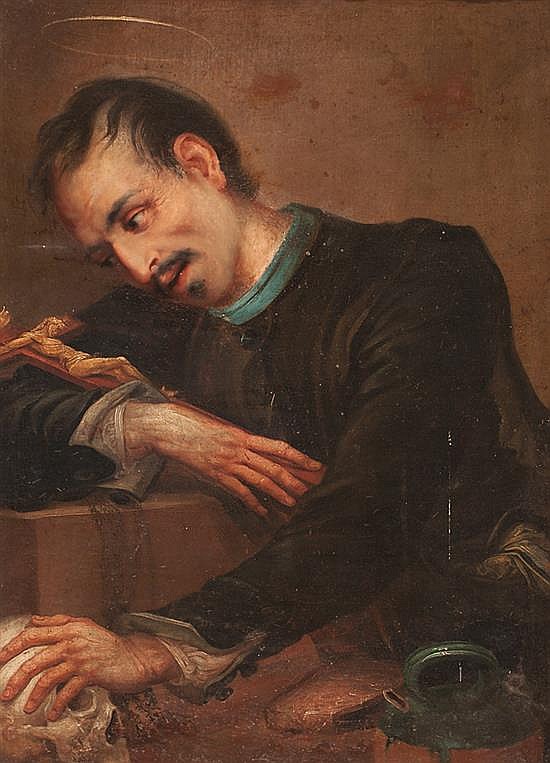
Saint of the Day – 23 March – St Joseph Oriol (1650-1702) Priest, Confessor, prophet, healer, apostle of penance, prayer and the sick and miracle-worker.   Known as the Thaumaturgus of Barcelona.   Born on 23 November 1650 in Barcelona, Spain and died on 23 March 1702 in his hometown of natural causes. Patronage – Barcelona.header st joseph oriol

St Joseph was born into a poor family but managed to study at the University of Barcelona where he was awarded a doctorate of theology on 1 August 1674. He was ordained on 30 May 1676.

He went on a pilgrimage to Rome, Italy in 1686, when Pope Innocent XI granted him a benefice at Santa Maria del Pino (Our Lady of the Pines), Barcelona, Spain, a parish he served for the rest of his life.

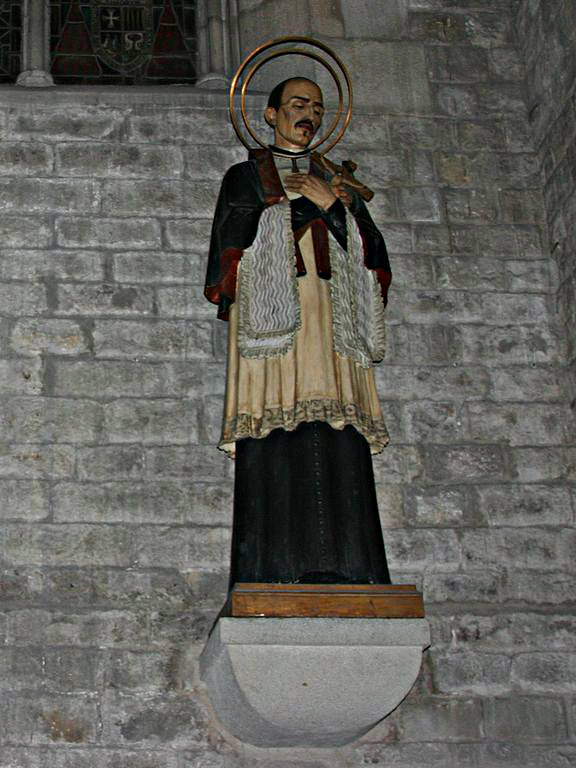
Statue_of_Saint_Joseph_Oriol_-_Santa_Maria_del_Mar_-_Barcelona_2014
Statue of St Joseph Oriol at Santa Maria del Pino, below is the Church

He went to Rome to offer himself for the foreign missions, seeking to evangelise the infidels and become a martyr. On the way to Rome, Joseph fell ill at Marseilles, France and had a vision that gave him a new mission – to revitalise the faith in his own country.st joseph oriol 1

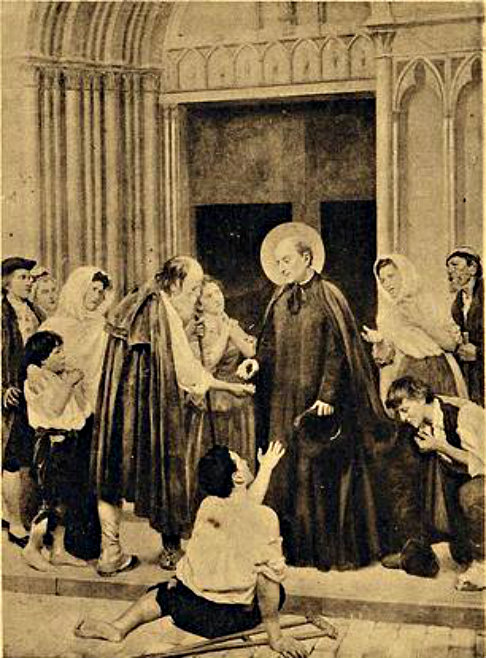
He returned home and worked with the youngest of children and roughest of soldiers and prayed without ceasing for the living and the dead. He wore a hair-shirt, lived for 26 years, half his life, solely on bread and water. He became a famed confessor, prophet, healer and miracle worker. The dying, the blind, the deaf and dumb, the lame and the paralytic, were said to be instantly cured by him.st joseph oriol 2

Joseph was Beatified by Pope Pius VII on 5 September 1808 and Pope Pius X later Canonised him on 20 May 1909.

He is buried in the Chapel of the Virgin Mary of Montserrat in Church of the Parish which he served all his life, between 1687 and 1702, Our Lady of the Pines in Barcelona, although a Basilica has also been built in his honour.

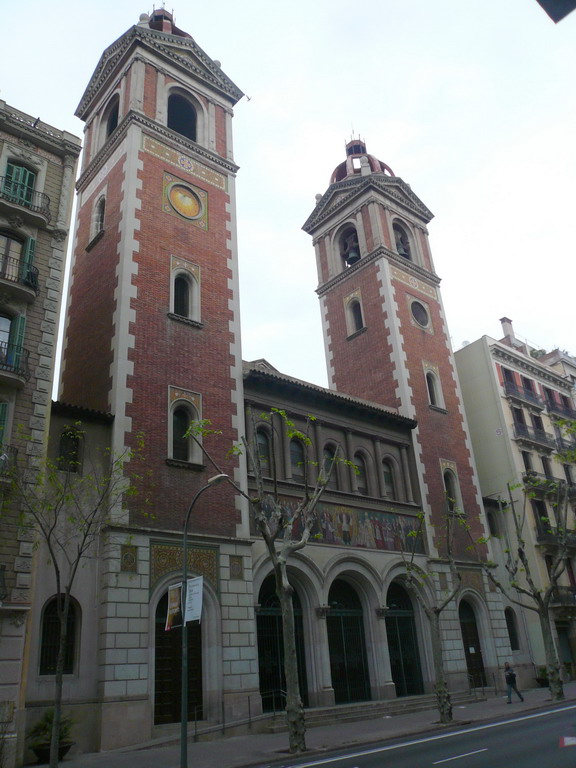
Basílica_de_Sant_Josep_Oriol
Basilica of St Joseph Oriol in Barcelona

The Canonisation Miracle:

On 6 April 1806, priest José Mestres fell off a walkway on the outside of the church’s apse. He rose unscathed from the experience and attributed the event to St Joseph Oriol, whose remains are interred inside the church.

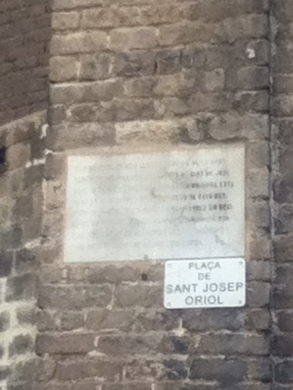
Although St Joseph was renowned for his healing miracles in 17th century Barcelona. He cured the deaf, blind, mute and otherwise disabled people who came to him.   But despite his accomplishments in life, sainthood can only be bestowed upon someone after their death.   As a result of this posthumous miracle, Oriol was canonised by the pope in September of the same year.   A small plaque was installed on the corner of the church to commemorate Padre Mestres’ blessed fall.miracle plaqueplaque 2Placa_a_la_plaça_de_Sant_Josep_Oriol_(1806)xsant-josep-oriol.jpg.pagespeed.ic.uA_BizStH5

This tiny landmark, located on the side of the Church of Santa Maria del Pi in the middle of Barcelona’s dense Gothic Quarter, marks the memory of this miracle of Fr José.

While St Joseph Oriol is little known outside of Spain, his Feast day today is celebrated with a wonderful festival in Barcelona every year and flowers are placed at the numerous statues of St Joseph throughout Barcelona.sant-josep-oriol-festival-barcelona

576px-SantJosepOriol-Cat-BarcelonaBasílica_de_la_Mercè_27_Sant_Josep_Oriolst joseph oriol

Posted in SAINT of the DAY

Memorials of the Saints – 23 March

St Turibius of Mogrovejo (1538-1606) (Optional Memorial)
Biography: https://anastpaul.wordpress.com/2018/03/23/saint-of-the-day-23-march-st-turibius-of-mogrovejo-1538-1606/

Bl Álvaro del Portillo Díez de Sollano
Bl Annunciata Asteria Cocchetti
St Benedict of Campagna
St Crescentius of Carthage
Bl Edmund Sykes
St Ethelwald of Farne
St Felix the Martyr
St Felix of Monte Cassino
St Fergus of Duleek
St Fidelis the Martyr
St Frumentius of Hadrumetum
St Gwinear
St Joseph Oriol (1650-1702)
St Julian the Confessor
St Liberatus of Carthage
St Maidoc of Fiddown
Bl Metod Dominik Trcka
St Nicon of Sicily
St Ottone Frangipane
Bl Peter Higgins
Bl Pietro of Gubbio
St Rafqa
St Theodolus of Antioch
St Victorian of Hadrumetum

Daughters of Feradhach: They are mentioned in early calendars and martyrologies, but no information about them has survived.

Martyrs of Caesarea – 5 saints: A group of five Christians who protested public games which were dedicated to pagan gods. Martyred in the persecutions Julian the Apostate. The only details we know about them are their names – Aquila, Domitius, Eparchius, Pelagia and Theodosia. They were martyred in 361 in Caesarea, Palestine.

Posted in SAINT of the DAY, VATICAN Resources

Thought for the Day – 22 March – “The Lion of Munster”

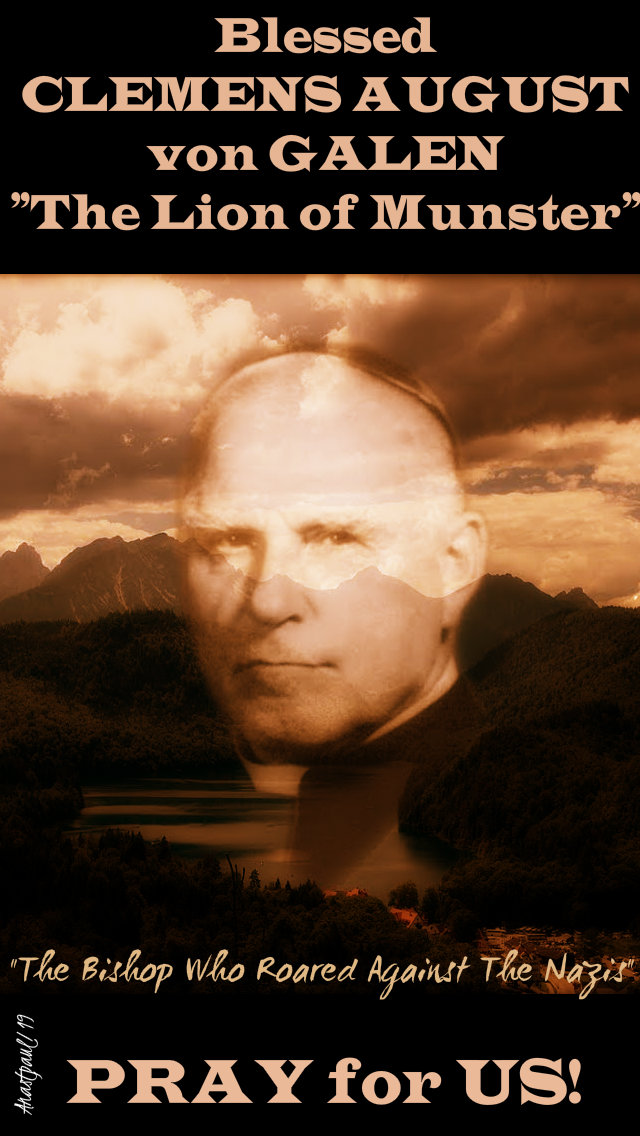
Thought for the Day – 22 March – Friday of the Second week of Lent, Year C and the Memorial of Blessed Clemens August Count von Galen (1878-1946) “The Lion of Munster”

MASS OF BEATIFICATION OF THE SERVANT OF GOD
CLEMENS AUGUST GRAF VON GALEN

EXCERPT from the HOMILY OF CARD. JOSÉ SARAIVA MARTINS

Vatican Basilica
Sunday, 9 October 2005

The tomb of the Supreme Pontiff Hadrian VI, well known for many centuries as the last non-Italian Pope, is located in the Church of Santa Maria dell’Anima, the national church of Germany in Rome. The following epitaph is engraved on his sepulchral monument: “Unfortunately, the conditions of the times strongly dissipate the effectiveness of the virtues of even the best of men”.

This epitaph is a negative reference to the conditions of the times in which Hadrian VI lived, but it also contains a very positive appreciation of the outstanding virtues that he practised precisely in the adverse conditions of his time.

Indeed, a characteristic feature of the famous Cardinal Clemens August von Galen, Bishop of Münster, whose beatification today fills our hearts with joy, is that he eminently and heroically practised the virtues of a Christian and a Pastor in a period so fraught with difficulties for the Church and for the German Nation.

Germany was then dominated by National Socialism.   The Diocese of Münster can boast of having had as Bishop, on the Chair of St Ludger, a Pastor who boldly opposed the ideology that despised humanity and the death mechanism of the National Socialist State.   This earned him the well-deserved nickname, “Lion of Münster”.

Bishop Clemens August Count von Galen, was one of the best known champions of the Church’s resistance to the unjust National Socialist regime.   If we wonder where he found his daring to reprimand the Nazis publicly and with very clear arguments, since they were violating fundamental human rights and how he managed to persevere in this denunciation, we must turn to three important factors that built up his strong personality as a man, a believer, first and subsequently, Bishop.

These were:  Family, Faith, and Politics.   However, we must never lose sight of the fact that the Blessed’s attitude stemmed from his deeply-rooted Christian virtues.

Clemens August came from a family bound by a long tradition both to the Church and to public life.   His father was involved in public affairs and his mother kept the family united – these factors gave Clemens August and his siblings a sense of security and a basis for life that later and rather unexpectedly enabled him to surpass himself and the tradition of the milieu into which he was born.

Traditionally, the life of the von Galen family was strongly oriented to a sense of public responsibility with regard to all the people in the Church and in society.   At the family table in Dinklage Castle, in addition to family conversation and the prayer of the Rosary, the father’s position as a deputy of the Reichstag in Berlin often gave rise to political topics.

Without any doubt he was able to do what he did only thanks to a deep but at the same time very simple spirituality, founded both on the Eucharist and on devotion to the Mother of God.

He countered the deafening martial music and the empty phrases blaring from the amplifiers of the speakers’ platforms with the veneration of the Blessed Eucharist, the silence of contemplative adoration of the Lord who made himself Bread.   Before the Lord present in the Sacrament of the Eucharistic Bread, apparently defenceless and thus not easy to recognise, he found the strength and nourishment that alone could permanently satisfy the human desire for life.

The unifying force of the new Blessed’s spiritual life was his profound and dynamic faith, enlivened by his active charity towards everyone, especially the suffering.   Von Galen’s spirituality, inspired by the Gospel, allowed him to be transparent in his public role.   All his actions and virtues flowed from his lived faith.

At the very outset of his pastoral work in Münster, Bishop von Galen unmasked the ideology of National Socialism and its contempt for human beings.   In the middle of the war in the summer of 1941, he criticised it even more harshly in the three homilies he gave in the months of July and August that year, which have become famous.

In them he targeted the obligatory closure of convents and the arrest of Religious.   He spoke vigorously against the deportation and destruction of those human lives that the regime deemed unworthy to be lived, that is, the mentally disabled.   The Bishop’s fiery words dealt fatal blows to the Nazi’s systematic extermination policy.

His clear arguments infuriated the Nazi leaders who were at a loss as to what to do next, because they did not have the nerve to arrest or kill him due to Bishop von Galen’s extraordinary authority.

It was neither innate courage nor excessive temerity.   Only a deep sense of responsibility and a clear vision of what was right and what was wrong could have induced Bishop Clemens August to speak these words.   They invite us to reflect on the brilliance of his witness to faith, in times that may seem less threatening but are just as problematic with regard to human life, they invite us to imitate his example.

Thus, in March 1946, reflecting on what happened at that time, Cardinal von Galen summarised all this.   He said:  “The good Lord gave me a position that obliged me to call what was black, black, and what was white, white, as outlined in episcopal ordination.   I knew that I could speak on behalf of thousands of people who, like me, were convinced, that only on the basis of Christianity, could our German People truly be united and attain a blessed future”.

Dear German pilgrims, we can look full of gratitude at this great personality from your Homeland.   Bl. Bishop Clemens August realised who our God is and placed all his hope in Him (cf. Is 25: 9).   When he was first a parish priest and later a Bishop, he spared no efforts in his pastoral ministry, he had learned how to do without (cf. Phil 4: 12) and was prepared to give his life in the service of human beings.   Indeed, he was fully aware of his responsibility to God.

Therefore, the Lord has made him worthy of his magnificent riches (cf. Phil 4: 19), of which St Paul spoke in his Letter to the Philippians that we have just heard.   In faith, we are convinced that he was called, that he was chosen to take part in the wedding banquet in the perfection of divine glory – the wonderful parable of Jesus, presented to us by the Gospel of today’s liturgy, prompts us to meditate on this wedding banquet (cf. Mt 22: 1-14).

I would like to congratulate the Diocese of Münster on the fact that precisely in the year in which its establishment, at least 12 centuries ago, is being commemorated, it can celebrate with joy and pride this Beatification here at the Tomb of the Apostle Peter, as if to strengthen its own apostolic roots, anchoring them even more firmly to the Magisterium of the Vicar of Christ who today, through God’s grace, is Benedict XVI.   May the new Blessed be an encouragement to the Diocese of Münster to keep its rich and ever-timely heritage constantly alive, making it fruitful for the people of our times.

May the Lord, through the intercession of the new Blessed, bless the beloved and venerable Diocese of Münster and the entire Church in Germany…Vatican.vabl clemens von galen the lion of munster pray for us 22 march 2019.jpg

Posted in QUOTES of the SAINTS, SAINT of the DAY, The TEN COMMANDMENTS

Quote of the Day – 22 March – ‘Thou shalt not kill.’

Quote of the Day – 22 March – Friday of the Second week of Lent, Year C

and the Memorial of Blessed Clemens August Count von Galen (1878-1946)

“The Lion of Munster”

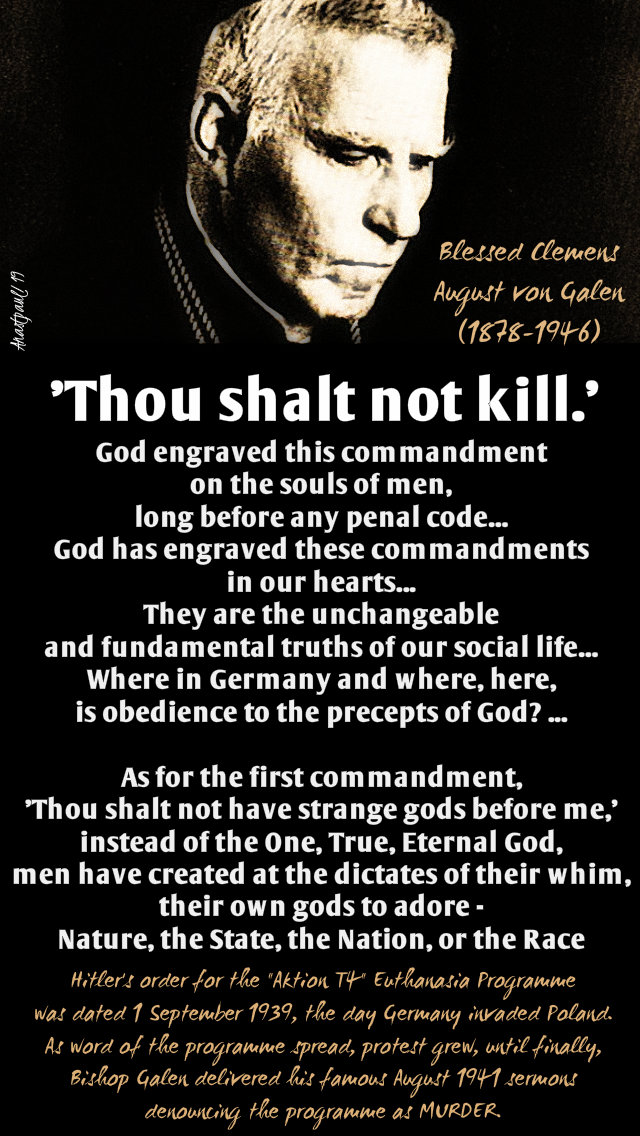
Hitler’s order for the “Aktion T4” Euthanasia Programme was dated 1 September 1939, the day Germany invaded Poland.   As word of the programme spread, protest grew, until finally, Bishop Galen delivered his famous August 1941 sermons denouncing the programme as “murder”.   On 3 August 1941, in one of his series of denunciations, Blessed Galen declared:

“‘Thou shalt not kill.'”
God engraved this commandment on the souls of men,
long before any penal code…
God has engraved these commandments in our hearts…
They are the unchangeable
and fundamental truths of our social life…
Where in Germany and where, here,
is obedience to the precepts of God? …
As for the first commandment,
‘Thou shalt not have strange gods before me,’
instead of the One, True, Eternal God,
men have created at the dictates of their whim,
their own gods to adore –
Nature, the State, the Nation, or the Race.”

Blessed Clemens August Count von Galen (1878-1946)
“The Lion of Munster”

thou shalt not kill - bl clemens august von galen 22 march 2019.jpg

Posted in SAINT of the DAY

Saint of the Day – 22 March – Blessed Clemens August Count von Galen (1878-1946)

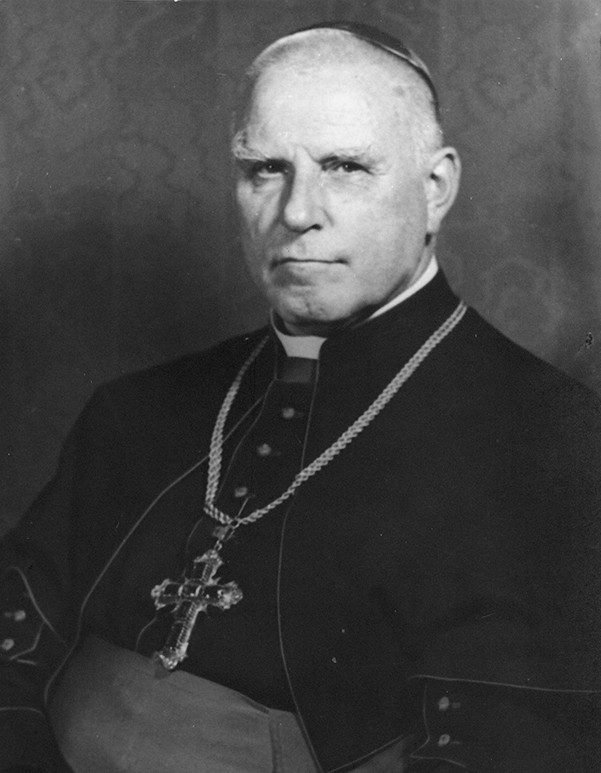
Saint of the Day – 22 March – Blessed Clemens August Count von Galen (1878-1946) aged 68 known as “The Lion of Munste,r”,”The Bishop Who Roared Against The Nazis,” “The Bishop Who Took On the Führer.”    Blessed Clemens had a great love for the Blessed Virgin, often leading pilgrimages, or going on his own, to Marian Shrines.   He was too, a great lover of the Holy Eucharist and a fervent apostle of charity.   Patronage – Munster.BL CLEMENS HEADER maxresdefault

Clemens August von Galen was born on 16 March 1878 in Dinklage Castle, Oldenburg, Germany, the 11th of 13 children born to Count Ferdinand Heribert and Elisabeth von Spee.

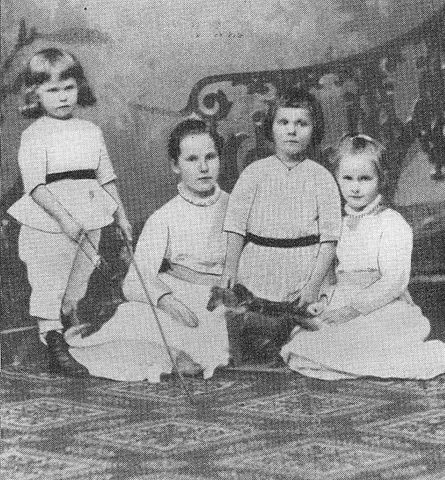
Clemens_August_von_Galen_and_siblings_(1884)
Clemens August (third from left) at age six.

His father belonged to the noble family of Westphalia, who since 1660 governed the village of Dinklage.   For over two centuries his ancestors carried out the inherited office of camerlengo of the Diocese of Münster.

Clemens August grew up in Dinklage Castle and in other family seats.   Due to the struggle between Church and State, he and his brothers were sent to a school run by the Jesuits in Feldkirch, Austria.

bl clemns von galen home 1024px-Burg_Dinklage_Wikipedia
The family home in Dinklage

He remained there until 1894, when he transferred to the Antonianum in Vechta.   After graduation, he studied philosophy and theology in Frebur, Innsbruck and Münster and was ordained a priest on 28 May 1904 for the Diocese of Münster by Bishop Hermann Dingelstadt.

Parish priest, concern for poor:
His first two years as a priest were spent as vicar of the diocesan cathedral where he became chaplain to his uncle, Bishop Maximilian Gerion von Galen.

From 1906 to 1929, Fr von Galen carried out much of his pastoral activity outside Münster – in 1906 he was made chaplain of the parish of St Matthias in Berlin-Schönberg; from 1911 to 1919 he was curate of a new parish in Berlin before becoming parish priest of the Basilica of St Matthias in Berlin-Schönberg, where he served for 10 year, here, he was particularly remembered for his special concern for the poor and outcasts.   In 1929, Fr von Galen was called back to Münster when Bishop Johannes Poggenpohl asked him to serve as parish priest of the Church of St Lambert.

“Nec laudibus, nec timore’:
In January 1933, Bishop Poggenpohl died, leaving the See vacant.   After two candidates refused, on 5 September 1933, Fr Clemens was appointed Bishop of Münster by Pope Pius XI.   On 28 October 1933 he was consecrated by Cardinal Joseph Schulte, Archbishop of Cologne.   Bishop von Galen was the first diocesan Bishop to be consecrated under Hitler’s regime.

565px-Coat_of_arms_of_Clemens_August_von_Galen.svg.png
Coat of Arms of Cardinal von Galen.

As his motto, he chose the formula of the rite of episcopal consecration:  “Nec laudibus, nec timore” (Neither praise nor threats will distance me from God).

Throughout the 20 years that Bishop von Galen was curate and parish priest in Berlin, he wrote on various political and social issues – in a pastoral letter dated 26 March 1934, he wrote very clearly and critically on the “neopaganism of the national socialist ideology“.   Due to his outspoken criticism, he was called to Rome by Pope Pius XI in 1937 together with the Bishop of Berlin, to confer with them on the situation in Germany and speak of the eventual publication of an Encyclical.

On 14 March 1937 the Encyclical “Mit brennender Sorge” (To the Bishops of Germany – The place of the Catholic Church in the German Reich) was published.   It was widely circulated by Bishop von Galen, notwithstanding Nazi opposition.

“Lion of Munster’:
In the summer of 1941, in answer to unwarranted attacks by the National Socialists, Bishop von Galen delivered three admonitory sermons between July and August.   He spoke in his old parish Church of St Lambert and in Liebfrauen-Ueberlassen Church, since the diocesan cathedral had been bombed.   In his famous speeches, Bishop von Galen spoke out against the State confiscation of Church property and the programmatic euthanasia carried out by the regime.bl clemens profile

The clarity and incisiveness of his words and the unshakable fidelity of Catholics in the Diocese of Münster embarrassed the Nazi regime and on 10 October 1943 the Bishop’s residence was bombed.   Bishop von Galen was forced to take refuge in nearby Borromeo College.

From 12 September 1944 on, he could no longer remain in the city of Münster, destroyed by the war, he left for the zone of Sendenhorst.

In 1945, Vatican Radio announced that Pope Pius XII was to hold a Consistory and that the Bishop of Münster was also to be present.

Creation of a Cardinal:
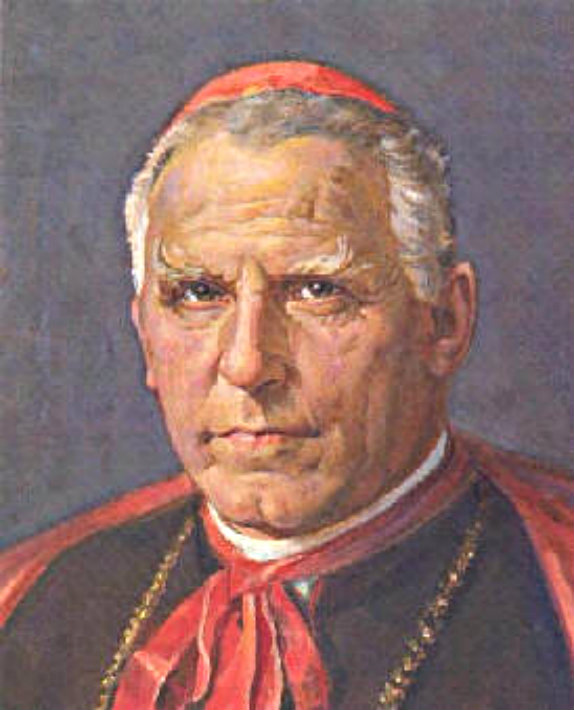
After a long and difficult journey, due to the war and other impediments, Bishop von Galen finally arrived in the “Eternal City”.   On 21 February 1946 the Public Consistory was held in St Peter’s Basilica and Bishop von Galen was created a Cardinal.bl clemens official cardinal pic

On 16 March 1946 the 68-year-old Cardinal returned to Münster.  He was cordially welcomed back by the city Authorities and awarded honourary citizenship by the burgomaster.

On the site of what remained of the cathedral, Cardinal von Galen gave his first (and what would be his last) discourse to the more than 50,000 people who had gathered, thanking them for their fidelity to the then-Bishop of Münster during the National Socialist regime.   He explained that as a Bishop, it was his duty to speak clearly and plainly about what was happening.nl clemens.jpg

No one knew that the Cardinal was gravely ill and when he returned to Münster on 19 March 1946 he had to undergo an operation.

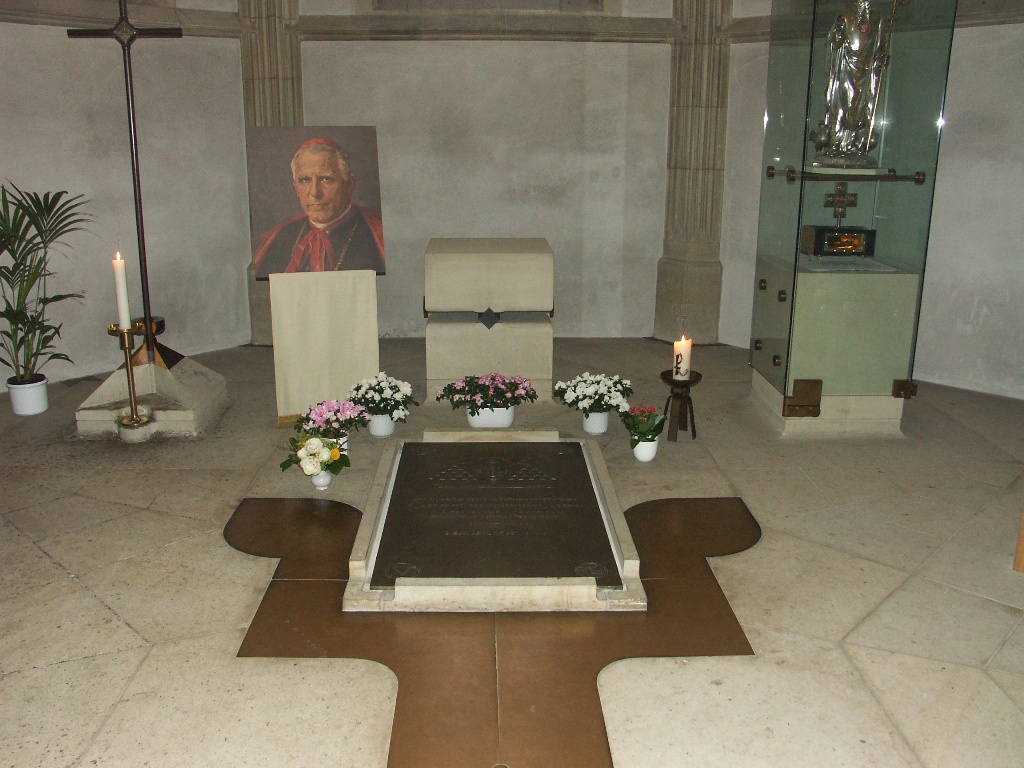
Cardinal von Galen died just three days later, on 22 March.   He was buried on 28 March in the Ludgerus Chapel, which has become a place of pilgrimage to this defender of the faith in the face of political oppression….Vatican.va20051009_von-galen

Blessed Clemens was Beatified on 9 October 2005 by Pope Benedict XVI at St Peter’s, Vatican City. His tomb is venerated in Munster Cathedral.Minolta DSC

Posted in JESUIT SJ, SAINT of the DAY

Memorials of Our Lady and the Saints – 22 March

Our Lady of the Seven Veils:
About: https://anastpaul.wordpress.com/2018/03/22/memorial-of-our-lady-of-the-seven-veils-and-memorials-of-the-saints-22-march/

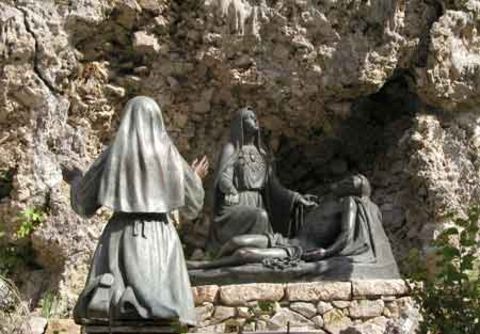
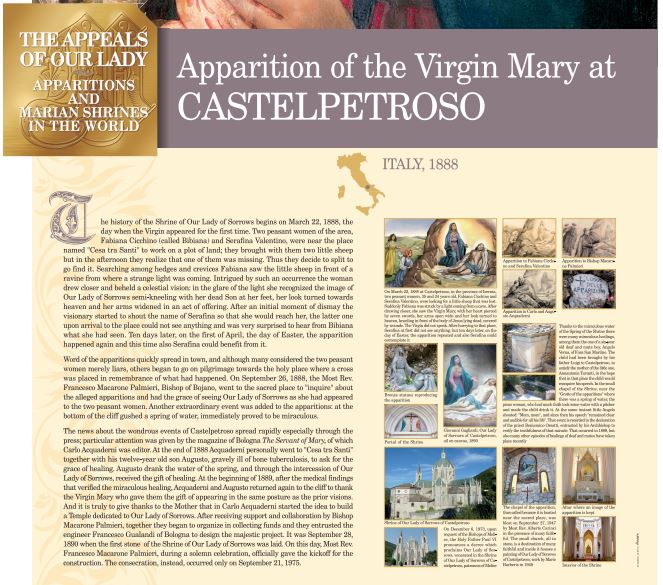
Our Lady of Sorrows of Castelpetroso:
About the Apparitions: http://mariancalendar.org/our-lady-of-sorrows-castelpetroso-italy/picture_castelpetroso-1basilica minor of our lady of seven sorrows

castelproso our lady of seven sorrows.JPG

St Avitus of Périgord
St Basil of Ancyra
St Basilissa of Galatia
St Benevenuto Scotivoli of Osimo
Bl Bronislaw Komorowski
St Callinica of Galatia
Bl Clemens August von Galen (1878-1946)

St Darerca of Ireland
St Deghitche
St Epaphroditus of Terracina
St Failbhe of Iona
Bl François-Louis Chartier
St Harlindis of Arland
Bl Hugolinus Zefferini
St Lea of Rome
Bl Marian Górecki
St Nicholas Owen SJ (1562-1606)
Dear St Nicholas Owen – The Priest-Hole Builder:
https://anastpaul.wordpress.com/2018/03/22/saint-of-the-day-22-march-st-nicholas-owen-s-j-1562-1606-the-priest-hole-builder-martyr/

St Octavian of Carthage
St Paul of Narbonne
St Saturninus the Martyr
St Trien of Killelga

Posted in LENT 2019, LENTEN THOUGHTS, ON the SAINTS, QUOTES - J R R Tolkien and MORE, QUOTES on FAITH, QUOTES on FASTING, QUOTES on GRACE, QUOTES on PRAYER, QUOTES on SANCTITY, SAINT of the DAY, The PASSION

Lenten Thoughts – 21 March – The Primacy of the Spiritual:  Saint Nicholas of Flue

Lenten Thoughts – 21 March – Thursday of the Second week of Lent, Year C and the Memorial of St Nicholas of Flue (1417-1487)

The Primacy of the Spiritual:  Saint Nicholas of Flue (Excerpt)
By Christopher O Blum

Born to a pious, upstanding peasant family, young Nicholas stood out for his goodness, simplicity and mortification.   While still a young man, labouring in the fields and meadows of the valleys south of Lucerne, he fasted four times per week, explaining himself, when pressed, by saying, “Such is the will of God.”   Until his fiftieth year, his life was that of an exemplary Swiss free man.   Like many of his fellow countrymen, he served his canton both under arms and by holding civic office.   And this pillar of the community raised up five sons and five daughters with the help of his exemplary wife Dorothy.   Yet God persisted in calling him to a life beyond that of the domestic holiness he had already embraced and sent visions to him in his late-night prayer vigils and his moments of afternoon solitude in the fields, visions that beckoned him to leave all.st nicholas of flue pray for us 21 march 2019 no 2.jpg

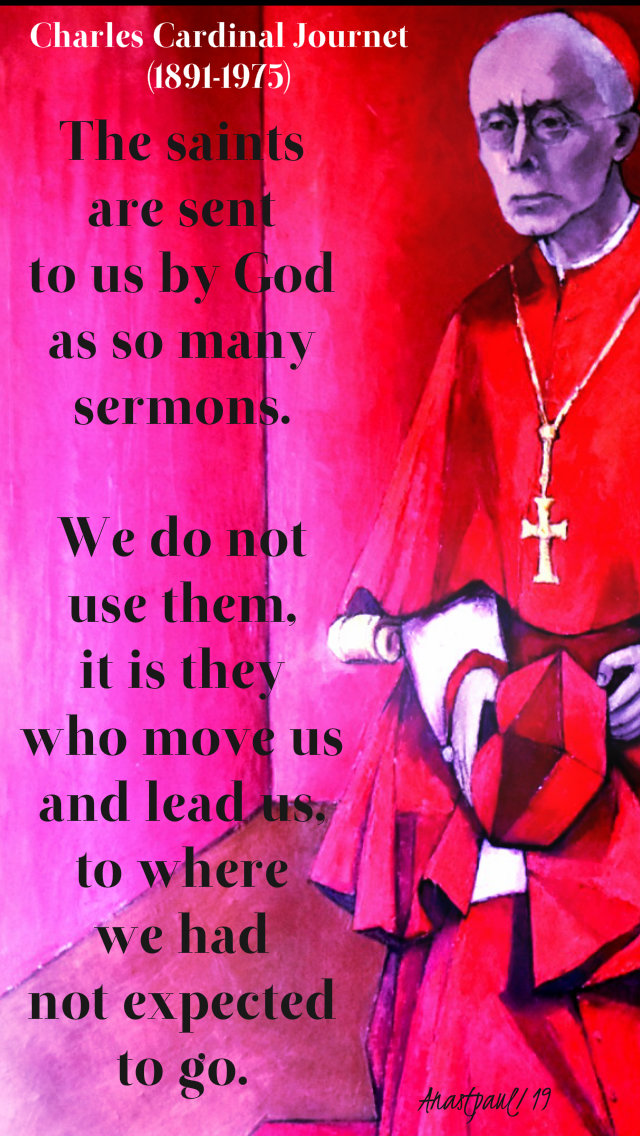
As the eminent Swiss theologian Charles Cardinal Journet (1891-1975) explained in his biography of the hermit-saint, “it no longer sufficed for him to walk along the roads of the world with God in his heart, he had to take the path set aside for him, that he might be taken by the hand and led to where he knew not.”   What praise of Dorothy of Flue could be lovelier, Journet asked, than to admire her magnanimity in being able to “comprehend the drama of this great soul”?   They parted friends, just thirteen weeks after the birth of their youngest child and remained so.   Several years later, a pilgrim visitor to Nicholas’ hermitage saw the saint, with joyous mien, lean out of the window of his tiny cell after the morning Mass to greet his family with a blessing:  “May God give you a blessed day, dear friends and good people!”

Nicholas had initially thought to join a monastery, perhaps one in nearby Alsace known for its austerity.   But a chance conversation with a peasant helped him to understand another of his mystical visions – this one of the nearby town of Liestal wrapped in flames. His good works were needed in his own neighbourhood.   And so, he built himself a hermitage one valley over from his home and spent the next twenty years there, clad only in a tunic, with bare feet and a bare head, to do penance for his beloved people.   His piety was simple, for he was illiterate.   A neighbouring priest had taught him the practice of meditating on Christ’s Passion in stages to match the seven canonical hours of the Church’s daily prayer.   This method bore good results.   He soon became known for the wisdom and holiness of his counsel and pilgrims flocked to his hidden valley to listen to his simple, direct words:  “O man, when the world hates you and is faithless toward you, think of your God, how he was struck and spat upon.   You should not accuse your neighbour of guilt but pray to God, that he be merciful to you both.”

Writing during the Second World War, Cardinal Journet saw in Nicholas of Flue the “supreme incarnation of the genius of Switzerland.”   By this he did not mean that the hermit was a pacifist.   He was something higher and more important.   His greatness “was to have affirmed the primacy of the spiritual life.”   “For the saints”, the Cardinal explained, “are sent to us by God as so many sermons.   We do not use them, it is they who move us and lead us, to where we had not expected to go.”   Those were years of exceptional trial for the Swiss but they were also years in which men and women of good will prepared the ground for spiritual renewal and rebuilding.the saints are sent to us by god - card charles journet 21 march 2019.jpg

What lesson might Nicholas of Flue hold out for our generation?   Were he alive today this simple Swiss peasant would doubtless be startled by our wealth.   The recession of recent years seems to have done little to dull the edge of our consumption.   The adjective “worldly” is now being used as a term of approbation, to signify the savoir-faire of the person who knows the latest fashions and ways of thinking.   It is a telling linguistic development.   Nicholas of Flue spent the last twenty years of his life in a tiny room with two windows.   Through one of them, he could see something of the beauty of his native land, a beauty that nourished his reflection and piety:  “O man, think of the sun so high in the sky and consider its splendour – but your soul has received the splendour of the eternal God.”   Through the other, he saw the altar, whence came the very food of his soul.   “We should carry the Passion of God in our hearts, for this is the greatest consolation to a man at the hour of his death.”   The one thing needful indeed.we should carry the passion of god - 21 march 2019 st nicholas of flue.jpg

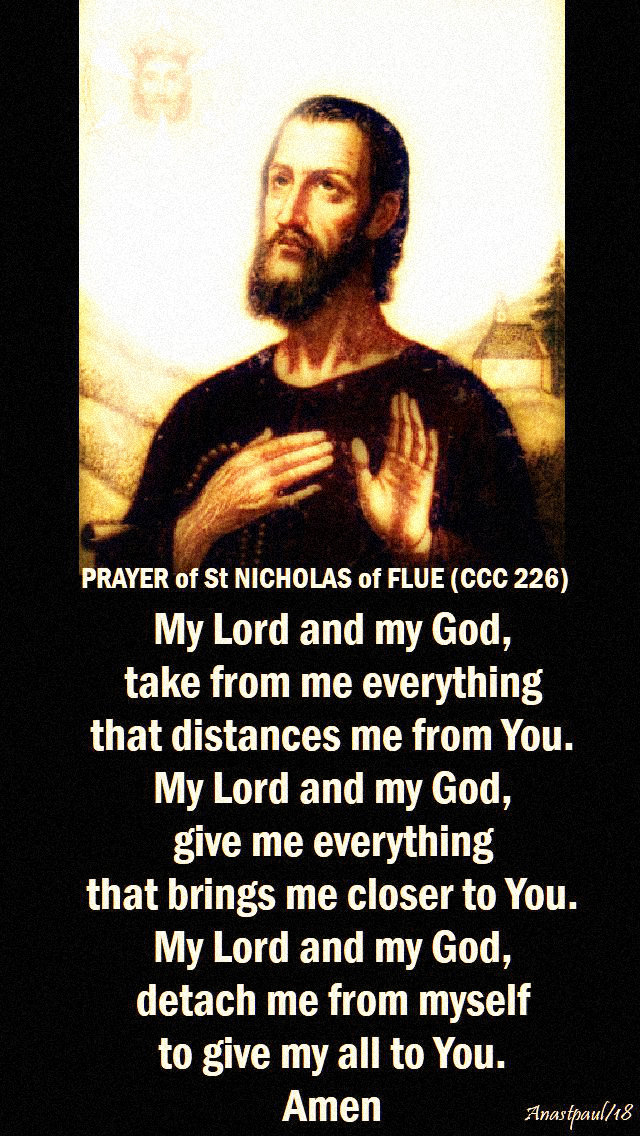
My Lord and my God
St Nicholas of Flue (1417-1487)

My Lord and my God,
take from me everything
that distances me from You.
My Lord and my God,
give me everything
that brings me closer to You.
My Lord and my God,
detach me from myself
to give my all to You.
Amen

The above prayer of St Nicholas, is cited in the Catechism of the Catholic Church in paragraph #226.
CCC 226 – It means making good use of created things: faith in God, the only One, leads us to use everything that is not God only insofar as it brings us closer to Him and to detach ourselves from it insofar as it turns us away from Him.

prayer-of-st-nicholas-of-flue-no-226-my-lord-and-my-god-take-from-me-everything-21-march-20181.jpg