Posted in CATECHESIS, CATHOLIC Quotes, DOCTORS of the Church, FATHERS of the Church, PRACTISING CATHOLIC, PRAYERS of the CHURCH, QUOTES of the SAINTS, SAINT of the DAY, SPEAKING of ....., The SIGN of the CROSS

Quote/s of the Day – 17 January – The Sign of the Cross

Quote/s of the Day – 17 January – Thursday of the First week in Ordinary Time and The Memorial of St Anthony Abbot (251-356)

Speaking of:  The Sign of the Cross

“The illusions of this world soon vanish,
especially if a man arms himself with
the Sign of the Cross.
The devils tremble
at the Sign of the Cross of our Lord,
by which He triumphed over
and disarmed them.”

St Anthony Abbot (251-356)the-illusions-of-this-world-st-anthony-abbot-17-jan-2018.jpg

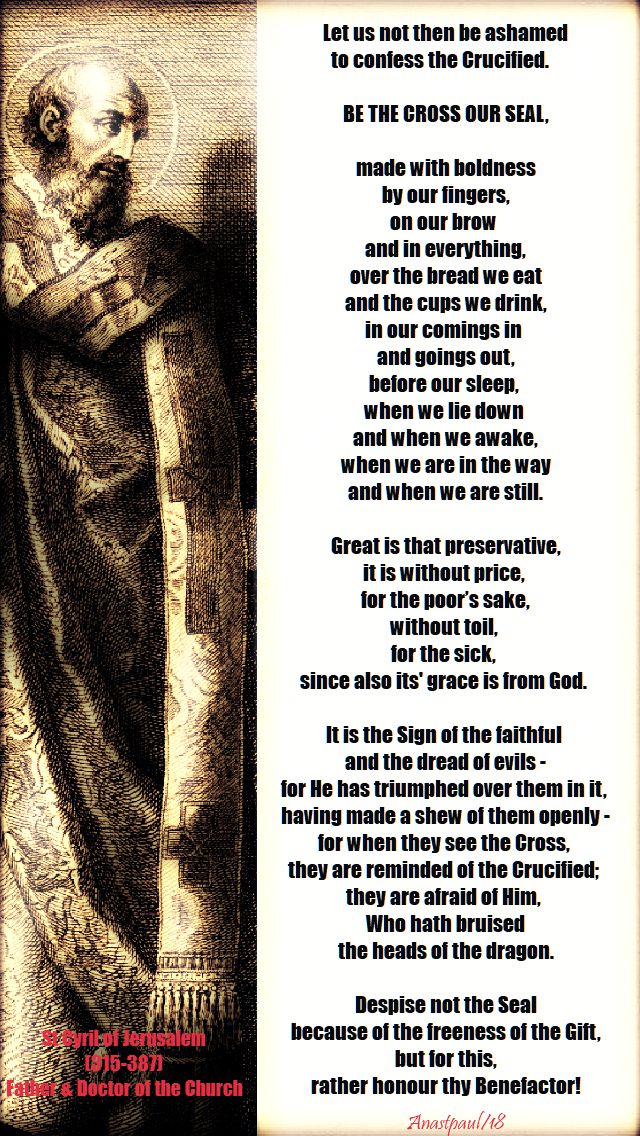
“Let us not then be ashamed to confess the Crucified.
Be the Cross our seal made with boldness by our fingers
on our brow and in everything;
over the bread we eat and the cups we drink;
in our comings in and goings out;
before our sleep, when we lie down and when we awake;
when we are in the way and when we are still.
Great is that preservative;
it is without price, for the poor’s sake;
without toil, for the sick, since also its grace is from God.
It is the Sign of the faithful and the dread of evils;
for He has triumphed over them in it,
having made a shew of them openly;
for when they see the Cross, they are reminded of the Crucified;
they are afraid of Him, Who hath bruised the heads of the dragon.
Despise not the Seal, because of the freeness of the Gift
but for this rather honour thy Benefactor.”

St Cyril of Jerusalem (315-387) Father and Doctorbe the cross our seal - st cyril of jerusalem - 17 jan 2019.jpglet-us-not-then-be-ashamed-st-cyril-of-jerusalem-17-jan-2018.jpg

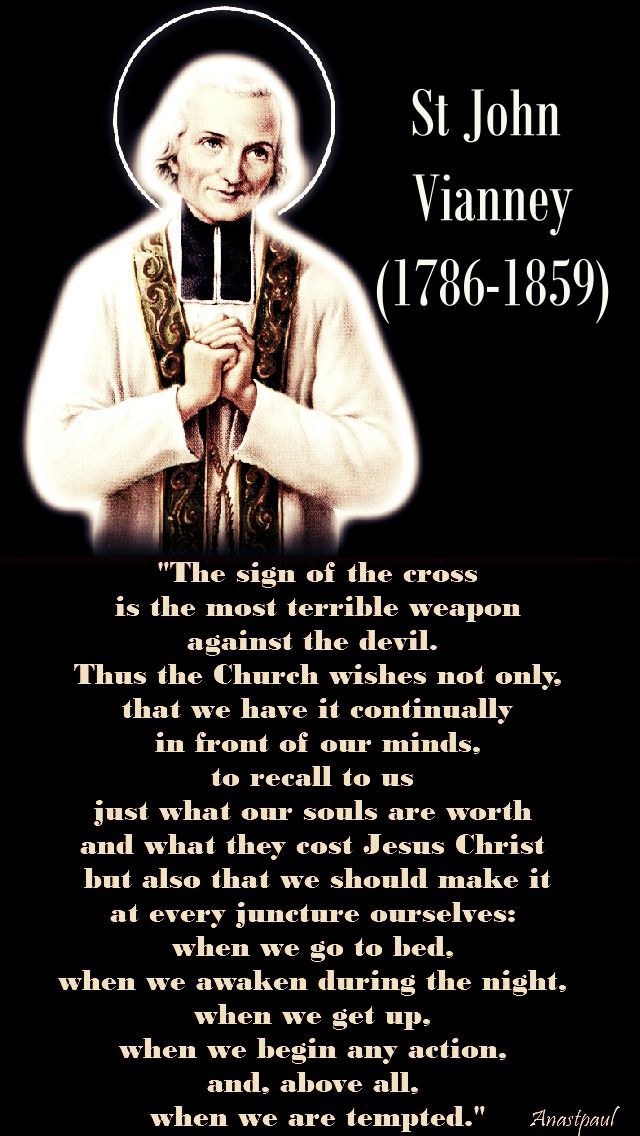
“The sign of the cross
is the most terrible weapon
against the devil.
Thus the Church wishes not only,
that we have it continually
in front of our minds,
to recall to us
just what our souls are worth
and what they cost Jesus Christ
but also that we should make it
at every juncture ourselves:
when we go to bed,
when we awaken during the night,
when we get up,
when we begin any action,
and, above all,
when we are tempted.”

St John Vianney (1786-1859)the sign of the cross - st john vianney.- new version - 17 jan 2018 jpg

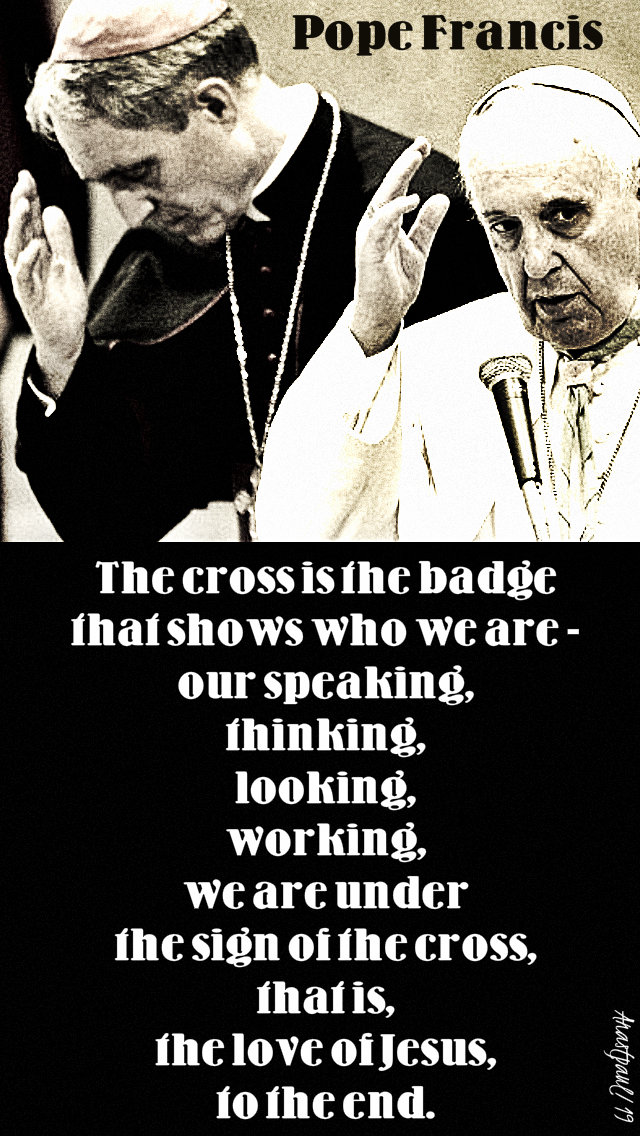
“The cross is the badge that shows who we are –
our speaking, thinking, looking, working,
we are under the sign of the cross,
that is, the love of Jesus, to the end.”the cross is the badge - pope francis 17 jan 2019.jpg

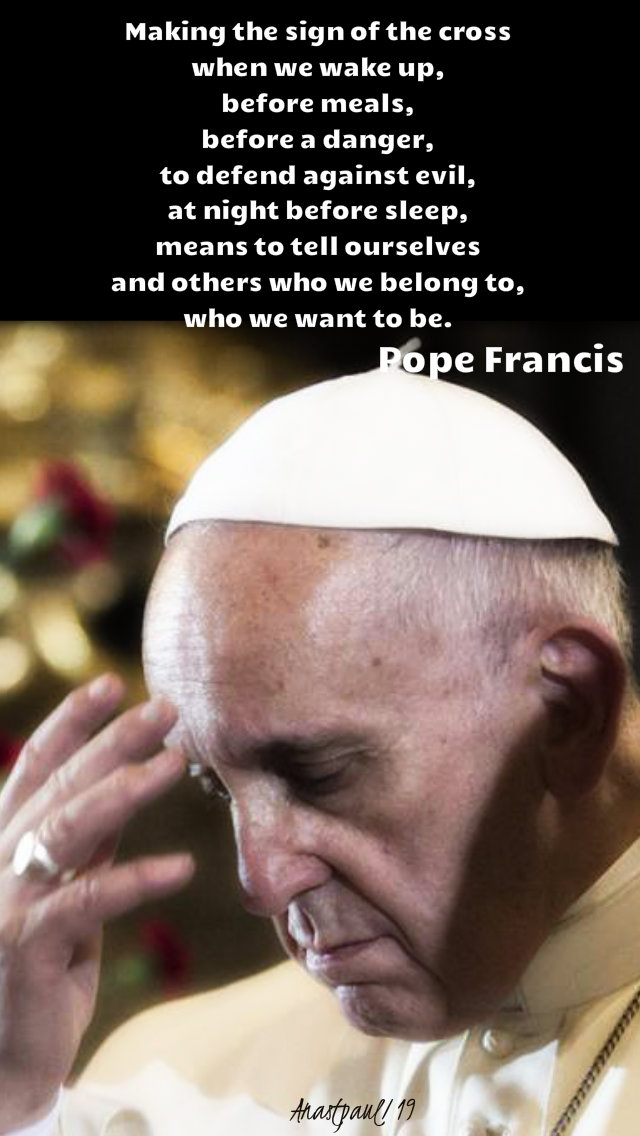
“Making the sign of the cross when we wake up,
before meals, before a danger, to defend against evil,
at night before sleep means to tell ourselves
and others who we belong to, who we want to be.”

Pope Francismaking the sign of the cross - pope francis 17 jan 2019.jpg

3 Things to Know about the Cross – Fr Mike Schmitz

Posted in CONFESSION/PENANCE, MORNING Prayers, PAPAL SERMONS, PRACTISING CATHOLIC, SAINT of the DAY, The WORD

One Minute Reflection – 17 January – “If you will, you can make me clean.”…Mark 1:40

One Minute Reflection – 17 January – Thursday of the First week in Ordinary Time – Gospel Mark 1:40–45 and the Memorial of St Anthony Abbot (251-356)

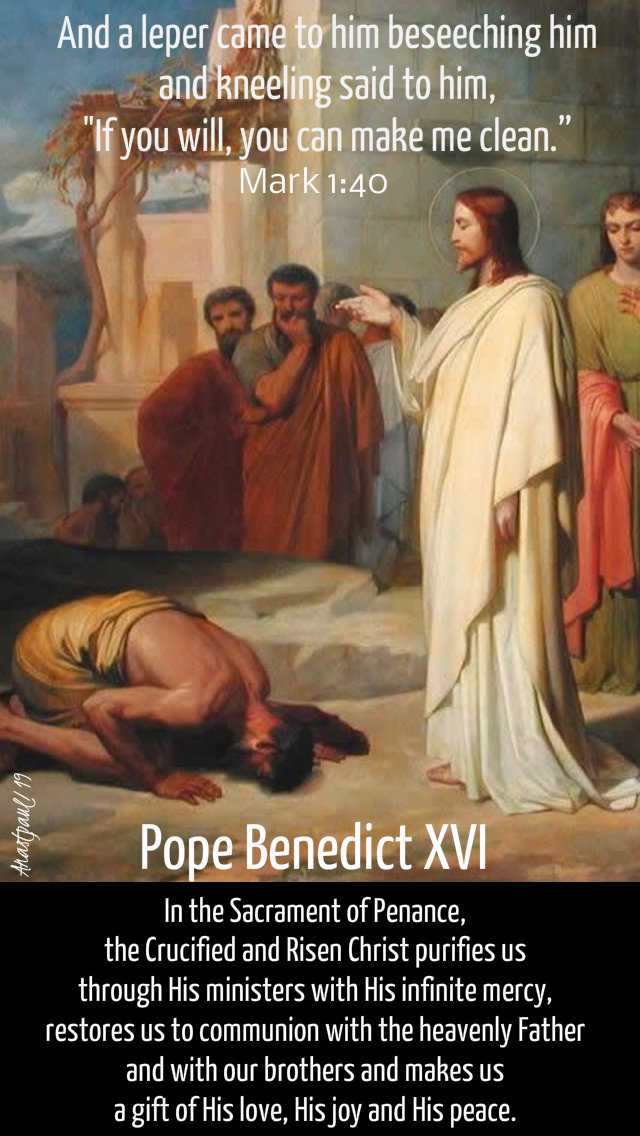
And a leper came to him beseeching him, and kneeling said to him, “If you will, you can make me clean.”…Mark 1:40

REFLECTION – “It is possible to see leprosy as a symbol of sin, which is the true impurity of heart that can distance us from God.   It is not in fact the physical disease of leprosy that separates us from God, as the ancient norms supposed but sin, spiritual and moral evil.   The sins that we commit distance us from God and, if we do not humbly confess them, trusting in divine mercy, they will finally bring about the death of the soul.   This miracle thus has a strong symbolic value.   Jesus, as Isaiah had prophesied, is the Servant of the Lord who “has borne our griefs / and carried our sorrows” (Is 53: 4).   In His Passion He will become as a leper, made impure by our sins, separated from God, He will do all this out of love, to obtain for us reconciliation, forgiveness and salvation.   In the Sacrament of Penance, the Crucified and Risen Christ purifies us through His ministers with His infinite mercy, restores us to communion with the heavenly Father and with our brothers and makes us a gift of His love, His joy and His peace.
Dear brothers and sisters, let us invoke the Virgin Mary whom God preserved from every stain of sin so that she may help us to avoid sin and to have frequent recourse to the Sacrament of Confession, the sacrament of forgiveness, whose value and importance for our Christian life must be rediscovered today.”…Pope Benedict XVI – Angelus 15 February 2009 mark 1 40 - if you will you can make me clean - in the sacrament of confession - pope benedict 17 jan 2019.jpg

PRAYER – Almighty, ever-living God, we make our prayer to You at morning, noon and evening.   Dispel from our hearts, the darkness of sin and bring us to the true light, Christ Your Son.  Grant that through the intercession of the Blessed Virgin Mary and St Anthony Abbot, we may deny ourselves and love You above all things.   Through Jesus, our Lord, with the Holy Spirit, God forever and ever, amen.blessed virgin mary pray for us 17 jan 2019.jpgagostinocarracci_thetemptationofstanthonyabbot-detail-pray-for-us-17-jan-2017-picjpg.jpg

Posted in SAINT of the DAY

Saint of the Day – 17 January – Blessed Rosalina of Villeneuve O.Cart. (1263–1329)

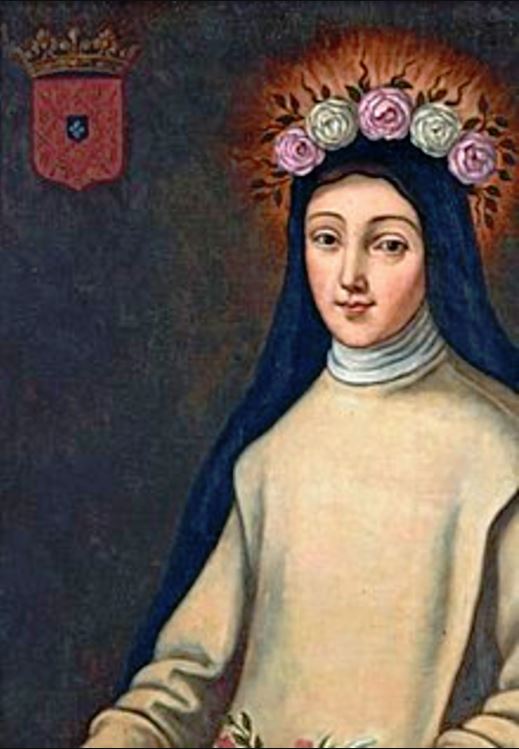
Saint of the Day – 17 January – Blessed Rosalina of Villeneuve O.Cart. (1263–1329) – Religious Nun of the Carthusaian Order, Mystic, Apostle of Charity – born in 1267 in a castle at Villeneuve, France and died on 17 January 1329.   Her body is incorrupt.

Rosalina belonged to the noble Southern French family of the ‘de Villeneuve’, which still exists today.   She was born in 1263.   When the Bishop of Fréjus gave her the sacrament of confirmation in 1270 in the chapel of the family castle, a supernatural light seemed to envelope the child.   At a very young age she made a private vow of virginity.220px-saint_rosaline_of_villeneuve

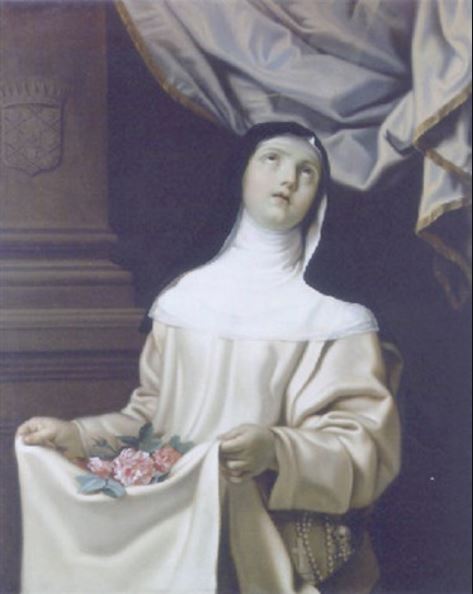
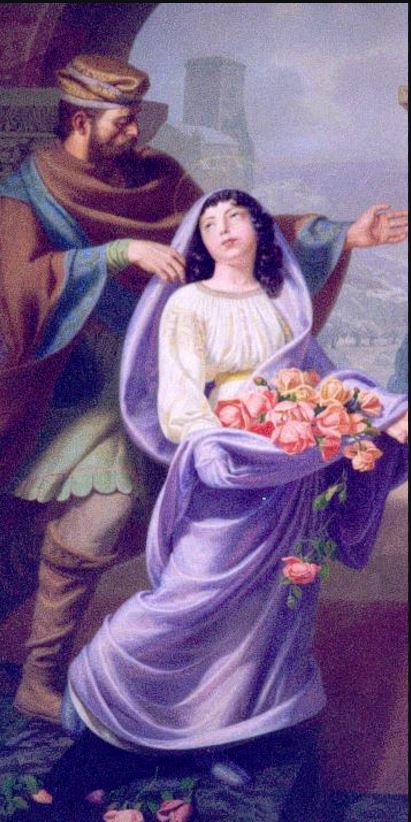
She loved more than anything else to take care of the poor, distributing generously from the family provisions, which alarmed the servants of the castle.   Once, after having filled her skirt with bread, Rosalina was on her way to the poor grouped together at the doors of the castle.   She was suddenly stopped by her father who asked her what she was carrying.   She answered: “These are the roses I just finished picking.”   Extending her skirt, she showed the said roses to the astonished eyes of her father.   It is to recall this miracle that Rosalina is often represented in portraits with her skirt full of roses.nicolas-mignard-saint-roseline-of-villeneuve.jpg

When she was sixteen years old she wanted to become a Carthusian nun.   She knew their life from the Charterhouse of la Celle-Roubaud close by, where her aunt Jeanne de Villeneuve was Prioress.   Since that House had no novitiate, it was at Saint André de Ramires that she entered and then she moved to the chief Charterhouse for women, Bertaud, not far from the city of Gap, in the French Alps.   She made profession there in 1280.

Her aunt at Celle Roubaud was getting on in age, so after a few years the Superior General of our Order permitted Rosalina to go to that House to help her aunt.   In 1288 she received virginal consecration at the hands of the Bishop of Fréjus.  It is told that this grace put her into a state of ecstasy which lasted the whole day.   Although she assisted in the choir and followed all the activities of the community, her soul was united with the Lord.   She was known for her inclination towards asceticism.   For example, she reduced her sleep and lived only on bread the days when she went to communion.   Prayer was for her most important in Carthusian life.   Each night she used to spend long hours in prayer, thus obtaining special graces for the Order, her family and town and for the entire Church.

Owing to her purity of heart God granted her the gift of reading what is in other people’s heart.   At the death of her aunt in 1300 the Superior General appointed Rosaline as Prioress.   She held that office for twenty-nine years.   It was during this time that her friend, the Bishop of Fréjus, became Pope as John XXII. saint_roseline

She died at the age of sixty-six with a great renown for holiness.    Immediately, there were miracles –  blind received their sight and sick were cured.   Five years after her death, in 1334, Pope John ordered to open her tomb.   Her body was found entirely incorrupt and it is still so today.   In 1602 it was transferred from the crypt to a newly built chapel.   In 1851 Blessed Pius IX authorised her feast for the diocese of Fréjus and in 1857 for the Carthusian Order.  Today, the Carthusians celebrate her memory on 6 July and her feast is a solemnity for the nuns of the Order.carthusian_coat_of_arms-2006_11_30_murraybuckley.svg

1024px-la_grande_chartreuse
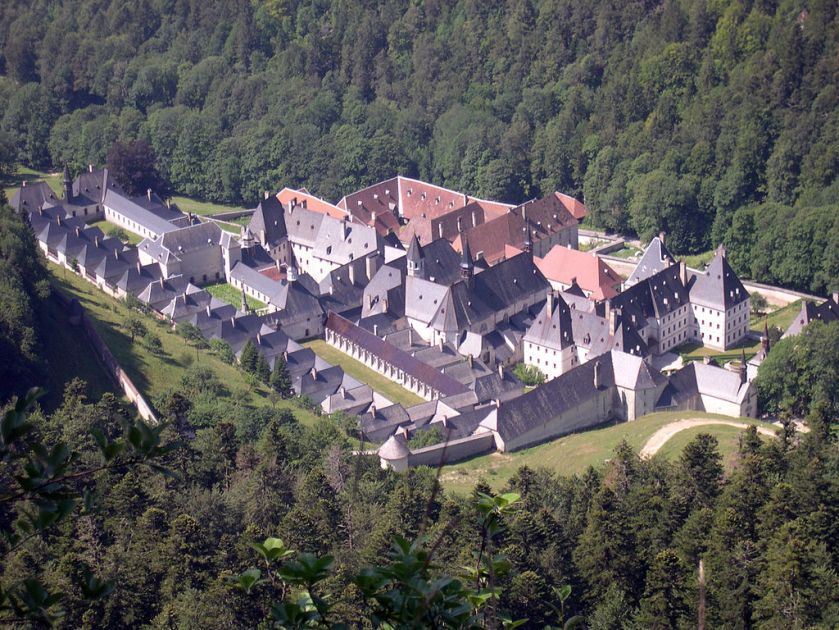
Grande Chartreuse Motherhouse of St Bruno

saint_rosellina

Prayer

Lord God, for love of You, Saint Rosalina trampled underfoot the flattering allurements of the world, that she might adhere only to You.   Help us to follow her example and, turning away from things of earth, find our joy in sharing Your heavenly gifts.

Deus, pro cuius amore, beata Rossolina mundi sibi blandientis calcavit illecebras ut tibi unice adhaereret : tribue nobis ex eius imitatione terrena despicere, et caelestium donorum semper participatione gaudere

 text from from the Charterhouse of the Transfiguration.

Posted in MARIAN TITLES, SAINT of the DAY, The BLESSED VIRGIN MARY

Feast of Our Lady of Pontmain & Memorials of the Saints -17 January

St Anthony Abbot (251-356) (Memorial)

Our Lady of Pontmain – 17 January:  During the Franco-Prussian War, German troops approached the town of Pontmain, France and the villagers there prayed for protection. On the evening of 17 January 1871, Mary appeared in the sky for several minutes over the town.   She wore a dark blue dress covered in stars, carried a crucifix and below her were the words –  Pray please. God will hear you soon.   My son lets Himself be touched.   That night the German army was ordered to withdraw and an armistice ending the war was signed eleven days later on 28 January.   Approval of diocesan bishop.pontmain_53_statue_de_la_vierge_sur_le_parvis_de_la_basilique.jpg

St Achillas of Sketis
St Amoes of Sketis
St Antony of Rome
Bl Euphemia Domitilla
Bl Gamelbert of Michaelsbuch
St Genitus
St Genulfus
St Jenaro Sánchez Delgadillo
St John of Rome
Bl Joseph of Freising
St Julian Sabas the Elder
St Marcellus of Die
St Merulus of Rome
St Mildgytha
St Nennius
St Neosnadia
St Pior
St Richimir
Bl Rosalina of Villeneuve O.Cart. (1263–1329)
St Sabinus of Piacenza
St Sulpicius of Bourges

Martyrs of Langres: Eleusippus, Leonilla, Meleusippus, Speusippus

Posted in ON the SAINTS, PAPAL SERMONS, QUOTES of the SAINTS, SAINT of the DAY

Thought for the Day – 16 January – The Memorial of Blessed Giuseppe Tovini OFS (1841-1897)

Thought for the Day – 16 January – The Memorial of Blessed Giuseppe Tovini OFS (1841-1897)

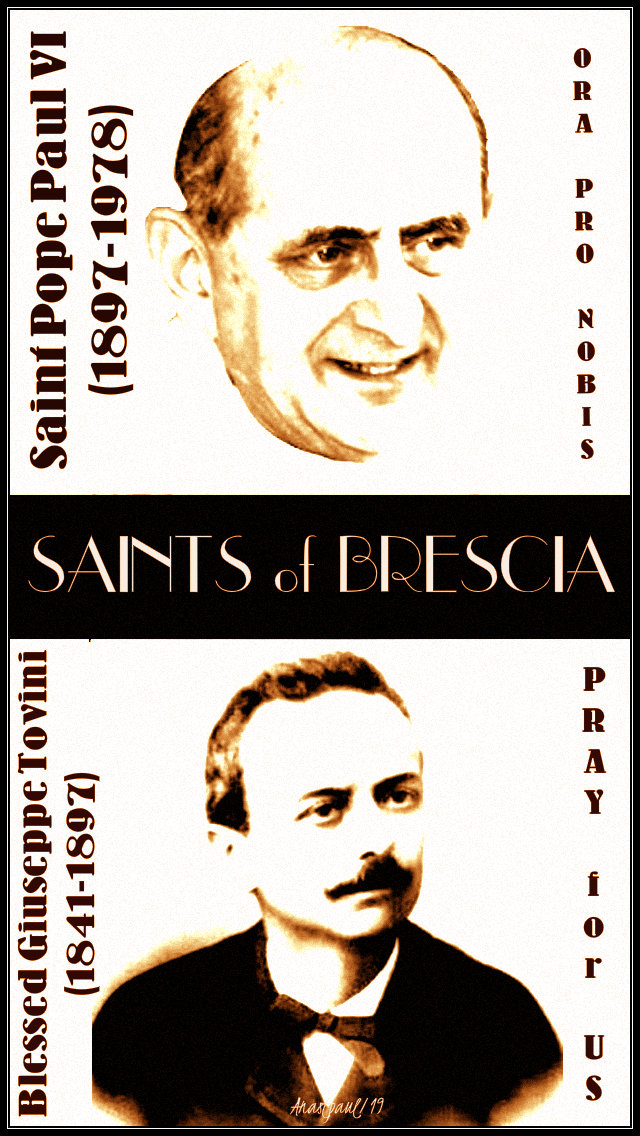
St Pope Paul VI and Blessed Giuseppe Tovini

Sons & Saints of Brescia

Excerpt from St Pope John Paul’s Homily

EUCHARISTIC CELEBRATION
ON THE OCCASION OF THE CENTENARY OF THE BIRTH
OF THE SERVANT OF GOD PAUL VI
AND THE BEATIFICATION OF GIUSEPPE TOVINI

HOMILY OF POPE JOHN PAUL II
Brescia
Sunday, 20 September, 1998

With deep affection I greet you, city of Brescia, so rich in works of Christian inspiration;  I greet your priests, religious and the many lay people who in their various ecclesial and civil offices have distinguished themselves by their religious, social and cultural commitment.

2. “Peter, do you love me?”.   We can say that Paul VI’s life was a response to Christ’s question – a great proof of love for God, the Church and mankind.   He loved God as a gracious and caring Father and during the important moments of his life, especially those burdened with difficulties and suffering, he displayed a very strong sense of the divine fatherhood.

When, as Archbishop of Milan, he decided to hold a popular mission to instil new energy in the city’s Christian tradition, he chose as his basic theme – God is Father.   Then on 6 August, 20 years ago, as he neared the end of his earthly life at Castel Gandolfo, he wanted to recite the Our Father as his last prayer.

And what can be said of his passionate love for Christ?   His was an essentially Christocentric spirituality.   In the homily to mark the beginning of his Pontificate, he explained that he had chosen the name of Paul because the Apostle “loved Christ supremely, because he greatly wanted and strove to bring the Gospel of Christ to all nations, because he offered his life in Christ’s name” (30 June 1963, in Insegnamenti I, [1963], pp. 24-25).   On another occasion he added that it is impossible to leave Christ out of consideration, “if we want to know something certain, full, revealed about God, or rather, if we want to have a living, direct and authentic relationship with God” (General Audience, 18 December 1968; L’Osservatore Romano English edition, 26 December 1968, p. 3).

3. To his love for God the Father and for Christ the Teacher, Paul VI joined an intense love for the Church, for which he spent all his physical, intellectual and spiritual energies, as the touching confession he made in Pensiero alla morte testifies:  “The Church … I could say that I have always loved her … and that I think I have lived for her and for nothing else” (cf. Pubblicazione dell’Istituto Paolo VI, Brescia 1988, pp. 28-29).

Flowing spontaneously from this love for Christ and for the Church was his pastoral passion for man, with an acute insight into the sufferings and expectations of the contemporary age.   Few have known, as he, to interpret the anxieties, desires, toils and aspirations of the men of our century.   He wished to walk at their side, to do this he made himself a pilgrim on their roads, meeting them where they lived and struggled to build a world of greater attention and respect for the dignity of every human being.

He wanted to be the servant of Church which evangelised the poor, called with every person of goodwill to build that “civilisation of love” in which not only the crumbs of economic and civil progress go to the poor, but where justice and solidarity should reign.

4. The roots of Pope Montini’s particular sensitivity to the great social questions of our century are sunk deep in his Brescian origins.   In his own family and then during the years of his youth in Brescia, he breathed that atmosphere, that fervour of activity which made Brescian Catholicism one of the significant landmarks of the Catholic presence in the social and political life of the country.   Addressing his fellow citizens at the beginning of his Pontificate, Paul VI expressed this debt of gratitude: “Brescia! The city which not only gave me birth but is such a part of the civil, spiritual and human tradition, teaching me as well the meaning of life in this world and always offering me a framework which, I think, will withstand future experiences ordained over the years by divine Providence” (cf. Address to a Pilgrimage from Milan and Brescia, 29 June 1963, in Insegnamenti I [1963], p. 647).

5. Bl Giuseppe Tovini was certainly a great witness of the Gospel incarnated in Italy’s social and economic history in the last century.   He is resplendent for his strong personality, his profound lay and family spirituality and for his generous efforts to improve society.   Between Tovini and Giovanni Battista Montini there is — as a matter of fact — a close, profound spiritual and mental bond.

In fact, the Pontiff himself wrote of Tovini:  “The impression he left on those I first knew and esteemed was so vivid and so real that I frequently heard comments and praise of his extraordinary personality and his many varied activities – astonished, I heard admiring expressions of his virtue and sorrowful regrets at his early death” (cf. Preface by Giovanni Battista Montini to the biography of Giuseppe Tovini by Fr Antonio Cistellini in 1953, p. I).st pope paul VI and bl giuseppe tovini saints of brescia - 16 jan 2019.jpg
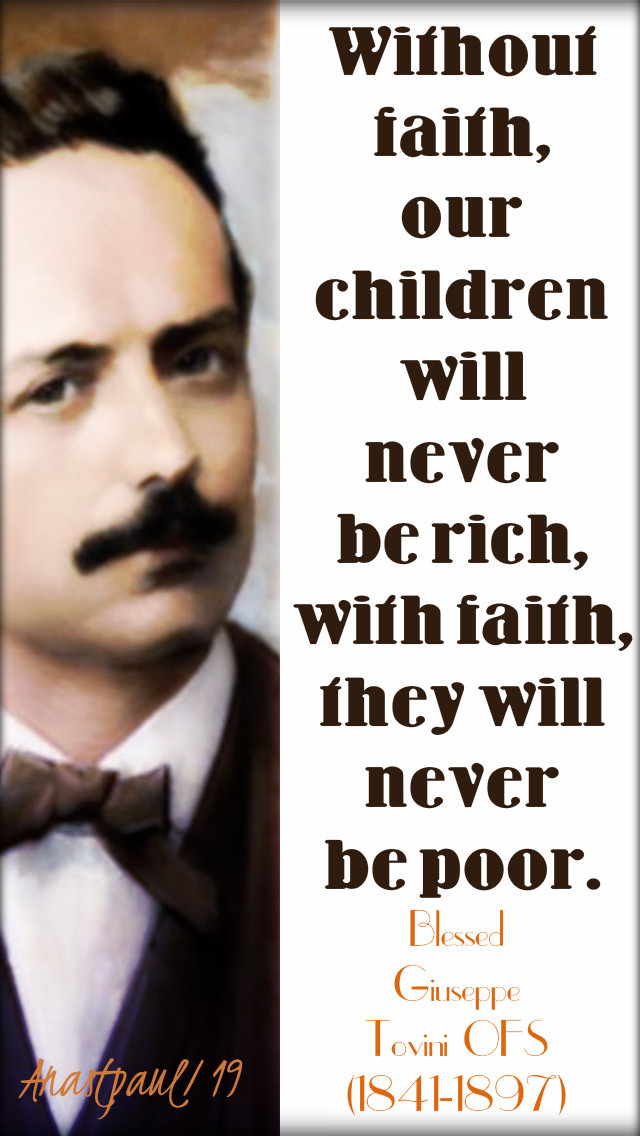
6. Fervent, honest, active in social and political life, Giuseppe Tovini proclaimed the Christian message, always in fidelity to the guidance of the Church’s Magisterium.   His constant concern was to defend the faith, convinced that — as he said at a congress — “without faith our children will never be rich, with faith they will never be poor”. He lived at a sensitive time in the history of Italy and the Church and it was clear to him, that one could not respond fully to God’s call, without being generously and selflessly involved in social problems.

His was a prophetic vision and he responded with apostolic daring to the needs of the times, which in the light of new forms of discrimination required of believers a more incisive leadership in temporal affairs.

Aided by the legal skills and rigorous professionalism that distinguished him, he promoted and directed many social organisations and also held political office in Cividate Camuno and Brescia in the desire to make Christian doctrine and morality present among the people.   He considered commitment to education a priority and prominent among his many initiatives, was his defence of schools and the freedom of teaching.

With humble means and great courage he laboured tirelessly to preserve for Brescian and Italian society what was most particularly its own, that is, its religious and moral heritage.

Tovini’s honesty and integrity were rooted in his deep, vital relationship with God, which he constantly nourished with the Eucharist, meditation and devotion to the Blessed Virgin.   From listening to God in daily prayer, he drew light and strength for the great social and political battles he had to wage to safeguard Christian values.   The Church of St Luke, with its beautiful image of the Immaculata and where his mortal remains now rest, is a witness to his piety.

On the threshold of the third millennium, Giuseppe Tovini, whom today we contemplate in heavenly glory, spurs us on.   I invite you in particular, dear lay faithful of Brescia and Italy, to look to this great social apostle, who was able to give hope to those without voice in the society of his time, so that his example will be an incentive and encouragement to everyone to work generously today and always to defend and to spread the truth and the demands of the Gospel.   May he protect you from heaven and sustain you by his intercession.

Dear Brescians, you have received a great religious and civil heritage – treasure it as an incomparable patrimony and bear active witness to it, with that ingenuity and integrity, that fidelity and perseverance which distinguished Paul VI and Giuseppe Tovini.

7. “I have fought the good fight…. The Lord stood by me” (2 Tm 4:7,17)   These words from the second reading of the Mass summarise the spiritual experience of the two figures we recall today with devout admiration.   We thank God for their witness – it is a precious gift, not only for Brescia but for Italy and for all humanity.   Their memory must not fade with the passing of time.   In different fields and with different responsibilities, they sowed so much good, they fought the good fight – the fight for Truth and the civilisation of Love.

May Mary, Mother of the Church, help us take up their legacy and follow in their footsteps so that we too will be allowed to answer Christ like the Apostle Peter: “Lord, you know everything; you know that I love you” (Jn 21:17). Amen!

Holy Mother Mary, Pray for Us!holy mother mary pray for us 16 jan 2019
St Pope Paul VI, Pray for Us!st pope paul vi pray for us 16 jan 2019

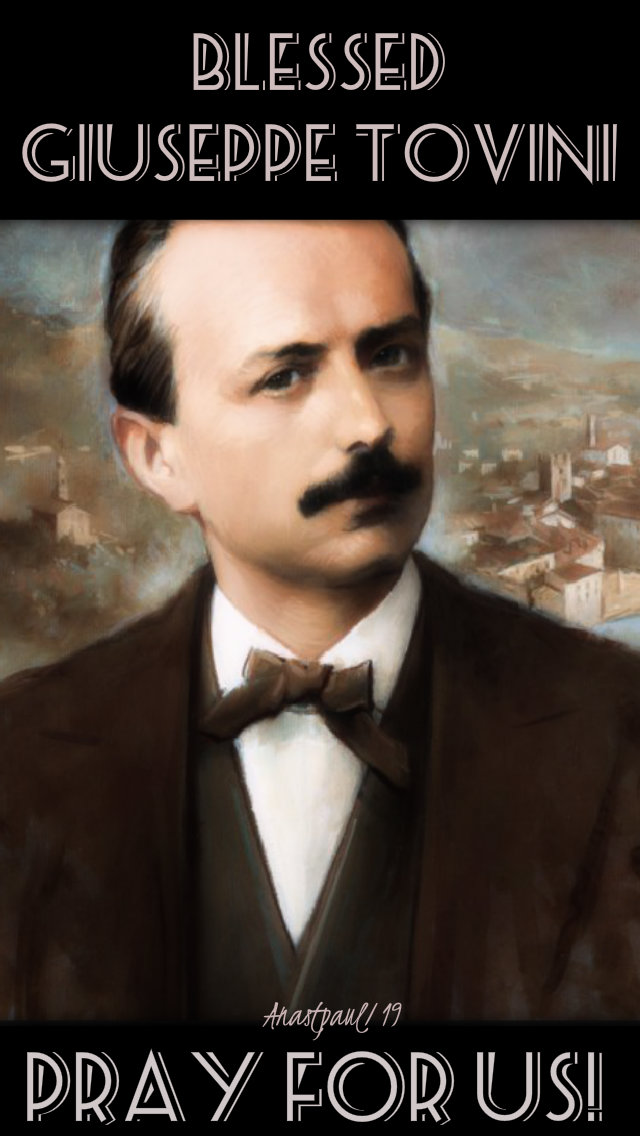
Blessed Giuseppe Tovini, Pray for Us!blessed giuseppe tovini pray for us 16 jan 2019 no 2

Posted in QUOTES of the SAINTS, QUOTES on FAITH, SAINT of the DAY

Quote of the Day – 16 January – The Memorial of Blessed Giuseppe Tovini OFS (1841-1897)

Quote of the Day – 16 January – The Memorial of Blessed Giuseppe Tovini OFS (1841-1897)

“Without faith,
our children
will never be rich,
with faith,
they will never be poor”.

Blessed Giuseppe Toviniwithout faith our children will never be rich with faith they will never be poor bl giuseppe tovini 16 jan 2019.jpg

Posted in DOCTORS of the Church, FATHERS of the Church, MORNING Prayers, QUOTES of the SAINTS, QUOTES on FAITH, SAINT of the DAY, The WORD

One Minute Reflection – 16 January – Wednesday of the First week in Ordinary Time – Gospel: Mark 1:29–39

One Minute Reflection – 16 January – Wednesday of the First week in Ordinary Time – Gospel: Mark 1:29–39

And he came and took her by the hand and lifted her up and the fever left her and she served them...Mark 1:31

REFLECTION – ““And he helped her up.”   As she couldn’t stand up by herself, it was the Lord who helped her.   “He grasped her hand and helped her up.”   When Peter was in danger on the sea, just as he was going to drown, he too was grasped by the hand and raised up… What a beautiful sign of friendship and love towards this sick woman!   He helped her up by taking her hand, His hand healed the sick woman’s hand.   He grasped that hand as a doctor would have done, He who was both doctor and remedy took her pulse and assessed the gravity of the fever.   Jesus touched it and the fever vanished.
Let us want Him to touch our hand so that in this way what we do may be made pure. Should He enter our house, let us get off our bed at last and not remain lying down.  Jesus stands at our bedside and will we remain lying down?   Come on! To your feet!… “There is one among you whom you do not recognise” (Jn 1:26); “the kingdom of God is among you” (Lk 17:21).   Let us have faith and we shall see Jesus among us.”...St Jerome (347-420) Father & Doctor of the Churchmark 1 31 and he came and took her by the hand - let us want him to touch our hand st jerome 16 jan 2019.jpg

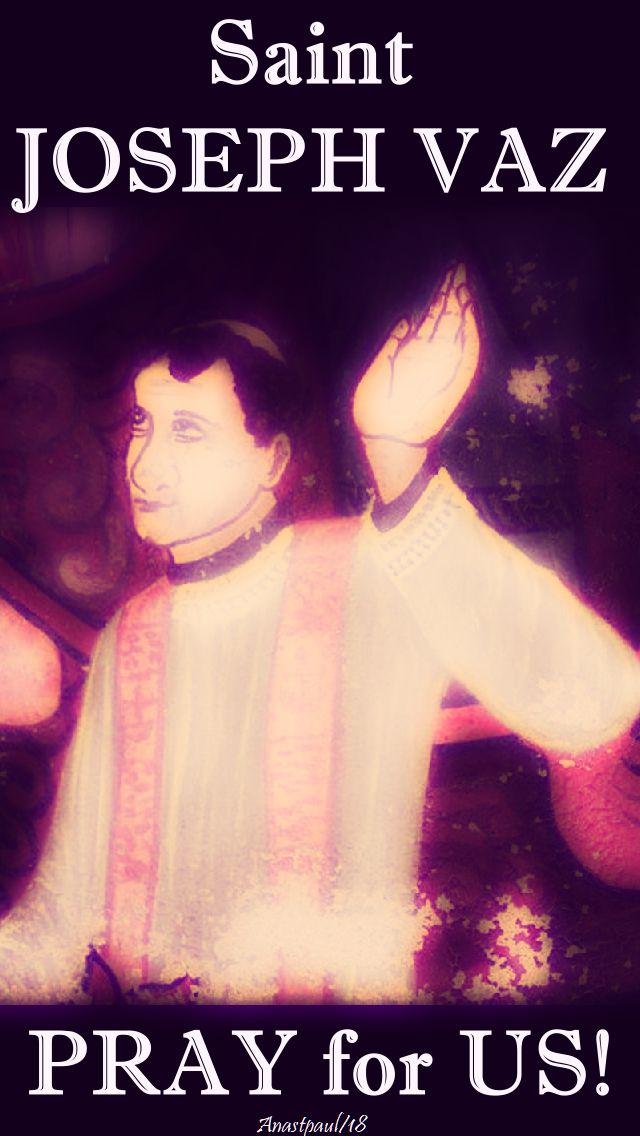
PRAYER – God our Saviour, through the grace of Baptism, You made us children of light. You lead us by the hand and guide and protect us by Your commandments.   Fill us with joy at Your nearness and the light of Your Son, by whose beam we see You and follow. Blessed Giuseppe Tovini and St Joseph Vaz, were shining examples to us all, grant, we pray, that their prayers may aid us.   Through Jesus our Lord and Christ, with the Holy Spirit, God forever, amen.st-joseph-vaz-pray-for-us-no-2-16-jan-2018.jpg

bl giuseppe tovini pray for us 16 jan 2019

Posted in franciscan OFM, SAINT of the DAY

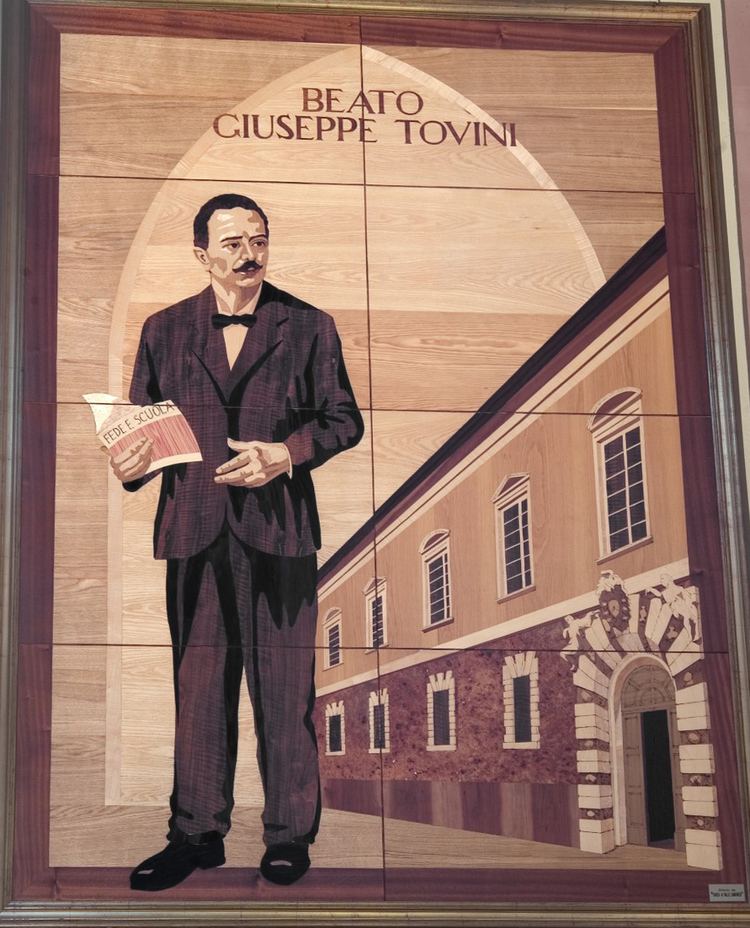
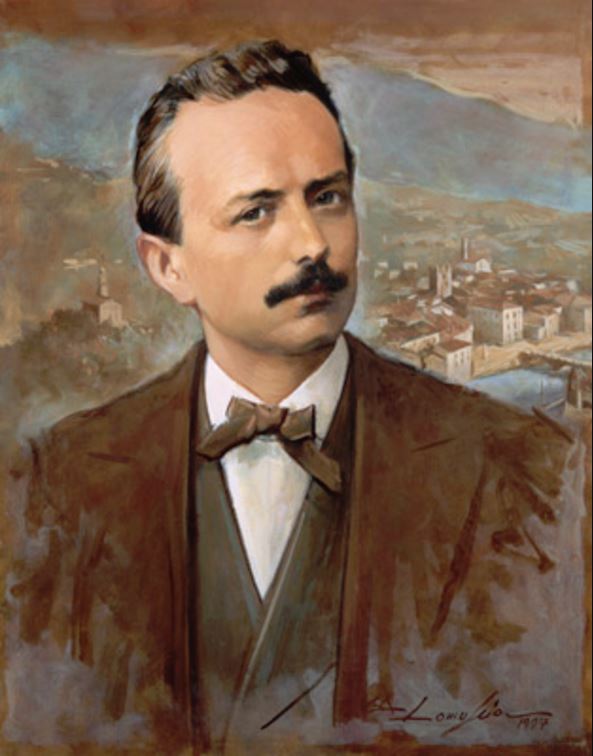
Saint of the Day – 16 January – Blessed Giuseppe Tovini OFS (1841-1897)

Saint of the Day – 16 January – Blessed Giuseppe Tovini OFS (1841-1897) Italian banker and lawyer who became a member of the Secular Franciscan Order, Social and Catholic educational activist, as well as charitable assistance and involved in the beginnings of Catholic Action.   His nephew was Blessed Mosè Tovini (1877– 1930).   He was born on 14 March 1841 as  Giuseppe Antonio Tovini, in Cividate Camuno, Brescia, Italy and died on 16 January 1897 in Brescia, Italy of natural causes.    Patronages – Franciscan tertiaries, Lawyers, Bankers, Cividate Camuno.giuseppe-tovini-6466887b-b082-4ac8-91df-a5a368ce1b6-resize-750

Giuseppe Antonio Tovini was born in 1841 as the first of seven children to Mosè Tovini and Rosa Malaguzzi.   He went to high school in Bergamo from 1852 to 1858 and later graduated from the University of Pavia in August 1865.   He then moved to Brescia in 1867 to become a lawyer and obtained all the appropriate qualifications to practice law in 1868.

He later married Emilia Corbolani on 6 January 1875 and they went on to have a total of ten children.   One son became a Jesuit priest and two daughters became nuns.   From 1871 to 1874, Tovini served as the mayor of Cividate Camuno, his birthplace.   As mayor, he made important decisions in the life of the city from promoting the establishment of banks to the construction of infrastructure like railway lines.  Most importantly, he worked to defend and help the poor and alienated.bl giuseppe my edit.JPG

Tovini also became a member of the Secular Franciscan Order and was among the founders of a Catholic newspaper which published its first edition in 1878 after its founding on 3 April.   He founded Banca di Valle Camonica in 1872, Banca San Paolo di Brescia in Brescia in 1888, Banco Ambrosiano in Milan in 1896.

In 1882 he founded Saint Joseph’s Kindergarten and helped founded the Union Leone XIII to support the faith of students in university in Brescia and worked support similar groups in other schools.   He founded the magazine Modern Italian School in 1893 and  the weekly journal La Voce del Popolo in 1893.    He helped the Canossian sisters found a teaching college in Cividate Camuno in 1894.    He also supported the Catholic University Federation and the creation of Catholic universities in Italy.  Further still, Blessed Giuseppe founded the Banca Santa Paolo in Brescia in 1888 and the Society for the Preservation of the Faith in Italian Schools in 1890.    The journal Faith and School was founded by Giuseppe in 1891.  bl giuseppe - upsized my edit

He died in 1897 with a reputation for personal holiness.

The cause of beatification was introduced on 14 April 1977 under Pope Paul VI  (who was a great admirer of Bl Giuseppe).   St Pope John Paul II declared he lived a life of heroic virtue and made him Venerable on 6 April 1995 and approved a miracle attributed to his intercession on 18 December 1997.   He was beatified on 20 September 1998.bl giuseppe vintage my edit

Posted in SAINT of the DAY

Memorials of the Saints – 16 January

St Berard and Companions (Peter, Adjute, Accurs, Odo and Vitalis)
St Dana of Leuca
St Dunchaid O’Braoin
St Fulgentius of Ecija
St Fursey of Peronne
Bl Gonzalo de Amarante
Bl Giuseppe Tovini OFS (1841-1897)
St Henry of Coquet
St Honoratus of Arles
St Honoratus of Fondi
Bl James of Luino
St James of Tarentaise
Bl Joan of Bagno di Romagna

St Joseph Vaz CO (1651-1711) Apostle of Sri Lanka
About St Joseph: https://anastpaul.wordpress.com/2018/01/16/saint-of-the-day-16-january-st-joseph-vaz-c-o-1651-1711-apostle-of-sri-lanka/

St Juana Maria Condesa Lluch
Bl Konrad II of Mondsee
St Leobazio
St Liberata of Pavia
St Pope Marcellus I
St Melas of Rhinocolura
St Priscilla of Rome
St Sigeberht of East Anglia
St Titian of Oderzo
St Triverius
St Valerius of Sorrento

Posted in PRAYERS to the SAINTS, QUOTES of the SAINTS, QUOTES on SACRIFICE, QUOTES on SUFFERING, QUOTES on TRUST and complete CONFIDENCE in GOD, SAINT of the DAY

Thought for the Day – 15 January – The Memorial of Bl Nikolaus Gross (1898-1945) Martyr

Thought for the Day – 15 January – The Memorial of Bl Nikolaus Gross (1898-1945) Martyr

Excerpt from “A Daughter Remembers”

by Marianne Gross Reichartz

“On 15 January 1945 Roland Freisler announced the death sentence.   Quote from the process report.  “Modest in nature, near the proclamation of judgement, weeping.”   After the verdict my parents could see each other again and say goodbye for this life.

In a farewell letter to his family, my father writes:

“Especially you, dear mother, I still have to thank you.  When we said goodbye a few days ago for this life, I returned to the cell, I thanked God from the bottom of my heart for your Christian strength and faith.   Yes, mother, through your brave farewell You have poured a bright light on my last days of life, the conclusion of our heartfelt love could not be more beautiful and happy than it has become through your strong-minded behaviour. “

On 23 January 1945, my father was executed in Berlin Plötzensee.

After the end of the war, my mother’s great task was to continue on her own what she and her husband had dreamed up for their family.   My brother Klaus returned from Russia three years after the end of the war.   My mother now had to raise her seven children alone and we were not simple children.   Since we had received no official death message, my mother did not receive any pension.   We rented the parental bedroom to guests.   All children wrote addresses for the newspaper advertisement of the first Cologne newspaper, for 2 Pfennig per letter.   We girls sewed rubber panties on behalf of a small company created in the backyard.   While the widow Freisler already put in their considerable pension every month, my mother had to fight for her pension for years under degrading circumstances.

But never has this strong and upright woman criticised her husband’s path, never felt betrayed or abandoned.   All the good that happened to us, she attributed to my father. When friends and good people helped us with food and money during the hunger period after the war and when they helped us children with their schooling and job search, the mother called them “tools of the father.”   “The father helps us again,” she always said then.

As young people we often and gladly discussed after the end of the war.   For too long the mouth had been banned.   A popular topic was:   Can a father of seven children go so far? Her answer:   “He would have died internally if he could not have lived his life and his faith and that would have been as much a death to him as bodily death.”   The memorial days of her husband (the anniversary of the death on 23 January and 20 July), the many initiations and naming ceremony, she celebrated with strength and dignity.

When the name of my Father is proclaimed in St Peter’s Square on 7 October 2001, at the Beatification of Nikolaus Gross, I am not only proud of my father, then, I am proud of my parents!”

Living God,
You have given the Blessed Nikolaus Gross
the strength to be a Christian in family, work and society
and to give his life
in resistance to the evil forces of his time.
We ask you –
Strengthen us also in faith,
so that we may recognise
Your mission for our lives
and fill it with courage and perseverance,
through Jesus Christ, Your Son,
who lives in the unity of the Holy Spirit
with You and reigns for all eternity.
Amen

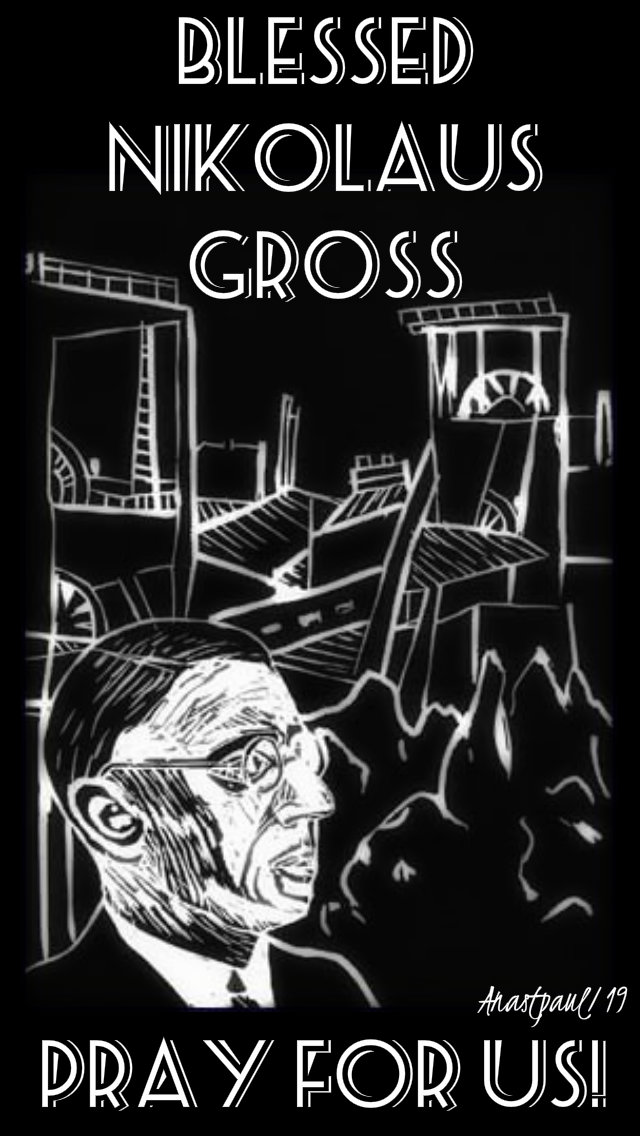
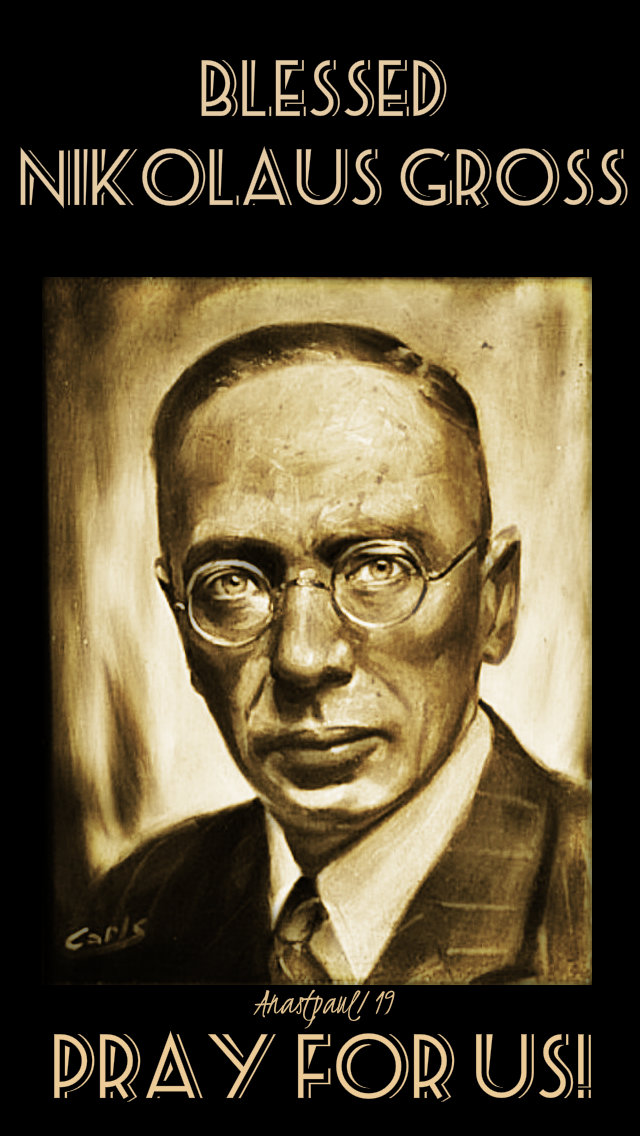
Blessed Nikolaus Gross – Pray for Us!bl nikolausa gross pray for us no 2 15 jan 2019.jpg

Posted in QUOTES of the SAINTS, QUOTES on CONSCIENCE, QUOTES on COURAGE, QUOTES on DEATH, QUOTES on ETERNAL LIFE, QUOTES on FAITH, QUOTES on HOPE, QUOTES on JUSTICE, SAINT of the DAY, The LAST THINGS

Quote/s of the Day – 15 January – The Memorial of Bl Nikolaus Gross (1898-1945) Martyr

Quote/s of the Day – 15 January – The Memorial of Bl Nikolaus Gross (1898-1945) Martyr

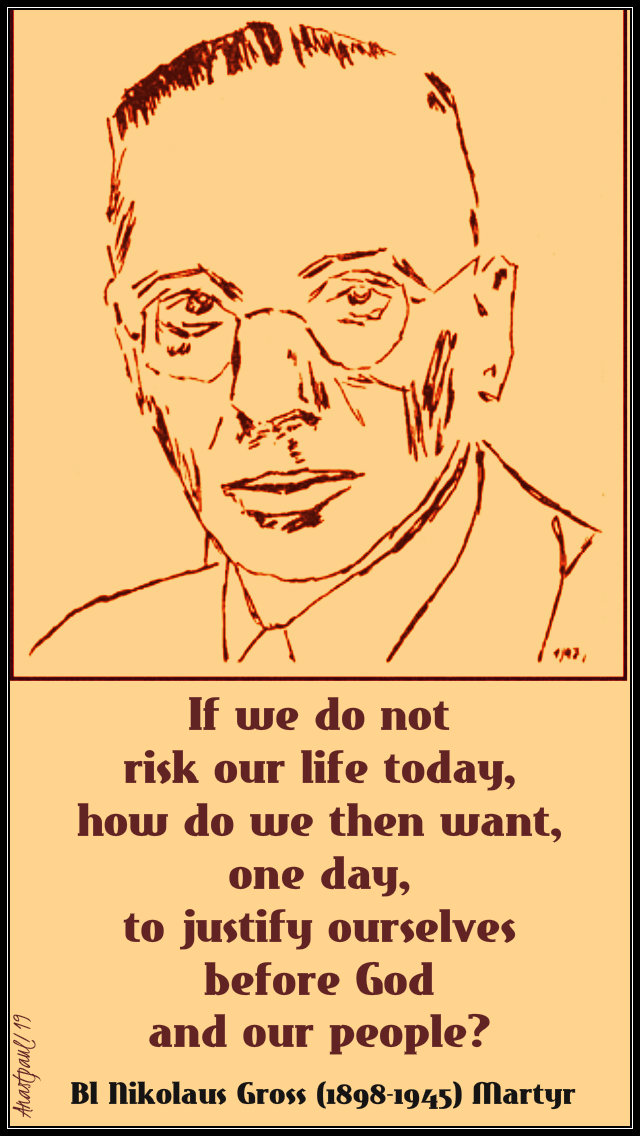
“If we do not risk our life today,
how do we then, want one day,
to justify ourselves
before God and our people?”if we do not risk - bl nikolaus gross 15 jan 2019

“…One must obey God more than men”.
If something is demanded of us
that goes against God or the Faith,
then, not only, may we but we must,
refuse obedience (towards men).”one must obey god - bl nikolays gross - 15 jan 2019

“Sometimes, my heart becomes heavy and the task appears insoluble if I measure my own human imperfection and inadequacy against the greatness of the obligation and the weight of the responsibility.

If a generation must pay the highest price, death, for its short life, we look for the answer in ourselves in vain.   We find it only in Him in whose hand we are safe in life and in death.   We never know what problems are waiting to test the power and strength of our souls…. Man’s ways lie in obscurity.

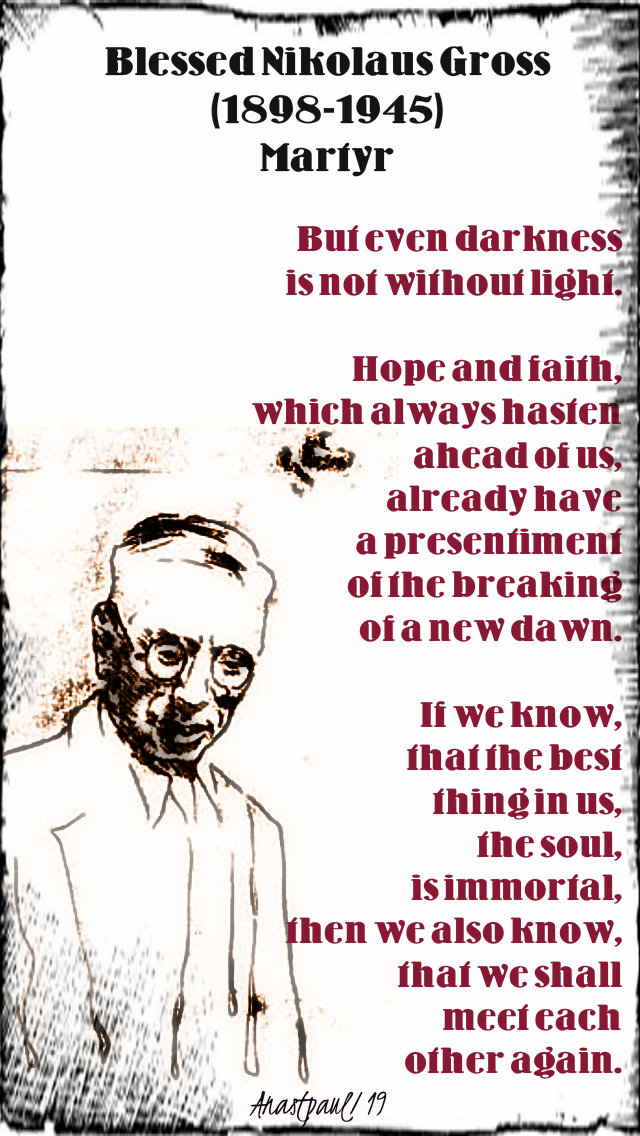
But even darkness is not without light.   Hope and faith, which always hasten ahead of us, already have a presentiment of the breaking of a new dawn.   If we know, that the best thing in us, the soul, is immortal, then we also know, that we shall meet each other again”.

Bl Nikolaus Gross (1898-1945) Martyrbut even darkness is not without light - bl nikolaus gross 15 jan 2019.jpg

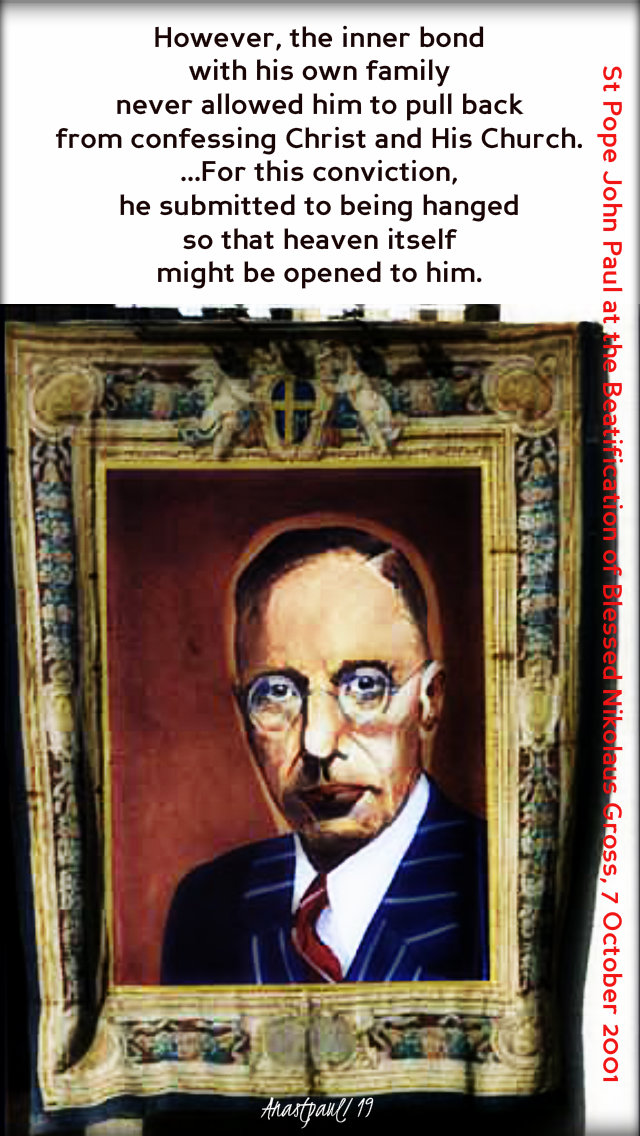
“With the clear insight that the Nazi ideology was incompatible with Christian faith, he courageously took up his pen to plead for the dignity of human beings.   Nikolaus loved his wife and children very much.   However, the inner bond with his own family never allowed him to pull back from confessing Christ and His Church.   It was clear to him, “If we do not risk our life today, how then do we want to justify ourselves one day before God and our people?”.   For this conviction he submitted to being hanged, so that heaven itself might be opened to him.   In the Blessed Martyr Nikolaus Gross was accomplished what the prophet foretold “The just man will live on account of his faith” (Hb 1,4).

St Pope John Paul at the Beatification of Blessed Nikolaus Gross, 7 October 2001howver the inner bond - st john paul on bl nikolaus gross 15 jan 2019.jpg

Posted in MARIAN TITLES, MORNING Prayers, SAINT of the DAY, The WORD

One Minute Reflection – 15 January – Today’s Gospel: Mark 1:21-28

One Minute Reflection – 15 January – Tuesday of the First Week in Ordinary Time – Today’s Gospel: Mark 1:21-28 and The Feast of Our Lady of Banneux & Memorial of Bl Nikolaus Gross (1898-1945) Martyr

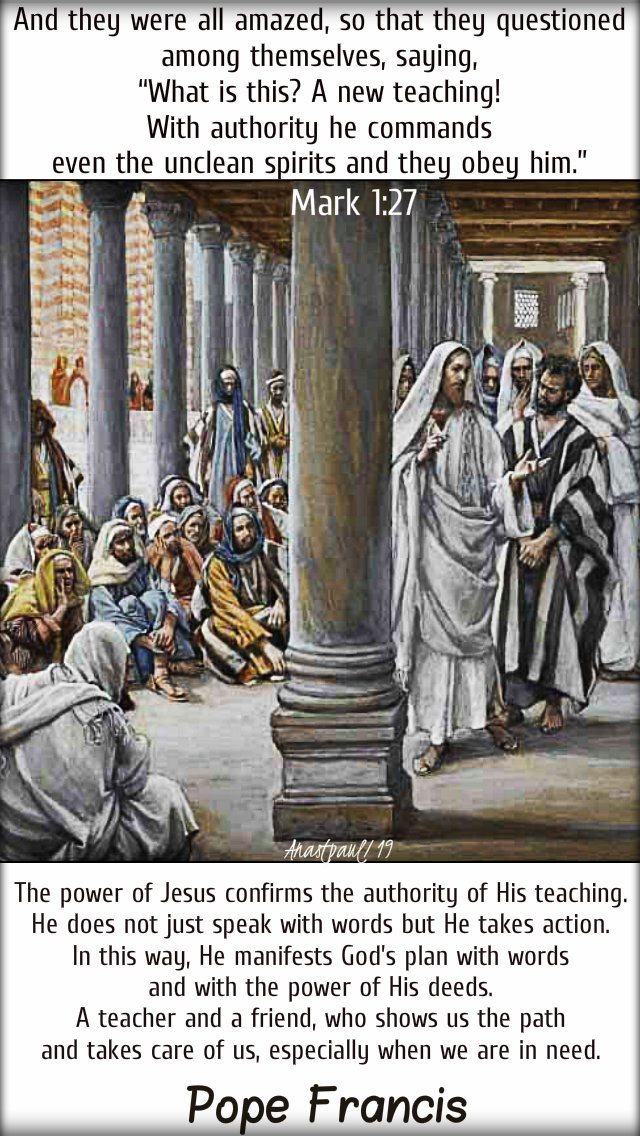
And they were all amazed, so that they questioned among themselves, saying, “What is this?   A new teaching!   With authority he commands even the unclean spirits, and they obey him.” …Mark 1:27

REFLECTION – “The power of Jesus confirms the authority of His teaching.   He does not just speak with words but He takes action.   In this way, He manifests God’s plan with words and with the power of His deeds.   A teacher and a friend, who shows us the path and takes care of us, especially when we are in need.”…Pope Francis – Angelus, 28 January 2018mark 1 27 and they were all amazed - the power of Jesus - pope francis 15jan2019.jpg

PRAYER – King of heaven and earth, Lord God, rule over our hearts and bodies this day. Sanctify us and guide our every thought, word and deed, according to the commandments of Your law, so that now and forever, Your grace may free and save us. Sanctify our hearts, minds and actions with Your power, that all we are may speak of Your Light.   May the prayers of our Mother of Banneux and Blessed Nikolaus Gross, who so diligently followed You in the darkness around him, bring us to peace and confidence. We make our prayer through Your Son, our Lord Jesus, in union with the Holy Spirit, one God for all eternity, amen.our-lady-of-banneux-pray-for-us-15-jan-2018

bl nikolaus gross - rpay for us 15 jan 2019

Posted in SAINT of the DAY

Saint of the Day – 15 January – Blessed Nikolaus Gross – (1898-1945) Martyr

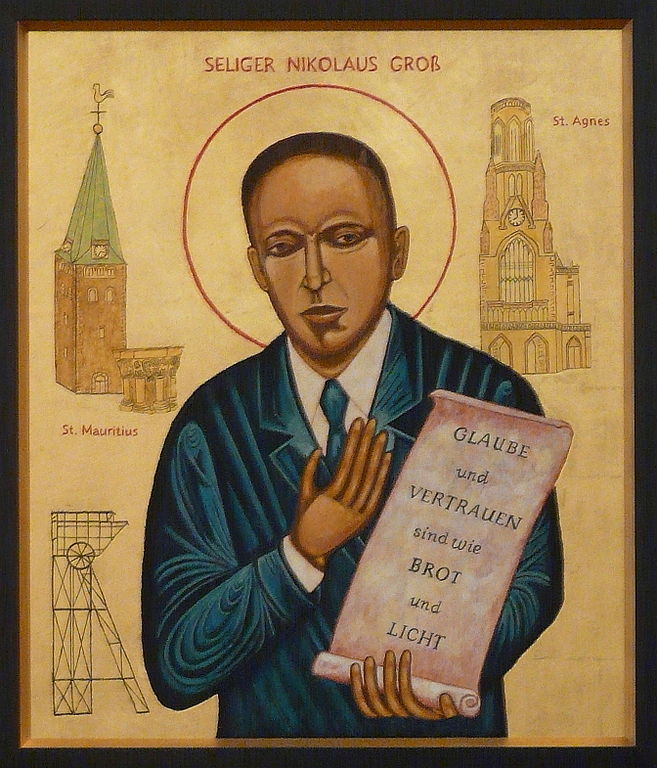
Saint of the Day – 15 January – Blessed Nikolaus Gross – (1898-1945) Martyr, layman, father of seven children, union activist, newspaper editor, apostle of charity.   Born on 30 September 1898 at Niederwenigern, Ruhr region, Germany and died by execution on 23 January 1945 at the Berlin-Plotzensee, Germany prison.  He was Beatified on 7 October 2001 by St Pope John Paul II at Saint Peter’s Basilica, Rome, Italy.Nikolaus_Groß_Ikone_sel.gesprochen_2001.JPG

Nikolaus Gross was born on 30 September 1898 of a colliery blacksmith in Niederwenigern, near the city of Essen and attended the local Catholic school from 1905-12.   He then worked initially in a plate rolling mill, then as a grinder and later as a face-worker in a coal mine.   He worked underground for five years.

In his limited spare time, he continued his higher education.   In 1917, he joined the Christian Miners’ Trade Union.   In 1918 he joined the Centre Party (the Catholic political party).   In 1919 he joined the St Anthony’s Miners Association (Antonius Knappenverein KAB) in Niederwenigern.   It was the major Catholic union for the Catholic miners and a major Catholic voice.   At the age of 22 he became secretary for young people in the union.   A year later he became assistant editor of the union newspaper Bergknappe (“The Miner”).   His work with the union took him around Germany until he finally settled in Bottrop in the Ruhr Valley, in what is now the Diocese of Essen.

In the meantime, he married Elizabeth Koch from Niederwenigern.   They had seven children in the course of their happy marriage.   He loved his family above everything and was an exemplary father in his responsibility for their education and upbringing in the faith.   Gross did not withdraw into the shell of family life.   He remained attuned to the great social problems, precisely in his responsibility for his family.   Work and social obligations were the place in which he realised his Christian mission.   In his doctrine of faith written in 1943 he wrote:  “The majority of great achievements come into being through the daily performance of one’s duties in the little things of everyday routine.   Our special love here is always for the poor and the sick”.

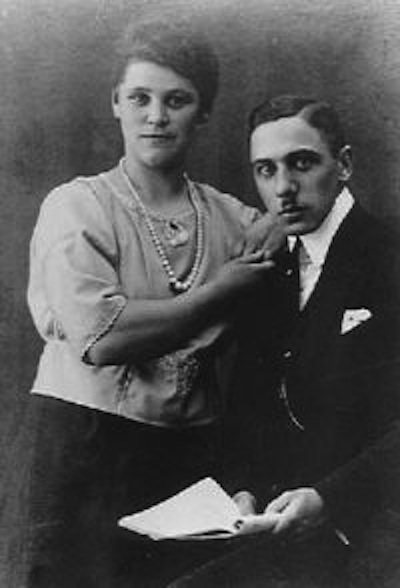
nikolaus_und_elisabeth_groß
Nikolaus and his wife Elisabeth.

At the beginning of 1927, he became assistant editor of the Westdeutsche Arbeiterzeitung (West German Workers’ Newspaper), the organ of the St Anthony’s Miners’ Association (KAB) and soon became its editor-in-chief.   Here he was able to give Catholic workers guidance on social and labour questions.   In the course of time, it became clear to him that the political challenges contained a moral claim and that the social problems cannot be solved without spiritual efforts.

The editor became a messenger who bore witness to his faith here too.   When he moved in this capacity to the Ketteler House in Cologne, in 1929, he already had a clear opinion about approaching Nazism  . Starting out from Bishop Ketteler’s main idea that a reform of the conditions in society can only be achieved by a reform in attitude, he saw in the Nazis’ success in society:  “political immaturity” and “a lack of discernment”.   Already at that time he called the Nazis “mortal enemies of the present state”.   As editor of the organ of the KAB, on 14 September 1930, he wrote:   “As Catholic workers we reject Nazism not only for political and economic reasons but decisively also, resolutely and clearly, on account of our religious and cultural attitude”.

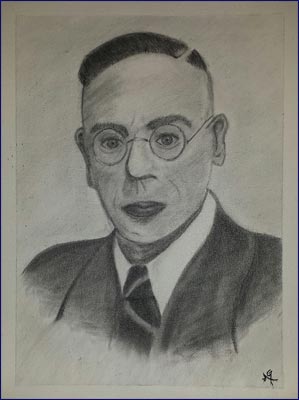
bl nikolaus gross by alice gross
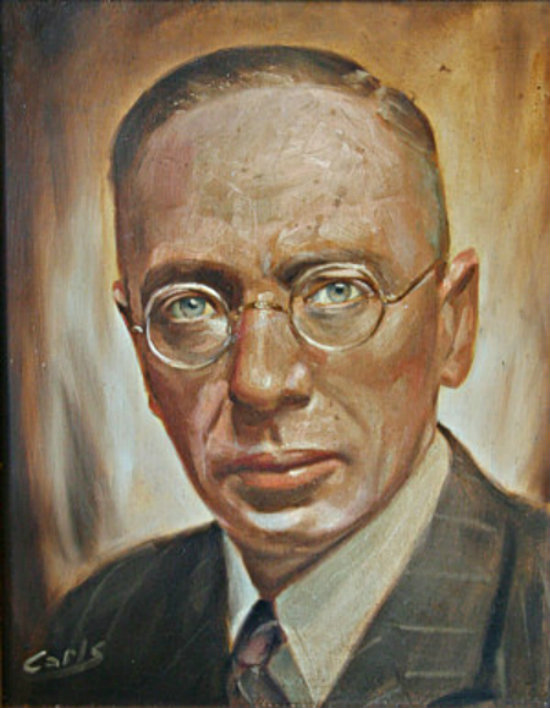
Drawing by Alice Gross

Already a few months after Hitler’s seizure of power, the leader of the German Labour Front, Robert Ley, called the KAB’s Westdeutsche Arbeiterzeitung “hostile to the state”.  In the following period, Gross attempted to save the newspaper from destruction without making concessions on its content.   From then on he knew how to write between the lines.   In November 1938 came the final ban on the workers’ newspaper which, in the meantime, had been renamed Kettelerwacht (Ketteler’s Watch).

Gross, who had to work very hard for his education was no great orator.   But he spoke convincingly, warm-heartedly and with power of persuasion.   The fact that Nikolaus Gross joined the resistance in Germany resulted from his Catholic religious conviction. For him the key was “that one must obey God more than men”.   “If something is demanded of us that goes against God or the Faith, then not only may we but we must, refuse obedience (towards men)”   Thus wrote Nikolaus Gross in 1943 in his doctrine of faith.   It was becoming ever clearer to him that Germany had reached this state under the Hitler regime.

Gross set down his joint thoughts in two writings which later fell into the hands of the Gestapo:   The Great Tasks and Is Germany Lost?   They were to contribute towards his execution.

bl nikolaus gross by barbara piwarski- essen 2001.jpg
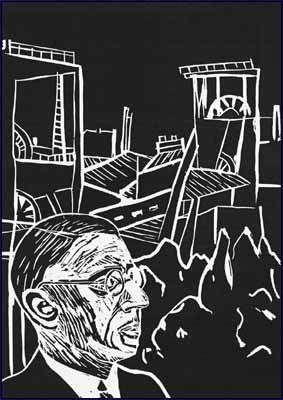
Lino cut by Barbara Piwarski

In 1940, Gross had to endure interrogations and house searches.   After the ban on the association’s newspaper, he published a series of small pamphlets which were intended to help strengthen the critical force of faith and Gospel values among workers.   We find an answer for the reasons which motivated someone like Nikolaus Gross in the memoirs of the well-known, workers’ chaplain, Msgr Caspar Schulte of Paderborn.   There we read:  “In my many conversations, especially with Nikolaus Gross and the association’s head, Otto Müller, I got to know and admire these men’s moral greatness.   They did not stumble into death.   They went their way also prepared to bear a painful death for the sake of freedom.   I said to Nikolaus Gross on the day before the assassination attempt on Hitler of 20 July 1944:  “Mr Gross, remember that you have seven children. I have no family for which I am responsible.   It’s a matter of your life’.   To which Gross made a really great statement to me:  “If we do not risk our life today, how do we then want one day to justify ourselves before God and our people?'”.

bl nikolaus gross by pralat albert essen 1997.gif
Drawing by Pralat Albert, Essen

In 1943, Gross wrote in a booklet, what was almost a prophecy:  “Sometimes, my heart becomes heavy and the task appears insoluble if I measure my own human imperfection and inadequacy against the greatness of the obligation and the weight of the responsibility.   If a generation must pay the highest price, death, for its short life, we look for the answer in ourselves in vain.  We find it only in Him in whose hand we are safe in life and in death.   We never know what problems are waiting to test the power and strength of our souls….  Man’s ways lie in obscurity.  But even darkness is not without light.   Hope and faith, which always hasten ahead of us, already have a presentiment of the breaking of a new dawn.   If we know that the best thing in us, the soul, is immortal, then we also know that we shall meet each other again”.   What a testimony to a sense of responsibility, feeling for reality and assurance of faith!   For Gross, trust in God was the foundation on which he did not falter.   During the years of the war he formed a network of resistance to the Nazi’s and he was often the courier between the centres of resistance.   He was well informed of the plot to assassinate Hitler, even though he took no part in its preparation and execution.

After the abortive assassination attempt on 20 July 1944, events came thick and fast. Gross, who was not himself involved in the preparation and execution of the plot, was arrested towards noon at his home on 12 August 1944 and taken first to the prison in Ravensbrück and then to the penitentiary in Berlin-Tegel.   His wife, Elisabeth, came to Berlin twice to visit him  . She reported clear signs of torture on his hand and arms.   His letters from the prison and the witness of the chaplain, Fr Peter Buchholz, give impressive evidence that constant prayer was the source of strength in his difficult and, in the end, hopeless position.   In every letter he never failed to request constant prayer from his wife and his children, just as he himself also prayed for his family each day.

bl nikolaus gross by hanna frey  no 2 1997.jpg
By Hanna Frey

On 15 January 1945, the death sentence was pronounced by the chairman of People’s Court, Roland Freisler.   His final remark in the court record and the real reason for the sentence:  “He swam along in treason and consequently had to drown in it!”.   He was hanged in Berlin-Plotzensee on 23 January 1945.   The Nazis did not make any martyrs.   They did not allow the hanged man to have a grave.   For the followers of falsehood and hatred there was only brutal destruction.  His ashes were scattered across a sewage farm.

But the testimony to truth and faith is not to be obliterated!   It lives on in those who have gone before us as a shining example.   The prison chaplain, Fr Peter Buchholz, who blessed the condemned man on his final walk, reported afterwards:  “Gross bowed his head silently during the blessing.   His face already seemed illuminated by the glory into which he was getting ready to enter”.nikolaus-gross.jpg

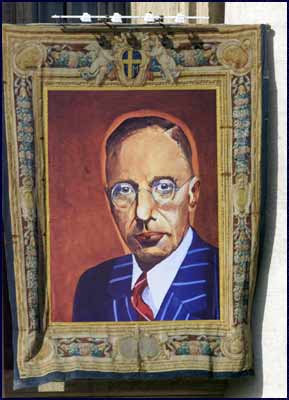
He was Beatified on 7 October 2001 by St Pope John Paul II at Saint Peter’s Basilica, Rome, Italy.beatification banner bl nikolaus gross 2001

There is a museum dedicated to Nikolaus Gross in Niederwenigern.   In 1948 a street in Cologne was named in his honour and streets were named after him in places such as Berlin and Essen amongst others.   A chapel was dedicated to him on 10 October 2004 and a memorial stone in Gelsenkirchen-Buer on 26 October 2003.

1024px-Hattingen_Niederwenigern_-_Domplatz_-_Nikolaus-Groß-Haus_02_ies.jpg
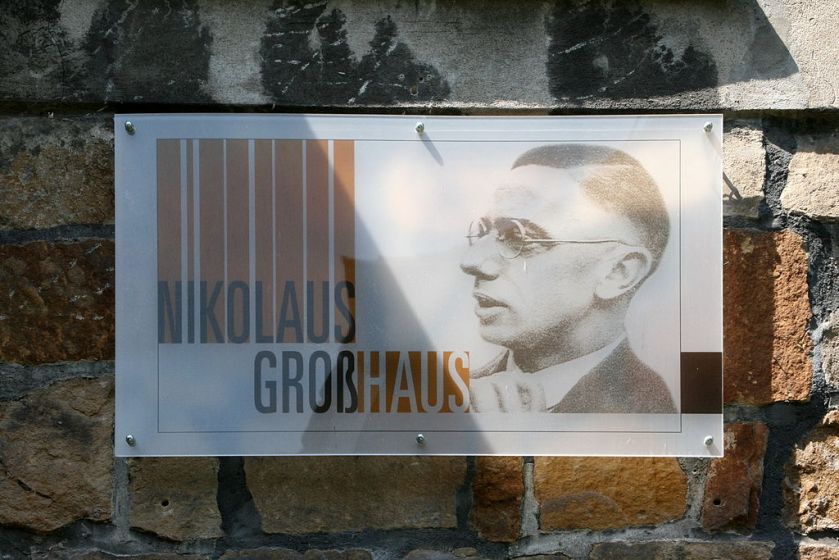
Sign at the Nikolaus-Groß-Haus (museum) in Niederwenigern.
Posted in MARIAN TITLES, SAINT of the DAY

Feast of Our Lady of Banneux and Memorials of the Saints – 15 January

Our Lady of Banneux, Belgium (under 2 Titles Our Lady of the Poor and Queen of Nations):  Our Lady of Banneux, or Our Lady of the Poor, is the sobriquet given to the apparition of the Virgin Mary to Mariette Beco, an adolescent girl living in Banneux, province of Liège (Belgium).    Between January 15 and March 2, 1933, Beco told her family and parish priest of seeing a Lady in white who declared herself to be the “Virgin of the Poor”, saying I come to relieve suffering and believe in me and I will believe in you.   As Our Lady of Banneux she has two titles: Our Lady of the Poor and Queen of Nations.115olbanneux3.jpg
Mariette Beco was twelve years old when she reported Marian apparitions in 1933 in Banneux, Belgium, a hamlet about 15 kilometres (10 mi) southeast of the city of Liège.   In this case, the Lady in White reportedly declared she was the Virgin of the Poor and said: “Believe in me and I will believe in you.”

Prayer to Our Lady of Banneux
Our Lady of the Poor and
Queen of Nations

Blessed Virgin of the Poor,
lead us to Jesus, Source of grace.
Blessed Virgin of the Poor, save all nations.
Blessed Virgin of the Poor, relieve the sick.
Blessed Virgin of the Poor, alleviate suffering.
Blessed Virgin of the Poor, pray for each one of us.
Blessed Virgin of the Poor, we believe in you.
Blessed Virgin of the Poor, believe in us.
Blessed Virgin of the Poor, we will pray hard.
Blessed Virgin of the Poor, bless us.
Blessed Virgin of the Poor,
Mother of the Saviour,
Mother of God, we thank You.
Mary Virgin of the Poor,
You lead us to Jesus,
source of grace
and you come to alleviate our suffering.
We implore you with confidence,
help us to folow your Son with generosity
and to belong to Him unreservedly.
Help us to welcome the Holy Spirit
Who guides and sanctifies us.
Obtain us the grace to look like Jesus everyday
so that our life will glorify the Father
and contribute to the salvation of all.
Amen.prayer-to-our-lady-of-banneux-14-jan-2018.jpg

http://www.miraclehunter.com/marian_apparitions/approved_apparitions/banneaux/

St Alexander of Goma
Bl Angelus of Gualdo Tadini
St Arnold Janssen
St Blaithmaic of Iona
St Bonitus of Clermont
St Britta
St Ceolwulf of Northumbria
St Emebert of Cambrai
St Ephysius of Sardinia
St Eugyppius
St Francis Ferdinand de Capillas
Bl Geoffrey of Peronne
Bl Giacomo Villa
St Gwrnerth
St Habakkuk the Prophet
St Isidore of Scété
St Isidore the Egyptian
St Ita of Killeedy
St John Calabytes
St Liewellyn
St Lleudadd of Bardsey
St Macarius of Egypt
St Malard of Chartres
St Maura
St Maurus
St Maximus of Nola
Bl Nikolaus Gross – (1898-1945) Martyr
St Pansofius of Alexandria
St Paul the Hermit (c 227-c 342)
About: https://anastpaul.wordpress.com/2018/01/15/saint-of-the-day-15-january-st-paul-the-hermit-c-227-c-342/

Bl Peter of Castelnau
St Placid
St Probus of Rieti
St Romedio of Nonsberg
St Sawl
St Secondina of Anagni
St Secundina of Rome
St Tarsicia of Rodez
St Teath

Martyrs of Suances – 5 beati:   A priest and four laymen in the archdiocese of Burgos, Spain who were martyred together in the Spanish Civil War.
• Blessed Donato Rodríguez García
• Blessed Emilio Huidobro Corrales
• Blessed Germán García y García
• Blessed Valentín Palencia Marquina
• Blessed Zacarías Cuesta Campo
They were martyred on
15 January 1937 near Suances, Cantabria, Spain
Venerated on 30 September 2015 by Pope Francis (decree of heroic virtues)
and Beatified on 23 April 2016 by Pope Francis.   The beatification was celebrated in Burgos, Spain, presided by Cardinal Angelo Amato.

Posted in SAINT of the DAY

Thought for the Day – 14 January – The Memorial of St Felix of Nola (Died c 253)

Thought for the Day – 14 January – Monday of the First week in Ordinary Time, Year C – Gospel: Mark 1:14–20 and the Memorial of St Felix of Nola (Died c 253)

Felix received a clear call to action from the angel in his prison cell, just as the Blessed Virgin received the Archangel Gabriel’s message of her extraordinary role in the Incarnation of Jesus.   Felix heard the call and risked his life and unimaginable suffering to answer it.   While the messages we receive from the Lord are not always heralded by angels, we still need to listen for them—and perhaps listen all the more closely.   These are the quiet urgings of our hearts, which bring us closer to our God.   How often are we too busy and too wrapped up in our wants and needless anxieties to hear the call of God? Might slowing down and creating some silence in our lives enable a deeper communion with Christ?

Today, we pray for that silence—the silence in which we hear and understand what the Lord wishes for and of us and the courage to stand up and put the call into action!

St Felix of Nola, Pray for Us!st felix of nola pray for us no 2 14 jan 2019.jpg

Posted in MORNING Prayers, SAINT of the DAY, The WORD

One Minute Reflection – 14 January – Gospel: Mark 1:14–20

One Minute Reflection – 14 January – Monday of the First week in Ordinary Time, Year C – Gospel: Mark 1:14–20 and the Memorial of St Felix of Nola (Died c 253) & Blessed Petrus Donders C.Ss.R. (1807-1887)

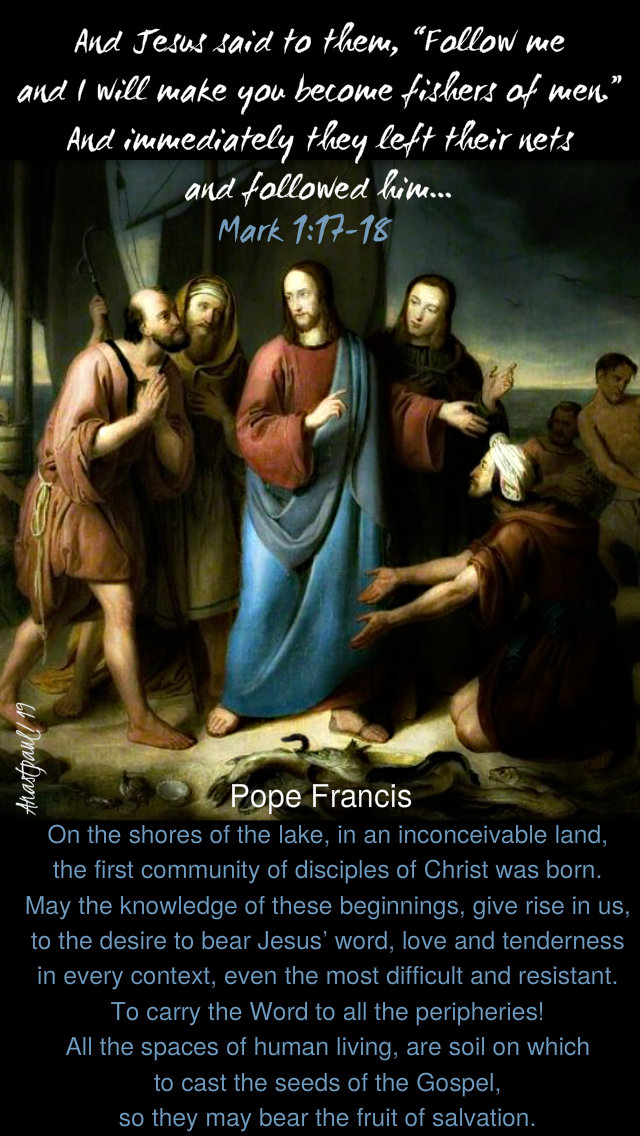
And Jesus said to them, “Follow me and I will make you become fishers of men.” And immediately they left their nets and followed him…Mark 1:17-18

REFLECTION – “We, today’s Christians, have the joy of proclaiming and witnessing to our faith because there was that first announcement, because there were those humble and courageous men who responded generously to Jesus’ call.   On the shores of the lake, in an inconceivable land, the first community of disciples of Christ was born.   May the knowledge of these beginnings give rise in us to the desire to bear Jesus’ word, love and tenderness in every context, even the most difficult and resistant.   To carry the Word to all the peripheries!   All the spaces of human living, are soil on which to cast the seeds of the Gospel, so they may bear the fruit of salvation.”…Pope Francis – Angelus, 22 January 2017mark 1 17-18 and jesus said follow - on the shores of the lake - pope francis 14 jan 2019.jpg
PRAYER – Holy Lord God, grant that we may live constantly in Your presence.   Grant that we may possess a spirit of joy and gladness because of the firm knowledge that You are always with us and in You and through You and with You, the extraordinary is commonplace!   And turn around Lord and call us, for we are behind You.   Be with us Lord, always, we pray!   Hear the prayers on our behalf, of St Felix of Nola and Blessed Petrus Donders, whom we ask for intercession.   Through the Lord Jesus Christ with the Holy Spirit, God forever for all eternity, amenst felix of nola pray for us 14 jan 2019
bl petrus donders pray for us 14 jan 2019

Posted in DOMESTIC ANIMALS, EYES - Diseases, of the BLIND, SAINT of the DAY

Saint of the Day – 14 January – St Felix of Nola (Died c 253)

Saint of the Day – 14 January – St Felix of Nola (Died c 253) Priest, Confessor, Apostle of Charity – born in the 3rd century at Nola, near Naples, Italy and died c 253 of natural causes.   Patronages – against eye disease, against eye trouble, against false witness, against lies, against perjury, domestic animals, of Nola, Italy.

The Roman Martyrology states of him today: “At Nola in Campania, the birthday of St Felix, Priest, who (as is related by Bishop, St Paulinus of Nola), after beomg subjected to torments by the persecutors, was cast into prison and extended, bound hand foot, on (snail) shells and broken earthenware. During the night, however, his bonds were loosened and he was delivered by an Angel. The persecution over, he brought many to the Faith of Christ by his exemplary life and teaching and renowned for many miracles, he rested in peace.

Much of the little information we have about Felix comes from the letters and poetry of Saint Paulinus of Nola (354-431), written 100 years after St Felix’s death.

felix_de_nole_45_03-use

Felix was the elder son of Hermias, a Syrian centurion who had retired to Nola, Italy. After his father’s death Felix sold off most of his property and possessions, gave the proceeds to the poor and pursued a clerical vocation.   After Felix divested himself of all his possessions, St Maximus, the bishop of Nola, a town near Naples, Italy, ordained him a priest and made him his assistant.   In 250, when Emperor Decius decreed a ferocious persecution, Maximus installed himself in a desert hiding place from which he safely governed the church.   Because soldiers could not find Maximus at Nola, they tortured and jailed Felix in his place.   However, just as St Peter had had a miraculous escape from prison, an angel is said to have released Felix.   Then the angel guided Felix to rescue Maximus, who was near death.

The persecution subsided in 251.   Upon the death of Maximus the people wanted to name Felix as bishop but he declined. Instead he retired to a small farm, where for the rest of his life he raised crops to feed himself and provide alms for the poor.   St Felix died around 260.

Every year Paulinus wrote a poem to celebrate Felix’s feast day.   In one he said that while Felix did not die a martyr he was willing to offer his life as a sacrifice to God. Paulinus thus provided one of the earliest definitions of a “confessor”:

st felix head

“This festive day celebrates Felix’s birthday, the day on which he died physically on earth and was born for Christ in heaven, winning his heavenly crown as a martyr who did not shed his blood.   For he died as confessor, though he did not avoid execution by choice, since God accepted his inner faith in place of blood.   God looks into the silence of hearts and equates those ready to suffer with those who have already done so, for He considers this inward test as sufficient and dispenses with physical execution in case of true devotion. Martyrdom without bloodshed is enough for Him if mind and faith are ready to suffer and are fervent towards God.

Paulinus adopted Felix as his patron saint, a custom that had its roots in the early church.   But for Paulinus, a patron was more than a namesake.   Felix not only interceded for him in heaven.   He also accompanied him spiritually as an encourager, guide, and protector, as Paulinus explained in the following passage:

Father and lord, best of patrons to servants however unworthy, at last our prayer is answered to celebrate your birthday within your threshold. . . .You know what toils on land and sea have . . . kept me far from your abode in a distant world, because I have always and everywhere had you near me and have called on you in the grim moments of travel and in the uncertainties of life.. . . I never sailed without you, for I felt your protection in Christ the Lord, when I overcame rough seas.   On land and water my journeying is always made safe through you.   Felix, I beg you, address a prayer on behalf of your own, to that Embodiment of the calm of eternal love and peace, to Him on whose great name you depend. Amen

Five churches have been built at, or near the place, where St Felix was first interred, which was without the precincts of the city of Nola.   His precious remains are kept in the cathedral but certain portions are at Rome, Benevento, and some other places.   In time a new church in Nola was dedicated in the name of St Felix.   People travelled from far away to see the burial place of this revered saint.   St Paulinus, who acted as porter to one of these churches, testifies to numerous pilgrimages made in honour of Felix.

st felix wall mural
An ancient mural of St Felix in one of these Churches

The poems and letters of Paulinus on Felix are the source from which St Gregory of Tours, Venerable Bede, and the priest Marcellus have drawn their biographies.   There is another Felix of Nola, bishop and martyr under a Prefect Martianus. He should not be considered to be the same as the above.

576px-Cimitile_tomb_of_felix_of_Nola.JPG
Burial place of Felix of Nola in Cimitile
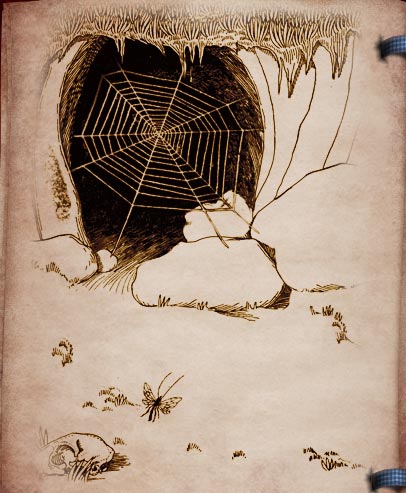
st feliz and the spider

One of the most well-known legends of St Felix relates to a spider.   It goes as follows:
Shortly following the imprisonment of Bishop Maximus, Felix was taken into custody by Roman soldiers, imprisoned, scourged and tortured and wrapped with heavy chains in his prison cell.   He miraculously escaped from his cell, following visitation from an angel who instructed him to go to the aid of his ailing bishop.   As the angel encouraged Felix, his chains fell off and his prison cell was opened.   Felix rescued Maximus, bearing him on his back (despite weakness and small stature) and effectively hiding both men from Roman authorities until the end of Decius’ reign.
The second attempt to imprison Felix and Maximus was miraculously prevented by a spider!   Upon hearing Roman soldiers approaching, Felix crawled into a small hole in the building he was staying, where it is said a spider immediately spun a web over the opening.   The guards saw the spider web and ceased searching for the men, assuming that the room had been undisturbed for some time.

Posted in SAINT of the DAY

Memorials of the Saints – 14 January

Bl Alfonsa Clerici
Bl Amadeus of Clermont
St Barbasymas
St Caldeoldus of Vienne
St Datius of Milan
Bl Devasahayam Pillai
St Engelmaro
St Eufrasio of Clermont
St Euphrasius the Martyr
St Felix of Nola (Died C 253)
St Felix of Rome
St Fermin of Mende
St Glycerius of Antioch
Bl Godfrey of Cappenberg
St Isaias the Martyr
St Jesaja of Sinai
St Macrina the Elder
St Nino of Georgia
Bl Odoric of Pordenone
St Odo of Novara
Bl Pablo Merillas Fernández
St Paul of Africa
Bl Petrus Donders C.Ss.R. (1807-1887)
About Blessed Petrus: https://anastpaul.wordpress.com/2018/01/14/saint-of-the-day-14-january-blessed-petrus-peter-donders-c-ss-r-1807-1887/

St Potitus
Bl Rainer of Arnsberg
St Sabas of Sinai
St Sava of Serbia
St Successus of Africa
St Theodolus of Sinai
Bl William de Sanjulia

Martyrs of Mount Sinai: A group of monks on Mount Sinai who were martyred by desert Bedouins. Their names and exact number have not come down to us. Martyred by Bedouins.

Martyrs of Raithu – 43 saints: A group of 43 monks in the Raithu Desert near Mount Sinai, Palestine, near the Red Sea. They were martyred for their faith by desert Bedouins. Their names have not come down to us. Martyred by Bedouins.

Posted in DOCTORS of the Church, DOCTRINE, DOGMA, FATHERS of the Church, GOD the FATHER, PRAYERS of the SAINTS, QUOTES of the SAINTS, SAINT of the DAY, The MOST HOLY & BLESSED TRINITY

Thought for the Day – 13 January – May I serve You by making You known

Thought for the Day – 13 January – May I serve You by making You known
The Memorial of St Hilary of Poitiers (315-368) Father & Doctor of the Church

This prayer is an excerpt from a sermon On the Trinity by Saint Hilary of Poitiers, a bishop and early Church Father of the fourth century who struggled valiantly against the Arian heresy, defending the divinity of Christ and the doctrine of the Trinity.
From a sermon on the Trinity by St Hilary of Poitiers (315-368) Father & Doctor of the Church – (Lib 1, 37-38: PL 10, 48-49)

May I serve You by making You known

“I am well aware, almighty God and Father, that in my life I owe You a most particular duty.   It is to make my every thought and word speak of You.

In fact, You have conferred on me this gift of speech and it can yield no greater return than to be at Your service.   It is for making You known as Father, the Father of the only-begotten God and preaching this to the world that knows You not and to the heretics who refuse to believe in You.

In this matter, the declaration of my intention, is only of limited value.   For the rest, I need to pray for the gift of Your help and Your mercy.   As we spread our sails of trusting faith and public avowal before You, fill them with the breath of Your Spirit, to drive us on, as we begin this course of proclaiming Your truth.   We have been promised and He who made the promise is trustworthy:   Ask, and it will be given to you; seek, and you will find; knock, and it will be opened to you.

Yes, in our poverty we will pray for our needs.   We will study the sayings of Your prophets and apostles with unflagging attention and knock for admittance wherever the gift of understanding is safely kept.   But Yours it is, Lord, to grant our petitions, to be present when we seek You and to open when we knock.

There is an inertia in our nature that makes us dull and in our attempt to penetrate Your truth. we are held within the bounds of ignorance. by the weakness of our minds.   Yet we do comprehend divine ideas by earnest attention to Your teaching and by obedience to the faith, which carries us beyond mere human apprehension.

So we trust in You to inspire the beginnings of this ambitious venture, to strengthen its progress and to call us into a partnership, in the spirit, with the prophets and the apostles.   To that end, may we grasp precisely what they meant to say, taking each word in its real and authentic sense.   For we are about to say what they already have declared as part of the mystery of revelation – that You are the eternal God, the Father of the eternal, only-begotten God;  that You are one and not born from another;  and that the Lord Jesus is also one, born of You from all eternity.   We must not proclaim a change in truth regarding the number of gods.   We must not deny that He is begotten of You who are the one God, nor must we assert that He is other than the true God, born of You who are truly God the Father.

Impart to us, then, the meaning of the words of Scripture and the light to understand it, with reverence for the doctrine and confidence in its truth.   Grant that we may express what we believe.   Through the prophets and apostles we know about You, the one God the Father and the one Lord Jesus Christ.   May we have the grace, in the face of heretics who deny You, to honour You as God, who is not alone and to proclaim this as truth.”

The above is used in the Roman Office of Readings for the feast (liturgical memorial) of St Hilary of Poitiers on 13 January.

St Hilary of Poitiers Pray for us!st hilary pray for us no 2 13 jan 2019.jpg

Posted in SAINT of the DAY

Saint of the day – 13 January – Blessed Francesco Maria Greco (1857-1931)

Saint of the day – 13 January – Blessed Francesco Maria Greco (1857-1931) Priest and Founder with Servant of God Raffaela De Vincentis (Sr Maria Teresa De Vincenti (1872-1936) of the Little Workers of the Sacred Hearts, Professor of Dogmatic Theology and Sacred Scripture, Apostle of Charity, devotee of Eucharistic Adoration, the Blessed Virgin and the Sacred and Immaculate Hearts.   Born on 26 July 1857 in Acri, Cosenza, Italy and died on 13 January 1931 in Acri, Cosenza, Italy of bronchitis.   Patronages – the Little Workers of the Sacred Hearts and Acri.bl francesco maria greco

Francesco Maria Greco, was born on 27 July 1857 in Acri, in what was then the Diocese of San Marco e Bisignano.   Preparing for his father’s profession, pharmacist, while still a student in Naples he felt a call to the priesthood.   At that time, while visiting the Shrine of the Blessed Virgin of the Rosary of Pompeii, still under construction, he asked for the grace of becoming “a learned priest for doing good ministry.”   He conquered the resistances of his parents and was ordained a priest in 1881.   In Acri he became arch-priest-pastor of the Church of St Nicholas, from 1888 to his death.

In the light of the Sacred Hearts of Jesus and Mary, for whom he had a special devotion, he carried out intense and fruitful pastoral work.    Living and working in Acri in the late 1800s, Fr Francesco realised that religious ignorance was the greatest problem his parishioners and townspeople face – for the less they knew about God, the further from Him they remained.   Together with his sister, Maria Teresa, he began a catechetical program to teach children, young people and adults about the Catholic faith.   The most dedicated catechist was Raffaella De Vincenti, who later became the faithful collaborator of Blessed Francisco, in the Institute’s foundation, on 21 November 1894, through her profession of the vows, of chastity, poverty and obedience, through which she received her religious name of Sister Maria Teresa of the Sacred Hearts.

Others soon followed as young women from Acri and nearby towns heard of the catechetical work to which she and Fr Francesco had devoted all their energies.   The Institute “… founded out of a spirit of charity, namely the love of God”, has as “its principal purpose catechetical instruction in parishes .”   Through its apostolic works, this Institute, gives witness to the charity of the Sacred Hearts directed in a special way to children and young people who are in need of human and Christian formation.francesco-maria-greco-1b233c6d-5f83-4994-9435-cb65fc83e45-resize-750

Always full of priestly concern for others, this blessed man founded the Caritas hospital which he entrusted to his sisters.

He also co-operated to the good performance of his diocese, making himself available to requests from Bishops, who held him in high esteem.   He taught Dogmatic Theology and Sacred Scripture in the Seminary of Bisignano and was its Rector for three years, while at the same time the fulfilling his role as pastor.   Surrounded by wide fame of holiness he fell asleep in the Lord on 13 January 1931.bl francesco maria greoc 21 may 2016

The cause of beatification began in 1960, was given in 1999 to Fr P Luca De Rosa, OFM, general Postulator.   The servant of God was declared Venerable on 19 April 2004.   On 21 January 2016, Pope Francis authorised the Congregation for the causes of Saints to promulgate the Decree of recognition of a miracle attributed to his intercession, thus allowing for his Beatification which took place on 21 May 2016.  The Beatification recognition was celebrated at Cosenza, Italy, with Cardinal Angelo Amato as the chief celebrant.   The beatification miracle involved bringing Nina Pancaro out of a coma in which she had lapsed following a severe illness and surger.   While comatose, she was visited by a dream of Father Francesco who healed her and woke her up.francesco_maria_greco2

Posted in FEASTS and SOLEMNITIES, SAINT of the DAY

Feast of The Baptism of the Lord – Year C (2019) & Memorials of the Saints – 13 January

Feast of The Baptism of the Lord – Year C (2019)

(This one is worth every second of viewing time!)

St Hilary of Poitiers (315-368) Doctor of the Church (Optional Memorial)
Biography: https://anastpaul.wordpress.com/2018/01/13/saint-of-the-day-13-january-st-hilary-of-poitiers-315-368-father-doctor-of-the-church/

St Agrecius of Trier
St Andrew of Trier
St Berno of Cluny
St Ðaminh Pham Trong Kham
St Designatus of Maastricht
St Elian of Brittany
St Emil Szramek
St Enogatus of Aleth
St Erbin of Cornwall
Bl Francesco Maria Greco (1857-1931)
Bl Francisca Inés Valverde González
St Giuse Pham Trong Ta
St Glaphyra
St Gumesindus of Córdoba
St Hermylus
Bl Hildemar of Arrouaise
Bl Ida of Argensolles
Bl Ivetta of Huy
St Kentigern of Glasgow
St Leontius of Caesarea
St Luca Pham Trong Thìn
Bl María Francisca Espejo y Martos
Bl Matteo de Lana
St Peter of Capitolíade
St Servusdei of Córdoba
St Stephen of Liège
St Stratonicus
Bl Veronica of Milan
St Viventius
St Vivenzio of Blera

Forty Martyred Soldiers at Rome: Forty soldiers martyred in the persecutions of Gallienus.
They werr martyred in 262 on the Via Lavicana, Rome, Italy.

Posted in PRACTISING CATHOLIC, QUOTES of the SAINTS, QUOTES on CHARITY, QUOTES on FORGIVENESS, QUOTES on LOVE, QUOTES on MERCY, QUOTES on PERSECUTION, QUOTES on SACRIFICE, QUOTES on SUFFERING, QUOTES on the CROSS of CHRIST, SAINT of the DAY, The HOLY CROSS, The PASSION

Thought for the Day – 12 January – St Aelred of Rievaulx OCSO (1110-1167)

Thought for the Day – 12 January – 6th day after Epiphany and The Memorial of St Aelred of Rievaulx OCSO (1110-1167)

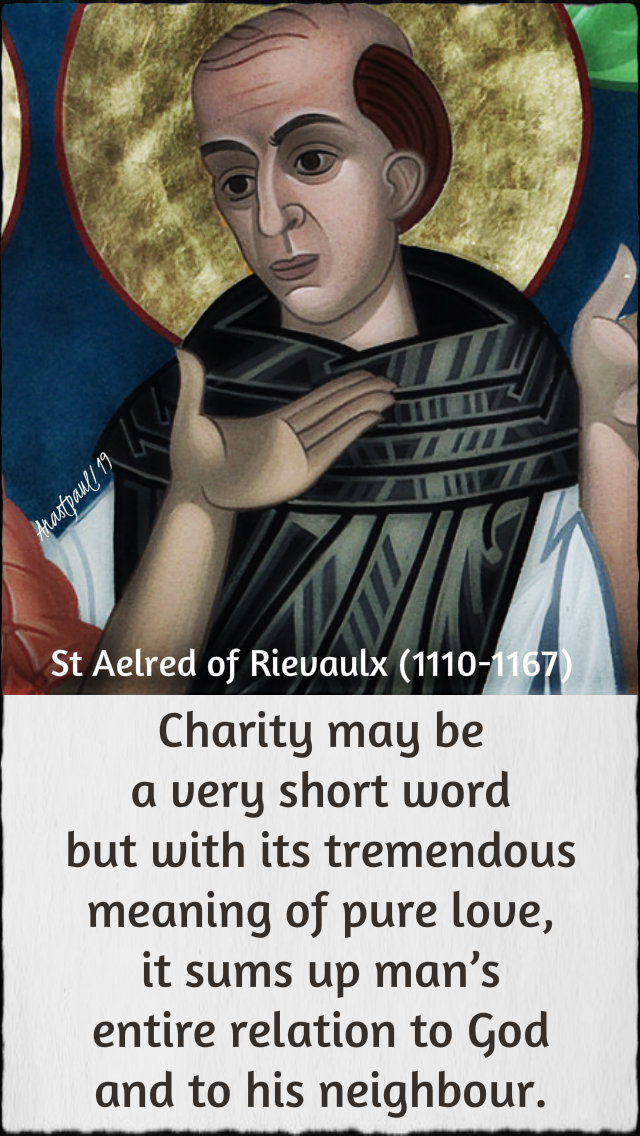
“Charity may be
a very short word
but with its tremendous
meaning of pure love,
it sums up man’s
entire relation to God
and to his neighbour.”

St Aelred of Rievaulx (1110-1167)charity may be a very short word - st aelred - 12 jan 2019

Aelred of Rievaulx on Jesus Christ as the model of brotherly love and patience through His forgiveness of persecutors and enemies and His prayer from the cross
“Father, forgive them, for they know not what they do.”

“The perfection of brotherly love lies in the love of one’s enemies.   We can find no greater inspiration for this, than grateful remembrance of the wonderful patience of Christ.   He who is more fair than all the sons of men, offered His fair face to be spat upon by sinful men;  He allowed those eyes that rule the universe to be blindfolded by wicked men;  He bared His back to the scourges;  He submitted that head which strikes terror in principalities and powers, to the sharpness of the thorns;  He gave Himself up to be mocked and reviled and, at the end, endured the cross, the nails, the lance, the gall, the vinegar, remaining always gentle, meek and full of peace.

In short, He was led like a sheep to the slaughter and like a lamb before the shearers, He kept silent and did not open His mouth.

Who could listen to that wonderful prayer, so full of warmth, of love, of unshakeable serenity – Father, forgive them – and hesitate to embrace his enemies with overflowing love?   Father, He says, forgive them!   Is any gentleness, any love, lacking in this prayer?

Yet He put into it something more.   It was not enough to pray for them – He wanted also to make excuses for them.  Father, forgive them, for they do not know what they are doing.   They are great sinners, yes but they have little judgement;  therefore, Father, forgive them.   They are nailing me to the cross but they do not know who it is that they are nailing to the cross – if they had known, they would never have crucified the Lord of glory, therefore, Father, forgive them.   They think it is a lawbreaker, an impostor claiming to be God, a seducer of the people.   I have hidden my face from them and they do not recognise my glory, therefore, Father, forgive them, for they do not know what they are doing.

If someone wishes to love himself he must not allow himself to be corrupted by indulging his sinful nature.   If he wishes to resist the promptings of his sinful nature he must enlarge the whole horizon of his love to contemplate the loving gentleness of the humanity of the Lord.   Further, if he wishes to savour the joy of brotherly love, with greater perfection and delight, he must extend even to his enemies the embrace of true love.

But if he wishes to prevent this fire of divine love from growing cold because of injuries received, let him keep the eyes of his soul always fixed on the serene patience of his beloved Lord and Saviour.”

This excerpt from the Mirror of Love by Saint Aelred of Rievaulx, abbot (Lib 3, 5: PL 195, 382) focuses on Christ as the supreme model of brotherly love, shown primarily in His love of persecutors and enemies.   It is used in the Roman Catholic Office of Readings for Friday of the 1st week in Lent with the accompanying biblical reading taken from Exodus 12: 21-36.

St Aelred, Pray for Us!st-aelred-pray-for-us-12-jan-2019

Posted in Our MORNING Offering, PRAYERS of the SAINTS, SAINT of the DAY

Our Morning Offering – 12 January – Behold me, O Sweet Lord – St Aelred

Our Morning Offering – 12 January – 6th day after Epiphany and The Memorial of St Aelred of Rievaulx OCSO (1110-1167)

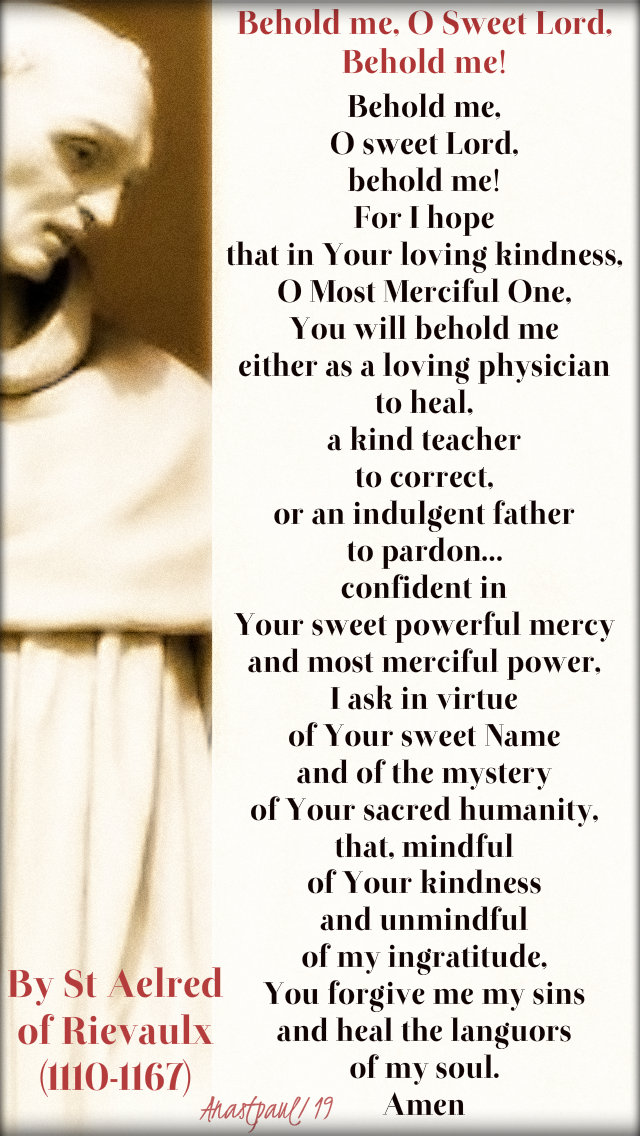
Behold me, O Sweet Lord, Behold me!
By St Aelred of Rievaulx

Behold me, O sweet Lord, behold me!
For I hope that in Your loving kindness,
O Most Merciful One,
You will behold me
either as a loving physician to heal,
a kind teacher to correct,
or an indulgent father to pardon…
confident in Your sweet powerful mercy
and most merciful power,
I ask in virtue of Your sweet Name
and of the mystery of Your sacred humanity,
that, mindful of Your kindness
and unmindful of my ingratitude,
You forgive me my sins
and heal the languors of my soul.
Amenbehold me o sweet lord behold me - st aelred 12 jan 2019

Posted in SAINT of the DAY

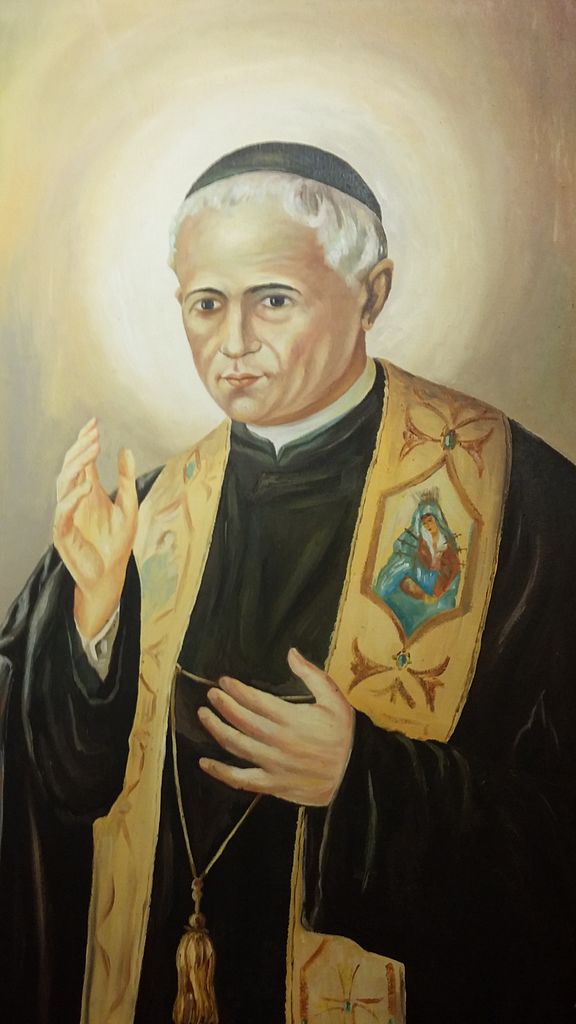
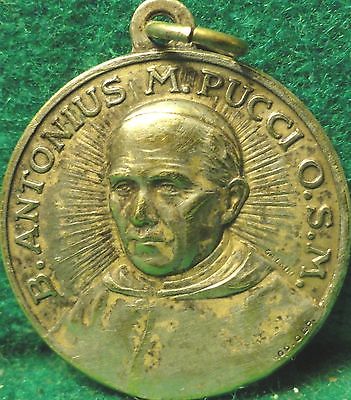
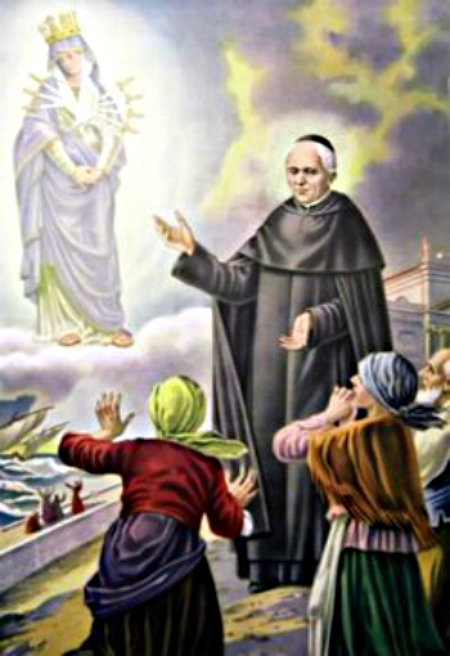
Saint of the Day – St Anthony Mary Pucci OSM (1819-1892)

Saint of the Day – St Anthony Mary Pucci OSM (1819-1892) – Religious Priest of the Servite Order, known as “the Father of the Poor”, Apostle of prayer, Mystic, Eucharistic and Marian devotee – born Eustance Pucci on 16 April 1818 in Poggiole di Vernio, Italy as Eustacchio Pucci and died on 12 January 1892 at Viareggio, Italy.

Anthony Mary Pucci was born of fine Christian parents at Poggiole, in the diocese of Pistoia, Italy, in 1819, he was the second of nine children.   After a youth marked by prayer and study, his devotion to Mary, the Mother of God, caused him to seek entrance in the Order of Servants of Mary at the age of eighteen.   He made his novitiate at Florence and studied philosophy and theology at Monte Senario for six years, where he also made his solemn profession.   In 1844, a year after his ordination to the priesthood, Anthony was sent to Viareggio as assistant pastor.   In 1847 he was named pastor and for forty-five years, until his death, he fulfilled this responsibility with great love, giving an example of a pure and fruitful life, singularly dedicated to God and his flock. Notwithstanding pastoral duties he continued his studies and in 1850 received the title of Master in Theology.sant'antonio_maria_pucci_icona

For many years Father Anthony was prior of the community in Viareggio and also prior provincial of the Tuscan Province.   This was a period of hostility between Church and civil authorities due to laws passed against religious orders and congregations.   In these offices, mindful of the words of Saint Augustine, he preferred to be loved rather than feared by his brothers and was happy to serve with love rather than exercise power.

Anthony was characterised by humility of spirit, reserve in speaking, abiding contact with God and love of poverty.   He dedicated himself completely to his priestly ministry in order to lead all to Christ; he knew his parishioners individually, he showed them fatherly love, offering them the word of God and supporting them with his advice and direction.   His charity to the needy knew no limits – he even went so far as to give a poor man the shirt off his back and because of this he was called “the Father of the Poor”.blessed-anthony-maria-pucci-now-st-mater

He was a faithful minister of the sacrament of penance, dedicating several hours a day to this work.   Of greatest importance to him was reconciling sinners to God, comforting the afflicted, forgiving those who had offended him, uniting those separated by hatred and violence, bringing peace to families, and assisting the sick and dying.   His love for others was particularly visible during the cholera epidemic of 1854-1856, when day and night, almost without rest, he worked with the sick.   God gave him many gifts, including discernment of spirits and the gift of healing.   He was seen at times in ecstasy or raised from the ground in prayer.

Father Anthony founded a congregation of Servite sisters in his parish for the education of youth and he directed them with particular concern.   He was a pioneer in establishing parish associations for young children, teenagers, men and women in order to intensify the Christian life of his community.   He promoted the St Vincent de Paul Society, recently introduced into Italy from France and the work for the Propagation of the Faith.   He founded the first permanent seaside home for the care of children.   In this work of the apostolate he was supported and animated by his great love for the Eucharist and Our Lady of Sorrows to whom he solemnly consecrated his parish.st antonio maria pucci.jpg

He was stricken with pneumonia on a winter’s day after he gave his coat to a poor man on the street.   A few days later, 12 January 1892, having received the sacraments, he died a holy death.
The entire city, including even those hostile to the Church, wept at the death of their beloved pastor.

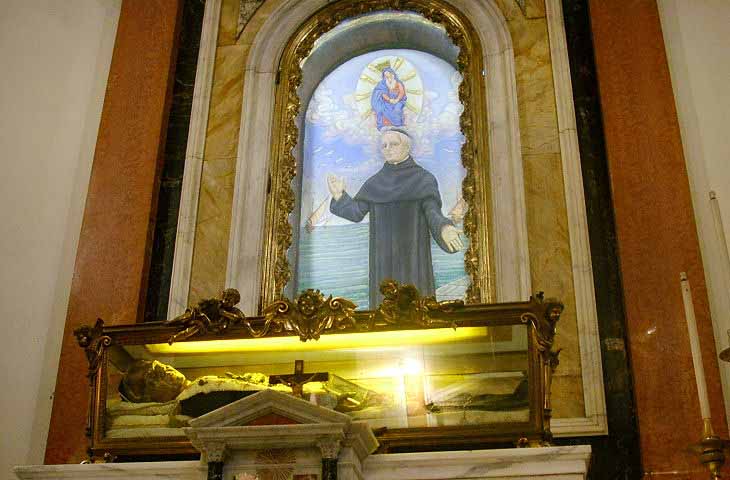
At the end of the first session of the Second Vatican Council St Pope John XXIII, on 9 December 1962, added his name to the list of saints.   The body of Saint Anthony Pucci is venerated in the Basilica of St Andrew in Viareggio, below is his tomb and a stained glass window in the Basilica.shrine st antonio maria pucci576px-viareggio,_chiesa_di_sant'andrea,_vetrata_di_sant'antonio_maria_pucci

Posted in SAINT of the DAY

Memorials of the Saints – 12 January

St Aelred of Rievaulx OCSO (1110-1167)
About St Aelred: https://anastpaul.wordpress.com/2018/01/12/saint-of-the-day-12-january-st-aelred-of-rievaulx-1110-1167-saint-bernard-of-the-north/

Bl Antoine Fournier
St Antonio Maria Pucci OSM (1819-1892)
St Arcadius of Mauretania
Bl Bartholomew Alvarez
Bl Bernardo de Plano
St Biccianus
St Benedict Biscop
St Bernard of Corleone
St Caesaria of Arles
St Caroticus
Bl Emmanuel d’Abreu
St Eutropius
St Ferreolus of Grenoble
Bl John Gaspard Cratz
St John of Ravenna
Bl Lucia of Valcaldara
St Marguerite Bourgeoys CND (1620-1700)
St Marguerite’s Biography: https://anastpaul.wordpress.com/2017/01/12/saint-of-the-day-12-january-st-marguerite-bourgeoys/

St Martinian of Belozersk
St Martin of León
Bl Nicholas Bunkerd Kitbamrung
St Peter of Abessala
Bl Pierre-François Jamet
St Probus of Verona
St Quinctus the Soldier
St Satyrus
St Tatiana of Rome
St Tigrius
St Victorian of Asana
Bl Vincent da Cunha

Martyrs of Africa – 44 saints: A group of 44 Christian soldiers murdered together for their faith in Africa. The only details that survive are four of their names – Castulus, Modestus, Rogatus and Zoticus.

Martyrs of Ephesus – 42 saints: Forty-two monks martyred at a monastery in Ephesus (modern Turkey) during the persecutions of the Iconoclast Byzantine Emperor Constantine V. Their names have not come down to us. Martyred c 762.

Martyrs of Iona – 38 saints: Thirty-eight monks martyred in Iona, Ireland. Their names have not come down to us. They were Martyred in 750 at Iona, Ireland.

Posted in FATHERS of the Church, MORNING Prayers, QUOTES of the SAINTS, QUOTES on PRAYER, SAINT of the DAY, The WORD

One Minute Reflection – 11 January – 5th day after Epiphany – Today’s Gospel: Luke 5:12–16

One Minute Reflection – 11 January – 5th day after Epiphany – Today’s Gospel: Luke 5:12–16

But he withdrew to the wilderness and prayed…Luke 5:16

REFLECTION – “Not by words alone but also by deeds, has God taught us to pray.   He Himself prayed frequently and demonstrated what we ought to do, by the testimony of His own example.   As it is written:  “But he himself was in retirement in the desert and in prayer,” and again, “He went out into the mountain to pray and continued all night in prayer to God.”   But if He who was without sin prayed, how much more ought sinners to pray and if He prayed continually, watching through the whole night with uninterrupted petitions, how much more ought we to lie awake at night in continuing prayer!”…St Cyprian of Carthage (c 200- c 258) Bishop and Martyr, Father of the Church (The Lord’s Prayer #29)luke 5 16 but he withdrew to the wilderness - but if he who was without sin - st cyprian 11 jan 2019.jpg

PRAYER – Almighty God and Father, by the guidance of a star, You revealed the birth of the Saviour of the world and by His teachings, the way of our path to You is shown to us. Open our minds and our hearts to these revelations and let them bear fruit in our lives. Listen we pray, to the prayers of St Tommaso da Cori on our behalf, who so diligently followed Your revelationS.   Through Jesus, our Lord and Christ, with the Holy Spirit, God forever, amen.st tommaso of cori pray for us 11 jan 2019.jpg

Posted in franciscan OFM, SAINT of the DAY

Saint of the Day – 11 January – St Tommaso da Cori OFM (1655-1729)

Saint of the Day – 11 January – St Tommaso da Cori OFM (1655-1729) Franciscan Friar and Priest, Preacher, Spiritual advisor, Evangeliser, Apostle of the Holy Eucharist, Prayer and Charity – known as the “Apostle of the Sublacense” – born Francesco Antonio Placidi on 4 June 1655 in Cori, Latina, Italy as Francesco Antonio Placidi and died on 11 January 1729 at Bellegra, Rome, Italy of natural causes.   Patronages – Subiaco, Province of Rome (co-patron), Preachers.119tomaso4_zpsfb73ac5d

St Tommaso was born in Cori (Latina) on 4 June 1655.   He knew a childhood marked by the premature loss first of his mother and then of his father, thus being left alone at the age of 14 to look after his younger sister.   Shepherding sheep, he learned wisdom from the simplest things.   Once his sister was married, the youth was free to follow the inspiration that for some years he had kept in the silence of his heart – to belong completely to God in the Religious Life of a Franciscan.   He had been able to get to know the Friars Minor in his own village at the St Francis convent.   Once his two sisters were settled in good marriages and he was rendered free of all other preoccupations, he was received into the Order and sent to Orvieto (PG) to fulfill his novitiate year.   After professing his vows according to the Rule of St Francis and completing his theological studies, he was ordained to the priesthood in 1683.   He was immediately nominated vice master of novices at Holy Trinity convent in Orvieto, since his superior recognised at once his gifts.

After a short time, Fr Tommaso heard of the hermitages that were beginning to bloom in the Order and the intention of the superiors of the Roman Province to inaugurate one at the convent at Civitella (today Bellegra).   His request was accepted and the young friar thus knocked at the door of the poor convent in 1684, saying, “I am Fr Tommaso of Cori and I come here to become holy!”   In speech perhaps distant from ours, he expressed his anxiousness to live the Gospel radically, after the spirit of Saint Francis.st tommaso young

From then, Fr Tommaso lived at Bellegra until death, with the exception of six years in which he was Guardian at the convent of Palombara, where he initiated the Hermitage modelled after the one at Bellegra.   He wrote the Rule first for one and then for the other, observing it scrupulously and consolidating by word and example the new institution of the two Hermitages.

The long years spent at Saint Francis of Bellegra can be summed up in three points:

Prayer:
St Tommaso of Cori was surely – as is said of St Francis – not so much a man who prayed as a man who became prayer.   This dimension animated the entire life of the founder of the Hermitage.   The most evident aspect of his spiritual life was undoubtedly the centrality of the Eucharist, as attested by St Tommaso in his celebration of the Eucharist, which was intense and attentive and in the silent prayer of adoration during the long nights at the Hermitage after the Divine Office, celebrated at midnight.   His life of prayer was marked by a persistent aridity of spirit.   The total absence of sensible consolation in prayer and in his life of union with God was protracted for a good 40 years, finding him always serene and totally in living the primacy of God.   Truly, his prayer was configured as a remembrance of God that made concretely possible a unity of life, notwithstanding his manifold activities.

Evangelisation:
St Tommaso did not close himself up in the Hermitage, forgetting the good of his brothers and sisters, and the heart of the Franciscan vocation, which is apostolic.   He was called with good reason the Apostle of Sublacense (the Subiaco region), having crossed the territory and its villages with the indefatigable proclamation of the Gospel, in the administration of the sacraments and the flowering of miracles at his passage, a sign of the presence and nearness of the Kingdom.   His preaching was clear and simple, convincing and strong.   He did not climb the most illustrious pulpits of his time, his personality was able to give its best in an ambit restricted to our territory, living his Franciscan vocation in littleness and in the concrete choice of the poorest.

Exquisite charity:
St  Tommaso of Cori was to his brothers, a very gentle father.   In the face of the resistance of some brothers before his will to reform and his radicality in living the Franciscan ideal, the Saint knew how to respond with patience and humility, even finding himself alone to mind the convent.   He had understood well that every true reform initiates itself.st tomasso of cori

The considerable correspondence left by him, demonstrates St Tommaso’ attention to the smallest expectations and needs of his Friars and of numerous friends, penitents and Friars who turned to him for his counsel.   In the convent, he demonstrated his spirit of charity in his availability for every necessity, even the most humble.

Rich in merits, he fell asleep in the Lord on 11 January 1729.   St Tommaso of Cori shines among us and in Rome, of which he is the co-patron, above all in his thirst for a Christian and Franciscan ideal that is pure and lived in its essentials.   A inspiration for all of us, not to take lightly the Gospel and its all-encompassing exigencies….Vatican.vastatua-san-tommaso-da-cori-620x639

St Tommaso’s body is enshrined in the Franciscan Chapel of Bellagra.   He was Beatified on 3 September 1786, at Saint Peter’s Basilica, by Pope Pius VI and Canonised on 21 November 1999, at Saint Peter’s Square, Vatican City by St Pope John Paul II.st tommaso body

Posted in SAINT of the DAY

Thought for the Day – 10 January – St Léonie Aviat

Thought for the Day – 10 January – 4th day after Epiphany and The Memorial of St Léonie Françoise De Sales Aviat (1844-1914) the co-founder of the Oblate Sisters of St Francis de Sales

St Pope John Paul on the Canonisation of St Léonie – 25 November 2001

“The loving plan of the Father “who has made us enter the kingdom of his beloved Son” found a splendid realisation in St Léonie Frances de Sales Aviat, who lived her self-offering to the end.

At the heart of her dedication and of her apostolate, Sister Léonie put prayer and union with God, where she found the light and the energy to overcome trials and difficulties and to persevere to the end of her life in the life of faith, desiring to be led by the Lord – “O my God, let my happiness be found in sacrificing my will and my desires for you!”   The resolution which distinguished Mother Aviat so well, “Forget oneself completely“, is also for us an appeal to go against the current of egotism and easy pleasures and open ourselves to the social and spiritual needs of our time.

Dear Oblate Sisters of St Francis-de-Sales, at the school of your foundress, in profound communion with the Church and wherever God has placed you, be determined to receive the present graces and to benefit from them, for it is in God that we find the light and the help necessary in every circumstance!

Trusting in the powerful intercession of the new saint, accept with joy the invitation to live, with renewed fidelity, the intuitions which she so perfectly lived.”

“O my God, let my happiness be found in sacrificing my will and my desires for you!”

St Léonie Aviat, Pray for Us!st leonie aviat opray for us no 2 10 jan 2019

Posted in ArchAngels and Angels, EUCHARISTIC Adoration, QUOTES of the SAINTS, QUOTES on CHARITY, QUOTES on DIVINE PROVIDENCE, QUOTES on FAITH, QUOTES on GRACE, QUOTES on PERSEVERANCE, QUOTES on PRAYER, QUOTES on SACRIFICE, QUOTES on SUFFERING, QUOTES on TRUST and complete CONFIDENCE in GOD, QUOTES on WORK/LABOUR, SAINT of the DAY

Quote/s of the Day – 10 January – St Léonie Françoise De Sales Aviat OSFS (1844-1914)

Quote/s of the Day – 10 January – 4th day after Epiphany and The Memorial of St Léonie Françoise De Sales Aviat OSFS (1844-1914)

“Let us work for the happiness of others.”

let us work for the happiness of others st leonie aviat 10 jan 2019.jpg

“Go often to rest your heart
near the tabernacle;
you will find there,
the necessary strength
and graces
to go more surely
along the path of fidelity.”go often to rest your heart near the tabernacle - st leonie aviat no 1 - 10 jan 2019.jpg

“God does not try us beyond our strength.
When He sends difficulty,
He adds the means of overcoming it.”god does not try us - st leonie - 10 jan 2019.jpg

“Our good Jesus always puts grace,
where He puts a sacrifice.”

“Our good Master never lets Himself
be outdone in generosity.
He gives back one hundredfold
what we sacrifice to Him.”our good Jesus, our good master - st leonie aviat - 10 jan 2019.jpg

“When we work for God, nothing is small!”when we work for god nothing is small st leonie aviat 10 jan 2019.jpg

“I formed the habit
of never approaching anyone
without casting a glance at our Lord.
Try my little method –
I can assure you it is a good one.”I formed the habit of never approaching st leonie aviat 10 jan 2019.jpg

“Pray to your good angels;
use them as messengers
in your little joys and sufferings.”pray to your good angels - st leonie aviat - 10 jan 2019.jpg

“Continue to entrust everything to God,
absolutely everything you have to do,
so that He may teach you more and more,
the happiness of living,
in union with Him.”

St Léonie Aviat (1844-1914)continue to entrust everything to god - st leonie aviat 10 jan 2019.jpg

Posted in MORNING Prayers, SAINT of the DAY, The WORD

One Minute Reflection – 10 January – 4th day after Epiphany:  Gospel Luke 4:14–22

One Minute Reflection – 10 January – 4th day after Epiphany:  Gospel  Luke 4:14–22 and The Memorial of St Léonie Françoise De Sales Aviat (1844-1914)

“The Spirit of the Lord is upon me,
because he has anointed me to preach good news to the poor.
He has sent me to proclaim release to the captives
and recovering of sight to the blind,
to set at liberty those who are oppressed...” Luke 4:18the spirit of the lord - luke 4 18-10 jan 2019

REFLECTION – “Evangelising the poor – this is Jesus’ mission.   According to what He says, this is also the mission of the Church and of every person baptised in the Church. Being a Christian is the same thing as being a missionary.   Proclaiming the Gospel with one’s word and even before, with one’s life, is the primary aim of the Christian community and of each of its members.  It is noted here that Jesus addresses the Good News to all, excluding no one, indeed favouring those who are distant, suffering sick, cast out by society.”...Pope Francis – Angelus, 24 January 2016being a christian is the same thing - pope francis - 10 jan 2019

PRAYER – Through Your Son, Lord God, You shed Your eternal light on all mankind.   You gave us our mission, You taught us our way.   Grant us the grace to acknowledge the full splendour of our Redeemer, so that, in His steps, we may grow from strength to strength in evangelising all.   Fill us with Your Spirit to enlighten and guide us.   May the intercession of St Léonie Françoise De Sales Aviat, who followed our Saviour and imitated Him, help us in our mission.   Through our Lord Jesus Christ, in union with the Holy Spirit, God forever, amen.st leonie aviat pray for us 10 jan 2019