
St Adalgott of Einsiedeln
St St Alanus of Quimper
Albinus of Buraburg
St Alfred the Great
St Alorus of Quimper
St Amandus of Strasburg
St Amandus of Worms
St Aneurin
St Aptonius of Angouleme
St Arnold of Queralt
St Bean of Mortlach
St Bernard de Figuerols
Bl Bonaventura of Potenza
St Cedd
Bl Celina Chludzinska
St Cuthbert of Canterbury
Bl Damian dei Fulcheri
St Eadfrid
St Eata of Hexham
St Pope Evaristus – (c 44 – c 107) Martyr
St Felicissimus of Carthage
St Fulk of Piacenza
St Gaudiosus of Salerno
St Gibitrudis
St Gwinoc
St Humbert
St Lucian
St Marcian
St Quadragesimus of Policastro
St Rogatian of Carthage
St Rusticus of Narbonne
St Sigibald of Metz
—
Martyrs of Nicomedia – 5 saints
Category: SAINT of the DAY
Thought for the Day – 25 October – The Memorial of Saints Crispin & St Crispinian – (†285 or 286) Martyrs
Thought for the Day – 25 October – The Memorial of Saints Crispin & St Crispinian – (†285 or 286) Martyrs
From the example of the saints, it appears how foolish the pretences of many Christians are, who imagine the care of a family, the business of a farm or a shop, the attention which they are obliged to give to their worldly profession, are impediments which excuse them from aiming at perfection. Such, indeed, they make them but this is altogether owing to their own sloth and malice. How many saints have made these very employments the means of their perfection! Saint Paul made tents; Saints Crispin and Crispinian were shoemakers,the Blessed Virgin was taken up in the care of her poor cottage, Christ Himself worked with His foster father and those saints who renounced all commerce with the world, to devote themselves totally to the contemplation of heavenly things, made mats, tilled the earth, or copied and bound good books.
The secret of the art of their sanctification was, that fulfilling the maxims of Christ, they studied to subdue their passions and die to themselves; they, with much earnestness and application, obtained of God and improved daily in their souls, a spirit of devotion and prayer; their temporal business they regarded as a duty which they owed to God and sanctified it by a pure and perfect intention, as Christ on earth directed everything He did to the glory of His Father.
In these very employments, they were careful to improve themselves in humility, meekness, resignation, divine charity and all other virtues, by the occasion which call them forth at every moment and in every action. Opportunities of every virtue and every kind of good work never fail in all circumstances and the chief means of our sanctification may be practised, in every state of life, which are self-denial and assiduous prayer, frequent aspirations and pious meditation or reflections on spiritual truths, which disengage the affections from earthly things and deeply imprint in the heart, those of piety and religion….by Father Alban Butler
Sts Crispin and Crispinian, Pray for Us!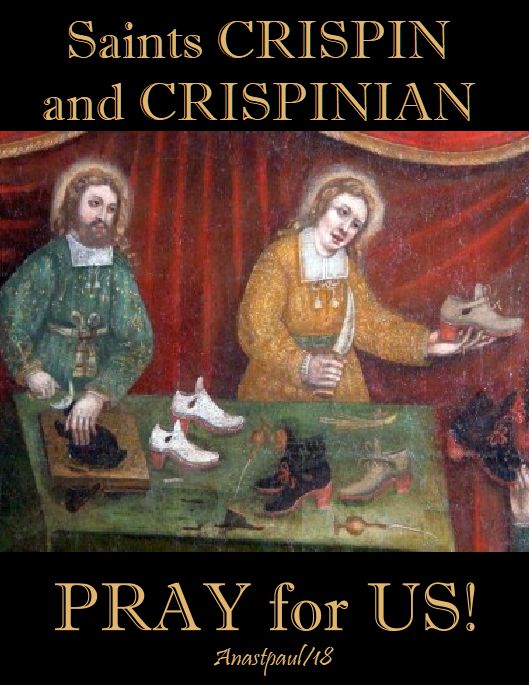
Quote of the Day – 25 October – The Memorial of Saints Crispin & St Crispinian – (†285 or 286) Martyrs
Quote of the Day – 25 October – The Memorial of Saints Crisp in & St Crispinian – (†285 or 286) Martyrs
The feast day of Saints Crispin and Crispinian is 25 October. Although this feast was removed from the Roman Catholic Church’s universal liturgical calendar following the Second Vatican Council, the two saints are still commemorated on that day in the most recent edition of the Roman Martyrology. Sts Crispin and Crispinian were the first “band of brothers,” who fought bravely on the battlefield of the soul.
The historian and bishop, St Gregory of Tours (538-594) refers twice in his History of the Franks to a Basilica of Sts Crispin and Crispinian in the northern French city of Soissons, if the Church was already well-established at that time, the commemoration of the martyrs dates from much closer to their martyrdom.
The St Crispin’s Day speech was delivered on 25 October 1415 by King Henry V of England to rouse his soldiers on the morning of the Battle of Agincourt and later chronicled by William Shakespeare in his play, Henry V, in Act IV Scene iii 18–67. In the speech, which fell on Saint Crispin’s Day, Henry V urged his men — who were vastly outnumbered by the French — to recall how the English had previously inflicted great defeats upon the French.
The speech by Shakespeare has been famously portrayed by Sir Laurence Olivier to raise British spirits during the Second World War, and by Sir Kenneth Branagh in the 1989 film Henry V (see video below) and it made famous the phrase “band of brothers.” The play was written around 1600 and several later writers have used parts of it in their own texts.
Note: the text is Shakespeare’s, as the wording of Henry’s historical speech is not known.
WESTMORLAND. O that we now had here
But one ten thousand of those men in England
That do no work to-day!
KING. What’s he that wishes so?
My cousin, Westmorland? No, my fair cousin,
If we are mark’d to die, we are enough
To do our country loss; and if to live,
The fewer men, the greater share of honour.
God’s will! I pray thee, wish not one man more.
By Jove, I am not covetous for gold,
Nor care I who doth feed upon my cost,
It yearns me not if men my garments wear,
Such outward things dwell not in my desires.
But if it be a sin to covet honour,
I am the most offending soul alive.
No, faith, my coz, wish not a man from England.
God’s peace! I would not lose so great an honour
As one man more methinks would share from me
For the best hope I have. O, do not wish one more!
Rather proclaim it, Westmorland, through my host,
That he which hath no stomach to this fight,
Let him depart, his passport shall be made,
And crowns for convoy put into his purse,
We would not die in that man’s company
That fears his fellowship to die with us.
This day is call’d the feast of Crispian.
He that outlives this day and comes safe home,
Will stand a tip-toe when this day is nam’d,
And rouse him at the name of Crispian.
He that shall live this day and see old age,
Will yearly on the vigil feast his neighbours,
And say “To-morrow is Saint Crispian.”
Then will he strip his sleeve and show his scars,
And say “These wounds I had on Crispin’s day.”
Old men forget; yet all shall be forgot,
But he’ll remember, with advantages,
What feats he did that day. Then shall our names,
Familiar in his mouth as household words—
Harry the King, Bedford and Exeter,
Warwick and Talbot, Salisbury and Gloucester—
Be in their flowing cups freshly rememb’red.
This story shall the good man teach his son,
And Crispin, Crispian shall ne’er go by,
From this day to the ending of the world,
But we in it shall be rememberèd—
We few, we happy few, we band of brothers,
For he to-day that sheds his blood with me
Shall be my brother, be he ne’er so vile,
This day shall gentle his condition,
And gentlemen in England now a-bed
Shall think themselves accurs’d they were not here,
And hold their manhoods cheap whiles any speaks
That fought with us upon Saint Crispin’s day.
One Minute Reflection – 25 October – Today’s Gospel: Luke 12:49–53
One Minute Reflection – 25 October – Today’s Gospel: Luke 12:49–53 – Thursday of the Twenty Ninth week in Ordinary Time, Year B and the Memorial of Saints Crispin & St Crispinian – (†285 or 286) Martyrs
“Do you think that I have come to give peace on earth? No, I tell you, but rather division…”…Luke 12:51
REFLECTION – “In all our affections, order is necessary. Love your father, love your mother, love your children after God. If it becomes inevitable to place love of one’s relatives and children in the balance with love of God, without it being possible to preserve them both, then not to prefer one’s own family, is piety towards God.”…St Jerome (343-420) Father & Doctor of the Church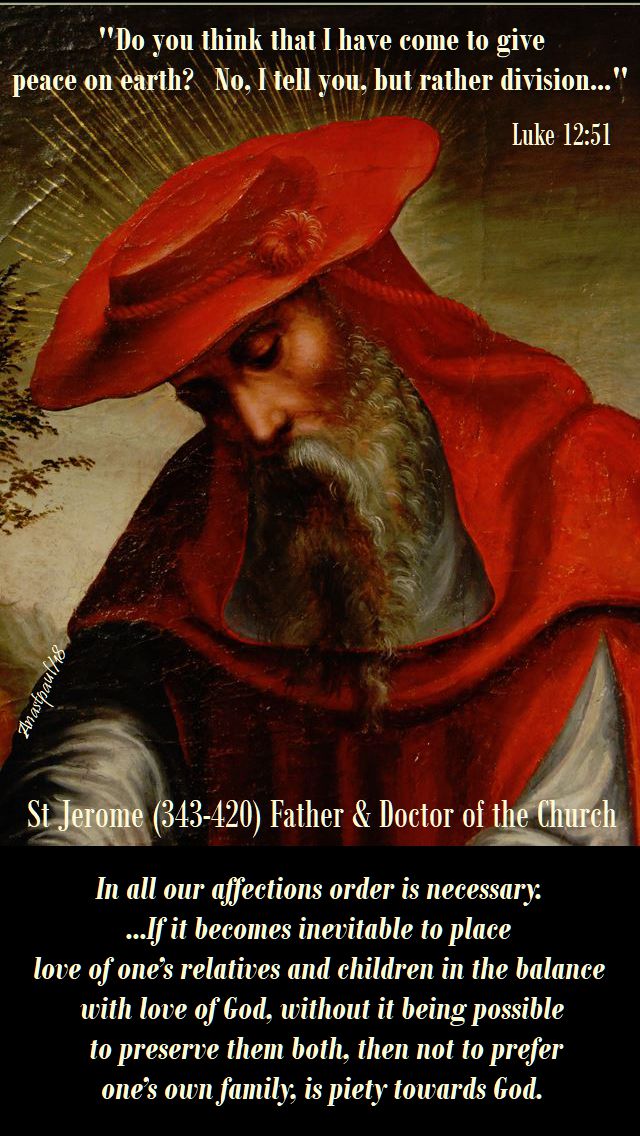
PRAYER – Glory be to the Father and to the Son and to the Holy Spirit, You glorious Trinity are our lesson in love and unity. Grant us this day the grace of true love for You and true order in all our affections. May the intercession of Sts Crispin and Crispinian, strengthen us. Amen.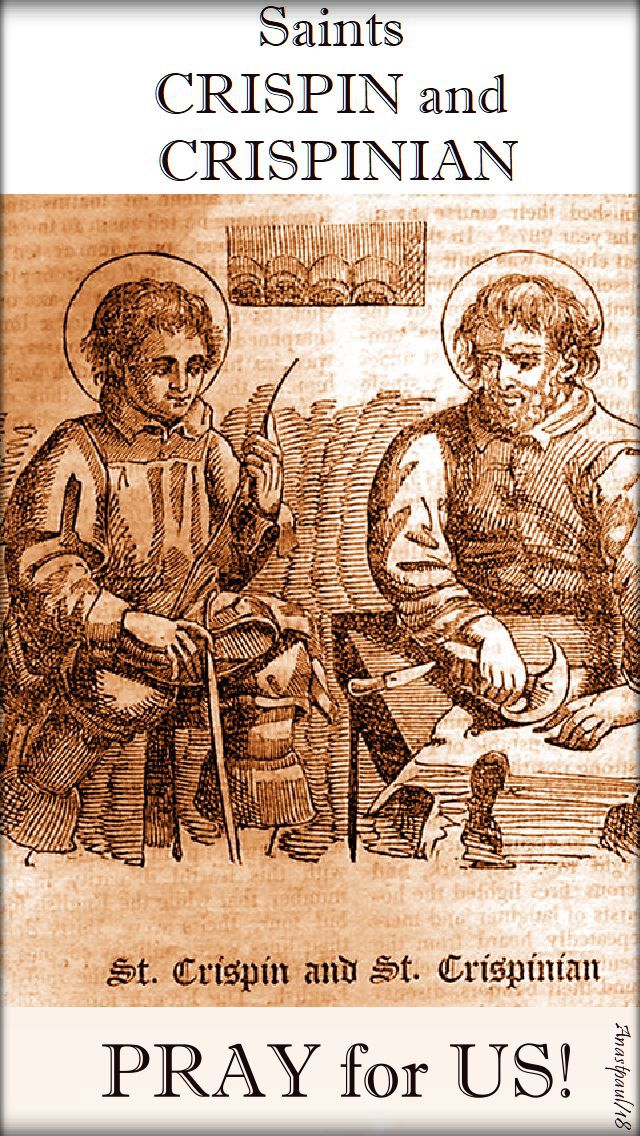
Saints of the Day – 25 October – Sts Crispin & Crispinian (†285 or 286) Martyrs
Saints of the Day – 25 October – Sts Crispin & Crispinian (†285 or 286) Martyrs – twin brother cobblers – Patronages – cobblers; curriers; glove makers; lace makers; lace workers; leather workers; saddle makers; saddlers; shoemakers; tanners; weavers, San Crispin, San Pablo City, Philippines.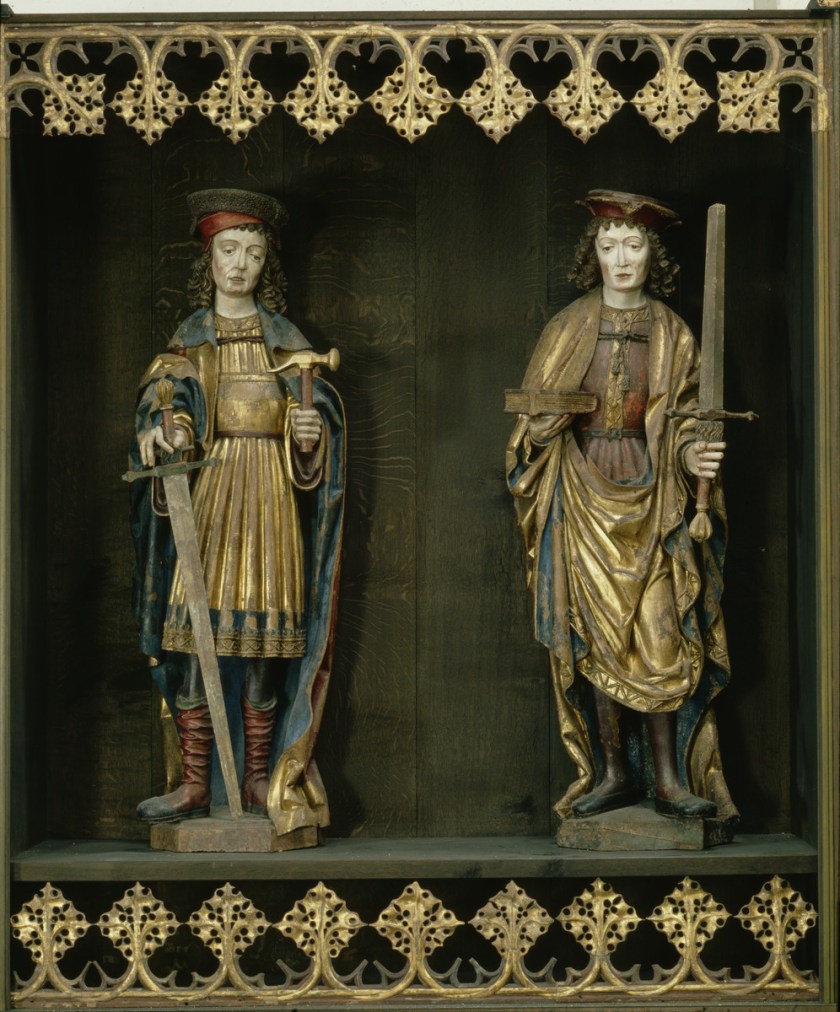

These two glorious martyrs came from Rome to preach the Faith in Gaul toward the middle of the third century. Fixing their residence at Soissons, they instructed many in the Faith of Christ, which they preached publicly in the day and at night they worked at making shoes, though they are said to have been nobly born and brothers.
The infidels listened to their instructions and were astonished at the example of their lives, especially of their charity, disinterestedness, heavenly piety and contempt of glory and all earthly things and the effect was the conversion of many to the Christian faith.
The brothers had continued their employment several years when a complaint was lodged against them. The emperor, to gratify their accusers and give way to his savage cruelty, gave orders that they should be convened before Biotin’s Varus, the most implacable enemy of the Christians.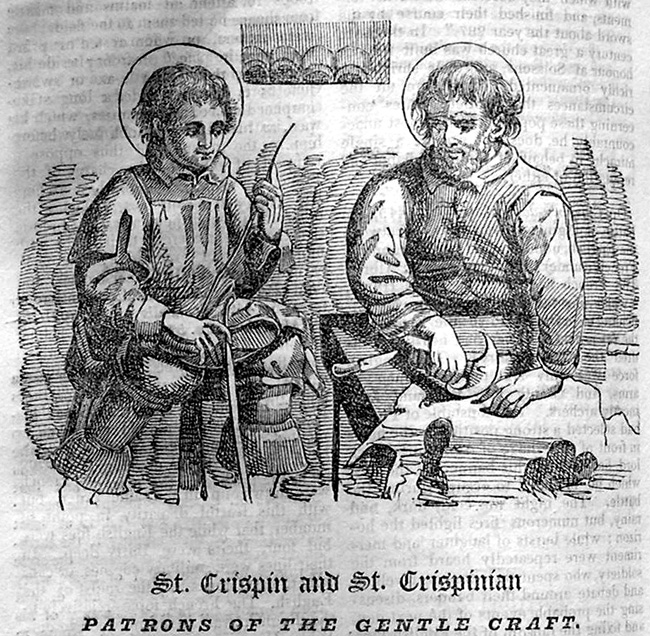
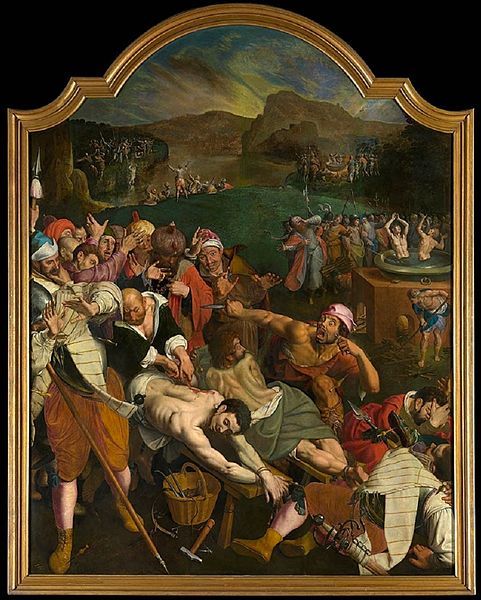
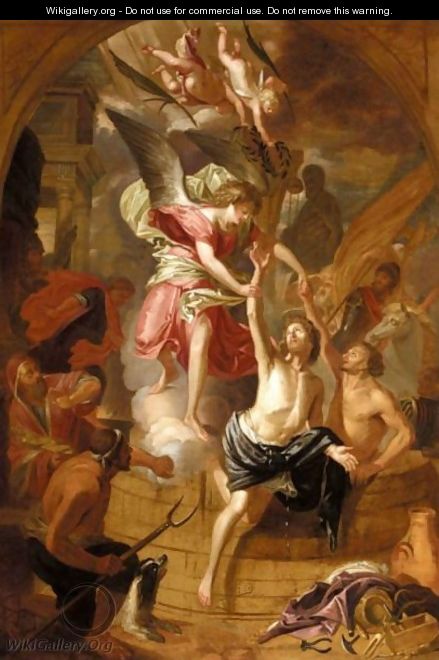
The martyrs were patient and constant under the most cruel torments and finished their course by the sword about the year 286. A Christian brother and sister buried their bodies on their own terrain, where later a public oratory was constructed. 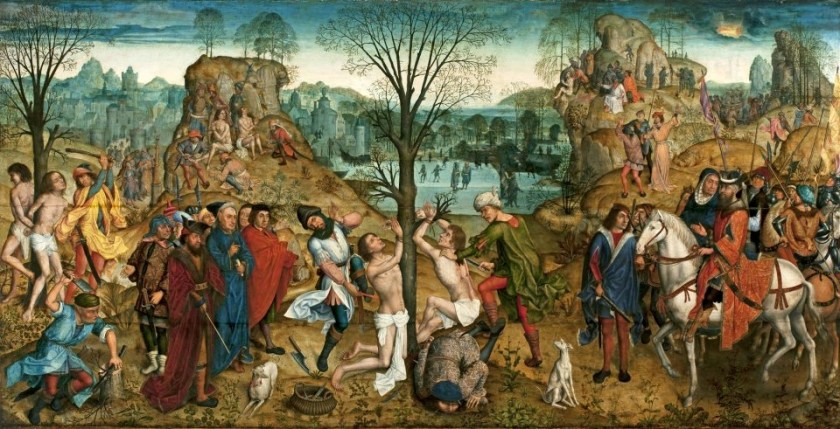
Memorials of the Saints – 25 October
St Alfons Arimany Ferrer
St Bernard of Calvo
St Canna verch Tewdr Marw
St Chrysanthus
St Crispin & St Crispian – (†285 or 286) Martyrs
St Cyrinus of Rome
St Daria
St Dulcardus
Bl Edmund Daniel
St Fronto of Périgueux
St Fructus of Segovia
St Gaudentius of Brescia
St George of Périgueux
St Goeznoveus of Leon
St Guesnoveus
Bl Henry of Segusio
St Hilary of Javols
St Hilary of Mende
St Hildemarca of Fecamp
St Januarius of Sassari
St Lucius of Rome
St Lupus of Bayeux
St Mark of Rome
Bl Maurus of Pécs
St Miniato of Florence
St Peter of Rome
St Protus of Sassari
St Recaredo Centelles Abad
St Tabitha
Bl Thaddeus McCarthy
St Theodosius of Rome
—
Martyrs of Constantinople:
Marciano
Martirio
Martyrs of Cruz Cubierta – 5 beati: A mother, Blessed María Teresa Ferragud Roig de Masiá and her four daughters, Blessed María Joaquina Masiá Ferragud, Blessed María Vicenta Masiá Ferragud, Blessed María Felicidad Masiá Ferragud and Blessed Josefa Ramona Masiá Ferragud, all nuns, who were Martyred in the Spanish Civil War, on 25 October 1936 in Cruz Cubierta, Alzira, Valencia, Spain.
They were Beatified on 11 March 2001 by St Pope John Paul II.
Forty Martyrs of England and Wales – 40 saints: Following the dispute between the Pope and King Henry VIII in the 16th century, faith questions in the British Isles became entangled with political questions, with both often being settled by torture and murder of loyal Catholics. In 1970, the Vatican selected 40 martyrs, men and women, lay and religious, to represent the full group of perhaps 300 known to have died for their faith and allegiance to the Church between 1535 and 1679. They each have their own day of memorial, but are remembered as a group on 25 October.
• Alban Roe • Alexander Briant • Ambrose Edward Barlow • Anne Line • Augustine Webster • Cuthbert Mayne • David Lewis • Edmund Arrowsmith • Edmund Campion • Edmund Gennings • Eustace White • Henry Morse • Henry Walpole • John Almond • John Boste • John Houghton • John Jones • John Kemble • John Lloyd • John Pain • John Plesington • John Rigby • John Roberts • John Southworth • John Stone • John Wall • Luke Kirby • Margaret Clitherow • Margaret Ward • Nicholas Owen • Philip Evans • Philip Howard • Polydore Plasden • Ralph Sherwin • Richard Gwyn • Richard Reynolds • Robert Lawrence • Robert Southwell • Secular Clergy • Swithun Wells • Thomas Garnet.
Canonised on 25 October 1970 by St Pope Paul VI
Martyrs of Rome – 67 saints: A group of 46 soldiers and 21 civilians martyred together in the persecutions of Claudius II. 269 in Rome, Italy.
Martyred in the Spanish Civil War:
• Blessed Alfons Arimany Ferrer
• Blessed Recaredo Centelles Abad
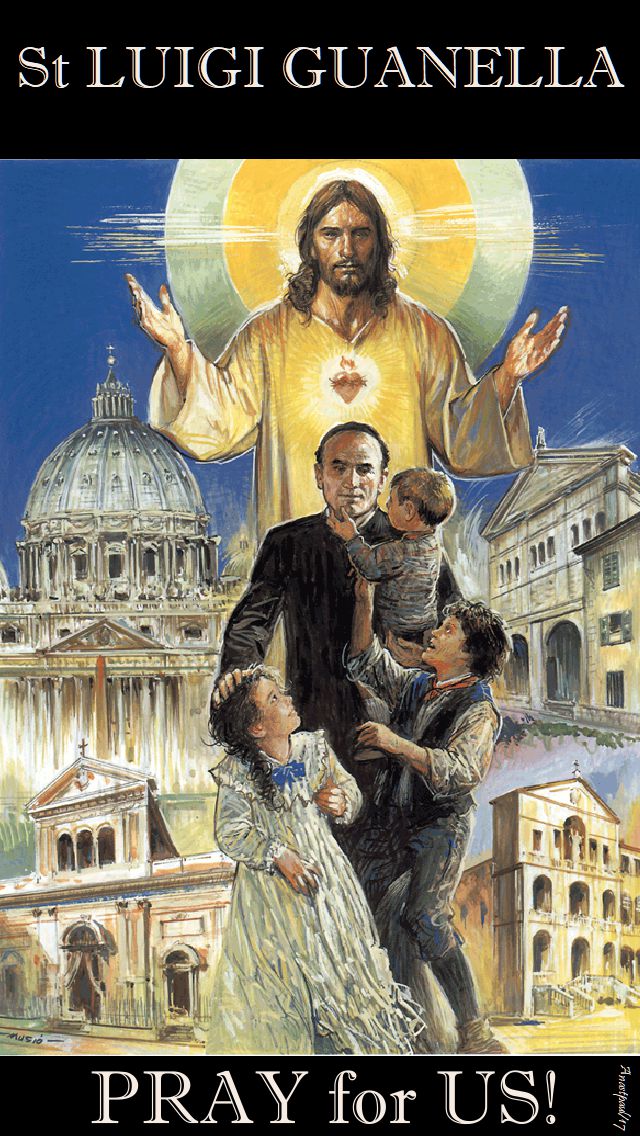
Thought for the Day – 24 October – The Memorial of St Luigi Guanella (1842-1915)
Thought for the Day – 24 October – The Memorial of St Luigi Guanella (1842-1915)
St Luigi and St Joseph – “The Pious Union of St Joseph”
In his daily life, Fr Guanella had a great devotion to St Joseph, custodial father of Jesus and safeguard of the virginity of Mary, his wife, the Mother of God. He reminded his priests and nuns that St Joseph is the administrator of all their homes. All superiors must have the love and care of St Joseph, as well as the kindness and gentleness of Mary, in dealing with the residents.
His love and care had no limit. His dear impaired people were assisted to the very end. When he was home, it was his duty to give his blessing for the dying. His motto was, “Let us give them bread and paradise” and this was implanted in the hearts of all his nuns and priests.
In Rome, six years before his death and physically tired by his work, Fr Guanella was inspired to build a Church and start an Association in honour of St Joseph, patron of the dying. Pope Pius X, a very close friend, expressed a desire to have a church in Trionfale, a very poor area near the Vatican. The Pope’s desire strengthened Fr Guanella’sown ideas. Trusting to divine providence, he put a down payment on the land and the foundation was immediately begun. On the property, there was a barn which became the first Chapel of St Joseph. The people called it the ‘Basilichetta’ (small Basilica.) In 1912, Fr Guanella announced to the Pope that the Church was completed in honour of St Joseph and His Holiness, whose baptismal name was Joseph Sarto.
The Pope admired Fr Guanella for his courage and devotion to St Joseph and when he heard about the Pious Union Association of prayers for the dying, he said to Fr Luigi, “Please make me the first member.”
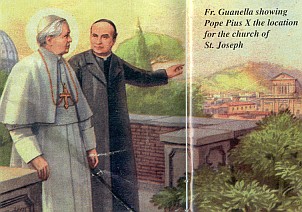
In 1913, Pope Pius X gave his approval, making the Church of the Pious Union the main centre for all the universal church. His beloved Pope Pius X died in 1914, one year before Fr Guanella’s own death. The two saints understood each other so well.
St Joseph, Pray for us!
St Pope Pius X, Pray for Us!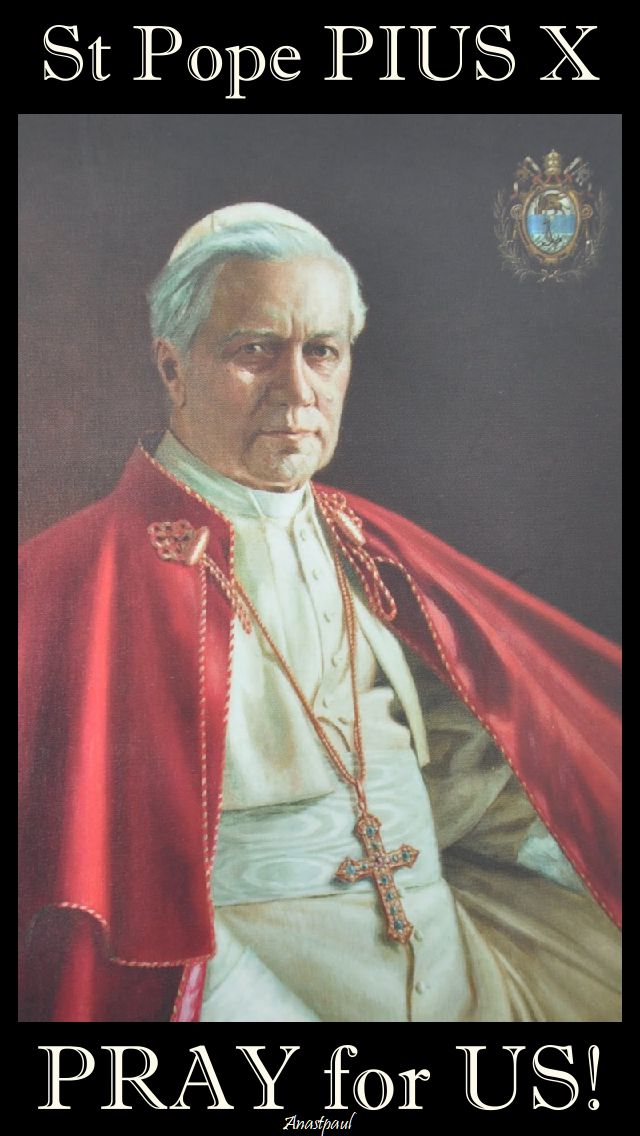
St Luigi Guanella, Pray for Us!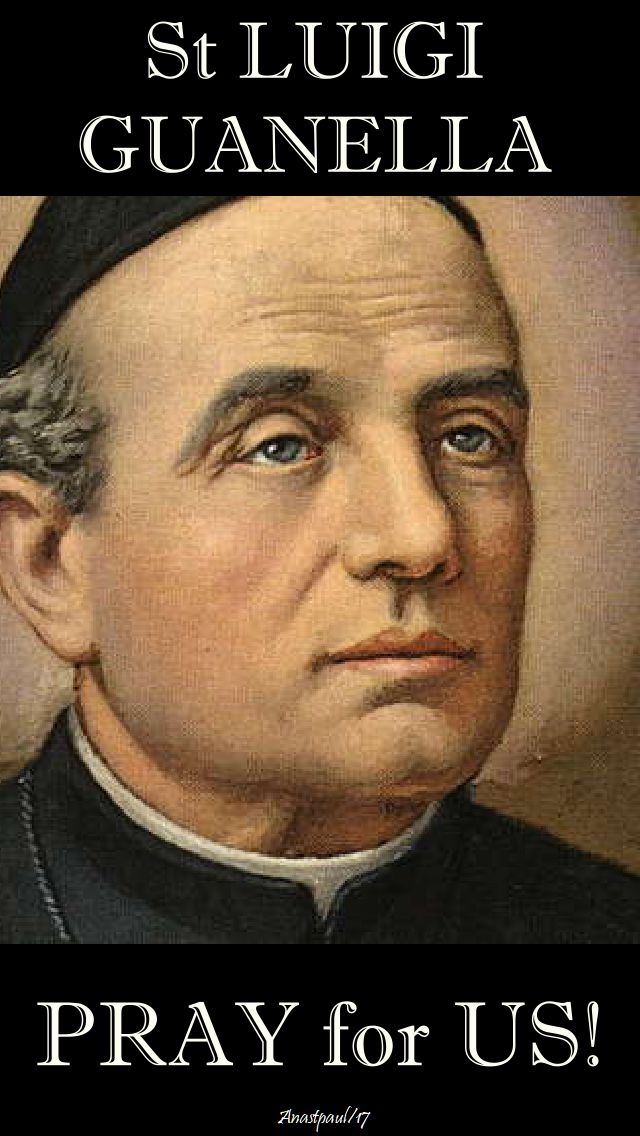
Quote/s of the Day – 24 October – The Memorial of St Luigi Guanella (1842-1915)
Quote/s of the Day – 24 October – The Memorial of St Luigi Guanella (1842-1915)
“The sun of our lives is the Eucharist.”
“The fountain of holy love
is in Jesus Christ
and we have Jesus with us,
in the Most Holy
Sacrament of the Altar.
From that throne of love,
how often He enlightens the minds of His children
and how many again find their peace of heart.”
“The earth is filled with tabernacles – Praise Him!”
“Our union in heaven
will depend upon
our communion
with God on earth.”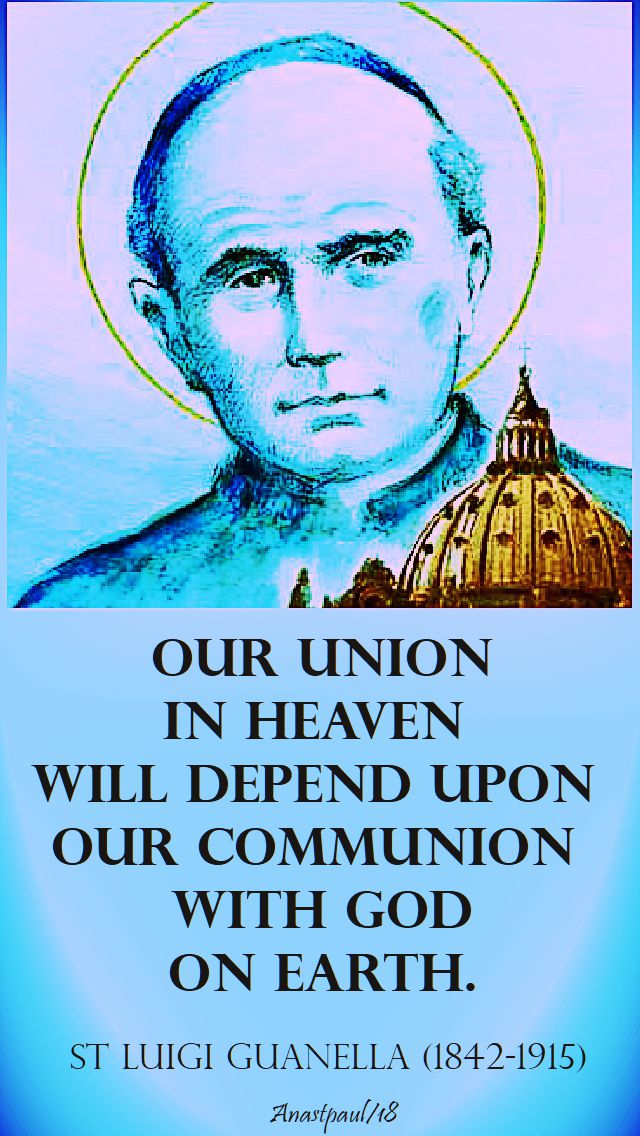
“Plant your heart
in Jesus Crucified
and all the thorns
will seem like roses.”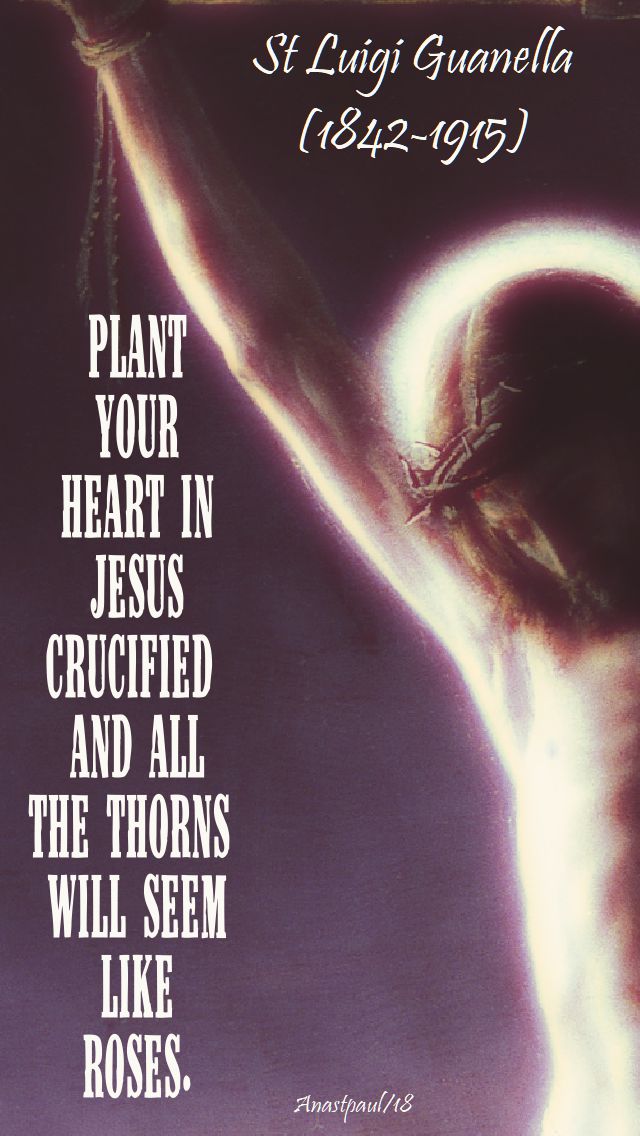
“Whoever finds Mary,
finds the way to Salvation.”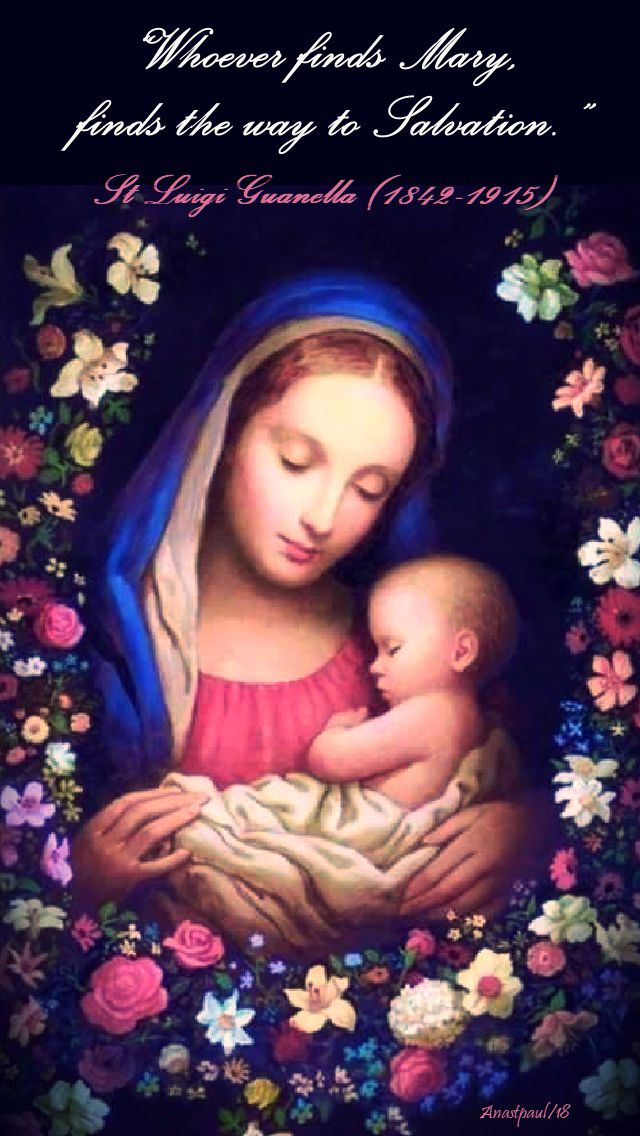
“Charity lights the path to divine love.”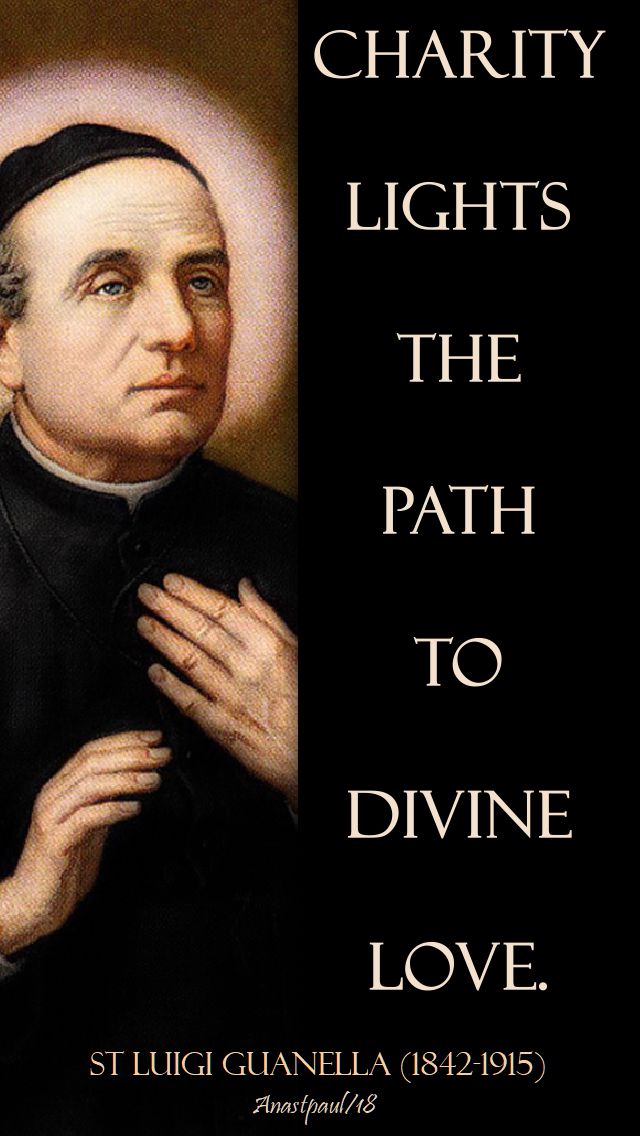
“Imitate the Heart of Christ in love for the poor.”
“Refuse God nothing!”
St Luigi Guanella (1842-1915)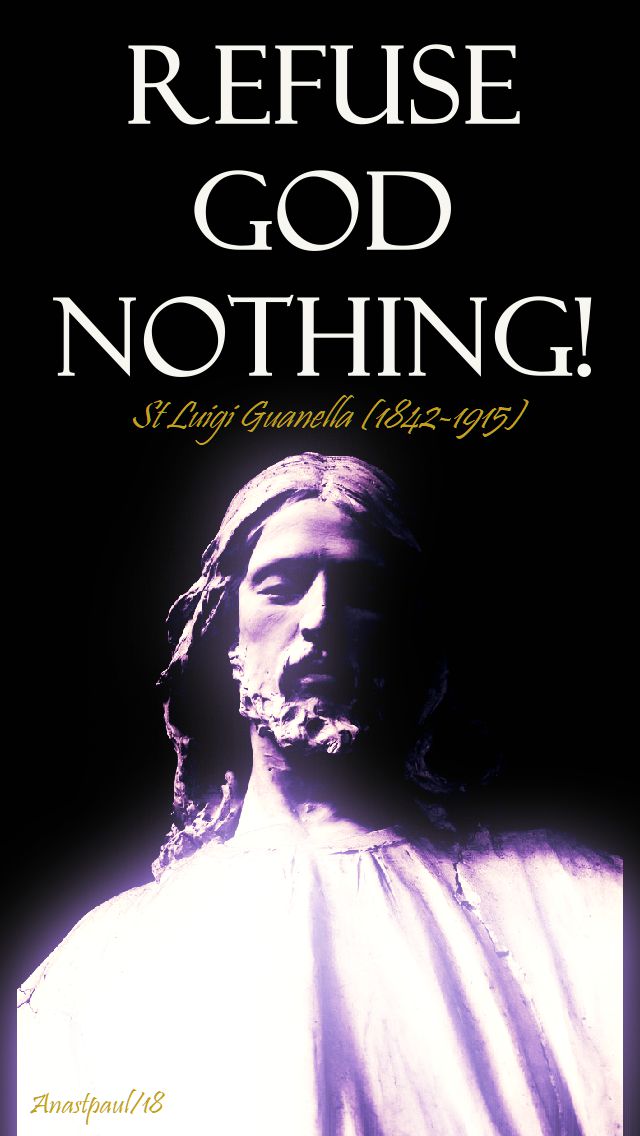
One Minute Reflection – 24 October – Today’s Gospel: Luke 12:39–48
One Minute Reflection – 24 October – Today’s Gospel: Luke 12:39–48 – Wednesday of the Twenty Ninth week in Ordinary Time. Year B and The Memorial of St Anthony Mary Claret CMF (1807-1870) and St Luigi Guanella (1842-1915)
“But know this, that if the householder had known at what hour the thief was coming, he would not have left his house to be broken into…”…Luke 12:39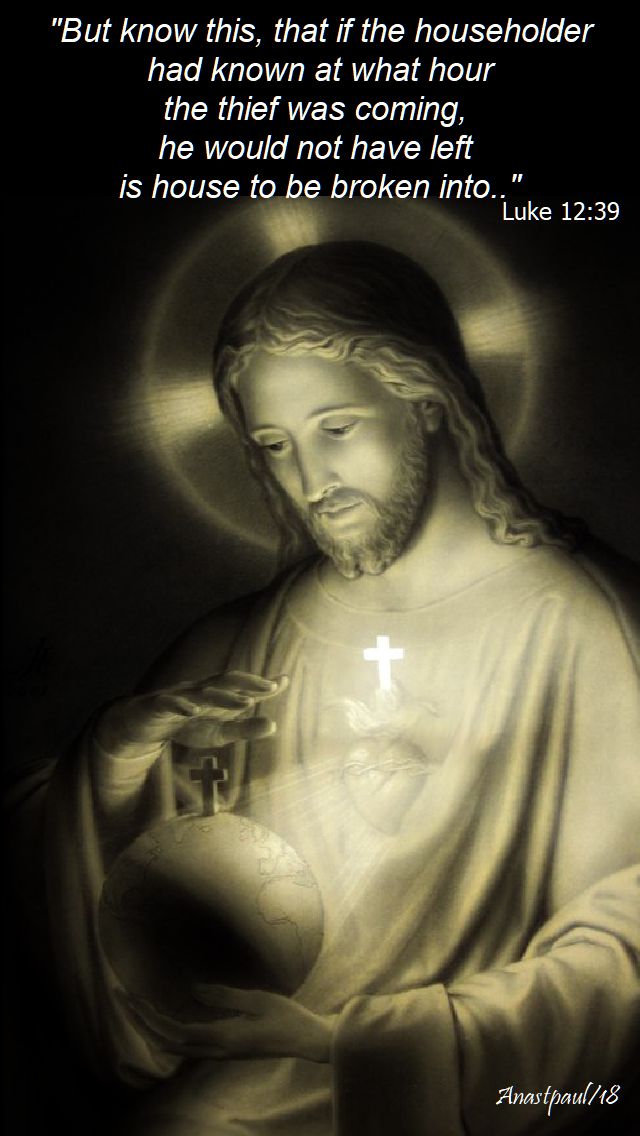
REFLECTION – “There is need of living well but, there is even more need of dying well. A good death is everything, especially today, where people think only of things and enjoyment here on earth, rejecting eternity.” … St Luigi Guanella (1842-1915)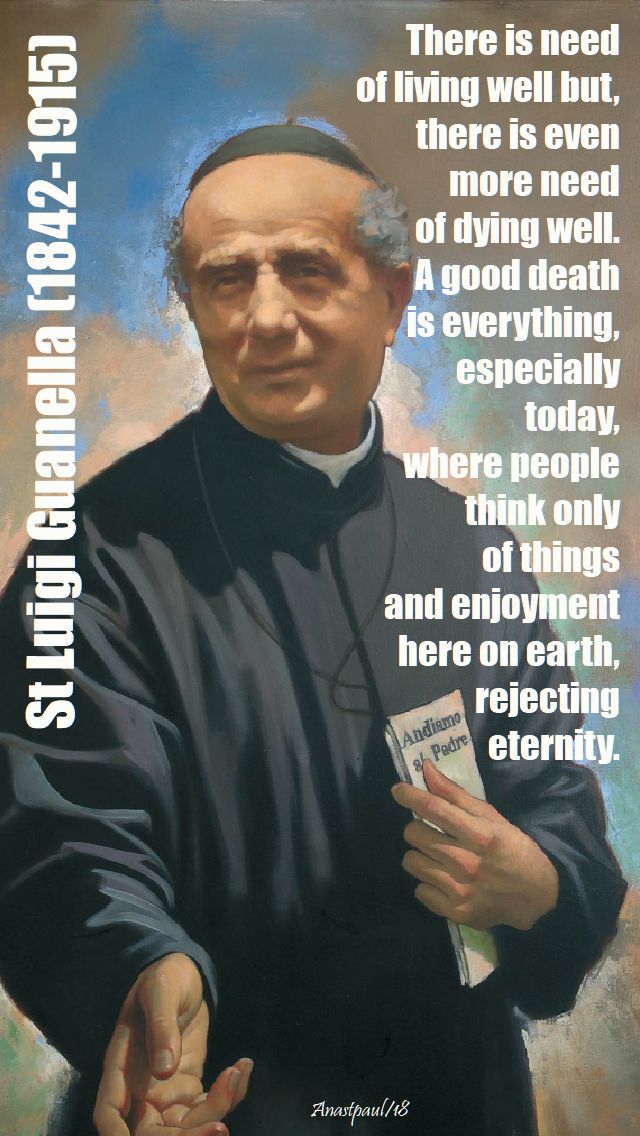
“The disciple is one, who awaits the Lord and His Kingdom. May the Virgin Mary help us, not to be people and communities dulled by the present, or worse, nostalgic for the past but striving toward the future of God, toward the encounter with Him, our life and our hope.”...Pope Francis – Angelus, 7 August 2016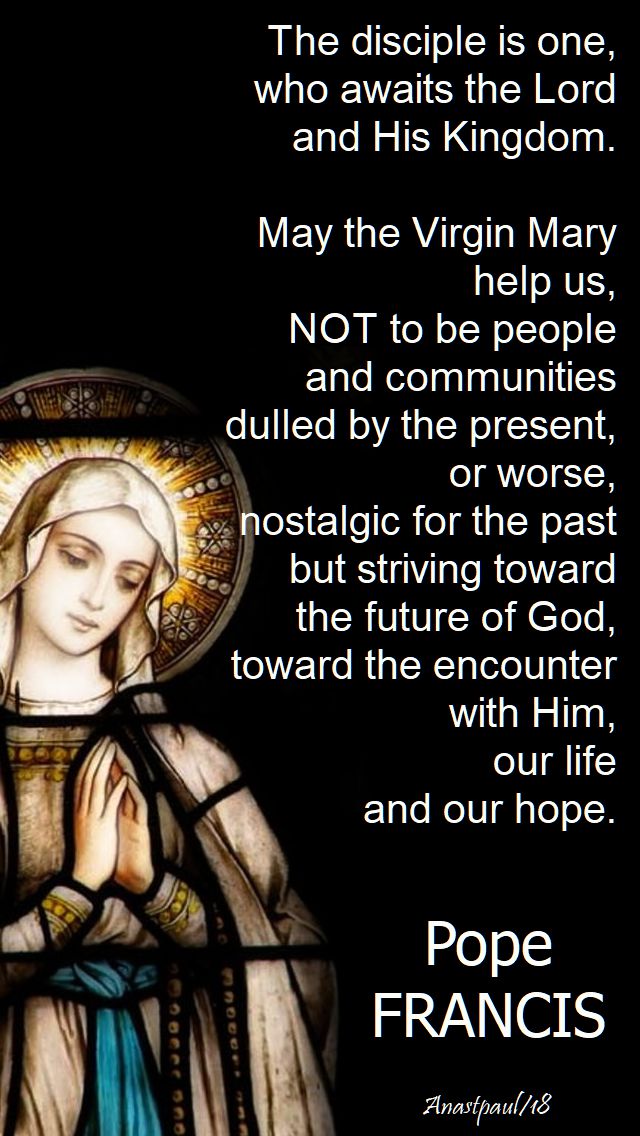
PRAYER – Heavenly Father, help me to keep my death constantly before my eyes, for this is my final account. I pray You for a holy life that my death may be holy and that I may come to You and live for all eternity with You. When my hour is come, bid me come to You, Lord. Hear the prayers of your Saints, Anthony Mary Claret and Luigi Guanella, who lived each moment of their lives for the glory of Your Kingdom. We ask this through Christ, our Lord with the Holy Spirit, God forever, amen.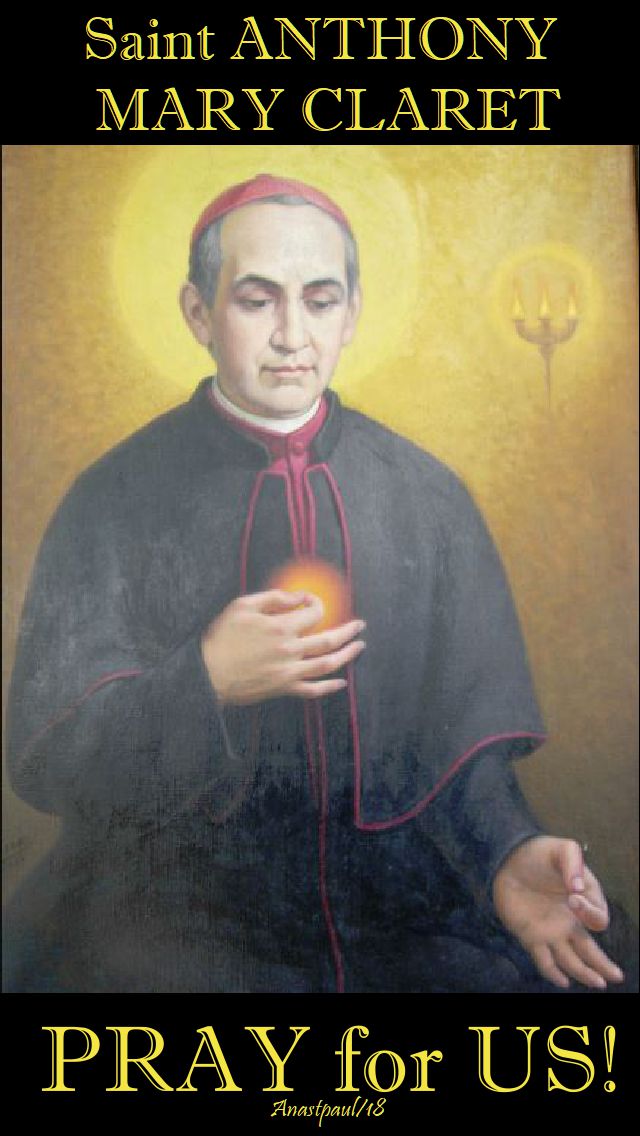
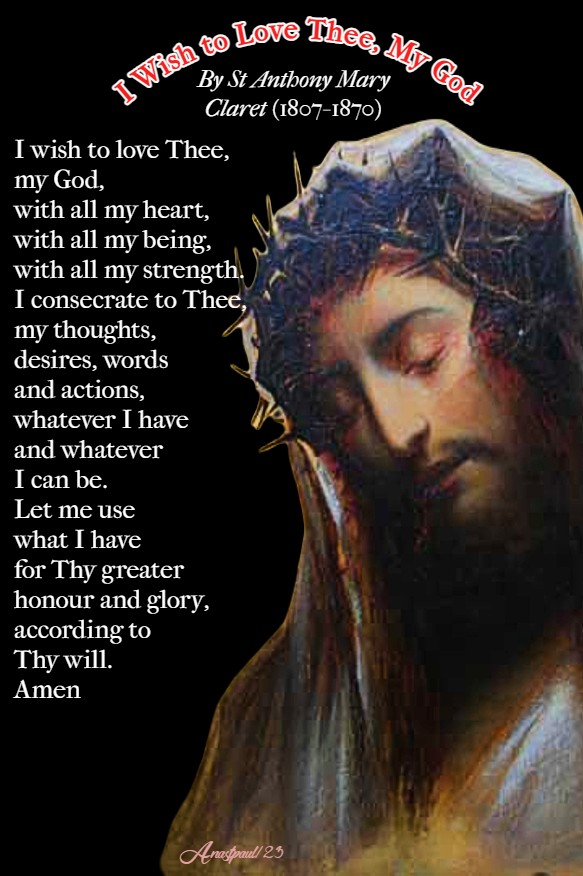
Our Morning Offering – 24 October – The Memorial of St Anthony Mary Claret CMF (1807-1870)
Our Morning Offering – 24 October – The Memorial of St Anthony Mary Claret CMF (1807-1870)
I Wish to Love Thee, My God
By St Anthony Mary Claret (1807-1870)
I wish to love Thee, my God,
with all my heart,
with all my being,
with all my strength.
I consecrate to Thee,
my thoughts,
desires, words
and actions,
whatever I have
and whatever I can be.
Let me use what I have
for Thy greater honour
and glory,
according to Thy will.
Amen

Saint of the Day – 24 October – St Luigi Guanella (1842-1915) “Servant of Charity”
Saint of the Day – 24 October – St Luigi Guanella (1842-1915) – Priest, Founder, Apostle of Charity, Marian devotee, Eucharistic Adorer and passionate apostle – born Aloysius Guanella on 9 December 1842 in Fraciscio di Campodolcino, Sondrio, diocese of Como, Italy and died on 24 October 1915 (aged 72) in Como, Italy of complications from a stroke he suffered on 27 September 1915. Founder of the Daughters of Saint Mary of Providence (1890) and the Servants of Charity (24 March 1908) alongside his friends Fr David Albertario (1846-1902) and Blessed Giuseppe Toniolo (1845-1918). Guanella also founded the Pious Union of Saint Joseph (1914) with his supporter and first member St Pope Pius X. These religious communities focused on the relief of the poor throughout the world. The Servants of Charity motto reads “In Omnibus Charitas” – “In all things Love” which became the cornerstone for Guanella’s own life. Patronages – Daughters of Saint Mary of Providence, Servants of Charity and the Pious Union of Saint Joseph.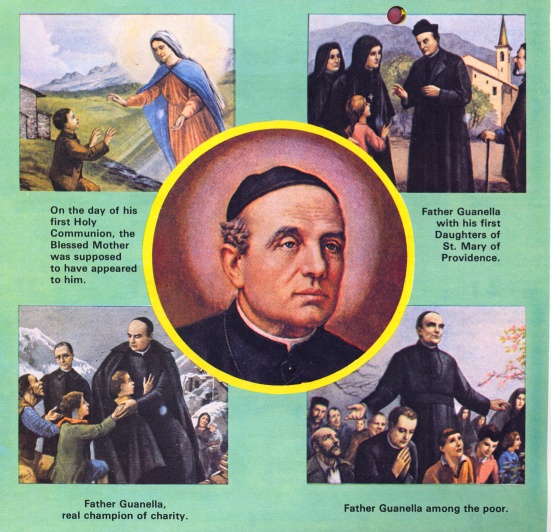
Louis Guanella was born in Fraciscio di Campodolcino in Val San Giacomo (Sondrio) on 19 December 1842. The particular geographical location where he grew up, formed Louis into a solid character – firm, temperate and with a spirit of sacrifice. He was always distinguished for his great faith, strengthened by popular piety, a faith alive for its closeness to the poor and simple.
He studied at the Gallio College in Como and in various diocesan seminaries. In 1866 he was ordained priest and, soon after, appointed parish priest at Savogno. He dedicated himself zealously to young people busying himself with helping them in their schooling and revitalising Catholic Action.
He was in contact with St Don Bosco SDB (1815-1888) at the time. Fascinated by the Salesian charism, he tried opening a College for the young but the operation didn’t go ahead. However, he wanted to stay with Don Bosco and in 1875 became a Salesian. He was in charge of the “Saint Aloysius” Oratory in Turin and soon after was appointed Rector of the “Dupraz” College in Trinità (Cuneo). He remained in the Salesian Congregation for just three years, because the Lord had arranged otherwis -: the bishop in fact called him back to the diocese. Louis had no fear of defending young people and the poor even in front of the powerful and the politicians.
This was another reason why he had to close the school he had opened for poor children in Traona. Sent by the bishop to look after a hostel for poor elderly people, he founded a group of Ursulines there, whom he organised into a Congregation – the Daughters of Holy Mary of Providence. The new Congregation was dedicated to the education of youth, especially those who were poor and on the margins but also, to support and be with poor elderly folk. In Como he founded the House of Divine Providence, at the centre of which he built a Shrine to the Sacred Heart. With support from the bishop he also founded a male branch – The Servants of Charity, with the same aims.
His Congregations flourished in Italy, Switzerland and the United States. In support of the dying he founded the Pia Unione del Transito – Pious Union of Saint Joseph. He built various churches and works for emigrants and fringe-dwellers.
What he gained from his experience with Don Bosco was not only a love for the young that he carried with him all his life but in particular, blind obedience and sacrifice in his relationships with his superiors. Like Don Bosco he was obedient to the bishop even when it meant suffering and misunderstanding. He died at Como 24 October 1925. 
Declared Venerable on 6 April 1962, Beatified on 25 October 1964 by Paul VI and Canonised on 23 October 2011 by Pope Benedict XVI.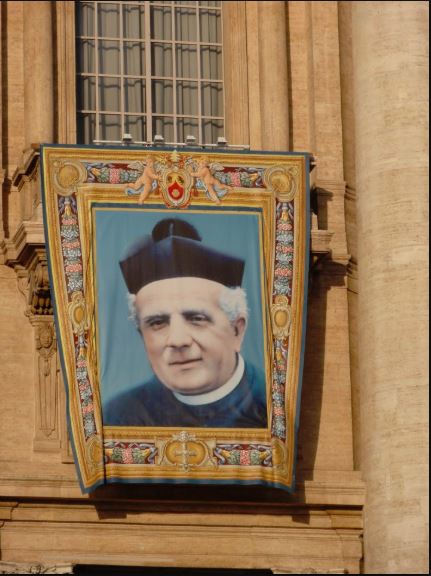
His older sister was the Servant of God Caterina Guanella (25 March 1841 – 13 June 1891).


Memorials of the Saints – 24 October
St Anthony Mary Claret CMF (1807-1870) (Optional Memorial)
About St Anthony Mary here: https://anastpaul.wordpress.com/2017/10/24/saint-of-the-day-24-october-st-anthony-mary-claret-1807-1870-cmf/
Bl Amado García Sánchez
St Audactus of Thibiuca
St Cadfarch
St Ciriacus of Hierapolis
St Claudian of Hierapolis
St Ebregislus of Cologne
St Felix of Thibiuca
St Fortunatus of Thibiuca
St Fromundus of Coutances
St Giuse Lê Dang Thi
Bl Giuseppe Baldo
St Januarius of Thibiuca
St Luigi Guanella
St Maglorius of Wales
St Marcius of Monte Cassino
St Martin of Vertou
St Proclus of Constantinople
St Senoch
St Senócus of Tours
St Septimus of Thibiuca
—
Martyrs of Ephesus – 3 saints: Three Christians martyred together. All we know about them are the names Mark, Sotericus and Valentina.
They were stoned to death near Ephesus, Asia Minor (in modern Turkey). Their relics are enshrined on the island of Tasos.
Thought for the Day – 23 October – The Memorial of St John of Capistrano OFM (1386-1456)
Thought for the Day – 23 October – The Memorial of St John of Capistrano OFM (1386-1456)
It has been said the Christian saints are the world’s greatest optimists. Not blind to the existence and consequences of evil, they base their confidence on the power of Christ’s redemption. The power of conversion through Christ extends not only to sinful people but also to calamitous events.
Imagine being born in the 14th century. One-third of the population and nearly 40 percent of the clergy were wiped out by the bubonic plague. The Western Schism split the Church with two or three claimants to the Holy See at one time. England and France were at war. The city-states of Italy were constantly in conflict. No wonder that gloom dominated the spirit of the culture and the times.
John Capistrano was born in 1386. His education was thorough. His talents and success were great. When he was 26 he was made governor of Perugia. Imprisoned after a battle against the Malatestas, he resolved to change his way of life completely. At the age of 30 he entered the Franciscan novitiate and was ordained a priest four years later.
John’s preaching attracted great throngs at a time of religious apathy and confusion. He and 12 Franciscan brethren were received in the countries of central Europe as angels of God. They were instrumental in reviving a dying faith and devotion.
The Franciscan Order itself was in turmoil over the interpretation and observance of the Rule of St Francis. Through John’s tireless efforts and his expertise in law, the heretical Fraticelli were suppressed and the “Spirituals” were freed from interference in their stricter observance.
John of Capistrano helped bring about a brief reunion with the Greek and Armenian Churches.
When the Turks captured Constantinople in 1453, John was commissioned to preach a crusade for the defence of Europe. Gaining little response in Bavaria and Austria, he decided to concentrate his efforts in Hungary. He led the army to Belgrade. Under the great General John Hunyadi, they gained an overwhelming victory and the siege of Belgrade was lifted. Worn out by his superhuman efforts, Capistrano was an easy prey to an infection after the battle. He died on October 23, 1456.
John Hofer, a biographer of John Capistrano, recalls a Brussels organisation named after the saint. Seeking to solve life problems in a fully Christian spirit, its motto was: “Initiative, Organisation, Activity.” These three words characterised John’s life. He was not one to sit around. His deep Christian optimism drove him to battle problems at all levels with the confidence engendered by a deep faith in Christ. (Lives of the Saints – Franciscan Media)
St John of Capistrano, Pray for us!
St John’s full biography here: https://anastpaul.wordpress.com/2017/10/23/saint-of-the-day-23-october-st-john-capistrano-ofm-1386-1456-the-soldier-saint/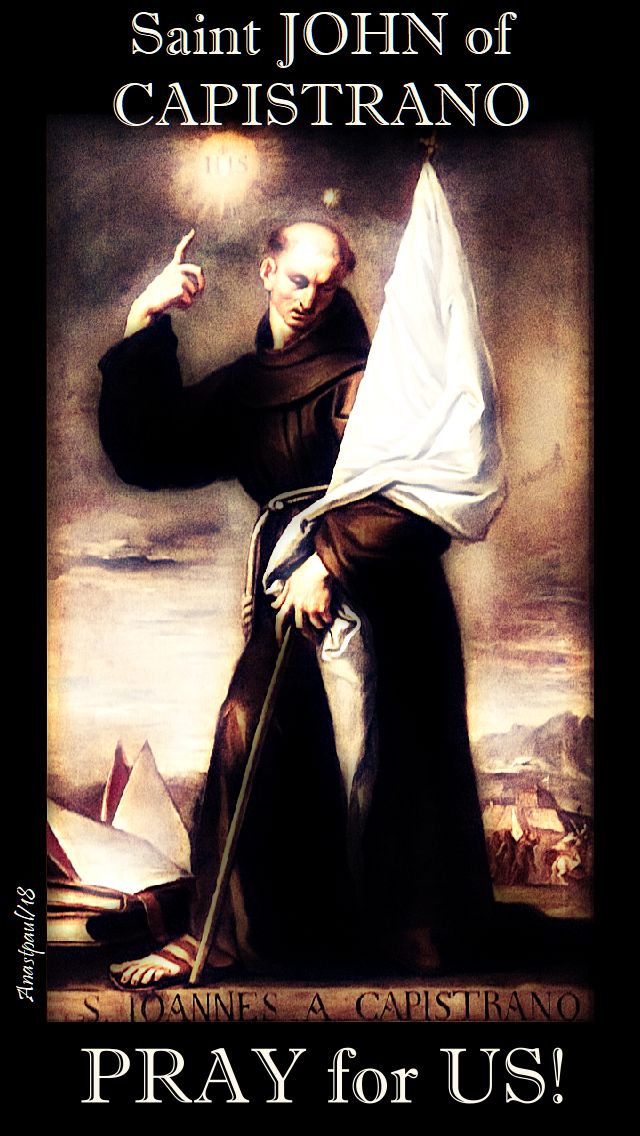
Quote/s of the Day – 23 October – The Memorial of Blessed Arnold Rèche FSC (1838-1890)
Quote/s of the Day – 23 October – The Memorial of Blessed Arnold Rèche FSC (1838-1890)
“..With the grace of God
that we obtain from prayer,
we can do anything.
All we have to do is to will it.”
“We do not stand alone
but in a history,
with men and women like ourselves,
who have heard Your word and said
“Yes” to Your call.”
Blessed Arnold Rèche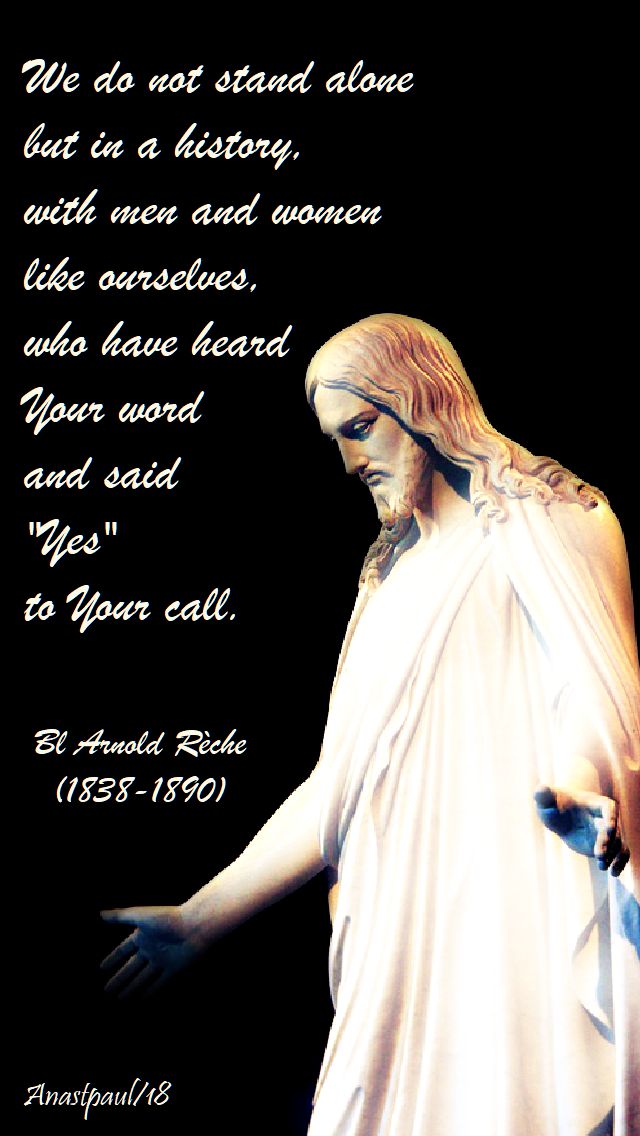
Our Morning Offering – 23 October
Our Morning Offering – 23 October – The Memorial of Blessed Arnold Rèche FSC (1838-1890)
Father in Heaven, God of Love
All I Have and Am is Yours
La Sallian Morning Offering
Father in heaven, God of love,
all I have and am is Yours.
Grant that I may become a living sign
of Your compassion in this world.
Grant me the faith
to live my life,
always in the awareness
of Your loving presence.
Grant me zeal
to serve without thought of reward,
those to whom You send me.
Grant me charity,
to bear the burdens of my brothers and sisters.
Teach me to seek Your Son’s face,
in the last,
the lost
and the least.
In whatever I undertake,
may I seek above all things,
to procure Your glory,
as far as I am able
and as You will require of me.
Strengthen me by Your Holy Spirit,
to follow Jesus by living
the commitment I make this day.
Amen.
Live Jesus in our hearts forever!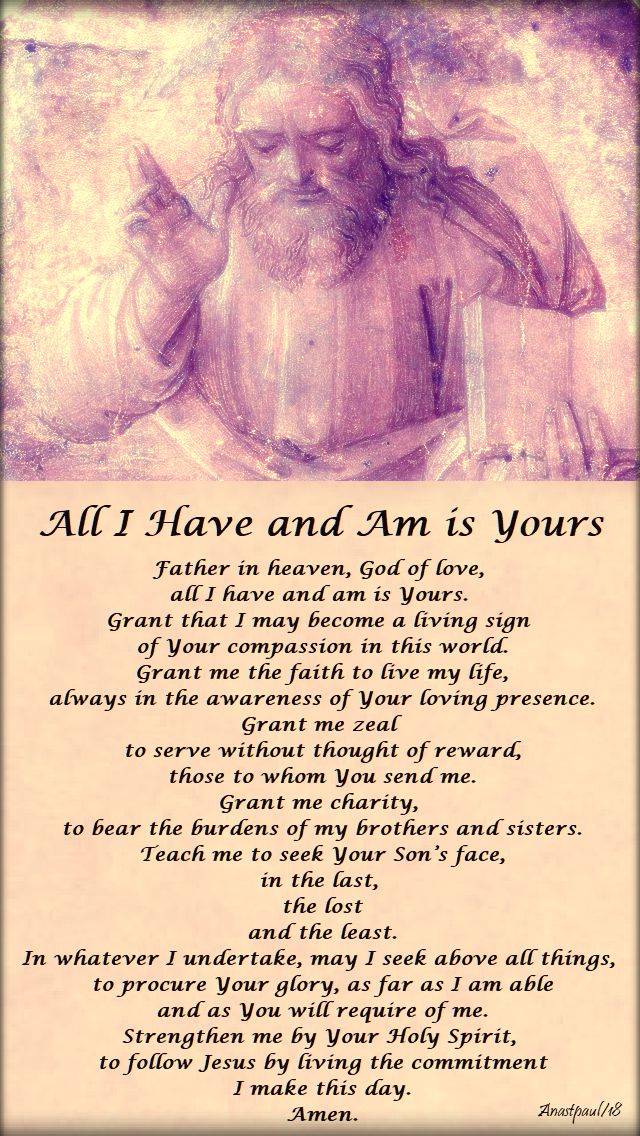
Saint of the Day – 23 October – Blessed Arnold Rèche FSC (1838-1890)
Saint of the Day – 23 October – Blessed Arnold Rèche FSC (1838-1890) – French Religious Brother of the Institute of the Brothers of the Christian School (LaSallian Brothers) founded by St Jean-Baptiste de La Salle (1651-1719) in 1725 – he assumed the religious name of “Arnould” upon his profession into the congregation and became a noted Teacher, Catechist, Novice Master – born 2 September 1838 at Landroff, Lorraine, France as Nicholas-Jules Reche and died on 23 October 1890 following a cerebral hemorrhage. Also known as Arnold Jules-Nicolas Rèche, Jules Reche, Julian-Nicolas Rèche, Nicholas-Jules Reche. Patronage – Teachers.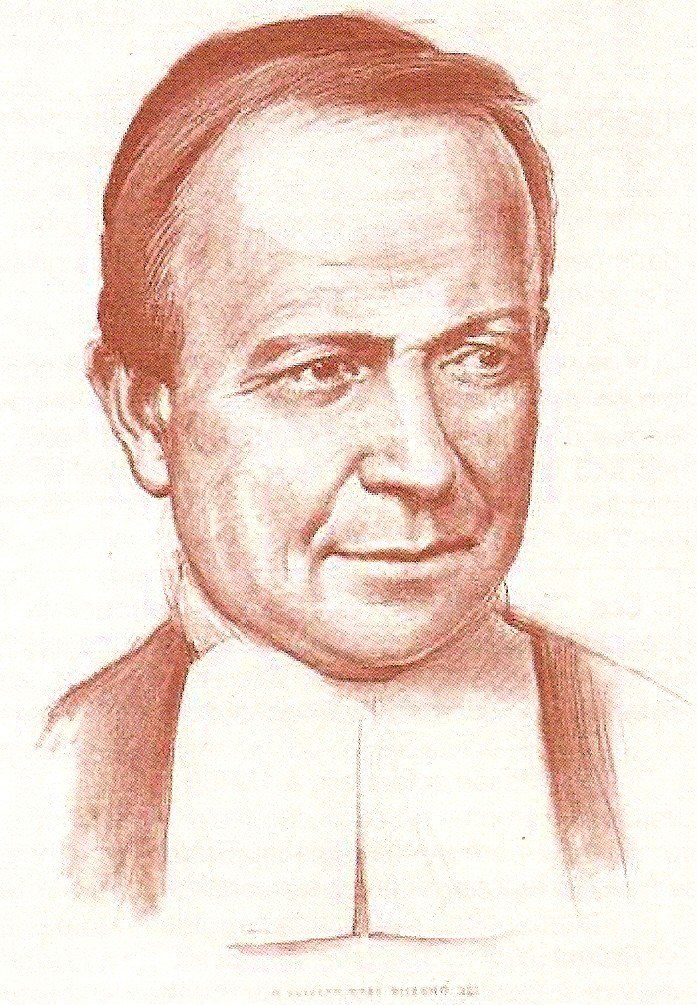
Jules-Nicolas Rèche was born into a poor family living in Landroff in the province of Lorraine. He left school at an early age to work as a stable-boy, a coachman and finally as a teamster for a local construction company. Even as a young man he was known among his fellow workers for his piety and his self-discipline. He first met the De La Salle Brothers while attending evening classes in their school and asked to be admitted into the congregation.
He taught for fourteen years at the boarding school on the Rue de Venise in Reims. Despite the demands of a full teaching schedule he managed by private study to master theology, mathematics, science and agriculture, which he taught to small groups of advanced students.
During the Franco-Prussian War of 1870, he worked with other Brothers to care for the medical and spiritual needs of the wounded soldiers on both sides, for which he was awarded the Bronze Cross.
The intensity of his prayer life and his love for practices of penance soon led the superiors to appoint him Director of Novices at Thillois. He won the hearts of his young charges by his evident solicitude for their spiritual and professional development.
There are stories of little miracles and cures, as well as his uncanny ability to discern their inmost thoughts. Brother Arnold was known for his devotion to the Lord’s passion and for his docility to the Holy Spirit who, as he often remarked, “strengthens a person’s heart.” When the novitiate was moved to the new formation centre at Courlancy near Rheims in 1885, Brother Arnold was instrumental in having it dedicated to the Sacred Heart.
He died at age fifty-two with a reputation for sanctity, only a few months after his appointment as Director General of Sacré Coeur. He was buried in Rheims and his grave became known for being the site of miraculous healings.
He was Beatified on 1 November 1987 by St Pope John Paul II.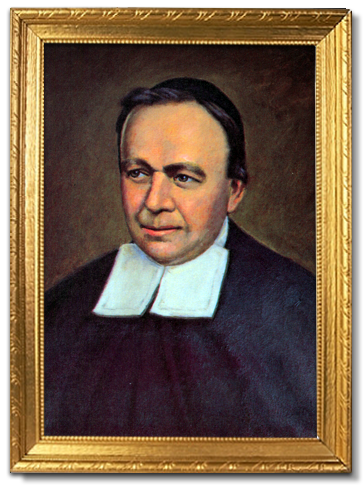
Memorials of the Saints – 23 October
St John of Capistrano OFM “The Soldier Saint” (1386-1456) (Optional Memorial)
St John here: https://anastpaul.wordpress.com/2017/10/23/saint-of-the-day-23-october-st-john-capistrano-ofm-1386-1456-the-soldier-saint/
St Allucio of Campugliano
Bl Anne-Joseph Leroux
St Amo of Toul
St Arethas of Negran
Bl Arnold Reche FSC (1838-1890)
St Benedict of Sebaste
St Clether
St Domitius
St Elfleda
St Ethelfleda
St Gratien of Amiens
St Henry of Cologne
St Ignatius of Constantinople
Bl John Angelo Porro
Bl John Buoni
St John of Syracuse
Oda of Aquitaine
St Phaolô Tong Viet Buong
St Romanus of Rouen
Bl Severinus Boethius
St Severinus of Cologne
Syra of Faremoutiers
St Theodoret of Antioch
Bl Thomas Thwing
St Verus of Salerno
—
Martyrs of Cadiz – 2 saints
Germanus
Servandus
Martyrs of Hadrianopolis – 2 saints
Dorotheus
Severus
Martyrs of Nicaea – 3 saints
Euerotas
Socrates
Theodota
Martyrs of Valenciennes – 6 beati: A group of Urusuline and Briggittine nuns murdered together in the anti-Christian excesses of the French Revolution. They were guillotined on 23 October 1794 in Valenciennes, Nord, France and Beatified on 13 June 1920 by Pope Benedict XV.
• Anne-Joseph Leroux
• Clotilde-Joseph Paillot
• Jeanne-Louise Barré
• Marie-Augustine Erraux
• Marie-Liévine Lacroix
• Marie-Marguerite-Joseph Leroux
Martyred in the Spanish Civil War including Martyrs of Manzanares (7 beati):
• Agapit Gorgues Manresa
• Agustín Nogal Tobar
• Andrés Navarro Sierra
• César Elexgaray Otazua
• Cristóbal González Carcedo
• Dorinda Sotelo Rodríguez
• Eduardo Valverde Rodríguez
• Felipe Basauri Altube
• José María Fernández Sánchez
• Juan Nuñez Orcajo
• Leonardo Olivera Buera
• Manuel Navarro Martínez
• Roque Guillén Garcés
• Toribia Marticorena Sola
Thought for the Day – 22 October – The Memorial of St Pope John Paul II (1920-2005)
Thought for the Day – 22 October – The Memorial of St Pope John Paul II (1920-2005)
St Peter’s Square had a special meaning for St John Paul. In earlier days he wrote a poem about it. Below is an excerpt from it:
Marble Floor
Marble floor
our feet meet the earth in this place,
there are so many walls,
so many colonnades,
yet we are not lost. If we find
meaning and oneness,
it is the floor that guides us….
Peter, you are the floor, that others
may walk over you… You guide their steps…
You want to serve their feet that pass
as rock serves the hooves of sheep.
The rock is a gigantic temple floor,
the cross a pasture.
St Peter’s name means “a rock” and Christ said of him “on this Rock I will build my Church.” The poem is about the role of the Holy Father, who is a shepherd to his flock, a guide to the Church.
St John Paul, keep being our shepherd by your prayers!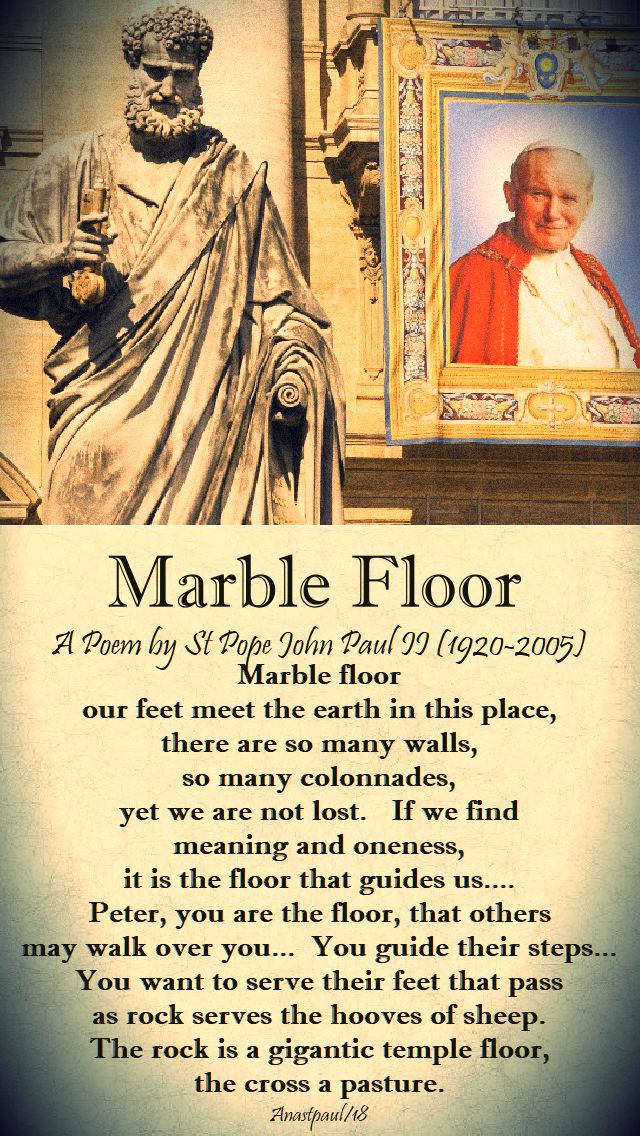
Quote/s of the Day – 22 October – The Memorial of St Pope John Paul II (1920-2005)
Quote/s of the Day – 22 October – The Memorial of St Pope John Paul II (1920-2005)
“Freedom consists not in doing what we like
but in having the right to do what we ought.”
“Darkness can only be scattered by light,
hatred can only be conquered by love.”
“The cemetery of the victims of human cruelty
in our century is extended to include
yet another vast cemetery,
that of the unborn.”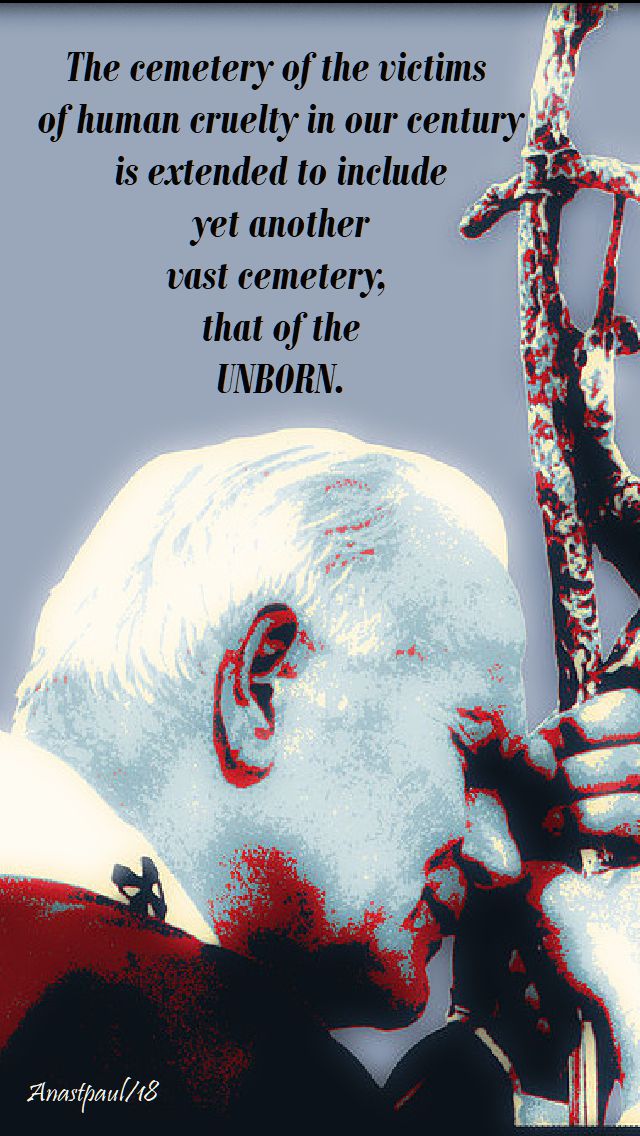
“The best, the surest
and the most effective way
of establishing PEACE on the face of the earth,
is through the great power
of Perpetual Adoration of the Blessed Sacrament.”
St Pope John Paul II (1920-2005)
One Minute Reflection – 22 October – Today’s Gospel: Luke 12:13–21
One Minute Reflection – 22 October – Today’s Gospel: Luke 12:13–21 – Monday of the Twenty Ninth week in Ordinary Time, Year B and The Memorial of St Pope John Paul II (1920-2005)
“But God said to him, ‘Fool! This night your soul is required of you and the things you have prepared, whose will they be?’“…Luke 12:20
REFLECTION – “The fool in the Bible, the one who does not want to learn from the experience of visible things, that nothing lasts forever but that all things pass away, youth and physical strength, amenities and important roles. Making one’s life depend on such an ephemeral reality is therefore foolishness. The person who trusts in the Lord, on the other hand, does not fear the adversities of life, nor the inevitable reality of death, he is the person who has acquired a wise heart, like the Saints.”…Pope Benedict XVI – Angelus 1 August 2010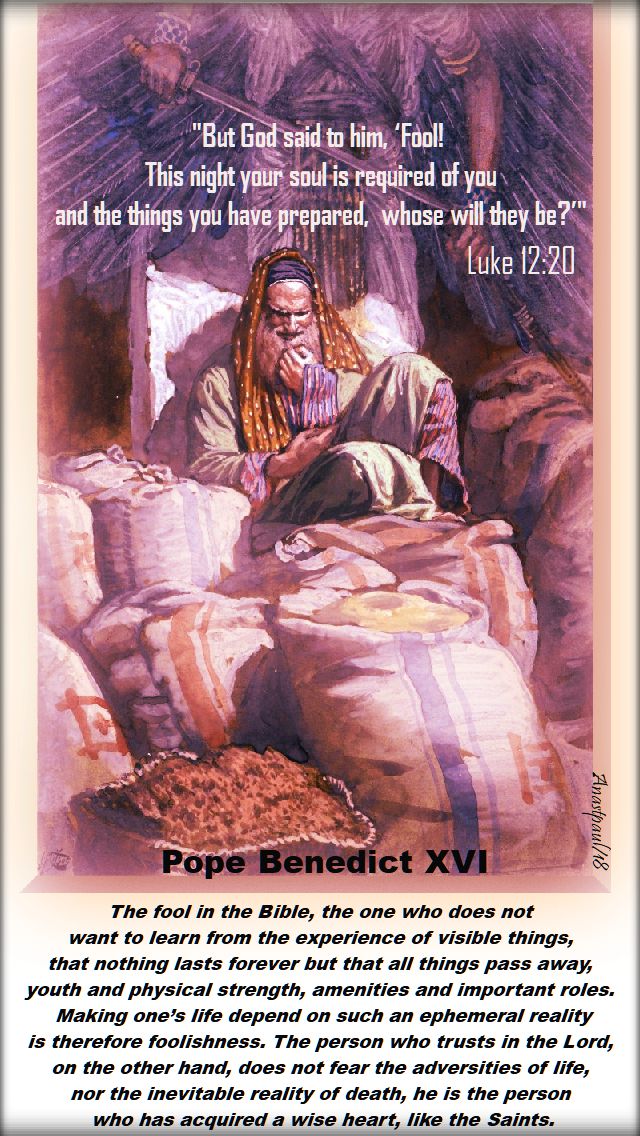
“The rich man, clinging to his immense fortune, is convinced that he will succeed in overcoming death….Indeed, like all other men and women, rich and poor, wise and foolish alike, he is doomed to end in the grave, as happens likewise to the powerful and he will have to leave behind on earth that gold so dear to him and those material possessions he so idolised.” – St Pope John Paul II 20 October 2004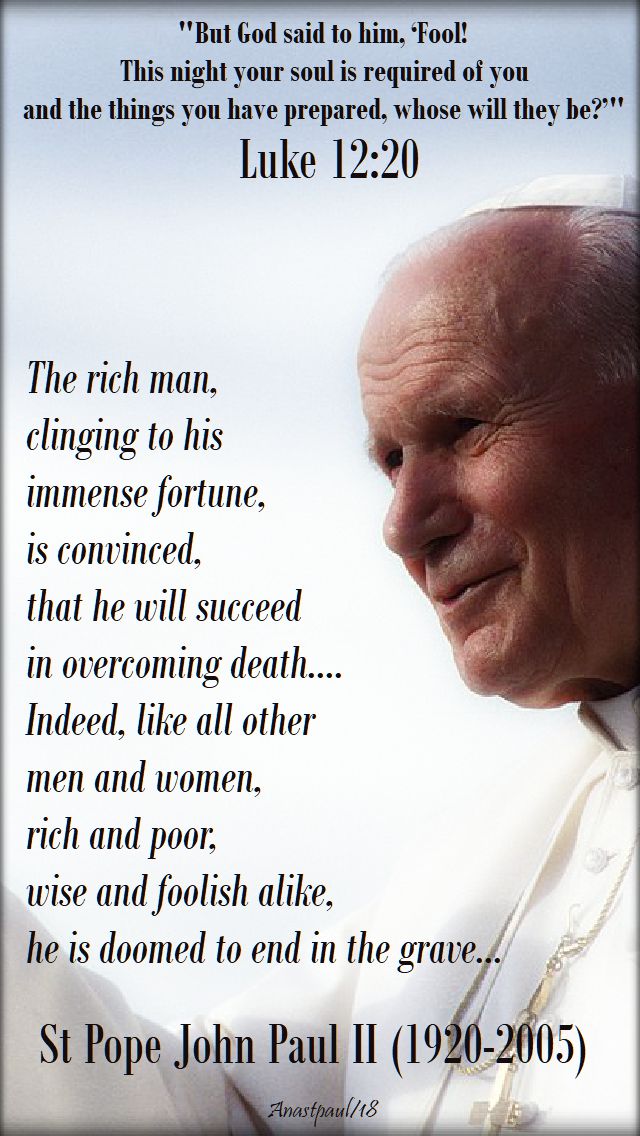
PRAYER – Almighty ever-living God, grant that we may always conform our will to Yours and serve Your majesty in sincerity of heart. Teach us to lay up riches in heaven and may the prayers of St John Paul assist us in our daily struggles against the idols of the world. Through our Lord Jesus Christ, Your Son, who lives and reigns with You in the unity of the Holy Spirit, one God, forever and ever, amen.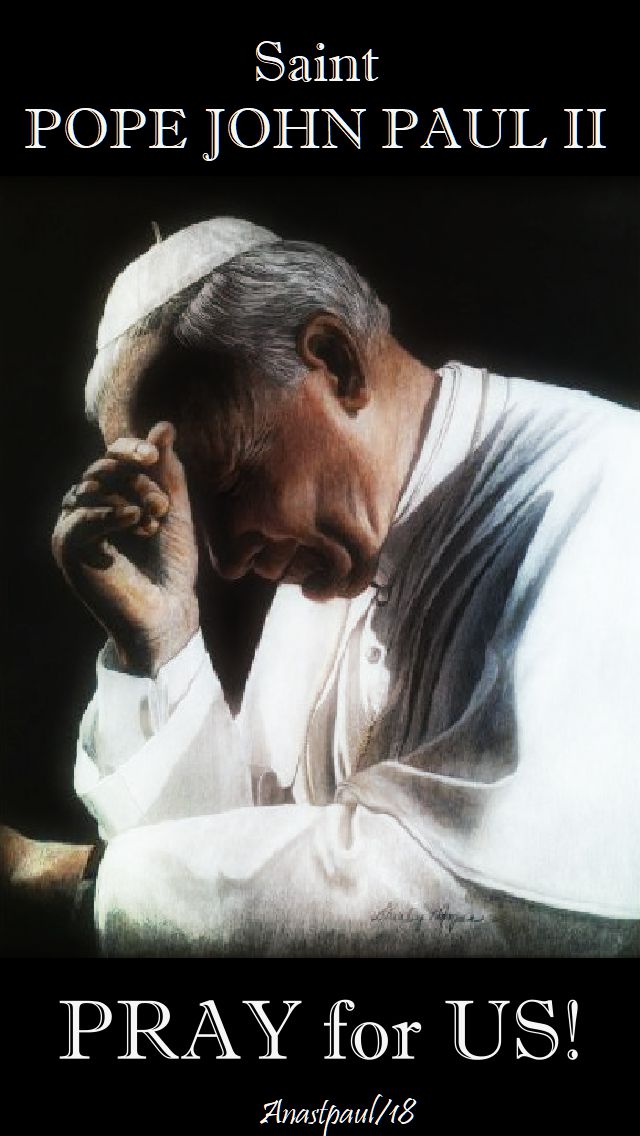
Our Morning Offering – 22 October – The Memorial of St Pope John Paul II (1920-2005)
Our Morning Offering – 22 October – The Memorial of St Pope John Paul II (1920-2005)
O Clement, O Loving,
Sweet Mother of God
By St Pope John Paul (1920-2005)
Mother of the Redeemer,
with great joy we call you blessed.
In order to carry out His plan of salvation,
God the Father chose you
before the creation of the world.
You believed in His love
and obeyed His word.
The Son of God desired you for His Mother
when He became man to save the human race.
You received Him with ready obedience
and undivided heart.
The Holy Spirit loved you
as His mystical spouse
and filled you with singular gifts.
You allowed yourself to be led
by His hidden powerful action.
We entrust to you the Church
which acknowledges you
and invokes you as Mother.
To you, Mother of human family
and of the nations,
we confidently entrust the whole humanity,
with its hopes and fears.
Do not let it lack the light of true wisdom.
Guide its steps in the ways of peace.
Enable all to meet Christ,
the Way, the Truth and the Life.
Sustain us, O Virgin Mary,
on our journey of faith
and obtain for us the grace
of eternal salvation.
O clement, O loving,
O sweet Mother of God
and our Mother, Mary!
Amen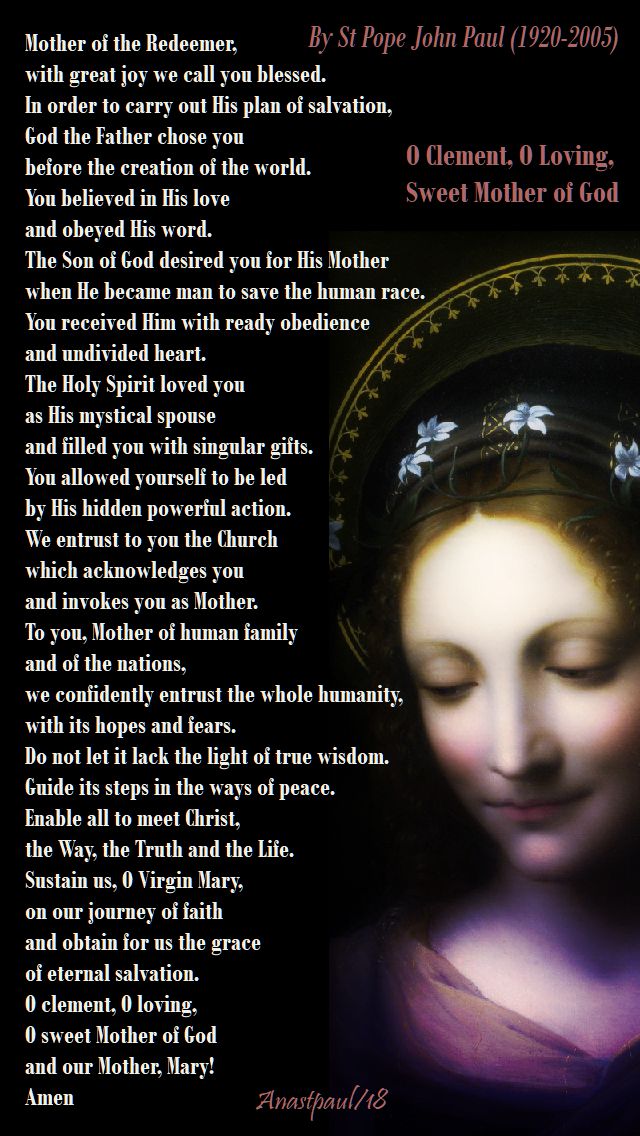
Saint of the Day – 22 October – St Pope John Paul II ‘The Great’ (1920-2005)
Saint of the Day – 22 October – St Pope John Paul II ‘The Great’ (1920-2005) Holy Father from from 1978 to 2005 (27 years), the second longest-serving pope in modern history after Pope Pius IX, who served for nearly 32 years from 1846 to 1878.
“Open wide the doors to Christ,” urged John Paul II during the homily at the installation Mass as pope in 1978.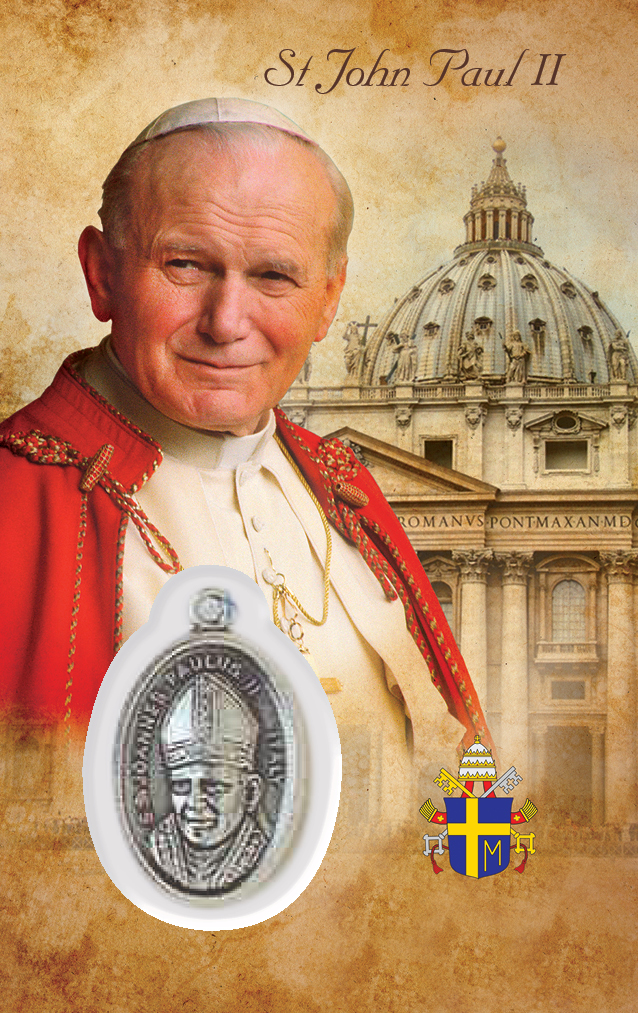
Born in Wadowice, Poland, Karol Jozef Wojtyla had lost his mother, father and older brother before his 21st birthday. Karol’s promising academic career at Krakow’s Jagiellonian University was cut short by the outbreak of World War II. While working in a quarry and a chemical factory, he enrolled in an “underground” seminary in Kraków. Ordained in 1946, he was immediately sent to Rome where he earned a doctorate in theology.
Back in Poland, a short assignment as assistant pastor in a rural parish preceded his very fruitful chaplaincy for university students. Soon Fr Wojtyla earned a doctorate in philosophy and began teaching that subject at Poland’s University of Lublin.
Communist officials allowed Wojtyla to be appointed auxiliary bishop of Kraków in 1958, considering him a relatively harmless intellectual. They could not have been more wrong!
Bishop Wojtyla attended all four sessions of Vatican II and contributed especially to its Gaudium et spes – Pastoral Constitution on the Church in the Modern World. Appointed as archbishop of Kraków in 1964, he was named a cardinal three years later.
Elected pope in October 1978, he took the name of his short-lived, immediate predecessor. Pope John Paul II was the first non-Italian pope in 455 years. In time, he made pastoral visits to 124 countries, including several with small Christian populations.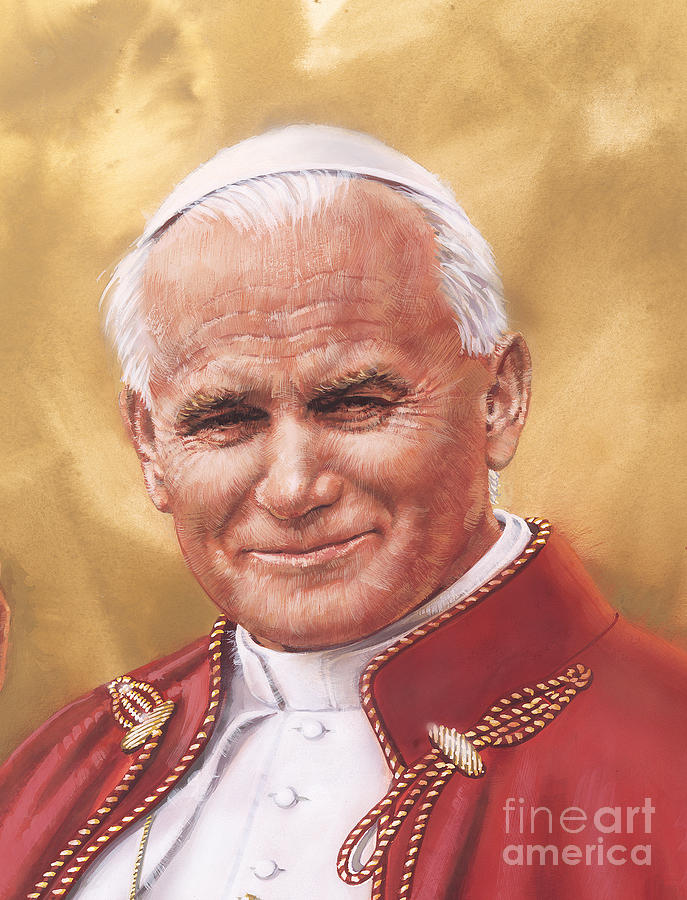
John Paul II promoted ecumenical and interfaith initiatives, especially the 1986 Day of Prayer for World Peace in Assisi. He visited Rome’s main synagogue and the Western Wall in Jerusalem, he also established diplomatic relations between the Holy See and Israel. He improved Catholic-Muslim relations and in 2001 visited a mosque in Damascus, Syria.
The Great Jubilee of the Year 2000, a key event in John Paul’s ministry, was marked by special celebrations in Rome and elsewhere for Catholics and other Christians. Relations with the Orthodox Churches improved considerably during his papacy.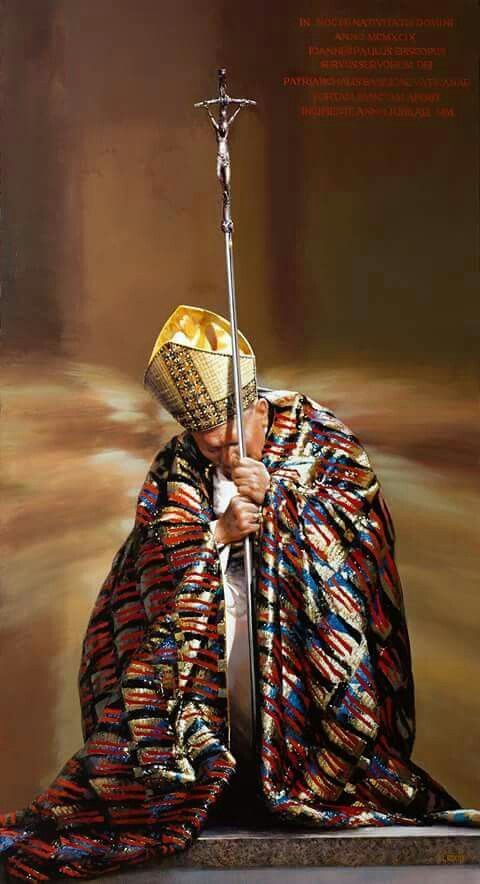
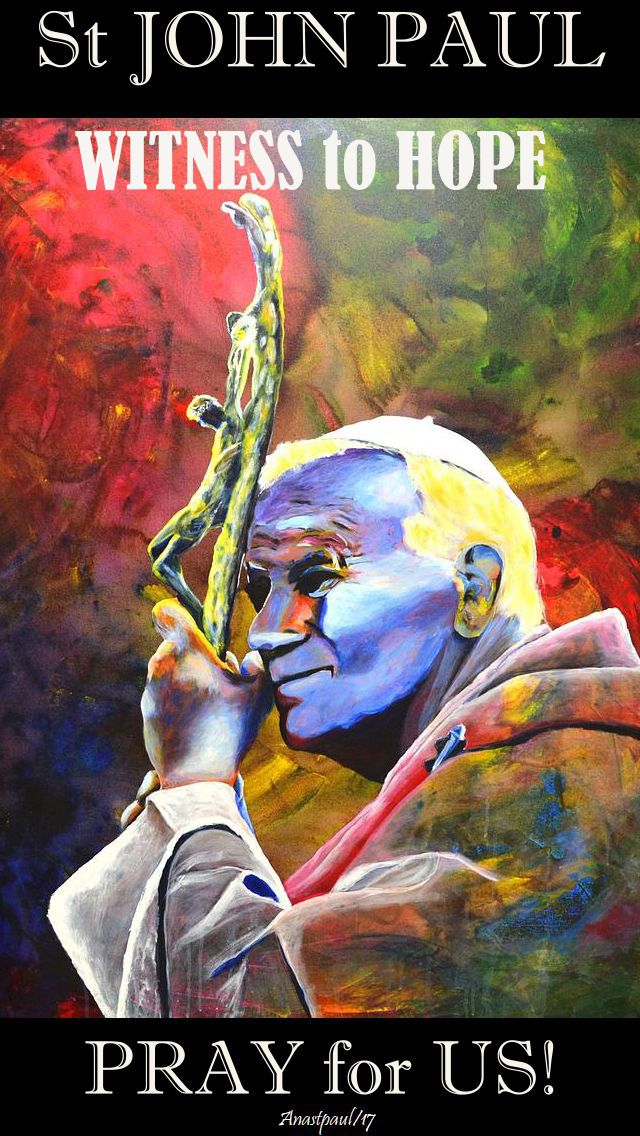
“Christ is the centre of the universe and of human history” was the opening line of John Paul II’s 1979 first encyclical, Redemptor hominis – Redeemer of the Human Race. In 1995, he described himself to the United Nations General Assembly as “a witness to hope.”
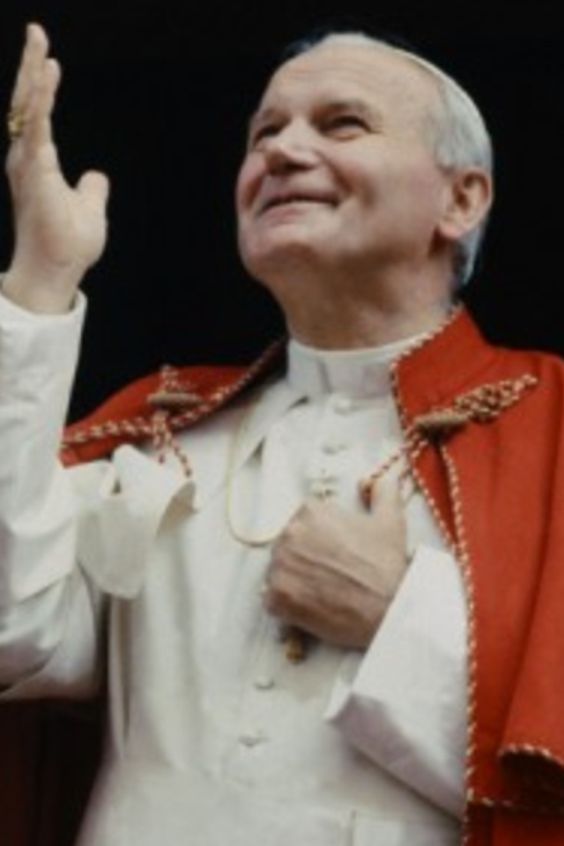
His 1979 visit to Poland encouraged the growth of the Solidarity movement there and the collapse of communism in central and eastern Europe 10 years later. John Paul II began World Youth Day and travelled to several countries for those celebrations. He very much wanted to visit China and the Soviet Union but the governments in those countries prevented that.
One of the most well-remembered photos of John Paul II’s pontificate was his one-on-one conversation in 1983, with Mehmet Ali Agca, who had attempted to assassinate him two years earlier.


In his 27 years of papal ministry, John Paul II wrote 14 encyclicals and five books, Canonised 482 saints and beatified 1,338 people. In the last years of his life, he suffered from Parkinson’s disease and was forced to reduce much of his many and varied activities.
Presiding at the funeral Mass, Cardinal Joseph Ratzinger—then dean of the College of Cardinals and later Pope Benedict XVI—concluded his homily by saying: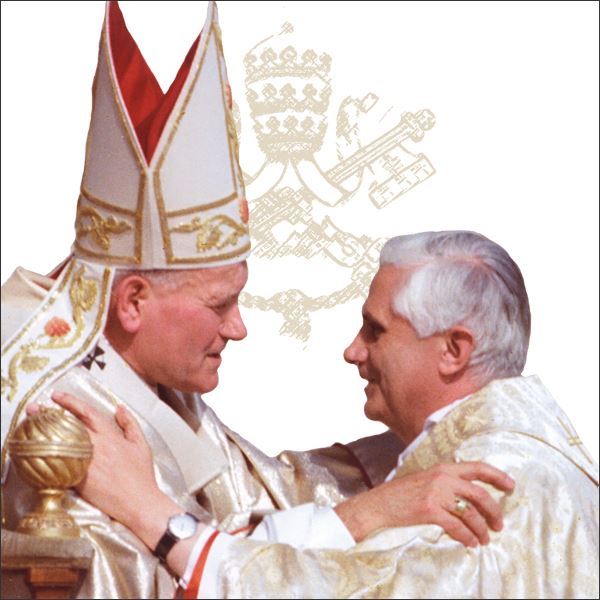
“None of us can ever forget how, in that last Easter Sunday of his life, the Holy Father, marked by suffering, came once more to the window of the Apostolic Palace and one last time gave his blessing urbi et orbi (‘to the city and to the world’).
We can be sure that our beloved pope is standing today at the window of the Father’s house, that sees us and blesses us. Yes, bless us, Holy Father. We entrust your dear soul to the Mother of God, your Mother, who guided you each day and who will guide you now to the glory of her Son, our Lord Jesus Christ. Amen.”
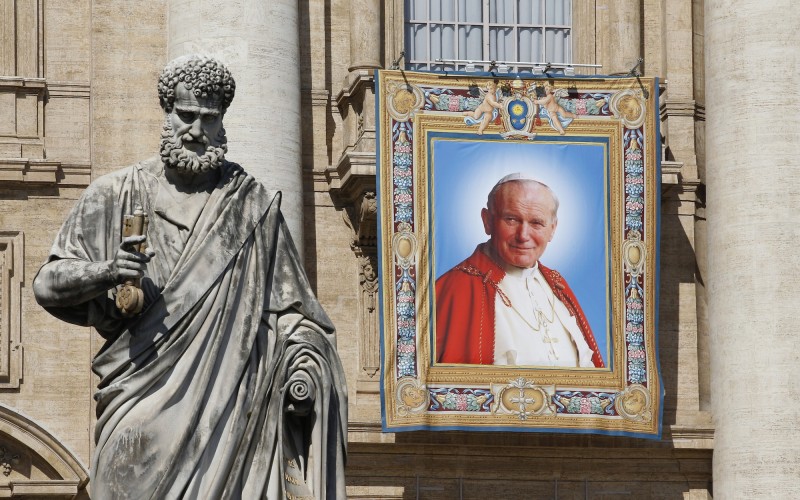
Pope Benedict XVI Beatified John Paul II in 2011 and Pope Francis Canonised him in 2014.
Memorials of the Saints – 22 October
St Pope John Paul II (1920-2005) (Optional Memorial)
Biography here: https://anastpaul.wordpress.com/2017/10/22/saint-of-the-day-22-october-st-pope-john-paul-ii-1920-2005/
St Abericus Marcellus
St Alodia of Huesca
St Apollo of Bawit
St Benedict of Macerac
St Bertharius of Monte Cassino
St Cordula
St Donatus of Fiesoli
Bl Esclaramunda of Majorca
St Hermes of Adrianople
St Ingbert
St Leothade of Auch
St Lupenzius
St Mark of Jerusalem
St Maroveus of Precipiano
St Mellon
St Moderan of Rennes
St Nepotian of Clermont
St Nunctus of Mérida
St Nunilo of Huesca
St Philip of Adrianople
St Philip of Fermo
St Rufus of Egypt
St Symmachus of Capua
St Valerius of Langres
St Verecundus of Verona
—
Martyrs of Heraclea – 4 saints: A group of four clerics in Heraclea (modern Marmara Ereglisi, Turkey) who were arrested in the persecutions of Diocletian. They were imprisoned, abused and ordered to turn over all the scriptures that they had hidden from authorities; they refused and were executed together. Martyrs. – Eusebius, Hermes, Philip and Severus. They were burned at the stake in 304 in Adrianople (modern Edirne, Turkey).
Martyrs of Adianople:
• Blessed Alexander
• Blessed Anna
• Blessed Elisabeth
• Blessed Glyceria
• Blessed Heraclius
• Blessed Theodota
Martyred in the Spanish Civil War:
• Blessed Álvaro Ibáñez Lázaro
• Blessed Andrés Zarraquino Herrero
• Blessed Estanislao García Obeso
• Blessed Germán Caballero Atienza
• Blessed José Menéndez García
• Blessed Josep Casas Lluch
• Blessed Luis Minguel Ferrer
• Blessed Pedro Lorente Vicente
• Blessed Victoriano Ibañez Alonso
Thought for the Day – 21 October – The Memorial of Blessed Karl of Austria (1887 – 1922)
Thought for the Day – 21 October – The Memorial of Blessed Karl of Austria (1887 – 1922)
“Practising Catholic – How to become a Saint”
From a young age and throughout his life, Karl of Austria demonstrated an awareness of God’s presence and Christian duty. As a child, he loved praying at daily mass with his mother, Archduchess Maria Josefa, and was known for his charitable acts. He knew all the prayers a typical Catholic youth would learn and loved praying them, particularly the rosary. As a youth and later as an adult, he loved making pilgrimages to Marian shrines.
As a young child, he was concerned about the poor and needy, so he did odd jobs around his home in order to earn money to give to them. There are records from when he was 18 years old recording his almsgiving and even as Emperor he continued his private charitable giving. There is testimony from one of his aides who was in charge of distributing the Emperor’s alms from his personal household. The aide informed him there was no more money left and Karl said:
“The need is so great, find the money from somewhere else and distribute that.”
Blessed Karl loved to pray throughout his life. He received Holy Communion daily and at the end of mass prayed “Veni Creator.” He prayed Morning Prayer, Evening Prayer, and the rosary daily. He frequently prayed the Litanies of the Sacred Heart, the Blessed Virgin Mary and Saint Joseph; he was a member of Our Lady’s Confraternity and wore the scapular.
Karl was devoted to adoring the Blessed Sacrament and could happily spend hours in adoration. He was routinely found praying wherever he was, at home, in the office and on the battlefield. He encouraged all of his soldiers to pray and frequently asked those around him to join him in prayer to begin a meeting or some action. Furthermore, the Emperor had a devotion to the angels, especially Saint Michael the Archangel, whom he made patron saint of the imperial army.
Karl of Austria was obedient to the Holy Father, acknowledging him to be the Vicar of Christ and he treated bishops and priests with respect. He was known as a loyal, kind, generous and jovial comrade, who lived and practised his faith without artifice. From the testimony of those who knew him well, it is clear, that Blessed Karl took his faith seriously and fostered his relationship with God, devoutly following the teachings of the Roman Catholic Church.
Blessed Karl of Austria, Pray for Us!
Quote/s of the Day – 21 October – The Memorial of Blessed Karl of Austria (1887 – 1922)
Quote/s of the Day – 21 October
The Memorial of Blessed Karl of Austria (1887 – 1922)
“Now, we must help
each other
to get to Heaven.”
“I strive always,
in all things,
to understand,
as clearly as possible
and follow,
the will of God
and this,
in the most perfect way.”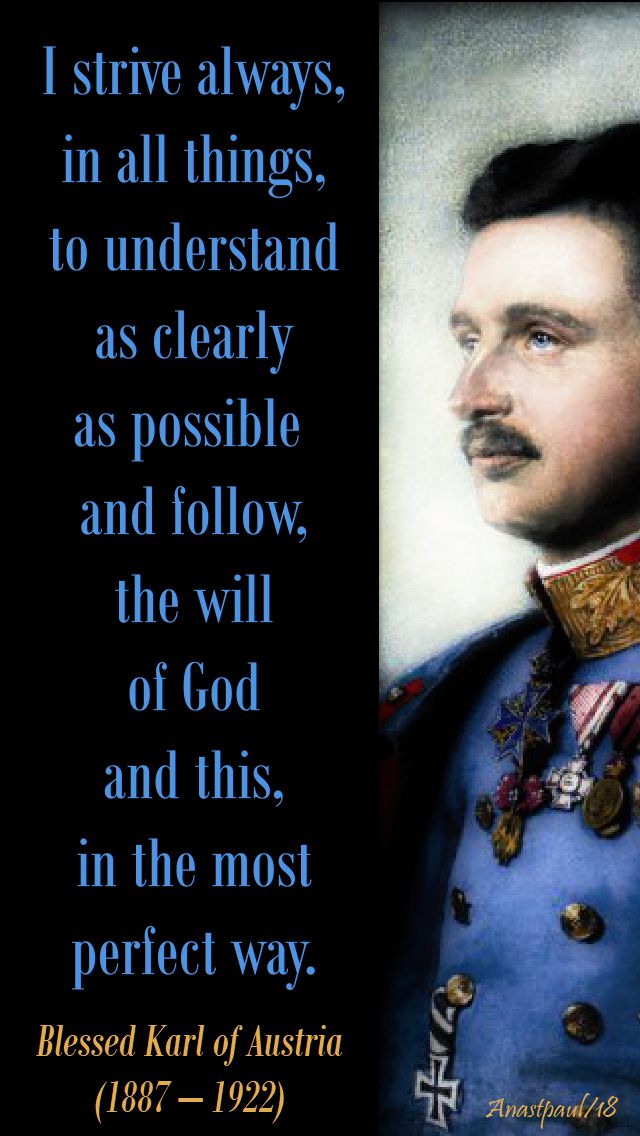
“Thy Holy Will be done.
Jesus, Jesus, come!
Yes—yes.
My Jesus as Thou willst it—Jesus.”
(The last words of Bl Karl – 1 April 1922)
Blessed Karl of Austria (1887 – 1922)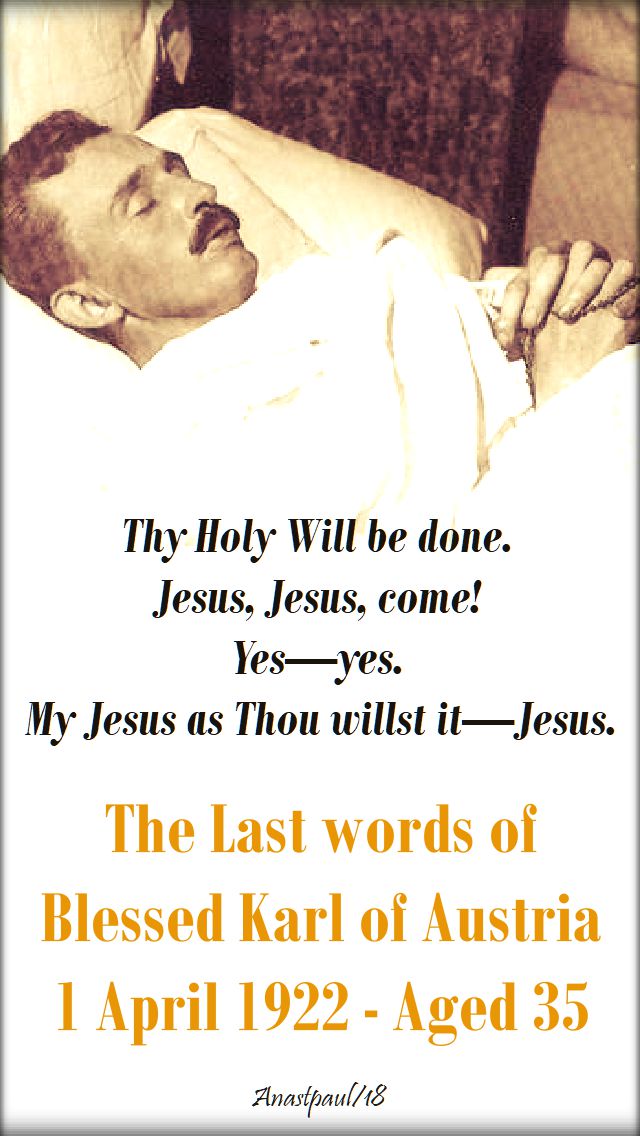
One Minute Reflection – 21 October – Today’s Gospel: Mark 10:35-45
One Minute Reflection – 21 October – Today’s Gospel: Mark 10:35-45 – Twenty Ninth Sunday in Ordinary Time, Year B, the Memorial of Blessed Karl of Austria (1887 – 1922)
“For the Son of man came not to be served but to serve and to give his life as a ransom for many.”…Mark 10:45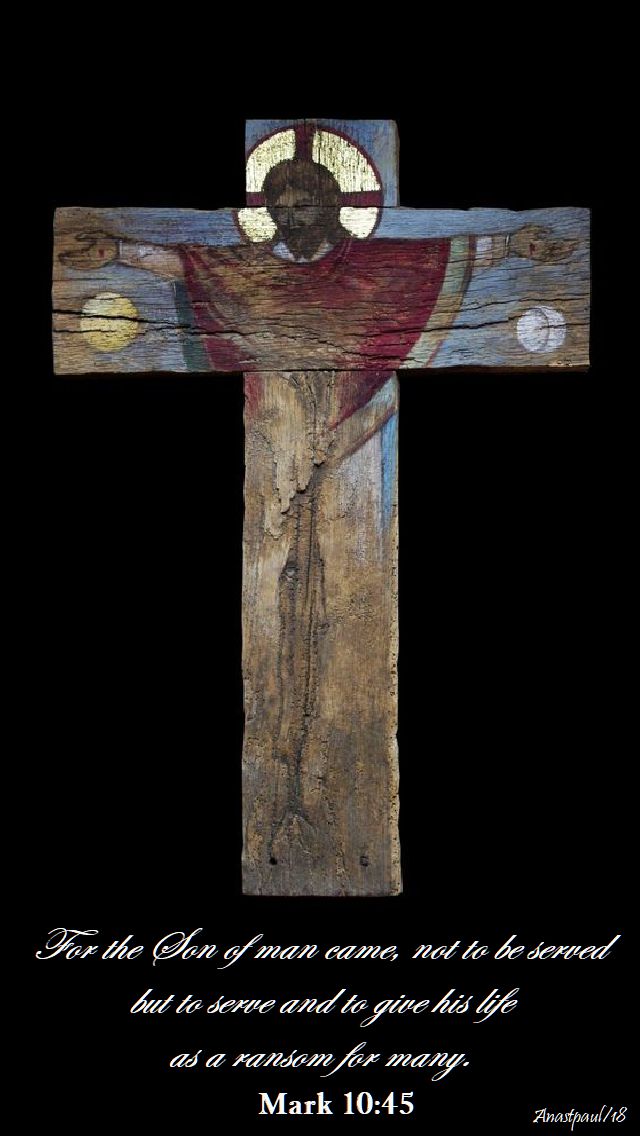
REFLECTION – “In the biblical tradition, the Son of Man is the one who receives from God “dominion, glory and kingship”. Jesus fills this image with new meaning. He shows us that He enjoys dominion because He is a servant, glory because He is capable of abasement, kingship because He is fully prepared to lay down His life. By His passion and death, He takes the lowest place, attains the heights of grandeur in service and bestows this upon His Church”…Pope Francis – Canonisation Mass, 18 October 2015
PRAYER – Holy Father, grant me an operative faith, a faith that will move mountains. Enlighten my soul with Your Light, Goodness, Power and Wisdom. Let my faith be an image of You by lively deeds and love and by conforming myself to Your Will in all things. Blessed Karl of Austria, amidst the fineries of your earthly kingship, you longed only to serve the God of all and searched for complete closeness and abandonment to Him, teach us by your prayer, to serve God alone with upright hearts and thus manifest a true faith, through Christ our Lord, with the Holy Spirit, God forever, amen.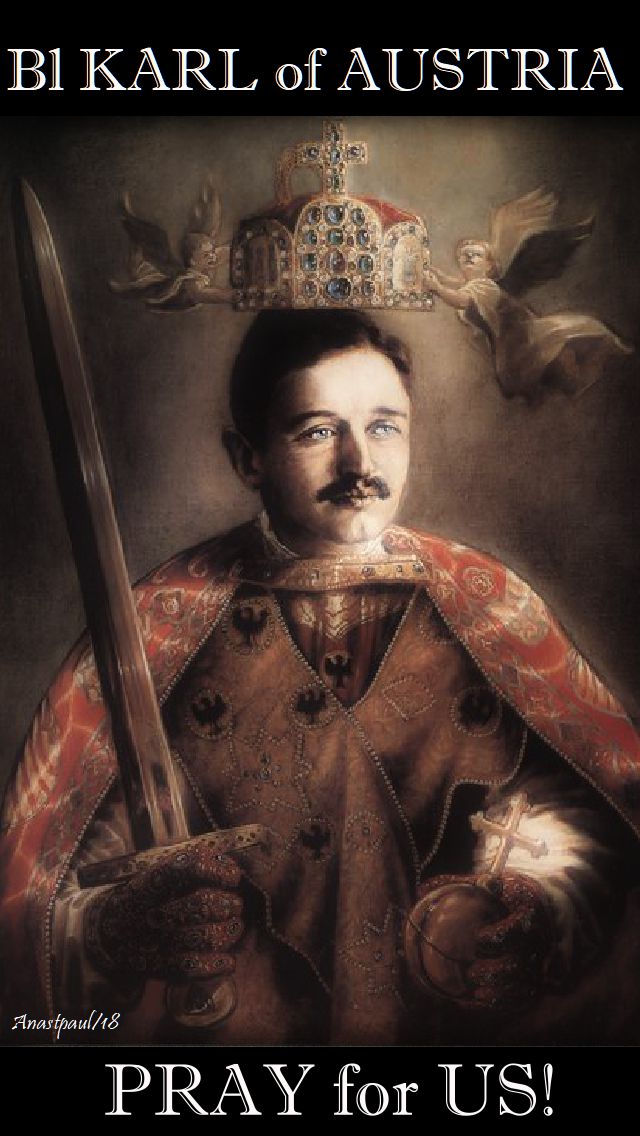
Saint of the Day – 21 October – Blessed Karl of Austria (1887 – 1922) Emperor & King
Saint of the Day – 21 October – Blessed Karl/Charles of Austria (1887 – 1922) Emperor of Austria, King of Hungary, Bohemia, Dalmatia and Croatia, Layman, devotee of the Sacred Heart and of the Holy Eucharist, Peacemaker, Social Reformer – born Karl Franz Joseph Ludwig Hubert Georg Otto Maria on 17 August 1887 in Persenbeug Castle, Melk, Lower Austria and died on 1 April 1922 at Funchal, Madeira, Portugal of pneumonia. Patronages – Marriage, Married couples, Family life, “League of Prayer of the Emperor Charles for the peace of the peoples”. His body is incorrupt. Blessed Karl’s wife Zita, is recognised by the Church as a Servant of God.

Blessed Karl of Austria was born 0n 17 August 1887, in the Castle of Persenbeug in the region of Lower Austria. His parents were the Archduke Otto and Princess Maria Josephine of Saxony, daughter of the last King of Saxony. Emperor Francis Joseph I was Karl’s Great Uncle.
Karl was given an expressly Catholic education and the prayers of a group of persons accompanied him from childhood, since a stigmatic nun prophesied that he would undergo great suffering and attacks would be made against him. That is how the “League of Prayer of the Emperor Charles for the peace of the peoples” originated after his death. In 1963 it became a prayer community ecclesiastically recognised.
A deep devotion to the Holy Eucharist and to the Sacred Heart of Jesus began to grow in Karl. He turned to prayer before making any important decisions.
On 21 October,1911, he married Princess Zita of Bourbon and Parma. Addressing Empress Zita on 22 October 1911, the day after their wedding, Blessed Karl said “Now, we must help each other to get to Heaven.” The couple was blessed with eight children during the ten years of their happy and exemplary married life. Karl still declared to Zita on his deathbed: “I’ll love you forever.”
He became heir to the throne of the Austro‑Hungarian Empire on 28 June 1914, following the assassination of the Archduke Francis Ferdinand.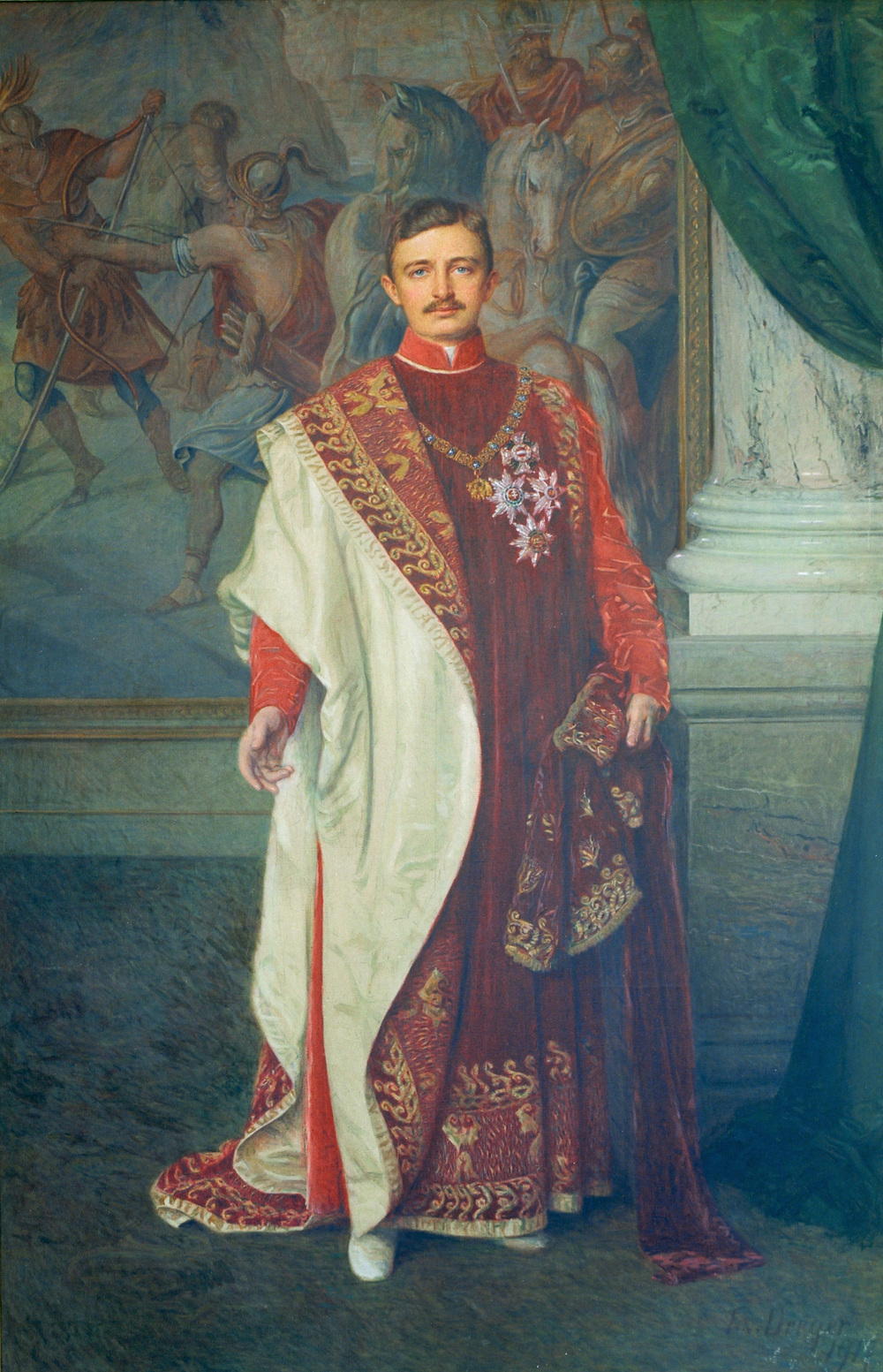
World War I was underway and with the death of the Emperor Francis Joseph, on 21 November 1916 Karl became Emperor of Austria. On 30 December he was crowned apostolic King of Hungary.
Karl envisaged this office also as a way to follow Christ – in the love and care of the peoples entrusted to him and in dedicating his life to them.
He placed the most sacred duty of a king – a commitment to peace – at the centre of his preoccupations during the course of the terrible war. He was the only one among political leaders to support Benedict XV’s peace efforts.
As far as domestic politics are concerned, despite the extremely difficult times he initiated wide and exemplary social legislation, inspired by social Christian teaching.
Thanks to his conduct, the transition to a new order at the end of the conflict was made possible without a civil war. He was, however, banished from his country.
The Pope feared the rise of communist power in central Europe and expressed the wish that Karlre‑establish the authority of his government in Hungary. But two attempts failed, since above all Karl wished to avoid the outbreak of a civil war.
He was exiled to the island of Madeira. Since he considered his duty as a mandate from God, he could not abdicate his office.
Reduced to poverty, he lived with his family in a very humble house. He then fell fatally ill and accepted this as a sacrifice for the peace and unity of his peoples.
Karl endured his suffering without complaining. He forgave all those who conspired against him and died on 11Apri 1922 with his eyes turned toward the Holy Sacrament. On his deathbed he repeated the motto of his life: “I strive always in all things to understand as clearly as possible and follow the will of God and this in the most perfect way”.
His remains except for his heart are still on the island, resting in state in a chapel devoted to the Emperor in the Church of Our Lady of Monte in spite of several attempts to move them to the Habsburg Crypt in Vienna. His heart and the heart of his wife are entombed in Muri Abbey, Switzerland.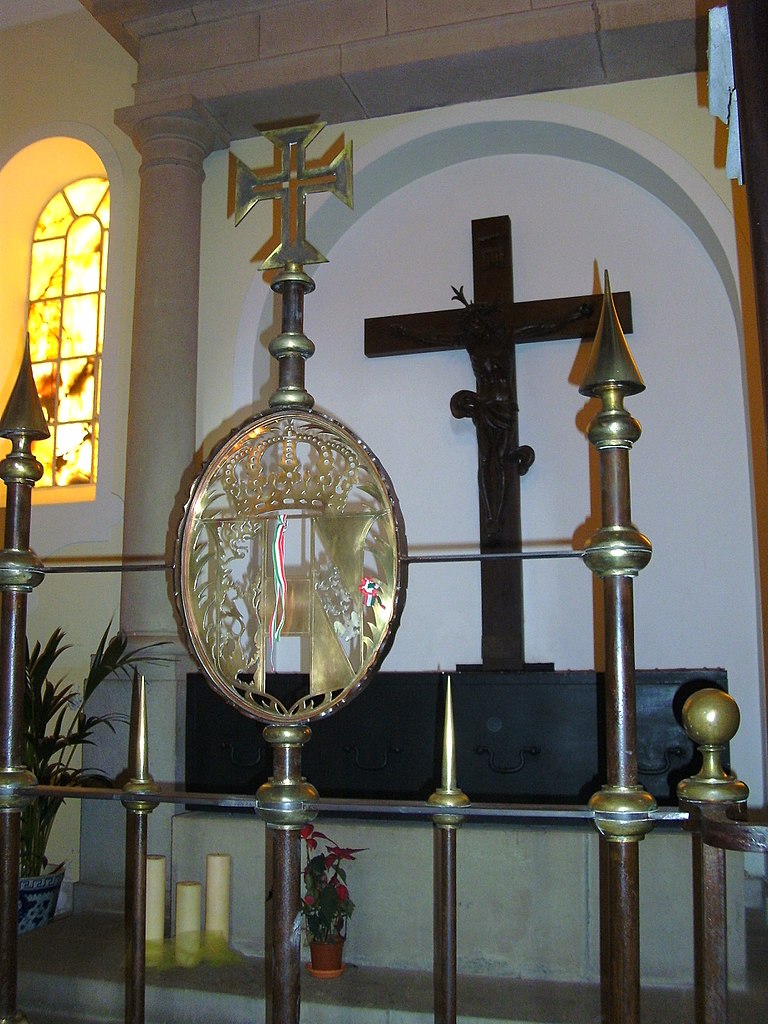
From the beginning, Emperor Charles conceived of his office as a holy service to his people. His chief concern was to follow the Christian vocation to holiness also in his political actions. For this reason, his thoughts turned to social assistance.
The cause or campaign for his canonisation began in 1949, when the testimony of his holiness was collected in the Archdiocese of Vienna. In 1954, the cause was opened and he was declared “servant of God”, the first step in the process. At the beginning of the cause for canonisation in 1972 his tomb was opened and his body was discovered to be incorrupt.
On 3 October 2004, he was Beatified by St Pope John Paul II. The Pope also declared 21 October, the date of Charles’ marriage in 1911 to Princess Zita, as Charles’ feast day.
The League of Prayers (join here: http://www.emperorcharles.org/welcome) established for the promotion of his cause has set up a website and Cardinal Christoph Schönborn of Vienna has sponsored the cause.
“The decisive task of Christians consists in seeking, recognising and following God’s will in all things. The Christian statesman, Karl of Austria, confronted this challenge every day. To his eyes, war appeared as “something appalling”. Amid the tumult of the First World War, he strove to promote the peace initiative of my Predecessor, Benedict XV.
From the beginning, the Emperor Charles conceived of his office as a holy service to his people. His chief concern was to follow the Christian vocation to holiness also in his political actions. For this reason, his thoughts turned to social assistance. May he be an example for all of us, especially for those who have political responsibilities in Europe today!”
Saint Pope John Paul II

Audience with the members of the Emperor Karl League for Prayers for Peace Among Nations , 14.10.2017
Address of the Holy Father
Excellencies, Highnesses,
Ladies and gentlemen,
Dear brothers and sisters,
With affection I greet you and all the members of the Emperor Karl League for Prayers for Peace Among Nations. I thank the president, Msgr Fernand Franck, for his words. Your annual assembly in Rome takes place in the context of the centenary of the initiative for peace undertaken by Pope Benedict XV and, among political leaders, supported only by Blessed Emperor Karl, with the strong desire to bring an end to the slaughter of the First World War.
The three aims of the League for Prayers underlined by your president – to seek and observe God’s will, to be committed to promoting peace and justice, to atone for the injustice of history – were, so to say, the recurrent motif of the life of Blessed Karl as a statesman, as a husband and father, and as a son of the Church. Delivering himself to God’s will, he accepted suffering and offered his own life as a sacrifice for peace, always sustained by the love and faithfulness of his wife, Servant of God Zita.
The challenges of our time require the collaboration of all men of good will and, in particular, prayer and sacrifice. I invite you, therefore, to keep your promise to take part, with prayer and personal commitment, in the many efforts of the Pope in favour of peace. Without the support of the prayer of the faithful, Peter’s Successor cannot fulfil his mission in the world. I count on you to. I entrust you to the maternal protection of Mary Most Holy and to the intercession of Blessed Emperor Karl, and heartily impart my apostolic blessing to you and your loved ones.
Memorials of the Saints – 21 October
St Agatho the Hermit
St Asterius of Périgord
St Asterius of Rome
St Berthold of Parma
St Celina of Meaux
Bl Karl of Austria (1887 – 1922) King & Emperor
St Cilinia
St Condedus
St Domnolus of Pouilly
St Finian Munnu
St Gebizo
Bl Giuseppe Puglisi
Bl Gundisalvus of Lagos
St Hilarion of Gaza (c 291-371)
Biography here: https://anastpaul.wordpress.com/2017/10/21/saint-of-the-day-21-october-st-hilarion-of-gaza-c-291-371/
Bl Hilarion of Moglena
St Hugh of Ambronay
Bl Imana of Loss
Bl Iulianus Nakaura
St John of Bridlington
St Laura of Saint Catherine of Siena
St Letizia
St Maurontus of Marseilles
St Malchus of Syria
Bl Peter of Città di Castello
St Petrus Yu Tae-Ch’ol
St Pontius de Clariana
St Raymond of Granada
Bl Sancho of Aragon
Bl Severinus of Bordeaux
Bl Tuda of Lindisfarne
Bl Viator of Lyons
St Wendelin
St William of Granada
St William of Montreal
St Zaira
St Zoticus of Nicomedia
—
Martyrs of Nicaea – 279 saints:
Martyrs of Nicomedia – 3 saints:
Caius of Nicomedia
Dasius of Nicomedia
Zoticus of Nicomedia
Martyred in the Spanish Civil War:
• Blessed Genaro Fueyo Castañon
• Blessed Isidro Fernández Cordero
• Blessed Segundo Alonso González
Saint Ursula and Companions: (238) Legendary princess, the daughter of a Christian British king and Saint Daria. She travelled Europe in company of either 11 or 11,000 fellow maidens; the 11,000 number probably resulted from a misreading of the term “11M” which indicated 11 Martyrs, but which a copyist took for a Roman numeral. Ursula and her company were tortured to death to get them to renounce their faith, and old paintings of them show many of the women being killed in various painful ways. Namesake for the Ursuline Order, founded for the education of young Catholic girls and women.
There are other saints closely associated with Ursula and her story –
travelling companions who were martyred with her
Antonia of Cologne
Cesarius of Cologne
Cyriacus of Cologne
Daria
Fiolanus of Lucca
Ignatius of Cologne
James of Antioch
Mauritius of Cologne
Pontius of Cologne
Sulpitius of Ravenna
Vincent of Cologne
Travelling companion, but escaped the massacre:
• Cunera
led by a dove to the lost tomb of Ursula:
• Cunibert of Cologne
Thought for the Day – 20 October – The Memorial of St Maria Bertilla Boscardin (1888 – 1922)
Thought for the Day – 20 October – The Memorial of St Maria Bertilla Boscardin (1888 – 1922)
“The humble nun of Brendola is the confirmation of a tradition that makes a fervent parish the first school of how to live a life of goodness and of holiness. Saint Bertilla is now on the altars above those people called the wise and the prudent of this century. She did not attend an extensive training in the schools but was able to carry out with good grace each task entrusted to her. Her book, kept jealously among her most treasured possessions was the Catechism, given to her by her parish priest. From it, she drew inspiration and comfort as a child, retiring with it alone in solitude, after having finished the housework, to read and re-read it all the time and to teach it with fervour to her contemporaries.
Here we have a simple soul who from the first unfolding of her vocation is pleased to throw herself into it entirely and without reservation, helped on by the respect the consent and encouragement of her parents. She was happy to do even the most humble service, because she does not ask for anything for herself, nor was she diverted by fancies of curiosity or by personal preferences.
Someone – that is, the Lord – was always with her to direct and enlighten her….”…St Pope John XXIII at the Canonisation of St Maria
And ‘they’ called her “the Goose” but she is a Saint, high above all of ‘them’! The simple peasant woman who was once called “the Goose” had taken flight and soared all the way up to Heaven.
St Maria Bertilla Boscardin, Pray for us!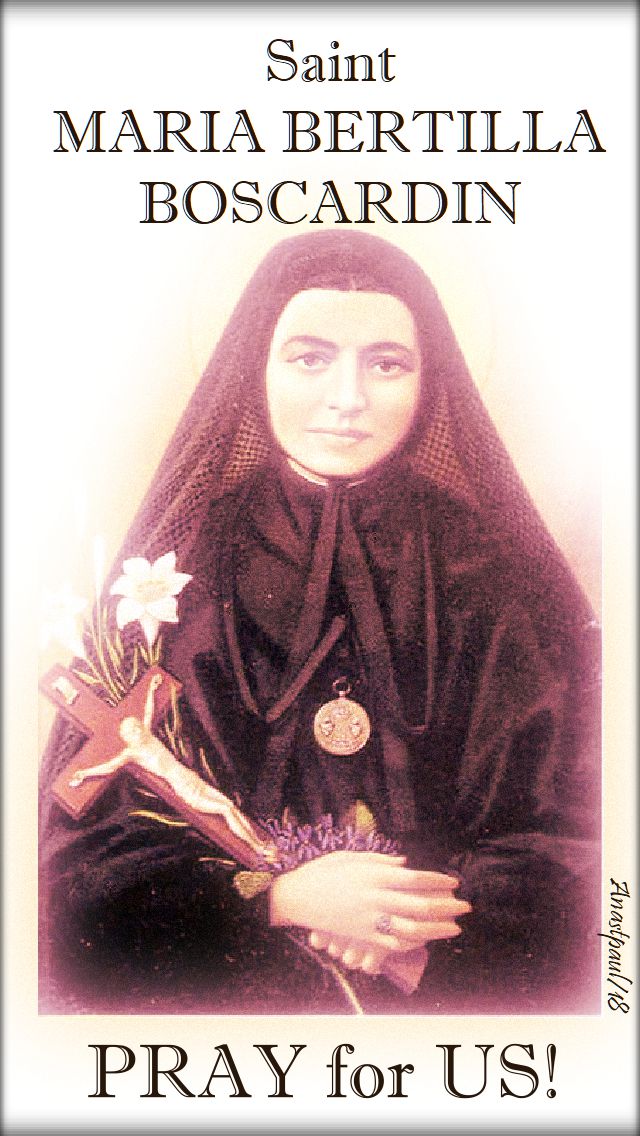
Quote/s of the Day – 20 October – The Memorial of St Maria Bertilla Boscardin (1888 – 1922)
Quote/s of the Day – 20 October – The Memorial of St Maria Bertilla Boscardin (1888 – 1922)
“Here I am, Lord, to do Your will, whatever comes.”
Saint Maria Bertilla Boscardin (1888 – 1922)
(from her diary)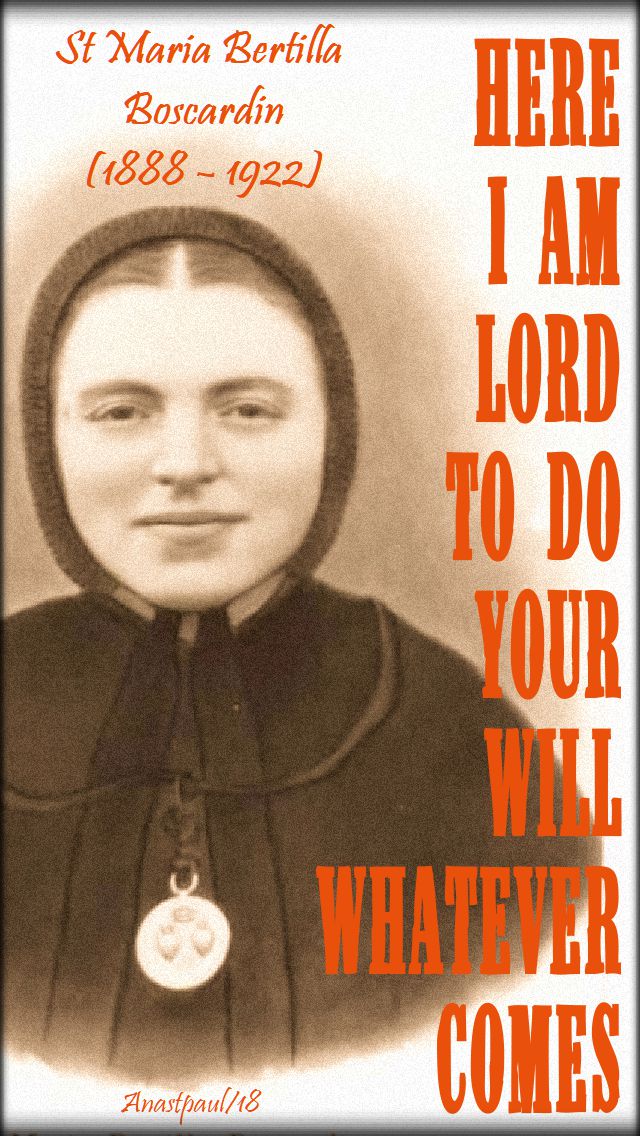
Take, Lord and receive all my liberty,
my memory, my understanding,
and my entire will,
All I have and call my own.
You have given all to me.
To You, Lord, I return it.
Everything is Yours,
do with it what You will.
Give me only Your love
and Your grace,
that is enough for me.


You must be logged in to post a comment.