Posted in SAINT of the DAY

Saint of the Day – 7 August – St Pope Sixtus II Martyr

Saint of the Day – 7 August – St Pope Sixtus II Martyr was the Bishop of Rome from 31 August 257 until his death on 6 August 258.   He was martyred along with seven deacons, including St Lawrence of Rome during the persecutions of Christianity by Emperor Valerian.   This is the St Sixtus who is commemorated in the Eucharistic Prayer.

530px-Sandro_Botticelli_-_Sixte_II

Even as the storm of persecution created by Emperor Valerian raged against the Church, the papal throne was not vacant.   Sixtus, a Greek, was elected to succeed Stephen.   The emperor’s decrees had ordered the Christians to take part in state religious ceremonies and forbade them to assemble in cemeteries.   For nearly a year Sixtus managed to evade the authorities before he was gloriously martyred.pope-sixtus-ii-d5dfa3a0-606a-44e4-9d83-97aa13c6a1b-resize-750

Valerian issued his second edict ordering the execution of Christian bishops, priests and deacons.   Sixtus had taken to holding services in the private cemetery of Praetextatus because it was not watched as closely by the authorities as was the cemetery of Calixtus. But in early August of 258, while Sixtus was seated on his episcopal chair and surrounded by the brethren, the soldiers broke in arresting Sixtus and four deacons who were in attendance.   After a formal judgement, Sixtus was led back to the very place where he had been arrested, to face execution.   His chief deacon St Lawrence, upon hearing the news, hastened to his side, desiring to die with his bishop.   Sixtus consoled his deacon by telling him that he would follow in three days with even greater glory.   The soldiers then placed Sixtus in his chair and swiftly beheaded him.   True to the great pope’s words, Lawrence was arrested three days later and executed the same day.   The remains of Sixtus were transferred by the Christian faithful to the Papal Crypt in the neighbouring cemetery of St Callistus.   Behind his tomb was enshrined the bloodstained chair on which he had been beheaded.

Posted in SAINT of the DAY

Memorials of the Saints – 7 August

St Pope Sixtus II (Died 258) Martyr (Optional Memorial)
St Cajetan (1480-1547) (Optional Memorial)
https://anastpaul.wordpress.com/2017/08/07/saint-of-the-day-7-august-st-cajetan-founder-of-the-theatine-order-the-father-of-providence/

St Afra of Augsburg
Bl Agathangelus Nourry
St Albert of Sicily
Bl Cassian Vaz Lopez-Neto
St Claudia of Rome
St Donat
St Donatian of Chalons-sur-Marne
St Donatus of Arezzo
St Donatus of Besancon
Bl Edmund Bojanowski
Bl Edward Bamber
St Faustus of Milan
St Hilarinus of Ostia
St Hyperechios
Bl John Woodcock
Bl Jordan Forzatei
St Julian of Rome
St Miguel de la Mora
Bl Nicholas Postgate
St Peter of Rome
Bl Thomas Whitaker
St Victricius of Rouen

Martyred Deacons of Rome – 6 saints: A group of deacons who were martyred with Pope Saint Sixtus II. We know nothing about them but their names and their deaths – Agapitus, Felicissimus, Januarius, Magnus, Stephen and Vincent. They were
beheaded on 6 August 258 in a cemetery on the Appian Way, Rome, Italy.

Martyrs of Como – 6 saints: A group of Christian soldiers in the imperial Roman army. Martyred in the persecutions of Maximian. We know little else but the names – Carpophorus, Cassius, Exanthus, Licinius, Secundus and Severinus. c.295 on the north side of Lake Como, near Samolaco, Italy. Their relics in the church of San Carpoforo, Como, Italy.

Martyred in the Spanish Civil War: 10 Beati
Dalmacio Bellota Perez
Diodorus Hernando Lopez
Francisco Gargallo Gascón
Joan Baptista Urgell Coma
Luis Villanueva Montoya
María del Carmen Zaragoza y Zaragoza
María Rosa Adrover Martí
Rafaél Severiano Rodríguez Navarro
Tomás Carbonell Miquel
Isabel Remiñán Carracedo

Posted in MARIAN PRAYERS, MORNING Prayers, PAPAL SERMONS, SAINT of the DAY, The TRANSFIGURATION

Thought for the Day – 6 August – Feast of the Transfiguration of the Lord – Today’s Gospel: Mark 9:2–10

Thought for the Day – 6 August – Feast of the Transfiguration of the Lord – Today’s Gospel: Mark 9:2–10

This invitation from the Father is very important. We, the disciples o  f Jesus, are called to be people who listen to His voice and take His words seriously.   To listen to Jesus, we must be close to Him, to follow Him, like the crowd in the Gospel who chase Him through the streets of Palestine.

Jesus did not have a teaching post or a fixed pulpit, He was an itinerant teacher, who proposed His teachings, teachings given to Him by the Father, along the streets, covering distances that were not always predictable or easy.   Follow Jesus in order to listen to Him.   But also let us listen to Jesus in His written Word, in the Gospel.   I pose a question to you: do you read a passage of the Gospel everyday?   Yes, no… yes, no… half of the time … some yes, some no.   It is important!   Do you read the Gospel?   It is so good;  it is a good thing to have a small book of the Gospel, a little one and to carry in our pocket or in our purse and read a little passage in whatever moment presents itself during the day.   In any given moment of the day I take the Gospel from my pocket and I read something, a short passage. Jesus is there and He speaks to us in the Gospel!   Ponder this. It’s not difficult, nor is it necessary to have all four books: one of the Gospels, a small one, with us.   Let the Gospel be with us always, because it is the Word of Jesus in order for us to be able to listen to Him.

From the event of the Transfiguration I would like to take two significant elements that can be summed up in two words:  ascent and descent.   We all need to go apart, to ascend the mountain in a space of silence, to find ourselves and better perceive the voice of the Lord.   This we do in prayer.   But we cannot stay there!   Encounter with God in prayer inspires us anew to “descend the mountain” and return to the plain where we meet many brothers weighed down by fatigue, sickness, injustice, ignorance, poverty both material and spiritual.   To these brothers in difficulty, we are called to bear the fruit of that experience with God, by sharing the grace we have received.
And this is curious.   When we hear the Word of Jesus, when we listen to the Word of Jesus and carry it in our heart, this Word grows.   Do you know how it grows?   By giving it to the other!   The Word of Christ grows in us when we proclaim it, when we give it to others!   And this is what Christian life is.   It is a mission for the whole Church, for all the baptised, for us all – listen to Jesus and offer Him to others.
Do not forget!   this week listen to Jesus!   And think about the matter of the Gospel, will you?   Will you do this?   Then next Sunday you tell me if you have done this, that you have a little book of the Gospel in your pocket or in your purse to read in little stages throughout the day.and this is what the christian life is listen to jesus and offer him to others - transfiguration 2 - 6 aug 2018
And now let us turn to our Mother Mary and entrust ourselves to her guidance in pursuing with faith and generosity this path of …., learning a little more how to “ascend” with prayer and listen to Jesus and to “descend” with brotherly love, proclaiming Jesus.

Pope Francis -16 March 2014blessed virgin mary - pray for us - 25 may 2018

Posted in FATHERS of the Church, FEASTS and SOLEMNITIES, MORNING Prayers, QUOTES of the SAINTS, SAINT of the DAY, The TRANSFIGURATION

Quote of the Day – 6 August – Feast of the Transfiguration of the Lord – Today’s Gospel: Mark 9:2–10

Quote of the Day – 6 August – Feast of the Transfiguration of the Lord – Today’s Gospel: Mark 9:2–10

It is indeed good to be here, as you have said, Peter.   It is good to be with Jesus and to remain here for ever. What greater hap  piness or higher honour could we have than to be with God, to be made like Him and to live in His light?

Therefore, since each of us possesses God in his heart and is being transformed into His divine image, we also should cry out with joy:
It is good for us to be here – here where all things shine with divine radiance, where there is joy and gladness and exultation; where there is nothing in our hearts but peace, serenity and stillness;  where God is seen.
For here, in our hearts, Christ takes up His abode together with the Father, saying as He enters:  Today salvation has come to this house.

With Christ, our hearts receive all the wealth of His eternal blessings and there where they are stored up for us in Him, we see reflected as in a mirror both the first fruits and the whole of the world to come.

St Anastasius of Sinai (630-701)

for here, christ takes up his abode - transfiguration homily - st anastasius of sinai - 6 aug 2018

Posted in BREVIARY Prayers, FEASTS and SOLEMNITIES, MORNING Prayers, PAPAL SERMONS, SAINT of the DAY, The TRANSFIGURATION, The WORD

One Minute Reflection 6 August – Feast of the Transfiguration of the Lord – Today’s Gospel: Mark 9:2–10

One Minute Reflection 6 August – Feast of the Transfiguration of the Lord – Today’s Gospel: Mark 9:2–10

And a cloud overshadowed them, and a voice came out of the cloud, “This is my beloved Son; listen to him.”...Mark 9:7this is my beloved son listen to him mark 9 7 - 6 aug 2018

REFLECTION – …”And the path of Jesus is another, Jesus triumphs through humiliation, the humiliation of the cross.   But, as this would be a scandal for them, Jesus lets them see what will come next, what is after cross, what awaits us, all of us.   This glory and this heaven.   And this is very beautiful, very beautiful because Jesus and this feels good, always prepares us for the test.   In one way or another but this is the message.   It always prepares us.   It gives us the strength to go on in moments of trial and to win with its strength.   Jesus does not leave us alone in the trials of life, He always prepares us, He helps us as He prepares these (the disciples) with the vision of His glory.   And so they remembered this moment, to bear the weight of the humiliation.   And this is the first thing that the church teaches, that Jesus always prepares us and rehearses with us.   He does not leave us alone, never!
“This is my beloved son.   Listen to him.” This is the message which the Father gives to the Apostles, the message of Jesus prepares them to see His glory, the message of the Father is “Listen to him.”   There is no moment in life which cannot be fully lived by listening to Jesus.   In beautiful moments, stop and listen to Jesus, in bad moments, stop and listen to Jesus.   This is the way, He will tell us what we need to do, always.”…Pope Francis 25 February 2018he does not leave us alone never - pope francis - transfiguration homily feb 2018 - 6 aug 2018

PRAYER – Father, at the Transfiguration in glory of Your only-begotten Son, You confirmed the mysteries of faith by the witness to Jesus of the prophets Moses and Elijah. You foreshadowed what we shall be when You bring our sonship to its perfection.   Grant that by listening to the voice of Jesus, we may become heirs with Him, who lives and reigns with You and the Holy Spirit, God forever and may Mary, our tender and caring Mother, help us to be bright rays of the saving light of her Son Jesus. Amenmary beloved mother-pray for us all

Posted in BREVIARY Prayers, CATHOLIC-PRAYERS OF THE CHURCH, FEASTS and SOLEMNITIES, HYMNS, MORNING Prayers, SAINT of the DAY, The TRANSFIGURATION

Our Morning Offering – 6 August – Feast of the Transfiguration of the Lord

Our Morning Offering – 6 August – Feast of the Transfiguration of the Lord

Breviary Lauds Hymn
Feast of the Transfiguration

More ancient than the primal world
And older than the morning star,
Before the first things took their shape,
Creator of them all, You are.

Your image is the Lord of life,
Your Son from all eternity,
All that must perish, He restores,
In Him, all reconciled will be.

Transfigured Christ, believed and loved,
In You our only hope has been.
Grant us, in Your unfathomed love,
Those things no eye has ever seen.

O Father, Son and Spirit blest,
With hearts transfigured by Your grace,
May we Your matchless splendour praise
And see the glory of Your face.breviary lauds hymn for the transfiguration - 6 august 2018

Posted in MORNING Prayers, ON the SAINTS, PAPAL SERMONS, QUOTES of the SAINTS, SAINT of the DAY, The TRANSFIGURATION

6 August, Feast of the Transfiguration of the Lord and the 40th Anniversary of the Death of Blessed Pope Paul VI (1897-1978)

6 August, Feast of the Transfiguration of the Lord

and the 40th Anniversary of the Death of Blessed Pope Paul VI (1897-1978) – Feast Day 26 September

Sunday 6 August 2000 – St Pope John Paul on the 22nd Anniversary of the death of Blessed Paul VI

“We are preparing to celebrate Holy Mass on the feast of the Transfiguration of the Lord, cherishing in our hearts the ever-living memory of the Servant of God Paul VI, 22 years after his “going forth” to eternity.

Today’s liturgy invites us to turn our gaze to the face of the Son of God who, as the Synoptics unanimously attest, is transfigured on the mountain before Peter, James and John, while the Father’s voice proclaims from the cloud:  “This is my beloved Son; listen to him” (Mk 9: 7).   St Peter will recall the event with emotion, saying: “We were eyewitnesses of his majesty” (2 Pt 1: 16).

In our era, pervaded by the so-called “image culture”, the desire to be able fill one’s eyes with the figure of the divine Master becomes more intense but it is appropriate to recall his words:  “Blessed are those who have not seen and yet believe” (Jn 20: 29).   It was precisely with his eyes of faith fixed on the adorable face of Christ, true man and true God, that the revered and unforgettable Paul VI lived.   Contemplating him with burning and impassioned love, he said:  “Christ is beauty, human and divine beauty, the beauty of reality, of truth, of life” (General Audience, 13 January 1971).   And he added: “The figure of Christ presents, over and above the charm of his merciful gentleness, an aspect which is grave and strong, formidable, if you like, when dealing with cowardice, hypocrisy, injustice and cruelty but never lacking a sovereign aura of love”   (General Audience, 27 January 1971).Paulo_VI

As we approach the altar with grateful hearts, praying for the blessed soul of this great Pontiff, we also wish, like him and like the disciples, to turn our gaze to the radiant face of the Son of God to be illumined by it.   Let us ask God, through the intercession of Mary, Teacher of faith and contemplation, to enable us to receive within us, the light that shines brightly on the face of Christ, so that we may reflect its image on everyone we meet.”SP-PAOLO-VI-1-690x450

“Forty years ago, Blessed Paul VI was living his last hours on earth.   In fact, he died on the evening of 6 August 1978,” Francis recounted.   “We remember him with so much veneration and gratitude while awaiting his Canonisation next October 14.   From Heaven, may he intercede for the Church, which he so loved and for peace in the world.   We all greet with applause this great Pope of modernity!”...Pope Francis 5 August 2018 .

Blessed Pope Paul VI, Pray for us!

blessed pope paul vi - pray for us.2

Posted in FEASTS and SOLEMNITIES, SAINT of the DAY, The TRANSFIGURATION

Feast of the Transfiguration of the Lord – 6 August – Today’s Gospel: Mark 9:2-10

Feast of the Transfiguration of the Lord – 6 August – Today’s Gospel:  Mark 9:2-10

All three Synoptic Gospels tell the story of the Transfiguration (Matthew 17:1-8; Mark 9:2-9; Luke 9:28-36).   With remarkable agreement, all three place the event shortly after Peter’s confession of faith that Jesus is the Messiah and Jesus’ first prediction of his passion and death.   Peter’s eagerness to erect tents or booths on the spot suggests it occurred during the week-long Jewish Feast of Booths in the fall.Tullow_Church_of_the_Most_Holy_Rosary_South_Transept_Window_Mysteries_of_Light_and_Pope_John_Paul_II_Detail_Transfiguration_2013_09_06

According to Scripture scholars, in spite of the texts’ agreement it is difficult to reconstruct the disciples’ experience, because the Gospels draw heavily on Old Testament descriptions of the Sinai encounter with God and prophetic visions of the Son of Man.   Certainly Peter, James and John had a glimpse of Jesus’ divinity strong enough to strike fear into their hearts.   Such an experience defies description, so they drew on familiar religious language to describe it.   And certainly, Jesus warned them, that His glory and His suffering were to be inextricably connected—a theme John highlights throughout his Gospel.Transfiguration

Tradition names Mount Tabor as the site of the revelation.   A church first raised there in the fourth century was dedicated on 6 August.   A feast in honour of the Transfiguration was celebrated in the Eastern Church from about that time.   Western observance began in some localities about the eighth century.the-transfiguration.Pietro Perugino

On 22 July 1456, Crusaders defeated the Turks at Belgrade.   News of the victory reached Rome on 6 August and Pope Callistus III placed the feast on the Roman calendar the following year.

One of the Transfiguration accounts is read on the second Sunday of Lent each year, proclaiming Christ’s divinity to the Elect and baptised alike.   The Gospel for the first Sunday of Lent, by contrast, is the story of the temptation in the desert—affirmation of Jesus’ humanity.

More here:  https://anastpaul.wordpress.com/2017/08/06/august-6-the-feast-of-the-transfiguration-of-the-lord/transfiguration 2transfiguration in art

Posted in FEASTS and SOLEMNITIES, SAINT of the DAY

Feast of the Transfiguration of Our Lord and Memorials of the Saints – 6 August

Transfiguration of Our Lord (Feast)
https://anastpaul.wordpress.com/2017/08/06/august-6-the-feast-of-the-transfiguration-of-the-lord/

Bl Gezelin of Schlebusch
St Gislain of Luxemburg
St Glisente of Brescia
Bl Goderanno
Bl Guillermo Sanz
St Hardulf of Breedon
St Pope Hormisdas
St James the Syrian
St Justus of Alcala
Bl Maria Francesca Rubatto
Bl Octavian of Savona
St Pastor of Alcala
St Stephen of Cardeña
Bl Tadeusz Dulny
Bl William of Altavilla

Martyrs of Cardeña: Two hundred Benedictine monks at the Saint Peter of Cardegna monastery, Burgos, Spain who were martyred in the 8th century by invading Saracens. They were buried by local Christians in a nearby churchyard in Burgos, Spain and Beatified in 1603 by Pope Clement VIII (cultus confirmed).

Martyred in the Spanish Civil War: 10 Beati
• Blessed Alejandro Casare Menéndez
• Blessed Andrés Soto Carrera
• Blessed Antoni Serra Hortal
• Blessed Carlos López Vidal
• Blessed Francesc Vives Antich
• Blessed José González Ramos Campos
• Blessed José María Recalde Magúregui
• Blessed Juan Silverio Pérez Ruano
• Blessed Pau Bertrán Mercadé
• Blessed Saturnino Ortega Montealegre

Posted in franciscan OFM, MARIAN DEVOTIONS, MARIAN QUOTES, MARIAN TITLES, MORNING Prayers, QUOTES of the SAINTS, SAINT of the DAY, The BLESSED VIRGIN MARY

Thought for the Day – 5 August – Dedication of the Basilica of Saint Mary Major/Our Lady of the Snow

Thought for the Day – 5 August – Dedication of the Basilica of Saint Mary Major/Our Lady of the Snow

St Mary Major is one of the four Roman basilicas known as patriarchal cathedrals in memory of the first centres of the Church.   St John Lateran represents Rome, the See of Peter;   St Paul Outside the Walls, the See of Alexandria, the see presided over by Mark;   St Peter’s, the See of Constantinople and St Mary’s, the See of Antioch, where Mary is believed to have spent most of her later life.

Theological debate over Christ’s nature as God and man reached fever pitch in Constantinople in the early fifth century.   The chaplain of Bishop Nestorius began preaching against the title Theotokos, “Mother of God,” insisting that the Virgin was mother only of the human Jesus.   Nestorius agreed, decreeing that Mary would henceforth be named “Mother of Christ” in his see.   The people of Constantinople virtually revolted against their bishop’s refutation of a cherished belief.   When the Council of Ephesus refuted Nestorius, believers took to the streets, enthusiastically chanting, “Theotokos!   Theotokos!”

So often I wish we would take to the streets shouting the same, “Mother of God! Mother of God!”

“Jesus honoured her before all ages
and will honour her for all ages.
No one comes to Him,
nor even near Him,
no one is saved or sanctified,
if he too will not honour her.
This is the lot of angels and of men.”

St Maximillian Kolbe (1894-1941)jesus-honoured-her-before-all-ages-st-maximillian-kolbe - 5 aug 2017

Our Lady of the Snows, Pray for us!

our lady of the snows - pray for us - 5 aug 2018

Posted in DOCTORS of the Church, MARIAN QUOTES, MORNING Prayers, QUOTES of the SAINTS, SAINT of the DAY, The BLESSED VIRGIN MARY

Quote of the Day – 5 August – Dedication of the Basilica of Saint Mary Major/Our Lady of the Snow

Quote of the Day – 5 August – Dedication of the Basilica of Saint Mary Major/           Our Lady of the Snow

“Mary is the Divine Page
on which the Father
wrote the Word of God,
His Son.”

St Albert the Great (1206-1280) Doctor of the Churchmary-is-the-divine-page-st-albert-the-great-doctor - 5 aug 2017.

Posted in MORNING Prayers, QUOTES - J R R Tolkien and MORE, QUOTES on PRAYER, QUOTES on SANCTITY, SAINT of the DAY, The BLESSED VIRGIN MARY, The HOLY EUCHARIST / The HOLY MASS, The WORD

One Minute Reflection – 5 August – Eighteenth Sunday in Ordinary Time, Year B

One Minute Reflection – 5 August – Eighteenth Sunday in Ordinary Time, Year B – Today’s Gospel: John 6:24-35

They said to him, “Lord, give us this bread always.” Jesus said to them, “I am the bread of life; he who comes to me shall not hunger, and he who believes in me shall never thirst.”…John 6″34-35i am the bread of life - john 6 35 - 5 aug 2018

REFLECTION – “The soul’s bread is Christ, “the living bread that came down from heaven” (Jn 6:51) who gives food to His own, by faith here and by vision in the world to come. For Christ dwells in you by faith and faith in Christ is Christ in your heart (Eph 3:17). The measure of your faith in Christ is the measure of your possession of Him.
… In this gift I have received, I possess Christ wholly and Christ wholly possesses me, just as the member belonging to the whole body likewise possesses the body in its entirety. And so this portion of faith you have received as your share, is like the morsel of bread in your mouth. But unless you often devoutly meditate over what you believe, unless you chew over it, so to speak, moving it about and turning it over with your teeth, that is to say with your spiritual senses, it will never enter your throat, in other words it won’t get as far as your understanding.
For indeed, how could you understand anything that you reflect over only rarely and carelessly, especially when it concerns something subtle and unseen?… So, by means of meditation, let “the Law of the Lord be ever on your lips” (Ex 13:9) so that a sound understanding may be brought to birth within you. Through a good understanding spiritual food passes into your heart, so that you will not neglect what you have understood but will lovingly reflect over it.”…Guigo II the Carthusian “the Angelic” (?-1188) Prior of the Grande Chartreuse (Meditation 10 (SC 163, p. 181 rev.)in this gift I have received - guigo II, the Carthusian - 5 aug 2018

PRAYER – Forgive the sins of Your people Lord and since of ourselves, we are unable to do what pleases You, lead us on the way of salvation in Your divine Son who lives in us and gives us life. May the prayers of Mary, His Mother help us to constantly meditate on His eternal sustenance. He is our food, our Lord Jesus Christ, who lives and reigns with You and the Holy Spirit, God forever and ever, amen.blessed virgin mary mother of god - pray for us - 5 aug 2018

Posted in MARIAN TITLES, SAINT of the DAY, The BLESSED VIRGIN MARY

SALUS POPULI ROMANI SANTA MARIA MAGGIORE, ROME – 5 August

SALUS POPULI ROMANI
SANTA MARIA MAGGIORE, ROMEsnows2

“Let us ask the Blessed Virgin to nominate an heir.”

THE PATRICIAN JOHN IN ROME BEFORE THE MIRACLE OF THE SNOW IN 352:
A WEALTHY aristocrat and devout Christian known by tradition as John, lived in Rome in the fourth century.   He and his wife had no children and were fearful that their lack of an heir would put an end to the family’s long prominence in the government of the city.   They had often prayed for a child but without success.   One day John’s wife said, “Let us ask the Blessed Virgin to nominate an heir.”   They did so and their prayer was answered dramatically.

SNOW IN AUGUST – the height of summer!
In August 352 a rectangle of snow was discovered on Mount Esquiline, one of the famous Seven Hills.   Snowfall of any sort was unheard of in Rome at that time of year but that it had fallen only in one place and in such a specific pattern was regarded as a phenomenon.   People crowded to see the patch of snow, which persisted despite the heat.   John was convinced that its shape and size indicated that a church should be built on the spot.   In fact both John and the Pontiff had dreamt that Our Lady desired a church to be built on Mount Esquiline.   The Holy Father was so moved by his dream that he visited the mysterious snowfall.   When he arrived with his retinue, John and his wife were already there kneeling in prayer to the Virgin.
As soon as the plot for the building had been staked out the snow melted.   John met the cost of the building, which was completed in 354 and was dedicated the Basilica Liberiana.   Seventy years later the church was rebuilt on a grander scale by Pope Sixtus III, who added decorations and ornaments of silver.   From then the church was known as Basilica Sixti and the Church of Santa Maria Maggiore [St Mary Major].

THE PRODIGY OF THE SNOW IS TRUE
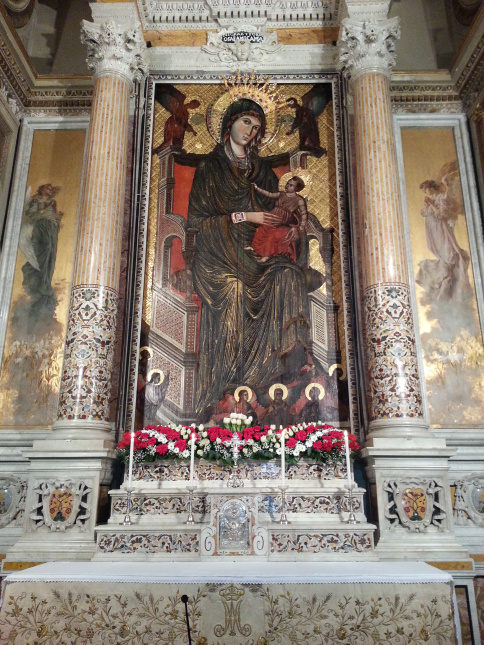
The new basilica housed a celebrated painting provided by the Pope.   It had belonged to St Helen, the mother of the Emperor Constantine—–the same Helen who, according to tradition, had made a pilgrimage to Palestine and discovered the original Cross of Christ. The picture, painted on a slab of cedar wood, is of a Madonna and Child.   The infant Jesus is holding a book and both figures are haloed and crowned—–the crowns presented by Pope Gregory XVI in 1832 as a thank-offering for deliverance from cholera.363px-Virgin_salus_populi_romani
The so-called ‘new’ Lady Chapel was built by Pope Paul V in 1613 to house the miraculous painting.   He declared, “This image should have a magnificent place of its own, befitting its eminence.   For it has always been regarded by all faithful people and through it many miracles and wonders have been wrought.”
Salus Populi Romana [Salvation of the Roman People] is the title of this famous painting and it is rightly named because for centuries the people of Rome have prayed before it in times of famine, war and national crisis.
Many popes have held the basilica on Mount Esquiline in particular regard.   When Gregory I was Pope [590-604] Rome was ravaged by a plague.   Gregory carried the image of the Holy Mother in procession from the chapel as far as Hadrian’s Mausoleum  . When the procession arrived they heard an invisible heavenly choir singing Regina Caeli. When the Pope asked the Virgin to pray for the city he saw an apparition of S. Michael replacing the sword of vengeance in its scabbard.   The plague abated.
Pope Benedict XIV had a special affection for the legend.   In 1427 he declared, “It must be acknowledged that nothing is wanting to enable us to affirm with moral certainty that the prodigy of the Snow is true” and Pope Benedict XVI attended the holy picture every Saturday and prayed the Litany.   The night before he died, Paul V asked to be taken to the Chapel of the Blessed Virgin in order to pray before her image.   St Ignatius Loyola, founder of the Society of Jesus, said his first Mass here at Christmas 1538.

snows3
The Madonna of the Snows 
GAETANO LAPIS 
1720

ANGELS SING THE RESPONSES
The Chapel of the Virgin Salus Populi Romani [Protectress of the Roman People] is very close to the historic heart of the Catholic Church, so it is not surprising that many stories have enriched its tradition over the centuries.   It is said that once when Pope Gregory the Great was celebrating Mass in the chapel and intoning the words “Pax Domini sit semper vobiscum,” he heard a choir of Angels sing the response “Et cum spiritu tuo.” From that day the custom in the chapel was to omit that section of the Mass in the belief that it was being offered and sung by the Angels.

snows1b
The figure on your left is Saint Lucy and the one on your right is Saint Mary of Magdala.   The Angel is distributing the snow by letting it fall from his hands as it collects on the ground below. The hand of the Christ Child is raised in the salute position of Christ the King.

THE BASILICA TODAY
The present-day church is one of the largest basilicas in the world and its Patronal Festival is held today in remembrance of the miracle of the snow.   During this celebration hundreds of white blossoms are showered from the dome of the chapel.   Not to be missed are the thirteenth-century mosaics on biblical themes and the frescoes by Reni and Della Porta.   There is an imposing Romanesque bell tower erected in 1377.
Santa Maria Maggiore has a further claim to fame.   In the seventh century a relic was brought from Bethlehem and traditionally venerated as the manger in which the Christ Child was laid at the first Christmas.   And so another name for the great basilica is St Mary of the Crib.

682px-Santa_Maria_Maggiore_(Rome)_06
Oratory of the Nativity

One of the most spectacular sights which meets today’s pilgrim is the triumphal arch which extends to almost 66 feet.   It is decorated in four horizontal sections. In the middle at the top God’s throne is set in a circle, with St Peter and St Paul on either side. Above this mosaic are the symbols of the four Gospel writers.

Interior_of_Santa_Maria_Maggiore_(Rome).jpg
Triumphal Arch with the Mosaic above

On 12 November 1964, Blessed Pope Paul VI made a pilgrimage to the basilica and solemnly proclaimed Our Lady “Mother of the Church.”
On 5 August the anniversary of the miraculous snow fall, the Feast of Our Lady of Snows is celebrated at the basilica of her name.   White petals are scattered throughout the Basilica.

More here:  https://anastpaul.wordpress.com/2017/08/05/august-5-dedication-of-the-basilica-of-saint-mary-major-our-lady-of-the-snows/

Posted in FEASTS and SOLEMNITIES, MARIAN TITLES, SAINT of the DAY

Feast of the Dedication of the Basilica of Saint Mary Major/Our Lady of the Snow and Memorials of the Saints – 5 August

Dedication of the Basilica of Saint Mary Major/Our Lady of the Snow (Optional Memorial)
https://anastpaul.wordpress.com/2017/08/05/august-5-dedication-of-the-basilica-of-saint-mary-major-our-lady-of-the-snows/

dedication-header

Our Lady of Copacabana:   A statue of the Blessed Virgin Mary standing four feet tall, made of plaster and maguey fiber, and created by Francisco Tito Yupanqui.   Except for the face and hands, it is covered in gold leaf, dressed like an Inca princess, and has jewels on neck, hands and ears.   There is no record of what the image looks like under the robes, the carved hair has been covered by a wig, and the image never leaves the basilica.   On 21 February 1583 it was enthroned in an adobe church on the peninsula of Copacabana, which juts into Lake Titicaca nearly 3 miles above sea level.   In 1669 the viceroy of Peru added a straw basket and baton to the statue, which she still holds today. The present shrine dates from 1805.   The image was crowned during the reign of Pope Pius XI, and its sanctuary was promoted to a basilica in 1949.   It has been the recipient of many expensive gifts over the years, most of which were looted by civil authorities in need of quick cash.
Patronage – Bolivia, Bolivian navy.

St Abel of Rheims
St Addai
St Aggai of Edessa
Bl Arnaldo Pons
St Cantidianus
St Cantidius
St Cassian of Autun
St Casto of Teano
Bl Corrado of Laodicea
St Emidius of Ascoli Piceno
St Eusignius
St Gormeal of Ardoilen
Bl James Gerius
St Margaret the Barefooted
St Mari
St Memmius of Châlons-sur-Marne
St Nonna
St Oswald of Northumbria
St Paris of Teano
Bl Pierre-Michel Noël
St Sobel
St Theodoric of Cambrai-Arras
St Venantius of Viviers
St Viator

Martyrs of Fuente la Higuera: A group of Augustinian priests and clerics who were martyred together in the Spanish Civil War. 5 August 1936 in Fuente la Higuera, Valencia, Spain. They were Beatified on 28 October 2007 by Pope Benedict XVI.
10 Beati:
• Anastasio Díez García
• Ángel Pérez Santos
• Cipriano Polo García
• Emilio Camino Noval
• Felipe Barba Chamorro
• Gabino Olaso Zabala
• Luciano Ramos Villafruela
• Luis Blanco Álvarez
• Ubaldo Revilla Rodríguez
• Victor Gaitero González

Martyrs of the Salarian Way: Twenty-three Christians who were martyred together in the persecutions of Diocletian.
303 on the Salarian Way in Rome, Italy.

Martyred in the Spanish Civil War:
Bl Eduardo González Santo Domingo
Bl Jaume Codina Casellas
Bl Joan Gibert Galofré
Bl José Trallero Lou
Bl Lluís Domingo Mariné
Bl Manuel Moreno Martínez
Maximino Fernández Marinas
Bl Pau Virgili Monfá
Bl Pere Massó Llagostera
Bl Salvi Huix Miralpeix
Bl Victor García Ceballos

Posted in CATECHESIS, MORNING Prayers, QUOTES of the SAINTS, QUOTES on HUMILITY, QUOTES on PRAYER, SAINT of the DAY

Thought for the Day – 4 August – The Memorial of St John Vianney (1786-1859)

Thought for the Day – 4 August – The Memorial of St John Vianney (1786-1859)

“My little children, reflect on these words:
the Christian’s treasure is not on earth but in heaven.

Our thoughts, then, ought to be directed to where out treasure is.
This is the glorious duty of man – to pray and to love.
If you pray and love, that is where a man’s happiness lies.
Prayer is nothing else but union with God.   In this intimate union, God and the soul are fused together like two bits of wax that no one can every pull apart.   This union of god with a tiny creature is a lovely thing. It is a happiness beyond understanding.

My little children, your hearts, are small but prayer stretches them and makes them capable of loving God.
Through prayer we receive a foretaste of heaven and something of paradise comes down upon us.
Prayer never leaves us without sweetness.   It is honey that flows into the souls and makes all things sweet.

When we pray properly, sorrows disappear like snow before the sun.   Some men immerse themselves as deeply in prayer as fish in water, because they give themselves totally to God.   O, how I love these noble souls!   How unlike them we are!  How often we come to church with no idea of what to do or what to ask for.   And yet, whenever we go to any human being, we know well enough why we go.
And still worse, there are some who seem to speak to the good God like this:  “I will only say a couple of things to You and then I will be rid of You.”
I often think that when we come to adore the Lord, we would receive everything we ask for, if we would ask with living faith and with a pure heart.

Prayer is the inner bath of love into which the soul plunges itself.”

– from the catechetical instructions by Saint John Vianney

St John Marie Baptiste Vianney, the poor boy from Dardilly, ordained a priest “through compassion” and in charge of an isolated parish, the one who prepared himself to die every day:  because of the strange logic of God who chooses the little to depose the mighty, it was this man who became a teacher and model even for the Popes who sit on the Chair of Peter, who are inspired by him and hold him up for emulation to the entire Church.   We must make ourselves ‘little’ in prayer, in total self-giving to God!

St John Marie Baptiste Vianney, Pray for us!st john vianney pray for us no 2 - 4 aug 2018

Posted in EUCHARISTIC Adoration, MORNING Prayers, PRACTISING CATHOLIC, QUOTES of the SAINTS, QUOTES on CHARITY, QUOTES on CONVERSION, QUOTES on LOVE, QUOTES on PRAYER, QUOTES on SANCTITY, SAINT of the DAY, The HOLY EUCHARIST / The HOLY MASS

Quote/s of the Day – 4 August – The Memorial of St John Vianney (1786-1859)

Quote/s of the Day – 4 August – The Memorial of St John Vianney (1786-1859)

here is a rule for eveyday life - st john vianney

“Here is the rule
for everyday life.
Do not do anything,
which you cannot
offer to God.”man is a beggar who needs to ask god for everything- st john vianney- 4 aug 2018

“Man is a beggar
who needs to ask God
for everything.”if people would do for god - you either belong - st john vianney - 4 aug 2018

“If people would do for God
what they do for the world,
what a great number of Christians
would go to Heaven.”

“You either
belong wholly
to the world
or wholly to God.”you-must-accept-your-cross4 aug 2017.

“You must accept your cross.
If you bear it courageously,
it will carry you to heaven.”

we should consider those moments - st john vianney - 4 aug 2018

“We should consider
those moments spent before
the Blessed Sacrament
as the happiest of our lives.”his look rests on you alone - st john vianney - 4 aug 2018

“His look rests on you alone.”

St John Marie Baptiste Vianney (1786-1859)

Posted in MORNING Prayers, QUOTES of the SAINTS, QUOTES on CHARITY, QUOTES on LOVE, QUOTES on PERSECUTION, SAINT of the DAY

One Minute Reflection – 4 August – The Memorial of St John Vianney (1786-1859)

One Minute Reflection – 4 August – The Memorial of St John Vianney (1786-1859)

But I say to you, love your enemies and pray for those who persecute you...Matthew 5:44matthew 5 44 but i say to you love your enemies - 4 aug 2018

REFLECTION – “All our religion is but a false religion and all our virtues are mere illusions and we ourselves are only hypocrites in the sight of God, if we have not that universal charity for everyone – for the good and for the bad, for the poor and for the rich and for all those who do us harm, as much as those who do us good.” – St John Vianneyall our religion is but a false religion - st john vianney - 4 aug 2018

PRAYER – Almighty and merciful God, by Your grace, St John Vianney was remarkable for his zeal as priest and shepherd.   Help us, by his example and prayers, to win our brethren for Christ by our love and to share with them in eternal glory.   Through our Lord Jesus Christ with the Holy Spirit, one God forever, amen.st jphn vianney pray for us - 4 aug 2018

Posted in MORNING Prayers, PRAYERS of the CHURCH, PRAYERS to the SAINTS, SAINT of the DAY

Our Morning Offering – 4 August – The Memorial of St John Vianney (1786-1859)

Our Morning Offering – 4 August – The Memorial of St John Vianney (1786-1859)

St John Vianney’s prayer which is quoted in the CCC

I Love You, O My God
By St John Vianney (1786-1859)

I love You,
O my God
and my only desire is to love You
until the last breath of my life.
I love You,
O my infinitely lovable God,
and I would rather die loving You,
than live without loving You.
I love You, Lord
and the only grace I ask,
is to love You eternally
My God,
if my tongue cannot say
in every moment that I love You,
I want my heart to repeat it to You
as often as I draw breath.
Ameni love you o my god - st john vianney and the CCC - 4 august 2018

Posted in CONFESSORS, EUCHARISTIC Adoration, INCORRUPTIBLES, PRIESTS, all CLERGY, QUOTES of the SAINTS, QUOTES on PRAYER, QUOTES on SILENCE, SAINT of the DAY

Saint of the Day – 9 August – St John Mary Vianney (1786-1859) the Curé d’Ars, Confessor

Saint of the Day – 9 August – St John Mary Vianney (1786-1859) the Curé d’Ars, Confessor. Patron of Parish Priests.   His body is incorrupt.   Facts, dates and patronages here: https://anastpaul.wordpress.com/2017/08/04/saint-of-the-day-4-august-st-jean-baptiste-marie-vianney-t-o-s-f-the-cure-of-ars/st john vianney

St John Baptist Mary Vianney was born near Lyon, France, on 8th May 1786.  Overcoming many difficulties prior to his ordination on 13th Aug 1815, he was thereafter entrusted with the remote parish of Ars, a village of 230 souls.   His Bishop had warned him that he would find religious practice there in a sorry state:  “There is little love of God in that parish;  you will have to be the one to put it there”.   As a result, he was deeply aware that he needed to embody Christ’s presence and bear witness to God’s saving mercy:   “Lord, grant me the conversion of my parish.   I am willing to suffer whatever you wish, for my entire life!”   With that prayer he entered upon his mission.st john vianney - header - maxresdefault

His first biographer tells us that “upon his arrival, he chose the church as his home.   He entered the church daily before dawn and did not leave it until after the evening Angelus.  There he was to be sought whenever needed”. 

antique-card-background
Inside the Old Church where St John Mary Vianney preached and heard confessions

 The Curé d’Ars taught his parishioners primarily by the witness of his life.   It was from his example that they learned to pray, to visit Jesus frequently in the Tabernacle.   “One need not say much to pray well”, he explained to them, “we know that Jesus is there in the Tabernacle.   Let us open our hearts to Him, let us rejoice in His sacred presence.   That is the best prayer”.   And He would urge them:  “Come to communion, my brothers and sisters, come to Jesus.   Come to live from Him in order to live with Him… Of course you are not worthy of Him but you need Him!”St-John-Vianney

He regularly visited the sick and families and organised missions and feast day celebrations.   He also enlisted lay persons to collaborate in the collection and management of funds for his charitable works, providing also for the education of children.   He personally cared for the orphans and teachers of the “Providence”, an institute he founded.

The Curé of Ars was known for his humility, while as a priest he was conscious of being an immense gift to his people.   “A good shepherd, a pastor after God’s heart, is the greatest treasure which the good Lord can grant to a parish and one of the most precious gifts of divine mercy”.

lovely - st john vianney glass

Explaining to his parishioners the importance of the Sacraments, he would say:  “Without the Sacrament of Holy Orders, we would not have the Lord.  Who put him there in that tabernacle?   The priest.   Who welcomed your soul at the beginning of your life? The priest.   Who feeds your soul and gives it strength for its journey?   The priest.   Who will prepare it to appear before God, bathing it one last time in the blood of Jesus Christ? The priest, always the priest.   And if this soul should die as a result of mortal sin, who will raise it up, who will restore its calm and peace?   Again, the priest… Only in heaven will he fully realise what he is.”

Those who attended the Masses he celebrated have said that “it was not possible to find a finer example of worship… He gazed upon the Host with immense love”.   He was convinced that the fervour of a priest’s life depended entirely upon the Mass, “All good works, taken together, do not equal the sacrifice of the Mass since they are human works, while the Holy Mass is the work of God… The reason why a priest is lax is that he does not pay attention to the Mass!   My God, how we ought to pity a priest who celebrates as if he were engaged in something routine!”st john vianney - mass

“The priest is not a priest for himself, he is a priest for you”

His profound sense of responsibility as a priest was palpable.   “Were we to fully realise what a priest is on earth, we would die:  not of fright but of love… Without the priest, the passion and death of our Lord would be of no avail.   It is the priest who continues the work of redemption on earth… What use would be a house filled with gold, were there no one to open its door?   The priest holds the key to the treasures of heaven:  it is he who opens the door:  he is the steward of the good Lord;  the administrator of his goods… Leave a parish for 20 years without a priest and they will end by worshipping the beasts there… The priest is not a priest for himself, he is a priest for you”.st john vianney - glass lg

By spending long hours in church before the Tabernacle, he inspired the faithful to imitate him by coming to visit Jesus, knowing that their parish priest would be there, ready to listen and offer forgiveness.   Later, the growing numbers of penitents from all over France would keep him in the confessional for up to 16 hours a day.   It was said that Ars had become “a great hospital of souls”.

He once explained to a fellow priest his self-imposed mortifications and expiations for those souls whose confessions he heard, “I will tell you my recipe: I give sinners a small penance and the rest I do in their place.”   He was moved knowing that souls have been won at the price of Jesus’ own blood and a priest cannot devote himself to their salvation if he refuses to share personally in the precious cost of Christ’s redemption.

A century after his death, the Shrine of Our Lady of Mercy was built in Ars-sur-Formans, where the relic of the heart of the Saint is venerated in the Chapel of the Heart.   His incorrupt body lies at the main altar of the Shrine in a glass reliquary.   The Curé’s humble cottage is presently a museum. Saint Jean Baptiste Vianney (1786-1859) priest in Ars (France) during meditation, engraving

museum OF ST JOHN VIANNEY IN ARS
St John Vianney’s Bedroom in his house which is now the Museum

Current estimates indicate that over 400,000 pilgrims visit the shrine every year.st john vianney lying in statest john vianney relicsshrine - st john vianneyArs basilique

Posted in SAINT of the DAY

Memorials of the Saints – 4 August

St John Mary Vianney (1786-1859) (Memorial)
https://anastpaul.wordpress.com/2017/08/04/saint-of-the-day-4-august-st-jean-baptiste-marie-vianney-t-o-s-f-the-cure-of-ars/

St Agabius of Verona
St Aristarchus of Thessalonica
St Crescentio of Rome
St Eleutherius of Bithynia
St Epiphanes of Besançon
St Euphronius of Tours
St Francesc Mercader Rendé
Bl Frédéric Janssone
St Hyacinth of Rome
St Ia of Persia
St Isidore of Besançon
St Lua of Limerick
St Onofrio of Panaia
St Perpetua of Rome
St Protasius of Cologne
St Rainerio of Split
St Sithney
St Tertullinus of Rome
Bl William Horne

Martyred in the Spanish Civil War:
Bl Gil Rodicio y Rodicio
Bl Gonzalo Gonzalo y Gonzalo
Bl Josep Batalla Parramon
Bl Josep Colom Alsina
Bl Josep Rabasa Betanachs
Bl Luis Quintas Durán
Bl Antonio Arrue Peirano
Bl Riccardo Gil Barcelon

Posted in DOCTORS of the Church, FATHERS of the Church, MORNING Prayers, PRAYERS of the SAINTS, QUOTES of the SAINTS, QUOTES on FAITH, QUOTES on TRUST and complete CONFIDENCE in GOD, SAINT of the DAY, The WORD

One Minute Reflection – 3 August – Today’s Gospel: Matthew 13:54–58

One Minute Reflection – 3 August – Friday of the Seventeenth week in Ordinary Time, Year B – Today’s Gospel: Matthew 13:54–58 and The Memorial of Bl Augustine Gazotich O.P. (1262-1323)

Is not this the carpenter’s son?…And he did not do many mighty works there, because of their unbelief....Matthew 13:55,58

REFLECTION – “For if I do not understand the nature placed at my service, I discern Your goodness from the mere fact that it is there to serve me.   I perceive that I do not even understand myself but I wonder at You all the more… You have given me intellect, life and human feeling, the source of so many joys, yet I do not begin to understand how I began to be…
So it is through failing to understand what surrounds me that I grasp what You are and it is through perceiving what You are that I come to adore You.   That is why, in what concerns Your mysteries, my incomprehension lessens not a bit my faith in Your omnipotence…  Your eternal Son’s birth exceeds even the idea of eternity; it is prior to the times everlasting. Before any other thing that exists, He was Son proceeding from You, O God and Father.   He is true God… You have never existed without Him…   Before ever time was, You are the eternal Father of Your Sole Begotten One.”…St Hilary (315-368) Bishop of Poitiers, Doctor of the Churchis not this the carpenter's son - matthew 13 55,58 - st hilary - so it is through failing to understand - 3 aug 2018

PRAYER – “So long as I enjoy that breath of life granted to me by You, Holy Father, Almighty God, I will proclaim You as God eternal but also as Father eternal.   Never will I set myself up as judge of Your almighty power and mysteries;  never will I set my limited understanding before the true appreciation of Your infinity; never will I claim You to have existed beforehand without Your Wisdom, Power and Word, God the Only-Begotten, my Lord Jesus Christ.   For even though human language is weak and imperfect when it speaks of You, this will not inhibit my mind to the point of reducing my faith to silence for lack of words able to express the mystery of Your being…” (St Hilary)   Lord God, You hold out the light of Your Word to those who do not know You.    Strengthen in our hearts the faith You have given us, so that no trials may quench the fire Your Spirit kindled within us.   Grant that the prayers of Bl Augustine Gazotich, may assist us to grow in love. Through Jesus Christ, our Lord, with the Holy Spirit, one God forever, amen.bl augustine gazotich - pray for us 3 aug 2018

Posted in DOMINICAN OP, SAINT of the DAY

Saint of the Day – 3 August – Blessed Augustine Gazotich O.P. (1262-1323)

Saint of the Day – 3 August – Blessed Augustine Gazotich O.P. (1262-1323) born in 1262 at Trau, Dalmatia and died on 3 August 1323 at Lucera, Foggia, Italy of natural causes.  Also known as Augustin Kazotic.   Blessed Augustine was a Dalmatian-Croatian Prelate and professed member from the Order of Preachers who served as the Bishop of Lucera from 1322 until his death.   Gazotich was a humanist and orator who had served first as the Bishop of Zagreb from 1303 until 1322.   He studied in Paris before returning to his homeland where he began working in the missions and preaching in modern Bosnia.  He was one of the first humanist figures to appear in southern Croatia, a great Apostle of Charity.   He was also noted for being the guide for Dante Aligheri as the poet travelled through Croatia.   His reputation for personal holiness remained noted long after his death; this resulted in Pope Innocent XII confirming the late bishop’s beatification in 1700.bl augustin gazotich-my enlg 2

Born to a wealthy family at Trau, Dalmatia, about 1262, Augustine joined the Dominican Order at eighteen and was sent to Hungary.   There his fine spiritual qualities brought him to the attention of the legate Cardinal Niccolo Boccasino, a fellow Dominican.   Upon the latter’s elevation to the Papacy as Benedict XI in 1303, Augustine was made Bishop of Zagreb.augustin-kaoti-b3710491-1f1d-40d7-a635-723897a2b11-resize-750
The new Bishop reformed the clergy, completed building the cathedral and diligently brought about the spiritual renewal of the diocese and its people–while fending off the attacks of the hostile King of Dalmatia.   He was particularly attentive to the needs of the poor and needy peoples, donating most of his own income to them.

In time, Augustine was transferred to the See of Lucera in Sicily, where he continued his work of spiritual renewal, aided by his gift of healing.   The Bishop also defended his flock from attacks against the Faith.   He cared for the poor and needy and fostered devotion to Sts Dominic, Thomas Aquinas, and Peter Martyr.   He died in 1323 in the odour of sa  nctity. In 1702, Pope Clement XI confirmed his cultus.   The cause for his canonisation was re-launched in 2013 in Lucera.   The current Postulator for this cause – since the cause still proceeds – is the Dominican priest Gianni Festa.augustin-kaoti-21c3e900-88eb-45f3-b6c2-93f2a7c0487-resize-750

Posted in SAINT of the DAY

Memorials of the Saints – 3 August

St Abibas
St Anthony the Roman
St Aspren of Naples
Bl Augustine Gazotich o.p. (1262-1323)
Bl Benno of Metz
St Dalmatius
St Euphronius of Autun
St Gamaliel
St Gaudentia
Bl Godfrey of Le Mans
Bl Gregory of Nonantula
St Hermellus
St Lydia Purpuraria – First convert of St Paul in Phillipi
St Nicodemus
St Senach of Clonard
St Trea of Ardtree
St Waltheof of Melrose

Martyred in the Spanish Civil War 1931-1939: The figures of this persecution are beyond comprehension and a complete and hatefilled attack on all Catholics whilst the world watched the violence : 13 bishops, 4,154 priests and seminarians, 2,365 religious, 283 nuns and about 4,000 laymen killed for helping or hiding nuns or priests.
https://anastpaul.wordpress.com/2017/08/03/saints-of-the-day-3-august-the-martyrs-of-the-spanish-civil-war-1931-1939/

BlAndrés Avelino Gutiérrez Moral
Bl Antonio Isidoro Arrué Peiró
Bl Eleuterio Mancho López
Bl Eugenio Remón Salvador
Bl Federico López y López
Bl Francisco Bandrés Sánchez
Bl Geronimo Limón Márquez
Bl Jose Guardiet y Pujol
Bl Patricio Beobide Cendoya
Bl Ricardo Gil Barcelón
Bl Salvador Ferrandis Seguí

Posted in JESUIT SJ, MORNING Prayers, ON the SAINTS, PAPAL SERMONS, QUOTES of the SAINTS, SAINT of the DAY

Thought for the Day – 2 August – The Memorial of St Peter Faber (1506-1546)

Thought for the Day – 2 August – The Memorial of St Peter Faber (1506-1546)

The Mass for the Feast of the Most Holy Name of Jesus, the titular feast day for the Society of Jesus, was offered on 3 January 2014, by Pope Francis in the Gesu Church in Rome.   Today the Church reminds us “to let the centre of … [our] heart be occupied by Christ.”   Gathering for prayer was an opportunity for the Holy Father to gather with his religious community in Rome to give God thanks for the many blessings received, and to give thanks for the new Jesuit saint Peter Faber (Pierre Favre).

In his homily Francis said: (excerpt)

“The heart of Christ is the heart of a God who, out of love, “emptied” himself.   Every one of us Jesuits who follow Jesus should be willing to empty himself.   We are called to this abasement: to be of the “emptied.”   To be men that do not live centred on themselves because the centre of the Society is Christ and his Church.   And God is the Deus semper maior, the God who always surprises us.   And if the God of surprises is not at the centre, the Society becomes disoriented.   Because of this, to be a Jesuit means to be a person of incomplete thought, of open thought: because one always thinks looking at the horizon which is the ever greater glory of God, who ceaselessly surprises us.   And this is the restlessness of our void, this holy and beautiful restlessness!

This is the restlessness that Peter Faber had, man of great desires, another Daniel.   Faber was a “modest, sensible man of profound interior life and gifted with the gift of close relations of friendship with persons of all sorts” (Benedict XVI, Address to Jesuits, April 22, 2006).   However, he was also a restless, uncertain and never satisfied spirit.   Under the guidance of Saint Ignatius he learned to unite his restless but also gentle — I would say exquisite –, sensibility with the capacity to take decisions.   He was a man of great desires; he took charge of his desires, he acknowledged them.   In fact for Faber, it was precisely when difficult things were proposed that his true spirit was manifested which moved him to action (cf. Memoriale, 301).   Authentic faith always implies a profound desire to change the world.   Here is the question we should ask ourselves: do we also have great visions and dash?   Are we also daring?   Does our dream fly high? Does zeal devour us (cf. Psalm 69:10)?   Or are we mediocre and content with our laboratory apostolic programs?   Let us remember always:   the strength of the Church does not lie in herself and in her organisational capacity but is hidden in the profound waters of God.   And these waters agitate our desires and desires enlarge the heart.   It is what Saint Augustine says:   pray to desire and desire to enlarge the heart. In fact it was in his desires that Faber could discern God’s voice.   Without desires one goes nowhere and it is because of this that we must offer our desires to the Lord.   

Faber had the real and profound desire to “be dilated in God”:   he was completely centred on God and because of this, he could go, in the spirit of obedience, often also on foot, everywhere in Europe to speak to all with gentleness and to proclaim the Gospel.  As Saint Peter Favre wrote, “We never seek in this life a name that is not connected with that of Jesus” (Memoriale, 205).   And we pray to Our Lady to be messengers with her Son.”…Pope Francis, 3 January 2014

Holy Mother, Pray for us!holy mary mother of god - pray for us - 13 may 2018

St Peter Faber, Pray for us!st peter faber pray for us - no 2 - 2 aug 2018

Posted in EUCHARISTIC Adoration, JESUIT SJ, MARIAN QUOTES, MORNING Prayers, QUOTES of the SAINTS, QUOTES on CHARITY, QUOTES on PRAYER, SAINT of the DAY, The BLESSED VIRGIN MARY, The HOLY EUCHARIST / The HOLY MASS

Quote/s of the Day – 2 August – The Memorial of Sts Peter Faber (1506-1546) and Peter Julian Eymard (1811-1868)

Quote/s of the Day – 2 August – The Memorial of Sts Peter Faber (1506-1546)

and Peter Julian Eymard (1811-1868)

“Take care, take care, never to close your heart to anyone!”Take care take care never to close your heart to anyone - st peetr faber

“Seek grace for the smallest things,
and you will find grace to accomplish,
to believe in,
and to hope for,
the greatest things.
Attend to the smallest things,
examine them,
think about putting them into effect,
and the Lord will grant you greater.”seek grace for the smallest things - st peter faber - 2 aug 2018

“To find God in the works,
compared to finding Him in prayer,
is often like the actual execution,
compared to the mere desire.”

St Peter Faber (1506-1546)to find god in the works - st peter faber - 2 aug 2018

“Eucharistic adoration is the greatest of actions.
To adore is to share the life of Mary on earth
when she adored the Word Incarnate in her virginal womb,
when she adored Him in the Crib,
on Calvary,
in the divine Eucharist.”eucharistic-adoration-is-the-greatest-of-actions-st-peter-julian-eymard-2 aug 2017

“When we work hard, we must eat well.
What a joy, that you can receive Holy Communion often!
It’s our life and support in this life – receive Communion often
and Jesus will change you into Himself.”

St Peter Julian Eymard (1506-1546)when-we-work-hard-we-must-eat-well-st-peter-julian-eymard-2 aug 2017

Posted in JESUIT SJ, MORNING Prayers, QUOTES of the SAINTS, QUOTES on CHARITY, QUOTES on PRAYER, SAINT of the DAY, The WORD

One Minute Reflection – 2 August – The Memorial of St Peter Faber S.J. (1506-1546)

One Minute Reflection – 2 August – The Memorial of St Peter Faber S.J. (1506-1546)

‘Cornelius, your prayer has been heard and your almsgiving remembered before God.’...Acts 10:31

REFLECTION – “I then noted that by seeking God in good works through the spirit, one will more readily find Him afterwards in prayer than if one had sought Him first in prayer so as to find Him subsequently in good works, as is often done.   For he who seeks and finds the spirit of Christ in good works makes much more solid progress than the person whose activity is limited to prayer alone.”…St Peter Fabercornelius your prayer has been heard and your acts 10 - 31 - I the noted - st peter faber - 2 aug 2018

PRAYER – Lord God, light of the faithful and shepherd of souls, who gave blessed Peter to Your Church, to feed Your flock by his teaching and form them by his example, grant that by his intercession, we may keep the faith which he taught and follow in the way he walked.   We make our prayer through Christ our Lord, in union with the Holy Spirit, one God forever, amen.st peter faber pray for us - 2 aug 2018

Posted in JESUIT SJ, MORNING Prayers, PRAYERS of the SAINTS, SAINT of the DAY

Our Morning Offering – 2 August – The Memorial of St Peter Faber S.J. (1506-1546)

Our Morning Offering – 2 August – The Memorial of St Peter Faber S.J. (1506-1546)

I Beg of You, My Lord
By St Peter Faber (1506-1546)

I beg of You, my Lord,
to remove anything which separates
me from You
and You from me.
Remove anything
that makes me unworthy
of Your sight,
Your control,
Your reprehension;
of Your speech and conversation,
of Your benevolence and love.
Cast from me every evil
that stands in the way of my seeing You,
hearing, tasting, savouring and touching You,
fearing and being mindful of You,
knowing, trusting, loving and possessing You;
being conscious of Your presence
and, as far as may be,
enjoying You.
This is what I ask for myself
and earnestly desire from You.
Ameni beg of you my lord - st peter faber - 2 august 2018

Posted in JESUIT SJ, SAINT of the DAY

Saint of the Day – 2 August – St Peter Faber S.J. (1506-1546) the “Second Jesuit”

St Peter Faber S.J. (1506-1546) the “Second Jesuit”, was the first Jesuit priest and theologian, who was also a co-founder of the Society of Jesus.   Born on 13 April 1506, in Villaret, Duchy of Savoy, Holy Roman Empire and died on 1 August 1546 (aged 40)
Rome, Papal States. Patronage – The Spiritual Excercises and co-patron of the Jesuits.st peter faber headerFaber was born in 1506 to a peasant family in the village of Villaret, in the Duchy of Savoy (now Saint-Jean-de-Sixt in the French Department of Haute-Savoie).   As a boy, he was a shepherd in the high pastures of the French Alps.   He had little education but a remarkable memory; he could hear a sermon in the morning and then repeat it verbatim in the afternoon for his friends.   Two of his uncles were Carthusian priors.   At first, he was entrusted to the care of a priest at Thônes and later to a school in the neighbouring village of La Roche-sur-Foron.st peter faber - young - my edit


In 1525, Faber went to Paris to pursue his studies.   He was admitted to the Collège Sainte-Barbe, the oldest school in the University of Paris, where he shared his lodgings with St Francis Xavier SJ (1506-1552).   There Faber’s spiritual views began to develop, influenced by a combination of popular devotion, Christian humanism and late medieval scholasticism.   Faber and Xavier became close friends and both received the degree of Master of Arts on the same day in 1530.   At the university, Faber also met Ignatius of Loyola and became one of his associates.   He tutored Loyola in the philosophy of Aristotle, while Loyola tutored Faber in spiritual matters.   Faber wrote of Loyola’s counsel:  “He gave me an understanding of my conscience and of the temptations and scruples I had had for so long without either understanding them or seeing the way by which I would be able to obtain peace…”   Xavier, Faber and Loyola all became roommates at the University of Paris and are all recognised by the Jesuits as co-founders of the Society of Jesus.st peter faber - lg

Faber was the first among the small circle of men who formed the Society of Jesus to be ordained.   Having become a priest on 30 May 1534, he received the religious vows of Ignatius and his five companions at Montmartre on 15 August.peter_faber3

After graduation, Loyola returned to Spain for a period of convalescence, after instructing his companions to meet in Venice and charging Faber with conducting them there.   After Loyola himself, Faber was the one whom Xavier and his companions esteemed the most.   Leaving Paris on 15 November 1536, Faber and his companions rejoined Loyola at Venice in January 1537.   When war between Venice and the Turks prevented them from evangelising the Holy Land as they planned, they decided to form the community that became the Society of Jesus, also known as the Jesuit Order.   The group then travelled to Rome where they put themselves at the disposal of Pope Paul III. After Faber spent some months preaching and teaching, the Pope sent him to Parma and Piacenza, where he brought about a revival of Christian piety.

Recalled to Rome in 1540, Faber was sent to Germany to uphold the position of the Catholic Church at the Diet of Worms and then at the Diet of Ratisbon in 1541.   Another Catholic theologian Johann Cochlaeus reported that Faber avoided theological debate and emphasised personal reformation, calling him “a master of the life of the affections”.   Faber was startled by the unrest that the Protestant movement had stirred up in Germany and by the decadence he found in the Catholic hierarchy.   He decided that the remedy did not lie in discussions with the Protestants but in the reform of the Roman Catholic, especially of the clergy.   For ten months, at Speyer, at Ratisbon and at Mainz, he conducted himself with gentleness with all those with whom he dealt.   He influenced princes, prelates and priests who opened themselves to him and amazed people by the effectiveness of his outreach.   Faber possessed the gift of friendship to a remarkable degree.   He was famous not for his preaching, but for his engaging conversations and his guidance of souls.   He crisscrossed Europe on foot, guiding bishops, priests, nobles and common people alike in the Spiritual Exercises.7061_Petrus-Faber_1000-e1460375034950

As a lone Jesuit often on the move, Faber never felt alone because he walked in a world whose denizens included saints and angels.   He would ask the saint of the day and all the saints “to obtain for us not only virtues and salvation for our spirits but in particular whatever can strengthen, heal and preserve the body and each of its parts”.   His guardian angel, above all, became his chief ally.   He sought support from the saints and angels both for his personal sanctification and in his evangelisation of communities.   Whenever he entered a new town or region, Faber implored the aid of the particular angels and saints associated with that place.   Through the intercession of his allies, Faber could enter even a potentially hostile region assured of a spiritual army at his side.   As he desired to bring each person he met to a closer relationship through spiritual friendship and conversation, he would invoke the intercession of the person’s guardian angel.

San Pedro Fabro sj

Called to Spain by Loyola, he visited Barcelona, Zaragoza, Medinaceli, Madrid and Toledo.   In January 1542, the pope ordered him to Germany again.  For the next nineteen months, Faber worked for the reform of Speyer, Mainz and Cologne.   The Archbishop of Cologne, Hermann of Wied, favored Lutheranism, which he later publicly embraced. Faber gradually gained the confidence of the clergy and recruited many young men to the Jesuits, among them Peter Canisius.   After spending some months at Leuven in 1543, where he implanted the seeds of numerous vocations among the young, he returned to Cologne.   Between 1544 and 1546, Faber continued his work in Portugal and Spain.  Through his influence while at the royal court of Lisbon, Faber was instrumental in establishing the Society of Jesus in Portugal.   There and in Spain, he was a fervent and effective preacher.   He was called to preach in the principal cities of Spain, where he aroused fervour among the local populations and fostered vocations to the clergy. Among them there was Francis Borgia, another significant future Jesuit.   King John III of Portugal wanted Faber made Patriarch of Ethiopia.   Simon Rodrigues (1510-1579), founder of the Jesuit province in Portugal, wrote that Faber was “endowed with charming grace in dealing with people, which up to now I must confess I have not seen in anyone else.   Somehow he entered into friendship in such a way, bit by bit coming to influence others in such a manner, that his very way of living and gracious conversation powerfully drew to the love of God, all those with whom he dealt.”   He then worked in several Spanish cities, including Valladolid, Salamanca, Toledo, Galapagar, Alcalá and Madrid.

In 1546 Faber was appointed by Pope Paul III to act as a peritus (expert) on behalf of the Holy See at the Council of Trent.   Faber, at age 40, was exhausted by his incessant efforts and his unceasing journeys, always made on foot.   In April 1546 he left Spain to attend the Council and reached Rome, weakened by fever, on 17 July 1546.   He died in the arms of Loyola, on 1 August 1546.   Faber’s body was initially buried at the Church of Our Lady of the Way, which served as a centre for the Jesuit community.   When that church was demolished to allow for the construction of the Church of the Gesù, his remains and those of others among the first Jesuits were exhumed. His are now in the crypt near the entrance to the Gesù.   Church of Gesus, St Ignatius Altar, Nave, Chapel of Madonna della Strada and Triumph of the Name of Jesus – by Giovanni Battista Gaulli.


Those who had known Faber in life already invoked him as a saint.   Saint Francis de Sales (1567-1622), whose character recalled that of Faber’s, never spoke of him except as a saint.   He is remembered for his travels through Europe promoting Catholic renewal and his great skill in directing the Spiritual Exercises.   Faber was beatified on 5 September 1872.      Faber was honoured as part of the 2006 Jesuit Jubilee Year which celebrated the 500th anniversary of the birth of Francis Xavier, the 500th anniversary of the birth of Peter Faber and the 450th anniversary of the death of Ignatius Loyola.

Pope Francis, on his own 77th birthday, 17 December 2013, announced Faber’s Canonisation.   He used a process known as equipollent canonisation that dispenses with the standard judicial procedures and ceremonies in the case of someone long venerated. Faber is regarded as one of Pope Francis’ favourite saints.   A few weeks earlier, Francis had praised Faber’s “dialogue with all, even the most remote and even with his opponents; his simple piety, a certain naïveté perhaps, his being available straightaway, his careful interior discernment, the fact that he was a man capable of great and strong decisions but also capable of being so gentle and loving.”    Pope Francis also gave thanks for Faber’s Canonisation when he celebrated Mass on 3 January 2014, at the Church of the Gesù.st peter faber-st peter fabre - beautiful

Posted in SAINT of the DAY, Uncategorized

Memorials of the Saints – 2 August

St Eusebius of Vercelli (283-371) Bishop (Optional Memorial)
St Peter Julian Eymard SSS (1811-1868) (Optional Memorial)

Our Lady of the Angels:   The image of Our Lady of the Angels is only about 10 cms high and is carved in a simple fashion on dark stone.   She has a round, sweet face, slanted eyes and a delicate mouth.   Her colouring is leaden, with scattered golden sparkles.   She carries the Christ Child on her left arm.   Only the faces of Mary and the Child are visible; the rest is covered by a cloak that is gathered in pleats.   The statuette is displayed in a large gold monstrance that surrounds it and enlarges its appearance.   While searching for firewood on 2 August 1635, the feast of the Holy Angels, a poor mestizo woman named Juana Pereira discovered this small image of the Virgin sitting beside the footpath near Cartago, Costa Rica.   Juana took it home with her but it soon disappeared only to be re-discovered at the same place beside the same path.   The statue repeated this behaviour five more times – taken to homes and then the parish church – and returning on its own to the site where Juan  a found it. The locals finally took this to mean that Our Lady wanted a shrine built there, and so it was.
The shrine soon became a point of pilgrimage, especially for the poor and outcast.   The image was solemnly crowned in 1926.   In 1935 Pope Pius XI declared the shrine of the Queen of Angels a basilica (see below).   The stone on which the statue was originally sitting is in the basilica and is being slowly worn away by the touch of the hands of the pilgrims.   A spring of water appeared from beneath the stone and its waters carried away to heal the sick.   Patronage – Costa Rica, diocese of Getafe, Spain.our-ldy-of-the-angels (1)

St Auspicius of Apt
St Betharius of Chartres
St Centolla of Burgos
St Etheldritha of Croyland
Bl Frederic Campisani
Bl Giustino Maria Russolillo
Bl Gundekar of Eichstätt
Bl Joanna of Aza
Bl John of Rieti
St Maximus of Padua
St Pedro de Osma
St Peter Faber S.J. (1506-1546)

St Plegmund
St Rutilius
St Serenus of Marseille
St Sidwell
St Pope Stephen I

Martyred in the Spanish Civil War:
Bl Ceferino Jimenez Malla
Bl Felipe de Jesús Munárriz Azcona
Bl Fernando Olmedo Reguera
Bl Francesc Company Torrelles
Bl Francisca Pons Sarda
Bl Francisco Calvo Burillo
Bl Francisco Manzano Cruz
Bl Francisco Tomás Serer
Bl José Peris Ramos
Bl Juan Díaz Nosti
Bl Leoncio Pérez Nebreda
Bl Leoncio Pérez Ramos
Bl Martí Anglés Oliveras
Bl Miguel Amaro Rodríguez

Posted in CATHOLIC-PRAYERS OF THE CHURCH, DOCTORS of the Church, MORNING Prayers, PRACTISING CATHOLIC, PRAYERS of the CHURCH, PRAYERS of the SAINTS, SAINT of the DAY, STATIONS of the CROSS

Thought for the Day – 1 August – The Memorial of (1696-1787) Doctor of the Church ST ALPHONSUS DE LIGUORI – REACHING THE PEOPLE

Thought for the Day – 1 August – The Memorial of (1696-1787) Doctor of the Church
ST ALPHONSUS DE LIGUORI – REACHING THE PEOPLE

With thanks to the C.Ss.R. Baltimore Province

St Alphonsus was a brilliant, articulate, pragmatic preacher.   He knew how to reach ordinary people who had limited education and very real needs.   They followed this gifted preacher from church to church and town to town to hear him preach the message of hope in Christ for all people.

Three great images, basic to the Christian faith, formed the heart of Alphonsus’ preaching and teaching — Jesus an infant in the crib, Jesus crucified on the Cross, and Jesus vibrantly alive and filled with love for all in the Eucharist.   To this he added the image of Mary, the Mother of the Redeemer.   When other theologians were opposed to devotion to Mary, Alphonsus invoked her:  “Hail Holy Queen, Mother of Mercy, our life, our sweetness, and our hope.”

Alphonsus appreciated how the poor and working class people expressed their realities through song.   A gifted musician and composer, he wrote many popular hymns and taught them to the people in parish missions.   His compositions continue to be sung around the world and have never lost their charm and popularity.   Redemptorists today still follow the cue of their founder.   Their message, announcing the abundance of God’s love, is enriched by the spiritual songs they sing in their community and with the people of God.

Alphonsus wrote for the people.   Many turned to his spiritual writing, for he wrote in a way that was understandable to anyone with a basic education.   On winter evenings in his time, the people in the villages often gathered around a fire in someone’s home. Someone read stories about the Gospels or the lives of the saints, things that nourished their faith and helped them to pray.   Alphonsus’ works were frequent choices and they remain so still, his works are a fountain of holiness.  Which of us has not, in our home poarishes all over the world, prayed his Stations of the Cross?   They will always be one of the treasures of the Church.    http://immaculateheartbalornock.co.uk/wp-content/uploads/2017/04/Stations-of-the-Cross-Booklet.pdf

St Alphonsus, Pray for us!st alphonsus liguori pray for us 1 august 2018