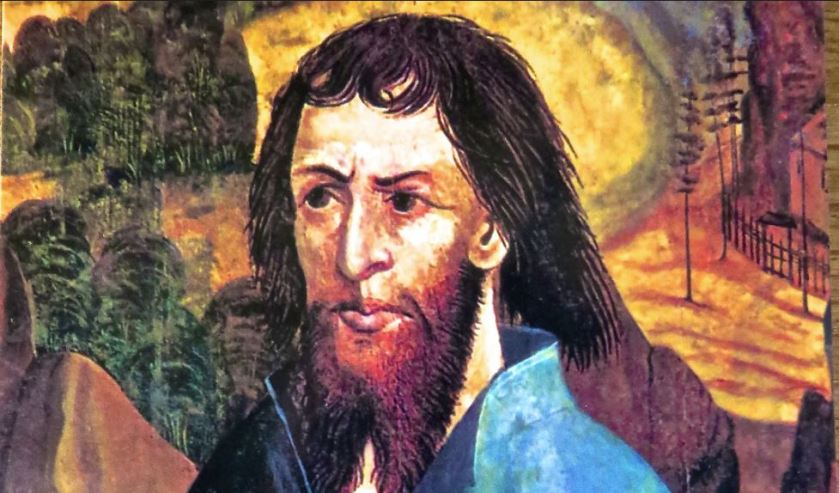
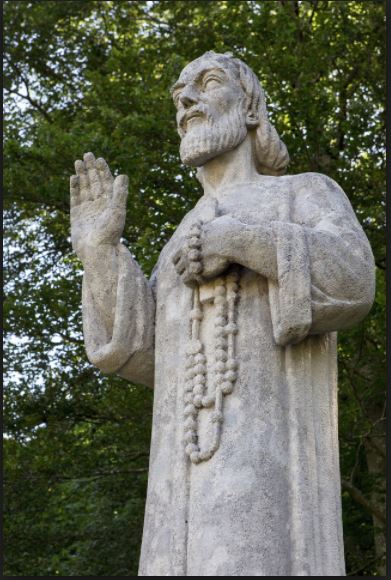
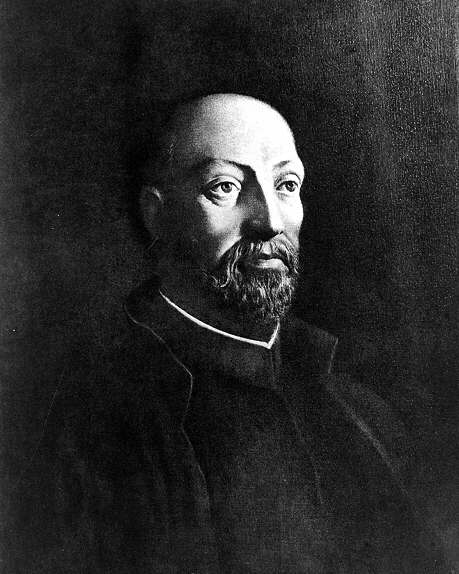
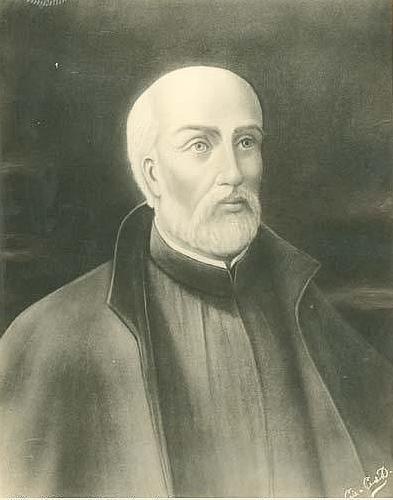
Saint of the Day – 21 March – St Nicholas of Flue (1417-1487) – born on 21 March 1417 at Sachseln, Canton Unterwalden, Lake Lucerne, Switzerland and died on 21 March 1487 at Ranft, Aargau, Switzerland of natural causes; his wife and children were at his side
His relics reside in the church of Sachseln, Switzerland. He is affectionately known as Brother Klause. Patronages – Switzerland, Pontifical Swiss Guards, Councillors, large families. St Nicholas was a Swiss hermit and ascetic who is the patron saint of Switzerland. He is sometimes invoked as Brother Klaus. A husband and father, a Mystic, a writer, farmer, military leader, member of the assembly, councillor, judge, he was respected as a man of complete moral integrity. Brother Klaus’s counsel to the Diet of Stans (1481) helped to prevent war between the Swiss cantons.
The Swiss affectionately call St.Nicholas of Flue “Brother Klaus.” They revere him as a great holy man and political Councillors, who contributed significantly to the formation of their peace-loving nation.
From his youth in Unterwalden, Switzerland, Nicholas was a member of a Catholic lay association called the Friends of God. Scattered throughout Switzerland, the Netherlands and Germany, members sought closeness to Christ through a disciplined life, especially by meditation on his passion.
Though totally dedicated to peace, twice patriotism led Nicholas to fight in wars to defend Unterwalden. At age thirty he married Dorothy Wissling and during twenty happy years she bore him ten children.
At age fifty, however, Nicholas sensed God’s call to live a contemplative life as a hermit. Dorothy, also a member of the Friends of God, would not be opposed to such a desire. She believed that Nicholas had a divine commission and she and the children released him. So Nicholas left his family and spent the next twenty years in a remote cottage at Ranft. He prayed most of the night but in afternoons he welcomed visitors. It is reported but not confirmed, that during these years he took no food or drink, only Holy Communion.
In 1481, Nicholas played a major role in solidifying the unity of Switzerland. After the cantons secured independence by defeating the German king, Charles the Bold, a dispute threatened to divide the cantons. Representatives meeting at Stans disagreed over admitting Fribourg and Soleure to the confederation. However, at an impasse they consulted Brother Klaus. Within an hour after obtaining his advice, they agreed to include the territories.
A document from that period preserved Nicholas’s fundamental political wisdom.
“Always put God first and do not extend too widely the country’s frontiers that you may live more easily in peace, union and faithfulness to your dearly attained liberties. Do not mix in the affairs of others or ally yourself with a powerful stranger. Protect your country and do not hold yourself distant from it. Do not let grow among you self-interest, jealousy, hatred, envy and factions, or these will work against you. Dear friends, don’t let innovations and roguery seduce you. Hold on to the good, all of you together. Stay on the road in the footprints of your pious ancestors. Guard faithfully that which has been assigned to you. If you do that, neither storm nor tempest can harm you and you will overcome much evil.
Six years after the Stans meeting, on December 21, 1487, Nicholas died at Ranft after an illness of eight days.
St Nicholas was beatified in 1669. After his beatification, the municipality of Sachseln built a church in his honour, where his body was interred. He was canonised in 1947 by Pope Pius XII.
As a layman with family responsibilities who took his civic duties as an ancestral landowner seriously, Brother Klaus is a model of heroic manhood for many concerned with the flourishing of local communities and sustainable use of open land. He is the patron saint of the German-language association KLB (Katholischen Landvolkbewegung), the Catholic Rural Communities Movement.
Bl Alfonso de Rojas
St Augustine Tchao
St Benedicta Cambiagio Frassinello
St Birillus of Catania
St Christian of Cologne
St Domninus of Rome
St Enda of Arran
St Isenger of Verdun
St James the Confessor
Bl John of Valence
Bl Lucia of Verona
St Lupicinus of Condat
Bl Mark Gjani
Bl Matthew Flathers
St Nicholas of Flue (1417-1487)
St Philemon of Rome
Bl Santuccia Terrebotti
St Serapion the Scholastic
Bl Thomas Pilcher
Bl William Pike
—
Martyrs of Alexandria: A large but unknown number of Catholics massacred in several churches during Good Friday services in Alexandria, Egypt by Arian heretics during the persecutions of Constantius and Philagrio. They were martyred on Good Friday in 342 in Alexandria, Egypt.
Saint of the Day – 20 March – St Martin of Braga (c 520–580) Archbishop, Monk, Missionary, Monastic Founder, prolific Ecclesiastical Writer. He was born in Pannonia, Central Europe and died in 580 at Braga, Portugal of natural causes.
About 550, St Martin arrived in Galicia, now northern Portugal, aboard a ship transporting pilgrims from the Holy Land. We know little about Martin’s background, except that he had received a Greek education in the East and training as a monk in the tradition of the Egyptian desert. The young monk seems to have come to Galicia as a missionary to a church infected with heresy.
The Suevi, a Germanic tribe that controlled Galicia, had adopted Priscillianism, a version of gnosticism that denied Christ’s humanity. Martin took a strategic approach to winning the Suevi to the Catholic Church. First he became the friend of King Theodomir and won the admiration of the royal family. Then, building on his personal relationships, Martin converted the king and his court.
Martin founded a monastery at Dumium, which served as his missionary base. Out of respect for him, the Suevian monarchs made him bishop of Dumium. Later they appointed Martin as Archbishop of Braga, which established him as the pre-eminent leader of the Galician church. In that position he held several councils that condemned Priscillianism and he promulgated teaching that restored its adherents to the church.
St Gregory of Tours (538-594) declared Martin the greatest scholar of his age. His writings included a guide to the Christian life, a description of superstitious peasant customs, a set of moral maxims and a version of the sayings of the Egyptian fathers. He died at his monastery at Dumium in 579.
Bl Ambrose Sansedoni of Siena
Anastasius XVI
Archippus of Colossi
St Benignus of Flay
St Cathcan of Rath-derthaighe
St Clement of Ireland
St Cuthbert of Lindisfarne
Bl Francis Palau y Quer
St Guillermo de Peñacorada
St Herbert of Derwenwater
Bl Hippolytus Galantini
Bl Jeanne Veron
Bl John Baptist Spagnuolo
St John Nepomucene
St John Sergius
St Jósef Bilczewski
St Maria Josefa Sancho de Guerra
St Martin of Braga (c 520–580)
St Nicetas of Apollonias
St Remigius of Strasbourg
St Tertricus of Langres
St Urbitius of Metz
St Wulfram of Sens
—
Martyrs of Amisus – 8 saints: A group of Christian women martyred together in the persecutions of Diocletian. The only details we have are eight of their names – Alexandra, Caldia, Derphuta, Euphemia, Euphrasia, Juliana, Matrona and Theodosia. They were burned to death c 300 in Amisus, Paphlagonia (modern Samsun, Turkey).
Martyrs of Rome – 9+ saints: A group of Christians martyred together in the persecutions of Nero. We know nothing else about them but the names Anatolius, Cyriaca, Joseph, Parasceve, Photis, Photius, Sebastian and Victor.
Martyrs of San Saba – 20 saints: Twenty monks who were martyred together in their monastery by invading Saracens.
They were martyred in 797 when they were burned inside the San Sabas monastery in Palestine.
Martyrs of Syria – 3+ saints: A group of Christians who were martyred together in Syria. We know nothing else about them but the names Cyril, Eugene and Paul.
Thought for the Day 19 March – The Solemnity of the Feast of St Joseph, Spouse of the Blessed Virgin Mary and Patron of the Universal Church
Go to Joseph
J O S E P H
By Fr Francis Peffley
J
Joseph the Just Man
St John Paul in his apostolic exhortation “The Guardian of the Redeemer” calls Joseph the just man. What does that mean? It means that he was a holy man. A righteous man. A man of honesty, integrity, and virtue. St Joseph is the greatest and holiest saint after the Blessed Mother herself. In fact, some of the Doctors of the Church said that there was no grace ever given to any of the Saints (except Mary) that was not given to St Joseph as well.
St. Thomas Aquinas says that God gives grace proportionate to our office and to our state in life. So if you are a husband and father, you will be given the grace to be a holy husband and father. When someone has been ordained a priest he will be given the grace to be a priest. Think how much grace St Joseph received to be the foster father of the Son of God and the virginal spouse of the Immaculate Conception. So St Joseph is that just man. He is the greatest of Saints because he was the closest one to Jesus and to the Blessed Mother.
As fathers and husbands you are called to holiness ‑ an obligation of every member of the Church. It is not just the priests and nuns but everyone who is called to holiness. Every single person has this vocation ‑ the universal call to holiness. We should ask ourselves, “Am I developing the virtues that St. Joseph has? Am I developing the integrity and character of St. Joseph?”
O
Joseph the Obedient one.
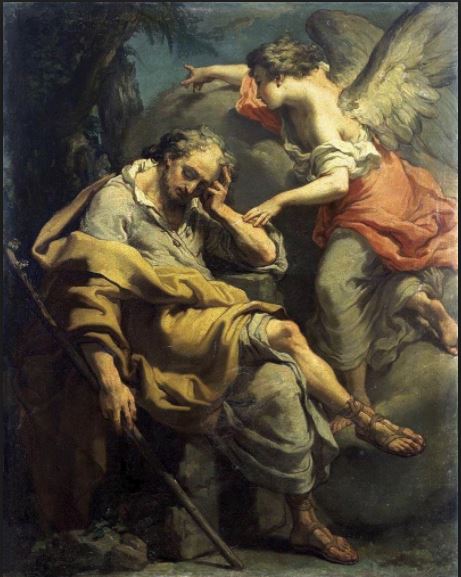
Joseph was truly obedient to the will of God in his life. The Angel said, “Have no fear about taking Mary to be your wife.” As soon as Joseph knew God’s will for him, he obeyed. When the angel told Joseph that Herod was planning to destroy the child, Joseph immediately got up and began the flight to Egypt.
Some people ask if St Joseph was old. This is due to the apocryphal writings of the early church, ancient writings which were not divinely inspired, or approved by the Church as Sacred Scripture. These ancient writings say that when Joseph married the Blessed Mother he was 89 years old and that he died at the age of 111. There is nothing in the Bible to suggest that St Joseph was so old. We can be assured that Mary didn’t have to push St Joseph in a wheel chair through the desert. Actually, I believe that Joseph was young and strong. Obviously older than the Blessed Mother; perhaps in his 20s or 30s. He was her guardian and protector. Scripture speaks about Mary’s betrothal to a man named Joseph. It does not say he was an old man, as Simeon or Zachary. So Joseph wasn’t as old as some would like to claim him to be. Even in the ancient catacomb of Priscilla, Joseph was drawn without a beard showing him to be a young man.
But Joseph was an obedient man. Whenever he was warned in a dream he always obeyed the will of God. He never questioned Divine Providence. Even though Mary was 8 3/4 months pregnant, Joseph had to believe it was God’s will for them to leave Nazareth and go down to Bethlehem. This was to fulfil the prophecy of Micah that the Saviour would be born in Bethlehem. Joseph abandoned himself to the will of God. Ask yourself these questions: “Am I obedient to the will of God? Am I obedient to the Ten Commandments? Am I obedient to the teaching of Christ and the teachings of the Church on marriage and family life?” Go to St. Joseph to become obedient sons of the Church.
S
Joseph the Silent One.
There are no recorded words of St Joseph in the entire Bible. There are words in the Old Testament for the great patriarch that we can apply to St Joseph. But in the New Testament there are no recorded words for St Joseph. He’s always there, though, as a silent presence. In fact, even his death is wrapped in silence. There is no account as to how Joseph was buried. He’s a man of silence. A strong man. A man with a deep interior life. Silence in our life helps us develop a life of prayer. Joseph was a man of prayer who listened to the word of God. He was not distracted by the many exterior things ‑ he was always a man of interior life. Why? Because God lived in his very house.
We picture St Joseph as a silent worker, as a craftsman, who suffered in silence as well. He did not complain and he did not grow angry at God and say, “Why are you doing this, why do we have to flee to Egypt?” He was a man who accepted these things in silence. We should ask ourselves, “Do I have enough silence in my life?Do I spend enough time in prayer with Jesus? Do I listen to Jesus when he speaks to me during the Sunday readings? Do I spend time in the Blessed Sacrament chapel listening to Jesus who is truly present? Do I use my speech for lying, gossiping or backbiting? Or, do I truly follow St. Joseph by being a man of integrity and silence?”
E
Joseph the Example.
Imagine the kind of man Joseph was. God the Father picked Joseph out of the whole human race to be the man to raise his only begotten Son, Jesus Christ. When you get a babysitter you don’t just pick anyone, even if it is for only a few hours. Imagine entrusting your only son to the care of another person. That is why adoption agencies have to be careful in selecting to whom they entrust other people’s children. That is why God chose the very best. He chose St Joseph to be a great example.
St Joseph was an example to Jesus in his words and in his actions. He has been called the World’s Greatest Father. Joseph was truly a father to Jesus in every way except for physical generation. He was the father who taught Jesus how to speak, how to read and how to make doors and ploughs. Note the example that St Joseph gave the Christ child and remember the saying, “Your example shouts so loudly I cannot hear what you say.” Isn’t that the way children look at their parents? What was the example that St. Joseph gave to the Christ child? He was the perfect example, the world’s greatest father, the educator of Jesus.
Joseph homeschooled Jesus and taught him the virtues. This was the Son of God who always had the beatific vision but (as the catechism says) He had to grow in the experiential and had to develop as a boy develops. Jesus looked up to St Joseph, even imitating his mannerisms. Let us ask ourselves, “What examples are we giving? What example do you give to your wife? To your children? Do you teach your children the faith? Do you study your own Catholic Faith by reading at least 10 ‑ 20 minutes every day? Do you make good use of your travel time to deepen your faith, so you can be a good example to your wife and children? Do you go on retreats? Are you living out your vocation as leader of your family?”
P
Joseph the Protector and Patron.
St Joseph is our benefactor who prays for us. Joseph is the patron Saint of fathers, husbands and workers. We should always pray that we will have the same kind of death that St Joseph had, dying in the arms of Jesus and Mary. He is the patron Saint of a happy death, which means dying in the arms of Jesus and Mary and Holy Mother Church. Go to St. Joseph for the grace of a happy death.
He is also the patron Saint of the universal Church. Everything that St Joseph did for Jesus he now does for the Church. Why? Because the Catholic Church is the mystical body of Christ himself. The Blessed Mother is the mother of the Church and St Joseph is the foster father and guardian of the Church.
St Joseph lately has become the patron Saint of selling houses. I have to wonder about Aunt Selma selling her house by burying a statue of St Joseph facing east. I have to wonder if that is what God really wants us to do. If you want to sell your house, place a statue of St. Joseph on your mantle and do a nine-day novena to him. You don’t have to suffocate the guy! Keep him there and ask his intercession. He will help you sell your house or keep your job in every way. Remember that Joseph is the protector and the guardian of the whole Church, as well as ourselves as individuals. Ask yourself the question, “Do I pray to St. Joseph every day? Do I pray to him for a happy death?” Pray to him for your whole family that you will have a happy death. And ask St. Joseph to help you protect your family from all the immorality on TV or in the media.
H
St Joseph the Helper of the Blessed Mother.
St Joseph was the virginal spouse of the Blessed Virgin Mary. In God’s plan of salvation he was a loving husband, kind, considerate, affectionate and self-sacrificing. St Joseph had an awesome responsibility with the Blessed Virgin. They worked as a team. St Joseph had the responsibility for spiritual leadership since he was the head of the family. God’s message from the angel was revealed to him even though the Blessed Mother was much holier through her Immaculate Conception. Obviously, Jesus as the Son of God and creator was far greater but St. Joseph was chosen because he was the head of that family, just as every one of you is the spiritual head of your family.
Joseph and Mary worked as a team. Remember TEAM spells “Together Everyone Achieves More.” Develop teamwork with your wife. I love the story that Zig Zigler tells of courtship after marriage using the example of Belgian horses. These huge Belgian horses could only pull 8,000 pounds individually. But when they are harnessed together, two horses working together can pull 32,000 pounds of weight. Isn’t that amazing? It almost defies every law of mathematics. So when you are joined with your spouse in an effort to move your family towards God, you will accomplish much more than if you were to do it individually. Ask yourself this question, “Am I a helper to my spouse?” Your vocation is really to get your spouse and your children to Heaven. This is your ultimate vocation in life.
Let us reflect on St Joseph: that Just man, that loving leader, that Obedient man; let us reflect on his Silence, his Example and his Patronage of our own lives and of the Church, and let us to try to imitate St Joseph the Helper of Mary.
God bless you.
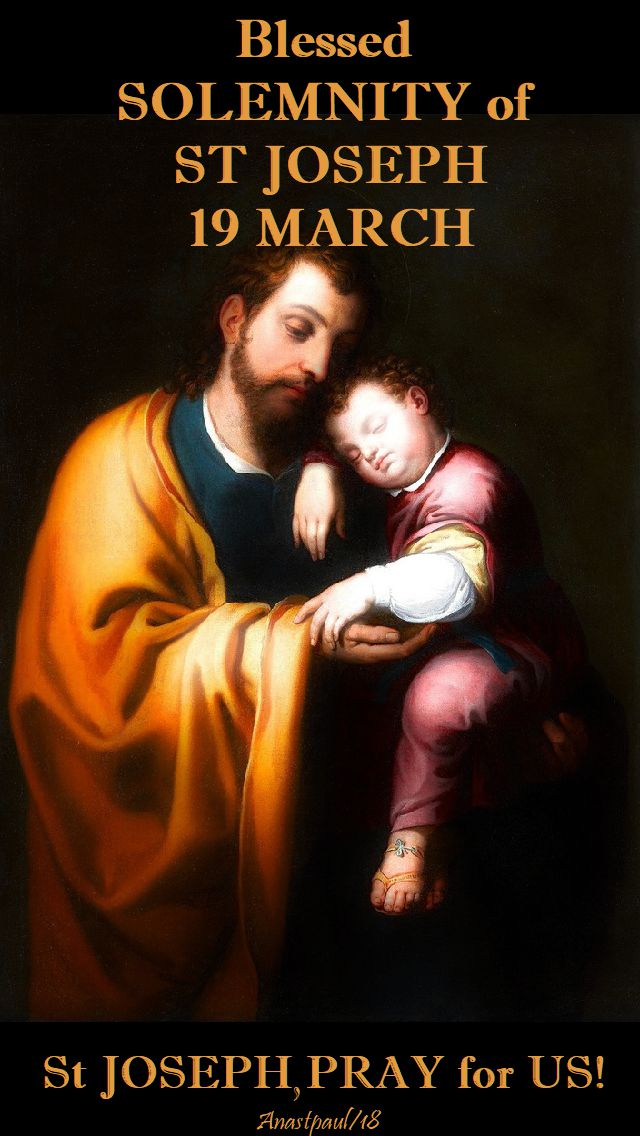
Happy and Blessed Solemnity of the Great St Joseph!
Fr Francis Peffley currently serves as parochial vicar at Saint John the Apostle in Leesburg, Virginia.
One Minute Reflection – 19 March – The Solemnity of the Feast of St Joseph, Spouse of the Blessed Virgin Mary and Patron of the Universal Church
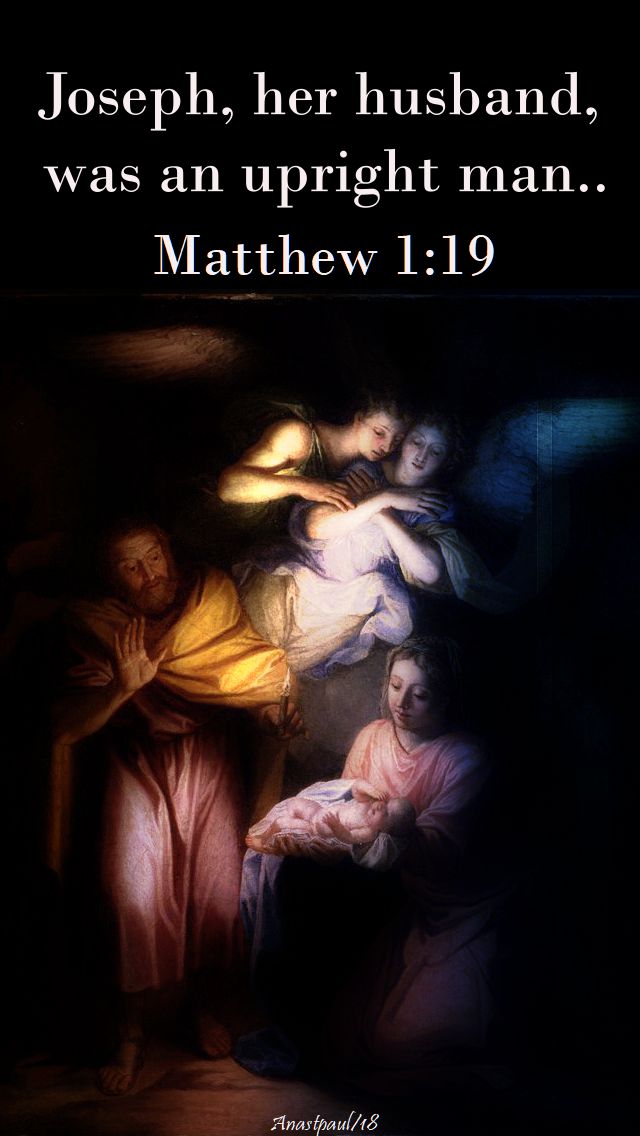
Joseph, her husband, was an upright man...Matthew 1:19
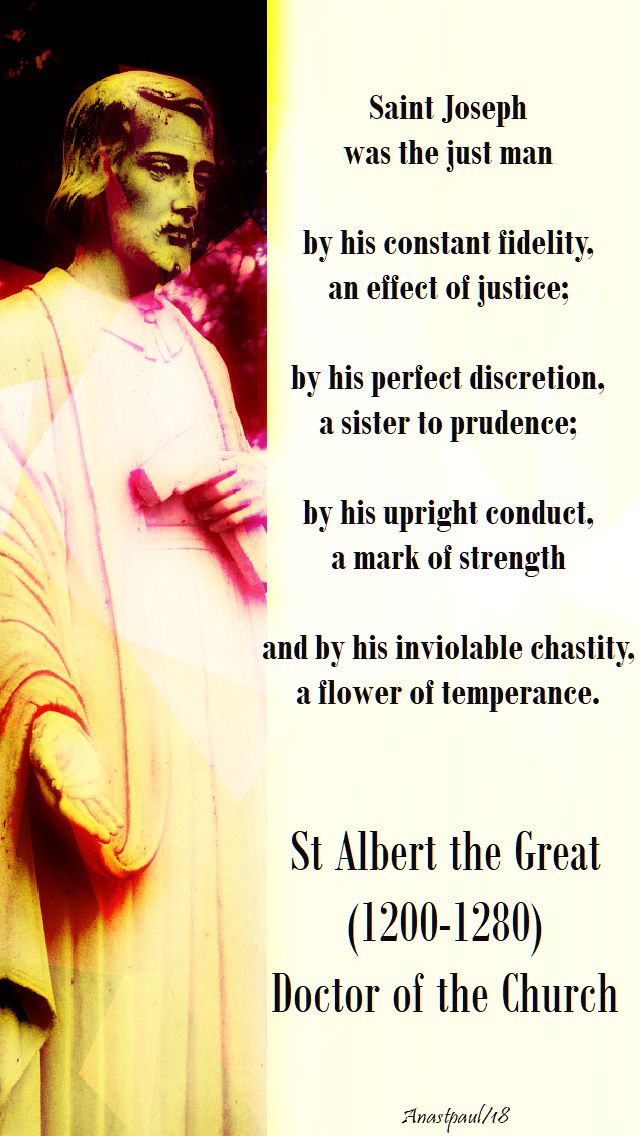
REFLECTION – Saint Joseph was the just man by his constant fidelity, an effect of justice; by his perfect discretion, a sister to prudence; by his upright conduct, a mark of strength and by his inviolable chastity, a flower of temperance…St Albert the Great (1200-1280) Doctor of the Church
PRAYER – Almighty God, at the beginning of our salvation, when Mary conceived Your Son and brought Him forth into the world, You placed them under Joseph’s watchful care. May his prayer still guide us and help Your Church, to be an equally faithful guardian of Your Mysteries and a sign of Christ to mankind. Through Your Son, our Saviour, in unity of the Holy Spirit, one God forever, amen.
Our Morning Offering – 19 March – The Solemnity of the Feast of St Joseph, Spouse of the Blessed Virgin Mary, Guardian of Jesus and Patron of the Universal Church, Patron of Fathers, Patron of the Dying, Patron of Workers. et al
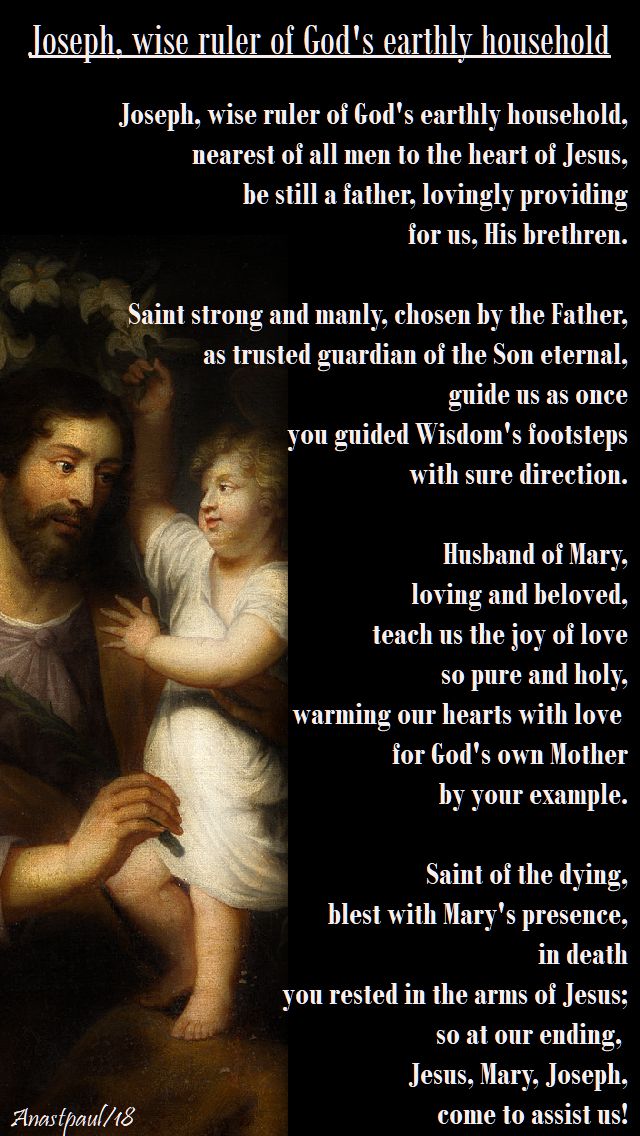
Joseph, wise ruler of God’s earthly household
Joseph, wise ruler of God’s earthly household,
nearest of all men to the heart of Jesus,
be still a father, lovingly providing
for us, His brethren.
Saint strong and manly, chosen by the Father,
as trusted guardian of the Son eternal,
guide us as once you guided Wisdom’s footsteps
with sure direction.
Husband of Mary, loving and beloved,
teach us the joy of love so pure and holy,
warming our hearts with love
for God’s own Mother by your example.
Saint of the dying, blest with Mary’s presence,
in death you rested in the arms of Jesus;
so at our ending, Jesus, Mary, Joseph,
come to assist us!
Saint of the Day – 19 March – The Solemnity of St Joseph, Spouse of the Most Blessed Virgin Mary, Mother of God and Patron of the Universal Church. The name ‘Joseph’ means “whom the Lord adds”. Patronages • against doubt and hesitation • accountants • all the legal professions • bursars • cabinetmakers • carpenters • cemetery workers • children • civil engineers • confectioners • craftsmen • the dying • teachers • emigrants • exiles • expectant mothers • families • fathers • furniture makers • grave diggers • happy death • holy death • house hunters • immigrants • joiners • labourers • married couples • orphans • against Communism • pioneers • pregnant women • social justice • teachers • travellers • the unborn • wheelwrights • workers • workers • Catholic Church • Oblates of Saint Joseph • for protection of the Church • Universal Church • Vatican II • Americas • Austria • Belgium • Bohemia • Canada • China • Croatian people • Korea • Mexico • New France • New World • Peru • Philippines • Vatican City • VietNam • Canadian Armed Forces • Papal States • 46 dioceses • 26 cities • states and regions.
St Joseph is invoked as patron for many causes. He is the patron of the Universal Church. He is the patron of the dying because Jesus and Mary were at his death-bed. He is also the patron of fathers, of carpenters and of social justice. Many religious orders and communities are placed under his patronage.
St Joseph, the spouse of the Blessed Virgin Mary and the foster-father of Jesus, was probably born in Bethlehem and probably died in Nazareth. His important mission in God’s plan of salvation was “to legally insert Jesus Christ into the line of David from whom, according to the prophets, the Messiah would be born, and to act as his father and guardian” (Directory on Popular Piety and the Liturgy). Most of our information about St. Joseph comes from the opening two chapters of St Matthew’s Gospel. No words of his are recorded in the Gospels; he was the “silent” man. We find no devotion to St Joseph in the early Church. It was the will of God that the Virgin Birth of Our Lord be first firmly impressed upon the minds of the faithful. He was later venerated by the great saints of the Middle Ages. Pius IX (1870) declared him patron and protector of the universal family of the Church.
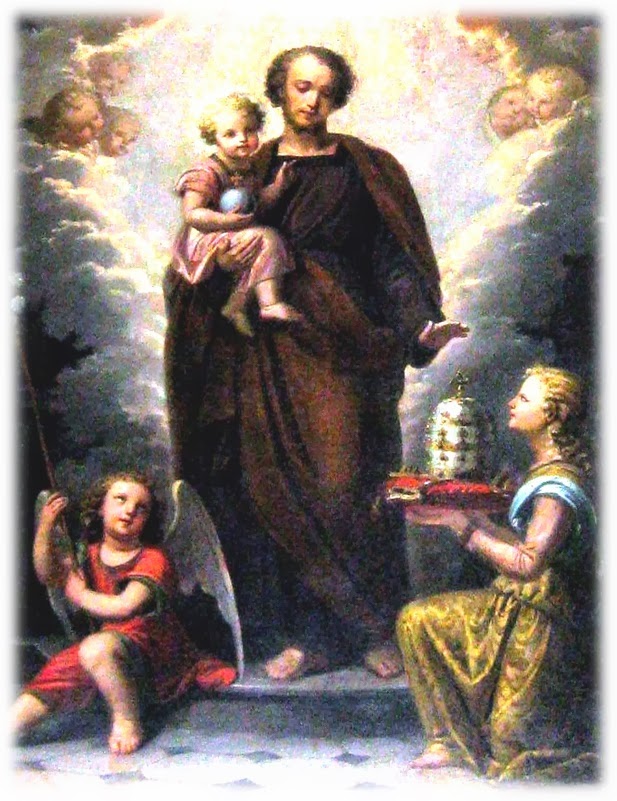
Unknown artist, 19th century, Italian
St Joseph was an ordinary manual labourer although descended from the royal house of David. In the designs of Providence he was destined to become the spouse of the Mother of God. His high privilege is expressed in a single phrase, “Foster-father of Jesus.” About him Sacred Scripture has little more to say than that he was a just man-an expression which indicates how faithfully he fulfilled his high trust of protecting and guarding God’s greatest treasures upon earth, Jesus and Mary.
The darkest hours of his life may well have been those when he first learned of Mary’s pregnancy; but precisely in this time of trial Joseph showed himself great. His suffering, which likewise formed a part of the work of the redemption, was not without great providential import: Joseph was to be, for all times, the trustworthy witness of the Messiah’s virgin birth. After this, he modestly retires into the background of holy Scripture.
Of St Joseph’s death the Bible tells us nothing. There are indications, however, that he died before the beginning of Christ’s public life. His was the most beautiful death that one could have, in the arms of Jesus and Mary. Humbly and unknown, he passed his years at Nazareth, silent and almost forgotten he remained in the background through centuries of Church history. Only in more recent times has he been accorded greater honour. Liturgical veneration of St Joseph began in the fifteenth century, fostered by Sts Brigid of Sweden and Bernadine of Siena. St Teresa of Avila, too, did much to further his cult.
At present there are two major feasts in his honour. Today 19 our veneration is directed to him personally and to his part in the work of redemption and is his main Feast and a Solemnity in the Universal Church, while on 1 May we honour him as the patron of workmen throughout the world and as our guide in the difficult matter of establishing equitable norms regarding obligations and rights in the social order….Excerpted from The Church’s Year of Grace, Pius Parsch
COLLECT PRAYER
Grant, we pray, almighty God, that by Saint Joseph’s intercession Your Church may constantly watch over the unfolding of the mysteries of human salvation, whose beginnings You entrusted to his faithful care. Through our Lord Jesus Christ, your Son, who lives and reigns with you in the unity of the Holy Spirit, one God, for ever and ever.
St Adrian of Maastricht
St Alkmund of Northumbria
St Amantius of Wintershoven
Bl Andrea Gallerani
Bl Anton Muzaj
St Apollonius of Braga
St Auxilius of Ireland
Bl Clement of Dunblane
St Colocer of Saint-Brieuc
St Corbasius of Quimperlé
St Cuthbert of Brittany
St Gemus
Bl Isnard de Chiampo
Bl Jan Turchan
Bl John of Parma
St John the Syrian of Pinna
St Lactali of Freshford
St Landoald of Maastricht
St Leontinus of Braga
St Leontinus of Saintes
Bl Marcel Callo – Martyr
Bl Mark of Montegallo
St Pancharius of Nicomedia
Bl Sibyllina Biscossi
—
Martyrs of Sorrento: A group of three sisters and a brother who were martyred together. We have little more than their names – Mark, Quartilla, Quintilla and Quintius. They were martyred in Sorrento, Italy, date unknown.
Mark
Quartilla
Quintilla
Quintius
Martyred in the Spanish Civil War
• Blessed Alberto Linares de La Pinta
• Blessed Jaume Trilla Lastra
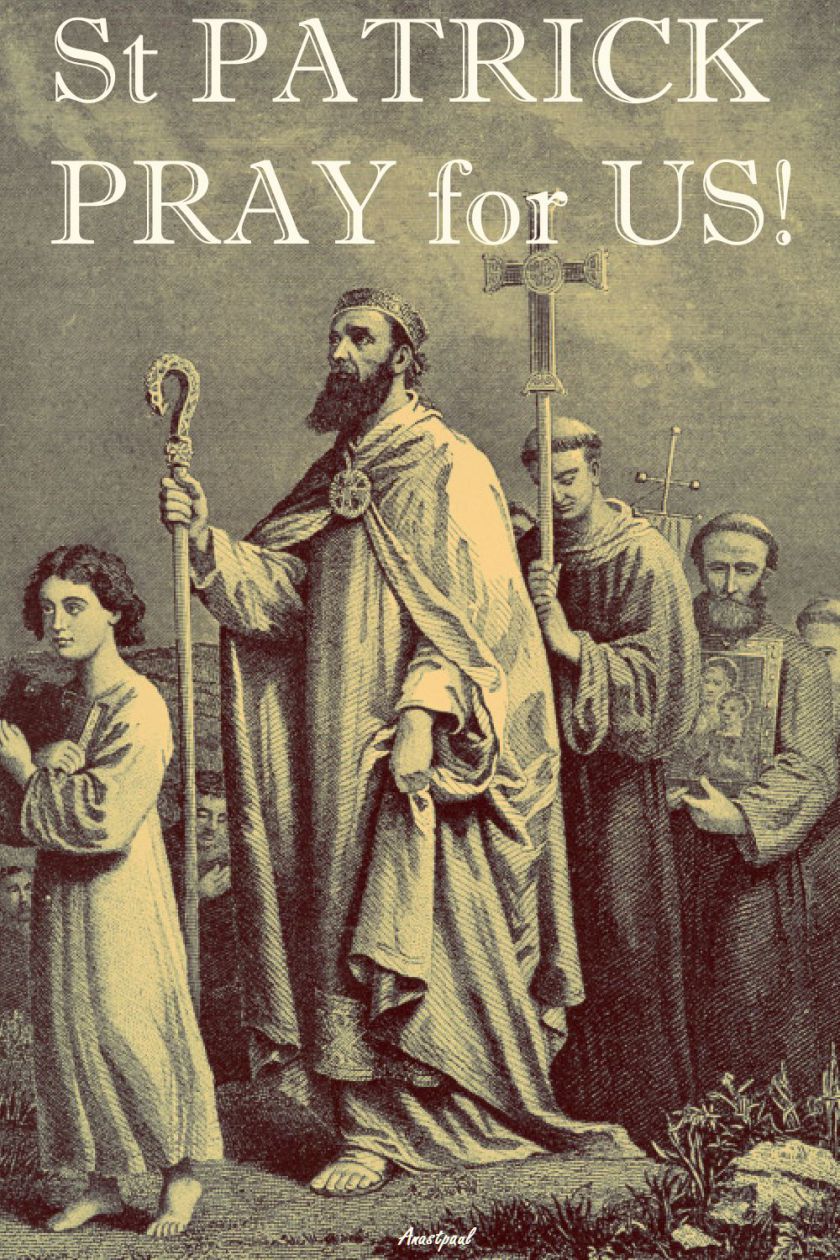
Thought for the Day – 17 March – The Memorial of St Patrick (c 386-461)
Something strange and wonderful happened in Ireland. All alone, frightened for his life and among people who worshipped trees and stones, Patrick opened his heart to God.
That happens to a lot of us, doesn’t it? When everything’s going great, we don’t have any time for God. But then something awful and painful happens and there we are, back at God’s feet.
During those years, Patrick started to pray. He thought about God all the time and it gave him peace of mind. He knew that no matter how much he was suffering, God loved him.
Eventually, Patrick escaped from slavery and traveled to France, which in those days was called Gaul. We’re not sure exactly how much time Patrick spent in Gaul. But it was enough time for him to draw closer to God as he prayed and studied in a monastery.
One night, deep in a dreamy vision, Patrick heard voices. He heard many voices, joined together, pleading with him.
“Come back,” the voices cried, “come back and walk once more among us.”
Patrick knew it was the Irish people calling him.
Strengthened by the courage that only God can give, Patrick went back. He returned to the very people who had stolen him from his family, worked him mercilessly as a slave and knew little, if anything, about the love of the true God.
Before he left Gaul, Patrick was made the bishop of Ireland. He then travelled across the sea to teach Ireland about Jesus Christ.
It wasn’t easy. The people of Ireland practised pagan religions. They worshipped nature and they practised magic. They feared the spirits they believed lived in the woods. The Irish people believed they could bring evil spirits down on those they wanted to harm.
Patrick had a big job ahead of him. He had to show a country full of students that there was no point in horsewhipping nature. Trees can’t forgive your sins or teach you how to love. The sun, as powerful as it is, could not have created the world. Patrick explained things using simple examples that people could easily understand. For example, he used the three-leaf clover to show people how there could be three persons in one God.
Patrick preached to huge crowds and small villages. He preached to kings and princes. He preached in the open air and he preached in huts. Patrick never stopped preaching, and he never stopped teaching. He couldn’t stop—the whole country of Ireland was his classroom and he couldn’t afford to miss even one student!
Soon, Patrick had help. Men became priests and monks. Women became nuns. Wherever they lived, those monks and nuns settled in monasteries and set up schools. More students were being reached every day.
But, of course, the greatest help Patrick had was from God.
When he was young, Patrick had forgotten God but that would never happen again. He knew that God supported him in every step he took. God gave Patrick the courage to speak, even when Patrick was in danger of being hurt by pagan priests who didn’t want to lose their power over the people.
St Patrick, please, please pray for us all, you who faced it all!
Quote/s of the Day – 17 March – The Memorial of St Patrick (c 386-461)
All quotations from “The Confession of St Patrick”
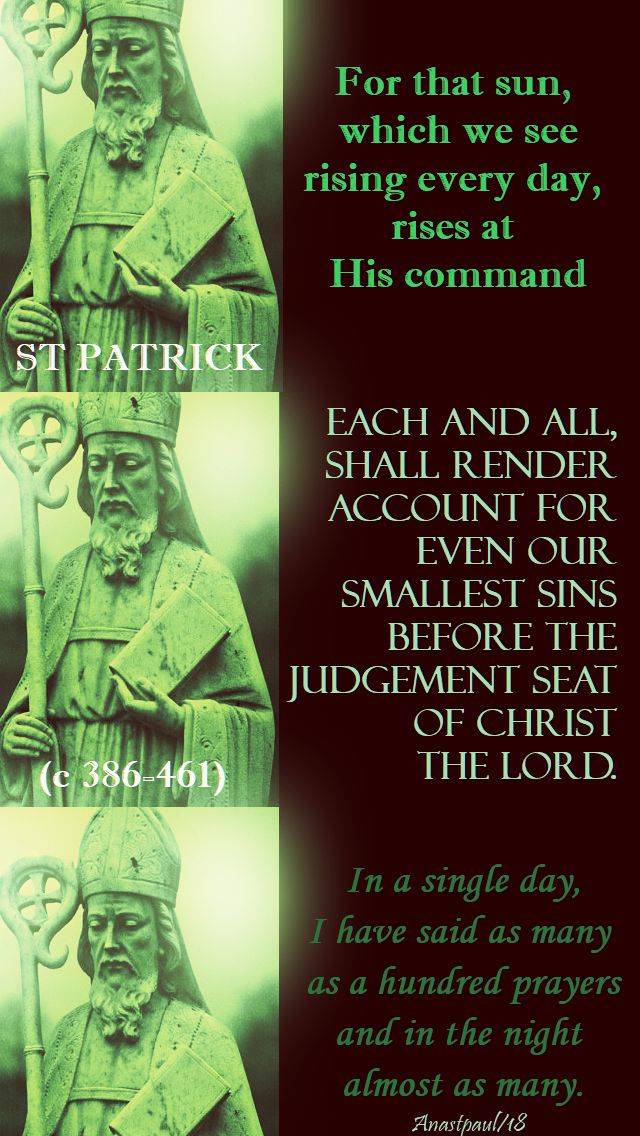
“For that sun, which we see rising every day, rises at His command…”
“Each and all shall render account for even our smallest sins before the judgement seat of Christ the Lord.”
“In a single day, I have said as many as a hundred prayers and in the night almost as many…”
“If I have any worth, it is to live my life for God…”
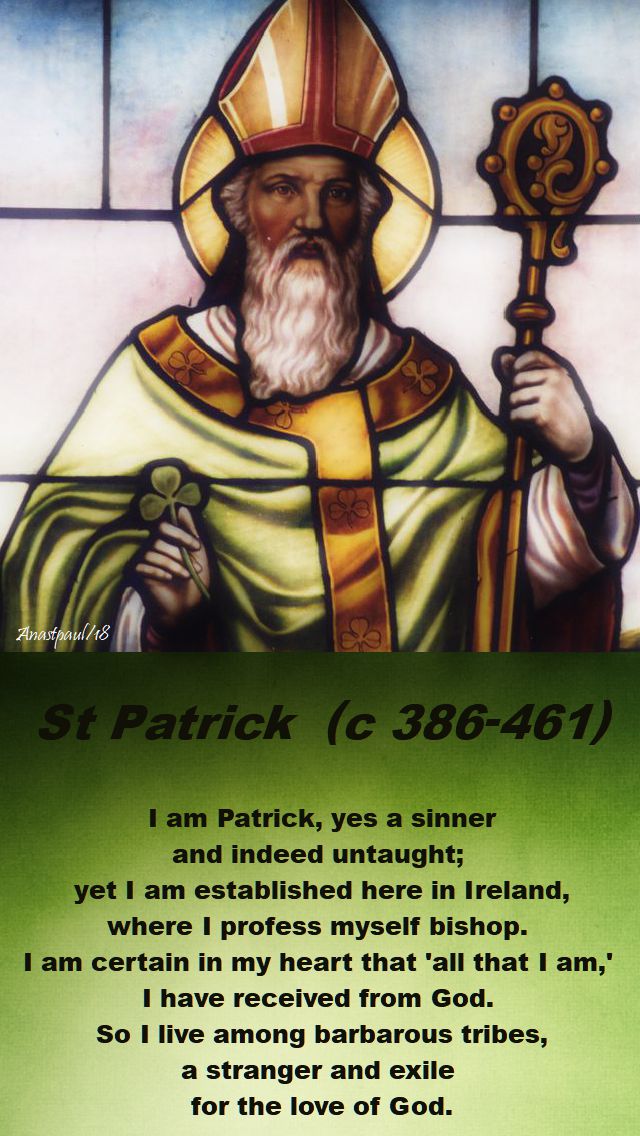
“I am Patrick, yes a sinner and indeed untaught; yet I am established here in Ireland, where I profess myself bishop. I am certain in my heart that ‘all that I am,’ I have received from God. So I live among barbarous tribes, a stranger and exile for the love of God.”
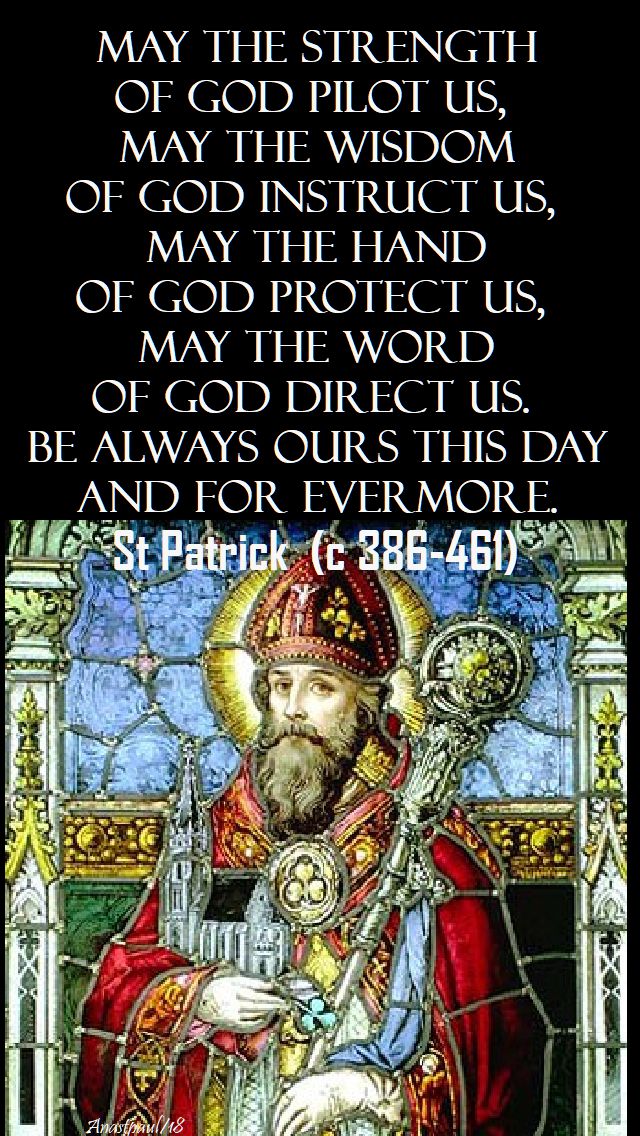
“May the strength of God pilot us, may the wisdom of God instruct us, may the hand of God protect us, may the word of God direct us. Be always ours this day and for evermore.”
One Minute Reflection – 17 March – The Memorial of St Patrick (c 386-461)
“Look at the birds of the air, that they do not sow, nor reap nor gather into barns and yet your heavenly Father feeds them. Are you not worth much more than they?”…Matthew 6:26
REFLECTION – “And He watched over me before I knew Him and before I learned sense or even distinguished between good and evil and He protected me and consoled me as a father would His son.”…St Patrick
PRAYER – You, O God, are our Father! How glorious is that fact and Your love. Teach us to trust in You and to follow the way You taught through our Lord and Saviour, Your Son, Jesus Christ. Allow that by the prayers of St Patrick, we may all come to see Your Face, the Face of our Father, to gaze on You, to love and worship You, with Christ and the Holy Spirit, one God forever, amen
Our Morning Offering – 17 March – The Memorial of St Patrick (c 386-461)
Excerpt from St Patrick’s Breastplate (also known as The Deer Cry)
I bind unto myself today the power of God to hold and lead, His eye to watch, His might to stay, His ear to hearken to my need; the wisdom of my God to teach, His hand to guide, His shield to ward; the word of God to give me speech, His heavenly host to be my guard. Against the demon snares of sin, the vice that gives temptation force, the natural lusts that war within, the hostile men that mar my course; of few or many, far or nigh, in every place and in all hours against their fierce hostility, ……. Christ be with me, Christ within me, Christ behind me, Christ before me, Christ beside me, Christ to win, Christ to comfort and restore me, Christ beneath me, Christ above me, Christ in quiet, Christ in danger, Christ in hearts of all that love me, Christ in mouth of friend and stranger. I bind unto myself the name, the strong name of the Trinity, by invocation of the same, the Three in One and One in Three, of whom all nature hath creation, Eternal Father, Spirit, Word. Praise to the Lord of my salvation: Salvation is of Christ the Lord. Amen
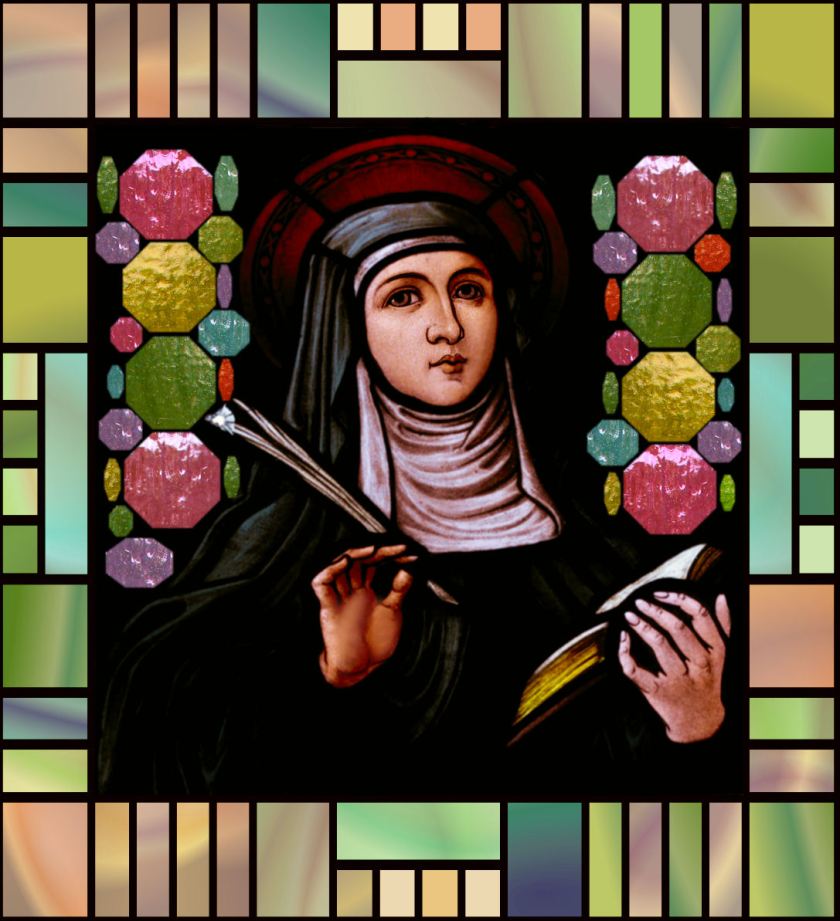
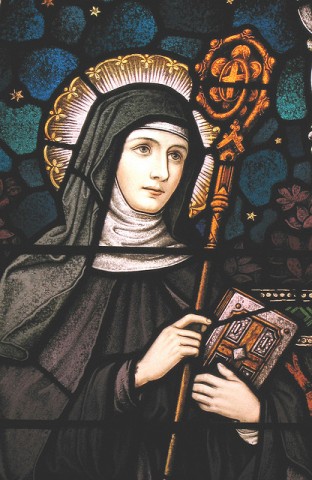
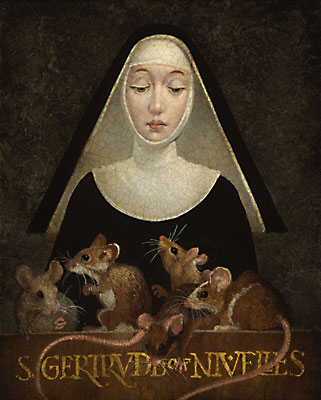
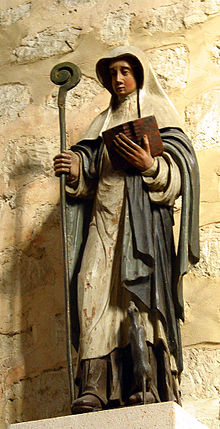
Saint of the Day – 17 March – St Gertrude of Nivelles O.S.B. (626-659) was a 7th-century Religious Abbess who, with her mother Itta, founded the Abbey of Nivelles located in present-day Belgium. She was born in 626 at Landen, Belgium and died on 17 March 659 at Nivelles, Belgium of natural causes. Patronages – against fear of mice and rates, against suriphobia, fever, mental disorders, insanity, of cats, of gardeners, innkeepers, hospitals, the mentally ill, pilgrims, travellers, suriphobics, sick, poor, prisoners, Landen, Belgium, Nivelles, Belgium, Wattenscheid, Germany. Attributes – a nun with a crosier, with cats, with mice, a woman spinning.
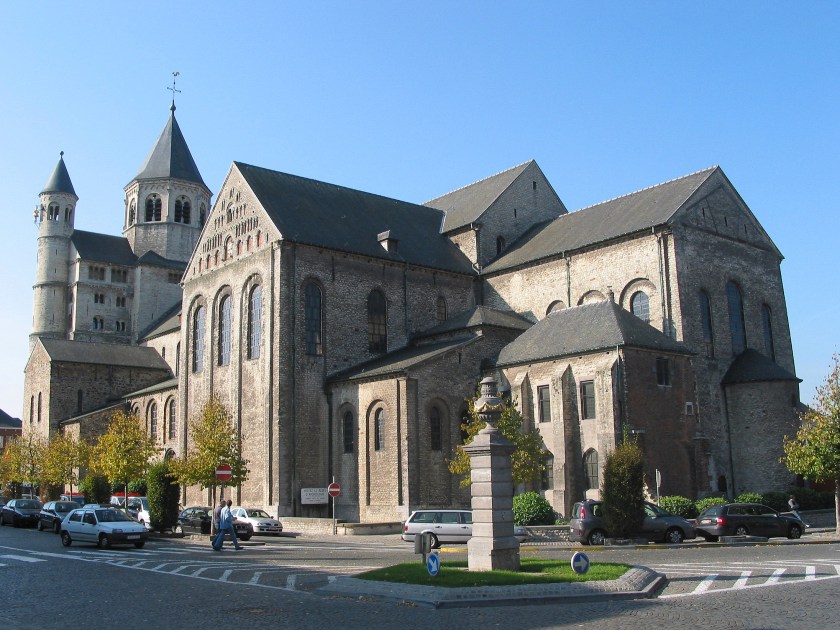
Our Saint was born at Landen, Belgium in 626 and died at Nivelles, 659; she was just thirty-three, the same age as Our Lord. Both her parents, Pepin of Landen and Itta were held to be holy by those who knew them; her sister Begga is numbered among the Saints. On her husband’s death in 640, Itta founded a Benedictine monastery at Nivelles, which is near Brussels and appointed Gertrude its abbess when she reached twenty, tending to her responsibilities well, with her mother’s assistance and following her in giving encouragement and help to monks, particularly Irish ones, to do missionary work in the locale.
Saint Gertrude’s piety was evident even when she was as young as ten, when she turned down the offer of a noble marriage, declaring that she would not marry him or any other suitor: Christ alone would be her bridegroom.
She was known for her hospitality to pilgrims and her aid to missionary monks. She gave land to one monk so that he could build a monastery at Fosse. By her early thirties Gertrude had become so weakened by the austerity of abstaining from food and sleep that she had to resign her office and spent the rest of her days studying Scripture and doing penance. It is said that on the day before her death she sent a messenger to Fosse, asking the superior if he knew when she would die.
His reply indicated that death would come the next day during holy Mass-the prophecy was fulfilled. Her feast day is observed by gardeners, who regard fine weather on that day as a sign to begin spring planting.
Devotion to St. Gertrude became widely spread in the Lowlands and neighbouring countries.
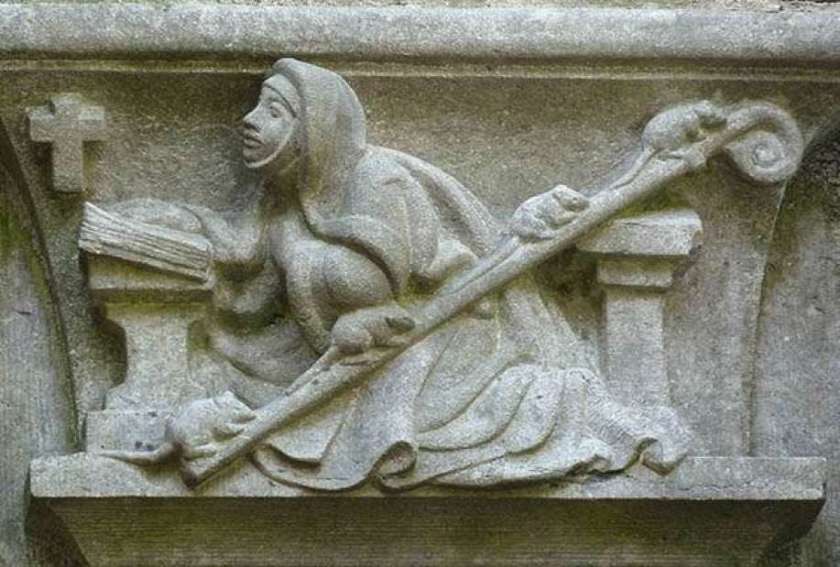
Commonly seen running up her pastoral staff or cloak are hopeful-looking mice representing Souls in Purgatory, to which she had an intense devotion, just as with St Gertrude the Great. Even as recently as 1822, offerings of mice made of gold and silver were left at her shrine. Another patronage is to travellers on the high seas. It is held that one sailor, suffering misfortune while under sail, prayed to the Saint and was delivered safely.
Just before her death in 659, Gertrude instructed the nuns at Nivelles to bury her in an old veil left behind by a travelling pilgrimess and Gertrude’s own hair shirt. Gertrude’s choice of burial clothing is a pattern in medieval hagiography as an expression of humility and piety. Her death and the image of her weak and humble figure is in fact a critical point in her biographer’s narrative. Her monastery also benefited from this portrayal because the hair cloth and veil in which Gertrude was interred became relics. At Nivelles, her relics were only publicly displayed for feast days, Easterand other holy days.
s.
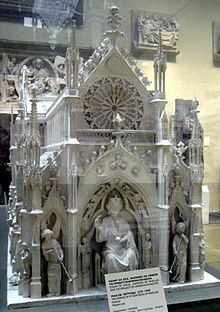
Shrine of St Gertrude of Nivelles, originally made in 1272-1298; this reproduction, in the Pushkin Museum, was cast from the original. In 1940, a German bomb smashed the original reliquary into 337 fragments. It was subsequently rebuilt.
St Agricola of Châlon-sur-Saône
St Alexander
St Ambrose of Alexandria
Bl Conrad of Bavaria
St Diemut of Saint Gall
St Gabriel Lalemant
St Gertrude of Nivelles (626-659)
Bl Gertrude of Trzebnica
St Jan Sarkander
Bl Josep Mestre Escoda
St Joseph of Arimathea
Bl Juan Nepomuceno Zegrí y Moreno
St Llinio of Llandinam
Bl Maria Bárbara Maix
St Paul of Cyprus
St Stephen of Palestrina
St Theodore of Rome
St Thomasello
St Withburga of Dereham
Martyrs of Alexandria – Also known as Martyrs of Serapis: An unknown number of Christians who were martyred together by a mob of worshippers of the Graeco-Egyptian sun god Serapis. They were Martyred in c 392 in Alexandria, Egypt.
Thought for the Day – 16 March – The Memorial of St Jean de Brébeuf (1593-1649) Martyr
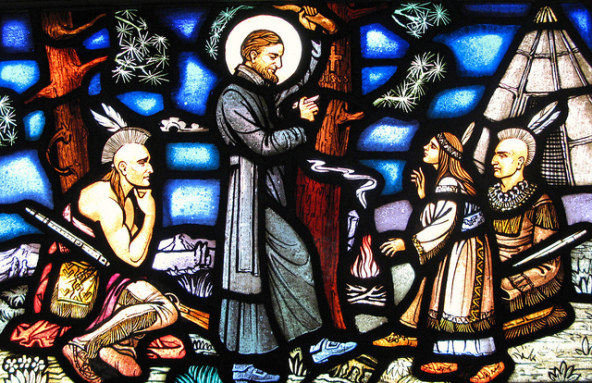
St Jean de Brébeuf is a giant of Canadian history. His writings in the Jesuit Relations, for example, offer an invaluable window into life in 17th-century Canada, while his gift for languages, which prompted him to create the first Huron dictionary, earn him the label of Canada’s first ethnographer. Brébeuf’s impact on the Canadian experience looms large; he is credited with everything from coining the term lacrosse to penning the lyrics of The Huron Carol, a Canadian Christmas classic.
One of the most telling details of his life, however, is found in the name the Huron people gave him — Echon. One translation means “healing tree,” a reference to Brébeuf’s height and gentle nature. The alternative translation, however, “one who carries a heavy burden,” speaks to the spiritual life of the most famous of the men known collectively as the Canadian Martyrs.
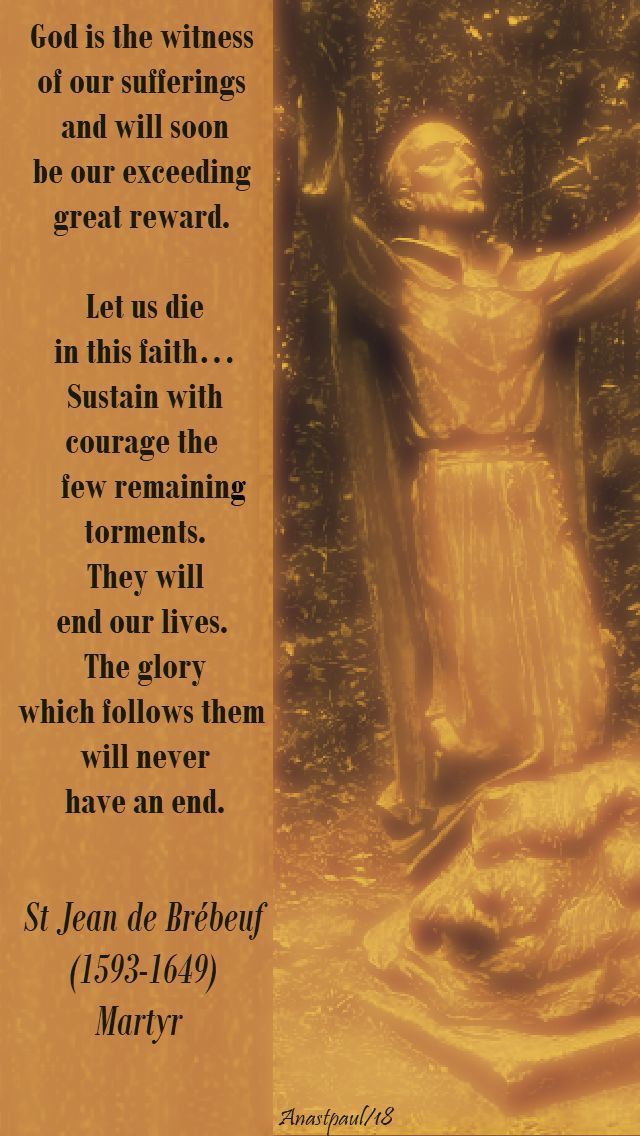
When the Iroquois tribe infiltrated them, he was captured with many others. A missionary to his death, he addressed the Huron who were captured with him, telling them, ”God is the witness of our sufferings and will soon be our exceeding great reward. Let us die in this faith…Sustain with courage the few remaining torments. They will end our lives. The glory which follows them will never have an end.”It is said he never cried out once but suffered in silence. His heroic virtue of suffering is laid out as an example for us all, to continue to fight the fight and win the race.
Quote/s of the Day – 16 March – The Memorial of St Jean de Brébeuf (1593-1649) Martyr and Friday in the 4th Week of Lent 2018
CCC 2473: Martyrdom is the supreme witness given to the faith: it means witness even unto death. The martyr bears witness to Christ who died and rose, to whom he is united by charity. He bears witness to the truth of the faith and of Christian doctrine. He endures death through an act of fortitude. “Let me become the food of the beasts, through whom it will be given me to reach God” [This quote at the end is from the Letter to the Romans by S. Ignatius of Antioch].
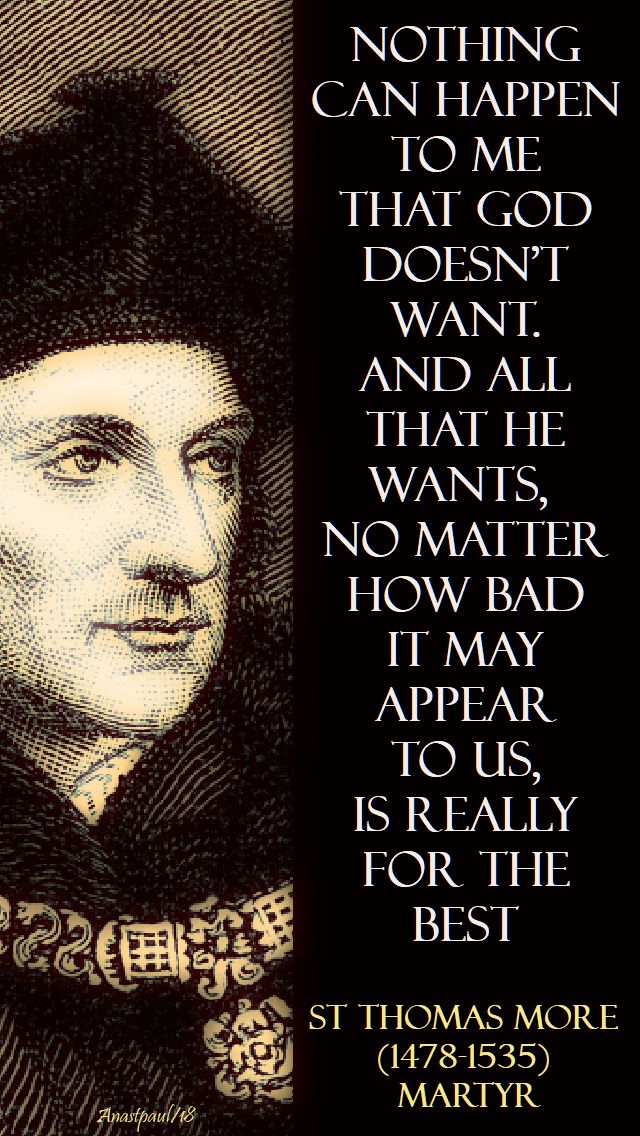
“Nothing can happen to me that God doesn’t want. And all that He wants, no matter how bad it may appear to us, is really for the best.”
St Thomas More (1478-1535) Martyr
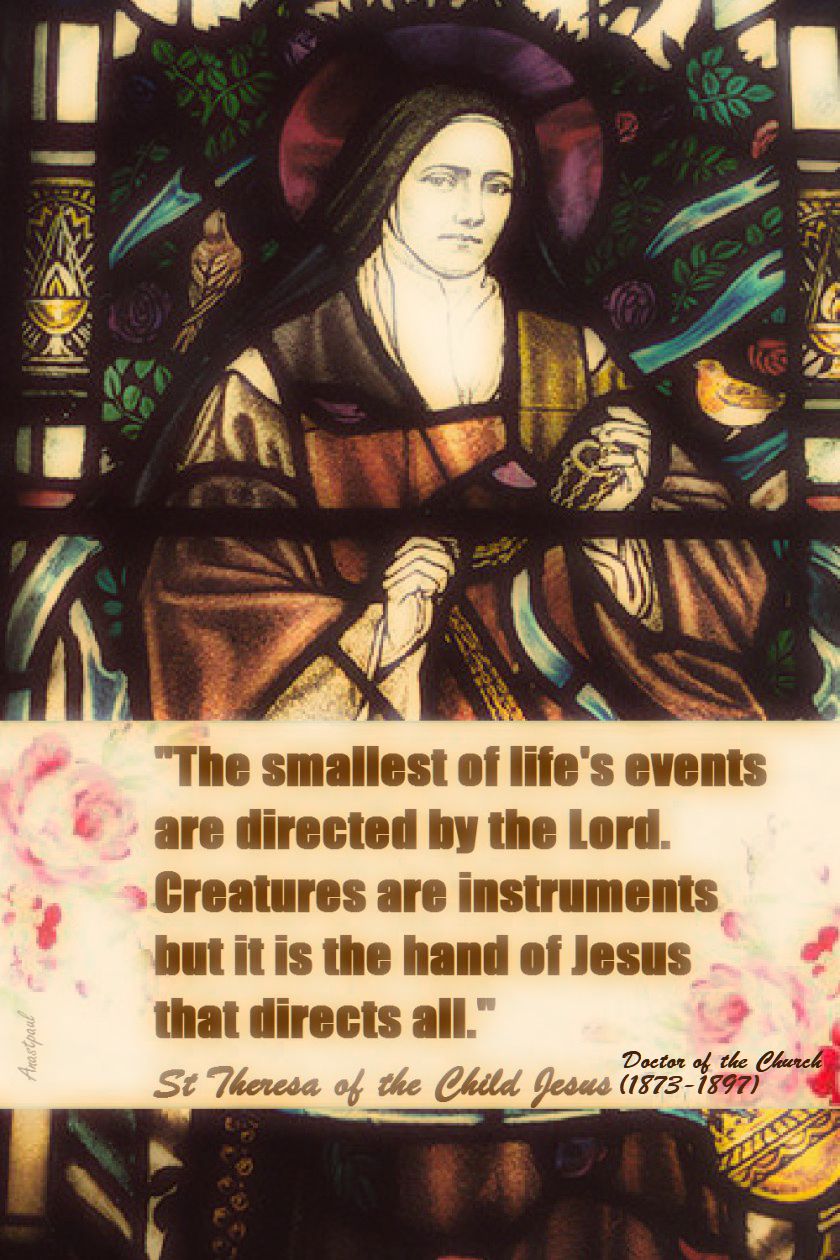
“The smallest of life’s events are directed by the Lord. Creatures are instruments but it is the hand of Jesus that directs all.”
St Theresa of the Child Jesus (1873-1897) Doctor of the Church
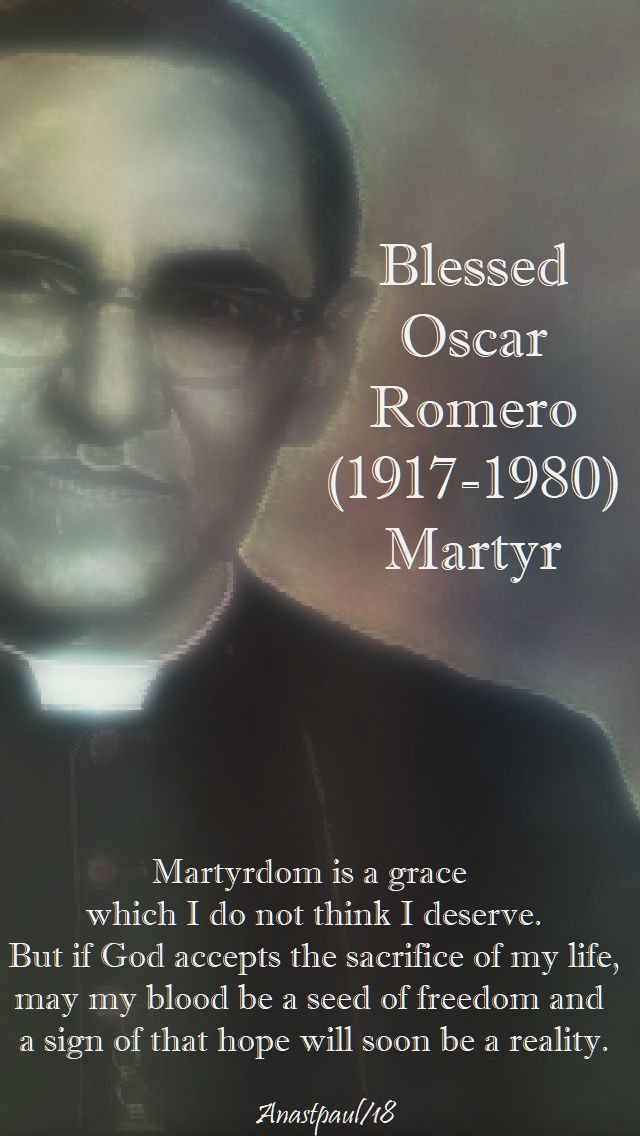
“Martyrdom is a grace which I do not think I deserve. But if God accepts the sacrifice of my life, may my blood be a seed of freedom and a sign of that hope will soon be a reality.”
One Minute Reflection – 16 March – The Memorial of St Jean de Brébeuf (1593-1649) Martyr and Friday in the 4th Week of Lent 2018
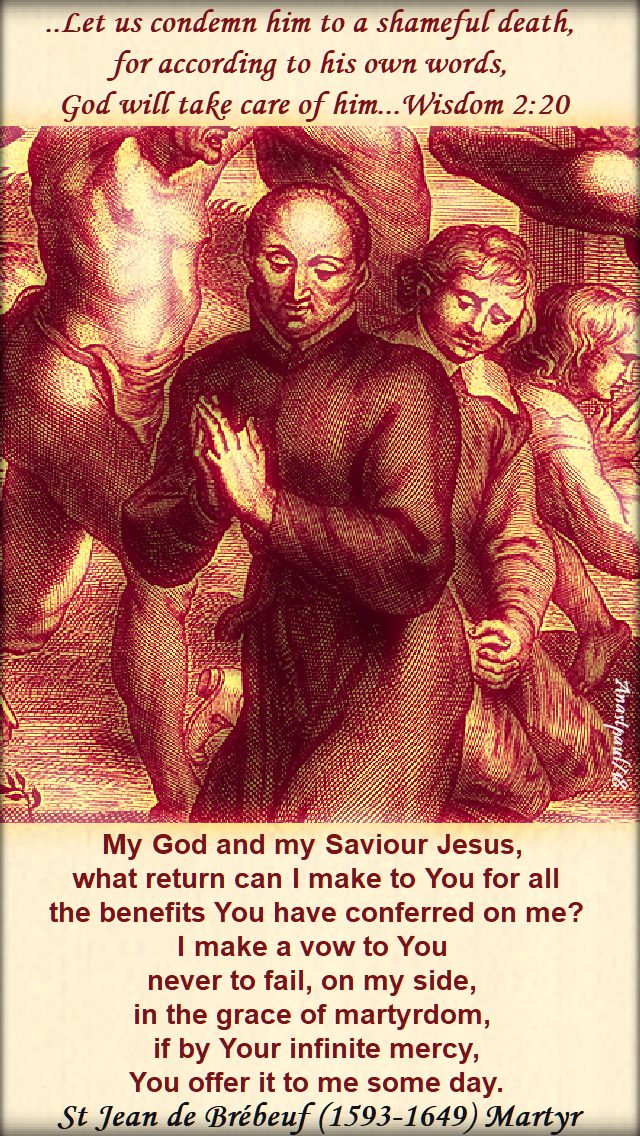
..Let us condemn him to a shameful death, for according to his own words, God will take care of him…Wisdom 2:20 (Today’s First Reading)
REFLECTION – “My God and my Saviour Jesus, what return can I make to You for all the benefits You have conferred on me? I make a vow to You never to fail, on my side, in the grace of martyrdom, if by Your infinite mercy You offer it to me some day.”…St Jean de Brébeuf
PRAYER – Heavenly Father, only in You re we able to stand against our enemies, those within and without. Seeking to follow Your Son, our Saviour, Lord give us strength! Grant we pray, that by the intercession of Your Holy Martyr, St Jean de Brébeuf, we may obtain the courage and be filled with Your Holy Spirit, to go forth in truth, amen.
Our Morning Offering – 16 March – The Memorial of St Jean de Brébeuf (1593-1649)
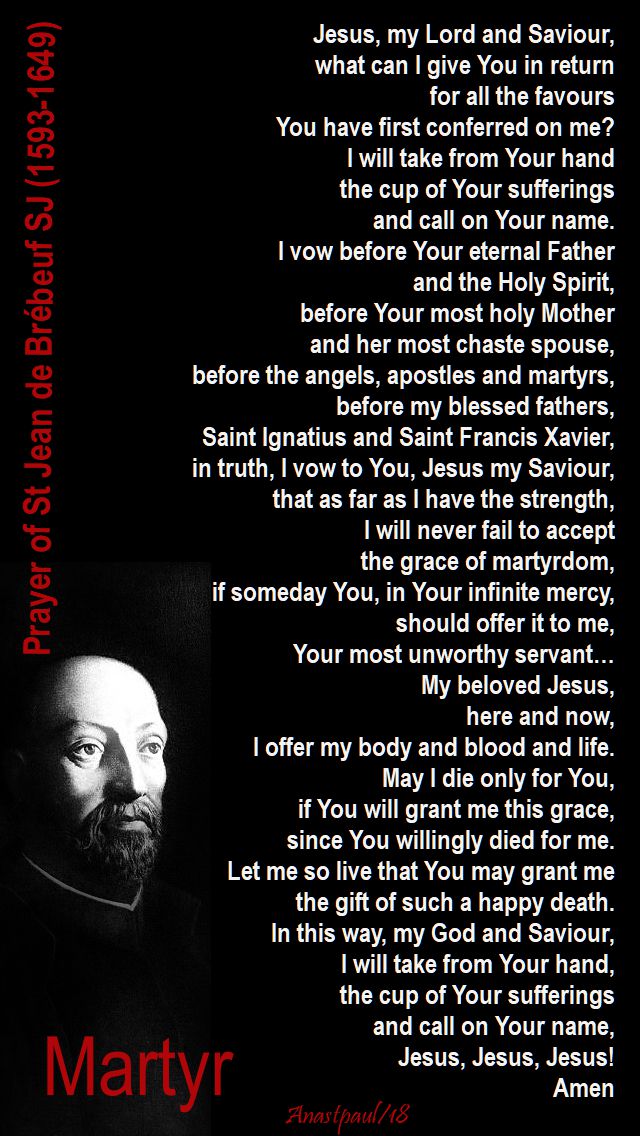
Jesus, What Can I Give You in Return? Prayer of St Jean de Brébeuf SJ (1593-1649)
Jesus, my Lord and Saviour,
what can I give You in return
for all the favours You have first conferred on me?
I will take from Your hand, the cup of Your sufferings
and call on Your name.
I vow before Your eternal Father and the Holy Spirit,
before Your most holy Mother
and her most chaste spouse,
before the angels, apostles and martyrs,
before my blessed fathers,
Saint Ignatius and Saint Francis Xavier,
in truth, I vow to You, Jesus my Saviour,
that as far as I have the strength,
I will never fail to accept the grace of martyrdom,
if someday You, in Your infinite mercy, should offer it to me,
Your most unworthy servant…
My beloved Jesus,
here and now, I offer my body and blood and life.
May I die only for You, if You will grant me this grace,
since You willingly died for me.
Let me so live that You may grant me
the gift of such a happy death.
In this way, my God and Saviour,
I will take from Your hand, the cup of Your sufferings
and call on Your name, Jesus, Jesus, Jesus!
Amen
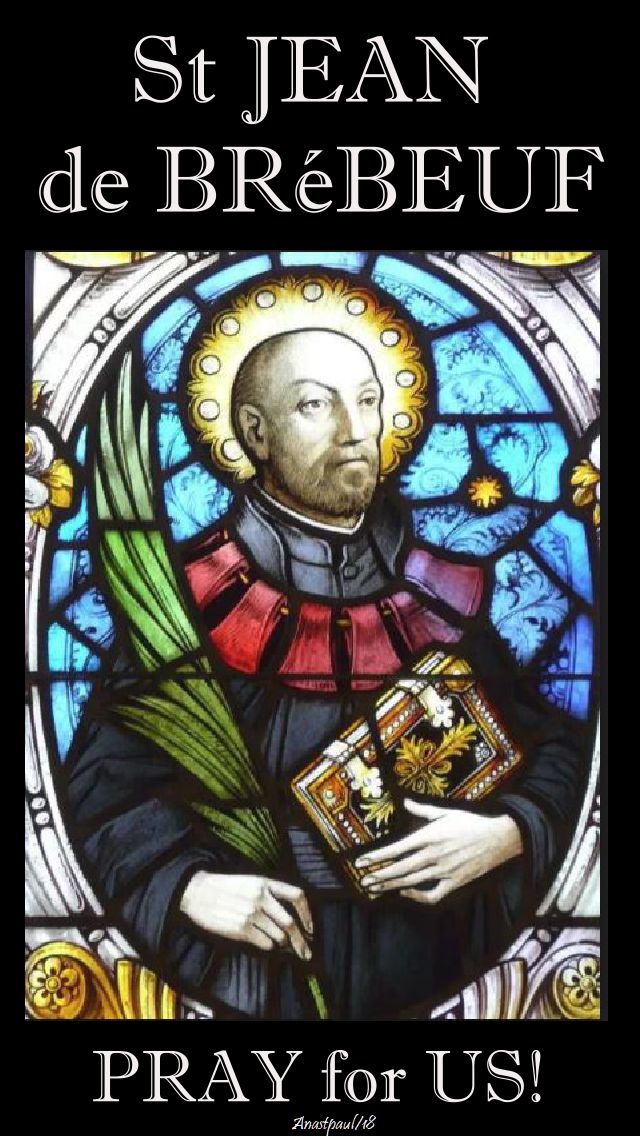
Saint of the Day – 16 March – St Jean de Brébeuf S.J. (1593-1649) – Religious Priest, Martyr, Missionary “Apostle to the Hurons” – Patron of Canada. Additional Memorial – 19 October as one of the Martyrs of North America. St Jean was born in 1593 at Normandy, France and he was tortured to death in 1649 in Canada. He was Canonised on 29 June 1930 by Pope Pius XI.
Jean de Brébeuf was born in Normandy, France. According to Joseph P Donnelly, S.J., one of his biographers, his family was of the “lesser nobility” who worked the land beside the peasants residing there. As a boy, then, Jean would have “herded sheep, fed the stock and, when old enough, took on heavier chores.” Little is known of Jean’s early life, though he likely studied at the University of Caen, where he probably met the Jesuits. He entered the Jesuit novitiate in Rouen in 1621. For the next few years he taught boys at the Jesuit school in Rouen. But this would not be the future that God had in store.
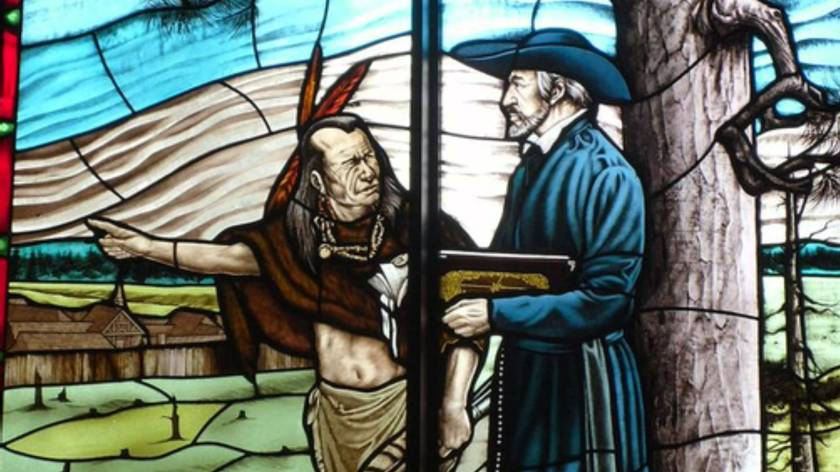
In 1624, the Franciscans, who had operated the “missions” to the Huron peoples in New France since 1615, appealed to other French religious orders to send assistance. Among the first to sail was Jean de Brébeuf , now a tall, robust man of 32.
Jean and his companions reached Quebec on 19 June 1625, and immediately began to prepare for his journey to the Huron nation. Happily, he had a great talent for something that would prove critical in his work. The great explorer Samuel de Champlain wrote about Brébeuf, “[H]e had such a striking gift for languages that…he grasped in two or three years what others would not learn in twenty.”
That facility would assist him in working with a people with whom he shared little in common, save their common humanity. To enter into their world Jean resolved to do everything according to their customs, no matter how strenuous, eating their food, sleeping as they did, working as hard as they did. Here is a powerful echo of the Call of the King, from the Spiritual Exercises, in which one is asked to “labour as Christ labours.”
Jean’s first journey to the Huron homeland, 800 miles from Quebec, was grueling. Jean tied his shoes around his neck, hiked up his cassock and climbed into the bark canoe. This passage, from Donnelly’s biography, Jean de Brébeuf, first published in 1975, is very descriptive:
“On a journey the Indians spoke little, saving their energy for paddling their average of ten leagues, about thirty miles a day. Squatted on their haunches, immobile for hours on end, except for the swing of their arms and shoulders wielding the paddle, they generally had no small talk. Rising at dawn the Hurons heated water into which they dropped a portion of coarsely pounded corn….[After] their scanty meal, the Hurons launched the canoes and began another day of silent travel. In the evening, when the light began to fail the Indians, making camp for the night, ate their [corn meal] and stretched out on the bare ground to sleep. The swarms of mosquitoes, deer flies and other insects…seemed not to bother the Indians….Then at dawn the whole painful process began again.”
Once he arrived, the tall Jean was given a name, “Echon,” perhaps a version of first name, or a word meaning in the Huron language, “man who carries the load.” Here is Brébeuf himself, writing to the Jesuit in Quebec, in the letters now known as the Relations, describing an aspect of his travels: “Now when these rapids or torrents are reached, it is necessary to land, or carry on the shoulder, through woods, over high and troublesome rocks and all the baggage and canoes themselves. This is not done without much work…”
In addition to learning their customs and beliefs, Jean wrote a Huron grammar and translated a catechism in the local language. Brébeuf would spend three years among these families before being asked to return to Rouen in 1629, after political difficulties made it harder for the French to remain. Despite the normal prejudices about the native peoples common at the time, Jean had grown to admire and love those with whom he lived. At times their generosity astonished him:
“We see shining among them some rather noble moral virtues. You note, in the first place, a great love and union, which they are careful to cultivate….Their hospitality to all sorts of strangers is remarkable; they present to them, in their feasts the best of what they have prepared and, as I said, I do not know if anything similar, in this regard, is to be found anywhere.”
When he returned to New France in 1635, he was cheerfully welcomed by his Huron friends. Immediately he and Antoine Daniel, another Jesuit, began their work in earnest. (They were one of several Jesuits working in the region at the time.) Near a town called Ihonotiria, near current-day Georgian Bay in Canada, Fathers Brébeuf and Daniel began teaching the people about Christianity. They were later joined by two other French Jesuits, Charles Garnier and Isaac Jogues.
With the arrival of their new companions, though, a smallpox epidemic broke out among the Jesuits, which spread to the Hurons, who had no immunity whatsoever from the illness. The missionaries cared for the sick and baptised thousands of Hurons. But because they had baptised those who were dying, the Hurons concluded that baptism brought death and so many of the Hurons began to turn against the “Blackrobes.” Brébeuf then moved to Sainte-Marie, a centre for the Jesuits in the area.
Then a new danger arose. Rumours (false ones) circulated that Jean was in league with a sworn enemy of the Hurons, the Seneca clan of the Iroquois. So he prudently moved to another site, Saint Louis. On 16 March, the Iroquois attacked the village and took the Hurons, who were mainly Christians, along with Jean and another Jesuit, Gabriel Lalement, prisoner. He knew that the possibility of martyrdom was imminent.
Jean de Brébeuf’s torture was among the cruelest any Jesuit has had to endure. (You might want to avoid this next paragraph if you’re squeamish.)
The Iroquois heated hatchets until they were glowing red and, tying them together, strung them across his shoulders, searing his flesh. They wrapped his torso with bark and set it afire. They cut off his nose, lips and forced a hot iron down his throat and poured boiling water over his head in a gruesome imitation of baptism. They scalped him and cut off his flesh while he was alive. Finally someone buried a hatchet in his jaw.
After 14 years as a missionary, Jean de Brébeuf died on 16 March 1639. He was 56. At his death his heart was eaten as a way for the Iroquois, who were stunned by his courage, to share in his bravery. Eight other Jesuits were martyred around this same time. Their feast day 19 Oct is referred to as either the Feast of the North American Martyrs or the Feast of St Isaac Jogues and Companions. Let us not forget this great Companion.
St Abban of Kill-Abban
St Abraham Kidunaia
St Agapitus of Ravenna
St Aninus of Syria
St Benedicta of Assisi
St Dionysius of Aquileia
St Dentlin of Hainault
Bl Eriberto of Namur
St Eusebia of Hamage
St Felix of Aquileia
St Finian Lobhar
Bl Ferdinand Valdes
St Gregory Makar
St Heribert of Cologne
St Hilary of Aquileia
St Jean de Brebeuf
Bl Joan Torrents Figueras
Bl John Amias
Bl John Sordi of Vicenza
St Julian of Anazarbus
St Largus of Aquileia
St Malcoldia of Asti
St Megingaud of Wurzburg
St Papa of Seleucia
Bl Robert Dalby
St Tatian of Aquileia
Bl Torello of Poppi
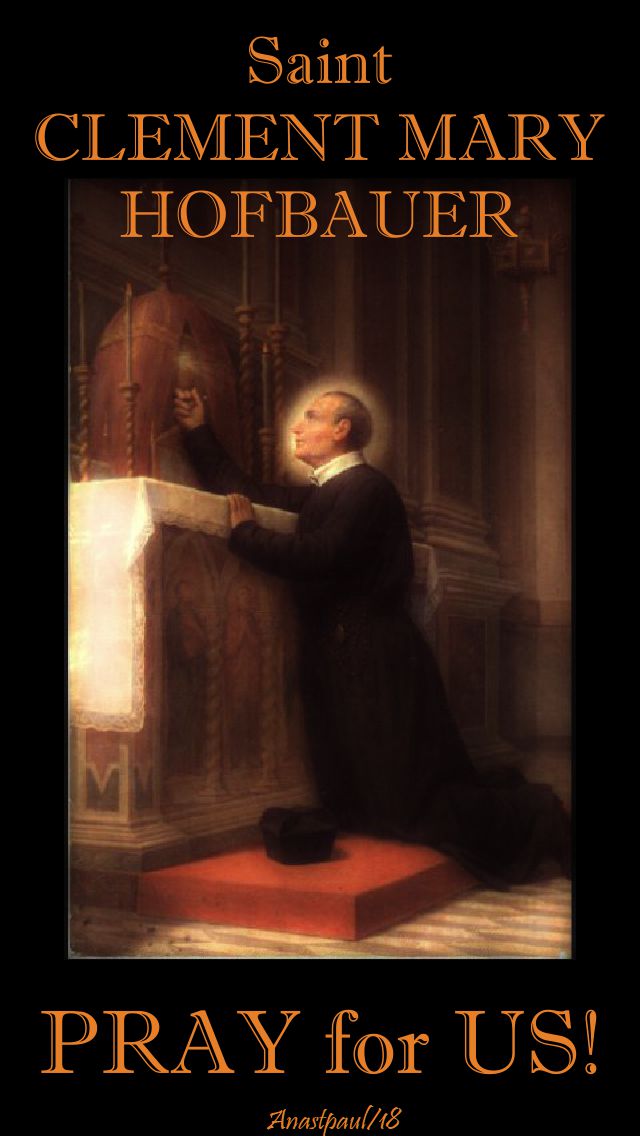
Thought for the Day – 15 March – The Memorial of St Clement Mary Hofbauer C.Ss.R.(1751-1820)
Drastic maladies, Clement reasoned, require drastic remedies. If in Warsaw evil and moral perversity abounded in the extreme, then dosages of Catholicity in the extreme — if indeed there can be such a thing — were needed to correct them. A powerful antidote invented by Clement Hofbauer was what he called the “Perpetual Mission.” He outlined it in the following manner:
“On all Sundays and holy days there is a sermon at five o’clock in the morning for servants, who . . . cannot attend the divine service at a later hour. For their convenience Holy Mass is said immediately after the sermon. . . . Every day at six o’clock there is a Mass of Exposition, during which the people chant hymns. After the Mass an instruction is given in Polish. During these instructions and sermons Masses are constantly being said, so that those who do not understand Polish or German, or who have not the time to remain for a sermon, may not be deprived of the Holy Sacrifice. Every day at eight o’clock there is a High Mass with Plain Chant, after which there are two sermons — the first in Polish and the second in German. Then the school children come to the church and the Solemn High Mass with musical accompaniment is celebrated. . . . In the afternoon at three o’clock the confraternities chant the Office of the Blessed Virgin. At four o’clock there is a German sermon, followed by Vespers solemnly chanted and followed in turn by a Polish sermon. Finally there is a visit to the Blessed Sacrament and to the Blessed Virgin publicly made with the faithful . . . . Every day at five o’clock there is a German sermon. Then follow in order, a Visit to the Blessed Sacrament, a sermon in Polish, the Way of the Cross and congregational singing of hymns in honour of the Passion of Our Lord and of the Blessed Virgin Mary. Lastly there is an Examination of Conscience for the people, the Acts of Faith, Hope and Charity are made, a short sketch of the life of the saint whose feast is celebrated on the morrow is read and then the Litany of the Blessed Virgin Mary is recited, after which the people are dismissed and the church is closed.”
This was the daily routine at St Benno’s for years! Besides these were the many other pastoral, charitable and educational labours carried out by the religious community. And its holy Superior assumed the lion’s share of these tasks.
O St Clement, pray for our world, pray for the Church, pray for us all!
Quote of the Day – 15 March – The Memorial of St Clement Mary Hofbauer C.Ss.R.(1751-1820)
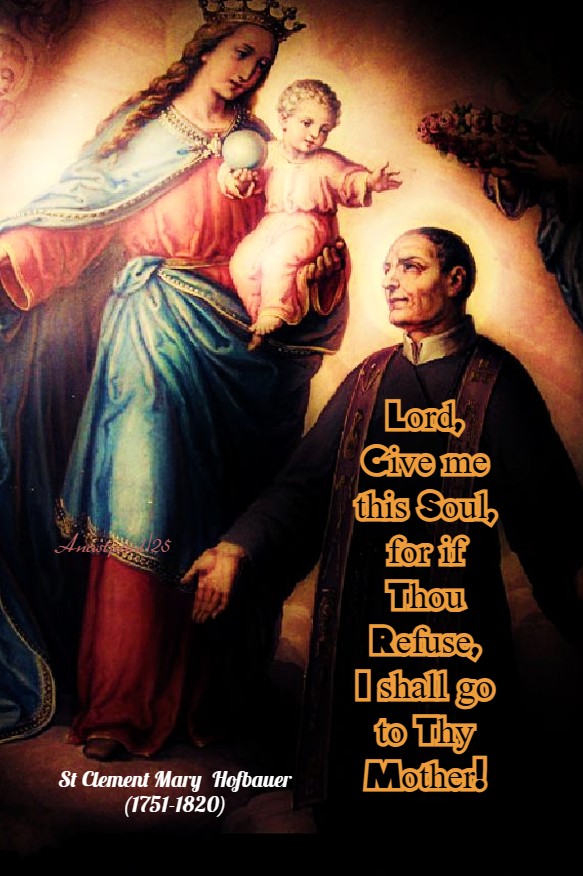
St Clement was unrelenting in pursuing souls cut off from the life of grace, especially those facing imminent death. A nun entered the church one day and found Father Hofbauer kneeling before the altar. Unobserved by the saint, she saw his cheeks wet with tears as he pleaded for the conversion of some sinner outside the fold.
“Lord, give me this soul, for if Thou refuse, I shall go to Thy Mother!”
One Minute Reflection – 15 March – The Memorial of St Clement Mary Hofbauer C.Ss.R.(1751-1820)
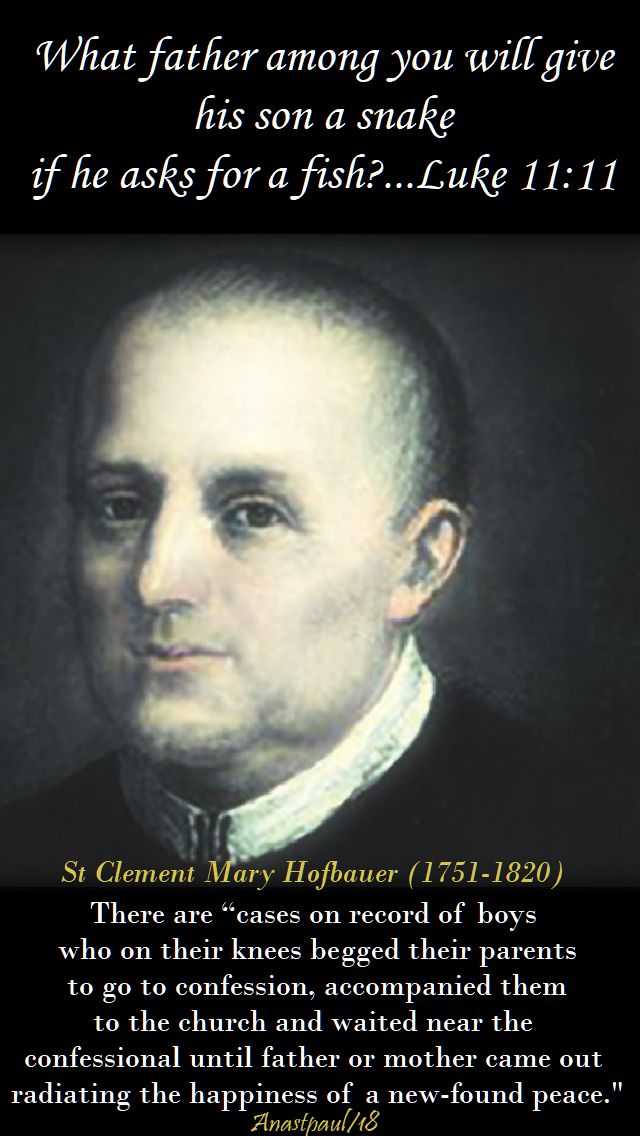
What father among you will give his son a snake if he asks for a fish?...Luke 11:11
REFLECTION – There are “cases on record of boys who on their knees begged their parents to go to confession, accompanied them to the church and waited near the confessional until father or mother came out radiating the happiness of a new-found peace” … St Clement Mary Hofbauer
PRAYER – All-merciful Father, help me to be ever open to Your love and mercy, running to You in all my needs and in all my fears. Allow me too, to run to the confessional when I have sinned, to ask for and receive forgiveness and love. Grant that the prayers of St Clement Mary Hofbauer, may assist us all in living holy lives according to Your Commandments and the laws of the Church. Amen
Our Morning Offering – 15 March – The Memorial of St Clement Mary Hofbauer C.Ss.R.(1751-1820)
On the Memorial of St Clement, known as the Second Founder of the Redemptorists, we pray a prayer by St Alphonsus Liguori, (1696-1787), Doctor of the Church, the Founder.
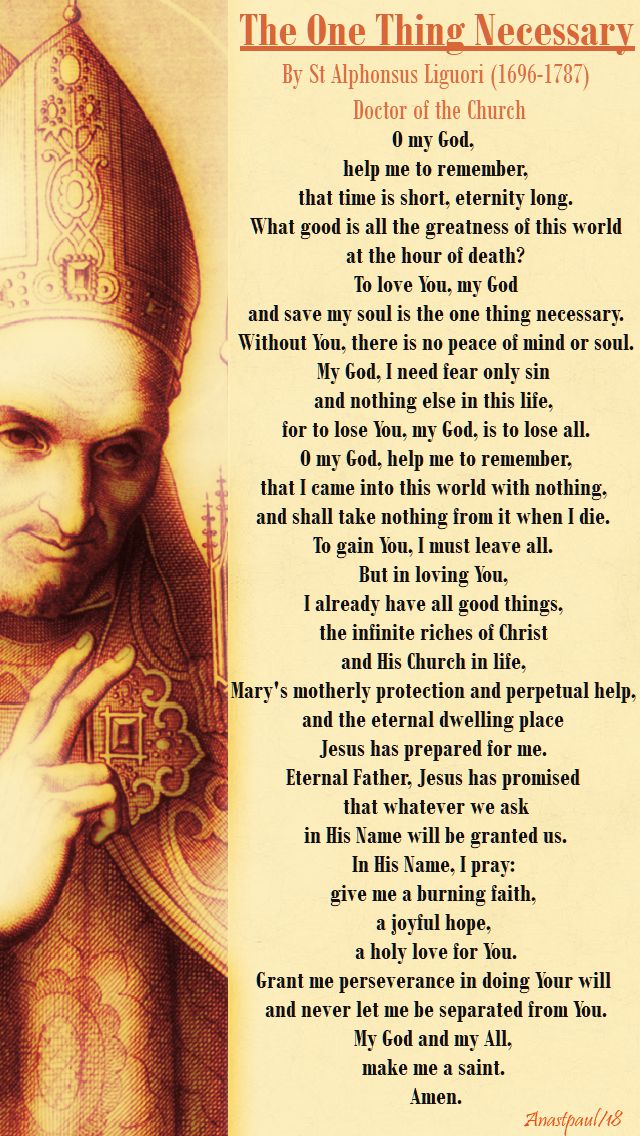
The One Thing Necessary By St Alphonsus Liguori (1696-1787) Doctor of the Church
O my God, help me to remember that time is short, eternity long.
What good is all the greatness of this world at the hour of death?
To love You, my God
and save my soul is the one thing necessary.
Without You, there is no peace of mind or soul.
My God, I need fear only sin and nothing else in this life,
for to lose You, my God, is to lose all.
O my God, help me to remember
that I came into this world with nothing,
and shall take nothing from it when I die.
To gain You, I must leave all.
But in loving You,
I already have all good things,
the infinite riches of Christ and His Church in life,
Mary’s motherly protection and perpetual help,
and the eternal dwelling place Jesus has prepared for me.
Eternal Father, Jesus has promised
that whatever we ask in His Name will be granted us.
In His Name, I pray:
give me a burning faith,
a joyful hope,
a holy love for You.
Grant me perseverance in doing Your will
and never let me be separated from You.
My God and my All,
make me a saint.
Amen.
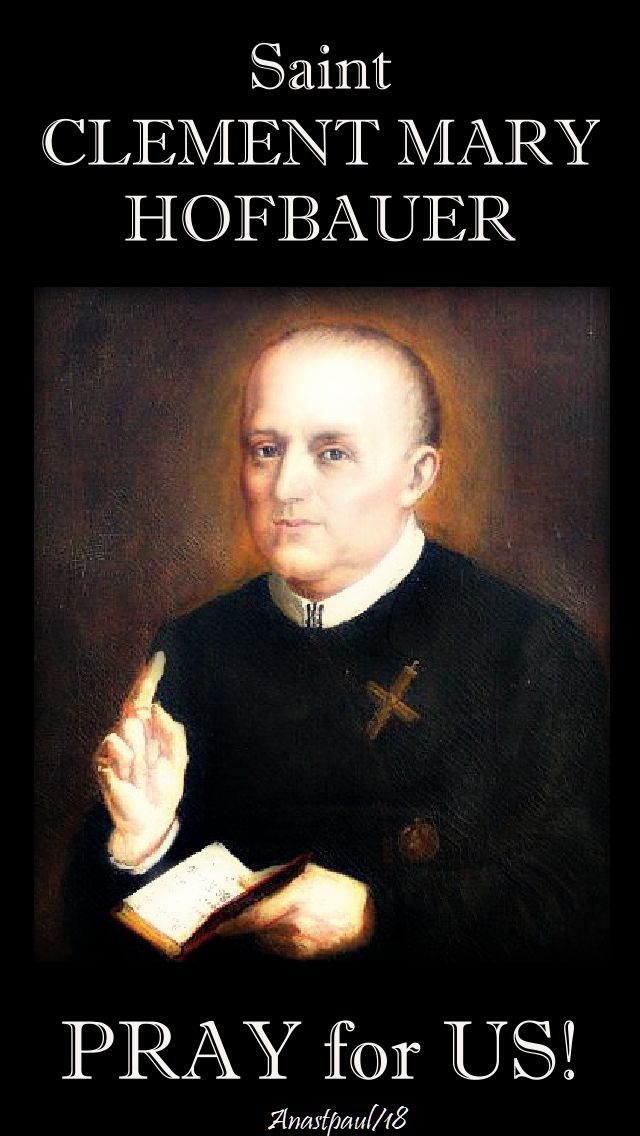
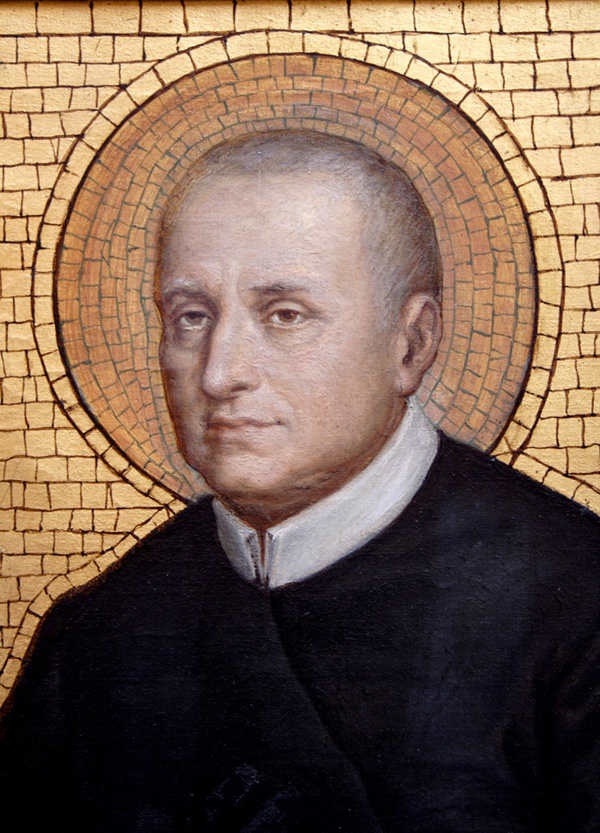
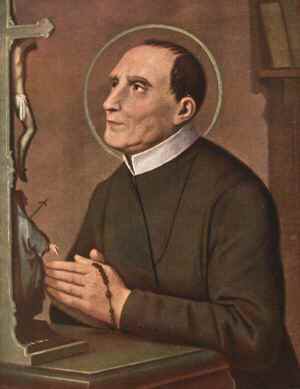
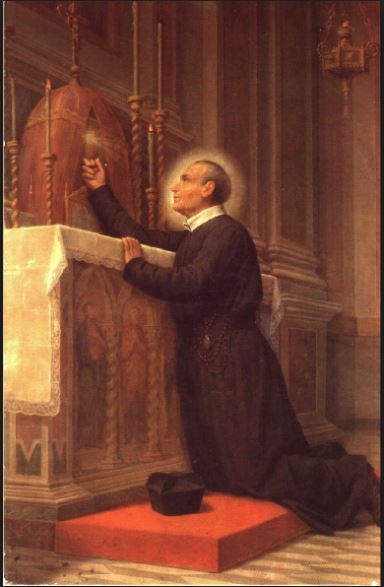
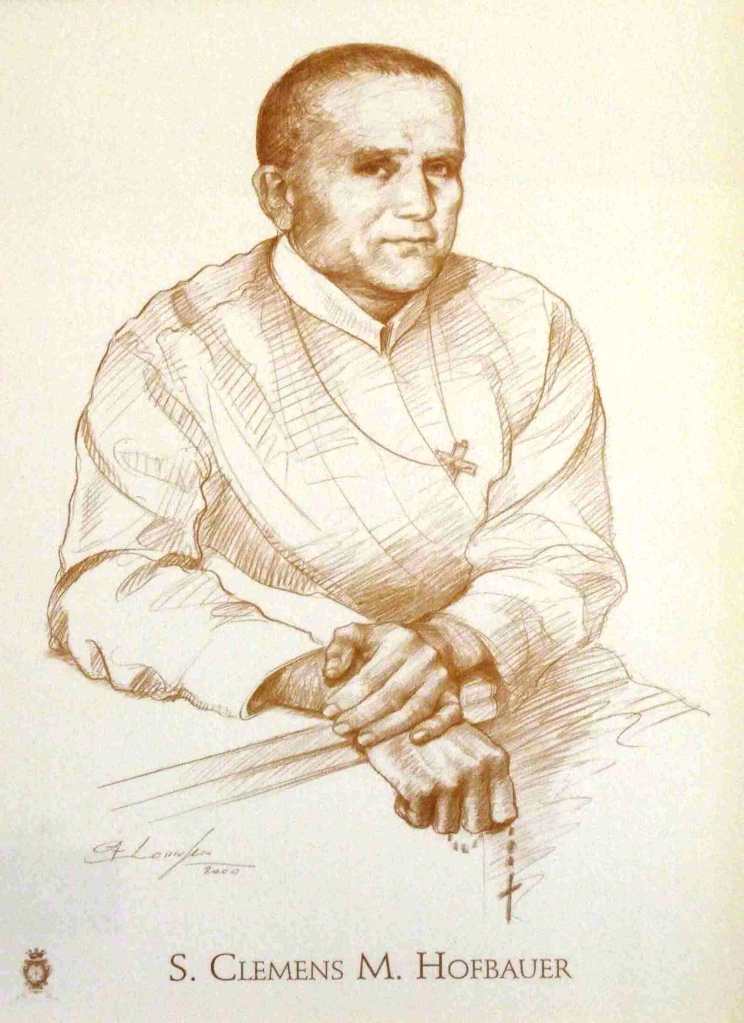
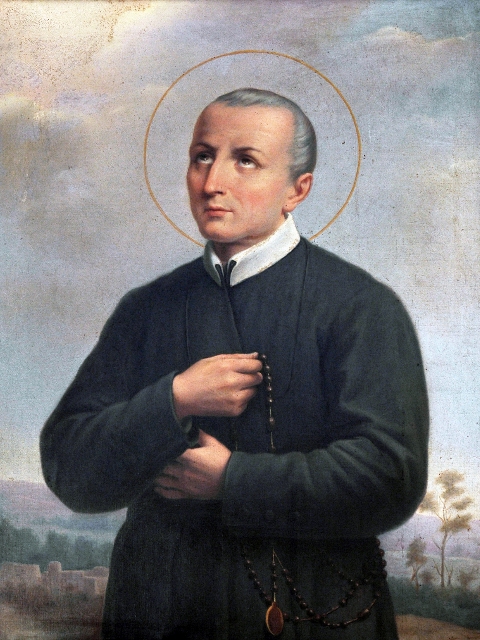
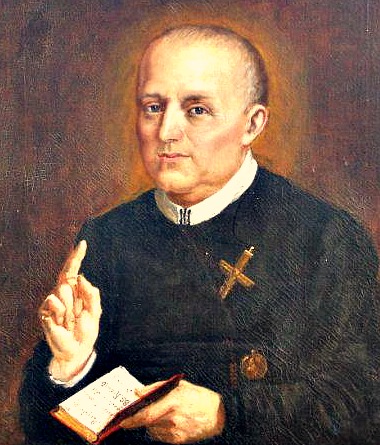
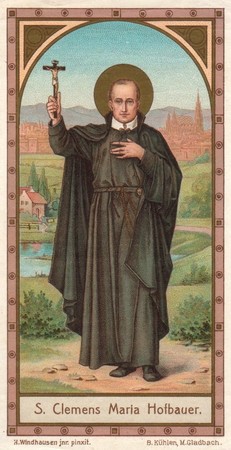
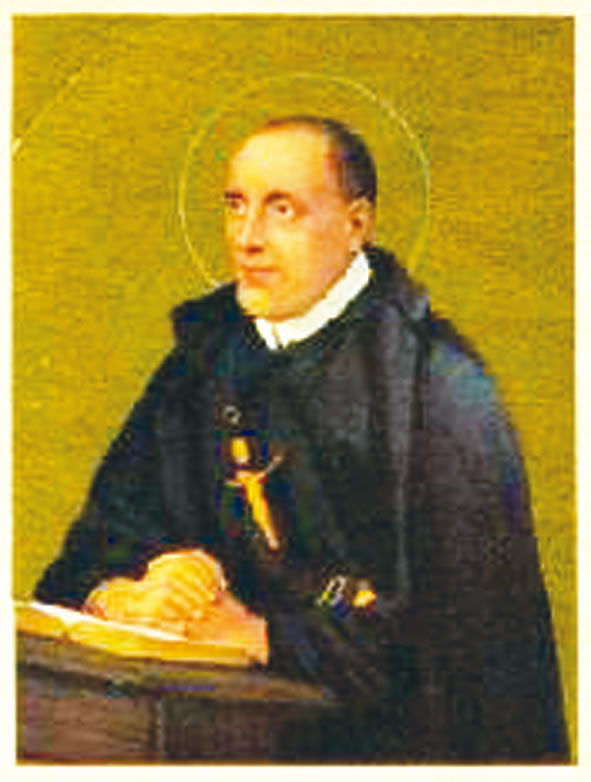
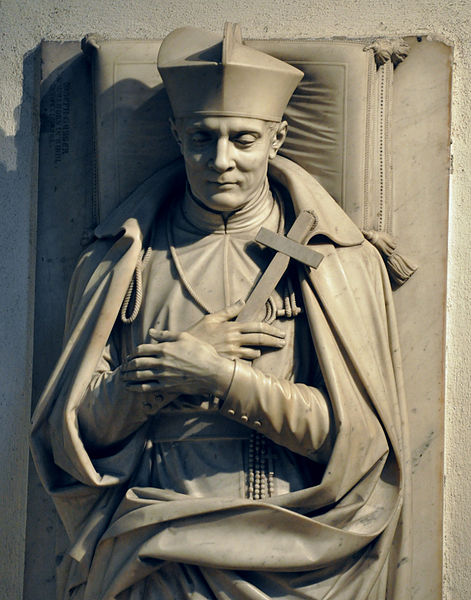
Saint of the Day – 15 March – St Clement Mary Hofbauer C.Ss.R.(1751-1820) Hermit, Priest, Religious, Co-Founder of the Redemptorist Order (in Austria), “The Apostle of Vienna.” St Clement was born on 26 December 1751 at Tasswitz, Moravia (in the modern Czech Republic) as John Dvorák and he died on 15 March 1820 at Vienna, Austria of natural causes. He was Canonised on 20 May 1909 by Pope Pius X. Patronage – Vienna, Austria (named by Pope Saint Pius X in 1914).
St Clement was born in Tasswitz, Austria, on December 26, 1751 — the eve of the feast of the Apostle who Jesus loved — he was christened John. But he would become known to the Catholic world by the names he would adopt in religious life, Clement Maria Hofbauer.
He was only six when his Bohemian-born father passed away. On this tragic occasion, his mother stood him before a crucifix and said: “Henceforth; He is your father. Take care that you never grieve Him by sin.” The words etched so deeply upon his heart that he never forgot them — and ever lived by them.
Often, the boy would gather the household together to recite the Rosary, his favourite devotion, would fast until nightfall on Saturdays, in honour of the Blessed Virgin and would distribute to the poor food and money of which he deprived himself. Not surprisingly, Hofbauer had yearned from his boyhood to enter the priesthood. “Priests,” he said, “are the light of the world and the salt of the earth.” But fulfilment of this, his singular earthly ambition, so long evaded him that it would seem he must have abandoned all hope of realising it. Instead, he twice withdrew himself from the world to adopt the contemplative life of a hermit. Yet, circumstances frustrated even these aspirations and at length he settled into the life of a baker.
If our heavenly Father will not reach a stone to one who asks for bread, could He deny the holy yearnings of so pious a soul? Indeed, he would not leave this saint of predestination a common baker confecting common bread for common food but would call him to confect Bread of Life upon the Altar of God.
Three wealthy sisters who attended Mass at St Stephen’s Cathedral in Vienna, where Hofbauer daily served as an altar boy, were caught in a torrential downpour at the cathedral one Sunday. When Clement fetched a carriage for them, the ladies urged him to ride with them out of the drenching rain. Long having observed his pious comportment in the sanctuary, the women inquired why their carriage guest, now thirty years old, had not entered the priesthood. “That has been my most ardent desire since childhood,” Hofbauer admitted, “but I am obliged to forego it, because I lack the means to carry it out.”At this the eldest sister announced: “If that is the only obstacle, we will gladly see that you reach your goal.” Thanks to the ladies’ generosity, an ecstatic saint was soon enrolled for seminary training at the University of Vienna.
As Clement Hofbauer began his pursuit of Holy Orders, Protestantism was in its third century of open defiance of the Church. The poison of Freemasonry had been seeping into the body of Europe for more than six decades. Where Catholicism had survived the ravages of the “Reformation,” many of its faithful were now weakened in spirit by Masonic “free thinking.” In many if not most portions of the continent, Catholics — including priests and even bishops — had grown tepid and indifferent in their faith. In this state, the wellsprings of grace seemed to dry up, and pitiful ignorance of even the most fundamental Truths of the Faith became pandemic. As a consequence, even regions still nominally Catholic were infected with scepticism toward the Apostolic authority of Rome and were easily drawn to the false doctrine of the divine right of kings which had been resurrected by Luther. Thus, emboldened monarchs intruded into ecclesiastical affairs with increasing brazenness.
Out of pure devotion, Saint Clement had undertaken several pilgrimages to Rome on foot in the years prior to entering the seminary. Now he made it an annual exercise, to escape the repulsive air of unorthodoxy at the university and the religious repression of the imperial state and to refresh himself spiritually in the capitol of Christendom. He was joined on these arduous journeys by a fellow seminarian of kindred spirit, Thaddeus Huebl, ten years the saint’s junior. By the fall of 1784, conditions in Vienna had become so intolerable that Hofbauer could not bring himself to return to the University. He decided instead to complete his studies in the Eternal City. The plan came to him with such suddenness and resoluteness that he implored Huebl to leave a hospital bed to join him. Because of his stricken condition, Huebl at first rejected the idea. But the saint would not be put off. He insisted that Huebl join him, promising that God would take care of his friend’s health. At this, Huebl consented — and his health was restored so rapidly as to seem miraculous.
It was a common practice for the two pilgrims to sleep in fields, drawing a circle about their earthen beds and invoking their guardian angels to protect them within it. In the mornings, they would attend Mass at the first church whose bells they heard. Having retired one evening in the neighbourhood of Santa Maria Maggiore, they were awakened in the very early morning by the soft pealing of a bell from the little church of San Giuliano. Upon their arrival, they realised it was a convent church but of a religious order they did not recognise. Impressed by the recollection of the Religious in their meditation, Hofbauer asked an altar boy what kind of priests these were. “They are Redemptorists,” the boy returned, adding, “and some day you, too, will be one of them.” Convinced that the astonishing oracle was a message from God, Saint Clement and his friend presented themselves to the Superior of the Convent and, with a burst of inspiration which left Huebl’s head spinning, found themselves enrolled as Redemptorists.
Monsignor Alphonsus Maria de Liguori, the Neapolitan Bishop of Agatha and the Founder of the Redemptorists, was not unknown to Clement Hofbauer. The latter saint in recent years had become an enthusiastic reader of the former’s voluminous spiritual writings — works that would eventually merit Saint Alphonsus canonical recognition as one of the 32 Doctors of the Church. But the Congregation of the Most Holy Redeemer, founded by Liguori in 1732, was scarcely known outside of Naples and not at all beyond the borders of Italy. Monsignor Liguori received with great joy the news that the first two non-Italians had entered his order in 1784. Isolated from them as he was, however, his keen interest in them as the hope of spreading the Congregation into the German kingdoms had to be taken from afar. Saint Alphonsus and Saint Clement would never meet in this life.
With a sense of urgency to carry on Liguori’s work and to cultivate new vocations in the German kingdoms to the north, the Superior General at San Guiliano shortened Hofbauer’s and Huebl’s novitiate. In March of 1785, ten days after they took their vows as professed Religious, they received the Sacrament of Holy Orders. Several months later, they were dispatched back across the Alps to establish the Congregation in the northern lands.
His first mission was to Warsaw, where he was in charge of the German church and he soon enjoyed a certain repute as a confessor and the instigator of good works to remedy the social evils of the day. Thus he founded an orphanage, a poor school and a secondary school. In 1808 the invading French cast him into prison, whence, after four weeks, he was able to go to Vienna. Here he became the inspiration and religious leader of a group of German romantics—von Muller, Schlegel, Werner and others—and exerted tremendous influence not only among the poor but also and despite his rather scanty education, with officials, statesmen and scholars. In this way he was able to defeat the project for a German national church at the Congress of Vienna and eventually succeeded in arranging for the legal establishment of the Redemptorists north of the Alps, though he did not live to see this occur, since he died in 1820.
As a consequence he is regarded by the Redemptorists as their second founder. He was a man of great energy and drive, seeing clearly the end in view and always indefatigable in his work for souls, in the confessional especially, and among the poor.
St Clement’s is a story that continues with the Venerable Joseph Passerat who, as the succeeding Vicar General, brought to fulfilment the prophecies of Saint Alphonsus and Saint Clement about the Congregation, leading to an inspiring re flowering of the One True Faith in much of Europe. It is a story that carries over, a century later, into the reign of Pope Saint Pius X who, after canonising Clement Hofbauer, valiantly defended the Faith against the very same forces of darkness posturing as Enlightenment.
But the Church’s victory has already been foretold. By Jesus Christ, Who promises the gates of hell shall not prevail against it. And by the Virgin Mary who, at Fatima, assured us: “In the end, my Immaculate Heart shall triumph.”
Bl Anthony of Milan
St Aristobulos of Britannia
Bl Arnold of Siena
Bl Artemide Zatti
St Bodian of Hanvec
St Clement Mary Hofbauer C.Ss.R.(1751-1820)
St Eoghan of Concullen
St Eusebius II
Bl Francis of Fermo
Bl Jan Adalbert Balicki
St Leocritia of Córdoba
St Longinus the Centurian
St Louise de Marillac
Bl Ludovico de la Pena
St Mancius of Evora
St Matrona of Capua
St Matrona of Thessaloniki
St Menignus of Parium
Bl Monaldus of Ancona
St Nicander of Alexandria
St Peter Pasquale
St Pío Conde y Conde
St Sisebuto
St Speciosus
St Vicenta of Coria
Bl Walter of Quesnoy
Bl William Hart
St Pope Zachary
Three Daughters of Eltin: Listed in several Irish martyrologie, but no details about them have survived.
One Minute Reflection – – 14 March 2018 – Wednesday of the 4th Week of Lent and the Memorial of St Matilda
Now is the acceptable time! Now is the time of salvation….2 Corinthians 6:2
REFLECTION – “You no longer have the time that is past. Nor are you sure of the time that is to come. Hence, all you do have, is this present point in time – and nothing more!”… St Catherine of Siena (1347-1380) Doctor of the Church
PRAYER – Timeless loving Lord, teach me to be grateful for every moment that You allot to me. Grant that I may always understand this ‘blink of an eye’ and live each moment only for You, in You and with You. Difficult as your times were St Matilda, you maintained your eyes on the Lord alone, pray for us all, that we too may follow your example. Amen
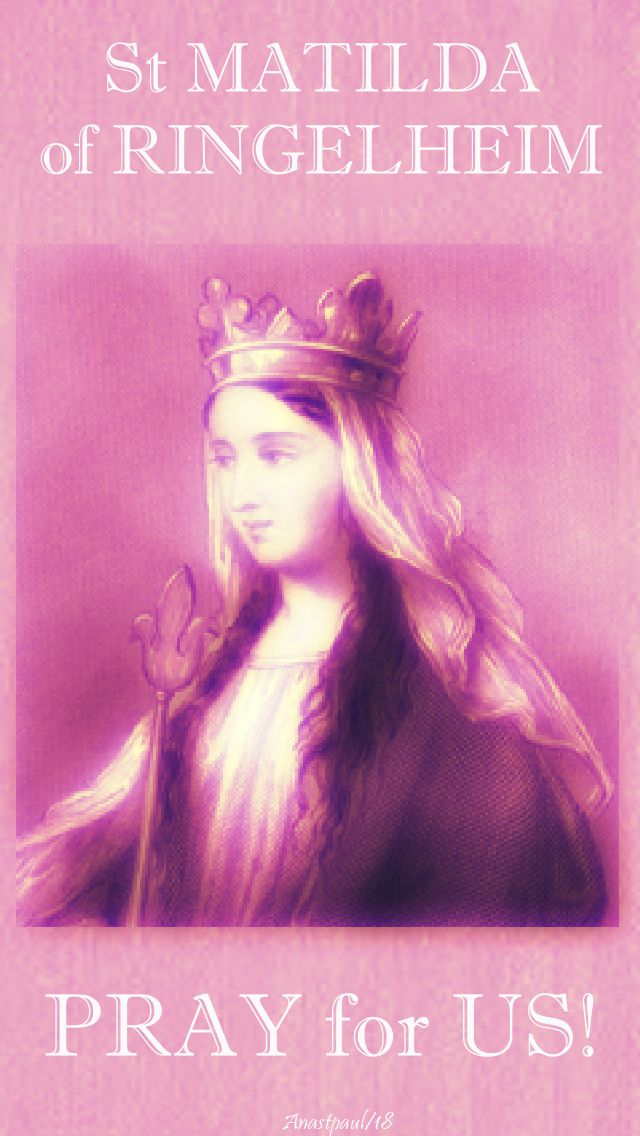
Saint of the Day – 14 March – St Matilda of Ringelheim/Saxony (c 895 – 968) – Queen, Apostle of Prayer and Charity, Foundress – Patron of death of children, disappointing children, falsely accused people, large families, people ridiculed for their piety, queens, second marriages, widows.
St Matilda, Queen of Germany and wife of King Henry I was the daughter of Count Dietrich of Westphalia and Reinhild of Denmark. She was born about 895 and was raised by her grandmother, the Abbess of Eufurt convent. Matilda married Henry the Fowler, son of Duke Otto of Saxony, in the year 909. He succeeded his father as Duke in the year 912 and in 919 succeeded King Conrad I to the German throne.
She was widowed in the year 936 and supported her son Henry’s claim to his father’s throne. When her son Otto (the Great) was elected, she persuaded him to name Henry Duke of Bavaria after he led an unsuccessful revolt.
St Matilda was known for her considerable almsgiving. She was severely criticised by both Otto and Henry for what they considered her extravagant gifts to charities. As a result, she resigned her inheritance to her sons and retired to her country home. She was later recalled to the court through the intercession of Otto’s wife, Edith. Matilda was welcomed back to the palace and her sons asked for her forgiveness.
In her final years, she devoted herself to the building of many churches, convents and monasteries. She spent most of the declining years of her life at the convent at Nordhausen she had built. She died at the monastery at Quedlinburg on March 14 and was buried there with her late husband, Henry.
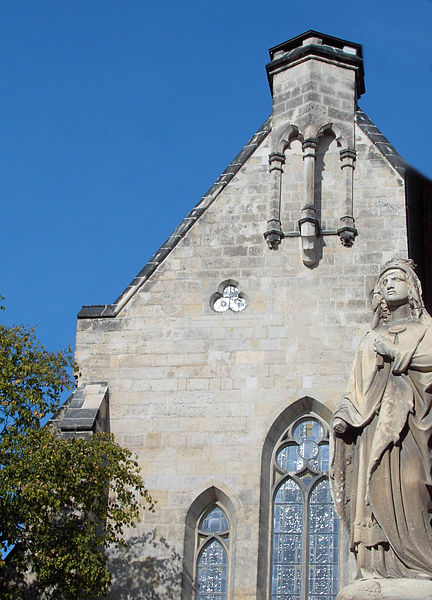
The Church and Monastery of St Matilda at Quedlinburg
Last year’s post with more details of St Mathilda’s life – https://anastpaul.wordpress.com/2017/03/14/saint-of-the-day-14-march-st-matilda-of-saxony/
St Agno of Zaragoza
St Alexander of Pydna
St Aphrodisius of Africa
Bl Arnold of Padua
St Boniface Curitan
St Diaconus
St Eutychius of Mesopotamia
Bl Eve of Liege
Bl Giacomo Cusmano
St Lazarus of Milan
St Leo of the Agro Verano
St Leobinus of Chartres (died 558)
St Matilda of Ringelheim/Saxony (c 895 – 968)
St Maximilian
Bl Pauline of Thuringia
St Peter of Africa
St Philip of Turin
St Talmach
Bl Thomas Vives
—
47 Martyrs of Rome – Forty-seven people who were baptised into the faith in Rome, Italy by Saint Peter the Apostle, and were later martyred together during the persecutions of Nero. Martyred c 67 in Rome, Italy.
Martyrs of Valeria – Two monks martyred by Lombards in Valeria, Italy who were never identified. After the monks were dead, their killers could still hear them singing psalms. They were hanged on a tree in Valeria, Italy in the 5th century.























You must be logged in to post a comment.