St Scholastica (c482-547) (Memorial)
—
Bl Alexander of Lugo
Bl Alojzije Stepinac
St Andrew of Bethlehem
St Aponius of Bethlehem
St Austrebertha of Pavilly
St St Baldegundis
St Baptus of Magnesia
Bl Catherine du Verdier de la Sorinière
St Charalampias
Bl Clare Agolanti of Rimini
St Desideratus of Clermont
St Erluph of Werden
Bl Eusebia Palomino Yenes
Bl Hugh of Fosse
Bl José Sánchez del Río
Bl Louise Bessay de la Voûte
Bl Louise Poirier épouse Barré
Bl Marie-Anne Hacher du Bois
Bl Marie-Louise du Verdier de la Sorinière
Bl Mikel Beltoja
Bl Paganus
Bl Paul of Wallachia
Bl Pierre Frémond
St Porfirio
St Prothadius of Besançon
St Salvius of Albelda
St Silvanus of Terracina
St Soteris the Martyr
St Troiano of Saintes
St Trumwin of Whitby
Bl William of Maleval
Martyred Soldiers in Rome: A group of ten Christian soldiers who were martyred together for their faith. We know little more about them but four of their names – Amantius, Hyacinth, Irenaeus and Zoticus. • 120 at Rome, Italy. They were buried on the Via Lavicana outside RomeAmantius, Hyacinth, Irenaeus, Zoticus.
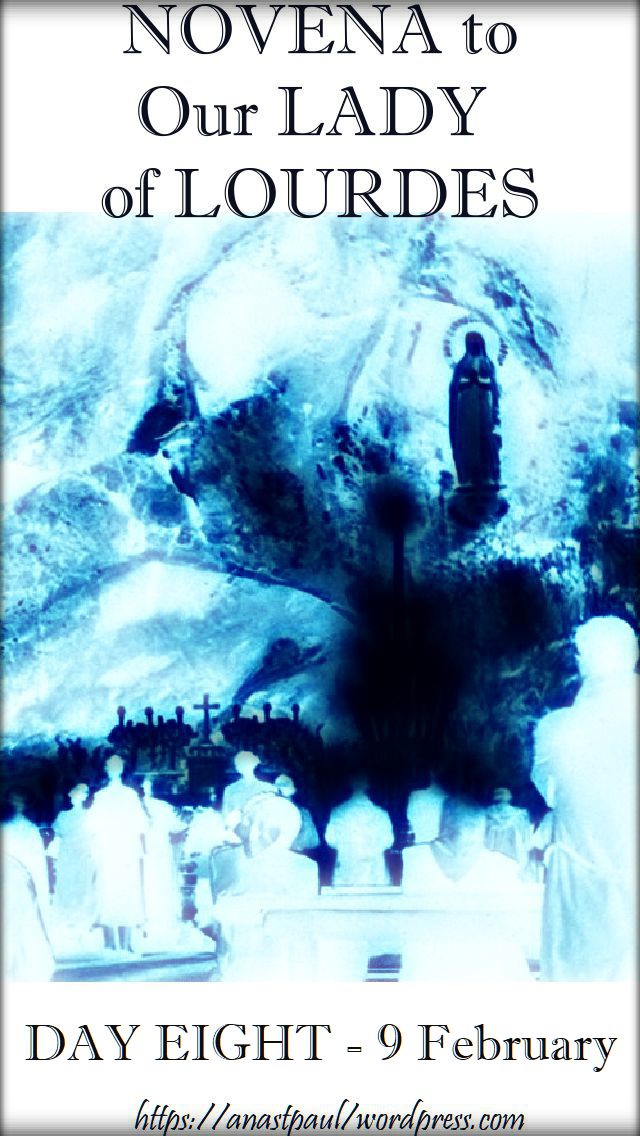
Novena to Our Lady of Lourdes – DAY EIGHT– 9 February (we Pray the Novena for our own intentions and for the sick, the infirm within our own communities but also for all those throughout the world who suffer, especially those who have no-one to pray for them in preparation for the Wold Day of the Sick on 11 February.)
DAY EIGHT
O Immaculate Mother of God,
from heaven itself you came to appear to the little Bernadette
in the rough Grotto of Lourdes!
And as Bernadette knelt at your feet
and the miraculous spring burst forth
and as multitudes have knelt ever since
before your shrine, O Mother of God,
we kneel before you today to ask that in your mercy
you plead with your Divine Son to grant
the special favour we seek in this novena.
…………………………….. (make your request)
O Brilliant star of purity, Mary Immaculate, Our Lady of Lourdes,
glorious in your assumption,
triumphant in your coronation,
show unto us the mercy of the Mother of God,
Virgin Mary, Queen and Mother,
be our comfort, hope, strength, and consolation. Amen.
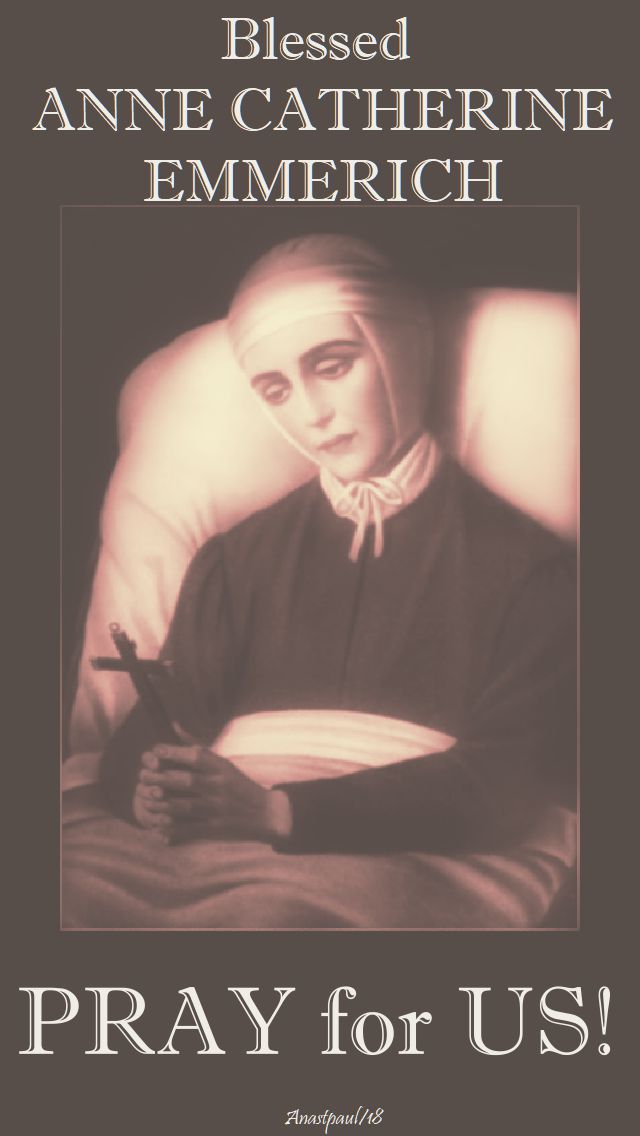
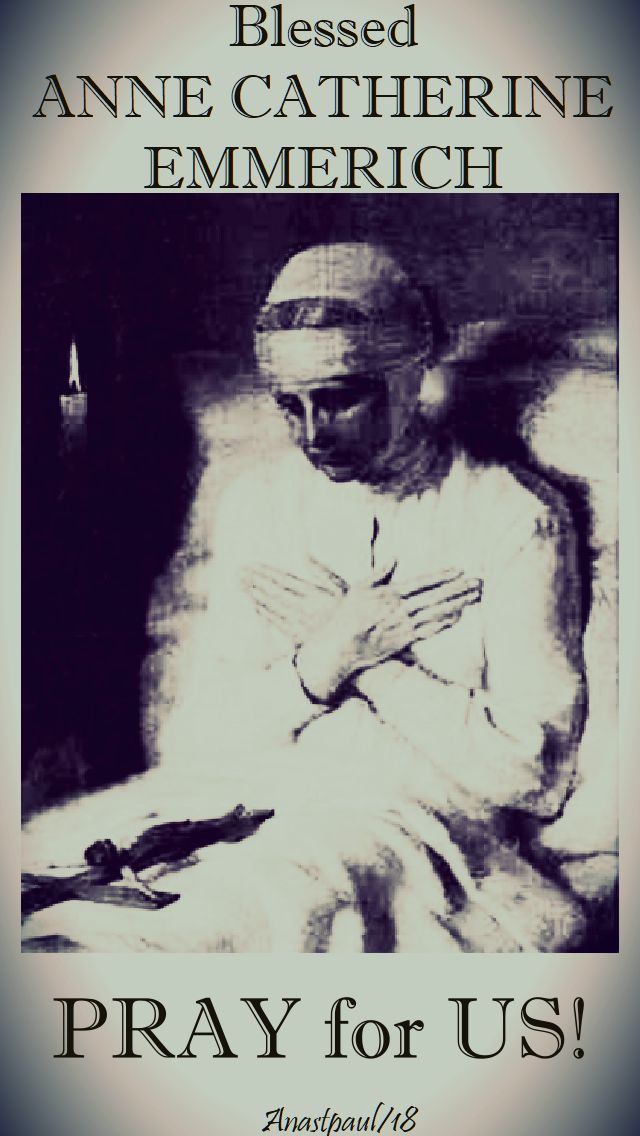
Thought for the Day – 9 February – The Memorial of Bl Anne Catherine Emmerich (1774-1824)
In a letter to Count Stolberg, Clemens August Droste zu Vischering, the vicar‑general at that time, called Anna Katharina Emmerick a special friend of God. In the words of Hans Urs von Balthasar we can say, “She brought her friendship with God to bear in solidarity with human beings.” To bring friendship with God to bear in solidarity with human beings – does this not shed light on an important concern in the life of the church today?
The Christian faith no longer includes everyone. In our world the Christian community represents people before God. We must bring our friendship with God to bear, let it be the decisive factor in solidarity with human beings.
Anna Katharina Emmerick is united to us in the community of believers. This community does not come to an end with death. We believe in the lasting communion with all whom God has led to perfection. We are united with them beyond death and they participate in our lives. We can invoke them and ask for their intercession. We ask Anna Katharina Emmerick, the newly named Blessed, to bring her friendship with God to bear in solidarity with us and with all human beings. (vatican.va)
Quote/s of the Day – 9 February – The Memorial of Bl Anne Catherine Emmerich (1774-1824)
“The prayer most pleasing to God is that made for others and particularly for the poor souls. Pray for them, if you want your prayers to bring high interest.”
Bl Anne Catherine Emmerich (1774-1824)
“As much as by her patience to endure her physical weaknesses, we are impressed by the strength of character of the new blessed and her firmness in the faith. She received this strength from the Holy Eucharist. In this way, her example opened the hearts of poor and rich men, educated and humble people, to complete loving passion toward Jesus Christ. Still today she communicates to all the salvific message: ‘By his wounds you have been healed’ (see 1 Peter 2:24).”
St Pope John Paul II, homily at the beatification of Blessed Anne, 3 October 2004
One Minute Reflection -9 February – The Memorial of Blessed Anne Catherine Emmerich (1774-1824)
“And I will give you the keys of the kingdom of heaven. And whatever you shall bind on earth shall be bound, even in heaven. And whatever you shall loose on earth shall be loosed, even in heaven.”...Matthew 16:19
REFLECTION – “The Church is the only one, the Roman Catholic! And if there were left upon earth but one Catholic, he would be the one, universal Church, the Catholic Church, the Church of Jesus Christ against which the gates of Hell shall never prevail.”…
Bl Anne Catherine Emmerich (1774-1824)
PRAYER – We come to You, our heavenly Father and beg You, that by the prayers of Your child, Bl Anne Emmerich, we may stand strongly in defense of our faith and the holy Church of Your Son. Come O Holy Spirit, fill our hearts with courage and love, our minds with the words to defend your beloved Spouse and keep our wills always in uniformity with Yours. We pray through Jesus our Lord, in unity with You, our Father and the Holy Spirit, one God forever amen.
Our Morning Offering – 9 February – The Memorial of Blessed Anne Catherine Emmerich (1774-1824)
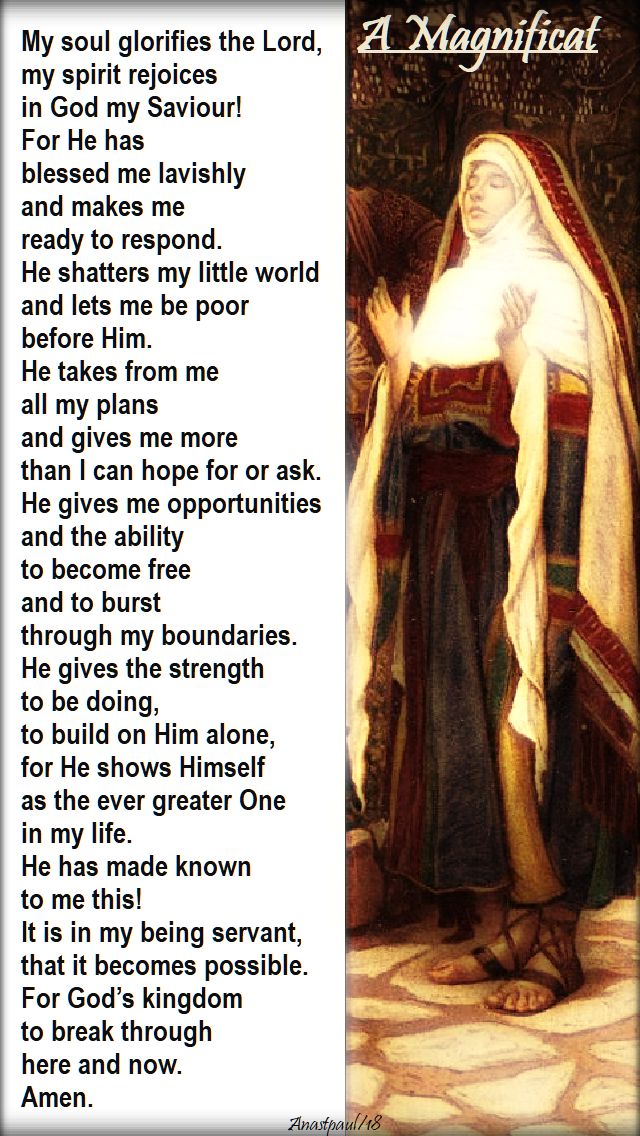
A Magnificat Translated from the German by Olga Warnke of the Institute of the Blessed Virgin Mary
My soul glorifies the Lord,
my spirit rejoices in God my Saviour!
For He has blessed me lavishly
and makes me ready to respond.
He shatters my little world
and lets me be poor before Him.
He takes from me all my plans
and gives me more than I can hope for or ask.
He gives me opportunities
and the ability to become free
and to burst through my boundaries.
He gives the strength to be doing,
to build on Him alone,
for He shows Himself
as the ever greater One in my life.
He has made known to me this!
It is in my being servant that it becomes possible.
For God’s kingdom to break through
here and now.
Amen.
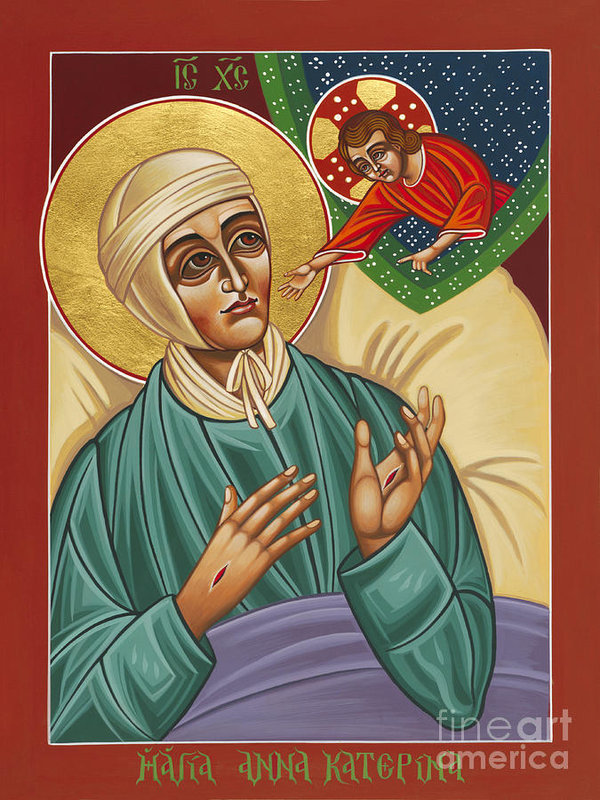
Saint of the Day – 9 February – Blessed Anna Katharina Emmerick/Anne Catherine Emmerich (1774-1824) – Handicapped, Virgin, Religious, Penitent, Marian Visionary, Mystic, Ecstatic, Writer and Stigmatist. Her body is incorrupt.
Anna Katharina Emmerick was born on 8 September 1774 in the farming community of Flamsche near Coesfeld. She grew up amidst a host of nine brothers and sisters. She had to help out in the house and with the farm work at an early age. Her school attendance was brief, which made it all the more remarkable that she was well instructed in religious matters. Her parents and all those who knew Anna Katherina noticed early on that she felt drawn to prayer and to the religious life in a special way.
Anna Katharina laboured for three years on a large farm in the vicinity. Then she learned to sew and stayed in Coesfeld for her further training. She loved to visit the old churches in Coesfeld and to join in the celebration of Mass. She often walked the path of Coesfeld’s long Way of the Cross alone, praying the stations by herself. She wanted to enter the convent but since her wish could not be fulfilled at that time, she returned to her parental home. She worked as a seamstress and, while doing so, visited many homes.
Anna Katherina asked for admission to different convents but she was rejected because she could not bring a significant dowry with her. The Poor Clares in Münster finally agreed to accept her if she would learn to play the organ. She received her parents’ permission to be trained in Coesfeld by the organist Söntgen. But she never got around to learning how to play the organ. The misery and poverty in the Söntgen household prompted her to work in the house and help out in the family. She even sacrificed her small savings for their sake.
Together with her friend Klara Söntgen Anna Katharina was finally able to enter the convent Agnetenberg in Dülmen in 1802. The following year she took her religious vows. She participated enthusiastically in the life of the convent. She was always willing to take on hard work and loathsome tasks. Because of her impoverished background she was at first given little respect in the convent. Some of the sisters took offence at her strict observance of the order’s rule and considered her a hypocrite. Anna Katharina bore this pain in silence and quiet submission.
From 1802 to 1811 Anna Katharina was ill quite often and had to endure great pain.
As a result of secularisation the convent of Agnetenberg was suppressed in 1811 and Anna Katharina had to leave the convent along with the others. She was taken in as a housekeeper at the home of Abbé Lambert, a priest who had fled France and lived in Dülmen. But she soon became ill. She was unable to leave the house and was confined to bed. In agreement with Curate Lambert she had her younger sister Gertrud come to take over the housekeeping under her direction.
During this period Anna Katharina received the stigmata. She had already endured the pain of the stigmata for a long time. The fact that she bore the wounds of Christ could not remain hidden. Dr Franz Wesener, a young doctor, went to see her and he was so impressed by her that he became a faithful, selfless and helping friend during the following eleven years. He kept a diary about his contacts with Anna Katharina Emmerick in which he recorded a wealth of details.
A striking characteristic of the life of Anna Katharina was her love for people. Wherever she saw need she tried to help. Even in her sickbed she sewed clothes for poor children and was pleased when she could help them in this way. Although she could have found her many visitors annoying, she received all of them kindly. She embraced their concerns in her prayers and gave them encouragement and words of comfort.
Many prominent people who were important in the renewal movement of the church at the beginning of the 19th century sought an opportunity to meet Anna Katharina, among them Clemens August Droste zu Vischering, Bernhard Overberg, Friedrich Leopold von Stolberg, Johann Michael Sailer, Christian and Clemens Brentano, Luise Hensel, Melchior and Apollonia Diepenbrock. The encounter with Clemens Brentano was particularly significant. His first visit led him to stay in Dülmen for five years. He visited Anna Katharina daily to record her visions which he later published.
Anna Katharina grew ever weaker during the summer of 1823. As always she joined her suffering to the suffering of Jesus and offered it up for the salvation of all. She died on 9 February 1824. She was buried in the cemetery in Dülmen. A large number of people attended the funeral. Because of a rumour that her corpse had been stolen the grave was reopened twice in the weeks following the burial. The coffin and the corpse were found to be intact.
Clemens Brentano wrote the following about Anna Katharina Emmerick: “She stands like a cross by the wayside”. Anna Katharina Emmerick shows us the centre of our Christian faith, the mystery of the cross.
The life of Anna Katharina Emmerick is marked by her profound closeness to Christ. She loved to pray before the famous Coesfeld Cross and she walked the path of the long Way of the Cross frequently. So great was her personal participation in the sufferings of our Lord that it is not an exaggeration to say that she lived, suffered and died with Christ. An external sign of this, which is at the same time, however, more than just a sign, are the wounds of Christ which she bore.
Anna Katharina Emmerick was a great admirer of Mary. The feast of the Nativity of Mary was also Anna Katharina’s birthday. A verse from a prayer to Mary highlights a further aspect of Anna Katharina’s life for us. The prayer states, “O God, let us serve the work of salvation following the example of the faith and the love of Mary”. To serve the work of salvation – that is what Anna Katharina wanted to do.
In Colossians the apostle Paul speaks of two ways to serve the gospel, to serve salvation. One consists in the active proclamation in word and deed. But what if that is no longer possible? Paul, who obviously finds himself in such a situation, writes: “Now I rejoice in my sufferings for your sake and in my flesh I complete what is lacking in Christ’s afflictions for the sake of his body, that is, the church” (Col 1:24).
Anna Katharina Emmerick served salvation in both ways. Her words, which have reached innumerable people in many languages from her modest room in Dülmen through the writings of Clemens Brentano, are an outstanding proclamation of the gospel in service to salvation right up to the present day. At the same time, however, Anna Katharina Emmerick understood her suffering as a service to salvation. Dr Wesener, her doctor, recounts her petition in his diary: “I have always requested for myself as a special gift from God that I suffer for those who are on the wrong path due to error or weakness, and that, if possible, I make reparation for them.” It has been reported that Anna Katharina Emmerick gave many of her visitors religious assistance and consolation. Her words had this power because she brought her life and suffering into the service of salvation. In serving the work of salvation through faith and love, Anna Katharina Emmerick can be a model for us all.
Dr Wesener passed on this remark of Anna Katharina Emmerick: “I have always considered service to my neighbour to be the greatest virtue. In my earliest childhood I already requested of God that he give me the strength to serve my fellow human beings and to be useful. And now I know that he has granted my request.” How could she who was confined to her sickroom and her bed for years serve her highborn? (vatican.va)
Her Works: • The Dolorous Passion of Our Lord Jesus Christ
• The Life of Jesus Christ and Biblical Revelations
• The Lowly life and Bitter Passion of Our Lord Jesus Christ and His Blessed Mother
Anna was Beatified on 3 October 2004, by St Pope John Paul II. However, the Vatican focused on her own personal piety rather than the religious writings associated to her by Clemens Brentano. Her documents of postulation towards canonisation is handled by the Priestly Fraternity of St Peter. Father Peter Gumpel who was involved in the analysis of the matter at the Vatican told Catholic News Service: “Since it was impossible to distinguish what derives from Sister Emmerich and what is embroidery or additions, we could not take these writings as a criteria. Therefore, they were simply discarded completely from all the work for the cause”.
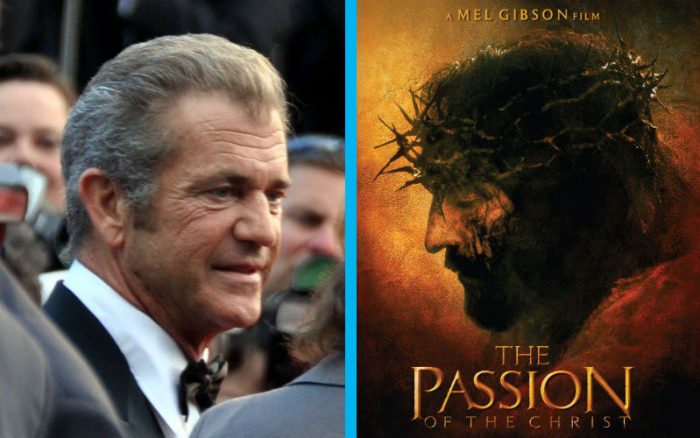
In 2003 actor Mel Gibson brought Anne Catherine Emmerich’s vision to prominence as he used her book The Dolorous Passion as a key source for his movie The Passion of the Christ. Gibson stated that Scripture and “accepted visions” were the only sources he drew on and a careful reading of Emmerich’s book shows the film’s high level of dependence on it.
In 2007 German director Dominik Graf made the movie The Pledge as a dramatisation of the encounters between Anne Catherine and Clemens Brentano, based on a novel by Kai Meyer.
House of the Virgin Mary
Neither Brentano nor Emmerich had ever been to Ephesus and indeed the city had not yet been excavated; but visions contained in The Life of The Blessed Virgin Mary were used during the discovery of the House of the Virgin Mary, the Blessed Virgin’s supposed home before her Assumption, located on a hill near Ephesus, as described in the book Mary’s House.
In 1881, a French priest, the Abbé Julien Gouyet used Emmerich’s book to search for the house in Ephesus and found it based on the descriptions. He was not taken seriously at first but sister Marie de Mandat-Grancey persisted until two other priests followed the same path and confirmed the finding.
The Holy See has taken no official position on the authenticity of the location yet but in 1896 Pope Leo XIII visited it and in 1951 Pope Pius XII initially declared the house a Holy Place. St Pope John XXIII later made the declaration permanent. Blessed Pope Paul VI in 1967, St Pope John Paul II in 1979 and Pope Benedict XVI in 2006 visited the house and treated it as a shrine.
St Alexander of Rome
St Alexander of Soli
St Alto of Altomünster
St Ammon of Membressa
St Ammonius of Soli
Bl Anne Catherine Emmerich (1774-1824)
St Ansbert of Rouen
St Apollonia of Alexandria
St Attracta of Killaraght
St Brachio of Auvergne
St Cuaran the Wise
St Didymus of Membressa
St Donatus the Deacon
St Eingan of Llanengan
St Emilian of Membressa
Bl Erizzo
Bl Francisco Sanchez Marquez
Bl Giacomo Abbondo
Bl Godeschalk of Želiv
St Lassa of Membressa
Bl Marianus Scotus
St Maro
St Miguel Febres Cordero Muñoz (1854-1910)
St Nebridius of Egara
St Nicephorus of Antioch
St Poëmus of Membressa
St Primus the Deacon
St Raynald of Nocera
St Romanus the Wonder Worker
St Ronan of Lismore
St Sabino of Abellinum
St Sabinus of Canosa
St Teilo of Llandaff
—
Martyrs of Alexandria: An unknown number of Christians who were massacred in church in 4th century Alexandria, Egypt by Arian heretics for adhering to the orthodox faith.
Martyrs of Membressa: A group of 44 Christians martyred together. We know little else about them some names –
• Ammon
• Didymus
• Emilian
• Lassa
• Poemus
They were martyred in Membressa in Africa.
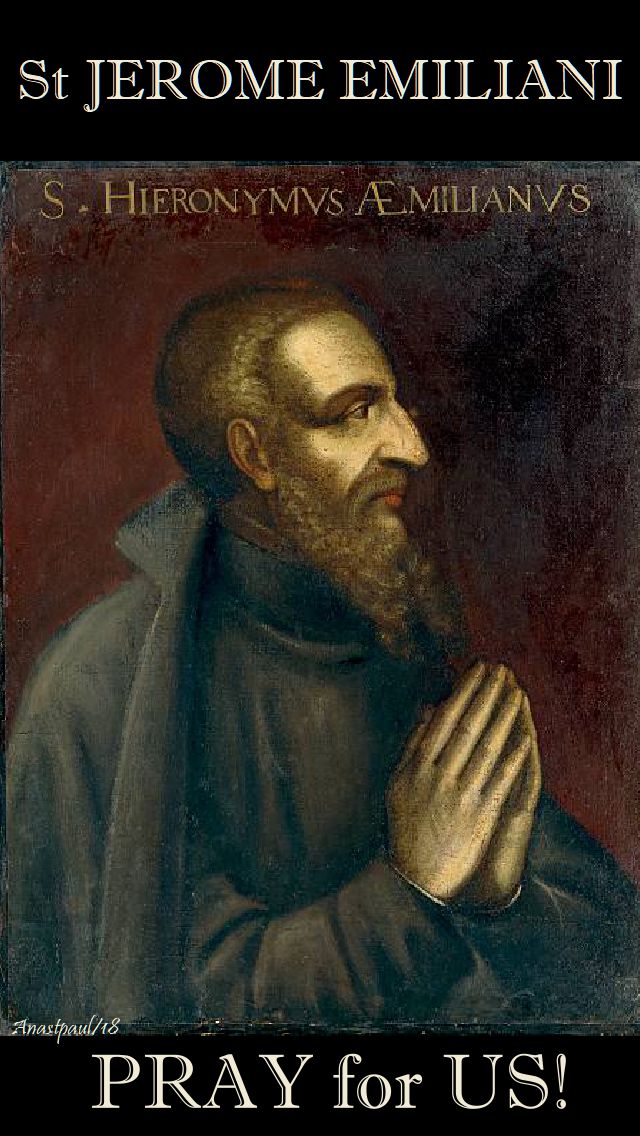
Thought for the Day – 8 February – The Memorial of St Jerome Emiliani (1486-1537)
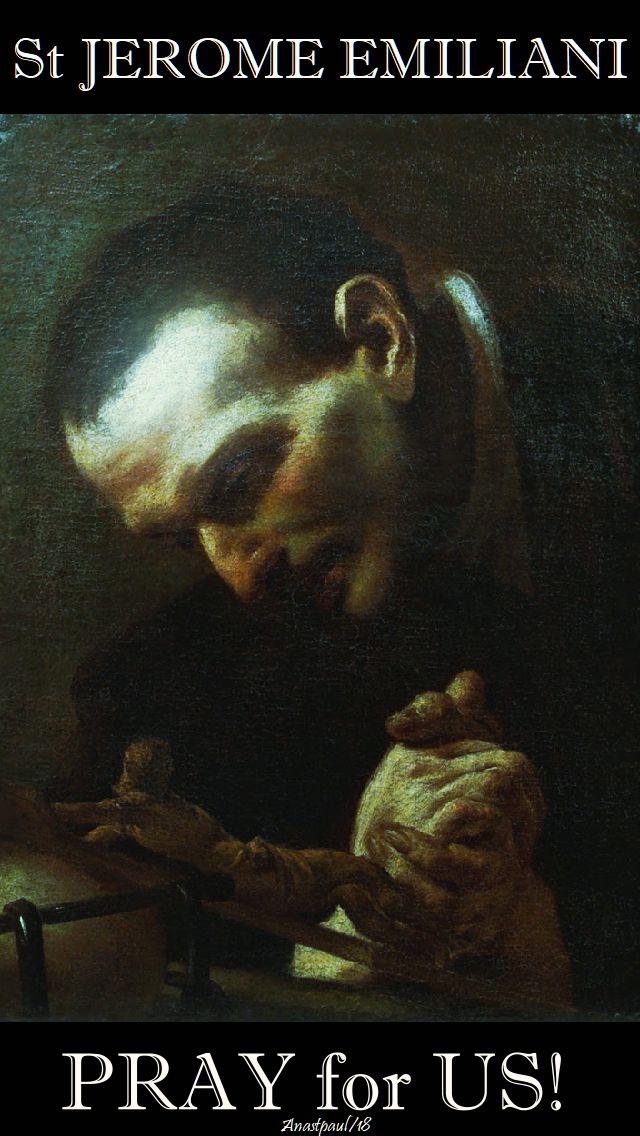
A careless and irreligious soldier for the city-state of Venice, Jerome was captured in a skirmish at an outpost town and chained in a dungeon. In prison Jerome had a lot of time to think and he gradually learned how to pray. When he escaped, he returned to Venice where he took charge of the education of his nephews—and began his own studies for the priesthood.
In the years after his ordination, events again called Jerome to a decision and a new lifestyle. Plague and famine swept northern Italy. Jerome began caring for the sick and feeding the hungry at his own expense. While serving the sick and the poor, he soon resolved to devote himself and his property solely to others, particularly to abandoned children. He founded three orphanages, a shelter for penitent prostitutes and a hospital.
Around 1532, Jerome and two other priests established a congregation, the Clerks Regular of Somasca, dedicated to the care of orphans and the education of youth. Jerome died in 1537 from a disease he caught while tending the sick. He was canonised in 1767. In 1928, Pope Pius Xl named him the patron of orphans and abandoned children.
Very often in our lives it seems to take some kind of “imprisonment” to free us from the shackles of our self-centredness. When we’re “caught” in some situation we don’t want to be in, we finally come to know the liberating power of Another. Only then can we become another for “the imprisoned” and “the orphaned” all around us.
Quote/s of the Day – 8 February – The Memorial of St Jerome Emiliani (1486-1537) & St Josephine Bakhita (1869-1947) and the Fourth World Day of Prayer and Awareness against Trafficking in Persons
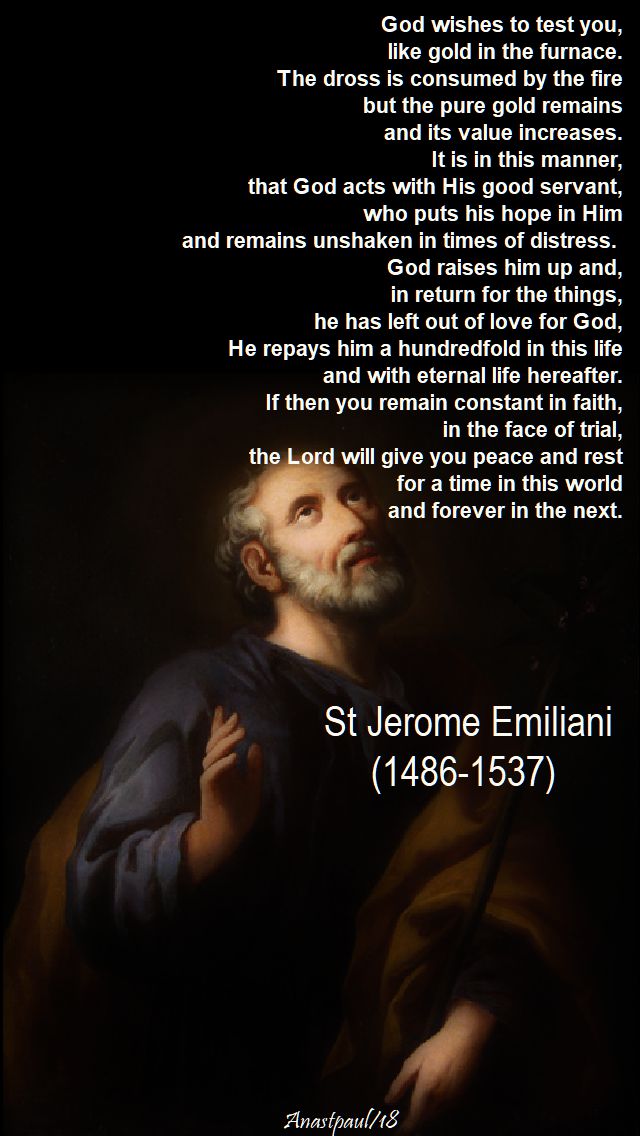
” God wishes to test you, like gold in the furnace. The dross is consumed by the fire but the pure gold remains and its value increases. It is in this manner, that God acts with His good servant, who puts his hope in Him and remains unshaken in times of distress. God raises him up and, in return for the things, he has left out of love for God, He repays him a hundredfold in this life and with eternal life hereafter. If then you remain constant in faith, in the face of trial, the Lord will give you peace and rest for a time in this world and forever in the next.”
St Jerome Emiliani (1486-1537)
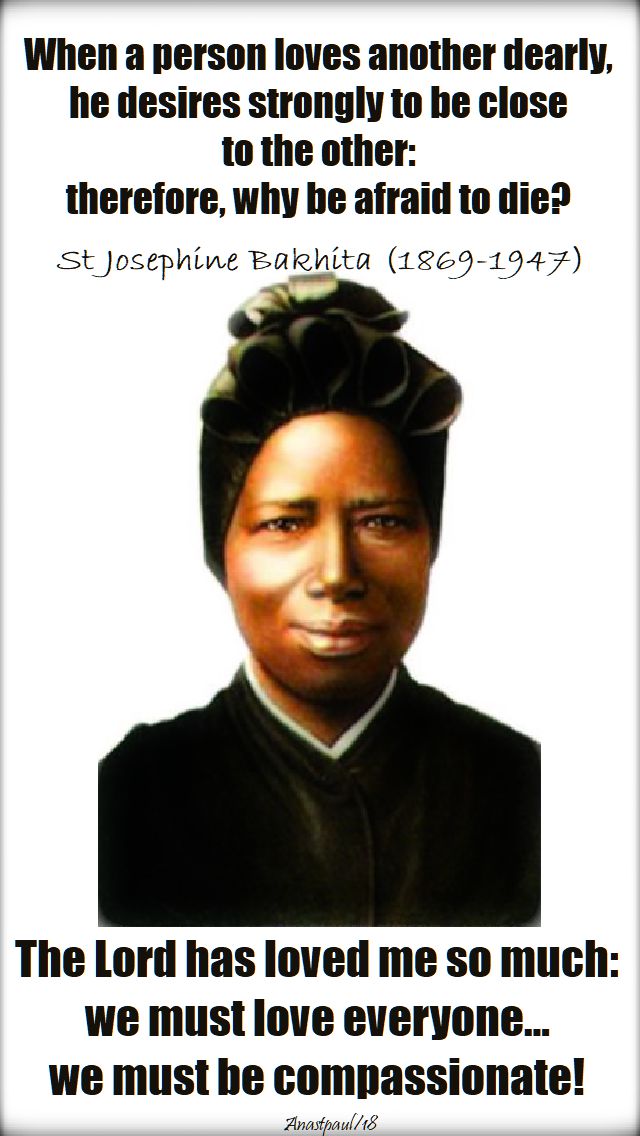
“When a person loves another dearly, he desires strongly to be close to the other: therefore, why be afraid to die?”
“The Lord has loved me so much: we must love everyone… we must be compassionate!”
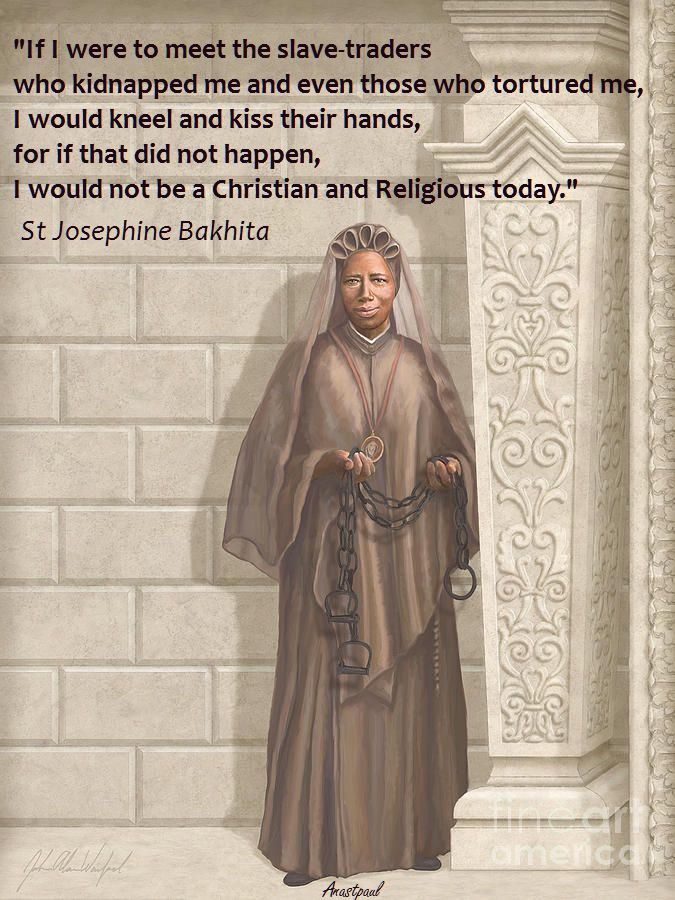
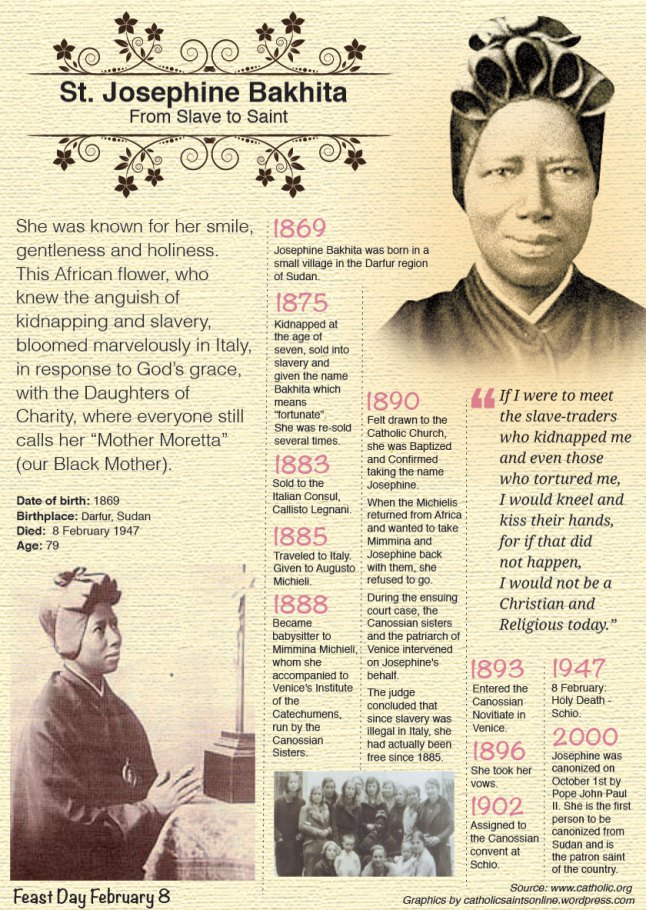
“If I were to meet the slave-traders who kidnapped me and even those who tortured me, I would kneel and kiss their hands, for if that did not happen, I would not be a Christian and Religious today.”
St Josephine Bakhita (1869-1947)
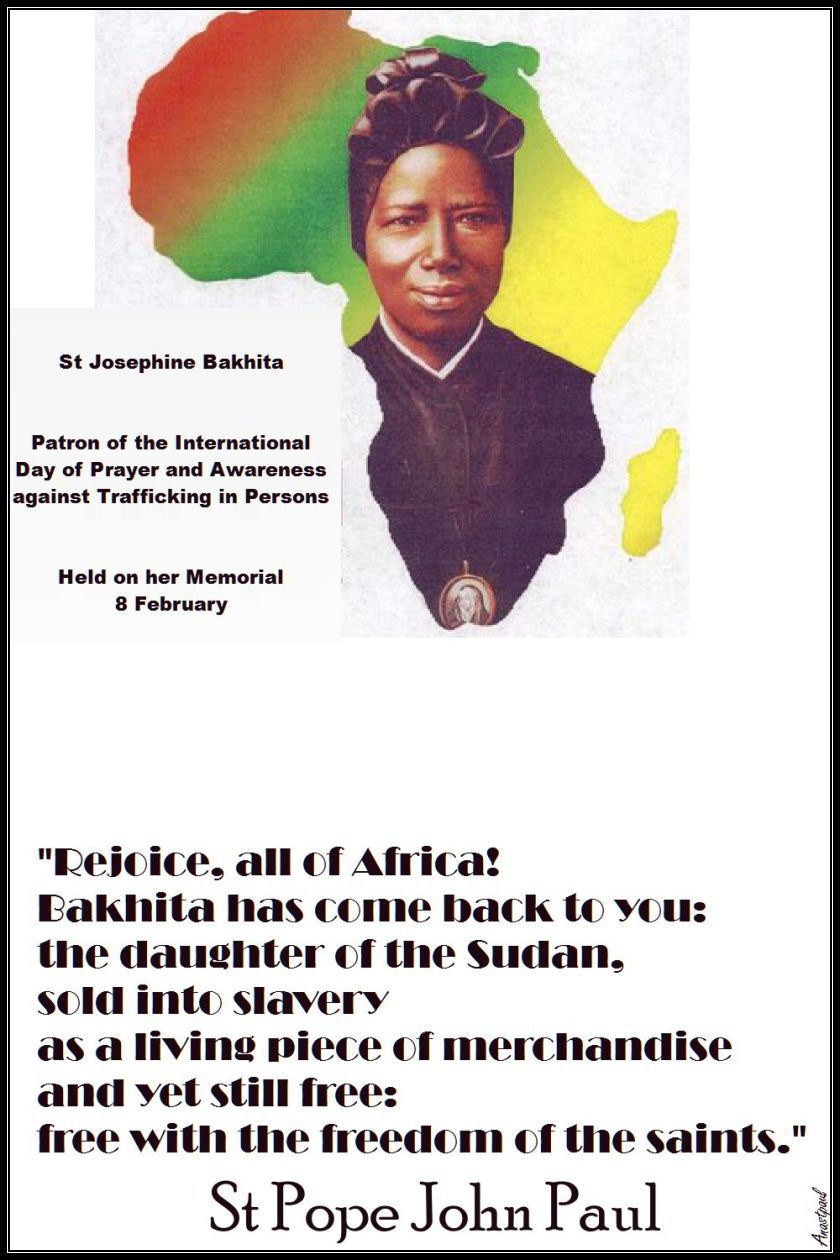
“Rejoice, all of Africa! Bakhita has come back to you: the daughter of the Sudan, sold into slavery as a living piece of merchandise and yet still free: free with the freedom of the saints.”
One Minute Reflection – 8 February – The Memorial of St Jerome Emiliani (1486-1537) – Gospel Mark 7:24-30 Year B
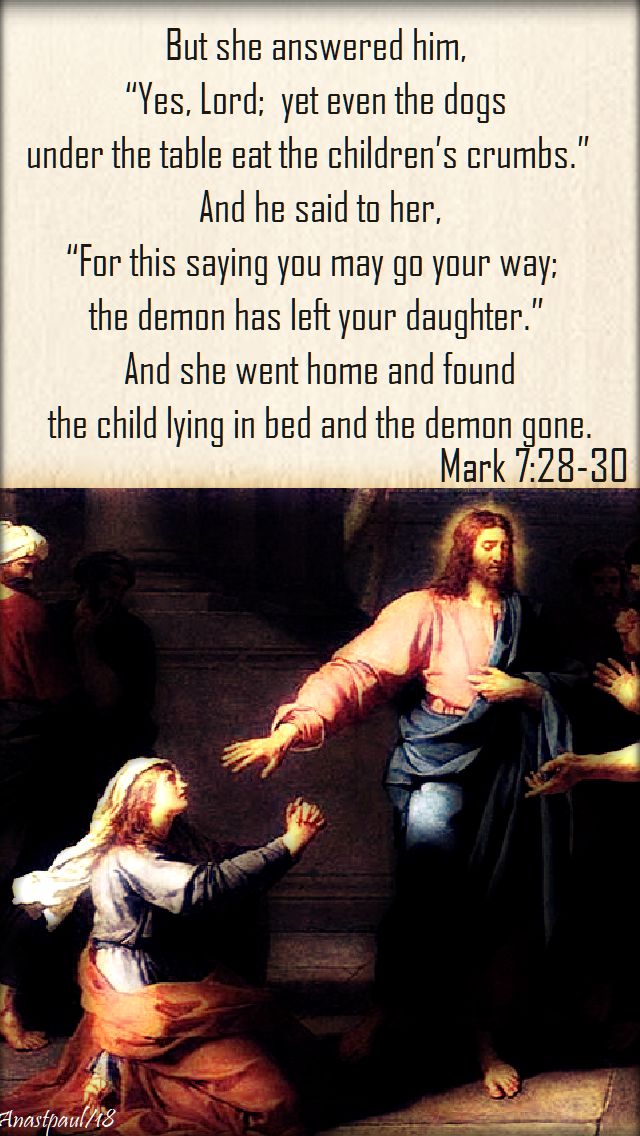
But she answered him, “Yes, Lord; yet even the dogs under the table eat the children’s crumbs.” And he said to her, “For this saying you may go your way; the demon has left your daughter.” And she went home, and found the child lying in bed, and the demon gone...Mark 7:28-30
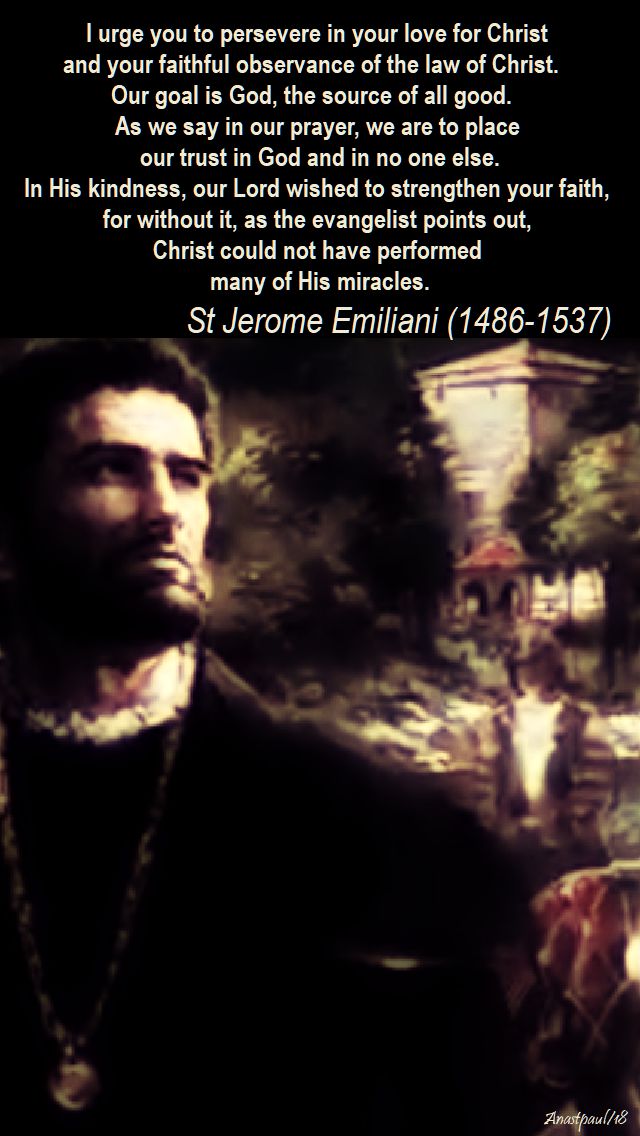
REFLECTION – “I urge you to persevere in your love for Christ and your faithful observance of the law of Christ. Our goal is God, the source of all good. As we say in our prayer, we are to place our trust in God and in no one else. In His kindness, our Lord wished to strengthen your faith, for without it, as the evangelist points out, Christ could not have performed many of His miracles.”…St Jerome Emiliani (1486-1537)
PRAYER – Father of mercy, You chose St Jerome Emiliani to be a father to orphans in their need. Grant that through his prayer, we may keep faithfully the spirit of sonship, by which we are not only called but really are Your children. Help us to imitate his love and faith, manifesting by our commitment to Your commandments, our true faith. Amen
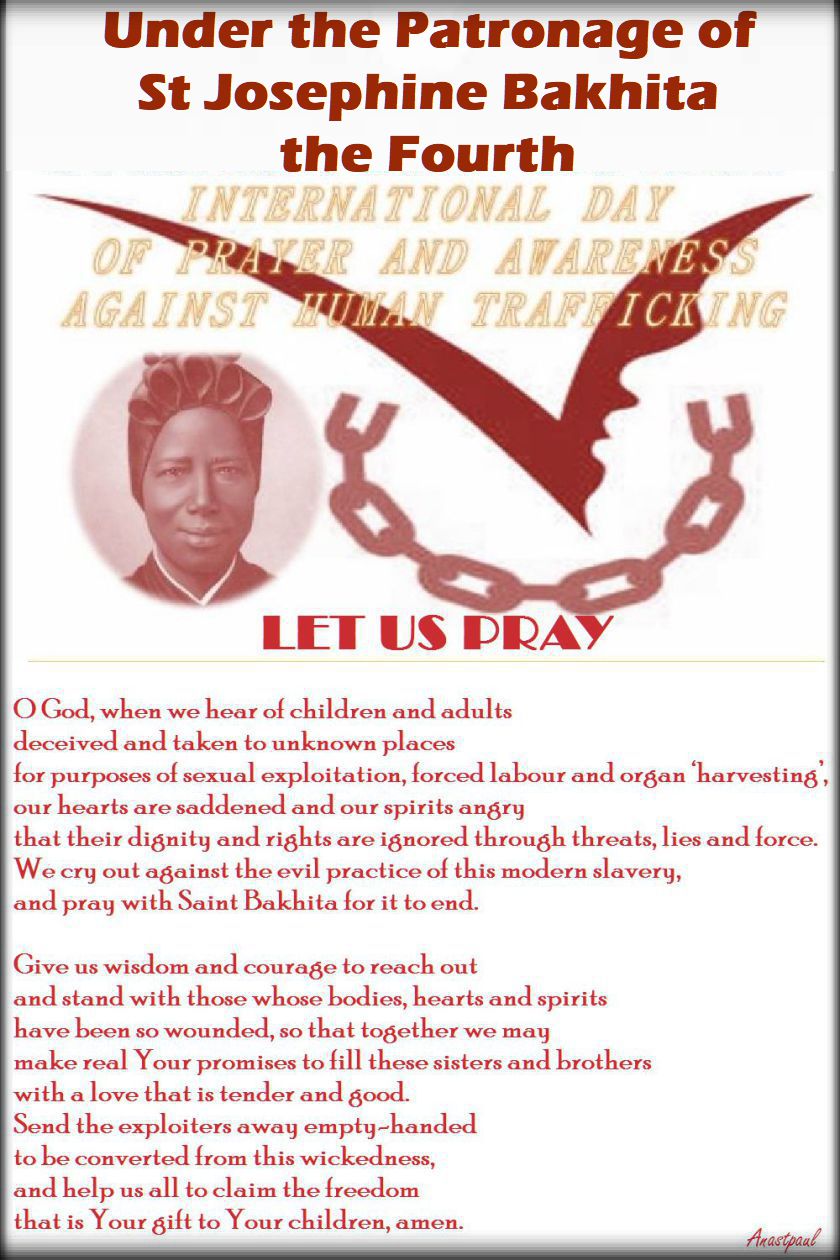
O God, when we hear of children and adults
deceived and taken to unknown places
for purposes of sexual exploitation, forced labour
and organ ‘harvesting’,
our hearts are saddened and our spirits angry
that their dignity and rights are ignored
through threats, lies and force.
We cry out against the evil practice
of this modern slavery,
and pray with Saint Bakhita for it to end.
Give us wisdom and courage to reach out
and stand with those whose bodies, hearts and spirits
have been so wounded, so that together we may
make real Your promises to fill these sisters and brothers
with a love that is tender and good.
Send the exploiters away empty-handed
to be converted from this wickedness,
and help us all to claim the freedom
that is Your gift to Your children, amen.
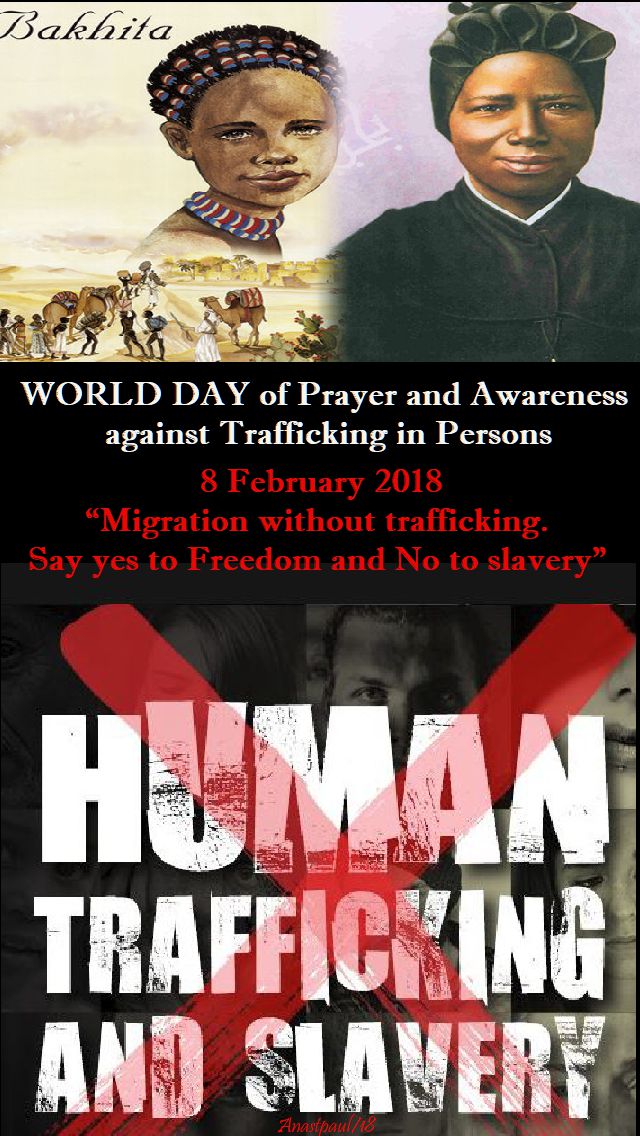
The FOURTH International Day of Prayer and Awareness against Trafficking in Persons under the Patronage of St Josephine Bakhita (1869-1947) – 8 February 2018
2018 theme of the Day of Prayer and Awareness:
“Migration without trafficking. Say yes to Freedom and No to slavery”
Speaking on the eve of the Day of Prayer and Awareness Raising against Human Trafficking, 7 February 2018, Pope Francis urged civil society and institutions to take concrete action to protect the victims and eliminate this terrible scourge that affects so many forced migrants and refugees.
Pope Francis noted that many migrants are forced to choose illegal channels of migration where they are submitted to “abuse of every kind, exploitation and slavery.”
He noted that criminal organizations that engage in the trafficking of persons make use of migratory routes to hide their victims among the migrants and refugees.
Pope Francis also asked for prayers so that “the Lord may convert the hearts of traffickers and give hope to those who suffer because of this shameful scourge so they may regain their freedom”.
“You may choose to look the other way but you can never say again that you did not know” said William Wilberforce, an English politician, philanthropist, theologian and a leader of the movement to abolish the slave trade who lived in the XVIII/XIX century.
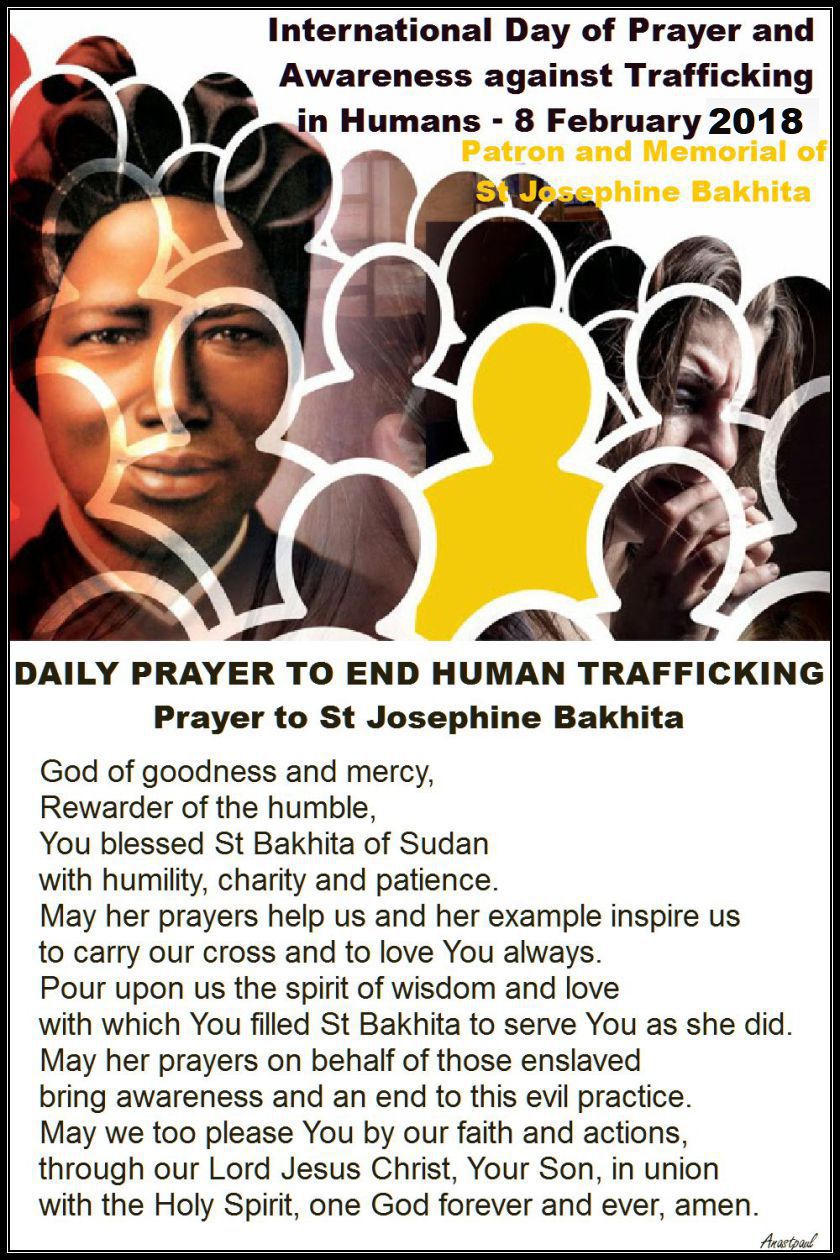
Daily Prayer to End Human Trafficking
God of goodness and mercy, Rewarder of the humble, You blessed St Josephine Bakhita of Sudan with charity and patience. May her prayers help us and her example inspire us to carry our cross and to love You always. Pour upon us the spirit of wisdom and love with which you filled St Josephine Bakhita, by serving You as she did. May her prayers on behalf of those enslaved bring awareness and an end to this evil practice. May we too please You by our faith and actions, through our Lord, Jesus Christ, Your Son, in union with the Holy Spirit, one God forever and ever, amen.
Saint of the Day – 8 February – St Josephine Bakhita (1869-1947) and the FOURTH World Day of PRAYER AND AWARENESS AGAINST TRAFFICKING IN PERSONS UNDER THE PATRONAGE OF ST BAKHITA
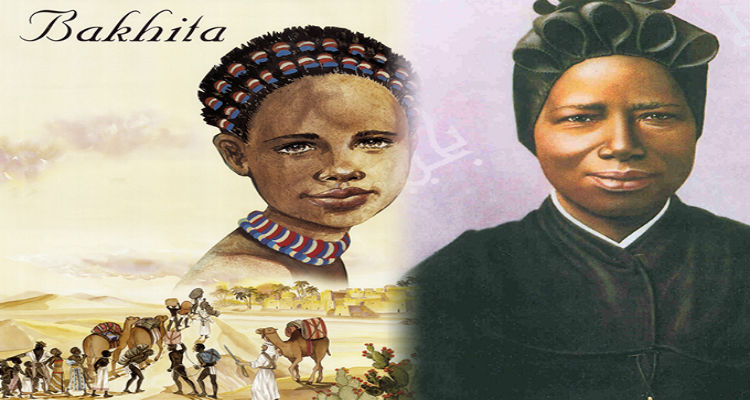
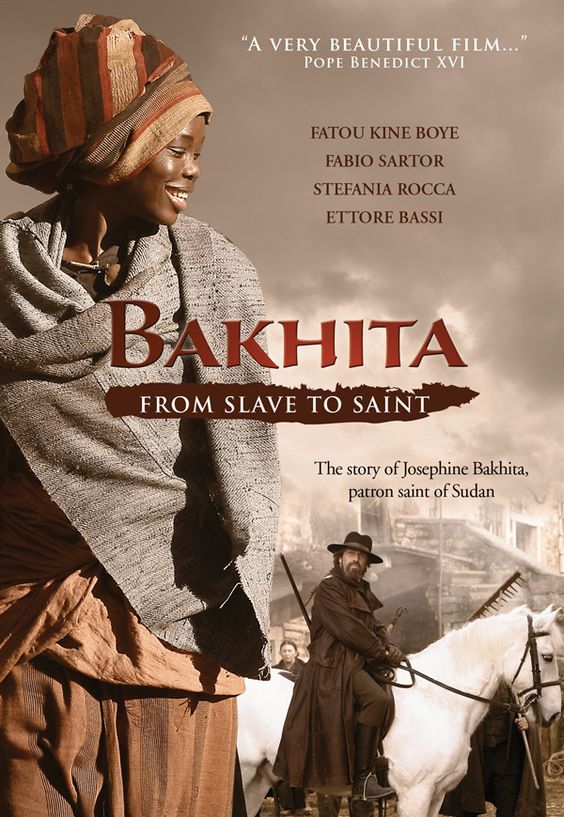
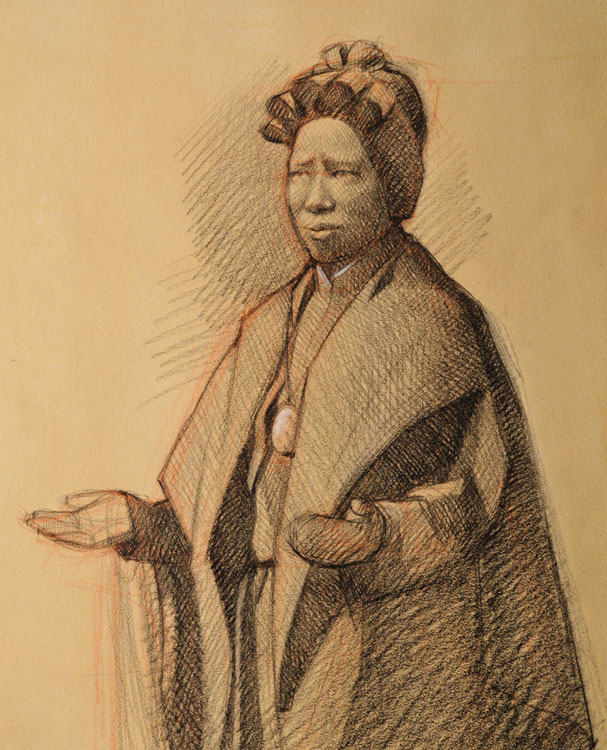
St Josephine Bakhita F.D.C.C. (1869-1947) RELIGIOUS – Patron of Sudan and World Day against Trafficking in Persons. She was born in Sudan, was kidnapped and sold as a slave and became a CanossianReligious Sister in Italy, living and working there for 45 years. In 2000 she was declared a Saint by St Pope John Paul II.
Mother Josephine Bakhita was born in Sudan in 1869 and died in Schio (Vicenza) in 1947.
This African flower, who knew the anguish of kidnapping and slavery, bloomed marvelously in Italy, in response to God’s grace, with the Daughters of Charity.
Mother “Moretta”
In Schio (Vicenza), where she spent many years of her life, everyone still calls her “our Black Mother”. The process for the cause of Canonisation began 12 years after her death and on December 1st, 1978 the Church proclaimed the Decree of the heroic practice of all virtues.
Divine Providence which “cares for the flowers of the fields and the birds of the air”, guided the Sudanese slave through innumerable and unspeakable sufferings to human freedom and to the freedom of faith and finally to the consecration of her whole life to God for the coming of his Kingdom.
In Slavery
Bakhita was not the name she received from her parents at birth. The fright and the terrible experiences she went through made her forget the name she was given by her parents. Bakhita, which means “fortunate”, was the name given to her by her kidnappers.
Sold and resold in the markets of El Obeid and of Khartoum, she experienced the humiliations and sufferings of slavery, both physical and moral.
Towards freedom
In the Capital of Sudan, Bakhita was bought by an Italian Consul, Callisto Legnani. For the first time since the day she was kidnapped, she realised with pleasant surprise, that no one used the lash when giving her orders; instead, she was treated in a loving and cordial way. In the Consul’s residence, Bakhita experienced peace, warmth and moments of joy, even though veiled by nostalgia for her own family, whom, perhaps, she had lost forever. Political situations forced the Consul to leave for Italy. Bakhita asked and obtained permission to go with him and with a friend of his, a certain Mr Augusto Michieli.
In Italy
On arrival in Genoa, Mr Legnani, pressured by the request of Mr Michieli’s wife, consented to leave Bakhita with them. She followed the new “family”, which settled in Zianigo (near Mirano Veneto). When their daughter Mimmina was born, Bakhita became her babysitter and friend.
The acquisition and management of a big hotel in Suakin, on the Red Sea, forced Mrs. Michieli to move to Suakin to help her husband. Meanwhile, on the advice of their administrator, Illuminato Checchini, Mimmina and Bakhita were entrusted to the Canossian Sisters of the Institute of the Catechumens in Venice. It was there that Bakhita came to know about God whom “she had experienced in her heart without knowing who He was”ever since she was a child. “Seeing the sun, the moon and the stars, I said to myself: Who could be the Master of these beautiful things? And I felt a great desire to see him, to know Him and to pay Him homage…”
Daughter of God
After several months in the catechumenate, Bakhita received the sacraments of Christian initiation and was given the new name, Josephine. It was 9 January 1890. She did not know how to express her joy that day. Her big and expressive eyes sparkled, revealing deep emotions. From then on, she was often seen kissing the baptismal font and saying: “Here, I became a daughter of God!” With each new day, she became more aware of who this God was, whom she now knew and loved, who had led her to Him through mysterious ways, holding her by the hand.
When Mrs. Michieli returned from Africa to take back her daughter and Bakhita, the latter, with unusual firmness and courage, expressed her desire to remain with the Canossian Sisters and to serve that God who had shown her so many proofs of His love. The young African, who by then had come of age, enjoyed the freedom of choice which the Italian law ensured.
Daughter of St Magdalene
Bakhita remained in the catechumenate where she experienced the call to be a religious, and to give herself to the Lord in the Institute of St. Magdalene of Canossa. On 8 December 1896, Josephine Bakhita was consecrated forever to God whom she called with the sweet expression “the Master!”
For another 50 years, this humble Daughter of Charity, a true witness of the love of God, lived in the community in Schio, engaged in various services: cooking, sewing, embroidery and attending to the door. When she was on duty at the door, she would gently lay her hands on the heads of the children who daily attended the Canossian schools and caress them. Her amiable voice, which had the inflection and rhythm of the music of her country, was pleasing to the little ones, comforting to the poor and suffering and encouraging for those who knocked at the door of the Institute.
Witness of love
Her humility, her simplicity and her constant smile won the hearts of all the citizens. Her sisters in the community esteemed her for her unalterable sweet nature, her exquisite goodness and her deep desire to make the Lord known. “Be good, love the Lord, pray for those who do not know Him. What a great grace it is to know God!”
As she grew older she experienced long, painful years of sickness. Mother Bakhita continued to witness to faith, goodness and Christian hope. To those who visited her and asked how she was, she would respond with a smile: “As the Master desires.”
Final test
During her agony, she re-lived the terrible days of her slavery and more then once she begged the nurse who assisted her: “Please, loosen the chains… they are heavy!”
It was Mary Most Holy who freed her from all pain. Her last words were: “Our Lady! Our Lady!” and her final smile testified to her encounter with the Mother of the Lord.
Mother Bakhita breathed her last on 8 February 1947 at the Canossian Convent, Schio, surrounded by the Sisters. A crowd quickly gathered at the Convent to have a last look at their «Mother Moretta» and to ask for her protection from heaven. The fame of her sanctity has spread to all the continents and many are those who receive graces through her intercession. (vatican.va)
St Jerome Emiliani (Optional Memorial)
St Josephine Bakhita (Optional Memorial) today is the FOURTH WORLD DAY OF PRAYER AND AWARENESS AGAINST TRAFFICKING IN PERSONS UNDER THE PATRONAGE OF ST BAKHITA
—
St Cointha of Alexandria
St St Cuthman
St Cyriacus of Rome
St Dionysus of Armenia
St Elfleda of Whitby
St Emilian of Armenia
Bl Esperanza de Jesus
St Giacuto
St Gisela
St Honoratus of Milan
St Invenzio of Pavia
St Isaias Boner
St Jacoba
Bl Josephina Gabriella Bonino
St Kigwe
St Lucius of Rome
St Meingold
St Mlada of Prague
St Nicetius of Besançon
St Oncho of Clonmore
St Paul of Rome
St Paul of Verdun
Bl Peter Igneus
St Sebastian of Armenia
St Stephen of Muret
—
Four Mercedarians
Martyrs of Constantinople: Community of 5th century monks at the monastery of Saint Dius at Constantinople. Imprisoned and martyred for loyalty to the Vatican during the Acacian Schism. 485 in Constantinople.
Martyrs of Persia: An unknown number of Christians murdered in early 6th-century Persia. Legend says that so many miracles occurred through the intercession of these martyrs that the king decreed an end to the persecution of Christians.
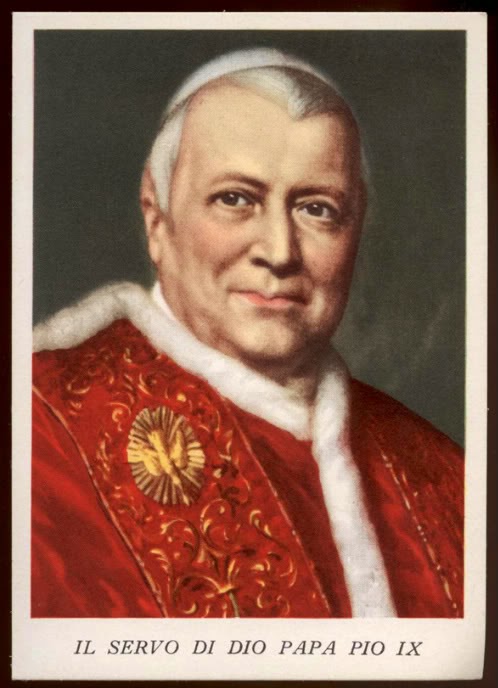
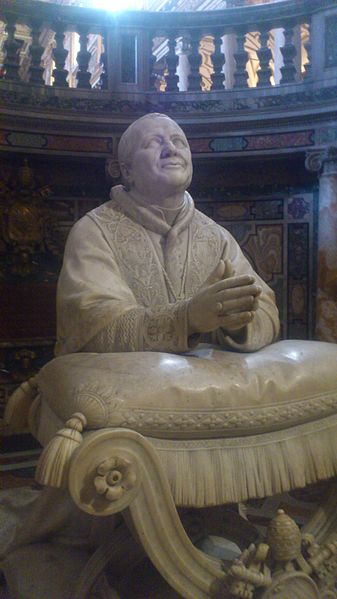
Thought for the Day – 7 February – The Memorial of Blessed Pope Pius IX (1792-1878)
“In the context of the Jubilee Year, it is with deep joy that I have declared blessed two Popes, Pius IX and John XXIII and three other servants of the Gospel in the ministry and the consecrated life: Archbishop Tommaso Reggio of Genoa, the diocesan priest William Joseph Chaminade and the Benedictine monk Columba Marmion.
Five different personalities, each with his own features and his own mission, all linked by a longing for holiness. It is precisely their holiness that we recognise today: holiness that is a profound and transforming relationship with God, built up and lived in the daily effort to fulfil his will. Holiness lives in history and no saint has escaped the limits and conditioning which are part of our human nature. In beatifying one of her sons, the Church does not celebrate the specific historical decisions he may have made but rather points to him as someone to be imitated and venerated because of his virtues, in praise of the divine grace which shines resplendently in him.
Listening to the words of the Gospel acclamation: “Lord, lead me on a straight road”, our thoughts naturally turn to the human and religious life of Pope Pius IX, Giovanni Maria Mastai Ferretti. Amid the turbulent events of his time, he was an example of unconditional fidelity to the immutable deposit of revealed truths. Faithful to the duties of his ministry in every circumstance, he always knew how to give absolute primacy to God and to spiritual values. His lengthy pontificate was not at all easy and he had much to suffer in fulfilling his mission of service to the Gospel. He was much loved but also hated and slandered.
However, it was precisely in these conflicts that the light of his virtues shone most brightly: these prolonged sufferings tempered his trust in divine Providence, whose sovereign lordship over human events he never doubted. This was the source of Pius IX’s deep serenity, even amid the misunderstandings and attacks of so many hostile people. He liked to say to those close to him: “In human affairs we must be content to do the best we can and then abandon ourselves to Providence, which will heal our human faults and shortcomings”.
Sustained by this deep conviction, he called the First Vatican Ecumenical Council, which clarified with magisterial authority certain questions disputed at the time, and confirmed the harmony of faith and reason. During his moments of trial Pius IX found support in Mary, to whom he was very devoted. In proclaiming the dogma of the Immaculate Conception, he reminded everyone that in the storms of human life the light of Christ shines brightly in the Blessed Virgin and is more powerful than sin and death.
Let us confidently ask the new blesseds, Pius IX, John XXIII, Tommaso Reggio, William Joseph Chaminade and Columba Marmion, to help us live in ever greater conformity to the Spirit of Christ. May their love of God and neighbour illumine our steps at this dawn of the third millennium!” – St Pope John Paul II – Beatification Homily, Sunday 3 September 2000
Meanwhile, although “prisoner” he may now have been, Pius IX’s popularity nevertheless soared, abetted by technological innovations that carried the words and images of the pope to Catholics around the world, while also carrying a growing number of pilgrims to Rome to see and pray with him in person. By the time of his death this helped make him what historian Eamon Duffy calls “a popular icon.”
But so, above all, did the goodness and charm of the man himself. Even his critics, Duffy writes, “admitted that it was impossible to dislike him.”
“He was genial, unpretentious, wreathed in clouds of snuff, always laughing. His sense of the absurd sometimes got the better of him, as when some earnest Anglican clergymen begged his blessing and he teasingly pronounced over them the prayer for the blessing of incense, ‘May you be blessed by him in whose honour you are to be burned.’”
People aren’t beatified for having a sense of humour, but with Pius IX it surely didn’t hurt.
Today we ask, Blessed Pope Pius IX, please pray for us!
Quote/s of the Day – 7 February – The Memorial of Blessed Pope Pius IX (1792-1878)
“The chisel is the pen of the sculptor.”
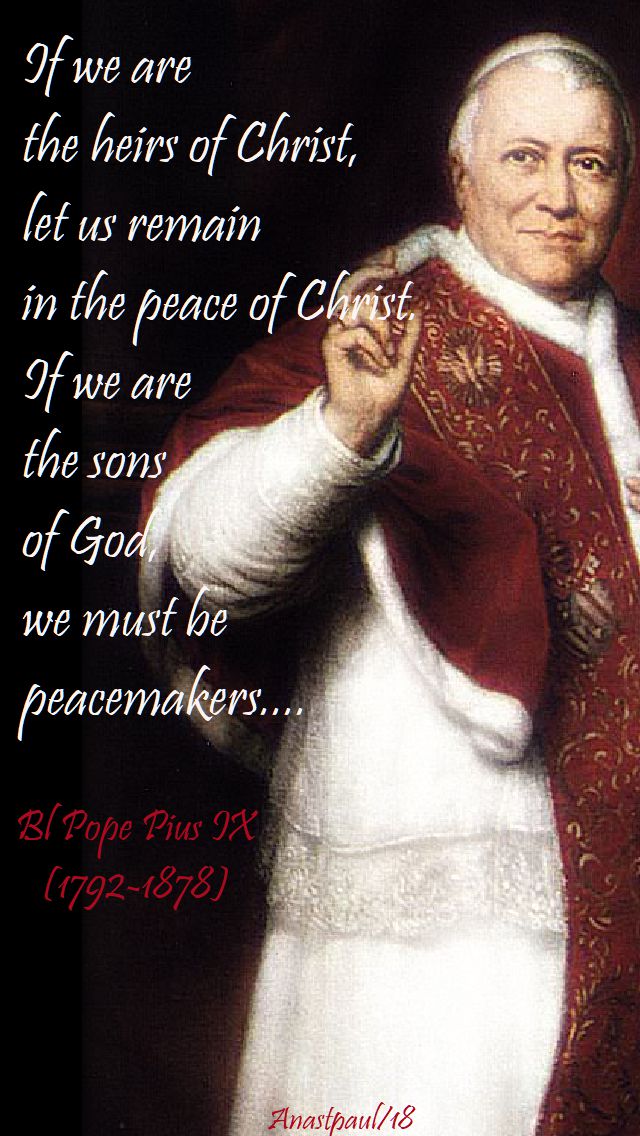
“If we are the heirs of Christ, let us remain in the peace of Christ. If we are the sons of God, we must be peacemakers….” INTER MULTIPLICES – PLEADING FOR UNITY OF SPIRIT: 21 March 1853
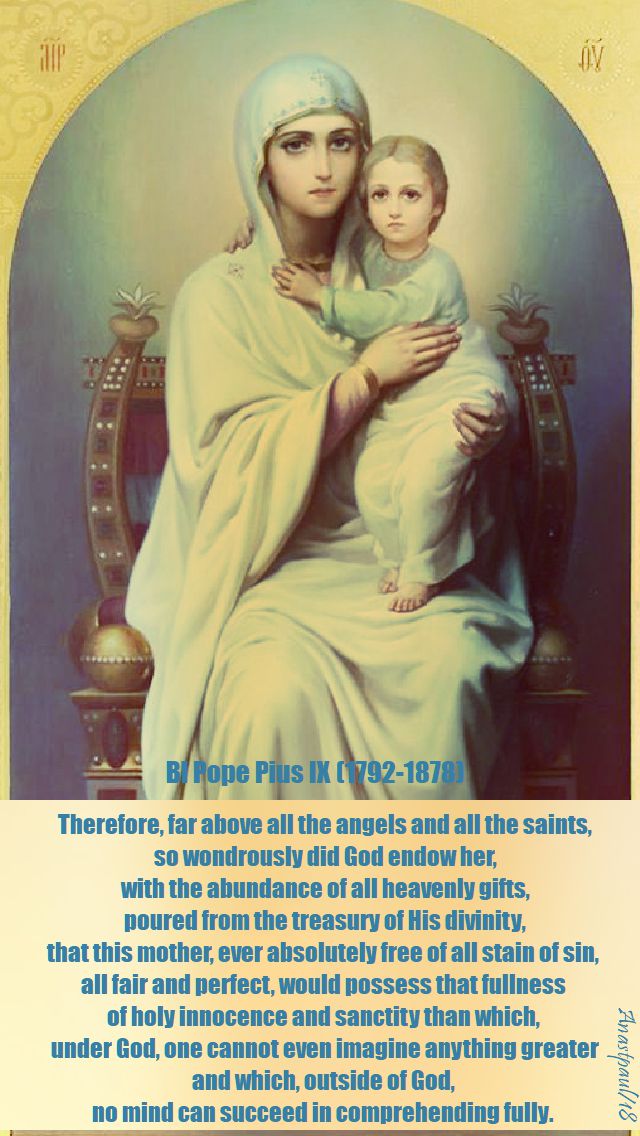
” From the very beginning and before time began, the eternal Father chose and prepared for His only-begotten Son, a Mother, in whom the Son of God would become incarnate and from whom, in the blessed fullness of time, He would be born into this world. Above all creatures did God so love her, that truly in her, was the Father well pleased, with singular delight. Therefore, far above all the angels and all the saints, so wondrously did God endow her, with the abundance of all heavenly gifts, poured from the treasury of His divinity, that this mother, ever absolutely free of all stain of sin, all fair and perfect, would possess that fullness of holy innocence and sanctity than which, under God, one cannot even imagine anything greater and which, outside of God, no mind can succeed in comprehending fully.”- INEFFABILIS DEUS – THE IMMACULATE CONCEPTION: 8 December 1854
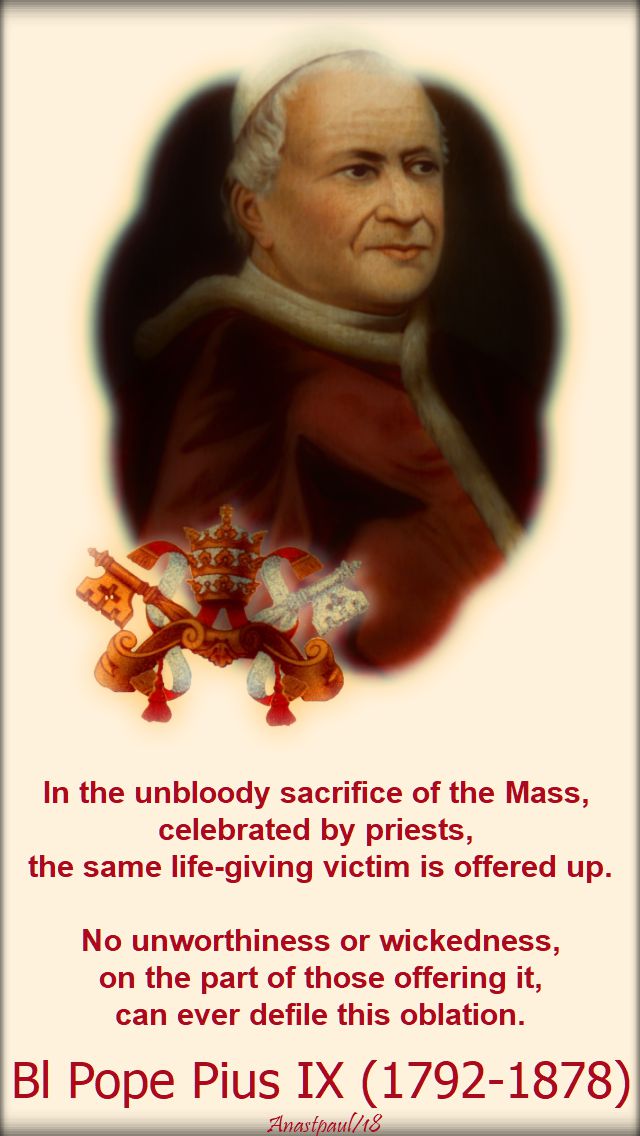
“In the unbloody sacrifice of the Mass, celebrated by priests, the same life-giving victim is offered up. This entreaty reconciles us to God the Father. It “renews in a mysterious way the death of Christ, who having risen from the dead dies no longer. Death no longer has domination over Him.” Still, He is sacrificed for us in the mystery of this sacred oblation. No unworthiness or wickedness on the part of those offering it can ever defile this oblation.”- AMANTISSIMI REDEMPTORIS – ON PRIESTS AND THE CARE OF SOULS: 3 May 1858
One Minute Reflection – 7 February – The Memorial of Blessed Pope Pius IX (1792-1878)
And I tell you, you are Peter and on this rock I will build my church and the gates of hell shall not prevail against it…Matthew 16:18
REFLECTION – “Now you know well that the most deadly foes of the Catholic religion have always waged a fierce war but without success, against this Chair; they are by no means ignorant of the fact that religion itself can never totter and fall while this Chair remains intact, the Chair which rests on the rock which the proud gates of hell cannot overthrow and in which there is the whole and perfect solidity of the Christian religion.”…Blessed Pope Pius IX
PRAYER – Holy Father God, our eternal praise and thanksgiving are offered to You for this Chair of Peter! The Church instituted by our Saviour, Your divine Son. Grant we pray, that by the prayers of Blessed Pope Pius IX, who faithfully guarded her through times of great difficulty, that we too may live and move and have our being in You and with Jesus, our Lord, in His Holy Church. Amen
Our Morning Offering – 7 February – The Memorial of Blessed Pope Pius IX (1792-1878)
Prayer in honour of Our Lady of Perpetual Help By Blessed Pope Pius IX (1792-1878)
O Lord Jesus Christ,
who gave us Your Mother, Mary,
whose renowned image we venerate,
to be a Mother ever ready to help us;
grant we beseech You,
that we who constantly implore her motherly aid,
may merit to enjoy perpetually
the fruits of Your redemption,
Who lives and reigns forever and ever.
Amen.
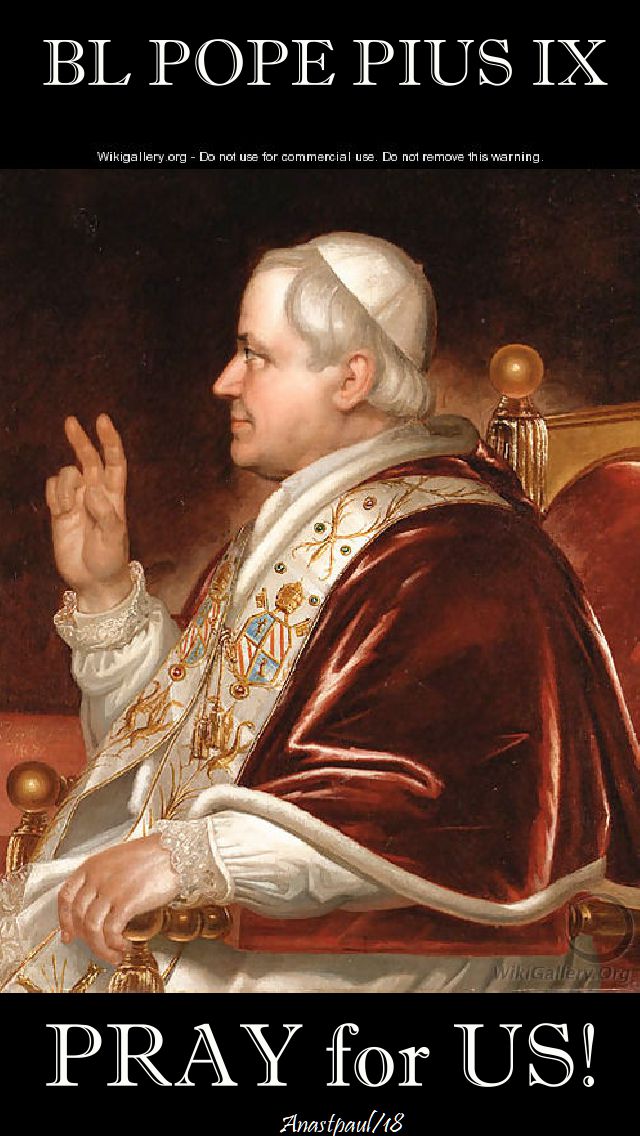
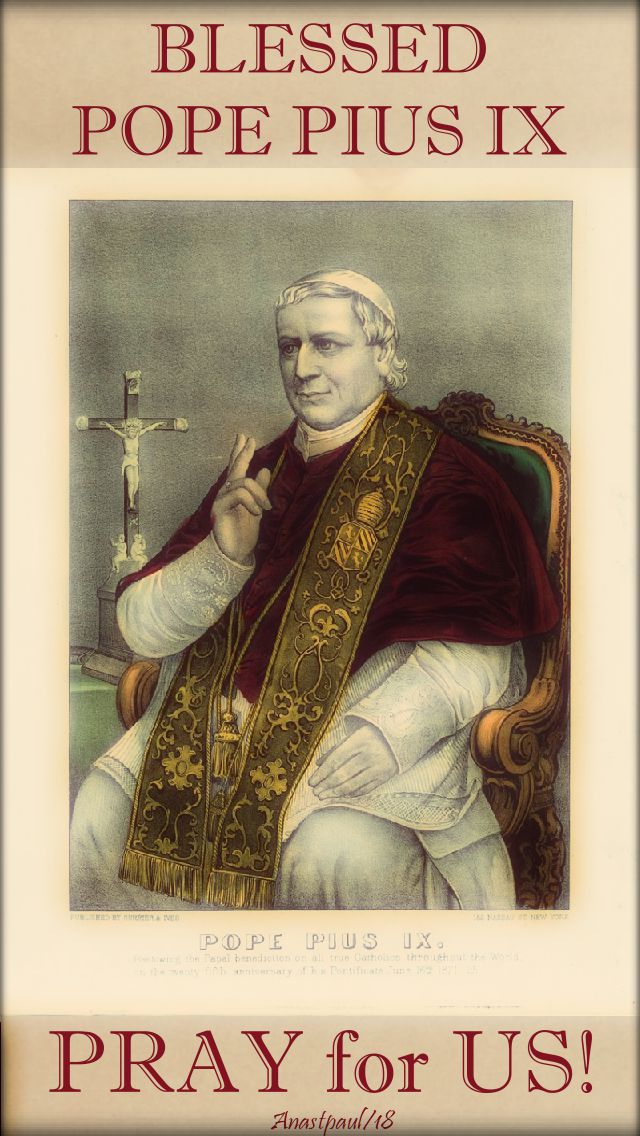
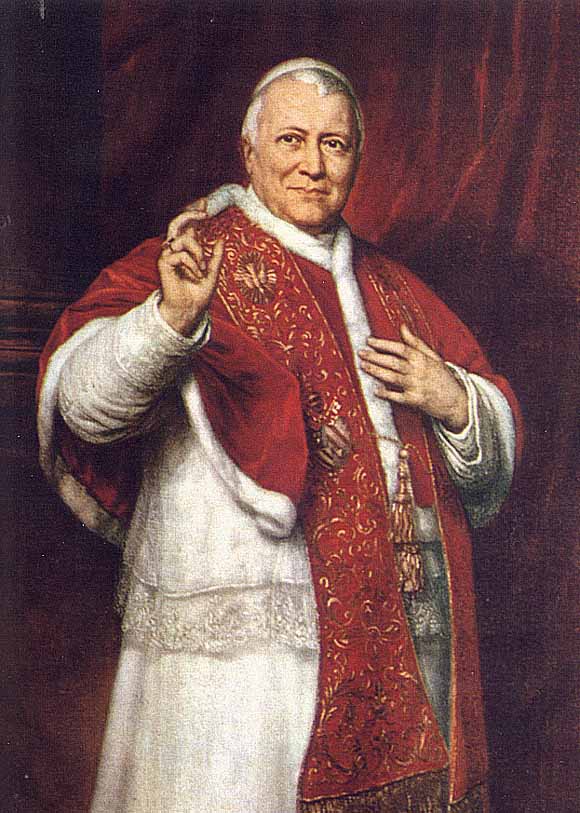
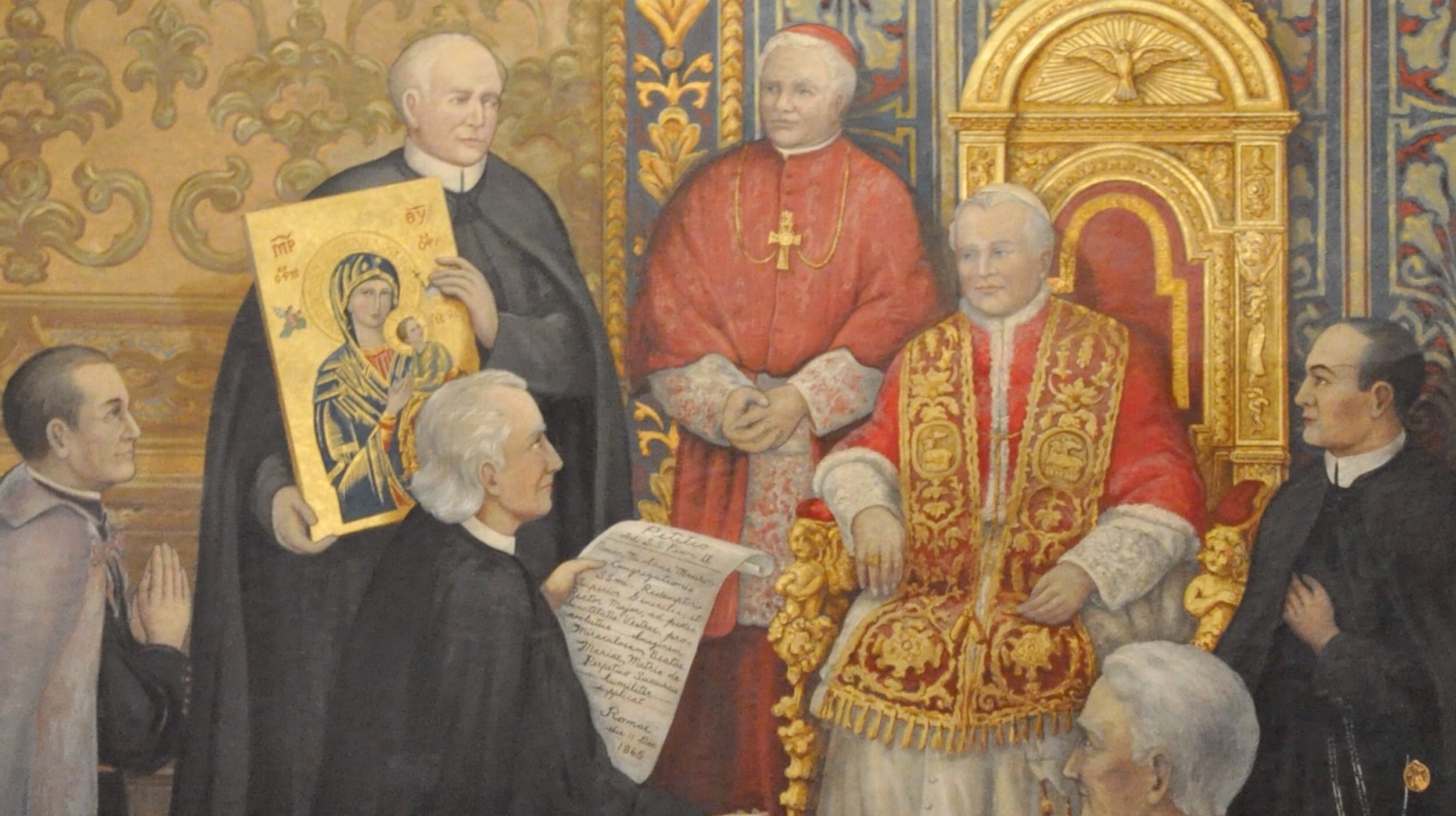
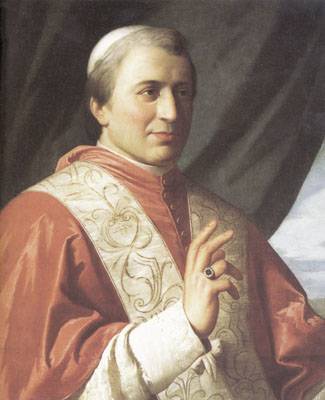
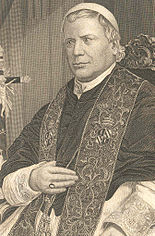
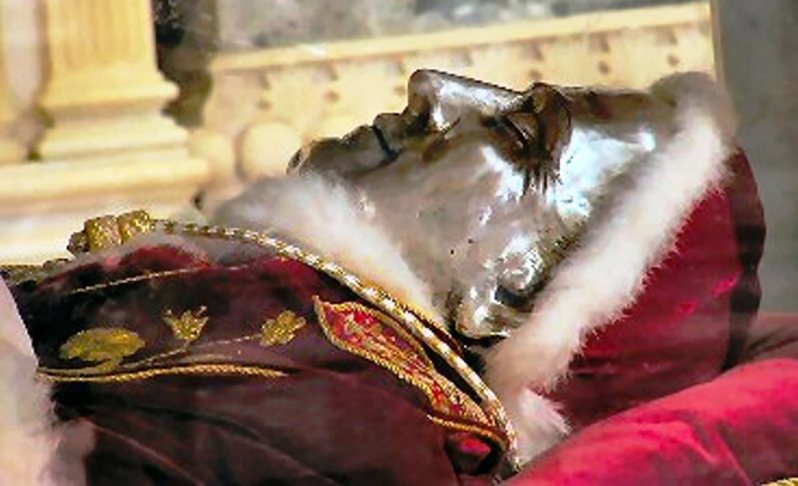
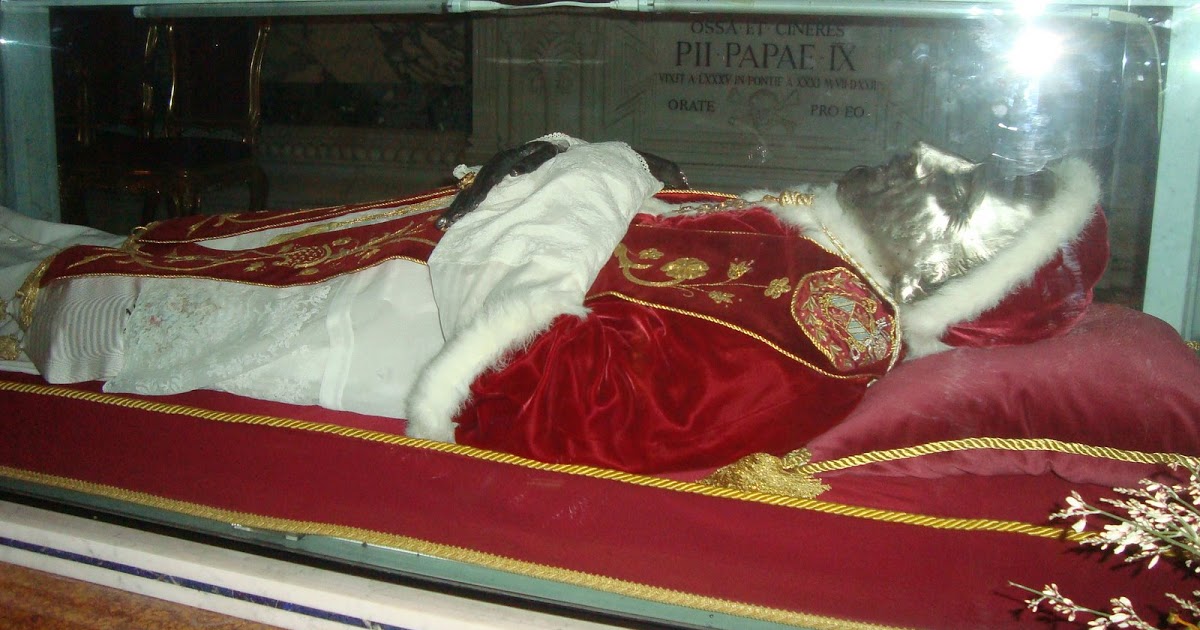
Saint of the Day 7 February – Blessed Pope Pius IX (1792-1878) Bishop of Rome, Writer. The longest regining Pope. Bl Pius was born as Giovanni Maria Mastai-Ferretti on 13 May 1792 in Senigallia, Italy and he died on 7 February 1878 in Vatican City of natural causes. He reigned from 16 June 1846 to the day of his death. He is the longest-reigning Pope in the history of the Church, serving for over 31 years. During his Pontificate, Pius IX convened the First Vatican Council (1869–70), which decreed Papal Infallibility and promulgated the Dogma of the Immaculate Conception, thus articulating a long-held belief that Mary, the Mother of God, was conceived without original sin. He conferred the title Our Mother of Perpetual Succour on a famous Byzantine icon from Crete entrusted to the Redemptorists. Pope Pius IX named three new Doctors of the Church: Hilary of Poitiers (1851), Alphonsus Liguori (1871), and Francis de Sales (19 July 1877).Patronages – Pius Seminary of Rome, Senigallia, Diocese of Senigallia, First Vatican Council. His body is incorrupt.
Bl Pope Pius IX was born in Senigallia, Italy, on 13 May 1792, the son of Gerolamo of the Counts Mastai Ferretti and Caterina Solazzi, of the local nobility. He was baptised on the day of his birth with the name Giovanni Maria. Of delicate physical constitution but of very lively intelligence, his childhood was marked by little voluntary mortifications and an intense religious life.
In 1809 he moved to Rome for higher studies. A disease not well diagnosed, which some called epilepsy, forced him to interrupt his studies in 1812. He was accepted into the Pontifical Noble Guard in 1815 but because of his illness he was immediately discharged. It was at this time that St Vincent Pallotti predicted that he would become Pope and that the Virgin of Loreto would free him eventually from the disease.
After serving briefly in the Tata Giovanni Educational Institute, he participated as a catechist in 1816 in a memorable mission in Senigallia and, immediately thereafter, decided to enter the ecclesiastical state. He was ordained a priest in 1819. Conscious of his noble rank, he committed himself to avoiding a prelatial career in order to remain only at the service of the Church.
He celebrated his first Mass in the Church of St Anne of the Carpenters at the Tata Giovanni Institute, of which he was named rector, remaining there until 1823. He was immediately recognised as assiduous in prayer, in the ministry of the Word, in the celebration of the liturgy, in the confessional and above all in his daily ministry at the service of the humblest and neediest. He admirably united the active and the contemplative life: ready for pastoral needs but always interiorly recollected, with strong Eucharistic and Marian devotion and fidelity to daily meditation and the examination of conscience.
In 1823 he left the institute to serve the Apostolic Nuncio in Chile, Mons. Giovanni Muzi. There he remained until 1825, when he was elected President of St Michael’s Hospice, a grand but complex institution in need of effective reform. To it Mastai applied himself with more than gratifying results but without ever neglecting his priestly duties. Two years later, at the age of 35, he was consecrated Archbishop of Spoleto. In 1831 the revolution which had begun in Parma and Modena spread to Spoleto. The Archbishop did not want the shedding of blood and repaired, as much as possible, the deleterious effects of the violence. When calm was restored, he obtained a pardon for all, even for those who did not merit it.
Another turbulent see awaited Mastai in Imola, where he was transferred in 1832. He remained an eloquent preacher, prompt in charity toward everyone, zealous for the supernatural as well as the material well-being of his Diocese, devoted to his clergy and seminarians, a promoter of education for the young, sensitive to the needs of the contemplative life, devoted to the Sacred Heart and to Our Lady, benevolent towards all but firm in his principles. In 1840 he received the Cardinal’s hat at the age of 48.
Despite having shunned honours, on the evening of 16 June 1846 Mastai found himself burdened with the greatest of them: he was elected Pope and took the name Pius IX.
He had a difficult pontificate, but precisely because of that he was a great Pope, certainly one of the greatest. Thoroughly aware of being the “Vicar of Christ” and responsible for the rights of God and of the Church, he was clear, simple consistent. He combined firmness and understanding, fidelity and openness.
He began with an act of generosity and Christian sensitivity: amnesty for political crimes. His first Encyclical was a programmatic vision but anticipated the “Syllabus”: in it he condemned secret societies, freemasonry and communism. In 1847 he promulgated a decree granting extensive freedom of the press and instituted a civil guard, the municipal and communal council, the Council of State and the Council of Ministers. From then on his interventions as Father of all nations and temporal Prince continued unabated.
The question of Italian independence, which he sympathised with, did not set the Prince against the Pope, a fact that alienated the most intransigent liberals. The situation came to a head on 15 November when Pellegrino Rossi, the head of government, was killed and Pius IX had to take refuge in Gaeta. After the proclamation of the Roman Republic (9 February 1849), he moved to Portici and later returned to Rome (12 April 1850). He reorganised the Council of State, established the Council for Finances, granted a new amnesty, re-established the Catholic hierarchy in England and in Holland.
In 1853 he condemned Gallican doctrines and founded the well-known “Seminario Pio”. He established the Commission on Christian Archaeology, defined the dogma of the Immaculate Conception on 8 December 1854 and blessed the rebuilt St Paul’s Basilica which had been destroyed by fire in 1823.
In 1856 he approved the plan for railways in the Papal States and on 24 April 1859 inaugurated the first section between Rome and Civitavecchia. In 1857 he visited the Papal States and was welcomed everywhere with rejoicing. He sent missionaries to the North Pole, India, Burma, China and Japan.
Meanwhile dark clouds gathered over him with the Italian “Risorgimento”, the Piedmontese annexations that were dismantling the Papal States and the expropriation of the Legations. Suffering but undaunted, he continued to show his charity and concern for all. In 1862 he established a dicastery to deal with the concerns of Eastern-rite Catholics; in 1864 he published his Syllabus condemning modern errors; in 1867 he celebrated the 18th centenary of the martyrdom of Peter and Paul; in 1869 he received the homage of the entire world for the golden jubilee of his priestly ordination. Later that year he opened the First Vatican Ecumenical Council, the pearl of his pontificate, and closed it on 18 July 1870.
With the fall of Rome (20 September 1870) and of the temporal power, the saddened Pontiff considered himself a prisoner of the Vatican, resisting the “Laws of Guarantees”, but approving the “Work of Congresses”. He consecrated the Church to the Sacred Heart of Jesus, disciplined the participation of Catholics in political life with the Non expedit and restored the Catholic hierarchy of Scotland. Suffering from poor health, he gave his last address to the parish priests of Rome on 2 February 1878. On 7 February the longest pontificate in history ended with his holy death. His body is incorrupt. He was Beatified on 3 September 2000 by St Pope John Paul II. (vatican.va).
Writings
• Amantissimi Redemptoris – On Priests and the Care of Souls, by Pope Pius IX, 3 May 1858 • Apostolicae Nostrae Caritatis – Urging Prayers For Peace, by Pope Pius IX, 1 August 1854 • Beneficia Dei – On The Twenty-Fifth Anniversary of His Pontificate, by Pope Pius IX, 4 June 1871 • Cum Nuper – On Care for Clerics, by Pope Pius IX, 20 January 1858 • Cum Sancta Mater Ecclesia – Pleading for Public Prayer, by Pope Pius IX, 27 April 1859 • Etsi Multa – On the Church in Italy, Germany, and Switzerland, by Pope Pius IX, 21 November 1873 • Exultavit Cor Nostrum – On the Effects of the Jubilee, by Pope Pius IX, 21 November 1851 • Graves ac Diuturnae – On the Church in Switzerland, by Pope Pius IX, 23 March 1875 • Gravibus Ecclesiae – Proclaiming a Jubilee for 1875, by Pope Pius IX, 24 December 1874 • Incredibili – On Persecution in New Granada, by Pope Pius IX, 17 September 1863 • Ineffabilis Deus – The Immaculate Conception, by Pope Pius IX, 8 December 1854 • Levate – On the Afflictions of the Church, by Pope Pius IX, 21 October 1867 • Maximae Quidem – On the Church in Bavaria, by Pope Pius IX, 18 August 1864 • Meridionali Americae – On the Seminary for Native Clergy, by Pope Pius IX, 30 September 1865 • Neminem Vestrum – On The Persecution Of Armenians, by Pope Pius IX, 2 February 1854 • Nemo Certe Ignorat – On Discipline for Clergy, by Pope Pius IX, 25 March 1852 • Nostis et Nobiscum – On The Church In The Pontifical States, by Pope Pius IX, 8 December 1849 • Nullis Certe Verbis – On the Need for Civil Sovereignty, by Pope Pius IX, 19 January 1860 • Omnem Sollicitudinem – On The Greek-Ruthenian Rite, Pope Pius IX, 13 May 1874 • Optime Noscitis – On Episcopal Meetings, by Pope Pius IX, 5 November 1855 • Optime Noscitis – On The Proposed Catholic University Of Ireland, by Pope Pius IX, 20 March 1854 • Praedecessores Nostros – On Aid for Ireland, by Pope Pius IX, 25 March 1847 • Quae in Patriarchatu – On the Church in Chaldae, by Pope Pius IX, 16 November 1872 • Quanta Cura – Condemning Current Errors, by Pope Pius IX, 8 December 1864 • Quanto Conficiamur Moerore – On Promotion of False Doctrines, by Pope Pius IX, 10 August 1863 • Quartus Supra – On the Church in Armenia, by Pope Pius IX, 6 January 1873 • Qui Nuper – On Pontifical States, by Pope Pius IX, 18 June 1859 • Qui Pluribus – On Faith And Religion, by Pope Pius IX, 9 November 1846 • Quod Nunquam – On the Church in Prussia, by Pope Pius IX, 5 February 1875 • Respicientes – Protesting the Taking of the Pontifical States, by Pope Pius IX, 1 November 1870 • Saepe Venerabiles Fratres – On Thanksgiving For Twenty-Five Years Of Pontificate, by Pope Pius IX, 5 August 1871 • Singulari Quidem – On the Church in Austria, by Pope Pius IX, 17 March 1856 • Syllabus of Errors, by Pope Blessed Pius IX, 8 December 1864 • Ubi Nos – On Pontifical States, by Pope Pius IX, 15 May 1871 • Ubi Primum – On Discipline for Religious, by Pope Pius IX, 17 June 1847 • Ubi Primum – On The Immaculate Conception, by Pope Pius IX, 2 February 1849 • Vix Dum a Nobis – On the Church in Austria, by Pope Pius IX, 7 March 1874
—
Bl Adalbert Nierychlewski
St Adaucus of Phrygia
St Amulwinus of Lobbes
St Anatolius of Cahors
Bl Anna Maria Adorni Botti
Bl Anselmo Polanco
Bl Anthony of Stroncone
St Augulus
St Chrysolius of Armenia
Bl Eugenie Smet
St Fidelis of Merida
Bl Felipe Ripoll Morata
St Giles Mary of Saint Joseph
Bl Jacques Sales
St John of Triora
St Juliana of Bologna
Bl Klara Szczesna
St Lorenzo Maiorano
St Luke the Younger
St Maximus of Nola
St Meldon of Péronne
St Moses the Hermit
St Parthenius of Lampsacus
Bl Peter Verhun
Bl Pope Pius IX (1792-1878)
St Richard the King
Bl Rizziero of Muccia
Bl Rosalie Rendu
St Theodore Stratelates
Bl Thomas Sherwood
St Tressan of Mareuil
Bl William Saultemouche
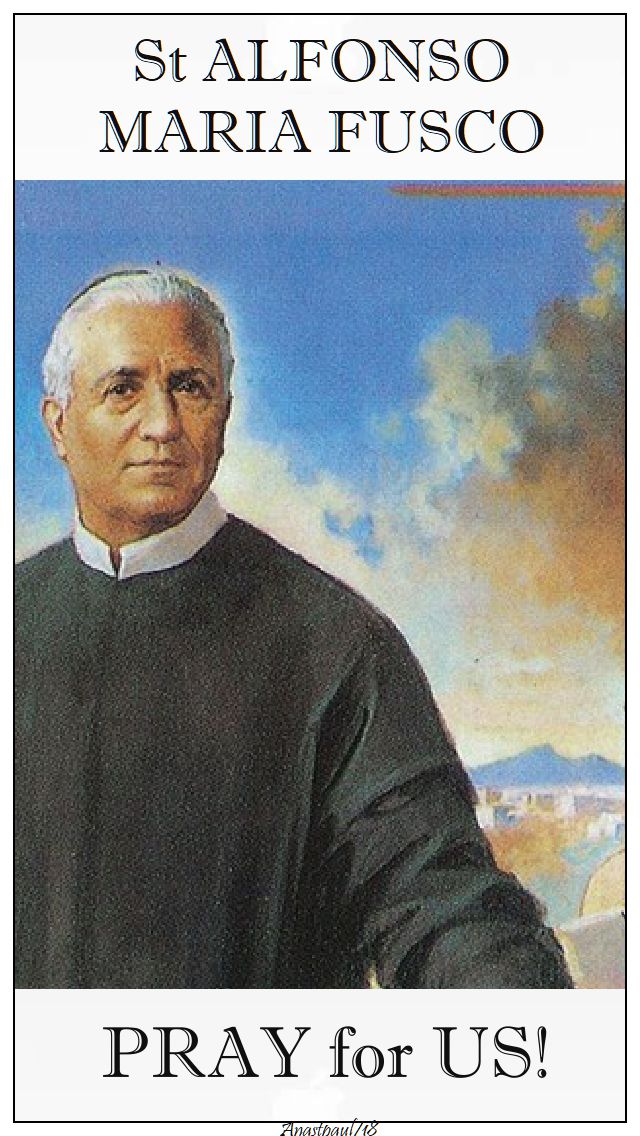
Second Thought for the Day – 6 February – The Memorial of St Alfonso Maria Fusco (1839-1910)
“At the start of today’s celebration, we addressed this prayer to the Lord: “Create in us a generous and steadfast heart, so that we may always serve you with fidelity and purity of spirit” (Collect).
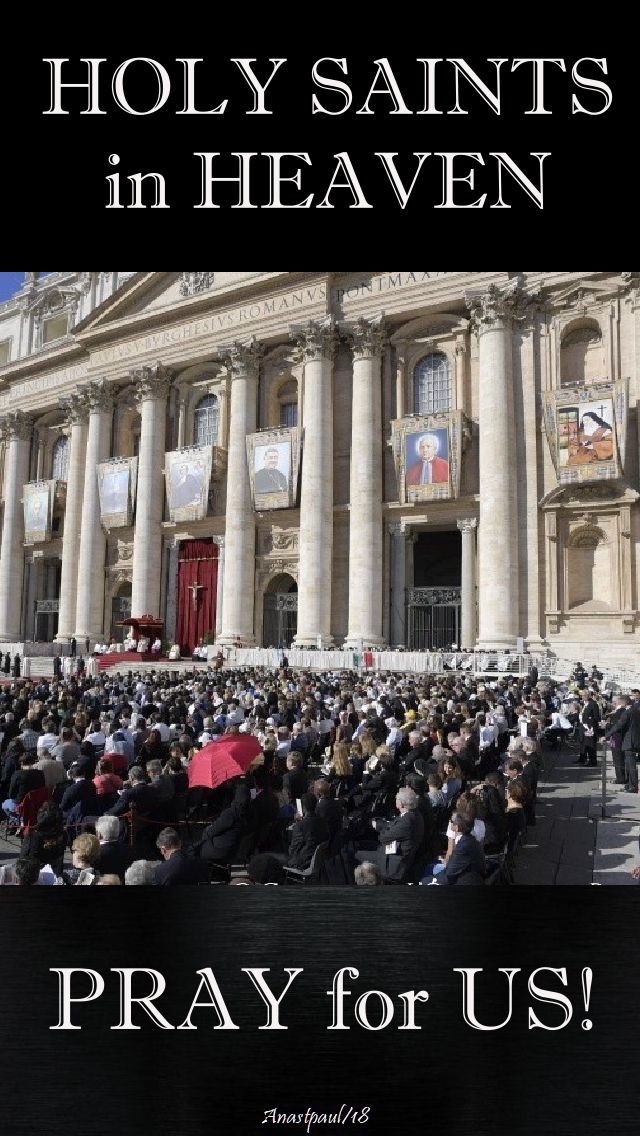
By our own efforts, we cannot give ourselves such a heart. Only God can do this and so in the prayer we ask him to give it to us as his “creation”. In this way, we come to the theme of prayer, which is central to this Sunday’s scriptural readings and challenges all of us who are gathered here for the canonisation of new Saints. The Saints attained the goal. Thanks to prayer, they had a generous and steadfast heart. They prayed mightily, they fought and they were victorious.
The saints are men and women who enter fully into the mystery of prayer. Men and women who struggle with prayer, letting the Holy Spirit pray and struggle in them. They struggle to the very end, with all their strength and they triumph but not by their own efforts: the Lord triumphs in them and with them. The seven witnesses who were canonised today also fought the good fight of faith and love by their prayers. That is why they remained firm in faith, with a generous and steadfast heart. Through their example and their intercession, may God also enable us to be men and women of prayer. May we cry out day and night to God, without losing heart. May we let the Holy Spirit pray in us and may we support one another in prayer, in order to keep our arms raised, until Divine Mercy wins the victory.”
Homily of HH Pope Francis – St Peter’s Square – Sunday 16 October 2016 – HOLY MASS AND CANONISATION OF THE BLESSEDS: Salomon Leclercq, José Sánchez del Río, Manuel González García, Lodovico Pavoni, Alfonso Maria Fusco, José Gabriel del Rosario Brochero, Elisabeth of the Holy Trinity Catez
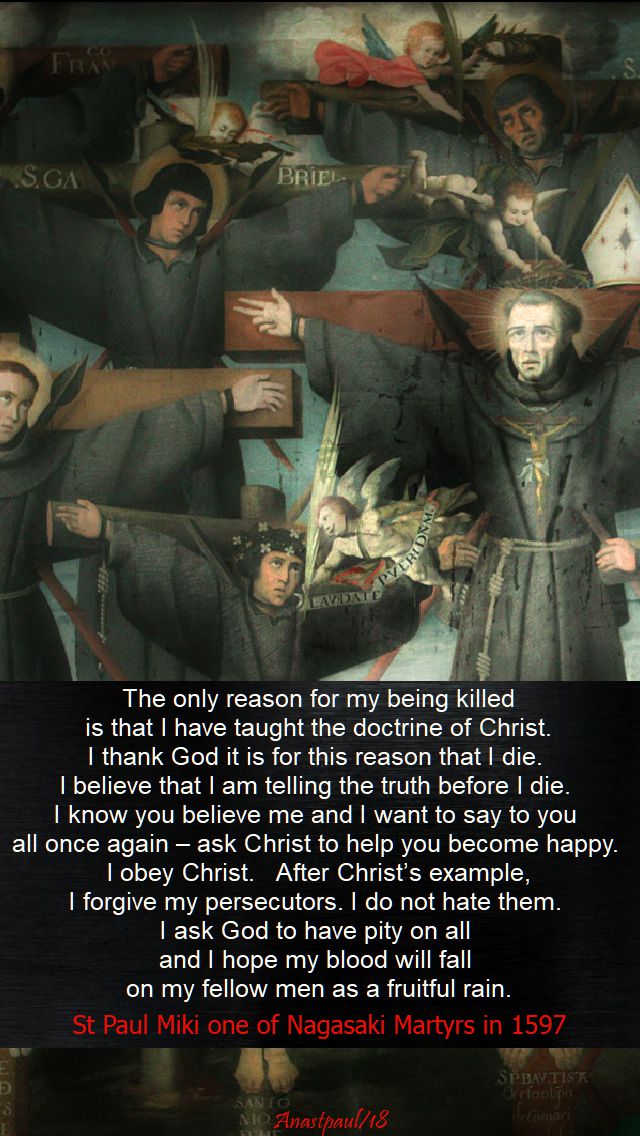
Thought for the Day – 6 February – The Memorial of St Paul Miki S.J. (1564/65-1597) & Companions – 26 Martyrs of Nagasaki
Twenty-six Franciscan and Jesuit missionaries and Japanese converts crucified together by order of Toyotomi Hideyoshi.
Following their arrests, they were taken to the public square of Meako to the city’s principal temple. They each had a piece of their left ear cut off and then paraded from city to city for weeks with a man shouting their crimes and encouraging their abuse. The priests and brothers were accused of preaching the outlawed faith of Christianity, the lay people of supporting and aiding them. They were each repeatedly offered freedom if they would renounce Christianity. They each declined. Today, a new era has come for the Church in Japan. Although the number of Catholics is not large, the Church is respected and has total religious freedom. The spread of Christianity in the Far East is slow and difficult. Faith such as that of the 26 martyrs is needed today as much as in 1597.
These Martyrs died an horrendous and agonising death in witness to their faith in Jesus Christ. We may not be called to make such a sacrifice but we are all called to bear witness to Him, very often this will result in broken ‘friendships’, ostracisation, bad ‘vibes’ around us, loneliness and feelings of being rejected – remember these utterly courageous Martyrs, pray for their intercession and bear your sufferings in silence!
Quote/s of the Day – 6 February – The Memorial of St Paul Miki S.J. (1564/65-1597) & Companions – 26 Martyrs of Nagasaki and St Alfonso Maria Fusco (1839-1910)
“The only reason for my being killed, is that I have taught the doctrine of Christ. I thank God it is for this reason that I die. I believe that I am telling the truth before I die. I know you believe me and I want to say to you all once again – ask Christ to help you become happy. I obey Christ. After Christ’s example, I forgive my persecutors. I do not hate them. I ask God to have pity on all and I hope my blood will fall on my fellow men as a fruitful rain.”
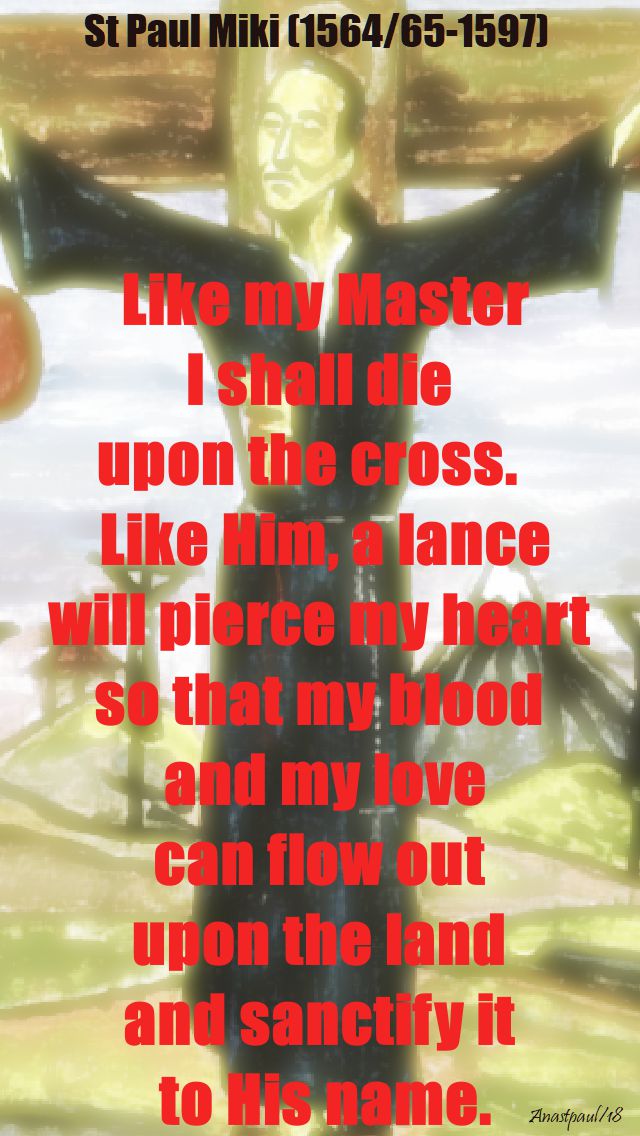
“Like my Master I shall die upon the cross. Like Him, a lance will pierce my heart so that my blood and my love can flow out upon the land and sanctify it to His name.”
St Paul Miki (1564/65-1597)
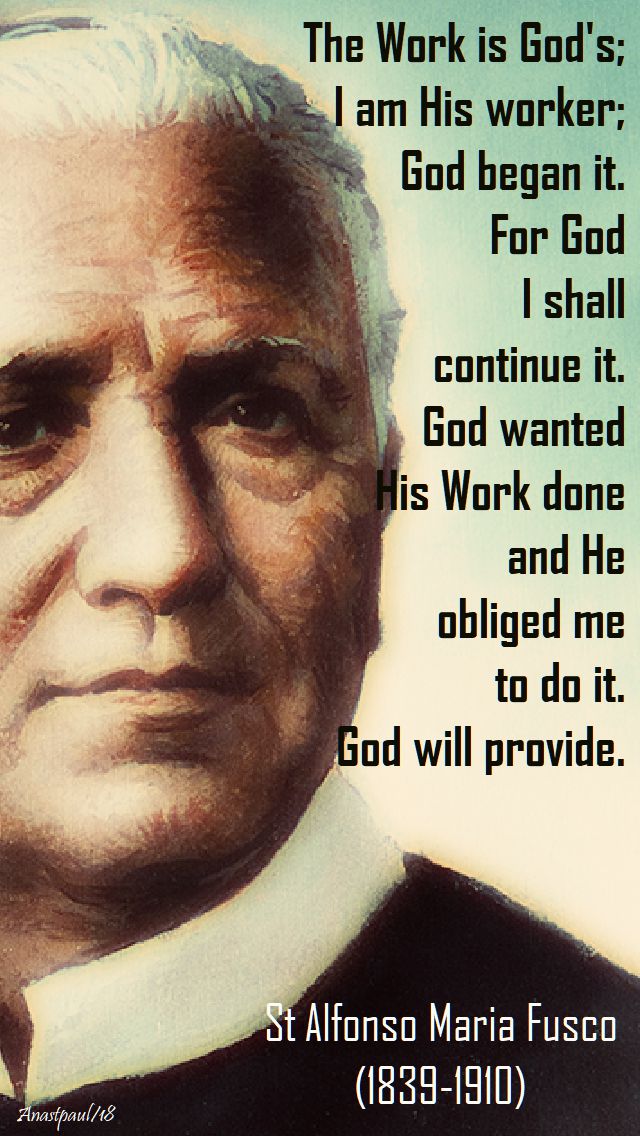
“The Work is God’s; I am His worker; God began it. For God I shall continue it. God wanted this Work done and He obliged me to do it. God will provide.”
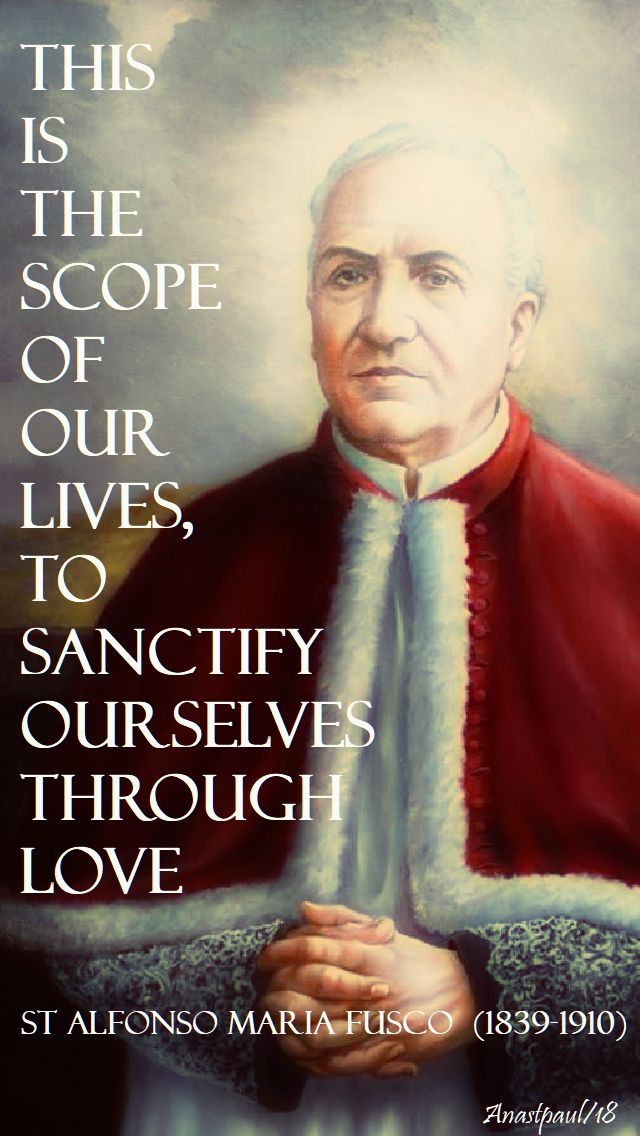
“This is the scope of our lives, to sanctify ourselves through love.”
One Minute Reflection – – 6 February – The Memorial of St Alfonso Maria Fusco (1839-1910)
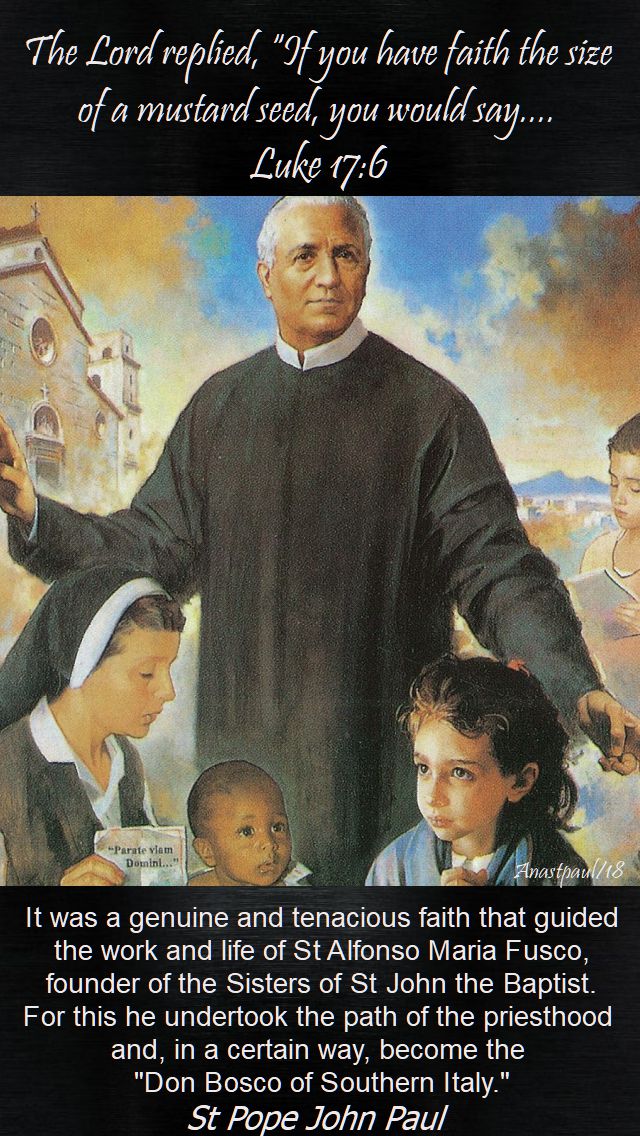
The Lord replied, “If you have faith the size of a mustard seed, you would say to [this] mulberry tree, ‘Be uprooted and planted in the sea’ and it would obey you…Luke 17:6
REFLECTION – “It was a genuine and tenacious faith that guided the work and life of Bl Alfonso Maria Fusco, founder of the Sisters of St John the Baptist. From when he was a young man, the Lord put into his heart the passionate desire to dedicate his life to the service of the neediest, especially of children and young people… For this he undertook the path of the priesthood and, in a certain way, become the “Don Bosco of Southern Italy.” From the beginning, he wanted to involve in his work some young women who shared his ideal and he offered them the words of St John the Baptist, “Prepare the way of the Lord” (Lk 3,4). Trusting in divine Providence, Alfonso and the Sisters of John the Baptist set up a work that was superior to their own expectations. From a simple house for the welcome of the young, there arose a whole Congregation which today is present in 16 countries and on 4 continents working alongside those who are “little” ones and “last”. “…St Pope John Paul – Beatification Homily 7 October 2001
PRAYER – Lord God, source of strength to all the saints, You called St Alfonso and the sisters, to live in total faith, accepting the sufferings and hardships to fulfil Your commandment of love. Let their prayers, help us to keep our faith and total commitment, to the end of our days, so that we may see Your Face and live with all Your saints and angels. Through our Saviour, Your Son, Jesus Christ, one God in unity with the Holy Spirit, amen.
Our Morning Offering – 6 February – The Memorial of St Paul Miki S.J. & Companions – 26 Martyrs of Nagasaki
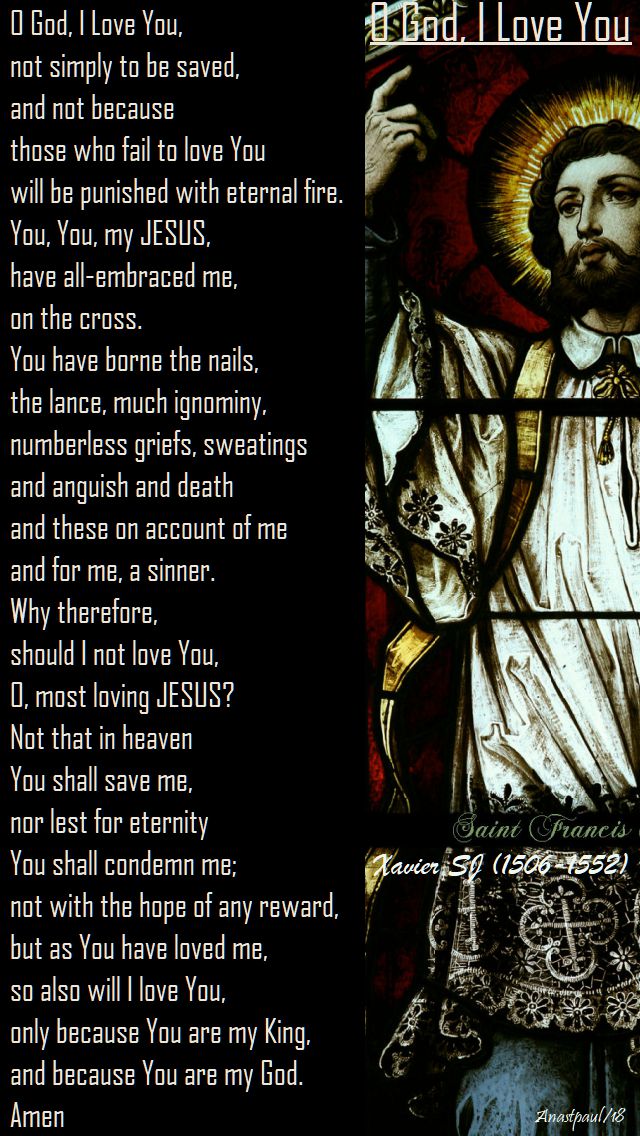
O God, I Love You By St Francis Xavier SJ (1506-1552)
O God, I Love You,
not simply to be saved,
and not because
those who fail to love You
will be punished with eternal fire.
You, You, my JESUS,
have all-embraced me,
on the cross.
You have borne the nails,
the lance, much ignominy,
numberless griefs, sweatings
and anguish and death,
and these on account of me
and for me, a sinner.
Why therefore,
should I not love You,
O, most loving JESUS?
Not that in heaven
You shall save me,
nor lest for eternity
You shall condemn me;
not with the hope of any reward,
but as You have loved me,
so also will I love You,
only because You are my King,
and because You are my God.
Amen
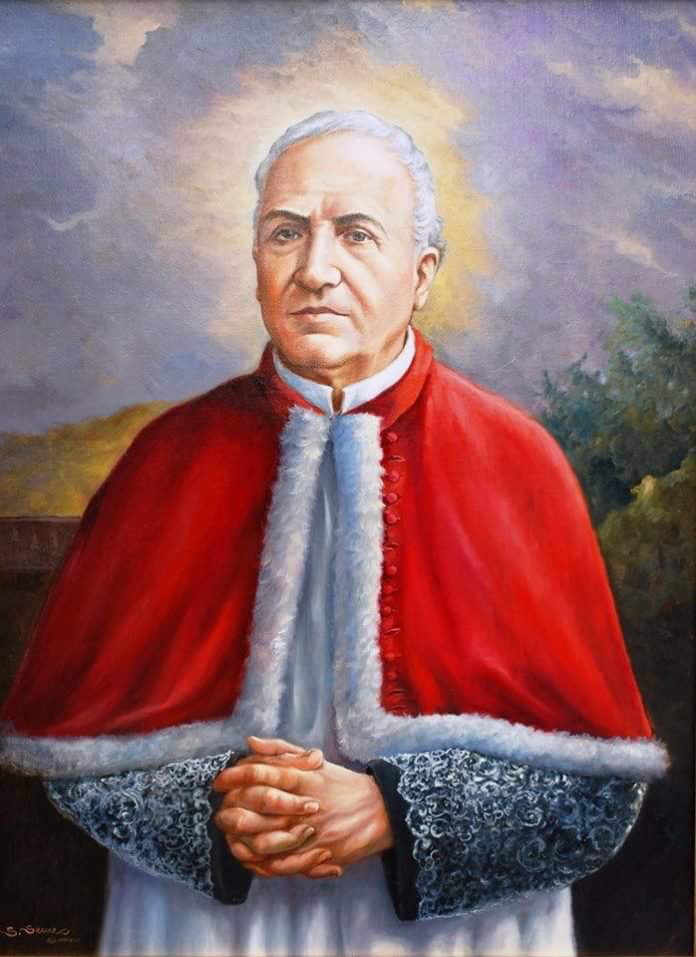
Saint of the Day – 6 February – St Alfonso Maria Fusco (1839-1910) Priest, Founder of the Sisters of Saint John the Baptist – also known as the Baptistine Sisters. Their mission is to evangelise and educate as well as to promote the faith amongst adolescents, with a particular emphasis on those who are poor or abandoned. Patronages – the Baptistine Sisters . He was Beatified by St Pope John Paul on 7 October 2001 and Canonised by Pope Francis on 16 October 2016.
Alfonso Maria Fusco, the oldest of five children, was born on 23 March 1839, in Angri, in the province of Salerno, in the Diocese of Nocera-Sarno. His parents, Aniello Fusco and Josephine Schiavone, were both of peasant stock but were raised from their infancy with strong Christian principles and with a holy fear of God. They were married in the Collegiata of St John the Baptist on 31 January 1834 and for four long years the cradle they had lovingly prepared remained painfully empty. In Pagani, only a short distance from Angri, the relics of St Alfonso Maria de’ Liguori were preserved. It was to his tomb that Aniello and Josephine went in 1838 to pray. While they were there, the Redemptorist, Francesco Saverio Pecorelli told them: “You will have a son; you will name him Alfonso; he will become a priest and will live the life of Blessed Alfonso”.
The little boy quickly revealed a mild, gentle, lovable character, responsive to prayer and to the poor. When he was seven, he received his First Holy Communion and Confirmation. He told his parents when he was eleven that he wanted to become a priest and on 5 November 1850, “freely and with the sole desire to serve God and the Church”, as he himself declared many years later, he entered the episcopal Seminary of Nocera dei Pagani. On 29 May 1863, he was ordained by the Archbishop of Salerno, Monsignor Anthony Salomone, amid the joy of his family and the enthusiasm of the people.
Quickly he distinguished himself among the clergy of the Collegiata of St John the Baptist in Angri for his zeal, his regular attendance at liturgical services and for his diligence in the administration of the sacraments, especially the Sacrament of Reconciliation where he revealed his paternal understanding of his penitents. He devoted himself to the evangelisation of the people through his simple and incisive style of preaching.
The daily life of Father Alfonso was that of a zealous priest but he carried in his heart an old dream. In his last years at the seminary, one night he had dreamed that Jesus the Nazarene was calling him to found an institute of Sisters and an orphanage for boys and girls as soon as he was ordained.
It was a meeting with Maddalena Caputo of Angri, a strong-willed woman aspiring to enter religious life, which impelled Father Alfonso to move more quickly in the foundation of the Institute. On 25 September 1878, Miss Caputo and three other young women met at night in the dilapidated Scarcella house in the Ardinghi district of Angri. The young women wanted to dedicate themselves to their own sanctification through a life of poverty, of union with God and of charity in the care and instruction of poor orphans. The Congregation of the Baptistine Sisters of the Nazarene was thus begun; the seed had fallen into the good earth of the hearts of these four zealous and generous women. Privations, struggles, opposition and trials were their lot but the Lord made that seed grow abundantly. The Scarcella House was quickly named the Little House of Providence.
Other postulants and the first orphans began to arrive and with them the first problems. The Lord, who allows those whom He loves much to suffer much, did not spare the Founder and his daughters. Father Alfonso accepted these trials, at times very difficult ones, demonstrating an absolute conformity to the will of God, an heroic obedience to his superiors and an unbounded trust in Divine Providence.
Father Alfonso did not leave many writings. He loved to speak with the witness of his life. The short statements, rich in evangelical wisdom, which we find in his writings, and the testimony of those who knew him are flashes which illuminate his simple life, his great love for the Eucharist and for the Passion of Jesus and his filial devotion to the Sorrowful Mother. He would often repeat to his Sisters: “Let us become saints, following Jesus closely… Daughters, if you live in poverty, in chastity and in obedience, you will shine like the stars up in the heavens”.
He directed the Institute wisely and prudently. Like a loving father, he watched over the Sisters and the orphans. He showed an almost maternal tenderness for all, especially for the most needy of the orphans. For them there was always space in the Little House of Providence, even when there was a scarcity of food or absolutely nothing. Then Father Alfonso would reassure his worried daughters saying: “Don’t worry, my daughters. I am going to Jesus now and He will worry about us!” And Jesus answered quickly and with great generosity. To him who believes, everything is possible!
At a time when an education was the privilege of the few, denied to the poor and to women, Father Alfonso did not mind sacrificing to give the children a peaceful life, an education and a trade for the older ones so that once they were grown up, they could live as honest citizens and as committed Christians. He wanted the Sisters to begin their studies as soon as possible so that they could teach the poor and, through their instruction and evangelisation, prepare the way for Jesus especially in the hearts of the children and of youth.
His tenacious will, totally anchored in Divine Providence, the wise and prudent collaboration of Maddalena Caputo, known as Sr Crocifissa, who was the first superior of the growing Institute, the ongoing spur of the love of God and neighbour, contributed to the extraordinary development of the work in a very short time. The growing requests for assistance for an ever greater number of orphans and children urged Fr Alfonso to open new houses, first in Campania and then in other regions of Italy.
During the night of 5 February 1910, he felt unwell. He requested and then received the sacraments on the morning of 6 February. After having blessed with trembling hands his own daughters weeping around his bed, he exclaimed: “Lord, I thank you, I have been a useless servant”. Then, turning to the Sisters: “From heaven I will not forget you. I will pray for you always”. And he then slept peacefully in the Lord.
News of his death spread quickly and for that entire Sunday, there was a procession of people crying and saying: “The father of the poor is dead; the saint is dead!”
His witness has been an inspiration of life and a means of grace, especially for his Sisters spread today throughout four continents. On 12 February 12, 1976, Pope Paul VI recognised his heroic virtues; on 7 October 2001, Pope John Paul II, proclaiming him blessed, offers him as an example to priests and a model for everyone of an educator and protector especially to the poor and the needy. (vatican.va)
On 16 October 2016, Pope Francis Canonised St Alfonso, together with Salomon Leclercq, José Sánchez del Río, Manuel González García, Lodovico Pavoni, José Gabriel del Rosario Brochero, Elisabeth of the Holy Trinity Catez
St Paul Miki SJ (1564/65-1597) & Companions/Martyrs of Nagasaki – 26 saints (Memorial)
—
St Alfonso Maria Fusco (1839-1910)
St Amand of Maastricht
St Amand of Moissac
St Amand of Nantes
St Andrew of Elnone
Bl Angelus of Furci
St Antholian of Auvergne
St Brinolfo Algotsson
Cassius of Auvergne
Bl Diego de Azevedo
St Dorothy of Caesarea
St Ethelburga of Wessex
Bl Francesca of Gubbio
St Francesco Spinelli
St Gerald of Ostia
St Guarinus
St Guethenoc
St Hildegund
St Ina of Wessex
St Jacut
St Liminius of Auvergne
Bl Mary Teresa Bonzel
St Mateo Correa-Magallanes
St Maximus of Aurvergne
St Mel of Ardagh
St Melchu of Armagh
St Mun of Lough Ree
St Relindis of Eyck
St Revocata
St Saturninus
St Tanco of Werden
St Theophilus
St Theophilus the Lawyer
St Vaast of Arras
St Victorinus of Auvergne
—
Martyrs of Emesa:
St Luke the Deacon
St Mucius the Lector
St Silvanus of Emesa
Thought for the Day – 5 February – The Memorial of St Agatha (c 231- c 251)
Female saints were numerous in the early Church and the cruelties these saints suffered for their faith encouraged many others to go to their martyrdom. These early witnesses to the faith became the great Christian heroes and heroines and their zeal did a great deal to cement and establish the faith. Many. like St Agatha, suffered centuries ago but their memory is kept fresh, as if they had died yesterday. As is common in the story of man, we learn not from our past, persecutions against Christians seems to constantly rear it’s ugly head – now we suffer too and our women are under a great attack in the modern world. Let us call on Agatha to be with us, to pray for us all and in particular to pray that all Christian women, may protect their purity and chastity.
St Agatha, pray for us!
The incorrupt body of St Agatha was transferred to Constantinople in the 11th century and then returned to Catania. The body is now preserved in different reliquaries. “The arms, legs, and breasts are preserved in a glass case in an incorrupt condition, although rather dried and dark after more than 17 centuries. The skull and principal relics are at Catania, enclosed in an effigy on which rests a costly jeweled crown. The reliquary consists of the figure of the Saint from the head to the waist and is situated in an upright position. The figure is entirely covered with precious gems, rings, bracelets, pins, chains, and jeweled flowers and crosses…”
Quote/s of the Day – 5 February – The Memorial of St Agatha (c 231- c 251)
Jesus Christ, Lord of all things! You see my heart, You know my desires. Possess all that I am – You alone. I am Your sheep. Make me worthy to overcome the devil.
Lord, my Creator, You have protected me since I was in the cradle. You have taken me from the love of the world and given me patience to suffer. Now receive my spirit.
St Agatha (c 231- c 251)
“She teaches by her example, to hasten to the true Good – God alone.”
St Methodius of Sicily (c 788-c 847)
from a homily on St Agatha






















You must be logged in to post a comment.