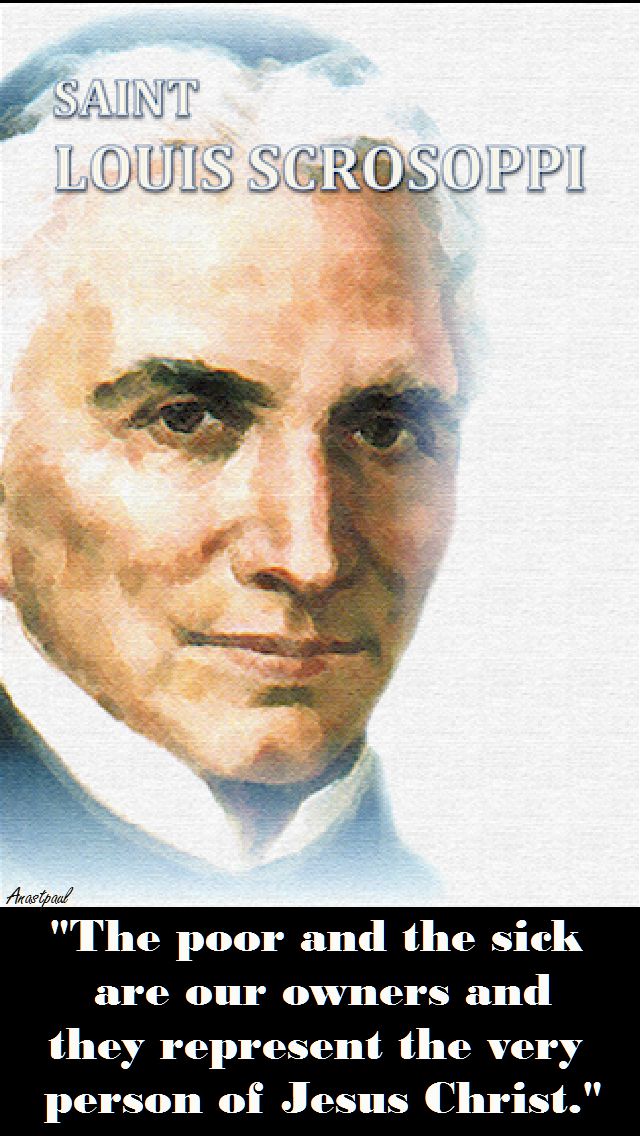
Gradually Father Luigi took on the fundamental traits of a spiritual life centred on Jesus Christ, loved and imitated in the humility and poverty of His incarnation in Bethlehem, in the simplicity of His working life at Nazareth, in His total immolation on the cross on Calvary and in the silence of the Eucharist. And since Jesus had said: “Whatever you did to one of the least of these my brethren you did it to me”, it is to them that every day Father Luigi devoted his life with the practical commitment to “seek first the kingdom of God and his justice” convinced that all the rest will be given according to the gospel promise. All the works he set in motion during his life reflect this preferential option for the poorest, the lowliest, the abandoned.
The more we read of the Saints, the more we know the answer without any doubt. For it has been given to us by God Himself, “whatever you do unto the least of these my brethren you did it to me.” (Matthew 25:45) So why on earth do we keep asking the same questions?
“At the evening of life, we shall be judged on our love” (CCC 1022; by St. John of the Cross)”
I am not seekng my own will but the will of him who sent me…………….John 5:30
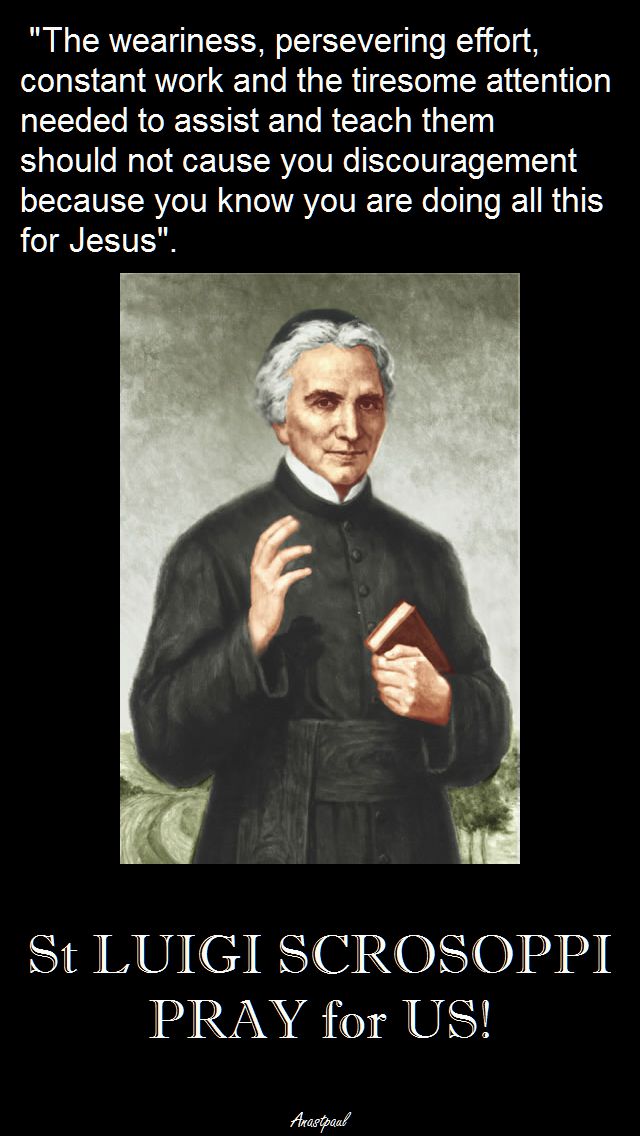
REFLECTION – “The weariness, persevering effort, constant work
and the tiresome attention needed to assist
and teach them should not cause you discouragement
because you know you are doing all this for Jesus”.
PRAYER – Heavenly Father, let me strive – through constant prayer and careful reflection to know Your will for me. Then help me Lord to offer You what You desire rather than what I want. Let me love You first and above all and then my neighbour as myself. St Luigi Scrosoppi, pray for us, amen.
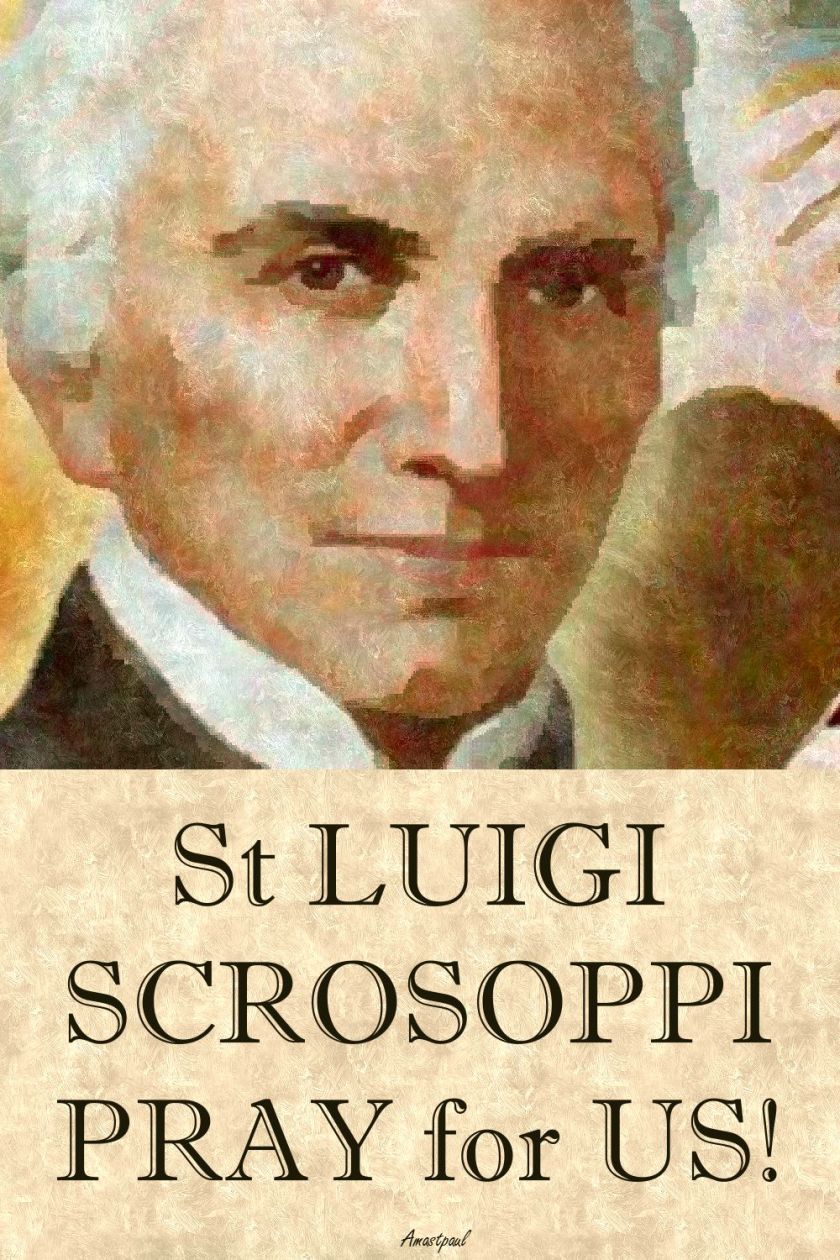
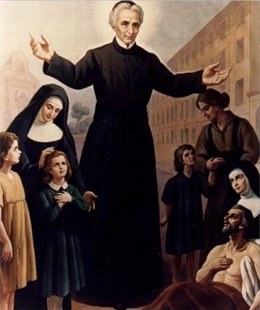
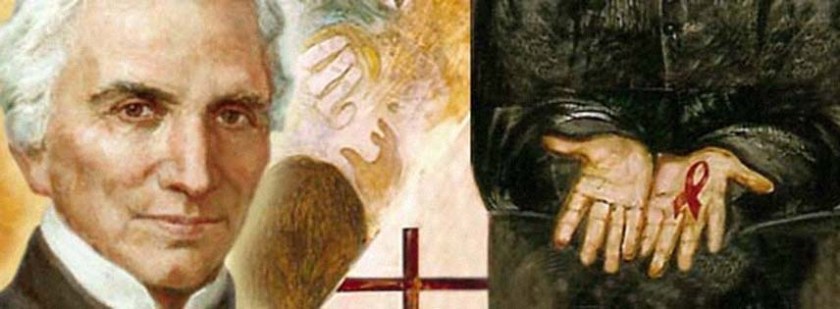
Saint of the Day – 3 April – St Luigi Scrosoppi C.O. (1804-1884 died aged 79) – Priest, Founder, Apostle of Charity – Patron of Sisters of Providence of Saint Cajetan of Thiene, footballers and Aids sufferers.
Luigi Scrosoppi (1804-84) spent much of his life fighting anti-clericalism in Italy and brought comfort to the poor. The son of a jeweller, Aloysius Scrosoppi – always known as Luigi – was born in Udine, in northeast Italy. His family was extremely devout, and his two elder brothers, Carlo and Giovanni, were ordained before him.
Luigi grew up during with famine, typhus and smallpox endemic. Even as a boy he felt the obligation to provide relief, inspired by Matthew 25:40: “Inasmuch as you have done it unto one of the least of these my brethren, you have done it unto me.” At 25, the year before he was ordained, Luigi joined a group of priests and young teachers dedicated to educating poor and abandoned girls, both in the town of Udine and in the surrounding countryside.
He gave himself tirelessly to fundraising and was soon running an organisation which accommodated over 300 students in a building which became known as the House of the Destitute. Scrosoppi, however, was not inclined to take any credit. “The Providence of God,” he wrote, “who prepares minds and hearts to undertake his works, was alone the founder of this Institute.”
He gathered together a team of young women to teach sewing and embroidery. Nine of them decided to mark their dedication more formally and in 1837, under Luigi Scrosoppi’s direction, constituted themselves the Sisters of Providence. The congregation received official recognition from Pope Pius IX in 1871.
In 1846, aged 42, Luigi Scrosoppi, joined the Congregation of the Oratory in Udine and redoubled his work for the Sisters of Providence, promising to found 12 houses for them before he died. This target he achieved and also opened a school for deaf-mute girls. In the 1860s the anti-clerical policies of the government in the Udine region forced the Oratory to close. But Luigi Scrosoppi’s determination and practical support enabled the Sisters of Providence to carry on their work.
Now an old man, but with his habitual openness of spirit, he understood that the time had come to hand over the reins to the Sisters, and this he did with tranquility and hope. At the same time he maintained contact with them all through his letters in which he strengthened the ties of affection and love, and in his paternal concern never tired of recommending community spirit and trust.
Through his deep union with God and his experience over many years Father Luigi had acquired a special spiritual wisdom and intuition which enabled him to read hearts: sometimes he even revealed the gift of knowledge about secret inner thoughts and situations which were known only to the person concerned.
At the end of 1883, as his strength began to decline, he was forced to give up all work, and he constantly suffered from a high fever. The illness took its inexorable course. He refold the Sisters not to be afraid “because it was God who raised up their religious family and made it grow and He it is who will see to its future”.
When he knew the end was near, he wished to greet everyone. So he wrote his last words to the Sisters: “After my death, your Congregation will have many troubles but afterwards it will have a new life. Charity! Charity! This is the spirit of your religious family: to save souls and to save them with Charity”.
During the night of Thursday, the 3rd of April 1884, he finally went to meet Jesus. The whole of Udine and the people of the surrounding countryside hastened to see him one last time and to beg his protection from heaven.
Through his efforts on behalf of the little ones, of the poor, of young people in difficulty, of those who are suffering, of all those living in trying circumstances, Father Luigi still continues today to show everyone the path of union with God, of compassion and of love, and is still ready to accompany the steps of those who entrust themselves to the Providence of God.
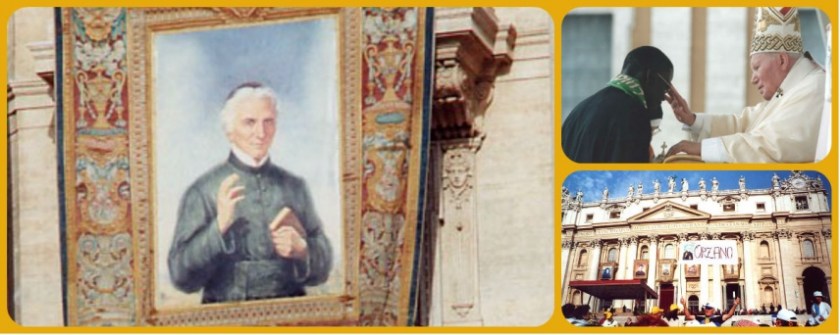
St. Luigi Scrosoppi was canonised on June 10, 2001 – It was at the intercession of St Luigi that a Zambian man, now Fr Peter Changu Shitima, was miraculously cured of AIDS in 1996. He was at that time a member of the Oratory at Oudtshoorn, near Cape Town in South Africa and it was to a member of St Philip’s family that his friends turned for help. Read the full story here https://zenit.org/articles/the-aids-miracle-that-led-to-a-canonization/
and here is Fr Shitima at St Luigi’s Canonisation.
Nine years later, he was named as patron saint of footballers (soccer players) by Bishop Alois Schwarz. Today his name is invoked by sufferers from Aids.
Bl Alexandrina di Letto
St Attala of Taormina
St Benignus of Tomi
St Burgundofara
St Chrestus
St Evagrius of Tomi
Bl Francisco Solís Pedrajas
Bl Gandulphus of Binasco
Bl Iacobus Won Si-bo
Bl John of Penna
St Joseph the Hymnographer
Bl Juan Otazua Madariaga
Bl Lawrence Pak Chwi-deuk
St Luigi Scrosoppi of Udine
Bl Maria Teresa Casini
St Nicetas of Medicion
Bl Piotr Edward Dankowski
St Richard of Chichester
Bl Robert Middleton
Bl Stephen Rowsham
Bl Thurstan Hunt
St Vulpian of Tyre
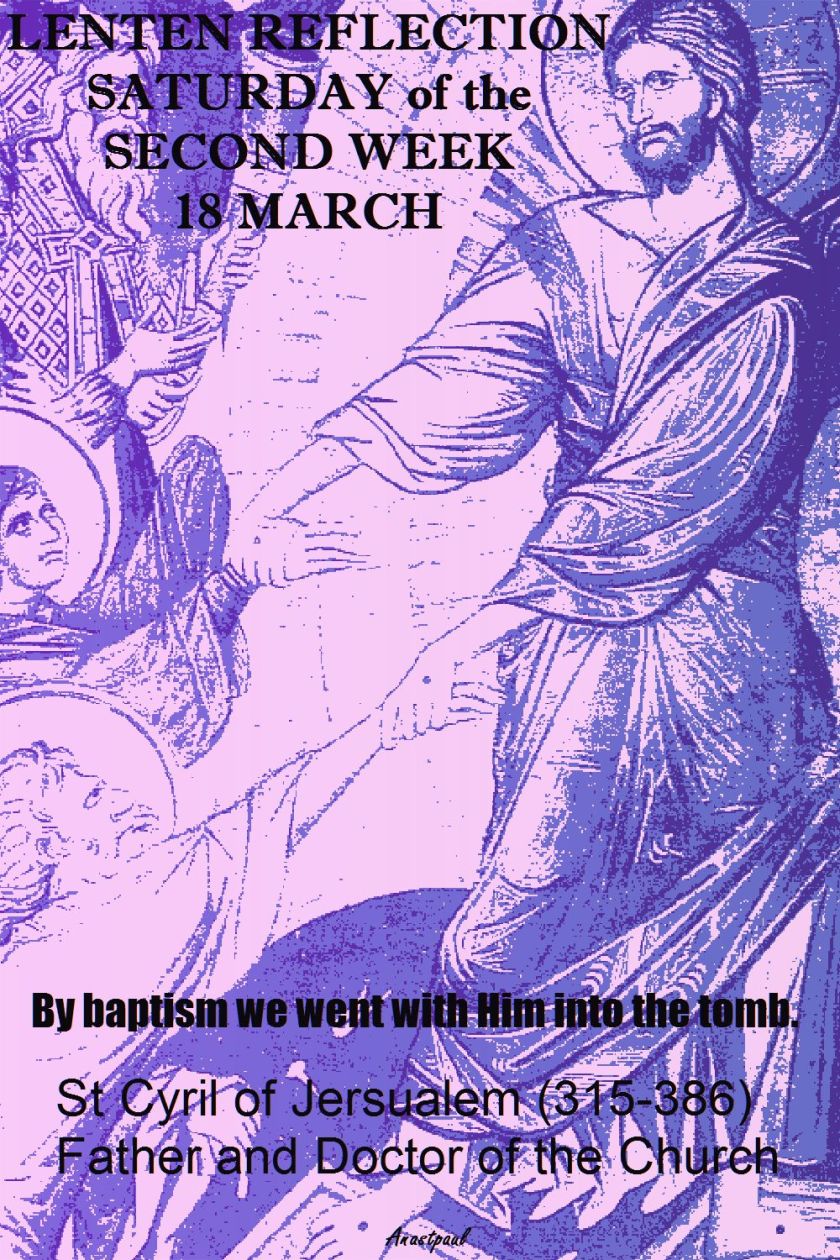
LENTEN REFLECTION – The Second Week- Saturday 18 March
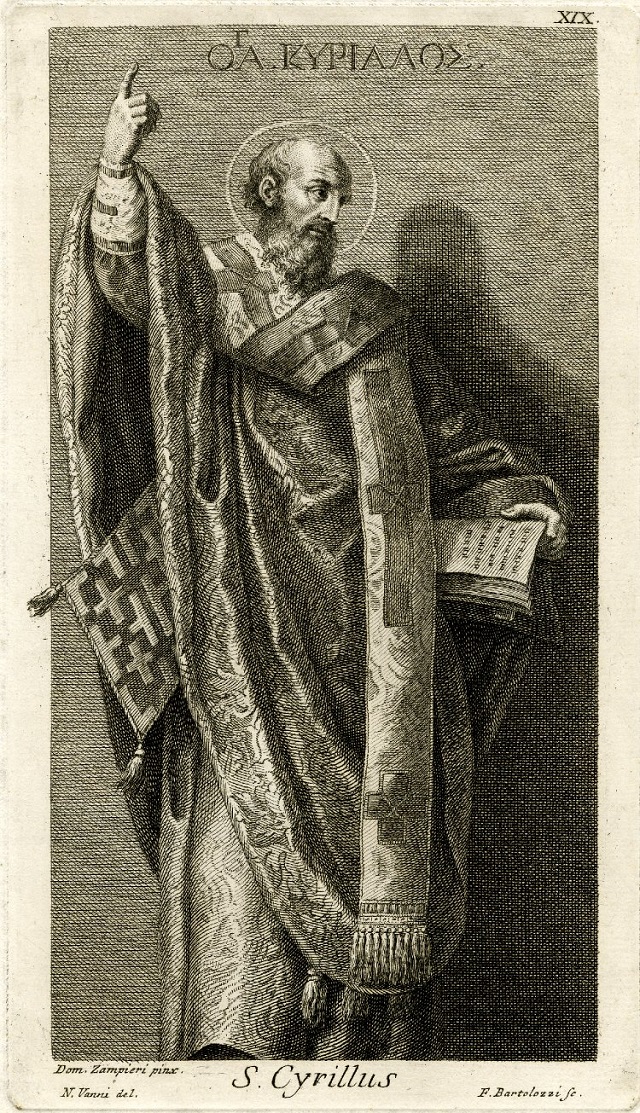
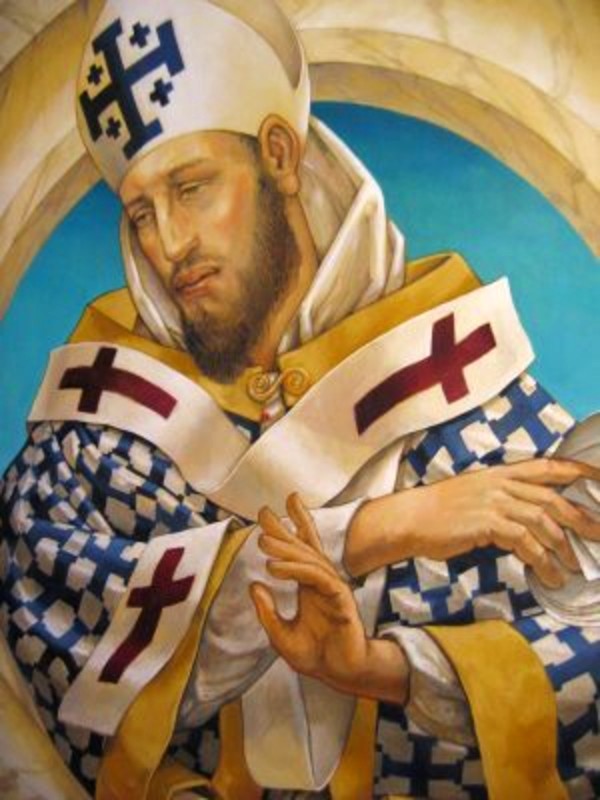
St Cyril of Jerusalem, (315-386)
Father and Doctor of the Church
The symbolic meaning of the sacrament of baptism as sharing in Christ’s passion according to Cyril of Jerusalem, Bishop of Jerusalem in the middle of the fourth century and one of the most important sources we have for how the church celebrated the sacraments during that era. In his Jerusalem Catechesis from which this excerpt comes, St. Cyril instructs new Christians in the days immediately before and after their initiation into the life of the Church at the Easter Vigil.
You were led down to the font of holy baptism just as Christ was taken down from the cross and placed in the tomb which is before your eyes. Each of you was asked, “Do you believe in the name of the Father, and of the Son and of the Holy Spirit?” You made the profession of faith that brings salvation, you were plunged into the water and three times you rose again. This symbolized the three days Christ spent in the tomb.
As our Saviour spent three days and three nights in the depths of the earth, so your first rising from the water represented the first day and your first immersion represented the first night. At night a man cannot see but in the day he walks in the light. So when you were immersed in the water it was like night for you and you could not see but when you rose again it was like coming into broad daylight. In the same instant you died and were born again; the saving water was both your tomb and your mother.
Solomon’s phrase in another context is very apposite here. He spoke of a time to give birth and a time to die. For you, however, it was the reverse: a time to die and a time to be born, although in fact both events took place at the same time and your birth was simultaneous with your death.
This is something amazing and unheard of! It was not we who actually died, were buried and rose again. We only did these things symbolically but we have been saved in actual fact. It is Christ who was crucified, who was buried and who rose again and all this has been attributed to us. We share in His sufferings symbolically and gain salvation in reality. What boundless love for men! Christ’s undefiled hands were pierced by the nails; he suffered the pain. I experience no pain, no anguish, yet by the share that I have in his sufferings he freely grants me salvation.
Let no one imagine that baptism consists only in the forgiveness of sins and in the grace of adoption. Our baptism is not like the baptism of John, which conferred only the forgiveness of sins. We know perfectly well that baptism, besides washing away our sins and bringing us the gift of the Holy Spirit, is a symbol of the sufferings of Christ. This is why Paul exclaims: Do you not know that when we were baptised into Christ Jesus we were, by that very action, sharing in his death? By baptism we went with him into the tomb.
These words of St. Cyril of Jerusalem on the symbolic meaning of the sacrament of baptism, a symbol of Christ’s passion, are read in the Roman Catholic liturgy’s Office of Readings on the Thursday in the Octave of Easter (Cat. 21 Mystagogica 3, 1-3 PG 33. 1087-1091) with the accompanying biblical reading of I Peter 3:1-17.
In times of great turmoil and controversy, it is difficult sometimes to know what is true and what is right and sometimes we have to grope our way along. We have to follow the truth and give it our full loyalty, at whatever cost. Sometimes that will mean that we are a majority of one. That is what truth demands of us! Those who imagine that the lives of saints are simple and placid, untouched by the vulgar breath of controversy, are rudely shocked by history. Yet, it should be no surprise that saints, indeed all Christians, will experience the same difficulties as their Master. The definition of truth is an endless, complex pursuit, and good men and women have suffered the pain of both controversy and error. Intellectual, emotional and political roadblocks may slow up people like Cyril for a time. But their lives taken as a whole are monuments to honesty and courage.
During this Lenten season, we reflect upon our beliefs and as Easter approaches, we renew our baptismal vows, using the words that Saint Cyril used.
Is our faith strong enough to endure accusation and exile?
How can we commit ourselves more fully to our Lord, our Church and our Creed?
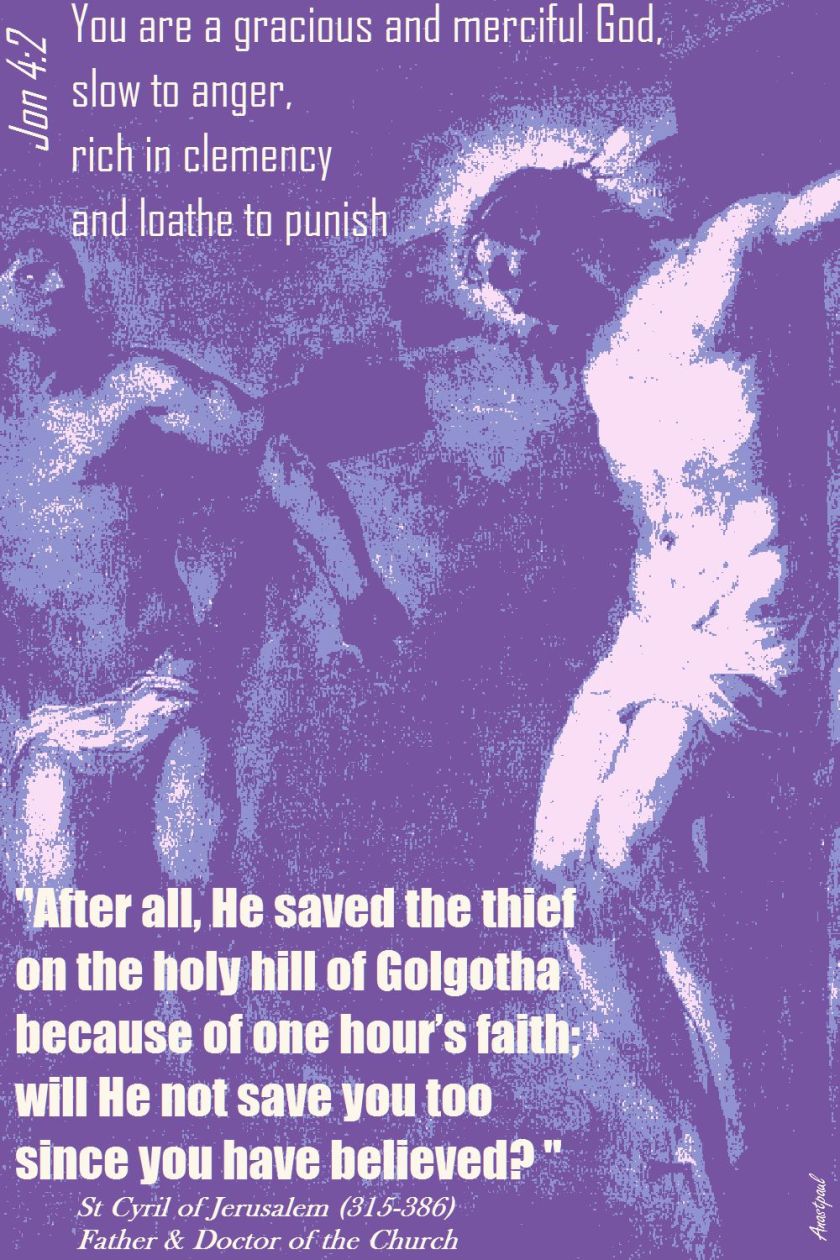
You are a gracious and merciful God, slow to anger, rich in clemency and loathe to punish……….Jon 4:2
REFLECTION – “How great is God’s love for men! Some good men have been found pleasing to God because of years of work. What they achieved by working for many hours at a task pleasing to God is freely given to you by Jesus in one short hour. For if you believe that Jesus Christ is Lord and that God raised Him from the dead, you will be saved and taken up to paradise by Him, just as He brought the thief there. Do not doubt that this is possible. After all, He saved the thief on the holy hill of Golgotha because of one hour’s faith; will He not save you too since you have believed? “………… St Cyril of Jersualem (315-386) Father and Doctor of the Church
PRAYER – Merciful Lord, come to my aid quickly in time of despair! Let me rely on the infinite merits of Your suffering Son, Who died for me. St Cyril pray for us all that we may always remain true to the Cross of Christ and our Holy Mother Church, amen.
Saint of the Day – 18 March – St Cyril of Jerusalem (315-387) aged 75 Bishop, Confessor and Father & Doctor of the Church, Theologian, Writer, Preacher, Catechist.
Little is known of his life before he became a bishop. According to Butler, Cyril was born at or near the city of Jerusalem, and was apparently well-read in both the Church fathers and the pagan philosophers. Cyril was ordained a deacon by Bishop St Macarius of Jerusalem in about 335 and a priest some eight years later by Bishop St. Maximus. About the end of 350 he succeeded St Maximus in the See of Jerusalem. It is not until his exile, historically recorded, that the event of his life are made clear. During a great depression, Cyril was accused of selling church property to feed the poor and thus exiled. Theologians and historians agree that his exile had less to do with service to the poor, and more to do with differences in doctrine, failure to conform to the Arian teachings and continued preaching of the Nicene doctrine. The Nicene Creed, which we still recite today, is believed to have had its origins in the teachings of Saint Cyril – as per his writings:
“I believe in one God, the Father Almighty, Creator of Heaven and earth and of all things visible and invisible. And in one Lord Jesus Christ, the only-begotten Son of God, begotten by the Father true God before all ages, God of God, Life of Life, Light of Light, by Whom all things were made. Who for us men and for our salvation came down, and was incarnate by the Holy Ghost and the Virgin Mary, and was made man. He was crucified and buried. He rose again on the third day according to the Scriptures, and sat at the right hand of the Father. And He cometh in glory to judge the living and the dead, whose kingdom shall have no end. And in one Holy Ghost, the Paraclete, Who spake by the prophets; and in one baptism of repentance for the remission of sins, and in one holy Catholic Church and in the resurrection of the body, and in life everlasting.”
Saint Cyril is known for his catechetical writings, including twenty-three homilies he delivered to those preparing for baptism during Lent and then mystagogical reflections for the week after Easter. In these writings, Cyril clearly outlines the liturgy of the Mass used at that time, including elements we continue celebrating today. Saint Cyril states a fairly strong doctrine of the Eucharist both in symbolic and realistic terms, addressing transubstantiation of elements and proclaiming the bread and wine received to be the actual body and blood of Christ. He affirms the true authority of the one Catholic Church, and provides instructions to the newly welcomed regarding how to receive the Holy Eucharist.
Saint Cyril of Jerusalem lived in a time of great strife and conflict within the Church, a time of heresy, faction and political influence which questioned the Divinity of Jesus Christ (known as Arianism). Saint Cyril, a man of peaceful and conciliatory temperament, opposed this movement, aligning himself with those true to Christ and teaching Nicene doctrine.
For this, he suffered exile multiple times, due to the power and political connections of the Arians at that time. He finally returned to find Jerusalem torn with heresy, schism and strife, and wracked with crime. Even Saint Gregory of Nyssa, who was sent to help, left in despair.
They both went to the Council of Constantinople, where the amended form of the Nicene Creed was promulgated in 381. Cyril accepted the word consubstantial – that is, Christ is of the same substance or nature as the Father. Some said it was an act of repentance but the Bishops of the Council praised him as a champion of orthodoxy against the Arians.
Following the eventual acceptance of the Nicene Doctrine, Cyril served the Church with jurisdiction over all of Jerusalem for the last five years of his life. Ten years after Cyril’s death, the Abbess, Lady Etheria, made a pilgrimage to the Holy Land and wrote that she found a peaceful Christian community. This was the result of the efforts of Bishop Cyril, who suffered to heal the wounds that Arianism had inflicted on the Church.
St Cyril of Jerusalem (Optional Memorial)
—
Bl Aimée-Adèle le Bouteiller
St Alexander of Jerusalem
St Anselm of Lucca the Younger
St Braulio of Saragossa
Bl Celestine of the Mother of God
Bl Christian O’Conarchy
St Edward the Martyr
St Egbert of Ripon
St Eucarpius of Nicomedia
St Felix of Gerona
St Finan of Aberdeen
St Frigidian of Lucca
Bl John Thules
St Leobard of Tours
St Narcissus of Gerona
Bl Roger Wrenno
St Salvator of Horta
St Trophimus of Nicomedia
—
Martyrs of Nicomedia – Commemorates the Christians who were martyred anonymously, either singly and in small groups, by local pagans in the area of Nicomedia prior to the year 300 and who may have been over-looked in the waves of Diocletian persecutions that resulted in the deaths of thousands.
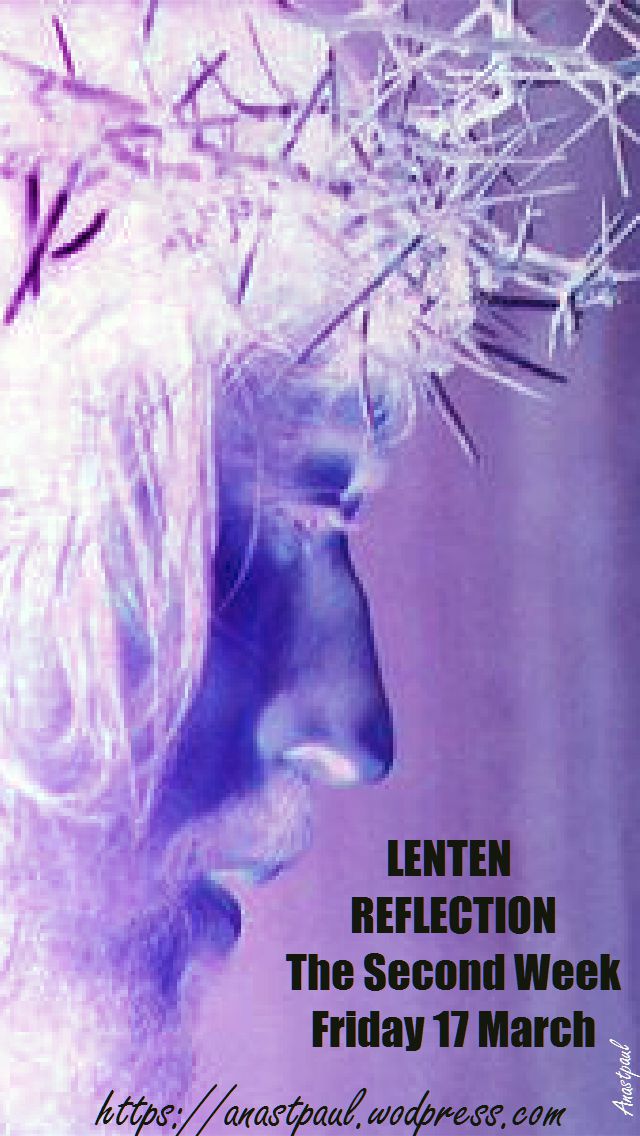
LENTEN REFLECTION – The Second Week- Friday 17 March
On the Memorial of St Patrick, there can be few better reflections than the complete Prayer/Hymn of the Breastplate. St. Patrick came to Ireland and showed all of them the way to the truth of God. He preached the Good News of God to them and called them to repent their past sins and wickedness. St. Patrick taught them the truth about God, including what is now famous as his symbol of the Holy Trinity, the three-leaf clover. He taught them how God is a perfect and loving union of three Divine Persons, of Father, Son and Holy Spirit, as inseparable as the three-leaf clover’s parts from each other.
And God Who is perfect in Love, and Who is indeed Love, wants to share that love with all of us His people. That is exactly why He has given us His commandments, His laws and ways and Jesus His Son to be our salvation from the darkness, by bringing us into the light of His new world and life filled with love and grace, no longer with greed, evil, wickedness, ego and all other human ambitions and vileness.
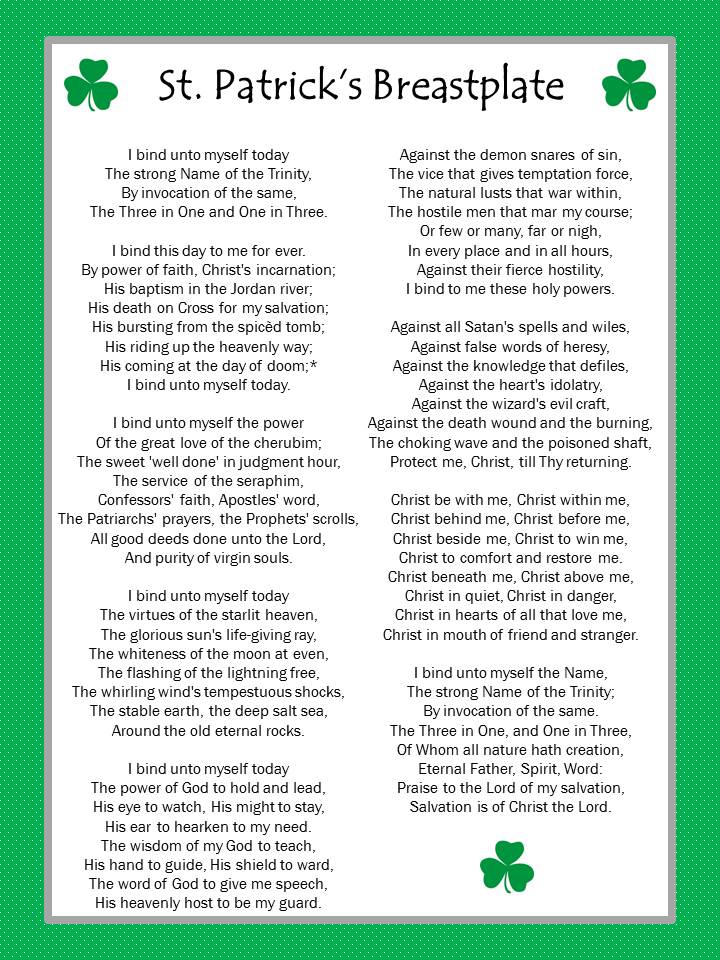
St. Patrick’s Breastplate (also known as The Deer Cry-see the reason below)
St. Patrick of Ireland, 387-460 AD
(translation by Cecil Frances Alexander)
This Celtic hymn, which dates from the late seventh or early eighth century, is ascribed to St. Patrick. It reflects many of the themes found in Patrick’s thought. It is believed that Patrick wrote this hymn as a breastplate of faith for the protection of body and soul against all forms of evil – devils, vice and the evil which humans perpetrate against one another. Legend has it that the High King of Tara, Loeguire, on Holy Saturday 433 AD, resolved to ambush and kill Patrick and his monks to prevent them from spreading the Christian faith in his kingdom. As Patrick and his followers approached singing this hymn, the king and his men saw only a herd of wild deer and let them pass by. This hymn is both a prayer and statement of faith to be recited for protection, arming oneself for spiritual battle, leading us all to reflect upon the power of God in our lives, the strength of His protection and the way we are go on towards our heavenly home.
I bind unto myself today
the strong name of the Trinity,
by invocation of the same,
the Three in One and One in Three.
I bind this day to me forever,
by power of faith, Christ’s incarnation;
his baptism in the Jordan River;
his death on cross for my salvation;
his bursting from the spiced tomb;
his riding up the heavenly way;
his coming at the day of doom:
I bind unto myself today.
I bind unto myself the power
of the great love of cherubim;
the sweet “Well done” in judgment hour;
the service of the seraphim;
confessors’ faith, apostles’ word,
the patriarchs’ prayers, the prophets’ scrolls;
all good deeds done unto the Lord,
and purity of virgin souls.
I bind unto myself today
the virtues of the starlit heaven,
the glorious sun’s life-giving ray,
the whiteness of the moon at even,
the flashing of the lightning free,
the whirling wind’s tempestuous shocks,
the stable earth, the deep salt sea,
around the old eternal rocks.
I bind unto myself today
the power of God to hold and lead,
his eye to watch, his might to stay,
his ear to hearken to my need;
the wisdom of my God to teach,
his hand to guide, his shield to ward;
the word of God to give me speech,
his heavenly host to be my guard.
[Against the demon snares of sin,
the vice that gives temptation force,
the natural lusts that war within,
the hostile men that mar my course;
of few or many, far or nigh,
in every place, and in all hours
against their fierce hostility,
I bind to me these holy powers.
Against all Satan’s spells and wiles,
against false words of heresy,
against the knowledge that defiles
against the heart’s idolatry,
against the wizard’s evil craft,
against the death-wound and the burning
the choking wave and poisoned shaft,
protect me, Christ, till thy returning.]
Christ be with me, Christ within me,
Christ behind me, Christ before me,
Christ beside me, Christ to win,
Christ to comfort and restore me,
Christ beneath me, Christ above me,
Christ in quiet, Christ in danger,
Christ in hearts of all that love me,
Christ in mouth of friend and stranger.
I bind unto myself the name,
the strong name of the Trinity,
by invocation of the same,
the Three in One, and One in Three,
of whom all nature hath creation,
Eternal Father, Spirit, Word.
Praise to the Lord of my salvation:
Salvation is of Christ the Lord.
The amazing influence of one man! How do you teach a classroom that’s as big as a whole country? How do you teach a whole country about God? St. Patrick’s classroom was the whole country of Ireland and his lesson was the good news of Jesus Christ. ow in the world did he do it? Well, it was only possible because he depended totally on God. But letting God give him strength and direction didn’t always come naturally to St. Patrick. That was a lesson the Lord had to teach him. And he didn’t get to learn it from understanding, gentle teachers in a comfortable classroom. He learned it from a band of thieving, roving pirates. But when he learned he learned it perfectly and he became the most wondrously hardworking, untiring apostle for Christ. When one considers the state of Ireland when he began his mission work, the vast extent of his labours and how the seeds he planted which continued to grow and flourish – making Ireland one of the greatest Catholic countries in history, which itself proceeded to evangelise the whole world, one can only admire the kind of man Patrick must have been. We have no way of knowing the fruits of our own lives or how many people our lives may touch. And this is power of holiness – it endures forever!
“I pray that those who believe in God and who read this confession, which I, Patrick, an unlearned sinner have written in Ireland, may recogniSe that whatever I achieved or taught that was pleasing to God, was done so by the gift of God. This is my confession before I die.”
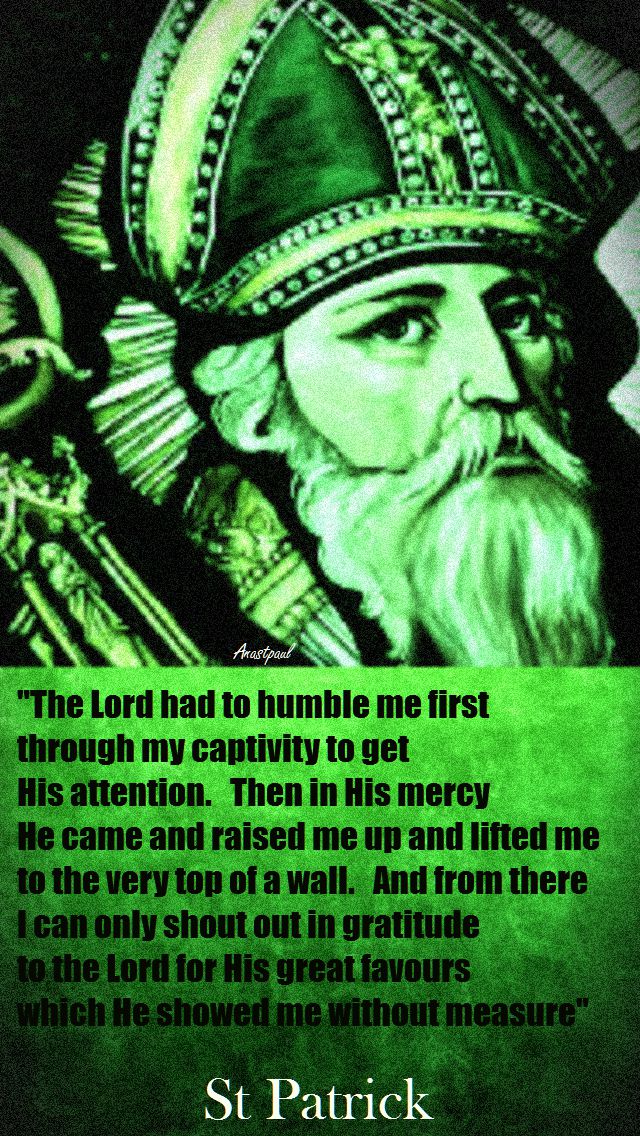
“The Lord had to humble me first through my captivity to get his attention. Then in His mercy He came and raised me up and lifted me to the very top of a wall. And from there I can only shout out in gratitude to the Lord for His great favours which He showed me without measure”
“Whether you be great or small, learned or simple, listen and consider how God summoned me, a fool and a wretch in this world, to serve Him with reverence, faith and humility. It was the love of Christ that inspired me to give my life in service to this people.”
“I came to the Irish people to preach the Gospel and endure the taunts of unbelievers, putting up with reproaches about my earthly pilgrimage, suffering many persecutions, even bondage and losing my birthright of freedom for the benefit of others. If I am worthy, I am ready also to give up my life, without hesitation and most willingly, for Christ’s name. H I want to spend myself for that country, even in death, if the Lord should grant me this favour. It is among that people that I want to wait for the promise made by Him, who assuredly never tells a lie. HHe makes this promise in the Gospel: “They shall come from the east and west and sit down with Abraham, Isaac and Jacob.” H This is our faith: believers are to come from the whole world.”
“I do not seek honour from others because the Lord Himself is enough for me. Although I am most unworthy, the Lord has exalted me beyond measure. I prefer poverty and failure rather than a life of wealth and pleasure. After all, Christ the Lord Himself was poor for our sakes. I fear nothing, not even betrayal, slavery, or murder because of the promises of heaven. I am in the Lord’s hands, as Scripture says: “Cast your burden on the Lord and he will sustain you.”
“Whatever befalls me, be it good or bad, I will accept it equally and give thanks always to God. I will put my trust in him and dare to undertake so holy and so wonderful a work, so that I might imitate those who have gone before as heralds of the Gospel to all peoples, even to the ends of the earth. This commission is being fulfilled even today, as we witness the Gospel being proclaimed in far away places such as this land.”
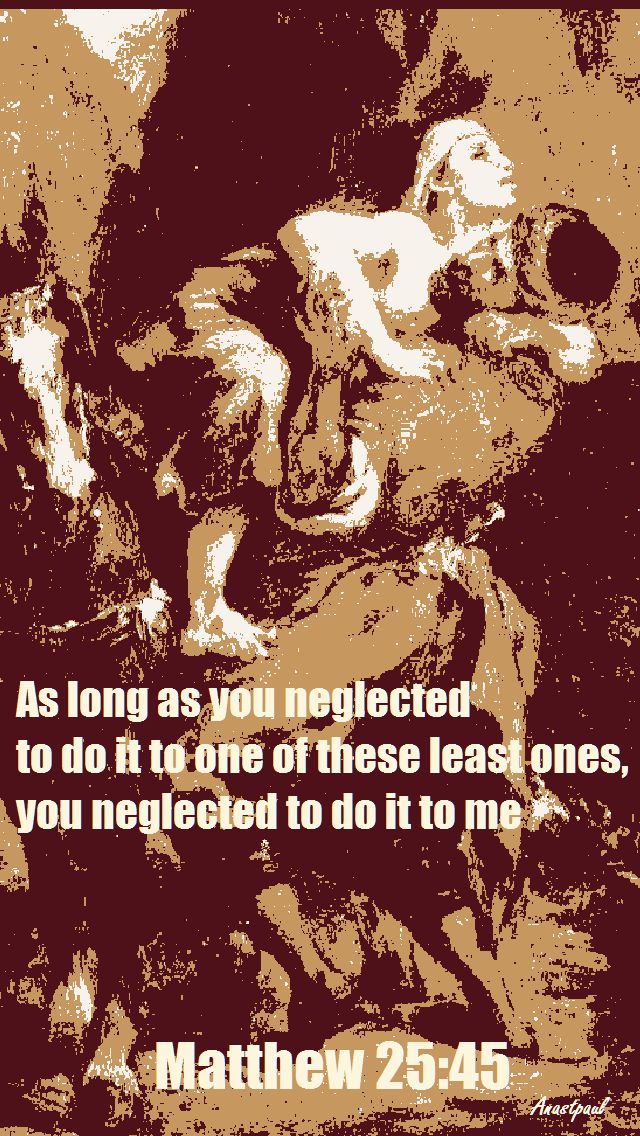
As long as you neglected to do it to one of these least ones, you neglected to do it to me…………..Matthew 25:45
REFLECTION – “May Christ shield me today, Christ with me. Christ before me, Christ behind me………
Christ in the mouth of everyone who speaks of me, Christ in every eye that sees me, Christ in every ear that hears me.”………….St Patrick
PRAYER – Lord Jesus the Christ, be with me this day and let me see You in everyone I meet. Grant that I may always serve You in others and so arrive at Your heavenly Kingdom where I will serve You and love You and see You, for ever and ever. St Patrick, pray for us all that we may live as you did and reach our heavenly home, amen.
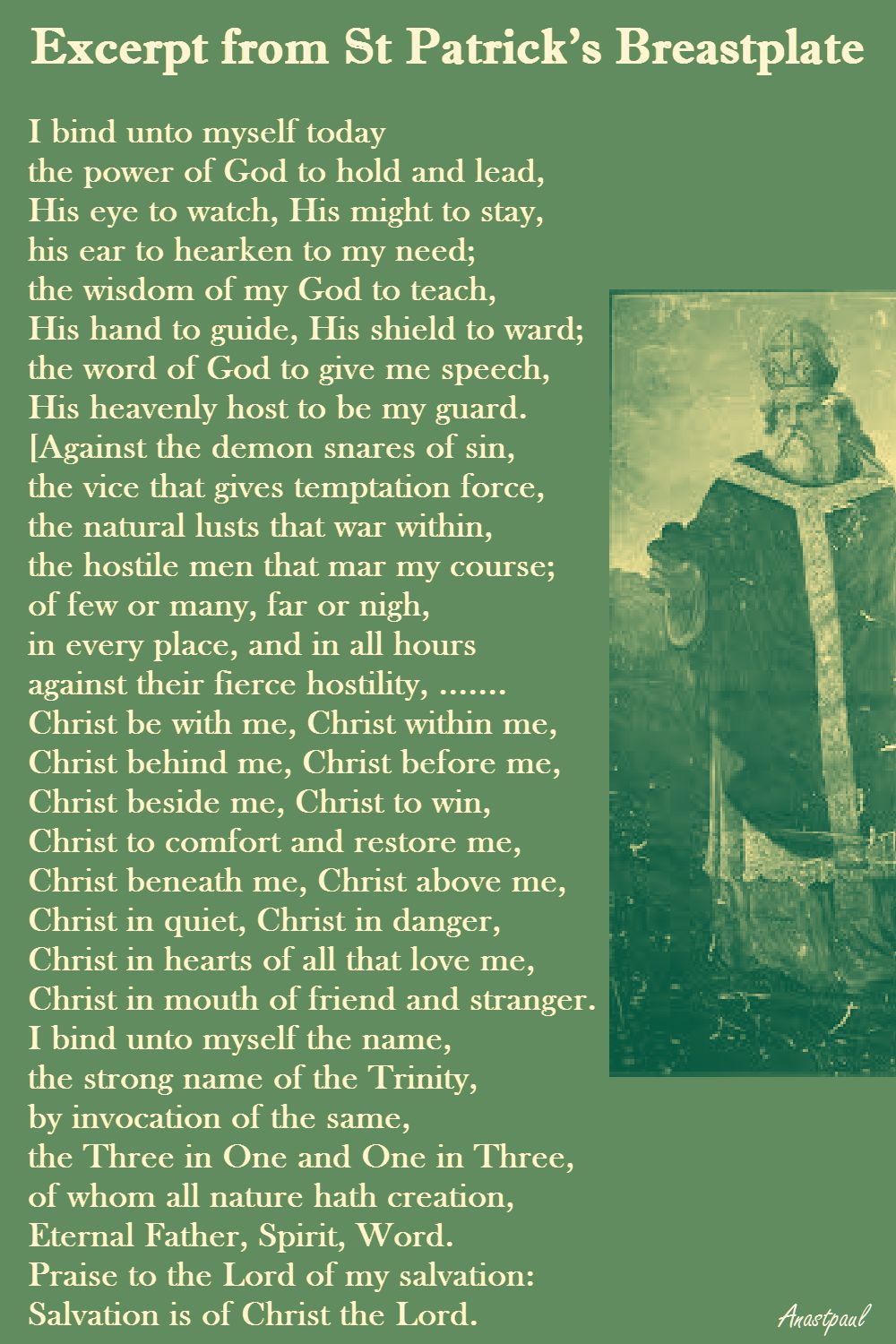
Excerpt from St Patrick’s Breastplate (also known as The Deer Cry)
I bind unto myself today
the power of God to hold and lead,
His eye to watch, His might to stay,
his ear to hearken to my need;
the wisdom of my God to teach,
His hand to guide, His shield to ward;
the word of God to give me speech,
His heavenly host to be my guard.
[Against the demon snares of sin,
the vice that gives temptation force,
the natural lusts that war within,
the hostile men that mar my course;
of few or many, far or nigh,
in every place, and in all hours
against their fierce hostility, …….
Christ be with me, Christ within me,
Christ behind me, Christ before me,
Christ beside me, Christ to win,
Christ to comfort and restore me,
Christ beneath me, Christ above me,
Christ in quiet, Christ in danger,
Christ in hearts of all that love me,
Christ in mouth of friend and stranger.
I bind unto myself the name,
the strong name of the Trinity,
by invocation of the same,
the Three in One and One in Three,
of whom all nature hath creation,
Eternal Father, Spirit, Word.
Praise to the Lord of my salvation:
Salvation is of Christ the Lord.
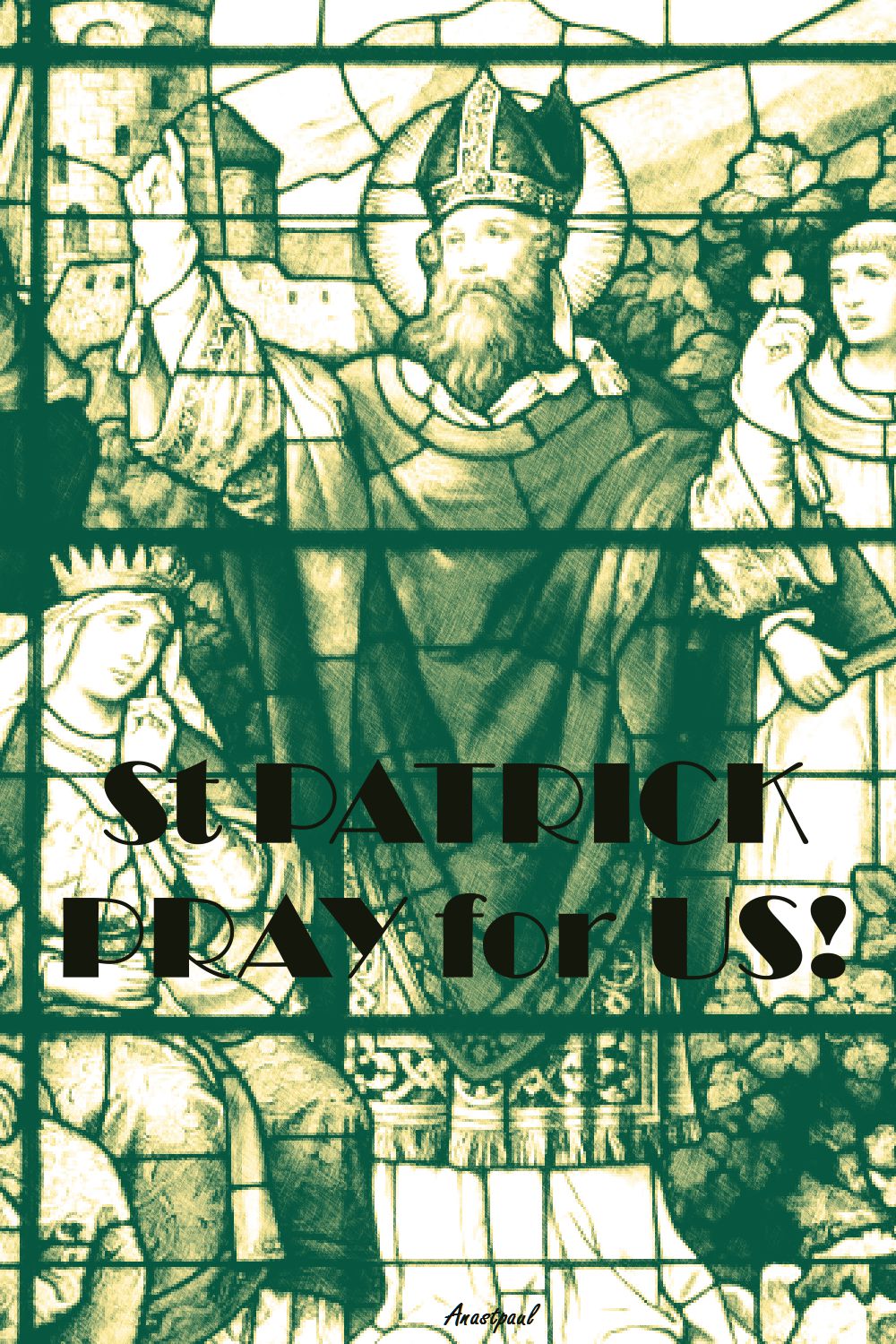
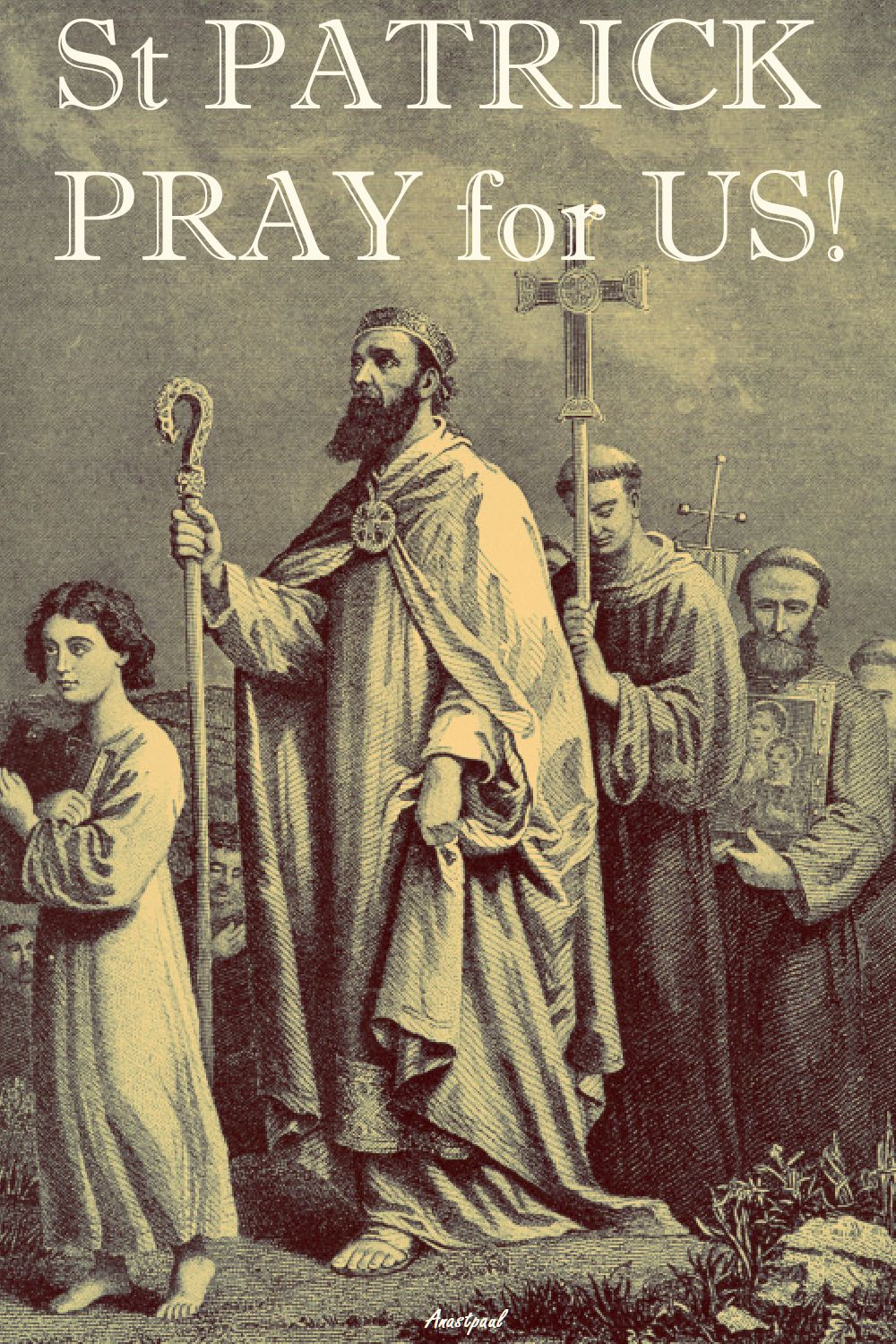
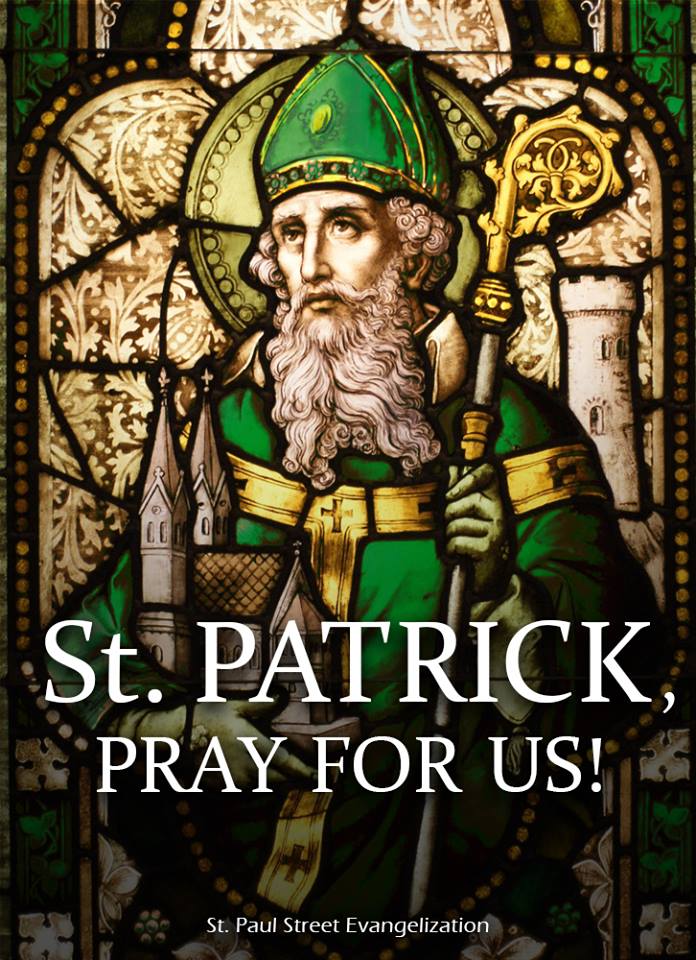
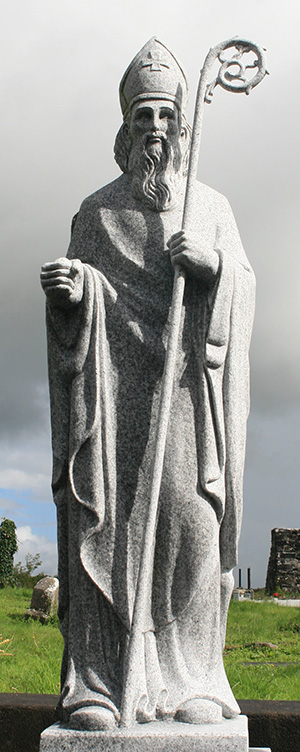
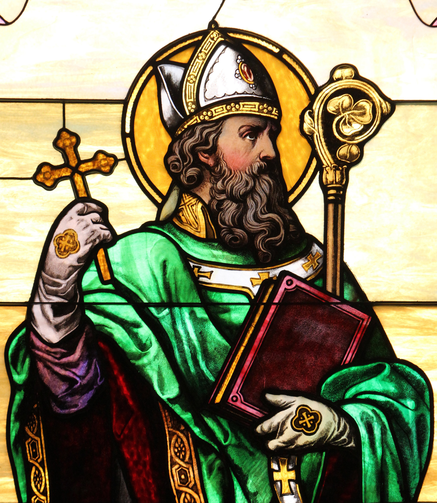
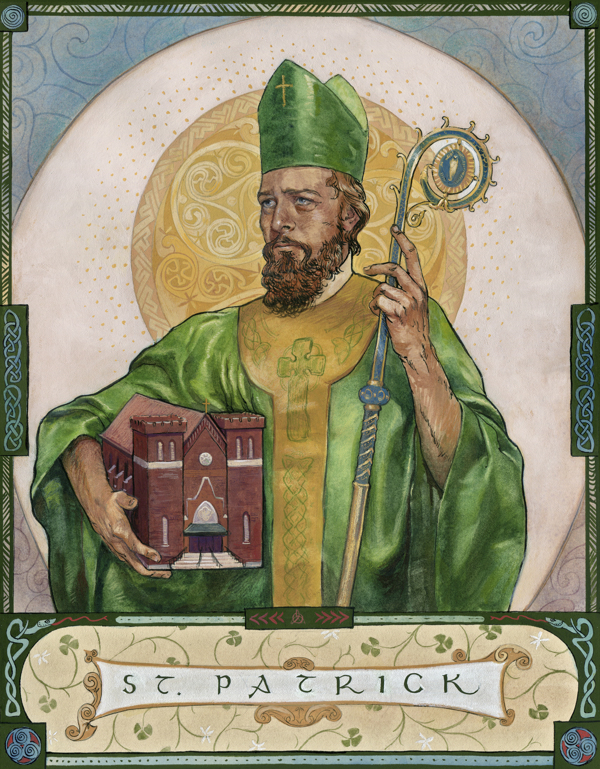
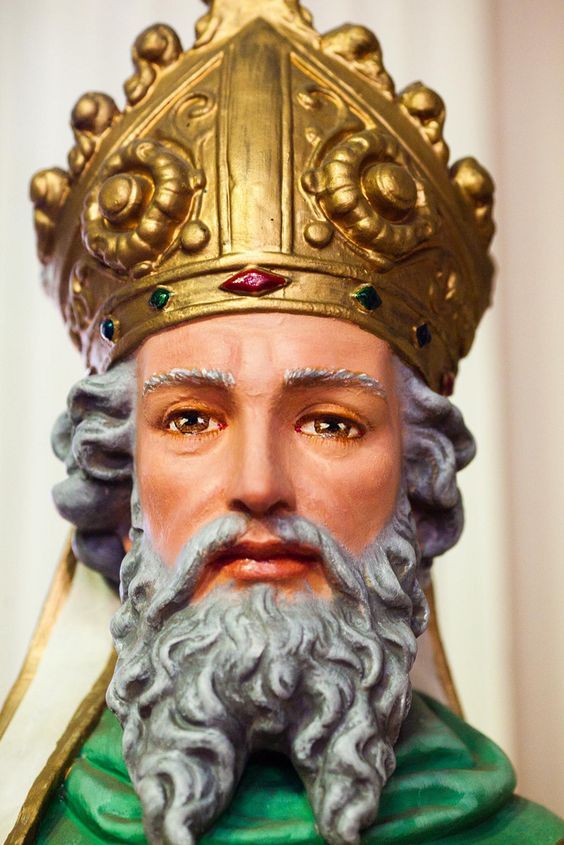
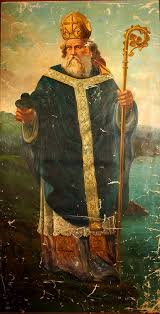
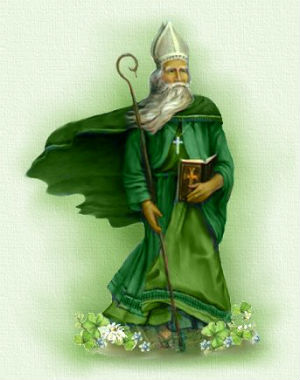
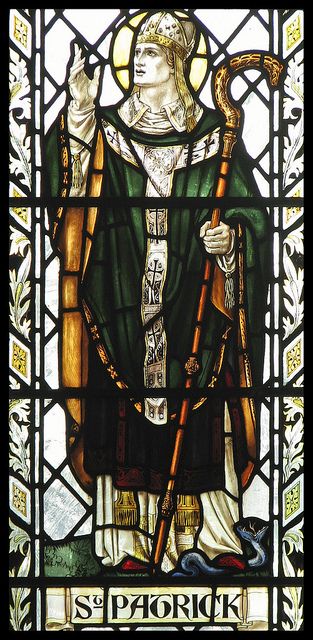
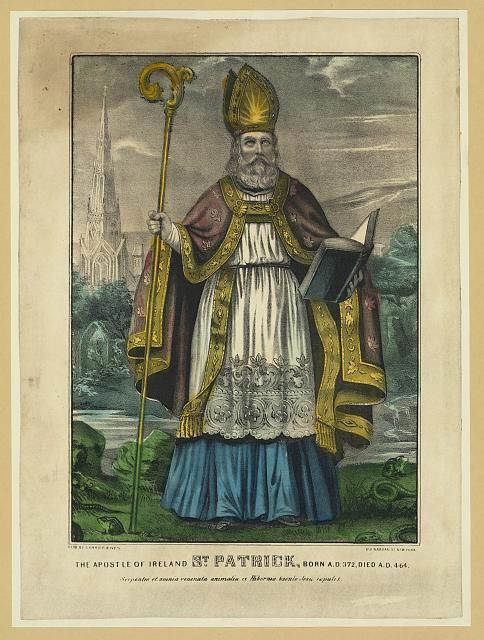
Saint of the Day – 17 March – St Patrick (c 386–461) “The Apostle of Ireland,” P riest, Bishop, Missionary.Patronages – against fear of snakes or ophidiophobia. ophidiophobics, against snake bites, against snakes, of barbers, hairdressers, barrel makers; coopers, blacksmiths, cattle, engineers, excluded people, miners, Ireland, Nigeria (1961), Loiza, Puerto Rico, 29 Diocese.
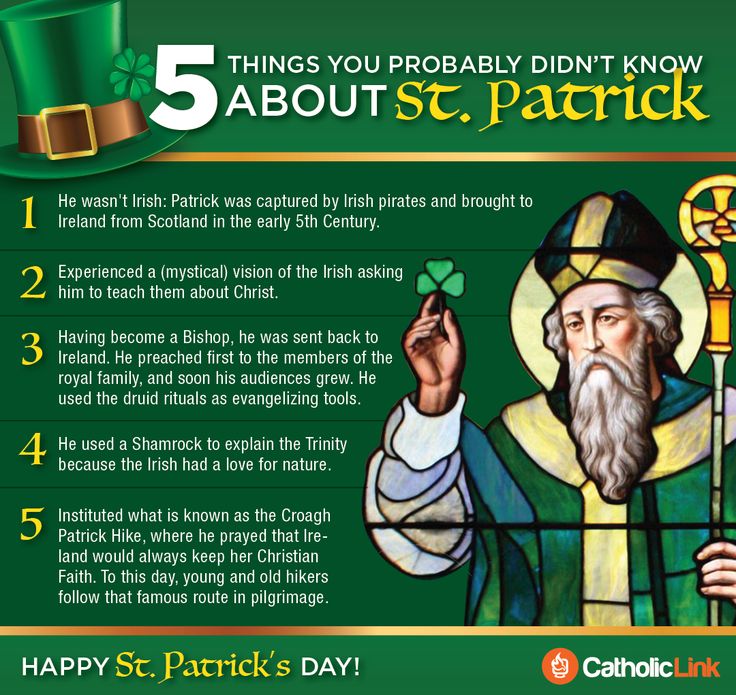
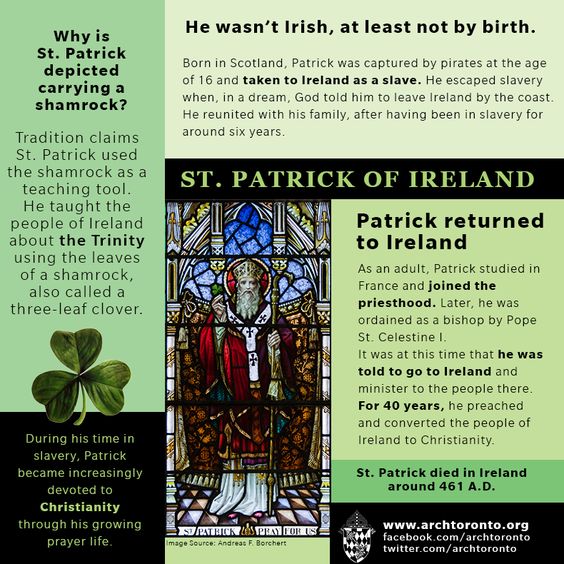
Although we think of Ireland when we remember St Patrick, he wasn not born in Ireland. He was born probably in Scotland but sources differ on this point – he might have been born in England or in France. His father was a Deacon and his grandfather had been a Priest.
But Patrick’s happy, carefree childhood life ended one day when crowds of strangers appeared on the horizon. They looked dangerous and frightening and they were. They were pirates and thieves, on their way to capture slaves to take back to Ireland. Patrick was one of those hundreds of captives. He was snatched from his family and his home. He was taken from all of his future hopes and dreams. Patrick was thrown on a ship, bound in chains and taken over the sea to Ireland. He was sixteen years old. For six years, Patrick was a slave in Ireland. He was put to work watching sheep and cattle. Patrick had just enough food to live on and when not working, he tried to rest in tiny huts which were damp and cold.
But something strange and wonderful happened in Ireland. All alone, frightened for his life and among people who worshiped trees and stones, Patrick opened his heart to God.
During those years, Patrick started to pray. He thought about God all the time and it gave him peace. He knew that no matter how much he was suffering, God loved him.
Eventually, Patrick escaped from slavery and travelled to France, which in those days was called Gaul. We are not sure exactly how much time Patrick spent in Gaul. But it was enough time for him to draw closer to God, as he prayed and studied in a Monastery. One night, deep in a dreamy vision, Patrick heard voices. He heard many voices, joined together, pleading with him. “Come back,” the voices cried, “come back and walk once more among us.” Patrick knew it was the Irish people calling him.
Strengthened by the courage that only God can give, Patrick went back. He returned to the very people who had stolen him from his family, worked him mercilessly as a slave and knew little, if anything, about the love of the true God.
Before he left Gaul, Patrick was made the Bishop of Ireland. He then travelled across the sea to teach Ireland about Jesus Christ. It wasn’t easy. The people of Ireland practiced pagan religions. They worshiped nature,and they practiced magic. They feared the spirits, they believed lived in the woods. The Irish people believed they could bring evil spirits down on those they wanted to harm.
Patrick had a big job ahead of him. He had to show a country full of students that there was no point in worshiping nature. Trees can’t forgive your sins or teach you how to love. The sun, as powerful as it is, could not have created the world. Patrick explained things using simple examples that people could easily understand. For example, he used the three-leaf clover to show people how there could be three persons in one God. Patrick preached to huge crowds and small villages. He preached to kings and princes. He preached in the open air and he preached in huts. Patrick never stopped preaching and he never stopped teaching. He couldn’t stop—the whole country of Ireland was his classroom and he couldn’t afford to miss even one student!
Soon, Patrick had help. Men became Priests and Monks. Women became Nuns. Wherever they lived, those Monks and Nuns settled in Monasteries and set up schools. More students were being reached every day. But, of course, the greatest help Patrick had was from God.
When he was young, Patrick had forgotten God but that would never happen again. He knew that God supported him in every step he took. God gave Patrick the courage to speak, even when Patrick was in danger of being hurt by pagan priests who didn’t want to lose their power over the people.
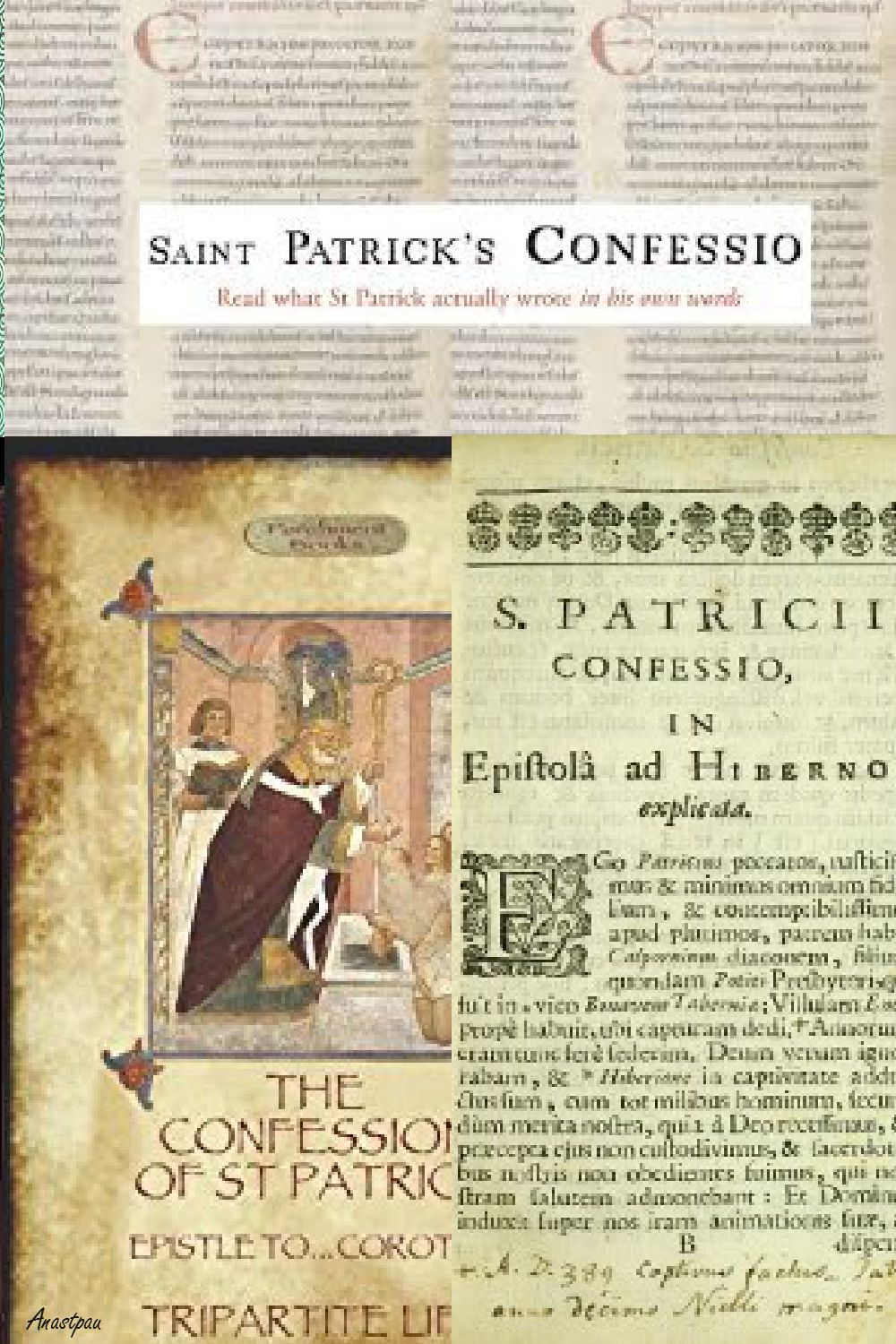
Patrick’s most famous prayer (excerpt below) shows us how close he was to God. It’s called “St. Patrick’s Breastplate.” A breastplate is the piece of armour that protects a soldier’s heart from harm. We have this prayer and his own story in one of the few certainly authentic writings of Patrick – his Confessio, which is above all an act of homage to God for having called Patrick, unworthy sinner, to the apostolate.
Christ with me, Christ before me,
Christ behind me, Christ within me,
Christ beneath me, Christ above me,
Christ at my right, Christ at my left.
Patrick banishes all snakes from Ireland
The absence of snakes in Ireland gave rise to the legend that they had all been banished by St. Patrick chasing them into the sea after they attacked him during a 40-day fast he was undertaking on top of a hill. This hagiographic theme draws on the Biblical account of the staff of the prophet Moses. In Exodus 7:8–7:13, Moses and Aaron use their staffs in their struggle with Pharaoh’s sorcerers, the staffs of each side morphing into snakes. Aaron’s snake-staff prevails by consuming the other snakes.
Patrick’s walking stick grows into a living tree
Some Irish legends involve the Oilliphéist, the Caoránach and the Copóg Phádraig. During his evangelising journey back to Ireland from his parent’s home at Birdoswald, he is understood to have carried with him an ash wood walking stick or staff. He thrust this stick into the ground wherever he was evangelising and at the place now known as Aspatria (ash of Patrick) the message of the dogma took so long to get through to the people there that the stick had taken root by the time he was ready to move on.
St Patrick died between 461 and 464 at Saul, County Down, Ireland of natural causes
St Patrick (Optional Memorial)
—
St Agricola of Châlon-sur-Saône
St Alexander
St Ambrose of Alexandria
Bl Conrad of Bavaria
St Diemut of Saint Gall
St Gabriel Lalemant
St Gertrude of Nivelles
Bl Gertrude of Trzebnica
St Jan Sarkander
Bl Josep Mestre Escoda
St Joseph of Arimathea
Bl Juan Nepomuceno Zegrí y Moreno
St Llinio of Llandinam
Bl Maria Bárbara Maix
St Paul of Cyprus
St Stephen of Palestrina
St Theodore of Rome
St Thomasello
St Withburga of Dereham
Martyrs of Alexandria – Also known as Martyrs of Serapis: An unknown number of Christians who were martyred together by a mob of worshippers of the Graeco-Egyptian sun god Serapis.. Died c.392 in Alexandria, Egypt
Potential martyrdom was a central component of the Jesuit missionary identity. Missionaries going to Canada knew they were at risk from harsh conditions, as well as from confronting alien cultures. They expected to die in the name of God; they believed the missionary life and its risks was a chance to save converts and thus be saved themselves. The Jesuits Christophe Regnault and Paul Ragueneau provided the two accounts of the deaths of Jean de Brébeuf and Gabriel Lalement. According to Regnault, the Jesuits learned of the tortures and deaths from Huron refugee witnesses, who had escaped from Saint-Ignace. Regnault went to see the bodies to verify the accounts and his superior Rageuneau’s account was based on his report. The main accounts of Brébeuf’s death come from the Jesuit Relations. Jesuit accounts of his torture emphasize his stoic nature and acceptance, claiming that he suffered silently without complaining. Throughout the torture, Brébeuf was reported to have been more concerned for the fate of the other Jesuits and of the captive Native converts than for himself. As part of the ritual, the Iroquois drank his blood, as they wanted to absorb Brébeuf’s courage in enduring the pain. The Iroquois mocked baptism by pouring boiling water over his head.
Is it even a tiny iota of our faith to know and be prepared to die such a death for Christ? When we suffer and are persecuted, in the smallest way compared to this, compared to the Cross of Christ, do we grow in faith and courage and pray for more?
St Jean de Brebeuf please pray that we may all grow in faith and courage!
All who believe………………have eternal life in him……….John 3:15
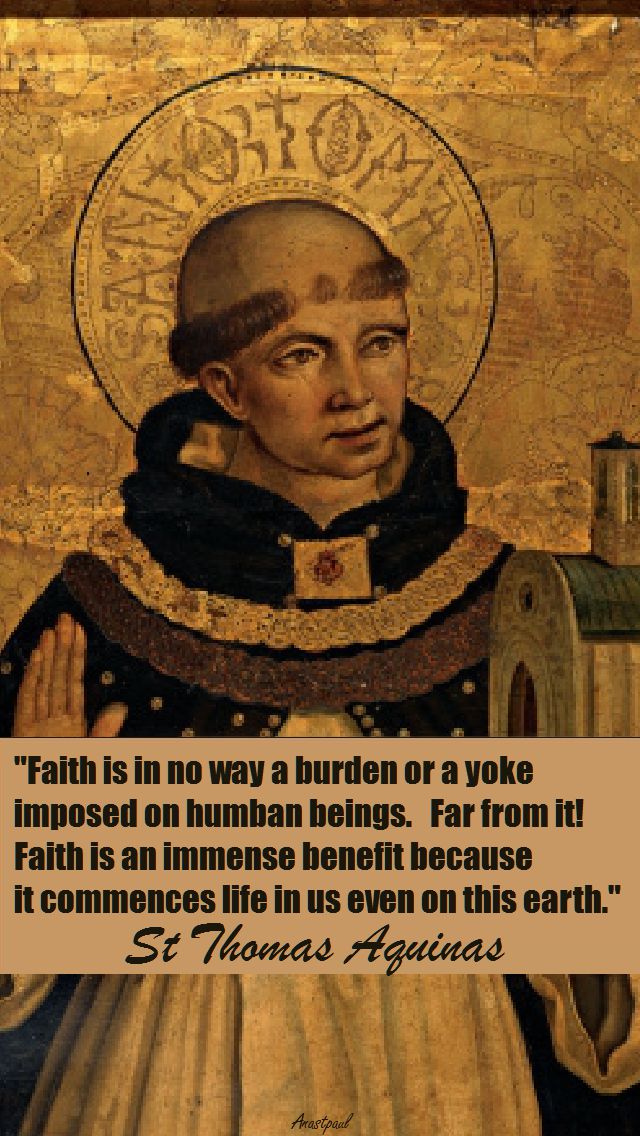
REFLECTION – “Faith is in no way a burden or a yoke imposed on humban beings. Far from it! Faith is an immense benefit because it commences life in us even on this earth.”………….St Thomas Aquinas
PRAYER – Heavenly Father, thank You for giving me the gift of faith. Help me to remain firm in my faith throughout my life and to strive, no matter to what suffering You call me, to increase in faith and love for You, day by day. St Jean de Brebeuf, you have reached the glory of heaven and by your life and suffering for your faith, you taught us the true beauty of love for Christ the Lord, please pray for us all, amen.
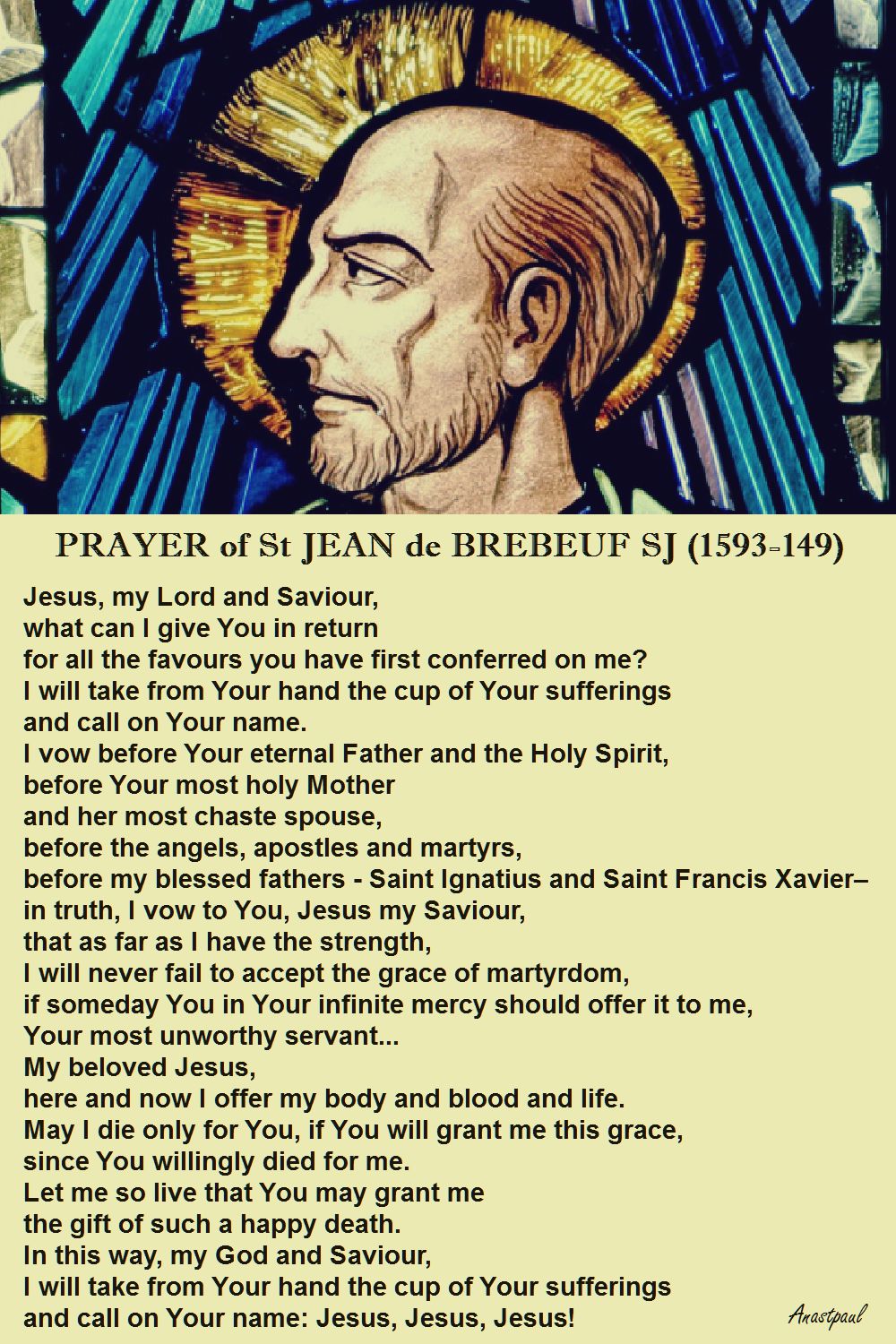
“Jesus, my Lord and Saviour,
what can I give You in return
for all the favours you have first conferred on me?
I will take from Your hand the cup of Your sufferings
and call on Your name.
I vow before Your eternal Father and the Holy Spirit,
before Your most holy Mother
and her most chaste spouse,
before the angels, apostles and martyrs,
before my blessed fathers –
Saint Ignatius and Saint Francis Xavier–
in truth, I vow to You, Jesus my Saviour,
that as far as I have the strength,
I will never fail to accept the grace of martyrdom,
if someday You in Your infinite mercy should offer it to me,
Your most unworthy servant…
My beloved Jesus,
here and now I offer my body and blood and life.
May I die only for You, if You will grant me this grace,
since You willingly died for me.
Let me so live that You may grant me
the gift of such a happy death.
In this way, my God and Saviour,
I will take from Your hand the cup of Your sufferings
and call on Your name: Jesus, Jesus, Jesus!”
Saint of the Day – 16 March – St Jean de Brebeuf SJ (1593-1949 aged 55) Priest, Martyr, Missionary “Apostle to the Hurons” – Patron of Canada. Additional Memorial – 19 October as one of the Martyrs of North America.
St Jean was a French Jesuit missionary who traveled to New France (Canada) in 1625. There he worked primarily with the Huron for the rest of his life, except for a few years in France from 1629 to 1633. He learned their language and culture, writing extensively about each to aid other missionaries. In 1649, Brébeuf and another missionary were captured when an Iroquois raid took over a Huron village (referred to in French as St. Louis). T ogether with Huron captives, the missionaries were ritually tortured and killed, being martyred on March 16, 1649. Brébeuf was beatified in 1925 and among eight Jesuit missionaries canonised in 1930.
In 1649, Brébeuf and another missionary were captured when an Iroquois raid took over a Huron village (referred to in French as St. Louis). Together with Huron captives, the missionaries were ritually tortured and killed, being martyred on March 16, 1649. Brébeuf was beatified in 1925 and among eight Jesuit missionaries canonized as saints in the Roman Catholic Church in 1930.
St. John de Brébeuf was large and handsome, his presence commanded attention. A brilliant student, gifted linguist and competent manager, he could make things happen. He was willing to endure anything if only he could thank Christ by giving his life for the salvation of others.
Even though weakened by tuberculosis, John joined the Canada mission in 1625. For a quarter of a century with only a four-year interlude, he evangelised the Hurons in Quebec. He lived with them, embraced their customs, mastered their language,and wrote a catechism for them.
At first he had little success because the odds were stacked against him. The Indians viewed him as member of a conquering race. They also blamed him for rampant diseases and everything else that went wrong. But John persevered with the good humour you see in this letter inviting other Jesuits to join the mission:
“When you reach the Hurons, you will find us with hearts full of love. We shall receive you in a hut, so mean that I have scarcely found in France one wretched enough to compare it with. Fatigued as you will be, we shall be able to give you nothing but a poor mat for a bed. Besides you will arrive when fleas will keep you awake most of the night.
Instead of being a great theologian as you may be in France, you must reckon on being here a humble scholar and then good God! with what masters—exposed to the laughter of all the savages. The Huron language will be your St. Thomas and your Aristotle. Glib as you are, you must decide for a long time to be mute among the barbarians.
Without exaggeration, you will pass the six months of winter in almost continual discomforts—excessive cold, smoke, the annoyance of the savages who surround our fireplace from morning until evening looking for food.
For the rest, thus far we have had only roses. As we have Christians in almost every village, we must expect to make rounds throughout the year. Add to all this that our lives depend upon a single thread. Your cabin might burn down at any moment or a malcontent may cleave your head open because you cannot make it rain.
Here we have nothing that incites toward good. We are among peoples who are astonished when you speak to them of God.”
In 1649, the Iroquois attacked the Huron village where John was living. They brutally martyred him, Gabriel Lalement, his companion and their converts . Their suffering is indescribable: bludgeoned, burned with red-hot hatchets, baptised with boiling water, mutilated, flesh stripped off and eaten, hearts plucked out and devoured. But John de Brébeuf had his prayer answered. He traded his life for the seven thousand souls he had converted and baptised.
St Abban of Kill-Abban
St Abraham Kidunaia
St Agapitus of Ravenna
St Aninus of Syria
St Benedicta of Assisi
St Dionysius of Aquileia
St Dentlin of Hainault
Bl Eriberto of Namur
St Eusebia of Hamage
St Felix of Aquileia
St Finian Lobhar
Bl Ferdinand Valdes
St Gregory Makar
St Heribert of Cologne
St Hilary of Aquileia
St Jean de Brebeuf
Bl Joan Torrents Figueras
Bl John Amias
Bl John Sordi of Vicenza
St Julian of Anazarbus
St Largus of Aquileia
St Malcoldia of Asti
St Megingaud of Wurzburg
St Papa of Seleucia
Bl Robert Dalby
St Tatian of Aquileia
Bl Torello of Poppi
In different times we hold up different models as examples of holiness. In our present time, we find holiness in people such as St John Paul, St Mother Teresa and St Padre Pio. They were people so grounded in prayer and their relationship with Christ that action must flow from them. They were each able to stand up strong about the rights and dignity of all people despite the opposition all around them.
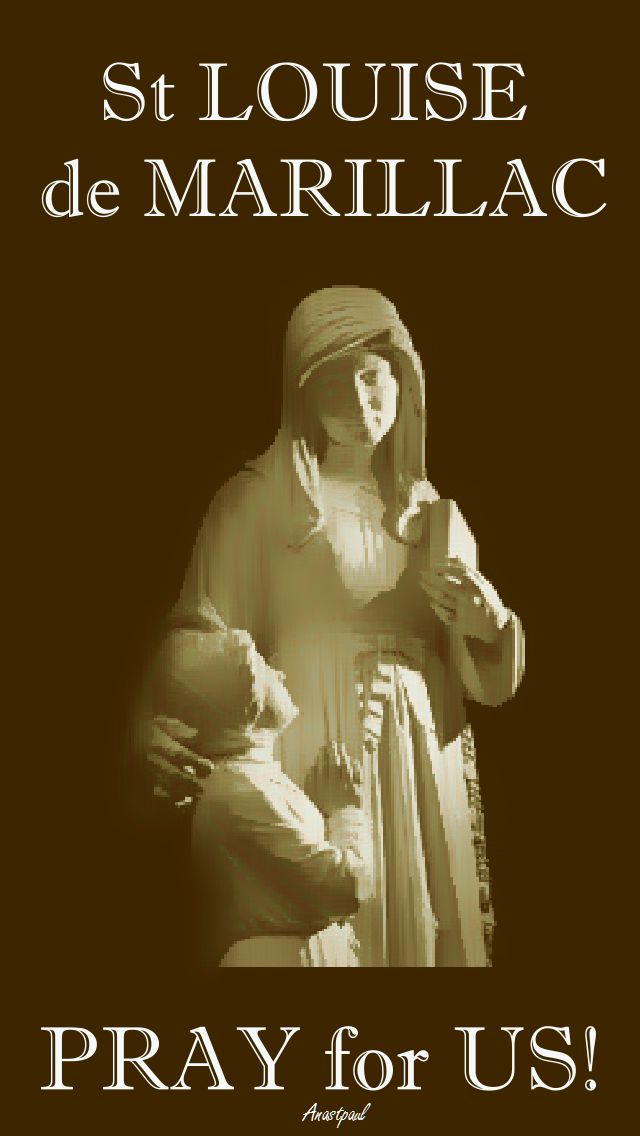
St. Louise de Marillac, co-founder of the Daughters of Charity, died in 1660. Yet, she wasn’t canonized until 1934. I believe it is because she is a saint for this present time. She was a great leader and changed the face of social work forever– all this because Christ was the centre of her life.
Through this season of Lent and into Easter, have we grown in holiness? Have we focused our lives more on Christ? Do we reach out more to those in need as Christ did? Especially those considered outcasts of mainstream society? If not, the blessing is we still have today, tomorrow and the next days to work on it!” (From the 2010 article What Does Holiness Look Like?, by Sr. Denise LaRock, DC)
“I gave myself to God to accept the designs of His Providence, if He willed me to continue, for the remainder of Lent, in a state of interior abandonment and even affliction so as to honour the sufferings of Jesus Christ which the Church places before our eyes.”
“Let us love suffering then
and let us make strong resolutions
to desire as much of it as the will of God
wants us to experience.
Rest assured that it is a sign
of God’s love for you since it is through this
that He makes you somewhat like his Son.
Suffer then, in His same spirit, through
submission to all that God wills of you.”
“The person who does not love does not know God, for God is Charity.”
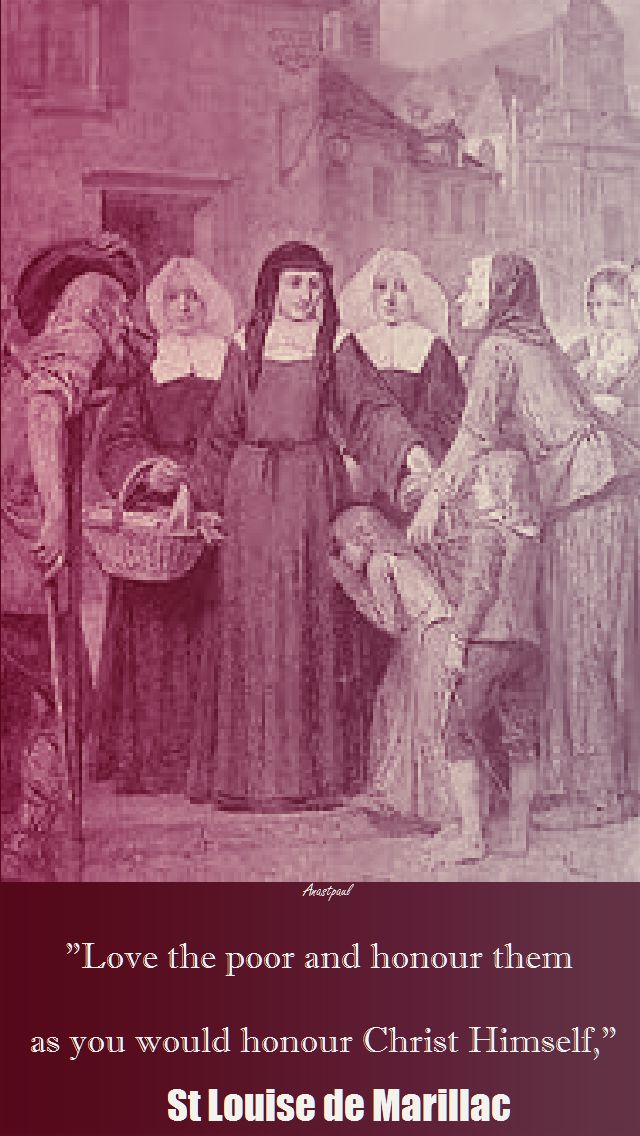
“Love the poor and honour them as you would honour Christ Himself,”
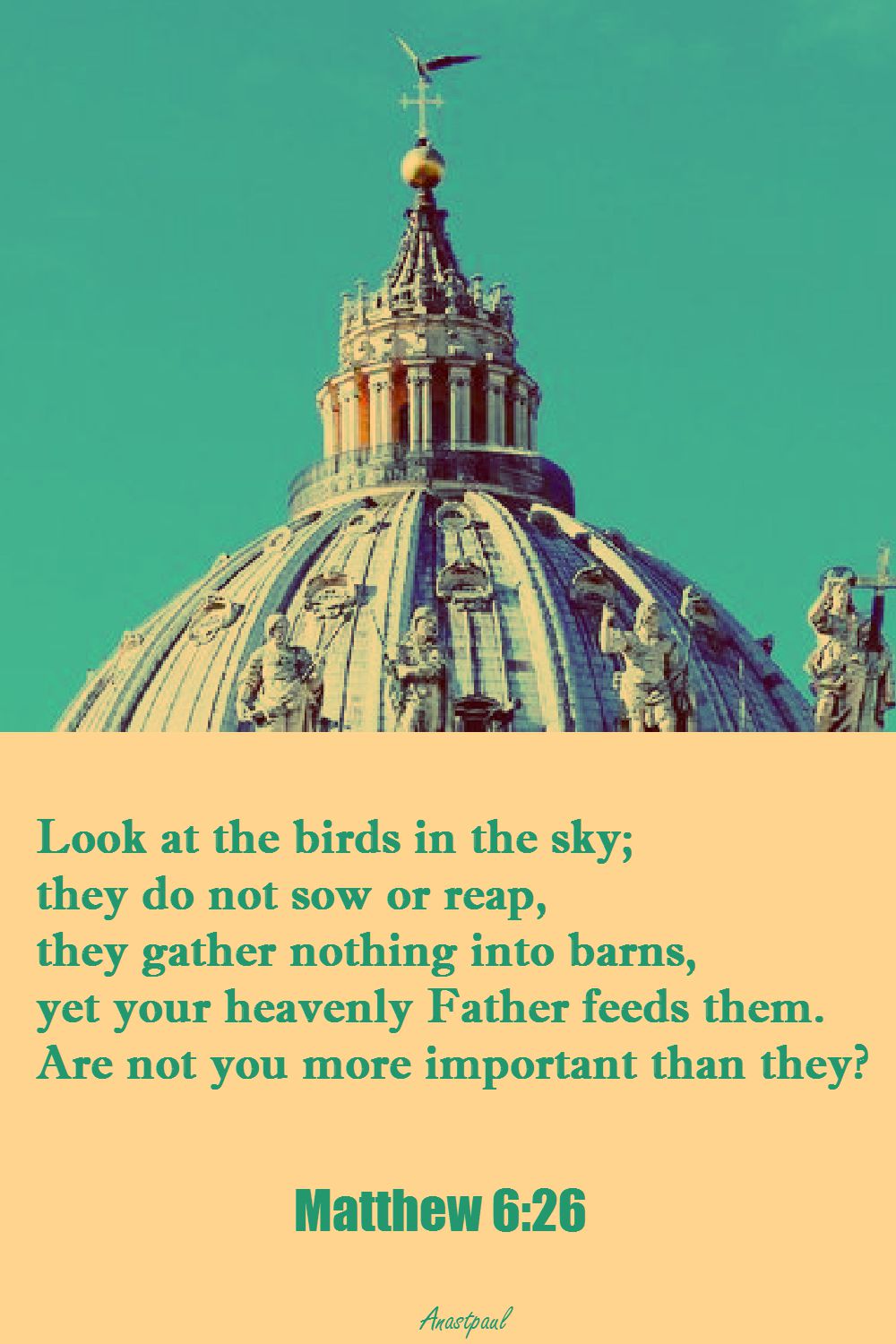
Look at the birds in the sky; they do not sow or reap, they gather nothing into barns, yet your heavenly Father feeds them.
Are not you more important than they?……………………Matthew 6:26
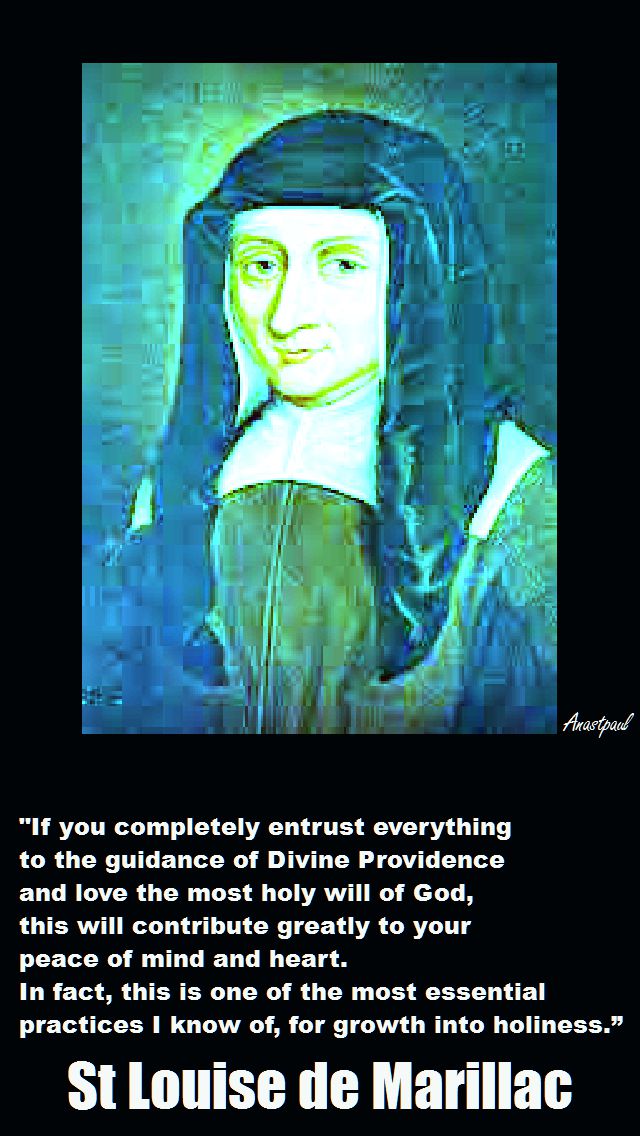
REFLECTION – “If you completely entrust everything to the guidance of Divine Providence and love the most holy will of God, this will contribute greatly to your peace of mind and heart. In fact, this is one of the most essential practices I know of for growth into holiness.”……..St Louise de Marillac
PRAYER – Loving and compassionate Father, we celebrate with great joy the faith and works of St Louise de Marillac. Instill in us the fire of her love, the tenacity of her belief and the tenderness of her care for the most abandoned. Draw us together into the light of your presence and help us to trust in the power of Your Spirit and the Light of Your Son, leading us to ever closer to You, who live and reign forever and ever. St Louise de Marillac, pray for us, amen.
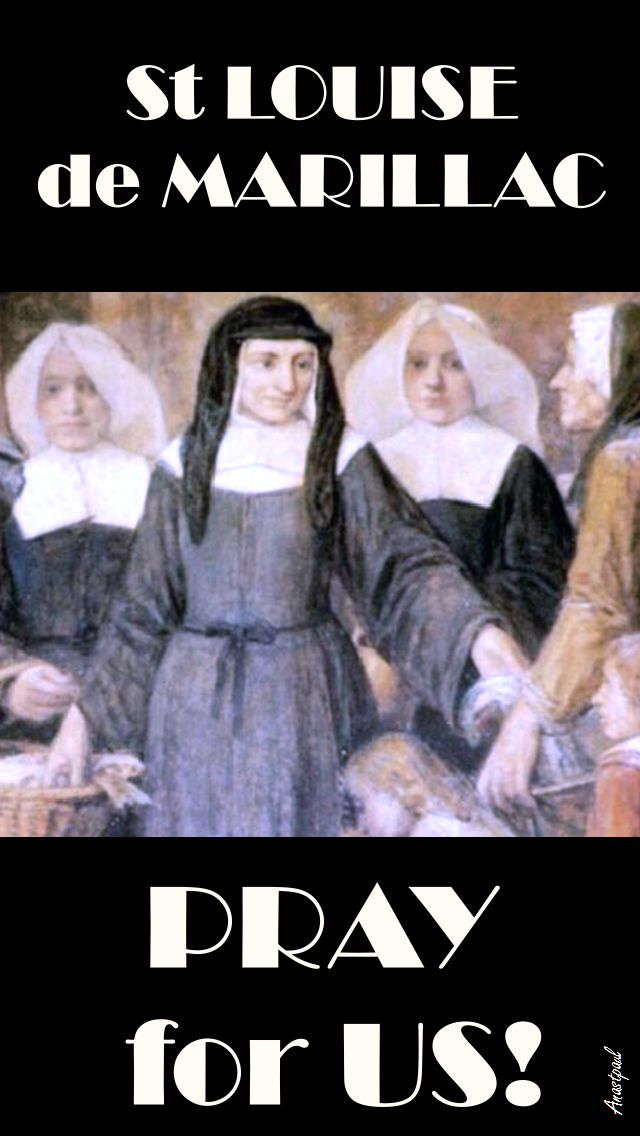
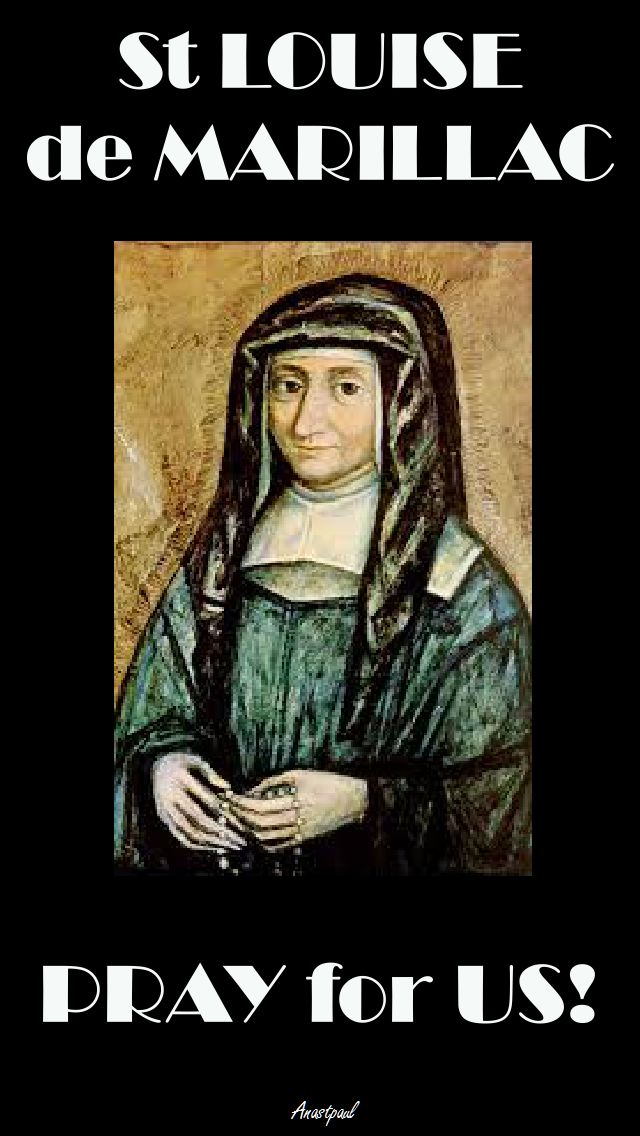
Saint of the Day – 15 March – St Louise de Marillac D.C. (1591-1660 body incorupt) Wife, Mother, Widow, Foundress, Apostle of Charity – Patron of disappointing children, loss of parents, people rejected by religious orders, sick people, social workers (proclaimed on 12 February 1960 by Pope John XXIII), Vincentian Service Corps, widows. With Saint Vincent de Paul, she founded the Daughters of Charity in 1642, receiving Vatican approval in 1655.
Louise was born and raised in Paris, during a time when great social strife had befallen the city. The gap between the rich and poor was ever increasing, with more and more families and children suffering without the basic necessities of living. At that time, nearly one in six citizens would die of poverty-related conditions or diseases. Louise felt drawn to change that, but her road to ministry would be a long one.
Born the illegitimate daughter of Louis de Marillac, Louise never knew her mother was passed away shortly after her birth. Her father graciously raised her, demonstrating great love for her, despite societal opinion. Due to family relations, Louise grew up interacting with members of the aristocracy, specifically the royal court of Queen Marie de Medicis, receiving a formal education and instruction in deportment. When her father remarried, Louise’s new stepmother refused to recognise her and she was sent to be schooled at the royal monastery of Poissy. The education Louise received was among the finest available at the time and she demonstrated a keen mind and intellect, especially in practical and organizational tasks. Her intellect was only surpassed by her dedication and commitment.
Upon her father’s death, when Louise was approximately 15 years old, she left the school and took up residence with an elderly religious, who inspired her to consider her own vocation. Louise, who had been quite frail and frequently sick throughout her childhood, applied to the Paris order of Capuchins but was denied entrance. Confused, and heartbroken, Louise was left without a plan for the next phase of her life. When her family arranged a marriage for her to Antoine Le Gras, a young man with an appointment to the royal court, Louise obeyed their wishes and was wed. The union produced one child, Michel, whom Louise came to love intensely. Louise put her energies into maintaining a household and being a mother with the same intensity that she had pursued her studies. When her husband fell ill and became bedridden, she spent her days nursing him and tending to her beloved son, who had also developed medical issues. Through her nursing, Louise came to love her husband very much and after a period of year, when she was 32, was devastated by his death. Not knowing where else to turn, Louise looked to God who had been her comfort throughout her life.
Directed by the Lord to that “the time would come when I would be in the position to make vows of poverty, chastity and obedience and that I would be in a small community where others would do the same,” Louise sought out a new spiritual director, Saint Vincent de Paul. Together, these two pious saints would lastingly change the world.
Under his direction, Louise regulated her own life, creating a Rule of the World, which scheduled her service to others, prayer and contemplative time and management of household duties. Like with many things in her life, Louise required an outside direction to temper her zeal for service and prayer, lest she damage her own frail health. Louise began a ministry to the poor of Paris, taking four young poor women into her home and teaching them to serve those in need. These were the first sisters of the Company of the Daughters of Charity, founded when Louise was 44 years old. She instructed her new charges, “Love the poor and honour them as you would honor Christ Himself.” Saint Vincent, recognizing her intelligence, ability to get things done, organisation and zeal for service to the Lord encouraged and supported her Daughters of Charity and extension of his own service organisation the Confraternities of Charity. “Your convent,” Saint Vincent said to Louise, “will be the house of the sick; your cell, a hired room; your chapel, the parish church; your cloister, the streets of the city or the wards of the hospital.”
Saint Louise went on to build and develop over 40 houses of the Company of the Daughters of Charity, throughout Paris and then extending throughout France. The sisters served the poor and sick, expanding into orphanages, mental institutions, homes for the elderly, prisons and even battlefields. Saint Louise had such a talent for organisation, she revolutionised the way in which religious interacted with hospital staff, creating integrated team approaches which cared for both the physical needs of the patient alongside the spiritual needs. This model continues to be used today.
Saint Louise continued her work and direction of her sisters until the day of her death at age 68. She said to her sisters, “Take good care of the service of the poor. Above all, live together in great union and cordiality, loving one another in imitation of the union and life of our Lord. Pray earnestly to the Blessed Virgin, that she might be your only Mother.” Her incorrupt body lies in the Chapel of Our Lady of the Miraculous Medal, Rue du Bac, Paris. Her work continues today, as her order and those that came after it, continue their missions of service.
After Louise’s death in 1660, one of Louise’s Daughters of Charity found her young granddaughter, tearfully praying at her grandmother’s tomb. When asked why she was crying, Louise’s granddaughter expressed concern that the Daughters of Charity would disappear, now that her grandmother was dead. The sister eloquently responded: “When all the poor in the world are no longer poor, when all the hungry are fed, and all the naked clothed, when the sick and the dying and the abandoned babies and the orphans and the outcast and the lonely and forsaken are all gathered in heaven, until that day, there will always be Daughters of Charity.”
Bl Anthony of Milan
St Aristobulos of Britannia
Bl Arnold of Siena
Bl Artemide Zatti
St Bodian of Hanvec
St Clement Mary Hofbauer
St Eoghan of Concullen
St Eusebius II
Bl Francis of Fermo
Bl Jan Adalbert Balicki
St Leocritia of Córdoba
St Longinus the Centurian
St Louise de Marillac
Bl Ludovico de la Pena
St Mancius of Evora
St Matrona of Capua
St Matrona of Thessaloniki
St Menignus of Parium
Bl Monaldus of Ancona
St Nicander of Alexandria
St Peter Pasquale
St Pío Conde y Conde
St Sisebuto
St Speciosus
St Vicenta of Coria
Bl Walter of Quesnoy
Bl William Hart
St Pope Zachary
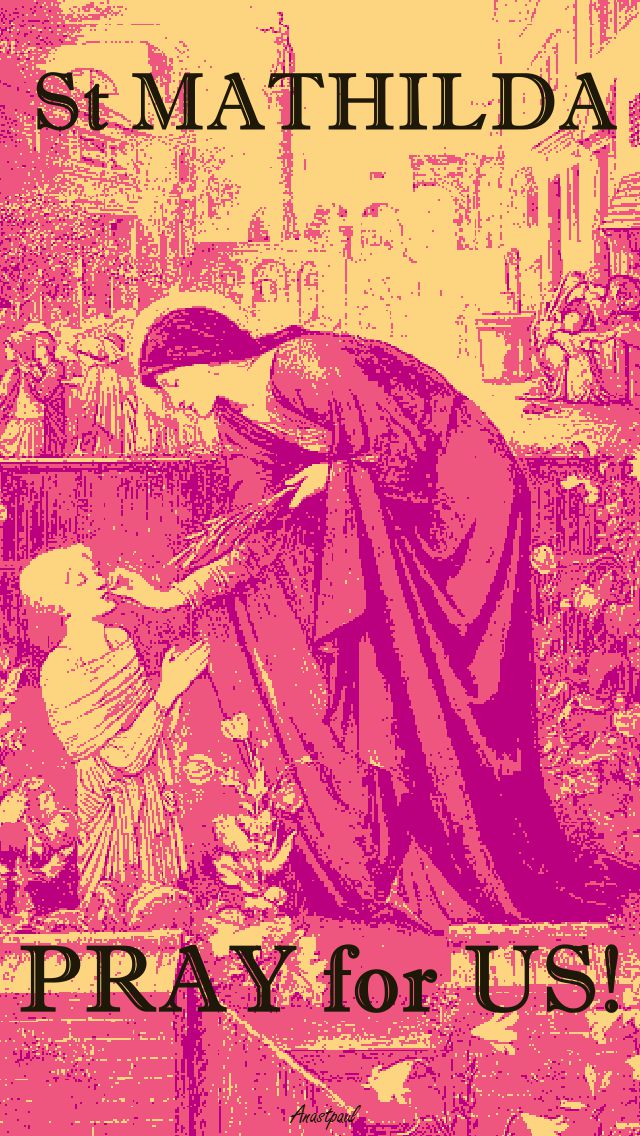
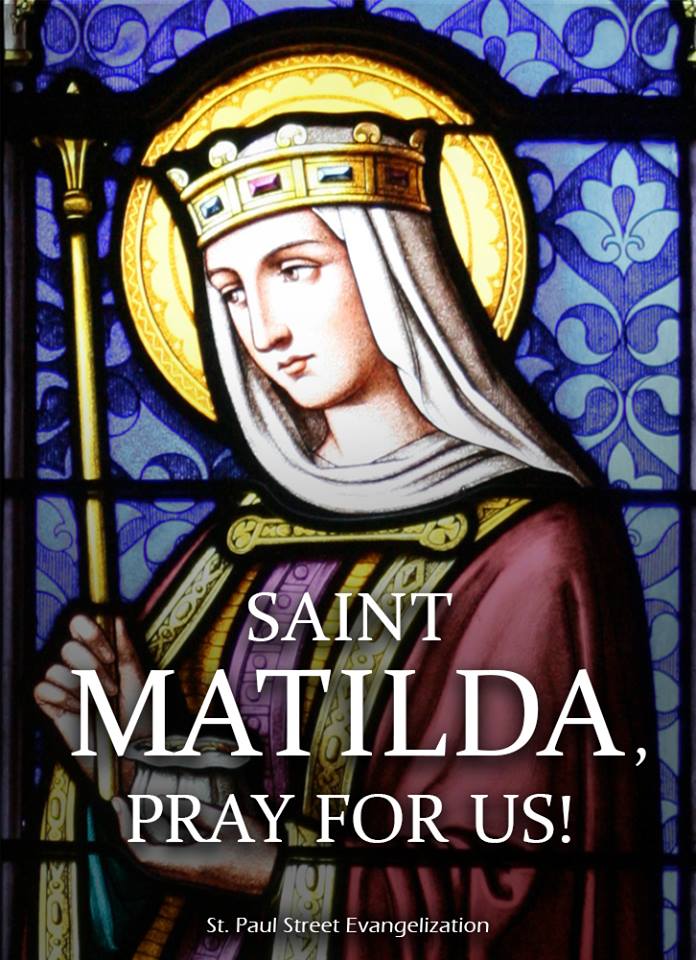
St Mathilda had to be many things: wife, mother, queen, grandmother, even regent of the kingdom. She never had a false sense of her own importance and was simply good to everyone. Her position enabled her to do a lot of good and she did not shirk from the effort. She spent her days in penance and service to others, through her prayer, heartfelt repentance and penance being washed clean of her sins and reaching Christian perfection in sainthood. This means that we too can achieve such perfection. Our greatest opportunities for good lies in those we live with – let us open our eyes to the people around us – where are we needed, where are we called?
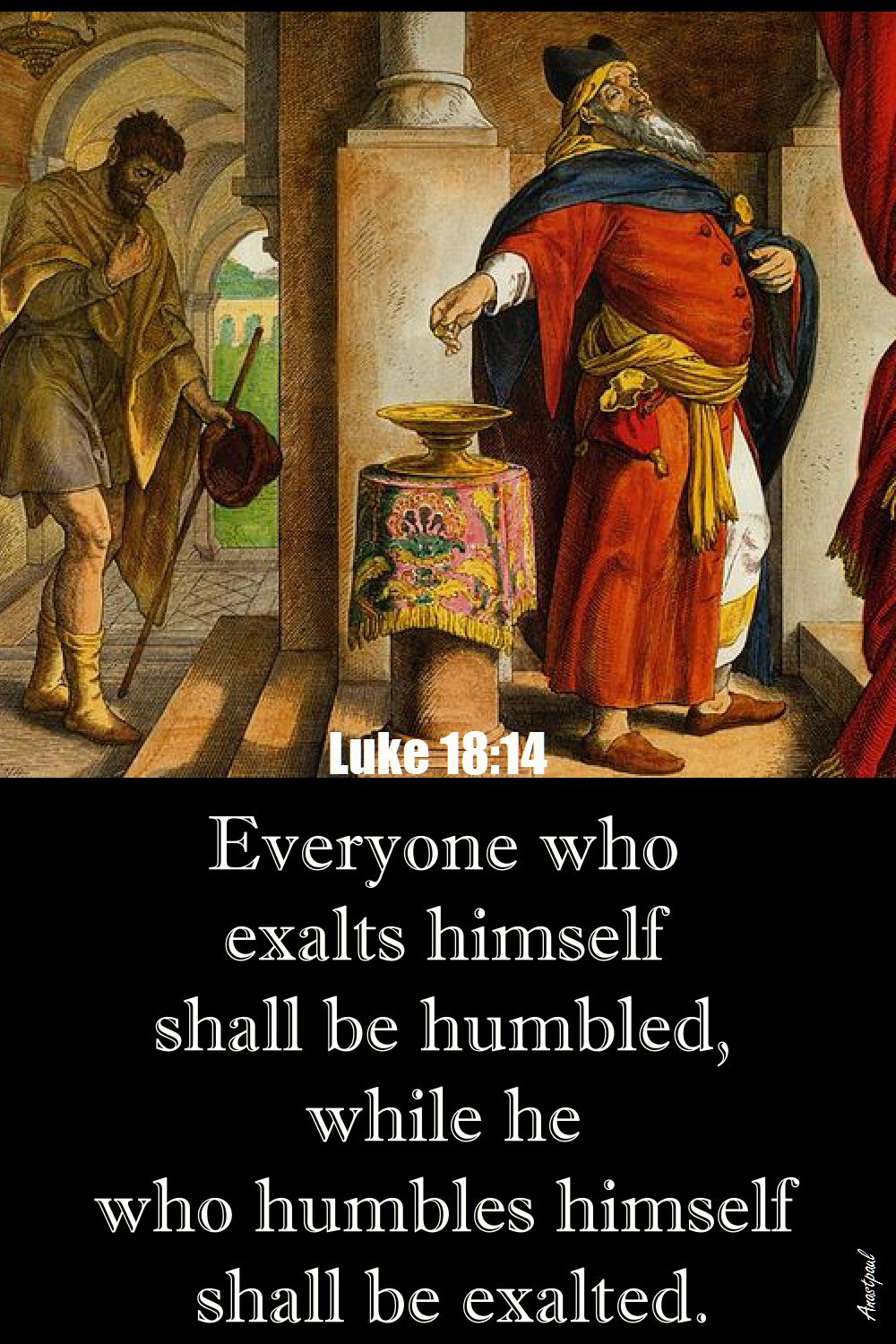
Everyone who exalts himself shall be humbled, while he who humbles himself shall be exalted……….Luke 18:14
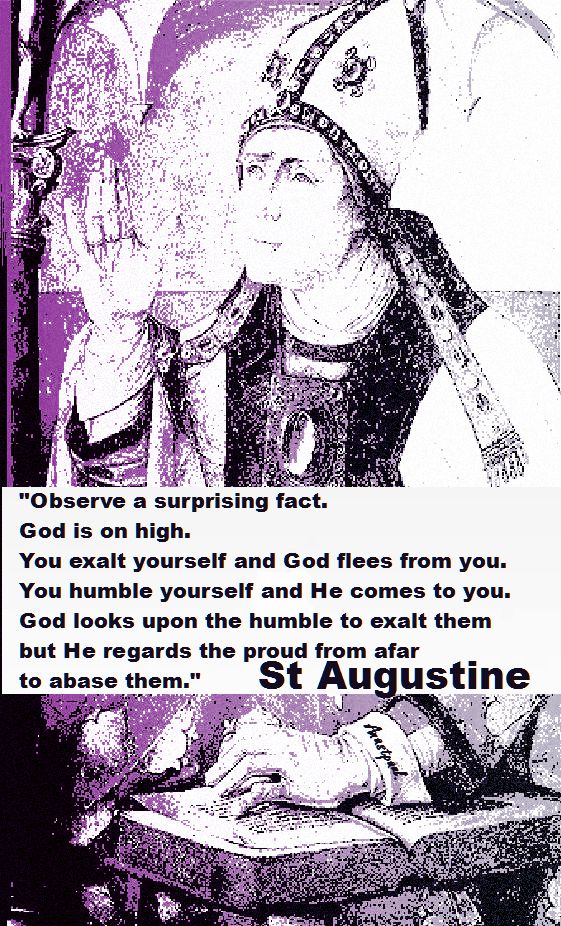
REFLECTION – “Observe a surprising fact. God is on high. You exalt yourself and God flees from you. You humble yourself and He comes to you.
God looks upon the humble to exalt them but He regards the proud from afar to abase them.”…………….St Augustine
PRAYER – Almighty Father, whenever I seek to take pride in what I do, please remind me of the way things really are. The only good I have and am comes from You; all that is mine is my weakness. Teach me that it is only in humility that I can attain You. St Matilda, you learnt humility by the suffering you experienced at the hands of your own family, please pray for us all, amen.
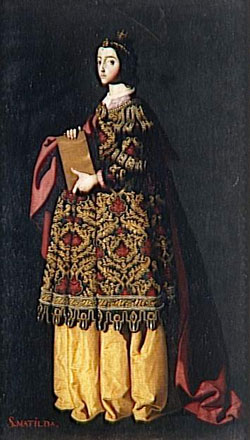
Saint of the Day – 14 March – St Matilda of Saxony (c 894-968) – Queen, Apostle of Prayer and Almsgiving, Foundress – Patronages – of death of children, disappointing children, falsely accused people, large families, people ridiculed for their piety, queens, second marriages, widows. Medieval chroniclers like Liutprand of Cremona and Thietmar of Merseburg celebrated Matilda for her devotion to prayer and almsgiving. Her first biographer depicted her leaving her husband’s side in the middle of the night and sneaking off to church to pray. St. Matilda founded many religious institutions, including the canonry of Quedlinburg, which became a center of ecclesiastical and secular life in Germany under the rule of the Ottonian dynasty. She also founded the convents of St. Wigbert in Quedlinburg, in Pöhlde, Enger, and Nordhausen, likely the source of at least one of her vitae.
Born in Saxony, Mathilda was the daughter of Thierri, a prince of considerable importance. From an early age, Mathilda demonstrated great piety and love for the Lord and was raised by her pious grandmother, Maud, the abbess of Enford, in the cloister. There, as she grew up, she practiced daily prayer and penance and learned a love of labour and spiritual reading. Mathilda would have been more than content to spend her life dedicated to religious pursuits. However, her father arranged her marriage to Henry, the son of the Duke of Saxony. Within seven years, Henry found himself the King of Germany, and Mathilda, the queen.
King Henry demonstrated through his actions that he was a God-fearing and pious spouse. His equity and courage won him the respect of his subjects and he encouraged and financed Mathilda’s longing to live a life of charitable service to others. While Henry ruled his kingdom, Mathilda devoted herself to penance and spent her days visiting the poor and sick, offering them consolation and comfort. She also founded schools to provide education to all, visited incarcerated prisoners and worked for the conversion of souls. Overall, her life was relatively a simple one, despite her royalty, with her primary focus on daily prayer.
After seventeen years, Henry died of apoplexy, and Mathilda, looking to the Lord, gave up her royal vestments and jewels, laying them on the alter of the Lord. Divesting herself of her title, she stepped aside for her children, with the eldest, Otho, becoming king. Henry became Duke of Bavaria and the youngest, Bruno, the Archbishop of Cologne.
However, all was not smooth prior to the coronation, with Henry contesting his brother’s rightful place as heir. Mathilda, for her part, always partial to Henry, sided with him, her words creating significant discord between the brothers. Eventually, the brothers reconciled, but turned against their mother, stripping her of her dowry,and accusing her publicly of mismanaging the royal funds in service to her charities. Saint Mathilda accepted the punishment gracefully, recognising her sinfulness in siding with one son above another, repenting and offering herself wholly to the Lord in reparation.
The persecution and suffering of Mathilda was long and cruel but she patiently bore this all, until her son reconciled with her. Her dowry restored, Mathilda was allowed to move back into the royal court. However, instead, she chose to live in the Benedictine monastery of Quedlinbourg, using her funds to serve the poor and extend the religious communities in the region dedicated to charity. he founded five monasteries, and built many churches.
Saint Mathilda grew ill and realized that death was upon her. In the presence of her community at the monastery, she made a public confession, donned sackcloth and covered herself with ashes. She further received last sacraments from William, Archbishop of Mayence, her nephew. Her body remains at Quedlinburg, where she is buried beside her husband. She is venerated there today.



















 AnaStpaul
You must be logged in to post a comment.