St Felicity of Carthage (Optional Memorial)
St Perpetua of Carthage (Optional Memorial)
—
St Ardo of Aniane
St Deifer of Bodfari
St Drausinus of Soissons
St Enodoch
St Esterwine of Wearmouth
St Eubulus of Caesarea
St Gaudiosus of Brescia
Bl Henry of Austria
Bl Leonid Feodorov
Bl Maria Antonia de Paz y Figueroa
St Paul of Prusa
St Paul the Simple
Bl St Reinhard of Reinhausen
St Teresa Margaret Redi
Bl William of Assisi
—
Martyrs of Carthage – 4 saints: A catechist and three students martyred together for teaching and learning the faith. We know little more than their names – Revocatus, Saturninus, Saturus and Secundulus. Mauled by wild beasts and beheaded 7 March 203 at Carthage, North Africa
Martyrs of Korea
Siméon-François Berneux
Bernard-Louis Beaulieu
Ioannes Baptista Nam Chong-Sam
Pierre-Henri Dorie
Simon-Marie-Just Ranfer de Bretenières
Martyrs of Laos
Bl Luc Sy
Bl Maisam Pho Inpèng
Martyrs of Tyburn
Bl German Gardiner
Bl John Ireland
Bl John Larke
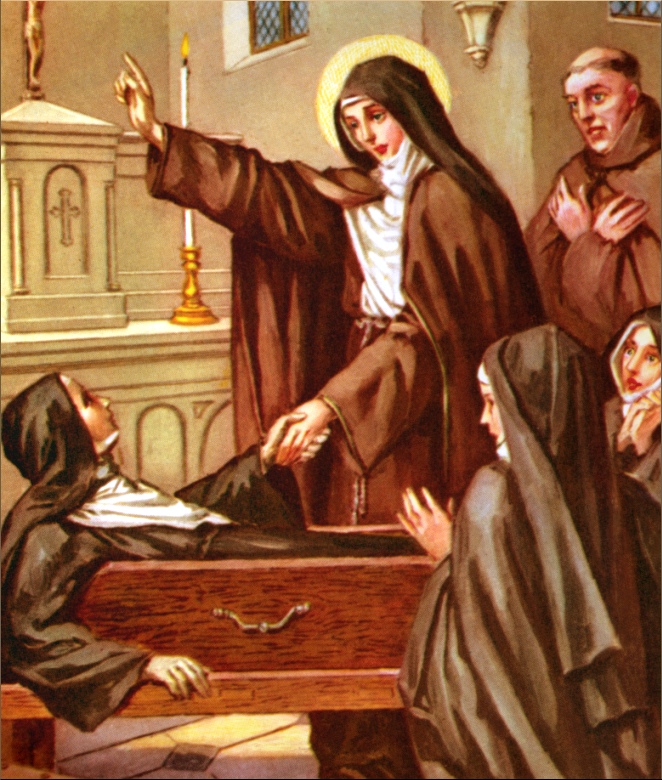
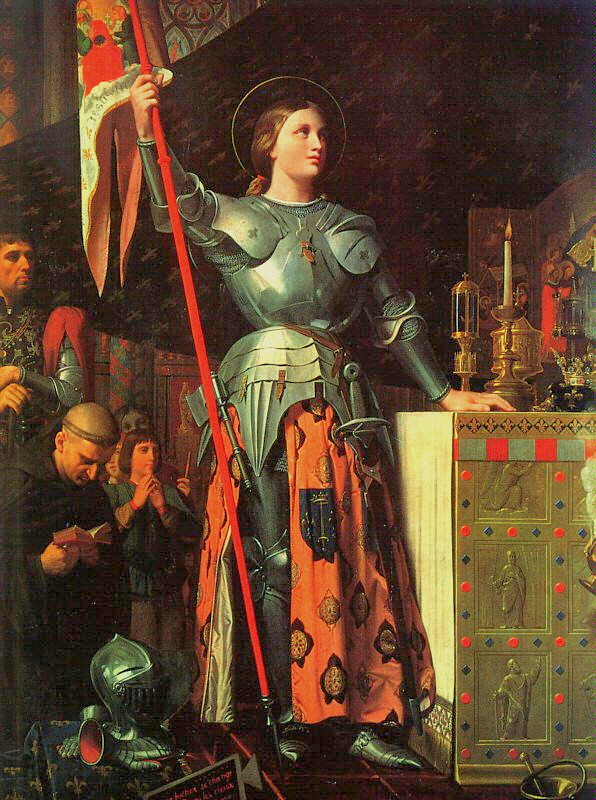
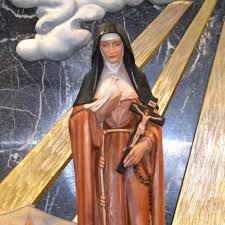
Like St Joan of Arc, St Colette had a mission from the Lord and, when she was sure of that mission, gave her whole life to it. In her day, holiness had declined even among religious and she was determined to recover a life of holiness for the daughters of St Francis and St Clare. No obstacles turned her back, for God was on her side. With God, she believed she could and she did, accomplish all things ……. and THIS is the message to you and me – with God on our side WE CAN!
Do not grow slack in zeal, be fervent in spirit, serve the Lord. Rejoice in hope, endure in affliction, persevere in prayer…….Romans 12:11-12
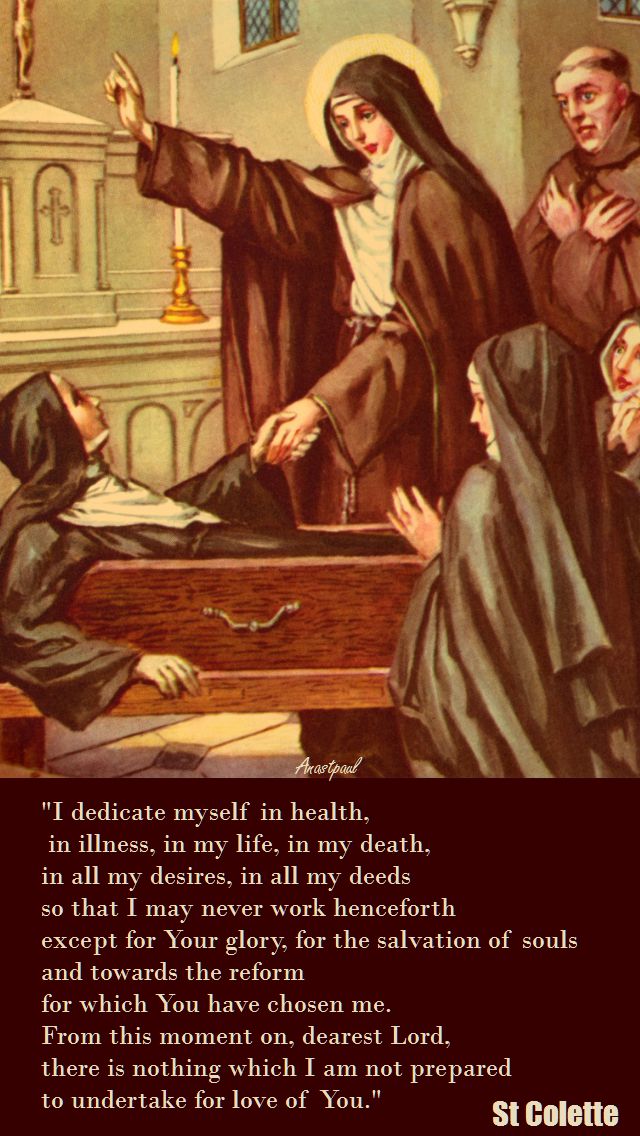
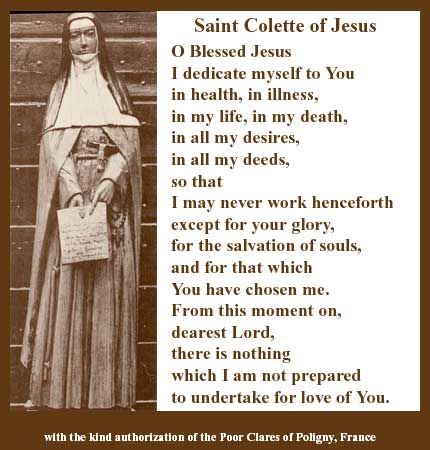
REFLECTION – “I dedicate myself in health, in illness, in my life, in my death, in all my desires, in all my deeds so that I may never work henceforth except for Your glory, for the salvation of souls and towards the reform for which you have chosen me. From this moment on, dearest Lord, there is nothing which I am not prepared to undertake for love of You.”………………..St Colette
PRAYER – “We must faithfully keep what we have promised. If through human weakness we fail, we must always without delay arise again by means of holy penance, and give our attention to leading a good life and to dying a holy death. May the Father of all mercy, the Son by his holy passion and the Holy Spirit, source of peace, sweetness and love, fill us with their consolation. Amen.” (Prayer of St Colette) St Colette Pray for us!
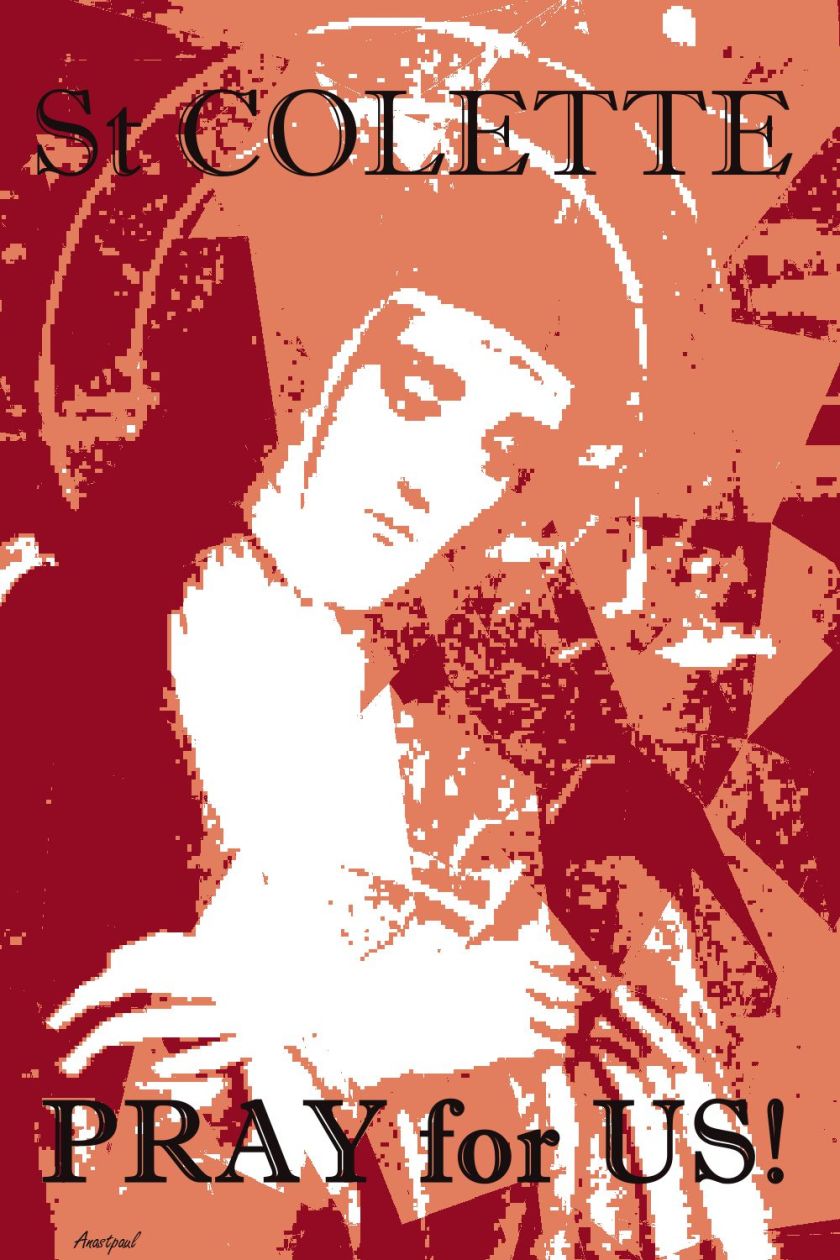
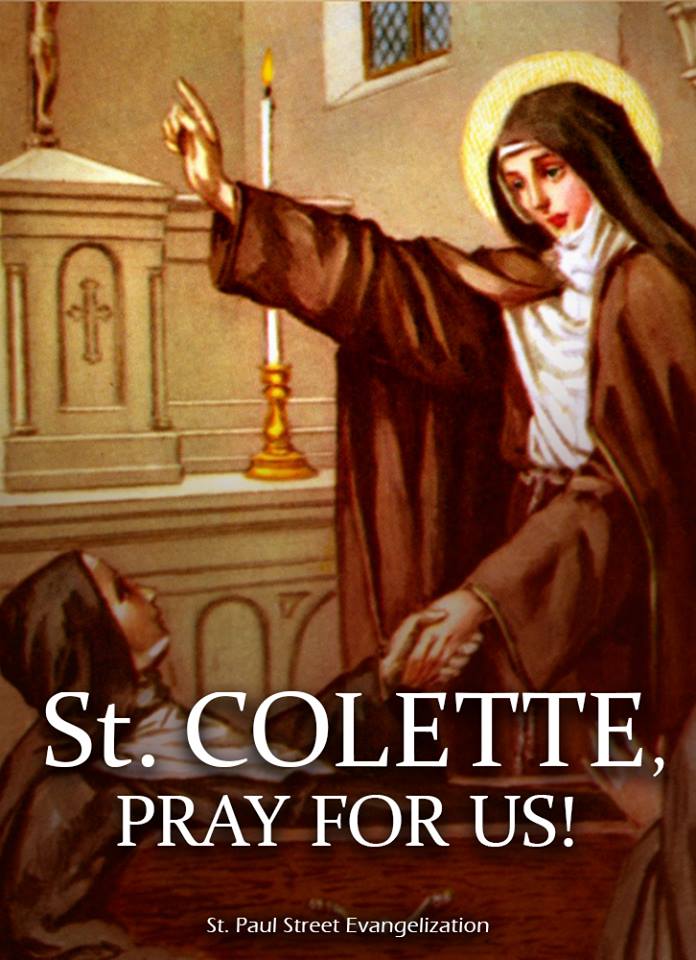
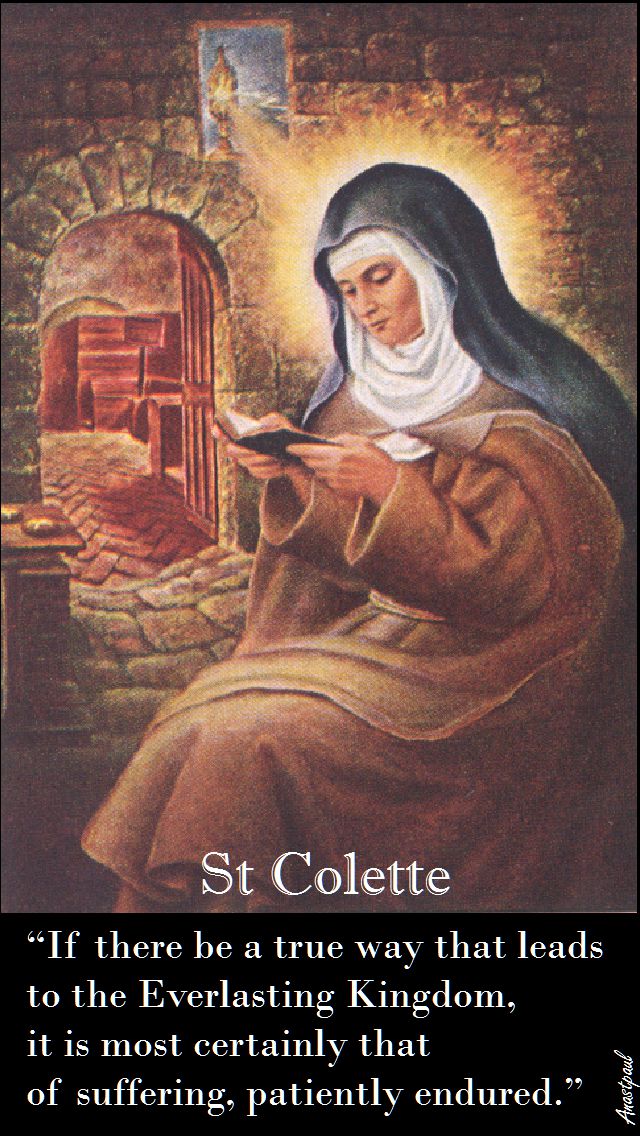
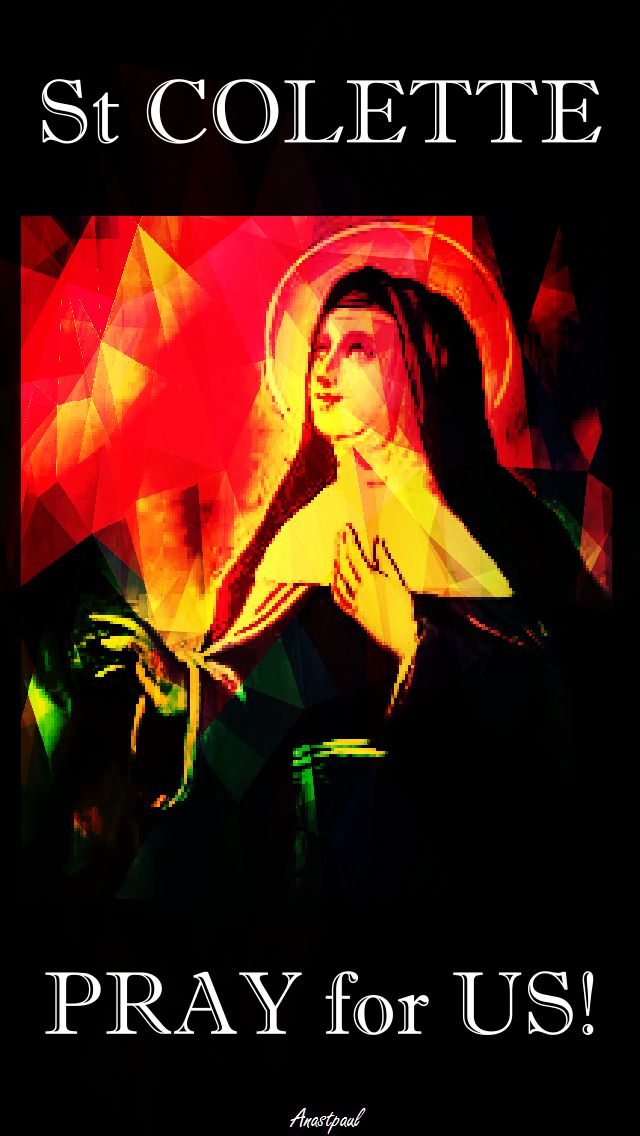
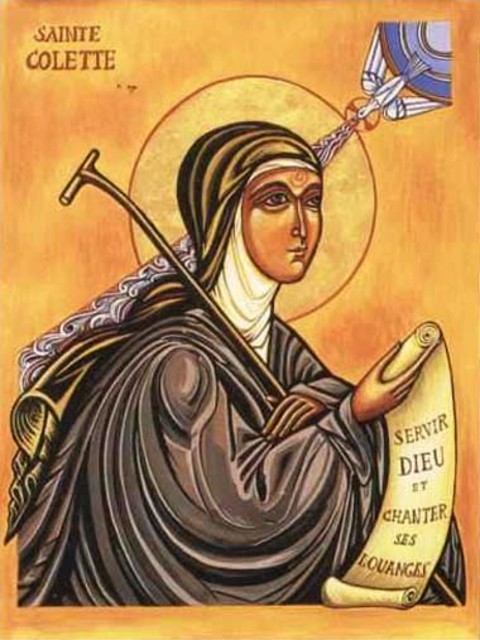
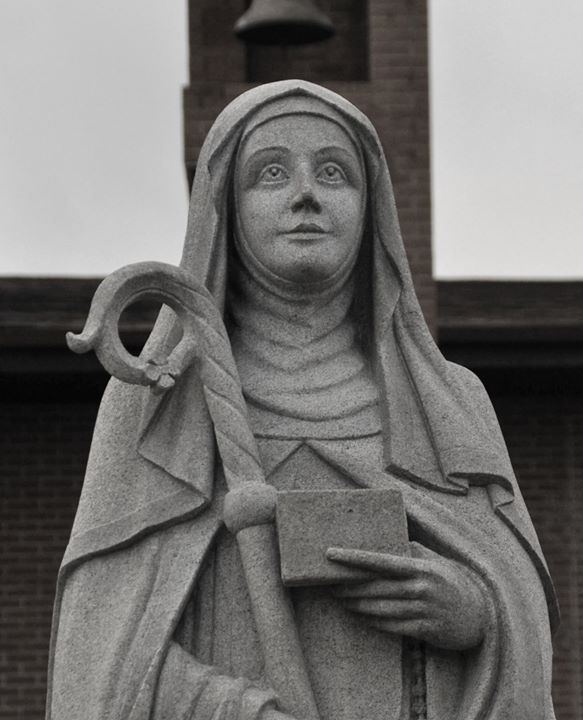
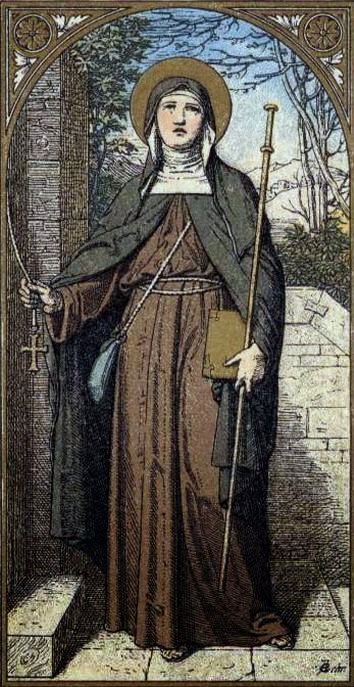
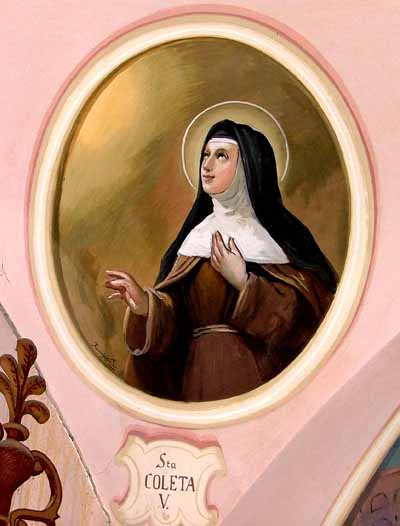
Saint of the Day – 6 March – St Colette PCC. (1381-1447) -aged 66, Abbess and Foundress of the Colettine Poor Clares, a reform branch of the Order of Saint Clare, better known as the Poor Clares. Patronages – against eye disorders, against fever, against headaches, against infertility, against the death of parents, of women seeking to conceive, expectant mothers and sick children, craftsmen, Poor Clares, servants, Corbie, France, Ghent, Belgium.
She was born Nicole Boellet (or Boylet) in the village of Corbie, in the Picardy region of France, on 13 January 1381, to Robert Boellet, a poor carpenter at the noted Benedictine Abbey of Corbie and to his wife, Marguerite Moyon. Her contemporary biographers say that her parents had grown old without having children, before praying to Saint Nicholas for help in having a child. Their prayers were answered when, at the age of 60, Marguerite gave birth to a daughter. Out of gratitude, they named the baby after the saint to whom they credited the miracle of her birth. She was affectionately called Nicolette by her parents, which soon came to be shorted to Colette, by which name she is known.
After her parents died in 1399, Colette joined the Beguines, she was seventeen but found their manner of life unchallenging. She received the habit of the Third Order of St. Francis in 1402 and became a hermit under the direction of the Abbot of Corbie, living near the abbey church.
Renewing religious institutions is not easy. We would expect a person chosen to reform convents and monasteries to be formidable. Maybe even physically tall, overbearing, and somewhat threatening. God, however, doesn’t seem to agree. For example, in the fifteenth century he selected St. Colette, a young woman the opposite of these characteristics, to call Franciscans to strict observance of the rules of St. Clare and St. Francis.
Not that Colette was unimpressive. She was a beautiful woman whose radiant inner strength attracted people. However, her spirituality, her commitment to God, and her heart for souls, not her physical qualities, suited her for her reforming mission.
St. Francis appeared to her in a vision and charged her to restore the Poor Clares to their original austerity. When Friar Henry de Beaume came in 1406 to conform her mission, Colette had the door of her hut torn down, a sign that her solitude was over and her work begun. And she then prayed her commitment:
“I dedicate myself in health, in illness, in my life, in my death, in all my desires, in all my deeds so that I may never work henceforth except for your glory, for the salvation of souls, and towards the reform for which you have chosen me. From this moment on, dearest Lord, there is nothing which I am not prepared to undertake for love of you.”
St Colette
Colette’s first reports to reform convents met vigorous opposition. Then she sought the approval of the Avignon pope, Benedict XIII, who professed her as a Poor Clare and put her in charge of all convents she would reform. He also appointed Henry de Beaume to assist her. Thus equipped, she launched her reform in 1410 with the Poor Clares at Besancon. Before her death in 1447, the saint had founded or renewed seventeen convents and several friaries throughout France, Savoy, Burgundy, and Spain.
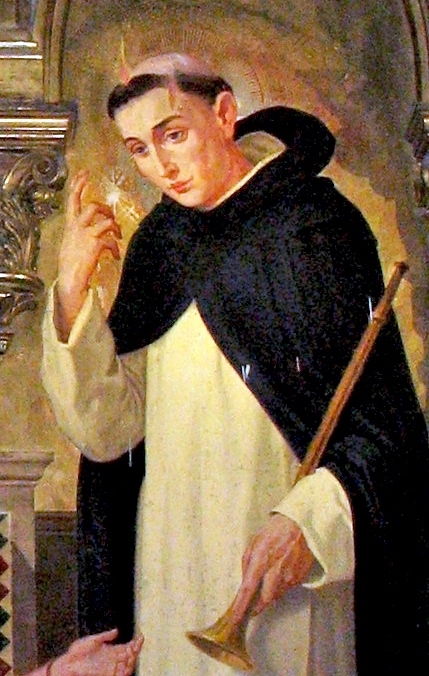
Like Francis and Clare, Colette devoted herself to Christ crucified, spending every Friday meditating on the passion. She is said to have miraculously received a piece of the cross, which she gave to St.Vincent Ferrer when he came to visit her.
St. Joan of Arc once passed by Colette’s convent in Moulins but there is no evidence that the two met. Like Joan, Colette was a visionary. Once, for instance, she saw souls falling from grace in great numbers, like flakes in a snowstorm. Afterward she prayed daily for the conversion of sinners. She personally brought many strays back to Christ and helped them unravel their sinful patterns. At age sixty-six, Colette foretold her death, received the sacrament of the sick and died at her convent in Ghent, Flanders.
St Vincent FerrerSt Joan of ArcSt ColetteSt Colette
Miracles Helping a mother in childbirth While traveling to Nice to meet Pope Benedict, Colette stayed at the home of a friend. His wife was in labour at that time with their third child and was having major difficulties in he childbirth, leaving her in danger of death. Colette immediately went to the local church to pray for her. The mother gave birth successfully and survived the ordeal. She credited Colette’s prayers for this. The child born, a girl named Pierinne, later entered a monastery founded by Colette. She would become Colette’s secretary and biographer.
Saving a sick child After the pope had authorised Colette to establish a regimen of strict poverty in the Poor Clare monasteries of France, she started with that of Besançon. The local populace was suspicious of her reform, with its total reliance on them for the sustenance of the monastery. One incident helped turn this around. According to legend, a local peasant woman gave birth to a stillborn child. In desperation, out of fear for the child’s soul, the father took the baby to the local parish priest for baptism. Seeing that the child was already dead, the priest refused to baptise the body. When the man became insistent, out of frustration, the priest told him to go to the nuns, which he did immediately. When he arrived at the monastery, Mother Colette was made aware of his situation by the portress. Her response was to take off the veil given to her by the Pope, when he gave her the habit of the Second Order and told the portress to have the father wrap the child’s body in it and for him to return to the priest. By the time he arrived at the parish church with his small bundle, the child was conscious and crying. The priest immediately baptised the baby.
Colette was beatified 23 January 1740, by Pope Clement XII and was canonized 24 May 1807 by Pope Pius VII.
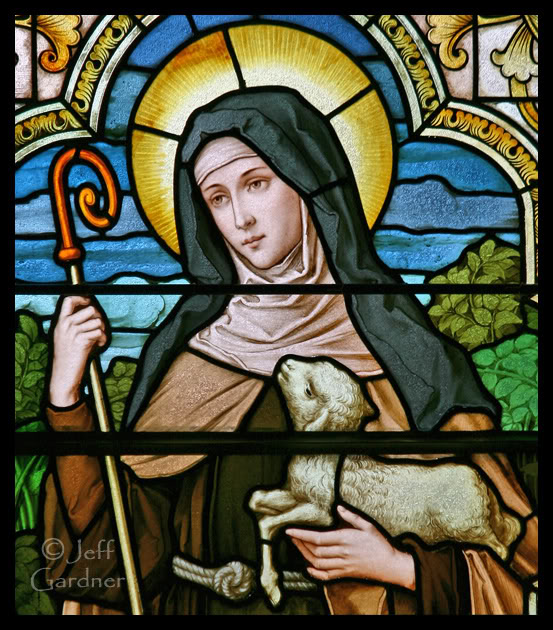
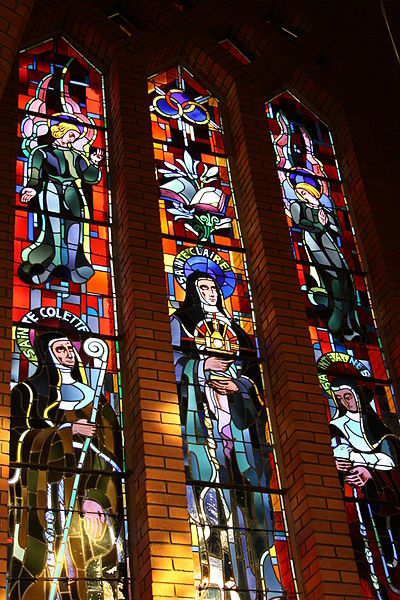
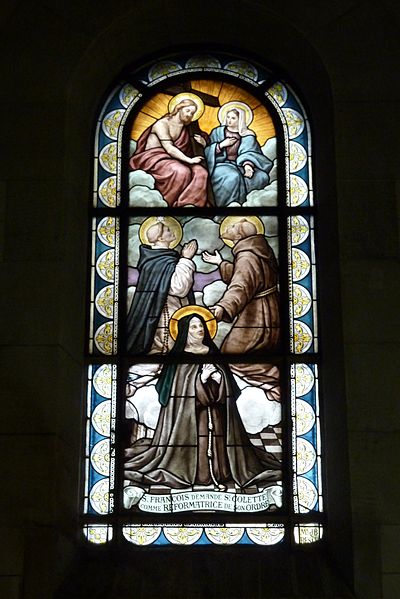
Stained glass window in a Franciscan chapel Paris, FranceStained glass window in Our Lady of the Rosary Church Saint-Ouen, France
St Aetius
St Bairfhion
St Baldred of Strathclyde
St Baldred the Hermit
St Balther of Lindisfarne
St Basil of Bologna
St Cadroë
St Chrodegang of Metz
St Colette
St Cyriacus of Trier
St Cyril of Constantinople
St Evagrius of Constantinople
Fridolin Vandreren of Säckingen
Bl Guillermo Giraldi
St Heliodorus the Martyr
Bl Jordan of Pisa
St Julian of Toledo
St Kyneburga of Castor
St Kyneswide of Castor
St Marcian of Tortona
Bl Ollegarius of Tarragona
St Patrick of Malaga
St Rose of Viterbo
St Sananus
Bl Sylvester of Assisi
St Tibba of Castor
St Venustus of Milan
—
Martyrs of Amorium – 42 saints – Also known as Martyrs of Syria and Martyrs of Samarra
A group of 42 Christian senior officials in the Byzantine empire who were captured by forces of the Abbasid Caliphate when the Muslim forces overran the city of Amorium, Phrygia in 838 and massacred or enslaved its population. The men were imprisoned in Samarra, the seat of the Caliphate, for seven years. Initially thought to be held for ransom due to their high position in the empire, all attempts to buy their freedom were declined. The Caliph repeatedly ordered them to convert to Islam and sent Islamic scholars to the prison to convince them; they refused until the Muslims finally gave up and killed them. Martyrs. We know the names and a little about seven of them:
• Aetios
• Bassoes
• Constantine
• Constantine Baboutzikos
• Kallistos
• Theodore Krateros
• Theophilos
but details about the rest have disappeared over time. However, a lack of information did not stop several legendary and increasingly over-blown “Acts” to be written for years afterward. One of the first biographers, a monk name Euodios, presented the entire affair as a judgement by God on the empire for its official policy of Iconoclasm.
Deaths:
• beheaded on 6 March 845 in Samarra (in modern Iraq) on the banks of the Euphrates river by Ethiopian slaves
• the bodies were thrown into the river, but later recovered by local Christians and given proper burial
Martyrs of Nicomedia
Bassa
Claudian
Victor
Victorinus
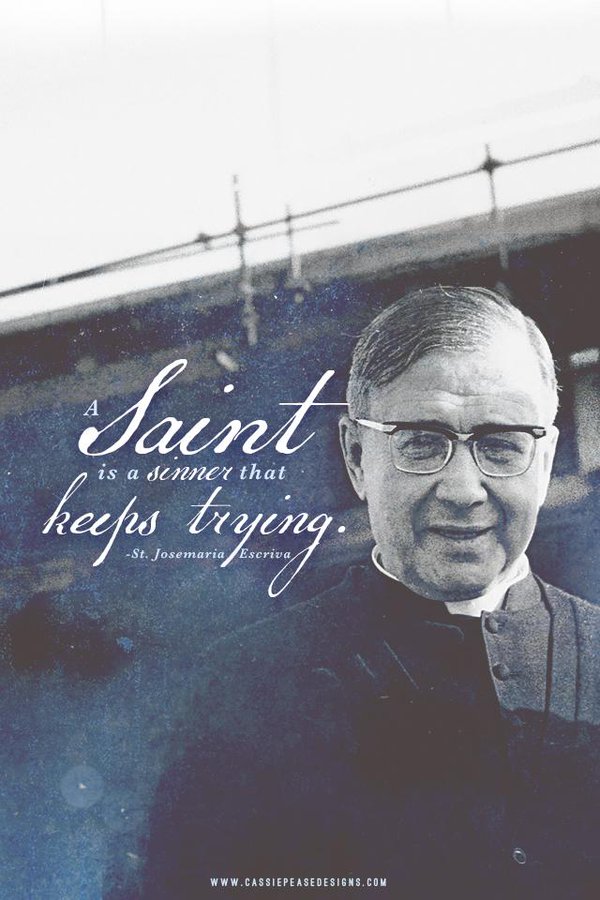
When St Eisebius of Cremona (memorial today) went to Rome to collect funds on behalf of St Jerome, he noticed that Rufinus, an old friend of Jerome’s – though not on good terms with him, was translating the works of Origen, against whose writing St Jerome was arguing. Eusebius secretly removed the works and sent them to Jerome, thus in fact stealing and causing a final rift between the two. So even saints sometimes do disgraceful things and St Eusebius’ theft of Rufinus’ manuscript was a thoughtless act of an overzealous friend embroiled in the controversies of the day. It is good to know that even saints have faults and that such faults detract nothing from their holiness. For – a saint is a sinner who keeps on trying! NEVER FORGET IT!
Saint of the Day – 5 March – St Eusebius of Cremona (died 423) Abbot
Born in Cremona, Italy; died c. 423. Eusebius first met Saint Jerome in Rome
when Jerome was acting as secretary to Pope Saint Damasus and preaching a
strict asceticism to all who would listen. Eusebius was so much attracted to
the stern Biblical scholar that when Jerome decided to leave for the Holy
Land, he begged to accompany him. At Antioch they were joined by Jerome’s
other two great friends, the widow Saint Paula and her daughter Saint
Eustochium. The four of them made a pilgrimage to all the places connected
with the earthly life of Jesus, before deciding to make Bethlehem their
home.
Jerome was much touched by the hundreds of pilgrims to Bethlehem, many of
whom were extremely poor. Resolving to build a hostel for them, he sent
Eusebius to Dalmatia and Italy to raise money for the project. Saint Paula
sold her Roman estate through him for this purpose and Eusebius also sold
his own property at Cremona and gave the proceeds for the building of the
hostel.
Eusebius succeeded the holy Doctor of the Church as abbot of Bethlehem and
was involved, like his friend, in bitter disputes with the followers of
Origen. As a loyal friend of Jerome’s Eusebius became involved in Jerome’s disputes over Origen and he seems to have been responsible for Pope Anastasius’ condemnation of Origen’s writings. There is an unsubstantiated tradition that Eusebius founded the
abbey of Guadalupe in Spain.
In 400 AD, Eusebius returned to his native Cremona, where some sources
indicate that he stayed until his death. Others suggest that he returned to
Bethlehem to become spiritual director of one of the religious communities
there. He may well be buried alongside Jerome in Bethlehem, where-in the
crypt of the church of the Nativity-an altar is dedicated in his name
(Benedictines, Bentley).
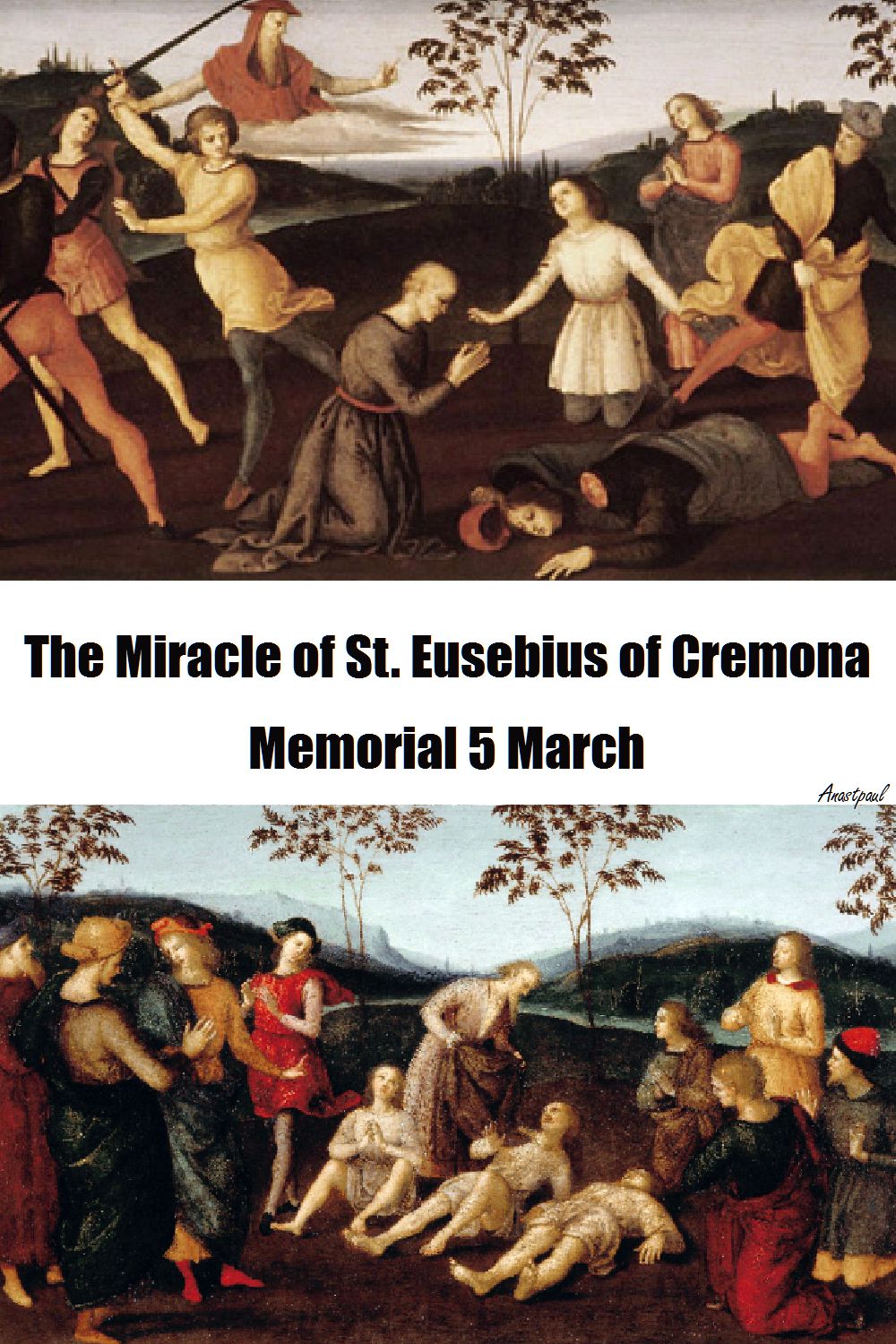
Painted for the chapel founded by Domenico Gavari in the Church of Santo Domenico, in Città di Castello (Umbria, Italy), this work illustrates a miracle of St. Eusebius, the bringing back to life of three young men, in keeping with a literary source that became very popular in Italy in the 15th century. Two other paintings from the same altarpiece have also survived and are housed at the National Gallery (London) and the North Carolina Museum of Art (USA).
The narrative subtlety of the three resuscitated figures, depicting different moments in their return to life – ranging from the still prostrate body on the right to the young man on the left who is already seen in prayer – reveals Raphael’s remarkable capacity for invention.
1st Sunday in Lent (2017)
—
St Adrian of Caesarea
St Caron
St Carthach the Elder
Bl Christopher Macassoli of Vigevano
St Clement of Santa Lucia
St Colman of Armagh
St Conon of Pamphylia
Bl Conrad Scheuber
St Eusebius of Cremona
St Eusebius the Martyr
St Gerasimus
Bl Giovanna Irrizaldi
Bl Ion Costist
St John Joseph of the Cross
St Kieran
Bl Lazër Shantoja
St Lucius I, Pope
St Mark the Ascetic
St Oliva of Brescia
St Phocas of Antioch
St Piran
Bl Roger
Bl Romeo of Limoges
St Theophilus of Caesarea
St Virgilius of Arles
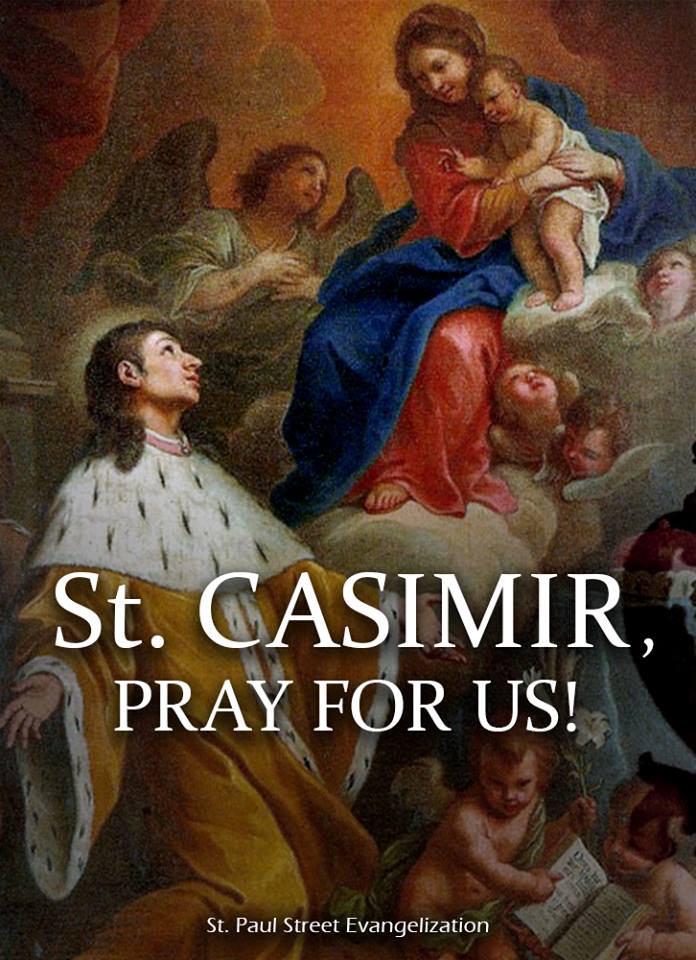
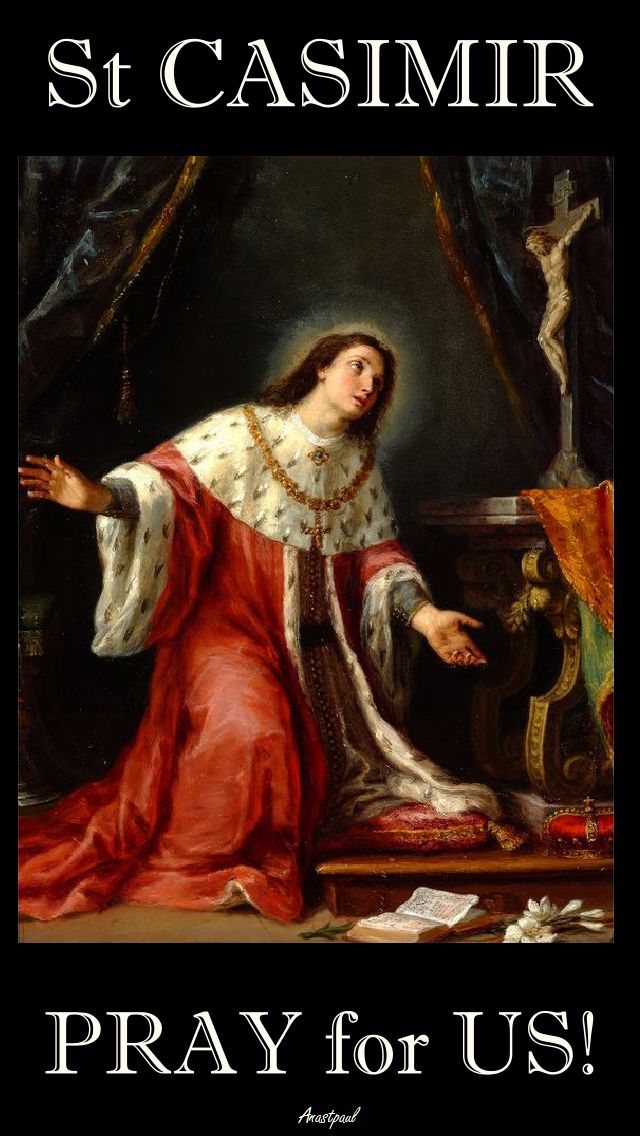
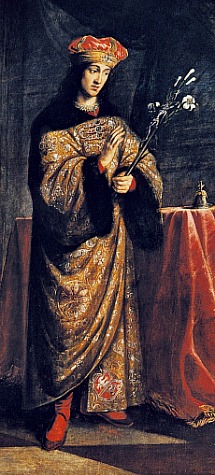
The calendar of the saints is studded with young saints: Agnes, Aloysius, Doiminic Savio, Maria Goretti……many more and today’s saint, Casimir. They chose to be different, independent and very bold during the times they lived. They chose to stand out from the crowd (almost the complete opposite of the desire of most of the young) and because of this choice, they had to walk a very singular path to sanctity. Casimir and Aloysius, both were princes but chose devotion to God above all, at a very early age. Youth too, needs its. saints and God sends them to us!
““(St Casimir’s) life of purity and prayer
beckons you to practice your faith
with courage and zeal,
to reject the deceptive attractions
of modern permissive society
and to live your convictions
with fearless confidence and joy.”
St John Paul in 1984, to Lithuanian pilgrims, on the 500th anniversary of St Casimir’s death
One Minute Reflection – 4 March – The Memorial of St Casimir (1458-1484) Confessor, Prince
“But above all these things have charity, which is the bond of perfection…” – Col 3:14
REFLECTION – “By the power of the Holy Ghost, Casimir burned with a sincere and unpretentious love for Almighty God that was almost unbelievable in its strength. So rich was his love and so abundantly did it fill his heart, that it flowed out from his inner spirit toward his fellow men. As a result nothing was more pleasant, nothing more desirable for him, than to share his belongings and even to dedicate and give his entire self to Christ’s poor, to strangers, to the sick, to those in captivity and all who suffer. To widows, orphans and the afflicted, he was not only a guardian and patron but a father, son and brother.” (From the Biography of Saint Casimir, written by a contemporary).
PRAYER – Loving Father, pour out Thy divine love into my heart and soul. Let me co-operate with that love and in this way strive for perfection in all virtues. St Casimir, you are a shining example to us all of how love should look, of how love should behave, please pray that we may too become beacons and hearts burning with love for all! Amen.
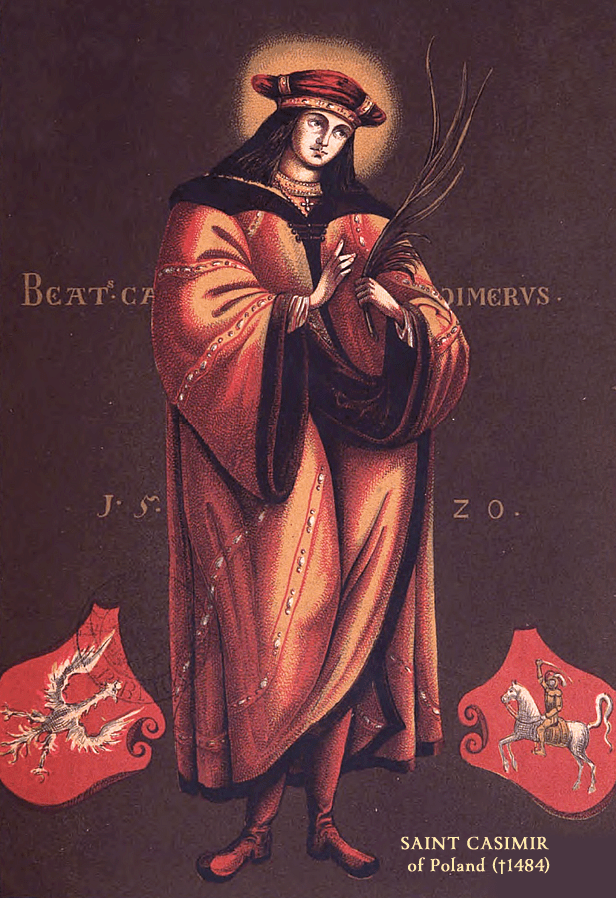
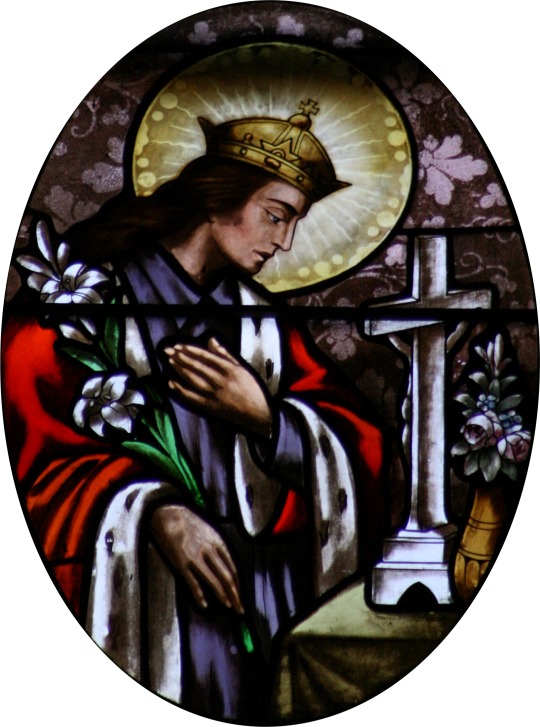
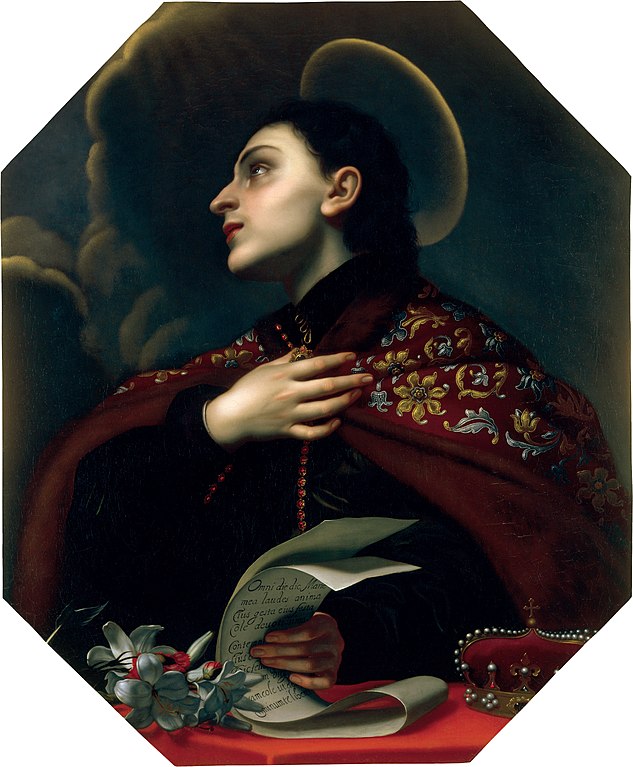
Saint of the Day – 4 March – St Casimir- (1458-148) aged 25 Confessor, Prince, Celibate, Ascetic, Apostle of Prayer, Apostle of Charity and Mercy, Marian Devotee, Eucharistic Adorer, Confessor – Patronages – against plagues/epidemics, of bachelors, kings, princes, Lithuania (proclaimed by Pope Urban VIII in 1636, Poland, Grodno, Belarus, Diocese of, youth. His body is incorrupt.
Casimir Jagiellon was born in 1458, the third of thirteen children born to Poland’s King Casimir IV and his wife Elizabeth of Austria. He and several of his brothers studied with the Priest and Historian, John Dlugosz, whose deep piety and political expertise influenced Casimir in his education.
The young Prince had a distaste for the luxury of courtly life and instead chose the way of asceticism and devotion. He wore plain clothes with a hair shirt beneath them, slept frequently on the ground and would spend much of the night in prayer and meditation on the suffering and death of Christ.
Casimir showed his love for God through these exercises of devotion and also through his material charity to the poor. He was known as a deeply compassionate young man who felt others’ pains acutely.
The young Prince was only 13 years old when his father was asked by the Hungarians to offer his son as their new King. Casimir was eager to aid the Hungarians in their defence against the Turks and went to be crowned. This plan was unsuccessful, however and he was forced to return to Poland.
After his return Casimir resumed his studies with Fr Dlugosz, while developing a canny grasp of politics by observing his father’s rule. In 1479 the King left Poland to attend to state business in Lithuania, leaving Prince Casimir in charge of the realm .between 1481 and 1483.
Advisers to the p=Prince joined his father in trying to convince Casimir to marry. But he preferred to remain single, focusing his life on the service of God and the good of his people.
After experiencing symptoms of tuberculosis, Casimir foresaw his death and prepared for it by deepening his devotion to God. He died en route to Lithuania on 4 March 1484 and was buried with a copy of the Marian Hymn he sang daily “Daily, Daily Sing to Mary.” Pope Adrian VI Canonised him in 1522. After a lapse of one hundred and twenty years, his body was taken up, and found without the slightest sign of corruption.
Five centuries after his death, John Paul II recalled how St Casimir “embraced a life of celibacy, submitted himself humbly to God’s will in all things, devoted himself with tender love to the Blessed Virgin Mary and developed a fervent practice of adoring Christ present in the Blessed Sacrament.”
St Casimir of Poland (Optional Memorial)
—
Adrian of May
Adrian of Nicomedia
Appian of Comacchio
Arcadius of Cyprus
Basinus of Trier
Felix of Rhuys
Gaius of Nicomedia
Giovanni Antonio Farina
Bl Humbert III of Savoy
Leonard of Avranches
Bl Marie-Louise-Élisabeth de Lamoignon de Dolé de Champlâtreux
Nestor the Martyr
Owen
Peter of Pappacarbone
Bl Placide Viel
Bl Rupert of Ottobeuren
—
Martyrs on the Appian Way – 900 saints – Group of 900 martyrs buried in the catacombs of Saint Callistus on the Appian Way, Rome, Italy.c260
Martyrs of Nicomedia – 20 saints – A group of 20 Christians murdered together for their faith. The only details about them to survive are three of their names – Archelaus, Cyrillos and Photius. Nicomedia, Bithynia (in modern Turkey)
Martyrs of the Crimea – 7 saints – A group of 4th century missionary bishops who evangelized in the Crimea and southern Russia, and we martyred for their work. We know little else beyond the names – Aetherius, Agathodorus, Basil, Elpidius, Ephrem, Eugene and Gapito.
Martyred by Communists: Bl Giovanni Fausti, Bl Gjelosh Lulashi, Bl Kolë Shllaku, Bl Zoltán Lajos Meszlényi
Martyred by Elizabeth I: Bl Alexander Blake, Bl Christopher Bales, Bl Nicholas Horner
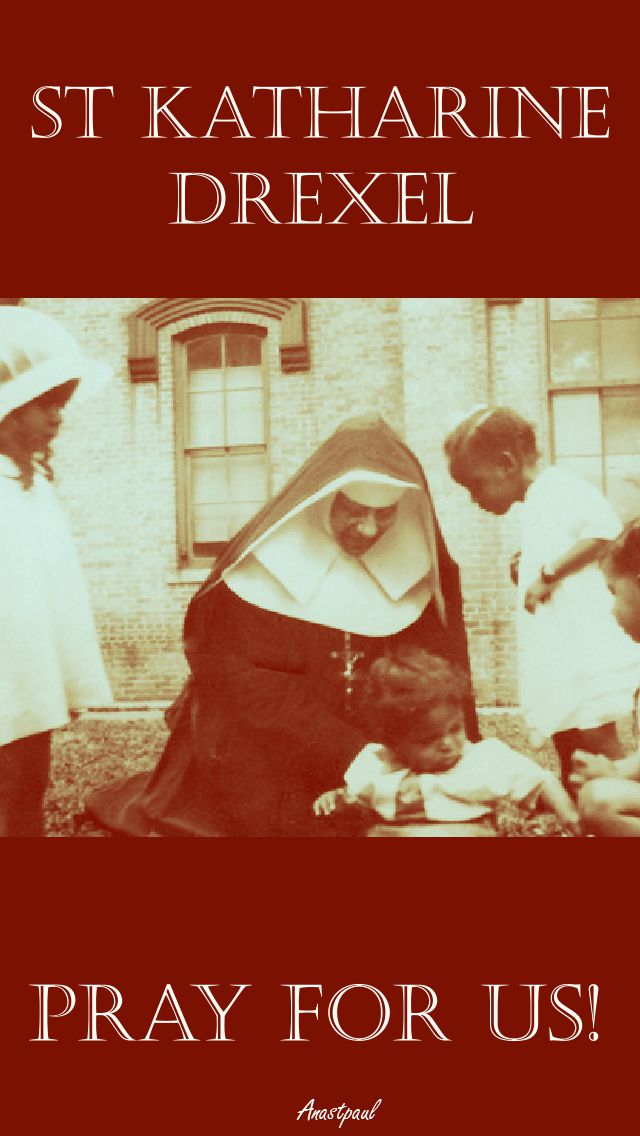
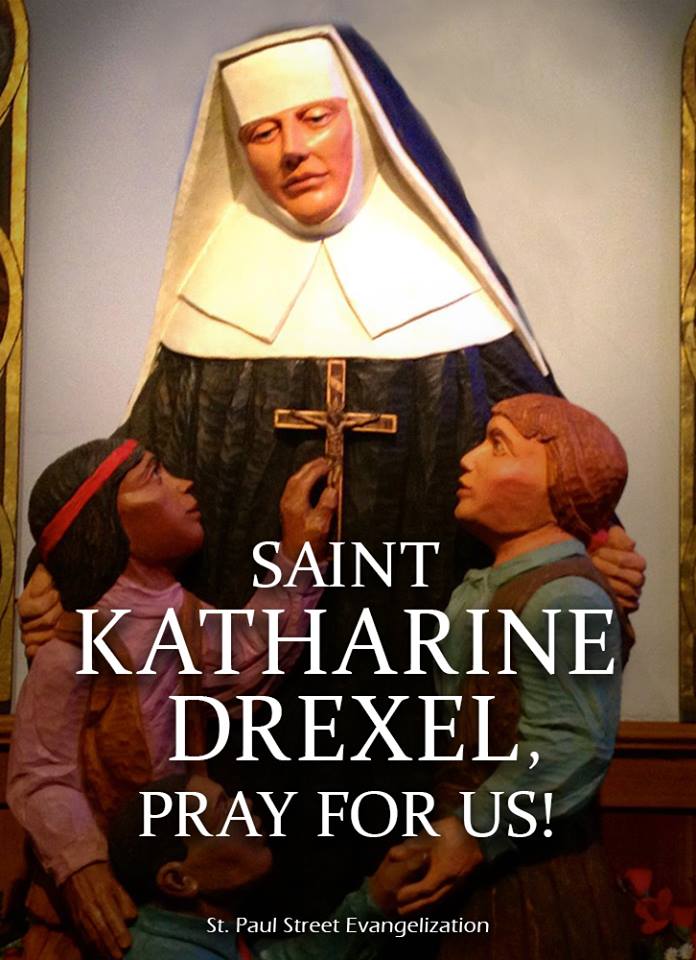
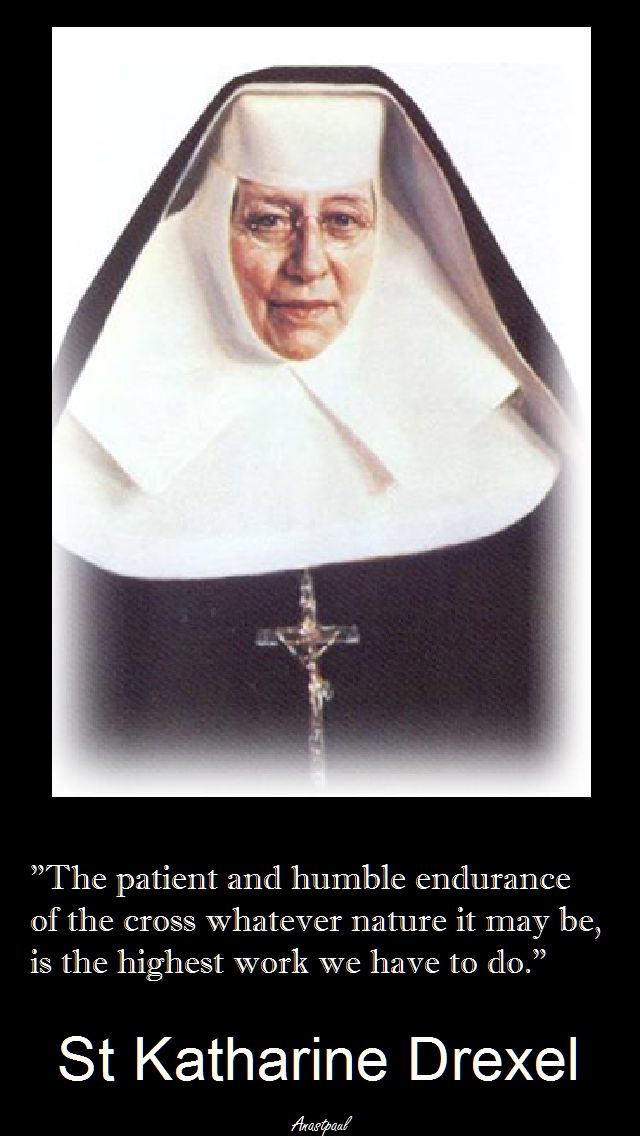
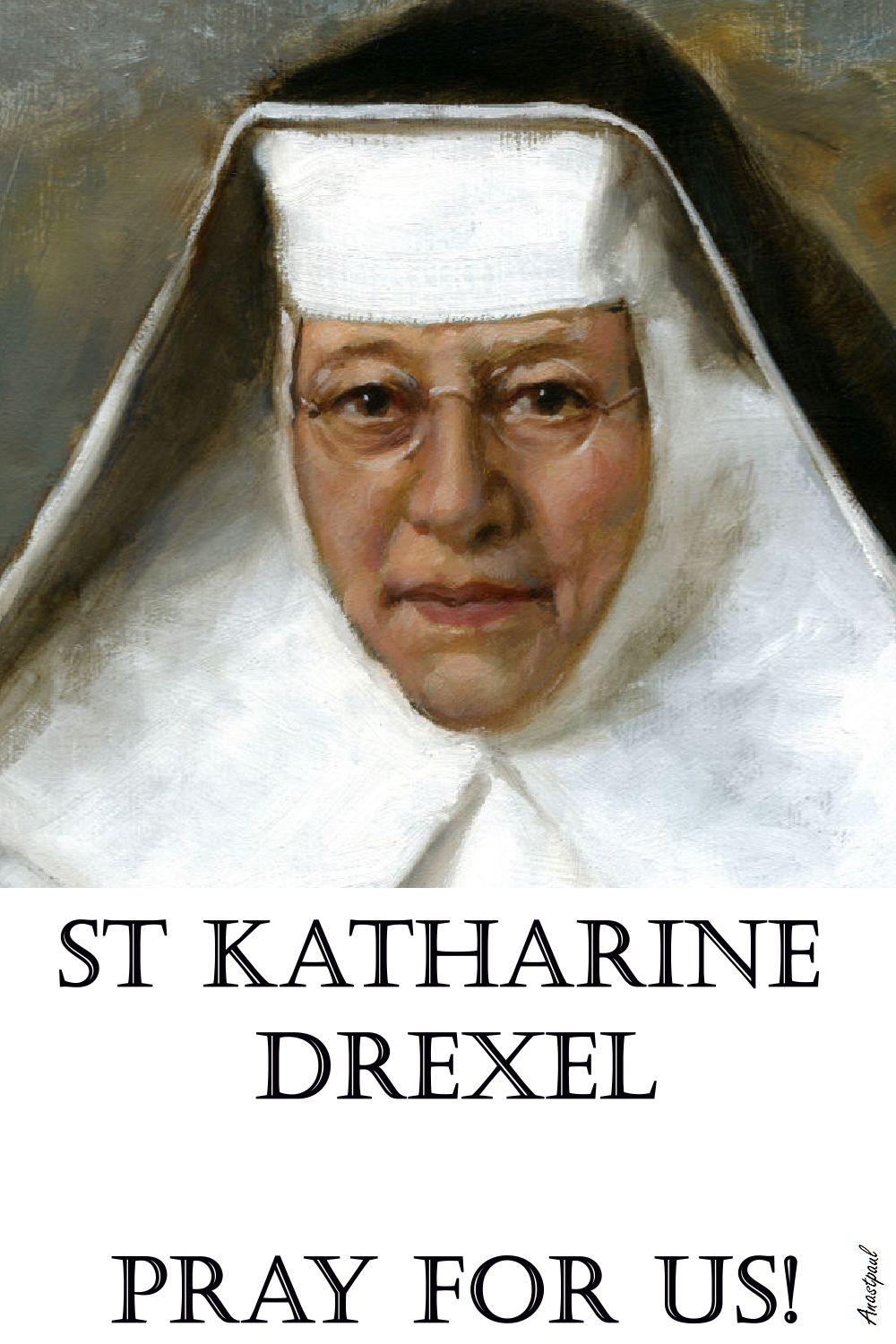
At first St Katharine Drexel was going to give only her fortune to the work of the missions but instead, at the suggestion of the Pope, gave herself. Her long life was spent bringing the faith to others and inspiring others to join her. God wants more than our generosity – He wants us! Perhaps we should look around and see how we might serve Him?
Katharine’s vast inheritance was distributed among her father’s twenty-nine favourite charities. Not a penny went to her own community. She wanted her sisters to live by faith, trusting God—not money—for everything!
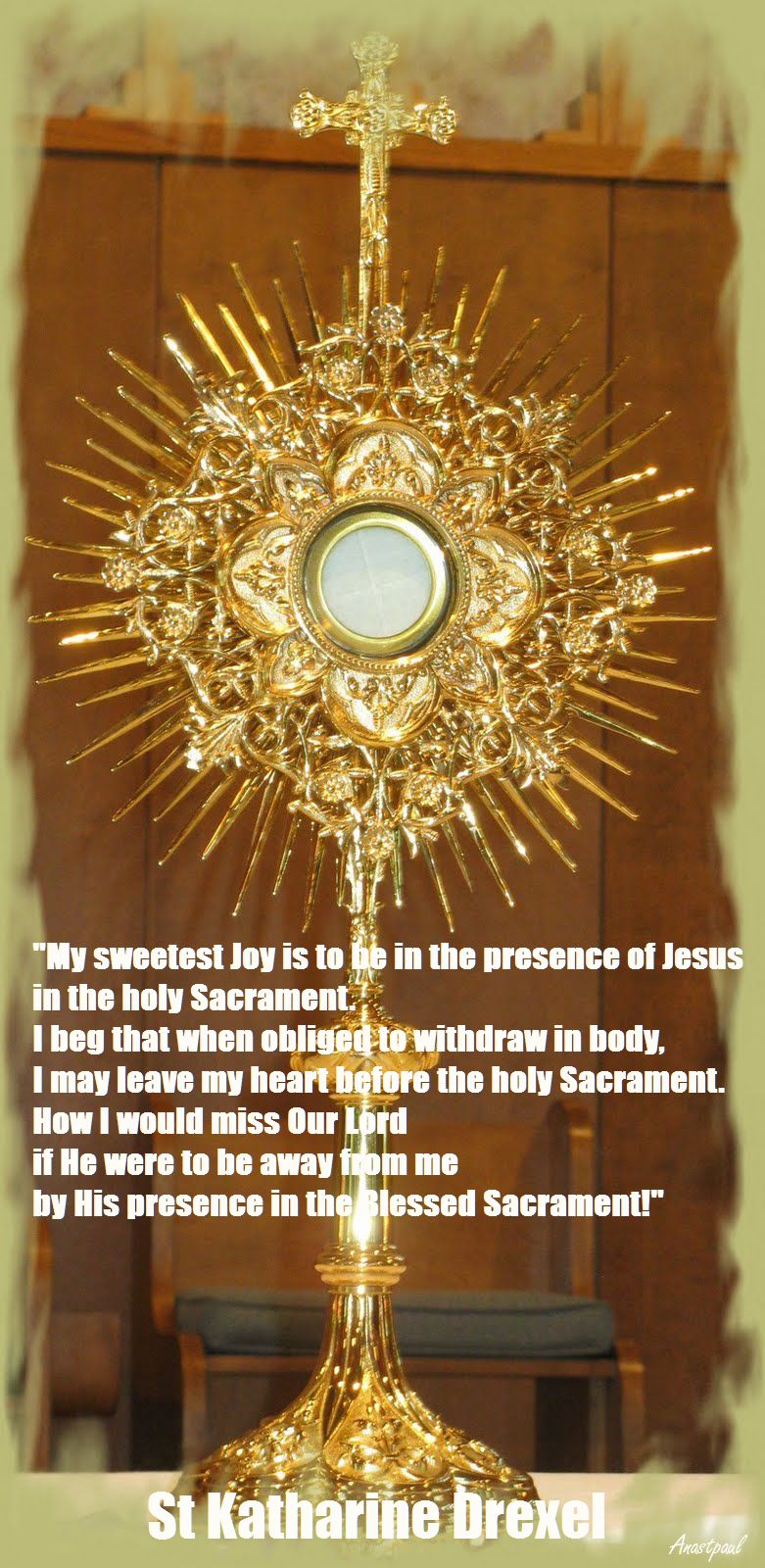
“My sweetest Joy is to be in the presence of Jesus in the holy Sacrament. I beg that when obliged to withdraw in body, I may leave my heart before the holy Sacrament. How I would miss Our Lord if He were to be away from me by His presence in the Blessed Sacrament!”
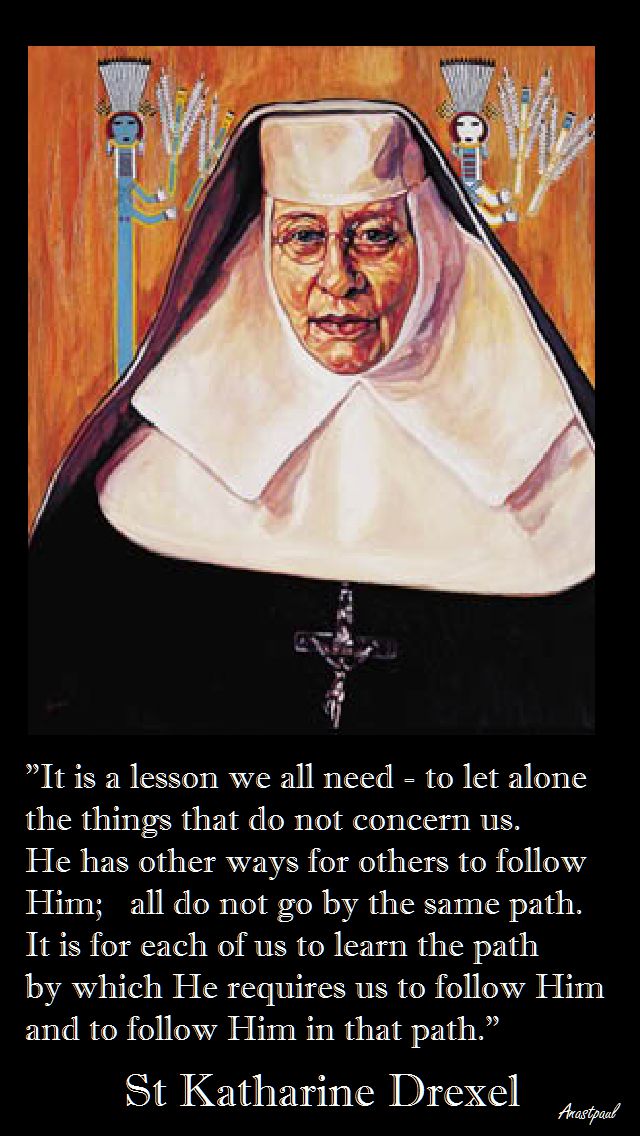
“It is a lesson we all need – to let alone the things that do not concern us. He has other ways for others to follow Him; all do not go by the same path. It is for each of us to learn the path by which He requires us to follow Him and to follow Him in that path.”
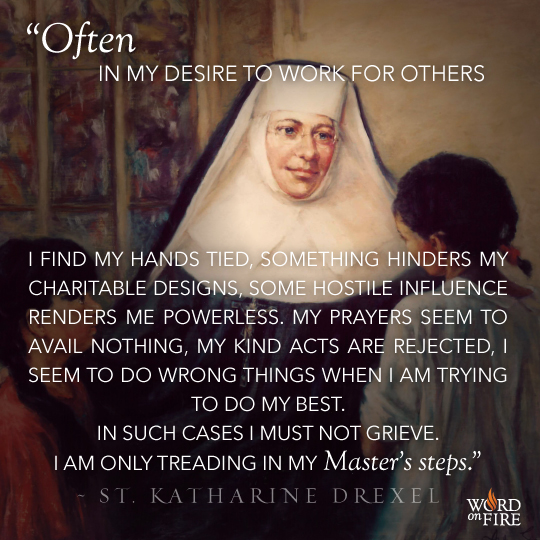
“Often in my desire to work for others I find my hands tied, something hinders my charitable designs, some hostile influence renders me powerless. My prayers seem to avail nothing, my kind acts are rejected, I seem to do the wrong thing when I am trying to do my best. In such cases I must not grieve. I am only treading in my Master’s steps.”
He who does not take up his cross and come after me is not worthy of me…………….Matthew 10:38
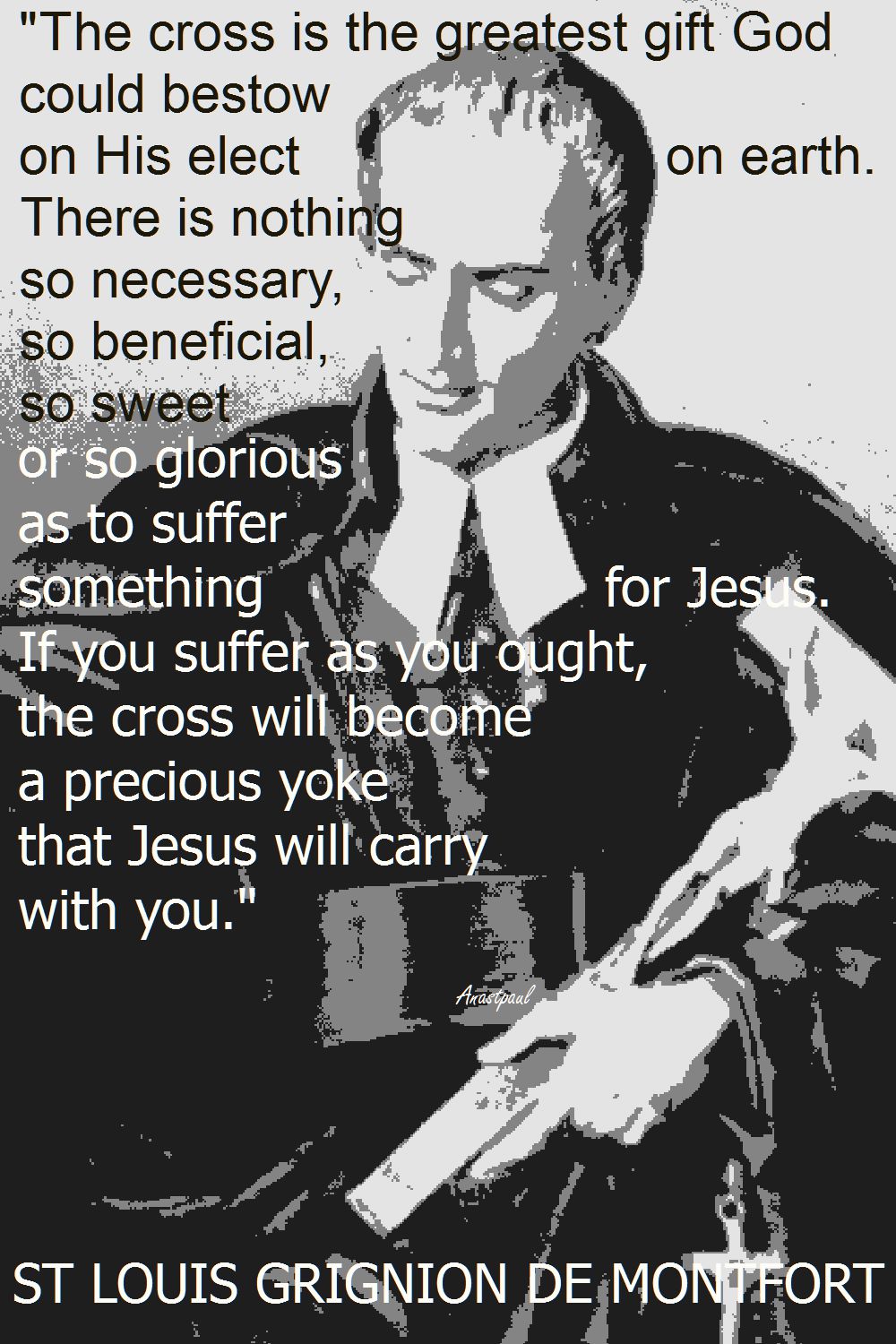
REFLECTION – “The cross is the greatest gift God could bestow on His elect on earth. There is nothing so necessary, so beneficial, so sweet, or so glorious as to suffer something for Jesus. If you suffer as you ought, the cross will become a precious yoke that Jesus will carry with you.”…………..St Louis Grignion de Montfort
“The patient and humble endurance of the cross whatever nature it may be, is the highest work we have to do.”………..St Katharine Drexel
PRAYER – Lord Jesus, impress upon me that without a cross on earth there will be no crown in heaven. Help me to bear my cross daily for You as You bore Your Cross for me and for all mankind. St Katharine Drexel, pray for us, amen.
Saint of the Day – 3 March – St Katharine Drexel S.B.S (Sisters of the Blessed Sacrament) (1858-1955-AGED 96) – was an American heiress, philanthropist, religious sister, missionary, educator, and foundress. She was canonised by the Roman Catholic Church in 2000; her feast day is observed on March 3. She is the only canonised saint to have been born a United States citizen – Patron of Philanthropy, racial justice
Francis A. Drexel, a world-renowned banker and a man of faith, provided his family a life of ease. And Emma Bouvier, her stepmother, trained Katharine and her two sisters in generous giving. Mrs. Drexel believed God gave wealth to the family to aid others and regularly involved her daughters in distributing food, medicine, clothing and rent money to the poor. The experience shaped Katharine’s future.
As a rich girl, Katharine also had a grand debut into society. But when she nursed her stepmother through a three-year terminal illness, she saw that all the Drexel money could not buy safety from pain or death and her life took a profound turn. Both parents died by 1885, leaving Katharine and her sisters to share the annual income from a fourteen-million-dollar estate. Right away Katharine began to donate thousands of dollars to the Bureau of Catholic Indian Missions for the construction and staffing of schools for Native American children, which became her life’s passion. Katharine had always been interested in the plight of the Indians, having been appalled by what she read in Helen Hunt Jackson’s A Century of Dishonour. While on a European tour, she met Pope Leo XIII and asked him to send more missionaries to Wyoming for her friend Bishop James O’Connor. The pope replied, “Why don’t you become a missionary?” His answer shocked her into considering new possibilities.
Back home, Katharine visited the Dakotas, met the Sioux leader Red Cloud and began her systematic aid to Indian missions.
At this time, however, Katharine’s spirit was in turmoil. Bishop James O’Connor, her spiritual director, thought she should remain a single woman serving in the world. But she wished to become a contemplative nun. “My heart is very sorrowful, she wrote him in 1886, because like the little girl who wept when she found that her doll was stuffed with sawdust and her drum was hollow, I, too, have made a horrifying discovery and my discovery like hers is true. I have ripped both the doll and the drum open and the fact lies plainly and in all its glaring reality before me: All, all, all (there is no exception) is passing away and will pass away.”
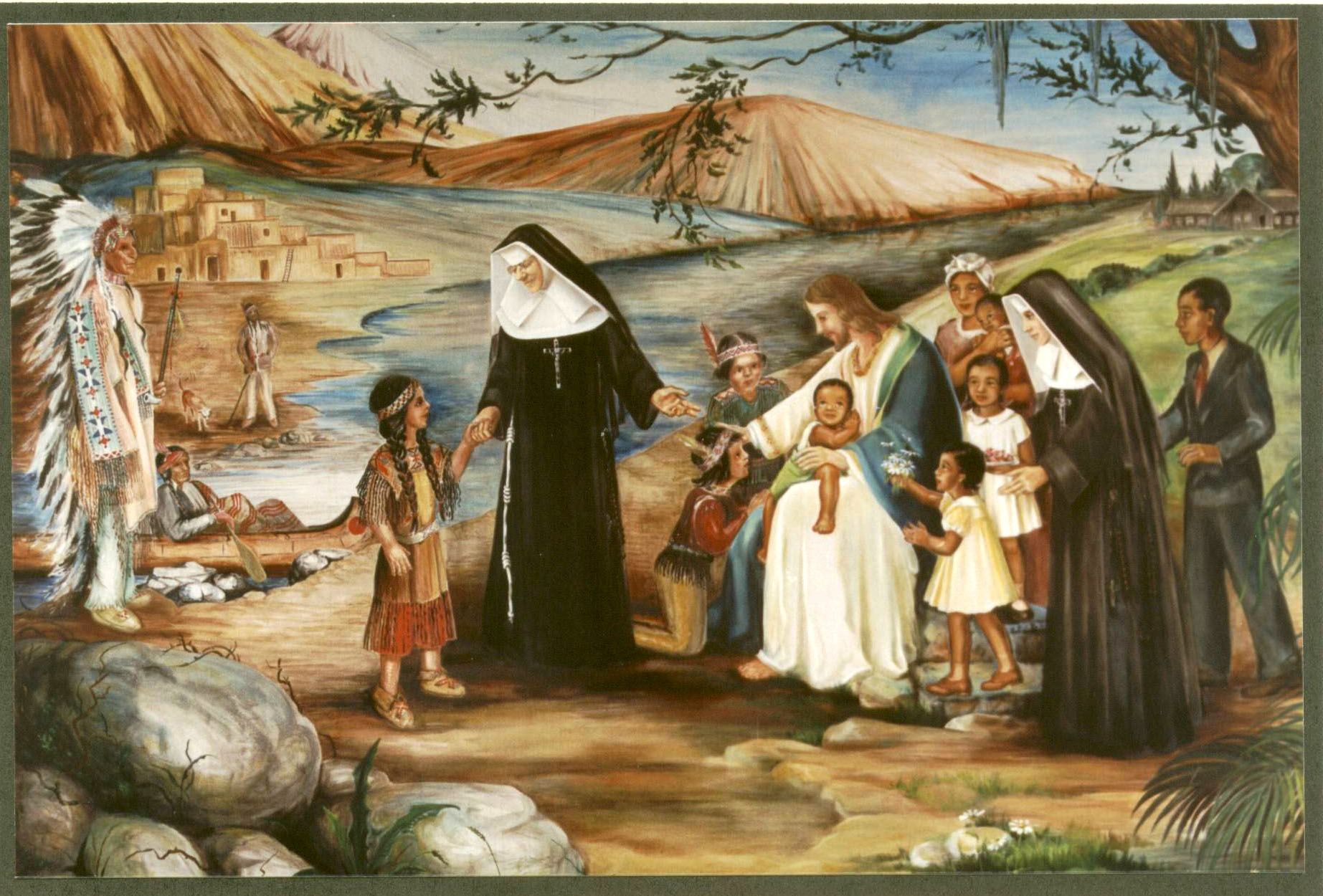
In 1891, Katharine resolved the tension by founding a new religious community, the Sisters of the Blessed Sacrament for Indians and Coloured People, that combined prayer and social action. By 1904, 104 sisters had joined her. After three and a half years of training, Mother Drexel and her first band of nuns–Sisters of the Blessed Sacrament for Indians and Coloured–opened a boarding school in Santa Fe. A string of foundations followed. By 1942, she had a system of black Catholic schools in 13 states, plus 40 mission centers and 23 rural schools. Segregationists harassed her work, even burning a school in Pennsylvania. In all, she established 50 missions for Indians in 16 states.
Two saints met when Mother Drexel was advised by Mother Cabrini about the “politics” of getting her order’s Rule approved in Rome. Her crowning achievement was the founding of Xavier University in New Orleans, the first Catholic university in the United States for African Americans.
Katharine established 145 Catholic missions and twelve schools for Native Americans and fifty schools for blacks. During her lifetime she gave away about twenty million dollars, mostly for these causes.
In 1935, Katharine suffered a severe heart attack. Two years later she retired and got her heart’s desire—eighteen years of quiet contemplation before she died in 1955 at age ninety-six.
St Katharine Drexel (Optional Memorial)
—
St Anselm of Nonantola
St Arthelais of Benevento
Bl Benedetto Sinigardi da Arezzo
St Calupan
St Camilla
St Cele-Christ
St Cunegundes
St Foila
Bl Frederick of Hallum
St Gervinus
Bl Innocent of Berzo
Bl Jacobinus de’ Canepaci
St Lamalisse
St Non
Bl Peter de Geremia
Bl Pierre-René Rogue
St Sacer
St Teresa Eustochio Verzeri
St Titian of Brescia
St Winwallus of Landévennec
—
40 Martyrs in North Africa – A group of Christians martyred together in North Africa, date unknown. No details have survived, but we know these names – Antonius, Artilaus, Asclipius, Astexius, Basil, Bosimus, Carissimus, Castus, Celedonius, Claudianus, Cyricus, Donata, Emeritus, Emeterius, Euticus, Felix, Fortunatus, Frunumius, Gajola, Georgius, Gorgonius, Hemeterus, Isicus, Janula, Julius, Luciola, Luciolus, Marcia, Marinus, Meterus, Nicephorus, Papias, Photius, Risinnius, Sabianus, Savinianus and Solus
Martyrs of Pontus – 3+ saints – A large group of Christians martyred together in the persecutions of Emperor Maximian Galerius and governor Ascleopiodato. We have some details on three of them – Basiliscus, Cleonicus and Eutropius. 308 in Pontus (in modern Turkey)
Martyrs of Caesarea;
Asterius
Marinus
Martyrs of Calahorra
Cheledonius
Emeterius
Martyrs of Gondar, Ethiopia:
Bl Antonio Francesco Marzorati
Bl Johannes Laurentius Weiss
Bl Michele Pío Fasol
Sometimes we have to break out of the mold into which others have placed us and hew our own unique pathway to God. A princess is expected to be a princess but St Agnes saw something more valuable and more important and refused the throne of an empress. She knew what she wanted and would let nothing stand in her way. When God calls, we leave all else behind!
“Happy the soul to whom it is given to attain this life with Christ, to cleave with all one’s heart to Him whose beauty all the heavenly hosts behold forever, whose love inflames our love, the contemplation of whom is our refreshment, whose graciousness is our delight, whose gentleness fills us to overflowing, whose remembrance makes us glow with happiness, whose fragrance revives the dead, the glorious vision of whom will be the happiness of all the citizens of the heavenly Jerusalem. For He is the brightness of eternal glory, the splendour of eternal light, the mirror without spot.”
St Clare of Assisi to St Agnes of Prague
(Read the entire letter here: http://www.beliefnet.com/columnists/bread_on_the_trail/2011/08/a-letter-of-st-clare-to-blessed-agnes-of-prague-on-christian-contemplation.html)
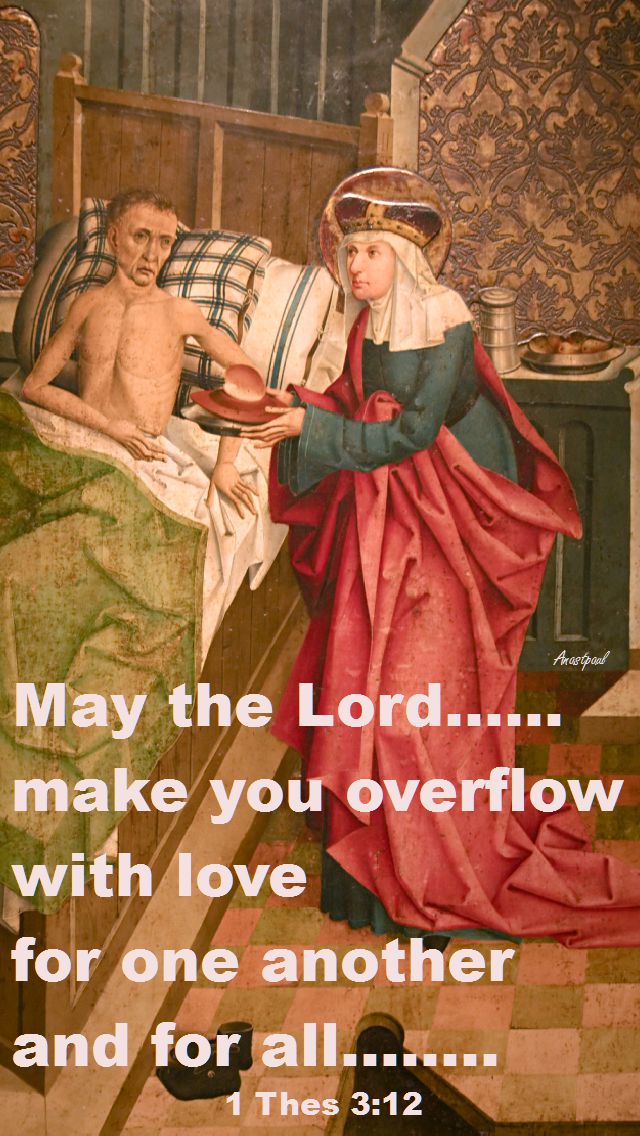
May the Lord……make you overflow with love for one another and for all…………1 Thes 3:12
REFLECTION – “Therefore, most beloved sister, or should I say, Lady worthy of great respect because You are the spouse and the mother and the sister of my Lord Jesus Christ and have been adorned resplendently with the sign of inviolable virginity and most holy poverty. Be strengthened in the holy service which You have undertaken out of an ardent desire for the Poor Crucified, Who for the sake of all of us took upon Himself the Passion of the Cross and delivered us from the power of the Prince of Darkness to whom we were enslaved because of the disobedience of our first parents and so reconciled us to God the Father.”………….St Clare of Assisi to St Agnes of Prague
PRAYER – Loving Father, grant me the grace to strive after perfect love. Help me to bring forth frequent acts of love so that I may grow in this greatest of virtues. Help me to be a loving support to all you need me in any way, stranger or friend. Fill my heart with the love You have for me and the unceasing love of Your Divine Son who died for me. St Agnes of Prague, pray for us! Amen
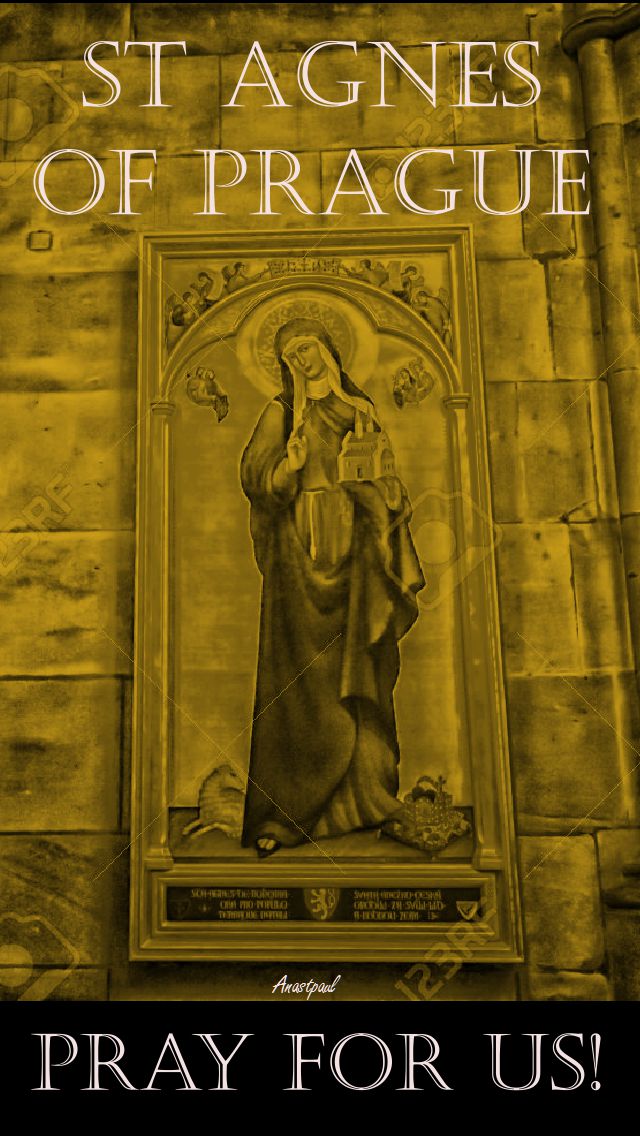
Saint of the Day – 2 March – St Agnes of Prague/Bohemia (1211-1282) Princess, Nun, Foundress, Abbess, Missionary of Charity and Mercy – Patron of the Czech Republic and Prague
Agnes was born in Prague sometime around the year 1211. She was the daughter of the Czech King Premysl Ottokar I of Bohemia and Queen Constancia. Her father promised that she would marry the son of German Emperor Friedrich II, later King Henry VII, Duke of Swabia and sent her to the Austrian Babenberg court to study court manners. However, Duke Leopold VI of Babenberg persuaded the Emperor to allow his son to marry with his daughter Margaret – so Agnes returned to Bohemia. She was later engaged to marry the English king Henry and even his father, emperor Friedrich II, who in the meantime had become a widower. However, when inspired by the holy life of Francis and Clare of Assisi, who left their rich families and lived in smaller monasteries and shared the destiny with the poor, Agnes decided to become a bride of Christ.
In around 1232, supported by her brother and mother, Agnes founded the Hospital of St. Francis for poor and ill people and established the Hospital Brotherhood that later developed into the Order of the Knights of the Cross with the Red Star. A year later, two monasteries were founded near the Hospital: the male monastery for the Smaller Brothers of St. Francis and the female convent for the Clares. The three building complex created the first dominating Gothic landmark in Prague which could compete with the residential palace at Hradčany.
Agnes joined the Clares, the female branch of the Franciscans, in 1234, along with another seven girls from wealthy Czech noble families. She became the abbess of the later St. Agnes Convent for a lengthy 47 years maintaining a great friendship through letters with St Clare of Assisi, some which still survive.
St Clare of Assisi and St Agnes of Prague
Agnes always aimed for peace within the Czech lands. It was she who negotiated the reconciliation between King Wenceslas I and his son Premysl Ottokar II averting a possible civil war which would otherwise become unavoidable. In addition, her intervention miraculously prevented a Tatar invasion.
Agnes died in March 1282 in the St. Agnes Convent. She was spoken of highly due to her education, charity and mercy and she was a very important personality of political, cultural and social life. Legends about her extraordinary life appeared instantly after her death.
Although Elisabeth of Bohemia and Emperor Charles VI made great effort in terms of Agnes’ beautification, it did not happen until 1874 upon proposal by Prague Archbishop and Cardinal Friedrich Joseph Schwarzenberg. She was canonised on 12 November 1989 by Pope John Paul II. The canonisation ceremony in Rome was witnessed by an unbelievable ten-thousand Czech pilgrims.
St Absolon of Caesarea
St Agnes of Prague/Bohemia
St Angela of the Cross Guerrero
St Basileus the Martyr
Chad of Mercia
Bl Charles the Good
St Cynibild of Laestingaeu
Bl Engelmar Unzeitig
St Felix of Treves
St Fergna the White
Bl Girolamo Carmelo di Savoia
St Gistilian
St Joavan of Brittany
St John Maron
St Jovinus the Martyr
St Lorgius of Caesarea
St Lucius of Caesarea
St Luke Casali
St Quintus the Thaumaturge
St Slebhene
St Troas
St Willeic
—
Martyrs of Campania – Approximately 400 northern Italian Christians martyred for their faith by pagan Lombards. Their story was recorded by Pope Saint Gregory the Great, who reports that they people spent their final days supporting each other with prayer. c579 in Camnpania, Italy.
Martyrs of Porto Romano – 4 saints – Group of Christians martyred in the persecution of Diocletian. The only other information that survives are the names of four of them – Heraclius, Januaria, Paul and Secondilla. c305 at Porto Romano at the mouth of the River Tiber, Rome.
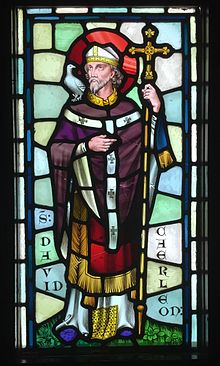
Saint of the day – 1 March – St David of Wales (c 542-c 601) Bishop in Caerfai, Pembrokeshire, Wales, Bishop, Prince, Monk, Confessor, Missionary, founder. Died 1 March 589 at St David’s, Pembrokeshire, Wales). Patron of Wales, Pembrokeshire; Naas; vegetarians; poets, doves.
Born to the Welsh royalty, the son of King Sandde, Prince of Powys and of Saint Non, the daughter of a chieftain of Menevia (western Wales). Grandson of Ceredig, Prince of Cardigan. Uncle of King Arthur. Priest. David studied under Saint Paul Aurelian. Worked with Saint Columbanus, Saint Gildas the Wise and Saint Finnigan. Missionary and founder of monasteries.
Following his contribution to the synod of Brevi in Cardiganshire, he was chosen primate of the Cambrian Church. Archbishop of Caerleon on Usk, he moved the see to Menevia. Presided at the Synod of Brefi which condemned the Pelagian heresy. He encouraged the life of austerity and founded monasteries. David was the first to build a chancel to Saint Joseph of Arimathea’s wattle church at Glastonbury.
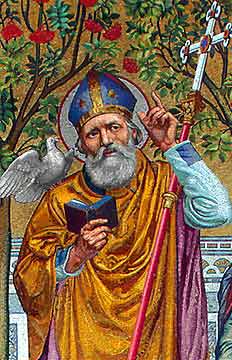
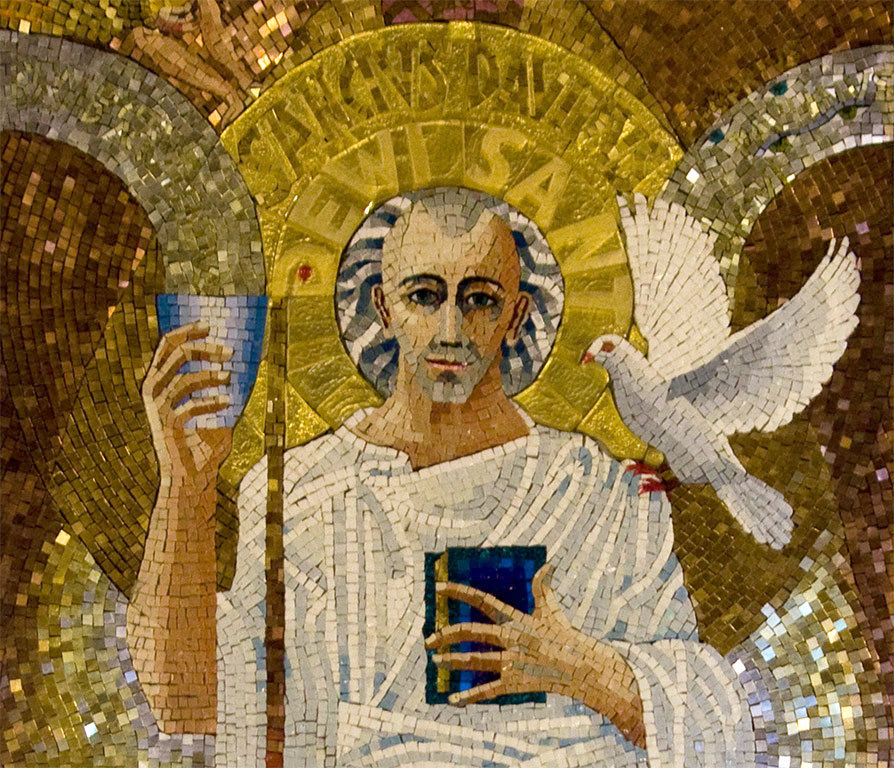
After a vision in his monastery in the Rhos Valley, he set out next day with two monks to Jerusalem to aid the Patriarch. While there his preaching converted anti-Christians. Legend says that once while he was preaching, a dove descended to his shoulder to show he had the blessings of the Spirit and that the earth rose to lift him high above the people so that he could be heard by them all. Another time when was preaching to a crowd at Llandewi Brefi, people on the outer edges could not hear, so he spread a handkerchief on the ground, stood on it and the ground beneath rose up in a pillar so all could hear.
Though the exact date of his death is not certain, tradition holds that it was on March 1, which is the date now marked as Saint David’s Day. The two most common years given for his death are 601 and 589. The monastery is said to have been “filled with angels as Christ received his soul.” His last words to his followers were in a sermon on the previous Sunday. The Welsh Life of St David gives these as, “Lords, brothers and sisters, Be joyful, and keep your faith and your creed, and do the little things that you have seen me do and heard about. And as for me, I will walk the path that our fathers have trod before us.” “Do ye the little things in life” is today a very well known phrase in Welsh. The same passage states that he died on a Tuesday, from which attempts have been made to calculate the year of his death.
David was buried at St David’s Cathedral at St Davids, Pembrokeshire, where his shrine was a popular place of pilgrimage throughout the Middle Ages. During the 10th and 11th centuries the Cathedral was regularly raided by Vikings, who removed the shrine from the church and stripped off the precious metal adornments. In 1275 a new shrine was constructed, the ruined base of which remains to this day which was originally surmounted by an ornamental wooden canopy with murals of David, Patrick and Denis. The relics of David and Justinian of Ramsey Island were kept in a portable casket on the stone base of the shrine. It was at this shrine that Edward I came to pray in 1284. During the reformation Bishop Barlow (1536–48), a staunch Protestant, stripped the shrine of its jewels and confiscated the relics of David and Justinian.
David was officially recognised at the Holy See by Pope Callixtus II in 1120, thanks to the work of Bernard, Bishop of St David’s. Over 50 churches in South Wales were dedicated to him in pre-Reformation days.
In the 2004 edition of the Roman Martyrology, David is listed under 1 March with the Latin name Dávus. He is recognised as bishop of Menevia in Wales who governed his monastery following the example of the Eastern Fathers. Through his leadership, many monks went forth to evangelise Wales, Ireland, Cornwall and Armorica (Brittany and surrounding provinces).
Welsh tradition says that during a battle against the Anglo-Saxons, David advised the Welsh warriors each to wear a leek in his hat or armour so that the warriors might distinguish themselves from their enemies. Ever since then, the Welsh wear leeks every March 1 in memory of David.
Ash Wednesday (2017)
—
St Abdalong of Marseilles
St Adrian of Numidia
St Agapios of Vatopedi
St Agnes Cao Guiying
St Albinus of Angers
St Albinus of Vercelli
St Amandus of Boixe
St Antonina of Bithynia
Bl Aurelia of Wirberg
Bl Bonavita of Lugo
St Bono of Cagliari
Bl Christopher of Milan
Bl Claudius Gabriel Faber
St David of Wales
St Domnina of Syria
St Donatus of Carthage
St Eudocia of Heliopolis
St Felix III, Pope
Bl George Biandrate
Bl Giovanna Maria Bonomo
Bl Gonzalo de Ubeda
St Hermes of Numidia
St Jared the Patriarch
St Leo of Rouen
St Leolucas of Corleone
St Lupercus
St Marnock
St Monan
Bl Pietro Ernandez
Bl Roger Lefort
St Rudesind
St Seth the Patriarch
St Simplicius of Bourges
St Siviard
St Swithbert
St Venerius of Eichstätt
Martyrs of Africa – A group of 13 Christians executed together for their faith in Africa. The only details about them to survive are ten names – Abundantius, Adrastus, Agapius, Charisius, Donatilla, Donatus, Fortunus, Leo, Nicephorus and Polocronius. c290
Martyrs of Antwerp – A group of Christians martyred together, buried together and whose relics were transferred and enshrined together. We know nothing else but their names – Benignus, Donatus, Felician, Fidelis, Filemon, Herculanus, Julius, Justus, Maximus, Pelagius, Pius, Primus, Procopius and Silvius. Died in the 2nd Century in Rome. They are buried in the St Callistus Catacombs and their relics were enshirned in the Jesuit Church in Antwerp on 28 February 1600.
Martyrs of the Salarian Way – A group of 260 Christians who, for their faith, were condemned to road work on the Salarian Way in Rome, Italy during the persecutions of Claudius II. When they were no longer needed for work, they were publicly murdered in the amphitheatre. Martyrs. c269 in Rome.
Martyrs Under Alexander – A large but unspecified number of Christians martyred in the persecutions of Emperor Alexander Severus and the praefect Ulpian who saw any non-state religion to be a dangerous treason. c219
Whoever wishes to be my follower
must take up his cross each day
and follow in my footsteps…………..Luke 9:23
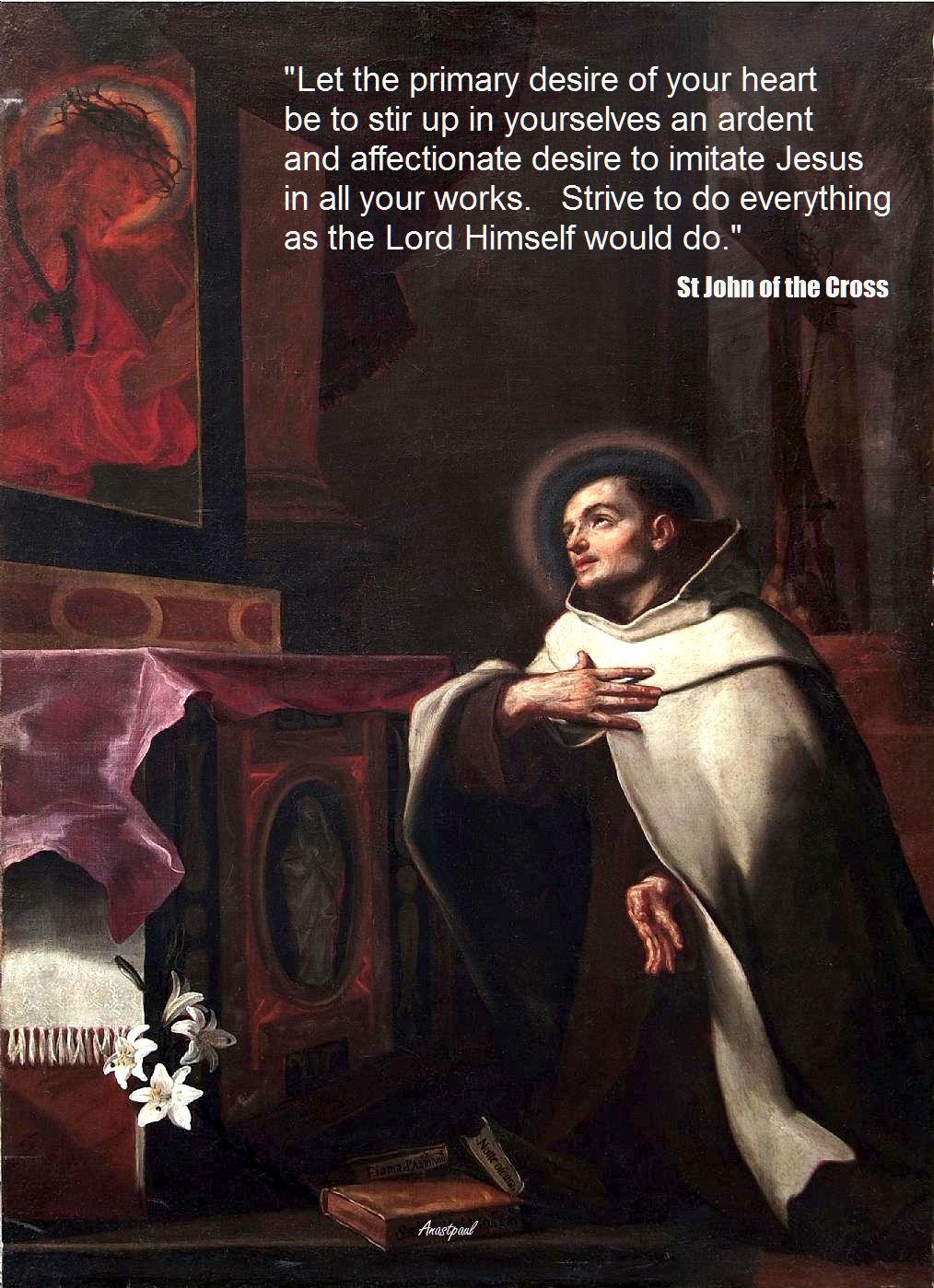
REFLECTION – Let the primary desire of your heart be to stir up in yourselves an ardent and affectionate desire to imitate Jesus in all your works.
Strive to do everything as the Lord Himself would do……………St John of the Cross
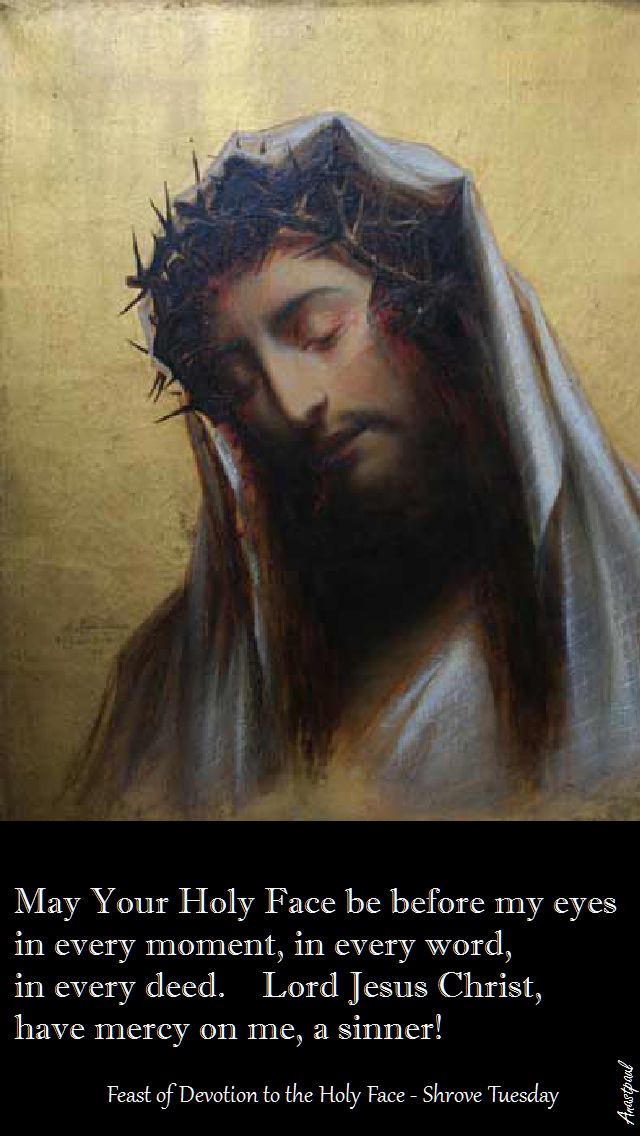
PRAYER – Lord Jesus, help me to pattern my life after You. Grant that I may imitate You completely – in all my thoughts, words and deeds. May Your Holy Face be before my eyes in every moment, in every word, in every deed. Lord Jesus Christ, have mercy on me, a sinner! Amen
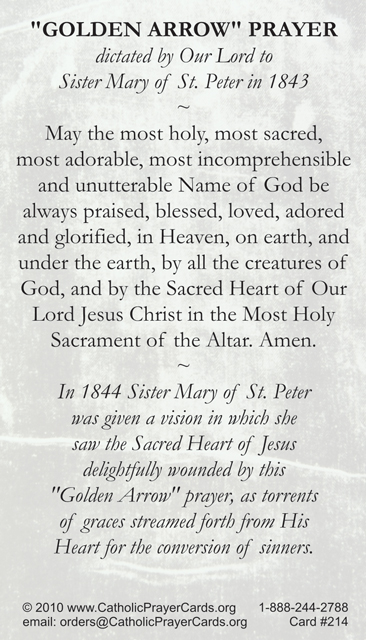
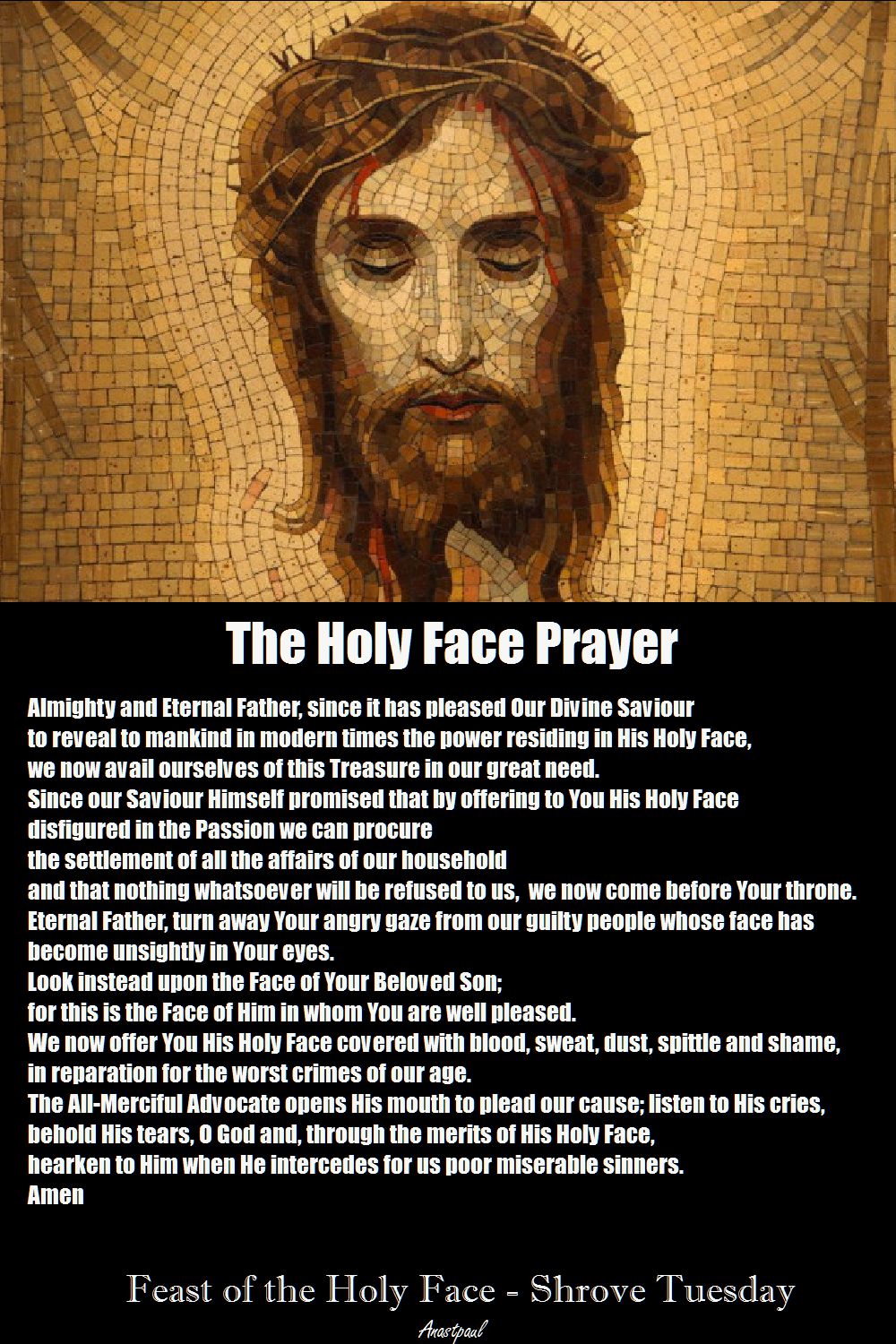
Almighty and Eternal Father,
since it has pleased Our Divine Saviour
to reveal to mankind in modern times
the power residing in His Holy Face,
we now avail ourselves of this Treasure
in our great need.
Since our Saviour Himself promised
that by offering to You His Holy Face
disfigured in the Passion we can procure
the settlement of all the affairs of our household
and that nothing whatsoever will be refused to us,
we now come before Your throne.
Eternal Father, turn away Your angry gaze
from our guilty people whose face has
become unsightly in Your eyes.
Look instead upon the Face of Your Beloved Son;
for this is the Face of Him in whom You are well pleased.
We now offer You His Holy Face covered
with blood, sweat, dust, spittle and shame,
in reparation for the worst crimes of our age.
The All-Merciful Advocate opens His mouth
to plead our cause; listen to His cries,
behold His tears, O God and,
through the merits of His Holy Face,
hearken to Him when He intercedes
for us poor miserable sinners.
Amen
Feast of the Holy Face of Jesus – 28 February – Shrove Tuesday
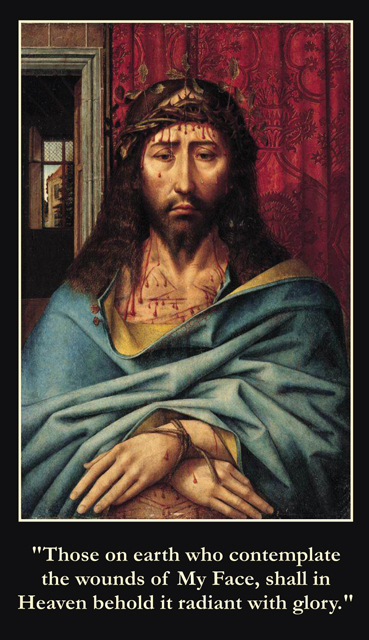
DEVOTION TO THE HOLY FACE OF JESUS
This ancient and venerable Catholic practice is rooted in the representation of the face of Christ said to have been left on the towel or veil used by a holy woman thought to be named, Veronica. An Archconfraternity of the Holy Face was established in Tours, France, 1884; its members make reparation for the blasphemies hurled at Christ. Since St. Therese’s devotion to the Holy Face has become known, this devotion has spread worldwide.
In addition, a devout and pious nun, Sr. Pierina, who died in 1945, was given many visions through Our Blessed Lady who appeared to her, as did Our Lord Jesus. They urged her to make reparation for the many insults Jesus suffered in His Passion, such as to be slapped, spit upon and kissed by Judas, as well as now being dishonoured in many ways in the Blessed Sacrament by neglect, sacrileges, and profanations.
She was given a medal which on one side bore a replica of the Holy Shroud and the inscription: “Illumina, Domine, vultum tuum super nos.” [O Lord, the light of Thy countenance shine upon us.] On the reverse side was a radiant host with the words: “Mane nobiscum, Domine.” [Stay with us, O Lord.] After great difficulties, Sr. Pierina obtained permission to have the medal cast. Even the expenses for the casting were miraculously met when she found on her desk an envelope with the exact amount of the bill—–11,200 lire.
The Evil Spirit showed his chagrin and rage at the medals by flinging them down and burning the pictures of the Sacred Face and beating the nun savagely.
In 1940, when the Second World War had the world in turmoil, Italy saw a wide distribution of the medal: soldiers, sailors and pilots were provided with the replica of the Holy Face since the medal was already famous for its miracles and countless spiritual and temporal favours.
In Our Blessed Mother’s own word, the medal is a weapon for defense, a shield for courage, a token of love and mercy and which her Divine Son wished to give the world in these troubled days of lust and hatred for God and His Church. Devilish snares have been set to rob the hearts of men of their faith while evil spreads the world over. Genuine apostles are few. A Divine remedy to all these evils will be the Adorable Face of her Son, Jesus.
Whoever wears this medal and, if possible, pays a visit to the Blessed Sacrament on Tuesday in a spirit of reparation for the outrages received by the Holy Face of Our Blessed Saviour during His Passion and those bestowed on Him every day in the Sacrament of His Divine Love, will be granted the gift of a strong Faith and the grace to fly to its defense, conquering if need be, all exterior and interior difficulties. Moreover, they are promised a happy death with special assistance of Christ Himself.
The very first medal of the Holy Face was offered to our glorious Pontiff, Pius XII; then the whole world became acquainted with this special object of holy favours and devotion. No soldier taken as a prisoner of war and who wore the medal was ever executed. Our Blessed Lord requested that a special feast be instituted to honor His Holy Face on Shrove Tuesday. Pope St. Pius XII obeyed and had this day set aside to honour the Holy Face in 1958.
When Venerable Pope Pius XII granted that the Feast of the Holy Face of Jesus be observed on Shrove Tuesday, the day before Ash Wednesday, he fulfilled the desire of Our Lord that His sorrowful Holy Face be contemplated in reparation for our sins. The history and tradition of venerating His Holy Face began on the day of His crucifixion and continues through the centuries with the help of holy men and women chosen by Our Lord and Our Blessed Mother to propagate this devotion.
The bloodied, bruised, disfigured face of Jesus was imprinted on a veil as St. Veronica comforted Christ by wiping His face on the road to Calvary. The original veil is kept at St. Peter’s Basilica and is displayed every Passion Sunday. The image of the face on the Shroud of Turin provides another opportunity of veneration of the Holy Face.
In his 2005 book On the Way to Jesus Christ, Pope Benedict XVI performed an analysis of Holy Face devotions and characterised them as having three separate components. The first element is discipleship, and the orientation of one’s life towards an encounter with Jesus. The second element is seeing Jesus in the Eucharist, the third element is eschatological and is interwoven between the other two.
Referring to Matthew 25:31-36 Benedict XVI stated that the first element (i.e. discipleship) involves seeing Jesus in the face of the poor and the oppressed and caring for them but to properly see Jesus in the face of those in need, believers first need to become better acquainted with Jesus through the Eucharist. The second element involves relating the Passion of Jesus, and the suffering expressed by the images that represent his wounded face to the Eucharistic experience. Thus the devotion that starts with the images of the face of Jesus leads to his contemplation in the Eucharistic experience. The eschatological element then builds on awakening to Christ by contemplating his face in the Eucharist

















You must be logged in to post a comment.