Saint of the Day – 1 December – Saint Evasius of Asti (Died c362) the First Bishop of Asti in Piedmont, Italy, Martyr, Missionary., Miracle-worker Born at Benevento, Italy and died in c362 at Casale Monferrato, Italy probably by beheading. Patronages of the following in Italy – Bizzarone, Casale Monferrato, City of Casale Monferrato, Diocese of Pedrengo, Rocchetta Palafea. Additional Memorial – 12 November in Casale Monferrato, Italy (translation of relics).
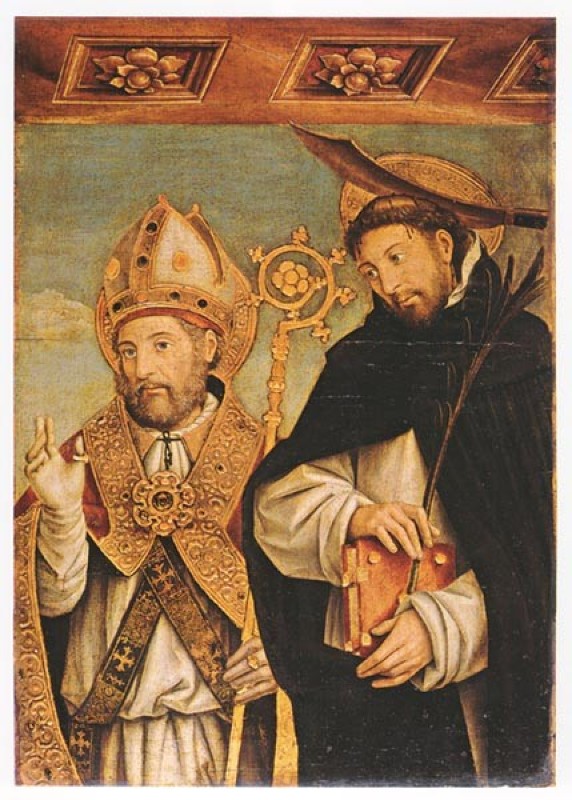
The Saints Evasius and Peter Martyr. Artist – Giovanni Martino Spanzotti, Oil on wood, c1595–1600.
Evasius is considered in tradition, to be the first Bishop of Asti, Consecrated around 330 – the earlier Cathedral was the current Church of San Secondo. Evasius, converted the main temple of Asti, dedicated to the goddess Minerva, into a Church, brought Monks to the – now abandoned – Monastery of the Santi Apostoli and converted many people. But the powerful supporters of Arianism, enraged by this, forced him and his companions – Saint Projectus of Casale and St Natalis ,to flee the City.
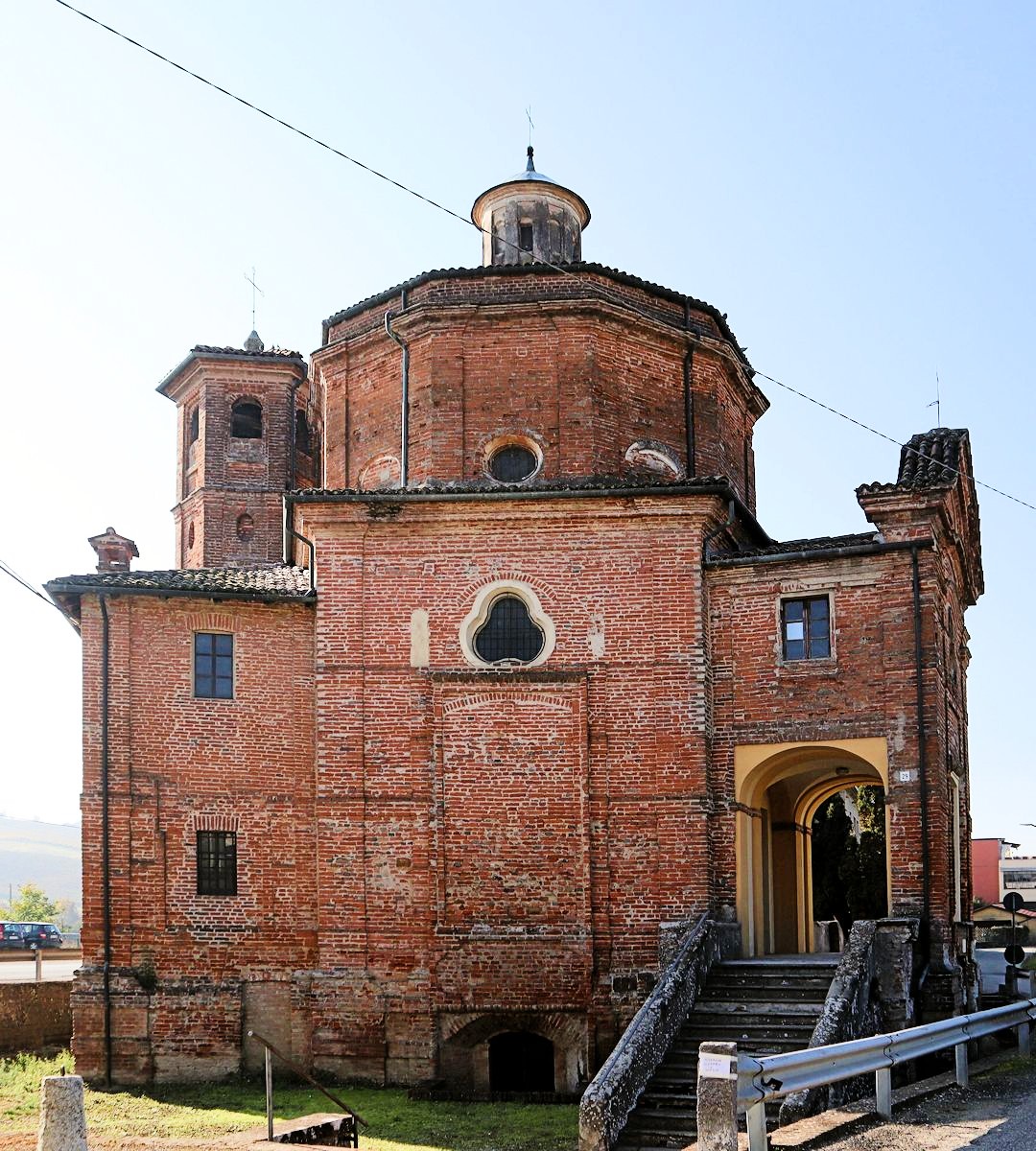
Church dedicated to Evasius in Pozzo Sant’Evasio
The three Saints found refuge in the Cornea forest – on the site of the Church in today’s Pozzo Sant’Evasio district near Casale Monferrato, where Evasius caused a spring to rise which is considered to have miraculous powers of curing sickness.
St Evasius Altarpiece in the Parish Church in Borgo Vercelli
There, according to legend, Atubalo, the Prefect of the City of Sedula, incited by the Arians, had them arrested along with another 145 of the lay faithful and then beheaded.
Fresco in the Cathedral at Asti
According to tradition, the Martyrs were buried in the Church of San Lorenzo – today’s Cathedral – in Casale Monferrato. In the Middle Ages the City was called Casale Sant’Evasio in honour of their Patron Saint Evasius . Today’s Cathedral was first mentioned in a document in 974 as a Church dedicated to him.
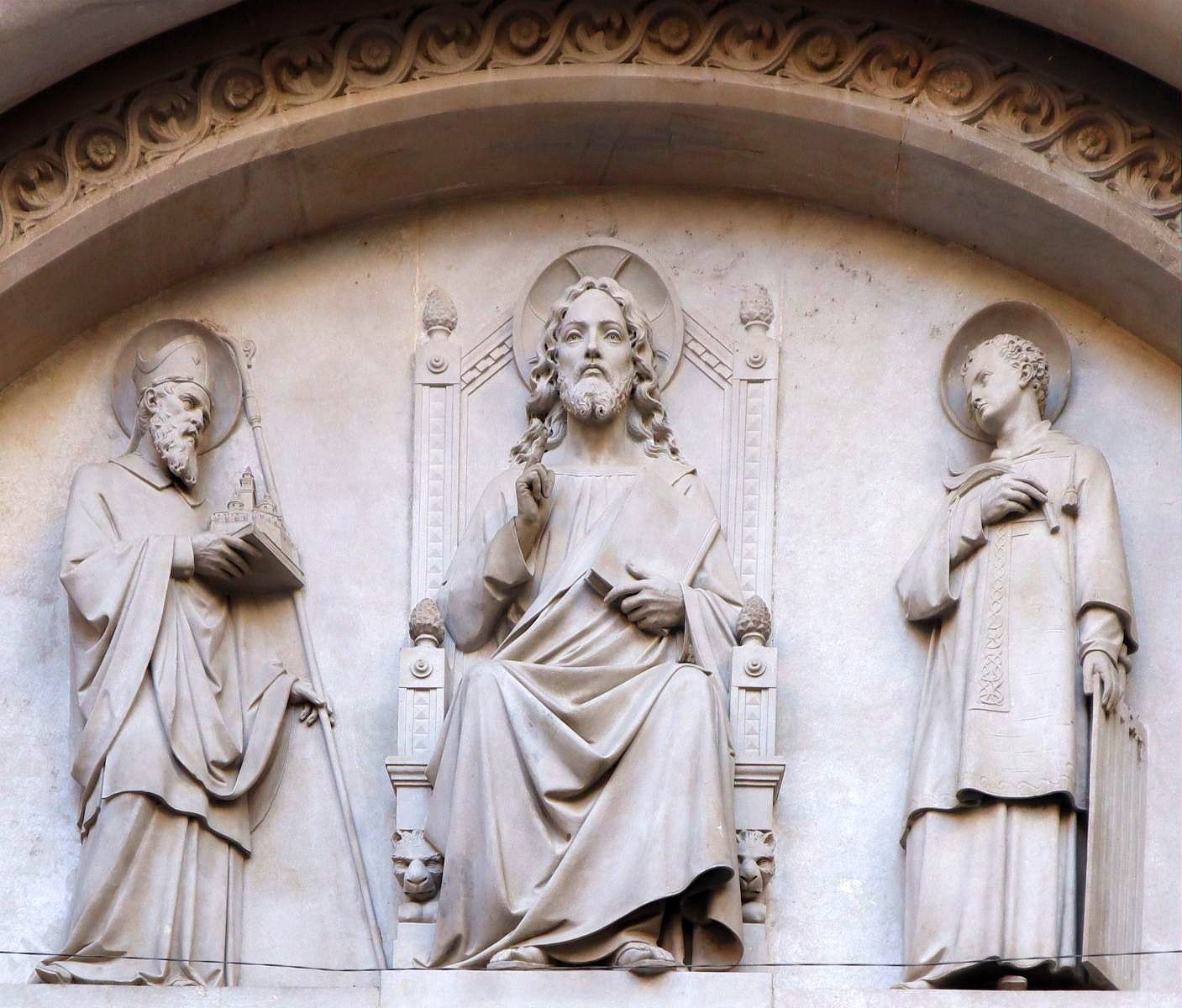
St Evasius (left), Christ and St Lawrence of Rome, Relief at the Cathedral in Casale Monferrato
There is much doubt about our Saint’s period of life and Episcopal governance. In fact, it is believed that Anianus, who reigned around 400, was the First Bishop in Asti, according to studies by Guglielmo Visconti in 2006 and by Fr S Dacquino in 1979. According to the list of Bishops of Asti, Evasius was the Bishop of the City from 685 to 713.
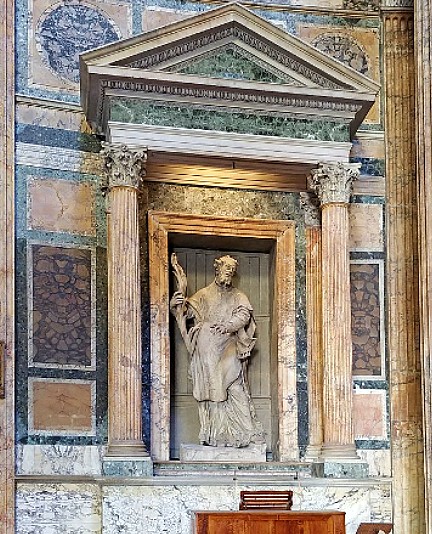
Statue of St Evasius at the Pantheon in Rome
Evasius’ remains were transferred to the Cathedral in Casale Monferrato. The Diocese of Casale Monferrato was only established in 1474 by Pope Sixtus IV. Relics also came to Borgo Vercelli, where Evasius’ intercession saved the inhabitants from an epidemic.
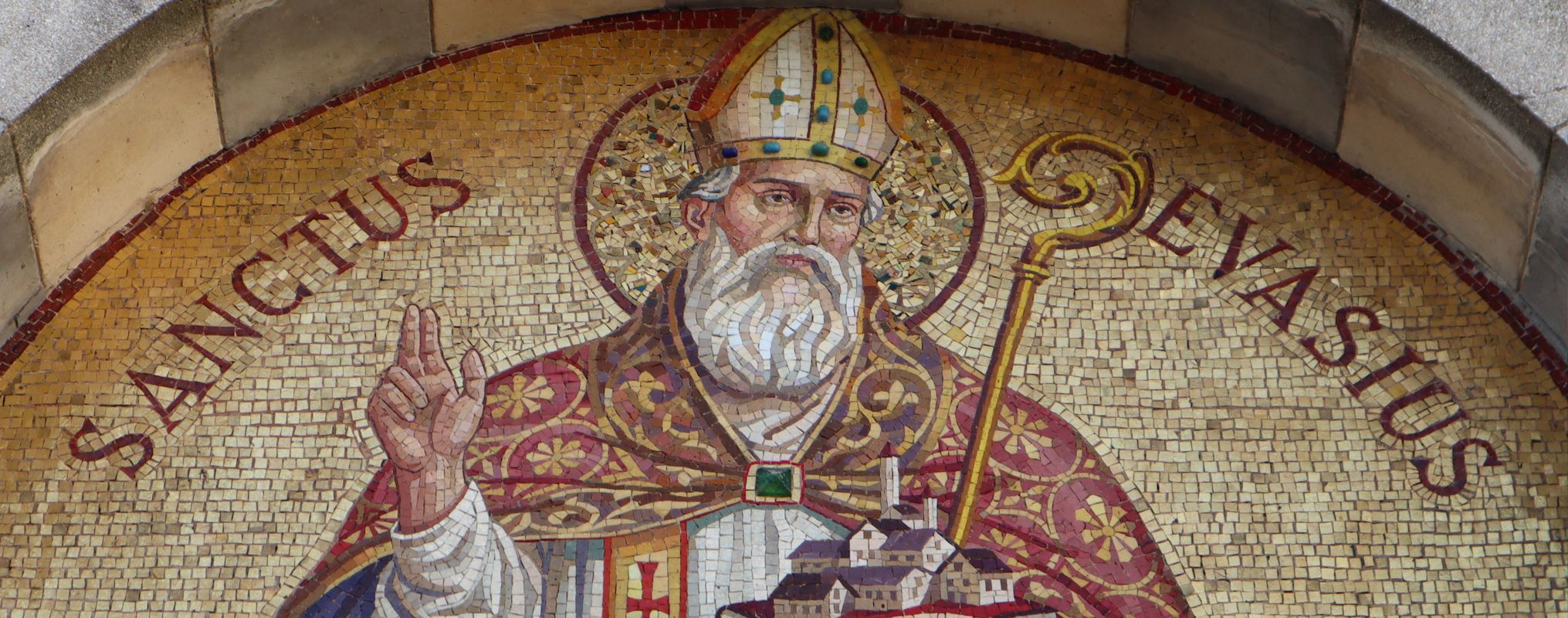
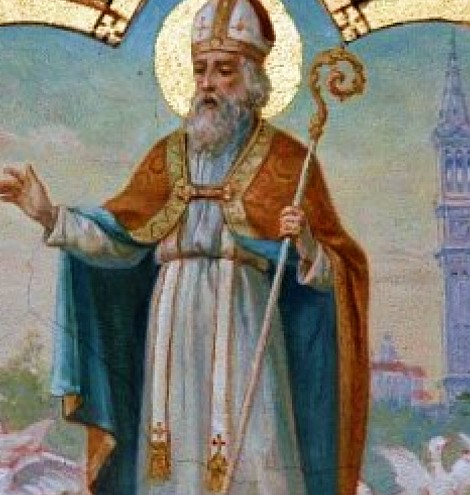
Mosaic of St Evasius, above the door of the Parish Church in Borgo
St Evasius’ Sarcophagus in the Cathedral in Casale Monferrato
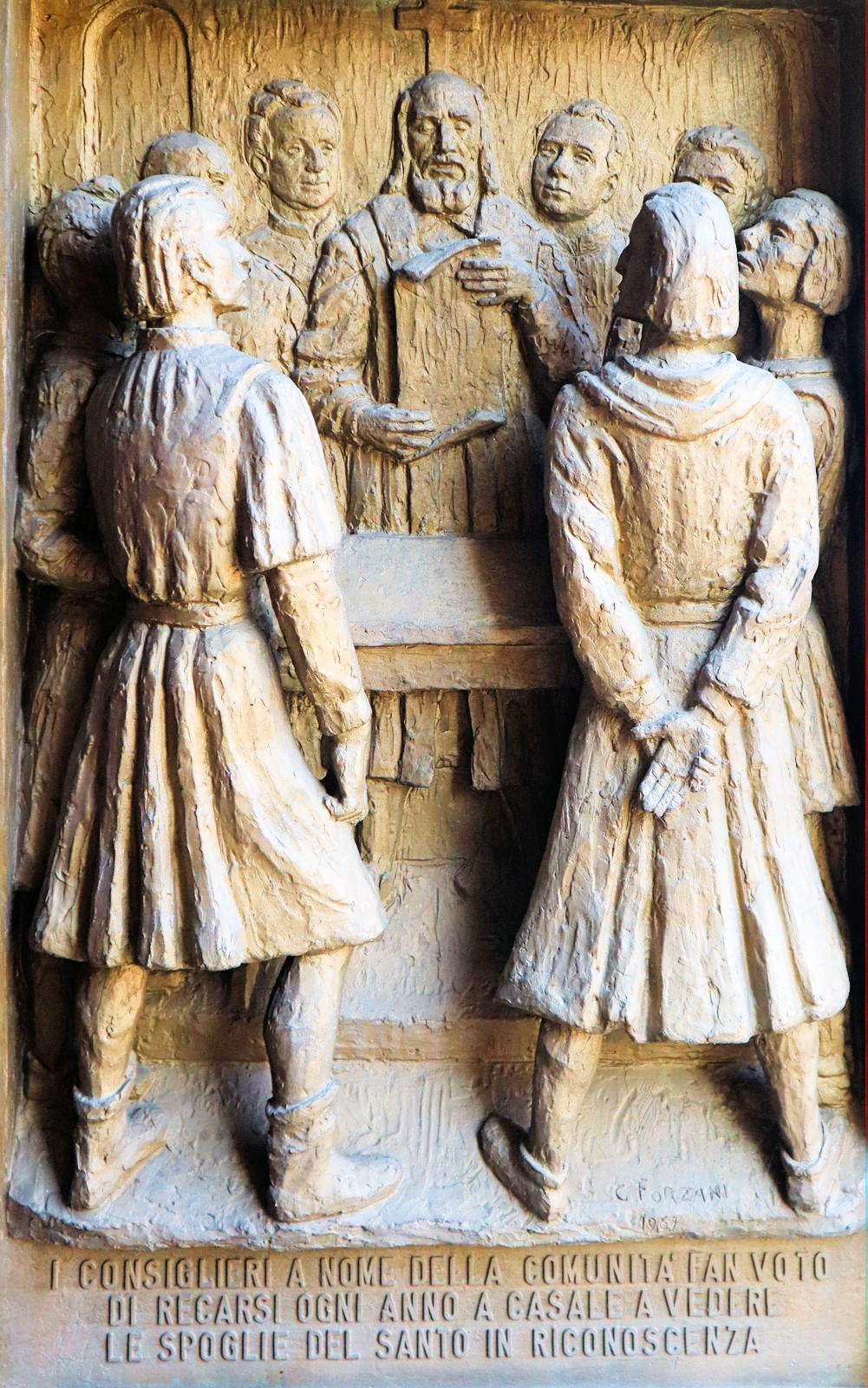
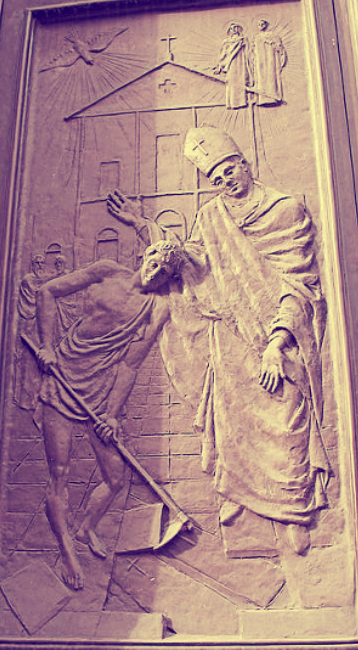
The elevation of the Relics of Evasius in Casale Monferrato, Bronze Relief on the door of the Parish Church in Borgo Vercelli
DECEMBER: Month of Devotion to The DIVINE INFANCY and The IMMACULATE CONCEPTION of the BLESSED VIRGIN MARY
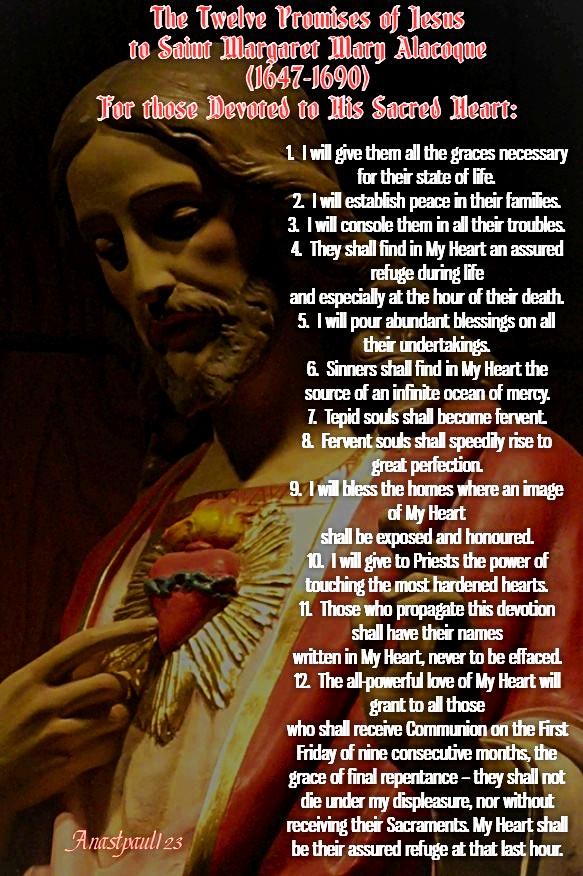
First Friday of the Month: “I promise you, in the excessive mercy of my Heart that my all powerful love, will grant to all those who receive Holy Communion on the First Friday, for Nine Consecutive Months, the grace of final repentance; they shall not die in my disgrace, nor without receiving the Sacraments; my Divine Heart shall be their safe refuge, in that last moment.” — Our Lord to St Margaret Mary
How to complete the First Friday’s Devotion:
Receive Holy Communion on each First Friday;
The Nine Fridays must be consecutive;
They must be made in honour and in reparation to His Sacred Heart.
St Agericus of Verdun St Agnofleta St Alexander Briant St Ambon of Rome St Ananias of Arbela St Ansanus the Baptizer Bl Antony Bonfadini St Candida of Rome St Candres of Maestricht St Cassian of Rome St Castritian of Milan Bl Christian of Perugia St Constantine of Javron St Declan St Didorus St Domnolus of Le Mans
St Latinus of Rome St Leontius of Fréjus St Lucius of Rome St Marianus St Marina of Rome St Martinus St Nahum the Prophet St Natalia of Nicomedia St Olympiades St Proculus of Narni St Resignatus of Maastricht Bl Richard Langley St Rogatus of Rome St Simon of Cyrene St Superatus of Rome St Ursicinus of Brescia
Martyrs of Oxford University: A joint commemoration of all the men who studied at one of the colleges of Oxford University and who were later Martyred for their loyalty to the Catholic Church during the official persecutions in the Protestant Reformation in England under Elizabeth I. They are: Blessed Edward James • Blessed Edward Powell • Blessed Edward Stransham • Blessed George Napper • Blessed George Nichols • Blessed Hugh More • Blessed Humphrey Pritchard • Blessed James Bell • Blessed James Fenn • Blessed John Bodey • Blessed John Cornelius • Blessed John Forest • Blessed John Ingram • Blessed John Mason • Blessed John Munden • Blessed John Shert • Blessed John Slade • Blessed John Storey • Blessed Lawrence Richardson • Blessed Mark Barkworth • Blessed Richard Bere • Blessed Richard Rolle de Hampole • Blessed Richard Sergeant • Blessed Richard Thirkeld • Blessed Richard Yaxley • Blessed Robert Anderton • Blessed Robert Nutter • Blessed Robert Widmerpool • Blessed Stephen Rowsham • Blessed Thomas Belson • Blessed Thomas Cottam • Blessed Thomas Pilcher • Blessed Thomas Plumtree • Blessed Thomas Reynolds • Blessed William Filby • Blessed William Hart • Blessed William Hartley • Saint Alexander Briant • Saint Cuthbert Mayne • Saint Edmund Campion • Saint John Boste • Saint John of Bridlington • Saint John Roberts • Saint Ralph Sherwin • Saint Thomas Garnet • Saint Thomas More.
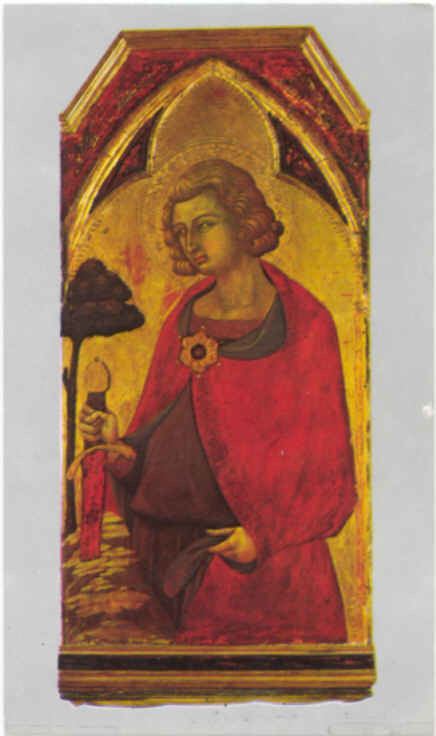
Saint of the Day – 30 November – Saint Galganus Guidotti (1148-1181) Hermit of The Sword in the Stone fame. Born in Chiusdino, Siena) in 1148 and died in 1181 at Monte Siepe, Tuscany, Italy of natural causes. Also known as – Galgano. Our Saintwas Canonised only 3 years after his death in 1185, by Pope Lucius III.
The Roman Martyrology reads today: “Near Mount Siepi in Tuscany, Saint Galganus Guidotti, a Hermit, who, having converted to God after a dissipated youth, spent the rest of his life in voluntary mortification of the body.”
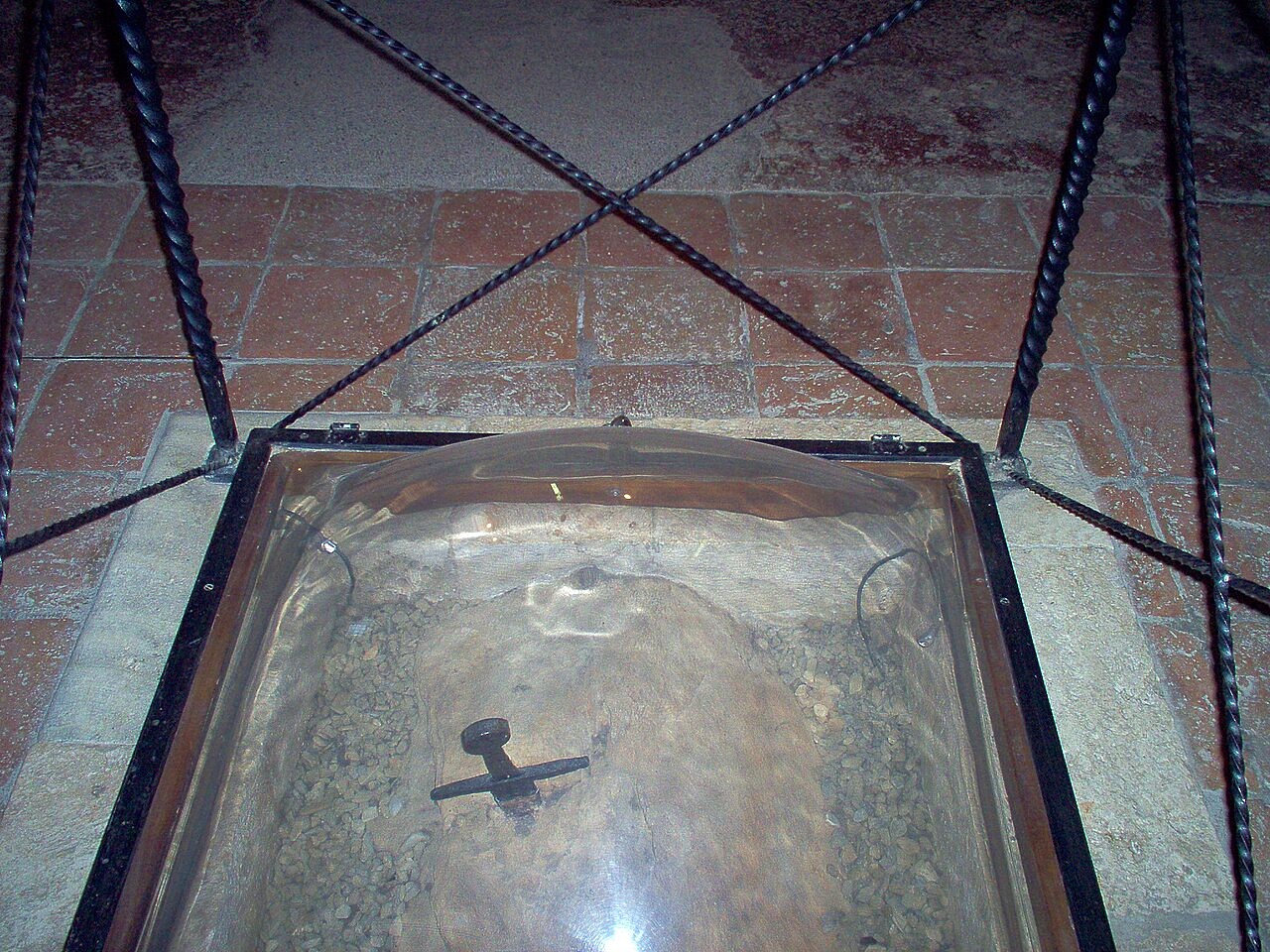
About 30 km (20 miles) southwest of Siena, in beautiful Tuscany, Italy, stands the ruins of a Cistercian Abbey. In a nearby Chapel is one of the strangest Relics ever – the sword of Saint Galganus, seemingly thrust into the bedrock to the hilt. How did it end up there?
Galganus Guidotti was born in 1148, the son of a minor noble and one of those dissipated young knights constantly seeking worldly pleasures. One day when he least expected it, Archangel Michael appeared before him and showed him the way to salvation and kindly provided him with directions. The next day, Galganus announced that he was going to become a Hermit and took up residence in a cave. His friends and relatives ridiculed him and Dionisia, his mother, bade him to wear his expensive nobleman’s clothes and at least, pay a last visit to his fiancée. On his way there, his horse reared, throwing Galganus. Spitting road dust, he suddenly felt as if he was being lifted to his feet by an invisible force and a seraphic voice and a will he was unable to resist, led him to Monte Siepi, a rugged hill close to his home town of Chiusdino.
The voice bade him stand still and look at the top of the hill. Galganus saw a round Church with Jesus and Mary surrounded by the Apostles. The voice told him to climb the hill and while doing so, the vision faded away. When he reached the top the voice spoke again, inviting him to renounce his loose, easy living. Galganus replied that it was easier said than done, about as easy as splitting a rock with a sword. To prove his point, he drew his blade and thrust at the rocky ground. With miraculous ease, the sword penetrated the living bedrock to the hilt! Galganus immediately prostrated himself in awe and took up permanent residence on that hill as a humble Hermit.
There he led a life of poverty, visited by the occasional peasant looking for a blessing. He befriended wild animals and once, when the Devil sent an assassin in the guise of a Monk, the wild wolves living with Galganus attacked the killer, sending him speedily running with them after him – it is said and “his bones were gnawed.”
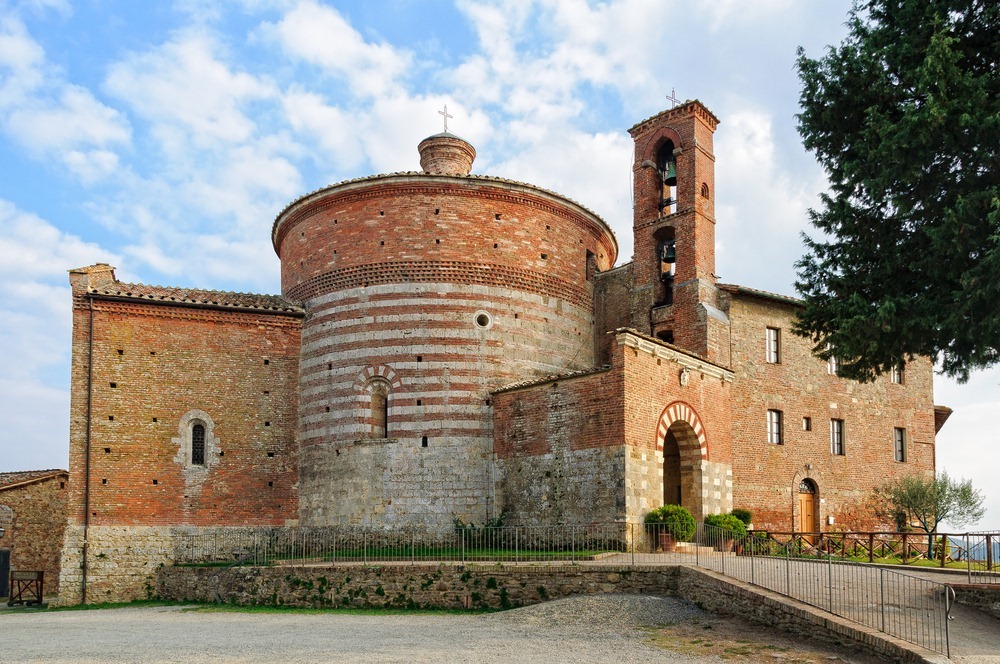
Galganus Guidotti died in 1181, at the age of 33 years and was Canonised four years later. His funeral was a major event, attended by Bishops and three Cistercian Abbots, including one who had been lost while on his way to Rome. The next year, the Bishop of Volterra gave Monte Siepi to the Cistercian Monks, aware that they would build a Shrine to Galganus’ memory. They began building in 1185, erecting a round Chapel that became known as the Cappella di Monte Siepi, on the hill above the main Abbey, with the sword forming the centrepiece.
The Sword “Excalibur”
The Cappella offers a breathtaking view of the Abbey, the neighbouring buildings and the beautiful surrounding countryside. Galganus’ body was for some reason lost after the funeral, although his head, which is said to have grown golden curls for many years following his death, was placed in one side Chapel and the chewed bones of the arms of the assassin in another.
The beautiful Capella
Saint Galganus’ head is now preserved as a Relic in the Museo dell’Opera del Duomo in Siena, while the skeletal arms are still in place. The crowds of pilgrims were so numerous that the Cistercians were authorised to build another Monastery named after the Saint a short distance away. It was to be one of the most beautiful Gothic buildings in Italy and one of the Cistercians’ two largest Italian foundations. The Monastery soon became both powerful and respected. Monks from San Galganus were appointed to high offices throughout Tuscany.
In the 14th Century, a Gothic side Chapel was added to the original Romanesque Cappella and in the 18th Century, a rectory was added. The side Chapel has the remains of some frescoes by Ambrogio Lorenzetti, including a faint picture of Galganus offering the sword in the stone to Saint Michael. The Abbey was sacked by the (in)famous English mercenary Captain Sir John Hawkwood and his White Company and by 1397 the Abbot was its only inhabitant. The Abbey deteriorated over the Centuries, becoming the impressive ruins seen today.
It is often argued that the legend of Saint Galganus formed the inspiration for the medieval legends about King Arthur and the Sword in the Stone, with which he proved his birthright. A story like that of Saint Galganus could travel all over Europe and, it is interesting to note that the first story about Arthur pulling a sword from a stone, (or more exactly an anvil on top of the stone), appears in the decades following Saint Galganus’ Canonisation in one of the poems by the Burgundian poet Robert de Boron. So, in the ever-changing legends of Arthur, it is it not unlikely that him pulling the sword out of the stone. was inspired by the act of a reformed Italian knight who became a Saint!
St Abraham of Persia St Anders of Slagelse Bl Andrew of Antioch Bl Arnold of Gemblours
St Castulus of Rome (c288) Martyr, married to Saint Irene of Rome (the woman who assisted St Sebastian after he had been wounded by the Imperial archers) and father of 2 children, Military Officer and he was the Chamberlain (or officer, valet) of Emperor Diocletian. His Feast day was moved to 26 March in 1969. His Life and Death: https://anastpaul.com/2021/03/26/saint-of-the-day-26-march-saint-castulus-of-rome-died-c-288-martyr/ St Constantius of Rome St Crider of Cornwall
Bl Joscius Roseus St Justina of Constantinople St Mahanes the Persian St Maura of Constantinople St Merola of Antioch St Mirocles of Milan St Sapor St Simeon of Persia St Trojan St Tudwal of Tréguier Bl William de Paulo Zosimus the Wonder Worker
Martyrs of Saxony – 6 Saints: Missionaries who worked with Saint Willehad of Bremen. Martyrs. – Attroban, Benjamin, Emmingen, Folkard, Gerwald and Grisold. They were martyred on 30 November 782 at River Weser, Lawer Saxony, Germany.
Saint/s of the Day – 29 November – Saint Saturninus of Rome (Died c304) + Priest and Martyr and Saint Sisinius of Rome (Died c304) + Deacon and Martyr. Both our Saints were born in Carthage and died by being finally beheaded in c304 on the Via Nomentana, 2 miles outside Rome, during the persecutions of Diocletian and Maximian and after years of slave labour and horrific tortures. Saturninus is also known as – Saturninus of Carthage, Saturninus the Elderly. Sisinius is also known as Sysinnius. Their Feast is celebrated on the day of the final translation of their Relics – 29 November. NB – (not to be confused with Saint Saturninus of Toulouse, a Bishop and Martyr in France, whose Feast is also today).
The Roman Martyrology reads: “At Rome, on the Salarian road, the birthday of the holy Martyr Saturninus, an aged man and the Deacon Sisinius, in the time of the Emperor Maximian. After a long imprisonment, they were, by order of the Prefect of the City, placed on the rack, distended with ropes, scourged with rods and whips garnished with metal, then exposed to the flames, taken down from the rack and beheaded.”
According to legend, Saturninus came from Carthage in North Africa and served as a Priest in Rome. He is described as an old man. Together with his Deacon Sisinnius, he was arrested and tortured during Christian persecutions. They were buried in the Cemetery of Saint Thraso on Via Salaria.
From the 1640 ‘General Legend of the Saints’ we read their story as follows:
“When the Emperors Diocletian (284-305) and Maximian (284-305) perceived that no torture or capital punishment could exterminate the Christians, nay, that the blood of the Martyrs was like seed, in which the life of one victim was in turn a hundred new believers, they invented a new way to oppress the Christians with long and painful tortures.
They had to carry stones and dig sand and do all the work necessary for the construction of public buildings. It was officially forbidden to sentence members of the nobility and soldiers to slave labour. But, precisely to humiliate the Christian faith even more, all Christians were sentenced, without respect to persons, to the slave labour of construction.
For example, Saturninus was among those in Rome who contributed to the construction of the bathhouses which Emperor Maximian had built for Diocletian because he had made him equal in rank to himself. Saturninus was already an elderly man and he was simply unable to do the heavy workwhich the overseers imposed on him. That is why he was helped by fellow Christians, especially by the Deacon Sisinnius. In his zeal, in addition to the burden imposed on himself, he also shouldered the burden of Saturninus. So he trudged to and fro, happily singing his Psalms to the Lord.
The imperial officials watched with great amazement at the great love and joy radiating from Sisinnius during his painful labours. They reported it to their Commander Espurius, who in turn, reported it to Emperor Maximian. He had Sisinnius and Saturninus brought before him. In vain he tried to have them sacrifice to idols under threats. When this came to nothing, he entrusted them to the Commander Landicius, with orders to force them to make sacrifices or else put them to death with his own hands. The Ruler threw them into prison. There they sat for several days, converting many pagans who came to visit them to the Christian faith. After thirty-three days the superior had them appear before him with their hands shackled and their feet bare. He perceived that they were still as steadfast and that they would rather die a thousand deaths, than deny Jesus Christ. He had an idol set up for them to worship. But Saturninus said, raising his voice: “May the Lord put to shame the gods of the heathen.” Immediately the statue fell to smithereens on the ground. At the same time two soldiers, named Papias and Maurus, began to shout that the Jesus Christ whom Saturninus and Sisinnius worshiped must be the true God!
The superior condemned the two Saints to the rack – then he had them lifted up, beaten with sharp scourges and torn their bodies apart with the instrument of torture, called the scorpion. But they sang with great joy, “Glory to Thee, Jesus Christ because Thou hast given us part in the glory of Thy servants.” When Papias and Maurus saw all this, they too began to long for the Martyr’s crown. They flew into a holy rage against the executioners and shouted, “How is it possible that the devil has such great power over you that he makes you so cruel to these two holy men?”
This angered Commander Landicius. He had them struck in the mouth with stones and then thrown into prison. In the days following, they were subjected to all kinds of torture. Meanwhile, he had the sides of Saturninus and Sisinnius scorched with flaming torches. But when he saw that this did nothing to their perfect faith either and that they were undergoing all this with joy, praising the Lord, he decided to have them taken half a mile outside Rome, to be beheaded along the road to Nomentana.
Their bodies were recovered by a rich, powerful and very devoted man named Thrassus; he spent all his possessions to support the Christians and assist the workers at the bathhouses. He buried them in his own yard. That happened on the twenty-ninth day of November. The Catholic Church has commemorated them on this day ever since. They were Martyred five years after the start of work on the construction of the bathhouses.‘”
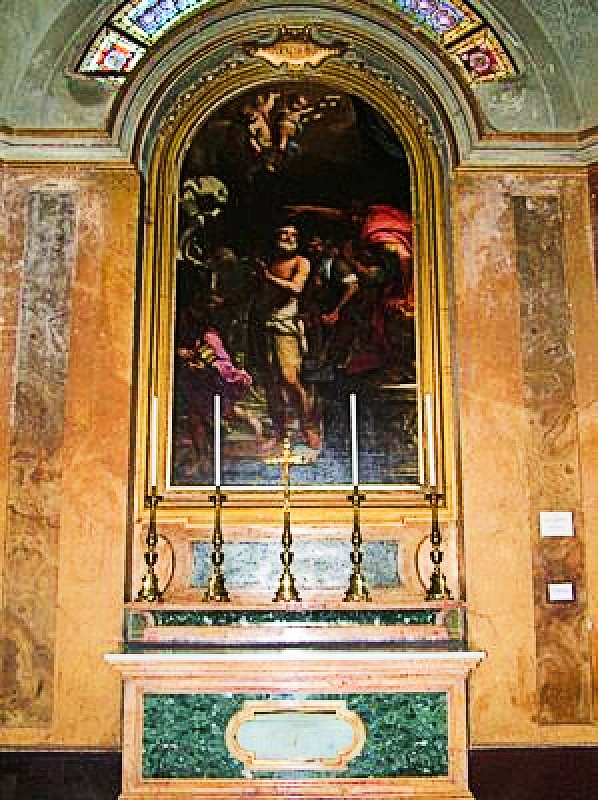
The Altar of St Saturinus at the Basilica of Sts John and Paul
The only definitive information which can be said with historical certainty is that Saturninus is a Martyr of the first Centuries of Christianity and that his feast was traditionally celebrated on 29 November at his grave on Via Salaria. On their grave stood a Church that fell into ruins in the Middle Ages.
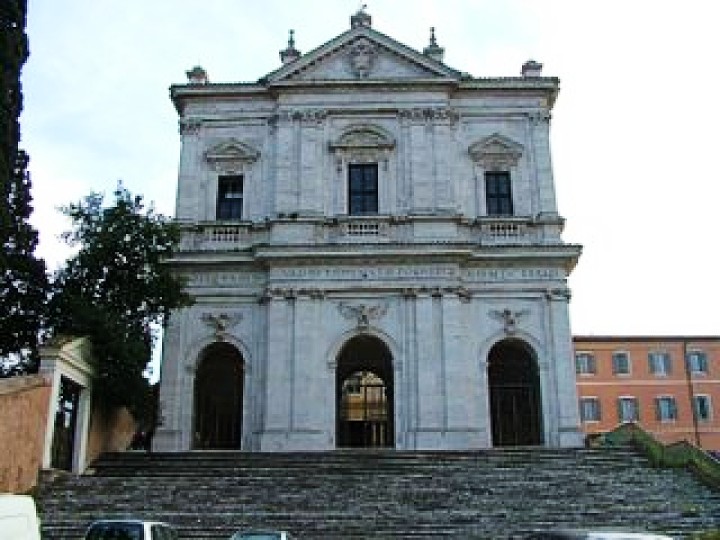
Their Relics were re-enshrined in the Church of Saints John and Paul (the ones mentioned in the Roman Canon). Finally, on 29 November 1987, most of the Relics were moved to the Church of St Gregory the Great and St Saturninus, in Rome, to an Altar newly dedicated in his honour. The image above resides above the Altar where some his Relics remain at Sts John and Paul.
The Church of St Gregory the Great and Saturinus in Rome
All Saints of the Seraphic Order (Franciscan): the Church celebrates the many Franciscan Saints who followed in the footsteps of St Francis. It is a special day for all Franciscans to celebrate the Feast of ‘All the Saints of the Seraphic Order.’ Also on this day in 1223, the final Rule of life for Franciscan Friars was approved. To commemorate this and all the saintly examples produced in the Franciscan Order, on this day all the Saints of the Seraphic order are remembered at Franciscan Churches throughout the world.
Bl Frederick of Ratisbon St Hardoin of Brittany St Illuminata of Todi St James of Saroug Bl Jutta of Heiligenthal St Paphnutius of Heracleopolis St Paramon St Philomenus of Ancyra St Radbod of Utrecht
St Sadwen of Wales St Saturninus of Rome (Died c304) + Priest and Martyr St Saturninus of Toulouse St Sisinius of Rome (Died c304) + Deacon and Martyr St Walderic of Murrhardt
Saint of the Day – 28 November – St Sosthenes (1st Century) the first Bishop of Colophon, Asia Minor, probably a Martyr, Jewish Ruler in Corinth, converted by St Paul and became his disciple, who is mentioned by him in his First Epistle to the Corinthians (1 Corinthians 1:1–2) and by St Luke in Acts 18:12–17. Also known as – Sosthenes of Corinth, Sosthenes of Colophon, Sostene…
The Roman Martyrology reads: “At Corinth, the birthday of St Sosthenes, fisciple of the blessed Apostle Paul, who is mentioned by that Apostle in his first Epistle to the Corinthians. He was chief of the synagogue when converted to Christ and, as a glorious beginning, consecrated the first fruits of his faith by being scourged in the presence of the Proconsul, Gallio.”
St Paul
During the long stay of the Apostle St Paul in Corinth, an event occurred which was not only sensational but, at least for us, difficult to explain, although reported with the usual clarity by St Luke, the Chronicler of the Acts of the Apostles:
“Gallio, being then Proconsul of Achaia (i.e. of the region in which Corinth was located) – we read – “the Jews, all in agreement, rose up against Paul and took him to the Tribunal, saying: ‘This man persuades the people to give God a cult, contrary to the law.’ And as Paul was there ready to speak, Gallio said to the Jews: ‘If it were a question of some crime, of some serious misdeed, I, Jews, would listen to you as reason dictates but, since it is a question of questions of words and names and they belong to your law, think about it – I do not want to be judge of these things!’ And he sent them away from the court. They all then took Sosthenes, the Ruler of the Synagogue and beat him before the tribunal and Gallio did not care at all. ”
St Sosthenes
The first part of the episode is quite clear – the Roman Proconsul, in a City which, after all, was in Greece and not in Palestine, cleverly refuses to be the judge of a doctrinal question which interests and concerns, only a minority of his subjects.
It is, again, the tactic of washing one’s hands, adopted by Pilate towards Jesus, with the difference that Corinth was not Jerusalem and, therefore, the “abstaining, so to speak, of the Roman Governor, saves Paul from accusations and threats of his enemies, without the Apostle even opening his mouth.
Except, here’s the unexpected fact – instead of Paul, his accusers, in that same Court, take and beat our Saint Sosthenes, who had nothing to do with Paul and who was, indeed, the Ruler of the local Synagogue. Why did this happen? Why was Sosthenes beaten instead of Paul? Scholars have failed to give a convincing answer to this question. Probably, the head of the Synagogue was the one who had incited his fellow Jews to demonstrate against Pau, and the Jews released their fury upon him when they saw that their entire design to attach St Paul had been destroyed by the Governor.
According to some, however, the resentment of the Jews related to the fact that Sosthenes’ converssion by St Paul had alreay taken place and was known by his fellow Jews.
But the Acts do not mention the conversion of Sosthenes, Ruler of the Synagogue of Corinth. Shortly afterwards, however, his name appears again in the address of the letter twhich St Paul wrote from Ephesus to the restless Christians of Corinth and, of which, Sosthenes seems to have been the bearer.
“Paul, called to be an Apostle of Jesus Christ by the will of God and Sosthenes, a brother, To the Church of God which is at Corinth, to them that are sanctified in Christ Jesus, called to be saints, with all that invoke the name of our Lord Jesus Christ, in every place of theirs and ours.” – 1 Corinthians 1:1-2
It was so natural to think that the ancient leader of the Synagogue, beaten by his fellow believers, was actually converted by Saint Paul, becoming his disciple, responsible for maintaining contacts between the Apostle and the community of Corinth, where he was well known and respected.
This hypothesis, is probable but not certain, was accepted by the compilers of the Martyrologies, who today remember Sosthenes among the Saints, as a disciple of Saint Paul and former Ruler of the Synagogue of Corinth. With the beatings before the tribunal, he would have “consecrated the first fruits of his faith with a glorious beginning”, and then matured that faith as Bishop of Colophonia, in Asia Minor. But this is traditional understanding which no historical testimony is completely able to confirm.
Bl Calimerius of Montechiaro St Fionnchu of Bangor
St Pope Gregory III (Died 741) Bishop of Rome 11 February 731 until his death on 28 November 741. (His Feast was moved to 10 December in 1969), The Roman Martyrology states: “St Rome, the blessed Pope Gregory III, who departed for Heaven with a reputation for great sanctity and miracles.“ His Life: https://anastpaul.com/2021/11/28/saint-of-the-day-28-november-saint-pope-gregory-iii-died-741/
St Hilary of Dijon St Hippolytus of Saint Claude St Honestus of Nimes St Irenarcus
St James of the Marches OFM Conv. (1391-1476) Priest of the Friars Minor Conventional, Confessor, brilliant Preacher, Penitent, Reformer, Writer, Papal legate, Inquisitor, founder of several monasteries in Bohemia, Hungary and Austria. St James was Canonised on 10 December 1726 by Pope Benedict XIII. His body is Incorrupt. About St James: https://anastpaul.com/2019/11/28/saint-of-the-day-28-november-saint-james-of-the-marches-ofm-1391-1476/
St Papius St Quieta of Dijon St Rufus St Simeon the Logothete St Sosthenes (1st Century) Bishop, Martyr, Jewish Ruler in Corinth, Converted by St Paul. St Stephen the Younger Bl Theodora of Rossano
Martyrs of Constantinople – 8 Saints: A group of over 300 Christians Martyred during the persecutions of the Iconoclast Emperors. We have a lot of information on Saint Stephen the Younger, but for the others we have nothing but seven of their names – Andrew, Auxentius, Basil, Gregor, John, Peter and Stefan. They were scourged, stoned and/or dragged to death through the streets of Constantinople in 764.
Martyrs of North Africa – 13 Saints: A group of thirteen Clerics killed or exiled in the persecutions of Arian Vandals in North Africa – Crescens, Crescentian, Cresconius, Eustace, Felix, Florentian, Habetdeum, Hortulanus, Mansuetus, Papinianus, Quodvultdeus, Urban and Valerian.
Martyrs of Tiberiopolis – 14 Saints: A group of fourteen Christian Laymen, Deacons, Priests and Bishops who were Martyred together in the persecutions of Julian the Apostate – Basil, Chariton, Comasios, Daniel, Etymasius, Hierotheos, John, Nicephorus, Peter, Sergius, Socrates, Theodore, Thomas and Timothy. 361 at Tiberiopolis, Phyrgia (in modern Turkey)
Saint of the Day – 27 November – Saint Maximus of Riez (Died 460) Bishop of Riez, France, Confessor, Abbot, Hermi, zealous and highly efficient leader, Miracle-worker. Born in Decom, Provence (modern Châteauredon, France) and died in Reiz in 460 of natural causes. Patronages – children, the dying, Agliè, Italy, Boulogne-sur-Mer, France.
The Roman Martyrology reads: “At Riez, in France, St Maximus, Bishop and Confessor, who, from his tender years, was endowed with every grace and virtue. Being first the Superior of the Monastery of Lérins and afterwards, Bishop of the Church of Riez, he was celebrated for the working of miracles and prodigies.”
Saint Maximus was born in Decomer in Provence in France and was duly Baptised as a very young infant by deeply pious parents. He was thus brought up in a similar manner observing all the devotions and duties of a Christian home. There, at home, he began to live as a kind of recluse, to mortify his senses and practice self-deniel, solitude and prayer.
When he was an adult, he chose the religious life and became a Monk in the Monastery of Lérins, where he was under the Founder, Saint Honoratius.
When, in 426, St Honoratus became the Archbishop of Arles, Maximus was elected as the Monastery’s second Abbot. Saint Sidonius writes that the Monastery received a new spiritual gift due to Saint Maximus’ wise leadership and shining example. The Monks obeyed him with joy and did not complain about the rigour of the religious life.
Maximus was also known for numerous miracles which naturally only increased his reputation as a saint. So many came to ask him for advice and to seek his spiritual counsel that finally, he had to find a home in the forest to concela himself from unwanted renown and to hide from those who wanted him to appoint him as the Bishop of Fréjus.
But later he still, in humble obedience, accepted the elevated role of a Bishop but of Riez in Provence. In 434 he was Ordained by Saint Hilarius (he had been tracked down, after he had first fled along the coast and into Italy, to escape appointment). He became one of the most prominent of the French Bishops, of the time. Even as a Bishop, he continued to wear a hair shirt and Monk’s Habit and followed the Monastic Rule as far as was compatible with his Episcopal obligations.
Some of the sermons formerly attributed to Eusebius of Emesa are now believed to have been by Saint Maximus. He attended the Synods of Riez in 439, Orange I in 441 and Arles in 454. Our Saint died in 460 and is buried in Riez.
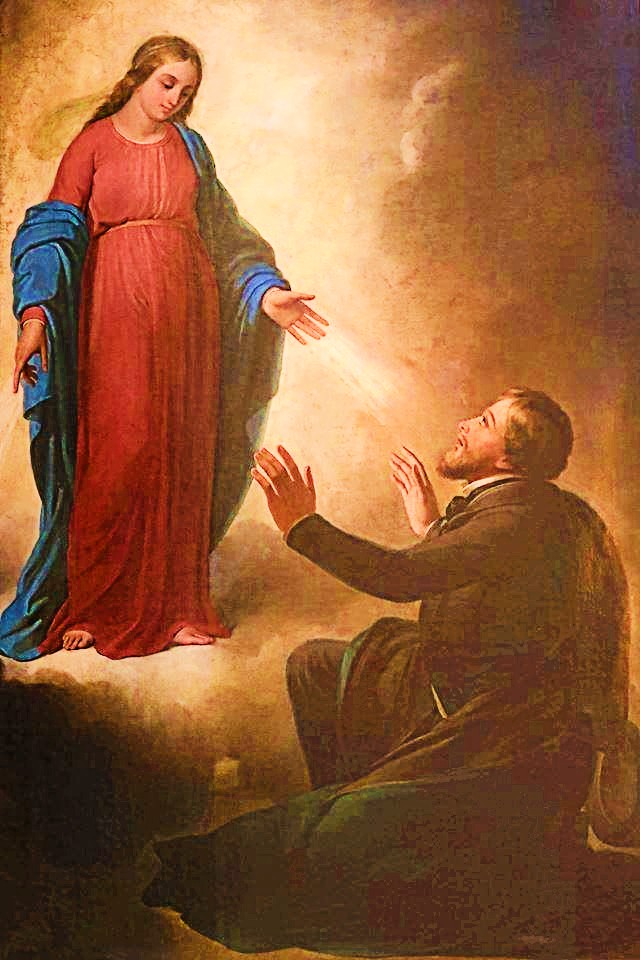
Two of the most famous conversions due to the Miraculous medal was that of Fr Alphonse Ratisbonne NDS (1814-1884), an anti-Catholic Jewish banker and Claude Newman (1923-1944). Fr Alphonse Ratisbonne received a vision of Our Lady of the Miraculous Medal. After his conversion, he became a Priest and worked for the conversion of the Jewish people.
St Acacius of Sebaste St Acharius of Noyon St Apollinaris of Monte Cassino St Barlaam
Blessed Bernardine of Fossa OFM (1420-1503) Priest, Friar of the Friars Minor, Missionary in Italy and a renowned Preacher, noted Historian, Lawyer, Ascetical Writer, rising within the Order to important positions. His cult was later confirmed by the Beatification of Pope Leo XII on 26 March 1828. The Roman Martyrology states: “At L’Aquila, blessed Bernardino da Fossa (Giovanni) Amici, Priest of the Order of Minors, who preached the Catholic Faith in many Provinces of Italy.“ Biography: https://anastpaul.com/2021/11/27/saint-of-the-day-27-november-blessed-bernardine-of-fossa-ofm-1420-1503/
St Bilhild of Altmünster St Eusician St Facundus St Fergus the Pict St Gallgo of Wales St Gregory of Sinai St Gulstan St Hirenarchus of Sebaste St James Intercisus St John Angeloptes St John of Pavia St Laverius
St Maximus of Riez (Died 460) Bishop, Confessor, Abbot, Hermit St Primitivus of Sahagun
Martyrs of Antioch – 3 Saints: A group of Christians Martyred together for their faith. Little information has survived except for their names – Auxilius, Basileus and Saturninus.
Martyrs of Nagasaki – 11 Beati: A group of eleven Christians Martyred together for their faith during a period of official persecution in Japan. They are: Blessed Alexius Nakamura Blessed Antonius Kimura Blessed Bartholomaeus Seki Blessed Ioannes Iwanaga Blessed Ioannes Motoyama Blessed Leo Nakanishi Blessed Matthias Kozasa Blessed Matthias Nakano Blessed Michaël Takeshita Blessed Romanus Motoyama Myotaro Blessed Thomas Koteda Kyumi They were Martyred on 27 November 1619 in Nagasaki, Japan and Beatified on 7 May 1867 by Pope Pius IX.
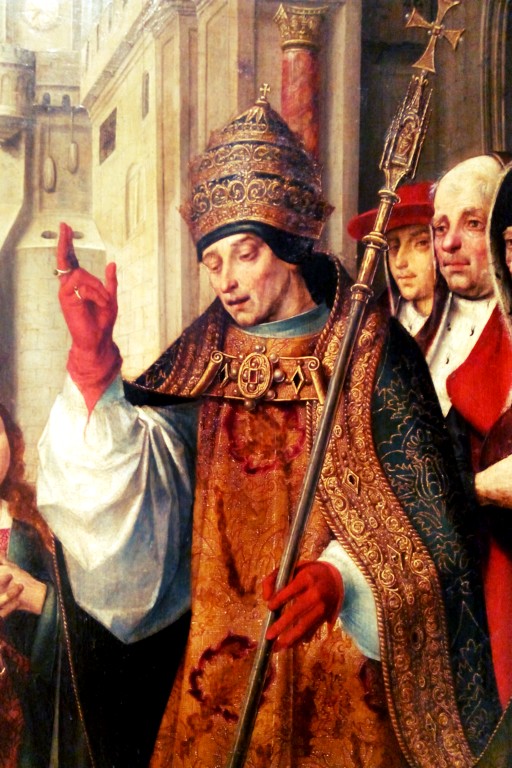
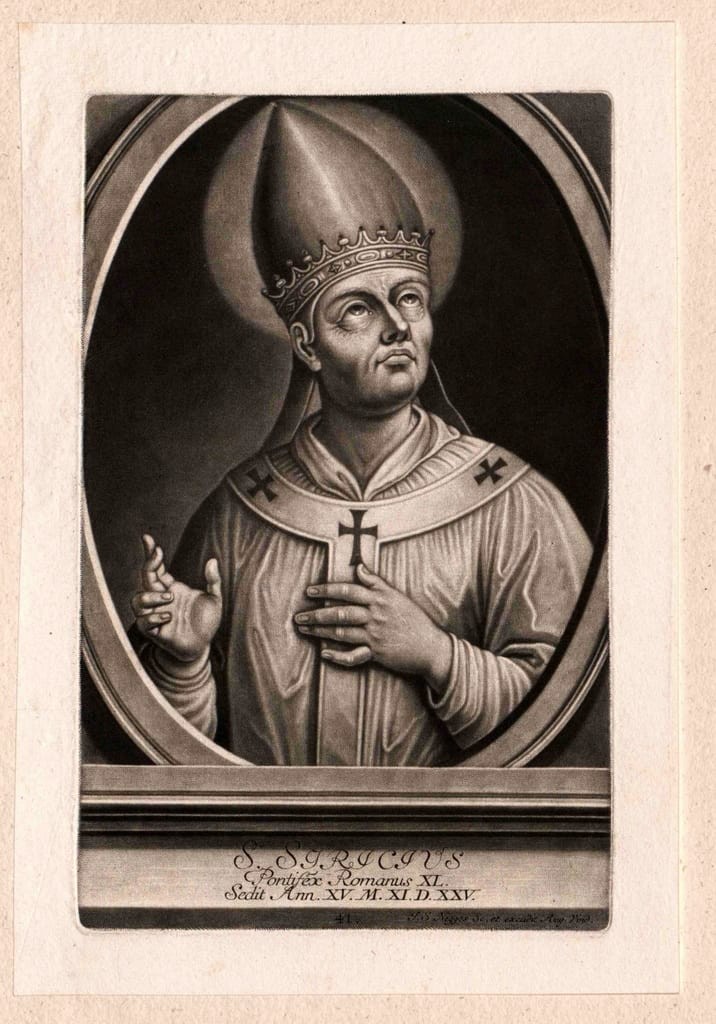
Saint of the Day – 26 November – St Pope Siricius (c334-399) the 38th Bishop of Rome from December 384 until his death on 26 November 399, Confessor, Defender of the Faith against heresies, Reformer of clerical discipline, Born in Rome and died there of natural causes aged around 64. In response to inquiries from Bishop Himerius of Tarragona, Siricius issued the Directa Decretal, containing Decrees of Baptism, Church discipline and other matters. His are the oldest completely preserved Papal Decrees. He is sometimes said to have been the first Bishop of Rome to call himself “Pope or Papa” – the word derived from the Greek, Papa, meaning Father.
The Roman Martyrology reads today: “At Rome, St Siricius, Pope and Confessor, celebrated for his learning, piety and zeal for religion, who condemned various heretics and published salutary laws concerning Ecclesiastical discipline.”
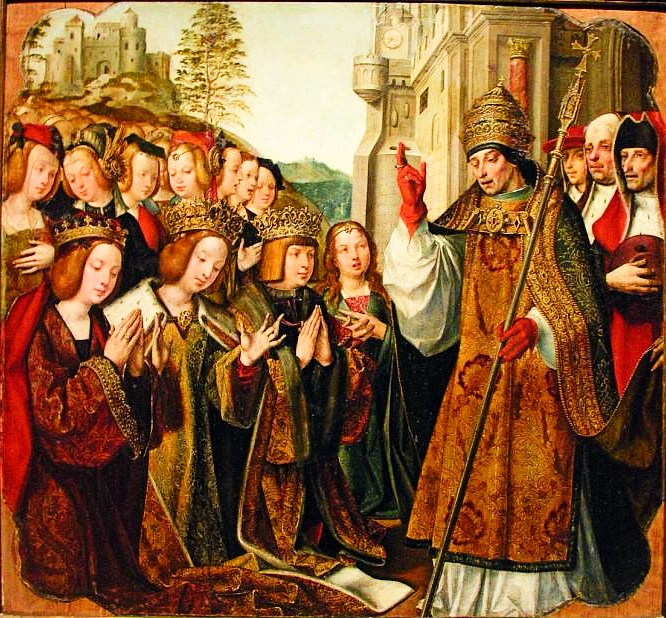
Image from the Saint Auta Altarpiece (Lisbon) of Pope Siricius blessing Saint Auta – see complete image below.
Saint Siricius was, a Roman and the son of Tiburtius. He entered the service of the Roman Church as a young man, most during the Pontificate of Liberius , first as Lector and later as Deacon. He was also a Deacon under Pope Damasus.
Although the antipope. Ursinus again stood as a candidate, in December 384 (the 15th?) Siricius was unanimously elected as Damasus’ successor. The election was confirmed with apparent satisfaction by the Emperor Valentinian II (375-392) in an edict of 25 February 385, probably mostly to cut off any intrigues in the Ursinian camp.
The Emperor gave further evidence of his approval by providing funds for the restoration and expansion to approximately its present size, of St Paul’s Basilica . The Pope Consecrated it in 390. A modern column outside the northern colonnade commemorates his Consecration of the Basilica.
The Church Father and Doctor, St Jerome or Hieronymus, had a justified hope of becoming Pope Damasus’ successor himself but he was banished from Rome, in an action Siricius must have, at least consented to. The disappointed Jerome describes the Pope as a simple man, gullible and easily deceived, while St Paulinus of Nola complained about his haughty unapproachability. In reality, he was an experienced and powerful Pope and, although he was as conscious as Damasus of the primacy of Rome and his own role as Peter ‘s successor, he was inevitably overshadowed by the contemporary St Ambrose, Bishop of Milan (340-397).
Siricius was probably not the first Pope to issue decretal speeches but his are the oldest preserved. A decretal speech is a directive or an authoritative decision on disciplinary matters. They were no longer in a tone of fraternal exhortation but held in the same authoritative style of imperial edicts and like them, had the same legal force as laws. The oldest preserved decretal speeches are from 11 February 385 and addressed to Himerius, Bishop of Tarragona in Spain, who had brought fifteen questions aconcerning Ecclesiastical discipline to Damasus I. They open with the demand that the Pope, or rather the Apostle Peter present in the papacy, bears the heavy burden of giving categorical rules in matters of Ecclesiastical discipline and Liturgical ordinances.
Siricius confirmed that Arians who were re-admitted to the Catholic Church were not to be re-Bbaptised and that Baptism could only be performed, in exceptional cases, at times other than Easter and Pentecost which had, nevertheless, previously been an old custom. Furthermore, he gave rules for age and qualifications before Ordination, insisted on Clerical abstinence and celibacy and gave rules for the discipline of penance. Siricius demanded that these general Decrees (decretalia generalia) which should be as binding as decisions (cwith a series of Canons) from Synods, should be communicated to the neighbouring Provinces in Africa, Spain and Gaul.
On 6 January 386, a Synod was held in Rome “at the Relics of the Apostle Peter” attended by 80 Bishops. A number of disciplinary decisions were made and the Pope sent nine Canons which were adopted at the Synod, to Africa and other Churches. They decided, inter alia that no Bishop should be Consecrated without “the knowledge of the Apostolic See” or by just a single Consecrator. Similarly, Siricius responded to requests from the Bishops of Gaul, with a series of Canons .
We believe that Siricius was the first Pope to reserve the exclusive right to use the title Pope/Papa. The word can also be seen as an anagram made from the initials of the words Petri Apostoli Potestatem Accipens (“He who has received power from the Apostle Peter”).
Siricius was no opponent of asceticism, as is sometimes misleadingly claimed. But around 388 the Monk Jovinian, who had had a great reputation for his strict life, came to Rome. Now, he began to assert that, after all, an austere life was a waste and that vows, chastity, fasting and good works, were of little use. In addition, he claimed that the Virgin Mary had lost her virginity when she gave birth to the Saviour. As a consequence of this vision, Jovinian, himself gave up his ascetic life and began to persuade many mMnks and Nuns to give up asceticism and get married. Shocked lay people asked the Pope to intervene. Siricius then held a Synod which condemned Jovinian’s theories and excommunicated him and his leading followers. The Pope sent three Priests to Milan to tell Saint Ambrose about the Synod. Ambrose himself held a Synod praising the Pope for his care and repeating the condemnation of Jovinian.
Later, the Pope condemned the view of Bonosus, bishop of Naissus that the Blessed Virgin had given birth to Joseph’s child after the birth of the Lord, leaving it to the bishop of Illyria, to judge the man himself.
The Pope also received a delegation from the East asking him to put an end to the long-standing schism over the Episcopate of Antioch. For years, two Bishops and their successors had been quarreling over the Episcopate. Siricius granted their plea to recognise the last survivor, Flavian, as a true Bishop and readmitted him to communion. On the Pope’s advice, a Council at Caesarea in Palestine,recognised that Flavian and not Evagrius, was the rightful Bishop.
In the mid-390s, Siricius incurred the wrath of St Jerome. St Jerome, who had now settled in Bethlehem and his friends in Rome, were enraged by the Pope’s positive attitude towards Bishop John of Jerusalem (died 417) and, towards Rufinus of Aquileia (died 410), both of whom, were at this time in St Jerome’s deepest displeasure.
During Siricius’ Pontificate, the great St Augustine became the Bishop of Hippo and wrote his Confessions.
The Eastern Emperor Theodosius I, who was very religious, came under the strong influence of St Ambrose. In 384 he issued a ban on pagan feasts and in 391 pagan sacrifices were banned. Violation of the ban was declared crimen maiestatis, treason. It led to a pagan revolt led by Rome. But Theodosius crushed the rebel army in a battle at Aquileia in 384, after which all the temples of Rome were closed and all the Senators forcibly Baptised. Christianity had finally and definitively, become the state religion. For Christianity, 392 is a special year. Then Emperor Theodosius announced that he would tolerate only one religion in his vast Empire. Both Christian heresy and pagan worship were banned.
Siricius died on 26 November 399 and was buried in the Basilica of Silvester near the Catacomb of Priscilla.
Although he was venerated as a Saint in the earliest Centuries, he was not included in the first edition (1584) of the Roman Martyrology, due to the criticism of Jerome and Paulinus of Nola. His name was added in 1748 by Pope Benedict XIV, who wrote a treatise to prove his holiness.
St Leonard of Port Maurice OFM (1676-1751) Confessor, Priest and Friar of the Friars Minor, reacher – in particular Parish Mission Preacher, Ascetic Writer, Spiritual Director. St Leonard founded many pious societies and confraternities and exerted himself to spread devotion to the Sacred Heart of Jesus, the Perpetual Adoration of the Most Blessed Sacrament, the Blessed Virgin Mary and the Passion of Christ. He was among the few to insist that the concept of the Immaculate Conception of Mary be defined as a Dogma of the Faith. He was Beatified on 19 June 1796 by Pope Pius VI and Canonised on 29 June 1867 by Pope Pius IX. Biography: https://anastpaul.com/2018/11/27/saint-of-the-day-27-november-st-leonard-of-port-maurice-ofm-1676-1751/
St Bertger of Herzfeld St Conrad of Constance Bl Delphine of Glandèves St Egelwine of Athelney St Ida of Cologne St James the Hermit St Magnance of Ste-Magnance St Marcellus of Nicomedia St Martin of Arades St Nicon of Sparta Bl Pontius of Faucigny St Sabaudus of Trier St Siricius, Pope (c334-399) Confessor, Bishop of Rome from December 384
St Stylinus St Vacz
Martyrs of Alexandria – 650+- Saints: A group of approximately 650 Christian Priests, Bishops and Laity Martyred together in the persecution of Maximian Galerius. We have the names and a few details only seven of them – Ammonius, Didius, Faustus, Hesychius, Pachomius, Phileas and Theodore. The were born in Egypt and were martyred there in c 311 in Alexandria, Egypt.
Martyrs of Capua – 7 Saints: A group of seven Christians Martyred together. The only details about them to survive are the names – Ammonius, Cassianus, Felicissimus, Nicander, Romana, Saturnin and Serenus. They were martyred in Capua, Campania, Italy, date unknown.
Martyrs of Nicomedia – 6 Saints: A group of six Christians Martyred by Arians. Few details have survived except their names – Marcellus, Melisus, Numerius, Peter, Serenusa and Victorinus. Martyred in 349 in Nicomedia, Bithynia, Asia Minor (modern Izmit, Turkey).
Saint of the Day – 25 November – Saint Moses of Rome (Died c251) Priest Martyr, Confessor. Born in Rome, Italy and died in c251 as a result of the lengthy confinement under the inhuman conditions in prison. It is said that our Saint was not a true Martyr in the usual sense of their deaths but since those times, many others too have been granted the title for similar deaths during imprisonment.
The Roman Martyrology reads today: “At Rome, St Moses, Priest and Martyr, who, with others detained in prison, was often consoled by the letters of St Cyprian (Martyr). After he had withstood, with unbending courage, not only the pagans but, also the Novatian schismatics and heretics, he was finally, in the persecutions of Decius, crowned with a Martyrdom which fills the mind with adminration, according to the words of Pope St Cornelius (Martyr).”
Prison of Ancient Rome by Giovanni Battista Piranesi (1760)
St Moses, who might have been of Jewish origin was born in Rome and ministered there during the times of the persecution of the Emperor Decius, in the mid-3rd Century.
Decius’ persecution also affected the leaders of the Church – Bishops and Pope Fabian himself. For many months it was impossible to elect a new Pontiff. For this reason, the Roman Church was administered by a college of Priests, among whom Moses, distinguished himself by his devotion and zealous confession of Christ and His Church.
During the persecution, many Christians had denied their faith. Extreme controversies arose between those who supported an intransigence line and those, like Moses, who held more moderate positions, calling for tolerance for those who had renounced or had prudently avoided the dangers.
Moses died in 251, the victim of a long imprisonment. He confessed Christ and testified to his faith until his death in chains.
Bl Adalbert of Caramaico St Alanus of Lavaur St Audentius of Milan
Blessed Beatrice d’Ornacieux O.Cart (c 1260–1303) Virgin, Carthusian Nun, Mystic, Founded a Monastery at Eymeu on France. The Roman Martyrology states: “In the territory of Valence in France, Blessed Beatrice d’Ornacieux, Virgin of the Carthusian Order, who, famous for her love for the Cross, lived and died in extreme poverty in the Monastery of Eymeu which she founded.” Biography: https://anastpaul.com/2021/11/25/saint-of-the-day-25-november-blessed-beatrice-dornacieux-o-cart-c-1260-1303/
St Bernold of Ottobeuren Bl Conrad of Heisterbach Bl Ekbert of Muensterschwarzach
St Erasmus of Antioch Bl Garcia of Arlanza Bl Guido of Casauria St Imma of Wurzburg St Jucunda of Reggio Aemilia St Mercurius of Caesarea St Moses of Rome (Died c251) Priest MartyrConfessor
Martyrs of Africa – 13 Saints: A group of 13 Christians murdered together for their faith in Africa, date unknown. The only details to have survived are their names – Claudian, Cyprian, Donatus, Felix, Januarius, Julian, Lucian, Marcian, Martialis, Peter, Quirianus, Victor and Vitalis.
Saint of the Day – 24 November – Saint Chrysogonus (Died 304) Priest Martyr. Died on 23 November 304 at Aguilera, Italy by beheading. Patronage – the City and Diocese of Zadar in Croatia. Also known as – Crisogono, Grisogono, Chrysogonius. Additional Memorial – 31 May in Aquileia, Italy, although Chrysogonus died on 23 November, his Feast is celebrated on 24 November, the anniversary of the Dedication of the Church in Rome which bears his name. The meaning of our Saint’s name, Chrysogonus, is a golden or precious birth. He is sometimes depicted as a Soldier or Official of the Roman Court which could relate to his history as the teacher of St Anastasia, the daughter of a Roman Prefect.
San Crisogono, by Michele Giambono (San Trovaso, Venice)
The Roman Martyrology reads: “The birthday of St Chrysogonus, Priest Martyr. After a long imprisonment in chains for the constant confession of Christ, he was, by order of Diocletian, taken to Aquileia, where he terminated his Martyrdom by being beheaded and thrown into the sea.”
Chrysogonus was a Greek but spent his life in Rome. There is some evidence that he was the iteacher of Saint Anastasia, the daughter of a noble Roman Praetextatus and befriended her when persecution struck her.
During the reign of Diocletian he was imprisoned for two years and then beheaded. His body was cast into the sea but was afterwards recovered and buried at Zara – now Zadar in Dalmatia/Croatia, where his Relics are still venerated.
Very early indeed, the veneration of this Martyr of Aquileia was equally regarded in Rome, where in Trastevere, a titular Church bears his name. A portion of his head is preserved and enshrined in a golden Reliquary there. He is held in great veneration by the Romans and by the Greeks, who call him “The Great Martyr.”
St Chrysogonus Church in Rome
The name of this holy Martyr, occurs in the Roman Canon of the Mass and is mentioned in the ancient Calendar of Carthage of the 5th Century and in all Western Martyrologies since that time. The Church in Rome of which he is Titular Saint, is mentioned in a Council held by Pope Symmachus (dIED 514) and in the Epistles of Saint Gregory the Great, it gives title to a Cardinal Priest.
Bl Conrad of Frisach St Crescentian of Rome St Eanfleda of Whitby St Felicissimus of Perugia St Firmina of Amelia St Flora of Cordoba St Hitto of Saint-Gall St Kenan of Damleag St Leopardinus of Vivaris St Marinus of Maurienne St Mary of Cordoba St Portianus of Miranda St Protasius of Milan St Romanus of Le Mans
Saint of the Day – 23 November – Saint Amphilochius of Iconium (c339-400) Bishop, Lawyer and Rhetorician, Poet, Writer and Theologian, Defender of Orthodoxy against heretics, Miracle-worker. First Cousin of St Gregory of Nazianzen and his great friend and so too, a close friend and confidante of St Basil the Great. Born in c339 in Cappadocia, Asia Minor (in modern Turkey) and died in 400 in Konya (in modern Turkey) of natural causes. Also known as – Amfilokius, Amphilochus, Anfilochio, Anfiloquio.
The Roman Martyrology reads today: “At Iconium, in Lycaonia, the holy Bishop, Amphilochius, who was the companion of St Basil the Great and of St Gregory Nazianzen in the desert and their colleague in the Episcopate. After many combats for the Catholic Faith, he rested in peace, with the reputation of a holy and learned Prelate.”
Amphilochius was born in c339 in Cappadocia in Asia Minor (now Turkey). He was a cousin of Saint Gregory of Nazianzen and a close friend and fellow student of Saint Basil the Great. The most important source of our information aregarding our Saint, is his correspondence with these two friends.
Amphilochius’ father was an eminent lawyer and his mother Livia, was remarkable for gentleness and wisdom. He was brought up in the highly religious atmosphere of the Christian aristocracy of his native Province.
He studied law and rhetoric in Antioch, under the renowned Libarius and, as a young man, he taught rhetoric in Constantinople. He was still young when he ran decided to retire to the country to seek spiritual solitude. He left the City in favour of a place near Nazianzen. There, he could live a quiet life, while taking care of his elderly father. We get a little insight into his life at this time, in a letter from Gregory, who seems to have supplied them with grain, in return for vegetables, from his Amphilochius’ family land.
He was soon drawn within the circle of influence around St Basil the Great and seems to have been, for a while, a member of the Christian “City of the Poor” which Basil had built at Cæsarea.
In 374, when Amphilochius was about 35 years old, he was appointed Bishop of Iconium (now Konya in Turkey). He was aware of what this position would entail and accepted with great reluctance. When his father complained to Gregory that he was going to miss his son’s care, Gregory replied that he was not to blame for the appointment and, in any case, he himself would miss Amphilochius’ company. Basil, who may well have been responsible for the appointment, wrote to encourage his friend, exhorting him to lead others and not be led by them. Amphilochius often consulted Basil and it was to him that Basil wrote his treatise on the Holy Ghost and, it was our Saint, Amphilochius, who gave the Eulogy at Basil’s funeral.
St Amphilochius Bishop of Iconium
Amphilochius was always zealous for the cause of orthodoxy and in 376 he held a Council at Iconium to condemn the Macedonian heresy which denied the deity of the Holy Ghost. In that connection, he wrote a book treating of the HolyGhost which was praised by Saint Jerome. He was present when Macedonianism was condemned at the Council of Constantinople in 381. He also urged Emperor Theodosios I (379-395) to forbid the Arians from holding their assemblies. At first, Theodosios refused because he considered such a measure, would be unnecessarily severe but Amphilochius eventually prevailed and persuaded him to promulgate a law making it illegal for Arians to meet in public or in private.
He was equally zealous in his opposition to the teachings of the Messalians, an Illuminist and Manichean sect which held that prayer alone is the essence of religion and the only way to salvation. In 394 he presided over a Synod at Sida in Pamphylia, where these heretics and their heresies were condemned.
Amphilochius wrote 333 verses in classical Greek poetry about the Christian life, several biblical commentaries and a writing against pseudo-ascetic practices.St Gregory Nazianzen described Amphilochius as a “herald of truth” and an exemplary and irreproachable Bishop and, his father confirmed that sick people had been healed by his prayers. He died in the year 400. His memorial day is 23 November.
In the history of theology. Amphilochius occupies a place of prominence for his defence of the divinity of the Holy Ghost, sadly this work is now lost, however, he read it to St Jerome on the occasion of their meeting at Constantinople. Most of Amphilochius’ works have been lost. Eight sermons have survived, including the oldest known sermon on the Feast of the Purification of the Blessed Virgin and the Presentation of Our Lord. His style and concern for historical accuracy puts Amphilochius in the place of a predecessor to St John Chrysostom, who may have been influenced by him.
St Adalbert of Casauria St Alexander Newski St Amphilochius of Iconium (c339-400) Bishop, First Cousin of St Gregory of Nazianzen and his great friend and so too, a close friend and confidante of St Basil the Great. St Augusta of Alexandria St Clement of Metz Bl Detlev of Ratzeburg St Falitrus of Chabris St Faustina of Alexandria St Gregory of Girgenti Bl Guy of Casauria St Loëvan of Brittany St Lucretia of Mérida Bl Margaret of Savoy St Mustiola of Chiusi St Paternian of Fano St Paulinus of Whitland St Rachildis of Saint-Gall St Severin of Paris St Sisinius of Cyzicus St Trudo of Hesbaye St Wilfetrudis of Nivelless
Saints of the Day – 22 November – Saint Philemon + (1st Century) Lay Martyr, Disciple of St Paul, his wife, Saint Appia (also known as Apphias, Affia, Apphia) and their son, Archippus. Many scholars believe that Pilemon was a Bishop or the Archbishop of Colossae.
The Roman Martyrology reads: “At Colossae, in Phrygia, during the reign of Nero, Saints Philemon and Apphias, disciples of St Paul. When the Christians ran to the Church for protection on a pagan feast, they were arrested and, by the command of the Governor, Artocles, were scourged, let down into a pit up to their waists and overwhelmed with stones.”
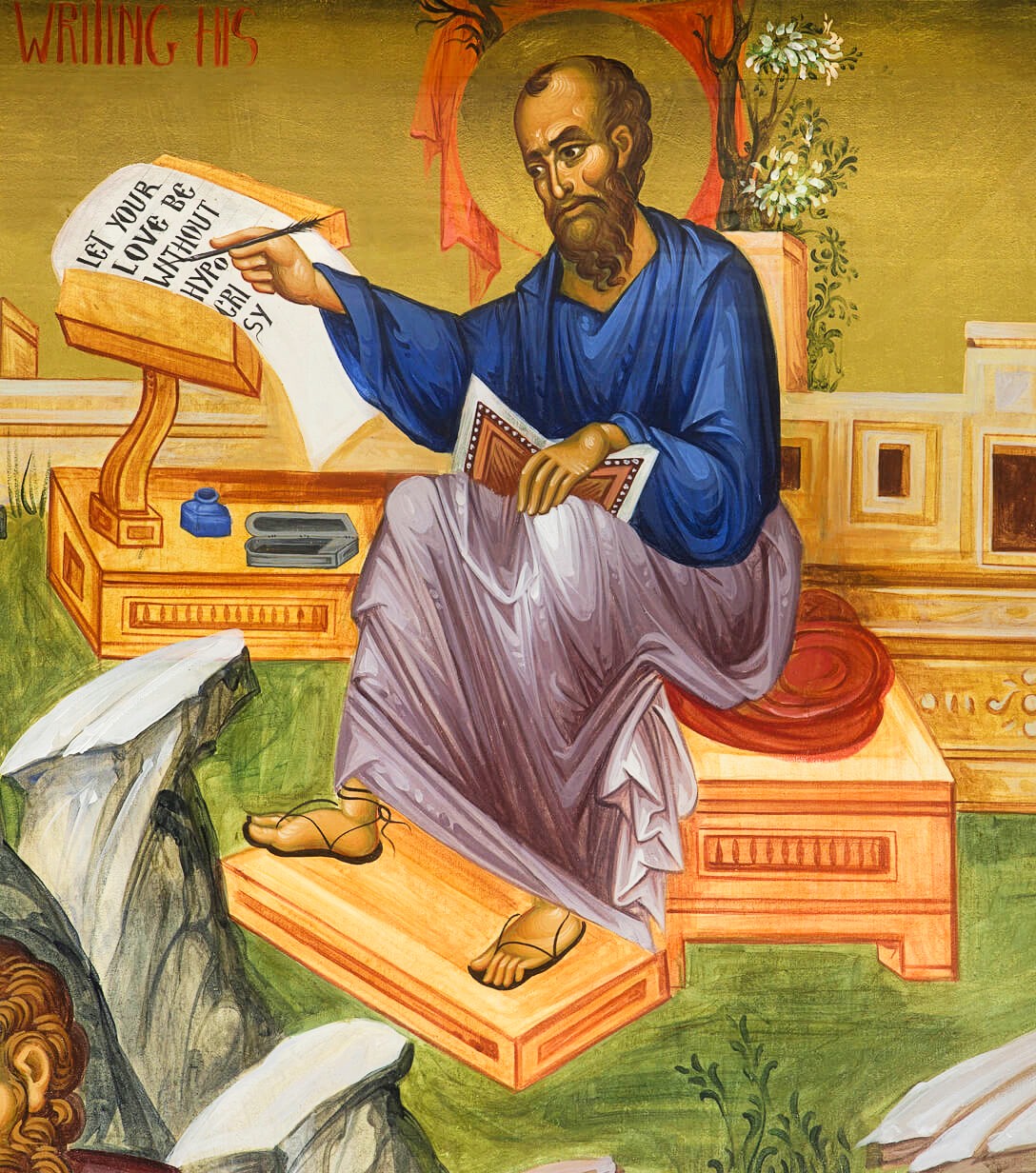
St Paul writing to St Philemon with St Timothy
Philemon of Colossae in Phrygia, was a disciple of St Paul. To him, the Apostle wrote the shortest of his Epistles, one of the four which he sent from Roman captivity (Eph, Phil, Col, Philem).
He was a wealthy Colossian, owner of buildings and slaves. Since St Paul had not been to Colossae, Philemon must have met him in Ephesus (cf Acts 19, 10-11), or during a tour through the interior of the Province of Asia (Acts 19, 26; I Cor. 16, 19). Philemon was converted and Baptised by St Paul together with his followers, probably during his long Ephesian labours between 54 and 57. (Philem. 19: “thou owe thyself to me too”).
Appia, from the beginning of the St Paul’s letter, is placed by him alongside Philemon “beloved brother” and greeted as “sister beloved”as found in the Vulgate or “dearest” in translation to English. St John Chrysostom, Theodoret and others following them, held, with good reason, that Apphia was the wife of Philemon. She certainly belonged, to his family, as did Archippus, named last among the three recipients of the letter (ibid. 1-2) who formed a family group very dear to Paul. Archippus must have been the son of Philemon and Appia. Their friendly house was at the Apostle’s disposal (ibid. 22). The three, together with their converted slave, Onesimus, who is the object, and (with Tychicus), bearer of the Epistle to Philemon, are commemorated in the Latin Martyrologies, on 22 November. All four wouldhave bene Martyred together at Colossae.
St Apphia
Epistle of St Paul to Philemon
He commends the faith and charity of Philemon and sends back to him, his fugitive servant, whom he had converted in prison.
“1 Paul, a prisoner of Christ Jesus and Timothy, a brother, to Philemon, our beloved and fellow labourer. 2 And to Appia, our dearest sister and to Archippus, our fellow soldier and to the church which is in thy house, 3 grace to thee and peace from God our Father and from the Lord Jesus Christ. 4 I give thanks to my God, always making a remembrance of thee in my prayers. 5 Hearing of thy charity and faith, which thou hast in the Lord Jesus and towards all the saints 6 That the communication of thy faith may be made evident, in the acknowledgment of every good work that is, in thee in Christ Jesus.
7 For I have had great joy and consolation in thy charity because the bowels of the saints have been refreshed by thee, brother. 8 Wherefore, though I have much confidence in Christ Jesus, to command thee that which is to the purpose, 9 for charity’s sake I rather beseech, whereas thou art such a one, as Paul, an old man and now a prisoner also of Jesus Christ. 10 I beseech thee for my son, whom I have begotten in my bands, Onesimus, 11 Who hath been, heretofore, unprofitable to thee but now, is profitable, both to me and thee, 12 whom I have sent back to thee. And do thou receive him as my own bowels. 13 Whom I would have retained with me that, in thy stead, he might have ministered to me, in the bands of the gospel 14 But, without thy counsel, I would do nothing that thy good deed, might not be, as it were of necessity but voluntary. 15 For perhaps he, therefore, departed for a season from thee that thou, mightest receive him again forever, 16 Not now as a servant but, instead of a servant, a most dear brother, especially to me but how much more to thee, both in the flesh and in the Lord?
17 If, therefore, thou count me a partner, receive him as myself. 18 And if he hath wronged thee in anything, or is in thy debt, put that to my account. 19 I Paul,have written it with my own hand, I will repay it, not to say to thee that thou owest me thy own self also. 20 Yea, brother. May I enjoy thee in the Lord. Refresh my bowels in the Lord.
21 Trusting in thy obedience, I have w,ritten to thee, knowing that thou wilt also do more than I say. 22 But withal, prepare me also a lodging. For I hope that through thy prayers, I shall be given unto thee. 23 There, salute thee Epaphras, my fellow prisoner in Christ Jesu,; 24 Mark, Aristarchus, Demas and Luke, my fellow labourers. 25 The grace of our Lord Jesus Christ be with thy spirit. Amen.”
Tradition tells us that all St Paul’s wishes in regard to St Onesius were joyfully carried out by our Saint Philemon.
St Agabbas of Syria St Amphilochius of Iconium St Ananias of Arbela St Appia + (1st Century) Lay Martyr, Disciple of St Paul St Archippus + (1st Century) Lay Martyr, Disciple of St Paul St Eugenia of Matera St Christian of Auxerre St Dayniolen the Younger St Joan of Montefalco St Mark of Antioch St Maurus of North Africa St Philemon + (1st Century) Lay Martyr, Disciple of St Paul
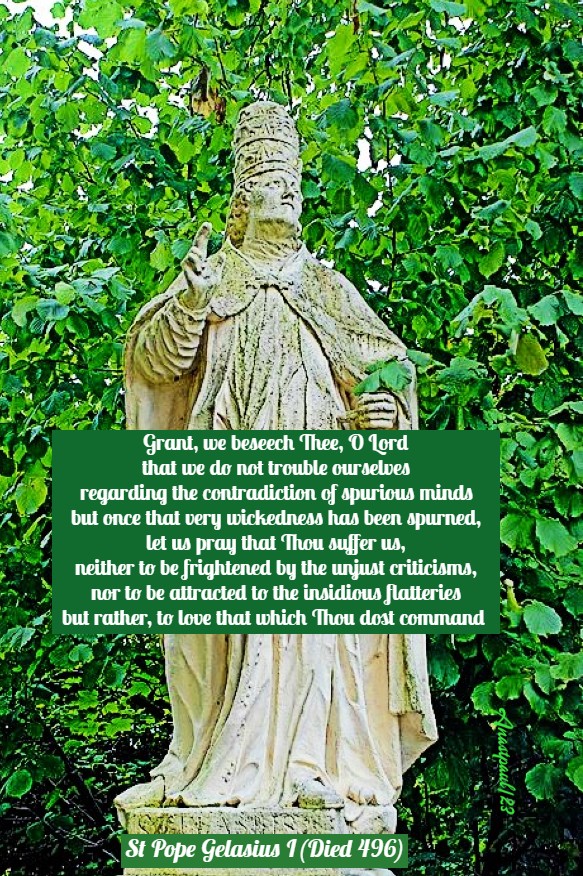
Quote/s of the Day – 21 November – The Memorial of St Pope Gelasius I (Died 496) Bishop of Rome from 1 March 492 until his death on 19 November 496.
“There are two powers, by which chiefly, this world is ruled – the Sacred authority of the Priesthood and the authority of Kings. And of these, the authority of the Priests is, so much the weightier, as they must render, before the tribunal of God, an account, even for the Kings of men.”
“Grant, we beseech Thee, O Lord that we do not trouble ourselves regarding the contradiction of spurious minds but once that very wickedness has been spurned, let us pray that Thou suffer us, neither to be frightened by the unjust criticisms, nor to be attracted to the insidious flatteries but rather, to love that which Thou dost command …”
(In 1751, Pope Benedict XIV published this Prayer within his Apostolic Constitution “Providas” which exposed the evils of freemasonry.)
Saint of the Day – 21 November – St Gelasius I (Died 496) Bishop of Rome. Papal Ascension 1 March 492 until his death on 19 November 496 in Rome, Italy. Gelasius was learned Scholar and a prolific Author, Defender of orthodoxy and of the See of Peter. Zealous Apostle of the poor and needy and of the Majesty of the Liturgical Worship, including the discipline of Hymn and Prayer within his scholastic orbit of Author. The Feast of St Gelasius is kept on 21 November which is the anniversary of his Interment, although many writers give this as the day of his death which actually occurred on 19 November as stated above.
The Roman Martyrology reads today: “At Rorme, the birthday of St Gelasius, Pope, distinguished for learning and sanctity.”
There is a difference of opinion and understanding of where our Saint was born – either in Rome but of African parents of Roman citizenship or, in Africa and then returned to Rome as their natural home with his parents. Either way he, himself, states that he was “Roman by nature.” Before his election as Pope on 1 March, 492, Gelasius had been greatly employed by his predecessor, Felix II, especially in drawing up Ecclesiastical documents which has led some scholars to confuse the writings of the two Pontiffs.
Upon his election to the Papacy, Gelasius at once showed his strength of character and his lofty conception of his position, by his firmness in dealing with the adherents of the Patriarch of Constantinople. Despite all the efforts of the otherwise orthodox Patriarch, Euphemius of Constantinople and the threats and wiles, by which the Emperor Anastasius tried to obtain recognition from the Apostolic See, Gelasius, though hard-pressed by difficulties at home, would make no peace which compromised. in the slightest degree. the rights and honour of the Chair of Peter!
The constancy with which he combated the pretensions, lay and Ecclesiastical, of the New Rome; the resolve, with which he refused to allow, the civil or temporal pre-eminence of a City, to determine its Ecclesiastcal rank; the unfailing courage with which he defended the rights of the “second” and the “third” Sees i.e. Alexandria and Antioch – these, are some of the most striking features of his Pontificate. It has been well said that nowhere, at this period, can be found stronger arguments for the Primacy of Peter’s See, than in the works and writings of our St Gelasius. He is never tired of repeating – that Rome owes its Ecclesiastical Princedom, not to an Ecumenical Synod, nor to any temporal importance it may have possessed but solely, to the Divine Institution of Christ Himself, Who conferred the Primacy over the whole Church upon Peter and his successors!
Gelasius’ Pontificate was too short to effect the complete submission and reconciliation of the ambitious Church of Byzantium. Not until Hormisdas (514-523) did the contest end in the return of the East to its old allegiance. Troubles abroad were not the only occasions to draw out the energy and strength of Gelasius. The Lupercalia, a superstitious and somewhat licentious vestige of paganism in Rome, was finally abolished by the Pope after a long contest.
Image created in c870, featuring the Coronation of Charles the Bald, flanked by Gelasius I on the left and Gregory the Great (540-604). Gelasius’ Pontificate and his writing, in particular, gave him an acclaimed status within Pontifical history.
A stanch upholder of the old traditions, Gelasius, nevertheless, knew when to make exceptions or modifications. An excellent example of his brilliance was his Decree obliging the reception of the Holy Eucharist under both kinds. This was done as the only effective way of detecting the Manichæans, who, although present in Rome in large numbers, sought to divert attention from their hidden propaganda and subversive plans, by feigning Catholicism. But as they held wine to be impure and essentially sinful, they would refuse the Chalice and thus, be recognised. Later, with the change of conditions, the old normal method of receiving Holy Communion under the form of bread alone, returned.
In his zeal for the beauty and majesty of Divine worship, Gelasius composed many Hymns, Prefaces and Collects and arranged a standard Mass-book, although the Missal which has commonly adopted his name, the “Sacramentarium Gelasianum” belongs properly, to the next Century. How much of it is the work of our Saint, is still subject to uncertainty.
Gelasius, although Pope but for four and a half years, exerted a deep influence on the development of Church polity, of the Liturgy and Ecclesiastical discipline. A large number of his Decrees have been incorporated into the Canon Law.
In his private life, Gelasius was, above all, conspicuous for his spirit of prayer, penance and study. He took great delight in the company of Monks and was a true father to the poor, dying empty-handed, as a result of his lavish charity. Dionysius Exiguus (c470-c544) the renowned Canonist, in a letter to his friend, the Priest Julian gives a glowing account of Gelasius as he appeared to his contemporaries.
As a Writer, Gelasius takes high rank for his period. His style is vigorous and elegant, though occasionally, obscure. Comparatively little of his literary work has come down to us, although he is said to have been the most prolific writer of all the Pontiffs of the first five Centuries. There are extant – forty-two letters and fragments of forty-nine others, besides six treatises, of which three are concerned with the Acacian schism, one with the heresy of the Pelagians, another with the errors of Nestorius and Eutyches, while the sixth is directed against the Senator Andromachus and the advocates of the Lupercalia. The best edition is that of Thiel.
St Celsus the Martyr St Clement the Martyr St Demetrius of Ostia St Digain St Pope Gelasius I (Died 496) Papal Ascension 1 March 492 until his death on 21 November 496 in Rome, Italy.
St Heliodorus of Pamphylia St Hilary of Vulturno St Honorius of Ostia
St Maurus of Porec St Maurus of Verona St Rufus of Rome
Martyrs of Asta – 3 Saints: Three Christians Martyred together for their faith during the persecutions of Diocletian. The only details about them to survive are their names – Eutychius, Honorius and Stephen. They were Martyred in c300 at Asta, Andalusia, Spain.
Saint of the Day – 10 November – Saint Baudolino (c700–c740) Hermit, Pilgrim. Mystic, Miracle-worker. Born in c700 and died in c740 of natural causes. Patronages -Alessandria, Italy, City of (proclaimed in 1786), Diocese of Alessandria, Italy, (proclaimed in 1786). Also known – Baudilio.
Baudolino lived at the time of the Lombard King Liutprand (712-744) and the oldest testimony which speaks of him is given to us by the historian Paolo Diacono, a Lombard Benedictine Monk (c720-799) practically a contemporary of the Saint.
Baudolino is called “man of wonderful sanctity,” he was a Hermit, gifted with the gift of miracles and prophecies and lived in Foro (now Villa del Foro, a Town on the bank of the Tanaro, near Alessandria). Legend has it that geese, deer and other animals would gather around him to listen to him in his hermitage, therefore, he is sometimes depicted surrounded by these animals.
Paolo Diacono, in his “Historia Langobardorum” reports, among other things, an episode as testimony to the supernatural gifts which Baudolino prossessed. During a hunting trip, an Earl, while trying to shoot a deer with his bow, missed the shot and instead hit Anfuso, the nephew of King Liutprand. The wound was serious and the King sent a messenger to Baudolino to ask the Lord for the healing of his young nephew.
In the meantime, Anfuso died and when the messenger reached Baudolino in his hermitage, before he spoke, the latter told him that he knew everything he wanted and he was sorry because he could not do anything, as the young man was already dead but he would pray for his soul.
The holy hermit died around 740 and was buried in Villa del Foro. When Alessandria was founded in 1168, the inhabitants of Villa del Foro moved there, also bringing the Relics of the Saint, who became their Patron. His patronage continued, according to tradition, when in 1174 he appeared on the City’s defence bastions, putting the Ghibelline besiegers to flight.
In 1189 a Church was built in his honour which was entrusted to the Humiliati and upon their suppression, in 1571, it passed to the Dominicans. Over time, the scant information about him, grew and increased, so that the legend of his life were gradually mixed with other decidedly fantastical information.
Furthermore, it was said that the Bishops of Tortona and Acqui, given the great popularity enjoyed by the Hermit Saint, considered him a Bishop, there was no shortage of those who defined him as bishop of Alessandria, which is why he is also depicted in bishop’s clothes.
In 1803 when the Dominican Church was closed, the Relics of the Saint were taken to the Church of St Alessandro and then, in 1810, transferred to the Cathedral and placed in a Chapel dedicated to our Saint Baudolino. There has been devotion and a vow in his honour since 1189, a vow renewed in 1599 and ratified by the Diocesan Synod of 1602. St Baudolino was proclaimed the main Patron of the City and the Diocese of Alessandria with his Feast being celebrated on 10 November.
St Baudolino’s Sarcophagus in the Cathedral of Alessandria
St Aedh Mac Bricc St Anianus the Deacon St Baudolino (c700–c740) Hermit St Demetrius of Antioch St Elaeth the King St Eustosius of Antioch St Grellen St Guerembaldus St Hadelin of Sees St John of Ratzenburg St Joseph the Martyr
St Leo of Melun St Monitor of Orleans St Narses of Subagord St Nonnus of Heliopolis St Orestes of Cappadocia St Probus of Ravenna Bishop St Theoctiste St Tryphaena of Iconium St Tryphosa of Iconium
Martyrs of Agde – 3 Saints: A group of Christians who were tortured and Martyred together in the persecutions of Diocletian. The only about them to survive are the names – Florentia, Modestus and Tiberius. Martyred c 303 in Agde, France.
Saint of the Day – 9 November – Saint Benignus of Armagh (Died 467) Bishop, Disciple of and Successor to St Patrick (c386-461) as the Bishop, Musician, Also known as – “Patrick’s Psalm Singer” Benignus of Ireland, Benen of….
Benignus was the son of Sesenen a pagan Irish chieftain. He was Baptised into the Catholic Faith by St Patrick and became his favourrf disciple and, in around 450, his administrative assistant in the Diocese of Armagh and upon St Patrick’s death in 461, becoming the Bishop there.
He had a gentle and lovable disposition and was named Benen (Latinised as Benignus). He followed St Patrick in all his travels and helped him in all his evangelisation and with missionary work, especially assisting him in the formation of Choirs for Liturgical music. From his musical talents he was known as “Patrick’s Psalm Singer.”
As Benignus had been trained by St Patrick in sacred learning from his youth and was well versed in the language and culture of his native land, he was appointed Secretary to the Commission of Nine which had been directed to compile the Brehon Laws, (Laws governing everyday life) a few years before
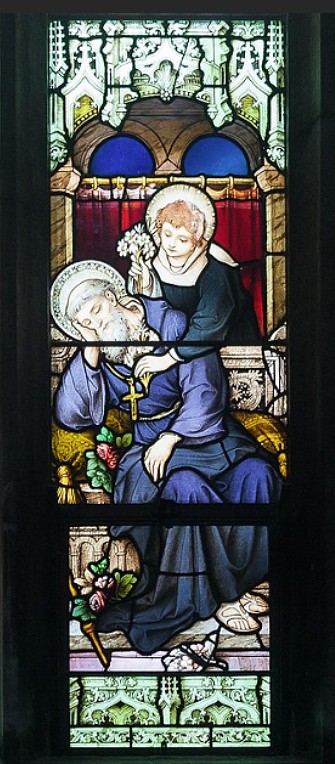
Armagh Cathedral of St Patrick West Aisle Window- St Benignus places flowers on the sleeping St Patrick
Benignus also contributed materials for the “Psalter of Cashel” and the “Book of Rights.” He was present at the Synod which passed the Canon recognising the “See of the Apostle Peter” as the final court of appeal in difficult cases – this Canon is to be found in the Book of Armagh.
He established a Monastery in today’s Drumbannon and also in today’s Kilbonane. During the Eastertide of 433, St Patrick clashed with King Laoghaire at Tara, over Religion and legend has it that a trial by fire was proposed. A pagan and Benignus were tied inside a burning timber building; the pagan was reduced to ash while St Benignus was untouched. At this point, Christian teaching was established throughout the region. St Benignus resigned hisBishopric in 467 and died at the end of that same year.
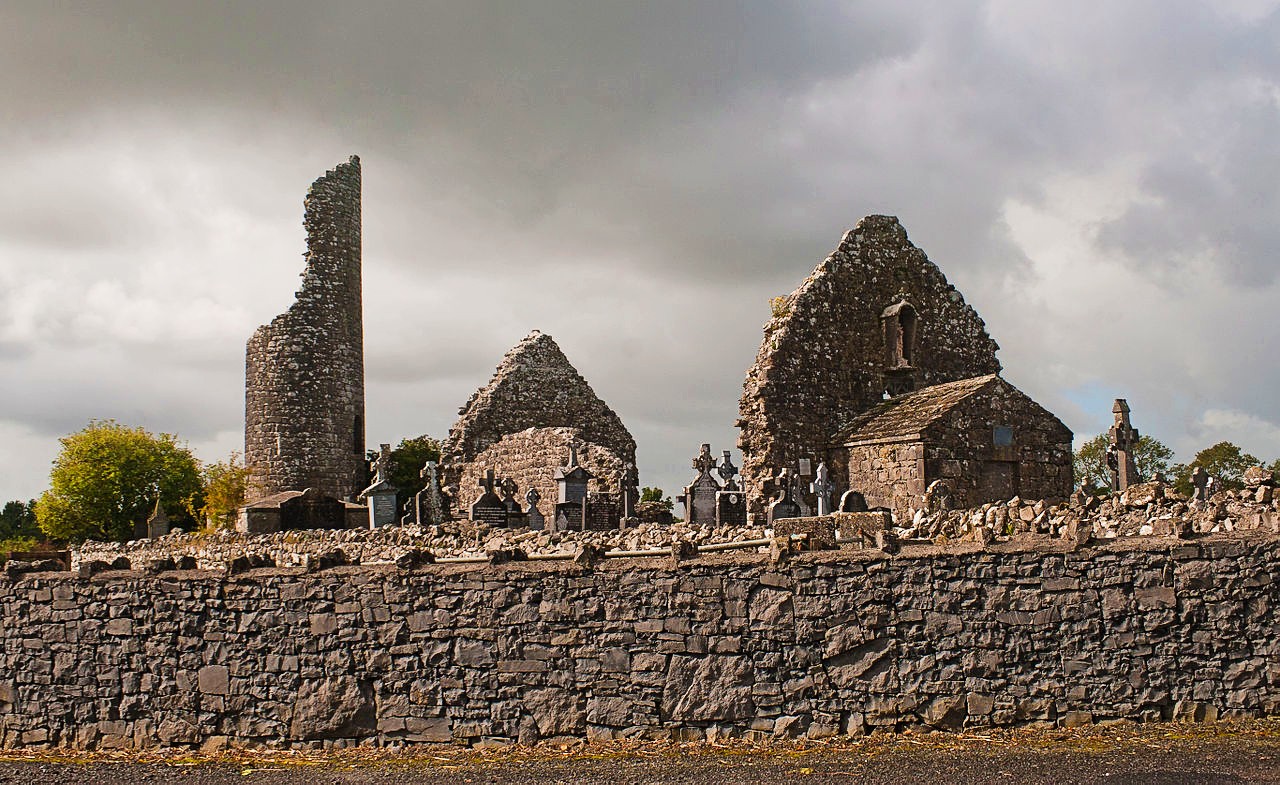
The ruins of St Benignus’ foundation of the Monastery of Kilbennan in East Galway.
The Martyrology of Marianus O’Gorman refers to “bright Benignus, a dear scion” on this day but he has a fuller entry in the Martyrology of Donegal which Archbishop John Healy quotes below. This extract on Saint Benignus/Benen has been taken from his 1905 book “The Life and Writings of Saint Patrick.”
“BENIGNUS, i.e., Benen, son of Sescnen, disciple of Patrick and his successor, that is, Primate of Ard-Macha (Armagh). He was of the race of Cian, son of Oilioll Olum. Sodelbh, daughter of Cathaoir, son of Feidhlimidh Firurghlais, of Leinster, was his mother. The holy Benen was benign, was devout – he was a virgin without ever defiling his virginity; for, when he was psalm-singer at Ard-Macha along with his master, St Patrick, Earcnat, daughter of Daire, loved him and she was seized with a disease, so that she died suddenly and Benen brought consecrated water to her from Patrick and he shook it upon her and she arose alive and well and she loved him spiritually afterwards and she subsequently went to Patrick and confessed all her sins to him and she offered her virginity afterwards to God, so that she went to Heaven and the name of God, of Patrick and of Benen, was magnified through it.”
Armagh Cathedral of St Patrick West Aisle Window- St Benignus places flowers on the sleeping St Patrick
St Agrippinus of Naples St Alexander of Salonica St Aurelius of Riditio St Benignus of Armagh (Died 467) Bishop, Disciple of and Successor to St Patrick
St Eustolia
Blessed Gabriel Ferretti OFM (1385-1456) Priest, Friar of the Order of Friars Minor, Provincial Superior, Mystic. renowned missionary Preacher. He was zealous in the restoration and establishment of new Convents. He was an ancestor to both Cardinal Gabriele Ferretti and Blessed Pope Pius IX, having been descended from a long noble lineage. Patronage – Ancona. His body is incorrupt. He was Beatified on 19 September 1753 by Pope Benedict XIV. Biography: https://anastpaul.com/2021/11/09/saint-of-the-day-9-november-blessed-gabriel-ferretti-ofm-1385-1456/
Blessed George Napper (1550-1610) Priest Martyr Beatified by Pope Pius XI on 15 December 1929
St Pabo St Sopatra St Theodore Stratelates St Ursinus of Bourges St Vitonus of Verdun
Martyrs of Constantinople – 3 Saints: A group of ten Christians who tried to defend an image of Jesus over the Brazen Gate of Constantinople from an attack by Iconoclasts during the persecutions of Emperor Leo the Isaurian. The group of was seized by soldiers, condemned by judges for opposing the emperor, and Martyred. The only details that have survived are three of their names – Julian, Marcian and Maria. They were martyred in 730 at Constantinople (modern Istanbul, Turkey).
Saint of the Day – 8 November – Saint Adeodatus I, Pope (Died 618) Bishop of Rome from 19 October 615 to 8 November 618 and serving for just over 2 years. Born in Rome and died there in November 618. Also known as – Adeodato, Diosdado, Deusdedit.
The Roman Martyrology reads: “At Rome, St Deusdedit, Pope, whose merit was so great that he cured a leper by kissing him.”
Adeodatus was born in Rome, the son of a Subdeacon named Stephen. He served as a Priest for 40 years before his election and was the first Priest to be elected Pope since John II in 533.
Almost nothing is known about Adeodatus I’s Pontificate. He encouraged and supported the Clergy, who were impoverished in consequence of the political troubles of the time. Our Saint today reversed the practice of his predecessor, Boniface IV, of filling the Papal administrative ranks with Monks by recalling the Clergy to such positions and by Ordaining some 14 Priests, the first Ordinations in Rome since St Gregory the Great’s Pontificate.
According to tradition, Adeodatus was the first Pope to use lead seals (bullae) on Papal documents which, in time, came to be called “Papal Bulls.” One Bull, dating from his reign, is still preserved, the obverse of which represents the Good Shepherd in the midst of His sheep, with the letters Alpha and Omega underneath, while the reverse bears the inscription: Deusdedit Papæ.
In August 618, an earthquake struck Rome, followed by an outbreak of Leprosy. Adeodatus was the first to rally the Church, to help those in need, setting an example by himself going into the streets to assist the suffering. Adeodatus died on 8 November 618 and was eventually succeeded by Boniface V.
Four Crowned Martyrs: Saint Castorus, Saint Claudius, Saint Nicostratus and Saint Simpronian. Skilled stone carvers in the 3rd century quarries. Martyred when they refused to carve an idol of Aesculapius for Diocletian. They were drowned in the River Sava in 305. Patronages – against fever, cattle, sculptors, stone masons, stonecutters.
St Adeodatus I, Pope (Died 618) Bishop of Rome from 19 October 615 to 8 November 618 St Clair of Tours St Cybi of Caenarvon St Drouet
All Deceased Dominicans All Saints of Bologna, Italy All Saints of Wales Augustinian Martyrs of Spain
All Saints of the Diocese of Evry: A regional memorial of all the Saints and Beati of the calendar who have a connection to the Diocese of Evry-Corbeil-Essonnes, France.
Blessed Isabella of France, founded the Longchamp monastery
Blessed Nicolas Gaudreau, pastor of Vert-le-Petit
Blessed Pierre Bonse, pastor of Massy
Our Lady of Good Guard, patron saint of the diocese, venerated in Longpont-sur-Orge, France
Saint Corbinian, born in Saint-Germain-lès-Arpajon
Saint Denis of Paris, evangelizer of part of Essonne and revered ni Longpont-sur-Orge
Saint Eloi, who lived in Chilly-Mazarin
Saint Germain of Paris
Saint William of Bourges, son of Count Baldwin IV of Corbeil
Saint William of Aebelholt, pastor of Brunoy
Saint Wulfran of Sens, born in Milly-la-Forêt
Blessed Nativelle, vicar of Longjumeau
Blessed René Le Bris, pastor of Bris-sous-Forges
Saint Spire of Bayeux, whose relics are in Corbeil in the cathedral that bears his name
Saint of the Day – 7 November – Saint Achillas (Died 313) Bishop of Alexandria, Egypt, Confessor, Scholar particularly in Philosophy and Theology. St Theonas had Ordained him to the Priesthood and appointed Achillas as the Head of the Catechetical School of Alexandria upon the departure of St Pierius, whom we celebrated on 4 November. Born in Alexandria, Egypt and died there in 313 of natural causes. Also known as – Archelaus, Achillas of Alexandria, … of Egypt, “Achillas the Great.”
The Roman Martyrology states of him today: “At Alexandria, blessed Achillas, a Bishop renowned for erudition, faith and purity of life.”
Achillas is less well-known than his contemporary, Arius. But, while one has gone down in history as one of the most notorious of all heretics, the other is honoured, as one who kept the True Faith to the end.
Achillas was, a complete Alexandrian, where he was born some time in the 3rd Century. The City was one of the theological centres of Christendom – which made it an attractive target for heretics. Sabellius came to Alexandria in the early 3rd Century, teaching the heresy that the Father, Son and Holy Spirit were all just different modes of one Divine person.
St Theonas, excommunicated Sabellius. His successor, Peter, had to contend with Meletius, who preached that those who had fallen away in persecution would have to be re-Baptised. Peter also had to discipline Arius. Before Peter was Martyred he nominated Achillas to succeed him.
As a former Head of Alexandria’s Catechetical School, Achillas was unlikely to be deceived by theological error. But, he was able to be deceived by his own kindness and merciful gentleness towards repentant sinners and by such a clever and wily man as Arius. Arius seems to have convinced Achillas that he, Arius, had changed and should be allowed back into the fold of the Church. Achillas eventually realised his mistake and started to oppose Arius publicly. He died without seeing the final victory of orthodoxy. After his death, Arius nominated himself to become Bishop of Alexandria but the clergy and the people, chose Alexander.
St Jerome lamented that “because, as a spark in Alexandria, he was not extinguished, Arius became a conflagration which laid waste the world!” But, for his efforts, Achillas has, nevertheless, been recognised as a Saint. St Athanasius (297-373), later the Archbishop of Alexandria and, the Doctor of the Church, described our St Achillas by the honourific “Achillas the Great.”





































 AnaStpaul
You must be logged in to post a comment.