Saint of the Day – 26 March – St Eutychius of Alexandria (Died 356) Sub-Deacon Martyr. Died during Lent in 356, from his wounds and exhaustion, while on the road to the mines in Egypt.
The Roman Martyrology reads today: “At Alexandria, the holy Martyrs, Eutychius and others, who died by the sword for the Catholic Faith, in the time of Constantius, uinder the Arian bishop, George.”
He was martyred in this City at the time of Emperor Constantius, in Lent of 356, when George, an Arian bishop, usurper of the Alexandrian See, assisted by soldiers, caused a violent resurgence of persecution against Catholics.
Saint Athanasius narrates how, after the week of Easter until the Octave of Pentecost, through the work of the Arians, virgins were imprisoned, Bishops were chained, the homes of widows and orphans were stripped, Catholics kidnapped at night.
Among them the Arians also kidnapped Eutichius, a Sub-Deacon, who was providing excellent service to the Church of Alexandria and, with whips made of bull skin, they flogged him so harshly that he was left dying; nor did they allow his wounds to be treated, so that when they condemned him to the horrible mines of Phoeno, the Martyr could not reach them because, torn by the pain of his wounds, he died along the way.
Athanasius, with a style that reveals the immediate and horrified witness, narrates many other infamies and atrocities committed by the Arians, especially at the instigation of George, who had unduly replaced him as and who was then massacred by the crowd. Eutychius is mentioned on 26 March in the Roman Martyrology:
St Braulio (590-651) Bishop of Saragossa, Spain, Monk, Confessor, Reformer, Scholar, Advisor, Writer, eloquent Preacher, Apostle of Charity. Saint Braulio was friend and disciple to Saint Isidore of Seville (560-636) Doctor of the Church ) and a prolific writer of letters, hymns, martyrologies, hagiographies and history. He fought against heresy and provided both strength and encouragement in the faith to his congregation. Biography: https://anastpaul.wordpress.com/2018/03/26/saint-of-the-day-26-march-braulio-590-651/
St Desiderius of Pistoia St Eutychius of Alexandria (Died 356) Sub-Deacon, Martyr St Felicitas of Padua St Felix of Trier (c 386–c 399) Bishop St Garbhan St Govan
St Ludger (c742-809) Bishop, Missionary, Founder, Abbot, Writer. Following in the footsteps of the English Missionary St Boniface, St Ludger, who was a native Netherlander, brought the faith to the people of Frisia in Holland and the Saxons of north-west Germany. He founded the Werden Abbey and was the first Bishop of Münster in Westphalia, Germany. About St Ludger: https://anastpaul.com/2019/03/26/saint-of-the-day-26-march-st-ludger-c-742-809/
St Maxima the Martyr St Mochelloc of Kilmallock (Died c639) Abbot at Kilmallock, Ireland. No other information has survived. Also known as – Celloch, Cellog, Motalogus, Mottelog. St Montanus the Martyr St Sabino of Anatolia St Sincheall the Elder (5th-6th Century) On 25 June is the commemoration of a County Offaly Saint, Sincheall of Killeigh. There is a Saint of this name associated with the household of Saint Patrick who is commemorated today. He is distinguished as Sincheall the Elder and may have been related to the St Sincheall of Killeigh. The Irish Calendars preserve this distinction and the two separate Feast Days. We have no further information of today’s St Sincheall the Elder.
St Wereka (Died c370) Martyr – Part of a Congregation burned to death in their Church, somewhere in the Balkans in south-eastern Europe. No other information has survived.
Martyrs of Rome – 5 Saints: A group of Christians Martyred together. The only details to survive are the names – Cassian, Jovinus, Marcian, Peter and Thecla. Rome, Italy, date unknown.
Saint of the Day – 25 March – Blessed Placido Riccardi OSB (1844-1915). Priest and Friar of the Order of St Benedict. He founded a branch thereof known as the Cassinese Congregation, a reform of the standard way of life of the Monasteries. Born on 24 June 1844 as Tommaso Riccardi in Trevi, Umbria, Italy and died aged 70 in Rome, on 25 March 1915. PATRONAGES – against Malaria, against all bodily illnesses. Also known as – Tommaso Riccardi, Thomas Riccardi. He was Beatified on 5 Dercember 1954 by Pope Pius XII.
Tommaso Riccardi was born in Trevi on 24 June 1844 to Francesco and Maria Stella Paoletti, the third of ten children. He was Baptised in the nearby Church of St Emilian and, as soon as he was reborn with Baptism, he was placed on the Altar of Our Lady of Sorrows, in an act of consecration.
In 1853 he entered the Lucarini College where he distinguished himself as attested by numerous mentions and medals, awarded to him. In 1862, when the Lucarini College was closed for political reasons, he placed himself under the spiritual direction of Don Ludovico Pieri, a holy Priest from Trevia, spiritual father and inspiration of Blessed Pietro Bonilli. In 1865, in the the act of resigning from Pieri to continue his studies in Rome, the latter prophesied his future vocation but Tommaso made a gesture of rebellion and, throwing the hat he was holding in his hand, to the ground and stepping on it, exclaimed: “If this vocation comes to me, I drown!”
Just a year later, 1866, after a pilgrimage to Loreto and a course of spiritual exercises, he knocked on the door of the Abbey of St Paul. Admitted to the Novitiate on 5 January 1867 with the name of Placido, he was Ordained Subdeacon on 2 April 1870 and Deacon on 224 September 1870.
Called up for Military Service, he took a few days to finish his exams but was immediately declared a deserter because of this delay! Having arrived in Spoleto to plead his case, since in the meantime, the Piedmontese government which also dominated Rome, had decreed an amnesty, it was discovered that his case did not fall within it and, therefore, he was arrested at the Fonti del Clitunno, while returning to Trevi. Transferred to Florence, he was tried and sentenced to one year’s imprisonment, then pardoned and sent to the Regiment in Pisa but, after medical tests, declared unfit, he was discharged on 27 January 1871. On 7 February he returned to St Paul’s where, on 10 March he made his Solemn Profession and on 25 March he was Ordained a Priest.
At The Beatification in St Peter’s Square
He held various positions: Deputy Master of Students, Master of Novices, Abbey Vicar of the Benedictines of St Magno in Amelia in two different periods. In 1994, while he was leaving the Amelia Monastery to return to Rome due to his poor health, a Nun wrote about him as follows: “Don Placido left leaving everyone in the deepest pain. Austere with himself but all charity for us, especially the sick. His charity also extended to the poor in Amelia. His virtues have aroused the admiration of the whole City!”
But the apotheosis of the humiliation and triumph of Don Placido’s sanctity occurred in Farfa, where he was sent to try to save what could be saved. The glorious Abbey, already powerful in the time of the Lombards, was reduced to miserable conditions. Overwhelmed by the latest political events and its assets passed to private individuals, the Abbot’s residence itself was absolutely uninhabitable! Don Placido turned his attention to the people, generally poor shepherds who came to him after Sunday Mass. In their extreme need, they were helped spiritually and materially. In his prodigality Don Placido regretted that he no longer even had his own personal effects to donate to the poor, since those he possessed were rejected several times because they were too poor. It is said that he also provided suggestions and medicinal remedies described in the ancient codes.
Farfa Abbey
In 1912, after almost twenty years of staying in Farfa, his body, which had always been in poor health, further weakened by a life of penance and deprivation, was so weakened he contracted Malaria and the holy man had to be brought back to Rome. He lived for another two and a half years, assisted by his disciple and friend Don Idelfonso Schuster, later Cardina, Bishop of Milan and his Biographer.
He passed away on the evening of 25 March 1915 and the following day, when his body was transported to the Basilica, the bells rang out without assistance.
In 1925 the body was moved to Farfa Monastery and in 1928 the process of Canonisation began band in the 1950s Pope Pius XII proclaimed him Blessed. .
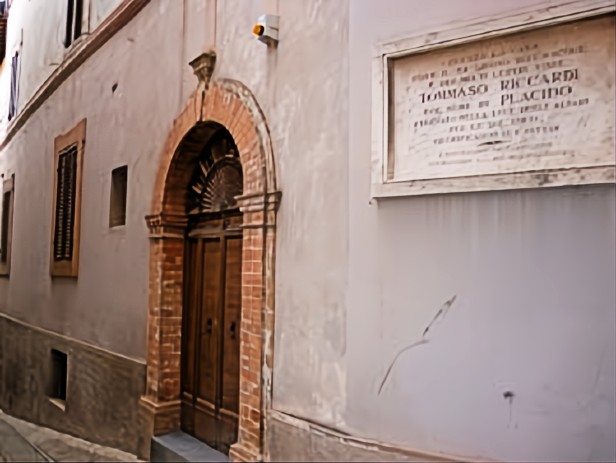
On 5 December 2008, a day of study was dedicated to the Blessed. In Trevi the road which goes from Piazza del Comune up towards the Church of St Emilian, where our Saint was Baptised and which was since named after him, passing in front of his house, where a plaque was placed. The large square behind the Basilica of St Paul in Rome also bears his name and in Milan, a central street, parallel to Via Palmanova.
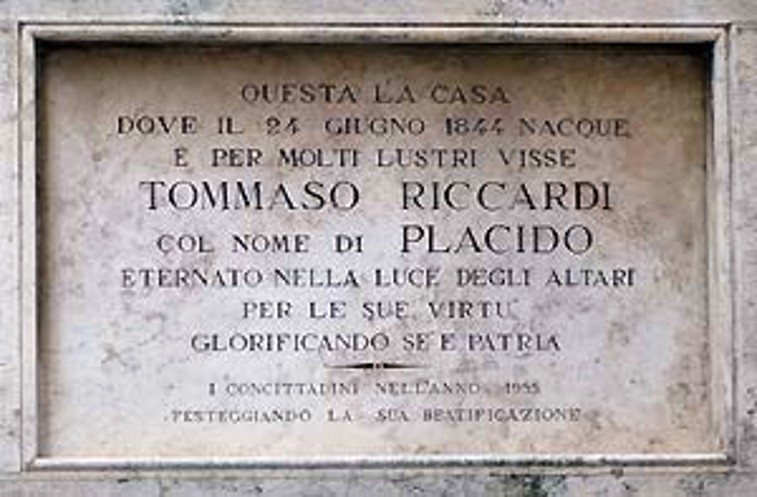
THIS IS THE HOUSE WHERE HE WAS BORN, ON 24 JUNE 1844 AND HE LIVED, FOR MANY YEARS, TOMMASO RICCARDI. WITH THE NAME OF PLACIDO ETERNATED IN THE LIGHT OF THE ALTARS FOR HIS VIRTUES – GLORIFYING SELF AND HOMELAND
FELLOW CITIZENS IN THE YEAR 1955 CELEBRATING HIS BEATIFICATION
St Dula the Slave Bl Everard of Nellenburg Bl Herman of Zahringen St Hermenlandus (Died Priest, Abbot St Humbert of Pelagius Bl James Bird St Kennocha of Fife
St Lucia Filippini (1672-1732) Virgin, Religious Sister, Founder. On 22 June 1930, Lucia Filippini was declared a Saint of the Church by Pope Pius XI and her Statue was given the last available niche in the Basilica of Saint Peter in Rome. Her statue can be seen in the first upper niche from the main entrance on the left (south) side of the nave of St Peter’s. Biography: https://anastpaul.com/2022/03/25/saint-of-the-day-25-march-st-lucia-filippini-1672-1732/
St Matrona of Barcelona St Matrona of Thessaloniki St Mona of Milan St Nicodemus of Mammola St Pelagius of Laodicea Bishop Blessed Placido Riccardi OSB (1844-1915. Priest and Friar of the Order of St Benedict. He was Beatified on 5 Dercember 1954 by Pope Pius XII.
St Procopius St Quirinus of Rome Bl Tommaso of Costacciaro
262 Martyrs of Rome: A group 262 Christians Martyred together in Rome. We know nothing else about them, not even their names.
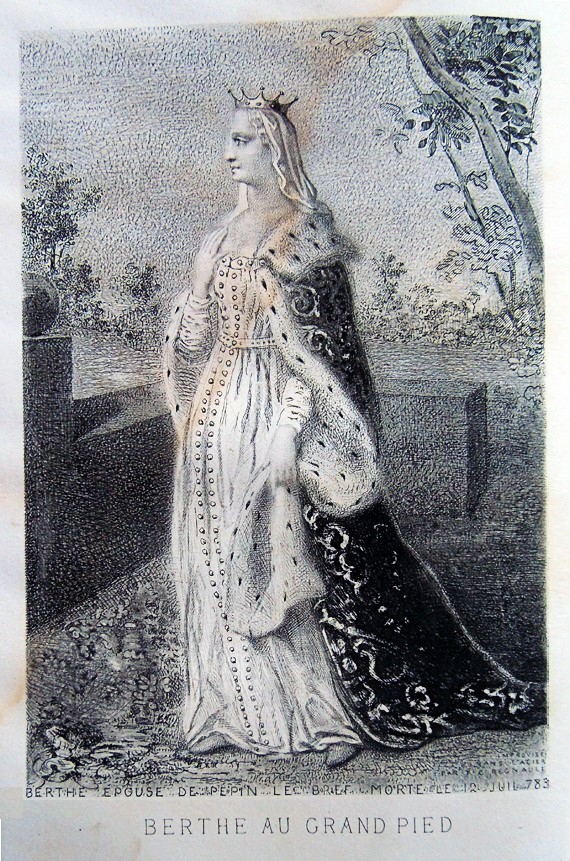
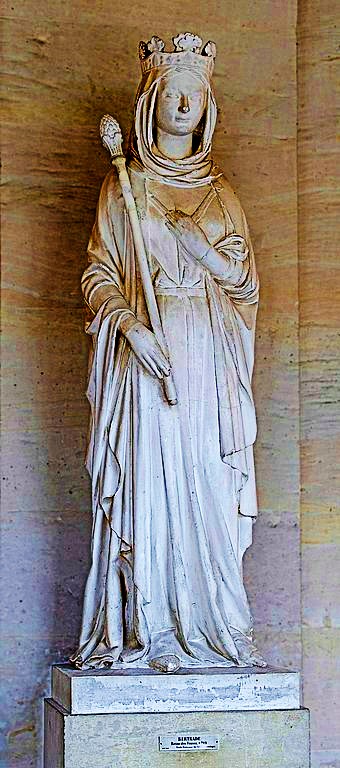
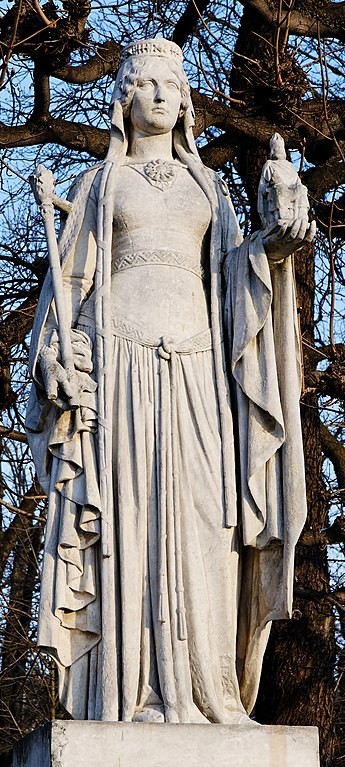
Saint of the Day – 24 March – Blessed Bertrada of Laon (c726-783) Married to King Pepin the Short. Queen of the Franks. Mother of Blessed Charlemagne. Bertrada was known to instil piety and devotion in her Court, following strict schedules of prayer and Liturgical celebrations for her family and for the Court generally. Born in c726 at Laon, France and died on 12 July 783 of natural causes at Choisy-au-Bac, Francia. Patronage – of Spinners. Also known as – Bertrada the Pius, Bertrada la Pia, Bertha… Berta…
We know nothing definite about Bertrada’s exact origins. According to some, she was the daughter of Charibert, Count of Laon, while others would even consider her the daughter of an Emperor of Constantinople. However, it is well known that the Frankish Kings cared little about the more or less illustrious origins of their wives and no-one has ever taken the trouble to discover where Queen Bertha probably came from, given that even ancient heroic poetry and various legends, left the question aside.
In 741, she married Pepin the Short, the son of Charles Martel, the Frankish Chancellor. However, Pepin and Bertrada’s union was not canonically sanctioned until 749, after the birth of Charlemagne. Besides Charlemagne, Bertrada and Pepin are known to have had seven further children, of whom 3 were sons. One of their daughters, Gisela, became a nun at Chelles Abbey.
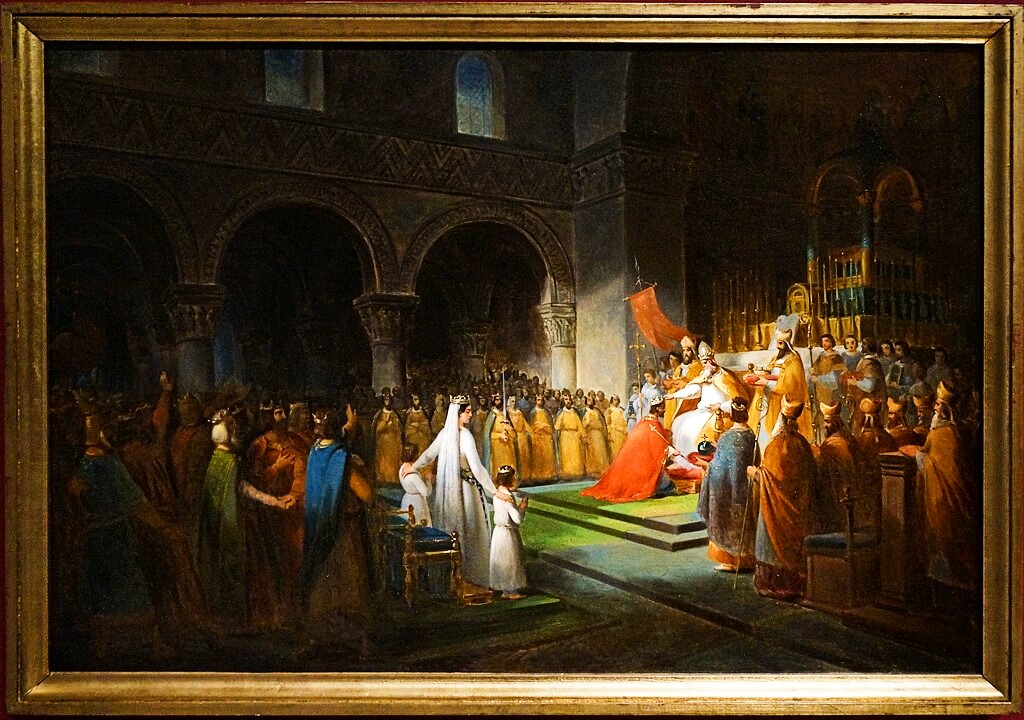
In 751, Pepin and Bertrada became King and Queen of the Franks, following Pepin’s successful coup against the Frankish Merovingian monarchs. Pepin was crowned in June 754 and Bertrada, Charlemagne, and Carloman were blessed by Pope Stephen II. (See the wonderful painting below by François Dubois.
After Pepin’s death in 768, Bertrada lost her title as Queen of the Franks. Charlemagne and Carloman inherited the two halves of Pepin’s Kingdom. Bertrada stayed at the Charlemagne’s Court and often tried to stop arguments between the two brothers. It is reported that her relationship with her sons was excellent, especially with Charlemagne. Historians say that the great Emperor had a respectful tenderness towards his mother and that he listened to her advice with a certain deference and trust.
In 771, Bertrada retired from the Court after Carloman’s death to live in Choisy-au-Bac, where Charlemagne had set aside a Royal house for her. Choisy-au-Bac was favourable because of its history of being the home and burial place of several Royals.
Bertrada died on 12 July 783 and was buried in Saint-Denis, where her Tomb, restored by the French King Saint Louis IX, bears the only inscription “Berta, Mater Caroli Magni.” The cult of her as Beatification has a purely local character.
The Archangel Saint Gabriel The Feast of Saint Gabriel was included by Pope Benedict XV in the General Roman Calendar in 1921, for celebration on 24 March. The Archangel Saint Gabriel’s name means “the Power of God” He appeared to the Prophet Daniel (Dan 8:16; 9:21), to the priest Zachary to announce the forthcoming birth of Saint John the Baptist (Luke 1:11, 19) and, most importantly, to the Blessed Virgin Mary to announce the birth of Our Saviour (Luke 1:26). St Gabriel! https://anastpaul.com/2022/03/24/saint-of-the-day-24-march-the-archangel-saint-gabriel/
St Agapitus of Synnada (Died 3rd Century) Bishop of Synnada, Phrygia, in Asia Minor. Its site is now occupied by the modern Turkish Town of Suhut. We have no further information on the life of St Agapitus..
St Bernulf of Mondov Bl Bertha de’Alberti of Cavriglia Blessed Bertrada of Laon (c726-783) Married to King Pepin the Short. Queen of the Franks. Mother of Blessed Charlemagne. St Caimin of Lough Derg St Cairlon of Cashel
St Latinus of Brescia St Macartan of Clogher St Mark of Rome St Pigmenius of Rome St Romulus of North Africa St Secundus of North Africa St Seleucus of Syria St Severo of Catania St Timothy of Rome
Martyrs of Africa – 9 Saints: A group of Christians murdered for their faith in Africa, date unknown. The only details about their that survive are the names – Aprilis, Autus, Catula, Coliondola, Joseph, Rogatus, Salitor, Saturninus and Victorinus. .
Martyrs of Caesarea – 6 Saints: A group of Christians Martyred together in the persecutions of Diocletian. We know little else but six of their names – Agapius, Alexander, Dionysius, Pausis, Romulus and Timolaus. They were martyred by beheading in 303 at Caesarea, Palestine.
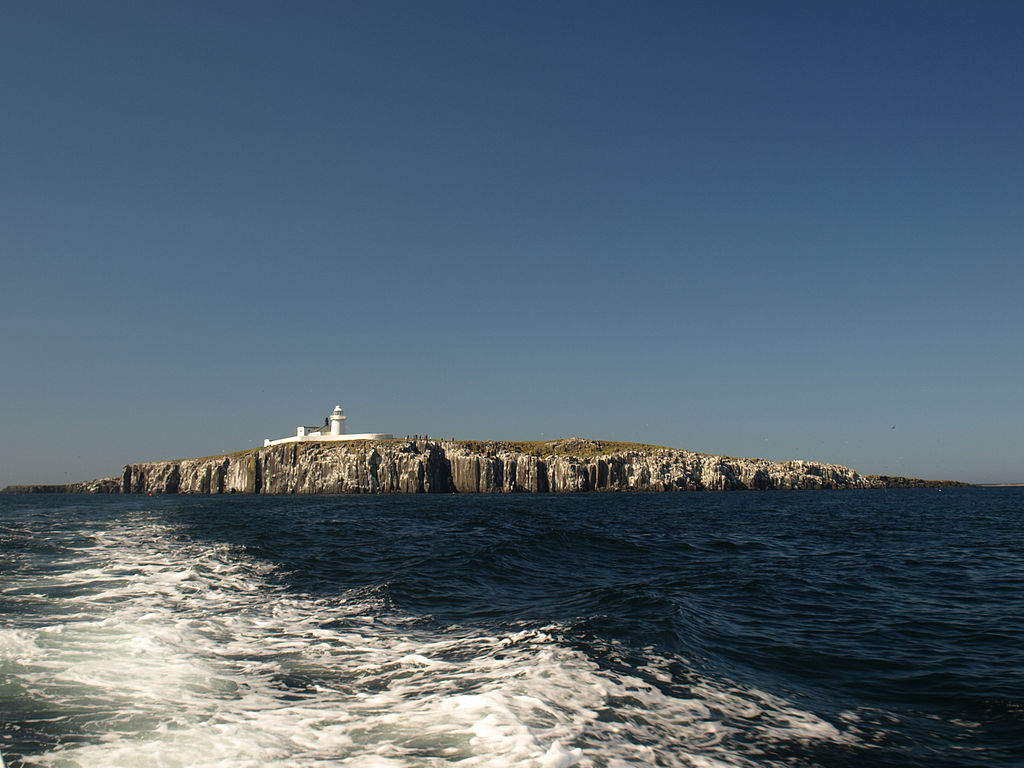
Saint of the Day – 23 March – Saint Ethelwald of Farne (Died 699) Priest, Monk and Hermit. Died on the Island of Inner Farne in 699. Also known as – Ethelwald the Hermit, Aethelwold… Ethelwold … Edelwald… He should not be confused with his near contemporary, Saint Ethelwald the Bishop of Lindisfarne who died in 740).
Inner Farne Island
Little is known about our Saint, apart from that which is recorded in the writings of the Venerable St Bede.
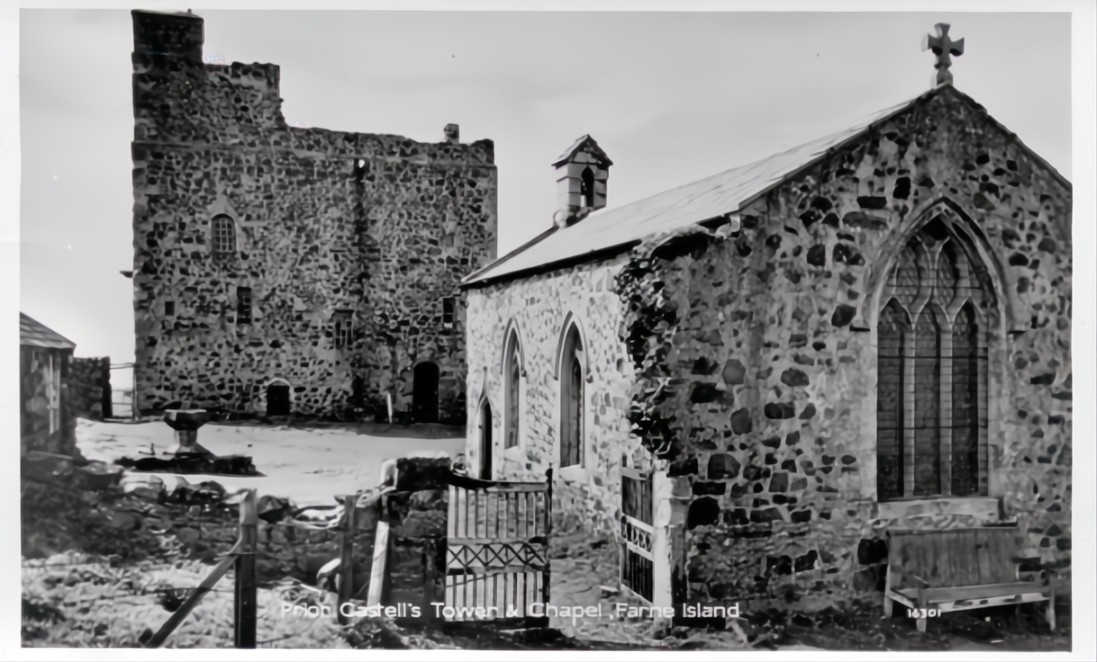
Ethelwald, a holy Priest and Monk of Ripon Monastery, in North Yorkshire, England, being desirous of some solitude, he succeeded to the tiny Hermitage of Saint Cuthbert on the lonely Island of Inner Farne, after the latter’s death in 687.
The Hermitage and Chapel on Inner Farne Isle
The best-known miracle of Ethelwald, related by St Bede, records how the future Abbot Guthrid visited him on Farne with two Lindisfarne Monks and, on his journey home, was saved from shipwreck by the Saint’s prayers. St Bede wrote through the lips of Abbot Guthrid:
“I came,” says he, “to the Island of Fame, with two others of the brethren, desiring to speak with the most reverend Father, Ethelwald. Having been refreshed with his discourse and asked for his blessing, as we were returning home, behold on a sudden, when we were in the midst of the sea, the fair weather, in which we were sailing, was broken and there arose so great and terrible a tempest that neither sails, nor oars, were of any use to us, nor had we anything to expect but death.
After long struggling with the wind and waves to no effect, at last we looked back to see whether it was possible, by any means, at least to return to the Island whence we came but we found that we were, on all sides alike, cut off by the storm and there was no hope of escape by our own efforts.
But looking further, we perceived, on the Island of Fame, our Father Ethelwald, beloved of God, come out of his retreat to watch our course, for, hearing the noise of the tempest and raging sea, he had come forth to see what would become of us. When he beheld us in distress and despair, he bowed his knees to the Father of our Lord Jesus Christ, in prayer for our life and safety and, as he finished his prayer, he calmed the swelling water, in such sort that the fierceness of the storm ceased on all sides and fair winds attended us over a smooth sea to the very shore. When we had landed and had pulled up our small vessel from the waves, the storm, which had ceased a short time for our sake, presently returned and raged furiously during the whole day, so that it plainly appeared that the brief interval of calm had been granted by Heaven, in answer to the prayers of the man of God, to the end that we might escape.”
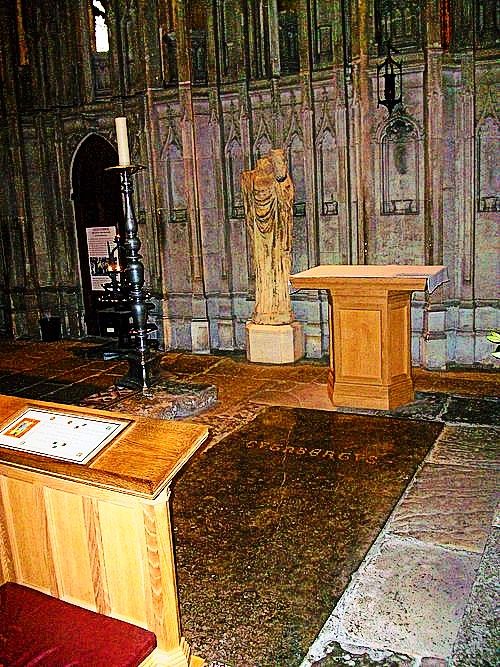
The man of God remained on the Isle of Inner Fame for twelve years and died there. Upon his death, his body was translated to Lindisfarne and laid next to those of Saints Cuthbert and Edbert. Later his Relics were carried from place to place with those of St Cuthbert until they were settled in Durham Cathedral. Many miracles were attributed by St Florence of Worcester to the intercession of Saint Ethelwald
This is St Cuthbert’s Tombstone and St Ethelwald is presumably nearby
St Benedict of Campagna St Crescentius of Carthage St Ethelwald of Farne (Died 699) Priest, Monk and Hermit St Felix the Martyr St Felix of Monte Cassino St Fergus of Duleek St Fidelis the Martyr St Frumentius of Hadrumetum St Gwinear
St Julian the Confessor St Liberatus of Carthage St Maidoc of Fiddown St Nicon of Sicily
St Ottone Frangipane (1040-1127) Layman, military Knight, Pilgrim, Ascetic, Hermit, Miracle-worker both during life and after his death. Founder of a Pilgrim’s Hospice in Ariano which later became a huge Hospital. Born in 1040 in Rome, Italy and died on 23 March 1127 in Ariano Irpino, Italy of natural causes. His Life: https://anastpaul.com/2023/03/23/saint-of-the-day-23-march-st-ottone-frangipane-1040-1127/
Daughters of Feradhach: They are mentioned in early calendars and martyrologies but no information about them has survived.
Martyrs of Caesarea – 5 Saints: A group of five Christians who protested public games which were dedicated to pagan gods. Martyred in the persecutions Julian the Apostate. The only details we know about them are their names – Aquila, Domitius, Eparchius, Pelagia and Theodosia. They were martyred in 361 in Caesarea, Palestine.
Saint of the Day – 22 March – Blessed Lukarda of Oberweimar O.Cist (c1275-1309) Virgin, German Cistercian Nun, Mystic, Miracle-worker. She was gifted with visions and the Stigmata of the Wounds of Our Lord. Born in c1275, probably in Erfurt, Germany and died on 22 March (Palm Sunday) 1309 at the Oberweimar Abbey, Weimar, Thuringia (in modern Germany) of natural causes, aged 33. Also known as – Lukarda of Erfurt, Lukardis… Lucardis… Lutgarda… Her name means — “the protector of the people” (Old High German).
Lukarda was born in 1275 or 1276 near Erfurt in Germany. At the age of twelve, she entered the Cistercians of Oberweimar Abbey, near modern-day Weimar.
Although she herself was not physically strong she was placed in the Infirmary of the Monastery to care for the ill and those even less healthy than herself. Lukarda dedicated herself with great assiduity to the needs of all the ailing patients.
Lukarda, afflicted by numerous sufferings which she endured with great patience and firmness of mind, was comforted by the Virgin Mary and Saint John the Baptist. She was deeply devoted to the Passion of Our Lord. Once, during a vision of the Saviour, the image of His Wounds were imprinted on her body and it was announced to her that she would only live for thirty-three years.
She had the gift of miracles, so much so that, through her intercession many people were cured of their sufferings and illnesses. Two blind men regained their sight when clothes stained by the blood of Saint Lukarda’s Stigmata were placed over there eyes.
She died on 22 March 1309 and was buried in the side Chapel of Oberweimar Abbey Church (see below). After her death she was immediately honoured with her own cult and was invoked by many who obtained extraordinary graces and cures through Lukarda’s intercession. She has been remembered and celebrated in Weimar on her Feast day, the Anniversary of her death for Centuries until the protestants sought to disrupt and prevent such devotions.
Church of St Peter and Paul of the former Cistercian Monastery in Oberweimar
Our Lady of the Seven Sorrows THE FEAST DAY OF THE SEVEN DOLORS IS TRADITIONALLY THE FRIDAY OF PASSION WEEK, WHICH IS THE FRIDAY BEFORE GOOD FRIDAY, AND ON 15 SEPTEMBER.
St Callinica of Galatia St Catherine of Sweden St Darerca of Ireland St Deghitche
St Epaphroditus of Terracina (1st Century) First Bishop of Terracina, Italy, Missionary, Evangelist, Disciple of the Apostles, Friend and Envoy of St Paul Apostle. St Hippolytus’ list of the Seventy Disciples includes “Epaphroditus, Bishop of Andriace.” The Roman Martyrology reads: “At Terracina, St Epaphroditus, a disciple of the Apostles, who was Consecrated Bishop of that City by the blessed Apostle Peter.” Biography: https://anastpaul.com/2022/03/22/saint-of-the-day-22-march-saint-epaphroditus-of-terracina-1st-century/
Saint of the Day – 21 March – Saint Lupicinus of Condat (Died c480) Abbot, previously a Widower, then a Hermit and then founding two Monasteries which became cornerstones of monastic, social and political stability under his administration. Born probably somewhere in the region of the Jura Mountains in France and died at his Monastery there in c480. Also known as – Lupicinus of Lauconne, Lupicinus of Jura, Lupicin… Lupicino… St Lupinus’ Body was certainly incorrupt until the 1700s. I am not sure whether it was protected from the evils destruction of the French Revolution.
The Roman Martyrology reads: “In the territory of Lyons, the Abbot St Lupicinus, whose life was resplendent with the lustre of holiness and miracles.”
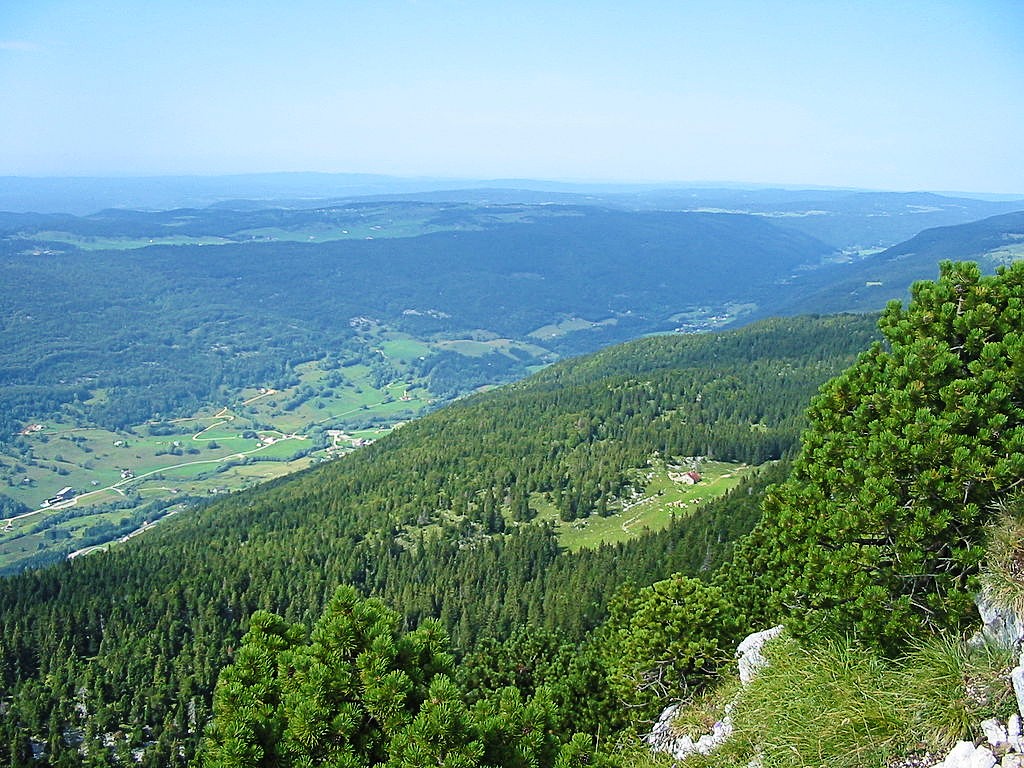
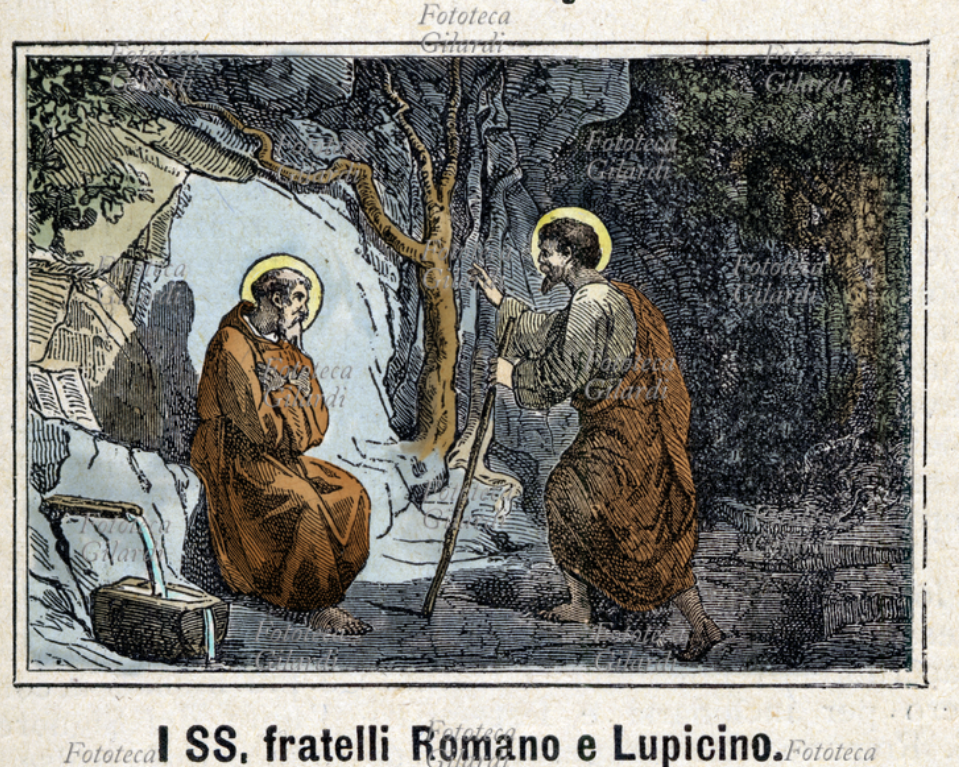
Lupicinus, was a man of adamantine faith and austere spirit. After the death of his beloved wife, Lupicinus joined his brother Romanus, a Hermit dedicated to contemplative solitude living in the Jura Mountains, a short distance north of the Western Alps and mainly demarcating a long part of the French–Swiss border.
Together, the two brothers took the first steps towards a monastic destiny of great importance in the region, founding two Monasteries: Condat, later known as Saint-Oyend (another sibling brother, the youngest, who is actually called St Eugendus) and Saint-Claude and Lauconne, later called Saint-Lupicin. Both brothers led the monastic communities with dedication but Lupicinus stood out for his ascetic rigour and iron discipline, applying the monastic rule with severity and intransigence, both in the governance of the community and in the recruitment of new members.
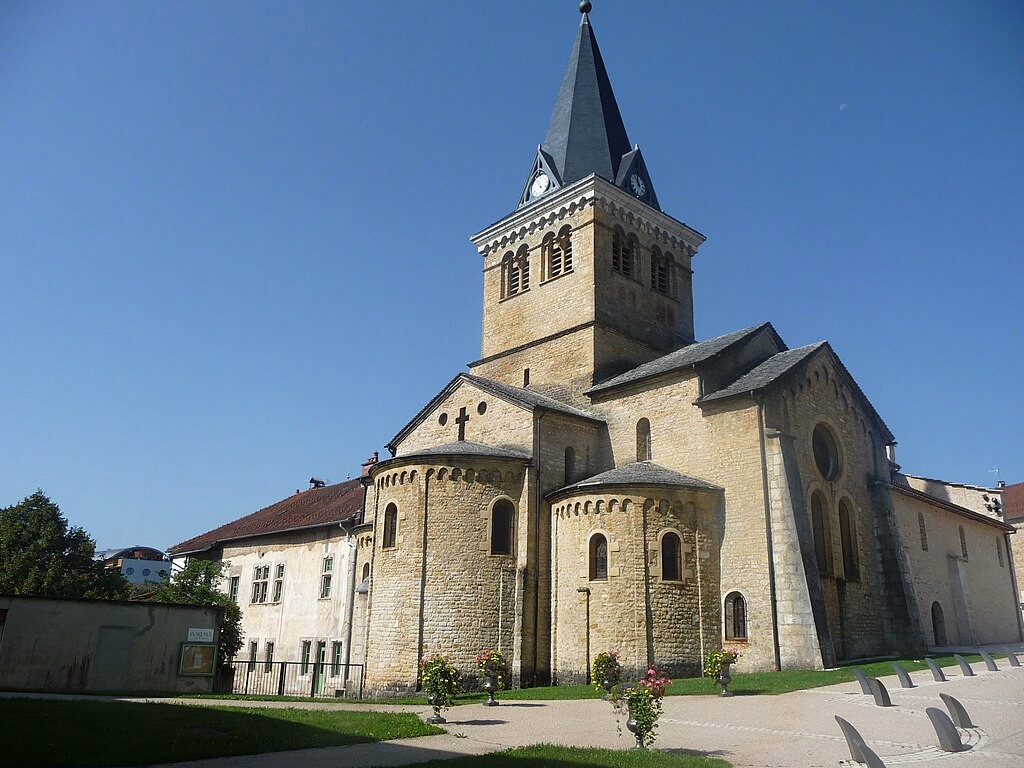
The Monastery Church of St Lupicinus
Upon Romanus’ death, Lupicinus assumed the unified leadership of the two Monasteries, becoming a point of reference, not only for religious life but also for the protection of the surrounding populations. In particular, he distinguished himself as a staunch defender of Count Agrippinus against the aims of the Burgundian King, demonstrating not only spiritual but also political mettle.
His earthly parable ended in 480, leaving an indelible legacy. The memory of Lupicinus and his brother Romanus was handed down by a biography written by a Condat Monk shortly after the death of St Oyend, their fellow Monk. Although the veracity of this document has been questioned by some scholars, others, have recognised its historical value. A further biography, by St Gregory of Tours, offers a less detailed but still, significant account.
St Lupinus Relics were transflated on 3 July of an unspecified year, shortly after his death. A reconnaissance carried out in 1689 miraculously revealed the intact body, strengthening the cult of the Saint. Until the French Revolution, on 6 June each year, the Relics were solemnly transported from the Church of St Lupinus to that of the Chapter of Saint-Claude, in a procession of great popular devotion. The date of celebration of St Lupicinus was set for 21 March and then confirmed by the Roman Martyrology. Together with his brothers Sts Romano and Oyend, he is venerated as a Benedictine Saint, although the Monasteries he founded predated the Rule of Saint Benedict which was adopted at a later time.
In the lives of the first Abbots of Condat, it is mentioned that the Monastery which was built by St Romanus of timber, being consumed by fire, the young brother, St Eugendus, rebuilt it of stone and also that he built a handsome Church in honour of Sts Peter, Paul and Andrew.
St John of Valence (Died 1146) Bishop, Founder of the Abbey of Bonnevaux, Monk, Abbot, Apostle of the poor, Social Reformer. The Roman Martyrology reads: “In Valence in the territory of Vienne in France, St John, Bishop, who, at first Abbot of Bonnevaux, suffered many adversities for the defence of justice and with charity took care of the peasants, the poor and the merchants ruined by debts.” His Life: https://anastpaul.com/2022/03/21/saint-of-the-day-21-march-saint-john-of-valence-died-1146/
Bl Lucia of Verona (1514-1574) Laywoman, Apostle of the Sick
St Lupicinus of Condat (Died c480) brother of St Romanus (Died c460)both Abbots at Condat Monastery. St Romanus is venerated on 28 February,
St Nicholas of Flue (1417-1487) Swiss Hermit and Ascetic who is the Patron Saint of Switzerland. He is sometimes invoked as Brother Klaus. A husband and father, a Mystic, a Writer, farmer, military leader, Member of the assembly, Councillor, Judge, he was respected as a man of complete moral integrity. He was Canonised on 15 May 1947 by Pope Pius XII. About St Nicholas: https://anastpaul.wordpress.com/2018/03/21/saint-of-the-day-21-march-st-nicholas-of-flue-1417-1487/St Nicholas of Flue (1417-1487)
St Serapion the Scolastic (Died c 354-370) Bishop of Thmuis, near Diospolis in the Nile delta of Egypt, Monk and Hermit, Confessor, brilliant Scholar of great learning, Theologian, Writer, a companion to St Anthony, the Desert and a close friend of St Athanasius and gave support to him against the heretic Arians in Egypt, for which action he was exiled. St Serapion’s Life: https://anastpaul.com/2021/03/21/saint-of-the-day-21-march-saint-serapion-the-scolastic-died-c-354-370-bishop/
St Philemon of Rome Bl Santuccia Terrebotti
Martyrs of Alexandria: A large but unknown number of Catholics massacred in several Churches during Good Friday services in Alexandria, Egypt by Arian heretics during the persecutions of Constantius and Philagrio. They were Martyred on Good Friday in 342 in Alexandria, Egypt.
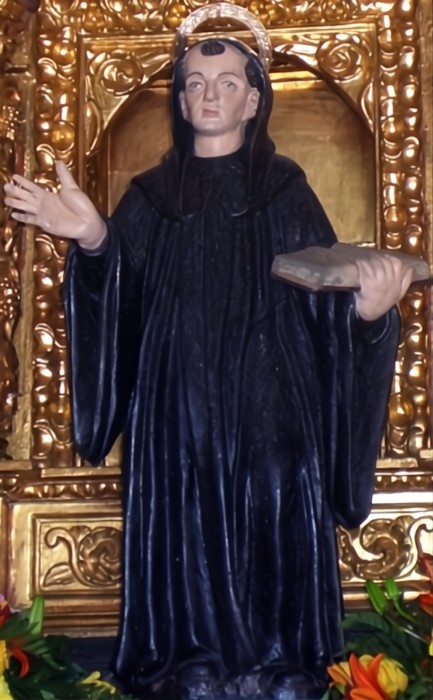
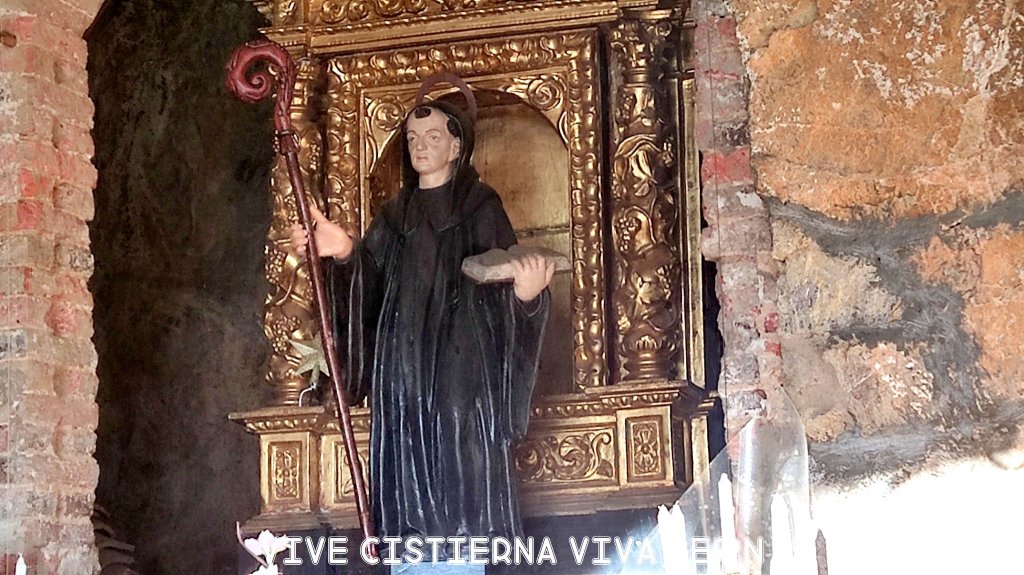
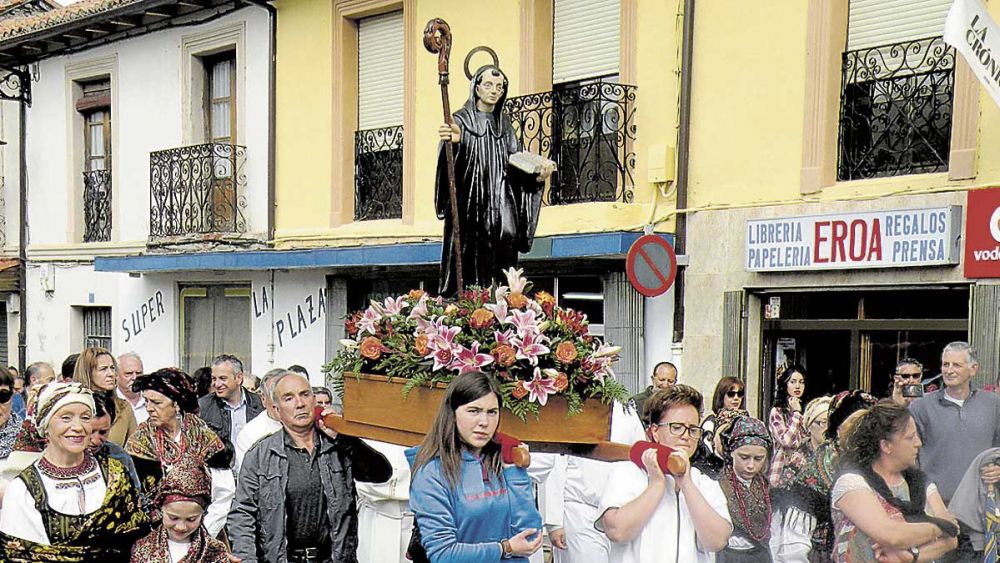
Saint of the Day – 20 March – St Guillermo de Peñacorada (Died c1042) Abbot, Miracle-worker. Patronage – Cistierna, Spain and he is invoked for rain in times of drought and he regularly proves his worth, bringing rain whenever needed. Also known as – Guglielmo, William.
We have no information regarding the early life of our Saint today. He became a Monk in the Cluniac Monastery of Satagún in the Province of León in Spain.
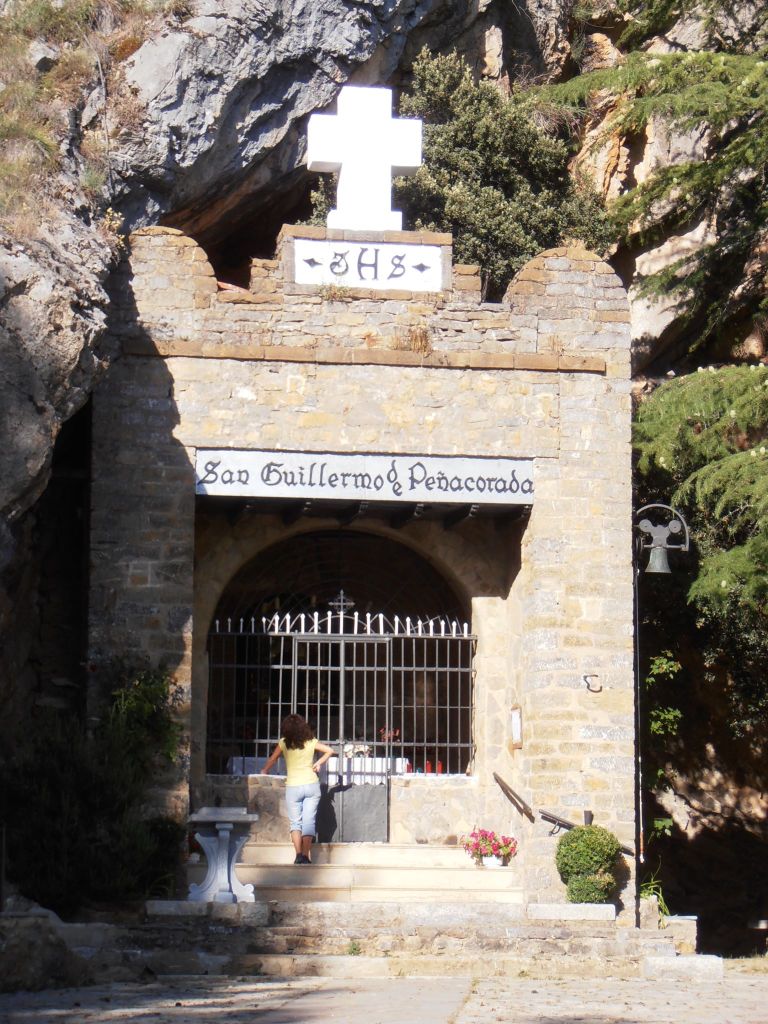
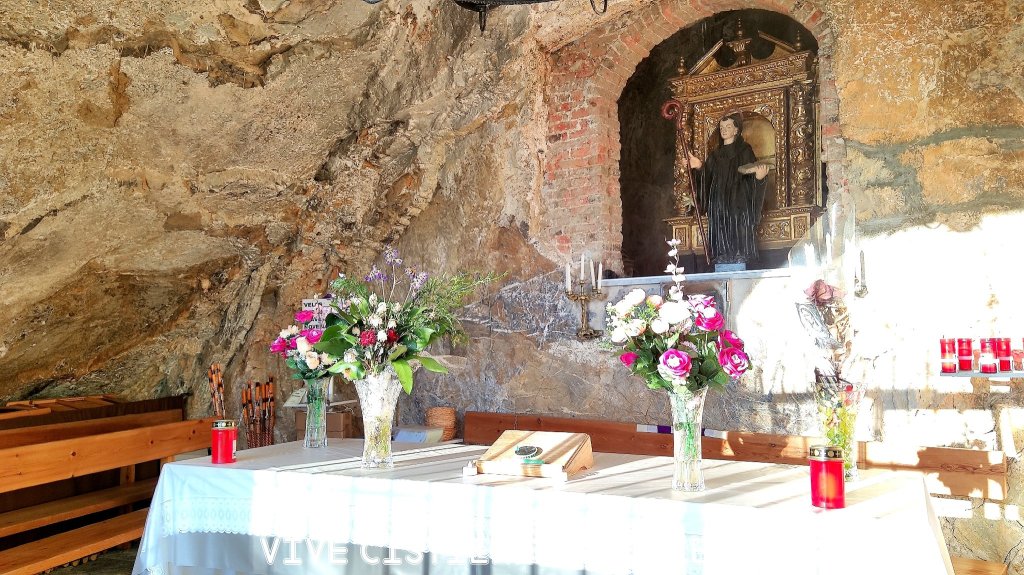
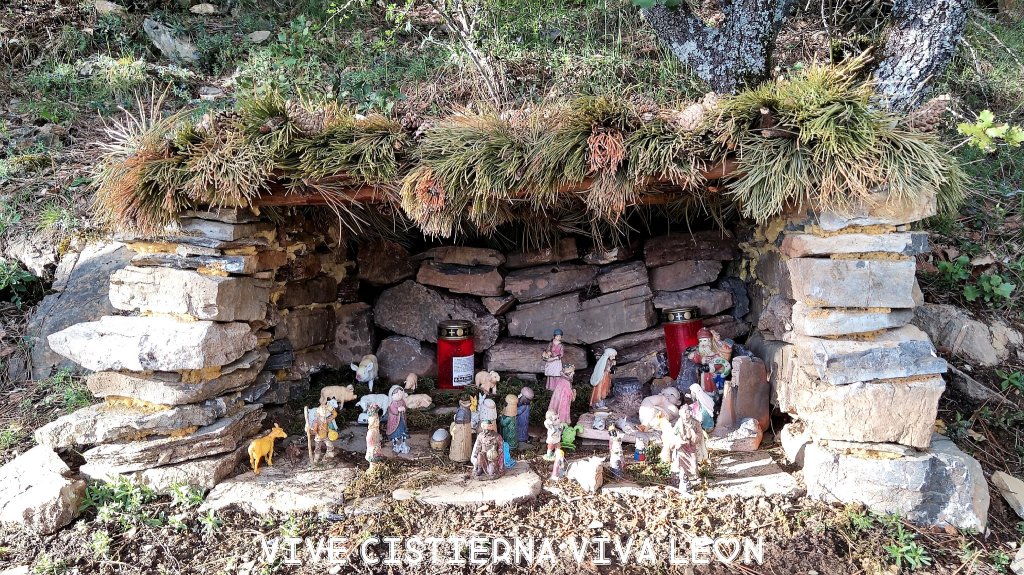
In 988 he fled with the other Monks from the horrors of the Almanzor invasion. They initially took refuge in a grotto on the southern slopes of Peñacorada, near Cistierna. This rough Hermitage became a pilgrimage site and remains so today. Below is an image of the Hermitage of Saint Guillermo, which is attended by devotees throughout the year.
After quite a long period in the Grotto, Guillermo and his Friars accepted the hospitality of the Augustinian Abbey near the Sanctuary of the Virgen de la Velilla, in the northern area of Peñacorada. There, after some time, he was elected Abbot and governed with great foresight.
Upon his death he was proclaimed a Saint and immediately afterwards the Monastery was solemnly renamed in his honour.
In the year 1281, the Monastery of St Guillermo de Peñacorada was annexed by King Sancho IV to the Cathedral of León.
Postage Stamp featuring St Guillermo
His Relics are located in La Mata de Monteagudo and lhe is remembered and celebrated on 20 March.
St Photina & Companions / Martyrs of Rome – 9+ Saints: A group of Christians Martyred together in the persecutions of Nero. We know nothing else about them but the names Photina, Sebastian and Victor, Anatolius, Cyriaca, Joseph, Parasceve, Photis.
Blessed Ambrose Sansedoni of Siena OP (1220-1287) Priest and Friar of the Order of Preachers, Preachers, Confessor, Mystic, a powerful and convincing Preacher employed by various Popes as a Diplomatic Peacemaker and that which seems opposed, as a Preacher of the Crusades, Peacemaker. A fellow student with St Thomas Aquinas under St Albert Magnus. His Life: https://anastpaul.com/2023/03/20/saint-of-the-day-19march-blessed-ambrose-sansedoni-of-siena-op-1220-1287-priest/
Anastasius XVI Archippus of Colossi St Benignus of Flay St Cathcan of Rath-derthaighe St Clement of Ireland
St Guillermo de Peñacorada (Died c1042) Abbot St Herbert of Derwenwater Bl Hippolytus Galantini Bl Jeanne Veron Bl John Baptist Spagnuolo St John Nepomucene St John Sergius
Martyrs of Amisus – 8 Saints: A group of Christian women Martyred together in the persecutions of Diocletian. The only details we have are eight of their names – Alexandra, Caldia, Derphuta, Euphemia, Euphrasia, Juliana, Matrona and Theodosia. They were burned to death c 300 in Amisus, Paphlagonia (modern Samsun, Turkey).
Martyrs of San Saba – 20 Saints: Twenty monks who were Martyred together in their monastery by invading Saracens. They were Martyred in 797 when they were burned inside the San Sabas monastery in Palestine.
Martyrs of Syria – 3+ Saints: A group of Christians who were Martyred together in Syria. We know nothing else about them but the names Cyril, Eugene and Paul.
Saint of the Day – 19 March – Blessed John of Parma OFM (c1209-1289) Priest and Friar of the Friars Minor, the 7th Minister General of the Order (1247–1257) and a noted Theologian. He was known for his attempts to bring back the earlier spirit of the Order after the death of Saint Francis of Assisi. Born in 1209 at Parma, Italy as Giovanni Burali and died in 1289 at Greccio, Italy of natural causes. Patronage – of his birthplace, Parma, Italy. His cult was confirmed in 1777 by his Beatification by Pope Pius VI. Also known as – Giovanni di Parma, John Burall. Additional Memorial – 20 March on some calendars.
John was born in Parma, Italy, around 1209 of the noble Burali family. His education was undertaken by his uncle, the Chaplain of the St Lazarus hospice in Parma. It was when he was a young Philosophy Professor known for his piety and learning that God called him to bid good-bye to the world he was used to and enter the new world of the Franciscan Order.
After his profession, John was sent to Paris to complete his Theological studies in order to be Ordained to the Priesthood. After his Ordaination, he was appointed to teach Theology at Bologna, then in Naples and finally in Rome.
In 1245, Pope Innocent IV called a General Council in the City of Lyons, France. Crescentius, the Franciscan Minister General at the time, was ailing and unable to attend. In his place he sent Friar John, who made a deep impression on the Church leaders gathered there. Two years later, when the same Pope presided at the election of a new Minister General of the Franciscans, he remembered Friar John well and proposed him as the man best qualified for the office.
And so, in 1247, John of Parma was elected to the position of the 7th Minister General. The surviving disciples of St Francis rejoiced in his election, expecting a return to the spirit of poverty and humility of the early days of the Order. And they were not disappointed. As General of the Order, John travelled on foot, accompanied by one or two companions, to practically all of the Franciscan Convents in existence. Sometimes he was able to visit incognito and unrecognised, remaining there for a number of days to test the true spirit of the Friars.
The Pope called on John to serve as the Papal Legate to Constantinople, where he was most successful in winning back the schismatic Greeks. Upon his return, he asked that someone else take his place to govern the Order. At John’s urging, Saint Bonaventure was chosen to succeed him. John then took up a life of prayer in the Hermitage at Greccio, one of St Francis favourite Hermitages. and where he founded the first Nativity devotion.
Many years later, John learned that the Greeks who had been reconciled with the Church for a time, had again relapsed into schism. Although 80 years old by then, John received permission from Pope Nicholas IV to return to the East in an effort to restore unity once more. On his way, John became ill and died. He was Beatified in 1777. The Office was granted to the Franciscan Order in 1780 and extended to the ducal States on 24 April 1781.
Blessed Clement of Dunblane (1200-1258) Bishop of Dunblane in Scotland, , Priest and Friar of the Order of Preachers, a great and humble carer of the poor and needy, a zealous Administrator but just as much, a shepherd of souls, Reformer, Writer, a highly renowned Preacher and Linguist, a very learned man indeed. Clement was the first member of the Dominican Order in Britain and Ireland to become a Bishop. Born in Scotland in 1200 and died in 1258 in Dunblane, Scotland of natural causes. Biography: https://anastpaul.com/2023/03/19/saint-of-the-day-19-march-blessed-clement-of-dunblane-op-1200-1258-bishop/
St Colocer of Saint-Brieuc St Corbasius of Quimperlé St Cuthbert of Brittany St Gemus
Blessed John of Parma OFM (c1209-1289) Priest, 7th Minister General of the Friars Minor.
St John the Syrian of Pinna St Lactali of Freshford St Landoald of Maastricht St Leontinus of Braga St Leontinus of Saintes Bl Mark of Montegallo St Pancharius of Nicomedia
Martyrs of Sorrento: A group of Three sisters and a brother who were Martyred together. We have little more than their names – Mark, Quartilla, Quintilla and Quintius. They were Martyred in Sorrento, Italy, date unknown.
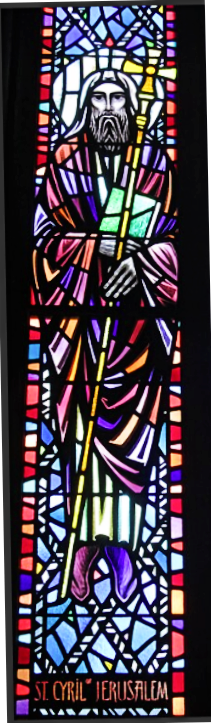
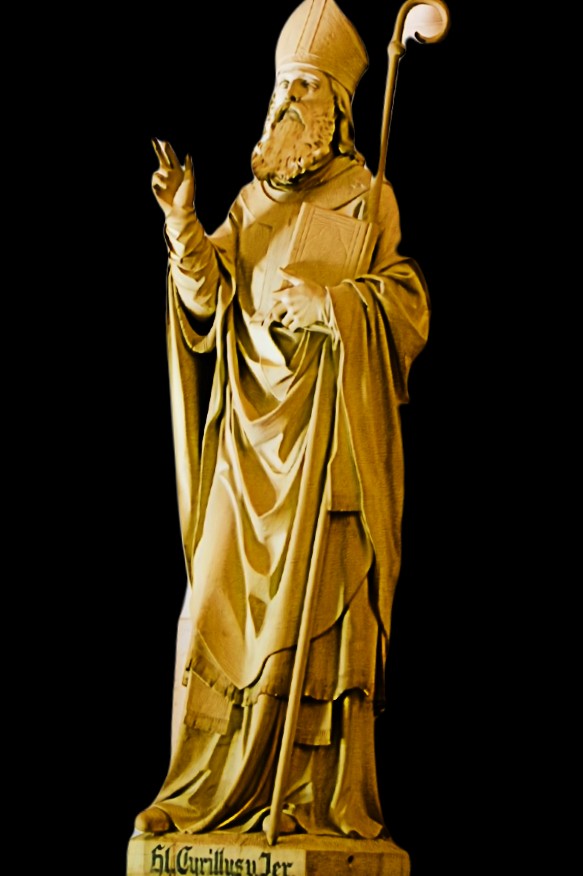
Saint of the Day – 18 March – St Cyril of Jerusalem (315-387) Bishop of Jerusalem, Confessor Father and Doctor of the Church, Theologian, Writer. Born in c315 possibly near Caesar in Palestine and died at the age of around 73 in c387 in Jerusalem. Also known as – Cirillo, Kyrillos.
The Roman Martyrology reads: “At Jerusalem, St Cyril, the Bishop and Doctor, who suffered many inhuries from the Arians for the Faith. Often exiled from his Church, he at length rested in peace, with a great reputation for sanctity. A magnificent testamony of the purity of his faith is given by a general Council, in a letter to the Pope Damasus.”
Cyril of Jerusalem, Ordained Presbyter around 345, was a man particularly attentive to the preparation of Catechumens aspiring to the Sacrament of Baptism celebrated on Easter night.
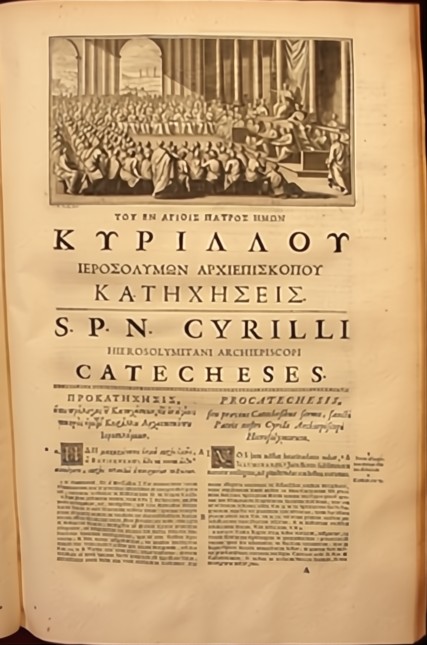
It is in these years of his Priesthood that he composed the work which is still rightly known today, the ‘Catecheses‘ contain sermons which illustrate Christian doctrine (the first 19 sermons held in the Basilica of the Holy Sepulchre built in Jerusalem by Constantine are addressed to the Catechumens) and they explain the Sacraments (discourses 20-24 were addressed to the already Baptised and admitted to the Church and aimed at teaching the understanding of the meaning of Liturgical practices).
St Cyril’s Catechesis
As a young man of around 33 in c348, Cyril was appointed as the Bishop of Jerusalem. Cyril was severely involved in the Christological controversy following the affirmation of the Nicene Creed. The term “of the same substance” constituted the Christological affirmation against the Arian heresy. In fact, once the Council ended, a long and very painful period began which saw the Church divide on the Christological question. Not all professed Nicenes (like the illustrious Bishop and Doctor of the Church, Saint Athanasius of Alexandria in Egypt), nor did the Arian party constitute a monolithic group. Most oscillated between the two positions.
Cyril of Jerusalem, like St Acacius, Bishop of Caesarea (340-366) and many others, held an intermediate and personal position. Due to issues related to the relationship between Churches, Acacius, definitively espousing a markedly Arian doctrine and thus guaranteeing imperial support, managed to repeatedly remove Cyril from his Episcopal Seat. He was thus first deposed and exiled by the Emperor Constantius in 357 and 360, then by the Emperor Valens from 367 to 378. This Acacius, Bishop from 340 to 366, is certainly no small figure. Having succeeded the great Bishop St Eusebius, he continued to enrich the library of Caesarea. Saint Jerome, in fact, who died in 420, spoke of his great works of commentary and interpretation of Sacred Scripture which were then sadly lost).
The Emperor Theodosius (379-395) put an end to his exile which lasted a total of 16 years. Now, no-one will chase him away again. In 381 Cyril took part in the Council of Constantinople (the 2nd Ecumenical Council) and in the following one in 382, in which the validity of his consecration as the Bishop of Jerusalem was again reiterated,, where he finally remained undisturbed until his death.
Cyril’s whole life was involved in the troubles of the Church during the first Centuries. That is, in the theological debates, even very harsh ones, mixed with human weaknesses and then intertwined with politics, with external wars to defend the Empire and internal ones to seize the throne. Fifteen Centuries laster, in 1882, Cyril was declared Doctor of the Church by Pope Leo XIII.
Martyrs of Nicomedia – Commemorates the Christians who were Martyred anonymously, either singly and in small groups, by local pagans in the area of Nicomedia prior to the year 300 and who may have been over-looked in the waves of Diocletian persecutions that resulted in the deaths of thousands.
Our Lenten Journey with the Angels and the Saints – 17 March – Passion Sunday and the Feast of St Patrick (c386-461) “The Apostle of Ireland,” Bishop, Confessor, Missionary. – Hebrews 9:11-15, John 8:46-59 – Scripture search here: https://www.drbo.org/
“To execute upon them the judgement which is written, this glory is to all His saints. Alleluia.” Psalm 149:9
“Your father Abraham rejoiced to see My day, he saw it and was glad.” John 8:56
Binding Ourselves
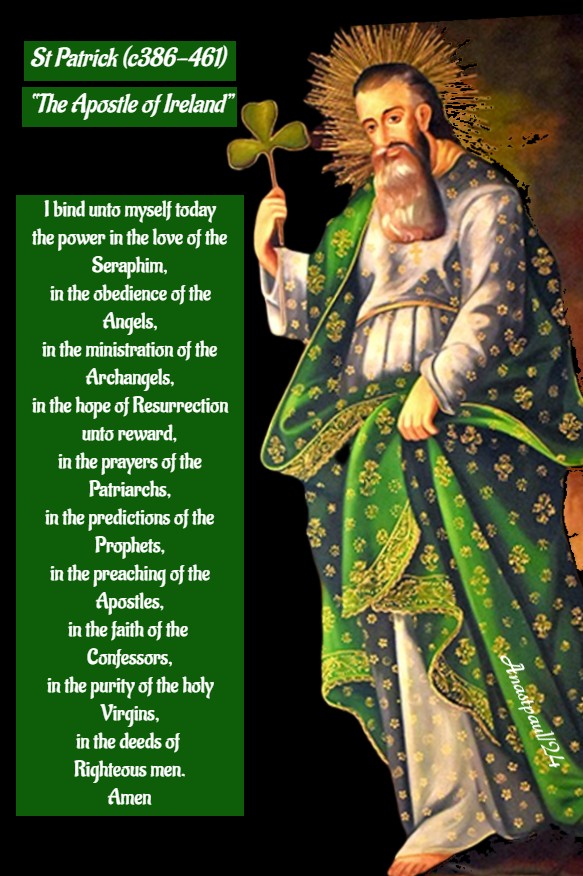
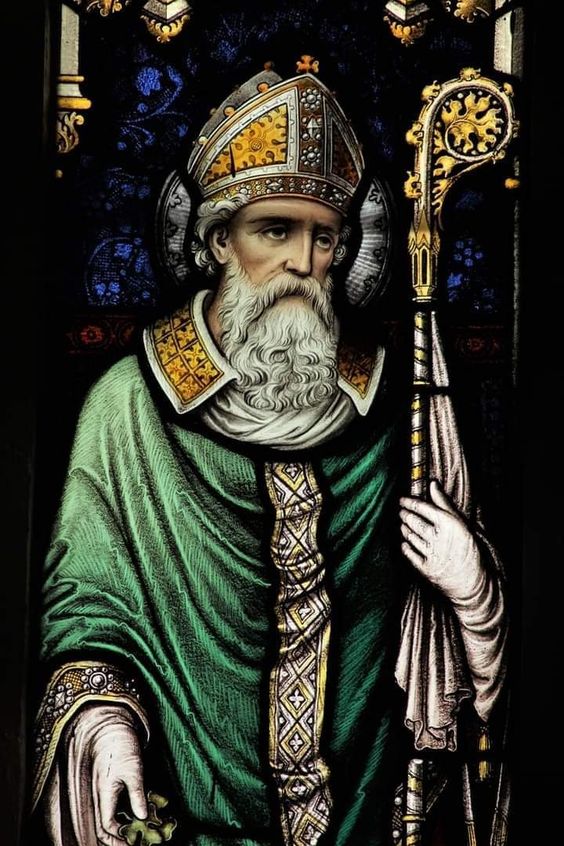
St Patrick (c386-461) “The Apostle of Ireland”
“The man of God, Patrick, was marvellously favoured with heavenly visions and revelations in prayer. ‘When,’ says his biographer, ‘he everyday, in the Mass, sacrificed the Son to the Father, or devoutly recited the Apocalypse of St John, it was granted to him to see the heavens opened and Jesus standing there, surrounded by a multitude of Angels and whilst he meditated on these great visions, his soul was altogether lost in God.’ Three times in the week the Angel Victor, visited and conversed with him, filling his soul with celestial consolations. The labours of the day, amongst men, seem to have been less arduous than those of the night with God.” (The Life of St Patrick, Apostle of Ireland)
Prayer of St Patrick:
I bind unto myself today the power in the love of the Seraphim, in the obedience of the Angels, in the ministration of the Archangels, in the hope of Resurrection unto reward, in the prayers of the Patriarchs, in the predictions of the Prophets, in the preaching of the Apostles, in the faith of the Confessors, in the purity of the holy Virgins, in the deeds of Righteous men. Amen
Saint of the Day – 17 March – St Patrick (c386-461) “The Apostle of Ireland,” Bishop, Confessor, Missionary, wondrous Miracle-worker. Born between 387 and 390 either in Scotland, or somewhere in England, or in Brittany, France (so many sources and so many different traditions) as Maewyn Succat and died between 461 and 464 at Saul, County Down, Ireland of natural causes. Also known as – “The Apostle of Ireland,” Maewyn Succat, Patricius, Patrizio.
Today on Ireland’s Patronal and National Festival, the Patron Saint of miners, hairdressers, coopers and blacksmiths; for cattle and poor souls; against fear of snakes, against pests and cattle diseases, against evil – just some of our bel;oved St Patrick’s many patronages.
The Roman Martyrology reads: “In Ireland, the birthday of St Patrick, Bishop and Confessor, who was the first to preach Christ in that country and became illustrious by great miracles and virtues.”
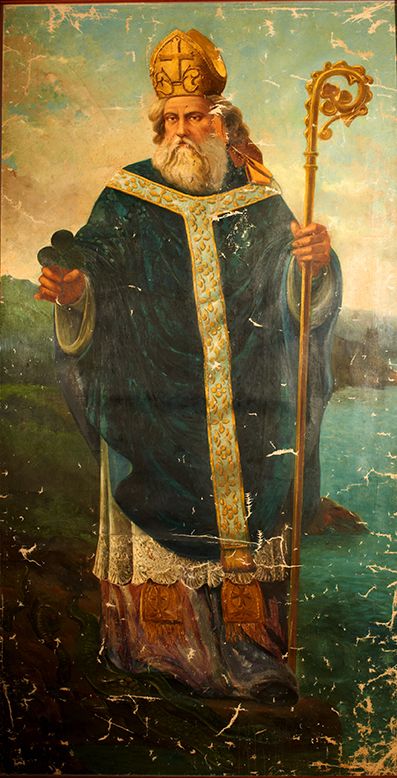
A painting inside the Church office shows a haloed, ornately robed St. Patrick driving snakes out of Ireland.
According to his own testimony however, Patrick was born in Banna Venta Berniae in Roman Britain. His father, Calpurnius, was an Official of the Roman occupying power and was later Ordained a Deacon; his grandfather was a Priest. At the age of 15, Patrick was kidnapped by pirates from his father’s country estate near the town of Bannauem Taburniae – which is also unknown today – and taken to Ireland as a slave. There, according to tradition, he had to look after the sheep of the tribal chief Maelchu on Mount Slieve Mish – today’s Slemish. After six years he heard a promise in a dream that he would soon find his way home on a ship and should then proclaim the good news to the Irish. He fled and returned home on a ship.
There he was Ordained a Priest. According to tradition,, he then went to the northern coast of Gaul, where he initially stayed as a Monk in the Noirmoutier Monastery. Again he had a dream which shaped his future life – an Irishman gave him a letter asking him to return home. In preparation, he studied Theology on the Lérins Island of St-Honorat and in Auxerre under St Germanus . Although he was criticised for his lack of education, he was appointed as the successor to the first Irish missionary, St Palladius . St Germanus is said to have Consecrated him as a Bishop but a trip to Rome with Consecration and Commission by Pope Celestine I, is also reported. It is confirmed that in 432, he arrived in Ireland with 24 companions, where he worked successfully as a Missionary in the north of the Island for decades.
When he arrived, all snakes and poisonous animals were said to have left the Island. Patrick lured the last snake in Ireland into a box and promised to let it out again tomorrow. When the snake asked when tomorrow was , he always answered tomorrow. Finally, he threw the box into the sea. It tells how he exposed a mutton thief by summoning the eaten prey to come forward from the robber’s stomach. At Patrick’s request, God established an earthly purgatory in Ireland that allows penitents to cleanse themselves of their sins.
Despite all odds, Patrick converted tens of thousands of people, as he reports in ‘Confession.’ He ahad 365 Churches built. Since Patrick had learned the Irish language during his captivity, he was able to use the local language in teaching. This was one of the reasons why the Christian faith was accepted by the Irish as something of their own and has taken particularly strong roots to this day. He is said to have illustrated the Trinity to his congregation using a three-leaf clover, which became the Irish National Symbol called the Shamrock.
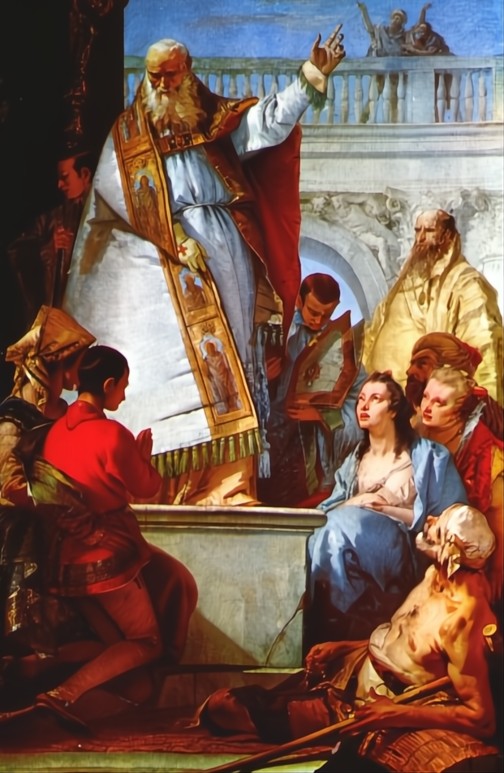
Giovanni Battista Tiepolo: St Patrick Preaching, 1746, in the Municipal Museums of Padua
On Easter 433, Patrick lit a fire on a hill visible far into the country near what is now Slane, marking the victory of the Light of Christ over darkness where the Kings once ruled. In 449 he is said to have retreated to the mountain in County Mayo, now known as Croagh Patrick, for forty days – like Moses at Sinai – for pre-Easter fasting . Every night an Angel came to ask him about his wishes – Patrick had asked to be allowed to judge the Irish himself in the Last Judgement. When this wish was rejected, he threatened never to leave the mountain again, whereupon the Angel admitted to him that since the Apostles, there has not been a man who is more to be admired which is why the wish was finally agreed to. Now the mountain has become the most important pilgrimage site in Ireland. Crowds of pilgrims trek up the mountain, many walking with bare feet or crawling on their knees to do penance. The stone on which Patrick is said to have knelt in prayer, for so long that his knees left an imprint, can still be seen today – yes, this is a living miracle!
Statue of St Patrick in front of the 765 meter high mountain called Croagh Patrick
Patrick left behind two writings providing much insight into the life of a Missionary among pagans on the edge of the world . His ‘Confession’ – only preserved as a translation done three centuries after St Patrick’s death and its authenticity is questionable in parts – and a letter to the soldiers of Croticus.
Patrick was dearly venerated in Ireland as early as the end of the 6th Century and in France from the 7th Century onwards. From the Episcopal See of Armagh, Patrick was praised as the Founder of the Church in Ireland. In the Middle Ages, St Patrick’s cult spread to many areas of Europe. Patrick’s Purgatory on Station Island in Lough Derg in County Donegal, became a much-visited place of pilgrimage . Patrick’s Day is celebrated as the Irish National holiday, Dublin celebrates Saint Patrick with a large parade and four days of celebration. Artificial snakes are carried through the City with their red tongues poking threateningly out of paper and plastic bodies. On people’s lapels is the Shamrock , the three-leaf clover.
The counties of Armagh and Down – around Downpatrick – in Protestant Northern Ireland were declared St Patrick’s Country a few years ago to stimulate tourism.
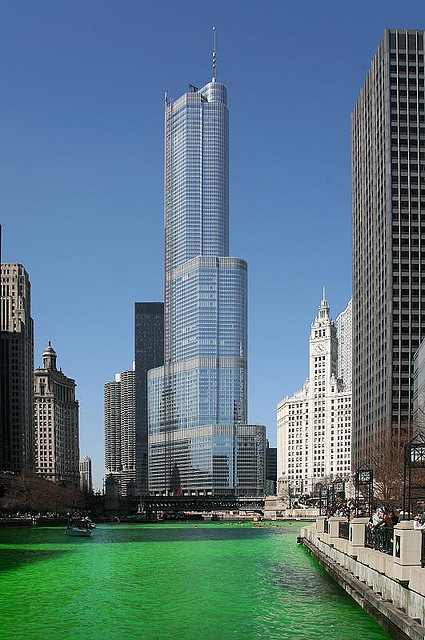
It is not only in Ireland that a holiday is still celebrated in honour of the National Saint of Ireland. Many Irish emigrant communities also celebrate in Canada, the USA, Australia, New Zealand, South Africa and elsewhere – for example, in Munich in Germany – with cheerful, colourful parades which also invite non-Irish people to join in the celebrations. Rivers such as the Chicago River are coloured green on this day and even the beer is green.
The green Chicago River on St Patrick’s Day in front of Trump Tower in Chicago
St Joseph of Arimathea Joseph of Arimathea (Died 1st Century) “The Secret Disciple of Jesus.” Patronages – of pallbearers, funeral directors, morticians, undertakers, tin miners, tin smiths, Catholic Cemeteries of the Archdiocese of Vancouver, Glastonbury Cathedral. Feast day moved after Vatican II to 31 August “The Secret Disciple of Jesus:” https://anastpaul.com/2021/08/31/saint-of-the-day-31-august-saint-joseph-of-arimathea-died-1st-century/
St Llinio of Llandinam St Paul of Cyprus St Stephen of Palestrina St Theodore of Rome St Thomasello St Withburga (Died 743) Abbess, Princess
Martyrs of Alexandria – Also known as Martyrs of Serapis: An unknown number of Christians who were Martyred together by a mob of worshippers of the Graeco-Egyptian sun god Serapis. They were Martyred in c 392 in Alexandria, Egypt.
Saint of the Day – 16 March – Blessed Robert Dalby (Died 1589) Priest Martyr Born at Hemingborough near Wakefield in North Yorkshire, England and died on 16 March 1589 at York, England by being hanged, drawn, and quartered during the persecutions of Elizabeth I. Also known as – Robert Drury. Additional Memorial – 29 October as one of the Martyrs of Douai. Blessed Robert was Beatified on 15 December 1929 by Pope Pius XI. A point of interest is that Yorkshire, as you will have noticed, was particularly strong in the Catholic Faith, regardless of the rampant and violent persecutions. Having lived in Yorkshire for 10 years, I have lots to tell you sometime soon.
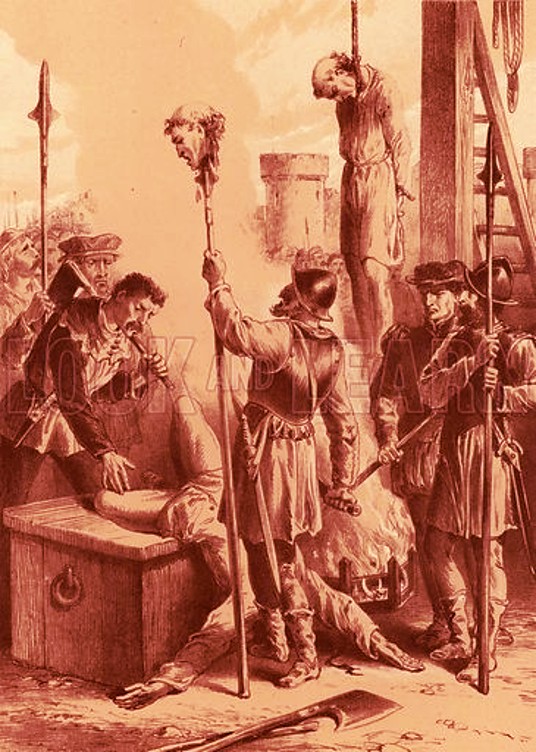
The Blesseds John Amias and Robert Dalby, “At the Place of Execution” Illustration for Memoirs of Missionary Priests by Bishop Challoner (Jack, 1878)
Robert was born a Protestant and became a minister. But he became intrigued with Catholicism and after studying the Faith Robert became a Catholic. In September 1586, he went to study the subjects of the Priesthood, at the English College at Rheims. He was Ordained a Priest at Chalons on 16 April 1588.
On 25 August of that same year, he set out for England. He was arrested almost immediately upon landing at Scarborough on the Yorkshire coast and was imprisoned in York Castle. He was in contravention of English Law which made it a capital oiffence to be a Catholic Priest and which Law carried the penalty of Death by means of hanging, drawing and quartering.
A fellow Priest, Fr John Amias, accompanied him. They remained imprisoned from 25 August until 16 March 1589. The Court Sentencing was proclaimed for both Priests. Upon the arrival at the place of execution, the two Priests prostrated themselves in prayer. Fr John was chosen to be executed first, so Robert Dalby had to watch his fellow Priest being hanged and quartered before his own turn came but he displayed no hesitation in going to his death for the Faith of the Church of his Christ.
Those who venerated these young Priests, shortly after their deaths, reported many miracles. Both Priests were declared Blessed by Pope Pius XI on 15 December 1929.
St Julian of Anazarbus St Largus of Aquileia St Malcoldia of Asti St Megingaud of Wurzburg St Papas St Patrick of Clermont Blessed Robert Dalby (Died 1589) Priest Martyr
Saint of the Day – 15 March – Saint Eusebius II of Vercelli (Died c520) Bishop of Vercelli, Italy. Also known as – Eusebio II.
Neither the volume printed in 1581, edited by the Eusebian Chapter which contained the ancient litanies and the Offices of the Cathedral of Vercelli, nor the Eusebian Calendar, published in 1676, mention him.
What is certain, is that under this portrait, part of the ancient series of the first 40 Bishops of Vercelli, painted in the Cathedral, one could read his name, with the ranking of “the Second.”
Now let us frame the historical period of his Episcopate — to the left, i.e. a predecessor, is the Bishop Emilian, who ruled the Diocese of Vercelli at the end of the 5th Century (Died 501), was succeeded by a Bishop whose name is unknown. Then immediately after came our Eusebius II, who, in fact was the 12th Bishop of the See. Some local historians believe his Episcopacy to have occurred from 515 to 534 but without proof of this supposition.
The Bollandist hagiographers, who placed his memory on 15 March, established the date of his death around 520 and expressed themselves with his praise, saying that, following the example of the Diocesan Protobishop, St Eusebius I of Vercelli (Died 1 August 371), his namesake, fulfilled his pastoral duties with the utmost diligence and charity.
And Bishop Ferrero also expressed himself in these terms, in his work on the Bishops of Vercelli,which he published in the second edition, in 1609.
Bl Anthony of Milan St Aristobulos of Britannia St Bodian of Hanvec St Eoghan of Concullen St Eusebius II of Vercelli (Died c520) Bishop Bl Francis of Fermo St Longinus the Centurian Bl Ludovico de la Pena St Mancius of Evora St Matrona of Capua St Matrona of Thessaloniki St Menignus of Parium Bl Monaldus of Ancona St Nicander of Alexandria St Peter Pasquale St Sisebuto St Speciosus St Vicenta of Coria Bl Walter of Quesnoy
Saint of the Day – 14 March – Saint Pauline of Thuringia (Died 1107) Widow, Mother, Nun. Died on 14 March 1107 in Fulda, Germany of natural causes. Also known as – Pauline of Fulda, Pauline of Hirsau, Pauline of Münsterschwarzach, Pauline of Zell, Paolina, Paulina.
Born to the Saxon nobility, Pauline was married, after the early death of her first husband to Ulric de Scharaplan. The couple were blessed with children, although we do not know anything about them.
After the death of Ulric and the sole upbringing of her children, she decided to enter religious life and asked the Pope for advice. He directed her to Udone, the Abbot of St Blasien Monastery. Unfortunately, however, in that period both the Abbot and Pauline’s father died.
Pauline then decided to retire with some companions to a forest in Thuringia, where she founded a double Monastery. The direction was entrusted to a Monk while Werner, Pauline’s son, took care of material things as a Lay Brother and Administrator.
In 1107 Pauline and her Nuns decided to separate from the Monks at Thuringia. She undertook to lead them to a Monastery at Hirsau but while travelling Pauline fell ill and was admitted to the Hospice at Munsterchwarzach. Here she received a visit from the Superior of Thuringia Monastery, who blessed her with the administration of the last Rites and Sacraments. She died on 14 March 1107.
St Maximilian St Pauline of Thuringia (Died 1107) Widow St Peter of Africa St Philip of Turin St Talmach Bl Thomas Vives
47 Martyrs of Rome – Forty-sevenpeople who were Baptised into the Faith in Rome, Italy by Saint Peter the Apostle and were later Martyred together during the persecutions of Nero. Martyred c67 in Rome, Italy
Martyrs of Valeria – Two Monks Martyred by Lombards in Valeria, Italy who were never identified. After the monks were dead, their killers could still hear them singing Psalms. They were hanged on a tree in Valeria, Italy.
Saint of the Day – 13 March – Saint Nicephorus (c758-829) Bishop and Confessor, Defender of Sacred images. Nicephorus was the Bishop of Constantinople from 806-815, Scholar and Writer. Born in c758 in Constantinople (modern-day Istanbul, Turkey) and died at the Monastery he had founded on the Black Sea coast on 5 April 828 or 2 June 829 (sources vary). Both these dates are variously celebrated in his honour.
The Roman Martyrology reads today: “At Constantinople, the Bishop St Nicephorus. In defence of the traditions of his forefathers and of the Churrch, the worship of Sacred images, he opposed the Iconoclast Emperor, by whom he was sent into exile, where he underwent a long martyrdom of fourteen years and departed for the Kingdom of God.”
This champion of the orthodox view in the second contest over the veneration of images belonged to a noted family of Constantinople. He was the son of the Imperial Secretary Theodore and his pious wife ,Eudoxia. Eudoxia was a strict adherent of the Church and Theodore had been banished by the Emperor Constantine Copronymus (741-75) on account of his steadfast support of the teaching of the Church concerning images.
While still young Nicephorus was brought to the Court, where he too became an Imperial Secretary. In 787, with two other officials of high rank, he represented the Empress Irene in 787 at the Second Council of Nicaea (the Seventh Ecumenical Council) which declared the Doctrine of the Church regarding images. Shortly after this Nicephorus sought solitude on the Thracian Bosporus, where he had founded a Monastery. There he devoted himself to ascetic practices and to the study both of secular learning, as grammar, mathematics and philosophy as well as to the that of the Sacred sciences especially the Scriptures.
Later he was recalled to the capital and given charge of the great hospital for the destitute, possibly that founded by St Basil the Great. Upon the death of Bishop Tarasius (25 February, 806), there was great division among the Clergy and higher Court officials, as to the choice of his successor. Finally, with the assent of the Bishops and Emperor, Nicephorus was appointed. Although still a layman, he was known by all to be very religious and highly educated. He received Holy Orders and was Consecrated Bishop on Easter Sunday, 12 April 806. He was opposed for a time by St Theodore the Studite after Nicephorus forgave a Priest who married Emperor Constantine VI toTheodota, despite the fact the Constantine’s wife, Mary, still lived. He seems to have been a gentle and forgiving man, devoted to reconciliation.
But in regard to Sacred images, Nicephorus challenged the Iconoclast policies of Emperor Leo V the Armenian without fear and was deposed by a Synod of Iconoclast Bishops at the conniving of the Emperor. Nearly assassinated on several occasions, Nicephorus was finally exiled to the Monastery he had founded on the Black Sea, spending his remaining years there in prayer.
He died in 829, never having been able to return to his See. While Bishop, he brought various reforms to his large Diocese and inspired zealous shepherded his faithful flock. He was also the Author of anti-Iconoclast writings and two historical works, a Chronographia and Brevianim.
In 847, St Nicephorus’ remains were solemnly brought back to Constantinople by Bishop Methodius I and interred in the Church of the Holy Apostles, where they were the object of an annual festival celebrated with much devotion.
NOVENA for the INTERCESSION of ST JOSEPH DAY FOUR:Clink Link here:DAY FOUR
St Leander of Seville (c534-c 600) BIshop, Confessor of the Faith, Teacher, Writer, Apostle of Spain and Evangelisation, Father of the Church – Patron of Episcopal attire and Liturgical garments. Saint Leander, as Bishop, instituted the practice of praying the Nicene Creed during Mass—a practice which continues today. Biography: https://anastpaul.wordpress.com/2017/03/13/saint-of-the-day-13-march-st-leander-of-seville/
Bl Judith of Ringelheim St Kevoca of Kyle St Mochoemoc St Nicephorus (c758-829) Bishop and Confessor, Defender of Icons Bl Peter II of La Cava St Pientius of Poitiers St Ramirus of Leon
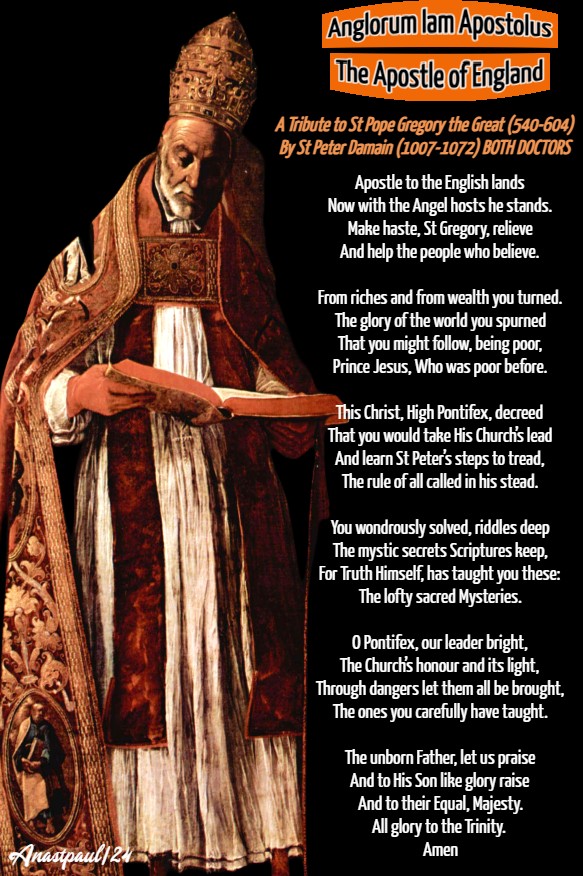
Quote/s of the Day – 12 March – St Gregory the Great (540-604) Pope, Confessor, Father & Doctor of the Church, “Father of the Fathers” “The Apostle of England”
Anglorum Iam Apostolus The Apostle of England By St Peter Damian (1007-1072) Bishop, Confesssor, Father and Doctor A Tribute to his fellow Monk St Gregory the Great (540-604) Pope, Confessor, Father & Doctor of the Church
Apostle to the English lands Now with the Angel hosts he stands. Make haste, St Gregory, relieve And help the people who believe.
From riches and from wealth you turned. The glory of the world you spurned That you might follow, being poor, Prince Jesus, Who was poor before.
This Christ, High Pontifex, decreed That you would take His Church’s lead And learn St Peter’s steps to tread, The rule of all called in his stead.
You wondrously solved, riddles deep The mystic secrets Scriptures keep, For Truth Himself, has taught you these: The lofty sacred Mysteries.
O Pontifex, our leader bright, The Church’s honour and its light, Through dangers let them all be brought, The ones you carefully have taught.
The unborn Father, let us praise And to His Son like glory raise And to their Equal, Majesty. All glory to the Trinity. Amen





























You must be logged in to post a comment.