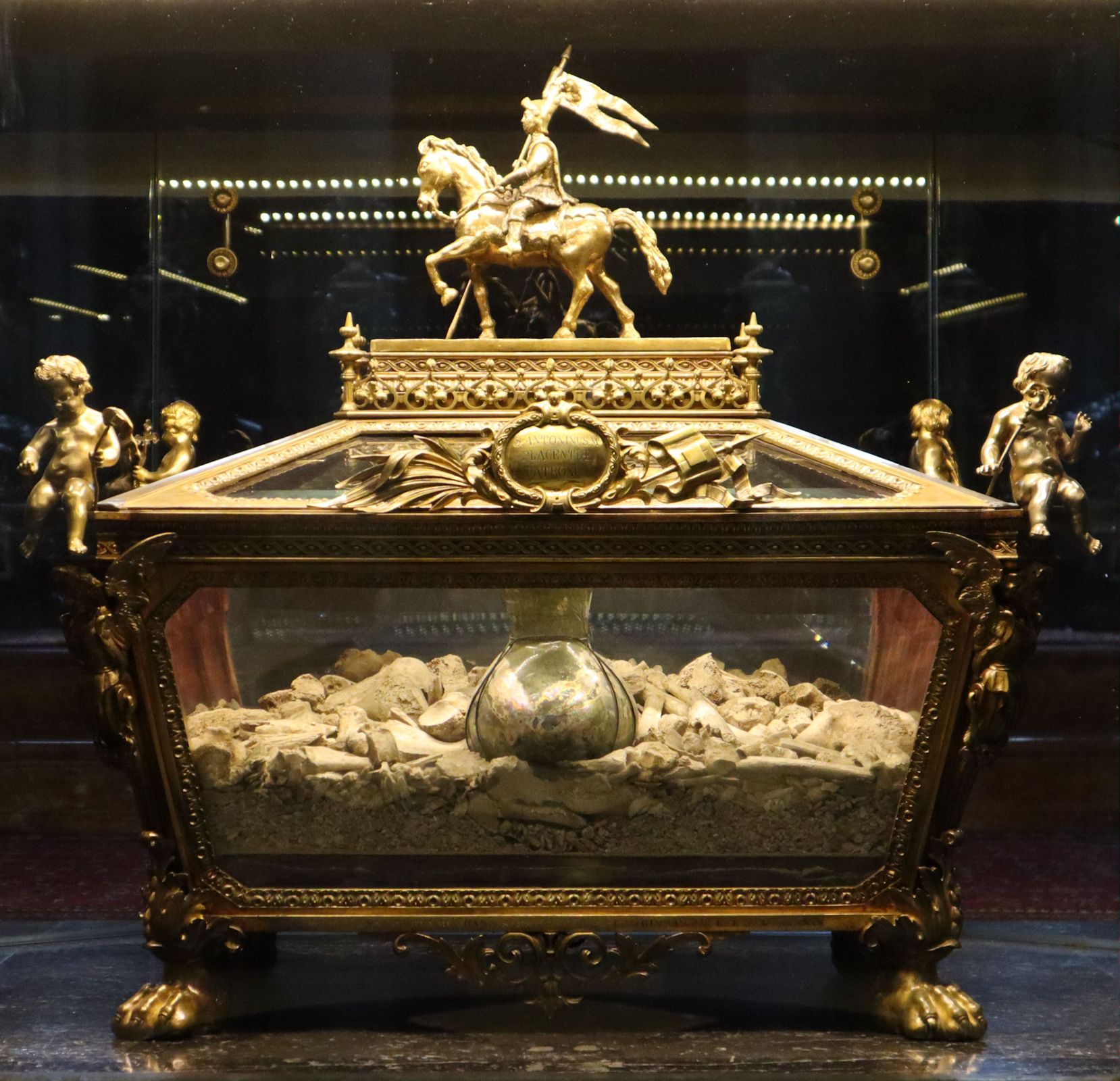
Saint of the Day – 30 September – Saint Antoninus of Piacenza (Died c303) Soldier of the Theban Legion, Martyr. A vial of his blood preserved as a Relic, is known to miraculously liquify. Patronage – of Piacenza, Bedpnia, San Antonino, Travo, Triuggio.Italy. Also known as – Antoninus the Martyr, Antonino… Additional Memorial – 4 July in Piacenza.
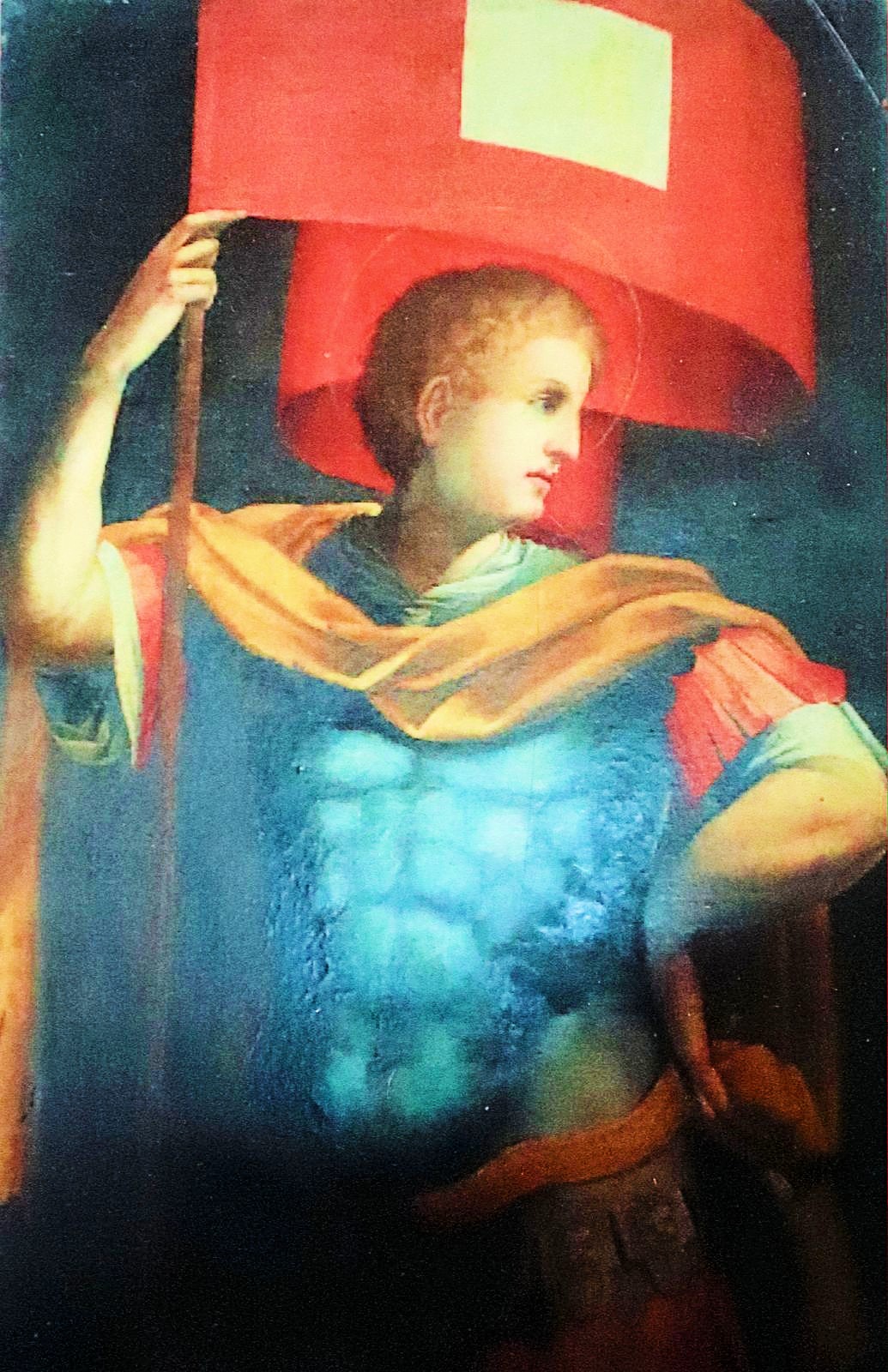
Image in the Basilica of Sant’Antonino in Piacenza
The Roman Martyrology reads today: “At Piacenza, the holy Martyr, Antoninus, soldier of the Theban Legion.”
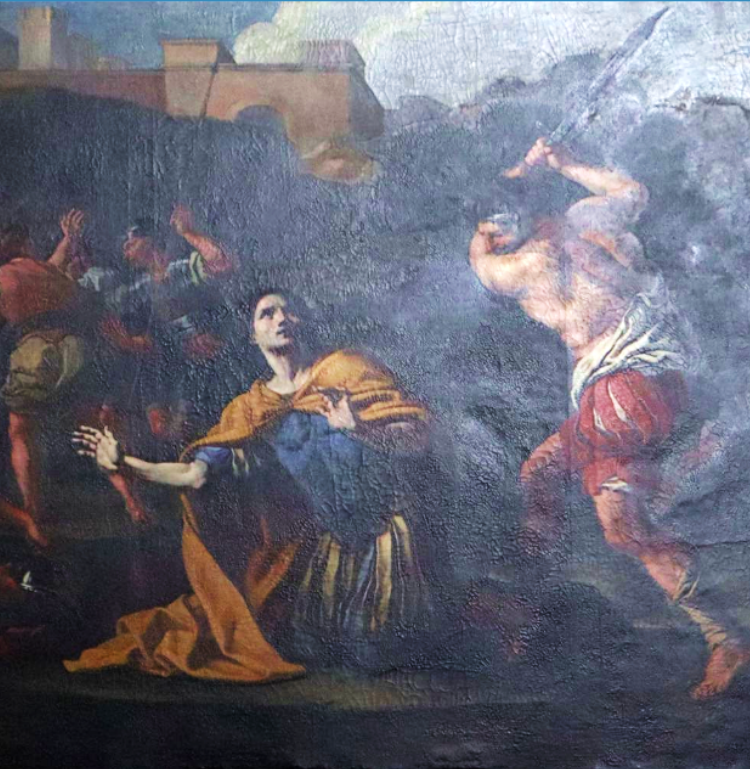
Robert de Longe: Antoninus’ Martyrdom, around 1694, in the Basilica of Sant’Antonino in Piacenza
Antoninus is venerated as a Martyr in the Basilica of St Antoninus – the former Cathedral – in Piacenza, dedicated to him, after Bishop Sabinus of Piacenza found his remains in 386 . Later tradition links his legend to the Thebean Legion of Maurice and Companions.
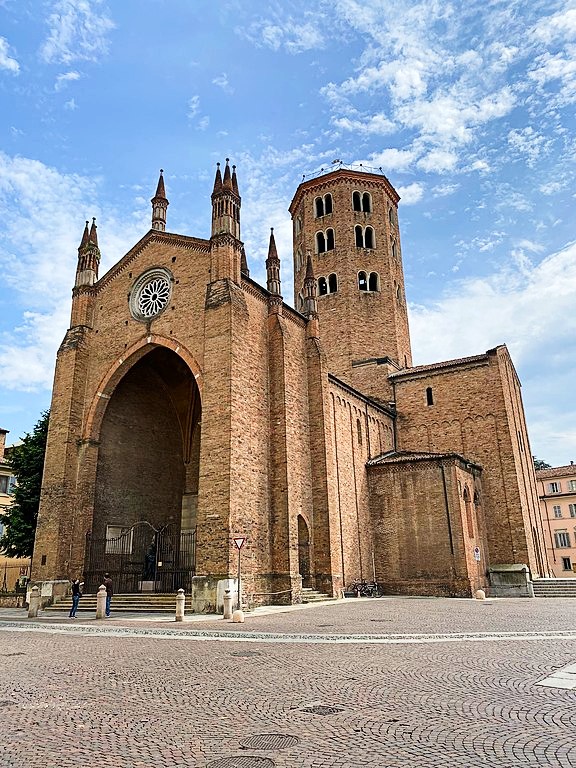
Basilica of Sant’Antonino in Piacenza
Around 396, St Victricius of Rouen knew of Antoninus as a highly venerated Saint with miraculous powers. The Martyrology of Jerome also names the Feast of our Saint as 30 September.
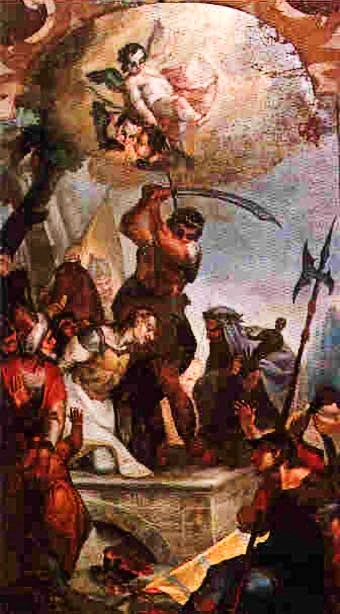
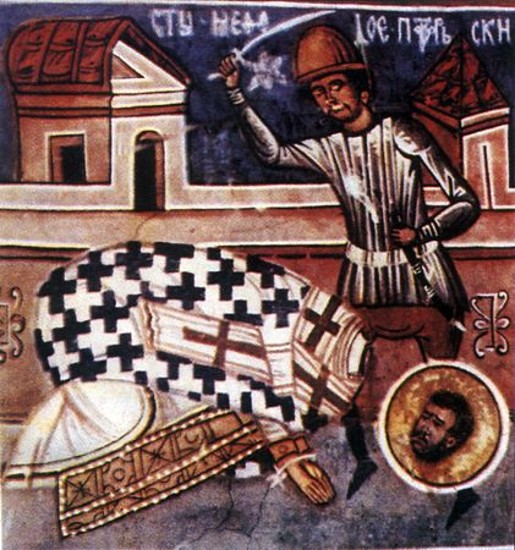
The Martyrdom of St Antininus – Unknown Artist
Around 570 a route to holy places was written and attributed to Antoninus – in fact, the author was an anonymous who began his journey at Antoninus’ tomb in Sant’Antoninus in Piacenza. The version of the legend about the Thebean Legion only comes from the 9th/10th Century.
St Ismidone of Die Bl Jean-Nicolas Cordier Blessed Conrad of Urach St Laurus St Leopardus the Slave St Midan of Anglesey St Simon of Crépy St Ursus the Theban St Victor the Theban
Martyrs of Valsery Abbey: An unknown number of Premonstratensian Monks at the Abbey of Notre-Dame de Valsery, Picardie, France who were Martyred by Calvinists. They were martyred in 1567 at Valsery, Pircardy, France.
Saint of the Day – 29 September – St Grimoaldus of Pontecorvo (Died c1137) Priest and Confessor, Miracle-worker. Also known as – Grimoaldo, Grimoald.
The Roman Martyrology reads: “At Pontecorvo near Aquino, St Grimoaldus, Priest and Confessor.”
There is little certain information about this Saint. Grimoaldus was an English Priest who, after having travelled to Rome as a pilgrim, went first to Aquino and then to Pontecorvo, where, he performed miracles. He died on there on 29 September in around 1137.
According to a long-standing tradition, a certain Giovanni Mele, tempted by the devil and on the verge of losing his life, had an apparition of St John the Baptist, who told him to go to Fr Grimoaldus, who, by then had been appointed as the Archpriest of Pontecorvo and to urge him to continue his life of fasting, prayer and almsgiving. This Mele also had to exhort the people to help Grimoaldus to build a Shrine in St John’s honour. Giovanni Mele, fearing to be taken for a visionary, did not carry out the order; the Saint then sent him another messenger to exhort and urge him to fulfill the task. The people flocked to the site of the apparition and, in 1137 our Saint began to build the Oratory, the foundations of which were blessed by the Bishop of Aquino, Guarino, whom the anonymous writer calls his predecessor.
Translation of St Grimoaldus’ Relics were carried out in 1760, 1862 and 1952 – probably when new Churches were constructed.
THIS festival has been kept with great solemnity on the 29th of September ever since the Fifth Century and was certainly initially celebrated in Apulia in 493. The Dedication of the famous Church of St Michael on Mount Gargano, in Italy, gave occasion to the institution of this Feast in the West, which is hence called in the Martyrologies of St Jerome, St Bede and others, ‘The Dedication of St Michael.’ About the Apparition of St Michael at Mount Gargano in 492: https://anastpaul.com/2018/05/08/saint-of-the-day-8-may-apparition-of-michael-the-archangel-at-monte-gargano-italy-492/
St Dadas of Persia St Diethardus of Eichstätt St Fraternus of Auxerre St Gabdelas of Persia St Grimoaldus of Pontecorvo (Died c1137) Priest and Confessor St Gudelia Bl Jan of Dukla
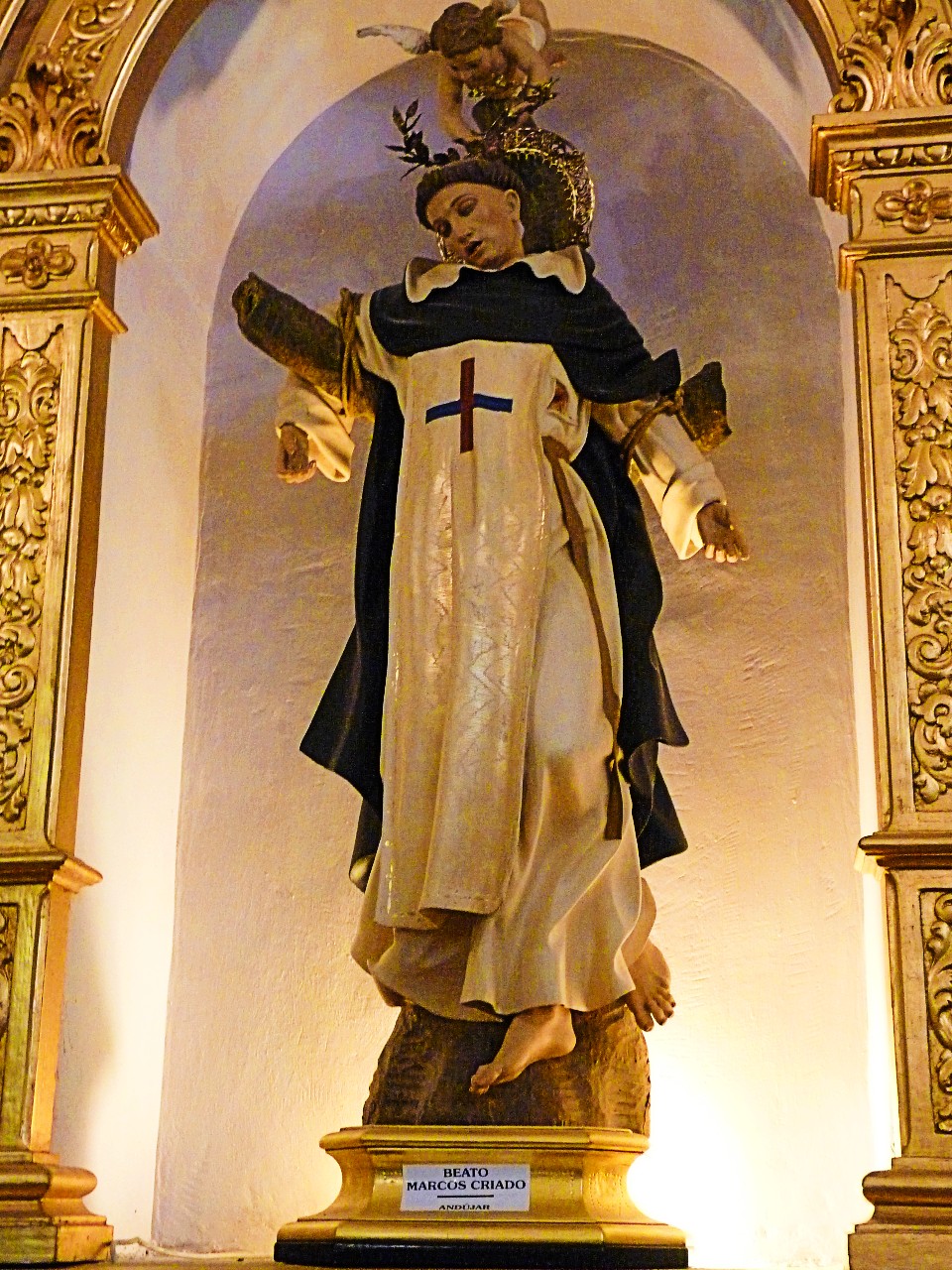
Saint of the Day – 25 September – Blessed Marco Criado OSsT (1522-1569) Trinitarian Priest and Martyr, renowned Preacher, Missionary. Born as Marcus Criado Guelamo on 25 April 1522 in Andujar, Spain and died by being stoned to death on 25 September 1569 (aged 47) near La Peza, Spain. Also known as – Marco Criado Guelamo, Marco Guelamo, Mark.
Marcos Criado Guelamo, better known as Blessed Marco Criado, was born on 25 April 1522 in Andújar (Jaén) and his earthly existence came to a violent end because of his faith in the “Sweet Name of Jesus” in La Peza (Granada) on 24 September 1569. He professed as a Trinitarian (OSsT), distinguished himself for his humility and ability to preach and was Martyred for the Gospel in Las Alpujarras during a Moorish revolt.
Marco Criado was born into a large family with deep Christian roots. He was the youngest of his siblings, the son of Juan Criado Notario, a native of Lahiguera (then La Higuera de Andújar) and María or Marina Guelamo Pasillas, a pious woman from Andujar. From a very young age Marco attended the conventual Church of the Trinitarians in his hometown.
After his mother’s death, he made a pilgrimage to the Shrine of Our Lady de la Cabeza in the Sierra Morena, to pray and commend his soul to God. Following tradition, he slept at the Shrine, asking the Virgin to tell him if it was the divine will that he should enter the Trinitarian Order. Marco Criado, embraced the designs of the Eternal Father and with generosity and humility, followed his vocation. In 1535. he made his Novitiate in the Convent of Andújar. His father also decided to enter religious life and join the Franciscan Order, in the Convent of Arruzafa in Córdoba.
After being Ordained as a Priest, he was later assigned, by his superiors, to the Convents of Andújar, Jaén and Úbeda, where he was given the post of preacher. In Úbeda he combined this mission with the office of Sacristan, a task to which he devoted himself body and soul, to satisfy his yearning for service to the community, with humility and simplicity. Several times he resigned from the highest offices in the Order because of his esteem and desire for a life of evangelical simplicity.
It happened that Archbishop Pedro Guerrero of Granada, concerned about the serious insurrections taking place in the area of the Alpujarras of Granada, met with the Bishops of Almería, Guadix and Málaga, who agreed, first of all, to “send Priests, learned in preaching and exemplary in their Christian life, to the areas most affected by the Moorish uprisings, so that they might devote themselves, with zeal, to reasemble the evangelical seed.”
At the request of the Bishop of Almería, the Trinitarian Provincial Minister of Castile and Andalusia, who was visiting Úbeda, considering the value of Friar Marco to the mission of Alpujarra, agreed that Father Marcos Criado should accompany Father Pedro de San Martín to the Almería Convent to take charge of itinerant preaching, in territories of significant Moorish population, in southeastern Spain. His companion soon died and Marco Criado was left alone, dedicated to his mission among the Moors.
Marco Criado’s apostolic outreach was directed to several localities in the Dioceses of Almería, Granada and Guadix. His preaching focused mainly on the region of the Alpujarras, where there was a large presence of Muslims, a dangerous place for any Christian preacher and also for the Christian inhabitants of the area.
The Town of La Peza became the centre of his missionary activities and was of great support to the local Parish Priest. His zeal in spreading devotion to the Sweet Name of Jesus and his popular sermons, achieved great success.
During one of his missionary journeys, while crossing the Sierra de los Filabres, Marco Criado was captured by a group of Moors, who tied him to a tree for two days. After miraculously surviving, he managed to talk to Abén Cota, leader of the rebellious Moors, to negotiate a peace agreement but this failed. He was tortured, tied to a horse’s tail and dragged for a long time. He was abandoned to his fate, thinking he would die. However, he recovered from his wounds and went on a mission to the regions of Almanzora and Tahá de Marchena, with great success in the Towns of Vera and Cadiar. There, a group of Moors had fled and they had been told to kill him during a sermon.
On Christmas night in 1568 there was a large gathering of Moors in the Alpujarras. On St John’s Eve in 1569, Muslim troops commanded by Aben Homeya decided to return to La Peza. Brother Marco and the Parish Priest were confined to the Parish Church, their movements and words constantly watched. Some exalted ones killed the Parish Priest at the door of the same Church, the same ones who, a few days later, stormed the holy place while Friar Marco was preaching to a small number of Christians who remained in Town. It was 22 September 1569 when Friar Mark was dragged from the Pulpit to the Square where he was stoned to death, after being covered with physical abuse and spit. He was pushed along the road to the Belchite Fountain on the other side of the stream, where he was tied to an oak tree. There he remained, singing hymns and loudly praising the Name of Jesus, until 25 September, when he was killed, tearing out his heart, on which, according to witnesses, the anagram of Jesus had appeared written: “IHS.”
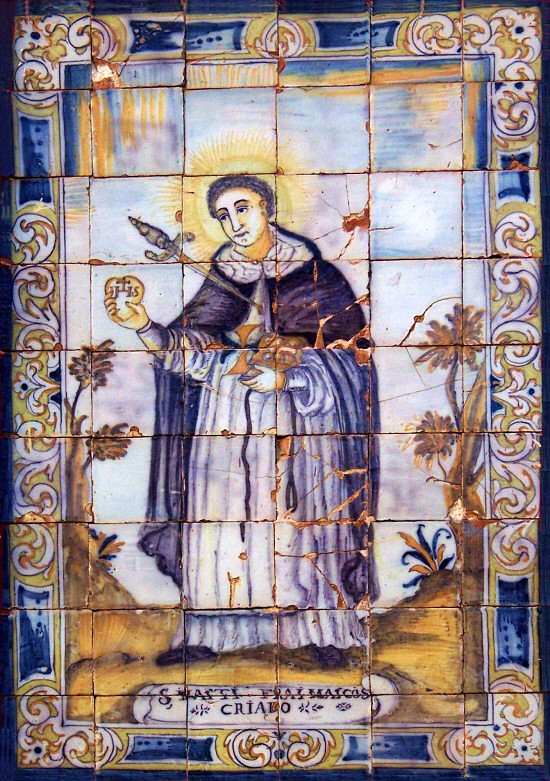
He became known as “the Martyr of the Alpujarras” and his cult was immediately widespread. The people of La Peza call him Saint Macok. To this day, the site of his burial remains a mystery. The iconography depicts him with his heart in his hand and engraved in it, the anagram of Jesus, in memory of the prodigy that, as mentioned, occurred at the time of his Martyrdom. Having collected testimonies of his cult from Father Antonino dell’Assunta, Postulator General of the Discalced Trinitarians, Pope Leo XIII Beatified Marco on 24 July 1899. His liturgical memory is celebrated on 25 September.
“Model of holiness and perennial example, for future generations, of human and spiritual values, rooted in his deep faith in God the Trinity.” Blessed Marco, Pray for us!
Blessed Herman of Reichenau/the Cripple (1013–1054) Benedictine Monk, Confessor, Scholar, Scientist, Writer, Hymnist, Poet, Musical Composer, Teacher. In his own day, the heroic cripple who achieved learning and holiness was called ‘The Wonder of His Age.’. Composer of the “Salve Regina” Hail Holy Queen, “Veni Sancte Spiritus” Come Holy Spirit and “Alma Redemptoris Mater” amongst many others. His Amazing Life and Works: https://anastpaul.com/2019/09/25/saint-of-the-day-blessed-herman-of-reichenau-the-cripple-osb-1013-1054-the-wonder-of-his-age/
St Fymbert Blessed Marco Criado Guelamo OSsT (1522-1569) Trinitarian Priest Martyr St Mewrog St Neomisia of Mecerata St Paphnutius of Alexandria St Principius of Soissons St Solemnis of Chartres
Martyrs of Damascus: A Christian family of six who were tortured to death in a persecution by Roman authorities. They were: Eugenia, Maximus, Paul, Rufus, Sabinian and Tatta. They were tortured to death in Damascus, Syria, date unknown.
The Holy Bishops of Milan: Imagine being part of a Diocese in which 36 of your past Bishops are Saints and some are also Doctors of the Church and Popes (and others being considered for Sainthood)! Today, the Church in Milan commemorates these holy Bishops. They are:
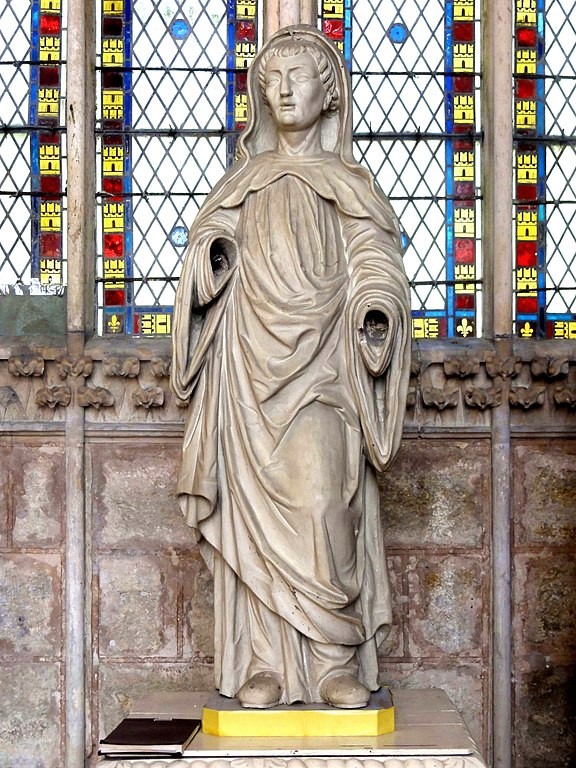
Saint of the Day – 24 September – St Geremarus (c608-658) French Priest, Abbot, Founder of Monasteries. Born in c608 in Vardes, Neuf-Marché, France and died in 658 near Beauvais, France of natural causes. Also known as – Germer de Fly, Geremar, Geremaro. He appears in the Roman Martyrology: “In the Diocese of Beauvais, St Geremarus, Abbot.”
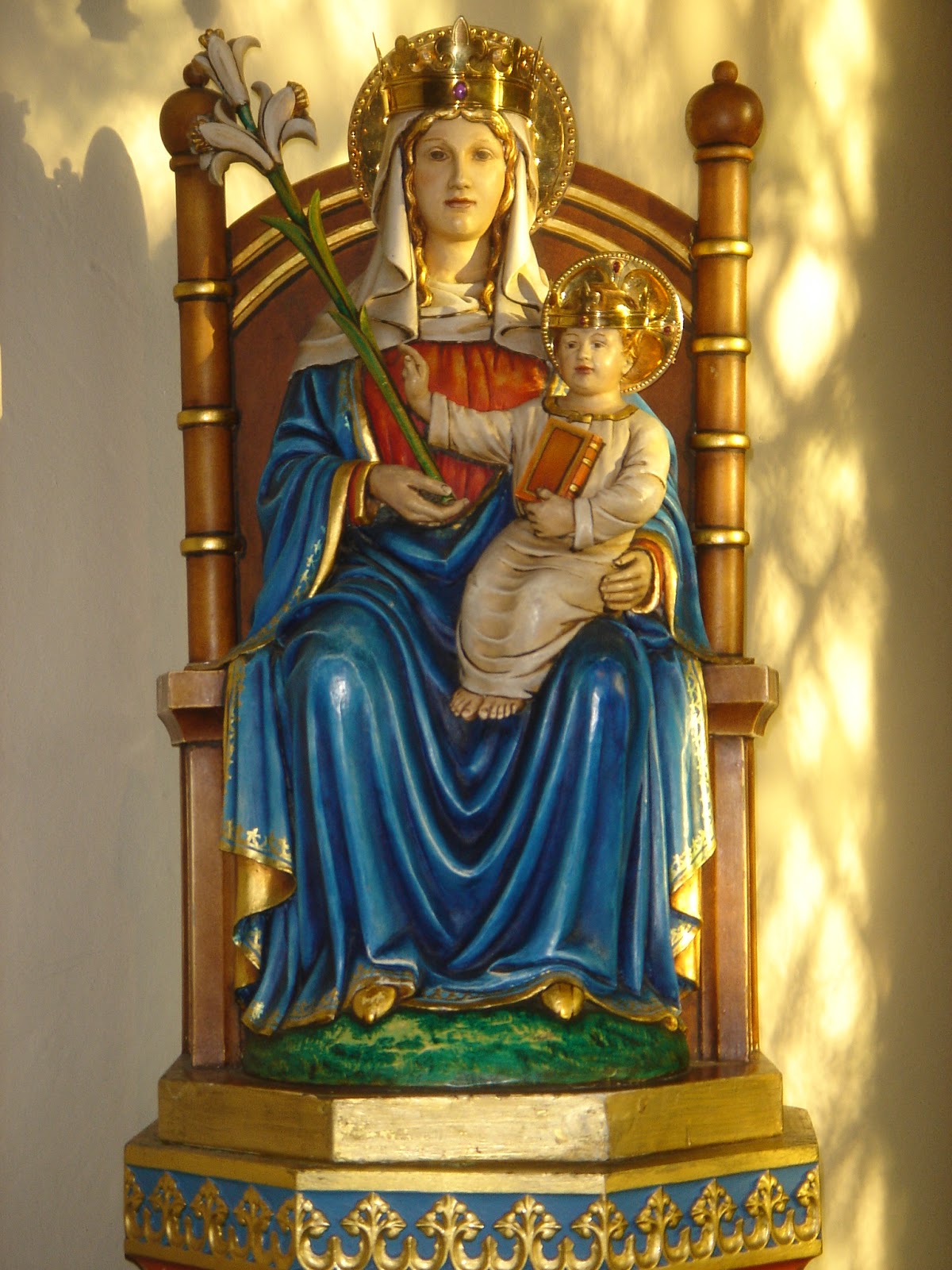
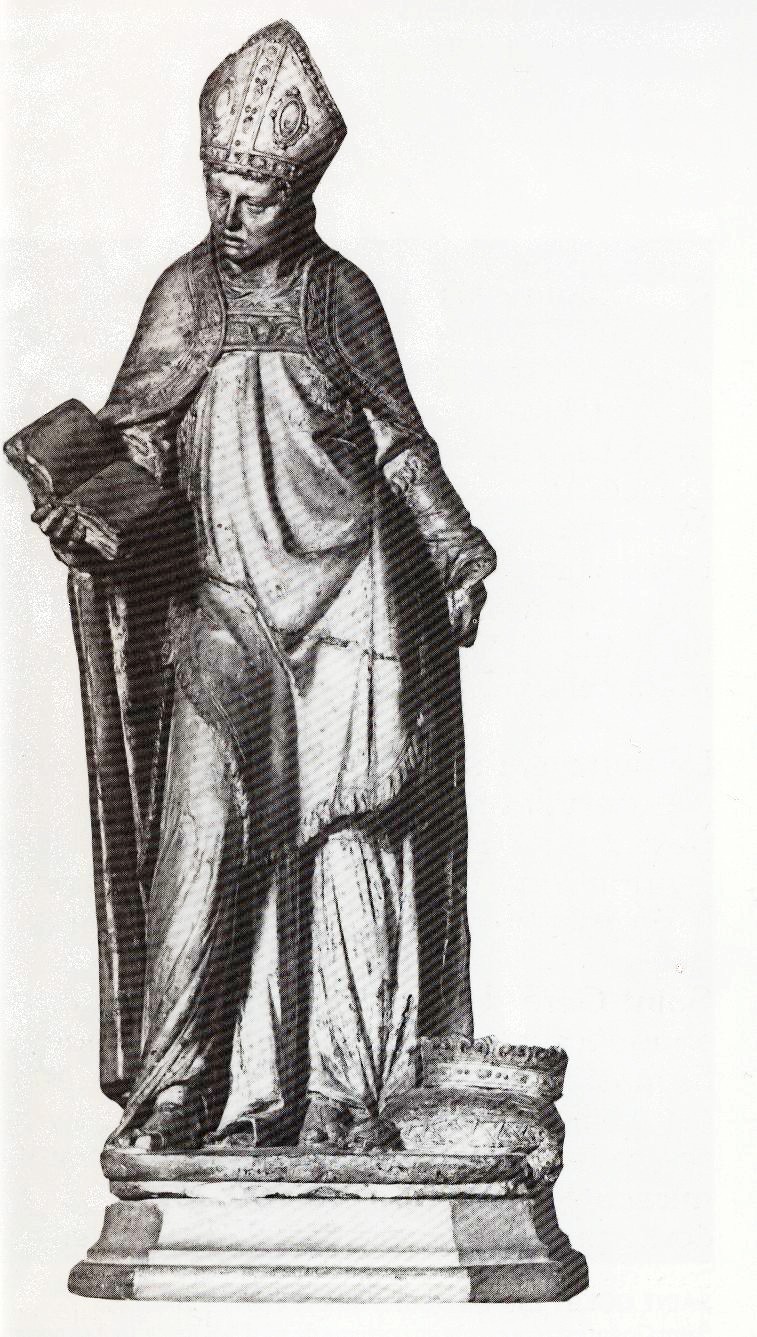
Statue of St Geremarus in the Chapel of Saint-Germer-de-Fly Abbey
Geremarus’ parents, Rigobert and Aga, were of the prime nobility in the territory of Beauvais. He was born at their Castle in the Village Warandra and was educated at the Cathedral school in Beauvais.
Geremarus married a pious lady named Domana and held high positions in the Courts of the Merovingian Kings, Dagobert and Clovis. the couple were blessed with two daughters and a son.
Geremarus met St Audoin (c605-684) Bishop of Rouen, at Dagobert’s Court and on his advice founded the Isle-sur-Epte Monastery in honour of Saint Peter. St Audoin also Ordained Geremarus to the Priesthood. This Monastery was afterwards destroyed by the Normans and is now an estate belonging to Saint Geremarus Abbey.
Again by the advice of Saint Audoin’s, Geremarus made his monastic profession in the Monastery of Pental, in the territory of Rouen. He was soon after chosen Abbot but finding the Monks averse to regularity he left the Abbacy and led an Hermit’s life in a cave near the river Seine. This lastest for 5 1/2 years.
When his only son, Amalbert, died and was buried in Saint Peter’s Monastery, the family estate reverted to Geremarus from his son and with the proceeds he founded the Monastery of Fly or Flaviacum, near Beauvais, now dedicated to our Saint. There he assembled a community of fervent Monks.
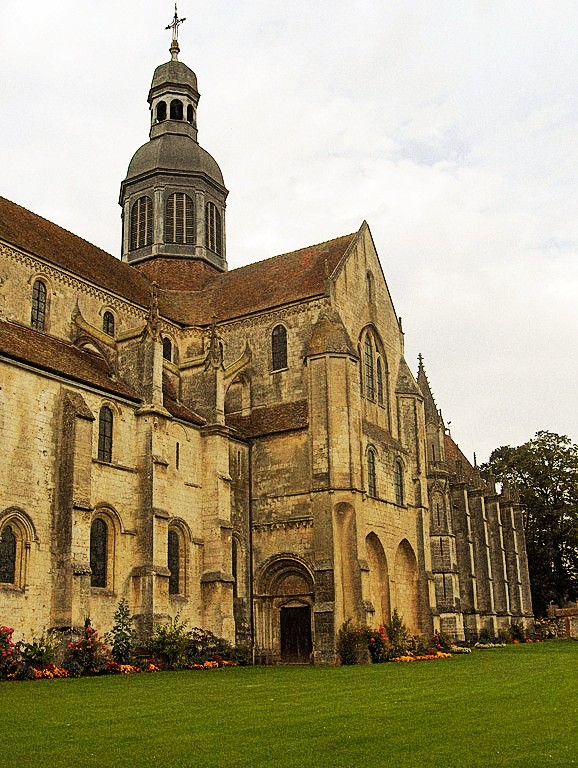
St Geremarus Abbey in Fly
Having governed this house for 3 1/2 years, he happily died on the 24th of September 658. His body was interred in the Church of his Abbey which soon after took his name. His Relics, for fear of the Norman plunderers, were conveyed secretly to Beauvais, where they are still kept in the Cathedral, except the bones of one arm, which have been given back to Saint Geremarus’ Monastery. In August of 1643 Bishop Potier of Beauvais, placed Monks of the congregation of Saint Maur in this Abbey,and erected there, a great school.
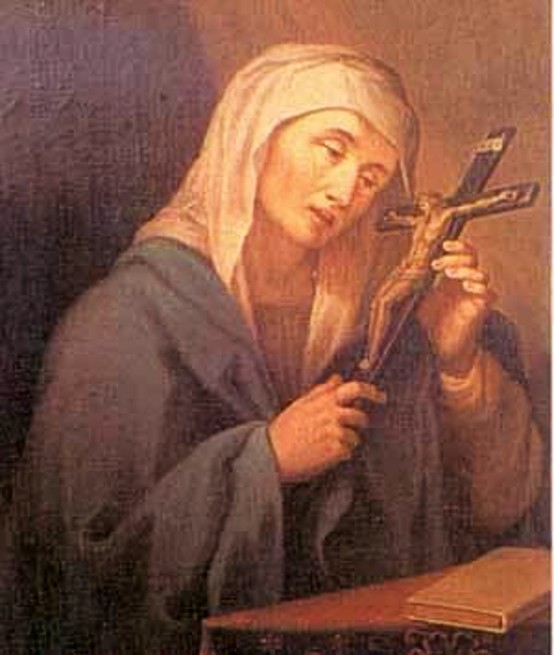
Saint of the Day – 23 September – Blessed Elena Duglioli (1472-1520) Widow Born in 1472 at Bologna, Italy and died on 23 September 1520 of natural cause, aged 48. Also known as – Elena Duglioli Dall’Olio, Hélène, Helen of Bologna. Elena was Beatified on 26 March 1828 by Pope Leo XII. Her body is incorrupt.
Unfortunately we have scant information on Elena’s life. Elena Duglioli was born in Bologna in 1472 to the aristocrats Notary Silverio Duglioli and Pentisilea Boccaferri.
During her childhood and adolescence, she desired to become a professed religious and decided to enter the Poor Clare Convent of Corpus Domini, Bologna. Her parents, however, wished her to marry and to obey and please them, she agreed to marry the much older Senator Benedetto dall’Olio.
The marriage took place in 1487 when she was 15 years old to the 40 year old Senator. Elena who greatly desired to Consecrate her virginity to God was able to bring Benedetto to agree to maintain total chastity in their marriage (this information is unconfirmed, hence her title remains ‘Widow’). The marriage proved happy and successful with both husband and wife living in admirable union and in complete harmony. Benedetto died after they had been together for 30 years.
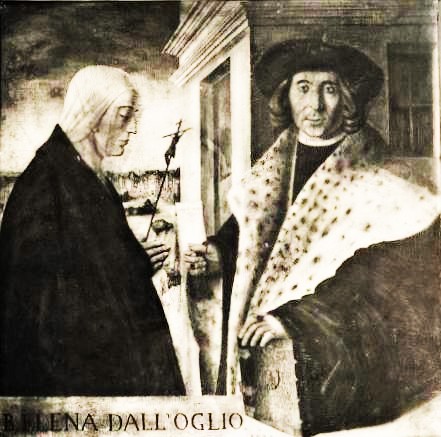
Bl Elena with her husband Benedetto
Having become a widow, she devoted herself to pious works with even greater zeal.
Elena bore a particular devotion to Saint Cecilia and the Papal Legate to Bologna – Cardinal Francesco Alidosi – gave her a knucklebone Relic of St Cecilia. Her devotion to the Saint led her to commission the construction of a Church where the Artist, Raphael, would paint an image of the Saint Cecilia.
Elena died on 23 September 1520. Her incorrupt remains are housed in the Church of San Giovanni in Monte.
The Beatification received official confirmation on 26 March 1828 once Pope Leo XII approved her local cultus. Prospero Lorenzo Lambertini – the future Pope Benedict XIV – spoke in favour of Elena’s Beatification.
St Pope Linus (c 10 – c 76) Successor to St Peter. Papacy lasted from c 67 to his death as a Martyr. Among those to have held the position of Pope, Peter, Linus and Clement are specifically mentioned in the New Testament. Linus is mentioned in the closing greeting of the Second Epistle to Timothy as being with Paul in Rome near the end of Paul’s life. About St Pope Linus: https://anastpaul.com/2018/09/23/saint-of-the-day-23-september-st-pope-linus-c-10-c-76-successor-to-st-peter/
St Cissa of Northumbria St Constantius of Ancona Blessed Elena Duglioli (1472-1520) WidowHer body is incorrupt.
Bl Guy of Durnes St Peter Acontanto St Polyxena
St Sosius (275-305) Confessor, Deacon and Martyr. His holiness and wisdom drew many Prelates to his feet, seeking spiritual assistance. St Sosius was a Deacon of Misenum, an important naval base of the Roman Empire in the Bay of Naples. The Roman Martyrology reads: “At Capo Miseno in Campania, St Sosius, Deacon and Martyr, who, as Pope St Symmachus reports, wishing to save his Bishop from death, instead found death together with him, obtaining equal glory at the same price.” His Life and Death: https://anastpaul.com/2022/09/23/saint-of-the-day-23-september-saint-sosius-275-305-confessor-deacon-and-martyr/
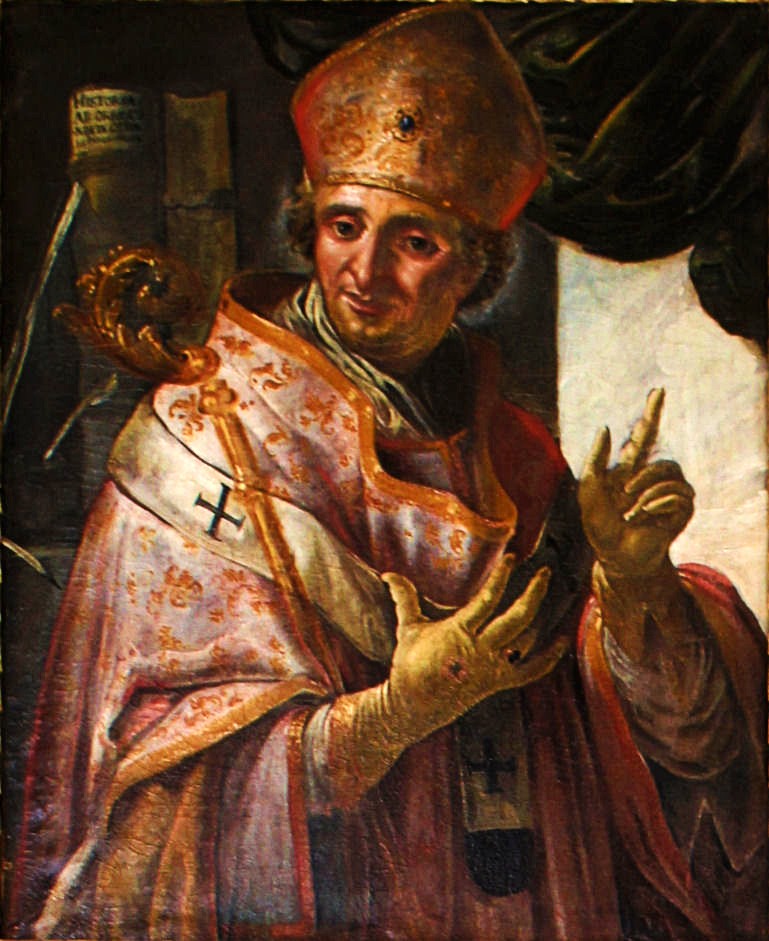
Saint of the Day – 22 September – Blessed Otto of Freising O.Cist. (c1111-1158) Bishop of Freising, Cistercian Priest and Abbot Historian, Reformer, Diplomatic Peace-maker, Defender of the Church, Crusader. Born between 1111 and 1114 in Klosterneuburg near Vienna, Austria and died at Morimond, Champagne, France, on 22 September, 1158 at the young age of 47 at the most. Also known as – Ottone. Additional Memorial – 7 September (Freising and Vienna).
Otto was as the fifth son of Leopold III, Margrave of Austria, by his wife Agnes, daughter of the Emperor Henry IV. By her first husband, Frederick I of Hohenstaufen, Duke of Swabia, by whom she was widowed, Agnes was the mother of the German King, Conrad III and grandmother of the Emperor, Frederick I. Otto’s sister, Judith, was married to Marquess William V of Montferrat. Otto was thus related to the most powerful families in Germany and northern Italy.
Like his younger brothers, he was destined for the Priesthood and when a very young adult, he was made Provost of the Chapter of Canons at Klosterneuberg. For his education, he was sent to the University of Paris, the centre of learning, philosophical, theological and classical.
Whilst travelling towards his homeland after completing his studies, he together with fifteen colleagues, all noblemen, entered the Cistercian Order at Morimond. It is not known what led him to take this step but it seems, by the attendance of his friends that they had contemplated, discussed and spent time in prayer before making this decision. Within three years Otto was elected Abbot of the Monastery. In 1133, Otto now convinced his father to found Heiligenkreuz Abbey, thus bringing literacy and sophisticated agriculture (including wine making) to the region that would become Vienna.
Probably in 1137 or 1138, Otto was called to Freising as Bishop, although he did not lay aside the Habit of his Order.
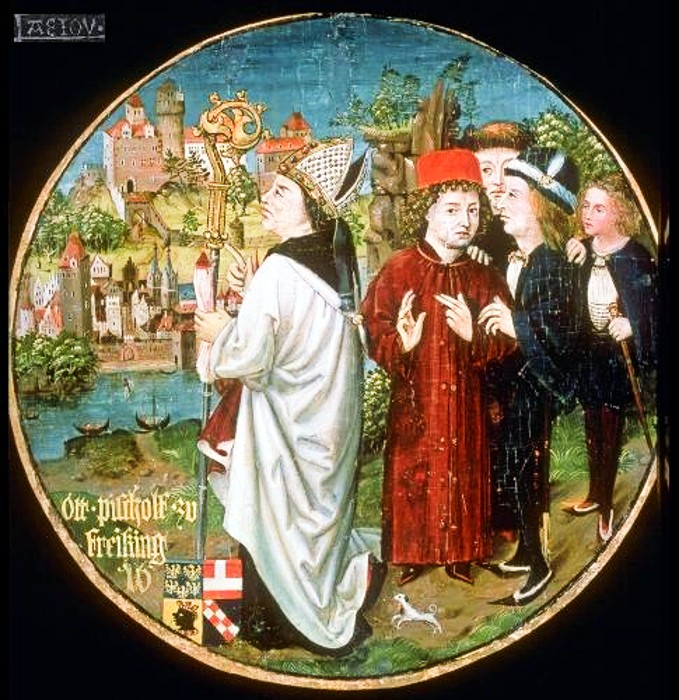
Painting of Blessed Otto of Freising by Hans Part in the Babenberger Stammbaum, ca. 1490, Stift Klosterneuburg. The Bishop is looking at the Cathedral and the City of Freising from the east bank of the Isar river.
As Bishop, Otto displayed a highly beneficent activity by founding and reforming Monasteries and zealously furthering studies by introducing Aristotelian philosophy and scholastic disputations on the model of the University of Paris. As a result, the school at Freising flourished anew.
He removed many of the abuses which had slowly infiltrated the Church and the secular institutions, in consequence of the investiture strife and demanded the return of the properties of which the Church had been robbed. In every way, Ottoe raised the prestige of the Church in Freising as against the nobility and after bitter struggles, freed it from the burdensome jurisdiction of certain Count. As Prince of the German Empire and closely connected with the Hohenstaufen family, he possessed great influence and used his high standing to obtain relief for the Church.
He was especially active in bringing about a reconciliation between Frederick and Henry and in restoring peace between the Emperor and the Pope.
In 1147 he accompanied King Conrad III on his unsuccessful Crusade to the Holy Land. The military division entrusted to Otto was completely routed and he, himself returned home after undergoing the severest privations and facing the greatest dangers. In 1158, due to ill health, Otto was forced to abandon his preposed accompaniment of Emperor Frederick on his march into Italy.
Otto is considered one of the most important historions of the High Middle Ages. Thanks to his excellent education and his noble position, he had access to numerous documents and information on history and politics. His works do not aim to be mere records but above all, to proclaim theological, philosophical and political messages. His “Chronica sive Historia de duabus civitatibus” (The Chronicle or History of the Two States) contains the history of the world in seven books and a vision of the Last Judgment in the eighth book. Otto writes this work as a theological continuation of St Augustine’s “De civitate Dei.” In contrast to St Augustine, Otto sees the Civitas Dei already realised on earth: it consists in the harmony of spiritual and secular power.
From 1156 onwards, Otto wrote the first two books of the “Gesta Friderici Imperatoris” (The Deeds of Emperor Frederick). In them he reproduces several imperial documents in their wording. Above all, he highlights the work of Emperor Friedrich Barbarossa. But this latter work is not confined to Germanic affairs, as tOtto digresses to tell of the preaching of St Bernard of Clairvaux and of his zeal against the heretics. Before his death, Otto commissioned his loyal secretary and Chaplain, Fr Rahewin (Died c1177) to complete this work.
On the way to the General Chapter in 1158 in Cîteaux, Bishop Otto reached his Monastery, Morimond, already ill. He died there surrounded by his monastic brothers. Otto’s body was buried in the Abbey Church of Morimond. Under the Sacramental Altar of the Cistercian Abbey Church of Heiligenkreuz, the bones, which were discovered in 1954 in the ruins of the Morimond Abbey Church and examined from 1966 to 1969 by the Anthropological Department of the Natural History Museum in Vienna, are venerated as Relics of Blessed Otto.
Otto is named as a Blessed with a Memorial day of 7 September in the Archdioceses of Vienna and Munich-Freising and in some Cistercian Monasteries, his memorial day is also celebrated on 7 September.
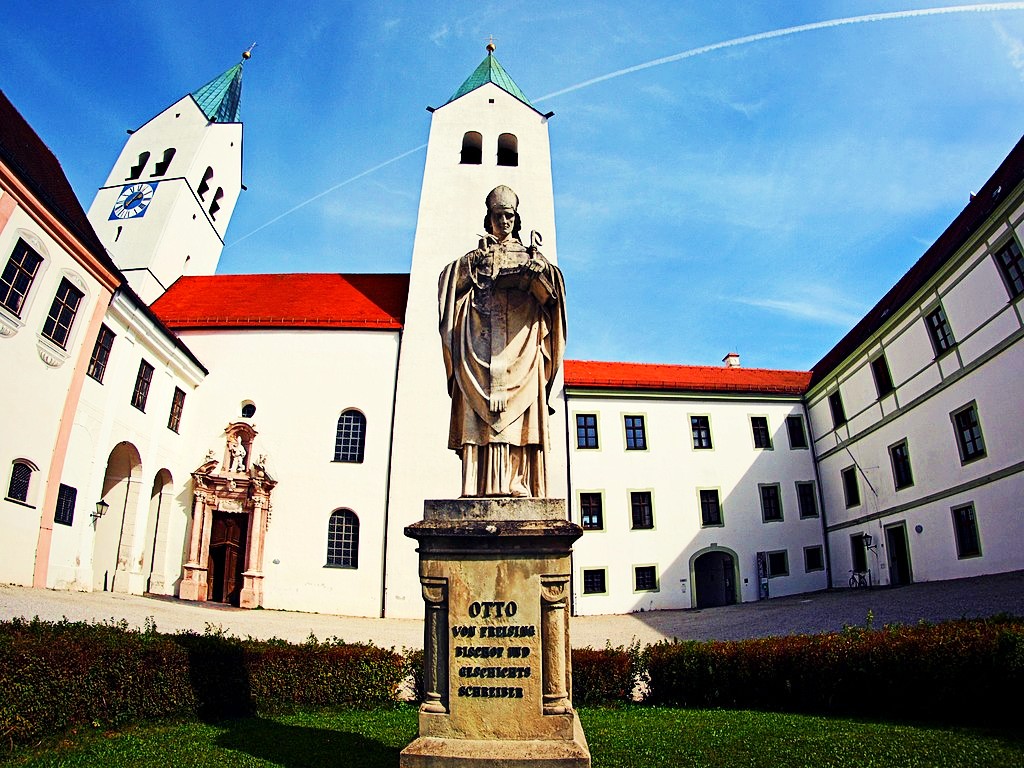
The Statue below is situate at Weihenstephan Abbey which was founded by Bl Otto’s father at Otto’s request. Sadly, it is no longer a working Monastery but it still produces beer and is the oldest brewery in the world.
St Thomas of Villanueva/Villanova OSA (1488-1555) Archbishop, Confessor, Religious Priest of the Order of St Augustine,Writer, Preacher, Teacher, Apostle of Charity, Mystic, Miracle-Worker often called “the Almsgiver” and “the Father of the Poor“, Reformer. Canonised on 1 November 1658 by Pope Alexander VII. About St Thomas here: https://anastpaul.com/2017/09/22/saint-of-the-day-22-september-st-thomas-of-villanova-o-s-a/
St Maurice & Companions: Martyrs of the Theban Legion: + Martyrs (c 287) A Roman imperial legion of 6,600 soldiers, all of whom were Christians; they had been recruited from the area around Thebes in Upper Egypt, were led by Saint Maurice and served under Emperor Maximian Herculeus. Around the year 287, Maximian led the army across the Alps to Agaunum, an area in modern Switzerland, in order to suppress a revolt by the Bagandre in Gaul. In connection with battle, the army offered public sacrifices to the Roman gods; the Theban Legion refused to participate. For refusing orders, the Legion was decimated – one tenth of them were executed. When the remainder refused to sacrifice to the gods, they were decimated again. When the survivors still refused to sacrifice, Maximinian ordered them all killed. Martyrs. https://anastpaul.com/2018/09/22/saints-of-the-day-22-september-st-maurice-and-the-martyrs-of-the-theban-legion-martyrs-c-287/
Bl Alfonso da Cusco St Basilia St Digna of Rome St Emerita of Rome St Emmeramus St Florentius the Venerable
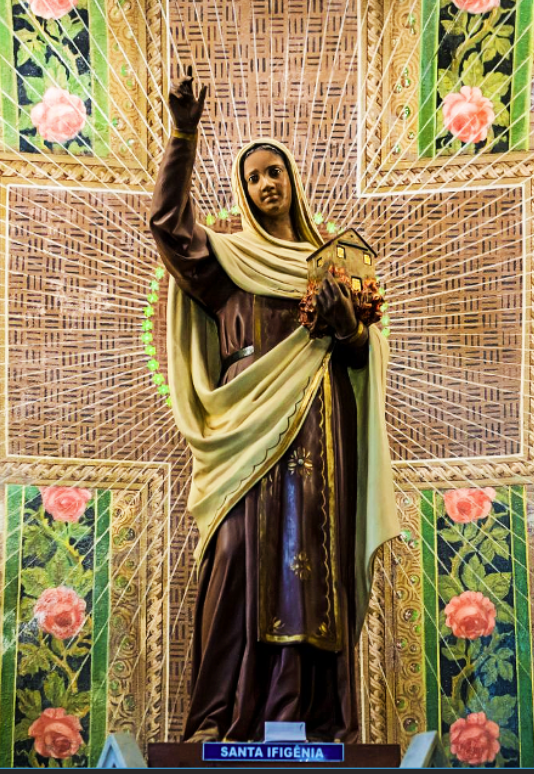
Saint of the Day – 21 September – Saint Iphigenia of Ethiopia (1st Century) Virgin, Princess, Abbess, Converted, Baptised and Consecrated to God by St Matthew, the Apostle and Evangelist and sharing his Feast day today. Also known as – Ephigenia, Iphigenia of Abyssinia.
The Roman Martyrology reads today: “In Ethiopia, St Iphigenia, virgin, who being Baptised and Consecrated to God by the blessed Apostle, St Matthew, ended her holy life in peace.”
Iphigenia was born a Princess to the Royal House of Ethiopia in the 1st Century. As a nation steeped in the paganism of the era, Ethiopia was to become witness to St Matthew the Apostle and Evangelist, who spread the Gospel there and converted much of the people.
Although we know little for certain about the events that transpired, an idea of her conversion and the efforts of the Apostle can be garnered from the 13th Century, “Golden Legend” by Blessed James of Voragin OP c1226-1298) the Archbishop of Genoa. Originally in Latin, it was the most widely read book during the late Middle Ages. This legend gives detail to St Matthew’s travels in Africa – his story is closely bound to the Princess Iphigenia.
“The Ethiopian King, at the time of St Matthew’s arrival, was named Egippus. He sent for all the men in his Provinces saying to them: “Come and see ye God in the likeness of a man.” Upon this, the people came with crowns of gold and divers manner of sacrifices and would have sacrificed to him. St Matthew beheld them and said: “What do ye men? I am not God but I am servant of our Lord.“
[Therefore, from the resources brought, they instead built a Church for the glory and honour of the Lord]. In which Church the Apostle sat three and thirty years and converted all Ethiopia to the Faith of Christ. The King Egippus, with his wife and his daughter,Iphigenia and all the people, were Baptised. And then the apostle hallowed to God Iphigenia the King’s daughter and made her mistress and governess of more than two hundred virgins.
And after this, Hirtacus succeeded to the King and coveted the said virgin Iphigenia and the Apostle said to him that after the custom of his predecessor, he should come on the Sunday to the Church and Iphigenia being present with the other virgins, he should hear what he should say of the goodness of lawful marriage.
And when the virgins and all the people were assembled, he spoke long of good and lawful matrimony and he made rehearsal of his sermon saying that marriage is good if it be truly held by good alliance. But ye that be here, know ye well that if any servant would take the wife of a king wedded, he should not only run to the offence of the king but above that, he should deserve death and not for to wed her but for that he in so taking the spouse of his lord should corrupt the marriage joined. And thou the king that knew that Iphigenia is made the spouse of the King perdurable [eternal] and is sacred with the holy veil, how mayst thou take the wife of a more puissant [powerful] king and couple her to thee by marriage?
And when the King heard this he began to enrage and departed [in a] frantic rage. And the Apostle without dread confirmed all the others to patience. And Iphigenia, Iying before him for dread, he blessed and all the other virgins too. And after the solemnities of the Mass, the King sent a tormentor, with a sword behind him, which slew Matthew, who was standing by the Altar holding up his hands unto Heaven and so was consecrated a Martyr.
[Following Hirtacus’ death sometime later] the people then established for to be King, the brother of Iphigenia whom the Apostle had Baptised too and reigned seventy years and established his son for to be King after him and increased much the honour of Christianity and replenished all Ethiopia with noble Churches of our Lord.”
St Alexander of the Via Claudia St Eusebius of Phoenicia St Gerulph St Iphigenia of Ethiopia 1st Century) Virgin converted by St Matthew, the Apostle and Evangelist St Isaac of Cyprus St Jonas the Prophet St Landelino of Ettenheim
St Maura of Troyes St Meletius of Cyprus St Pamphilus of Rome
Martyrs of Gaza – 3 Saints: Three brothers, Eusebius, Nestulus and Zeno, who were seized, dragged through the street, beaten and murdered by a pagan mob celebrating the renunciation of Christianity by Julian the Apostate. They were burned to death in 362 on a village garbage heap in Gaza, Palestine.
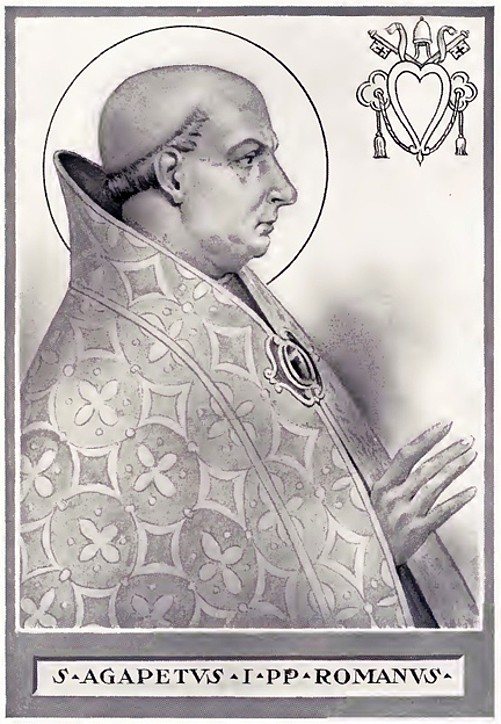
Saint of the Day – 20 September – St Pope Agapetus I (c489-536) the 57th Bishop of Rome Papal Reign from 13 May 535 – 22 April 536. Agapetus was born in Rome, although his exact date of birth is unknown. He was the son of Gordianus, a Roman Priest who had been slain during the riots in the days of Pope Symmachus (term 498–514). The name ‘Gprdianus’ might point to a familial relationship with 2 Popes – Felix III (Reign – 483–492) and Gregory I the GREAT (Reign – 590–604).
Agapetus was Ordained as a Deacon perhaps as early as 502, then elevated to Archdeacon and from there to Suprme Pontiff on 13 May 535.
As Pope, he confirmed the Decrees of the Council held at Carthage, after the liberation of Africa from the Vandal yoke, according to which, converts from Arianism were declared ineligible to Holy Orders and those already Ordained, were merely admitted to lay communion.
Agapetus assisted the Servant of God, Senator Cassiodorus, in the founding of his Monastery, named Vivarium in Calabria, Italy.
He accepted an appeal from Contumeliosus, Bishop of Riez in France, whom a Council at Marseilles had condemned for immorality and he ordered St Caesarius of Arles, the Archbishop, to grant the accused a new trial before Papal delegates, the outcome we believe went against Bishop Contumeliosus.
During his short Papacy, the Byzantine Empire, under the helm of General Belisarius, looked to invade Italy. It was the Ostrogothic King, Theodahad who informed Pope Agapetus of this. Following his advice, Agapetus and five Bishops, left in winter to meet with the Byzantine Emperor Justinian I. They made it to Constantinople in February of 536. Unfortunately, Emperor claimed he could not prevent Belisarius.
Seeing the situation as a religious issue and not as a political problem, Agapetus sought out the Byzantine Patriarch, Anthimus I. Things quickly unraveled into a heated debate of faith and power. Agapetus questioned Anthimus I’s faith, demanding a written confession of faith and that he resign as Patriarch. When Anthimus refused, Agapetus further and more vigorously questioned him. To this, Emperor Justinian I said he would banish the Pope if need be!
Agapetus replied with spirit: “With eager longing have I come to gaze upon the Most Christian Emperor Justinian. In his place I find a Diocletian, whose threats, however, terrify me not!” This intrepid language made Justinian pause and being finally convinced that Anthimus was unsound in faith, he made no objection to the Pope’s exercising the plenitude of his powers in deposing and suspending the intruder and, for the first time in the history of the Church, personally Consecrating his legally elected successor, Mennas. This memorable exercise of the Papal prerogative was not soon forgotten by the Orientals, who, together with the Latins, venerate him as a Saint even before death.
In order to clear himself of every suspicion of abetting heresy, Justinian delivered, to the Pope, a written confession of faith which the latter accepted with the judicious proviso that “although he could not admit, in a layman. the right of teaching religion, yet, he observed, with pleasure that the zeal of the Emperor was in perfect accord, with the decisions of the Fathers.”
Shortly afterwards, Agapetus fell ill and died, after a glorious and very busy reign of just ten months. His remains were brought in a leaden coffin to Rome and deposited in St Peter’s. His memory is kept on 20 September, the day of his deposition.
St Pope Agapetus I (c489-536) Bishop of Rome Papal Reign from 13 May 535 – 22 April 536 St Candida of Carthage St Clicerius of Milan Bishop St Dionysius of Phrygia St Dorimedonte of Synnada St Eusebia of Marseilles St Evilasius of Cyzicum St Fausta of Cyzicum St Glycerius of Milan Bl John Eustace St Priscus
Martyrs of Constantinople – 3 Saints: A Priest and two Bishops who were imprisoned, tortured and Martyred for the defence of icons in the iconoclast persecutions of Emperor Leo the Isaurian. – Andrea, Asiano and Hypatius. They were Martyred in 735 in Constantinople (modern Istanbul, Turkey) and their bodies were thrown to the dogs.
Martyrs of Pergen – 6 Saints: A group of lay people Martyred in the persecutions of Emperor Elagabalus. The names that have come down to us are Dionysius, Dioscorus, Philippa, Privatus, Socrates and Theodore. They were crucified c 220 at Pergen, Pamphylia, Asia Minor (in modern Turkey).
Saint of the Day – 19 September – Saint Goeric of Metz (c570-c643), Bishop of Metz. Goeric was married and a father, Courtier and Soldier of hjgh rank. In the official catalogues of the Diocese, Goeric is listed as the 30th Bishop of Metz, having governed that See from 625 to 642 or 643. Born in c570 in Aquitaine, Gaul and died in c643 in Metz, in today’s France, of natural causes. Also known as – Abbo I of Medtz, Abbone, Goerico, Goericus, Goëry, Goéry. Additional Memorial 15 April (Translation of Relics). In the Germanic Martyrologies, in that of Metz and other Cities of Gaul, he is remembered on 19 September as “Bishop and Confessor, admirable for holiness, amiable to his subjects.”
Goeric was born in Aquitaine, between 565 and 575, son, apparently, of Gamard and nephew of his predecessor Bishop, Saint Arnulf, whose remains he recognised in Remiremont in 641 and brought them back to Metz.
Goeric was a Courtier at the Court of King Dagobert I (628-639) and was married. He is said to have had two daughters – Vittorina and Precia (or Aprincia), the latter on whom, he himself imposed the veil of virginity as Bishop and, who later became a Saint.
According to all the documents that tell us about him, Goeric was a valiant warrior, he won numerous victories against the barbarians and thanks to his extraordinary skills as a Captain, he went through all the levels of his military career, reaching the highest dignities.
Being wounded in a clash, he lost his sight and that he bore this unhappiness with Christian patience. In response to what he felt was a supernatural command, he decided to make a pilgrimage to the Cathedral of St Stephen, the seat of the Bishop in Metz, where his uncle, Saint Arnulf (580-640), was the Bishop (613-628). He set off with his daughters Precia and Victorina. to guide him, and when they reached Metz, he went straight to the Church. There, he regained his sigh while praying. In gratitude, he decided to become a Priest and offer the rest of his life to God. The following year,, 628, when Arnulf resigned as Bishop, Goericus succeeded him in the Bishopric of Metz.
The Cathedral of St Stephen in Metz
Here he had the Church of St Pieter built. He was greatly honoured by King Dagobert, who named him in his will (636). Goeric enjoyed a vibrant correspondence with St Desiderius, Bishop of Cahors. As Bishop of Metz, Goeric founded a Nunnery at Epinal on the River Moselle, where his daughter St Precia became the first Abbess.
In the 10th Century, in Metz, there was a Church built in honour of St Goeric. A Breviary printed in Paris in 1535 and a Breviary of 1554, have an office composed by him.
In the 10th Century, his Relics were brought from Saint-Symphorien to Epinal. This event is commemorated in the local Calendar of Saints on 15 April.
Illustration of Saint Goeric in the Church of Saint Maurice of Épinal
Notre-Dame de la Salette / Our Lady of La Salette), La Salette-Fallavaux, Isère, Rhône-Alpes, France (1846) 19 September: Our Lady appeared to two small children, Melanie Mathieu and Maximin Giraud, on the mountain of La Salette in the French Alps. She was crying and around her neck was a crucifix, with a hammer and pincers on either side – 19 September 1846. Approved by the Diocesan Bishop in 1851. Read the story here: https://anastpaul.wordpress.com/2017/09/19/feast-of-our-lady-of-la-salette-19-september/
St Arnulph of Gap Bl Carolus Hyon Song-Mun St Constantia of Nocera St Desiderius of Pozzuoli St Eustochius of Tours St Felix of Nocera St Festus of Pozzuoli St Goeric of Metz (c570-c643)Bishop
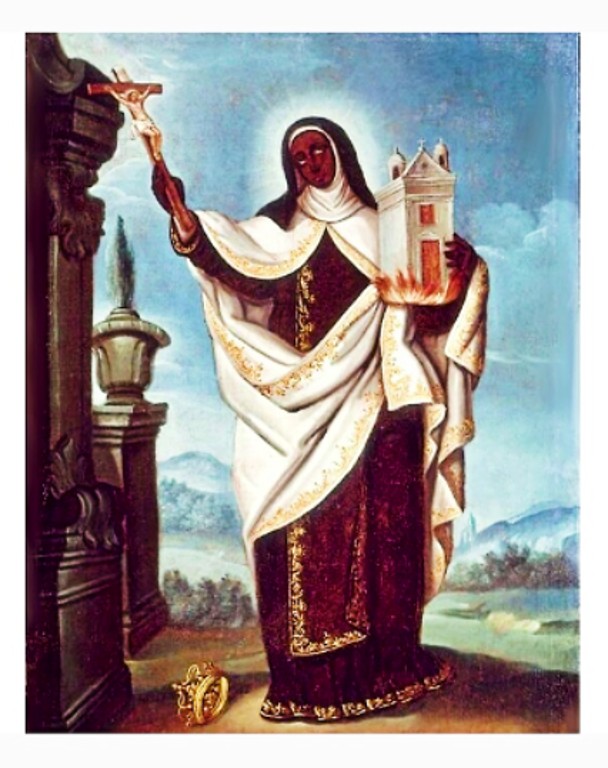
St Maria de Cervellón OdeM (1230 – 1290) Virgin, Catalan Superior of Second Order of the Mercedarians in her region. Mystic, graced with the gift of bilocation, Apostle of the poor, the abandoned, the needy. She was the first woman to wear the Habit of the ‘ Order of the Blessed Virgin Mary of Ransom. She is considered the Founder of the Mercedary Nuns. Her entry in the Roman Martyrology states: “At Barcelona in Spain, blessed Maria de Cervellione, Virgin of the Order of Our Lady of Ransom. She is commonly called Maria of Help on account of the prompt assistance she renders to those who invoke her.“ Patronages – Mercadarian Nuns and Sisters, Navigators, against shipwreck, Spanish sailors., of the abandoned. On 13 February1692, Pope Innocent XII gave a favourable judgement and confirmed her immemorial cult;and she was introduced into the Roman Martyrology as a Saint on 8 November 1729. Her body is Incorrupt. Her Holy Life: https://anastpaul.com/2021/09/19/saint-of-the-day-19-september-st-maria-de-cervellon-odem-1230-1290/ Please watch this video if you are able to spare the time. It is absolutely beautiful.
St Pomposa St Sequanus St Sosius of Puzzuoli St Theodore of Canterbury St Trophimus of Synnada
Martyrs of Antioch – 3 Saints: Christians imprisoned, tortured and executed in various ways in the persecutions of Emperor Probus; some names have come down to us – Dorymedon, Sabbatius and Trophimus. c 277 at Antioch (in modern Turkey).
Martyrs of Phunon – (4 aints): Four bishops in Egypt who were sentenced to forced labour in a rock quarry and martyred in the persecution of Diocletian. Noted for celebrating Mass in prison. – Elias, Nilus, Patermuzio and Peleus. They were burned to death in 310 at Phunon, near Petra in Palestine.
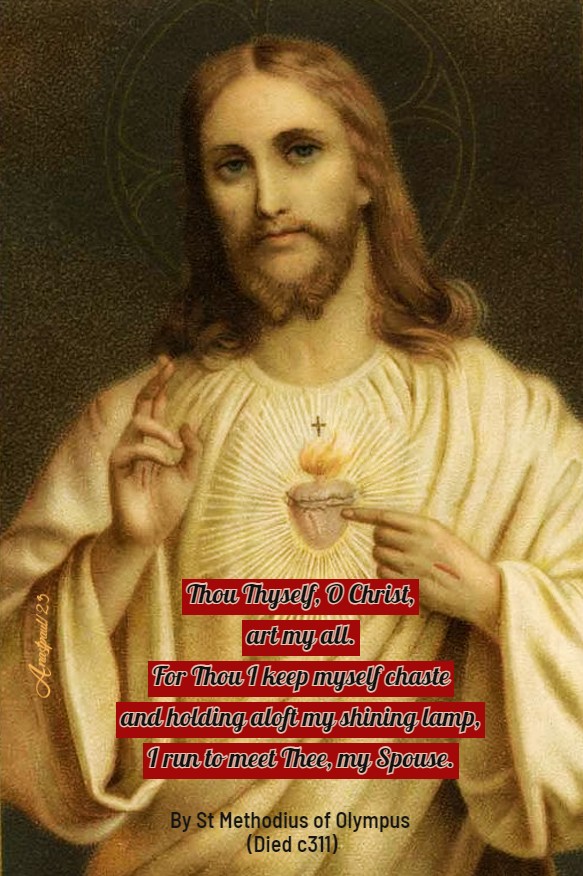
Quote/s of the Day – 18 September – “Month of The Seven Sorrows of the Blessed Virgin Mary and The Holy Cross” – St Methodius of Olympus (Died c311) Confessor, Bishop, Martyr, Father
“Thou Thyself, O Christ, art my all. For Thou I keep myself chaste and holding aloft my shining lamp, I run to meet Thee, my Spouse.”
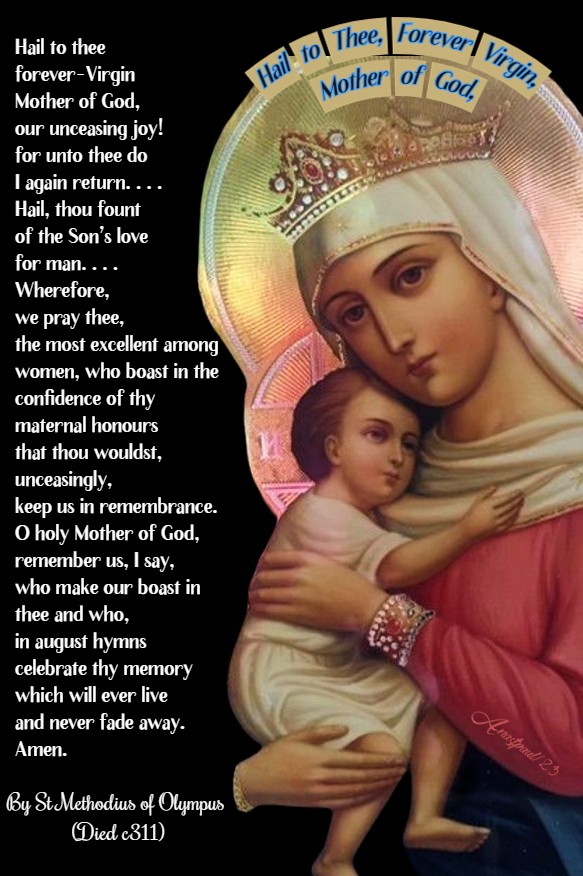
Hail to Thee, Forever Virgin, Mother of God, By St Methodius of Olympus (Died c311)
Hail to thee forever-Virgin Mother of God, our unceasing joy! for unto thee do I again return. . . . Hail, thou fount of the Son’s love for man. . . . Wherefore, we pray thee, the most excellent among women, who boast in the confidence of thy maternal honours that thou wouldst, unceasingly, keep us in remembrance. O holy Mother of God, remember us, I say, who make our boast in thee and who, in august hymns celebrate thy memory which will ever live and never fade away. Amen.
Saint of the Day – 18 September – Saint Methodius of Olympus (Died c311) Confessor, Bishop of Olympus in Lycia in Asia Minor, Martyr, Ecclesiastical Scholar and Author, renowned Theologian. After Olympus it seems that he was appointed as the Bishop of Tyre, Lebanon, or possibly Patara, in the same country. Date of birth unknown, Methodius died a Martyr, probably in 311 in Chalcis, in modern Greece. His works include the “Treatise “On the Resurrection” and “Symposium on Virginity.”
The Roman Martyrology reads today: “The same da, [as St Joseph of Cupertino] the birthday of St Methodius, Bishop of Olympus in Lycia and afterwards of Tyre. Most renowned for his eloquence and learning. St Jerome says that he won the Crown of Martyrdom at Chalcis in Greece at the end of the last persecution there.”
The Martyrdom of St Methodius
We are indebted to St Jerome for the earliest accounts of Methodius. According to him, Methodius suffered Martyrdom at Chalcis at the end of the newest persecution, i.e., under Diocletian, Galerius or Maximinus.
Papyrus fragment of the Symposium, Oratio 8, dated 5th or 6th Century, the earliest known Manuscript of a work by St Methodiu.
Methodius had a very comprehensive philosophical education and was an important Theologian and a prolific and polished Author. Chronologically, his works can only be assigned, in a general way, to the end of the 3rd and beginning of the 4th Century. He became of special importance in the history of theological literature, in that he successfully combated various erroneous views of the great Alexandrian, Origen.
He particularly attacked his doctrine that man’s body, at the resurrection, is not the same body as he had in lif. Another area of Methodius’ opposition was Origen’s idea of the world’s eternity and the erroneous notions it involved. Nevertheless, he recognised Origen’s great services to the Church in Ecclesiastical Theology. Like Origen, Methodius is strongly influenced by Plato’s philosophy and uses, to a great extent, the allegorical style of explanation especially of Scripture.
Of his numerous works only one has come down to us in a complete state in a Greek text, –Th Symposium on Virginity. However, we do have Slavonian versions or portions thereof, of all his other works. He also wrote commentaries on Genesis and on the Song of Songs, many other areas of Sacred Scripture and other holy subjects, for example on the Martyrs, on marriage, on the food laws of the Jews, etc.
St Joseph of Cupertino OFM Conv. (1603-1663) Confessor, Religious Priest of the First Order of St Francis and Friar, Mystic, Miracle-worker. If ever a tiny child began life with nothing in his favour it was Joseph of Cupertino; he had only one hopeful and saving quality—that he knew it. … – Read on and be ashamed, for this is a Saint before the Throne of God! All about the this holy Flying Saint here: https://anastpaul.wordpress.com/2017/09/18/saint-of-the-day-18-september-st-joseph-of-cupertino-o-f-m-conv-1603-1663/
St Ariadne St Eumenius Thaumaturgus
St Eustorgius of Milan (Died c 349) The Ninth Bishop of Milan, Confessor, Defender of the Faith. Both St Athanasius and St Ambrose remember Eustorgius of Milan as one of the most steadfast and illustrious opponents of the Arian heresy. The Roman Martyrology says of him: “At Milan, St Eustorgius, Bishop of that City, highly recommended by blessed Ambrose.” Biography: https://anastpaul.com/2021/09/18/saint-of-the-day-18-september-saint-eustorgius-of-milan-died-c-349/
St Ferreolus the Tribune St Ferreolus of Limoges St Hygbald St Irene of Egypt
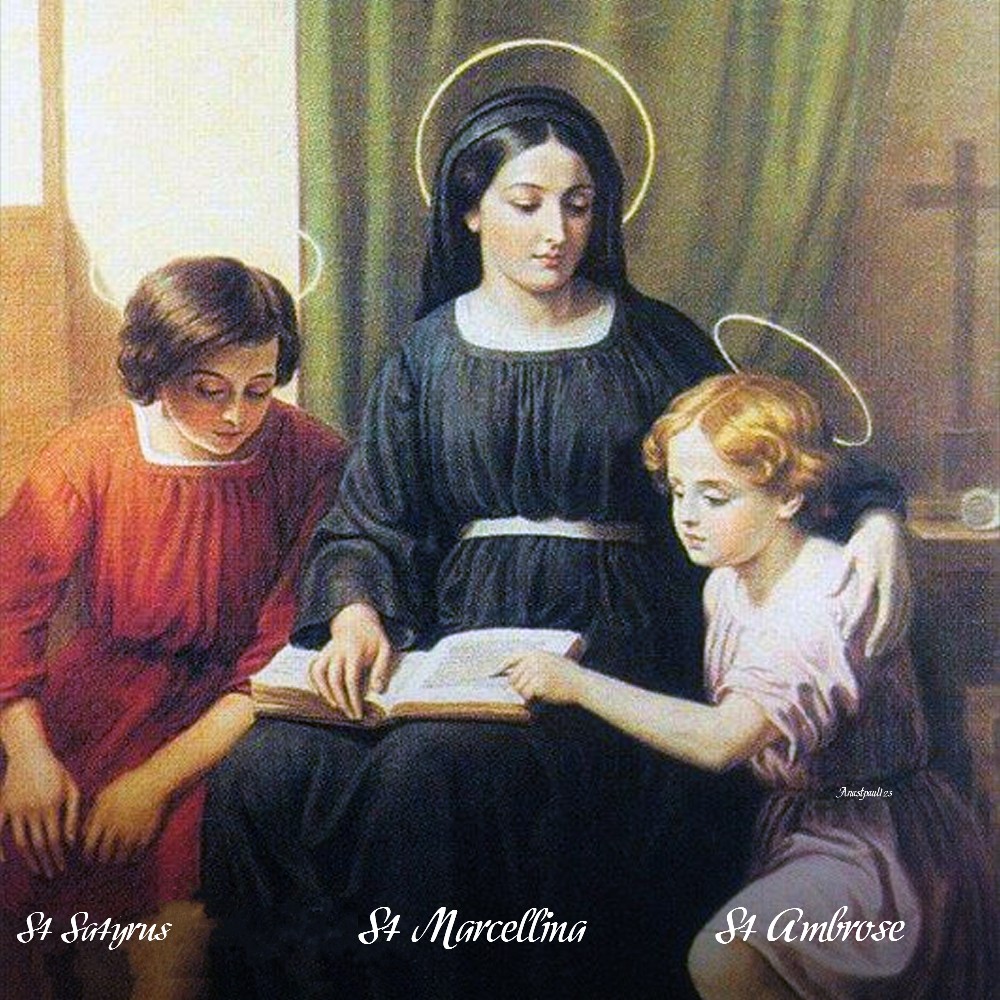
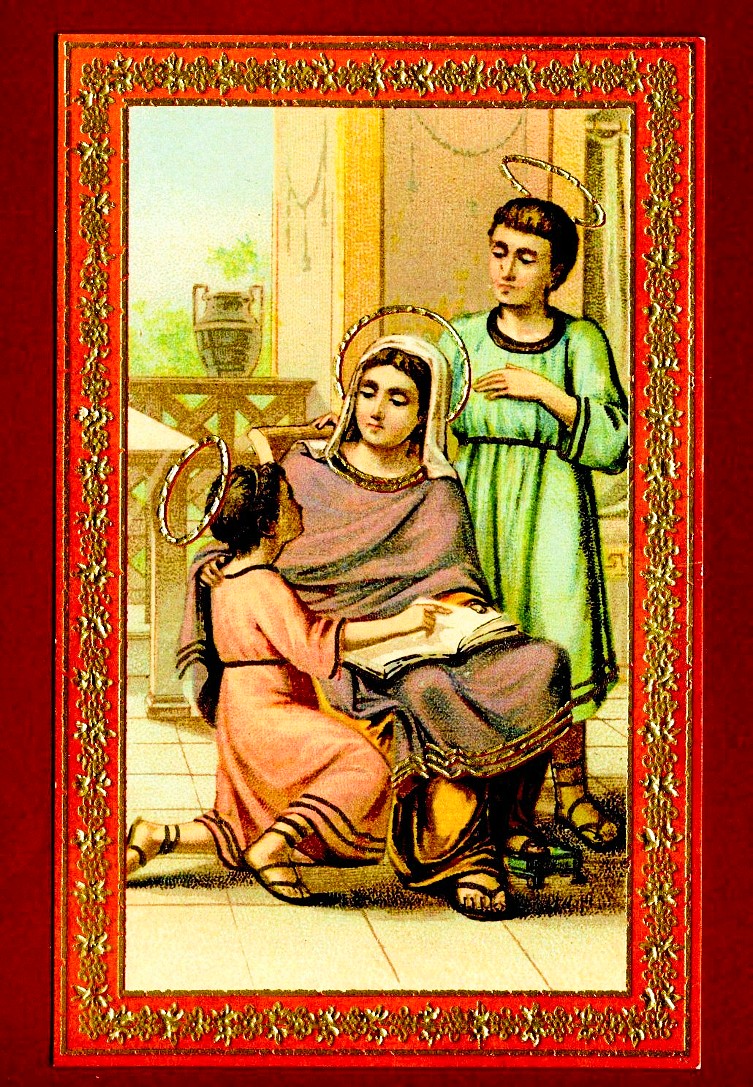
Saint of the Day – 17 September – St Satyrus of Milan (c335-c378) Confessor, Layman. Older brother of St Aurelius Ambrose (340-397) Father and Doctor and St Marcellina (c330-c398) Consecrated Virgin. Born as Uranio Satiro, probably in Trier, Germany and died in 378 in Milan of natural causes. Patronages – of Sacristans of the Archdiocese of Milan.
The Roman Martyrology reads today: “At Milan, the departure from this world of St Satyrus, Confessor, whose distinguished merits are mentioned by his brother, St Ambrose.”
Our only sources for Satyrus’ life are two orations delivered by his brother, one on the day of his death and the other, a week later. We know that he was the second of their parents’ three children, born after their sister, Marcellina; this puts his birth somewhere around 335, before his brother’s in 340, at either Trier, where their father reigned as Governor of a Roman Province, or at Rome. Being of the Senatorial Aristocracy, both brothers followed in the path of their father’s career and served as Governors of Roman Provinces but that assigned to Satyrus is unknown.
In 374, when St Ambrose was appointed as the Bishop of Milan, his brother left public office in order to help him with the administration of the Diocese, as well as to care for their sister and the family patrimony. St Ambrose praises him for his chastity in terms that clearly indicate that he was not married.
More than once, these duties required Satyrus to travel to Africa. Like many men of his class and period, whose public responsibilities were difficult to reconcile with the discipline of a Christian life, he long remained a Catechumen. (St Ambrose himself was a Catechumen at the time of his election as Bishop by popular acclamation. The Ambrosian Rite adds a commemoration of his Baptism to the Mass of St Andrew the Apostle on 30 November and keeps his principal Feast only a week later, on the day of his Episcopal Ordination). Ambrose, however, notes the following episode, in proof of his strong faith.
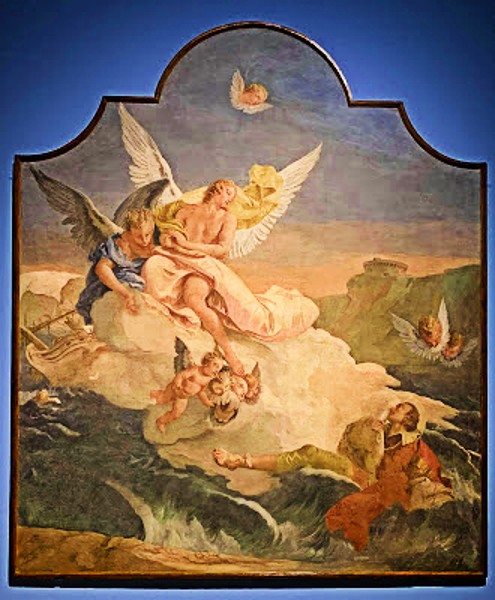
The Shipwreck of St Satyrus, by Giambattista Tiepolo, 1737′ It is kept in the Chapel dedicated to him, where his Relics were formerly kept, also within the Basilica of St Ambrose.
On Satyrus’ return from the last of his African journeys, his ship was wrecked on shoals, just off the coast of either Sicily or Sardinia. Before jumping off the boat, one of his fellow passengers gave him, at his request, a small piece of the Blessed Sacrament, which he then wrapped up in a small cloth and fastened around his neck. St Ambrose attributes his safe deliverance from the sea, to this, noting that Satyrus’ faith in God was so strong that he did not even bother to grab onto one of the planks of the broken vessel. After safely reaching land, he decided to be Baptised. He had, however, evidently already contracted the unknown disease which would take his life shortly thereafter. Having returned to Milan, he died in either 378 or 379 in the arms of his two siblings.
Devotion to St Satyrus is first attested in the 9th Century, when Anspert, Archbishop of Milan, built a small Church dedicated to him, his brother and St Silvester. This was later absorbed into a Church constructed by the Architect Donatello Bramante in 1476-1482 which is still, to this day, known as “St Mary near St Satyrus.” His name first appears in Liturgical books of the Ambrosian Rite in the 10th Century. In view of his role as his brother’s assistant in the administration of the Diocese, he is traditionally honoured in Milan as the Patron Saint of Sacristans.
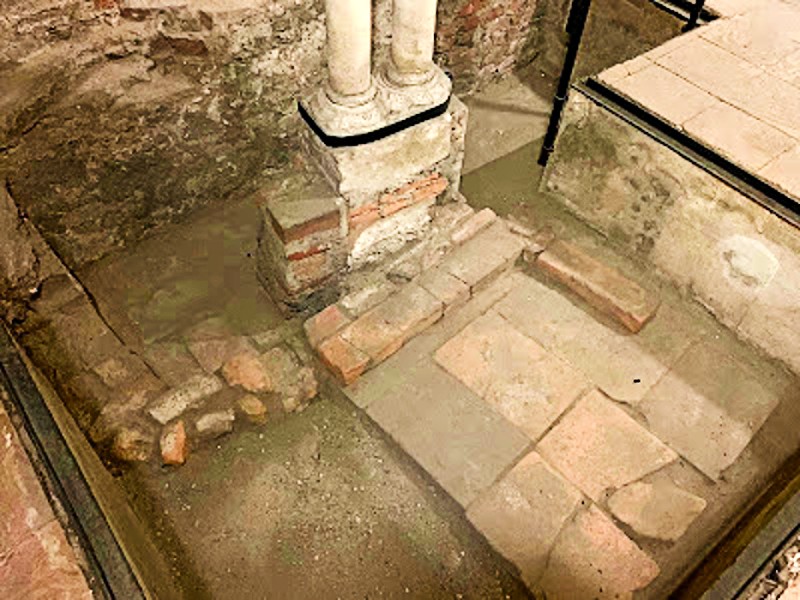
The original location of St Satyrus’ burial within the Chapel of St Victor.
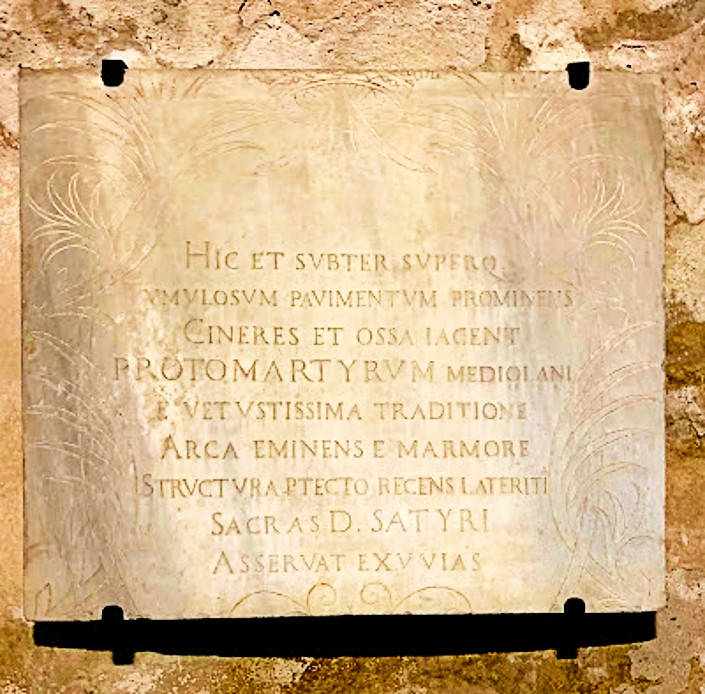
An inscription which notes the site as the place of his burial, alongside several early Martyrs of the Church of Milan.
The story told above about the shipwreck, forms a large part of the Ambrosian Preface for the Mass of St Satyrus:
“Truly it is worthy… eternal God, unceasingly praising Thy glory and proclaiming Thy greatness in Thy Saints. Who didst grant Thy blessed Confessor, Satyrus, such an abundance of virtues that he, having become, in many affairs, the colleague of his brother, the glorious Bishop Ambrose, the foremost Doctor and teacher of the Churches, was, for his diligence, deemed a most faithful and excellent champion of Christ, Thy Son. For while yet in the first service of the Faith, he so distinguished himself that, amid the waves of the sea, when he would have perished miserably by the wreck of his ship, although he was not yet washed by holy Baptism, he still did not lack for trust in Thy help. Therefore, he placed the Sacrament of the Lord’s Body, enclosed in a cloth, around his neck and did not hesitate, to entrust himself, to the frothing sea, supported by such an oar. And Thy, most mighty Right Hand which in the waves lifted up Peter, the Prince of the Apostles, lest he drown, with like power also brought this man safe and unharmed to the shore. This, O Lord, is the working of the fullness of Thy might. Through the same Christ our Lord. Through Whom the Angels praise Thy majesty…” (GREGORY DIPIPPO)
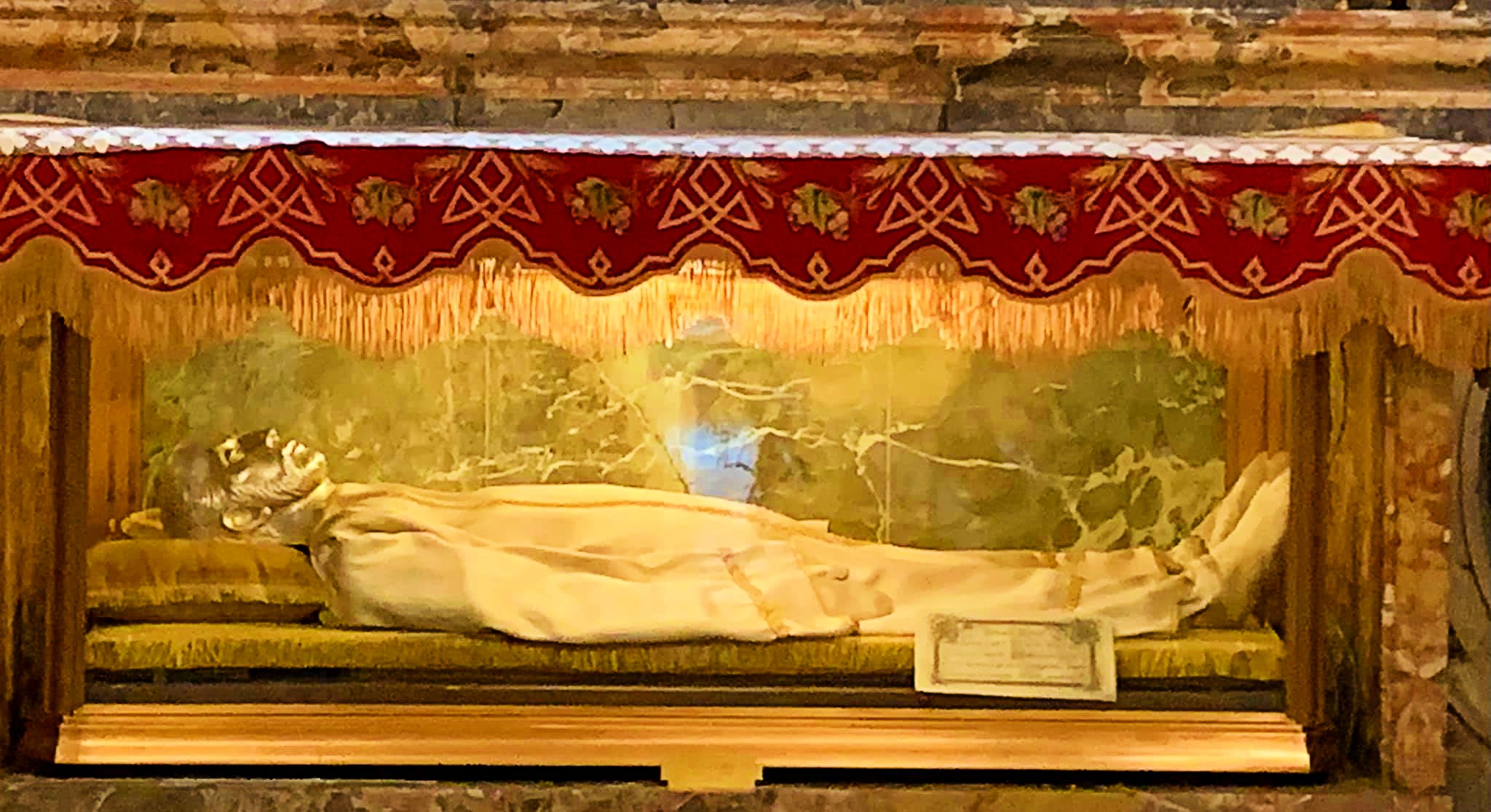
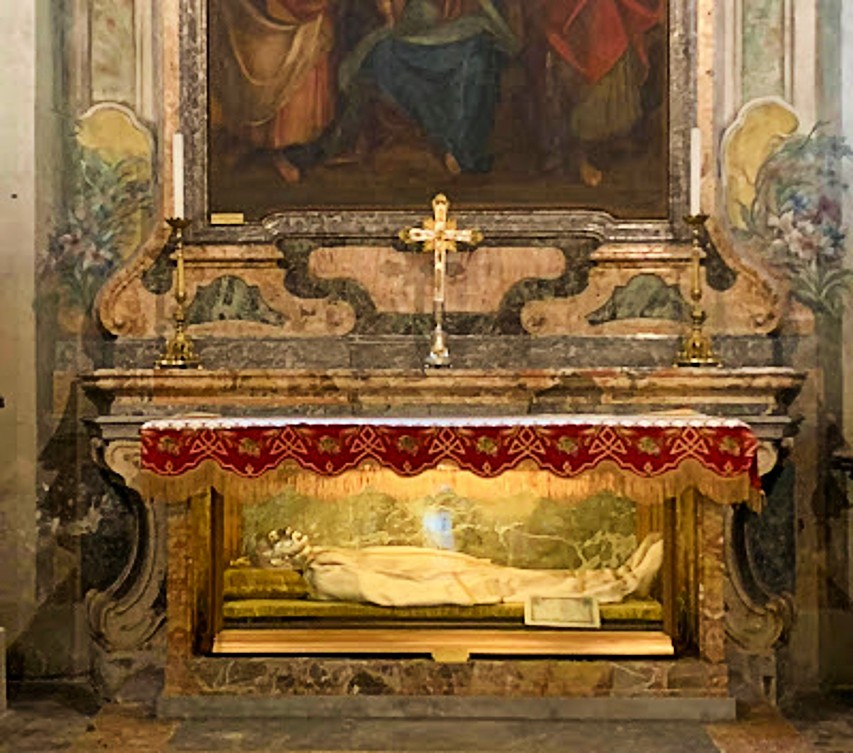
Right side Nave of St Ambrose Basilica. Saint Bartholomew and Saint Satyrus baroque-style Chapel. It preserves the Relics of Satyrus.
St Rodingus St Satyrus of Milan (c335-c378) Confessor, Older brother of St Ambrose (340-397) Father and Doctor and St Marcellina (c330-c398) Consecrated Virgin St Socrates St Stephen St Theodora St Uni of Bremen
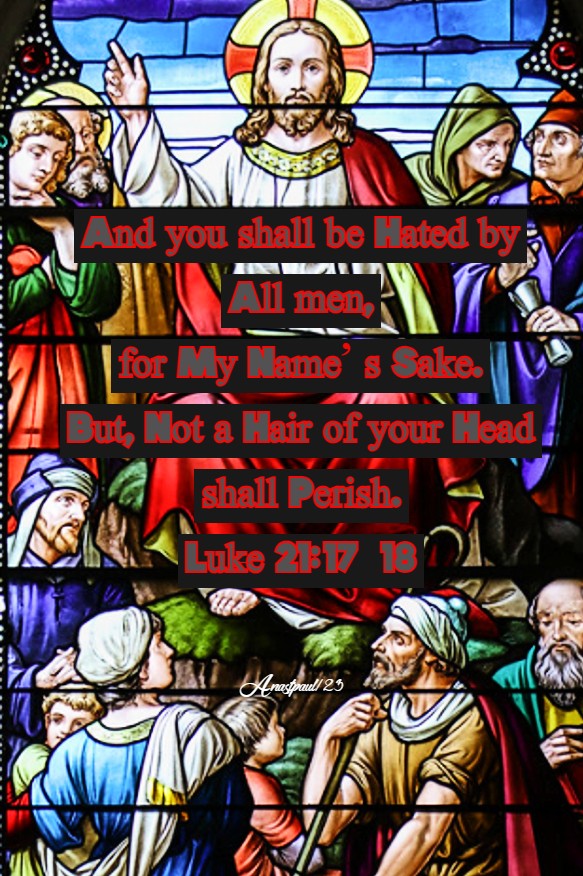
Quote/s of the Day – 16 September – Saints Cornelius and Cyprian – Wisdom 3:1-8, Luke 21:9-19 – Scripture search here: https://www.drbo.org/
“And you shall be hated by all men, for My Name’s sake. But, not a hair of your head shall perish.”
Luke 21:17-18
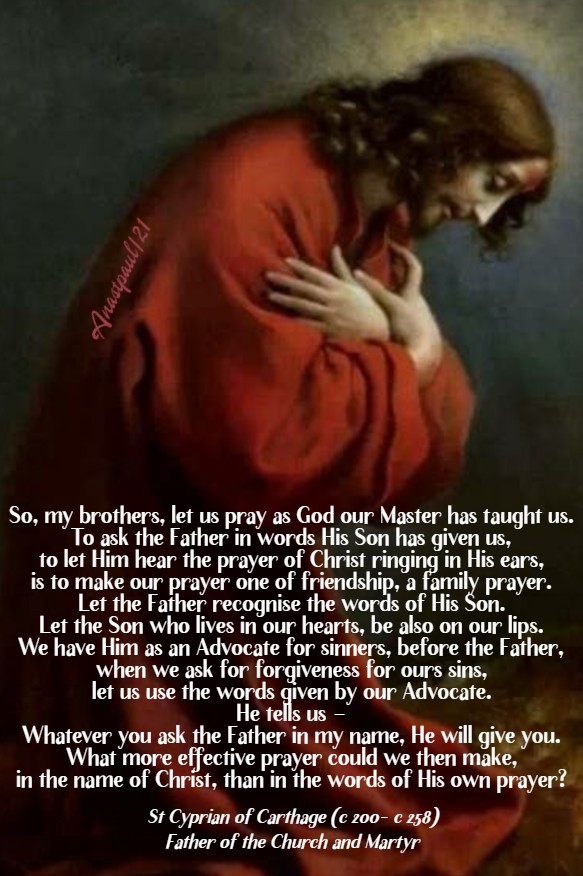
“So, my brothers, let us pray as God our master has taught us. To ask the Father in words His Son has given us, to let Him hear the prayer of Christ ringing in His ears, is to make our prayer one of friendship, a family prayer. Let the Father recognise the words of His Son. Let the Son who lives in our hearts, be also on our lips. We have Him as an Advocate for sinners, before the Father, when we ask for forgiveness for ours sins, let us use the words given by our Advocate. He tells us – Whatever you ask the Father in my name, He will give you. What more effective prayer could we then make, in the name of Christ, than in the words of His own prayer?”
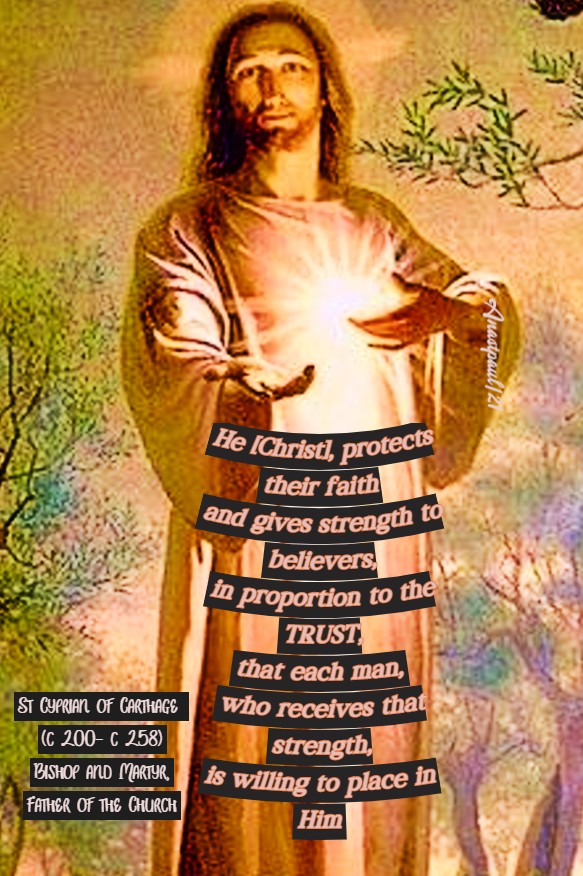
“He [Christ], protects their faith and gives strength to believers, in proportion to the TRUST, that each man, who receives that strength, is willing to place in Him.”
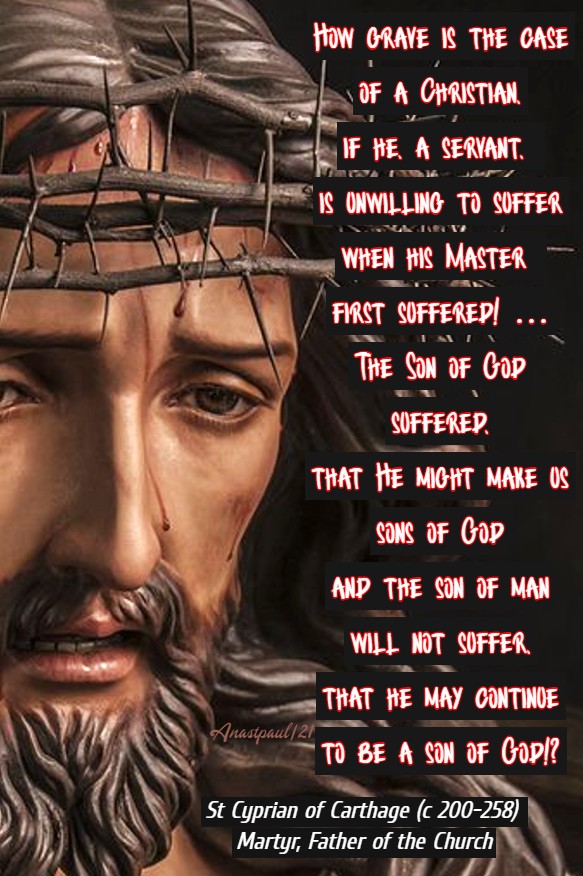
“ How grave is the case of a Christian, if he, a servant, is unwilling to suffer when his Master first suffered! … The Son of God suffered that He might make us sons of God and the son of man will not suffer that he may continue to be a son of God!? … The Maker and Lord of the world also warns us, saying: “If the world hates you, remember that it hated Me before you. If you were of the world, the world would love its own but because you are not of the world but I have chosen you out of the world ” … remember the word that I said to you: “The servant is not greater than his Lord” (Jn 15:18-20).”
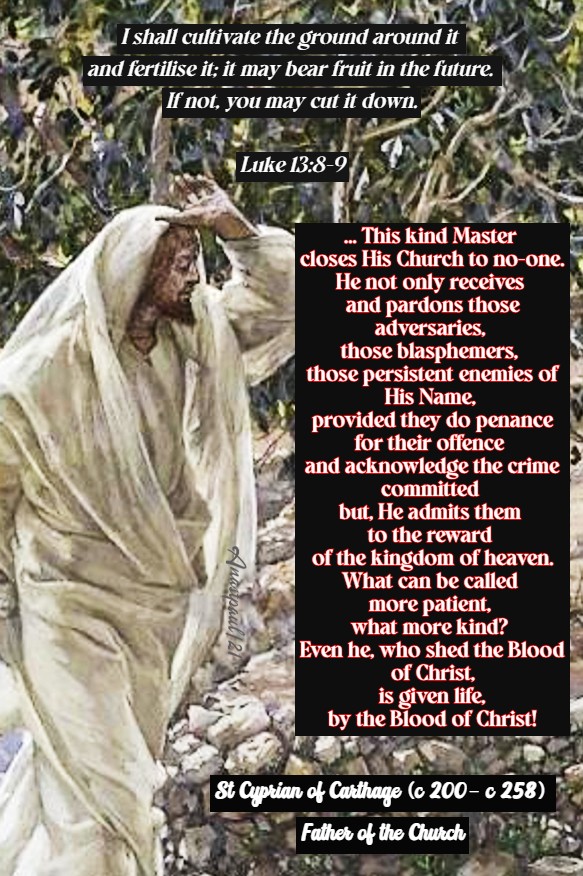
“I shall cultivate the ground around it and fertilise it; it may bear fruit in the future. If not, you may cut it down.” Luke 13:8-9
“… This kind Master closes His Church to no-one. He not only receives and pardons those adversaries, those blasphemers, those persistent enemies of His Name, provided they do penance for their offence and acknowledge the crime committed but, He admits them to the reward of the Kingdom of Heaven. What can be called more patient, what more kind? Even he, who shed the Blood of Christ, is given life, by the Blood of Christ.”
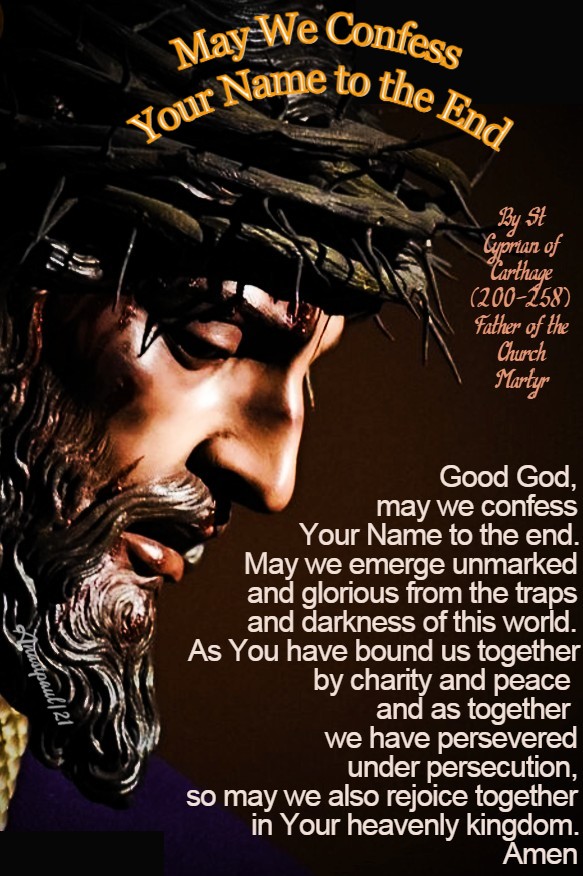
May We Confess Your Name to the End By St Cyprian of Carthage (200-258)
Good God, may we confess Your Name to the end. May we emerge unmarked and glorious from the traps and darkness of this world. As You have bound us together by charity and peace and as together we have persevered under persecution, so may we also rejoice together in Your heavenly kingdom. Amen
St Cyprian of Carthage (c 200-258) Martyr, Bishop of Carthage, Father of the Church
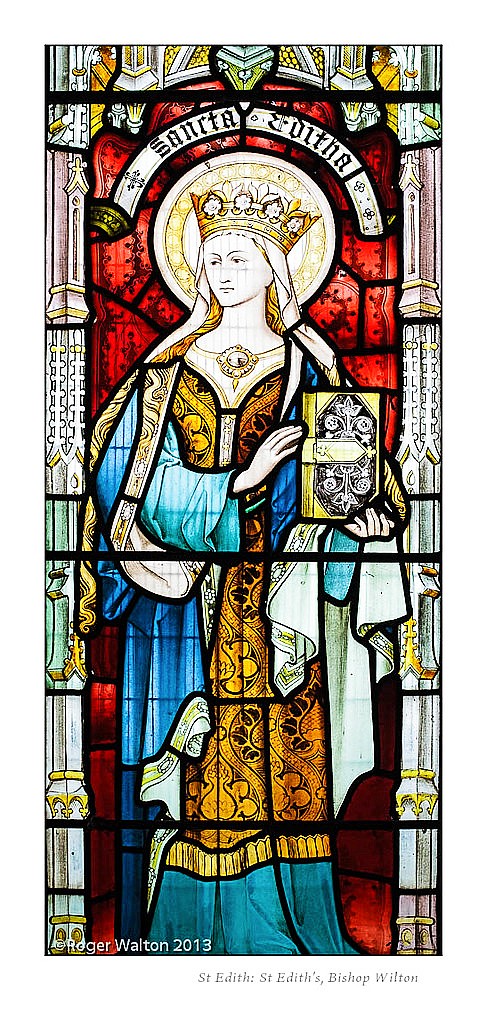
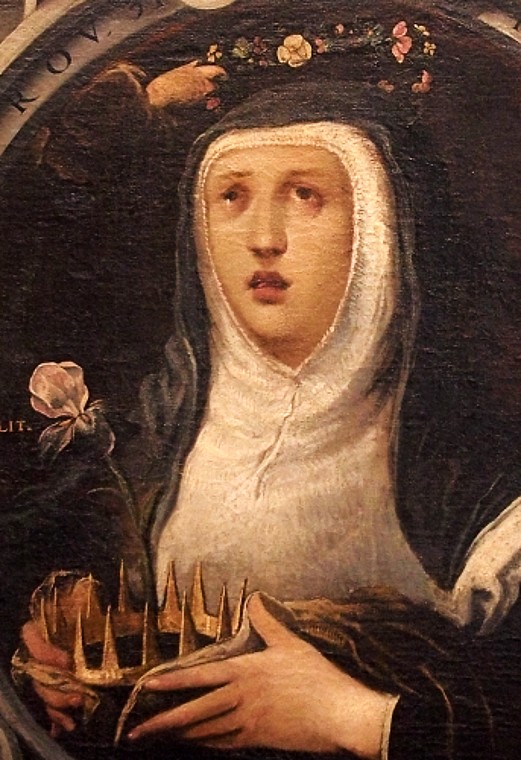
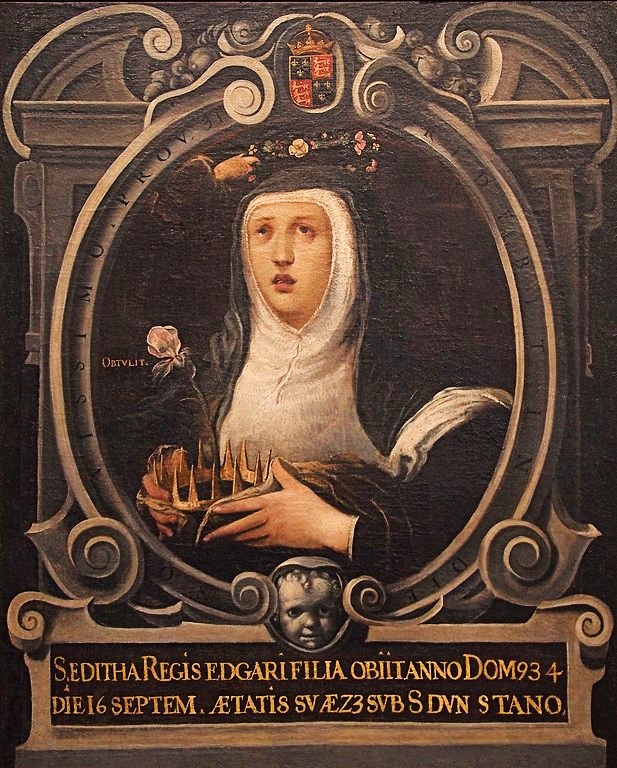
Saint of the Day – 16 September – Saint Edith of Wilton (961-984) Virgin, Nun, Princess, Founder of a Church and a Hospital for the poor. Born in 961 at Kensing, Kent, England and died on 15 September 984 aged just 23 years, a date foretold by Saint Dunstan of Canterbury, of natural causes. Edith also had a gift for communicating with wild animals as so many Saints have had. Edith is one of the most venerated female Saints of England. Her extensive legacy continues to this day – there is a Pilgrimage route, “St Edith’s Way” and annual devotions take place on her Feast day. Also known as – Edith of Barking, Eadgyth…. Eadgith…. Editha…. Ediva…. Patronage – against blindness and eye diseases, of sailors, against storms at sea, Wilton Abbey.
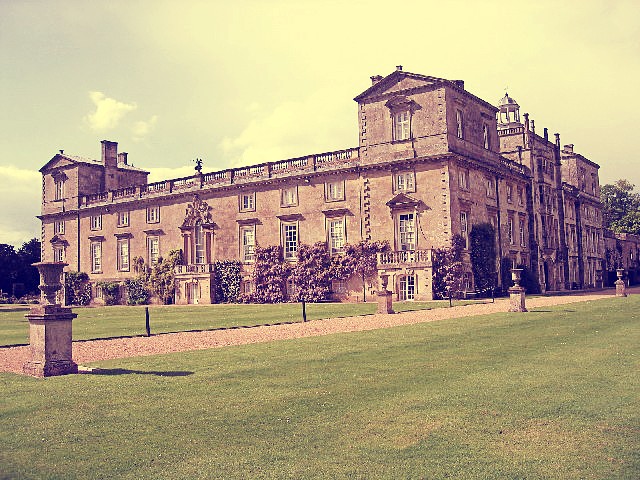
Edith was the only daughter of King Edgar the Peaceful (959-975) and St Wulfthryth, who later became Abbess of Wilton Abbey. Edith is an interesting Saint because she seemed to be able to combine her Royal status and its concerns, with the asceticism of a Benedictine Monastery. There seems to be some doubt about the relationship of her parents. Apparently Edgar took the noblewoman Wulfthryth, from the Convent at Wilton and either kept her as a concubine or else married her. However, the union was dissolved and Wulfthryth returned to her Convent with Edith. Edgar, nonetheless, continued to take an interest in his daughter, arranging her education with two foreign Chaplains, Fr Radbod of Rheims and Fr Benno of Trier.
There is a indecision over whether Edith was actually a Nun or a lay member of the community – whether she took Vows or not. Her main biographer, writing about a hundred years after her death, was a Flemish Benedictine Monk, who came to England and wrote lives of the Saints. He relates that her father, Edgar, came to the Convent and placed before her the finest clothes and jewels, while her mother placed religious objects before her eyes. Edith, opted for the religious life, although she always wore fine clothes – the Bishop of Winchester admonished her for this but she replied: “My father, the mind maybe modest and God-fearing under fine clothes, as under a serge habit. The God I love looks to the heart and not to the dress.” According to legend, she was vindicated when a chest caught fire as a candle was accidentally dropped on it – the clothes remained untouched inside! The chest was preserved in the Convent. She also maintained the custom, suited to a Princess but not expected of a Nun in a cloistered community, of heating her bath water with a special metal casket.
In spite of her fine clothes, she observed strict fasting and abstinence and wore a hair shirt under those clothes – a lesson in not juding a book by its cover, I would think. She had a care for the poor and sick and asked that a hospital be built to care for the poor and destitute patients. It was said of her that at night she would wash the stockings of her fellow sisters.
Her education was one that befitted a Royal lady. She seems to have been a talented needlewoman and designed and embroidered a sumptuous Alb and other Ecclesiastical Vestments. She was versed in literary languages and the arts. She had a fine singing voice, painted, wrote and composed. She had a library and wrote out a book of prayers. She was also very well read. Edith also seemed to have been free to indulge her interest in animals, as she kept a menagerie of native and exotic creatures.
Although she had chosen a Convent life, she seems to have had influence at her father’s Court and that of her half-brothers Edward the Martyr and Ethelred. She was highly regarded by the nobility of England; foreign Kings and Ambassadors sought her favour through letters and gifts and high-ranking Clergy, her intercession. Her father tried to make her Abbess of three Convents but she refused the honour. When Edward the Martyr was murdered, she was offered the throne,but again declined.
St Dunstan, Archbishop of Canterbury, predicted her death and that the thumb on her right hand – which made the Sign of the Cross in an unusual way – would remain incorrupt. Edith died three weeks after his prediction, on 16 September 984. Dunstan presided when her body was removed to the Chapel of St Denys, which our Saint had built and the thumb had not decomposed.
Edith’s cult seemed to have developed slowly. The Abbess, Aelfgifu was cured of an eye disease during a dream vision. There are stories of her intervention, when either her surroundings or Relics were interfered with. King Canute did not believe she was a Saint and demanded that her Tomb be opened so he could decide for himself. The body of Edith rose up and struck him! He got the message and generously endowed the Convent. He claimed also that later, Edith had rescued him from a storm at sea.
She was Canonised thirteen years after her death through the offices of her half-brother King Ethelred II and with the support of St Dunstan and other Ecclesiastics. Her body was removed to the Church of St Denys, which she had founded.
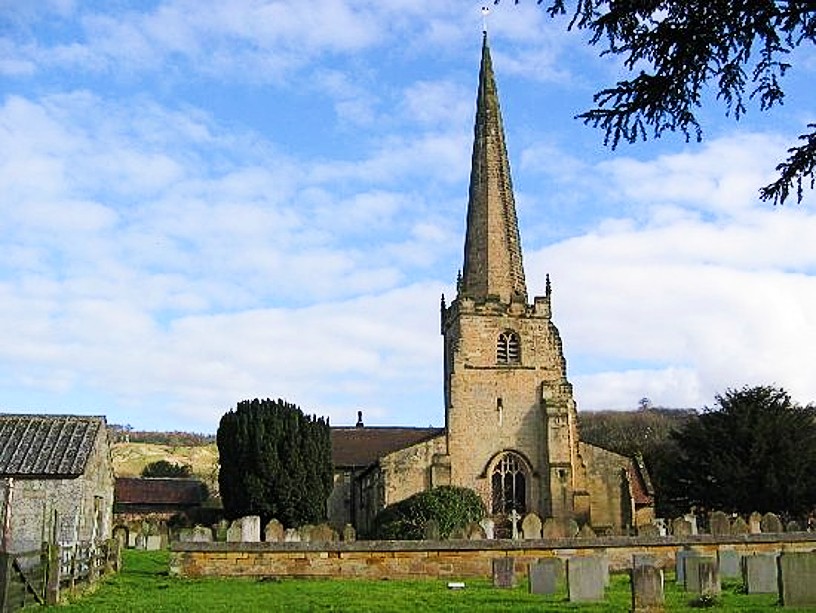
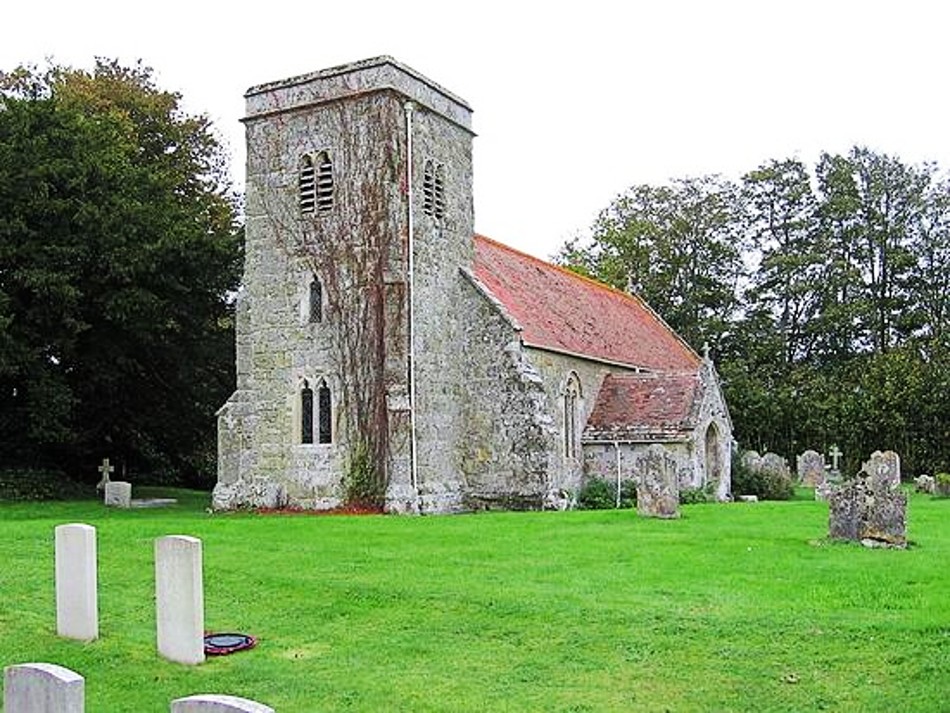
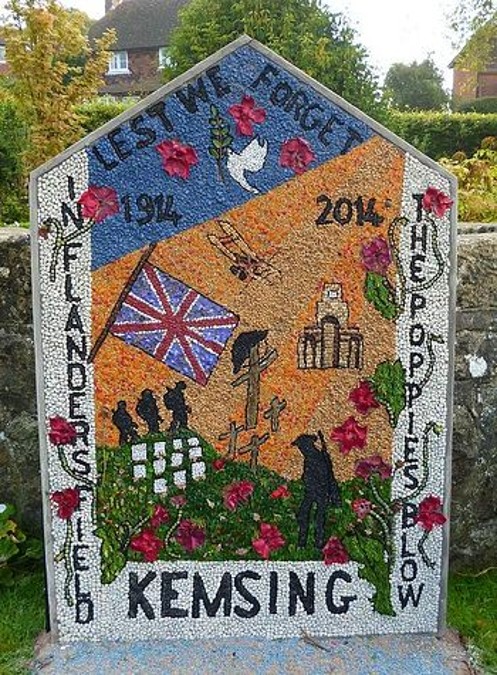
She became a very popular Saint in medieval Britain with the help of Royal patronage. The Convent at Wilton became a place where Royal and noble ladies could receive a good education. The Abbey continued to function until the Reformation when it was dissolved. St Edith, however, has not been forgotten. She is venerated at her birth-place in Kemsing. The Holy Well in the centre of the Village bears her name and, it is said, to have healing properties. Well dressing has been revived recently. There is also a Pilgrimage entitled “St Edith’s Way.”
St Abundantius of Rome St Abundius of Rome St Andrew Kim Taegon St Cunibert of Maroilles St Curcodomus St Dulcissima of Sutri St Edith of Wilton (961-984) Virgin, Nun, Princess St Eugenia of Hohenburg
Blessed Luigi Ludovico Allemandi (c 1390-1450) Bishop and Cardinal, called “The Cardinal of Arles.” Blessed Luigi was a Priest driven by immense love for the Holy Mother of God and for the Church. His involvement in various Councils and Papal dissentions, were the result of his great desire to maintain the purity of the Chair of Peter. He was Beatified in 1527 by Pope Clement VII. His Life; https://anastpaul.com/2020/09/16/saint-of-the-day-blessed-luigi-ludovico-allemandi-c-1390-1450/
St Lucia and St Geminianus of Rome + St Ludmila St Marcian the Senator Bl Martin of Huerta Bl Michael Himonaya
Bl Paul Fimonaya St Priscus of Nocera St Rogellus of Cordoba St Sebastiana St Servus Dei St Stephen of Perugia
Martyrs of the Via Nomentana: Four Saints: Christian men Martyred together, date unknown – Alexander, Felix, Papias and Victor. They were Martyred on the Via Nomentana outside Rome, Italy.
Saint of the Day – 15 September – St Nicomedes (Died c71) Priest and Martyr. Died in Rome by being beaten to death wiuth clubs.
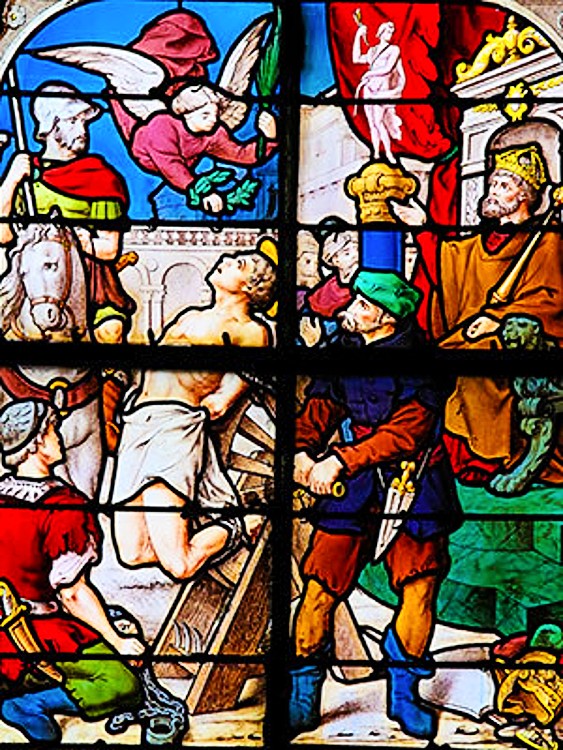
The Roman Martyrology reads today: “In Rome, on the Nomentan Way, the birthday of the blessed Nicomedes, Priest and Martyr. As he said to those who would compel him to sacrifice: “I sacrifice only to the Omnipotent God, who reigns in Heaven.” He was scourged, for a very long time with leaded whips and thus, went to our Lord.”
Stained glass depiction of scene common in the days of the early Christian Martyrs and the time of St Nicomedes. Stained glass window in St Catherine’s Church in Honfleur, France.
Little is known of the early life of this heroic Christian Martyr. What we do know for sure, is derived from the historical texts of Holy Mother Church He is spoken of in the legendary ‘Passio’ of the Saints Nereus and Achilleus composed in the 5th-6th Century, whose Author states that Nicomedes was a Priest.
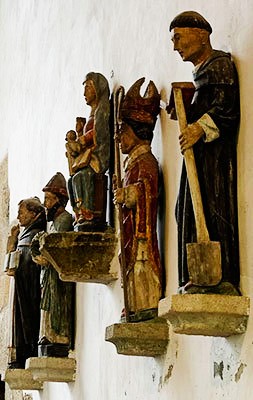
A holy “line up” including: St Dominic, St Nicomèdes, Our Lady and Baby Jesus, St Claude and St Fiacre. These sculptures are found in the interior of the Chapelle de Kermaria-an-Isquit in France.
He was discovered while burying the body of the Martyr Felicola and arrested by a certain Flaccus, Since he refused to sacrifice to the gods, he was subjected to a cruel flagellation, during which he died.
His body was thrown into the Tiber but one of his fellow-clerics ,named Giusto, recovered it and buried it in a small garden along the Via Nomentan.
The Author of the ‘Passio’ does not mention the day of his death but from the context, it can be deduced that he died, at the time of the Emperor Domitian (51-96. Subsequent studies and research have hypothesised 15 September as the day of his death, while another ‘Passio’ of the 7th Century places his death on 1 June under Maximian (240-310).
In any case, the existence and cult of this Martyr Nicomedes are attested by documents worthy of faith, although the biographical information is uncertain. Moreover, he is mentioned in at least eight historical ‘Martyrologies.’ In the ‘Roman’ one, his feast day remained on 15 September.
Already in the 7th Century, it is known that pilgrims venerated the tomb of the Martyr on the Via Nomentan, on which Pope Boniface V (619-625) had a Basilica built which was later restored by Pope Hadrian I (†795).
St Aichardus St Albinus of Lyon St Aprus of Toul St Bond of Sens St Emilas of Cordoba St Eutropa of Auvergne St Hernan St Jeremias of Cordoba St Joseph Abibos St Mamillian of Palermo St Melitina St Mirin of Bangor St Nicetas the Goth
St Nicomedes (Died c71) Priest and Martyr
St Porphyrius the Martyr St Ribert St Ritbert of Varennes Bl Rolando de Medici Bl Tommasuccio of Foligno St Valerian of Châlon-sur-Saône St Valerian of Noviodunum St Vitus of Bergamo
Martyrs of Adrianopolis – 3 Saints: Three Christian men Martyred together in the persecutions of Maximian – Asclepiodotus, Maximus and Theodore. They were martyred in 310 at Adrianopolis (Adrianople), a location in modern Bulgaria.
Martyrs of Noviodunum – 4 Saints: Three Christian men martyred together, date unknown – Gordian, Macrinus, Stratone and Valerian. They were martyred in Noviodunum, Lower Moesia (near modern Isaccea, Romania).
Mercedarian Martyrs of Morocco – 6 Beati: A group of six Mercedarians who were captured by Moors near Valencia, Spain and taken to Morocco. Though enslaved, they refused to stop preaching Christianity. Martyrs. – Dionisio, Francis, Ildefonso, James, John and Sancho. They were crucified in 1437 in Morocco.
Saint of the Day – 14 September – Saint Cormac of Cashel (c836-908) Bishop, King of Munster, Ireland, a great Scholar and Writer. Born as Cormac MacCquilenan was the son of Cuillenan and descended from King Aengus who Saint Patrick Baptised. Cormac was probably the first Bishop of Cashel and the compiler of the “Psalter of Cashel” an Irish history. Irish writers have celebrated him for his learning, piety, charity and valour. He was killed in a battle against King Flan of Meath.
Coprmac, in his early years received a good education in one of the Irish Monastery schools. He was Ordained Priest and afterwards appointed Bishop of Cashel.
In the year 900 he became, on account of his descent, King of Cashel and thus were combined in his person, the two offices of spiritual and temporal ruler of Leth Moga, as the southern portion of Ireland was called.
In 906, The Ardri (ard-ri, High King) Flann, assisted by the King of Leinster, led his forces into the Southern Province and was met by the Munstermen under Cormac. The Ardri suffered a signal defeat. However in 908, Flann, assisted by Ceorbhall, King of Leinster and Cathal, King of Connaught, returned to the attack, apparently because Cormac, instigated by Flaherty, Abbot of Inniscathay, had claimed tribute from Leinster and had even signified his intention of assuming the position of High King there. The battle was fought, the Munstermen suffered a complete defeat and Cormac was killed in the battle.
An Irish Glossary called “Sanas Chormai,” containing etymologies and explanations of over 1400 unusual Irish words which has come down to us. Although, etymologically, the work is of little value, yet on account of the light it throws upon many ancient Irish customs and institutions, it is of great importance to the historian. The “Glossary of Cormac” is said to be only a part of the “Psalter of Cashel” also attributed to Cormac, but which has been lost. The lost Psalter of Cashel and the “Lebor na Cert—the Book of Rights”—is also linked to Cormac.
Cormac was regarded as a Saint after his death and his Shrine at Castledermot, County Kildare, is the site of miracles and pilgrimages.
St Caerealis Bl Claude Laplace St Cormac of Cashel (c836-908) Bishop, King St Crescentian of Carthage St Crescentius of Rome St Generalis of Carthage St Giulia Crostarosa St Jean Gabriel Taurin du Fresse
St Maternus of Cologne (Died c 325) Bishop, the first Bishop of Cologne and Founder of the Diocese of Tongeren, Germany. In Cologne and in his hometown of Trier, the faithful began to venerate him as a Saint. A popular cult of which the splendid 13th century stained glass windows in the Cathedral Chapel dedicated to his name, also testify. He was buried in the Cathedral of Cologne but the Cathedral of St Peter in Trier boasts a large Reliquary, which became and remains, a pilgrimage site. Biography; https://anastpaul.com/2021/09/14/saint-of-the-day-14-september-saint-maternus-of-cologne-died-c-325/
St Peter of Tarentaise O.Cist (1102-1174) Cistercian Monk, Archbishop of Tarentaise from 1141 until his death, Abbot, Apostle of Charity, Miracle-worker. There are two Saints named Saint Peter of Tarentaise who lived one Century apart. The Saint we honour today, is the younger Peter, born in France in the early part of the 12th Century. The other Saint Peter if Tarentaise, became Pope Innocent V. His Life: https://anastpaul.com/2019/09/14/saint-of-the-day-14-september-saint-peter-of-tarentaise-o-cist-1102-1174/
Bl Pedro Bruch Cotacáns St Rosula of Carthage St Sallustia St Victor of Carthage






















 AnaStpaul

You must be logged in to post a comment.