Our Morning Offering – 7 July – “The Month of the Most Precious Blood of Jesus” and “Friday Devotion The Passion”
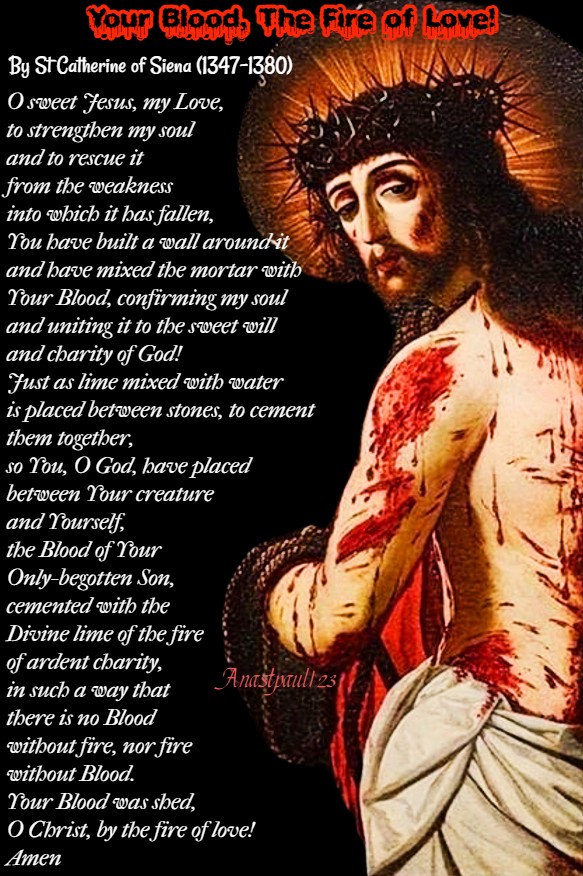
Your Blood, The Fire of Love! By St Catherine of Siena (1347-1380) Doctor of the Church
O sweet Jesus, my Love, to strengthen my soul and to rescue it from the weakness into which it has fallen, You have built a wall around it and have mixed the mortar with Your Blood, confirming my soul and uniting it to the sweet will and charity of God! Just as lime mixed with water is placed between stones, to cement them together, so You, O God, have placed between Your creature and Yourself, the Blood of Your Only-begotten Son, cemented with the Divine lime of the fire of ardent charity, in such a way that there is no Blood without fire, nor fire without Blood. Your Blood was shed, O Christ, by the fire of love! Amen
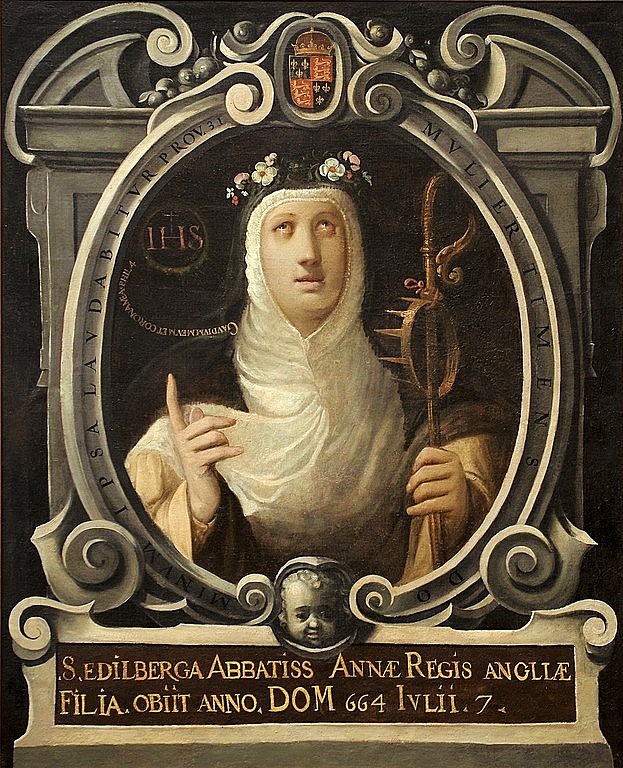
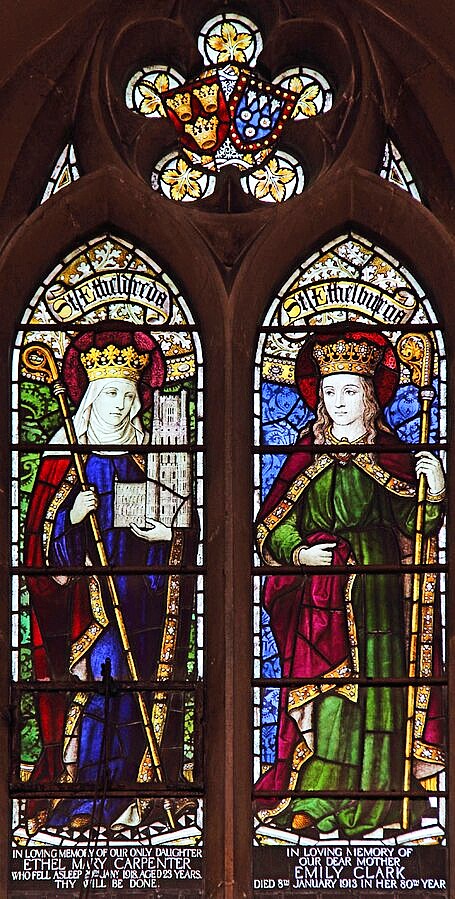
Saint of the Day – 7 July – Saint Ethelburga of Faremoutier (Died 664) Virgin, Abbess, Princess Born in the Kingdom of East Anglia and died in 664 at Faremoutier, France of natural causes. When her body was exhumed seven years after her death, it was found incorrupt. Also known as – Aubierge, Cdilburh, Edelburga, Edilberga, Edilburga, Etelburg.
Ethelburga was one of the daughters of King Anna of East Anglia. Her sisters were St Withburga, St Saethryth, who was Abbess of Faremoutiers Abbey in Brie, France, St Seaxburh and St Æthelthryth who wereboth Abbesses of Ely, Cambridge, England.
She was known throughout the community for her adherence to the Rule of the Order. In the mid-seventh Century, Ethelburga was chosento be the Abbess. She ruled with wisdom and justice until her death.
As Abbess, Ethelburga began work on a Church in honour of the Twelve Apostles which was left unfinished at her death in 664. At her request, she was buried in the Church. After seven years a decision was made to move her Relics to the nearby Church of Saint Stephen and her body was found to be incorrupt.
Saint Cyril (827-869) Saint Methodius (826-885) “Apostles to the Slavs,” Sibling Brother Bishops, Confessors, Theologians, Missionaries, Writers, Preachers, Patrons of Europe. Creators of the Glagolitic alphabet, the first alphabet used to transcribe Old Church Slavonic and Cyrillac Alphabet, which was developed from it. Their Feast Day is 7 July (moved in 1969). The great Saints Cyril & Methodius: https://anastpaul.wordpress.com/2018/02/14/saints-of-the-day-14-february-sts-cyril-827-869-methodius-826-885/
St Lawrence of Brindisi OFM Cap (1559-1619) Confessor, The “Franciscan Renaissance Man,” Priest and Friar of the Friars Minor Capuchin, Theologian, Vicar General of the Franciscans, Language scholar, Humanist, Philosopher, Biblicist, Preacher, Missionary, Professor, International Administrator, Confidant of Popes, Emperors, Kings and Princes, Diplomatic envoy, Army Chaplain, Military Strategist and Morale builder, Polemicist, Prolific writer. He was Beatified on 1 June 1783 by Pope Pius VI and Canonised on 8 December 1881 by Pope Leo XIII. His Zealous Life: https://anastpaul.com/2017/07/21/saint-of-the-day-21-july-st-lawrence-of-brindisi-o-f-m-cap-doctor-of-the-church/
St Alexander St Angelelmus of Auxerre St Apollonius of Brescia
Blessed Pope Benedict XI OP (1240-1303) Cardinal-Priest of St Sabina, Bishop of Ostia then of Rome, Dominican Friar, Prior Provincial of Lombardy prior to becoming the Master of the Order in 1296, Apostolic Papal Legate to Hungary and France, Teacher, Preacher, Writer and renowned Scholar with special emphasis on Scriptural commentary. His Papacy began on 22 Ocober 1303 and ended at his death on 7 July 1304. His Life: https://anastpaul.com/2020/07/07/saint-of-the-day-7-july-blessed-pope-benedict-xi-1240-1303/
Bl Bodard of Poitiers St Bonitus of Monte Cassino St Carissima of Rauzeille St Eoaldus of Vienne St Ethelburga of Faremoutier (Died 664) Abbess, Princess St Hedda of Wessex St Maelruan Bl Marie-Gabrielle-Françoise-Suzanne de Gaillard de Lavaldène St Medran St Merryn Bl Oddino Barrotti St Odo of Urgell St Odran St Palladius of Ireland St Pantaenus of Alexandria
St Pantænus (Died c 216) Father of the Church, Theologian, Philosopher, Teacher, Confessor and Defender of the Faith, Writer and interpreter of the Bible, the Trinity and Christology, |Missionary. Convert of the disciples of the Apostles. Head of the Alexandrian School of Learning – a famous pupil was St Clement of Alexandria. Biography: https://anastpaul.com/2019/07/07/saint-of-the-day-7-july-st-pantaenus-father-of-the-church-died-c-216/
Martyrs of Durres – 7 Saints: Also known as – Martyrs of Dyrrachium/Martyrs of Durazzo. A group of seven Italian Christians who fled Italy to escape the persecutions of Emperor Hadrian. Arrived in Dyrrachium, Macedonia to find Saint Astius tied to a cross, covered in honey, laid in the sun and left to be tortured by biting and stinging insects. When they expressed sympathy for Astius, they were accused of being Christians, arrested, chained, weighted down, taken off shore and drowned. We know little more about each of them than their names – Germaus, Hesychius, Lucian, Papius, Peregrinus, Pompeius and Saturninus. They were born in Italy and were Martyred at sea c117 off the coast of Dyrrachium (Durazzo), Macedonia (modern Durres, Albania).
St Saxburgh of Ely St Sisoes the Great Bl Suzanne Agathe de Loye Blessed Thomas Alfield (c 1552-1585) Priest Martyr St Tranquillinus of Rome
Martyrs of Campania – 23 Saints: A group of 23 Christians arrested, tortured and then beheaded together in the later 3rd century by order Gf Governor Rictiovarus during the persecutions of Diocletian. The names that have come down to us are – Antoninus, Arnosus, Capicus, Cutonius, Diodorus, Dion, Isidore, Lucia, Lucian, Rexius, Satyrus and Severinus.
Martyrs of Fiesole – 5 Saints: Five Christians Martyred together during the persecutions of Emperor Domitian – Carissimus, Crescentius, Dulcissimus, Marchisianus and Romulus. c 90 near Fiesole, Italy.
Saint of the Day – 5 July – Saint Modwenna (9th Century) Irish Virgin Princess, Nun, Founder of Burton Abbey in Staffordshire, Miracle-worker.
According to the medieval Life of St Modwenna, she was an Irish noblewoman by birth and founded the Abbey on an island in the River Trent.
Modwenna is reported to have performed many holy miracles at Burton Abbey, and to this day the well on the site is said to have healing properties. After a time Modwenna left Burton-upon-Trent and travelled to Scotland where she died in Langfortin, near Dundee, reportedly at the age of 130. Her body was returned to Burton-upon-Trent for burial.
However, there are many conflicting legends of Modwenna and confusion with other Saints, some as far as 200 and more years apart.
The Chapel at Pillaton Hall and St Mary and St Modwen Church, Burton-on-Trent are dedicated to St Modwenna.
St Agatho of Sicily St Athanasius the Athonite St Athanasius of Jerusalem St Cast St Cyprille of Libya St Cyrilla of Cyrene St Domèce St Domitius of Phrygia St Edana of West Ireland
St Erfyl St Fragan St Grace of Cornwall St Gwen St Marinus of Tomi St Mars of Nantes St Marthe St Modwenna (9th Century)Irish Princess, Nun, Founder St Numerian of Treves St Philomena of San Severino St Probus of Cornwall St Rosa Chen Aijieh St Sedolpha of Tomi St Stephen of Reggio St Teresia Chen Qingjieh St Theodotus of Tomi St Thomas of Terreti St Triphina of Brittany St Triphina of Sicily St Zoe of Rome
Saint of the Day – 4 July – Saint Andrew of Crete (c660-c740) Bishop of Gorvina, Constantinople, Monk at Mar Sabas, Noted and eloquent Preacher, Poet and Hymnist. Born in c660 at Damascus, Syria and died in c740 in Crete of natural causes. Also known as – Andrew of Jerusalem, Andrew of Gortina, Andrea, Andreas.
Andrew was born in Damascus around 660, i.e. towards the middle of the 7th Century. At the age of fifteen, having reached Jerusalem, he decided to enter the Monastery of San Sabas and the Holy Sepulchre.
In 685 Theodore, Bishop of Jerusalem, sent him as his delegate to the VI Ecumenical Council (known as Constantinopolitan III) to support the condemnation of Monothelitism, a heretical theory that supported one divine will of Christ. During his stay in the imperial capital, Andrew received Ordination as a Deacon and was entrusted with the management of an orphanage and a home for the elderly. It didn’t take long, before perhaps already around the year 700, he was elected to the Episcopal office at Gortyna, the metropolitan Arch-episcopal See of the island of Crete.
In 711 Philippicus Bardane ascended the throne and convened a Synod to try to overturn the response of the previous Synod and establish Monotheism as the official religion of the Empire. Andrew also participated in this Synod and for a short time he even came to recognise the heretical decrees but finally, Bardane was then expelled and the Bishop of Constantinople was left with nothing but to retract, in writing, to the Pope, apologising also in the name of those who had participated in the illegitimate synod.
Andrea was famous as a preacher and composer of sacred Hymns. About fifty sermons have been handed down to us and tradition has arbitrarily attributed to him, the introduction of the type of Hymn, known as Kanon or Canon, typical of the Byzantine Liturgy. In reality, it is true, that he, nevertheless, wrote many of them, some of which are still sung today, remarkable for the originality of their metric and musical form. Among them, the so-called “Great Canon” stands out as his masterpiece, of a Lenten character and made up of two hundred and fifty stanzas!
His sermons proved to be important for the development of Marian devotion – in fact, he exalted the Virgin Mother of God as Immaculate and Assumed into Heaven, thus prefiguring the Dogmatic definitions of Popes Pius IX and Pius XII, which occurred in the 19th and 20th Centuries.
Sainy Andrew of Crete died on the Island of Lesbos in 740 and the Martyrologium Romanum commemorates him on 4 July.
St Albert Quadrelli St Andrew of Crete (c660-c740) Bishop St Anthony Daniel St Aurelian of Lyons St Bertha of Blangy St Carileffo of Anille Bl Catherine Jarrige St Cesidio Giacomantonio Bl Damiano Grassi of Rivoli St Donatus of Libya St Edward Fulthrop St Elias of Jerusalem St Finbar of Wexford St Fiorenzo of Cahors St Flavian of Antioch St Giocondiano Bl Giovanni of Vespignano St Haggai the Prophet Bl Hatto of Ottobeuren Bl Henry Abbot St Henry of Albano St Hosea the Prophet St Innocent of Sirmium Bl John Carey
Blessed John Cornelius SJ (1557– 1594) Martyr, English Priest of the Society of Jesus, Missionary. Additional Memorials – 29 October as one of the Martyrs of Douai, 1 December as one of the Martyrs of Oxford University. Fr Cornelius and his three companions, the Martyrs of England, were Beatified by Pope Pius XI on 15 December 1929. All their bodies were retrieved and given proper burial by Lady Arundell. His Life and Death: https://anastpaul.com/2021/07/04/saint-of-the-day-4-july-blessed-john-cornelius-sj-1557-1594-martyr/
St Jucundian St Laurian of Seville St Lauriano of Vistin St Namphanion the Archmartyr Bl Natalia of Toulouse St Odo the Good Bl Odolric of Lyon Bl Patrick Salmon St Sebastia of Sirmium St Theodore of Cyrene St Theodotus of Libya Bl Thomas Bosgrave Bl Thomas Warcop
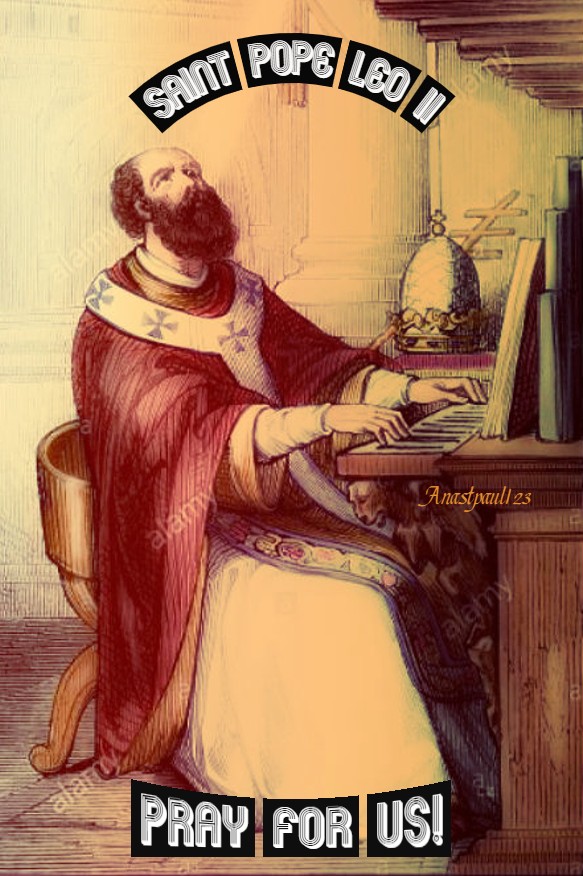
One Minute Reflection – 3 July – “The Month of the Most Precious Blood of Jesus” – St Leo II (611–683) Pope, Confessor – 1 Peter 5:1-4; 5:10-11, Matthew 16:13-19 – Scripture search here: https://www.drbo.org/
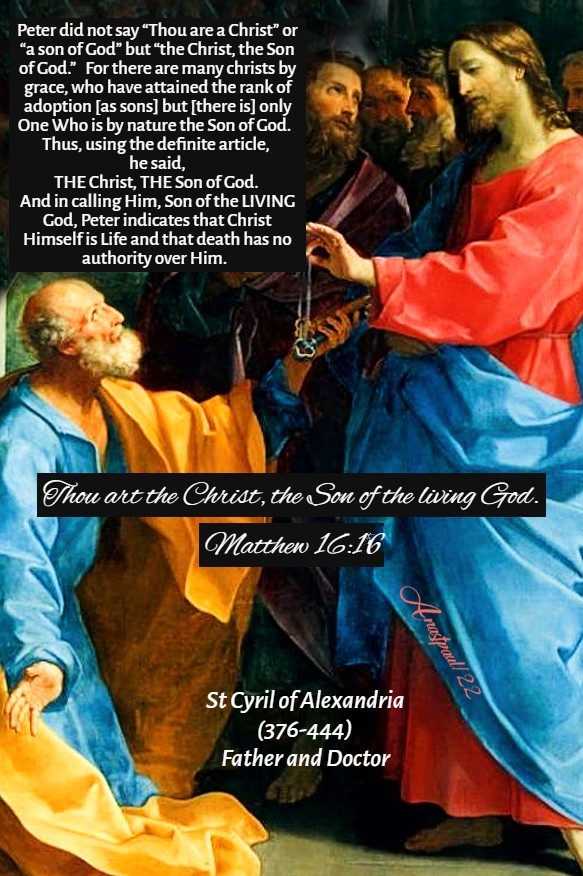
“Thou art the Christ, the Son of the living God.” – Matthew 16:16
REFLECTION – “Peter did not say “Thou are a Christ” or “a son of God” but “the Christ,the Son of God.” For there are many christs by grace, who have attained the rank of adoption [as sons] but [there is] only One Who is by nature the Son of God. Thus, using the definite article, he said, THE Christ, THE Son of God. And in calling Him, Son of the LIVING God, Peter indicates that Christ Himself is Life and that death has no authority over Him. And even if the flesh, for a short while, was weak and died, nevertheless, it rose again, since the Word, Who dwelled in it, could not be held under the bonds of death.” – St Cyril of Alexandria (376-444) Known as “The Pillar of Faith” Archbishop of Alexandria, Father and Doctor Incarnationis (Doctor of the Incarnation) (Fragment 190).
PRAYER – Look forgivingly on Thy flock, Eternal Shepherd and keep it in Thy constant protection, by the intercession of blessed Leo Thy Sovereign Pontiff, whom Thou didst constitute Shepherd of the whole Church. Through Jesus Christ, Thy Son our Lord, Who lives and reigns with Thee, in the unity of the Holy Ghost, God, world without end. Amen (Collect).
Saint of the Day – 3 July – Saint Raymond of Toulouse (Died 1118) Archdeacon, Canon of the Lateran Canons Regular at St Sernin Basilica in Toulouse, France. Born at Toulouse, France as Raymond Gayrard and Died on 3 July 1118 of natural causes. Also known as – Raymond Gayrard, Raimund, Raimundus. Additional Memorial – 8 July when Raymond is commemorate in the Order of the Lateran Canons.
The Roman Martyrology reads: “In Toulouse on the Garonne in France, Saint Raymond Gayrard, who, as a teacher, remained a widower, passionately devoted himself to works of charity, founded a hospice and was finally admitted among the Canons of the Basilica of San Saturnin.”
What we know of Raymond has come down to us as narrated in a ‘Vita’ written in the 13th Century, based on older documents, therefore, relatively close to the years of his existence.
Following a custom of the time, Raymond, of noble birth, was placed at the service of the Church of St Sernin dedicated to the first Bishop of Toulouse, becoming its Cantor while remaining a layman.
He married but his wife died shortly after the wedding; Raymond in his grief, renounced ever to remarry and decided to devote himself entirely to the service of others.
He distributed generous alms to the poor of the area and founded a Hospice. True rescuer of his fellow citizens, he had two bridges built over the Hers river, whose frequent floods were an obstacle to the passage of people and trading.
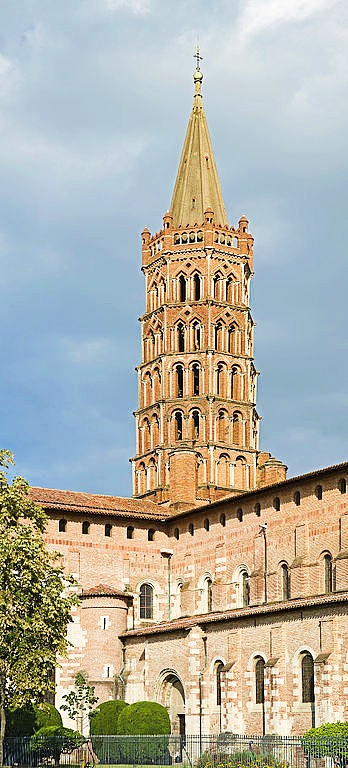
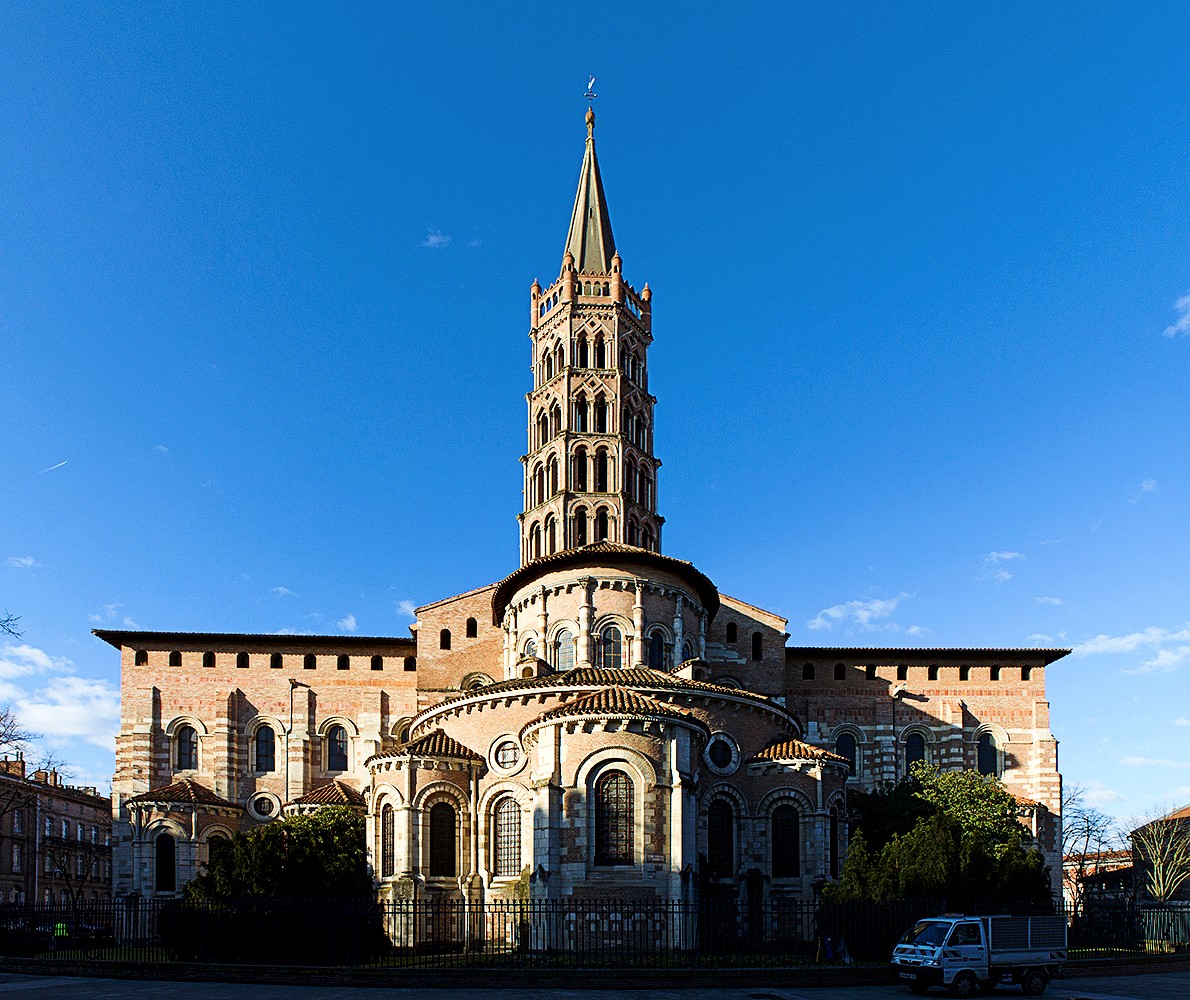
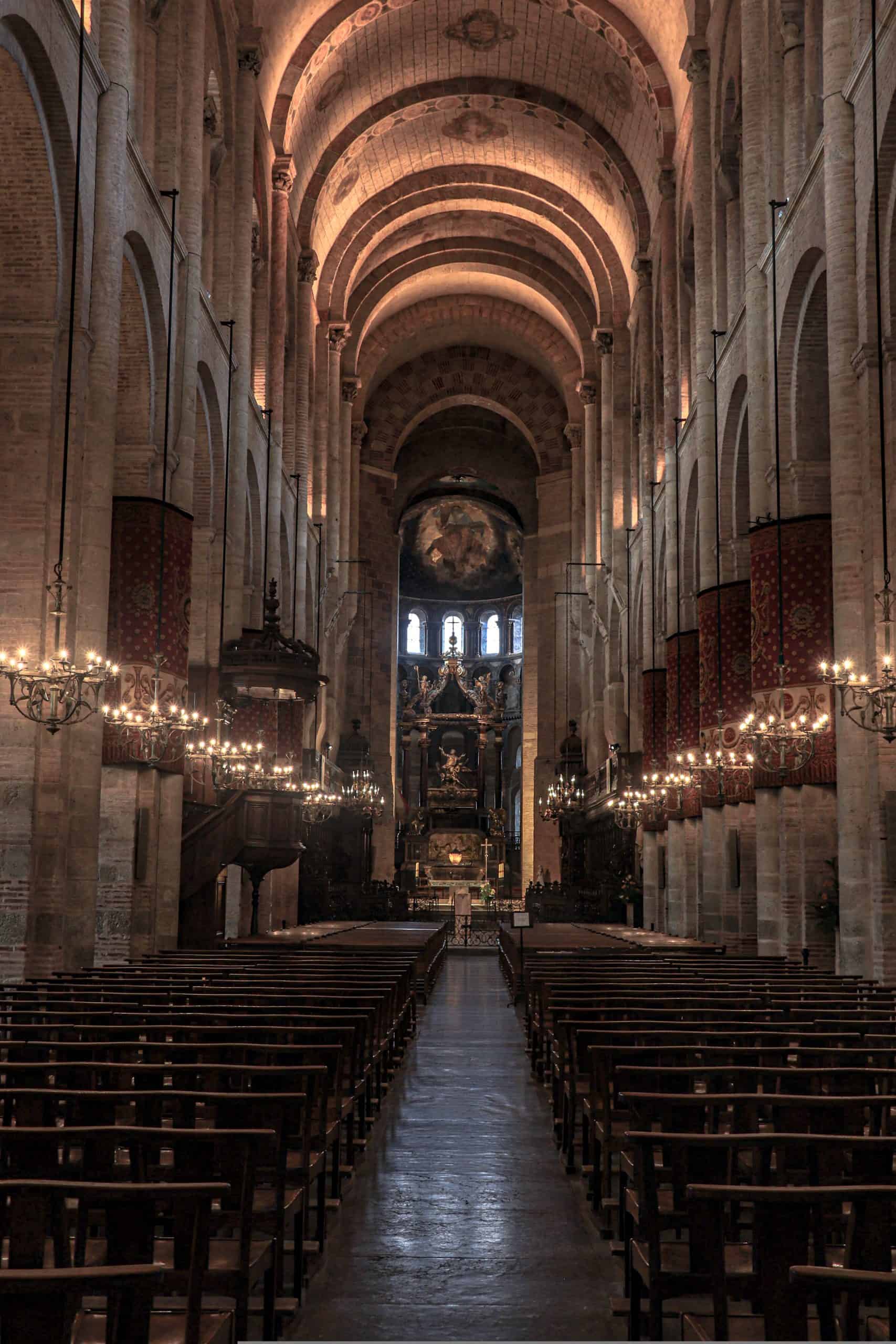
But his most important work remains his participation in the re-construction of the Church of St Sernin; the ancient complex had been under restoration since the beginning of the 11th Century, under the Bishop Ruggero. The Choir had been consecrated by Pope Urban II on 24 May 1096 but the transept, a large part of the nave and the aisles, still had to be built. Thanks to Raymond’s skills in architecture, he took over the management of the construction site, giving great impetus to the works; the long construction, to which he devoted all his activities, had great repercussions on his spiritual life, who, to bind himself even more to this Church, asked to be accepted among the Canons of St Sermin, who later elected him as Provost of the Chapter.
The Crypt at St Sernin
Unfortunately, he could not see the long and laborious work completed, in fact Raymond died on 3 July 1118 and it is recorded that by that date, he had “brought the walls all the way around up to the completion of the windows…”
Raymond was buried at the Hospice which he had founded.
Numerous miracles soon took place at his grave, for which he became the object of a local cult. In 1652, on the occasion of an epidemic which had brought a large number of sick people to his tomb, Pope Innocent III officially confirmed his cult.
(Not to be confused with Raymond, Count of Toulouse).
Below is a Welcome Note from the Curé of St Sernin.
Dear pilgrims and visitors, welcome!
Going through the doors of the Basilica of Saint-Sernin is to touch the millennial history of the Christian faith of the City of Toulouse, to be amazed by the majesty of Romanesque art, to be edified by the testimony of the Martyr Saint Saturnin, to venerate an impressive number of Relics of Saints. Stopping on the way to Santiago de Compostela, feeling the prayers rising to Heaven, being in the presence of the Lord Jesus Christ. Whatever the reason that brings you to Saint-Sernin, this Church will not leave you indifferent. Take the time to soak up its atmosphere, ask the volunteers to give you a spiritual visit, light a candle as a sign of prayer, come and attend the Masses and the Offices. You will then contemplate the true beauty of this Basilica, a jewel of Romanesque art in the heart of Toulouse, and will understand why people from Toulouse are said to have always had two Parishes – theirs and Saint-Sernin
Bl Andreas Ebersbach Bl Barbara Jeong Sun-mae St Bladus St Byblig St Cillene St Dathus of Ravenna St Eusebius of Laodicea St Firminus St Firmus Bl Gelduin St Giuse Nguyen Ðình Uyen St Gunthiern St Guthagon St Heliodorus of Altinum St Hyacinth of Caesarea Bl Ioannes Baptista Zhao Mingxi St Irenaeus of Chiusi St Maelmuire O’Gorman St Mark of Mesia St Mennone the Centurian St Mucian of Mesia St Paul of Mesia Bl Petrus Zhao Mingzhen Bl Philiphê Phan Van Minh St Raymond of Toulouse (Died 1118) Layman
Martyrs of Alexandria – 13 Saints: Thirteen Christian companions Marytred together. No details about them have survived but the names – Apricus, Cyrion (2 of), Eulogius, Hemerion, Julian, Julius, Justus, Menelaus, Orestes, Porfyrios and Tryphon (2 of). They martyred in Alexandria, Egypt, date unknown.
Martyrs of Constantinople – 24 Saints: A group of 24 Christians Martyred in the persecutions of Arian Emperor Valens. We know little more than their names – Acacios, Amedinos, Ammonius, Ammus, Cerealis, Cionia, Cionius, Cyrianus, Demetrius, Eulogius (2), Euphemia, Heliodoros, Heraclios, Horestes, Jocundus, Julian, Martyrios, Menelaeus, Sestratus, Strategos, Thomas, Timotheos and Tryphon. They were martyred in c367 in Constantintinople.
Theodotus and Companions – 6 Saints: Six Christians who were imprisoned, tortured and Martyred together in the persecutions of Trajan. Saint Hyacinth ministered to them in prison. We know nothing else about them but their names – Asclepiodotus, Diomedes, Eulampius, Golinduchus, Theodota and Theodotus. They were beheaded in c110, location unknown.
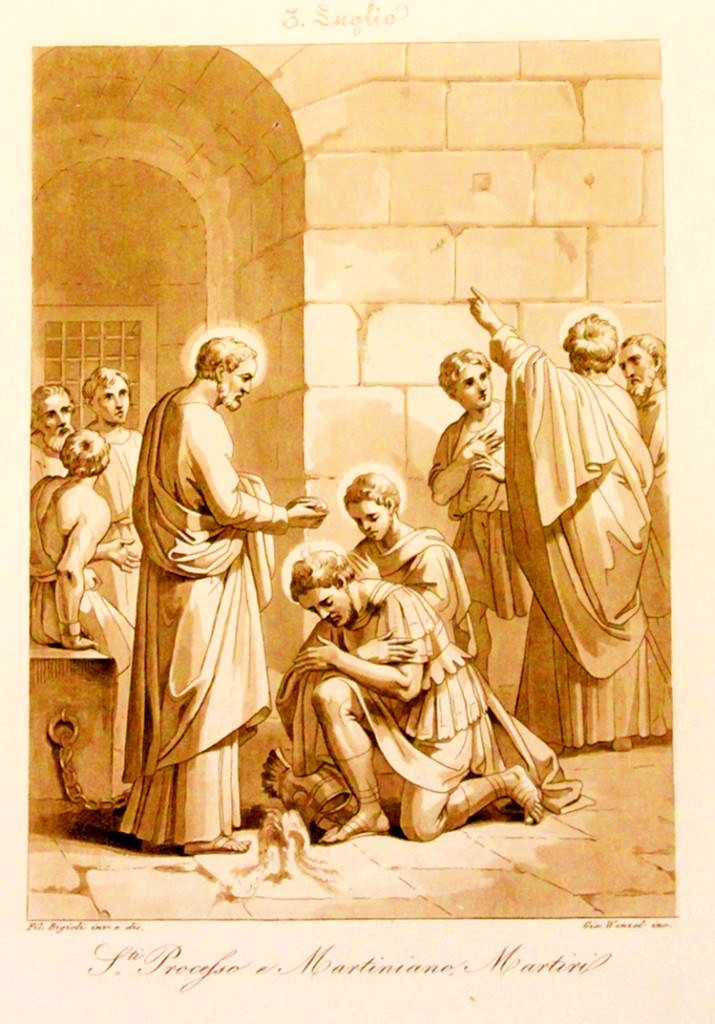
Saints of the Day – 2 July – Saints Processus and Martinian of Rome * (Died c67) Martyrs, Laymen, Prison guards at the Mamertine prison in Rome. They were among the Guards of St Peter and St Paul, the Apostles. They converted to Christ and were Baptised by Peter and Paul. Patronage – Bagnolo Mella, Italy.
The Roman Martyrology reqads today: “At Rome, on the Aurelian Way, the birthday of the holy Martyrs, Processus and Martinian, who were Baptised by the blessed Apostle Peter, in the Mamertine Prison. After being struck on the mouth, racked, scourged with thongs and whips tipped with metal, after being beaten with rods and exposed to the flames, they were beheaded in the days of Nero and thus obtained the Crown of Martyrdom.”
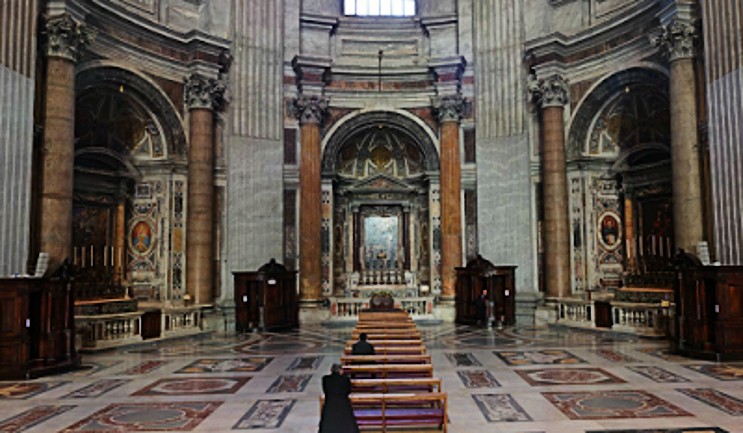
For many Centuries before the Feast of the Visitation was instituted, the 2nd of July was kept as the Feast of the Martyrs Saints Processus and Martinian, who remain as a commemoration on that day in the Extraordinary Form. According to a legend current since the Sixth Century, they were the jailers in charge of keeping Sts Peter and Paul, in the Mamertine prison in Rome, during the reign of the Emperor Nero and having been converted by the Apostles, allowed them to escape. For this, they were put to death after a long series of torments, through which they simply said over and over again, “Blessed be the Name of our Lord, Jesus Christ, Whom His blessed Apostles have preached!” Originally buried in a cemetery off the via Aurelia, their remains were transferred to the ancient Basilica of St Peter by Pope Paschal I in the early Ninth Century. The north transept of the new Basilica is named for them, where their Relics are kept under the middle of the three Altars.
The north transept of St Peter’s Basilica
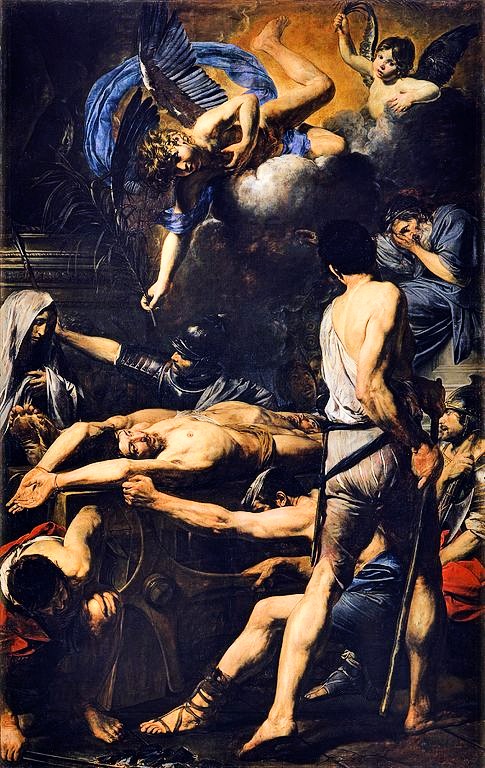
The central Altar is where this painting of their Martyrdom, by the French painter Valentin de Boulogne (1629) was originally displayed – it is now replaced by a mosaic copy.
Interesting Note: Since the windows of St Peter’s Basilica are so high up, the marble walls are never exposed to direct sunlight for any great length of time and, generally remain cooler than the air. In the summertime, when Italy is often very hot and humid, a great deal of moisture comes into the building and condenses on the cooler marble. In the middle of the 18th Century, it was realised that the paintings over the Altars were being destroyed because they had a slick of condensation over them for several months of the year. They were, therefore, all removed and replaced by mosaics. The original of our painting of the Martyrdom, is now in the Painting Gallery of the Vatican Museums. (GREGORY DIPIPPO).
Bl Giovanni da Fabriano Becchetti St Jacques Fermin Bl Jarich of Mariengaarde St Jéroche St Lidanus of Sezze St Martinian of Rome * (Died c67) Martyr, Layman
Martyred Soldiers of Rome – 3 Saints: Three soldiers who were converted at the Martyrdom of Saint Paul the Apostle. Then they were martyred, as well. We known nothing else about them but their names – Acestes, Longinus and Megistus. Martyred c68 in Rome, Italy
Martyrs in Carthage by Hunneric – 7 Saints: A group of seven Christians tortured and murdered in the persecutions of the Arian Vandal king Hunneric for remaining loyal to the teachings of orthodox Christianity. They were some of the many who died for the faith during a period of active Arian heresy. – Boniface, Liberatus, Maximus, Rogatus, Rusticus, Septimus and Servus.
Martyrs of Campania – 10 Saints: A group of ten Christians Marytred together in the persecutions of Diocletian. The only details about them to have survived are their names – Ariston, Crescention, Eutychian, Felicissimus, Felix, Justus, Marcia, Symphorosa, Urban and Vitalis. Martyred in 284 in Campania, Italy.
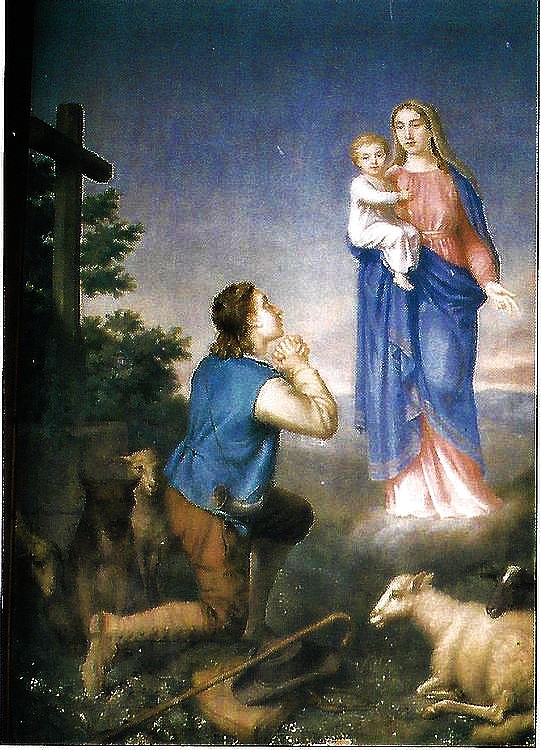
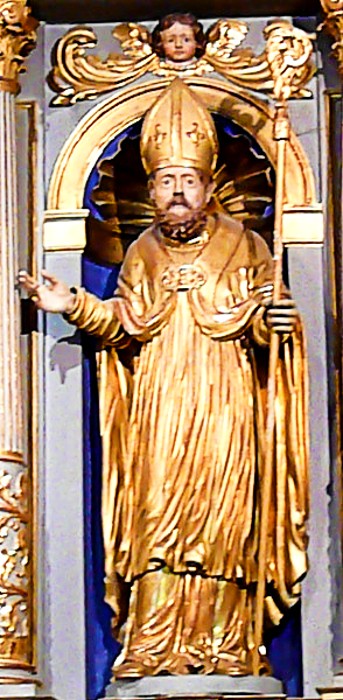
Saint of the Day – 1 July – Saint Fleuret of Estaing (Died c621) Bishop of Auvergne, France , Miracle-worker. Patronages – the blind, those with eye ailments, the lame and crippled, Estaing (modern Aveyron), France. Also known as – Fleuret of Auvergne.
The only known medieval narrative about our Saint is in the Estaing Breviary which says he was the Bishop of Auvergne, the Province north of Rouergue.
The local Abbot was returning with our Bishop from a Synod in Rome and invited him to stay in the village for a while. During this sojourn, a blind man was cured by washing his eyes in water which Fleuret had used and a lame man was enabled to walk, when the Saint gave him a piece of bread.
Local tradition summarised in literature at the Parish Church, has it that he converted the village to Christ by his preaching.
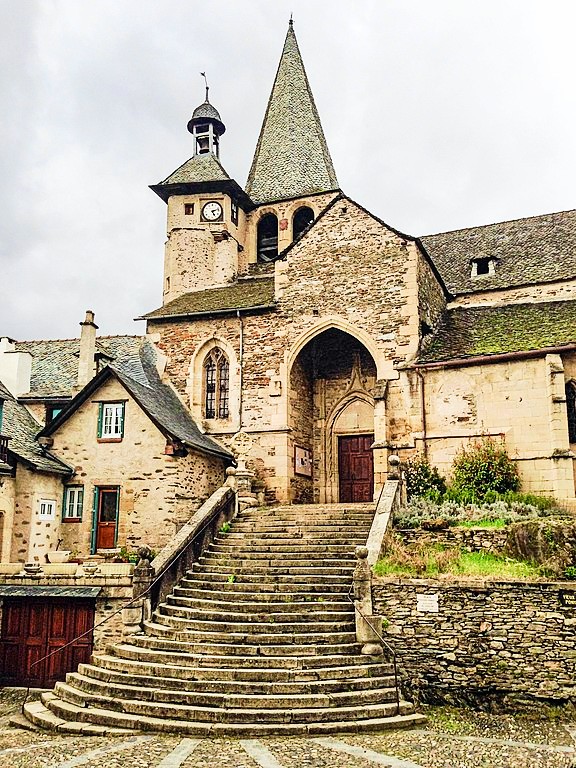
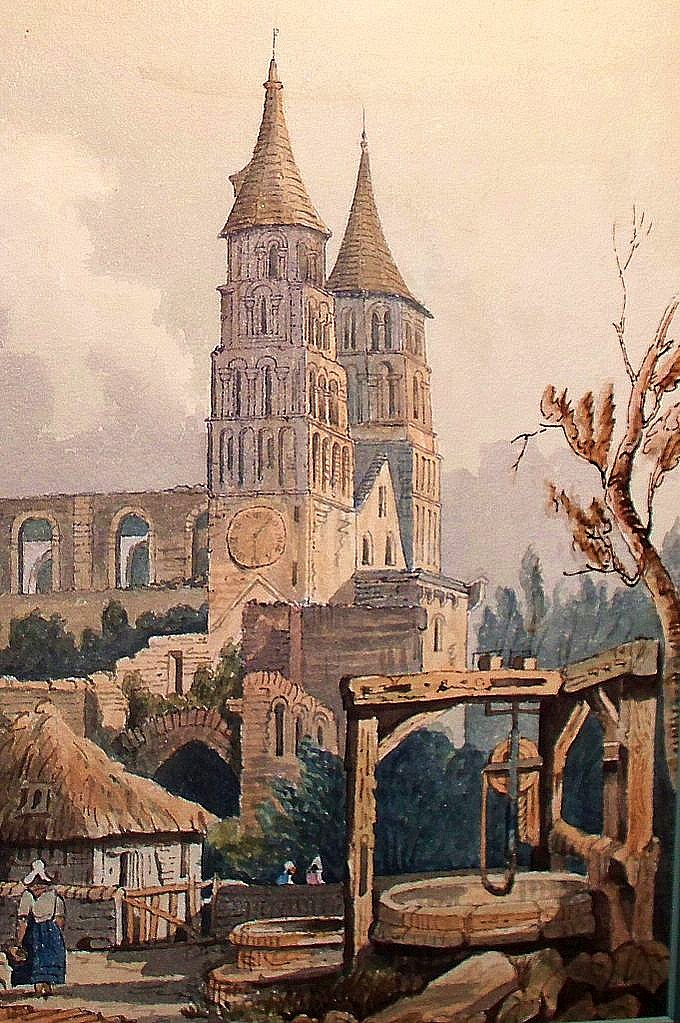
St Fleuret’s Parish Church
The people were amazed and encouraged the Bishop to extend his stay. He did,but after two weeks he took ill and died.
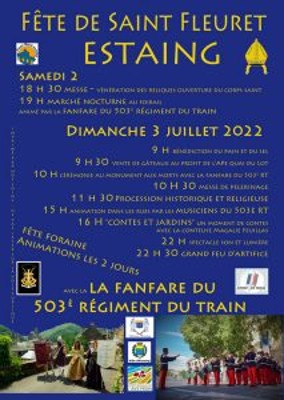
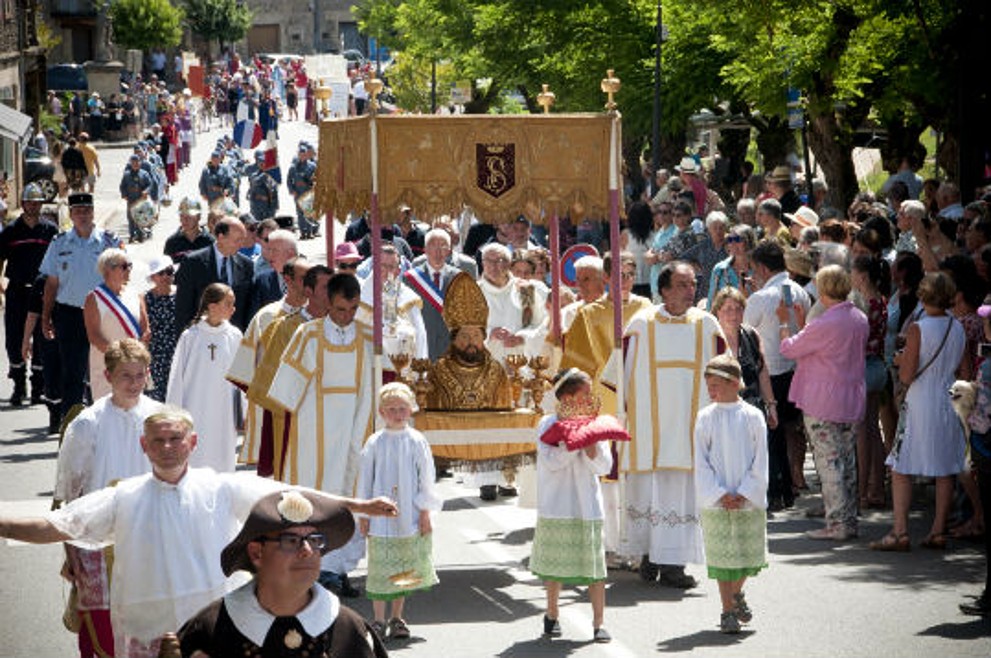
St Fleuret’s Procession in Estaing: According to tradition, St Fleuret, regional Bishop of Auvergne, stopped off at Estaing where he died in 621. St Fleuret’s cult has been attested since the 15th Century. In the 17th and 18th Centuries.
The festival was the occasion for the election of a youth king and a queen. This became more profane than religious, and was condemned by the Church. The Festival was restored in the 19th Century in the form that we now celebrate it as a symbolic, historical and religious tribute.
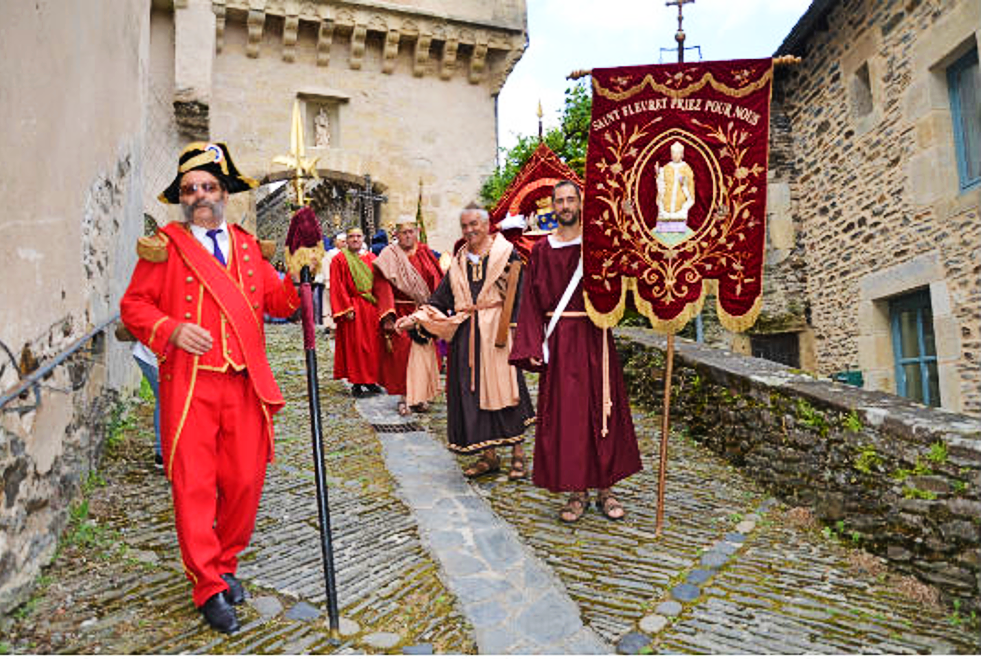
Every first Sunday of July the Procession of Saint Fleuret takes place. A parade representing Saints of Paradise, members of the Ecclesiastical hierarchy, Angels, Archangels, faithful of the old brotherhoods, pilgrims and the most illustrious characters of the Estaing family… accompanied by the clergy and the civil Officials.
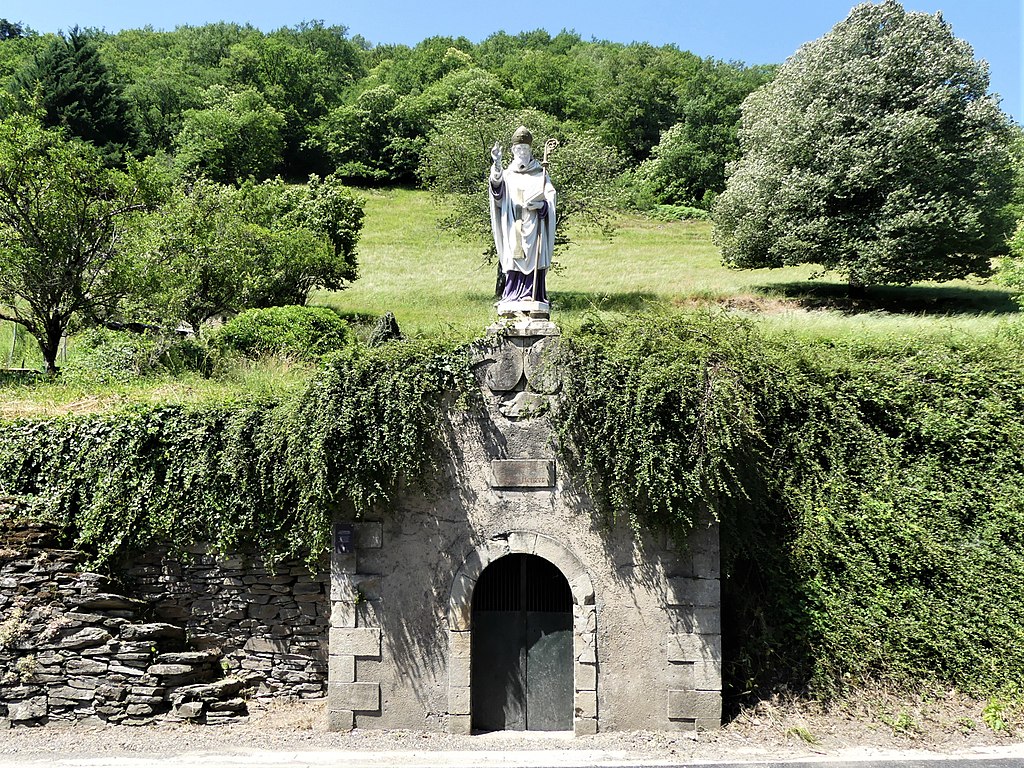
They venerate the Relics and the bust in gilded wood of St Fleuret which are carried all along the roads under the triumphal canopy and visiting St Fleuret’s miraculous spring (see below).
St Aaron of Caerleon St Aaron the Patriarch St Arnulf of Mainz St Calais of Anisole St Carilephus St Castus of Sinuessa St Cewydd St Concordius of Toledo St Cuimmein of Nendrum St Domitian of Lerins Bl Elisabeth de Vans St Eparchius of Perigord St Eutychius of Umbria St Esther the Queen Saint Fleuret (Died c621) Bishop of Auvergne, France St Gall of Clermont St Golvinus of Leon St Gwenyth of Cornwall Bl Huailu Zhang St Julius of Caerleon St Justino Orona Madrigal St Juthware St Leonorious of Brittany St Leontius of Autun St Martin of Vienne St Nicasius of Jerusalem
St Secundinus of Sinuessa St Servan of Culross St Theobald of Vicenza St Theodoric of Mont d’Or St Veep
Martyrs of Rome – 6 Saints: Six Christians who were Martyred together. No details have survived except their names – Esicius, Antonius, Processus, Marina, Serenus and Victor. They were martyred in Rome, Italy, date unknown.
St Adolphus of Osnabrück St Alpinian of Limoges St Alrick the Hermit Bl Ambrose de Feis Bl Anthony de Tremoulières Bl Arnulf of Villers St Austriclinian of Limoges St Basilides of Alexandria St Bertrand of Le Mans St Clotsindis of Marchiennes
Bl Elisabeth Heimburg St Emiliana of Rome St Erentrude St Eurgain St Gaius Bl Jacob Clou St Leo the Deacon St Lucina of Rome St Lucina of the Callistus Catacombs St Marcian of Pampeluna St Martial of Limoges St Ostianus St Otto of Bamberg St Peter of Asti St Petrus Li Quanhui
Blessed Raymond Lull TOSF (c 1232 – c 1315) Martyr – known as “Doctor Illuminatus,” Raymond was a Philosopher, Logician, Writer, Poet, Pioneer in computation theory, Franciscan tertiary. Within the Franciscan Order he is honoured as a Martyr. He was Beatified on 25 February 1750 by Pope Benedict XIV (cultus confirmed) and reaffirmed in 1847 by Pope Pius IX. His Life: https://anastpaul.com/2018/06/30/saint-of-the-day-30-june-blessed-raymond-lull-t-o-s-f-c-1232-c1315-martyr/
St Vihn Son Ðo Yen
Martyrs of Africa – 7 Saints: Seven Christians Martyred together. No detail about them have surived but the names – Cursicus, Gelatus, Italica, Leo, Timotheus, Zoilus, and Zoticus. Date and precise location in Africa unknown.
Saint of the Day – 29 June – St Cassius (Died 558) Bishop of Narni, Italy, from 537 to 558, the date of his deat, Miracle-worker. He was praised by St Gregory the Great and was noted for his charity. Died on 30 June 558 in Narni, Italy of natural causes. Relics enshrined in the Cathedral of Narni, Italy.
The Roman Martyrology reads: “At Narni, St Cassius, Bishop of that City of whom St Gregory the Great relates, in writing and in sermons, that Cassius permitted scarely any day of his life to pass without offering the Victim of propitiation to Almight God and he was well worthy to do so, for he distributed in alms, all he possessed and his devotion was such that abundant tears flowed from his eyes during the Holy Sacrifice. At Last, he came to Rome on the birthday of the Apostles, as was his yearly custom and after having solemnly celebrated Mass and given the Lord’s Body and the Kiss of Peace to all, he departed for Heaven, the next day at Narni”
Cassius would offer Mass daily at the Tomb of his predecessor Saint Juvenal of Narni, on whose life he tried to pattern his own. On the feast of Sts Peter and Paul, on the occasion of which every year, he used to go to Rome, after having celebrated the holy mysteries in his city and having distributed communion to all, he died.
St Gregory the Great, praising Cassius, says that he lived at the time of King Totila. Cassius adorned the Episcopal See of Narni in the time of the Gothic wars and was one of the Bishops who, in that sad period of disasters for Italy, implemented the directives of the Church in the pastoral ministry with zeal and prudence. St Gregory recounts that in the territory of Narni a sword holder of King Totila, possessed by the devil, was freed through the prayers of Cassius.
An Ambo in the Cathedral of Narni depicting the Virgin and Child and Sts Cassius and Juvenal.
In the tragic circumstances of the sack of Narni in the year 878, Cassius’ Relics were taken to the Basilica di San Frediano in Lucca with those of Saints Juvenal and Cassius’ wife Fausta. They were taken by Adalbert, Margrave of Tuscany but all of the Relics were returned to Narni two years later.
The Relics of Saint Cassius were enclosed in a restored shrine later known as the Sacello di San Cassio. The beautiful artwork below depicts The Miracle of St Cassius on the return of his Relics to Narni. Unfortunately I find no information of this miracle but one can see a father with an ill child in his arms, possibly a dead child.
St Anastasius of Bourges St Benedicta of Sens St Cassius (Died 558) Bishop of Narni, Italy St Ciwg ap Arawn St Cocha St Ilud Ferch Brychan St Judith of Niederaltaich St Marcellus of Bourges St Mary, the Mother of John Mark St Salome of Niederaltaich St Syrus of Genoa Bl William of Sann
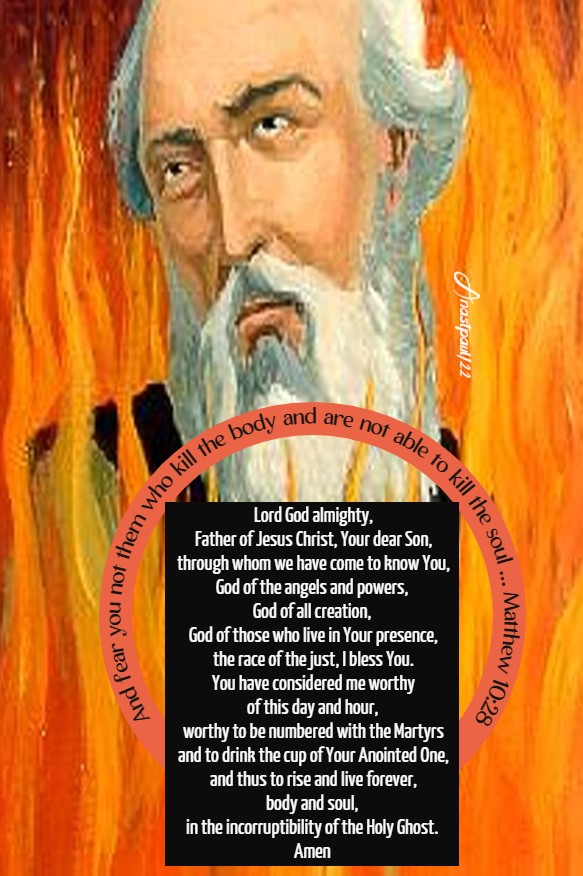
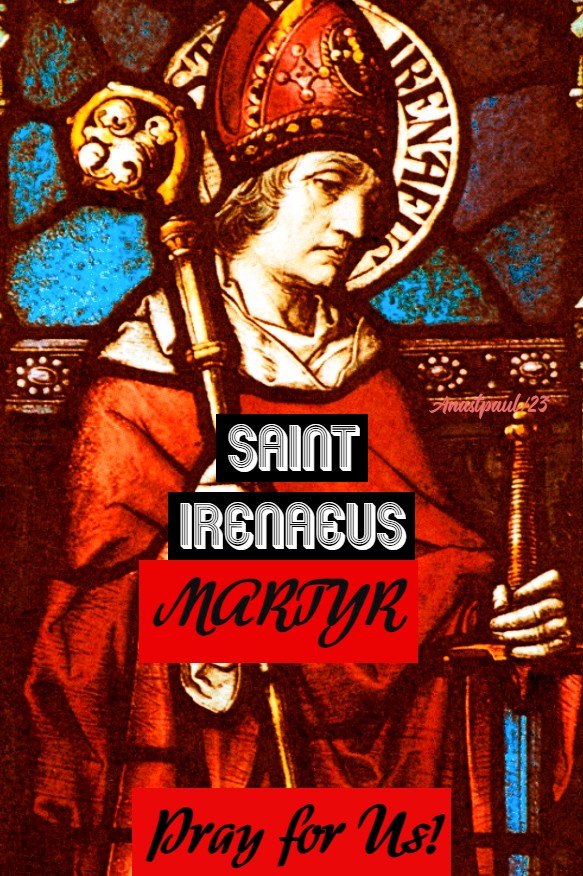
One Minute Reflection – 28 June – “The Month of the Sacred Heart of Jesus” – St Irenaeus (c130 – c202) Bishop, Martyr – 2 Timothy 3:14-17, 4:1-5; Matthew 10:28-33 – Scripture search here: https://www.drbo.org/
“And fear you not them who kill the body and are not able to kill the soul …” – Matthew 10:28
REFLECTION – “They did not nail Polycarp but only tied him up. And so, he was bound, putting his arms behind his back, like a noble ram taken from a large flock for sacrifice, a burnt offering acceptable to and made ready for God. Then he gazed up to Heaven and said: “O Lord God Almighty, Father of Your beloved and blessed Son Jesus Christ, through Whom we have received knowledge of You, God of the angels and the powers and of all creation, God of the whole race of the righteous who live in Your sight: I bless You, for You have thought me worthy of this day and hour, to share the cup of Your Christ, as one of Your Martyrs, to rise again to eternal life in body and soul in the immortality of the Holy Ghost. May I be taken up today into Your Presence among Your Martyrs, as a rich and acceptable sacrifice, in the manner You have prepared and have revealed and have now brought to fulfillment, for You are the God of truth… And so also I praise You for all things; I bless and glorify you through our Eternal High Priest in Heaven (Heb 4,14), in Your beloved Child, Jesus Christ, through Whom be glory to You and to Him and to the Holy Ghost, now and for the ages to come. Amen.” – Letter of the Church of Smyrna concerning the Martyrdom of Saint Polycarp (69-155) [Especially appropriate today, as St Irenaeus was a Student and Disciple of St Polycarp.]
PRAYER – O God, Who enabled blessed Irenaeus, Thy Martyr and Bishop, to overcome heresy with true doctrine and to establish peace happily in the Church, grant, we beseech Thee that Thy people may be steadfast in holy religion and give us Thy peace in our times. Through Jesus Christ, Thy Son our Lord, Who lives and reigns with Thee, in the unity of the Holy Ghost, God, world without end. Amen (Collect).
SWEET HEART of JESUS, be my LOVE. – Indulgence 300 Days, Once a Day – Pope Leo XIII 21 May 1802.
Saint of the Day – 28 June – St Heimerad (c970-1019) Priest, Pilgrim, Hermit, Miracle-worker. Born in c970 at Baden, Swabia, Germany and died on 28 June 1019 in Germany, of natural causes. Also known as – Eimerado, Heimrad, Haimrad or Heimo.
According to some sources Heimrad was born of a noble family but others say he was the son of a slave who was in the service of a wealthy lady who encouraged Heimerad to study to become a Priest. Heimerad was being Ordained at around 30 years of age.
Around 1006 he undertook numerous pilgrimages, to the seven pilgrimage Churches in Rome and to the Holy Land. After his return, he wanted to enter the Monastery in Memleben but was rejected and then went to the Benedictine mother Monastery in Hersfeld – today’s Bad Hersfeld – where he lived for a few years. But, he declined to take the religious vows and was, therefore, insulted, whipped and cast out by the enraged Abbot.
The ruins of the collegiate Church in Bad Hersfeld
Heimerad then settled in Kirchberg as a Hermit and was soon accused of stealing from the Chapel and was again expelled. Heimerad then worked nearby (this period is mentioned in an extant sermon dated 1012). But, even from here he was chased out of town by the local Priest because he had reproached the Priest’s housekeeper, for her unvirtuous way of life and the Priest recognised this as an attack on himself.
He asked Bishop Meinwerk in Paderborn for accommodation but he was turned away because of his unkempt appearance, called the devil and whipped. As a holy fool, he continued to endure shame and ridicule, finally he found a place on the Hasunger Berg near Kassel and, together with his servant, took over the care of the St Michael’s Chapel there. Bishop Meinwerk visited him there and asked his forgiveness for his harshness.
At first Heimerad was mocked and scorned even there but with the passage of time he came to be revered as a saint and his advice was sought by the great – the Count Dodiko von Warburg and the Empress Kunigundebecame protectors and spiritual disciples of our Saint. Heimerad became the guardian of Christianity in the Franconian-Saxon border region, which had only recently been Christianised. His holiness attracted many followers to join the Monastery.
Numerous miracles and anecdotes have been handed down from this time. One day, while climbing the mountain, Hemmo, a friend of Heimerad’s, recognised the devil who was smashing the trees on the mountain with a large boulder. Hemmo crossed himself and boldly continued the climb, for Heimerad had foreseen this attack and warned Hemmo not to fear but to cross himself.
Heimerad died as the mountain’s guardian, well respected and loved by the people, the nobles and the Bishops and Priests of the surrounding area.
Two years after Heimerad’s death, Archbishop Eribo of Mainz built a Church on the site of his Hermitage which served as the nucleus of Hasungen Abbey, founded in 1074. Pilgrimages to his grave reached their high point in the second half of the 11th Century, when Hasungen ranked as the most visited place of pilgrimage in Germany.
Around 1076, Heimerad’s life story was written by the Monk Ekkebert on behalf of Abbot Hartwig of Hersfeld The Hasunger Berg quickly became one of the most visited German pilgrimage site. But the Monastery was dissolved during the Reformation in 1527.
There have been many ‘Lives’ written about Heimerad and his fascinating and often misunderstood, earthly pilgrimage. In 2019, on the occasion of the 1000th anniversary of St Heimerad’s death, Stefan Blanz published a collection of contributions entitled “The Holy Heimerad – Priest. Pilgrim. Pauper of Christ.” The authors devote themselves to testimonies of veneration from the 11th Century to the present day.
Bl Almus of Balmerino St Argymirus of Córdoba St Attilio of Trino St Austell of Cornwall St Benignus of Utrecht St Crummine Bl Damian of Campania St Egilo St Heimerad (c970-1019) Priest, Pilgrim, Hermit St Lupercio St Papias the Martyr
Martyrs of Africa – 27 Saints: 27 Christians Martyred together. The only details about them to survive are the names – Afesius, Alexander, Amfamon, Apollonius, Arion, Capitolinus, Capitulinus, Crescens, Dionusius, Dioscorus, Elafa, Eunuchus, Fabian, Felix, Fisocius, Gurdinus, Hinus, Meleus, Nica, Nisia, Pannus, Panubrius, Plebrius, Pleosus, Theoma, Tubonus and Venustus. Unknown location in Africa, date unknown.
Martyrs of Alexandria – 8 Saints: A group of spiritual students of Origen who were Martyred together in the persecutions of emperor Septimius Severus – Heraclides, Heron, Marcella, Plutarch, Potamiaena the Elder, Rhais, Serenus and Serenus. They were burned to death c206 in Alexandria, Egypt.
Saint of the Day – 27 June – St Crescens of Galatia (Died c100) Bishop Martyr, Apostle of St Paul. Crescens is traditionally considered one of the 72 disciples sent out by Jesus in Luke 10. He was a missionary in Galatia and became a companion to and a disciple of St Paul. The name ‘Crescens’ means ‘increasing.’ Additional Memorial – 29 December (translation of Relics).
The Roman Martyrology reads today: “In Galatia, St Crescens, disciple of the blessed Apostle St Paul. In passing through Gaul, he converted many to the Faith by his preaching. Returning to the people for whom especially, he had been Consecrated Bishop, he maintained, to the end of his life, the Galatians in the service of the Lord and finally, consumated his Martyrdom under Trajan.”
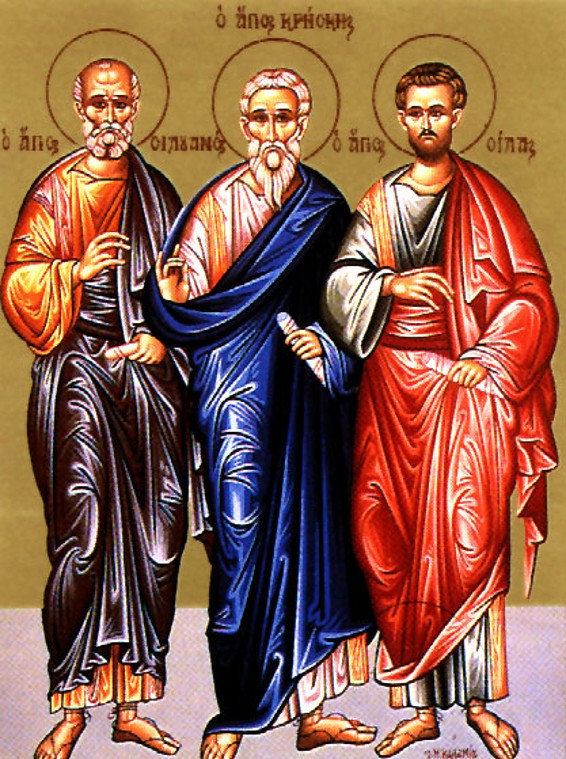
Icon of the St Crescens (centre), with Saints Silvanus and Silas traditionally of the Seventy two.
Crescens, a companion of Paul during his second Roman captivity, appears once in the New Testament, where he is mentioned as having left the Apostle to go into Galatia: “Make haste to come to me,” Paul writes to Timothy, “for Demas hath left me, loving this world and is gone to Thessalonica, Crescens into Galatia, Titus into Dalmatia” (2 Timothy 4:8–10).
All commentators agree in ranking Crescens with Titus rather than with Demas and in seeing here, therefore, a reference to a missionary journey into Galatia. This term, in New Testament times, might mean either Gaul or the Roman Province of Galatia in Asia Minor, where Paul had laboured so much and its use here, has been interpreted in both senses. In the other passages where it occurs in the New Testament, however, it denotes Galatiain Asia Minor and most probably it would be so understood here by Timothy, especially, as the other regions mentioned are likewise to the east of Rome. Moreover, Paul might easily have a reason for sending a disciple to visit his old Churches in Galatia, while Fenlon notes that there is no proof that he had an active interest in Gaul.
Later traditions, on the other hand, locate him as Bishop of Vienne in Gaul, also at Mainz on the Rhine. But the earliest known traditions of Gaul itself, record nothing of this disciple of the Apostle, as a Founder of their Church and the belief is thought to have arisen later, from the desire of an Apostolic origin.
The claims of Vienne have been most strongly urged but they are based upon the mistaken identification of its first Bishop, Crescens, who lived in the Third Century.
As little can be said for Mainz. The reading of certain manuscripts which have ‘Gallia’ instead of ‘Galatia’ has also been advanced in favour of Gaul but the traditional reading is supported, by the great mass of manuscript evidence.
Crescens is mentioned as one of the seventy two disciples of Christ by Pseudo-Dorotheus. His Martyrdom in Galatia, under Trajan, is commemorated on 27 June.
St Adeodato of Naples St Aedh McLugack St Anectus of Caesarea St Arialdus of Milan St Arianell of Wales
Blessed Benvenutus of Gubbio OFM ) (Died 1232) Lay brother of the Order of the Friars Minor of St Francis, ex-Soldier, Apostle of the sick and of lepers. Benvenutus was graced with an ardent and mystical devotion to the Blessed Eucharist and to the Mother of God. So ardent was his faith and contemplation that he was seen to hold the Divine Infant in his arms. Biography: https://anastpaul.com/2021/06/27/saint-of-the-day-27-june-blessed-benvenutus-of-gubbio-ofm-died-1232/
St Brogan St Crescens of Galatia (Died c100) Bishop Martyr, Apostle of St Paul St Crescentius of Mainz Bl Daniel of Schönau Bl Davanzato of Poggibonsi St Desideratus of Gourdon St Dimman St Felix of Rome St Ferdinand of Aragon St Gudene of Carthage Bl Hemma of Gurk St Joanna the Myrrhbearer St John of Chinon
Saints of the Day – 26June – Saint John and Saint Paul of Rome (Died c362) Laymen siblings, Martyrs. John and Paul lived during the 4th Century in the Roman Empire. They were Martyred at Rome on 26 June. The year of their Martyrdom is uncertain according to their Acts; it occurred under the Emperor, Julian the Apostate
This image is in the Passionist Monastery
The Roman Martyrology reads today: “At Rome, on Mount Coelus, the holy Martyrs, John and Paul, brothers. The former was Steward, the other Secretary of the virgin Constantia, daughter of the Emperor Constantine. Afterwards, under Hulian the Apostate, they received the Palm of Martyrdom by being beheaded.”
These two Saints were brothers and were Officers of the Roman army in the days of Constantine the Great. They served in the house of Constantia, daughter of Constantine, who was consecrated to God. Their virtues and services to her father rendered them very dear to her. They would soon glorify God by a great moral victory – after despising the honours of the world, they triumphed by their Martyrdom over its threats and torments.
With the aid of the liberality of the Christian Princess, they were practising many works of charity and mercy, until the deaths of both Constantine and Constantia. Then, at the accession of Julian the Apostate to the imperial throne, they resigned their position in the palace. Julian had returned to the cult of idols and was attempting to re-establish it in the Empire. The Christian brothers saw many wicked men prosper in their impiety but were not dazzled by their example. They considered that worldly prosperity accompanied by impunity in sin, is the most dreadful of all judgements, indicating reprobation. And history reveals how false and short-lived was the glittering prosperity of Julian.
While still in power the apostate attempted to win back these influential Officers into active service. When he was refused, he gave them ten days to reconsider. The Officer Terentianus, who at the end of that time brought to their house a little idol of Jupiter for their adoration, found them in prayer. In the middle of that night they were decapitated secretly in their own garden, since the Emperor feared their execution might cause a sedition in Rome. He instigated a rumour that they had been exiled but the demons took hold of possessed persons in Rome and published the fact of their Martyrdom everywhere.
The son of the Officer who had slain them, also became possessed and it was only after their father, Terentianus, had prayed at the tomb of the Martyrs that the child was liberated. This so impressed him that he became a Christian, with all his family and wrote the history we have reported.
The Martyrdom of St John and St Paul, by Guercino, 1632.
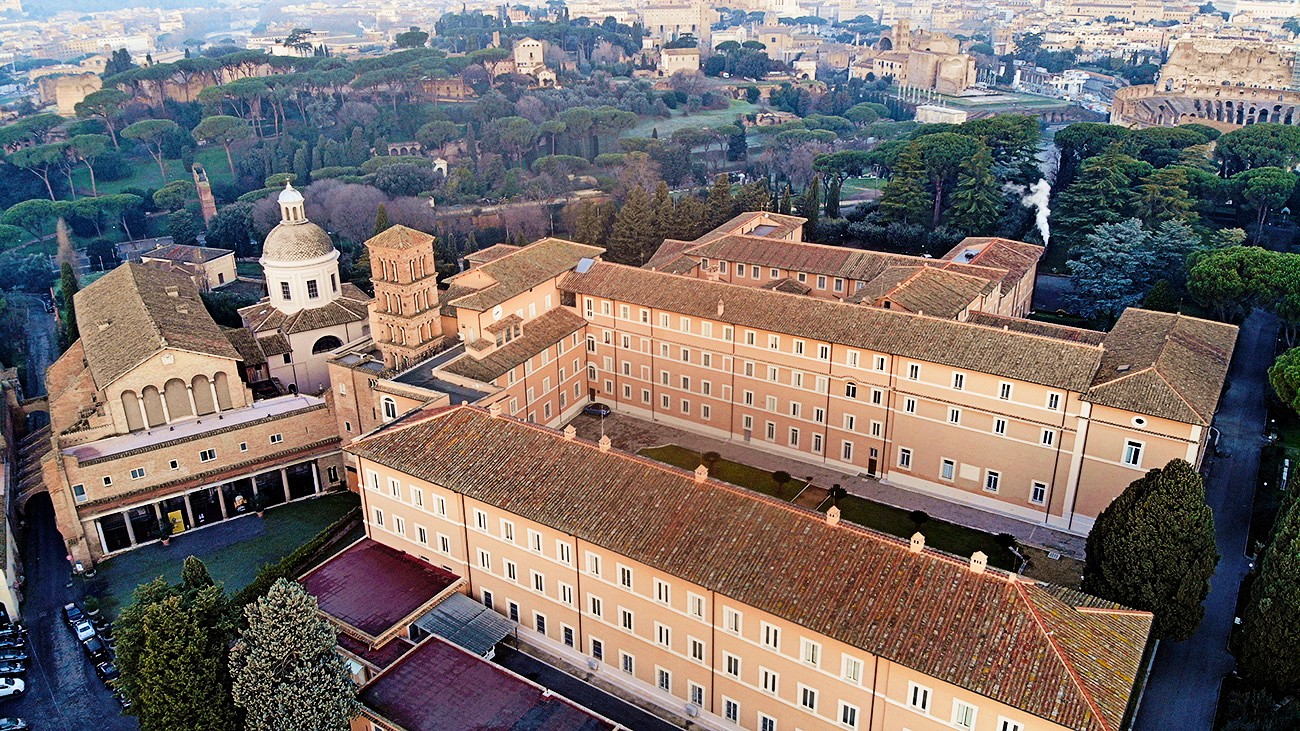
The Martyrs, by their renunciation of favours and their heroic resistance, purchased an immense weight of never-fading glory and were a spectacle worthy of God. Their house became a magnificent Basilica already at the end of the 4th Century. Next to it, there was also a building to offer hospitality to the devotees of the cult of our Martyrs and to house those who would care for the sacred buildings. In time this became the Passionist Monastery Complex dedicated to Sts John and Paul, see below
The Basilica of Santi Giovanni e Paolo in Rome, is dedicated to them, as is the Basilica di San Zanipolo in Venice (Zanipolo being Venetian for John and Paul), which is situate in the Square of San Zanipolo. Since the erection of the Roman Basilica, the two Saints have been greatly venerated and since the 5th Century, their names have been included in the Roman Canon.
Exterior of Santi Giovanni e Paolo (Venice) from Campo San Zanipolo
Reflection. The Saints always consider that they had done nothing for Christ, as long as they had not resisted unto blood and completed their sacrifice, even to pouring forth its last drop, if God asked it of them. We must always bear in mind that we owe to God, all that we are and, after all our efforts, we remain unprofitable servants, doing only what we are bound to do. (Little Pictorial Lives of the Saints).
St Anthelm of Belley O. Cart. (c 1105-1178) Bishop of Belley, France, Prior of the Carthusian Grand Chartreuse. Reformer, talented Administrator, Founder of the female Carthusians and originated of the Carthusian Rule (with the zealous and learned assistance of Bless John the Spaniard whom we celebrated yesterday) Apostle of the poor, the sick and the needy. The wonderful St Anthelm: https://anastpaul.com/2021/06/26/saint-of-the-day-st-anthelm-of-belley-o-cart-c-1105-1178/
St Babolenus of Stavelot-Malmédy St Barbolenus of Fossés Bl Bartholomew of Vir St Corbican St David of Thessalonica St Deodatus of Nola St Dionysius of Bulgaria St Edburga of Gloucester St Hermogius of Tuy St Iosephus Ma Taishun St John of Rome * Layman, Martyr St John of the Goths St José Maria Robles Hurtado St Maxentius of Poitou St Medico of Otricoli St Paul of Rome * Layman, Martyr St Pelagius of Oviedo St Perseveranda of Poitiers Bl Raymond Petiniaud de Jourgnac St Salvius Bl Sebastian de Burgherre St Soadbair St Superius St Terence of Rome St Vigilius of Trent
Martyrs of Africa – 4 Saints: Four Christians who were Martyred together – Agapitus, Emerita, Felix and Gaudentius at an unknown location in Africa, date unknown.
Martyrs of Alexandria – 3 Saints: Three Christians who were Martyred together but we really know little more that the names – Agatho, Diogenes and Luceja. They were Martyred in Alexandria, Egypt, date unknown.
Martyrs of Cambrai – 4 Beati: Four Daughters of Charity of Saint Vincent de Paul, Nuns at Arras, France. Imprisoned together in 1792 and executed together two years later in the anti-Catholic excesses of the French Revolution. They were: , Jeanne Gerard, Marie-Françoise Lanel, Marie-Madeleine Fontaine, Thérèse-Madeleine Fantou, They were guillotined on 26 June 1794 at Cambrai, Nord, France and Beatified in June 1920 by Pope Benedict XV.
Saint of the Day – 25 June – Blessed John the Spaniard O.Cart. (1123-1160) Carthusian Prior, Founder of the female branch of the Carthusians for which he wrote the Rule, also Founder of the Reposoir Monastery. Born in 1123 at Almanza, Spain and died on 25 June 1160 at the Reposoit Chapterhouse in Switzerland of natural causes, aged just 37. Patronage – against fever. Also known as – John of Spain. Blessed John was Beatified in 1864 by Pope Pius IX.
At the age of thirteen John left his country for France, both to escape the Moslems and for the purpose of studies. He settled in the Town of Arles , in Southern France. At sixteen he felt drawn to the monastic life and entered a Monastery in the vicinity. After some years, he heard about the recently founded Order of the Carthusians and their Monastery of Montrieux, not far away, founded in 1118, 5 years before he himself was born. Drawn to their austere and entirely contemplative life, he joined the Carthusians there.
Once a vowed Carthusian, he was Ordained a Priest, was named Sacristan and eventually — still a man in his twenties! —elected Prior. We may assume he was precocious on the natural level but, even more so, by the early maturity of his virtues.
The Nuns of the Monastery of Prébayon in the vicinity, following the Rules of Saint Caesarius of Arles and of Saint Benedict , were so impressed with the fervour of Montrieux, under John’s leadership that they asked to be admitted to the Carthusian Order which, unil then, had consisted only of Monks. The Prior of the Motherhouse, La Grande Chartreuse and Superior General of the Order, Saint Anthelm, authorised this. He asked John to adapt the Consuetudines of Guigo , which were the Carthusian Rule at that time, to the nuns. He did so and this was the beginning of the female branch of the Order. It was the year 1145.
Virginal Consecration of Carthusian nuns, by Mathias de Visch (1748)
Various difficulties at Montrieux lead to his retirement from the Priorship and he moved to la Grande Chartreuse in 1150. Just then, a noble lord in neighbouring Savoy, asked for a Monastery of Carthusians on his lands. Saint Anthelm saw in Blessed John the man of Providence. He sent him to make the foundation in Savoy, which was eventually given the name of le Reposoir. There he ruled wisely as Prior for some years.
While being in this new Monastery, for several years he copied, for the Nuns, the liturgical books in use at the Chartreuse. Finally, he contributed to the ratification of the Nuns’ affiliation with the Order, probably during the Second General Chapter in 1155, in which he participated as Prior of the Charterhouse of Reposoir.
Reposoir Charterhouse. This House still exists but is today a monastery of Carmelite nuns.
On 25 June 1160 John died, not yet forty years old. Through unusual circumstances he was interred not inside the enclosure, as the custom is but outside. In fact, during his Priorate, two servants of the Monastery, having died in the mountains, under an avalanche of snow, had been interred in an inappropriate place, outside the enclosure, for which John had been reproved. To make amends he had made his Monks swear that after his death they would bury him at the same place as the two servants. This, however, permitted John’s Tomb—with his renowned for sanctity—to become the object of popular pilgrimages. The faithful prayed at his Tomb and many miracles occurred in the course of the centuries, particularly cures of malignant fever. In 1864 Blessed Pius IX approved the cult of Blessed John of Spain, venerated since time immemorial.
Let us pray: God our Father, Thou called on Blessed John to help draw up a Rule for our Nuns. May we ,who have eagerly embraced the monastic life, also arrive at the perfection of charity. We ask this through Christ Our Lord. Amen.
St Amand of Coly Bl Burchard of Mallersdorf St Cyneburga of Gloucester Bl Dorothy of Montau St Eurosia of Jaca St Febronia of Nisibis Bl Fulgentius de Lara St Gallicanus of Embrun
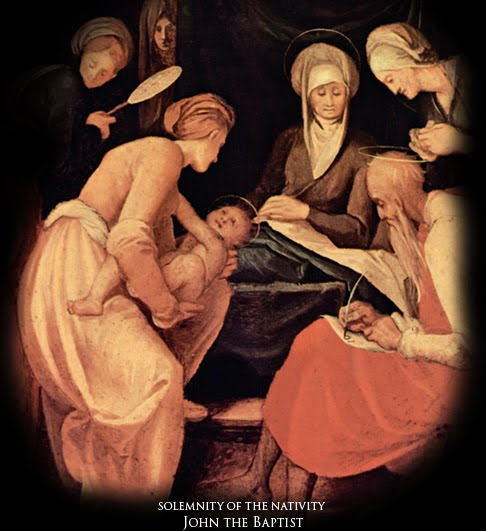
Saint of the Day – 24 June –The Nativity of St John the Baptist
“A man was sent from God, whose name was John. He came to testify to the light, to prepare a people fit for the Lord.” John 1:6-7
Ordinarily the Church observes the day of a Saint’s death as his Feast, because that day marks his entrance into Heaven. To this rule there are two notable exceptions, the birthdays of Blessed Mary and of St John the Baptist. All other persons were stained with original sin at birth, hence, were displeasing to God. But Mary, already in the first moment of her existence, was free from original sin (for which reason even her very conception is commemorated by a special Feast) and, John was cleansed of original sin in the womb of his mother. This is the dogmatic justification for today’s Feast. In the Breviary St Augustine explains the reason for today’s observance in the following words:
“Apart from the most holy solemnity commemorating our Saviour’s birth, the Church keeps the birthday of no other person, except that of bohn the Baptist. [The feasts of the Immaculate Conception and of the Nativity of the Blessed Virgin had not yet been introduced.] In the case of other saints or of God’s chosen ones, the Church, as you know, solemnises the day on which they were reborn to everlasting beatitude, after ending the trials of this life and gloriously triumphing over the world. For all these, the final day of their lives, the day on which they completed their earthly service is honoured.
But for John the day of his birth, the day on which he began this mortal life is likewise sacred. The reason for this, is, of course, that the Lord willed to announce to men His own coming through the Baptist, lest if He appeared suddenly, they would fail to recognise Him. John represented the Old Covenant and the Law. Therefore, he preceded the Redeemer, even as the Law preceded and heralded the new dispensation of grace.”
Bl Christopher de Albarran St Erembert I of Kremsmünster St Faustus of Rome and Companions St Festus of Rome St Germoc St Gohardus of Nantes Bl Henry of Auxerre/the Hagiographer St Ivan of Bohemia St John of Rome
St John of Tuy St Joseph Yuan Zaide St Rumold St Simplicio of Autun Bl Theodgar of Vestervig St Theodulphus of Lobbes
The First Martyrs of the Church of Rome: Countless numbers were Christians Martyred in the City of Rome during Nero’s persecution in 64. The event is recorded by both Tacitus and Pope Clement I, among others. They are celebrated today.
Martyrs of Satala: Seven Christian brothers who were soldiers in the imperial Roman army. They were expelled from the military, exiled and eventually martyred in the persecutions of Maximian. We know little more about them than their names – Cyriacus, Firminus, Firmus, Longinus, Pharnacius, Heros and Orentius. The martyrdoms occurred in c 311 at assorted locations around the Black Sea.
Bl Peter of Juilly Bl Thomas Corsini of Orvieto St Thomas Garnet Bl Walhere of Dinant St Zenas of Philadelphia St Zeno of Philadelphia
Martyrs of Ancyra: A family of converts who were arrested, tortured, and sent in chains to Ancyra, Galatia (modern Ankara, Turkey) where they was tortured again by order of governor Agrippinus during the persecutions of Diocletian. Martyrs. They were – Eustochius, Gaius, Lollia, Probus, Urban. Died by being roasted over a fire and finally beheaded c300 in Ancyra, Galatia (modern Ankara, Turkey).
Martyrs of Nicomedia: During the persecutions of Diocletian, many Christians fled their homes to live in caves in the area of Nicomedia. In 303 troops descended on the area, systematically hunted them down and murdered all they could find.




















 AnaStpaul
You must be logged in to post a comment.