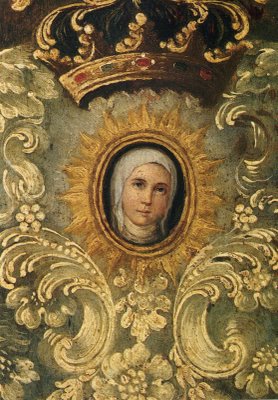
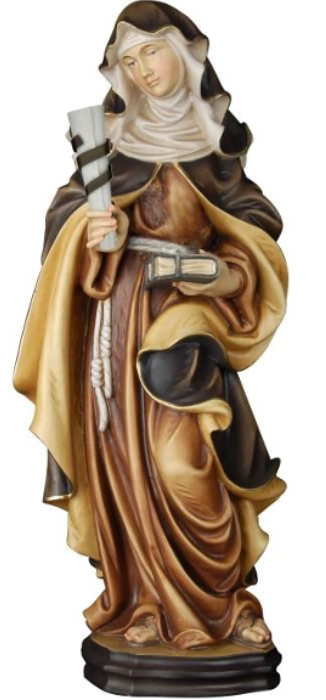
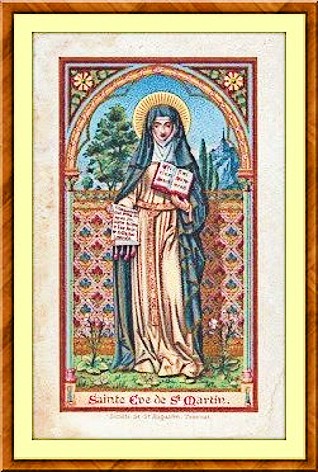
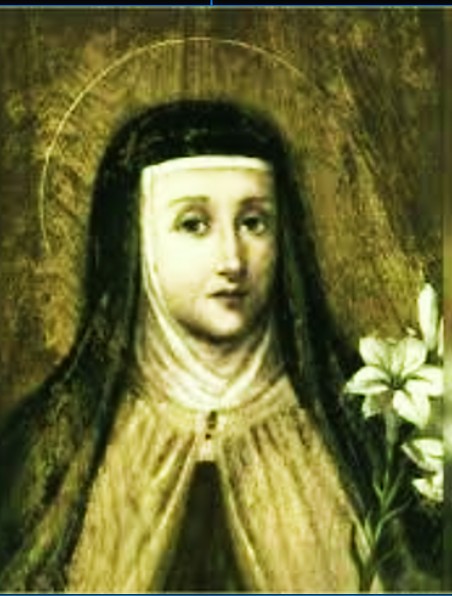
Saint of the Day – 18 January – Blessed Beatrix d’Este the Younger (c 1230-1262) Benedictine Nun, founded a Convent. Born in c 1230 at Castello Estense, Ferrara and died on 18 January 1262 of natural causes. Beatrix was Beatified in 1774 by Pope Clement XIV. Her memorial date was decreed by Pope Pius VI for today. Additional Memorial – 19 January. Also known as – Beatrice.
The Roman Martyrology states: “In Ferrara, Blessed Beatrice d’Este, Nun, who, on the death of her future husband, having renounced the kingdom of this world, consecrated herself to God in a Monastery founded by herself under the rule of Saint Benedict.”
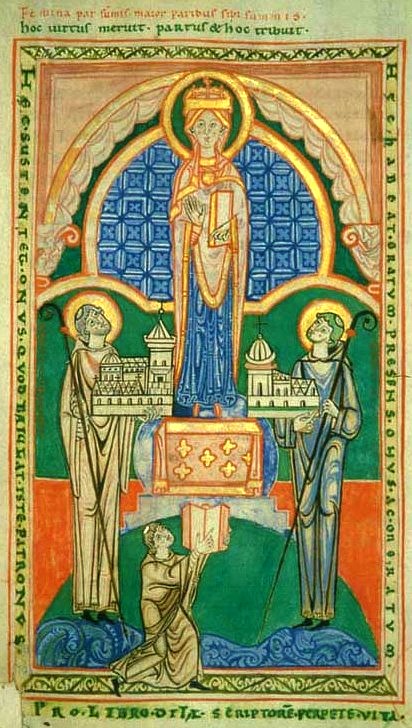
By Bartolomeo Veneto, 1510
An account of her life was written, in both medieval Latin and the Italian vernacular, by a Monk, Brother Alberto of the Church of the Holy Spirit. This text was unknown for centuries, until it was rediscovered in the eighteenth Century in an “old Ferrarese codex.”
Beatrix was the daughter of Azzo IX, the Marquis d’Este and Lord of Ferrara and of Giovanna di Puglia, Beatrice was born in Ferrara around 1230. She was educated following the examples of her aunt St Beatrix the Elder, a Nun in Gemmola (Padua)
She was given in marriage to Galeazzo, son of Manfredi and Mayor of Vicenza. On travelling to join him in Milan, she received the painful news of his death in battle, against Frederick II.
She returned to Ferrara and retired to monastic life on the islet of St Lazzarus, west of the City, with some court maids, there receiving the habit.
In 1257, as the number of Nuns grew, she obtained from Pope Innocent IV, permission to move to the Monastery of St Stephen della Rotta, near which, in 1267, the Church of St Anthony Abbot was built. Beatrix made her vows by the hands of the Bishop John, embracing the Rule of St Benedict.
Beatric lived in holiness and died on 18 January 1262 and not, as Muratori believed, in 1270. She was buried in a wing of the large cloister transformed into a Chapel and her sepulchre soon became the destination of pilgrimages .
Pope Clement XIV approved the cult on 23 July 1774 and Pope Pius VI granted the Mass and the Office in 1775, setting the celebration for 19 January in Padua, since the 18th was the now suppressed Feast of the Chair of St Peter in Rome.
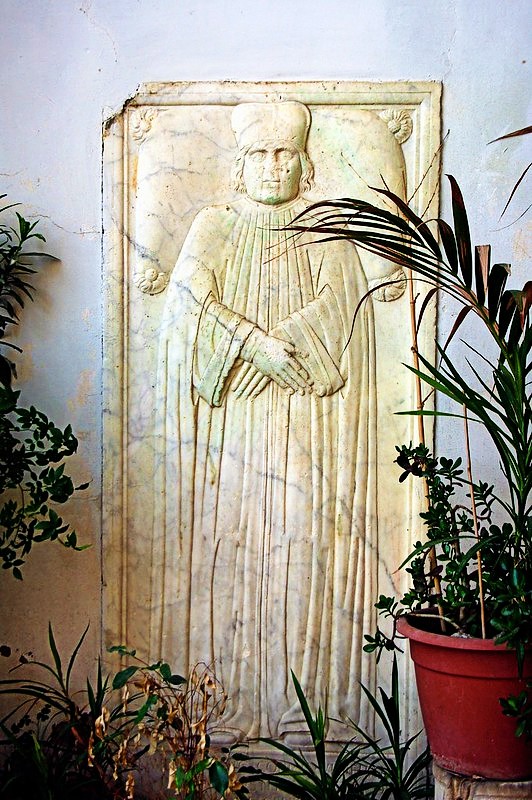
From Beatrix’s marble tomb, at certain times of the year, a liquid miraculously exudes and a delicate perfume is released from her bones. The many graces obtained on the occasions of public calamities, make the place an object of great veneration.
Quote/s of the Day – 17 January – St Anthony Abbot (251-356)
“The fruits of the earth are not brought to perfection immediately but by time, rain and care. Ssimilarly, the fruits of men ripen through ascetic practice, study, time, perseverance, self-control and patience.”
“Regard as free, not those, whose status makes them outwardly free but those, who are free in their character and conduct. For we should not call men truly free when they are wicked and dissolute, since they are slaves to worldly passions. Freedom and happiness of soul consist in genuine purity and detachment from transitory things.”
“. . . You should know that there is present with you, the Angel whom God has appointed for each man. . . This Angel, who is sleepless and cannot be deceived, is always present with you; he sees all things and is not hindered by darkness. You should know, too, that with him, is God!”
Saint of the Day – 17 January – Blessed Joseph of Freising (Died 764) the 3rd Bishop of Freising from 747/8 until his death., Founder of Churches and Monasteries. Died 17 January 764 of natural cause, Germanys. Also known as – Joseppus/Josef of Verona.
There is no direct evidence of Joseph’s place of origin, or place of birth. It is sometimes claimed that he was a native of Verona in Italy, whence his alternative name but it is equally possible that he was from Bavaria or northern Austria, or perhaps the Tyrol.
He is presumed to have been a Monk in St Corbinian’s new foundation, Freising Abbey before being appointed at the Bishop of Freising, the third to hold the office. The previous Bishop, St Erembert is believed to have been his Tutor and to have brought him up in the Monastery of St Corbinian.
As Bishop, Joseph paid special attention to increasing the possessions of his Diocese – a document dated in the year 750 has been preserved which records the donation to Joseph, of the area around Erching – today’s district of Hallbergmoos – by Bavarian Duke Tassilo III.
Joseph was also active as a founder of Churches and religious houses. In particular, he founded Isen Abbey in 752 and dedicated it to Saint Zeno of Verona.
After 760, he was closely involved, with the respective founders in the establishment of Schäftlarn and Scharnitz Abbeys. At Schäftlarn the founders gave him the power of supervision of the Monastery and the right to appoint the Abbots. Here, his first appointment was Aribo, Joseph’s successor as Bishop. At Scharnitz he appointed Atto, Aribo’s successor as Bishop of Freising, also to be highly successful in the acquisition of estates for the Diocese.
After his death on 17 January 764, Joseph was buried in the Church of Isen Abbey, founded by himself, where his tomb was restored in 1743. The Church survived the secularisation of Bavaria in 1802-03 and is still in service as St Zeno’s, the Parish Church of Isen.
Saint of the Day – 16 January – Saint Titian of Oderzo (Died 632) Bishop of Oderzo and Confessor, Defender of the True Faith against the heresy of the Arians, Miracle-worker. Born in Heraclea, Italy and died on 16 January 632 in Oderzo, Italy of natural causes. Patronages – the City and Diocese of Oderzo, Treviso, Italy and of the Diocese of Vittorio Veneto (which,until 1939, bore the ancient name of Ceneda) also in Italy. Also known as – Titian of Venice, Tiziano of Oderzo.
According to ancient tradition, Titian belonging to a wealthy and distinguished family, was born around the year 555: on the Island of Eraclea/Heraclea. In his adolescence, Titian was sent to Oderzo, for his education, where St Florian was Bishop and where the Cathedral school was highly regarded.
As he grew older, Titian felt his vocation to the Priesthood mature prompted by his inclination to put himself at the service of poor people but also by the examples of his teacher St Florian. The latter, in due course, was happy to Ordain him a Deacon and then a Priest. Having demonstrated an excellent pastoral preparation, Titian was entrusted with the task of Treasurer and was promoted to Archpriest of the Cathedral. In exercising these trusted duties, Titian found a new opportunity to exercise charity towards the poor, who were many.
St Florian, having renounced the Episcopate, desiring to become a missionary among the pagans, with the hope, moreover, of seizing the Palm of Martyrdom, the clergy and people found no person more worthy than Titian to succeed him as shepherd and guide. According to ancient tradition, he was the Bishop of Oderzo for about 25 years.
As the Bishop, Titian had to fight strenuously to protect his See from the Arians. As historians assure us, by the zealous protection of their Bishop Titian, the Diocese of Oderzo remained immune from yielding to the heresy.
The civil situation, in those days, was profoundly upset by the invasion of the Longobards, against whom, Bishop Titian protect his people. The Lombards did not occupy the City of Oderzo, which still remained, for more than a century, the stronghold of the Byzantine Empire of the Venices.
Titian, rich in virtues and merits, surrounded by fame as a miracle-worker, died on 16 January 632. His body was placed in a separate tomb in the Church of his City, where the people immediately flocked to venerate him as a Saint, recognising the great merits acquired during his lifetime and testifying to the many miracles obtained through his intercession.
The Heracleans for their part did not delay in claiming the relics but in vain, due to the strenuous opposition of the Opitergians. Fellow citizens and relatives of the Saintly Titian, who came one day to Oderzo from Eraclea, under the pretext of visiting his tomb, abducted his body when night fell and carried it off by boat. The locals, soon realising what had happened, gave chase to the robbers and caught up with them in the vicinity of the castle of Motta, where the Monticano flows into the Livenza.
At this point a beautiful miracle, so dear to the people devoted to St Titian occurred and is illustrated by the painter Pomponio Amalteo in five splendid panels (1530) is conserved in the Diocesan Museum of Sacred Art. At the gates of the City. St Titian performed a great miracle, suddenly curing a young woman who had been seriously ill for a long time.
The Translation and the miracle which occurred
To solve the problem, after a fierce battle between the inhabitants of Oderzo and Eraclea, it was decided that St Titian’s Relics should be placed in a wagon pulled by oxen. Wherever the oxen stopped would be where the Relics would be housed. The oxen stopped at Ceneda and this is where the relics have remained to this day.
His Relics are now in the crypt of the Cathedral of Ceneda, in a bronze urn fashioned in neo-Byzantine style, in the form of a sarcophagus. He is depicted in various paintings in the Cathedrals of Oderzo and Ceneda and there are ten Parishes dedicated in his name
St Peter Enthroned with Sts Paul, Titian of Oderzo (to the left of St Peter), Justina of Padua, John the Baptist, Mark and Augusta. The Painting resides in tSt Titian’s Patronal Church of Fontanelle in Ceneda.
St Henry of Coquet St Honoratus of Arles St Honoratus of Fondi Bl James of Luino St James of Tarentaise Bl Joan of Bagno di Romagna Bl Konrad II of Mondsee St Leobazio St Liberata of Pavia St Melas of Rhinocolura St Otto of Morocco St Peter of Morocco St Priscilla of Rome St Sigeberht of East Anglia St Titian of Oderzo (Died 632) Bishop St Triverius St Valerius of Sorrento
Quote/s of the Day – 15 January – The Memorial of St Macarius of Egypt (c 300-390) Priest, Abbot, Hermit, Father
“The heart itself is only a small vessel, yet dragons are there and lions, there are poisonous beasts and all the treasures of evil, there are rough and uneven roads, there are precipices but there too is God and the Angels, life is there and the Kingdom, there too is light and there, the Apostles and heavenly cities and treasures of grace. All things lie within that little space!”
Prayer for Mercy and Forgiveness By St Macarius of Egypt (c 300-390)
Lord, be merciful now that my life is approaching its end and the evening awaits me. There is not enough time for me to cleanse myself of my sins, for they are so many. Heal me while I am still on earth and I shall be truly healthy. In Thy mercy, move me to repent, so that I shall not be ashamed, when I meet Thee in Heaven. Amen
“Then go and learn, neither to be moved with injuries nor flatteries. If you die to the world and to yourself, you will begin to live to Christ.”
“The Son of man is Lord of the Sabbath.” Luke 6:5
“ … The Lord calls on us to rest, telling us: “Come to me, all you who labour and are burdened and I will give you rest” (Mt 11:28) And He gives rest to all souls who trust Him and come to Him, by delivering them from painful, oppressive and impure thoughts. Then they completely stop indulging in evil, celebrating a true, a delightful and holy Sabbath, a feast of the Spirit in inexpressible joy and rejoicing. They offer a pure and acceptable worship to God, coming from a pure heart. That is the true and holy Sabbath.”
“And as soon as He sees you seek Him fervently, He will make Himself known to you. He will appear to you, grant you His help, bestow the victory on you and save you from your enemies. In fact, when He sees how you are looking for Him, how you continually place all your hope in Him, then He will instruct you, teach you true prayer, give you that authentic charity that is Himself. Then, He will become everything to you: your Paradise, Life-giving Tree, Precious Pearl, Crown, Architect, Farmer, One subject to suffering but not afflicted with suffering, Man, God, Wine, Living Water, Lamb, Bridegroom, Soldier, Armour, Christ Who is “All in All” (1Cor 1B,28).
Saint of the Day – 15 January – St Macarius of Egypt (c 300-390) Priest, Abbot, Hermit, Desert Father of the Church, Spiritual student of Saint Anthony Abbot, Ascetic, Miracle-worker , known as “The Glowing Lantern.” Macarius was one of the famed Desert Fathers, who fled society in the fourth century to live a life of austerity and prayer in the desert.Born in c 300 at Upper Egypt and died in 390 of natural causes. Also known as – Macarius the Elder, Macarius the Great, “The Glowing Lantern.”
The Roman Martyrology reads today: “In Egypt. St Macarius, Abbot, disciple of St Anthony, very celebrated for his life, wisdom and miracles.”
Macarius was born in Lower Egypt around the year 300. At the wish of his parents Macarius entered into marriage but was soon widowed. Shortly after, his parents died. Macarius distributed all his money among the poor and needy. He found a teacher in an experienced Hermit, who lived in the desert not far from the village. The Hermit accepted the youth, guided him in the spiritual science of solitude and silence, fasting and prayer and taught him the handicraft of weaving baskets.
A while later, a pregnant woman accused him of having defiled her. Macarius did not attempt to defend himself and accepted the accusation in silence. However, when the woman’s delivery drew near, her labour became exceedingly difficult. She did not manage to give birth until she confessed Macarius’s innocence. A multitude of people then came asking for his forgiveness but he fled to the Nitrian Desert to escape all mundane glory.
As a Hermit, Macarius spent seven years living on only pulse and raw herbs. He spent the following three years consuming four or five ounces of bread a day and only one vessel of oil a year. While in the desert, he visited St Anthony Abbot and learned from him the laws and rules of monasticism. When he returned to the Scetic Desert at the age of forty, he bwas Ordained a Priest. The fame of his sanctity drew many followers. The community, which took up its residence in the desert, was of the semi-eremitical type. The Monks were not bound by any fixed rule; their cells were close together and they met for the celebratiion of the Holy Mass only on Sundays. He presided, as Abbot, over this monastic community for the rest of his life.
A young man applying to Macarius for spiritual advice, he directed him to go to a burying-place, and upbraid the dead; and after, to go and flatter them. When he came back, the saint asked him what answer the dead had made: “None at all,” said the other, “either to reproaches or praises.” “Then,” replied Macarius, “go and learn, neither to be moved with injuries nor flatteries. If you die to the world and to yourself, you will begin to live to Christ.” He said to another: “Receive, from the hand of God, poverty as cheerfully as riches, hunger and want as plenty and you will conquer the devil and subdue all your passions.” A certain Monk complained to him, that in solitude he was always tempted to break his fast, whereas in the Monastery, he could fast the whole week cheerfully. “Vain-glory is the reason,” replied the Saint; “fasting pleases, when men see you but seems intolerable, when that passion is not gratified.”
For a brief period of time, Macarius was banished to an island in the Nile by the Emperor Valens, along with St Macarius of Alexandria (Died 395), during a dispute over the doctrine of the Nicene Creed. Both men were victims of religious persecution by the followers of then Bishop Lucius of Alexandria. During their time on the island, the daughter of a pagan priest had become ill. The people of the island believed that she was possessed by an evil spirit. Both Saints prayed over the daughter and by their intercession she was cured. saved her. The pagan people of the island were so impressed and grateful that they were converted and built a Church. When word of this got back to the Emperor Valens and Bishop Lucius of Alexandria, they quickly allowed both men to return home. At their return they were met by a multitude of Monks in joyous celebration.
Macarius’ face used to be enlightened with grace in an amazing way, to the extent that many fathers testified that his face used to glow in the dark and thus, he was called “The Glowing Lantern.” This description was transferred to his Monastery, and thus it was called “the glowing lantern of the wilderness” or “the glowing Monastery,” which meant the place of high wisdom and constant prayer. Today it belongs to the Coptic Orthodox Church.
Macarius died peacefully around the age of 90, in the year 390. After his death, the natives of his village appropriated his body and built a great Church for him in their village. Today, the body of Macarius is found in his Monastery, the Monastery of Saint Macarius in Scetes, Egypt.
The entirety of the Nitrian Desert is sometimes called the Desert of Macarius, for he was the pioneer Monk in the region. The ruins of numerous Cells in this region, support the local tradition that the cloisters of Macarius, were equal in number to the days of the year.
We have 50 of his sermons to savour his wisdom. Below is a link to a video series of the sermons as well as a Pdf, which also contains great details of his life.
St Maurus OSB (c 512-584) Benedictine Monk, Abbot and Deacon, Miracle-worker. Maurus was the first disciple of Saint Benedict of Nursia (512–584). He is mentioned in Saint Gregory the Great’s biography of the latter as the first oblate, offered to the Monastery by his noble Roman parents as a young boy, to be brought up in the monastic life. The formula and blessing of St Maurus were universally adopted and approved for use in the Blessing of the Sick. His Life and Miracles: https://anastpaul.com/2021/01/15/saint-of-the-day-15-january-saint-maurus-osb-c-512-584/
St Blaithmaic of Iona St Bonitus of Clermont St Britta St Ceolwulf of Northumbria St Emebert of Cambrai St Ephysius of Sardinia St Eugyppius Bl Geoffrey of Peronne Bl Giacomo Villa St Gwrnerth St Habakkuk the Prophet St Isidore of Scété St Isidore the Egyptian St Ita of Killeedy St John Calabytes St Liewellyn St Lleudadd of Bardsey St Macarius of Egypt (c 300-390) Priest, Hermit, Spiritual student of Saint Anthony Abbot.
St Malard of Chartres St Maximus of Nola Bl Peter of Castelnau St Placidus
Saint of the Day – 14 January – St Macrina the Elder (Died c 340) Widow, Mother of the elder St Basil and, therefore, the Grandmother of St Basil the Great, St Gregory of Nyssa, St Peter of Sebaste and St Macrina the Younger. Macrina was a native of Cappadocia, in what is now eastern Turkey. Patronages – against poverty, of the poor, of widows. Also known as – Macrina of Caesarea.
The Roman Martyrology says today: “St Macrina, disciple of St Gregory Thaumaturgus and the grandmother of St Basil, whom she brought up in the Faith.”
Our knowledge of the life of the elder Macrina is derived mainly from the testimony of the great Cappadocian Fathers of the Church, her grandchildren – Basil, Gregory of Nyssa (Vita Macrinae Junioris) and the panegyric of St Gregory of Nazianzen on St Basil.
Two of these grandsons helped shape the Faith which we proclaim today—Basil the Great, a Doctor of the Church and his brother, Gregory of Nyssa, who helped the Church better articulate her understanding of the Trinity. Both of these men played crucial roles in formulating the Nicene Creed which Catholics still recite every Sunday at Mass. Macrina raised both of these men and their influential younger sister, Macrina the Younger. She gave all these great Saints their first religious instruction as children.
The works of Basil indicate that she studied under Gregory Thaumaturgus (or the Wonderworker), the great father of the Faith in Cappadocia, he of whom it is said that when he arrived in the territory, there were only seventeen Christians in the Town of Neocaesarea; when he died in 268, there were only seventeen pagans. It was his teachings, handed down through Macrina to Basil and Gregory that were particularly formative for the two Cappadocian brothers.
Her home was at Neocaesarea in Pontus and according to Gregory Nazianzen, during the persecution of Christians under Galerius and Diocletian, Macrina fled with her husband to the shores of the Black Sea. They left their home and hid in the woods for seven years. They were often hungry and had to live off the land and whatever animals they could hunt. After they were finally allowed to go home to Neocaesarea, another round of persecution took effect and their possessions were confiscated. These trials are the reason for her patronage of the poor.
She was widowed and is also the Patron of widows. She is said to have died in the early 340s
Bl Amadeus of Clermont St Barbasymas St Caldeoldus of Vienne St Datius of Milan St Engelmaro St Eufrasio of Clermont St Euphrasius the Martyr
St Felix of Nola (Died c 253) Priest, Confessor, Apostle of Charity .Patronages – against eye disease, against eye trouble, against false witness, against lies, against perjury, domestic animals, of Nola, Italy. The Roman Martyrology states of him today: “At Nola in Campania, the birthday of St Felix, Priest, who (as is related by Bishop, St Paulinus of Nola), after beomg subjected to torments by the persecutors, was cast into prison and extended, bound hand foot, on (snail) shells and broken earthenware. During the night, however, his bonds were loosened and he was delivered by an Angel. The persecution over, he brought many to the Faith of Christ by his exemplary life and teaching and renowned for many miracles, he rested in peace.” Biography: https://anastpaul.com/2019/01/14/saint-of-the-day-14-january-st-felix-of-nola-died-c-253/
St Felix of Rome St Fermin of Mende St Fulgentius of Ecija St Glycerius of Antioch
St Isaias the Martyr St Jesaja of Sinai St Macrina the Elder (Died c 340) Widow, Grandmother of St Basil the Great, St Gregory of Nyssa, St Peter of Sebaste and St Macrina the Younger. St Nino of Georgia Bl Odoric of Pordenone
St Paul of Africa St Potitus Bl Rainer of Arnsberg St Sabas of Sinai St Sava of Serbia St Successus of Africa St Theodolus of Sinai Bl William de Sanjulia
Martyrs of Mount Sinai: A group of Monks on Mount Sinai who were Martyred by desert Bedouins. Their names and exact number have not come down to us. Martyred by Bedouins.
Martyrs of Raithu – 43 Saints: A group of 43 Monks in the Raithu Desert near Mount Sinai, Palestine, near the Red Sea. They were Martyred for their faith by desert Bedouins. Their names have not come down to us. Martyred by Bedouins.
Saint of the Day – 13 January – Saint Leontius of Caesarea (Died 337) Bishop of Caesarea in Cappadocia. Leontius died in 337 of natural causes. He is sometimes called “the Angel of Peace.”
The Roman Martyrology states today: “At Caesarea, in Cappadocia, St Leontius, the Bishop, who strongly opposed the Gentiles under Licinius and the Arians, under Constantine.”
Leontius attended the First Council of Nicaea in 325 and was highly praised in the writings of Saint Athanasius (297-373) the Archbishop of Alexandria, a Father and Doctor of the Church. He was known to the Greeks by the spiritual title “the Angel of Peace.”
Saint of the Day – 12 January – Saint Tatiana of Rome (Died c 226) Virgin, Martyr. Died by being beheaded in c 226 in Rome, Italy. Patronage – students, school children. Also known as – Martina, Tatienne.
The Roman Martyrology reads today: “At Rome in the time of the Emperor Alexander, St Tatiana, Martyr who was torn with iron hooks and combs, thrown to the beasts and cast into the fire but, having received no injury, was beheaded and thus, went to Heaven.”
Tatiana was a Christian Martyr in the 3rd Century, in Rome during the reign of Emperor Alexander Severus. According to legend, she was the daughter of a Roman civil servant who was secretly Christian. He raised his daughter in the Faith and she became prominent in helping the early Church. This was dangerous, bringing her to the attention of the persecutors and one day the jurists Ulpian, captured Tatiana and attempted to force her to make a sacrifice to Apollo. She prayed and miraculously an earthquake destroyed the Apollo statue and part of the temple.
Tatiana was then blinded and beaten for two days, before being brought to a Circus and thrown into the pit with a hungry lion. But the lion did not touch her,and instead, lay at her feet. This resulted in a death sentence being pronounced and after being tortured, Tatiana was beheaded with a sword.
Tatiana was venerated as a Saint from the early days of the Church. The miracles performed by Tatiana are said to have converted thousands upon thousands,and many converted to the Faith immediately. She is the Oatron Saint of students.
Bl Bartholomew Alvarez Bl Bernardo de Plano St Biccianus St Bernard of Corleone St Caesaria of Arles St Caroticus Bl Emmanuel d’Abreu St Eutropius St Ferreolus of Grenoble Bishop Martyr Bl John Gaspard Cratz St John of Ravenna Bl Lucia of Valcaldara St Martinian of Belozersk St Peter of Abessala St Probus of Verona St Quinctus the Soldier St Satyrus St Tatiana of Rome (Died c 226) Virgin, Martyr St Tigrius St Victorian of Asana Bl Vincent da Cunha
Martyrs of Africa – 44 Saints: A group of 44 Christian soldiers murdered together for their faith in Africa. The only details that survive are four of their names – Castulus, Modestus, Rogatus and Zoticus.
Martyrs of Ephesus – 42 Saints: Forty-two Monks Martyred at a Monastery in Ephesus (modern Turkey) during the persecutions of the Iconoclast Byzantine Emperor Constantine V. Their names have not come down to us. Martyred c 762.
Martyrs of Iona – 38 Saints: Thirty-eight Monks Martyred in Iona, Ireland. Their names have not come down to us. They were Martyred in 750 at Iona, Ireland.
Saint of the Day – 11 January – Saint Anastasius of Suppentonia (Died c 570) Monk, Abbot of the Monastery at Suppendonia, Italy. Died in c 570 at Suppentonia, Italy of natural causes. Patronage – of Castel Saint’Elia, Italy. Also known as – Anastasius of Castel Sant’Elia, Anastasius X.
The Roman Martyrology reads today: “At Suppentonia, near Mount Socrates, the holy Monk Anastasius and his companions, who were called by a voice from Heaven to enter the Kingdom of God.”
A source on Anastasius’ life is St Gregory the Great, who wrote that an Angel appeared to summon Anastasius and all of the Abbot’s Monks. Anastasius and all of his Monks all subsequently died one after the other within the next eight days.
St Nonnosus (Died c 570) Monk, was one of Anastasius’ Monks.
Saint of the Day – 10 January – St John Camillus the Good (Died c 669) Confessor, Archbishop of Milan from c. 641 until his death. Known as “the Good” for his great charity and generosity, his holiness, devotion and his many miracles. Additional Memorials – 2 January on some calendars, 15 January in Milan and 25 September together with all the Saint Bishops of Milan. Also known as – John Bonus, John Camillus, John the Good of Milan, Giovanni Bonus.
The Bishop of Milan, Honoratus, escaped to Genoa and Honoratus’ successors remained in Genoa. Genoa was then a suffragan Diocese of Milan. There, John the Good, is particularly remembered for being the first Bishop to return the Seat to Milan after more than 70 years absence.
John the Good was born in the Diocese of Genoa in the village of Recco (also the nearby town of Camogli claims the birth of John). It is not exactly known when he became Bishop of Milan but it is believed that his election was in consequence of the 641 conquest of Genoa by the Lombard’s King Rothari. John was the Bishop who returned the Seat and See of the Diocese to Milan.
There are two main sources for John’s life – the Catalogue of the Bishops of Milan (dated about the 10th Century) and a poem in his honour which can be dated from the 11th to the 13th Century. According to this Poem/Vita, John was distinguished for his generosity and charity, from which he was given the sobriquet “the Good.”
The Alter erected by St Charles Borromeo in Milan Cathedral. The immense windows beside it depict the life of St John the Good
In 649, John was invited to participate to the Lateran Council but he arrived in Rome when the Council had already ended. He, however, subscribed to all the Decrees issued by the Council.
According to the Vita, he accomplished many miracles and moved some of the Relics of Saint Syrus of Genoa to Desio. He died in c 669 leaving all his properties, including estates in Genoa, to the Church of Milan.
John’s body was initially buried in the little Church of Saint Michael in Milan and the first survey on his Relics was made by Archbishop Aribert (1018–1045). On 24 May 1582, shortly before the demolition of the Church of St Michael, Cardinal Saint Charles Borromeo translated John’s body to the south transept of the Cathedral of Milan, where it is still venerated. Our Saint John the Good, was a tall man, his body measures 1.90 metres (6 ft 3 in) in height.
John died on 2 January according to the catalogue, or on 10 January according to the Poem Vita. The latter date became his Feast day. Today, his Feast is celebrated on 2 January, or on 10 January where he is still listed for this date in the Roman Martyrology (or 15 January in the Cathedral of Milan and together with all the Saint Bishops of Milan on 25 September).
St Marcellinus of Ancona St Marciana Bl Martinus In Eon-min St Maurontius St Nearchus St Paschasia of Dijon
St Peter of Sebaste (c 340-c 391) Bishop of Sebaste in Lesser Armenia. Member of the glorious family of Saints – He was the younger brother of Basil of the Great, Gregory of Nyssa, the famous Christian Hermit Naucratius and Macrina the Younger and a close friend of Gregory of Nazianzen, all Saints. Of course, Basil and Gregory of Nazianzen are both Doctors too. About St Peter: https://anastpaul.com/2021/01/09/saint-of-the-day-9-january-st-peter-of-sebaste-c-340-c-391-bishop/
St Philip Berruyer St Polyeucte St Waningus of Fécamp (Died c 688) Monk, Abbot
Martyrs of Africa – 21 Saints: A group of 21 Christians murdered together for their faith in the persecutions of Decius. The only details to survive are 14 of their names – Artaxes, Epictetus, Felicitas, Felix, Fortunatus, Jucundus, Pictus, Quietus, Quinctus, Rusticus, Secundus, Sillus, Vincent and Vitalis. They were Martyred in c 250.
Martyrs of Antioch – 6 Saints: A group of Christians Martyred together during the persecutions of Diocletian – Anastasius, Anthony, Basilissa, Celsus, Julian and Marcionilla.
Saint of the Day – 8 January – Saint Severinus of Noricum (c410-482) Abbot, Hermit, Missionary, established Monasteries and refuge centres for those stricken by war. Severinus was graced with the gifts of prophecy and miracles. He is known as “The Apostle to Noricum” – Noricum is the Latin name for the Celtic Kingdom or Federation of Tribes which included most of modern Austria and part of Slovenia. Born in c410 and died on 8 January 482 at Favianae, Noricum of natural causes. Patronages – against famine, of linen weavers, prisoners, vineyards/vintners/wine farms, Austria, Bavaria, Germany, the Diocese of Linz, Austria. Also known as – Severrin, Severino.
Saint Severin blesses Austria – Hans Gustav Dittenberger von Dittenberg, 1849
The Roman Martyrology reads today: “This same day, among the inhabitants of Noricum (now Austria), the Abbot, St Severin, who preached the Gospel in that country and is called it’s apostle. By Divine Power, his body was carried to Lucullanum, near Naples and thence transferred to the Monastery of St Severin.”
It has been speculated that Severinus was born in either Southern Italy or in the Roman province of Africa. Severinus himself refused to discuss his personal history prior to arriving along the Danube in Noricum. However, he did mention experiences with eastern desert monasticism and his Vita draws connections between Severinus and Saint Anthony of Lérins (c 428-c 520) https://anastpaul.com/2021/12/28/saint-of-the-day-28-december-saint-anthony-of-lerins-c-428-c-520/
Little is known of his origins. The source for information about him is the Commemoratorium Vitae St Severini (511) by Eugippius (c 460-c 535), who was a disciple of Severinus. In 511 Eugippius wrote to Paschasius and asked his venerated and dear friend, who had great literary skill, to write a biography of St Severinus from the accounts of the Saint which he (Eugippius) had put together in crude and unartistic form. Paschasius, however, replied that the acts and miracles of the Saint could not be described better than had done by Eugippius. This Vita is available online at: https://www.tertullian.org/fathers/severinus_02_text.htm
St Severinus – St.Severin Parish Church Lower Austria
Severinus was a high-born Roman living as an Hermit in the East. He was an ascetic in practice. He is first recorded as travelling along the Danube in Noricum and Bavaria, preaching Christianity, procuring supplies for the starving, redeeming captives and establishing Monasteries at Passau and Favianae,
While the Western Empire was falling apart, Severinus, thanks to his virtues and organisational skills, committed himself to the religious and material care of the frontier peoples, also taking care of their military defence. He organised refugee camps, migrations to safer areas and food distribution.
Madonna and Child Enthroned between San Severino and San Sossio – Protasio Crivelli, 1506
Serverinus offered practical leadership, as well as spiritual leadership. He was a tireless preacher and a marvellous Miracle-worker – he miraculously multiplied food reserves, cured the sick, cast out devils, commanded the elements of nature and once even resurrected the dead.
The main theme of his teaching was the value of penance. It was a propitious choice. The sufferings of his people under the Germanic invasions were acute and, uniting them with Christ’s sufferings for the reparation of sin and the conversion of sinners, enabled them to find meaning and strength amid calamity. He also practiced what he preached. In his constant barefoot journeying throughout Austria and Bavaria, he ate only one meal a day and slept on a sack which he carried around with him, wherever he happened to find himself at bedtime.
His efforts seem to have won him wide respect, including that of the Germanic chieftain Odoacer. Eugippius credits him with the prediction that Odoacer would become king of Rome. However, Severinus warned that Odoacer would rule not more than fourteen years.
Severinus also prophesied the destruction of Asturis in Austria, by the Huns. When the people would not heed his warning, he took refuge in Comagena. There he established refugee centres for people displaced by the invasion and founded Monasteries to re-establish spirituality and preserve learning in the stricken region.
He died in his monastic cell at Favianae while singing Psalm 150. Six years after his death, his Monks were driven from their Abbey and his body was taken to Italy, where it was at first kept in the Castel dell’Ovo, Naples, then eventually interred at the Benedictine Monastery rededicated to him, the Abbey of San Severino in the City of Naples.
Austrian postage stamp of their Patron Saint
St Severinus Statue on the Church in Church at Steinhof, Vienna
St Apollinaris the Apologist (Died 2nd Century) Confessor, Defender of the True Faith against heretics, Writer, renowned Scholar. Bishop, Apologist. The Roman Martyrology states: “In Hierapolis in Phrygia, in today’s Turkey, Saint Apollinaris, Bishop, who shone under the Emperor Marcus Aurelius for doctrine and holiness.” A Courageous and Zealous Life: https://anastpaul.com/2022/01/08/saint-of-the-day-8-january-saint-apollinaris-the-apologist-died-2nd-century/
St Athelm of Canterbury St Atticus of Constantinople St Carterius of Caesarea Bl Edward Waterson St Ergnad of Ulster St Erhard of Regensburg St Eugenian of Autun St Garibaldus of Regensburg St Gudule of Brussels St Helladius St Julian of Beauvais St Lucian of Beauvais St Maximian of Beauvais St Maximus of Pavia Bl Nathalan of Aberdeen St Patiens of Metz St Pega of Peakirk
St Severinus of Noricum (c 410-482) Abbot, Hermit, Missionary, the “Apostle to Noricum” (Noricum is the Latin name for the Celtic kingdom or federation of tribes that included most of modern Austria and part of Slovenia.) St Theophilus the Martyr St Thorfinn St Wulsin of Sherborne
Martyrs of Greece – 9 Saints: A group of Christians honoured in Greece as Martyrs, but we have no details about their lives or deaths – Euctus, Flix, Januarius, Lucius, Palladius, Piscus, Rusticus, Secundus and Timotheus
Martyrs of Terni – 4 Saints: A group of Christian soldiers in the imperial Roman army. Executed during the persecutions of Emperor Claudius. Martyrs. – Carbonanus, Claudius, Planus and Tibudianus. They were martyred in 270 in Terni, Italy.
Saint of the Day – 7January – St Valentine of Passau (Died 475) Bishop in Passau in the Rhaetia region, Switzerland, an area in the border region of modern Italy, Austria and Switzerland, Monk, Abbot, Missionary, Hermit, Miracle-worker. Died on 7 January 475 at Mais, Tyrol, Austria of natural causes. Patronages – against convulsions, against cramps/stomach pain, against epilepsy, against gout, against plague/epidemics, against demonic possession, of cattle diseases, of pilgrims, poor people, City and Diocese of Passau. Also known as • Valentine of Mais • Valentine of Raetia • Valentine of Ratien • Valentine of Retie • Valentine of Rezia • Valentine of Rhaetia • Valentine of Rhétie • Valentin, Valentinus.Additional Memorial – 4 August (translation of relics), 29 October a combined Feast with the other Patrons of Passau, St Stephen, the Protomartyr and St Maximillian Martyr Bishop of Passau for 20 years, who died in c 284 (Feast day 12 October)..
The 3 Patrons of Passau, St Valentine left, st Stephen centre and St Maximillian right
According to tradition, Valentine came to Passau around 430; there the construction of the first Church on the site of today’s Cathedral is attributed to him.
Valentine had been sent by the Pope to preach the Gospel in the Passau. He found that his work was without fruit and returned to Rome to implore the Holy Father to send him elsewhere. But the Pope Consecrated him Bishop and sent him back to Passau, to preach in season and out of season, whether it produced fruit or not.
The Bishop renewed his efforts but the pagans and Arians combined to drive him out of the City. Thereupon, he went into the Rhætian Alps and his teaching produced abundant fruit in the region. His Vita states, St Valentine was “teaching the word of God and doing great good, such that he was able to expel demons from the obsessed and cure those who were sick of all sorts of diseases.”
At length he resolved to serve God and purify his own soul, in a life of retirement. He, therefore, built a little Chapel and Monastery at Mais, in Tyrol and there he died. His Relics are enshrined at Passau.
A Monk who died in 482 wrote a Vita of the Bishop of Raetia. St Venantius Fortunatus knew of a Church dedicated to Saint Valentine in the Upper Inn Valley and another, probably on the Brenner Pass in the Alps.
otive image, 1843 from the Mariahill pilgrimage Church in Passau. Next to Bishop Valentin appears the Mother of God with the Jesus Child in her arms in a wreath of clouds. The text asks for a devotional Lord’s Prayer to Maria for the sinful person.
Around 1200, on the occasion of the discovery of his grave in the forecourt of Passau Cathedral, a life story was written by an Cathedral Chaplain – who said that Valentin worked in the area around Passau but was unsuccessful because of the wildness of the residents and finally retreated to the Alps after abuse and expulsion.
Below is a Painting by Franz de Neve “The Cures Wrought by Saint Valentine and the Beheading of St Maximilian” (after 1689) which resides in the Cathedral of St Stephen, Passau. In the foreground, St Valentine cures the sick. The beheading of St Maximilian is barely visible in the left edge of the background.
Bl Albert of Siena St Aldric of Le Mans Bl Ambrose Fernandez St Anastasius of Sens St Brannock of Braunton St Candida of Greece St Canute Lavard St Cedd St Clerus of Antioch St Crispin I of Pavia St Cronan Beg St Emilian of Saujon St Felix of Heraclea St Giuliano of Gozzano (c 350-c 391) Deacon, Missionary St Januarius of Heraclea St Julian of Cagliari St Kentigerna St Lucian of Antioch
St Pallada of Greece St Polyeuctus of Melitene St Reinhold of Cologne St Spolicostus of Greece St Theodore of Egypt St Tillo of Solignac St Valentine of Passau (Died 475) Bishop St Virginia of Ste-Verge Bl Wittikund of Westphalia
Saint of the Day – 6 January – Saint Peter of Canterbury (Died c 614) Priest, Missionary, the First Abbot of the Monastery of Sts Peter and Paul in Canterbury (later St Augustine’s Abbey) and a companion of St Augustine of Canterbury (Died c 605) in the Gregorian mission to Kent.
It is presumed that Peter was a native of Italy, like the other members of the Gregorian mission. This mission was dispatched by Pope Gregory the Great in 596 to Christianise the Anglo-Saxons from their paganism. It landed in Kent in 597 and soon converted King Æthelberht of Kent, who gave Augustine the land on which he founded the Abbey that later became St Augustine’s, Canterbury.
The medieval historian, the Venerable St Bede records that sometime after the mission’s arrival in England, probably in late 600, Peter, along with fellow-missionary St Laurence, was sent back to Gregory. This deputation was to relay the news of St Augustine’s successes in Kent and to request more missionaries. They also conveyed to the Pope a number of inquiries from St Augustine about how to proceed with the mission and when they returned in 601, they brought back Gregory’s replies to Augustine.
Peter became the First Abbot of the Monastery which King Æthelberht founded in Canterbury, originally dedicated to the Saints Peter and Paul but later rededicated as St Augustine’s, after the leader of the mission.
St Bede describes Peter as both Abbot and Presbyter’Priest. Peter drowned while crossing the English Channel on the way to Gaul, at a place called Ambleteuse, near Boulogne. At first he was buried hastily nearby but St Bede reports that after a light illuminated the grave every night, the locals realised Peter was a Saint and exhumed him and re-interred him in Boulogne Church with suitable honour.
The actual date of death is unknown and since his feast day was celebrated on two different days, 30 December or 6 January, that information does not clear up the mystery. The date of his death is reported to have been 1 year, 7 months and 3 weeks after Augustine’s, by Thomas of Elmham, a 15th Century chronicler. If this is true, this would give a year of death between 605 and 611. This information, however, is contradicted by the fact that Peter was present at the Council of Paris in 614, convened by Chlothar II. It is possible that he died during his return from this Council.
Peter was Canonised in 1915 Pope Benedict XV (cultus confirmed).
The Epiphany of the Lord – 6 January: Epiphany celebrates the visit of the three kings or wise men to the Christ Child, signifying the extension of salvation to the Gentiles. The date of Epiphany, one of the oldest Christian Feasts, is 6 January, the 12th day after Christmas. However, in some countries, the celebration of Epiphany is transferred to the Sunday that falls between 2 January and 8 January (inclusive). Greece, Ireland, Italy and Poland continue to observe Epiphany on 6 January as do some Dioceses ithroughout the world. Because Epiphany is one of the most important Christian Feasts, it is a Holy Day of Obligation in most countries.
St Antoninus St Basillisa of Antinoë Saint Balthasar, Saint Caspar and Saint Melchior
St Charles of Sezze OFM (1613-1670) Stigmatist, Friar, of the Friars Minor, Mystic, Writer, Advisor. His Beatification was celebrated in 1882 while Pope Pius XII approved his Canonisation in 1958 but the Pope died before he could Canonise the Friar so his successor, Pope John XXIII did so on 12 April 1959. His body is incorrupt. About St Charles: https://anastpaul.wordpress.com/2018/01/06/saint-of-the-day-6-january-st-charles-of-sezze-o-f-m-1613-1670/
St Demetrius of Philadelphia St Diman Dubh of Connor St Edeyrn St Eigrad St Erminold of Prüfening
St Julian of Antinoë St Julius Bl Luc of Roucy Bl Macarius the Scot St Macra of Rheims St Merinus St Nilammon of Geris St Petran of Landévennec St Peter of Canterbury (Died c 614) Priest, Abbot, Missionary St Pia of Quedlinburg St Pompejanus Bl Raymond de Blanes Bl Rita Amada de Jesus St Schotin St Wiltrudis of Bergen
Martyrs in Africa: Unknown number of Christian men and women who were Martyred in the persecutions of Septimus Severus. They were burned to death c 210.
Martyrs of Sirmium – 8 Saints: A group of Christians Martyred together for their faith. The only surviving details are the names of eight of them – Anastasius VIII, Florianus, Florus, Jucundus, Peter, Ratites, Tatia and Tilis. They were martyred in the 4th century at Syrmium, Pannonia (modern Sremska Mitrovica, Vojvodina, Serbia).
Twelve Apostles – Saints of Ireland: Twelve 6th century Irish monks who studied under Saint Finian at Clonard Abbey and then spread the Faith throughout Ireland. Each has his own commemoration but on this day, they and their good works are considered and celebrated together. Although Saint Finian is sometimes included, most ancient writers list them as –
Saint of the Day – 5 January – Saint Telesphorus (Died c 138) Confessor, Pope Martyr. Papal Ascension – 128 to 129 and died by Martyredom in 138 to 139. Also known as – Telesforo.
The Roman Martyrology reads today: “In Rome, in the time of Antoninus Pius, St Telesphorus, Pope, who after many sufferings for the Confession of Christ, underwent a glorious Martyrdom.”
He was of Greek ancestry and born in Terranova da Sibari, Calabria, Italy.
Telesphorus is traditionally considered as the Eighth Bishop of Rome in succession after Saint Peter. The Liber Pontificalis mentions that he had been an Anchorite Monk prior to assuming office.
Engraving of St Telesphorus by Johann Andreas Pfeffel (1674-1748)
The tradition of Christmas Midnight Masses, the celebration of Easter on Sundays, the keeping of a seven-week Lent before Easter and the singing of the Gloria, are usually attributed to his Pontificate. A fragment of a letter from St Irenæus to Pope Victor I, during the Easter controversy in the late 2nd Century, also preserved by Eusebius, testifies that Telesphorus was one of the Roman Bishops who always celebrated Easter on Sunday,, rather than on other days of the week, according to the calculation of the Jewish Passover. Unlike Victor, however, Telesphorus remained in communion with those communities who did not follow this custom.
14th Century depiction of St Telesphorus in the Carmelite Monastery of Straubing in Bavaria
According to the testimony of St Irenaeus (Against Heresies III.3.3), he suffered a “glorious Martyrdom.” Although most early Popes are called Martyrs by sources such as the Liber Pontificalis, Telesphorus is the first to whom St Irenaeus, writing in c 180, gives this title, thus making his Martyrdom the earliest attested Martyrdom of a Pope, after Saint Peter.
Eusebius (Church History iv.7; iv.14) places the beginning of his Pontificate in the twelfth year of the reign of Emperor Hadrian (128–129) and gives the date of his death as being in the first year of the reign of Antoninus Pius (138–139).
The Carmelites venerate Telesphorus as a Patron Saint of the Order since some sources depict him as a hermit living on Mount Carmel. The town of Saint-Télesphore, in the southwestern part of Canada’s Quebec Province, is named after him.
Bl Alacrinus of Casamari St Apollinaris Syncletica St Cera of Kilkeary Bl Convoyon of Redon St Deogratias of Carthage (Died 457) Bishop St Dorotheus the Younger
St Kiara St Lomer of Corbion Bl Marcelina Darowska Bl Paula of Tuscany Bl Pietro Bonilli St Simeon Stylites St Syncletica St Talida of Antinoë
Martyrs of Africa – 14 Saints: A group of Christians Martyred together in Africa, date unknown, exact location unknown. We know nothing more than their names – Acutus, Anastasia, Candidus, Coelifloria, Felix, Honorius, Januaria, Jucundus, Lucianus, Marcus, Petrus, Secundus, Severus and Telesphorus.
Martyrs of Sais: A group of Christians Martyred for their faith, but about whom no details have survived. They were Martyred by drowning near Sais, Egypt.
Martyrs of Upper Egypt: There were many Martyrs who suffered in the persecutions of Diocletian in the Thebaid region. Though we know these atrocities occurred, to the point that witnesses claim the torturers and executioners were exhausted by the work, we do not know the names of the saints and we honour them as a group. Many were beheaded and or burned alive in 303 in Upper Egypt.
Saint of the Day – 4 January – Saint Gregory of Langres (Died 539) Bishop of Langres and Dijon, Count and Governor, Father of 2 Sons and Widower, before being appointed as the Bishop of Langres, Ascetic, Miracle-worker. Great-grandfather of St Gregory of Tours. He ordered the translation of the Relics of Saint Benignus and built the Church and the Abbey of Saint-Benignus of Dijon. Born around around 446, as the Count of Autun, in Saone-et-Loire, modern France and died in 539 of natural causes. Also known as – Gregory of Autun, Gregory of Dijon. Additional Memorials – 13 May and 6 November (translation of relics).
The Roman Martyrology reads today: “At Langres, Gregory, Bishop, renowned for his miracles, Great-grandfater of St Gregory of Tours, who wrote of him.”
Gregory was a descendant of a rich family of Senators. After the death of his uncle, Attale, he became the Count of Autun. He was the Count and Governor of Autun and Autunois.
History retains the memory of a man firm and severe, yet fair. He was ruthless to cowards and bandits, kind and gentle with those in need and with the good and faithful servants of Christ..
Gregory had two sons of his union with Armentaire, daughter of Armentarius, Senator of Lyons. One of his sons, named Tetricus, became his successor to the Episcopal See of Langres. His second son, also named Gregory, became the grandfather of the famous St Gregory of Tours.
After the death of his wife, Gregory joined the Church. his biographer tells us that he was elected in 506 by the Clergy and the faithful of Langres to the Episcopal See. It is about this date that he founded the Abbey of Saint-Bénigne of Dijon – St Benignus, who was a Martyr who died in the 3rd Century, is the Patron Saint and first herald of Christianity of Dijon (Feast day 1 November). Gregory placed the Relics of St Benignus, the Apostle of Burgundy, in the Basilica he built at the Abbey. The Abbey Church built by Gregory was superseded by a Romanesque Basilica, which collapsed in 1272 and was replaced by the present Dijon Cathedral. He placed the Monastery under he care of Abbot Eustad.
Gregory was an exemplary shepherd, indulging in abstinence with great rigour, eating only bread made with barley, using only wine diluted with water and spending long hours in prayer. He lived “like an anchorite in the middle of the world”, according to St Gregory of Tours, his great-grandson.
He made frequent trips to Dijon, which at that time depended on the Diocese of Langres. He lived near the baptistery of Saint Vincent, near the Saint-Etienne Church. It was a place with many relics, where he came to pray at night. The legend tells us that one of the clerics watching him one night saw the revered saints coming to sing and glorify God with him. Saint Benignus too appeared to Gregory and told him that he was quite grieved that his cult was neglected. Gregory immediately renovated and restored the Shrine of the Martyr.
It was in his day that Abbot Sigo, who would be Canonised under the name of St Seine, came to the Abbey of Reome, under the spiritual direction of St Jean of Reome.
On his way to Langres to celebrate Epiphany, Gregory caught A cold and died on 4 January 539. He had held the Episcopal Seat for thirty-three years. He was buried, according to his wishes, in the Church of Saint-Jean de Dijon, near the baptistery. Legend has it that on the way to his funeral convoy, passing in front of the prison, the prisoners implored the deceased and that he performed a miracle – the gates of the penal establishment opened by themselves.
His son, Tetricus, who succeeded him in the Episcopal See of Langres, made a transfer of his father’s body, in order to raise a Monument worthy of his holiness. This event is commemorated on 6 November. Later, a second translation took place in 1282 – a part of his Relics were deposited in the Cathedral of Langres . Gui of Geneva , Bishop of Langres, deposited them in a silver box which was placed on a column behind the main Altar of Saint-Mammès. The Clergy assembled in Synod, participated in this ceremony.
St Angela of Foligno TOSF (1248-1309) known as the “Mistress of Theologians” – Wife, Mother, Widow, Religious, Mystic, Writer, Third Order Franciscan, Foundress of a religious community, which refused to become an enclosed religious order, so that it might continue her vision of caring for those in need. It is still active today. About St Angela: https://anastpaul.com/2020/01/04/saint-of-the-day-4-january-saint-angela-of-foligno-tosf-1248-1309/
St Celsus of Trier Bl Chiara de Ugarte St Chroman St Dafrosa of Acquapendente
St Ferreolus of Uzès St Gaius of Moesia St Gregory of Langres (Died 539) Bishop St Hermes of Moesia St Libentius of Hamburg Bl Louis de Halles St Mavilus of Adrumetum St Neophytos St Neopista of Rome St Oringa of the Cross Bl Palumbus of Subiaco
Martyrs of Africa – 7 Saints: A group of Christians Martyred together in the persecutions of the Arian Vandal king Hunneric. Saint Bede wrote about them. – Aquilinus, Eugene, Geminus, Marcian, Quintus, Theodotus and Tryphon. In 484 in North Africa.
Martyrs of Rome – 3 Saints: Three Christians Martyred together in the persecutions of Julian the Apostate for refusing to renounce Christianity as ordered. – Benedicta, Priscillianus and Priscus. In 362 in Rome, Italy.
Saint of the Day – 3 January – St Fintan of Doon (Died 6th Century) Abbot, Founder of a Monastery, Miracle-worker. Born in Ireland and died in the 6th Century in Ireland of natural causes. Also known as – Fiontan, Fintanus. Patronage – eye diseases, against blindness, all ailments.
Fintan was a brother to St Finlug, son to Diman who was descended from Mured Manderig, King of Ulster. Alinna, of a noble Limerick family, was his mother.
St Comgall, Abbot of Bangor had founded a school at Bangor in the middle of the 6th Century and it was here that Fintan studied. At this time pirates raided these Monasteries frequently. Fintan, once, asked Finian of Maghbile to lend him a Gospel for his studies but was refused. The next night Fintan and his companions were on guard at the port, fearing an invasion. The pirates, however, firstly raided Magh Bile – the Monastery of St Finian and among the treasures they stole was the Gospel. Later they approached Bangor where Fintan was on guard. When they were about to attack the City, a storm suddenly arose and all the ships were sunk except that which carried the Gospel. The Gospel, along with other artefacts were recovered.
One Spring, a leper came to Fintan and requested some bread, made from newly ripened corn. Fintan instructed the leper to plant a seed in the newly ploughed field. The seed immediately grew and ripened and thus the leper was satisfied.
At this time a pagon king lived in a district called Calathmagh. On hearing of Fintan’s approach, the king instructed his servants to prevent the further progress of Fintan. On reaching a field where the king’s workers were, the Saint and his followers were obstructed from continuing. On requesting permission, they were insulted. Presently a storm arose and the crops were set on fire from which the smoke almost blinded the kings servants. With some Holy Water, Fintan restored their vision and they were deeply grateful to him and many converted.
After these occurrences, Fintan settled at Doon, whose name is derived from the earthen dun and from Blesc who was a vassal to the king at that time. The presence of Fintan’s well and the fact that this is the only place in the area with a name of origin “Dun” verifies that Doon is the place where Fintan settled.
Fintan’s settlement at Doon had been prophesised by St Comgall in the Leabhar Breac which has been translated thus:
“My little foster son shall obtain the fortress, Fintan, by whom the dun will be obtained His city of sacred protection shall be That which is called Doon (Dun Bleisce).”
At Doon, Fintan was welcomed with much hospitality from Columbanus, son to Kynchadhe. A feast, which consisted of a cow and calf and milk had been prepared for Fintan and his seven followers.
St Fintan’s well is situated in a grove of trees in the east corner of lower Kilmoylan townl. The well’s water is reputed to have great healing powers and previously many pilgrims journeyed there to be cured of diverse ailments but most especially of blindness and eye diseases..
“They have left their cot for the holy well Near the Cross in the valley flowing, its bright blude hide haith a spell Light and joy to the blind bestowing.”
St Fintan is believed to have lived to a very old age. The exact site of St Fintan’s Monastery in Doon is uncertain but we presume it is near the ancient graves of St Fintan’s cemetery in Doon. From St Engus’ comments and other sources, it has been learned that St Fintan’s death fell on the 3rd of January. His Feast-day is celebrated in the Parish. There is no information, however, regarding the year or place of his death.
Notre-dame de Montaigu-Zichem / Our Lady of Sichem / Our Lady of Montaigu (474) – 3 January:
The Shrine in Brabant in the Duchy of Louvain, is a replacement of the one below Mount Garizim, Israel. Hadrian restored the temple on Mount Garizim and dedicated it to Jupiter. A small Christian community settled there and on several occasions they suffered greatly at the hands of the pagans. In 474 the Emperor, to avenge an unjust attack on the community, gave Mount Garizim to the Christians, who built on it a Church dedicated to the Blessed Virgin. After the Mohammedan conquest, Christianity practically disappeared from the district. The French made amends by erecting a Shrine to Mary in the Duchy of Louvain. The ancient Statue of Our Lady of Sichem, or as Our Lady of Montaigu-Zichem, which is the title more commonly used today, has been venerated in Belgium from very early times. The Mother of God rewarded the faithful magnanimously for their pious attention. According to legend, a shepherd boy originally found the Statue of Our Lady after it had apparently fallen from a niche cut in an old oak tree. The Statue was mysteriously too heavy for him to lift alone, so he ran to find his master, and have him return to help him replace the statue in its place in the old oak. It is said that in 1306 the Blessed Virgin Mary moved the hearts of the people by causing four drops of blood to flow from the eyes of the Statue. This revived the faith of the people and increased their fervour. A small Chapel was built beneath the tree, which was rebuilt in 1602 and the dedication of Our Lady of Sichem took place in the year 1604 by the Archbishop of Mechlin, Mathias Hovius. From that time forward, there were many miracles as Our Lady seemed to demonstrate her appreciation by granting many favours. The Statue was soon venerated as miraculous, and there have been many pilgrimages to the site during the centuries, continuing even until this day.
St Constant of Gap St Cyrinus of Cyzicus St Daniel Himmerod the Younger Bl Daniel of Padua St Eustadius St Finlugh St Fintan of Doon (Died 6th Century) Abbot St Florentius of Vienne St Florentius of Vienne the Martyr Bl Gerard Cagnoli St Gordius of Cappadocia St Imbenia St Lucian of Lentini St Melorius St Peter of Palestine St Primus of Cyzicus St Salvator of Belluno St Theogenes of Cyzicus St Theonas St Theopemptus of Nicomedia St Wenog Bl William Vives St Zosimus of Cilicia
Martyrs of Africa – 12 Saints: A group of Christians Martyred together in Africa, date unknown, exact location unknown. We know nothing more than their names – Acuta, Candidus, Constantius, Eugenia, Firmus, Hilarinus, Lucida, Martial, Poenica, Possessor, Rogatianus and Statutianus.
Martyrs of Tomi – 7 Saints: A group of Christians Martyred together, date unknown. We know nothing more than their names – Claudon, Diogenius, Eugene, Eugentus, Pinna, Rhodes and Rhodo. They were martyred at Tomi, Exinius Pontus, Moesia (modern Constanta, Romania).
Saint of the Day – 2 January – Feast of the Infant Jesus of Prague – the 16th Century wax-coated wooden Statue of the Child Jesus, holding a globus cruciger (the Orb and Cross) with the right hand being raised in benediction, is of Spanish origin and is just under half a metre in height. It is now located in the Discalced Carmelite Church of Our Lady of Victories in Malá Strana, Prague, Czech Republic, see the Church at the bottom (one where I have been immensely blessed to attend Holy Mass before the Infant each day for a week some years ago). The Statue is venerated on 2 January, on 14 January and on the first Sunday of May.
The Infant above the Altar at Our Lady of Victories in Malá Strana, Prague
In 1556, pious legends claim that the Statue once belonged to St Teresa of Ávila and was donated to the Carmelite Friars by Princess Polyxena of Lobkowicz in 1628 upon her marriage to Czech nobleman.
The image is routinely clothed by the Carmelite Nuns in luxurious fabrics often in the Liturgical Vestment colours relevant to the Seasons and with imperial regalia and a golden crown. In thanksgiving for the numerous graces and cures received, the miraculous Statue at Prague , was solemnly crowned when Pope Leo XII signed and granted its first Pontifical Decree of Canonical Coronation on 24 September 1824. St Pius X granted authorisation via the Decree “Significat Nobis” to erect a namesake Confraternity.
Disturbances in Bohemia due to the Thirty Years’ War brought an end to the special devotions and on 15 November 1631 the army of King Gustavus Adolphus of Sweden took possession of Bohemia’s Capital City. The Carmelite Friary was plundered and the image of the Infant of Prague was thrown into a pile of rubbish behind the Altar. Here it lay forgotten for seven years, its hands broken off, until in 1637, it was found again by Father Cyrillus and placed in the Church’s oratory. One day, while praying before the Statue, Cyrillus heard a voice say, “Have pity on Me and I will have pity on you. Give Me my hands and I will give you peace. The more you honour Me, the more I will bless you.”
A German copy of the Statue, with a white wig instead of the traditional blonde hair, circa. 1870
Copies of the Infant Jesus arrived in Poland in 1680 and it has been popular in Polish homes and Bohemia in general, where the copies are typically placed in glass-enclosed cases. After the start of the Counter-Reformation era of the 17th Century, the Statue spread among Catholics all over the world, with particular devotion developing in South Africa, Australia, Caribbean, Thailand and Sri Lanka.
So many graces have been received by those who invoke the Divine Child before the original Statue that it has been called “The Miraculous Infant Jesus of Prague.” We read the following in an old book printed in Kempt: “All who approach the miraculous Statue and pray there with confidence, receive assistance in danger, consolation in sorrows, aid in poverty, comfort in anxiety, light in spiritual darkness, streams of grace in dryness of soul, health in sickness and hope in despair.”
The Infant in it’s bare format
From small beginnings, this devotion has grown to great proportions. The Divine Child attracts an ever increasing number of clients, who appeal to Him in every need.
The Church of Our Lady Victorious, in Malá Strana, Prague, Czech Republic.
Bl Airaldus of Maurienne St Alverius of Agaunum St Asclepius of Limoges St Aspasius of Auch St Baudimius of Auvergne St Blidulf of Bobbio St Dietmar of Prague Bl Guillaume Répin Bl Guillermo de Loarte St Hortulana of Assisi St Isidore of Antioch St Isidore of Nitri St John Camillus the Good St Macarius of Rome
St Mark the Mute St Maximus of Vienne St Munchin of Limerick Bl Odino of Rot St Paracodius of Vienne St Sebastian of Agaunum St Seiriol Bl Stephana de Quinzanis Bl Sylvester of Troina St Telesphorus, Pope St Theodota St Theopistus St Vincentian of Tulle St Viance of Anjou
Many Martyrs Who Suffered in Rome: There were many Martyrs who suffered in the persecutions of Diocletian for refusing to surrender the holy books. Though we know these atrocities occurred, we do not know the names of the Saints and we honour them as a group. c 303 in Rome, Italy.
Martyrs of Antioch – 5 Saints: A group of Christian soldiers Martyred together for their faith. We know the names of five – Albanus, Macarius, Possessor, Starus and Stratonicus. They were born in Greece and were Martyred in Antioch (modern Antakya, Turkey).
Many Martyrs of Britain: The Christians of Britain appear to have escaped unharmed in the earlier persecutions which afflicted the Church but the cruel edicts of Diocletian were enforced in every corner of the Roman Empire and the faithful inhabitants of this land, whether native Britons or Roman colonists, were called upon to furnish their full number of holy Martyrs and Confessors. The names of few are on record but the British historian, Saint Gildas, after relating the Martyrdom of Saint Alban, tells us, that many others were seized, some put to the most unheard-of tortures and others immediately executed, while not a few hid themselves in forests and the caves of the earth, where they endured a prolonged death until God called them to their reward. The same writer attributes it to the subsequent invasion of the English, then a pagan people, that the recollection of the places, sanctified by these Martyrdoms, has been lost and so little honour paid to their memory. It may be added, that, according to one tradition, a thousand of these Christians were overtaken in their flight near Lichfield and cruelly massacred and that the name of Lichfield, or Field of the Dead, is derived from them.
Martyrs of Ethiopia – 3 Saints: A group of Christians Martyred together for their faith. We know the names of three – Auriga, Claudia and Rutile.
Martyrs of Jerusalem – 2 Saints: A group of Christians Martyred together for their faith. We know the names of two – Stephen and Vitalis.
Martyrs of Lichfield: Many Christians suffered at Lichfield (aka Lyke-field, meaning field of dead bodies), England in the persecutions of Diocletian. Though we know these atrocities occurred, we do not know the names of the Saints and we honour them as a group. Their Martyrdom occurred in 304 at Lichfield, England.
Martyrs of Piacenza: A group of Christians who died together for their faith in the persecutions of Diocletian. No details about them have survived. They were Martyred on the site of Church of Madonna di Campagna, Piacenza, Italy.
Martyrs of Puy – 4 Saints: Missionaries, sent by Saint Fronto of Périgueux to the area of Puy, France. Tortured and Martyred by local pagans. We know the names – Frontasius, Severinus, Severian and Silanus. They were beheaded in Puy (modern Puy-en-Velay), France and buried together in the Church of Notre Dame, Puy-en-Velay by Saint Fronto, their bodies laid out to form a cross.
Martyrs of Syrmium – 7 Saints: Group of Christians Martyred together, date unknown. We know the names of seven – Acutus, Artaxus, Eugenda, Maximianus, Timothy, Tobias and Vitus – but very little else. This occurred in the 3rd or 4th century at Syrmium, Pannonia (modern Sremska Mitrovica, Serbia).
Martyrs of Tomi – 3 Saints: Three brothers, all Christian soldiers, in the Imperial Roman army and all three Martyred in the persecutions of Emperor Licinius Licinianus. We know their names – Argeus, Marcellinus and Narcissus – but little else. They were Martyred in 320 at Tomi, Exinius Pontus, Moesia (modern Constanta, Romania).
You must be logged in to post a comment.