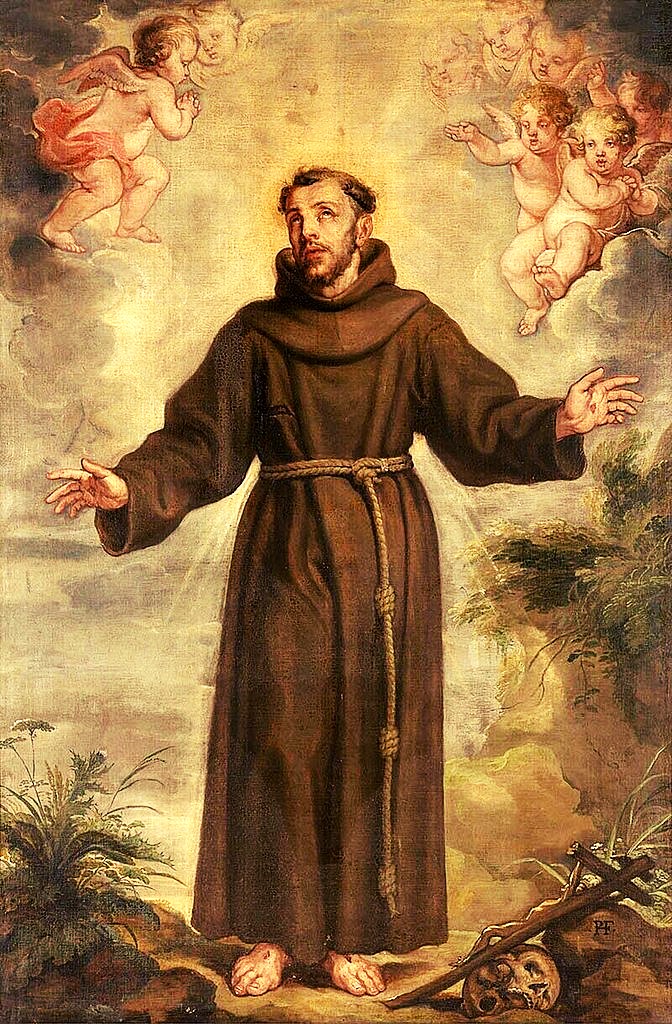
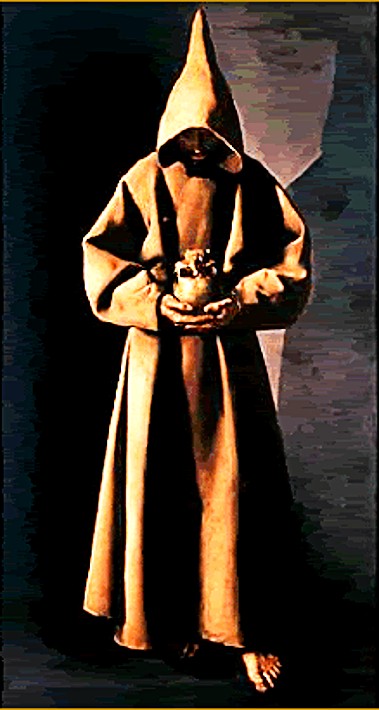
Saint of the Day – 4 October – St Francis of Assisi OFM (c 1181–1226)
An Excerpt from The Little Flowers of St Francis of Assisi Translated from the 14th Century Fioretti (1905)
“In this book are contained certain little Flowers, namely, miracles and devout examples of the glorious poor Little One of Christ, St Francis and of some of his holy companions, to the praise of Jesus Christ. Amen.
In the first place, let us consider how the glorious St Francis, in all the acts of his life, was conformed to the life of that blessed Christ; that, as Christ in the beginning of His preaching elected twelve Apostles that they should despise every worldly thing and follow Him in poverty and in all virtues, so St Francis, for the founding of his Order, elected, in the beginning, twelve companions, who were to be possessors of nothing but an entire poverty.
And, as one of the twelve Apostles of Christ, rejected by God for his infidelity, finally strangled himself, so also, one of the twelve companions of St Francis, who was called Brother John della Capella, apostatised and finally, hanged himself in like manner. And this is to the elect, a great warning and a matter of humility and of fear, to cause them to remember that no-one is certain, to persevere to the end, in the grace of God.
As the blessed Apostles were wholly marvellous for sanctity and humility and full of the Holy Ghost, so the blessed companions of St Francis were men of such great sanctity that, since the time of the Apostles, the world had not seen the like; since one of them, like St Paul, was taken up into the third heaven and this was Brother Giles; another of them, namely Brother Filippo Longo, was touched on the lips by an angel, like the Prophet Isaias, with a coal of fire; another of them and this was Brother Silvester, spoke with God, as one friend with another, after the manner of Moses; another, by the purity of his soul, flew up to the light of the Divine Wisdom, like the eagle, St John the Evangelist and this was the most humble Brother Bernard, who explained, most profoundly, Holy Writ and another was sanctified by God and canonised in Heaven whilst still living on earth and this was Brother Ruffino, who was a gentleman of Assisi. And so were they all privileged with remarkable signs of holiness, as will be declared in the sequel . . .” –page 1 – 2
St Aurea St Berenice St Caius of Corinth St Callisthene of Ephesus St Crispus of Corinth St Damaris of Athens St Diogenes of Milan St Domnina St Hierotheus Bl Julian Majali St Lucius of Alexandria St Peter of Damascus
Martyrs of Alexandria: A group of Christians, men and women, young and old, murdered together for their faith. The only names that have come down to us are the brothers Mark and Marcian.
Quote/s of the Day – 3 October – St Thérèse of the Child Jesus and the Holy Face (1873 – 1897)
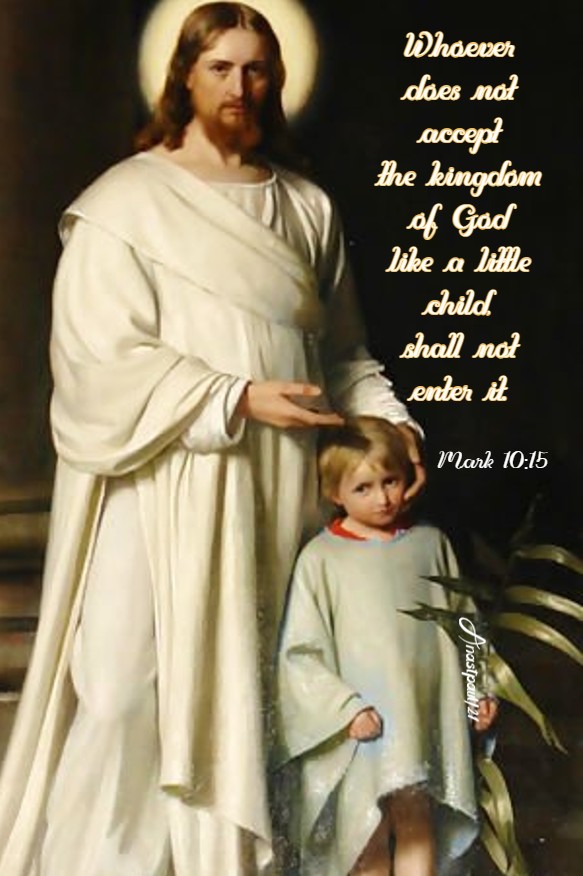
“Whoever does not accept the kingdom of God like a little child, shall not enter it.”
Mark 10:15
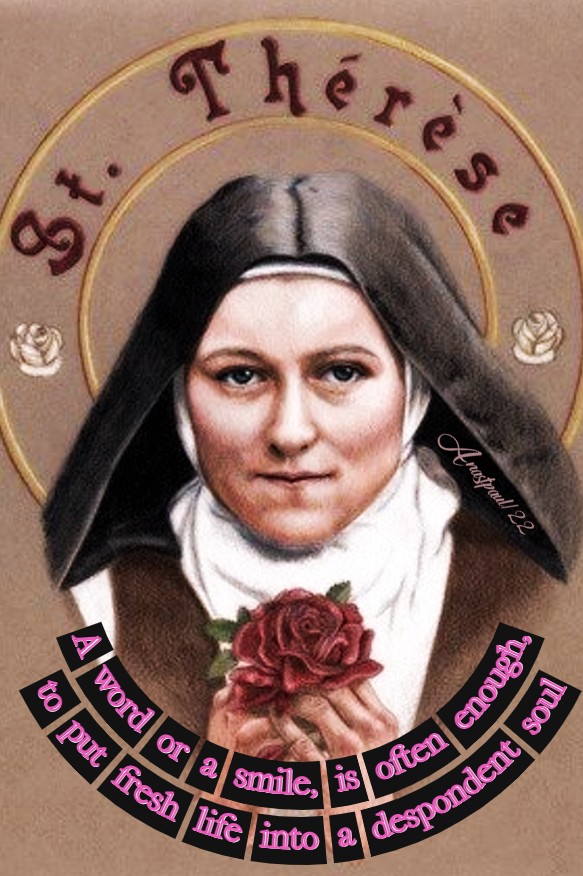
“A word or a smile, is often enough, to put fresh life into a despondent soul.”
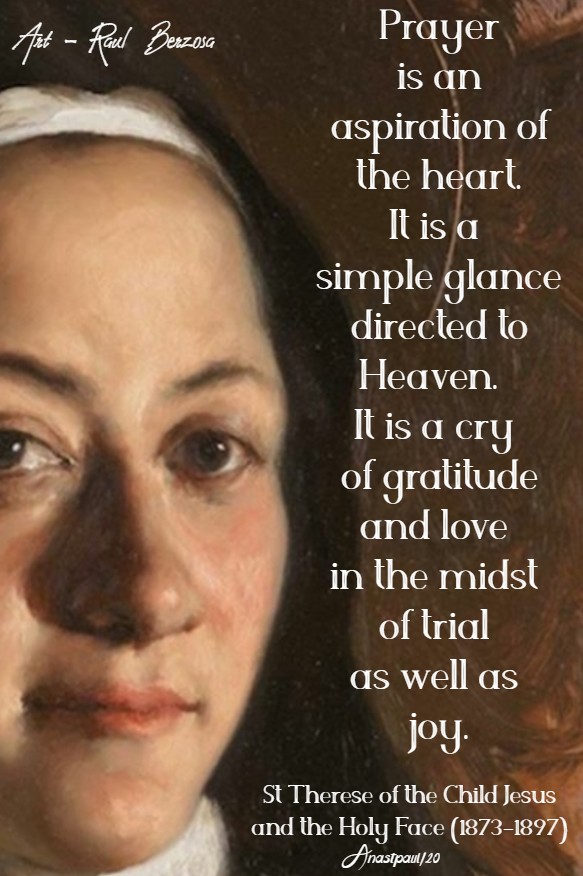
“Prayer is an aspiration of the heart. It is a simple glance directed to Heaven. It is a cry of gratitude and love in the midst of trial as well as joy.”
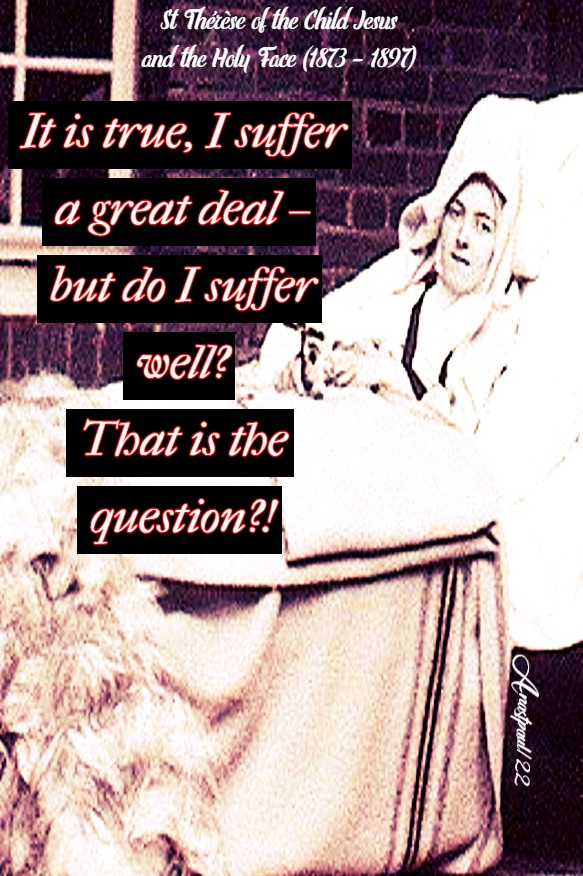
“It is true, I suffer a great deal– but do I suffer well? That is the question?!”
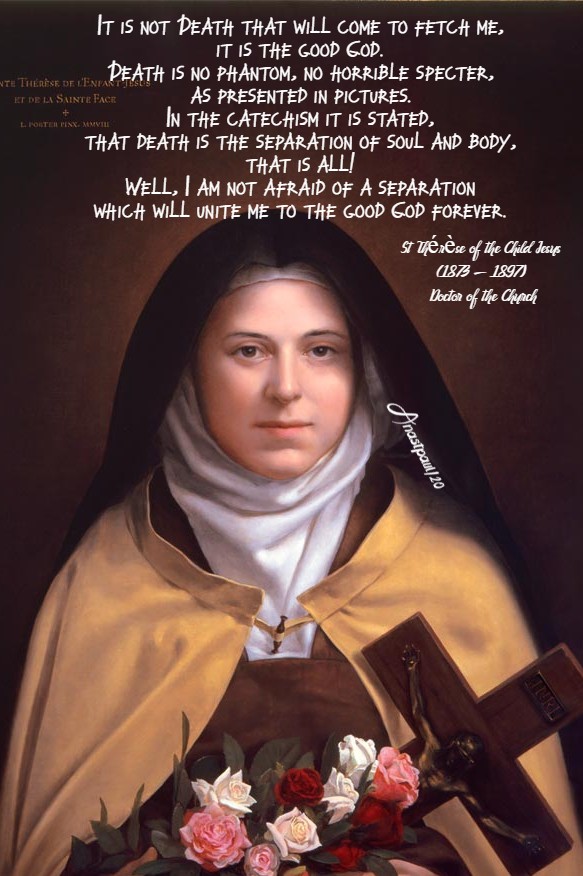
“It is not Death that will come to fetch me, it is the good God. Death is no phantom, no horrible specter, as presented in pictures. In the catechism it is stated, that death is the separation of soul and body, that is all! Well, I am not afraid of a separation which will unite me to the good God forever.”
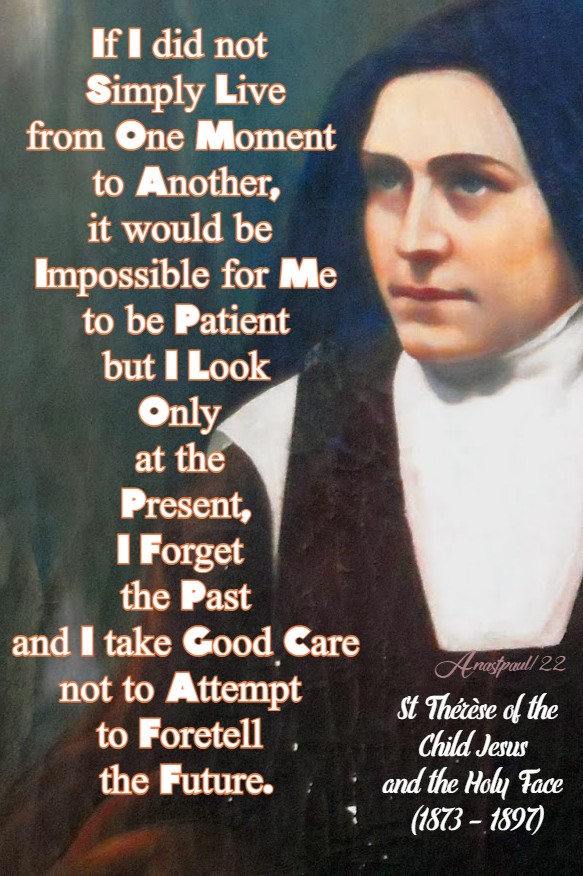
“If I did not simply live from one moment to another, it would be impossible for me to be patient but I only look at the present, I forget the past and I take good care not to attempt to foretell the future.”
St Thérèse of the Child Jesus and the Holy Face (1873 – 1897)
Saint of the Day – 3 October – Sant Thérèse of the Child Jesus and the Holy Face or The Little Flower (1873 – 1897) Virgin.
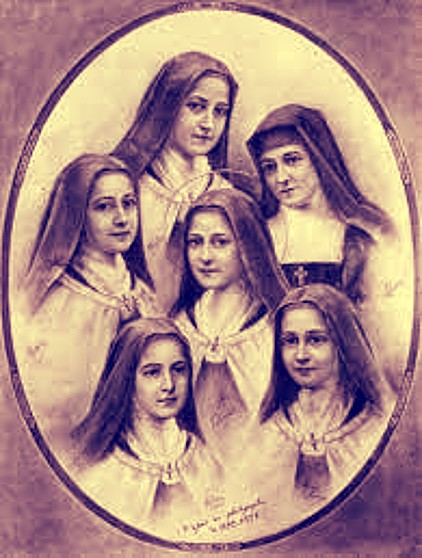
Marie Francoise Thérèse Martin, known as the Little Flower of Jesus, was born 2 January 1873 at Alencon in Normandy, France, of very Christian parents. The Martins, who lost four of their little ones in early infancy or childhood, regarded their children as Gifts from Heaven and offered them to God before their birth. Thérèse was the last flower of this blessed stem, which gave four Sisters to the Carmel of Lisieux, still another to the Visitation of Caen.
The five sisters were left without their mother, a victim of cancer, when Thérèse was only four years old but her two oldest sisters were of an age to take excellent care of the household and continue the Christian character formation, of the younger ones, which their mother had initiated. Their saintly father was soon to see his little flock separated, however, when one after the other they left to enter religious life. He blessed each one and gave them all back to God, with humble gratitude to God for having chosen his daughters.
From childhood,Thérèse had manifested a tender piety which her naturally lively temperament could not alter. Her mother’s death affected her profoundly, however and, at the age of nine, she was visited with a severe trial in the form of an illness the doctors could not diagnose and which seemed incurable. She was instantly restored to her ordnary good health by the Virgin Mary, in answer to her desolate sisters’ prayers – Thérèse saw Her statue become animated, to smile at her with an ineffable tenderness as she lay on her bed of suffering.
Before the age of fifteen, Thérèse already desired to enter the Carmel of Lisieux, where her two eldest sisters were already nuns; a trip to Rome and a petition at the knees of the Holy Father, Leo XIII, gave her the inalterable answer – that her Superiors would regulate the matter. Many prayers finally obtained an affirmative reply to her ardent request and four months after her fifteenth birthday, she entered Carmel with a great joy. She could say then, “I no longer have any desire but to love Jesus even to folly.“
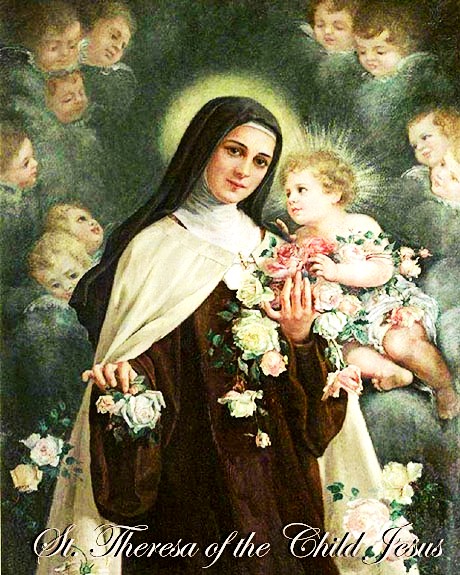
She adopted flowers as the symbol of her love for her Divine Spouse and offered all her little daily sacrifices and works, as rose petals at the feet of Jesus. Divine Providence gave to the world, the autobiography of this true Saint, whose little way of spiritual childhood was described in her own words, in her Story of a Soul. She could not offer God the macerations of the great soldiers of God, only her desires to love Him ,as they had loved Him and to serve Him, in every way possible. She chose “all” in spirit, for her beloved Lord.
Later, she would be named Patroness of missions. Her spirituality does not imply only sweetness and light, however, for this loving child of God, passed by a tunnel of desolate spiritual darkness, yet never ceased to smile at Him, wanting to serve Him, if it were possible, without His even knowing it.
When nine years had passed in the Carmel, the little flower was ready to be plucked for heaven and, in a slow agony of Consumption, Thérèse made her final offering to God. She suffered so severely that she said she would never have believed it possible and could only explain it by her desire to save souls for God. She died in 1897, was Beatified in 1923 and Canonised in 1925.
And now, as she foretold, she is spending her heaven in doing good upon earth. Countless miracles have been attributed to her intercession. Little Flower of Jesus please pray for Holy Mother Church and for all Her faithful children.
St Thérèse of Lisieux/St Thérèse of the Child Jesus and the Holy Face/The Little Flower OCD (1873 – 1897) Virgin, Carmelite Nun. She was Canonised by Pope Pius XI on 17 May 1925. The same Pope proclaimed her Universal Patron of the Missions, alongside Saint Francis Xavier, on 14 December 1927. Up until 1969 her Memorial was celebrated on 3 October. Biography: https://anastpaul.com/2018/10/01/saint-of-the-day-st-therese-of-lisieux-o-c-d-1873-1897-doctor-of-the-church/
St Adalgott of Chur Bl Agostina of the Assumption St Candidus the Martyr St Cyprian of Toulon Bl Damian de Portu St Dionysius the Aeropagite Bl Dominic Spadafora Bl Edmund of Scotland St Ewald the Black St Ewald the Fair St Froilan
Martyrs of Alexandria – 9 Saints: A number of Christian Martyrs remembered together. We know the names Caius, Cheremone, Dionysius, Eusebio, Fausto, Lucio, Maximus, Paul, Peter and that there were at least two more whose names have not come down to us, and that’s about all we know.
St Leudomer St Maria Antonina Kratochwil St Modesto of Sardinia St Saturius of Soria St Theophilus of Bulgaria
St Thomas de Cantilupe of Hereford (c 1218-1282) Bishop of Hereford, Confessor, learned Scholar, known for his care of the poor and his protection of them against feaudal landlords, miracle-worker, Chancellor of Oxford University, Lord Chancellor of England. Thomas de Cantilupe was the last Englishman Canonised before the Reformation. An amazing Life and in death, a wondrous Miracle-worker: https://anastpaul.com/2021/10/02/saint-of-the-day-2-october-saint-thomas-de-cantilupe-of-hereford-c-1218-1282/
St Ursicinus II
Martyred in Nagasaki, Japan: A husband, wife and two sons, who were all martyred together in the persecutions in Japan. They were beheaded on 2 October 1622 in Nagasaki, Japan and Beatified by Pope Pius IX on 7 May 1867. • Blessed Andreas Yakichi • Blessed Franciscus Yakichi • Blessed Lucia Yakichi • Blessed Ludovicus Yakichi
Saint of the Day – 1 October – Blessed Christopher Buxton (1562–1588) Priest and Martyr Born in 1562 in Tideswell, Derbyshire, England and died by being hanged, drawn and quartered on 1 October 1588 in Canterbury, Kent, England. Additional Memorial – 29 October as one of the Martyrs of Douai. Blessed Christopher was Beatified on 15 December 1929 by Pope Pius XI.
Christopher was a student of Nicholas Garlick (c 1555 – 24 July 1588) (another Priest, martyred in Derby in the reign of Queen Elizabeth I) at the Grammar School, Tideswell, Peak District. Garlick entered the English College at Rheims on 22 June 1581. Buxton arrived about a month later.
In 1584 he was sent to the English College in Rome where he was Ordained on 26 October 1586. He had a lengthy and difficult journey across Europe, calling in at Rheims on his way to Dieppe. Word had already reached the continent concerning the government’s plans to exile or execute the Priests then held in prison. A Dr. Darbishire in Paris directed Buxton to delay his departure for the time being and in obedience Christopher complied. But eventually Buxton crossed to Kent in early September 1587.
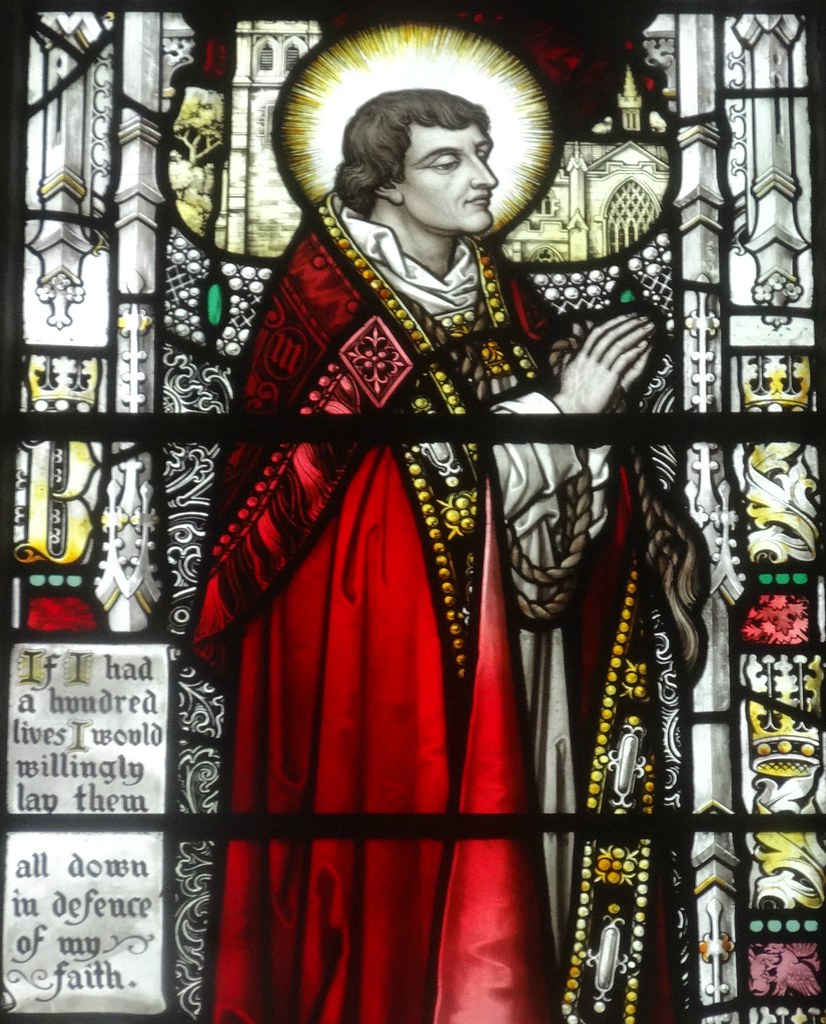
He was arrested in Kent about two months later and taken to the Marshalsea prison. On 15 August 1588, he was examined and cross-questioned, at which time he admitted he was a Priest. As he was so young, it was thought that his constancy might be shaken by the sight of the deaths of his fellow Priests and his life was offered to him, if he would conform to the new religion. But he answered, that he would not purchase a corruptible life, at such a price and that, if he had a hundred lives, he would willingly surreder them all, in defence of the One True Faith.
While in the Marshalsea Prison he wrote a Rituale, the manuscript of which is now preserved as a Relic at Olney, Buckinghamshire. He sent this manuscript to a Priest, as the last token of his friendship, the day before he was taken from prison. He was taken to Canterbury for trial and execution. Christopher died at the age of twenty-six.
Blessed Christopher Buxton was Beatified by Pope Pius XI in 1929.
Bl Cecilia Eusepi Blessed Christopher Buxton (1562–1588) Priest and Martyr St Crescens of Tomi St Dodo Bl Dominic of Villanova Bl Edward James St Evagrius of Tomi St Fidharleus Bl Gaspar Fisogiro St Gregory the Illuminator St John Kukuzelis Bl John Robinson St Maxima of Lisbon Bl Nikita Budka St Piaton of Tournai St Priscus of Tomi Bl Ralph Crockett Bl Robert Widmerpool Bl Robert Wilcox
St Romanos the Melodist (c 490-c 556) Deacon, Hymnographer, Poet, Writer. He is said to have composed more than 1,000 hymns celebrating various festivals of the ecclesiastical year, the lives of the saints and other sacred subjects, some 60 to 80 of which survive. Wonderful Saint Romanos! https://anastpaul.com/2020/10/01/saint-of-the-day-1-october-st-romanos-the-melodios-c-490-c-556/
St Sazan of Abyssinia St Verissimus of Lisbon St Virila St Wasnulf
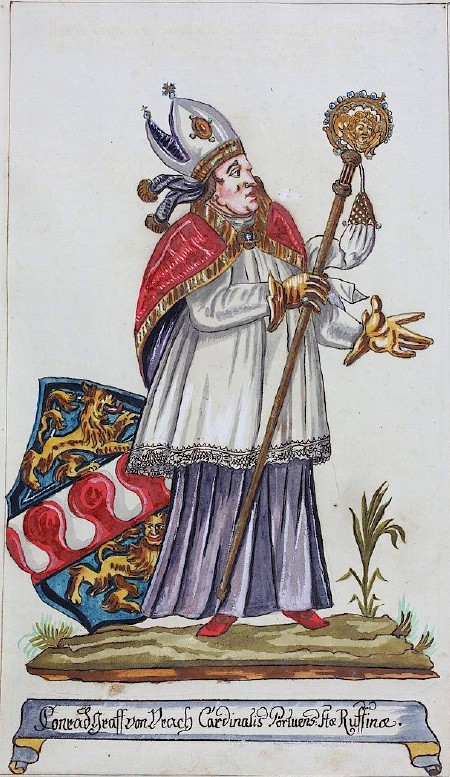
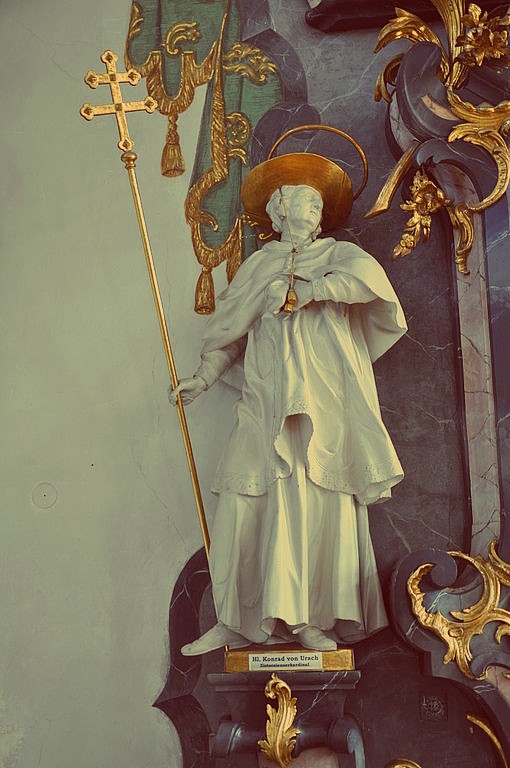
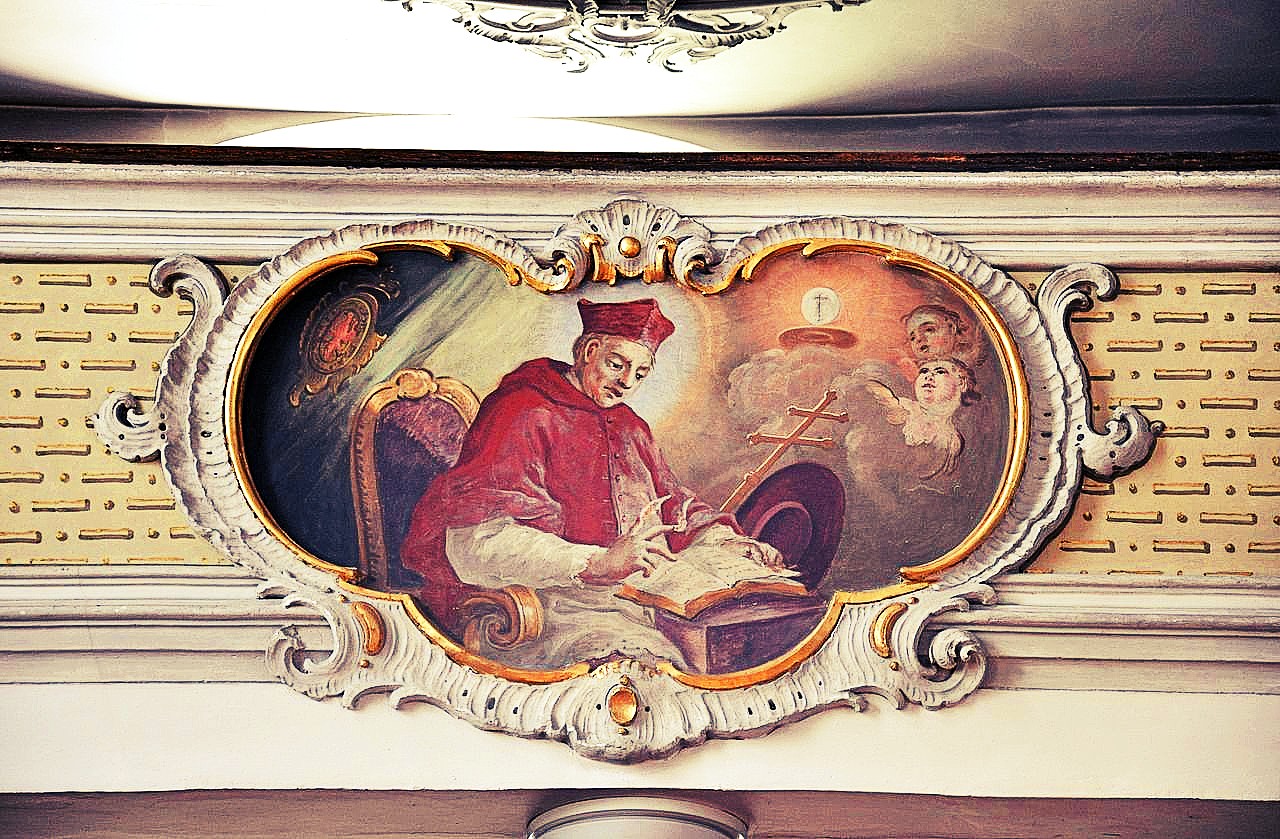
Saint of the Day – 30 September – Blessed Conrad of Urach O.Cist (c 1180-1227) Priest, Prior, Abbot, General of the Cistercians, Cardinal and Bishop, Papal legate to France from 1220 to 1223 and to Germany (1224-1226), Peacemaker. Born as Konrad in c 1180 and died in 1227 of natural causes.
Conrad was the second son of Count Egino IV of Urach and his wife Agnes, sister of Berthold V of Zähringen, in the early generations of the line of Dukes of Württemberg.
His early education was entrusted to his great-uncle Rudolf of Zähringen, Bishop of Liège. At an young age he became a Canon of Saint Lambert’s Cathedral in Liège. This began his Ecclesiastical career.
In 1199 however, he entered the Cistercian Monastery of Villers in Brabant, whose Abbot was another uncle. He soon became Prior and in 1209 was elected as the Abbot. While he was in Rome on the business of the Order, Pope Honorius III, on 8 January 1219, created him Cardinal and later charged him as Papal legate with two important missions- one in France (1220-1223), to suppress the Albigenses.
The other in Germany (1224-1226), to promote the Crusade which Emperor Frederick II had vowed to undertake (the eventual Sixth Crusade) . During this period he also established the University of Montpellier (1222).
While in Germany, Conrad was responsible for the declaration as a Martyr of Engelbert II of Berg, Archbishop of Cologne, murdered on 7 November 1225.
After the death of Honorius III on 18 March 1227 he was appointed a member of a triumvirate of cardinals chosen to select the new pope the next day and as a matter of courtesy, was offered the papacy, which he refused out of concern he would be accused of self-aggrandisement.
He returned to Rome in 1227, undertaking negotiations with the Cities of the Lombard League. He died at Bari later that year and was buried, according to his own wishes, in the Abbey at Clairvaux. Cistercian records refer to him as Blessed (liturgical feast on 30 September).
St Antoninus of Piacenza St Castus of Piacenza St Colman of Clontibret Blessed Conrad of Urach O.Cist (c 1180-1227) Priest, Prior, Abbot, General of the Cistercians, Cardinal and Bishop, Papal legate to France from 1220 to 1223. St Desiderius of Piacenza St Enghenedl of Anglesey St Eusebia of Marseilles Bl Felicia Meda Bl Frederick Albert
St Ismidone of Die Bl Jean-Nicolas Cordier Blessed Conrad of Urach St Laurus St Leopardus the Slave Bl Ludwik Gietyngier St Midan of Anglesey St Simon of Crépy St Ursus the Theban St Victor the Theban
Martyrs of Valsery Abbey: An unknown number of Premonstratensian Monks at the Abbey of Notre-Dame de Valsery, Picardie, France who were Martyred by Calvinists. They were martyred in 1567 at Valsery, Pircardy, France.
THIS festival has been kept with great solemnity on the 29th of September ever since the Fifth Century and was certainly initially celebrated in Apulia in 493. The Dedication of the famous Church of St Michael on Mount Gargano, in Italy, gave occasion to the institution of this Feast in the West, which is hence called in the Martyrologies of St Jerome, St Bede and others, ‘The Dedication of St Michael.’ About the Apparition of St Michael at Mount Gargano in 492: https://anastpaul.com/2018/05/08/saint-of-the-day-8-may-apparition-of-michael-the-archangel-at-monte-gargano-italy-492/
Quote of the Day – 28 September – St Wenceslaus (907-935) Duke of Bohemia, Martyr.
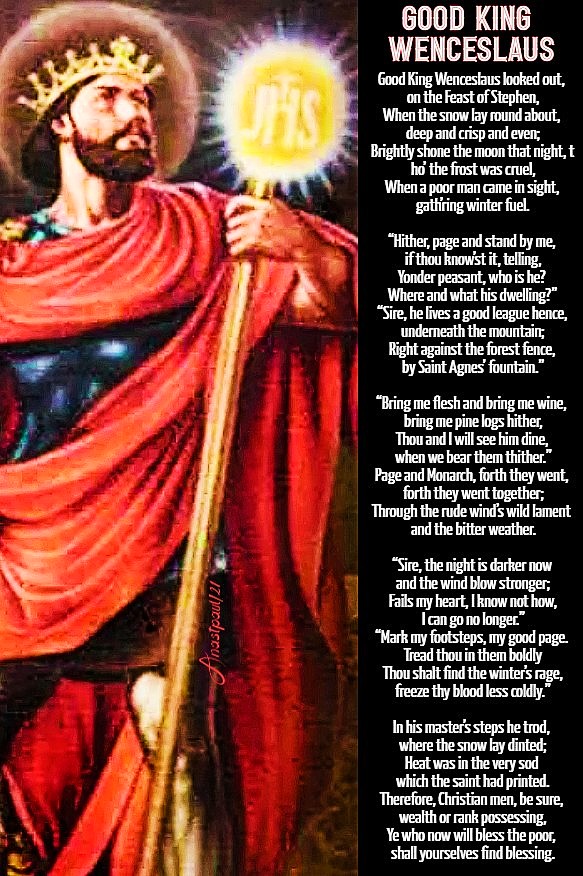
Good King Wenceslaus
Good King Wenceslaus looked out, on the Feast of Stephen, When the snow lay round about, deep and crisp and even; Brightly shone the moon that night, t ho’ the frost was cruel, When a poor man came in sight, gath’ring winter fuel.
“Hither, page and stand by me, if thou know’st it, telling, Yonder peasant, who is he? Where and what his dwelling?” “Sire, he lives a good league hence, underneath the mountain; Right against the forest fence, by Saint Agnes’ fountain.”
“Bring me flesh and bring me wine, bring me pine logs hither, Thou and I will see him dine, when we bear them thither.” Page and Monarch, forth they went, forth they went together; Through the rude wind’s wild lament and the bitter weather.
“Sire, the night is darker now and the wind blow stronger; Fails my heart, I know not how, I can go no longer.” “Mark my footsteps, my good page. Tread thou in them boldly Thou shalt find the winter’s rage, freeze thy blood less coldly.”
In his master’s steps he trod, where the snow lay dinted; Heat was in the very sod which the saint had printed. Therefore, Christian men, be sure, wealth or rank possessing, Ye who now will bless the poor, shall yourselves find blessing.
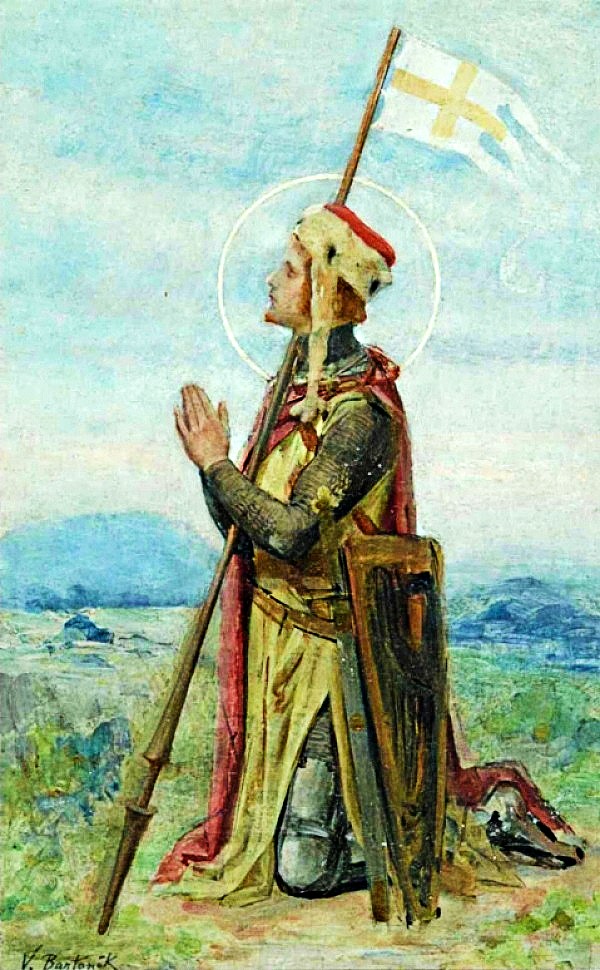
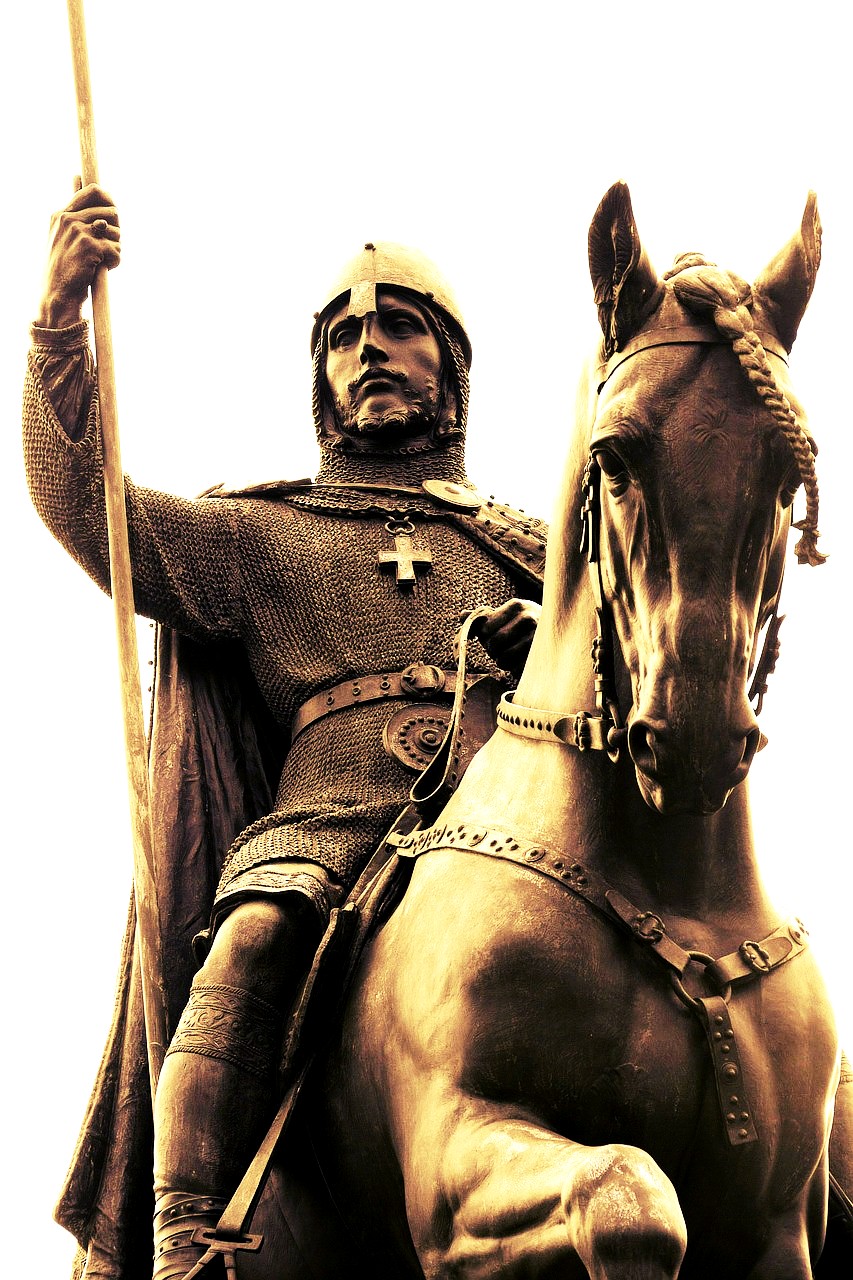
Saint of the Day – 28 September – St Wenceslaus (907-935) Duke of Bohemia, Martyr.
St Wenceslas, Duke of Bohemia, Martyr From an old Slavic legend about Saint Wenceslaus
At the death of Vratislaus, the people of Bohemia made his son, Wenceslaus their King. He was by God’s grace, a man of utmost faith. He was charitable to the poor and he would clothe the naked, feed the hungry and offer hospitality to travellers, according to the summons of the Gospel. He would not allow widows to be treated unjustly; he loved all his people, both rich and poor; he also provided for the servants of God and he adorned many Churches.
The men of Bohemia, however, became arrogant and prevailed upon Boleslaus, his younger brother. They told him, “Your brother Wenceslaus is conspiring with his mother and his men to kill you.”
On the feasts of the dedication of the Churches in various Cities, Wenceslaus was in the habit of paying them a visit. One Sunday he entered the City of Boleslaus, on the feast of Saints Cosmas and Damian and after hearing Mass, he planned to return to Prague. But Boleslaus, with his wicked plan in mind, detained him with the words, “Why are you leaving brother?“
St Wenceslaus Altar, at St Peter’s Basilica, Vatican
The next morning when they rang the bell for Matins, Wenceslaus, on hearing the sound, said, “Praise to Thee, Lord; Thou hast allowed me to live to this morning.” And so he rose and went to Matins. Immediately Boleslaus followed him to the Church door. Wenceslaus looked back at him and said, “Brother, you were a good subject to me yesterday.“
“Praise to Thee, Lord; Thou hast allowed me to live to this morning.“
But the devil had already blocked the ears of Boleslaus and perverted his heart. Drawing his sword, Boleslaus replied, “And now I intend to be a better one!” With these words, he struck his brother’s head with his sword.
But Wenceslaus turned and said, “Brother, what are you trying to do?” And with that he seized Boleslaus and threw him to the ground. But one of Boleslaus’ counsellors ran up and stabbed Wenceslaus in the hand. With his hand wounded, he let go of his brother and took refuge in the Church. But two evil men struck him down at the Church door and then another rushed up and ran him through with a sword. Thereupon, Wenceslaus died with the words: “Into your hands, O Lord, I commend my spirit.”
Although Wenceslaus was a Duke during his lifetime, the Holy Roman Emperor, Otto I posthumously “conferred on [Wenceslaus] the regal dignity and title of King” which is why he is referred to as King in legend and song.
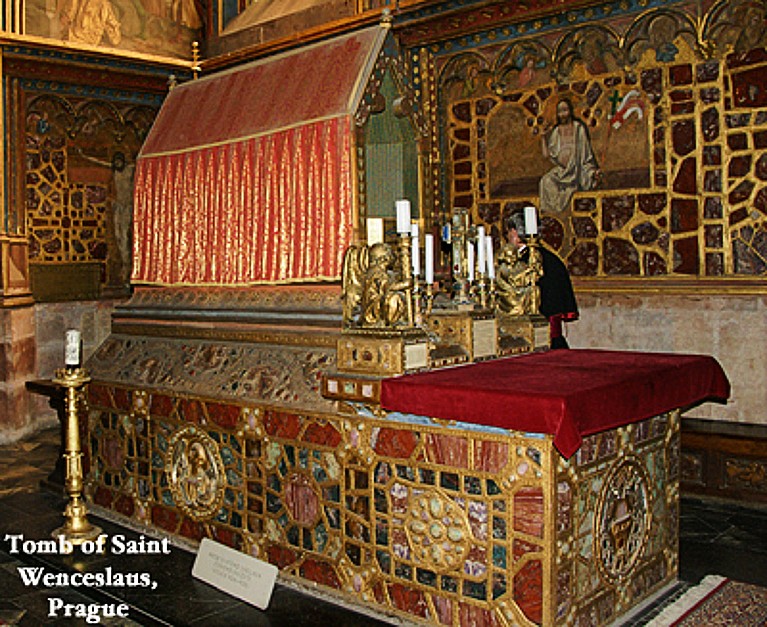
The Church door below, to which Saint Wenceslaus clung at his Martyrdom, leads to his Chapel in the Cathedral of Saint Vitus in Prague.
Bl Aaron of Auxerre St Alodius of Auxerre St Annemond of Lyons St Bardomianus
Blessed Bernardine of Feltre OFM (1439-1494) Franciscan Priest and Friar, Missionary Preacher, Poet, peace-maker, Civil protestor against the practice of usury, defender of the poor. He was a true ‘child prodigy’ – by the time he was 12 he was fluent in Latin and at the age of 15 he composed a poem and read it in the Town Square to celebrate a local peace treaty. He is remembered most especially, in connection with the “Monti di Pietà” “Mount of Piety” of which he was the reorganiser and, in a certain sense, the Founder, together with the Blessed Michele Carcano. On 13 April 1654, Pope Innocent X confirmed the cultus of Blessed Bernardine and he was formally Beatified in 1728 by Pope Benedict XIII. Biography: https://anastpaul.com/2020/09/28/saint-of-the-day-28-september-blessed-bernardine-of-feltre-ofm-1439-1494/
St Chariton of Palestine Bl Christian Franco St Conval of Strathclyde St Eucarpus St Eustochium St Exuperius of Toulouse (Died 411) Bishop St Faustus of Riez
Blessed Francesco Piani of Caldarola OFM (1424-1507) Francisan Friar, renowned Preacher and Peacemaker, a collaborator in the fight against usury by the institution of the “Mount of Piety,” (a type of pawn shop), social activist and protector of the struggling rural communities. He was Beatified by Pope Urban VII in 1634 – his cult was reaffirmed on 1 September 1843 by Pope Gregory XVI. His Amazing Life: https://anastpaul.com/2021/09/28/saint-of-the-day-28-september-blessed-francesco-piani-of-caldarola-ofm-1424-1507/
St John of Dukla St Laurence of North Africa St Lioba of Bischofsheim St Machan St Martial of North Africa St Martin of Moyenmoutier St Paternus of Auch St Privatus of Rome St Salonius of Geneva St Silvinus of Brescia
St Solomon of Genoa St Stacteus St Tetta of Wimborne Bl Thiemo St Willigod of Moyenmoutier St Zama of Bologna
Augustinian Martyrs of Japan: The first Augustinian Missionaries arrived in Japan in 1602 and met with immediate success; many were brought to the faith; many of them became Augustinians and many of them were Martyred in the periodic persecutions of Christians. This memorial commemorates all of them, whether they have a sanctioned Cause for Canonisation or not. They include: • Blessed Bartolomé Gutiérrez Rodríguez • Blessed Ferdinand Ayala • Blessed Francisco Terrero de Ortega Pérez • Blessed Ioannes Mukuno Chozaburo • Blessed Laurentius Kaida Hachizo • Blessed Mancius Yukimoto Ichizaemon • Blessed Martín Lumbreras Peralta • Blessed Melchor Sánchez Pérez • Blessed Michaël Ichinose Sukezaemon • Blessed Pedro de Zúñiga • Blessed Petrus Sawaguchi Kuhyoe • Blessed Thomas Jihyoe of Saint Augustine • Blessed Thomas Terai Kahyoe • Blessed Vicente Simões de Carvalho • Saint Magdalena of Nagasaki
Martyrs of Antioch – 37 Saints: A group of 30 soldiers and 7 civilians who were murdered together for their faith. The names that have come down to us are – Alexander, Alphinus, Heliodorus, Mark, Neon, Nicon and Zosumus. c 303 at Antioch, Pisidia (in modern Turkey).
Saint of the Day – 27 September – Saint Delphina TOSF (1283-1360) Virgin Laywoman, Married in Chastity to St Elzear (below) Widow, Recluse, Apostle of the Poor and needy. Born in 1283 at the Chateau-Puimichel in Languedoc (modern Puy-en-Velay, France) and died on 26 November 1360 of natural cause, having lived as a Franciscan tertiary for most of her life. Patronages – • Brides, Tertiaries, Diocese of Ariano Irpino-Lacedonia, Italy. Also known as – Delphine, Delphine of Glandèves, Delphina/e of Sabran.
Delphine was the daughter and heiress of the Count of Puy-Michel. Left an orphan in her infancy, she was placed under the guardianship of her uncles and was brought up under the direction of her Aunt, who was the Abbess of the Convent of St Catherine of Sorps, at Bauduen. As a young girl, she took a vow of virginity which she kept to the end of her life.
Despite her vow, at the age of twelve she was espoused to the ten-year-old Elzéar, Count of Sabran. They were married three years later at the Castle of Puy-Michel. Having grown up together, they regarded each other as brother and sister, rather than husband and wife. Inspired by her example, her husband also took a vow of celibacy, which both honoured throughout their married life. The couple, having both received the habit of the Third Order of St Francis, lived together at their Castle in Ansouis, in the practice of prayer, penance andgood works towards the poor. After seven years, they moved to Puy-Michel. When Elzéar had to go to Naples to see to some inherited property, they kept up a regular correspondence. Elzéar died in 1323.
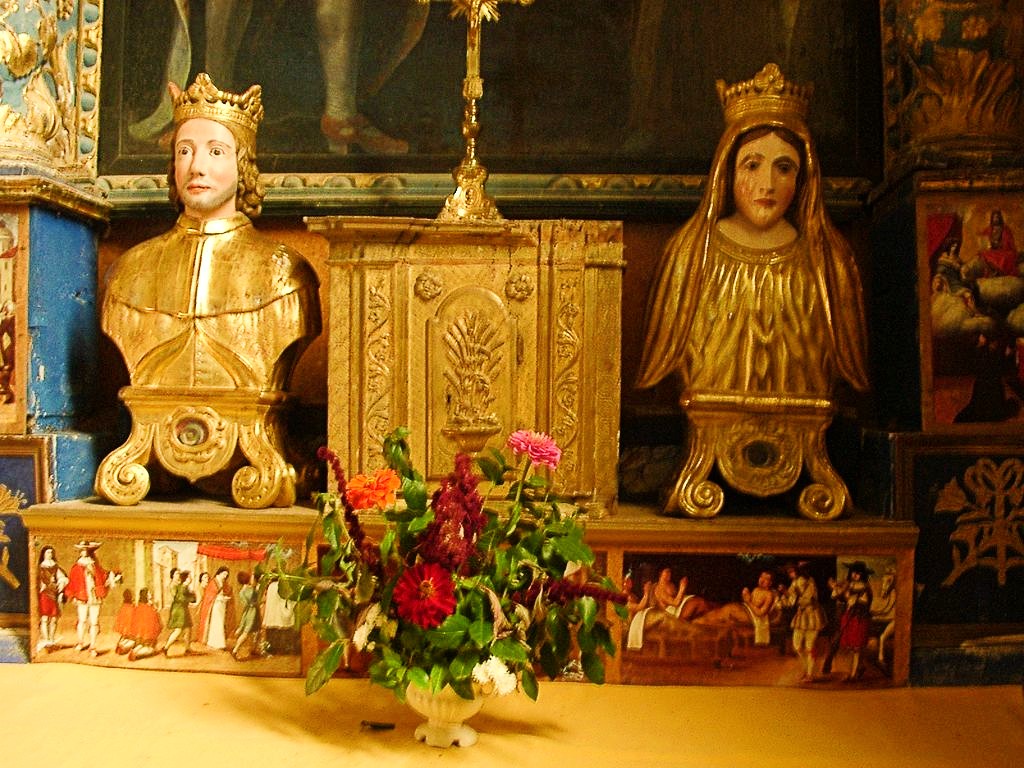
Reliquaries of Sts Elzéar and Delphina in the Franciscan Church of Ansouis, France
After the death of her husband, Delphina sold all her possessions for the benefit of the poor and retired first to Naples and then to Cabrières, which was the location of the Castle where her husband had been born. She finally returned to Apt where her husband had been buried. Upon her death, she was buried with him in the church of the Friars Minor there, wearing the habit of the Order.
The veneration that had begun to be given to Delphina was confirmed by Pope Urban V, godson of Elzéar, who Canonised Elzéar and Delphina in 1694. Her feast day is not the date of her death, 26 November but today, 26 September, sharing this day with the remembrance of her husband.
St Ceraunus of Paris St Chiara of the Resurrection St Deodatus of Sora Saint Delphina TOSF (1283-1360) Laywoman, Married in Chastity to St Elzear (below) Widow, Recluse.
Martyrs of Aegea – (3 Saints): Three Christians Martyred with Saints Cosmas and Damian in the persecutions of Diocletian – Anthimus, Euprepius and Leontius. They were tortured and beheaded c.303 in Aegea, Cilicia (modern Ayas, Turkey).
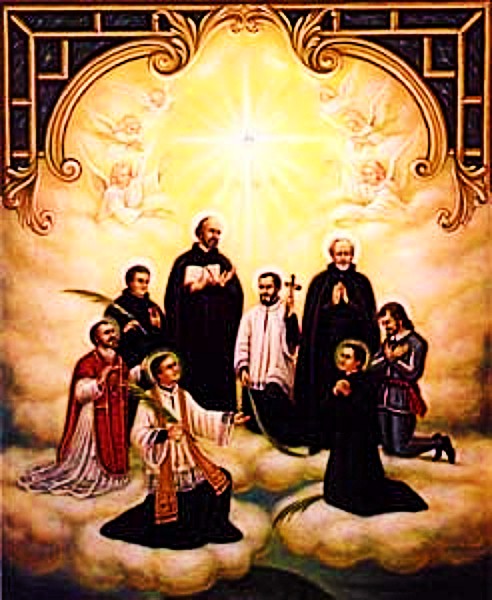
Saints of the Day – 26 September – St Isaac Jogues SJ (1607-1646) Priests, Martyrs, Missionary and Companions – known as The North American or the Canadian Martyrs. Born on 10 January 1607 o, Orléans, Orléanais, France. In 1646, Jogues was Martyred by the Mohawk at their village of Ossernenon, near the Mohawk River. They were Beatified on 21 June 1925, by Pope Pius XI and Canonised on 29 June 1930, by Pope Pius XI. They are collectively the secondary Patron Saints of Canada.
St Isaac Jogues and Companions from the Roman Breviary
Among the members of the Society of Jesus who brought most renown to the infant Church in North America, in the middle of the seventeenth Century, God chose as victims eight men of outstanding integrity, that from the seeds of faith watered with their blood, there might spring up a more abundant harvest.
All these Martyrs–six Priests and two Laymen–natives of France, were sent by their Superiors to the Missions in Canada, at that time known as New France. With Quebec as a centre, they made numberless missionary journeys to the various sectors of this vast territory, labouring amidst the greatest hardships. In the end, all were most cruelly put to death and for the same reaso – their faith, although not at the same time and place.
Jean de Brebeuf, born at Conde-sur-Vire, in the Diocese of Bajon (now Constance), of an illustrious family and Isaac Jogues, born in Orleans, are regarded as their leaders and masters and rightly so. For they were valiant men, fired with apostolic zeal, living most mortified lives, in intimate prayerful union with God and, at times, were honoured with heavenly visions.
St Jean de Brébeuf (1607-1646 aged 39) Priest
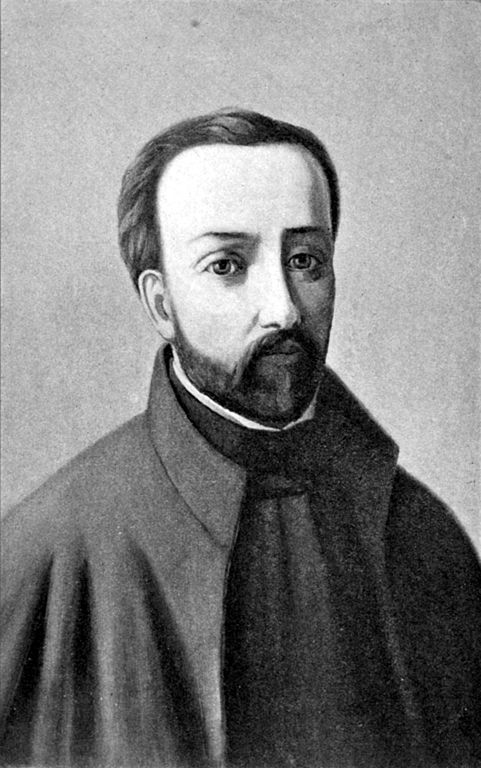
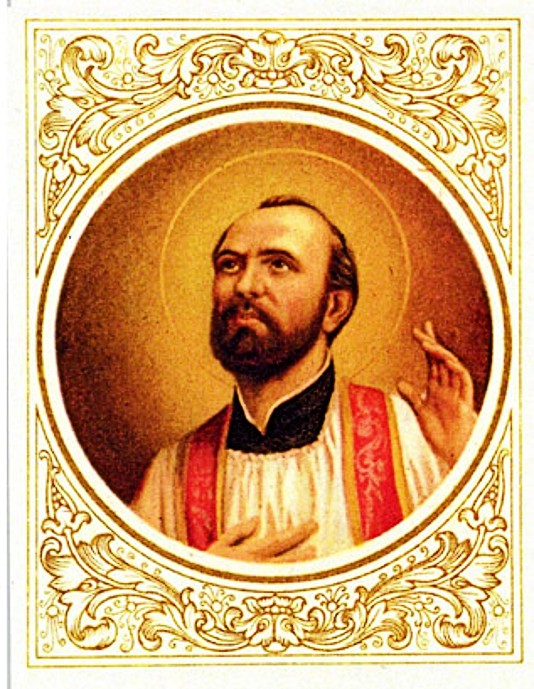
Not unlike them, were their four companion Priests: Antoine Daniel, born at Dieppe, Gabriel Lalemant and Charles Gamier, both Parisian born and Noel Chabanel, a native of Mende – all of these faithfully fulfilled their Priestly functions, labouring principally in various villages of the Huron country.
Frequent raids by the Iroquois, a hostile neighbouring tribe, often wrought havoc in the Huron missions and seriously endangered the lives of the Fathers in charge of them. In 1642, on a journey from Quebec to the Huron country, Isaac Jogues, together with Rene Goupil, a lay co-adjutor of the Society of Jesus, fell in with the Iroquois, who held him and his companion as slaves and subjected them to most horrible torments. In the same year on the 29th of September, Rene was killed by order of an old savage, out of hatred for the Cross of salvation. It was near Auriesville, in the present State of New York, where this most sincere man breathed forth his soul to God.
In the following year Isaac managed to escape and made his way back to France. He returned to America after another year and along with John Lalande, who was also a co-adjutor of the Society of Jesus, made a second and third journey to the savages, his erstwhile tormentors.
On 18 October 1646, in the present diocese of Albany, Isaac was struck with a tomahawk and thus obtained the Palm of Martyrdom. The following day his companion, John, meeting with a like fate, took his flight to Heaven, to be rewarded with the same Crown of Martyrdom.
St Isaac Jogues (1607-1646) aged 39) Priest
On 4 July 1648, in an attack upon the village of St Joseph by the Iroquois, Antoine Daniel, in charge of the Huron mission there, was slain while fearlessly defending his flock. Overwhelmed by a shower of arrows and bullets at the entrance of the Church, like a good shepherd he laid down his life for his sheep. Within a year, on 16 March 1649, at St Ignace, a village situated in what is now the Province of Ontario, Canada, John de Brebeuf and Gabriel Lalemant were captured by the Iroquois. That same day, Brebeuf, rightly called the Apostle of the Hurons, died a glorious death, after undergoing long drawn-out tortures of the most atrocious description, during which, this gallant soldier of Christ manifested such fortitude, as to excite even the admiration of the savages themselves. On the following day Gabriel Lalemant suffered the same cruel Martyrdom, during which, he showed the same heroic virtue.
St Gabriel Lalemant (1610-1649) aged 38 Priest
St Antoine Daniel (1601-1648) aged 47) Priest
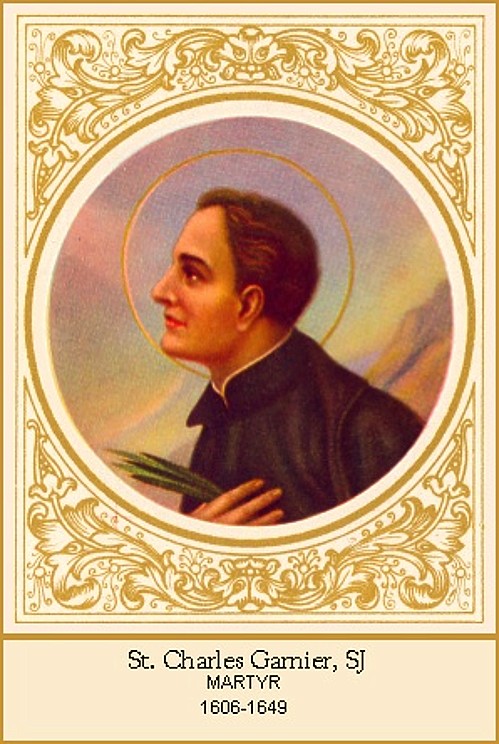
In December of the same year, 1649, on the eve of the Immaculate Conception of the Blessed Virgin Mary, Charles Garnier, after several bullet Wounds was killed by a blow from a hatchet, thereby adding a glorious Crown to a life of exceptional innocence. On the following day Noel Chabanel became the victim of the treachery of a Huron apostate, who killed him and threw his body into a river. His longing for the Palm of Martyrdom was thus realised in his own beloved mission. Although he felt a natural repugnance for this work among the savages, hero that he was, he bound himself by a vow to remain in this mission until death.
St Charles Garnier (1606-1649) aged 33) Priest
These eight Martyrs, the first in North America, were Beatified by Pope Pius XI in 1925 and were Canonised by the same Pontiff five years later.
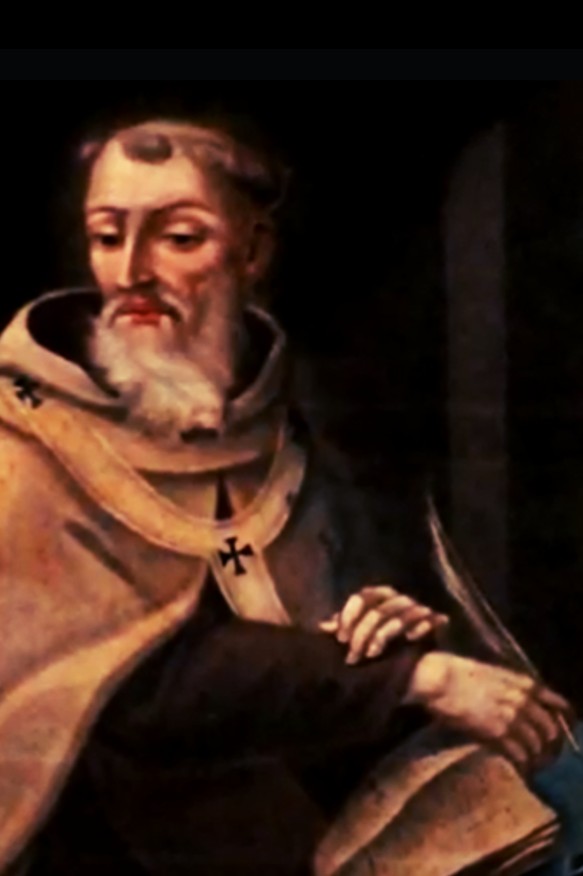
Saint of the Day – 25 September – Saint Ceolfrid (642-716) Abbot and Guardian of the Venerable St Bede, who was placed in his care when the child was 7 years old, for his education in the Monastery. He built an immense library at Jarrow and was himself a man of great knowledge of the Sacred writings. He was the Abbot of Monkwearmouth-Jarrow Abbey, of Wiremouth,Monastery and a major contributor to the production of the the famous Codex Amiatinus, which is considered the best-preserved manuscript of the Latin Vulgate. It was one of three giant single-volume Scriptures then made at Monkwearmouth–Jarrow and is the earliest complete, one-volume Latin Vulgates to survive. Born in 642 in Northumbria, England and died on 25 September 716 at Longres, Champagne, France of natural causes, whilst en route to Rome, to deliver a copy of the Codex to Pope Gregory II. Also known as – Ceolfrith, Ceufrey, Gaufrid, Geoffrey, Geoffroy, Geofroi, Gioffredo, Godefrid, Godefridus, Godfrey, Goffredo, Goffrey, Gofrido, Gotfrid, Gottfried, Jeffrey. CEOLFRID is the same Teutonic name as Geoffrey and signifies “Joyful.”
Ceolfrid was nobly born in Bernicia and related to St Benedict Biscop (c 628-690), (Tutor of the Venerable St Bede) wth whom he joined in the generous resolution of turning their backs upon the world and gave themselves to God.. With him, he made a journey to Rome, partly out of devotion, and partly for improvement in sacred studies and divine knowledge.
After their return he was St. Benedict’s assistant in the foundation of his Monastery of St Peter at Wiremouth, on the north bank of the river, in the Bishopric of Durham. S. Ceolfrid would have regarded it as his greatest felicity on earth, if he could have been as much forgotten by all creatures and despised by everyne as he studied to forget himself. He lived in his, community as St Antony and St Hilarion lived, on their mountains, in the most profound recollection and in the practice of the most austere penance.
When St Benedict built the Monastery of St Paul at Jarrow, he sent Ceolfrid, with seventeen Monks, to lay the foundation of that house and appointed him Abbot. Our Saint governed this Abbey for seven years in St Benedict’s life-time and was constituted, at the desire of that saint, in his last sickness, Abbot also of Wiremouth, from which time, he presided, for twenty-eight years, over both those Monasteries, which, for their proximity and constant interaction, were usually esteemed as one and were generally subject to one Abbot..
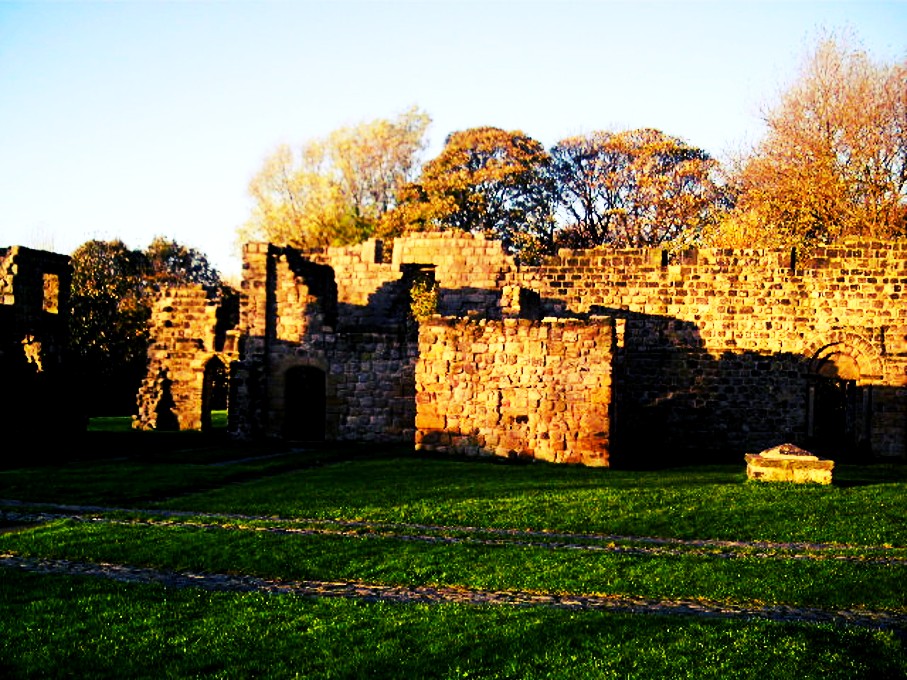
The remains of St Paul’s Monastery, Jarrow, where Ceolfrid was Abbot.
St Ceolfrid was diligent and active in everything he took in hand, of a sharp wit, wise and mature in judgement and fervent in zeal. the Venerable St Bede, who had the happiness to live under this admirable man, has left us most authentic testimonies of his learning, abilities and extraordinary sanctity. He was a great lover of Sacred literature and enriched the libraries of his two Monasteries with a great number of excellent volumnes but banished those which could only serve to entertain curiosity.
To how great a pitch he carried the Sacred sciences in his Monasteries, St Bede is an instance. He was himself very learned. Naitan, King of the Picts, sent to him, desiring to be informed concerning the right time of celebrating Easter and the true form of the clerical tonsure. The holy Abbot strongly proved and recommended to him ,the Catholic custom of observing Easter and the Roman tonsure called St Peter’s, by a letter which Bede hath inserted in his history. The King received it with great joy and satisfaction and commanded both points to be received and observed throughout his dominions. This King, likewise desired our Saint to send him builders, who might erect a stone Church, after the manner of the Romans, promising to dedicate it in honour of St Peter. The Abbot complied also with this request.
St Ceolfrid, finding himself broken with age and infirmities and no longer capable of teaching his Monks, by word and example, the perfect form of monastic observance, resigned his Abbacy. The Monks entreated him on their knees to alter his resolution but were obliged to acquiesce and, upon his recommendation, chose Hubert, a very learned Priest, Abbot of both Monasteries, in which then lived six hundred Monks.
This being done, the Saint, having sung Mass in the morning, made them a strong exhortation to mutual love and concord and, for fear of being stopped by the grandees of the kingdom, who all held him in great veneration, set out immediately with a design to perform a pilgrimage to the tombs of the Apostles at Rome. On the road, besides the canonical hours, he everyday sung the whole Psalter twice over and also, offered to God, the saving victim in the Mass which he sung everyday, except one when he was upon the sea and the three last days of his life.
After travelling one hundred and fourteen days, he arrived at Langres, in France, where, being stopped by sickness, he happily died on the 25th of September, in the year of our Lord 716, of his age seventy-four, of his sacerdotal character forty-seven and his Abbatial dignity, thirty-five years.
He was buried in the Church of the three brother Martyrs, Saints Speusippus, Eleusippus and Meleusippus. His relics were afterwards removed to his Monastery of Jarrow and thence, in the time of the Danish devastations, to Glastenbury. On a square stone at Jarrow, this inscription was found: “The dedication of the Church of St Paul at Jarrow, on the ninth day before the ides of May, in the fifteenth year of King Ecfrid and the fourth of the Abbot Ceolfrid, the builder of this Church.”
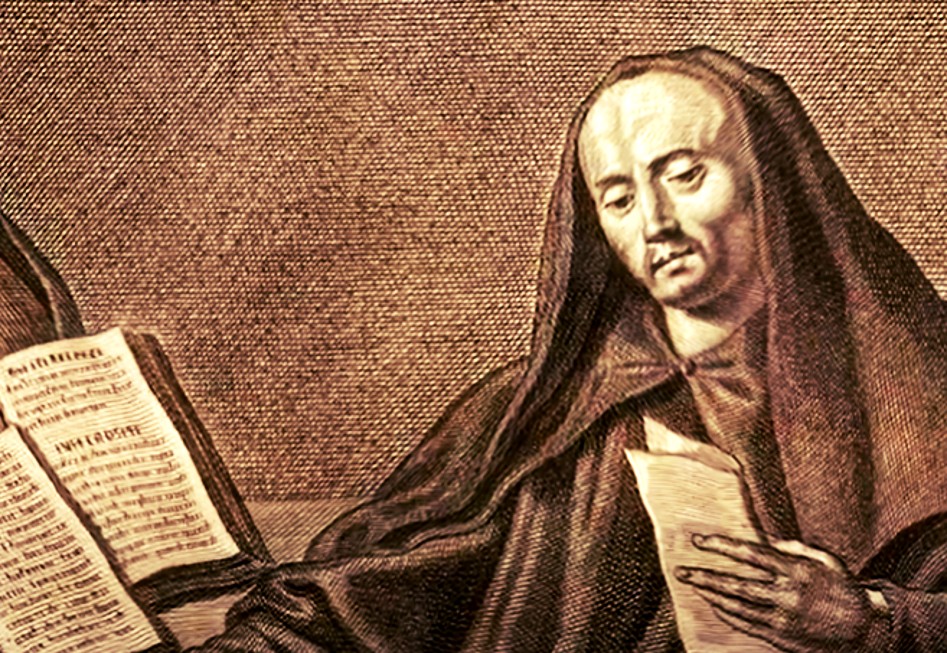
Blessed Herman of Reichenau/the Cripple (1013–1054) Benedictine Monk, Confessor, Scholar, Scientist, Writer, Hymnist, Poet, Musical Composer, Teacher. In his own day, the heroic cripple who achieved learning and holiness was called ‘The Wonder of His Age.’. Composer of the “Salve Regina” Hail Holy Queen, “Veni Sancte Spiritus” Come Holy Spirit and “Alma Redemptoris Mater” amongst many others. His Amazing Life and Works: https://anastpaul.com/2019/09/25/saint-of-the-day-blessed-herman-of-reichenau-the-cripple-osb-1013-1054-the-wonder-of-his-age/
St Fymbert Bl Marco Criado St Mewrog St Neomisia of Mecerata St Paphnutius of Alexandria St Principius of Soissons St Sergius of Moscow St Solemnis of Chartres
Martyrs of Damascus: A Christian family of six who were tortured to death in a persecution by Roman authorities. They were: Eugenia, Maximus, Paul, Rufus, Sabinian and Tatta. They were tortured to death in Damascus, Syria, date unknown.
The Holy Bishops of Milan: Imagine being part of a Diocese in which 36 of your past Bishops are Saints and some are also Doctors of the Church and Popes (and others being considered for Sainthood)! Today, the Church in Milan commemorates these holy Bishops. They are: • Blessed Alfredo Ildefonso Schuster • Blessed Andrea Carlo Ferrari • Pope Pius XI • Saint Ambrose of Milan • Saint Ampelius of Milan • Saint Anathalon of Milan • Saint Antoninus of Milan • Saint Auxanus of Milan • Saint Benedict Crispus of Milan • Saint Benignus of Milan • Saint Calimerius of Milan • Saint Castritian of Milan • Saint Charles Borromeo • Saint Datius of Milan • Saint Dionysius of Milan • Saint Eugene of Milan • Saint Eusebius of Milan • Saint Eustorgius II of Milan • Saint Eustorgius of Milan • Saint Gaius of Milan • Saint Galdinus of Milan • Saint Geruntius of Milan • Saint Glycerius of Milan • Saint Honoratus of Milan • Saint John Camillus the Good • Saint Lazarus of Milan • Saint Magnus of Milan • Saint Mansuetus of Milan • Saint Marolus of Milan • Saint Martinian of Milan • Saint Mirocles of Milan • Saint Mona of Milan • Saint Natalis of Milan • Saint Protasius of Milan • Saint Senator of Milan • Saint Simplician of Milan • Saint Venerius of Milan
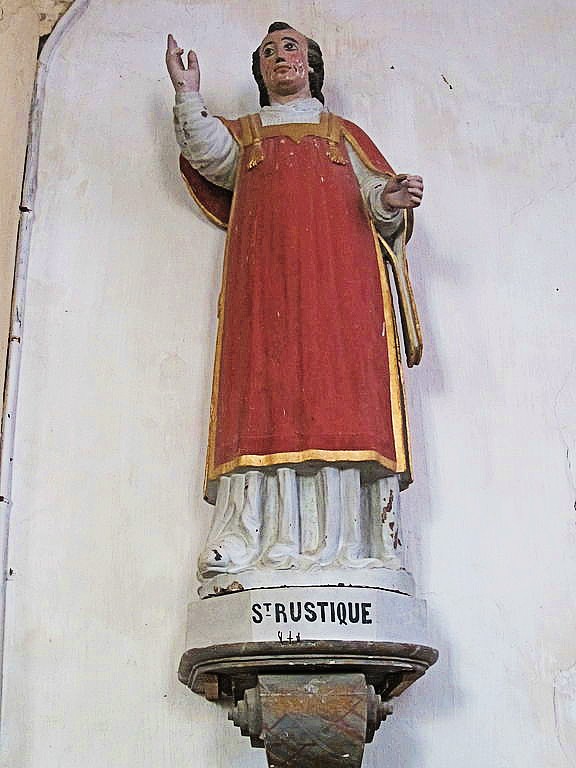
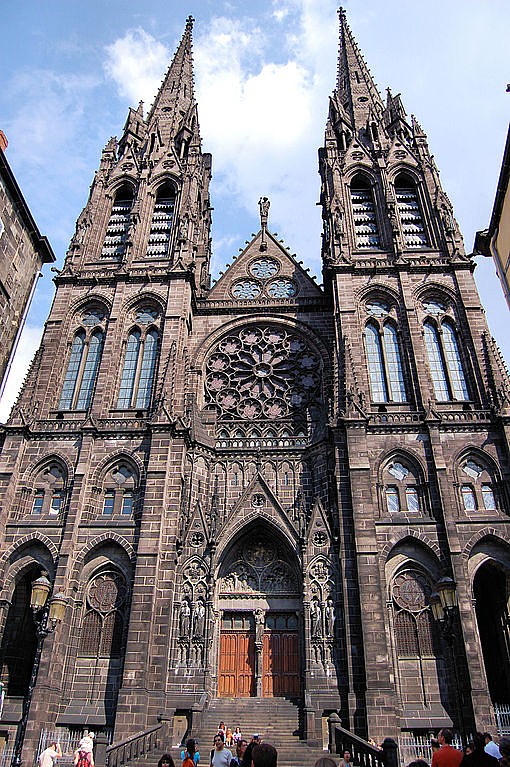
Saint of the Day – 24 September – Saint Rusticus of Clermont (Died 446) Bishop of Clermont, Confessor – the Seventh Bishop of Clermont in Auvergne, concerning whose election Saint Gregory of Tours relates, that it was brought about by a special intervention of Divine Providence. Born in Auvergne, France and died in 446 in Clermont, Auvergne of natural causes. Also known as – Rustique, Rotiri. Rusticus of Auvergne.
At Clermont Cathedral
Rusticus was a Priest in Clermont, remarkable for the sanctity of his manners. He was a native of the Diocess and had the administration of a Parish there. This is all which is known, with any cerntainty, concerning his life.
Église Saint-Denis in Saint-Denis-le-Vêtu – Statue of saint Rustique
When the former Bishop, Venerandus, died on the 24th of December, 423,. It is said that an assembly of citizens were adiscussing candidates to succeed Venerandus, when a veiled Nun told them to let the Lord make the choice and the chosen would appear.
At that moment, Rusticus arrived and the woman cried out that he was the one appointed by the Lord.
Rusticus duly succeeded as the Bishop of Clermont. His term as the Bishop was 22 years long , from 424 to 446. He was succeeded by Saint Namatius, who was the Bishop from 446 to 462 and founded Clermont Cathedral.
Martyrs of Chalcedon – (49 Saints): Forty-nine Christian choir singers of the Church in Chalcedon in Asia Minor who were Martyred together in their persecutions of Diocletian in 304.
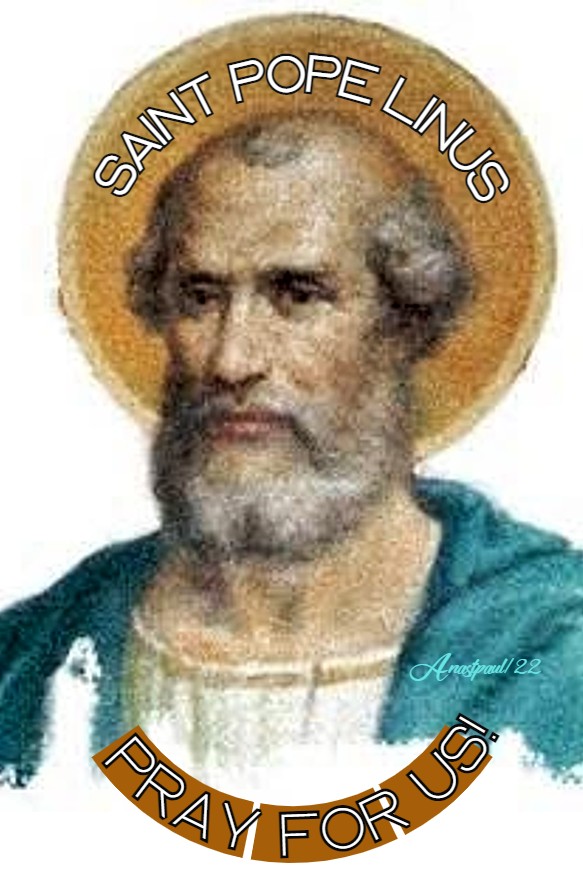
One Minute Reflection – 23 September – “The Month of the Seven Sorrows of the Blessed Virgin Mary and the Holy Cross” and the Mermorial of St Pope Linus (c 10 – c 76) Successor to St Peter – Osee 14:2-10, Luke 7:36-50
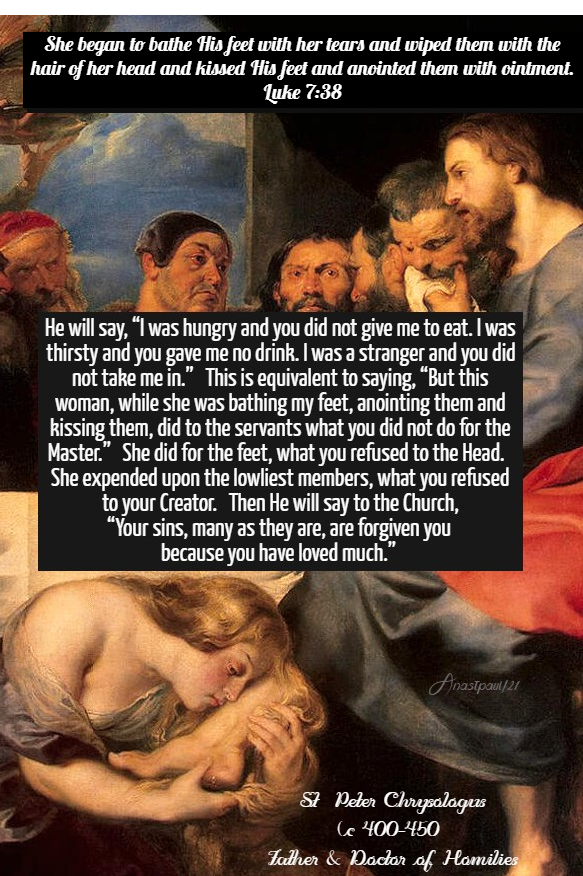
“She began to bathe His feet with her tears and wiped them with the hair of her head and kissed is feet and anointed them with ointment.” – Luke 7:38
REFLECTION – “With her hands of good works, she holds the feet of those who preach His Kingdom. She washes them with tears of charity, kisses them with praising lips and pours out the whole ointment of mercy, until He will turn her. This means that He will come back to her and say to Simon, to the Pharisees, to those who deny, to the nation of the Jews, “I came into your house. You gave me no water for my feet.”
When will He speak these words? He will speak them when He will come in the Majesty of His Father and separate the righteous from the unrighteous, like a shepherd who separates the sheep from the goats. He will say, “I was hungry and you did not give me to eat. I was thirsty and you gave me no drink. I was a stranger and you did not take me in.” This is equivalent to saying, “But this woman, while she was bathing my feet, anointing them and kissing them, did to the servants, what you did not do for the Master.” She did for the feet, what you refused to the Head. She expended upon the lowliest members, what you refused to your Creator. Then He will say to the Church, “Your sins, many as they are, are forgiven you because you have loved much.”– St Peter Chrysologus (c 400-450) Bishop of Ravenna, Father and “Doctor of Homilies” (Sermon 95).
PRAYER – Look forgivingly on Thy flock, Eternal Shepherd, and keep it in Thy constant protection, by the intercession of blessed Linus Thy Sovereign Pontiff, whom Thou didst constitute Shepherd of the whole Church. Through the same Jesus Christ, Who lives and reigns with God the Father, in the unity of the Holy Spirit, God, world without end. Amen (Collect).
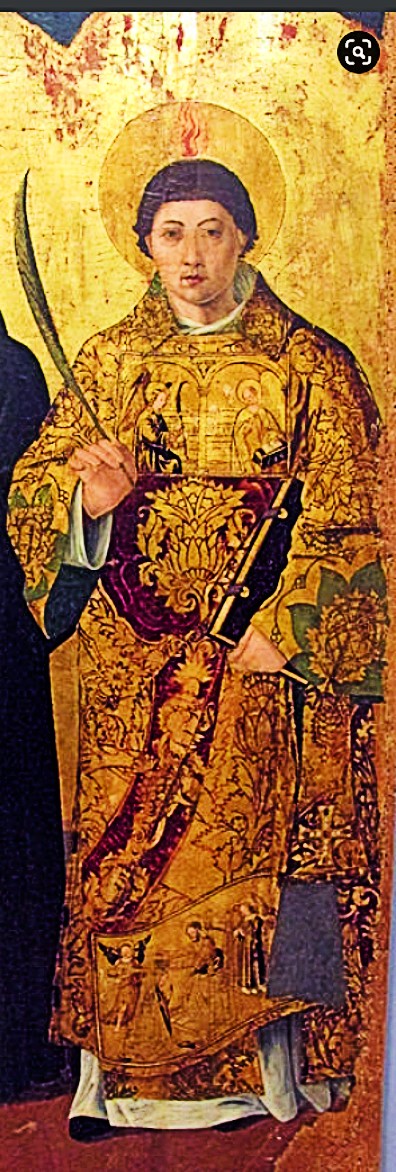
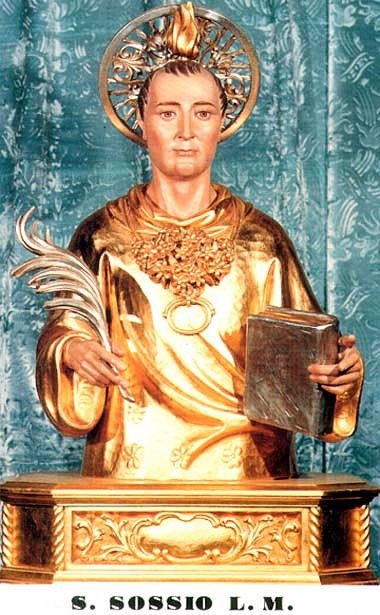
Saint of the Day –23 September – Saint Sosius (275-305) Confessor, Deacon and Martyr. His holiness and wisdom drew many Prelates to his feet, seeking spiritual assistance. St Sosius was a Deacon of Misenum, an important naval base of the Roman Empire in the Bay of Naples. Born in 275 in Miseno, Italy and died by being beheaded on 19 September 305, along with St Januarius, at Pozzuoli, Campagna, Italy. Patronages – ailments of the bones, of Frattamaggiore, Italy, San Sossio Baronia, Italy. Also known as – Sosius of Misenum, of Miseno, Sosius of Puzzuoli, Sosier, Sosio, Sosius, Sossio, Sossius, Sosso.
The Roman Martyrology reads: “At Capo Miseno in Campania, St Sosius, Deacon and Martyr, who, as Pope St Symmachus reports, wishing to save his Bishop from death, instead found death together with him, obtaining equal glory at the same price.””
Sosius was born in Miseno in 275, as reported by the Martyrology of the Venerable Bede. He was one of the most ardent leaders of early Christian groups. Giovanni Diacono defined him as “a man in whom all the charisms of Grace were crowded.”
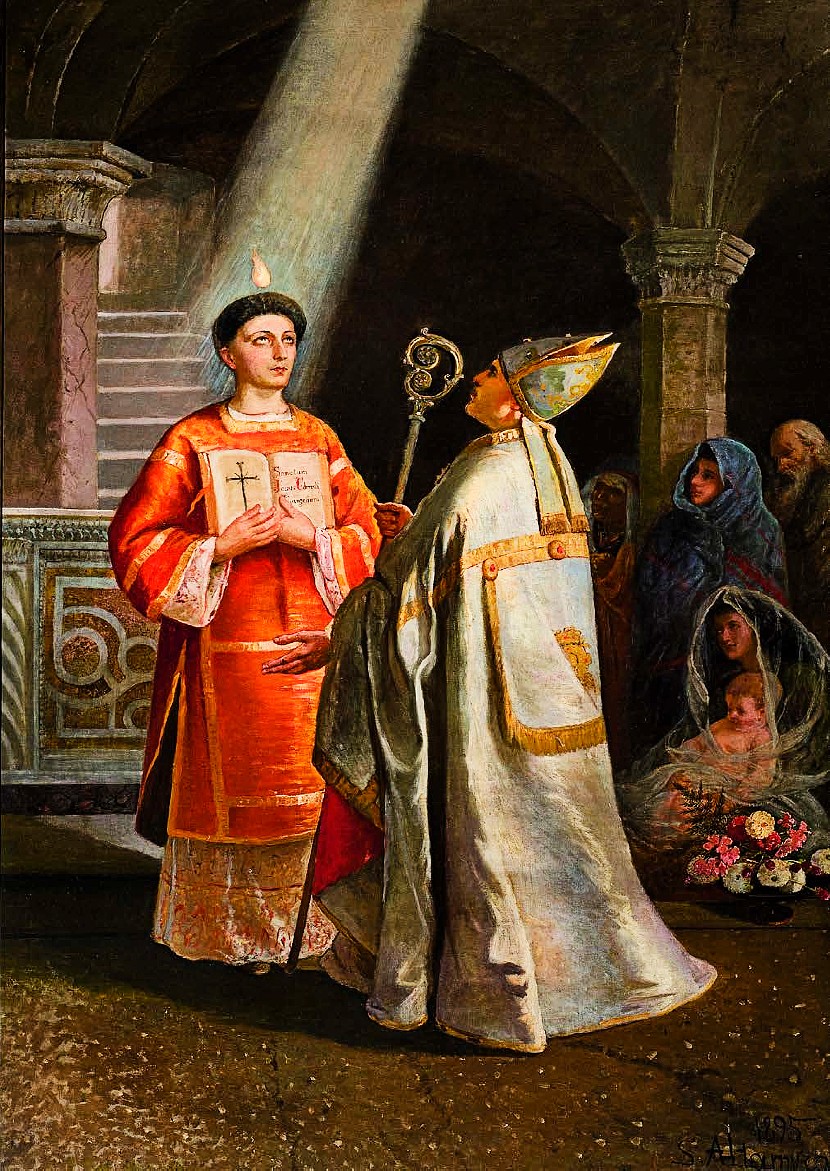
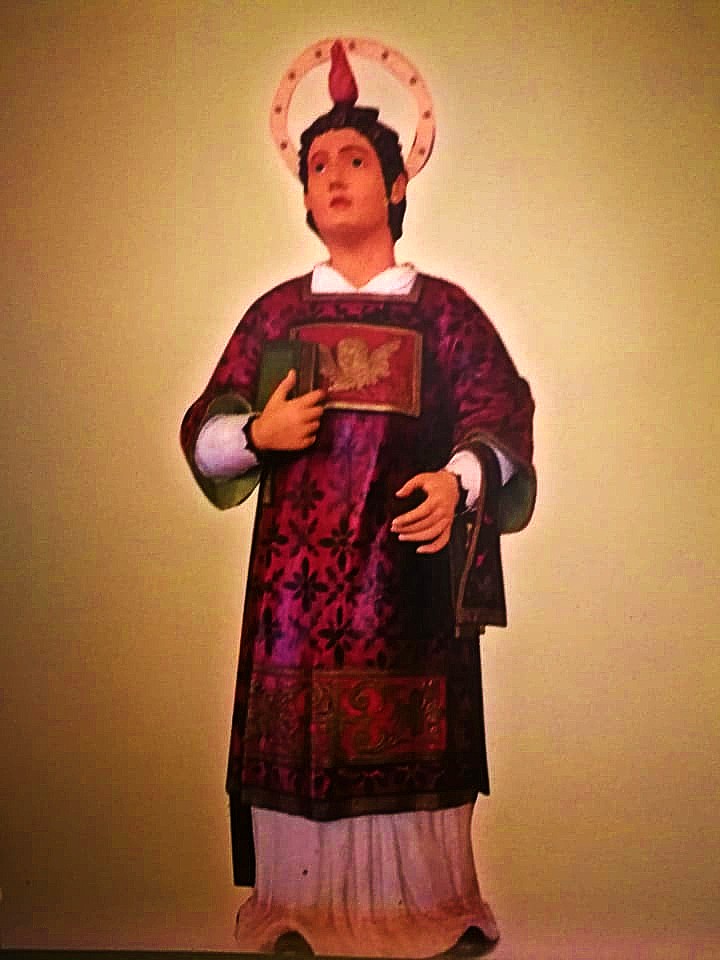
To demonstrate the fame of holiness which he enjoyed, while still alive, it is enough to remember that illustrious Prelates felt the need to come to Miseno to confer with the seraphic Deacon. Pope Symmachus shows him very zealous to the point of sacrifice and he was so full of the Holy Spirit that his advice was also requested by the great Neapolitan Bishop, St Januarius. During one of these visits, in 304, St Januarius,, celebrating the Holy Mass on the third Sunday of Easter, saw a flame similar to that descending on the forehead of the Apostles, on the day of Pentecost, appear on the head of Sosius, while he was reading the Gospel. St Januarius, evealed the vision to many there.
Sts Sosius and Januarius
The persecution started the year before by Diocletian had, in the meantime, reached its peak and Misenus, seat of the imperial praetorian fleet, was an extremely dangerous place for Christians. But not for this reason, not for any dangers, would Sosius limit his work, continuing with fervour in the preaching of the word of Christ against false idols.
Betrayed by informers, he was taken to prison in Pozzuoli and tortured to deny his faith. St Januarius himself, who was not unaware of the danger to which he was exposed, went to visit him in prison and on that occasion, he too was imprisoned, along with Sts Desiderius and Festus. All were destined to be fed to the beasts in the Amphitheater of Pozzuoli but, a series of miraculous events did not allow the condemnation to be carried out, “…when the animals came near the Saints, they fell affectionately at their feet and refused to harm them,” therefore, they were condemned to be beheaded.
Sosius’ body was transferred to Miseno on 23 September of the same year, which was set as his feast day. The destruction of Miseno by the Saracens caused the migration of the population towards the interior, with the subsequent foundation of Frattamaggiore. here the Misenati brought with them the cult of the Saint, making him the Patron Saint of the City.
The Benedictines, who, at the beginning of the 10th Century, found the remains in the ruins of the Church of Misenate, kept the body in Naples, at the Convent of St Severinus, preserving it from the raids of the Saracens. Thanks to them, the cult spread in Campania, in Lazio and even in Africa.
In 1807, following the suppression of the Convent by Napoleon, the remains of the Saint, together with those of the Apostle of Norico St Severinus, who for many centuries had rested next to the Benedictine Convent, were translated to the mother Church of Frattamaggiore, where still today, they are the object of the love and veneration of all.
St Sosius is also particularly venerated in Castro dei Volsci (Frosinone). The people effectively invoke him against the ailments of the bones.
Saint Sossius (right) with Saint Severinus, Altar painting from the eponymous Church of Saints Severinuaande Sossius in Naples, late 15th Century.
St Pope Linus (c 10 – c 76) Successor to St Peter. Papacy lasted from c 67 to his death. Among those to have held the position of pope, Peter, Linus and Clement are specifically mentioned in the New Testament. Linus is mentioned in the closing greeting of the Second Epistle to Timothy as being with Paul in Rome near the end of Paul’s life. About St Pope Linus: https://anastpaul.com/2018/09/23/saint-of-the-day-23-september-st-pope-linus-c-10-c-76-successor-to-st-peter/
St Cissa of Northumbria St Constantius of Ancona Bl Francisco de Paula Victor Bl Guy of Durnes Bl Helen Duglioli St Peter Acontanto St Polyxena St Sosius (275-305) Confessor, Deacon and Martyr Bl William Way St Xantippa
Martyrs of Syracuse – (4 Saints): Group of Christians deported from Syracuse, Sicily by invading Saracens and sent to North Africa where they were tortured and executed for their faith. Martyrs. The names that have survived are Andrew, Antony, John and Peter. c900
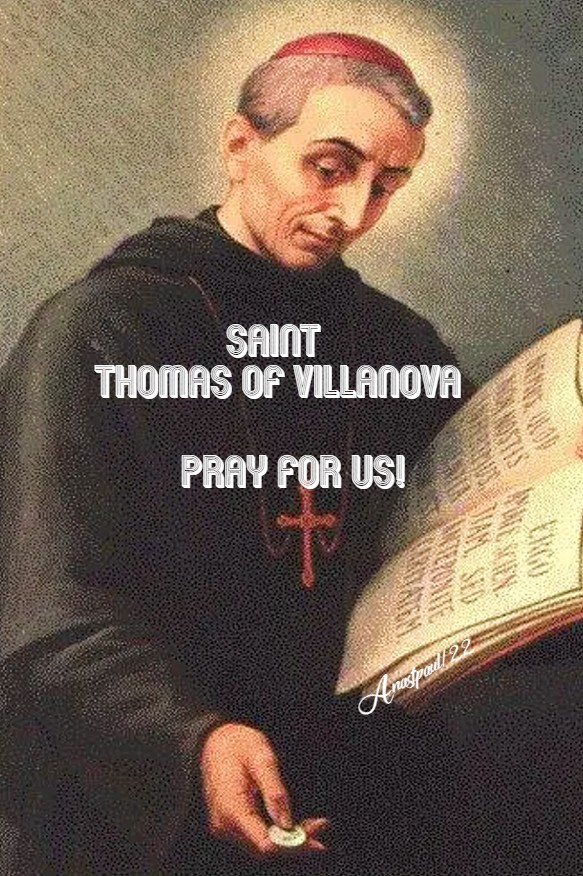
One Minute Reflection – 22 September – The Memorial of St Thomas of Villanueva OSA (1488-1555) Archbishop, Confessor – Sirach 44:16-27; 45:3-20, Matthew 25:14-23
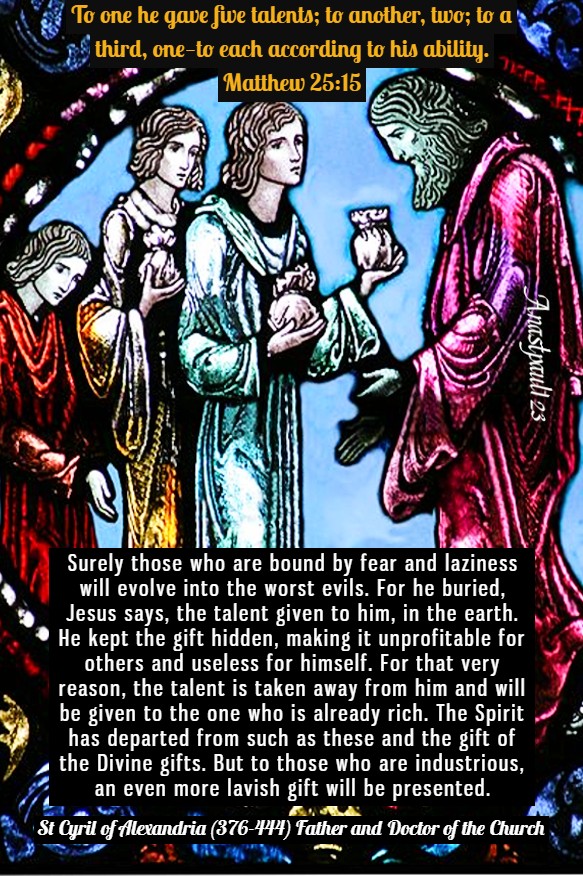
“To one he gave five talents; to another, two; to a third, one—to each according to his ability. Then he went away. Immediately …” – Matthew 25:15
REFLECTION – “The man who is the landowner is actually the Creator and Lord of all. The Word compares the time the landowner spends away from home, in the parable, to either the Ascension of Christ into Heaven, or, at any rate, to the unseen and invisible character of the Divine Nature. Now, one must conceive of the property of God, as those in each country and city who believe in Him. He calls His servants, those who according to the times, Christ crowns with the glory of the Priesthood. For the holy Paul writes, “No-one takes this honoUr upon himself; he must be called by God.”
He hands over [His property] to those who are under Him, to each giving a spiritual gift, so that he might have character and aptitude. We think that this distribution of the talents, is not supplied to the household servants in equal measure because, each is quite different from the other, in their understanding. Immediately they head out for their labours, He says, directly, indicating to us here, that apart from the procrastination of one, they are fit to carry out the work of God.
Surely those who are bound by fear and laziness will evolve into the worst evils. For he buried, Jesus says, the talent given to him in the earth. He kept the gift hidden, making it unprofitable for others and useless for himself. For that very reason, the talent is taken away from him and will be given to the one who is already rich. The Spirit has departed from such as these and the gift of the divine gifts. But to those who are industrious, an even more lavish gift will be presented.” – St Cyril of Alexandria (376-444) Archbishop of Alexandria, Father and Doctor of the Church (Fragment 283)
PRAYER – O God, Who endowed blessed Bishop Thomas with the virtue of special pity for the poor, we beseech Thee, through his intercession, generously to pour forth the riches of Thy mercy upon all those who pray to Thee. Through Jesus Christ, Thy Son our Lord, Who lives and reigns with Thee, in the unity of the Holy Ghost, God, world without end. Amen (Collect).
Saint of the Day – 22 September – Saint Septimius of Jesi (Died c 307) the first Bishop of Jesi in Italy, Confessor, Martyr., Miracle-worker Born in Germany and died by being beheaded in Jesi, Italy. Patronages – the City and Diocese of Jesi. Also known as – Settimio.
St Septimius is venerated as the first Bishop of the Diocese of Jesi and is considered the builder of the first Cathedral,which, although dedicated to the Holy Saviour retained the name of Septimius as the name of the founder (as was the custom).
Fresco of St Septimius, by Biagio Bigatti, 1937. Iesi Cathedral.
Very ancient documents from Jesi, bear 461 as the date of the death of the holy Bishop and Martyr, however, this date seems to be in error when contrasted with the other historical events of the time. The office tells us that Septimius, born in Germany, devoted himself to liberal studies and a military life, then, in contrast to the opinion of his relatives, he converted to Christianity and came to Italy with some friends.
He began to preach the faith in Milan but was forced to leave that City, following the spread of Diocletian’s persecution. He travelled to Rome where he worked wonders and converted many to the True Faith. He was so successful in evangelising the pagans and became so renowned for the many miracles worked through his prayers, that Pope Marcellus I (308-309) Consecrates him as the Bishop of Jesi.
Septimius began immediately his pastoral mission and, at the same time, began the work of building a Cathedral. But in this City he found the Judge Florentius, who forbid him to continue his apostolate and gave him the ultimatum to sacrifice to the gods within five days, according to the imperial edict. Septimius, however, ignored Florentius’ demands and continues to preach the Gospel of Christ and convert pagans and perform miracles, At the end of the five days, Septimius was arrested and beheaded.
Although his place of burial was lost, by 1208 the Cathedral was named for him, His body was finally rediscovered in 1469 and translated to the Cathedral. In 1623 a new Altar was Consecrated to him where his body is now enshrined. His cult, however, had always been venerated because the Cathedral of Jesi was already dedicated to St Septimius.
Until 1623, St Septimius’ celebration was on 5 September and after that year, it was fixed at 22 September. St Septimius is the Patron Saint of the City of Jesi and of the Diocese, which he had established.
St Thomas of Villanueva/Villanova OSA (1488-1555) Archbishop, Confessor, Religious Priest of the Order of St Augustine,Writer, Preacher, Teacher, Apostle of Charity, Mystic, Miracle-Worker often called “the Almsgiver” and “the Father of the Poor“, Reformer. Canonised on 1 November 1658 by Pope Alexander VII. About St Thomas here: https://anastpaul.com/2017/09/22/saint-of-the-day-22-september-st-thomas-of-villanova-o-s-a/
St Irais St Jonas St Lauto of Coutances St Lindru of Partois Bl Otto of Freising St Sadalberga St Sanctinus of Meaux St Septimius of Jesi (Died c 307) Bishop, Confessor, Martyr St Sigfrid of Wearmouth St Silvanus of Levroux St Symphorian
Martyrs of the Theban Legion: + Martyrs (c 287) A Roman imperial legion of 6,600 soldiers, all of whom were Christians; they had been recruited from the area around Thebes in Upper Egypt, were led by Saint Maurice and served under Emperor Maximian Herculeus. Around the year 287, Maximian led the army across the Alps to Agaunum, an area in modern Switzerland, in order to suppress a revolt by the Bagandre in Gaul. In connection with battle, the army offered public sacrifices to the Roman gods; the Theban Legion refused to participate. For refusing orders, the Legion was decimated – one tenth of them were executed. When the remainder refused to sacrifice to the gods, they were decimated again. When the survivors still refused to sacrifice, Maximinian ordered them all killed. Martyrs. Known members of the Legion include: Alexander of Bergamo Candidus the Theban Chiaffredo of Saluzzo Exuperius Fortunato Innocent of Agaunum Maurice Secundus the Theban Ursus the Theban Victor of Agaunum Victor of Xanten Victor the Theban Vitalis of Agaunum Other profiled Saints associated with the Legion include: Antoninus of Piacenza (martyred soldier; associated by later story tellers) Adventor of Turin (not a member; associated by later story tellers) Cassius (may have been a member) Florentius the Martyr (may have been a member) George of San Giorio (not a member; associated by later story tellers) Gereon (not a member, but another soldier who was martyred for refusing to make a sacrifice to Roman gods) Octavius of Turin (not a member; associated by later story tellers) Pons of Pradleves (escaped the massacre to become an evangelists in northern Italy) Secundus of Asti (not a member but linked due to art work) Solutor of Turin (not a member; associated by later story tellers) Tiberio of Pinerolo (may have been a member) Verena (wife of a member of the Legion) They were Martyred c 287 in Agaunum (modern Saint-Maurice-en-Valais, Switzerland. A Basilica was built in Agaunum to enshrine the relics of the Legion. The full story: https://anastpaul.com/2018/09/22/saints-of-the-day-22-september-st-maurice-and-the-martyrs-of-the-theban-legion-martyrs-c
St Alexander of the Via Claudia Bl Diego Hompanera París St Eusebius of Phoenicia St Francisco Pastor Garrido St Gerulph St Herminio García Pampliega St Iphigenia St Isaac of Cyprus Bl Jacinto Martínez Ayuela St Jonah the Prophet Bl José María Azurmendi Mugarza Bl Josep Vila Barri St Landelino of Ettenheim Bl Manuel Torró García
St Maura of Troyes St Meletius of Cyprus Bl Nicolás de Mier Francisco St Pamphilus of Rome Bl Vicente Galbis Gironés Bl Vicente Pelufo Orts
Martyrs of Gaza – 3 Saints: Three brothers, Eusebius, Nestulus and Zeno, who were seized, dragged through the street, beaten and murdered by a pagan mob celebrating the renunciation of Christianity by Julian the Apostate. They were burned to death in 362 on a village garbage heap in Gaza, Palestine.
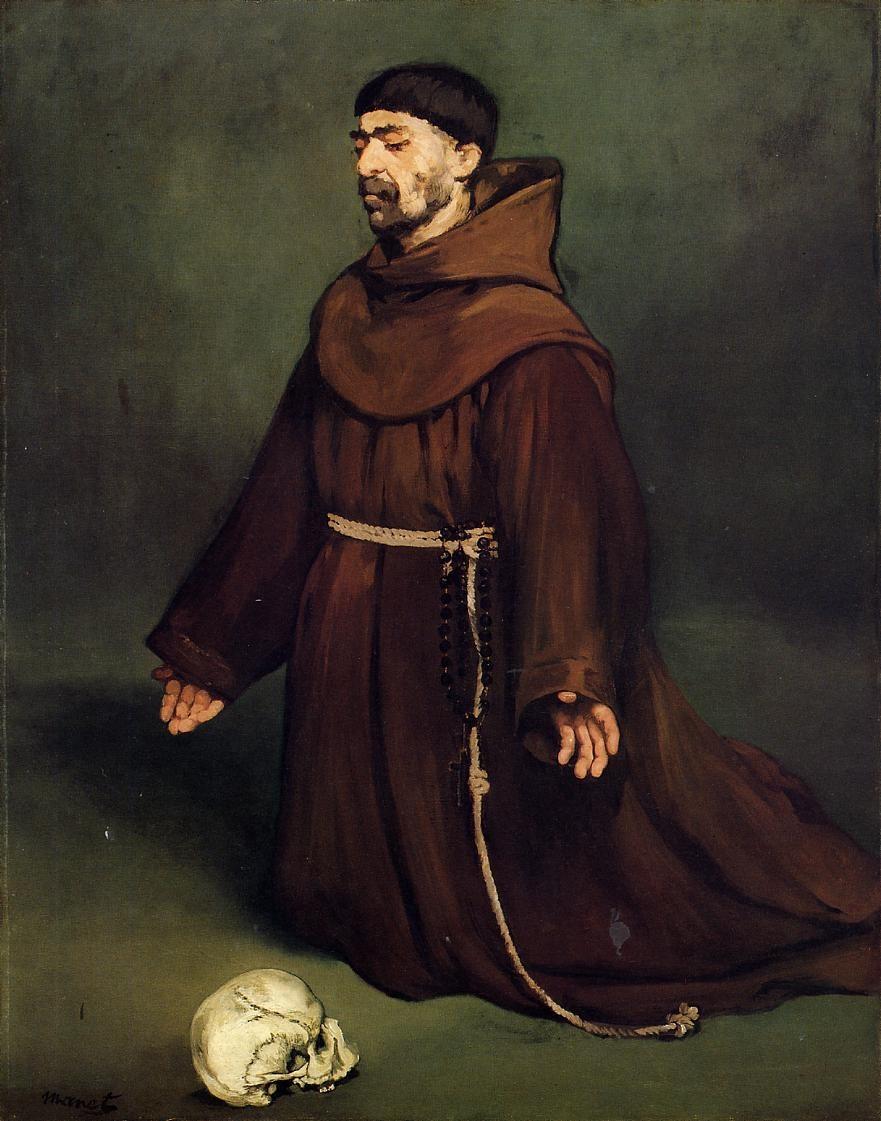
Saint/s of the Day – 29 August – Blessed John of PerugiaOFM (Died 1231) Priest and Blessed Peter of Sassoferrato OFM (Died 1231) Lay Brother, Martyrs, Confessors, Friars of the Friars Minor. Both were beheaded in 1231 in Valencia, Spain. We have no artworks of the two Saints, those below are generic Franciscans.
A Franciscan Friar
The two Friars Minor, Blessed John of Perugia, a Priest, and Peter of Sassoferrato, a lay brother, were sent to Spain with a large number of Friars by St Francis himself. There, they were assigned to the kingdom of Aragon, where they built a small Convent in the little town of Teruel and reaped much fruit, by their holy lives, their prayers and their sermons on penance.
Their longing for the conversion of the infidels and the hope of obtaining the Palm of Martyrdom urged Friars John and Peter to go to the larger city of Valencia, which was governed, at that time, by the Moorish King Azotus. The Friars began to preach in public that Jesus Christ is the true Son of God and that only through Him, can we be saved. Azotus was a bitter enemy of the Christians.
Hearing of the activities of the Friars, he had them seized and cast into prison. He used every possible means to force them to apostatise. But when promises and threats alike, failed to shake their constancy, he condemned them to be beheaded. The Friars thanked the King,, praying fervently to God to enlighten their persecutor and in His mercy, to grant him the grace of conversion to the true Faith. Then, Blessed John of Perugia and Peter of Sassoferrato were beheaded. This occurred in the year 1231.
A few years later, James I, the Catholic King of Aragon, made war on Valencia. His army defeated the army of Azotus, who by this ill fortune and by the grace which the holy Martyrs had won for him from God, recognised Mohammed as a false prophet and Christ as the Saviour of the world. King James rejoiced exceedingly when Azotus asked to be Baptised. After his Baptism, Azotus offered the Friars Minor, his former palace for a Convent.
“When I was still an infidel,” he told them, “I caused your brethren to be executed at Teruel. I sincerely regret this crime and desire to make reparation for it. Accept my palace, in which the blood of many holy Martyrs has been shed and convert it into a convent.”
The palace was remodeled into a Convent and, next to it, a Church was erected in honour of the two Martyrs. On 11 September 1704, Pope Clement XI approved the public veneration which was paid to them and in 1783, Pope Pius VI again honoured them by confirming their cultus.






























 AnaStpaul
You must be logged in to post a comment.