St Asclepiades of Antioch St Athenodorus St Brothen Bl Burchard I St Cadwaladr of Brittany Bl Domenico of Perpignano St Eutychius of Pozzuoli St Gwen St Gwen of Tagarth St Gwendoline
Bl Margherita Tornielli St Monon of Nassogne St Proculus of Pozzuoli Bl Theobald of Narbonna St Tryphonia of Rome
Martyrs of Africa – 9 Saints: A group of Christians Martryed together in Africa. The only details that have survived are the names – Beresus, Dasius, Faustinus, Leucius, Lucius, Martialis, Victoricus, Victrix and Viktor. They were martyred in c.300 in Africa.
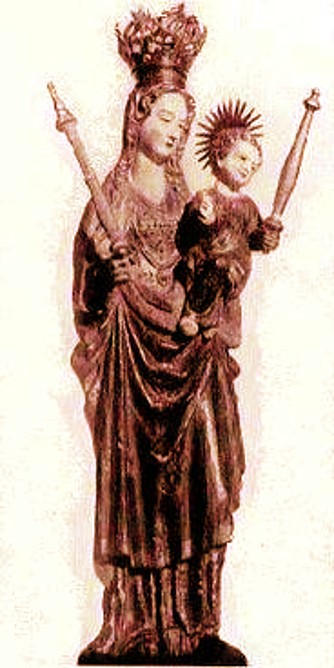

Saint of the Day – 17 October – St Margaret Mary Alacoque VHM (1647-1690) Virgin, Nun of the Order of the Visitation of Holy Mary, Mystic, Visionary and Saint and Apostle of the Sacred Heart.
St Margaret Mary Alacoque (1647-1690) From Little Pictorial Lives of the Saints, 1894
Saint Margaret Mary, a soul of divine predilection, was born at Terreau in Burgundy, on 22 July 1647. During her infancy, she showed a wonderfully sensitive revulsion to the very idea of sin and, while still a young child, always recited the entire Rosary everyday. She lost her father at the age of eight years and her mother placed her with the Poor Clares. She was often sick and for four years was bedridden, losing almost entirely the use of her members. She made a vow to Our Lady to become one of her daughters if she cured her and was suddenly entirely well.
She was of a happy temperament and her heart became easily attached to human affections. God began her purification when the charge of her mother’s house was confided to persons who reduced the family to a sort of servitude. Margaret Mary turned to God for strength and consolation when she was accused of various crimes she had not committed. In short, the Saint of the Sacred Heart learned to suffer for Christ, with patience, what innocence can suffer in such situations.
She desired to be a religious but her mother could not bear to hear a word of that desire. Finally, God came to her assistance through a Franciscan Priest, who told her brother that he would answer to God for the vocation of his sister. In 1671 she entered the Order of the Visitation of Mary, at Paray-le-Monial and was professed the following year. She followed all the practices of the Monastery in perfect obedience, spending as much time as she could in the Chapel with her Lord. After sanctifying her by many trials, Jesus appeared to her in numerous visions, displaying to her, His Sacred Heart, sometimes burning as a furnace and sometimes, torn and bleeding on account of the coldness and sins of men. “Behold this Heart which has so loved men and been so little loved by them in return!“
In 1675, she was told by Our Lord that she, with the aid of Father Claude de la Colombiere of the Society of Jesus, was to be His instrument for instituting the Feast of the Sacred Heart and for spreading the devotion everywhere. This was not accomplished without great sufferings. The good Jesuit did all in his power to make known and loved the Heart of Jesus but when it seemed all obstacles were about to disappear, his Superiors sent him to England. He returned to France exhausted and soon died.
Saint Margaret Mary was for a time Mistress of Novices and in this office, exercised a true apostolate, working to win for the Heart of Jesus, the hearts of the young girls who were aspiring to religious consecration. She was persecuted when she sent one of them home, not having seen in her the indications of a genuine vocation – the family attempted to have her deposed. She remained in the charge but was deprived of Holy Communion on the First Friday of the month. This practice was one of Our Lord’s specific requests – for souls who Communicate Nine First Fridays in succession, He promised the most wonderful graces. The demons also persecuted her visibly, nonetheless, her entire Community and later the entire Universal Church, was finally won over to devotion to the Divine Heart of Jesus.
The Twelve Promises of Jesus to Saint Margaret Mary and to those Devoted to His Sacred Heart:
I will give them all the graces necessary for their state of life.
I will establish peace in their families.
I will console them in all their troubles.
They shall find in My Heart an assured refuge during life and especially at the hour of their death.
I will pour abundant blessings on all their undertakings.
Sinners shall find in My Heart the source of an infinite ocean of mercy.
Tepid souls shall become fervent.
Fervent souls shall speedily rise to great perfection.
I will bless the homes where an image of My Heart shall be exposed and honoured.
I will give to priests the power of touching the most hardened hearts.
Those who propagate this devotion shall have their names written in My Heart, never to be effaced.
The all-powerful love of My Heart will grant to all those who shall receive Communion on the First Friday of Nine consecutive months the grace of final repentance; they shall not die under my displeasure, nor without receiving their Sacraments; My heart shall be their assured refuge at that last hour.
St Margaret Mary Alacoque VHM (1647-1690) Virgin, Nun of the Order of the Visitation of Holy Mary, Mystic, Visionary and Saint and Apostle of the Sacred Heart. Her feast day was moved to after Vatican II and prior to that was 17 October the date of her death. Beatified on 18 September 1864 by Pope Blessed Pius IX and Canonised on 13 May 1920 by Pope Benedict XV. Biography here: https://anastpaul.wordpress.com/2017/10/16/saint-of-the-day-16-october-st-margaret-mary-alacoque-1647-1690-v-h-m/
St Ethelbert of Eastry St Ethelred of Eastry St Florentius of Orange Bl Gilbert the Theologian St Heron of Antioch Bl Jacques Burin St John the Short/Dwarf St Louthiern St Mamelta of Persia St Nothelm of Canterbury St Richard Gwyn St Rudolph of Gubbio St Rufus of Rome St Serafino of Montegranaro St Solina of Chartres St Zosimus of Rome
Martyrs of Nicomedia – 3 Saints: A group of Christians Martyred in the persecutions of Diocletian. The only details about them that have survived are their names – Alexander, Marianus and Victor. 303 in Nicomedia (in modern Turkey).
Martyrs of Valenciennes -5 Beati: A group of Ursuline nuns Martyred in the persecutions of the French Revolution. • Hyacinthe-Augustine-Gabrielle Bourla • Jeanne-Reine Prin • Louise-Joseph Vanot • Marie-Geneviève-Joseph Ducrez • Marie-Madeleine-Joseph Déjardins
Martyrs of Volitani: A group of Martyrs who were praised by Saint Augustine of Hippo. In Volitani, proconsular Africa (in modern Tunisia).
St Amandus of Limoges St Ambrose of Cahors St Balderic St Baldwin St Bertrand of Comminges St Bolonia St Conogon of Quimper St Dulcidius of Agen St Eliphius of Toul St Eremberta of Wierre St Florentinus of Trier
Bl Gerald of Fossanuova St Junian St Lull St Magnobodus of Angers St Martinian of Mauretania St Mummolinus St Saturian of Mauretania St Silvanus of Ahun St Victor of Cologne St Vitalis of Noirmoutier
Martyrs in Africa – 220 Saints: A group of 220 Christians Martyrs about whom we know nothing but that they died for their faith.
Martyrs of North Africa – 365 Saints: A group of 365 Christians who were Martyred together in the persecutions of the Vandal king Genseric. The only details that have survived are the names of two of the Martyrs – Nereus and Saturninus. 450 in North Africa.
Saint of the Day – 15 October – St Teresa of Jesus of Avila OCD (1515-1582) Virgin and Doctor of the Church
Practical Considerations On the Life of Saint Teresa By Fr Francis Xavier Weninger SJ (1805-1888)
I. Teresa began in early youth, after the teachings of her pious parents, to read devout books. From this, she first drew the spirit of piety. No sooner, however, had she become interested in reading worldly books, than she grew, from day-to-day, more indolent in the service of God and she returned, not to her first fervour, until she had cast aside those works and again resumed her pious reading – a proof of the great benefit we may derive from devout books and of the harm which worldly writings may do us. Oh! that those, who desire to, live piously, may understand this and conform their lives to it. Oh! that all Christians would guide their children, from their early youth, to the reading of devout books!
II. Teresa, after the death of her mother, chose the Blessed Virgin to be another mother to her, and sought and found, in her, comfort and assistance in all her needs. Thrugh her intercession and that of St Joseph, she received the grace of being constant in her reform. Love Mary as your mother – seek, with filial trust, consolation and assistance from her. St Joseph should be one of your principal Patrons, as his intercession is very powerful with the Almighty and, especially, as he has now been solemnly declared the Patron Saint of the Universal Church.
III. The sight of the wounded Jesus, filled the heart of St Teresa with great contrition for her former indifferent life. It inflamed her with true love of God and kept her, until her end, in these sentiments. Consider frequently how your Saviour suffered for your sake and repent of your sins sincerely, as they were the cause of Christ’s bitter Passion. Love your Redeemer with all the strength of your heart and make the resolution to serve Him in future most fervently.
IV. Teresa saw the place in hell which would have been hers, if she had not discontinued her idle discourses and her indifference in the worship of the Most High. Hence, she often gave humble thanks to God that He had not condemned her and she learned, by it, how hurtful even a menial sin can become, since it may lead us gradually to the path of everlasting perdition. You have still more reason to give thanks to God that He did not call you away, from this mortal life, in your sin. How long would you already have been in hell? If idle, empty conversation would have led Teresa gradually into hell, what may you not have to fear, if you do not abstain from so much sinful talking, in which you indulge? Learn also that you should not esteem a venial sin, however small it appears to you, as trifling, for, it may slowly lead you to damnation!
V. Many other lessons, which the life of St Teresa contains, I leave to yourself to consider. One thing only I request of you. Call to mind frequently the words which the Saint uttered in her ecstasy: “Only one God! Only one death! Only one soul! Love this only God and do not offend Him. Take earnest care of your only, your precious, your immortal soul. ‘Keep thyself, therefore and thy soul, carefully.’ (Deut., iv.)”
St Callistus of Huesca St Cannatus of Marseilles Bl Cipriano Alguacil Torredenaida St Euthymius the Younger St Fortunatus of Rome Bl Josefa Martínez Pérez St Leonard of Vandoeuvre Bl Narcis Basté y Basté Bl Pere Verdaguer Saurina Bl Ramón Esteban Bou Pascual St Sabinus of Catania St Severus of Trier
Martyrs of Cologne: A group of 360 Christian soldiers Martyred together in the persecutions of Diocletian and Maximian. They were Martyred in 303 outside the city walls of Cologne, Germany.
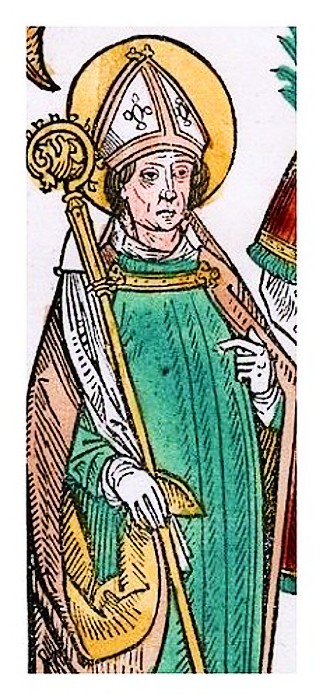
Saint of the Day – 14 October – St Burchard of Wurzburg (Died c752) The First Bishop of Wurzburg, Confessor, Monk, Missionary, English disciple of St Boniface to Germany. Born in an unknown date and location in England and died on 9 February in c 752 in Wurzburg, Germany of natural causes. Also known as – Burkard or Burkhard, Burcard. Additional memorial – 9 February, the day of his death.
The Roman Martyrology states : “In Würzburg in Austrasia, in Germany, St Burcard, a Bishop, who, originally from England, was Ordained by St.Boniface, as the first Bishop of this City.”
In about the year 732, Saint Boniface, standing in need of fellow-labourers, powerful in words and works, in the vast harvest which he had on his hands in Germany, invited from England, Saint Lullus and Saint Burchard, who seem, by this circumstance, to have come from the Kingdom of West-Sussex. They were both persons of an apostolic spirit.
Saint Boniface consecrated Saint Burchard, with his own hands, as the first Bishop of Wurzburg in Franconia, where Saint Kilian had preached the word of life and suffered Martyrdom about fifty years before.
This whole country was converted to Christ, by Burchard’s work. After labouring for twenty years, Burchard exhausted his strength and with the consent of King Pepin and by the approbation of Saint Lullus, (Saint Boniface being gone to preach in Friesland), he resigned his Bishopric to Megingand, a Monk of Fritzlar, and a disciple of Saint Wigbert.
Burchard retiring into solitude in that part of his Diocese called Hohenburg, where he spent the remaining part of his life with six fervent Monks or clergymen, in watching, fasting, and incessant prayer. He died on the 9th of February 752 and was buried near the relics of Saint Kilian at mount Saint Mary’s or Old Wurtzburg, where he had built a Monastery under the invocation of Saint Andrew.
St Burchard’s Abbey c 1400
In 752, out of veneration for his sanctity, King Pepin,declared the Bishops of Wurtzburg as Dukes of Franconia, with all civil jurisdiction. The Emperor Henry IV. alienated several parts of Franconia but the Bishops of Wurzburg retained the sovereignty of this extensive Diocese.
On 14 October 983, Hugh, Bishop of Wurzburg and Chancellor to the Emperor Otho IV. authorised by an order of Pope Benedict VII, made a very solemn translation of Burchard’s relics. This day, on which this ceremony was performed, has been regarded as St Burchard’s principal festival.
Engraving by Johann Salver
The life of Saint Burchard was written by an anonymous author above two hundred years after his death and again, by Egilward, a Monk of Wurzburg. – Excerpted from Father Alban Butler (1710–1773) English Priest and Hagiographer (Lives of the Fathers, Martyrs and Principal Saints, 1866).
The Statue of St Burchard on Wurzburg’s Old Bridge
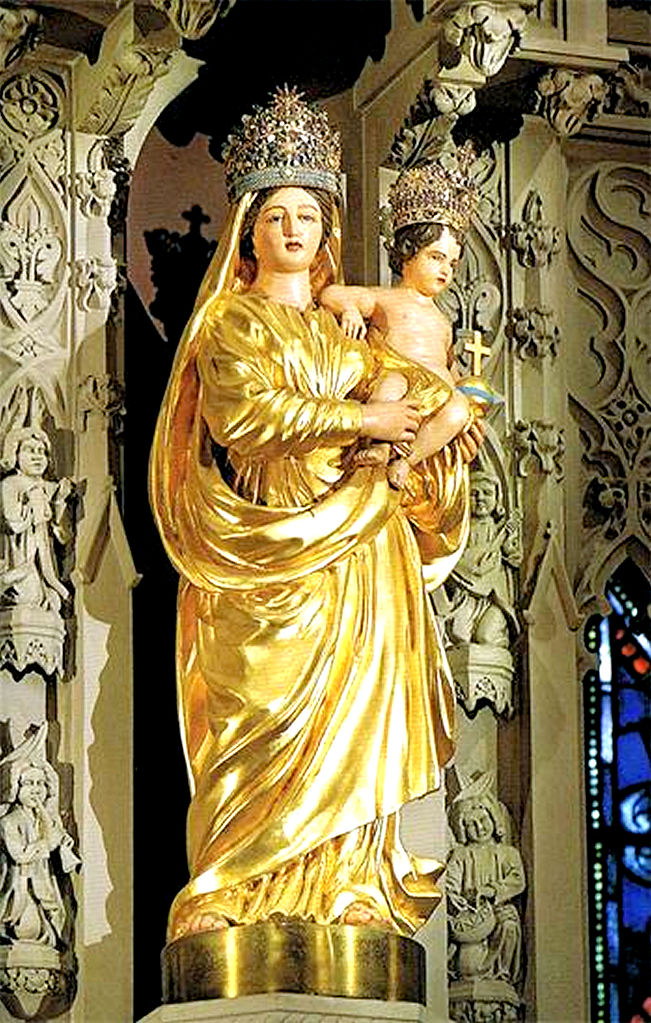
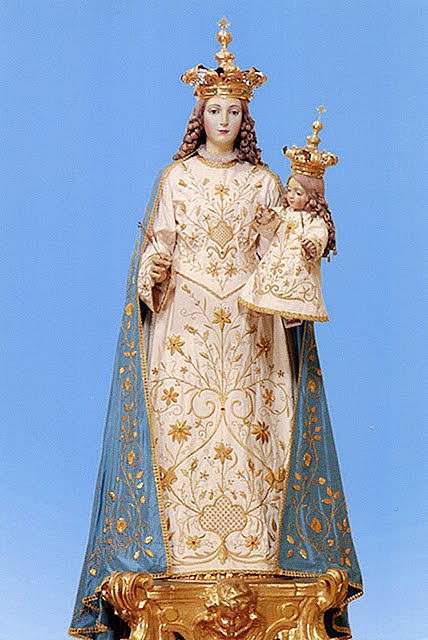
Notre-Dame-de-la-Rochette, Ranchal, France / Our Lady of La Rochette: 14 October
There are no easily translated legends of the above Marian Feast. Hopefully, by next year I will find something somewhere.In the meantime, I have found the beautiful Statues and Church and the little citation by Abbot Orsini:
The Abbot Orsini wrote: “Our Lady of La Rochette near Geneva. A shepherd coming up to a bush, where he heard a plaintive voice, found there an image of the Blessed Virgin, which led to a Church being built there.”
St Bernard of Arce St Burchard of Wurzburg (c 752) Bishop, Confessor, Monk, Missionary, disciple of St Boniface. St Celeste of Metz St Dominic Loricatus
Saint Fortunatus of Todi (Died 537) Bishop, Confessor, miracle-worker. An entry in the Roman Martyrology under 14 October records: “At Todi in Umbria, St Fortunatus, Bishop, who, as is mentioned by blessed Gregory, was endowed with an extraordinary gift for casting out unclean spirits.” About St Fortunatus: https://anastpaul.com/2020/10/14/saint-of-the-day-14-october-saint-fortunatus-of-todi-died-537/
St Gaudentius of Rimini St Gundisalvus of Lagos Bl Jacques Laigneau de Langellerie St Lupulo of Capua St Lupus of Caesarea St Manacca St Manehildis St Modesto of Capua St Rusticus of Trier St Saturninus of Caesarea St Venanzio of Luni
Martyrs of Caesarea – (4 Saints): Three brothers and a sister Martyred together in the persecutions of Diocletian – Carponius, Evaristus, Fortunata and Priscian. In 303 in Caesarea, Cappadocia (in modern Turkey) – their relics enshrined in Naples, Italy.
Saint of the Day – 13 October – St Simbert of Augsburg (Died c 809) Bishop of Augsburg, Monk, Abbot, Miracle-worker, he restored and built Churches and the Cathedral of Augsburg, as well as, contributed vastly to the reconstruction of the City after the devastation of war. Simbert – name means: on a brilliant path (old high German) Died on 13 October in c 809 of natural causes. Also known as – Simpert, Sintbert, Sinthert. He was Canonised by Pope Nicholas V. Patronages – against headaches, of children and youth of the Diocese of Augsburg and the third Patron of the Diocese.
The Roman Martyrology reads: “In Augsburg in Bavaria in Germany, St Simbert, who was Bishop and Abbot of Murbach.”
Hans Holbein the Younger: St Simpert and the wolf legend, 1492, in the Bavarian State Library in Munich
Simpert, probably the son of Duke Ambertus of Lorraine and his wife Simphorina, a sister of Charlemagne , was educated in a Monastery. King Karl, with whom he was in close contact throughout his life, appointed him Bishop of Augsburg – probably in 778 – as Bishop Tozzo ‘s successor . In documents from 798 and 799, Simpert was also referred to as Bishop of Neuburg an der Donau , in 800 he became Bishop of Neuburg. It was only between 801 and 807 that the areas of the Diocese east and west of the Lech, which had previously been separated, were united and Augsburg, once again, became the sole Episcopal See – this union was due to the great merit of Simbert.
Augsburg was badly damaged in the fighting between Bavaria and Franconia, at the time, and Simpert contributed greatly to the reconstruction of the City of Augsburg. To renovate his Diocese, he received extensive gifts and goods. In Augsburg, he had the destroyed Church of St Afra – today St. Ulrich and Afra – rebuilt and also completed the new building of the Cathedral, which he accordingly Consecrated in 807. He also founded the Cathedral school.
According to his wishes,, Simpert was buried in the Church of St Afra , which he had renovated and Consecrated. In 1064 his bones were raised and reburied. Numerous miracles occurred at his tomb. Records tell us how a mother asked for the intercession of St Simbert because a wolf had kidnapped her child. The wolf then returned the child and left it, unharmed in the Church. Simper’t’s intercession rescued a man who was about to sink in a swamp. Since the late Middle Ages, Simpert has also been revered as a Miracle-worker and regionally, as a unfailing assistant in all needs. Simpert caps were worn for headaches.
St Simpert saves the child from the wolf, artwork in the Church of St. Ulrich and Afra in Augsburg, where St Simbert’s tomb is enshrined
Simpert’s hagiography and reports on the miracles he performed, were written in 1230 by the Abbot of the Monastery in St. Ulrich and Afra. Emperor Maximilian I had a great devotion and veneration for him and included him in his line of ancestors. Emperor Maximillian was present as King when the bones were transferred in 1492. The large marble reclining figure above his grave, dates from 1714. The grave was opened in 1977 and an almost intact skeleton was revealed together with a copy of the biography from 1492 were found. His skull was then transferred to the St Simpert Church , which was newly built in 1978/1979 .
Reclining figure on the St Simpert Shrine and relief of the wolf miracle, 1714, in the Basilica of St. Ulrich and Afra in Augsburg
In 2007, Bishop Walter Mixa placed the Youth ministry of the Diocese of Augsburg and all children and young people under Simpert’s special protection and entrusted them to him as Patron Saint and advocate.
Josef Henselmann 1986: St Simpert with wolf and child (left), Bishop St Ulrich von Augsburg fighting the Hungarians (middle) and St Afra (right). The Group Statue composition stands at the fountain in front of the St Simbert’s Cathedral in Augsburg
In 1450 Pope Nicholas V Canonised St Simbert and allowed Simpert to be venerated as a Saint in his burial Church of St Ulrich and Afra in Augsburg, then in 1622, Pope Gregory XV approved. his veneration in the Diocese of Augsburg and in 1624 he was appointed the third Diocesan Patron.
Saint of the Day –12 October – Saint Opilio of Piacenza (Died mid 5th Century) Deacon. Opilio died in Piacenza of natural causes. He is also known as – Opilione.
Opilio is commonly remembered together with his brother St Gelasius and the Piacenza Bishop St Maurus. The three Saints are almost always remembered in a single chapter by the biographers and are always defined with the similar characteristics.
Opilio was a great example ,especially for his piety, his spirit of austere penance and his lively charity towards his neighbour. Tradition has it that he shared with the poor the food that his mother sent him through Sr Gelasius, his brother.
We have no certain information about his biography. Some inform us that as an Acolyte, he participated in the translation of the body of St Antoninus, commissioned by St Savinien.
The date of death of Saint Opilio can be placed in the first half of the 5th century. His bones rest in the Basilica of St Antoninus and some relics were brought by the Bishop Giovanni Battista Scalabrini, to the Chapel of the City’s Seminary.
There are various works depicting St Opilio Deacon, none of which can be traced online. In the Chapel of the Seminary, there is a painting of the late nineteenth Century, by the painter Ghittoni, which depicts the young St Opilio, with an ecstatic face in conversation with the Angels, together with St Gelasius.
Furthermore, there is still the only painting by the artist Bernardo Ferrari that depicts the two Saints and is located in the Basilica of St Antoninus in Piacenza.
The Basilica of St Antoninus in Piacenza where St Opilio’s tomb is venerated
In the Parish Church there is a painting from 1882, by Fedele Toscani, which depicts him alone. Finally, St Opilio is depicted in a portrait in relief in stone, in the Altar of the Crypt of the Piacenza Cathedral.
St Opilio is remembered by the Piacenza Church on 12 October.
Saint of the Day – 11 October – Blessed James Grissinger OP (c 1407-1491) “The Innocent,” Lay Brother of the Order of Preachers, Artist of Religous imagery, especially stained glass, former Soldier. Born in 1407 at Ulm, Swabia (modern Germany) and died on 11 October 1491, aged 84, in Bologna, Italy of natural causes. Also known as – James Griesinger, James of Ulm.
The Roman Martyrology reads: “In Bologna, blessed Giacomo da Ulm Grissinger, a religious of the Order of Preachers, who, although unlearned, he was a skilled decorator of stained glass windows and for fifty years, offered everyone an example of dedication to work and prayer.”
James, born in Ulm in 1407, had since childhood in his family, the Grissingers, the most precious examples of Christian piety. After a period as a Soldier, being unhappy in that life, at 25 years of age, with the blessing of his parents, from the banks of the Danube, he set out as a pilgrim to Rome to venerate the tombs of the Holy Apostles.
After various wanderings, he passed through Bologna, where he stopped for some time. His favourite destination was the tomb of St Domenic and here, during his devoted visits, he felt a strong inspiration to embrace the Order.
Although he was not completely uneducated, he asked and obtained, in 1441, to be admitted among the lay brothers. Candid and sensitive soul, he understood and knew how to fully implement his holy vocation.
His prayer touched ecstasy and he was often seen surrounded by light But although his heart was foreign to the earth, his hands were always ready to work and to render any humble service with that amiable smile that opens hearts. He was skilled in the art of painting glass, so much so that excellent works remain in remembrance of him. for the benefit of souls.
It is said that one day, while he supervised the firing of some painted glass, the Prior commanded him to go in search of alms. The Blessed one, without opening his mouth, went to fulfill the task in holy obedience. On his return, instead of finding the glass incinerated, as was to be expected, he found them cooked to the right point, by the Divine intercession at which he marvelled in thanksgiving.
He always kept his Baptismal innocence and, having expired his blessed soul, on 11 October 1491, his candour seemed to be communicated also to his body, which shone with celestial light.
On 3 August 1825, Pope Leo XII confirmed his cult. His relics, are preserved in St Domeni’s Basilica in Bologna,
Saint of the Day – 10 October – St Francis Borgia SJ (1510-1572) Confessor, Priest of the Society of Jesus, Advisor, Missionary, Evangelist, Administrator par excelleance. Francisco de Borja y Aragon was the 4th Duke of Gandía, was a Grandee of Spain, a Spanish Jesuit and third Superior General of the Society of Jesus
“St Francis instituted at his Court, before he entered the religious life, the veneration of the Saints of the Month. Every Catholic, besides worshipping the Almighty, ought to honour the Saints. We should especially honour the Divine Mother, as the Queen of all the Saints, then, the foster-father of Christ, St Joseph and further,, our Guardian Angel and Patron Saint. Besides this, we ought to select some special Patrons, for whom we feel particular esteem and love. It is also very beneficial, to adopt the practice of the “Monthly Patrons.” This consists in selecting, on the last day of every month, a Saint whose festival will be celebrated during the following month. Daily should he be invoked and honoured. If possible his life should be read and something from it, be selected for imitation. We may also approach the Sacraments on his festival, or on the Sunday after it and employ a little more time than usual, in good works. It is known, that several great servants of God, at the end of their days, called upon the Saints whom they had honoured as their Monthly Patrons during life and it cannot be doubted, that they received benefit and comfort. “Everyone,” says St Bonaventure, “ought to venerate an especial Saint with great devotion. To him, he ought daily, to commend himself and practise some good work, in his honoru.” By Fr Francis Xavier Weninger SJ (1805-1888)
Because the life of St Francis Borgia is rather long for one post, I post below, a part of it on his childhood and youth. Hopefully, we do not have to wait a year before I add to it. It is excerpted from the Lives of the Saints by Fr Alban Butler (1711-1773.)
St Francis Borgia, Fourth Duke of Gandia and Third General of the Jesuits, was son to John Borgia, Duke of Gandia and Grandee of Spain and of Joanna of Arragon, daughter of Alphonso, natural son to Ferdinand V King of Arragon … who was the great-grandfather to our Saint. The family of Borgia or Borja, had long flourished in Spain but in 1455, received a new lustre, by the exaltation of Cardinal Alphonso Borgia to the Pontificate, under the name of Calixtus III.
St Francis was born in 1510, at Gandia, a town which was the chief seat of the family, in the Kingdom of Valencia. His pious mother had a great devotion to St Francis of Assisi and, in the pangs of a dangerous labour, made a vow that if she brought forth a son, he should be called Francis.
As soon as he began to speak, his parents taught him to pronounce the Holy Names of Jesus and Mary, which he used often to repeat with wonderful seriousness. At five years of age he recited, everyday on his knees, the chief parts of the Catechism. All his diversion was to set up pious pictures, make little altars, imitate the ceremonies of the Church and teach them to the little boys, who were his pages. From the cradle he was mild, modest, patient and affable to all. The noble sentiments of gratitude and generosity, which he then began to discover, were certain presages of an innate greatness of soul – the former being inseparable from a goodness of heart and the latter, when regulated by prudence and charity, being the greatest virtue of a Prince, who is raised above others, only that he may govern and do good to mankind.
Francis, at seven years of age, could read his mother tongue and the Latin Office of the Blessed Virgin very distinctly. His father, therefore, thought it time for him to learn writing and grammar, for which purpose he appointed him a preceptor of known prudence, learning and piety, who was called Dr.Ferdinand. At the same time, he was furnished with a governor, whose business it was, at different hours, to fashion the young Prince to the exercises that were suitable to his birth, in proportion as his age was capable of them. It was the first care of the parents, in the choice of the masters whom they placed about their son, that they were persons of uncommon piety, whose example might be a continual lesson of virtue and whose instructions, should all ultimately tend to the grafting, in his mind, true sentiments of morality and religion, without which all other accomplishments, lose their value.
St Francis Borgia assists at the death of a impenitent by Goya
Before he was ten years old , Francis began to take wonderful delight in hearing sermons and spent much time in practising devotions, being tenderly affected to the Passion of our Divine Redeemer, which he honoured with certain daily exercises. In his tenth year, his pious mother fell dangerously ill; on which occasion, Francis, shutting himself up in his chamber, prayed for her with abundance of tears. This was the first time he used that practice of mortification, which he afterwards frequently made a part of his penance. It pleased God that the Duchess died of that distemper in 1520. This loss cost Francis many tears, though he moderated his grief by his entire resignation to the Divine will. Her pious counsels had always been to him a great spur to virtue and he took care never to forget them.
At that time, Spain was filled with tumults and insurrections of the common people, against the regency. The rebels, taking advantage of the absence of the young King, Charles V.(who was then in Germany, where he had been chosen Emperor,) plundered the houses of the nobility in the Kingdom of Valencia and made themselves masters of the town of Gandia. The Duke fled with his whole family. Going to Saragossa, he left his son Francis, then twelve years old, under the care of the Archbishop, John of Arragon, who was his uncle, being brother to his deceased mother. The Archbishop made up a household for his nephew and provided him with masters in grammar, music,and fencing, which he had begun to learn. The young nobleman laboured at the same time, to improve daily in grace and in every virtue.
At the age of fifteen, Francis was sent to Tordesillas, to be taken into the family and service of the Infanta Catharine, sister to Charles V. who was soon after to be married to John III. King of Portugal. The marriage was accomplished in 1525 but when the Infanta went into Portugal, the Duke of Gandia, who had greater plans for his son in Spain, recalled him, and engaged the Archbishop of Saragossa to re-assume the care of his education. When he had finished rhetoric, Francis studied philosophy for two years under an excellent master, with extraordinary diligence and applause. …
By the eighteenth year of his age, Francis had strong inclinations to entera religious state. … But in 1528, his father and uncle, to divert his thoughts from a religious life, removed him from Saragossa to the Court of Charles V. , where they hoped his thoughts would take a different turn. He considered his duty to his Prince, as his duty to God and although he willingly accepted, every mark of his Prince’s regard for him, he was very solicitous in all things to refer himself, his actions,and whatever he received from God, purely to the Divine honour. … (TO BE CONTINUED …)
St Aldericus St Cassius St Cerbonius of Populonia St Cerbonius of Verona St Clarus of Nantes Bl Demestrius of Albania Bl Edward Detkens St Eulampia St Eulampius St Florentius the Martyr St Fulk of Fontenelle St Gereon St Gundisalvus Bl Hugh of Macon
Bl Pedro de Alcantara de Forton de Cascajares St Pinytus of Crete Bl Pontius de Barellis St Tanca St Teodechilde St Victor of Xanten
Martyrs of Ceuta – 7 Beati: A group of seven Franciscan Friars Minor missionaries to Muslims in the Ceuta area of modern Morocco. Initially treated as madmen, within three weeks they were ordered to convert to Islam and when they would not they were first abused in the streets, then arrested, tortured and executed. • Angelo • Daniele di Calabria • Donnolo • Hugolinus • Leone • Nicola • Samuele They were beheaded in 1227 in Mauritania Tingitana (Ceuta, Morocco). Local Christians secreted the bodies away and gave them proper burial in Ceuta. They were Beatified in 1516 by Pope Leo X.
Saint of the Day – 9 October – St John Leonardi (1541-1609) Confessor, Priest, Founder. Patron of Pharmacists.
Saint John Leonardi was born in 1541 in Diecimo, in the Province of Lucca, Italy. He was the youngest of seven children and was raised in his Catholic faith. His family was industrious and John was the same. Throughout his adolescence, John spent a lot of time working hard in a shop of herbs and medicines that was located in his home town. When he was seventeen years old, his father had enrolled him in a regular course in Pharmacy training in Lucca, with plans for him to be a future Pharmacist. John agreed to follow this path and worked very diligently to achieve his goals.
After studying for more than a decade, John was able to open his own Pharmacy shop, however, he did not think the moment had arrived for him to fulfil a plan that he always had in his heart. After a mature reflection and much prayer, he decided to enter the Priesthood. He left his career as a Pharmacist and began taking theological formation courses.
On the Feast of the Epiphany in 1572, John was Ordained a Priest and celebrated his first Mass. As a Priest, John realised how his passion for Pharmaceutics had helped him in his vocation. With his Pharmacist background, he was able to help people discover “the medicine of God,” which is Jesus Christ Crucified and Risen, “measure of all things.” He firmly believed that all people needed this medicine and he desired to “start anew from Christ,” as he often said. He spent a lot of time working in hospitals and prisons and spreading “the medicine of God” to these people.
John knew that the fundamental reason for his existence, was his personal relationship with Jesus Christ in order to save his own soul and because of this conviction, he knew that Christ took primacy over everything in his life. This conviction helped him live out his Priestly vocation. John decided to dedicate himself with enthusiasm to the apostolate among the youth, through the Company of Christian Doctrine. On 1 September 1574, he founded the Congregation of Reformed Priests of the Blessed Virgin, later known as the Order of Clerks Regular of the Mother of God. He encouraged his disciples to have “before the mind’s eye only the honour, service and glory of Christ Jesus Crucified” and, like a good Pharmacist, accustomed to giving out medicines, according to careful measurements, he would add: “Raise your hearts to God a bit more and measure things with him.” He chose the Blessed Mother to be the Patroness of his Order because he had a strong devotion to her. He always kept his gaze on our Lady and she was his teacher, sister and mother, who protected him and led him closer to Jesus Christ.
During his Priestly life, the Church was under spiritual renewal and many new religious institutes were forming. In May 1605, John sent Pope Paul V a report, in which he suggested the criteria for a genuine renewal of the Church. He explained that “whoever wishes to carry out a serious moral and religious reform, must make first of all, like a good doctor, a careful diagnosis of the evils that beset the Church, so as to be able to prescribe, for each of them, the most appropriate remedy.” He knew what the real medicine was for these spiritual evils and he explained it by saying, “Christ first of all, Christ in the centre of the heart, in the centre of history and of the cosmos. Humanity needs Christ intensely because, He is our ‘measure.’ There is no realm that cannot be touched by His strength; there is no evil that cannot find remedy in Him, there is no problem that cannot be solved in Him. Either Christ or nothing!” This was John’s prescription for every type of spiritual and social reform.
John was also very much concerned with the Christian formation of the people, especially the young. He educated them in the purity of the Christian faith and in holy practices. John spent his entire life working hard to purify the Church and to evangelisie the world. His apostolic zeal and all of his evangelical efforts, led him to be one of the Founders of the College for the Propagation of the Faith.
On 9 October 1609, he passed away from influenza, which he contracted while he was giving himself to the care of all those, who had been stricken by the epidemic,in the Roman quarter of Campitelli. He was venerated for his miracles and religious fervour and was Canonised in 1938 by Pope Pius XI.
Bl Aaron of Cracow St Abraham the Patriarch St Alfanus of Salerno St Andronicus of Antioch St Athanasia of Antioch Bl Bernard of Rodez St Demetrius of Alexandria St Deusdedit of Montecassino St Domninus St Dorotheus of Alexandria
St Eleutherius St Geminus St Gislenus St Goswin Bl Gunther St Lambert St Publia St Rusticus St Sabinus of the Lavedan St Valerius
Martyrs of Laodicea – Three Christians Martyred together in Laodicea but no other information about them has survived but their names – Didymus, Diodorus and Diomedes. They Died in Laodicea, Syria.
Quote/s of the Day – 8 October – St Bridget of Sweden (c 1303-1373) Widow
“We must show love for those who do evil to us and pray for them. Nothing is dearer or more pleasing to God than this.”
“There is no sinner in the world, however much at enmity with God, who cannot recover God’s grace by recourse to Mary and by asking her assistance.”
“Mary is the lily in God’s garden.”
Mother of Love, of Sorrow and of Mercy By St Bridget of Sweden (1303-1373)
O Blessed Virgin Mary, Immaculate Mother of God, who endured a Martyrdom of love and grief, beholding the sufferings and sorrows of Jesus! Thou didst co-operate in the benefit of my redemption by thy innumerable afflictions and by offering to the Eternal Father, His only-begotten Son, as a holocaust and victim of propitiation for my sins. I thank thee for the unspeakable love which led thee to deprive thyself of the Fruit of thy womb, Jesus, true God and true Man, to save me, a sinner. Oh! make use of the unfailing intercession of thy sorrows with the Father and the Son, that I may steadfastly amend my life and never again crucify my loving Redeemer by my sins and that, persevering till death in His grace, I may obtain eternal life through the merits of His Cross and Passion. Amen
Saint of the Day – 8 October – St Bridget of Sweden (c 1303-1373) Widow – Patronages – Europe, Sweden, widows.
St Bridget, Widow By Fr Francis Xavier Lasance (1860-1946
St Bridget, known in the entire Church of God, on account of the many divine revelations with which she was graced, was born in Sweden, of noble and pious parents. Shortly before the birth of Bridget, her mother was in great danger of shipwreck but was miraculously saved. In the following night, a venerable old man appeared to her, who said: “God has saved your life on account of the child to whom you will give birth. Educate it carefully, for it will arrive at great holiness.” This command was faithfully followed by the pious mother as long as she lived. After her death, Bridget, then only seven years old, was given into the charge of a very devout aunt, who brought her up most piously.
When ten years of age, she heard a sermon on the bitter passion and death of our Lord, which made a deep impression on her young and tender heart. In the following night, Christ appeared to her, hanging on the Cross, while streams of blood flowed from His wounds. Bridget, deeply moved, cried out: “O, Lord, who has so maltreated thee?” “Those who despise My love,” answered Christ, that is, those who transgress My laws and are ungrateful for My immeasurable love for them. This vision remained in Bridget’s memory and caused her, from that hour, to manifest the most tender devotion to the Passion and Death of the Saviour, of which she could never think without shedding tears.
This vision was followed by many others, especially during her prayers, which the Saint loved so well that it seemed as if no other occupation could give her joy or contentment. She often rose quietly during the night and passed hours in pious meditation. She also used many ways and means, to mortify her delicate body, so as to resemble, in silently enduring pain, Him Who had suffered so infinitely more for her.
In obedience to her father, she, at the age of thirteen, gave her hand to Ulpho, Prince of Nericia, whose heart she won so entirely by her amiability and sweetness of manners, that she weaned him, in a short time, from gaming, immoderate luxury in dress and other similar faults and induced him to lead a life pleasing to God, by his assiduity in prayer and in going to Confession. She lived with him in undisturbed love and harmony. She was also very solicitous for her domestics and allowed nothing that might offend the Almighty or prevent His blessing from coming upon her house.
She became the mother of four sons and as many daughters. Two of her sons died in their innocence; two while travelling in the Holy Land. Two of her daughters lived at Court, and became models of all virtues. The third became a Nun and led a holy life and the fourth, Catherine, was numbered among the Saints; which is evidence of the pious care with which St. Bridget educated her children. She herself instructed them in religion and in the way of living piously and led them, from their most tender years, to practise works of charity and mortification, being an example to them in all virtuous deeds.
With the consent of Ulpho, she founded a hospital and waited daily, at certain hours, like a servant, on the poor and sick resident there. She often washed their feet, kissing them most reverentially.
Her husband became dangerously ill on his return from Compostella, whither he had gone with St Bridget, to visit the tomb of the holy Apostle St James. But St Dionysius, who appeared to Bridget, announced to her, besides other future events, that Ulpho would soon recover. She soon saw this prophecy fulfilled and had atoo, the joy of perceiving that Ulpho was disgusted with the world and desired to end his life in retirement. With the permission of his pious spouse, he went into a Cistercian Monastery, where he ended his life most devoutly.
Bridget lived thirty years after her husband had entered a Monastery and, being free from many former cares and anxieties, she devoted herself with great zeal, to a most perfect and penitential life. Her temporal possessions she gave to her children, clothed herself in a penitential robe, and unweariedly practised acts of devotion, charity and penane. She fasted four times in the week and on Friday, took only water and bread. She gave the greater part of the night to prayer, spending whole hours prostrate before the Crucifix or the Blessed Sacrament. Every Friday she let fall a few drops of boiling wax into a wound which she had, to remember, by the pain this gave her, the suffering of our Lord. She daily fed twelve poor persons and served them at table. She founded a Convent for sixty Nuns and gave them a Rule, which she had received from Christ Himself. These regulations were afterwards adopted by many houses of Religious men. This was the origin of the celebrated Brigittine Order. St Bridget herself, entered a Convent which she had founded and was a shining light to all in the practice of virtue.
Having lived there for two years, she was commanded, in a vision, to make a pilgrimage to Rome, with her daughter Catherine and thence to the Holy Land. On her return, a malignant fever seized her, which greatly increased when she had arrived at Rome and lasted a whole year. The great pains she suffered were made easy to her, by the thought of the bitter passion of our Saviour and for love of Him, she was willing to endure much more. She derived the greatest comfort from a vision in which God appeared to her and assured her of her salvation. The hour of her death was also made known to her by Divine revelation. She prepared herself most carefully for her end and after receiving the holy Sacraments, she breathed her last in the arms of her holy daughter and, rich in merits and virtues, went to receive her reward in Heaven, in the 71st. year of her age, in the year 1373. Before and after her death, God wrought many and great miracles by her intercession. Her body was taken to Sweden on the 7th of this month.
St Felix of Como (Died 390) the first Bishop of Como. Felix was a friend of Saint Ambrose, who praised him for his missionary activity and Ordained him a Priest in 379 and Consecrated him as Bishop in 386. St Ambrose sent him to evangelise the City of Como, as a testimony to the great missionary drive of the Church of Milan. St Felix is honoured as a zealous shepherd of souls. More about St Felix: https://anastpaul.com/2021/10/08/saint-of-the-day-8-october-saint-felix-of-como-died-390/
Saint of the Day – 7 October – Saint Justina of Padua (Died c 304) Virgin and Martyr. Born in Padua she was Martyred in c 304 in Padua. Patronages – Padua, Venic and Santa Giustina, Italy. Also known as Giustinadi Padova.
The Roman Martyrology states today: “At Padua, Saint Justina, Virgin and Martyr, who was Baptised by blessed Prosdocimus, disciple of St Peter. As she remained firm in the faith of Christ, she was put to the sword by order of the Governor Maximus and thus went to God.”
Saint Justina by Bartolomeo Montagna
Justina of Padua was a Virgin of noble birth in the City which claims her Patronage. her father, Vitalian, was a rich nobleman and Prefect of Padua. Her parents were converted to Christianity by the preaching of Saint Prosdocimo, also a Patron of Padua, and not having been blessed with children up to that time, they received Justina in answer to their prayer.
She was devoted to her religion from her earliest years and ultimately she took the vow of perpetual virginity. At this time arose the persecutions of the Christians by Nero and Maximian the Prefect who had succeeded Vitalian, proved himself particularly brutal.
Saint Justina with the Donor circa 1530, by Moretto da Brescia
As Justina would visit the prisons to comfort and encourage the Christians there, Maximian ordered her arrest. While she was passing by the Pont Marin near Padua, she was seized by the soldiers. When she was brought before Maximian he was struck by her beauty and endeavoured, by every means, to shake her constancy. However, she remained firm against all attacks and the Prefect caused her to be slain with the sword.
Paolo Veronese, The Martyrdom of Saint Justina
Medieval texts describe her as a disciple of Saint Peter the Apostle since Saint Prosdocimus, the first Bishop of Padua, is said to have been Justina’s teacher and his hagiography states that he was sent from Antioch by Peter. This, however is chronologically impossible as Justina, being a young woman in 304 could not have known Prosdocimus as he died in approximately 100.
St Justina is a Patron Saint of Padua. After St Mark, she is also a second Patroness of Venice. The Paduan Basilica and Abbey of Santa Giustina, house the Martyrdom of St Justine by Paolo Veronese. The Abbey complex was founded in the 5th century on Justine’s tomb and in the 15th century became one of the most important Monasteries in the region.
St Venantius Fortunatus ranks her among the most illustrious holy Virgins, whose sanctity and triumph have adorned and edified the Church, saying that her name makes Padua illustrious, And in his poem on the life of St Martin, he bids those who visit Padua, there to kiss the Sacred Sepulchre of the blessed Justina, on the walls of which, they will see the actions of St Martin represented in figures or paintings.
Quote/s of the Day – 6 October – St Bruno O.Cart (c 1030-1101) Priest, Confessor
“No act is charitable, if it is not just.”
“In the solitude and silence of the wilderness… God gives his athletes the reward they desire – a peace that the world does not know and joy in the Holy Spirit.”
Saint of the Day – 6 October – Saint Mary Frances of the Five Wounds of Jesus TOSF (1715-1791) Virgin, a member of the Third Order of the Friars Minor, Mystic, Ecstatic, Stigmatist, blessed with the gift of prophesy and of miracles. Recluse. Born on 25 March 1715 as Anna Maria Rosa Gallo at Naples, Italy and died on 6 October 1791 at Naples, Italy of natural causes. Also known as St Anna Maria Gallo, Maria Francesca. Mary Frances is the first woman from Naples to have been declared a Saint. Patronages – Pope Pius IX, who Canonised her, declared her to be a patroness of expectant mothers and of women having difficulty conceiving.
Anna Maria Rosa, as Saint Mary Frances was Baptised, was born in Naples in 1715 of a family that belonged to the middle class of society. Her mother, a devout and gentle woman, who had much to contend with from her hot-tempered husband, was quite worried before the birth of this child. But St John Joseph of the Cross, who lived in Naples at that time, calmed her and recommended special care of the child, as it was destined to attain to great holiness.
Anna Maria Rosa was scarcely 4 years old when she began to spend hours in prayer and sometimes arose at night for this purpose. Such was her desire to know the truths of the Catholic Faith that an Angel appeared to her and instructed her regularly. She had not yet attained her 7th year when she desired to receive Holy Communion. Her local Parish Priest marvelled at her knowledge of the Faith, as well as her ardent desire for the Bread of Angels and felt that he could not deny her the privilege. In fact, it was not long before he permitted her to receive daily.
Meanwhile, although physically of a very delicate constitution, the little saint was making herself useful to her parents by assisting them in their work. Her father, a weaver of gold lace, was anxious to have his children help as early as possible. He found that Anna Maria Rosa was not only the most willing but also the most skilled in the work.
She was 16 years old when a rich young man asked her father for her hand. Rejoicing at the favourable prospect, her father at once gave his consent. But when he told Anna Maria Rosa he was amazed to hear her, who had never contradicted him, declare her firm intention of espousing only her heavenly Bridegroom and asking his permission to become a Tertiary. He became so enraged that he seized a rope and whipped the delicate girl unmercifully, until her mother intervened. He then locked her in a room, where she received only bread and water and no-one was permitted to speak to her.
She considered herself fortunate to be able to offer her Divine Bridegroom this early proof of her fidelity – she regarded the trial as a pre-nuptial celebration. The earnest representations of a Priest made her father, who after all was a believing Christian, realise that he had done wrong and he finally consented that his daughter take the Tertiary Habit and serve God as a Consecrated Virgin at home, as was customary in those days. Filled with holy joy, Anna Maria now received the Habit and, with it, the name Maria Francesca and the Surname “of the Five Wounds of Jesus.” This name was prophetic of her subsequent life.
At home Mary Frances had much to endure. Her father never got over the loss of a wealthy son-in-law. When God favoured her with unusual graces — she was sometimes granted ecstasies at prayer and suffered our Lord’s agony with Him — her own brothers and sisters insulted her as an imposter. Even her Confessor felt obliged to deal harshly with her. For a long time she could find consolation nowhere but in the Wounds of Christ. At last her Confessor perceived that it was God Who was doing these things in Mary Frances. Since her mother had died meanwhile, he saw to it that she found a home with a fellow Tertiary. There one day, as she herself lay ill, she learned that her father was near death and she asked Almighty God to let her suffer her father’s death agony and his purgatory. Both requests were granted her.
Although she suffered continuously, Our Lord also gave Mary Frances great graces and consolations. She received the marks of the wounds of Christ and was granted the gift of prophesy and of miracles. She would wear gloves to cover the marks of the nails on her hands, while she did her work. When Pope Pius VI was crowned pope in 1775, she beheld him in a vision wearing a crown of thorns. Pope Pius closed his life 24 years later as a prisoner of the French Revolution at Valence. Mary Frances also prophesied the tragic events of the French Revolution and God heard her prayer, asking that she be taken from this world before they would happen. She died on 6 October 1791, kissing the feet of her Crucifix. God glorified her by many miracles.
Saint Mary Frances was buried in the Church of the Alcantarines, Saint Lucia del Monte, Naples, which she attended during her life, very near the tomb of Saint John Joseph of the Cross. On 6 October 2001, her remains were transferred from the Church of Santa Lucia to the house where she had spent the last half of her life. It is now the Shrine of St. Mary Frances of the Five Wounds. It is still a common practice for expectant mothers to go there to be blessed with her relic. Many votive offerings from mothers who credit her with their successful deliveries are displayed in the Sanctuary.
Devotion to our Saint has long continued in the neighbourhood where she lived in Naples and of which she is the Patron. The residents credit her intercession, with the little damage the sector endured during World War II, when over 100 bombs were dropped on it!
On 12 November 1843, Mary Frances was Beatified by Pope Gregory XVI and on 29 June 1867, she was Canonised by Pope Pius IX.
Saint of the Day – 5 October – Blessed Matthew Carreri OP (c 1420-1470) Priest and Friar of the Order of Preachers, Stigmatic, Mystic, Reformer, renowned Preacher. Born Giovanni Francesco Carrieri in the City of Mantua, Italy some time around 1420 and died on 5 October 1470 at Vigevano, Province of Pavia, Italy of natural causes. Patronage – Vigevano, Italy. Also known as – Matthew of Mantua, Matteo Carreri. Additional Memorial – 7 October on some calendars.
Giovanni Francesco grew up a silent and prayerful child, a good student and a great reader. These qualities seemed to recommend him to the Preaching Friars and at an early age, he presented himself at the Convent in his home City and received the Habit. He took the name Matthew when he entered the Dominican Order. His later success as a preacher was inarguably, attributable, to the significant time he spent in spiritual exercises and meditation
Matthews’s career as a preacher began soon after his Ordination, when he was sent to Lombardy to preach against the heretics. He succeeded admirably in his preaching and converted many to a spiritual way of life. Travelling from Convent to Convent, he preached a revival of fervour and a deeper understanding of the spirit of St Dominic, and many of the religious of Lombardy-both Dominicans and members of other Orders,were led by him to renew their devotion and fervour..
At on time, when he was preaching in Vigevano, a troupe of jugglers came into Town and set up their act. They were a particularly scandalous set of people, poking ridicule at the religious and the pope. Matthew sent them word to move on, which they ignored. So he went after them with his walking-stick and this proved more effective. They scattered and ran but soon came back, fortified with the presence of the Duke of Milan, who scolded Matthew for being so narrow-minded and humourless. Matthew patiently pointed out to him, the unhealthy and evil areas in their humour and, in spite of the Duke’s natural aversion to Friars, convinced him that he should keep the jugglers out of Town.
At Lucina, there was a lady of noble birth and great talents, who was wasting her time in frivolities. Never one to avoid an issue, Matthew aimed a powerful sermon in her direction and she came to him afterwards ,in a torrent of tears and begged him to help her. He gave her the Habit of the Third Order and outlined a stiff rule of life, which she afterwards faithfully followed.
He also met and directed Blessed Stephanie Quinzan who proved to be an apt pupil.
Matthew was given the task of reforming the Convents of the Dominican Friars in Soncino and in nearby Towns and he worked for many years in Milan. Going up and down the Peninsula, he varied his approach but never his message – penance and love of God. So many were the conversions effected that a whole group of additional Preachers had to be appointed, to continue to carry on Matthew’s powerful methods and message, as he moved rapidly from place to place. Preaching his way, he went through Tuscany, and took ship at Genoa.
The ship was soon captured by a Turkish corsair. The Mohammed Captain called on the three Dominicans for an explanation of why they were there. Matthew spoke up so fearlessly and eloquently that the Captain released all three of them. Just as they were being hustled off to a rescue boat, the wail of one of the woman passengers stopped them. The lady and her young daughter were resisting the journey and were afraid to be taken to Algiers,and Matthew began pleading for them. The Captain told him he had better let the affair alone and be satisfied that he had saved his own skin. Matthew thereupon, volunteered to go to Algiers, in chains, if the Captain would release the two women. Amazed at his courage, as well as at his defence of those in danger, the Captain released all of them and told them to get off of his ship quickly, before he changed his mind.
Many miracles are credited to Matthew Carreri. One day, a young father who came to hear Matthew preach, had left his little son at home with the nurse. The baby fell into the fire and was badly burned. The distraught father brought the little one to Matthew, who cured him. The baby was well in a few days and grew up to be a Franciscan Friar. Matthew cured another man of hemorrhage and worked many cures on the sick and possessed.
One day, , while meditating on the Passion, Matthew asked our Lord tp allow him to partake of His sufferings. He received the stigmata, in the form of an arrow which pierced his heart. For the remainder of his life, he suffered great pain from his wound.
Matthew Carreri died, in 1470, in a house composed entirely of religious whom he had rescued from a life a laxity. His cult was confirmed twelve years after his death, testifying to the great reputation for sanctity he enjoyed among the people of northern Italy.
Pope Sixtus VI confirmed his cultus in 1483 and he was formally Beatified by Pope Urban VIII on 2 December 1625.
Notre-Dame Arcachon / Our Lady of La Teste-de-Buch, Guienne (1519) – 5 October:
According to the Marian Calendar, Our Lady of Buch is located in the Pine Mountains, in Guienne. The sea cast this image upon the sands, while Saint Thomas, the Cordelier Friar, was praying on behalf of two vessels which he saw in danger of perishing. He respectfully received this image and deposited it in this place, in a small Chapel which he built there.
Guienne, or Guyenne, refers to a loosely defined region of pre-revolutionary, South-Western France. Buch, or La Teste-de-Buch, is a Town in the Gironde region in Aquitaine, located on the south shore of Arcachon Bay. The “Cordeliers,” known also as the Grey Friars for the heavy grey cloth they wore, are Franciscans. Their belt was but a rope with five knots tied at the end, which gave them their name in France. The “Saint Thomas” mentioned is Thomas Illyricus (1484-1528), a Franciscan native of Vrana in the Diocese of Zarian. He was never Canonised. He was a hermit and itinerant preacher and an indefatigable missionary traveller who lived near Arcachon in la Teste-de-Buch. It was he, who built the Chapel of Notre-Dame Arcachon.
“More than his voice, vibrant with emotion,” wrote the Abbe Mauriac, “more than his ascetic appearance, more than his style so direct and so strong, what stirred and attracted thousands of listeners, was his ardent sincerity which overflowed and poured itself out, while his love of God and of souls, accented his words and made him very eloquent.”
It was in the year 1519 that Thomas Illyricus found the famous Statue now known as the Virgin of Advent at the edge of the sea. He built a Shrine of wood that same year for the Statue, and pilgrimages date from 1525 and grew so much in numbers that in 1624, Cardinal Francois de Sourdis authorised the construction of a stone Chapel. This small Chapel was gradually buried by the sands and it was decided to build a new one which was completed in 1723. The Church is known as the Church of L’eglise Notre Dame des Passes, or Notre-Dame Arcachon. Many miracles have been wrought through devotion to Mary at the Shrine and the Church is dedicated to sailors, who face the channels for entry into the Arcachon basin. There is a tall Cross known as the Sailors Cross which stands at the end of the pier of the Chapel. Built at the same time as the construction of the Chapel in 1722, the original was destroyed by a gale in 1855 and was replaced by the one that we see today. It was once customary for sailors to greet the Cross with two blasts from their fog horn, to appeal for divine protection, when they went out on the ocean and faced its dangers. Mary is particularly interested in seafarers and folk living near waters. She who was so familiar with the Sea of Galilee and the profession of the Twelve Pillars of her Divine Son’s Church, she is still is vigilant for their welfare and happiness.
St Alexander of Trier St Anna Schaeffer St Apollinaris of Valence St Attilanus of Zamora St Aymard of Cluny St Boniface of Trier St Charitina of Amasa St Eliano of Cagliari St Firmatus of Auxerre St Flaviana of Auxerre Bl Flora of Beaulieu St Gallo of Aosta St Jerome of Nevers Bl John Hewett St Magdalveus of Verdun St Mamlacha St Marcellinus of Ravenna Blessed Matthew Carreri OP (c 1420-1470) Priest and Friar of the Order of Preachers, Stigmatist, Mystic. St Meinulph St Palmatius of Trier
Blessed Pietro of Imola (c1250-1320) Knight of the Order of St John of Jerusalem and Grand Prior , Lawyer, Jurist, Mediator, Peace-maker. The Roman Martyrology states: “In Florence, blessed Pietro da Imola, who, a Knight of the Order of St John of Jerusalem, took care of the sick with pious charity.” Biography: https://anastpaul.com/2021/10/05/saint-of-the-day-5-october-blessed-pietro-of-imola-c1250-1320/
Blessed Raymond of Capua OP (c 1330-1399) Priest, “The Second Founder” of the Dominican Order of Preachers, Reformer, Spiritual Director, he worked with St Agnes of Montepulciano and St Catherine of Siena, Hagiographer, Teacher. The important Mystic, Reformer, Doctor of the Church, St Catherine of Siena, accepted him as her spiritual director because of his burning passion for the Church and for the revival of religious life, most especially in their own Order. In 1899 Pope Leo XIII Beatified him, on the 500th anniversary of his death. About Blessed Raymond: https://anastpaul.com/2020/10/05/saint-of-the-day-5-october-blessed-raymond-of-capua-op-c-1330-1399/
Bl Robert Sutton Bl Sante of Cori St Thraseas of Eumenia Bl William Hartley
Martyrs of Messina or St Placidus and Companions – 30 Saints: A group of about 30 Benedictine Monks and nuns, some blood relatives, who were sent in the early days of the order to establish Monasteries in the vicinity of Messina, Sicily, Italy and who were martyred. We know the names, and a few details, about seven of them – • Donatus • Eutychius • Faustus • Firmatus • Flavia • Placidus • Victorinus 6th century Messina, Sicily, Italy.
Saint of the Day – 4 October – St Francis of Assisi OFM (c 1181–1226)
An Excerpt from The Little Flowers of St Francis of Assisi Translated from the 14th Century Fioretti (1905)
“In this book are contained certain little Flowers, namely, miracles and devout examples of the glorious poor Little One of Christ, St Francis and of some of his holy companions, to the praise of Jesus Christ. Amen.
In the first place, let us consider how the glorious St Francis, in all the acts of his life, was conformed to the life of that blessed Christ; that, as Christ in the beginning of His preaching elected twelve Apostles that they should despise every worldly thing and follow Him in poverty and in all virtues, so St Francis, for the founding of his Order, elected, in the beginning, twelve companions, who were to be possessors of nothing but an entire poverty.
And, as one of the twelve Apostles of Christ, rejected by God for his infidelity, finally strangled himself, so also, one of the twelve companions of St Francis, who was called Brother John della Capella, apostatised and finally, hanged himself in like manner. And this is to the elect, a great warning and a matter of humility and of fear, to cause them to remember that no-one is certain, to persevere to the end, in the grace of God.
As the blessed Apostles were wholly marvellous for sanctity and humility and full of the Holy Ghost, so the blessed companions of St Francis were men of such great sanctity that, since the time of the Apostles, the world had not seen the like; since one of them, like St Paul, was taken up into the third heaven and this was Brother Giles; another of them, namely Brother Filippo Longo, was touched on the lips by an angel, like the Prophet Isaias, with a coal of fire; another of them and this was Brother Silvester, spoke with God, as one friend with another, after the manner of Moses; another, by the purity of his soul, flew up to the light of the Divine Wisdom, like the eagle, St John the Evangelist and this was the most humble Brother Bernard, who explained, most profoundly, Holy Writ and another was sanctified by God and canonised in Heaven whilst still living on earth and this was Brother Ruffino, who was a gentleman of Assisi. And so were they all privileged with remarkable signs of holiness, as will be declared in the sequel . . .” –page 1 – 2
St Aurea St Berenice St Caius of Corinth St Callisthene of Ephesus St Crispus of Corinth St Damaris of Athens St Diogenes of Milan St Domnina St Hierotheus Bl Julian Majali St Lucius of Alexandria St Peter of Damascus
Martyrs of Alexandria: A group of Christians, men and women, young and old, murdered together for their faith. The only names that have come down to us are the brothers Mark and Marcian.
Quote/s of the Day – 3 October – St Thérèse of the Child Jesus and the Holy Face (1873 – 1897)
“Whoever does not accept the kingdom of God like a little child, shall not enter it.”
Mark 10:15
“A word or a smile, is often enough, to put fresh life into a despondent soul.”
“Prayer is an aspiration of the heart. It is a simple glance directed to Heaven. It is a cry of gratitude and love in the midst of trial as well as joy.”
“It is true, I suffer a great deal– but do I suffer well? That is the question?!”
“It is not Death that will come to fetch me, it is the good God. Death is no phantom, no horrible specter, as presented in pictures. In the catechism it is stated, that death is the separation of soul and body, that is all! Well, I am not afraid of a separation which will unite me to the good God forever.”
“If I did not simply live from one moment to another, it would be impossible for me to be patient but I only look at the present, I forget the past and I take good care not to attempt to foretell the future.”
St Thérèse of the Child Jesus and the Holy Face (1873 – 1897)
Saint of the Day – 3 October – Sant Thérèse of the Child Jesus and the Holy Face or The Little Flower (1873 – 1897) Virgin.
Marie Francoise Thérèse Martin, known as the Little Flower of Jesus, was born 2 January 1873 at Alencon in Normandy, France, of very Christian parents. The Martins, who lost four of their little ones in early infancy or childhood, regarded their children as Gifts from Heaven and offered them to God before their birth. Thérèse was the last flower of this blessed stem, which gave four Sisters to the Carmel of Lisieux, still another to the Visitation of Caen.
The five sisters were left without their mother, a victim of cancer, when Thérèse was only four years old but her two oldest sisters were of an age to take excellent care of the household and continue the Christian character formation, of the younger ones, which their mother had initiated. Their saintly father was soon to see his little flock separated, however, when one after the other they left to enter religious life. He blessed each one and gave them all back to God, with humble gratitude to God for having chosen his daughters.
From childhood,Thérèse had manifested a tender piety which her naturally lively temperament could not alter. Her mother’s death affected her profoundly, however and, at the age of nine, she was visited with a severe trial in the form of an illness the doctors could not diagnose and which seemed incurable. She was instantly restored to her ordnary good health by the Virgin Mary, in answer to her desolate sisters’ prayers – Thérèse saw Her statue become animated, to smile at her with an ineffable tenderness as she lay on her bed of suffering.
Before the age of fifteen, Thérèse already desired to enter the Carmel of Lisieux, where her two eldest sisters were already nuns; a trip to Rome and a petition at the knees of the Holy Father, Leo XIII, gave her the inalterable answer – that her Superiors would regulate the matter. Many prayers finally obtained an affirmative reply to her ardent request and four months after her fifteenth birthday, she entered Carmel with a great joy. She could say then, “I no longer have any desire but to love Jesus even to folly.“
She adopted flowers as the symbol of her love for her Divine Spouse and offered all her little daily sacrifices and works, as rose petals at the feet of Jesus. Divine Providence gave to the world, the autobiography of this true Saint, whose little way of spiritual childhood was described in her own words, in her Story of a Soul. She could not offer God the macerations of the great soldiers of God, only her desires to love Him ,as they had loved Him and to serve Him, in every way possible. She chose “all” in spirit, for her beloved Lord.
Later, she would be named Patroness of missions. Her spirituality does not imply only sweetness and light, however, for this loving child of God, passed by a tunnel of desolate spiritual darkness, yet never ceased to smile at Him, wanting to serve Him, if it were possible, without His even knowing it.
When nine years had passed in the Carmel, the little flower was ready to be plucked for heaven and, in a slow agony of Consumption, Thérèse made her final offering to God. She suffered so severely that she said she would never have believed it possible and could only explain it by her desire to save souls for God. She died in 1897, was Beatified in 1923 and Canonised in 1925.
And now, as she foretold, she is spending her heaven in doing good upon earth. Countless miracles have been attributed to her intercession. Little Flower of Jesus please pray for Holy Mother Church and for all Her faithful children.
St Thérèse of Lisieux/St Thérèse of the Child Jesus and the Holy Face/The Little Flower OCD (1873 – 1897) Virgin, Carmelite Nun. She was Canonised by Pope Pius XI on 17 May 1925. The same Pope proclaimed her Universal Patron of the Missions, alongside Saint Francis Xavier, on 14 December 1927. Up until 1969 her Memorial was celebrated on 3 October. Biography: https://anastpaul.com/2018/10/01/saint-of-the-day-st-therese-of-lisieux-o-c-d-1873-1897-doctor-of-the-church/
St Adalgott of Chur Bl Agostina of the Assumption St Candidus the Martyr St Cyprian of Toulon Bl Damian de Portu St Dionysius the Aeropagite Bl Dominic Spadafora Bl Edmund of Scotland St Ewald the Black St Ewald the Fair St Froilan
Martyrs of Alexandria – 9 Saints: A number of Christian Martyrs remembered together. We know the names Caius, Cheremone, Dionysius, Eusebio, Fausto, Lucio, Maximus, Paul, Peter and that there were at least two more whose names have not come down to us, and that’s about all we know.
St Leudomer St Maria Antonina Kratochwil St Modesto of Sardinia St Saturius of Soria St Theophilus of Bulgaria
St Thomas de Cantilupe of Hereford (c 1218-1282) Bishop of Hereford, Confessor, learned Scholar, known for his care of the poor and his protection of them against feaudal landlords, miracle-worker, Chancellor of Oxford University, Lord Chancellor of England. Thomas de Cantilupe was the last Englishman Canonised before the Reformation. An amazing Life and in death, a wondrous Miracle-worker: https://anastpaul.com/2021/10/02/saint-of-the-day-2-october-saint-thomas-de-cantilupe-of-hereford-c-1218-1282/
St Ursicinus II
Martyred in Nagasaki, Japan: A husband, wife and two sons, who were all martyred together in the persecutions in Japan. They were beheaded on 2 October 1622 in Nagasaki, Japan and Beatified by Pope Pius IX on 7 May 1867. • Blessed Andreas Yakichi • Blessed Franciscus Yakichi • Blessed Lucia Yakichi • Blessed Ludovicus Yakichi
Saint of the Day – 1 October – Blessed Christopher Buxton (1562–1588) Priest and Martyr Born in 1562 in Tideswell, Derbyshire, England and died by being hanged, drawn and quartered on 1 October 1588 in Canterbury, Kent, England. Additional Memorial – 29 October as one of the Martyrs of Douai. Blessed Christopher was Beatified on 15 December 1929 by Pope Pius XI.
Christopher was a student of Nicholas Garlick (c 1555 – 24 July 1588) (another Priest, martyred in Derby in the reign of Queen Elizabeth I) at the Grammar School, Tideswell, Peak District. Garlick entered the English College at Rheims on 22 June 1581. Buxton arrived about a month later.
In 1584 he was sent to the English College in Rome where he was Ordained on 26 October 1586. He had a lengthy and difficult journey across Europe, calling in at Rheims on his way to Dieppe. Word had already reached the continent concerning the government’s plans to exile or execute the Priests then held in prison. A Dr. Darbishire in Paris directed Buxton to delay his departure for the time being and in obedience Christopher complied. But eventually Buxton crossed to Kent in early September 1587.
He was arrested in Kent about two months later and taken to the Marshalsea prison. On 15 August 1588, he was examined and cross-questioned, at which time he admitted he was a Priest. As he was so young, it was thought that his constancy might be shaken by the sight of the deaths of his fellow Priests and his life was offered to him, if he would conform to the new religion. But he answered, that he would not purchase a corruptible life, at such a price and that, if he had a hundred lives, he would willingly surreder them all, in defence of the One True Faith.
While in the Marshalsea Prison he wrote a Rituale, the manuscript of which is now preserved as a Relic at Olney, Buckinghamshire. He sent this manuscript to a Priest, as the last token of his friendship, the day before he was taken from prison. He was taken to Canterbury for trial and execution. Christopher died at the age of twenty-six.
Blessed Christopher Buxton was Beatified by Pope Pius XI in 1929.
You must be logged in to post a comment.