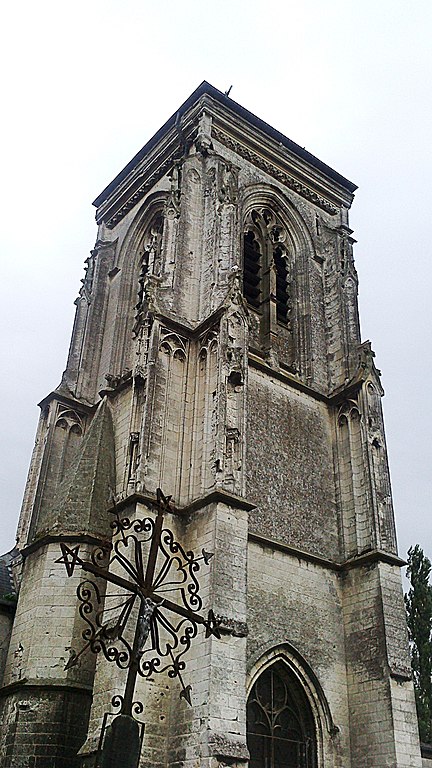
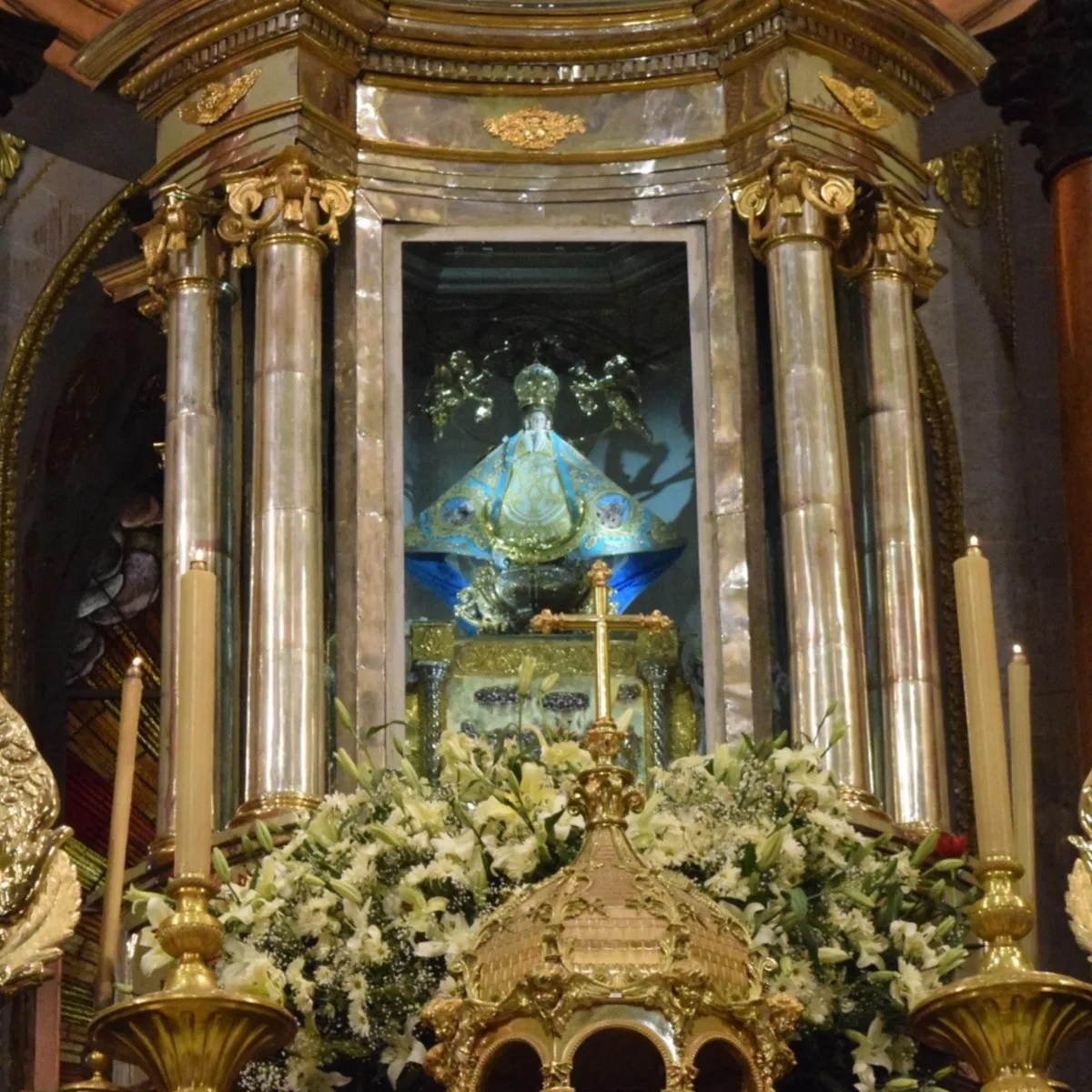
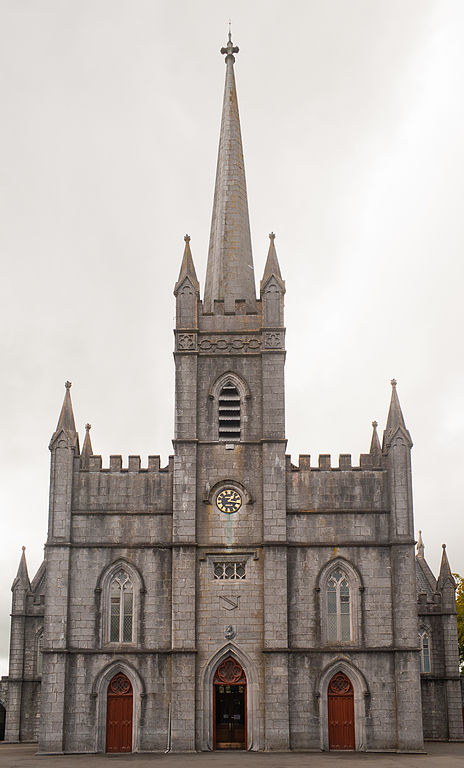
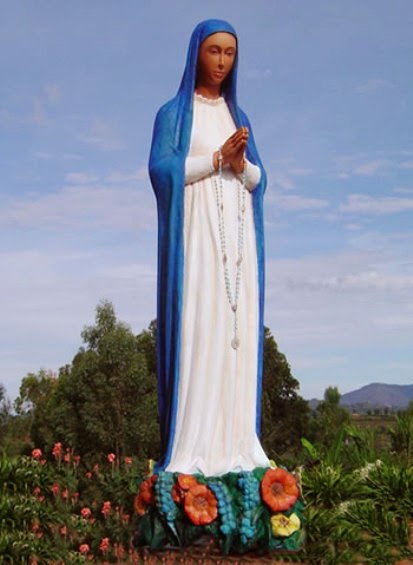
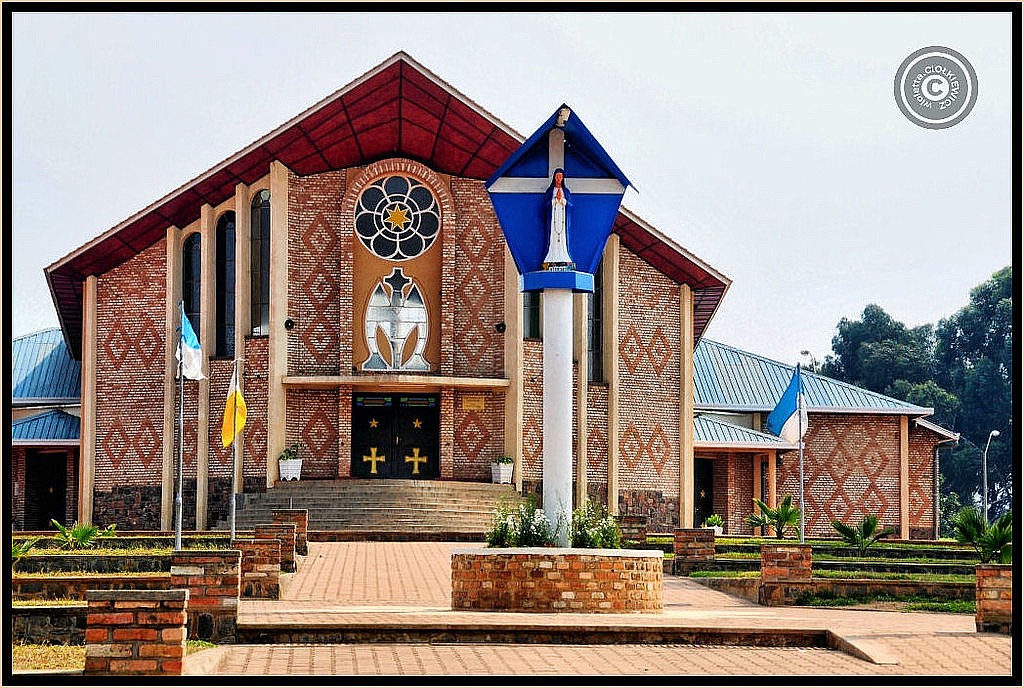
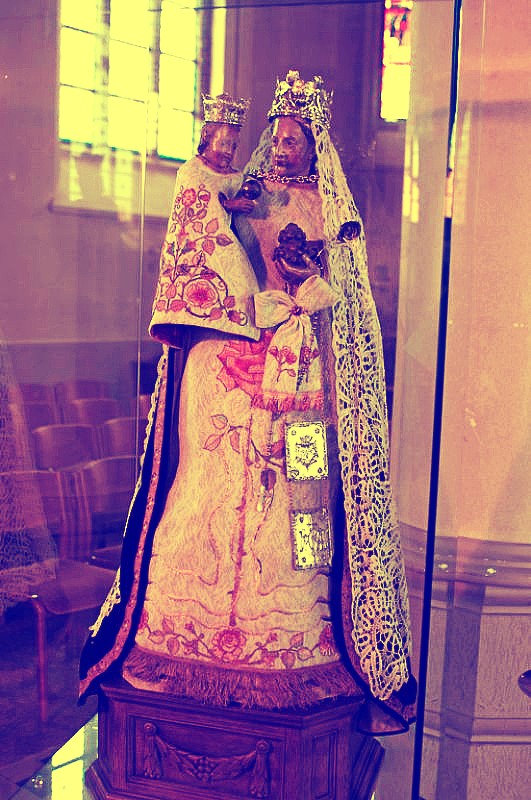
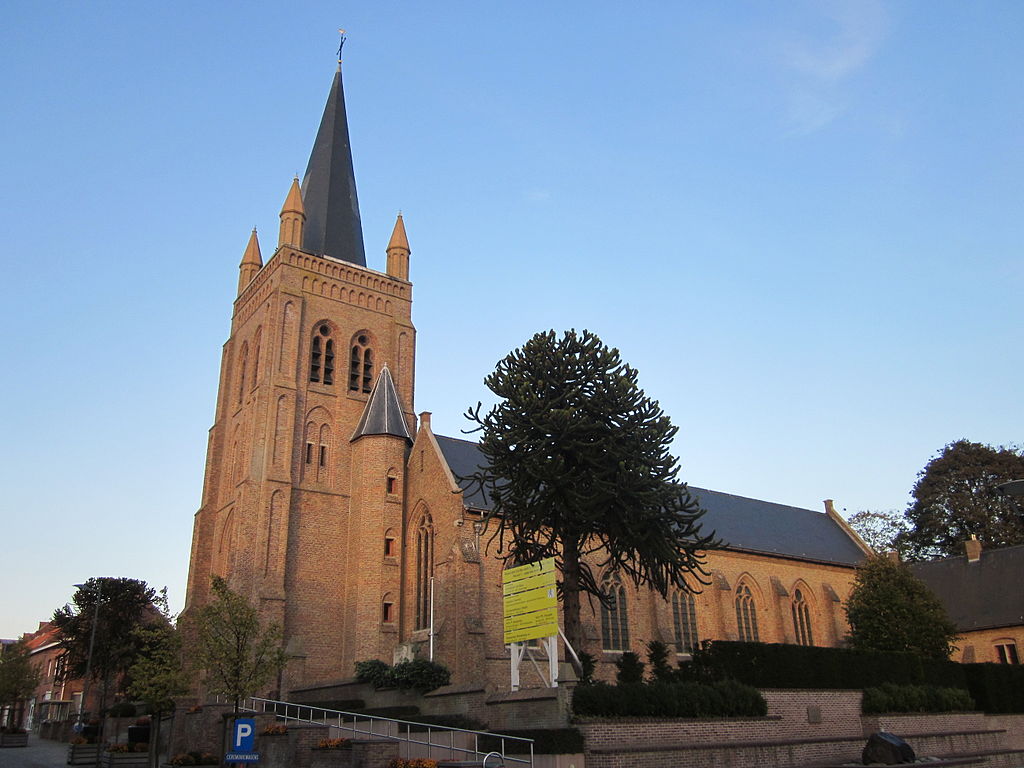
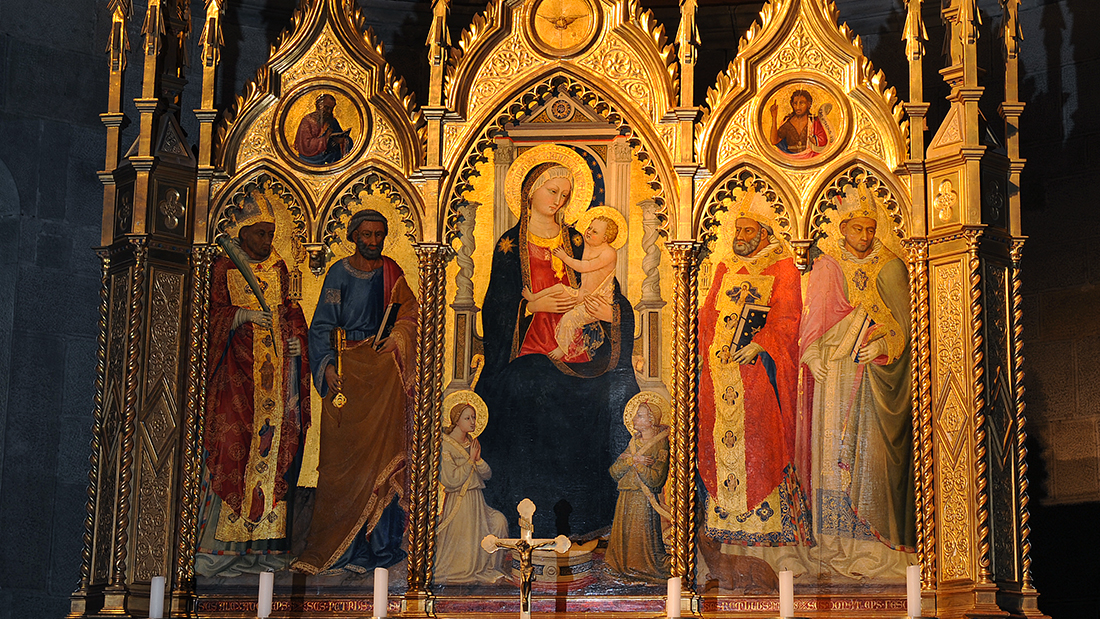
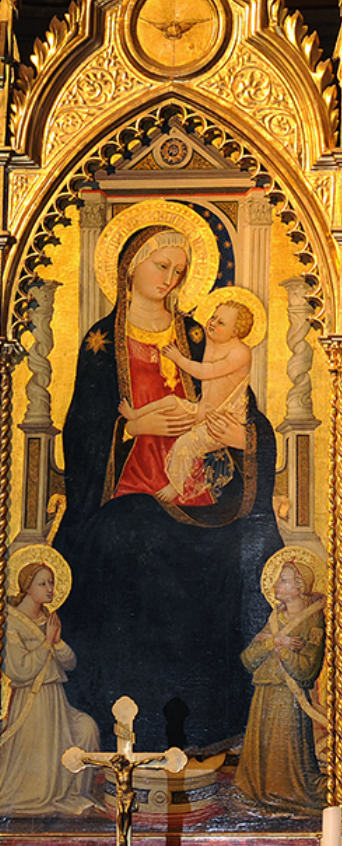
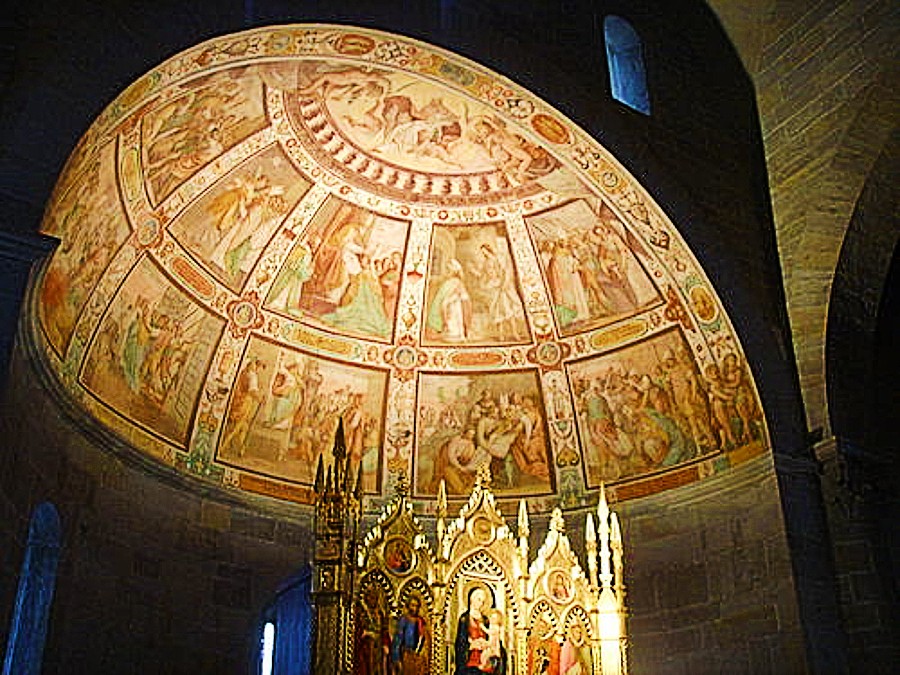
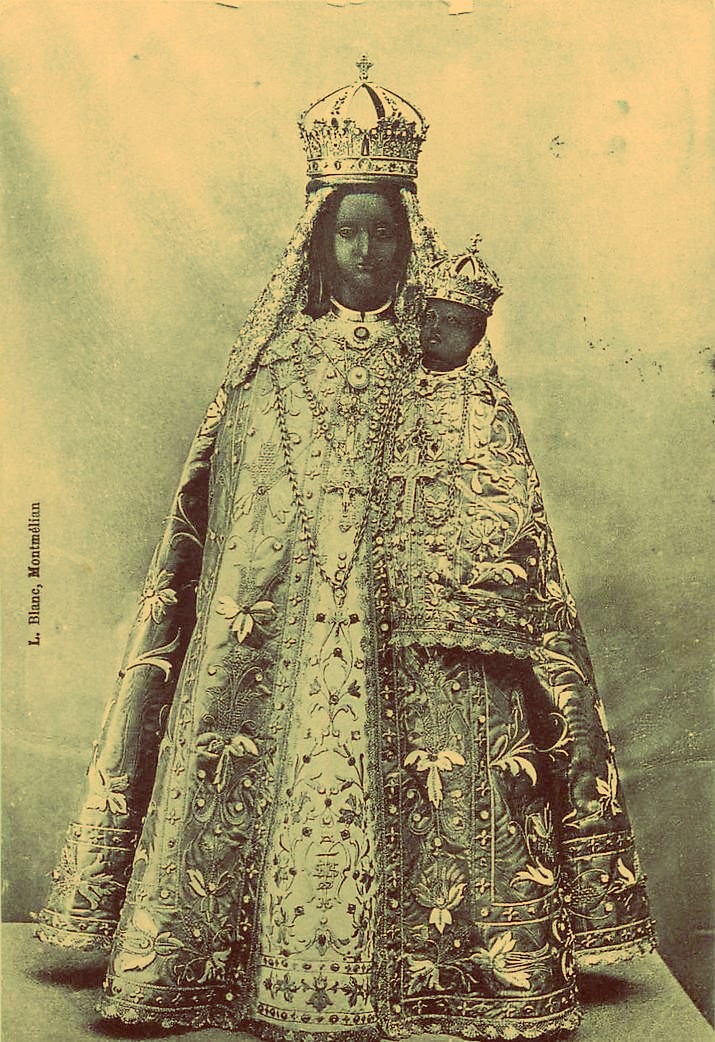
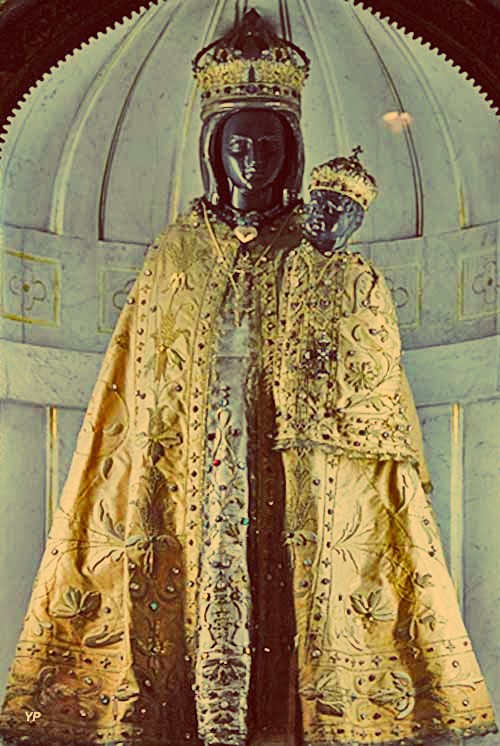
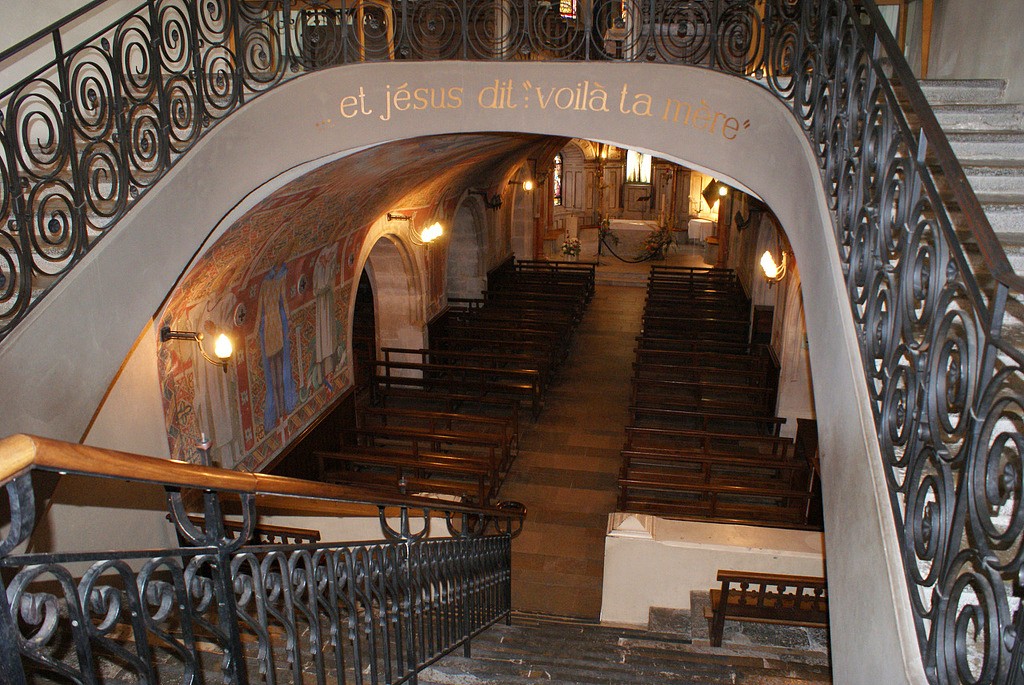
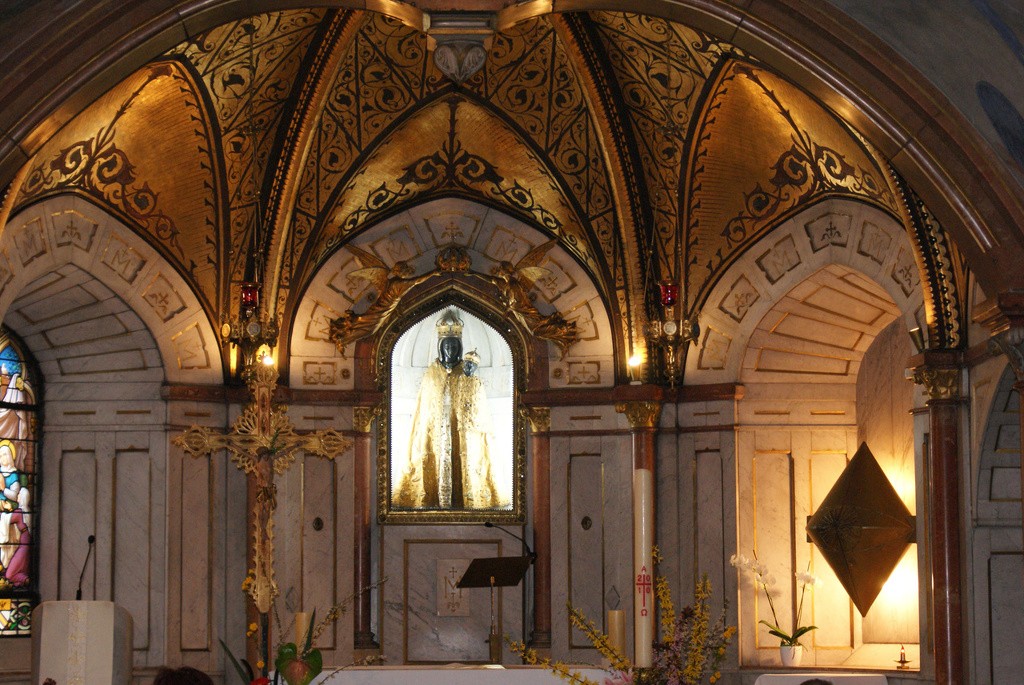
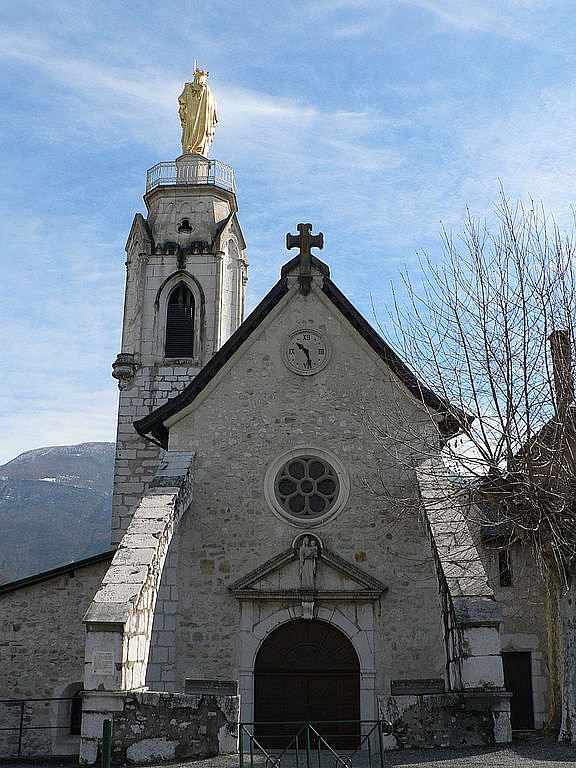
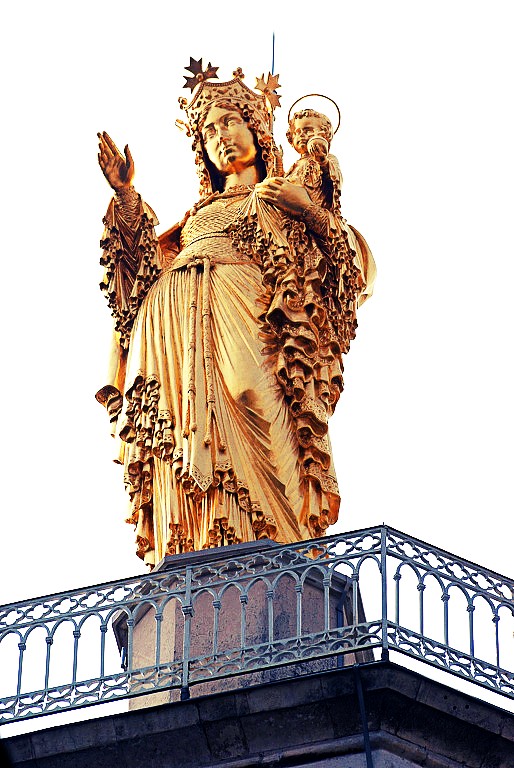
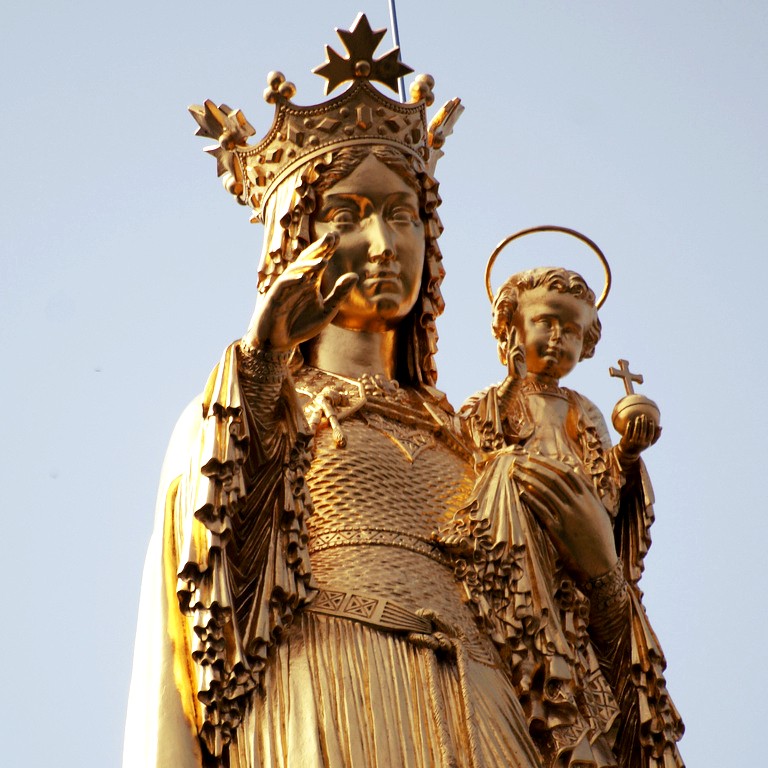
Notre-Dame de Reims / Our Lady of Rheims – Dedication of the Church of Our Lady of Rheims (405) built by St Nicasius – 18 October:
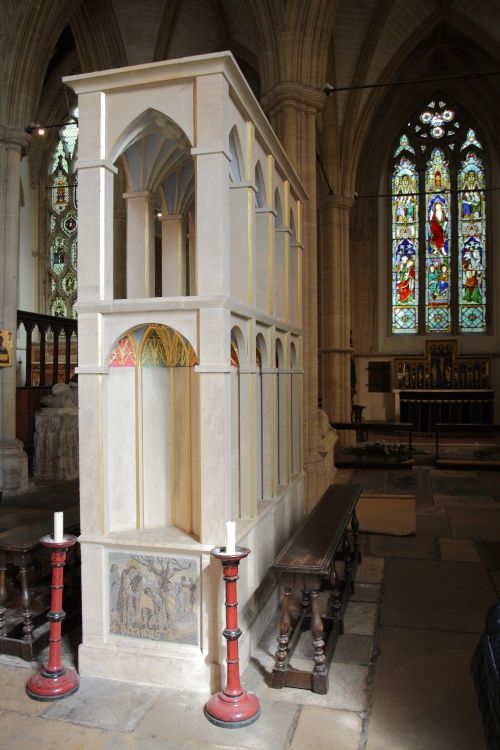
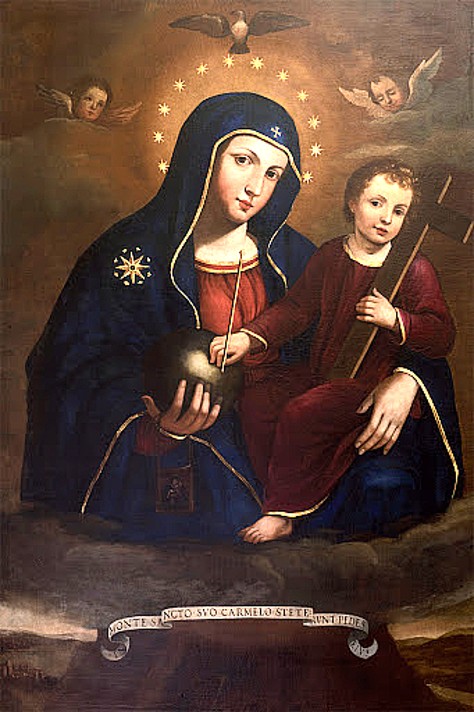
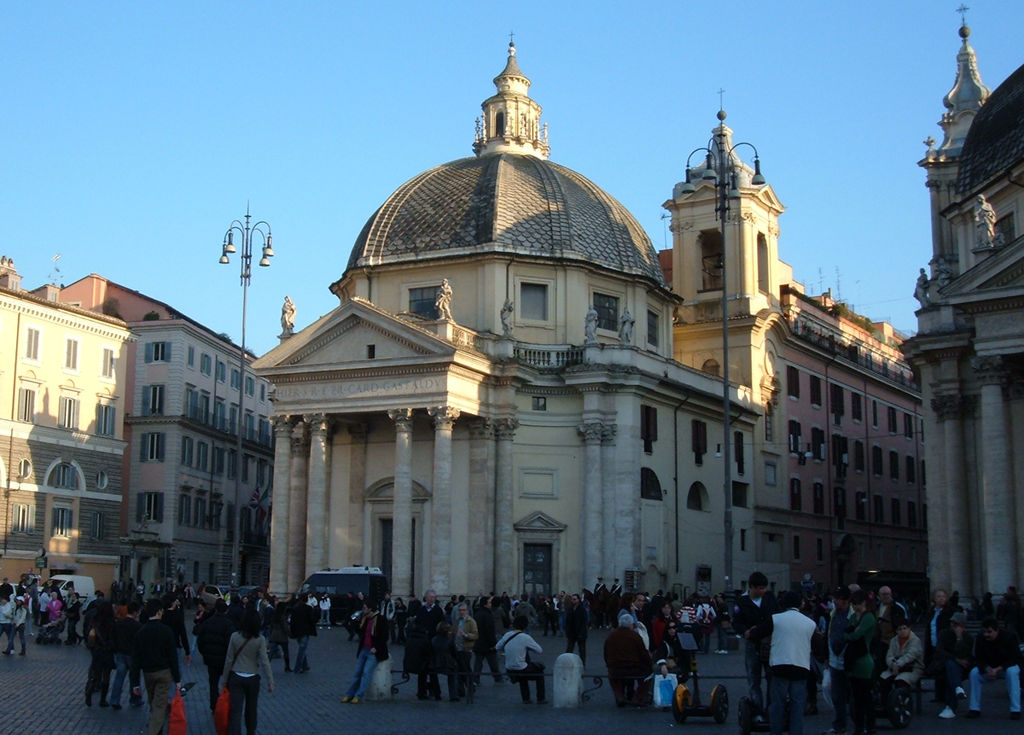
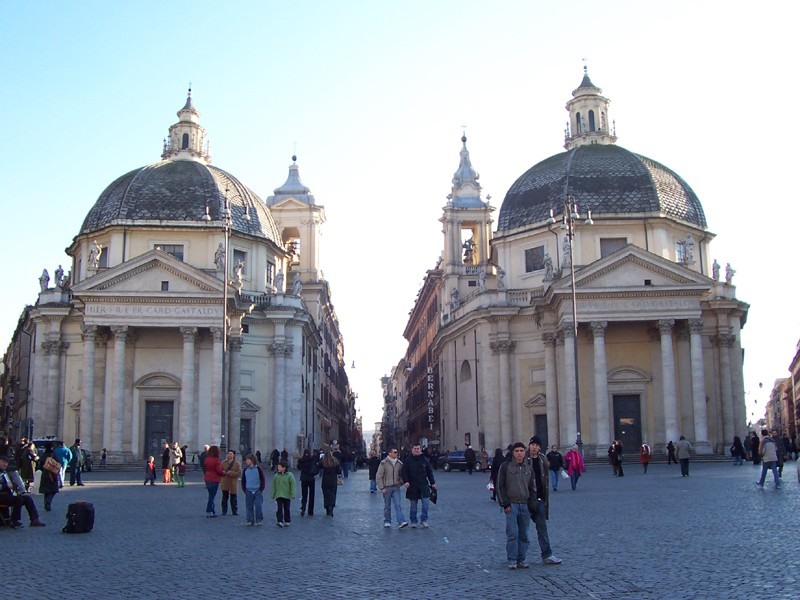
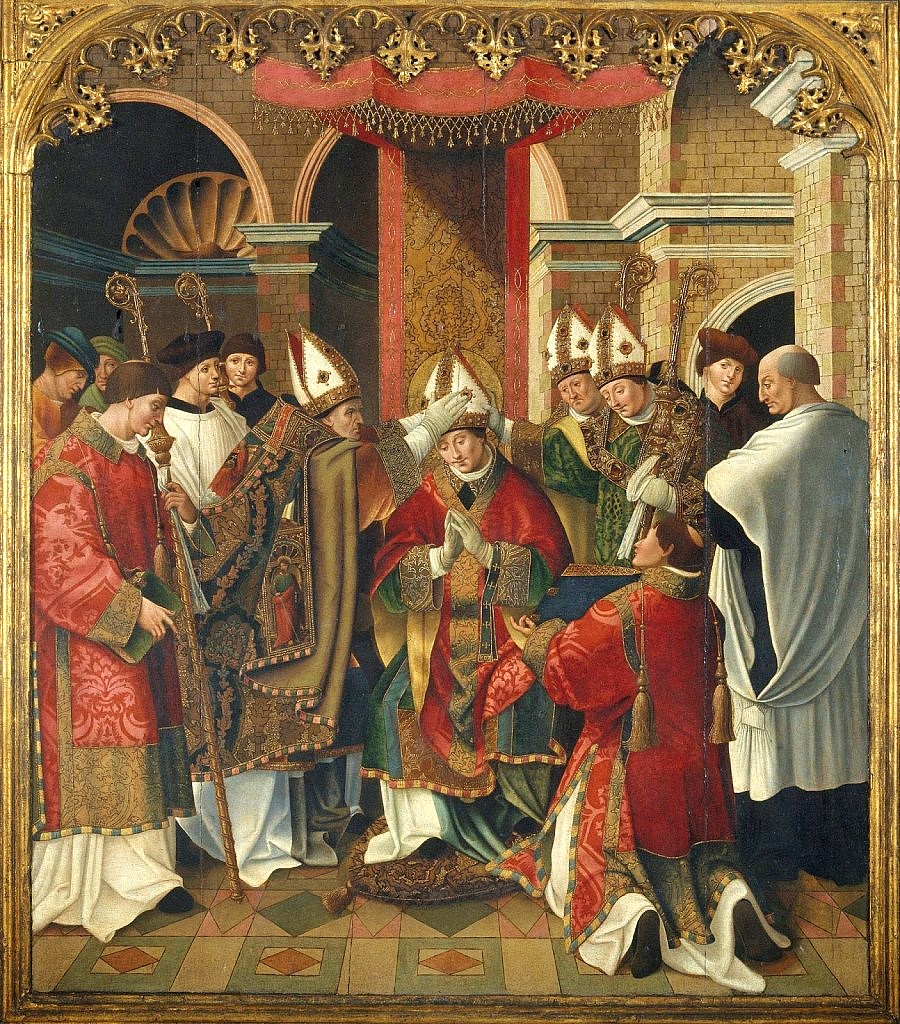
Dedication of Our Lady of Rheims, built by St Nicasius (died c 407), Archbishop of that City period in the year 405. It was Saint Nicasius who prophesised that France would be invaded by the Vandals, telling the people of Rheims to prepare themselves. When the Vandals finally arrived at the City gates, St Nicasius went out to meet them with his sister, a faithful deaconess. All were killed but their sacrifice gave time for more of the people of Rheims to flee to safety. It is interesting to note, that when St Nicasius was beheaded he was praying Psalm 119. He was slain at the moment when he reached the phrase “Adhaesit pavimento anima mea,” which means, “my soul is attached to dust.” After he was decapitated, his head struck the ground and he miraculously continued the psalm, saying: “Vivifica me, Domine, secundum verbum tuum,” which means, “revive me, Lord, with your words.” This was the Church where King Clovis humbly confessed his belief in the Triune God and was baptised by St Regimius in 496 and where, all of the subsequent French Kings were crowned. In the Gallery of the Kings there is a magnificent painting of the baptism of King Clovis surrounded by images of all of his successors.
The Baptism of King Clovis by the Master of Saint Giles (16th cent)
This Church, having fallen to ruins, was later rebuilt by Ebo and Hincmar. It was finished in the year 845 and still remains a place of pilgrimage to the Mother of God. At one time enemies of the Cathedral chapter set fire to a monastery of Rheims. Among the relics which the sacristan tried to save was an ivory statue of the Virgin, containing some of her hair. The sacristan prayed fervently to the Virgin that she would preserve this relic. The Abbot, entering the ruins of the Church, found the Statue upright and unharmed as if placed there reverently. From thence forward, the image was believed to be miraculous. The present Cathedral takes the place of the older churches, the previous one having been damaged by fire in 1210. It was not completed until the 14th century, and is the beautiful Gothic Cathedral that can still be seen today, after much restoration work after the bombardments of WWI and II.
St Acutius of Pozzuoli St Amabilis of Auvergne (c 397- c 475) Priest, Confessor St Asclepiades of Antioch St Athenodorus St Brothen Bl Burchard I St Cadwaladr of Brittany Bl Domenico of Perpignano St Eutychius of Pozzuoli St Gwen St Gwen of Tagarth St Gwendoline
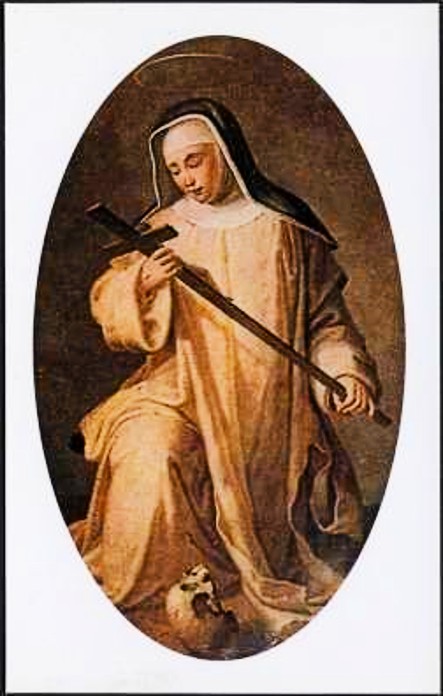
Bl Margherita Tornielli St Monon of Nassogne St Proculus of Pozzuoli Bl Theobald of Narbonna St Tryphonia of Rome — Martyrs of Africa – 9 saints: A group of Christians martryed together in Africa. The only details that have survived are the names – Beresus, Dasius, Faustinus, Leucius, Lucius, Martialis, Victoricus, Victrix and Viktor. They were martyred in c.300 in Africa.
Martyred in the Spanish Civil War: • Blessed Alfredo Almunia López-Teruel • Blessed Francisco Roselló Hernández • Blessed Isidro Juan Martínez
Saint of the Day – 17 October – Blessed Contardo Ferrini TOSF (1859-1902) Layman, Third Order Franciscan, Profesor, Civil and Canon Lawyer, Apostle of the poor, writer, A recognised specialist in Roman and Byzantine law, Contardo Ferrini was a Professor at several Universities but his name is mainly linked to the University of Pavia , where he studied in 1880 and later became a Professor. He was also a fervent Roman Catholic, who lived a devout life of prayer and service to the poor. Born on 4 April 1859 at Milan, Italy and died on 17 October 1902 at Suna, Verbano-Cusio-Ossola, Italy of typhus, aged 43. Patronages – academics, colleges, schools, universities.
The Roman Martyrology mentions him today: “In Suna near Lake Maggiore, Blessed Contardo Ferrini, who, in educating young people, with his example of faith and Christian life, went far beyond human science.“
Contardo Ferrini was born on 5 April 1859 in Milan to Rinaldo Ferrini and Luigia Buccellati. He was Baptised at the font where Blessed Frédéric Ozanam, also a native of Milan, had been Baptised 46 years before. After receiving his First Holy Communion at age 12, he joined a Blessed Sacrament Confraternity.
Contardo’s father, a Professor of mathematics and science, taught his son at an early age. By the time he was a young man, he spoke several languages. His apparent love for his faith caused friends to call him by the nickname St. Aloysius (St. Aloysius Gonzaga). He entered University of Pavia at age 17 and, two years later, was appointed Dean of Students. At age 21 he became a Doctor of the law at the University. His doctoral thesis, which related penal law to Homeric poetry, was the basis of his being awarded a scholarship to the University in Berlin, where he specialised in Roman-Byzantine law, a field in which he became internationally acclaimed as expert.
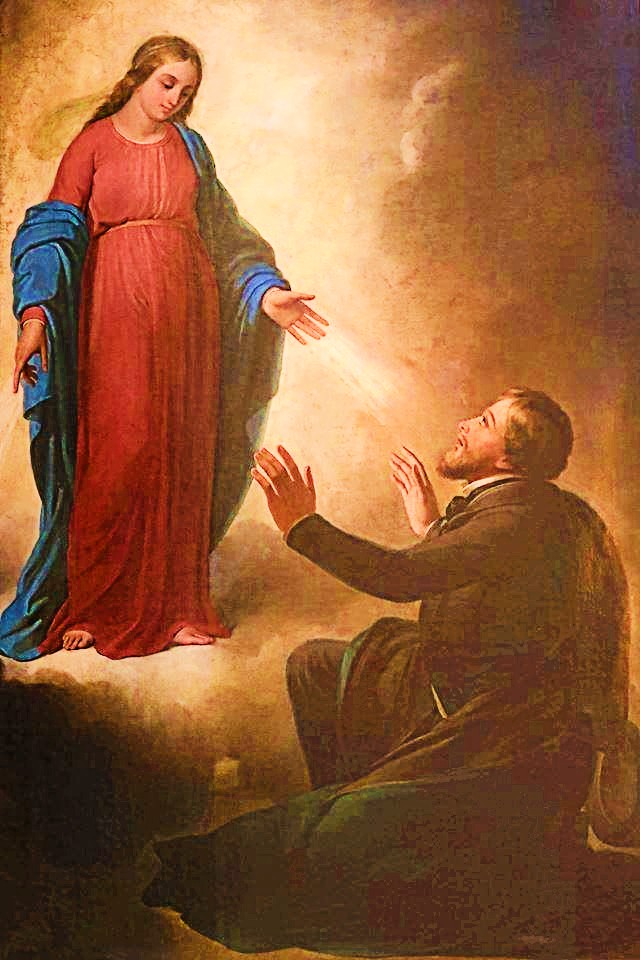
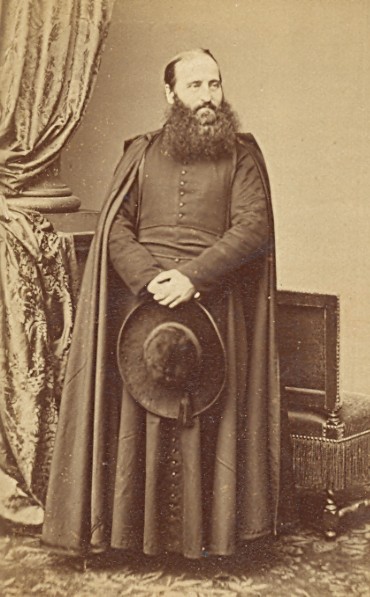
Blessed Bartholomew Longo and Contardo Ferrini
During Contardo’s stay in Berlin, he wrote of his excitement at receiving the Sacrament of Reconciliation for the first time in a foreign country. The experience brought home to him, he wrote, the universality of the Church.
Upon his return to Italy, he was a Lecturer in Universities at Messina, Modena and Pavia. He received his first Professorship at age 26. Contardo, atthis time, attempted to discern a vocation as a secular priest, a religious, or as a married person. Ultimately, he remained an unmarried layperson. He vowed himself to God, became a member of the Third Order of St. Francis in 1886 and was a member of the Saint Vincent de Paul Society, to which he had been introduced by his father, a member of a St Vincent de Paul Conference himself.
As a faculty member at the University of Pavia, he was considered an expert in Roman Law. Over the course of his career he published books, articles and reviews. He taught for a time at the University of Paris. He became a Canon Lawyer in addition to being a Civil Lawyer. Mountaineering was an favourite hobby.
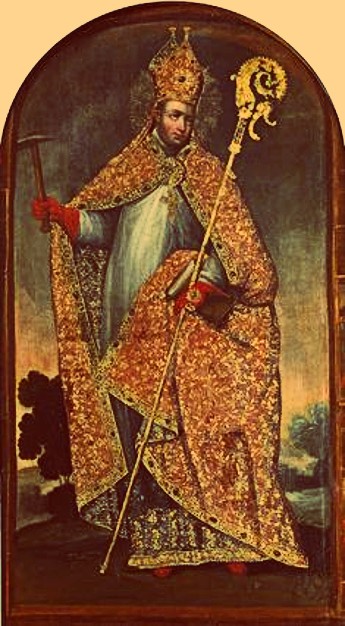
An anecdote, unsourced, about Contardo is that he was asked to attend a dinner party and, once there, found it tedious. His resort was to invite all the guests to join him in praying the Rosary.
In 1900, Contardo developed a heart lesion. In Autumn 1902, he went to his country home in Suna in order to rest. There he became ill with typhus. He died at age 43 on 17 October 1902. Residents of Suna immediately declared him a saint. His fellow faculty members at the University of Pavia wrote letters in which he was described as a saint. In 1909 Pope Pius X appointed Cardinal Ferrari to open a cause. Contardo was declared Venerable by Pope Pius XI and he was Beatified by Pope Pius XII on 13 April 1947. His body is venerated in a Chapel of Milan’s Catholic University. He is a patron of universities, colleges and academics. Yesterday we read some of the history of Milan Duomo and the 3159 Saint Statues there. One of the 2245 Spire Saints, on one the lofty Spires of this breathtaking Cathedral, resides our Blessed Contardo.
Twenty First Sunday after Pentecost Twenty Ninth Sunday in Ordinary Time
Könnyezo Szuz Mária / Our Lady of Tears or the Weeping Madonna (Sajópálfala, Miskolci, Borsod-Abaúj-Zemplén, Hungary) (1717) – Third Sunday of October, 16 February:
During the Turkish occupation of the late 1600s, the town of Sajópálfala in northeastern Hungary was destroyed and deserted. Not long after Greek Catholics resettled the area. The painting of the Madonna and Child in their village Church perspired and wept bloody tears, from 6 January to 16 February 1717.
The investigating Bishop took the picture to Eger, where it stayed in the Franciscan Church until the Communists dissolved the religious orders in 1950. Then the painting was lost to the faithful of Sajópálfala, who had made an annual pilgrimage to Eger on the Feast of Our Lady of Sorrows.
In 1969, they located the original weeping image in a Church in the Diocese of Pécs, where a friar had taken it when the Eger Monastery closed. On 25 October 1973, after 256 years, the Weeping Virgin Mary returned to the Church of the Visitation in Sajópálfala, where the main pilgrimage days are now Pentecost Sunday and the third Sunday in October.
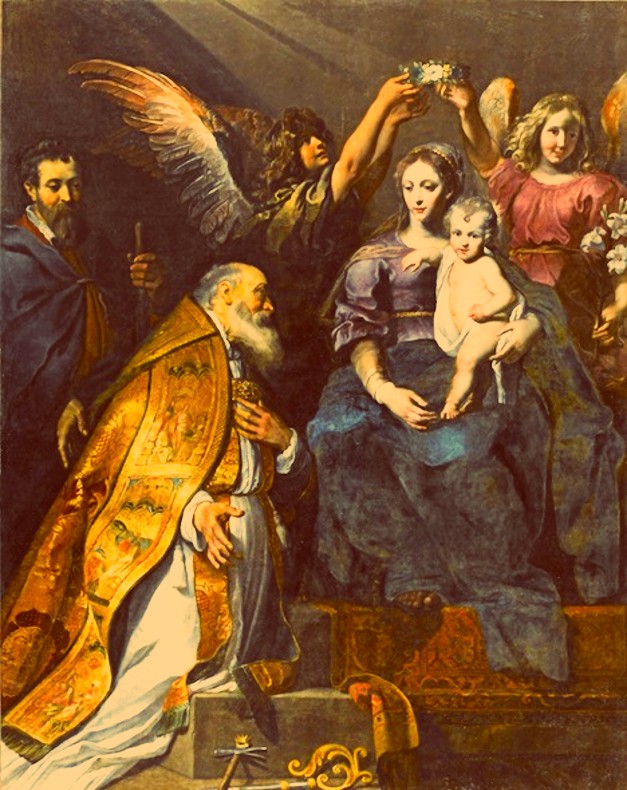
Bl Battista de Bonafede St Berarius I of Le Mans St Catervus St Colman of Kilroot Blessed Contardo Ferrini TOSF (1859-1902) Layman, Third Order Franciscan
St Ethelbert of Eastry St Ethelred of Eastry St Florentius of Orange
Bl Gilbert the Theologian St Heron of Antioch Bl Jacques Burin St John the Short/Dwarf St Louthiern St Mamelta of Persia St Nothelm of Canterbury St Richard Gwyn St Rudolph of Gubbio St Rufus of Rome St Serafino of Montegranaro St Solina of Chartres St Zosimus of Rome — Martyrs of Nicomedia – 3 saints: A group of Christians martyred in the persecutions of Diocletian. The only details about them that have survived are their names – Alexander, Marianus and Victor. 303 in Nicomedia (in modern Turkey).
Martyrs of Valenciennes -5 beati: A group of Ursuline nuns martyred in the persecutions of the French Revolution. • Hyacinthe-Augustine-Gabrielle Bourla • Jeanne-Reine Prin • Louise-Joseph Vanot • Marie-Geneviève-Joseph Ducrez • Marie-Madeleine-Joseph Déjardins
Martyrs of Volitani: A group of martyrs who were praised by Saint Augustine of Hippo. In Volitani, proconsular Africa (in modern Tunisia).
Martyred in the Spanish Civil War: • BlessedFidel Fuidio Rodriguez • BlessedJosé Sánchez Medina • BlessedPerfecto Carrascosa Santos • BlessedTársila Córdoba Belda de Girona
Saint of the Day – 16 October – St Hedwig of Andechs (1174-1243) Mother, Widow, High Duchess of Poland, Apostles of orphans, the poor, the sick, founder with her husband of Monasteries, schools and Churches, Administrator, peace-maker, Born in 1174 in Castle Andechs, Bavaria (part of modern Germany) and died on 15 October 1243 at at Trzebnica, Silesia (part of modern Poland). Also known as – Hedwig of Silesia, Hedwig von Andechs, Jadwiga Slaska, Hedvigis, Hedwiges, Avoice.Patronages – against jealousy, brides, duchesses, death of children, difficult marriages, widows, Silesia, Diocese of Görlitz, Germany, Andechs Abbey, Bavaria, Germany, 6 cities. She was Canonised on 26 March 1267 by Pope Clement IV.
An example of all virtues, especially worthy to be imitated, is presented to us today, in the life of St Hedwig. Her father was Berthold, Duke of Carinthia and Count of Meran. Her mother, Agnes, was of equally high birth. She was one of eight children – of her four brothers, two became Bishops, Ekbert of Bamberg and Berthold of Aquileia. Mechtilde became Abbess of Kitzingen and another sister, became the mother of St Elizabeth of Hungary. Already in Hedwig’s childhood it was visible that God had gifted her with a mind far beyond her age. She possessed an innate inclination to all virtues and nothing of what usually delights the young, touched her heart, just as little pleasure did she evince, in later years, in the honours, riches and amusements of the world. Reading and praying were her only enjoyments. All her books were devout works and her prayers were said mostly before an image of the Blessed Virgin, whom she loved and honoured like a worldly mother.
When scarcely twelve years old, she was given in marriage to Henry, Duke of Poland and Silesia. Although married so early in life, her conduct was so sensible and virtuous, that everyone was greatly astonished at it. Among her maxims was this: “The greater one is by birth, the greater one must be in virtue and the more distinguished we are in station, the more we must distinguish ourselves by our conduct, in order to be a bright example to others.” She became the mother of three sons and three daughters, all of whom she educated most piously.
She was a little over twenty, and her husband thirty years of age, when their sixth child was born; after which, desiring to serve God more perfectly, she made a vow before the Bishop, in which her husband joined, to live in future in perpetual continence.
From that hour, Hedwig grew daily more and more perfect in all Christian virtues, occupying every moment left her from the cares she bestowed upon her children, in prayers and deeds of charity. She found especial comfort in assisting at Holy Mass; hence, she was not satisfied with one but went to as many as she could; and the manner in which she conducted herself in Church was a proof of her deep devotion. Towards widows and orphans, her kindness was truly motherly and many of them she fed in her palace, serving them herself, sometimes on bended knees. She frequently visited the sick in the hospitals; encouraged them to be patient and assisted them by rich alms. She never hesitated to wash the feet of the lepers, or to kiss the sores of the sufferers. She persuaded the Duke, her husband, to build a large convent not far from Breslau, for the Cistercian nuns, which she made a home for poor children, who were educated there and afterwards, provided for according to their station. Nothing could be more modest and plain than the garments of the holy Duchess and her example in this respect induced others living at Court to attire themselves with great simplicity. In the midst of the dissipation of the Court, the Saint lived so austere a life, that it was more to be admired than to be followed.
To prove her virtue, God visited her with a great many cares and sorrows. The enemy invaded the dominions of her spouse, who was wounded in a battle and made prisoner. When this news was brought to her, she raised her eyes confidently to heaven, saying: “I hope to see him again soon, well and free.” She herself went to Conrad, the Duke who had imprisoned her husband and spoke so earnestly to him that he restored her husband to liberty. Soon after, Henry became dangerously ill and Hedwig nursing him most faithfully, did everything to make his death happy. To those who pitied her after his death, she said: “We must adore the decrees of the Almighty, not only in days of happiness but also in those of sorrow and bereavement.” Three years later, she lost her first-born son, who was killed in a battle with the Tartars and this sad event found her as submissive to the will of Providence as she had been on the death of her husband.
Soon after the burial of the Duke in 1238, at the Cistercian Monastery of Nuns, Trzebnica Abbey, Hedwig had too followed him into the Convent, which, at her request, he had founded, to be further removed from all temporal vanity and to serve the Lord more peacefully and perfectly. The widow moved into the Convent of Cistercian Nuns which was led by her daughter Gertrude, assuming the position of a lay sister and donning the habit. She observed most strictly the regulations of the Order, desiring to do the meanest work and to be considered the least of the Sisters. In her austerity to herself she had now full liberty. She fasted daily, except on Sundays and festivals but her fasts were much more rigorous than those of others, for she abstained from all meat and wine and partook only of herbs, bread and water. She wore, day and night, rough hair-cloth and an iron girdle which she had already worn while at Court. She went bare-footed over snow and ice and slept, when well, on the bare boards and when ill, on straw covered with a coarse cloth. Her sleep lasted hardly three hours before Matins; the remainder of the night she occupied in prayer, which she only interrupted to scourge herself to blood. So severe a life emaciated her body to a skeleton. While working, she always raised her soul to the Most High by mental prayer,and she was often found in an ecstasy, or raised high above the ground. Her conversation was only of God, virtue and piety. Towards the Crrucified Saviour, she bore the deepest devotion and the mysteries of His bitter Passion and Death were the objects of her daily meditations, during which, she frequently shed tears. Mary, the Blessed Virgin, was most ardently loved by her,and her whole countenance glowed at the bare mention of her holy name.
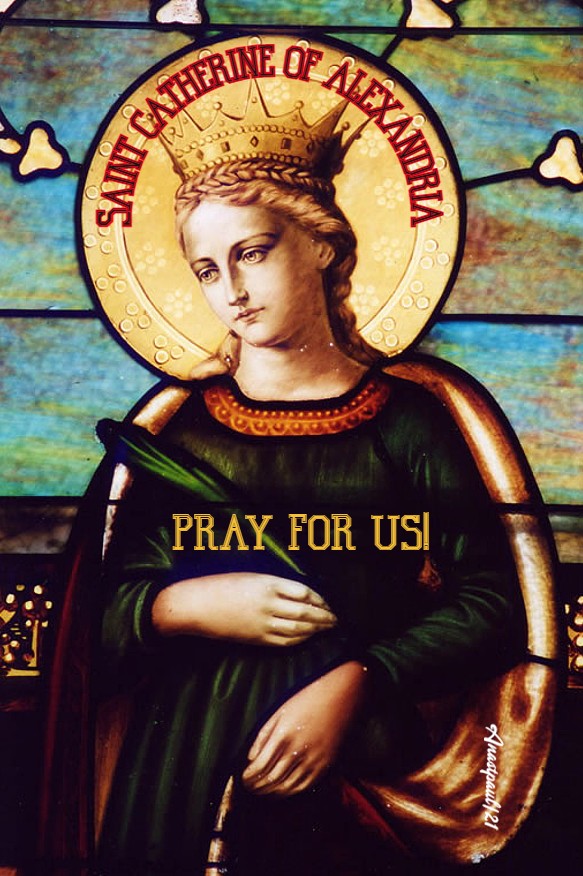
So holy a life could only be followed by a happy death, of which a severe sickness was the messenger. Before others became aware that her life was in danger, the Saint asked for the last Sacraments and she received them with a devotion which drew tears from the eyes of all who were present. Before her end, S. Catherine of Alexandria, St Thecla, St Ursula and St Magdalen appeared to her, all of whom she had greatly honoured during her life. These heavenly visitors comforted her and accompanied her to the mansions of everlasting bliss.
Twenty-five years after her death, her holy body was exhumed, as so many extraordinary miracles had taken place at her intercession. On opening the coffin, the whole Church was filled with fragrance. The flesh of the whole body was consumed, except that of three fingers on her left hand. With these she had frequently held a picture of the Blessed Virgin, which she constantly carried with her. While dying, she held this picture so fast, that after her death it could not be removed and it was buried with her. Pope Clement IV. placed the Duchess among the Saints on account of her many great virtues, of the miracles which she had wrought while she lived and of those which took place after her death, through her intercession. The inhabitants of Poland venerate her as one of their special Patrons. (By Father Francis Xavier Weninger, 1876)
Dedication of the Church of Our Lady of Milan (1417) by Pope Martin V – 16 October:
The Abbot Orsini wrote: “Dedication of Our Lady of Milan, by Pope Martin V, in the year 1417. This Church was built in 1388 by John Galleas, Duke of Milan.”
The magnificent Milan Cathedral is a Gothic Cathedral that has its roots in the fourth centurY. Today it is one of the most famous and celebrated structures in all of Europe. It is the second largest Church in Italy after St Peter’s Basilica in Rome and the third largest Catholic Church in the world.
Dedicated to the Mother of God, the present Cathedral was begun in the 14th century but was not completed until the 20th century when the last gate was finally installed in 1965. Emperor Napoleon Bonaparte himself ordered that the façade be finished in the year 1805, as he desired to see the beautiful structure completed. He guaranteed that the French would pay for the work, although they never actually did. Even so, it took seven years to complete the work. There were other additions that followed, including stained glass windows and various arches and lace-like spires. In the end it can be said, that the Cathedral required 6 centuries to complete and is one of the largest Cathedrals in the entire world.
The Madonnina Spire or guglia del tiburio (“lantern spire“), one of the main features of the Cathedral, was erected in 1762 at the height of 108.5 m (356 ft), as designed by Francesco Croce. At the top of the spire is the polychrome Madonnina Statue, designed and built by Carlo Pellicani in 1774, during the episcopacy of Bishop Giuseppe Pozzobonelli who supported the idea to place the Madonnina at the top of the Cathedral, By tradition, no building in Milan may be higher than the Madonnina.
The first Church thought to occupy the location was built by Saint Ambrose, although there is an old baptistery which was constructed in about 335. The good Abbot appears to have been incorrect in dating the Cathedral from 1388, as there is a plate attached to a stone on the Church which states: “El Principio del Duomo di Milano Nel Anno 1386.”
St Ambrose barring Theodocius from Milan Cathedral
The Milan Cathedral houses a Holy Nail which was used to Crucify Christ. It is marked by a tiny red light located in the dome above the apse. There are more Statues on this Cathedral than any other in the world, 3159 in total. 2245 of these are on the exterior together with 96 gargoyles and 135 spires. It is said that if the Statues were placed on top of each other, they would reach a height of about 5,300 meters (3.3 miles).
The Cathedral is 158.5 meters (520 feet) long, 92 meters (302 feet) wide. It has a cruciform plan in the form of a Latin cross that covers nearly 12,000 square meters. 40,000 people can fit comfortably within. Its construction was up five naves, a central and two lateral on each side, resting on 40 columns of 24.50 meters (80 feet) each.
Access to the Cathedral is made through five large bronze doors from Piazza Duomo. The central one [pic. below] is the oldest and was created in the nineteenth century by Ludovico Pogliaghi.
After exploring the inside, visitors can pay a small fee to take a fascinating trip to the Duomo’s roof via steps or elevator. It is an amazing experience to walk among the forest of spires and the view from the roof is unmatched. On a clear day you can see as far as the Alps and Apennines.
St Amandus of Limoges St Ambrose of Cahors Bl Anicet Koplinski Bl Augustine Thevarparampil St Balderic St Baldwin St Bertrand of Comminges St Bolonia St Conogon of Quimper St Dulcidius of Agen St Eliphius of Toul St Eremberta of Wierre St Florentinus of Trier
Bl Gerald of Fossanuova St Hedwig of Andechs (1174-1243) Mother, Widow, High Duchess of Poland Bl Jesús Villaverde Andrés Bl Józef Jankowski St Junian St Lull St Magnobodus of Angers
St Martinian of Mauretania St Mummolinus St Saturian of Mauretania St Silvanus of Ahun St Victor of Cologne St Vitalis of Noirmoutier — Martyrs in Africa – 220 saints: A group of 220 Christians martyrs about whom we know nothing but that they died for their faith.
Martyrs of North Africa – 365 saints: A group of 365 Christians who were martyred together in the persecutions of the Vandal king Genseric. The only details that have survived are the names of two of the martyrs – Nereus and Saturninus. 450 in North Africa.
Saint of the Day – 15 October – Saint Aurelia of Strasbourg (Died 1027) Virgin Recluse, Princess Died on 15 October 1027 at Regensburg, Gemany of natural causes. Aurelia’s name means – “she who shines like gold,.” Patronage – against fever. Also known as – Aurelia of Ratisbon, Aurelia of Regensburg.
Aurelia was a Princess of the Hugo Capet family, who fled to Alsace to escape from marriage and lived as a Recluse. Only Bishop Wolfgang of Ratisbon knew of her hermitage and he cared for her spiritual and material welfare.
Royal documents from the 10th century validate the existence of a Church built over the crypt in which the tomb of Saint Aurelia was situated. The Church was dedicated to Aurelia and her tomb was highly revered by the faithful, during the Middle Ages. Aurelia was invoked particularly for help in cases of fever.
After the Protestant Reformation, the aforementioned Church passed into the hands of the Lutherans, who in 1524 desecrated the Saint’s tomb and disposed of the relics but without succeeding in eliminating the cult that remains alive to this day.
Virgen de los Remedios / Virgin of the Remedies, Rubite, Granada, Spain (12th Century) – 15 October:
The Virgin of Los Remedios is the title of the Virgin Mary which was promoted by the Trinitarian Order, founded in the late 12th century. The devotion became tied to the re-conquest of Spain, then still at its height. In the following century it spread to other parts of Europe. When Spain began the exploration and conquest of the Americas, it was a favourite devotion of the Spanish conquistadores. It remains a popular devotion in Spain. Patronages – Diocese of San Cristóbal de La Laguna, the island of Tenerife, and the city of Cali, Colombia.
This Statue of the Virgin of Los Remedios, is kept in the Cathedral of the Diocese of San Cristóbal de La Laguna (Tenerife, Spain)
St Antiochus of Lyon St Aurelia of Strasbourg (Died 1027) Virgin Recluse, Princess St Callistus of Huesca St Cannatus of Marseilles Bl Cipriano Alguacil Torredenaida St Euthymius the Younger Bl Josefa Martínez Pérez St Leonard of Vandoeuvre Bl Narcis Basté y Basté Bl Pere Verdaguer Saurina Bl Ramón Esteban Bou Pascual St Sabinus of Catania St Severus of Trier
St Willa of Nonnberg — Martyrs of Cologne: A group of 360 Christian soldiers martyred together in the persecutions of Diocletian and Maximian. They were martyred in 303 outside the city walls of Cologne, Germany.
Martyred in the Spanish Civil War: • Blessed Cipriano Alguacil Torredenaida • Blessed Josefa Martínez Pérez • Blessed Narcis Basté y Basté • Blessed Pere Verdaguer Saurina • Blessed Ramón Esteban Bou Pascual
Saint of the Day – 14 October – Saint Angadrisma of Beauvais (Died c 615) Virgin, Abbess, miracle-worker. Born in c 615 in the Diocese of Thérouanne, France and died in c 696 at the Oroër-des-Vierge Abbey, Beauvais, France of natural causes. Patronages – against drought, against fire, against natural disasters, against slander, of Beauvais, France, City of and of the Diocese of Beauvais-Noyon-Senlis. Also known as – Andragasyna, Angadreme, Angadresima, Angadrême, Angradesma.
The Roman Martyrology states today : “Near Beauvais in Neustria, now in France, Saint Angadrisma, Abbess of the Monastery founded by Saint Brolph and called the Oratory because she had several places of prayer, in which she ceaselessly served the Lord.”
Angadrisma lived in the Diocese of Thérouanne in northern France. She was the daughter of Robert I, Bishop of Tours and a cousin to Lambert, the Bishop of Lyons.
Her education was profoundly influenced by St Homer, Bishop of the Diocese and by her cousin, St Lambert, who at that time was a Monk in Fontanelle.
It was probably their influence that supported the girl in her desire to become a nun, and which encouraged her, at a young age, to make a private vow of her Virginity. she was, however, promised in an arranged marriage, to St Ansbert of Chaussy. To avoid the wedding, Angadrisma prayed fervently that she would become physically repellent. Her prayers were answered when she afflicted with leprosy.
The young gentleman, Ansbert, later became the Bishop of Rouen, married another person and Angadrisma was free to receive the religious habit from the hands of St Ouen, the Archbishop of Rouen; from that day her illness disappeared. She became Abbess of the Benedictine Convent of Oroër-des-Vierges, near Beauvais.
Many miracles are attributed to her and she is credited with having extinguished a fire that threatened to destroy the Convent . She led the sisters in prayer, holding aloft the relics of the holy Founder St Ebrulf of Ouche.
When the Convent was destroyed by the Normans in 851, the Saint’s relics were transferred to the Church of St Michele in the City. During the French Revolution they were again moved and placed in the Cathedral of Beauvais, which is a spectacular building, see below.
Saint Fortunatus of Todi (Died 537) Bishop, Confessor, miracle-worker. An entry in the Roman Martyrology under 14 October records: “At Todi in Umbria, St Fortunatus, Bishop, who, as is mentioned by blessed Gregory, was endowed with an extraordinary gift for casting out unclean spirits.” About St Fortunatus: https://anastpaul.com/2020/10/14/saint-of-the-day-14-october-saint-fortunatus-of-todi-died-537/
St Franciszek Roslaniec St Gaudentius of Rimini St Gundisalvus of Lagos Bl Jacques Laigneau de Langellerie St Lupulo of Capua St Lupus of Caesarea St Manacca St Manehildis St Modesto of Capua Bl Richard Creagh
St Rusticus of Trier St Saturninus of Caesarea St Stanislaw Mysakowski St Venanzio of Luni — Martyrs of Caesarea – (4 saints): Three brothers and a sister martyred together in the persecutions of Diocletian – Carponius, Evaristus, Fortunata and Priscian. In 303 in Caesarea, Cappadocia (in modern Turkey) – their relics enshrined in Naples, Italy.
Martyred in the Spanish Civil War: • Blessed Ana María Aranda Riera • Blessed Jacques Laigneau de Langellerie
Saint of the Day – 13 October – Saint Lubentius (Died 370) Priest, Missionary, Disciple of St Martin of Tours and St Maximinus of Trier. Patronage – sailors on the River Lahn. Also known as – Lubencio, Lubenzio, Lubin.
Lubentius was delivered by his parents when a small child, to St Martin of Tours, to educate him. St Martin Baptised him and treated him as a son. Martin later sent him to Bishop St Maximinus of Trier in Germany, to be educated for the priesthood. When Lubentius came of canonical age, Maximin Ordained him Priest.
He worked as a Parish Priest in Kobern. In 349, St Maximin us died while visiting relatives in Acquitaine. His successor, St Paulinus of Trier, sent Lubentius to retrieve the Saint’s body. Lubentius travelled to Acquitaine and after diligent search, discovered the Church where St Maximinus’ body had been buried. He and his companions, obtained the keys to the Church from the sleeping custodian and made off with the body, bringing it back to Trier.
According to the records of the 12th century, he worked as a Missionary along the Lahn river and founded a famous Church at Dietkirchen.
He died in Kobern. His body was interred in the collegiate Church of Saint Lubentius in Dietkirchen, Limburg, Germany. Some relics were granted to Kell, Andernach, Germany, some relics to Lahnstein, Germany and also to Trier, Germany.
Bust containing the relics of St Lubertius at the Church he built in Dietkirchen.
St Lubentius Church on a rock outcrop above the river Lahn
Our Lady of Fatima: The Sixth & Final Apparition & the Miracle of the Sun (1917) 13 October (104th Anniversary +2021)
The Day the Sun Danced… The Miracle of the Sun which occurred miraculously on 13 October 1917, attended by a large crowd who had gathered in Fátima, Portugal, in response to a prophecy made by three shepherd children, Lúcia Santos and Francisco and Jacinta Marto. The prophecy was that the Virgin Mary (referred to as Our Lady of Fátima), would appear and perform miracles on that date. Newspapers published testimony from witnesses who said that they had seen extraordinary solar activity, such as the Sun appearing to “dance” or zig-zag in the sky, careen towards the Earth, or emit multicolored light and radiant colours. According to these reports, the event lasted approximately ten minutes.
The local Bishop opened a canonical investigation of the event in November 1917, to review witness accounts and assess whether the private revelations from Mary were compatible with Catholic doctrine. The local Priest conducting the investigation was particularly convinced by the concurring testimony of the extraordinary solar phenomena, received from secular reporters, government officials and other skeptics in attendance. Bishop José da Silva declared the miracle “worthy of belief” on 13 October 1930, permitting “officially the cult of Our Lady of Fatima” within the Catholic Church.
At a gathering on 13 October 1951 at Fátima, the Papal Legate, Cardinal Federico Tedeschini, told the million people attending, that on 30 October, 31 October, 1 November and 8 November 1950, Pope Pius XII himself witnessed the miracle of the Sun from the Vatican gardens.
St Maurice of Carnoet St Regimbald of Speyer St Romulus of Genoa St Simbert of Augsburg St Theophilus of Antioch St Venantius — Three Crowns of Cordoba – (3 saints): Three Christian men martyred in the persecutions of Diocletian – Faustus, Januarius and Martial. They were burned to death in 304 in Cordoba, Spain.
Martyred in the Spanish Civil War: • Blessed Àngel Presta Batllé • Blessed ángel Ramos Velázquez • Blessed Antonio Ayet Canós • Blessed Ruperto García Arce • Blessed Salustiano González Crespo • Blessed Tomás Pallarés Ibáñez • Blessed Francesc Mitjá i Mitjá • Blessed Herminio Motos Torrecillas • Blessed Joan Puig Serra
Quote/s of the Day – 12 October – “Month of the Holy Rosary” and the Memorial of St Serafino of Montegranaro OFM Cap (1540-1604)
“Be constant in secret prayers which God, Who indeed sees in secret, rewards in the open. Hold fast to this exercise of a most excellent way of life. that you may find hidden treasure in the day of need.”
St Basil the Great (329-379) Father and Doctor of the Church
“I have nothing, just a Crucifix and a Rosary but with these, I hope to benefit the Friars and become a Saint.”
Said by St Serafino upon entering the Novitiate
“… [I] resolved to recite a Rosary for anyone who caused me trouble. Then I heard the voice from the Tabernacle say, ‘Your prayers for those who mortify you, are very pleasing to Me. In exchange, I am ready to grant you many graces.‘”
Saint Serafino prayed each day:
“Holy Mother, pierce me through, In my heart each wound renew Of my Saviour Crucified.”
Saint of the Day – 12 October – St Serafino of Montegranaro OFM Cap (1540-1604) Franciscan Capuchin Lay Friar, Confessor, gifted with the charism of prophecy, mystic, Apostle of the poor, spiritual advisor, devoted to the Blessed Sacrament, the Holy Rosary and to the Blessed Virgin Mary, wonder-worker . Born as Felice Rapagnano in1540 at Montegranaro, Italy and died on 12 October 1604 at Ascoli Piceno, Italy of natural causes. Also known as – Serafino of Ascoli Piceno, Serafinus, Seraphim, Seraphin. Felix, Felice.
The Roman Martyrology states: “At Ascoli, St Seraphinus, Confessor, of the Order of Minorite Capuchins, distinguished by holiness of life and humility. Hre was enrolled among the Saints by the Sovereign Pontiff Clement XIII.”
Born Felice (Felix) Rapagnano at Montegranaro, then in the March of Fermo, he was the second of four children of poor but pious parents, Gerolamo Rapagnano and Teodora Giovannuzzi. His father was a mason. Because of their poverty, the family depended on the productivity of all of its members. The eldest son, Silenzio, followed in his father’s footsteps as a mason. The slighter and less manually adept Felix, was hired out to a local farmer as a shepherd. Felix enjoyed shepherding since it afforded him time for prayer. Even at an early age, he had an inclination toward silence, seclusion and prayer. When their father died, however, he was summoned home. His brother understood that Felix lacked the skills of a mason but hoped to use him as an unskilled laborer. All attempts proved futile. Felix could not even learn how to slake lime. He did learn, however, to put up with the physical and emotional abuse heaped upon him by his irascible brother.
Felix kept in mind stories he had heard about the desert ascetics and of their fasting and penances and dreamed of becoming like them. He confided in a friend, Luisa Vannucci from Loro Piceno, who encouraged him to enter religious life. She specifically mentioned the Capuchins because she was familiar with these Friars and with their reputation for virtue. Immediately, he left for Tolentino and presented himself to the Capuchin Provincial, expecting to be admitted that very day. But such was not the Capuchin custom. Instead, he was sent home, in all likelihood because of his age, he was just eighteen and fragile condition. In 1556, he repeated his request to the Prior Provincial, who this time accepted him and sent him to the Novitiate of the Province at Jesi.
After he completed a year of probation, Felix received the religious name of Serafino (meaning “seraph” or “celestial being or the burning one”). Upon entering the Order, he remarked, “I have nothing, just a Crucifix and a Rosary but with these, I hope to benefit the Friars and become a Saint.” Serafino was distinguished from the first, by his unaffected simplicity, mortification and obedience, as well as a great charity towards the poor. He had a special devotion to the Blessed Sacrament and to the Blessed Virgin. He was assigned to serve variously as a porter or questor at various Friaries throughout the March but most of his religious life was spent at Ascoli Piceno.
Serafino’s physical appearance was described as that of a peasant – hair always rumpled, clumsy at manual tasks and mainly illiterate. But his holiness was recognised by many. At times, he was discouraged by the ridicule of his Capuchin brothers. He would regain his composure through prayer. He explained, “When I entered religious life I was a poor, unskilled labourer, lacking both talent and potential. I remained as I was and this caused so many humiliations and rebukes, which the devil used as opportunities to tempt me to leave religious life and retreat to some desert, withdrawing into myself. I entrusted myself to the Lord and, one night I heard a voice coming from the Tabernacle say, ‘To serve God you must die to yourself and accept adversity, of whatever type.’ So I accepted them and resolved to recite a Rosary for anyone who caused me trouble. Then I heard the voice from the Tabernacle say, ‘Your prayers for those who mortify you are very pleasing to me. In exchange, I am ready to grant you many graces.‘”
A Capuchin custom was to keep rooms near the Porter’s Office available for the use of travelLers and pilgrims. At whatever hour of the night, Serafino would answer the door. Many recounted that, after the City gates had been closed for the night, they had sought refuge at the Capuchin Friary, which were usually located outside the City walls and that they had been welcomed warmly by Serafino. He spent entire nights in Church. Friars testified that, after everyone else had gone to bed, they would often hear him walking toward the Church to spend the night in adoration before the Blessed Sacrament. There he was heard praying, “Peace, Lord, I ask peace for so-and-so.” He once confided that the reason he spent so much of the night before the Tabernacle was because, in his room, he was greatly tempted against chastity, even in his old age.
Memories agree, that Serafino was endowed with the gift of reading the secrets of hearts and with that of miracles and prophecy. Although unlettered, Serafino’s advice was sought by secular and ecclesiastical dignitaries. His reputation reached as far as the Dukes of Bavaria and Parma, the nobles of Bologna and Cardinal Ottavio Bandini. The Bishop of Ascoli, the eminent theologian Cardinal Girolamo Bernerio, also sought out his advice.
Serafino was austere in his person. Only once in his life did he accept a new religious habit and then, only out of obedience. For forty continuous years, he ate only soup or salad. In keeping with the spirituality prevalent at the time, Serafino had a personal devotion of serving as many Masses as possible. To avoid having people kiss his hand or tunic to show their respect, he would carry a Crucifix with him, offering it for them to kiss instead.
However, Serafino was also endowed with a great sense of humour. Once, a woman asked him if she would give birth to a boy or a girl. He attempted to avoid answering. But the woman insisted, saying, “How shall I know what name to choose?” Chuckling, Serafino responded, “As far as that goes, choose Ursula and Companions,” indicating that throughout her life the woman would give birth to a succession of girls.
Even before Serafino’s burial in 1604, his first biographer put pen to paper. He was Canonised by Pope Clement XIII on 16 July 1767. Pope Clement Canonised Serafino together with John Cantius, Joseph Calasanz, Joseph of Cupertino, Jerome Emiliani and Jane Frances de Chantal. In the Papal Bull of Canonisation, the illiterate and physically clumsy Capuchin was acclaimed as a person who “knew how to read and understand the great book of life which is our Saviour, Jesus Christ. For that reason, he deserves to be listed among Christ’s principal disciples.”
Serafino’s tomb is in the Capuchin friary at Ascoli Piceno. A Church at San Lorenzo Nuovo is dedicated to him.
Serafino was in love with the mystery of Christ and of Our Lady. He was enthralled to meditate on them and would go into ecstasy. He would have liked to be in the fraternity at Loreto or in Rome to be able to serve as many Masses as possible each day. This was the source of his zeal – to work with Christ to save souls. He was remembered and venerated – for his brief and penetrating spiritual exhortations; for his extremely fruitful vocational apostolate; for his veneration for priests; for his compassion for the sick, the troubled and the poor; for his courageous commitment to make peace in society and in families; for his missionary enthusiasm and his desire for martyrdom. Although he was almost illiterate he could speak about the things of God with extraordinary ability and unction. When he was obliged, by obedience, to give a sermon in the refectory, his words in commenting on the psalm Qui habitat in adiutorio Altissimi, or the sequence Stabat Mater dolorosa were so full of feeling that he used to reduce everyone to tears. Dear holy Saint Serafino, pray for us all!
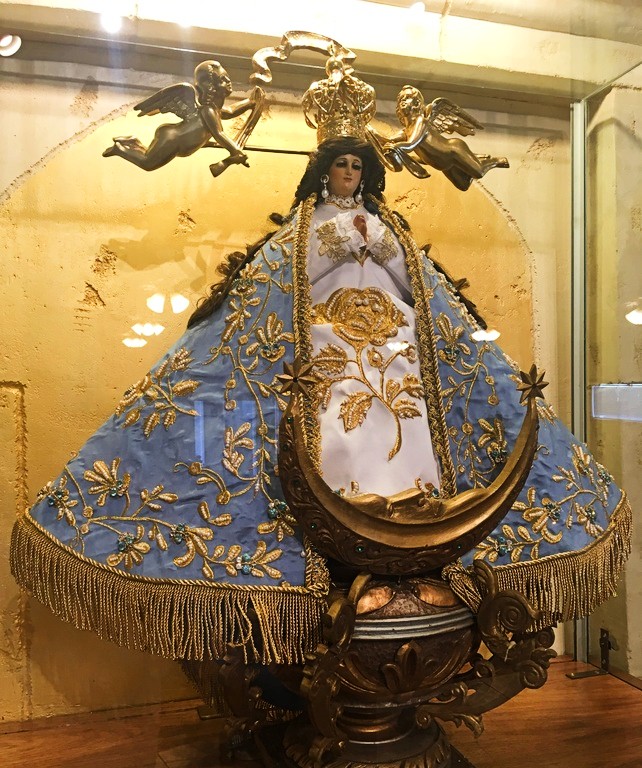
Virgen de Zapopan / Our Lady of Zapopan, Zapopan, Jalisco, Mexico, (1541) – 18 January, 12 October:
Today the village of Zapopan is a quiet little place not many miles from Guadalajara, reached by an excellent highway. Its tranquility and religious atmosphere must be a far cry from pre-Conquest times, when it was a feudal district and tributary of the powerful King of Tonala. In those days the Indians of the district worshiped an idol called Teopintzintl, “The Child God,” to which they offered gifts of hare and partridge. When the kingdom of Tonala bowed to Nuno de Guzman in 1530, Zapopan came under Spanish dominion. The Indian Queen, Chihuapili Tzapotzinco, ordered all the chieftains under her rule, to render their obedience to the Spanish Crown and in March of 1530 the Governor of Atemajac, under whose jurisdiction lay Zapopan, complied with this order. The Mixton War of 1541, however, depopulated the district and the Commander of Tlaltenango, Francisco de Bobadilla, obtained the Viceroy’s permission to repopulate Zapopan with Indians from Tlaltenango, thus lessening the chance of another uprising.
On the eighth of December, 1541, the people of Zapopan was resettled in accordance with the agreement, and on that day, the Franciscan Fray Antonio de Segovia, gave to the newly settled colony, a small image of Our Lady of the Immaculate Conception. For ten years it had accompanied him on his apostolic journeys. In fact, only a short while before, while the Mixton War was still in progress, Fray Antonio, with his missionary companion Fray Miguel de Bolonia, had gone among the warring Indians, the image about his neck, exhorting them to make peace with the Spaniards. It is related that while Fray Antonio was preaching, the Indians saw luminous rays issuing from the image of Our Lady, and that this fact, as much as his preaching, caused them to stop fighting. In thirty-six hours Fray Antonio de Segovia brought to the Viceroy for pardon, more than six thousand Indians, who had laid down their arms. From that time Fray Antonio called the image La Pacificadora, “She Who Makes Peace.”
The image is made of paste – pieces of cornstalk, smoothed and cemented together with glue. It is little more than 30 centimetres in height and represents the Virgin Mary under her title of the Immaculate Conception. The hands, joined before the breast, are of wood. The original sculpture donated by Fray Antonio de Segovia consisted only of the upper half, it is believed, the lower section having been added at a later date. As the lower half is not in proportion to the upper, the reconstruction gives a stunted effect to the image. However, nowadays the Statue is always covered with rich vestments of fabric, the disproportion is not apparent.
In its sculptured form, the Statue represents Our Lady standing with her feet upon a rudely formed crescent moon. She wears a red tunic and a dark blue mantle outlined in gold. One may find much to be desired in the image, considered as a work of art. Yet we must remember that it has the honour of being the first image of the Virgin Mary venerated in the State of Jalisco and that it has seen the Church, in that part of Mexico, grow from the tiniest seed to the great, many-branched tree of the present-day Catholic Faith. Furthermore, for over four centuries, Our Lady of Zapopan has been a constant channel of heavenly favours to the people of Jalisco. A beautiful Church has bee built to house and enshrine her and it remains a vital source of devotion and pilgrimage. Our Lady under this title is celebrated on 18 January and 12 October.
St Amelius of Mortara St Amicus of Mortara
St Carlo Acutis (1991-2006) Aged 15 Layman
St Cyprian St Domnina of Anazarbus St Edisto St Edistius of Ravenna
Martyred in the Spanish Civil War: • Blessed Bartolomé Caparrós García • Blessed Eufrasio of the Child Jesus • Blessed José González Huguet • Blessed Pedro Salcedo Puchades • Blessed Rafael Lluch Garín
Saint of the Day – 11 October – Saint Gummarus (717-774) Lay Hermit, Confessor, Soldier, Courtier, Married. Born in 717 at Brabant, Belgium and died in 774 of natural causes. Patronages – childless people, courtiers, cowherds, difficult marriages, glove makers, hernia sufferers, separated spouses, woodcutters. Also known as – Gommarus of Lier, Gomer, Gommaire, Guntmar, Gummar, Gommar.
Gummarus was a native of a noble family of Emblehem, referring to an area including Lier and not just the Town of Emblem, in Brabant and a relative of King Pepin the Younger, who called him to his Court and entrusted him with important offices. The King arranged a marriage between Gummarus and a wealthy noblewoman named Guinmarie, who was extravagant and haughty. His wife appears to have been shrewish, as well as abusive to their household servants in his absence. They had no children.
Gummarus accompanied Pepin on a number of military campaigns and spent eight years in the field. Upon his return from military campaigns, Gummarus tried to reconcile with his wife and remedy the injustices she had laid upon the people in their service. That he might have a place of quiet and retirement and in order to attend his private devotions, he built a Chapel called Nivesdunc.
Gummarus and his wife eventually separated. He became a Hermit at Nivesdunc and the Town of Lier, Belgium grew up around the site of the hermitage and where, with Saint Rumbold of Mechelen he founded an Abbey. Gummarus died at his Abbey in 774. In 815 he was recognised as a Saint.
Saint Rumbold ands Saint Gummarus, at the Cathedral of Mechelen
The site of his hermitage is now St Peter’s Chapel. The Church of St Gummarus was built in Brabant in 1378. Every year on the first Sunday after 11 October, the City of Lier, holds the St Gummarus Fair, which includes a procession in which the Saint’s relics are carried through the streets of Lier.
The Reliquary enshrined at St Gummarus Church in Lier
Feast of the Divine Maternity – Second Sunday in October or 11 October:
The object of this feast is to commemorate the dignity of the Mary as Mother of God. Mary is truly the Mother of Christ, who in One Person unites the Human and Divine Nature. This title was solemnly ratified by the Council of Ephesus on 22 June, 431. It was long celebrated in Portugal, where the Maternity of Our Lady was declared a feast on 22 January in 1751, at the request of King Joseph Manuel. The feast, granted to the Dioceses of Portugal, Brazil, and Algeria, was assigned to the first Sunday in May. In the following year it was extended to the Province of Venice; in 1778, to the Kingdom of Naples; in 1807, to Tuscany. It was finally instituted in 1931 by Pope Pius XI in view of the fifteenth Centenary of the Council of Ephesus. At the same time the Pope ordered, at his own cost, the restoration of the Marian mosaics in Saint Mary Major, much decayed through age. He issued an encyclical letter, “Lux veritatis.”In this, among the objects of the new festival, is named one truth that was particularly close to the heart of Pius XI, “…that Mary, who is loved and revered so warmly by the separated Christians of the East, would not suffer them to wander and be unhappily led further away from the unity of the Church and, therefore, from her Son, whose Vicar on earth we are.” At present the feast is not found in the Universal Calendar of the Church but nearly all Diocesan calendars have adopted it.
St Alexander Sauli CRSP (1534-1592) Bishop “The Apostle of Corsica,” Clerk Regular of the Congregation of Saint Paul (The Barnabites) – St Alexander is referred to as “The Second Founder,” Missionary, Writer, Teacher of philosophy and theology at the University of Pavia, Reformer, Evangeliser, Confessor, Superior-General of the Barnabites in 1565. In addition, St Alexander Sauli was both friend, advisor and spiritual comfort to St Charles Borromeo, who held him in very high esteem. His Life: https://anastpaul.com/2020/10/11/saint-of-the-day-11-october-saint-alexander-sauli-crsp-1534-1592/
St Anastasius V St Anastasius the Apocrisarius St Andronicus of Ephesus St Andronicus the Soldier St Ansilio St Bruno the Great St Canice St Digna of Sicily St Dionisio de Santarem St Emilian of Rennes St Ethelburgh of Barking St Eufridus St Firminus of Uzes St Germanus of Besancon St Gratus of Oloron St Guiadenzio of Gniezno St Gummarus (717-774) Lay Hermit Bl James Grissinger St Juliana of Pavilly
St Nectarius of Constantinople St Phêrô Lê Tùy St Philip the Deacon St Philonilla St Placid St Placidia St Probus of Side St Santino of Verdun St Sarmata St Taracus of Cladiopolis St Zenaides — Martyrs of Vilcassin – 4 saints: Four Christians who were martyred together. We know little more than the names – Nicasius, Pienza, Quirinus and Scubicolus. Their martyrdom occurred in Vexin Lugdunense territory of Gaul (modern Vilcassin, France), date unknown.
Saint of the Day – 10 October – Saint John of Bridlington OSA (1319-1379) Priest, Prior, miracle-worker. In his lifetime he enjoyed a reputation for great holiness and for miraculous powers. John was commended for the integrity of his life, his scholarship , his humility and his quiet generosity. Born in 1319 at Thwing (near Bridlington), Yorkshire, England and died on 10 October 1379 of natural causes. Also known as – John Thwing, John of Thwing, John Twenge, John Thwing of Bridlington. Additional Memorial – 9 October among the Augustinian Canons Regular, 21 October on some calendars.
The Roman Martyrology states: “In Bridlington in England, St John, a Priest, who, Prior of the Monastery of the Canons Regular of St Augustine, shone with prayer, austerity and meekness.“
Born in 1320 in the village of Thwing on the Yorkshire Wolds, about nine miles west of Bridlington, he was of the Yorkshire family Twenge, which during the English Reformation would supply two Roman Catholic Priest-martyrs and was also instrumental in establishing the Institute of the Blessed Virgin Mary at Bar Convent, York.
John was educated at a school in the village from the age of five, completing his studies at Oxford University. He then entered the Augustinian Canons Regular community of Bridlington Priory. He carried out his duties with humility and diligence, and was in turn Novice Master, almsgiver, preacher and sub-prior. He became Canon of the Priory in 1346 and was eventually elected Prior in 1356. John initially declined out of humility but after being re-elected, probably in 1361, he took on the duties of Prior in January 1362. He served as Prior for 17 years before his death on 10 October 1379.
In his lifetime he enjoyed a reputation for great holiness and for miraculous powers. On one occasion he changed water into wine. On another, five seamen from Hartlepool in danger of shipwreck called upon God in the name of His servant, John of Bridlington, whereupon the Prior himself appeared to them in his Canonical habit and brought them safely to shore. The men left their vessel at the harbour and walked to the Monastery where they thanked John in person for saving their lives.
“The Vision of William Staunton,” recounts William’s visit to St Patrick’s Purgatory where he sees both purgatory and the earthly paradise and is conducted through the otherworld by St John of Bridlington and St Ive.
After his death from natural causes, the fame of the miracles brought by his intercession, spread rapidly through the land. Alexander Neville, Archbishop of York, charged his suffragans and others, to take evidence with a view to his Canonisation. Richard le Scrope, Archbishop of York, assisted by the Bishops of Durham and Carlisle, officiated at a solemn translation of his body on 11 March 1401. Pope, Boniface IX, shortly afterwards Canonised him. The Canonisation had been lost but the original Bull was unearthed in the Vatican archives by T A Twemlow, who was engaged in research work there for the British government.
At the English Reformation, Henry VIII was asked to spare the magnificent Shrine of the Saint but it was destroyed in 1537. The nave of the Church, restored in 1857, is all that now remains of Bridlington Priory.
Twentieth Sunday after Pentecost Twenty-eighth Sunday in Ordinary Time
La Naval de Manila / Our Lady of the Most Holy Rosary , Quezon City, Philippines (1593) – Second Sunday of October: Also known as Nuestra Señora del Santísimo Rosario / The Grand Lady of the Philippines.
In 1593, the Governor General of the Philippines commissioned a Statue of Our Lady of the Rosary for the Dominican Church in Manila. A un-named Chinese sculptor carved the hardwood body and ivory hands and face, which has Asian features. About 4’8″ tall, the image is dressed in cloth of gold, with a crown and a halo of 24 stars and adorned with precious donated jewels. Our Lady holds the Child Jesus with her left hand and a Rosary with her right. The title “La Naval” refers to Our Lady’s help in the naval battles of Lepanto in 1571 and Manila in 1646, when a small Catholic fleet repeatedly repelled Dutch invaders. The Catholic Church in Manila first celebrated the feast of “La Naval” on 8 October 1646. Pope Pius X’s Apostolic Delegate crowned the Statue on 5 October 1907. Pope Pius XII also sent an Apostolic Letter on the occasion of the tricentenary of the Battle of La Naval de Manila on 31 July 1946. The Japanese bombing of 27 December 1941 destroyed the Church of Santo Domingo in Manila’s old walled city. Hidden for safekeeping, the holy Statue moved in 1954 to its present location in the Santo Domingo Shrine in Quezon City.
In 1646, naval forces of the Dutch Republic made several repeated attempts to conquer the Philippines in a bid to control trade in Asia. The combined Spanish and Filipino forces who fought, requested the intercession of the Virgin through the Statue prior to battle. They were urged to place themselves under the protection of Our Lady of the Rosary and to pray the Rosary repeatedly. They went on to rebuff the continued attacks by the superior Dutch fleet, engaging in five major battles at sea and losing only fifteen members of the Spanish Navy. After the Dutch retreat, in fulfillment of their vow, the survivors walked barefoot to the Shrine in gratitude to the Virgin. Later, on 9 April 1662, the Cathedral chapter of the Archdiocese of Manila declared the naval victory a miraculous event owed to the intercession of the Virgin Mary, declaring:
“Granted by the Sovereign Lord through the intercession of the Most Holy Virgin and devotion to her Rosary, that the miracles be celebrated, preached and held in festivities and to be recounted amongst the miracles wrought by the Lady of the Rosary, for the greater devotion of the faithful to Our Most Blessed Virgin Mary and Her Holy Rosary.“
St Cassius St Cerbonius of Populonia St Cerbonius of Verona St Clarus of Nantes Bl Demestrius of Albania Bl Edward Detkens St Eulampia St Eulampius St Florentius the Martyr St Fulk of Fontenelle St Gereon St Gundisalvus Bl Hugh of Macon St John of Bridlington OSA (1319-1379) Priest, Prior of the Monastery of the Canons Regular of St Augustine. Bl Leon Wetmanski St Maharsapor the Persian St Malo the Martyr St Patrician St Paulinus of Capua
Bl Pedro de Alcantara de Forton de Cascajares St Pinytus of Crete Bl Pontius de Barellis St Tanca St Teodechilde St Victor of Xanten
Martyrs of Ceuta – 7 beati: A group of seven Franciscan Friars Minor missionaries to Muslims in the Ceuta area of modern Morocco. Initially treated as madmen, within three weeks they were ordered to convert to Islam and when they would not they were first abused in the streets, then arrested, tortured and executed. • Angelo • Daniele di Calabria • Donnolo • Hugolinus • Leone • Nicola • Samuele They were beheaded in 1227 in Mauritania Tingitana (Ceuta, Morocco). Local Christians secreted the bodies away and gave them proper burial in Ceuta. They were Beatified in 1516 by Pope Leo X.
Saint of the Day – 9 October – Saint Donnino of Città di Castello (Died 610) Lay Hermit Also known as – Donino. Patronages – of Città di Castello together with Saint Flordio and Saint Amanzio, against arthritis, epilepsy, against rabid dog attacks
The Roman Martyrology states: “In Città di Castello in Umbria, St. Donnino, a hermit.”
Donnino collaborated with the Bishop Florido and the Priest Amanzio in the reconstruction of Città di Castello (then Castrum Felicitatis) after the destruction suffered during the Greek-Gothic war.
Hagiographies written of him in the 17th and 18th centuries recall his devotion and zeal. On the death of Bishop Florido (599 or 600) and of St Amanzio, shortly after, Donnino abandoned public life to retire to live in the hermitic solitude at the Rubbiano locality. He then moved to a second hermitage, closer to Città di Castello, today called Villa San Donino. Here he lived on wild herbs and spent his time in prayer and in the company of a dog. The saintly hermit died on 9 October 610.
During the years of the Donnino’s life the news of his presence, his holiness and spiritual gifts spread rapidly and large crowds began to visit him. Donino became their spiritual guide and an intercessor with God.
His body is now preserved inside an urn placed in the Church of Saint Donnino. Another place linked to the memory of this Saint is near Rubbiano, where there are some boulders and a miraculous spring where pilgrims pray for cures especially from arthritis and epilepsy.
Although a layman, Donino was in the past depicted with priestly vestments and the chalice and next to a small dog. The oldest representation is contained in the embossed and chiselled silver frontal donated by Pope Celestine II to the Cathedral of Città di Castello in 1144, where Donino is depicted together with the Saints Florido and Amanzio. His relics were subjected to canonical recognition in the years 1543, 1791 and 1869.
St John Leonardi (1541-1609) (Optional Memorial) Priest, Founder of the Clerks Regular of the Mother of God of Lucca, wherein he assumed the name of “Giovanni of the Mother of God”, Confessor, Reformer, Apostle of the Holy Eucharist and Eucharistic Adoration, Marian devotee. Biography here: https://anastpaul.wordpress.com/2017/10/09/saint-of-the-day-9-october-st-john-leonardi-1541-1609/
Bl Aaron of Cracow St Abraham the Patriarch St Alfanus of Salerno St Andronicus of Antioch St Athanasia of Antioch Bl Bernard of Rodez St Demetrius of Alexandria St Deusdedit of Montecassino St Domninus St Dorotheus of Alexandria St Donnino of Città di Castello (Died 610) Lay Hermit St Eleutherius St Geminus St Gislenus St Goswin Bl Gunther
St Publia St Rusticus St Sabinus of the Lavedan St Valerius — Martyrs of the Spanish Civil War – Martyrs of Astoria – (9 saints): Also known as Martyrs of Turon: A group of Brothers of the Christian Schools and a Passionist priest martyred in the persecutions during the Spanish Civil War. They are – • Aniceto Adolfo • Augusto Andrés • Benito de Jesús • Benjamín Julián • Cirilo Bertrán • Inocencio de la Immaculada • Julián Alfredo • Marciano José • Victoriano Pío They were martyred on 9 October 1934 in Turón, Spain and Canonised on 21 November 1999 by St Pope John Paul II. — Martyrs of Laodicea – (3 saints): Three Christians martyred together in Laodicea, but no other information about them has survived but their names – Didymus, Diodorus and Diomedes. They were martyred in Laodicea, Syria.
Quote/s of the Day – 8 October– The Memorial of St Bridget of Sweden (c 1303 – 1373)
“O Lord, make haste and illumine the night. Say to my soul that nothing happens without You permitting it and that nothing of what You permit, is without comfort.”
“O Mary, you give assistance to everyone endeavouring to rise to God!”
“There is no sinner in the world, however much at enmity with God, who cannot recover God’s grace, by recourse to Mary and by asking her assistance.”
“Let everyone who has the grace of intelligence, fear that because of it, he will be judged more heavily, if he is negligent.”
Saint of the Day – 8 October – Saint Felix of Como (Died 390) the first Bishop of Como. Felix was a friend of Saint Ambrose, who praised him for his missionary activity and Ordained him a Priest in 379 and Consecrated him as Bishop in 386. St Ambrose sent him to evangelise the City of Como, as a testimony to the great missionary drive of the Church of Milan. When St Bassianus of Lodi (c 320 – 413 – feast day 10 June) built a Church dedicated to the Apostles at Lodi, he Consecrated it in the presence of Saints Ambrose and Felix. St Felix is honoured as a zealous shepherd of souls. Additional Memorials – 31 August in Milan and 14 July on some calendars.
The Roman Martyrology states: “In Como, St Felix, Bishop, who, Ordained by St Ambrose of Milan, was the first to rule the Church of this City.”
The first document that presents Felix, is a letter from St Ambrose of Milan, from which it is noted that the recent evangelisation work of the first Bishop, Felix, although it had led to the conversion of many people, required the indispensable and constant collaboration of some co-operators: “I know well that you do not lack work in the vineyard of the Lord, especially because there are few workers with you, who can help us but, this lament is old and too well known to us: the Hand of God, however, has not shortened; He will help you in your need and will send you new workers to harvest the grain of the Lord. I thank the Lord very much, He, Who favoured you in the conversion of these souls and cordially congratulate you, hearing how many of these citizens of Como have already accepted the Catholic faith.”
From the full text of the letter, which is undated, it appears that Felix enjoyed the familiarity and paternal predilection of Saint Ambrose, who had conferred on him the Episcopal Consecration on Sunday 1 November, almost certainly in 386 and had sent him to the Consecration of the Basilica of the Apostles built by St Bassianus in Lodi, Bishop of that City, who longed for the presence of the Bishop of Como.
In another letter, of exquisitely familiar and friendly tone, commonly ascribed to the year 387, Ambrose thanks Felix for the gift of a basket of truffles but also complains that he visits him too rarely.
According to an ancient tradition, Felix would have erected the first Church of Como on the open slope of the Baradello hill, in honour of the Saints Carpoforo and fellow martyrs and in it buried their bodies.
Tradition has handed down 8 October as the date of Felix’s death, also his feast day. He was buried in the primitive Church of San Carpoforo and subsequently in the enlarged Basilica of the same name, until, in 1932, his body was transferred to the new Parish Church of San Brigida, where his cult is still alive and placed under the main Altar.
A very unclear picture but it seems to be the Shrine of St Felix in the Church of St Brigid in Como
Notre-Dame du Bon Remède / Our Lady of Good Remedy, France (1197) – 8 October:
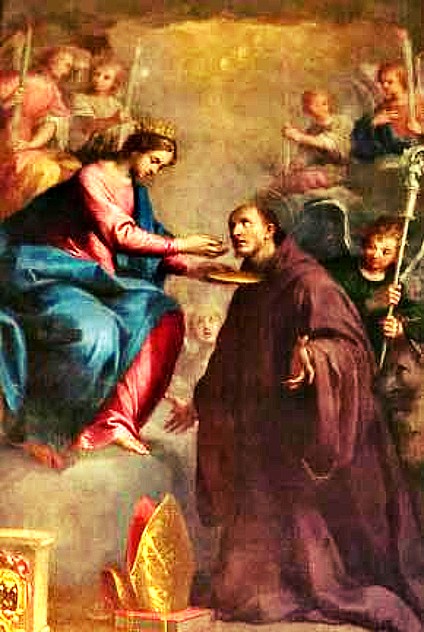
In 1197, a Sorbonne Doctor of Theology and newly Ordained Priest, Jean de Matha, while saying his first Holy Mass, saw a vision of an Angel with a red and blue cross on his chest and his hands resting on the heads of two captives. The following year, St Jean founded a religious order dedicated to the redemption of Christians held as slaves by Moslems — the Hospitaler Order of the Most Holy Trinity and of Captives, commonly called the Trinitarians. On their habit, Jean placed the Cross he had seen on the Angel,and, as their Patron, he gave them Notre-Dame du Bon Remède, a popular devotion in his Provençal homeland. Now devoted largely to education and evangelisation, for three centuries they raised funds and travelled from Europe into Africa to buy thousands of captives’ freedom with Our Lady’s help. A painting (right) in the Trinitarian Motherhouse of Cerfroid in northern France, shows Our Lady of Good Remedy giving a bag of money to St Jean/John of Matha, while a grateful freedman and St Felix of Valois, look on. The Order celebrates her feast day 8 October.
800 years ago Christians were being captured and sold into slavery by the thousands, and nobody knew what to do about it. Then, in the year 1198, a man had an idea. St. John of Matha founded the Trinitarians to go to the slave markets, buy the Christian slaves and set them free. To carry out this plan, the Trinitarians needed large amounts of money. So, they placed their fund-raising efforts under the patronage of Mary. They were so successful that, over the centuries, the Trinitarians were able to free thousands and thousands of people and to return them safely home. In gratitude for her miraculous assistance, St. John of Matha honoured Mary with the title of “Our Lady of Good Remedy.” Devotion to Mary under this ancient title is widely known in Europe and Latin America and the Church celebrates her feast day on 8 October. Our Lady of Good Remedy is often depicted as the Virgin Mary handing a bag of money to St. John of Matha. When in need – for whatever reason but especially where you have had difficulty obtaining help – invoke the aid of Our Lady of Good Remedy and you will surely experience the power of her intercession.
St Amor of Aquitaine St Artemon of Laodicia St Badilo St Benedicta of Laon St Benedicta of Origny-sur-Oise St Evodius of Rouen St Felix of Como (Died 390) Bishop St Gratus of Chalons
Saint of the Day – 7 October – Saint Augustus of Bourges (Died c 560) Priest and Abbot. He was miraculously cured of paralysis, with which he bas born, by the intercession of St Martin of Tours. Died in c 560 of natural causes. Also known as – Augustus of San Sinforiano, Augosto of….
The Roman Martyrolog states of him today: “Near Bourges in Aquitaine, France, Saint Augustus, Priest and Abbot, who had his hands and feet so contracted that he could not support himself except with his knees and elbows. He was healed through the intercession of St Martin of Tours. He gathered around himself some Monks and waited intently on prayer.”
Augustus was French, and lived in Bourges in the sixth century. His life and illness is known to us, with sufficient accuracy, from the pages of writers and above all from the artwork, which latter we have no access too online. In fact, St Gregory of Tours says that he was was paralysed from birth, in the feet and hands. To move, he dragged himself painfully on his elbows and knees.
But the infirmity of his limbs did not discourage him, nor hardened his heart and soul, which remained healthy and whole, as a Christian rich in devotion and goodwill.
Aided by the alms of the faithful, Augustus set out to build a Church dedicated to the great French Bishop, St Martin of Tours. In fact, he managed to accomplish this undertaking, which seemed so much superior to his strength.
When the construction of the Church was completed in Bourges, he had some precious relics of the titular saint brought there.
It is said that precisely because of the miraculous powers of these relics, the cripple, who had not surrendered to his infirmity, gained the use of his limbs. But he did not take the opportunity to leave but instead, Augustus stayed at the Church he had built, in a small monastic community. According to some hagiographic sources, he also had a mystical vision in which he learned of the location of the burial place of Saint Ursinus, the first Bishop of Bourges.
If as an infirm he had overcome the impairments of his shrunken body, healed, he knew how to subjugate the vigorous body. He refused his legs to vain movements, his hands to unworthy pursuits. He stood still and quiet, in prayer and penance.
The Bishop of the City Ordained Augustus as a Priest and also appointed him Abbot of the Monastery of St Sinforian and Augustus,, without abandoning his penitent Monks, wisely governed from there, both one and the other community. And in this task he died holy, it is believed around 560, in circumstances that we do not know.
Our Lady of the Holy Rosary/Our Lady of Victory – (Commemorating the Victory of Lepanto – 1571 [Mandatory Memorial):
On Sunday 7 October 1571 the combined Christian fleets under Don John of Austria achieved a significant naval victory over the Turks in the Straits of Lepanto. Thousands of Christians were liberated, the Turkish fleet was destroyed and they suffered their first great defeat at sea. In gratitude to God and Our Lady, Pope Saint Pius V ordered an annual commemoration to be made of Our Lady of Victory. In 1573 Pope Gregory XIII transferred the feast to the first Sunday of October with the title Feast of the Most Holy Rosary since the victory was won through invocation of Our Lady of the Rosary. In 1716 Pope Clement XII extended the feast to the whole Latin Rite calendar, assigning it to the first Sunday in October. Saint Pope Pius X changed the date to 7 October in 1913. In 1969 Pope Paul VI changed the name of the feast to Our Lady of the Holy Rosary.
St Adalgis of Novara (Died c 850) Bishop St Apuleius of Capua St Augustus of Bourges (Died c 560) Priest and Abbot St Canog ap Brychan St Dubtach of Armagh St Gerold of Cologne St Helanus
St Martin Cid Bl Matthew Carreri St Osith St Palladius of Saintes St Quarto of Capua St Rigaldo
Martyrs of Arima: Eight lay people Japan who were martyred together in the persecutions of Christianity in Japan: • Blessed Hadrianus Takahashi Mondo • Blessed Ioanna Takahashi • Blessed Leo Hayashida Sukeemon • Blessed Martha Hayashida • Blessed Magdalena Hayashida • Blessed Didacus Hayashida • Blessed Leo Takedomi Kan’Emon • Blessed Paulus Takedomi Dan’Emon They were martyred on 7 October 1613 in Arima, Hyogo, Japan and Beatified on 24 November 2008 by Pope Benedict XVI.
Mercedarian Nuns of Seville: Five Mercedarian nuns at the monastery of the Assumption in Seville, Spain noted for their piety – Sisters Agnese, Bianca, Caterina, Maddalena and Marianna.
Martyred in the Spanish Civil War • Blessed José Llosá Balaguer
Saint of the Day – 6 October – Saint Faith of Agen (Died 3-4th Century) Virgin Martyr, Confessor. Born at Agen, Aquitaine, (modern France) and died by being cooked on a brazier, then beheaded. Also known as – Fides, Foi, Foy, Fe, Faith of Conques. Patronages – eye diseases and blindness, Pilgrims, prisoners. soldiers. Our little Faith today must not be was confused with the three legendary sisters known as Faith, Hope and Charity., Virgin Martyrs of the 2nd Century whose feast day is 1 August.
The Roman Martyrologgy states: “ At Agen, in France, the birthday of St Faith, Virgin and Martyr whose example encouraged the blessed Caprasius so much, that he happily terminated his combat by Martyrdom.“
Faith was a beautiful 12-year-old girl living in Agen, Aquitaine, France, during the reign of Diocletian and Maximian. Her parents, wealthy pagans, left her rearing to a nurse, who happened to be Christian. Growing up in a beautiful, mosaic-encrusted villa, Faith had everything the world could offer and her future looked bright, except for one thing – she had accepted her nurse’s Christian faith.
To understand why this was a problem, we must understand Emperor Diocletian. He had announced, on assuming office, his intention to revive morality within the realm, since immorality was sapping Roman virtue and, therefore, the Empire’s viability and strength. He also believed that a revival of the traditional Roman gods was key, because an empire united in its religious praxis would be stronger. This was not a problem for most pagans in most places because gods were gods, even if their names varied by region. This was obviously not the case for Christians, however.
Diocletian launched a persecution designed to force everyone to the same cult. Dacian, Prefect of the Province in which Faith lived, came to Agen to observe his subjects’ loyalty—that is, to see if they were being good pagans and, if not, to kill them.
While many Christians were terrified but Faith voluntarily surrendered to the authorities. Imagine how frightened she must have been. She likely prayed for strength and for the words to convert her persecutors. Dacian probably had some nervousness too. After all, putting a twelve-year-old girl on trial would be a touchy situation, especially for a capital crime. Who wants to execute a child? Better to get her to apostatise but how? During the trial Faith gave a brave, remarkable defense of Christianity. Fine, Dacian told her, keep your beliefs. Just sacrifice to the goddess Diana in the town’s temple.
Faith refused and Dacian lost patience with the girl. He ordered her bound to a brazen bed and roasted. Pitch was thrown on the fire to make its flames flare and burn her legs. This happened in public, so that the crowds could witness the fate awaiting Christians.
Medieval depiction of Faith’s Martyrdom.
The problem for Dacian was that little Faith refused to cooperate. She cried, yes but she did not scream or beg for mercy. After a miraculous rainstorm extinguished the flames, Dacian had her beheaded. Seeing all this, the mob was moved, not to contempt for Christianity but to pity for Faith. Their only contempt was for Dacian, the child executioner. They wondered what god of theirs could give a mere maiden such strength. Realising the answer was “None,” many converted on the spot. In turn, most of these received martyrdom days later.
After her death St Faith developed a reputation as something of a practical joker. If someone was stingy with a donation left for her Shrine’s upkeep, small misfortunes might befall them. For instance, a dying woman promised S. Faith she would will her most precious ring to the Abbey. Afterward her husband—possibly for its sentimental value, or maybe the thing had cost him a good deal of money—thought better of his wife’s last pledge. He instead used the ring as his second wife’s wedding band. Shortly the ring finger of the new wife swelled so much that it became unbearably painful. The couple beat a hasty path to the Shrine. There, when the lady blew her nose, the ring flew off her hand with such force that it left a crack in the flooring.
On another occasion, Faith’s prayers restored sight to a man named Guibert, whose eyes had been torn from their sockets. Wanting to keep the recipient of so great a miracle close, the Monks who cared for St Faith’s Shrine gave him the job of selling candles. It seems Guibert was a good businessman and soon became quite rich. But as so often happens, when success came, devotion to Our Lord went. St Faith reproached Guibert for his ingratitude. She had prayed Jesus would restore his sight, and this is how Guibert repaid her? So Guibert lost sight in one eye. This happened repeatedly: He would mend his ways, gain his eyes, grow successful again, fall into sin, lose the eye, and so on.
The Monks would parade Faith’s relics around the Monastery grounds. With the greatest pomp, they processed while holding candles and they sang all day. By evening they were exhausted and famished. Once when many people had prayed, the intercession of St Faith wrought many miracles. With each miracle the Monks would sing a Te Deum. At the end of the day, the Monks sat down under a tree to have a picnic but each time they were about to sink their teeth into their meager food, someone would cry, “A miracle!” and the Monks would have to get up and sing again.
Thirty-eight churches in England alone are named after St Faith. There are many more in northern Spain and southern France and her fame spread to the Americas via the conquistadors. Indeed, at least four Cities in the United States are named after her, including Santa Fe, New Mexico. And in Brazil alone 22 Cities bear her name.
Except for what she said in court, St. Faith never preached. She never wrote an epistle. Her preaching and writing were her actions. The bravery and resolve of this young maiden astounded the crowds. Perceiving something special about the God she worshiped, they converted. And she was just a child. God makes up for what we lack.
Holy Spirit, through Your ineffable gifts, draw us to constant conversion. Renew our hearts. Let our actions preach eloquent sermons that draw people to Christ, far better than our poor words could do. Help us to love You, Holy Father, to do everything for You, and to remain firm in that love, no matter the hardships we encounter, so that, with St Faith, we may wear an eternal crown in Heaven. (Partially excerpted from “Saint Who?: – 39 Holy Unknowns” by Brian O’Neel).
In the fifth century, Dulcitius, Bishop of Agen, ordered the construction of a Basilica dedicated to her, later restored in the 8th century and enlarged in the 15th but sadly demolished in 1892 for urban development – horrible
Contrary to all custom, however, the centre of the cult of Faith was not the Basilica but the Church of Conques-enRouergue, where in the 9th Century. some of her relics had been transported, see the Reliquary below. Here there was also a Monastery, which, due to being on the road frequented by pilgrims Compostella, became in turn, famous and a pilgrimage destination in its own right. The cult of Faith thus spread throughout Europe and then also in America, where numerous cities and churches were dedicated to her. Among the most important are the Conches Abbey in Normandy and the Church of Sélestat, in Alsace.
Ninth Century Reliquary of Saint Faith at Conques.
St Alberta of Agen Bl Artaldo of Belley St Aurea of Boves St Ceollach St Epiphania St Erotis St Faith of Agen (Died 3-4th Century) Virgin Martyr St Francis Trung Von Tran Bl François Hunot Bl Isidore of Saint Joseph St Iwi St John Xenos Bl Juan de Prunera St Magnus of Orderzo
St Pardulf St Renato of Sorrento St Romanus of Auxerre St Sagar of Laodicea — Martyrs of Capua – 4 saints: A group of martyrs who were either killed in Capua, Italy, or that’s where their relics were first enshrined. We now know nothing but their names – Aemilius, Castus, Marcellus and Saturninus.
Martyrs of Kyoto – 52 beati: Fifty-two Japanese lay people, some single, some married, some parents, some children, who were martyred together during one of the government sponsored persecutions of Christians.
Martyrs of Trier: Commemorates the large number of martyrs who died in Trier, Germany in the persecutions of Diocletian. 287 in Trier, Germany.
Saint of the Day – 5 October – Blessed Pietro of Imola (c1250-1320) Knight of the Order of St John of Jerusalem and Grand Prior , Lawyer, Jurist, Mediator, Peace-maker. Born in mid-13th century in Italy as Pietro Pattarini and died on 5 October 1320 in Campo Corbellini, Florence, Tuscany, Italy of natural causes . Also known as – Peter of Imola, Peter Pattarini, Pietro Pattarini de Imola.
The Roman Martyrology states: “In Florence, blessed Pietro da Imola, who, a Knight of the Order of St John of Jerusalem, took care of the sick with pious charity.”
Very little is known of the details of the life of Blessed Pietro of Imola whose memorial we celebrate today. He was born in the mid 1200s at Imola, in Italy, into the noble Pattarini family who had been the Lords of Linasio for over 100 years and part of the Ghibelline faction. Pietro was an excellent scholar and become a well-known lawyer and jurist. The respect held for his legal opinion is evident ,by the fact that his name is found on many important documents which are still preserved in Imola, giving his interpretation of the laws of his time. In 1289 he became a Court Magistrate and eight years later was to use all his skills and experience to negotiate a peace between the rival Guelph and Ghibelline factions in Romagna. The Guelphs were predominately from wealthy mercantile families who supported the Pope while the Ghibellines tended to come from families with wealthy agricultural estates who supported the Emperor. It was no easy task and took several years but, at last, Pietro was able to persuade the Ghibellines to leave Romagna.
After successfully mediating this conflict and crowning, what had been a successful secular career, Pietro sought a new vocation dedicated to charitable works, in helping the poor and the sick. He began working in one of the Order of St John’s hospitals in Florence and was invested as a Knight in 1310. His administrative skills were welcome and appreciated and put to good use as he assumed greater responsibilities in his work in the hospital. His talents were not unnoticed and after some years he was chosen Grand Prior of the Order in Rome. He again returned to Florence to the Commandery of St James in Campo Corbellini.
We do not know for certain if he became the Commander of St James or assumed other duties. Nevertheless, he continued performing great charitable works serving the sick who were either home-bound or in the hospital. Blessed Pietro died in Florence on 5 October 1320 and his loss was felt by everyone who knew him. He was buried in the Church of St James in Campo Corbellini which still belongs to the Order of the Knights.
One of the most remarkable stories about Blessed Pietro occurred after his death. One day in preparation for the feast of St James, the Church was being decorated by the brothers and a Priest had placed a ladder against the tomb of Blessed Pietro and was standing on it and working up high against the wall, hanging some decorations. The Priest lost his balance and the ladder began to fall. Suddenly, Bless Pietro’s tomb opened slightly and his hand reached out and steadied the ladder, no doubt saving the life of the Priest. This miracle was authenticated by several witnesses. Blessed Pietro’s relics were later translated to under the main Altar of the Church in a reliquary that Commander Fra Augustine Mego had made for it, and the miracle-working arm was kept in a separate little box. After the flooding of the Arno river in 1557, the documents and reliquary were submerged and greatly damaged. However ,the box containing his arm survived and is still venerated in the Imola Cathedral. The main relics of Blessed Pietro reside at St Lawrence’s Church in Florence on 10 June 2016 and further relics are contained in the Reliquary at the Chapel in the Grand Magistry of the Order of Malta in Rome. The skin and nails of the arm and hand remain intact, all these centuries later.
The tomb of Blessed Peter at the Church of St James in Campo Corbolini, Florence/Italy
Reliquary at the Chapel in the Grand Magistry of the Order of Malta in Rome
The main relics of Blessed Pietro are in St Lawrence’s Church in Florence/Italy since 10 June 2016
St Firmatus of Auxerre St Flaviana of Auxerre Bl Flora of Beaulieu St Gallo of Aosta St Jerome of Nevers Bl John Hewett St Magdalveus of Verdun St Mamlacha St Marcellinus of Ravenna Bl Marian Skrzypczak St Meinulph St Palmatius of Trier Blessed Pietro of Imola (c1250-1320)
Bl Robert Sutton Bl Sante of Cori St Thraseas of Eumenia St Tranquilino Ubiarco Robles Bl William Hartley — Martyrs of Messina or St Placidus and Companions – 30 saints: A group of about 30 Benedictine monks and nuns, some blood relatives, who were sent in the early days of the order to establish monasteries in the vicinity of Messina, Sicily, Italy and who were martyred. We know the names, and a few details, about seven of them – • Donatus • Eutychius • Faustus • Firmatus • Flavia • Placidus • Victorinus 6th century Messina, Sicily, Italy.
Martyred in the Spanish Civil War: • Blessed Eugenio Andrés Amo • Blessed Sebastià Segarra Barberá • Blessed Rafael Alcocer Martínez
You must be logged in to post a comment.