St Aceolus of Amiens St Acius of Amiens St Aldebrandus of Fossombrone St Amator of Auxerre St Ambrose of Ferentino St Andeolus of Smyrna Bl Arigius of Gap St Arnold of Hiltensweiler St Asaph of Llanelwy St Augustine Schöffler
St Benedict of Szkalka OSB (Died 1012) Monk and Hermit
St Bertha of Avenay St Bertha of Kent St Brieuc of Brittany (c 420-c 510)Welsh Bishop Monk and Missionary to Brittany. St Ceallach of Killala St Cominus of Catania Evermarus of Rousson Bl Felim O’Hara St Grata of Bergamo St Isidora of Egypt St Jeremiah the Prophet St John-Louis Bonnard Bl Klymentii Sheptytskyi St Marculf St Orentius of Auch St Orentius of Loret St Patientia of Loret
St Peregrine Laziosi OSM (1260-1345) The “Angel of Good Counsel,” Priest of the Servite Order (The Order of Servants of Mary), Apostle of the poor and the sick, Miracle-worker, Spiritual Advisor. Patronages – against cancer, against breast cancer, against open sores, against skin diseases, AIDS patients, sick people, Diocese of Forli-Bertinoro, Italy, City of Forli, Italy. St Peregrine’s body is Incorrupt. Beautiful St Peregrine: https://anastpaul.com/2020/05/01/saint-of-the-day-1-may-saint-peregrine-laziosi-osm-1260-1345-today-is-the-675th-anniversary-of-his-death/
Bl Petronilla of Moncel
St Richard Pampuri OH (1897-1930) aged 33 – Italian Religious of the Hospitallers of St John of God, Medical Doctor, Founder of the Band of Pius X (a Youth movement) which he dedicated to the medical care of poor people, Third Order Franciscan. He was an outstanding lover of the Holy Eucharist in Adoration and an avid Marian devotee, as well as living out his short but faith-filled life in total charity to all the needy and poor. Biography: https://anastpaul.com/2019/05/01/saint-of-the-day-1-may-saint-richard-pampuri-oh-1897-1930/
Spy Wednesday in Holy Week – 13 April – Our Lenten Journey with the Great Fathers – Isaias 53:1-12, Luke 22:39-71; 23:1-53
“And turn not away thy face from thy servant, for I am in trouble, hear me speedily. Save me, O God, for the waters are come in, even unto my soul.” – Psalm 68:2
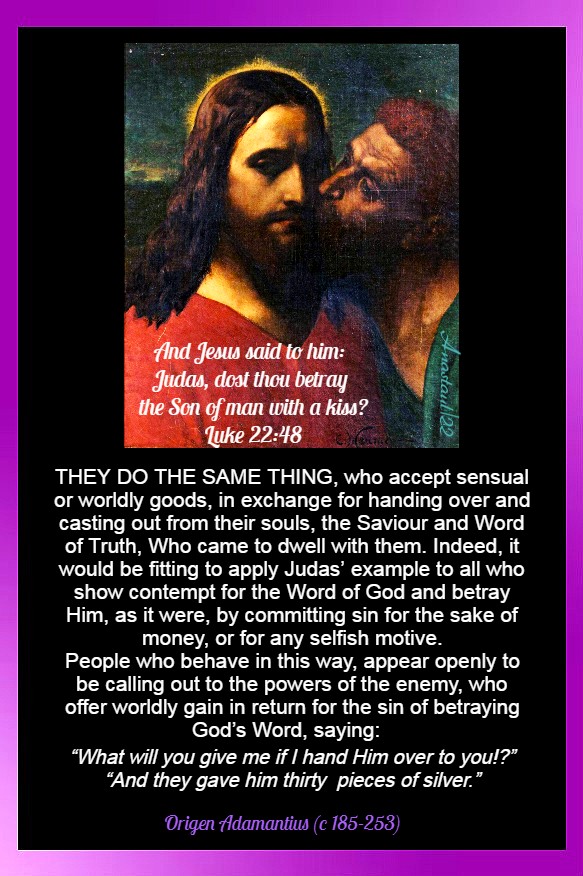
“And Jesus said to him: Judas, dost thou betray the Son of man with a kiss?”
Luke 22:48
“LET US CONSIDER what Judas said to the Jewish priests: “What will you give me if I hand him over to you?” He was willing to take money in exchange for handing over the Word of God!
THEY DO THE SAME THING, who accept sensual or worldly goods, in exchange for handing over and casting out from their souls, the Saviour and Word of Truth, Who came to dwell with them. Indeed, it would be fitting to apply Judas’ example to all who show contempt for the Word of God and betray Him, as it were, by committing sin for the sake of money, or for any selfish motive. People who behave in this way, appear openly to be calling out to the powers of the enemy, who offer worldly gain in return for the sin of betraying God’s Word, saying: “What will you give me if I hand Him over to you!?” “And they gave him thirty pieces of silver.”
THE NUMBER OF COINS they gave Judas, was equivalent, to the number of years the Saviour had sojourned in this world. For at the age of thirty, He was Baptised and began to preach the gospel, like Joseph was thirty years old when he began to gather grain for his brothers. Just as at that time the grain was prepared by God for the sons of Israel but given also to the Egyptians, so also, the gospel was prepared for the saints but preached also to the unfaithful and wicked.” – Origen Adamantius (c 185-253) Priest, Theologian, Exegist, Writer, Apologist, Father (Commentary on Matthew 78)
Monday of Holy Week – 11 April – Our Lenten Journey with the Great Fathers – Isaias 50:5-10, John 12:1-9
“Help us, O God, our saviour and for the glory of thy name, O Lord, deliver us and forgive us our sins, for Thy name’s sake” – Psalm 78:9
“He (Judas Iscariot) said this, not because he cared about the poor but because, he was a thief and held the money bag and used to steal the contributions.”
John 12:6
“LOOK NOW AND LEARN that this Judas did not become perverted, only at the time when he yielded to the bribery of the Jews and betrayed his Lord. For not a few, inattentive to the Gospel, suppose, that Judas only perished, when he accepted money from the Jews, to betray the Lord. It was not then that he perished but he was already a thief and a reprobate, when following the Lord;,for it was with his body and not with his heart, that he followed. He made up the apostolic number of twelve but had no part in the apostolic blessedness. He had been made the twelfth in semblance and on his departure and the succession of another, the apostolic reality was completed and the entirety of the number conserved.
WHAT LESSON THEN, my brethren, did our Lord Jesus Christ wish to impress on His Church, when it pleased Him, to have one castaway among the twelve – but this – that we should bear with the wicked and refrain from dividing the body of Christ? Here you have Judas among the saints,- that Judas, mark you! who was a thief, yes – do not overlook it – not a thief of any ordinary type but a thief and a sacrilegis – a robber of money bags,but of such as were the Lord’s; of money bags but of such as were sacred! . … How much more severe ought to be, the sentence on the sacrilegious thief, who has dared to steal, not from places of any ordinary kind but, to steal from the Church!?
HE WHO THIEVES from the Church, stands side by side with the castaway Judas. Such was this man Judas and yet, he went in and out with the eleven holy disciples. With them, he came even to the table of the Lord, he was permitted to have intercourse with them but he could not contaminate them.
OF ONE BREAD did both Peter and Judas partake and yet, what communion had the believer with the infidel? Peter’s partaking was unto life but that of Judas unto death. For that good bread was just like the sweet savour. For as the sweet savour, so also does the good bread give life to the good and bring death to the wicked. “For he that eateth unworthily, eateth and drinketh judgement to himself:” – “judgment to himself,” not to thee. If, then, it is judgement to himself, not to thee, bear as one that is good, with him that is evil, that you may attain the rewards of the good,and be not hurled into the punishment of the wicked.” – St Augustine (354-430) Bishop of Hippo, Great Western Father and Doctor of the Church (On John 12:1-9 Monday of Holy Week).
Quote/s of the Day – 11 April – Monday of Holy Week – Isaias 50:5-10, John 12:1-9
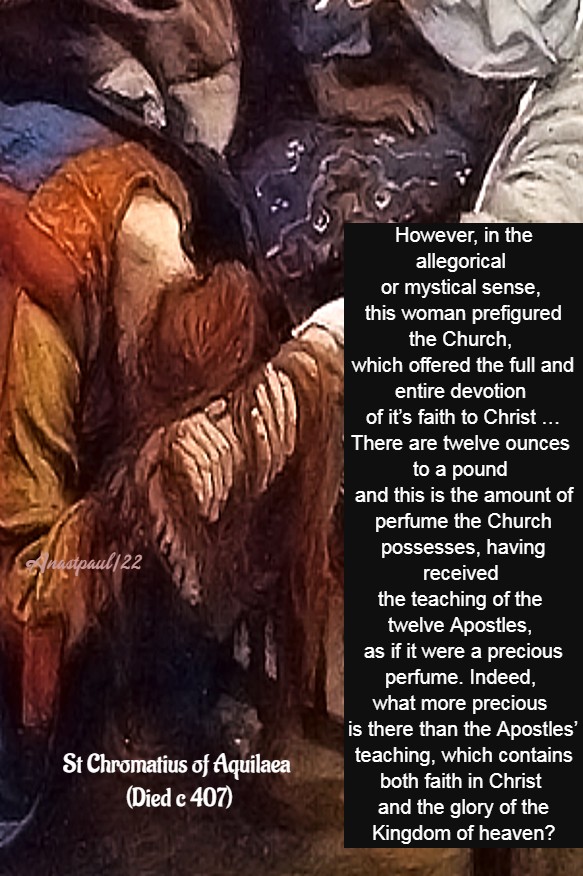
“However, in the allegorical or mystical sense, this woman prefigured the Church, which offered the full and entire devotion of it’s faith to Christ … There are twelve ounces to a pound and this is the amount of perfume the Church possesses, having received the teaching of the twelve Apostles, as if it were a precious perfume. Indeed, what more precious is there than the Apostles’ teaching, which contains both faith in Christ and the glory of the Kingdom of heaven? ”
St Chromatius of Aquilaea (Died c 407)
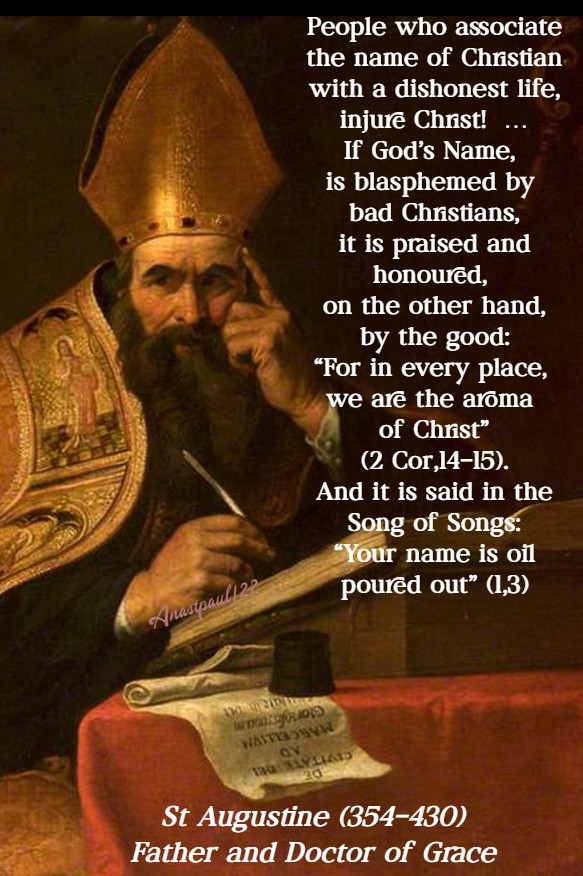
“People who associate the name of Christian with a dishonest life, injure Christ! … If God’s Name, is blasphemed by bad Christians, it is praised and honoured, on the other hand, by the good: “For in every place, we are the aroma of Christ” (2 Cor,14-15). And it is said in the Song of Songs: “Your name is oil poured out” (1,3).”
One Minute Reflection – 11 April – Monday of Holy Week – Isaias 50:5-10, John 12:1-9
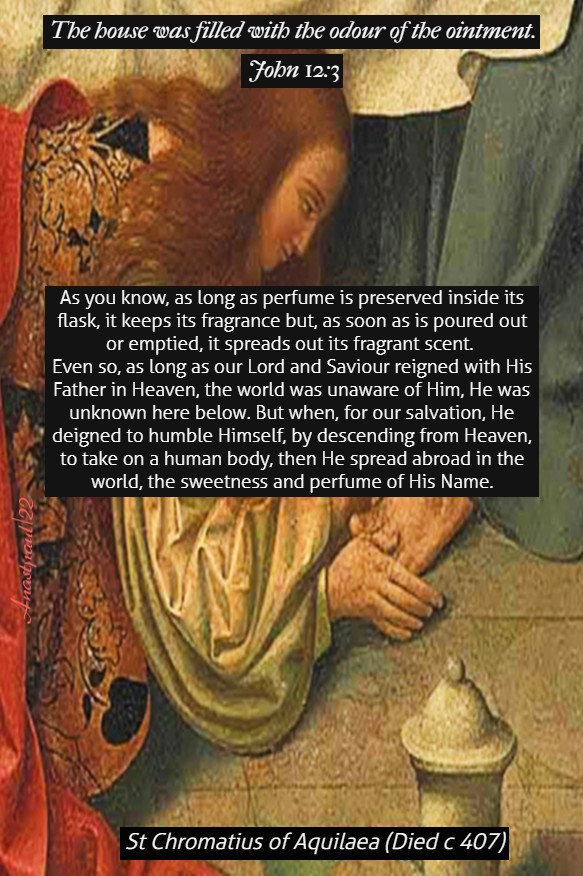
“The house was filled with the odour of the ointment.” – John 12:3
REFLECTION – “When she had anointed the Lord’s feet this woman did not wipe them with a cloth but with her own hair, to show Him greater honour … Like a thirsty person drinking from a fresh waterfall, this holy woman drank in grace full of delights, from the Springs of Holiness, to quench the thirst of her faith.
However, in the allegorical or mystical sense, this woman prefigured the Church, which offered the full and entire devotion of its faith to Christ …There are twelve ounces to a pound and this is the amount of perfume the Church possesses, having received the teaching of the twelve Apostles, as if it were a precious perfume. Indeed, what more precious is there than the Apostles’ teaching, which contains both faith in Christ and the glory of the Kingdom of Heaven? Furthermore, it is related that the whole house was filled with the scent of that perfume because, the whole world has been filled with the Apostles’ teaching. As it is written: “Through all the earth their voice resounds and to the ends of the world, their message” (Ps 19[18]:5).
In the Song of Songs we read the following words addressed through Solomon, to the Church: “Your name spoken is a spreading perfume” (1,2). Not without cause, is the Lord’s Name called a “spreading perfume.” As you know, as long as perfume is preserved inside its flask, it keeps its fragrance but, as soon as is poured out or emptied, it spreads out its fragrant scent. Even so, as long as our Lord and Saviour reigned with His Father in Heaven, the world was unaware of Him, He was unknown here below. But when, for our salvation, He deigned to humble Himself, by descending from Heaven, to take on a human body, then He spread abroad in the world, the sweetness and perfume of His Name.“ – St Chromatius of Aquilaea(Died c 407) – Bishop of Aquileia, Italy, Theologian, Exegete (Sermon 11).
PRAYER – Grant, we beseech thee, almighty God, that we who fail through our weakness, in so many difficulties, may be relieved through the pledging of the Passion of Thy only-begotten Son. Who lives and reigns with God the Father, in the unity of the Holy Spirit, God, world without end. Amen (Collect).
Thought for the Day – 8 April – Meditations with Antonio Cardinal Bacci (1881-1971)
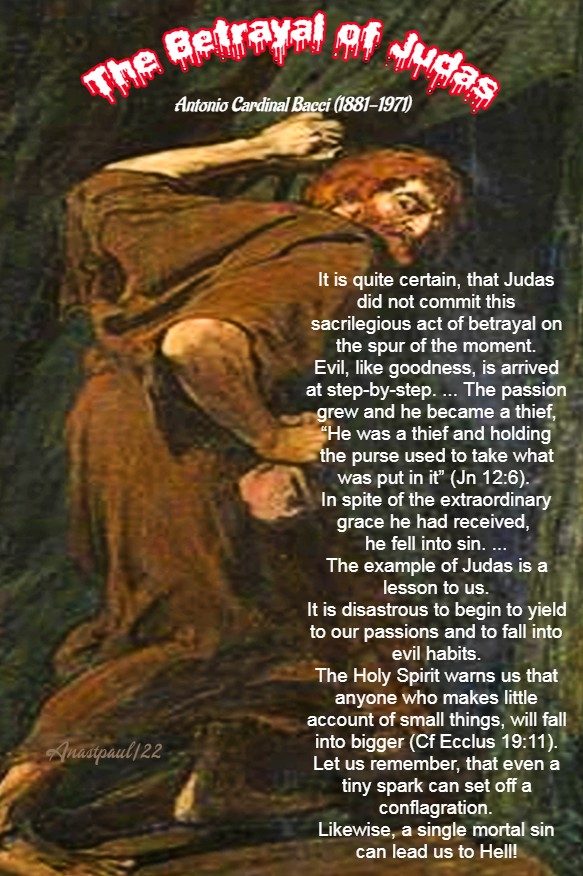
The Betrayal of Judas
“It is quite certain, that Judas did not commit this sacrilegious act of betrayal on the spur of the moment. Evil, like goodness, is arrived at step-by-step. Perhaps it was some motive of self-interest, rather than of pure love, which led Judas to become one of Jesus; Apostles. Covetousness, “the root of all evils,” (Cf 1 Tim 6:10) seems to have been his dominant passion. As the Gospel tells us, he kep the money offerings which those who had been converted, gave to Jesus for His support and for that of His Apostles. Judas did not know how to suppress his dominant passion at times. On one occasion, he complained about Mary Magdalen, when she anointed the feet of Jesus with precious ointment. The passion grew and he became a thief, “He was a thief and holding the purse used to take what was put in it” (Jn 12:6). In spite of the extraordinary grace he had received, he fell into sin. Finally, he was guilty of the betrayal, of the sacrilegious communion at the last supper and of the kiss of hypocrisy in Gethsemane.
The example of Judas is a lesson to us. It is disastrous to begin to yield to our passions and to fall into evil habits. The Holy Spirit warns us that anyone who makes little account of small things, will fall into bigger (Cf Ecclus 19:11). Let us remember, that even a tiny spark can set off a conflagration. Likewise, a single mortal sin can lead us to Hell!”
Thought for the Day – 7 April – Meditations with Antonio Cardinal Bacci (1881-1971)
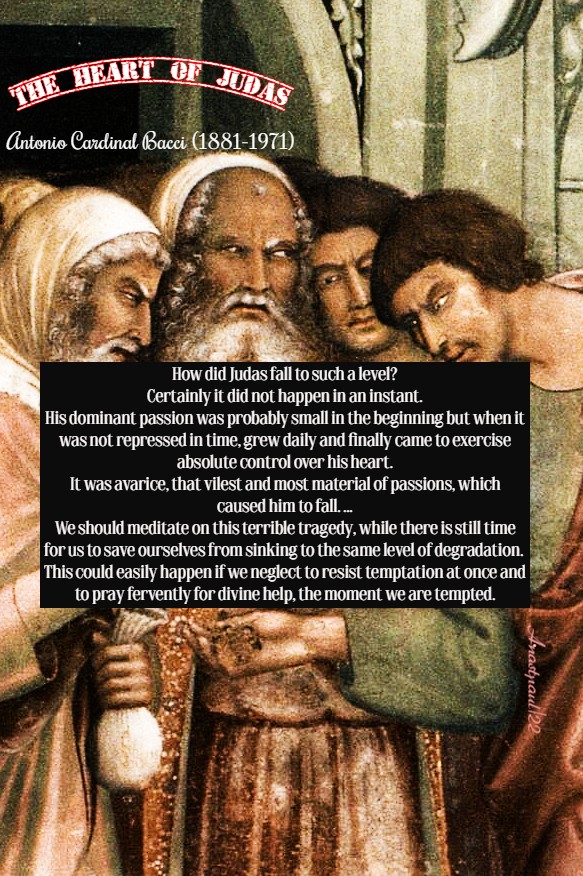
The Heart of Judas
“How did Judas fall to such a level? Certainly it did not happen in an instant. His dominant passion was probably small in the beginning but when it was not repressed in time, grew daily and finally came to exercise absolute control over his heart. It was avarice, that vilest and most material of passions, which caused him to fall.
Judas had been appointed bursar and administrator of the small offering which the faithful made to the Apostles. He became attached to this money and may have begun to steal small sums which grew bigger with time until greed prompted him to sell Jesus for thirty miserable pieces of silver. He carried out his plan at the very moment when Jesus bestowed on him the highest dignity.
We should meditate on this terrible tragedy, while there is still time for us to save ourselves from sinking to the same level of degradation. This could easily happen if we neglect to resist temptation at once and to pray fervently for divine help, the moment we are tempted.”
Wednesday of the Second Week of Lent – 16 March – Our Lenten Journey with the Great Fathers – Esther 13:8-11; 15-17, Matthew 20:17-28
“Forsake me not, O Lord, my God, be not far from me! Hasten to help me, O Lord, my salvation!” – Psalm 37:22-23
“Then the mother of the sons of Zebedee came to Him with her sons …”
Matthew 20:29
“THE SONS OF ZEBEDEE press Christ: ‘Promise that one may sit at Your right side and the other at Your left.’ What does He do? He wants to show them that it is not a spiritual gift for which they are asking and that, if they knew what their request involved, they would never dare make it. So He says: ‘You do not know what you are asking,’ that is, what a great and splendid thing it is and how much beyond the reach even of the heavenly powers. Then He continues: ‘Can you drink the cup which I must drink and be baptised with the baptism which I must undergo?’ He is saying: “You talk of sharing honours and rewards with me but I must talk of struggle and toil.Now is not the time for rewards or the time for my glory to be revealed. Earthly life is the time for bloodshed, war and danger.”
CONSIDER HOW by His manner of questioning He exhorts and draws them. He does not say: “Can you face being slaughtered? Can you shed your blood?” How does He put His question? Can you drink the cup? Then He makes it attractive by adding: which I must drink, so that the prospect of sharing it with Him may make them more eager. He also calls His suffering, a baptism, to show that it will effect a great cleansing of the entire world. The disciples answer him: We can! Fervour makes them answer promptly, though they really do not know what they are saying but still think they will receive what they ask for.
HOW DOES CHRIST REPLY? You will indeed drink My cup and be baptised with My baptism. He is really prophesying a great blessing for them, since He is telling them: You will be found worthy of Martyrdom; you will suffer what I suffer and end your life with a violent death, thus sharing all with Me. But seats at My right and left are not Mine to give; they belong to those for whom the Father has prepared them. Thus, after lifting their minds to higher goals and preparing them to meet and overcome all that will make them desolate, He sets them straight on their request.
THEN THE OTHER TEN became angry at the two brothers. See how imperfect they all are: the two who tried to get ahead of the other ten and the ten, who were jealous of the two! But, as I said before, show them to me at a later date in their lives and you will see,that all these impulses and feelings have disappeared. Read how John, the very man who here asks for the first place, will always yield to Peter when it comes to preaching and performing miracles in the Acts of the Apostles. James, for his part, was not to live very much longer; for from the beginning, he was inspired by great fervour and, setting aside all purely human goals, rose to such splendid heights that he straightway suffered Martyrdom.” – St John Chrysostom (347-407) Archbishop of Constantinople, Great Father and Doctor of the Church – An excerpt from Sermon 65 (On Matthew)
Quote/s of the Day – 24 February – Feast of St Matthias, Apostle and Martyr – Acts 1:15-26, Matthew 11:25-30
“You did not choose me but I chose you and appointed you that you should go and bear fruit and that your fruit should abide”
John 15:16
“They spoke with such confidence because someone had to be appointed. They did not say “choose” but “make known to us” the chosen one; “the one you choose,” they said, fully aware, that everything was being preordained by God.”
One Minute Reflection – 24 February – Feast of St Matthias, Apostle and Martyr – Acts 1:15-26, Matthew 11:25-30
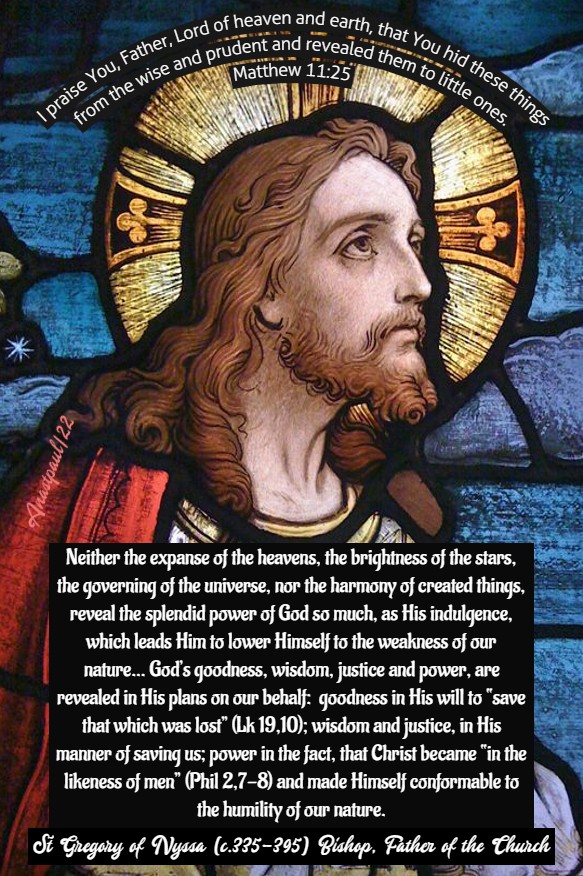
“I praise You, Father, Lord of heaven and earth, that You hid these things from the wise and prudent and revealed them to little ones.” – Matthew 11:25
REFLECTION – “The fact that the all-powerful God has been able to humble Himself even to the humility of the human condition, constitutes a greater proof than the impact and supernatural character of miracles. Indeed, when Divine power effects something of great sublimity, this is, after a fashion, in conformity with and appropriate to God’s nature… On the other hand, that God descended even to our lowliness is, in a certain way, the expression of an overwhelming power which, is not in the least restrained, by what is contrary to its nature…
Neither the expanse of the heavens, the brightness of the stars, the governing of the universe, nor the harmony of created things, reveal the splendid power of God so much, as His indulgence, which leads Him to lower Himself to the weakness of our nature… God’s goodness, wisdom, justice and power, are revealed in His plans on our behalf: goodness in His will to “save that which was lost” (Lk 19,10); wisdom and justice, in His manner of saving us; power in the fact, that Christ became “in the likeness of men” (Phil 2,7-8) and made Himself conformable to the humility of our nature.” – St Gregory of Nyssa (c.335-395) Bishop, Father of the Church (Catechetical Discourse 23-26 ; SC 453).
PRAYER – God, Who added blessed Matthias to the company of Your Apostles, grant, we beseech You, that by his intercession, we may ever be aware of the depth of Your love for us. Through Jesus Christ, Thy Son our Lord, Who lives and reigns with Thee, in the unity of the Holy Ghost, God, world without end. Amen (Collect).
Our Morning Offering – 24 February – Feast of St Matthias, Apostle and Martyr
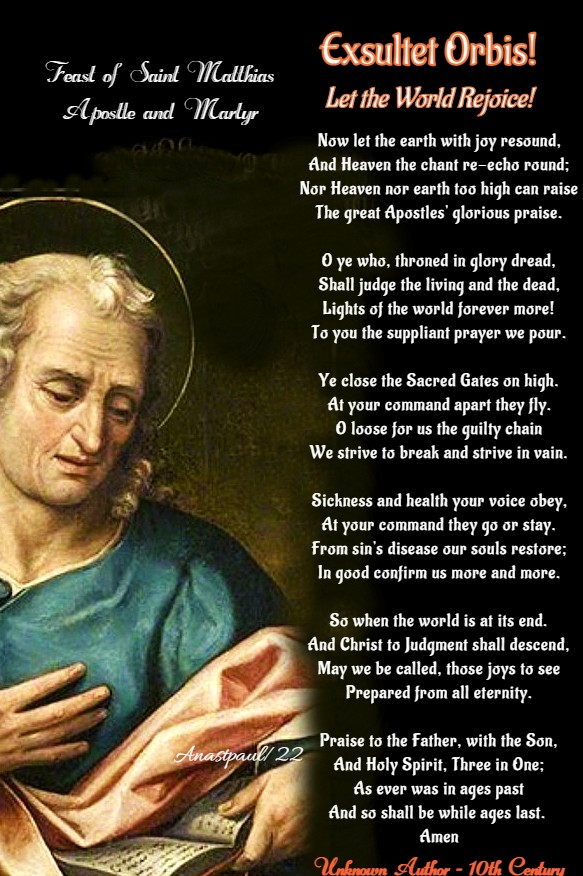
Exsultet Orbis! Let the World Rejoice! Unknown Author
Now let the earth with joy resound, And Heaven the chant re-echo round; Nor Heaven nor earth too high can raise The great Apostles’ glorious praise.
O ye who, throned in glory dread, Shall judge the living and the dead, Lights of the world forever more! To you the suppliant prayer we pour.
Ye close the Sacred Gates on high. At your command apart they fly. O loose for us the guilty chain We strive to break and strive in vain.
Sickness and health your voice obey, At your command they go or stay. From sin’s disease our souls restore; In good confirm us more and more.
So when the world is at its end. And Christ to Judgment shall descend, May we be called, those joys to see Prepared from all eternity.
Praise to the Father, with the Son, And Holy Spirit, Three in One; As ever was in ages past And so shall be while ages last. Amen
(Roman Breviary for the Common of Apostles) An Office Hymn that was traditionally prescribed for Vespers and Lauds on the Feasts of Apostles and Evangelists outside Easter time. The Hymn is found as early as the tenth century in a hymnal of Moissac Abbey.
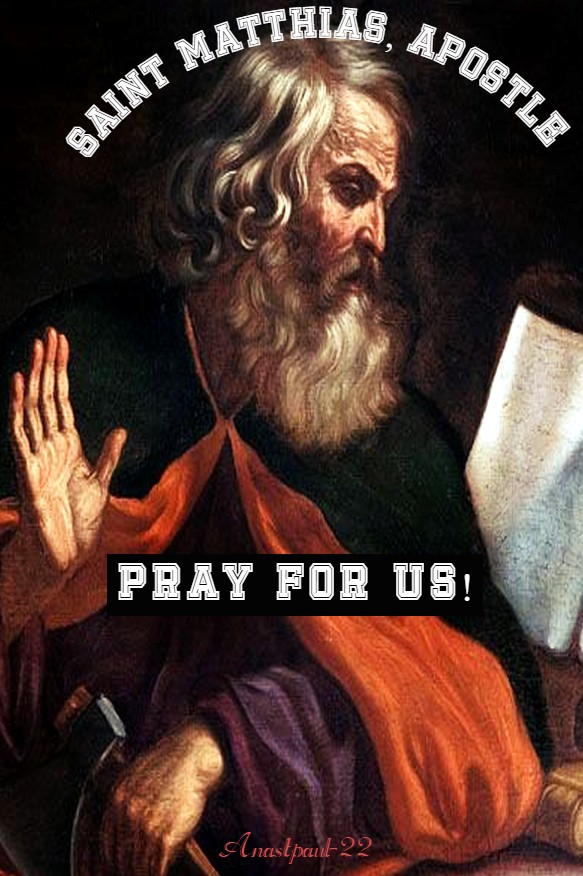
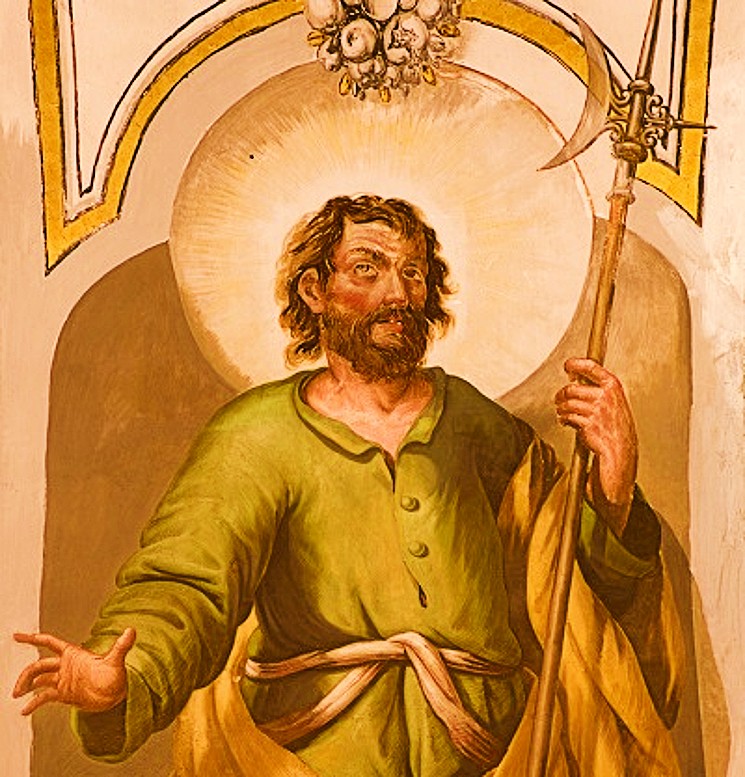
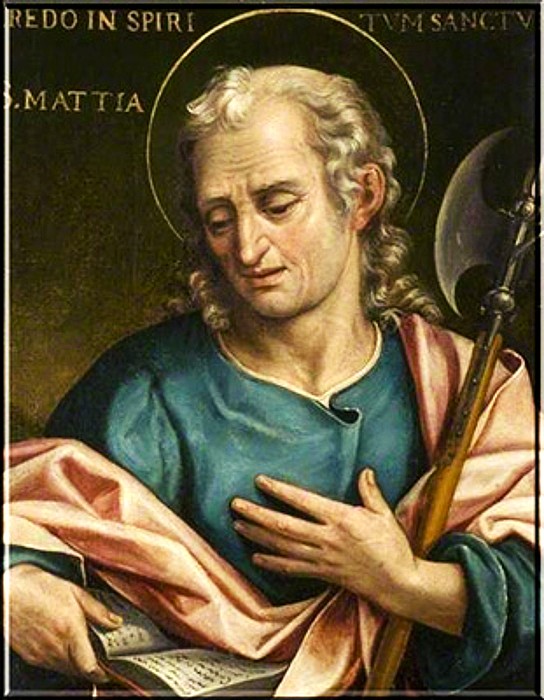
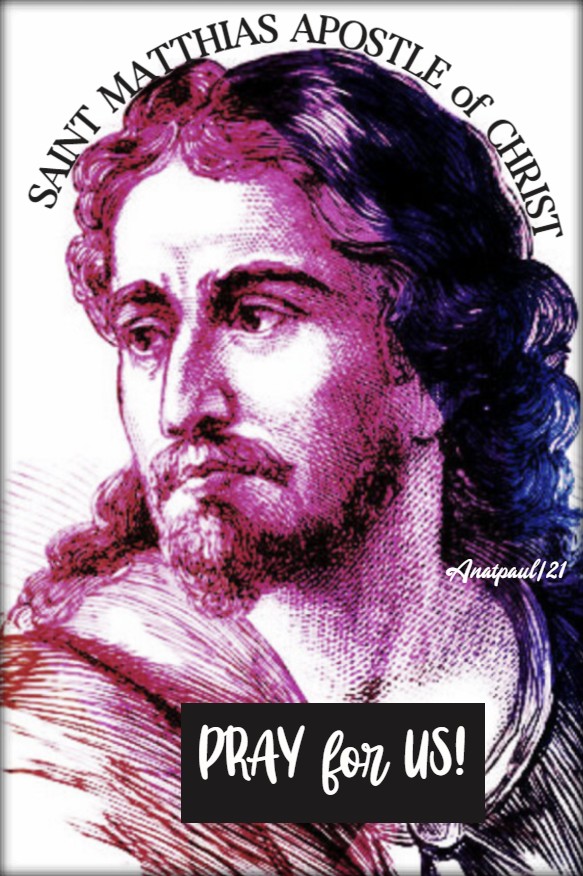
Saint of the Day – 24 February – St Matthias Apostle of Christ, Martyr.
St Mattias, born in Bethlehem of Juda, was at the commencement of Christ’s preaching, numbered by Him, among the seventy-two disciples and everywhere accompanied our Saviour and witnessed all His miracles and His Resurrection.
After Christ’s Ascension, Matthias was chosen Apostle in place of the traitor Judas, as is detailed in the Epistle of this day and, after the descent of the Holy Ghost, announced the Gospel, first to his own people, the Jews and then, in Cappadocia and the neighbourhood of the Caspian Sea.
Having preached the doctrine of salvation in many countries, especially urging, as St Clement of Alexandria relates, abstinence from Carnal pleasures, he was stoned by the Jews in Galilee, who wished not to hear his sermons and was finally beheaded by the Roman soldiers about the year 63. (Father Leonard Goffine, 1880).
Acts 1:15-26
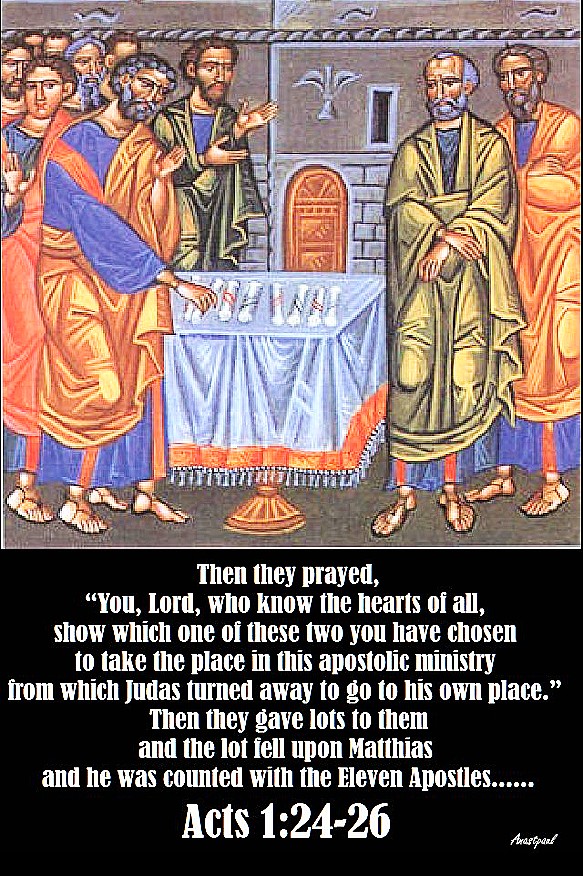
In those days, Peter stood up in the midst of the brethren – now the number of persons met together, was about a hundred and twenty – and he said, Brethren, the Scripture must be fulfilled which the Holy Spirit declared before, by the mouth of David, concerning Judas, who was the guide of those who arrested Jesus; inasmuch as he had been numbered among us and was allotted his share in this ministry. And he indeed bought a field with the price of his iniquity and, being hanged, burst asunder in the midst and all his bowels gushed out. And it became known to all the residents of Jerusalem, so that the field came to be called, in their language, Haceldama, that is, the Field of Blood. For it is written in the book of Psalms, ‘Let their habitation become desolate and let there be none to dwell in it.’ And, ‘His ministry let another take.’ Therefore, of these men who have been in our company all the time that the Lord Jesus moved among us, from John’s baptism until the day that He was taken up from us, of these one must become a witness with us of His Resurrection.” And they put forward two: Joseph, called Barsabbas, who was surnamed Justus and Matthias.
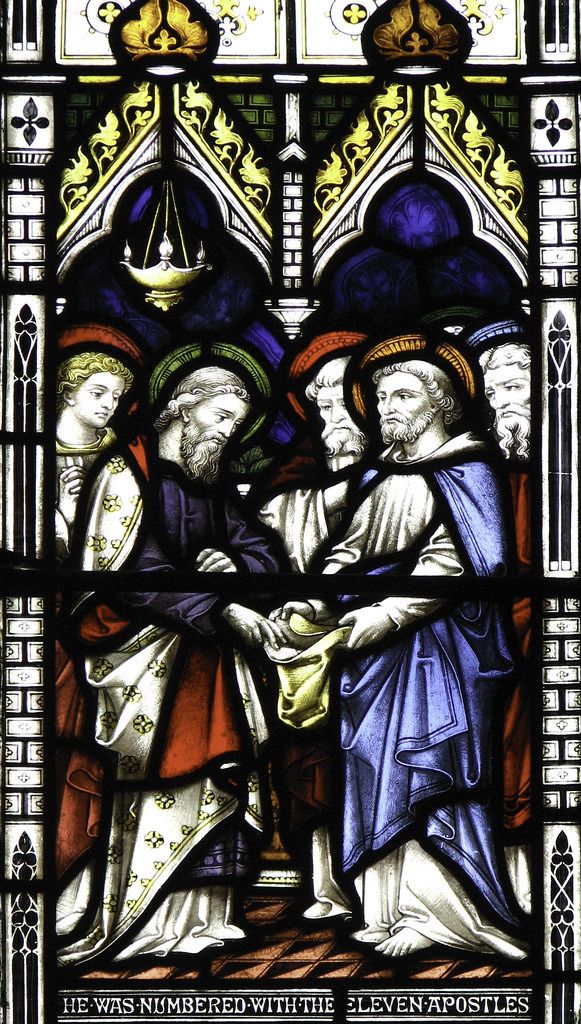
The Election of St Matthias
And they prayed and said, You, Lord, Who know the hearts of all, show which of these two You have chosen to take the place in this ministry and apostleship, from which Judas fell away to go to his own place. And they drew lots between them and the lot fell upon Matthias and he was numbered with the eleven apostles.
O God, Who didst choose Thy blessed servant Matthias to be of the number of the twelve Apostles, grant, we beseech Thee, that Thy Church, being upholden by his prayers, may ever feel about her, the arms of Thy most mighty Protection. Through our Lord Jesus Christ Thy Son, Who lives and reigns with Thee in the unity of the Holy Ghost, one God, world without end. Amen.
St Adela of Blois Bl Antonio Taglia Bl Arnold of Carcassonne St Betto of Auxerre Bl Berta of Busano
Blessed Constantius of Fabriano OP (1401-1481) Priest and Friar of the Order of Preachers, Prior, Reformer, Preacher of renown, Writer, known as a Miracle-Worker and had the gift of prophecy, peacemaker Biography: https://anastpaul.com/2019/02/24/saint-of-the-day-24-february-blessed-constantius-of-fabriano-op-1401-1481/
Bl Ida of Hohenfels Bl Josefa Naval Girbes St Liudhard Bl Lotario Arnari Bl Marco De’ Marconi St Modestus of Trier St Peter the Librarian St Praetextatus of Rouen St Primitiva St Sergius of Caesarea Bl Simon of Saint Bertin
One Minute Reflection – 9 February – The Memorial of St Cyril of Alexandria (376-444) Bishop, Confessor, Father and Doctor of the Church – 2 Timothy 4:1-8, Matthew 5,13-19.
Jesus said to His disciples: “You are the salt of the earth. … You are the light of the world.” – Matthew 5:13, 14
REFLECTION – “You are the salt of the earth. It is not for your own sake, He says but for the world’s sake that the word is entrusted to you. I am not sending you into two cities only or ten or twenty, not to a single nation, as I sent the prophets of old but across land and sea, to the whole world. And that world is in a miserable state. For when He says: You are the salt of the earth, He is indicating, that all mankind had lost its savour and had been corrupted by sin. Therefore, He requires of these men, those virtues which are especially useful and even necessary, if they are to bear the burdens of many. For the man who is kindly, modest, merciful and just will not keep his good works to himself but will see to it, that these admirable fountains send out their streams, for the good of others. Again, the man who is clean of heart, a peacemaker and ardent for truth, will order his life so as to contribute to the common good. …
Then He passes onto a more exalted comparison – You are the light of the world. Once again, “of the world,” not of one nation or twenty cities but of the whole world. The light He means, is an intelligible light, far superior to the rays of the sun we see, just as the salt is a spiritual salt. First salt, then light, so that you may learn how profitable sharp words may be and how useful, serious doctrine. Such teaching holds in check and prevents, dissipation, it leads to virtue and sharpens the mind’s eye. A city set on a hill cannot be hidden, nor do men light a lamp and put it under a basket. Here again, He is urging them to a careful manner of life and teaching them, to be watchful, for they live under the eyes of all and have the whole world for the arena of their struggles.” – St John Chrysostom (347-407) Archbishop of Constantinople, Father and Doctor of the Church (An excerpt from his Homily on Matthew).
PRAYER – King of heaven and earth, Lord God, rule over our hearts and bodies this day. Sanctify us and guide our every thought, word and deed according to the commandments of Your law, so that now and forever, Your grace may free and save us. Teach us Lord to walk in the ways of the Cross of Your Son, our Saviour, longing for and rejoicing always in our heavenly home as St Cyril of Alexandria so lovingly and willingly inspires us to do. Through Christ our Lord, with the Holy Spirit, God, forever, amen.
One Minute Reflection – 25 January – Feast of the Conversion of St Paul , Apostle, Acts 9:1-22, Matthew 19,27-29.
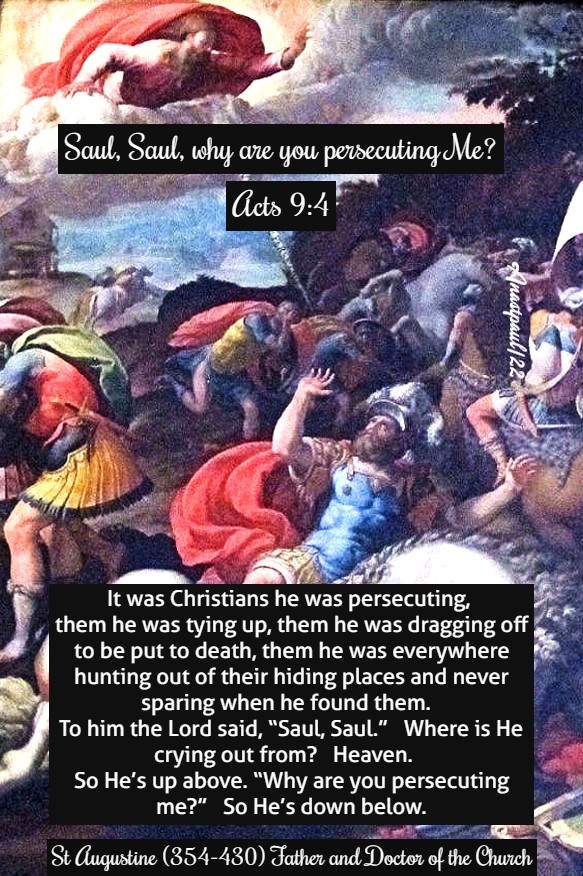
“He fell to the ground and heard a voice saying to him, “Saul, Saul, why are you persecuting Me?” – Acts 9:4.
REFLECTION – “How can we show that He is there and that He is also here? Let Paul answer for us, who was previously Saul. First of all, the Lord’s own Voice from Heaven shows this: “Saul, Saul, why are you persecuting me?” Had Paul climbed up to Heaven then? Had Paul even thrown a stone at Heaven? It was Christians he was persecuting, them he was tying up, them he was dragging off to be put to death, them he was everywhere hunting out of their hiding places and never sparing when he found them. To him the Lord said, “Saul, Saul.” Where is He crying out from? Heaven. So He’s up above. “Why are you persecuting Me?” So He’s down below.” – St Augustine (354-430) Bishop of Hippo, Father and Doctor of the Church (Sermon 122).
PRAYER – Today Lord, we celebrate the conversion of St Paul, Your chosen vessel for carrying Your Name to the whole world. Help us to make our way towards You by following in his footsteps and by being Your disciples before the men and women of our day. Grant that by the prayers of St Paul, we too may say, “Yet I live, no longer I but Christ lives in me; insofar as I now live in the flesh, I live by faith in the Son of God Who has loved me and given himself up for me.” (Galatians 2:20) Through Jesus Christ, our Lord, in union with the Holy Spirit, one God forever and ever, amen.
Our Morning Offering – 24 January – Feast of Saint Timothy, Bishop and Martyr
O Fathers of Our Ancient Faith
O Fathers of our ancient faith, With all the heav’n, we sing your fame Whose sound went forth in all the earth To tell of Christ and bless His Name.
You took the Gospel to the poor, The Word of God alight in you, Which in our day is told again, That timeless Word, forever new.
You told of God, Who died for us And out of death triumphant rose, Who gave the Truth which made us free and changeless through the ages goes.
Praise Father, Son and Holy Spirit, Whose gift is faith that never dies, A light in darkness now, until The Day-Star in our hearts arise.
O Fathers of Our Ancient Faith is written by the Benedictine Nuns of Stanbrook Abbey. In the Divine Office it is sung at Morning Prayer in the Common of Apostles. It is set to the anonymous tune associated with the 7th century Latin hymn, Creator Alme Siderum.
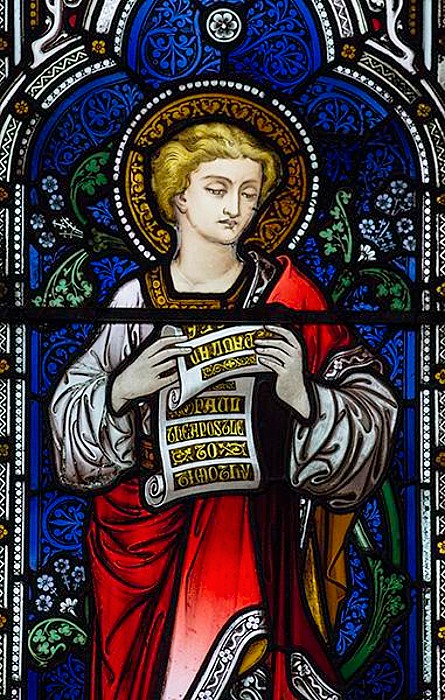
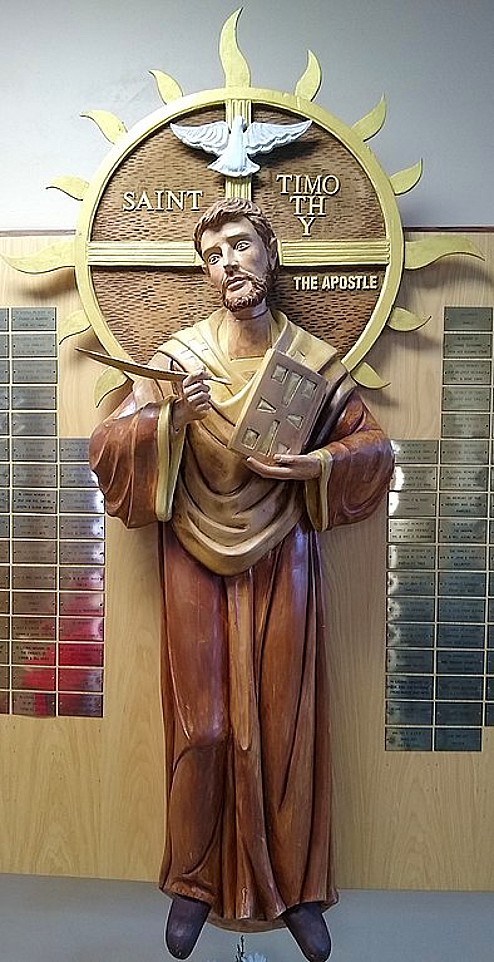
Saint of the Day – 24 January – Saint Timothy (Died c 97) Disciple of St Paul, Bishop of Ephesus and Martyr, Confessor, Missionary. Died by being stoned to death in c 97. Patronages – against intestinal disorders; of Termoli, Italy. Also known as – Timotheus. Additional Memorials – 26 January (Novus Ordo), 23 January (Australia), 27 January (Norway).
The Roman Martyrology states of St Timothy today: “The birthday of St Timothy, disciple of the Apostle, St Paul, who consecrated him Bishop of Ephesus. After many combats for Christ, he was stoned for reprehending those who offered sacrifices to Diana and shortly after, went peacefully to rest in the Lord.”
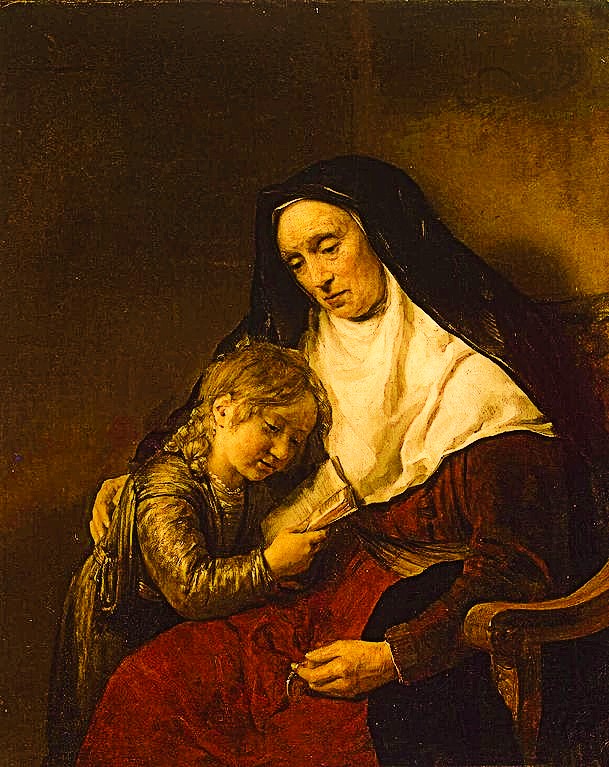
St Timothy, the beloved disciple of St Paul, was of Lycaonia and probably of the City of Lystra. His father was a Gentile but his mother, Eunice, was a Jewess. When Paul and Barnabas first visited Lystra, Paul healed a person crippled from birth, leading many of the inhabitants to accept his teaching. When he returned a few years later with Silas, Timothy was already a respected member of the Christian community as were his mother and grandmother Lois and St Paul commends their faith. Timothy had made the holy scriptures his study from his childhood. In 1 Corinthians 16:10, there is a suggestion that he was by nature reserved and quiet: “When Timothy comes, see that you put him at ease among you, for he is doing the work of the Lord.”
Rembrandt’s Timothy and his grandmother, 1648.
Timothy’s father was a Greek Gentile. Thus Timothy had not been circumcised and Paul now ensured that this was done, according to Acts 16:1-3, to enable Timothy’s acceptability to the Jews, who they would be evangelising. St Chrysostom here admires the prudence, steadiness and charity of St Paul and we may add, the voluntary obedience of our disciple, Timothy.
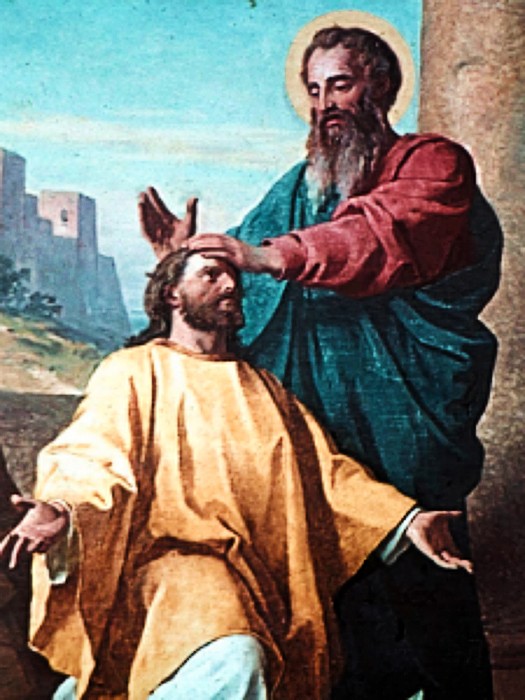
After he was circumcised, St Paul, by the imposition of hands, committed to him the ministry of preaching, his rare virtue making ample amends for his want of age. From that time the Apostle regarded him not only as his disciple and most dear son but as his brother and the companion of his labours. He calls him a man of God and tells the Philippians, that he found no-one so truly united to him in heart and sentiments, as Timothy.
Timothy became St Paul’s disciple and later his constant companion and co-worker in preaching.[18] In the year 52, Paul and Silas took Timothy along with them on their journey to Macedonia. Augustine extols his zeal and disinterestedness in immediately forsaking his country, his house, and his parents, to follow the apostle, to share in his poverty and sufferings.
Timothy may have been subject to ill health or “frequent ailments” and Paul encouraged him to “use a little wine for your stomach’s sake,” hence his patronage of stomach ailments,”
When Paul went on to Athens, Silas and Timothy stayed for some time at Beroea and Thessalonica before joining Paul at Corinth.
Timothy’s bond with Paul was close. Timothy’s name appears as the co-author on 2 Corinthians, Philippians, Colossians, 1 Thessalonians, 2 Thessalonians and Philemon. Paul wrote to the Philippians about Timothy, “I have no-one like him.”
When Paul was in prison and awaiting martyrdom, he summoned his faithful friend Timothy for a last farewell.
That Timothy was jailed at least once during the period of the writing of the New Testament is implied by St Paul in Hebrews when he mentions Timothy’s release at the end of the epistle.
Although not stated in the Scriptures other sources have records of the Apostle’s death. The apocryphal Acts of Timothy (5th Century) states that in the year 97, the 80-year-old Bishop tried to halt a procession in honour of the goddess Diana by preaching the Gospel. The angry pagans beat him, dragged him through the streets and stoned him to death.
From the 13th century until 1969 the feast of Timothy (alone, that is without St Titus whose feast day is 6 February) is today, 24 January, the day before that of the Conversion of Saint Paul.
In the 4th century, the relics of Timothy were transferred from Ephesus to Constantinople and placed in the Church of the Holy Apostles near the tombs of Saints Andrew and Luke. In the 13th century, the relics seem to have been taken to Italy by a count returning from the crusades and buried, around 1239, in the Termoli Cathedral. The remains were re-discovered in 1945, during restoration works.
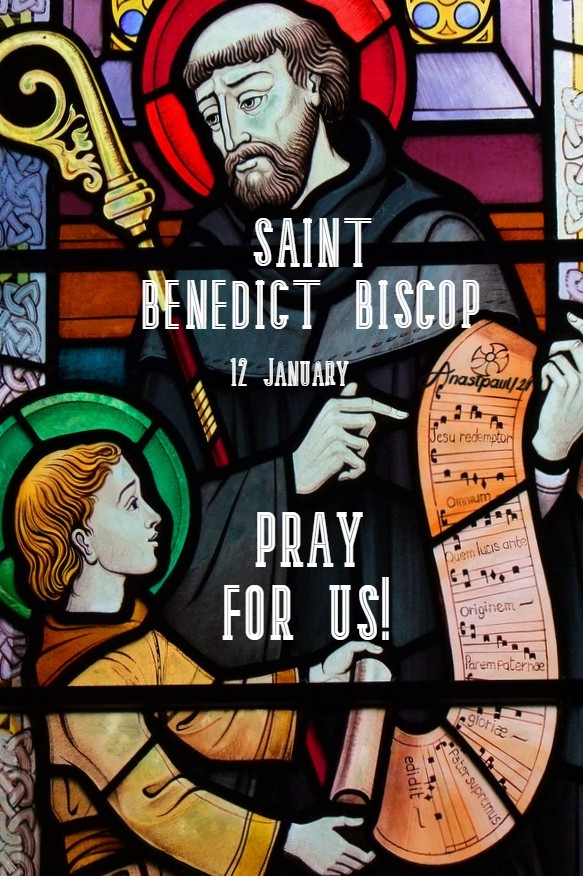
One Minute Reflection – 12 January – Seventh day in the Octave of Epiphany, Readings: Romans 12:1-5; Luke 2:42-52 and the Memorial of St Benedict Biscop OSB (c 628-690)
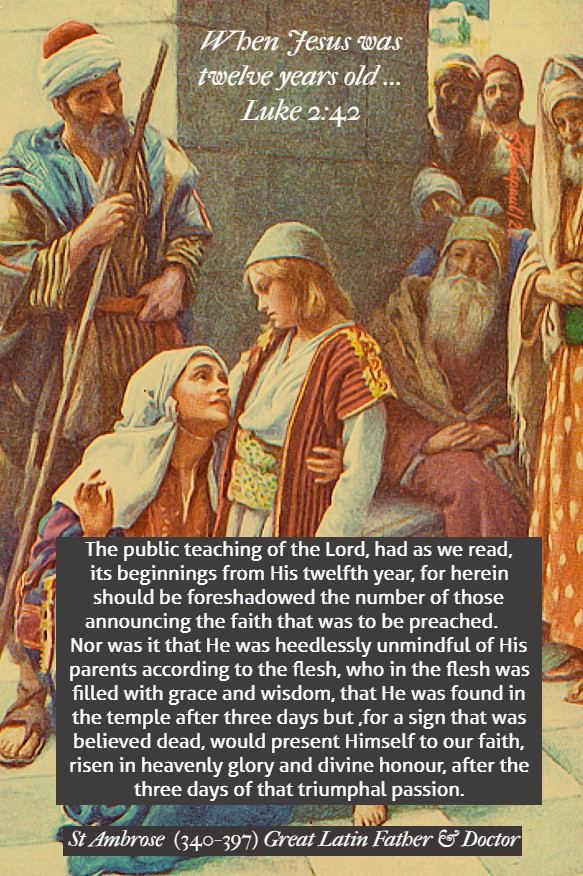
“When Jesus was twelve years old …” – Luke 2:42
REFLECTION – “The public teaching of the Lord, had as we read, its beginnings from His twelfth year, for herein should be foreshadowed the number of those announcing the faith that was to be preached. Nor was it that He was heedlessly unmindful of His parents according to the flesh, who in the flesh was filled with grace and wisdom, that He was found in the temple after three days but ,for a sign that was believed dead, would present Himself to our faith, risen in heavenly glory and divine honour, after the three days of that triumphal passion.
“How is it that you sought me. Did you not know that I must be about my Father’s business.” (Lk 2:49) There are two generations in Christ: the one is Paternal, the other Maternal; that which is Paternal is more Divine, the Maternal, that whereby He has stooped to our need and benefit. And, therefore, what was accomplished in the manner above nature, above age, above what was usual, must not be ascribed to His human excellence but must be referred to the power of His Divinity. Elsewhere, His Mother pleads with Him for a miracle, here she requires of Him a reason, since she still looks to the things that are human. But while here, He is described as being but twelve years old, there, He is spoken of as having disciples. See how the Mother has learnt to know her Son, so that she seeks a miracle from Him now, in His full strength, Who was astonished at this wonder in His Boyhood.” – St Ambrose (340-397) Great Latin Father and Doctor of the Church (Writings Octave of the Epiphany).
PRAYER – King of heaven and earth, Lord God, rule over our hearts and bodies this day. Sanctify us and guide our every thought, word and deed, according to the commandments of Your law, so that now and forever, Your grace may free and save us. Sanctify our hearts, minds and actions with Your power, that all we are, may speak of Your Light. May the prayers of the Blessed Virgin our Mother and the ever-zealous St Benedict Biscop, bring us to peace and confidence. We make our prayer through Your Son, our Lord Jesus, in union with the Holy Spirit, one God for all eternity, amen.
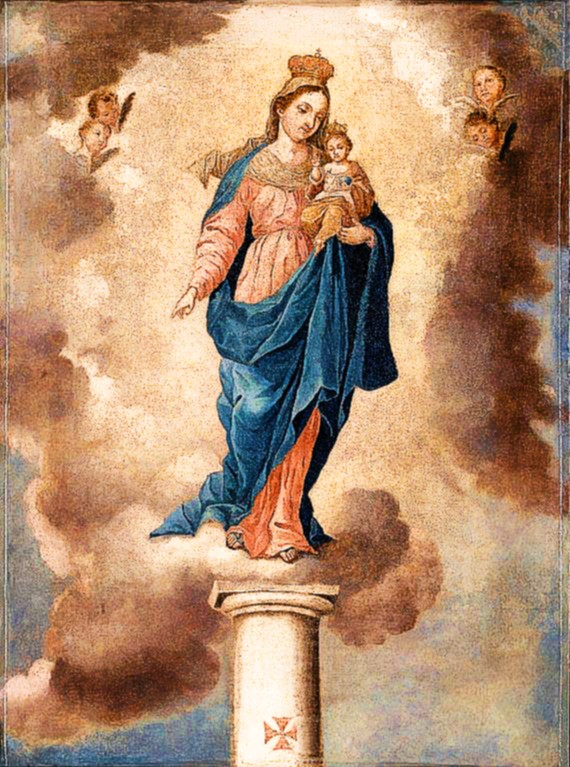
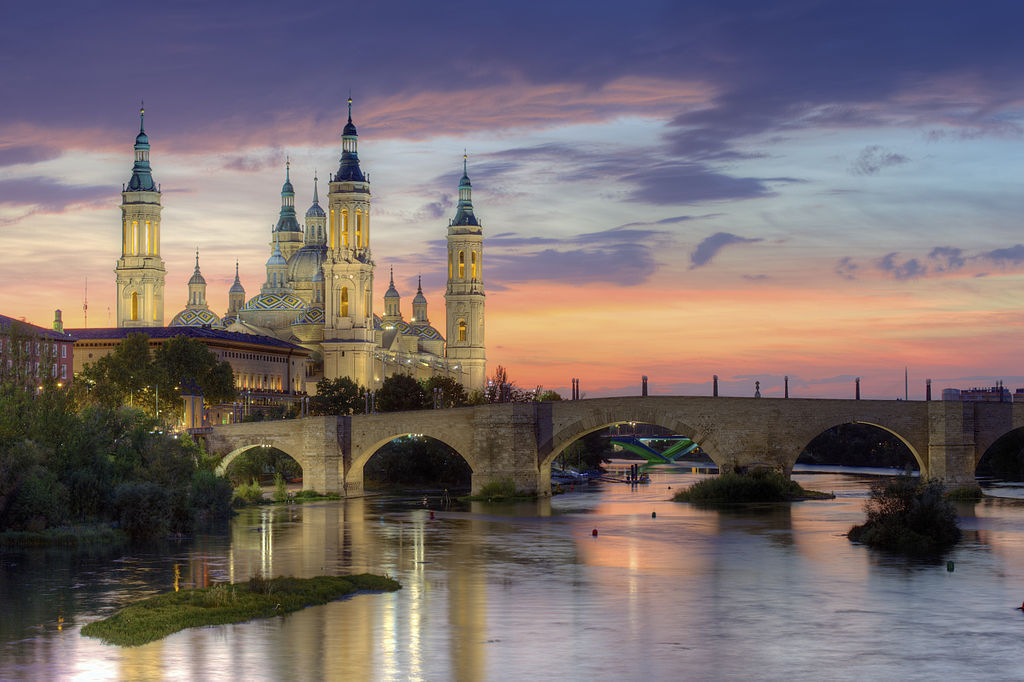
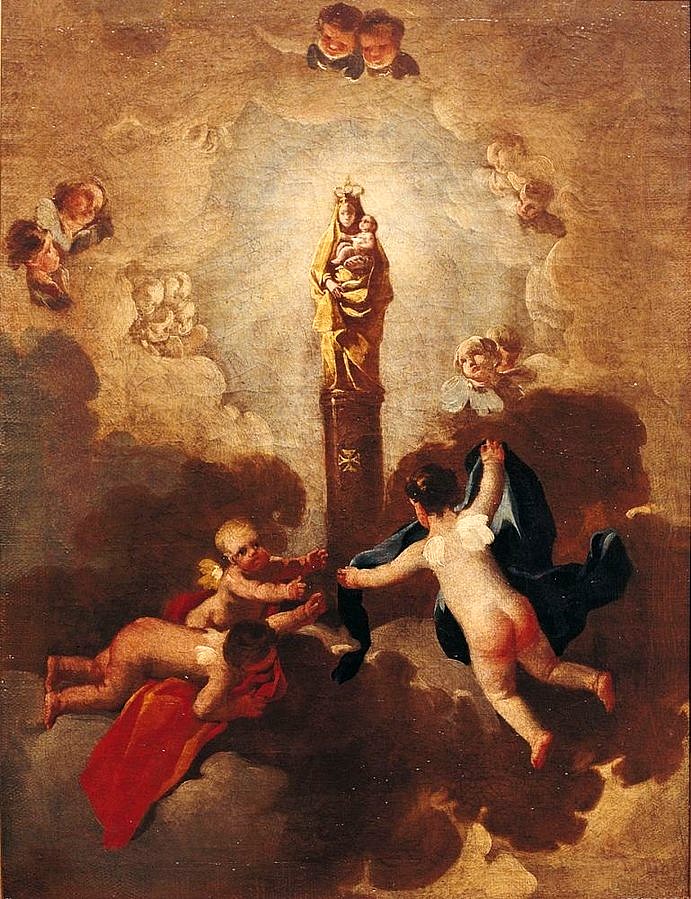
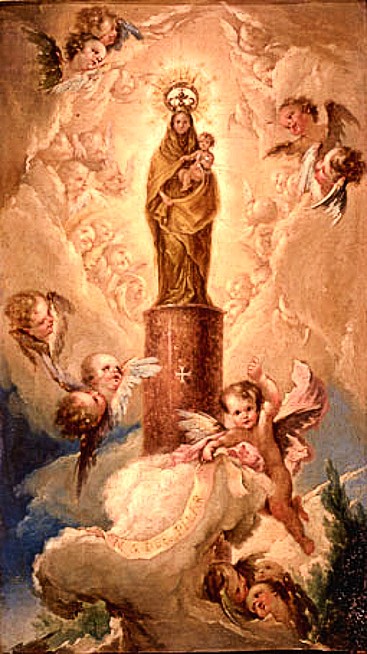
Nuestra Señora del Pilar / Our Lady of the Pillar (Zaragoza, Spain) (40) – 2 January, 12 October (originally 4 October), 15 August – (This Apparition it is considered the first Marian Apparition, and is unique because it happened while Mary was still living on Earth):
According to ancient Spanish history, on 2 January in the year 40, in the early days of Christianity, James the Greater, one of the original Twelve Apostles of Jesus Christ, was preaching the Gospel in what was then the pagan land of Caesaraugusta (now Zaragoza), in the Roman Province of Hispania.
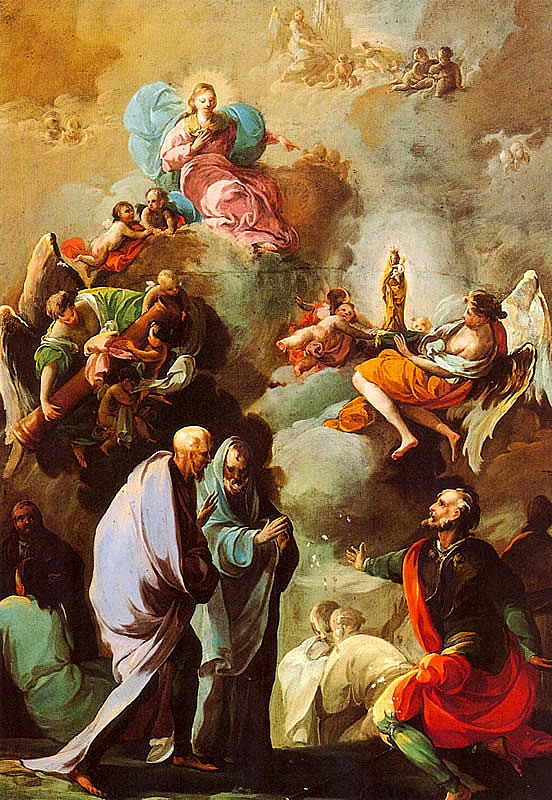
St James was disheartened with his mission, having made only a few converts. While he was praying by the banks of the Ebro River with some of his disciples, the Blessed Virgin Mary miraculously appeared before him atop a pillar accompanied by Angels. Mary assured James that the people would eventually be converted, becoming a stronghold of the Faith due to his efforts and their faith would be as strong as the pillar she was standing on. She gave him the pillar as a symbol and a wooden image of herself. James was also instructed to build a Chapel on the spot where she left the pillar which he did, making it the first Church in Spain.
Apparition of the Virgin of the Pillar to Saint James and his Saragossan disciples by Francisco Goya, c 1769.
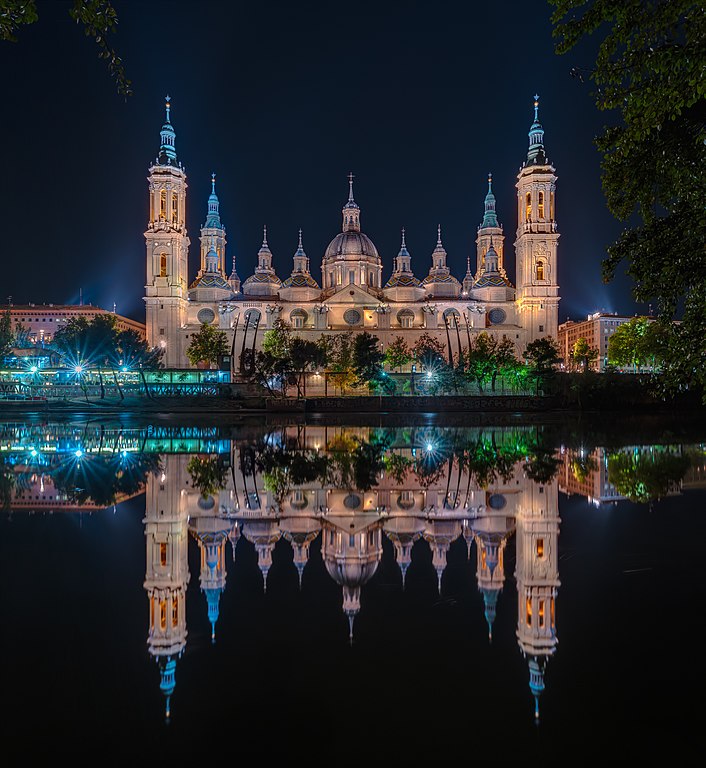
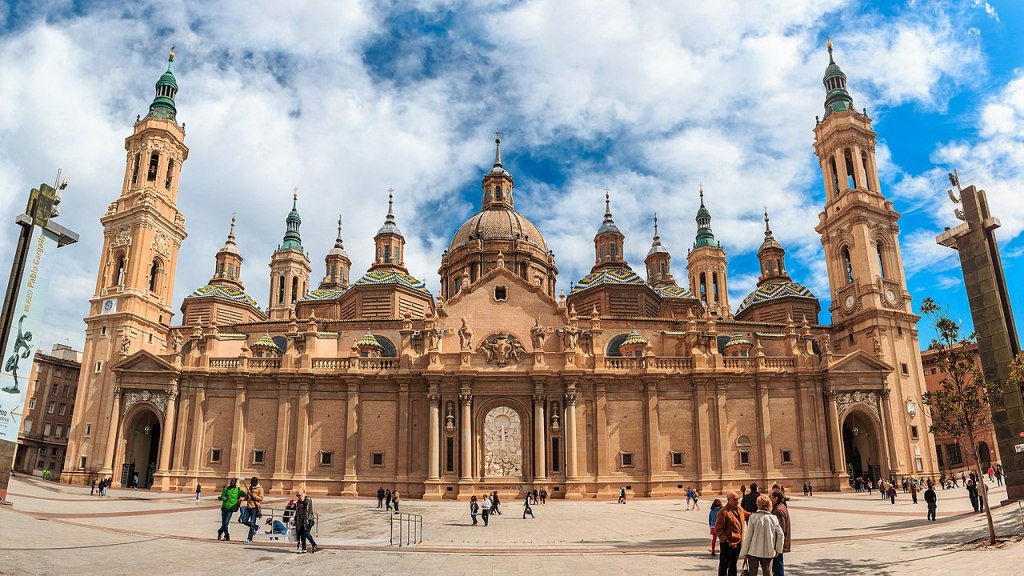
It is generally believed, that Mary appeared to James through bilocation, as she was still living, either in Ephesus or Jerusalem, at the time of this event, as she is believed to have died three to fifteen years after Jesus ascended into Heaven. After establishing the church, James returned to Jerusalem with some of his disciples where he became a Martyr, beheaded in 44 under Herod Agrippa. His disciples returned his body to Spain. The pillar left by the Virgin Mary is presently enshrined in the same but larger Basilica of Our Lady of the Pillar. It is believed to be the same pillar given and promised by Mary, in spite of numerous disasters that beset the Church. A fire in 1434 razed the Church that preceded the present Basilica Cathedral, see below.
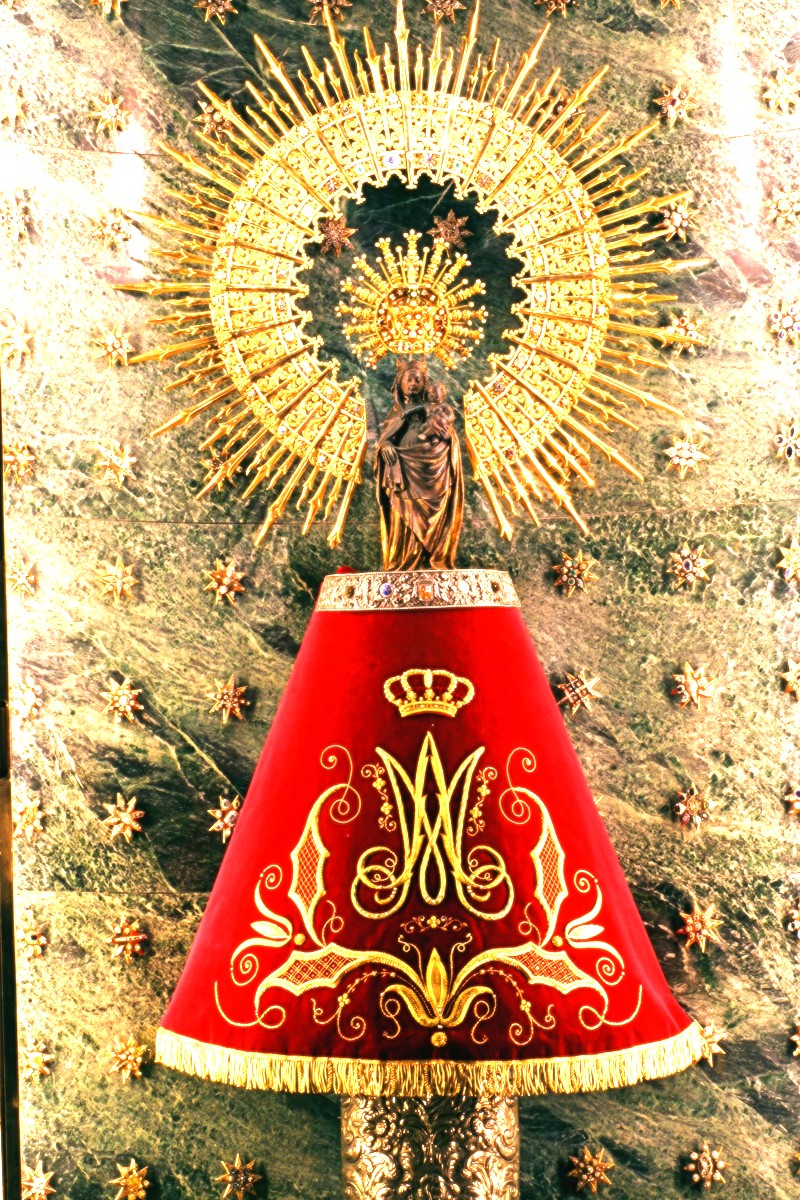
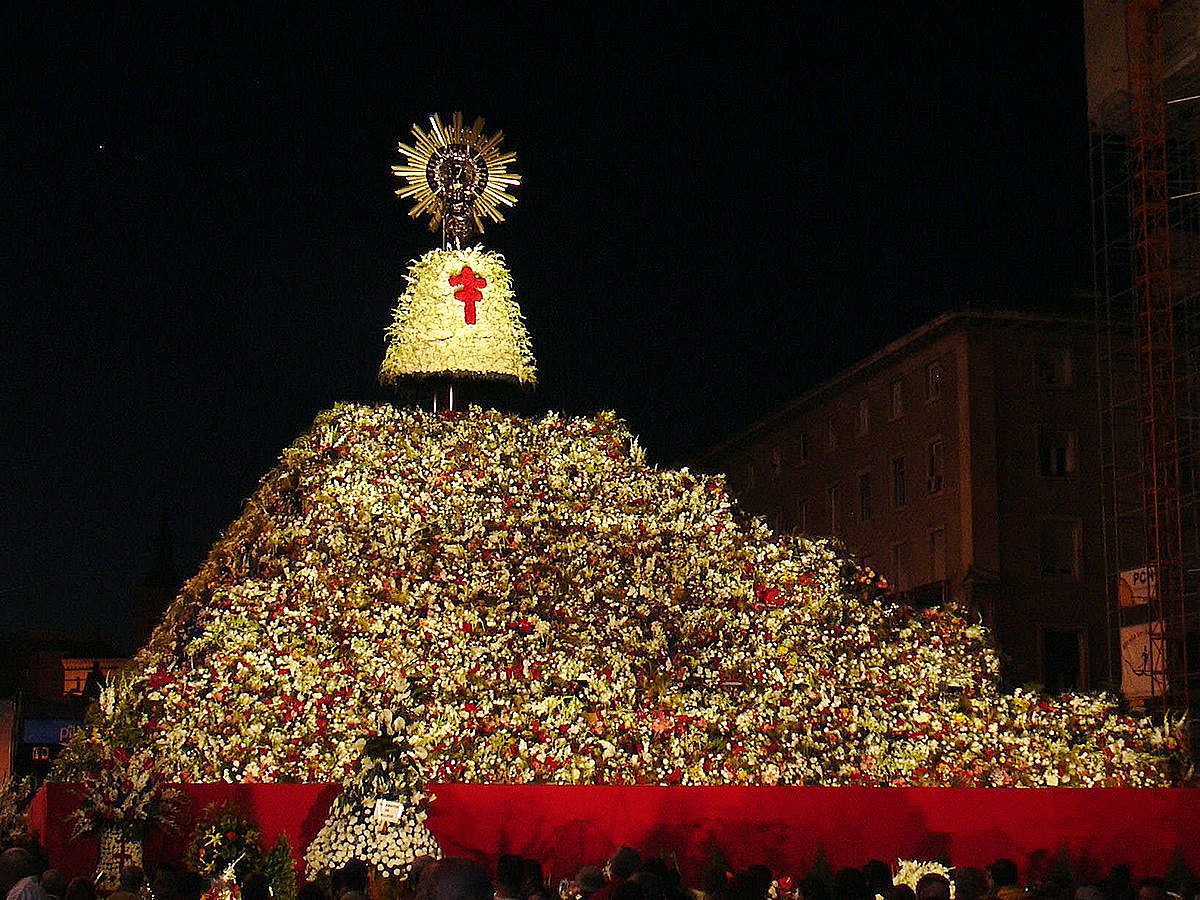
The image of the Blessed Virgin Mary may or may not be the original. Some reports state that the original wooden image was destroyed when the Church burned down in 1434, contradicting other reports, that it is still the original Statue. The Statue of the Blessed Virgin Mary is made of wood and stands 39 centimetres tall while the 1.8 m pillar is made of jasper.quartz. The Statue depicts Mother Mary with the Child Jesus on her left arm, Who has a dove sitting on His left palm. Since the 16th century, the pillar is usually draped in a skirt-like cover called manto (in English: mantle). As a whole, it is protected by a bronze case and then another case of silver. The image was canonically crowned in 1905 during the reign of Pope Pius X. The crown was designed by the Marquis of Griñi, valued at 450,000 pesetas (£18,750, in1910). During the three Marian festivities of today, 15 August and 12 October, the faithful adorn the base of the Pillar and Statue with flowers – see below (both our Blessed Mother and St James would be thrilled by this display of such immense faith and piety!)
The apparition of Our Lady of the Pillar is a widely accepted sacred tradition. Popes from earliest times issued Papal Bulls attesting to the authenticity of the Shrine and the appearance of the Virgin Mary. Pope Calixtus III issued a Bull in 1456 encouraging pilgrimage to the Lady of the Pillar. It acknowledged the miracle of its foundation and the miracles that had taken place at the Spanish Shrine. It was also through this Bull that the name “Our Lady of the Pillar” was confirmed. So many contradictions had arisen concerning the miraculous origin of the Church that during the reign of Pope Innocent XIII , the Bishops of Spain appealed to the Holy See to settle the controversy. After careful investigation, the twelve Cardinals, in whose hands the affair rested, adopted the following account, which was approved by the Sacred Congregation of Rites on 2 August 1723 and has since been inserted in the lessons of the Office of the Feast of Our Lady of the Pillar, celebrated on 12 October.
“Of all the places that Spain offers for the veneration of the devout, the most illustrious is doubtless the Sanctuary consecrated to God under the invocation of the Blessed Virgin, under the title of Our Lady of the Pillar, at Saragossa. According to ancient and pious tradition, St James the Greater, led by Providence into Spain, spent some time at Saragossa. He there received a signal favour from the Blessed Virgin. As he was praying with his disciples one night, upon the banks of the Ebro, as the same tradition informs us, the Mother of God, who still lived, appeared to him and commanded him to erect an oratory in that place. The Apostle delayed not to obey this injunction,and with the assistance of his disciples, soon constructed a small Chapel. In the course of time, a larger Church was built and dedicated, which, with the dedication of Saint Saviour’s, is kept as a festival in the City and Diocese of Saragossa on the 4th of October.“
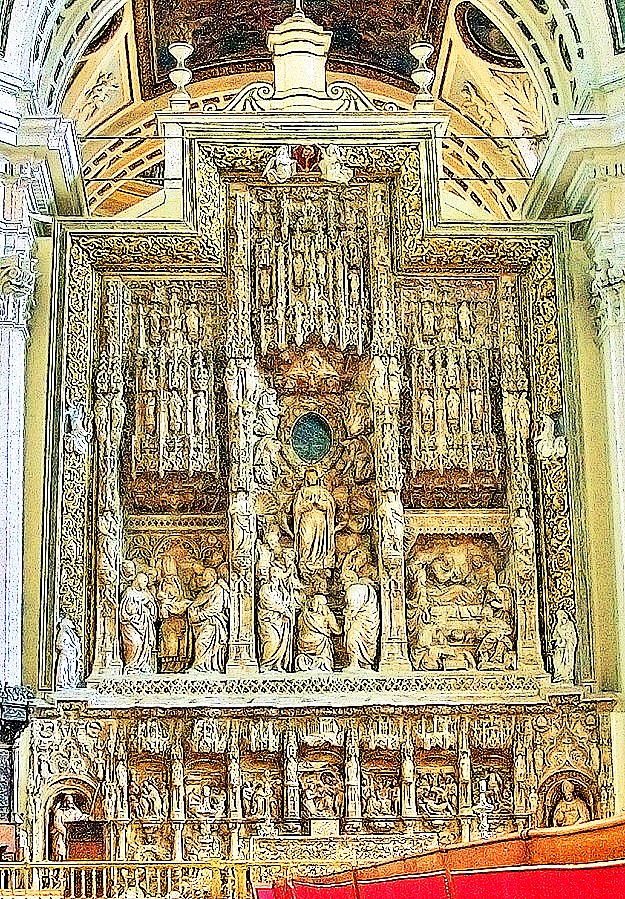
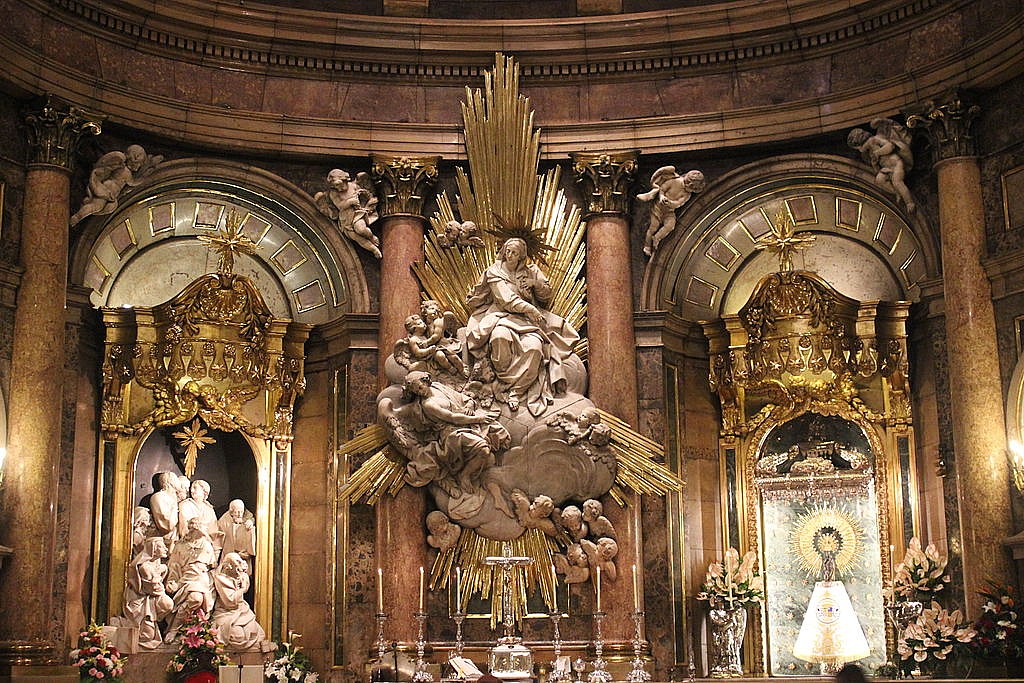
Holy Chapel of the Pillar of Zaragoza. Altar with the Arrival of the Virgin by ‘José Ramírez de Arellano.
In 1730, Pope Clement XII allowed the celebration of the Feast of Our Lady of the Pillar all over the Spanish Empire. As the date coincides with the discovery of the Americas, the Lady was later named as Patroness of the Hispanic World although her Patronages include all of the following: Zaragoza, Spain, Melo, Uruguay, Buenos Aires, Argentina, Diocese of Imus, Cavite, Zamboanga City, Santa Cruz, Manila, Alaminos, Laguna, San Simon, Pampanga, Libmanan, Camarines Sur, Pilar and Morong in Bataan, Mamburao, Occidental Mindoro, Sibonga, Cebu, Baleno, Masbate, Cauayan, Isabela.
Prayer: Hail, Mary, Our Lady of the Pillar, conceived without sin, I come to venerate and honour you. above all the Angels and Saints in Heaven, as my Queen, my Lady and my dearest Mother. I firmly resolve to serve you always and to do whatever I am able, that all may render faithful service to you. Most Holy Mary, through your kind intercession and by your own merits, obtain for me from your Divine Son Jesus, our Lord and Saviour, all the graces I need for the eternal salvation of my soul. Therefore, most devoted Mother of mothers, through the Precious Blood which your Son shed for us, I humbly beseech thee to receive me among your devotees and to accept me as your servant forever. Help me in my every thought, action word and deed, never to be displeasing in your sight and in the sight of your Son, our Lord and Redeemer. Think of me always, my dear Lady of the Pillar and do not forsake me in the hour of my death. Amen.
Bl Airaldus of Maurienne St Asclepius of Limoges St Aspasius of Auch St Blidulf of Bobbio Bl Guillaume Répin St Hortulana of Assisi St Isidore of Antioch St Isidore of Nitria St Laurent Bâtard
Saint Macarius the Younger of Alexandria (Died c 401) Priest, Monk, Desert Hermit.
St Maximus of Vienne Bl Odino of Rot St Paracodius of Vienne St Seiriol Blessed Sylvester of Troina St Telesphorus, Pope St Theodota St Theopistus St Vincentian of Tulle
Many Martyrs Who Suffered in Rome: There were many Martyrs who suffered in the persecutions of Diocletian for refusing to surrender the holy books. Though we know these atrocities occurred, we do not know the names of the Saints and we honour them as a group. c 303 in Rome, Italy.
Martyrs of Antioch – 5 saints: A group of Christian soldiers Martyred together for their faith. We know the names of five – Albanus, Macarius, Possessor, Starus and Stratonicus. They were born in Greece and were Martyred in Antioch (modern Antakya, Turkey).
Many Martyrs of Britain: The Christians of Britain appear to have escaped unharmed in the earlier persecutions which afflicted the Church but the cruel edicts of Diocletian were enforced in every corner of the Roman Empire and the faithful inhabitants of this land, whether native Britons or Roman colonists, were called upon to furnish their full number of holy Martyrs and Confessors. The names of few are on record but the British historian, Saint Gildas, after relating the Martyrdom of Saint Alban, tells us, that many others were seized, some put to the most unheard-of tortures and others immediately executed, while not a few hid themselves in forests and the caves of the earth, where they endured a prolonged death until God called them to their reward. The same writer attributes it to the subsequent invasion of the English, then a pagan people, that the recollection of the places, sanctified by these Martyrdoms, has been lost and so little honour paid to their memory. It may be added, that, according to one tradition, a thousand of these Christians were overtaken in their flight near Lichfield and cruelly massacred and that the name of Lichfield, or Field of the Dead, is derived from them.
Martyrs of Ethiopia – 3 saints: A group of Christians Martyred together for their faith. We know the names of three – Auriga, Claudia and Rutile.
Martyrs of Jerusalem – 2 saints: A group of Christians Martyred together for their faith. We know the names of two – Stephen and Vitalis.
Martyrs of Lichfield: Many Christians suffered at Lichfield (aka Lyke-field, meaning field of dead bodies), England in the persecutions of Diocletian. Though we know these atrocities occurred, we do not know the names of theSsaints and we honour them as a group. Their Martyrdom occurred in 304 at Lichfield, England.
Martyrs of Piacenza: A group of Christians who died together for their faith in the persecutions of Diocletian. No details about them have survived. They were Martyred on the site of Church of Madonna di Campagna, Piacenza, Italy.
Martyrs of Puy – 4 saints: Missionaries, sent by Saint Fronto of Périgueux to the area of Puy, France. Tortured and Martyred by local pagans. We know the names – Frontasius, Severinus, Severian and Silanus. They were beheaded in Puy (modern Puy-en-Velay), France and buried together in the Church of Notre Dame, Puy-en-Velay by Saint Fronto, their bodies laid out to form a cross.
Martyrs of Syrmium – 7 saints: Group of Christians Martyred together, date unknown. We know the names of seven – Acutus, Artaxus, Eugenda, Maximianus, Timothy, Tobias and Vitus – but very little else. This occurred in the 3rd or 4th century at Syrmium, Pannonia (modern Sremska Mitrovica, Serbia).
Martyrs of Tomi – 3 saints: Three brothers, all Christian soldiers, in the Imperial Roman army and all three Martyred in the persecutions of Emperor Licinius Licinianus. We know their names – Argeus, Marcellinus and Narcissus – but little else. They were Martyred in 320 at Tomi, Exinius Pontus, Moesia (modern Constanta, Romania).
Our Morning Offering – 31 December – The Seventh Day of the Octave of Christmas
The Apostles’ Creed
I believe in God, the Father Almighty, Creator of heaven and earth and in Jesus Christ, His only Son, our Lord, who was conceived by the Holy Spirit, born of the Virgin Mary, suffered under Pontius Pilate, was crucified, died and was buried; He descended into hell; on the third day He rose again from the dead; He ascended into heaven and is seated at the right hand of God the Father Almighty; from thence He shall come to judge the living and the dead. I believe in the Holy Spirit, the Holy Catholic Church, the communion of Saints, the forgiveness of sins, the resurrection of the body and life everlasting. Amen
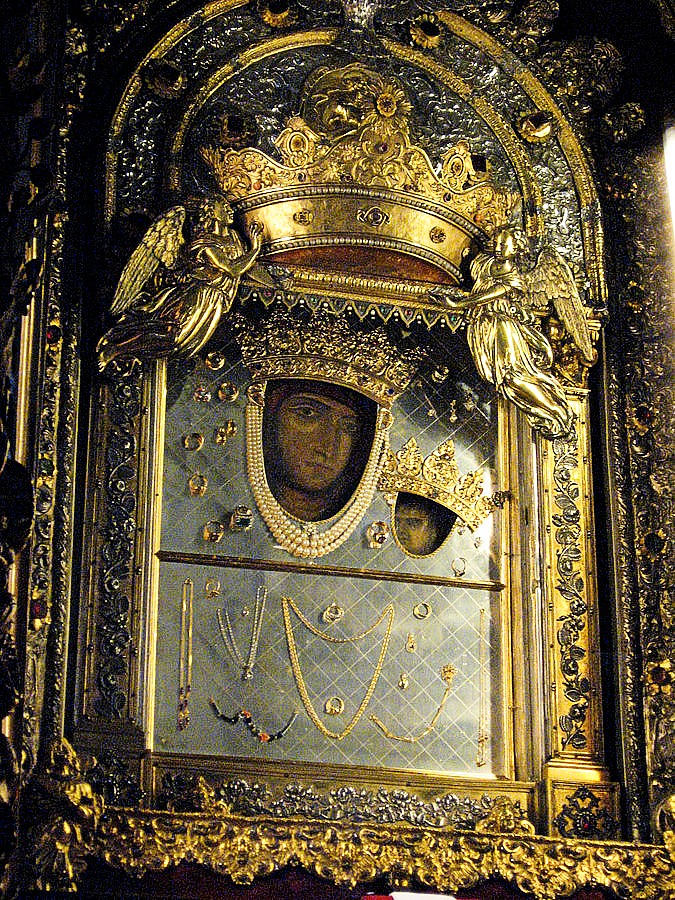
Madonna of San Luca / Nostra Signora della Guardia / Our Lady of Saint Luke of La Guardia, Bologna, Italy (433) – 30 December:
The Abbot Orsini wrote: “This picture was in the Church of Santa Sophia, at Constantinople, with this inscription: “This picture, painted by Saint Luke, must be taken to the mountain of La Garde and placed over the Altar of the Church.” A Greek monk set out for Italy about the year 433, with the picture entrusted to him and deposited it on the mountain of La Garde.”
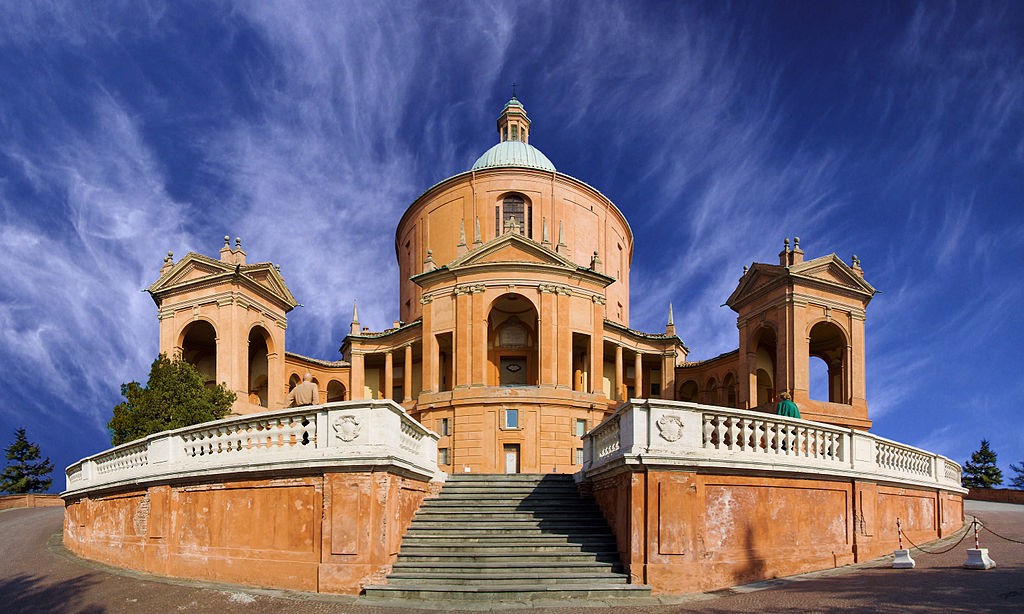
The account mentioned by the Abbot above, is also told in the chronicle of Graziolo Accarisi, who wrote of a Greek hermit who went on pilgrimage to Constantinople where he received from the Priests of the Church of Santa Sofia, the icon of Our Lady of La Guardia. This image was attributed to Saint Luke the Evangelist and there was an inscription on the painting itself that it should one day be taken to the “mountain of the guard.” The hermit took the Icon,and walked throughout Italy in search of the place where the Icon was meant to be,but it was not until he reached the City of Emilia near Bologna that the authorities of the City came out to greet him and processed with the icon back to the mountain. The Icon had finally found its home and it is now more commonly known as the Madonna of San Luca. Among the many miracles attributed to the image is especially noted the “miracle of the rain,” which occurred on 5 July 1433. An extremely heavy spring rain came late in the season, threatening to destroy the crops. Facing the prospect of famine, the people turned to the Blessed Virgin for assistance. The storm and rain stopped suddenly, with the arrival into the City, of a procession carrying the miraculous Icon. Since that time these processions have been repeated annually. There is even an incredible arched walkway that is only a little short of four kilometers in length, that is meant to protect the Icon from the elements, as well as those on procession. The Icon shows the Blessed Virgin Mary holding the Infant Jesus in blessing. She wears a blue-green robe, with a red tunic. The nose, eyes and fingers appear somewhat elongated. The Divine Child wears a tunic of the same colour as His Mothers’, with His right hand in a gesture of giving a blessing and his left hand being closed. In 1625 the image was covered with a silver panel which leaves only the faces of the figures uncovered. The Icon was crowned in 1603 by the Archbishop Alfonso Paleotti. The Sanctuary of Saint Luke, where the Icon is kept, was declared a national monument in the year 1874. In 1907 the Church was raised to the dignity of a Minor Basilica by the holy Pope Saint Pius X.
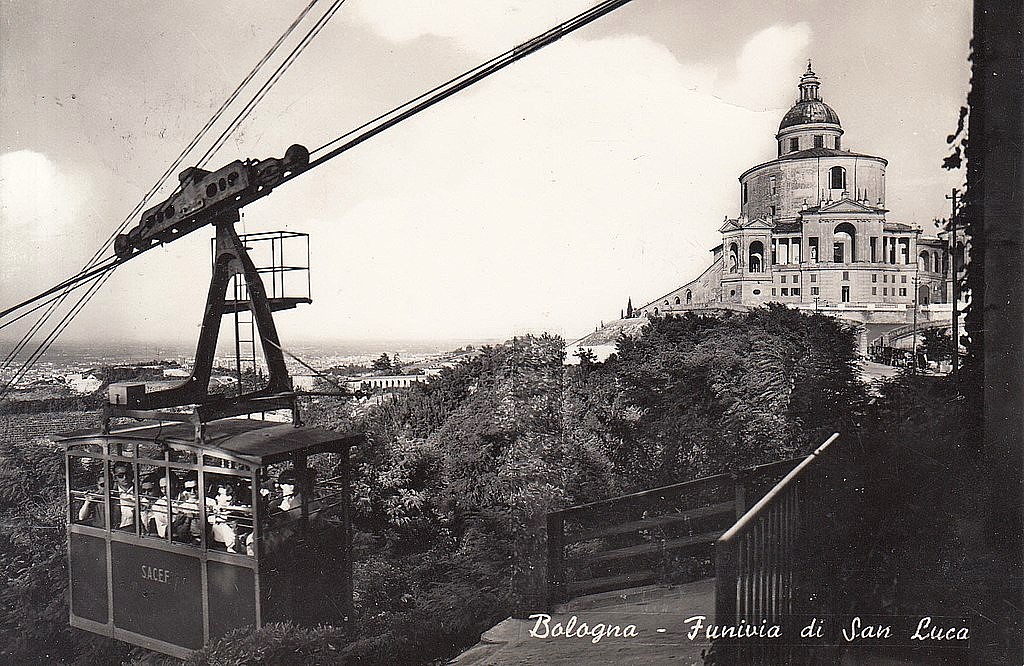
The Sanctuary is situate some 300 metres above the City plain, just south-west of the historical centre of the City. While a road now leads up to the Sanctuary, it is also possible to reach it along a 3.8 km monumental roofed arcade (Portico di San Luca) consisting of 666 arches, which was built in 1674–1793. It was meant to protect the Icon as it was paraded up the hill. A yearly procession from the Cathedral of San Pietro in the centre of Bologna to the Sanctuary goes along this path. The arches held sacred images or Chapels erected by patron families. There is also a cable car which takes tourists up to the Basilica.
Cable car approaching the Mountain Sanctuary
St Anysia of Thessalonica St Anysius of Thessalonica
St Egwin of Worcester OSB (Died 717) Bishop of Worcester, England, Benedictine Monk, Reformer and Penitent, miracle-worker. Egwin was devout and lived for God from his youth. His biographers say, that king, clergy and the faithful, all united in demanding Egwin’s elevation to Bishop. About St Egwin: https://anastpaul.com/2020/12/30/saint-of-the-day-30-december-saint-egwin-of-worcester-osb-died-717/
St Elias of Conques St Eugene of Milan St Pope Felix I St Geremarus
St Hermes of Moesia St Jucundus of Aosta St Liberius of Ravenna Blessed Margherita Colonna (c 1255-1284) Virgin, Nun
St Perpetuus of Tours Bl Raoul of Vaucelles St Raynerius of Aquila Bl Richard of Wedinghausen St Ruggero of Canne St Sebastian of Esztergom
Martyrs of Alexandria – (5 saints): A group of Christians martyred in the unrest caused by Monophysite heretics. We know the names for five of them – Appian, Donatus, Honorius, Mansuetus and Severus. They were martyred in c 483 at Alexandria, Egypt.
Martyrs of Oia – (6 saints): A group of Christians martyred together, date unknown. The only details to have survived are the names – Cletus, Florentius, Papinianus, Paul, Serenusa and Stephen. They were martyred in Oia, Greece.
Martyrs of Spoleto – (4 saints): A group of Christians martyred in the persecutions of Diocletian – Exuperantius, Marcellus, Sabinus and Venustian. They were martyred in 303 in Spoleto, Italy.
Thought for the Day – 27 December – Meditations with Antonio Cardinal Bacci (1881-1971)
St John the Apostle and Evangelist
“St John proved himself worthy of His Master’s special favour. He never deserted Christ. He was present at the Agony in Gethsemane. He was in the courtyard of the High Priest, when Peter denied Christ but he remained faithful. He was the only Apostle present at the foot of the Cross on Mount Calvary, where, he was privileged to hear Our Lord’s last words.
After the Resurrection, John was one of the first to hurry to the sepulchre. Like the other Apostles, he proved his undying love for Jesus, by enduring the pains of Martyrdom, although his life was miraculously spared. He spent his long life studying how to love and serve Jesus Christ. Can the same be said for us? We have not been granted the privileges given to St John but, we have received countless favours from God.
Let us learn from the example of this great Apostle, how to co-operate generously with the grace of God, for how many times have we deserted Christ!”
Quote/s of the Day – 27 December – Feast of St John the Apostle and Evangelist and the Third Day of the Christmas Octave
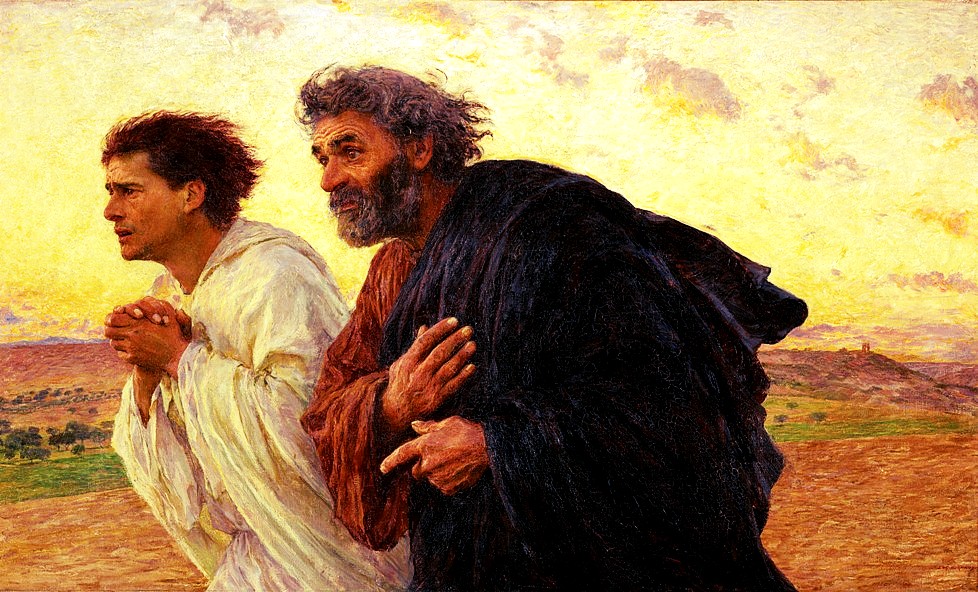
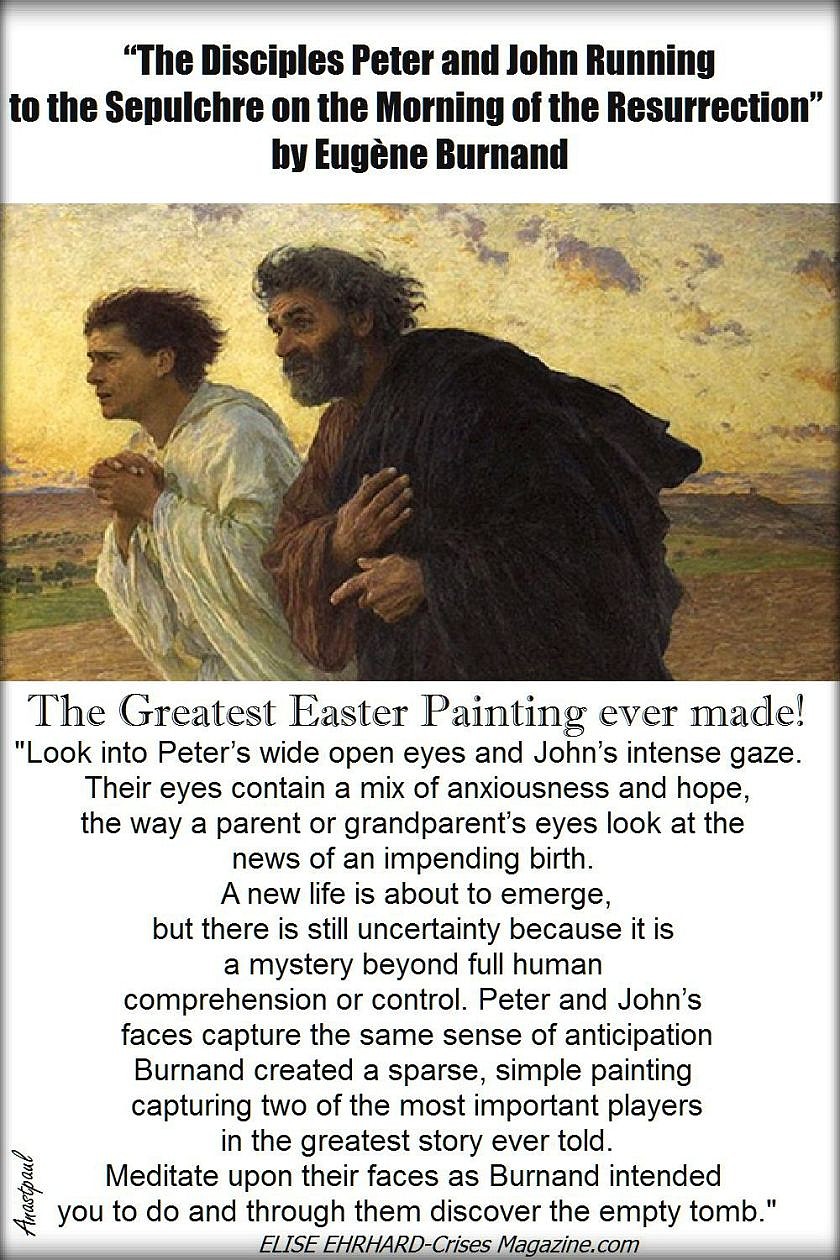
“Look into Peter’s wide open eyes and John’s intense gaze. Their eyes contain a mix of anxiousness and hope, the way a parent or grandparent’s eyes look at the news of an impending birth. A new life is about to emerge but there is still uncertainty because it is a mystery beyond full human comprehension or control. Peter and John’s faces capture the same sense of anticipation.
Burnand created a sparse, simple painting capturing two of the most important players in the greatest story ever told. Meditate upon their faces, as Burnand intended you to do and through them, discover the empty tomb.” (Elisabeth Ehrhard-Crises Magazine).
Oh Teach Me then, Dear Saint! An Invocation of St John, Apostle and Evangelist Unknown Author
Saint of the Sacred Heart, Sweet teacher of the Word, Partner of Mary’s woes And favourite of thy Lord!
Refrain Oh teach me then, dear Saint! The Secrets Christ taught thee; The Beatings of His Heart, And how it beat for me!
We know not all thy gifts But this Christ bids us see, That He Who so loved all, Found more to love in thee. Refrain
When the last evening came, Thy head was on His breast, Pillowed on earth, where now In Heaven the Saints find rest. Refrain
Dear Saint! I stand far off, With vilest sins opprest, Oh may I dare, like thee, To lean upon His Breast? Refrain
His Touch could heal the sick, His Voice could raise the dead, Oh that my soul might be Where He allows thy head. Refrain
The gifts He gave to thee He gave thee to impart And I, too, claim with thee His Mother and His Heart! Refrain
One Minute Reflection – 27 December – Feast of St John tApostle and Evangelist and the Third Day of the Christmas Octave, Readings: 1 John 1:1-4, Psalm 97:1-2, 5-6, 11-12, John 20:2-8
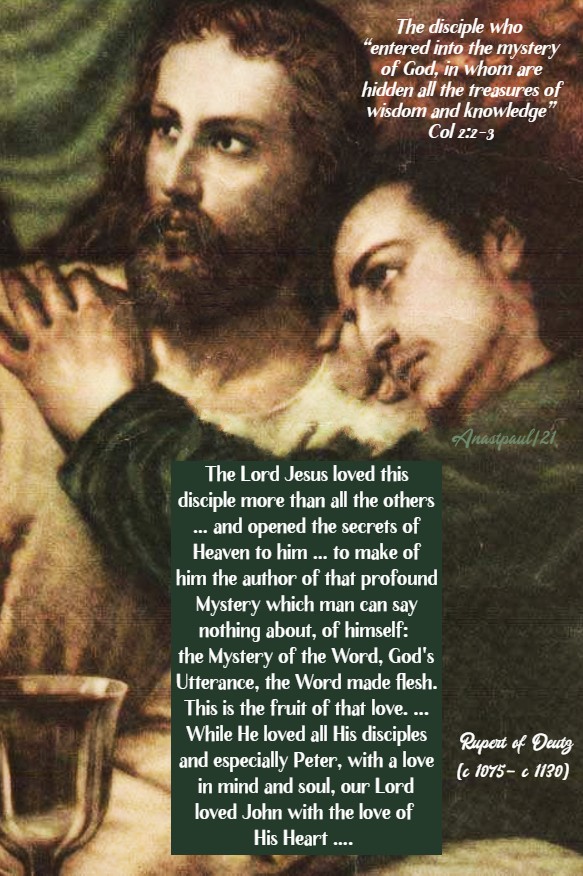
The disciple who “entered into the mystery of God, in whom are hidden all the treasures of wisdom and knowledge …” – Col 2:2-3
REFLECTION – “In proportion to the grace that caused Jesus to love him and enabled him to rest on Jesus’ Breast at the Supper (Jn 13:23), John abundantly received [the Spirit’s gifts] of understanding and wisdom (Is 11:2) – understanding with which to comprehend Scripture, wisdom with which to compose his own books with wonderful skill. As a matter of fact, ,he did not receive this gift right from the time when he rested on our Lord’s Breast,, even if he was subsequently able to draw from that Heart “in which are hidden all the treasures of wisdom and knowledge” (Col 2:3). When he says, that when he went into the tomb “he saw and he believed,” he acknowledges that “they did not yet understand the Scripture that Jesus had to rise from the dead” (Jn 20:9). Like all the other Apostles, John received its fullness, when the Holy Spirit came [at Pentecost] and when grace had been given to each of them “according to the measure of Christ’s gift” (Eph 4:7). …
The Lord Jesus loved this disciple more than all the others … and opened the secrets of Heaven to him … to make of him the author of that profound Mystery which man can say nothing about, of himself: the Mystery of the Word, God’s Utterance, the Word made flesh. This is the fruit of that love. Yet even though He loved him, it was not to him that Jesus said: “You are Peter, and on this rock I shall build my Church” (Mt 16:18) … While He loved all His disciples and especially Peter, with a love in mind and soul, our Lord loved John with the love of His Heart …. In the order of Apostleship, Simon Peter received the first place and the “keys of the Kingdom of heaven” (Mt 16:19) but John, won another inheritance, the spirit of understanding, “a wealth of joy and gladness” (Sir 15:6).” – Rupert of Deutz (c 1075- c 1130) Benedictine Monk, Theologian and Writer (The Works of the Holy Spirit, IV, 10 SC 165)
PRAYER – I am grateful to You for the love You have given me. My dear Jesus, I place this love into Your hands: keep it chaste and bless it, so that it may always be rooted in You. And increase in me my love for You. I know that if I love You, I can never get lost. If I want to be Yours with all my heart, You will never let me stray from You. Amen. May St John the Evangelist, beloved of the Lord and Your Blessed Mother intercede for us that we may love You Lord with all our hearts, minds and souls!
Our Morning Offering – 27 December – Feast of St John the Evangelist and the Third Day of the Christmas Octave
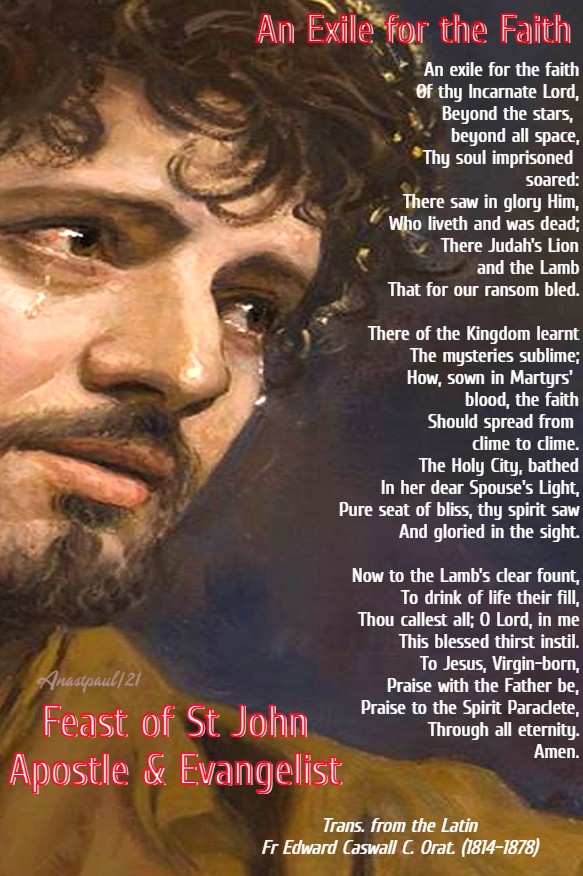
An Exile for the Faith Trans. from the Latin Fr Edward Caswall C. Orat. (1814–1878)
An exile for the faith Of thy Incarnate Lord, Beyond the stars, beyond all space, Thy soul imprisoned soared: There saw in glory Him, Who liveth and was dead; There Judah’s Lion and the Lamb That for our ransom bled.
There of the Kingdom learnt The mysteries sublime; How, sown in Martyrs’ blood, the faith Should spread from clime to clime. The Holy City, bathed In her dear Spouse’s Light, Pure seat of bliss, thy spirit saw And gloried in the sight.
Now to the Lamb’s clear fount, To drink of life their fill, Thou callest all; O Lord, in me This blessed thirst instil. To Jesus, Virgin-born, Praise with the Father be, Praise to the Spirit Paraclete, Through all eternity. Amen.
Saint of the Day – 27 December – 27 December – St John the Apostle and Evangelist. Patronages – • against burns; burn victims• against epilepsy• against foot problems• against hailstorms• against poisoning• art dealers• authors, writers• basket makers• bookbinders• booksellers• butchers• compositors• editors• engravers• friendships• glaziers• government officials• harvests• lithographers• notaries• painters• papermakers• publishers• saddle makers• scholars• sculptors• tanners• theologians• typesetters• vintners• Asia Minor (proclaimed on 26 October 1914 by Pope Benedict XV)• 6 Diocese• 7 Cities.
St John, Apostle and Evangelist by Father Francis Xavier Weninger SJ (1805-1888)
St John, Apostle and Evangelist of Jesus Christ, a brother of St James and son of Zebedee and Salome, was born at Bethsaida, a Town in Galilee. Christ, our Lord, called him and his brother James to follow Him, at the time when they were mending their nets in a boat, on the shore of the Sea of Genesareth. John, without delay, left all he possessed, even his own father and, with his brother, followed the Lord. Although the youngest of the Apostles, he was beloved by the Saviour above all the others – whence he is several times mentioned in the Gospel, as “the disciple whom Jesus loved.” The cause of this special love of Jesus for him, was, according to the Holy Fathers, his virginal purity, which he kept undefiled and the tender love he bore to the Lord. “He was more beloved than all the other Apostles,” writes St Thomas Aquinas, “on account of his purity.” “For the same reason,” says St. Anselm, “God revealed more mysteries to him, than to the other Apostles. Justly,” says he, “did Christ the Lord reveal the greatest mysteries to him, because he surpassed all in virginal purity.“
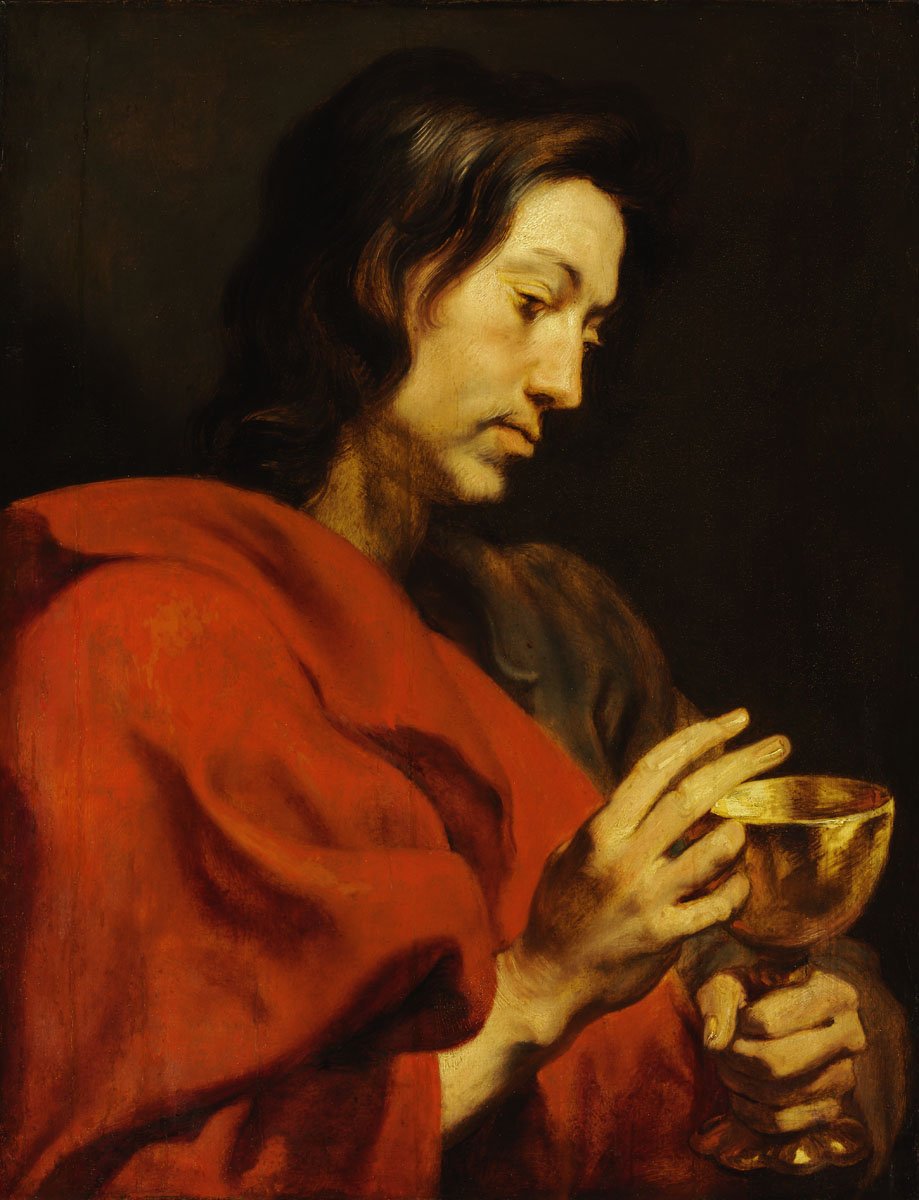
Anthony van Dyck
It is evident from the Gospel, that St John was one of the most intimate of the friends of the Lord, and was, in consequence, sometimes admitted into Christ’s presence, when, except Peter and James, no other Apostle was allowed to be near. Thus, he was with Christ when He healed the mother-in-law of Peter; when He raised the daughter of Jairus from the dead and when He was transfigured on Mount Thabor. He also accompanied Christ when He suffered His Agony in the Garden of Olives. The other two above-named Apostles ,shared these favours with John but none was permitted to lean upon the Saviour’s bosom, at the last supper, save John; none was recommended as son to the divine Mother but John. Only he, of all the Apostles, followed Christ to Mount Calvary,and remained there with Him, until His death. To recompense this love, Christ gave him to His Mother as her son, when He said: “Behold thy Mother!” Christ, who had lived in virginal chastity, would trust His Virgin Mother to no-one else but John, who himself lived in virginal purity. As St.Jerome says: “Christ, a virgin, recommended Mary, a virgin, to John, a virgin.” No greater grace could John have asked of Christ; no more evident proof could he have received of His love. The most precious thing which the Lord possessed on earth, His holy Mother, He commended to His beloved disciple. He took him as brother, by giving Him as son to His Mother. Who cannot see from all this, that Christ loved and honoured St John above all others?
How deeply this beloved disciple must have suffered by seeing his Saviour die, so ignominious a death, is easily to be conceived; and St Chrysostom hesitates not to call him, therefore, a manifold Martyr. After Christ had died on the Cross, had been taken from it, and interred with all possible honours, St John returned home with the divine Mother, who was now also his mother, and waited for the glorious Resurrection of the Lord. When this had taken place, he participated in the many apparitions of the Lord, by which the disciples were comforted and, doubtless received again, particular marks of love from the Saviour. He afterwards assisted, with the divine Mother and the Apostles and other disciples of Christ, at the wonderful Ascension of the Lord. With these, also, he received, after a ten days’ preparation, the Holy Ghost, on the great festival of Pentecost.
Soon after this, he and Peter had, before all others, the grace to suffer for Christ’s sake. For when these two Apostles had, in the name of Christ, miraculously healed a poor cripple who was lying at the door of the temple of Jerusalem and used this opportunity, to show to the assembled people, that Jesus of Nazareth was the true Messiah.
Fresco in the Cappella Brancacci, Florence, attributed to Masolino da Panicale (1383 – c.1447). It is part of the cycle of frescoes painted between 1425 and 1427 depicting the life of St. Peter. It shows the Apostle, accompanied by StJohn, giving his hand to a cripple seeking alms. The cripple is instantly cured.
They were seized, at the instigation of the chief priests,and were cast into prison. On the following day, the priests came together and John and Peter were called before them and asked in whose name and by what power, they had healed the cripple. Peter and John answered fearlessly, that it had been done in the Name of Jesus Christ. The high priest dared not do anything further to them but, setting them free, prohibited them from preaching, in future, the Name of Christ. The two holy Apostles, however, nothing daunted, said: “If it be just in the sight of God to hear you rather than God, judge ye: for we cannot but speak the things which we have seen and heard.“
Anthony van Dyck
St. John remained for some time in Jerusalem after this and, with the other Apostles, was zealous in his endeavors to convert the Jews. When the Apostles separated, to preach the Gospel over all the world, Asia Minor was assigned to St John. Going thither, he began with great zeal his apostolic functions and, by the gift of miracles, he converted many thousands to the Faith of Christ. The many Bishoprics which he instituted in the principal cities sufficiently prove this. In the course of time, he went also to other countries, preaching everywhere the Word of Christ, with equal success..
Anthony van Dyck
oil, oak
64,5 x 50 cm
The Emperor Domitian, who, after the death of the Emperor Nero, again began to persecute the Christians, ordered his officers to apprehend John and bring him to Rome. Hardly had the holy Apostle arrived there, when he was commanded by the Emperor to sacrifice to the gods. As the Saint refused this and fearlessly confessed Christ, the Emperor had him most cruelly scourged and afterwards, cast into a large caldron, filled with boiling oil. The Saint signed himself and the cauldron with the Holy Cross and remained unharmed, when he was cast into it. This gave him an opportunity to announce, with great energy, to the assembled people, the Gospel of Jesus Christ. The tyrant, who could not suffer this, had him taken out of the cauldron, and sentenced him to banishment on the island of Patmos, to work in the mines and perform other hard labour, in company with other Christians. St John had, at that time, reached his ninetieth year but was willing to undergo the unjust sentence.
After his arrival on the island, he had many and wonderful visions, which, by command of God, he put down in writing. The book which contains them, is a part of Holy Writ, called the Apocalypse, or Revelation of St John, a book which,, according to St Jerome, contains almost as many mysteries as words. After the death of Domitian, St John was liberated and returning to Ephesus, remained there until his death. He outlived all the other Apostles, as he reached the age of 100 years. His great labours, wearisome travels and the many hardships he endured, at last enfeebled him to such an extent, that he could not go to the Church without being carried. F
Frequently he repeated, in his exhortations, the words: “My little children, love one another.” Some, annoyed at this, asked him why he so often repeated these words. He answered: “Because it is the commandment of the Lord and if that is done, it suffices.” By this he meant, that if we love each other rightly, we also love God and when we love God and our neighbour, no more is needed to gain salvation – as love to God and to our neighbour contains the keeping of all other commandments.
The holy Apostle, who had suffered and laboured so much for his beloved Master, was, at length, in the year 104, called by Him into heaven to receive his eternal reward.
Besides the Apocalypse, to which we referred above, St John also wrote three Epistles and his Gospel, on account of which, he is called Evangelist. In his Gospel he gives many more facts than the other Evangelists, to prove the Divinity of Jesus Christ; as, at that period, several heretics, as Cerinthus, Ebion and the Nicolaites, fought against this truth. In his Epistles, he exhorts particularly, to love God and our neighbour,and to avoid heretics. In the first, among other things, he explains that love to God consists in keeping the commandments of God, which are not difficult to keep. “For this is the charity of God,” writes he, “that we keep His commandments;and His commandments are not heavy.” Of the love of our neighbour he says, that it must manifest itself in works, that is, we must assist our brethren in their need and, if necessary, give even our lives for them, after the example of Christ. The holy Apostle exemplified his words by his actions.
Several holy Fathers relate the following of him. The Saint had given a youth in charge of a Bishop, with the commendation to instruct him carefully in virtue and sacred sciences. After some years, when the Saint returned to this Bishop and asked for the young man, he heard with deep sorrow, that he had secretly left and had joined the highwaymen and had even become their chief. The holy Apostle set out at once and went, not without danger to his life, into the woods, where the unhappy young man was said, to be. Finding him, he spoke most kindly to him and succeeded in bringing him back. It is touching to read how the holy, man promised to atone for the youth’s sins, if he would repent and lead a better life. The youth followed the Saint’s admonition and did penance with such fervour and zeal, that the Saint hesitated not to give him charge of the Church at Ephesus. (1876)
St John, Pray for Holy Mother Church, Pray for us all!
Nossa Senhora do Rosário / Our Lady of the Rosary (Atibaia, São Paulo, Brazil) (1817) – 27 December:
In 1763, slaves who couldn’t attend St John the Baptist’s, the main Church in Atibaia, began building their own. Completed in 1817, the Church is often called Nossa Senhora do Rosário dos Pretos, Our Lady of the Rosary of the Blacks. This agricultural City is home to the oldest and most active tradition in the region. The five indigenous groups in Atibaia combine African and Portuguese religious practices, centered around devotion to St Benedict and Our Lady of the Rosary. On 27 December, as they have for over 200 years, the locals gather outside Our Lady’s Church at dawn, dressed in brilliant uniforms of scarlet, green, blue, pink, or white and carrying swords, banners and musical instruments.
The day begins with a serenade and ends with fireworks. In between, to the sound of drums, guitars and pealing bells, the faithful process dancing through the City: young, old, male, female, black and white. The festa of Our Lady of the Rosary is part of a Christmas celebration beginning on 25 December with the erection of two towering poles topped with images of the Saints in Rosary Plaza and concluding 28 December with processions and Holy Mass honouring St Benedict.
Bl Adelheidis of Tennenbach Bl Alejo Pan López Bl Alfredo Parte-Saiz Bl Christina Ebner
Bl Francesco Spoto Bl Hesso of Beinwil St José María Corbin-Ferrer St Maximus of Alexandria St Nicarete of Constantinople Bl Odoardo Focherini Bl Raymond de Barellis Bl Roger of Verdun
Notre-Dame de Saint-Acheul / Our Lady of Saint Acheul, Amiens, France, founded by Saint Firmin, Bishop (4th Century) – 21 December:
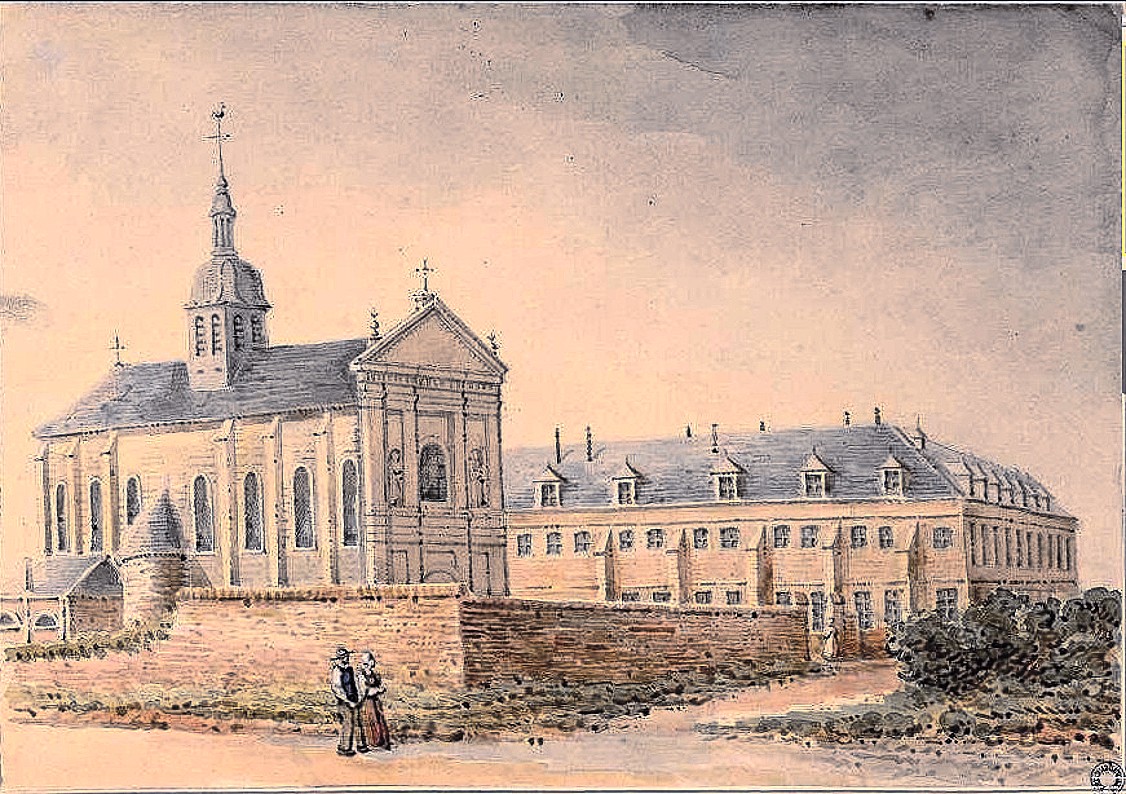
The Church containing the Shrine of Our Lady of Acheul, was located near Amiens. In fact, Saint Acheul was once considered the Mother-Church of the Cathedral of Amiens and was sometimes called the “Old Cathedral of Amiens,” although this is no longer the case, as there is now a larger Cathedral Church in Amiens. The Church stands on the very place where once a Roman temple stood, and tradition tells that Saint Firminus (Died 303) was the Apostle of Amiens, arriving there before the close of the third century after Christ. It is said that by the eloquence of his preaching and the number of his miracles, Saint Firminus (or Saint Firmin) converted many idolaters to the True Faith and Baptised three thousand men in forty days. The early Church, built around the year 300, contained the remains of the Martyred Saint. This Church was devastated repeatedly by the invasions of the Normans, and was finally totally destroyed in 1218. The relics of Saint Firmin were transferred to the Cathedral of Amiens during the Middle Ages. The Shrine of the Virgin of Saint Acheul, is noteworthy for a singular miracle – an apparition which occurred during the Holy Sacrifice of the Mass. The celebrant, after the Consecration, saw a hand appear from within a luminous cloud and the hand of Christ took the Sacred Host and dropped it into the Chalice. Some of the faithful present likewise witnessed the same thing – a certain skeptic was brought to his knees in humble acceptance of the fact, that the Holy Sacrifice is truly the same as that of Calvary. The armorial bearings of the Abbey of Saint-Acheul, displays a hand in remembrance of this miracle.
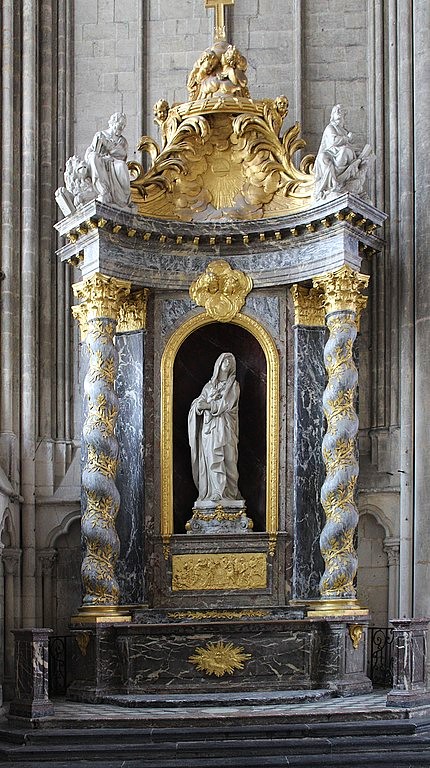
The Altar to Our Lady at the Cathedral
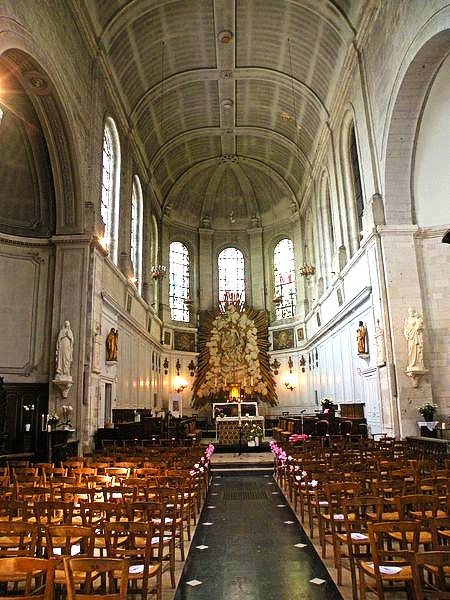
The present Cathedral of Saint Acheul was not finished until the fifteenth century. After the erection of the new Cathedral at Amiens, Saint Acheul was known as the Church of Our Lady of Acheul. Miracles took place frequently and pilgrimages continued. The Church of Saint Acheul was destroyed by a natural phenomenon, probably a strong storm, in about the year 1751. It was rebuilt and completed in 1760. A few short years later, during the Terror of the French Revolution, the Church was used as a stable. Today, the Church is protected as an historical monument, the decree given in 1969. The Abbey buildings are now occupied by a private party but the Church is used as a Parish Church.
St Anrê Tran An Dung St Baudacarius of Bobbio St Beornwald of Bampton Bl Bezela of Göda Blessed Daniel of the Annunciation OdeM Mercedarian Friar(13th Century?) St Dioscorus
St Festus of Tuscany St Glycerius of Nicomedia St James of Valencia St John of Tuscany St John Vincent St Micah the Prophet St Phêrô Truong Van Thi St Severin of Trèves (Died c 300) Bishop, Confessor Bl Sibrand of Marigård St Themistocles of Lycia
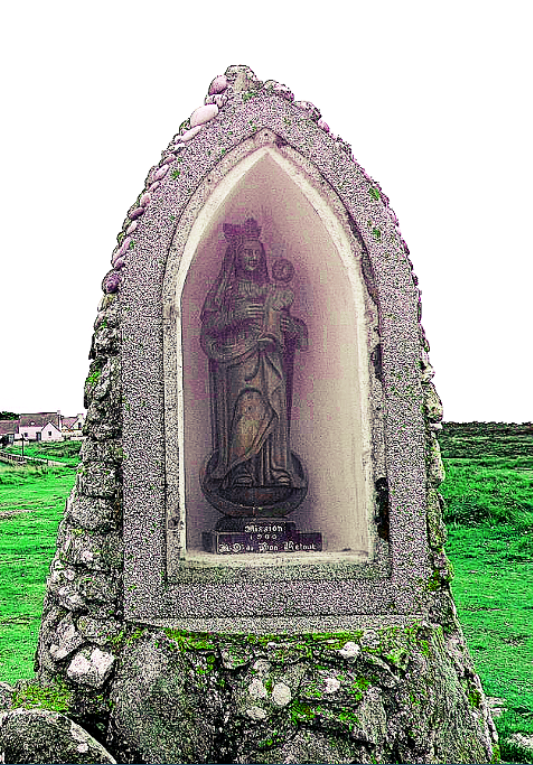
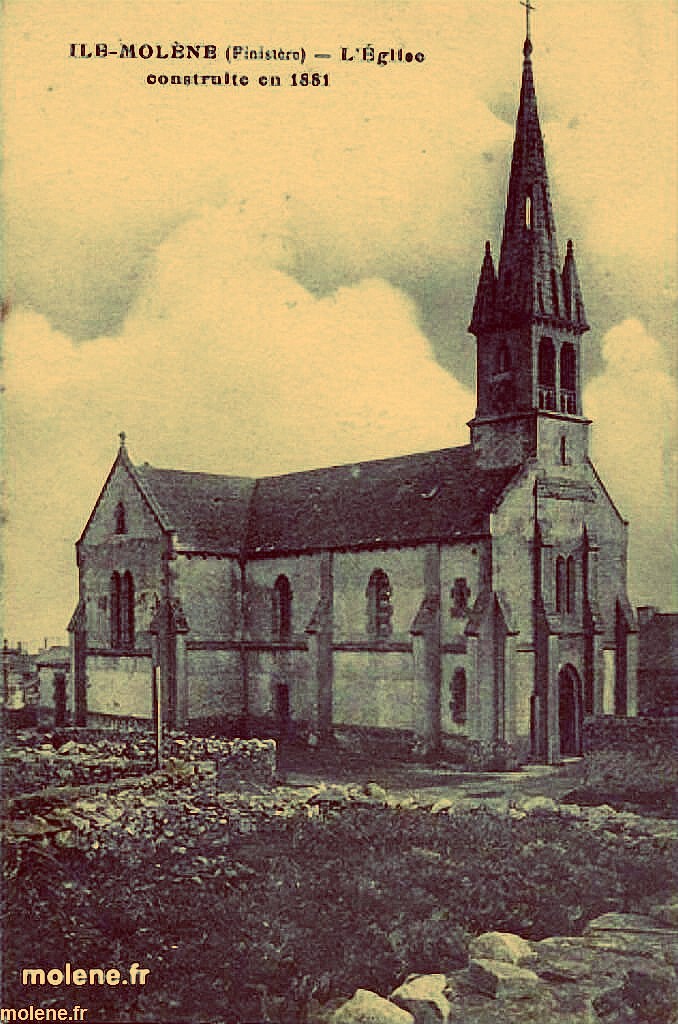
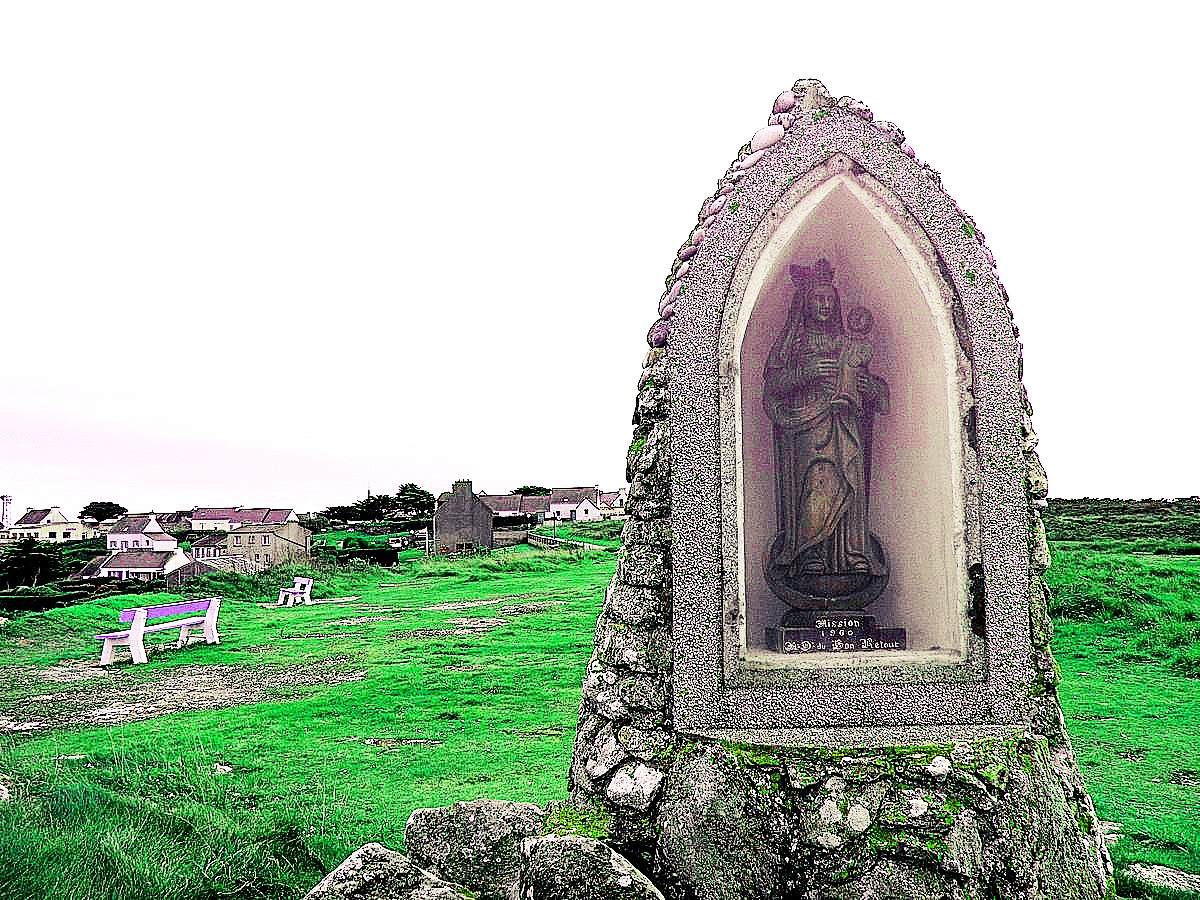
Notre-Dame de Bon Retour à Île-Molène / Our Lady of Molene, France (1075) – 20 December
The Abbot Orsini wrote: “The Shrine of Our Lady of Molene is in the Abbey of the Order of Saint Benedict in Langres. It was founded on the 20th of December, 1075, by Saint Robert who was the Abbot.”
The Benedictine Monastery in the Diocese of Langres founded by Saint Robert was actually the famous Molesme Abbey. As the Abbot Orsini mentioned, it was indeed founded by Saint Robert, henceforth known as Saint Robert of Molesme O.Cist (1028-1111), in the year 1075. He had been the Abbot of Saint Michael Abbey but left and founded a new Abbey when they refused to accept his necessary reforms. Saint Robert was born in the year 1029 and had a deep, childlike devotion to the Mother of God – by reason of a vision his mother saw, before Robert was born – and he instilled the same into the hearts of his Monks. Saint Robert’s holiness attracted many sincere men to join him, and as many of them were also noblemen, they provided Saint Robert with the financial means necessary to build a magnificent Abbey. Among those who flocked to Saint Robert was St Bruno of Cologne, who was the future Founder of the Carthusian Order. When Saint Robert died in the year 1111, he was buried in the Ahurch at the Abbey he founded. St Alberic, Robert’s Successor, decided that the Order should be dedicated to Mary. According to legend, Mary bestowed on Alberic a white mantle; for that reason, the Monks changed their black habit and wore white. All their Churches were dedicated to the Virgin and each had its Mary Altar before which the office of Mary was chanted every Saturday. The Church and Monastery were destroyed and any remaining property stolen in 1472 during the war between Burgundy and France. The Huguenots burned what had been rebuilt the following century during the French Wars of Religion. The end came during the French Revolution when the Abbey was suppressed and the buildings and Church destroyed. The small Church pictured is the Church of Sainte-Croix, built in the 13th century as a Chapel for the novices at the Abbey. Even this building was damaged in 1940 during combat between the French and German troops and some of that damage can still be seen. However, this is now a thriving Parish with an annual pilgrimage to honour Our Lady. The Grotto above and below, stands in the open field previously the site of the Monastery. The Abbey site has been an historical monument since 1985. The once thriving community is gone and the site now is only accessible by prior arrangement. The Monastery seal pictured the Virgin Mary crowned.
St Attala of Strasbourg St Bajulus of Rome St Crescentius of Africa St Dominic of Brescia
St Eugene of Arabia St Gabriel Olivares Roda St Hoger of Hamburg-Bremen Bl John de Molina St Julius of Gelduba Bl Lorenzo Company St Liberatus of Rome St Macarius of Arabia St Malou of Hautvillers
Quote of the Day – 30 November – The Feast of St Andrew, Apostle of Christ, Martyr on the Cross for Christ
This is what the Apostle is claimed to have been said on the occasion of St Andrew’s Martyrdom, according to an ancient story (which dates to the beginning of the sixth century), entitled –
The Passion of Andrew:
“Hail, O Cross, inaugurated by the Body of Christ and adorned with His limbs as though they were precious pearls. Before the Lord mounted you, you inspired an earthly fear. Now, instead, endowed with heavenly love, you are accepted as a gift.
Believers know of the great joy that you possess and of the multitude of gifts you have prepared. I come to you, therefore, confident and joyful, so that you too may receive me, exultant as a disciple of the One Who was hung upon you….
O blessed Cross, clothed in the majesty and beauty of the Lord’s limbs!…
Take me, carry me far from men and restore me to my Teacher, so that, through you, the One who redeemed me by you, may receive me.




























 AnaStpaul
You must be logged in to post a comment.