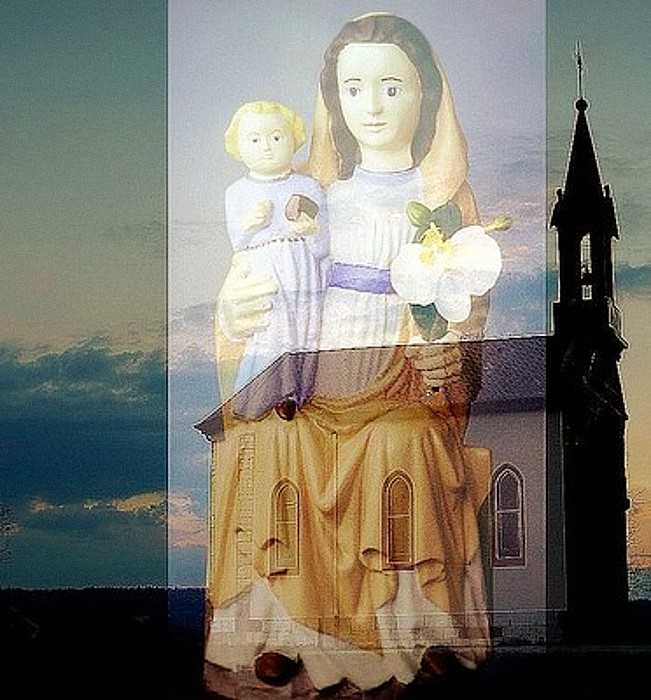
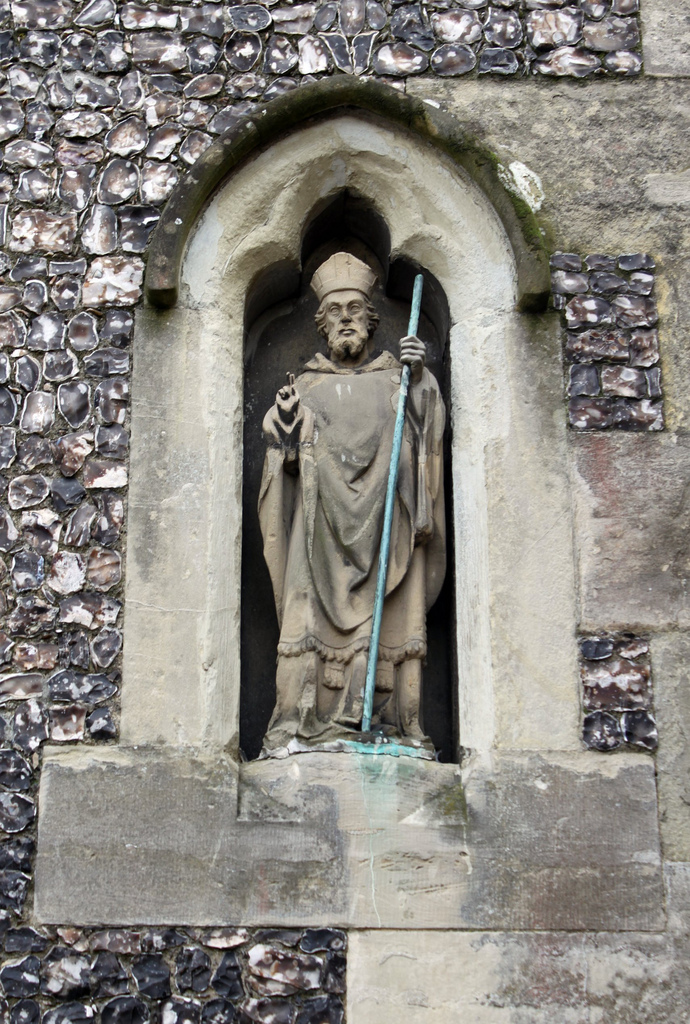
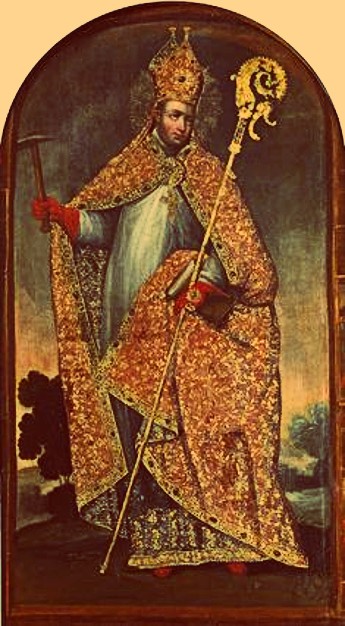
Saint of the Day – 1 July – St Domitian (c347-440) Abbot, who had been the first Hermit of the surrounding region in France, Founder of a Monastery which became the foundation of the spiritual, cultural and social teachings of its region and day. Born in c347 in Rome and died in 440 at the Saint Rambert de Joux Abbey in the Diocese of Lyons in France of natural causes. Also known as – Domitian of Bebron, Domitian of Lerins, Domiziano… Additional Memorial – 1 September in the Diocese of Belley
The Roman Martyrology reads: “In the Diocese of Lyons, the decease of St Domitian, Abbot, who was the first to lead there, an eremitical life. After having assembled, in that place, many servants of God and gained great renown for virtues and miracles, he was gathered to his fathers at an advanced age.”
Information about the life of Saint Domitian comes mainly from an anonymous ‘Vita’ written many centuries after Domitian’s had died. According to this source, Domitian lived in the 5th Century, initially dedicating himself to the life of a Hermit in Gallia Lugdunensis, a region which today includes part of south-eastern France. His vocation as a Hermit led him to settle in the area of Bebron, in the Alps, where he led a life of prayer and asceticism.
However, Domitian’s fame for sanctity soon attracted disciples eager to follow his example. A community gathered around him, giving life to a monastery which became a centre of spiritual reference for the region. Domitian became the Abbot of this community, leading his brothers with wisdom and compassion.
The Monastery founded by him in Bebron played a significant role in the spread of monasticism in the region. Known as the Monastery of Bebron or theAbbey of Saint-Rambert-de-Joux, it became a place of intense spiritual and cultural activity. The Monks, under the guidance of Domitian, devoted themselves to prayer, study and manual labour, contributing to the economic and social development of the area.
The fame of the sanctity of Saint Domitian spread rapidly beyond the confines of his Monastery. His death, which occurred at an advanced age, was marked by deep mourning on the part of his community and the faithful of the region. His body was buried inside the Monastery C hurch, becoming an object of veneration for pilgrims, who came from all over to ask for his intercession. The cult of Saint Domitian consolidated, over the centuries, as attested by several mentions in calendars and martyrologies. The Roman Martyrology commemorates him on 1 July, while the Diocese of Belley celebrates him on 1 September. His memory is particularly alive in the Bugey region, where the Monasterywhich he had founded prospered for centuries, taking the name of Abbey of Saint-Rambert-en-Bugey, see below.
St Aaron of Caerleon St Aaron the Patriarch St Arnulf of Mainz St Calais of Anisole St Carilephus St Castus of Sinuessa St Cewydd St Concordius of Toledo St Cuimmein of Nendrum St Domitian (c347-440) Abbot Bl Elisabeth de Vans St Eparchius of Perigord St Eutychius of Umbria St Esther the Queen
St Gall of Clermont St Golvinus of Leon St Gwenyth of Cornwall Bl Huailu Zhang St Julius of Caerleon St Justino Orona Madrigal St Juthware St Leonorious of Brittany St Leontius of Autun St Martin of Vienne St Nicasius of Jerusalem
St Secundinus of Sinuessa St Servan of Culross St Theobald of Vicenza St Theodoric of Mont d’Or St Veep
Martyrs of Rome – 6 Saints: Six Christians who were Martyred together. No details have survived except their names – Esicius, Antonius, Processus, Marina, Serenus and Victor. They were martyred in Rome, Italy, date unknown.
Thought for the Day – 30 June – Meditations with Fr Richard Frederick Clarke SJ (1839-1900)
The Adorable Heart of Jesus Meditations for a Month
EXERCISES OF DEVOTION.
Act of Reparation to the Sacred Heart of Jesus to make amends for the outrages He suffers in the Blessed Sacrament
O Heart of Jesus, ever on fire with love for men and ever outraged by their ingratitude! Thou hast done everything on earth, during Thy mortal life, to show Thy Love to men, even so far, as to wear Thyself out and to consume Thyself for them. Thy Love was repaid then, by nothing but contempt and the most disgraceful insult. And now that Thou burnest with the self-same love in the Holy Eucharist, where Thou art still dwelling in Thy Sacrament of Love in the midst of us, Thou dost suffer at the hands of ungrateful men the most cruel outrages, although they have no longer the excuse of ignorance and know now, what Thou art.
I see Thee on our Altars expose, during the lapse of so many hundred years, to numberless irreverences, sacrileges and insults, the memory of which fills me with horror and which, are going on now, even amongst those who believe in the True Faith!
Moved by these outrages, I prostrate myself before Thee, O Adorable Heart and weep for Thine outraged Love. I beg Thy pardon for the ingratitude of which I myself am guilty. I detest the sins which I have committed in Thy Presence by irreverence, coldness, and negligence. I would make reparation for them, as also, for the abominations committed against Thee by so many heretics and bad Catholics.
Would that by my homage and my grief, I could make amends to Thy injured honour. Would that by my tears and my blood, I could wash out the insults I deplore. Would that by some new kind of homage, I could atone for so many irreverences, insults and sacrileges. My life would not be too much to sacrifice for so worthy an object. Grant me, O Sacred Heart, by Thine own sweetness and boundless mercy, the pardon which I ask for, and give me grace to keep the resolution, which I now make, to do all I can in the future , to pay Thee, in the Sacrament of Thy Love, the profound adoration which I owe Thee and to show Thee that gratitude and love which are justly due to Thee. I resolve to repair my past faults by the modesty of my deportment in Thy churches, by my constancy in visiting Thee, my devotion and fervo.r in receiving Thee and, in fulfilment of Thy desire, I impose upon myself the duty of often repeating Acts of Reparation in Thy Presence, as Thou hast deigned to direct, in order, as far as I can, to atone for the injuries done Thee by others and of which Thy very love makes Thee the Victim in this Divine Sacrament.
Bless, I beseech Thee, this resolve and give me grace to keep it faithfully. Amen.
Quote/s of the Day – 30 June – “The Last Day of Month of the Sacred Heart of Jesus”
The Nine First Friday of the Month Dedicated to the Devotion of Love and Reparation the Sacred Heart of Jesus:
“I promise you, in the excessive mercy of My Heart, that My all-powerful Love will grant to all those who receive Holy Communion on the First Friday for Nine Consecutive Months the grace of final repentance. They shall not die in My disgrace, nor without receiving the Sacraments. My Divine Heart shall be their safe refuge in that last moment.” — Our Lord to St. Margaret Mary
How to complete the First Friday’s Devotion:
Attend Holy Mass and Receive Holy Communion on each First Friday; The Nine Fridays must be consecutive; They must be made in honour and in reparation to His Sacred Heart.
Act of Love to the Sacred Heart of Jesus By Servant of God Cardinal Rafael Merry del Val (1865-1930)
Reveal Thy Sacred Heart to me, O Jesus and show me Its attractions. Unite me to It forever. Grant that all my aspirations and all the beats of my heart, which cease, not even while I sleep, may be a testimonial to Thee, of my love for Thee and may it say to Thee – “Yes, Lord, I am all Thine” the pledge of my allegiance to Thee, rests forever in my heart and will never cease to be there. May Thou accept, the slight amount of good that I do and be graciously pleased, to repair all my wrong-doing – so that I may be able, to bless Thee, in time and in eternity. Amen
Act of Consecration and Reparation to the Sacred Heart By Pope Leo XIII (1810-1903) Most sweet Jesus, Redeemer of the human race, look down upon us humbly prostrate before Thine Altar. We are Thine and Thine we wish to be but, to be more surely united with Thee, behold each one of us, freely consecrates himself today to Thy Most Sacred Heart. Many indeed have never known Thee, many too, despising Thy precepts, have rejected Thee. Have mercy on them all, most merciful Jesus and draw them to Thine Sacred Heart. Be Thou King, O Lord, not only of the faithful, who have never forsaken Thee but also of the prodigal children, who have abandoned Thee, grant that they, may quickly return to Thy Father’s House lest they die of wretchedness and hunger. Be Thou King of those who are deceived by erroneous opinions, or whom discord keeps aloof and call them back to the harbour of truth and unity of faith, so that there may be but one flock and one Shepherd. Be Thou, King of all those. who are still involved in the darkness of idolatry or of Islamism and refuse not, to draw them into the Light and Kingdom of God. Turn Thine Eyes of Mercy towards the children of the race, once Thy chosen people – of old they called down upon themselves the Blood of the Saviour; may it now descend upon them, a laver of redemption and of life. Grant, O Lord, to Thy Church, assurance of freedom and immunity from harm; give peace and order to all nations and make the earth resound from pole to pole, with one cry: “Praise be to the Divine Heart which wrought our salvation; to It be glory and honour forever!” Amen
The above prayer, composed by Pope Leo XIII was included in the 1899 Encyclical, Annum Sacrum, issued by Leo XIII as he Consecrated the entire world to the Sacred Heart of Jesus. The Consecration was influenced by two letters written to the Holy Father by Blessed Sister Mary of the Divine Heart, who stated that in visions of Jesus Christ, she had been told to request the Consecration.
One Minute Reflection – 30 June – “The Month of the Sacred Heart of Jesus” – Saints Peter and Paul, Apostles – Pentecpst VI – Romans 6:3-11; Mark 8:1-9 – Scripture search here: https://www.drbo.org/
“… Giving thanks, He broke and gave to His disciples to set before them …” – Marl 8:6
REFLECTION – “Our Lord multiplied bread in the wilderness and changed water into wine at Cana. Thus, He accustomed His disciples’ mouths to His Bread and Wine, until the time when He would give them His Own Body and Blood. He gave them a taste of transitory bread and wine, to stir up in them, a desire for His Own life-giving Body and Blood. He gave them generously of those insignificant things that they might know that His more important gift would be free. He gave these things freely, even though, they might have bought them that they might know they would not be asked to pay for something beyond price – …. for, if they were able to pay the price of some bread and wine, yet they would not be able to pay for His Body and Blood.
Not only did He freely fill us with His gifts but He treated us yet more lovingly. For He gave us those little things freely, to draw us, so that we would come to Him and freely receive that great good of the Eucharist. Those fragments of bread and wine which He gave, were sweet to the mouth but the gift of His Body and Blood, is of value to the spirit. He attracted us by these tasty foods ,to draw us to that which gives life to our souls …
The Lord’s Work achieves all things – in the blink of an eye, He multiplied a morsel of bread! What people effect and transform after ten months of labour, His Ten Fingers carried out in an instant … From a handful of bread, a quantity of loaves comes to be – it was for them, as it was at the time of the first blessing – “Be fruitful and multiply and fill the earth” (Gn 1:28).” – St Ephrem (306-373) Deacon in Syria, Father and Doctor of the Church added by Pope Benedict XV in 1920. (Commentary on the Diatessaron 12:1-4).
PRAYER – O God, Who made this day holy by the Martyrdom of Thy Apostles Peter and Paul, grant Thy Church to follow in all things the teaching of those from whom she first received the faith.Through Jesus Christ, Thy Son our Lord, Who lives and reigns with Thee, in the unity of the Holy Ghost, God, world without end. Amen (Collect).
EUCHARISTIC Heart of JESUS, model of the Priestly heart, have mercy on us. COR JESU Eucharisticum, cordis sacerdotalis exemplar, miserere nobis. – Indulgence 300 Days, Everytime – Raccolta 177St Pius X, 11 September 1907.
Our Morning Offering – 30 June – “The Last Day of the Month of the Sacred Heart of Jesus” – Pentecost VI
A Magnificat By St John Eudes (1601-1680) A Hymn of Praise and Thanksgiving to the Sacred Heart of Jesus and to the Holy Heart of Mary
My soul doth magnify the admirable Heart of Jesus and Mary And my spirit rejoices in Thou great Heart. Jesus and Mary have given me their Heart, This immense Heart, in order that all in me May be performed in its love.
Infinite praise to them, for their ineffable gift. This Heart infinitely merciful, has done great things for me. It has possessed me from the womb of my mother. Infinite thanksgiving for Thou ineffable gifts.
The abyss of my misery has called on the abyss of His Mercy. Infinite thanksgiving for His ineffable gifts. This Heart infinitely meek has presented me With blessings of its sweetness. Infinite thanksgiving for His ineffable gifts. Amen
Saint of the Day – 30 June – Saint Adele of Orp-le-Grand (Died c670) Abbess, Founder, Born in the early 7th Century in modern Belgium and died in c670 of natural causes at her Monastery. Patronage – agaomst eye diseases, ailmnts and vision disorders. Also known as – Adel, Adèlais. Additional Memorial – on the 1st Sunday in October (procession of her Relics through the streets of Orp-le-Grand) and 25 May on some calendars.
Adele of the Merovingian Dynasty noble family, decided to take the veil by entering the Monastery of Nivelles which had been founded by Itte Idoberge, widow of King Pepin the Elder and her daughter ,Saint Gertrude.
Around the year 640, she founded a Monastery at Orp-le-Grand, of which she became the first Abbess. While Childeric II governed, this new Monastery flourished, so much so, that it led her to construct a larger building which she had dedicated to Saint Martin, into which she moved her entire community.
There are two local traditions regarding St Adele’s life. The first tells how Saint Adele became blind and then miraculously recovered her sight, the second reports that the Saint was born blind and received her sight during her Baptism.
We know little more about her and it is said that Saint Adele of Orp-le-Grand died around the year 670 and was buried in the Crypt of Saint Martin’s Abbey.
Chapelle Sainte-Adele Orp-le-Grand Orp-Jauche
Every year on the 1st Sunday of October her Relics are carried in procession, with great participation of the faithful through the streets of Orp-le-Grand.
St Adele’s Church at Orp-le-Grand Abbey
She is popularly invoked for curing vision disorders and is traditionally represented in religious dress. There is a terracotta statue depicting her in the Church of St Omer. In homage to Saint Adele, many Churches have been dedicated to her in Saint-Géry, Fromiée and Hemptinne. In Brye, in Hainaut, next to the Chapel which bears her name, there is a well built in the 18th Century, where pilgrims draw miraculous water to bathe their eyes. The celebration and remembrance for Saint Adele of Orp-le-Grand is generally held on 30 June.
St Adele of Orp-le-Grand (Died c670) Abbess, Founder
St Adolphus of Osnabrück O.Cist. (1185-1224) Bishop St Alpinian of Limoges St Alrick the Hermit Bl Ambrose de Feis Bl Anthony de Tremoulières Bl Arnulf of Villers St Austriclinian of Limoges St Basilides of Alexandria St Bertrand of Le Mans St Clotsindis of Marchiennes
Bl Elisabeth Heimburg St Emiliana of Rome St Erentrude St Eurgain St Gaius Bl Jacob Clou St Leo the Deacon St Lucina of Rome St Lucina of the Callistus Catacombs St Marcian of Pampeluna St Martial of Limoges St Ostianus St Otto of Bamberg St Peter of Asti St Petrus Li Quanhui
Blessed Raymond Lull TOSF (c 1232 – c 1315) Martyr – known as “Doctor Illuminatus,” Raymond was a Philosopher, Logician, Writer, Poet, Pioneer in computation theory, Franciscan tertiary. Within the Franciscan Order he is honoured as a Martyr. He was Beatified on 25 February 1750 by Pope Benedict XIV (cultus confirmed) and reaffirmed in 1847 by Pope Pius IX. His Life and Death: https://anastpaul.com/2018/06/30/saint-of-the-day-30-june-blessed-raymond-lull-t-o-s-f-c-1232-c1315-martyr/
St Vihn Son Ðo Yen
Martyrs of Africa – 7 Saints: Seven Christians Martyred together. No detail about them have surived but the names – Cursicus, Gelatus, Italica, Leo, Timotheus, Zoilus, and Zoticus. Date and precise location in Africa unknown.
Thought for the Day – 29 June – Meditations with Fr Richard Frederick Clarke SJ (1839-1900)
PATIENCE Meditations for a Month
The Patience of Mary
As Jesus came to suffer, it was necessary that Mary should suffer with Him. This was her greatest privilege and she knew it to be such. She knew it even when her human love broke forth, in the words of expostulation: ‘Son, why hast Thou so dealt with us?‘ She knew it when she stood broken-hearted beneath the Cross. She knew it when she received, in her arms, the Body of he Son, after He had been taken down from the Cross. She knew from first to last that the best proof of our Lord’s Love is to give us a share in His sufferings! This was Mary’s consolation; is it mine when I have to suffer?
+++ 2. We do not read much in Sacred Scripture respecting the patience of Mary,but enough to know that Jesus purposely tried her patience. Why did He prompt holy Simeon to pierce her heart with the prediction of her coming sufferings? Why did He compel her to start in the dark night on the journey to Egypt, when He could, so easily, have defeated Herod’s projects? Why did He not let her know where He was, when He remained behind in Jerusalem? Why did He apparently rebuke her at the marriage of Cana? Why did He allow her heart to be torn by the sight of His Crucifixion? It was all that she might have a more glorious reward and share His triumph, in a greater degree!
+++ 3 If we could have seen Mary upon earth, we would have been especially struck by her undisturbed peace. This was owing to her perfect patience and readiness to accept everything at God’s Hand. ‘Behold the handmaid of the Lord; let it be done to me according to thy word.’ If I desire peace, this must be the motto of my life.
Quote/s of the Day – 29 June – Saints Peter and Paul, Apostles – Acts 12:1-11; Matthew 16:13-19 – – Scripture search here: https://www.drbo.org/
“Thou art the Christ, the Son of the living God.”
Matthew 16:16
“… Now you must be, for a little time, made sorrowful in divers temptations. That the trial of your faith, (much more precious than gold which is tried by the fire) may be found unto praise and glory and honour at the appearing of Jesus Christ.”
1 Peter 1:6-7
“And all who wish to live piously in Christ Jesus, will suffer persecution.”
2 Timothy 3:12
“What is the surest kind of witness? “Anyone who acknowledges that Jesus Christ came among us in the flesh” (cf 1 Jn 4:2) and who keeps the commands of the Gospel… How many there are, each day, of these hidden martyrs of Christ who confess the Lord Jesus! … So be faithful and courageous in interior persecutions, so that you may also win the victory in exterior persecutions.”
St Ambrose (340-397) Father & Doctor of the Church
“It is an old custom with the servants of God, always to have some little prayers ready and to be darting them up to Heaven frequently during the day, lifting their minds to God out of the filth of this world. He who adopts this plan, will get great fruit, with little pains.”
St Philip Neri (1515-1595)
“He who most loves, will be most loved.”
St Francis de Sales (1567-1622) Doctor of the Church
One Minute Reflection – 29 June – “The Month of the Sacred Heart of Jesus” –Saints Peter and Paul, Apostles – Acts 12:1-11; Matthew 16:13-19 – – Scripture search here: https://www.drbo.org/
“And I shall give to thee, the keys of the Kingdom of Heaven.” – Matthew 16:19
REFLECTION – “They went forth, sowing their seeds.” But why? Shall they always weep? God forbid! “They shall come home with shouts of joy, carrying their sheaves” (Ps 125:8). And so rightly do they shout for joy, since they bring back sheaves of glory. But you say – “that is for the resurrection on the last day; a long time to wait!”
Do not permit your will to be broken, do not yield to pusillanimity; you have, in the meantime “the first-fruits of the Spirit” (2 Cor 1:22) which, even now, you may reap with joy. Sow for yourselves righteousness and reap the hope of life. These words do not postpone your triumph until the last day, when the object of your desire will be possessed, not hoped for; they refer to the time now, at your disposal. But when eternal life does come, what great gladness there will be, what joy beyond imagining! And can the hope of this great happiness be without happiness, even now?!” – St Bernard (1090-1153) Father and Mellifluous Doctor of the Church (Sermons on the Song of Songs No 37).
PRAYER – O God, Who made this day holy by the Martyrdom of Thy Apostles Peter and Paul, grant Thy Church to follow in all things the teaching of those from whom she first received the faith. Through Jesus Christ, Thy Son our Lord, Who lives and reigns with Thee, in the unity of the Holy Ghost, God, world without end. Amen (Collect).
ALL PRAISE, honour and glory to the Divine Heart of JESUS.Indulgenced– 50 Days, once a day. 168 Pope Leo XIII, 14 June 1901.
Our Morning Offering – 29 June – Sts Peter and Paul, Apostles
Apostolorum Passio By St Ambrose (c 340-397) Father and Doctor of the Church
This happy day is sanctified As Martyr’s glory we recall, The cross bedewed with Peter’s blood, The sword that won a crown for Paul.
The triumph of their Martyrdom United these great souls in death, Whose faith in Christ had crowned their lives In service to their latest breath.
Saint Peter held the primacy, Saint Paul would equal him in grace, When once, as chosen instrument The cause of Christ, he would embrace
Once, Simon, leaving Rome, turned back To give, by death, full praise to God, That by the cross he too should tread The self-same path his Master trod.
Now Rome exults, as well she may And strives to give devotion’s due To one who sealed with his own blood His work as Priest and Shepherd true.
And who can count the crowds that come As loving children to her gate, Where nations’ teacher, holy Paul Once dwelt and gladly met his fate.
Grant us, O Lord, the final grace Of sharing in their joy above, That with such Princes we may praise Your bounty and undying love. Amen
Translation: The Benedictines of Saint Cecilia’s Abbey, Ryde, UK
Saint of the Day – 29 June – Saint Syrus of Genoa (Died c380) Archbishop of Genoa, Miracle-worker. Born in a suburb of Genoa and died in his home City at an advanced age of natural causes and was buried there. He is the chief Patron of Genoa. Also known as – Siro. Additional Memorial – 7 July (translation of his relics; in Genoa).
Born at Struppa, a neighbourhood of Genoa, as a Priest, he soon acquired a reputation for holiness and zeal. He succeeded Saint Felix as the Bishop of Genoa, having previously been the Parish Priest at Saint Romulus Church.
As a boy, Syrus brought his pet blackbird back to life by means of his saliva and prayers. Later, while walking with his father in the hills, he wished that a ship making for the Port might be still, whereupon the wind died and the ship came to a halt as if at anchor. Asking his father for permission to go on board, Syrus expressed his wish the boat might come to the land, whereupon the wind returned and the boat freely entered the harbour.
St Syrus of Genoa. Painted by Denys Savchenko. The Painint resides at St Peter and St Therese of the Child Jesus Church in Genoa, Italy
Legend holds that the bisBop was able to banish a basilisk which dwelt in a well adjacent to the Church of the Twelve Apostles – a plaque on a nearby house recalls the miracle. This event is represented in a medieval Bas Relief on the Portico Arcade next to the Church, as well as a fresco by Carlone in the Apse.
The Basilica of San Siro is one of the oldest Churches in Genoa. It occupies the site of a former Church originally dedicated to the Twelve Apostles. In later centuries, the Church was renamed after St Syrus and was elevated to a Basilica. Originally, it was the Cathedral of Genoa but it stood outside of the original walls and was vulnerable to attacks from Saracen pirates the title of Cathedral was transferred to San Lorenzo.
There is another Church dedicated to San Siro, San Siro di Struppa, outside the City centre in the suburb where our Saint was born and where his Relics now lie enshrined . Below is an image of the Basilica Interior.
Sts Peter and Paul, Apostles: The joint commemoration of the Apostles, Peter and Paul, is one of the most ancient customs of the Roman Church, attested already in the oldest surviving Roman Liturgical Calendar, the Depositio Martyrum, written in 336. A verse of the Hymn, Apostolorum Passio, an authentic work of St Ambrose († 397) and still used in the Ambrosian liturgy, says that “the thick crowds make their way through the circuit of so great a city; the feast of the sacred Martyrs is celebrated on three streets.” These “three streets” are the via Cornelia, the main street running up to and over the Vatican hill; the via Ostiensis, where the burial and Church of St Paul are and the via Appia, on which resides the Cemetery “in Catacumbas.”
St Anastasius of Bourges (Died c274) Soldier. Martyr. Scourged to death in c274, no other information has survived.
St Benedicta of Sens
St Cassius (Died 558) Bishop of Narni, Italy from 537 to 558, the date of his deat, Miracle-worker. He was praised by St Gregory the Great and was noted for his charity. Died on 30 June 558 in Narni, Italy of natural causes. Relics enshrined in the Cathedral of Narni, Italy. The Roman Martyrology reads: “At Narni, St Cassius, Bishop of that City of whom St Gregory the Great relates, in writing and in sermons, that Cassius permitted scarely any day of his life to pass without offering the Victim of propitiation to Almight God and he was well worthy to do so, for he distributed in alms, all he possessed and his devotion was such that abundant tears flowed from his eyes during the Holy Sacrifice.At Last, he came to Rome on the birthday of the Apostles, as was his yearly custom and after having solemnly celebrated Mass and given the Lord’s Body and the Kiss of Peace to all, he departed for Heaven, the next day at Narni” This Holy man of God: https://anastpaul.com/2023/06/29/saint-of-the-day-29-june-st-cassius-died-558-bishop-of-narni/
St Ciwg ap Arawn St Cocha St Ilud Ferch Brychan St Judith of Niederaltaich
St Marcellus of Bourges (Died c274) Soldier. Martyr. Beheaded in c274, no other information has survived.
St Mary, the Mother of John Mark St Salome of Niederaltaich St Syrus of Genoa (Died c380) Bishop Bl William of Sann
Thought for the Day – 28 June – Meditations with Fr Richard Frederick Clarke SJ (1839-1900)
PATIENCE Meditations for a Month
The Reward of Job’s Patience
‘You have heard of the patience of Job and have seen the end of the Lord that the Lord is merciful and compassionate,‘ (St James 5 : 11)
+++ 1. The patience of Job produced, as its first-fruit, humility. Although he had never lost his patience nor, in any way, rebelled against God, yet, when he heard the Voice of God declaring to him the Divine Majesty, he accuses himself of speaking unwisely, of things which exceeded his knowledge. ‘ I reprehend myself and do penance in dust and ashes.‘ This is the effect of suffering on the friend of God; it does not embitter them, it humbles them.
+++ 2. Job earned the approval of God Himself, having spoken correctly. Against his friends the wrath of God was kindled, for their unkindness, their rash judgement, their censorious words. They were commanded to offer sacrifice for their sins and to ask Job to pray for them, if they desired to escape God’s anger. Thus God will always justify His faithful servants, if they leave their cause in His Hands! ‘Blessed are those who wait for Him, they will not be disappointed.’ Is this my policy, or am I keen to fight my own battles?
+++ 3. God rewarded Job even in this life for his patience. One by one his relatives came to comfort him and bring him presents. God blessed his flocks, his herds, his family and he became doubly as rich as before. Sons and daughters grew up around him and Job was happy and prosperous. He died at last, full of days, leaving behind him a name to be honoured, as an example of patience and fidelity, as long as the world lasts and, receiving in Heaven, a rich reward. Am I earning, by my patience in this life, God’s blessing and an eternal reward in Heaven?
Quote/s of the Day – 28 June – St Irenaeus (c130–c202) Bishop, Martyr, Father of the Church
“The business of a Christian is nothing else, than to be ever preparing for death.”
“And, should anyone press you into service for one mile, go with him for two miles.” Matthew 5:41
“So, in everything, Christ invites you to be of service to your neighbour, taking no thought for his wickedness but filling your own goodness to the brim. Thus He invites us to become like our Father “who makes his sun rise on the bad and the good,” (Mt 5:45).”
“He is the Word of God who dwelt with man and became the Son of Man, to open the way for man, to receive God, for God to dwell with man, according to the will of the Father.”
“It was, too, to lead the Ninevites to firm repentance and to convert them to Him, Who would deliver them from death, amazed as they were by the sign accomplished in Jonah … In the same way, God permitted man to be swallowed by that great monster, the author of disobedience, not so that he should altogether vanish away and die but because God, had prepared beforehand, the salvation fulfilled by His Word by means of the “sign of Jonah.”
One Minute Reflection – 28 June – “The Month of the Sacred Heart of Jesus” – St Irenaeus (c130–c202) Bishop, Martyr, Father of the Church – 2 Timothy 3:14-17, 4:1-5; Matthew 10:28-33 – Scripture search here: https://www.drbo.org/
“And fear you not them who kill the body and are not able to kill the soul …” – Matthew 10:2828,
REFLECTION – “They did not nail Polycarp but only tied him up. And so, he was bound, putting his arms behind his back, like a noble ram taken from a large flock for sacrifice, a burnt offering acceptable to and made ready for God. Then he gazed up to Heaven and said: “O Lord God Almighty, Father of Your beloved and blessed Son Jesus Christ, through Whom we have received knowledge of You, God of the angels and the powers and of all creation, God of the whole race of the righteous who live in Your sight: I bless You, for You have thought me worthy of this day and hour, to share the cup of Your Christ, as one of Your Martyrs, to rise again to eternal life in body and soul in the immortality of the Holy Ghost. May I be taken up today into Your Presence among Your Martyrs, as a rich and acceptable sacrifice, in the manner You have prepared and have revealed and have now brought to fulfillment, for You are the God of truth… And so also I praise You for all things; I bless and glorify you through our Eternal High Priest in Heaven (Heb 4,14), in Your beloved Child, Jesus Christ, through Whom be glory to You and to Him and to the Holy Ghost, now and for the ages to come. Amen.” – Letter of the Church of Smyrna concerning the Martyrdom of Saint Polycarp (69-155) [Especially appropriate today, as St Irenaeus was a Student and Disciple of St Polycarp.]
PRAYER – O God, Who enabled blessed Irenaeus, Thy Martyr and Bishop, to overcome heresy with true doctrine and to establish peace happily in the Church, grant, we beseech Thee that Thy people may be steadfast in holy religion and give us Thy peace in our times. Through Jesus Christ, Thy Son our Lord, Who lives and reigns with Thee, in the unity of the Holy Ghost, God, world without end. Amen (Collect).
MAY the HEART of JESUS be loved everywhere. INDULGENCE – 100 Days, Once a day – Pope Pius IX 23 September 1860.
Our Morning Offering – 28 June – “The Month of the Sacred Heart of Jesus”
O Adorable Heart of my Jesus! By St Alphonsus Maria de Liguori (1696-1787) Most Zealous Doctor
O Adorable Heart of my Jesus, Heart yearning expressly. for the love of men! Until now, I have shown towards Thee only ingratitude. Pardon me, O my Jesus. Heart of my Jesus, Abyss of Love and of Mercy, how is it possible, hat I do not die of sorrow, when I reflect on Thy Goodness to me and my ingratitude to Thee? Thou, my Creator, after having created me, hast given Thy Blood and Thy Life for me and, not content with this, Thou hast invented a means of offering Thyself everyday for me, in the Holy Eucharist, exposing Thyself to a thousand insults and outrages! Ah, Jesus, do Thou wound my heart with a great contrition for my sins and a lively love for Thee. Through Thy Tears and Thy Blood, give me the grace of perseverance in Thy fervent love, until I breathe my last sigh. Amen.
Saint of the Day – 28 June –Saint John Southworth (1592-1654) Priest Martyr, Missionary. Known as ‘The Parish Priest of Westminster.’ Born in 1592 at Samlesbury, Lancashire, England and died by being hanged, drawn and quartered on 28 June 1654 at Tyburn Tree, London, England. Patronage – the Clergy of the Westminster Diocese. His remains were purchased by the Spanish Ambassador to England and were sent to the English College in Douai, France. There the Relics were hidden to prevent destruction during the French Revolution and were only rediscovered in 1927 and are now housed at Westminster Cathedral, London. Additional Memorials – 27 and 28 June in the Diocese of Westminster,25 October as one of the Forty Martyrs of England and Wales, 29 October as one of the Martyrs of Douai.
John was born in 1592 at Samlesbury Hall, near Preston in Lancashire, to a recusant Catholic family. He entered the English College in Douai and was Ordained a Priest in 1618.
Upon returning to England, he ministered in London and Lancashire, with a brief period as Chaplain to the Benedictine Nuns in Brussels.
John was first arrested and sentenced to death in 1626 at Lancashire Castle but reprieved through the efforts of Queen Henrietta Maria, the French wife of King Charles I. He was to be arrested three more times, spending much of the rest of his life effectively on parole.
Throughout the 1630’s he attended to the Plague victims in Westminster, administering the Sacraments and helping those in need, thus gaining him selfthe nickname ‘The Parish Priest of Westminster.’
In 1654 John was arrested for the last time, and tried at the Old Bailey in London. By this stage the courts were weary of executing Catholics and a more lenient sentence was likely. However, refusing to deny his Priesthood, John was sentenced to death.
On the 28 June 1654, John Southworth was hanged, drawn and quartered at Tyburn Tree after a long gallows speech.
“This gallows I look on as His Cross which I gladly take to follow my dear Saviour.”
Following his execution, the Spanish Ambassador bought the body for 40 Guineas, had it stitched back together and embalmed before returning it to the English College in Douai for veneration. During the war between England and France in 1793, the lead coffin containing the body of John Southworth was buried in an unmarked grave for safe keeping, where it remained hidden until 1927 when the College was demolished to make way for housing.
In 1929 John Southworth was Beatified and his major Relics were sent to St Edmund’s College, in Ware, Hertfordshire, England the successor of the English College in Douai, before being transferred to Westminster Cathedral in 1930 (pictured below).
The names of the 40 Martyrs of England and Wales which adorn the ceiling in the ‘Chapel of St George and the English Saints’ in Westminster Cathedral, where the body of St John is enshrined.
Bl Almus of Balmerino St Argymirus of Córdoba St Attilio of Trino St Austell of Cornwall St Benignus of Utrecht St Crummine Bl Damian of Campania St Egilo
Martyrs of Africa – 27 Saints: 27 Christians Martyred together. The only details about them to survive are the names – Afesius, Alexander, Amfamon, Apollonius, Arion, Capitolinus, Capitulinus, Crescens, Dionusius, Dioscorus, Elafa, Eunuchus, Fabian, Felix, Fisocius, Gurdinus, Hinus, Meleus, Nica, Nisia, Pannus, Panubrius, Plebrius, Pleosus, Theoma, Tubonus and Venustus. Unknown location in Africa, date unknown.
Martyrs of Alexandria – 8 Saints: A group of spiritual students of Origen who were Martyred together in the persecutions of emperor Septimius Severus – Heraclides, Heron, Marcella, Plutarch, Potamiaena the Elder, Rhais, Serenus and Serenus. They were burned to death c206 in Alexandria, Egypt.
Thought for the Day – 27 June – Meditations with Fr Richard Frederick Clarke SJ (1839-1900)
PATIENCE Meditations for a Month
The Source of Job’s Patience
How was it that Job was able to bear his manifold calamities,with patience? It was not that he did not feel them acutely, or that he wrapped himself in a mantle of self-reliant pride. It was simply due to his great subservience to the Will of God. His motto was: ‘As it hath pleased the Lord, so let it be done.‘ He was quite satisfied with whatever was the Divine good pleasure, and so, whatever happened, he could say from his heart ‘Blessed be the Name of the Lord,‘ he could thank God for it, however great the pain and misery resulting to himself.
There was a further secret of Job’s patience. He placed his hopes of happiness in the future, not the present: ‘I know that my Redeemer liveth, I know that in my flesh, I shall see God.’ When man thus realises the love of Jesus, and is able to say. ‘my Redeeme’ (as St Paul said, ‘He loved me and gave Himself for me’) he has, amid all his troubles, a source of consolation which never can dry up. He is able to look to the joyful day of the resurrection. In my trials, I must thus look to Jesus and think of the reward to come which shall richly compensate for all present pain.
Job was not only perfectly resigned but, ready for fresh sufferings, if it were God’s Will and, if no rebellion in his heart should follow from the additional calamities. ‘Let this be my comfort that afflicting me, He spare not and that I may not contradict the words of the Holy One.’ Is this my spirit? Have I the generosity to pray for more sufferings and more humiliations? At least I will pray that God may send me, whatever He sees will cleanse me from sin and help me to love Him more and more.
Quote/s of the Day – 27 June – – Mother of Perpetual Succour
“Let not your heart be disturbed. Do not fear that sickness, nor any other sickness or anguish. Am I not here, who is your Mother? Are you not under my protection? Am I not your health? Are you not happily within my fold? What else do you wish? Do not grieve nor be disturbed by anything!”
Our Lady of Guadalupe to Juan Diego 9 December 1531
“Gracious Lady, you are a Mother and Virgin, you are the Mother of the body and soul of our Head and Redeemer, you are also truly Mother of all the members of Christ’s Mystical Body. For through your love, you have co-operated in the begetting of the faithful in the Church. Unique among women, you are Mother and Virgin, Mother of Christ and Virgin of Christ. You are the beauty and charm of earth, O Virgin. You are, forever, the image of the holy Church. Through a woman came death, through a woman came life! yes, through you, O Mother of God.“
St Augustine (354-430) Father and Doctor of Grace
Whenever I Say Hail Mary Blessed Alain de la Roche (1428-1475)
Whenever I say Hail Mary, The Court of Heaven rejoices And the earth is lost in wonderment And I despise the world And my heart is brim full Of the love of God.
When I say Hail Mary, All my fears wilt and die And my passions are quelled.
If I say Hail Mary, Devotion grows within me And sorrow for sin awakens.
When I say Hail Mary, Hope is made strong in my breast And the dew of consolation Falls on my soul more and more, Because I say Hail Mary. And my spirit rejoices, And sorrow fades away When I say … Hail Mary!
“Let me now say something of the devotion which we ought to have toward this holy Virgin. The worldly-minded imagine that devotion to Our Lady usually consists in carrying a Rosary in their cincture. It seems to them that, it is enough, to pray it a number of times without doing anything else. In this, they are greatly mistaken! For our dear Mistress wants us to do what her Son commands us [Jn 2:5] and, considers as done to herself, the honour we give to her Son, by keeping His commandments.”
St Francis de Sales (1567-1622) Doctor of the Church
One Minute Reflection –27 June – “The Month of the Sacred Heart of Jesus” – Mother of Perpetual Succour – Within the Octave of St John the Baptist – Isaias 49:1-3, 5-7, Luke 1:57-68 – Scripture search here: https://www.drbo.org/
“What then will this child be?” – Luke 1:66
REFLECTION – “What will the glory of the Judge be, if the glory of the hero is so great? What will He be Who comes as the Way (Jn 14:6), if such is the one, who prepares the way? . . . We are celebrating John’s birthday, we also celebrate the birthday of Christ . . . John was born of a woman who was too old for childbearing; Christ was born of a young virgin. John’s birth occurred in spite of the age of his parents; Christ’s birth occurred without the union of sexes. One was predicted by an Angel, the other was conceived by the voice of the Angel…The news of John’s birth was met with incredulity and his father was struck dumb; Mary believes in Christ’s birth and conceives Him through faith…
John, then, appears as the boundary between two covenants, the old and the new. That he is a sort of boundary the Lord Himself bears witness, when He speaks of the law and prophets lasting until John the Baptist: “The law and the prophets lasted until John” (Lk 16:16). Thus John represents the time that is past and, at the same time, he is the herald of the new era to come. Because he represents the past, he is born of aged parents; as herald of the new era, he is declared to be the prophet while still in his mother’s womb (Lk 1:41) . . . It was revealed that he was to be Christ’s precursor even before they had ever seen one another. These are Divine happenings surpassing the limits of our human frailty.
In due course he is born, he receives his name, his father’s tongue is loosened. One must read these events in the light of their deeper symbolic meaning.” – St Augustine (354-430) Father and Doctor of Grace (6th Sermon for the Nativity of John the Baptist, No 293:1)
PRAYER – God our Father, Thou opens the gates of the Kingdom of Heaven to those who are born again of water and the Holy Ghost. Increase the grace Thou hast given, so that the people who have been purified from all sin, may not forfeit the promised blessing of Thy love. Grant that we may ever keep Thy Son, the Lord Jesus Christ, before our eyes and do all in Him and through Him and for Him and may the prayers of our Mother of Perpetual Succour ever guide and bear us in her care! We make our pray through Christ, our Lord,who livest and reignest with Thee and the Holy Ghost, one God forever, amen. (Collect).
Ejaculation:My Lady and my Mother, remember, I am thine; protect and defend me as thy property and possession.
Our Morning Offering – 27 June – “The Month of the Sacred Heart of Jesus” – Mother of Perpetual Succour
Prayer to Our Mother of Perpetual Succour, When In Urgent Need By St Alphonsus’ Redemptorists
O Mother of Perpetual Succour, numerous clients continually surround thy Holy picture, all imploring thy mercy. All bless thee as the assured help of the miserable, all feel the benefit of thy motherly protection. With confidence then, do we present ourselves before thee in our misery. See, dear Mother, the many evils to which we are exposed, see how numerous are our wants. Trials and sorrows often depress us, reverses of fortune and privations, often grievous, bring misery into our lives, everywhere we meet the Cross. Have pity, compassionate Mother, on us and on our dear ones, especially in this our necessity …………… (mention your need). Help us, dear Mother in our distress, deliver us from all our ills, or, if it be the Will of God, that we should suffer still longer, grant that we may endure all, with love and patience. These Grace’s we expect of thee with confidence, because thou art our Perpetual Succour, amen.
Saint of the Day – 27 June – Saint Sampson of Constantinople (Died c530) Priest, Apostle of the poor and ill, Physician, founder of a hospital for the poor which lasted for hundreds of years. Born in Rome and died in c530 in Constantinople of natural causes. Also known as – Sampson the Hospitable, Samson…. Father of the Poor.
The Roman Martyrology reads: “At Constantinople, St Sampson, a Priest who harboured the poor.”
Sampsonwas born in Rome to a prominent and devout family. He was a Physician who devoted much of his time to helping the poor and sick.
He moved to Constantinople and there turned his home into a free hospitable, providing his patients with food, a bed and medical care. He was later Ordained a Priest.
When the Byzantine Emperor,Justinian the Great became ill, he sent for Sampson to cure him. He was the only Physician in the City to help the Emperor’s illness and the latter wanted to reward him. Sampson requested that the Emperor help him establish a new hospital for the poor. With the Emperor’s assistance, Sampson foundeda hospital which became the largest free clinic in the Empire and served the people of Constantinople for 600 years.
Sampson was buried in the Church of the Holy Martyr St Mocius (Died c190) in Constantinople.
St Adeodato of Naples St Aedh McLugack St Anectus of Caesarea St Arialdus of Milan St Arianell of Wales
Blessed Benvenutus of Gubbio OFM ) (Died 1232) Lay brother of the Order of the Friars Minor of St Francis, ex-Soldier, Apostle of the sick and of lepers. Benvenutus was graced with an ardent and mystical devotion to the Blessed Eucharist and to the Mother of God. So ardent was his faith and contemplation that he was seen to hold the Divine Infant in his arms. Biography: https://anastpaul.com/2021/06/27/saint-of-the-day-27-june-blessed-benvenutus-of-gubbio-ofm-died-1232/
St Crescentius of Mainz Bl Daniel of Schönau Bl Davanzato of Poggibonsi OFM (c1200-1295) Priest St Desideratus of Gourdon St Dimman St Felix of Rome St Ferdinand of Aragon St Gudene of Carthage Bl Hemma of Gurk St Joanna the Myrrhbearer St John of Chinon
Thought for the Day – 26 June – Meditations with Fr Richard Frederick Clarke SJ (1839-1900)
PATIENCE Meditations for a Month
The Patience of Job
The patience of Job is proverbial. It is held up in Holy Scripture for our imitation. (St James 5 : 11). It was commended by God Himself and received a rich reward even in this world. It is, therefore, worthy of our study and imitation.
+++1. The patience of Job supported him, not against one kind of misfortune only,but, against a series of all kinds of calamities, coming upon him one after another, in rapid succession. All his goods were taken from him and his children, were one and all killed, by the fall of the house where they were. Job, so far from murmuring, simply worshipped God, saying: ‘The Lord gave and the Lord hath taken away, Blessed be the Name of the Lord! Is this my language when I suffer?
+++2. Job’s next misfortune befell his own body. He was smitten with grievous ulcers from head to foot. His wife, seeing his condition, cried out to him that it was better to put an end to his life than to live on in such a state. But Job gently reproved her: ‘If we have received good things at the Hand of the Lord, why should we not receive evil? I too have received good things without number from God’s Hand. Shall I then murmur if I receive a little of the evil, of which I have deserved so much?!’
+++3. But this was not the end of Job’s troubles. His three friends came to comfort him and began to taunt him as a vain man lifted up by pride, who had hardened his heart and thus brought all this misery upon himself. Poor Job could not restrain the expression of his misery; he poured forth words of sorrow, yet he never lost his patience or His confidence in God. Do I thus maintain and uphold my trust in God when all around fail or reproach me undeservedly? Am I gentle and patient with them, as vas Job?
Quote/s of the Day – 26 June – Ecclesiasticus 44:10-15, Luke 12:1-8 – Scripture search here: https://www.drbo.org/
“Are not five sparrows sold for two farthings? And yet not one of them is forgotten before God. Yes, the very hairs of your head are all numbered. Therefore, do not be afraid, you are of more value t han many sparrows.”
Luke 12:6-7
“[He] hath called you out of darkness into His marvellous Light … ”
1 Peter 2:9
“In the world you will have tribulation. But take heart, I have conquered the world.” John 16:33
“Who will be crowned without having fought? Who will go to rest if he is not tired (cf. 2 Tim 2:5-6)? Who will gather the fruits of life without having planted virtues in his soul? Cultivate them, prepare the earth with the greatest care, take trouble over it, sweat over it, children, God’s workers, imitators of the Angels, competitors with incorporeal beings, lights for those who are in the world. (cf. Phil 2:15)!”
St Theodore the Studite (759-826)
“Fear is a greater evil than the evil itself.”
(Letters to Persons in the World, VI, 12)
“Why do you put yourself in trouble? God is good; He sees very well what you are.”
(Letters to Persons in Religion, III, 16)
“The good Angels are around you, like a company of Sentinels on guard!”
St Francis de Sales (1567-1622) Doctor Caritatis
“We think not enough of this Truth – that God is present with us that He sees our thoughts, even long before we have them. That He knows what we think and shall think, better than we ourselves that He sees the folds and recesses, of our heart and of this other Truth – that NOTHING HAPPENS to us but by the order of Providence. We should all be Saints, if we well apprehended these Truths. And truly, it is a great consolation, to know that God sees the bottom of our heart.”
St Jane Frances de Chantal (1572-1641) Disciple and Collaborator with St Francis de Sales in Founding the Sisters of the Visitation
One Minute Reflection – 26 June – “The Month of the Sacred Heart of Jesus” – Saint John and Saint Paul of Rome (Died c362) Martyrs – Ecclesiasticus 44:10-15, Luke 12:1-8 – Scripture search here: https://www.drbo.org/
“Are not five sparrows sold for two farthings? And yet not one of them is forgotten before God. Yes, the very hairs of your head are all numbered. Therefore, do not be afraid, you are of more value than many sparrows.” – Luke 12:6-7
REFLECTION – “It seems to me you ought to resolve to carry out peacefully what you can. Do not worry about all the rest but entrust to Divine Providence that which you are unable to accomplish on your own. What is pleasing to God ,is the reasonable care and attention we give, to accomplishing well, whatever business we must undertake through duty. What is not pleasing to God, is anxiety and disquiet of mind. The Lord wants our limitations and weaknesses, to find their support in His Strength; He wants us to hope that His Goodness will complete and perfect the imperfectness of our means.
Those who take on numerous responsibilities, even with an upright an d pure intention, must resolve to do simply what lies within their power … If it is necessary to set certain things aside, arm yourselves with patience and do not think that God expects of us what we are unable to do. He does not want a man to distress himself on account of his limitations … there is no need to tire ourselves out excessively. More, if we have laboured to do our best, we can abandon all the rest to Him ,Who has the power to accomplish whatever He will.
May the Divine Goodness always be pleased to communicate His Light of Wisdom to us, so that we may clearly see and firmly accomplish, His good pleasure, for ourselves and for others … so that we may accept from His Hand, whatever He sends us, taking due note of what is the most important – patience, humility, obedience and charity!” – St Ignatius Loyola (1491-1556) Priest, Founder of the Society of Jesus (Letter of 17 November 1555)
PRAYER – We beseech Thee, Almighty God that on this feast-day, we may have the double joy of celebrating blessed John and Paul, true brothers ,who obtained eternal glory through one Faith and one Martyrdom. Through Jesus Christ, Thy Son our Lord, Who lives and reigns with Thee, in the unity of the Holy Ghost, God, world without end. Amen (Collect).
All praise, honour and glory to the divine HEART of JESUS. – Indulgence 50 Days, Once a day. Raccolta 168 Pope Leo XIII, 14 June 1901.
You must be logged in to post a comment.