Thought for the Day – 6 August – Meditations with Antonio Cardinal Bacci (1881-1971)
Sacred Images
“Apart from avoiding the two extremes of behaviour which have been mentioned, we should cultivate a proper respect for the images of Saints, men and women, who have benefited mankind. If we can cherish so dearly the portraits of our parents, how much more should we revere the images of Christ, Our Lady and the Saints.
We should kneel before them and imagine that the loved ones are present whom they represent. As we are praying, we should remember the virtues of those to whom we pray and resolve to follow in their footsteps.”
Quote/s of the Day – 6 August – The Transfiguration of Our Lord – 2 Peter 1:16-19, Matthew 17:1-9 – Scripture search here: https://www.drbo.org/
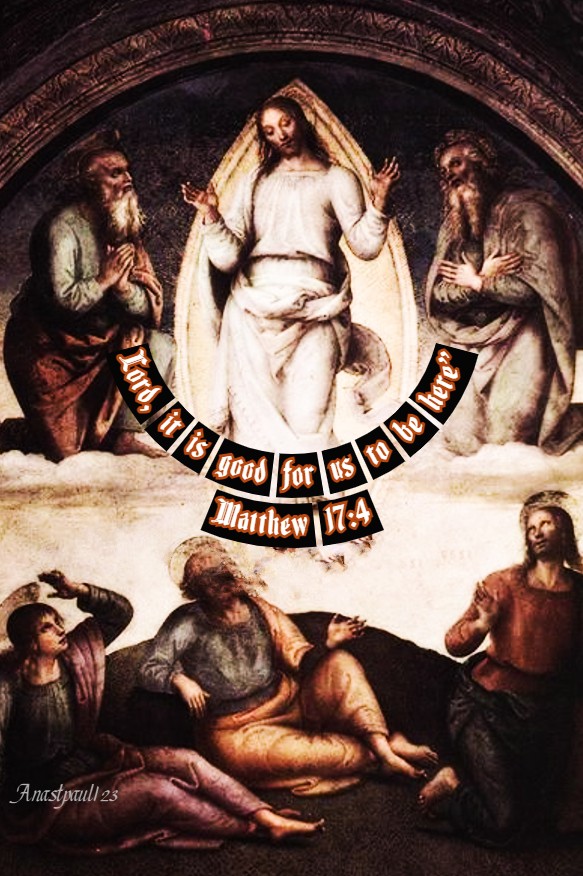
“Lord, it is good for us to be here”
Matthew 17:4
“Let us listen to the holy Voice of God which summons us from on high, from the holy mountain top. There, we must hasten – I make bold to say – like Jesus, Who is our leader and has gone before us into Heaven. There, with Him, may the eyes of our mind shine with His light and the features of our soul be made new; may we be transfigured with Him and moulded to His image, ever becoming divine, being transformed in an ever greater degree of glory.”
St Anastasius Sinaita (Died 6th Century) Priest and Abbot of St Catherine’s Monastery on Mount Sinai
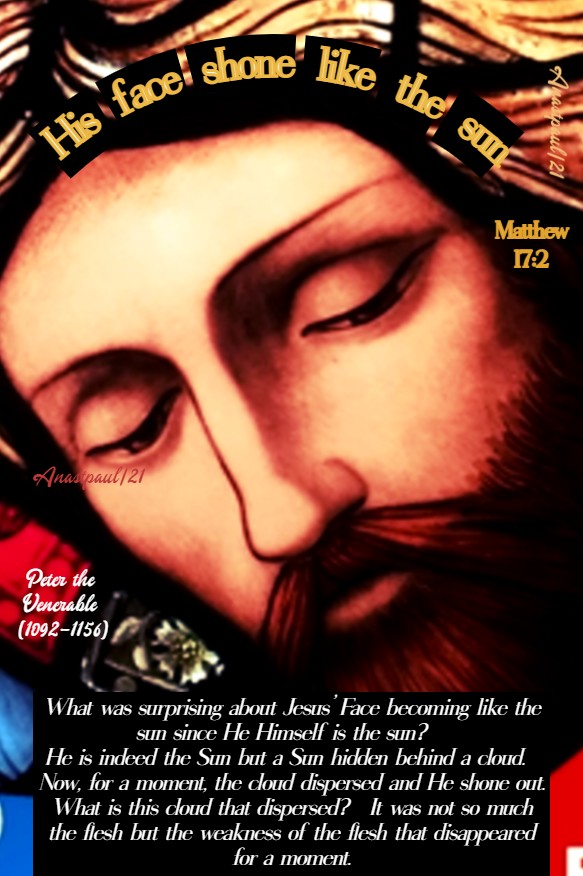
“What was surprising about Jesus’ Face becoming like the sun since He Himself is the Sun? He is indeed the Sun but a Sun hidden behind a cloud. Now, for a moment, the cloud dispersed and He shone out. What is this cloud that dispersed? It was not so much the flesh but the weakness of the flesh that disappeared for a moment.”
Peter the Venerable (1092-1156) Abbot of Cluny Sermon 1 for the Transfiguration
“At His Transfiguration Christ showed His disciples, the splendour of His beauty, to which He will shape and colour those who are His: ‘He will reform our lowness configured to the body of His glory.’”
St Thomas Aquinas (1225 – 1274) Doctor of the Church
One Minute Reflection – 6 August – The Transfiguration of Our Lord – 2 Peter 1:16-19, Matthew 17:1-9 – Scripture search here: https://www.drbo.org/
“And as they came down from the mountain, Jesus charged them, saying: ‘Tell the vision to no man, until the Son of man be risen from the dead.‘” – Matthew 17:9
REFLECTION – “Jesus Christ spoke, a great deal, to His disciples about His Sufferings, Passion and Death and, He foretold the afflictions, they themselves would have to endure and the violent deaths they would one day have to undergo (Mt 16:21-26). That is why, after telling them such hard and difficult things, He tries to comfort them by drawing attention to the reward He will give them when He comes in His Father’s glory (Mt 16:27)… He wants to show them, beforehand, as far as they are capable of it in this life, the great majesty in which He was to come and thus, forestall the trouble and sadness His Apostles, particularly Saint Peter, might feel before His death…
“Jesus took with Him, Peter, James and John.” Why only take these three Apostles? No doubt because they outstripped the others. Saint Peter because of his ardour, his love; Saint John because he was the disciple Jesus loved (Jn 13:23) and Saint James because he had said along with his brother: “We can drink your cup” (Mt 20:22) and subsequently kept his word (Acts 12:2)…
Why did Jesus cause Moses and Elijah to appear?… He was constantly accused of breaking the Law and blaspheming, appropriating for Himself, a glory that did not belong to Him, the glory of the Father… Therefore, wanting, a glory that did not belong to Him, Jesus calls on the authority of two of the most unimpeachable witnesses – Moses, who had given the Law … and Elijah, who had burned with zeal for the glory and service of God (1 Kgs 19:10) … He also wanted to teach them that He was lord over life and death, by causing one man who was dead and another who had been carried off alive in a fiery chariot, (2 Kgs 2,11) to appear. He wanted, too, to reveal the glory of His Cross to His disciples and comfort Peter and his companions, who were frightened by his Passion, reviving their courage. For Moses and Elijah spoke with Him about the glory He was to receive in Jerusalem (Lk 9:31). That is to say, they spoke of His Passion, His Cross which the prophets had always called His glory.” – St John Chrysostom (345-407) Bishop of Constantinople, Father and Doctor of the Church (Sermons on Saint Matthew’s Gospel no 56).
PRAYER – O God, Who in the glorious Transfiguration of Thy Only-begotten Son strengthened the Mysteries of faith, by the testimony of the fathers and, by the Voice coming down in a shining cloud, miraculously betokened the complete adoption of Thy children, mercifully grant that we, be made co-heirs with that King of glory and sharers in that same glory. Through the same Jesus Christ, Thy Son our Lord, Who lives and reigns with Thee, in the unity of the Holy Ghost, God, world without end. Amen (Collect).
Our Morning Offering – 6 August – The Feast of the Transgiuration of the Lord
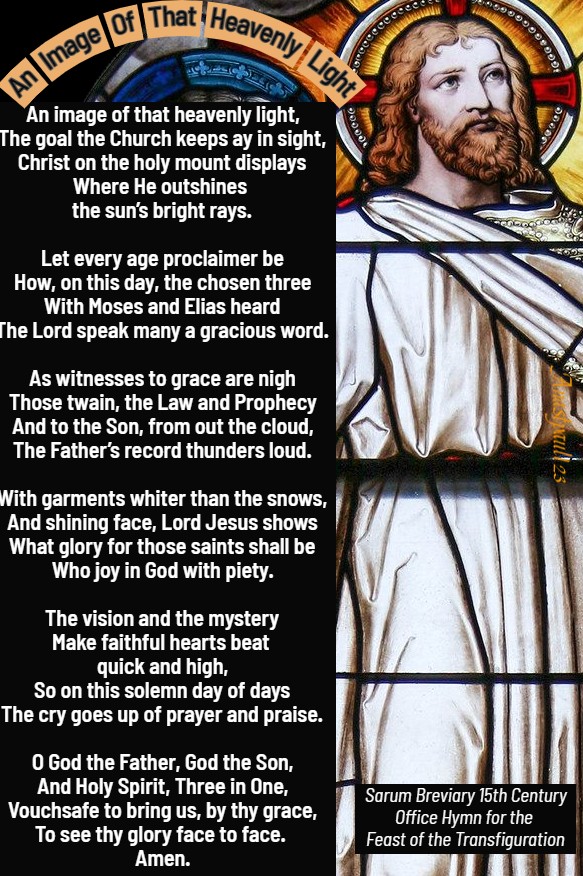
An Image of that Heavenly Light Sarum Breviary 15th Century Office Hymn for the Feast of the Transfiguration
An image of that heavenly light, The goal the Church keeps ay in sight, Christ on the holy mount displays Where He outshines the sun’s bright rays.
Let every age proclaimer be How, on this day, the chosen three With Moses and Elias heard The Lord speak many a gracious word.
As witnesses to grace are nigh Those twain, the Law and Prophecy And to the Son, from out the cloud, The Father’s record thunders loud.
With garments whiter than the snows, And shining face, Lord Jesus shows What glory for those saints shall be Who joy in God with piety.
The vision and the mystery Make faithful hearts beat quick and high, So on this solemn day of days The cry goes up of prayer and praise.
O God the Father, God the Son, And Holy Spirit, Three in One, Vouchsafe to bring us, by thy grace, To see thy glory face to face. Amen.
Words: Sarum Breviary, 15th Century Trans Richard E Roberts (1874-1945), 1906 This Hymn is used for Vespers I on the Feast of the Transfiguration of the Lord in the Sarum Breviary. This is the original text as it appears in The English Hymnal (1906).
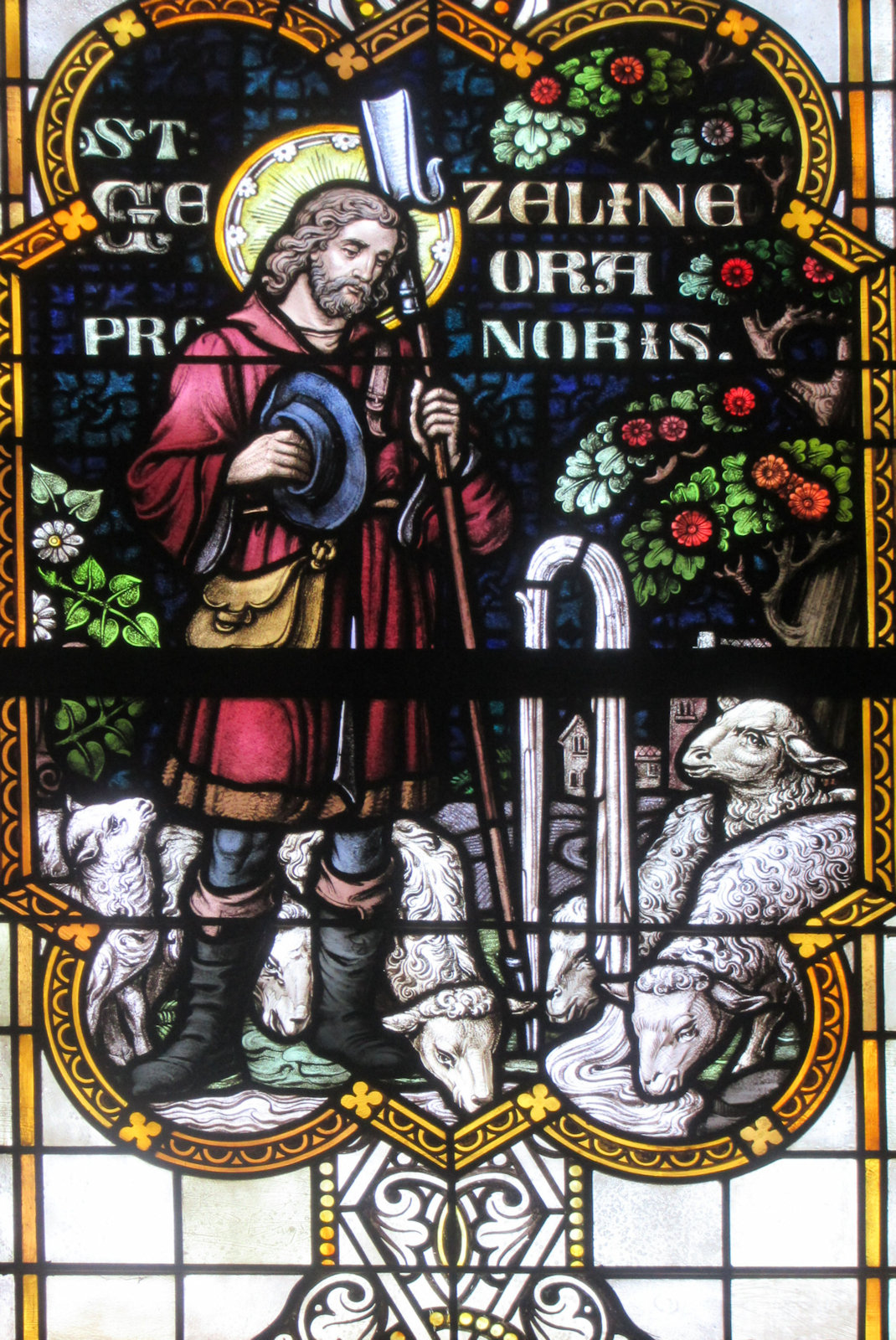
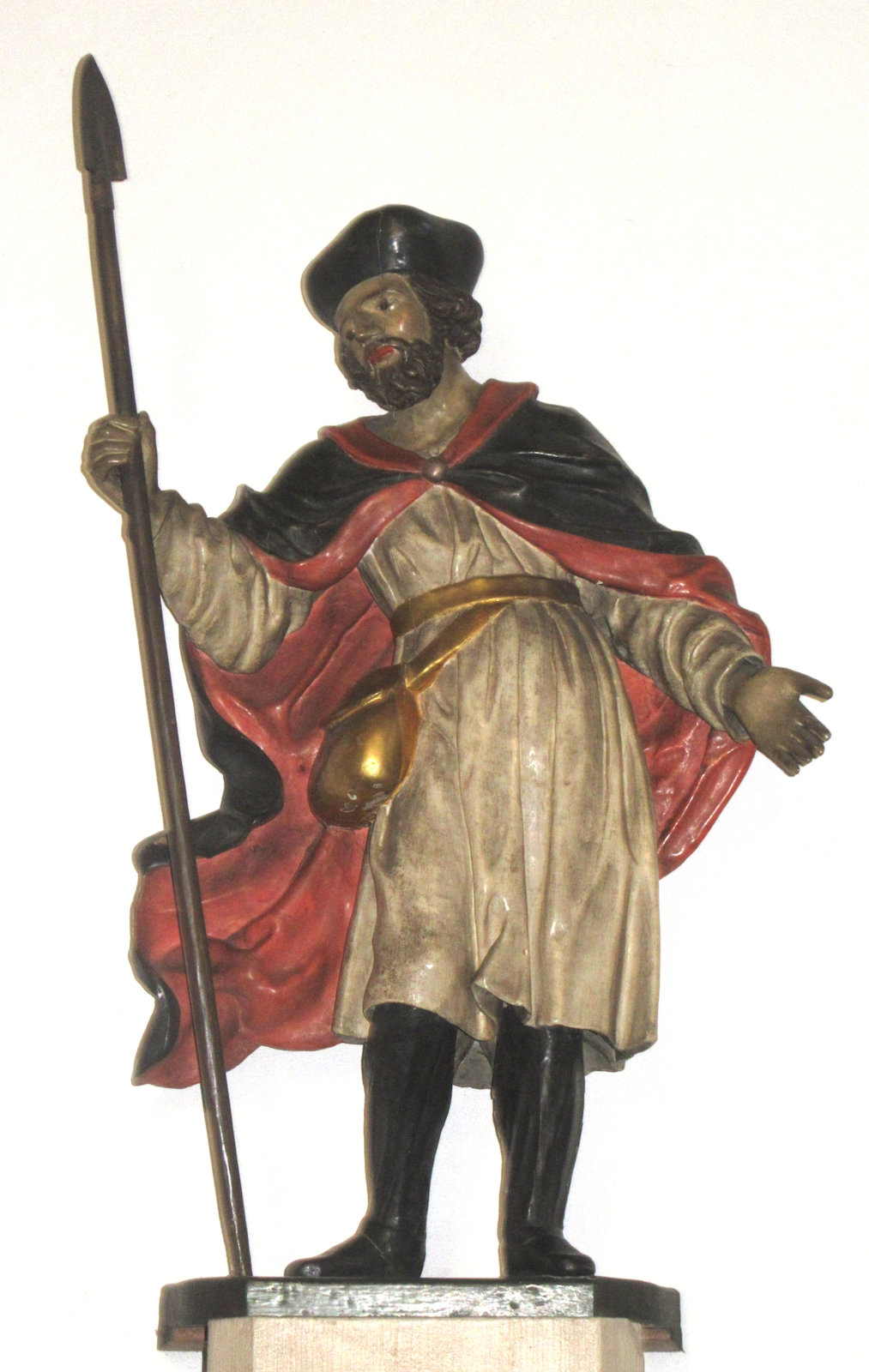
Saint of the Day – 6 August – Saint Gezelin of Schlebusch O.Cist. (Died 1149) known as “The Apostle of Hainaut” – Lay Brother of the Cistercian Order, Hermit, Gezelin’s duties included shepherding the sheep of the Monastery, Miracle-worker. Died on 29 July 1149 in Gut Alkenrath, Schlebusch, Germany. Patronages – children, against epilepsy in children, against eye disorders, against headaches. Also known as – Gezelin of Altenberg, Gezelinus of… Gezzelin of… Gezzelino of… Ghislain of… Gisle of… Gozelin of… Jocelin of… Schezelinus of… Gezelin was Canonised by the Bishop of Cologne, Germany, which was a common practice at that time.
The window of St Gezelin near his Shrine in the Andreas Church in Schlebusch
Gezelin was a lay brother in the Cistercian Monastery of Morimond – in today’s Fresnoy-en-Bassigny. In around 1135 he came to the new Altenberg Abbey and worked as a shepherd on the Alkenrath estate belonging to the Monastery in Schlebusch. Even during his lifetime, he was highly praised and revered for his always kind and helpful support of the rural population and the news of miraculous deeds spread more and more. For example, during a drought – in which even the Rhine had dried up – a copious Spring spurted out by his fervent prayers.
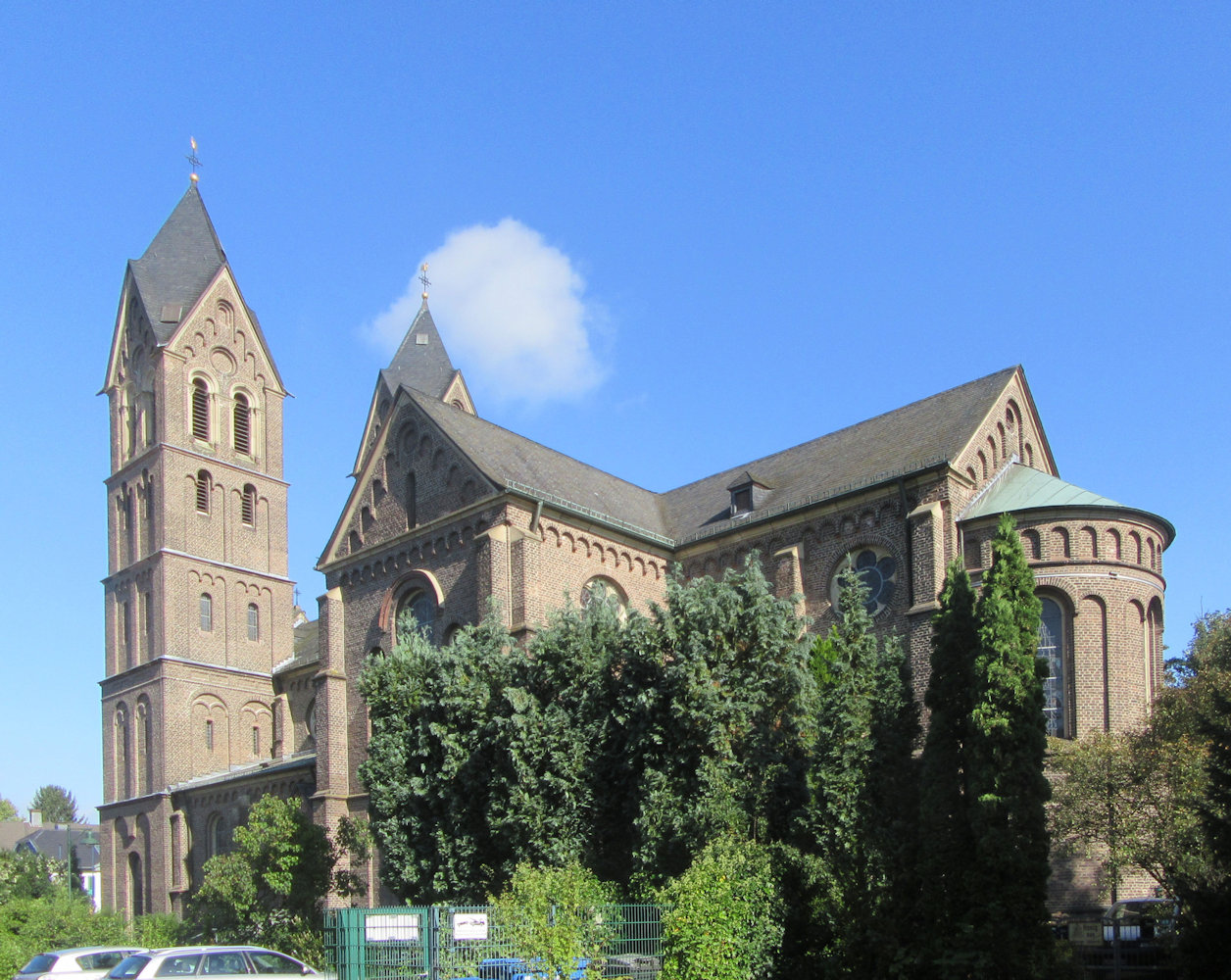
In his modesty, Gezelin requested not to be buried in the Abbey in Altenberg but, in the Parish Church near his sheep in Alkenrath. His bones were collected there in 1814. After the demolition of this Church, In 1890, the Relics were taken to the Andreas Church in Schlebusch where they now rest in an oak Shrine made in 1903. More of Gezelin’s Relics were enshrined in Altenberg Cathedral.
The Andreas Church
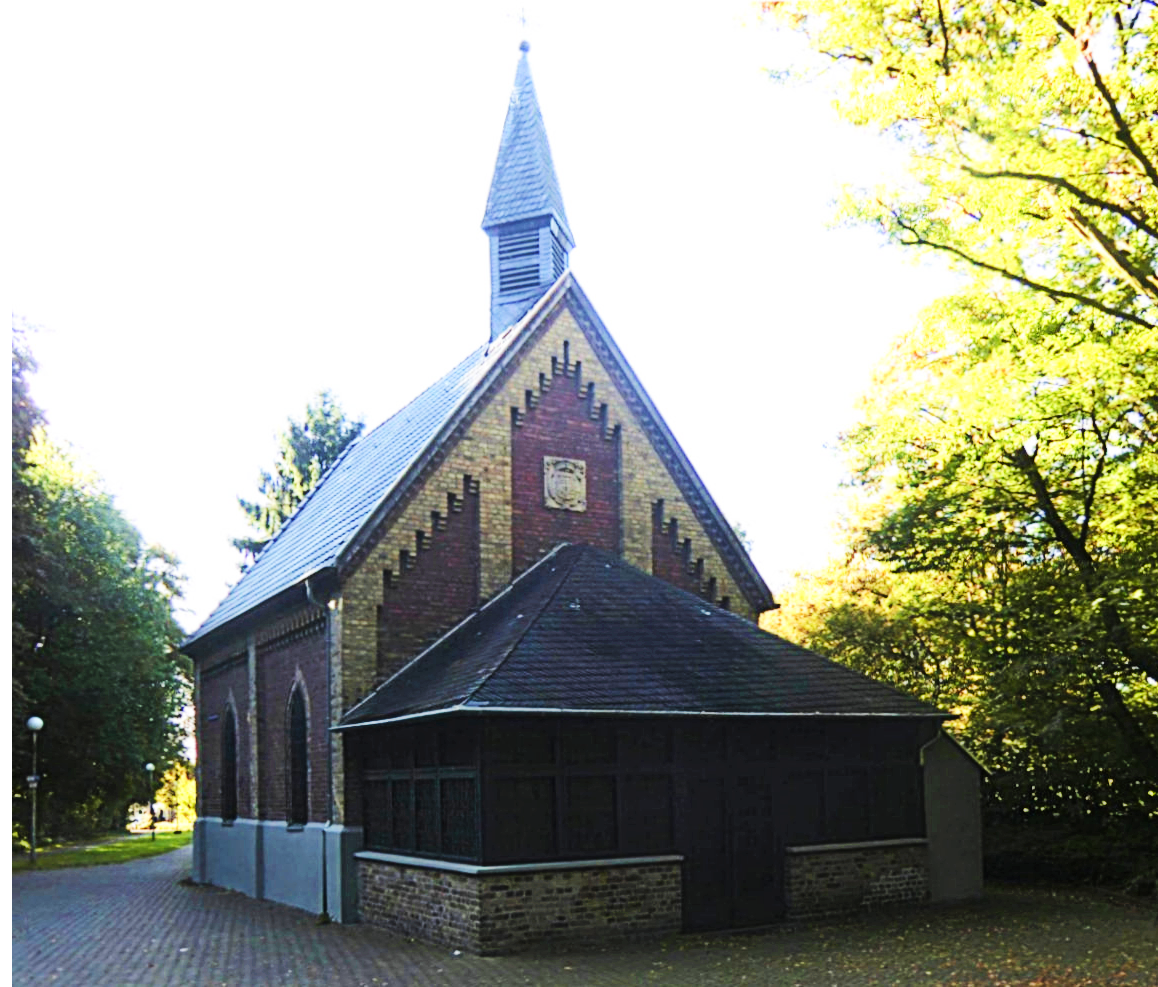
A Chapel dedicated to him, renovated in 1659 and rebuilt from 1864 to 1868, still stands above the Holy Spring in Gut Alkenrath, which Gezelin caused to rise and whose water heals head and eye ailment and which is still a site of pilgrimage. Many local residents used to fetch their drinking water there and to this day the Baptismal water for the Andreas Church in Schlebusch, is fetched from it. A pilgrimage takes place on the Sunday after Corpus Christi and on his Feast day . The source flow was disturbed by canal work in the 1950s, since then the water is pumped at certain times to the outflow on the west side of the Chapel. The St Gezelin Chapel is normally locked except, of course, during Mass but the Miraculous Spring flows everyday – a sign is posted outside the Chapel of the times when it is pumped.
St Pope Sixtus II/ Xystus (Died 258) Pope and Martyr, Philosopher. 25th Pope from St Peter. Papal Ascension 30 August 257. He was Martyred along with seven deacons, (St Lawrence of Rome a few days later) during the persecutions of Christianity by Emperor Valerian. This is the St Sixtus who is commemorated in the Roman Canon Eucharistic Prayer. His Life and Death: https://anastpaul.com/2021/08/06/saint-of-the-day-6-august-saint-sixtus-ii-died-258-pope-and-martyr/
St Gezelin of Schlebusch O.Cist. (Died 1149) Lay Brother of the Cistercian Order, Hermit. St Gislain of Luxemburg St Glisente of Brescia Bl Goderanno Bl Guillermo Sanz St Hardulf of Breedon
Bl Octavian of Savona St Stephen of Cardeña Bl William of Altavilla
Martyrs of Cardeña: Two hundred Benedictine Monks at the Saint Peter of Cardegna monastery, Burgos, Spain who were Martyred in the 8th century by invading Saracens. They were buried by local Christians in a nearby churchyard in Burgos, Spain and Beatified in 1603 by Pope Clement VIII (cultus confirmed).
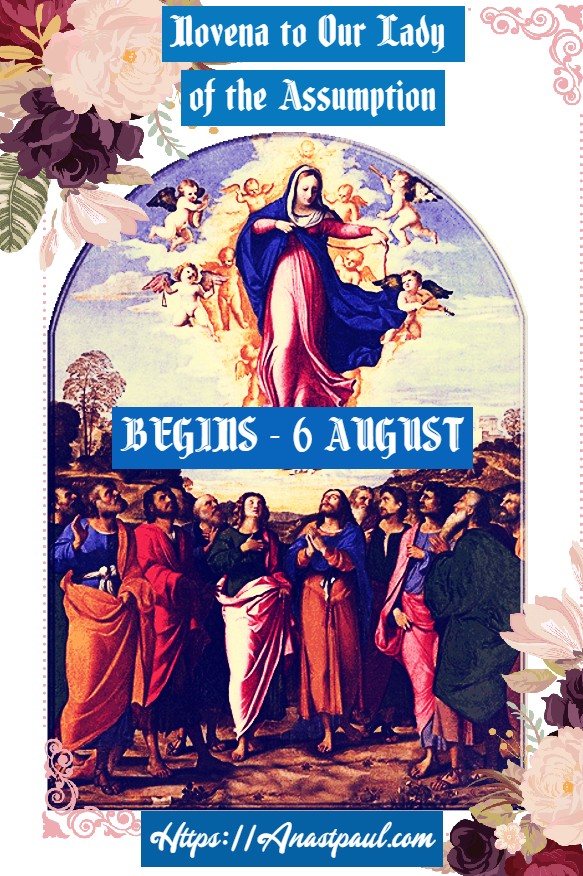
The Novena to Our Lady of the Assumption Begins 6 August in preparation for the Feast on 15 August – a Holy Day.
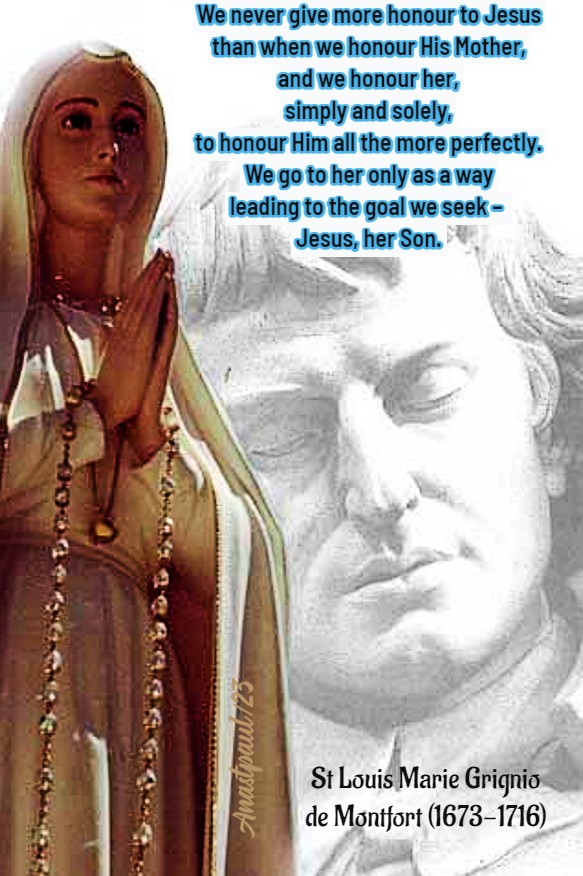
“We never give more honour to Jesus than when we honour His Mother, and we honour her, simply and solely, to honour Him all the more perfectly. We go to her only as a way leading to the goal we seek – Jesus, her Son.” s
St Louis Marie Grignion de Montfort (1673-1716)
Please join us as we pray a Novena in reverence and filial devotion to Our Lady, the Blessed Virgin Mary, Assumed into Heaven, our Queen and our Mother Mary.
We pray in preparation for the great Feast of the Assumption of Our Lady, Body and Soul as defined and declared as Dogma on 1 November 1950, by Pope Pius XII. Thus he solemnly proclaimed that the belief whereby, the Blessed Virgin Mary, at the close of her earthly life, was taken up, body and soul, into the Glory of Heaven, definitively forms part of the deposit of faith, received from the Apostles.
Our Novena will include a brief Meditation with practical reflection, a preparatory prayer by St Alphonsus Liguori and the daily prayer each morning for nine days. See you here!
Thought for the Day – 5 August – Meditations with Antonio Cardinal Bacci (1881-1971)
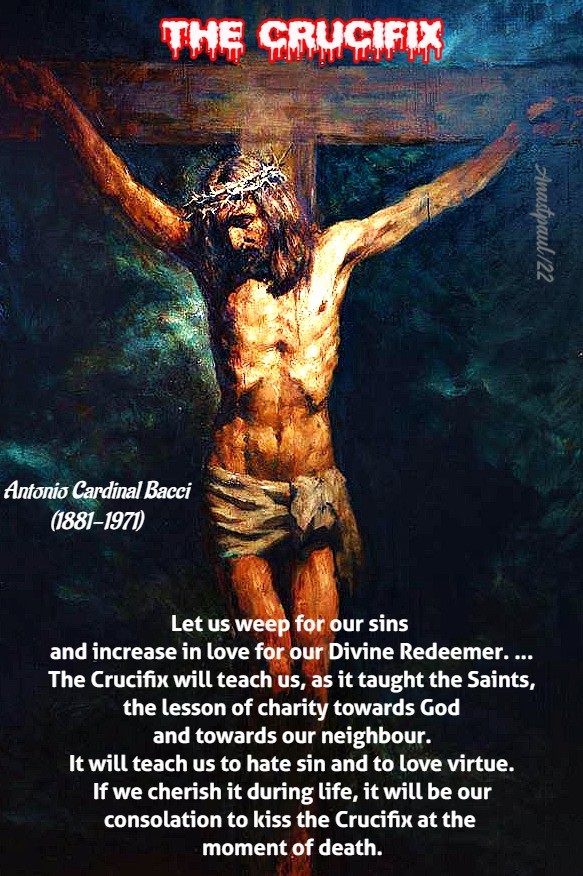
THE CRUCIFIX
“Let us weep for our sins and increase in love for our Divine Redeemer. When we are oppressed by the weight of our own cross, we shall look at the Crucifix and find comfort. When we are tempted, we shall grasp the Crucifix and turn away with horror from thoughts of sin and ingratitude.
The Crucifix will teach us, as it taught the Saints, the lesson of charity towards God and towards our neighbour. It will teach us to hate sin and to love virtue. If we cherish it during life, it will be our consolation to kiss the Crucifix at the moment of death.”
Quote/s of the Day – 5 August – “The Month of the Immaculate Heart of Mary” – Dedication of the Basilica of Our Lady of the Snows
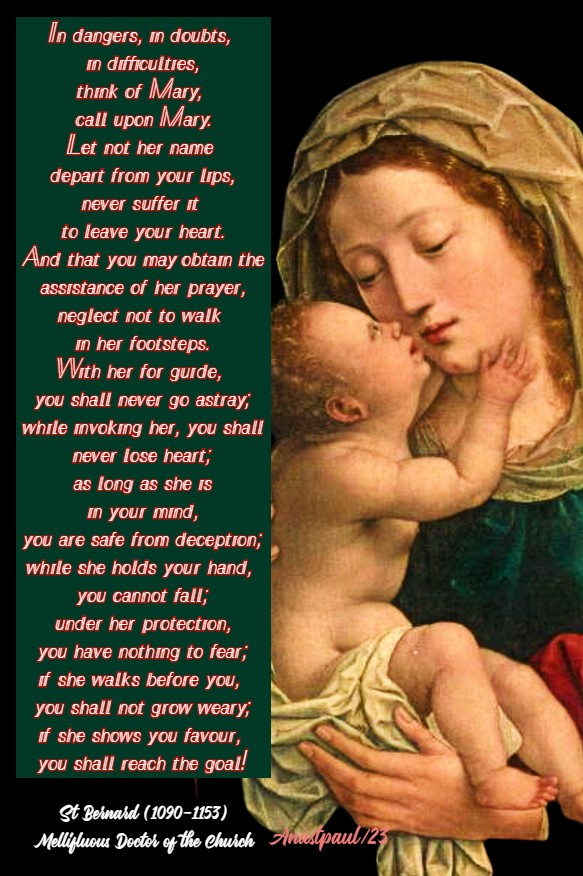
“In dangers, in doubts, in difficulties, think of Mary, call upon Mary. Let not her name depart from your lips, never suffer it to leave your heart. And that you may obtain the assistance of her prayer, neglect not to walk in her footsteps. With her for guide, you shall never go astray; while invoking her, you shall never lose heart; as long as she is in your mind, you are safe from deception; while she holds your hand, you cannot fall; under her protection, you have nothing to fear; if she walks before you, you shall not grow weary; if she shows you favour, you shall reach the goal!”
St Bernard (1090-1153) Mellifluous Doctor of the Church
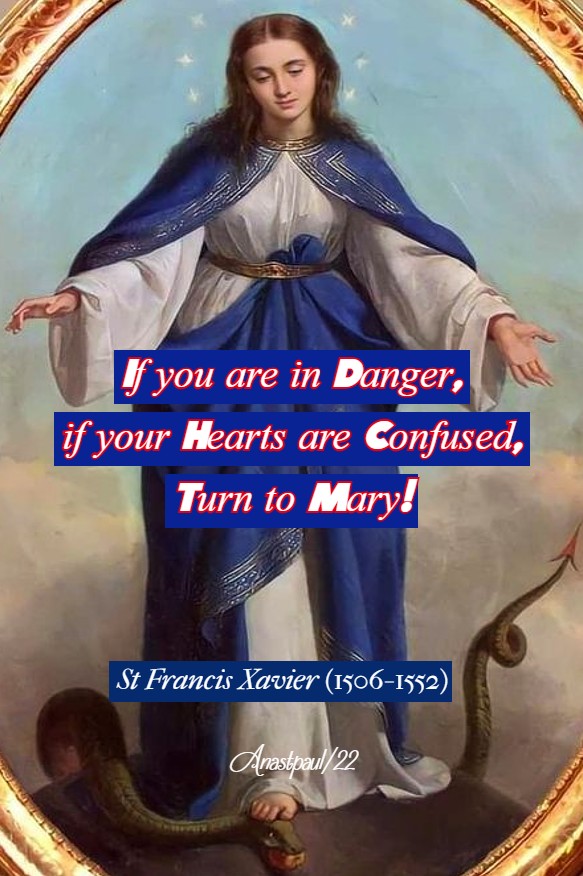
“If you are in danger, if your hearts are confused, turn to Mary!”
St Francis Xavier (1506-1552)
No-one who shall invoke this Mother of Grace, with devotion and perseverance, can possibly perish forever.”
St John Eudes (1601-1680) “The Apostle of Two Hearts”
Tota Pulchra Es, Maria You Are All Beautiful, Mary Unknown Author – 4th Century
You are all beautiful, Mary, and the original stain is not in you. You are the glory of Jerusalem, you are the joy of Israel, you give honour to our people. You are an advocate of sinners. O Mary, O Mary, Virgin most intelligent, Mother most merciful. Pray for us, Plead for us, To the Lord Jesus Christ.
Tota pulchra es, Maria. Et macula originalis non est in Te. Tu gloria Ierusalem. Tu laetitia Israel. Tu honorificentia populi nostri. Tu advocata peccatorum. O Maria, O Maria, Virgo prudentissima. Mater clementissima. Ora pro nobis. Intercede pro nobis. Ad Dominum Iesum Christum.
One Minute Reflection – 5 August – “The Month of the Immaculate Heart of Mary” – Dedication of the Basilica of Our Lady of the Snows – Sirach 24:14-16, Luke 11:27-28 – Scripture search here: https://www.drbo.org/
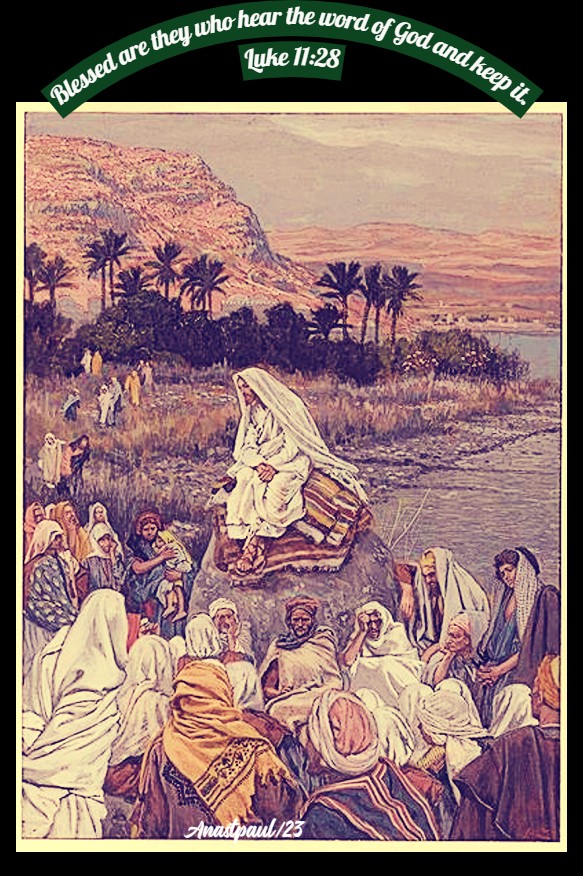
“Blessed are they who hear the word of God and keep it.” – Luke 11:28
REFLECTION – “Mary was very discreet – we have proof of this in the Gospel. Where do you see her having been talkative, or full of presumption? Once she stood at the door wishing to speak to her Son but, she did not use her maternal authority either, to interrupt His preaching or to enter the house where He preached (Mk 3:31).
If I remember correctly, the Evangelists only allow Mary’s words to be heard four times. First, when she addressed the Angel – and this was only in answer to him. Secondly, during her visit to Elizabeth when, having been praised by her cousin, Mary wanted to praise the Lord even more. Thirdly, when she complained to her Son, then aged twelve that His father and she herself, had searched for Him anxiously. Fourthly, at the wedding of Cana when she intervened with her Son and the servants.
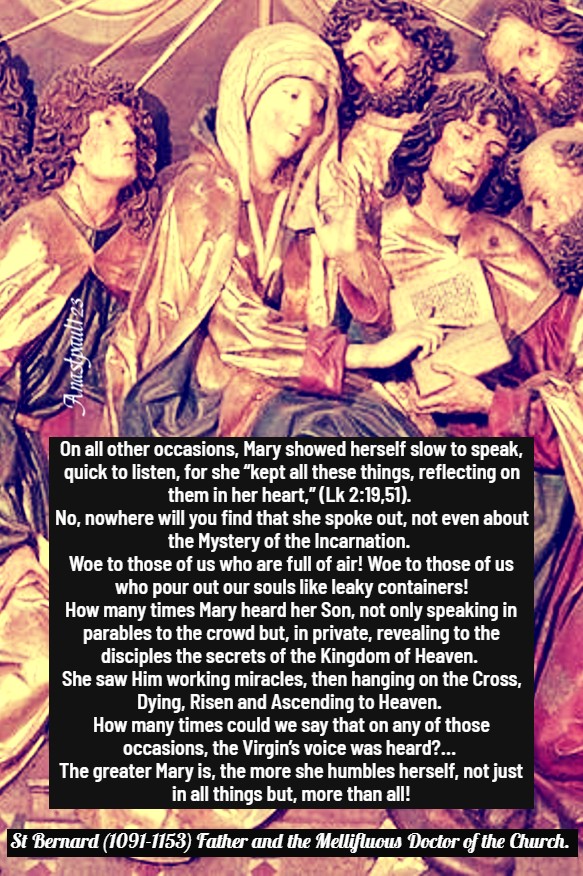
On all other occasions, Mary showed herself slow to speak, quick to listen, for she “kept all these things, reflecting on them in her heart,” (Lk 2:19,51). No, nowhere will you find that she spoke out, not even about the Mystery of the Incarnation. Woe to those of us who are full of air! Woe to those of us who pour out our souls like leaky containers!
How many times Mary heard her Son, not only speaking in parables to the crowd but, in private, revealing to the disciples the secrets of the Kingdom of Heaven. She saw Him working miracles, then hanging on the Cross, Dying, Risen and Ascending to Heaven. How many times could we say that on any of those occasions, the Virgin’s voice was heard?… The greater Mary is, the more she humbles herself, not just in all things but, more than all!” – St Bernard (1091-1153) Known as the Last Father and the Mellifluous Doctor of the Church.
PRAYER – Grant us, Thy servants, O Lord God, we beseech Thee, to enjoy lasting health of mind and body and by the intercession of glorious and Blessed Mary, ever Virgin, may be delivered from present sorrow and partake of the fullness of eternal happiness. Through the same Jesus Christ, Thy Son our Lord, Who lives and reigns with Thee, in the unity of the Holy Ghost, God, world without end. Amen (Collect).
Our Morning Offering – 5 August – “The Month of the Immaculate Heart of Mary” – Dedication of the Basilica of Saint Mary Major / Our Lady of the Snows and the First Saturday of August
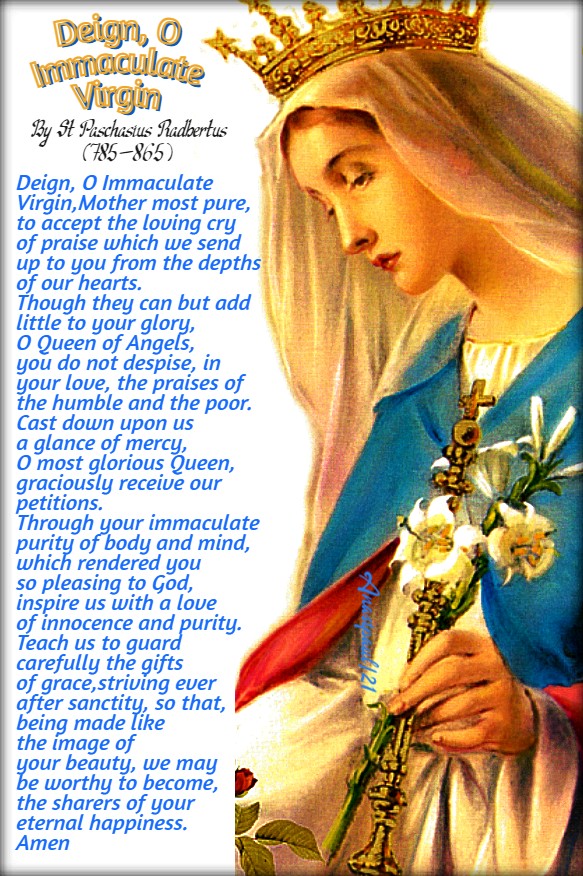
Deign, O Immaculate Virgin By St Paschasius Radbertus (785–865)
Deign, O Immaculate Virgin, Mother most pure, to accept the loving cry of praise which we send up to you from the depths of our hearts. Though they can but add little to your glory, O Queen of Angels, you do not despise, in your love, the praises of the humble and the poor. Cast down upon us a glance of mercy, O most glorious Queen, graciously receive our petitions. Through your immaculate purity of body and mind, which rendered you so pleasing to God, inspire us with a love of innocence and purity. Teach us to guard carefully the gifts of grace, striving ever after sanctity, so that, being made like the image of your beauty, we may be worthy to become, the sharers of your eternal happiness. Amen
Saint of the Day – 5 August – St Nonna of Nazianzen (c305-374) Widow of St Gregory Nazianzen the Elder, (c276-374) the saintly Bishop of Nazianzen and Mother of St Gregory Nazianzen (330-390) Doctor of the Church, his younger brother St Caesarius Nazianzen (c331-368) a Physician and St Gorgonia (Died c375) Married, Mother. Born in Nazianzen in Cappadocia (modern day Turkey) in around 305 and died in c374 in her home town, of natural causes. Patronages – death of children, Information services. Also known as – Nona.
The Roman Martyrology states: “In Nazianzus in Cappadocia, in today’s Turkey, Saint Nonna, who was the wife of the holy Bishop Gregory the Elder and mother of the Saints Gregory, Cesario and Gorgonia.”
Nonna was born and raised as a deeply religious Christian. After she married, she converted her husband Gregory to Christianity. He had been a member of the Hypsistarians, a Jewish-pagan sect which worshipped Hypsistos, the “Most High” God. Both Gregory and Nonna came from wealthy families and Gregory was able to personally finance the construction of a Church in the region. In 328, Gregory was selected as the Bishop of Nazianzen, a position he held until his death. At one point, Gregory subscribed to an Arian understanding of the Blessed Trinity. However, this was for a very brief time and he quickly renounced that position.
Nonna became the mother of three children, each of whom became Saints, the most notable of whom being the Doctor of the Church, St Gregory Nazianzen.
Nonna outlived her husband and two of her children, dying, almost certainly in 374.
Her son Gregory tells of an occasion in 351 when Nonna fell terribly sick with a severe illness and appeared to be at the point of death. On his way to visit a friend, Gregory hurried instead to his mother who, in the meantime, had begun to recover. She had a vision in which Gregory had given her magical cakes marked with the Sign of the Cross and blessed by him.
Gregory championed Nonna as a model of Christian motherhood. He wrote of her:
“My mother was a worthy companion for such a man [as my father] and her qualities were as great as his. She came from a pious family but was even more pious than they, although, in her body she was but a woman, in her spirit she was above all men…
Her mouth knew nothing but the truth but, in her modesty, she was silent about those deeds which brought her glory. She was guided by the fear of God. …”
St Eusignius St Gormeal of Ardoilen Bl James Gerius St Margaret the Barefooted (1335-1395) Married Laywoman St Mari St Memmius of Châlons-sur-Marne St Nonna of Nazianzen (c305-c374) Widow. Mother
St Sobel St Theodoric of Cambrai-Arras St Venantius of Viviers St Viator
Martyrs of the Salarian Way: Twenty-three Christians who were Martyred together in the persecutions of Diocletian. Died in 303 on the Salarian Way in Rome, Italy.
Thought for the Day – 4 August – Meditations with Antonio Cardinal Bacci (1881-1971)
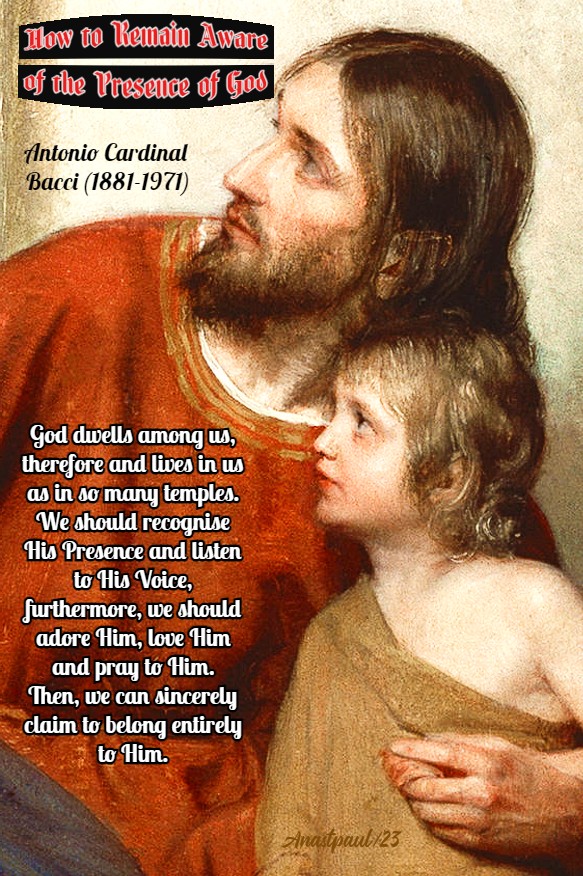
How to Remain Aware of the Presence of God
“The third way of remaining attentive to the Presence of God is to contemplate Him living in ourselves. While it is true that God is present everywhere, He dwells in a special manner in the human soul which is the masterpiece of creation!
When our souls are adorned with His grace, His delight in us is unbounded. “I will dwell and move among them. I will be their God and they shall be My people” (2 Cor 6:16). “Do you not know that you are the temple of God and that the Spirit of God dwells in you” (1 Cor 3:16).
God dwells among us, therefore and lives in us as in so many temples. We should recognise His Presence and listen to His Voice, furthermore, we should adore Him, love Him and pray to Him. Then, we can sincerely claim to belong entirely to Him.”
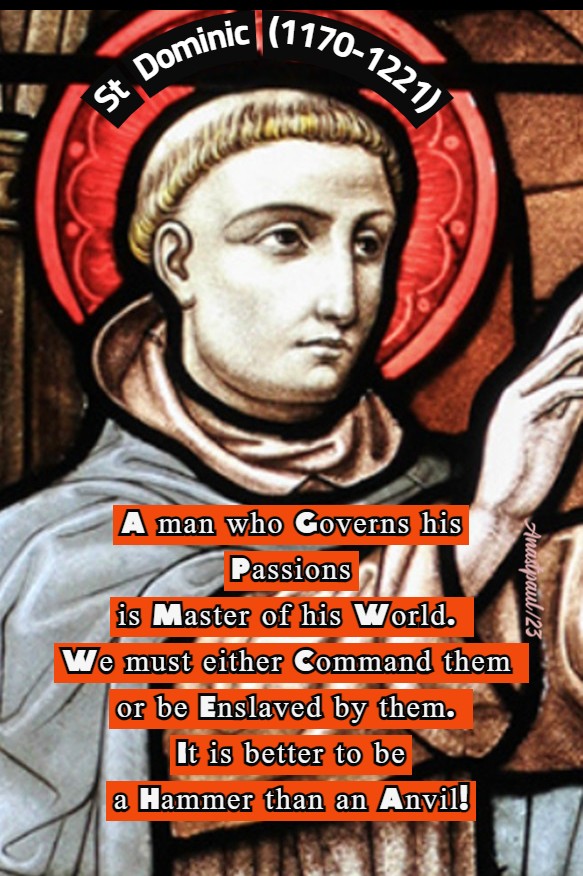
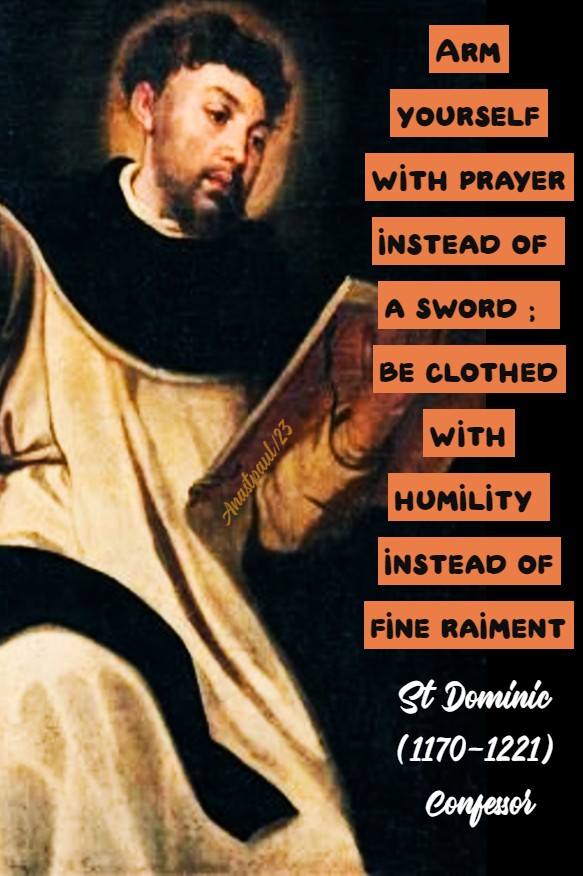
Quote/s of the Day – 4 August – The Memorial of St Dominic (1170-1221) Confessor
“A man who governs his passions is master of his world. We must either command them or be enslaved by them. It is better to be a hammer than an anvil!”
“Arm yourself with prayer instead of a sword; be clothed with humility instead of fine raiment.”
One Minute Reflection – 4 August – “The Month of the Immaculate Heart of Mary” – St Dominic de Guzman OP (1170-1221) – 2 Timothy 4:1-8, Luke 12:35-40 – Scripture search here: https://www.drbo.org/
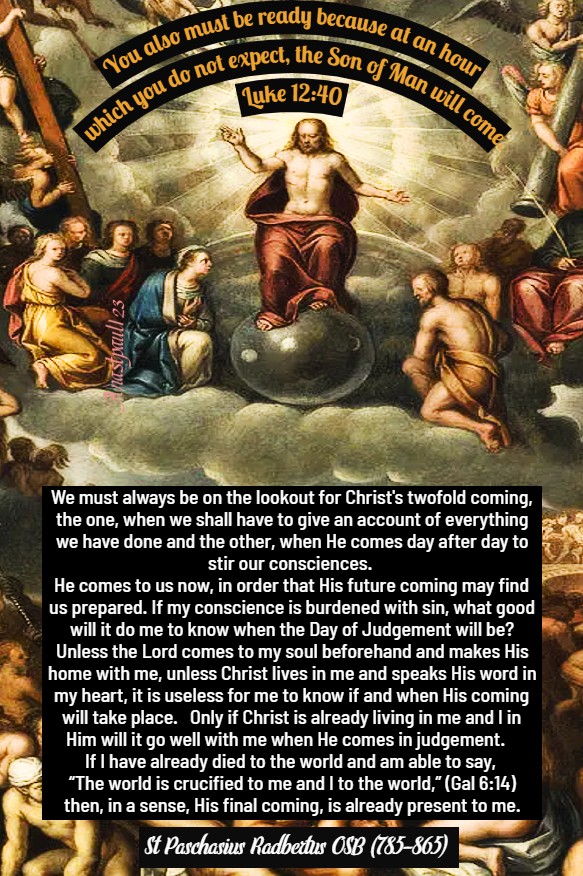
“You also must be ready because at an hour which you do not expect, the Son of Man will come.” – Luke 12:40
REFLECTION – “We must always be on the lookout for Christ’s twofold coming, the one, when we shall have to give an account of everything we have done and the other, when He comes day after day to stir our consciences. He comes to us now, in order that His future coming may find us prepared. If my conscience is burdened with sin, what good will it do me to know when the Day of Judgement will be? Unless the Lord comes to my soul beforehand and makes His home with me, unless Christ lives in me and speaks His word in my heart, it is useless for me to know if and when His coming will take place. Only if Christ is already living in me and I in Him will it go well with me when He comes in judgement. If I have already died to the world and am able to say, “The world is crucified to me and I to the world,” (Gal 6:14) then, in a sense, His final coming is already present to me.
Consider also our Lord’s warning: “Many will come in My Name” (Mt 24:5). It is only the Antichrist and his members who, albeit falsely, claim the Name of Christ. .. You will never find the Lord in Scripture, actually declaring, “I am the Christ.” His teaching and miracles revealed it clearly enough, for the Father was at work in Him. Louder than a thousand acclamations His teaching and mighty works proclaimed: “I am the Christ.” And so, whether or not you find Him describing Himself in so many words, the “works of the Father” (Jn 5:6) and His own message of love, declared what He was, whereas the false Christs, who possessed neither godly deeds nor holy doctrine, loudly claimed to be what they were not.” – St Paschasius Radbertus OSB (785–865) Abbot, Theologian (Commentary on St Matthew’s Gospel 11, 24).
PRAYER – O God, Who graciously enlightened Thy Church by the good works and teaching of St Dominic, Thy Confessor, grant by his intercession, that she may never be deprived of temporal helps and may ever advance in spiritual growth. Through the same Jesus Christ, Thy Son our Lord, Who lives and reigns with Thee, in the unity of the Holy Ghost, God, world without end. Amen (Collect).
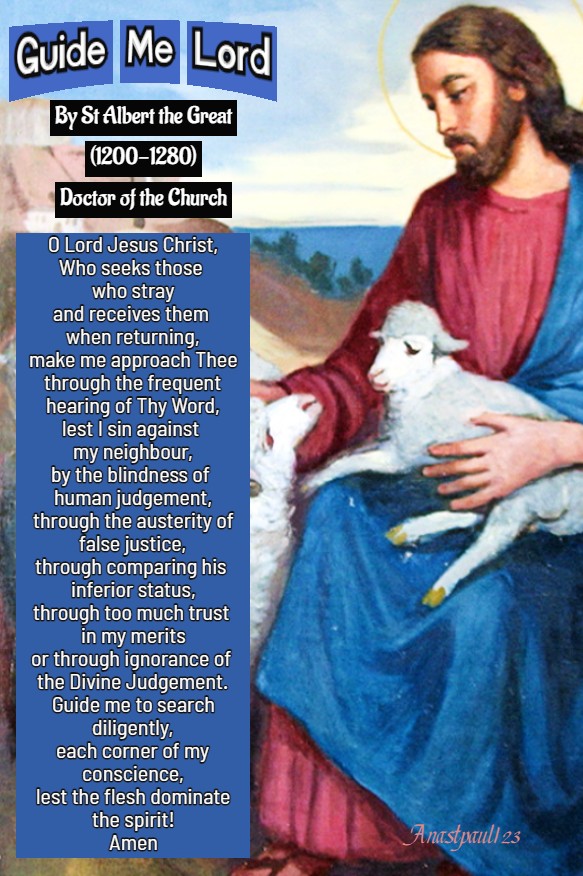
Our Morning Offering – 4 August – On the Feast of St Dominic, we pray a prayer by one of his most illustrious children, St Albert the Great
Guide Me Lord By St Albert the Great (1200-1280) Doctor of the Church
O Lord Jesus Christ, Who seeks those who stray and receives them when returning, make me approach Thee through the frequent hearing of Thy Word, lest I sin against my neighbour, by the blindness of human judgement, through the austerity of false justice, through comparing his inferior status, through too much trust in my merits or through ignorance of the Divine Judgement. Guide me to search diligently, each corner of my conscience, lest the flesh dominate the spirit! Amen
Saint of the Day – 4 August – Saint Agabius of Verona (Died c350) Bishop, Confessor – the Ninth Bishop of Verona, Italy. His birth date and place are unknown but he died in c350 in Verona, of natural causes. Also known as – Agabio, Agapio, Agapito. Agabius was the Bishop of the Diocese of Verona who lived in the 4th Century. The name Agabius is of Greek origin and derives from the verb “agapao” to love.
We know very little about our Saint today. Our only certain knowledge is that he was buried in the Church of St Proculus and when the Church was suppressed on 28 September 1806, his remains were moved to the crypt of the Basilica of St Zeno, the Cathedral Church of Verona.
The Martyrology of the Veronese Church states: “Saint Agabius of Verona, Bishop of the same City, who, excelling in piety to God and gentleness of manners, he of all virtues, of great faith … and of liberality to all the poor, left behind him examples to the … Bishops.” (The gaps are due to the Italian translation which makes little sense).
Another clarification on this holy Bishop is made by Msgr Dario Cervato in his recent work “Verona Agiografica” where he states: “some said he was a native of Caesarea in Palestine, where he was the Bishop, successor of Teotemius and then transferred to Verona but this is unsupported information.”
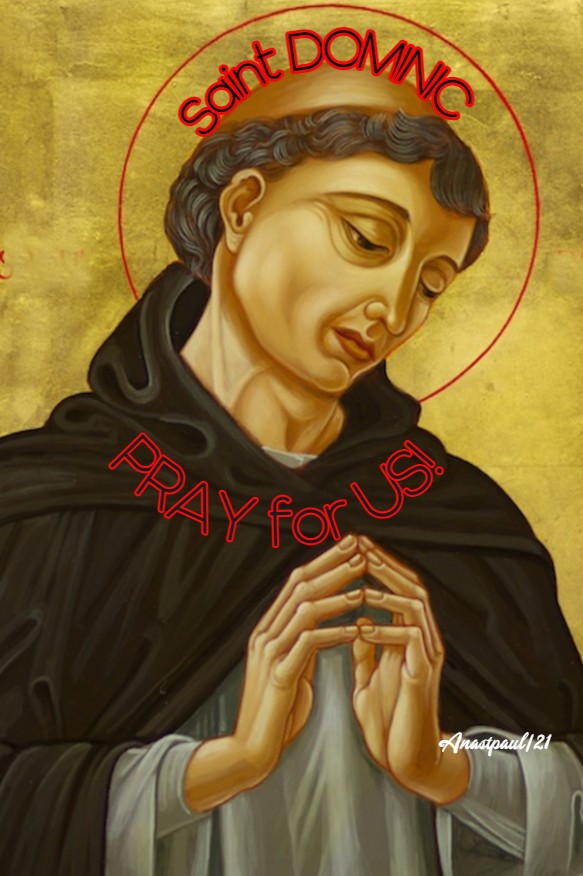
St Dominic de Guzman OP (1170-1221) Confessor, Founder of the Dominicans – The Order of Preachers – Priest, Founder, Teacher, Preacher, Mystic, Miracle-Worker, Apostle of the Holy Rosary. At Dominic’s Baptism, Blessed Joan, his Mother, saw a star shining from his chest, which became another of his symbols in art and led to his patronage of astronomy. https://anastpaul.wordpress.com/2017/08/08/saint-of-the-day-8-august-st-dominic-de-guzman-founder-of-the-dominican-order-of-preachers/ A lovely personal description of St Dominic here: https://anastpaul.com/2022/08/04/saint-of-the-day-4-august-st-dominic-confessor/ The Roman Martyrology states today: “At Bologna, St Dominic, Confessor, Founder of the Order of Friars Preachers, most renowned for sanctity and learning. He preserved his chastity unsullied to the end of his life and by his great merits, raised three persons from the dead. After having repressed heresies by his preaching and instructed many in the religious and Godly life, he rested in peace on the 6th of this month. His Feast, however, is celebrated on this day by decree of Pope Paul IV.”
St Agabius of Verona (Died c350) Bishop St Aristarchus of Thessalonica (1st Century) St Crescentio of Rome St Eleutherius of Bithynia St Epiphanes of Besançon
St Hyacinth of Rome St Ia of Persia St Isidore of Besançon St Lua of Limerick St Onofrio of Panaia St Perpetua of Rome St Protasius of Cologne St Rainerio of Split St Sithney (Died c 529) St Tertullinus of Rome Blessed William Horne O.Cart. (Died 1540) Martyr, Carthusian Lay Brother
Thought for the Day – 3 August – Meditations with Antonio Cardinal Bacci (1881-1971)
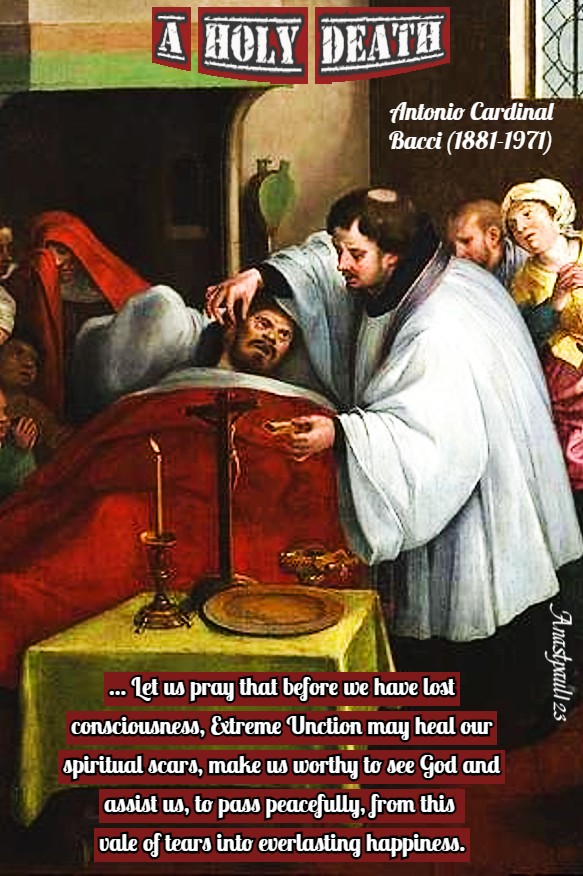
A Holy Death
“During our meditation on death, we should seize the opportunity of asking God for the favour of dying with the consolation of the last Sacraments. Let us pray that in our final moments, we may be comforted and reassured by the Sacramental absolution and blessing of the Priest at our bedside and that Jesus may visit us once more in the Blessed Eucharist, to revive our faith, hope and love and to strengthen us for our journey into eternity.
Finally, let us pray that before we have lost consciousness, Extreme Unction may heal our spiritual scars, make us worthy to see God and assist us, to pass peacefully, from this vale of tears into everlasting happiness.”
Quote/s of the Day – 3 August – The Finding of the Relics of St Stephen, Protomartyr – Acts 6:8-10; 7:54-60. Matthew 23:34-39
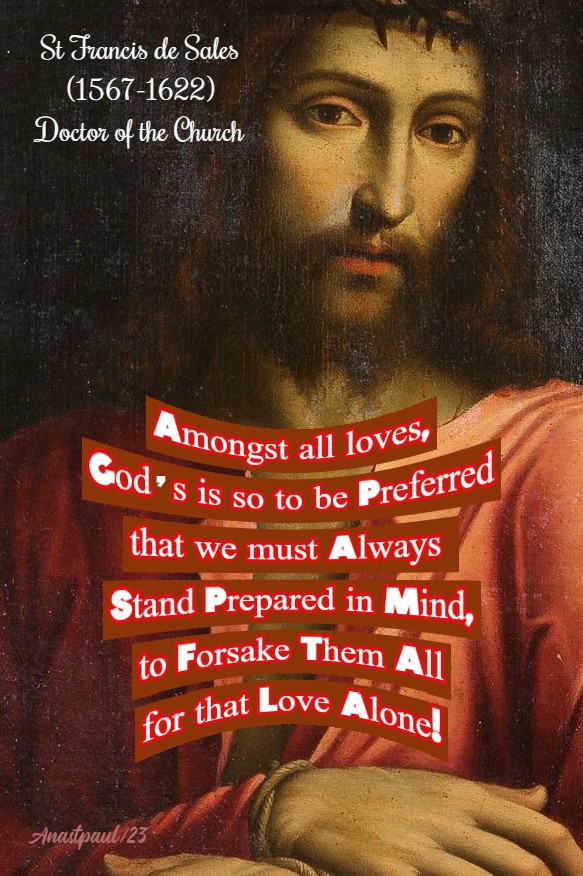
“Amongst all loves, God’s is so to be preferred that we must always stand prepared in mind, to forsake them all for that alone!”
(Treatise on the Love of God, Book 10, Chapter 7)
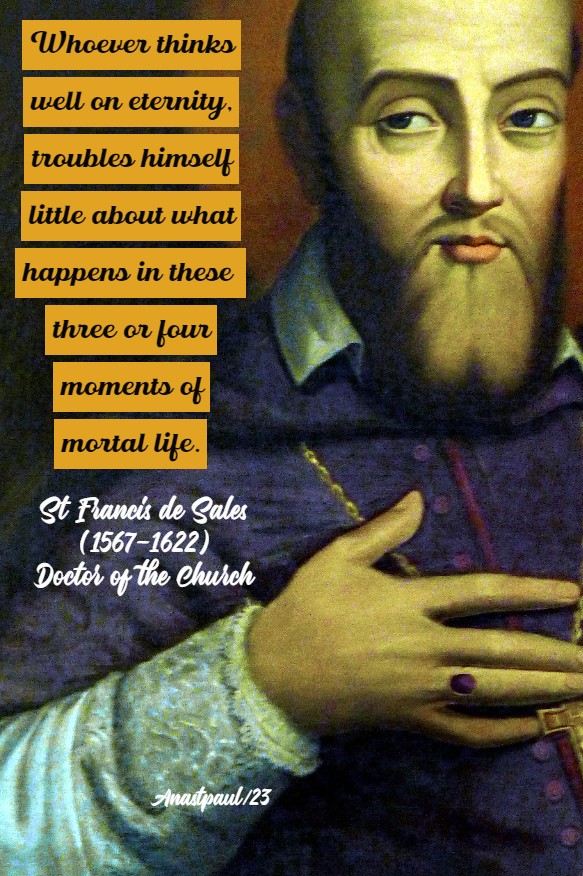
“Whoever thinks well on eternity, troubles himself little about what happens in these three or four moments of mortal life.”
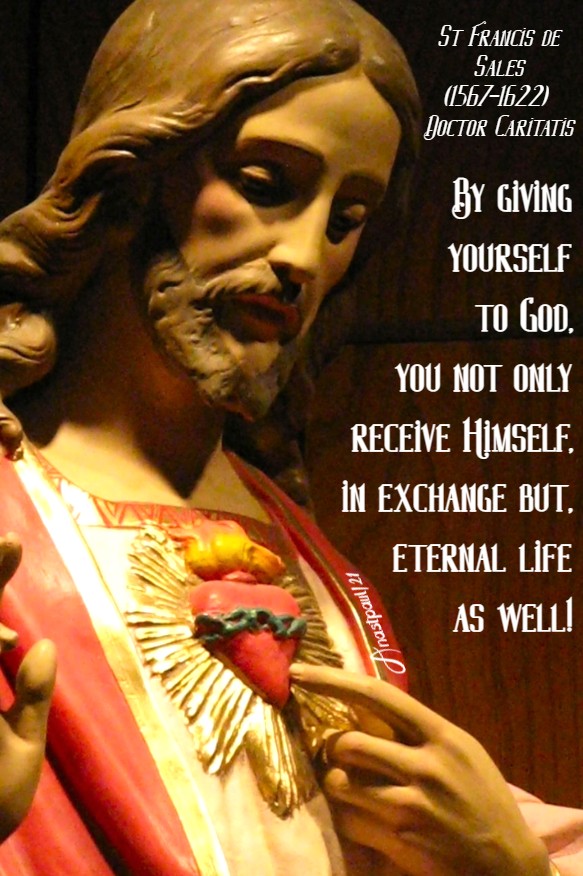
“By giving yourself to God, you not only receive Himself in exchange but, eternal life as well!”
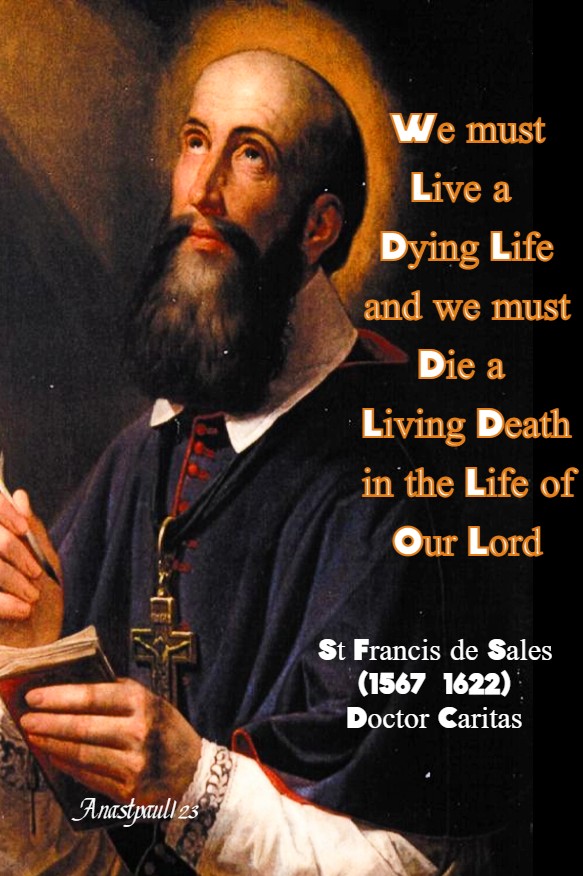
“We must live a dying life and we must die a living death in the life of our Lord.”
(The Spirit of St. François de Sales, XV 6 )
St Francis de Sales (1567-1622) Doctor of the Church
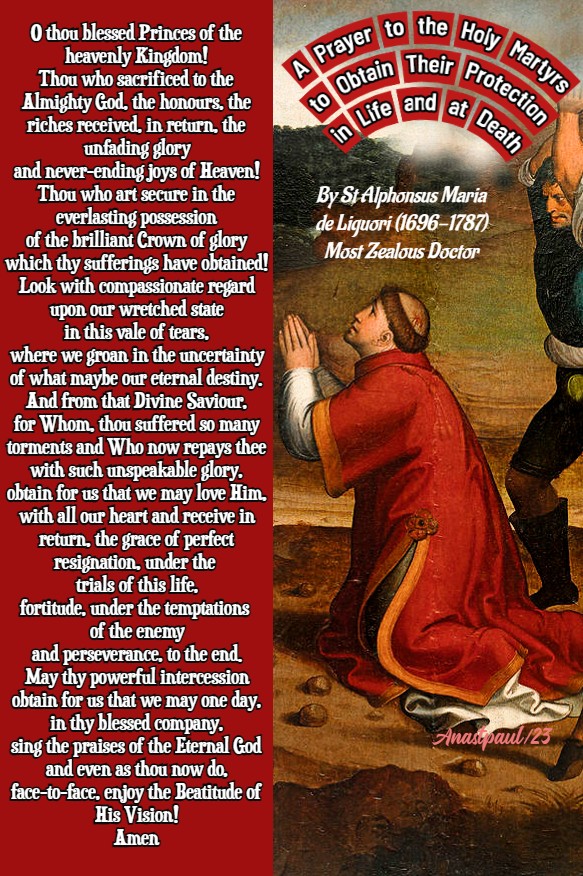
A Prayer to the Holy Martyrs to Obtain Their Protection in Life and at Death By St Alphonsus Maria de Liguori (1696-1787)
O thou blessed Princes of the heavenly Kingdom! Thou who sacrificed to the Almighty God, the honours, the riches received, in return, the unfading glory and never-ending joys of Heaven! Thou who art secure in the everlasting possession of the brilliant Crown of glory which thy sufferings have obtained! Look with compassionate regard upon our wretched state in this vale of tears, where we groan in the uncertainty of what maybe our eternal destiny. And from that Divine Saviour, for Whom, thou suffered so many torments and Who now repays thee with such unspeakable glory, obtain for us that we may love Him, with all our heart and receive in return, the grace of perfect resignation, under the trials of this life, fortitude, under the temptations of the enemy and perseverance, to the end. May thy powerful intercession obtain for us that we may one day, in thy blessed company, sing the praises of the Eternal God and even as thou now do, face-to-face, enjoy the Beatitude of His Vision! Amen
One Minute Reflection – 3 August – “The Month of the Immaculate Heart of Mary” – The Finding of the Relics of St Stephen, Protomartyr: – Acts 6:8-10, 7:54-59; Matthew 23:34-39 – Scripture search here: https://www.drbo.org/
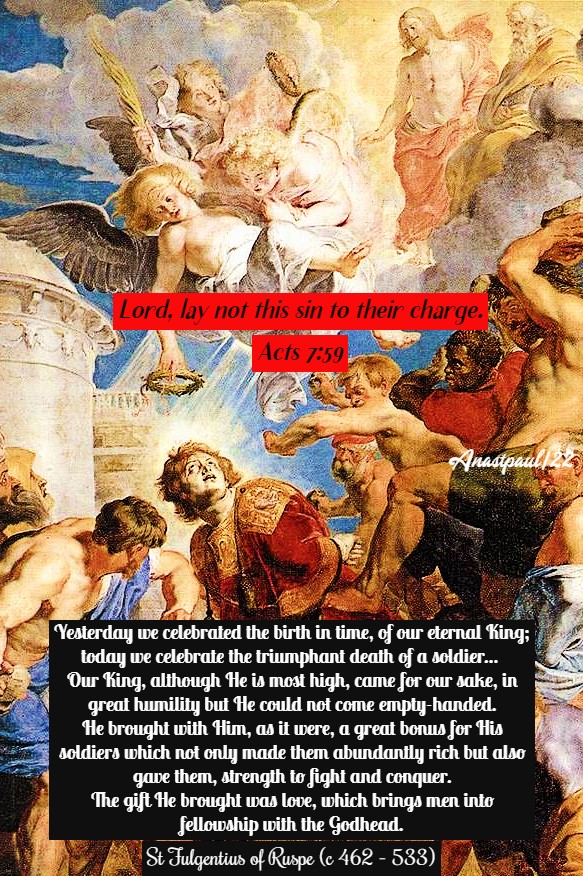
“And falling on his knees, he cried with a loud voice, saying: Lord, lay not this sin to their charge.” – Acts 7:59
REFLECTION – “Yesterday we celebrated the birth in time, of our eternal King; today we celebrate the triumphant death of a soldier… Our King, although He is most high, came for our sake, in great humility but He could not come empty-handed. He brought with Him, as it were, a great bonus for His soldiers which not only made them abundantly rich but also gave them, strength to fight and conquer. The gift He brought was love, which brings men into fellowship with the Godhead…
The love, then, that brought Christ down from Heaven to earth, lifted Stephen from earth to Heaven… And Stephen, so as to deserve to win the crown— which is what his name means—had love as his weapon and by it was everywhere victorious. Through love of God, he did not yield to the raging of his enemies and through love of his neighbour, he prayed for those who were stoning him. Through love, he accused those, who were in the wrong that they might be corrected. Through love, he prayed for those stoning him, to save them from punishment. Trusting in the strength of love, he overcame the cruel raging of Saul and so, won for himself, as a companion in men, the man who had been his persecutor on earth, This holy and untiring love, ardently desired to acquire as converts by his prayers, those whom he had been unable to convert by argument.
Now Paul rejoices with Stephen, with Stephen he enjoys the brightness of Christ; he exults with Stephen, he reigns with Stephen. There, where Stephen arose, the first, stoned under Paul’s very eyes, there too, Paul has risen with the help of Stephen’s prayers.” – St Fulgentius of Ruspe (c 462 – 533) Bishop in North Africa (Sermon 3, 1-3, 5-6).
PRAYER – Grant us, we beseech Thee, O Lord, to imitate what we celebrate, so that we may learn to love, even our enemies; because we keep the anniversary of the invention of Him, Who knew how to plead even for His persecutors with our Lord, Jesus Christ, Thy Son, Who with |Thee. lives and reigns with Thee, in the unity of the Holy Ghost, God, world without end. Amen (Collect).
Our Morning Offering – 3 August – “The Month of the Immaculate Heart of Mary”
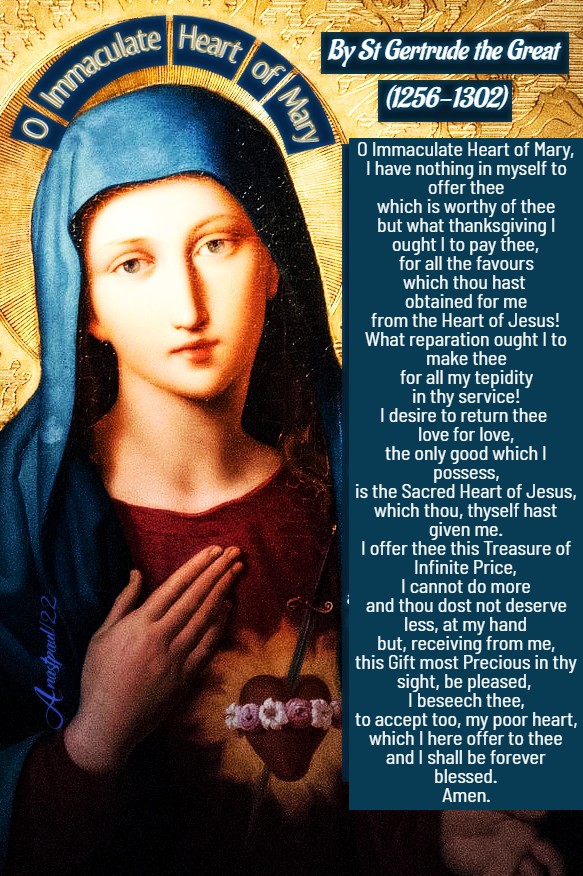
O Immaculate Heart of Mary By St Gertrude the Great (1256-1302)
O Immaculate Heart of Mary, I have nothing in myself to offer thee which is worthy of thee but what thanksgiving I ought I to pay thee, for all the favours which thou hast obtained for me from the Heart of Jesus! What reparation ought I to make thee for all my tepidity, in thy service! I desire to return thee love for love, the only good which I possess, is the Sacred Heart of Jesus, which thou, thyself hast given me. I offer thee this Treasure of Infinite Price, I cannot do more and thou dost not deserve less, at my hand but, receiving from me, this Gift most Precious in thy sight, be pleased, I beseech thee, to accept too, my poor heart, which I here offer to thee and I shall be forever blessed. Amen.
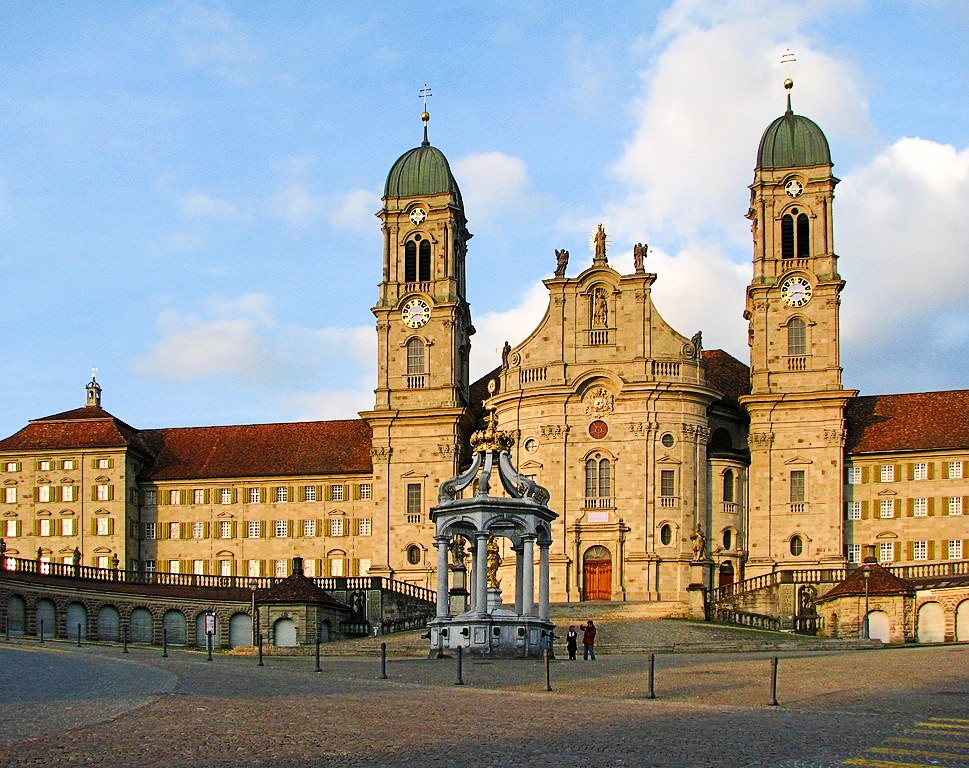
Saint of the Day – 3 August – St Benno of Einsiedeln (Died 940) Bishop of Metz, Hermit, Monk, Co-founder of the renowned Einsiedeln Abbey in Switzerland. Born in the late 9th Century in Swabia (part of modern Germany) and died on 3 August 940 in Einsiedeln, Switzerland of natural causes. Also known as – Benno of Metz.
Born in the late 9th Century in the Swabian region of Germany, Benno was a member of the Duke of Swabia’s noble family. But Benno chose rather the service of the Lord and he became a hermit in Einsiedeln and is, together with his kinsman, St Eberhard, the founder of the Monastery there.
Einsiedeln Abbey
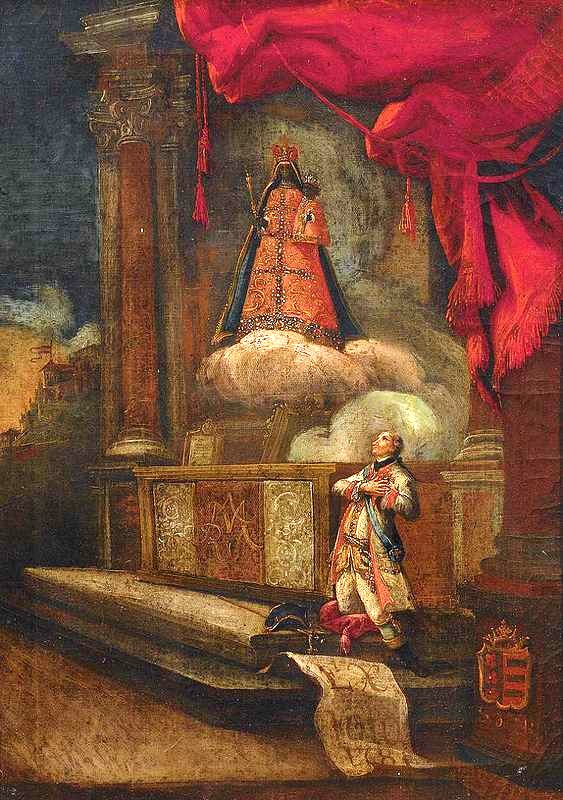
After Ordination to the Priesthood, he served as a Canon at Strasbourg in France. In 906, he retired to the former hermitage of St Meinrad, on Mount Etzel near Lake Zurich in Switzerland. There Benno rebuilt Meinrad’s Chapel, restored the miraculous Statue of Our Lady of Einsiedeln to a place of honour and soon attracted a group of disciples.
May be St Benno before Our Lady of Einsiedeln – also known as the Black Madonna of Einsiedeln
In 927, Benno was named Bishop of Metz in France, by King Henry I of Germany, in opposition to the locally elected candidate. Bishop Benno was attacked and blinded by the disgruntled opposition of his Diocese and in 929 he resigned his office and returned to his hermitage at Einsiedeln. He was joined by his kinsman St Eberhard in 934 and the Benedictine Monastery was soon established.
Hillside pastures near the Monastery
Fathers of Einsiedeln – Detail from the Icon in the Russian-Orthodox Church of Christ’s Resurrection in Zurich.
Benno lived his remaining years as a Monk in peace at the Monastery until his death on 3 August in the year 940, his Feast day. Benno’s Relics are kept at Einsiedeln Abbey.
Metz Cathedral – equally famous for its Art and Architecture
Blessed Augustine Gazotich OP (1262-1323) Bishop of Lucera, Croatia, of the Order of Preachers. He was also noted for being the guide for Dante Alighieri as the poet travelled through Croatia. His reputation for personal holiness remained noted long after his death; this resulted in Pope Innocent XII confirming the late Bishop’s Beatification in 1700. Biography: https://anastpaul.com/2018/08/03/saint-of-the-day-3-august-blessed-augustine-gazotich-o-p-1262-1323/
St Benno of Einsiedeln (Died 940) Bishop
St Dalmatius St Euphronius of Autun St Gamaliel St Gaudentia Bl Godfrey of Le Mans Bl Gregory of Nonantula St Hermellus St Nicodemus St Senach of Clonard (Died 6th Century) One of the Twelve Apostles of Ireland St Trea of Ardtree
Thought for the Day – 2 August – Meditations with our Saint of the Day, St Alphonsus Maria de Liguori (1696-1787) Bishop, Confessor, Most Zealous Doctor of the Church
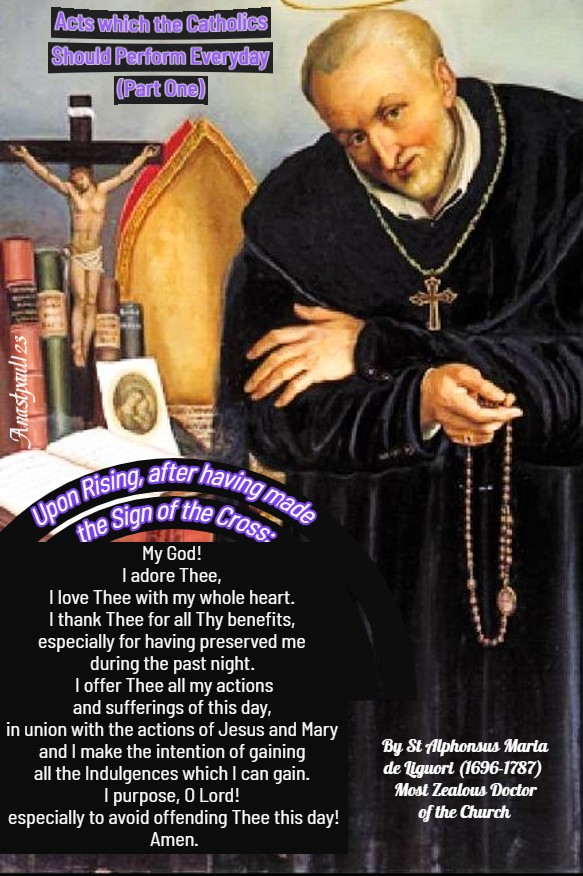
Acts which Catholics Should Perform Everyday (Part One) from The Mysteries of the Faith: – The Incarnation Vol. IV By St Alphonsus Maria de Liguori (1696-1787) Bishop, Confessor, Most Zealous Doctor of the Church
“Upon Rising, after having made the Sign of the Cross:
My God! I adore Thee, I love Thee with my whole heart. I thank Thee for all Thy benefits, especially for having preserved me during the past night. I offer Thee all my actions and sufferings of this day, in union with the actions of Jesus and Mary and I make the intention of gaining all the Indulgences which I can gain. I purpose, O Lord! especially to avoid offending Thee this day! Amen.
It is good to make a Resolution, particularly in regard to the fault into which we fall the most often.
I beg Thee, for the love of Jesus, to grant me the grace of perseverance. I resolve to conform myself to Thy holy will and particularly, in those things which are contrary to my inclination, saying always, O Lord! Thy will be done. My Jesus, keep Thy hand over me this day! Most Holy Virgin Mary, take me beneath thy mantle. And do Thou, O Eternal Father, help me, for the love of Jesus and Mary! O my Angel Guardian and my holy Patron Saints, assist me. Amen.”
Say the Our Father, the Creed, three Hail Marys: in honour of the purity of Mary.
When the Clock Strikes the Hour:
My Jesus, I love Thee; never permit me to offend Thee again and let me never be separated from Thee.
St Alphonsus Maria de Liguori (1696-1787) Most Zealous Doctor of the Church
Quote/s of the Day – 2 August – “The Month of the Immaculate Heart of Mary” and the Feast of St Alphonsus Maria de Liguori (1696-1787) Bishop, Confessor, Most Zealous Doctor of the Church
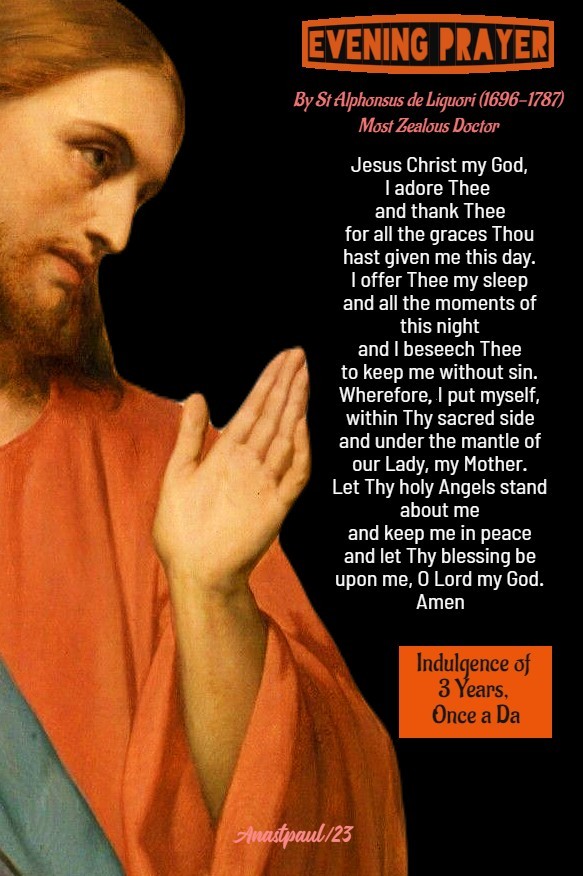
Evening Prayer By St Alphonsus de Liguori (1696-1787) Most Zealous Doctor (Indulgence of 3 Years, Once a Day)
Jesus Christ my God, I adore Thee and thank Thee for all the graces Thou hast given me this day. I offer Thee my sleep and all the moments of this night and I beseech Thee to keep me without sin. Wherefore ,I put myself, within Thy sacred side and under the mantle of our Lady, my Mother. Let Thy holy Angels stand about me and keep me in peace and let Thy blessing be upon me, O Lord my God. Amen
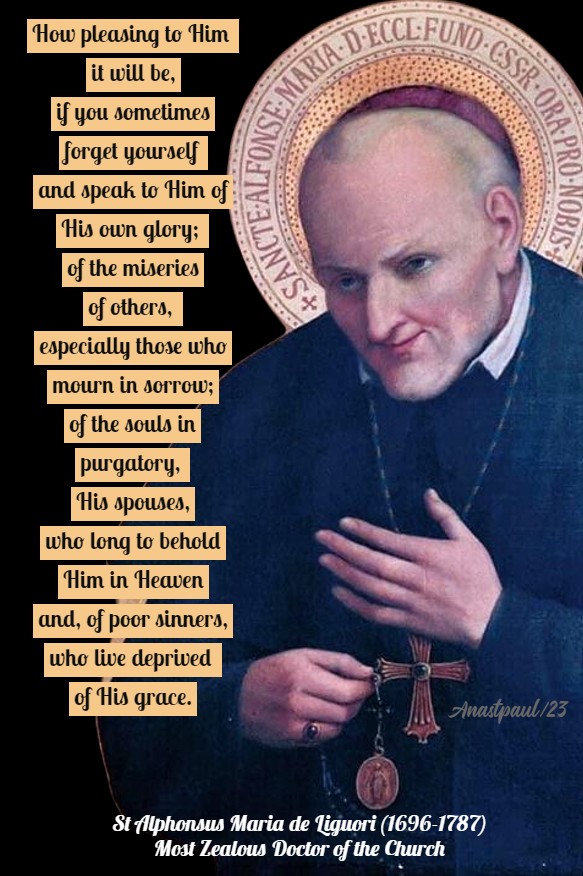
“How pleasing to Him it will be, if you sometimes forget yourself and speak to Him of His own glory; of the miseries of others, especially those who mourn in sorrow; of the souls in purgatory, His spouses, who long to behold Him in Heaven and, of poor sinners, who live deprived of His grace.”
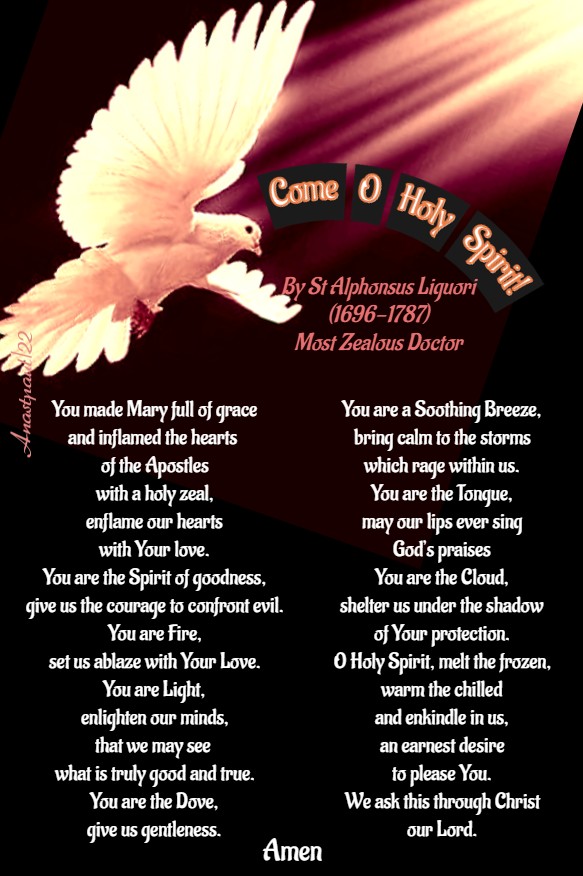
Come O Holy Spirit! By St Alphonsus de Liguori (1696-1787) Most Zealous Doctor
You made Mary full of grace and inflamed the hearts of the Apostles with a holy zeal, enflame our hearts with Your love. You are the Spirit of goodness, give us the courage to confront evil. You are Fire, set us ablaze with Your Love. You are Light, enlighten our minds, that we may see what is truly igood and true. You are the Dove, give us gentleness. You are a Soothing Breeze, bring calm to the storms which rage within us. You are the Tongue, may our lips ever sing God’s praises You are the Cloud, shelter us under the shadow of Your protection. O Holy Spirit, melt the frozen, warm the chilled and enkindle in us, an earnest desire to please You. We ask this through Christ our Lord. Amen
“The powers of hell will assail the dying Christian but his Angel Guardian will come to console him. His Patrons and St Michael, who has been appointed by God to defend his faithful servants, in their last combat with the devils, will come to his aid.”
“We should not forget, that the devil has his martyrs and that he infuses into them a false constancy. It is not the punishment but the cause, that makes the Martyr; that is – the confession of the True Faith.”
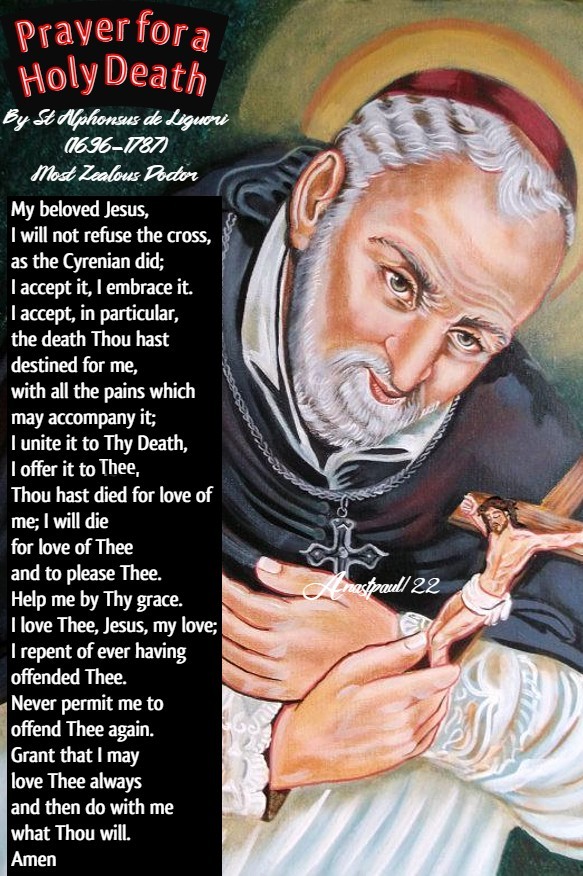
Prayer for a Holy Death By St Alphonsus de Liguori (1696-1787) Most Zealous Doctor Patron of Final Perseverance
My beloved Jesus, I will not refuse the cross, as the Cyrenian did; I accept it, I embrace it. I accept, in particular, the death Thou hast destined for me, with all the pains which may accompany it; I unite it to Thy Death, I offer it to Thee Thou hast died for love of me; I will die for love of Thee and to please Thee. Help me by Thy grace. I love Thee, Jesus, my love; I repent of ever having offended Thee. Never permit me to offend Thee again. Grant that I may love Thee always and then do with me what Thou will. Amen
O Afflicted Virgin! By St Alphonsus de Liguori (1696-1787) Most Zealous Doctor
O afflicted Virgin! O soul, great in virtues and great also in sorrows! for both arise from that great fire of love thou hast for God; thou “whose heart can love nothing but God.” O Mother, have pity on me, for I have not loved God and I have so much offended Him. Thy sorrows give me great confidence to hope for pardon. But this is not enough; I wish to love my Lord and who can better obtain this for me than thou, thou who art the Mother of fair love? O Mary, thou dost console all, comfort me also. Amen
One Minute Reflection – 2 August – “The Month of the Immaculate Heart of Mary” and the Feast of St Alphonsus Maria de Liguori (1696-1787) Bishop, Confessor, Most Zealous Doctor of the Church – 2 Timothy 2:1-7, Luke 10:1-9 – Scripture search here: https://www.drbo.org/
“At that time, the Lord appointed seventy-two others and sent them forth …” – Luke 10:1
REFLECTION – “Our Lord Jesus Christ Ordained the disciples to be guides and teachers of the world and to be “stewards of God’s mysteries” (1Cor 4:1). He also bade them… like lights, to illuminate and give light, not merely to the Jewish people… but everywhere under the sun and to peoples scattered over all the earth (cf Mt 5:14)…
For, if He desired to send His disciples out, even as the Father had sent Him, (Jn 20:21) was it not necessary for those who were destined to imitate His mission, to ascertain what it was that the Father sent the Son to do? In various ways, then, He expounded the character of His mission. And, on one occasion, He said: “I have come to call, not the righteous but sinners, to repentance” (Lk 5:32) and again: “For I have come down from Heaven, not to do My own will but the will of Him Who sent Me” (Jn 6:38) and yet, once more: “For God did not send His Son into the world to condemn the world but in order that the world might be saved through Him” (Jn 3:17).
By saying that He is sending them as the Father has sent Him, therefore, He summarised, in a few words, the character of the Apostles’ mission. In this way, they would know that they were bound to call sinners to repentance, to heal the sick, whether of body or soul and in all their dealings as stewards, not by any means to follow their own will but the will of Him Who sent them and, finally, to save the world, insofar as it received the teachings of the Lord.” – St Cyril of Alexandria (380-444) Bishop, Father and Doctor of the Church (Commentary on the Gospel of John 12:1).
PRAYER – O God, Who through blessed Alphonsus Maria, Thy Confessor and Bishop, fired with love for souls, enriched Thy Church with a new family; we beseech Thee that, taught by his saving counsels and strengthened by his example, we may be enabled, happily to come to Thee. Through the same Jesus Christ, Thy Son our Lord, Who lives and reigns with Thee, in the unity of the Holy Ghost, God, world without end. Amen (Collect).
Our Morning Offering – 2 August – The Feast of St Alphonsus Maria de Liguori (1696-1787) Bishop, Confessor, Most Zealous Doctor of the Church
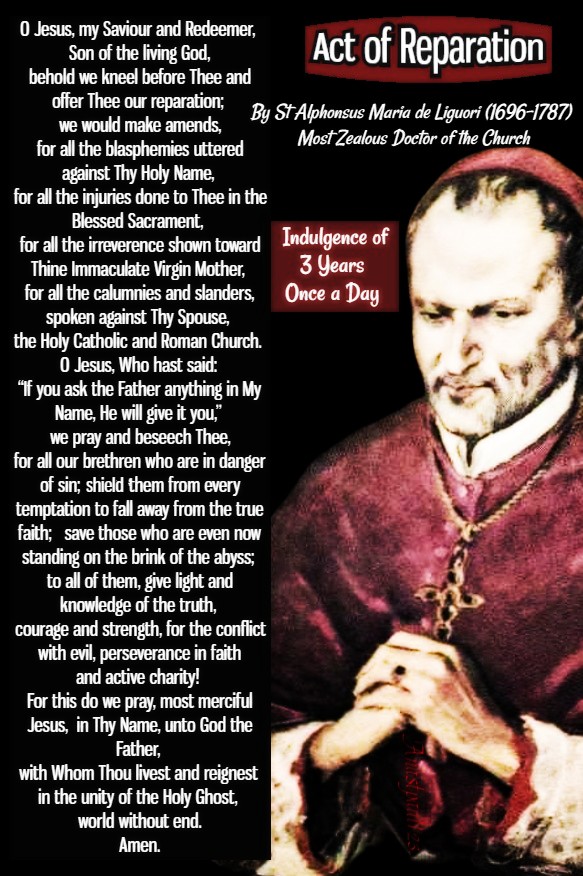
Act of Reparation By St Alphonsus Maria de Liguori (1696-1787) Most Zealous Doctor of the Church Indulgence of 3 Years Once a Day
O Jesus, my Saviour and Redeemer, Son of the living God, behold we kneel before Thee and offer Thee our reparation; we would make amends, for all the blasphemies uttered against Thy Holy Name, for all the injuries done to Thee in the Blessed Sacrament, for all the irreverence shown toward Thine Immaculate Virgin Mother, for all the calumnies and slanders, spoken against Thy Spouse, the Holy Catholic and Roman Church. O Jesus, Who hast said: “If you ask the Father anything in My Name, He will give it you,” we pray and beseech Thee, for all our brethren who are in danger of sin; sheld them from every temptation to fall away from the true faith; save those who are even now standing on the brink of the abyss; to all of them, give light and knowledge of the truth, courage and strength, for the conflict with evil, perseverance in faith and active charity! For this do we pray, most merciful Jesus, in Thy Name, unto God the Father, with Whom Thou livest and reignest in the unity of the Holy Ghost, world without end. Amen.
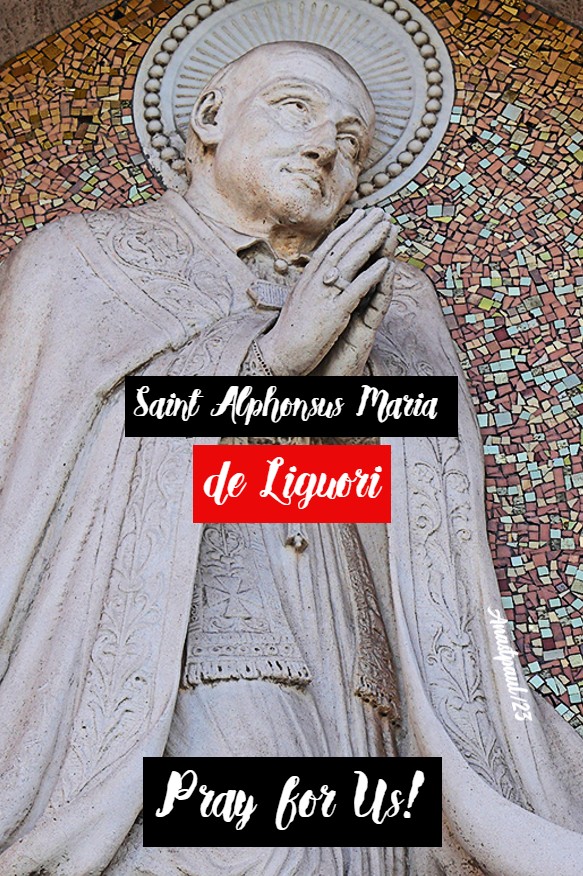
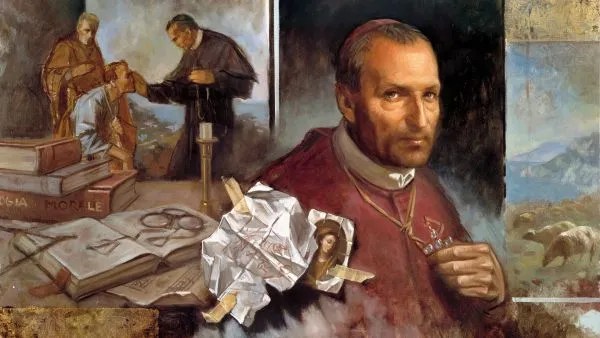
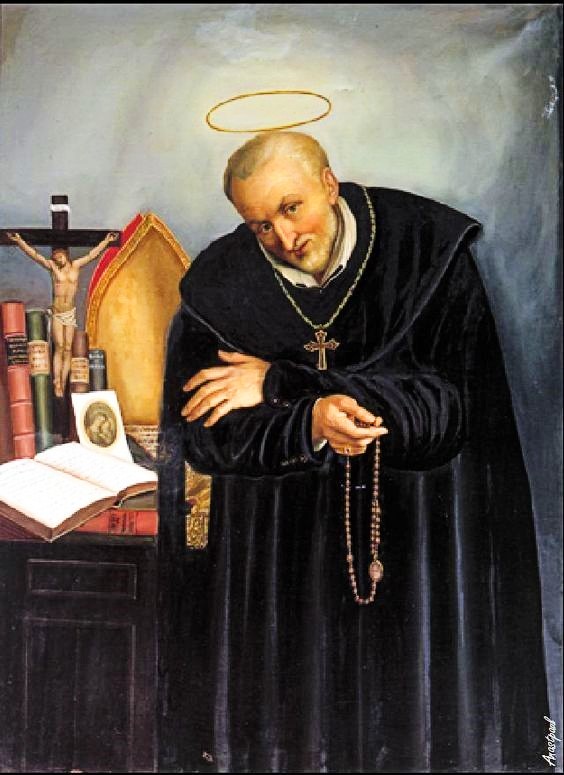
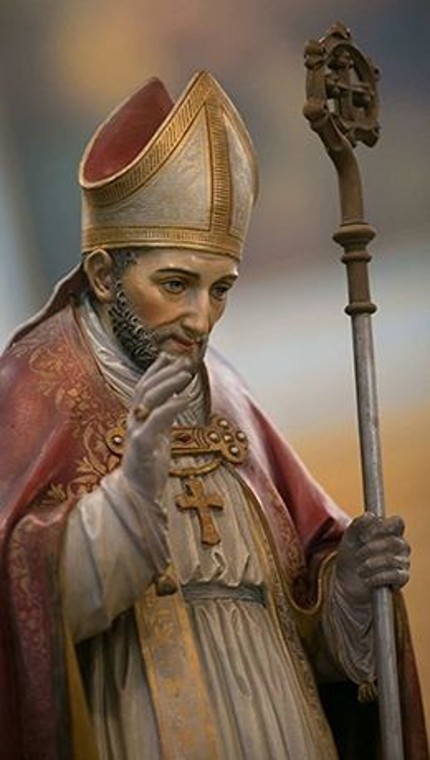
Saint of the Day – 2 August – St Alphonsus Maria de Liguori (1696-1787) Bishop, Confessor, Most Zealous Doctor of the Church, Founder of the Redemptorists, Spiritual Writer, Miracle-worker, Composer, Musician, Artist, Poet, Lawyer, Scholastic Philosopher and Theologian.Patronages – against arthritis, against scrupulosity, of Confessors (given on 26 February 1950 by Pope Pius XII), final perseverance, moral theologians, moralists (1950 by Pope Pius XII), scrupulous people, vocations, Diocese of Acerra, Italy, Diocese of Agrigento, Italy, l Pagani, Italy, Sant’Agata de’ Goti, Italy.
Saint Alphonsus Mary Liguori from the Liturgical Year, 1909
Let us listen to the Church’s account of his life.
“I have not hid Thy justice within my heart, I have declared Thy truth and Thy salvation.” (Gradual of the Mass Ps 39:11)
Alphonsus Maria de Liguori was born of a noble family at Naples and from his early youth, gave clear proofs of sanctity. While he was still a child, his parents once presented him to St Francis Girolamo, of the Society of Jesus. The Saint blessed him and prophesied that he would reach his ninetieth year that he would be raised to the Episcopal dignity and would do much good for the Church.
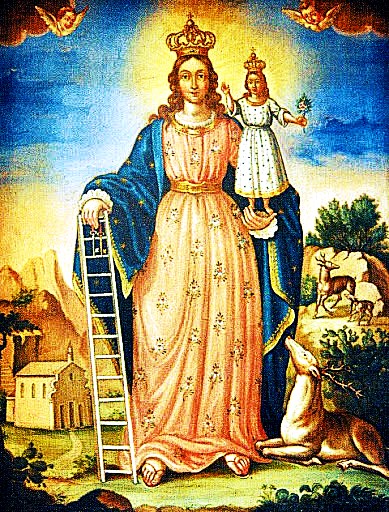
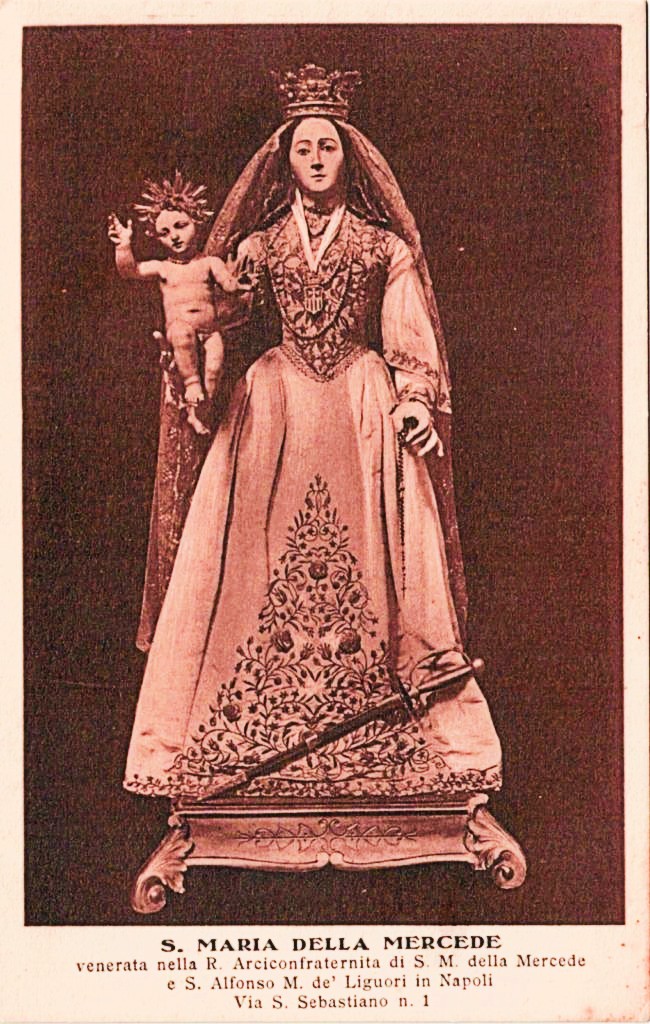
Even as a boy he shrank from games and both by his words and example, incited noble youth to Christian modesty. When he reached early manhood, he enrolled himself in pious associations and made it his delight to serve the sick in the public hospital, to spend much time in prayer and in the Church and frequently to receive the Sacred Mysteries. He joined study to piety with such success that, when scarcely sixteen years of age, he took the Degree of Doctor in both Canon and Civil Law, in the University of his native City. In obedience to his fathers wishes, he pleaded at the bar but, while winning himself a name in the discharge of this office, he learned by experience, what dangers beset a lawyer’s life and, of his own accord, abandoned the profession. Then he refused a brilliant marriage proposed to him by his father, renounced his right of inheritance as eldest son and, hanging up his sword at the Altar of the Virgin of Mercy, he devoted himself to the Divine Service.
OLYMPUS DIGITAL CAMERA
The Image of Our Lady where St Alphonsus placed his sword
Having been made Priest, he attacked vice with such great zeal that, in the exercise of his Apostolic ministry, he hastened from place to place, working wonderful conversions. He had a special compassion for the poor and particularly, for country people and founded a Congregation for Priests, called “of the Holy Redeemer,” who were to follow the Redeemer through the fields and hamlets and villages, preaching to the poor.
In order that nothing might turn him from his purpose, Alphonsus bound himself by a perpetual vow of never to waste any time. On fire with love of souls, he strove to win them to Christ and to make them lead more perfect lives, both by preaching the Divine Word and by writings full of Sacred learning and piety. Marvellous was the number of hatreds he stilled and of wanderers he brought back to the path of salvation.
He had the greatest devotion to the Mother of God, and published a book on the “Glories of Mary.” More than once, while he was speaking of her with great earnestness during his sermons, a wonderful brightness came upon him from Our Lady’s image and he was seen, by all the people, to be rapt in ecstasy.
The Passion of our Lord and the Holy Eucharist were the objects of his unceasing contemplation and he spread devotion to them in a wonderful degree. When he was praying before the Altar of the Blessed Sacrament, or celebrating Holy Mass, which he never failed to do, through the violence of his love, he shed burning tears, was agitated in an extraordinary manner and at times, was carried out of his senses. He joined a wonderful innocence, which he had never stained by deadly sin, with an equally wonderful spirit of penance and chastised his body, by fasting, iron chains, hair-shirts and scourgings even to blood. At the same time, he was remarkable for the gifts of prophecy, reading of hearts, bilocation and many miracles.
Alphonsus firmly refused the Ecclesiastical dignities which were offered him, but he was compelled, by the authority of Pope Clement XIII. to accept the government of the Church of St Agatha of the Goths. As Bishop, although he changed his outward dress, yet he made no alteration in the severity of his life. He observed the same moderation; his zeal for Christian discipline was most ardent and he displayed the greatest devotedness in rooting out vice, in guarding against false doctrine and in discharging the other duties of the pastoral charge. He was most generous towards the poor, distributing to them, all the revenues of his See and, in a time of scarcity of corn, he sold even the furniture of his house, to feed his starving people. He was all things to all men. He brought religious women to lead a more perfect life and took care to erect a Monastery for Nuns of his Congregation.
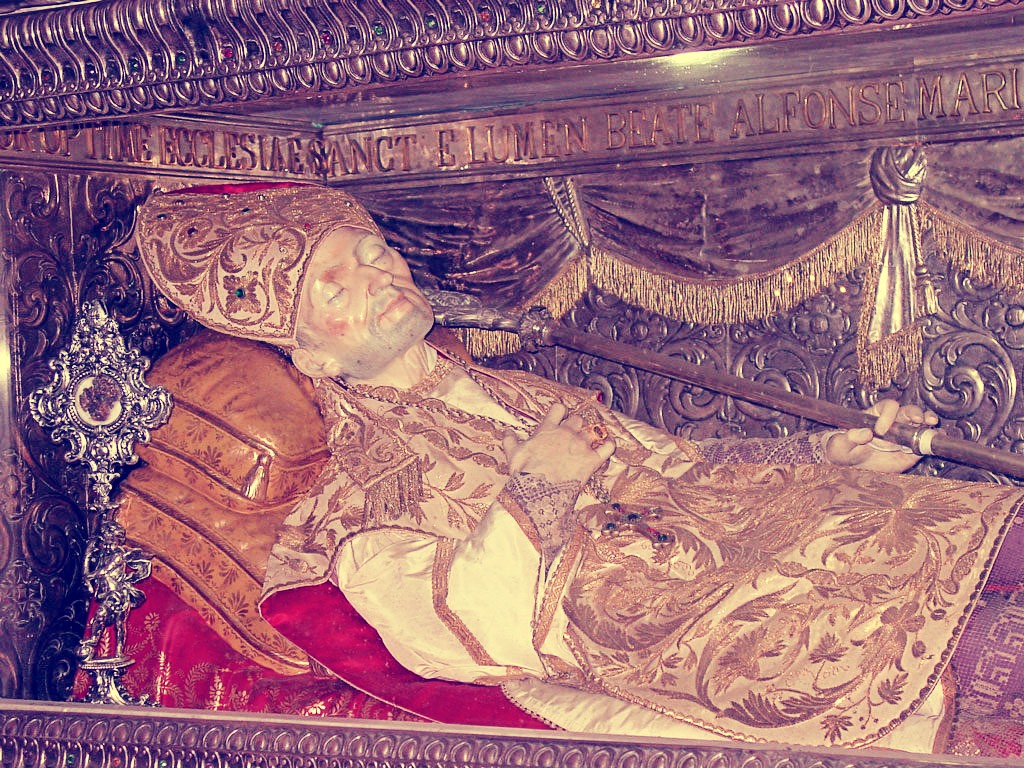
Severe and continual sickness forced Alphonsus to resign his Bishopric and he returned to his children, as poor as when he had left them. Although worn out in body by old age, labours, chronic arthritis and other painful maladies, his mind was fresh and clear and he never ceased speaking or writing of heavenly things until at length, on the 1st of August he most peacefully expired, at Nocera-dei-Pagani, amidst his weeping children. It was in the year 1787, the ninetieth of his age. His virtues and miracles made him famous and on this account, in 1816, Pope Pius VII. enrolled him amongst the Blessed. God still glorified him with new signs and wonders and, on the Feast of the Most Blessed Trinity, in the year 1839, Gregory XVI solemnly inscribed his name on the list of the Saints; and finally, Pope Pius IX, after consulting the Congregation of Sacred Rites, declared him a Doctor of the universal Church.
The Little-known Miracles of the Liquefying Blood of St Alphonsus
Like St Januarius, the principal Patron of Naples, the Saint of the very renowned “Liquefying Blood.” However, it remains unknown to most, that there are several prodigies of blood liquefying in the Neapolitan City, so many that the French writer Jean Jacques Bouchard (1606-1641) called Naples, “Urbs sanguinum – The City of Blood.”
“Among these is that of St Alphonsus Maria de Liguori: the Doctor of the Church, the Saint of the Age of Enlightenment, the Founder of the Congregation of the Most Holy Redeemer, which today has more than 700 houses in 80 countries around the world. A prodigious fact of which there is no longer any memory, not even among his spiritual children.
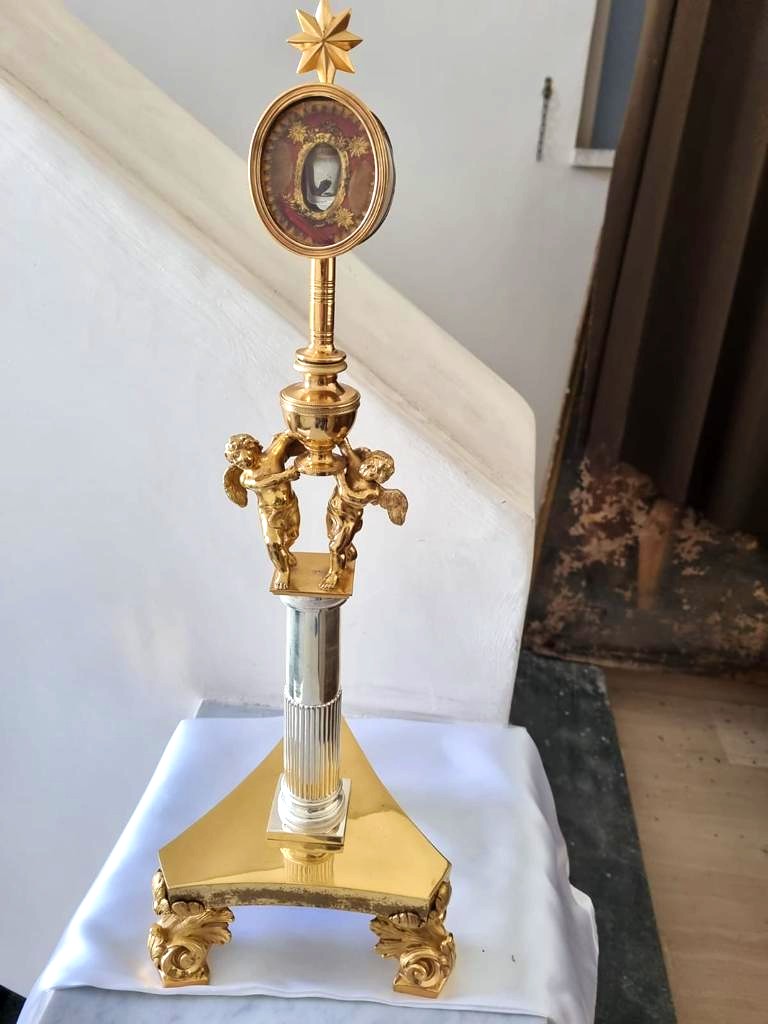
And yet, until a few decades ago, hundreds of the faithful went to the Santa Maria della Mercede (Holy Mary of Mercy) and St Alphonsus Church in Naples, also known by the name of the Redemption of the Captives, in Via San Sebastiano, a few steps from the Conservatorio di San Pietro a Majella, the same place where the young and noble Alfonso de Liguori laid his sword at the foot of the Statue of the Virgin to witness, on the Anniversary of the Saint’s death, the liquefying of his blood preserved in an ampoule set in a marvellous Reliquary.






























You must be logged in to post a comment.