Our Morning Offering – 13 June – “The Month of the Sacred Heart of Jesus” and the Feast Day of St Anthony of Padua OFM (1195-1231) Confessor, Doctor of the Church
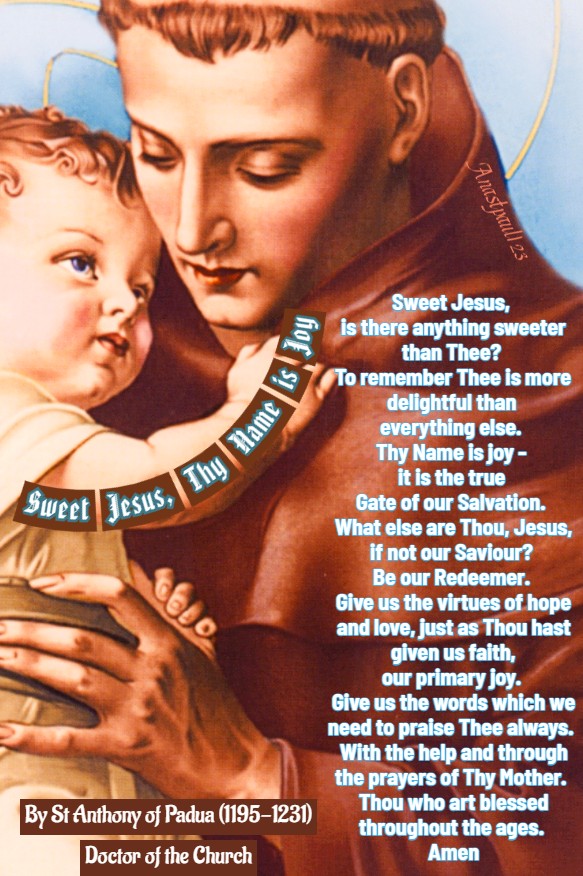
Sweet Jesus, Thy Name is Joy By St Anthony of Padua OFM (1195-1231) Doctor of the Church
Sweet Jesus, is there anything sweeter than Thee? To remember Thee is more delightful than everything else. Thy Name is joy – it is the true Gate of our Salvation. What else are Thou, Jesus, if not our Saviour? Be our Redeemer. Give us the virtues of hope and love, just as Thou hast given us faith, our primary joy. Give us the words which we need to praise Thee always. With the help and through the prayers of Thy Mother. Thou who art blessed throughout the ages. Amen
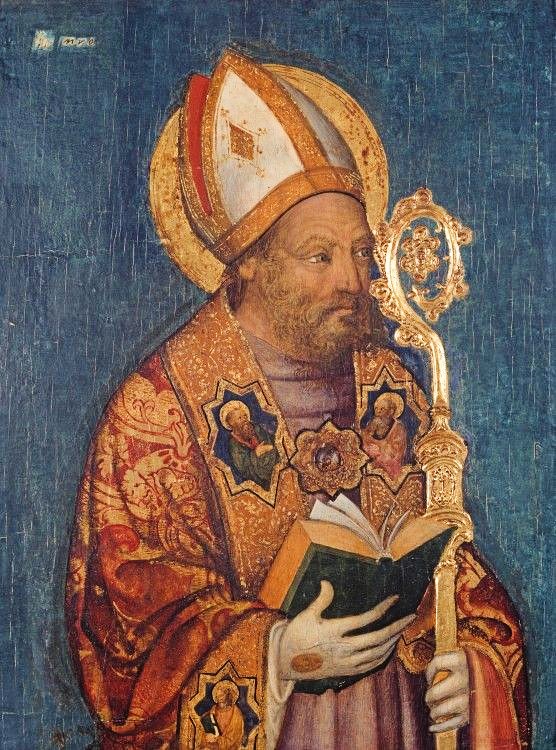
Saint of the Day – 13 June – St Wilicarius of Vienne (Died 765) Archbishop of Vienne, France, Monk. Wilicarius was the 45th Bishop of Vienne in Dauphiné in south-eastern France. Also known as – Wilicaire.
We have little information on the life of our Saint today. He is the last in the line of the first 45 Bishops of Vienne, to be venerated as Saints.
Wilicarius was Consecrated as the Bishop of Vienne around the year 740. He received the Palium from St Gregory III, whose reign was from 731-741.
According to historical reports, Wilicarius solemly translated the Relics of Saints Ferreol and Julien to Vienne when the Basilica housing them had been razed by invading Saracens.
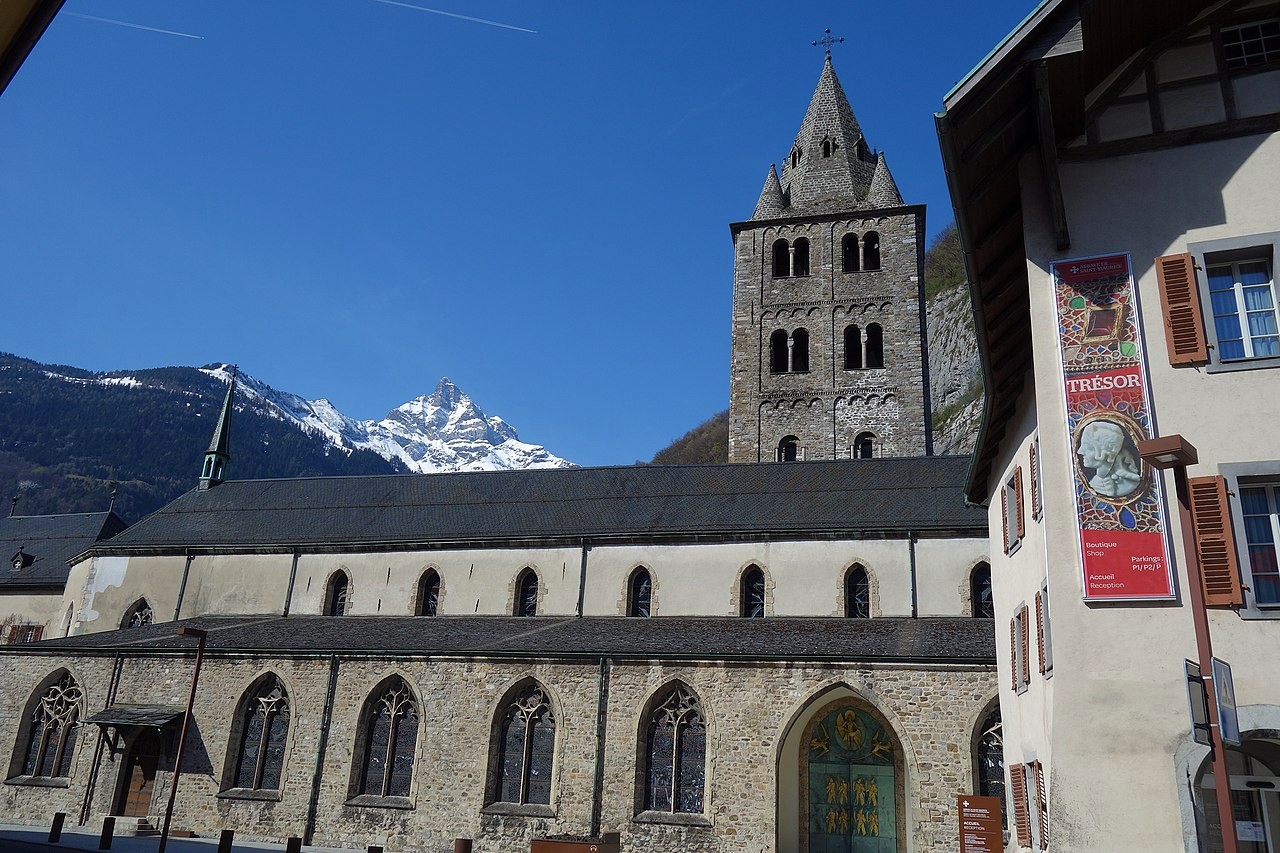
Wilicarius resigned from his See in c752 when it fell under Frankish persecution. He took refuge in Rome and then finally retired to the Monastery of St Maurice d’Agaune in Valais, where he became the Abbot, being highly revered for his holiness.
During the Council of Attigny, convened around 762 by King Pepin, Wilicarius was present and signed the various Decrees as Abbot of the Abbey of St Maurice.
He should not be confused with Abbot Willicaire d’Agaune, who became Archbishop of Sens in 769.
There is some confusion about our Saint’s death – some say 765 and others 782. This latter date places him on the list of Abbots of St Maurice as having reigned from 760 to 782.
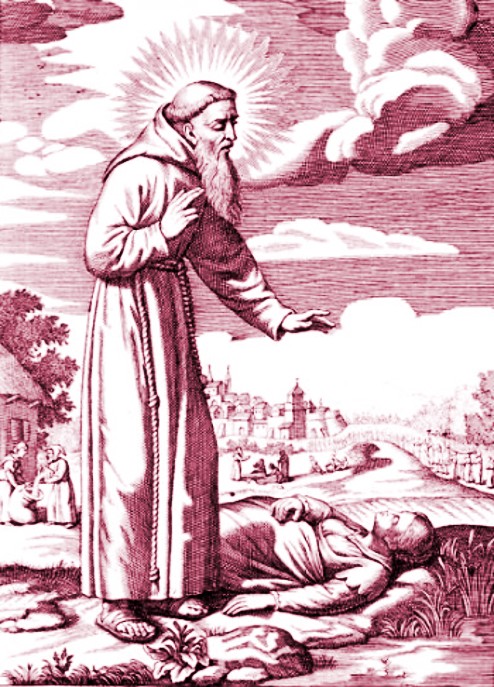
St Anthony of Padua OFM (1195-1231) Confessor, Evangelical Doctor of the Church, Priest and Friar of the Order of Friars minor,Known as theHammer of Heretics – Professor of Miracles – Wonder-Worker – Ark of the Testament – Repository of Holy Scripture . Patronages – against sterility, against shipwreck, against starvation, American Indians, amputees, animals – both wild and domestic, asses, mariners, elderly people, expectant mothers, for faith in the Blessed Sacrament, fishermen, for good harvests, horses, lost articles, seekers of lost articles, posted articles, oppressed people, poor people, swineherds, travel guides, travellers, Brazil, Portugal, Tigua Indians, 4 Diocese, 17 Cities. Noted by his contemporaries for his forceful preaching, expert knowledge of Scripture and undying love and devotion to the poor and the sick, he was one of the most-quickly Canonised Saints in Church history. He was proclaimed a Doctor of the Church by Pope Pius XII on 16 January 1946. The wonderful St Anthony: https://anastpaul.com/2017/06/13/saint-of-the-day-13-june-st-anthony-of-paduao-f-m-evangelical-doctor-hammer-of-heretics-professor-of-miracles-wonder-worker-ark-of-the-covenant/ AND: https://anastpaul.com/2018/06/13/saint-of-the-day-13-june-st-anthony-of-padua-o-f-m-evangelical-doctor-hammer-of-heretics-professor-of-miracles-wonder-worker-ark-of-the-tes/ AND A SERMON BY ST ANTHONY: Actions Speak Louder than Words: https://anastpaul.com/2019/06/13/thought-for-the-day-13-june-actions-speak-louder-than-words/
Bl Achilleo of Alexandria Bl Alfonso Gomez de Encinas Bl Anthony of Ilbenstadt St Aquilina of Syria St Aventino of Arbusto St Damhnade St Diodorus of Emesa
St Fandilas of Penamelaria St Felicula of Rome St Fortunatus of North Africa
Blessed Gerard of Clairvaux (Died 1138) – was the elder brother of Saint Bernard of Clairvaux. He was a Soldier. When he was wounded in combat at the siege of Grancy, Gerard resolved to become a Monk. He became a Benedictine Cistercian Monk at Citeaux. He worked with Saint Bernard at Clairvaux and became his closest confidant. He died in 1138 of natural causes.
St Lucian of North Africa St Mac Nissi of Clonmacno St Maximus of Cravagliana St Nicolas Bùi Ðuc The St Peregrinus of Amiterno St Rambert St Salmodio Bl Servatius Scharff St Thecla
Thought for the Day – 12 June – Meditations with Antonio Cardinal Bacci (1881-1971)
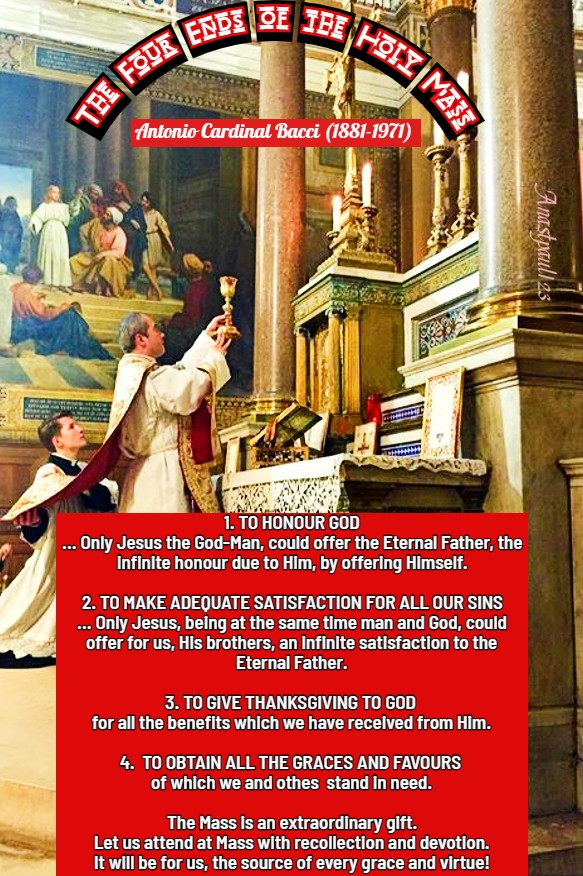
The Holy Mass The Four Ends of the Holy Mass
“Let us meditate on the fact, that the Sacrifice of the Eucharist, was instituted for four ends, namely:
1. TO HONOUR GOD All the Angels and Saints of Heaven and all the human beings upon earth, could not possibly honour God, as He ought to be honoured because, they are creatures who derive everything which they possess from God. Only Jesus the God-Man, could offer the Eternal Father, the infinite honour due to Him, by offering Himself.
2. TO MAKE ADEQUATE SATISFACTION FOR ALL OUR SINS Insofar, as they are a revolt against God, our sins are, in a certain way, infinite. This is because they offend an Infinite Being. Only Jesus, being at the same time man and God, could offer for us, His brothers, an infinite satisfaction to the Eternal Father. Only He, could redeem us from the debt of crime and punishment, which we had contracted, by offering Himself, without reserve, in the Eucharistic Sacrifice. It must be explained, however, that although the Mass is of infinite value in itself, God applies this value to us in a finite way only, according to His good pleasure and according to our dispositions. For this reason, we should do well to attend Mass, as often as possible and with the maximum fervour.
3. TO GIVE THANKSGIVING TO GOD for all the benefits which we have received from Him.
4. Finally, TO OBTAIN ALL THE GRACES AND FAVOURS of which we and others stand in need. The Mass is an extraordinary gift. Let us attend at Mass with recollection and devotion. It will be for us, the source of every grace and virtue!” Amen
Quote/s of the Day – 12 June – “The Month of the Sacred Heart of Jesus” – Within the Octave of Corpus Christi
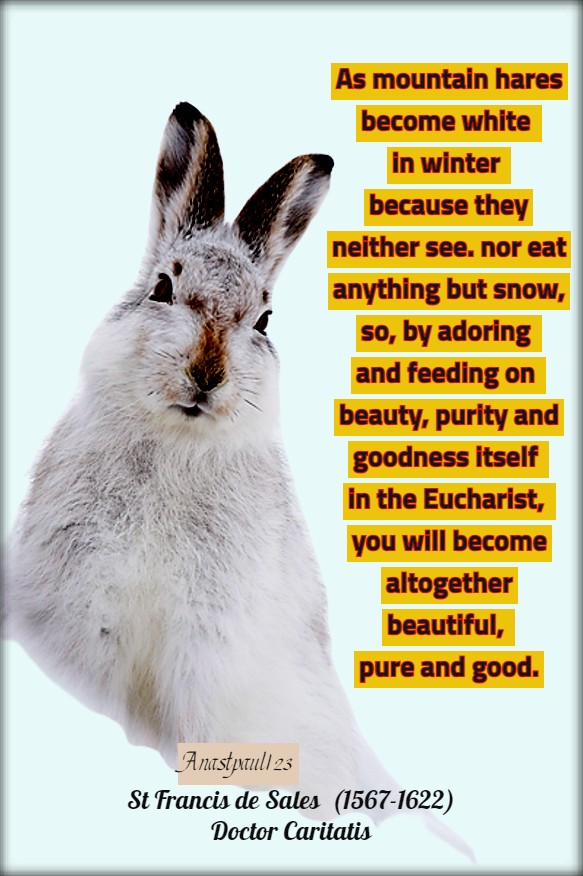
“As mountain hares become white in winter because they neither see. nor eat anything but snow, so, by adoring and feeding on beauty, purity and goodness itself in the Eucharist, you will become altogether beautiful, pure and good.“”
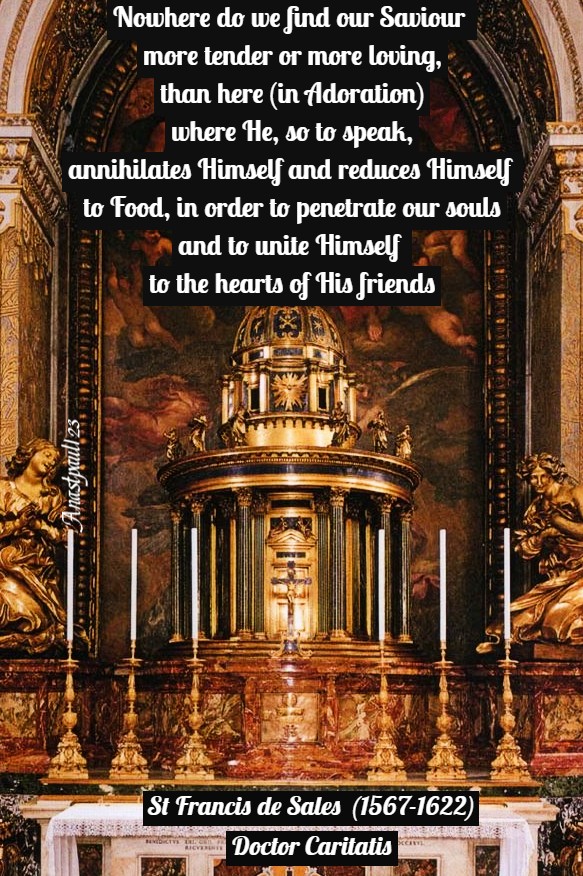
“Nowhere do we find our Saviour more tender or more loving, than here [in Adoration] where He, so to speak, annihilates Himself and reduces Himself to Food, in order to penetrate our souls and to unite Himself to the hearts of His friends.”
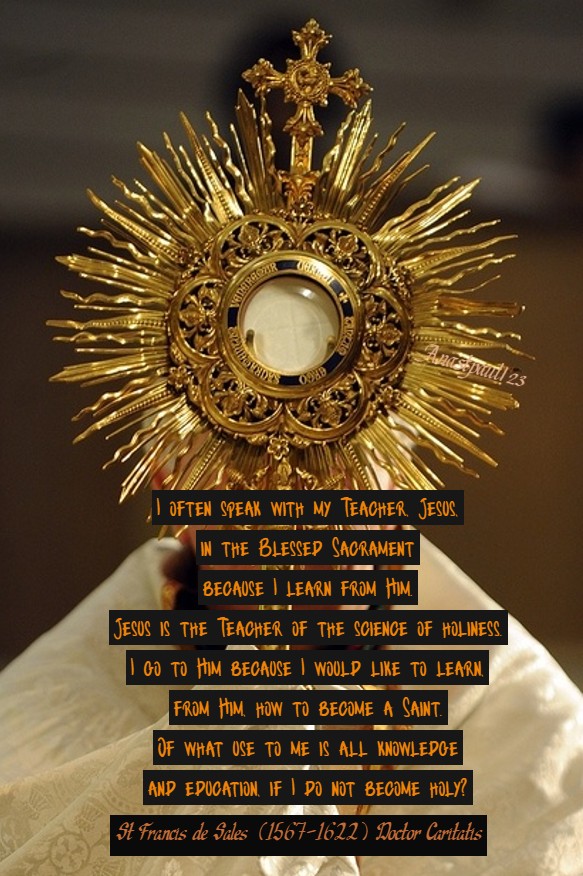
“I often speak with my Teacher, Jesus, in the Blessed Sacrament because I learn from Him. Jesus is the Teacher of the science of holiness. I go to Him because I would like to learn, from Him, how to become a Saint. Of what use to me is all knowledge and education, if I do not become holy?”
One Minute Reflection – 12 June – “The Month of the Sacred Heart of Jesus” – Within the Octave of Corpus Christiand the Memorial of St Juan de Sahagun (1419-1479) Confessor, Priest and Friar of the Order of the Augustinians – 1 Corinthians 23-29, John 6:56-59. – Scripture search here: https://www.drbo.org/
“For My flesh is food indeed and My Blood is drink indeed.”- John 6:56
REFLECTION – “Take and eat; this is My Body… Take and drink; this is My Blood.” (Mt 26:26.) Since then, Christ Himself clearly described the Bread to us in the words “This is My Body” who will dare henceforward, to dispute it? And since He has emphatically said, “This is My Blood” who will waver?… So let us partake with the fullest confidence that it is the Body and Blood of Christ. For His Body has been bestowed on you in the form of bread and His Blood in the form of wine, so that by partaking of Christ’s Body and Blood, you may share with Him, the same Body and Blood… This is how, in the blessed Peter’s words: “we become partakers of the divine nature” (2 Pt 1:4).
Christ once said in conversation with the Jews: “Unless you eat My Flesh and drink My Blood, you have no life in you” They were scandalised because they did not interpret His words spiritually… Even in the Old Testament, there were “Loaves of the Presence” but since they belonged to the old dispensation, they have come to fulfilment. But in the New Testament, the Bread is of Heaven and the Chalice brings salvation, (Jn 6:41; Ps 115:4) and they sanctify the soul and the body; for, as the bread relates to the body, so the word harmonises with the soul…
The Blessed David will inform you of the meaning of the Eucharist when he says: “Thou hast laid a table before me against those who oppress me” (Ps 22:5)… The only thing he can mean is that sacramental, spiritual table which God has made ready for us against the evil spirit… “And the chalice which inebriates me, how godly it is” (Ps 22), here he mentions the chalice which Jesus took in His Hand and giving thanks said: “This is the Blood which is poured out for many, for the remission of sins” (Mt 26:28)… David was speaking of this long ago when he sang: “Bread strengthens the heart of man, that he may make his face glad with oil” (Ps 103:15). So strengthen your heart by partaking of that spiritual bread and gladden the face of your soul.” – Catechesis to the Newly Baptised of the Church in Jerusalem (4th Century) No 4.
PRAYER – O God, Author of peace and lover of charity, Who endowed blessed John, Your Confessor, with a wondrous grace for reconciling enemies; grant by his merits and intercession that, being ourselves firmly rooted in Thy charity, we may not be separated from Thee by any temptations.Through Jesus Christ, Thy Son our Lord, Who lives and reigns with Thee, in the unity of the Holy Ghost, God, world without end. Amen (Collect).
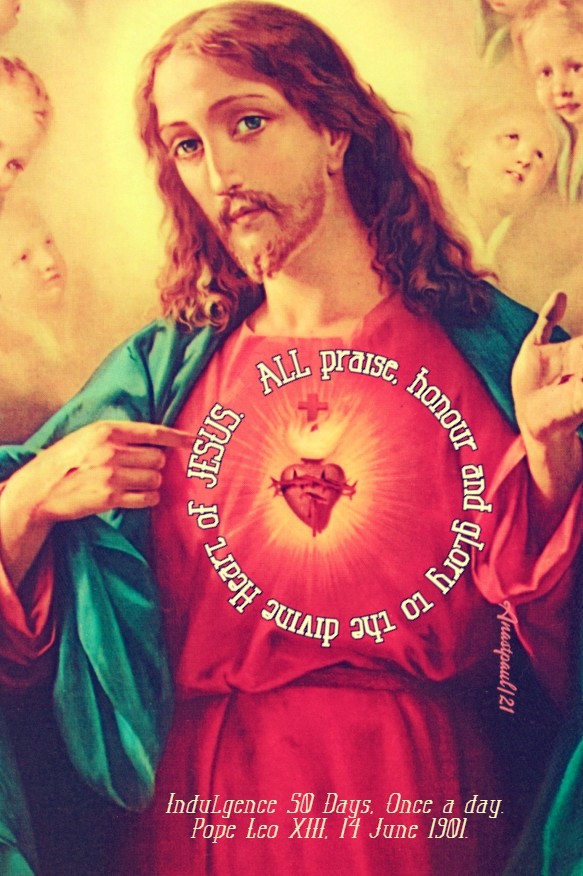
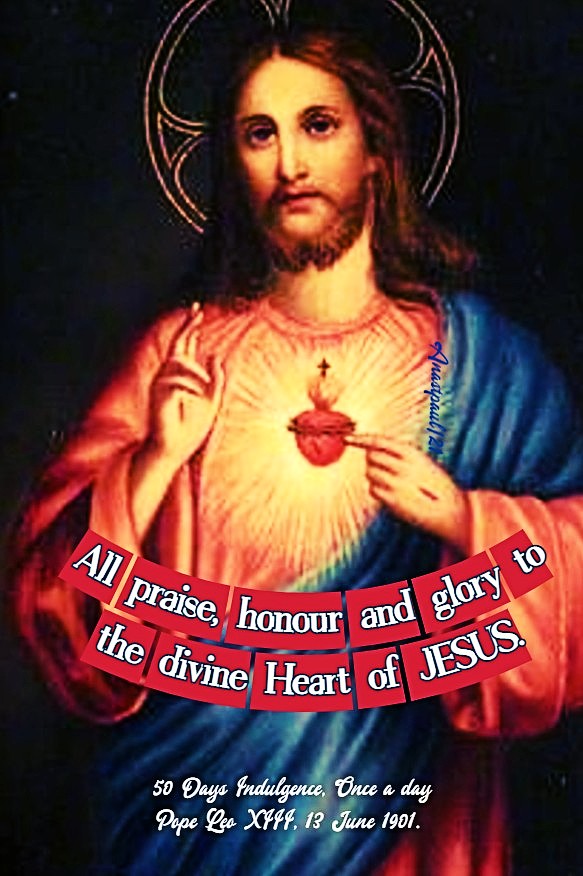
All praise, honour and glory to the divine HEART of JESUS. – Indulgence 50 Days, Once a day. Raccolta 168 Pope Leo XIII, 14 June 1901.
Our Morning Offering – 12 June – “The Month of the Sacred Heart of Jesus” – Within the Octave of Corpus Christi
Prayer in Adoration of the Sacred Heart in the Blessed Sacrament By St Margaret Mary Alacoque (1647-1690) Visionary and Apostle of the Sacred Heart of Jesus
Jesus Christ, my Lord and my God, Whom I believe to be really present in the Blessed Sacrament of the Altar, receive this most profound Act of Adoration to supply for the desire I have, to adore Thee unceasingly and in thanksgiving, for the sentiments of love which Thy Sacred Heart has for me in this Sacrament. I cannot better acknowledge them, than by offering Thee, all the Acts of Adoration, resignation, patience and love which this same Heart has made during its mortal life and which it makes still and which it shall make eternally in Heaven, in order that through it, I may love Thee, praise Thee and adore Thee worthily, as much as it is possible for me. I unite myself to this Divine Offering which Thou dost make to Thy Divine Father and I consecrate to Thee, my whole being, praying Thee, to destroy in me, all sin and not to permit that I should be separated from Thee, in time and eternally. Amen.
Saint of the Day – 12 June – Blessed Guy Vignotelli of Cortona OFM (c1185-1250) Priest of the Friars Minor, Miracle-worker. Born in c1185 in Cortona, Italy and died in 1250 at the Franciscan Convent at Cortona, of natural causes. Also known as Guido, Giles. Blessed Guy was Beatified in 1583 by Pope Gregory XIII.
In the year 1211, when our holy Father St Francis of Assisi was preaching in Cortona on his first missionary journey through Italy, a certain young man was so touched by his words that, after the sermon, he entreated St Francis to dine at his house. The Saint accepted the invitation. When the young man learned further details about the newly founded Order, and witnessed the edifying conduct of the Founder, he fell at hs feet and begged for the Habit of the Order.
The young man was Guy, or Giles, first-born son of a distinguished family in Cortona. He had been reared in piety and virtue and was quite accomplished in the sciences. Francis directed Guy to distribute his wealth among the poor and gave him the holy Habit in the Parish Church of Cortona in the presence of a great concourse of people. Then Francis chose a spot in a secluded valley near Cortona, where, with the assistance of some devout persons, he built a poor Convent. For a few months the Saint himself instructed Guy and several other Novices there. At his departure, he entrusted to the blessed Gather Sylvester, his companion, the direction of the Novices, especially of young Guy, whose eminent holiness he foresaw.
In fasting, prayer and all the religious exercises, Guy evinced such perfection that he could be raised to the other Novices as a model. He would have preferred to spend all his life in the holy seclusion of the Convent but when he was Ordained to the Priesthood, St Francis commissioned him to go out and preach, for in accordance with the vocation of the Order, he was to sanctify not only himself but other souls too.
Filled with zeal for the salvation of souls, Guy left his seclusion. His words had great influence over the hearts of sinners, his holy life edified everybody and Almighty God confirmed his activities with extraordinary miracles. Once, Guy was quite ill with exhaustion and nothing but water was at hand by way of medicine. Guy made the Sign of the Cross over it and it became the most choice wine, which restored his health and what was lef, later healed the infirmities of others.
After a most blessed and successful career, Almighty God announced to Guy, in the sixtieth year of his life that his death was near at hand. St Francis, who had long ago entered into heavenly bliss, appeared to him and said:
“My son, after three days, at nine o’clock, I shall return and escort your soul to the eternal dwellings.”
His already decreasing strength then began to ebb rapidly. On the third day he received the last Sacraments with great devotion and when the appointed hour arrived, he called out:
“Behold our holy Father Francis! Arise, let us go to meet him!”
With these words he jubilantly surrendered his pure soul into the hands of his Maker. It was 12 May 1250.
Upon receiving the news of his death, the people of Cortona came to bury Guy’s precious remains in the Parish Church. Amid the festive pealing of bells, with palm branches in their hands and singing hymns, they transported the holy body, in a long procession to the Town. There the remains were entombed in the principal Church. Many miracles were wrought through his intercession.
After some time enemies invaded the City, the Church was pillaged and the precious coffin containing the body of Blessed Guy of Cortona was carried away, although the sacristan hastily wrapped the head in linen cloths and hid it in a well near the Church. At the end of three years, when the Church was being restored, a mysterious light radiated from the well. Upon investigation, the head was found, not even moistened by the water! Amid the jubilation of the entire City, it was again emshrined in the Church.
Pope Benedict XIII approved a proper Mass and Office in honour of Blessed Guy of Cortona, for the Diocese of Cortona. Pope Innocent XII extended it to the entire Franciscan Order.
St Amphion of Nicomedia Bl Antonio de Pietra St Arsenius of Konev St Christian O’Morgair of Clogher St Chrodobald of Marchiennes St Cominus Bl Conrad of Maleville St Cunera St Cuniald St Cyrinus of Antwerp St Eskil St Galen of Armenia St Gerebald of Châlons-sur-Seine St Geslar
Blessed Guy Vignotelli of Cortona OFM (c1185-1250) Priest of the Friars Minor, Miracle-worker.
St Pope Leo III (c 750-816) Bishop of Rome and Ruler of the Papal States from 26 December 795 to his death. Defender of the City ad peoples of Rome and of the Church. Peacemaker and restorer of Churches and Monasteries, Patron of the Arts and Apostle of the poor. Know as “Charlemagne’s Pope” His Life: https://anastpaul.com/2021/06/12/saint-of-the-day-12-june-st-pope-leo-iii-c-750-816/
St Odulf of Utrecht St Olympius of AEnos St Onuphrius of Egypt Bl Pelagia Leonti of Milazzo St Peter of Mount Athos St Placid of Val d’Ocre St Ternan of Culross St Valerius of Armenia
Martyrs of Bologna: Three Christians who were martyred at different times and places, but whose relics have been collected and enshrined together – Celsus, Dionysius, and Marcellinus. Their relics were enshrined in churches in Bologna and Rome in Italy.
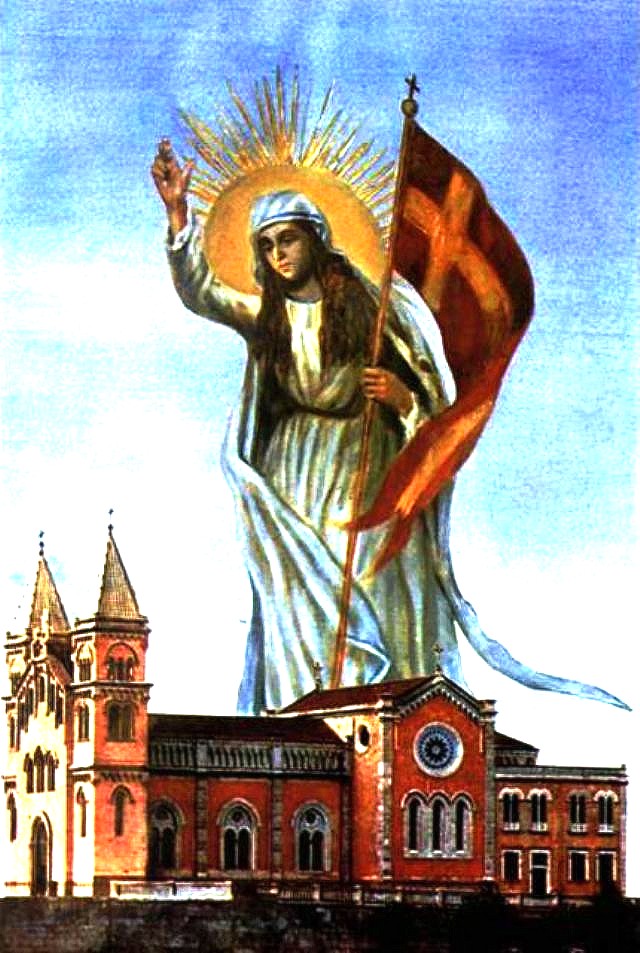
St Basilides and Companions / cMartyrs of Rome: Four members of the Imperial Roman nobility. They were all soldiers, one or more may have been officers, and all were Martyred in the persecutions of Diocletian – Basilides, Cyrinus, Nabor and Nazarius. They were martyred in 304 outside Rome, Italy and buried along the Aurelian Way.
Three Holy Exiles: Three Christian men who became Benedictine Monks at the Saint James Abbey in Regensburg, Germany, then Hermits at Griestatten and whose lives and piety are celebrated together. – Marinus, Vimius and Zimius.
Thought for the Day – 11 June – Meditations with Antonio Cardinal Bacci (1881-1971)
The Holy Mass
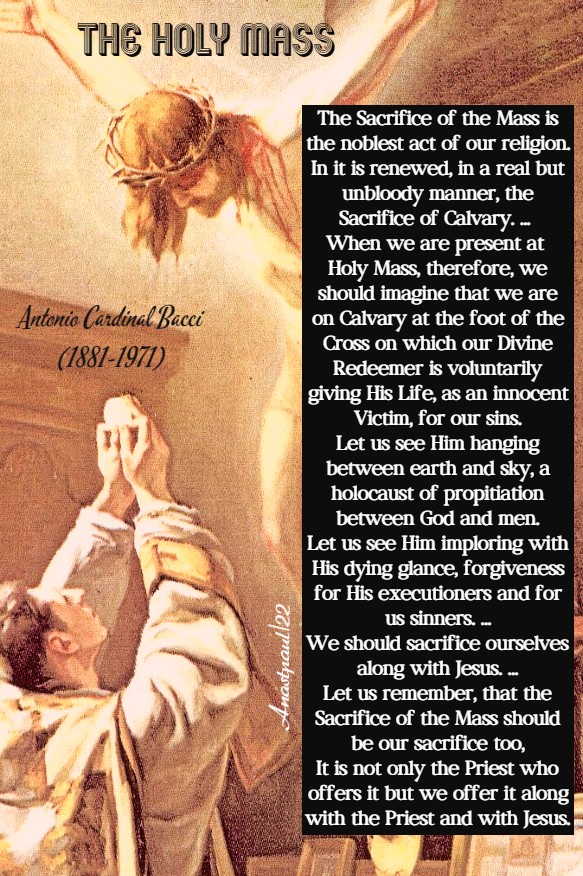
“The Sacrifice of the Mass is the noblest act of our religion. In it is renewed, in a real but unbloody manner, the Sacrifice of Calvary.
Jesus desired to remain with us throughout the centuries in the Blessed Eucharist as our friend, comforter and spiritual food. Similarly, not being satisfied with having shed His Precious Blood on the Cross for our Redemption, it was His wish that this sacrificial action should be renewed daily in every corner of the world, in such a way, that everyone could participate in it and benefit from it. When we are present at Holy Mass, therefore, we should imagine that we are on Calvary at the foot of the Cross on which our Divine Redeemer is voluntarily giving His Life, as an innocent Victim, for our sins. Let us see Him hanging between earth and sky, a holocaust of propitiation between God and men. Let us see Him imploring with His dying glance, forgiveness for His executioners and for us sinners.
Let us imagine, moreover, His most Holy Mother as she gazes sorrowfully upon her suffering Son. With love far greater than that of any other human creature, she offers herself in union with Jesus, for our salvation.
We should make a similar offering when we assist at the Sacrifice of the Altar. We should sacrifice ourselves along with Jesus. If we are tormented by sufferings, let us offer them up along with those of Jesus. If we are troubled by passionate inclinations to sin, let us sacrifice these bravely, along with Jesus and for love of Him. If we are full of hatred and coldness towards others, let us sacrifice these feelings for love of Jesus, Who forgave everyone who asked and repented and prayed even for His executioners.
Let us remember, that the Sacrifice of the Mass should be our sacrifice too, It is not only the Priest who offers it but we offer it along with the Priest and with Jesus. “Receive, O Holy Trinity, this oblation which we make to Thee.” Let us unite the offering of our entire selves to the Sacrifice of Jesus and we sgall obtain great spiritual benefits.”
Quote/s of the Day – 11 June – “The Month of the Sacred Heart of Jesus” – The Solemnity of Corpus Christi – 1 John 3:13-18, Luke 14:16-24. – Scripture search here: https://www.drbo.org/
“… This Body which He took from us, He gave wholly for our salvation. For, He offered His own Body to God the Father, upon the Altar of the Cross, as a Victim for our reconciliation and, He shed, His own Blood, both to redeem and cleanse us that we, being bought back from a wretched slavery, might be washed from all our sins. And then, that the memory of such a great benefit might abide in us, He left His Body to be our food and His Blood to be our drink that the faithful might receive them under the species of Bread and Wine.”
St Thomas Aquinas (1225-1274) Doctor Angelicus/Doctor Communis
“I adore Thee at every moment, O Living Bread of Heaven, great Sacrament! Jesus, heart of Mary, I pray Thee, bless my soul. Holiest Jesus, my Saviour, I give Thee my heart.”
(Indulgence of Two Hundred Days; Pope Pius VII, 1915)
The Divine Praises
Blessed be God. Blessed be His Holy Name. Blessed be Jesus Christ, true God and true Man. Blessed be the Name of Jesus. Blessed be His Most Sacred Heart. Blessed be Jesus in the Most Holy Sacrament of the Altar. Blessed be the Holy Spirit, the Paraclete. Blessed be the great Mother of God, Mary most holy. Blessed be her holy and Immaculate Conception. Blessed be her glorious Assumption. Blessed be the name of Mary, Virgin and Mother. Blessed be Saint Joseph, her most chaste spouse. Blessed be God in His Angels and in His Saints.
May the Heart of Jesus, in the Most Blessed Sacrament, be praised, adored and loved with grateful affection, at every moment, in all the Tabernacles of the world, even to the end of time. Amen.
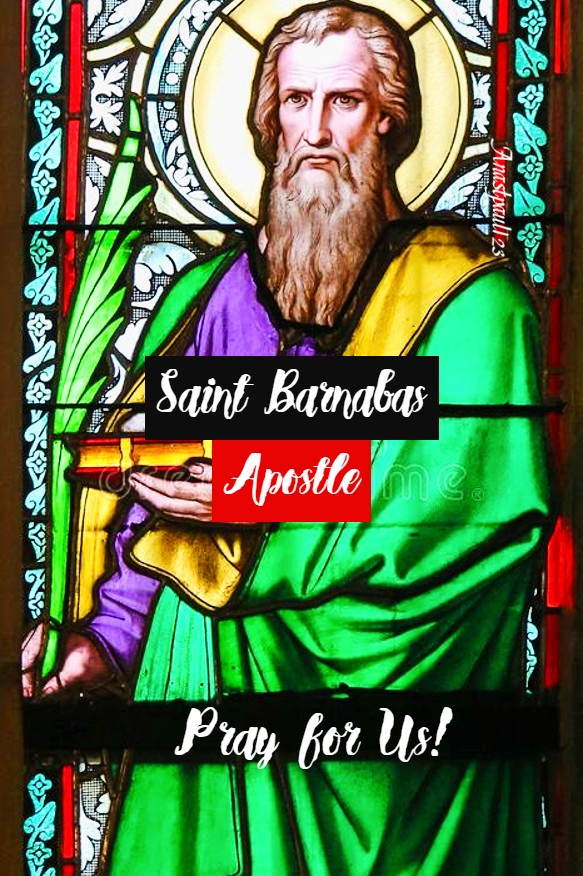
One Minute Reflection – 11 June – “The Month of the Sacred Heart of Jesus” – The Solemnity of Corpus Christi and the Feast of St Barnabas Apostle – 1 John 3:13-18, Luke 14:16-24. – Scripture search here: https://www.drbo.org/
“But I say unto you that none of those men who were invited shall taste of my supper.” – Luke 14:24
REFLECTION – “The Psalmist says: “Bread fortifies the heart of man and wine rejoices his heart” (Ps 103:15). For those who believe in Him, Christ is Food and Drink, Bread and Wine. He is Bread when He strengthens and establishes us according to Peter’s words: “After you have suffered a little, the God of all grace Who called you to His eternal glory in Christ, will restore, strengthen and establish you” (1 Pt 5:10). He is Drink and Wine when He makes us glad according to the words of the Psalmist: “Gladden the soul of Thy servant, for to Thee, O Lord, I lift up my soul” (Ps 85:4).
Everything in us which is strong, steadfast, firm, happy and joyful to carry out God’s commands, bear with misfortune, act obediently, stand up for justice – all these things come from this Bread’s strength, this Wine’s gladness. Happy are they whose deeds are strong and joyful! And since no-one can do it of themselves, happy are they who have an eager desire to cleave to what is just and right and to be strengthened in everything and rejoice through Him Who said: “Blessed are they who hunger and thirst for righteousness” (Mt 5:6). If Christ is Food and Drink even now for the strength and joy of the righteous, how much more so will He be in the life to come, when He will give to the righteous without measure?!” – Baldwin of Canterbury (c1125-1190) Cistercian Abbot of Forde Monastery and Archbishop of Canterbury (The Sacrament of the Altar – II:3 ).
PRAYER – O God, Who gladden us by the merits and intercession of blessed Barnabas, Thy Apostle, mercifully grant that we, who ask of Thee favours through him, may obtain them by the gift of Thy grace.ThroughJesus Christ, Thy Son our Lord, Who lives and reigns with Thee, in the unity of the Holy Ghost, God, world without end. Amen (Collect).
All praise, honour and glory to the Divine Heart of JESUS. 50 Days Indulgence, Once a day, Raccolta, 168 Pope Leo XIII, 13 June 1901.
Our Morning Offering – 11 June – “The Month of the Sacred Heart of Jesus” – The Solemnity of Corpus Christi, The Most Holy Body and Blood of Our Lord Jesus Christ and Sunday within the Octave – The Second Sunday after Pentecost
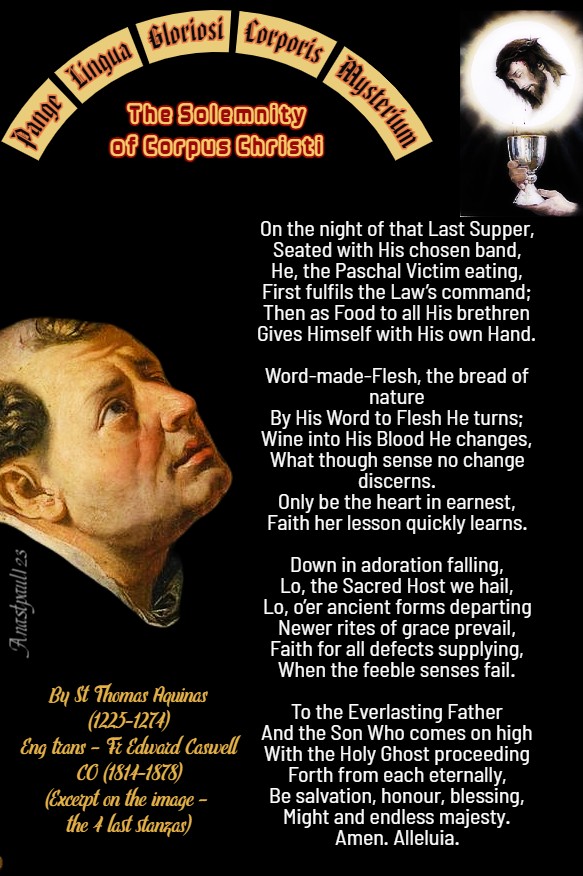
Pange Lingua Gloriosi Corporis Mysterium Sing, My Tongue By St Thomas Aquinas (1225-1274) Eng trans – Fr Edward Caswell CO (1814-1878) (Excerpt on the image – the 4 last stanzas)
Sing, my tongue, the Saviour’s glory, Of His Flesh, the Mystery sing; Of the Blood, all price exceeding, Shed by our Immortal King, Destined, for the world’s redemption, From a noble Womb to spring.
Of a pure and spotless Virgin Born for us on earth below, He, as Man, with man conversing, Stayed, the seeds of truth to sow; Then He closed in solemn order Wondrously His Life of woe.
On the night of that Last Supper, Seated with His chosen band, He, the Paschal Victim eating, First fulfils the Law’s command; Then as Food to all His brethren Gives Himself with His own Hand.
Word-made-Flesh, the bread of nature By His Word to Flesh He turns; Wine into His Blood He changes, What though sense no change discerns. Only be the heart in earnest, Faith her lesson quickly learns.
Down in adoration falling, Lo, the Sacred Host we hail, Lo, o’er ancient forms departing Newer rites of grace prevail, Faith for all defects supplying, When the feeble senses fail.
To the Everlasting Father And the Son Who comes on high With the Holy Ghost proceeding Forth from each eternally, Be salvation, honour, blessing, Might and endless majesty. Amen. Alleluia.
Written by St Thomas Aquinas (1225-1274) the Angelic and Common Doctor of the Church, for the very first Solemnity of Corpus Christi, this Hymn is considered the most beautiful of Aquinas’ Hymns and one of the seven great Hymns of the Church.
The last two stanzas make up the Tantum Ergo (Down in Adoration Falling) which is used at Benediction of the Blessed Sacrament. The Hymn is also used on Maundy Thursday during the procession from the Sanctuary to the Altar of Repose, where the Blessed Sacrament is kept until Good Friday.
PANGE, Lingua, Gloriosi Corporis Mysterium
Corporis mysterium, Sanguinisque pretiosi, quem in mundi pretium fructus ventris generosi Rex effudit Gentium.
Nobis datus, nobis natus ex intacta Virgine, et in mundo conversatus, sparso verbi semine, sui moras incolatus miro clausit ordine.
In supremae nocte cenae recumbens cum fratribus observata lege plene cibis in legalibus, cibum turbae duodenae se dat suis manibus.
Verbum caro, panem verum verbo carnem efficit: fitque sanguis Christi merum, et si sensus deficit, ad firmandum cor sincerum sola fides sufficit.
Tantum ergo Sacramentum veneremur cernui: et antiquum documentum novo cedat ritui: praestet fides supplementum sensuum defectui.
Genitori, Genitoque laus et iubilatio, salus, honor, virtus quoque sit et benedictio: procedenti ab utroque compar sit laudatio. Amen. Alleluia.
Saint of the Day – 11 June – St Rembert of Hamburg (c830-888) Archbishop of Hamburg-Bremen, Missionary, Miracle-worker, Founder of Churches and Monasteries, Disciple of St Ansgar (801-865) “The Apostle of the North.” Born in c830 in Denmark (probably) and died on 3 February in 862 or 888 of natural causes. St Rembert most famously wrote the Hagiography about the life Ansgar, the Vita Ansgari, one of the most popular hagiographies of middle ages. Patronage s- of the blind and those with eye diseases, against storms at sea. Also known as – Rembert, Rembertus, Rimbert. Additional Memorial 4 February the day on which St Rembert was chosen as the Archbishop. St Ansgar’s life here: https://anastpaul.com/2019/02/03/saint-of-the-day-3-february-saint-ansgar-osb-801-865-apostle-of-the-north/
The Roman Martyrology reads : “In Bremen in Saxony, in today’s Germany, Saint Rembert, Bishop of Hamburg and Bremen, who, a faithful disciple of Saint Ansgar and his successor, extended his ministry to the regions of Denmark and Sweden and, at the time of the invasions of the Normans, he took care of the ransom of the Christian prisoners.”
Engraving in the Austrian National Library in Vienna
Little is directly known about Rimbert, much of the information available regarding his life comes from the Vita Rimberti, a Hagiography written by an unknown author, likely produced some time in the 10th Century. We believe that Rembert might have been a Dane. He studied under St Ansgar near Bruges in the neighbouring Monastery of Turholt. St Ansgar called him to his assistance in his missionary labours and, in his last sickness, recommended him to be his successor, saying: “Rembert is more worthy to be Archbishop, than I to discharge the office of his Deacon.”
After St Ansgar’s death, in 865, Rembert was unanimously chosen as the Archbishop of Hamburg-Bremen and evangelised, governed and administered all the Churches of Sweden, Denmark and Lower Germany, finishing the work of their conversion. Rembert continued much of the missionary labours begun under St Ansgar, despite the lack of Royal or Papal support.
As Archbishop, he maintained the poorhouse in Bremen which had been established by St Ansgar and founded a Monastery at Bücken. Rembert, furthermore, obtained market, coinage and toll rights for the City of Bremen.
He also began the conversion of the Sclavi and the Vandals, now called Brandenburghers. He sold the Sacred Vessels to redeem captives from the Normans and gave the horse on which he was riding, for the ransom of a virgin taken by the Sclavi.
In 884 Rembert personally led a Frisian army against the Vikings and following the victorious Battle of Norditi, was able to drive them permanently out of East Frisia! This indeed, was a Saint of many talents.
It was also chronicled in the Vita Rimberti that our Saint had performed numerous miracles, many of which are associated with his missionary work in Sweden. The miracles attributed to him include calming stormy seas, restoring sight to the blind and in one instance, performing an exorcism on the son of Louis the German.
He was most careful never to lose a moment of time from serious duties and prayer and never to interrupt the attention of his mind to God in his exterior functions.
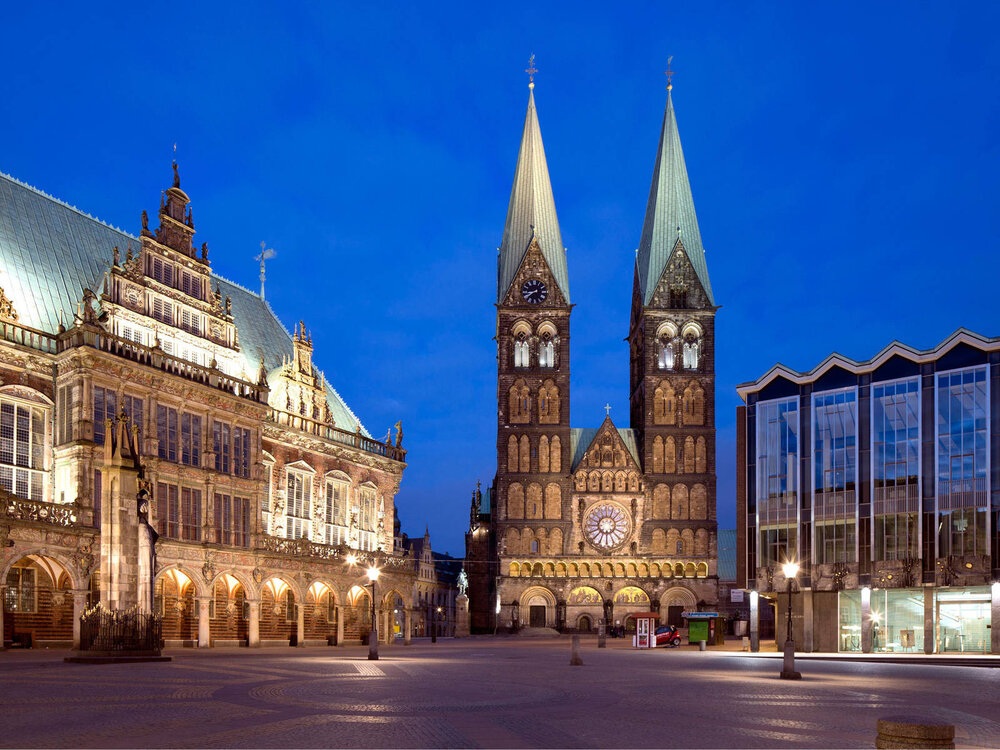
Rembert died on 3 February in 888 (or 862) but is commemorated also on the 4th of February, the day on which he was chosen Archbishop. Hewas buried on the outer wall of Bremen Cathedral next to St Willehad.
His life of St Ansgar is admired, both for the Author’s accuracy and piety and for the elegance and correctness of the composition. His letter to St Walburga, the first Abbess of Nienherse, is a vulnerable exhortation to humility and virginity.
St Herebald of Bretagne Bl Hugh of Marchiennes Bl Jean de Bracq
Bl Kasper of Grimbergen St Maximus of Naples
St Parisius ECMC (c 1160-1267) Priest and Monk of the Camaldolese Hermits of Mount Corona, Spiritual Director, Reformer, Miracle-worker during his life and after his death. A very long life of humble and loving service, for the glory of God!: The Roman Martyrology reads: “In Treviso, Saint Parisio, Priest of the Camaldolese Order, who for seventy-seven years took care of the spiritual direction of the Nuns with healthy advice, dying at the age of one hundred and eight.” https://anastpaul.com/2022/06/11/saint-of-the-day-11-june-st-parisius-ecmc-c-1160-1267-a-very-long-life-of-humble-and-loving-service-for-the-glory-of-god/
St Rembert of Hamburg (c830-888) Archbishop St Riagail of Bangor Bl Stephen Bandelli OP St Tochumra of Kilmore St Tochumra of Tuam
Martyrs of Tavira – 7 Beati: Members of the Knights of Santiago de Castilla. During the re-conquest of the Iberian peninsula from the Muslims by Christian forces, in a period of truce between the armies, the group was allowed to leave the Portuguese camp to hunt. Near Tavira, Portugal, he and his companions were ambushed and killed by a Muslim force. Making a reprisal attack, the Portuguese army took the city of Tavira. The murdered knights were considered to be martyrs as they died in an action defending the faith. They were – Blessed Alvarus Garcia, Blessed Beltrão de Caia, Blessed Damião Vaz, Blessed Estêvão Vasques, Blessed Garcia Roiz, Blessed Mendus Valle, Blessed Pedro Rodrigues’ They were Martyred in 1242 outside Tavira, Faro, Portugal. Their relics are enshrined under the altar of Saint Barnabas in the Church of Our Lady, Queen of the Angels (modern Santa Maria do Castelo) in Tavria, Portugal.
Mercedarian Martyrs of Damietta: Three Mercedarian Lay Knights who worked to ransom Christians enslaved by Muslims. During the 7th Crusade, a plague swept through the Christian army and these knights volunteered to work with the sick. During this work they were captured by Muslims and ordered to convert to Islam; they refused. They were tortured, taken to Damietta, Egypt where they were murdered for their faith. They were thrown from a tower in the mid-13th century in Damietta, Egypt.
Thought for the Day – 10 June – Meditations with Antonio Cardinal Bacci (1881-1971)
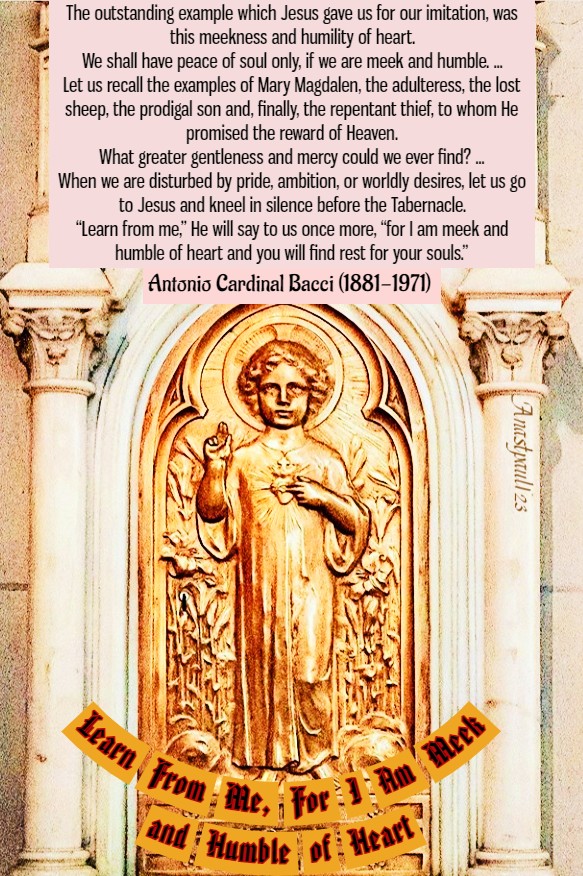
“Learn From Me, For I Am Meek and Humble of Heart”
“Jesus is perfection itself. In Him, therefore, every virtue is to be found. He could truly claim that He fulfilled in Himself the precept: “You are to be perfect, even as your heavenly Father is perfect” (Mt 5:48). Throughout His life, He performed in a perfect manner, the will of His heavenly Father: “I do always the things that are pleasing to Him” (Jn 8:29).
Jesus Christ provided us with an example of every virtue. As the foundation of all the virtues, He insisted on the great precept of loving God above all things and our neighbour as ourselves. In proposing Himself as a model, however, this is what He said: “Learn from me, for I am meek and humble of heart and ou will find rest for your souls” (Mt 11:29). The outstanding example which Jesus gave us for our imitation, was this meekness and humility of heart. We shall have peace of soul only, if we are meek and humble.
In what did the humility of Jesus consist? He was God and He became man. He, Who possessed everything was born poor in a wretched stable and lived as a lowly workman for thirty years. He allowed Himself to be betrayed by one of His Apostles, to be sentenced to death as an evildoer and, finally, to be executed on the Cross.
He combined humility with gentleness. He was happy when He could receive back penitent sinners and grant them forgiveness and peace. Let us recall the examples of Mary Magdalen, the adulteress, the lost sheep, the prodigal son and, finally, the repentant thief, to whom He promised the reward of Heaven. What greater gentleness and mercy could we ever find?
To the present day, moreover, Jesus Christ is hidden in the Blessed Eucharist under the consecrated species and appeals to us to imitate and love Him.
When we are disturbed by pride, ambition, or worldly desires, let us go to Jesus and kneel in silence before the Tabernacle. “Learn from me,” He will say to us once more, “for I am meek and humble of heart and you will find rest for your souls.”
Quote/s of the Day – 10 June – “The Month of the Sacred Heart of Jesus” – Within the Octave of Corpus Christi – 1 Corinthians 23-29, John 6:56-59 – Scripture search here: https://www.drbo.org/
“He who eats My Flesh and drinks My Blood, abides in Me and I in him.”
John 6:57
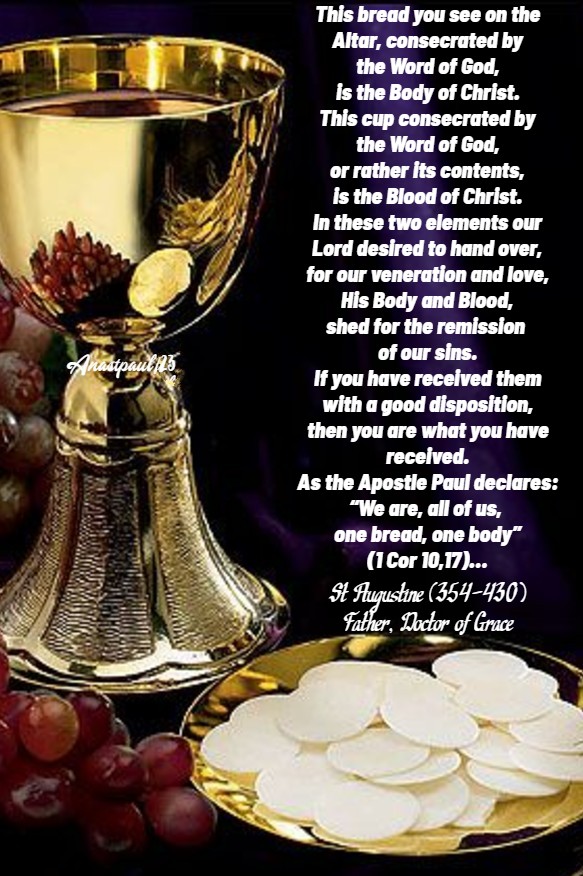
“This bread you see on the Altar, consecrated by the Word of God, is the Body of Christ. This cup consecrated by the Word of God, or rather its contents, is the Blood of Christ. In these two elements our Lord desired to hand over, for our veneration and love, His Body and Blood, shed for the remission of our sins. If you have received them with a good disposition, then you are what you have received. As the Apostle Paul declares: “We are, all of us, one bread, one body” (1 Cor 10,17)…”
St Augustine (354-430) Father, Doctor of Grace
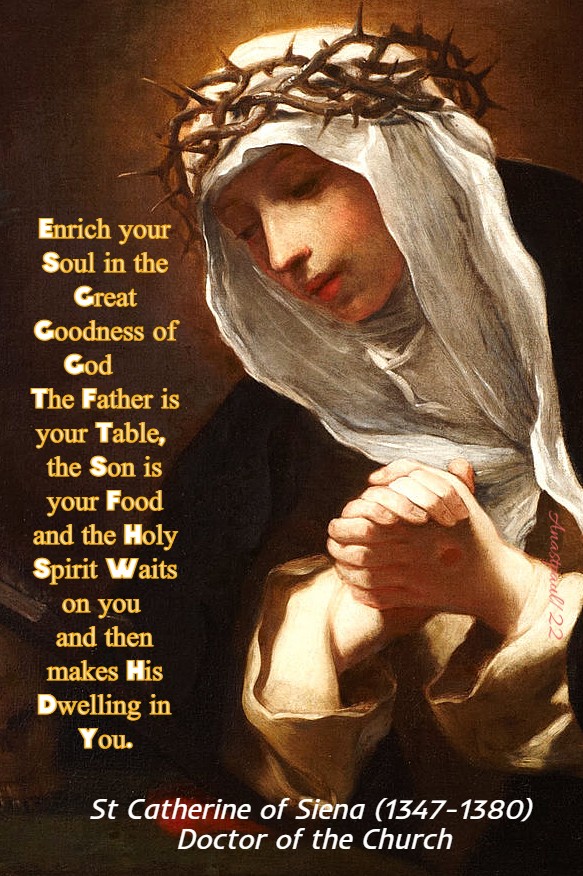
“Enrich your soul in the great goodness of God – The Father is your Table, the Son is your Food and the Holy Spirit waits on you and then makes His Dwelling in you.”
St Catherine of Siena OP (1347-1380) Doctor of the Church
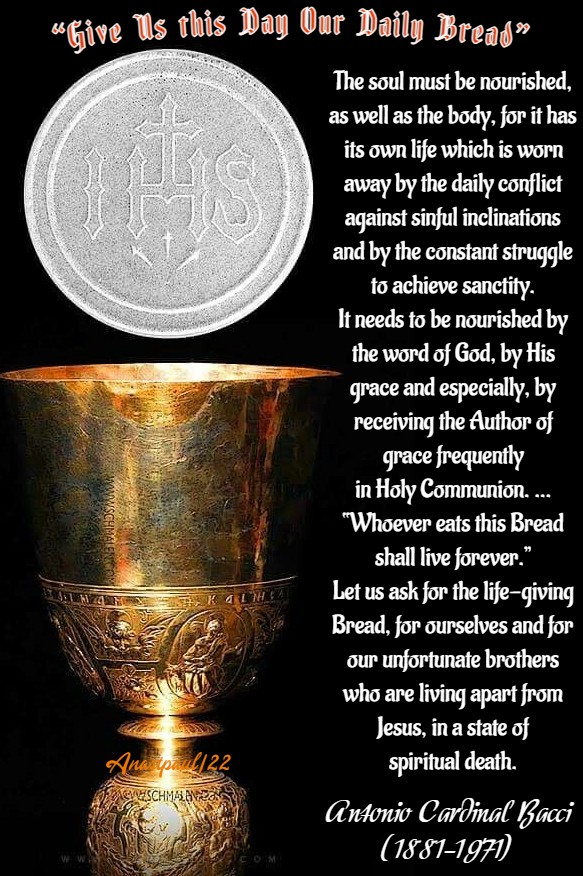
“The soul must be nourished, as well as the body, for it has its own life which is worn away by the daily conflict against sinful inclinations and by the constant struggle to achieve sanctity. It needs to be nourished by the word of God, by His grace and especially, by receiving the Author of grace frequently in Holy Communion. … “Whoever eats this Bread shall live forever.” Let us ask for the life-giving Bread, for ourselves and for our unfortunate brothers who are living apart from Jesus, in a state of spiritual death.”
One Minute Reflection – 10 June – “The Month of the Sacred Heart of Jesus” – Within the Octave of Corpus Christi and The Memorial of St Margaret Queen of Scotland (1045-1093) Widow – 1 Corinthians 23-29, John 6:56-59 – Scripture search here: https://www.drbo.org/
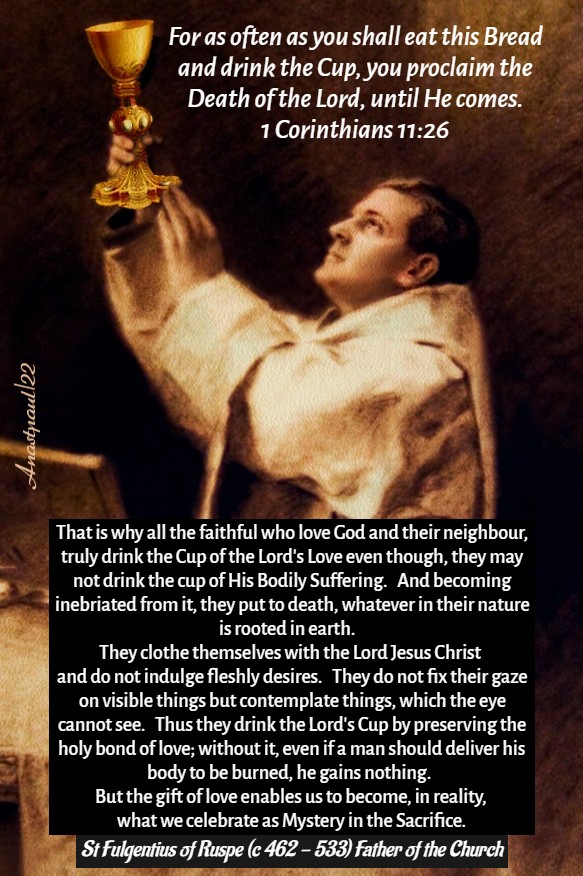
“For as often as you shall eat this Bread and drink the Cup, you proclaim the Death of the Lord, until He comes.” – 1 Corinthians 11:26
REFLECTION – “In our offering of the Holy Sacrifice we fulfil the Command of our Saviour, as recorded by the Apostle Paul: The Lord Jesus, on the night in which He was betrayed, took bread and after He had given thanks, broke it and said: This is My Body, which is given for you. Do this in remembrance of Me. The same way, after the supper, He took the Cup saying: This Cup is the New Covenant in My Blood. Do this, whenever you drink it, in remembrance of Me. For as often as you eat this Bread and drink this Cup, you shall proclaim the Death of the Lord until He comes.
This Sacrifice is offered, then, to proclaim the Lord’s Death; it is offered in remembrance of Him, Who laid down His Life for our sake. As He says: Greater love than this no man has, that he lay down his life for his friends. Because Christ died for us out of love, we ask, when we make remembrance of His Death, at the time of Sacrifice, that we too may be granted love through the coming of the Holy Spirit. We pray, that by the Love which Christ had for us, when He braved the Cross, we may receive the grace of the Spirit and be crucified to the world and the world to us. The Death Christ died, He died to sin, once for all but the Life He lives, He lives to God. Let us imitate our Lord’s Death and also live a new life. Strengthened with the gift of His Love, let us die to sin and live for God.
For God’s Love has been poured out in our hearts, through the Holy Spirit, Who has been given to us. Indeed our sharing in the Lord’s Body and Blood, when we eat His Bread and drink His Cup, teaches us, that we should die to the world and that we should keep our life hidden with Christ in God, crucifying our flesh with its vices and evil desires.
That is why all the faithful who love God and their neighbour, truly drink the Cup of the Lord’s Love even though, they may not drink the cup of His Bodily Suffering. And becoming inebriated from it, they put to death, whatever in their nature is rooted in earth. They clothe themselves with the Lord Jesus Christ and do not indulge fleshly desires. They do not fix their gaze on visible things but contemplate things, which the eye cannot see. Thus they drink the Lord’s Cup by preserving the holy bond of love – without it, even if a man should deliver his body to be burned, he gains nothing. But the gift of love enables us to become, in reality, what we celebrate as Mystery in the Sacrifice.” – St Fulgentius of Ruspe (c 462 – 533) Bishop, Father (An excerpt from Against Fabianus).
PRAYER – O God, Who made blessed Queen Margaret glorious by her remarkable charity toward the poor; grant, by her intercession and example that Thy charity may continually increase in our hearts. Through Jesus Christ, Thy Son our Lord, Who lives and reigns with Thee, in the unity of the Holy Ghost, God, world without end. Amen (Collect).
MAY the Heart of JESUS in the most Blessed Sacrament be praised, adored and loved with grateful affection, at every moment, in all the Tabernacles of the world, even to the end of time. – Indulgence 100 Days, Once a Day. Raccolta 161 Pius IX, 29 February 1868.
Our Morning Offering – 10 June – “The Month of the Sacred Heart of Jesus” – Saturday Within the Octave of Corpus Christi and Mary’s Saturday
Prayer to the Two Holy Hearts of Jesus and Mary
O Heart of Jesus, pierced for our sins and giving us Your Mother on Calvary! O Heart of Mary, pierced by sorrow and sharing in the sufferings of your Divine Son for our redemption! O Sacred union of these Two Hearts! Praised be the God of Love who united them together! May we unite our hearts and every heart, so that all hearts may live in unity and in imitation of that Sacred unity which exists in these Two Hearts. Triumph, O Sorrowful and Immaculate Heart of Mary! Reign, O Most Sacred Heart of Jesus! – in our hearts, in our homes and families, in the hearts of those who as yet do not know You and in all nations of the world. Establish in the hearts of all mankind the sovereign triumph and reign of Your Two Hearts so that the earth may resound from pole to pole with one cry: Blessed forever be the Most Sacred Heart of Jesus and the Sorrowful and Immaculate Heart of Mary! Obtain for me a greater purity of heart and a fervent love of the spiritual life. May all my actions be done for the greater glory of God in unions with the divine heart of Jesus and the Immaculate Heart of Mary. Hear and answer our prayers and intentions according to Your most merciful will. Amen
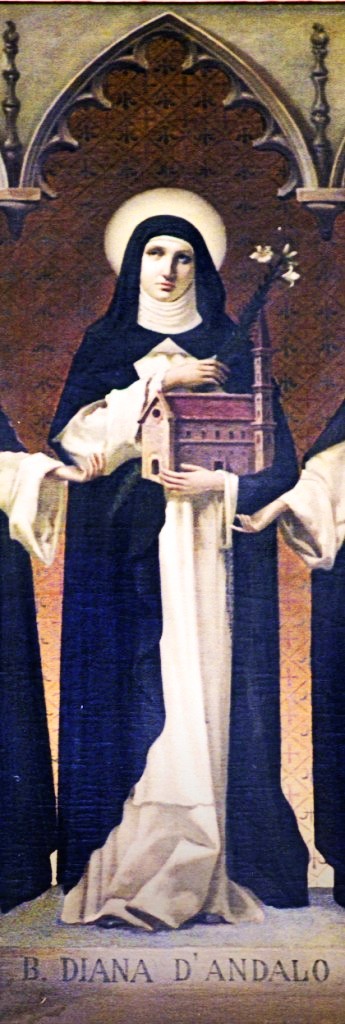
Saint of the Day –10June – Blessed Diana d’Andalo OP (1201-1236) Virgin, Nun of the Order of Preachers Born in 1201 near Bologna, Italy and died on 9 January 1236 in Bologna of natural causes. Beatified on 8 August 1888 by Pope Leo XII. Also known as – Diana degli Andalò.
The Roman Martyrology states: “In Bologna, blessed Diana d’Andalò, Virgin, who, having overcome all the impediments posed by her family, took a vow of cloistered life in the hands of Saint Dominic himself, entering the Monastery of Saint Agnes, which she founded.”
Diana was born into a powerful Roman family in Bologna, Italy in 1201. Nothing is known of her childhood but she was described as “rather spoiled.” She was “of outstanding beauty,” charming, eloquent, well-educated, high spirited, courageous and had good judgement. Dominican scholar Gerald Vann also called her “full of the joy of living, full too of the joy of her own beauty and the power it gave her.”
In 1218, Diana heard the Dominican Scholar and Preacher, Blessed Reginald of Orléans speak in Bologna. His sermons inspired her to give up her worldliness and devote herself to prayer. Following Reginald’s advice, she remained at her family’s home and continued to wear the clothes appropriate to her standing, although she wore an iron chain and hairshirt under them.
In 1219, St Dominic , himself, came to Bologna and to him she vowed her perpetual virginity and she proclaimed her intention to join the Dominican Order as soon as a Convent was established in Bologna.
She persuaded her father to purchase the lands to build a Convent but he refused to allow her to enter it, probably because the family intended that she marry into another prominent family and the Bishop denied permission to build on the site chosen.
In 1222, she ran away to an Augustinian Convent in Ronzano. Her family forcibly removed her and brought her back home;. In the struggle, one of her ribs was broken, an almost fatal injury from which she never fully recovered. St Dominic died shortly afterwards but after she recovered sufficiently in 1223, she again escaped to Ronzano, although her family did not pursue her a second time.
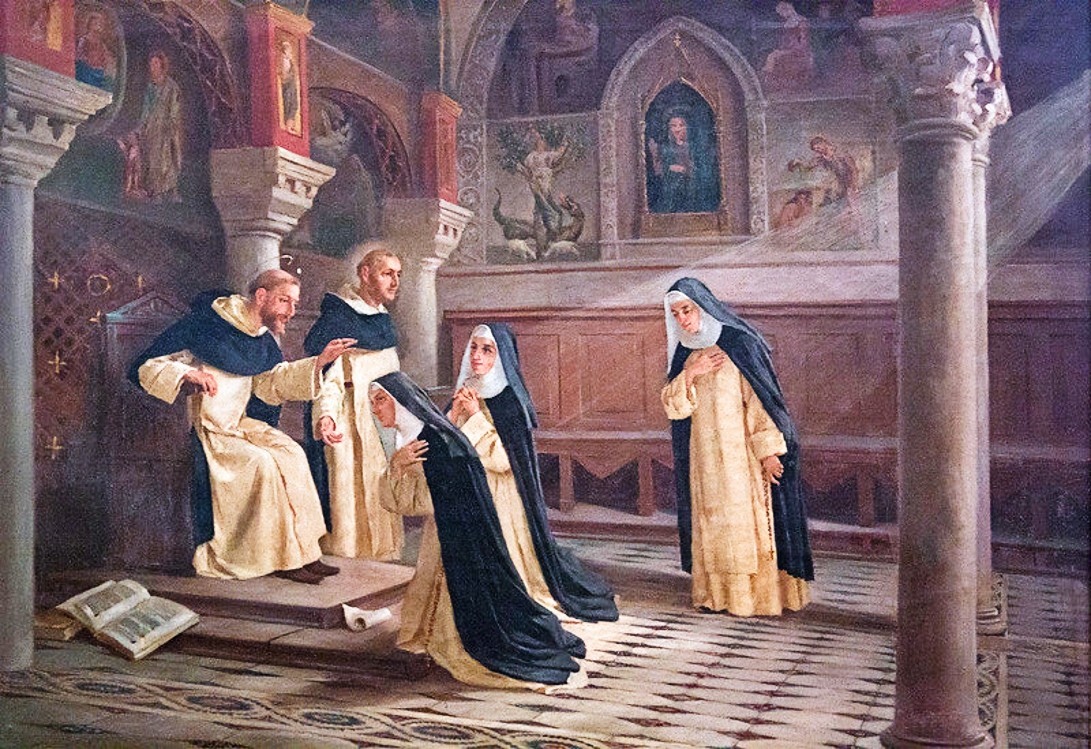
The 3 Sisters make their vows at the new Convent
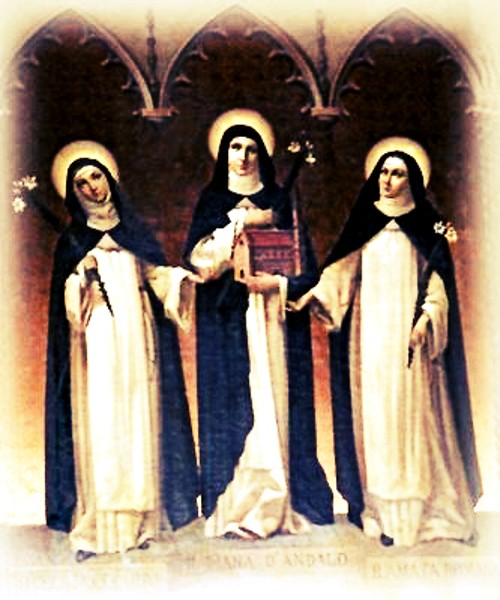
Shortly after St Dominic’s death, Blessed Jordan of Saxony, St Dominic’ Successor, as leader of the Order, met Diana when he came to Bologna. With his assistance, Diana reconciled with her family, her father agreed to allow her to enter religious life and the Bishop agreed to another site for the Convent. In 1223, the Convent was dedicated to St Agnes in Bologna and Diana entered the Dominican Order there. Four other nuns were also brought from the Convent of St Sixtus in Rome, including the Blessed Cecilia Cesarini, who was made Prioress, and Blessed Amata. The three are always associated together.
Blesseds Cecilia, Diana, Amarta
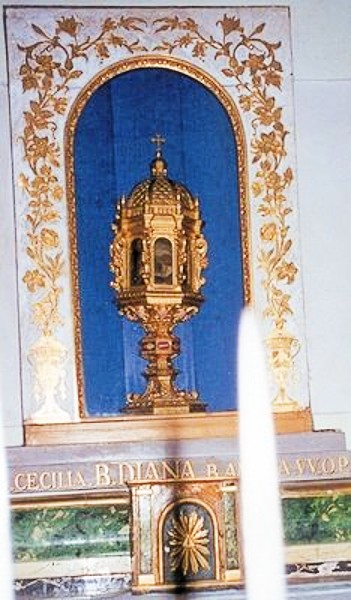
Diana remained at St Agnes until her death in 1236 and was buried there, along with the remains of Cecilia and Amata. Their Relics were moved several times but always together. Diana’s head was placed in a Reliquary near St Dominic’s Tomb. Diana, along with Cecilia and Amata, were Beatified on 8 Augus 1888, by Pope Leo XIII.
The Reliquary containing Blessed Diana’s skull
Diana is known for a series of letters written to her and to the other Sisters at St Agnes, by Blessed Jordan of Saxony. 37 of the 50 letters that have survived were written directly to her. They are “evidence of the deep friendship shared by Diana and Jordan and demonstrate the possibility of warm affection” between Priests and the cloistered Nuns who pray for them and their work. The letters are also a record of the early history of the Dominican Order. Gerald Vann, Author of the book To Heaven with Diana! a compilation of the correspondence between the two Blesseds, Diana and Jordan, calls the letters “a wonderful treatise on Christian friendship.”
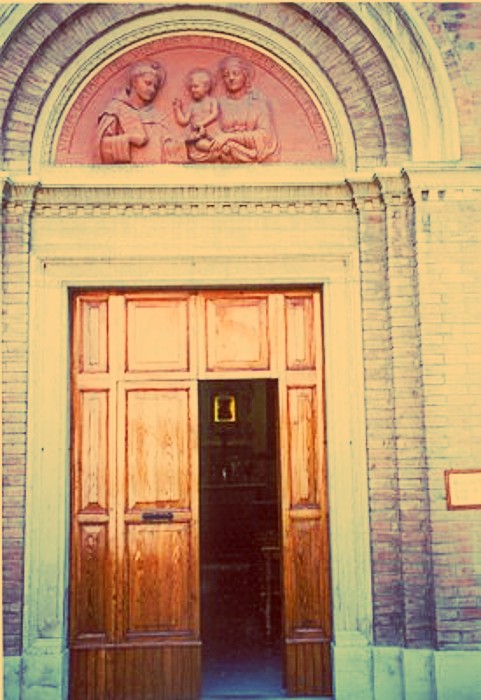
The entrance to St Agnes Convent, built by Bl Diana’s family in Bologna
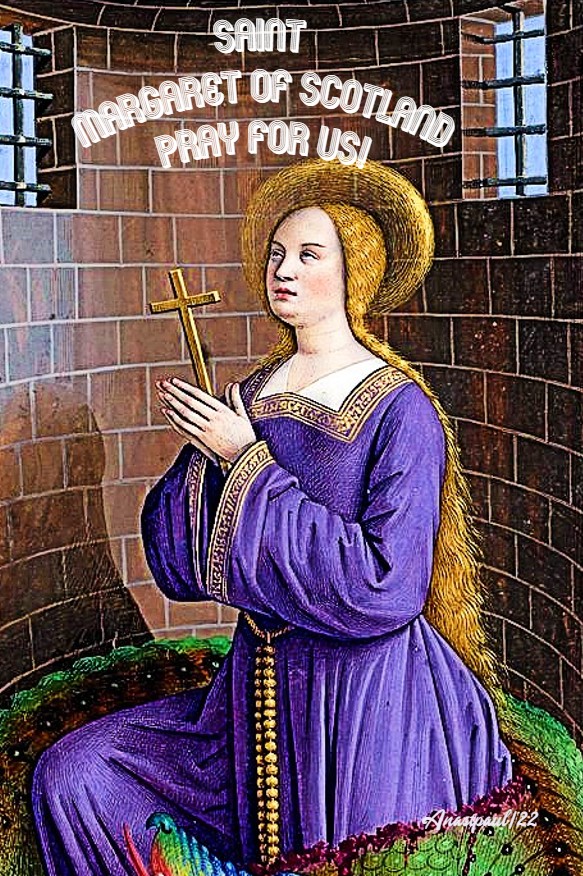
St Margaret of Scotland (1045-1093) Queen consort of Scotland, Wife and Mother, Apostle of the poor, Reformer. Saint Margaret’s name signifies “pearl” “a fitting name,” says Bishop Turgot, her Confessor and her first Biographer, “for one such as she.” Her soul was like a precious pearl. A life spent amidst the luxury of a Royal Court never dimmed its lustre, or stole it away from Him who had bought it with His Blood. Pope Innocent IV Canonised St Margaret in 1250 in recognition of her personal holiness, fidelity to the Roman Catholic Church, work for Ecclesiastical reform and charity. In 1693 Pope Innocent XII moved her feast day to 10 June but it was changed after Vatican II to 16 November. Wonderful St Margaret: https://anastpaul.com/2018/11/16/saint-of-the-day-16-november-st-margaret-of-scotland-1045-1093-queen/ AND: https://anastpaul.com/2022/06/10/saint-of-the-day-10-june-st-margaret-of-scotland-1045-1093/
Bl Amata of San Sisto St Amantius of Tivoli St Asterius of Petra St Bardo of Mainz
St Caerealis of Tivoli St Censurius of Auxerre (Died 486) Bishop St Crispulus of Rome Blessed Diana d’Andalo OP (1201-1236) Nun of the Order of Preachers Beatified on 8 August 1888 by Pope Leo XII. Bl Elisabeth Hernden Bl Elizabeth Guillen St Evermund of Fontenay St Faustina of Cyzicus Bl Gerlac of Obermarchtal St Getulius of Tivoli
St Landericus of Novalese St Landericus of Paris Bl Mary Magdalene of Carpi St Maurinus of Cologne St Primitivus of Tivoli St Restitutus of Rome Bl Thomas Green St Timothy of Prusa Bl Walter Pierson St Zachary of Nicomedia
Martyrs of North Africa – 17 Saints: A group of seventeen Christians Martyred together in North Africa; the only surviving details are two of their names – Aresius and Rogatius. Both the precise location in North Africa and the date are unknown.
Martyrs of the Aurelian Way – 23 Saints: A group of 23 Martyrs who died together in the persecutions of Aurelian. The only details that survive are three of their names – Basilides, Mandal and Tripos. c.270-275 on the Aurelian Way, Rome, Italy.
Thought for the Day – 9 June – Meditations with Antonio Cardinal Bacci (1881-1971)
The Sacred Heart of Jesus Surmounted by a Flaming Cross
“St Margaret Mary saw the Sacred Heart of Jesus, surmounted by flames in the midst of which, a Cross was raised on high. These flames and this Cross, were the symbol of the infinite love of Jesus. Let us reflect a little. God, immeasurably happy in Himself, wished to communicate a share in His happiness to men, whom He created in a state of earthly happiness. He was offended by men and, when He saw that they were heading for destruction, He sent His Eternal Word to them. The Word took a human nature and became our Brother; He preached the way to Heaven and gave us the means to achieve it. More than this, He offered Himself as a divine victim of expiation for our sins. Having been condemned by those whom He had come to show the way, He died on the Cross and shed all His Blood, for our salvation.
Pagans of all times have called this “the folly of the Cross.” In fact, it is the miracle of the infinite love of God for humanity. Let us remember, however, that, although His love and goodness are infinite, so also is His justice! It is an overwhelming miracle of love on the part of God, that He became man and died for us. It will be our own downfall if we fail to co-operate with this miracle of love!
The same Jesus, Who died on the Cross for us and revealed His Heart, pierced and flaming with love, will one day appear with the same glorious Sign of the Cross, as our Supreme Judge. Then, He will say to the wicked: “Depart from me, accursed ones, into everlasting fire!”
God’s justice is, as infinite as His charity! We must choose either the way of the Cross, the way of love and goodness to which the Sacred Heart of Jesus invites us, or the way of sin, which leads to the gulf of ruin and the final condemnation of the Supreme Judge. This is the tremendous choice we have to make!”
Quote/s of the Day – 9 June – Within the Octave if Corpus Christi – 1 Corinthians 23-29, John 6:56-59 – Scripture search here: https://www.drbo.org/
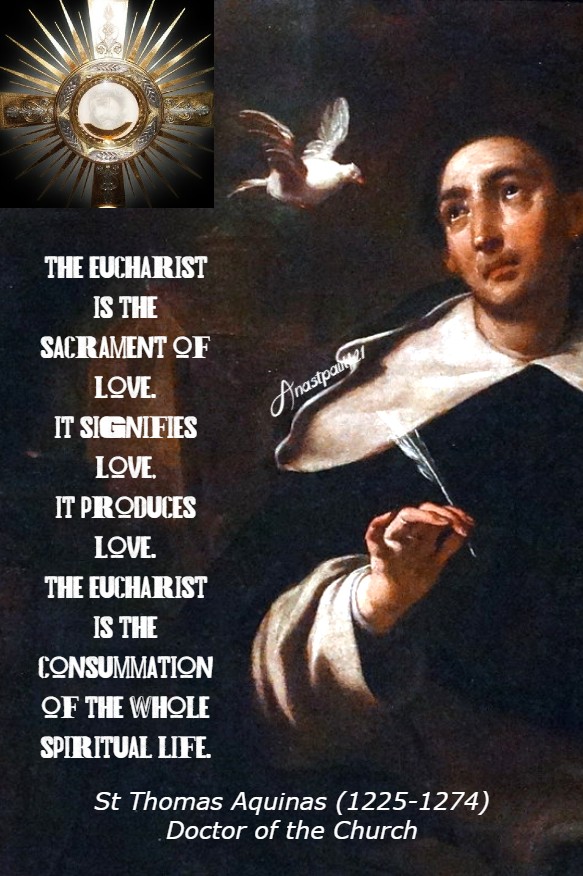
“The Eucharist is the Sacrament of Love. It signifies Love, It produces love. The Eucharist is the consummation of the whole spiritual life.”
St Thomas Aquinas (1225-1274) Doctor angelicus/Doctor communis
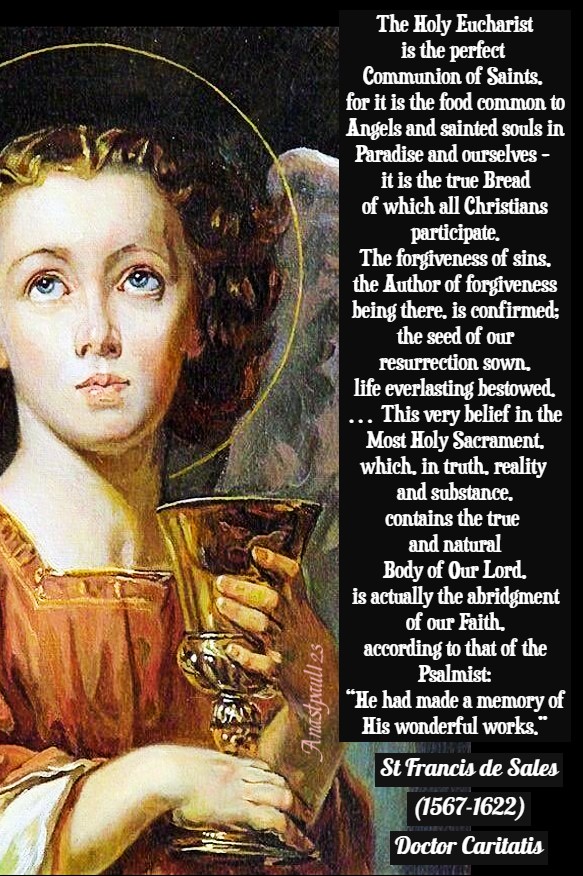
“The Holy Eucharist is the perfectCommunion of Saints, for it is the food common to Angels and sainted souls in Paradise and ourselves – it is the true Bread of which all Christians participate. The forgiveness of sins, the Author of forgiveness being there, is confirmed; the seed of our resurrection sown, life everlasting bestowed. … This very belief in the Most Holy Sacrament, which, in truth, reality and substance, contains the true and natural Body of Our Lord, is actually the abridgment of our Faith, according to that of the Psalmist: “He had made a memory of His wonderful works.”
One Minute Reflection – 9 June – Within the Octave if Corpus Christi – Saints Primus and Felicianus (Died c304) Cinfessors, Brother Lay Martyrs – 1 Corinthians 23-29, John 6:56-59 – Scripture search here: https://www.drbo.org/
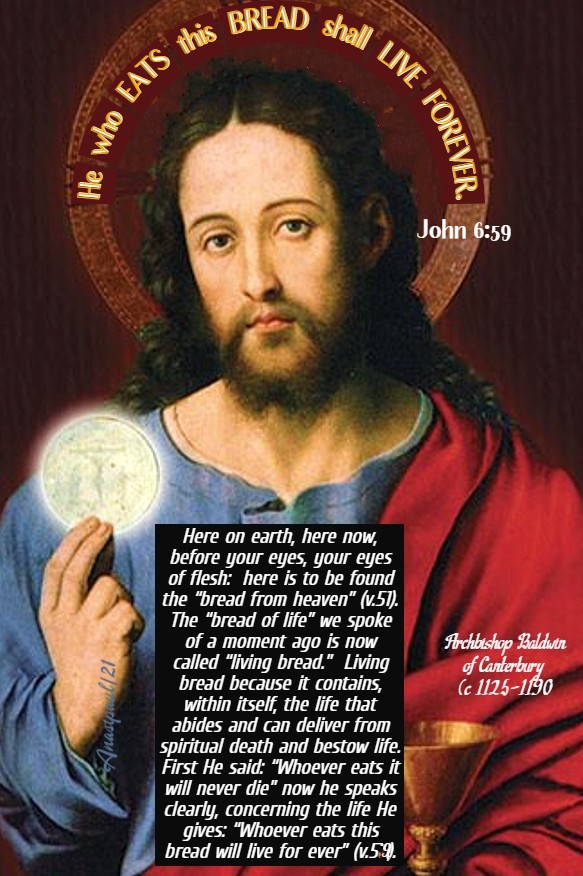
This is the Bread that has come down from Heaven; not as your fathers ate the manna and died. He who eats this Bread shall live forever.” – John 6:59
REFLECTION – Christ is “the bread of life” for those who believe in Him: to believe in Christ is to eat the bread of life, to possess Christ within one, is to possess eternal life… “I am the bread of life,” He says; “your fathers ate manna in the wilderness and they are dead” (Jn 6,48f). By this is to be understood ,spiritual death. Why are they dead? Because they believed in what they saw and did not understand what they could not see… Moses ate manna, Aaron ate it and many others, too, who pleased God and are not dead. Why are they not dead? Because they understood, in a spiritual fashion, they were spiritually hungry, they tasted the manna spiritually, so that they might be spiritually satisfied. “This is the bread that came down from heaven: whoever eats it will never die” (v.50). This manna – that is to say, Christ, who Himself spoke like this…, was prefigured by the manna but was able to do more than manna could. For manna could not, of itself, prevent dying spiritually… But the righteous saw Christ in the manna, they believed in His coming and Christ, of whom manna was the symbol, grants to all who believe in Him that they should not spiritually die. Hence He says: “This is the bread come down from heaven; whoever eats it will never see death.” Here on earth, here now, before your eyes, your eyes of flesh: here is to be found the “bread from heaven” (v.51). The “bread of life” we spoke of a moment ago is now called “living bread.” Living bread because it contains, within itself, the life that abides and can deliver from spiritual death and bestow life. First He said: “Whoever eats it will never die” now he speaks clearly, concerning the life He gives: “Whoever eats this bread will live for ever” (v.58). Archbishop Baldwin of Canterbury (c 1125-1190) Cistercian – The Sacrament of the Altar II
PRAYER – Grant O Lord, we pray, that we may ever honour the festival of thy holy Martyrs, Primus and Felicianus and Thy truth of the Church of Saints. Through Jesus Christ, Thy Son our Lord, Who lives and reigns with Thee, in the unity of the Holy Ghost, God, world without end. Amen (Collect).
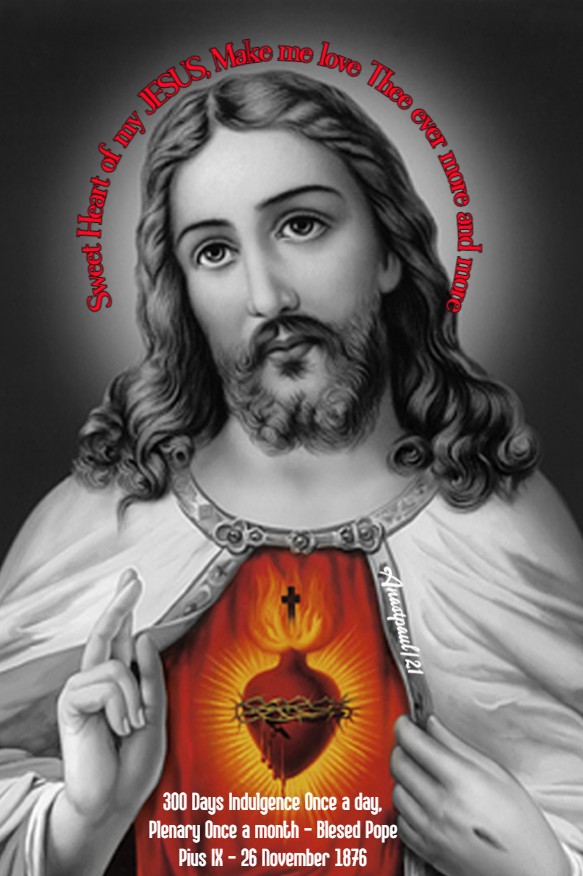
Sweet Heart of my JESUS, Make me love Thee ever more and more! – 300 Days Indulgence Once a day, Plenary Once a month – Blessed Pope Pius IX – 26 November 1876
Our Morning Offering – 9 June – “The Month of the Sacred Heart of Jesus”
Prayer in Adoration of the Sacred Heart By St Margaret Mary Alacoque (1647-1690) Visionary and Apostle of the Sacred Heart of Jesus
Jesus Christ, my Lord and my God, Whom I believe to be really present in the Blessed Sacrament of the Altar, receive this most profound Act of Adoration to supply for the desire I have, to adore Thee unceasingly and in thanksgiving, for the sentiments of love which Thy Sacred Heart has for me in this Sacrament. I cannot better acknowledge them, than by offering Thee, all the Acts of Adoration, resignation, patience and love which this same Heart has made during its mortal life and which it makes still and which it shall make eternally in Heaven, in order that through it, I may love Thee, praise Thee and adore Thee worthily, as much as it is possible for me. I unite myself to this Divine Offering which Thou dost make to Thy Divine Father and I consecrate to Thee, my whole being, praying Thee, to destroy in me, all sin and not to permit that I should be separated from Thee, in time and eternally. Amen.
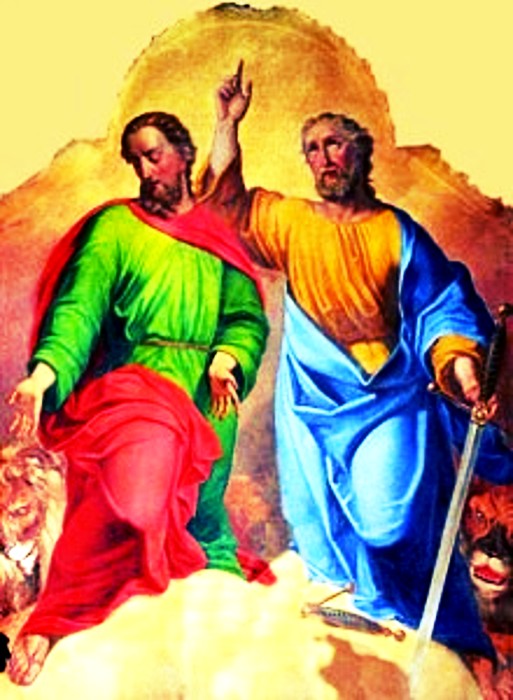
Saints of the Day – 9 June – Saints Primus and Felicianus (Died c304) Brother Lay Martyrs, Confessors. Martyred during the Diocletian persecution. The Martyrologium Hieronymianum gives under 9 June the names of Primus and Felician who were buried in the Church of Saint Stephen on Mount Celio, Rome.
The Roman Martyrology reads today: “At Rome, on Mount Caelius, the birthday of the holy Martyrs, Primus and Felician, under the Emperor Diocletian and Maximian. These glorious Martyrs lived long in the service of the Lord and endured sometimes together, sometimes separately, various cruel torments. They were finally beheaded by Promotus, Governor of Nomentum and thus happily ended their combat.”
Saints Primus and Felicianus (Died c304) Martyrs By Fr Francis Xavier Weninger ,SJ (1805-1888)
“Primus and Felicianus, two holy Martyrs, were brothers and natives of Rome. They were renowned on account of their birth and wealth but still more, on account of the blameless life they led and their determination to remain constant in the True Faith, although they knew the suffering which was in store for them, even from their pagan parents, as from other persecutors of the Christian faith. At that period the Emperors Dioclesian and Maximian reigned and the Christians were most cruelly persecuted. Many of them were cast into prison, while others were put to death by the most barbarous torments.
The two zealous brothers visited the imprisoned Christians frequently and sacrificed all their possessions to comfort them, while they cheered and encouraged those that were led to execution, exhorting them to remain faithful to Christ. The idolatrous priests could not endure this, and incited the people against the two holy brothers, as against two sworn enemies of the gods and accused them before the Emperor, demanding their execution.
Both were brought before the Emperor and called upon to renounce their Faith, They, however, said fearlessly, that they would rather die, than obey the Emperor in this point. They were cast into a dungeon and heavily chained. But during the first night an Angel appeared to them, who loosed their fetters and set them free.
They immediately returned to their former kind deeds not willing to save their lives by flight, as many advised them to do. The Emperor, being informed of this, summoned them into his presence and endeavoured, more than before, by promises and menaces to persuade them to abjure their Faith and, at last, sent them to the temple of Hercules to offer incense to this idol. Both brothers refused to obey and the Emperor gave orders that after having been scourged, they should be taken to the Governor of Momentum, a village about 12 miles from Rome and very hostile to the Christians. Before they were led there an Angel again appeared and healed their wounds. No sooner had the two Christian heroes appeared before Promotus, the cruel Governor of the town, than he ordered them to be beaten with clubs until they should change their minds. This was a punishment ordained by law only for slaves and other low people and the tyrant had it executed upon the two noble brothers, in derision of their Faith.
It was a most painful punishment, as the clubs were scourges twisted together of many cords, with leaden balls fastened at the end. With these, the condemned were whipped on the bare back and neck. The two holy brothers had to endure this torment and were more cruelly whipped than the greatest criminals. They, however, manifested no sign of pain but encouraging each other, they united in praising God, humbly begging His assistance:
“Strengthen us, O God!” cried they; “be with us O God! Our only hope, strengthen us that all may recognise Thee as the only true God.”
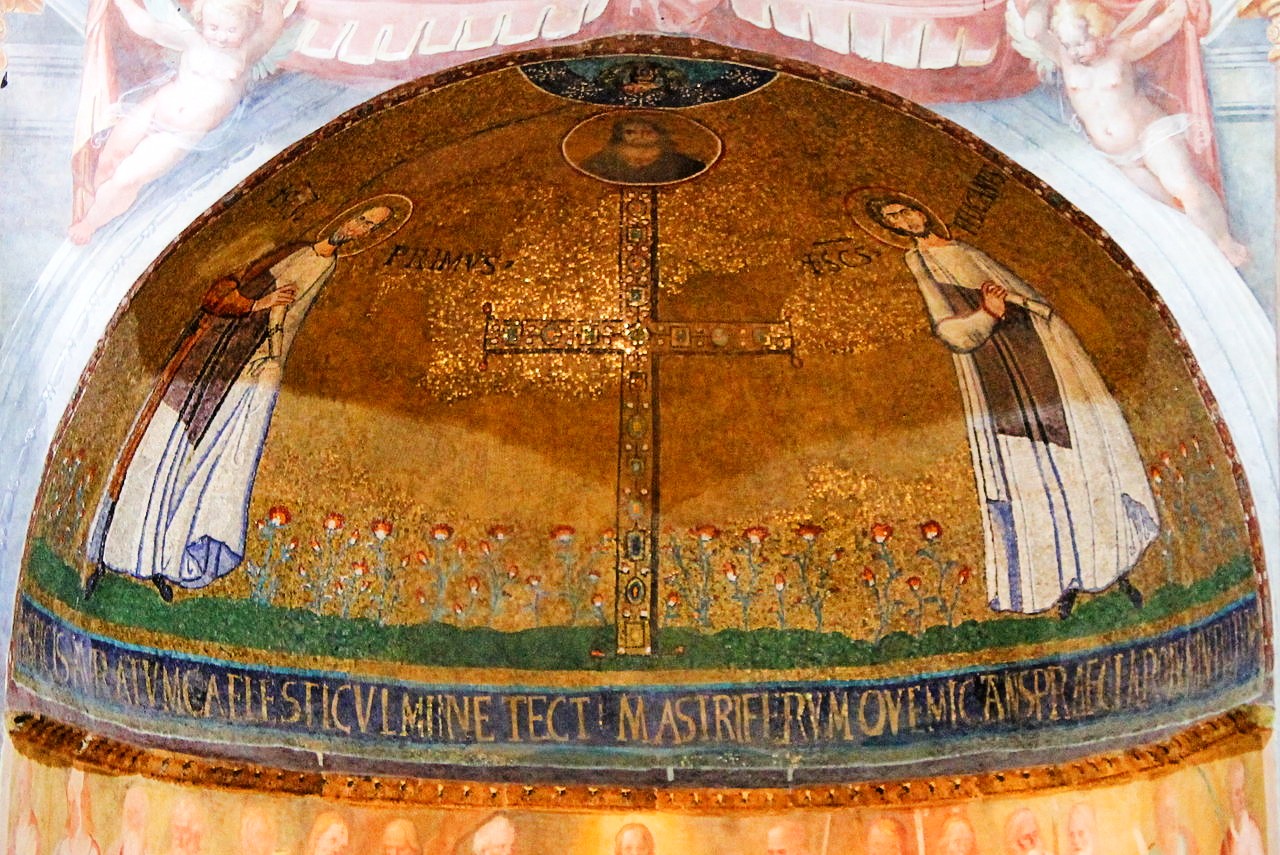
Our Saints on the Dome of St Stephen’s their resting place
The torture was prolonged until the executioners, tired with whipping, were no longer able to torment the Saints. The Governor wondered at the constancy, or, as he said, the obstinacy of the two brothers and to cause them sooner to obey him, he separated them and had them confined in different prisons.
A few days later, he had Felicianus alone brought before him, to whom he said: “Is it not a contemptible blindness that you should persist in ending your days in agony,” (Felicianus was 80 years old) “when, by obeying the Emperor, you have the opportunity of closing your life, honoured and favoured by him?” The Saint replied: “Is it not a much more contemptible blindness that you, a man of so much mind and importance, should worship a piece of wood as God and thus cast yourself, after the few short days of life, into never-ending pains and torments, while you have the opportunity, by receiving the True Faith, to make yourself eternally happy with the true God?” These fearless words enraged the Governor beyond endurance and he ordered the Saint to be fastened to a pole by an iron nail and there to be left hanging. The Saint, casting his eyes towards Heaven, said: “I have placed my trust in God; I shall not fear the hand of man.”
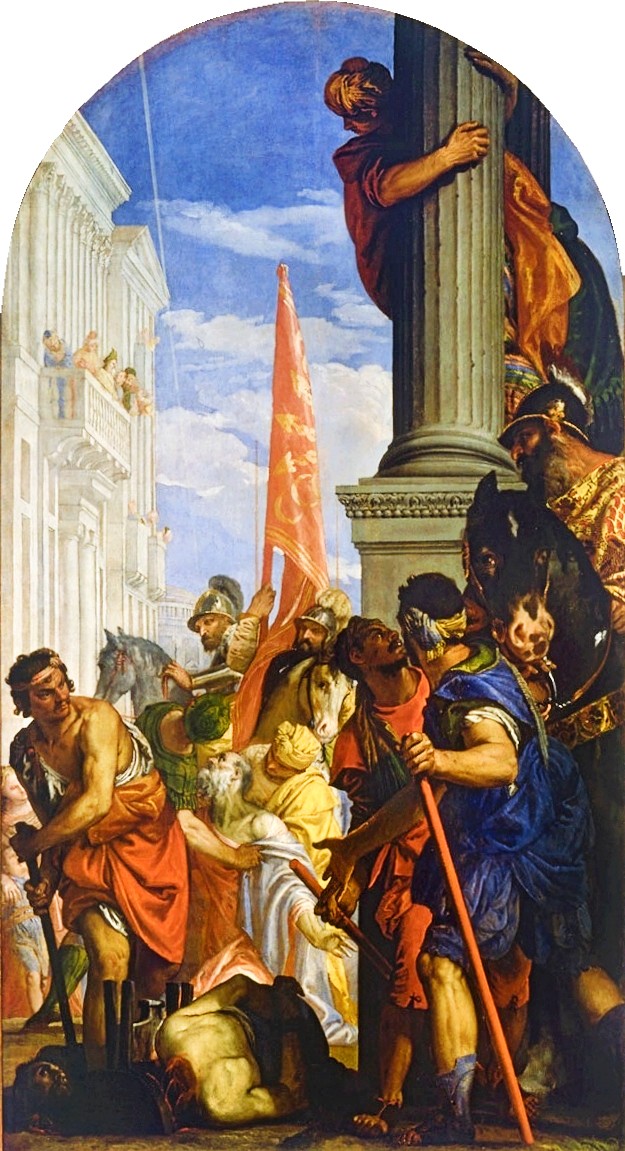
The M artyrdom of Sts Primus and Felicianus by Veronese
Three days the hero had to remain on the pole, after which he was taken back to prison. Meanwhile. Promotus had Primus brought before him and said to him that at last the eyes of his brother. Felicianus had been opened and that he had sacrificed to Jupiter, for which reason, the Emperor had raised him to the highest dignities and. that Primus might expect the same favours, if he followed his brother’s example. But Primus knew the constancy of his brother, as an Angel had confirmed it to him. Hence, he reproved Promotus with earnest words. Enraged at this, the Governor said: “Either you will immediately sacrifice to Jupiter, or I shall deal with you more cruelly than with all the others.” “I sacrifice to the true God only,” replied Primus “and fear not your cruelties.“
Hardly had these words passed his lips, when the tyrant gave orders to scourge him with hard thongs, until his whole body was one great wound. After this they burned him for a long time with torches. Primus’ countenance was bright and cheerful during this inhuman torture. To prevent this, by command of the tyrant, they poured melted lead into his mouth. How terrible must have been this suffering is easily to be conceived. …
Primus was sentenced to this suffering in order that he might no longer praise the true God. He, however, swallowed the lead without the least sign of pain and then turning to Promotus, said: “ Acknowledge at length, unhappy man, the omnipotence of my God and be converted to Him that you may not go to eternal damnation.” Promotus, furious and unwilling to hear more, ordered the brothers to to be cast to the wild beasts. The order was obeyed but neither the fiercely roaring lion, nor the cruel bear, which they let loose upon them, harmed either of them but crouching at their feet, thus evinced their reverence for the holy men.
Many of the heathens, who witnessed this spectacle, were so deeply touched by the miracle that they cried: “Great is the God of the Christians and He alone is the true God!” Promotus, fearing an insurrection, had both the valiant Confessors decapitated without loss of time and thus they, both, after many heroic battles, obtained the Crown of immortality in Heaven.”
St Comus of Scotland St Cumian of Bobbio St Cyrus Bl Diana d’Andalo OP St Diomedes of Tarsus St Felicianus * and St Primus * (Died c304) Brothers, Lay Martyrs Bl Henry the Shoemaker St Julian of Mesopotamia St Luciano Verdejo Acuña St Maximian of Syracuse St Pelagia of Antioch St Primus * St Richard of Andria Bl Robert Salt Bl Sylvester Ventura St Valerius of Milan St Vincent of Agen
Martyrs of Arbil – 5 Saints: Five Nuns who were Martyred together in the persecutions of Tamsabur for refusing to renounce Christianity for sun-worship – Amai, Mariamne, Martha, Mary and Tecla. They were beheaded on 31 May 347 at Arbil, Assyria (in modern Kurdistan, Iraq).
Thought for the Day – 8 June – Meditations with Antonio Cardinal Bacci (1881-1971)
Adoration of Jesus in the Blessed Sacrament
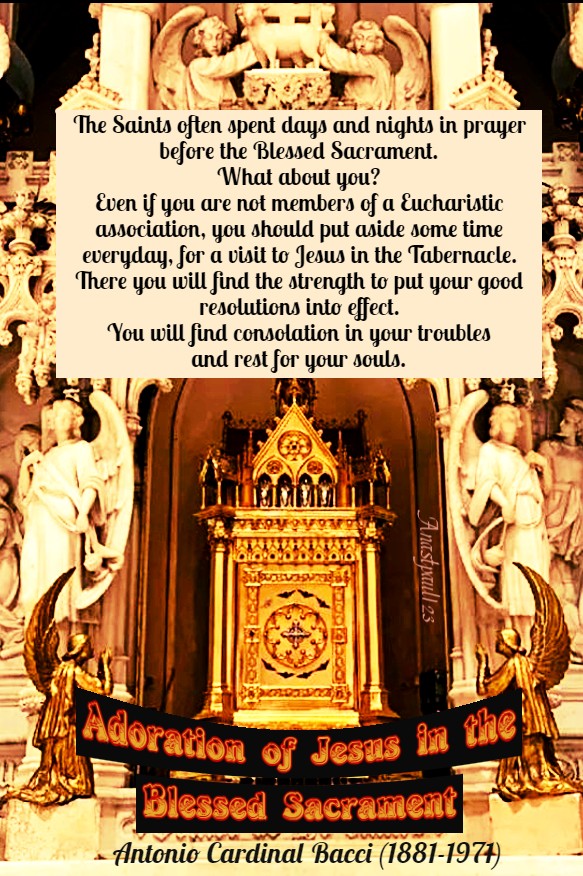
“In many Diocese and Parishes, there exist Associations of devout people who take it in turns to pray before Jesus in the Blessed Sacrament. There ought to be some such association everywhere because, everyone who has a sincere love for the Holy Eucharist, should feel the need of spending some time in Adoration and in conversation with Jesus in the Blessed Sacrament.
The Saints often spent days and nights in prayer before the Blessed Sacrament. What about you? Even if you are not members of a Eucharistic association, you should put aside some time everyday, for a visit to Jesus in the Tabernacle. There you will find the strength to put your good resolutions into effect. You will find consolation in your troubles and rest for your souls.”
Quote/s of the Day – 8 June – “The Month of the Sacred Heart of Jesus” and the Feast of Corpus Christi – 1 Corinthians 23-29, John 6:56-59 – Scripture search here: https://www.drbo.org/
“I Am the Living Bread Who came down from Heaven. If any man eat of this Bread, he shall live forever and the Bread that I will give, is My Flesh, for the Life of the world.”
John 6:51-52
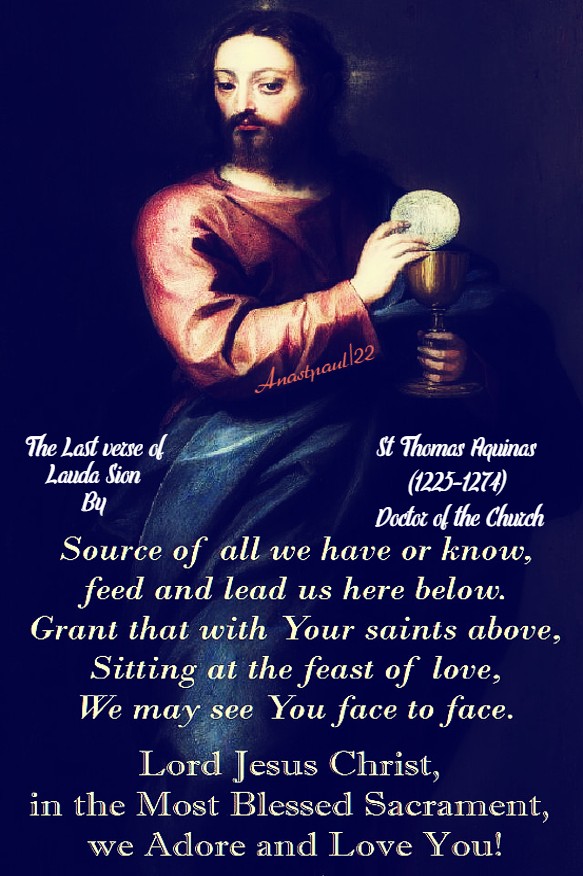
Source of all we have or know, feed and lead us here below. Grant that with Your saints above, Sitting at the feast of love, We may see You face to face.
Amen Alleluia!
Lord Jesus Christ, in the Most Blessed Sacrament, we Adore and Love You!
( The last Verse of the Lauda Sion, the Eucharistic Hymn/Sequence By St Thomas Aquinas (1225-1274)
“The Saviour has instituted the most glorious Sacrament of the Eucharist, which truly contains His Body and His Blood, so that, whoever eats it will live forever. Therefore, those who receive it frequently, with devotion, strengthen their spiritual life and well-being, to such an extent, that it is almost impossible for them to be poisoned by any kind of evil attachment.”
(Introduction to the Devout Life, Part II, Chapter 20)
St Francis de Sales (1567-1622) Doctor of the Church
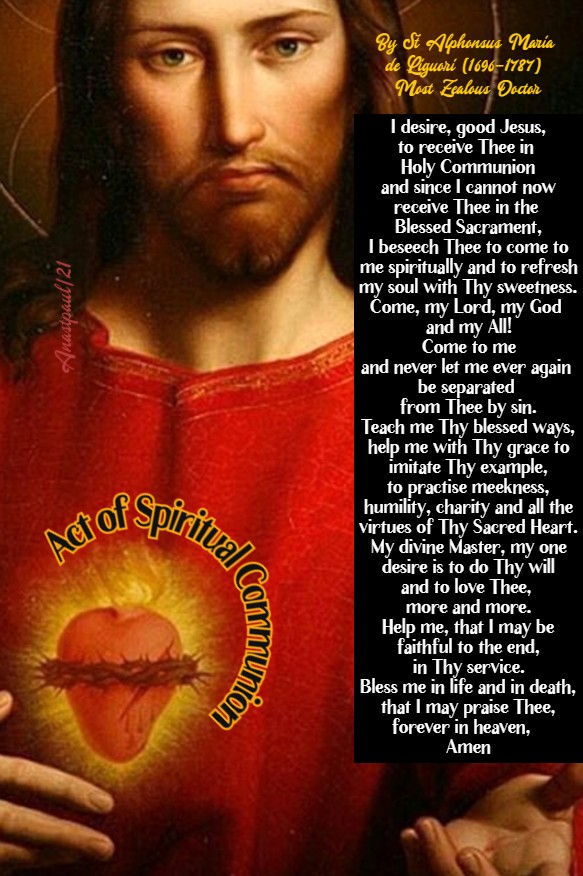
Act of Spiritual Communion By St Alphonsus Maria de Liguori (1696-1787) Most Zealous Doctor
I desire, good Jesus, to receive Thee in Holy Communion and since I cannot now receive Thee in the Blessed Sacrament, I beseech Thee to come to me spiritually and to refresh my soul with Thy sweetness. Come, my Lord, my God and my All! Come to me and never let me ever again be separated from Thee by sin. Teach me Thy blessed ways, help me with Thy grace to imitate Thy example, to practise meekness, humility, charity and all the virtues of Thy Sacred Heart. My divine Master, my one desire is to do Thy will and to love Thee, more and more. Help me, that I may be faithful to the end, in Thy service. Bless me in life and in death, that I may praise Thee, forever in heaven, Amen
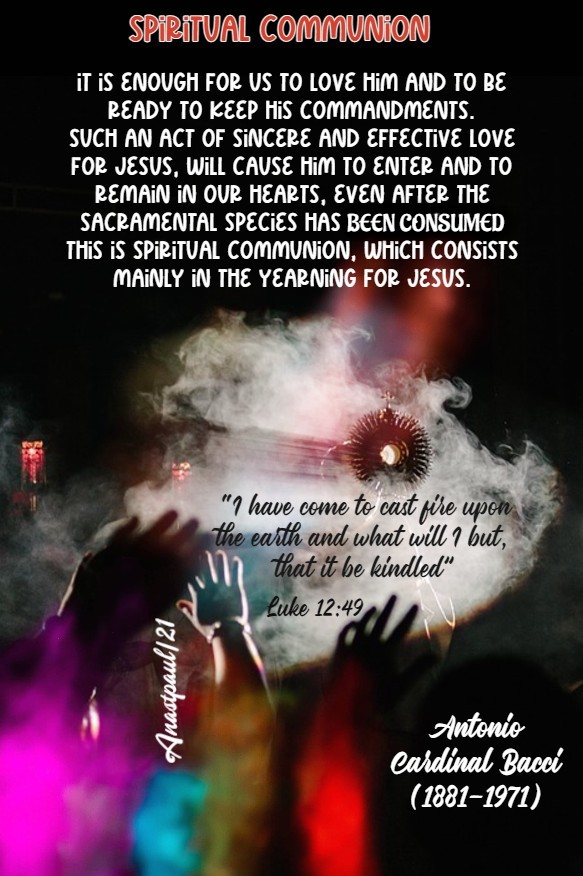
“It is enough for us to love Him and to be ready to keep His commandments. Such an act of sincere and effective love for Jesus, will cause Him to enter and to remain in our hearts, even after the Sacramental Species has been consumed. This is Spiritual Communion, which consists mainly in the yearning for Jesus. “I have come to cast fire upon the earth and what will I but, that it be kindled” (Lk 12:49).”
One Minute Reflection – 8 June – “The Month of the Sacred Heart of Jesus” – Feast of Corpus Christi – 1 Corinthians 23-29, John 6:56-59 – Scripture search here: https://www.drbo.org/
“He who eats My Flesh and drinks My Blood, abides in Me and I in him. ” – John 6:57
REFLECTION – “The heavenly sacrifice which Christ instituted is indeed the inheritance bequeathed to us through His new covenant. He left it to us on the night He was delivered up to be Crucified, as a token of His Presence. It is viaticum for our journey, food on our life’s path, until we come to it upon leaving this world. That is why our Lord said: “Unless you eat My Flesh and drink My Blood, you do not have life within you.” He wished His deeds of kindness to remain among us and the souls He redeemed, by His Precious Blood, always to be made holy in the image of His own Passion. This is why He commanded His faithful disciples, instituted as the first Priests of His Church, to celebrate these mysteries of eternal life, in perpetuity… Thus all the faithful would have before their eyes, day-by-day, a representation of Christ’s Passion. Taking Him in our hands, receiving Him in our mouths and hearts, we will hold fast to an indelible remembrance of our Redemption.
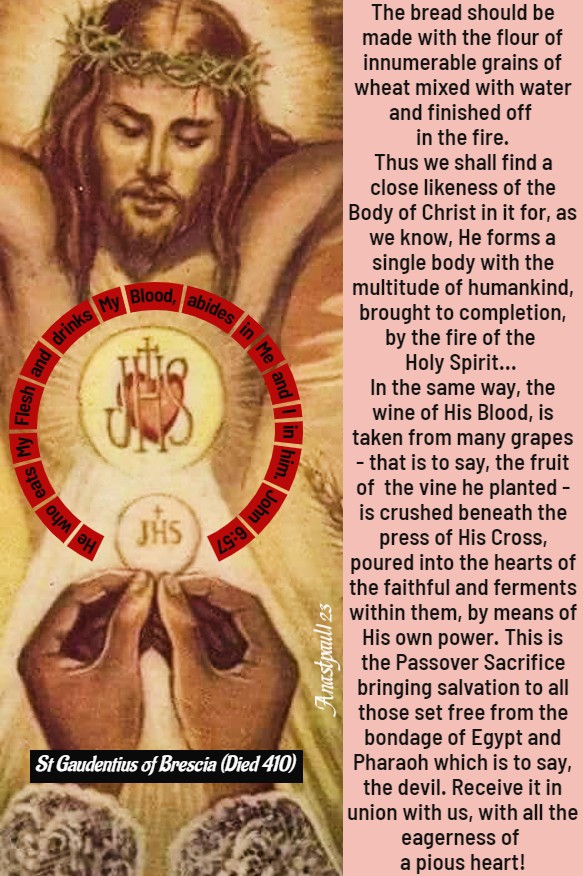
The bread should be made with the flour of innumerable grains of wheat mixed with water and finished off in the fire. Thus we shall find a close likeness of the Body of Christ in it for, as we know, He forms a single body with the multitude of humankind, brought to completion, by the fire of the Holy Spirit… In the same way, the wine of His Blood, is taken from many grapes – that is to say, the fruit of the vine he planted – is crushed beneath the press of His Cross, poured into the hearts of the faithful and ferments within them, by means of His own power. This is the Passover Sacrifice bringing salvation to all those set free from the bondage of Egypt and Pharaoh which is to say, the devil. Receive it in union with us, with all the eagerness of a pious heart.” – St Gaudentius of Brescia (Died 410) Bishop , Father, renowned Preacher, Theologian, Diplomatic Mediator (An Excerpt from a Paschal Homily no 68:30).
PRAYER – O God, Thou Who in this wondrous Sacrament have left us a memorial of Thy Passion, grant us, we beseech Thee, so to venerate the Sacred Mysteries of Thy Body and Blood that we may ever experience, within us, the effect of Thy Redemption.Through the same Jesus Christ, Thy Son our Lord, Who lives and reigns with Thee, in the unity of the Holy Ghost, God, world without end. Amen (Collect). All praise, honour and glory to the divine HEART of JESUS. – Indulgence 50 Days, Once a day. Raccolta 168 Pope Leo XIII, 14 June 1901.































You must be logged in to post a comment.