Thought for the Day – 6 June – Meditations with Antonio Cardinal Bacci (1881-1971)
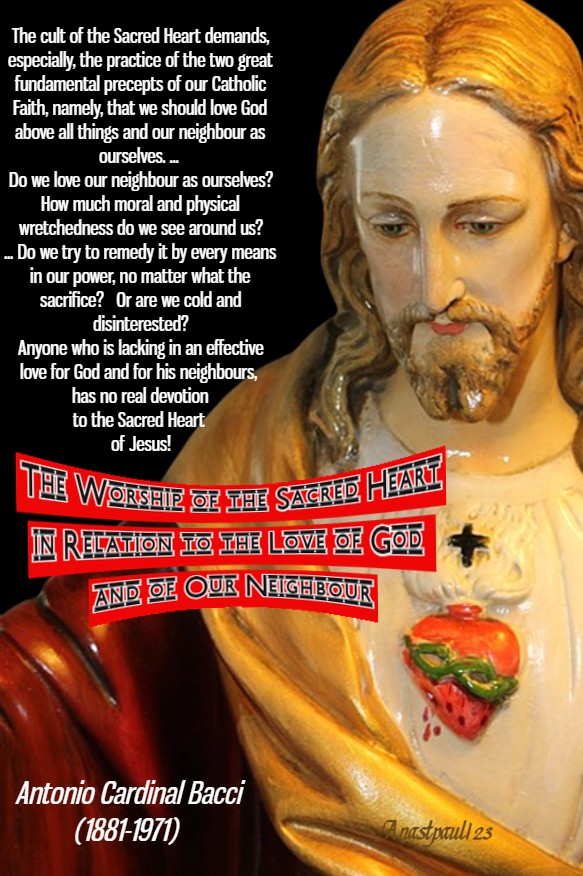
The Worship of the Sacred Heart in Relation to the Love of God and of Our Neighbour
“The cult of the Sacred Heart demands, especially, the practice of the two great fundamental precepts of our Catholic Faith, namely, that we should love God above all things and our neighbour as ourselves. The implementation of this teaching will transform our lives.
Do we love God above all things and more than we love ourselves? What is the predominant concept in our minds? Is it the concept of God? What is the first love in our hearts? Is it the love of God? What is our main desire in life? Is it the glory of God? Or is it our own glory or our own pleasure?
We have still, a long way to go in the way of love of God which is the way of perfectiuon. We can only really be said to be ourselves moreover, when we love God above all things and more than ourselves. If a man does not love God above all things, neither does he love himself in the way in which he ought to love himself because, God is our only true to happiness.
Do we love our neighbour as ourselves? How much moral and physical wretchedness do we see around us? But do we try to remedy it by every means in our power, no matter what the sacrifice? Or are we cold and disinterested? Let us remember the words of St John the Apostle of Charity. “In this we have come to know His love that He laid down His life for us and we likewise, ought to lay down our life for the brethren” (1 Jn 3:16). Are we prepared to do this? Are we at least prepared to give away whatever do do not need ourselves, in order to relieve poverty and want?
Anyone who is lacking in an effective love for God and for his neighbours, has no real devotion to the Sacred Heart of Jesus!”
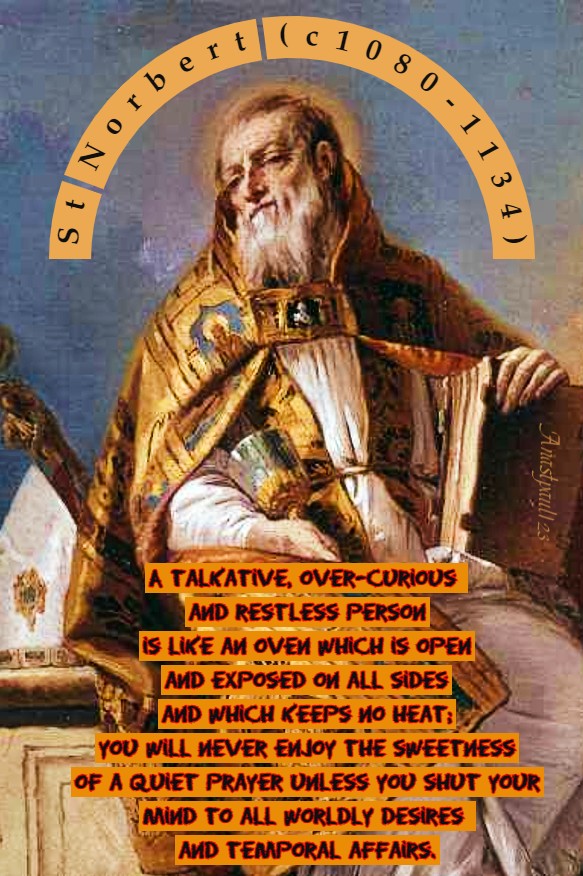
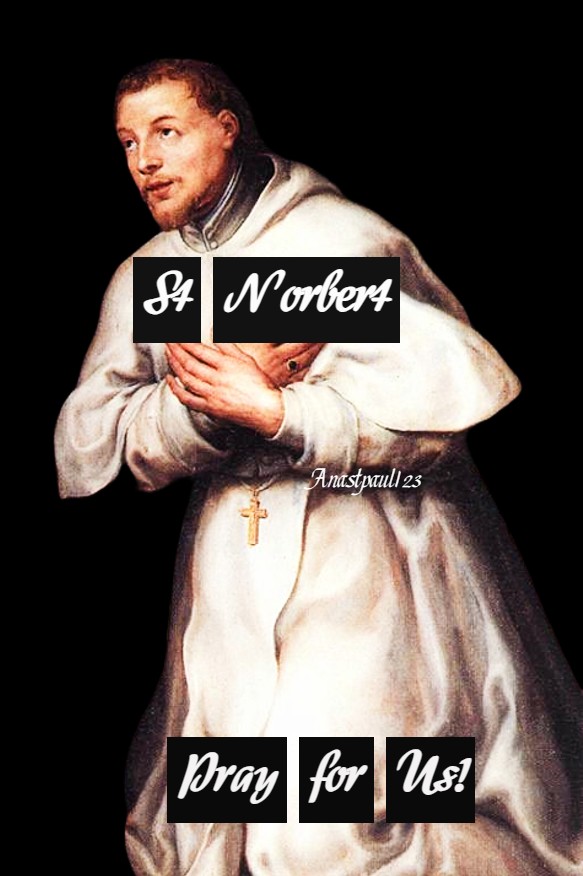
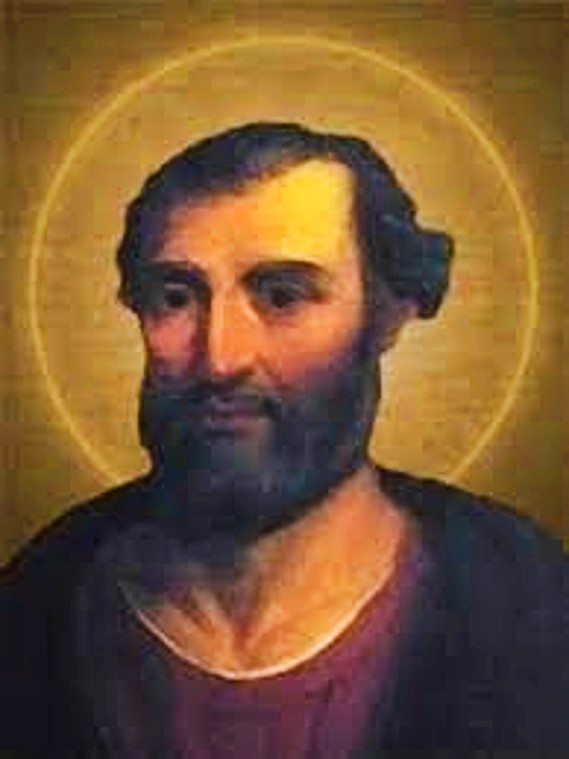
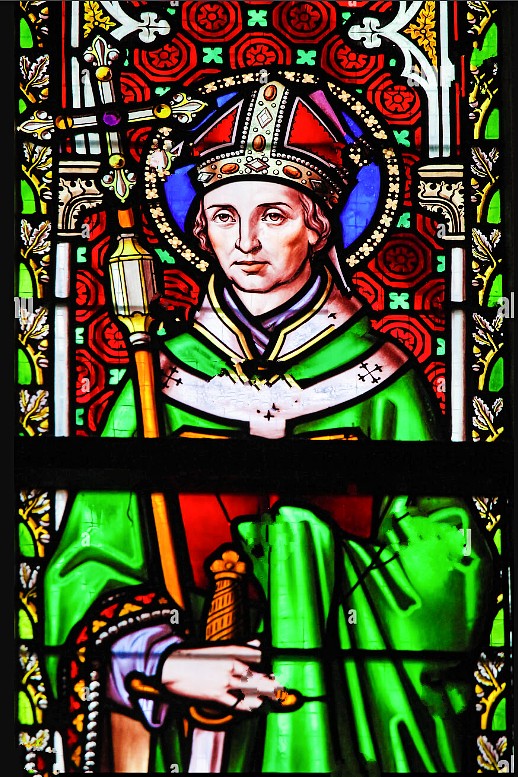
Quote/s of the Day – 6 June – St Norbert (c 1080-1134) Bishop, Confessor, Patron for peace, invoked during childbirth for safe delivery, of infertile married couples.
“A talkative, over-curious and restless person is like an oven which is open and exposed on all sides and which keeps no heat; you will never enjoy the sweetness of a quiet prayer unless you shut your mind to all worldly desires and temporal affairs.”
One Minute Reflection – 6 June – “The Month of the Sacred Heart of Jesus” – St Norbert (c 1080-1134) Bishop, Confessor, Founder of the Premonstratensian or the Norbertine Canons and Sisters, “Defender of the Eucharist” and “Apostle of the Eucharist,”– Sirach 44:16-27; 45:3-20, Matthew 25:14-23 – Scripture search here: https://www.drbo.org/
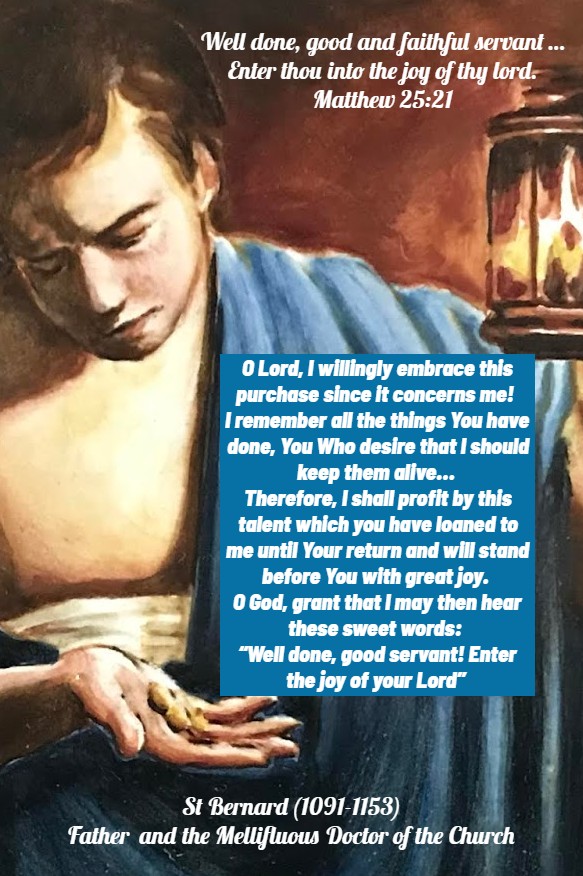
“Well done, good and faithful servant … Enter thou into the joy of thy Lord.”- Matthew 25:21
REFLECTION – “The Word of the Father, Only-begotten Son of God, Sun of Justice (Mal 3:20), is the great Merchant Who has brought us the price of our redemption. It is atruly precious exchange that we can never value sufficiently when a King, Son of the King most high, has become the Coin, the Gold has paid our dues, the Just Man is given for the sinner. Truly unmerited mercy, perfectly disinterested love, astonishing goodness…, it is a completely disproportionate purchase, in which the Son of God is delivered up for the servant, the Creator is put to death for the one He has created, the Lord is condemned for His slave.
O Christ, these are Your works, You Who descended from Heaven’s brightness into our hellish darkness, to bring light to our gloomy prison. You came down from the Right Hand of the Divine Majesty, into our human misery, to redeem the human race, You Who descended from the Father’s glory to death on the Cross, to triumph over death and its author. You are the only One and there is no other but You Who could have been drawn to redeem us through Your own goodness…
Let all the merchants of Teman (Bar 3:23) withdraw from this place… it is not they but Israel [Your] beloved that [You have] chosen, You Who hide these mysteries from the wise and prudent and have revealed them to those babes and humble servants of Yours (Lk 10:21)… O Lord, I willingly embrace this purchase since it concerns me! I remember all the things You have done, You Who desire that I should keep them alive… Therefore, I shall profit by this talent which you have loaned to me until Your return and will stand before You with great joy. O God, grant that I may then hear these sweet words: “Well done, good servant! Enter the joy of your Lord” (Mt 25:21).” – St Bernard O.Cist. (1091-1153) Cistercian Monk, known as the Last Father and the Mellifluous Doctor of the Church (Selected sermons, no 42: The Five Purchases).
PRAYER – To God, Who made blessed Norbert, Thy Confessor and Bishop, a brilliant preacher of Thy Word and through him, enriched Thy Church with a new religious family, grant, we beseech Thee, that by his prayerful intercession and Thy help, we may be able to do what he has taught us by his words and deeds. Through Jesus Christ, Thy Son our Lord, Who lives and reigns with Thee, in the unity of the Holy Ghost, God, world without end. Amen (Collect).
Our Morning Offering – 6 June – “The Month of the Sacred Heart of Jesus”
Daily Consecration to the Sacred Heart of Jesus Prayers to the Sacred Heart 1936 – 15th Edition, Dublin
O Sacred Heart of Jesus, filled with infinite love, broken by our ingratitude and pierced by our sins, yet loving us still, accept the Consecration we make to Thee, of all that we are and all that we have. Take every faculty of our souls and bodies, only day by day draw us, nearer and nearer to Thy Sacred Heart, and there, as we shall hear the lesson, teach us Thy Holy Way. Amen
Saint of the Day – 6 June – Blessed William Greenwood O.Cart. (Died 1537) Carthusian Lay Friar, Martyr. Born in England and died by being starved to death on 6 June 1537 at Newgate Prison, London, for opposing the policies of Henry VIII. Additional Memorial – 4 May as one of the Carthusian Martyrs. William was Beatified on 20 December 1886 by Pope Leo XIII.
On 18 May 1537 the 20 hermits and 18 lay brothers remaining in the London Charterhouse were required to take the Oath of Supremacy. Of the brothers, Robert Salt, William Greenwood, Thomas Redyng, Thomas Scryven, Walter Pierson, and William Horne refused.
On 29 May, those refusing the oath were all sent to Newgate Prison and treated, as had been their fellow Carthusians in June 1535. They were chained standing and with their hands tied behind them to posts in the prison. Plague and typhus running through the prisoners in the summer weather, killed five of the prisoners, two more coming close to death.
Margaret Clement (1508-1570) (née Giggs), who had been raised by St Thomas More, bribed the gaoler to let her have access to the prisoners and, disgu as his foster-daughterised as a milkmaid, carried in a milk-can full of meat which she fed to them. She also relieved them as best she could of the filth. However, King Henry became suspicious and began to ask whether they were already dead and Thomas Cromwell was angered to hear the prisoners had been left to die. When this filtered back to the gaoler, he became too afraid to let Margaret enter again. For a brief time she was allowed to go on the roof and uncover the tiles, and let down meat in a basket as near as she could to their mouths. This method meant the monks could get little or nothing from the basket and, in any case, the gaoler became too afraid and stopped any contact.
William Greenwood died first, on 6 June with his fellow Carthusians following in quick succession.
There is a memorial plaque at Charterhouse Square. A private commemoration ceremony takes place each year at the Carthusian Martyrs Plaque on 4 May, the date of the Prior, St John Houghton’s execution.
St Norbert (c 1080-1134) Bishop, Confessor, Founder of the Premonstratensian or the Norbertine Canons and Sisters, “Defender of the Eucharist” and “Apostle of the Eucharist,” Exorcist, Reformer, Preacher His amazing life: https://anastpaul.com/2017/06/06/saint-of-the-day-6-june-st-norbert/
St Agobard of Lyon St Alexander of Fiesole St Alexander of Noyon St Amantius of Noyon St Anoub of Skete St Artemius of Rome St Bazalota of Abyssinia
St Candida of Rome St Ceratius of Grenoble St Claudius of Besançon St Cocca St Colmán of Orkney Bl Daniel of Bergamo St Euphemia of Abyssinia St Eustorgius II of Milan Bl Falco of La Cava Bl Gilbert of Neufontaines St Grazia of Germagno St Gudwall Bl Gundisalvus of Azebeyro St Hilarion the Younger
Blessed William Greenwood O.Cart. (Died 1537) Carthusian Lay Friar, Martyr
Marytrs of Tarsus: A group of 20 Martyrs who were Martyred together during the persecutions of Diocletian. They were martyred in Tarsus (in modern Turkey).
Mercedarian Fathers of Avignon: Several Mercedarians from the Santa Maria Convent of Avignon, France who worked with plague victims in that city and died of the disease themselves. They died in Avignon, France of plague and are remembered together today for their great charity and commitment to their people.
Thought for the Day – 5 June – Meditations with Antonio Cardinal Bacci (1881-1971)
The Sacred Heart and the Holy Viaticum
“From a sudden and unprovided death, O Lord, deliver us. Jesus, Mary and Joseph, I give Thee my heart and my soul. Jesus, Mary and Joseph, assist me now and in my last agony. Jesus, Mary and Joseph, may I breathe forth my soul in peace with Thee. Amen.”
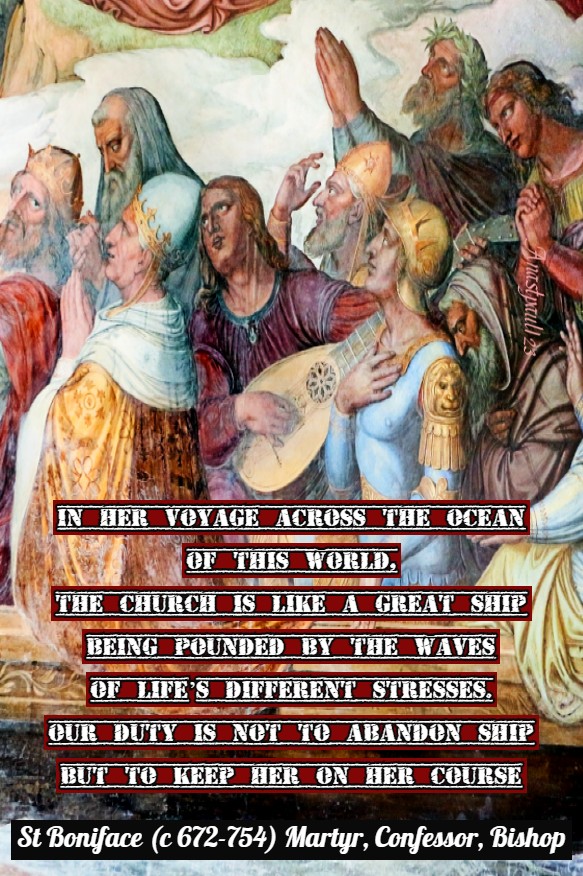
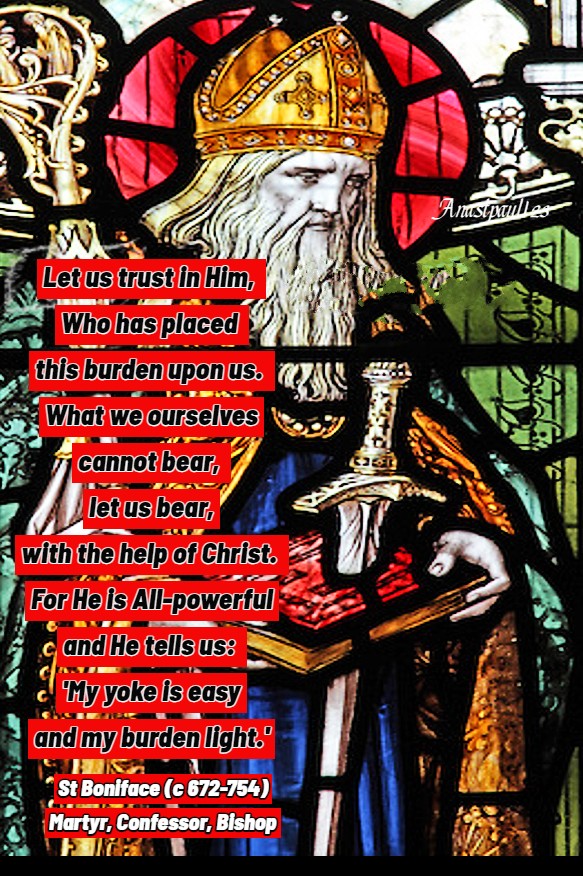
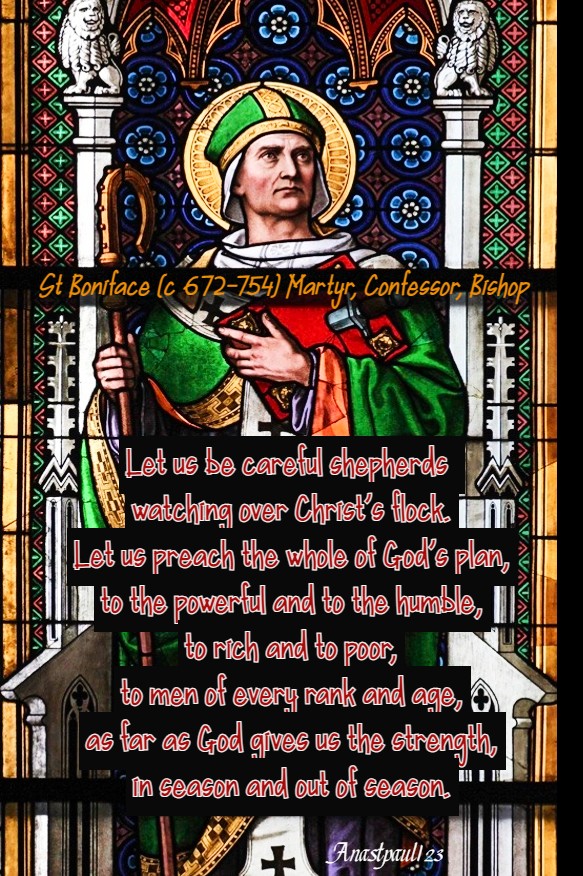
Quote/s of the Day – 5 June – The Memorial of St Boniface (672-754) Martyr “The Apostle of Germany,” Confessor, Bishop
“In her voyage across the ocean of this world, the Church is like a great ship being pounded by the waves of life’s different stresses. Our duty is not to abandon ship but to keep her on her course.”
“Let us trust in Him. Who has placed this burden upon us. What we ourselves cannot bear, let us bear, with the help of Christ. For He is All-powerful and He tells us: ‘My yoke is easy and my burden light.’”
“Let us be careful shepherds watching over Christ’s flock. Let us preach the whole of God’s plan, to the powerful and to the humble, to rich and to poor, to men of every rank and age, as far as God gives us the strength, in season and out of season.”
One Minute Reflection – 5 June – “The Month of the Sacred Heart of Jesus” – The Memorial of St Boniface (672-754) Martyr “The Apostle of Germany,” Confessor, Bishop – Ecclesiasticus 44:1-15. Matthew 5,1-12.– Scripture search here: https://www.drbo.org/
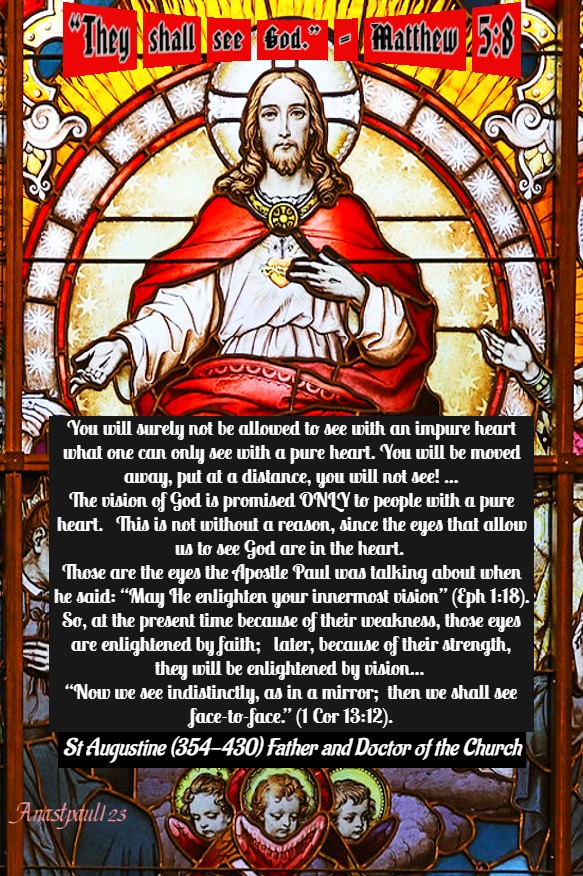
“They shall see God.” – Matthew 5:8
REFLECTION – “We want to see God, we seek to see Him, we ardently desire to see Him. Who does not desire this? But note what the Gospel says: “Blest are the pure of heart, they shall see God.” Do what is necessary in order to see Him! To compare it with something from material reality, how can you want to contemplate the rising sun if your eyes are sick? If your eyes are healthy that light will be a pleasure for you; if they are sick, it will be torture for you. You will surely not be allowed to see with an impure heart what one can only see with a pure heart. You will be moved away, put at a distance, you will not see!
How often did the Lord proclaim people to be ‘blest‘? What reasons for eternal happiness did He cite, what good works, what gifts, what merits and what rewards? No other! the beatitude says, “They shall see God.” This is what the others say: “How blest are the poor in spirit, the reign of God is theirs. Blest are the lowly; they shall inherit the land. Blest are the sorrowing; they shall be consoled. Blest are they who hunger and thirst for holiness; they shall have their fill. Blest are they who show mercy; mercy shall be theirs.” So none other asserts, “They shall see God.”
The vision of God is promised ONLY to people with a pure heart. This is not without a reason, since the eyes that allow us to see God are in the heart. Those are the eyes the Apostle Paul was talking about when he said: “May He enlighten your innermost vision” (Eph 1:18). So, at the present time because of their weakness, those eyes are enlightened by faith; later, because of their strength, they will be enlightened by vision… “Now we see indistinctly, as in a mirror; then we shall see face-to-face.” (1 Cor 13:12).” – St Augustine (354-430) Father and Doctor of the Church (Sermon 53).
PRAYER – O God, Who, through the zeal of blessed Boniface, Thy Martyr and Bishop, graciously called a multitude of people to the knowledge of Thine Name, mercifully grant that we, who keep his feast, may also enjoy his patronage.Through Jesus Christ, Thy Son our Lord, Who lives and reigns with Thee, in the unity of the Holy Ghost, God, world without end. Amen (Collect).
Our Morning Offering – 5 June – The Memorial of St Boniface (672-754) Martyr “The Apostle of Germany,” Confessor, Bishop
Eternal God, Our Refuge By St Boniface (672-754) Martyr
Eternal God, the refuge and help of all Thy children, we praise Thee for all Thou hast given us, for all Thou hast done for us, for all that Thou art to us. In our weakness, Thou art strength, in our darkness, Thou art light, in our sorrow, Thou art comfort and peace. We cannot number Thy blessings, we cannot declare Thy love – for all Thy graces, we bless Thee. May we live as in Thy presence, and love the things that Thou loves and serve Thee in our daily lives, through Jesus Christ our Lord. Amen
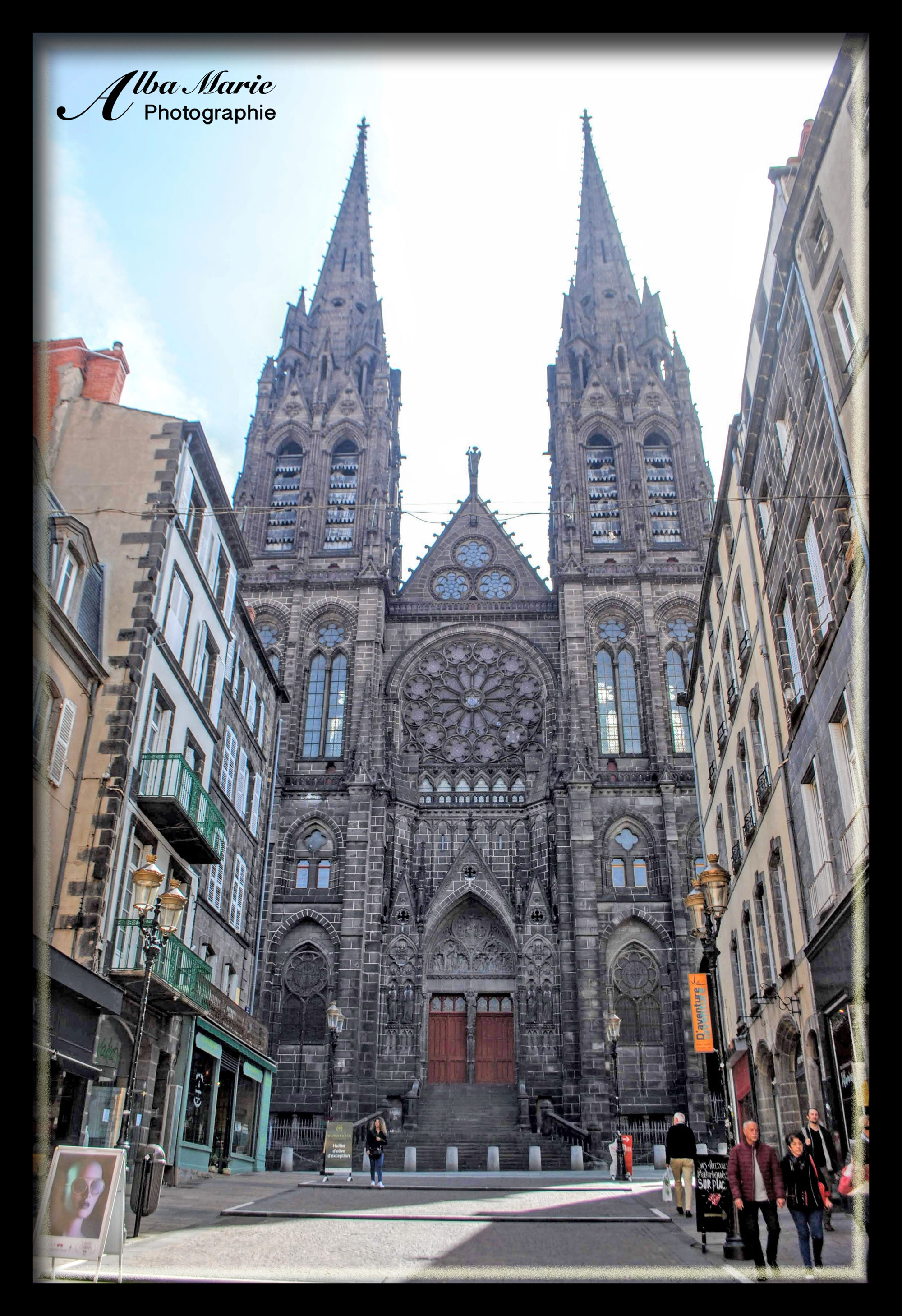
Saint of the Day – 5 June – St Genesius (Died 725) Layman, Count of Clermont and Count of Auvergne, renowned as a Miracle-worker, benefactor of the Church. Known as “the Holy Count.”
Clermont Cathedral
According to the lessons of the Breviary of the Chapter of Camaleria (Acta Sanctorum June, I, 497), he was of noble birth, His father’s name is given as Audastrius and his mother’s as Tranquilla. He was probably a relative of Bishop Genesius (of Clermont).
Even in his youth he is said to have wrought miracles—to have given sight to the blind and cured the lame. He built and richly endowed several Churches and religious houses.
The “Martyrdom of Bishop Praefectus (625–676)” says that when the Bishopric of Clermont became vacant, King Childeric had sent edicts to elect Count Genesius but he turned down the See. Saint Prix then becamethe Bishop.
Partly by his own ample patrimony and partly by the great generosity of Genesius, the holy Count of Auvergne, Bishop Prix was able to found several Monasteries, Churches and hospitals.
Genesius was a friend of St Bonitus, Bishop of Clermont and of St Meneleus, Abbot of Menat. He was buried at Combronde in Auvergne by St Savinian, successor of Meneleus.
St Adalar of Erfurt Bl Adalbert Radiouski Bl Adam Arakawa St Austrebertus of Vienne St Claudius of Egypt and Companions St Ðaminh Huyen St Ðaminh Toai St Dorotheus of Tyre St Elleher St Eoban of Utrecht St Eutichius of Como St Evasius of Africa St Felix of Fritzlar
Blessed Ferdinand of Portugal (1402-1443) “The Holy Prince.” Blessed Ferdinand spent as much time as he could in adoration of the Most Blessed Sacrament especially during the Easter Triduum when his habit was to be constantly in adoration, from Holy Thursday to Easter. He was the youngest of the “Illustrious Generation” of 15th-century Portuguese Princes of the House of Aviz and lay Master of the Knightly Order of Aviz. About Blessed Ferdinand: https://anastpaul.com/2021/06/05/saint-of-the-day-5-june-blessed-ferdinand-of-portugal-1402-1443-the-holy-prince/
St Franco of Assergi St Genesius (Died 725) Layman, Count of Clermont St Gregory of Lilybaeum St Gundekar St Hadulph St Luke Loan Bl Meinwerk of Paderborn St Privatus of Africa St Sanctius of Córdoba St Tudno of Caernarvon St Waccar
Martyrs of Caesarea: A group of Christians who converted together, were imprisoned together, tortured together, and Martyred together. We know nothing more about them but their names – Cyria, Marcia, Valeria and Zenaides. Died Caesarea, Palestine, date unknown.
Martyrs of Egypt: A group of Christians Martyred together in the persecutions of Galerius Maximian. The only other information was have is three of their names – Apollonius, Marcian and Nicanor. Died in Egypt, date unknown.
Martyrs of Perugia: A group of Christians Martyred together in the persecutions of Decius. We know little more than their names – Cyriacus, Faustinus, Florentius, Julian and Marcellinus. Died beheaded in 250 in Perugia, Italy
Martyrs of Rome: 26 Christians Martyred together. We have no details about them but their names – Candida, Castula, Fappa, Felician, Felicitas (2 of), Felicula, Fortunatus, Gagus, Gregor, Hilarius, Ingenuus, Juliana, Martialis, Maurus, Mustilus, Nicander, Prima, Rogata, Rutianus, Sacrinus, Saturnin, Secundian, Secundus, Urbicus, Victurus. Died • Rome, Italy, date unknown. Relics transferred to Antwerp, Belgium, date unknown.
Thought for the Day – 4 June – Meditations with Antonio Cardinal Bacci (1881-1971)
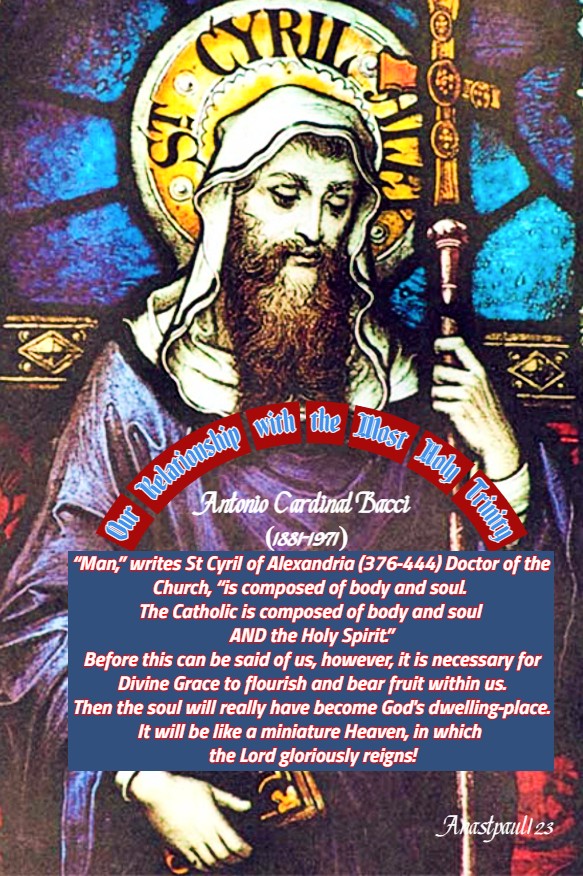
Our Relationship with the Most Holy Trinity
“Finally, we are, or should be, the temples of the Holy Spirit. “Do you not know that you are the temple of God and the Spirit of God dwells in you?” (1 Cor 3:16; 6:19) writes St Paul. “Man,” writes St Cyril of Alexandria (376-444) Doctor of the Church, “is composed of body and soul. The Catholic is composed of body and soul AND the Holy Spirit.” Before this can be said of us, however, it is necessary for Divine Grace to flourish and bear fruit within us. Then the soul will really have become God’s dwelling-place. It will be like a miniature Heaven, in which the Lord gloriously reigns!
Let us study the Saints carefully. They live in this world but they are not immersed in it. Their souls are already in Heaven through grace, even as they will one day reside there in glory. Because of this, their personalities radiate peace and contentment.
Of them it can truly be said: “Our citizenship is in Heaven” (Phil 3:20). We should never allow sin to deprive us of the Holy Spirit. Let everything in us be clean and pure, as becomes Saints of God.”
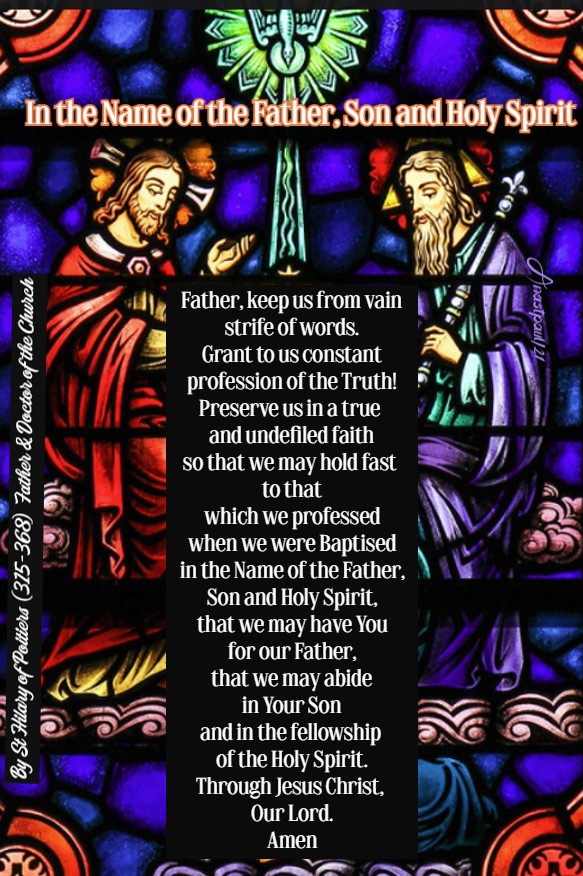
In the Name of the Father, Son and Holy Spirit By St Hilary of Poitiers (315-368) Father & Doctor of the Church
Father, keep us from vain strife of words. Grant to us constant profession of the Truth! Preserve us in a true and undefiled faith so that we may hold fast to that which we professed when we were Baptised in the Name of the Father, Son and Holy Spirit, that we may have You for our Father, that we may abide in Your Son and in the fellowship of the Holy Spirit. Through Jesus Christ, Our Lord. Amen
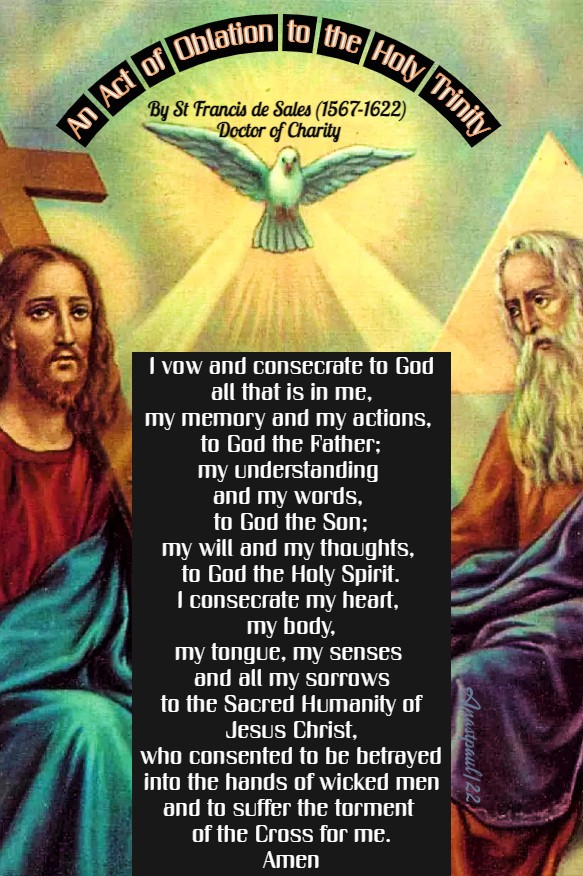
An Act of Oblation to the Holy Trinity By St Francis de Sales (1567-1622) Doctor of Charity
I vow and consecrate to God all that is in me, my memory and my actions, to God the Father; my understanding and my words, to God the Son; my will and my thoughts, to God the Holy Spirit. I consecrate my heart, my body, my tongue, my senses and all my sorrows to the Sacred Humanity of Jesus Christ, who consented to be betrayed into the hands of wicked men and to suffer the torment of the Cross for me. Amen
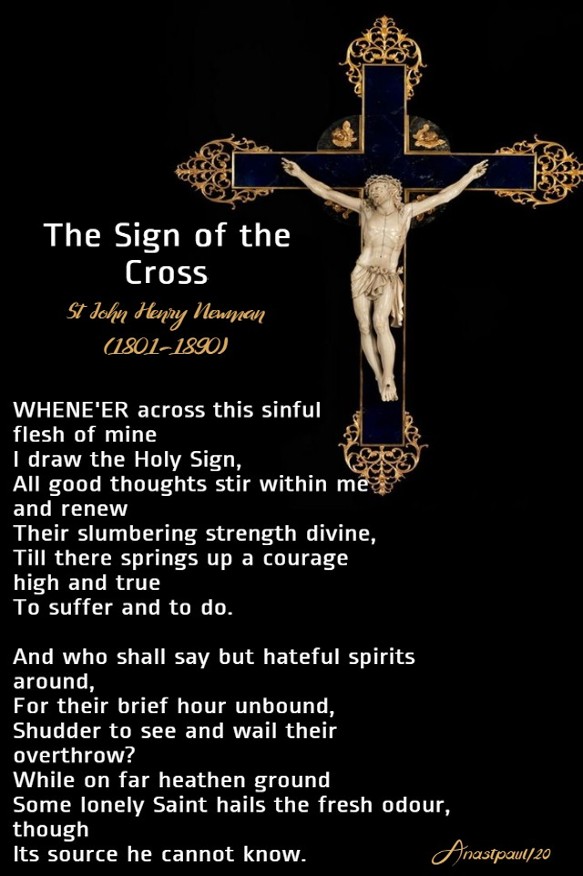
The Sign of the Cross In the Name of the Father and of the Son and of the Holy Ghost.
(50 Days. 100 Days if made with Holy Water Blessed Pope Pius IX, 1865.)
WHENE’ER across this sinful flesh of mine I draw the Holy Sign, All good thoughts stir within me and renew Their slumbering strength divine, Till there springs up a courage high and true To suffer and to do.
And who shall say but hateful spirits around, For their brief hour unbound, Shudder to see and wail their overthrow? While on far heathen ground Some lonely Saint hails the fresh odour, though Its source he cannot know.
John Henry Newman (1801-1890) Oxford – 25 November 1832
One Minute Reflection – 4 June – “The Month of the Sacred Heart of Jesus” – Trinity Sunday and the Memorial of St Francis Caracciolo CRM (1563-1608) The Confessor – Romans 11:33-36, Matthew 28:18-20 – Scripture search here: https://www.drbo.org/
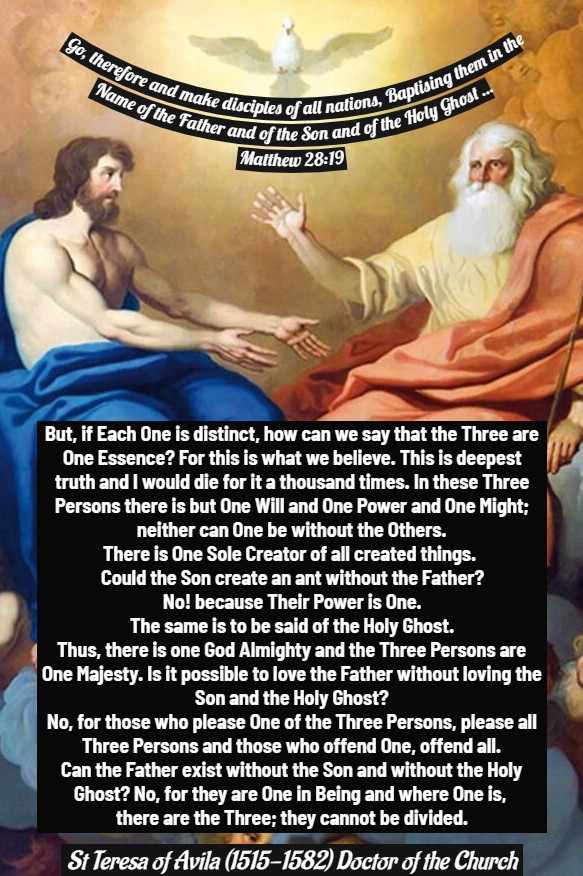
“Go, therefore and make disciples of all nations, Baptising them in the Name of the Father and of the Son and of the Holy Ghost, teaching them to observe all that I have commanded you.” – Matthew 28:19-20
REFLECTION – “God gave me to see clearly the truth of the most Holy Trinity. It is just as learned theologians told me but I did not understand it as I do now… What I have seen is this – Three distinct Persons, Each One visible and Who speaks and to Whom we can speak. Afterwards, I thought how the Son alone took human flesh, which shows clearly that the Three Persons are distinct. The Persons love each other, communicate and know each other. But, if Each One is distinct, how can we say that the Three are One Essence? For this is what we believe. This is deepest truth and I would die for it a thousand times. In these Three Persons there is but One Will and One Power and One Might; neither can One be without the Others. There is One Sole Creator of all created things. Could the Son create an ant without the Father? No! because Their Power is One. The same is to be said of the Holy Ghost.
Thus, there is one God Almighty and the Three Persons are One Majesty. Is it possible to love the Father without loving the Son and the Holy Ghost? No, for those who please One of the Three Persons, please all Three Persons and those who offend One, offend all. Can the Father exist without the Son and without the Holy Ghost? No, for they are One in Being and where One is, there are the Three; they cannot be divided.
How is it, then, that we see that the Three Persons are distinct? And how is it that the Son, not the Father, nor the Holy Ghost, took human flesh? This is what I have never understood – theologians know it. What I know is that the Three were there when that marvellous work was done. I do not busy myself with much thinking about this, all my thinking comes down to this – God is Almighty, that He has done what He would do and can do what He wills. The less I understand it, the more I believe it and the greater the devotion it excites in me. May He be blessed for ever! Amen.” – St Teresa of Avila (1515-1582) Carmelite, Founder, Reformer, Doctor of the Church (Relations, 33).
PRAYER – Almighty, eternal God, Thou Who have given Thy servants, in the confession of the true faith, to acknowledge the glory of the eternal Trinity and in the power of that Majesty, to adore its unity, grant, we beseech Thee, that in the firmness of this faith, we may ever be protected from all harm. And may the example and intercession of Thy Confessor, St Francis Caracciolo ever assist us on our journey to our eternal home. Through Jesus Christ, Thy Son our Lord, Who lives and reigns with Thee, in the unity of the Holy Ghost, God, world without end. Amen (Collect).
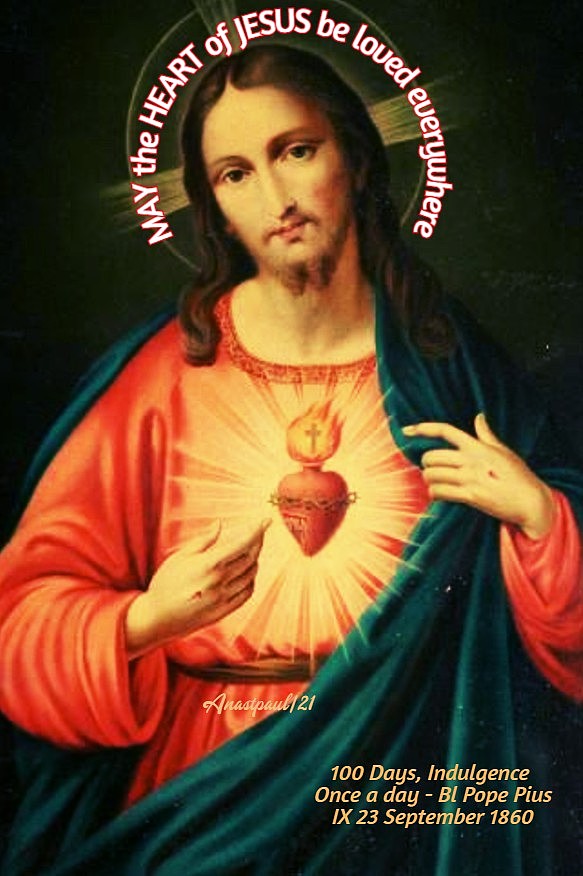
MAY the HEART of JESUS be loved everywhere.100 Days, Indulgence Once a day – Bl Pope Pius IX 23 September 1860
Holy God, we praise Thy Name. Lord of all, we bow before Thee. All on earth Thy sceptre claim; all in heav’n above adore Thee. Infinite Thy vast domain, everlasting is Thy reign.
Hark, the loud celestial hymn, angel choirs above are raising. Cherubim and seraphim, in unceasing chorus praising, fill the heav’ns with sweet accord: Holy, holy, holy Lord.
Holy Father, Holy Son, Holy Ghost, three we name Thee While in essence only One, Undivided God, we claim Thee and adoring, bend the knee, while we own the Mystery.
Spare Thy people Lord, we pray, By a thousand snares surrounded. Keep us without sin today, Never let us be confounded. Lo, I put my trust in Thee, Never Lord, abandon me.
Fr Ignaz Franz Poland (1719-1790) (Attri) Archbishop of Schlawa, Germany, Hymnist, Musician He also functioned as the Assessor for Theological Affairs at the Apostolic Vicariate. He wrote hymn lyrics and compiled religious music. Translated by Fr Clarence A Walworth (1820-1900) Convert, writer. He was one of the Founders of the Order of the Paulists in the USA.
Saint of the Day – 4 June – Blessed Werner von Ellerbach (Died 1126) Abbot. Died on 2 April, 2 May or 4 June (records vary) 1126 at Wiblingen Abbey near Ulm, Germany of natural causes. Also known as – Werner of Wiblingen, Varnerio.
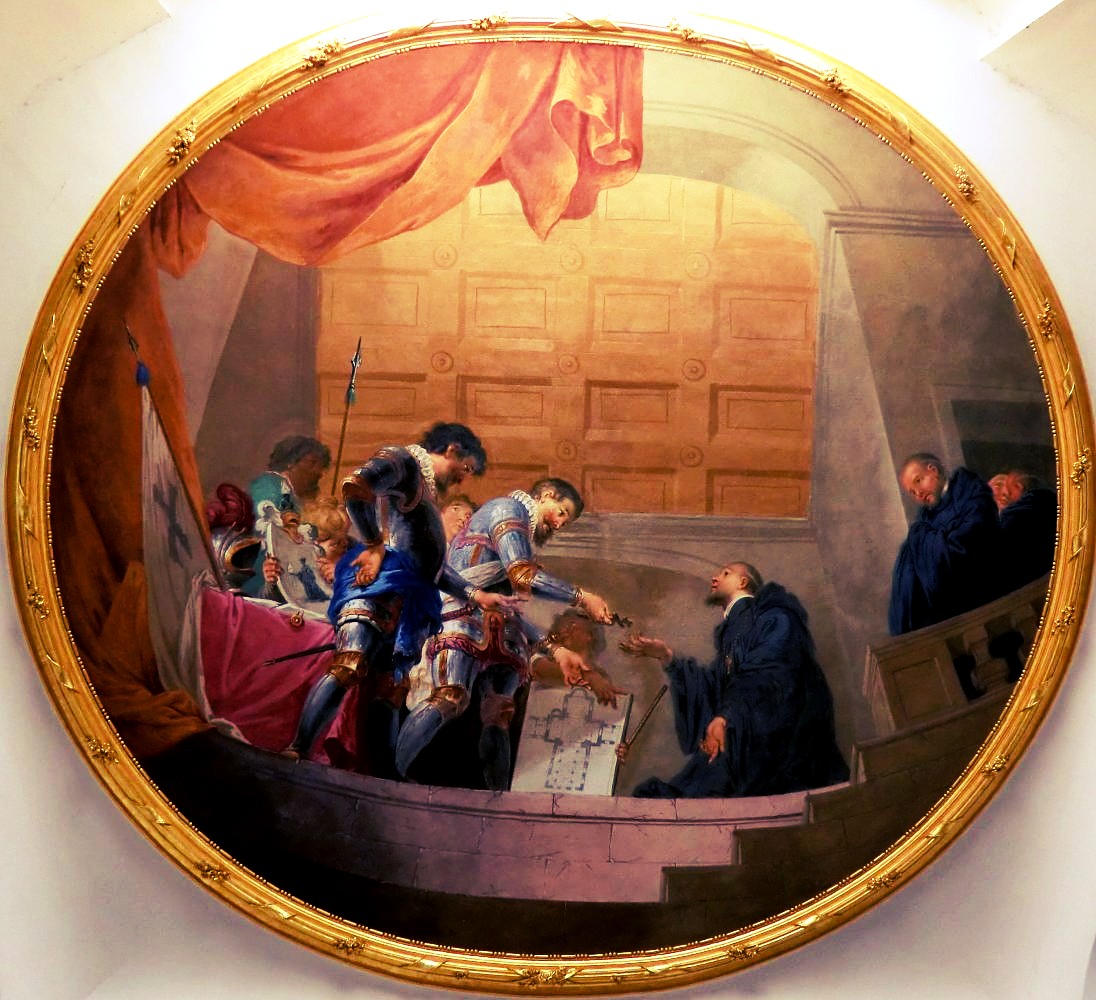
Johannes Zwick: The donors give Werner the Relic of the True Cross of Christ – ceiling fresco in the Monastery Church in Wiblingen.
Werner was a Benedictine Monk of the Black Forest Abbey of St Blaise, who lived between the 11th and 12th centuries.
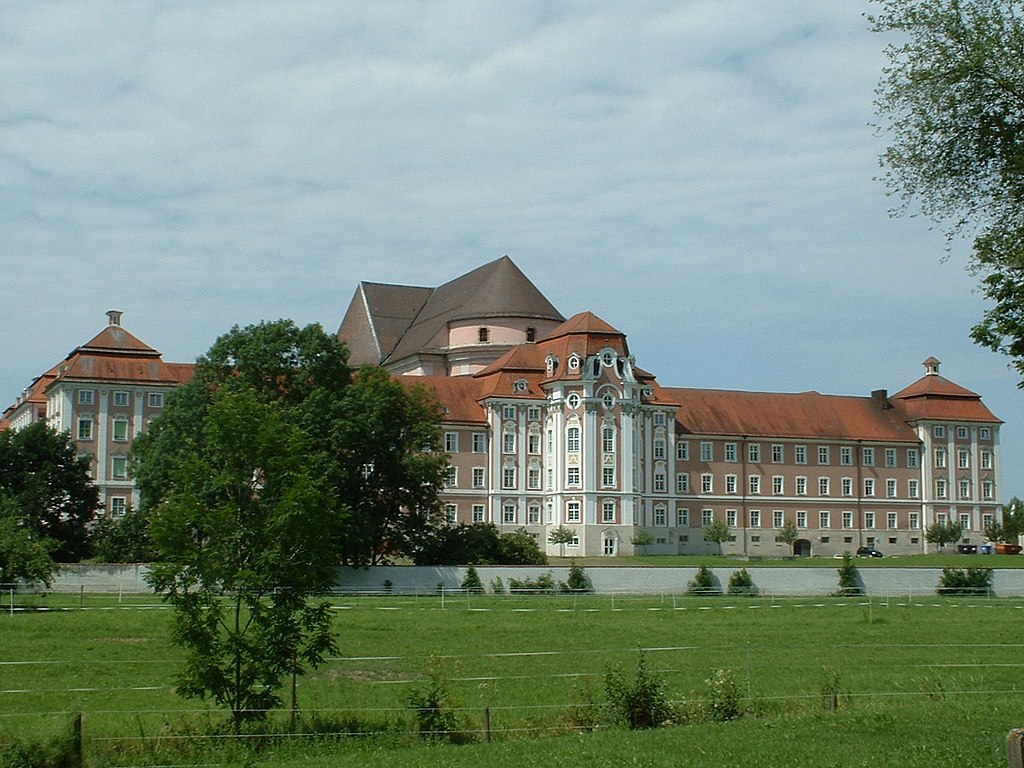
He was sent as the first Abbot to Wiblingen, near Ulm, after the foundation of the Benedictine Monastery there in 1093 by Hartmann of Swabia, Count of Kirchberg and his brother, Otto. The Abbey was consecrated in 1099 and the Counts donated to it a piece of the Holy Cross which they had obtained by participating in the first Crusade. The Abbey then became a magnet for pilgrims to Wiblingen to venerate the Holy Cross Relic. Under Werner’s administration it also became renowned for learning and its magnificent Library.
Wiblingen Monastery
According to the list of Abbots, Werner probably died on 2 April 1126, while according to a manuscript by St Blaisen he died on 2 May. According to another author, Blessed Werner died on 4 June, the date on which he is celebrated and remembered in the Monastery.
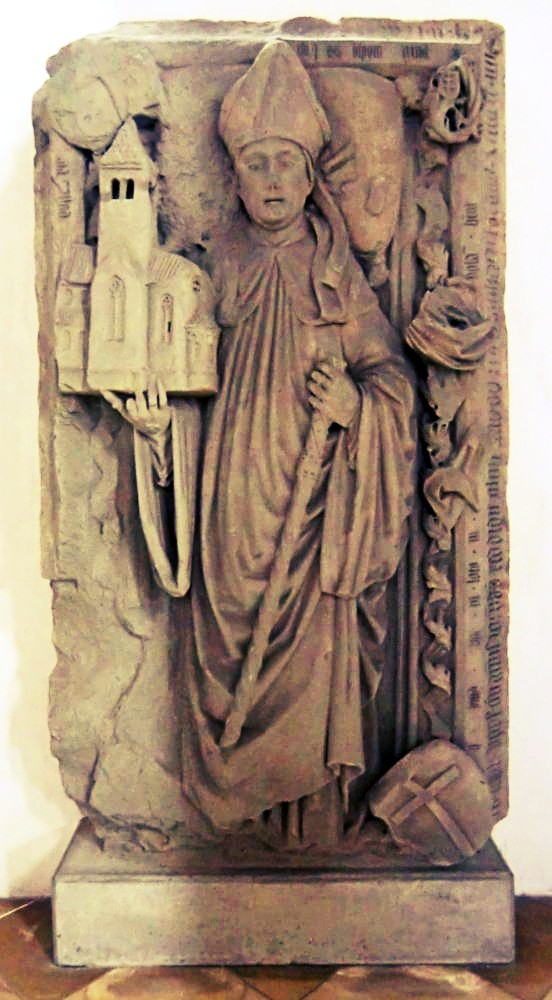
In the ancient Church of the Monastery the tomb of Blessed Werner was located in front of the Altar of the Holy Cross and the funeral slab was raised and placed on some columns.
Between 20 and 21 March 1782, the remains of Blessed Werner were enshrined with a bronze plaque. Some relics of Blessed Werner were donated to St Blaise Abbey.
Until the Thirty Years’ War, Wernerbrote loaves were blessed every year in the Wiblingen Monastery and distributed to protect against disease.
Grave slab for Werner in the Monastery in Wiblingen
St Francis Caracciolo CRM (1563-1608) Confessor, Priest, Co-Founder of the Congregation of the Clerics Regular Minor with Venerable John Augustine (1551-1587) the “Adorno Fathers,” Apostle of the Eucharistic Adoration. His body was given enough preparation for a long journey to Naples. Truly, God has left His own sign on him. When the body was lanced, the blood spouted a red and scented fluid and his vital organs were incorrupt. Around his heart were printed the words of the Psalm: “The zeal of Thy House consumes me” (Ps 69:10). Wow!: https://anastpaul.com/2020/06/04/saint-of-the-day-4-june-saint-francis-caracciolo-crm-1563-1608/
St Aldegrin of Baume St Alexander of Verona St Alonio St Aretius of Rome Bl Boniface of Villers St Breaca of Cornwall St Buriana of Cornwall St Christa of Sicily St Clateus of Brescia St Cornelius McConchailleach OSA (Died 1176) Archbishop of Armagh St Croidan St Cyrinus of Aquileia St Dacian of Rome St Degan St Edfrith of Lindisfarne St Elsiar of Lavedan St Ernin of Cluain Bl Francis Ronci Bl Margaret of Vau-le-Duc St Medan Bl Menda Isategui St Metrophanes of Byzantium St Nennoc St Nicolo of Sardinia St Optatus of Milevis
St Quirinus of Croatia St Quirinus of Tivoli St Rutilus of Sabaria St Saturnina of Arras St Trano of Sardinia St Walter of Fontenelle St Walter of Serviliano Blessed Werner von Ellerbach (11th-12th Century) Abbot
Martyrs of Cilicia – 13 Saints: A group of 13 Christians who were Martyred together. The only details about them that have survived are their names – Cama• Christa• Crescentia• Eiagonus• Expergentus• Fortunus• Italius • Jucundian• Julia• Momna• Philip• Rustulus• Saturnin They were Martyred in Cilicia, Asia Minor (in modern Turkey), date unknown
Martyrs of Nyon – 41 Saints: A group of 41 Christians Martyred together for refusing to sacrifice to imperial Roman idols. We know the names of some but no other details. Amatus• Attalus• Camasus• Cirinus• Dinocus• Ebustus• Euticus• Eutychius • Fortunius• Galdunus• Julia• Quirinus• Rusticus• Saturnina• Saturninus • Silvius• Uinnita• Zoticus Martyred by being beheaded in Noviodunum (modern Nyon, Switzerland).
Thought for the Day – 3 June – Meditations with Antonio Cardinal Bacci (1881-1971)
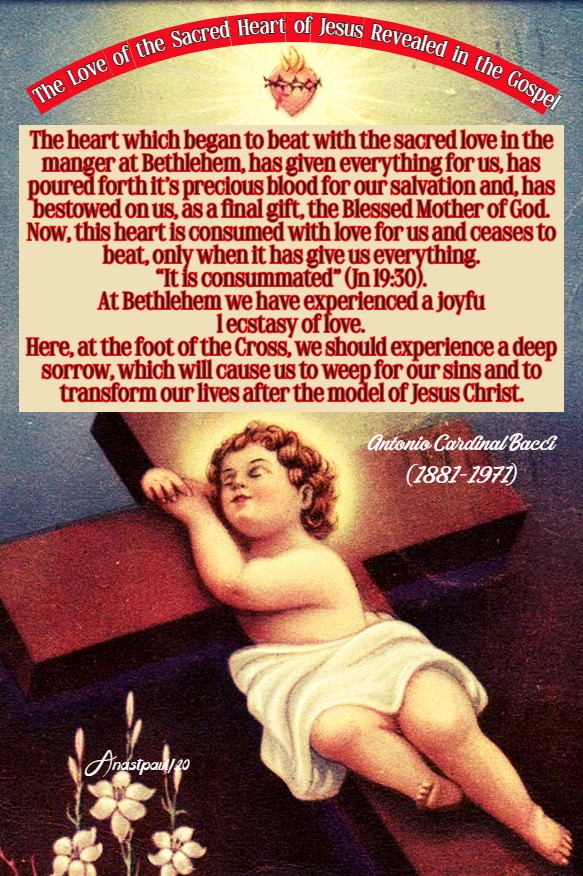
The Love of the Sacred Heart of Jesus Revealed in the Gospel
“If we meditate on the pages of the Gospel, we shall find that they are vibrant with the infinite love of the Sacred Heart of Jesus. Let us, in imagination, enter the cave of Bethlehem and kneel before the crib where the Divine Infant is lying. Darkness is all around, darkness over the earth, darkness in the minds and hearts of the majority of men. But, now, the heavens open and from the brightness the voices of angels ring out, “Glory to God in the highest and on earth, peace among men of goodwill.” Who is this infant? He is the Eternal Word, the substantial image of God, Who, for love of us, has been made man. He is the Infinite One Who has willed to unite Himself with the finite, in order to lift us towards Himself. This little heart is throbbing like that of any baby but, in this throb, is expressed the love of the God-Man. It is a profound mystery, that God should have loved man so much, that He became a tiny infant. Yet, He did this so that we might love Him more easily and in order to show us His own immeasurable love. There is about this Infant, a fascination, at once human and divine, which compels us to love Him, even as Mary, Joseph and the simple shepherds loved Him. He is asking us for love, adoration and complete surrender. Can we refuse Him?
Now let us take ourselves in imagination to Calvary and kneel at the foot of the Cross. The heart which began to beat with the sacred love in the manger at Bethlehem, has given everything for us, has poured forth it’s precious blood for our salvation and, has bestowed on us, as a final gift, the Blessed Mother of God. Now, this heart is consumed with love for us and ceases to beat only when it has give us everything. “It is consummated” (Jn 19:30). At Bethlehem we have experienced a joyful ecstasy of love. Here, at the foot of the Cross, we should experience a deep sorrow, which will cause us to weep for our sins and to transform our lives after the model of Jesus Christ.”
Quote/s of the Day – 3 June – Ember Saturday of Pentecos – Joel 2:28-32, Luke 4:38-44 – Scripture search here: https://www.drbo.org/
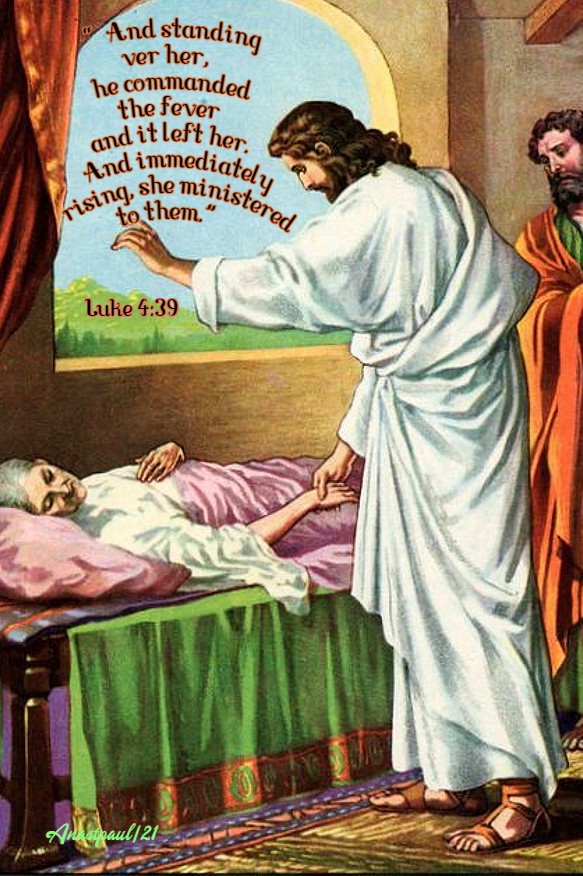
“And standing over her, He commanded the fever and it left her. And immediately rising, she ministered to them.”
Luke 4:39
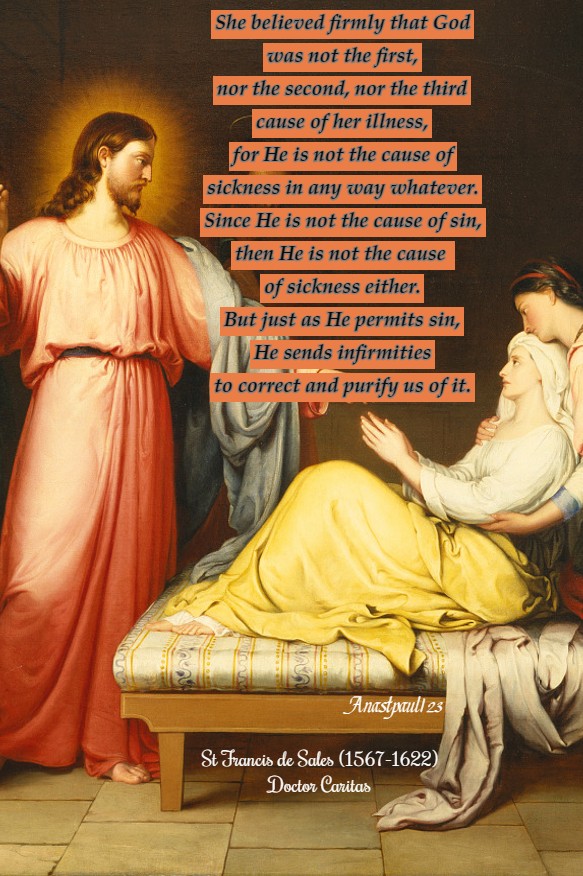
“She believed firmly that God was not the first, nor the second, nor the third cause of her illness, for He is not the cause of sickness in any way whatever. Since He is not the cause of sin, then He is not the cause of sickness either. But just as He permits sin, He sends infirmities to correct and purify us of it.”
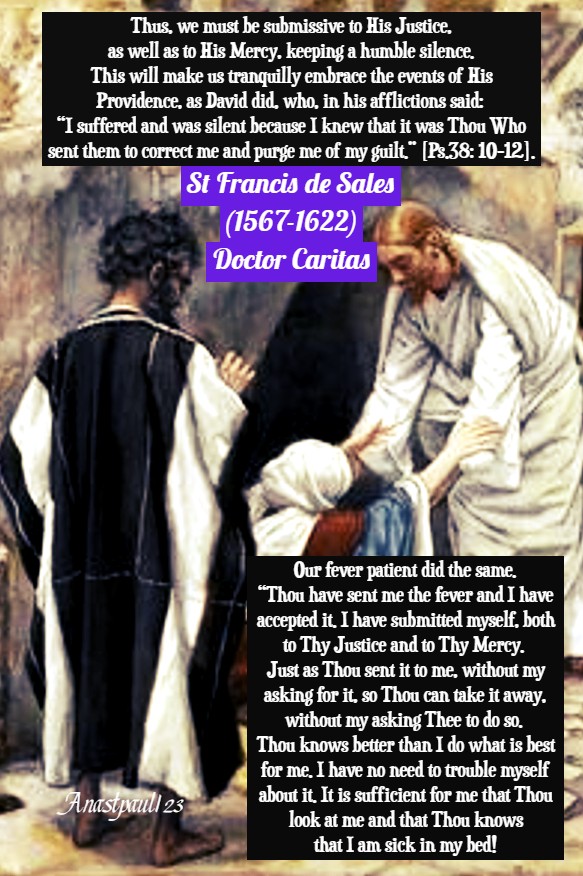
“Thus, we must be submissive to His Justice, as well as to His Mercy, keeping a humble silence. This will make us tranquilly embrace the events of His Providence, as David did, who, in his afflictions said: “I suffered and was silent because I knew that it was Thou Who sent them to correct me and purge me of my guilt.” [Ps.38: 10-12].
Our fever patient did the same. “Thou have sent me the fever and I have accepted it. I have submitted myself, both to Thy Justice and to Thy Mercy. Just as Thou sent it to me, without my asking for it, so Thou can take it away, without my asking Thee to do so. Thou knows better than I do what is best for me. I have no need to trouble myself about it. It is sufficient for me that Thou look at me and that Thou knows that I am sick in my bed!”
(Sermon for the Thursday after the Third Sunday of Lent, 3 March 1622, concerning the cure of St Peter’s mother-in-law).
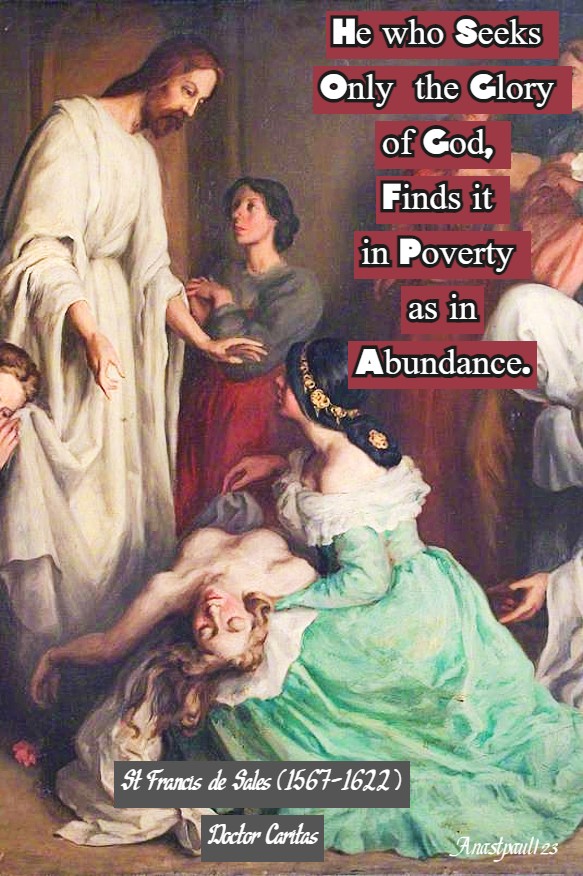
“He who seeks only the glory of God, finds it in poverty, as in abundance. ”
One Minute Reflection – 3 June – “The Month of the Sacred Heart of Jesus” – Ember Saturday of Pentecost – Joel 2:28-32, Luke 4:38-44 – Scripture search here: https://www.drbo.org/
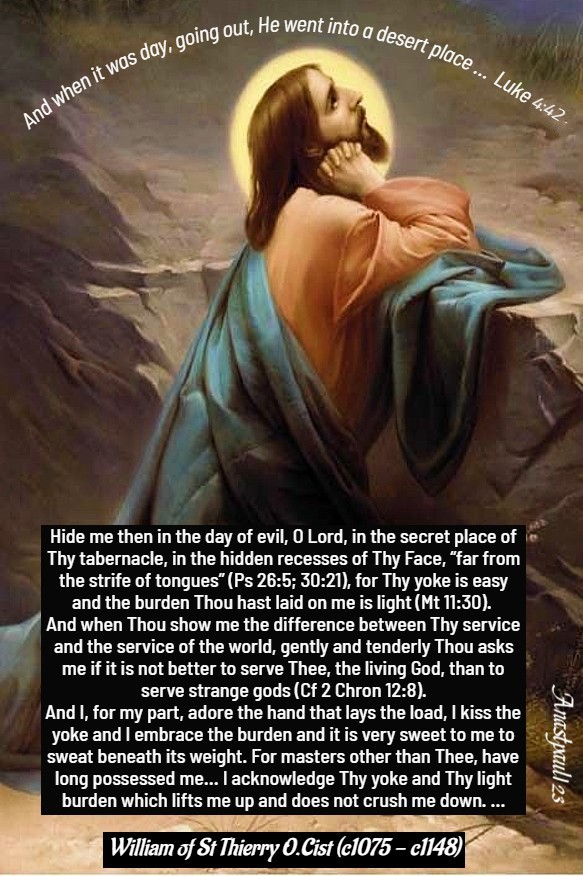
“And when it was day, going out, He went into a desert place … ” – Luke 4:42
REFLECTION – “Lead me away, meanwhile, my Refuge and my Strength, into the heart of the desert as once Thou led Thy servant Moses; lead me where the bush burns, yet is not burnt away, where the holy soul which… is all aflame with the fullness of the fire of Thy Holy Spirit and, burning like the Seraphim, is not consumed but cleansed…
The soul attains to the holy place where none may stand or take another step, except he be bare-footed—having loosed the shoe-strings of all fleshly hindrances… This is the place where He, Who Is, Who cannot be seen as He Is, Is notwithstanding, heard to say, “I Am Who Am,” the place where, for the time, the soul must cover her face so that she does not see the Face of God and yet, in humble obedience must use her ears to hear what the Lord God will say concerning her.
Hide me then in the day of evil, O Lord, in the secret place of Thy tabernacle, in the hidden recesses of Thy Face, “far from the strife of tongues” (Ps 26:5; 30:21), for Thy yoke is easy and the burden Thou hast laid on me is light (Mt 11:30).And when Thou show me the difference between Thy service and the service of the world, gently and tenderly Thou asks me if it is not better to serve Thee, the living God, than to serve strange gods (Cf 2 Chron 12:8). And I, for my part, adore the hand that lays the load, I kiss the yoke and I embrace the burden and it is very sweet to me to sweat beneath its weight. For masters other than Thee, have long possessed me… I acknowledge Thy yoke and Thy light burden which lifts me up and does not crush me down. …” – William of St Thierry O.Cist (c1075 – c1148) Cistercian Monk, Mystic, Theologian, Writer (Meditations IV, 10-11).
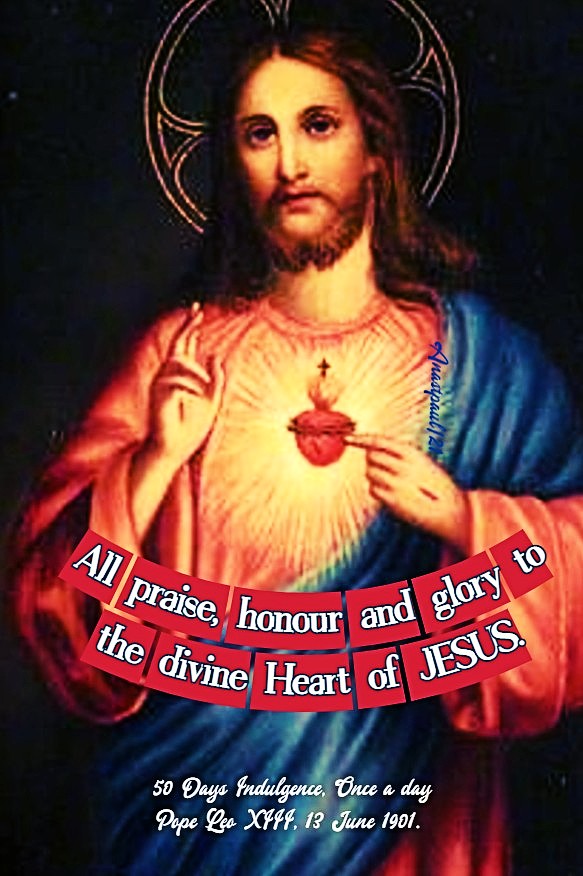
PRAYER – Graciously pour into our minds, we beseech Thee, O Lord, the Holy Spirit, Whose wisdom created us and Whose providence governs us. Through Jesus Christ, Thy Son our Lord, Who lives and reigns with Thee, in the unity of the Holy Ghost, God, world without end. Amen (Collect). All praise, honour and glory to the Divine Heart of JESUS.50 Days Indulgence, Once a day, Raccolta, 168 Pope Leo XIII, 13 June 1901.
Our Morning Offering – 3 June – Ember Saturday of Pentecost – “The Month of the Sacred Heart of Jesus” and First Saturday
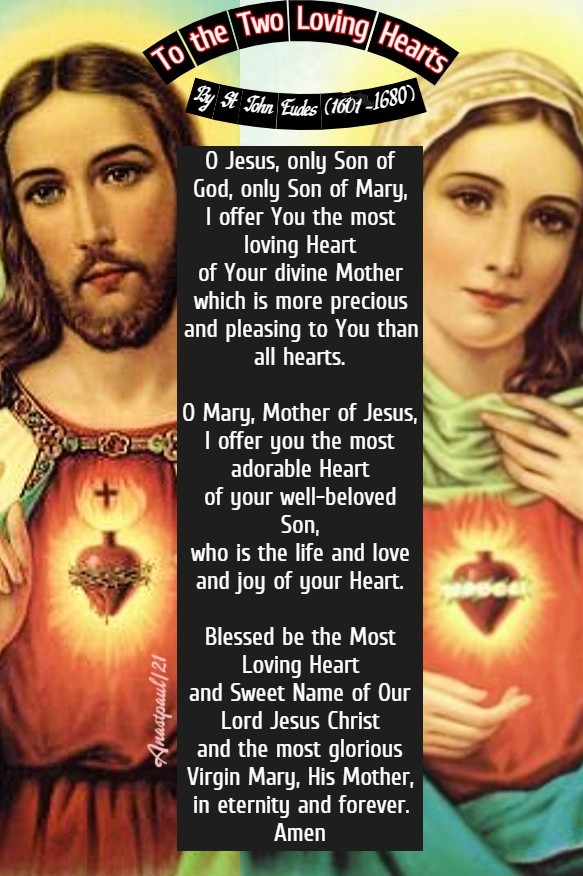
To the Two Loving Hearts By St John Eudes (1601-1680)
O Jesus, only Son of God, only Son of Mary, I offer You the most loving Heart of Your divine Mother which is more precious and pleasing to You than all hearts.
O Mary, Mother of Jesus, I offer you the most adorable Heart of your well-beloved Son, who is the life and love and joy of your Heart.
Blessed be the Most Loving Heart and Sweet Name of Our Lord Jesus Christ and the most glorious Virgin Mary, His Mother, in eternity and forever. Amen
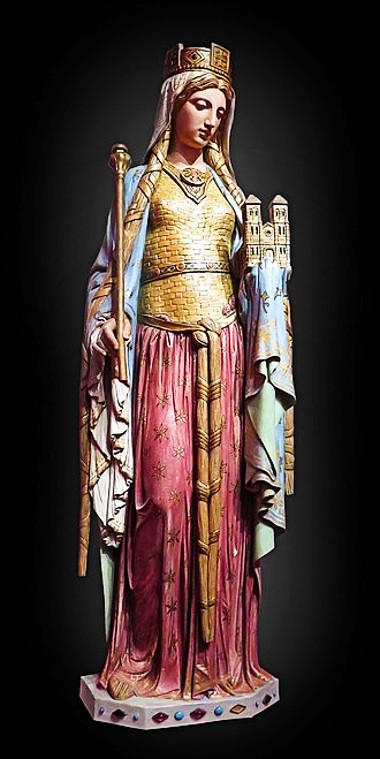
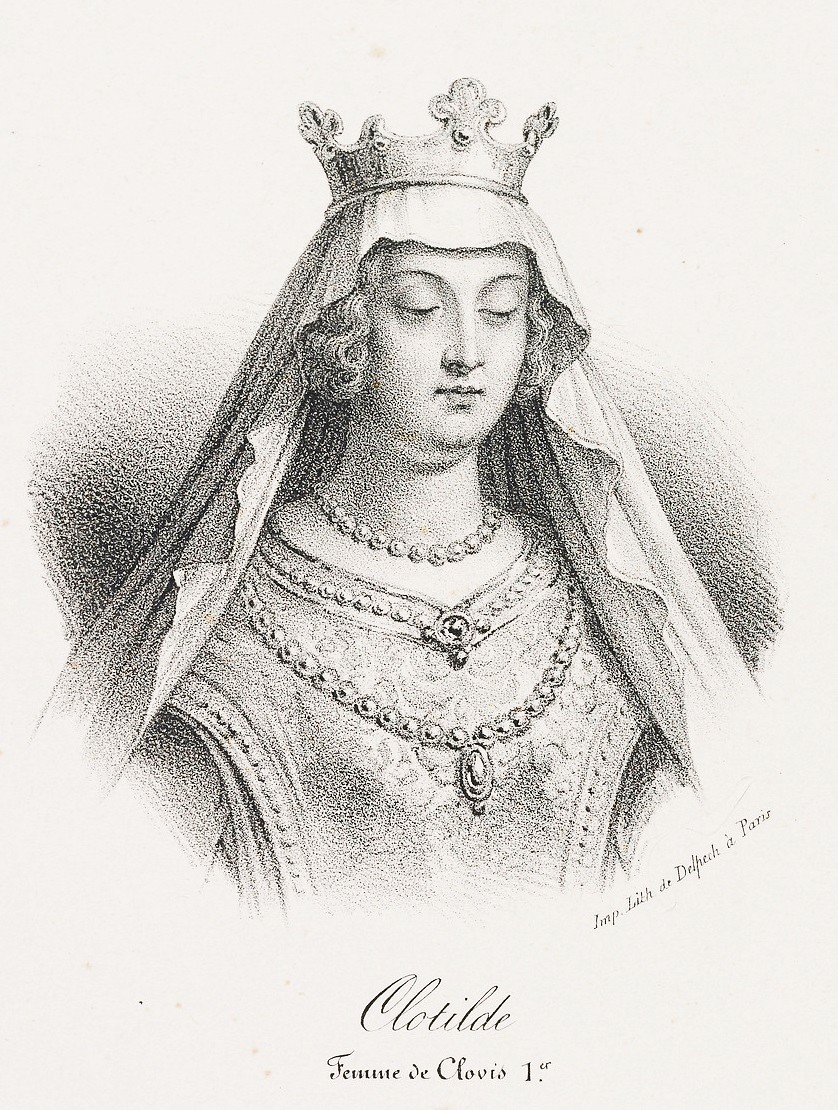
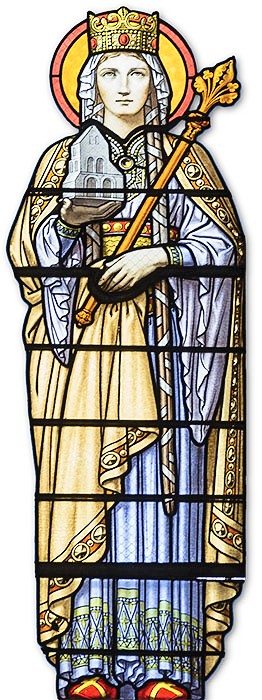
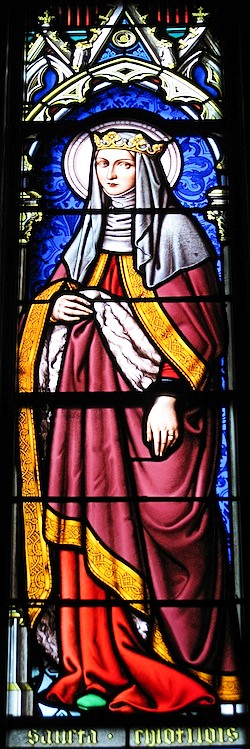
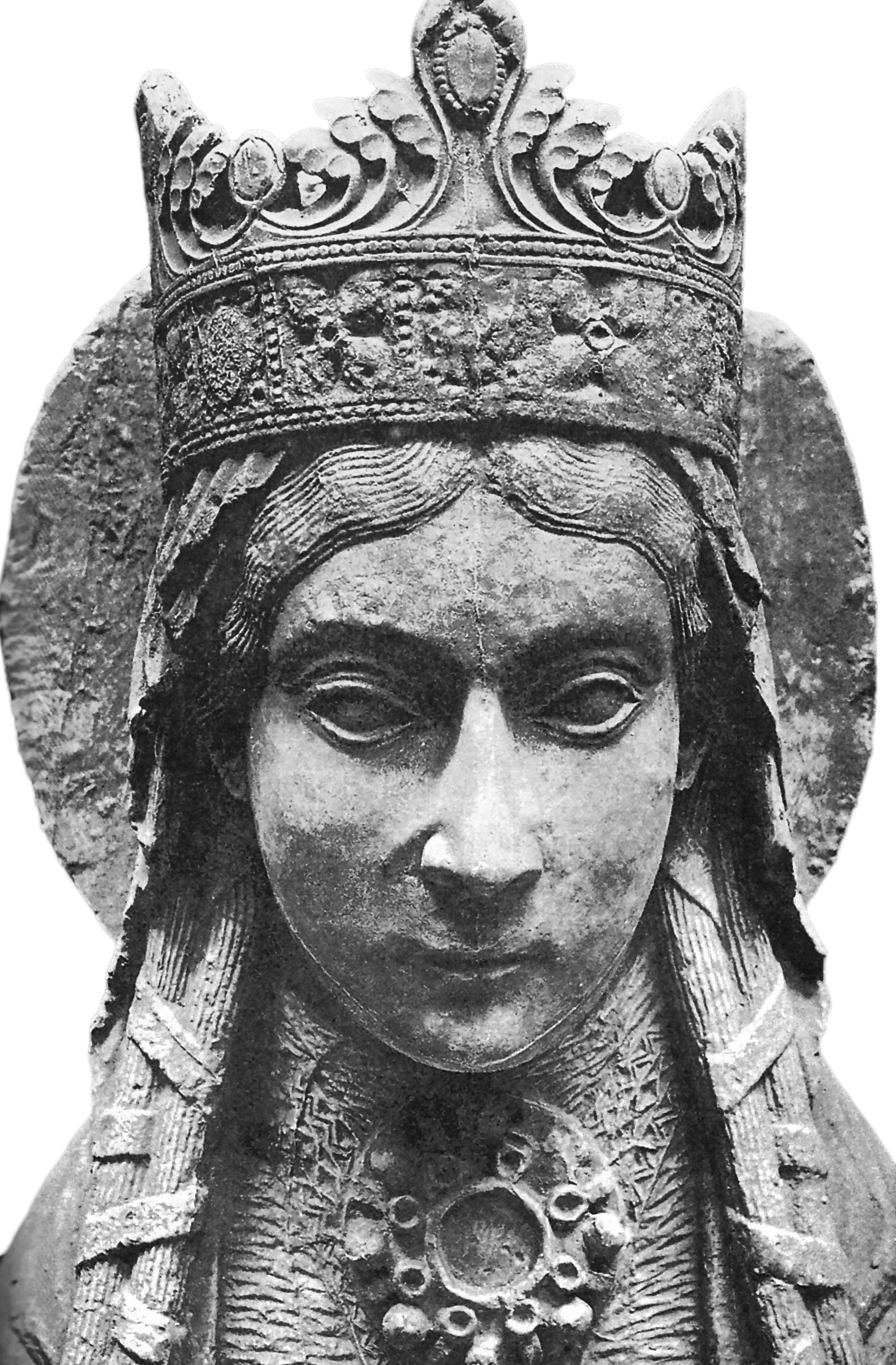
Saint of the Day – 3 June – St Clotilde of France (c475-545) Widow, Mother, Queen, Apostle of the poor and the sick. Born in c475 at Lyons, France and died on 3 June 545 at Tours, France of natural causes. Patronages – against death of children, adopted children, brides, exiles, parenthood, parents of large families, people in exile, queens, widows. Also known as – Chlodechildis, Chrodechildis, Clothilde, Clotichilda, Clotild, Clotilda, Clotildus, Croctild, Crotildes, Hlodihild, Hlotild, Hroþihildi, Rotilde.
The Roman Martyrology reads today: “At Paris, St Clotilde, Queen, by whose prayers her husband, King Clovis, was converted to the Faith of Christ.”
Clotilde was born in Lyon around 475, almost coinciding with the disappearance of the Roman Empire in the West (476). Even Roman Gaul had been disintegrating through the establishment of various independent Kingdoms by barbarian peoples, not infrequently rivals. With her birth she was already a Princess, as the daughter of King Childeric I, leader of the Burgundians, an eastern Germanic group which had arrived first on the left of the Rhine and then on the middle Rhone. However, in her life there would be the adverse fate of a painful series of tragedies and royal assassinations, among which she found salvation with a great faith in Christ Jesus.
In 481 her father was killed and then she, with her mother and older sister Croma, retired to Geneva. Together they gave themselves to a life of prayer and then of assistance to the needy. According to some stories, the young woman was also subjected to persecution and to the loss of her mother to assassination, until, through the Ambassadors, she received a proposal of marriage by Clovis, the young King of the Franks, another Germanic people who had settled in territories north of the Seine .
Clovis, who would become the progenitor of the Merovingians, was a pagan man, rather rude and irreligious. However, he gave his wife permission to Baptise each of his five children.. With the help and protection of the Bishop of Rheims, the future St Remigius, Clotilde was also beginning the slow but profound work of the moral conversion of her husband.
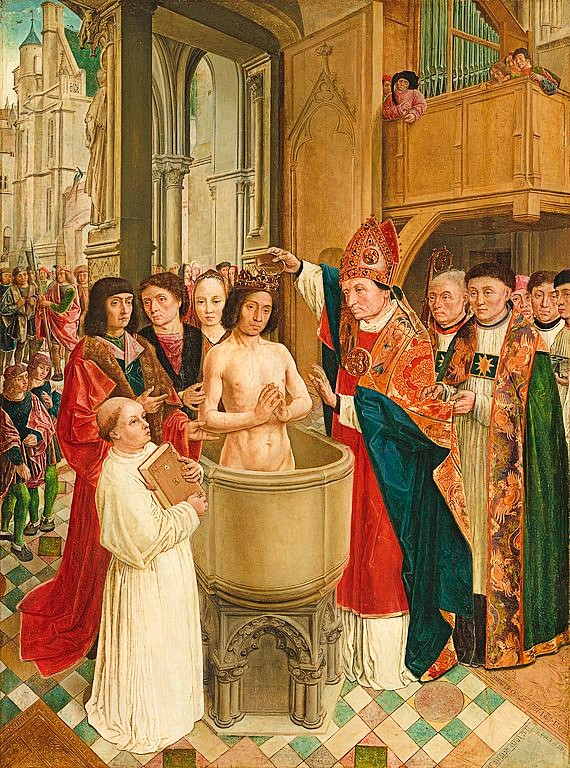
A true prodigy occurred in 496, when Clovis found himself forced to engage in battle against his enemies near Cologne. Fearing the worst, he called upon his wife’s God and emerged victorious. He then promised conversion to the Catholic Faith and on Christmas night of that year, he was Baptised in Rheims by the Bishop himself. Most of his subjects followed suit. This act was a success of Queen Clotilde, so important as to make France the “eldest daughter of the Church. ”
The Baptims of King Clovis I by St Remigius of Rheims
After his conversion, Clovis made friends with many Bishops, extending his power over a large part of France, which shortly after would have Paris as its Capital.
We also owe Clotilde the replacement of the three toads with three lilies in the shield of the French Monarchy, after she received one with the lilies as a gift from a mysterious hermit of the forest of Saint-Germain-en-Laye.
Widowed after twenty years of marriage, the Queen of France underwent many other poignant dynastic trials, until she retired to Tours, near the tomb of St Martinto whom she was particularly devoted. In that region she founded Churches and Monasteries, dedicating herself to penance and works of charity.
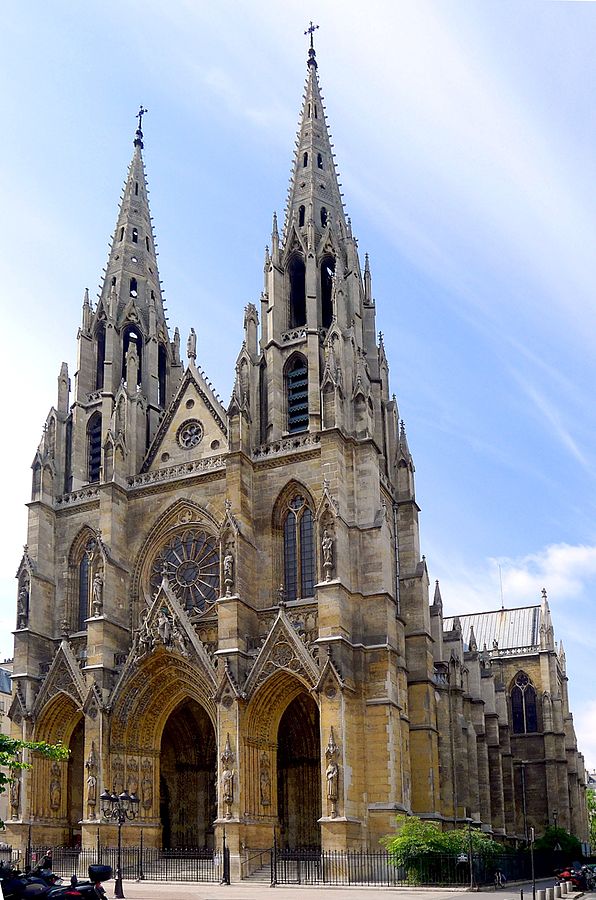
Clotilde died in Tours on 3 June 545. In later times, she was brought from that City as a virtuous and courageous Saint to the tomb in Paris, next to the bodies of Clovis and Saint Guinevere Patroness of the Capital . Her mortal remains were then cremated in 1793 to prevent revolutionary desecration. Now they rest in a Basilica dedicated to her and built between 1846 and 1856, where on 3 June of each year, the Saint is solemnly commemorated.
St Albert of Como St Athanasius of Traiannos St Auditus of Braga Bl Beatrice Bicchieri St Caecilius of Carthage St Clotilde of France (c475-545) Widow, Mother, Queen, Apostle of the poor and the sick. St Conus of Lucania St Cronan the Tanner St Davinus of Lucca Bl Diego Oddi St Gausmarus of Savigny St Genesius of Clermont St Glunshallaich St Hilary of Carcassone St Isaac of Córdoba
St Laurentinus of Arezzo St Liphardus of Orléans St Morand of Cluny St Moses of Arabia St Oliva of Anagni St Paula of Nicomedia St Pergentinus of Arezzo St Phaolô Vu Van Duong St Urbicius
Martyrs of Africa – 156 Saints: 156 Christians Martyred together in Africa, date unknown; the only other information to survive are some of their names – Abidianus• Demetria• Donatus• Gagus• Januaria• Juliana• Nepor• Papocinicus• Quirinus• Quirus.
Martyrs of Byzantium – 5 Saints: A group of Christians, possibly related by marriage, who were Martyred together. They were – Claudius, Dionysiu, Hypatius, Lucillian, Paul. They were Martyred in 273 in Byzantium.
Martyrs of Rome – 8 Saints: A group of Christians Martyred together. We know nothing else about them but the names – Amasius, Emerita, Erasmus, Lucianus, Orasus, Satuaucnus, Septiminus• Servulus. They were Martyred in Rome, Italy, date unknown.
Martyrs of Rome – 85+ Christians Martyred together in Rome, Italy, date unknown. The only details that have survived are some of their names –
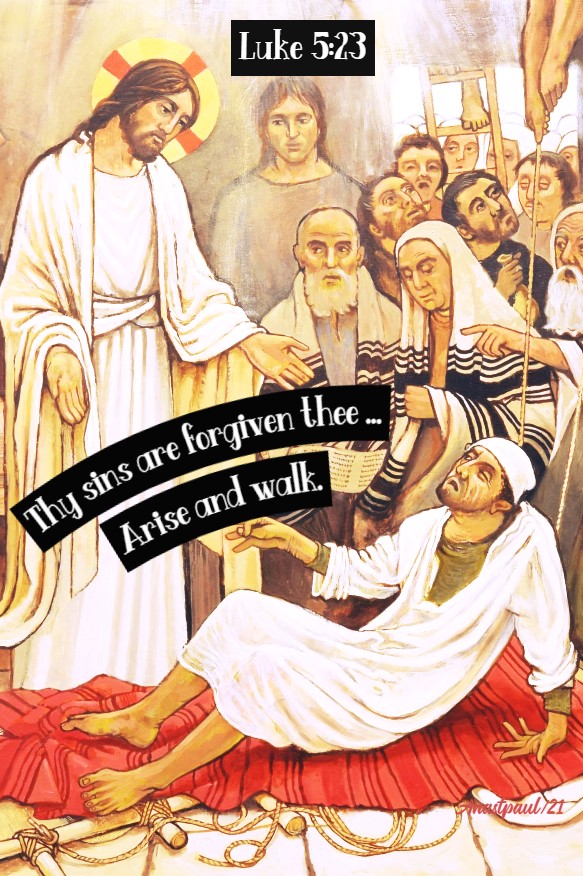
Quote/s of the Day – 2 June – Pentecost Friday – Joel 2:23-24; 26-27, Luke 5:17-26 – Scripture search here: https://www.drbo.org/
“Thy sins are forgiven thee … Arise and walk.”
Luke 5:23
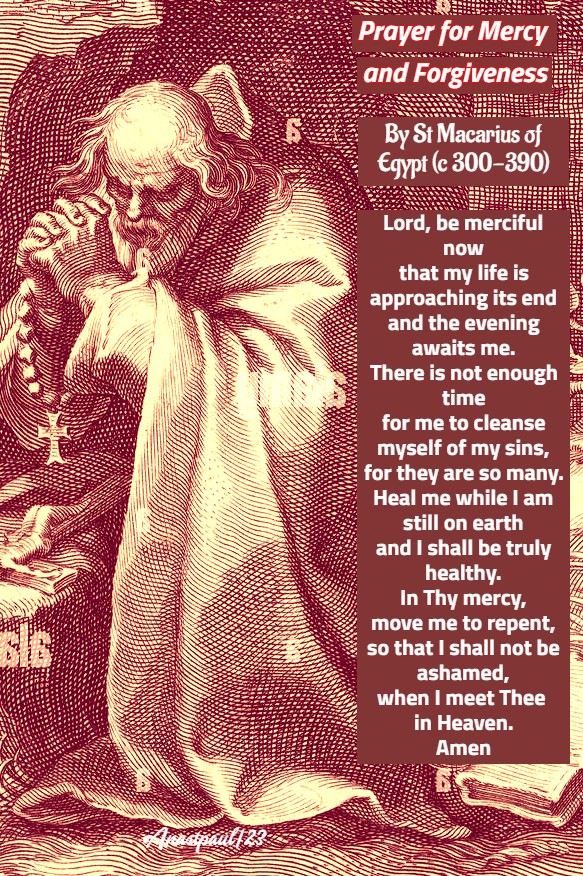
Prayer for Mercy and Forgiveness By St Macarius of Egypt (c 300-390)
Lord, be merciful now that my life is approaching its end and the evening awaits me. There is not enough time for me to cleanse myself of my sins, for they are so many. Heal me while I am still on earth and I shall be truly healthy. In Thy mercy, move me to repent, so that I shall not be ashamed, when I meet Thee in Heaven. Amen
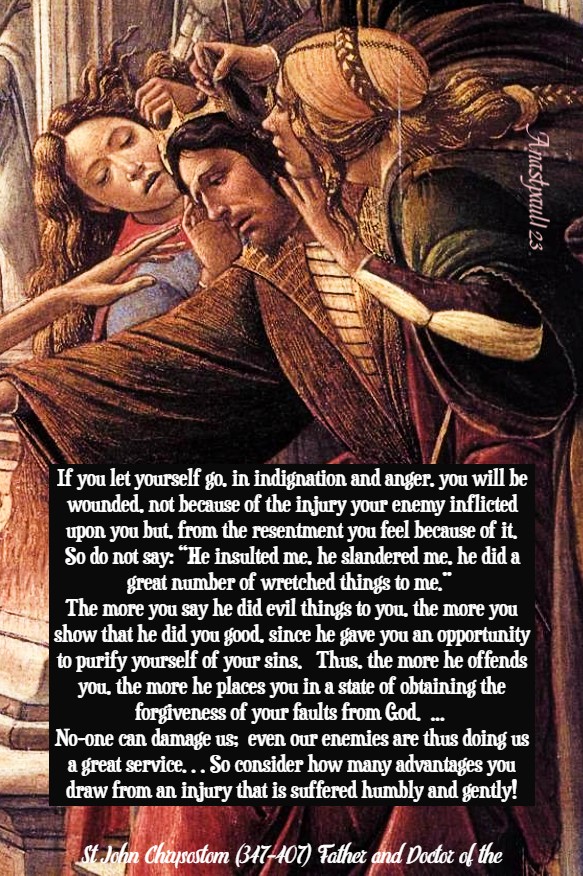
“What evil can your enemy do to you which would be comparable to that, which you do to yourself? … If you let yourself go, in indignation and anger, you will be wounded, not because of the injury your enemy inflicted upon you but, from the resentment you feel because of it. So do not say: “He insulted me, he slandered me, he did a great number of wretched things to me.” The more you say he did evil things to you, the more you show that he did you good, since he gave you an opportunity to purify yourself of your sins. Thus, the more he offends you, the more he places you in a state of obtaining the forgiveness of your faults from God. For if we want, no-one can damage us; even our enemies are thus doing us a great service… So consider how many advantages you draw from an injury that is suffered humbly and gently!”
St John Chrysostom (347-407) Father and Doctor of the Church
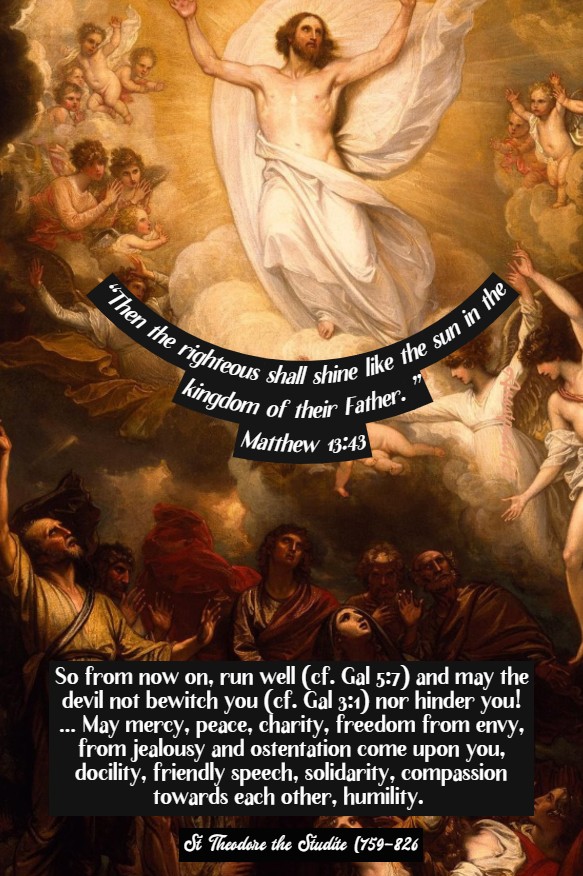
“Then the righteous shall shine like the sun in the kingdom of their Father.” Matthew 13:43
“So from now on, run well (cf. Gal 5:7) and may the devil not bewitch you (cf Gal 3:1) nor hinder you! … May mercy, peace, charity, freedom from envy, from jealousy and ostentation come upon you, docility, friendly speech, solidarity, compassion towards each other, humility.”
St Theodore the Studite (759-826)
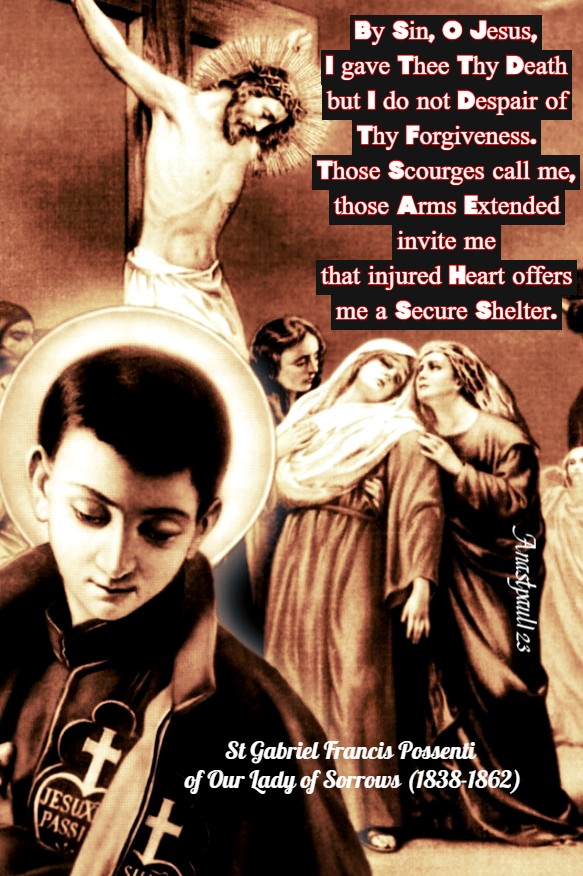
“By sin, O Jesus, I gave Thee Thy Death but I do not despair of Thy Forgiveness. Those Scourges call me, those Arms extended invite me that injured Heart offers me a secure shelter.”
St Gabriel Francis Possenti of Our Lady of Sorrows (1838-1862)
One Minute Reflection – 2 June – “The Month of the Sacred Heart of Jesus” – The Feast of the Martyrs Saints Marcellinus and Peter the Exorcist (Martyred in 304) – Joel 2:23-24; 26-27, Luke 5:17-26 – Scripture search here: https://www.drbo.org/
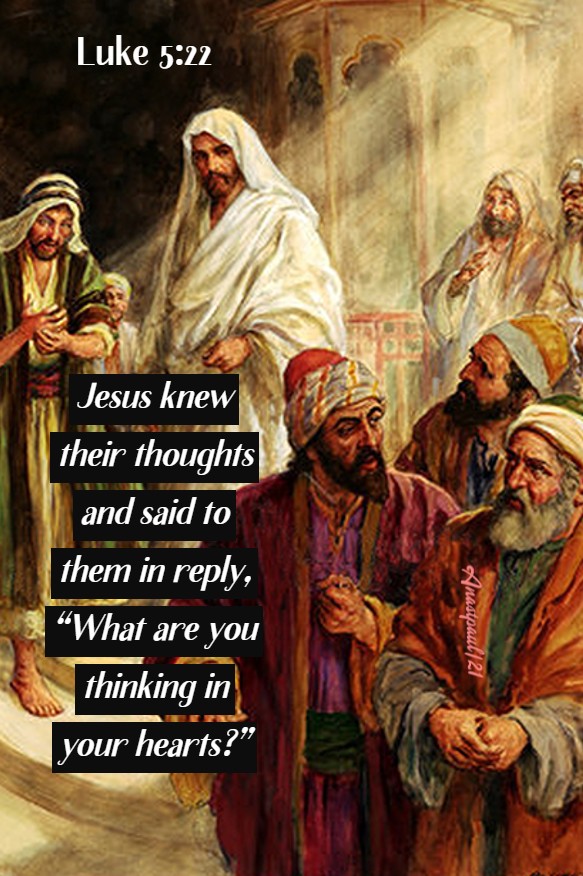
“Jesus knew their thoughts and said to them in reply, “What are you thinking in your hearts?” – Luke 5:22
REFLECTION – “Thanks to the faith of others the cripple’s soul would be cured before his body. “Seeing their faith,” the Gospel says. Note here, my brethren, that God is not interested in what foolish people want and does not expect to find faith among the ignorant … among those who conduct themselves badly. On the other hand, He does not refuse to come to the help of others’ faith. Such faith is a gift of grace, at one with God’s will … In His Divine Goodness, Christ the Physician, strives to draw to salvation, even in spite of themselves, those affected by sickness of soul, those whom the burden of their sins and offences overwhelms, even to delirium. Yet, they do not want to submit.
O my brethren, if only we wanted to, if only we all wanted to perceive our soul’s paralysis in all its depth! Then we would see that it is lying on a stretcher of sins, deprived of strength. Christ’s action within us, would be a source of light and we would understand that each day He sees our lack of faith, harmful as it is, that He draws us towards healing remedies and sharply presses our rebellious wills. “My son” He says, “your sins are forgiven you.”– St Peter Chrysologus (c 400-450) Bishop of Ravenna, Father and Doctor of the Church (Sermon 50 ; PL 52, 339).
PRAYER – O God, Who made thy blessed Martyrs, Marcellinus and Peter the Exorcist, glorious by their remarkable confession of Thy glory; grant, by their intercession and example, that Thy charity may continually increase in our hearts. Through Jesus Christ, Thy Son our Lord, Who lives and reigns with Thee, in the unity of the Holy Ghost, God, world without end. Amen (Collect). SACRED Heart of JESUS, I trust in Thee. 300 Days Indulgence Once a Day – Plenary, Once a month. Raccolta 175 – St Pius X, 19 August 1905 and 27 June 1906.
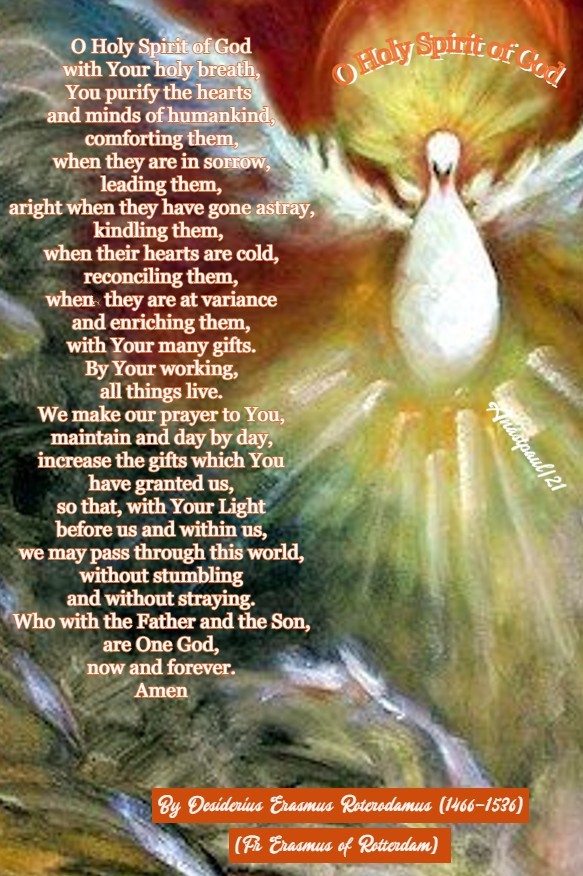
O Holy Spirit of God By Desiderius Erasmus Roterodamus (1466-1536) (Fr Erasmus of Rotterdam)
O Holy Spirit of God with Your holy breath, You purify the hearts and minds of humankind, comforting them, when they are in sorrow, leading them, aright when they have gone astray, kindling them, when their hearts are cold, reconciling them, when they are at variance and enriching them, with Your many gifts. By Your working, all things live. We make our prayer to You, maintain and day by day, increase, the gifts which You have granted us, so that with Your Light before us and within us, we may pass through this world, without stumbling and without straying. Who with the Father and the Son, are One God, now and forever. Amen
Fr Erasmus of Rotterdam was a Dutch Philosopher and Theologian who is considered one of the greatest scholars of the northern Renaissance. As a Catholic Priest, he was an important figure in classical scholarship who wrote in a pure Latin style.
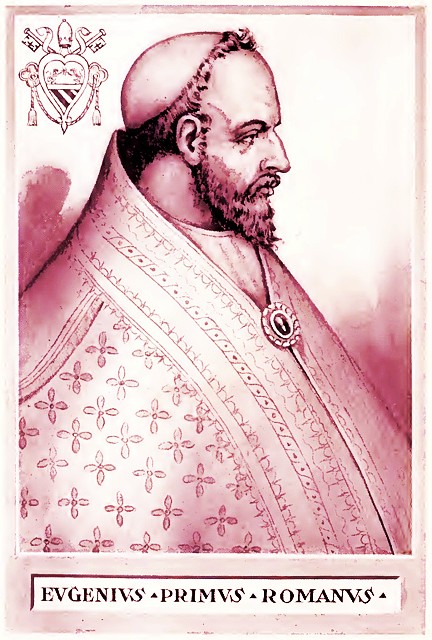
Saint of the Day – 2 June – Saint Eugene I (Died 657) the 75th Bishop of Rome elected on 10 August 654 and died at Rome on 2 June 657 of natural causes, aged just 42. He was chosen to become Pope after the exile of Martin I by Emperor Constans II over the dispute regarding the Monothelitism Heresy.
Eugene was a Roman from the Aventine region along the Tiber, He was the son of Rufinianus and had become a cleric in the Church at an early age and spent his life in dedication to the Church.
His election to papacy came under unusual circumstances. His predecessor, Pope Martin I, was still alive and living in exile as a prisoner of Emperor Constans II. In fact, on 18 June 653, Constans troops forcibly carried Martin out of the City for refusing to submit to their demand o accept Monothelitism. This is a belief that Jesus had only one will and which is considered blasphemous by the Church.
At the time of his appointment, many Romans believed that Pope Eugene I was being placed on the Throne of St Peter as a pawn to do the Emperors’ will against the wishes of Pope Martin I. However, a letter sent by Martin shortly before his death indicated his approval of Eugene as his successor and Pope Eugene I’s actions,, once in power, demonstrated that he was no puppet of the Byzantine Emperor.
The challenges facing Pope Eugene I began as soon as he took power. Emperor Constans II immediately demanded that Eugene capitulate to the demands which Pope Martin had refused to do. These included acknowledging Peter as the Patriarch of Constantinople and allowing the tolerance of Monthelites. Despite threats to exile him like Martin and to roast him alive along with his Roman supporters, Pope Eugene I stood firm against the demands and refused to deny the Mysteries of the Faith
Emperor Constans II did not get the chance to make good on his threats against Pope Eugene I. The capture of the City of Rhodes in 654 and Constans’ defeat at the naval battle of Phoenix in 655 ,stopped his aggression towards the Church.
Pope Eugene I went onto lead the Church for another two years until his peaceful death at the young age of 42 of natural causes. Pope Eugene I consecrated 21 Bishops to serve throughout the world during his time as the Pope. He was buried at St Peter’s Basilica. St Eugene I was succeeded by Pope Vitalian.
The Cathedral of Saint Eugene, where Pope St Eugene I is the Patron Saint, is in the Diocese of Santa Rosa in California.
St Ada of Ethiopia St Adalgis of Thiérarche St Armin of Egypt St Barbarinus St Blandina the Slave St Bodfan of Wales St Daminh Ninh Bl Demetrios of Philadelphia St Dorotheus of Rome
St Eugene I (Died 657) Bishop of Rome elected on 10 Augugust 654, and died at Rome on 2 June 657 of natural causes, aged just 42. St Evasius Bl Giovanni de Barthulono
St Guido of Acqui (c 1004-1070) Bishop of Acqu in north-west Italy from 1034 until his death, zealous Reformer both in the lives of his clergy and his people. He built the Cathedral of Acqui amongst other religious buildings, including a Convent for Nuns. He donated his personal inheritance to the upkeep of the Diocese, the poor and for his building projects. Biography: https://anastpaul.com/2022/06/02/saint-of-the-day-2-june-saint-guido-of-acqui-c-1004-1070-patron-saint-against-famine/
St Honorata St Humatus St John de Ortega St Joseph Tien
St Photinus of Lyons St Rogate Bl Sadoc of Sandomierz St Stephen of Sweden
Martyrs of Lyons and Vienne: A group of 48 Christians from the areas of Vienne and Lyon, France, who were attacked by a pagan mob, arrested and tried for their faith, and murdered in the persecutions of Marcus Aurelius. A letter describing their fate, possibly written by Saint Irenaeus of Lyons, was sent to the churches in the Middle East. Only a few names and details of their lives have survived; some of them have separate entries on this date –
Alexander of Vienne
Attalus of Pergamos
Biblis of Lyons
Blandina the Slave
Cominus of Lugdunum
Epagathus of Lugdunum
Maturus the Novice
Photinus of Lyons
Ponticus of Lugdunum
Sanctius of Vienne
Vettius of Lugdunum They were martyred in assorted ways on on various during 177.
Martyrs of Sandomierz: A group of 49 Dominicans, some of whom received the habit from Saint Dominic de Guzman himself. They worked separately and together to bring the faith and establish the Dominican Order in Poland, basing their operations in and around Sandomierz. In 1260 they were all Martyred by the Tartars as they were singing the Salve Regina at Compline; the custom of singing the Salve Regina at the deathbed of Dominicans, stems from this incident. We know a few details about a few of the martyrs, but most survive only as names –




















You must be logged in to post a comment.