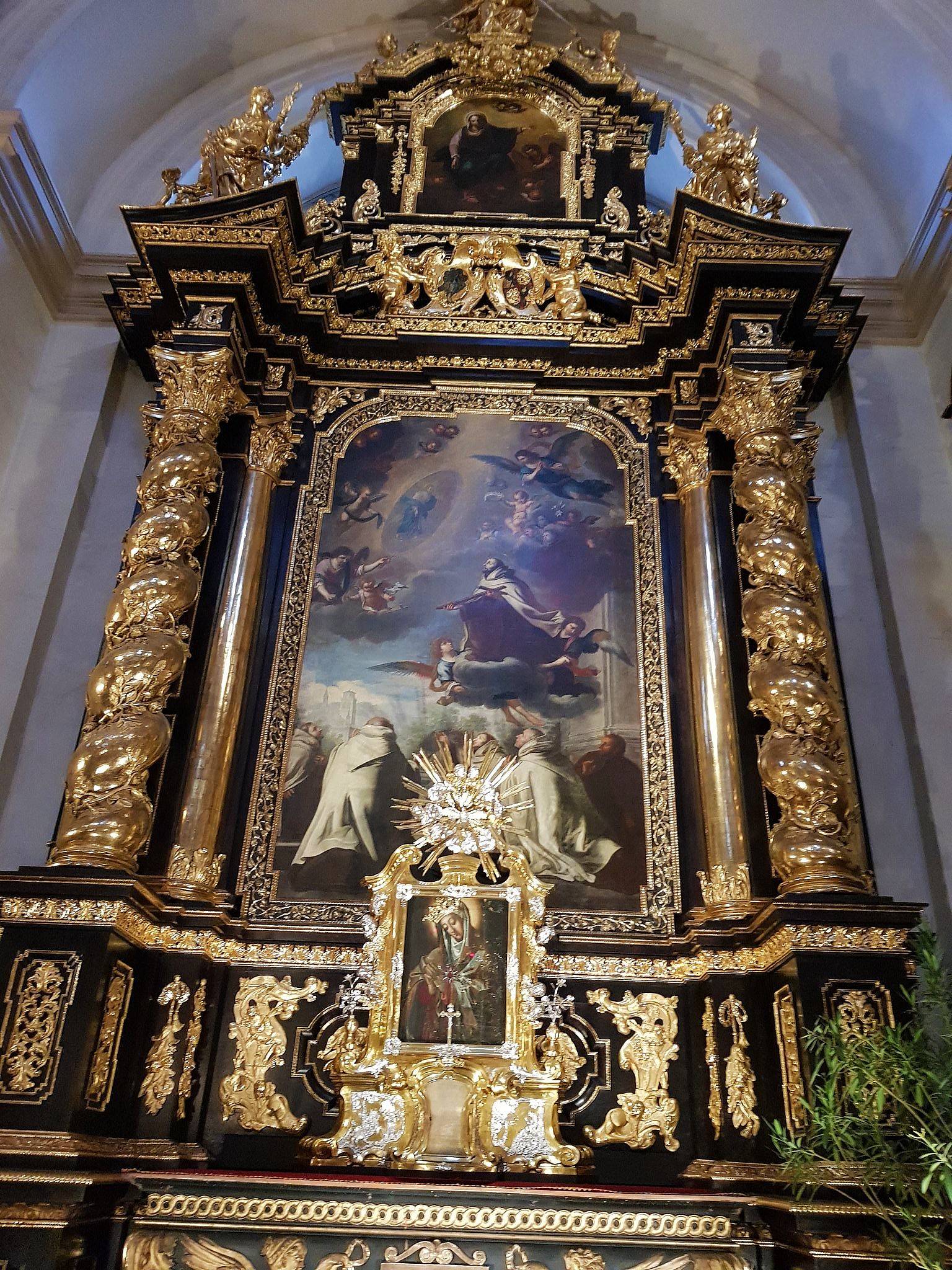
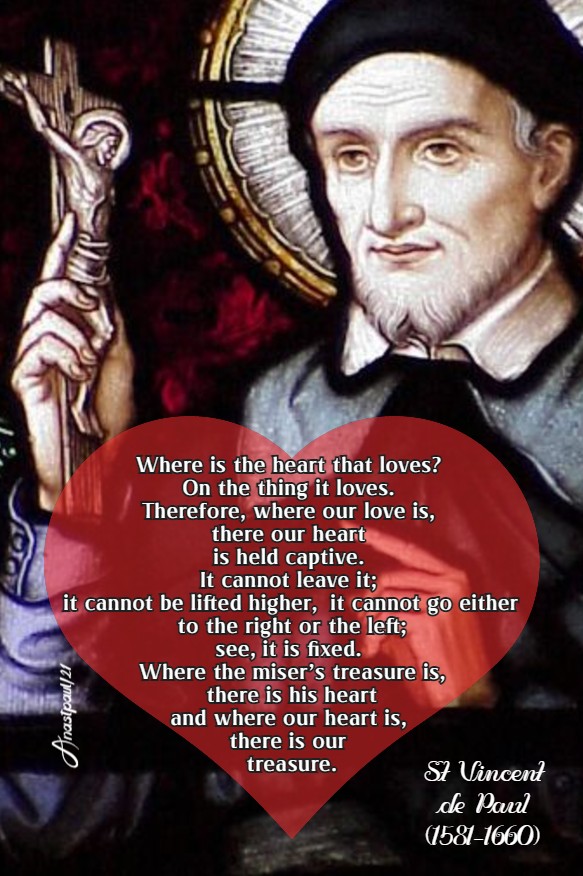
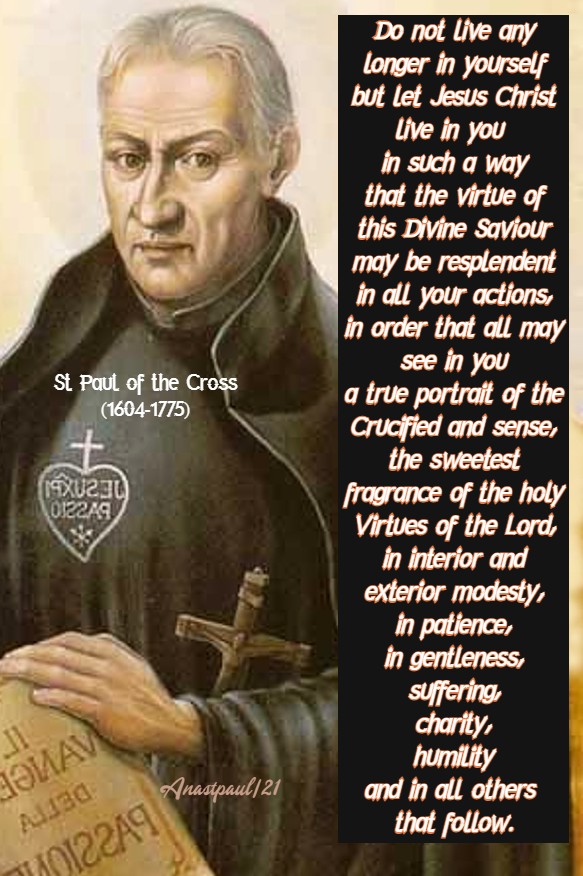
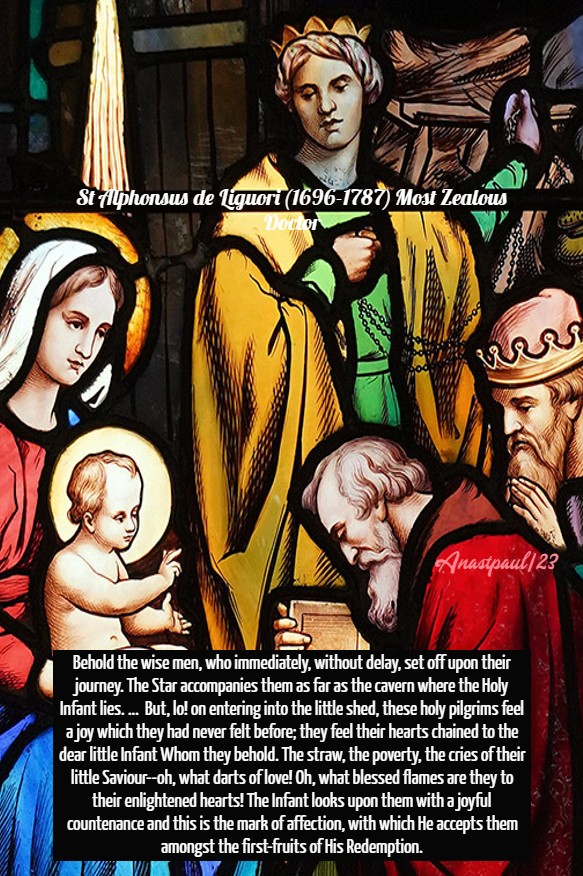
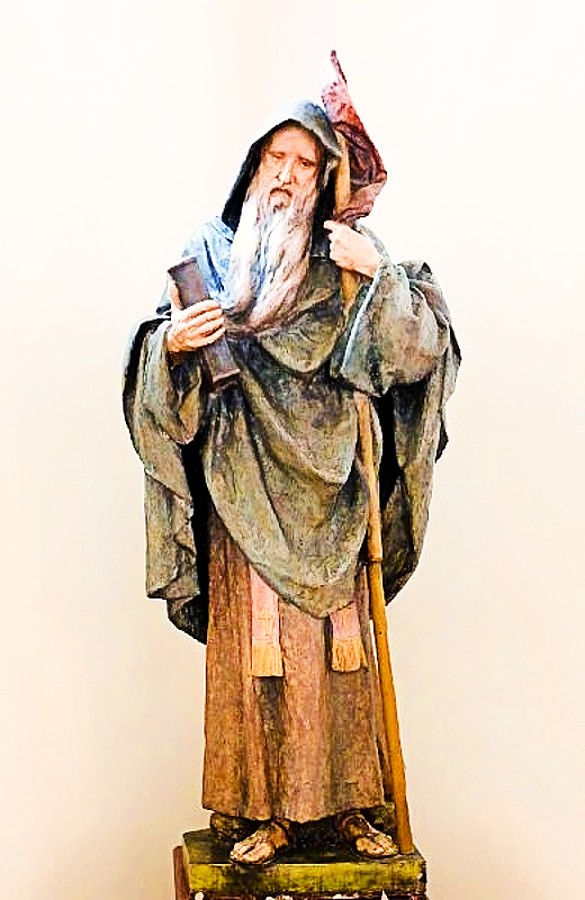
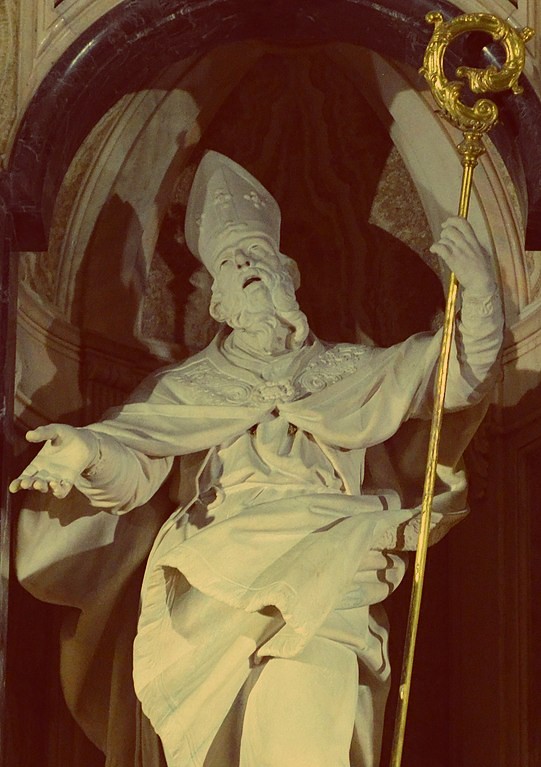
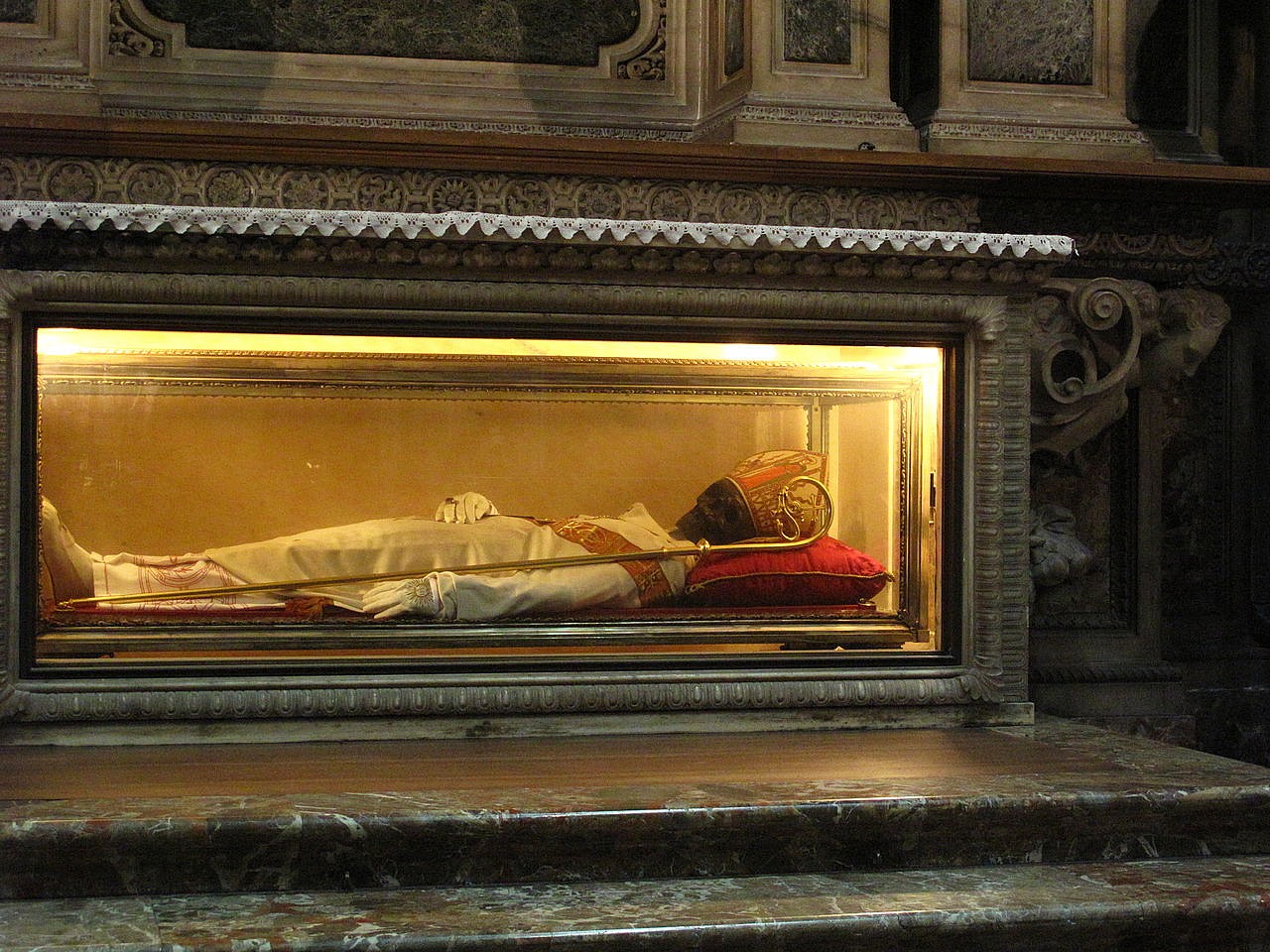
Blessed Giovanni Colombini (1300-1367) Confessor, Layman, Husband and Father, Founder of the Apostolic Clerics of Saint Jerome (the Jesuati), Apostle of the poor and the sick, Penitent, Missionary, Miracle-worker. After many miracles had occurred at his tomb, Pope Gregory XIII inserted Giovanni Colombini’s name in the Roman Martyrology, fixing 31 July for the celebration of his feast His Life https://anastpaul.com/2021/07/31/saint-of-the-day-31-july-blessed-giovanni-colombini-1300-1367/
St Helen of Skofde St Neot
Martyrs of Syria – 350 Saints: 350 monks massacred by heretics for their adherence to orthodox Christianity and the decrees of the Council of Chalcedon. 517 in Syria.
Martyrs of Synnada: 3 Saints Democritus Dionysius the Martyr Secundus
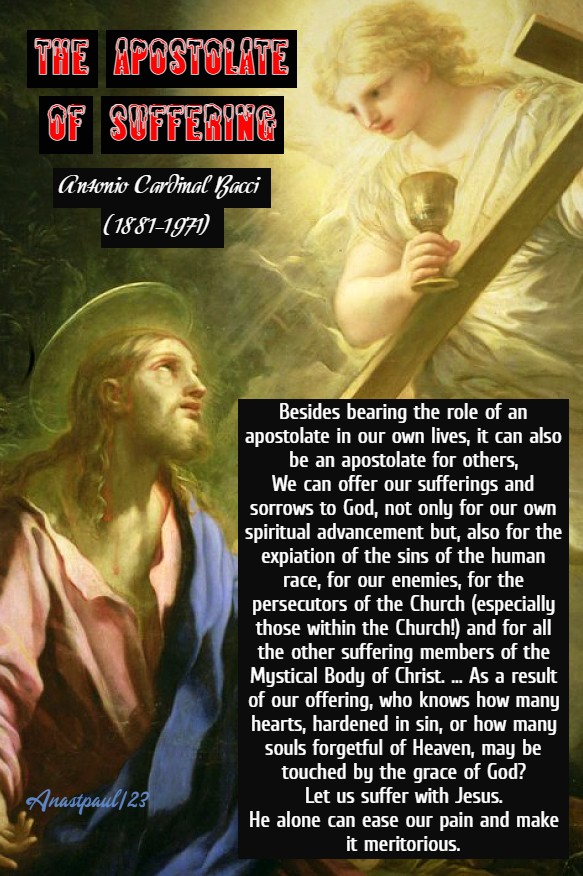
Thought for the Day – 30 July – Meditations with Antonio Cardinal Bacci (1881-1971)

Knowledge and Sanctity
“We have no right to speak evil of human learning and industry, which are a gift from God. But we must recognise that goodness is more important than knowledge. The devil’s intellect is superior to ours but, he has lost God and in losing God, has lost everything which is good.
“Knowledge puffs up” writes St Paul (1 Cor 8:1). Pride and presumption can easily spring from a little learning, whereas the fruits of holiness are always beneficial to ourselves and to others.
Let us be humble in our scientific studies and use the results which we obtain, for our own progress in sanctity.”
Quote of the Day – 30 July – Our Lady’s Saturday – Ecclesiasticus 24:14-16, Luke 11:27-28
“Gracious Lady, you are a Mother and Virgin, you are the Mother of the body and soul of our Head and Redeemer, you are also truly Mother of all the members of Christ’s Mystical Body. For through your love, you have co-operated in the begetting of the faithful in the Church. Unique among women, you are Mother and Virgin, Mother of Christ and Virgin of Christ. You are the beauty and charm of earth, O Virgin. You are, forever, the image of the holy Church. Through a woman came death, through a woman came life, yes, through you, O Mother of God.“
One Minute Reflection – 30 July – Our Lady’s Saturday – Ecclesiasticus 24:14-16, Luke 11:27-28
“Blessed is the womb that bore Thee ” – Luke 11:27
REFLECTION – “Stretching out His Hand over His disciples, the Lord Christ declared: Here are My mother and My brothers; anyone who does the Will of My Father Who sent Me, is mM brother and sister and My mother. I would urge you to ponder these words. Did the Virgin Mary, who believed by faith and conceived by faith, who was the chosen one from whom our Saviour was born among men, who was created by Christ before Christ was created in her—did she not do the Will of the Father? Indeed the blessed Mary certainly did the Father’s Will and so, it was for her a greater thing to have been Christ’s disciple, than to have been His Mother and she was more blessed in her discipleship, than in her Motherhood. Hers was the happiness of first bearing in her womb Him, Whom she would obey as her Master.
Now listen and see if the words of Scripture do not agree with what I have said. The Lord was passing by and crowds were following Him. His miracles gave proof of Divine power and a woman cried out – Blessed is the womb that bore Thee, blessed is that womb! But the Lord, not wishing people to seek happiness in a purely physical relationship, replied: – More blessed are those who hear the word of God and keep it. Mary heard God’s Word and kept it and so, she is blessed. She kept God’s Truth in her mind, a nobler thing than carrying His Body in her womb. The Truth and the Body were both Christ, He was kept in Mary’s mind insofar as He is Truth, He was carried in her womb, insofar as He is Man but what is kept in the mind is of a higher order, than what is carried in the womb.
The Virgin Mary is both holy and blessed and yet,the Church is greater than she. Mary is a part of the Church, a member of the Church, a holy, an eminent—the most eminent—member but still, only a member of the entire body. The body undoubtedly is greater than she, one of its members. This body has the Lord for its Head and Head and body together, make up the whole Christ. In other words, our Head is Divine—our Head is God!
Now, beloved, give me your whole attention, for you also are members of Christ, you also are the body of Christ. Consider how you, yourselves, can be among those of whom the Lord said: Here are my mother and my brothers. Do you wonder how you can be the mother of Christ? He Himself said: Whoever hears and fulfills the will of My Father in Heaven is my brother and my sister and my mother. As for our being the brothers and sisters of Christ, we can understand this because,, although there is only one inheritance and Christ is the Only Son, His Mercy would not allow Him to remain alone. It was His wish that we too should be heirs of the Father and co-heirs with Himself.
Now having said that all of you are brothers of Christ, shall I not dare to call you His mother? Much less would I dare to deny His own Words. Tell me how Mary became the Mother of Christ, if it was not by giving birth to the members of Christ? You, to whom I am speaking, are the members of Christ. Of whom were you born? “Of Mother Church,” I hear the reply of your hearts. You became sons of this mother at your Baptism, you came to birth then as members of Christ. Now you, in your turn, must draw to the Font of Baptism, as many as you possibly can. You became sons when you were born there yourselves and now, by bringing others to birth in the same way, you have it in your power to become the Mothers of Christ!” – St Augustine (354-430) Bishop of Hippo, Father and Doctor of Grace (An excerpt from Sermon 25).
PRAYER – Grant us, Thy servants, O Lord God, we beseech Thee, to enjoy lasting health of mind and body; and by the intercession of glorious and blessed Mary, ever virgin, may we be delivered from present sorrow and partake of the fullness of eternal happiness.Through Jesus Christ, Thy Son our Lord, Who lives and reigns with Thee, in the unity of the Holy Ghost, God, world without end. Amen (Collect).
Most Holy Virgin, My Consolation By St Germanus of Paris (c 490-576)
Most Holy Virgin! Who are the greatest consolation that I receive from God, you, who art the heavenly dew which assuages all my pains, you, who are the light of my soul when it is enveloped in darkness, you, who are my guide in unknown paths, the support of my weakness, my treasure, in poverty, my remedy, in sickness, my consolation, in trouble, my refuge, in misery, and the hope of my salvation, hear my supplications, have pity on me, as becomes the Mother of so good a God and obtain for me a favourable reception of all my petitions at the throne of mercy. Amen
Saint of the Day – 30 July – Saint Godelieve (c 1049-1070) Flemish Married Laywoman. Born in c 1049 at Londefort-lez-Boulogne, France and died by murder by being strangled by her mother-in-law’s and husband’s servants on 6 July 1070 at Gistel, Belgium. Patronages – difficult marriages, against abuse and spousal abuse, against throat diseases, in-law problems, for good weather and against storms. Also known as – Godelieve of, Ghistelles, Godelieve of Gistel, Godaleva, Godeleine, Godeleva, Godeliève, Godelina, Godeliva, Godelive, Godelva, Godliva.
The Cross and Death of St Godelieve By Fr Francis Xavier Weninger SJ (1805-1888)
“Godelieve was a native of France and the daughter of rich and noble parents, who neglected nothing, to give her an education in accor,dance with her station in life. She united with most exquisite beauty, great virtue and piety and hence was early sought in holy matrimony by many young men of the nobility. Among these, a certain Bertulph of the Netherlands, who seemed her equal in rank, gained her parent’s consent and Godeliva submitted to their will.
Having received a dowry according to her position, she went, accompanied by some of her relatives, to the Netherlands, where her marriage was to take place. But how surprising an evidence of the inconstancy of human love! Scarcely had the noble bride arrived under the roof of her future husband, when she perceived that Bertulph’s love for her was changed into hatred and aversion, as he hardly deigned to look at her. His wicked mother, if not the first, was not the last cause of this unexpected change – as she reproached her son for having chosen a foreigner for his wife, as if, in his own country, her equal in beauty and virtue could not be found. She found fault with everything the innocent Godeliva said or did and thus inflamed, the fire of contention, to such a degree that later, only the blood of the pious Godeliva could quench it.
The poor maiden’s sadness may easily be conceived but she hoped that these dark clouds would pass away. Meanwhile the arrangements for the wedding were completed and it accordingly took place. Bertulph, however, was present only during the ceremony, as he was unable to hide his aversion for his bride. He appointed a separate dwelling for her and remained with his parents, declaring that he would not hear or see anything of her, so great was the hatred he bore her. The deeply grieved Godeliva, seeing herself thus forsaken by men, sought for refuge with God. Day and night, she was on her knees imploring the Almighty to change Bertulph’s heart and fill it with Christian love.
Although God did not answer her prayers in the manner she desired, He gave her grace to submit entirely to His Divine Will and to carry her cross with heroic patience. Bertulph, in order to torment her still more and slowly to kill her, gave her a servant whom he had commanded to furnish for her sustenance daily, only a piece of bread and some water. The godless servant not only obeyed the cruel order but treated Godoliva with as much rudeness as if she had been his slave, instead of his mistress. Godrliva’s Christian virtue bore all this with indescribable patience. She never showed the least sign of indignation and no complaint of Bertulph’s inhuman command, nor the harsh treatment she received from the servant, ever passed her lips. She only uttered the praises of God, and thanked Him for giving her the opportunity to suffer.
When the profligate mother of Bertulph saw that neither hunger nor grief would, as she had hoped, end Godeliva’s life, she persuaded her son to get rid of her in some other way, as starvation was too slow. Bertulph would have been easily persuaded to follow this wicked advice, had not fear of Godeliva’s noble parents and relatives deterred him, at least for some time.
The innocent handmaid of the Lord perceived meanwhile, by the daily increasing torments, that she had nothing to expect but a violent death and, therefore, sought for an opportunity to escape. God gave her this opportunity and she, embracing it, fled, and after many hardships returned to her parents. The latter were inexpressibly griev,ed when she told them og her sufferings and being greatly indignant at the tyranny she had endured, they requested Baldwin, Count of Flanders and also the Bishop of Nimwegen, as their friend, to reproach Bertulph, seriously, with his impious conduct and command him, at the same time, to receive his wife again and in future to treat her in a different manner. Both took a deep interest in the matter and they supposed that their expostulation had impressed Bertulph, as he professed to them and to the parents of Godeliva, deep regret at his tyranny and promised on , not only to cease from maltreating her but to live with her in love and harmony. On this promise, she was commanded by her parent, to return with him to his home, which she did
No sooner, however, had she arrived there than she was more ill-treated than before. All her former miseries were redoubled and the hatred of Bertulph, now more deeply rooted, made itself more clearly manifest. Nothing was to be expected but the execution of the long nourished murderous design. The innocent Godeliva was ready for her last hour; for she was determined not to leave her husband again, even if it should cost her life. Everyday she prepared herself to die, commending her soul to the mercy of her Creator.
To some women, who came to comfort her in her misery, she said, with great cheerfulness; “You believe that I am an object of pity but I, although encompassed by sorrow, hope one day to be exalted and recompensed above all women in Flanders.” Thus she consoled herself with the contemplation of her reward in Heaven.
Into this she was soon to enter, for Bertulph was determined to do the worst. He hired two assassins to murder Godeliva. Not to be suspected of the bloody deed, he undertook a journey to Brussels, went to Godeliva and pretending to acknowledge and repent of his faults, he informed her that he was obliged to set out for Brussels but that, on his return, he would show greater love for her than she had ever expected from him. Upon this, the false spouse took leave, with the assurance that he would return in a few days. He really went away, believing that no-one would suppose him to be the instigator of the murder, which would take place during his absence.
Godeliva had no faith in his promises, his many other false demonstrations had made her suspicious. She had no doubt that her end was near. Soon after Bertulph’s departure, the two assassins entered Godeliva’s chamber at night, dragged her out of bed, put a rope around her neck, and strangled her in a most barbarous manner. After this, they placed the dead body again in the bed and covered it, thinking that no-one would discover how Godoliva had come by her death. When she was found on the following day, everyone believed that grief had put an end to her life. God, however, so ordered, that Bertulph, in the course of time, confessed his crime and, to do penance, retired into a cloister.
How precious Godeliva’s death was in the sight of the Lord, was shown by the many miracles which were wrought at her tomb. History does not tell what became of the wicked mother of Bertulph but she doubtless went to eternal destruction, if she repented not, since, by destroying the harmony between her son and his wife, she had been the cause of so much unhappiness. And the same lot will befall all those, who, by slander, tale-bearing, or other wicked means, produce the same disunion.
Woe to such mischief-makers! How great will be their responsibility before the Judgment-seat of God! The Lord, according to Holy Writ, has the greatest detestation for those who stir up dissensions among brothers and still more, for those who disturb the peace of husband and wife because the quarrels of the latter, are generally of longer duration and their consequences are more disastrous.
The Life and Miracles of Saint Godelieve, last quarter of 15th century
The two left panels represent the Saint’s piety and charity during her life in Boulogne. In the centre, the first panel shows Bertolf’s courtship, the second their marriage and the third Godelieve’s ill treatment from her husband and mother-in-law. In the two right panels the servants first strangle her, then immerse her in water, then return the body to her bed.
Godelieve’s body was exhumed in 1084 by the Bishops of Tournai and Noyon, in the presence of Gertrude of Saxony, the wife of Robert I, Count of Flanders, the Abbot of St Winnoc’s and a number of clergymen. It was Radbod II, Bishop of Noyon-Tournai, that consecrated Godelieve’s relics in 1084 and Godelieve’s popular cult developed thereafter. Godelieve’s feast day, 6 July in Belgium, was, like that of Saint Swithun in England and Saint Medard in France, connected with the weather. She is thus considered one of the “Weather Saints.”
Drogo, a Monk of St.Winnoc’s Abbey, wrote the Vita Godelieve, about ten years after her death. The Abbey of Ten Putte in Bruges, was dedicated to her. Every year, on the Sunday following 5 July, a procession celebrating Saint Godelieve takes place in Gistel.
Stained glass representations of Saint Godelieve and saint Idesbald.
Bl Richard Featherstone St Rufinus of Assisi St Senen St Tatwine of Canterbury St Terenzio of Imola Bl Thomas Abel St Ursus of Auxerre
Martyrs of Tebourba – 3 Saints: Three girls Martyred together in the persecutions of Diocletian. We know little else about them but the names – Donatilla, Maxima and Secunda. 304 at Tebourba in North Africa.
Thought for the Day – 29 July – Meditations with Antonio Cardinal Bacci (1881-1971)

Little Things
“Our eternal salvation will probably be determined by these ordinary acts of virtue and these ordinary sins. Jesus compared the Kingdom of Heaven to a mustard seed which grows into a tree. Similarly, many Saints began their spiritual ascent, by following one simple inspiration and many souls, perhaps, have found themselves condemned as a result of having neglected the commonplace virtues and inspirations.
Ordinary virtue may develop into heroic virtue but, if a man has neglected to train himself to act well in small matters, how will he behave in a time of great spiritual trial? Experience also teaches us that smaller vices can develop into great vices. “He who wastes the little he has, will be stripped bare” (Ecclus 19:11). A man who is not faithful to God in little things, will not be faithful in greater things.
We are either going up, or down, in the way of perfection – it is almost impossible to stand still! If we sincerely wish to make progress, let us resolve to avoid the least suggestion of sin and to enrich ourselves daily, by tiny acts of virtue.”
Quote/s of the Day – 29 July – St Martha, Sister of Saint Lazarus and Saint Mary of Bethany – 2 Corinthians 10:17-18; 11:1-2, Luke 10:38-42
“Martha, Martha, you are anxious and troubled about many things and yet, only one thing is needful. Mary has chosen the best part and it will not be taken away from her.”
Luke 10:41-42
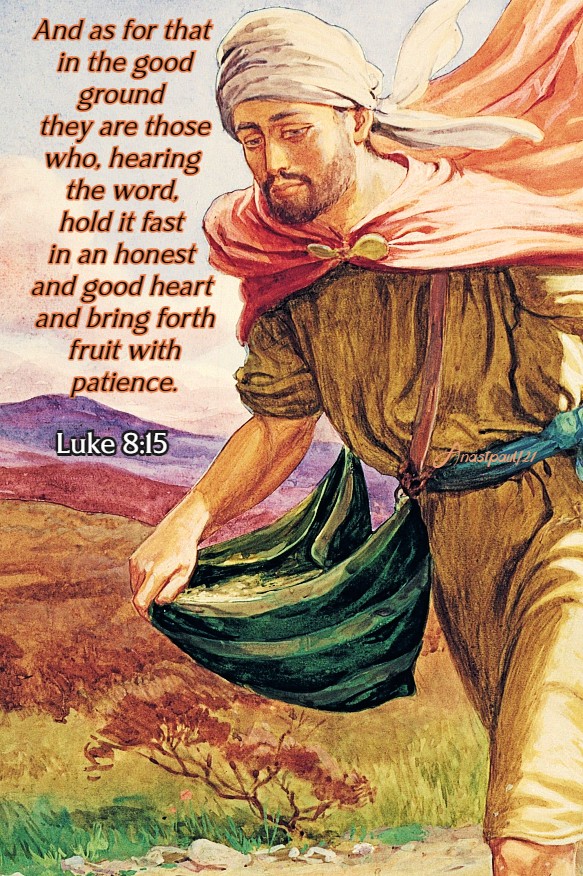
“And as for that in the good ground they are those who, hearing the word, hold it fast in an honest and good heart and bring forth fruit with patience.”
Luke 8:15
“… Scripture, as a whole, is God’s one perfect and complete instrument, giving forth, to those who wish to learn … It is one Saving Music…”
Origen (c 185-253) Priest, Theologian, Father of the Church
“Blessed are they who hear the word of God and keep it.”
Luke 11:28
“But if you will, you can be healed. Hand yourself over to the Doctor, and He will open the eyes and ears of your mind and heart. Who is to be the Doctor? It is God, Who heals and gives life through His Word and Wisdom. … ”
St Theophilus of Antioch (Died c 185) Bishop of Antioch, Confessor, Apologist, Father
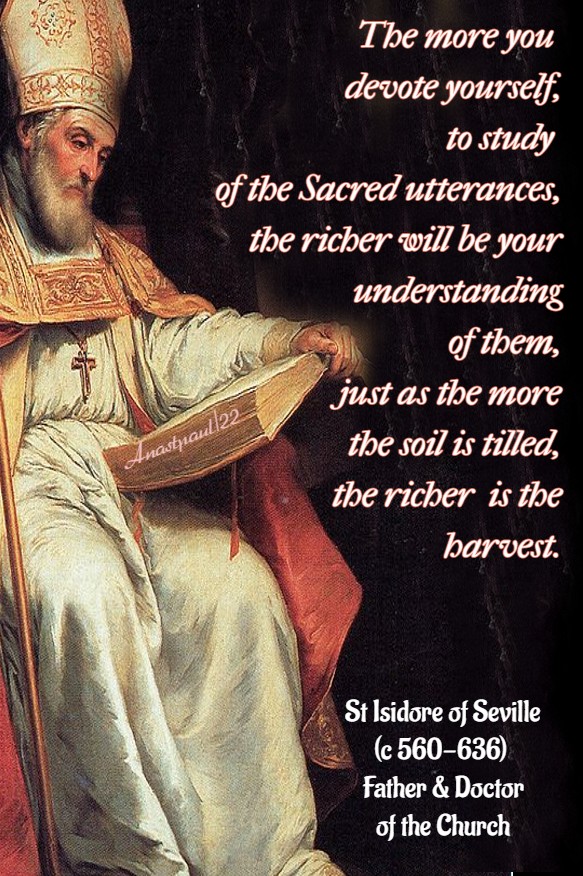
“The more you devote yourself, to study of the Sacred utterances, the richer will be your understanding of them, just as the more the soil is tilled,, the richer is the harvest.”
“Live as if you were to die tomorrow. Learn as if you were to live forever.”
St Isidore of Seville (c 560-636) Father & Doctor of the Church
“Cultivate your vineyard together with Jesus. To you the task of removing stones and pulling up brambles. To Jesus, that of sowing, planting, cultivating and watering. But even in your work, it is still He who acts. Because, without Christ, you could do nothing at all.”
One Minute Reflection – 29 July – “The Month of the Precious Blood” – St Martha, Sister of Saint Lazarus and Saint Mary of Bethany – 2 Corinthians 10:17-18; 11:1-2, Luke 10:38-42
“Martha, Martha, you are anxious and troubled about many things and yet ,only one thing is needful. Mary has chosen the best part and it will not be taken away from her.” – Luke 10:41-42
REFLECTION – “Virtue does not have a single form. In the example of Martha and Mary, there is added the busy devotion of the one and the pious attention of the other, to the Word of God, which, if it agrees with faith, is preferred, even to the very works, as it is written: “Mary has chosen the best portion, which shall not be taken away from her.”
So let us also strive to have what no-one can take away from us, so that not careless but diligent hearing, may be granted to us. For even the seeds of the heavenly Word itself, are likely to be taken away, if they are sowed by the wayside. Let the desire for wisdom lead you, as it did Mary . It is a greater and more perfect work. Do not let service divert the knowledge of the heavenly Word. Nor is Martha rebuked in her good serving but Mary is preferred because she has chosen the better part for herself, for Jesus abounds with many blessings and bestows many gifts. And, therefore, the wiser chooses what she perceives as foremost.” – St Ambrose (340-397) Archbishop of Milan, Father and Doctor of the Church (Exposition of the Gospel of Luke, 7).
PRAYER – Graciously hear us, God our Saviour, that as we rejoice in the festival of blessed Martha, Thy Virgin, so may we be nourished by the food of her heavenly teaching as to be enlightened by the fervour of her dedicated holiness.Through the same Jesus Christ, Thy Son our Lord, Who lives and reigns with Thee, in the unity of the Holy Ghost, God, world without end. Amen (Collect).
Our Morning Offering – 29 July – “The Month of the Most Precious Blood”
A Prayer of the Passion By St Melito of Sardis (Died 180) Bishop of Sardis, Apologist, Father
Lord Jesus Christ, You were bound as a ram, You were shorn like a lamb, You were led to the slaughter like a sheep, You bore the wood of the Cross on Your shoulders, You were led up the hill of Calvary, You were displayed naked on the Cross, You were nailed to the bitter Cross by three spikes, You delivered Your last Seven Words from the Cross You died on the Cross, with a shout of victory, You were buried in noble Joseph’s rock-hewn tomb, By Your boundless suffering on our behalf, fix our eyes unceasingly on Your broken Body and the Blood that poured from Yout Hands, Feet and Side. By the Holy Sacrifice of the Mass that renews each day Your Sacrifice of the Cross on our Altars, apply the merits of the Cross to all humanity and, especially to those who worship it daily and who offer themselves back to You, our great High Priest and perpetually Intercessor, before the Eternal Throne of God. You live and reign, through all the ages of ages. Amen.
Saint/s of the Day – 29 July – Blessed Luis Bertran OP (1594-1627) and Companions Martyrs. Luis was a Spanish Priest and Missionary of the Order of Preachers. Born in 1596 in Barcelona, Spain and died by being burned to death on 29 July 1627 at Omura, Nagasaki, Japan. Also known as – Luis Exarch. Additional Memorial – 10 September as one of the 205 Martyrs of Japan. Beatified on 7 May 1867 by Pope Pius IX.
The Dominican Missionary Priest, Luis Bertran, from Barcelona, Spain, was a relative of aother revered Dominican Missionary Priest with the same name, Saint Louis Bertrand (1526-1581), who had served in Latin America..
The younger Father Bertran joined the Dominicans at the Convent of Santa Catalina in Barcelona, Spain in 1611. He was sent as a Missionary firstly to the Philippines in 1618 and then to Japan in 1623 where the Catholics were in great need under the dire persecutions of the regime then in control.
Luis ministered for 4 years in secret, to the Catholics of the Omura region in Japan. Luis brought many pagans to the Faith, especially working with Dominican Tertiaries. During a period of veracious persecution, he hid from the authorities in a leper colony but was found, imprisoned and executed by being burned to death, together with Blessed Mancio de la Cruz, Blessed Pedro de Santa Maria and three of the patients who had given them shelter. Pedro was a native of Japan and Mancio, an elderly man, were both Catechists. Pedro and Mancio were formally admitted to the Dominican Order shortly before their execution.
St Antony St Beatrix of Rome Bl Beatrix of Valfleury St Callinicus of Paphlagonia St Faustinus of Rome St Faustinus of Spello St Felix of Rome St John the Soldier Bl José Calasanz Marqués St Kilian of Inishcaltra St Lek Sirdani Bl Luis Bertran OP (1594-1627) Martyr, Spanish Priest and Missionary of the Order of Preachers. St Lupus of Troyes Bl Mancius of the Cross St Olaf II St Olaus of Sweden Bl Petrus of Saint Mary St Pjetër Çuni St Prosper of Orleans St Rufo of Rome St Seraphina St Serapia of Syria St Sulian
Thought for the Day – 28 July – Meditations with Antonio Cardinal Bacci (1881-1971)
Other Ways of Resisting Temptation
“The third method, is to avoid the occasions of sin. Anyone who places himself without grave reasons, in the proximate occasions of sin is certain to fall. “He who loves danger,” the Holy Spirit warns us, “will perish in it” (Ecclus 3:27). It is useless for a man to pray, when he is exposing himself needlessly and voluntarily to the danger of sinning. He cannot expect God to hear his prayers, for this is presumption!, not confidence in God.
On the other hand, a man may be obliged to expose himself to the risk of temptation, in the course of his work, or for some other strong reason. In this case, he can be sure of God’s assistance but, he should fortify himself by fervent prayer and by taking all the precautions necessary to minimise the danger.
Where temptations against holy purity are involved, it is especially necessary to avoid, even the slightest occasion of sin, when that is possible. As St Francis de Sales was accustomed to say, there are certain battles which can only be won by soldiers, who are prepared to retreat!”
Quote/s of the Day – 28 July – Wisdom 10:17-20, Luke 21:9-19
“And you shall be hated by all men,
for My Name’s sake …”
Luke 21:17
“In that day, you will ask in My Name”
John 16:26
“Wake up then, believer and note what is stated here: “In my Name.” That [Name] is Christ Jesus. Christ signifies King, Jesus signifies Saviour. Therefore, whatever we ask for that would hinder our salvation, we do not ask in our Saviour’s Name and yet, He is our Saviour, not only when He does what we ask but also, when He does not. When He sees us ask anything to the disadvantage of our salvation, He shows Himself our Saviour by not doing it. The physician knows whether what the sick person asks for, is to the advantage or disadvantage of his health. And [the physician] does not allow what would be harmful to him, although the sick person himself, desires it. But the physician looks to his final cure.”
St Augustine (354-430) Father and Doctor of Grace of the Church
“The Name of Jesus is the purest and holiest, the noblest and most indulgent of names, the Name of all blessings and of all virtues, it is the Name of the God-Man, of sanctity itself.”
St Bernard of Clairvaux (1090-1153) Father and Mellifluous Doctor of the Church
“The eternal God asks a favour of His bride: “Hold Me close to your heart, close as locket or bracelet fits.” No matter whether we walk or stand still, eat or drink, we should at all times wear the golden locket “Jesus” upon our heart.”
One Minute Reflection – 28 July – “The Month of the Precious Blood” – St Pope Innocent I (Died 417) Confessor – Wisdom 10:17-20, Luke 21:9-19
“But you will be delivered up by your parents and brothers and relatives and friends and some of you, they will put to death. And you will be hated by all, for My Name’s sake …” – Luke 21:16-17
REFLECTION – “I must give thanks to my God continuously. He has helped me to keep my faith, through difficult times, so that I can fearlessly offer myself as a kind of living sacrifice to Christ. The Lord has rescued me from so many dangers that sometimes I just have to ask: “God, who am I?… “From where did I get such wisdom?” It certainly wasn’t from inside myself. “I didn not know my future” and I had no great knowledge of God. And later on, Who was it, Who gave me such a wonderful and life-giving gift, the gift to know and love God? But to receive such things, I had to leave behind my home and family… I came to Ireland to preach the good news and to suffer abuse from unbelievers and… to have my mission shamefully criticised. I have had many hard times, even to the point of being enslaved again but I traded in my free birth for the good of others.
If I am worthy, I am even ready to lay down my life willingly and without hesitation for His Name. Here, in Ireland, is where I wish to live out my final days, if God will permit me. I owe so much to God, Who allowed so many people to find a new life in Him through me. I confirmed them in our Faith and Ordained Clergy for them everywhere, for a people just coming to a belief in God. The Master chose them from the ends of the earth, just as He said He would through the prophets: “The gentiles will come to you from the ends of the earth” and… “I will place you like a lamp among the nations so that you may bring salvation to the ends of the earth.” – St Patrick (c 380-461) Bishop. Missionary Monk (Confession, 34-38).
PRAYER – May the Martyrdom of Your Saints Nazarius, Celsus, Victor and Innocent, give us courage, O Lord and may it give us a help to counter- our weakness.Through Jesus Christ, Thy Son our Lord, Who lives and reigns with Thee, in the unity of the Holy Ghost, God, world without end. Amen (Collect).
Our Morning Offering – 28 July – “The Month of the Most Precious Blood”
O God of Our Life By St Augustine (354-430) Father & Doctor of the Church
O God of our life, there are days when the burdens we carry chafe our shoulders and weigh us down, when the road seems dreary and endless, the skies grey and threatening, when our lives have no music in them and our hearts are lonely and our souls have lost their courage. Flood the path with light, run our eyes to where the skies are full of promise, tune our hearts to brave music, give us the sense of comradeship, with heroes and Saints of every age and so quicken our spirits, that we may be able to encourage, the souls of all, who journey with us on the road of life, to Your honour and glory. Amen
Saint of the Day – 28 July – St Samson of Dol (c 490 – 565) Bishop, Confessor, Abbot, Missionary, Miracle-worker. Born in c 490 at south Wales and died on 28 July 565 at Dol-de-Bre-ta-paign, Brittany of natural causes. Samson was the brother of Saint Gwenyth of Cornwall and Saint Veep. Also known a – Sampson of..
Samson’s parents, whose names are given as Amon of Dyfed and Anna of Gwynedd, were of noble but not royal, birth. While still an infant, he was dedicated to God and , at the age of 7 years, was entrusted to the care of St Illtyd, by whom he was brought up in the Monastery of Llantwit Major in Wales
He showed exceptional talents in his studies and was eventually Ordained Deacon and Priest by St Dubric. After this, he retired to another Monastery n Caldy Island, to practice greater austerities. Some years later , Samson was appointed the Abbot. there In about 516, some Irish Monks who were returning from Rome, happened to visit Samson’s Monastery. So struck was tAbbot Samson, by their learning and sanctity, that he accompanied them to Ireland and there remained for a while
During this visit, he received the submission of an Irish Monastery and, on his return to Wales, sent one of his uncles to act as its Superior. His fame as a miracle-worker now attracted so much attention that he resolved to found a new Monastery or cell “far from the haunts of men” and, accordingly retired with a few companions, to a lonely spot on the banks of the Severn. He was soon discovered, however and forced, by his fellow-countrymen, to become Abbot of the Monastery formerly ruled by St Germanus. Here St Dubric consecrated him Bishop but without appointment to any particular See.
Soon after, Samson received a vision from God telling him to evangelise Brittany in France.. He and some Monks there, established a Monastery at Dol which later became the centre of a new Diocese and of his Episcopal work in the district.
Business taking him to Paris, he visited King Childebert there and was nominated by him, as Bishop of Dol. He is also recorded as having attended a Council in Paris sometime between 556 and 565, by which time he would have been old.
Samson spent the rest of his life in Brittany, gaining renown for wisdom, holiness and zeal for the preaching of the Gospel, the conversion of pagans and glory of God. Samson is regarded by many, as one of the greatest of the Welsh Saints.
Samson attained the age of 85 years and was buried at Dol. Several early lives of Samson exist. The oldest, printed by Mabillon in his “Acta Sanctorum” from a manuscript at Cîteaux and again, by the Bollandists, claims to be compiled from information derived from Samson’s contemporaries, which would refer it to about 600. Dom Plaine in the “Analecta Bollandiana” has edited another and fuller life, (from manuscript Andeg., 719), which he regards as earlier than Mabillon’s. Later lives 0f St Samson are numerous.
The Anglo-Saxon King Athelstan (reign 924–939), obtained several relics of St Samson, including an arm and a crozier, which he deposited at his Monastery at Milton Abbas in Dorset.
St Pope Innocent I (Died 417) Confessor. Papal Ascension 402 until his death on 12 March 417, He defended the exiled Saint John Chrysostom and consulted with the Bishops of Africa concerning the Pelagian controversy, confirming the decisions of the African synods. The Catholic priest-scholar Johann Peter Kirsch, 1500 years later, described Innocent as “a very energetic and highly gifted individual …who fulfilled admirably the duties of his office.” Biography: https://anastpaul.com/2021/07/28/saint-of-the-day-28-july-saint-pope-innocent-i-died-417/
St Acacius of Miletus St Arduinus of Trepino St Botwid of Sudermannland St Camelian of Troyes St Celsus of Rome (Died c 68) Martyr Bl Christodoulos St Eustathius of Galatia St Irene of Cappadocia Bl John Soreth St Longinus of Satala St Lucidius of Aquara St Lyutius St Nazarius of Rome (Died c 68) Martyr St Nicanor the Deacon St Parmenas the Deacon St Peregrinus St Prochorus the Deacon St Samson of Dol (c 490 – 565) Bishop, Confessor, Abbot, Missionary
Thought for the Day – 27 July – Meditations with Antonio Cardinal Bacci (1881-1971)
The Main Ways to Conquer Temptation
“The masters of the spiritual life suggest various ways of combating temptation. As St Alphonsus de Liguori points out, however, “the first way is absolutely essential and that is, to pray to God for the light and strength, to conquer. Without prayer, it is impossible to overcome temptation, whereas with prayer, we are sure of victory” (Al Servizio Divino p 22, c 6).
The reason is obvious. Prayer is not simply a verbal address to Almighty God but is, an elevation of the mind and heart, a conversation with God. Let us pray. therefore, with confidence and with love!”
Quote/s of the Day – 27 July – The Memorial of St Pantaleon (Died c 305) Martyr, Lay Physician, one of the Fourteen Holy Helpers – 2 Tim. 2:8-10; 3:10-12, Matthew 10:26-32
“And all who wish to live piously in Christ Jesus, will suffer persecution.”
2 Timothy 3:12
“The very hairs of your head are all numbered.”
Matthew 10:30
“What is the surest kind of witness? “Anyone who acknowledges that Jesus Christ came among us in the flesh” (cf. 1Jn 4,2) and who keeps the commands of the Gospel… How many there are, each day, of these hidden martyrs of Christ who confess the Lord Jesus! … So be faithful and courageous in interior persecutions, so that you may also win the victory in exterior persecutions.”
St Ambrose (340-397) Father & Doctor of the Church
“When he has begun to follow Me, according to My teaching and precepts, he will find many people contradicting him and standing in his way, many who not only deride but even persecute him. Moreover, this is true, not only of pagans who are outside the Church but also of those, who seem to be in it visibly but are outside of it because of the perversity of their deeds. Although these glory, in merely the title of Christian, they continually persecute faithful Christians.”
St Caesarius of Arles (470-543)
“Rejoice and be happy! Persevere to the end and prefer to die rather than abandon the post, to which God has called you!”
St Catherine of Siena (1347-1380) Doctor of the Church
“Let us go forward in peace, our eyes upon heaven, the only one goal of our labours.”
One Minute Reflection – 27 July – “The Month of the Precious Blood” – The Memorial of St Pantaleon (Died c 305) Martyr, Lay Physician, one of the Fourteen Holy Helpers – 2 Tim. 2:8-10; 3:10-12, Matthew 10:26-32
“And do not be afraid of those who kill the body but cannot kill the soul. But rather, be afraid of him, who is able to destroy both soul and body in hell.” – Matthew 10:28
REFLECTION – “The Gospel is life. Impiety and infidelity are the death of the soul. So then, if the soul can die, how then is it yet immortal? Because, there is always a dimension of life in the soul which can never be extinguished. And how does it die? Not in ceasing to be life but by losing its proper life. For the soul is both life to something else and it has it own proper life. Consider the order of the creatures. The soul is the life of the body. God is the life of the soul. As the life that is the soul, is present with the body, that the body may not die, so the life of the soul (God), ought to be with the soul that it may not die.
How does the body die? By the departure of the soul. I say, by the departure of the soul, the body dies and it lies there as a mere carcass, what was a little before, a lively, not a contemptible object. There are in it still, its several members, the eyes and ears. But these are merely the windows of the house – its inhabitant is gone. Those who bewail the dead, cry in vain at the windows of the house. There is no-one there within it to hear. Why is the body dead? Because the soul, its life, is gone. But at what point is the soul itself dead? When God, its life, has forsaken it. This then we can know and hold for certain – the body is dead without the soul and the soul is dead without God. Everyone without God has a dead soul. You who bewail the dead rather, should bewail sin! Bewail ungodliness! Bewail disbelief.! – St Augustine (354-430) Bishop of Hippo, Father and Doctor of the Church (Sermon 65).
PRAYER – Grant, we beseech Thee, Almighty God, that through the intercession of Thy blessed Martyr Pantaleon, we may be delivered from all afflictions of the body and cleansed from all evil thoughts of the mind. Through Jesus Christ, Thy Son our Lord, Who lives and reigns with Thee, in the unity of the Holy Ghost, God, world without end. Amen (Collect).
Our Morning Offering – 27 July – “The Month of the Most Precious Blood”
Prayer for Five Graces By St Alphonsus de Liguori (1696-1787) Most Zealous Doctor
Eternal Father, Thy Son has promised that Thou would grant, all the graces we ask of Thee in His Name. Trusting in this promise and in the Name of and through the Merits of Jesus Christ, I ask of Thee five special graces: First, I ask pardon, for all the offenses I have committed, for which I am sorry with all my heart because I have offended Thine infinite goodness. Second, I ask for Thy Divine Light, which will enable me to see the vanity of all things of this earth and see also, Thy Infinite greatness and goodness. Third, I ask for a share in Thy love, so that I may detach myself from all creatures, especially from myself and love only Thy Holy Will. Fourth, grant me the grace to have confidence in the Merits of Jesus Christ and in the intercession of Mary. Fifth, I ask for the grace of perseverance, knowing that, whenever I call on Thee for assistance, Thou will answer my call and come to my aid. I fear only, that I will neglect to turn to Thee in time of need and thus bring myself to ruin. Grant me the grace to pray always, O Eternal Father, in the Name of Our Lord Jesus. Amen.
Saint of the Day – 27 July – Blessed Nevolone of Faenza OFM (Died 1280) Penitent, Pilgrim, Widower, Lay Friar of the Order of Friars Minor, then a Camaldolese Hermit, Apostle of the poor and sick, worked as a Cobbler / Shoemaker.. Born in the 13th Century Faenza, Italy and died on 27 July 1280 in Faenza, Italy of natural causes. Patronage – Faenza, cobblers, shoemakers, shoe repairers (chosen by the cobblers of Rimini, Italy in 1331). Also known as – Nevolo of Tavensia, Nevolone, Novellone, Nevolonius. Beatified on 4 June 1817 by Pope Pius VII.
In the great family of Saints the shoemaker stands next to the king’s son and the penitent who has atoned for the errors of his earlier life, may associate with the innocent man who has never lost the grace of God.
Born of devout parents at Faenza, Italy, Nevellon learned the trade of a shoemaker but his bad conduct caused great grief to them, especially to his good mother. He married when he was quite young and it was hoped, that now at least, he would change his ways but he continued in the same bad habits, inflicting still greater pain on his family. His mother, however, prayed and sighed without ceasing that the good Lord, Who consoled the widow of Naim by raising her son to life, would also raise her son from a spiritual death to a new life.
The prayers and tears of the mother did not remain unanswered. Almighty God caused Nevellon to become seriously ill. The nearness of death opened his eyes; he reflected on his past years, grace touched his heart and with bitter tears of true contrition, he vowed that if he recovered, he would lead a penitential life. He also resolved to make a pilgrimage to the tombs of the Holy Apostles Peter and Paul at Rome and to the tomb of St James at Compostela.
A few days later Nevellon recovered his health as if by a miracle . He was then only twenty four years old but he remained faithful to his promise all the rest of the days of his life, even up to an advanced age.
From that time on, prayer and work were his daily occupation. He became a Franciscan tertiary and converted his wife to an active faith. His charity to the poor nearly ruined his business.Mindful of the words, “Alms purge away sins” (Tob. 12,9), Blessed Nevellon retained only so much of his wages, as was necessary for he and his wife’s support and the remainder he divided among the poor and the sick. In the beginning, his wife, who was somewhat anxious over their temporalities, was much vexed at this liberality but when she saw the great blessings that attended her husband’s charity, she gave full consent.
Nevellon severely chastised his body for the sins of his past life and amid great hardships, undertook the pilgrimages he had promised, including several trips to Compostela. When his wife died, Nevelone became a Franciscan Lay Brother. But seeking greater unity with God in prayer and mortification he became a Camaldolese Hermit at the Monastery of San Maglorio in Faenza, Italy where his reputation for piety and wisdom continued to grow, leading many to emulate his spiritual ascent.
After giving the most edifying example of penance and many holy virtues for a space of fifty-six years, holy Nevellon died peacefully in the Lord in 1280. God glorified him in life and in death by miracles. His remains were interred in the Cathedral of San Pietro in Faenza. By 1282, 2 years after his death, there were so many pilgrims to his tomb that guards had to be posted to maintain order. With the approval of the Pope his native town celebrates his feast and shoemakers have chosen him for their special Patron.
St Aetherius of Auxerre St Anthusa of Constantinople St Arethas St Aurelius of Cordoba St Benno of Osnabruck (c 1020-1088) Bishop Bl Berthold of Garsten
St Ecclesius of Ravenna St Felix of Cordoba St Galactorio of Lescar St George of Cordoba St Hermippus St Hermocrates St Hermolaus St Juliana of Mataró St Lillian of Cordoba Bl Lucy Bufalari St Luican
Blessed Maria Magdalena Martinengo OSC Cap (1687-1737) Nun of the Order of the Capuchin Poor Clares, Mystic with a great devotion to the Passion of Christ. She had a great horror of sin and devoted much time to contemplating death, and the Divine Judgement. The recognition of two miracles attributed to her direct intercession allowed for Pope Leo XIII to preside over her Beatification on 3 June 1900. Her Story: https://anastpaul.com/2021/07/27/saint-of-the-day-27-july-blessed-maria-magdalena-martinengo-osc-cap-1687-1737/
St Maurus of Bisceglia St Natalia of Cordoba Blessed Nevolone of Faenza OFM (Died 1280) Penitent, Widower, Lay brother of the Order of Friars Minor, then a Camaldolese Hermit. St Pantaleimon Bl Rudolf Aquaviva S.J. Bl Robert Sutton St Semproniana of Mataró St Sergius of Bisceglia Bl William Davies Bl Zacarías Abadía Buesa
Martyrs of Nicomedia – 3 Saints: Three Christians Martyred together. The only other information to survive are their names – Felix, Jucunda and Julia. Nicomedia, Asia Minor.
Seven Sleepers of Ephesus: A group of seven young Christian men who hid in a cave in hopes of avoiding the persecution of Decius in the year 250. Found and arrested, they were ordered by the pro-consul in Ephesus to renounce their faith; they refused and were sentenced to die. Legend says that they were walled up in their hiding cave, guarded by the dog Al Rakim; when the cave wall was breached in 479 – they all woke up! It is likely that the youths were tortured to death in various ways and buried in the cave. The resurrection story confusion came from the phrase “went to sleep in the Lord” which was used to describe the death of Christians and 479 is when their relics were discovered. Their names were Constantinus, Dionysius, Joannes, Malchus, Martinianus, Maximianus and Serapion. They were martyred in 250 in Ephesus (in modern Turkey); tradition says that they were walled up in a cave to suffocate but other records indicate that they were tortured to death in various ways. Their relics discovered in 479 and translated to Marseilles, France and enshrined in a large stone coffin.
Thought for the Day – 26 July – Meditations with Antonio Cardinal Bacci (1881-1971)
TEMPTATION
“Still we must watch,” The Imitation of Christ continues, “especially in the beginning of temptation, for then the enemy is more easily overcome, if he be not suffered to enter the door of the mind but, is withstood upon the threshold, the very moment that he knocks. Whence a certain one has said: ‘Resist beginning; all too late the cure, when ills have gathered strength, by long delay’ (Ovid. Remedia Amoris 5:91). For first there comes into the mind a simple thought, then a strong imagination afterward delights and the evil notion [gains power] and [then come] consent” (Bk 1 c 13).
It is worth meditating on this vivid description of the psychology of temptation and of the simplest remedy, by which it can be combated. Every temptation is first presented to the mind as a simple thought. If a man is determined enough, it is quite easy to reject it immediately. If there is any delay, however, the concept is clothed by the imagination and projected in vivid colours until it arouses the evil inclinations of the senses. In this way, the idea takes possession of the mind, so that it is almost impossible to set it free.
We must be ready to face up to such an idea before it takes possession of us. We should treat it as we would a serpent, not pausing to examine it but, taking to flight at once! If we are resolute, the grace of God will ensure our safety!”
Quote/s of the Day – 26 July – St Anne, Mother of the Blessed Virgin Mary, Grandmother of Jesus.
St Anne, through her constant prayer, received, the Mother of God and then, became the Grandmother of God!
“God accepts our desires as though they were of great value. He longs ardently for us to desire to and love Him. He accepts our petitions for benefits, as though we were doing Him a favour. His joy in giving, is greater than ours in receiving. So let us not be apathetic in our asking, nor set too narrow bounds to our requests; nor ask for frivolous things unworthy of God’s greatness.”
St Gregory Nazianzen (330-390) Father & Doctor of the Church
“Prayer is the place of refuge for every worry, a foundation for cheerfulness, a source of constant happiness, a protection against sadness.”
“When you are weary of praying and do not receive, consider how often you have heard a poor man calling and have not listened to him.”
St John Chrysostom (347-407) Father and Doctor of the Church
“Fasting is the soul of prayer, mercy is the lifeblood of fasting. Let no-one try to separate them, they cannot be separated. If you have only one of them, or not all together, you have nothing! So if you pray, fast; if you fast, show mercy; if you want your petition to be heard, hear the petition of others. If you do not close your ear to others, you open God’s ear to yourself.”
St Peter Chrysologus (c 400-450) Father & Doctor of the Church
“Realise above all, that you are in God’s presence and stand there with the attitude of one, who stands before the Emperor.”
St Romuald (c 951-1027)
“The spirit of prayer is the spirit of the love of God and this should inspire all our vocal prayers. Flowery petitions are no use if our minds and hearts are turned away from God. God wants our hearts. Let us pray often but let our prayers be sincere acts of the love of God, coming from the heart.”
One Minute Reflection – 26 July – St Anne, Mother of the Blessed Virgin Mary, Grandmother of Jesus.– Proverbs 31:10-31, Matthew 13:44-52
“The kingdom of heaven is like a treasure buried in a field, which a person finds and hides again and out of joy, goes and sells all that he has and buys that field.” – Matthew 13:44
REFLECTION – “It was Christ who was present to all those to whom, from the beginning, God communicated His Speech and Word. If anyone, therefore, reads the Scriptures with attention, he will find, in them, an expression of Christ and a foreshadowing of this new calling. For Christ is the treasure which was hidden in the field, that is, in this world (Mt 13:38) – a treasure hidden in the Scriptures, since it was alluded to by means of symbols and parables which, humanly speaking, could not be understood prior to the fulfilment of prophecy, that is to say, before the coming of the Lord. That is why it was said to Daniel the prophet: ” Keep secret the message and seal the book until the end of time ” (12:4) … And Jeremiah also says, “In the last days they shall understand these things.” (23:20) …
When read by Christians, the Law is a treasure, hidden beforehand in a field, but brought to light and interpreted by the Cross of Christ. It shows forth the Wisdom of God and makes known His intentions with regard to our salvation; it prefigures the Kingdom of Christ and preaches, by anticipation, the Good News of our inheritance of the holy Jerusalem. It proclaims beforehand, that those who love God shall advance even to hearing and seeing His Word and, that they will be glorified by this Word …
Thus it was, that the Lord explained the Scriptures to His disciples, after His Resurrection from the dead, proving to them, by their means, that “it was necessary the Christ should suffer these things and enter into his glory” (Lk 24:26). So if anyone should likewise read the Scriptures, that person will become a perfect disciple, “like the head of a household who brings from his storeroom things both new and old.” (Mt 13:52). – St Irenaeus of Lyons ((130-202) Bishop, Martyr, Theologian – Against the Heresies, IV, 26 ; SC 100
PRAYER – O God, Who in Thy kindness gave blessed Anne the grace to be the mother of her, who Mothered Thy Only-begotten Son, graciously grant that we who keep her feast, maybe helped by her intercession with Thee. Through the same Jesus Christ, Thy Son our Lord, Who lives and reigns with Thee, in the unity of the Holy Ghost, God, world without end. Amen (Collect).
Saint of the Day – 26 July – St Anne, Mother of the Blessed Virgin Mary, Grandmother of Jesus. The name Anne from the Hebrew commonly believed to mean “grace” but St Augustine says (City of God) that it in fact means ,“by the grace of God.” Patronages – against poverty, against sterility or infertility, broommakers, cabinetmakers, carpenters,of childless couples, equestrians, expectant mothers and mothers, childbirth, grandmothers, grandparents, housewives, lace makers, lost articles, miners, old-clothes dealers, the poor,, seamstresses, stablemen, turners, Canada, France, Micmaqs, 4 Diocese, 18 Cities.
St. Anne, Mother of the Blessed Virgin Mary By Fr Francis Xavier Weninger SJ (1805-1888)
St Anne, the mother of the Blessed Virgin, was a native of Bethlehem, a City two miles distant from Jerusalem, frequently mentioned in Holy Writ. Having passed her youth in unstained purity, she was married to a man named Joachim, who was born at Nazareth in Galilee, with whom she lived in such love and harmony and, at the same time, so piously, that one could justly say of them, what St. Luke writes of Zachary and Elizabeth: “They were both just before God, walking in all the commandments and justifications of the Lord without blame.” They divided their income into three parts, the first of which was used for the honour of God and to adorn the Temple, the second to assist the poor and the third, for their own subsistence. They employed the day in prayer, work suitable to their station in life and charitable deeds.
Their only grief was, that, although so long married, they had no issue and a barren marriage was, at that time, considered a disgrace, nay almost a sign of a Divine curse. Saddened by this sorrow, St Anne, as well as her spouse, prayed with many sighs and tears, that God would take pity on them and remove the disgrace that was weighing them down. But when, after having prayed long and earnestly, they were not heard, they determined to bear patiently the will of the Almighty. As, however, St Anne knew that God required continual prayer and ,that He had not given to men a certain time to ask for grace, she ceased not to implore eaven with great confidence, for all that she believed was for His honour and her own salvation .
Being one day in the Temple, she felt her distress so deeply, that she wept bitterly,but she remembered, at the same time, that there had been another Anne, spouse of Elcana, who had been afflicted as she was but whose prayers, God at last had answered, making her the mother of the great prophet Samuel. While thinking of this, she perceived in herself, an invincible desire to beg the Lord for a like grace. Hence, she repeated her prayer with earnest fervour, promising, at the same time, that if God would grant her a child, she would consecrate it in the Temple, to His Divine service, as the above-mentioned Anne had done.
God answered the trusting, tearful prayer of His servant,and sent her, according to the opinion of the Holy Fathers, an Angel, who announced to her that she would give birth to a child who blessed among women, would become the Mother of the long expected Saviour of the world. It is also believed, that the Angel told St Anne the name which she should give to the blessed fruit of her womb. The same revelation was made to St Joachim and the happiness of both and their gratitude to the Almighty, can be easily imagined. Their happiness was crowned when St Anne gave birth to her, who was elected by God from all eternity, to become the Mother of His Only Son.
Who can describe the joy with which Anne pressed her newborn child to her heart, or the solicitude and love with which she brought it up? The knowledge that her blessed daughter was chosen by God to so great a dignity, was incentive enough, to leave nothing undone for her welfare. The mind of the blessed child was so far beyond her years and her whole being, so angelically innocent, that her education was an easy task and St Anne deemed herself, the happiest mother in the world because God had entrusted to her, so priceless a child. The graces which, through the presence of the Blessed Virgin, she received from Heaven, cannot but have been innumerable . For if, in after times, the house of Elizabeth and Zachary was, by a visit from Mary, filled with Heavenly blessings, who can doubt, that St Anne, who was the mother of the Blessed Virgin, was gifted with extraordinary graces?
Knowing, however, that Mary was not only a precious treasure lent her by Heaven but also, had consecrated herself to the service of the Almighty, St Anne did not fail to return to God, what she had received from Him and to offer willingly, what she had so willingly promised. Hardly had Mary reached the age of three years, when Anne and Joachim went with her to the temple at Jerusalem and presenting her to the Priest, consecrated her through him to the Almighty. Nothing could have been more painful to the pious parents than to separate from so perfect a child but, as they were more zealous for the glory of God, than for their own joy, even though it was so pious, they made this sacrifice without complaining. Thus Mary was received among the number of those who, under the direction of the priests, served God in the Temple and were led in the path of virtue.
After they had piously offered this agreeable sacrifice, the parents of the Blessed Virgin returned home and spent the remainder of their days in good works, which were continued by St Anne, when she became a widow by the death of her holy spouse. As she had been an example to the virgins, before her marriage, as well as a perfect model of a wife, so also was she, in her widowhood, a shining light, for all those qualities which St Paul,afterwards required of a Christian widow, in his first Epistle to Timothy. She went frequently to Jerusalem to see her holy daughter and died, according to several authors, in the 79th year of her age. Mary, who at that time still lived in the temple, closed her eyes.
As one cannot give to the Blessed Virgin a higher title than to call her, Mother of God, thus St Anne, cannot be more exalted, than when she is called the mother of her, who bore the Son of God. And for the very reason, that she was chosen to be her mother, we must believe, that the Almighty favoured her here upon earth, with grace above all the Saints and raised her to high glory in Heaven. Hence we may rightly suppose, that her intercession with God, is most powerful and this is also testified by many examples.
You must be logged in to post a comment.