St Margaret of Scotland (1045-1093) Queen Consort of Scotland Saint Margaret’s name signifies “pearl” “a fitting name,” says Bishop Turgot, her Confessor and her first Biographer, “for one such as she.” Her soul was like a precious pearl. Today is the date of St Margaret’s Death and the usual date for a Feast and in Scotland St Margaret is remembered today. But the Traditional Calendar holds her Feast on 10 June as set by Pope Innocent XII in 1693. About St Margaret: https://anastpaul.com/2018/11/16/saint-of-the-day-16-november-st-margaret-of-scotland-1045-1093-queen/
St Elpidius the Martyr St Eucherius of Lyon St Eustochius the Martyr St Felicita of Capua St Fidentius of Padua St Gobrain of Vannes St Ludre St Marcellus the Martyr St Othmar of Saint Gall (c 689-c 759) Priest, the First Abbot of the Abbey of St Gall in Switzerland. Bl Simeon of Cava
Thought for the Day – 15 November – Meditations with Antonio Cardinal Bacci (1881-1971)
Conversation with God and with Men
“Do not speak too often with men but speak often with God. We should always be in communication with God because, to converse with God, is to pray. Jesus has told us that we ought always to pray (Lk 18:1). We have a great need of intimacy with God, for if the life of grace does not flow within us, we become like arid branches and fall prey to temptations and to tepidity. In order to remain close to God, we must pray constantly. As St Paul says, “whatever you do, in word or in work, do all in the Name of the Lord Jesus, giving thanks to God the Father, through Him” (Col 3:17). This is what the Saints did. While their feet walked the earth, their minds were in Heaven.
We should imitate them by trying to cultivate the interior life which will keep us detached from the world and from sin and always close to God.”
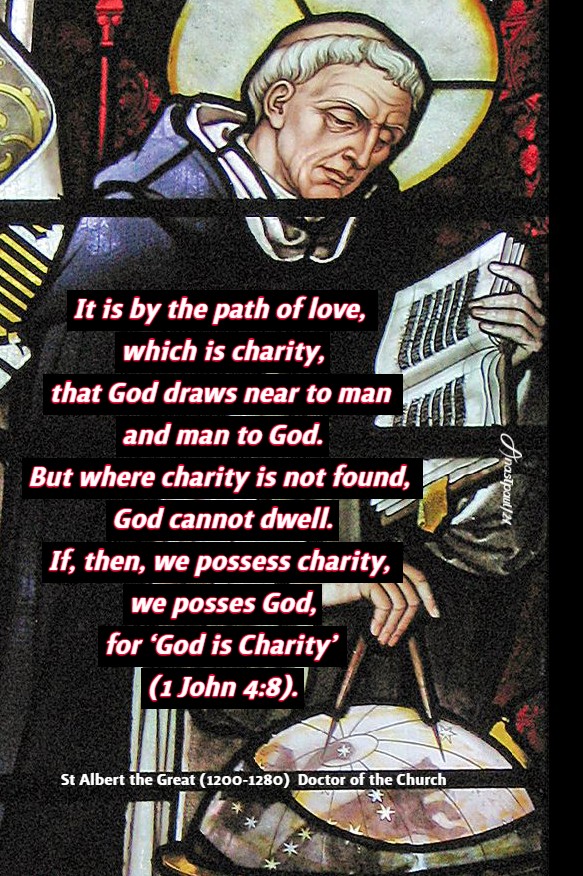
Quote/s of the Day – 15 November – St Albert the Great OP (1200-1280) Bishop, Confessor, Doctor of the Church
“It is by the path of love, which is charity, that God draws near to man and man to God. But where charity is not found, God cannot dwell. If, then, we possess charity, we posses God, for ‘God is Charity’ (1 John 4:8).”
“Banish, therefore, from thy heart, the distractions of earth and turn your eyes to spiritual joys that you may learn at last, to repose in the light of the contemplation of God.”
“Saint Joseph was the just man: by his constant fidelity -an effect of justice; by his perfect discretion – a sister to prudence; by his upright conduct – a mark of strength and by his inviolable chastity – a flower of temperance.”
St Albert the Great (1200-1280) Doctor of the Church
One Minute Reflection – 15 November – St Albert the Great OP (1200-1280) Bishop, Confessor, Doctor of the Church – 2 Timothy 4:1-8, Matthew 5:13-19 – Scripture search here: https://www.drbo.org/
“You are the light of the world.” – Matthew 5:14
REFLECTION – “I shall always love and reverence the Apostles sent by Christ and their successors, in sowing the seed of the Gospel, those zealous and tireless co-operators in propagating the Word, who may justly say of themselves: Let a man so account of us as the ministers of Christ and the dispensers of the mysteries of God. For Christ, like a most watchful and most faithful householder, wished that the Gospel lamp should be lighted by such ministers and delegates, with fire sent down from Heaven and once lighted, should not be put under a measure but set upon a candlestick, so that it may spread its brightness far and wide and put to flight, all darkness and error, rife among both Jews and Gentiles.
Now it is not enough for the Gospel teacher to be a brilliant speaker in the eyes of the people; he must also be as a voice crying in the desert and endeavour, by his eloquence, to help many to lead good lives, lest, if he omit his duty of speaking, he be called the dumb dog that is not able to bark, spoken of by the prophet. Yes, he should also burn, in such a way, that, equipped with good works and love, he may adorn his evangelical office and follow the leadership of Paul. He indeed was not satisfied with bidding the Bishop of the Ephesians: This command and teach: conduct thyself in work as a good soldier of Christ Jesus but he unflaggingly preached the Gospel to friend and foe alike and, said with a good conscience to the Bishops gathered at Ephesus: You know how I have kept back nothing that was for your good but have declared it to you and taught you in public and from house to house, urging Jews and Gentiles to turn to God in repentance and to believe in our Lord Jesus Christ.
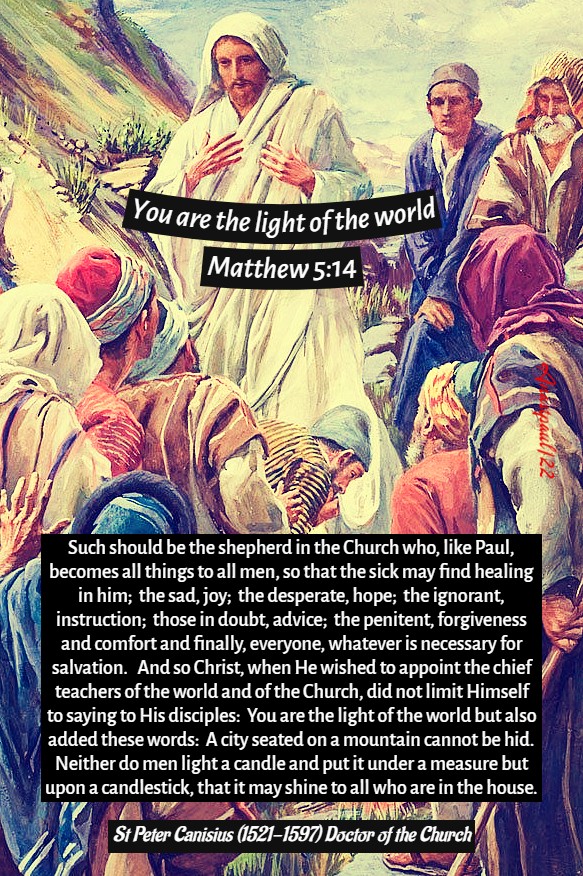
Such should be the shepherd in the Church who, like Paul, becomes all things to all men, so that the sick may find healing in him; the sad, joy; the desperate, hope; the ignorant, instruction; those in doubt, advice; the penitent, forgiveness and comfort and finally, everyone, whatever is necessary for salvation. And so Christ, when He wished to appoint the chief teachers of the world and of the Church, did not limit Himself to saying to His disciples: You are the light of the world but also added these words: A city seated on a mountain cannot be hid. Neither do men light a candle and put it under a measure but upon a candlestick, that it may shine to all who are in the house. Those churchmen err, who imagine that it is by brilliant preaching, rather than by holiness of and all-embracing love, they fulfil their office.” – St Peter Canisius SJ (1521-1597) Doctor of the Church (Sermon excerpt).
PRAYER – O God, Who made blessed Albert, ThyBishop and Doctor, eminent in the submission of human wisdom to divine faith, grant us, we beseech Thee, so to follow the path of his teaching that we may enjoy perfect light in Heaven.Through Jesus Christ, Thy Son our Lord, Who lives and reigns with Thee, in the unity of the Holy Ghost, God, world without end. Amen (Collect).
Our Morning Offering – 15 November – St Albert the Great (1200-1280) Bishop, Confessor, Doctor of the Church
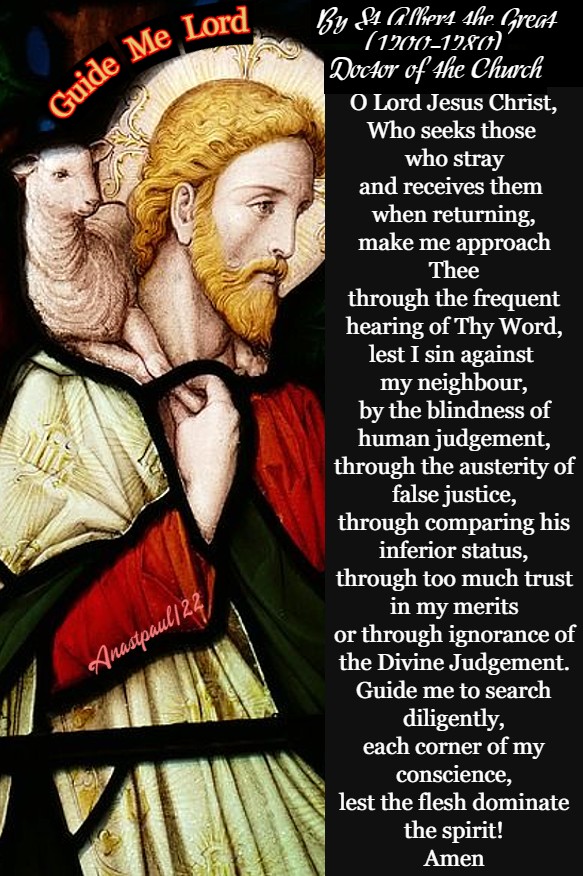
Guide Me Lord By St Albert the Great (1200-1280) Doctor of the Church
O Lord Jesus Christ, Who seeks those who stray and receives them when returning, make me approach Thee through the frequent hearing of Thy Word, lest I sin against my neighbour, by the blindness of human judgement, through the austerity of false justice, through comparing his inferior status, through too much trust in my merits or through ignorance of the Divine Judgement. Guide me to search diligently, each corner of my conscience, lest the flesh dominate the spirit! Amen
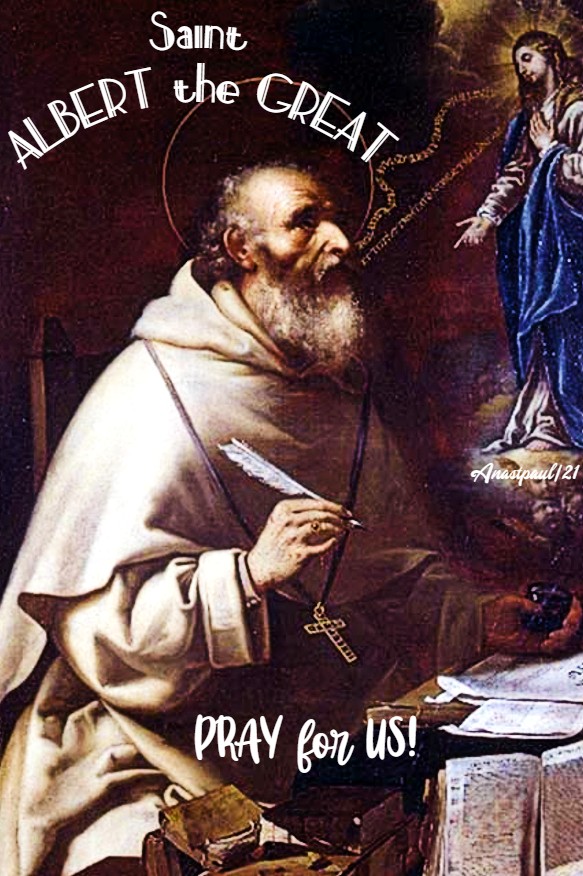
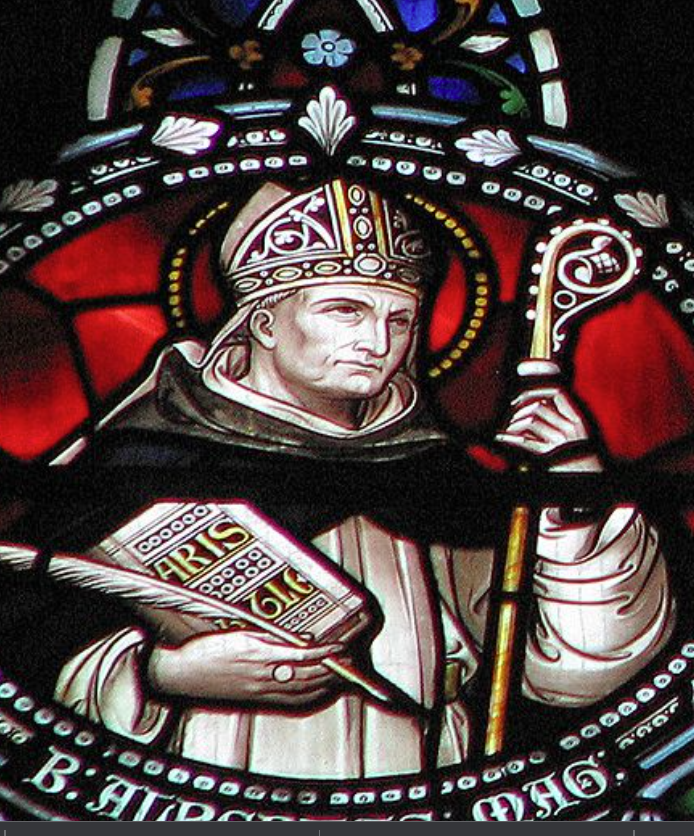
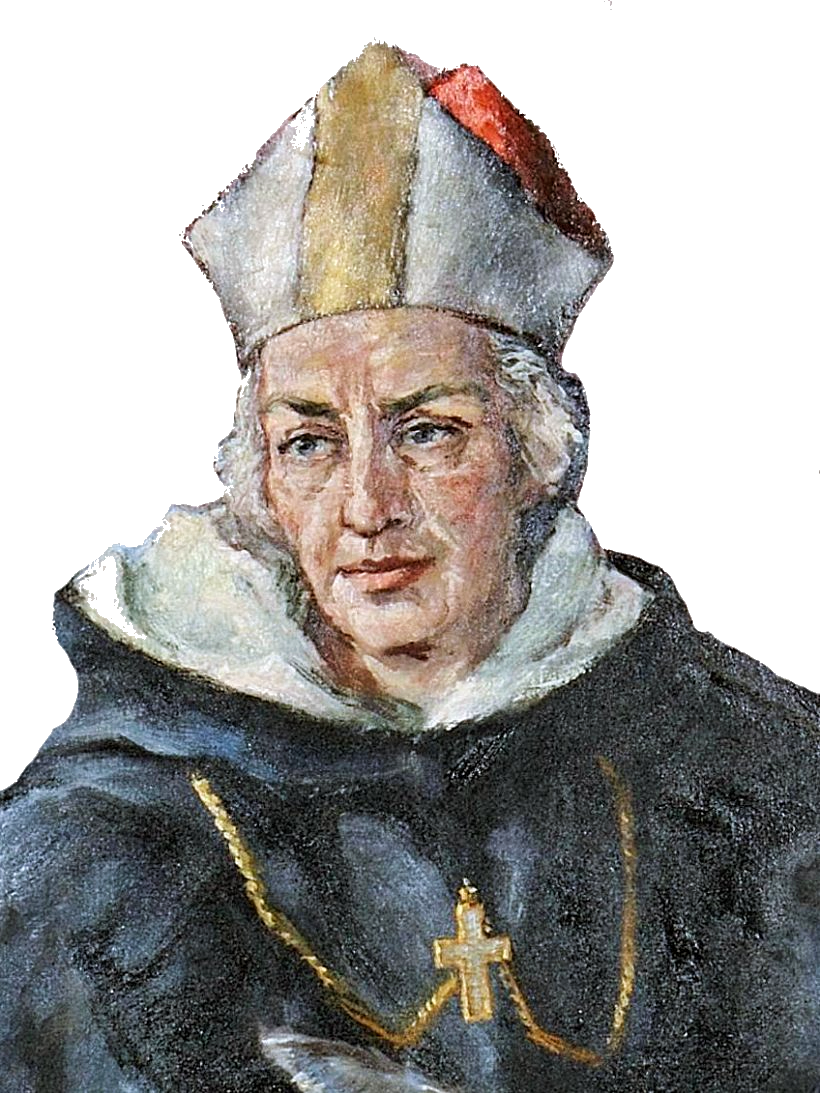
Saint of the Day – 15 November – St Albertus Magnus / the Great OP (1200-1280) Bishop, Confessor, Doctor of the Church – Doctor Universalis (Universal Doctor) – Priest and Friar of the Order of Preachers, Theologian, Scientist, Philospher, Teacher, Writer. St Albert was Beatified in 1622 by Pope Gregory XV and Canonised and created a Doctor of the Church in 1931 by Pope Pius XI. St Albert was known during his lifetime as Doctor Universalis and Doctor Expertus and, late in his life, the Sobriquet “Magnus” was appended to his name. He is the Patron of • Medical Technicians, Natural Sciences, Philosophers, schoolchildren, Scientists (proclaimed on 13 August 1948 by Pope Pius XII). Theology students. Scholars have referred to him as the greatest German Philosopher and Theologian of the Middle Ages.
St Albert the Great, Doctor of the Church From Saint Albert le Grand, 1942
Saint Albert the Great was born in the region of Augsbourg, Germany, of parents rich in the goods of fortune. From the time he was a child, he manifested in his studies, an unusual aptitude for the exact sciences. While he was still a boy, he had himself let down the side of a cliff to examine, at close range, an eagle’s nest which interested him. At the age of fifteen he was already a student of the natural sciences and the humanities, at Bologna. Saint Dominic had died in that City the preceding year, 1221 and was buried in the Dominican Convent there. Their house, in a suburban area of Bologna, was closely associated with the activities at the University and students in large numbers were requesting admission to the Order.
Blessed Reginald of Orleans, Dominican, a former Professor in Paris, came to preach there in the streets. The second Dominican General, Blessed Jordan of Saxony, a compatriot of Albert and a very eloquent Preacher, was in Padua and when the students of Bologna were transferred there, Albert heard him at the Padua Dominican Church. He had already desired to enter the Order, but his uncle, opposed to that plan a very vigorous opposition and Albert was still very young. He dreamed one night that he had become a Dominican but left the Order soon afterwards. The same day he heard Master Jordan preach and the Dominican General spoke of how the demon attempts, to turn aside those who want to enter into religion, knowing that he will suffer great losses from their career in the Church – he persuades them in dreams that they will leave it, or else they see themselves on horseback, or clothed in purple, or as solitaries in the desert, or surrounded by cordial friends; thus he makes them fear entering because they would not be able to persevere. This was precisely Albert’s great concern, faced as he was with his uncle’s opposition. Afterwards the young student, amazed, went to Blessed Jordan, saying: “Master, who revealed my heart to you?” And he lost no time then in entering the Order at the age of sixteen, in 1223, having heard the same Preacher remark, to him personally, that he should consider what a pity it would be, if his excellent youthful qualities became the prey of eternal fires!
When he had earned the title of Doctor in Theology, he was sent to Cologne, where for a long time his reputation attracted many illustrious disciples. The humble Albert, filled with the love of God, taught also in Padua and Bologna, in Saxony, at Freibourg, Ratisbonne and Strasbourg and when Blessed Jordan of Saxony died in 1237, he occupied his place and fulfilled his functions, until 1238, when the election of his successor was held. He returned then to Cologne, where he would encounter a disciple, who alone among all of them, would suffice for his glory — Saint Thomas Aquinas. This young religious, already steeped in the highest theological studies, was silent among the others, to the point of being called by his fellow students “the Mute Ox of Sicily.” But Albert silenced them, saying, “The bellowings of this ox will resound throughout the entire world!”
From Cologne, Saint Albert was called to the University of Paris, with his dear disciple. There, his genius appeared in all its brilliance and there, he composed a large number of his writings. Later, obedience took him back to Germany as Provincial of his Order. Without a murmur, he said farewell to his cell, his books and his numerous disciples and as Provincial, thereafter, journeyed with no money, always on foot, visiting the numerous Monasteries under his jurisdiction, throughout an immense territory, in which were included Austria, Bavaria, Saxony and other regions even to Holland.
He was no longer young when he had to submit to the formal order of the Pope and accept, in difficult circumstances, the Episcopal See of Ratisbonne. There, his indefatigable zeal was rewarded, only by harsh trials, in the midst of which, his virtue was perfected. When, in response to his persevering requests to be relieved of the responsibilities of a large See, Pope Urban IV restored to him the conventual peace of his Order, he was nonetheless, obliged to take up his apostolic journeyings again. Finally, he could enter into a definitive retreat, to prepare for death. One is astonished that amid so many labours, journeys and works of apostolic zeal, Albert could find the time to write on the natural sciences, on philosophy and theology, works which form from twenty-one to thirty-eight volumes, depending on the edition — and one may ask, in which of his titles, he most excelled, that of scholar, of Saint, or of Apostle?
He died, apparently of fatigue, at the age of seventy three, on 15 November 1280 and his body was buried in Cologne in the Dominican Church. He had to wait until 16 December 1931 for the honours of Canonisation and the extension of his cult to the Universal Church. Proclaiming his holiness, Pope Pius XI added the glorious title, so well merited, of Doctor of the Church. From time immemorial, he has been known as the glorious Saint Albert the Great, [Albertus Magnus, most worthy indeed, is this holy child of St Dominic!]
St Albertus Magnus OP (1200-1280) Bishop, Confessor, Doctor of the Church – Doctor Universalis (Universal Doctor) – Priest and Friar of the Order of Preachers, Theologian, Scientist, Philospher, Teacher, Writer. St Albert was Beatified in 1622 by Pope Gregory XV and Canonised and created a Doctor of the Church in 1931 by Pope Pius XI. St Albert was known during his lifetime as Doctor universalis and Doctor expertus and, late in his life, the sobriquet Magnus was appended to his name. St Albert! https://anastpaul.com/2017/11/15/saint-of-the-day-15-november-st-st-albertus-magnus-albert-the-great-o-p-1200-1280-doctor-of-the-church/
St Anianus of Wilparting St Arnulf of Toul Bl Caius of Korea St Desiderius of Cahors St Eugene of Toledo St Felix of Nola St Findan St Fintan the Missionary St Gurias of Edessa Bl Hugh Faringdon Bl John Eynon Bl John Rugg Bl John Thorne
Blessed Lucia (Lucy) of Narni OP (1476-1544) Virgin, Tertiary of the Order of Preachers, Mystic, Stigmatist, Her body is incorrupt. So many miracles occurred at her Shrine that Lucia was finally Beatified on 1 March 1710 by Pope Clement XI. It is thought that Lucia was the inspiration for th little girl Lucy, who could see many things that no-one else could, in C S Lewis’ The Chronicles of Narnia. Her Life: https://anastpaul.com/2021/11/15/saint-of-the-day-15-november-blessed-lucia-of-narni-op-1476-1544/
St Luperius of Verona St Machudd of Llanfechell St Malo of Aleth St Marinus of Wilparting
St Paduinus of Le Mans Bl Richard Whiting Bl Roger James St Shamuna of Edessa St Sidonius of Saint-Saens
Martyrs of Hippo – 20 Saints: 20 Christians Martyred together and celebrated by Saint Augustine. The only details about them to survive are three of the names – Fidenziano, Valerian and Victoria. Hippo, Numidia (in north Africa).
Martyrs of North Africa – 3 Saints: A group of Christians murdered for their faith in imperial Roman north Africa. The only details that have survived are the names of three of them – Fidentian, Secundus and Varicus.
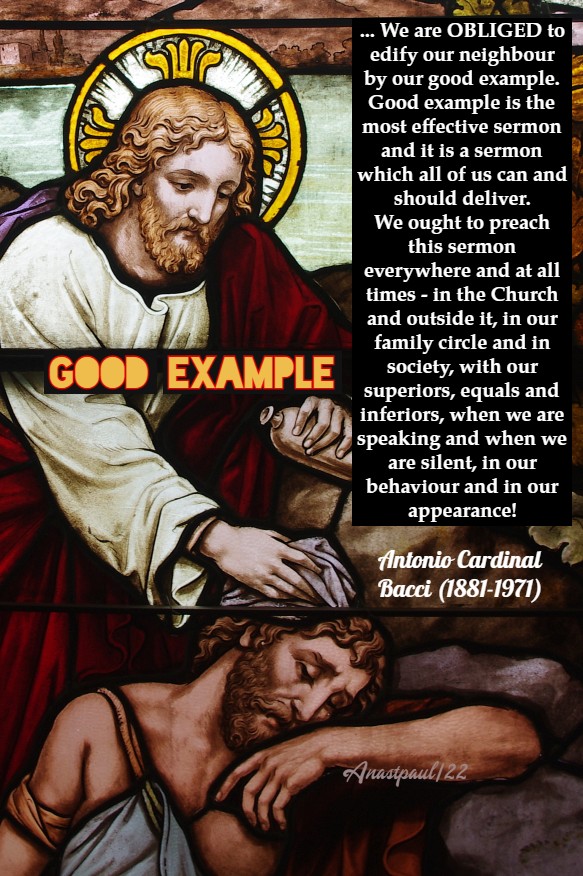
Thought for the Day – 14 November – Meditations with Antonio Cardinal Bacci (1881-1971)
Good Example
“The Holy Spirit tells us that God entrusts to everyone, the care of his neighbour (Ecclus 17:12). “Let your light shine before men,” says Jesus Christ, “in order that they may see your good works and give glory to your Father in Heaven” (Mt 5:16). St Paul echoes this counsel, when he warns us not to return evil for evil but to “provide good things, not only in the sight of God but also in the sight of all men” (Cf Rom 12:17). In other words, we are obliged to edify our neighbour by our good example.
Good example is the most effective sermon and it is a sermon which all of us can and should deliver. We ought to preach this sermon everywhere and at all times – in the Church and outside it, in our family circle and in society, with our superiors, equals and inferiors, when we are speaking and when we are silent, in our behaviour and in our appearance!”
Quote/s of the Day – 14 November – St Josaphat Kuncewicz OSBM (1584-1623) Confessor, Archbishop, Martyr – Hebrews 5:1-6, John 10:11-16 – Scripture search here: https://www.drbo.org/
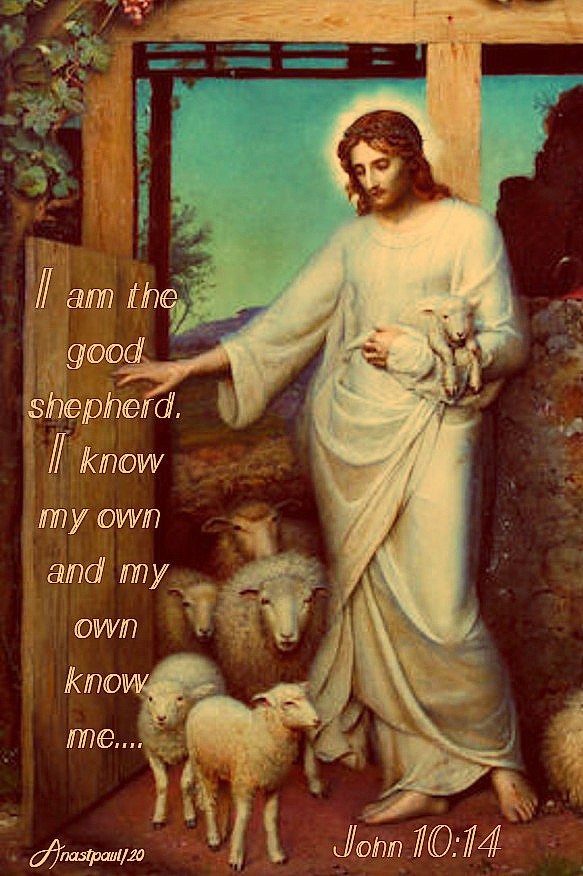
“I Am the Good Shepherd and I know mine and mine know me.”
John 10:14
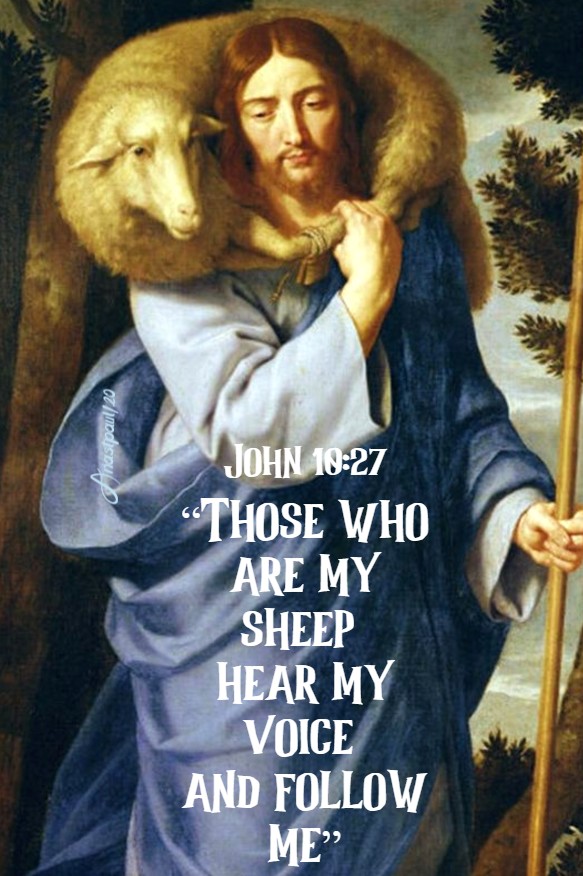
“Those who are my sheep hear my voice and follow me”
John 10:27
“He cries out, saying: See, I am with you all the days of this age. He is Himself the shepherd, the high priest, the way and the door, and has become all things at once for us.”
St Athanasius (297-373) Father & Doctor of the Church
“The mark of Christ’s sheep is their willingness to hear and obey, just as disobedience is the mark of those who are not His. We take the word ‘hear’ to imply obedience to what has been said.”
St Cyril of Alexandria (376-444) Father and Doctor of the Church
“With good reason Christ declares: I am the Good Shepherd, I seek out the lost sheep, the strayed I will bring back, the injured I will bind up, the sick I will heal (Ez 34:16). I have seen the flock of mankind struck down by sickness; I have witnessed my lambs wander about where demons dwell; I have seen my flock ravaged by wolves. All this I have seen and have not witnessed it from on high. That is why I took hold of the withered hand, gripped by pain, as if by a wolf; I have unbound those whom fever had bound; I taught him to see, whose eyes had been shut from his mother’s womb; I brought Lazarus out from the tomb where he had lain for four days (Mk 3:5; 1:31; Jn 9; 11). For I am the Good Shepherd and the good shepherd lays down his life for his sheep.”
Basil of Seleucia (Died 448) Bishop of Seleucia, Writer Oratio 26
O Lord, Show Thy Mercy to Me By St Jerome (347-419) Confessor, Father and Doctor of the Church
O Lord, show Thy mercy to me and gladden my heart. I am like the man on the way to Jericho, who was overtaken by robbers, wounded and left for dead. O Good Samaritan, come to my aid. I am like the sheep which went astray. O Good Shepherd, seek me out and bring me home, in accord with Thy will. Let me dwell in Thy house all the days of my life and praise Thee, forever and ever with those who are there. Amen.
“No matter how grave and how numerous our sins may be, let us remember that the Mercy of God is Infinite. Let us remember that He is waiting for us, as his father waited for the prodigal son and, that He is following us like a shepherd who is searching for his lost sheep. He allowed us to fall, in order to humble us and help us to realise that we are incapable of doing anything good by ourselves.”
One Minute Reflection – 14 November – St Josaphat Kuncewicz OSBM (1584-1623) Confessor, Archbishop, Martyr – Hebrews 5:1-6, John 10:11-16 – Scripture search here: https://www.drbo.org/
“I am the good shepherd and I know My Own and My Own know Me.”- John 10:14
REFLECTION – “He shows in what manner a shepherd may be proved good and, He teaches that, he must be prepared to give up his life, fighting in defence of his sheep, which was fulfilled in Christ. For man has departed from the love of God and fallen into sin and because of this was, I say, excluded from the divine abode of paradise. And when he was weakened by that disaster, he yielded to the devil tempting him to sin and death, following that sin, he became the prey of fierce and ravenous wolves. But after Christ was announced as the True Shepherd of all men, He laid down His life for us (1 John 3:16), fighting for us against that pack of inhuman beasts. He bore the Cross for us that by His own death, He might destroy death. He was condemned for us that He might deliver all of us, from the sentence of punishment: the tyranny of sin being overthrown by our faith: fastening to the Cross, the decree that stood against us, as it is written (Colossians 2:14).
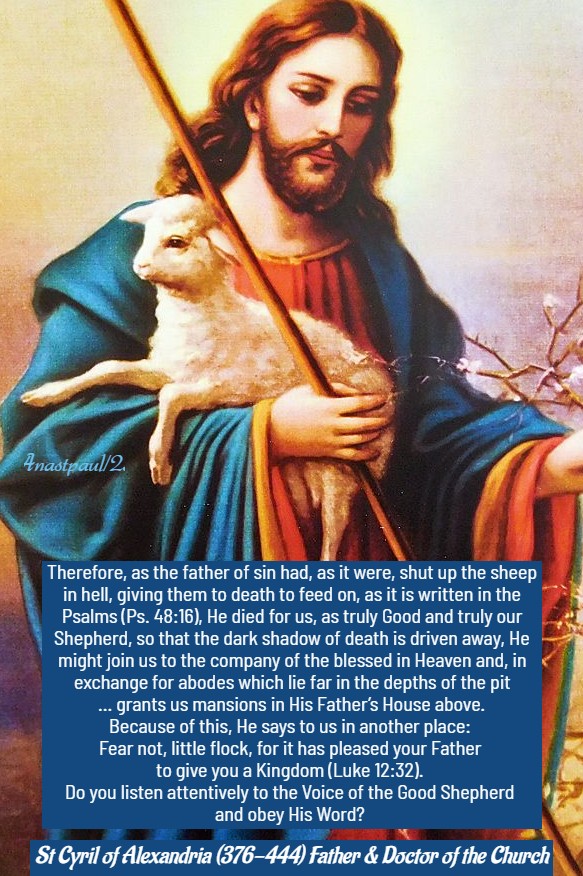
Therefore, as the father of sin had, as it were, shut up the sheep in hell, giving them to death to feed on, as it is written in the Psalms (Ps. Xlviii.16), He died for us, as truly Good and truly our Shepherd, so that the dark shadow of death is driven away, He might join us to the company of the blessed in Heaven and, in exchange for abodes, which lie far in the depths of the pit …grants us mansions in His Father’s House above. Because of this, He says to us in another place: Fear not, little flock, for it has pleased your Father to give you a Kingdom (Luke 12:32). Do you listen attentively to the Voice of the Good Shepherd and obey His Word? – ” – St Cyril of Alexander (376-444) Known as “The Pillar of Faith” Archbishop of Alexandria, Father and Doctor of the Church. (Commentary on the Good Shepherd).
PRAYER – Arouse in Thy Church, O Lord, the spirit with which blessed Josaphat, Thy Martyr and Bishop, was filled, when he laid down his life for his flock; so that, by his intercession, we, also moved and strengthened by the same spirit, may not fear to lay down our lives for our brethren. Through Jesus Christ, Thy Son our Lord, Who lives and reigns with Thee, in the unity of the Holy Ghost, God, world without end. Amen (Collect).
Saint of the Day – 14 November – Saint Siard OPraem (Died 1230) Abbot. Siard of Friesland in the Netherlands, was a holy Abbot of the Norbertine Abbey in Mariëngaard by Hallum in Friesland. He was a powerful and hardworking Administrator, abiding strictly by the Rule of the Order, Apostle of the poor and needy, a holy Abbot of deep and mystical piety and prayer, on occasion he was seen in ecstasy, Peace-maker. Patronage – against blindness, bodily ailments.
He was born to a noble Frisian family in the shadow of the Abbey of Mariëngaard and there received the white habit at the hands of St Frederick (c 780-838). During his first twenty years in the Abbey, Siard practised great penances and mortification and proved a model of edification for the brethren, to such an extent that Abbot John appointed Siard his successor on his death-bed.
Young St Siard kneeling before the Madonna and Child with St Frederick on the right standing
As Abbot his life was particularly marked by its austerity and benevolence.Nothing in his daily life distinguished him from his confreres. He wore the same habit, ate at the same table and slept in the same dormitory. On account of his exceptional humility, he resolutely refused everything that was not strictly necessary. He was a good administrator who governed his Monastery well, both in spiritual and material matters. He laboured zealously with his Monks, particularly in the fields harvesting wheat. He would lead the confreres in the singing of Psalms during harvest time. He was extremely open to those who sought his advice and ensured that the Abbey became known as a place of refuge throughout the region.
As a model of perfection, Siard had also given Blessed Dodo of Haskerland his Norbertine education. He showed a true conciliatory spirit, settling disputes quickly and with the utmost gentleness and understanding. Furthermore, the Saint extended the lands of the Abbey and guided the constructios of various additions to the buildings. The apostolic spirit of the Order thrived at Mariëngaarde under his leadership. Whenever Siard went on a journey, he took along a large basket full of bread and other foods that he could distribute among the poor. Because of this he is usually depicted with a basket at his feet.
Once on a journey, the holy Abbot came across a noisy celebration of music and dance. He stopped and turned to his brothers saying, “Just imagine what songs of joy the angel choirs must sing when they celebrate the conversion of a single sinner.” He urged three things upon the confreres who had to leave the Monastery on a journey – a joyous departure, a peaceful sojourn and a happy return. Known also for his miraculous cures of the sick and ailing, the Monastery began to attract many in search of the alleviation of their physical illnesses, after Siard cured a man of blindness.
Siard had a special devotion to Martha and Mary. He looked to Martha, as an example for his care of the confreres and to Mary, as a reminder of the necessity of listening to Christ, in prayer and meditation. On occasion, he would fall into ecstasy during prayer and hear the heavenly music of the angels.
Naturally the austhere life which Siard had implemented, was not popular with all of the Canons and,, in 1290, one of their number attempted to murder the Abbot. His loud cries brought the aid of the confreres and he escaped with only minor injuries.
He had been Abbot for thirty six years when he died on 14 November 1230. Numerous faithful were granted special favours by God, at his grave. After the destruction of Mariëngaarde by the Calvinists in 1578, his earthly remains were rescued by a Frieslanden nobleman, Siard of Helsema, who brought them to Hildesheim. In 1608 his Relics were divided and placed in two separate Reliquaries. In 1617, one of these was brought to the Abbey of St Feuillin du Roeulz. After the suppression of this Abbey during the French Revolution, the Relics were taken to the Church at Strépy. In 1938 Prelate Bauwens brought them to the Norbertine Abbey of Leffe. The other Reliquary was brought to Tongerlo in 1617, where ever since the people have held St Siard in great honour and celebrated his Feast each year, with great solemnity. A part of the Relic of Siard’s head found a home in the Generalate House in Rome, until 2000 when it was transferred to the Abbey of Windberg.
The cult of St Siard was confirmed by Pope Benedict XIII on 22 January and 8 March in 1728.
O God, Who made Thy Saints to obey the Gospel as an example for many, grant, we beseech Thee, that we may imitate the cheerful goodness and devout piety of the blessed Abbot Siard. We ask this through our Lord Jesus Christ, Thy Son, Who lives and reigns with Thee in the unity of the Holy Ghost, One God forever and ever. Amen.
All Saints of the Carmelite Order: On this day, the Carmelite Family celebrates the memory of all its holy men and women, those known and those unknown, those living on Earth and those living in Heaven, who reflect the glory of God.
St Joseph Maria Pignatelli SJ (1737 – 1811) Priest of the Society of Jesus known as “The Restorer of the Society of Jesus” and “The Second Founder of the Society of Jesus” following the suppression of the Society of Jesus by Pope Clement XIV in 1773. He was Beatified on 21 May 1933 by Pope Pius XI and was Canonised on 12 June 1954 by Venerable Pope Pius XII. His Life: https://anastpaul.com/2019/11/14/saint-of-the-day-14-november-saint-joseph-maria-pignatelli-sj-1737-1811/
St Jucundus of Bologna
St Laurence O’Toole/Lorcán Ua Tuathail (c 1128 – 1180) Archbishop of Dublin, Abbot, Reformer, Mediator, Preacher, Apostle of Charity, Papal Legate to Ireland, he established new Churches and Monasteries. Due to the great number of miracles that rapidly occurred either at his tomb or through his intercession, Lorcán was canonised only 45 years after his death in 1225 by Pope Honorius III. Biography: https://anastpaul.com/2018/11/14/saint-of-the-day-14-november-st-laurence-otoole-c-1128-1180/
St Modanic St Pierre of Narbonne St Ruf of Avignon St Serapion of Alexandria
St Serapion of Algiers OdeM (c 1179–1240) Mercedarian Priest and Martyr, Soldier and Crusader. The Roman Martyrology states today: “At Algiers in Africa, the blessed Serapion, of the Order of Our Blessed Lady of Ransom, for the Redemption of the faithful in captivity and the preaching of the Christian Faith. He was the first of his Order to deserve the Palm of Martyrdom by being crucified and cut to pieces.” On 14 July 1728, a decree was issued confirming his immemorial cult. he was Canonised on 14 April 1728 by Pope Benedict XIII and on 24 August 1743, he was included in the Roman Martyrology. His Life and Death: https://anastpaul.com/2021/11/14/saint-of-the-day-14-november-saint-serapion-of-algiers-odem-c-1179-1240-martyr/
St Siard OPraem (Died 1230) Abbot of the Premonstratensian Order or the “Norbertines.” St Venerando the Centurian St Venerandus of Troyes
Martyrs of Emesa: Group of Christian women tortured and executed for their faith in the persecutions of the Arab chieftain Mady. They died in Emesa (modern Homs, Syria).
Martyrs of Heraclea – (3 Saints): Group of Christians murdered together for their faith. The only details we have are three of their names – Clementinus, Philomenus and Theodotus. They were Martyred in Heraclea, Thrace.
Thought for the Day – 13 November – Meditations with Antonio Cardinal Bacci (1881-1971)
Almsgiving and Simplicity
“There are others who give generously but are anxious to make a good appearance before their fellowmen. It is of these that it has been written “they have received their reward.” (Mt 6:2).
We should give with holy simplicity in the manner indicated in the Gospel. “When thou givest alms, do not let thy left hand know what thy right hand is doing.” (Mt 6:3). Such unostentation generosity, is more pleasing to the poor than the gift itself.”
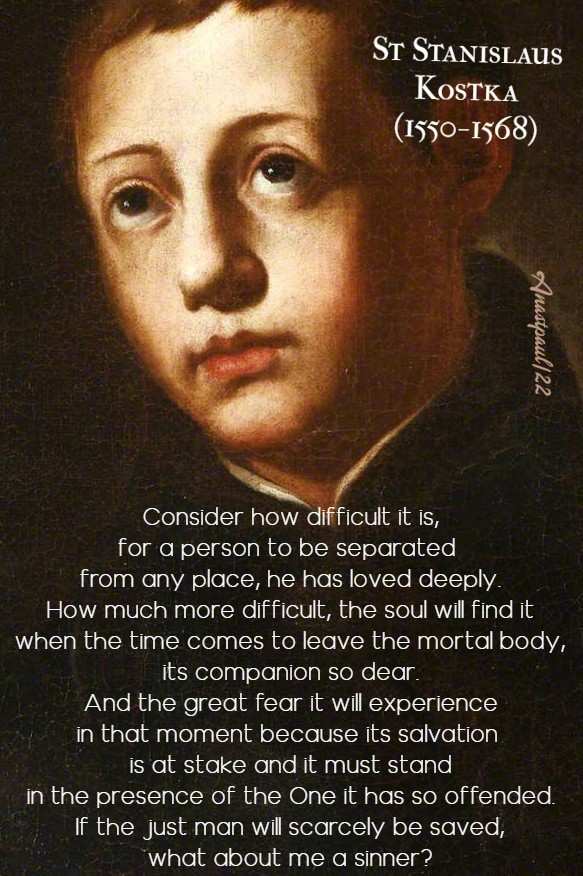
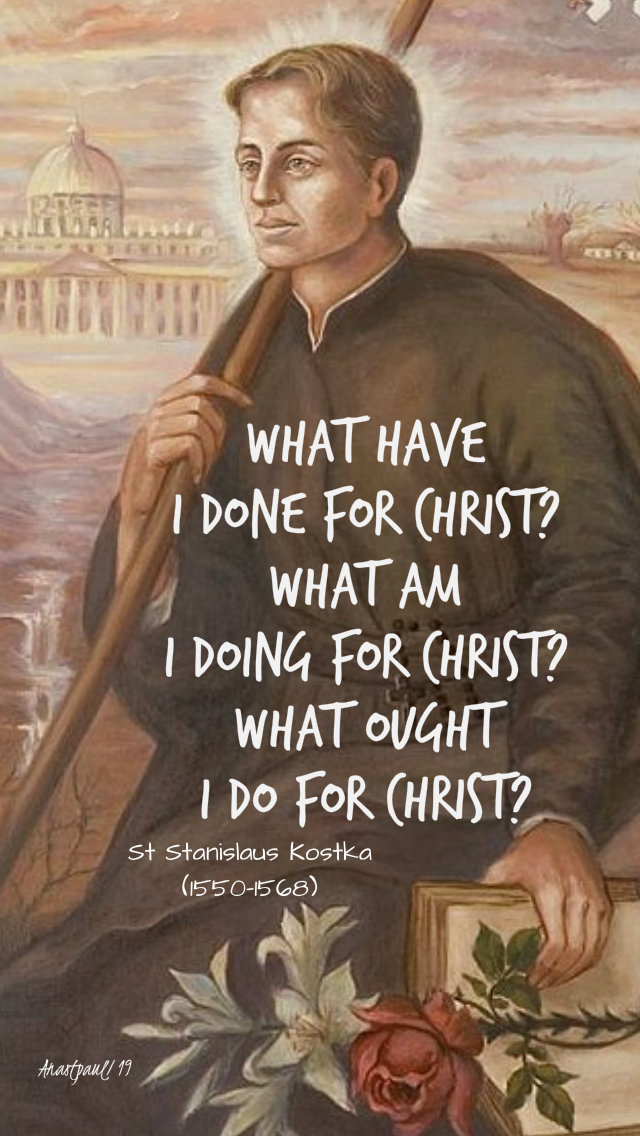
Quote/s of the Day – 13 November – St Stanislaus Kostka SJ (1550-1568) Jesuit Novice
“Consider how difficult it is, for a person to be separated from any place, he has loved deeply. How much more difficult, the soul will find it when the time comes to leave the mortal body, its companion so dear. And the great fear it will experience in that moment because its salvation is at stake and it must stand in the presence of the One it has so offended. If the just man will scarcely be saved, what about me a sinner?”
“What have I done for Christ? What am I doing for Christ? What ought I do for Christ?”
One Minute Reflection – 13 November – The Twenty Third Sunday after Pentecost – St Didacus de Alcalá de Henares) OFM (c 1400-1463) Confessor and the Feast of All Saints of the Augustinian Order – Philippians 3:17-21; 4:1-3, Matthew 9:18-26 – Scripture search here: https://www.drbo.org/
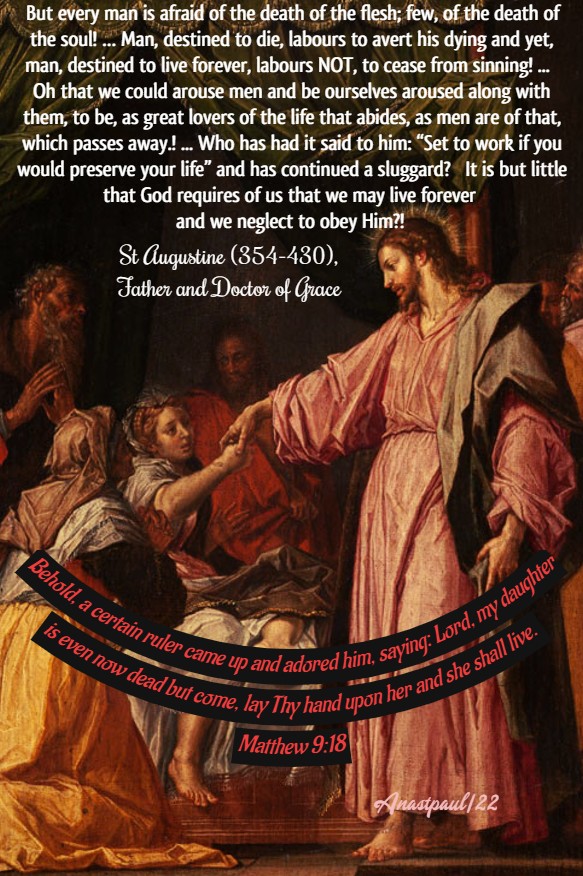
“Behold .a certain ruler came up and adored him, saying: Lord, my daughter is even now dead but come, lay Thy hand upon her and she shall live. ” – Matthew 9:18
REFLECTION – “The hour is coming, in which all that are in their graves ,shall hear His Voice and shall come forth” (Jn 5,28)… We have read in the Gospel, of three dead persons who were raised to life by the Lord and, let us hope, to some good purpose. For surely the Lord’s deeds are not merely deeds but signs… We were listening with wonder… in the reading of the Gospel, how Lazarus was restored to life (Jn 11). If we turn our thoughts to the still more wonderful works of Christ, everyone who believes, rises again – if we all consider and understand that more horrifying kind of death which everyone who sins dies.
But every man is afraid of the death of the flesh; few, of the death of the soul! …Man, destined to die, labours to avert his dying and yet, man, destined to live forever, labours not, to cease from sinning! … Oh that we could arouse men and be ourselves aroused along with them, to be, as great lovers of the life that abides, as men are of that, which passes away.! … Who has had it said to him: “Be off to sea, if you would escape with your life” and has delayed to do so? Who has had it said to him: “Set to work if you would preserve your life” and has continued a sluggard? It is but little that God requires of us that we may live forever and we neglect to obey Him?! …
If, then, the Lord in the greatness of His grace and mercy, raises our souls to life that we may not die forever, we may well understand, that those three dead persons whom He raised in the body, have some figurative significance of that resurrection of the soul, which is effected by faith.” – St Augustine (354-430), Father and Doctor of Grace of the Church (Sermons on Saint John’s Gospel, no.49, 1-3).
PRAYER – Almighty, eternal God, Who in Thy wondrous providence, choose the weak things of the world to overcome the strong, mercifully grant unto us Thy humble servants that, by the loving prayers of blessed Didacus, Thy Confessor, we may be found worthy to be raised unto the everlasting glory of Heaven. Through Jesus Christ, Thy Son our Lord, Who lives and reigns with Thee, in the unity of the Holy Ghost, God, world without end. Amen (Collect).
Our Morning Offering – 13 November – The Twenty Third Sunday after Pentecost – All Saints of the Benedictine & Cistercian Orders
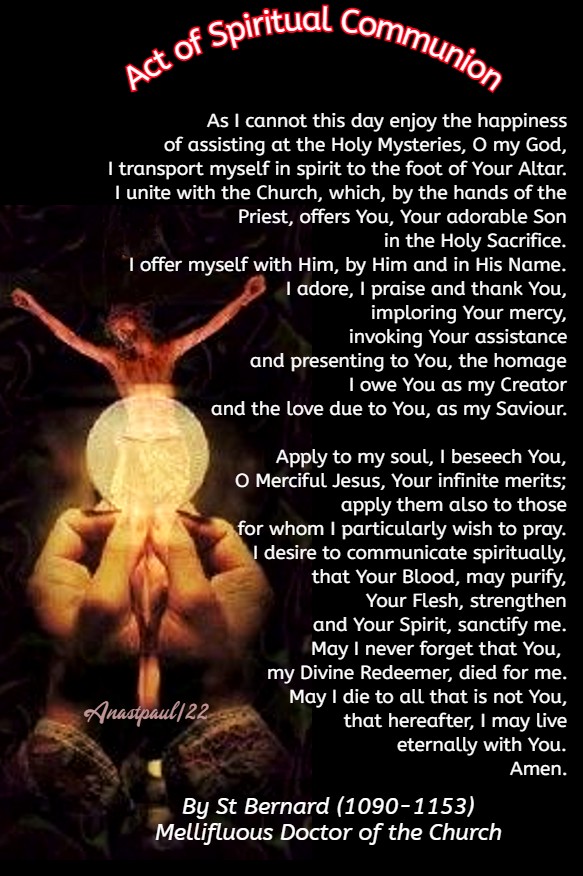
Act of Spiritual Communion By St Bernard O. Cist (1090-1153) Mellifluous Doctor of the Church
As I cannot this day enjoy the happiness of assisting at the Holy Mysteries, O my God, I transport myself in spirit to the foot of Your Altar. I unite with the Church, which, by the hands of the Priest, offers You, Your adorable Son in the Holy Sacrifice. I offer myself with Him, by Him and in His Name. I adore, I praise and thank You, imploring Your mercy, invoking Your assistance and presenting to You, the homage I owe You as my Creator and the love due to You, as my Saviour.
Apply to my soul, I beseech You, O Merciful Jesus, Your infinite merits; apply them also to those for whom I particularly wish to pray. I desire to communicate spiritually, that Your Blood, may purify, Your Flesh, strengthen and Your Spirit, sanctify me. May I never forget that You, my divine Redeemer, died for me. May I die to all that is not You, that hereafter, I may live eternally with You. Amen.
Saint of the Day – 13 November – Blessed Leone of Assisi OFM (Died 1271) Priest and Friar of the Friars Minor of St Francis, Confessor, Secretary and Companion of St Francis, commonly known as “Brother Leo.” Died at Assisi, on15 November, 1271. His date and place of birth is uncertain but is believed to have been in Assisi and not in Viterbo, as some writers have asserted.
Although not one of the original twelve companions of St Francis, Leo was one of the first to join him after the approbation of the first Rule of the Friars Minor (1209-1210) and perhaps was already a Priest. In the course of time, he became the Confessor and Secretary of the Saint, and from about 1220, o the time of Francis’ death, Leo was his constant companion.
Leo was with the “Poverello” when the latter retired to Fonte Colombo near Rieti in 1223 to re-write the Rule of the Order and he accompanied him on his subsequent journey to Rome, to seek its approval. During the following year. Leo was with the Saint on Mount La Verna, when Francis received the Stigmata. Francis called him “Frate Pecorello di Dio – Little poor one of God” because of Leo’s simplicity and tenderness. Leo nursed his master during his last illness.
Leo had entered deeply into the bitter disappointments experienced by the Saint during the last few years of his life and soon after St Francis’s death, he came into conflict with those whom he considered traitors to the Poverello and his ideal of poverty.
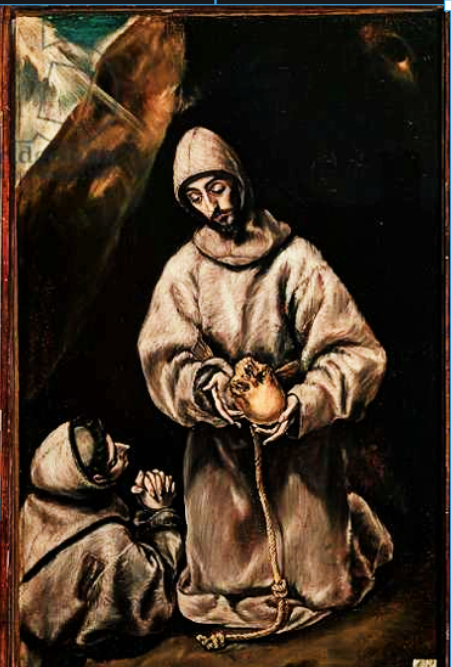
St Francis and Bl Leone contemplating morality by El Greco
After Francis’s death Leo took a leading role in the opposition to Elias of Cortona. Having protested against the collection of money for the erection of the Basilica of San Francesco, it was Leo who broke in pieces the marble box which Elias had set up for offerings, for the completion of the Basilica at Assisi. For this, Elias had him scourged and this outrage, on St Francis’s dearest disciple, consolidated the opposition to Elias. Leo was the leader in the early stages of the struggle in the Order for the maintenance of St Francis’ ideas on strict poverty.
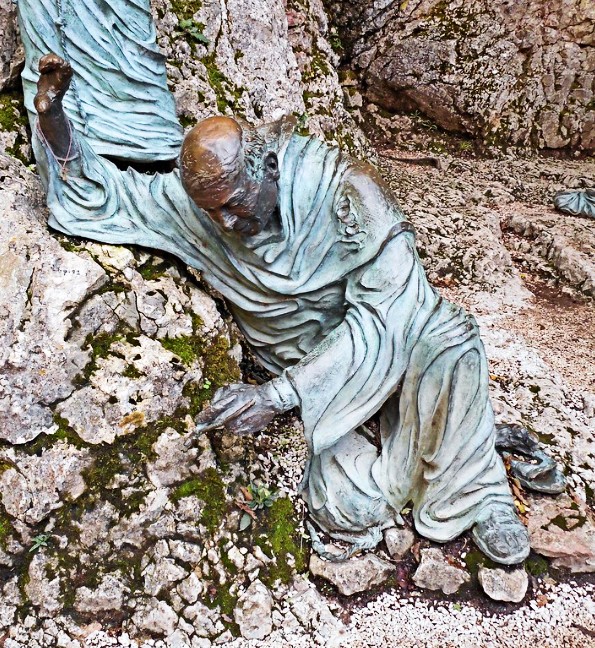
Friar Leone (Detail) – “Saint Francis, Friar Leone and Friar Ginepro admire the sky” – modern bronze statues by Fiorenzo Bacci – “Eremo delle Carceri” at Assisi
He retired , thereafter, to a hermitage of the Order. Leo assisted at Saint Clare’s deathbed in 1253. After suffering many persecutions, by the dominant party in the Order, he died at the Portiuncula, in extreme old age and his remains are buried in the Basilica of St Francis in Assisi.
Much that is known concerning him was collected by Paul Sabatier in the “Introduction” to the Speculum perfectionis (The Mirror of Perfection). It was likely compiled after his death, based on stories that he told and in his writings.
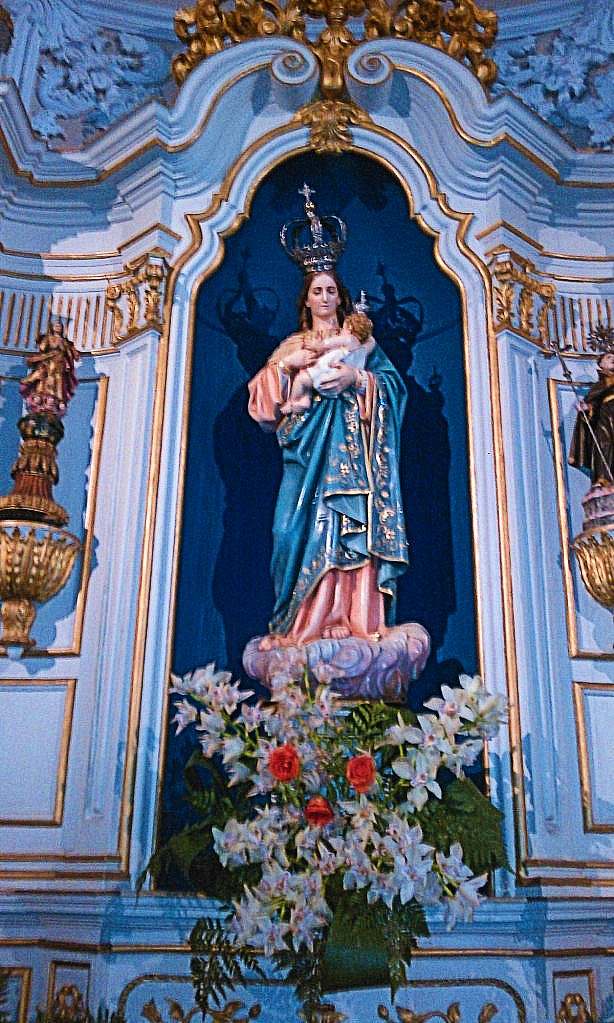
Fiesta del Patronato de Nuestra Señora / Feast of the Patronage of Our Lady (1679):
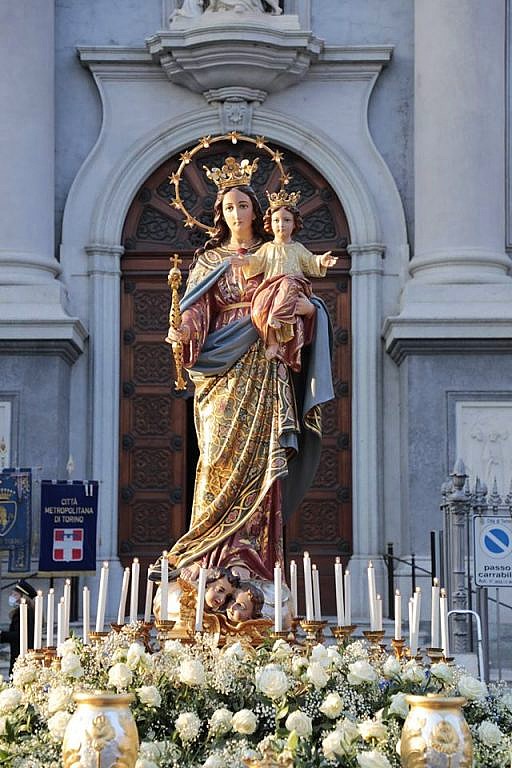
Statue of Our Lady in Barcelona Cathedral
This Feast was first permitted by Decree of the Sacred Congregation of Rites, on 6 May, 1679, for all the Provinces of Spain, in memory of the victories obtained over the Saracens, heretics and other enemies, from the sixth century to the reign of Philip IV. Pope Benedict XII ordered it to be kept in the Papal States on the third Sunday of November. To other places it is granted, on request, for a Sunday in November, to be designated by the ordinary. The Office is taken entirely from the Common of the Blessed Virgin and the Mass is the “Salve sancta parens”. In many places the Feast of the Patronage of Our Lady, is held with an additional title of Queen of All Saints, of Mercy, Mother of Graces.
St Didacus de Alcalá de Henares) OFM (c 1400-1463) Confessor, Lay Brother of the Order of Friars Minor, Hermit, Mystic. Months passed before it was possible to bury Brother Didacus, so great was the number of people who came to venerate his remains. Not only did his body remain incorrupt but it diffused a pleasant odour. After it was laid to rest in the Franciscan Church at Alcalá de Henares, astounding miracles continued to occur at his tomb. Pope Sixtus V, himself a Franciscan, Canonised Brother Didacus in 1588. About this lovely Sainst: https://anastpaul.com/2021/11/13/saint-of-the-day-13-november-saint-didacus-ofm-c-1400-1463/
St Frances Xavier Cabrini (1850-1917) Mother Cabrini, was an Italian-American religious sister, who founded the Missionary Sisters of the Sacred Heart of Jesus, that was a major support to the Italian immigrants to the United States, Cardinal Mundelein of Chicago officiated at her funeral and in 1938 also presided at her beatification by Pius XI. She was canonised by Pius XII in 1946. She lies buried under the altar of the chapel of Mother Cabrini High School in New York City.(Memorial for the United States only ) – her Universal Feast Day is 22 December. Biography: https://anastpaul.com/2017/12/22/saint-of-the-day-22-december-st-frances-xavier-cabrini-m-s-c-1850-1917/
All Saints of the Augustinian Order: On 13 November – St Augustine’s Birthday, we celebrate the Feast of All Saints of the Augustinian Order. On this day we call to mind the many unsung brothers and sisters of the Augustinian family who have “fought the good fight” and celebrate now, in Heaven. Let us pray for one another that we too may one day join in the “unceasing chorus of praise” with all our Augustinian brethren in Heaven.
All Saints of the Benedictine & Cistercian Orders: Those interested in the Benedictine family may be interested to know that today, within the Benedictine liturgical tradition, is traditionally celebrated the Feast of All Saints of the Benedictine Order – In Festo Omnium Sanctorum Ordinis S.P.N. Benedicti. The Cistercians — who also follow the Rule of St Benedict — likewise observe this day for All Saints of their Order. (On a related note, the Benedictines also traditionally observe 14 November as All Souls of their Order.
All Benedictine Saints
St Benedict and St Bernard -1542
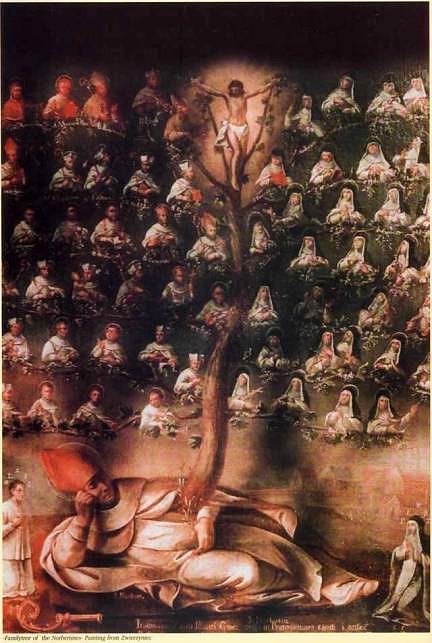
All Saints of the Premonstratensian Order or the “Norbertines.” The Order of Canons Regular of Prémontré, also known as the Premonstratensians, the Norbertines and, in Britain and Ireland, as the White Canons , are a Roman Catholic religious order of canons regular founded in Prémontré near Laon in 1120 by Saint Norbert, who later became Archbishop of Magdeburg. Premonstratensians are designated by O.Praem. following their name. St Norbert was a friend of Saint Bernard of Clairvaux and so was largely influenced by the Cistercian ideals as to both the manner of life and the government of his order. Aside from St Norbert there are at present fifteen saints of the Order who have been Canonised or have had their immemorial cults confirmed by the Holy See. St Norbert (c 1080-1134) “Defender of the Eucharist” and “Apostle of the Eucharist” – Bishop, Confessor, Founder. Patron for peace, invoked during childbirth for safe delivery, of infertile married couples. St Norbert here: https://anastpaul.com/2017/06/06/saint-of-the-day-6-june-st-norbert/
St Norbert
All Saints of the Norbertines
All Deceased Dominican Brothers and Sisters
St Abbo of Fleury St Amandus of Rennes St Amanzio St Beatrix of Bohemia St Brice of Tours (Died 444) Bishop St Caillin St Chillien of Aubigny St Columba of Cornwall St Dalmatius of Rodez St Devinicus St Eugenius of Toledo St Florido of Città di Castello St Gredifael St Himerius St Homobonus of Cremona St Juan Ortega Uribe Blessed Leone of Assisi OFM (Died 1271)Priest and Friar of the Friars Minor, Companion, Secretary and Confessor of St Francis. St Leoniano of Vienne St Maxellendis St Mitrius St Pope Nicholas I St Paterniano St Quintian of Rodez Bl Robert Scurlock Bl Warmondus of Ivrea
Martyrs of Caesarea – 5 Saints: A group of Christians murdered for their faith in the persecutions of Diocletian, Galerius Maximian and Firmilian. – Antoninus, Ennatha, Germanus, Nicephorus and Zebinas. 297 at Caesarea, Palestine.
Martyrs of Ravenna – 3 Saints: A group of Christians murdered together in the persecutions of Diocletian. The only information about them that has survived are three names – Solutor, Valentine and Victor. c 305 in Ravenna, Italy.
Martyrs of Salamanca – 5 Saints: The first group of Christians exiled, tortured and executed for their adherence to the Nicene Creed during the persecutions of the Arian heretic Genseric. – Arcadius, Eutychianus, Paschasius, Paulillus and Probus. Born in Spain and Martyred in 437. Their relics are at Medina del Campo, Spain.
Thought for the Day – 12 November – Meditations with Antonio Cardinal Bacci (1881-1971)
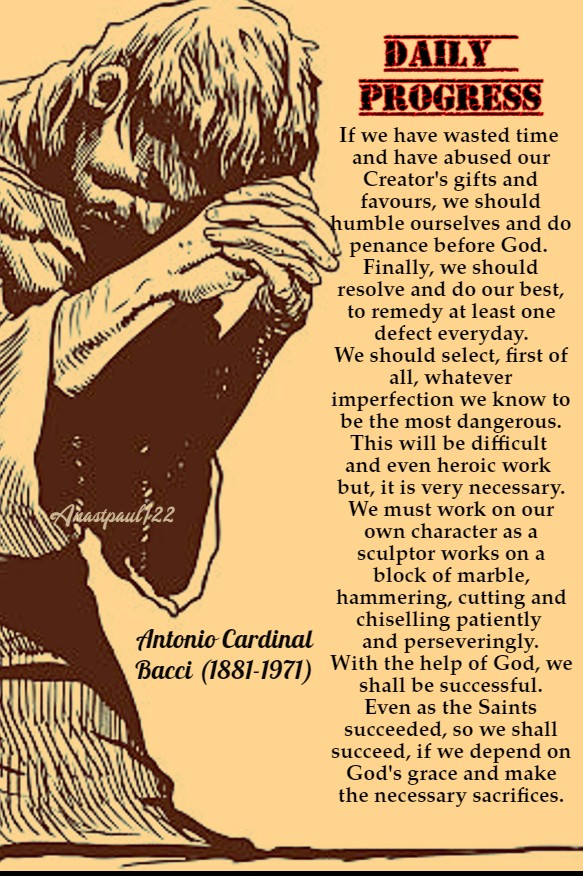
Daily Progress
“There are two ways in which we should make constant daily progress. The first is in the removal of our defects and imperfections. As TheImitation of Christ insists, we should soon become holy, if we were to conquer, at least, one sin every year.
It is opportune, at this stage, to ask ourselves, how many years we have already spent on earth? During these years, how many personal defects can we claim to have remedied? Perhaps there was a time when we were better than we are now? If we have wasted time and have abused our Creator’s gifts and favours, we should humble ourselves and do penance before God.
Finally, we should resolve and do our best, to remedy at least one defect everyday. We should select, first of all, whatever imperfection we know to be the most dangerous. This will be difficult and even heroic work but, it is very necessary. We must work on our own character as a sculptor works on a block of marble, hammering, cutting and chiselling patiently and perseveringly. With the help of God, we shall be successful. Even as the Saints succeeded, so we shall succeed, if we depend on God’s grace and make the necessary sacrifices.”
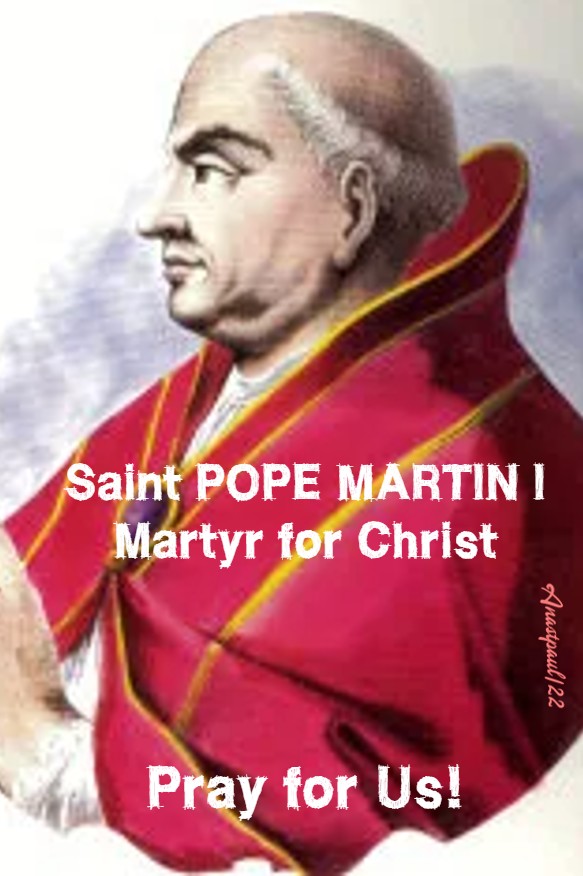
Quote/s of the Day – 12 November – St Martin I, Pope (598-655) Martyr – 1 Peter 5:1-4; 5:10-11, Matthew 16:13-19 – Scripture search here: https://www.drbo.org/
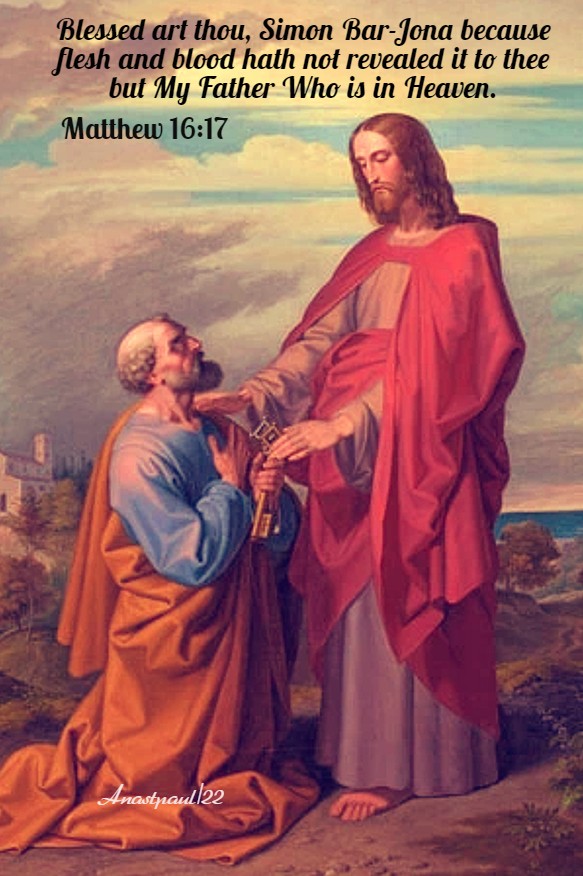
“Blessed art thou, Simon Bar-Jona because flesh and blood hath not revealed it to thee but My Father Who is in Heaven.”
Matthew 16:17
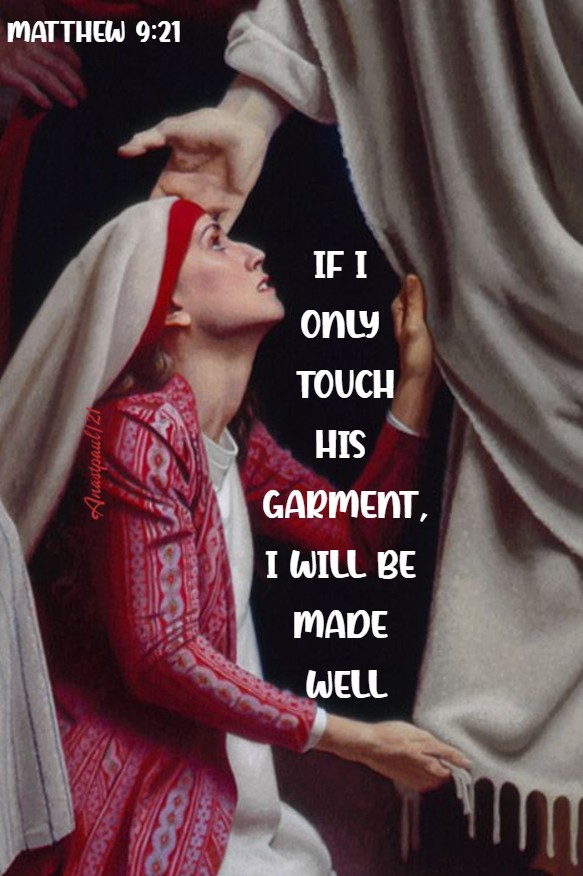
“If I only touch his garment, I will be made well.” Jesus turned and seeing her he said, “Take heart, daughter, your faith has made you well.” And instantly the woman was made well.”
Matthew 9:21-22
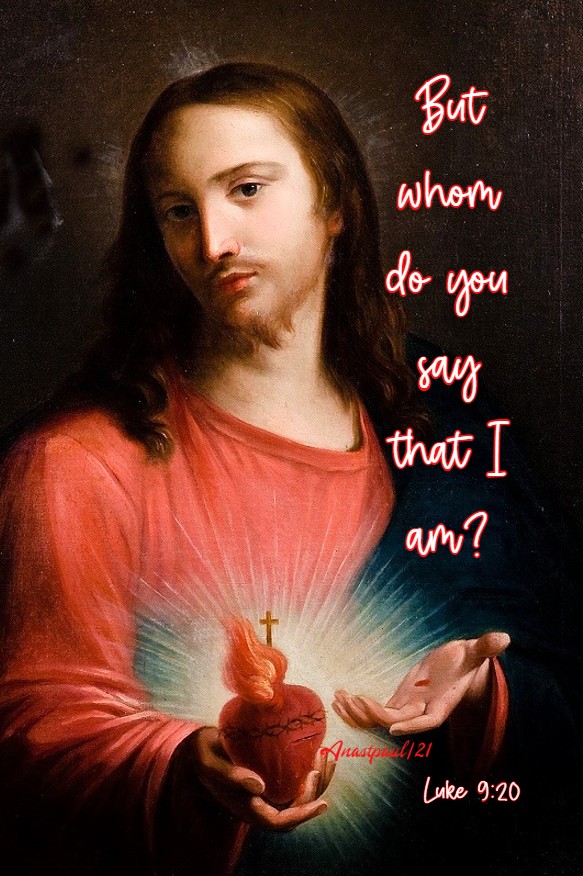
“But whom do you say that I Am?”
Luke 9:20
“Our pilgrimage on earth cannot be exempt from trial. We progress by means of trial. No-one knows himself except through trial, or receives a crown, except after victory, or strives, except against an enemy or temptations.”
St Augustine (354-430) Father and Doctor of Grace
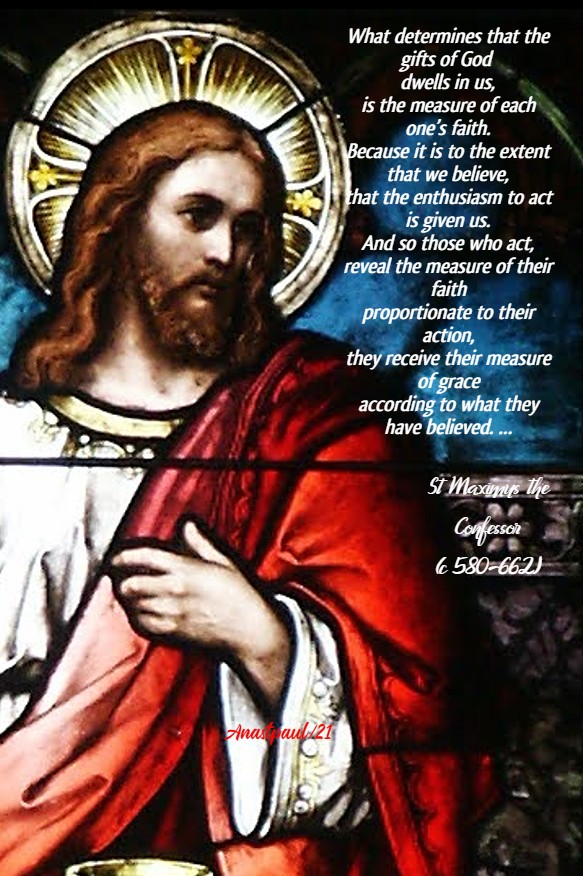
“What determines that the gifts of God dwells in us, is the measure of each one’s faith. Because it is to the extent that we believe, that the enthusiasm to act is given us. And so those who act, reveal the measure of their faith proportionate to their action, they receive their measure of grace according to what they have believed. …”
St Maximus the Confessor (c 580-662) Monk and Theologian
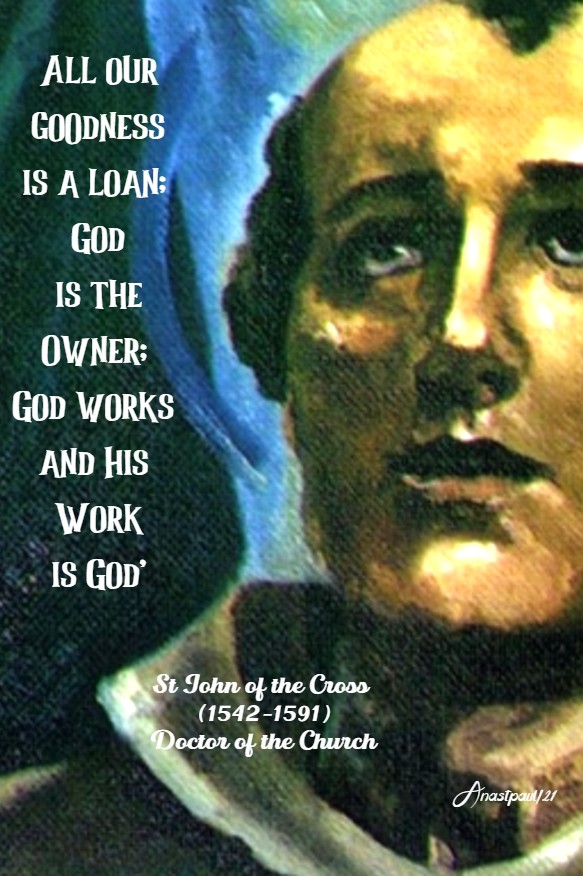
“All our goodness is a loan; God is the owner; God works and His work is God.”
St John of the Cross (1542-1591) Doctor of the Church
The Apostles’ Creed
I believe in God, the Father Almighty, Creator of heaven and earth and in Jesus Christ, His only Son, our Lord, who was conceived by the Holy Spirit, born of the Virgin Mary, suffered under Pontius Pilate, was crucified, died and was buried; He descended into hell; on the third day He rose again from the dead; He ascended into heaven and is seated at the right hand of God the Father Almighty; from thence He shall come to judge the living and the dead. I believe in the Holy Spirit, the Holy Catholic Church, the communion of Saints, the forgiveness of sins, the resurrection of the body and life everlasting. Amen
One Minute Reflection – 12 November – St Martin I, Pope (598-655) Martyr – 1 Peter 5:1-4; 5:10-11, Matthew 16:13-19 – Scripture search here: https://www.drbo.org/
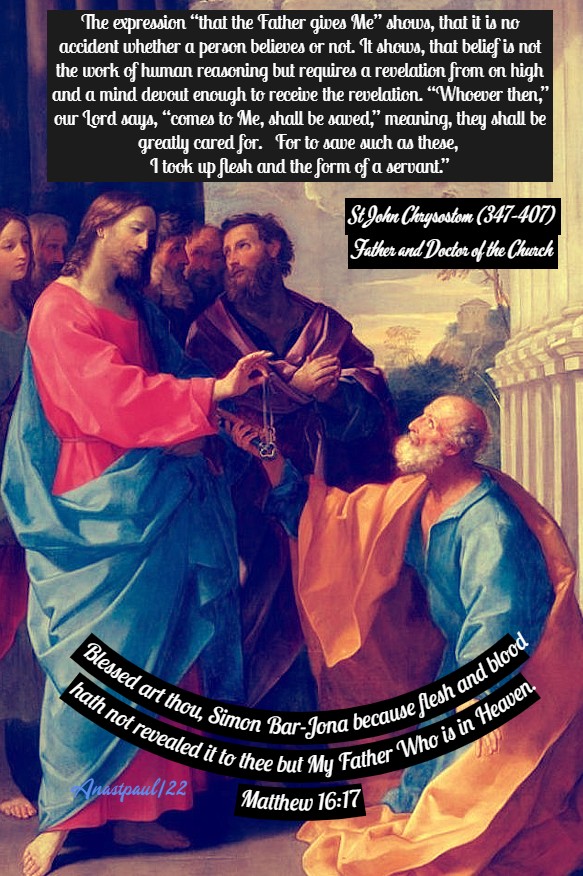
“Blessed art thou, Simon Bar-Jona because flesh and blood hath not revealed it to thee but My Father Who is in Heaven.” – Matthew 16:17
REFLECTION – “Faith in Me, He intimates here, is no ordinary thing or one that comes from human reason but [it] needs a revelation from above. And this He establishes throughout His discourses, showing, that this faith requires a noble sort of soul and one drawn on by God. The expression “that the Father gives Me” shows, that it is no accident whether a person believes or not. It shows, that belief is not the work of human reasoning but requires a revelation from on high and a mind devout enough to receive the revelation. “Whoever then,” our Lord says, “comes to Me, shall be saved,” meaning, they shall be greatly cared for. For to save such as these, I took up flesh and the form of a servant.” – St John Chrysostom (347-407) Archbishop of Constantinople, Father and Doctor of the Church (Homilies on the Gospel of John 45)”
PRAYER – Look forgivingly on Thy flock, Eternal Shepherd and keep it in Thy constant protection, by the intercession of blessed Martin Thy Martyr and Sovereign Pontiff, whom thou didst constitute Shepherd of the whole Church. Through Jesus Christ, Thy Son our Lord, Who lives and reigns with Thee, in the unity of the Holy Ghost, God, world without end. Amen (Collect).
Our Morning Offering – 12 November – Mary’s Saturday – “The Month of the Holy ouls in Purgatory”
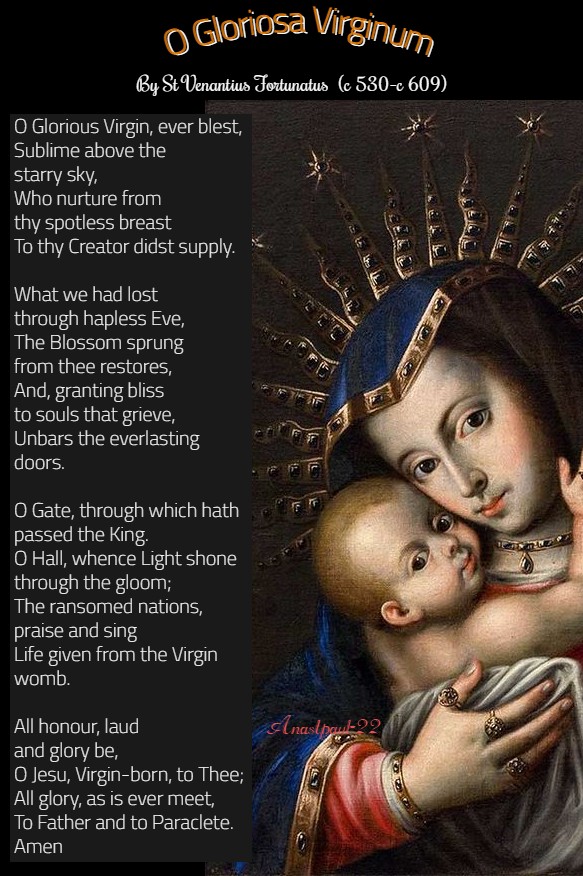
O Gloriosa Virginum By St Venantius Fortunatus (c 530 – c 609)
O Glorious Virgin, ever blest, Sublime above the starry sky, Who nurture from thy spotless breast To thy Creator didst supply.
What we had lost through hapless Eve, The Blossom sprung from these restores, And, granting bliss to souls that grieve, Unbars the everlasting doors.
O Gate, through which hath passed the King. O Hall, whence Light shone through the gloom; The ransomed nations, praise and sing Life given from the Virgin womb.
All honour, laud and glory be, O Jesu, Virgin-born, to Thee; All glory, as is ever meet, To Father and to Paraclete. Amen
O Gloriosa Domina is the second half of the hymn: Quem Terra, Pontus, Aethera. It was composed by St Venantius Fortunatus (c 530 – c 609) the Bishop of Poitiers. In 1632, in accordance with revisions made to the hymns of the Divine Office by Pope Urban VIII (1568-1644), it was altered and changed to O Gloriósa Vírginum. It is sung in the Common of the Blessed Virgin Mary of the Roman Breviary. It is said that St Anthony of Padua (1195-1231) was always singing this hymn. His mother sang it to him as a baby,and even on his death bed after receiving Extreme Unction, he intoned the hymn.
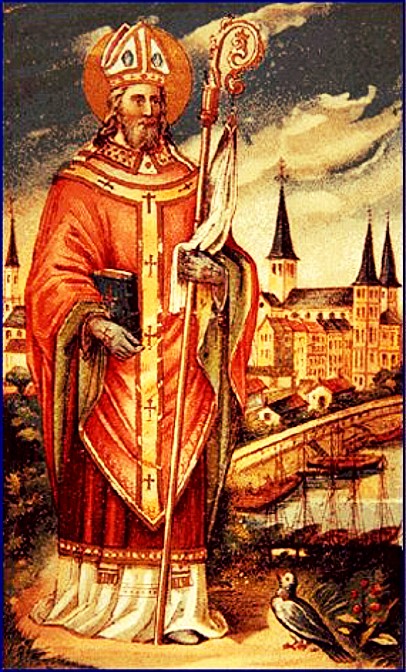
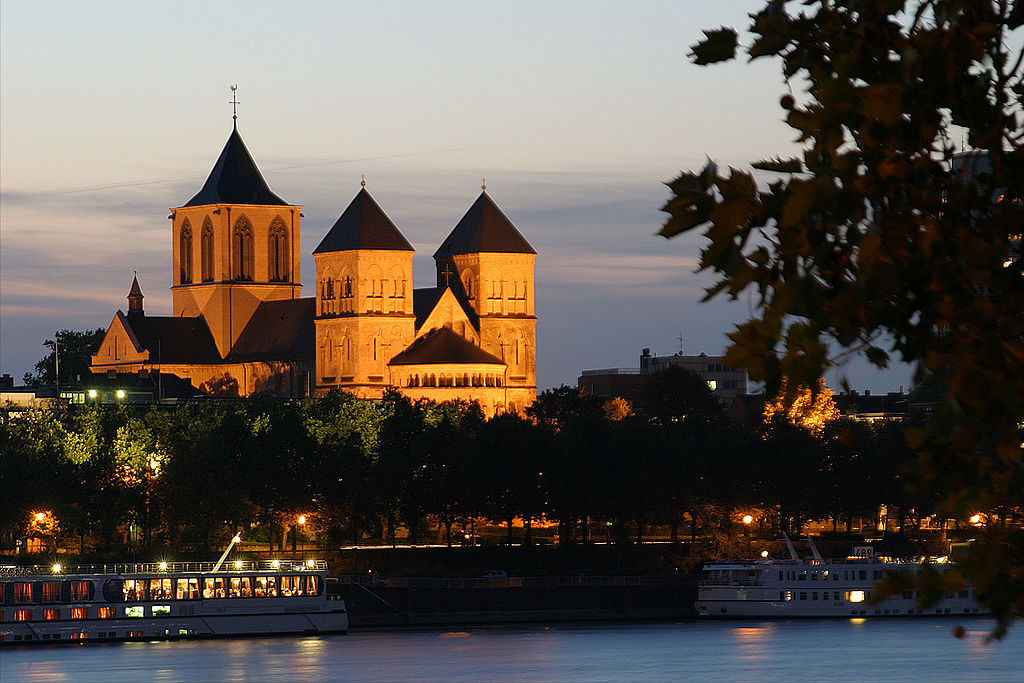
Saint of the Day – 12 November – St Cunibert of Cologne (Died c 663) Archbishop of Cologne, from 627 to his death. He founded many Churches and supported and established Monasteries. Contemporary sources only mention him between 627 and 643. Cunibert died in c 663 in Cologne, Germany of natural causes. Also known as – • Cunibert of Keulen• Cunibert of Köln• Cunibert of Trèves• Cunibert of Trier• Cunipert, Honoberht, Kunibert. He is mentioned in the Roman Martyrology.
Cunibert was born somewhere along the Moselle to a family of the local Ripuarian Frankish aristocracy and educated in Metz at the Court of Chlothar II. He entered religious life and became the Archdeacon of Trier. He was elected Bishop of Cologne in 627. According to legend, he was led by a pigeon to the grave of Saint Ursula.
As Bishop, Cunibert served as an advisor to King Dagobert I. Cunibert also served as tutor to his son and heir, Sigebert III. In 633 or 634 Sigebert was invested as King of Austrasia. Following this, Dagobert made Cunibert and Adalgisel, the mayor of the Palace, co-regents of the Kingdom. After the death of Adalgisel’s successor, Pepin of Landen, Cunibert served as the chief public official of the King, in which capacity, he revised the Lex Ribuaria – the laws of Germany, at that time. Cunibert attended the Synod of Clichy in 626/627.
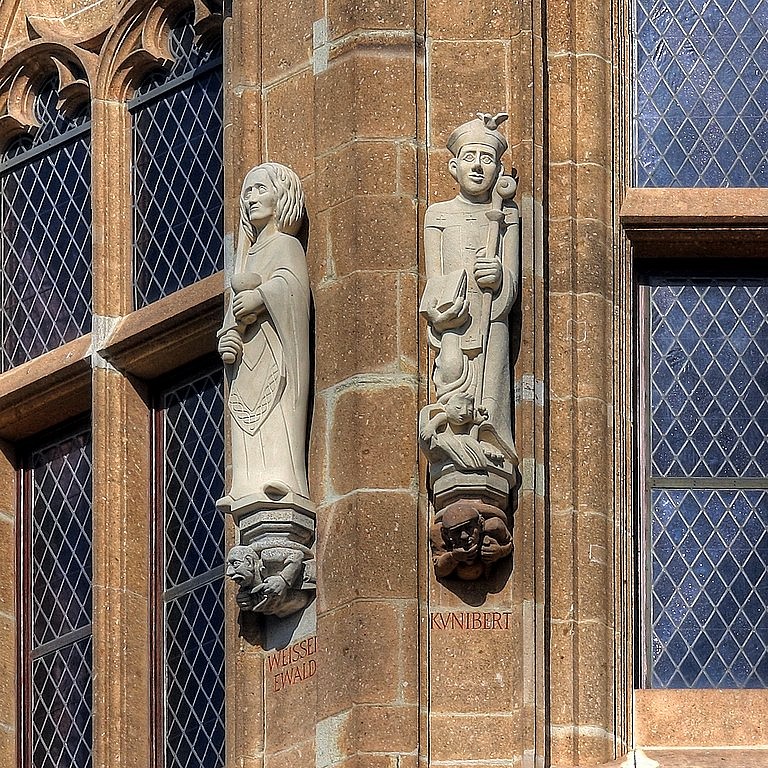
Statue of St Cunibert on the tower of Cologne City
Throughout his Episcopacy, monasticism flourished and Churches were founded and restored. His Feast day is the day of his death, 12 November He is buried in a Church bearing his name in Cologne City, where he lived and died.
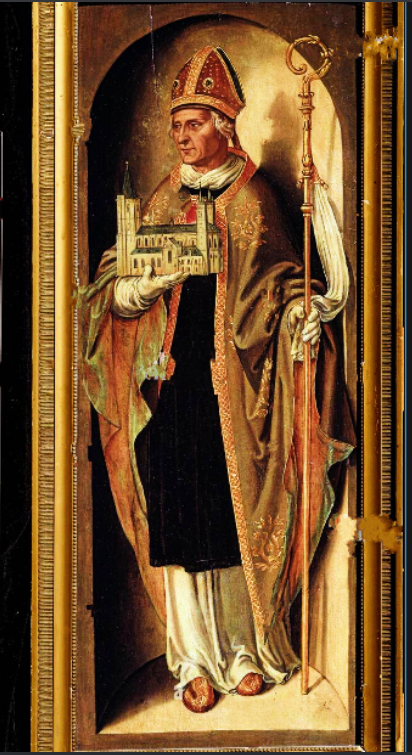
St Aurelius St Cadwallader St Cummian Fada St Cunibert of Cologne (Died c 663) Archbishop of Cologne St Emilian Cucullatus St Evodius of Le Puy St Hesychius of Vienne Bl John Cini della Pace
St Livinus of Alost St Machar of Aberdeen St Namphasius St Nilus the Elder St Paternus of Sens St Publius St Renatus of Angers St Rufus of Avignon St Ymar of Reculver
Five Polish Brothers – Martyrs: They weren’t Polish and they weren’t related but were instead five Italian Benedictine Monks who worked with Saint Adalbert of Prague as missionaries to the Slavs and were Martyred together. They were – Benedict, Christinus, Isaac, John and Matthew. Born in Italy. They were Martyred in 1005 at the Benedictine Monastery near Gnesen, Poland and Canonised by Pope Julius II.
Thought for the Day – 11 November – Meditations with Antonio Cardinal Bacci (1881-1971)
Sensitiveness
“Our wounded feelings sometimes give rise to an external explosion in the form of bitter and offensive remarks. These always create disharmony and have various unfortunate after-effects.
It is fatal to lose control over ourselves. A man who has surrendered to anger and resentment, does not weigh his words and is not responsible for his actions. When the fit has passed, he is left with a sense of humiliation because of his lack of moderation and must suffer the consequences, both before God and before his fellowmen in his domestic and social enviroment. “When the angry man has calmed down,” Seneca truly observed, “he is angry with himself.” “Let anger be foreign to us,” said Cicero, “for an angry man is incapable of acting correctly, or prudently. Anything which is done, in a state of agitation, cannot be done properly, nor can it meet with the approval of the bystanders” (De Officiis I, 38).
Let us meditate also on these apt quotations from Sacred Scripture. “A mild answer calms wrath but a harsh word, stirs up anger” (Prov 15:1). “An ill-tempered man, stirs up strife but a patient man allays discord” (Prov 15:18).”
Quote/s of the Day – 11 November – “The Month of the Holy Souls in Purgatory” – St Martin of Tours (c 316-397) Bishop, Confessor – Sirach 44:16-27; 45:3-20, Luke 11:33-36 – Scripture search here: https://www.drbo.org/
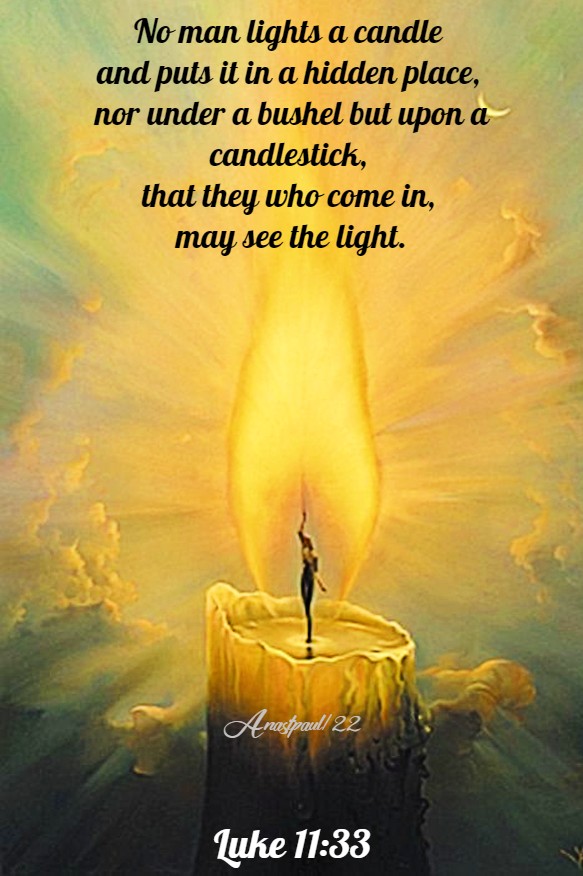
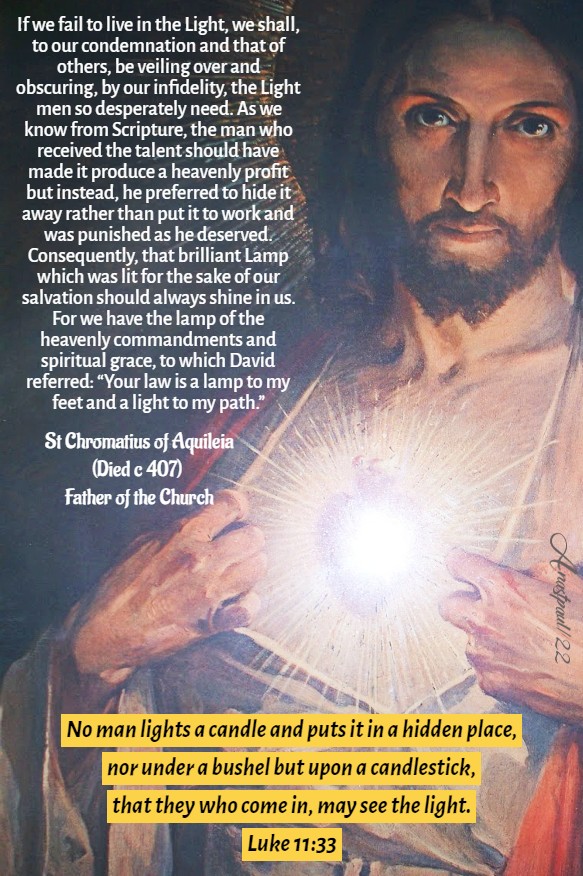
“No man lights a candle and puts it in a hidden place, nor under a bushel but upon a candlestick, that they who come in, may see the light.”
Luke 11:33
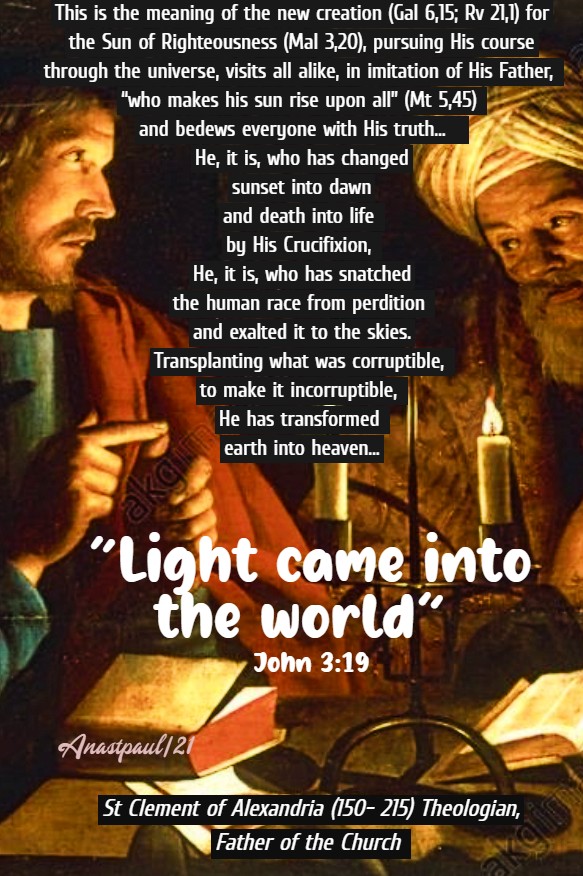
“Light came into the world”
John 3:19
“This is the meaning of the new creation (Gal 6,15; Rv 21,1) for the Sun of Righteousness (Mal 3,20), pursuing His course through the universe, visits all alike, in imitation of His Father, “who makes his sun rise upon all” (Mt 5,45) and bedews everyone with His truth… He, it is, Who has changed sunset into dawn and death into life by His Crucifixion, He, it is, Who has snatched the human race from perdition and exalted it to the skies. Transplanting what was corruptible, to make it incorruptible, He has transformed earth into Heaven!…”
St Clement of Alexandria (150- 215) Theologian, Father of the Church
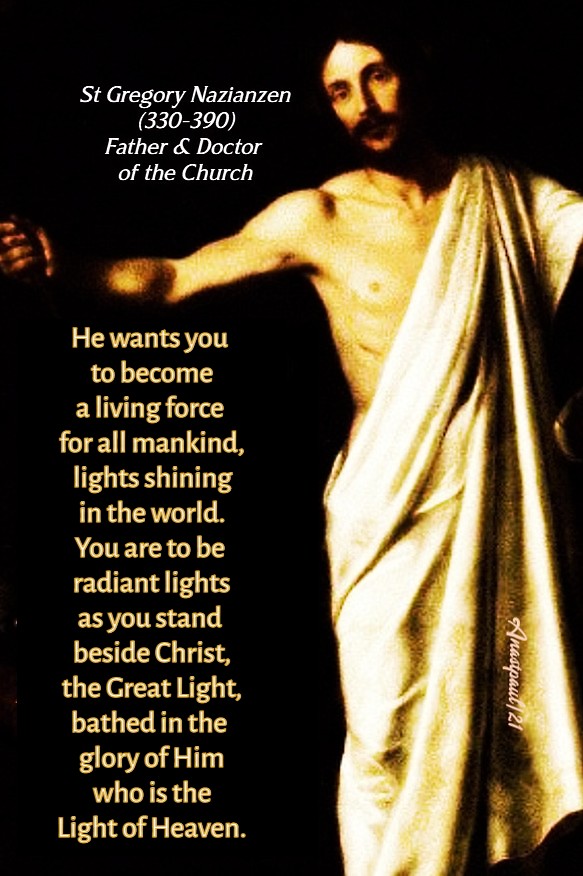
“He wants you to become a living force for all mankind, lights shining in the world. You are to be radiant lights as you stand beside Christ, the Great Light, bathed in the glory of Him who is the Light of Heaven.”
St Gregory Nazianzen (330-390) Father & Doctor of the Church
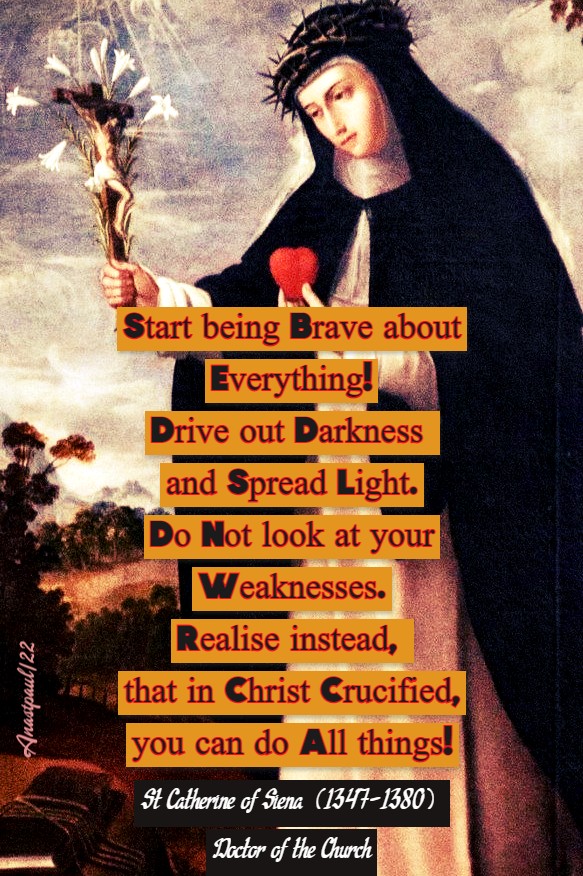
“Start being brave about everything! Drive out darkness and spread light. Do not look at your weaknesses. Realise instead, that in Christ Crucified, you can do all things.”
St Catherine of Siena (1347-1380) Doctor of the Church
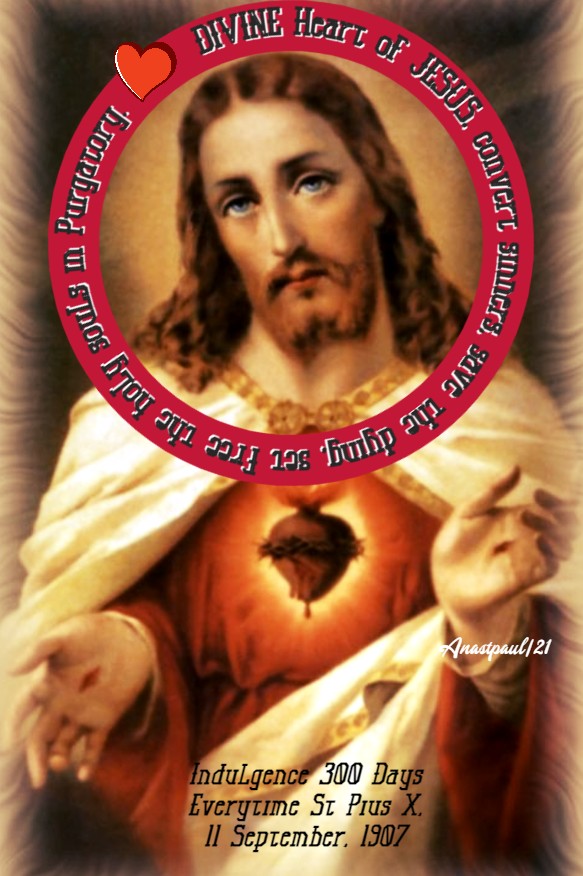
DIVINE Heart of JESUS, convert sinners, save the dying, set free the holy souls in Purgatory. Indulgence 300 Days Everytime – St Pius X, 11 September, 1907
One Minute Reflection – 11 November – St Martin of Tours (c 316-397) “Martin the Merciful,” Bishop, Confessor, Miracle-Worker. – Sirach 44:16-27; 45:3-20, Luke 11:33-36 – Scripture search here: https://www.drbo.org/
“At that time, Jesus said to His disciples: No man lights a candle and puts it in a hidden place, nor under a bushel but upon a candlestick, that they who come in, may see the light.” – Luke 11:33
REFLECTION – “You are the light of the world. A city set on a hill cannot be hidden. Nor do men light a lamp only to put it under a bushel basket; they put it on a stand where it gives light to all in the house. The Lord called His disciples, the salt of the earth because they seasoned ,with heavenly wisdom, the hearts of men, rendered insipid by the devil. Now he calls them, the light of the world as well because they have been enlightened by Him, the True and Everlasting Light and have themselves become a light in the darkness.
Since He is the Sun of Justice, he fittingly calls His disciples, the light of the world. The reason for this, is that through them, as through shining rays, He has poured out the light of the knowledge of Himself, upon the entire world. For by manifesting the Light of Truth, they have dispelled the darkness of error from the hearts of men.
Moreover, we too have been enlightened by them. We have been made light out of darkness, as the Apostle says: For once you were darkness, but now you are light in the Lord; walk as children of light. He says another time: For you are not sons of the night and of darkness but you are all sons of light and of the day.
Saint John also rightly asserts, in his letter: God is Light and whoever abides in God, is in the Light, just as God Himself is in the Light. Therefore, because we rejoice in having been freed from the darkness of error, we should always walk in the Light as children of Light. This is why the Apostle says: Among them you shine as lights in the world, holding fast to the Word of Life.
If we fail to live in the Light, we shall, to our condemnation and that of others, be veiling over and obscuring, by our infidelity, the Light men so desperately need. As we know from Scripture, the man who received the talent should have made it produce a heavenly profit but instead, he preferred to hide it away rather than put it to work and was punished as he deserved.
Consequently, that brilliant Lamp which was lit for the sake of our salvation should always shine in us. For we have the lamp of the heavenly commandments and spiritual grace, to which David referred: Your law is a lamp to my feet and a light to my path.Solomon also says this about it: For the command of the law is a lamp.
Therefore, we must not hide this Lamp of law and faith. Rather, we must set it up in the Church, as on a lampstand, for the salvation of many, so that we may enjoy the Light of Truth itself and all believers, may be enlightened.” – St Chromatius of Aquileia(Died c 407) Bishop of Aquileia, Theologian, Exegete, Writer and friend of Saints Ambrose and Jerome, Father of the Church (Excerpt from A treatise on the Gospel of Saint Matthew).
PRAYER – O God, Who sees that we cannot survive by any power of our own, mercifully grant that, by the intercession of blessed Martin, Thy Confessor and Bishop, we may be made safe from all harm. Through Jesus Christ, Thy Son our Lord, Who lives and reigns with Thee, in the unity of the Holy Ghost, God, world without end. Amen (Collect).
Our Morning Offering – 11 November – The day of the Passion
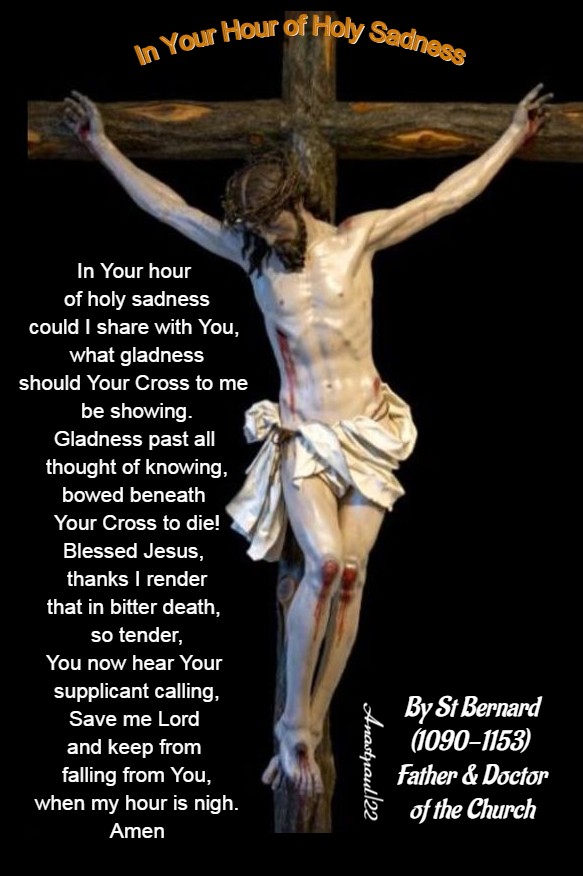
In Your Hour of Holy Sadness By St Bernard (1090-1153) Father & Doctor of the Church
In Your hour of holy sadness could I share with You, what gladness should Your Cross to me be showing. Gladness past all thought of knowing, bowed beneath Your Cross to die! Blessed Jesus, thanks I render that in bitter death, so tender, You now hear Your supplicant calling, Save me Lord and keep from falling from You, when my hour is nigh. Amen.
Saint of the Day – 11 November – Saint Mennas (Died c 300) Martyr, Layman, Miracle-worker, Soldier, he may have been a camel driver and merchant, Hermit. Born in Egypt and died by beheading in c 300 at Cotyaes, Phrygia, under Emperor Diocletian. He was one of the most popular Saints in the early Eastern Church. Patronages – falsely accused people, general physical ailments, peddlers, pilgrims, travelling salesmen. Also known as – • Aba Mina• Menas of Egypt• Menas of Constantinople• Menas of Cotyaes• Menas of Cotyaeum• Menas of Kotyaeum• Menas of Mareotis• Menas the Martyr• Menas the Miracle Maker• Menas the Miracle Worker• Menas the Soldier• Menas the Wonder Worker• Mena, Mennas, Mina, Minas.
The Roman Martyrology reads: “At Cotyaeus, in Phrygia, during the persecution of Diocletian, the celebrated Martyrdome of St Mennas, Egyptian soldier, who cast off the military belt and obtained the grace of serving the King of Heaven, secretly, at first, in the desert. Afterwards, coming out publicly and freely declaring himself a Christian he was first subjected to dire torments and finally, kneeling in prayer and giving thanks to Our Lord Jesus Christ, he was struck with the sword. After his death, he was renowned for many miracles.”
St Mennas by Paolo Veronese
Mennas, a Christian and an Egyptian by birth, served in the Roman army under the tribune Firmilian. When the army came to Cotyaeus in Phrygia, Menas hearing of the impious edicts issued against the Christians by the Emperors Diocletian and Maximian, left the army in order to practise his faith in safety and retired to a solitude in the mountains and served God by fasting vigils and prayer.
During the celebration of a great pagan festival Mennas appeared in the midst of the populace in the circus and fearlessly professed his faith. He was led before the Prefect Pyrrhus, cruelly scourged, put to torture and finally beheaded.
The Martyrdom of St Mennas by Paolo Veronese
His body was brought to Egypt and the Martyr was soon invoked in many needs and afflictions. The fame of the miracles wrought, spread far and wide and thousands of pilgrims came to the grave in the desert of Mareotis, between Alexandria and the valley of Natron.
For centuries Bumma was a national sanctuary and grew into a large city with costly temples a holy well and baths. A beautiful Basilica was erected by the Emperor Arcadius. The cult was spread into other countries, perhaps by travelling merchants who honoured him as their Patron.
As a result of various vicissitudes, the doctrinal disputes and the conquest of Egypt by the Arabians under Omar in 641 the sanctuary was neglected and ultimately forgotten.
During 1905 Msgr C M Kaufmann of Frankfort, led an expedition into Egypt which made excavations at Bumma. He found in a vast field of ruins, the grave, the well and thermae (public baths), the Basilica, the Monastery, numerous inscriptions on the walls, imploring aid through the intercession of the Saint and, thousands of little water pitchers and oil lamps. The rich findings are partly in the Museums of Alexandria and Cairo and partly in Frankfort and Berlin. The Monsignor published an official report of his expedition in 1908, (La découverte des Sanctuaires de Menas dans le désert de Mareotis).
Terracotta pilgrim’s water flask impressed with Saint Mennas between two camels, 1000s of which were found by Msgr C M Kaufmann



























You must be logged in to post a comment.