Quote/s of the Day – 16 October – Feast of the Purity of the Blessed Virgin Mary
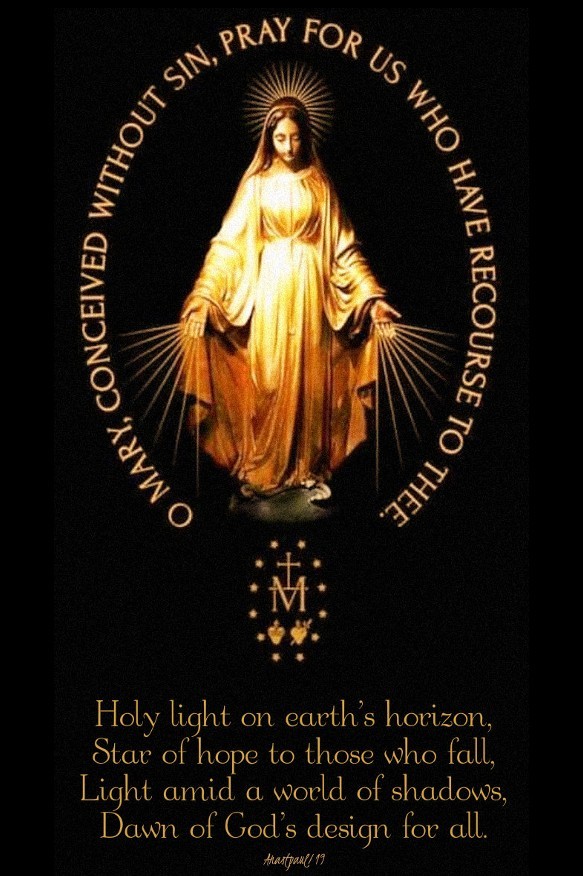
Holy light on earth’s horizon, Star of hope to those who fall, Light amid a world of shadows, Dawn of God’s design for all.
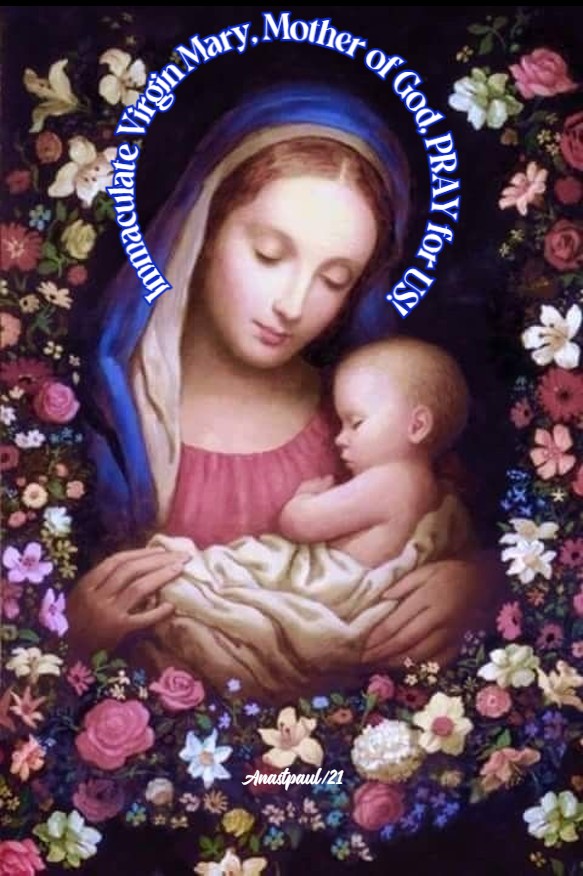
O Mary, conceived without sin, Pray for us who have recourse to thee.
“Thou alone and Thy Mother, are in all things fair, there is no flaw in Thee and no stain in Thy Mother.”
St Ephrem of Syria (306-373) Father and Doctor of the Church
“The very fact that God has elected her, proves, that none was ever holier than Mary; if any stain had disfigured her soul, if any other virgin had been purer and holier, God would have selected her and rejected Mary.”
St Jacob of Sarug (c 451-521) Bishop, Theologian, Poet, Writer
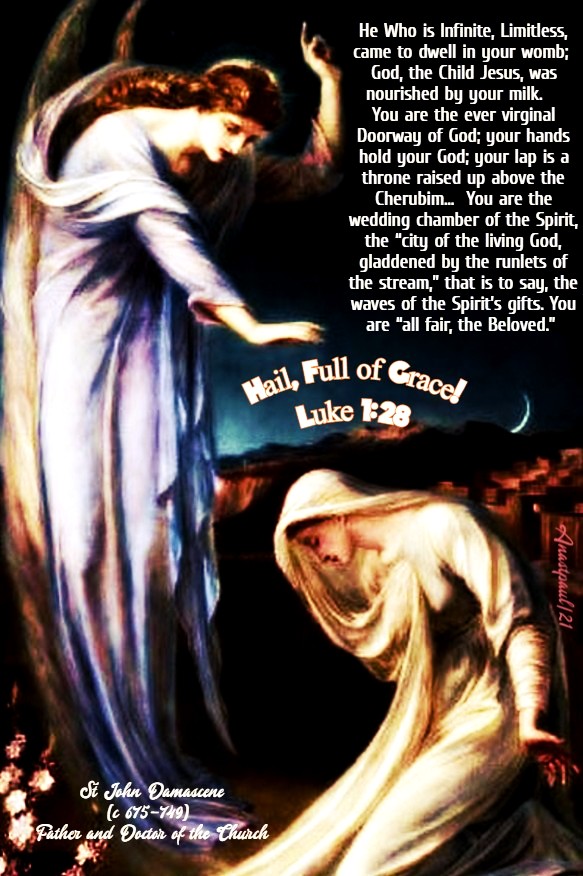
“He Who is Infinite, Limitless, came to dwell in your womb; God, the Child Jesus, was nourished by your milk. You are the ever virginal Doorway of God; your hands hold your God; your lap is a throne raised up above the Cherubim… You are the wedding chamber of the Spirit, the “city of the living God, gladdened by the runlets of the stream,” that is to say, the waves of the Spirit’s gifts. You are “all fair, the Beloved” of God.”
St John Damascene (675-749) Father and Doctor of the Church
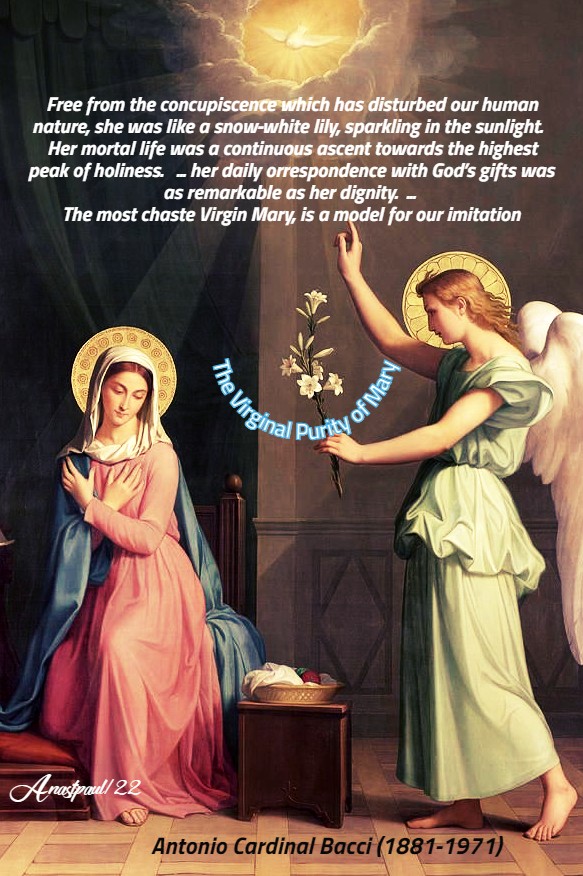
“Free from the concupiscence which has disturbed our human nature, she was like a snow-white lily, sparkling in the sunlight. Her mortal life was a continuous ascent towards the highest peak of holiness. … her daily correspondence with God’s gifts was as remarkable as her dignity. … The most chaste Virgin Mary, is a model for our imitation.”
Antonio Cardinal Bacci (1881-1971)
Tota Pulchra Es, Maria You Are All Beautiful, Mary Unknown Author – 4th Century
You are all beautiful, Mary, and the original stain is not in you. You are the glory of Jerusalem, you are the joy of Israel, you give honour to our people. You are an advocate of sinners. O Mary, O Mary, Virgin most intelligent, Mother most merciful. Pray for us, Plead for us, To the Lord Jesus Christ.
Tota pulchra es, Maria. Et macula originalis non est in Te. Tu gloria Ierusalem. Tu laetitia Israel. Tu honorificentia populi nostri. Tu advocata peccatorum. O Maria, O Maria, Virgo prudentissima. Mater clementissima. Ora pro nobis. Intercede pro nobis. Ad Dominum Iesum Christum.
This prayer used by the Church since the 4th Century for the Feast of the Immaculate Conception and the Purity of the Blessed Virgin. It takes some text from the book of Judith and other text from Song of Songs, specifically 4:7. Many composers have set this prayer to music over the centuries.
One Minute Reflection – 16 October – Feast of the Purity of the Blessed Virgin Mary – Ephesians 4:23-28, Matthew 22:1-14 – Scripture search here: https://www.drbo.org/
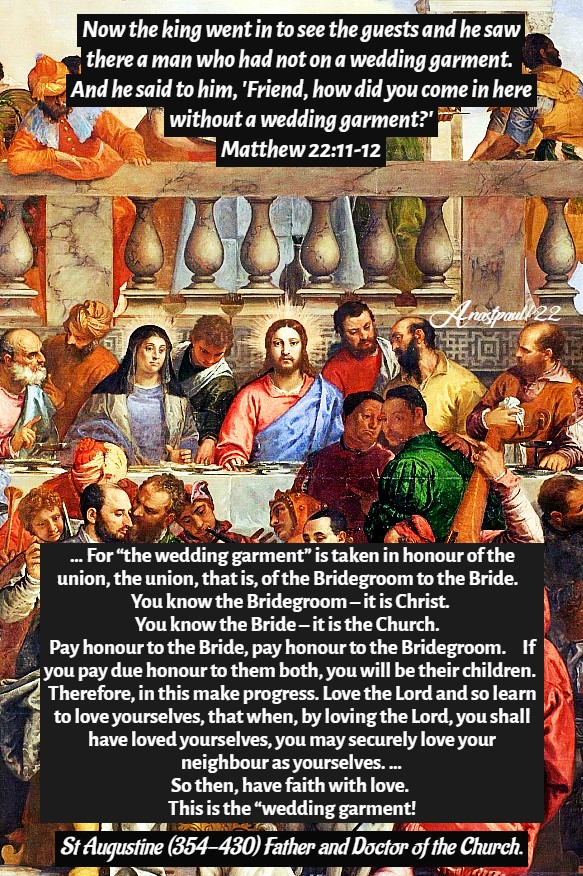
“Now the king went in to see the guests and he saw there a man who had not on a wedding garment. And he said to him, ‘Friend, how did you come in here without a wedding garment?‘” – Matthew 22:11-12
REFLECTION – “What is that “wedding garment” then? … The wedding garment” is such charity as this. “Although I speak with the tongues of men and of Angels and have not charity, I am become as sounding brass and a tinkling cymbal.” Tongues have come in alone and it is said to them, “Friend, how did you come in here without a wedding garment? “I have the gift of prophecy and understand all mysteries and all knowledge and although I have all faith, so that I could remove mountains and have not charity, I am nothing.”
See, these are the miracles of men who very often have not “the wedding garment.” “Although,” he says,” I have all these and have not Christ, I am nothing.” … If then I have not charity, although I bestow alms freely upon the poor, although I have come to the confession of Christ’s Name even unto blood and fire, these things may be done even through the love of glory and so are vain. … For “the wedding garment” is taken in honour of the union, the union, that is, of the Bridegroom to the Bride. You know the Bridegroom – it is Christ. You know the Bride – it is the Church. Pay honour to the Bride, pay honour to the Bridegroom. If you pay due honour to them both, you will be their children. Therefore, in this make progress. Love the Lord and so learn to love yourselves, that when, by loving the Lord, you shall have loved yourselves, you may securely love your neighbour as yourselves. …So then, have faith with love. This is the “wedding garment!” … St Augustine (354-430) Father and Doctor of Grace.
PRAYER – Grant, we beseech Thee, O Lord God, unto all Thy servants, that they may remain continually in the enjoyment of soundness, both of mind and body and by the glorious intercession of the Blessed Mary, always a Virgin, may be delivered from present sadness and enter into the joy of Thine eternal gladness. Through Jesus Christ, Thy Son our Lord, Who lives and reigns with Thee, in the unity of the Holy Ghost, God, world without end. Amen (Collect).
Our Morning Offering – 16 October – Feast of the Purity of the Blessed Virgin Mary
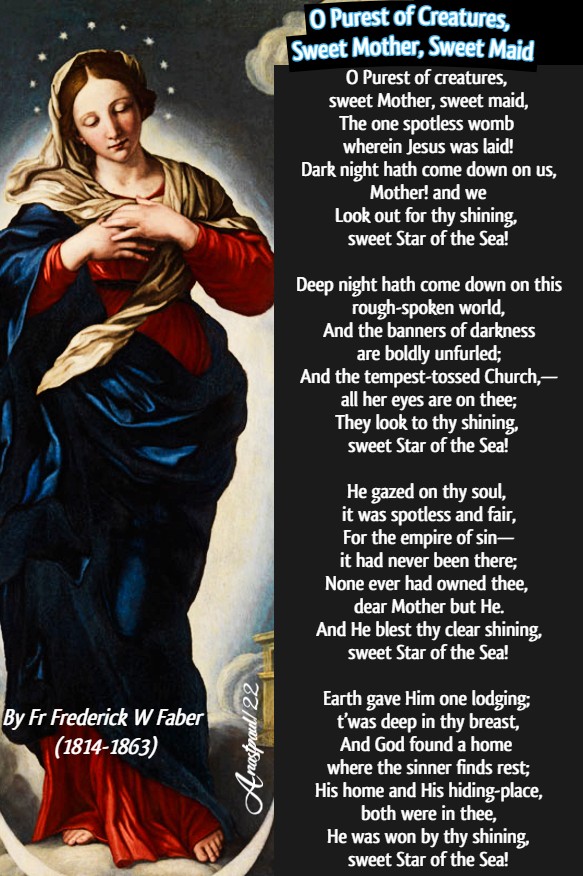
O Purest of Creatures, Sweet Mother, Sweet Maid By Fr Frederick W Faber C.Orat. (1814-1863)
O Purest of creatures, sweet Mother, sweet maid, The one spotless womb wherein Jesus was laid! Dark night hath come down on us, Mother! and we Look out for thy shining, sweet Star of the Sea!
Deep night hath come down on this rough-spoken world, And the banners of darkness are boldly unfurled; And the tempest-tossed Church,— all her eyes are on thee; They look to thy shining, sweet Star of the Sea!
He gazed on thy soul, it was spotless and fair, For the empire of sin—it had never been there; None ever had owned thee, dear Mother but He. And He blest thy clear shining, sweet Star of the Sea!
Earth gave Him one lodging; t’was deep in thy breast, And God found a home where the sinner finds rest; His home and His hiding-place, both were in thee, He was won by thy shining, sweet Star of the Sea!
Saint of the Day – 16 October – Feast of the Purity of the Blessed Virgin Mary. This Feast Day is kept by various Orders and Calendars..
Feast of the Purity Of The Blessed Virgin Mary By Father Lawrence G Lovasik SVD (1913-1986)
Mary, Mother of God, you are the Virgin most pure because you are the Immaculate Conception. The closer a soul is to God, the farther it is from sin. God is Infinite Good; sin, horrible evil. No-one could have had a closer approach to God than you, for it is impossible for any creature to be closer to God’s Son than His own Mother.
From eternity, before anything was, you were united to your Son in the mind of God, as His most pure Mother. When God decreed the Incarnation of the Word, His very own Son, through you alone, you had a place in the same plan, as Jesus. Since the Conception of the Son of God is all holy, all pure, infinitely removed from every appearance of sin, it was supremely fitting that your own conception should be equally far from sin. For that reason, you were conceived by your mother, Saint Anne, without even the shadow of sin. You are the Virgin most pure. Because you were to be the Mother of God, Original Sin which, like all Eve’s daughters you should have contracted, could not touch you. Such a stain would have reflected upon your Son, Who is Holiness itself. Then Satan could boast that he had overcome Jesus in you, His Mother. You are pure and sinless. You expressed this to Saint Bernadette at Lourdes when you said, “I am the Immaculate Conception.”
Mary, My Mother, there is no sin in you; in you there is only God’s grace—His light, His splendour, His love, His unspeakable delight. You are truly His beloved Daughter, the only one in whom there was never a stain. With you all is pure, virginal, immaculate In you, there is no inclination to evil—no impure thoughts or desires. You are God’s purest and holiest creature, the one chosen to conceive and bear the Son of God. Who would not love you and endeavour to imitate you, most beautiful and Immaculate Mother of God?
Mary, Mother of God, you are the Virgin most pure because you are full of grace. You are the most beautiful of creatures, the one in whom there is no spot, God’s masterpiece. You are full of grace, the Lord’s free gift and it overflows in you filling your soul with every virtue and perfection. What marvels of grace possessed your soul! Sanctifying grace made you God’s adopted child and the lawful heir to His Eternal Kingdom, putting you in possession of God’s goods and of God Himself forever. That grace made you holy and most pleasing in God’s eyes, the special object of His love. Sanctifying grace likened you to God as it did no other pure creature. Because you were full of God’s grace and a Virgin most pure, Gabriel could exclaim, “You have found grace with God.” No-one has found or received such grace as you.
But who can describe the matchless purity and beauty of your soul? Jesus is the most beautiful of men; you were His mould, His mirror and He, yours. Your soul contained all the marvels of God’s grace, for which reason, the Church calls you the Singular Vessel of Devotion. Mary, My Mother, you are all beautiful—beautiful in mind, in body, in soul! In you I behold the charm of the purest of Virgins, the majesty of the noblest of mothers. You are beautiful at your presentation in the temple; in prayer before Gabriel as he awaited your answer, in Nazareth’s hidden life and later as you followed Jesus and listened to Wisdom speak. You were beautiful when you stood as the brave Queen of Martyrs beneath the Cross of your dying Son; in the supper room beneath the fiery tongues of the Divine Spirit; beautiful, above all, in the glory in which you reign with Jesus. If a single soul in the state of grace by far excels in beauty all other earthly beauty, what beauty must you possess, Virgin most pure, who surpassed in holiness all other souls in the state of grace!
Mary, Mother of God, you are the Virgin most pure because you are the holiest of God’s creatures. You are the holiest of God’s creatures because you are the Mother of God. The Prophet tells us that God is “wonderful in His saints” (Ps. 67, 36). How wonderful, then, He must be in the Mother of the Saint of Saints! In you, to an eminent degree, all the privileges of other Saints meet. The Church venerates many holy Virgins, Martyrs and other Saints but not one of them has merited, or obtained, your title of Holy Virgin, Virgin most pure. Whatever of sanctity, of dignity, of merit, of grace and of glory, that we can imagine, all is in you.
Holiness is a complete separation from creatures and perfect union with God through love. No-one ever belonged to Jesus as completely as you, for you are His Mother. Jesus belonged entirely to you, the holiest among women. Your womb was so pure, so immaculate that it became the Holy of Holies, in which Jesus Christ our Lord, the Eternal High Priest, alone found entrance. Mary, My Mother, God raised you so high in Himself that He never has created and never will create, a holier person more worthy of Himself, of His greatness, of His love, than you, O Virgin most pure. Having carried within you, Jesus Christ, the Son of God, you share, as no-one else does, in your Divine Son’s holiness and purity. You come nearest to the holiness of God.
You are the holiest of women, the Virgin-Mother thrice holy because you are holy of the Father, holy of the Son, holy of the Holy Spirit of Love. Hence, with Holy Church I repeat, “You are all fair, Mary and the stain of original sin is not in you. You are the Glory of Jerusalem, you are the Joy of Israel, you are the Honour of our people.”
St Amandus of Limoges St Ambrose of Cahors St Balderic St Baldwin St Bertrand of Comminges St Bolonia St Conogon of Quimper St Dulcidius of Agen St Eliphius of Toul St Eremberta of Wierre St Florentinus of Trier
Bl Gerald of Fossanuova St Junian St Lull St Magnobodus of Angers St Martinian of Mauretania St Mummolinus St Saturian of Mauretania St Silvanus of Ahun St Victor of Cologne St Vitalis of Noirmoutier
Martyrs in Africa – 220 Saints: A group of 220 Christians Martyrs about whom we know nothing but that they died for their faith.
Martyrs of North Africa – 365 Saints: A group of 365 Christians who were Martyred together in the persecutions of the Vandal king Genseric. The only details that have survived are the names of two of the Martyrs – Nereus and Saturninus. 450 in North Africa.
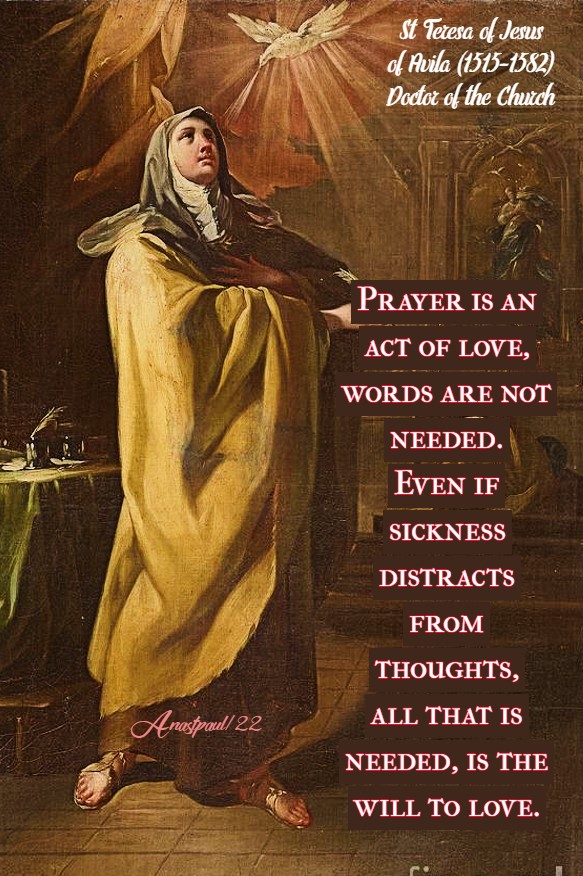
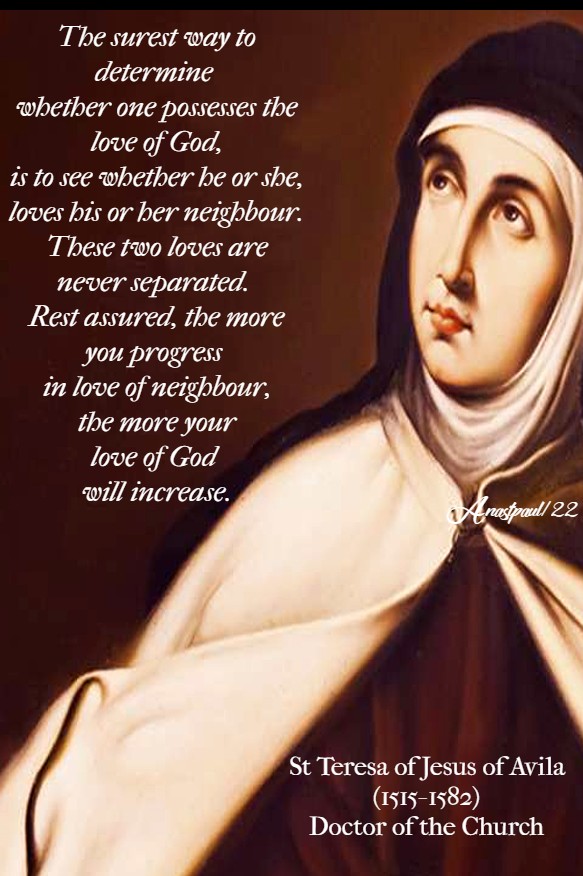
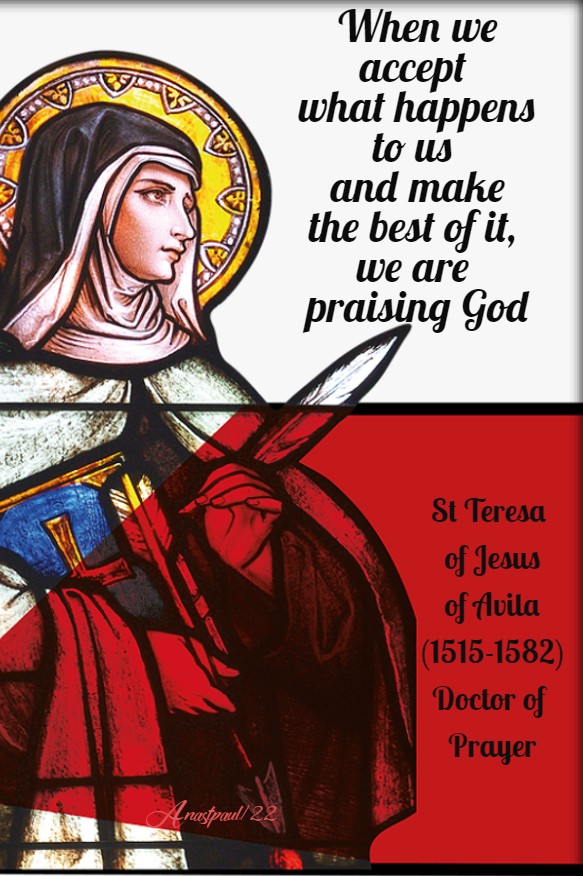
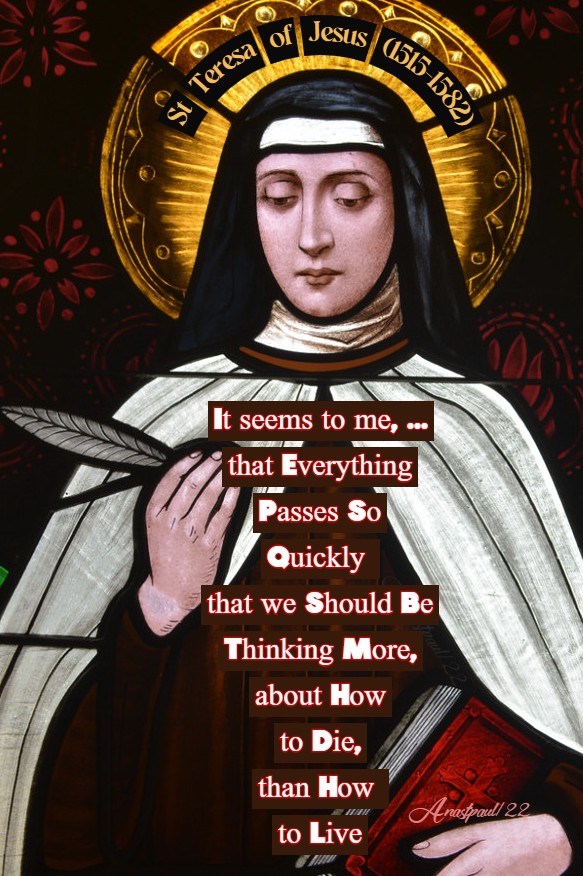
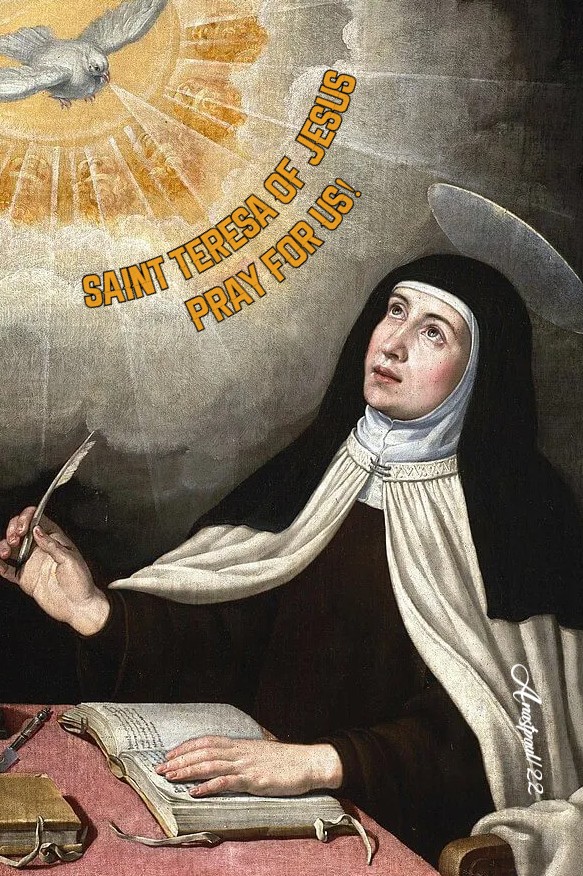
Quote/s of the Day – 15 October – St Teresa of Jesus of Avila OCD (1515-1582) Virgin and Doctor of the Church
“Prayer is an act of love, words are not needed. Even if sickness distracts from thoughts, all that is needed, is the will to love.”
“The surest way to determine whether one possesses the love of God, is to see whether he or she, loves his or her neighbour. These two loves are never separated. Rest assured, the more you progress in love of neighbour, the more your love of God will increase.”
“When we accept what happens to us and make the best of it, we are praising God.”
“Know that, even when you are in the kitchen, our Lord moves amidst the pots.”
“We always find that those who walked closest to Christ, were those, who had to bear the greatest trials.”
“Those who risk all for God will find that they have both lost all and gained all.”
“It seems to me, my daughters, that everything passes so quickly that we should be thinking more, about how to die, than how to live!”
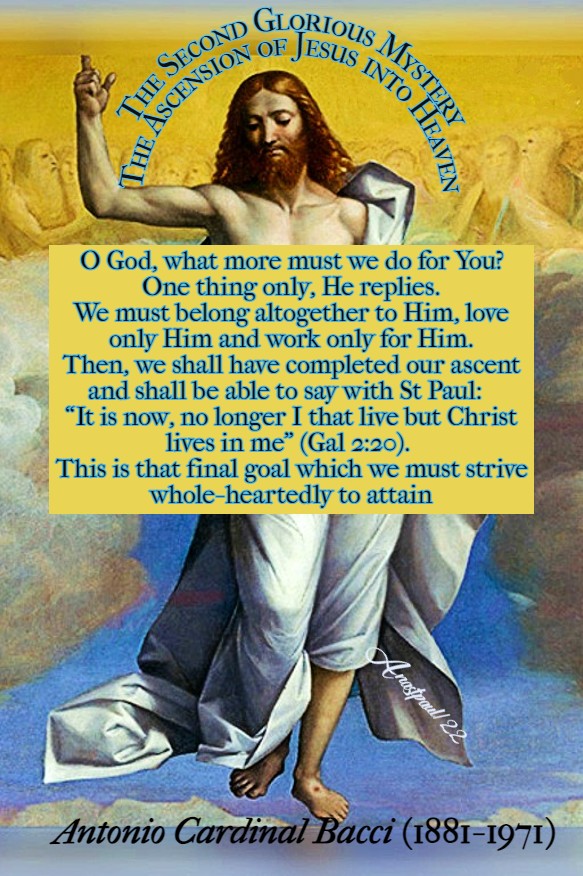
Thought for the Day – 15 October – Meditations with Antonio Cardinal Bacci (1881-1971)
“Month of the Holy Rosary” The Second Glorious Mystery The Ascension of Jesus into Heaven
“O God, what more must we do for You? One thing only, He replies. We must belong altogether to Him, love only Him and work only for Him. Then, we shall have completed our ascent and shall be able to say with St Paul: “It is now, no longer I that live but Christ lives in me” (Gal 2:20). This is that final goal which we must strive whole-heartedly to attain.”
One Minute Reflection – 15 October – St Teresa of Jesus of Avila OCD (1515-1582) Virgin and Doctor of the Church – 2 Corinthians 10:17-18; 11:1-2, Matthew 25:1-13 – Scripture search here: https://www.drbo.org/
“But at midnight there was a cry, ‘Behold, the bridegroom! Come out to meet him.” – Matthew 25:6
REFLECTION – “The souls’ husband is the Holy Spirit, by His grace. When His interior inspiration calls the soul to repentance, then every enticement of vice is in vain. The pride that wants command, the greed and lust that consumes everything: this was the master that used to control and ravage the soul. Their very names have been removed from the repentant sinner’s mouth… When grace is poured into the soul and gives it light, God makes a covenant with sinners. He is reconciled with them… Then is celebrated the wedding of the Bridegroom with His bride, in the peace of a pure conscience.” – St Anthony of Padua (1195-1231) Doctor of the Church
PRAYER – Graciously hear us, O God, our Saviour that as we rejoice on the feast-day of blessed Teresa, Thy Virgin, we may be so nourished by the food of her heavenly teaching, as to learn how to serve Thee.T hrough the same Jesus Christ, Thy Son our Lord, Who lives and reigns with Thee, in the unity of the Holy Ghost, God, world without end. Amen (Collect).
Our Morning Offering – 15 October – St Teresa of Jesus of Avila OCD (1515-1582) Virgin and Doctor of the Church
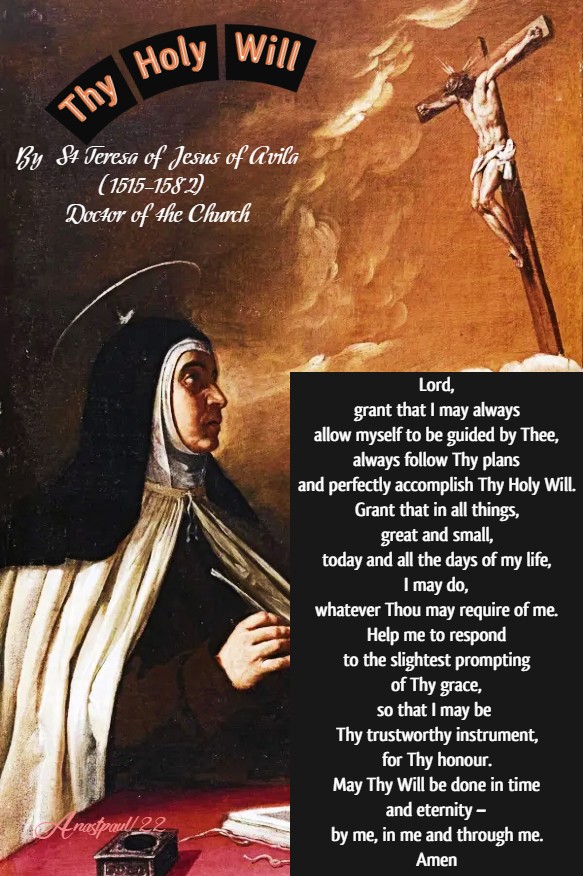
Thy Holy Will By St Teresa of Jesus of Avila (1515-1582) Doctor of the Church
Lord, grant that I may always allow myself to be guided by Thee, always follow Thy plans and perfectly accomplish Thy Holy Will. Grant that in all things, great and small, today and all the days of my life, I may do, whatever Thou may require of me. Help me to respond to the slightest prompting of Thy grace, so that I may be Thy trustworthy instrument, for Thy honour. May Thy Will be done in time and eternity – by me, in me and through me. Amen
Saint of the Day – 15 October – St Teresa of Jesus of Avila OCD (1515-1582) Virgin and Doctor of the Church
Practical Considerations On the Life of Saint Teresa By Fr Francis Xavier Weninger SJ (1805-1888)
I. Teresa began in early youth, after the teachings of her pious parents, to read devout books. From this, she first drew the spirit of piety. No sooner, however, had she become interested in reading worldly books, than she grew, from day-to-day, more indolent in the service of God and she returned, not to her first fervour, until she had cast aside those works and again resumed her pious reading – a proof of the great benefit we may derive from devout books and of the harm which worldly writings may do us. Oh! that those, who desire to, live piously, may understand this and conform their lives to it. Oh! that all Christians would guide their children, from their early youth, to the reading of devout books!
II. Teresa, after the death of her mother, chose the Blessed Virgin to be another mother to her, and sought and found, in her, comfort and assistance in all her needs. Thrugh her intercession and that of St Joseph, she received the grace of being constant in her reform. Love Mary as your mother – seek, with filial trust, consolation and assistance from her. St Joseph should be one of your principal Patrons, as his intercession is very powerful with the Almighty and, especially, as he has now been solemnly declared the Patron Saint of the Universal Church.
III. The sight of the wounded Jesus, filled the heart of St Teresa with great contrition for her former indifferent life. It inflamed her with true love of God and kept her, until her end, in these sentiments. Consider frequently how your Saviour suffered for your sake and repent of your sins sincerely, as they were the cause of Christ’s bitter Passion. Love your Redeemer with all the strength of your heart and make the resolution to serve Him in future most fervently.
IV. Teresa saw the place in hell which would have been hers, if she had not discontinued her idle discourses and her indifference in the worship of the Most High. Hence, she often gave humble thanks to God that He had not condemned her and she learned, by it, how hurtful even a menial sin can become, since it may lead us gradually to the path of everlasting perdition. You have still more reason to give thanks to God that He did not call you away, from this mortal life, in your sin. How long would you already have been in hell? If idle, empty conversation would have led Teresa gradually into hell, what may you not have to fear, if you do not abstain from so much sinful talking, in which you indulge? Learn also that you should not esteem a venial sin, however small it appears to you, as trifling, for, it may slowly lead you to damnation!
V. Many other lessons, which the life of St Teresa contains, I leave to yourself to consider. One thing only I request of you. Call to mind frequently the words which the Saint uttered in her ecstasy: “Only one God! Only one death! Only one soul! Love this only God and do not offend Him. Take earnest care of your only, your precious, your immortal soul. ‘Keep thyself, therefore and thy soul, carefully.’ (Deut., iv.)”
St Callistus of Huesca St Cannatus of Marseilles Bl Cipriano Alguacil Torredenaida St Euthymius the Younger St Fortunatus of Rome Bl Josefa Martínez Pérez St Leonard of Vandoeuvre Bl Narcis Basté y Basté Bl Pere Verdaguer Saurina Bl Ramón Esteban Bou Pascual St Sabinus of Catania St Severus of Trier
Martyrs of Cologne: A group of 360 Christian soldiers Martyred together in the persecutions of Diocletian and Maximian. They were Martyred in 303 outside the city walls of Cologne, Germany.
Thought for the Day – 14 October – Meditations with Antonio Cardinal Bacci (1881-1971)
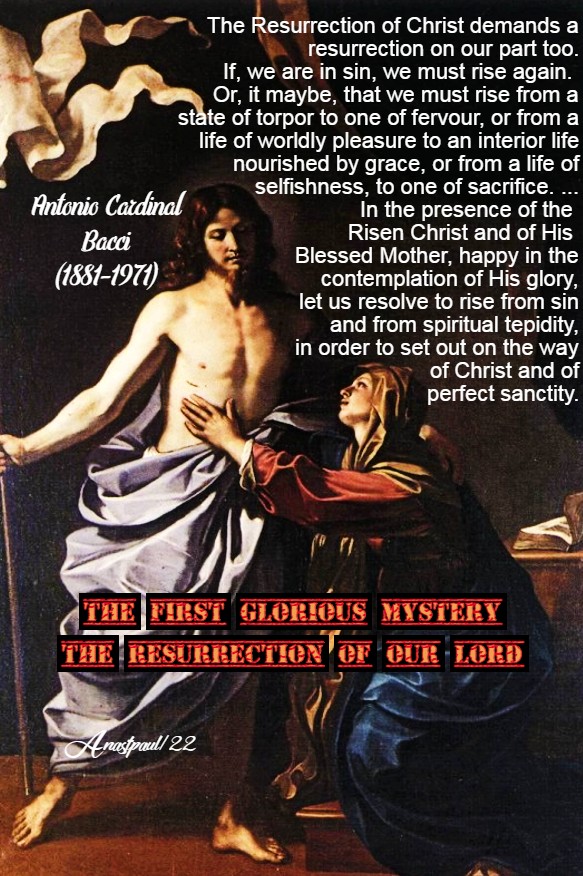
“Month of the Holy Rosary” The First Glorious Mystery The Resurrection of Our Lord
“The Resurrection of Christ demands a resurrection on our part too. If, we are in sin, we must rise again. Or, it maybe, that we must rise from a state of torpor to one of fervour, or from a life of worldly pleasure to an interior life nourished by grace, or from a life of selfishness, to one of sacrifice.
In which state do we find ourselves? In the presence of the risen Christ and of His Blessed Mother, happy in the contemplation of His glory, let us resolve to rise from sin and from spiritual tepidity, in order to set out on the way of Christ and of perfect sanctity.”
Quote/s of the Day – 14 October – – 1 Peter 5:1-4; 5:10-11, Matthew 16:13-19
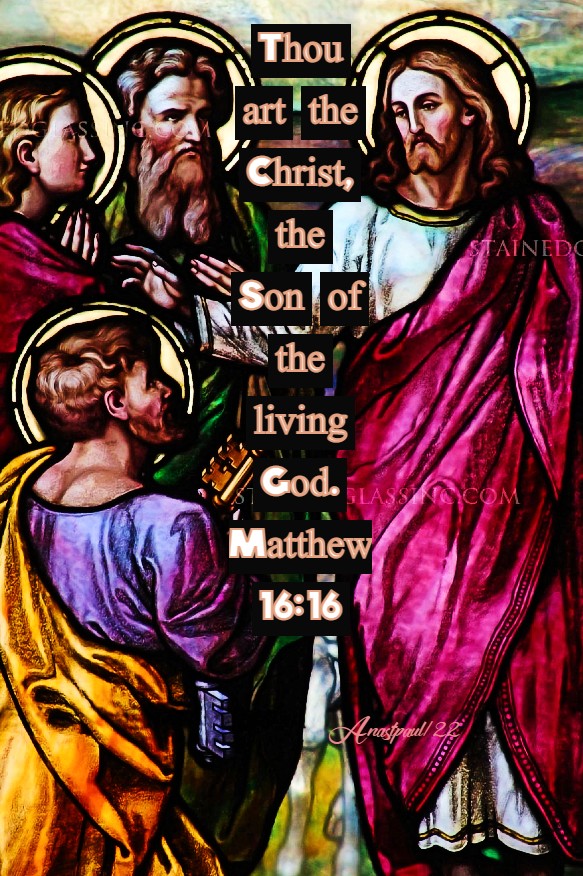
“Thou art the Christ, the Son of the living God.”
Matthew 16:16
“Without Me you can do nothing.”
John 15:5
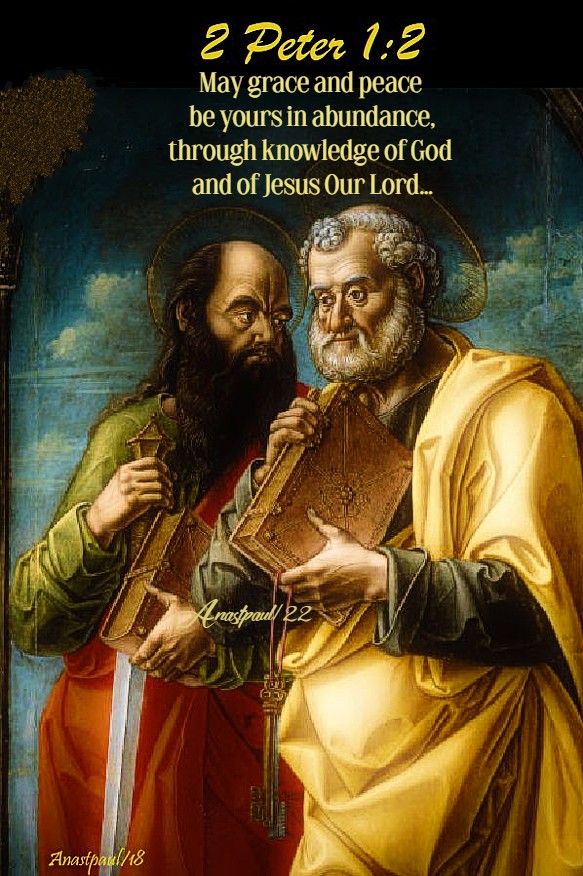
“… May grace and peace be yours in abundance, through knowledge of God and of Jesus Our Lord…”
2 Peter 1:2
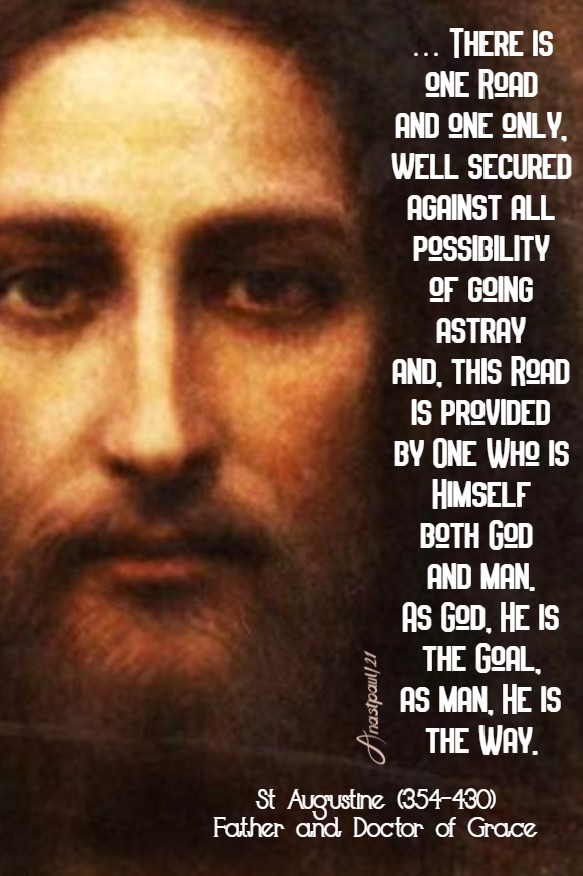
“… There is one Road and one only, well secured against all possibility of going astray and, this Road is provided by One Who is Himself both God and man. As God, He is the Goal, as man, He is the Way.”
St Augustine (354-430) Father and Doctor of Grace
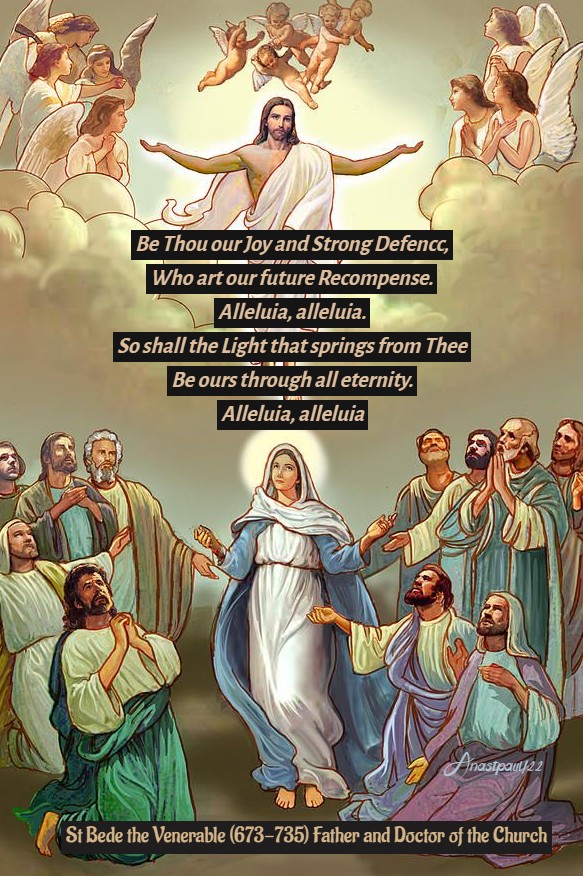
“Be Thou our Joy and Strong Defence, Who art our future Recompense. Alleluia, alleluia. So shall the Light that springs from Thee Be ours through all eternity. Alleluia, Alleluia.”
St Bede the Venerable (673-735) Father and Doctor of the Church”
“Girded with faith and the performance of good works, let us follow in His paths by the guidance of the Gospel.”
St Benedict (c 480-547)
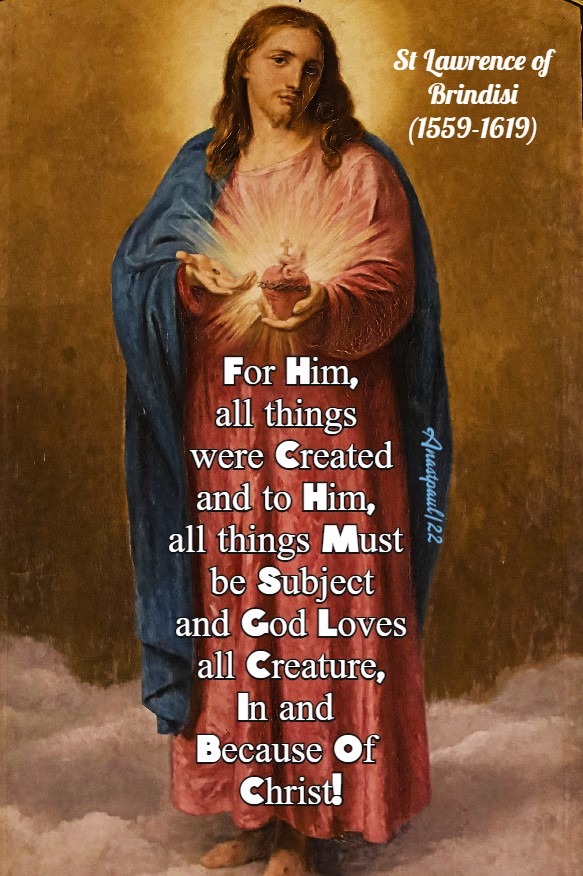
“For Him all things were created and to Him, all things must be subject and God loves all creature, in and because of Christ.”
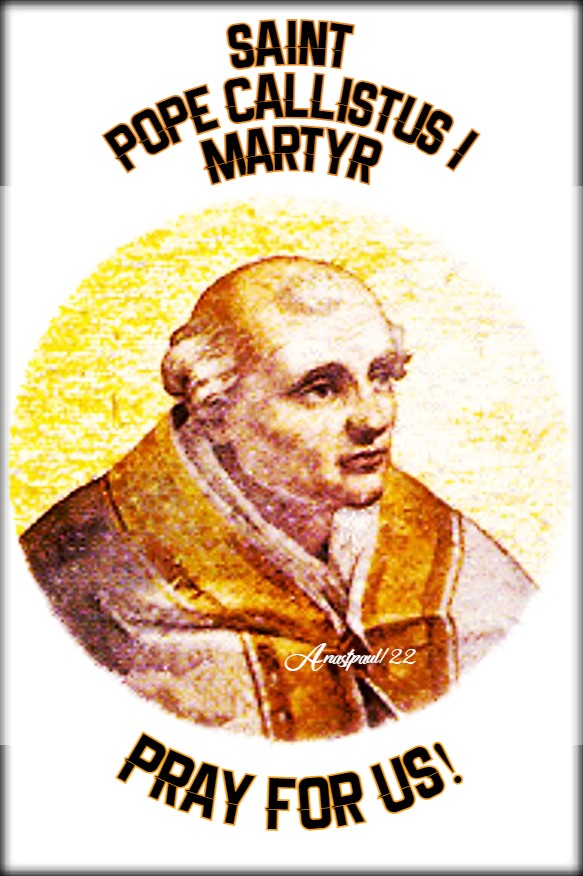
One Minute Reflection – 14 October – St Callistus I (c 218 – c 223) Confessor, Pope, Martyr – 1 Peter 5:1-4; 5:10-11, Matthew 16:13-19 – Scripture search here: https://www.drbo.org/
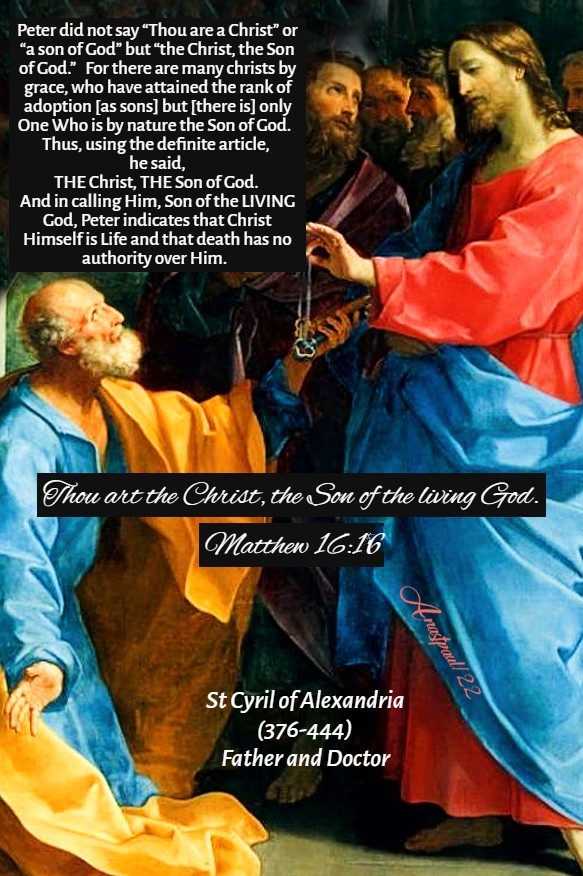
“Thou art the Christ, the Son of the living God.” – Matthew 16:16
REFLECTION – “Peter did not say “Thou are a Christ” or “a son of God” but “the Christ,the Son of God.” For there are many christs by grace, who have attained the rank of adoption [as sons] but [there is] only One Who is by nature the Son of God. Thus, using the definite article, he said, THE Christ, THE Son of God. And in calling Him, Son of the LIVING God, Peter indicates that Christ Himself is Life and that death has no authority over Him. And even if the flesh, for a short while, was weak and died, nevertheless, it rose again, since the Word, Who dwelled in it, could not be held under the bonds of death.” – St Cyril of Alexandria (376-444) Known as “The Pillar of Faith” Archbishop of Alexandria, Father and Doctor Incarnationis (Doctor of the Incarnation) (Fragment 190).
PRAYER – O God, Who behold how we fail in our weakness, mercifully restore us to Thy love, through the examples of Thy Saints.Through Jesus Christ, Thy Son our Lord, Who lives and reigns with Thee, in the unity of the Holy Ghost, God, world without end. Amen (Collect).
Our Morning Offering – 14 October – Catholic Time, Friday: The Passion
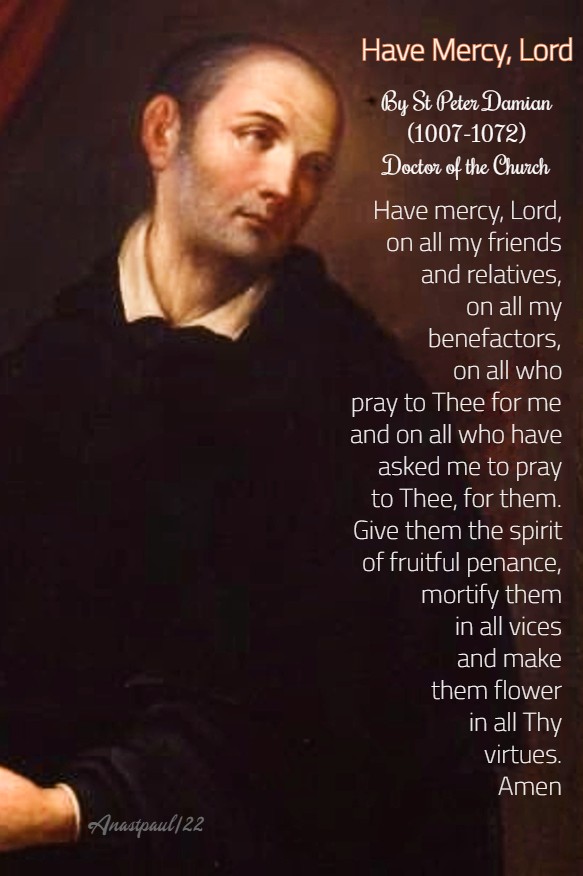
Have Mercy, Lord By St Peter Damian (1007-1072) Father & Doctor of the Church
Have mercy, Lord, on all my friends and relatives, on all my benefactors, on all who pray to Thee for me and on all who have asked me to pray to Thee, for them. Give them the spirit of fruitful penance, mortify them in all vices and make them flower in all Thy virtues. Amen
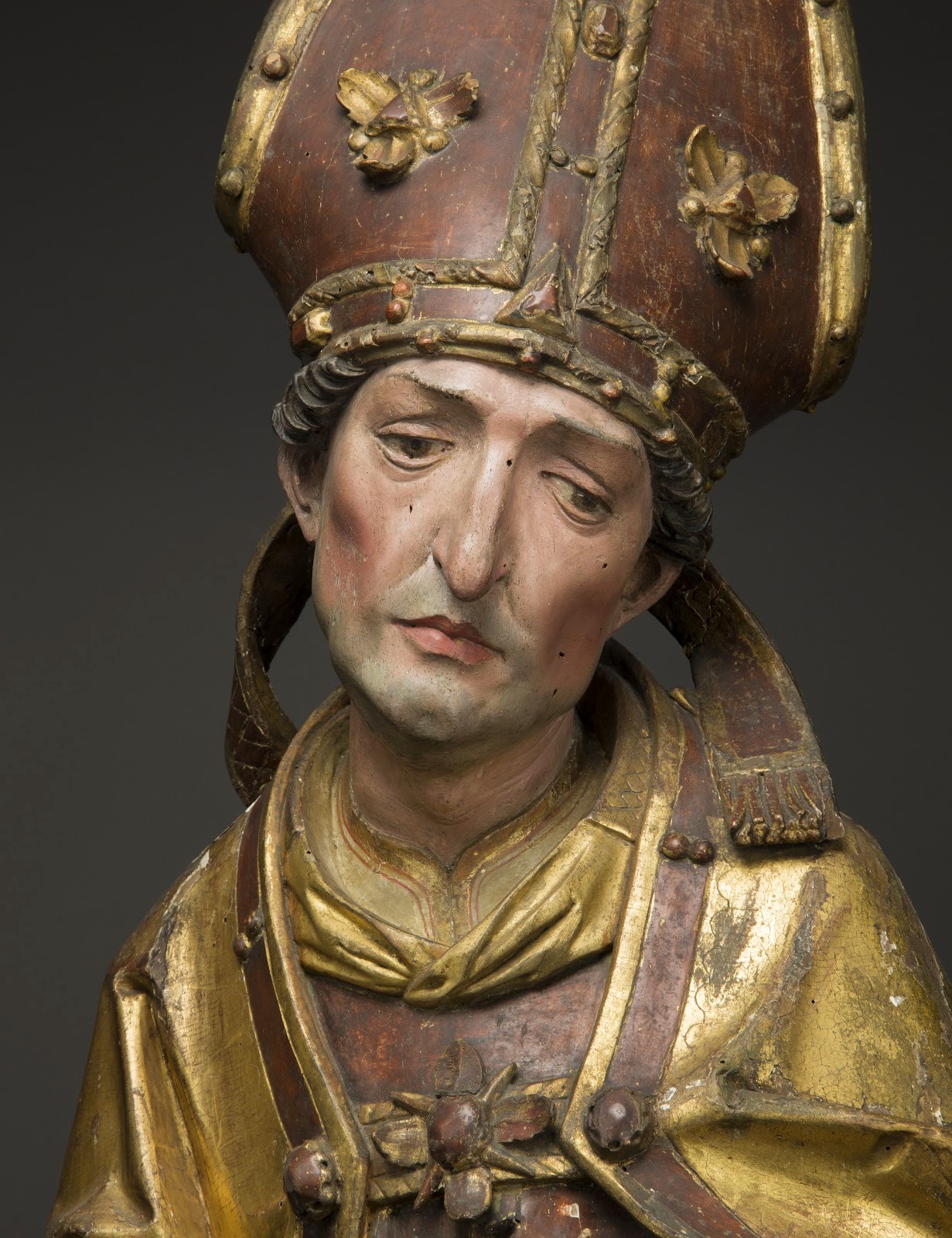
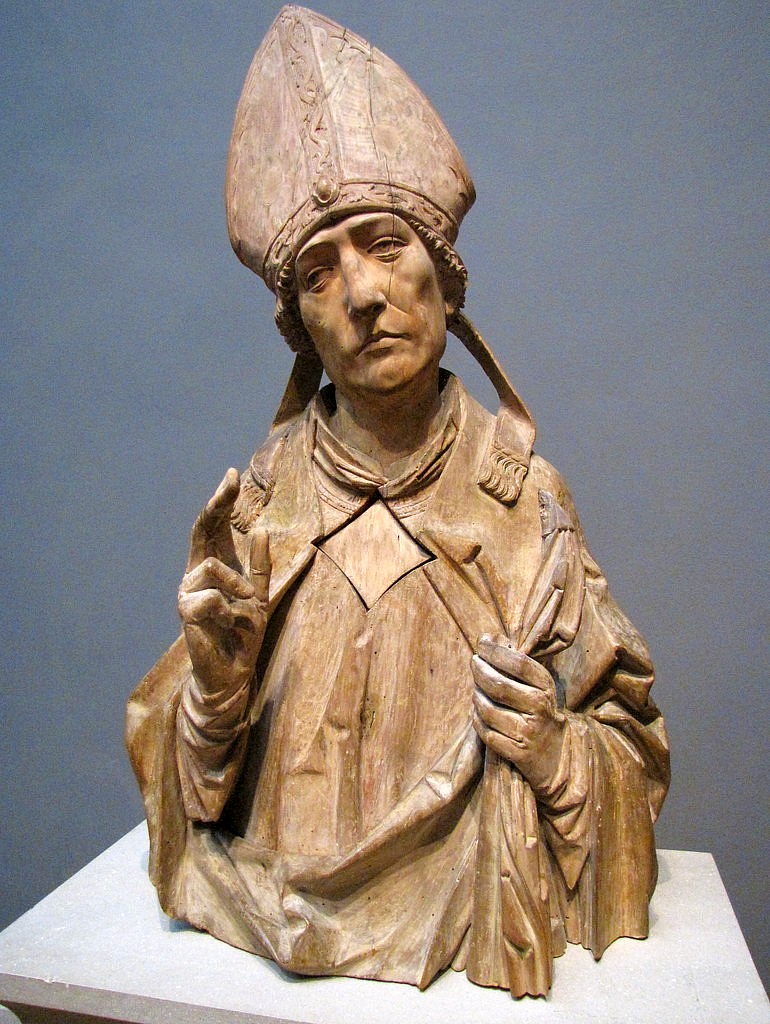
Saint of the Day – 14 October – St Burchard of Wurzburg (Died c752) The First Bishop of Wurzburg, Confessor, Monk, Missionary, English disciple of St Boniface to Germany. Born in an unknown date and location in England and died on 9 February in c 752 in Wurzburg, Germany of natural causes. Also known as – Burkard or Burkhard, Burcard. Additional memorial – 9 February, the day of his death.
The Roman Martyrology states : “In Würzburg in Austrasia, in Germany, St Burcard, a Bishop, who, originally from England, was Ordained by St.Boniface, as the first Bishop of this City.”
In about the year 732, Saint Boniface, standing in need of fellow-labourers, powerful in words and works, in the vast harvest which he had on his hands in Germany, invited from England, Saint Lullus and Saint Burchard, who seem, by this circumstance, to have come from the Kingdom of West-Sussex. They were both persons of an apostolic spirit.
Saint Boniface consecrated Saint Burchard, with his own hands, as the first Bishop of Wurzburg in Franconia, where Saint Kilian had preached the word of life and suffered Martyrdom about fifty years before.
This whole country was converted to Christ, by Burchard’s work. After labouring for twenty years, Burchard exhausted his strength and with the consent of King Pepin and by the approbation of Saint Lullus, (Saint Boniface being gone to preach in Friesland), he resigned his Bishopric to Megingand, a Monk of Fritzlar, and a disciple of Saint Wigbert.
Burchard retiring into solitude in that part of his Diocese called Hohenburg, where he spent the remaining part of his life with six fervent Monks or clergymen, in watching, fasting, and incessant prayer. He died on the 9th of February 752 and was buried near the relics of Saint Kilian at mount Saint Mary’s or Old Wurtzburg, where he had built a Monastery under the invocation of Saint Andrew.
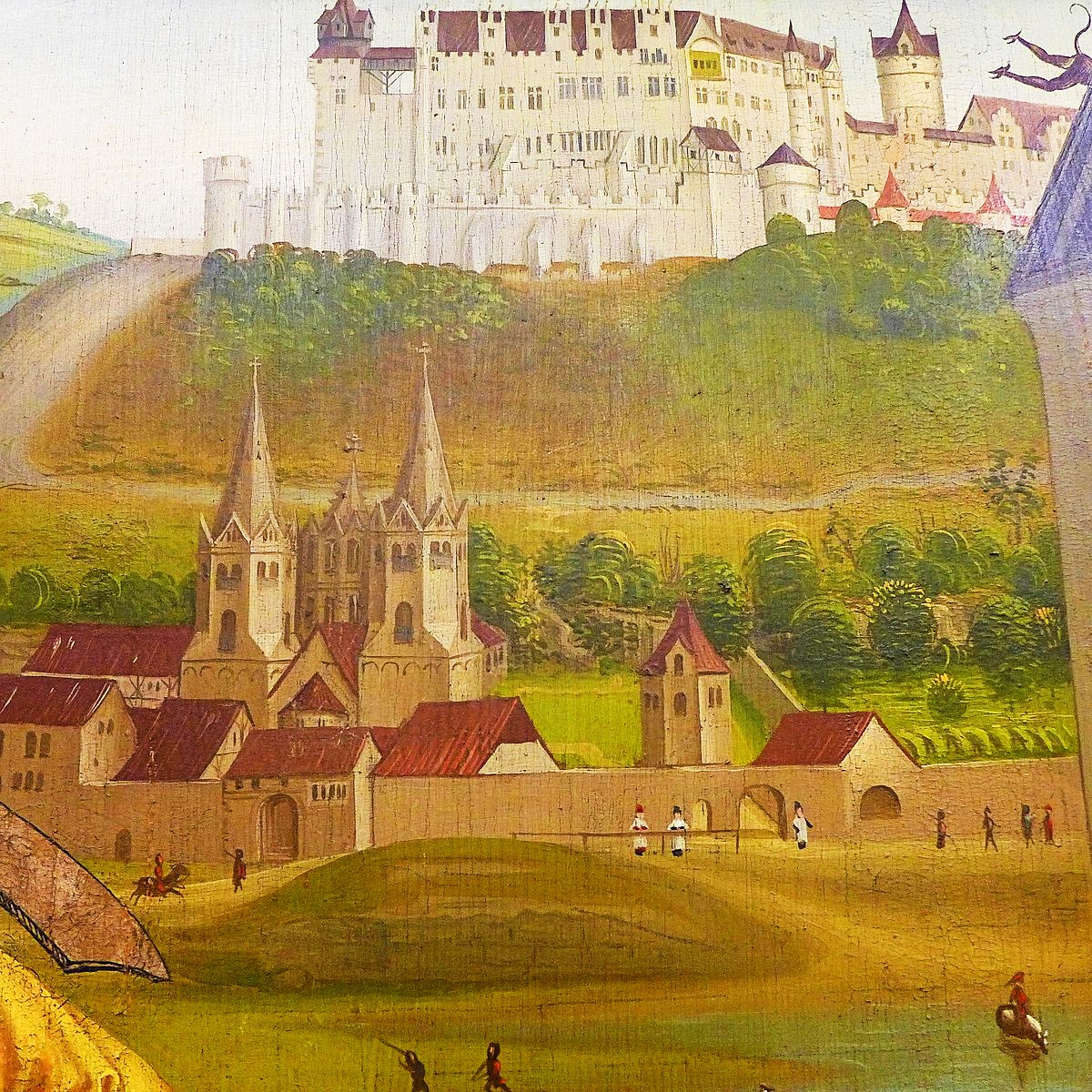
St Burchard’s Abbey c 1400
In 752, out of veneration for his sanctity, King Pepin,declared the Bishops of Wurtzburg as Dukes of Franconia, with all civil jurisdiction. The Emperor Henry IV. alienated several parts of Franconia but the Bishops of Wurzburg retained the sovereignty of this extensive Diocese.
On 14 October 983, Hugh, Bishop of Wurzburg and Chancellor to the Emperor Otho IV. authorised by an order of Pope Benedict VII, made a very solemn translation of Burchard’s relics. This day, on which this ceremony was performed, has been regarded as St Burchard’s principal festival.
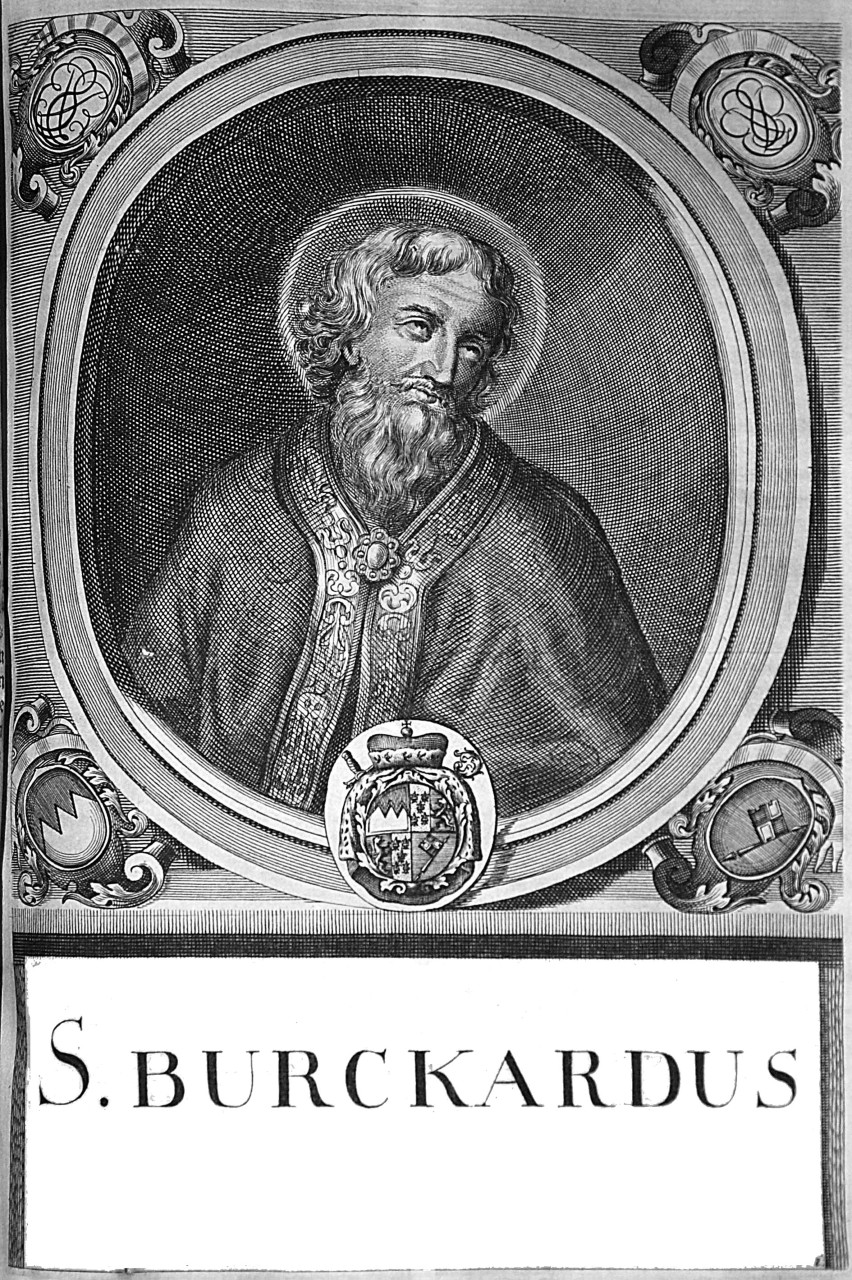
Engraving by Johann Salver
The life of Saint Burchard was written by an anonymous author above two hundred years after his death and again, by Egilward, a Monk of Wurzburg. – Excerpted from Father Alban Butler (1710–1773) English Priest and Hagiographer (Lives of the Fathers, Martyrs and Principal Saints, 1866).
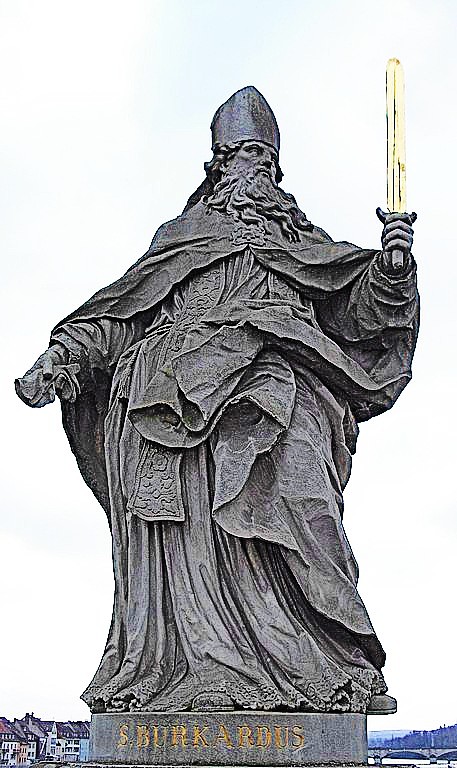
The Statue of St Burchard on Wurzburg’s Old Bridge
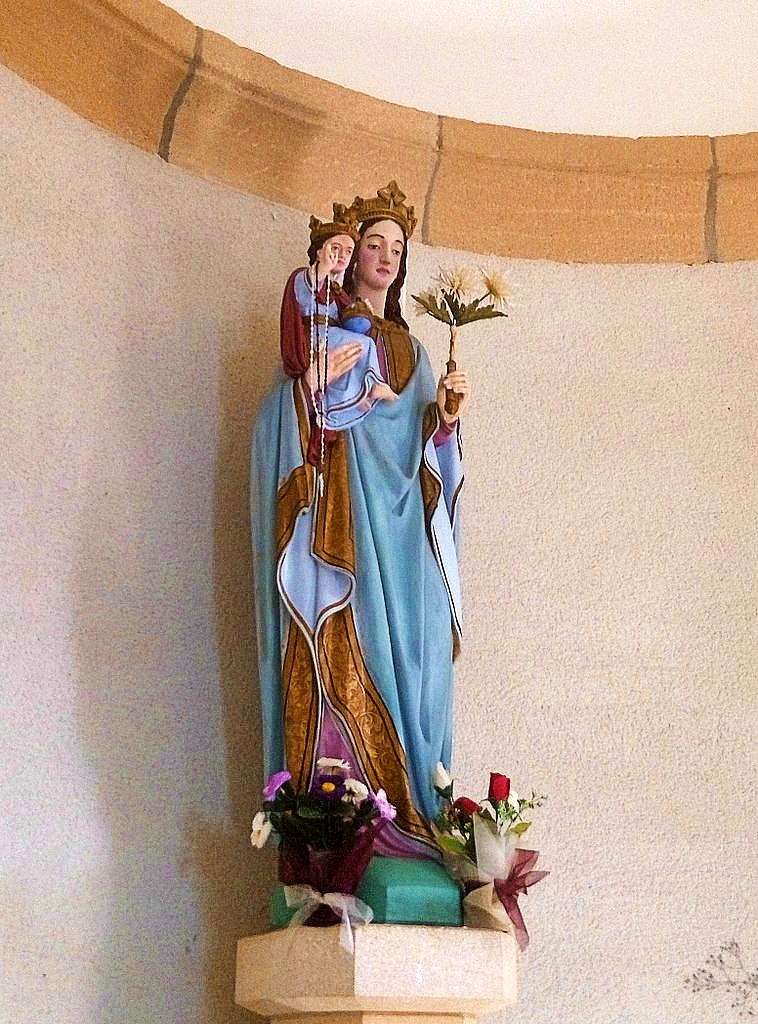
Notre-Dame-de-la-Rochette, Ranchal, France / Our Lady of La Rochette: 14 October
There are no easily translated legends of the above Marian Feast. Hopefully, by next year I will find something somewhere.In the meantime, I have found the beautiful Statues and Church and the little citation by Abbot Orsini:
The Abbot Orsini wrote: “Our Lady of La Rochette near Geneva. A shepherd coming up to a bush, where he heard a plaintive voice, found there an image of the Blessed Virgin, which led to a Church being built there.”
St Bernard of Arce St Burchard of Wurzburg (c 752) Bishop, Confessor, Monk, Missionary, disciple of St Boniface. St Celeste of Metz St Dominic Loricatus
Saint Fortunatus of Todi (Died 537) Bishop, Confessor, miracle-worker. An entry in the Roman Martyrology under 14 October records: “At Todi in Umbria, St Fortunatus, Bishop, who, as is mentioned by blessed Gregory, was endowed with an extraordinary gift for casting out unclean spirits.” About St Fortunatus: https://anastpaul.com/2020/10/14/saint-of-the-day-14-october-saint-fortunatus-of-todi-died-537/
St Gaudentius of Rimini St Gundisalvus of Lagos Bl Jacques Laigneau de Langellerie St Lupulo of Capua St Lupus of Caesarea St Manacca St Manehildis St Modesto of Capua St Rusticus of Trier St Saturninus of Caesarea St Venanzio of Luni
Martyrs of Caesarea – (4 Saints): Three brothers and a sister Martyred together in the persecutions of Diocletian – Carponius, Evaristus, Fortunata and Priscian. In 303 in Caesarea, Cappadocia (in modern Turkey) – their relics enshrined in Naples, Italy.
Thought for the Day – 13 October – Meditations with Antonio Cardinal Bacci (1881-1971)
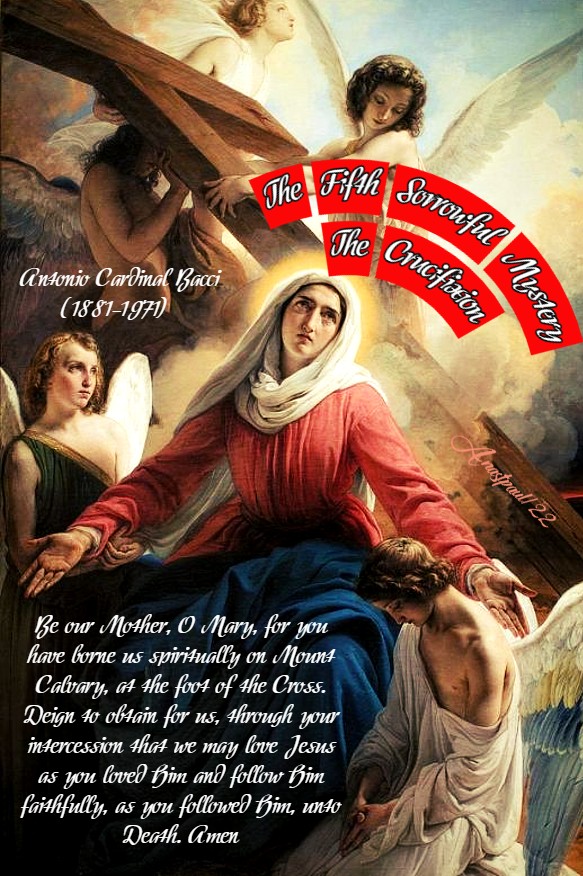
“Month of the Holy Rosary” The Fifth Sorrowful Mystery The Crucifixion
“Be our Mother, O Mary, for you have borne us spiritually on Mount Calvary, at the foot of the Cross. Deign to obtain for us, through your intercession that we may love Jesus as you loved Him and follow Him faithfully, as you followed Him, unto Death. Amen.”
Quote/s of the Day – 13 October – “The Month of the Most Holy Rosary and of the Angels” and the Memorial of Our Lady of Fatima: The Sixth & Final Apparition
Our Lady’s Words
“Let not your heart be disturbed. Do not fear that sickness, nor any other sickness or anguish. Am I not here, who is your Mother? Are you not under my protection? Am I not your health? Are you not happily within my fold? What else do you wish? Do not grieve nor be disturbed by anything.”
Our Lady of Guadalupe to Juan Diego 9 December 1531
“Penance, penance, penance. Pray for sinners.”
Our Lady to St Bernadette Soubirous at Lourdes, 1858
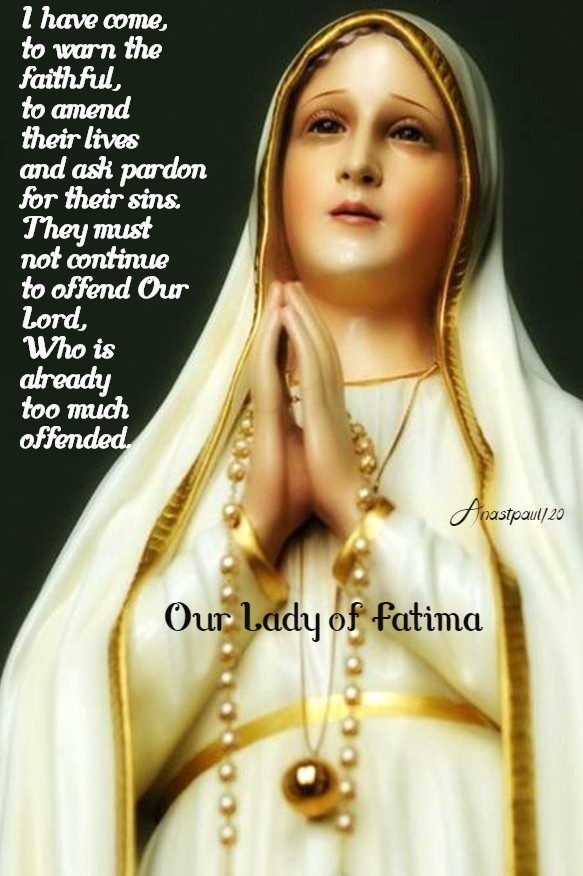
“I have come, to warn the faithful, to amend their lives and ask pardon for their sins. They must not continue to offend Our Lord, Who is already too much offended.”
“Look, my Daughter,” Our Lady said to Lúcia on 10 December 1925, “at my heart, surrounded with thorns, with which ungrateful men pierce me.”
“My child, behold my Heart all pierced with thorns, which the blasphemies and ingratitude of men drive deeper at every moment . . . make known to men that:
I promise to assist. at the hour of death. with the graces necessary for salvation, all those who, on the first Saturdays of five consecutive months, go to Confession, receive Holy Communion, say the Rosary and spend a quarter of an hour with me, in meditation on te fifteen Mysteries of the Rosary, with the object of making reparation to me.”
“Say the Rosary everyday to obtain peace for the world. And after each decade, say the following prayer: ‘O my Jesus, forgive us our sins, save us from the fires of Hell, lead all souls to Heaven, especially those in most need of Thy mercy.’”
One Minute Reflection – 13 October – “The Month of the Most Holy Rosary and of the Angels” and the Memorial of Our Lady of Fatima: The Sixth & Final Apparition – Sirach 31:8-11, Luke 12:35-40 – Scripture search here: https://www.drbo.org/
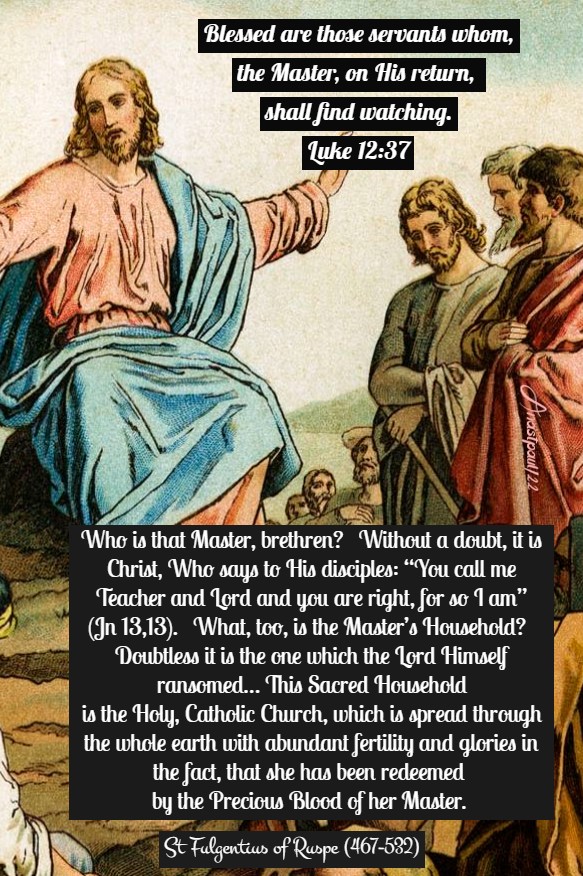
“Blessed are those servants whom the Master, on His return, shall find watching.” – Luke 12:37
REFLECTION – “Wishing to emphasise the special office of the servants, whom He has placed in charge of His people, the Lord says, ‘Who, do you think, is the faithful and wise steward, whom the Lord sets over His household, to give to them their measure of wheat at the proper time? Blessed is that servant whom his Master will find so doing when he comes.” Who is that Master, brethren? Without a doubt, it is Christ, Who says to His disciples: “You call me Teacher and Lord and you are right, for so I am” (Jn 13,13). What, too, is the Master’s Household? Doubtless it is the one which the Lord Himself ransomed… This Sacred Household is the Holy, Catholic Church, which is spread through the whole earth with abundant fertility and glories in the fact, that she has been redeemed by the Precious Blood of her Master. As He Himself says: “The Son of Man came, not to be served but to serve and to give His Life as a ransom for many” (Mk 10,45).
He is, too, the Good Shepherd ”Who laid down His Life for His sheep” (Jn 10,11)…As to who the steward is, who ought to be faithful, as well as wise, the Apostle Paul shows us, when, speaking of himself and his companions, he says: “This is how one should regard us, as the servants of Christ and stewards of the mysteries of God. Moreover, it is required of stewards that they should be found trustworthy” (1Cor 4,1-2).
Now, lest anyone of us should think that it is only the Apostles who have been made stewards…, the blessed Apostle Paul shows us that the Bishops also are stewards, when he says: “For a bishop, as God’s steward, must be blameless” (Tt 1,7)…We, therefore, who are the servants of the Master of the Household, we are the stewards of the Lord, we have received the measure of wheat to disburse to you.” – St Fulgentius of Ruspe (467-532) Bishop in North Africa (Homily 1, on the Lord’s servants) (trans. Breviary Common of Pastors).
PRAYER – From all perils of soul and body defend us, O Lord, we beseech Thee and by the intercession of blessed and gloriosus ever Virgin Mary, Mother of God,and all the Saints, graciously grant us, safety and peace that all adversities and errors being overcome, thy Church may serve Thee in security and freedom. Through Jesus Christ, Thy Son our Lord, Who lives and reigns with Thee, in the unity of the Holy Ghost, God, world without end. Amen (Collect).
Our Morning Offering – 13 October – “The Month of the Most Holy Rosary” and the Memorial of Our Lady of Fatima: The Sixth & Final Apparition
Act of Consecration and Reparation to the Immaculate Heart of Mary
O Immaculate Heart of Mary, Queen of Heaven and Earth and tender Mother of men, in accordance with thy ardent wish made known at Fatima, I consecrate to thee, myself, my brethren, my country and the whole human race. Reign over us and teach us how to make the Heart of Jesus reign and triumph in us and around us, as It has reigned and triumphed in thee. We wish to atone for the many crimes committed against Jesus and thee. We wish to call down upon our country and the whole world, the peace of God in justice and charity. We promise to imitate thy virtues, by the practice of a Christian life without regard to human respect. We resolve to receive Holy Communion on the first Saturday of every month and to offer thee five decades of the Rosary on this day, together with our sacrifices in the spirit of reparation and penance. Amen.
Saint of the Day – 13 October – St Simbert of Augsburg (Died c 809) Bishop of Augsburg, Monk, Abbot, Miracle-worker, he restored and built Churches and the Cathedral of Augsburg, as well as, contributed vastly to the reconstruction of the City after the devastation of war. Simbert – name means: on a brilliant path (old high German) Died on 13 October in c 809 of natural causes. Also known as – Simpert, Sintbert, Sinthert. He was Canonised by Pope Nicholas V. Patronages – against headaches, of children and youth of the Diocese of Augsburg and the third Patron of the Diocese.
The Roman Martyrology reads: “In Augsburg in Bavaria in Germany, St Simbert, who was Bishop and Abbot of Murbach.”
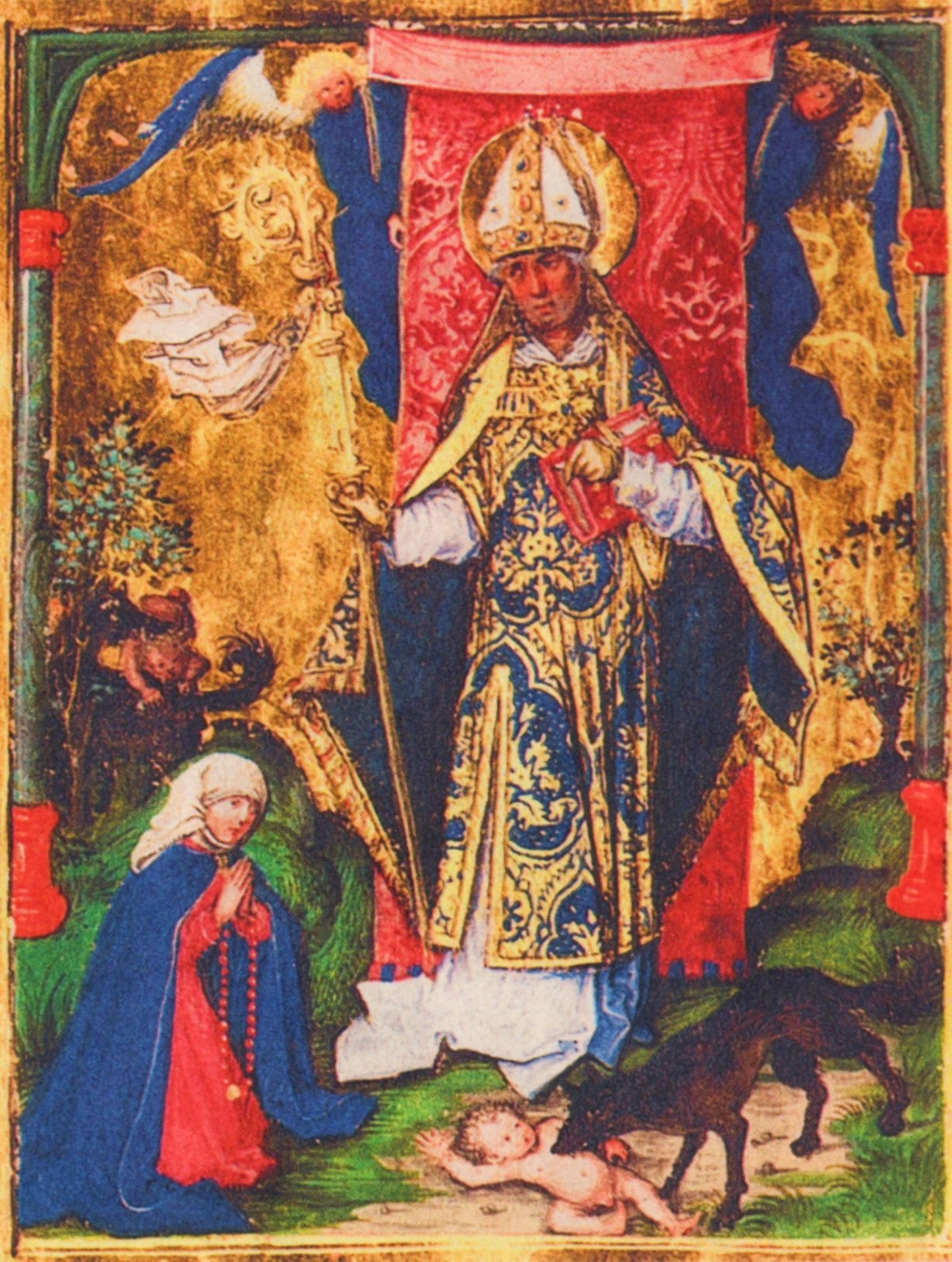
Hans Holbein the Younger: St Simpert and the wolf legend, 1492, in the Bavarian State Library in Munich
Simpert, probably the son of Duke Ambertus of Lorraine and his wife Simphorina, a sister of Charlemagne , was educated in a Monastery. King Karl, with whom he was in close contact throughout his life, appointed him Bishop of Augsburg – probably in 778 – as Bishop Tozzo ‘s successor . In documents from 798 and 799, Simpert was also referred to as Bishop of Neuburg an der Donau , in 800 he became Bishop of Neuburg. It was only between 801 and 807 that the areas of the Diocese east and west of the Lech, which had previously been separated, were united and Augsburg, once again, became the sole Episcopal See – this union was due to the great merit of Simbert.
Augsburg was badly damaged in the fighting between Bavaria and Franconia, at the time, and Simpert contributed greatly to the reconstruction of the City of Augsburg. To renovate his Diocese, he received extensive gifts and goods. In Augsburg, he had the destroyed Church of St Afra – today St. Ulrich and Afra – rebuilt and also completed the new building of the Cathedral, which he accordingly Consecrated in 807. He also founded the Cathedral school.
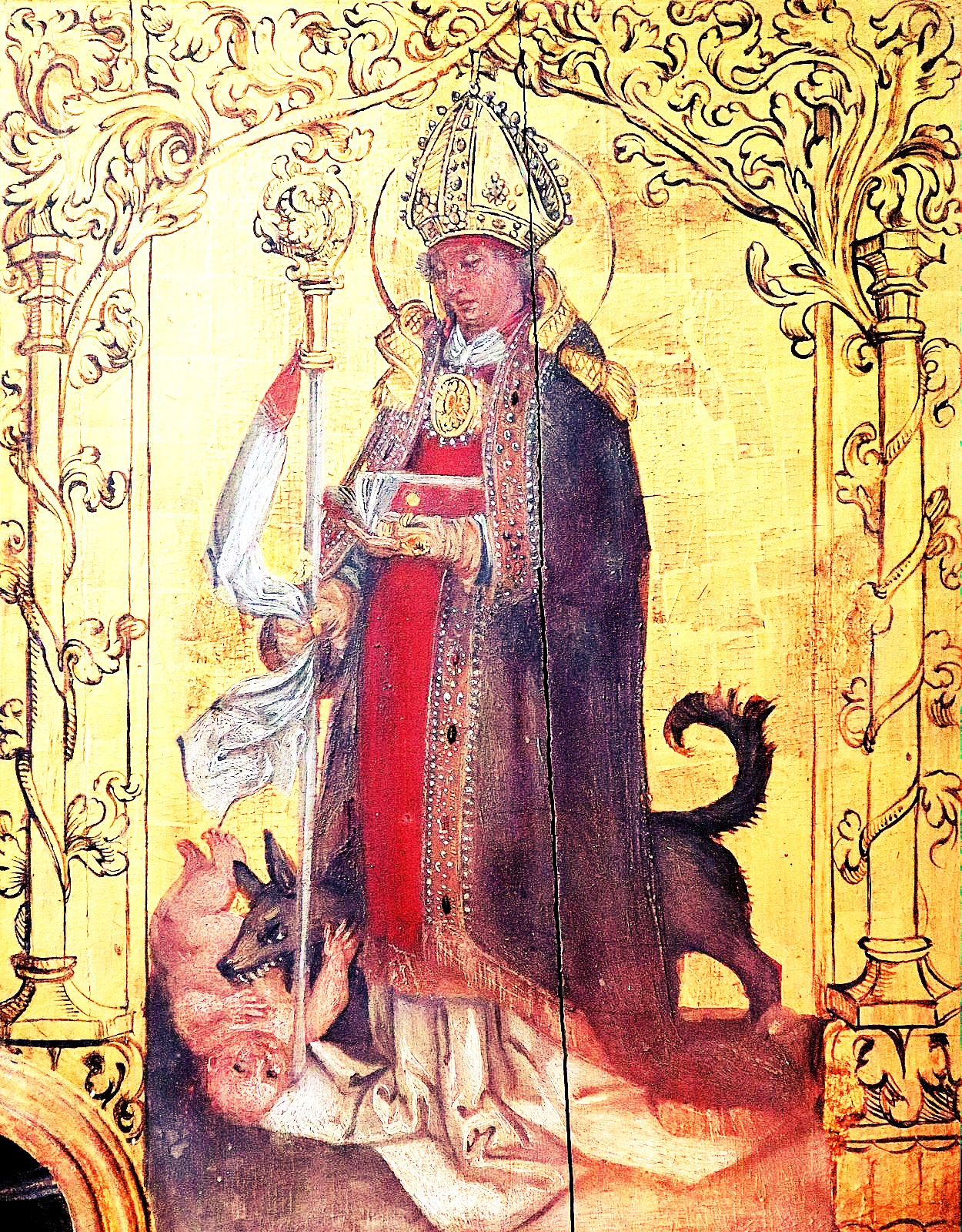
According to his wishes,, Simpert was buried in the Church of St Afra , which he had renovated and Consecrated. In 1064 his bones were raised and reburied. Numerous miracles occurred at his tomb. Records tell us how a mother asked for the intercession of St Simbert because a wolf had kidnapped her child. The wolf then returned the child and left it, unharmed in the Church. Simper’t’s intercession rescued a man who was about to sink in a swamp. Since the late Middle Ages, Simpert has also been revered as a Miracle-worker and regionally, as a unfailing assistant in all needs. Simpert caps were worn for headaches.
St Simpert saves the child from the wolf, artwork in the Church of St. Ulrich and Afra in Augsburg, where St Simbert’s tomb is enshrined
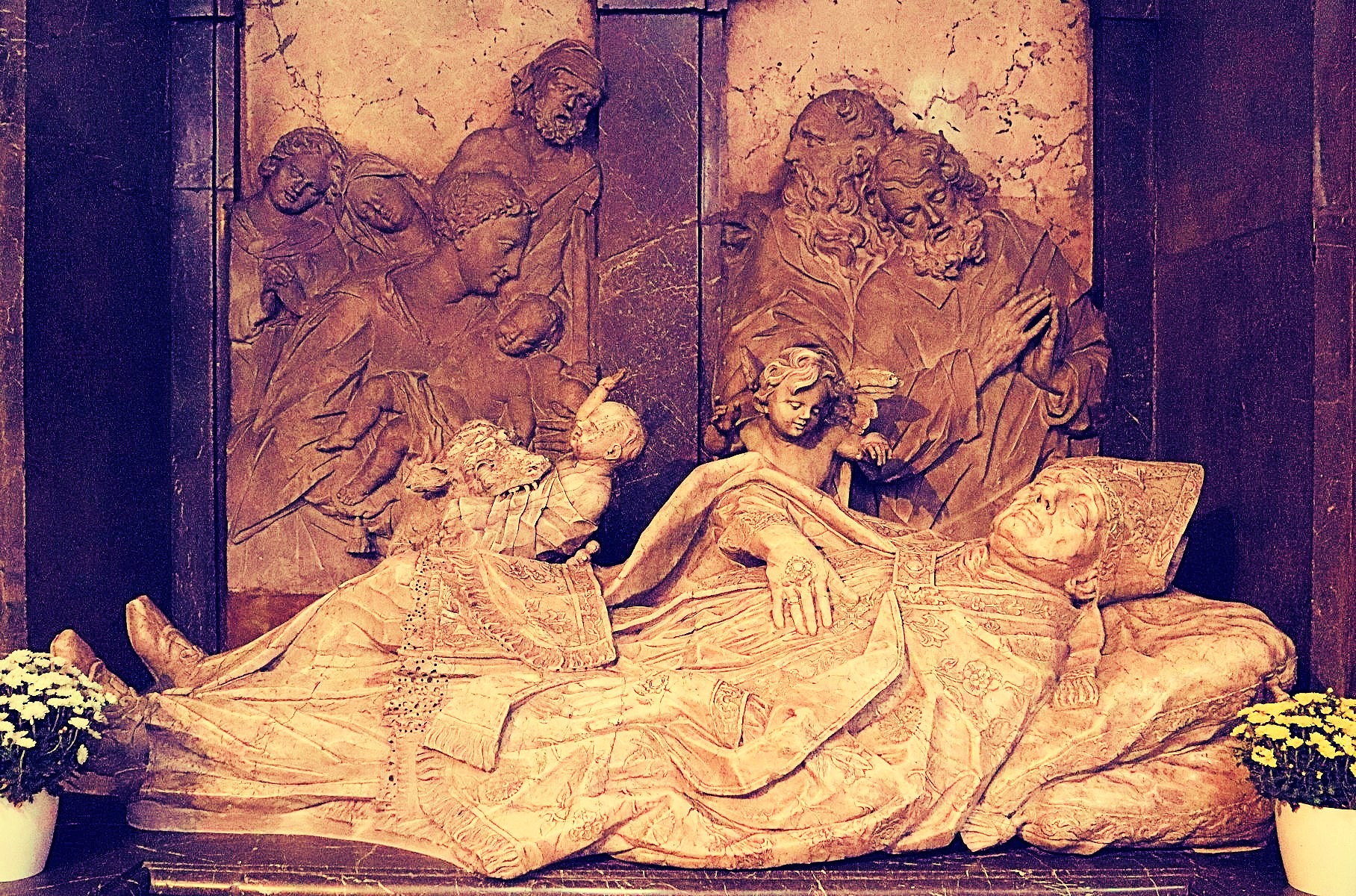
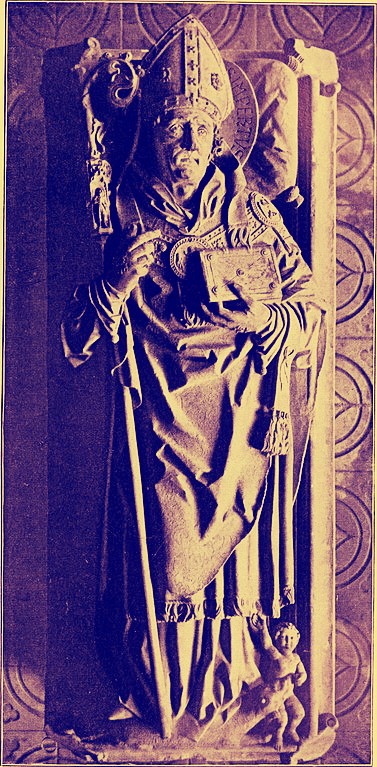
Simpert’s hagiography and reports on the miracles he performed, were written in 1230 by the Abbot of the Monastery in St. Ulrich and Afra. Emperor Maximilian I had a great devotion and veneration for him and included him in his line of ancestors. Emperor Maximillian was present as King when the bones were transferred in 1492. The large marble reclining figure above his grave, dates from 1714. The grave was opened in 1977 and an almost intact skeleton was revealed together with a copy of the biography from 1492 were found. His skull was then transferred to the St Simpert Church , which was newly built in 1978/1979 .
Reclining figure on the St Simpert Shrine and relief of the wolf miracle, 1714, in the Basilica of St. Ulrich and Afra in Augsburg
In 2007, Bishop Walter Mixa placed the Youth ministry of the Diocese of Augsburg and all children and young people under Simpert’s special protection and entrusted them to him as Patron Saint and advocate.
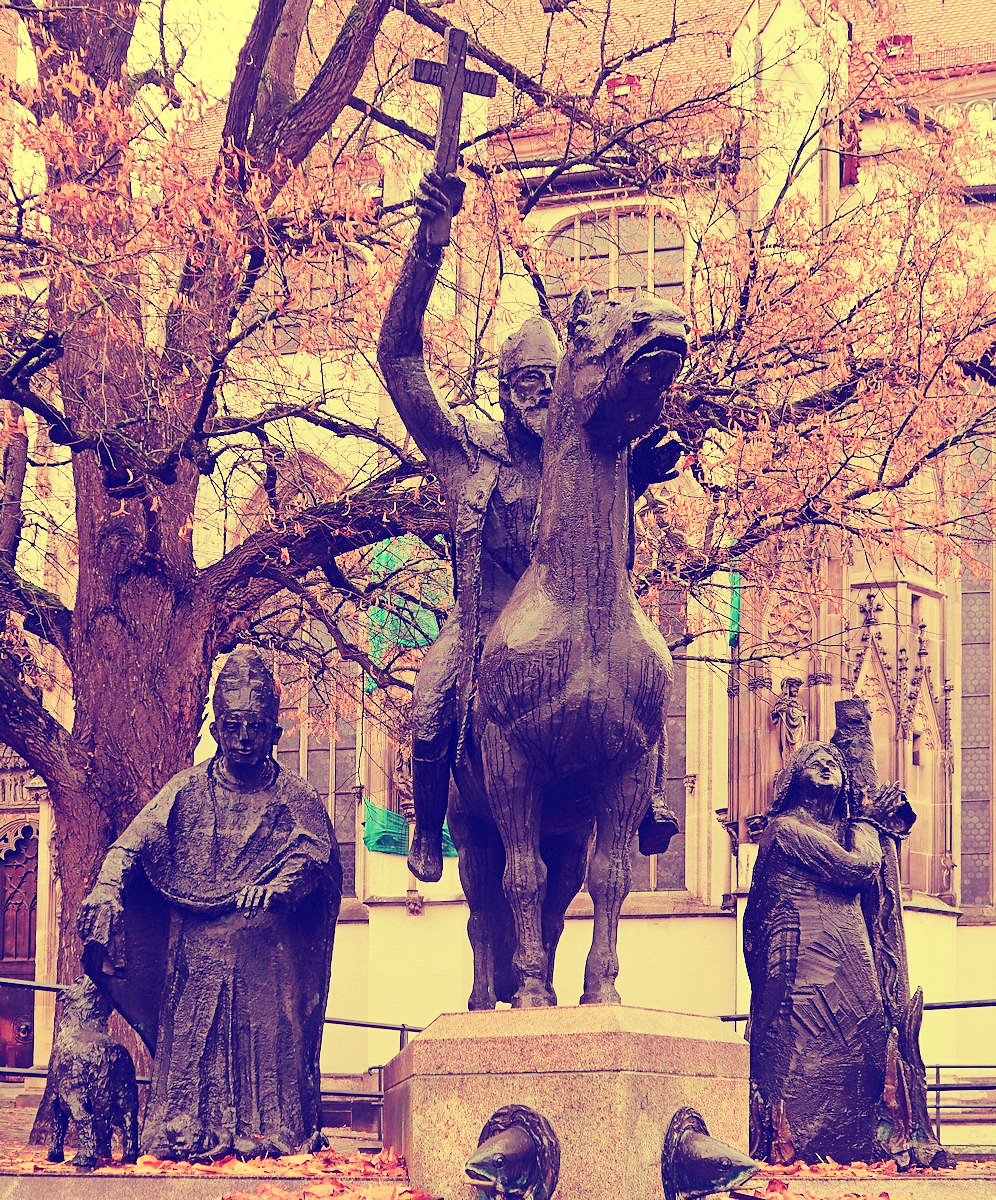
Josef Henselmann 1986: St Simpert with wolf and child (left), Bishop St Ulrich von Augsburg fighting the Hungarians (middle) and St Afra (right). The Group Statue composition stands at the fountain in front of the St Simbert’s Cathedral in Augsburg
In 1450 Pope Nicholas V Canonised St Simbert and allowed Simpert to be venerated as a Saint in his burial Church of St Ulrich and Afra in Augsburg, then in 1622, Pope Gregory XV approved. his veneration in the Diocese of Augsburg and in 1624 he was appointed the third Diocesan Patron.
St Benedict of Cupra St Berthoald of Cambrai St Carpus of Troas St Chelidonia St Comgan the Monk St Florence of Thessalonica St Fyncana St Fyndoca Bl Gebrand of Klaarkamp
St Maurice of Carnoet St Regimbald of Speyer St Romulus of Genoa St Simbert of Augsburg (Died c 809) Bishop, Monk, Abbot St Theophilus of Antioch St Venantius
Three Crowns of Cordoba – (3 Saints): Three Christian men Martyred in the persecutions of Diocletian – Faustus, Januarius and Martial. They were burned to death in 304 in Cordoba, Spain.
Thought for the Day – 12 October – Meditations with Antonio Cardinal Bacci (1881-1971)
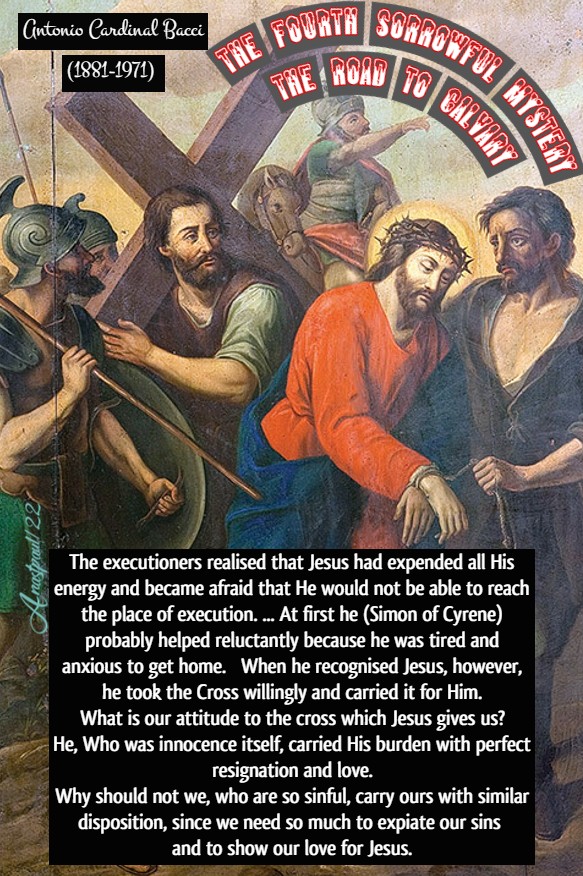
“Month of the Holy Rosary” The Fourth Sorrowful Mystery The Road to Calvary
“The executioners realised that Jesus had expended all His energy and became afraid that He would not be able to reach the place of execution. For this reason, they compelled Simon of Cyrene, who was coming back from the country after his work, to carry the Cross instead of Jesus. At first he probably helped reluctantly because he was tired and anxious to get home. When he recognised Jesus, however, he took the Cross willingly and carried it for Him.
What is our attitude to the cross which Jesus gives us? He, Who was innocence itself, carried His burden with perfect resignation and love. Why should not we, who are so sinful, carry ours with similar disposition, since we need so much to expiate our sins and to show our love for Jesus.”
Quote/s of the Day – 12 October – 1 Corinthians 1:4-8, Matthew 9:1-8–
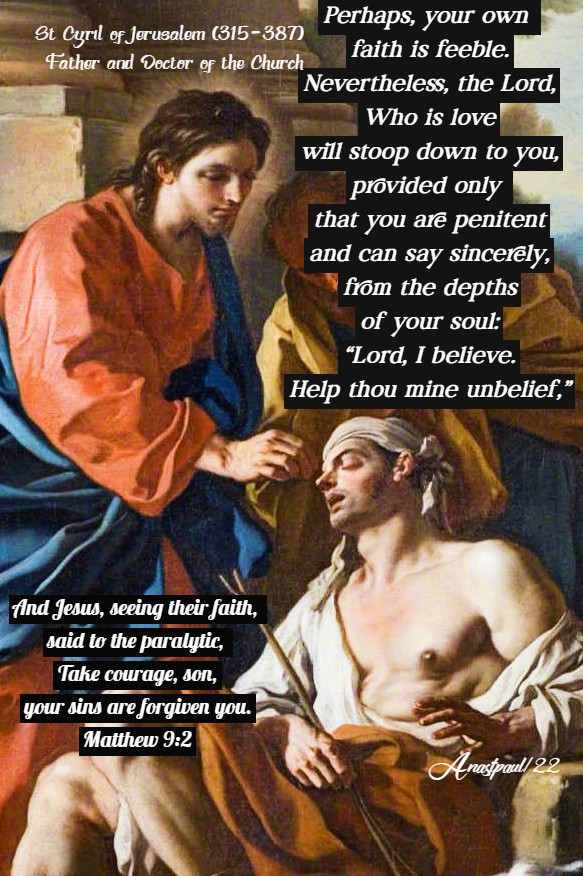
“And Jesus, seeing their faith, said to the paralytic, Take courage, son, your sins are forgiven you.”
Matthew 9:2
“Perhaps, your own faith is feeble. Nevertheless, the Lord, who is love will stoop down to you, provided only that you are penitent and can say sincerely, from the depths of your soul: “Lord, I believe. Help thou mine unbelief,” (Mark 9:23)……”
St Cyril of Jerusalem (315-387) Father and Doctor of the Church
“Faith gives rise to prayer and this prayer obtains an increase of faith.”
St Augustine (354-430) Father and Doctor of Grace
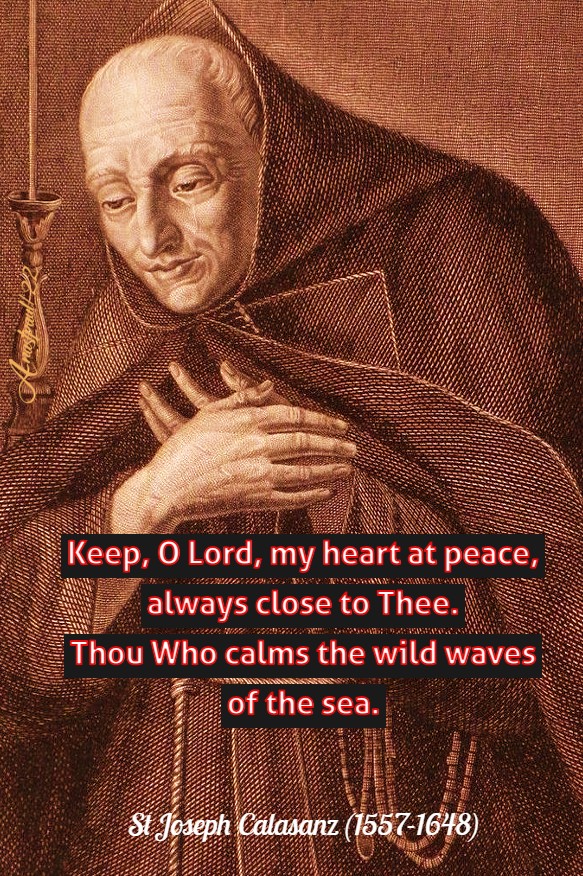
“Keep, O Lord, my heart at peace, always close to Thee. Thou Who calms the wild waves of the sea.”
St Joseph Calasanz(1557-1648)
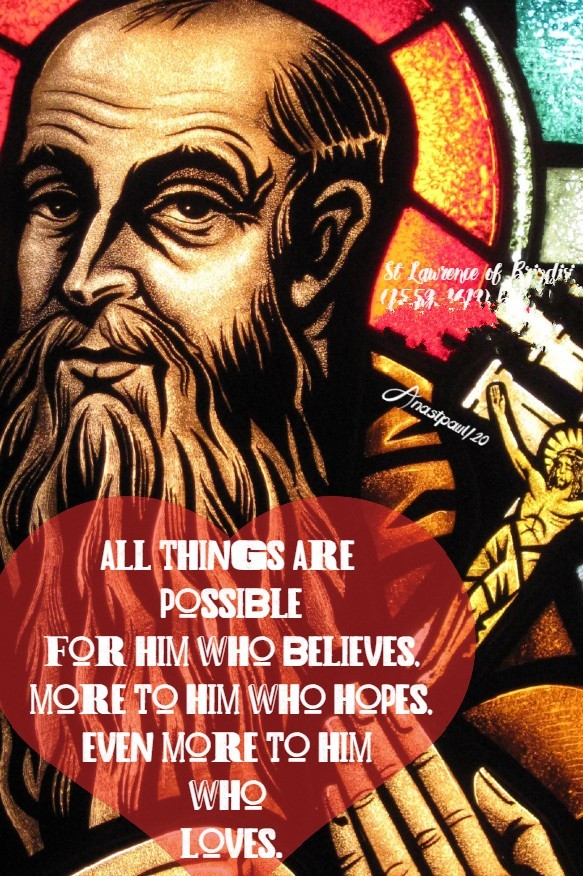
“All things are possible for him who believes, more to him who hopes, even more to him who loves.”
St Lawrence of Brindisi (1559-1619)
Hear us, O Heavenly Father, For the Sake of Your Only Son By St Augustine (354-430)
Almighty Father, come into our hearts and so fill us with Your love that forsaking all evil desires, we may embrace You, our only good. Show us, O Lord our God, what You are to us. Say to our souls, I am your salvation, speak so, that we may hear. Our hearts are before You, open our ears, let us hasten after Your Voice. Hide not Your Face from us, we beseech You, O Lord. Open our hearts, so that You may enter in. Repair the ruined mansions, that You may dwell therein. Hear us, O Heavenly Father, for the sake of Your only Son, Our Lord Jesus Christ, who lives and reigns with You and the Holy Spirit, one God, now and forever. Amen
One Minute Reflection – 12 October – “The Month of the Most Holy Rosary and of the Angels” – 1 Corinthians 1:4-8, Matthew 9:1-8 – Scripture search here: https://www.drbo.org/
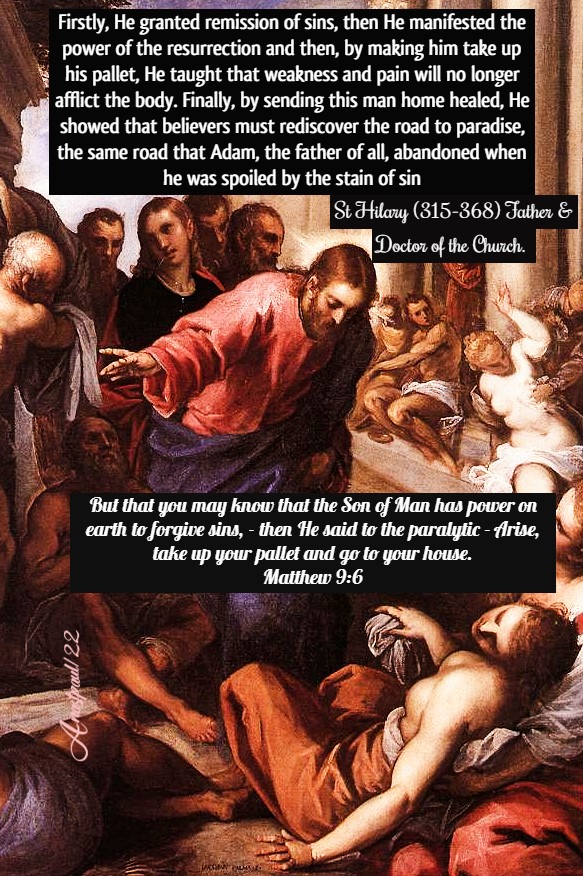
“But that you may know that the Son of Man has power on earth to forgive sins, – then He said to the paralytic – Arise, take up your pallet and go to your house. ” – Matthew 9:6
REFLECTION – “None can forgive sins except God alone and so, He who healed them, is God… And so that people might understand that He had taken flesh for the remission of their sins and to gain resurrection for their bodies, He said: “That you may know that the Son of Man has authority on earth to forgive sins on earth” – He then said to the paralytic: “Rise, pick up your pallet” It would have been enough to have said: “Rise” but… He added: “Pick up your pallet and go home.” Firstly, He granted remission of sins, then He manifested the power of the resurrection and then, by making him take up his pallet, He taught that weakness and pain will no longer afflict the body. Finally, by sending this man home healed, He showed that believers must rediscover the road to paradise, the same road that Adam, the father of all, abandoned when he was spoiled by the stain of sin.”… St Hilary (315-368) Father & Doctor of the Church.
PRAYER – May the working of Thy mercy, we beseech Thee, O Lord, guide our hearts, for without Thee, we cannot please Thee. Through Jesus Christ, Thy Son ouTheeord, Who lives and reigns with Thee, in the unity of the Holy Ghost, God, world without end. Amen (Collect).
O God of Our Life By St Augustine (354-430) Father & Doctor of the Church
O God of our life, there are days when the burdens we carry chafe our shoulders and weigh us down, when the road seems dreary and endless, the skies grey and threatening, when our lives have no music in them and our hearts are lonely and our souls have lost their courage. Flood the path with light, run our eyes to where the skies are full of promise, tune our hearts to brave music, give us the sense of comradeship, with heroes and Saints of every age and so quicken our spirits, that we may be able to encourage, the souls of all, who journey with us on the road of life, to Your honour and glory. Amen
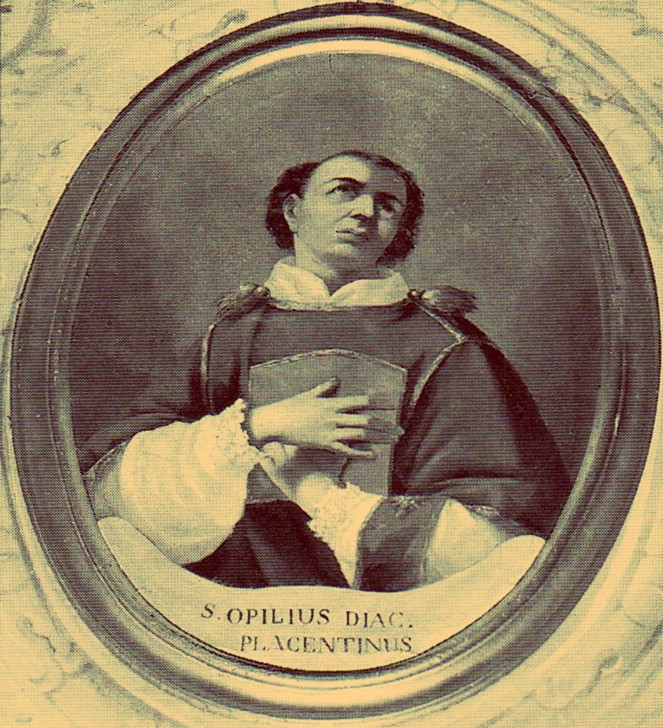
Saint of the Day –12 October – Saint Opilio of Piacenza (Died mid 5th Century) Deacon. Opilio died in Piacenza of natural causes. He is also known as – Opilione.
Opilio is commonly remembered together with his brother St Gelasius and the Piacenza Bishop St Maurus. The three Saints are almost always remembered in a single chapter by the biographers and are always defined with the similar characteristics.
Opilio was a great example ,especially for his piety, his spirit of austere penance and his lively charity towards his neighbour. Tradition has it that he shared with the poor the food that his mother sent him through Sr Gelasius, his brother.
We have no certain information about his biography. Some inform us that as an Acolyte, he participated in the translation of the body of St Antoninus, commissioned by St Savinien.
The date of death of Saint Opilio can be placed in the first half of the 5th century. His bones rest in the Basilica of St Antoninus and some relics were brought by the Bishop Giovanni Battista Scalabrini, to the Chapel of the City’s Seminary.
There are various works depicting St Opilio Deacon, none of which can be traced online. In the Chapel of the Seminary, there is a painting of the late nineteenth Century, by the painter Ghittoni, which depicts the young St Opilio, with an ecstatic face in conversation with the Angels, together with St Gelasius.
Furthermore, there is still the only painting by the artist Bernardo Ferrari that depicts the two Saints and is located in the Basilica of St Antoninus in Piacenza.
The Basilica of St Antoninus in Piacenza where St Opilio’s tomb is venerated
In the Parish Church there is a painting from 1882, by Fedele Toscani, which depicts him alone. Finally, St Opilio is depicted in a portrait in relief in stone, in the Altar of the Crypt of the Piacenza Cathedral.
St Opilio is remembered by the Piacenza Church on 12 October.
St Evagrius the Martyr St Felix St Herlindis St Juan Osiense St Maximilian of Celeia St Meinards St Monas of Milan (Died 249) Saint Opilio of Piacenza Deacon (Died first half of the 5th Century) St Pantalus of Basle St Priscian the Martyr St Relindis
St Serafino of Montegranaro OFM Cap (1540-1604) Confessor, Franciscan Capuchin Lay Friar, gifted with the Charism of prophecy, Mystic, Apostle of the poor, Spiritual Advisor, devoted to the Blessed Sacrament, the Holy Rosary and to the Blessed Virgin Mary, Miracle-worker. The Roman Martyrology states: “At Ascoli, St Seraphinus, Confessor, of the Order of Minorite Capuchins, distinguished by holiness of life and humility. Hre was enrolled among the Saints by the Sovereign Pontiff Clement XIII.” Holy St Serafino: https://anastpaul.com/2021/10/12/saint-of-the-day-12-october-st-serafino-of-montegranaro-ofm-cap-1540-1604/
Martyrs of Arian North Africa: Commemoration of the 4,996 Martyrs who died in the persecutions of the Vandals in Africa mandated by the Arian King Huneric. The persecuted Christians include Bishops, Priests, Deacons and thousands of the lay faithful. They died in 483 at various locations in North Africa. (Would we follow Christ and stand true to the Faith today?)
Thought for the Day – 11 October – Feast of the Divine Maternity –Meditations with Antonio Cardinal Bacci (1881-1971)
Mary, the Mother of God
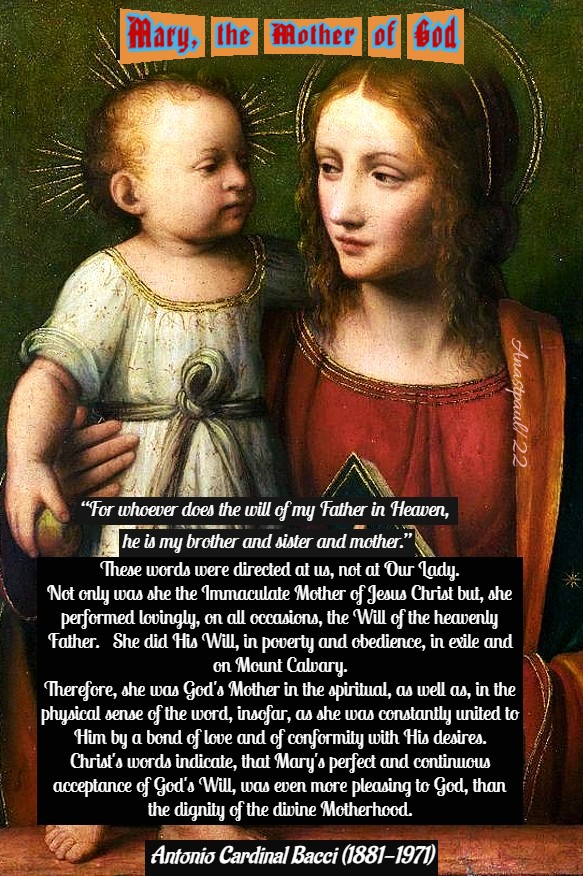
“St Matthew (Cf Mt 12:46-50) and St Mark (Cf Mk 3:31-35), relate how Jesus was preaching one day in Galilee, surrounded by His Apostles and by a large crowd, when a man approached and said: “Behold, thy mother and thy brethren are standing outside, seeking thee.” “Who is my mother,” He answered, “and who are my brethren?” Then He extended His hand towards His disciples and said: “Behold, my mother and my brethren! For whoever does the will of my Father in Heaven, he is my brother and sister and mother.”
These words were directed at us, not at Our Lady. Not only was she the Immaculate Mother of Jesus Christ but, she performed lovingly, on all occasions, the Will of the heavenly Father. She did His Will, in poverty and obedience, in exile and on Mount Calvary. Therefore, she was God’s Mother in the spiritual, as well as, in the physical sense of the word, insofar, as she was constantly united to Him by a bond of love and of conformity with His desires.
Christ’s words indicate, that Mary’s perfect and continuous acceptance of God’s Will, was even more pleasing to God, than the dignity of the divine Motherhood.
We cannot equal her in dignity but, we can imitate her in this other respect. Jesus will look on us as His brothers and as worthy sons of Mary, if we carry out His Will in all things. It is not always easy to do this. It is not easy, when we are strongly tempted to commit sins of pride, anger or impurity. It is not easy, when we are overcome by sorrow or by sickness, when we are let down or misunderstood by others, when we are in want and, when we feel that we are collapsing beneath the weight of our cross. At times like these, we should pray for Mary’s spirit of complete acceptance of the Will of God.”







































You must be logged in to post a comment.