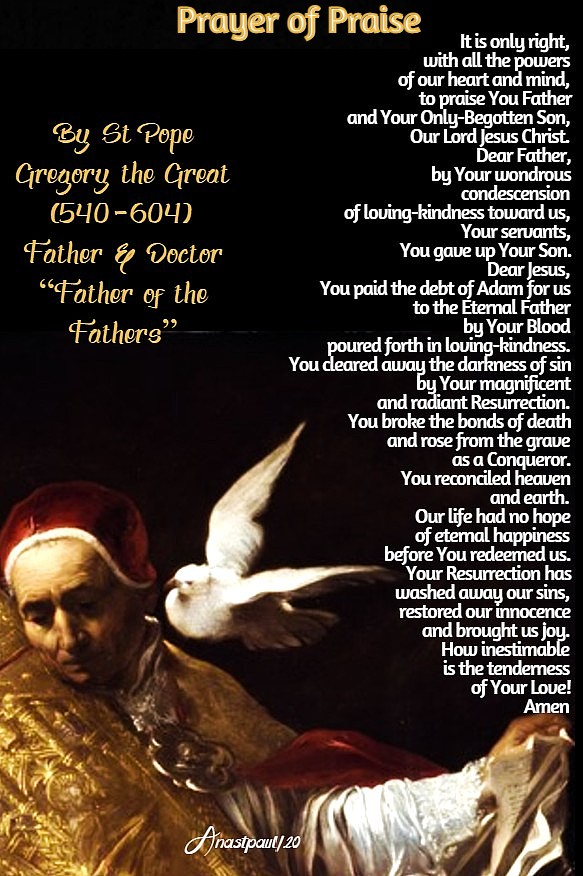
One Minute Reflection – 23 November – Readings: Daniel 2: 31-45; Psalm: Daniel 3: 57-61; Luke 21: 5-11 – The Mmemorial of St Pope Clement I (Died c 101) Martyr, Apostolic Father, Papacy c 88 – c 101.
“See that you not be deceived, for many will come in my name, saying, ‘I am he’ and ‘The time has come.’ Do not follow them!” – Luke 21:8
REFLECTION – “[Christ speaks:] I became useless to those who knew Me not, because I shall hide Myself, from those who possessed Me not. And I will be with those who love Me. All my persecutors have died and they, who trusted in Me, sought Me because I am living! I arose and am with them and will speak by their mouths. For they have rejected those who persecute them and I threw over them, the yoke of My love. Like the arm of the bridegroom over the bride (cf Sg 2,6), so is My yoke over those who know Me. And as the bridal feast is spread out by the bridal pair’s home, So is My love, by those who believe in Me.
I was not rejected, although I was considered to be so and I did not perish, although they thought it of Me. Sheol saw Me and was shattered and Death ejected Me and many with Me. I have been vinegar and bitterness to it and I went down with it as far as its depth. Death was released because it was not able to endure My Face.
And I made a congregation of living, among his dead (1P 3,19; 4,6) and I spoke with them, by living lips; in order that My word may not fail. And those who had died ran toward Me and they cried out and said, “Son of God, have pity on us. And deal with us according to Your kindness and bring us out from the chains of darkness. And open for us, the door by which we may go forth to You, for we perceive, that our death does not approach You. May we also be saved with You because You are our Saviour.”
Then I heard their voice and placed their faith in My Heart. And I placed My Name upon their forehead (Rv 14,1) because they are free and they are Mine! – Odes of Solomon (Hebrew Christian text from the beginning of the 2nd century) N° 42
PRAYER – Almighty, everliving God, the holiness of the Saints is Your glory. Let us rejoice in the memory of Saint Clement, Priest and Martyr of Christ Your Son. His life his teaching and his death bore witness to the mystery of faith. Grant us by his prayers, the courage and faith he manifested, to imitate Our Master in all things. We make our prayer through Him Who is the Light and the Power, with You Father and the Holy Spirit, one God now and forever, amen.
Our Morning Offering – 23 November – The Memorial of Blessed Miguel Pro – Martyr (1891-1927)
Heart Of Jesus By Blessed Miguel Pro – Martyr (1891-1927)
I believe, O Lord but strengthen my faith, Heart of Jesus, I love Thee but increase my love. Heart of Jesus, I trust in Thee but give greater vigour to my confidence. Heart of Jesus, I give my heart to Thee but so enclose it in Thee that it may never be separated from Thee. Heart of Jesus, I am all Thine but take care of my promise so that I may be able to put it into practice even unto the complete sacrifice of my life. Amen.
Saint of the Day – 23 November – St Pope Clement I (Died c 101) Martyr, Apostolic Father, Papacy c 88 – c 101. Born in Rome and Martyred at Chersonesus, Greece. The Liber Pontificalis states that Clement died in Greece in the third year of Emperor Trajan’s reign, or 101. Patronages – mariners, sailors, marble artisans, sick children, stonecutters, Diocese of Aarhus, Denmark, Dundee, Scotland, Steenwijk, Netherlands, Velletri, Italy. Also known as – Clement of Rome, Clemens Romanus. St Clement is listed by St Irenaeus and Tertullian as the fourth Bishop of Rome, holding office from 88 until his death. He is considered to be the first Apostolic Father of the Church, (those who provided a direct link between the Apostles and later generations of Church Fathers). one of the three chief ones together with St Polycarp and St Ignatius of Antioch. He has left one genuine writing, a letter to the Church of Corinth and many others have been attributed to him.
The Roman Martyrology states: “The birthday of Pope St Clement, who held the sovereign Pontificate, the third after the blessed Apostle Peter. In the persecution of Trajan, he was banished to Chersonesus, where, being precipitated into the sea with an anchor tied to his neck, he was crowned with Martyrdom. His body was taken to Rome, during the Pontificate of Nicholas I and placed with due honour, in the Church which had been previously built under his invocation.”
Few details are known about Clement’s life. Tradition suggests that Clement was the son of a Roman named Faustinus and that he joined the Church in Rome during its early years through the preaching of Saint Peter or Saint Paul. He went on to share in the missionary journeys of the Apostles, some believe he was one of the 72 or 70 disciples and may even have assisted the first Pope in running the Church on a local level.
Clement was said to have been Ordained by St Peter the Apostle and he is known to have been a leading member of the Church in Rome in the late 1st century. After the deaths of St Peter’s first two successors, the Saints Popes Linus and Cletus, Clement took up St Peter’s position of primacy in the Church around the year 88.
In his letter to the Church at Corinth in response to a dispute in which certain Presbyters of the Corinthian Church had been deposed, he asserted the authority of the Presbyters as rulers of the Church, on the ground that the Apostles had appointed them. His letter, which is one of the oldest extant Christian documents outside the New Testament, was read in Church, along with other Epistles, some of which later became part of the Christian canon. These works were the first to affirm the apostolic authority of the clergy.
St Clement has been identified as the Clement that Paul mentioned in Philippians 4:3: “And I entreat thee also, my sincere companion, help those women who have laboured with me in the gospel, with Clement and the rest of my fellow labourers, whose names are in the book of life.” (DR).
According to apocryphal acta dating to the 4th century at earliest, Clement was banished from Rome to the Chersonesus during the reign of the Emperor Trajan and was set to work in a stone quarry. Finding, on his arrival, that the prisoners were suffering from lack of water, he knelt down in prayer. Looking up, he saw a Lamb on a hill, went to where the Lamb had stood and struck the ground with his pickaxe, releasing a gushing stream of clear water. This miracle resulted in the conversion of large numbers of the local pagans and his fellow prisoners to Christianity.
St Clement by Tiepolo
As punishment, Clement was Martyred by being tied to an anchor and thrown from a boat into the Black Sea. Since then, that every year a miraculous ebbing of the sea revealed a divinely built Shrine containing his bones.
The Martyrdom of St Clement
The Inkerman Cave Monastery marks the supposed place of Clement’s burial in the Crimea. A year or two before his own death in 869, Saint Cyril (c 827–869), (brother of St Methodius) brought to Rome what he believed to be the relics of Saint Clement, bones he found in the Crimea buried with an anchor on dry land. They are now enshrined in the Basilica di San Clemente, one of the oldest Parish Churches in Rome. Other relics of Saint Clement, including his head, are claimed by the Kyiv Monastery of the Caves in Ukraine.
In works of art, Saint Clement can be recognised by having an anchor at his side or tied to his neck. He is most often depicted wearing papal vestments, including the Pallium and sometimes, with a Papal Tiara but more often with a Mitre. He is also sometimes shown with Papal symbols such as the Papal Crucifix and the Keys of Heaven. In reference to his Martyrdom, he often holds the palm of Martyrdom.
The St Clement’s Cross is also referred to as the Anchored Cross or Mariner’s Cross.
St Clement’s Cross
St Clement is among the Saints mentioned in the Church’s most traditional Eucharistic prayer, the Roman Canon.
La Conchita de Granada. Virgen de la Concepción / Our Lady of the Immaculate Conception, Granada, Nicaragua (1721) – 23 November to 8 December:
Patron of Granada and of the Armies of Nicaragua – known as the “General” of the armies.
In 1721, women washing clothes in Lake Nicaragua saw a chest floating in but every time it drew near, waves pulled it back out. The women went to tell the Franciscan Friars. When they arrived and waded into the water, the chest floated up to their hands. On top were the words, “For the City of Granada.” Inside were two images of the Virgin (one of which was later given to the City of Masaya). Immediately, the Franciscan Friars carried the image to the Cathedral in procession. In 1856, the American Mercenary, William Walker invaded and proclaimed himself president of Nicaragua. On 23 November 1856, when he began to lose his private war in Central America, he left Granada, commanding the fire that almost completely destroyed the City Among the few objects recovered in good condition was the Sacred Statue of the Virgen de la Concepción, still in the Cathedral of Granada today.


Granada Cathedral
The Virgin is shown slaying a dragon with a spear, which is inscribed in the Title given her in 1862, “General of the Nicaraguan Army.” The army band plays in her honour on 28 November, the first day of the Novena, prior to the Feast of the Immaculate Conception on 8 December. The Statue is a one and a half meter tall wood carving,the Virgin Mary smiles gently – in her left arm the Child Jesus lies, while with his right hand he holds a spear that rests on the head of a serpent. The current spear is not the original spear, since William Walker stole the original which was solid silver. The Virgin’s feet rest on a half moon. In 1862, once the Nicaraguan National War had ended, General Tomas Martínez declared the Title of “General of the Nicaraguan Armies,” this Title was granted, considering that the Virgin had played “a decisive role in the great battles against the Mercenaries.” The Title of General makes the Blessed Virgin enjoy a salary for the reconstruction of the Church, in addition, the Title thus belonging to the armed forces, grants the Army a particular role in the celebrations of the Patron during the Novena and the Festivities in her honour on 8 December.
St Pope Clement I (Died c 101) Martyr, Apostolic Father, Papacy c 88 – c101(Optional Memorial)
St Adalbert of Casauria St Alexander Nevski St Amphilochius of Iconium St Augusta of Alexandria St Cecilia Yu Sosa St Clement of Metz Bl Detlev of Ratzeburg Bl Enrichetta Alfieri St Falitrus of Chabris St Faustina of Alexandria Bl Felícitas Cendoya Araquistain St Felicity of Rome St Gregory of Girgenti Bl Guy of Casauria St Jaume Nàjera Gherna St John Camillus the Good St Loëvan of Brittany St Lucretia of Mérida Bl Margaret of Savoy
St Mustiola of Chiusi St Paternian of Fano St Paulinus of Whitland St Rachildis of Saint-Gall St Severin of Paris St Sisinius of Cyzicus St Trudo of Hesbaye St Wilfetrudis of Nivelless
Thought for the Day – 17 November – Meditations with Antonio Cardinal Bacci (1881-1971)
The Influence of the Cinema, Radio, Television, [Internet]
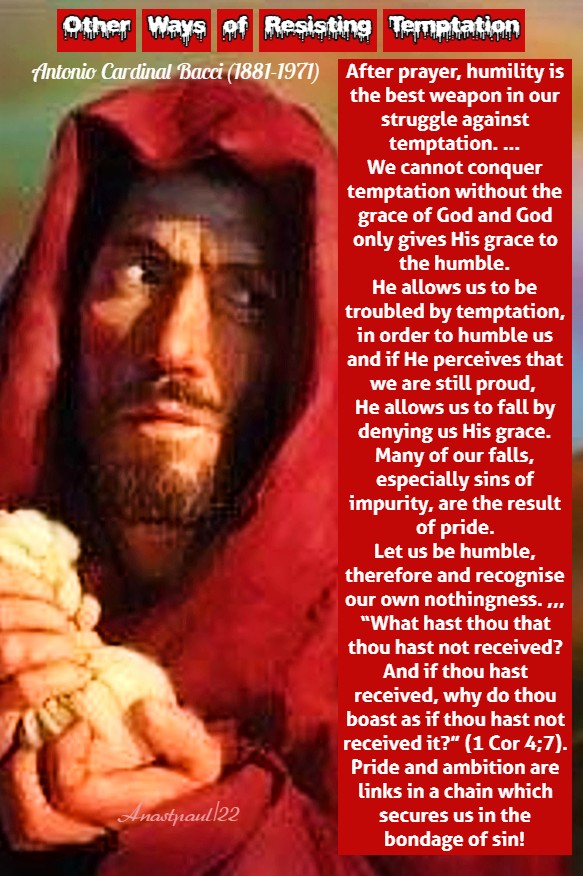
“It is an unfortunate but undeniable fact, that man often employs new inventions and discoveries for evil, rather than for good purposes. The gifts of God ought to bring us closer to Him but, too often, they become, through our own fault, the means of separating ourselves further from Him. Everything is good and not only whatever God has created but also, whatever we, ourselves produce by a proper use of the facultis with which our Creator has endowed us.
“Every creature of God is good,” says St Paul, “and nothing is to be rejected…” (1 Tim 4:4). These words are still true of the countless inventions of our own era. The cinema, radio, television, [internet], are essentially good because they are gifts which God has brought into being through the agency of human intelligence and perseverance. But what use have we been making of them? Take, for instance, the cinema. It must be admitted that there are very few films today which are edifying or spiritually helpful. Most are positively bad and dangerous, especially to certain branches of the community. Moreover, as Pope Pius XI warned us, in his Encyclical, Vigilanti Cura, on this subject in 1936, many films, which would otherwise be quite harmless, are rendered dangerous because they are interspersed with various kinds of immorality.
Since the greatest evil for a Christian is the loss of God and this inevitably follows, the loss of grace and of the Faith, we must observe the following safeguards in our approach to the cinema: (1)We must stay away from any film which might represent a proximate occasion of mortal sin; (2) We must avoid films which are opposed to morals or to the Faith and must see that our families and dependents, do likewise; (3) We may attend films which are good or merely entertaining. It is better, however, not to go to the cinema too regularly, for to do so, would be a waste of time and could expose us to unforeseen risks. In any case, there are many other amusements, preferably open-air, which are much more beneficial to soul and body.”
Antonio Cardinal Bacci
Note: We are definitely capable of updating the wise words of dear Cardinal Bacci to accommodate the current era and infiltration of the above evils into virtually every moment of our lives – on our phones and computers.
One Minute Reflection – 17 November – Readings: 2 Maccabees 7: 1, 20-31; Psalm 17: 1, 5-6, 8b and 15; Luke 19: 11-28 and the Memorial of St Elizabeth of Hungary TOSF (1207-1231) Princess
“He called ten of his servants and gave them ten gold coins and told them, ‘Engage in trade with these until I return.’” – Luke 19:13
REFLECTION – “From this time onward, Elizabeth’s goodness greatly increased. She was a lifelong friend of the poor and gave herself entirely to relieving the hungry. She ordered that one of her Castles, should be converted into a Hospital in which she gathered many of the weak and feeble. She generously gave alms to all who were in need, not only in that place but in all the territories of her husband’s empire. She spent all her own revenue from her husband’s four principalities and finally, she sold her luxurious’ possessions and rich clothes for the sake of the poor.
Twice a day, in the morning and in the evening, Elizabeth went to visit the sick. She personally cared for those who were particularly repulsive; to some she gave food, to others clothing; some she carried on her own shoulders and performed many other kindly services. Her husband, of happy memory, gladly approved of these charitable works. Finally, when her husband died, she sought the highest perfection; filled with tears, she implored me to let her beg for alms from door to door.
On Good Friday of that year, when the Altars had been stripped, she laid her hands on the Altar in a Chapel in her own Town, where she had established the Friars Minor,and before witnesses, she voluntarily renounced all worldly display and everything that our Saviour in the gospel advises us to abandon. Even then, she saw that she could still be distracted by the cares and worldly glory which had surrounded her while her husband was alive. Against my will she followed me to Marburg. Here in the Town she built a hospice, where she gathered together the weak and the feeble. There she attended the most wretched and contemptible at her own table.
Apart from those active good works, I declare before God that I have seldom seen a more contemplative woman. When she was coming from private prayer, some religious men and women often saw her face shining marvelously and light coming from her eyes like the rays of the sun!
Before her death I heard her Confession. When I asked what should be done about her goods and possessions, she replied that anything which seemed to be hers, belonged to the poor. She asked me to distribute everything except one worn out dress in which she wished to be buried. When all this had been decided, she received the Body of our Lord. Afterward, until vespers, she spoke often of the holiest things she had heard in sermons. Then, she devoutly commended to God all who were sitting near her and as if falling into a gentle sleep, she died.” – Conrad of Marburg (1180-1233) Priest, Spiritual Director of Saint Elizabeth of Hungary (An excerpt from Letter).
PRAYER – Holy God and Father, grant us a strong Faith! Poor Your graces into our hearts that we may believe with all our hearts, minds and souls and that in believing, we may constantly raise our entire being to You in prayer and supplication, in prayer and adoration, in prayer and love. May the intercession of St Elizabeth of Hungary, a woman of deep prayer and charity from her youth, strengthen our perseverance and trust. Through Jesus Christ, our Lord in the unity of the Holy Spirit, God forever and ever, amen
Rescue Our Life, Lord By St Romanos the Melodist (c 490-c 556) Deacon, Hymnographer, Poet, Writer.
We implore You, O All-Holy, Long-Suffering, Life and Restoration, Source of goodness, look down from Heaven and visit all those who ever trust in You; rescue our life, Lord, from all constraint and affliction and, in the faith of Truth, guide us all, at the prayers of Your Immaculate Mother of God and Virgin, Save Your world and those in the world and spare us all, You Who, for us, became Man without change, only Lover of mankind. Amen
Saint of the Day – 17 November – Saint Hugh of Lincoln O.Cart. (1135-1200) Carthusian Monk, Bishop of Lincoln, England, Confessor, Exorcist, Diplomat, Social Reformer and Protector of the poor and unjustly treated. Born in c 1135 at Avalon Castle, Burgundy, France and died on 16 November 1200 at London, England of natural causes. Patronages – sick children, sick people, swans, shoemakers. Also known as – Hugh of Avalon, Hugh of Burgundy. St Hugh was the first Carthusian Monk to be Canonised.
The Roman Martyrology states of him today: “In England, St Hugh, Bishop, who was called from a Carthusian Monastery to the government of the Church of Lincoln. He ended his holy life in peace, renowned for many miracles.“
Hugh was born at the Château of Avalon of a noble family, the son of Guillaume, Duke of Avalon. His mother died when he was eight, years old and because his father was a soldier, he was sent away for his education. When his father returned from military excursions, he retired from the world to the Augustinian Monastery of Villard-Benoît, near Grenoble and took his son Hugh, with him.
In 1140 Hugh joined the Carthusian Order at the age of 20 at Grande Chartreuse. He was highly regarded for his intellectual ability, his integrity and kind and caring nature. In 1175, at the request of Henry II, he was sent to England to found the first English Charterhouse at Witham in Somerset, which he did in the face of obstacles of all kinds. It flourished so well under his care, that in 1181 the King chose him to be Bishop of Lincoln. Hugh was reluctant to leave the monastic life but agreed and moved to Lincoln in 1186. He set about rebuilding the part of the Cathedral which had been damaged in an earthquake the previous year.
The Diocese was vast and Hugh travelled ceaselessly on horseback, ministering to the needs of the people. He stayed at small diocesan manors, as he travelled through the countryside. The most central of these was what has become Buckden Towers which he built, halfway between Lincoln and London. As a Bishop, he was exemplary, constantly in residence or travelling within his Diocese, generous with his charity, scrupulous in the appointments he made. He raised the quality of education at the Cathedral school and began the restoration of the Cathedral, which had been damaged by fire.
Hugh was known for his love of justice and his kindness to the oppressed, children and animals. Throughout his ministry he tended to lepers and in 1190 he risked his life to protect a group of Jews from violence. He also upheld the rights of the peasants against the King’s harsh and unjust forestry laws. Although he was highly principled and outspoken, his conciliatory nature and sense of humour helped him to win over his opponents.
St Hugh exorcises a man possessed by the devil
As one of the premier Bishops of the Kingdom of England Hugh more than once accepted the role of diplomat to France for Richard and then for King John in 1199, the latter trip took great toll on his health. He Consecrated St Giles’ Church, Oxford, in 1200. There is a Cross consisting of interlaced circles cut into the western column of the tower that is believed to commemorate this. Also in commemoration of the Consecration, St Giles’ Fair was established and continues to this day each September. While attending a national Council in London, a few months later, he was stricken with an unnamed ailment and died two months later on 16 November 1200
Hugh was held in great affection by everyone from peasants to monarchs and on his death at the age of 60, he was greatly mourned. At his magnificent funeral the Kings of England and Scotland helped to carry the bier. He was buried in Lincoln Cathedral and Canonised on 18 February 1220 by Pope Honorius III.
St Hugh is usually depicted as a Bishop, sometimes as a Carthusian. In either case he is accompanied by a swan, the swan of Stow, Lincolnshire (site of a palace of the bishops of Lincoln) which had a deep and lasting friendship with the Saint, even guarding him while he slept. The swan would follow him about, and was his constant companion while he was at Lincoln.as it was reported that a fierce swan at his manor at Stow became very tame and attached to him, eating from his hand and yet, the swan would attack anyone else who came near Hugh!
At Avalon, a round tower in the Romantic Gothic style, was built by the Carthusians in 1895 in Hugh’s honour on the site of the castle where he was born.
Virgen del Milagro / Our Lady of the Miracle – Mazarrón, Murcia, Spain (1585) – 17 November :
The original Statue
17 November is a special day for the coastal Town of Mazarrón, the day the Fiesta del Milagro takes place. They have for their Mother and Patroness the Immaculate Conception, and it is She, who from generation to generation, has been attributed the protection of the people against the Berber invasion.
It was the year 1585 and in the early morning of 17 November witnesses assured that about fifty Berber pirates had docked in the port of Bolnuevo to loot . For no apparent reason they fled without carrying out their assault.
The processional Statue
As is clear from reports and records of eyewitnesses, the Virgin drove the Turkish pirates away, who in their flight, left their standard, which is still preserved and can be seen after a recent restoration. It is from this miraculous event that the Virgin became the Patron of the Town. Devotion to her has continued unabated and with immense love since 1585 and the commemoration of the miraculous event occurs every 17 November with a pilgrimage. The Blessed Virgin is the Queen and Lady of Mazarrón. always watching over the Town since time immemorial.
St Acisclus St Aignan of Orléans St Alphaeus of Palestine St Eugene of Florence St Eusebio Roldán Vielva St Florinus of Remüs St Giacinto Ansalone St Gregory of Tours
St Hugh of Lincoln O. Cart. (c 1135-1200) Bishop, Carthusian Monk St Hugh of Noara St Josefa Gironés Arteta St Juan de Castillo-Rodriguez St Laverius St Lazarus Zographos St Lorenza Díaz Bolaños St Namasius of Vienne Bl Salomea of Galicia Bl Sébastien-Loup Hunot St Thomas Hioji Nishi Rokuzaemon St Victoria of Cordoba Bl Yosafat Kotsylovsky St Zacchaeus of Palestine — Jesuit Martyrs of Paraguay – 3 saints
Martyred in the Spanish Civil War: • Blessed Eusebio Roldán Vielva • Blessed Josefa Gironés Arteta • Blessed Lorenza Díaz Bolaños
Thought for the Day – 16 November – Meditations with Antonio Cardinal Bacci (1881-1971)
Evil Literature
“As far back as 1886, Pope Leo XIII in his Encyclical, Pergrata Nobis, deplored the extent to which evil literature was perverting morals and insidiously attacking the Faith. Elsewhere, he wrote: “Everyday we see new falsehood emerging with unbelievable audacity, both in large volumes and in pamphlets, periodicals and in newspapers of every kind” (AL 1883 p 262). “The yellow press is like a poison which diffuses itself everywhere” (AL1893, p 340). “The enemies of the Church employ it as the most powerful weapon with which to combat Her. Their evil and disturbing publications are, unfortunately, restrained, neither by law, nor by public opinion” (AL 1882) “We perceive, with the utmost sorrow, books and newspapers, which seem to have been compiled in order to sneer at virtue and exalt the vilest indecencies” (AL 1888 p 396).
The solemn warning of Leo XIII, has been repeated over and over again by his successors. His Holiness, Pope Pius XII, went so far as to declare that today, the propagation of evil has been turned into an industry. The unhealthy curiosity of a great many people, especially of the young, is exploited in order to sell indecent publications, which are devoid of any literary value.
In every bookstall are displayed, gaudy magazies which attrract the eye of the passer-by. If he is already the victim of vicious habits, he is provided with a further incentive towards evil, or, if he is young and innocent, the dangerous disturbance which he experiences, may be the beginning of an ultimate surrender to his lower instincts.
Since it is obvious, therefore, that the printing press has become one of the most powerful means of diffusing good and evil among individuals and families, let us examine our own attitude towards it. What kind of books and newspapers do we read? Do we support good or evil literature? Our reading, like our friends, shows what we are. If we read worldly, frivolous, or even evil publications, we are injected, perhaps unconsciously, with a subtle spiritual poison. The results may be disastrous!”
Quote/s of the Day – 16 November – The Memorial of St Gertrude the Great (1256-1302)
“Bodily and spiritual affliction are the surest sign of Divine predilection.”
“Gratitude for suffering is a precious jewel for our heavenly crown… Man should always firmly believe, that God sends just that trial which is most beneficial for him.”
“Every time we look at the Blessed Sacrament, our place in Heaven is raised forever.”
“Angels constantly guard the clients of the Blessed Virgin from the assaults of Hell.”
One Minute Reflection – 16 November – Readings: 2 Maccabees 6: 18-31; Psalm 3: 2-7; Luke 19: 1-10 – The Memorial of St Gertrude the Great (1256-1302)
“So he ran ahead and climbed a sycamore tree in order to see Jesus …”- Luke 19:4
REFLECTION – “Here is a sweet remedy when downhearted and small – we should do what Zaccheus did. He was not tall and climbed a tree in order to see God. His zeal merited him to hear these sweet words: “Zaccheus, go home for today I need to dine with you.”
We should do the same when we are low, when our hearts are constricted and lacking in charity – we should climb the Tree of the most Holy Cross and there we shall see, we shall touch God! There we shall find the fire of His ineffable charity, the love which caused Him to run, even to the insults of the Cross which raised Him up and made Him ardently desire the honour of His Father and our salvation, with hunger and thirst. … If we wish, if we are not prevented by our negligence, we may accomplish these words in ourselves, emanating from the lips of Truth, when we mount the Tree of the Cross: “when I am lifted up on high, I shall draw all things to myself” (Jn 12:32). Indeed, when the soul is thus raised up, it sees the blessings of the Father’s goodness and power…, it sees the mercy and lavishness of the Holy Spirit, that is to say, the inexpressible love holding Jesus bound to the Wood of the Cross. Nails and bonds cannot hold Him there, only charity… O climb this most holy Tree where hang the ripe fruits of all the virtues, that the body of the Son of God bears – ardently hasten. Dwell within the holy and sweet love of God. O sweet Jesus, Jesus love.” – St Catherine of Siena OP (1347-1380) Doctor of the Church, Co-Patron of Europe (Letter 119 to the prior of the Olivetans
PRAYER – Lord our God, You made the heart of St Gertrude, the dwelling place of Your love. Lighten our darkness so that through her intercession, we may experience the joy of Your presence in our hearts and with Zaccheus, we may have you stay in our home. We make our prayer through our Lord Jesus Christ, in the unity of the Holy Spirit, God forever, amen.
Our Morning Offering – 16 November – The Memorial of St Gertrude the Great (1256-1302)
Hail, Sacred Heart of Jesus! By St Gertrude the Great (1256-1302)
Hail, Sacred Heart of Jesus! Living and strengthening, Source of eternal life, Infinite Treasury of the Divinity, Burning Furnace of Divine Love! You are my Refuge and my Sanctuary. My loving Saviour, consume my heart in that burning fire with which Your own is inflamed. Pour into my soul those graces which flow from Your Love. Let my heart be so united with Yours, that our wills may be one and my will, in all things, conformed with Yours. May Your Will be the guide and rule of my desires and of my actions. Amen
Saint of the Day – 16 November – Saint Agnes of Assisi OSC (1197-1253) Virgin, Nun,Abbess, younger sister of Clare of Assisi and one of the first Abbesses of the Order of Poor Ladies (now the Poor Clares). Born Caterina Offreducia in 1197 at Assisi, Italy and died on 16 November 1253 at the Monastery of San Damiano of natural causes. Patronage – the Poor Clares, siblings, children of Mary, engaged couples, chastity.
Agnes was the younger daughter of Count Favorino Scifi. Her saintly mother, Blessed Hortulana, belonged to the noble family of the Fiumi and her cousin, Rufino, was one of the celebrated “Three Companions” of St Francis.
Agnes’s childhood was passed between her father’s Palace in the City and his Castle of Sasso Rosso on Mount Subasio.
On 18 March, 1212, her eldest sister Clare, moved by the preaching and example of St Francis, had left her father’s home to follow the way of life taught by the Saint. Sixteen days later, Agnes repaired to the Monastery of St Angelo in Panso, where the Benedictine Nuns had afforded Clare temporary shelter and resolved to share her sister’s life of poverty and penance. Agnes was just Fifteen years of age.
At this ocurrence, the fury of Count Favorino knew no bounds. He sent his brother Monaldo, with several relatives and some armed followers, to St Angelo’s Monastery, to force Agnes, if persuasion failed, to return home. The conflict which followed is related in detail in the “Chronicles of the Twent Four Generals.” Monaldo, (Agnes’ uncle) beside himself with rage, drew his sword to strike the young girl but his arm dropped, withered and useless, by his side; others dragged Agnes out of the Monastery by the hair, striking her and even kicking her repeatedly. Presently St.Clare came to the rescue and suddenly, Agnes’s body became so heavy that the soldiers having tried in vain to carry her off, dropped her, half dead, in a field near the Monastery.
Overcome by a spiritual power against which physical force availed not, Agnes’s relatives were obliged to withdraw and to allow her to remain with St Clare.
St Francis, who was overjoyed at Agnes’s heroic resistance to the entreaties and threats of her pursuers, presently cut off her hair and gave her the habit of Poverty. Soon after, he established the two sisters at St Damiano’s, in a small rude dwelling adjoining the humble Sanctuary, which he had helped to rebuild with his own hands. There several other noble ladies of Assisi joined Clare and Agnes, and thus began the Order of the Poor Ladies of St Damian’s, or Poor Clares, as these Franciscan nuns afterwards came to be called.
From the outset of her religious life, Agnes was distinguished by such an eminent degree of virtue, that her companions declared that she seemed to have discovered a new road to perfection, known only to herself.
As Abbess, she ruled with loving kindness and knew how to make the practice of virtue bright and attractive to her subjects. In 1219, Agnes, despite her youth, was chosen by St Francis to found and govern a community of the Poor Ladies at Monticelli, near Florence, which in course of time, became almost as famous as St Damiano’s. A letter written by St Agnes to St Clare, after this separation, is still extant, touchingly beautiful in its simplicity and affection. Nothing perhaps in Agnes’s character, is more striking and attractive, than her loving fidelity to Clare’s ideals and her undying loyalty in upholding the latter, in her lifelong and arduous struggle for Seraphic Poverty.
Full of zeal for the spread of the Order, Agnes established, from Monticelli, several Monasteries of the Poor Ladies in the north of Italy, including those of Mantua, Venice and Padua, all of which observed the same fidelity to the teaching of St Francis and St Clare.
In 1253 Agnes was summoned to St Damiano’s during the last illness of her beloved sister and assisted at the latter’s triumphant death and funeral.
On 16 November of the same year,she followed St Clare to her eternal reward. Her mother Hortulana and her younger sister Beatrice, both of whom had followed Clare and Agnes into the Order, had already passed away.
The precious remains of St Agnes repose near the body of her mother and sisters, in the Church of St Clare at Assisi. God, Who had favoured Agnes with many heavenly manifestations during life, glorified her Tomb after death, by numerous miracles. In 1753 Pope Benedict XIV recognised her holiness and recognised her cultus by and permitted the Order of St Francis to celebrate her Feast. It is kept on 16 November, as a double of the second class.
Our Lady of the Gate of Dawn / Our Lady of Ostra, Brama, Vilnius, Lithuania (1363) – 16 November:
This Marian Title is the prominent Catholic painting of the Blessed Virgin Mary venerated by the faithful in the Chapel of the Gate of Dawn in Vilnius, Lithuania. The painting was historically displayed above the Vilnius City Gate; city gates of the time often contained religious artefacts intended to ward off attacks and bless passing travellers. The painting is in the Northern Renaissance style and was completed most likely around 1630. The Virgin Mary is depicted without the infant Jesus. The artwork soon became known as miraculous and inspired a following. A dedicated Chapel was built in 1671 by the Discalced Carmelites. At the same time, the painting was covered in expensive and elaborate silver and gold clothes leaving only the face and hands visible.
In 1702, when Vilnius was captured by the Swedish army during the Great Northern War, Our Lady of the Gate of Dawn came to her people’s rescue. At dawn, the heavy iron of the Gate collapsed, crushing and killing four Swedish soldiers. After this, the Polish-Lithuanian Commonwealth Army successfully counter-attacked near the gate. In the following centuries, the cult grew and Our Lady became an important part of religious life in Vilnius. This inspired many copies in Lithuania, Poland and diaspora communities worldwide. On 5 July 1927, the image was canonically crowned as Mother of Mercy. It is a major site of pilgrimage in Vilnius and attracts many visitors, especially from Poland.
Patronage of Our Lady: Feast permitted by a 1679 Decree of the Sacred Congregation of Rites for all Provinces of Spain, in memory of the victories obtained there over infidels. Pope Benedict XIII granted it to the Papal States and it may now be celebrated with due permission by Churches throughout the world.
Bl Edward Osbaldeston St Elpidius the Martyr St Eucherius of Lyon St Eustochius the Martyr St Felicita of Capua St Fidentius of Padua St Gobrain of Vannes St Ludre St Marcellus the Martyr St Othmar of Saint Gal Bl Simeon of Cava — Martyrs of Africa – (11 saints)
Martyrs of Almeria – (9 saints): Soon after the start of the Spanish Civil War in 1936, the Communist-oriented Popular Front had all clergy and religious arrested and abused as they considered staunch Christians to be enemies of the revolution. Many of these prisoners were executed for having promoted the faith and this memorial remembers several of them killed in the province of Almeria. • Adrián Saiz y Saiz • Bienvenido Villalón Acebrón • Bonifacio Rodríguez González • Diego Ventaja Milán • Eusebio Alonso Uyarra • Isidoro Primo Rodríguez • Justo Zariquiegui Mendoza • Manuel Medina Olmos • Marciano Herrero Martínez
Thought for the Day – 15 November – Meditations with Antonio Cardinal Bacci (1881-1971)
Conversation with God and with Men
“Let us recall again the sentence in which The Imitation of Christ paraphrases an idea of Seneca (Epistulae morales ad Lucilinum, 7) “As often as I habe been amopngst men, I have returned less a man” (Bk 1 cj XX, v 2). The writer goes onto explain what he means by this, “It is easier to keep silence altogether, than not to fall into excess in speaking. No man can safely speak but he who loves silence!” IIbid).
We have all experienced how true it is that when we are frequently in the company of others, we become easily absorbed in matters which are spiritually advantageous, neither to ourselves, nor to our neighbour. If the people with whom we associate were holy, this would not happen. It is always edifying to hold conversation with a Saint. After such a conversation, we go away better Christians than we were beforehand. “Nobody,” writes Tertullian, “is wiser, more faithful and nobler, than the Christian” (De Praescriptione Haereticorum, 3).
Unfortunately, Saints are rare, whereas evil men are common and idle and foolish men more common still. “Walk with wise men and you will become wise but the companion of fools, will fare badly” (Prov 13:20).
This does not mean that we should all become hermits, for that is a lofty vocation to which only a few are called. But, it remains true, that constant chatter with other men is both a waste of time and harmful. So-called society life is dissipating and disedifying.
Converse with men, when it is necessary, when it is useful and when it is polite to do so. At such times, let your speech be simple and good and your behaviour edifying.”
Quote/s of the Day – 15 November – The Memorial of St Albert the Great (1200-1280) Universal Doctor
“Eternal life flows from this Sacrament because God, with all sweetness, pours Himself out upon the blessed.”
“The greater and more persistent your confidence in God, the more abundantly you will receive, all you ask for.”
“Above all, one should accept everything, in general and individually, in oneself or in others, agreeable or disagreeable, with a prompt and confident spirit, as coming from the Hand of His infallible Providence or the order He has arranged.”
One Minute Reflection – 15 November – Readings: First Maccabees 1: 10-15, 41-43, 54-57, 62-63; Psalm 119: 53, 61, 134, 150, 155, 158; Luke 18: 35-43 and the Memorial of St Albert the Great OP (1200-1280) Doctor of the Church
“Your faith has saved you.” – Luke 18:42
REFLECTION – “We must now look at what He said to the blind man as He came near: “What do you want me to do for you?” Was One who could restore light, ignorant of what the blind man wanted? But He wants to be asked, for what He already knows; we shall request and He shall grant. He counsels us to be untiring in our prayers and yet, he says: “For Your Father knows what you need before you ask him” (Mt 6:8). And so He questions that we may ask Him, He questions to rouse our hearts to prayer. …
The blind man does not ask the Lord for gold but for light. He sets little store by asking anything but light … Let us imitate him, dearly beloved … Let us not ask the Lord for deceitful riches, or earthly gifts, or passing honours but for light. And let us not ask for light shut up in one place, or limited by time, or ending with the coming of night. The beasts behold such light just as we do. Let us ask for the light which we can see with angels alone, light without beginning or end. The way to this light is faith. Hence Jesus immediately says to the blind man, who is to be enlightened: “Raise your eyes, your faith has saved you.” – St Pope Gregory the Great (540-604) Father and Doctor of the Church [Homilies on the Gospel, no 2 (Migne) ; PL 76, 1081(trans. Cistercian Fathers]
PRAYER – Lord God, You made St Albert great by his gift for reconciling human wisdom with divine faith. Help us so to follow his teaching that every advance in science may lead us to a deeper knowledge and love of You. May his prayers on our behalf be a succour to us all. Through our Lord Jesus Christ with the Holy Spirit, one God for all eternity, amen.
Our Morning Offering – 15 November – A Catholic Monday of the Holy Spirit
Inflame our Hearts with Your Love Prayer To the Holy Spirit By St Alphonsus Maria de Liguori (1696-1787) Most Zealous Doctor of the Church
You made Mary full of grace and enflamed the hearts of the Apostles with a holy zeal. Inflame our hearts with Your love. You are the Spirit of Goodness, Give us the courage to confront evil. You are Fire, set us ablaze with Your love. You are Light, enlighten our minds, that we may see what is truly important. You are the Dove, give us gentleness. You are a soothing Breeze, bring calm to the storms that rage within us. You are the Tongue, may our lips ever sing God’s praises You are the Cloud, shelter us under the shadow of Your protection O Holy Ghost, melt the frozen, warm the chilled and enkindle in us an earnest desire to please You. We ask this through Christ our Lord. Amen
Saint of the Day – 15 November – Blessed Lucia of Narni OP (1476-1544) Virgin, Tertiary of the Order of Preachers, Mystic, Stigmatist, Ecstatic, Married but remained chaste and fulfilled her vow of Virginity before she left her marital home and entered a Convent. Born on 13 December 1476 in Narni, Umbria, Italy as Lucia Brocadelli and died on 15 November 1544 at the Saint Catherine of Siena Convent in Ferrara, Italy of natural causes. Patronage – of Narni, Italy. Also known as – Lucy Brocadelli, Lucy de Alessio, Lucia Broccadelli. Her body is incorrupt.
Already very early it became evident to her pious Italian family that this child was set for something unusual in life. Lucia was born in 13 December 1476 on the feast day of Saint Lucia of Syracuse, the eldest of eleven children of Bartolomeo Brocadelli and Gentilina Cassio, in the Town of Narni (then called Narnia) and in the region of Umbria.
When Lucia was five years old, she had a vision of the Child Jesus with Our Lady. Two years later, Our Lady appeared with Child Jesus, Saint Catherine of Siena and Saint Dominic. Jesus gave her a ring and Saint Dominic gave her the scapular. At age 12, she made a private vow of total consecration, determined, even at this early age, to become a Dominican. However, family affairs were to make this difficult. During the following year Lucia’s father died, leaving her in the care of an uncle. And this uncle felt that the best way to dispose of a pretty niece was to marry her off, as soon as possible.
The efforts of her uncle to get Lucia successfully married form a colorful chapter in the life of the Blessed Lucia. Eventually the uncle approached the matter with more tact, arranging a marriage with Count Pietro of Milan, who was not a stranger to the family. Lucia was, in fact, very fond of him but she had resolved to live as a religious. The strain of the situation made her seriously ill. During her illness, Our Lady appeared to her again, accompanied by Saint Dominic and Saint Catherine and told her to go ahead with the marriage as a legal contract but to explain to Pietro that she was bound to her vow of virginity and must keep it. When Lucia recovered, the matter was explained to Pietro and in 1491 the marriage was solemnised.
Lucia’s life now became that of the mistress of a large and busy household. She took great care to instruct the servants in their religion and soon became known for her benefactions to the poor. Pietro, to do him justice, never seems to have objected when his young wife gave away clothes and food, nor when she performed great penances. He knew that she wore a hair-shirt under her rich clothing and that she spent most of the night in prayer and working for the poor.
But when, after having disappeared for the entire night, Countess Lucia returned home early in the morning in the company of two men and claimed that they were Saints Dominic and John the Baptist, Pietro’s patience finally gave out. He had his young wife locked up. Here she remained for the season of Lent; sympathetic servants brought her food until Easter. Being allowed to go to the Church, Lucia never returned. She went to her mother’s house and on the Feast of the Ascension, 1494, 8 May she put on the habit of a Dominican tertiary.
Count Pietro was furious, burned down the Dominican Priory and even tried to kill her spiritual director who had given her the habit. Rich and influential, he continued to try to bring her back. The following year, Lucia went to Rome and entered the Monastery of the Dominican tertiaries near Pantheon. Her sanctity impressed everyone so much that by the end of the year, with five other Sisters, she was sent by the Master General of the Dominicans, to start a new Monastery in Viterbo.
On Friday, 25 February 1496, Lucia received the Stigmata, the Sacred Wounds. She tried very hard to hide her spiritual favours because they complicated her life wherever she went. She had the stigmata visibly and she was usually in ecstasy, which meant a steady stream of curious people who wanted to question her, investigate her, or just stare at her. Even the Sisters were nervous about her methods of prayer. Once they called in the Bishop, and he watched Lucia with the sisters for 12 hours, while she went through the drama of the Passion.
The Bishop hesitated to pass judgement and called for special commissions; the second one was presided by a famous Inquisitor of Bologna. All declared that her Stigmata were authentic. Here the hard-pressed Pietro had his final appearance in Lucia’s life. He made a last effort to persuade hery to come back to him. After seeing her, he returned to Narni, sold everything he had and became a Franciscan. In later years, he was a famous preacher.
The Duke of Ferrara was planning to build a Monastery and, hearing of the fame of the mystic of Viterbo, asked Sister Lucia to be its Prioress. Lucia had been praying for some time that a means would be found to build a new Convent of strict observance and she agreed to go to Ferrara. This led to a two-year battle between the Towns. Viterbo had the Mystic and did not want to lose her; the Duke of Ferrara sent first his messengers and then his troops to bring her. Much money and time was lost before she finally escaped from Viterbo and was solemnly received in Ferrara on 7 May 1499.
Various problems arose in the Convent due to the Duke bringing all sorts of unsuitable people to view ‘his’ Convent and Stigmatist. the Sisters petitioned the Bishop and, by the order of the Pope, he sent ten nuns from the Second Order to reform the community. Lucia’s foundation was of the Third Order; of women who remained part of the laity even after their vows. The Second Order “real” nuns, according to the chronicle, “brought in the very folds of their veils the seed of war.” Nnuns of the Second Order wore black veils, a privilege not allowed to tertiaries.
The uneasy episode ended when one of these ten nuns was made Prioress and when the Duke died on 24 January 1505. Lucia was placed on penance. The nature of her fault is not mentioned, nor was there any explanation of the fact that, until her death, 39 years later, she was never allowed to speak to anyone but her Confessor, who was chosen by the Prioress. Only now, 500 years later, the situation is slowly beginning to clear.
The Dominican Provincial, probably nervous for the prestige of the Order, would not let any member of the Order go to see her. Her Stigmata disappeared, too late to do her any good and vindictive companions said: “See, she was a fraud all the time.” When she died in 1544, people thought she had been dead for many years. It is hard to understand how anyone, not a saint, could have so long endured such a life. Lucia’s only friends during her 39 years of exile were heavenly ones – the Dominican Catherine of Racconigi, sometimes visited her – evidently by bi-location – and her other heavenly friends often also came to brighten her lonely cell.
Immediately after her death everything suddenly changed. When her body was laid out for burial so many people wanted to pay their last respects that her funeral had to be delayed by three days. Her Tomb in the Monastery Church was opened four years later and her perfectly preserved body was transferred to a glass case. When Napoleon suppressed her Monastery in 1797, her body was transferred to the Cathedral of Ferrara and on 26 May 1935 to the Cathedral of Narni.
So many miracles occurred at her Shrine that Lucia was finally Beatified on 1 March 1710 by Pope Clement XI.
It is thought that Lucia was the inspiration for th little girl Lucy, who could see many things that no-one else could, in C S Lewis’ The Chronicles of Narnia.
Notre-Dame de Piedmont / Our Lady of Pignerol, Savoy, France (1098) – 15 November:
Our Lady of Pignerol, is also known as Our Lady of Pinerolo, Notre-Dame de Piedmont and Madonna delle Grazie di Pinerolo. The Shrine was built in honour of the Assumption of the Blessed Virgin in the year 1098, by Adelaide, Countess of Savoy. It is a National Shrine of Savoy. Pinerolo is a Town in northern Italy near Turin in a region historically known as Savoy, which was annexed to France. The Town itself began just over 1,000 years ago, due to its central location along a trade route that ran between France and Italy. The pious and far-seeing Countess anticipated, by almost one thousand years, the Dogma of the Assumption of Our Lady. Mary was publicly honoured under this beloved title and frequently repaid the generosity of her devout Adelaide, by answering the pleas of her children, crying to her for help in every need. Answering their prayers, curing their ills and obtaining miracles for the faithful, where human aid was despaired of,but where faith always conquered. When the Assumption of Our Lady was proclaimed a Dogma, the rejoicing at the Pignerolo Shrine was indescribable. Venerable Pope Pius XII, on 1 November 1950, solemnly proclaimed:
“By the authority of Our Lord Jesus Christ, of the Blessed Apostles Peter and Paul and by our own authority, we pronounce, declare and define it to be a divinely revealed Dogma: that the Immaculate Mother of God, the ever Virgin Mary, having completed the course of her earthly life, was assumed body and soul into heavenly glory.”
Although this declaration of Pope Pius XII was made “ex cathedra,” belief in the Assumption of the Blessed Virgin Mary was a commonly held belief among early Catholics and the Fathers of the Church. In the Apocalypse of Saint John, Chapter 12, the woman mentioned is said to be an allusion to both the Church and our Blessed Mother:
“And a great sign appeared in heaven – A woman clothed with the sun,and the moon under her feet and on her head a crown of twelve stars; and being with child, she cried travailing in birth and was in pain to be delivered.”
This passage is generally interpreted as the Church being clothed with the Son, or Son of God, while Our Lady has the moon beneath her feet, representing the things of the material world. She is crowned with 12 stars, the Apostles and is in labour to bring forth the children of God, amidst a world full of affliction and misery.
The Shrine celebrates Our Lady annually on 15 November.
St Anianus of Wilparting St Arnulf of Toul Bl Caius of Korea St Desiderius of Cahors St Eugene of Toledo St Felix of Nola St Findan St Fintan the Missionary St Gurias of Edessa Bl Hugh Faringdon Bl John Eynon Bl John Rugg Bl John Thorne St Joseph Mukasa
Bl Miguel Díaz Sánchez St Paduinus of Le Mans Bl Richard Whiting Bl Roger James St Shamuna of Edessa St Sidonius of Saint-Saens — Martyrs of Hippo – 20 saints: 20 Christians martyred together and celebrated by Saint Augustine. The only details about them to survive are three of the names – Fidenziano, Valerian and Victoria. Hippo, Numidia (in north Africa).
Martyrs of North Africa – 3 saints: A group of Christians murdered for their faith in imperial Roman north Africa. The only details that have survived are the names of three of them – Fidentian, Secundus and Varicus.
Thought for the Day – 14 November – Meditations with Antonio Cardinal Bacci (1881-1971)
Good Example
“The Saints achieved a great deal by preaching and by conversation but, they achieved far more by good example. The spiritual power of personality touched even the most hardened sinners.
It is said of St Romuald, that everyone who visited him, experienced great interior happiness. His appearance alone was enough to cheer them! He was so detached from himself and from the things of the world and, so absorbed in God, that he was always smiling.
The Cure d’Ars, too, converted more people by the unseen impact of his personal holiness, than by the simple sermons which he delivered to the crowds gathered about him.
Unfortunately, quite the opposite influence is exerted by hardened sinners and by self-centred worldlings and, even greater damage is done by those who are immersed in soul-destroying sensuality. The latter exhale the breath of death and the familiarity of their friendship, perverts and corrupts those, with whom they come in contact.
Examine your behaviour at home and in society, for it affects, not only your own spiritual welfare but, that of your neighbour as well. Good example is the most effective sermon and it is a sermon, which all of us can and should deliver!
Quote/s of the Day – 14 November – The Memorial of St Serapion of Algiers OdeM (c 1179–1240) Mercadarian Priest and Martyr
“How precious the gift of the Cross, how splendid to contemplate! In the Cross there is no mingling of good and evil, as in the Tree of Paradise; it is wholly beautiful to behold and good to taste. The fruit of this Tree is not death but life, not darkness but light. This Tree does not cast us out of Paradise but opens the way for our return.”
St Theodore the Studite (750–826) Father, Abbot, Theologian, Writer
“O sweet and precious wood, the perfect image of the Wood on which my beloved Jesus died, through you, I hope to ascend to eternal happiness!”
St Serapion of Algiers (c 1179–1240) Martyr
“There is no better Wood for feeding the fire of God’s love than the Wood of the Cross.”
St Ignatius Loyola (1491-1556)
“Holy Mother, pierce me through, In my heart each wound renew Of my Saviour Crucified.”
St Serafino of Montegranaro (1540-1604)
“The Crucifix is the open book in which men can read of God’s infinite love for them. The Saints wept before the Crucifix because they realised that the sufferings and death of the Redeemer were the result of sin and so, they learned to avoid sin at all costs. … Let the Crucifix be the most precious object in our homes and let us love to hold it in our hands. Let us weep for sins and increase in love for our divine Redeemer.”
One Minute Reflection – 14 November – “Month of the Holy Souls in Purgatory” – Readings: Daniel 12: 1-3; Psalm 16: 5, 8, 9-10, 11; Hebrews 10: 11-14, 18; Mark 13: 24-32 and the Memorial of St Serapion of Algiers OdeM (c 1179–1240) Mercadarian Priest and Martyr
“And then they will see the Son of man coming in the clouds with great power and glory… ” – Mark 13:26
REFLECTION – “All the trees of the forest will exult before the Face of the Lord, for He has come, he has come to Judge the earth. He has come the first time and He will come again. At His first coming, His own voice declared in the gospel: “Hereafter, you shall see the Son of Man coming upon the clouds.” What does He mean, by hereafter? Does He not mean that the Lord will come at a future time when all the nations of the earth will be striking their breasts in grief? Previously He came through His preachers and He filled the whole world. Let us not resist His first coming, so that we may not dread the second. … But I wish you to be without anxiety. He who is without anxiety waits without fear until his Lord comes. For what sort of love of Christ is it to fear His Coming? Brothers, do we not have to blush for shame? We love Him, yet we fear His Coming? Are we really certain that we love Him? Or do we love our sins more? Therefore, let us hate our sins and love Him, Who will exact punishment for them. He will come whether we wish it or not. Do not think that because He is not coming just now, He will not come at all. He will come, you know not when and provided He finds you prepared, your ignorance of the time of His Coming, will not be held against you. … ” – St Augustine (354-430) Bishop and Great Western Father, Doctor of Grace of the Church – (An excerpt from his On The Psalms (Psalm 95) 14-15.)
PRAYER – Almighty Lord and God, protect us by Your power throughout the course of this day, even as You have enabled us to begin it. Your grace is all that we need, to see the loving kindness of Your Son, our Lord Jesus in all we see and do and think. Do not let us turn aside from His path but by the faith You have granted us, let us find meaning in all, which is the sign of Your glory. Do not let us turn aside to sin and may the intercession of St Serapion of Algiers, grant us courage and peace. Through Jesus Christ, our Saviour, with the Holy Spirit, God now and forever, amen.
Our Morning Offering – 14 November – The Twenty Fifth Sunday after Pentecost
Holy God, We Praise Thy Name
Holy God, we praise Thy Name. Lord of all, we bow before Thee. All on earth Thy sceptre claim; all in heav’n above adore Thee. Infinite Thy vast domain, everlasting is Thy reign.
Hark, the loud celestial hymn, angel choirs above are raising. Cherubim and seraphim, in unceasing chorus praising, fill the heav’ns with sweet accord: Holy, holy, holy Lord.
Holy Father, Holy Son, Holy Ghost, three we name Thee While in essence only One, Undivided God, we claim Thee and adoring, bend the knee, while we own the Mystery.
Spare Thy people Lord, we pray, By a thousand snares surrounded. Keep us without sin today, Never let us be confounded. Lo, I put my trust in Thee, Never Lord, abandon me.
Fr Ignaz Franz Poland (1719-1790) (Attri) Archbishop of Schlawa, Germany, Hymnist, Musician He also functioned as the Assessor for Theological Affairs at the Apostolic Vicariate. He wrote hymn lyrics and compiled religious music. Trans. by Fr Clarence A Walworth (1820-1900) Convert, writer. He was one of the Founders of the Order of the Paulists in the U.S.A.
Saint of the Day – 14 November – Saint Serapion of Algiers OdeM (c 1179–1240) Mercedarian Priest and Martyr, Soldier and Crusader, Born in c 1179 as Serapion Scott in the British Isles and died by being crucified, stabbed and dismembered alive in Algeria in 1240. He was the first of his Order to merit the Palm of Martyrdom. Patronages – against arthritis, of the Diocese of Azul, Argentina. Also known as – Serapion of the Bristish Isles, Serapio, Serapius.
The Roman Martyrology states today: “At Algiers in Africa, the blessed Serapion, of the Order of Our Blessed Lady of Ransom, for the Redemption of the faithful in captivity and the preaching of the Christian Faith. He was the first of his Order to deserve the Palm of Martyrdom by being crucified and cut to pieces.”
The renowned painting of The Martyrdom of Saint Serapion by Francisco de Zurbarán.The Ma
Serapion was a noble, born at the turn of the year 1178 in the British Isles and was a relative of the Scottish Monarch. And even though the exact dates of his childhood and youth are unknown, later on, he is seen at the side of King Richard the Lionhearted on the Third Crusade, fighting for the Faith and for the liberation of the land where Jesus lived. Even then, he was busy caring for the captives who were being liberated in Palestine.
He too suffered in prison at the hands of the Duke of Austria, until he was set free by the latter’s son, Leopold VII, whom he went on to accompany in the battles against the Saracens in Spain, at the Battle of Las Navas de Tolosa in 1212. After the victory, he retired to Burgos, leaving that City to accompany Leonore of Castile in 1221, who was headed to Aragon to marry King James I.
In the following year, he became acquainted with Saint Peter Nolasco in Daroca and entered the Order of Mercy.
Impelled by charity for the captives, he carried out several redemptions. In 1229, on one of the redemption missions, he was accompanied by Saint Raymond Nonnatus in 1229 and ransomed more than 150 captives. During the redemption mission in 1240, which he carried out with his companion Fr Berenguer de Bañares in Algiers, he was taken hostage. Saint Peter Nolasco wrote to Fr Guillermo de Bas, asking him to collect–without delay–the necessary goods with which to come to the aid of the redeemer. Since they did not have the price of ransom in time, St Serapion was crucified on a cross like Saint Andrew, suffering a cruel Martyrdom, as reflected in the Mercedarian iconography. He is said to have pronounced the following words while hanging on the cross:
“O sweet and precious wood, the perfect image of the Wood on which my beloved Jesus died, through you, I hope to ascend to eternal happiness!”
Because of his cruel martyrdom on the cross, he is the Patron Saint of those who suffer bone and joint paints. The blessing of oil in his honour is an ancient tradition of the Order that is included in the current Ritual.
Saint Serapion appears in the ancient Mercedarian liturgy, specifically in the 1560 Breviary of Master General Miguel Puig, with a proper antiphon and prayer.
His process of Beatification was started in 1717 in Barcelona and Genoa, conducted by Manuel Ribera and José Rimón as procurators. On 14 July 1728, a decree was issued confirming his immemorial cult. he was Canonised on 14 April 1728 by Pope Benedict XIII and on 24 August 1743, he was included in the Roman Martyrology.
The Twenty Fifth Sunday after Pentecost Thirty Third Sunday in Ordinary Time
Nossa Senhora dos Remédios / Our Lady of Remedies, (Lamego, Portugal) 6th Century) Also known as – Nossa Senhora da Gruta / Our Lady of the Grotto – 14 November:
The Abbot Orsini wrote: “Our Lady of the Grotto, in the Diocese of Lamego, in Portugal. This Chapel was cut in the rock, in the same place where an image of the Blessed Virgin had been found.”
Lamego is both a Municipality and a City in northern Portugal, the City having a total of less than 9,000 inhabitants. The City is an ancient one, as the Roman’s came to settle the area in about the year 500 BC. The people became Catholic when Ricardo I, the Visigothic King, converted to Christianity late in the 6th century. The Sanctuary of Nossa Senhora dos Remedios, or Our Lady of Remedies, is in the location of Our Lady of the Grotto. It is in the Town of Lamego, district of Viseu, Portugal and is located atop the hill of Saint Stephen. This site begins as an old hermitage that was dedicated to Saint Stephen (Santo Estevao) constructed in 1361, so Catholic devotion here goes well back into the Middle Ages. By the 16th century, the old hermitage was at risk of collapsing and so was demolished, to make way for the construction of a new hermitage in the same spot. The Bishop of Lamego placed an image of the Virgin and Child there and thus over time, Marian devotion eclipsed devotion to Saint Stephen. Miraculous cures, especially of diseases, brought more pilgrims and the name for the image as Our Lady of Remedies. The Marian Shrine that can be seen there today, however, was built during the 18th through the 20th centuries, from 1750 to 1905 when it was completed. 8 September the Feast of the Nativity of the Blessed Virgin, is the date when there are feasts in honor of Our Lady of Remedies. The celebration in September includes fireworks, musicals, sporting events and recreational activities that take place in amid the trees in a grove of a nearby park. There is a parade known as the Procession of the Triumph, who’s participants are richly dressed, that is the highpoint of the celebration. Inside the Church there is an Altar above which the image of Nossa Senhora dos Remedios rests. It is carved in wood and is surrounded by stained glass windows having images of Our Lady of the Immaculate Conception, the Sacred Heart of Jesus and the Annunciation. Two side Altars are dedicated to the parents of the Blessed Virgin, Joachim and Saint Anna.
There is also a famous Baroque staircase, having 686 steps, that leads to the Sanctuary. There are several levels, decorated with sculptures of kings and eight fountains. There is also a “Court of the Kings” where eighteen Kings of Israel, all belonging to the family tree of the Blessed Virgin and Mother of God, can be seen.
St Adeltrude of Aurillac St Alberic of Utrecht St Antigius of Langres St Dubricius of Wales St Etienne-Théodore Cuenot St Hypatius of Gangra Bl Jean of Tufara
Bl Maria Louise Merkert Bl Maria Teresa of Jesus St Modanic St Ruf of Avignon St Serapion of Alexandria St Serapion of Algiers OdeM (c 1179–1240) Priest Martyr St Siard St Venerando the Centurian St Venerandus of Troyes — Holy Fathers of Merida
Martyrs of Emesa: Group of Christian women tortured and executed for their faith in the persecutions of the Arab chieftain Mady. They died in Emesa (modern Homs, Syria).
Martyrs of Heraclea – (3 saints): Group of Christians murdered together for their faith. The only details we have are three of their names – Clementinus, Philomenus and Theodotus. They were martyred in Heraclea, Thrace.
Martyrs of the Jaffa Gate: • Blessed Déodat of Rodez • Blessed Nikola Tavelic • Blessed Pierre of Narbonne • Blessed Stefano of Cuneo
Thought for the Day – 13 November – Meditations with Antonio Cardinal Bacci (1881-1971)
Almsgiving and Simplicity
“Some people are so afraid of poverty, that they rarely give alms. Let them meditate on these words of St Cyprian of Carthage: “You are afraid that if you begin to engage in too many charitable enterprises, your substance will be dissipated and you will be reduced to poverty. Have confidence and do not be afraid” (De Opere at elemosynis, 9-10),
That fortune, will never be exhausted, he assures us, from which the possessor draws frequently, in order to relieve Christ’s poor or to perform an act of religion. He does not assure us of this on his own authority, he says but bases his promises on the evidence of Sacred Scripture.
Speaking through the medium of Solomon, the Holy Spirit says: “He who gives to the poor, suffers no want but he who ignores them, gets many a curse” (Prov 28:27). In other words, the avaricious and self-centred man, is more likely to be reduced to poverty, than the kind and bountiful man.
St Paul says much the same under the influence of diving inspiration. “He who provides the sower with seed, will both give you bread to eat and will multiply your seed and will increase the growth of the fruits of your justice, that being enriched in all things, you may contribute with simplicity of purpose” (2 Cor 9-10). “The administration of this service,” he adds, “not only supplies the wants of the saints but, overflows also, in much gratitude to the Lord” (Ibid 9-12). The poor thank God for the alms which we give them and our prosperity increases as a result.
In the Gospel, Our Lord reproaches men for their niggardliness and lack of confidence. “Do not be anxious, saying, ‘What shall we eat?’ or ‘What shall we drink?’ or ‘What are we to put on?’ (for after all these things, the Gentiles seek), for your Father knows that you need all these things. But seek first the Kingdom of God and his justice and all these things shall be given you besides” (Mt 6:31). The man who aims at doing justice, therefore, will not go in want. When the Day of Judgement comes, moreover, he has Our Lord’s promise, that he will be given a share in the Kingdom, for the sake of which, he performed his charitable actions.
“You are afraid,” says St Cyprian, “that your substance will be exhausted, if you take from it, in order to give in charity. You do not realise, wretched man, that while you are afraid of losing your substance, you are losing life itself! While you are carefully guarding against the diminution of your possessions, you do not see, that you, yourself, are diminishing. You love money more than life! While you are afraid of expending your wealth for the sake of spiritual gain, you are ruining yourself, for the sake of your possessions!”
You must be logged in to post a comment.