Thought for the Day – 1 April – Meditations with Antonio Cardinal Bacci (1881-1971)
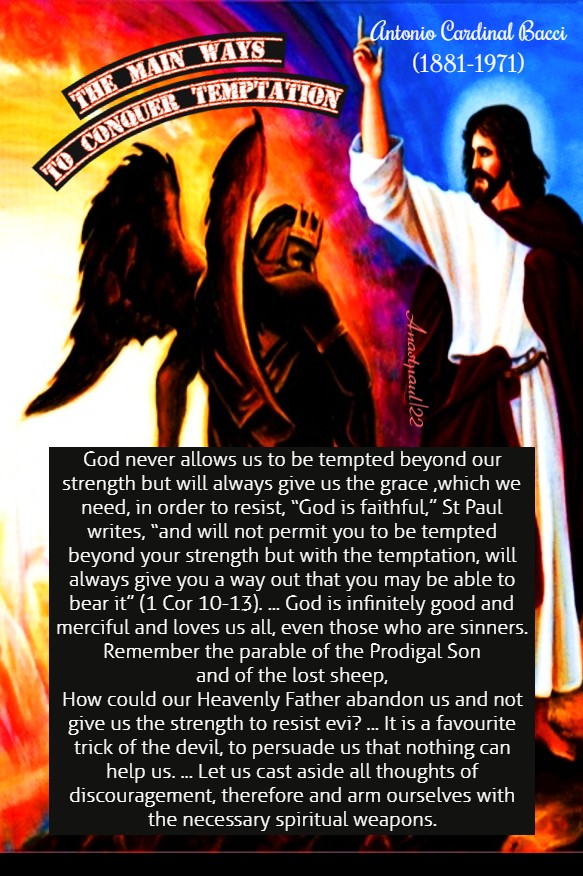
The Main Ways to Conquer Temptation
“God never allows us to be tempted beyond our strength but will always give us the grace ,which we need, in order to resist, “God is faithful,” St Paul writes, “and will not permit you to be tempted beyond your strength but with the temptation, will always give you a way out that you may be able to bear it” (1 Cor 10-13).
The man who is so discouraged by frequent falls that he surrenders to temptation and resigns himself to the slavery of sin, as if there were no other way out, is making a fatal mistake. God is infinitely good and merciful and loves us all, even those who are sinners. Remember the parable of the Prodigal Son and of the lost sheep, How could our Heavenly Father abandon us and not give us the strength to resist evi?
If we are discouraged, let us ask God’s help for He loves us and knows how weak we are. “He knows how we are formed” (Ps 102:14). It is a favourite trick of the devil, to persuade us that nothing can help us.
Let us cast aside all thoughts of discouragement, therefore and arm ourselves with the necessary spiritual weapons. With humble perseverance and the grace of God, we are sure to triumph.”
Friday of the Fopurth Week of Lent – 1 April – Our Lenten Journey with the Great Fathers – 3 Kings 17:17-24, John 11:1-45
“O Lord, remember not, against u,s the iniquities of the past, may Your compassion, quickly come to us, for we are brought very low.” – Psalm 78:8-9
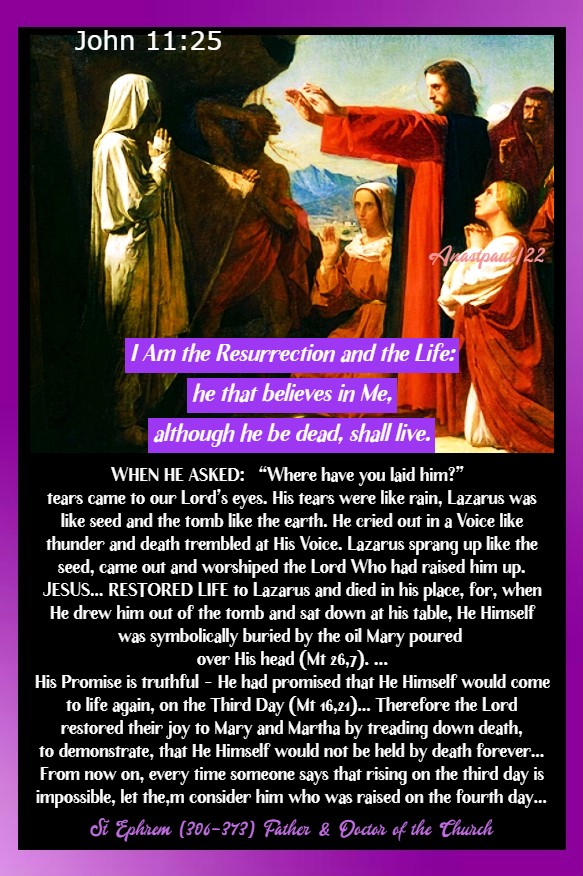
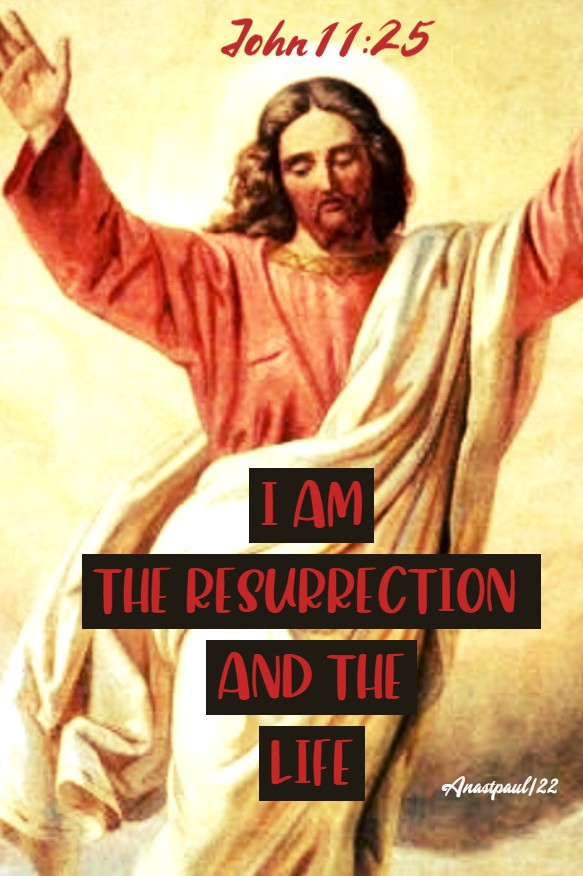
“I Am the Resurrection and the Life: he that believes in Me, although he be dead, shall live. ”
John 11:25
“WHEN HE ASKED: “Where have you laid him?” tears came to our Lord’s eyes. His tears were like rain, Lazarus was like seed and the tomb like the earth. He cried out in a Voice like thunder and death trembled at His Voice. Lazarus sprang up like the seed, came out and worshiped the Lord Who had raised him up.
JESUS… RESTORED LIFE to Lazarus and died in his place, for, when He drew him out of the tomb and sat down at his table, He Himself was symbolically buried by the oil Mary poured over His head (Mt 26,7). The power of the death, which had overcome Him for four days, was wiped out… that death might know, how easy it was for the Lord to overcome it, on the Third Day… His Promise is truthful – He had promised that He Himself would come to life again, on the Third Day (Mt 16,21)… Therefore the Lord restored their joy to Mary and Martha by treading down death, to demonstrate, that He Himself would not be held by death forever… From now on, every time someone says that rising on the third day is impossible, let the,m consider him who was raised on the fourth day…
“GO AND TAKE AWAY THE STONE” What is this? He who raised a dead man and restored him to life, couldn’t he have opened the tomb and overturned the stone? He who said to his disciples: “If you have faith the size of a mustard seed, you will say to this mountain: ‘Move from here to there’” (Mt 17,20), could He not move aside the stone, shutting the entrance to the tomb, with one word? Certainly He could! He whose Voice, when He hung on the cross, split rocks and sepulchers, could have taken away the stone with His Word (Mt 27,51-52). But because He was Lazarus’ friend, He said: “Open it that the smell of decay may hit you and you who wrapped him in his winding sheet, unbind him, that you may surely recognise the one you buried.” – St Ephrem (306-373) Deacon in Syria, Great Father & Doctor of the Church (Commentary on the Diatessaron, 17, 7-10 ; SC 121).
Quote/s of the Day – 1 April – Friday of the Fourth Week of Lent – 3 Kings 17:17-24, John 11:1-45
“I Am the Resurrection and the Life”
John 11:25
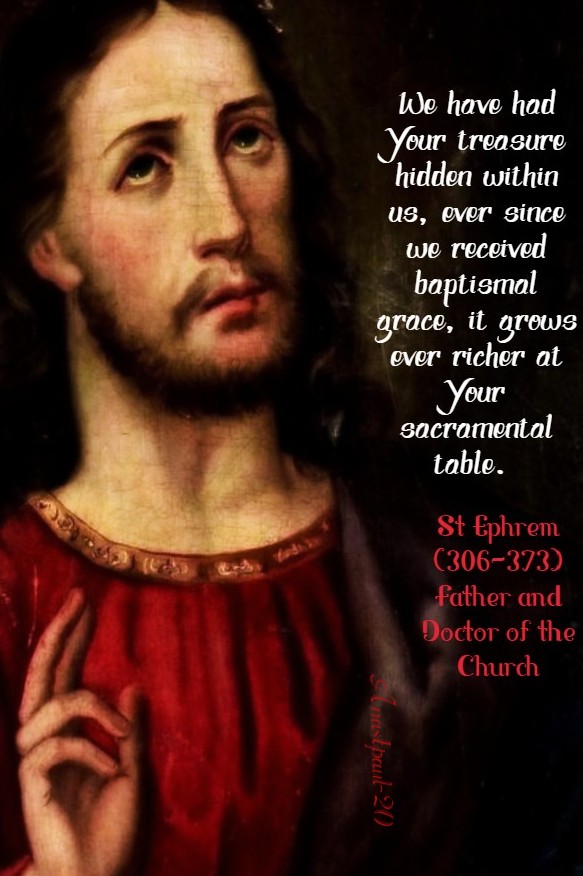
“We have had Your treasure hidden within us, ever since we received baptismal grace, it grows ever richer at Your sacramental table.”
St Ephrem (306-373) Father and Doctor of the Church
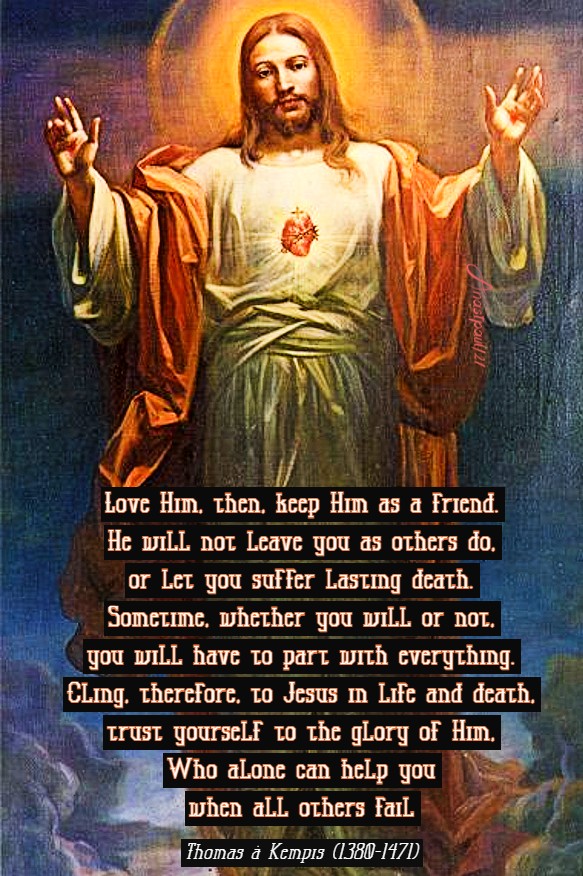
“Love Him, then, keep Him as a friend. He will not leave you as others do, or let you suffer lasting death. Sometime, whether you will or not, you will have to part with everything. Cling, therefore, to Jesus in life and death, trust yourself to the glory of Him, Who alone can help you when all others fail.“
Thomas à Kempis (1380-1471)
“This death … has already levelled his bow to strike me. Is it not prudent to prevent its stroke, by dying now to the world, that at my death, I may live to God?”
One Minute Reflection – 1 April – Friday of the Fourth Week of Lent – 3 Kings 17:17-24, John 11:1-45
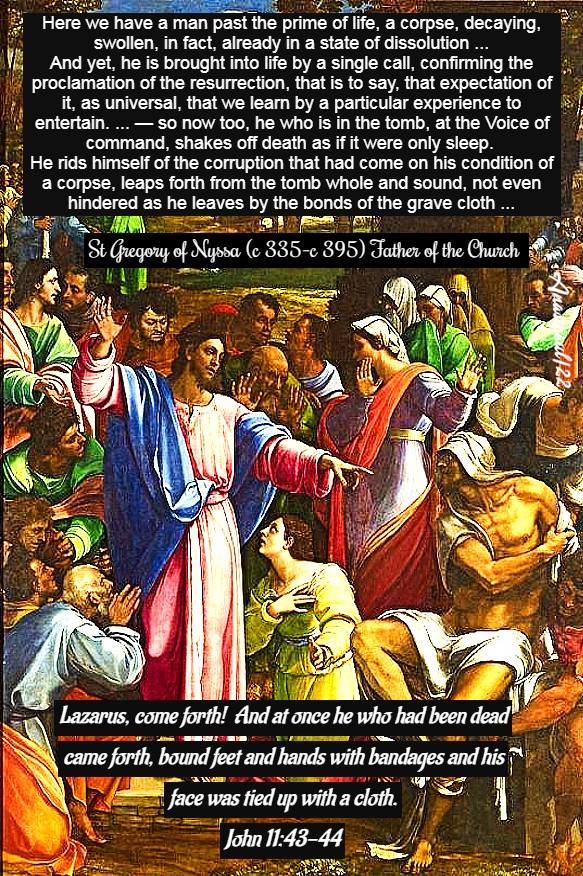
“Lazarus, come forth! And at once he who had been dead came forth, bound feet and hands with bandages and his face was tied up with a cloth. ”- John 11:43-44
REFLECTION – “Here we have a man past the prime of life, a corpse, decaying, swollen, in fact, already in a state of dissolution, so that even his own relatives did not want the Lord to draw near the tomb because the decayed body enclosed there, was so offensive . And yet, he is brought into life by a single call, confirming the proclamation of the resurrection, that is to say, that expectation of it, as universal, that we learn by a particular experience to entertain. For as in the regeneration of the universe, the Apostle tells us that “the Lord himself will descend with a shout, with the voice of the archangel” and by a trumpet sound, raise up the dead to incorruption — so now too, he who is in the tomb, at the Voice of command, shakes off death as if it were only sleep. He rids himself of the corruption that had come on his condition of a corpse, leaps forth from the tomb whole and sound, not even hindered as he leaves by the bonds of the grave cloths round his feet and hands.” … St Gregory of Nyssa (c 335–c 395) Father of the Church (On the Making of Man, 25).
PRAYER – O God, Who by Your wondrous sacraments renew the world, grant that Your Church may benefit from Your eternal decrees and not be deprived of temporal help. Through Jesus Christ, Thy Son our Lord, Who lives and reigns with Thee, in the unity of the Holy Ghost, God, world without end. Amen (Collect).
Our Morning Offering – 1 April – Friday of the Fourth Week of Lent
My God, I Love Thee By St Francis Xavier (1506-1552) (Attri) Transr: Fr Edward Caswall CO (1814-1878)
My God, I love Thee, not because I hope for heav’n thereby, nor yet for fear, that loving not, I might forever die but for that Thou didst all mankind upon the Cross embrace; for us didst bear the nails and spear and manifold disgrace.
And griefs and torments numberless and sweat of agony; e’en death itself and all for man, who was Thine enemy. Then why, most loving Jesus Christ, should I not love Thee well? Not for the sake of winning heav’n, nor any fear of hell.
Not with the hope of gaining aught, nor seeking a reward but as Thyself hast loved me, O ever loving Lord! E’en so I love Thee and will love and in Thy praise will sing, solely because Thou art my God and my eternal King! Amen
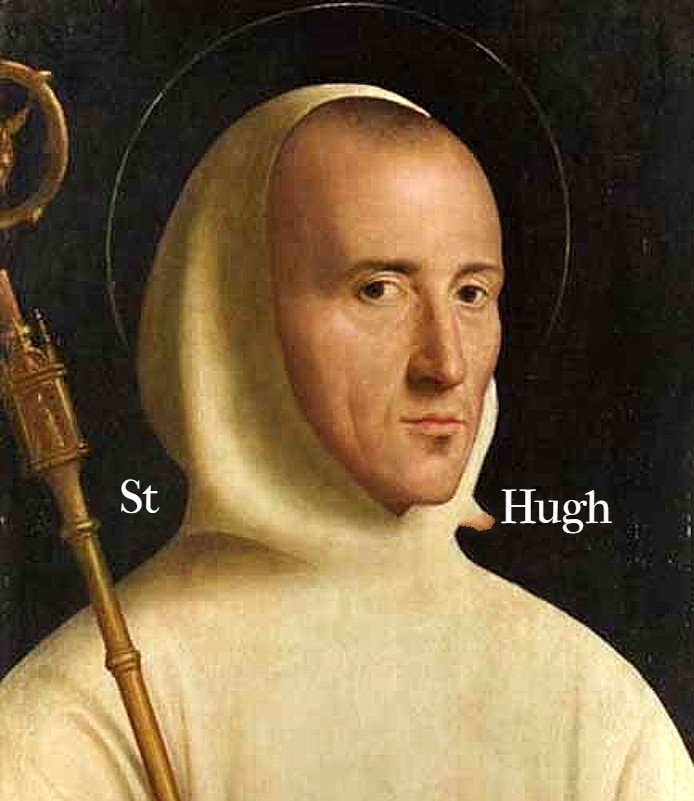
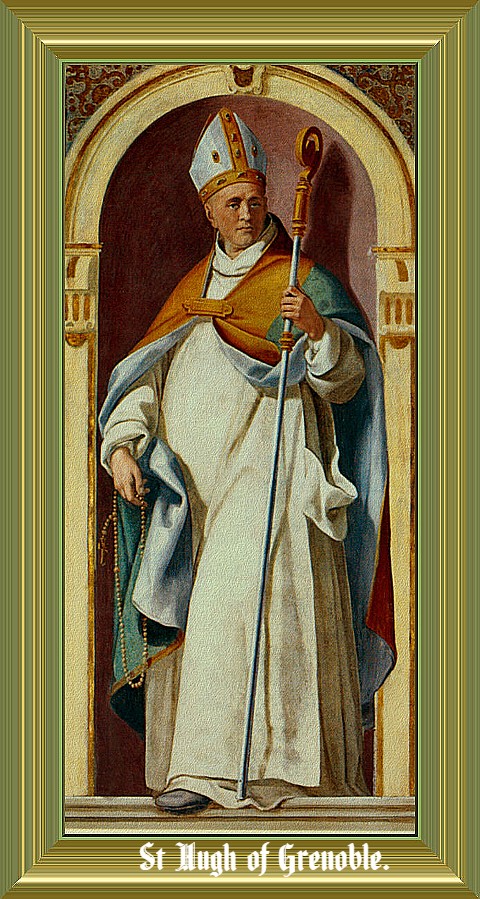
Saint of the Day – 1 April – Saint Hugh of Grenoble (1053-1232) Bishop, Reformer, in the foundation of the Carthusian Order, founded a Monastery at Chalais. Born in 1053 at Chateauneuf, Dauphiné, France and died on 1 April 1132 in Grenoble, France of natural causes. Patronages – against headaches, of Grenoble, France. Also known as – Hugh of Châteauneuf, Ugo, Hughes. Additional Memorial – 22 April (Carthusians).
The Roman Martyrology reads: “In Grenoble in Burgundia, in today’s France, St Hugh, Bishop, who worked for the reform of the customs of the clergy and the people and, during his Episcopate, ardently loving solitude, gave St Bruno at the time, his teacher and to his companions, the hermitage of Chartroux, of which he was also the first Abbot. He ruled his Church for about fifty years with the thoughtful example of his charity.”
Hugh was born at Châteauneuf-sur-Isère, County of Albon., as the son of a soldier named Odilo, a man known for his Christian life,and who later became a Cistercian Monk; his mother was known for her life of prayer and alms-giving. Hugh was the uncle of Saint Hugh of Bonnevaux, who is also celebrated today. He showed piety and theological facility from a young age. and was an exceptional student in all his studies. While still a layman, Hugh was made a Canon of Valence. His piety was such ,that it was said of him, that he only knew one woman by sight.
At the Council of Avignon in 1080, he was elected Bishop of Grenoble, although he was not yet ordained. The See of Grenoble had fallen into a very poor state and Hugh was selected to be its Gregorian renovator. Conducted by a papal legate to Rome, Hugh was Ordained by Pope Gregory VII himself. Upon his return, he immediately set to the task of reforming the abuses in his new Diocese. When he had not succeeded, to his satisfaction, in countering abuse and fostering devotion after two years, he tried to resign his bishopric and enter the Benedictine Monastery at Cluny. However, the Pope ordered him to continue his Episcopal work.
For the rest of the 11th century, his Episcopate was marked by strife with Count Guigues III of Albon over the possession of Ecclesiastic lands. Hugh alleged that the Count had usurped the lands from the Bishopric of Grenoble with the help of Bishop Mallen of Grenoble. Only in 1099. an accord was finally reached between Hugh and Count Guigues The Count agreed to cede the disputed territories while Hugh admitted to the Count’s temporal authority within the vicinity of Grenoble.
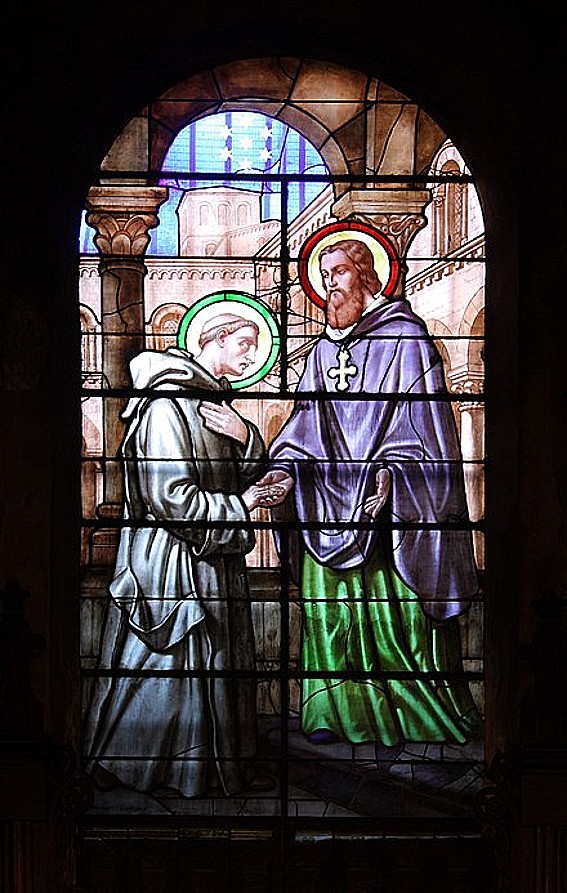
Hugh was also instrumental in the foundation of the Carthusian Order. He received Bruno of Cologne, his own teacher and six of his companions in 1084, after seeing them under a banner of seven stars in a vision. Hugh installed the seven in a snowy and rocky Alpine location called Chartreuse. They founded a Monastery and devoted their lives to prayer and study, being often visited by Hugh, who was reported to have adopted much of their way of life. Hugh also founded the nearby Monastery at Chalais, which grew into an independent order.
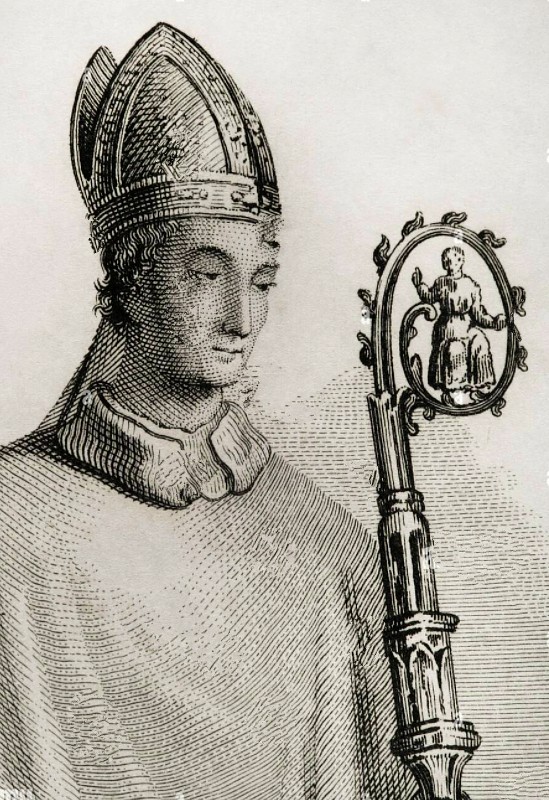
St Hugh (right) on a stained glass window in Grenoble Cathedral, St Bruno is on the left.
St Hugh served his See for 52 years, although he had earnestly solicited Pope Innocent II for leave to resign his bishopric, that he might die in solitude but was never able to obtain his request. For the last forty years of his life, he was afflicted with almost continual headaches and pains in the stomach God was pleased to purify his soul by a lingering illness before He called him to Himself.
Some time before his death ,his memory became vague and cloudy for everything but his prayers; the psalter and the Lord’s Prayer, which he recited with great devotion, almost without intermission and he was said to have repeated the latter, three hundred times in one night. Being told that so constant an attention would increase his fever he said, “It is quite otherwise; by prayer I always find myself stronger.”
Hugh was Canonised on 22 April 1134 by Pope Innocent II, only two years after his death. During the French Wars of Religion the Huguenots burned his body.
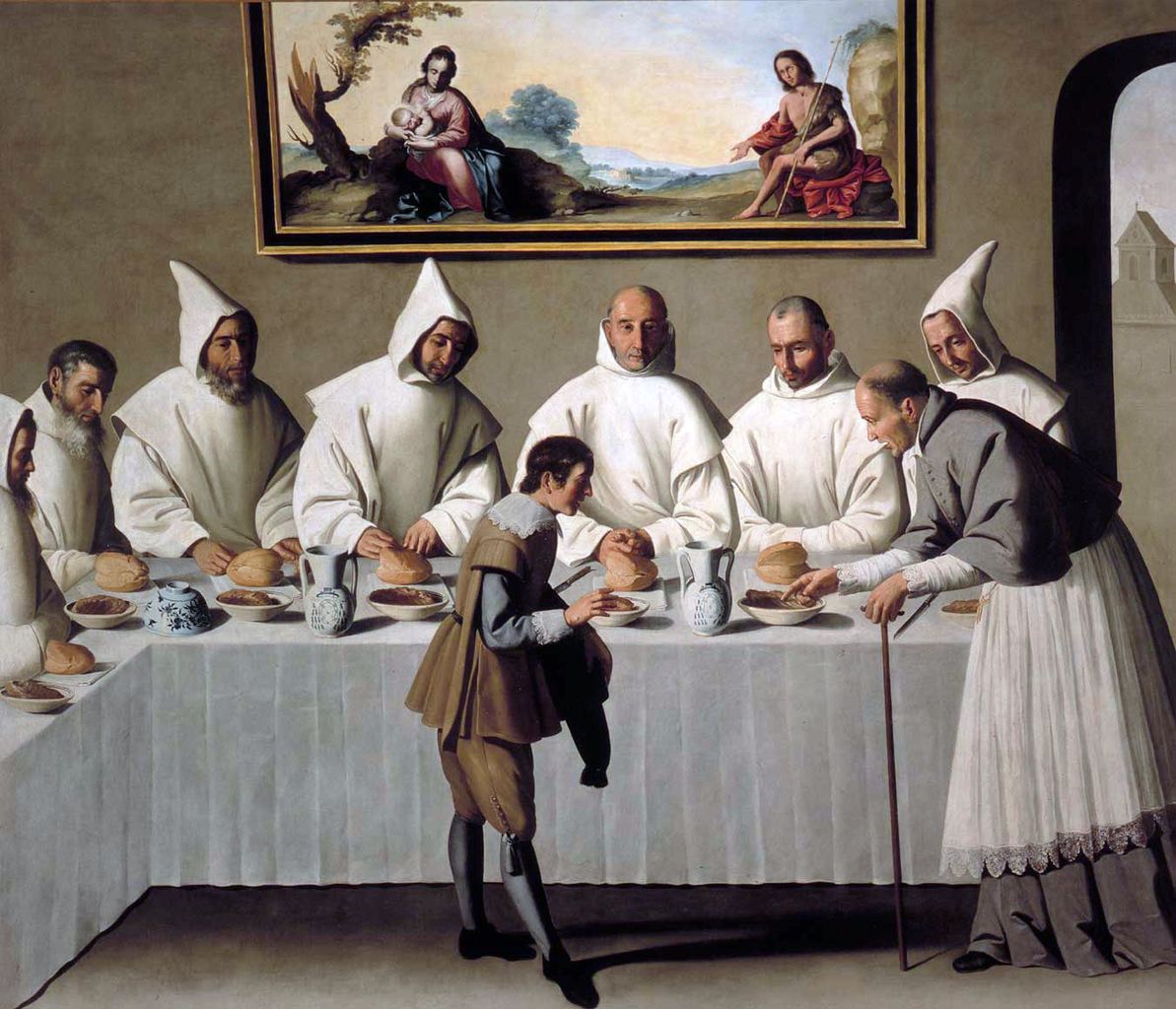
Painting from the Carthusian cloister of Nuestra Señora de las Cuevas a Triana by Francisco de Zurbarán. The scene depicts Saint Hugh in the Carthusian Monastery.
Blessed Abraham of Bulgaria Blessed Alexander of Sicily Saint Anastasio Blessed Antonius of Noto Saint Berhard of Amiens Blessed Bernhardin of Noto Saint Celsus of Armagh Saint Dodolinus of Vienne Blessed Gerard of Sassoferrato Saint Gilbert de Moray Blessed Giuseppe Girotti Blessed Hugh of Bonnevaux Saint Hugh of Grenoble (1053-1232) Bishop, Saint Jacoba of Rome Blessed John Bretton Saint Leucone of Troyes
Saint Melito Sardis (Died c 180) Early Church Father, Bishop of Sardis (Died c 180), ecclesiastical Writer, Confessor, Apologist, Defender of Christ’s dual nature. Saint Melito is believed to have been martyred around the time he wrote his apology to Marcus Aurelius circa 180. Biography: https://anastpaul.com/2019/04/01/saint-of-the-day-1-april-st-melito-died-c-180/
Blessed Nicolò of Noto Saint Prudentius of Atina Saint Tewdrig ap Teithfallt Saint Theodora of Rome Saint Valery of Leucone Saint Venantius of Spalato Blessed Vinebault Blessed Zofia Czeska-Maciejowska
Apostles of Picardy – Martyrs: Saint Caidoc Saint Fricor –
Martyrs of Dalmatia and Istria – 9 Saints: A group of Christians Martyrs who died at various locations in Dalamtia and Istria (in modern Croatia, whose relics were later taken to Rome, Italy, and who are remembered together. We know the names Anastasio, Antiochiano, Asterius, Gaiano, Mauro, Paoliniano, Septimius, Telio and Venantius. Died • on the Adriatic coast of modern Croatia • relics translated to Rome, Italy
Martyrs of Thessalonica – 6 saints: A group of Christians martyred. We know nothing about them but the names Alexander, Dionysius, Ingenianus, Panterus, Parthenius and Saturninus. Died Thessalonica, Greece, date unknown
Martyred Sisters of Thessalonica: Saint Agape Saint Chionia
Martyred in Alexandria: Saint Stephen Saint Victor
Martyred in Armenia: Saint Irenaeus Saint Quintian
Martyred in Heraclea: Saint Castus Saint Victor
Martyred in the Mexican Revolution Blessed Anacleto González Flores Blessed Jorge Vargas González Blessed Luis Padilla Gómez Blessed Ramón Vargas González
Thought for the Day – 31 March – Meditations with Antonio Cardinal Bacci (1881-1971)
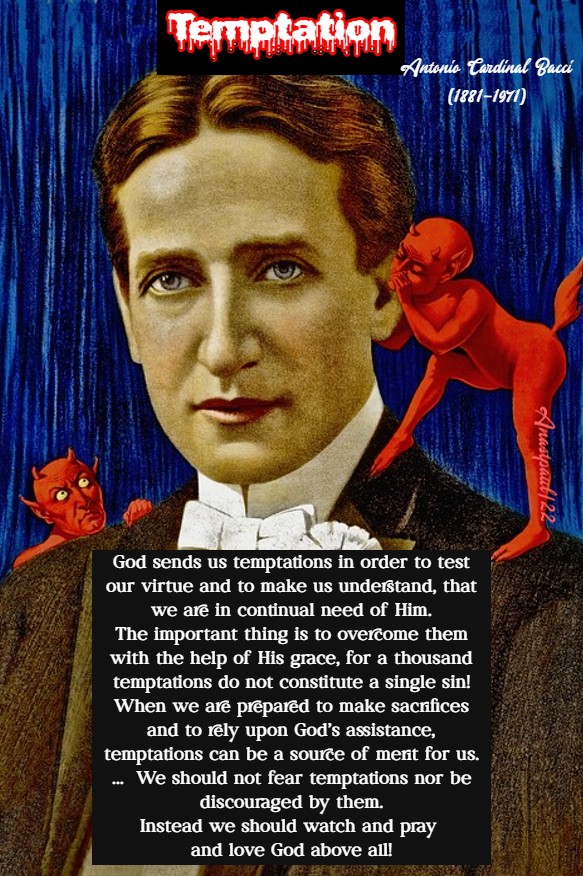
TEMPTATION
“When a man fears and loves God, temptation is the great trial which he can endure. “No-one is so perfect and holy,” says The Imitation of Christ, “as not, sometimes to have temptation and we never can be wholly free from them. Nevertheless, temptations are often very profitable to a man, troublesome and grievous though they may be; for in them a man is humbled, purified and instructed. All the Saints passed through many tribulations and temptations and profited by them And they that could not support temptation became reprobate and fell away …
A man is never wholly secure from temptation as long as he lives, for there is within us the source of temptation, since we were born in concupiscence.
Inconstancy of mind and little confidence in God, is the beginning of all evil temptations. For as a ship without a helm is driven to and fro by the waves, so the man who is negligent and gives up his resolutions, is tempted in varioys ways. Fire tries iron and temptation a just man” (Bk 1, C 13).
These words from The Imitation of Christ, should encourage us. God sends us temptations in order to test our virtue and to make us understand, that we are in continual need of Him. The important thing is to overcome them with the help of His grace, for a thousand temptations do not constitute a single sin! When we are prepared to make sacrifices and to rely upon God’s assistance, temptations can be a source of merit for us.
“Blessed is the man who endures temptations,” writes St James, “for when he has beeen tried, he will receive the crown of life which God haqs premised to those who love Him” (js 1:12).
We should not fear temptations nor be discouraged by them. Instead we should watch and pray and love God above all!”
Thursday of the Fourth week in Lent – 31 March – Our Lenten Journey with the Great Fathers – 4 Kings 4:25-38, Luke 7,11-16.
“Give thanks to the Lord, invoke His Name; make known among the nations His deeds.” – Psalm 104:1
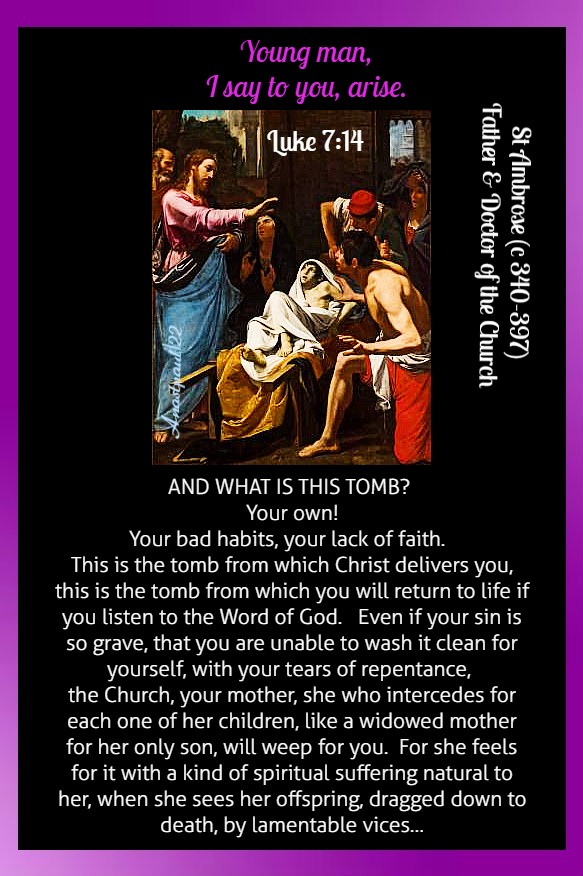
And he said, “Young man, I say to you, arise.”
Luke 7:14
“EVEN IF the signs of death have removed all hope of life, even if the bodies of the dead lie beside the tomb, yet, at the Voice of God, the corpses of those ready to decompose, will rise and recover speech. The son is restored to his mother, he is called back from the tomb, snatched out of it.
AND WHAT IS THIS TOMB? Your own! Your bad habits, your lack of faith. This is the tomb from which Christ delivers you, this is the tomb from which you will return to life if you listen to the Word of God. Even if your sin is so grave, that you are unable to wash it clean for yourself, with your tears of repentance, the Church, your mother, she who intercedes for each one of her children, like a widowed mother for her only son, will weep for you. For she feels for it with a kind of spiritual suffering natural to her, when she sees her offspring, dragged down to death, by lamentable vices…
LET HER WEEP, then, this pious mother; let the crowd accompany her – and not just a crowd but a large crowd – and may it show compassion towards this tender mother. Then you will come to life again in your tomb and will be delivered, the bearers will stop and you will start to speak the words of the living; everyone will be astonished. The example of one will correct the many and they will praise God for having granted such remedies to us for escaping death.”…St Ambrose (c 340-397) Great Father & Doctor of the Church (A treatise on the Gospel of Saint Luke)
Quote/s of the Day – 31 March – Thursday of the Fourth week in Lent
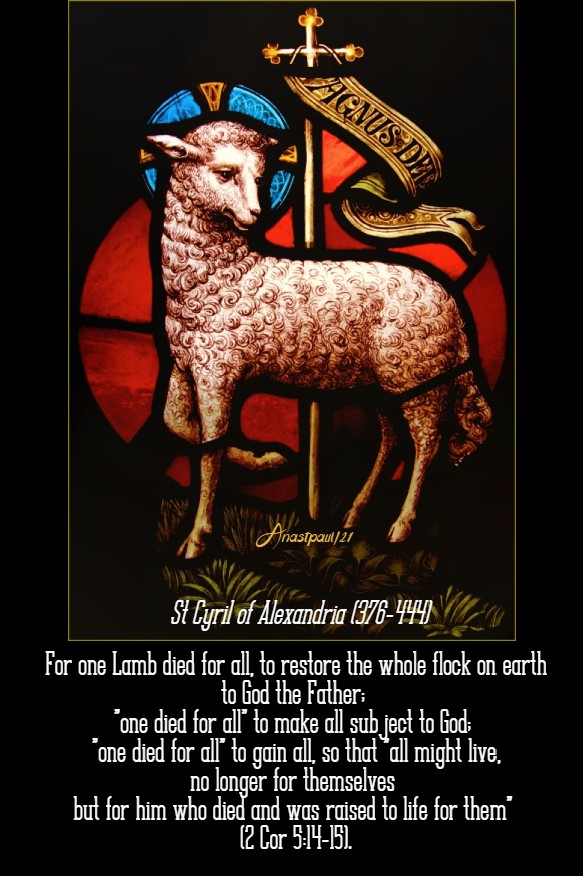
“For one Lamb died for all, to restore the whole flock on earth to God the Father; “one died for all” to make all subject to God; “one died for all” to gain all, so that “all might live, no longer for themselves but for Him who died and was raised to life for them” (2 Cor 5:14-15).”
St Cyril of Alexandria (376-444) Father and Doctor of the Church
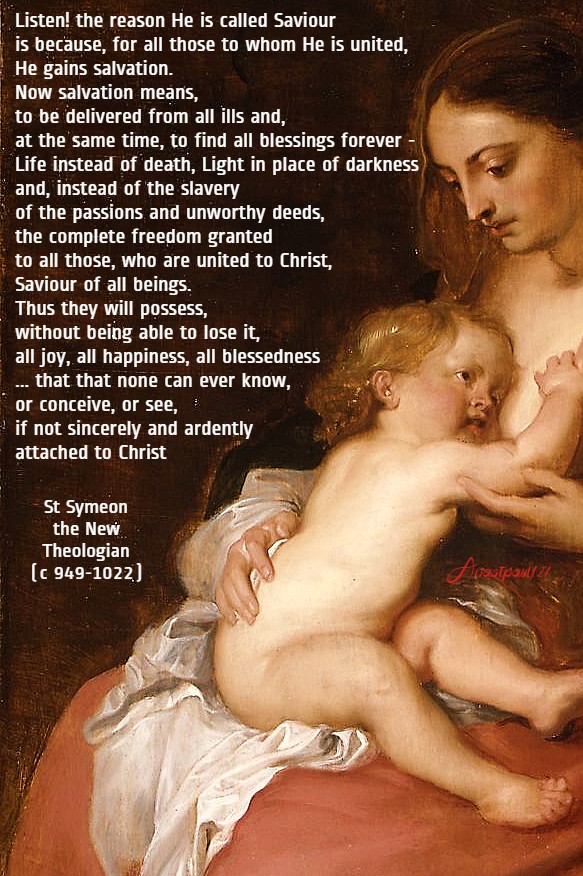
“Listen! the reason He is called Saviour is because, for all those to whom He is united, He gains salvation. Now salvation means, to be delivered from all ills and, at the same time, to find all blessings forever – Life instead of death, Light in place of darkness and, instead of the slavery of the passions and unworthy deeds, the complete freedom granted to all those, who are united to Christ, Saviour of all beings. Thus they will possess, without being able to lose it, all joy, all happiness, all blessedness (…) that that none can ever know, or conceive, or see, if not sincerely and ardently attached to Christ.”
St Symeon the New Theologian (c 949-1022)
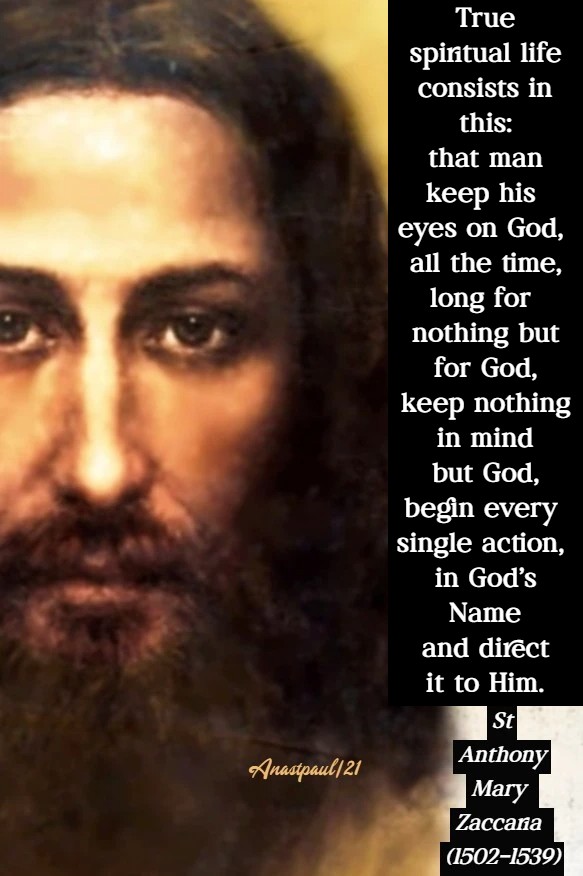
“True spiritual life consists in this: that man keep his eyes on God, all the time, long for nothing but for God, keep nothing in mind but God, begin every single action, in God’s Name and direct it to Him.”
St Anthony Mary Zaccaria (1502-1539)
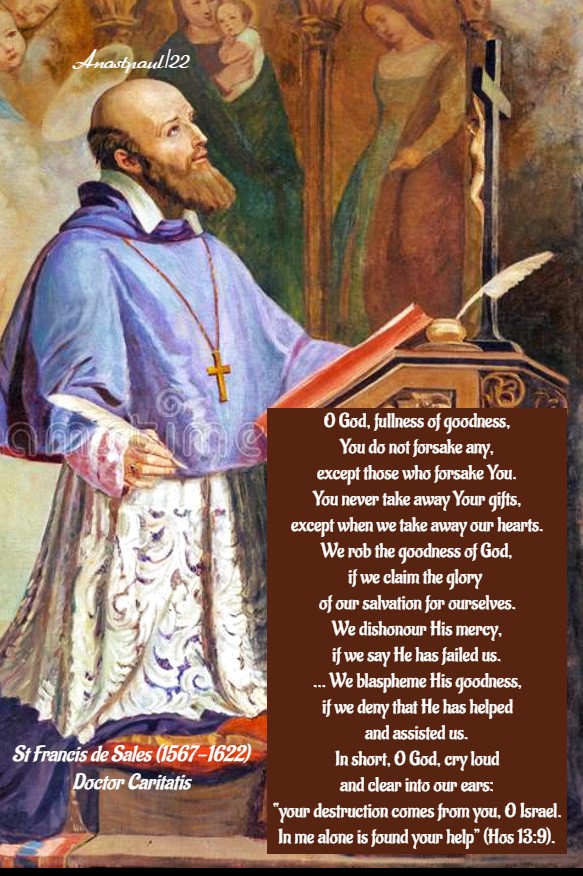
“O God, fullness of goodness, You do not forsake any, except those who forsake You. You never take away Your gifts, except when we take away our hearts. We rob the goodness of God, if we claim the glory of our salvation for ourselves. We dishonour His mercy, if we say He has failed us. … We blaspheme His goodness, if we deny that He has helped and assisted us. In short, O God, cry loud and clear into our ears: “your destruction comes from you, O Israel. In me alone is found your help” (Hos 13:9).
One Minute Reflection – 31 March – Thursday of the Fourth week in Lent – 4 Kings 4:25-38, Luke :,11-16.
“And He said, “Young man, I say to you, arise.”- Luke 7:14
REFLECTION – “Observe how He joins miracle to miracle. In the former instance, the healing of the centurion’s servant, He was present by invitation but here, He draws near without being invited. No-one summoned Him to restore the dead man to life, but He comes to do so of His own accord. He seems to me to have purposely made this miracle also follow upon the former.
The dead man was being buried,and many friends were conducting him to his tomb. Christ, the Life and Resurrection, meets him there. He is the Destroyer of death and of corruption. He is the One in Whom we live and move and are. He is Who has restored the nature of man ,to that which it originally was and has set free our death-fraught flesh, from the bonds of death. He had mercy upon the woman and that her tears might be stopped, He commanded saying, “Weep not.” Immediately the cause of her weeping was done away with.
Christ raised him who was descending to his grave. The manner of his rising is plain to see. “He touched,” it says, “the bier and said, ‘Young man, I say unto thee, arise.’” … What is more powerful than the Word of God? Why then did He not work the miracle by only a word but also, He touched the bier? It was, my beloved, that you might learn, that the Holy Body of Christ is productive for the salvation of man. The Flesh of the Almighty Word is the Body of Life and was clothed with His might. Consider that iron, when brought into contact with fire, produces the effects of fire and fulfils its functions. The Flesh of Christ also has the power of giving Life and annihilates the influence of death and corruption because it is the Flesh of the Word, Who gives Life to all. May our Lord Jesus Christ also touch us that delivering us from evil works, even from fleshly lusts, He may unite us to the assemblies of the saints.” – St Cyril of Alexandria (376-444) Father and Doctor of the Church (Commentary on Luke, Homily 36).
PRAYER – Grant, we beseech You, Almighty God, that we, who are chastising the flesh by fasting, may rejoice in this holy practice and thus, with earthly passions subdued, we may the more readily direct our thoughts to heavenly things. Through Jesus Christ, Thy Son our Lord, Who lives and reigns with Thee, in the unity of the Holy Ghost, God, world without end. Amen (Collect).
Our Morning Offering – 31 March – Thursday of the Fourth week in Lent
Forgive Me, Good Jesus By St Leonard of Port Maurice (1676-1751)
Lord, I confess that up until now I have not lived as a Christian. I am not worthy to be numbered among Your elect. I recognise that I deserve to be damned but Your mercy is great and, full of confidence in Your grace, I say to You that I wish to save my soul, even if I have to sacrifice my fortune, my honour, my very life, as long as I am saved. If I have been unfaithful up to now, I repent, I deplore, I detest my infidelity, I ask You humbly to forgive me. Forgive me, good Jesus and strengthen me, that I may be saved. I ask You not for wealth, honour or prosperity, I ask You for one thing only, to save my soul. Amen
Saint of the Day – 31 March – Blessed Jane of Toulouse O.Carm. (Died 1286?) possibly the first Carmelite Tertiary or a fully professed Nun and it is believed, that she received the Veil from the hands of St Simon Stock (died 1265). Born at Toulouse, France and died perhaps in1286 of natural causes. Also known as – Jeanne, Joan, Johanna.
According to the most reliable biography, that of the Carmelite John Bale, who visited Toulouse in 1527, Joan was of a noble family of the kingdom of Navarre. Because of her devotion to Our Lady, she wished to live as a recluse near the Carmelite Convent of Toulouse, where she led a life of great austerity. She loved to speak about heavenly things with the young Friars and prayed much for them, which was to their great spiritual benefit.
IThere is doubt concerning the dates of her life but it does not appear that she lived much before the 15th Century because she does not appear on the lists of Carmelite saints of the second half of the 14th Century nor on the list of the Saints of the Order by John Grossi (died 1437), a member of the Carmelite Province of Toulouse.
Jane is often called a Tertiary or even Nun, however, it is not impossible that she professed the Carmelite rule, as did other pious ladies of that time.
After her death,, many miracles were attributed to her by the faithful. Bernard du Rosier, Archbishop of Toulouse from 1452 until 1474. He had Jane’s body exhumed and placed in an urn, in a worthy place in a Chapel of the Carmelite Church of the City and,on that occasion, he granted an indulgence of forty days to ail who would visited the remains. Gailhard de Ruppe, provincial of Toulouse, gave the panegyric. An antiphon, with verse and oration, in honour of the blessed is also known. According to Bale, the General Chapter of the Carmelites, held at Naples in 1510, treated of the Canonisation of Jane.
Examinations of the remains were held in 1616, 1656 and 1688. In 1656 it was noted that an arm and the right hand were missing, they had been carried into Spain by the Prior General, Henry Silvio, during a visit to the Convent. And in 1688 the left hand and some teeth were also missing.
After the French revolution, during the demolition of the Carmelite Church at Toulouse in 1805, the remains of the blessed were found in a wall, together with the document of the examination of 1688 and some prayers that the blessed reputedly recited on a regular basis. The body was carried into the metropolitan Church of St Stephen and buried in the Chapel of St Vincent de Paul. Then, in 1893, for the occasion of her Beatification, it was again exhumed and placed in an reliquary. Joan was Beatified by Pope Leo XIII in 1895.
In a fresco of the late 15th Century (1472) in the Carmelite Church of St Felix del Benaco in Brescia, Italy, the blessed appears in the white veil of a Carmelite tertiary. An engraving made about 1620, at the order of Gaspard Rinkens, Prior of the Anvers Carmel, represents her as a Carmelite Nun gazing at the Crucifix which she holds in her hands and this is how she is generally represented today.
St Abda St Acacius Agathangelos of Melitene St Agigulf St Aldo of Hasnon St Balbina of Rome
St Benjamin the Deacon (Died c 424) Deaco and Martyr. Benjamin was executed during a period of persecution of Christians that lasted forty years and through the reign of two Persian kings: Isdegerd I, who died in 421 and his son and successor, Varanes V. King Varanes carried on the persecution with such great fury, that Christians were submitted to the most cruel tortures. His Life and Death: https://anastpaul.com/2021/03/31/saint-of-the-day-31-march-st-benjamin-the-deacon-died-c-424-martyr/
Bl Guy of Vicogne Blessed Jane of Toulouse O.Carm. (Died 1286?)possibly the first Carmelite Tertiary or a fully professed Nun. St Machabeo of Armagh Bl Mary Mamala St Mella of Doire-Melle Bl Natalia Tulasiewicz St Renovatus of Merida
Martyrs of Africa – 4 Saints: A group of Christians Martyred together for their faith. No details have survived except for of their names – Anesius, Cornelia, Felix and Theodulus. They were martyred in Roman pro-consular Africa.
Thought for the Day – 30 March – Meditations with Antonio Cardinal Bacci (1881-1971)
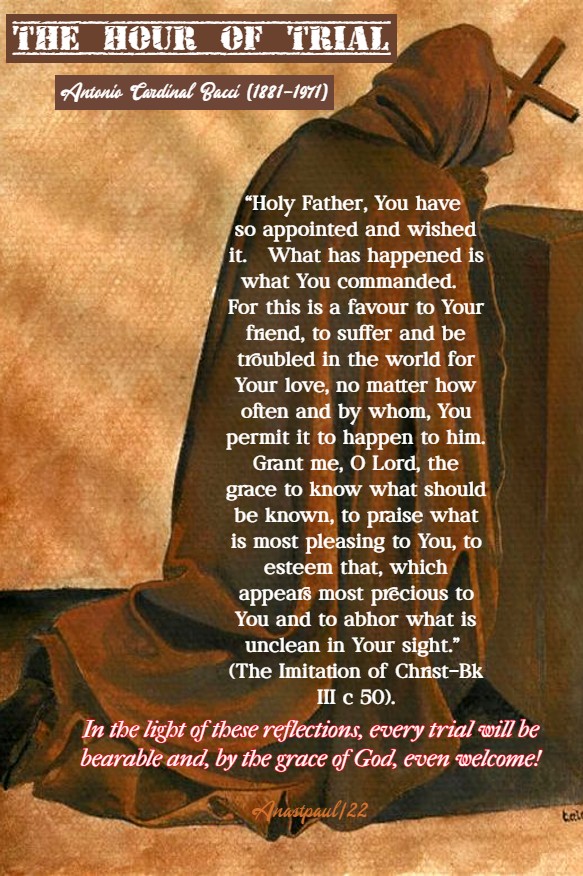
The Hour of Trial
“We should meditate on the following passage from The Imitation of Christ.
“Just Father, ever to be praised, the hour is come for Your servant to be tried. Beloved Father, it is right that in this hour Your servant should suffer something for You. O Father, forever to be honoured, the hour which You knew from all eternity is at hand, when, for a short time, Your servant should be outwardly oppressed but inwardly, should ever live with You.
Let him be a little slighted, let him be humbled, let him fail in the sight of men, let him be afflicted with sufferings and pains, so that he may rise again with You in the dawn of the New Light and be glorified in Heaven.”
“Holy Father, You have so appointed and wished it. What has happened is what You commanded. For this is a favour to Your friend, to suffer and be troubled in the world for Your love, no matter how often and by whom, You permit it to happen to him.”
“Grant me, O Lord, the grace to know what should be known, to praise what is most pleasing to You, to esteem that, which appears most precious to You and to abhor what is unclean in Your sight.” (Bk III c 50).
In the light of these reflections, every trial will be bearable and, by the grace of God, even welcome!”
Wednesday of the Fourth Week of Lent – 30 March – Our Lenten Journey with the Great Fathers – Isaias 1:16-19, John 9:1-38
“Wash yourselves, be clean, take away the evil of your devices from My eyes, cease to do perversely, Learn to do well: seek judgement, relieve the oppressed, judge for the fatherless, defend the widow.” – Isaias 1:16-17
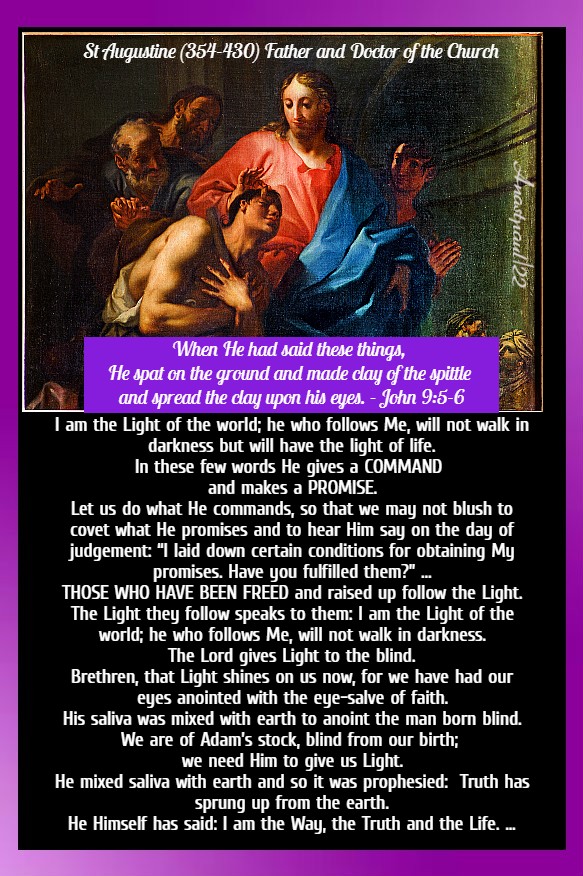
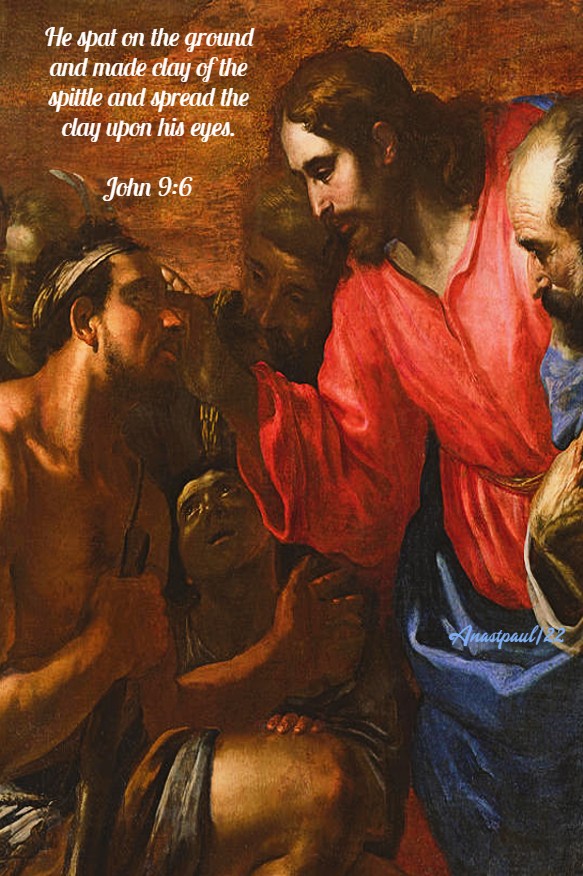
“And Jesus passing by, saw a man who was blind from his birth. … As long as I am in the world, I am the Light of the world. When He had said these things, He spat on the ground and made clay of the spittle and spread the clay upon his eyes,”
John 9:1,5-6
“THE LORD TELLS US – I am the Light of the world; he who follows Me, will not walk in darkness but will have the light of life. In these few words He gives a COMMAND and makes a PROMISE. Let us do what He commands, so that we may not blush to covet what He promises and to hear Him say on the day of judgement: “I laid down certain conditions for obtaining My promises. Have you fulfilled them?” If you say: “What did you command, Lord our God?” He will tell you: “I commanded you to follow Me. You asked for advice on how to enter into life. What life, if not the life about which it is written: With you is the fountain of life?”
LET US DO NOW what He commands. Let us follow in the footsteps of the Lord. Let us throw off the chains that prevent us from following Him. Who can throw off these shackles without the aid of the One addressed in these words: You have broken my chains? Another psalm says of Him: The Lord frees those in chains, the Lord raises up the downcast.
THOSE WHO HAVE BEEN FREEDand raised up follow the Light. The Light they follow speaks to them: I am the Light of the world; he who follows Me, will not walk in darkness. The Lord gives Light to the blind. Brethren, that Light shines on us now, for we have had our eyes anointed with the eye-salve of faith. His saliva was mixed with earth to anoint the man born blind. We are of Adam’s stock, blind from our birth; we need Him to give us Light. He mixed saliva with earth and so it was prophesied: Truth has sprung up from the earth. He Himself has said: I am the Way, the Truth and the Life. …
IF YOU LOVE ME, follow Me. “I do love you,” you protest “but how do I follow you?” If the Lord your God said to you: “I am the truth and the life,” in your desire for truth, in your love for life, you would certainly ask Him to show you the way to reach them. You would say to yourself: “Truth is a great reality, life is a great reality – if only it were possible for my soul to find them!” – St Augustine (354-430) Bishop, Great Western Father and Doctor of the Church (An excerpt from: On John [Treatise 34]).
Quote/s of the Day – 30 March – Wednesday of the Fourth Week of Lent – Isaias 1:16-19, John 9:1-38
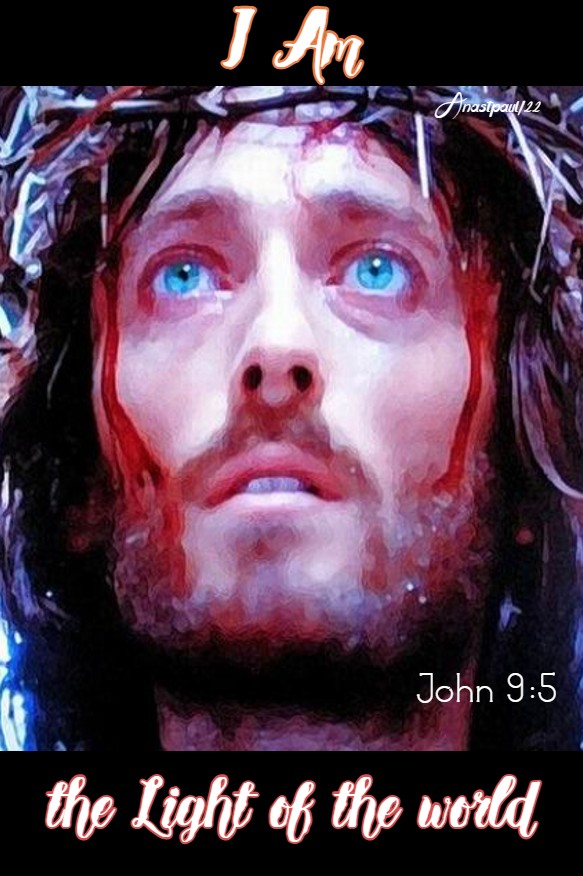
“I Am the Light of the world.”
John 9:5
“I am the Light of the world; he who follows me will not walk in darkness but will have the light of life.”
John 8:12
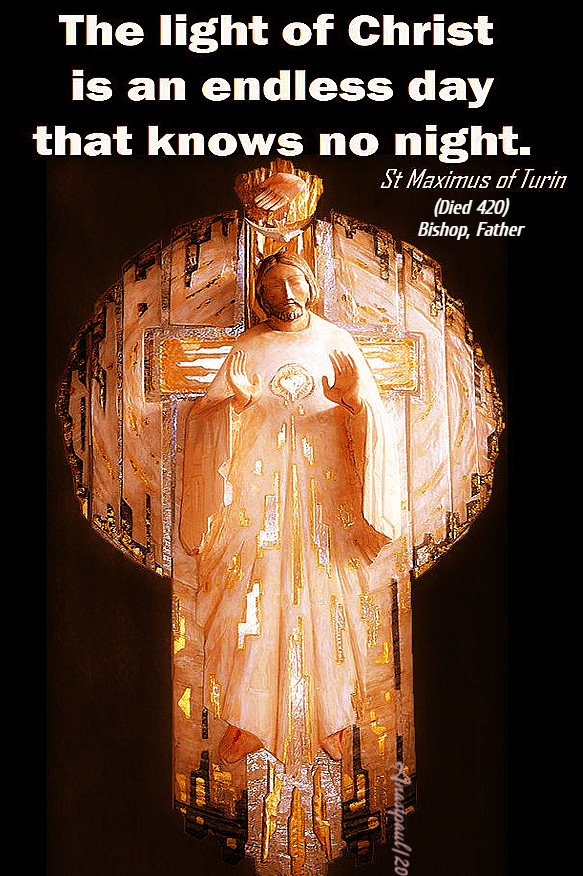
“The Light of Christ is an endless day that knows no night.”
St Maximus of Truin (Died 420) Bishop, Father
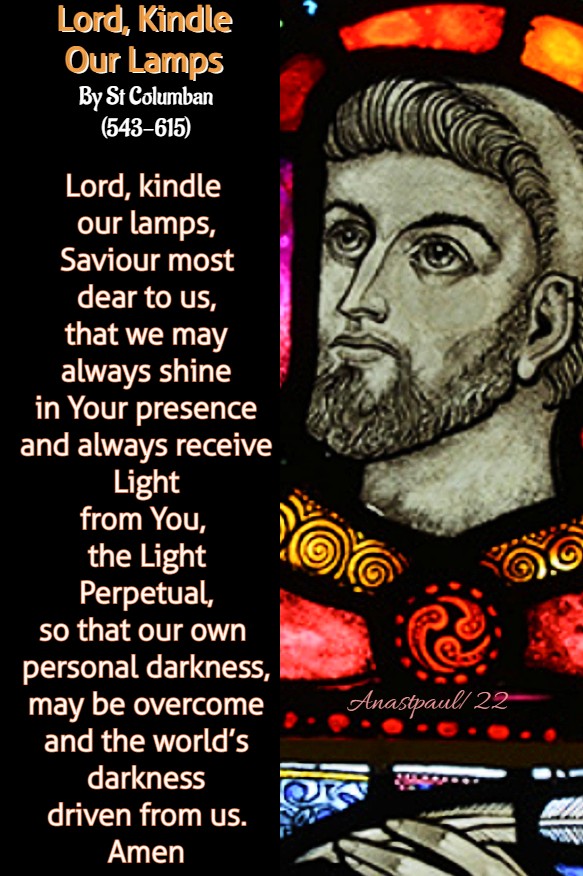
Lord, Kindle our Lamps By St Columban (543-615)
Lord, kindle our lamps, Saviour most dear to us, that we may always shine in Your presence and always receive Light from You, the Light Perpetual, so that our own personal darkness, may be overcome and the world’s darkness driven from us. Amen
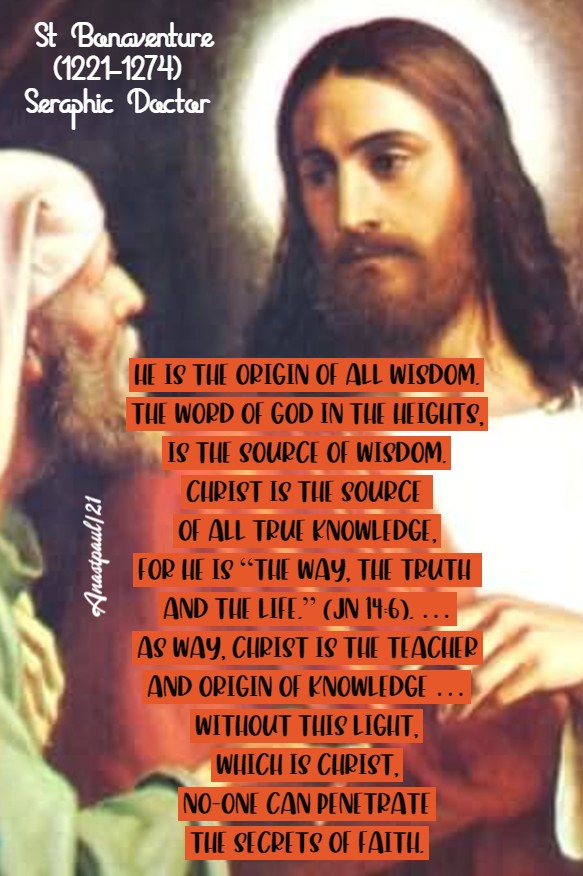
“He is the origin of all wisdom. The Word of God in the heights, is the source of wisdom. Christ is the source of all true knowledge, for He is “the way, the truth and the life.” (Jn 14:6). … As way, Christ is the teacher and origin of knowledge … Without this Light, which is Christ, no-one can penetrate the secrets of faith.”
One Minute Reflection – 30 March – Wednesday of the Fourth Week of Lent – Isaias 1:16-19, John 9:1-38
“I am the light of the world. When He had said these things, He spat on the ground and made clay of the spittle and spread the clay upon his eyes,” – John 9:5-6
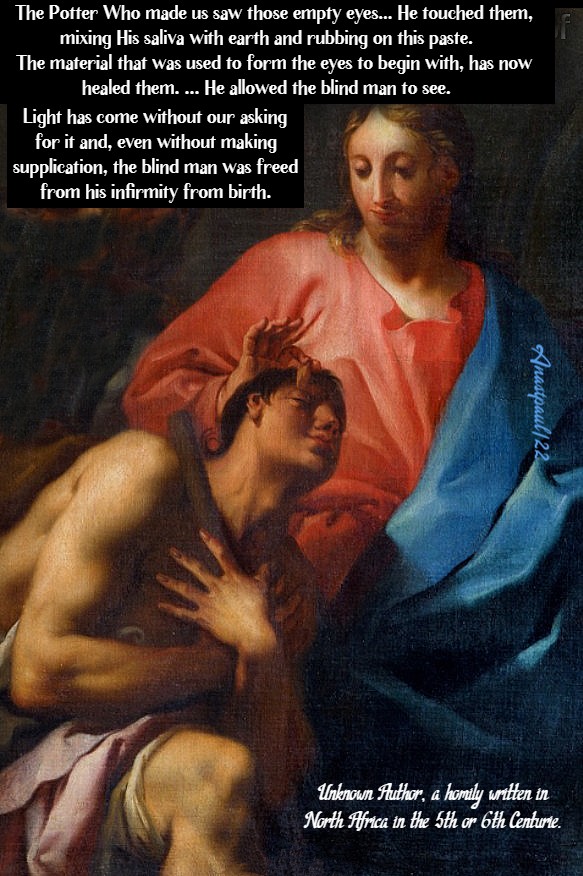
REFLECTION – “He who “enlightens everyone coming into this world” (Jn 1,9) is the true Mirror of the Father. Christ passes by as the refulgence of the Father’s glory (Heb 1,3) and casts out the blindness in the eyes of those who cannot see. The Christ Who comes from Heaven passes by, that all flesh might see Him… only those who are blind could not see Christ, Mirror of the Father… Christ has opened this prison; He has opened the blind man’s eyes, who then saw in Christ, the Mirror of the Father…
The first man was created radiant but, once he had left the serpent, he found himself to be blind. This blind man began to be reborn when he started to believe… The man born blind was seated… without asking any doctor for ointment to heal his eyes… The Maker of the world comes along and reflects His image into the Mirror. He sees the wretchedness of the blind man seated there begging. What a miracle of God’s strength! It heals what it sees and enlightens that which it visits…
He who created the earthly orb has now opened the orbs of the blind man’s eyes… The Potter Who made us, (Gn 2,6; Is 64,7) saw those empty eyes… He touched them, mixing His saliva with earth and rubbing on this paste. The material that was used to form the eyes to begin with, has now healed them. Which is the greater marvel -to create the orb of the sun or to recreate the eyes of the man born blind? The Lord, seated on His throne, made the sun to shine; passing through earth’s public squares He allowed the blind man to see. Light has come without our asking for it and, even without making supplication, the blind man was freed from his infirmity from birth.” – Unknown Author, a homily written in North Africa in the 5th or 6th Centuries, incorrectly attributed to Saint Fulgentius of Ruspe (c 462 – 533).
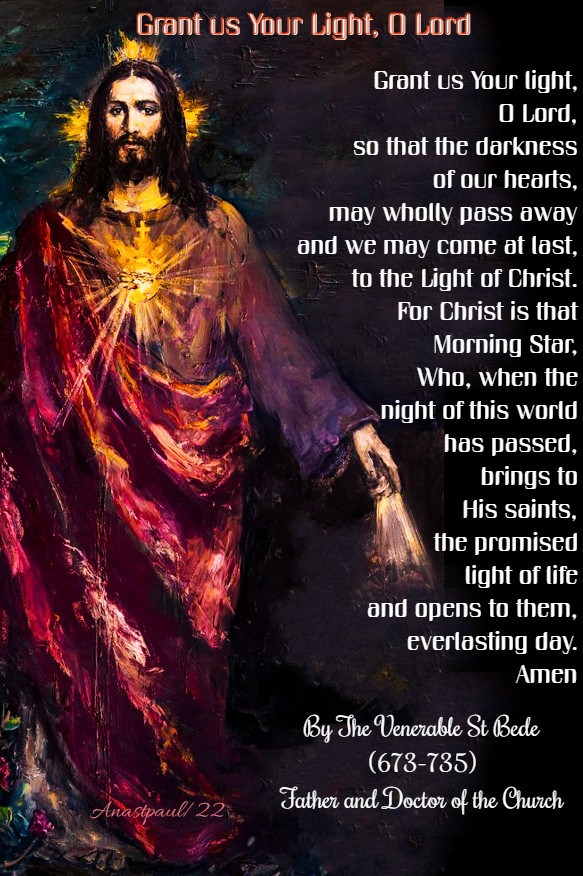
PRAYER – Grant us Your Light, O Lord By The Venerable St Bede (673-735) Father and Doctor of the Church
Grant us Your light, O Lord, so that the darkness of our hearts, may wholly pass away and we may come at last, to the Light of Christ. For Christ is that Morning Star, who, when the night of this world has passed, brings to His saints, the promised light of life and opens to them, everlasting day. Amen.
Our Morning Offering – 30 March – Wednesday of the Fourth Week of Lent
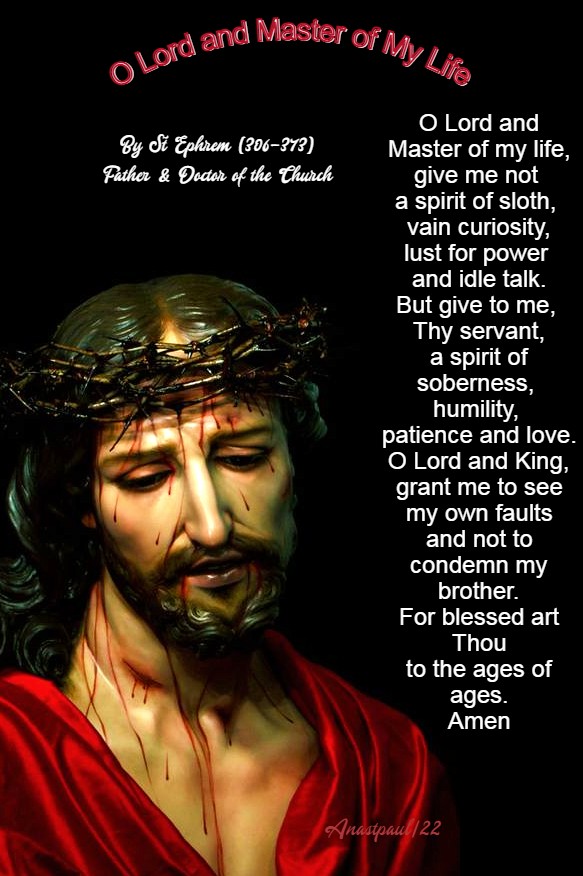
O Lord and Master of My Life By St Ephrem (306-373) Father & Doctor of the Church
O Lord and Master of my life, give me not a spirit of sloth, vain curiosity, lust for power and idle talk. But give to me, Thy servant, a spirit of soberness, humility, patience and love. O Lord and King, grant me to see my own faults and not to condemn my brother. For blessed art Thou to the ages of ages. Amen
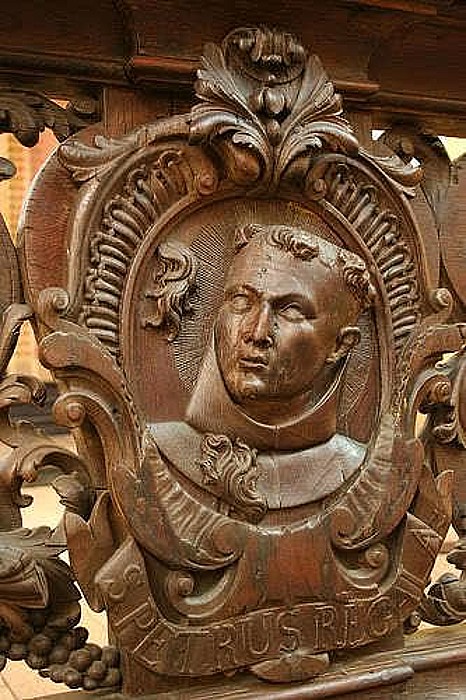
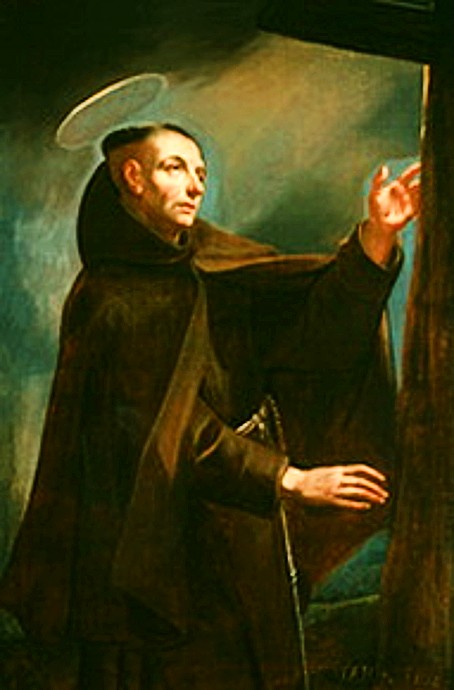
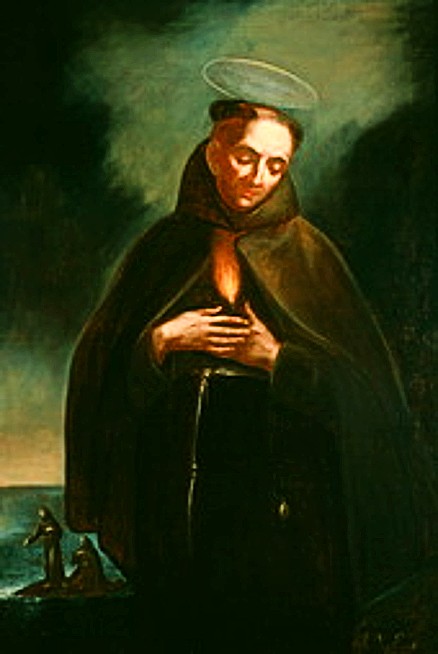
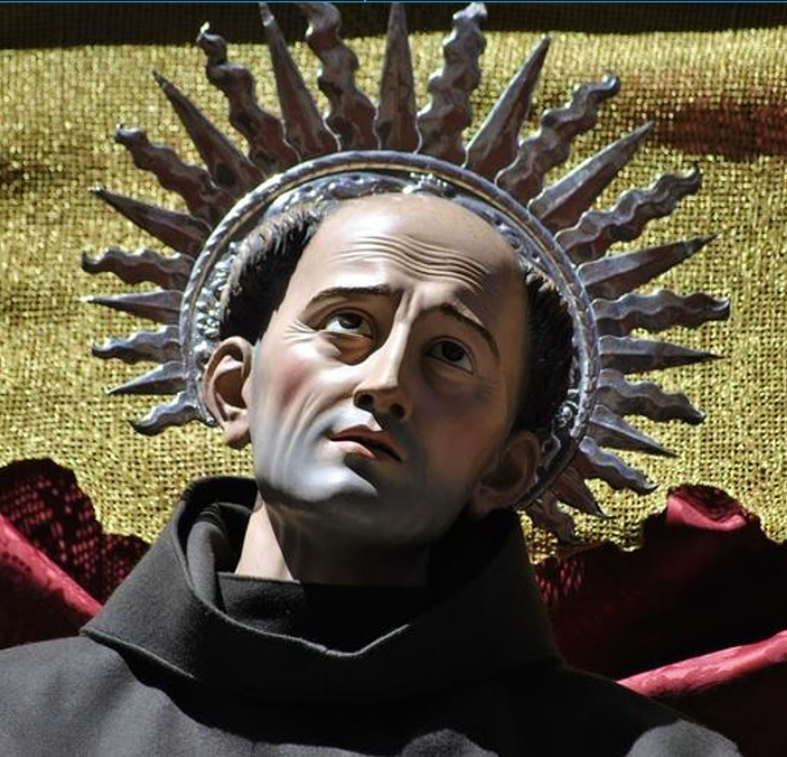
Saint of the Day – 30 March – Saint Peter Regalatus OFM (1320-1456) Priest, Friar of the Friars Minor, Superior, gifted with bi-location, prophecy and miracle working. Born in 1390 at Valladolid, Spain and died on 30 March 1456 at Aguilera, Spain of natural causes. Patronage – Valladolid, Spain. Also known as – Pedro de Regalado, Pedro Regalado, Peter Regalati, Peter Regulatus. Additional Memorial – 13 May – translation of his relics. His body is incorrupt.
The Roman Martyrology reads: “In Aguilera in Castile in Spain, Saint Peter Regalado of Valladolid, Priest of the Order of Minors, who was distinguished for humility and rigour of penance and built two cells, in which only twelve Friars could live in solitude.”
Peter was born in 1390 in Valladolid in Spain to a noble family of Jewish descent. He soon lost his father. At the age of ten years, Peter begged to be admitted into the Conventual Franciscans, which favour was granted him three years later and at the age of thirteen, his mother granting her permission to enter the Franciscan Monastery in his hometown. He had no other ambition than to lead a life of prayer and penance, considering his mother’s visits nothing more than a useless distraction.
Peter was conquered by the ideals of Peter da Villacreces, committed to re-establishing in the Iberian peninsula the original observance of the Franciscan Rule and from 1404 he followed him to he newly founded convent at Aguilera, where he found the solitude, poverty and the climate of prayer, he had so longed for. The young Lope de Salinas y Salazar also joined them. Lope was then called to hold the office of Vicar in Castile, with jurisdiction over the Convents of Burgos and founded another sixteen hermitages before his death.
In 1414 Peter da Villacreces had to participate in the Council of Constance, where he obtained the approval of the reform he had undertaken and left our saint in charge of .Aguilera, Both Peters, then in 1422, took part in the Provincial Chapter but here Peter da Villacreces died and Peter Regalatus was definitively entrusted with the guidance of the Monastery of Aguilera,
In 1426 he went to Burgos in order to recommend to his old friend Lope, not to abandon the reforming work undertaken by their common master. In the way traced by the latter, Peter had found his desire for holiness satisfied. He was in fact neither a founder nor a reformer but a simple ascetic and contemplative. He lived in conditions of penance and extreme poverty but his care for his brothers in need and his love for the sick became proverbial. With the gift of tears, his affectionate nature was manifested and likewise his burning love for God was proven. He performed several miracles on the banks of the Duero and, with irony it is said, that his work did not consist in much more.
In 1427 at Medina del Campo Peter attended the Concordia, a meeting of the followers of Peter Villacreces, the Reformer, where it was decided to remain united with the Conventual Friars. From 1442 he became Vicar of the Villacrecians and, therefore, the third successor of the Founder.. Finally, in 1456, hearing his death approaching, he decided to leave for Burgos to ask Lope, in vain, to accept the Vicariate of the Villacrecians. He died in Aguilera on 30 March 1456.
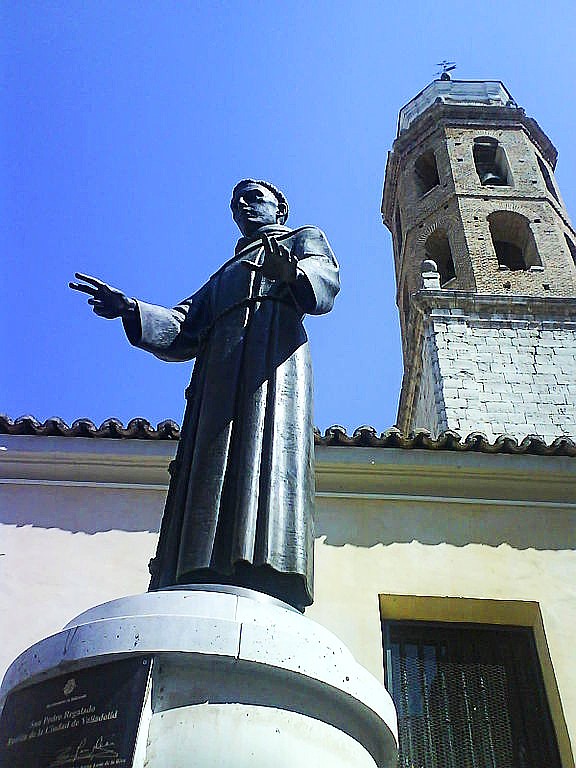
Statue at Valladolid
It was not long before numerous miracles occurred at his tomb and thirty-six years later, when he was exhumed to transfer his remains to the Church, his body was found incorrupt. He was Beatified on 11 March 1684 by Pope Innocent XI and on 29 June in 1746, Pope Benedict XIV Canonised PeterRegalatus of Valladolid by enrolling him in the register of Saints. Italian and Spanish iconography usually portrays the saint in the act of distributing bread to the poor, calling their gaze to the Crucifix.
Blessed Amadeus of Savoy (1435-1472) IXth Duke of Savoy, nicknamed “the Happy,” was the Duke of Savoy, from 1465 to 1472, apostle of the poor and ill, a pious, humble and gentle ruler. Amadeus was a particular protector of Franciscan Friars and endowed other religious houses, as well as homes for the care of the poor and suffering. Biography: https://anastpaul.com/2021/03/30/saint-of-the-day-30-march-blessed-amadeus-of-savoy-1435-1472/
St Clinius of Pontecorvo St Cronan Mochua St Damiano St Domnino of Thessalonica St Fergus of Downpatrick St Irene of Rome Bl Joachim of Fiore
Bl Maria Restituta Kafka St Osburga of Coventry St Pastor of Orléans St Patto of Werden St Quirinus the Jailer St Peter Regalatus OFM (1320-1456) Priest, Friar of the Friars Minor.
St Regulus of Scotland St Regulus of Senlis St Secundus of Asti St Tola St Zozimus of Syracuse
Martyrs of Constantinople: Fourth-century Christians who were exiled, branded on the forehead, imprisoned, tortured, impoverished and murdered during the multi-year persecutions of the Arian Emperor Constantius. They were martyred between 351 and 359 in Constantinople.
Martyrs of Korea: Marie-Nicolas-Antoine Daveluy Iosephus Chang Chu-gi Lucas Hwang Sok-tu Martin-Luc Huin Pierre Aumaître
Thought for the Day – 29 March – Meditations with Antonio Cardinal Bacci (1881-1971)
Holiness
“We need Saints to recall our wayward and corrupt society to the path of truth, justice and charity. We should pray to God to send us Saints who will reform the world by living the Gospel and making it live for others. Above all, we should endeavour to become holy ourselves. To achieve this, we do not have to put on sack-cloth, go into the de4sert, or shut ourselves up in a Monastery. Each of us can become a saint in his own home and in whatever position God has allotted him. All we have to do is obey God’s Will in everything, love Him above everything, love our neighbour as ourselves, avoid sin and aim at what is good. We can and should, do all this with the help of God.”
Tuesday of the Fourth Week of Lent – 29 March – Our Lenten Journey with the Great Fathers – Exodus 32:7-14, John 7:14-31
“Arise, O Lord, help us! Redeem us for Your Name’s sake.” – Psalm 43:26
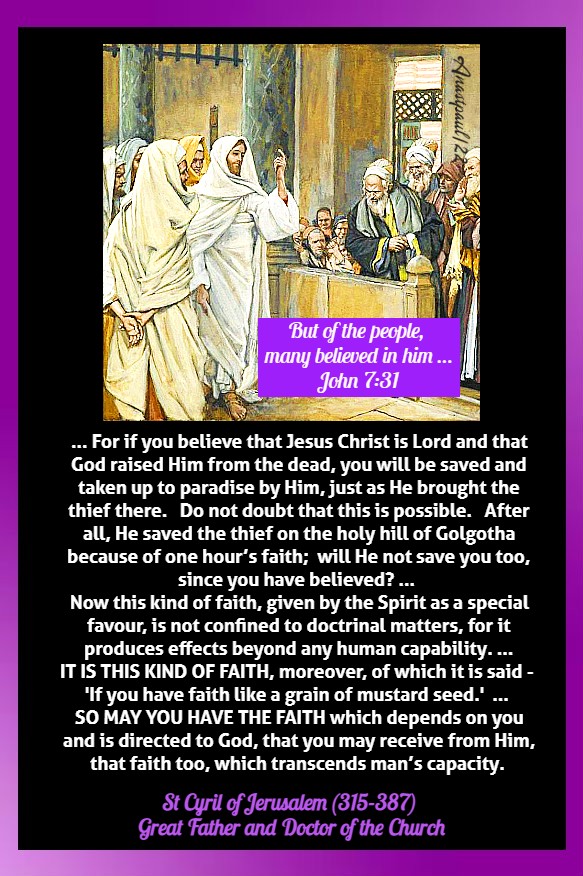
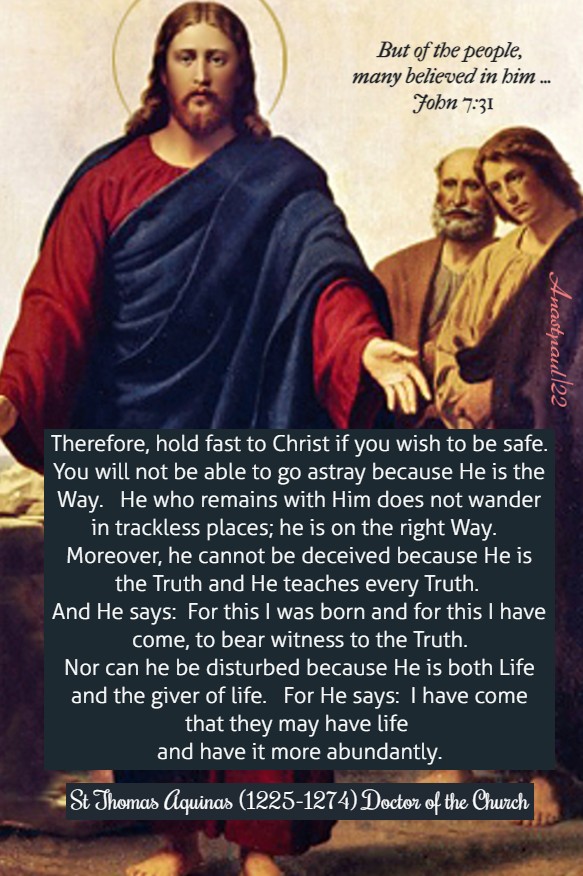
“But of the people, many believed in him …”
John 7:31
“THE ONE WORD “FAITH” can have two meanings. One kind of faith concerns doctrines. It involves the soul’s ascent to and acceptance of some particular matter. It also concerns the soul’s good, according to the words of the Lord: Whoever hears my voice and believes in him who sent me has eternal life and will not come to be judged. And again: He who believes in the Son is not condemned but has passed from death to life.
HOW GREAT is God’s love for men! Some good men have been found pleasing to God because of years of work. What they achieved by working, for many hours at a task pleasing to God, is freely given to you by Jesus in one short hour. For if you believe that Jesus Christ is Lord and that God raised Him from the dead, you will be saved and taken up to paradise by Him, just as He brought the thief there. Do not doubt that this is possible. After all, He saved the thief on the holy hill of Golgotha because of one hour’s faith; will He not save you too, since you have believed?
THE OTHER KIND OF FAITH is given by Christ by means of a special grace. To one wise sayings are given through the Spirit, to another perceptive comments by the same Spirit, to another faith by the same Spirit, to another gifts of healing. Now this kind of faith, given by the Spirit as a special favour, is not confined to doctrinal matters, for it produces effects beyond any human capability. If a man ,who has this faith, says to this mountain, move from here to there, it will move. For when anybody says thi,s in faith, believing it will happen and having no doubt in his heart, he then receives that grace.
IT IS THIS KIND OF FAITH,moreover, of which it is said – ‘If you have faith like a grain of mustard seed.’ The mustard seed is small in size but it holds an explosive force; although it is sown in a small hole, it produces great branches and when it is grown, birds can nest therein In the same way, faith produces great effects in the soul instantaneously. Enlightened by faith, the soul pictures God and sees Him as clearly as any soul can. It circles the earth; even before the end of this world, it sees the judgement and the conferring of promised rewards.
SO MAY YOU HAVE THE FAITHwhich depends on you and is directed to God, that you may receive from Him, that faith too, which transcends man’s capacity.” – St Cyril of Jerusalem (315-387) – Bishop, Confessor, Great Father and Doctor of the Church (An excerpt from his Catecheses 5).
Quote/s of the Day – 29 March – Tuesday of the Fourth Week of Lent – Exodus 32:7-14, John 7:14-31
“But of the people,many believed in him …”
John 7:31
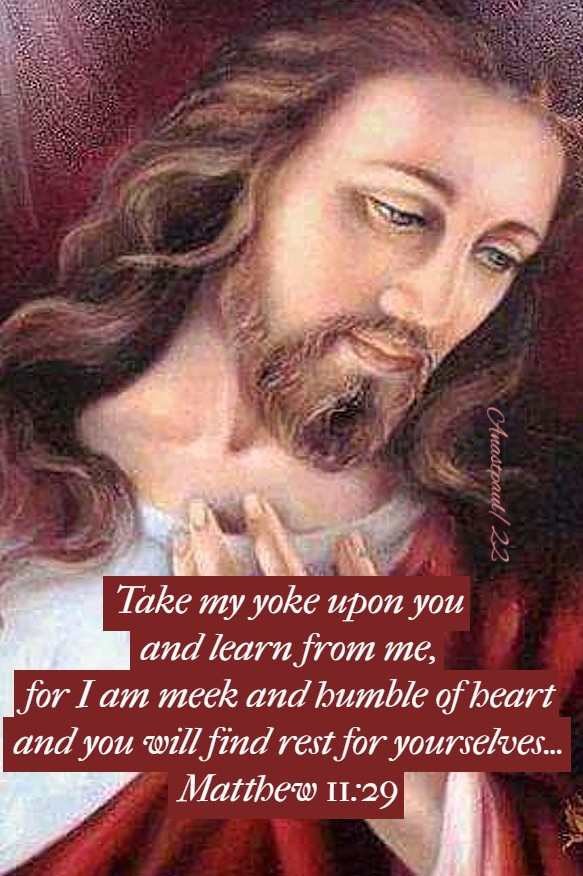
“Take my yoke upon you and learn from me, for I am meek and humble of heart and you will find rest for yourselves…”
Matthew 11:29
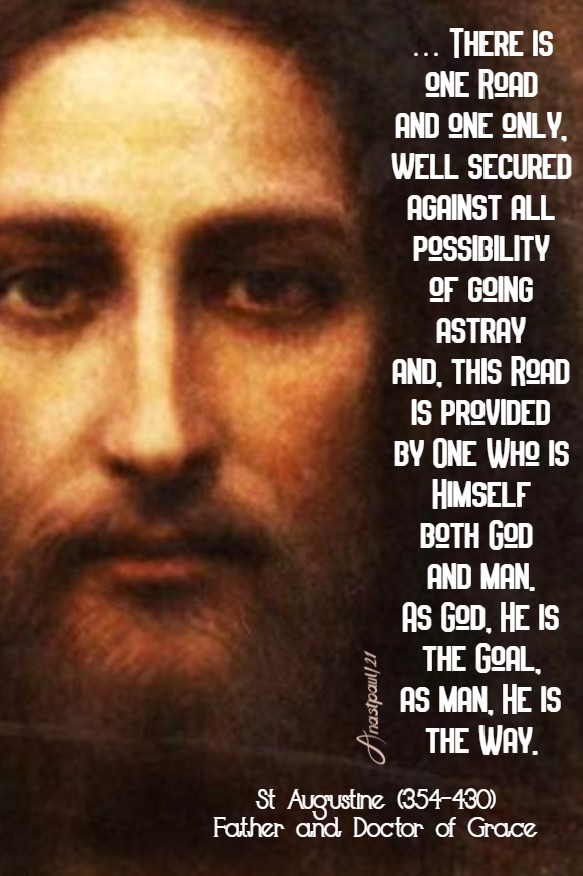
“… There is one Road and one only, well secured against all possibility of going astray and, this Road is provided by One Who is Himself both God and man. As God, He is the Goal, as man, He is the Way.”
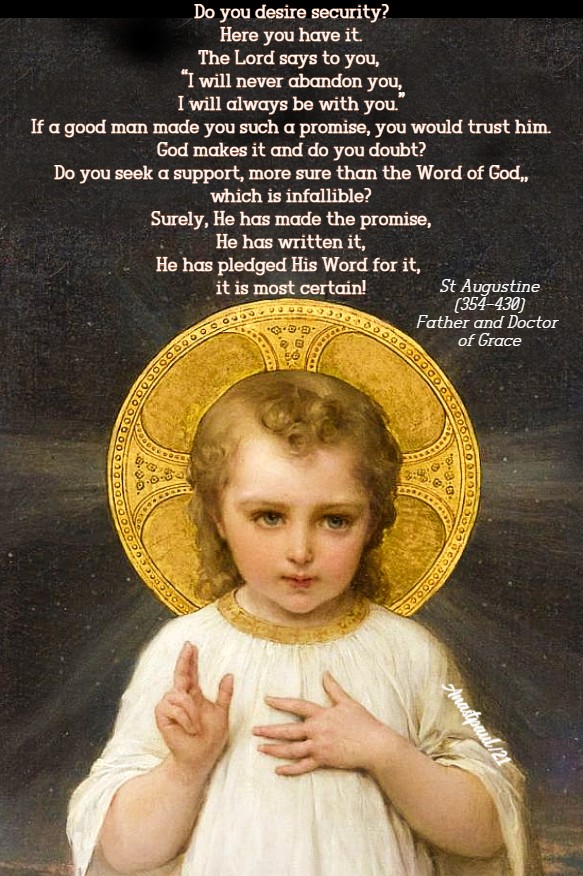
“Do you desire security? Here you have it. The Lord says to you, “I will never abandon you, I will always be with you.” If a good man made you such a promise, you would trust him. God makes it and do you doubt? Do you seek a support, more sure than the Word of God, which is infallible? Surely, He has made the promise, He has written it, He has pledged His Word for it, it is most certain!”
St Augustine (354-430) Bishop of Hippo Father and Doctor of Grace
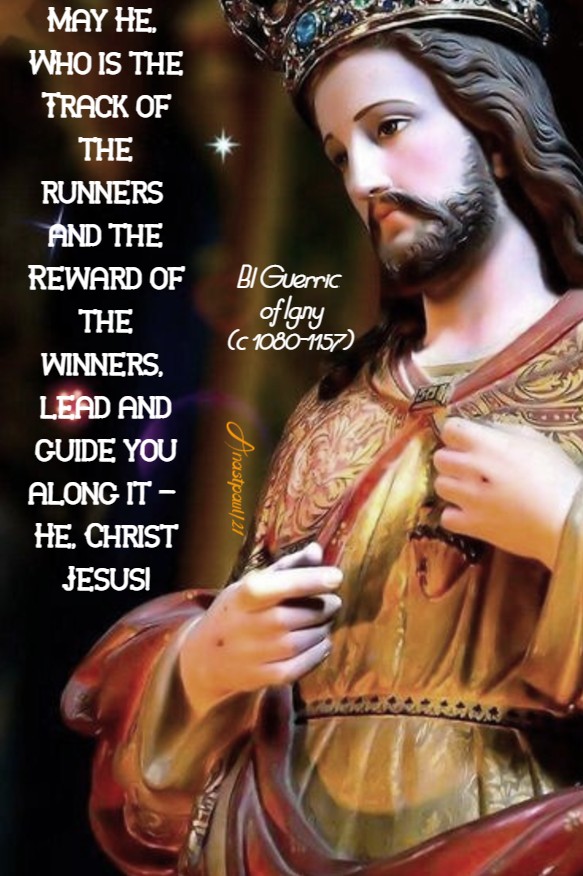
“May He, Who is the Track of the runners and the Reward of the winners, lead and guide you along it – He, Christ Jesus!”
One Minute Reflection – 29 March – Tuesday of the Fourth Week of Lent – Exodus 32:7-14, John 7:14-31
“But of the people, many believed in him …” – John 7:31
REFLECTION – “If, then, you are looking for the way by which you should go, take Christ because He Himself is the Way: This is the Way; walk in it. And Augustine says: Make man your way and you shall arrive at God. It is better to limp along the Way, than stride along off the Way. For a man who limps along the Way, even if he only makes slow progress, comes to the end of the Way but one who is off the Way, the more quickly he runs, the further away is he from his goal.
If you are looking for a goal, hold fast to Christ because He Himself is the Truth, where we desire to be. My mouth shall reflect on the Truth. If you are looking for a resting place, hold fast to Christ because He Himself is the Life. Whoever finds Me finds life and receives salvation from the Lord.
Therefore, hold fast to Christ if you wish to be safe. You will not be able to go astray because He is the Way. He who remains with Him does not wander in trackless places; he is on the right Way. Moreover, he cannot be deceived because He is the Truth and He teaches every Truth. And He says: For this I was born and for this I have come, to bear witness to the Truth. Nor can he be disturbed because He is both lLfe and the giver of life. For He says: I have come that they may have life and have it more abundantly.” – St Thomas Aquinas (1225-1274) Priest, Doctor of the Church (An excerpt from: Exposition on John – Chapter 14).
PRAYER – May the sacred practice of fasting, we beseech You, O Lord, win for us increased holiness of life and the continuing help of Your mercy. Through Jesus Christ, Thy Son our Lord, Who lives and reigns with Thee, in the unity of the Holy Ghost, God, world without end. Amen (Collect).
Our Morning Offering – 29 March – Tuesday of the Fourth Week of Lent
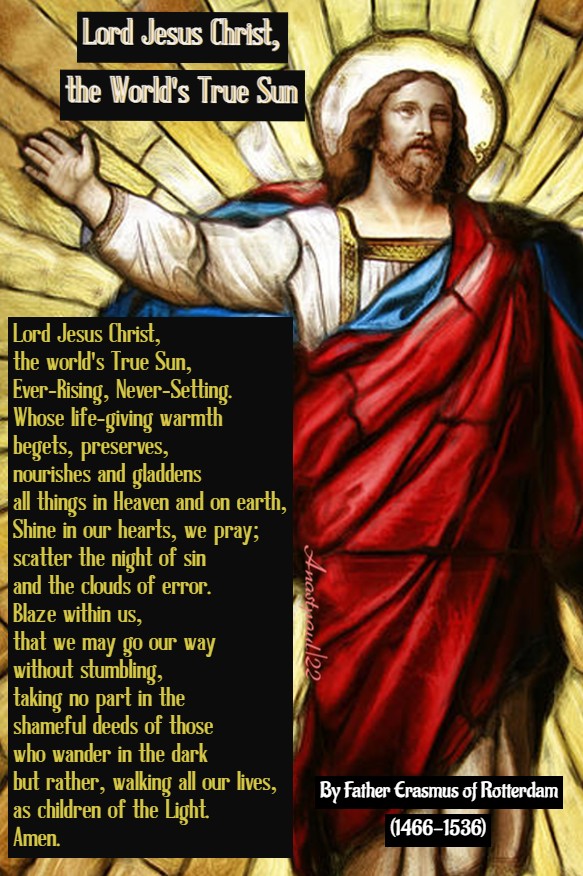
Lord Jesus Christ, the World’s True Sun By Fr Erasmus of Rotterdam (1466-1536)
Lord Jesus Christ, the world’s True Sun, Ever-Rising, Never-Setting. Whose life-giving warmth begets, preserves, nourishes and gladdens all things in Heaven and on earth, Shine in our hearts, we pray; scatter the night of sin and the clouds of error. Blaze within us, that we may go our way without stumbling, taking no part in the shameful deeds of those who wander in the dark but rather, walking all our lives, as children of the Light. Amen.
Desiderius Erasmus Roterodamus, more commonly known as ‘Erasmus,’ was a Dutch Priest, Philosopher and Catholic Theologian, who is considered one of the greatest scholars of the northern Renaissance.[2][3][4] As a Catholic priest, he was an important figure in classical scholarship who wrote in a pure Latin style.
Saint of the Day – 29 March – Saint Eustachio of Naples (3rd Century) the Seventh Bishop of Naples. Died in the mid-3rd-Century in Naples, Italy of natural causes, Also known as – Eustasio, Eustatius. Additional Memorial – 10 May in Naples.
The Roman Martyology states: “In Naples, commemoration of Saint Eustasio, Bishop.”
In the list of Bishops of the Archdiocese og Naples, Eustachio is included in Seventh place, after St Agrippino and before St Efebo.
We know very little, only that he lived in the first half of the third century and before 343, the year in which the ninth Bishop, Fortunatus is historically ocumented.
According to the Catalogus, Eustachio governed the Diocese for seventeen years during the Pontificates of Pope Anterus and Pope Fabian.
It is reported that his remains were transferred, in the 9th century, to the main Altar of the Church of Santa Maria in Portanova.
The urn containing the body of Eustachio was found in 1616 and Archbishop Decio Carafa decided to extend the cult to the entire Diocese.
In the month of September of the year 1884, the canonical recognition of the relics was carried out and after this, on 18 December 1884, Pope Leo XIII confirmed the cult paid ab immemorial, to Saint Eustachio.
St Mark of Arethusa St Masculas of Africa St Pastor of Nicomedia St Saturus of Africa St Simplicius of Monte Cassino St Victorinus of Nicomedia St William Tempier
Martyrs of Nicomedia: Seven Christians who were Martyred together in the persecutions of Diocletian. We know nothing else about them but the names of two – Pastor and Victorinus.
Thought for the Day – 28 March – Meditations with Antonio Cardinal Bacci (1881-1971)
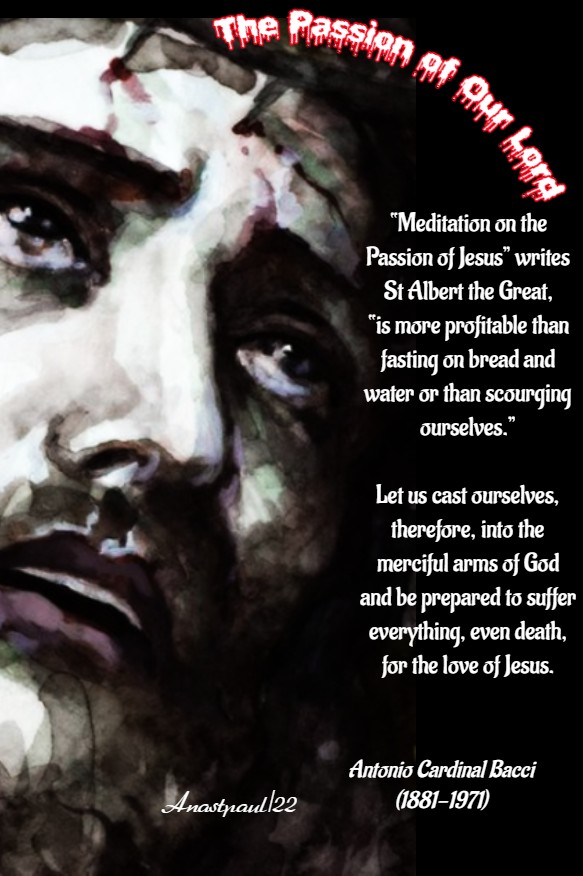
The Passion of Our Lord
“Meditation on the Passion of Jesus” writes St Albert the Great, “is more profitable than fasting on bread and water or than scourging ourselves.”
This is because, when we meditate with love and gratitude on the Passion of our Redeemer, we have the experience of being transformed and set aglow with charity. We realise the truth of St Paul’s words, “The sufferings of the present time are not worthy to be compared with the glory to come, that will be revealed in us” (Rom 8:18)).
Let us cast ourselves, therefore, into the merciful arms of God and be prepared to suffer everything, even death, for the love of Jesus.”
Monday of the Fourth Week of Lent – 28 March – Our Lenten Journey with the Great Fathers – 3 Kings 3:16-28, John 2:13-25
“Be my rock of refuge, O God, a stronghold to give me safety.” – Psalm 30:3
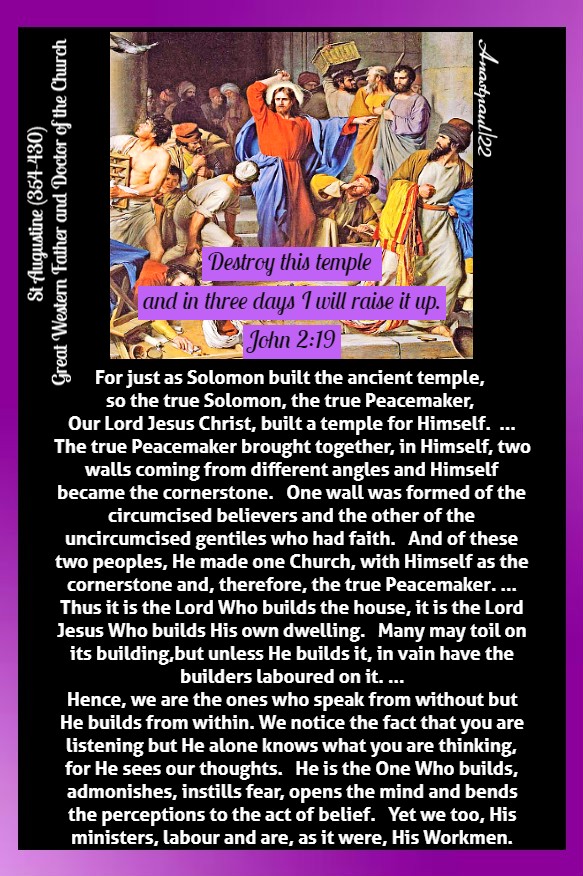
“Destroy this temple and in three days I will raise it up.”
John 2:19
“THE TEMPLE that Solomon built to the Lord was a type and figure of the future Church, as well as, of the Body of the Lord. For this reason Christ says in the Gospel: Destroy this temple and in three days I will raise it up again. For just as Solomon built the ancient temple, so the true Solomon, the true Peacemaker, Our Lord Jesus Christ, built a temple for Himself. Now Solomon means peacemaker; Jesus, however, is the true Peacemaker, of Whom Saint Paul says: He is our peace, uniting the two into one.The true Peacemaker brought together, in Himself, two walls coming from different angles and Himself became the cornerstone. One wall was formed of the circumcised believers and the other of the uncircumcised gentiles who had faith. And of these two peoples, He made one Church, with Himself as the cornerstone and, therefore, the true Peacemaker.
AND SO, WHEN SOLOMON the King of Israel, the son of David and Bathsheba, built his temple, he acted as a figure of Christ, the true Solomon and Peacemaker. But I do not think it was Solomon of old, the type of Christ, who really built God’s dwelling. As the beginning of the psalm tells us: Unless the Lord build the house, in vain have the builders laboured on it.Thus it is the Lord Who builds the house, it is the Lord Jesus Who builds His own dwelling. Many may toil on its building,but unless He builds it, in vain have the builders laboured on it.
AND WHO ARE THOSE who labour on it? ll those who preach God’s word in the Church, who are ministers of His Sacraments . All of us now rush, work and build and before us, other men rushed, worked and built; still, unless the Lord build the house, in vain have the builders laboured on it. The Apostles and Paul specifically, saw some of them fail and said: You observe the days, the years, the months and the seasons; I fear that I may have toiled for you to no purpose. For realising that he was the result of the Lord’s building from within, he was sorrowful because he had toiled for them to no avail. Hence, we are the ones who speak from without but He builds from within. We notice the fact that you are listening but He alone knows what you are thinking, for He sees our thoughts. He is the One Who builds, admonishes, instills fear, opens the mind and bends the perceptions to the act of belief. Yet we too, His ministers, labour and are, as it were, His Workmen.” – St Augustine (354-430) Bishop and Great Western Father and Doctor of the Church (An excerpt from a Discourse on the Psalms).





















You must be logged in to post a comment.