Posted in DIVINE Mercy, Goodness, Patience, QUOTES on ANGER, QUOTES on CHARITY, QUOTES on DEATH, QUOTES on ENVY, QUOTES on FORGIVENESS, QUOTES on JUDGING, QUOTES on LOVE, QUOTES on MERCY, QUOTES on PRAYER, The LAST THINGS, The WORD

Quote/s of the Day – 8 November – Forgive him …

Quote/s of the Day – 8 November – Readings: Wisdom 1: 1-7; Psalm 139: 1b-10; Luke 17: 1-6

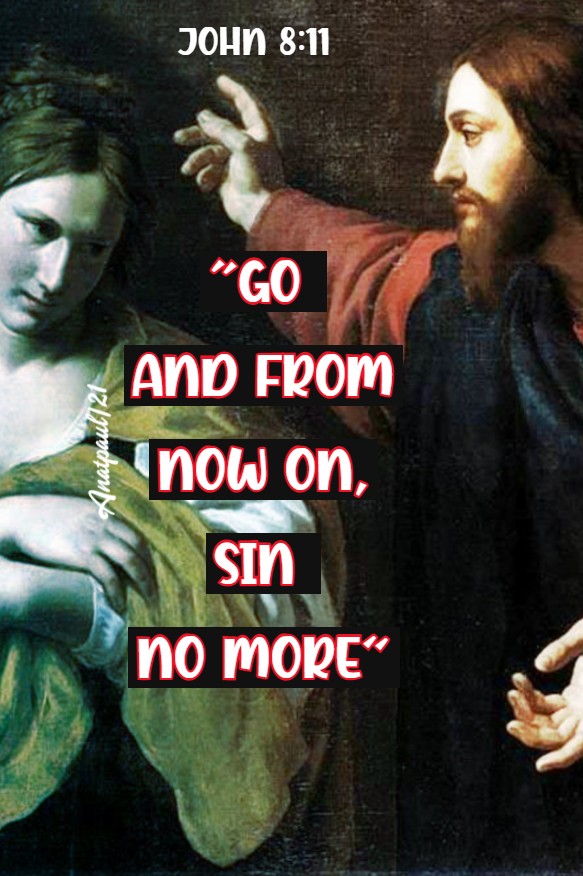
If your brother sins, rebuke him
and if he repents, forgive him.
And if he wrongs you seven times
in one day and returns to you
seven times saying, ‘I am sorry,’
you should forgive him.

Luke 17:3-4

Judge not and you will not be judged;
condemn not and you will not be condemned;
forgive and you will be forgiven;
give and it will be given to you,
good measure, pressed down,
shaken together, running over,
will be put into your lap.
For the measure you give,
will be the measure you get back.

Luke 6:37-38

Then Peter came up and said to him,
“Lord, how often shall my brother sin against me and I forgive him? As many as seven times?”
Jesus said to him,
“I do not say to you seven times
but seventy times seven
.”

Matthew 18:21-22

Gloriously has God slain enmity,
in order to save us,
may we never risk the life of our souls
by being resentful
or by bearing grudges
.”

St Gregory of Nyssa (c 335–c 395)
Father of the Church

(Excerpt from his treatise,
On Christian Perfection
)

“In conformity with
the philosophy of Christ,
let us make of our life,
a training for death.”

To harbour no envy, no anger,
no resentment against an offender,
is still not to have charity for him.
It is possible, without any charity,
to avoid rendering evil for evil.
But, to render, spontaneously, good for evil –
such belongs to a perfect spiritual love.

St Maximus the Confessor (c 580-662)
Father of the Church

We must show love
for those who do evil to us
and pray for them.
Nothing is dearer
or more pleasing to God than this.

St Bridget of Sweden (c 1303-1373)

Posted in CHRIST the JUDGE, DIVINE Mercy, Goodness, Patience, FATHERS of the Church, QUOTES on FORGIVENESS, QUOTES on MERCY, The LAST THINGS, The WORD

One Minute Reflection – 8 November – ‘… What He is referring to as judgement….’

One Minute Reflection – 8 November – “Pray for the Holy Souls in Purgatory” – Readings: Wisdom 1: 1-7; Psalm 139: 1b-10; Luke 17: 1-6

If your brother sins, rebuke him and if he repents, forgive him. And if he wrongs you seven times in one day and returns to you seven times saying, ‘I am sorry,’ you should forgive him.” – Luke 17:3-4

REFLECTION – “O you who are hard-hearted, incapable of gentleness, learn of your Creator’s goodness and do not be bitter judges and arbitrators of your fellow servants, as you wait for the coming of Him, Who will disclose the hidden places of the heart and will Himself, the all-powerful Lord, determine each one’s place in the world to come. Do not assign severe judgements, that you may not be judged in the same way and rent by the words of your own mouth, as if by sharp teeth. For it is against this kind of crime that these words of the Gospel seem to warn us: “Do not judge and you will not be judged” (Lk 6:37). In saying this, He is not doing away with discernment and wisdom; what He is referring to, as judgement, is over-severe condemnation. As far as possible, then, lighten the weight of your measure if you do not want your actions to weigh too heavily on the scales, when our lives are weighed, as on a balance, at God’s Judgement! … Never refuse to show mercy that you may not be denied forgiveness when you are in need of it yourself.” – St Asterius of Amasea (c 350– c 410) Bishop (Sermon 13)

PRAYER – O Lord our God, grant that we may not so much seek to be consoled as to console, to be understood as to understand, to be loved as to love and to be only good influences to our neighbour. May the prayers of the Blessed Virgin, all the Saints and Angels, ever intercede for the Church Militant and the Church Suffering, Amen.

Posted in CHRIST, the WAY,TRUTH,LIFE, DOCTORS of the Church, GOD ALONE!, JESUIT SJ, JUNE-THE SACRED HEART, ON the SAINTS, Our MORNING Offering, QUOTES for CHRIST, QUOTES of the SAINTS, QUOTES on the CROSS of CHRIST, SACRED HEART PRAYERS, The HEART, The PASSION

Our Morning Offering – 8 November – May I Be United With You, Good Jesus

Our Morning Offering – 8 November – Octave Day of All Saints

May I Be United With You, Good Jesus
St Peter Canisius (1521-1597)
Doctor of the Church

Let my eyes take their sleep
but may my heart always
keep watch for You.
May Your right hand bless Your servants
who love You.
May I be united with the praise
that flows from You, Lord Jesus,
to all Your saints;
united with the gratitude
drawn from Your heart, good Jesus,
that causes Your saints to thank You;
united with Your passion, good Jesus,
by which You took away our guilt;
united with the divine longing
which You had on earth, for our salvation;
united with every prayer
that welled from Your divine heart, good Jesus
and flowed into the hearts of Your saints.
Amen

Posted in SAINT of the DAY

Saint of the Day – 8 November – Saint Willehad of Bremen (Died 789)

Saint of the Day – 8 November – Saint Willehad of Bremen (Died 789) First Bishop of Bremen, Germany, Confessor, Benedictine Monk and Priest, a friend of Blessed Alcuin of York, disciple of St Boniface, Missionary. Born in the 8th Century in Northumbria, England and died in 789 in Bremen, Germany of natural causes. Patronage – Saxony. Also known as – Willihad.

The Roman Martyrology states: “At Bremen, St Willehad, first Bishop of that City, who, in conjunction with St Boniface, whose disciple he was, spread the Gospel in Friesland and Saxony.

Willehad was born in Northumbria and probably received his education at York under Bishop Ecgbert. He was Ordained after his education, and about the year 766, he went to Frisia, to continue the missionary work of St Boniface who had been Martyred by the Frisians in 754. At an assembly in Paderborn in 777, Saxony was divided into missionary zones. The zone between the Weser and the Elbe, called Wigmodia, was given to Willehad.

From 780 Willehad preached in the region of the lower Weser River on commission from Charlemagne. He barely escaped with his life when the Frisians wanted to kill him and he returned to the area around Utrecht. Once again, he and his fellow missionaries barely escaped with their lives, when the local pagans wanted to kill them for destroying some temples. Finally, in 780, Charlemagne sent him to evangelise the Saxons. He preached to them for two years but, in 782, the Saxons under Widukind, rebelled against Charlemagne and Willehad was forced to flee to Frisia. He took the opportunity to travel to Rome, where he reported to Pope Adrian I on his work.

Upon his return from Rome, Willehad retired for a time to the Monastery of Echternach, in present-day Luxembourg. He spent two years there reassembling his missionary team.

After Charlemagne’s conquest of the Saxons, Willehad preached in the region around the lower Elbe and the lower Weser. In 787 Willehad was Consecrated Bishop and that part of Saxony and Friesland, near the mouth of the Weser, was assigned to him for his Diocese. He chose as his seat, the City of Bremen, which is mentioned for the first time in documents of 782 and built a Cathedral there. Praised for its beauty by Ansgar, it was dedicated in 789.

Willehad died in Blexen-upon-Weser, today a part of Nordenham. He is buried in the City’s Cathedral, which he Consecrated shortly before his death on 8 November 789. Bishop St Ansgar compiled a life of Willehad and the preface which he wrote was considered a masterpiece for that age. In 860, a sick girl from Wege travelled to his grave. There, she was cured by a miracle. This was the first time the small village was mentioned in any historical documents.

Bremen Cathedral

Posted in MARIAN TITLES, SAINT of the DAY

Octave Day of All Saints, Notre-Dame de Bellefontaine / Our Lady of the Blessed Fountain, Bellefontaine, France (12th Century) and Memorials of the Saints – 8 November

Octave Day of All Saints

Notre-Dame de Bellefontaine / Our Lady of the Blessed Fountain, Bellefontaine, France (12th Century) – 8 November:

According to tradition it was sometime in the 13th century when a man, who was hunting near the Benedictine Abbey, severely injured his hand. The injury was so severe, that the man feared that he might lose his life from the loss of blood which would not cease. Having with him a bowl, he filled it with fresh water he found nearby and placed his hand in it as he prayed devotedly to the Blessed Virgin Mary for her intervention The man’s faith was rewarded, as the hunter looked at his hand to witness the wound miraculously close as if he had never been injured at all.
In recognition of the miracle, he later returned to site, bringing with him, a Statue of the Blessed Virgin. When the news of the miracle became widely known. it attracted many pilgrims from all over Europe. Thus, starting in the 13th century, the Statue of the Virgin was venerated under the title of Notre-Dame-de-Bellefontaine. A small Chapel was also built around the Statue of the Virgin Mary.
Shortly before the coming of the French Revolution, a Church was built, whose care was entrusted to a local hermit. The Statue of the Blessed Virgin miraculously escaped the revolutionary turmoil and the place remained a place of celebration for the faithful of the two neighbouring counties. The nearby Benedictine Abbey, which had been founded at the end of the eleventh century, was plundered and confiscated by the state during the Revolution and then sold in the year 1791. In 1794 some of the buildings were set ablaze and the rest of the Abbey left in ruins. Some of the property was purchased on 17 january 1817, by a Trappist Monk, Urban Guillet and it once again became a flourishing Monastery.

The pool from which the hunter obtained the water still exists and is now protected behind a metal grate. There is also a modern Statue of the Blessed Virgin Mary located in a grotto nearby, as the original Statue disappeared during the fighting and chaos of World War I. Its current whereabouts is unknown.

The Abbey Church with the new Statue above the Altar.

St Adeodatus I, Pope
St Clair of Tours
St Cybi of Caenarvon
St Drouet

Blessed John Duns Scotus OFM (c 1265-1308) Doctor Subtilis (Subtle Doctor) Franciscan Priest and Friar, Theologian, Philosopher, Lecturer – known as “The minstrel of the Word Incarnate” and “Defender of Mary’s Immaculate Conception”.
Blessed John Duns Life:

https://anastpaul.com/2018/11/08/saint-of-the-day-8-november-blessed-john-duns-scotus-ofm-c-1265-1308/

St Elizabeth of the Trinity O.Carm (1880-1906) Virgin, Carmelite Nun, Mystic, Writer, gifted Pianist.
Biography:

https://anastpaul.com/2017/11/08/saint-of-the-day-8-november-st-elizabeth-of-the-trinity-o-c-d-1880-1906/

St Gervadius
St Giuse Nguyen Ðình Nghi

St Godfrey of Amiens OSB (1066–1115) Bishop of Amiens, Reformer, Apostle of Prayer and Charity, Penitent.
About St Godfrey:

https://anastpaul.com/2019/11/08/saint-of-the-day-8-november-saint-godfrey-of-amiens-osb-1066-1115/

St Gregory of Einsiedeln
St John Baptist Con
Bl Maria Crucified Satellico
St Martinô Tho
St Martinô Ta Ðuc Thinh
St Maurus of Verdun
St Moroc of Scotland
St Phaolô Nguyen Ngân
St Tysilio of Wales
St Willehad of Bremen (Died 789) Bishop Confessor
St Wiomad of Trèves

All Deceased Dominicans

All Saints of the Diocese of Evry: A regional memorial of all the saints and beati of the calendar who have a connection to the Diocese of Evry-Corbeil-Essonnes, France.
• Blessed Isabella of France, founded the Longchamp monastery
• Blessed Nicolas Gaudreau, pastor of Vert-le-Petit
• Blessed Pierre Bonse, pastor of Massy
• Our Lady of Good Guard, patron saint of the diocese, venerated in Longpont-sur-Orge, France
• Saint Corbinian, born in Saint-Germain-lès-Arpajon
• Saint Denis of Paris, evangelizer of part of Essonne and revered ni Longpont-sur-Orge
• Saint Eloi, who lived in Chilly-Mazarin
• Saint Germain of Paris
• Saint William of Bourges, son of Count Baldwin IV of Corbeil
• Saint William of Aebelholt, pastor of Brunoy
• Saint Wulfran of Sens, born in Milly-la-Forêt
• Blessed Nativelle, vicar of Longjumeau
• Blessed René Le Bris, pastor of Bris-sous-Forges
• Saint Spire of Bayeux, whose relics are in Corbeil in the cathedral that bears his name
All Saints of Wales

Augustinian Martyrs of Spain

Four Crowned Martyrs: Saint Castorus, Saint Claudius, Saint Nicostratus and Saint Simpronian. Skilled stone carvers in the 3rd century quarries. Martyred when they refused to carve an idol of Aesculapius for Diocletian. They were drowned in the River Sava in 305. Patronages – against fever, cattle, sculptors, stone masons, stonecutters.

Martyred in the Spanish Civil War
• BlessedAntolín Pablos Villanueva
• BlessedLaureano Pérez Carrascal
• BlessedManuel Sanz Domínguez
• BlessedMaximino Serrano Sáiz

Posted in NOTES to Followers

Dear Rosemary ….

Dear Rosemary …

We have a very special child of God and a fellow-pilgrim here with us, on Breathing Catholic.
She has been a generous and loving supporter and benefactor of this project and of me personally, for many years now.
She has been a friend in need and a support in trial.
She has been a wise head and a shoulder to cry on.
As the times have been so difficult for all of us and as she is not very well, I wished to manifest the great regard I hold her and her husband in, that they might know how much they are appreciated. Across the thousands of miles, Rosemary has always, remained close in Christ.

God love you,keep you in the Palm of His Hand and bless you. Remember all the evils of the world will pass away. God alone is our Refuge and our Fortress.

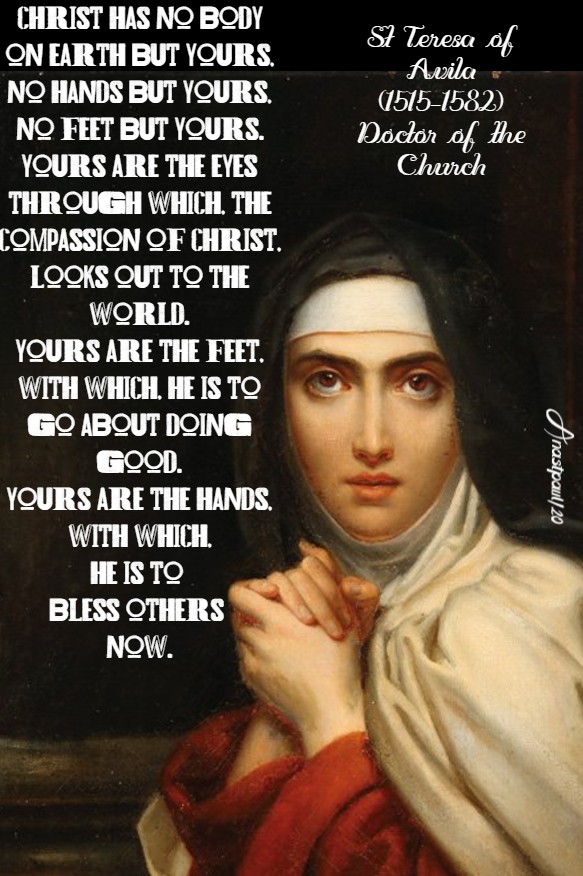
Let nothing perturb you,
Let nothing frighten you,
All things pass away,
God never changes.
Patience obtains all things.
He who has God
Finds he lacks nothing.
God alone suffices.

St Teresa of Avila (1515-1582)
Doctor of the Church

May Our Beloved Lord,
grant you the strength,
courage and wisdom,
to rest in Him alone!

Happy Birthday dearest Rosemary!

💘🙏Ana

Posted in MEDITATIONS - ANTONIO CARD BACCI, NOVEMBER - Month of the SOULS in PURGATORY, PURGATORY, QUOTES on CHARITY, QUOTES on ETERNAL LIFE, QUOTES on HEAVEN, QUOTES on HELL, QUOTES on LOVE of GOD, QUOTES on MERCY, QUOTES on PRAYER, The LAST THINGS

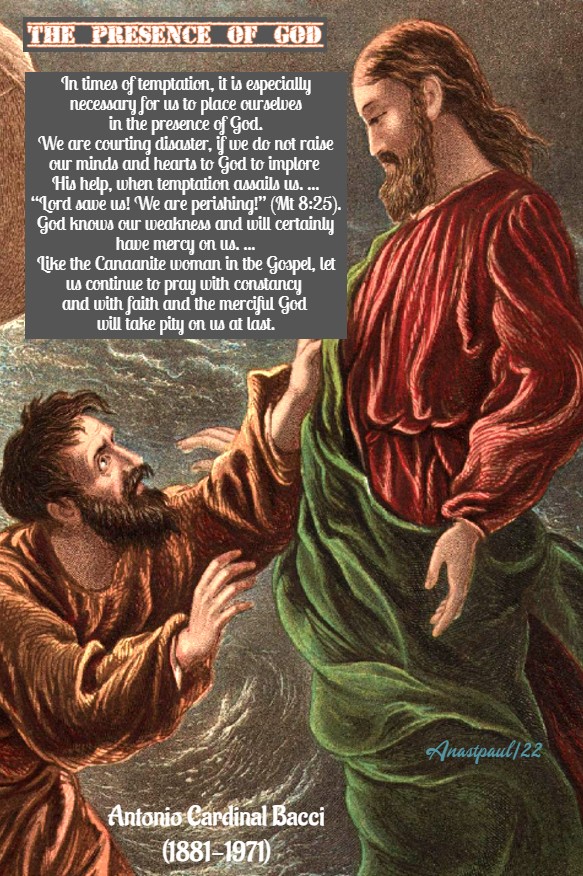
Thought for the Day – 7 November – How We Can Help the Faithful Departed

Thought for the Day – 7 November – Meditations with Antonio Cardinal Bacci (1881-1971)

How We Can Help the Faithful Departed

We have a natural obligation to help the faithful departed, for they are our fellow-men.
Are we capable of watching another human being in agony, without feeling pity for him?
If there is some way in which we can help him, moreover, ought we not to do so?
The Holy Souls are in agony, however, they are on fire with the love of God, yet cannot be united to Him.
We have a means of helping them through our prayers and good works.

There is a further obligation on us, arising from our religion.
They have been redeemed, like ourselves, by the Blood of Christ and God has told us that the same degree of mercy, will one day be shown to us, which we have shown to others.
The time will come when we also shall find ourselves in Purgatory and shall be in need of prayer.
If we remember the dead now, they will be in a position, one day, to do the same for us.
Blessed are the merciful, Jesus says, for they will obtain mercy.

When we appear before the judgement seat of God in order to account for the way in which we have spent our lives, He will count as done to Himself, whatever we have done to the poor, hungry and ill-clad.
Only if we have been merciful towards them, will He receive us into the Kingdom of Heaven.
Otherwise, He will send us away, accursed, for all eternity.
Now the Souls in Purgatory are more unfortunate than those who are poor, hungry and homeless in this world.
They hunger for God, they are full of regret for the sins which they have committed and they languish far from the eternal home, to which they belong.

Finally, we have a duty in justice, to help their souls.
Some of them are our parents, brothers, sisters, friends and benefactors.
Perhaps they are suffering now because they loved us too much because they wished to make money for us or because, they were led astray by our bad example!
It is not only charity, therefore but justice, which obliges us to pray for them.

Antonio Cardinal Bacci

Posted in "Follow Me", CHRIST the KING, CHRIST the LIGHT, CHRIST the PHYSICIAN, CHRIST the WORD and WISDOM, CHRIST, the WAY,TRUTH,LIFE, DOCTORS of the Church, DOMINICAN OP, FATHERS of the Church, LOVE of NEIGHBOUR, MARIAN PRAYERS, PRAYERS of the SAINTS, QUOTES for CHRIST, QUOTES on CHARITY, QUOTES on COURAGE, QUOTES on EVANGELISATION, QUOTES on FAITH, QUOTES on GRACE, QUOTES on HUMILITY, QUOTES on LOVE, QUOTES on LOVE of GOD, QUOTES on PRAYER, QUOTES on SACRED SCRIPTURE, QUOTES on the CROSS of CHRIST, QUOTES on TRUTH, SOLDIERS/ARMOUR of CHRIST, The DIVINE INFANT, The FAITHFUL on PILGRIMAGE

Quote/s of the Day – 7 November – The Order of Preachers

Quote/s of the Day – 7 November – The Memorial of
All Saints of the Order of Preachers

Arm yourself with prayer,
instead of a sword;
be clothed with humility,
instead of fine raiment.

We must sow the seed,
Not hoard it
.”

St Dominic’s Blessing
By St Dominic de Guzman (1170-1221)

May God the Father,
who made us, bless us.
May God the Son,
send His healing among us.
May God the Holy Spirit,
move within us
and give us eyes to see with,
ears to hear with,
and hands, that Your work,
might be done.
May we walk and preach
the word of God to all.
May the angel of peace
watch over us
and lead us at last,
by God’s grace,
to the Kingdom.
Amen

St Dominic de Guzman OP (1170-1221)

“I send you a very little word,
THE WORD,
made little in the crib,
THE WORD,
made flesh for us ….
THE WORD,
of salvation and grace
THE WORD,
of sweetness and glory
THE WORD
Who is good and gentle –
JESUS CHRIST!

Blessed Jordan of Saxony OP (1190-1237)

It is by the path of love,
which is charity,
that God draws near to man
and man to God.
But where charity is not found,
God cannot dwell.
If, then, we possess charity,
we posses God,
for ‘God is Charity’
(1 John 4:8).

St Albert the Great OP (1200-1280)
Doctor of the Church

To convert somebody,
go and take them by the hand
and guide them
.”

Charity is
the form,
mover,
mother
and root
of all
the virtues.

To love is to
will the good
of the other.

The greatest kindness
one can render
to any man
consists in leading him
from error to truth.

O Jesus, Mary’s Son!
By St Thomas Aquinas OP (1225-1274)
Doctor Angelicus, Doctor communis

Hail to Thee! True body sprung
From the Virgin Mary’s womb!
The same that on the cross was hung
And bore for man the bitter doom.
Thou Whose side was pierced and flowed
Both with water and with blood.
Suffer us to taste of Thee
In our life’s last agony.
O kind, O loving One!
O Jesus, Mary’s Son!
Amen

St Thomas Aquinas OP (1225-1274)

Be strong and kill yourself
with the sword of hate and love,
then you will not hear the insults
and abuse. which the enemies
of the Church throw at you.
Your eyes will not see anything,
which seems impossible,
or the sufferings,
which may follow
but only the light of faith
and in that light ,
everything is possible
and remember ,
God never lays greater burdens
on us than we can bear.

What is it you want to change?
Your hair, your face, your body?
Why? For God is in love with all those things
and He might weep when they are gone!

St Catherine of Siena OP (1347-1380)
Doctor of the Church

Compassion, my dear Brother,
is preferable to cleanliness.
Reflect that with a little soap,
I can easily clean my bed covers
but even with a torrent of tears,
I would never wash from my soul,
the stain, that my harshness toward
the unfortunate would create
.”

St Martin de Porres OP (1579-1639)

Just a few of the great Dominicans – Ana OP – with Love

Posted in DOCTORS of the Church, DOMINICAN OP, FATHERS of the Church, QUOTES on ALMS, QUOTES on CHARITY, QUOTES on LOVE, The WORD

One Minute Reflection – 7 November – The price …

One Minute Reflection – 7 November – Readings: Kings 17: 10-16; Psalm 146: 7-10; Hebrews 9: 24-28; Mark 12: 38-44

“For they all contributed out of their abundance but she, out of her poverty, has put in everything she had, her whole living.” – Mark 12:44

REFLECTION – “Now, if someone is wondering what the cost is, here is their answer – He does not give it to someone who does not value it.   For indeed, nobody gives away something they hold dear without placing some kind of value on it.
From now on, then, if God has no need of your goods, neither does He have to give you this great thing, if you refuse to love Him, all He requires is love, without which nothing constrains His giving.   Love, then, and you will receive the Kingdom, love and you will possess it…
Love God more than yourself and already, you begin to have what it is you desire to possess fully, in heaven.”… St Anselm (1033-1109) Father and Doctor of the Church

PRAYER – Lord God, Your Son has shown us the way. As we follow in His steps, may we never wander from the path that leads to life. Renew the wonders of Your grace in our hearts so that neither death nor life may separate us from Your love. Holy Father, as You were glorified by the life and death of all the Dominican Saints and Blesseds, grant that by their prayers, we may receive Your grace to give first to You and then to our neighbour in complete love and service. Through our Lord, Jesus Christ, with You in union with the Holy Spirit, one God for all eternity, amen.

Posted in DOCTORS of the Church, HOLY COMMUNION, Our MORNING Offering, PRAYERS of the SAINTS, The HOLY EUCHARIST / The HOLY MASS

Our Morning Offering –7 November – My Lord, I am Unworthy!

Our Morning Offering –7 November – Twenty Fourth Sunday after Pentecost

My Lord, I am Unworthy!
Prayer before Holy Communion
By St Bonaventure (1217-1274)
Seraphic Doctor of the Church

My Lord,
Who are You
and who am I,
that I should dare to take You
into my body and soul?
A thousand years
of penance and tears,
would not be sufficient
to make me worthy
to receive so royal a Sacrament even once!
How much more am I unworthy of it,
who fall into sin daily,
I, the incorrigible,
who approach You so often
without due preparation!
Nevertheless, Your mercy
infinitely surpasses my unworthiness.
Therefore, I make bold
to receive this Sacrament,
trusting in Your love.
Amen

Posted in SAINT of the DAY

Saint of the Day – 7 November – Saint Engelbert of Cologne (c 1185-1225)

Saint of the Day – 7 November – Saint Engelbert of Cologne (c 1185-1225) Archbishop Martyr, Count, Guardian and Chancellor of the Empire on behalf of the young King, protector of the Monasteries and religious Orders, Apostle of the poor. Born in .1185 at Berg in modern Germany and died by being stabbed to death on the evening of 7 November 1225 near Schwelm, Germany, by a member of his own family.. Also known as – Engelbert of Berg.

Engelbert, was born in Berg around the year 1185 to Engelbert, Count of Berg and Margaret, daughter of the Count of Gelderland. He studied at the Cathedral school of Cologne and, while still a boy, was made administrator of the Churches of St George and St Severin at Cologne and of St Mary’s at Aachen, as it was a common in the Church at the time, to appoint the children of nobles to such positions.

In 1199, he was elected administrator of the Cathedral at Cologne. He led a worldly life and in the conflict between two Archbishops, Adolf and Bruno, he sided with his cousin Adolf and waged war for him. Consequently, he was excommunicated by the Pope along with his cousin. After his submission, he was reinstated in 1208 and, to atone for his sin, joined the Crusade against the Albigenses in 1212. On 29 February 1216, the chapter of the Cathedral elected him Archbishop by a unanimous vote.

The mendicant orders of the Franciscans and the Dominicans, settled in his realm while he was Archbishop. He was well disposed towards the Monasteries and insisted on strict religious observance in them. Ecclesiastical affairs were regulated in provincial synods. He was considered a friend of the clergy and a helper of the poor.

Engelbert exerted a strong influence in the affairs of the Empire. Emperor Frederick II, who had taken up his residence permanently in Sicily, gave Germany to his son, Henry VII, then still a minor and in 1221 appointed Engelbert Guardian of the King and administrator of the Empire. When the young King reached the age of twelve, he was crowned at Aachen by Engelbert, who loved him as his own son and honoured him as his sovereign. Engelbert watched over the young King’s education and governed the Empire in his name, careful to secure peace, both within and without of the realm.

Engelbert’s devotion to duty, and his obedience to the Pope and to the Emperor, were eventually the cause of his ruin. Many of the nobility feared, rather than loved him and he was obliged to surround himself with bodyguards. The greatest danger came from his relatives who were jealous of his position.

His cousin, Count Frederick of Isenberg, the secular administrator for the Nuns of Essen, had grievously oppressed that Abbey. Pope Honorius III and the Emperor, urged Engelbert to protect the Nuns and their rights. Frederick wished to forestall the Archbishop and his wife incited him to murder. On 7 November 1225, as he was journeying from Soest to Schwelm to Consecrate a Church, Engelbert was attacked on a dark evening by Frederick and his associates, was wounded in the thigh, torn from his horse and killed. His body was covered with forty-seven wounds. It was placed on a dung-cart and brought to Cologne four days later. King Henry wept bitterly over the remains, put Frederick under the ban of the Empire and saw him broken on the wheel a year later at Cologne. Frederick died contrite, having acknowledged and confessed his guilt.

Engelbert’s body was placed in the old Cathedral of Cologne on 24 February 1226, by Cardinal Conrad von Urach, the Papal Legate. The latter also declared him a Martyr, although a formal canonisation did not take place. In the Martyrology, Engelbert is commemorated on 7 November as a Martyr. and Saint. A Convent for Nuns was erected at the place of his death.

“True Guardian of the King,
thy exalted traits do honour
to our Emperor;
Chancellor whose like
has never been.
” – Walther von der Vogelweide, Poet, writing about Engelbert

Posted in MARIAN TITLES, SAINT of the DAY

Twenty Fourth Sunday after Pentecost, The Feast of All Saints of the Order of Preachers, Onze Liewe Vrou van Scherpenheuvel / Our Lady of Scherpenheuvel, Scherpenheuvel-Zichem, Belgium (17th Century) and Memorials of the Saints – 7 November

Twenty Fourth Sunday after Pentecost
Thirty Second Sunday in Ordinary Time

The Feast of All Saints of the Order of Preachers: “Fountain of all holiness, you stirred up in our holy brothers and sisters an extraordinary love of truth, conformity to Christ crucified, and a thirst for the salvation of souls: may we imitate them in offering you thanks on account of the way of life they gave us.” — From the Intercessions at Lauds for the feast of All Saints of the Order of Preachers.
Here:
https://anastpaul.com/2019/11/07/thought-for-the-day-7-november-feast-of-all-dominican-saints/

Onze Liewe Vrou van Scherpenheuvel / Our Lady of Scherpenheuvel
Scherpenheuvel-Zichem, Belgium (17th Century)
– Commemorated on the First Sunday after the Feast of All Saints

For many years the Marian cult on the Scherpenheuvel (“Sharp Hill”) centred at an oak tree on top of the hill. According to the foundation legend, a shepherd noticed that the image had fallen to the ground and decided to take it home. When he had lifted it, he discovered he was unable to move. As the herd did not return in the evening, his master became concerned and went to look for the shepherd. Only by restoring the Statue to its original place in the oak tree, could the master release the shepherd, thereby discovering the spiritual importance of the site.
The inhabitants of the nearby Town of Zichem would frequent the site in the second half of the sixteenth century whenever they were in need of the intercession of the Blessed Mother.
After an official enquiry in 1604 Mathias Hovius, Archbishop of Mechelen, approved the cult of Scherpenheuvel . The approval was accompanied by the publication of a collection of miracles ascribed to the intercession of the Virgin of Scherpenheuvel, issued in Dutch, French and Spanish. An English translation followed in 1606. Philip Numan, who had authored the collection, produced two more editions (1605 and 1606) as well as three more collections (1613-1614, 1617 and 1617-1618) in short succession. Latin versions were later published too. According to these publications, close to 700 miracles were credited to the intercession of Our Lady of Scherpenheuvel, in the course of the seventeenth century. The Latin collections, in particular, caused a lot of controversy among theologians, with Calvinist authors ridiculing the whole idea of miraculous intercession by the Saints.
Meanwhile, it had been decided in 1602, to remove the Statue from the oak tree and house it in a small wooden Chapel nearby. Within the year, the Chapel proved too small and was replaced by a modest stone edifice. Its foundation stone was laid on 13 July 1603 by Count Frederik van den Bergh on behalf of the Archdukes Albert and Isabella. From that point on, the Archdukes showed great interest in the development of the Shrine. Attributing the recent relief of the besieged Town of ‘s-Hertogenbosch to the intercession of the Virgin, Albert and Isabella made their first pilgrimage to Scherpenheuvel on 20 November 1603. It would soon become a yearly pilgrimage that took place in May or June and lasted the nine days of a novena.

Under the patronage of the Archdukes, the emerging Shrine was raised to the status of a Town in 1605 and of an independent Parish in 1610. Their support helped to ensure the grant of a Papal Indulgence on 16 September 1606, the feast of Our Lady of Sorrows. Shortly after reaching a cease-fire with the United Provinces, on 28 August 1607, Albert and Isabella announced that they would build a vast Church and surround it with a planned and fortified Town. The foundation stone of the third and present Church was laid by them in person, on 2 July 1609, the Feast of the Visitation.

The iconographical decoration of the Basilica is particularly rich. The recurrent use of the number seven (in the shape of the Church and the Town, the number of Altars outside and inside, the shape of the stars on the dome) recalls the cult of the Seven Sorrows of the Virgin.
The image of Our Lady of Scherpenheuvel was solemnly crowned by Cardinal Victor-Auguste-Isidor Deschamps on behalf of the Blessed Pope Pius IX on 25 August 1872.
Fifty years later, on 2 May 1922, Pope Pius XI raised the Shrine to the status of a Minor Basilica.
On 2 February 2011, Pope Benedict XVI dedicated that year’s Golden Rose to the Basilica. It was ceremoniously presented by the Papal Nuncio Monsigneur Giacinto Berloco on 15 May 2011 with grand Pontifical ceremony.
The pilgrimage season runs from 1 May to the first week of November. In 2010 almost 1200 groups of pilgrims visited the Shrine, with parties travelling from as far as Soest in the Netherlands and Fulda in Germany.

St Achillas
St Amarand
St Amaranthus

Blessed Anthony Baldinucci SJ (1665-1717) Priest of the Society of Jesus, Preacher, Writer and Missionary.
Biography here:

https://anastpaul.wordpress.com/2017/11/07/saint-of-the-day-blessed-anthony-baldinucci-s-j-1665-1717/

St Athenodorus of Neo-Caesarea
St Auctus of Amphipolis
St Baud of Tours
St Blinlivet
St Congar
St Engelbert of Cologne (c 1185-1225) Archbishop Martyr
St Ernest of Mecca
St Florentius of Strasburg
St Gebetrude of Remiremont
St Herculanus of Perugia
St Hesychius of Mytilene
St Hieron of Mytilene
St Hyacinth Castañeda Puchasons
St Lazarus the Stylite
St Nicander of Mytilene
St Peter Ou
St Prosdocimus of Padua
St Prosdocimus of Rieti
St Raverranus of Séez
St Rufus of Metz
St Taurion of Amphipolis
St Thessalonica of Amphipolis
St Tremorus of Brittany
St Vincent Liem

St Vincenzo Grossi (1845-1917) Priest and Founder of the Daughters of the Oratory, Spiritual Director, Apostle of the Holy Eucharist and of Charity, renowned Preacher
His Life:

https://anastpaul.com/2019/11/07/saint-of-the-day-7-november-saint-vincenzo-grossi-1845-1917/

St Willibrord (c 658 – 739) “Apostle to the Frisians,” Bishop, Missionary.
Biography:

https://anastpaul.com/2018/11/07/saint-of-the-day-7-november-st-willibrord-c-658-739-apostle-to-the-frisians/

Martyred in the Spanish Civil War:
• Blessed Alfredo Fanjul Acebal
• Blessed Andrés Francisco Simón Gómez
• Blessed Isabelino Carmona Fernández
• Blessed José Delgado Pérez
• Blessed José Vega Riaño
• Blessed Juan Mendibelzúa Ocerín
• Blessed Manuel Marín Pérez
• Blessed Serviliano Riaño Herrero
• Blessed Vicente Rodríguez Fernández

Posted in DOCTRINE, DOGMA, MEDITATIONS - ANTONIO CARD BACCI, NOVEMBER - Month of the SOULS in PURGATORY, ON the SAINTS, PURGATORY, The COMMUNION of SAINTS, The HOLY SOULS

Thought for the Day – 6 November – The Communion of Saints and the Souls in Purgatory

Thought for the Day – 6 November – Meditations with Antonio Cardinal Bacci (1881-1971)

The Communion of Saints
and the Souls in Purgatory

The Communion of Saints is one of the most consoling Doctrines of our religion.
This Dogma assures us, that the Church Militant, Suffering and Triumphant, is one family, whose members are bound together by the bonds of divine charity.

As the Saints in Heaven love and pray for us and for the Souls in Purgatory, so the suffering souls love and intercede for us and so, we should love and pray for them too.
This is a triple harmony of love and prayer, a hymn which rises to the throne of God, from our place of pilgrimage, from the region of expiation, where the separated souls are aflame with the desire to be united with their Creator and from the joyful choirs of Heaven.
The result is the pouring of divine grace on ourselves and on the Souls in Purgatory.

The souls of the dead, therefore, whether they are among the blessed in Heaven, or are expiating their sins in Purgatory, are united to us in that they love us and pray for us.
Between them and us, there is a real but invisible link, an exchange of thought, of affections and of prayer.
There are all the elements of a true and lasting friendship.

This is a very consoling realisation.
We have not lost our dear ones, who have gone to God.
They are looking down on us, thinking of us and waiting for us.
We, in our turn, can think of them, love them still and pray for them, always.

Antonio Cardinal Bacci

Posted in DOCTORS of the Church, FATHERS of the Church, GOD ALONE!, QUOTES on ALMS, QUOTES on CHARITY, QUOTES on GREED, WEALTH, The WORD

Quote/s of the Day – 10 November – “No servant can serve two masters.”- Luke 16:13

Quote/s of the Day – 10 November – “Month of the Holy Souls in Purgatory” – Readings: : Romans 16: 3-9, 16, 22-27; Psalm 145: 2-5, 10-11; Luke 16: 9-15

No servant can serve two masters.

Luke 16:13

But God said to him,
‘Fool! This night your soul is required of you
and the things you have prepared, whose will they be?’
So is he, who lays up treasure for himself
and is not rich toward God.

Luke 12:20-21

… So then, you rich who have wisdom,
apply yourselves to this business…
Why let yourselves be transfixed
by diamonds and emeralds,
by houses that fire devours,
time destroys,
or earthquakes throw down?
Aspire for nothing other
than to dwell in the heavens
and reign with God.
A mere man,
a beggar will gain you this kingdom!

St Clement of Alexandria (150- 215)
Father of the Church

All the plenty
in the world
which is not my God,
is utter want.

St Augustine (354-430)
Father and Doctor of Grace

Earthly riches are like the reed.
Its roots are sunk in the swamp
and its exterior, is fair to behold
but inside, it is hollow.
If a man leans on such a reed,
it will snap off and pierce his soul.”

Damned money!
Alas! …
Money is the ‘droppings of birds’
that blinded the eyes of Tobit.

St Anthony of Padua (1195-1231)
Evangelical Doctor

Posted in CHRIST the LIGHT, CHRIST, the WAY,TRUTH,LIFE, DOCTORS of the Church, FATHERS of the Church, ONE Minute REFLECTION, QUOTES on WEALTH/RICHES, The WORD

One Minute Reflection – 10 November – The unjust steward

One Minute Reflection – 10 November – “Month of the Holy Souls in Purgatory” – Readings: : Romans 16: 3-9, 16, 22-27; Psalm 145: 2-5, 10-11; Luke 16: 9-15

I tell you, make friends for yourselves with dishonest wealth, so that when it fails, you will be welcomed into eternal dwellings.”…Luke 16:9

REFLECTION – “A servant cannot serve two masters.” Not that there are two – there is only one Master – for even if there are some people who serve money, it has no inherent right to be a master; they, themselves, are the ones who assume the yoke of this slavery. In fact, money has no rightful authority but constitutes an unjust bondage. That is why Jesus says: “Make friends for yourselves with deceitful money” so that, by generosity to the poor, we will win the favour of angels and saints.

The steward is not blamed. By this we learn, that we are not masters but rather stewards of other people’s wealth. He was praised even though he was in the wrong because, in paying out to others in his master’s name, he won support for himself. And how rightly Jesus spoke of “deceitful wealth” because love of money so tempts our desires with its various seductions, that we consent to become its slaves. That is why He said: “If you are not trustworthy with what belongs to another, who will give you what is yours?” Riches are alien to us because, they exist outside of our nature; they are not born with us, they do not follow us in death. But Christ, to the contrary, belongs to us because He is Life… So do not let us become slaves of exterior goods because Christ is the only One we should acknowledge as our Lord.” – St Ambrose (340-397) Bishop of Milan and Father & Doctor of the Church -(Commentary on Saint Luke’s Gospel, 7, 244s ; SC 52)

PRAYER – Lord God, You built Your Church on the firm foundation of the Apostle Peter and You promised that the gates of hell would never overcome it. So too, may we trust in Your power, that by our faith we may receive the grace to withstand the enemy who will not prevail against us. May we always serve You in our brother and may your Holy Spirit grant us the grace of fortitude to withstand our temptations and thus gain eternal life, supported by the prayers of all the Angels, Saints and our Blessed Mother Mary. Through Christ, in the unity of the Holy Ghost, God now and forever, amen.

Posted in Hail MARY!, MARIAN Antiphons, MARIAN PRAYERS, MARIAN Saturdays, Our MORNING Offering, QUEENSHIP of MARY

Our Morning Offering – 6 November – Ave Regina Caelorum

Our Morning Offering – 6 November – Mary’s Day

Ave Regina Caelorum
Queen of Heaven Enthroned

Hail, O Queen of Heaven enthroned.
Hail, by angels mistress owned.
Root of Jesse, Gate of Morn
Whence the world’s true Light was born,
Glorious Virgin, Joy to thee,
Loveliest whom in Heaven they see;
Fairest thou, where all are fair,
Plead with Christ, our souls to spare.

V. Vouchsafe that I may praise thee,
O sacred Virgin.
R. Give me strength against thine enemies.

Let us pray:
We beseech thee, O Lord,
mercifully to assist our infirmity,
that like, as we do now
commemorate the Blessed Mary
Ever-Virgin, Mother of God;
so by the help of her intercession
we may die to our former sins
and rise again to newness of life.
Through the same Christ our Lord.
Amen

“Ave Regina caelorumis one of the Marian antiphons said or sung in the Liturgy of the Hours at the close of compline. In the Roman Breviary as revised by Pope Pius V in 1569 it was assigned for this use from compline of 2 February until compline of Wednesday of Holy Week.
The original author is unknown – it has been found in a manuscript from the twelfth-century.
It has been set to music by various composers including Hyden and many others.

Posted in SAINT of the DAY

Saint of the Day – 6 November – Saint Winnoc of Wormhoult (Died 716/717)

Saint of the Day – 6 November – Saint Winnoc of Wormhoult (Died 716/717) Abbot, miracle-worker. Born in the 7th Century in Wales and died on 6 November in 716 or 717 at Wormhoult, Belgium of natural causes. Patronages – against fever, against whooping cough, millers. Also known as – Winnoc of Flanders, Winnoc of Wormhoudt, Vinocus, Vinnoco, Winnow, Winoc, Winocus, Winok, Wunnoc, Winnok. Additional Memorials – 18 September (translation of relics) and 20 February (exaltation of Saint Winnoc).

The Roman Martyrology states today: “In the territory of Thérouanne in Austrasia, in today’s France, Saint Vinnoco, Abbot, who, of Breton origin, was welcomed by Saint Bertino among the Monks of Sithieu and then founded, with the work of his own hands, the Monastery of Wormhoudt.

Winnoc is generally called a Breton but the Bollandist, Charles de Smedt shows, that he was more probably of Welsh origin. He is said to have been of noble birth, of the same house as the Kings of Domnonia. Some sources state that Winnoc’s father was Saint Judicael. He may have been raised and educated in Brittany, since his family had fled there to escape the Saxons. He is said to have founded the Church and parish of St Winnow in Cornwall, although this toponym may be connected with Saint Winwaloe.

Winnoc came to Flanders, to the Monastery of Saint-Omer, then ruled by St Bertin, with three companions and was soon sent to found, at Wormhoult, a dependent cell or priory. It is not known what rule, Columbanian or Benedictine, was followed ,at this time, in the two Monasteries.

When enfeebled by old age, St Winnoc received supernatural assistance in the task of grinding grain for his brethren and the poor. The mill ground the grain automatically due to the intercession of the Saint’s prayers. A Monk who, out of curiosity, came to see how the old man did so much work, was struck blind but healed by the Saint’s intercession. Many other miracles followed his death, which occurred on 6 November 716 or 717 (we only know the year from a fourteenth century tradition).

The popularity of St Winnoc’s cultus is attested by the frequent insertion of his name in liturgical documents and the numerous translations of his relics as well as the four hagiographies written of his life. He was originally buried at Wormhoult but his relics were translated to Bergues-Saint-Winnoc in 899. It is said that people who stood along the route taken by the Monks were reported to have been cured of many illnesses, especially coughs and fevers. His relics were invoked against drought. The Monastery was burned by Protestants in 1558. Some of Winnoc’s relics were destroyed.

His feast is kept on 6 November, that of his translation on 18 September; a third, the Exaltation of St Winnoc, on 20 February.

Posted in MARIAN TITLES, QUOTES "CARPE DIEM" - Seize the Day

Notre-Dame de Valfleury / Our Lady of Valfleury, France (800) and Memorial of the Saints – 6 November

Notre-Dame de Valfleury / Our Lady of Valfleury, France (800) – 6 November:

The title traces its origins to the image of the Black Madonna at Valfleury (Loire), France, near St Etienne and St Chamond south of Lyons and is venerated annually on 6 November.

The original Statue, in wood, dates to Christmas 800 when the image was found in a broom bush. Pilgrimages began as early as the eighth century, almost ceased entirely during the years of the plagues that struck the region and resumed in earnest again in 1629. The Shrine is a Church partially underground that had appeared in the written records by the end of the tenth century. Entrance to the Church is at the base of a massive rock formation, on top of which, stands the Romanesque tower of the 12th century and steeple. Among the unique features of the Church are 22 steps cut from the rock inside the entrance. A number of frescoes depict eventS in Christ’s life. The miraculous cures of a child on a pilgrimage was reported to have occurred in the Chapel in 1842. In 1854, Pope Pius IX granted the pilgrimage of Vals, a plenary indulgence.

Benedictine Monks established a priory there and called the place “valley flowers.” In 1625, the Congregation of Saint Vincent de Paul succeeded them. They established a mission house and took care of the pilgrimage Church which replaced the original Shrine and was erected in 1809.

St Atticus
St Barlaam of Novgorod
Bl Beatrice of Olive
Bl Christina of Stommeln
St Demetrian of Cyprus
St Edwen of Northumbria
St Efflam of Brittany
St Emilian of Faenza
St Erlafrid of Hirschau
St Felix of Fondi
St Felix of Genoa
St Felix of Thynissa
St Illtyd
St Israel of Limoges

St Leonard of Noblac (c 496-559) Monk, Hermit, Abbot, Miracle-worker.
About St Leonard: https://anastpaul.wordpress.com/2017/11/06/saint-of-the-day-st-leonard-of-noblac-c496-559/

St Leonard of Reresby
Bl Leonianus of Autun
St Melaine of Rennes
St Paul of Constantinople
St Pinnock
St Severus of Barcelona
Bl Simon of Aulne
St Stephen of Apt
St Theobald of Dorat

St Théophane Vénard MEP (1829-1861) Priest Martyr, Missionary.
His Life and Death:

https://anastpaul.com/2018/11/06/saint-of-the-day-6-november-saint-jean-theophane-venard-m-e-p-1829-1861-martyr/

St Valentine of Genoa
St Victor Chumillas-Fernández
St Winnoc of Wormhoult (Died 716/717) Abbot

Martyrs of Antioch – 10 saints: Ten Christians murdered together by Arabs after their seizure of Antioch, Syria. No names or other details about them have come down to us. 637 in Antioch, Syria.

Martyrs of Gaza – 9 saints: A group of Christian soldiers who were captured by Saracens invading the area of Gaza in Palestine. When the men continued to profess their Christianity, they were executed. We know the names of some of the martyrs – Himerius, John (2 of them), Kallinikos (Callinoco), Paul, Peter, Stephen and Theodore (2 of them). They were beheaded in Gaza, Palestine.

Martyrs of Spain – 498 saints and beati: – Martyred Franciscan Capuchins of Barcelona – 26 beati
Martyred Vincentians of Spain – 14 beati

Posted in MEDITATIONS - ANTONIO CARD BACCI, NOVEMBER - Month of the SOULS in PURGATORY, PURGATORY, QUOTES on CONSOLATION, QUOTES on HEAVEN, QUOTES on HELL, QUOTES on LOVE of GOD, QUOTES on SUFFERING, The LAST THINGS

Thought for the Day – 5 November – The Consolations of the Suffering Souls in Purgatory

Thought for the Day – 5 November – Meditations with Antonio Cardinal Bacci (1881-1971)

The Consolations of the
Suffering Souls in Purgatory

“The following is an excerpt from a book by a spiritual writer named, Father Alberione:

There is suffering in Purgatory and there is suffering in Hell but there are essential difference between one and the other.
Hell is eternal, while Purgatory is temporal.
In Hell, there is no hope of salvation, whereas in Purgatory, there is the certainty of future happiness in Heaven.
Hell is the lasting state of a soul rejected by God, while Purgatory is the temporary state of a soul loved and awaited by God in Heaven.
In Hell, suffering is without hope and altogether unprofitable but in Purgatory, the purpose of suffering, is to become worthy of entering Heaven.
Hell is a place forever cursed by God, whereas Purgatory is a place which He has blessed.
Hell is governed by the stern and exacting justice of God, whereas Purgatory is under the dominion of the divine justice, which seeks to be merciful.
Hell is the abode of the damned.
Purgatory is the abode of the saved and this earth is the abode of those who are still uncertain of salvation
.”

The writer goes onto examine the three main reasons why there is joy in Purgatory, even in the midst of the most dreadful torments.
The first reason is that the suffering souls are sure of eternal salvation.
They are confirmed in grace and it is impossible for them to sin any more.
No Saint on earth had this wonderful certitude, which makes the sufferings of Purgatory seem desirable to those confined there.

In the second place, these souls recognise their own imperfection and need of purification, therefore, they are glad to suffer in order to become worthy, at last, of the happiness of God’s company.

The third source of consolation, is their ardent love of God.
Love does not measure or feel sacrifices; it even desires them because it knows that they are a necessary means of achieving an intimate union with the beloved.
It is the greatness of their love for the Supreme Good, which makes it a joy for the suffering souls, to suffer for His sake and for the purpose of being united with Him.

If only we could love God as they love Him, we should avoid and abhor the least imperfection.
We should accept ,with perfect resignation, the sorrows and trials of this life, as a means of making reparation for our sins and, we should pray often for these suffering souls, so that they might at last, fulfil their intense desire to be united with their Infinite Good.

Antonio Cardinal Bacci

Posted in CHRIST, the WAY,TRUTH,LIFE, CHRISTMASTIDE!, DOCTORS of the Church, Gerard MANLEY HOPKINS SJ, GOD ALONE!, GOD is LOVE, JESUIT SJ, JULY - The MOST PRECIOUS BLOOD, MARIAN POETRY, MAY - The Blessed Virgin MARY'S MONTH, MODESTY, POETRY, PRAYERS of the SAINTS, QUOTES on COURAGE, QUOTES on DEATH, QUOTES on EVANGELISATION, QUOTES on FEAR, QUOTES on GRACE, QUOTES on HEAVEN, QUOTES on HELL, QUOTES on JUSTICE, QUOTES on LOVE of GOD, QUOTES on PATIENCE, QUOTES on PEACE, QUOTES on SELF-DENIAL, QUOTES on SUFFERING, QUOTES on the CHURCH, QUOTES on THE WORLD, QUOTES on TRUST and complete CONFIDENCE in GOD, QUOTES on WORK/LABOUR, SACRED HEART QUOTES, SAINT of the DAY, SOLDIERS/ARMOUR of CHRIST, The MOST PRECIOUS BLOOD

Quote/s of the Day – 5 November – Jesuits

Quote/s of the Day – 5 November – The Memorial of All Jesuit Saints and Blesseds

Hate what the world seeks
and seek, what it avoids
.”

God’s love calls us to move beyond fear.
We ask God for the courage
to abandon ourselves unreservedly,
so that we might be moulded
by God’s grace,
even as we cannot see
where that path may lead us.

Act as if everything depended on you;
trust as if everything depended on God
.”

St Ignatius Loyola SJ (1491-1556)

I Beg of You, My Lord
By St Peter Faber (1506-1546)

I beg of You, my Lord,
to remove anything which separates
me from You
and You from me.
Remove anything that makes me unworthy
of Your sight,
Your control,
Your reprehension;
of Your speech and conversation,
of Your benevolence and love.
Cast from me every evil
that stands in the way of my seeing You,
hearing, tasting, savouring and touching You,
fearing and being mindful of You,
knowing, trusting, loving and possessing You;
being conscious of Your Presence
and, as far as may be, enjoying You.
This is what I ask for myself
and earnestly desire from You.
Amen

What a tragedy,
how many souls
are being shut out of heaven
and falling into hell,
thanks to you!

St Francis Xavier SJ (1506-1552)

This death … has already levelled
his bow to strike me.
Is it not prudent to prevent its stroke,
by dying now to the world,
that at my death,
I may live to God?

St Francis Borgia (1510-1572)

“We ought to instruct with meekness
those whom heresy has made bitter and suspicious
and has estranged from orthodox Catholics,
… Thus, by whole-hearted charity and goodwill,
we may win them over to us in the Lord.

St Peter Canisius SJ (1521-1397)
Doctor of the Church

We … are under an obligation
to be the light of the world
by the modesty of our behaviour,
the fervour of our charity,
the innocence of our lives
and the example of our virtues.
Thus shall we be able
to raise the lowered prestige
of the Catholic Church
and, to build up again,
the ruins that others by their vices have caused.
Others, by their wickedness,
have branded the Catholic Faith
with a mark of shame,
we must strive,
with all our strength, to cleanse it
from its ignominy
and to restore it
to its pristine glory!

The Burning Babe,

As I in hoary winter’s night
stood shivering in the snow,
Surprised I was with sudden heat
which made my heart to glow;
And lifting up a fearful eye to view
what fire was near,
A pretty babe all burning bright
did in the air appear;
Who, scorchëd with excessive heat,
such floods of tears did shed
As though His floods should quench His flames
which with His tears were fed.
Alas, quoth He but newly born in fiery heats I fry,
Yet none approach to warm their hearts
or feel my fire but I!
My faultless breast the furnace is,
the fuel wounding thorns,
Love is the fire and sighs the smoke,
the ashes shame and scorns;
The fuel justice layeth on
and mercy blows the coals,
The metal in this furnace wrought
are men’s defiled souls,
For which, as now on fire I am
to work them to their good,
So will I melt into a bath to wash them in my blood.
With this He vanished out of sight
and swiftly shrunk away,
And straight I called unto mind
that it was Christmas day.

St Robert Southwell SJ (1561-1595)
Priest and Martyr

When He takes away
what He once lent us,
His purpose is to
store our treasure elsewhere,
more safely and bestow on us,
those very blessings,
that we ourselves
would most choose to have.

(From A Letter to His Mother)

St Aloysius Gonzaga SJ (1568-1591)

The Catholic religion was the religion of your forefathers
and the only one Jesus Christ founded; –
the one which He promised would endure
till the end of time.
It is in the Catholic religion alone
that you can save your soul.

How long are you going to be deaf to His call?
Or are you going to lose your soul,
which Jesus Christ bought at the price
of His Precious Blood?

St John Francis Régis SJ (1597-1640)

… Make use of Our Lord
as an armour which covers [us] all about,
by means of which [we] shall resist
every device of [our] enemies.
You shall then be my Strength, O my God!
You shall be my Guide,
my Director,
my Counsellor,
my Patience,
my Knowledge,
my Peace,
my Justice
and my Prudence.

He promises to be [our] strength,
in proportion to the trust
which [we] place in Him.

St Claude de la Colombiere SJ (1641-1682)
“Apostle of the Sacred Heart”

The May Magnificat
By Gerard Manley Hopkins SJ (1844-1889)

May is Mary’s month and I
Muse at that and wonder why:
Her feasts follow reason,
Dated due to season-

Candlemas, Lady Day:
But the Lady Month, May,
Why fasten that upon her,
With a feasting in her honour?
Ask of her, the mighty Mother:
Her reply puts this other
Question: What is Spring?
Growth in everything-
All things rising, all things sizing
Mary sees, sympathising
With that world of good,
Nature’s motherhood.

Well but there was more than this:
Spring’s universal bliss
Much, had much to say
To offering Mary May.

Posted in BAPTISM, CHRIST the WORD and WISDOM, FATHERS of the Church, JESUIT SJ, ONE Minute REFLECTION, QUOTES on SIN, QUOTES on the CROSS of CHRIST, The HOLY CROSS, The WORD

One Minute Reflection – 5 November – ‘… The handwriting of sin … ‘

One Minute Reflection – 5 November – “Month of the Holy Souls in Purgatory” – Readings: Romans 15: 14-21; Psalms 98: 1-4; Luke 16: 1-8 and the Memorial of All Jesuit Saints and Blesseds

Then to another he said: ‘And you, how much do you owe?’ He replied, ‘One hundred kors of wheat.’ He said to him, ‘Here is your promissory note, write one for eighty.’” – Luke 16:7

REFLECTION – “What the Gospel of “the unjust steward” says, is also an image of this matter. He says to the debtor [of one hundred measures of wheat], “Take your bill, sit down and write eighty” and the other things that are related.
You see that he said to each man, “Take your bill.
It is evident from this, that the ‘documents of sin‘ are ours but God writes ‘documents of justice.
The Apostle says, “For you are an epistle written not with ink but with the Spirit of the living God; not in tables of stone but in the fleshly tables of the heart.” You have in yourselves, ‘documents of God’ and ‘documents of the Holy Spirit.’
If you transgress, you yourself write in yourselves, the handwriting of sin.
Notice, that at anytime, when you have approached the Cross of Christ and the grace of Baptism, your handwriting is fastened to the Cross and blotted out in the fountain of Baptism.
Do not rewrite later, what has been blotted out, or repair what has been destroyed. Preserve only the documents of God in yourself. Let only the scripture of the Holy Spirit remain in you.
” – Origen Adamantius (c 185-253) Priest, Theologian, Exegist, Writer, Apologist, Father (Homilies on Genesis, 13)

PRAYER – Lord God, teach us humility, to give and not to count ever the cost to ourselves, to take the lowest part and the back seat – teach us Lord, to strive and not to seek for glory, save for that of Your Kingdom. Let us see Your Face, His Face, He our Teacher, our Saviour in the face of all those in most need. May all those great Jesuit Saints standing before that Face, pray for us! We ask this through Jesus Christ, our Lord, who we beg, have mercy on us all, who seek rewards for our own sakes, amen.

Posted in FATHERS of the Church, GOOD FRIDAY, HOLY WEEK, Our MORNING Offering

Our Morning Offering – 5 November – Come Jesus,for My Feet are Soiled

Our Morning Offering – 5 November – “Month of the Holy Souls in Purgatory”

Come Jesus,
for My Feet are Soiled
By Origen of Alexandria (c 185-253)

Come Jesus,
for my feet are soiled.
Become once more,
a Servant for my sake.
Pour water into Your basin
and come and wash my feet.
I know these words of mine,
presume too much
and yet, I dread those
frightening Words of Yours,
“If I do not wash your feet,
you can have no part in me!”
Then wash my feet,
so that I belong to You.
Yet how can I dare to say,
“Wash my feet?”
Let Peter say so;
he needed only
to have his feet washed
For he was clean through and through.
I too have been washed once in Baptism
and yet, I need that other cleansing
that You spoke of,
when You said:
“I have another baptism to undergo;”
Cleanse me Lord thoroughly,
by Your saving Death.
Amen

Origen Adamantius (c 185-253)
Priest, Theologian, Exegist,
Writer, Apologist, Father

Posted in SAINT of the DAY

Saint of the Day – 5 November – Saint Bertille (c 629-c 703)

Saint of the Day – 5 November – Saint Bertille (c 629-c 703) Virgin, Abbess, spiritual student of St Ouen (also known as St Audoin). Born at Soissons, France and died in c 703 of natural causes. Also known as – Bertilla.

St Bertille was born of one of the most illustrious families in the territory of Soissons, in the reign of Dagobert I and by her piety, acquired the true nobility of the children of God. From her infancy she preferred the love of God to that of creatures, shunned as much as possible, the company and amusements of the world and employed her time in serious duties and chiefly in holy prayer.

As she grew up, by relishing daily more and more. the sweetness of conversing with God, she learned perfectly, to despise the world and earnestly desired to renounce it. Not daring to discover this inclination to her parents, she first opened herself to St Ouen, by whom she was encouraged in her resolution. Self-love early disguises itself in every shape and the devil often transforms himself into an angel of light. Not to be deceived through precipitation and rashness in so important a choice as that of a state of life, impartial advice, prayer, careful self-examination and mature deliberation are necessary. These means having been employed, the saint’s parents were made acquainted with her desire, which God inclined them not to oppose. They conducted her to Jouarre, great Monastery in Brie, four leagues from Meaux, founded not long before, about the year 630, by Ado, the elder brother of St. Ouen, who took the monastic habit there with many other young noblemen and established a nunnery in the neighbourhood, which became the principal house.

St Thelchildes, a Virgin of noble descent, who seems to have been educated or first professed in the Monastery of Faremoutier, was the first Abbess of Jouarre and governed that house until about the year 660. By her and her religious community, St Bertille was received with great joy and trained in the strictest practice of monastic perfection. Our saint, looking upon this solitude as a secure harbour, never ceased to return thanks to God for His infinite mercy in having drawn her out of the tempestuous ocean of the world but was persuaded she could never deserve to become the spouse of Jesus Christ ,unless she endeavoured to follow Him in the path of humiliation and self-denial. By her perfect submission to all her sisters she seemed everyone’s servant and in her whole conduct, was a model of humility, obedience, regularity and devotion. Though she was yet young, her prudence and virtue appeared consummate and the care of entertaining strangers, of the sick and of the children that were educated in the Monastery was successfully committed to her. In all these employments she had acquitted herself with great charity and edification when she was chosen Prioress to assist the Abbess in her administration. In this office, her tender devotion, her habitual sense of the divine presence and her other virtues, shone forth with new lustre and had a wonderful influence on the direction of the whole community.

When St Bathildes, wife of Clovis II, munificently refounded the Abbey of Chelles, which St Clotildis had instituted near the Marne, four leagues from Paris, she desired St Thelchildes to furnish this new community with a small colony of the most experienced and virtuous Nuns of Jouarre, who might direct the novices in the rule of monastic perfection. Bertille was sent at the head of this holy company and was appointed the first Abbess of Chelles, in 646, or thereabouts. The reputation of the sanctity and prudence of our saint and the excellent discipline which she established in this house, drew several foreign princesses to desire admittance. Among others Bede mentions Hereswith, Queen of the East-Angles. She was daughter of Hereic, brother or brother-in-law to St Edwin, King of Northumberland and married the religious King Annas, with whose consent she renounced the world and, passing into France, in 646, became a Nun at Chelles. Queen Bathildes, after the death of her husband in 655, was left Regent of the Kingdom during the minority of her son Clotaire III but as soon as he was of age to govern, in 665, she retired to Chelies, took the religious habit from the hands of St Bertille, obeyed her as if she had been the last sister in the house and passed to the glory of the Angels in 680. In this numerous family of holy Queens, Princesses and Virgins, no contests arose but those of humility and charity. The holy Abbess, who saw two great Queens everyday at her feet, seemed the most humble and the most fervent among her sisters and showed, by her conduct, that no-one commands well or with safety, who has not first learned and is not always ready,, to obey well.

St Bertille governed this great Monastery for the space of forty six years with equal vigour and discretion. In her old age, far from abating her fervour, she strove daily to redouble it both in her penances and in her devotions. In these holy dispositions of fervour the saint closed her penitential life in around 703. (Rev Alban Butler).

Posted in JESUIT SJ, MARIAN TITLES, SAINT of the DAY

Feast of the Holy Relics, Nossa Senhora da Medalha Milagrosa / Our Lady of the Miraculous Medal, Monte Sião, Brazil (1939) and Memorials of the Saints

Feast of the Holy Relics:
About: https://anastpaul.wordpress.com/2017/11/05/feast-of-the-holy-relics-5-november/

Nossa Senhora da Medalha Milagrosa / Our Lady of the Miraculous Medal, Monte Sião, Brazil (1939)5 November now moved to 27 November:

The first Church in Monte Sião appeared in 1849, dedicated to Our Lady of the Miraculous Medal, built by the founder of the place, Antonio Bernardes de Souza. The official Consecration of the Church took place on 13 April 1850. In the Parish of Father Luigi Cocoresi, from 1883 to 1890, more precisely in 1881, the Chapel was replaced by the Parish Church, built on top of in in the same square. The new Church was also built of clay based on strips of sawn wood.
In the parish administration of Fr. José Eugênio de Faria – Fr Zequinha – in 1934, the construction of the current Mother Church began, which is located in the same place as the previous otwo
The Church’s architecture resembles the style of Roman art from the 12th century and the main Altar is entirely carved in wood, where the centenary image of the Patron Saint, the Blessed Mother, can be seen. The image of Our Lady of the Miraculous Medal, which adorns the main Altar, was brought to Monte Sião around 1860 and came from Portugal, through a Portuguese farmer, Mr João Pereira Batista Machado, who would have funded both its acquisition and the transportation. The image arrived at the Port of Rio de Janeiro and was brought to the City on the back of animals, inside a cargo jack and wrapped in dry corn husk.

In 1937, at the request of the Bishop, the image was removed from the Altar and sent to a Chapel in the countryside, claiming that the Statue looked too modern.
The faithful greatly missed the Statue in the Igreja Matriz. It was then, that between 1937 and 1939, the City of Monte Sião was inflicted by a period of great drought. There was rain in every other City but not there. The people then associated the lack of rain with the absence of the Statue of their Patron and went to intercede with the Parish Priest, to bring the Statue back. On 5 November 1939, the Statue was allowed to return. The day was sunny and a procession was held to honour the Patroness.
When the Statue reached the City, the first drops began to fall and then a heavy rain, soaking everyone. This was called the rain miracle and after that, everything went smoothly. The Statue underwent a restoration in the year 2015, which returned all the original features to the image, which had been lost with previous restorations.
Although the Feast was 5 November it was moved to co-incide with the official Feast of the Miraculous Medal, 27 November, which is a local public holiday, when it is celebrated after a Novena between 18 and 26 November, with a Mass in honour of the Patron , the Blessed Maria of the Miraculous Medal.

All Saints and Blesseds of the Society of Jesus:

The Society of Jesus, commonly known as the Jesuits, was Founded in 1534 by Saint Ignatius Loyola (1491-1556) at Montmartre, Paris, France. A body of clerics regular organised for Apostolic work, following a religious rule and relying on alms for their support. It was the chief instrument of the Catholic Reformation. Pope Paul III approved the new rule in 1540 and Ignatius was elected the first general of the order in 1541. The constitutions, drafted by him and based on his Spiritual Exercises were adopted in 1558. It was the first order which enjoined by its constitutions devotion to the cause of education. The ministry of the Society consists chiefly in preaching. teaching catechism. administering the sacraments. conducting missions in parishes, taking care of parishes. organising pious confraternities, teaching in schools of every grade, writing books, pamphlets, periodical articles, going on foreign missions and special missions when ordered by the current Holy Father, to whom they take a vow of total obedience. Our current Holy Father, Pope Francis is a Jesuit and has jokingly wondered aloud who is boss of whom in his Order. The general resides at Rome, Italy and has a council of assistants. The motto of the Society is Ad Majorem Dei Gloriam (For the greater glory of God).
All Jesuit Saints and Blesseds:
https://anastpaul.com/2018/11/05/feast-of-all-the-saints-and-blesseds-of-the-society-of-jesus/

St Augustine of Terracina
Bl Bernhard Lichtenberg
St Bertille (c 629-c 703) Abbess
St Canonica
St Comasia
St Ðaminh Mau
St Dominator of Brescia
St Elizabeth
St Domninus the Physician
St Epistemis
St Eusebius of Terracina
St Felix of Terracina
St Fibitius
St Galation
St Gerald of Beziers
Bl Gomidas Keumurjian
Bl Gregory Lakota
St Guetnoco
St Guido Maria Conforti
St St Hermenegild
St Idda
St Juan Antoni Burró Mas
St Juan Duarte Martín
St Kanten
St Kea
St Laetus of Orleans
St Magnus of Milan
St Mamete
St Marco of Troia
Bl María del Carmen Viel Ferrando
Bl Simon Ballachi
St Spinulus of Moyen-Moûtier
St Sylvanus of Syria
St Zachary

Martyrs of Caesarea Maritima – 4 saints: Four young Christian men who were martyred together in the persecutions of Maximian – Aussenzius, Philotheus, Timothy and Theotimus. They were martyred in the arena at Caesarea Maritima, Palestine.

Martyred in the Spanish Civil War:
• Blessed Juan Antoni Burró Mas
• Blessed Juan Duarte Martín
• Blessed María del Carmen Viel Ferrando

Posted in CONFESSION/PENANCE, MEDITATIONS - ANTONIO CARD BACCI, NOVEMBER - Month of the SOULS in PURGATORY, PURGATORY, QUOTES on REPARATION/EXPIATION, QUOTES on SIN

Thought for the Day – 4 November – More About the Sufferings of Purgatory

Thought for the Day – 4 November – Meditations with Antonio Cardinal Bacci (1881-1971)

More About the Sufferings of Purgatory

Apart from the physical pain which we have considered in the preceding meditation, the souls in Purgatory suffer a much greater torment, which theologians call “the pain of loss.“
St John Chrysostom writes, that the pain of loss, which is the unsatisfied yearning to be united with the Supreme Good, is a far more agonising torment, than the flames of a hundred hells!
This is because, the souls in Purgatory, having been set free from the bodily confinement which prevented them from seeing the Eternal Truths in all their clarity, now experience an unceasing and irresistible need, to be united with God.
Being aware of their own imperfection, however, they undergo a terrible anguish at their inability to satisfy this burning desire.
They love God with an immense love and long to enjoy His intimate friendship but, they realise, that they will be rejected by His divine justice as long as they have not perfectly expiated their faults.

If we would have a faint idea of the cruel agony of this unsatisfied desire, let us recall the keen anguish experienced by the Saints, whenever they remembered the sins which they had committed before their conversion.
They shed tears of repentance before the Crucifix and inflicted terrifying penances upon themselves in reparation for their misdeeds.

What are we doing in order to avoid offending God and to wash away our past transgressions?
Let us remember, that the divine justice must be satisfied, either in this life, or in the next.
If we fail to make satisfaction now, we shall do so with much greater suffering in Purgatory, where we shall no longer have the benefit of the Sacraments and of Indulgences.”

Antonio Cardinal Bacci

Posted in GOD ALONE!, QUOTES on LOVE of GOD, QUOTES on TRUST and complete CONFIDENCE in GOD, SAINT of the DAY

Quote/s of the Day – 4 November – St Charles Borromeo

Quote/s of the Day – 4 November – The Memorial of St Charles Borromeo (1538-1584)

God wishes us not to rest
upon anything
but His infinite goodness;
do not let us
expect anything –
hope anything,
or desire anything
but from Him
and let us put our trust
and confidence in Him alone
.”

We must keep ourselves
in the presence of God
as much as possible
and have no other view
or end, in all our actions
but the divine honour.

MORE HERE:
https://anastpaul.com/2018/11/04/quote-s-of-the-day-4-november-the-memorial-of-st-charles-borromeo-1538-1584/

St Charles Borromeo (1538-1584)

Posted in CHRIST the WORD and WISDOM, DOCTORS of the Church, FATHERS of the Church, ONE Minute REFLECTION, The GOOD SHEPHERD, The WORD

One Minute Reflection – 4 November – ‘ …He sets out in search of the one.’ 

One Minute Reflection – 4 November – “Month of the Holy Souls in Purgatory” – Readings: Romans 14: 7-12; Psalm 27: 1, 4, 13-14; Luke 15: 1-10 and the Memorial of Saint Charles Borromeo (1538-1584) and St Emeric of Hungary (c 1007-1031)

What man of you, having a hundred sheep, if he has lost one of them, does not leave the ninety-nine in the wilderness and go after the one which is lost, until he finds it? And when he has found it, he lays it on his shoulders, rejoicing.”…Luke 15:4-5

REFLECTION – “The fact of re-finding something we had lost always fills us anew with joy.   And this joy is greater than that we felt before losing it, when the thing was safely kept.   But the parable of the lost sheep speaks more of God’s tenderness than of the way in which people usually behave.   It expresses a profound truth.   To leave behind something of importance for love of what is more humble, is characteristic of divine power, not of human possessiveness.   For God even brings into existence what is not, He sets out in search of what is lost while still keeping what He had left in place and He finds what had strayed without losing what He has under His protection.
That is why, this Shepherd is not of earth but of heaven.   The parable is not in any respect, a representation of human achievements but it conceals divine mysteries, as the numbers it mentions immediately show: “What man among you,” says the Lord, “having a hundred sheep and losing one of them…”   As you see, the loss of a single sheep has sorely tried this Shepherd, as though, the whole flock, deprived of His protection, had set out along a treacherous path.   This is why, leaving the ninety-nine others there, He sets out in search of the one.   He attends to one alone so that, in that one, all may be found and savedSt Peter Chrysologus (c 400-450) Father and Doctor of the Church

PRAYER – Lord God, in Your wisdom, You created us, by Your providence You rule us, penetrate our inmost being with Your holy light, so that our way of life, may always be one of faithful service to You. With great love we thank You for the great gifts You shower upon us and for being our Father, who seeks and finds us when we are lost. Grant that by the intercession of St Charles Borromeo and St Emeric, we may ever seek to stay true to our baptism. Through Jesus, our Lord, with the Holy Spirit, God forever, amen.

Posted in Our MORNING Offering, PRAYERS of the SAINTS, SAINT of the DAY

Our Morning Offering – 4 November – Your Instrument – Prayer of St Charles Borromeo

Our Morning Offering – 4 November – The Memorial of Saint Charles Borromeo (1538-1584)

Thy Instrument
By St Charles Borromeo (1538-1584)

Almighty God,
Thou hast generously made known
to human beings,
the Mysteries of Thine Life
through Jesus Christ
Thy Son in the Holy Ghost.
Enlighten my mind
to know these Mysteries
which Thy Church
treasures and teaches.
Move my heart to love them
and my will, to live in accord with them.
Give me the ability
to teach this Faith to others,
without pride,
without ostentation
and without personal gain.
Let me realise that,
I am simply Thy instrument,
for bringing others to the knowledge
of the wonders Thou hast done
for all Thy creatures.
Help me to be faithful to this task
Thou hast entrusted to me.
Amen

Posted in CHILDREN / YOUTH, SAINT of the DAY

Saint of the Day – 4 November – Saint Emeric of Hungary (c 1007-1031)

Saint of the Day – 4 November – Saint Emeric of Hungary (c 1007-1031) Confessor, Prince and Heir to the Hungarian Throne, Son of St Stephen, the first King of Hungary, Married but lived in continence with his wife, having vowed his virginity to God. Born in c 1007 in Veszprém, Hungary and died by being killed by a boar while hunting on 2 September 1031 in Hungary, aged 24. Patronages – Youth, Hungarian Americans. Also known as – Emerick, Emmerich, Emmericus, Henricus, Henry. Additional Memorial – 5 November the date of his Canonisation.

Emeric is believed to have been the second son of Saint Stephen I. Named after his maternal Uncle St Henry II, the Holy Roman Emperor, he was the only one of Stephen’s sons who reached adulthood.

Emeric was educated in a strict and ascetic spirit by the Benedictine Monk from Venice, St Gerard Sagredo (980-1046), from the age of 15 to 23. He was intended to be the next Monarch of Hungary and his father wrote his Admonitions to prepare him for this task – here: https://anastpaul.com/2019/08/16/thought-for-the-day-16-august-st-stephens-letter-to-st-emeric/

St Stephen here: https://anastpaul.com/2018/08/16/saint-of-the-day-16-august-st-stephen-of-hungary-c-975-038-apostle-of-hungary/ and St Gerard here: https://anastpaul.com/2020/09/24/saint-of-the-day-24-september-saint-gerard-sagredo-osb-980-1046-bishop-and-martyr-the-apostle-of-hungary/

Emeric married a Byzantine Princess but according to a biography written between 1109 and 1116, he lived during marriage in perfect chastity, collaborating with his father King Stephen in the conversion of his subjects.

The succession plans of Emeric’s father could never be fulfilled, for on 2 September 1031, at age 24, Emeric was killed by a boar while hunting. It is believed that this happened in Hegyközszentimre (presently Sântimreu, Romania). He was buried in the Székesfehérvár Basilica. Several wondrous healings and conversions happened at his grave. On 5 November 1083 King Ladislaus I translated Emeric’s relics in a large ceremony. Emeric was Canonised for his pious life and purity, along with his father and Bishop Gerard by Pope Gregory VII.

On the 900th Anniversary of the death of Prince Emeric, a National Memorial Year was organised in 1930–1931 and the village of Pestszentimre was named after him. The Church in the district also bears the name of the Saint-Prince and the first public Statue of the district depicts Saint Emeric. The Saint Emeric Memorial Year proclaimed for 1930–1931 moved the whole country and the settlements around Pest, which are now parts of Budapest. The two-year event series was such an important event that Pestszentimre, which belongs to the 18th District today, took the name of our first King’s, St. Stephen’s, son. The settlement had previously been called Soroksárpéteri.

St Emeric’s Church in the Town named for him
St Emeric in Pestszentimre
Posted in MARIAN TITLES, SAINT of the DAY

Santa Maria alla Porta Luigi / Our Lady of Port Louis, Milan and Memorials of the Saints – 4 November

Santa Maria alla Porta Luigi / Our Lady of Port Louis, Milan, Italy – 4 November:

The ancient City of Milan, Italy, has had three completely different systems of walls defending the City throughout the ages. The oldest walls were Roman, built in the Republican and Imperial eras. The second wall was built in the 12th century, shortly after the City was razed by Frederick Barbarossa. The third, and final wall system was built in the 16th century by the Spanish rulers of Milan. Even though in most places there is little left of the walls, the gates, or “ports” contributed to the layout of the City as the streets passed through the gates from a central hub. The Roman gates were Porta Romana, Porta Ticinese, Porta Vercellina and so on, with each wall having gates with a variety of names. None of them, however, has had the name of Porta Luigi There is no Church in Milan to St. Louis and I can find no reference to this feast of Mary, that was once famous enough to have a date on the calendar. (https://www.roman-catholic-saints.com/our-lady-of-port-louis.html).

I (Ana) have found a Church called “Santa Maria alla Porta” (Holy Mary at the Gate), see below, which dates from very early times, certainly before the 12th Century. Although a Church already stood in the same Milanese location since before the year 1105, the present Church was erected in 1652 under Spanish rule.

St Charles Borromeo (1538-1584) Archbishop of Milan (Memorial)
About St Charles:
https://anastpaul.wordpress.com/2017/11/04/saint-of-the-day-st-charles-borromeo-1538-1584/
And on the 400th Anniversary of St Charles’s Canonisation:
https://anastpaul.wordpress.com/2017/11/04/pope-benedict-xvi-on-the-commemoration-of-the-fourth-centenary-of-the-canonisation-of-st-charles-borromeo-1538-1584-4-november-2010/

St Agricola of Bologna
St Amandus of Avignon
St Amandus of Rodez
St Birstan
St Clarus the Hermit
St Clether
St Emeric of Hungary (c 1007-1031) Confessor, Prince and heir to the Hungarian Throne, Son of St Stephen, King of Hungary

St Felix of Valois (1127 – 1212) Priest, Confessor, Hermit, Co-Founder of the Trinitarians.
His Feast day should be 20 November by order of Pope Innocent XI (General Roman Calendar 1679-1969).
About St Felix:

https://anastpaul.com/2018/11/04/saint-of-the-day-4-november-st-felix-of-valois-1127-1212/

Bl Frances d’Amboise
St Gerard de Bazonches
St Gregory of Burtscheid
Bl Helen Enselmini
Bl Henry of Zweifalten
St Hermas of Myra
Bl Joan Antoni Burró Mas
St Joannicus of Mount Olympus
St John Zedazneli
St Modesta of Trier
St Nicander of Lycia
St Patrobas
St Perpète
St Philologus
St Pierius
St Proculus of Autun
Bl Teresa Manganiello
St Vitalis of Bologna