Our Morning Offering – 24 March – Thursday of the Third Week of Lent
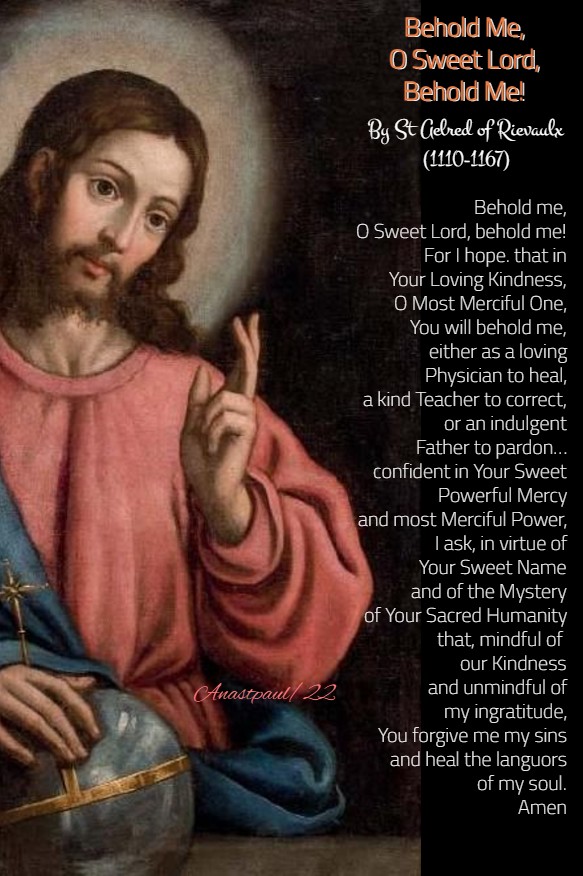
Behold Me, O Sweet Lord, Behold Me! By St Aelred of Rievaulx O.Cist. (1110-1167)
Behold me, O Sweet Lord, behold me! For I hope. that in Your Loving Kindness, O Most Merciful One, You will behold me, either as a loving Physician to heal, a kind Teacher to correct, or an indulgent Father to pardon… confident in Your Sweet Powerful Mercy and most Merciful Power, I ask, in virtue of Your Sweet Name and of the Mystery of Your Sacred Humanity that, mindful of Your Kindness and unmindful of my ingratitude, You forgive me my sins and heal the languors of my soul. Amen
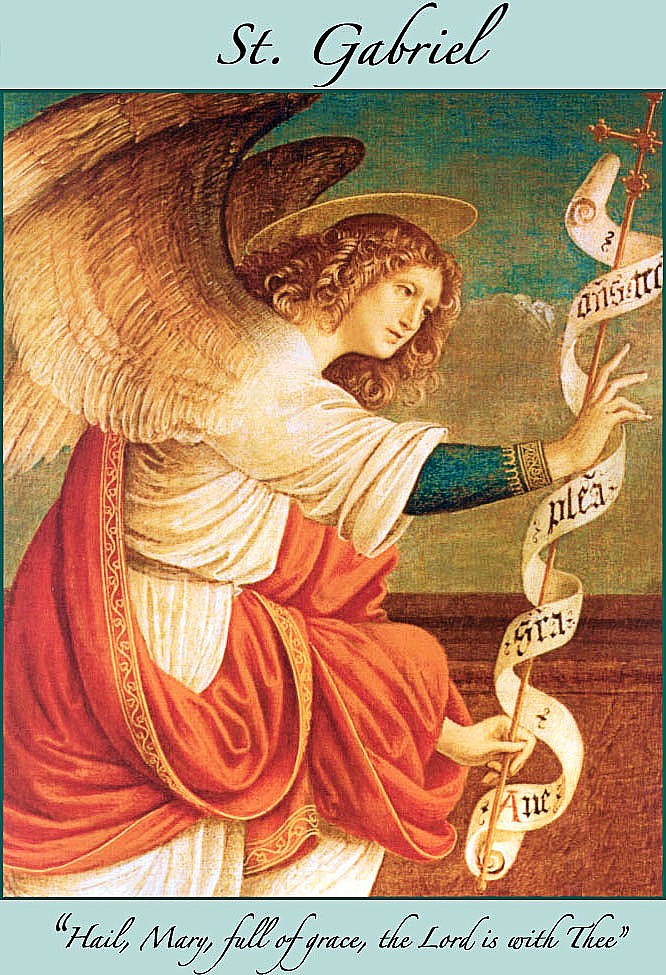
Saint of the Day – 24 March – The Archangel Saint Gabriel. The name GABRIEL is a Hebrew name generally translated “strength of God” more accurately “my strength is in God” or “God is my strength.” Gabriel appeared to the prophet Daniel (Dan 8:16; 9:21), to the priest Zachary to announce the forthcoming birth of Saint John the Baptist (Luke 1:11, 19) and to the Blessed Virgin Mary to announce the birth of Our Saviour (Luke 1:26.). His Feast Day is celebrated today 24 March. PATRONAGES – Ambassadors, Telecommunication workers, Radio and Television Broadcasters, Messengers and Couriers, Postal workers, Clerical workers, Diplomats, Stamp Collectors, Portugal, Santander in the Cebu Province in the Philippines.
Saint Gabriel, the Archangel Abbot Prosper Guéranger OSB (1805-1875)
So far in the Church’s Calendar, we have not met with any Feast in honour of the Holy Angels. Amidst the ineffable joys of Christmas Night, we mingled our timid but glad voices with the Hymns of these heavenly Spirits, who sang around the Crib of our Emmanuel. The very recollection brings joy to our hearts, saddened as they now are by penitential feelings and by the near approach of the mournful anniversary of our Jesus’ Death. Let us, for a moment, interrupt our sadness, and keep the Feast of the Archangel Gabriel. Later on, we shall have Michael, Raphael, and the countless host of the Angel Guardians but today, it is just that we should honour Gabriel. Yes, a day hence and we shall see this heavenly Ambassador of the Blessed Trinity coming down to the Virgin of Nazareth, let us, therefore, recommend ourselves to him and beseech him to teach us how to celebrate, in a becoming manner, the grand Mystery of which he was the Messenger.
Gabriel is one of the first of the Angelic Kingdom. He tells Zachary, that he stands before the Face of God (St. Luke 1:11,19.). He is the Angel of the Incarnation because it is in this Mystery, which apparently is so humble, that the power of God is principally manifested and, Gabriel signifies the strength of God. We find the Archangel preparing for his sublime office, even in the Old Testament. First of all, he appears to Daniel, after this Prophet had had the vision of the Persian and Grecian Empires and, such was the majesty of his person, that Daniel fell on his face trembling (Dan 7:17). Shortly afterwards, he appears again to the same Prophet, telling him the exact time of the coming of the Messias: Know thou and take notice: that from the going forth of the word to build up Jerusalem again, unto Christ the Prince, there shall be seven weeks and sixty-two weeks (Ibid. 9:25), that is, sixty-nine weeks of years.
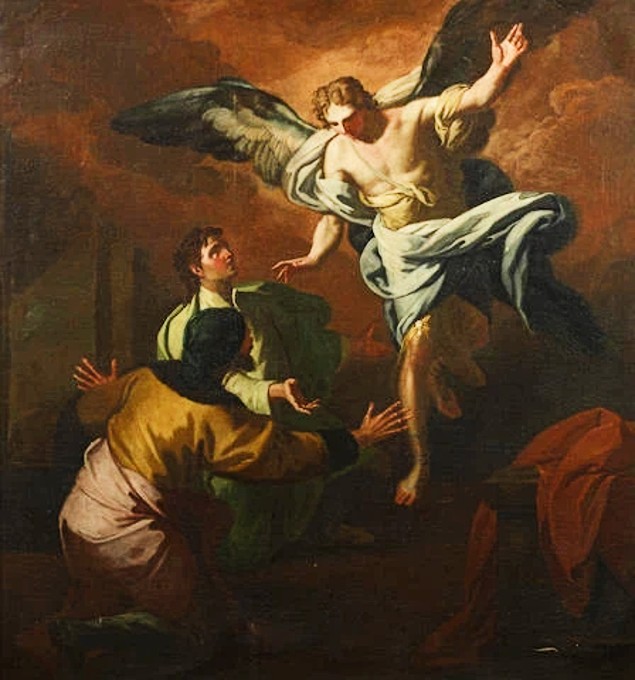
Follower Francesco Solimena The Archangel Saint Gabriel appears to the Prophet Daniel
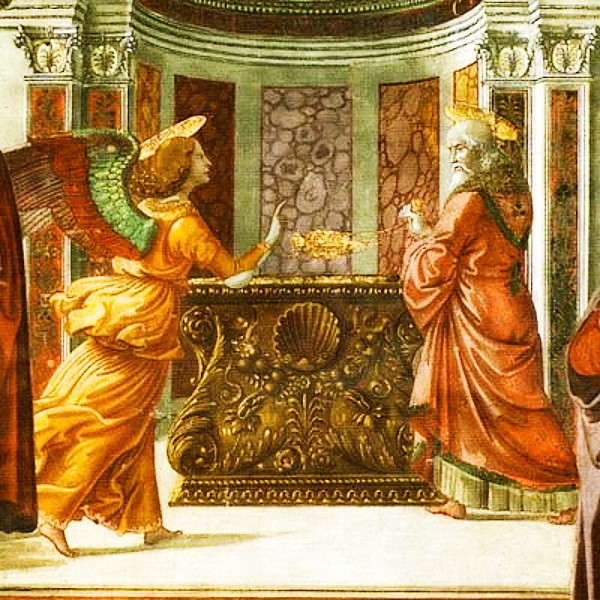
When the fulness of time had come and Heaven was about to send the last of the Prophets, he, who after preaching to men the approach of the Messias, is to show him to the people, saying: Behold the Lamb of God, who taketh away the sins of the world, Gabriel descends from Heaven to the temple of Jerusalem and prophesies to Zachary the birth of John the Baptist (Luke 1:13), which was to be followed by that of Jesus Himself.
St Gabriel appears to Zachary – Fra Angelico
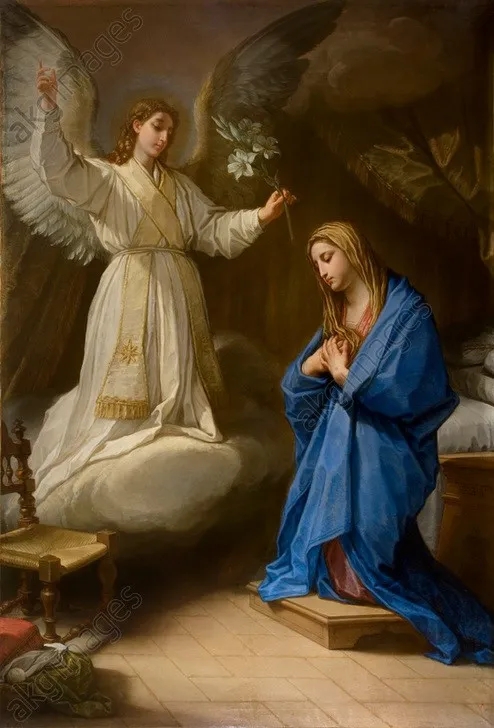
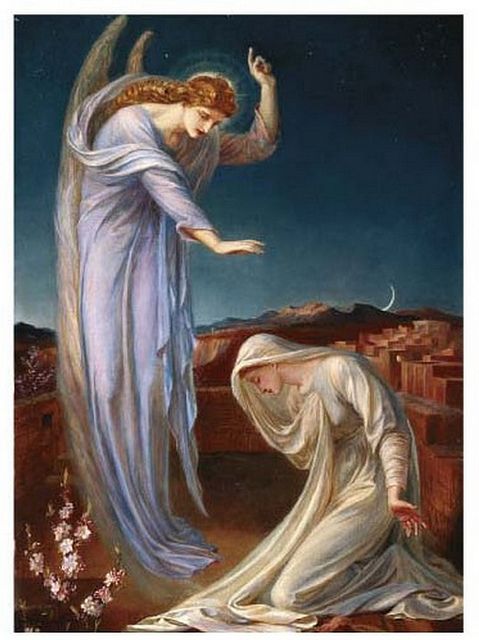
Six months later on, the holy Archangel again appears on the earth and this time it is Nazareth that he visits. He brings the great message from Heaven. Angel as he is, he reveres the humble Maid, whose name is Mary. He has been sent to her by the Most High God, to offer her the immense honour of becoming the Mother of the Eternal Word. It is Gabriel that receives the great Fiat, the consent of Mary and when he leaves this earth, he leaves it in possession of Him, for Whom it had so long prayed, in those words of Isaias: Drop down Dew, O ye Heavens (Is. 14:8.)!
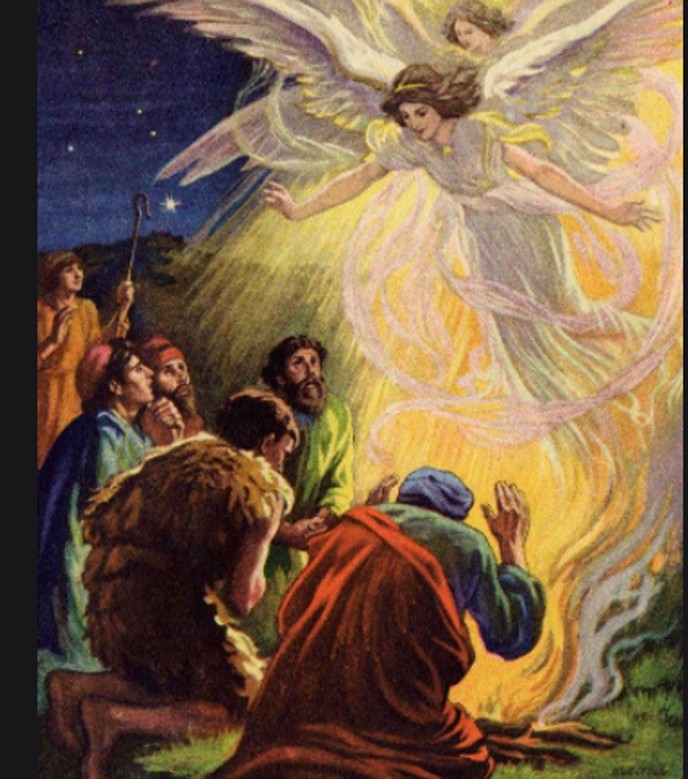
The hour at length came, when the Mother of the Emmanuel was to bring forth the Blessed Fruit of her virginal Womb. Jesus was born amidst poverty but Heaven willed that His Crib should be surrounded by fervent adorers. An Angel appeared to some Shepherds, inviting them to go to the Stable near Bethlehem. He is accompanied by a multitude of the heavenly army, sweetly singing their hymn: Glory to God in the highest and on earth peace to men of good will! Who is this Angel that speaks to the Shepherds and seems, as the chief of the other blessed Spirits that are with him? In the opinion of several learned writers, it is the Archangel Gabriel, who is keeping up his ministry as Messenger of the Good Tidings (St. Luke 2:10).
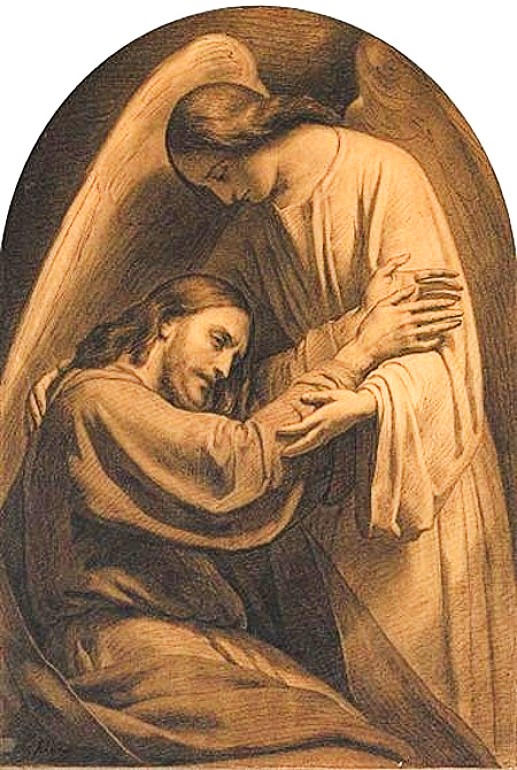
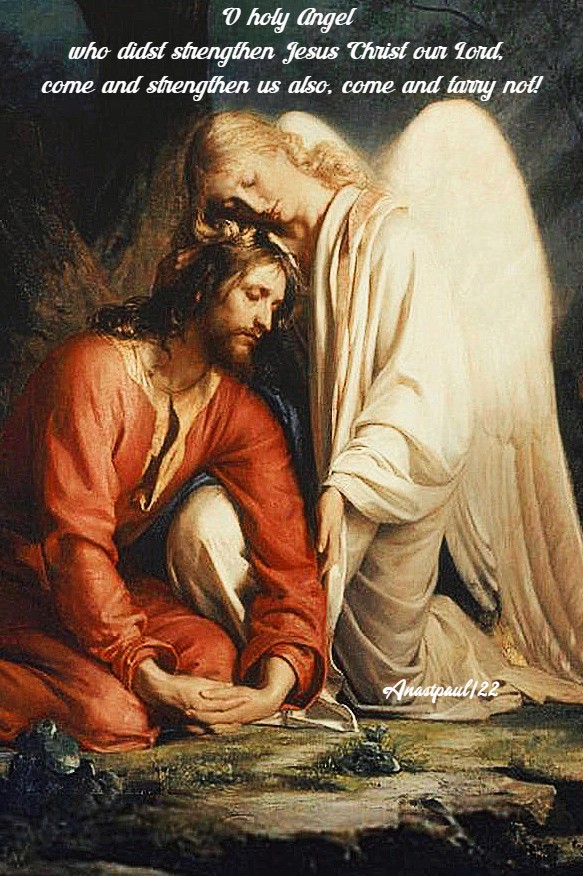
Lastly, when Jesus is suffering His Agony in the Garden of Gethsemani, an Angel appears to Him, not merely as a witness of His suffering but that He might strengthen Him, under the fear his Human Nature felt at the thought of the Chalice of the Passion He was about to drink (Ibid. 22:42, 43.). Who is this Angel? It is Gabriel, as we learn, not only from the writings of several holy and learned authors,but also, from a Hymn which the Holy See has permitted to be used in the Liturgy. …
These are the claims of the great Archangel to our veneration and love; these are the proofs he gives of his deserving his beautiful name, the Strength of God. God has employed him in each stage of the great work, in which he has chiefly manifested his power, for Jesus, even on his Cross, is the Power of God (1 Cor. 1:21.), as the Apostle tells us. Gabriel prepares the way for Jesus. He foretells the precise time of His Coming; He announces the birth of His Precursor; he is present at the solemn moment when the Word is made Flesh; he invites the Shepherds of Bethlehem to come to the Crib and adore the Divine Babe and when Jesus, in his Agony, is to receive Strength from one of His own creatures, Gabriel is found ready in the Garden of Gethsemani, as he had been at Nazareth and Bethlehem.
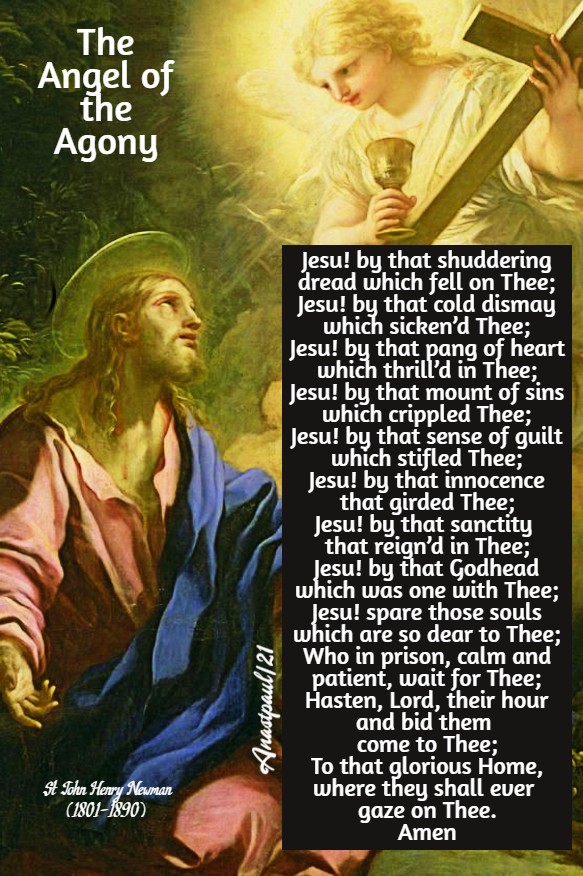
The Angel of the Agony John Henry Newman (1801-1890)
Jesu! by that shuddering dread which fell on Thee; Jesu! by that cold dismay which sicken’d Thee; Jesu! by that pang of heart which thrill’d in Thee; Jesu! by that mount of sins which crippled Thee; Jesu! by that sense of guilt which stifled Thee; Jesu! by that innocence that girded Thee; Jesu! by that sanctity that reign’d in Thee; Jesu! by that Godhead which was one with Thee; Jesu! spare those souls which are so dear to Thee; Who in prison, calm and patient, wait for Thee; Hasten, Lord, their hour and bid them come to Thee; To that glorious Home, where they shall ever gaze on Thee. Amen
O holy Angel who didst strengthen Jesus Christ our Lord, come and strengthen us also, come and tarry not!
The Archangel Saint Gabriel The Feast of Saint Gabriel was included by Pope Benedict XV in the General Roman Calendar in 1921, for celebration on 24 March.
St Agapitus of Synnada St Aldemar the Wise St Bernulf of Mondovi Bl Bertha de’Alberti of Cavriglia Bl Bertrada of Laon Bl Brian O’Carolan St Caimin of Lough Derg St Cairlon of Cashel
St Pigmenius of Rome St Romulus of North Africa St Secundus of North Africa St Seleucus of Syria St Severo of Catania St Timothy of Rome
Martyrs of Africa – 9 Saints: A group of Christians murdered for their faith in Africa, date unknown. The only details about their that survive are the names – Aprilis, Autus, Catula, Coliondola, Joseph, Rogatus, Salitor, Saturninus and Victorinus. .
Martyrs of Caesarea – 6 Saints: A group of Christians Martyred together in the persecutions of Diocletian. We know little else but six of their names – Agapius, Alexander, Dionysius, Pausis, Romulus and Timolaus. They were martyred by beheading in 303 at Caesarea, Palestine.
Thought for the Day – 23 March – Meditations with Antonio Cardinal Bacci (1881-1971)
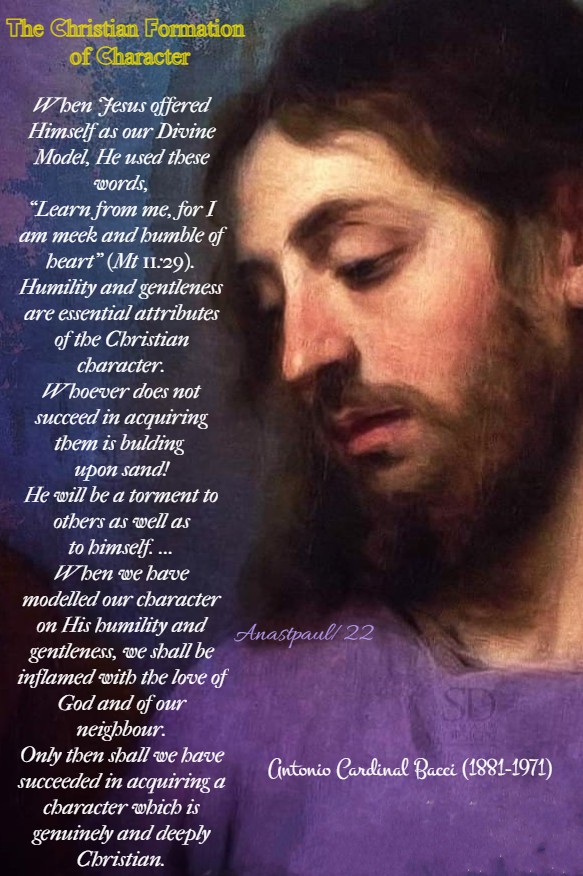
The Christian Formation of Character
“When Jesus offered Himself as our Divine Model, He used these words, “Learn from me, for I am meek and humble of heart” (Mt 11:29). Humility and gentleness are essential attributes of the Christian character. Whoever does not succeed in acquiring them is bulding upon sand! He will be a torment to others as well as to himself. Jesus indicates this also, for after He has said: “Learn from me, for I am meek and humble of heart,” He adds, “and you will find rest for your souls” (Ibid). In other words, He tells us, that it is only on this condition that we shall find spiritual peace. When we have modelled our character on His humility and gentleness, we shall be inflamed with the love of God and of our neighbour. Only then shall we have succeeded in acquiring a character which is genuinely and deeply Christian.”
Wednesday day of the Third Week of Lent – 23 March – Our Lenten Journey with the Great Fathers – Exodus 20:12-24, Matthew 15:1-20
“Have pity on me, O Lord, for I am languishing; heal me, O Lord.” – Psalm 6:3
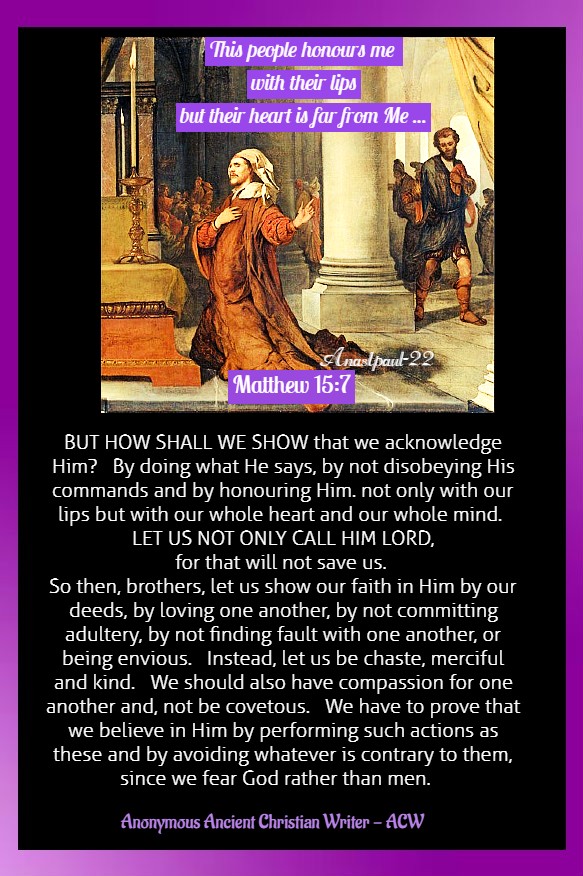
“… This people honours me with their lips but their heart is far from Me … ”
Matthew 15:7
“GREAT IS THE MERCY that Jesus Christ has shown us. The first benefit that we owe to His mercy, is that we, who are living, do not sacrifice to dead gods or worship them but have, through Christ, attained a knowledge of the Father. What else is knowledge of the Father but the recognition of His Son, through Whom this knowledge comes to us? He Himself declares: – Everyone who acknowledges Me, I in My turn will acknowledge in the presence of the Father. This then will be our reward if we acknowledge Him through Whom we have been saved. But how shall we show that we acknowledge Him? By doing what He says, by not disobeying His commands and by honouring Him. not only with our lips but with our whole heart and our whole mind. For He says in Isaiahs This people pays me lip service but its heart is far from me.
LET US NOT ONLY CALL HIM LORD, for that will not save us. Not everyone who says to Me, Lord, Lord, will be saved, He warns but only the man who does what is right. So then, brothers, let us show our faith in Him by our deeds, by loving one another, by not committing adultery, by not finding fault with one another, or being envious. Instead, let us be chaste, merciful and kind. We should also have compassion for one another and, not be covetous. We have to prove that we believe in Him by performing such actions as these and by avoiding whatever is contrary to them, since we fear God rather than men. Should we fail to do so, we have the Lord’s warning:- If you do not keep my commandments, even though I had pressed you to my heart, I will thrust you away from me and say to you: Out of my sight, you whose deeds are evil; you are complete strangers to me.
THEREFORE, MY BROTHERS, let us enter the lists in the knowledge that the contest is imminent. Many men travel far to contend for a crown that soon fades, yet not all of them win but only those who have strained every nerve and competed fairly. Let us so contend, that we may all be crowned. Let us run a straight course in the race of the Christian life, setting out in great numbers to take part in it and then striving for the crown with all our might. Even if we are not all able to win, at least let us draw near to victory.
NOW, WE MUST SURELY KNOW, that even when the contest is for a wreath that lasts but a day, if anyone is found to be breaking the rules, he is flogged and driven off the racecourse. What do you suppose, then, will be the fate of the man who breaks the rules in the contest of the Christian life? Of those who have not kept the seal of their Baptism unbroken, Scripture says: The worm does not die and the fire is never extinguished. They will be a spectacle to all men.” – Anonymous Ancient Christian Writer – ACW (An excerpt from a Second Century Homily).
Quote/s of the Day – 23 March – Wednesday day of the Third Week of Lent – Exodus 20:12-24, Matthew 15:1-20
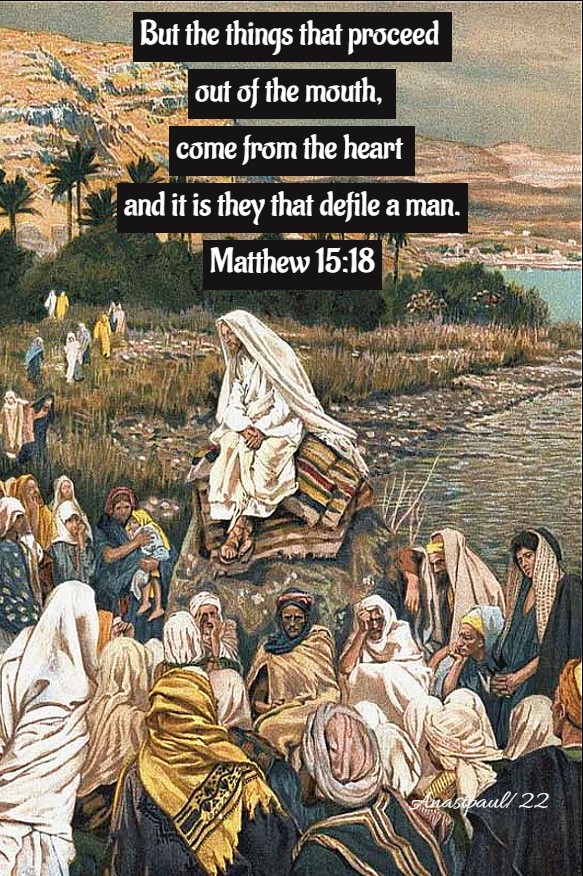
“But the things that proceed out of the mouth, come from the heart and it is they that defile a man.”
Matthew 15:18
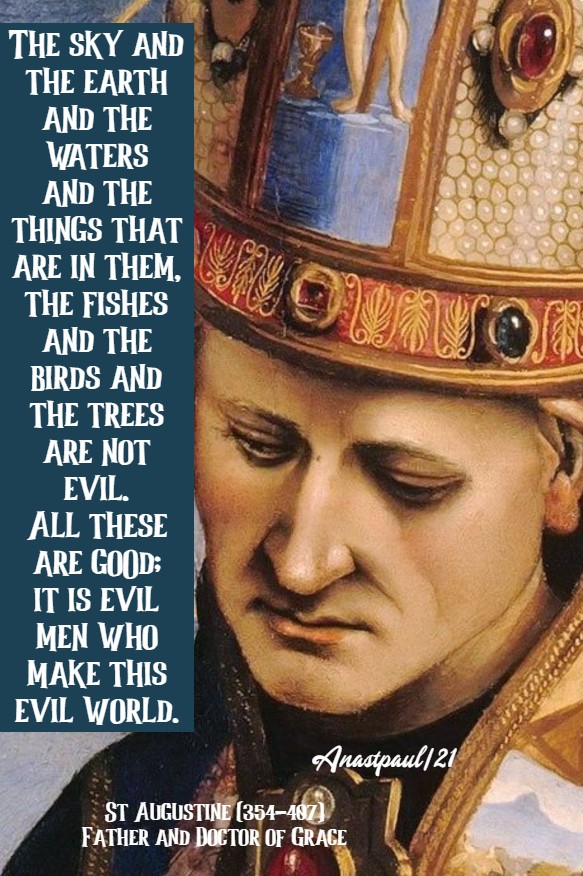
“The sky and the earth and the waters and the things that are in them, the fishes and the birds and the trees are not evil. All these are good; it is evil men who make this evil world.”
“What is reprehensible, is that while leading good lives themselves and abhorring those of wicked men, some, fearing to offend, shut their eyes to evil deeds instead of condemning them and pointing out their malice.”
One Minute Reflection – 23 March – Wednesday of the Third Week of Lent – Exodus 20:12-24, Matthew 15:1-20
“Hypocrites, well did Isaias prophesy of you, saying, ‘This people honours me with their lips but their heart is far from Me and in vain do they worship Me, teaching as doctrine, the precepts of men.’ ” – Matthew 15:7
REFLECTION – “The law of the spirit of life in Christ Jesus has freed you from the law of sin and death” (Rm 8:2) … Saint Paul says that the Law of Moses has been given to prove our weakness and not just to prove it but, to increase it and thus force us to find the Doctor. … “Where sin increased, grace overflowed all the more” (Rm 5:20; cf. 3:20) … But why did the first Law, written with the Finger of God (Ex 31:18), not give us the essential assistance of grace? Because it was written on tablets of stone, not the tablets of flesh, that are our hearts (2 Cor 3:3) ….
It is the Holy Spirit Who writes “the Law of the Spirit of life” not on stone but in the heart; this Law of the Spirit of life that is in Jesus Christ in Whom the Passover has been celebrated in truth (1 Cor 5:7-8), has delivered you from the law of sin and death. Do you want to have proof of the manifest and certain difference separating the Old Testament from the New? … Hear what the Lord spoke by the mouth of one of the prophets. … ”I will place my law within them and write it upon their hearts” (Jr 31:33). So if God’s Law is written in your heart, it does not bring forth fear [as at Sinai] but pours a secret sweetness into your soul.” – St Augustine (354-430) Bishop of Hippo, Father and Doctor of the Church (Sermon 155, 6 ).
PRAYER – Breathe in Me, O Holy Spirit By St Augustine (354-420)
Breathe in me, O Holy Spirit, that my thoughts may all be holy. Act in me, O Holy Spirit, that my work, too, may be holy. Draw my heart, O Holy Spirit, that I love but what is holy. Strengthen me, O Holy Spirit, to defend all that is holy. Guard me, then, O Holy Spirit, that I always may be holy. Amen
Our Morning Offering – 23 March – Wednesday of the Third Week of Lent
Inflame our Hearts with Your Love Prayer To the Holy Spirit By St Alphonsus Maria de Liguori (1696-1787) Most Zealous Doctor of the Church
You made Mary full of grace and enflamed the hearts of the Apostles with a holy zeal. Inflame our hearts with Your love. You are the Spirit of Goodness, Give us the courage to confront evil. You are Fire, set us ablaze with Your love. You are Light, enlighten our minds, that we may see what is truly important. You are the Dove, give us gentleness. You are a soothing Breeze, bring calm to the storms that rage within us. You are the Tongue, may our lips ever sing God’s praises You are the Cloud, shelter us under the shadow of Your protection O Holy Ghost, melt the frozen, warm the chilled and enkindle in us an earnest desire to please You. We ask this through Christ our Lord. Amen
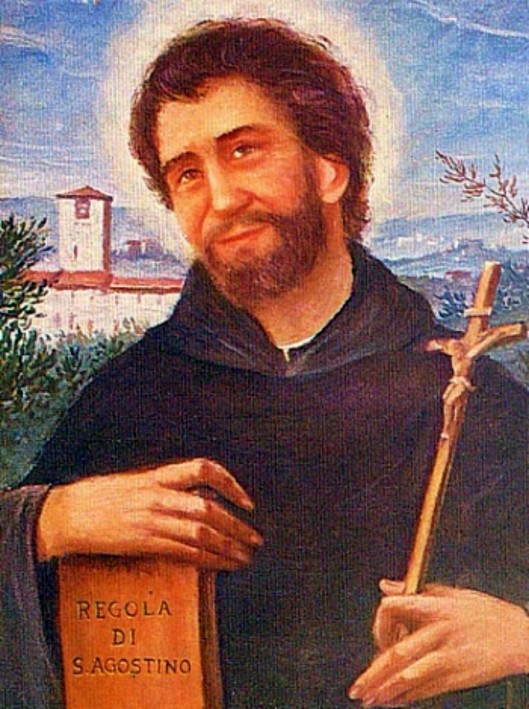
Saint of the Day – 23 March – Blessed Pietro of Gubbio OSA (Died c 1306) Priest and Friar of the Order of Hermits of St Augustine, Lawyer, noted Preacher, Envoy for the Order, Miracle-worker. Born in the early 13th century in Gubbio, Umbria, Italy and died between 1306 and 1322 in Gubbio, Umbria, Italy of natural causes. Also known as Peter of Gubbio. Additional Memorial – 29 October (The Augustinians).
Pietro of the noble Ghigenzi family, was born in the first half of the thirteenth century. He studied law first in Italy and then in Paris.
At about the age of forty, Pietro came to know the Augustinians and was drawn to them, wanting to put himself and his law practice at the disposal of the Church. He joined the Augustinians of his hometown who had come to Gubbio from the hermitage of Brettino (Fano).
As a Friar, he won the respect of his confreres and was entrusted with various duties of responsibility. He was chosen and sent by the Prior General to visit the Monasteries of France. Pietro that he travelled bare-footed and met all his brother Augustinians in that way as a sign of humility. He left a deep impression for his holiness of life, zeal for the Rule, his his patience with Augustinian brothers who had trouble living up to the Rule,and as a miracle worker.
He is described by the Anonymous Florentine, a writer of the fifteenth century, as “a man of great patience and prayer, who ended his life in the peace of the Lord and is renowned for many miracles.”
Pietro spent his later years as a prayerful Friar in the Gubbio Monastery where he had begun.
He died sometime between 1306 and 1322 and was venerated from the time of his death. His remains were buried in the common grave of Friars in the centre of the Choir area in the Augustinian Church in Gubbio.
One day, soon after his burial, the Friars were in the Choir, singing the Te Deum and they heard a voice from the tomb that responded: Te Dominum confitemur! – ‘Lord, we thank you! ‘ The frightened brothers opened the tomb and found the body of Blessed Peter on his knees, looking up and hands crossed on his chest.
Pietro’s relics are still enshrined in the Augustinian Church, where the veneration of this gentle, humble Friar were immediately and are still the subject of pilgrimages.
Bl Álvaro del Portillo Díez de Sollano Bl Annunciata Asteria Cocchetti St Benedict of Campagna St Crescentius of Carthage Bl Edmund Sykes St Ethelwald of Farne St Felix the Martyr St Felix of Monte Cassino St Fergus of Duleek St Fidelis the Martyr St Frumentius of Hadrumetum St Gwinear
St Julian the Confessor St Liberatus of Carthage St Maidoc of Fiddown Bl Metod Dominik Trcka St Nicon of Sicily St Ottone Frangipane Bl Peter Higgins Blessed Pietro of Gubbio OSA (Died c 1306) Priest
Daughters of Feradhach: They are mentioned in early calendars and martyrologies but no information about them has survived.
Martyrs of Caesarea – 5 Saints: A group of five Christians who protested public games which were dedicated to pagan gods. Martyred in the persecutions Julian the Apostate. The only details we know about them are their names – Aquila, Domitius, Eparchius, Pelagia and Theodosia. They were martyred in 361 in Caesarea, Palestine.
Thought for the Day – 22 March – Meditations with Antonio Cardinal Bacci (1881-1971)
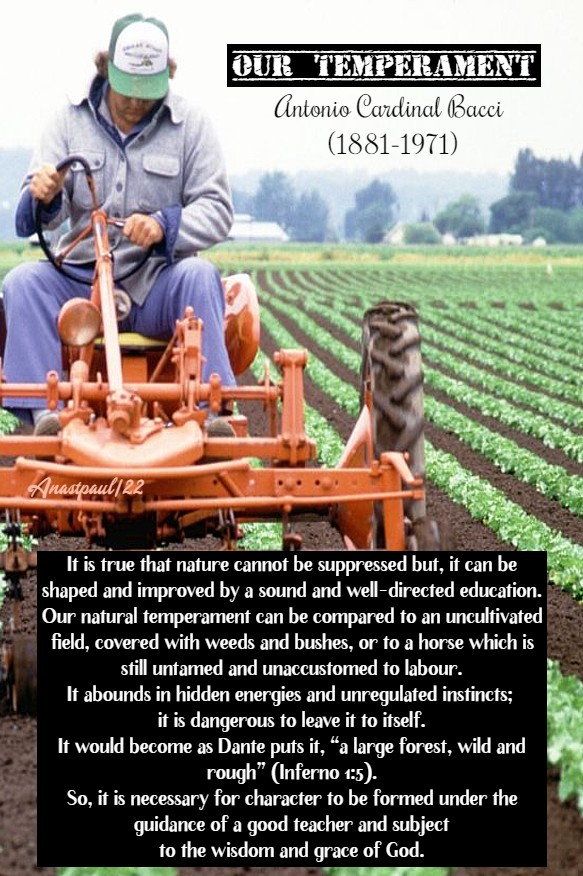
Our Temperament
“There is a theory that it is impossible to form character because, our character is and always will be, what nature has given us. “Naturam expellas furca, tamen usque recurret” ( “You cast out nature with a pitchfork but only until such time, as it comes back again”) (Horace, Epistles 1 10:24). Montaigne and Rousseau extended this idea of Horace, to the extent of holding, that it would be evil as well as superfluous, to attempt to shape character, which should be what nature intended it to be. Although there is some little truth in this opinion, fundamentally, it is false. It is true that nature cannot be suppressed but, it can be shaped and improved by a sound and well-directed education. Our natural temperament can be compared to an uncultivated field, covered with weeds and bushes, or to a horse which is still untamed and unaccustomed to labour. It abounds in hidden energies and unregulated instincts; it is dangerous to leave it to itself. It would become as Dante puts it, “a large forest, wild and rough” (Inferno 1:5).
So, it is necessary for character to be formed under the guidance of a good teacher and subject to the wisdom and grace of God.”
Tuesday of the Third Week of Lent – 22 March – Our Lenten Journey with the Great Fathers – 4 Kings 4:1-7, Matthew 18:15-22
“Cleanse me from my unknown faults, O Lord! From wanton sin especially, restrain Your servant. Let it not rule over me. Then, shall I be blameless and innocent of serious sin.” – Psalm 18:13-14
“If your brother sins against you, go and show him his fault, between you and him alone. If he listens to you, you have won your brother.”
Matthew 18:15
“HE DOES NOT SAY, “accuse him,” or “punish him,” or “take him to court.” He says “correct him. ” For he is possessed, as it were, by some stupor and drunk in his anger and disgrace. The one who is healthy must go to the one who is sick. You must conduct your judgement of him privately. Make your cure easy to accept. For the words “correct him” mean nothing other, than help him see his indiscretion. Tell him what you have suffered from him.
WHAT THEN IFhe does not listen, if he stubbornly flares up? Call to your side someone else or even two others, so that two witnesses may corroborate all that’s said. For the more shameless and boldfaced he is, so much the more must you be earnest toward his cure, not toward satisfying your anger and hurt feelings. For when a physician sees the sickness unyielding, he does not stand aside or take it hard but then is all the more earnest. That then is what Christ orders us to do. You appeared too weak since you were alone, so become stronger with the help of others. Two are sufficient to reprove the wrongdoer.
DO YOU SEEhow He seeks the interest, not of the aggrieved party alone but also that, of the one who caused the grief? For the person injured may be the one who is more taken captive by passion. He becomes the one that is diseased and weak and infirm.
THIS EFFORT MAY OCCUR many times, as he attempts to lead him first alone and then with others. If he persists, then make the effort with the whole congregation. “Tell it,” He says, “to the Church.” If He had sought the interest of the aggrieved alone, He would not have told him to approach the sick individual seventy-seven times. He would not have attempted so many times, or brought so many treatments to the malady. He might have just let him be, if he persisted uncorrected from the first meeting. But instead, He shows us how to seek his cure once, twice and many times: first alone, then with two, then with many more.” – St John Chrysostom (347-407) Archbishop of Constantinople, Great Father and Doctor of the Church (The Gospel of Matthew, Homily 60).
Quote/s of the Day – 22 March – Tuesday of the Third Week of Lent – 4 Kings 4:1-7, Matthew 18:15-22
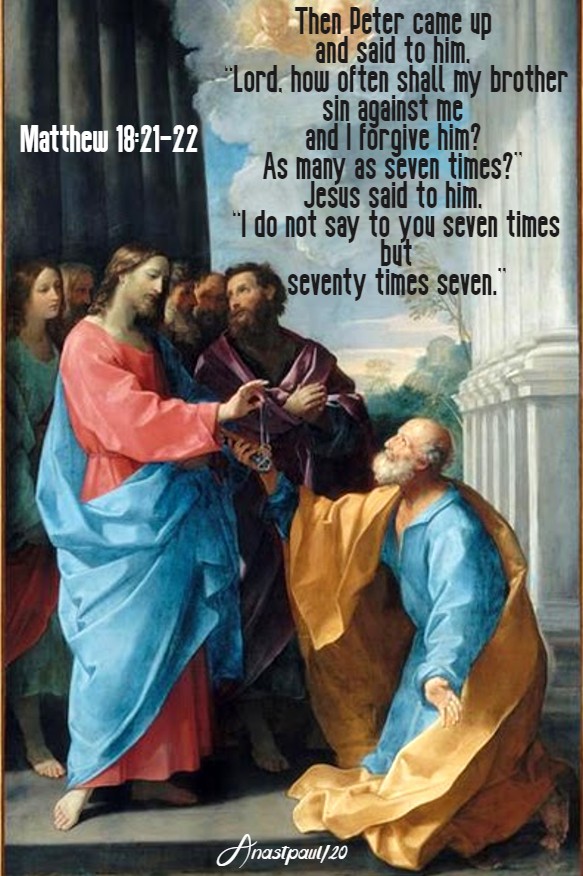
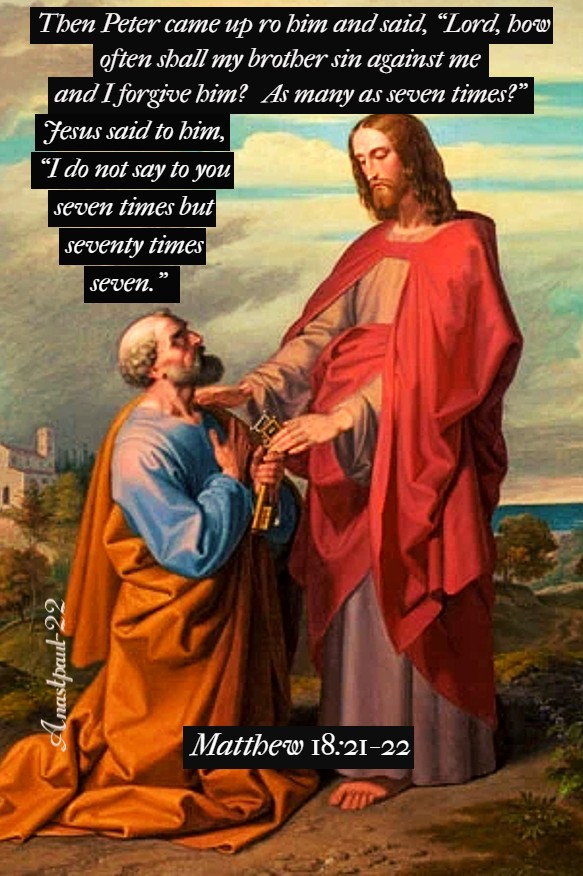
“Then Peter came up and said to him, “Lord, how often shall my brother sin against me and I forgive him? As many as seven times?” Jesus said to him, “I do not say to you seven times but seventy times seven.”
Matthew 18:21-22
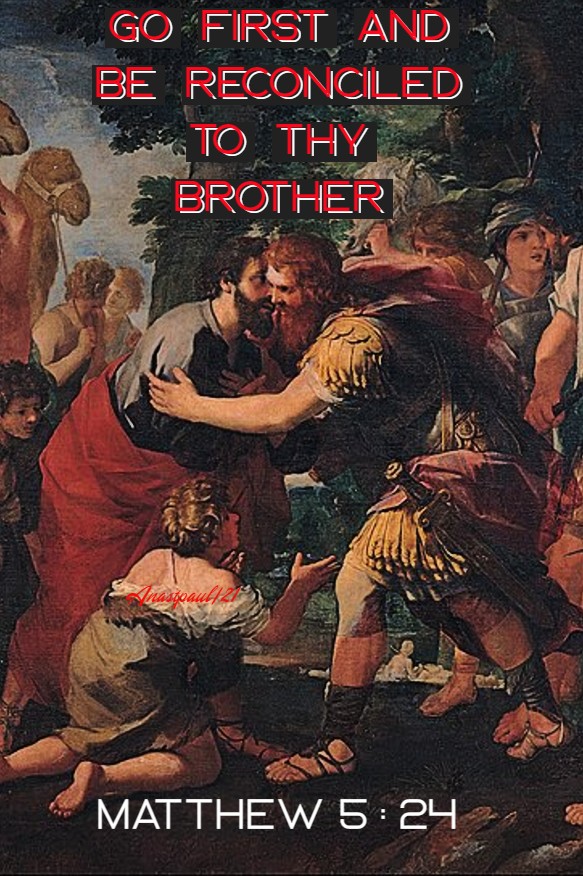
“Go first and be reconciled with your brother”
Matthew 5:24
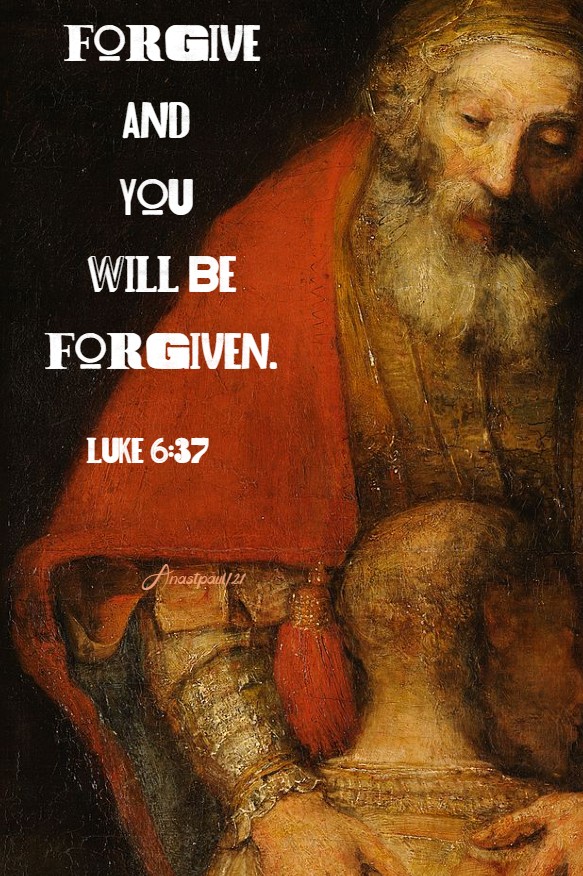
“Forgive and you will be forgiven.”
Luke 6:37
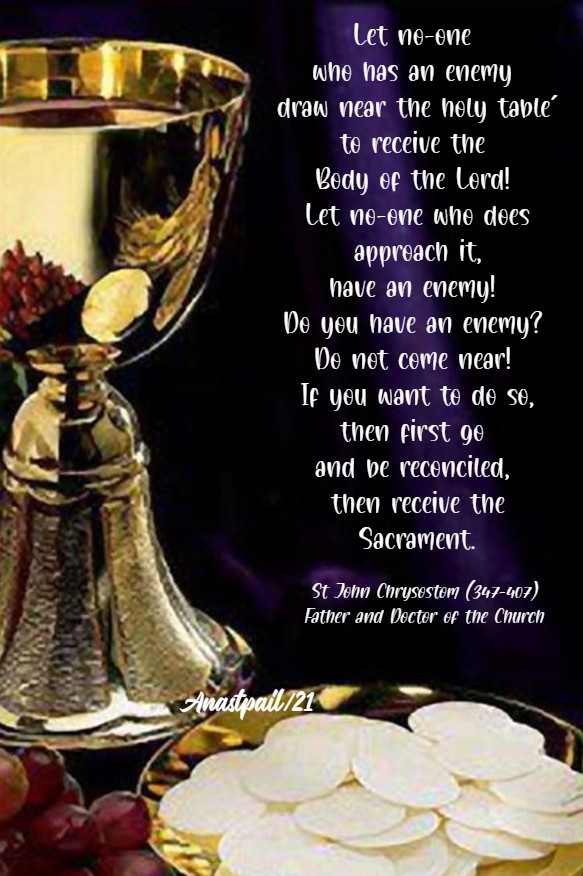
“This is what I proclaim, what I testify, what I cry out with a resounding voice: Let no-one who has an enemy, draw near the holy table, to receive the Body of the Lord! Let no-one who does approach it, have an enemy! Do you have an enemy? Do not come near! If you want to do so, then first go and be reconciled, then receive the Sacrament.”
St John Chrysostom (347-407) Father and Doctor of the Church
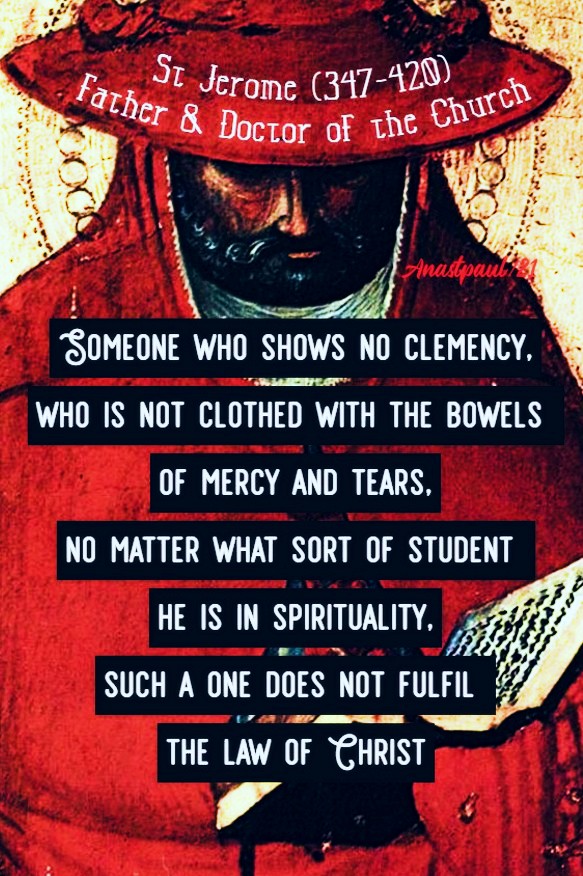
“Someone who shows no clemency, who is not clothed with the bowels of mercy and tears, no matter what sort of student he is in spirituality, such a one, does not fulfil the law of Christ.”
St Jerome (347-420) Father & Doctor of the Church
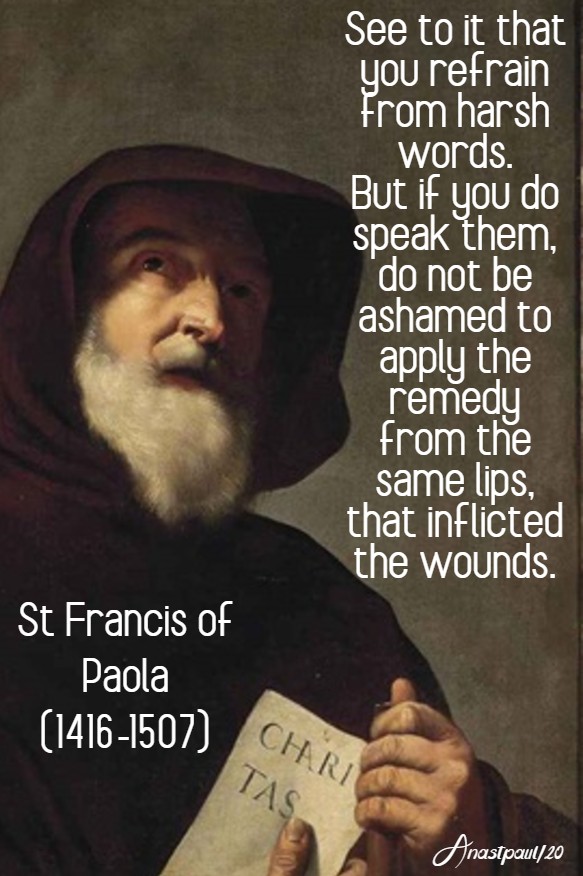
“See to it that you refrain from harsh words. But if you do speak them, do not be ashamed to apply the remedy from the same lips, that inflicted the wounds.”
St Francis of Paola OM (1416-1507)
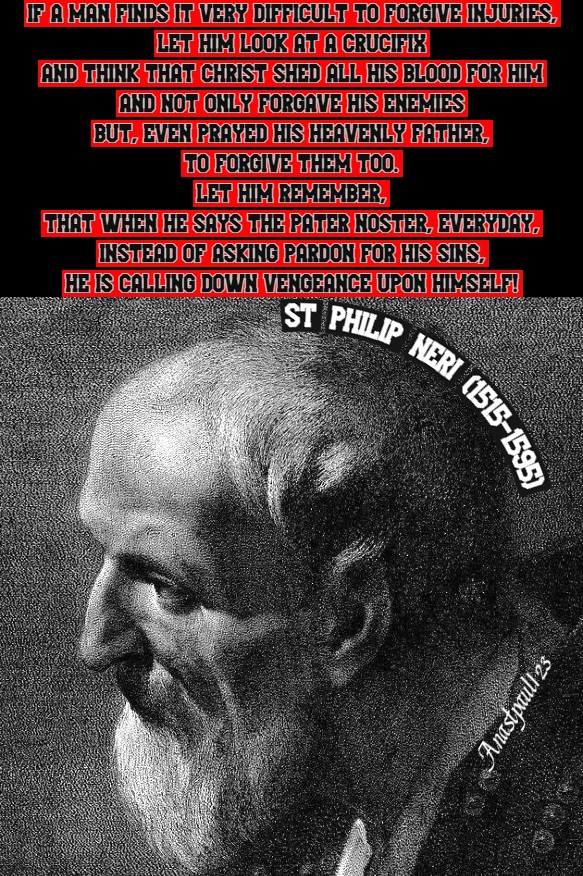
“If a man finds it very difficult to forgive injuries, let him look at a Crucifix and think that Christ shed all His Blood for him and not only forgave His enemies but, even prayed His Heavenly Father, to forgive them also. Let him remember, that when he says the Pater Noster, everyday, instead of asking pardon for his sins, he is calling down VENGEANCE UPON HIMSELF!”
One Minute Reflection – 22 March – Tuesday of the Third Week of Lent – 4 Kings 4:1-7, Matthew 18:15-22 – “The Month of St Joseph”
“Then Peter came up to him and said, “Lord, how often shall my brother sin against me and I forgive him? As many as seven times?” Jesus said to him, “I do not say to you seven times but seventy times seven.” – Matthew 18:21-22
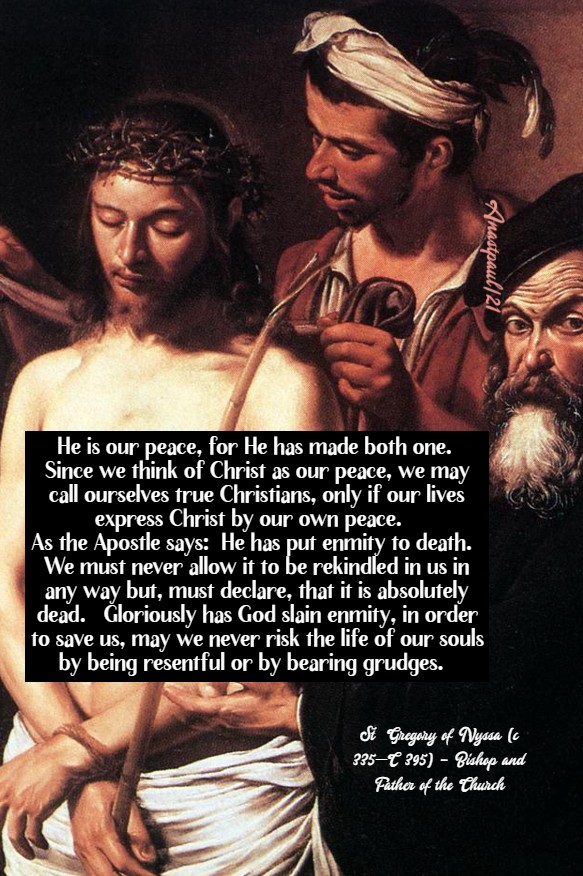
REFLECTION – “He is our peace, for He has made both one. Since we think of Christ as our peace, we may call ourselves true Christians, only if our lives express Christ by our own peace. As the Apostle says: He has put enmity to death. We must never allow it to be rekindled in us in any way but, must declare, that it is absolutely dead. Gloriously has God slain enmity, in order to save us, may we never risk the life of our souls by being resentful or by bearing grudges. …
No, since we possess Christ who is peace, we must put an end to this enmity and live as we believe He lived. He broke down the separating wall, uniting what was divided, bringing about peace by reconciling in His single person, those who disagreed. In the same way, we must be reconciled not only with those who attack us from outside but also with those who stir up dissension within; flesh then will no longer be opposed to the spirit, nor the spirit to the flesh. Once we subject the wisdom of the flesh to God’s law, we shall be re-created as one single man, at peace. Then, having become one instead of two, we shall have peace within ourselves.
Now peace is defined as harmony among those who are divided. When, therefore, we end that civil war within our nature and cultivate peace within ourselves, we become peace. By this peace we demonstrate that the name of Christ, which we bear, is authentic and appropriate.
When we consider that Christ is the true light, having nothing in common with deceit, we learn that our own life also must shine with the rays of that true light. Now these rays of the Sun of Justice are the virtues which pour out to enlighten us so that we may put away the works of darkness and walk honourably as in broad daylight. When we reject the deeds of darkness and do everything in the light of day, we become light and, as light should, we give light to others by our actions. If we truly think of Christ as our source of holiness, we shall refrain from anything wicked or impure in thought or act and thus show ourselves to be worthy bearers of His Name. For the quality of holiness is shown, not by what we say but by what we do in life.” – St Gregory of Nyssa (c 335–C 395) – Bishop and Father of the Church (Excerpt from his treatise, On Christian Perfection).
PRAYER – Holy God, grant we pray, Your Holy Spirit of love and divine grace to grow ever more in faith and love. . By our prayers and love for You and our neighbour, may we merit Your divine assistance. Lord Jesus, help us to dwell often on the manner in which we are following You. Let us strive each day to become more and more like You in all things and, to become beacons of Your Light, to all the world. Holy Mother of God, pray for us, St Joseph pray for us. Through Christ, Our Lord, Who lives and reigns with Thee in the unity of the Holy Ghost, now and forevermore. Amen
Our Morning Offering – 22 March – Tuesday of the Third Week of Lent
A Lenten Offering By St Thérèse of the Child Jesus and the Holy Face of Lisieux (1873-1897) Doctor of the Church
O my God! I offer Thee all my actions of this Lent for the intentions and for the glory of the Sacred Heart of Jesus. I desire to sanctify every beat of my heart, my every thought, my simplest works, by uniting them to Its infinite merits and I wish to make reparation for my sins, by casting them into the furnace of Its Merciful Love. O my God! I ask of Thee for myself and for those whom I hold dear, the grace to fulfil perfectly Thy Holy Will, to accept for love of Thee, the joys and sorrows of this passing life, so that we may one day be united together in heaven, for all eternity. Amen
Saint of the Day – 22 March – Saint Epaphroditus of Terracina (1st Century) First Bishop of Terracina, Italy, Missionary, Evangelist, Disciple of the Apostles, Friend and Envoy of St Paul Apostle. St Hippolytus’ list of the Seventy Disciples includes “Epaphroditus, Bishop of Andriace. Also known as – Epaphroditus of Philippi, Epaphroditus the Apostle, Epaphroditus of Adriate, Epafrodito…
Epaphroditus is a Greek name (meaning “lovely” or “charming” and corresponds to the Latin Venustus (meaning “handsome”) and was very common in the Roman period. “The name occurs very frequently in inscriptions both Greek and Latin, whether at full length Epaphroditus, or in its contracted form Epaphras.” Our Saint is, therefore, linked with Epaphras (Colossians 1.7, 4.12; Philemon 23), with the suggestion that the latter is a “contracted” or “pet form” for the Philippian Envoy.
The Roman Martyrology reads: “At Terracina, St Epaphroditus, a disciple of the Apostles, who was Consecrated Bishop of that City by the blessed Apostle Peter.”
“With regard to Epaphroditus, my brother and co-worker and fellow soldier, your messenger and minister in my need, I consider it necessary to send him to you. For he has been longing for all of you and was distressed because you heard that he was ill. He was indeed ill, close to death but God had mercy on him, not just on him but also on me, so that I might not have sorrow upon sorrow. I send him therefore with the greater eagerness, so that, on seeing him, you may rejoice again and I may have less anxiety. Welcome him then in the Lord, with all joy and hold such people in esteem, because, for the sake of the work of Christ, he came close to death, risking his life to make up for those services to me, that you could not perform.” – Philippians 2:25-30
Epaphroditus lived in the Macedonian City of Philippi (now ruins in present-day Greece), seemingly the first European City to receive Christianity, as described in the 16th chapter of Acts. At various times after evangelising in Philippi, Paul found himself in prison. It was during one of these times of captivity that Epaphroditus left Philippi, sought out the imprisoned Paul and brought him an offering — perhaps funds or supplies. Paul was very thankful for the gifts and wrote to the Philippians in gratitude.
This unique letter that Paul wrote to the Christians of Philippi has a touching and personal ambiance. Calling him his “brother,” “co-worker” and “fellow soldier” firmly indicates that Epaphroditus was very dear to Paul’s heart ,as well as a person who worked hard to glorify God, even during times of difficulty. It appears from the letter, that Epaphroditus became very ill while visiting Paul — that he almost died! When Epaphroditus recovered, Paul decided to send him back to Philippi to deliver his letter.
Paul could tell that Epaphroditus was anxious over his brethren in Philippi and that everyone in Philippi was worried about Epaphroditus, having received reports of his illness. Paul emphasised in his letter, that Epaphroditus ought to be welcomed with joyfulness and high regard due to the way he risked death while serving Christ by travelling to help Paul.
It is believed that Epaphroditus became the first Bishop of Philippi and later of Terracina in Italy.
Blessed Clemens August von Galen (1878-1946) Martyr Boshop, known as “The Lion of Munster,” “The Bishop Who Roared Against The Nazis,” “The Bishop Who Took On the Führer.” Blessed Clemens had a great love for the Blessed Virgin, often leading pilgrimages, or going on his own, to Marian Shrines. He was too, a great lover of the Holy Eucharist and a fervent apostle of charity. Patronage – Munster. The Lion of Munster! https://anastpaul.com/2019/03/22/saint-of-the-day-22-march-blessed-clemens-august-count-von-galen-1878-1946/
St Darerca of Ireland St Deghitche St Epaphroditus of Terracina (1st Century) Bishop St Failbhe of Iona Bl François-Louis Chartier St Harlindis of Arland Bl Hugolinus Zefferini St Lea of Rome Bl Marian Górecki
Thought for the Day – 21 March – Meditations with Antonio Cardinal Bacci (1881-1971)
The Power of God’s Love in the Christian Life
“As has been said, love must be active and effective, as well as coming from the heart. This is still not sufficient, however. Love tends towards an intimate union with the person loved and does not rest, until this union is achieved. This is the unity of love. The Saints reached this high level of charity. They lived in God and were permanently united to God, as if theyt formed part of His Being. “It is now, no longer I that live,” exclaimed St Paul, “but Christ lives in me” (Gal 2:20).
If only we could succeed in achieving such a complete and lasting union with God, any sacrifice would seem easy and we should certainly grow in sanctity.”
Monday of the Third Week of Lent – 21 March – Our Lenten Journey with the Great Fathers – 4 Kings, 5:1-15, Luke 4:23-30
“O God, my wanderings You have counted; my tears are recorded in Your sight.” – Psalm 55:9
“There were many widows in Israel”
Luke 4:25
THE WIDOW OF SAREPTA welcomes the prophet Elijah with every generosity and expends all her poverty in his honour, even though she is a Sidonian foreigner. She had never heard what the prophets have to say about the merits of almsgiving, let alone the words of Christ: “You saw me hungry and gave me food” (Mt 25:35).
WHAT EXCUSE DO WE HAVE if, after such exhortations, after the promise of such great rewards, after the promise of the Kingdom of Heaven and its happiness, we fail to reach the same level of goodness as this widow? A Sidonian woman, a widow, burdened with the care of a family, threatened by famine and seeing the advent of death, opens her door to welcome an unknown man and gives him the scrap of meal she has left …
YET WE, WHO HAVE been taught by the prophets, have heard the teachings of Christ, have the opportunity of meditating on what is to come, who are not threatened by famine and who own a great deal more that this woman, are we to be excused if we dare not lay a finger on our goods to give of them? Are we going to neglect our own salvation? …
SO THEN, LET US SHOW GREAT compassion towards the poor so as to be made worthy of possessing good things to come for all eternity, by the grace and love for humankind of our Lord Jesus Christ.” – St John Chrysostom (347-407) Bishop of Constantinople, Great Father and Doctor of the Church (Sermon on Elijah and the widow and almsgiving; PG 51, 348).
Quote/s of the Day – 21 March – Monday of the Third Week of Lent – The Memorial of St Benedict OSB (c 480-547)
“Girded with faith and the performance of good works, let us follow in His paths by the guidance of the Gospel.”
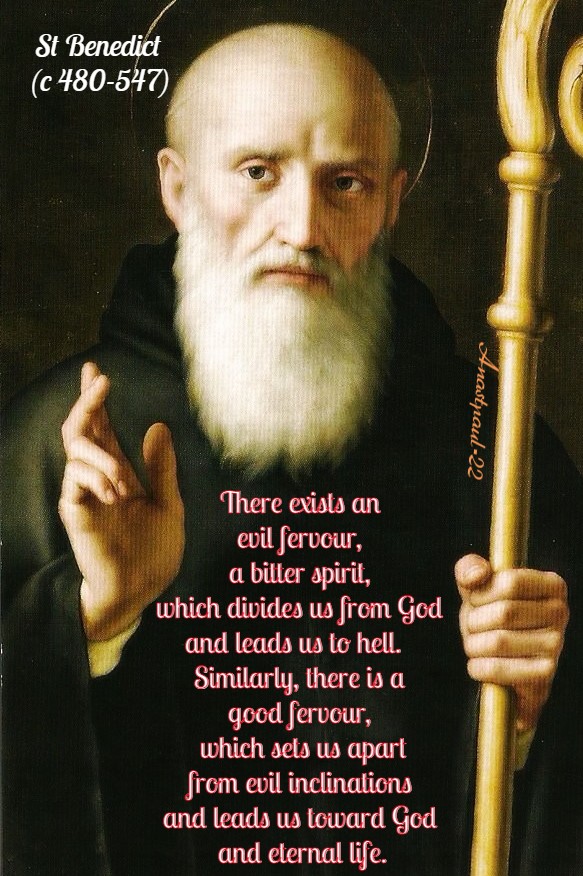
“There exists an evil fervour, a bitter spirit, which divides us from God and leads us to hell. Similarly, there is a good fervour, which sets us apart from evil inclinations and leads us toward God and eternal life.”
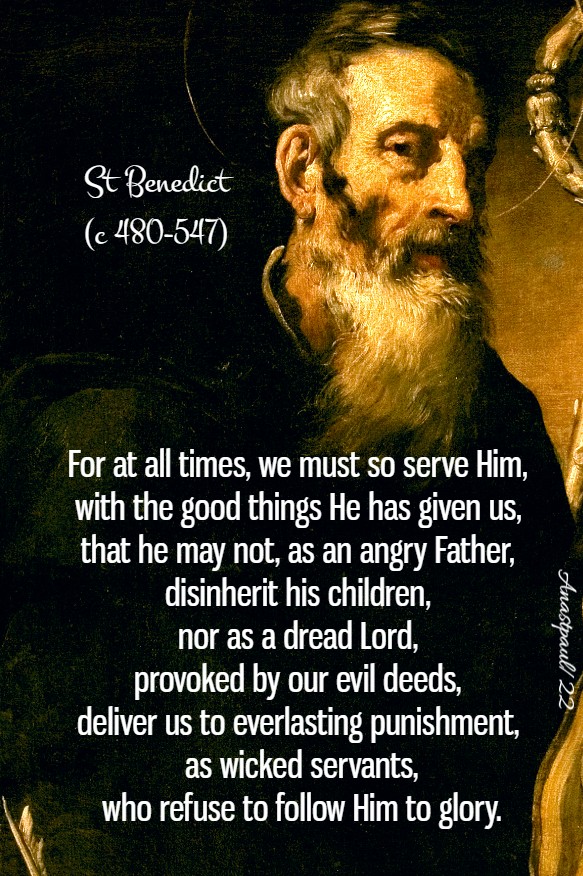
“For at all times, we must so serve Him, with the good things He has given us, that he may not, as an angry Father, disinherit his children, nor as a dread Lord, provoked by our evil deeds, deliver us to everlasting punishment, as wicked servants, who refuse to follow Him to glory.”
“The first degree of humility, is prompt obedience.”
One Minute Reflection – 21 March – Monday of the Third Week of Lent – 4 Kings, 5:1-15, Luke 4:23-30 and the Memorial of St Benedict OSB (c 480-547)
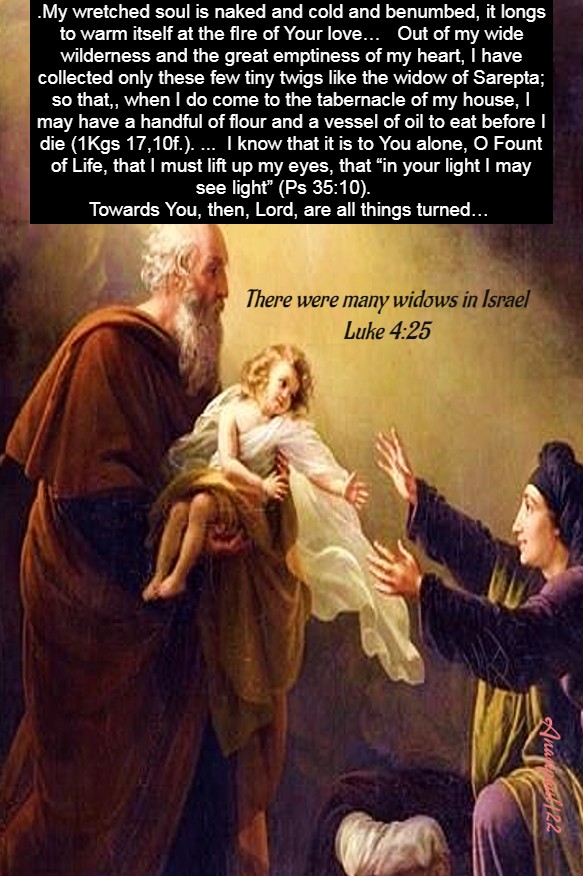
“There were many widows in Israel” – Luke 4:25
REFLECTION – “My wretched soul is naked and cold and benumbed, it longs to warm itself at the fIre of Your love… Out of my wide wilderness and the great emptiness of my heart, I have collected only these few tiny twigs like the widow of Sarepta; so that,, when I do come to the tabernacle of my house, I may have a handful of flour and a vessel of oil to eat before I die (1Kgs 17,10f.). Or maybe, Lord, I shall not die as quickly as all that! It may be rather that “I shall not die at al, but live, and declare the works of the Lord” (Ps 117[118],17).
So I stand in the house of solitude… I open my mouth in Your direction, Lord; I breathe in the Spirit. And sometimes, Lord,… You do put something in my heart’s mouth but You do not permit me to know just what it is. A savour I perceive, so sweet, so gracious, and so comforting that… I should seek nothing more. But when I receive this thing, neither by bodily sight, nor by spiritual sense, nor by understanding of the mind, do You allow me to discern what it is. When I receive it, then I want to keep it, and think about it and assess its flavour but forthwith, it has gone… But every time this happens I hear the Lord say to me: “The Spirit blows whither he will. ” And I know, even in myself, that He breathes not, when I will but when He Himself wills…
I know that it is to You alone, O Fount of Life, that I must lift up my eyes, that “in your light I may see light” (Ps 35:10). Towards You, then, Lord, are all things turned… But in the meantime, Lord, how much longer are You going to put me off? How often must my wretched, harassed, gasping soul trail after You? “Hide me,” I beseech you, “in the secret place of Your Face away from the troubles of men, protect me in Your tabernacle from the strife of congues!” (Ps 30[31],21).” – William of Saint-Thierry (c 1085-1148) Cistercian Monk, Theologian (The Contemplation of God 12).
PRAYER – O Lord, we beseech You, in Your mercy, pour forth Your grace into our hearts, that, as we abstain from material food, so may we restrain our senses from sin. May the intercession of the blessed Abbot Benedict, commend us to You, O Lord, so that through his merits we may obtain that which we cannot accomplish by our own. Through Jesus Christ, Thy Son our Lord, Who lives and reigns with Thee, in the unity of the Holy Ghost, God, world without end. Amen (Collect).
Our Morning Offering – 21 March – Monday of the Third Week of Lent and the Memorial of St Benedict OSB (c 480-547)
O God, Be With Us By St Benedict (c480-547)
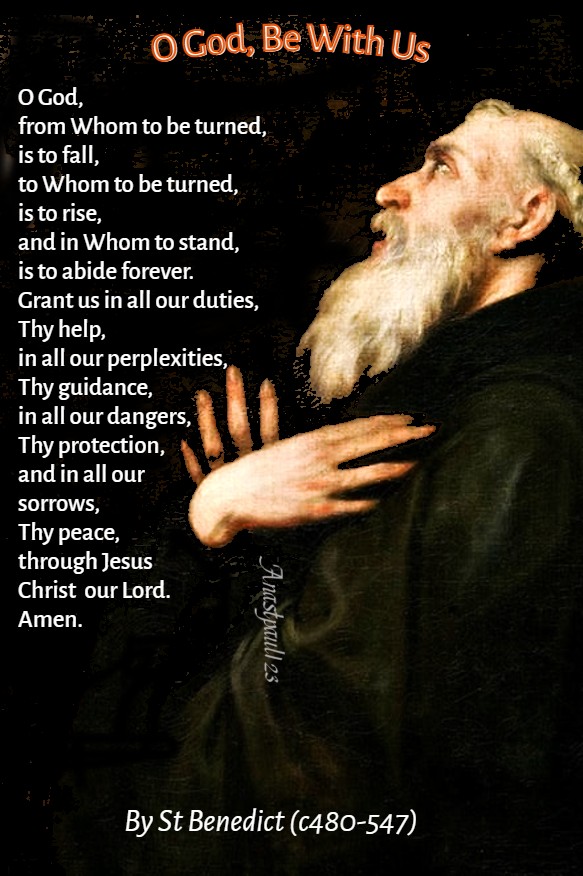
O God, from Whom to be turned, is to fall, to Whom to be turned, is to rise, and in Whom to stand, is to abide forever. Grant us in all our duties, Thy help, in all our perplexities, Thy guidance, in all our dangers, Thy protection, and in all our sorrows, Thy peace, through Jesus Christ our Lord. Amen.
Saint of the Day – 21 March – Saint John of Valence (Died 1146) Bishop, Founder of the Abbey of Bonnevaux, Monk, Abbot, Apostle of the poor, Social Reformer. Born at Lyons, France and died on 21 March 1146 of natural causes. Additional Memorial – 26 April on some calendars.
The Roman Martyrology reads: “In Valence in the territory of Vienne in France, St John, Bishop, who, at first Abbot of Bonnevaux, suffered many adversities for the defence of justice and with charity took care of the peasants, the poor and the merchants ruined by debts.”
Nothing is known of his early life until he became a Priest and a Canon of the Lyons Cathedral.
After a pilgrimage to Compostela, Spain John had a dream in which Christ complained: “He ought to be Mine, not as a pilgrim but as a dweller in My house.” John immediately entered Clairvaux Abbey to become a Monk under Saint Bernard. In 1117, he founded the Cistercian Abbey at Bonnevaux, became its Abbot and from which he established four daughter-houses.
In 1141 John was elected Bishop of Valence. John felt so unworthy of the position that he had to be physically carried to the Altar to be Consecrated. As Bishop, John fought zealously for his flock not just in matters spiritual but for farmers, merchants and the impoverished who were all ruined by debt during a regional financial crisis.
During his five years as the Bishop, John maintained the rigoroys life of a Monk, keeping fasts and penances. He actively alleviated the sufferings of widows, orphans and the poor and in other ways, promoted social justice.
John died on 21 March 1146 . Pope Pius X confirmed his cultus in on 3 December 1903.
St Isenger of Verdun St James the Confessor St John of Valence (Died 1146) Bishop Bl Lucia of Verona St Lupicinus of Condat Bl Mark Gjani Bl Matthew Flathers
St Nicholas of Flue (1417-1487) Swiss Hermit and Ascetic who is the Patron Saint of Switzerland. He is sometimes invoked as Brother Klaus. A husband and father, a Mystic, a Writer, farmer, military leader, Member of the assembly, Councillor, Judge, he was respected as a man of complete moral integrity. About St Nicholas: https://anastpaul.wordpress.com/2018/03/21/saint-of-the-day-21-march-st-nicholas-of-flue-1417-1487/
St Serapion the Scolastic (Died c 354-370) Bishop of Thmuis, near Diospolis in the Nile delta of Egypt, Monk and Hermit, Confessor, brilliant Scholar of great learning, Theologian, Writer, a companion to St Anthony, the Desert and a close friend of St Athanasius and gave support to him against the heretic Arians in Egypt, for which action he was exiled. St Serapion’s Life: https://anastpaul.com/2021/03/21/saint-of-the-day-21-march-saint-serapion-the-scolastic-died-c-354-370-bishop/
St Philemon of Rome Bl Santuccia Terrebotti
Bl Thomas Pilcher Bl William Pike
Martyrs of Alexandria: A large but unknown number of Catholics massacred in several Churches during Good Friday services in Alexandria, Egypt by Arian heretics during the persecutions of Constantius and Philagrio. They were Martyred on Good Friday in 342 in Alexandria, Egypt.
Thought for the Day – 20 March – Meditations with Antonio Cardinal Bacci (1881-1971)
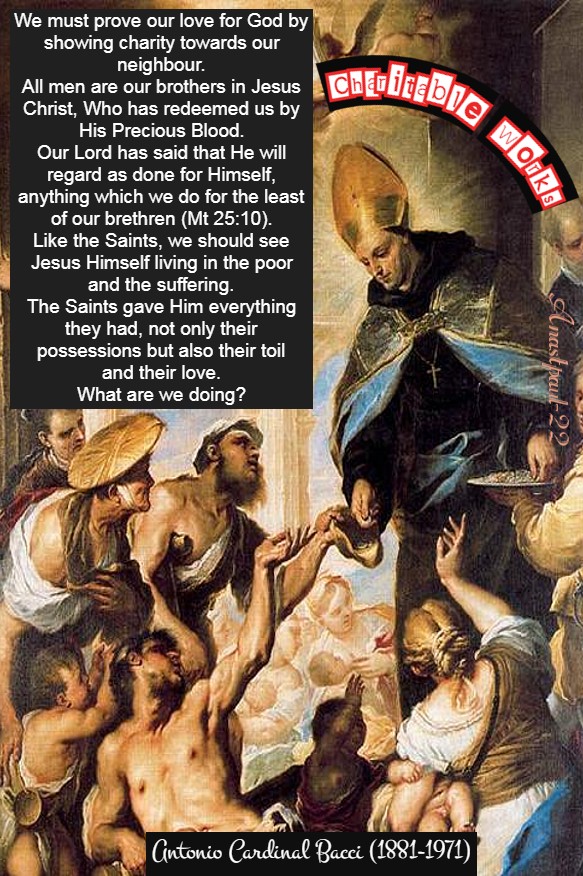
Charitable Works
“When Jesus was asked, what was the first commandment, He replied: “Thou shalt love the Lord thy God with thy whole heart and with thy whole soul and with thy whole mind and with thy whole strength. This is the first commandment. And the second is like unto it. Thou shalt love thy neighbour as thyself. There is no other commandment greater than this” (Mk 12:30-31). As St Augustine says, the love of God and the love of neighbour are two branches of the same tree, the tree of charity. “If anyone says, ‘I love God’ and hates his brother,” St John warns us, “he is a liar” (1 Jn 4:20).
We must prove our love for God by showing charity towards our neighbour. All men are our brothers in Jesus Christ, Who has redeemed us by His Precious Blood. Our Lord has said that He will regard as done for Himself, anything which we do for the least of our brethren (Mt 25:10).
Like the Saints, we should see Jesus Himself living in the poor and the suffering. The Saints gave Him everything they had, not only their possessions but also their toil and their love.
Think how much those missionaries do who leave everything in order to go to foreign lands and win souls for Christ. Think of the charitable work of the sisters and nurses in the hospitals, asylums and orphanages. What are we doing?”
The Third Sunday of Lent – 20 March – Ou4 Lenten Journey with the Great Fathers – Ephesians 5:1-9, Luke 11:14-28
“My eyes are ever toward the Lord, for He will free my feet from the snare. Look toward me and have pity on me, for I am alone and afflicted.” – Psalm 24:15-16
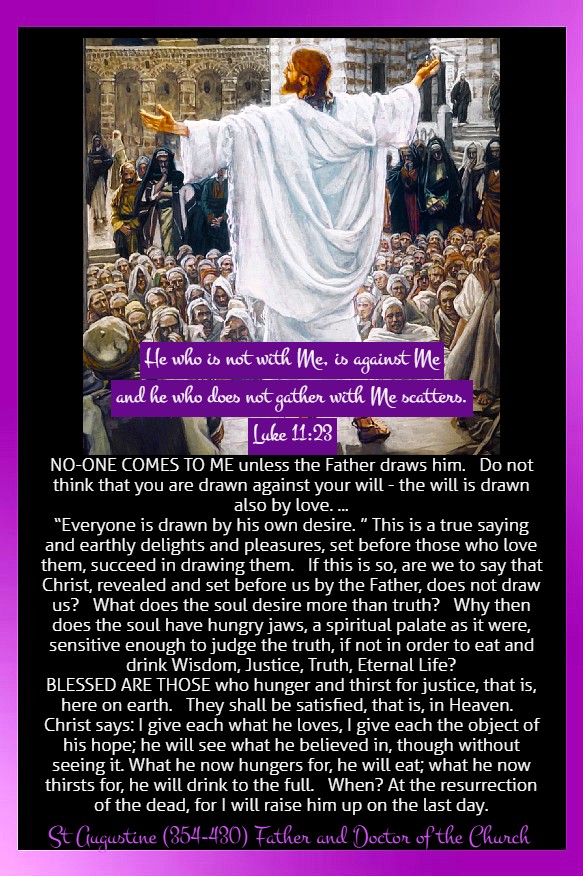
“He who is not with Me, is against Me and he who does not gather with Me scatters.”
Luke 11:23
“NO-ONE COMES TO ME unless the Father draws him. Do not think that you are drawn against your will – the will is drawn also by love. We must not be afraid of men who weigh words but are far from understanding what belongs above all to Divine Truth. They may find fault with this passage of Scripture and say to us: “How can I believe of my own free will if I am drawn to believe?” I answer: “It is not enough that you are moved by the will, for you are drawn also by desire.”
WHAT DOES THIS MEAN, to be drawn by desire? Take delight in the Lord and He will give you the desires of your heart. The heart has its own desires; it takes delight, for example, in the bread from heaven. The poet could say: “Everyone is drawn by his own desire,” not by necessity but by desire, not by compulsion but by pleasure. We can say then with greater force, that one who finds pleasure in Truth, in Happiness, in Justice, in Everlasting Life, is drawn to Christ, for Christ is all these things.
ARE OUR BOIDLY SENSES to have their desires but not the will? If the will does not have its desires, how can Scripture say: The children of men will find their hope under the shadow of your wings, they will drink their fill from the plenty of your house and you will give them drink from the running stream of your delights, for with you is the fountain of life, and in your light we shall see light.
SHOW ME ONE WHO LOVES; he knows what I mean. Show me one who is full of longing, one who is hungry, one who is a pilgrim and suffering from thirst in the desert of this world, eager for the fountain in the homeland of eternity; show me someone like that and he knows what I mean. But if I speak to someone without feeling, he does not understand what I am saying.
YOU HAVE ONLY to show a leafy branch to a sheep and it is drawn to it. If you show nuts to a boy, he is drawn to them. He runs to them because he is drawn, drawn by love, drawn without any physical compulsion, drawn by a chain attached to his heart. “Everyone is drawn by his own desire. ” This is a true saying and earthly delights and pleasures, set before those who love them, succeed in drawing them. If this is so, are we to say that Christ, revealed and set before us by the Father, does not draw us? What does the soul desire more than truth? Why then does the soul have hungry jaws, a spiritual palate as it were, sensitive enough to judge the truth, if not in order to eat and drink Wisdom, Justice, Truth, Eternal Life?
BLESSED ARE THOSE who hunger and thirst for justice, that is, here on earth. They shall be satisfied, that is, in Heaven. Christ says: I give each what he loves, I give each the object of his hope; he will see what he believed in, though without seeing it. What he now hungers for, he will eat; what he now thirsts for, he will drink to the full. When? At the resurrection of the dead, for I will raise him up on the last day.” – St Augustine (354-430) Bishop of Hippo, Great Western Father and Doctor of Grace of the Church (An excerpt from his Treatise 26).
Quote/s of the Day – 20 March – The Third Sunday of Lent – Ephesians 5:1-9, Luke 11:14-28
“Whoever does not gather with me, scatters.”
Luke 11:23
“We recognise a tree by its fruit and we ought to be able to recognise a Christian by his action. The fruit of faith should be evident in our lives, for being a Christian, is more than making sound professions of faith. It should reveal itself in practical and visible ways. Indeed, it is better to keep quiet about our beliefs and live them out, than to talk eloquently about what we believe but fail, to live by it.”
St Ignatius of Antioch (c 35-c 108) Father of the Church
The waters have risen and severe storms are upon us but we do not fear drowning, for we stand firmly upon a rock. Let the sea rage, it cannot break the rock.” Let the waves rise, they cannot sink the Boat of Jesus.”
St John Chrysostom (347-407) Father and Doctor of the Church
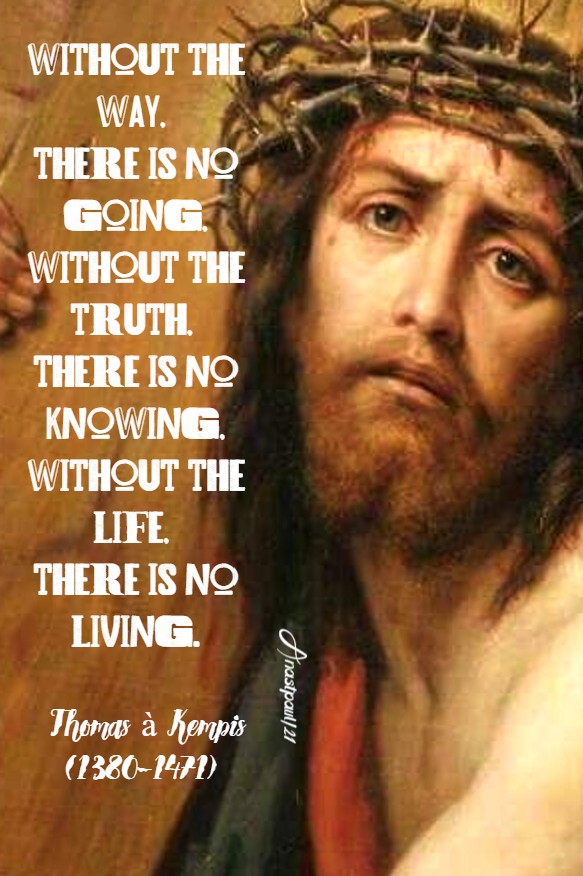
“Without the Way, there is no going, Without the Truth, there is no knowing, Without the Life, there is no living.”
One Minute Reflection – 20 March – The Third Sunday of Lent – Ephesians 5:1-9, Luke 11:14-28
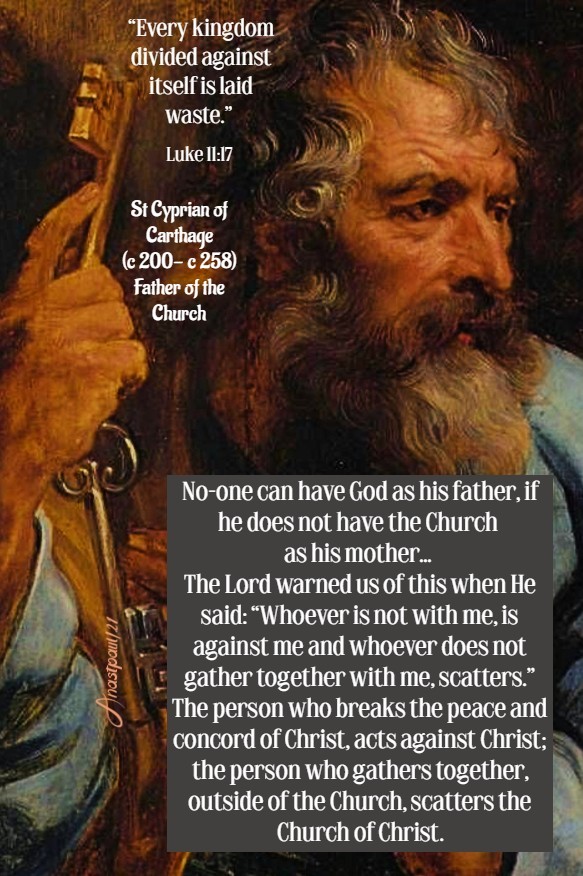
“Every kingdom divided against itself is laid waste.” – Luke 11:17
REFLECTION –“No-one can have God as his father, if he does not have the Church as his mother… The Lord warned us of this when He said: “Whoever is not with me, is against me and whoever does not gather together with me, scatters.” The person who breaks the peace and concord of Christ, acts against Christ; the person who gathers together, outside of the Church, scatters the Church of Christ.
The Lord said: “The Father and I are one.” (Jn 10:30) It is also written of the Father, the Son and the Holy Spirit: “These three are one.” (1 Jn 5:7) From now on, who can believe, that the unity, which has its origin in this divine harmony, which is linked with this heavenly mystery, can be divided up in the Church… through conflicts of will? Whoever does not observe this unity, neither observes the law of God, nor faith, in the Father and the Son – he keeps neither life, nor salvation.
In the gospel, this sacrament of unity, this bond of concord, in indissoluble cohesion, is shown us through the Lord’s tunic. It could neither be divided nor torn but they drew lots, so as to know who would put on Christ (Jn 19:24)… It is the symbol of unity, that comes from on high.” – St Cyprian of Carthage (c 200- c 258) Bishop and Martyr, Father of the Church (On the unity of the Church).
PRAYER – O God, shepherd and ruler of all the faithful, look with favour upon Your servant , whom You willed to designate shepherd of Your Church; grant him, we beseech You, that by word and example he may so benefit those in his charge, that together with the flock committed to his care, he may attain life everlasting. Through Jesus Christ, Thy Son our Lord, Who lives and reigns with Thee, in the unity of the Holy Ghost, God, world without end. Amen (Collect). May the Mother of Your Church, teach us her holy way and pray for us all!.
Our Morning Offering – 20 March – The Third Sunday of Lent
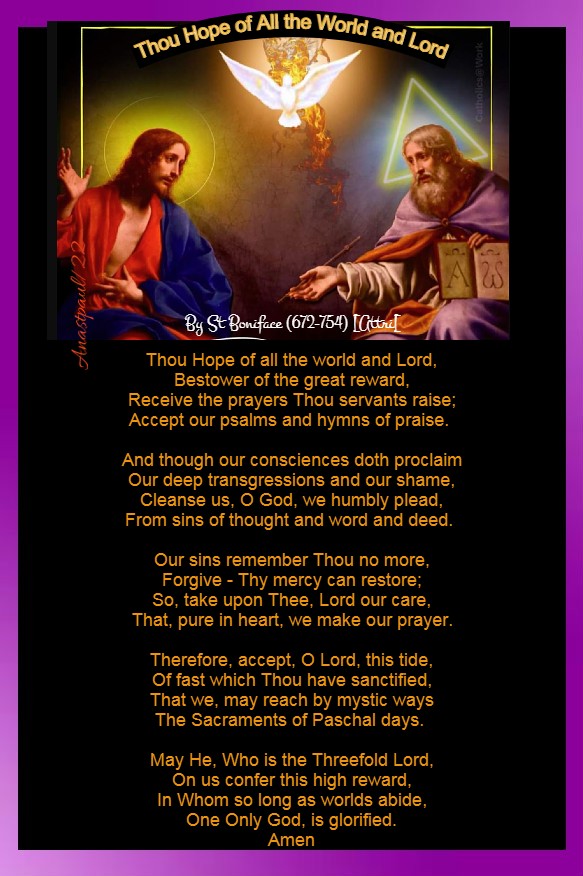
Thou Hope of All the World and Lord Attri to St Boniface (672-754) Sarum Rite Breviary Transl. Fr Alan G McDougall (1895-1964)
Thou Hope of all the world and Lord, Bestower of the great reward, Receive the prayers Thou servants raise; Accept our psalms and hymns of praise.
And though our consciences doth proclaim Our deep transgressions and our shame, Cleanse us, O God, we humbly plead, From sins of thought and word and deed.
Our sins remember Thou no more, Forgive – Thy mercy can restore; So, take upon Thee, Lord our care, That, pure in heart, we make our prayer.
Therefore, accept, O Lord, this tide, Of fast which Thou have sanctified, That we, may reach by mystic ways The Sacraments of Paschal days.
May He, Who is the Threefold Lord, On us confer this high reward, In Whom so long as worlds abide, One Only God, is glorified. Amen
Saint of the Day – 20 March – Saint Cuthbert of Lindisfarne (c 634-687) “The Wonder-Worker of England,” Bishop of Lindisfarne, Monk, Hermit, Miracle-worker, Born in c 634 possibly in Northumbria, England and died on 20 March 687 at Lindisfarne, England of natural causes. Patronages – against plague and epidemics, of boatmen, mariners, sailors, shepherds, England, the Diocese of Hexham and Newcastle, England, Diocese of Lancaster, England, of Durham, England, Northumbria, England. Both during his life and after his death he became a popular medieval Saint of Northern England, with a cult centred on his tomb at Durham Cathedral. I am always saddened by the almost total lack of veneration at this Tomb, although there are still a few organised Catholic pilgrimages per year. The Church is now no longer ours (Anglican) and for the most part, the only visitors to the Tomb are camera-flashing tourists.
The Roman Martyrology reads today: “In England, St Cuthbert, Bishop of Lindisfarne, who, from his childhood until his death, was renowned for good works and miracles.”
Cuthbert was born in North Northumbria in about the year 634 – the same year in which St Aidan founded the Monastery at Lindisfarne. He came from a notable and wea\lthy English family and like most boys of that class, he was placed with foster-parents for part of his childhood and taught the arts of war. We know nothing of his foster-father but he was very fond of his foster-mother, Kenswith.
It seems, from stories about his childhood, that he was brought up as a Christian. He was credited, for instance, with having saved, by his prayers, some Monks who were being swept out to sea on a raft. There is some evidence that, in his mid-teens, he was involved in at least one battle, which would have been quite normal for a boy of his social background.
St Cuthbert discovers a piece of timber to save drowning Monks, from a 12th-century manuscript of St Bede’s ‘Life of St Cuthbert.’
His life changed when he was about 17 years old. He was looking after some neighbour’s sheep on the hills. (As he was certainly not a shepherd boy it is possible that he was mounting a military guard – a suitable occupation for a young warrior!) Gazing into the night sky he saw a light descend to earth and then return, escorting, he believed, a human soul to Heaven. The date was 31 August 651- the night that St Aidan died! Perhaps Cuthbert had already been considering a possible monastic calling but that was his moment of decision.
He went to the Monastery at Melrose, also founded by St Aidan and asked to be admitted as a Novice. For the next 13 years he was with the Melrose Monks. When Melrose was given land to found a new Monastery at Ripon, North Yorkshire, Cuthbert went with the founding party and was made Administrator. In his late 20s he returned to Melrose and found that his former teacher and friend, the Prior Boisil, was dying of the plague. Cuthbert became Prior (second to the Abbot) at Melrose.
In 664 the Synod of Whitby decided that Northumbria should cease to look to Ireland for its spiritual leadership and turn instead to the continent. The Irish Monks of Lindisfarne, with others, went back to Iona. The Abbot of Melrose subsequently became also Abbot of Lindisfarne and Cuthbert its Prior.
Cuthbert seems to have moved to Lindisfarne at about the age of 30 and lived there for the next 10 years. He ran the Monastery; – he was an active missionary; he was much in demand as a spiritual guide and he was graced with the charism of miraculous curing of the ill. He was an outgoing, cheerful, compassionate person and no doubt became popular. But when he was 40 years old he believed that he was being called to be a hermit and to do the hermit’s job of fighting the spiritual forces of evil in a life of solitude.
After a short trial period on the tiny islet adjoining Lindisfarne, he moved to the more remote and larger island known as ‘Inner Farne’ and built a hermitage where he lived for 10 years. Of course, people did not leave him alone – they went out in their little boats to consult him or ask for healing. However, on many days of the year the seas around the islands are simply too rough to make the crossing and Cuthbert was left in peace.
Cuthbert’s fame for piety, diligence, and obedience quickly grew.and at the age of about 50 he was asked by both Church and King to leave his hermitage and become a Bishop. He reluctantly agreed. For two years he was an active, travelling Bishop as St Aidan had been. He seems to have journeyed extensively. On one occasion he was visiting the Queen in Carlisle (on the other side of the country from Lindisfarne) when he knew by miraculous understanding that her husband, the King, had been slain by the Picts in battle in Scotland.
Feeling the approach of death, he retired back to the hermitage on the Inner Farne where, in the company of Lindisfarne Monks, he died on 20 March 687.
His body was brought back and buried at Lindisfarne. People immediately came to pray at the grave and many miracles occured. To the Monks of Lindisfarne this was a clear sign that Cuthbert was a Saint in Heaven and they, desired to declare to the world the great power of intercession, of their St Cuthbert.
They decided to allow 11 years for his body to become a skeleton and then ‘elevate’ his remains on the anniversary of this death (20 March 698). We believe that during these years, the beautiful manuscript known as ‘The Lindisfarne Gospels‘ was made, to be used for the first time at the great ceremony of the Translation of St Cuthbert. The declaration of Cuthbert’s sainthood was to be a day of joy and thanksgiving. It turned out to be also a day of surprise, even shock, for when they opened the coffin ,they found no skeleton but a complete and undecayed body. That was a sign of very great sainthood indeed.
So the cult of St Cuthbert began. Pilgrims began to flock to the Shrine. The ordinary life of the Monastery continued for almost another century until, on 8 June 793, the Vikings came. The Monks were totally unprepared; some were killed; some younger ones and boys were taken away to be sold as slaves; gold and silver was taken and the monastery partly burned down. After that, the Monastery lived under threat and it seems that in the 9th century there was a gradual movement of goods and buildings to the nearby mainland. The traditional date for the final abandonment of Lindisfarne is 875.
The body of St.Cuthbert, together with other relics and treasures which had survived the Viking attack, were carried by the Monks and villagers onto the mainland.
For over 100 years the community settled at the old Roman Town of Chester-le-Street. It was said that fear of further attack took them inland to Ripon but not for long and on their journey back from there they finally settled at Durham.
After the Norman Conquest (1066) a Benedictine community began to build the great Cathedral at Durham. They proposed to honour the body of St.Cuthbert with a new Shrine immediately east of the new High Altar and in 1104, all was ready for the translation. The Durham Monks opened up the coffin and found, that the St Cuthbert’s body was indeed still incorrupt. Throughout the Middle Ages the coffin was placed in a beautiful Shrine and visited by great numbers of pilgrims. But at the reformation, when the Monastery was dissolved, the Shrine was dismantled and the coffin opened – the body was still complete. It was buried in a plain grave behind the High Altar and the Sacred items buried with St Cuthbert were removed. Below is St Cuthbert’s Gospel of St John, recovered from his coffin; the original tooled red goatskin binding is the earliest surviving Western binding.
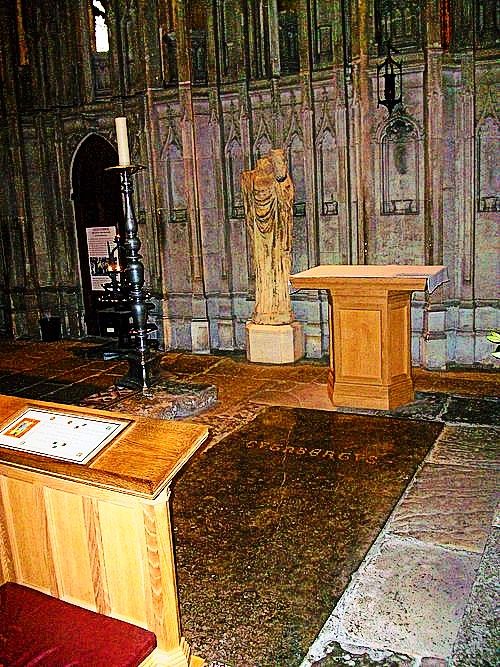
The human remains were then re-interred in the same place and marked by a plain gravestone with the name Cuthbertus. The Site, remaibs the focus of many pilgrimages today, including myself and family who have venerated St Cuthbert, a few times, in the Cathedral built to house his Shrine – of course, this is now a protestant church.
The 8th-century historian St Bede, wrote both a verse and a prose life of St Cuthbert around 720. He has been described as the most popular Saint in England prior to the death of Thomas Becket in 1170. In particular, Alfred the Great, King of Wessex, was inspired and encouraged in his struggle against the Danes by a vision or dream he had of St Cuthbert. Thereafter, the royal house of Wessex, who became the Kings of England, made a point of great devotion to St Cuthbert.
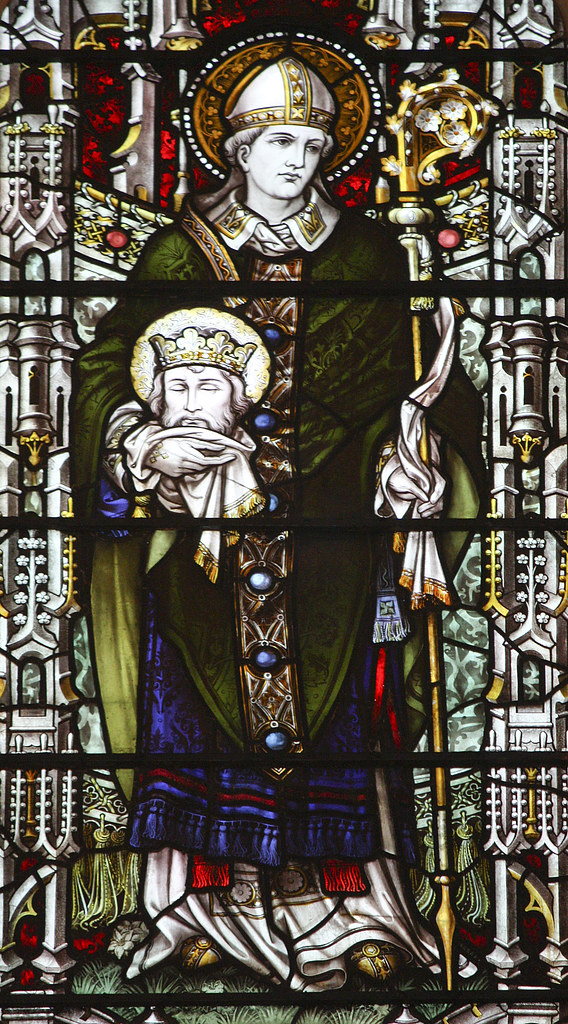
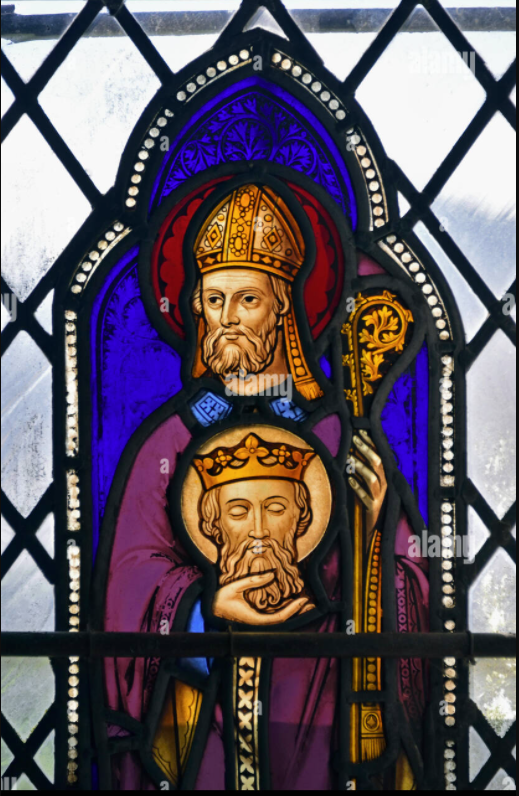
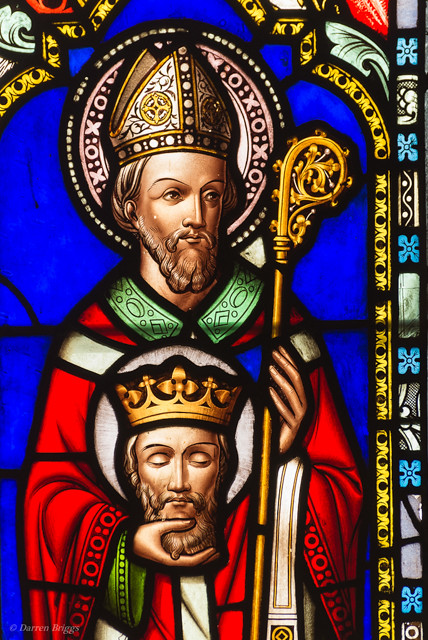
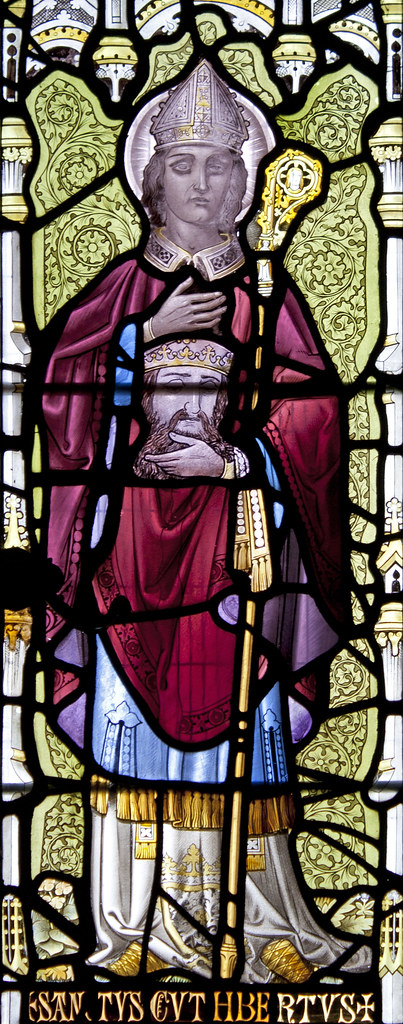
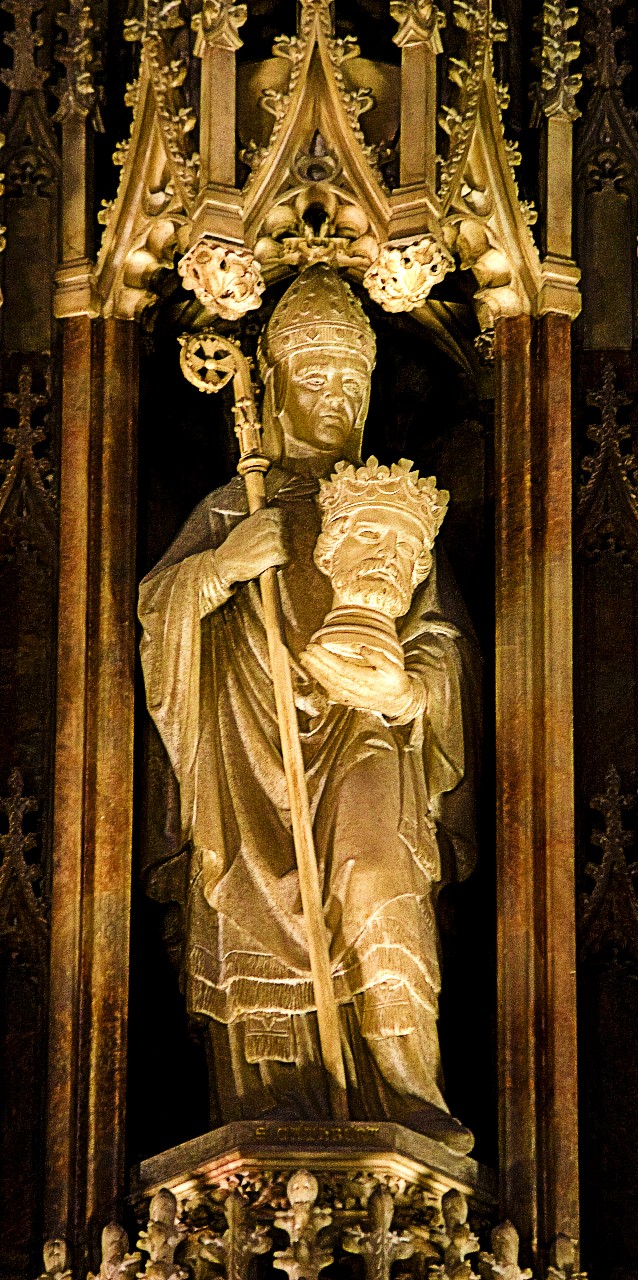
Why is St Cuthbert depicted holding St Oswald’s Head (c 605-642) King of Northumbia and why is it entombed with St Cuthbert?
St Bede tells us that Oswald was born around 605, the son of the King of Northumbria. After his father’s death, Oswald and his brothers were exiled to western Scotland, possibly to Iona, where they were inspired by St Columba’s Monks and were Baptised. In 634 Oswald returned to Northumbria where Cadwalla was massacring the people having killed King Edwin. After setting up a Cross as his standard and leading his men in prayer on the night before battle, Oswald defeated Cadwalla’s much larger army at Heavenfield and reclaimed the throne. The Intercession of St Columba,who died some 35 years earlier, assisted Oswald and his men, for Columba,appeared to Oswald in a vision and promised Heavenly assistance.
Oswald asked the Monks at Iona to send Missionaries to convert and guide his people. The first Monk they sent went back and reported that he could make no progress, due to the ungovernability, obstinacy and barbarous temperament of Oswald’s people, so they sent St Aidan instead. Oswald let Aidan choose where to base his Monastery and his mission. Aidan chose Lindisfarne and Oswald then worked closely with Aidan, travelling the countryside, acting as Aidan’s translator. In St Bede’s words, “while the Bishop, who was not fluent in the English language, preached the gospel, it was most delightful to see the King himself, interpreting the word of God to his ealdormen and thegns; for he, himself, had obtained perfect command of the Irish tongue during his long exile.”
Oswald was killed at Oswestry on 5 August 642, fighting the Mercians led by King Penda. His head was rescued from the battlefield and is buried in the Durham Cathedral, in St Cuthbert’s tomb, which is why you sometimes see pictures or statues of Cuthbert holding Oswald’s head. Soon miracles occurred at the place of his death, as they had at the place where he knelt to pray before battle and he was effectively canonised by the loving devotion of his people.












































You must be logged in to post a comment.