One Minute Reflection – 17July – “Month of the Most Precious Blood” – Readings: Exodus 12: 37-42; Psalms 136: 1 and 23-24, 10-12, 13-15; Matthew 12: 14-21
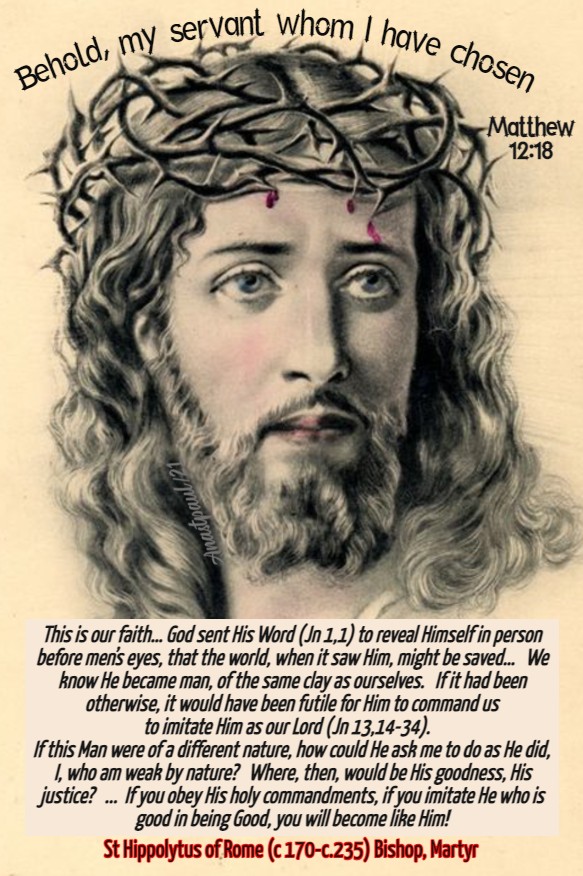
“Behold, my servant whom I have chosen” – Matthew 12:18
REFLECTION – “This is our faith… God sent His Word (Jn 1,1) to reveal Himself in person before men’s eyes, that the world, when it saw Him, might be saved… We know He became man, of the same clay as ourselves. If it had been otherwise, it would have been futile for Him to command us to imitate Him as our Lord (Jn 13,14-34). If this Man were of a different nature, how could He ask me to do as He did, I, who am weak by nature? Where, then, would be His goodness, His justice?
To make us thoroughly understand, that He is no different from us, He desired to bear fatigue and know hunger (Jn 4,6); He did not refuse thirst or to find rest in sleep. He did not refuse suffering, He became subject to death and openly manifested His Resurrection. In all these things, He offered His own humanity as a first-fruits, so that you, in your own suffering, might not lose courage but, recognising that you, yourself, are man, might also wait for what the Father has given to Him…
Thanks to your knowledge of the true God, you will have an immortal and imperishable body like the soul itself. You will receive the Kingdom of Heaven as your inheritance because you acknowledged the King of Heaven, while you lived on earth. You will live in the presence of God, “co-heir with Christ” (Rm 8,17). You will no longer be dominated by desires, suffering and sickness because you have become divine in nature… “Christ is God above all” (cf Rm 9,5)… and has given the perfection of the new Man to the old man (Col 3,9). He called it His image from the beginning (Gn 1,27) and, through this likeness, He has shown His loving kindness for you. If you obey His holy commandments, if you imitate He who is good in being Good, you will become like Him.” – St Hippolytus of Rome (c 170-c.235) Bishop, Martyr, Theologian, Father – The Refutation of all heresies, 10, 33-34
PRAYER – Lord God, in Your wisdom You created us, by Your Providence, You rule us. Penetrate our inmost being with Your holy light so that our way of life may always be one of faithful service and childlike trust in You. Grant that by the intercession of our most Holy and Blessed Virgin Mother, we may always follow behind Your Son, obey His Words and grasp His hand, to lead us to You, Through Jesus Christ our Lord with the Holy Spirit, one God now and for all eternity, amen
Our Morning Offering – 17 July – “Month of the Most Precious Blood” –
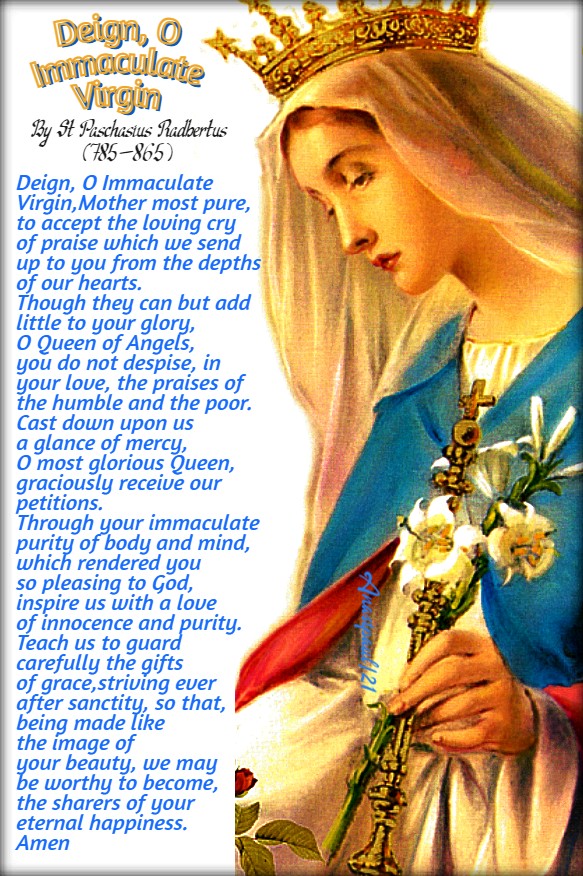
Deign, O Immaculate Virgin By St Paschasius Radbertus (785–865)
Deign, O Immaculate Virgin, Mother most pure, to accept the loving cry of praise which we send up to you from the depths of our hearts. Though they can but add little to your glory, O Queen of Angels, you do not despise, in your love, the praises of the humble and the poor. Cast down upon us a glance of mercy, O most glorious Queen, graciously receive our petitions. Through your immaculate purity of body and mind, which rendered you so pleasing to God, inspire us with a love of innocence and purity. Teach us to guard carefully the gifts of grace, striving ever after sanctity, so that, being made like the image of your beauty, we may be worthy to become, the sharers of your eternal happiness. Amen
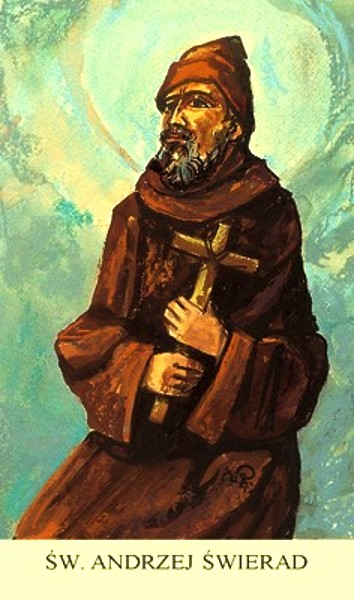
Saint of the Day – 17 July – Saint Andrew Zorard OSB (c 980 – c 1008) Hermit, Benedictine Monk, Missionary, spiritual guide, ascetic. Born in c 980 in Opatowiec, Poland and diedin c 1010 in of natural causes. Patronages – Hungary, Nitra, Diocese of Nitra, Diocese of Tarnów, St Andrew Abbey in Cleveland. Also known as – Sverad, Svorad, Swierad, Swirad, Wszechrad, Zoerardus, Zoërard, Zurawek, Zórawek.
Andrew was born around 980 in Opatowiec, a small village in Poland. A tradition in the small village of Tropie holds, that in his youth he lived near there as a Monk. At around the year 1000, when he was 20 years old, he began living as a Hermit and a Missionary, evangelising in Olawa, Silesia (modern Poland). At some time, he also travelled to northern Hungary (Slovakia).
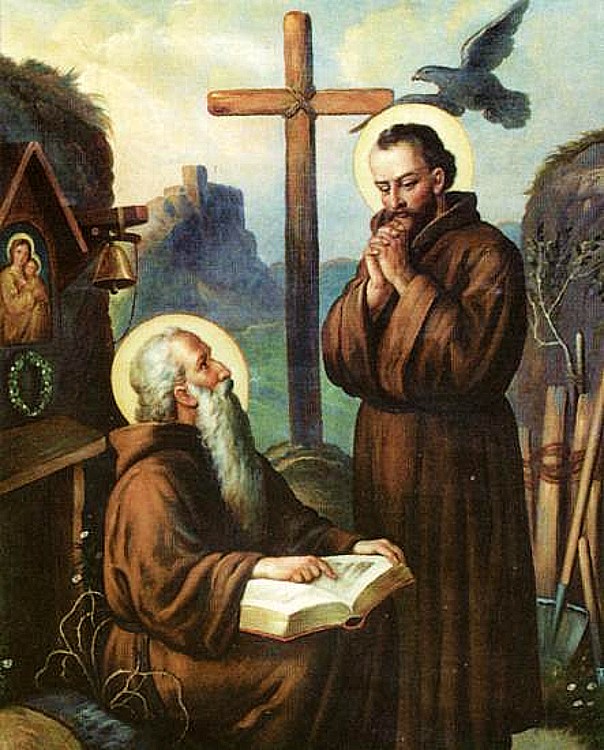
Around the year 1003 Andrew settled in St Hippolytus Monastery on Mount. Zobor near Nitra – then part of the Kingdom of Hungary, present day Slovakia. He became a Benedictine Monk in the Abbey. He took the name “Andrew” at his profession. He became the spiritual guide of St Benedict of Skalka (Died 1012). Andrew and Benedict, with the permission of their superior Philip, later left the Monastery and became Hermits in a cave along the Váh River.
St Benedict (left) and St Andrew
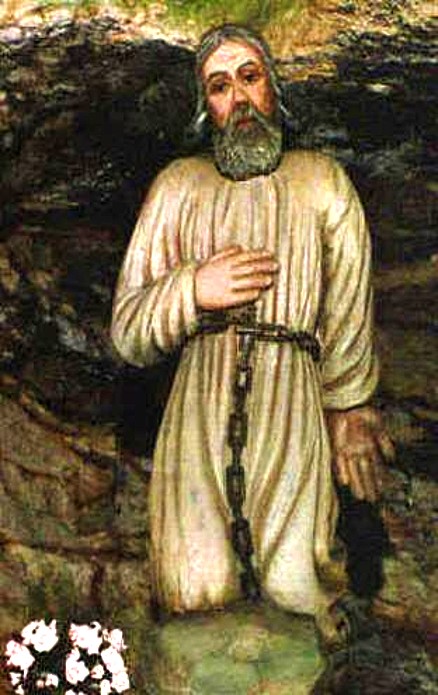
Andrew died of natural causes around 1008. He practiced such severe austerities that, according to legend, the iron chain, which he wore wrapped around the belt, eventually grew into his flesh.
Benedict continued to live in the cave for three years until he was murdered by a gang of thieves looking for treasure. In 1083 Andrew’s relics were transferred to St.Emmeram’s Cathedral in Nitra where they remain to this day. A biography of Benedict and Andrew was written by Maurus of Nitra, Bishop of Pécs.
Andrew is venerated especially in Slovakia, Hungary and Poland,but also in diaspora communities of the United States. His feast day is 17 July but in some calendars he is venerated together with Benedict on 13 June.
Slovakian Postage Stamp honouring St Andrew
King Géza I of Hungary declared him one of the Patron Saints of Hungary. As early as 1064, King Géza took the first steps towards his Canonisation. His cult was officially confirmed in July 1083 by Pope Gregory VII, thanks to the Hungarian King Ladislaus I.
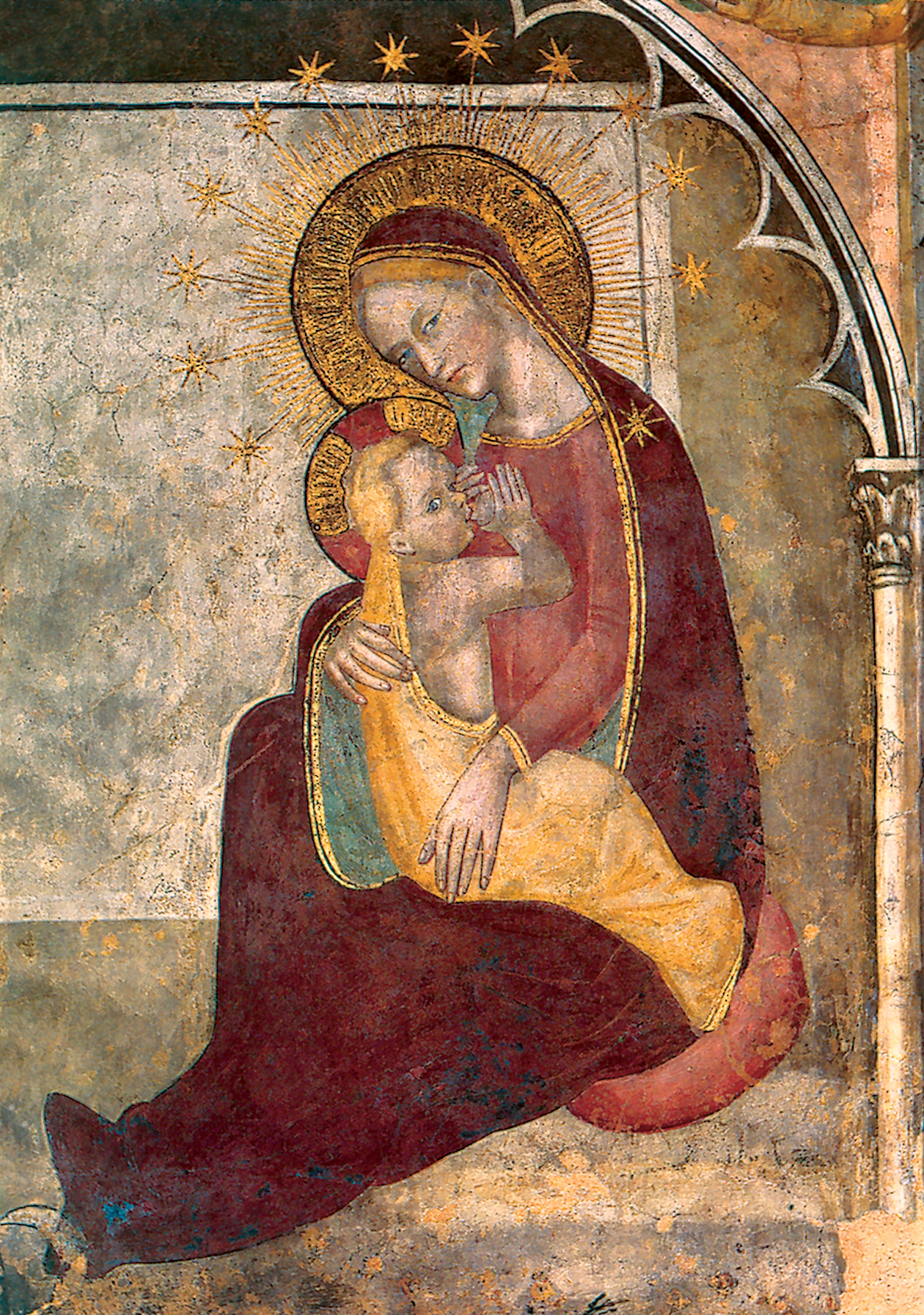
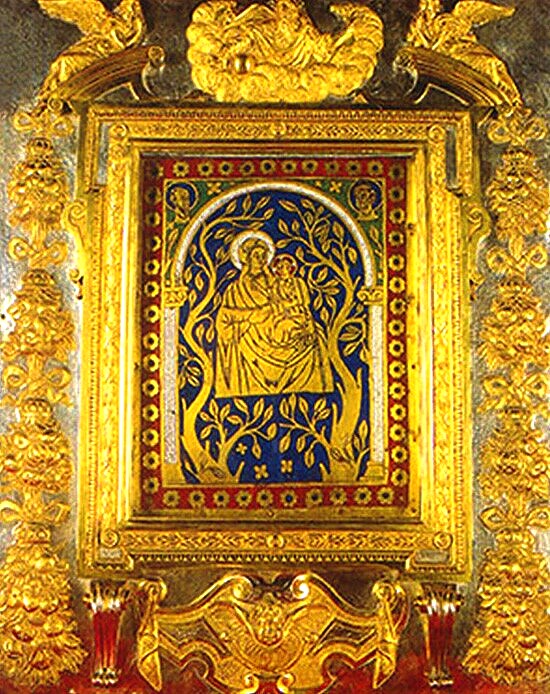
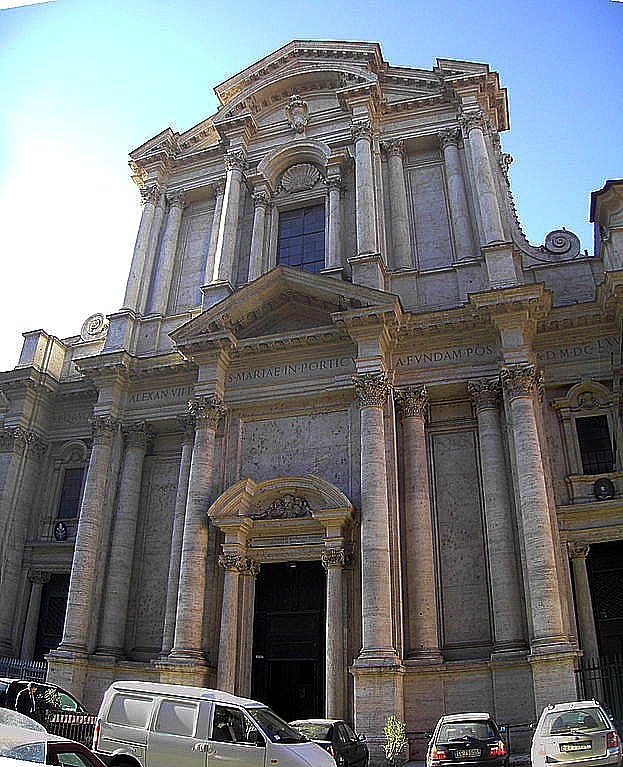
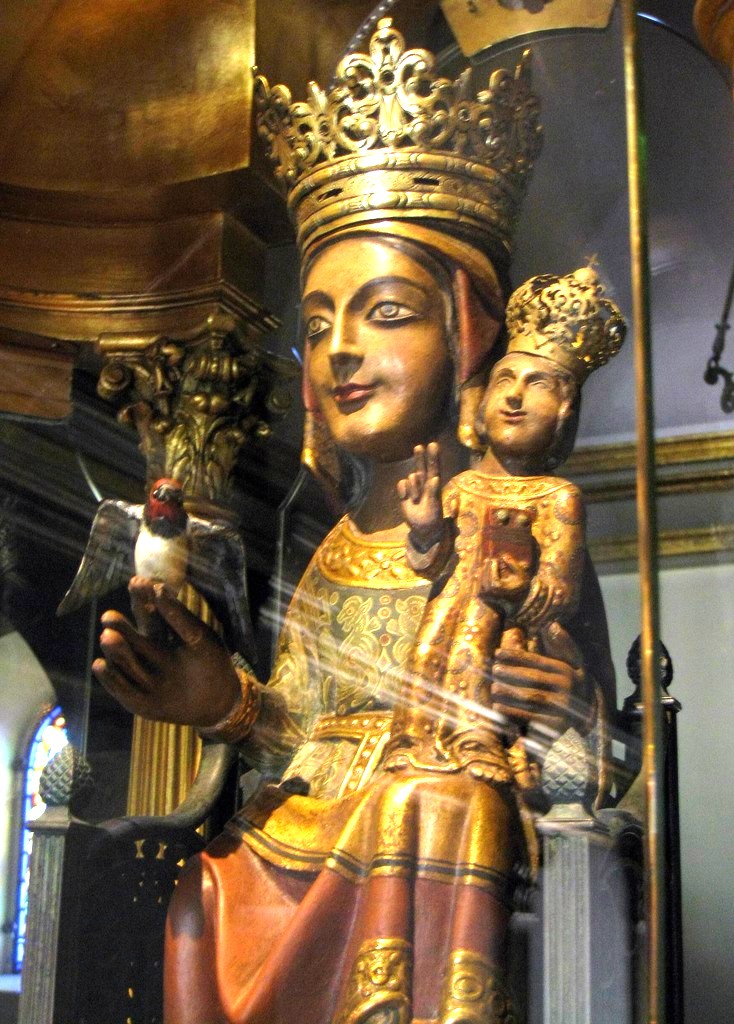
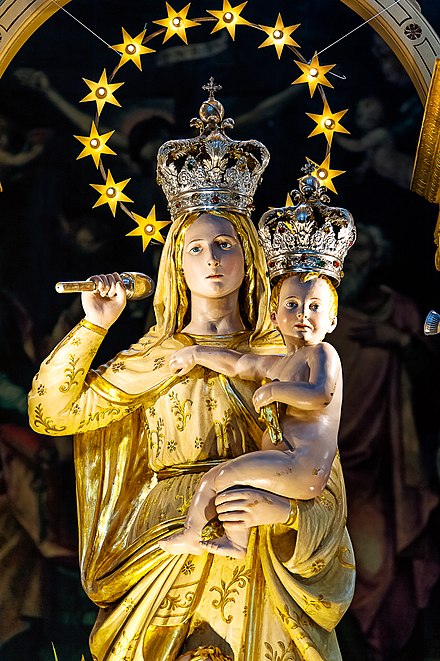
Madonna della Campitelli / Our Lady of Campitelli, Italy (524) – 17 July and 2 February:
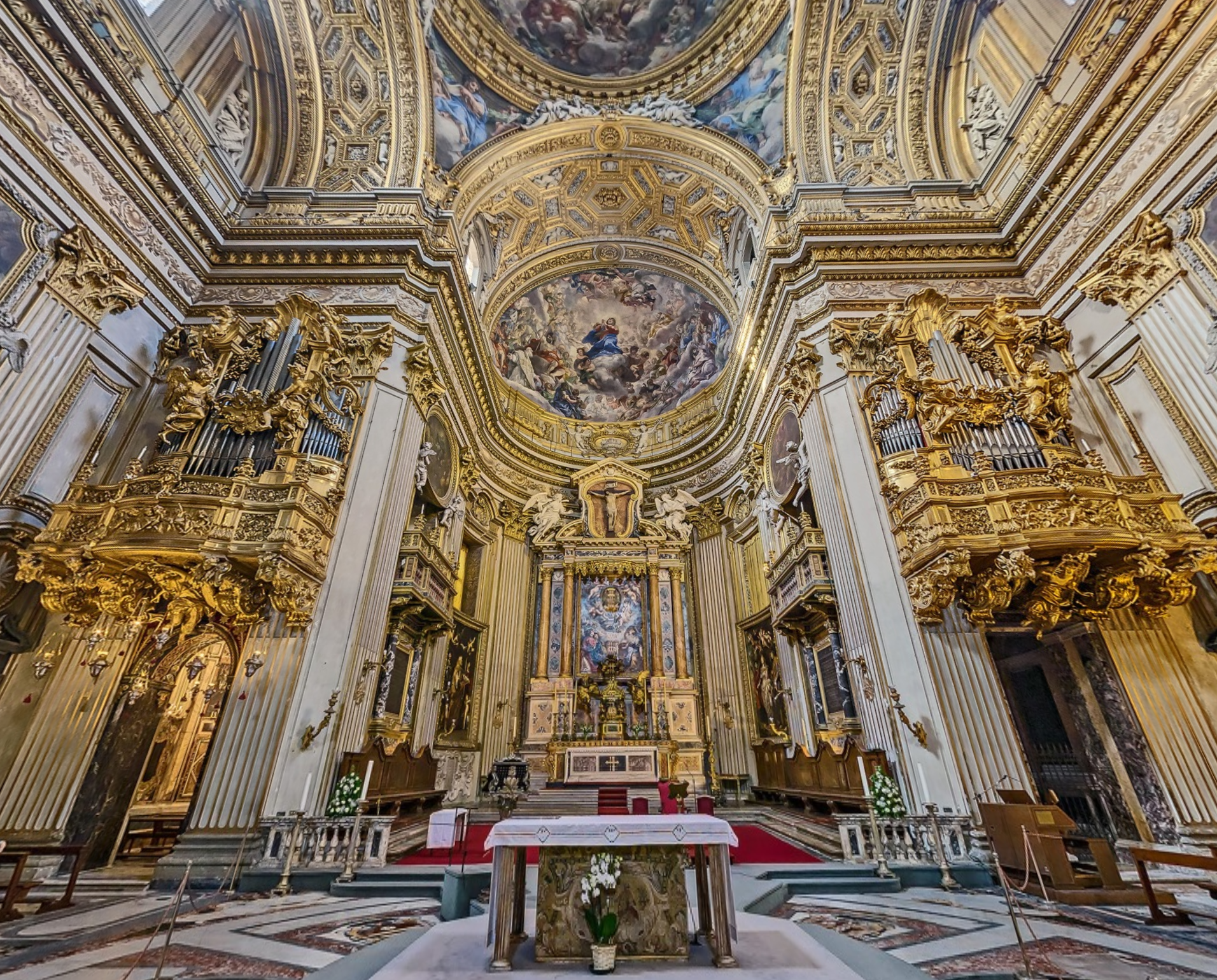
The Sanctuary of Sancta Maria in Campitelli is one of the most celebrated of Rome. It is dedicated to the Blessed Virgin Mary, and is located on the Piazza di Campitelli in Rome, Italy. There is venerated at the Church a precious image that was transported from the portico of the palace of the Roman matron, Galla Patrizia Seveath, to whom the Virgin herself appeared on 17 July 524. The icon is only 25 centimeters high. Mention is made of the miraculous appearance by Pope Gregory the Great. The image is known as Our Lady in the Portico, or the Madonna del Portico. The Church where the icon was kept was known as Santa Galla Antiqua and it used to be located just north of the Piazza Bocca della Verita and west of the Via Petroselli. It was destroyed by Mussolini under pretext that the street should be widened. In the year 1618 the congregation was transferred to a new Church known as Santa Maria in Campitelli, finished in 1667. The work of the Shrine is that of the architect Rainaldi. The new edifice was erected by vote of the people in thanksgiving for the preservation of the city from the pestilence of 1656 and was designed in the Baroque style. There are tall columns on the façade of the church that were intended to include statues, although the statues were never completed as originally planned.
The icon of Our Lady of Campitelli is surrounded by an ornate Shrine behind the High Altar and there is a stairway behind the display that allows a closer inspection of the famous Icon. It is not open to the general public. Many times the sacred image of Our Lady of Campitelli has been carried in procession through the streets of Rome – the people invoking Mary’s protection against pestilence, epidemics and earthquakes. This image is also invoked under the title of Our Lady of Security and two feasts are commemorated in Mary’s honour – 17 July and 2 February.
St Andrew Zorard OSB (c 980 – c 1008) Hermit, Monk, Missionary Bl Arnold of Himmerod Bl Bénigne Bl Biagio of the Incarnation
Bl Carlos de Dios Murias OFM Conv (1945-1976) Priest Martyr St Cynllo St Ennodius of Pavia St Fredegand of Kerkelodor St Generosus St Gorazd St Hedwig, Queen of Poland St Hyacinth of Amastris St Kenelm St Pope Leo IV St Marcellina St Nerses Lambronazi
St Petrus Liu Zeyu Bl Sebastian of the Holy Spirit Bl Tarsykia Matskiv St Theodosius of Auxerre St Theodota of Constantinople St Turninus
Martyrs of Compiegne (16 beati): Sixteen Blessed Teresian Martyrs of Compiègne. Eleven Discalced Carmelite nuns, three lay sisters and two lay women servants who were martyred together in the French Revolution. They were the earliest martyrs of the French Revolution that have been recognised. • Angelique Roussel • Anne Pelras • Anne-Marie-Madeleine Thouret • Catherine Soiron • élisabeth-Julitte Vérolot • Marie Dufour • Marie Hanniset • Marie-Anne Piedcourt • Marie-Anne-Françoise Brideau • Marie-Claude-Cyprienne Brard • Marie-Françoise de Croissy • Marie-Gabrielle Trezel • Marie-Geneviève Meunier • Marie-Madeleine-Claudine Lidoine • Rose-Chretien de Neuville • Thérèse Soiron • They were guillotined on 17 July 1794 at the Place du Trône Renversé (modern Place de la Nation) in Paris, France.
Martyrs of Scillium (12 saints): A group of twelve Christians martyred together, the final deaths in the persecutions of Emperor Marcus Aurelius. Upon their conviction for the crime of being Christians, the group was offered 30 days to reconsider their allegiance to the faith; they all declined. Their official Acta still exist. Their names – • Acyllinus • Cythinus • Donata • Felix • Generosa • Januaria • Laetantius • Narzales • Secunda • Speratus • Vestina • Veturius They were beheaded on 17 July 180 in Scillium, Numidia (in North Africa).
Thought for the Day – 16 July – Meditations with Antonio Cardinal Bacci (1881-1971)
Holiness
“In a radio message which he broadcast on the occasion of the Beatification of Pope Innocent XI, the Supreme Pontiff, Pius XII, defined holiness as “the intimate awareness of loyal subjection to God, Who is adored and loved, as the beginning, end and norm of every thought, affection, word and action.”
Let us meditate on this definition, which helps to shed some light on the true nature of sanctity. A holy man must always have a keen awareness of his own dependence upon God, his Creator, Redeemer and Sanctifier and his hoped for reward and happiness in the next life. This awareness must be vivid, for it should not be possible for it to be obscured by worldly distractions or obliterated by sensual allurements. It should be active, so that it may not be a merely theoretical acknowledgement of our dependence which leads to nothing more than lip-worship; on the contrary, it must be capable of transforming our lives into an act of obedience and of love. Finally, it should be a faithful awareness, a complete and voluntary subjection to God, which is the driving force behind all our words and actions and, which inspires us alike, in joy and in sorrow, in victory and in defeat. If we wish to be perfect Christians, we must cultivate this kind of consciousness of our dependence upon God.”
Quote/s of the Day – 16 July – “Month of the Most Precious” – Readings: Exodus 11: 10 – 12: 14; Psalms 116: 12-13, 15 and 16bc, 17-18; Matthew 12: 1-8
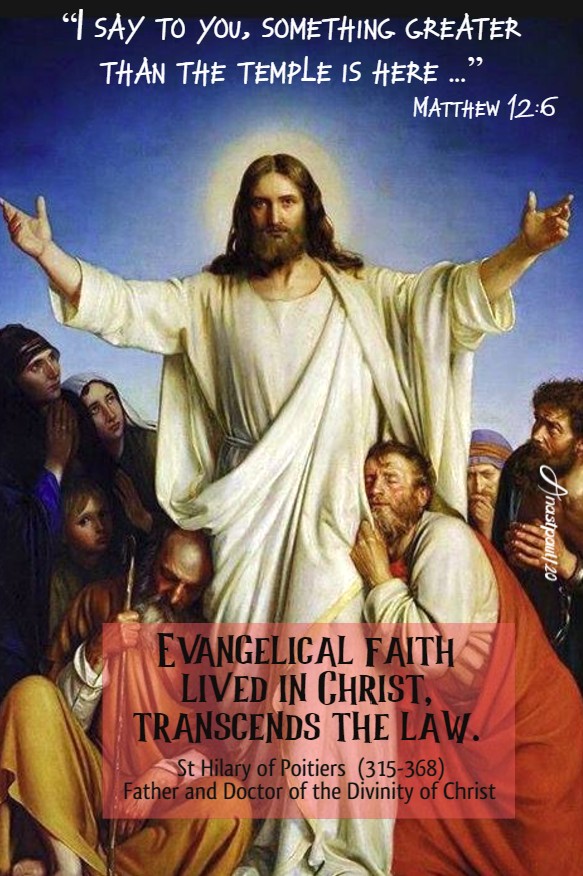
“I say to you, something greater than the temple is here …”
Matthew 12:6
“Evangelical faith lived in Christ, transcends the law.”
St Hilary of Poitiers (315-368) Father and Doctor of the Divinity of Christ
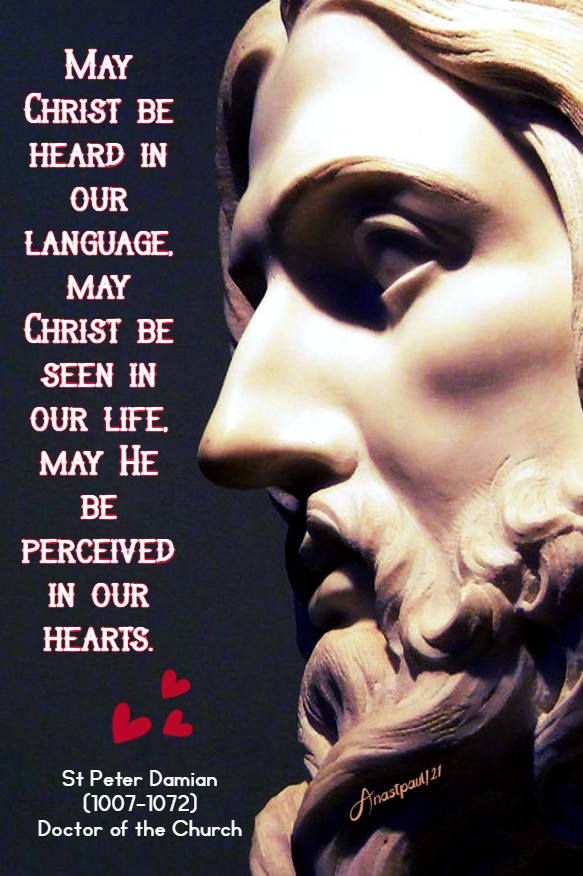
“May Christ be heard in our language, may Christ be seen in our life, may He be perceived in our hearts”
St Peter Damian (1007-1072) Father and Doctor of the Church
“If, then, you seek to know what path to follow, take Christ because He is the way.”
St Thomas Aquinas (1225-1274) Doctor of the Church
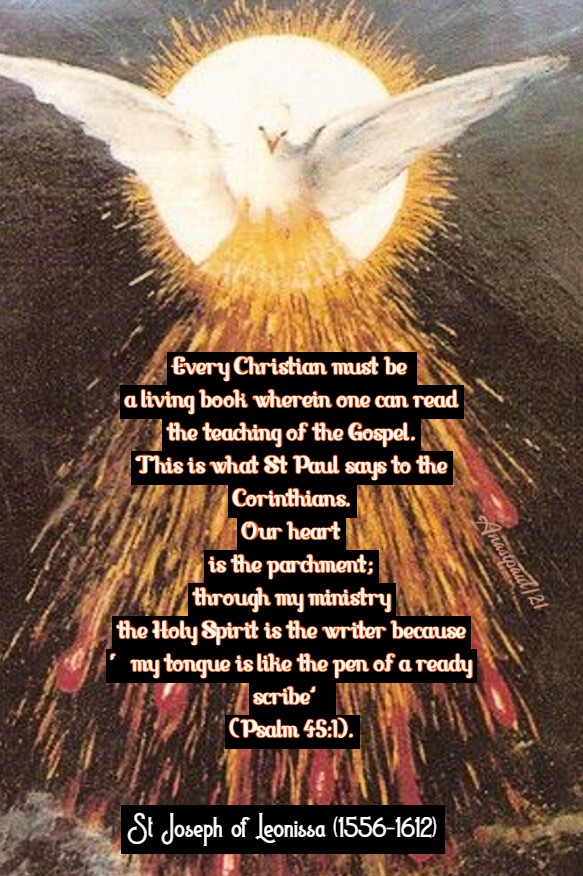
“Every Christian must be a living book wherein one can read the teaching of the Gospel. This is what St Paul says to the Corinthians. Our heart is the parchment; through my ministry the Holy Spirit is the writer because ‘my tongue is like the pen of a ready scribe’ (Psalm 45:1).”
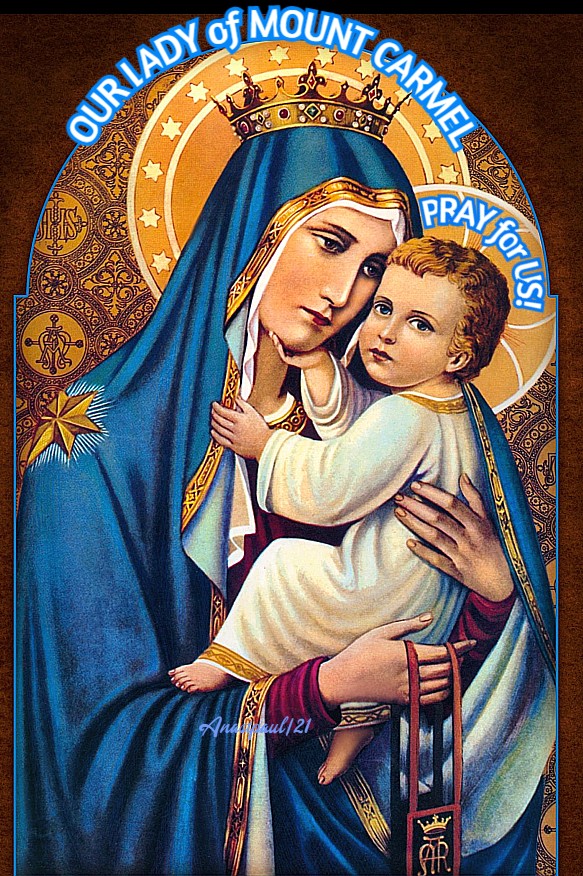
One Minute Reflection – 16 July – “Month of the Most Precious” – Readings: Exodus 11: 10 – 12: 14; Psalms 116: 12-13, 15 and 16bc, 17-18; Matthew 12: 1-8 and the Memorial of Our Lady of Mount Carmel
“For the Son of man is Lord, even of the sabbath.” – Matthew 12:8
REFLECTION – “My brethren, consider the great mystery of the harmony and the difference of the two Laws and two peoples. The people of old celebrated Passover, not in the full light of day but in the shadow of that which was to come (Col 2,17) and fifty days after the Passover celebration… God gave it the Law, written by His own Hand on Mount Sinai… God came down on Mount Sinai in the midst of the fire, striking with terror the people who were standing far off and with His finger He wrote the Law on stone, not in the heart (Ex 31,18). On the other hand, when the Holy Spirit came down to earth, the disciples were all assembled together in the same place and, instead of terrifying them from the height of the mountain, He entered the house where they had gathered (Acts 2,1f.). From the heights of heaven came an enormous noise like that of a strong wind approaching but this noise did not frighten anybody.
You have heard the sound, see the fire, too. For on the mountain these two phenomena are to be distinguished – the noise and the fire. On Mount Sinai the fire was surrounded by smoke but here, to the contrary, it has a shining clarity: “There appeared to them tongues as of fire, which parted.” Was this a fire that stirred up fear? Not at all – “they came to rest on each one of them”… Listen to this tongue speaking and understand that it is the Spirit that writes, not on stone but in the heart. Therefore, the “Law of the Spirit of life,” written in the heart and not on stone, this Law of the Spirit of life which is in Jesus Christ, in whom the Passover has been celebrated in all truth (1Cor 5,7), “has set you free from the Law of sin and death” (Rm 8,2). – St Augustine (354-430) Bishop, Father and Doctor of the Church – Sermon 155, 6-
PRAYER – Almighty God, to whom this world with all its goodness and beauty belongs, give us grace joyfully to begin this day in Your name and to fill it, with an active love for You and for our neighbour. Grant us the grace to repent of our sins, to turn to the Cross of Your Son and to beg Him, in His great love and suffering, to forgive us again! Mary, the Madonna of Humility, intercede for us in our weakness and help us become humble and look only at the face of Christ. Amen
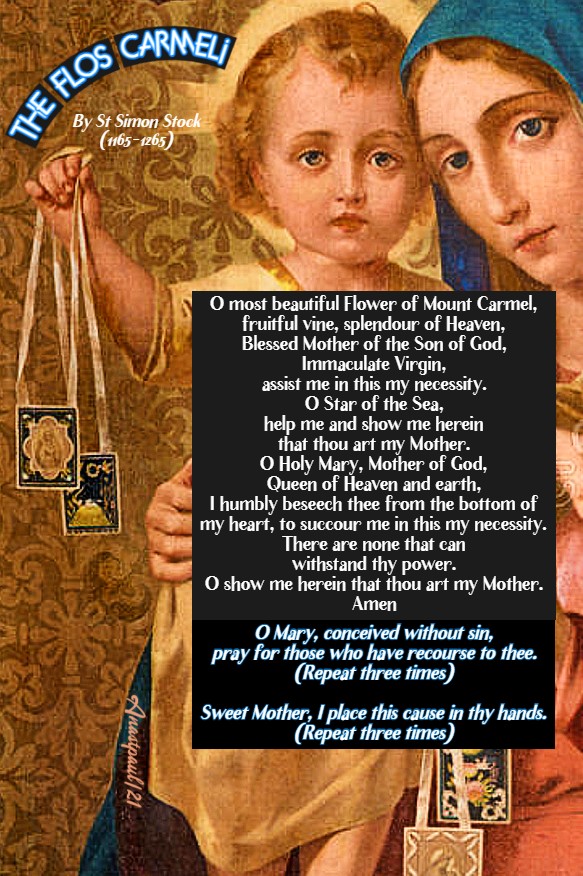
Our Morning Offering – 16 July – The Memorial of Our Lady of Mount Carmel
“The Flos Carmeli The Flower of Carmel” By St Simon Stock (1165-1265)
O most beautiful Flower of Mount Carmel, fruitful vine, splendour of Heaven, Blessed Mother of the Son of God, Immaculate Virgin, assist me in this my necessity. O Star of the Sea, help me and show me herein that thou art my Mother. O Holy Mary, Mother of God, Queen of Heaven and earth, I humbly beseech thee from the bottom of my heart, to succour me in this my necessity. There are none that can withstand thy power. O show me herein, that thou art my Mother. Amen.
O Mary, conceived without sin, pray for those who have recourse to thee. (Repeat three times)
Sweet Mother, I place this cause in thy hands. (Repeat three times)
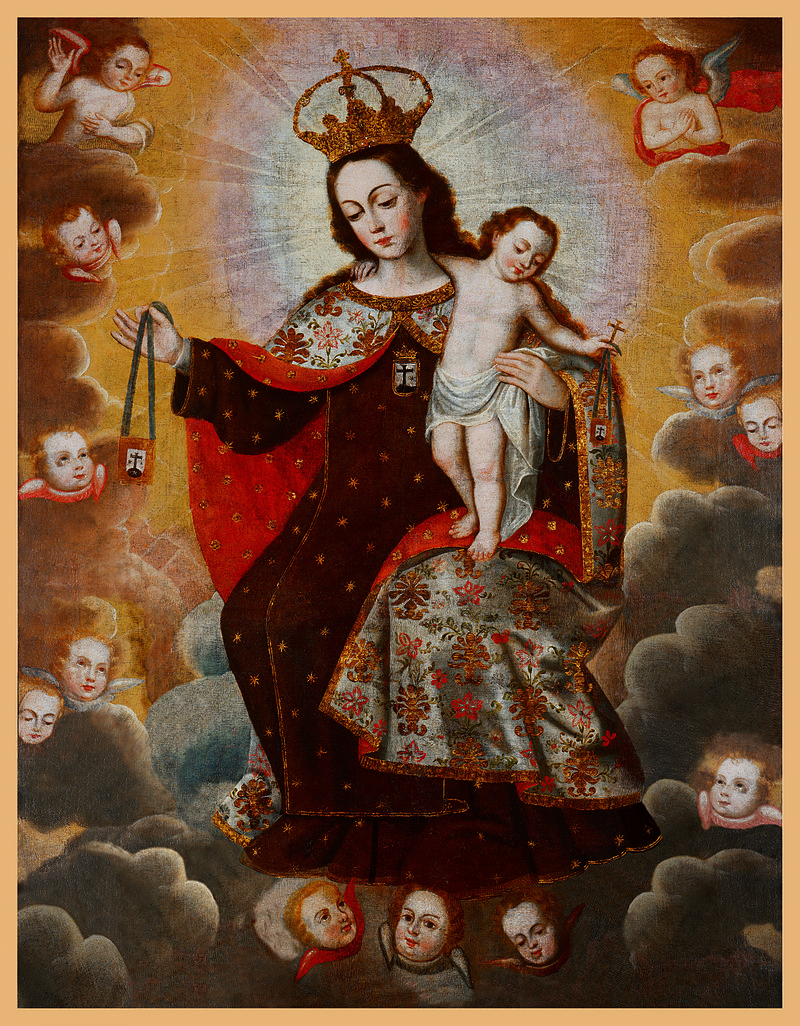
This prayer, the “Flos Carmeli” (“The Flower of Carmel”), was composed by St Simon Stock (1165-1265), a Carmelite, so-called because he and other members of his order lived atop Mount Carmel in the Holy Land. St Simon Stock was visited by the Blessed Virgin Mary on 16 July 1251, at which time, she bestowed upon him a scapular, or habit, (commonly called “the Brown Scapular”), which became part of the liturgical clothing of the Carmelite order Oral tradition tells of St Simon Stock praying, with a passionate intensity to Our Lady of Mount Carmel, during a time of great distress and hardship for the Order. With fervour and faith, he prayed his prayer, the Flos Carmeli for the first time. And Our Lady answered his prayer. Thus, for seven centuries the Flos Carmeli continues to be prayed to the Blessed Mother with the firm faith that she she will answer its request with her powerful help.
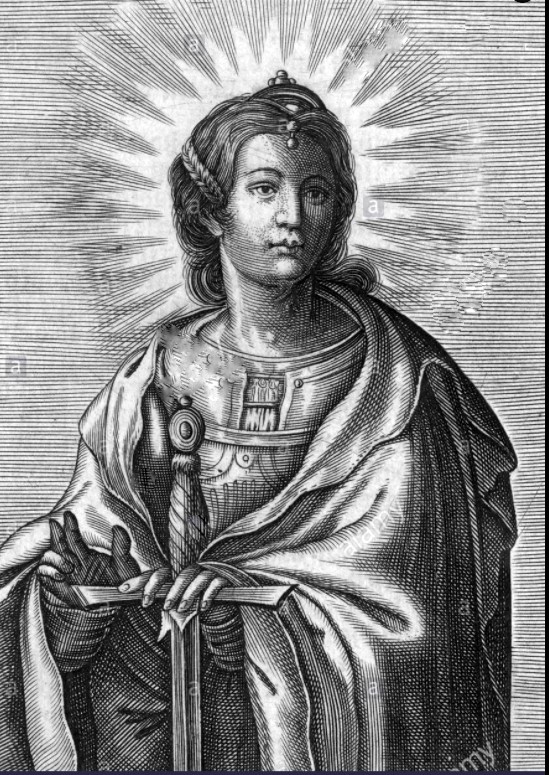
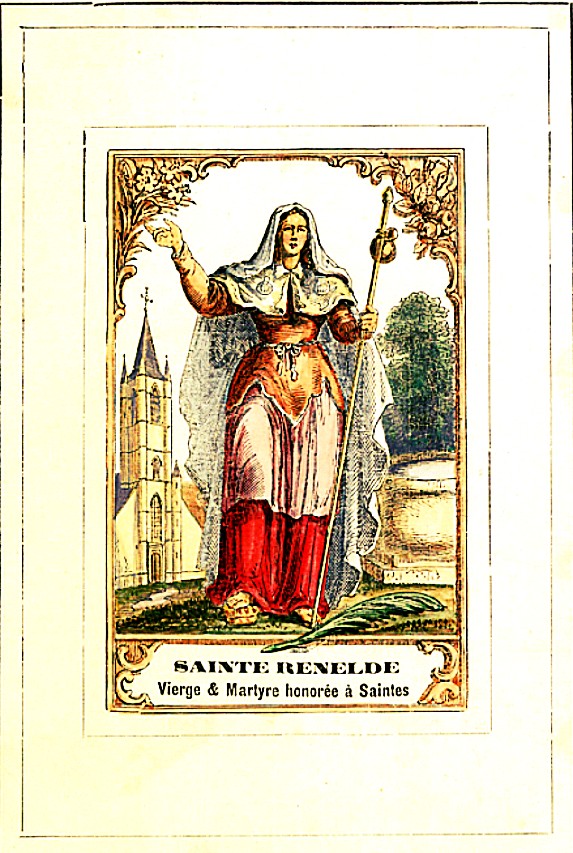
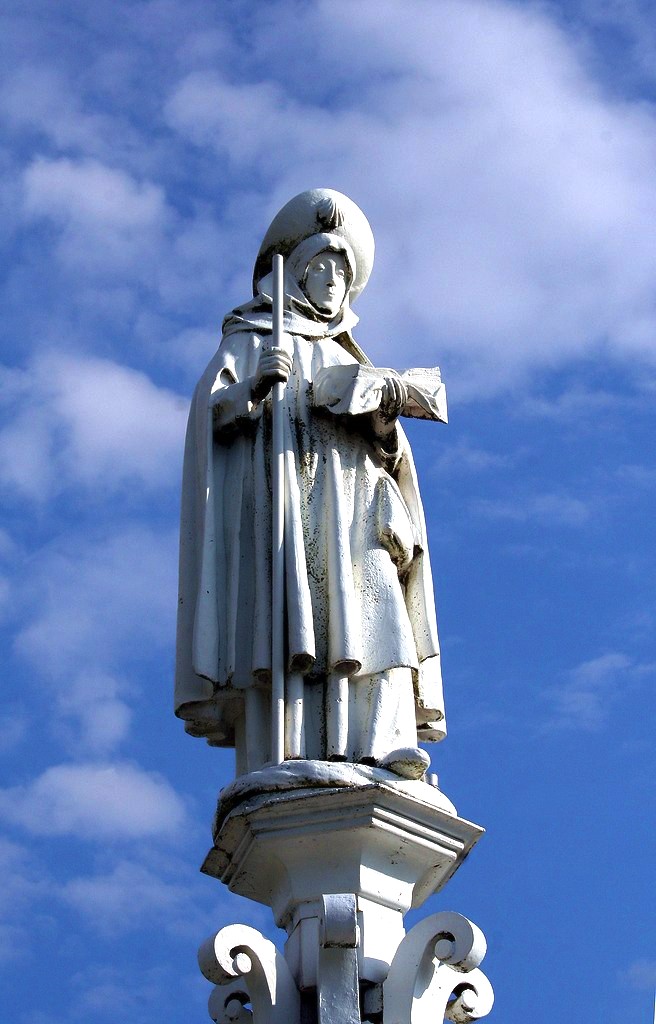
Saint of the Day – 16 July – St Reinildis of Saintes ( c 630 – c 700) Virgin, Laywoman, Martyr, Pilgrim. Born in c 630 in Kontich, Belgium and died by being beheaded in c 700 outside a Chapel in Saintes (in modern Halle), Belgium. by the invading Huns. Also known as – Reinildis of Condacum, Reinildis of Kontich, Rainelde, Raineldis, Reinaldes, Reineldis, Reinhild. Patronage – against eye diseases, the Town of Saintes.
The Roman Martyrology states: “At Saintes, in France, this holy Martyrs Reinildis, Virgin and her companions. who were massacred by bbarbarians for the Christian Faith.”
Reinildis was the daughter of St Amalberga (10 July – here: https://anastpaul.com/2017/07/10/saint-of-the-day-10-july-st-amalberge-of-mauberg/) but her birthplace is under discussion, since it is not known whether it is Kontich, just outside Antwerp, or Condésur-Escaut in present-day northern France. although the former seems more likely. Tradition holds that when her parents and sister, St Gudula (8 January), embraced the religious life, Reinildis followed her father to the Abbey of Lobbes, hoping to be able to enter it, giving the Abbey most of her riches and possessions . However, she did not enter for unknown reasons and instead left on a pilgrimage to the Holy Land, where she stayed for seven years (some sources claim only two) and returned with many relics.
On her return she lived in Saintes, near Hal, southwest of Brussels, devoting all her time to assisting the poor and the sick. of the area. She was killed in Saintes during a barbarian raid. With her at the time of her Martyrdom was the servant Gandolfo and a sub-Deacon called Grimoaldo, all three venerated as Martyrs.
A cult began immediately after her death and in 866, the Bishop, St John of Cambrai, exhumed the relics and buried them again in a solemn ceremony. The first Life of St Reinildis dates from this period.
A document from the twelfth century describes the transfer of her relics to Lobbes Abbey probably in 1170 and their authentication by the local Bishop. It seems that this document was a homily written by a Monk of Lobbes on the day of the anniversary of the translation, and it is more hagiographic than historical but, at least it is a reliable testimony, that the cult of Reinildis was widespread in the Saintes area and in the Abbey of Lobbes.
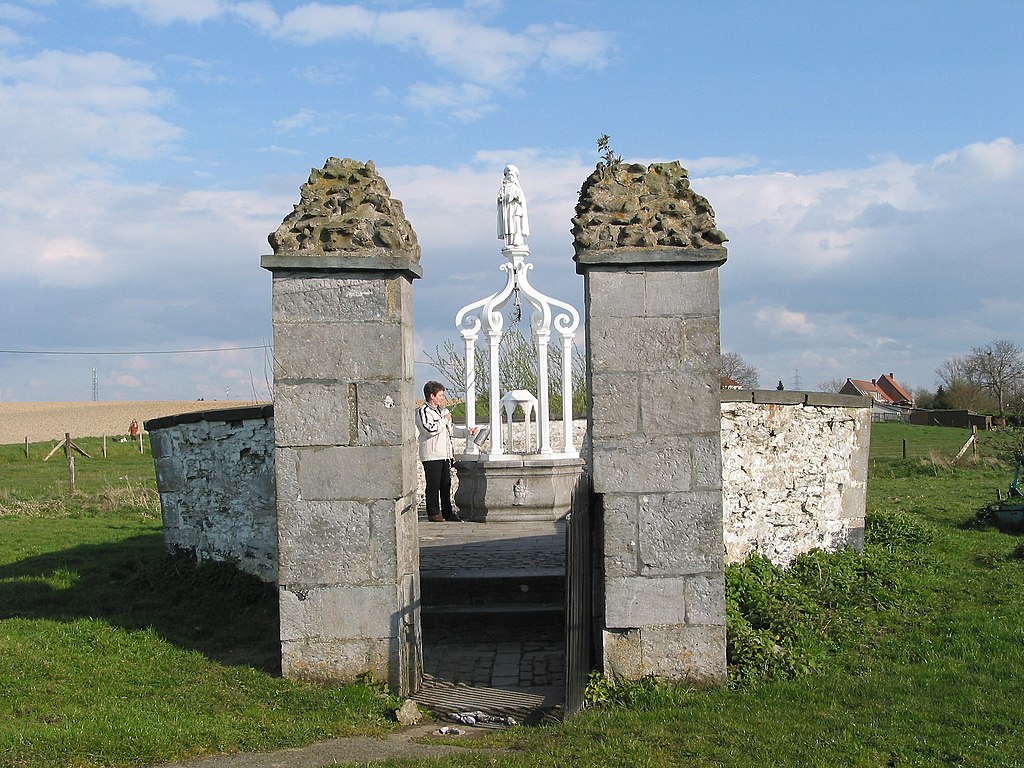
Saint Reinildis’ Patronage against eye diseases is due to the association with a well in Saintes known as “Sainte Renelde’s Well,” the water of which is believed to cure eye diseases.
Saint Reinildis is greatly venerated in Saintes as the Patron Saint of the Town. Some sources even indicate that Saintes owes its name to Reinildis” Martyrdom
The Parish Church of Saintes is, since the Middle Ages, dedicated to Sainte Reinildis and has preserved some of her relics.
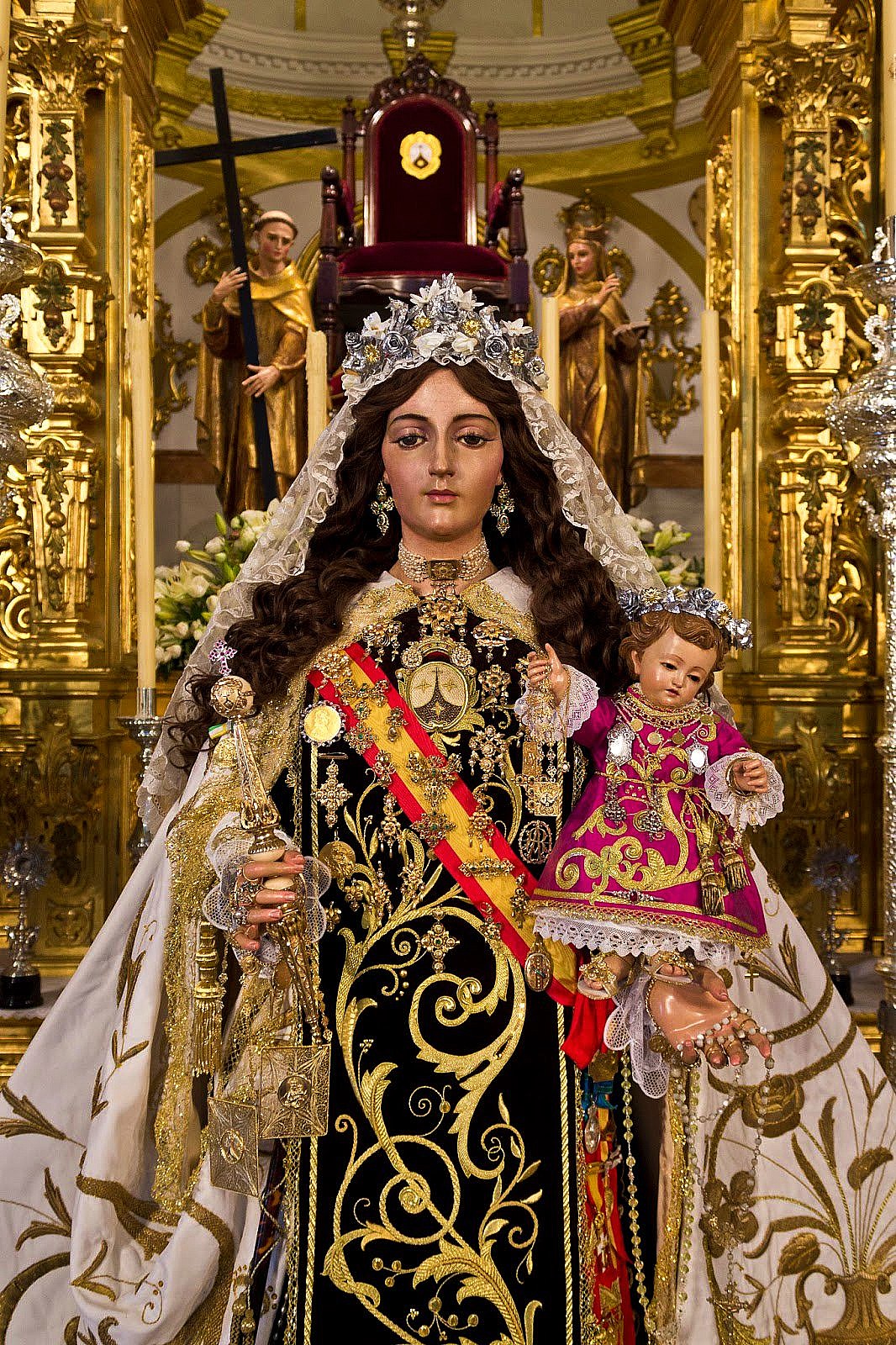
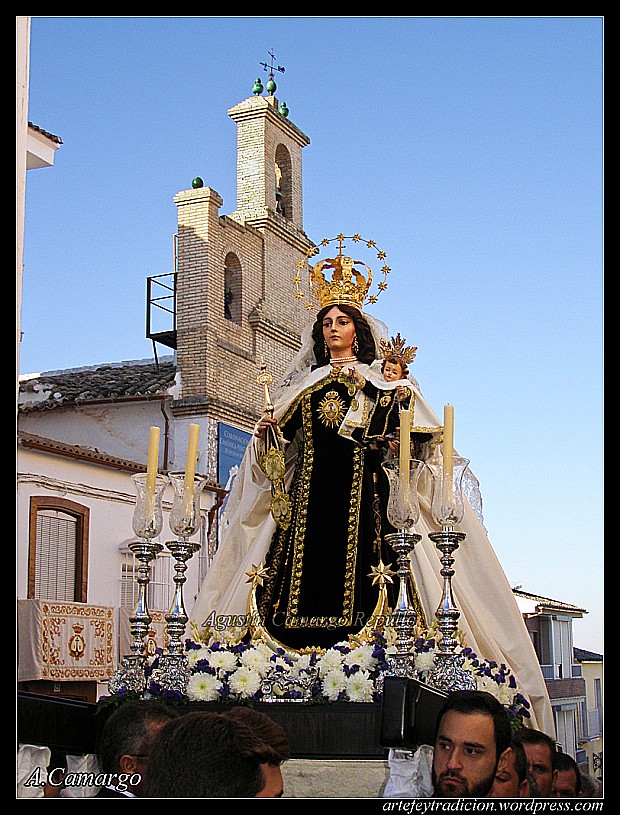
Nuestra Señora del Carmen (Rute, Córdoba, Andalucía, Spain) (17th Century)– 16 July, 13 February – Patron of Rute:
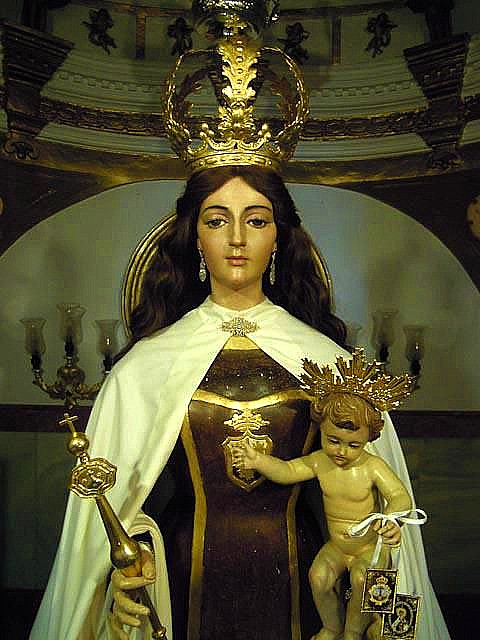
By order of Pope Pius XI, Our Lady of Mount. Carmel was proclaimed Patron of the Town of Rute in southern Spain on 13 February1924. Her beloved image goes back to the late 1600s, when Luisa Roldán (La Roldana) of Seville carved the head and hands. Made to be dressed, the Statue did not have a proper body until the 1960s.
It occupies a neo-baroque setting over the High Altar, also of the 1960s. Rute honours its Patron several times a year. The anniversary celebration lasts three days, culminating on 13 February with Mass, presentations to the Chief of the Brotherhood and the Fiesta Queen of gifts made for the Virgin, and a ceremony of kissing the Scapular of Our Lady of Mount. Carmel. Her liturgical feast day, 16 July is the focus of another three-day celebration. On the last Sunday of June, the procession is held, when the Statue goes in procession through the neighbourhood to the main Parish Church of Santa Catalina Mártir. Another triduum is celebrated around the feast of the Assumption, 14-16 August.
Bl André de Soveral St Andrew the Hermit St Antiochus of Sebaste Bl Arnold of Clairvaux Bl Arnold of Hildesheim St Athenogenes of Sebaste
St Bartholomew of Braga OP – ArchBishop of Braga also known as Bl Bartholomew of the Martyrs (Bartolomeu Fernandez dei Martiri Fernandes) (1514-1590) Portuguese Dominican Friar and Priest, Writer, Theologian, Advisor, Teacher and Catechetical writer, Apostle of Charity founding a series of hospitals and hospices in Braga and surrounds. St Bartholomew: https://anastpaul.com/2018/07/16/saint-of-the-day-16-july-blessed-bartholomew-of-the-martyrs-1514-1590/
Bl Claude Beguignot Bl Domingos Carvalho St Domnin St Domnio of Bergamo Bl Dorothée-Madeleine-Julie de Justamond St Elvira of Ohren St Eugenius of Noli St Faustus St Faustus of Rome and Milan St Fulrad of Saint Denis St Generosus of Poitou St Gobbán Beg St Gondolf of Saintes St Grimoald of Saintes St Helier of Jersey Bl Irmengard Bl John Sugar St Landericus of Séez Bl Madeleine-Françoise de Justamond Bl Marguerite-Rose de Gordon Bl Marguerite-Thérèse Charensol Bl Marie-Anne Béguin-Royal Bl Marie-Anne Doux
Bl Marie-Rose Laye Bl Milon of Thérouanne Bl Nicolas Savouret Bl Ornandus of Vicogne St Paulus Lang Fu St Reinildis of Saintes ( c 630 – c 700) Virgin, Laywoman, Martyr Bl Robert Grissold Bl Simão da Costa St Sisenando of Cordoba St Tenenan of Léon St Teresia Zhang Heshi St Valentine of Trier St Vitalian of Capua St Vitaliano of Osimo St Yangzhi Lang — Martyrs of Antioch – 5 saints: Five Christians who were martyred together. No details about them have survived by the names – Dionysius, Eustasius, Maximus, Theodosius and Theodulus. They were Martyred in Antioch, Syria, date unknown.
Thought for the Day – 15 July – Meditations with Antonio Cardinal Bacci (1881-1971)
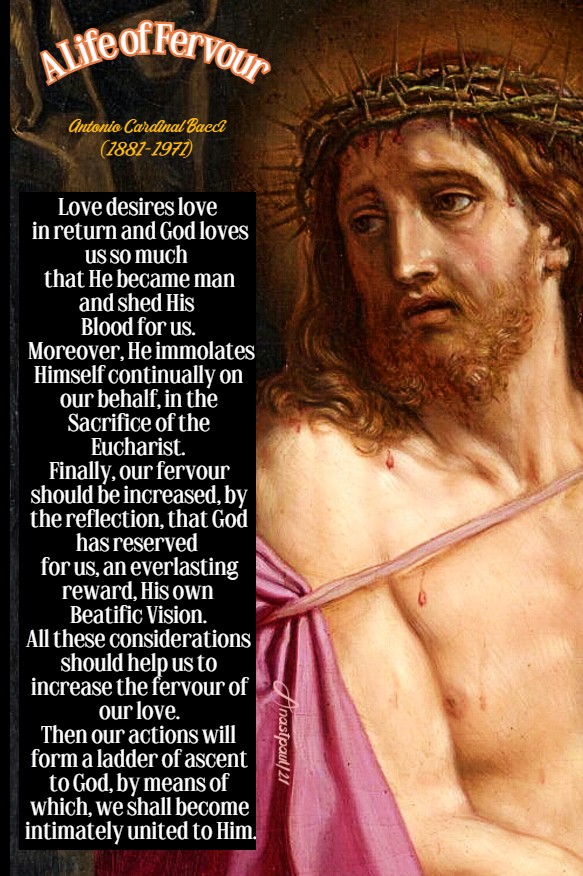
A Life of Fervour
“God is our Creator and absolute Master, Whom the Angels adore and irrational creatures obey. His greatness demands that we should offer all our activities to Him in a spirit of fervent and loving dedication. Since we have received everything from Him, we have many reasons for loving Him. By the work of redemption, God became our Friend and our Brother and the Victim of Expiation for our sins. How could we remain indifferent and ungrateful when we remember the favours which we have received . Love desires love in return and God loves us so much that He became man and shed His Blood for us. Moreover, He immolates Himself continually on our behalf, in the Sacrifice of the Eucharist. Finally, our fervour should be increased, by the reflection, that God has reserved for us, an everlasting reward, His own Beatific Vision.
All these considerations should help us to increase the fervour of our love. Then our actions will form a ladder of ascent to God, by means of which, we shall become intimately united to Him.
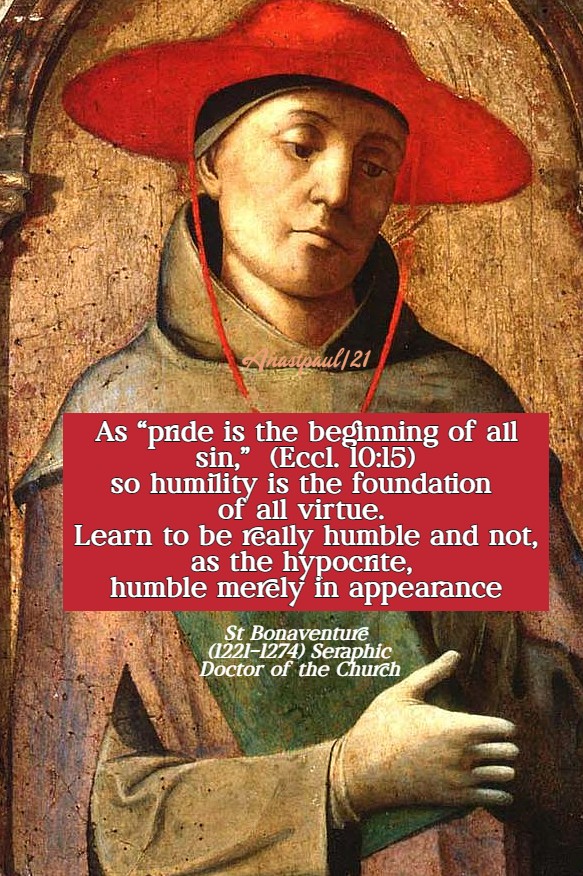
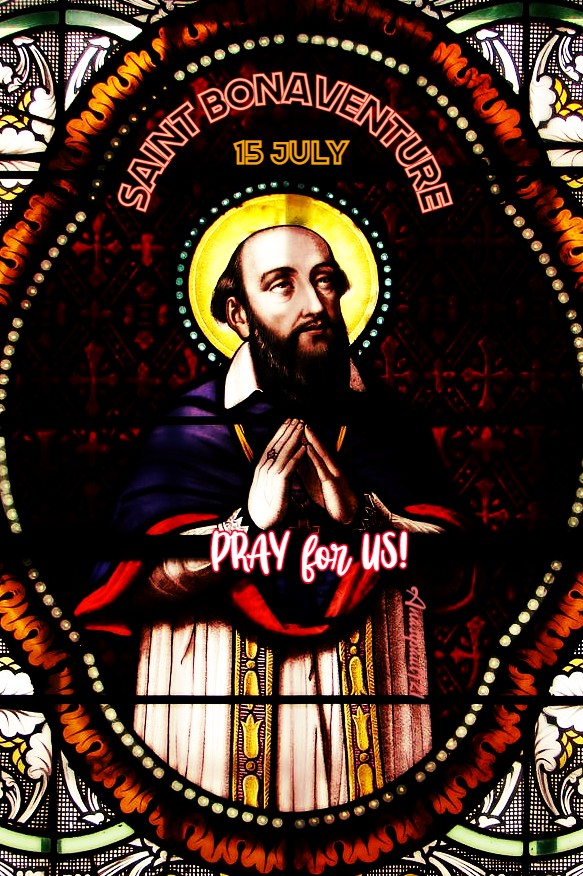
Quote/s of the Day – 15 July – “Month of the Most Precious Blood” and the Memorial of St Bonaventure OFM (1221-1274) Seraphic Doctor of the Church
“As “pride is the beginning of all sin,” (Eccl. 10:15) so humility is the foundation of all virtue. Learn to be really humble and not, as the hypocrite, humble merely in appearance.”
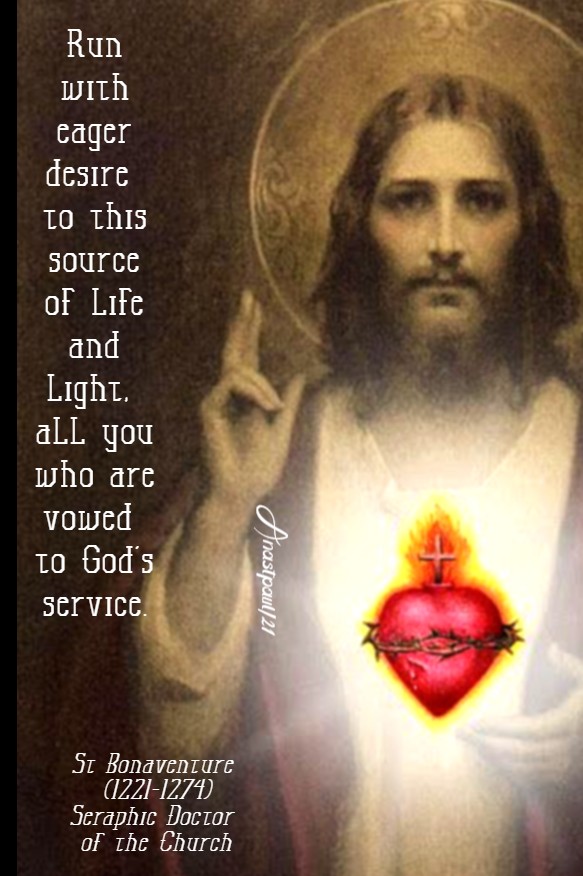
“Run with eager desire to this Source of Life and Light, all you who are vowed to God’s service.”
St Bonaventure’s Sermon of 4 October 1255
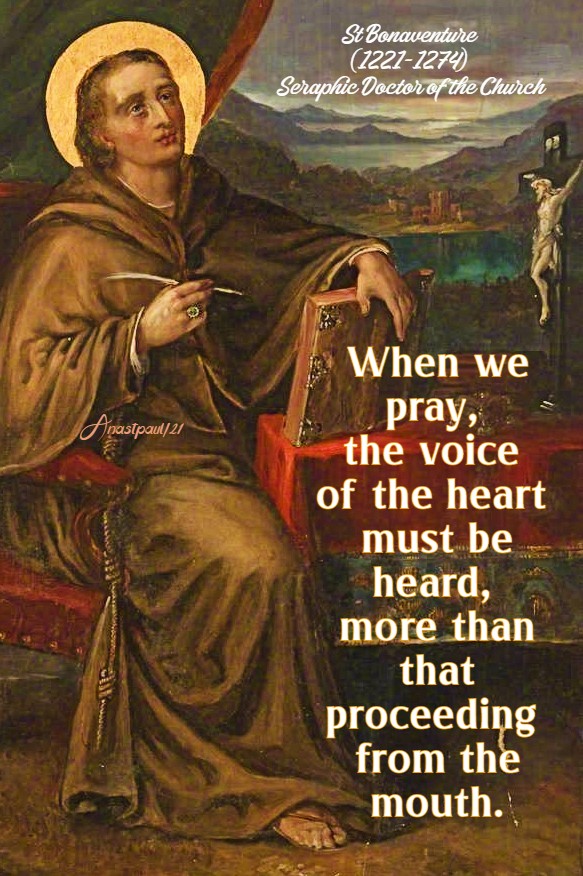
“When we pray, the voice of the heart must be heard , more than that proceeding from the mouth.”
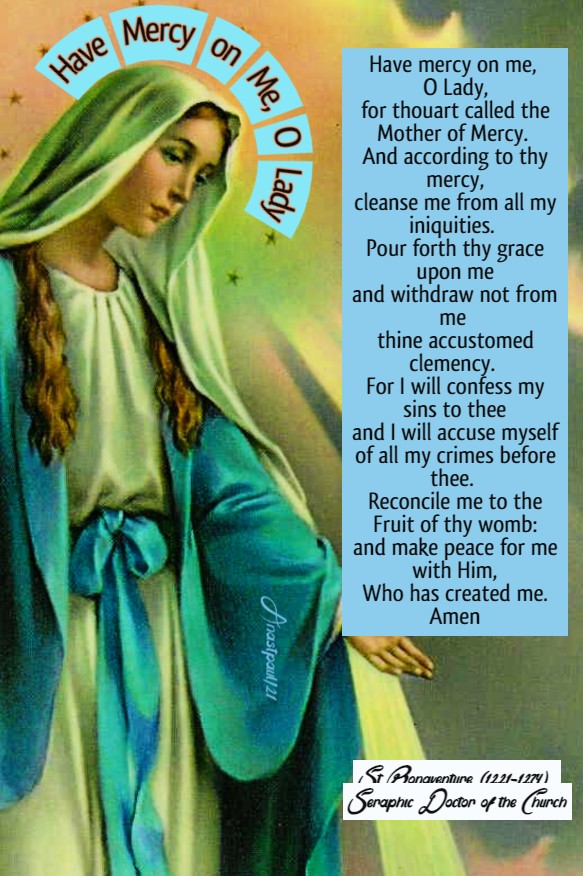
“Have Mercy on Me, O Lady
Have mercy on me, O Lady, for thou art called the Mother of Mercy. And according to thy mercy, cleanse me from all my iniquities. Pour forth thy grace upon me and withdraw not from me thine accustomed clemency. For I will confess my sins to thee and I will accuse myself of all my crimes before thee. Reconcile me to the Fruit of thy womb: and make peace for me with Him, Who has created me. Amen.”
The Psalter of the Blessed Virgin Mary by St Bonaventure
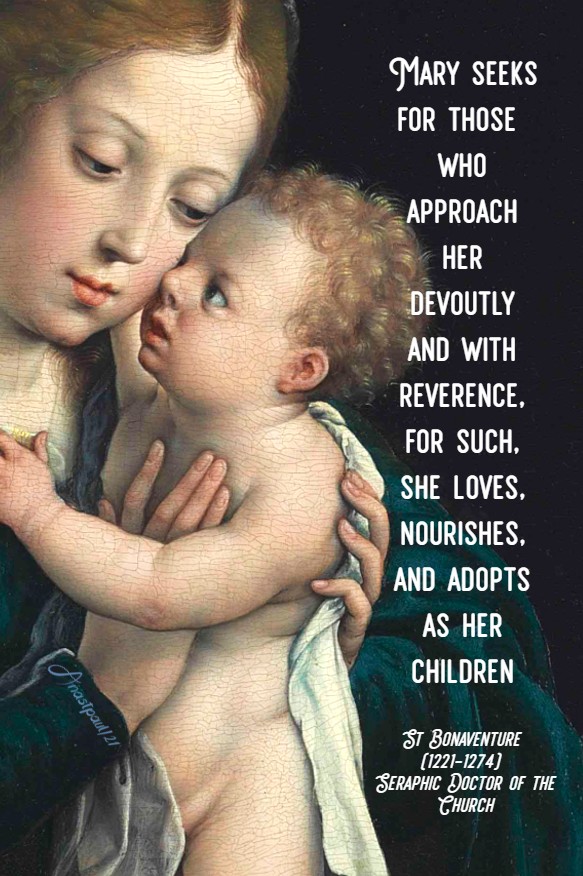
“Mary seeks for those who approach her devoutly and with reverence, for such she loves, nourishes, and adopts as her children. ”
One Minute Reflection – 15 July – “Month of the Most Precious Blood” and the Memorial of St Bonaventure (1221-1274) Seraphic Doctor of the Church – Readings: Exodus 3: 13-20; Psalms 105: 1 and 5, 8-9, 24-25, 26-27; Matthew 11: 28-30
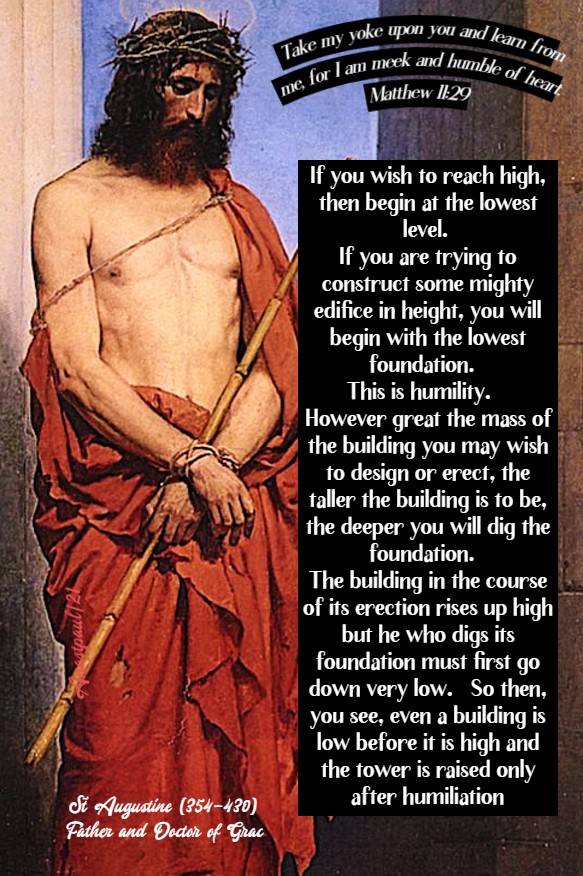
“Take my yoke upon you and learn from me, for I am meek and humble of heart and you will find rest for your souls…” – Matthew 11:29
REFLECTION – “You are to “take my yoke upon you and learn from me.” You are not learning from Me, how to re-fashion the fabric of the world, nor to create all things visible and invisible, nor to work miracles and raise the dead. Rather, you are simply learning of Me: “that I am meek and lowly in heart.”If you wish to reach high, then begin at the lowest level. If you are trying to construct some mighty edifice in height, you will begin with the lowest foundation. This is humility. However great the mass of the building you may wish to design or erect, the taller the building is to be, the deeper you will dig the foundation. The building in the course of its erection rises up high but he who digs its foundation must first go down very low. So then, you see, even a building is low before it is high and the tower is raised only after humiliation.” – St Augustine (354-430) Bishop, Father and Doctor of Grace – Sermon 69.
PRAYER – Holy God, our Father, we turn to You in confidence as children and pray, give us meekness of heart, make us “poor in spirit” that we may recognise that we are not self-sufficient, that we are unable to build our lives on our own but need You, we need to encounter You, to listen to You, to speak to You. Help us to understand that we need Your gifts, Your wisdom, which is Jesus Himself, in order to do the Your will in our lives and thus to find rest in the hardships of our journey. Grant we pray that the prayers of our Blessed Mother, St Bonaventure and all Your Angels and Saints, may carry us home to You. Through Christ our Lord, one God with You and the Holy Spirit, now and forever, amen.
Our Morning Offering – 15 July – “Month of the Most Precious Blood” and the Memorial of St Bonaventure (1221-1274) Seraphic Doctor of the Church
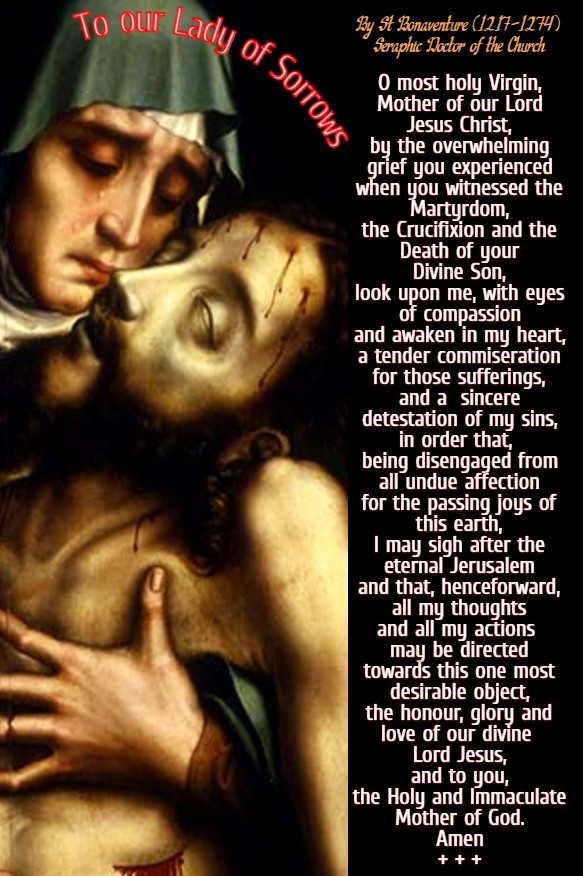
To our Lady of Sorrows By St Bonaventure (1217-1274) Seraphic Doctor of the Church
O most holy Virgin, Mother of our Lord Jesus Christ, by the overwhelming grief you experienced when you witnessed the Martyrdom, the Crucifixion and the Death, of your Divine Son, look upon me, with eyes of compassion and awaken in my heart, a tender commiseration for those sufferings and a sincere detestation of my sins, in order that, being disengaged from all undue affection for the passing joys of this earth, I may sigh after the eternal Jerusalem and that, henceforward, all my thoughts and all my actions may be directed towards this one most desirable object, the honour, glory and love of our divine Lord Jesus, and to you, the Holy and Immaculate Mother of God. Amen.
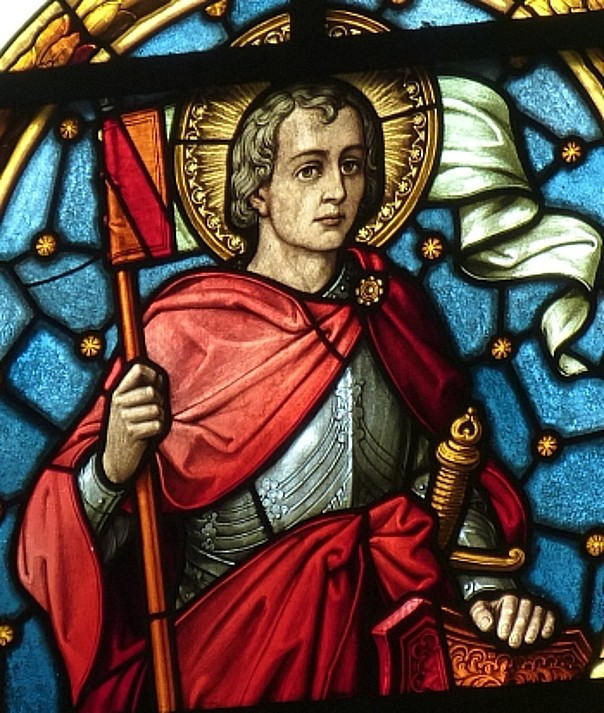
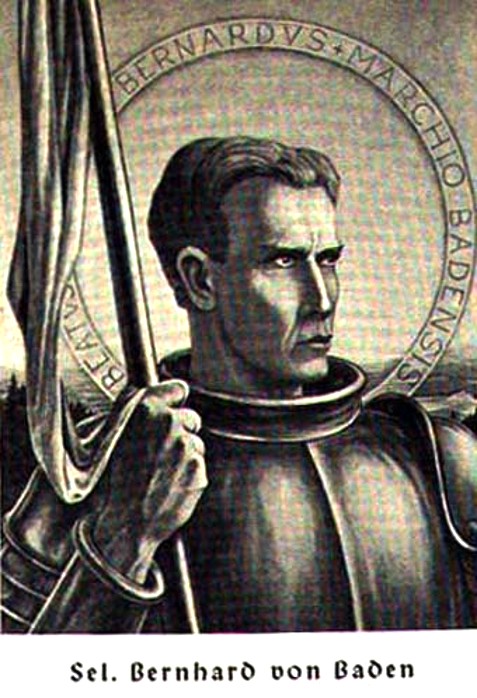
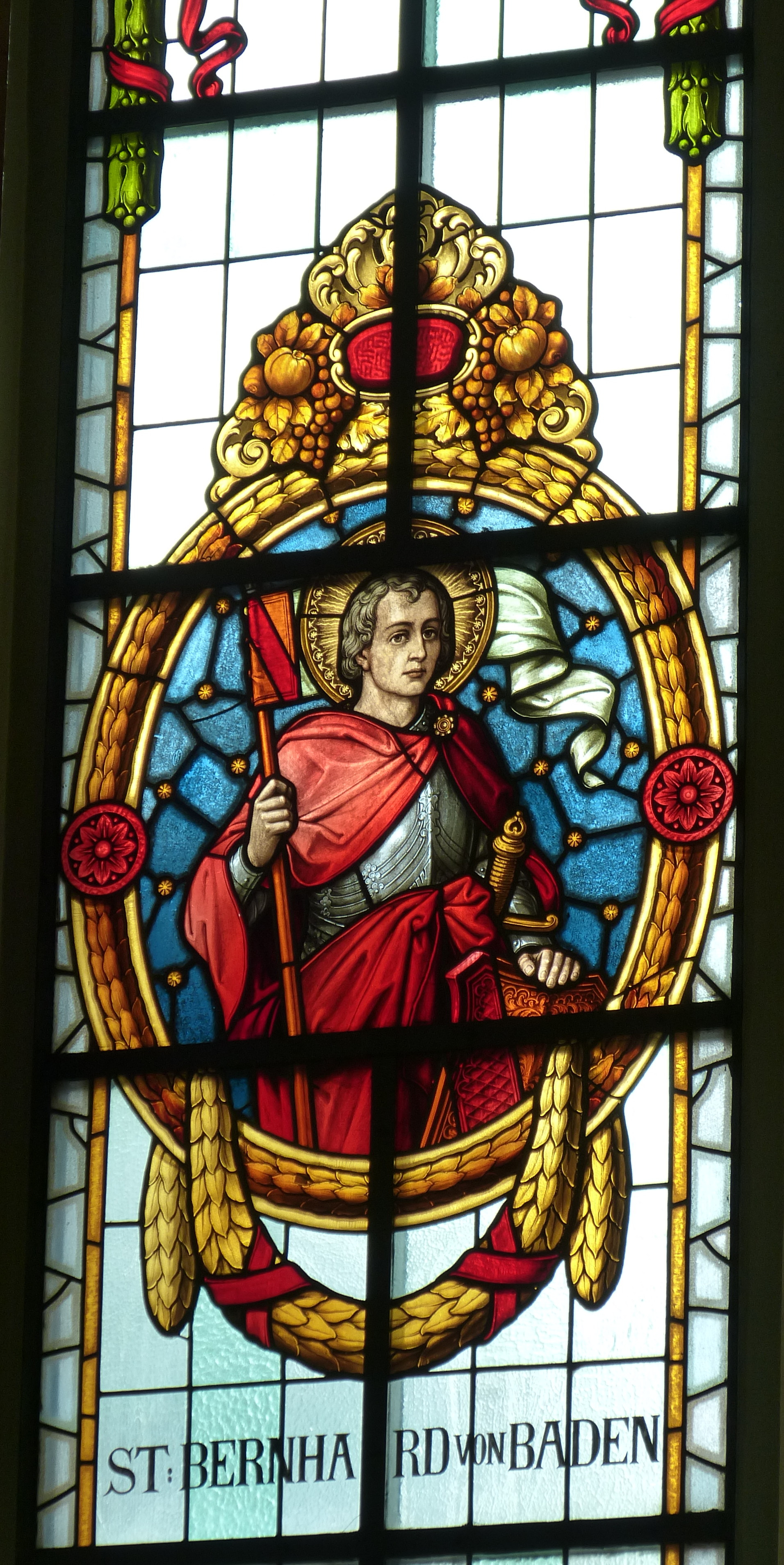
Saint of the Day – 15 July – Blessed Bernard of Baden TOSF (1428-1458) Margrave of Baden (Margrave was originally the medieval title for the military commander assigned to maintain the defence of one of the border provinces of the Holy Roman Empire.) Tertiary of the Order of St Francis, apostle of the poor and the needy. Born in c 1428 in Hohenbaden Castle, Baden-Baden, Baden-Württemberg, Germany and died on 15 July 1458 in Moncalieri, Italy of natural causes. Also known as – Bernard of Marchio, Bernard II, Margrave of Baden-Baden, Bernhard of Baden, Bernardo, Bernardus, Bernhard. Patronages – Baden, Germany, Baden-Baden, Germany, together with Saint Konrad of Constance , he is the Patron Saint of the Archdiocese of Freiburg, Germany, Moncalieri, Italy.
Blessed Bernard was born in late 1428 or early 1429 (his exact birthday is not known) at Hohenbaden Castle near Baden-Baden in the present state of Baden- Baden. Württemberg in Germany. This Castle was the then tribal seat of the Margraves of Baden and Bernhard was the second son of Margrave James I and his wife Catherine of Lorraine, who was the daughter of Blessed Margaret of the Palatinate and Duke Charles II of Lorraine (1364-1431) .
Berrnard grew up in a deeply religious family. His father,had founded Fremersberg Abbey and expanded the Collegiate Church in Baden-Baden. The Margrave’s house was characterised by a deep devotion and religious practices and a great sense of responsibility towards the family members and subjects.
Bernard received a careful education, which would prepare him for his later role as a sovereign. The intent was that he would be Margrave of Pforzheim, Eberstein, Besigheim and several districts in the northern part of the Margraviate.
He was related to the Habsburg dynasty via his older brother Karl I, who had married Catherine of Austria, a sister of Emperor Frederick III. This relationship should give Bernard access to the imperial Court. But first, he assisted his uncle René of Anjou in an armed conflict in northern Italy. According to contemporary sources, he fought bravely. After his father’s death in 1453, he returned to Baden, where he agreed with his brother to give up his claim to part of the margraviate. Instead, he became Frederick III’s personal envoy, despite his young age.
Bernard saw a number of disgraceful situations and tried to alleviate hardship and poverty wherever he could. He spent most of his income assisting the poor and those in need. Even during his lifetime, he impressed his contemporaries with his unusual and deep piety.
Under pressure, after the fall of Constantinople to the Turks in 1453, the imperial Habsburg family began preparing a Crusade against the expanding Ottoman Empire. In March 1453, the Turks captured Constantinople, the capital of the Greek Empire, after a terrible battle and the City was lost to Christianity. This was the main reason that Frederick III, in particular, saw the need to attempt to rout the Turks. Thus, Bernard left soldier life and embarked on a diplomatic career, which was more in line with his peaceful nature. Emperor Frederick III sent him to various Courts in Germany, France and Italy to arouse interest and raise money for a new Crusade. He was so attracted to this mission to save Christianity, that he soon after handed over the office of Margrave of Baden with all rights to his brother Karl for a period of ten years.
Bernard had, since childhood, lived a very religious life and wanted to support his brother-in-law the Emperor by all means. At the imperial Court he also became an ardent intercessor for the needy, following the teachings of Christ and His Church and seeing the Face of Christ in the poor. Bernard rightly believed, that Godliness should lead to mercy for those in most need. He himself lived as he taught and divided his guaranteed annual income into three: one-third was to be used for the poor, one-third was to benefit the Church, and one-third was for himself. In addition, he led a strictly religious life and gave up all worldly pleasures, which earned him deep respect even during his young lifetime.
Emperor Frederick III held two parliaments in 1455, where he appointed delegations of German Princes to recruit rulers outside Germany to take part in a crusade against the Turks. Bernard’s intention was to work on behalf of Emperor Frederick III for the good of Christianity in the areas that the Turks had occupied. His last voyage as an imperial envoy began in late May 1458 and led him and his companions to the Duchy of Orléans and on to Genoa.
He was on his way to Rome, to meet Pope Callistus III (1455-1458), who himself tried to encourage support for a Crusade with great enthusiasm but little success . But shortly after Bernard left Turin in northern Italy, he and his companions were infected by an epidemic, probably the plague. He tried to get home to Baden but even before reaching the village of Moncalieri on the Po River south of Turin in Piedmont, two of his companions were dead. In a hostel next to the Franciscan Monastery in Moncalieri, Bernard died on 15 July 1458, not yet thirty years old.
Due to his position as Prince and Emperor’s envoy, Margrave Bernard was buried in front of the High Altar in the dormitory Church of Santa Maria della Scala in Moncalieri. He was not a citizen of Moncalieri but was, nevertheless, solemnly carried to the grave in the presence of numerous clergy and local citizens, which was probably due more to his privileged status, than the strongly believing and holy life he had led.
During the mourning ceremony, Bernard’s life was told, which led to a citizen of Moncalieri asking Bernhard for prayer and help, as he had only been able to move with a cane and crutches for a long time the result of a bone disease. Already, during the mourning ceremony, this man recovered, which led to general astonishment and joy and was immediately attributed to the prayers of the newly buried Badian Margrave. Bernard’s cult and calls for help and support had begun. He already had a reputation for holiness and for a special devotion to the Virgin Mary, and many miracles were reported at his tomb. In Moncalieri and the surrounding area, accounts spread of his effective intercession. His tomb and his relics became a pilgrimage site which it still is. Pilgrimages were and are held there, prayers are said, vows are made and sacrifices are offered. Bernhard has, for many centuries, been the Patron Saint of Moncalieri, which is probably the only City in Italy, that has a German Prince as their Protector.
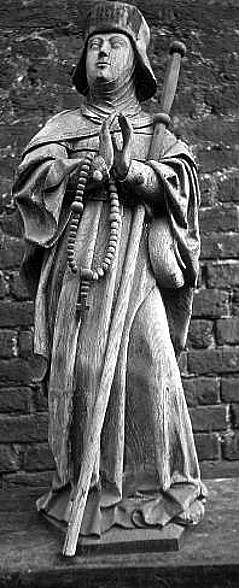
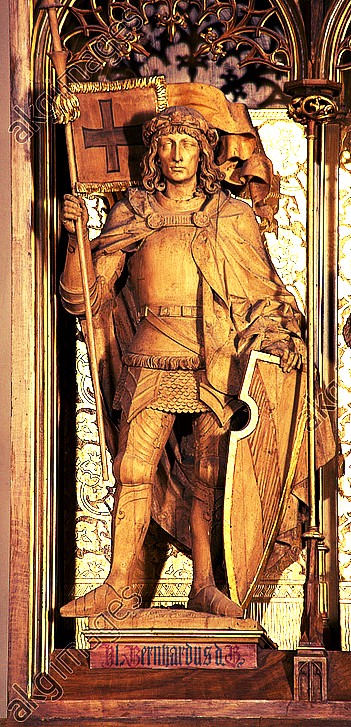
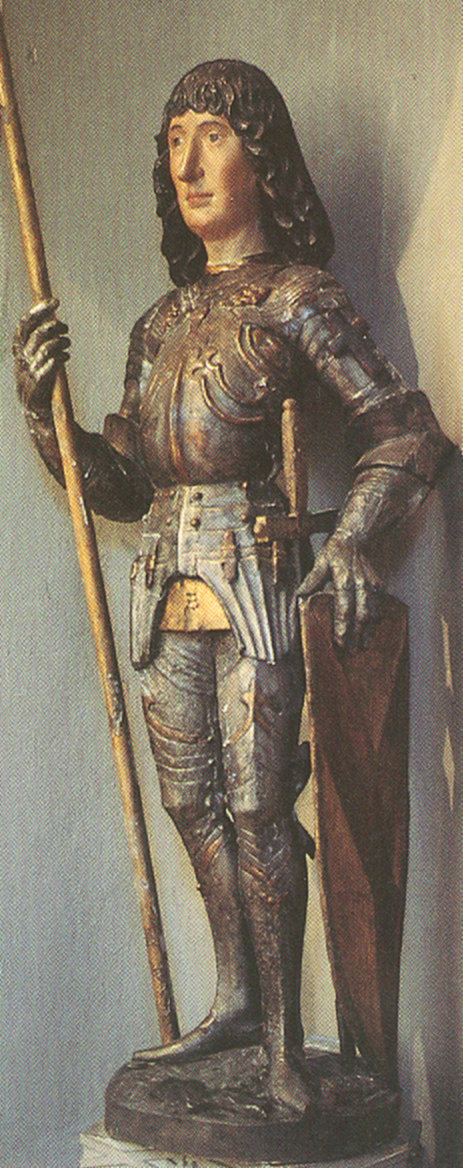
His cult spread rapidly in Piedmont and the surrounding areas of France and Germany. In Vic near Nancy and Metz in Lorraine, where Bernhard’s brother Georg had been Bishop, an Altar and Statue were rected in St. Stephan’s Collegiate Church. Of course, he was also remembered in his home county. There, Margaret, daughter of Margrave Charles I, who from 1477 to 1496 was Abbess of the Monastery of Lichtenthal, had a wooden Statue made in honour of her uncle, which was erected in the princely Chapel.
The wooden Statue erected by Bleseed Bernard’s niece
Bernard was Beatifed on 16 September 1769 by Pope Clement XIV. His Canonisation process continues, at present, the second miracle required is being investigated.
Mariae Virginis Molanus / Our Lady of Molanus, Jerusalem (1099) – 15 July :
In the year 1099, the Christian armies arrived in Jerusalem, overjoyed that they had survived and reached their objective. Their joy turned nearly to despair, however, as they ran short of food and suffered greatly with a plague during the siege of the City. The leaders of the Crusade concluded, that they could not win without courting the Divine Assistance. It was agreed by all, that they should march together barefoot around the City while singing litanies to the Blessed Virgin Mary. This they did, as the Jews had done centuries before at Jericho, while praying, fasting and giving alms. Eight days later, Godfrey of Bouillon, known as the “Defender of the Holy Sepulchre,” was the first to breach the walls and set foot in Jerusalem, which was then swiftly taken. The Turks were finally defeated after what had been a long and difficult siege and the First Crusade ended with a Christian victory. Now that the City was in Christian hands, the Crusaders desired that they should have a king for the new Kingdom of Jerusalem. The nobleman Raymond of Saint Gilles was offered the crown but he refused, as it did not seem proper to him to be named king in that holy place. Next, Robert Courte-Heuse also refused. Finally, Godfrey of Bouillon, who had so distinguished himself in the taking of Jerusalem, was asked to accept the crown.
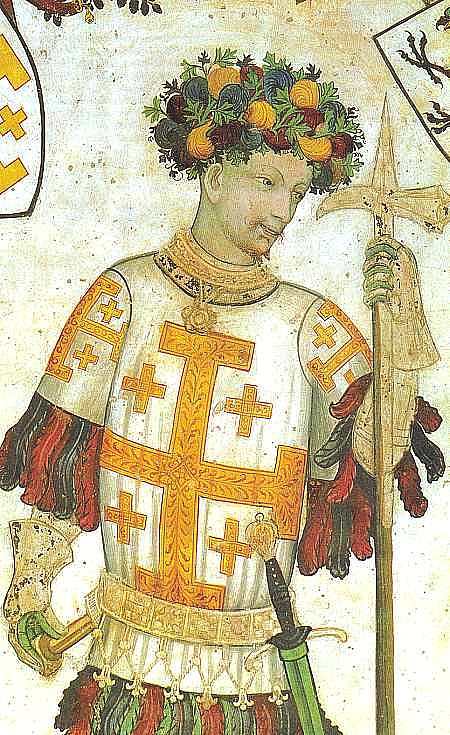
Godfrey of Bouillon, from a fresco painted by Giacomo Jaquerio in Saluzzo, northern Italy, around 1420.
Godfrey of Bouillon was a good man, the son of Blessed Ida of Bouillon, whose father was the Duke Godfrey of Lorraine, himself a descendent of Blessed Charles the Great. Although Godfrey agreed to be made king, still, as they were about to crown him King of Jerusalem, Godfrey pushed aside the crown, saying, “I cannot wear a diadem in the place where my Lord wore a Crown of Thorns.” Instead, as he had prayed at Our Lady at Boulogne-sur-mer before leaving on the Crusade, he credited the Blessed Virgin Mary with the victory, and symbolically gave the crown to Our Lady of Molanus. After the victory, clad in white garments, the Crusaders expressed, in solemn procession, hymns and prayers, their gratitude to the Mother of God for giving them this singular victory over the enemies of the Church.
The annual celebration in remembrance of the victory occurs each year on15 July with a Mass offered to Our Lady of Molanus. Formerly the feast of this event was celebrated with a double office and octave.
Dispersion of the Apostles: Commemorates the missionary work of the Twelve Apostles. It was first mentioned in the 11th century and was celebrated in the northern countries of Europe during the Middle Ages. It is now observed in Germany, Poland and some dioceses of England, France and the United States.
St Abundantia of Spoleto St Abudemius of Bozcaada St Adalard the Younger St Anrê Nguyen Kim Thông
Bl essed Anne-Mary Javouhey (1779-1851) “The Mother of the Slaves,” Religious Sister, Missionary and Founder of the Sisters of Saint Joseph of Cluny. Imagine a Mother Teresa in the France of Napoleon’s day and you will have a picture of Anne-Marie Javouhey. Nanette, as she was called, was a “velvet brick,” a thin layer of gentleness covering her determined core. A competent leader, Nanette dominated every scene in her adventurous life. Blessed Anne-Marie was Beatified on 15 October 1950 by Ven Pope Pius XII. Biography: https://anastpaul.com/2019/07/15/saint-of-the-day-15-july-blessed-anne-mary-javouhey-1779-1851/
Bl Antoni Beszta-Borowski St Apronia St Athanasius of Naples St Antiochus of Sebaste St Benedict of Angers Blessed Bernard of Baden TOSF (1428-1458) St David of Sweden St Donivald St Eberhard of Luzy St Edith of Tamworth St Eternus St Felix of Pavia St Gumbert of Ansbach St Haruch of Werden St Jacob of Nisibis St Joseph Studita of Thessalonica Bl Michel-Bernard Marchand Bl Peter Aymillo St Phêrô Nguyen Bá Tuan St Plechelm of Guelderland Bl Roland of Chézery St Valentina of Nevers St Vladimir I of Kiev — Martyred Jesuit Missionaries of Brazil – 40 beati: A band of forty Spanish, Portugese and French Jesuit missionaries martyred by the Huguenot pirate Jacques Sourie while en route to Brazil. They are – • Aleixo Delgado • Alonso de Baena • álvaro Borralho Mendes • Amaro Vaz • André Gonçalves • António Correia • Antônio Fernandes • António Soares • Bento de Castro • Brás Ribeiro • Diogo de Andrade • Diogo Pires Mimoso • Domingos Fernandes • Esteban Zuraire • Fernando Sánchez • Francisco Alvares • Francisco de Magalhães • Francisco Pérez Godoy • Gaspar Alvares • Gonçalo Henriques • Gregorio Escribano • Ignatius de Azevedo • Iõao • João Fernandes • João Fernandes • Juan de Mayorga • Juan de San Martín • Juan de Zafra • Luís Correia • Luís Rodrigues • Manuel Alvares • Manuel Fernandes • Manuel Pacheco • Manuel Rodrigues • Marcos Caldeira • Nicolau Dinis • Pedro de Fontoura • Pedro Nunes • Simão da Costa • Simão Lopes • They were martyed on 15 and 16 July 1570 on the ship Santiago near Palma, Canary Islands. They were beatified on 11 May 1854 by Pope Pius IX.
Martyrs of Alexandria – 13 saints: Thirteen Christians who were martyred together. We know the names of three, no details about them and the other ten were all children. – Narseus, Philip and Zeno. Martyred in the early 4th-century in Alexandria, Egypt.
Martyrs of Carthage – 9 saints: A group of nine Christians who were martyred together. We know nothing else but their names – Adautto, Catulinus, Felice, Florentius, Fortunanziano, Januarius, Julia, Justa and Settimino. They were martyred in Carthaginian and their relics at the basilica of Fausta at Carthage.
Martyrs of Pannonia – 5 saints: Five 4th-century martyrs killed together. No information about them has survived except the names – Agrippinus, Fortunatus, Martialis, Maximus and Secundinus.
Thought for the Day – 14 July – Meditations with Antonio Cardinal Bacci (1881-1971)
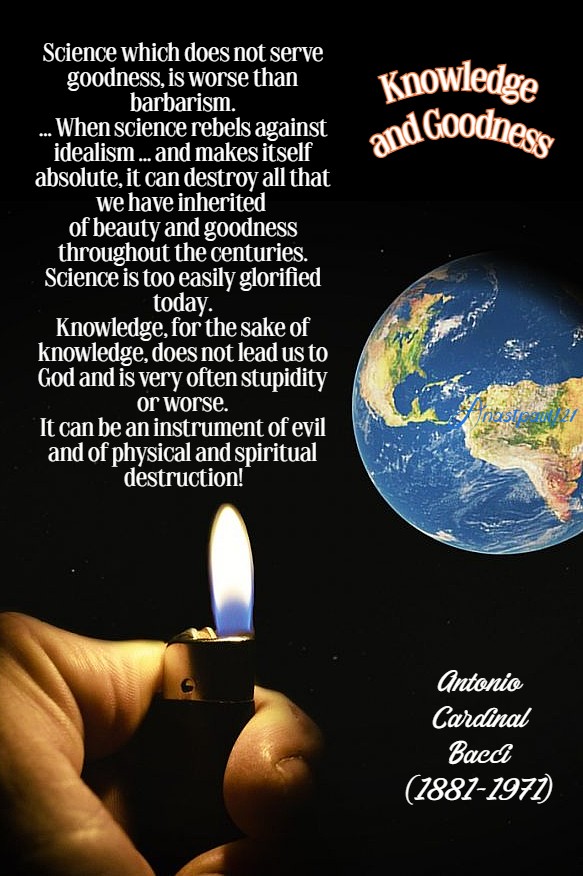
Knowledge and Goodness
“Joseph DeMaistre’s views on the relationship between knowledge and goodness may seem a little extreme but, they are nothing but the truth. “If the guardianship of education is not restored to the Church and if knowledge is not everywhere subordinated to goodness, the evils which await us will be incalculable. Science will brutalise us. Because of it, men will become more savage than the barbarians!”
We do not wish to speak slightingly of knowledge. It is a gift from God, Who has given us our intellects to know the truth. But truth, like every created thing, comes from God and should lead us back to God. It is the same with knowledge. If we investigate the secrets of nature and do not make of them a ladder, which helps us to climb towards our Creator, we turn the natural order upside down and inevitably fall backwards. We can gain, by our labours, a mastery over the hidden forces of nature. If we do not use them to benefit humanity but to destroy those of our brothers whom we call our enemies, we are worse than Cain. Science which does not serve goodness, is worse than barbarism. The latter has very few instruments of destruction at its disposal. When science rebels against idealism, however and makes itself absolute, it can destroy all that we have inherited of beauty and goodness throughout the centuries.
Science is too easily glorified today. But knowledge, for the sake of knowledge, does not lead us to God and is very often stupidity or worse. It can be an instrument of evil and of physical and spiritual destruction!”
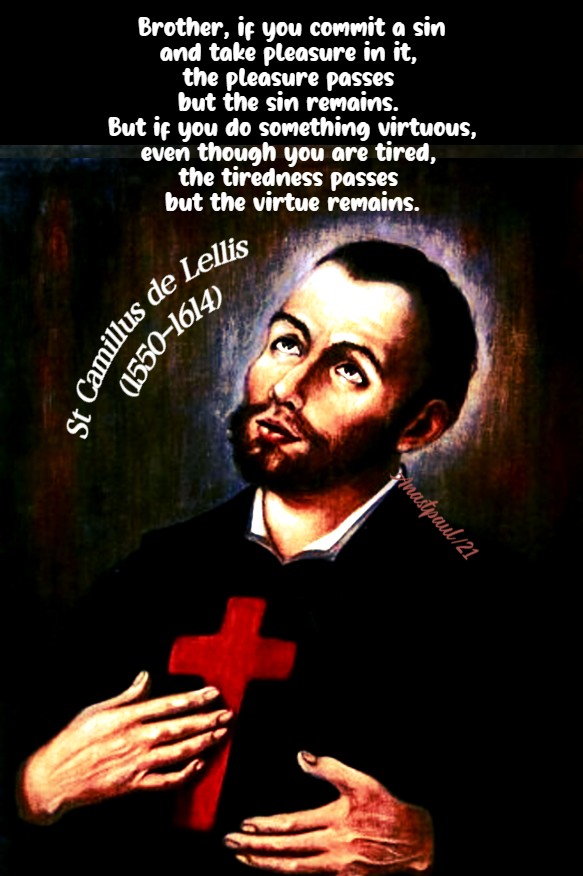
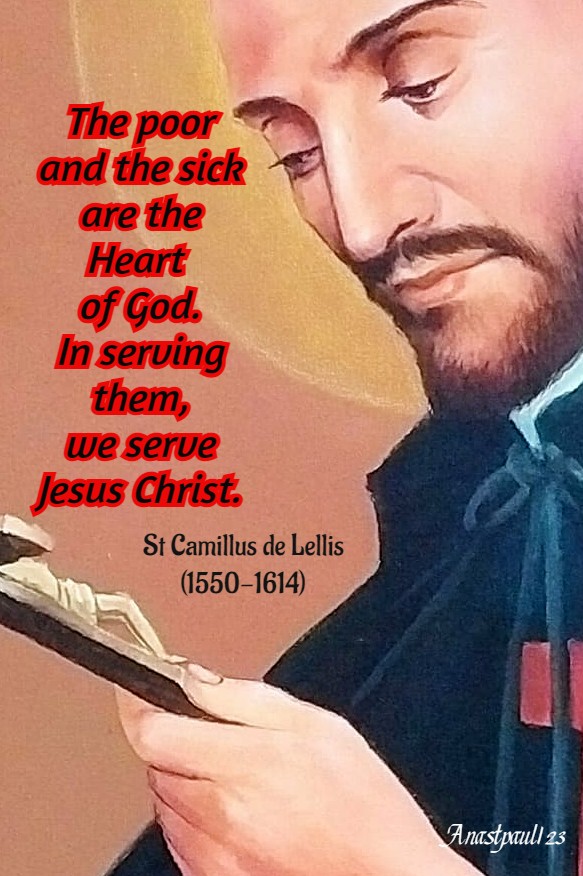
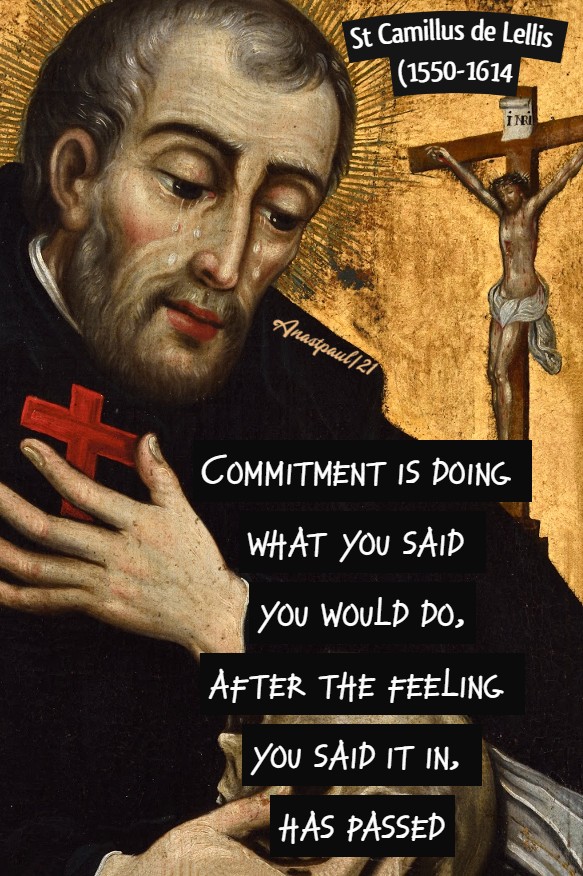
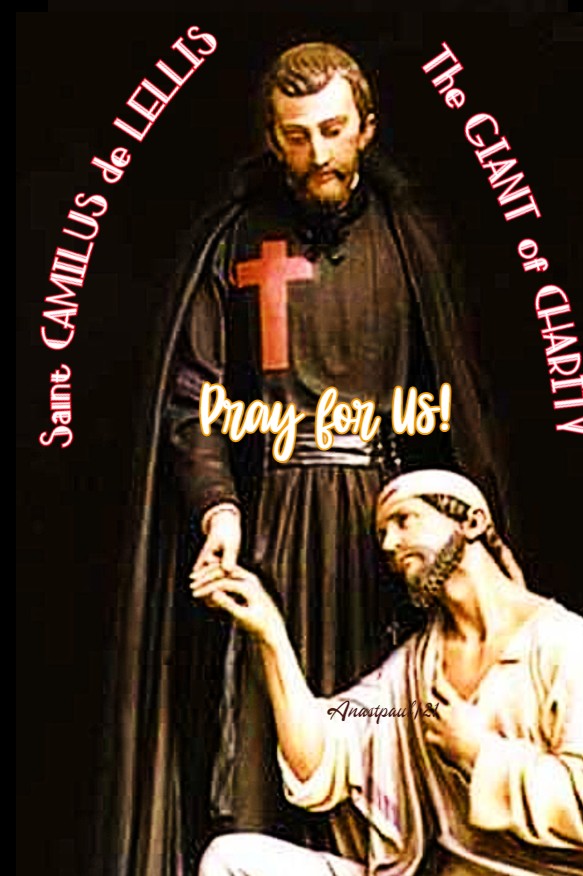
Quote/s of the Day – 14 July – “Month of the Most Precious Blood” – and the Memorial of Saint Camillus de Lellis MI (1550-1614) “The Giant of Charity”
“Brother, if you commit a sin and take pleasure in it, the pleasure passes but the sin remains. But if you do something virtuous, even though you are tired, the tiredness passes but the virtue remains.”
“The poor and the sick are the Heart of God. In serving them, we serve Jesus Christ.”
“Commitment is doing what you said you would do, after the feeling you said it in, has passed.”
One Minute Reflection – 14 July – “Month of the Most Precious Blood” – Readings: Exodus 3: 1-6, 9-12; Psalm: 103: 1b-2, 3-4, 6-7;: Matthew 11: 25-27 and the Memorial of Saint Camillus de Lellis MI (1550-1614) “The Giant of Charity”
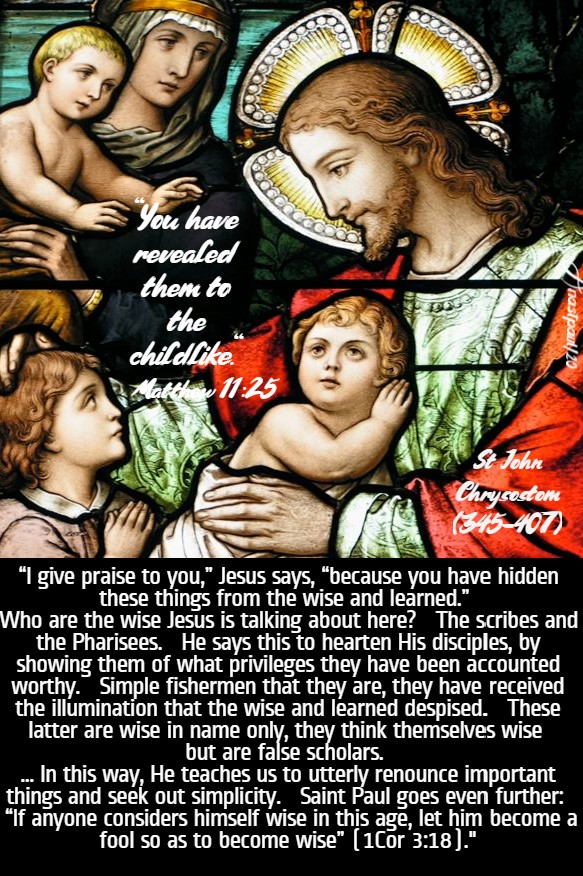
“You have revealed them to the childlike.” … Matthew 11:25
REFLECTION – “I give praise to you,” Jesus says, “because you have hidden these things from the wise and learned.” What? Is He glad at the loss of those who don’t believe in Him? Certainly not. How wonderful are God’s designs for people’s salvation! When they turn away from the truth and refuse to accept it, God never forces them but lets them be. Their wandering away stimulates them to find the path again. Returning to their senses, they hastily seek out the grace of the call to faith they had rejected before. As for those who had remained faithful, their devotion becomes even stronger like this. So Christ is glad these things are revealed to some but saddened they are hidden from others. This is made known when He weeps over the city (Lk 19:41). Saint Paul writes in the same spirit: “Thanks be to God! You were once slaves of sin but you have become obedient from the heart” to the Gospel (Rom 6:17). …
Who are the wise Jesus is talking about here? The scribes and the Pharisees. He says this to hearten His disciples, by showing them of what privileges they have been accounted worthy. Simple fishermen that they are, they have received the illumination that the wise and learned despised. These latter are wise in name only, they think themselves wise but are false scholars. That is why Christ did not say: “You have revealed them to the ignorant” but to “the childlike,” that is to say, simple, honest people. … In this way, He teaches us to utterly renounce important things and seek out simplicity. Saint Paul goes even further: “If anyone considers himself wise in this age, let him become a fool so as to become wise” (1Cor 3:18).” … St John Chrysostom (345-407) – Bishop of Constantinople, Father and Doctor of the Church – Sermons on Saint Matthew’s Gospel, no.38, 1
PRAYER – Lord God, in Your wisdom You created us, by Your Providence, You rule us. Penetrate our inmost being with Your holy light so that our way of life may always be one of faithful service and childlike trust in You. Grant that we may always follow behind Your Son and grasp His hand, to lead us to You. May we grow in faith and love daily, by the intercession of Saint Camillus de Lellis and may we be a light of love, to all around us, as he was. We make our prayer through our Lord Jesus with You in the unity of the Holy Spirit, God forever, amen.
Our Morning Offering – 14 July – “Month of the Most Precious Blood”
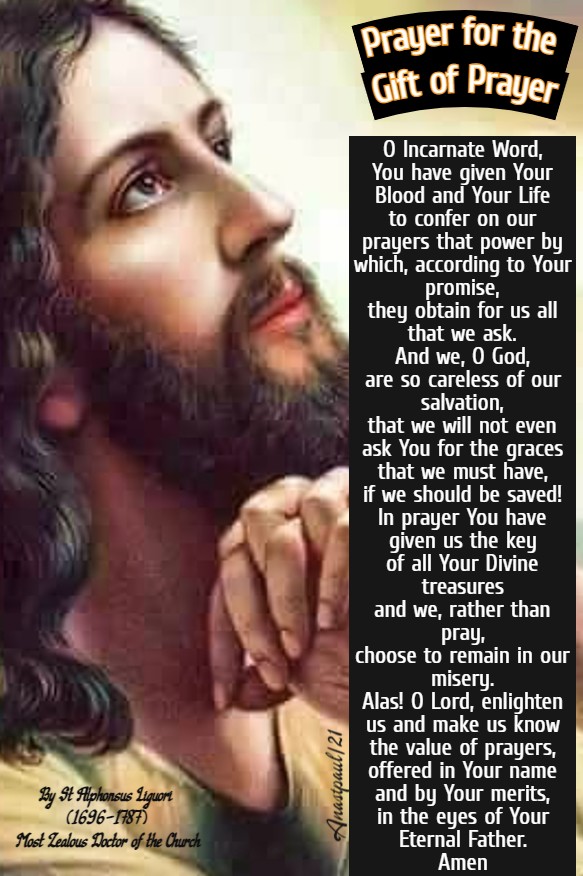
Prayer for the Gift of Prayer By St Alphonsus Liguori (1696-1787) Most Zealous Doctor of the Church
O Incarnate Word, You have given Your Blood and Your Life to confer on our prayers that power by which, according to Your promise, they obtain for us all that we ask. And we, O God, are so careless of our salvation, that we will not even ask You for the graces that we must have, if we should be saved! In prayer You have given us the key of all Your Divine treasures and we, rather than pray, choose to remain in our misery. Alas! O Lord, enlighten us, and make us know the value of prayers, offered in Your name and by Your merits, in the eyes of Your Eternal Father. Amen
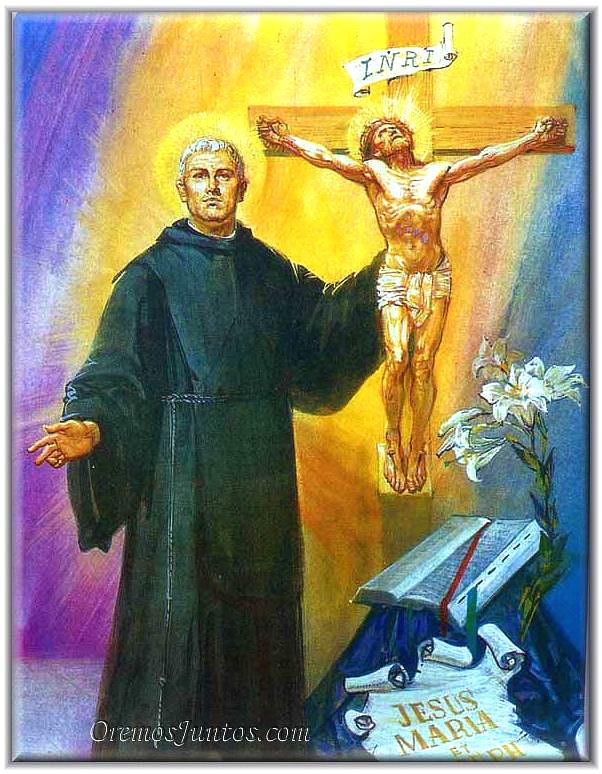
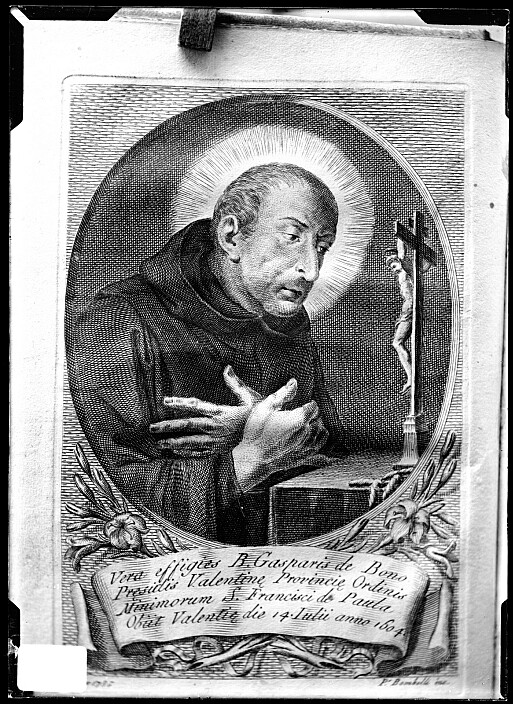
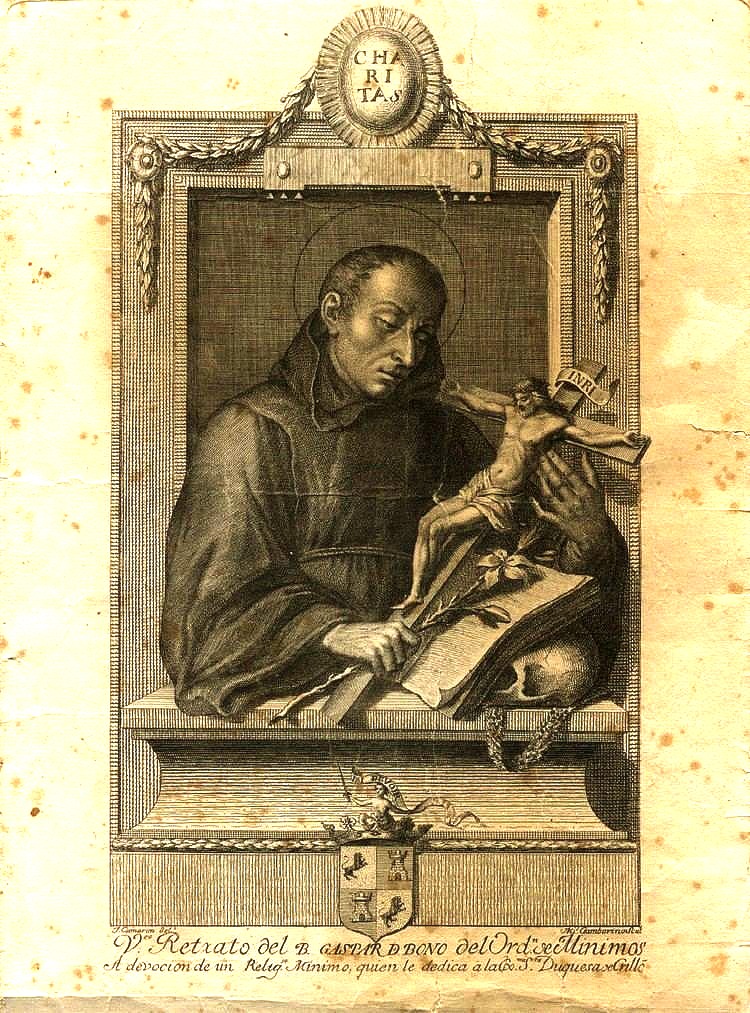
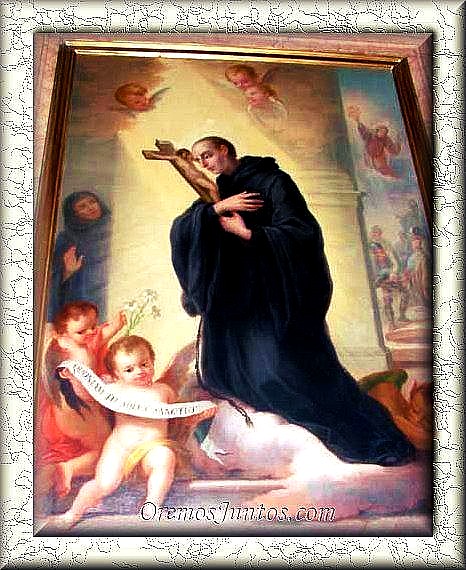
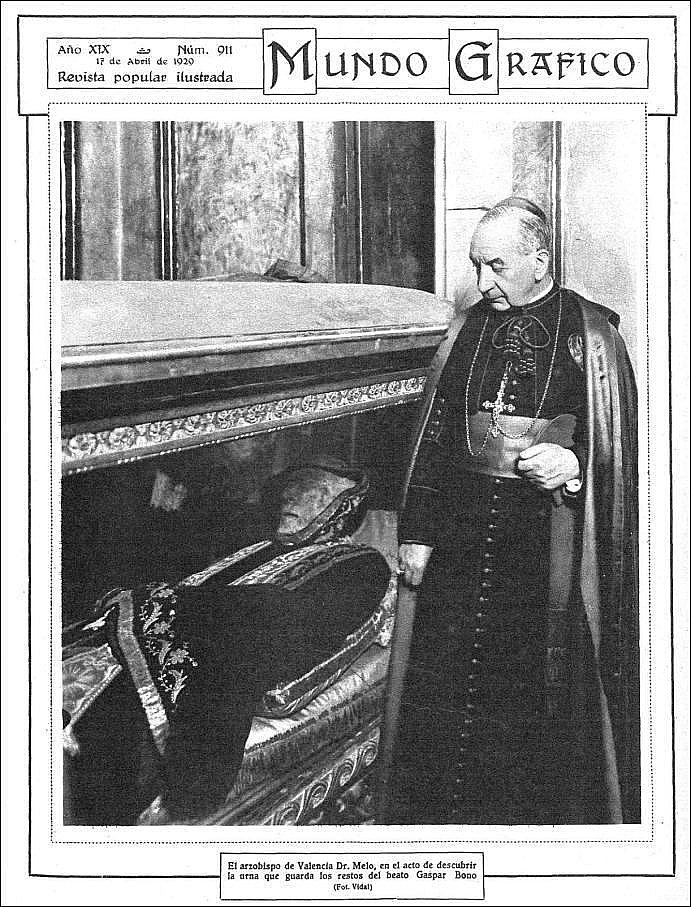
Saint of the Day – 14 July – Blessed Gaspar de Bono OM (1530– 1604) Priest, Friar of the Order of Minims, Vicar Provincial of the Order. He was noted for his particular devotion to the Passion of Christ, carrying his Crucifix everywhere as a means of evangelisation and to be able to constantly immerse himself in his Saviour’s sufferings. Born as Gaspar de Bonom Mozón on 5 January 1530 in Valencia, Aragon, Spain and died on 14 July 1604 in Valencia of natural causes.
The Roman Martyrology for 14 July states: “At Valencia in Spain, Blessed Gaspar de Bono, a Priest of the Order of Minims, who left the arms of the prince of the world for the militia of Christ the King and for the sake of the house of Order in the Spanish province, who ruled with prudence and charity.“
Gaspar was born on 5 January 1530 in Valencia, the second of the four children of Juan de Bonom who had emigrated from Gascony and his wife, Isabel Juana Manzón (or Monzon), originally from Villa de Cervera in the Province of Lleida. Upon his birth, he was bBaptised at the nearby Church of St Nicolás. Having been born on the eve of the Feast of the Epiphany, he was named for one of the Biblical Magi.
Gaspar’s parents were very pious and very poor. His father was a linen weaver by trade but when his mother was blinded three years after his birth and became unable to help in the family trade, the father was forced to sell their home and his tools and took work as a grinder and reseller. As a child, he developed a noticeable stammer, a problem from which he suffered his whole life.
At the age of ten,Gaspar began working with a silk merchant but soon realised that his vocation was religious and began to study Latin while continuing to work to help support his family. In about 1545, he was admitted as a candidate to the Dominican Order but, just as he was about to enter their novitiate, he was talked out of this by a brother-in-law, after which he returned home.
At age twenty, Gaspar joined the army of the Emperor Charles V, in search of fortune. He served as a soldier for about ten years but continued to try and live a devout and religious life, by praying, saying the rosary daily, donating to charity and frequenting places of worship. He fought in Lombardy where he was seriously wounded in the head. Left for dead, Gaspar made a promise, if he survived, to enter the Minim Friars, founded by St Francis of Paola.
Gaspar did recover and soon entered the Minim Monastery of St Sebastián in Valencia, which was located a short distance from his family home, receiving the religious habit on 16 June 1560. He professed his religious vows as a member of the Order on 17 June of the following year and was Ordained as a Priest in 1562.
Fr Gaspar soon became known for his virtue and strict compliance with the Rule of Life of the Order. He was available to all the people of the neighbourhood which he knew thoroughly. He was present to comfort his parents in their final hours, his Mother dying on 29 April 1583 and his fFther, a year later. He was soon named Master of novices for the Catalan Province of the Order, being responsible for the founding of a Minim Monastery in Barcelona. He was then elected to serve as Vicar Provincial. In 1602, at the insistence of the Archbishop of Valencia, Juan de Ribera (now honoured as a Saint) andagainst Gaspar’s wishes,he was elected Corrector Provincial (Regional Superior) of Valencia. He is said to have remained humble and austere; retaining his devotions and customs and continued to be noted for his prudence and charity throughout his life.
He died on 14 July 1604, the body being exposed in the conventual Church of St Sebastián de Valencia, miracles and wonders attributed to his intercession took place immediately. He was buried three days later under the steps of the main Altar. In 1835, after the suppression of the Monastery under the Napoleonic rule of Spain, the urn containing his bones was moved to the Church of St Nicolás, where he had been Baptised as a baby and enshrined under the Altar of the Chapel of St Raphael. Gaspar’s remains were damaged in 1823 and desecrated in 1936, so that only some bones are today venerated in the Parish of St Nicolás de Valencia.
Given his exemplary observance, his deep prayer, his patience, his humility and, in general, the set of virtues that characterised his life and the miracles attributed to his intercession, the Diocesan Information Process began very early. The cause suffered various vicissitudes and delays but finally on 10 September 1786, Blessed Gaspar was Beatified by Pope Pius VI . In March 1786 he was declared, by the Palma de Mallorca City Council, the most illustrious son of the City.
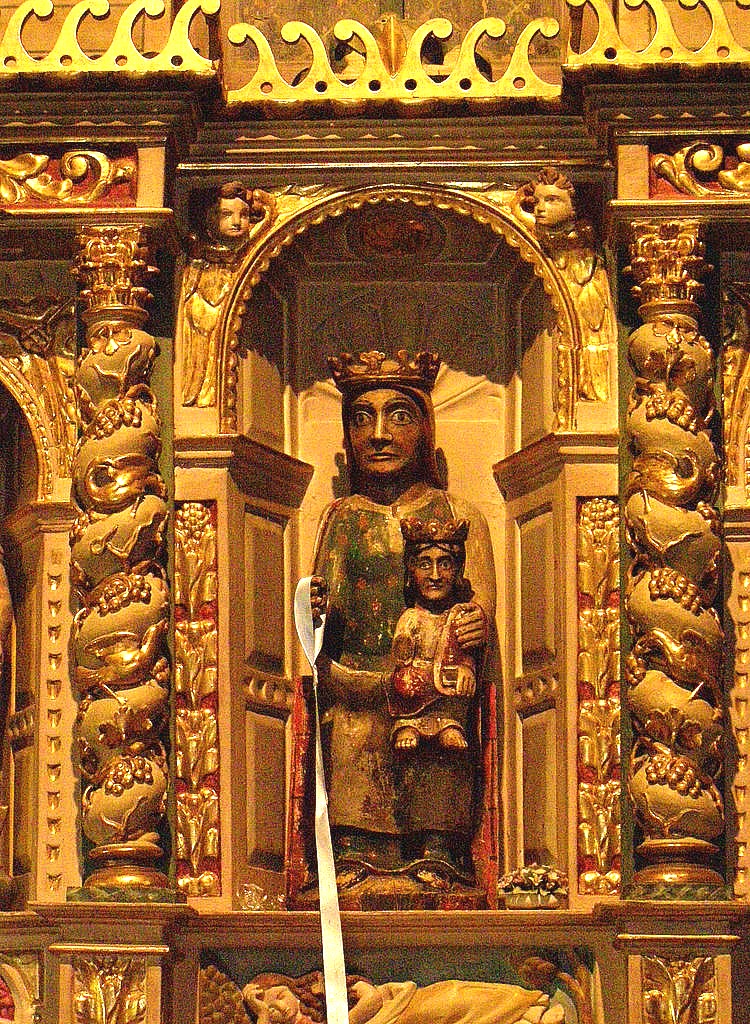
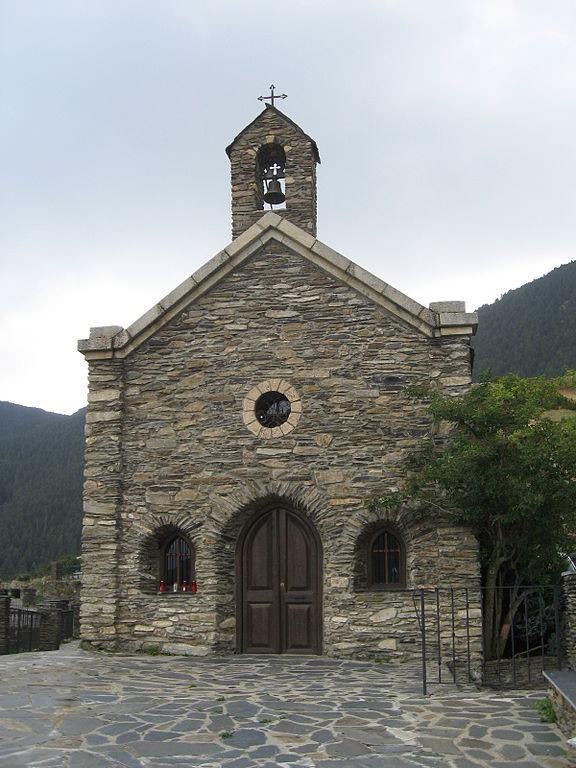
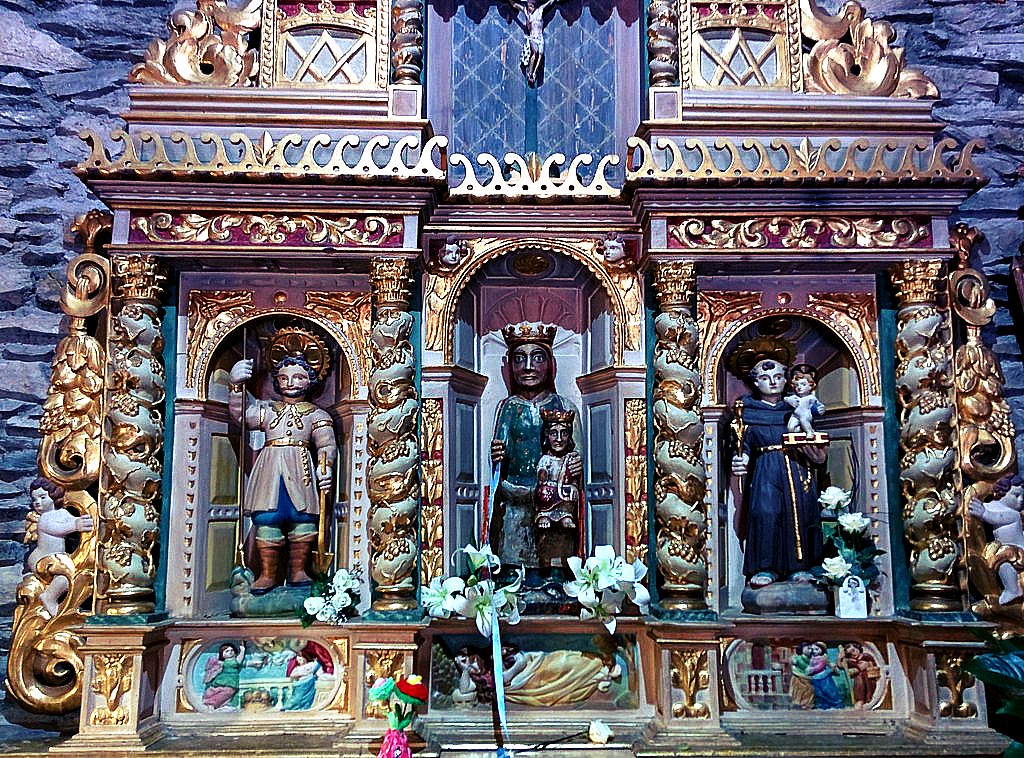
Mare de Déu de Canòlich / Mother of God of Canòlich, Canòlich, Sant Julià de Lòria, Andorra, Spain (1223) – 14 July and 4th Saturda\y of May:
On 14 July 1223, a shepherd was pasturing his flock near the village of Canòlich in southern Andorra, when suddenly a bird with brilliant plumage came to rest on an outcrop. The shepherd approached and caught the bird with no trouble and carried it to his house. The next day the bird had disappeared and again he found it in the field. The sequence recurred three times but the last time, the shepherd found an image of the Virgin Mary in a niche in the rock.
In response to this prodigy, the people of Sant Julià de Lòria Parish decided to build a Shrine to the Virgin where her Statue was found. Many miracles ensued at the Shrine and still do. Sadly now, nothing remains of that Church. The present Sanctuary, containing a baroque Altarpiece from a previous Shrine, dates from the 1970s. The Romanesque image of the Mother of God of Canòlich resides in the Parish Church of Sant Julià y San Germà in the urban centre of Sant Julià de Lòria: a wooden Statue from the late 1100s, with original polychrome, crowned by the Vatican in 1999.
On the last Saturday in May, parishioners gather in Sant Julià de Lòria for morning fireworks and Mass in the Virgin’s honour. Then the celebration — moves to Canòlich, for Masses at the Sanctuary and after Mass, dancing, and blessing and distribution of bread.
Bl Boniface of Canterbury St Colman of Killeroran St Cyrus of Carthage St Deusdedit of Canterbury St Donatus of Africa Bl Dorotea Llamanzares Fernández
Blessed Gaspar de Bono OM (1530– 1604) Priest, Friar of the Order of Minims Bl Giorgio of Lauria Bl Hroznata of Bohemia Bl Humbert of Romans St Idus of Ath Fadha St Ioannes Wang Kuixin St Just St Justus of Rome
Thought for the Day – 13 July – Meditations with Antonio Cardinal Bacci (1881-1971)
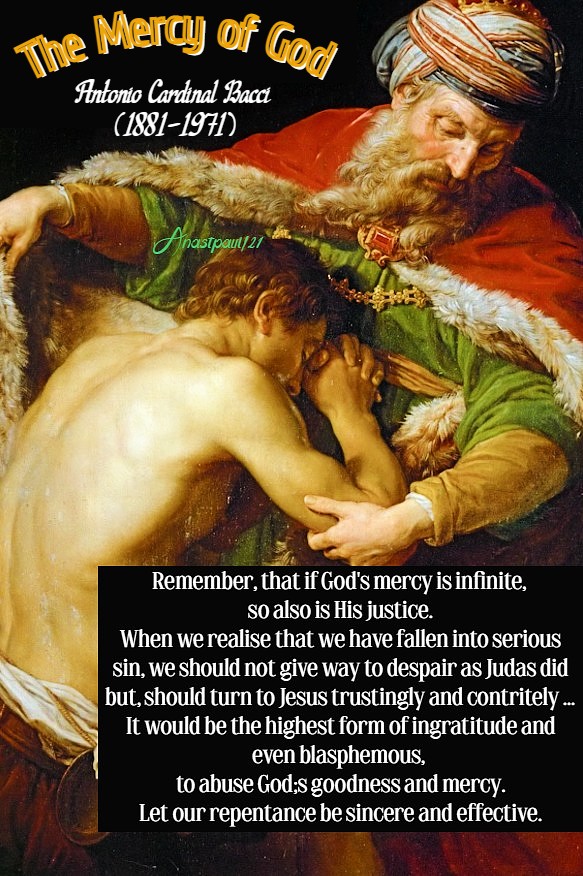
The Mercy of God
“Remember, that if God’s mercy is infinite, so also is His justice.
When we realise that we have fallen into serious sin, we should not give way to despair as Judas did but, should turn to Jesus trustingly and contritely, saying with the Psalmist, “My refuge and my fortess, my stonghold, my deliverer, my shield, in whom I trust” (Ps 143:2). We shall certainly be forgiven.
It would be the highest form of ingratitude and even blasphemous, to abuse God;s goodness and mercy. Let our repentance be sincere and effective. In return for the infinite goodness of God, let us give Him our love, limited indeed but willing and constant.”
Quote/s of the Day – 13 July – “Month of the Precious Blood” – Readings: Exodus 2: 1-15a; Psalms 69: 3, 14, 30-31, 33-34; Matthew 11: 20-24
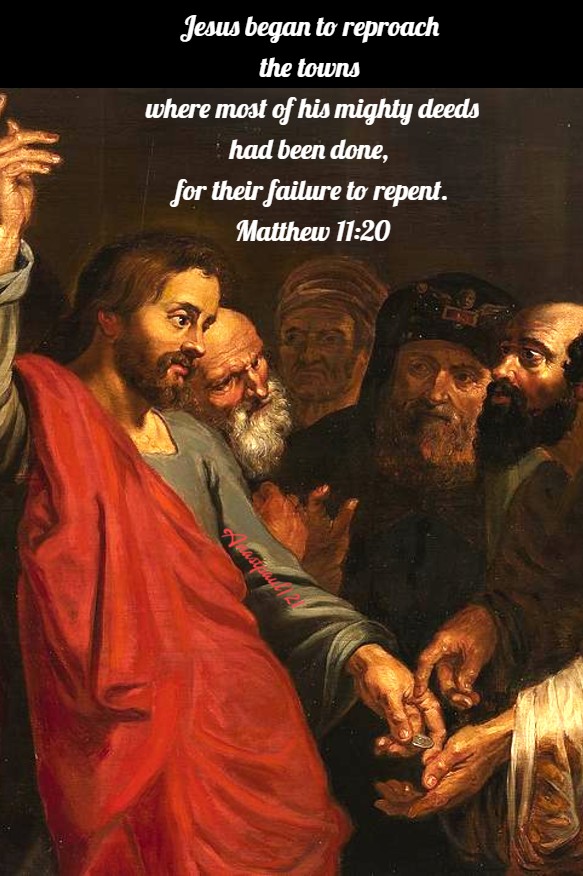
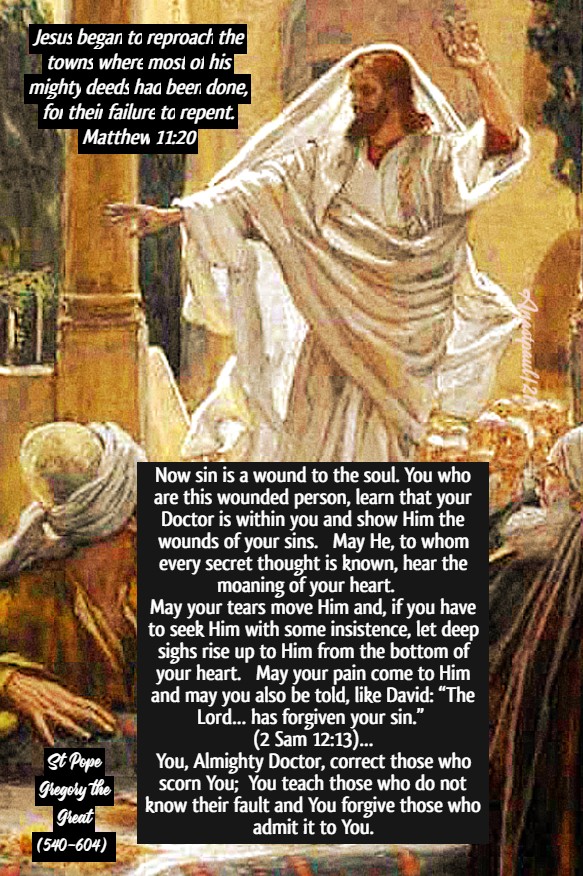
“Jesus began to reproach the towns where most of his mighty deeds had been done, for their failure to repent.”
Matthew 11:20
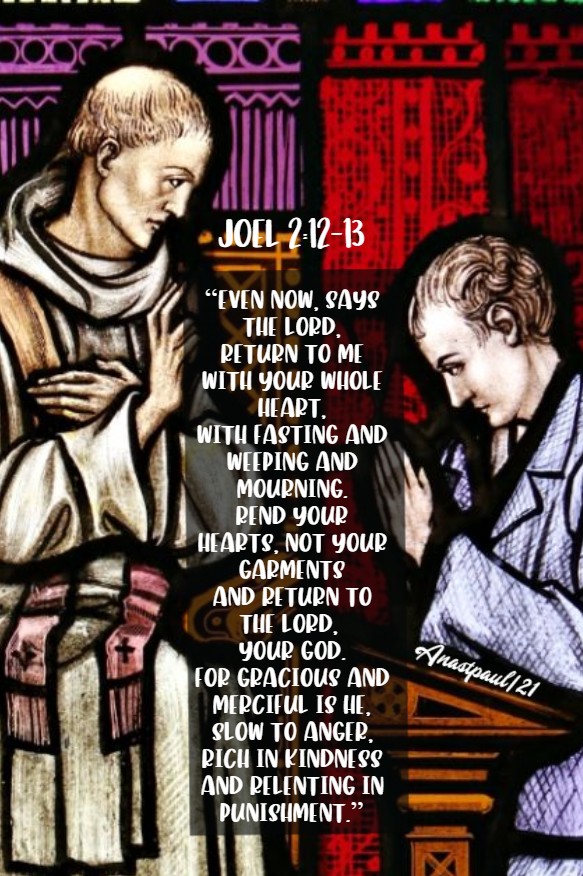
“Even now, says the LORD, return to me with your whole heart, with fasting and weeping and mourning. Rend your hearts, not your garments and return to the LORD, your God. For gracious and merciful is he, slow to anger, rich in kindness and relenting in punishment.”
Joel 2:12-13
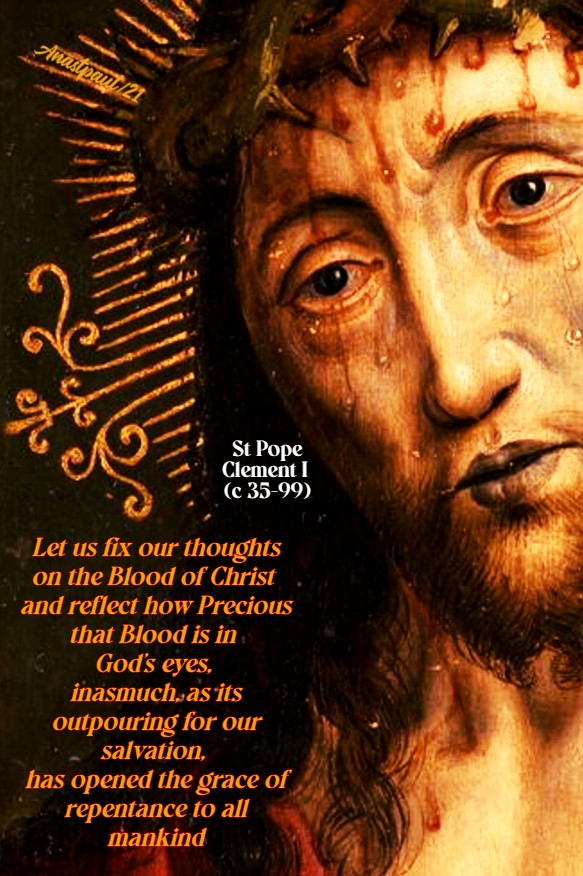
“Let us fix our thoughts on the Blood of Christ and reflect how Precious that Blood is, in God’s eyes, inasmuch, as its outpouring for our salvation, has opened the grace of repentance to all mankind.”
St Pope Clement I (c 35-99)
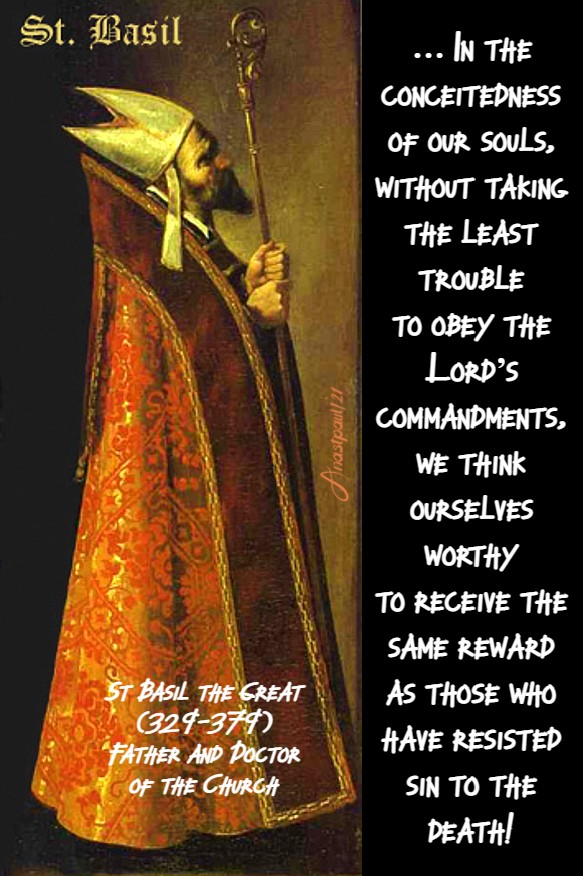
“… In the conceitedness of our souls, without taking the least trouble to obey the Lord’s commandments, we think ourselves worthy to receive the same reward as those who have resisted sin to the death!”
St Basil the Great (329-379) Father and Doctor of the Church
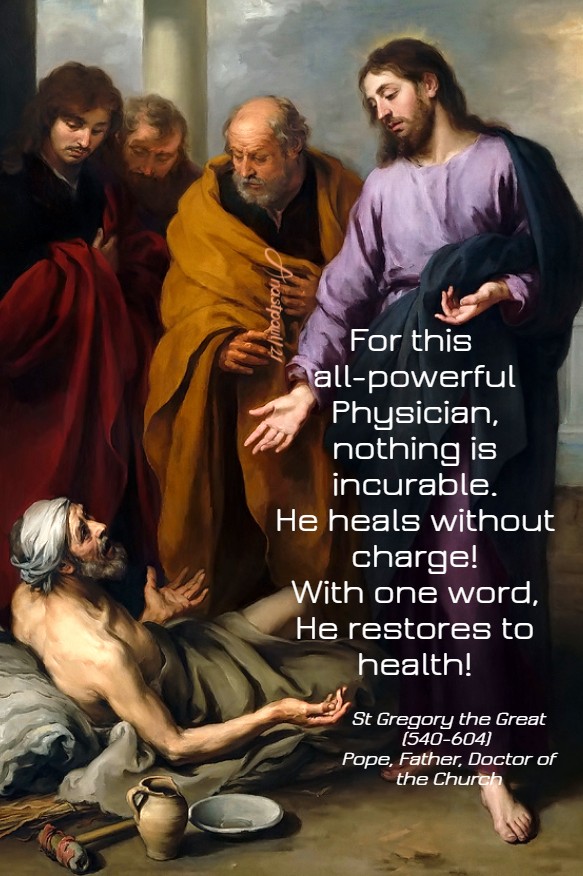
“For this all-powerful Physician, nothing is incurable. He heals without charge! With one word, He restores to health! I would have despaired of my wound were it not, that I placed my trust in the Almighty.”
St Gregory the Great (540-604) Pope, Father, Doctor of the Church
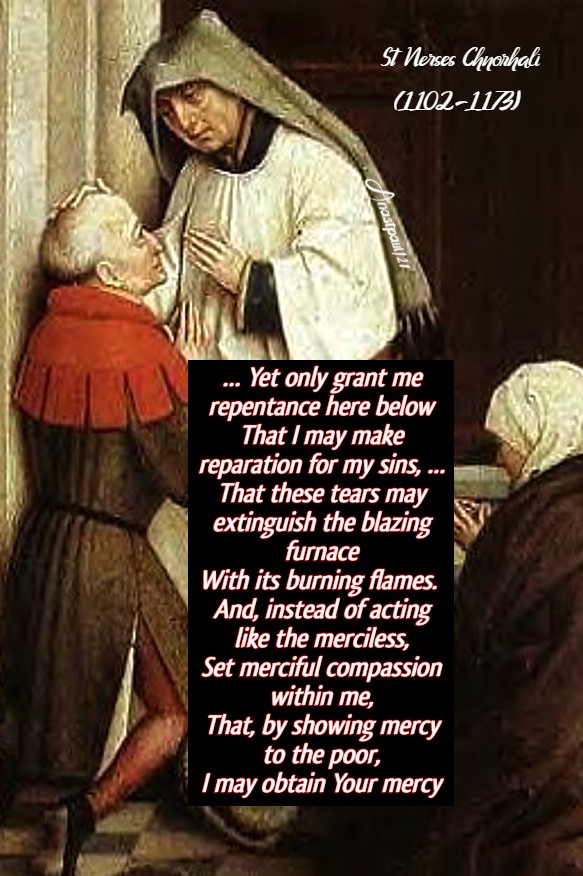
“ … Yet only grant me repentance here below That I may make reparation for my sins, … That these tears may extinguish the blazing furnace With its burning flames. …
And, instead of acting like the merciless, Set merciful compassion within me, That, by showing mercy to the poor, I may obtain Your mercy.”
St Nerses Chnorhali (1102-1173) Armenian Bishop
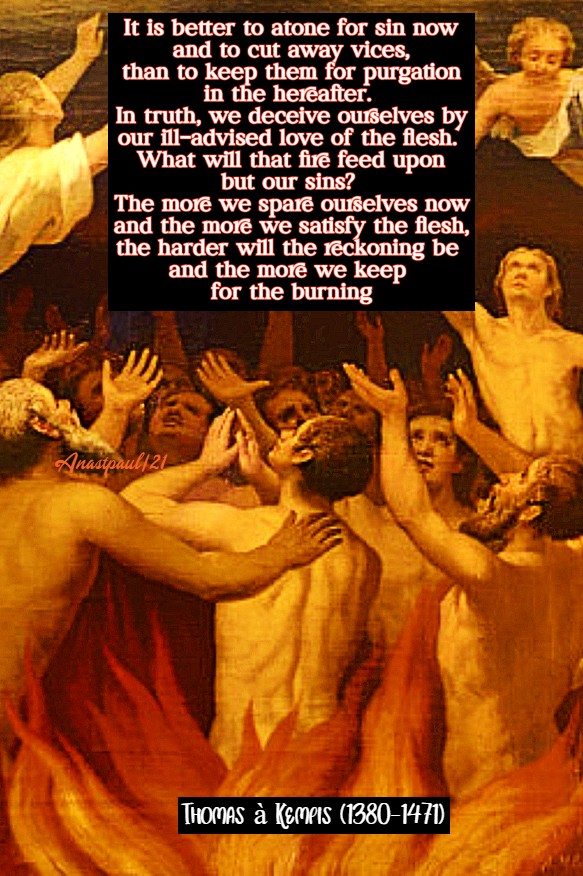
“ It is better to atone for sin now and to cut away vices, than to keep them for purgation in the hereafter. In truth, we deceive ourselves by our ill-advised love of the flesh. What will that fire feed upon but our sins? The more we spare ourselves now and the more we satisfy the flesh, the harder will the reckoning be and the more we keep for the burning.”
One Minute Reflection – 13 July – “Month of the Precious Blood” – Readings: Exodus 2: 1-15a; Psalms 69: 3, 14, 30-31, 33-34; Matthew 11: 20-24
“Jesus began to reproach the towns where most of his mighty deeds had been done, for their failure to repent.” – Matthew 11:20
REFLECTION – “Let us cry out with David; let us hear him weep and let us shed tears with him. Let us see how he rises up again and let us rejoice with him: “Have mercy on me, O God, in your goodness.” (Ps 51:3)
Let us place before the eyes of our soul a man who is seriously injured, almost on the point of breathing his last breathe and who is lying naked in the dust. In his desire to see a doctor arrive, he is moaning and begging the person who understands his condition, to have pity. Now sin is a wound to the soul. You who are this wounded person, learn that your Doctor is within you and show Him the wounds of your sins. May He, to whom every secret thought is known, hear the moaning of your heart. May your tears move Him and, if you have to seek Him with some insistence, let deep sighs rise up to Him from the bottom of your heart. May your pain come to Him and may you also be told, like David: “The Lord… has forgiven your sin.” (2 Sam 12:13)…
“Have mercy on me, O God, in your goodness.” The people who belittle their fault because they do not know this great tenderness, only draw a little tenderness to themselves. As for me, I fell far, I sinned with full knowledge. But You, Almighty Doctor, correct those who scorn You; You teach those who do not know their fault and You forgive those who admit it to You.” – St Pope Gregory the Great (540-604) Father and Doctor of the Church – Presentation on the seven penitential Psalms
PRAYER – God our Father, we are Your children and You have set us aside to come home to You by the light of the way of Your divine Son. Fill us with knowledge of our need to turn to You in sorrow and repentance, that we may one day attain our final home with You. Grant we pray, that by the intercession of the Blessed Virgin, we may too become lights announcing Your Glory and our great need for repentance. and penance. We make our prayer through our Lord Jesus with You in the unity of the Holy Spirit, God forever, amen.
Our Morning Offering – 13 July – “Month of the Precious Blood”
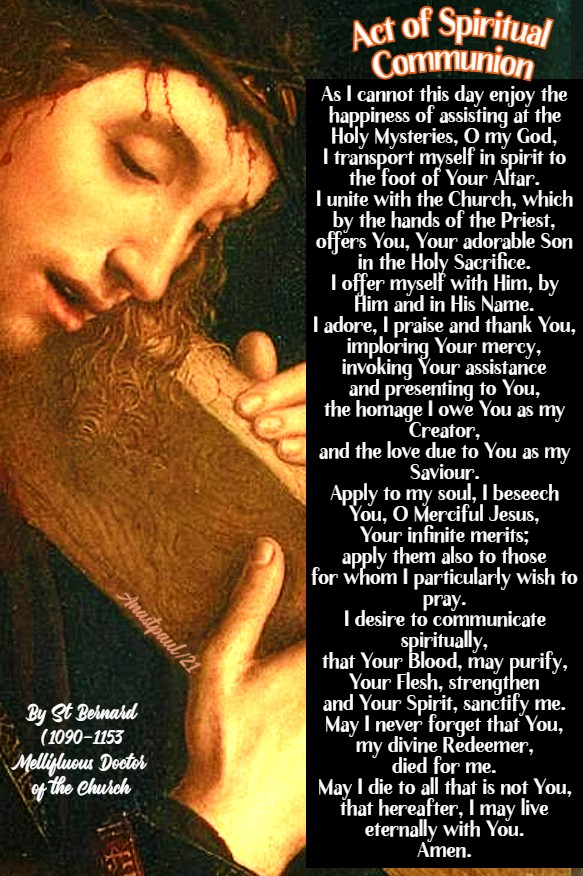
Act of Spiritual Communion By St Bernard (1090-1153 Mellifluous Doctor of the Church
As I cannot this day enjoy the happiness of assisting at the Holy Mysteries, O my God, I transport myself in spirit to the foot of Your Altar. I unite with the Church, which by the hands of the Priest, offers You, Your adorable Son in the Holy Sacrifice. I offer myself with Him, by Him and in His Name. I adore, I praise and thank You, imploring Your mercy, invoking Your assistance and presenting to You, the homage I owe You as my Creator and the love due to You as my Saviour.
Apply to my soul, I beseech You, O Merciful Jesus, Your infinite merits; apply them also to those for whom I particularly wish to pray. I desire to communicate spiritually, that Your Blood, may purify, Your Flesh, strengthen and Your Spirit, sanctify me. May I never forget that You, my divine Redeemer, died for me. May I die to all that is not You, that hereafter, I may live eternally with You. Amen.
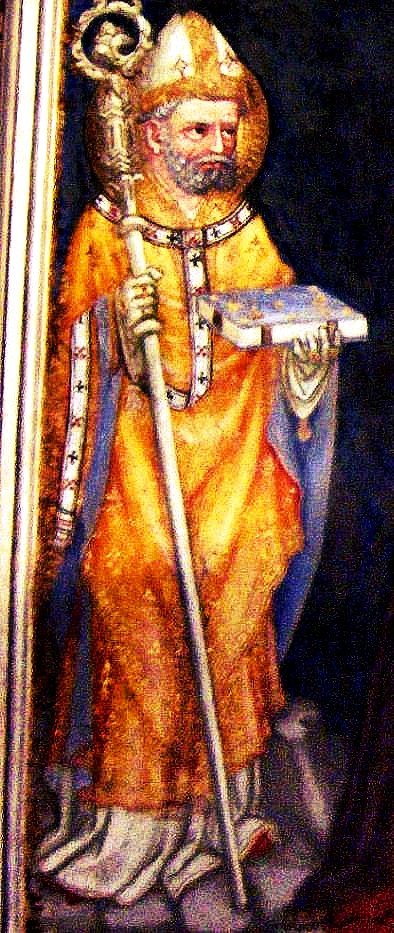
Saint of the Day – 13 July – Blessed James of Voragine OP (c 1226 – 13 or 16 July 1298) Archbishop of Genoa, Author of the ‘Golden Legend’ (a collection of lives of Saints and treatises on Christian festivals, one of the most popular religious works of the Middle Ages and is still published and referred to today – completed 1265), Priest and Friar of the Order of Preachers of St Dominic, Writer, Scholar of great genius, Prior and Provincial General of the Order. Born as Giacomo da Varazze in c 1226 at Varazze (modern Voragine), Diocese of Savona, Italy (near Genoa) and died on either 13 July or 16 1298 in Genoa, Italy of natural causes. Also known as – James of Varazze, James of Viraggio, James of Genoa, Giacomo, Jacob, Jacobus, Jacopo.
James of Voragine has been Beatified by the Church for the sanctity of his life. He lives in secular history for quite a different reason – he was a creative genius of his age. His Golden Legends, which has enjoyed a circulation of nearly seven centuries, is only one of several projects which in his time, as in ours, are a tribute to the versatility of the man and the zeal of a Saint.
Little is recorded of the childhood of James. He entered the Order of Preachers in Genoa and soon was known, both for his virtue and for a singularly alert and practical mind. Tradition says that James was the first to translate the Bible into Italian. Whether this is true or not, it is ample evidence that he was a true scholar.
As Prior, provincial,and later Archbishop, James gained a reputation for strict observance, heroic charity and sound good sense. He was a builder where war had wrecked, a peace maker where others sowed trouble. He must of had a contagious zeal, for the wealthy gave to him as readily as the poor begged from him and under his hand, ruined Churches and hospitals were restored, the sick and poor were cared for, and good practices and devotion reignited. He was a genius at getting things done and, fortunately, his whole heart was bent on doing good for the glory of God.
Like others of his calling and training, James was first of all a Preacher. For those many who could not read, one of the chief means of instruction was via sermons, which took their key note from the feast of the day. The Saints, the stories of their live and examples of their virtues became as much part of a Christians life as the people around him. The collection of stories – later called The Golden Legend – started as a series of sermons prepared by James for the various festival of the Saints. Since he preached in Italian, rather than in Latin, his sermons had immense popular appeal and they were rapidly copied by other Preachers into all the languages of Europe. The Golden Legend was , next to the Bible, the most popular book of the Middle Ages.
James was rigorous in his observance of the Dominican Rule, which, is of itself, enough to canonise him. He had also the good sense to make use of changing trends to further the work of God. Today he would be using the digital world, the press, the movies, and television – then ,he used what his century had to offer – sermons in the vernacular, religious drama and music. How much present day drama and music owed to him, it would be impossible to say.
There is an amusing story told of his efforts to fight fire with fire. He organised a troop of jugglers and acrobats from the student Novices of San Eustorgio, in Milan, who were to mingle entertainment with doctrine in staging ‘plays’ to teach and in an effort to combat the indecency of the secular theatre. This was one scheme which left no lasting effect but it does serve to show, that James was a man of his times, alert to the changing needs of a fast-moving world and whole-heartedly determined to win the world to the truth of the One Holy Catholic Faith by any honest means that came to hand.
Purity, poverty and charity were the outstanding virtues of this man whom the Church has seemed fit to enroll among Her blesseds. He will always be recognised in Dominican history as a man of many and peculiar gifts, who consecrated his talents to God and, in trading with them , gained heaven. Blessed James was Beatified on 11 May 1816 by Pope Pius VII.
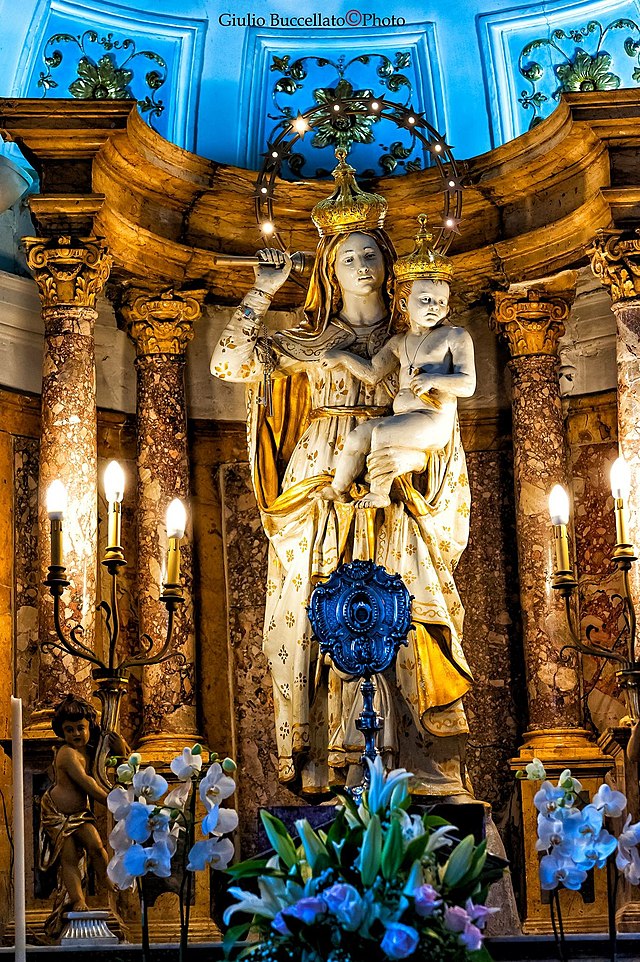
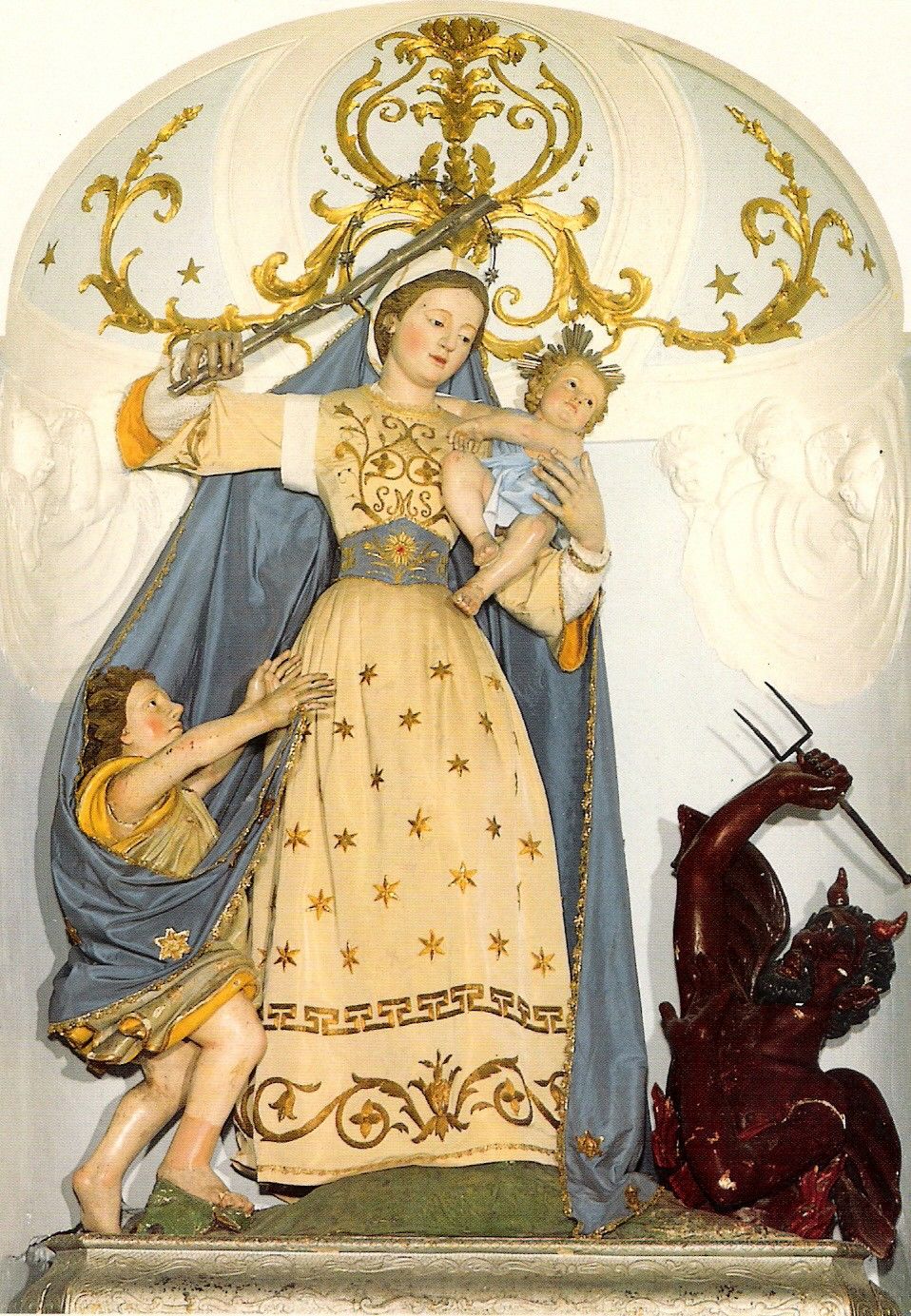
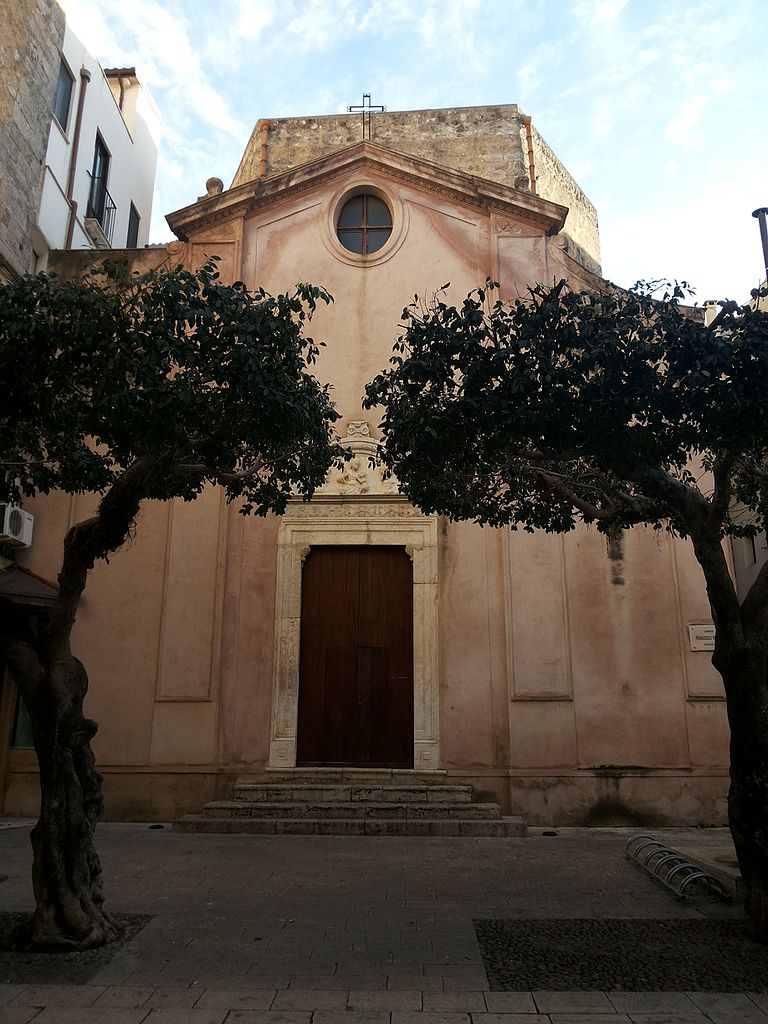
Madonna del Soccorso / Our Lady of Soccorso, Castellammare del Golfo, Trapani, Sicily, Italy ( 1718)- 13 July, 21 August:
In Castellammare del Golfo , in the Province of Trapani, a miraculous event occurred on 13 July 1718, when the Town was in the midst of war between Philip V and Amedeo di Savoia, for the possession of Sicily. A Spanish ship, pursued by five English ships, arrived to take refuge under the castle, from where the enemy ships were repelled. The people, frightened, cried out for a miraculous help to their Patron – all fled the City, and despite the blows of the English artillery, no-one was killed or injured. But all of a sudden, to everyone’s amazement, the white-dressed Madonna appeared from Mount delle Scale, followed by a group of Angels, who descended towards Cala Marina. This vision terrified the British who hastened in retreat and left the port. The name of Madonna del Soccorso derives from this extraordinary event. Every two years, in fact, on 13 July in the Town of the Gulf the “Historical Re-enactment” of the miraculous intervention of Maria Santissima del Soccorso, in the City of Castellammare.
Devotion to the Madonna del Soccorso is particularly felt in the Magolà hamlet, in Lamezia Terme but also, in the whole area. The Sanctuary of the Madonna del Soccorso is located on a green hill overlooking the City of Lamezia Terme and overlooking the plain of Sant’Eufemia, in the most panoramic point . The presence of this Church then gave its name to the whole area. According to a historical research by Don Pietro Bonacci ( 1915 – 2007 ), devotion to the Madonna del Soccorso is very ancient and was initially practiced in the Church of the Reformed Fathers of St Frances (currently the Church of Santa Maria Maggiore) in very remote times. This devotion was also in use in the Church of Santa Lucia , which until the eighteenth century, had the title of Parish of St Maria del Soccorso, then passed to the Church of Magolà. It is said that the Reformed Fathers decorated with great piety and love, a miraculous image of the Madonna painted by St Luke and brought from Jerusalem by a Franciscan Friar who landed in Sant’Eufemia, fell ill and died with the Reformed Fathers. This image was of great veneration for its continuous graces but no trace has been found, it has disappeared.
The current Church was built shortly after the construction of the votive Shrine. In fact, a document reports that it was completed in 1740. . At the beginning of the nineteenth century cholera broke out and a small hospital was built to treat the sick. In the twentieth century everything returned to normal and the celebrations in honour of the Madonna began, which were established on the third Sunday of July, preceded by the Novena. On Saturdays it was customary to celebrate The Rosary and other Marian devotions, in which one spent a whole day with the Madonna and sang traditional hymns. On the day of the festival, after several Masses, the procession with the Statue of the Madonna begins,and looks out from the hill to bless the City. There was also a great fair. Today the festival is held the same way.
St Henry (972-1024) Holy Roman Emperor (Optional Memorial) Henry was well known for his missionary spirit and for his protection of the Pope in times of trouble. Henry ruled with a spirit of great humility and always sought to give the glory to God. He used his position to promote the work of the Church and the peace and happiness of the people. Biography: https://anastpaul.wordpress.com/2017/07/13/saint-of-the-day-13-july-st-henry-ii-holy-roman-emperor/
Bl Anne-Andrée Minutte St Arno of Würzburg Bl Barthélemy Jarrige de la Morelie de Biars Bl Berthold of Scheide
St Dogfan Bl Élisabeth Verchière St Emanuele Lê Van Phung St Esdras the Prophet St Eugene of Carthage Bl Ferdinand Mary Baccilleri St Iosephus Wang Kuiju Blessed James of Voragine OP (c 1226 – 3 or 16 July 1298) Bishop, Author of the ‘Golden Legend.’ Bl Jean of France St Joel the Prophet Bl Louis-Armand-Joseph Adam
Bl Marie-Anastasie de Roquard Bl Marie-Anne Depeyre Bl Marie-Anne Lambert St Mildred of Thanet St Muritta of Carthage St Myrope St Paulus Liu Jinde St Salutaris of Carthage St Sarra of Egypt St Serapion of Alexandria Serapion of Macedonia Bl Thérèse-Henriette Faurie Bl Thomas Tunstal St Turiaf — Martyrs of Cyprus – 300 saints: 300 Christians who retired to Cyprus to live as cave hermits, devoting themselves to prayer and an ascetic life devoted to God. Tortured and martyred for their faith and their bodies dumped in the various caves in which they had lived. We know the names of five of them but no other details even about them – Ammon, Choulélaios, Epaphroditus, Eusthénios and Héliophotos. They were beheaded in the 12th century on Cyprus and their bodies dumped in the cave where they had lived and only rediscovered long afterwards.
Martyrs of Philomelio – 31 saints: 31 soldiers martyred for their faith in the persecutions of prefect Magno, date unknown. The only name that has come down to us is Alexander. In Philomelio, Phrygia (in modern Turkey).
Thought for the Day – 12 July – Meditations with Antonio Cardinal Bacci (1881-1971)
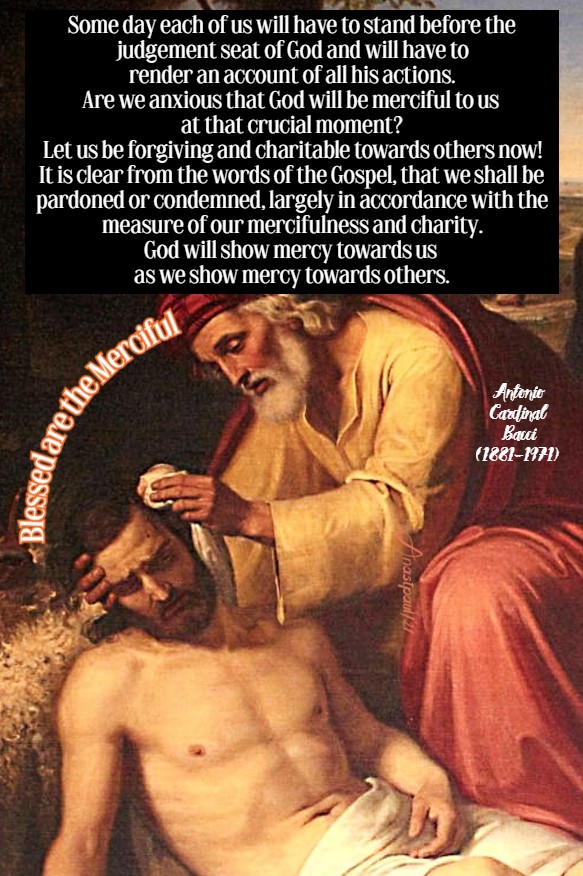
Blessed are the Merciful
“Some day each of us will have to stand before the judgement seat of God and will have to render an account of all his actions. Are we anxious that God will be merciful to us at that crucial moment? Let us be forgiving and charitable towards others now! It is clear from the words of the Gospel, that we shall be pardoned or condemned, largely in accordance with the measure of our mercifulness and charity. God will show mercy towards us as we show mercy towards others. In fact, the Eternal Judge will say to the good: “Come, blessed of my Father, take possession of the Kingdom prepared for you from the foundation of the word: for I was hungry and you gave me to eat; I was thirsty and you gave me to drink; I was a stranger and you took me in; naked and you covered me; sick and you visited me; I was in prison and you came to me.” Then He will turn to the wicked and deliver this terrible sentence: “Depart from me accursed ones, into the everlasting fire which was prepared for the devil and his angels. For I was hungry and you did not give me to eat; I was thirsty and you gave me no drink; I was a stranger and you did not take me in; naked and you did not clothe me; sick and in prison and you did not visit me … Amen, I say to you, as long as you did not do it for one of these least ones, you did not do it for me.” (Mt 25:34-46).
These are terrifying words. They should persuade us to exercise charity towards all who are suffering in any way at all!”
Quote/s of the Day – 12 July – “Month of the Most Precious Blood” – Readings: Exodus 1: 8-14, 22; Psalms 124: 1b-3, 4-6, 7-8; Matthew 10: 34 – 11: 1
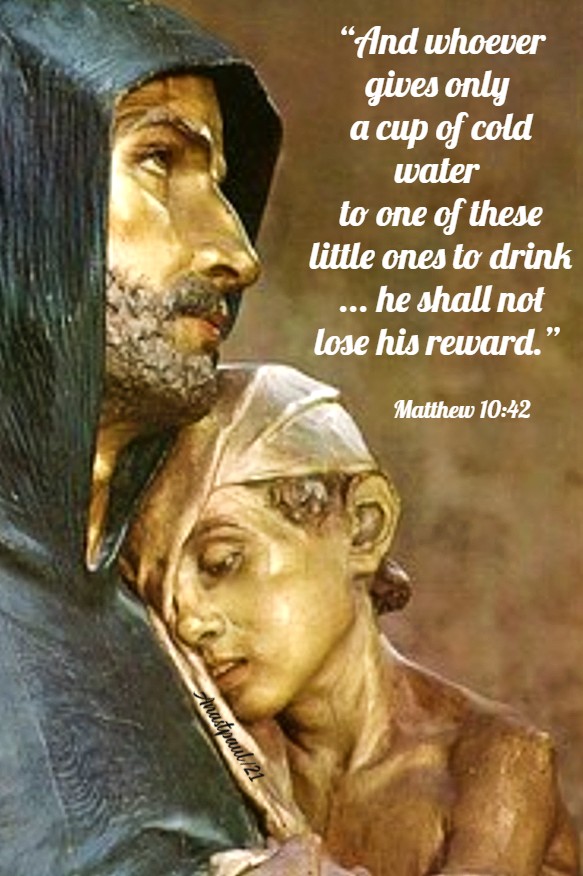
“And whoever gives only a cup of cold water to one of these little ones to drink , … he shall not lose his reward.”
Matthew 10:42
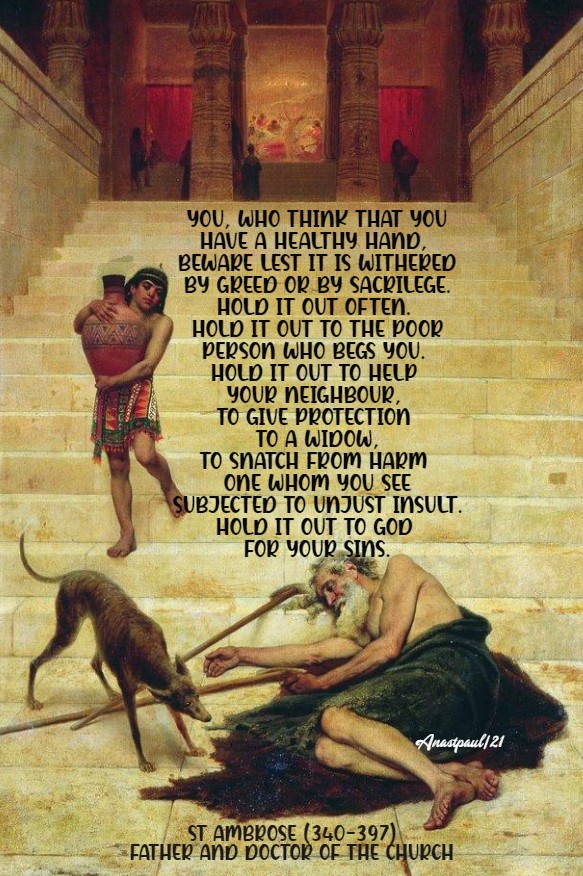
“You, who think that you have a healthy hand, beware lest it is withered by greed or by sacrilege. Hold it out often. Hold it out to the poor person who begs you. Hold it out to help your neighbour, to give protection to a widow, to snatch from harm one whom you see subjected to unjust insult. Hold it out to God for your sins.”
St Ambrose (340-397) Father and Doctor of the Church
“ Lift up and stretch out your hands, not to heaven but to the poor… if you lift up your hands in prayer without sharing with the poor, it is worth nothing.”
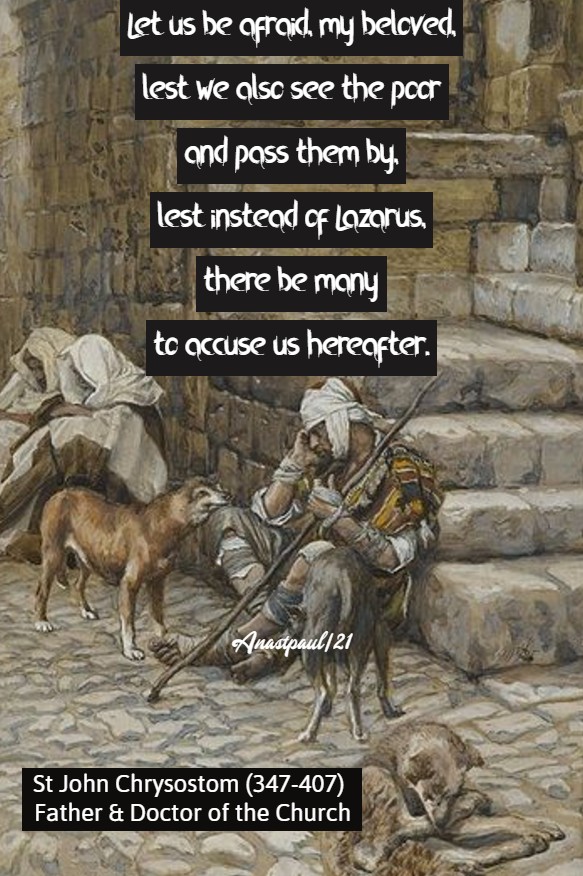
“… Let us be afraid, my beloved, lest we also see the poor and pass them by, lest instead of Lazarus, there be many to accuse us hereafter.”
St John Chrysostom (347-407) Father and Doctor of the Church
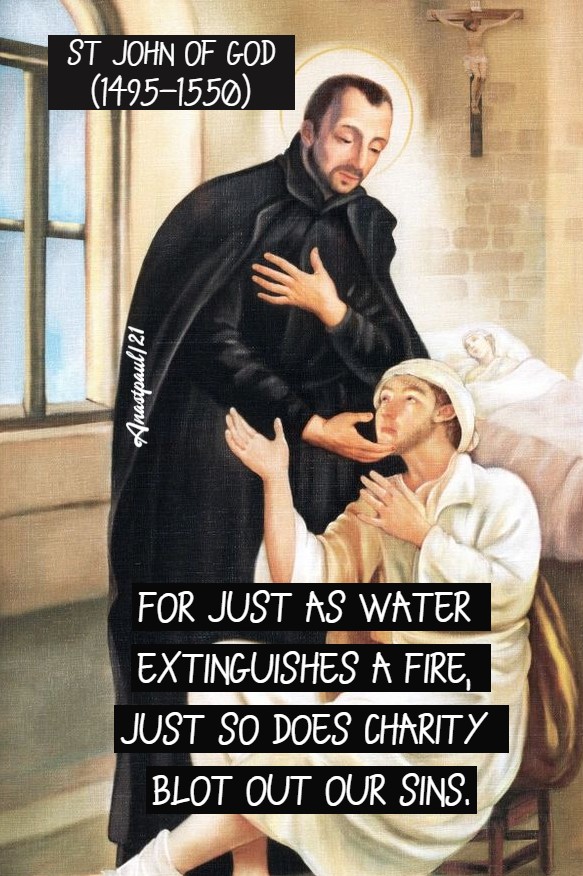
“For just as water extinguishes a fire, just so does charity blot out our sins.”
St John of God (1495-1550)
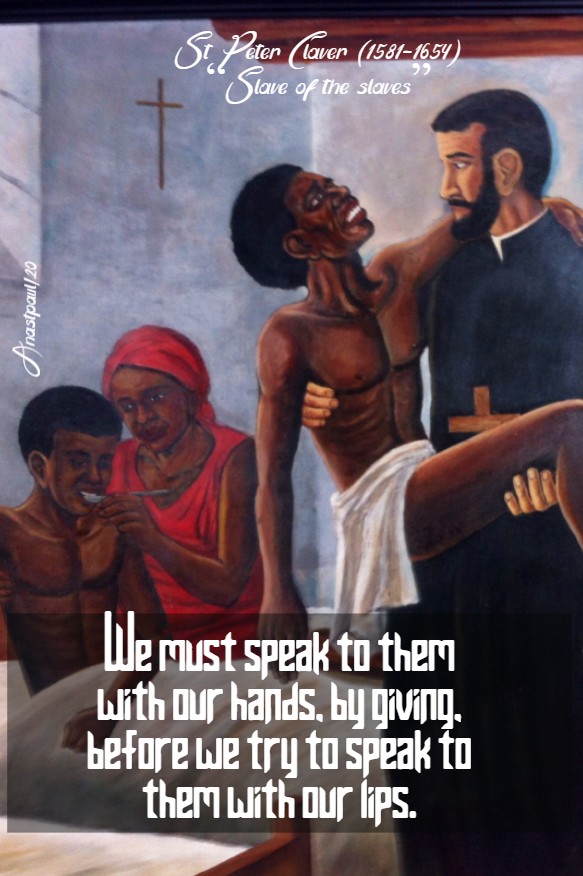
“We must speak to them with our hands, by giving, before we try to speak to them with our lips.”
St Peter Claver (1581-1654) “Slave of the slaves”
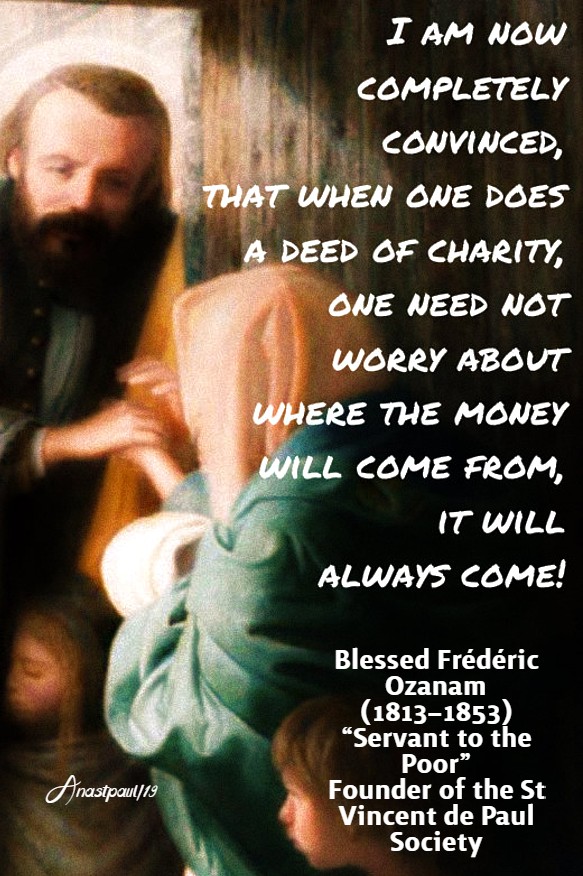
“I am now completely convinced, that when one does a deed of charity, one need not worry about where the money will come from, it will always come!”
Blessed Frédéric Ozanam (1813–1853) “Servant to the Poor”























 AnaStpaul
You must be logged in to post a comment.