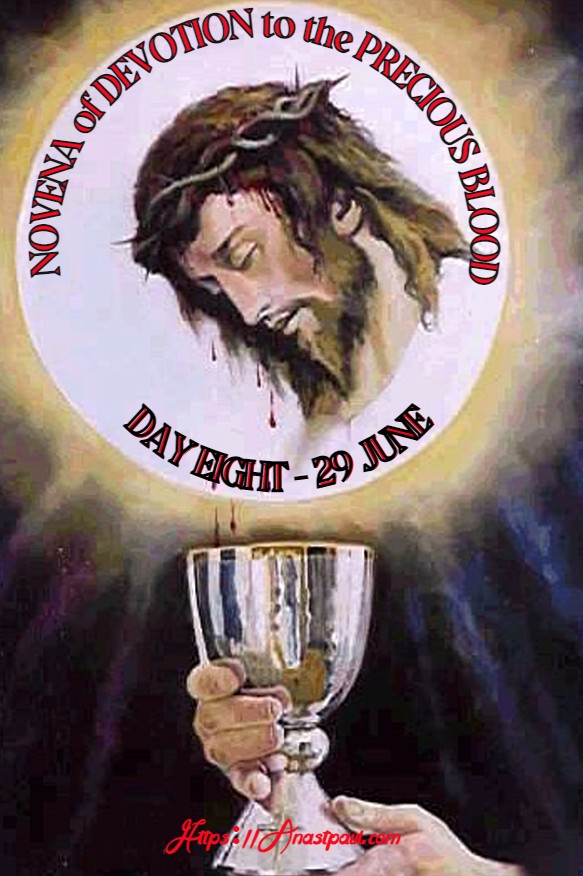
DAY EIGHT – NOVENA of DEVOTION to the PRECIOUS BLOOD of JESUS
Opening Prayer for each Day:
Grant me the grace to know You, to love You and to be truly sorry that I have offended You. I ask this grace by Your Precious Blood – By that Precious Blood, which bathed Your Sacred Body and trickled down to the ground in the Garden of Olives. By that Precious Blood, which poured forth from Your Sacred Body during the scourging. By that Precious Blood, which which covered Your Sacred Face when You were crowned with thorns. By that Precious Blood, which burst from Your hands and feet on Calvary. By that Precious Blood, which came forth from Your Sacred Heart after Your death. By that Precious Blood, which we drink in Holy Communion and of which You said: “He who feeds on My Flesh and drinks My Blood has life eternal.” Amen.
Day Eight : Jesus Sheds Blood in the Piercing of His Sacred Heart
Final prayer:
Eternal Father, we offer You the Precious Blood of Jesus, shed in the piercing of the Sacred Heart of Your Son. Open our hearts to share His life and continue to bless us with His love. Help us renew and live our Baptismal promises. Father of mercy, sanctify Your Church. May the opening of the heart of Your Son be an invitation to all the peoples of the world to live in harmony, peace,and love and to see the only way to eternal life is through the Church, given birth, by the Precious Blood of Christ. Through Jesus Christ our Lord. Amen
Our Father … Glory be …
V. Praise and thanksgiving be evermore to Jesus. R. Who with His Blood has saved us. V. Glory to the Blood of Jesus! R. Now and forever. Amen
Thought for the Day – 29 June – Meditations with Antonio Cardinal Bacci (1881-1971)
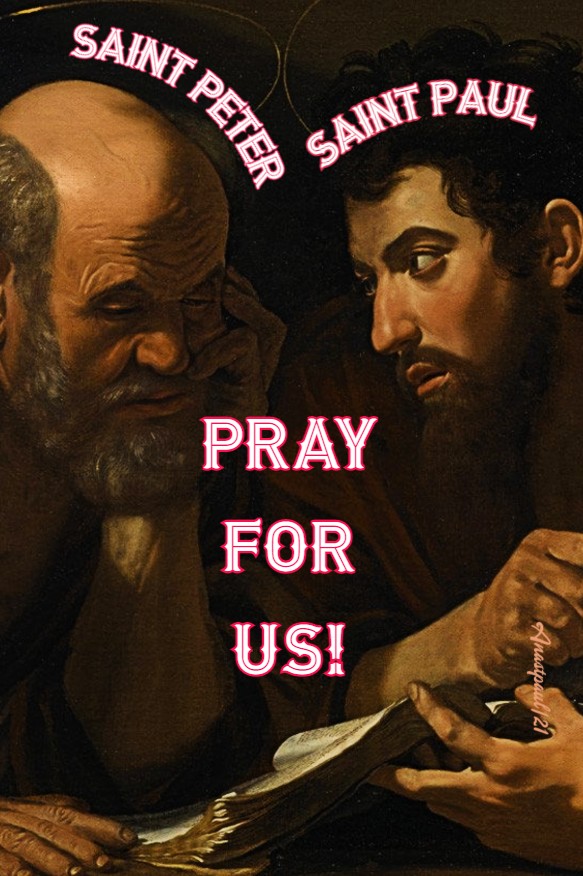
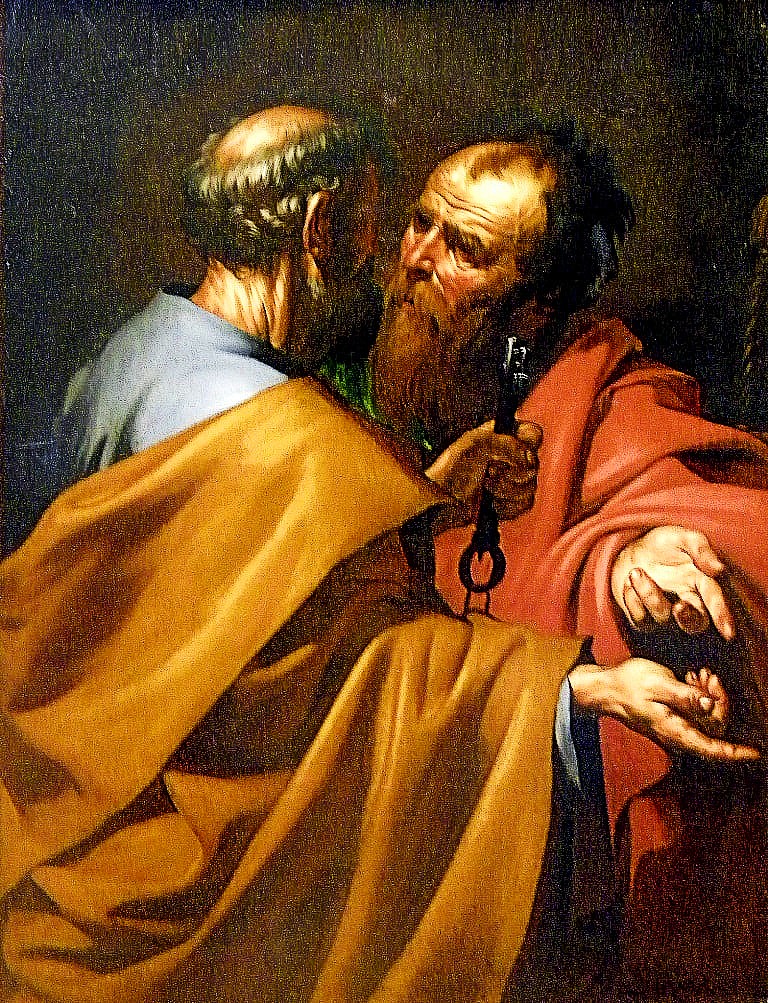
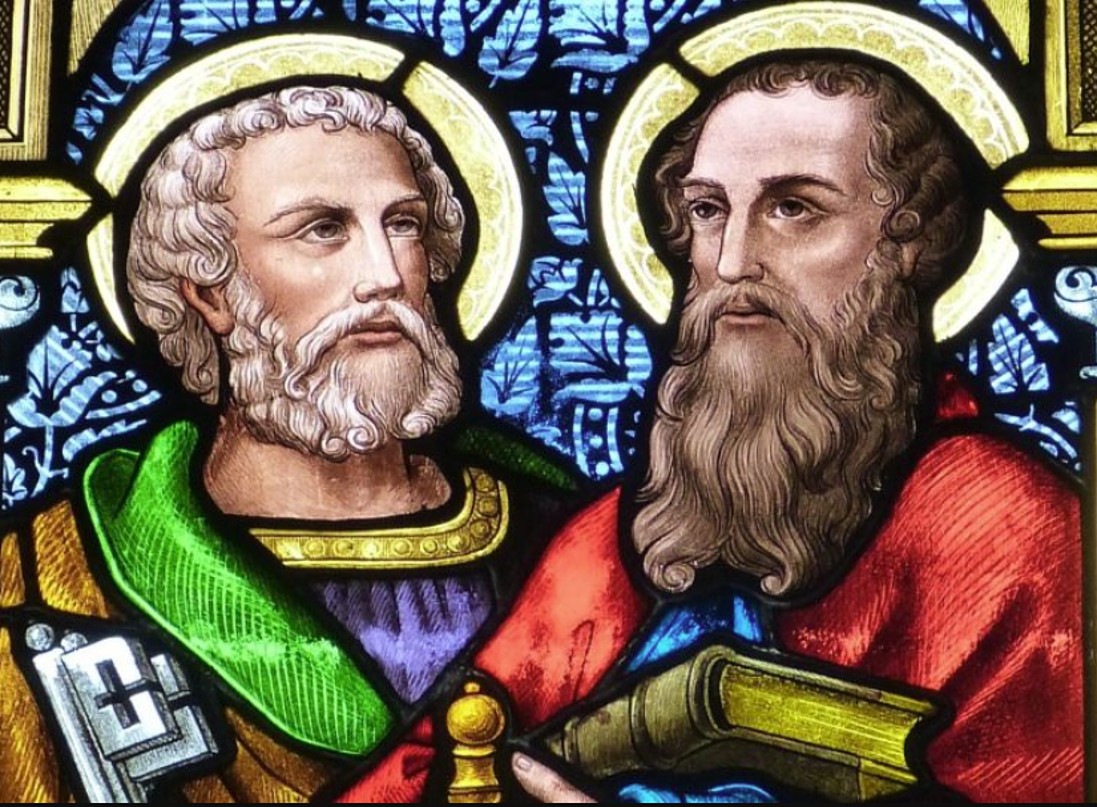
St Peter, Prince of the Apostles St Paul, the Apostle to the Gentiles
“Jesus was walking one day along the shoe of the Sea of Galilee, when He saw two fishermen casting their nets into the water. He approached them and said: “Come, follow me and I will make you fishers of men” (Mk 1:17). These two fishermen were brothers named, Simon and Andrew. The divine Master won their hearts immediately, so that they left their boat and their nets and followed Jesus. Simon was later called Peter and became the leader of the Apostles.
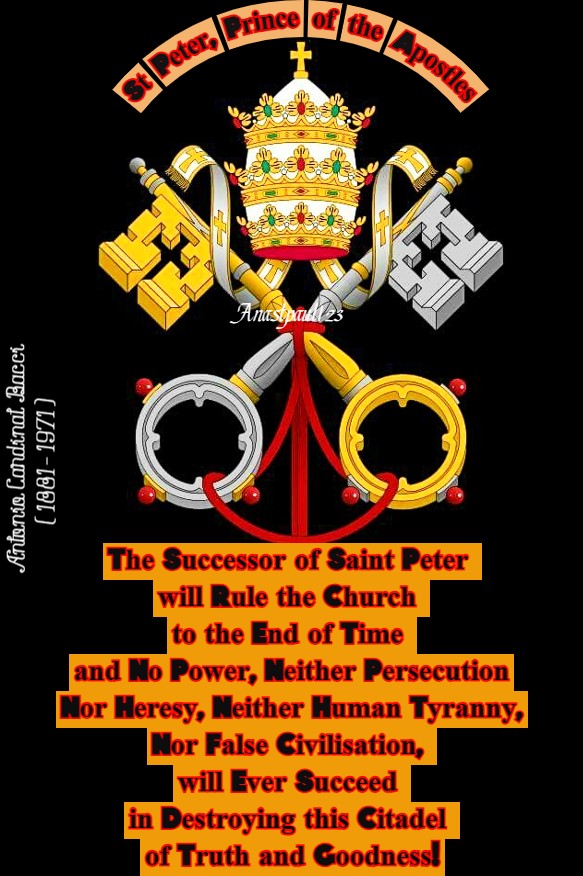
Peter’s generosity and great love for Jesus are evident in the pages of the Gospel. When Our Lord foretold the institution of the Blessed Eucharist, many of His disciples were scandalised and left Him. “Do you also wish to go away?” Jesus asked His Apostles. St Peter answered Him without delay. “Lord, to whom shall we go? Thou has the words of everlasting life and we have come to believe and to know, that Thou are the Christ, the Son of God” (Jn 6:69). On another occasion, Jesus asked His disciples – “Who do men say the Son of Man is?” The Apostles hesitated and began to suggest the names of various Prophets. But St Peter was inspired to make the reply: “Thou are the Christ, the Son of the living God.” Then Our Lord appointed him Head of the Church. “Blessed are thou, Simon Bar-Jona … thou are Peter and upon this rock I will build my Church and the gates of hell, shall not prevail against it. And I will give thee the keys of the kingdom of heaven and whatever you shall bind on earth shall be bound in heaven” (Mt 16:15-19). By these words there was instituted the loftiest and most ancient of the dynasties, the Papacy. The successor of St Peter will rule the Church to the end of time and no power, neither persecution nor heresy, neither human tyranny nor false civilisation, will ever succeed in destroying this citadel of truth and goodness!”
St Paul, the Apostle to the Gentiles
“St Paul was by nature, fiery and zealous. Once he discovered the truth, he was ready to die for it. Originally he was convinced that Judaism contained the whole truth and, for this reason he hated the Christians, whom he regarded as a sect which had corrupted the sacred Hebrew tradition. The deacon Stephen was the first victim of his persecuting zeal. As he was being stoned and beaten to death this saintly young man prayed for his persecutors. It may be that in this moment his eyes, shining with faith and love, encountered those of the man who hated him. Soon afterwards, Saul (this was Paul’s real name), left Jerusalem for Damascus, carrying letters investing him with new powers for the persecution of the infant Church. On the way, this headstrong but sincere enemy of Christianity was suddenly dazzled by a light from Heaven. He fell to the ground and heard a mysterious voice saying: “Saul, Saul, why do thou persecute me?” Terrified he answered: “Who are thou, Lord?” “I am Jesus,” the voice said, “whom thou are persecuting” (Acts 9:1-15). From that day, Saul was changed completely. Under the influence of divine grace, he became the Apostle to the Gentiles.
Before he set out on his missionary journeys, Paul wet apart into the desert of Arabia (Cf Gal 1:17), where, he remained sometime in prayer and recollection. Then he went to Jerusalem to pay homage to the Prince of the Apostles, St Peter (Gal 1:18). After this, he began his apostolic travels, in the course of which, he encountered all kinds of hardships and dangers. The Jews frequently hunted him, in order to put him to death. He was often cruelly scourged and flung into prison and, several times, he was shipwrecked and had miraculous escapes from death (CF 2 Cor 11:23-27). He bore everything joyfully however, in order to prove his liove for Jesus Christ. Charity was always his main incentive. “The love of Christ impels us” (2 Cor 5:14). Charity, he said himself, “Believes all things, hopes all things,edues all things” (Cf 1 Cor 13:4-13). His charity was so great, that he could truthfully say: “Who is weak and I am not weak? Who is made to stumble and I am not inflamed?” (2 Cor 11:29).
St Paul could make this claim because his heart had become identified with the Heart of Jesus. Therefore, he could say: “It is now no longer I that live but Christ lives in me,” (Gal 2:20) and: “For me to live is Christ and to die is gain,” (Phil 1:21) and: “I am hard pressed from both sides, desiring to depart and to be with Christ, a lot by far the better; yet, to stay on in the flesh is necessary, for your sake” (Phil 1:23-24).
Let us meditate on this ardent love of God. Let us cast aside our coldness and indifference and ask St Paul, to set us on fire with divine charity.” Amen
Quote/s of the Day – 29 June – “Month of the Sacred Heart” – The Solemnity of Saints Peter and Paul
“Look at the holy Apostles. It was by sinful jealousy that Peter was subjected to tribulation, not once or twice but many times; it was in that way, that he bore his witness before leaving us for his well-earned place in glory. And Paul, because of jealousy and contention, has become the very type of endurance rewarded. … In him we have one of the greatest of all examples of endurance. … [And] we too, are in the same arena and have the same conflict before us.”
St Pope Clement I of Rome (c 35-99)
Letter to the Corinthians, 5-7
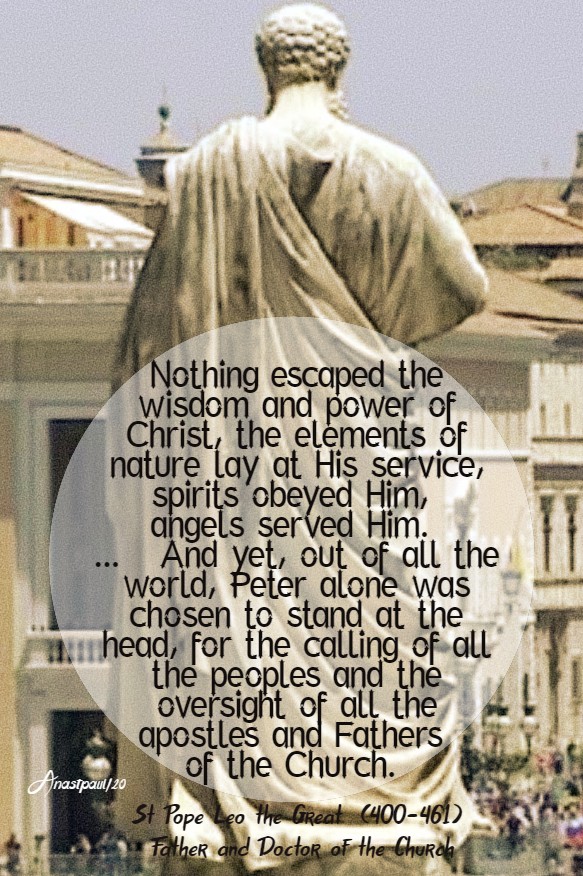
“Nothing escaped the wisdom and power of Christ, the elements of nature lay at His service, spirits obeyed Him, angels served Him. … And yet, out of all the world, Peter alone was chosen to stand at the head, for the calling of all the peoples and the oversight of all the apostles and Fathers of the Church. .”
St Pope Leo the Great (400-461) Father and Doctor of the Church
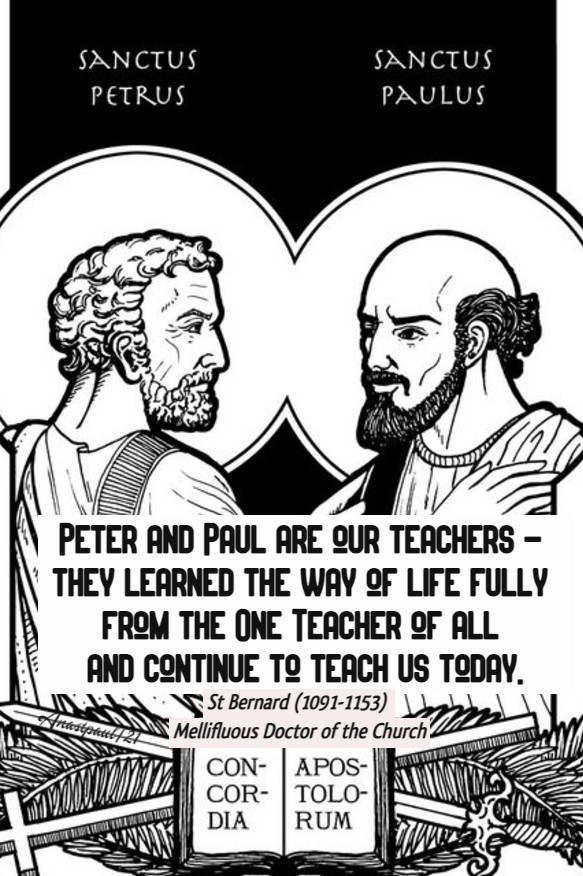
“Peter and Paul are our teachers – they learned the way of life fully from the One Teacher of all and continue to teach us today.”
St Bernard (1091-1153) Mellifluous Doctor of the Church
One Minute Reflection – 29 June – “Month of the Sacred Heart” – The Solemnity of Saints Peter and Paul, Readings: Acts 12:1-11, Psalm 34:2-9, 2 Timothy 4:6-8, 17-18, Matthew 16:13-19
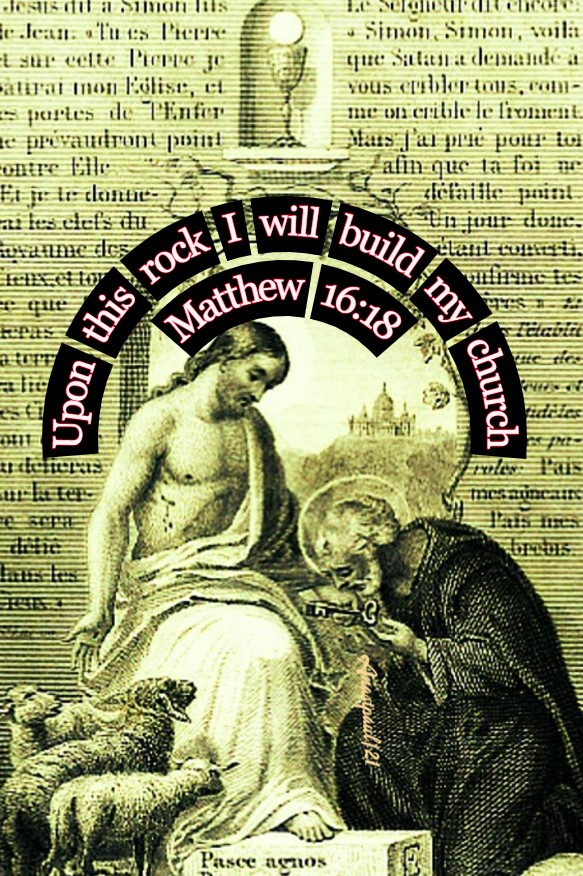
“Upon this rock I will build my church” – Matthew 16:18
REFLECTION –“Though the earth and all who dwell in it quake, I have set firm its pillars” (Ps 74[75],40). All the Apostles are pillars of the earth but, at their head, the two whose feast we are celebrating. They are the two pillars who support the Church with their teaching, their prayer and the example of their steadfastness. The Lord Himself strengthened these pillars. For at first they were weak, completely incapable of supporting either themselves or others. And in this, the Lord’s great design appears – if they had always been strong, people could have thought their strength came from themselves. That is why the Lord wanted to show, what they were capable of, before strengthening them, so that all might know their strength came from God… Peter was thrown to the ground by the voice of a mere servant… and the other pillar was very weak too: “I was once a blasphemer and persecutor and an arrogant man” (1Tm 1,13)…
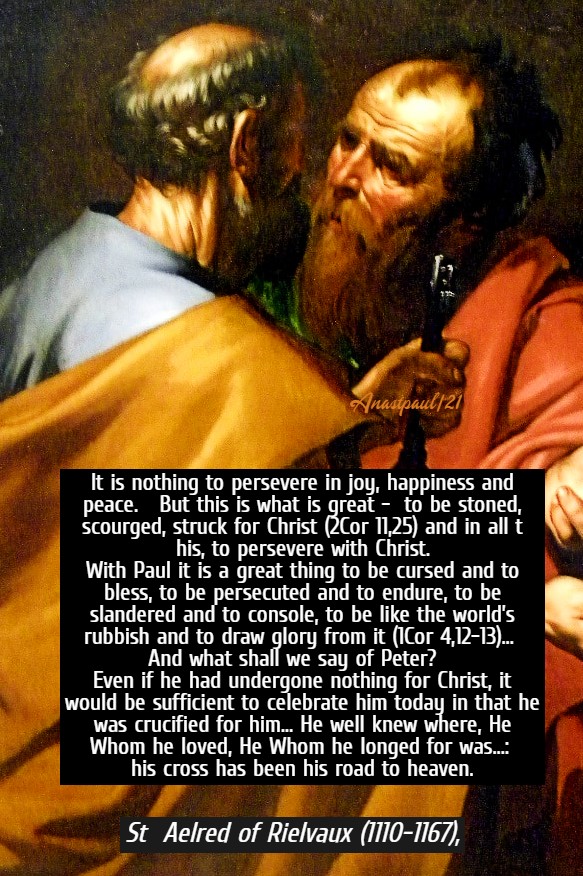
Hence, we ought to praise these Saints with all our heart – our fathers who bore such trials for the Lord’s sake and who persevered with such determination. It is nothing to persevere in joy, happiness and peace. But this is what is great – to be stoned, scourged, struck for Christ (2Cor 11,25) and in all this, to persevere with Christ. With Paul it is a great thing to be cursed and to bless, to be persecuted and to endure, to be slandered and to console, to be like the world’s rubbish and to draw glory from it (1Cor 4,12-13)… And what shall we say of Peter? Even if he had undergone nothing for Christ, it would be sufficient to celebrate him today in that he was crucified for him… He well knew where, He Whom he loved, He whom he longed for was…: his cross has been his road to heaven.” – St Aelred of Rielvaux (1110-1167), Cistercian Monk – Sermon 18, for the Feast of Saints Peter and Paul – PL 195, 298
PRAYER – Almighty ever-living God, You give us the great joy of devoting this day to the honour of the great Apostles Peter and Paul. Grant Your Church may follow their teachings fully because these are the men who first taught us to worship You in Christ, Your Son, Who lives and reigns with You and the Holy Spirit, God forever and ever, amen.
Our Morning Offering – 29 June – The Solemnity of Saints Peter and Paul
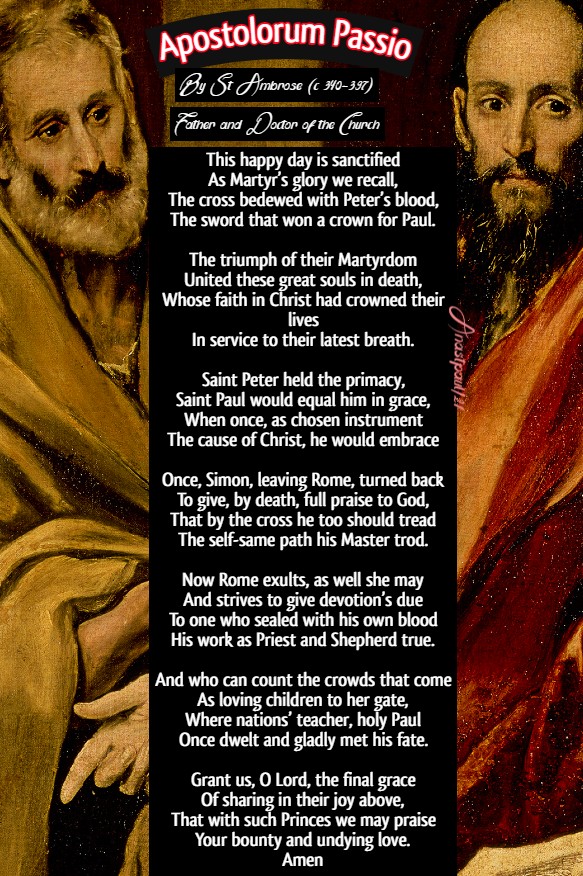
Apostolorum Passio By St Ambrose (c 340-397) Father and Doctor of the Church
This happy day is sanctified As Martyr’s glory we recall, The cross bedewed with Peter’s blood, The sword that won a crown for Paul.
The triumph of their Martyrdom United these great souls in death, Whose faith in Christ had crowned their lives In service to their latest breath.
Saint Peter held the primacy, Saint Paul would equal him in grace, When once, as chosen instrument The cause of Christ, he would embrace
Once, Simon, leaving Rome, turned back To give, by death, full praise to God, That by the cross he too should tread The self-same path his Master trod.
Now Rome exults, as well she may And strives to give devotion’s due To one who sealed with his own blood His work as Priest and Shepherd true.
And who can count the crowds that come As loving children to her gate, Where nations’ teacher, holy Paul Once dwelt and gladly met his fate.
Grant us, O Lord, the final grace Of sharing in their joy above, That with such Princes we may praise Your bounty and undying love. Amen
Translation: The Benedictines of Saint Cecilia’s Abbey, Ryde, UK
Solemnity of Saints Peter and Paul Apostles and Martyrs – 29 June
After the great Solemnities of the movable cycle, and the Feast of St John the Baptist, none is more ancient, nor more universal in the Church, than that of the two Princes of the Apostles. From the beginning, Rome celebrated their triumph on the very day itself which saw them go up from earth to heaven, 29 June. Her practice prevailed, at a very early date, over the custom of several other countries, which put the Apostles’ feast towards the close of December. It was, no doubt, a fair thought which inspired the placing of these Fathers of the Christian people in the cortege of Emmanuel at His entry into this world. But, as we have already seen, today’s teachings have intrinsically an important preponderance in the economy of Christian dogma; – they are the completion of the whole Work of the Son of God – the cross of Peter fixes the Church in her stability and marks out for the Divine Spirit, the immutable centre of His operations. Rome, therefore, was well inspired when, leaving to the Beloved Disciple the honour of presiding over his brethren at the Crib of the Infant God, she maintained the solemn memory of the Princes of the Apostles upon the day chosen by God Himself to consummate their labours and to crown, at once, both their life and the whole cycle of mysteries.
Fully today, do the heavens declare the glory of God, as David expresses it, today do they show us the course of the Spouse completed on the eternal hills (Ps. xviii. 2-6). Day unto day uttereth speech and night unto night revealeth the deep secret (Ibid. 3). From north and south of the new Sion, from either side of her stream, Peter and Paul waft one to other, as a farewell song, as a sacred Epithalamium, the good Word (Ps. xliv. 2); sublime that echo, sonorous its power, vocal still throughout the whole earth (Ibid. xviii. 4, 5), and yet, to resound as long as the world lasts. These two torches of salvation blend their flames above the palaces of ancient Rome; the passing darkness of their death, that night of which the Psalmist sings, now concentrates light, forever, in the midst of the Queen City. Beside the throne of the Bridegroom fixed forever and ever, on yonder seven hills (Ps. xliv. 7-10), the Gentile world, now become the Bride, is resplendent in glory (Eph. v. 27), all fair in that peerless purity which she derives from their blood united, as it is, to that of the Son of God.
But seemly is it, not to forget, on so great a day, those other messengers sent forth by the divine householder and who watered earth’s highways with their sweat and with their blood, the while they hastened the triumph and the gathering in of the guests invited to the Marriage feast (St.Matth. xxii. 8-10). To them is it due, if now the law of grace is definitively promulgated throughout all nations and if, in every language and upon every shore, the good tidings have been sounded (Ps. xviii. 4, 5). Thus the festival of St Peter, completed by the more special memory of St Paul his comrade in death, has been from earliest times regarded as the festival likewise of the whole Apostolic college. In those primitive times it seemed impossible to dream of separating from their glorious leader any of those whom Our Lord had so intimately joined together in the responsibility of one common work. But in course of time, however, particular solemnities were successively consecrated to each one of the Apostles and so, the feast of 29 June was more exclusively attributed to the two Princes whose Martyrdom rendered this day illustrious. (from the Liturgical Year, 1904).
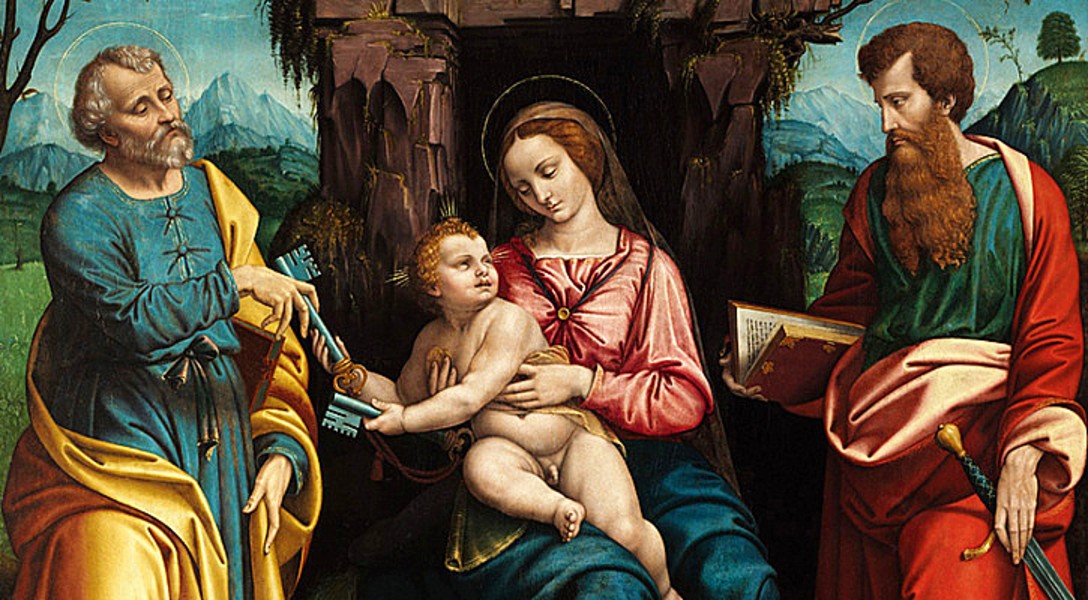
the Virgin and Child with Saints Peter and Paul by Girolamo Figino
Notre-Dame de Buglose / Our Lady of Buglose, France (1634) – 29 June:
Located about two leagues from Acqe in Glascony is the Shrine containing a miraculous image of Our Lady of Buglose. The original Shrine of Notre-Dame de Buglose was burned and completely destroyed by the Huguenots, and the Statue of Our Lady was hidden in a marsh. The exact location of the Statue was eventually forgotten, as was the memory even that the place had once been the location of a Shrine in honour of the Blessed Virgin. Years later, a shepherd led his herd into the marshes and observed that one of his oxen did not go with the others but went into an area of the marsh alone and began to bellow in a strange manner. The shepherd climbed a tree to see what was happening, and saw the ox licking an unknown object that was half buried in the mud. Not understanding the mystery, he ran into Town to bring others back with him to see what had happened. When the shepherd returned, the Statue of the Blessed Virgin holding the baby Jesus in her arms had been revealed. It was respectfully removed from the water and the Bishop of Dax desired to take the image to his Church in Pouy. He placed the Statue in a cart that was pulled by oxen to transport it back to Pouy. The procession began with hymns and prayers but had only gone a short distance, when the oxen stopped and would not move any further. It was understood that the Blessed Virgin desired that her image should stay near the fountain. The Bishop accepted the revelation as a divine order and thanks to the zeal and enthusiastic support of the people living in the region, a new Church was built with prodigious speed. The Shrine was, for a long time, popular as a place of pilgrimage in France – now it is further renowned as the birthplace of Saint Vincent de Paul. The house where he was born and where he spent his boyhood, is still visited as a Museum of the Saint.
|The Basilica of St Vincent de Paul and Our Lady of Buglose
There have been many miracles at the Shrine, as indeed Buglose had become known as a land of miracles. There were 19 miracles recorded in the year 1622 alone. There is a fountain near the Chapel marking the place where the Statue of Our Lady of Buglose was found buried. In 1623, a man named Bernard Ducassou came to the shrine seeking a cure for the seven boils that covered his left leg. He spent the entire night in prayer and the next day bathed at the fountain. The ulcers that would not heal were suddenly closed. Pilgrims still travel to the famous Shrine of Our Lady where miracles are continuously granted to pious devotees.
St Anastasius of Bourges St Benedicta of Sens St Cassius of Narni St Ciwg ap Arawn St Cocha St Ilud Ferch Brychan St Judith of Niederaltaich St Marcellus of Bourges St Mary, the Mother of John Mark St Salome of Niederaltaich St Syrus of Genoa Bl William of Sann — Martyrs of China Ioannes Baptista Wu Mantang Magdalena Du Fengju Maria Du Tianshi Paulus Wu Anju Paulus Wu Wanshu
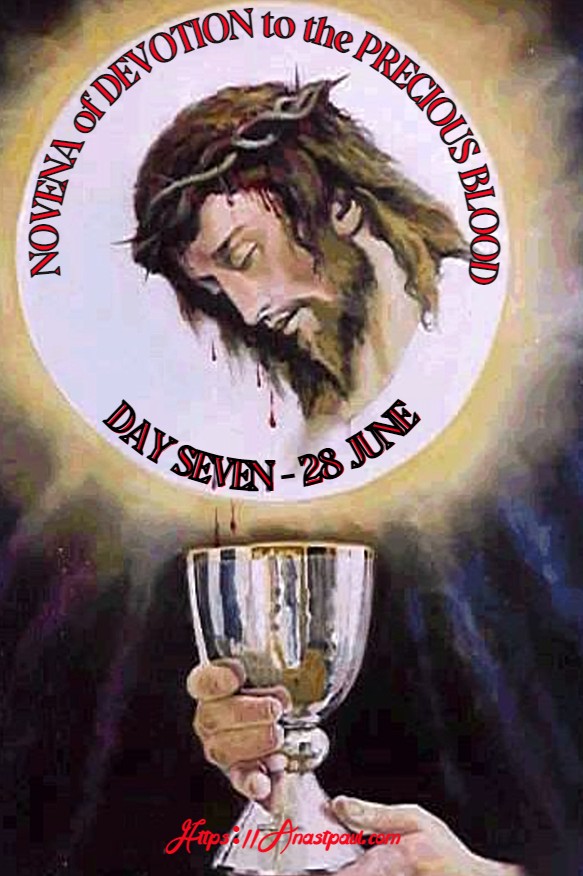
DAY SEVEN – NOVENA of DEVOTION to the PRECIOUS BLOOD of JESUS
Opening Prayer for each Day:
Grant me the grace to know You, to love You and to be truly sorry that I have offended You. I ask this grace by Your Precious Blood – By that Precious Blood, which bathed Your Sacred Body and trickled down to the ground in the Garden of Olives. By that Precious Blood, which poured forth from Your Sacred Body during the scourging. By that Precious Blood, which which covered Your Sacred Face when You were crowned with thorns. By that Precious Blood, which burst from Your hands and feet on Calvary. By that Precious Blood, which came forth from Your Sacred Heart after Your death. By that Precious Blood, which we drink in Holy Communion and of which You said: “He who feeds on My Flesh and drinks My Blood has life eternal.” Amen.
Day Seven : Jesus Sheds Blood in the Crucifixion
Final prayer:
Eternal Father, we offer You the Precious Blood of Jesus shed in the Crucifixion. Permit that, in perfect union with Your only begotten Son, we offer You our lives as a gift of sacrifice. As participants in the eternal redemption, we celebrate the memory of our Redemption at the foot of the Cross. With Mary our Mother, we glorify You in the abundance of Your grace and enjoy the victory of salvation. Through Jesus Christ our Lord. Amen
Our Father … Glory to the Father …
V. Praise and thanksgiving be evermore to Jesus. R. Who with his blood has saved us. V. Glory to the Blood of Jesus! R. Now and forever. Amen
Thought for the Day – 28 June – Meditations with Antonio Cardinal Bacci (1881-1971)
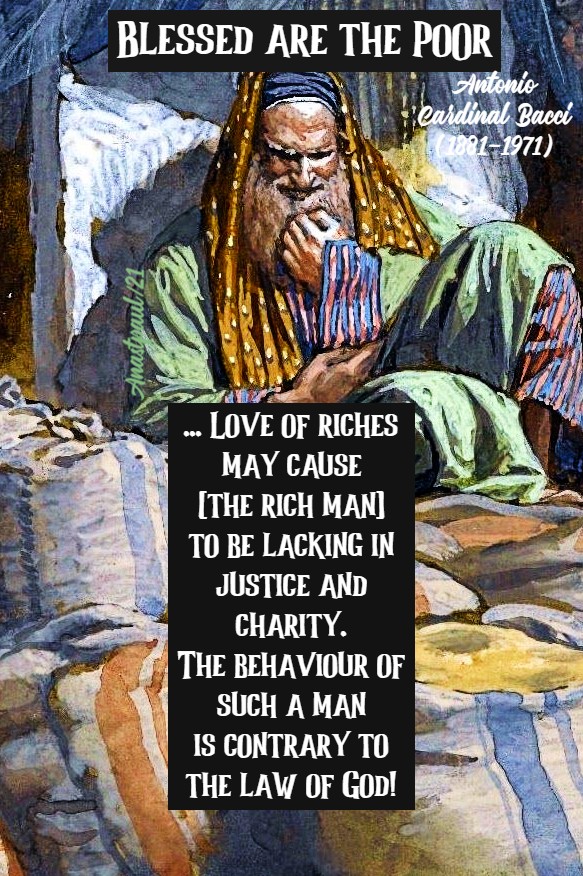
Blessed are the Poor
“Blessed are the rich.” This, is the judgement of the world. But Jesus says: “Blessed are you poor” (Lk 6:20). Whom are we to believe? Naturally, we must believe Jesus. A certain amount of confusion could arise, however, in our understanding of this maxim. It becomes clear from the context of St Luke and still clearer in the words of St Matthew, who writes: “Blessed are the poor in spirit” (Mt 5:3). It is necessary, therefore, as St Jerome and others have commented, to be poor in our detachment from our possessions.
If a poor man longs for riches and envies and hates the wealthy because of their possessions, he is NOT poor in spirit. So he cannot receive the blessing of which Our Lord spoke. In the same way, a rich man may be attached to his great wealth. Perhaps he aims at nothing else but to increase it and, because he is thinking of it all the time, neglects his duty to God and to his neighbour. Above all, love of riches may causes him to be lacking in justice and charity. The behaviour of such a man is contrary to the law of God! Meditate carefully on this point and do not neglect to make, whatever resolutions, seem necessary.”
Quote/s of the Day – 28 June – “Month of the Sacred Heart” – The Memorial of St Irenaeus of Lyons (c 130 – c 202) Martyr, Father of the Church, Bishop, Theologian, Writer, Confessor, Defender of the Faith, Apologist.
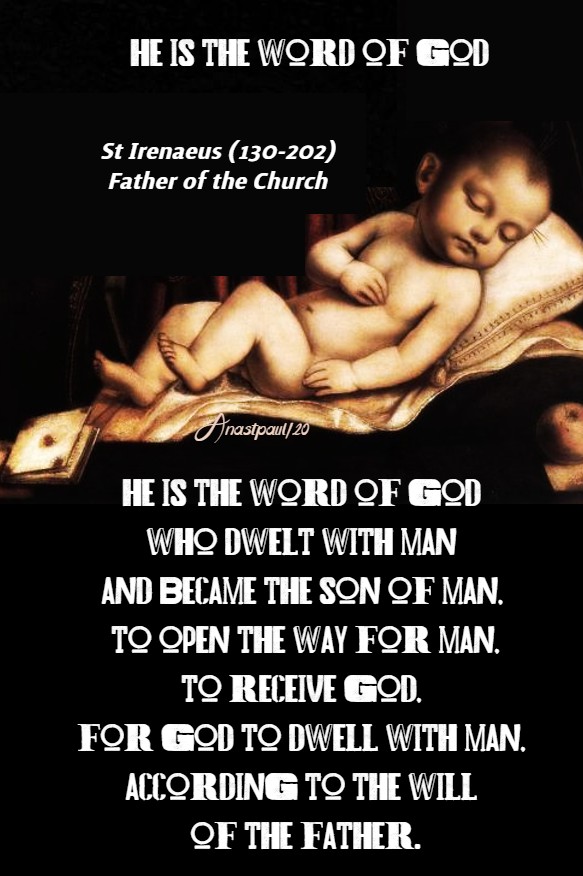
“He is the Word of God who dwelt with man and became the Son of Man, to open the way for man, to receive God, for God to dwell with man, according to the will of the Father.”
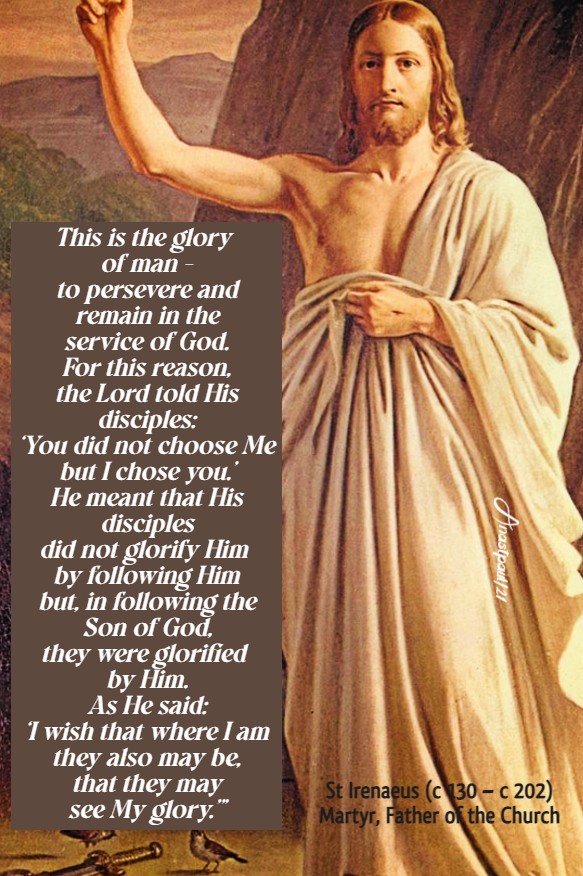
“This is the glory of man – to persevere and remain in the service of God. For this reason, the Lord told His disciples: ‘You did not choose Me but I chose you.’ He meant that His disciples did not glorify Him by following Him but, in following the Son of God, they were glorified by Him. As He said: ‘I wish that where I am they also may be, that they may see My glory.’”
“When we stand in the light it is not we who illumine the light and cause it to shine but we are illuminated and made shining by the light… God grants His blessings on those who serve Him because they are serving Him and on those who follow Him because they are following Him but He receives no blessing from them because He is perfect and without need.”
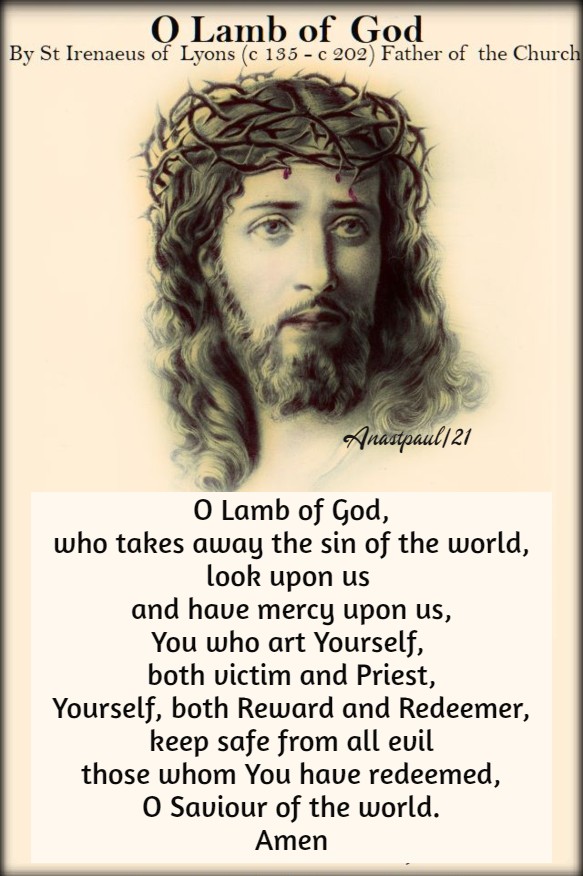
O Lamb of God By St Irenaeus (c 130 – c 202)
O Lamb of God, who takes away the sin of the world, look upon us and have mercy upon us, You who art Yourself, both victim and Priest, Yourself, both Reward and Redeemer, keep safe from all evil those whom You have redeemed, O Saviour of the world. Amen
St Irenaeus (c 130 – c 202) Bishop & Martyr, Father of the Church
One Minute Reflection – 28 June – “The Month of the Sacred Heart” – Readings: Genesis 18: 16-33, Psalms 103: 1b-2, 3-4, 8-9, 10-11, Matthew 8: 18-22
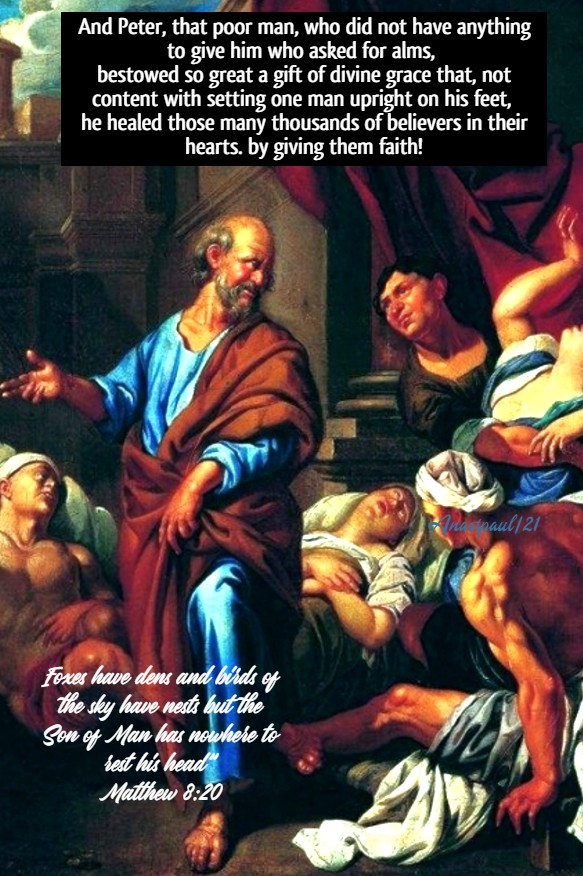
“Jesus answered him, “Foxes have dens and birds of the sky have nests but the Son of Man has nowhere to rest his head” – Matthew 8:20
REFLECTION – “Hence the blessed Apostle Peter, when he was going up to the temple and was asked for alms by a lame man, said, “I have neither silver nor gold but what I do have I give you, in the name of Jesus Christ the Nazarene, rise and walk” (Acts 3:6)…
And Peter, that poor man, who did not have anything to give him who asked for alms, bestowed so great a gift of divine grace that, not content with setting one man upright on his feet, he healed those many thousands of believers in their hearts. by giving them faith!”…St Pope Leo the Great (400-461) Father & Doctor
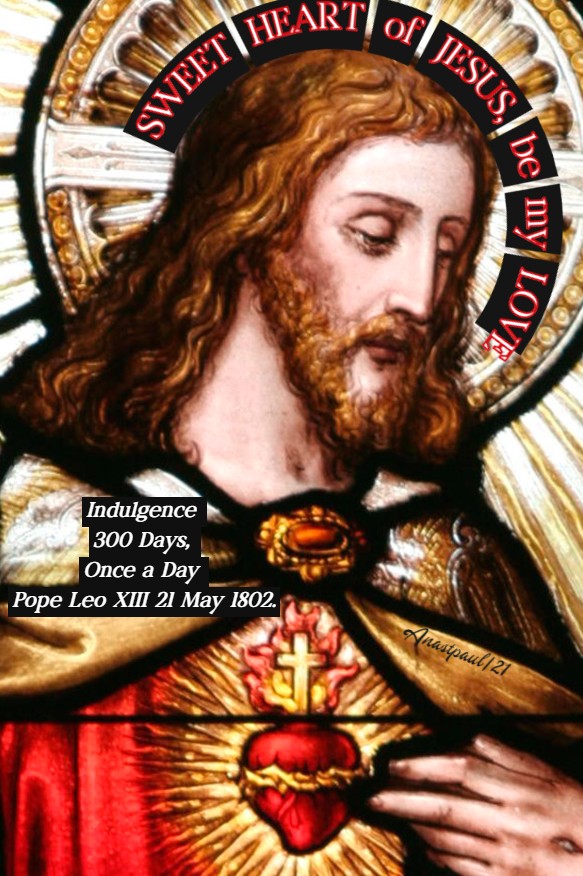
PRAYER – Lord God, be the beginning and the end of all that we are and do and say. Prompt our actions with Your grace, may Your light be our only way, may Your commands be our only need and complete all, with Your all-powerful help. Blessed Peter of Luxembourg, who was the rich young man made poor, pray for us! We make our prayer through Christ our Lord in the unity of the Holy Spirit, one God with You, forever and ever, amen. SWEET HEART of JESUS, be my LOVE. – Indulgence 300 Days, Once a Day – Pope Leo XIII 21 May 1802.
Our Morning Offering – 28 June – “The Month of the Sacred Heart”
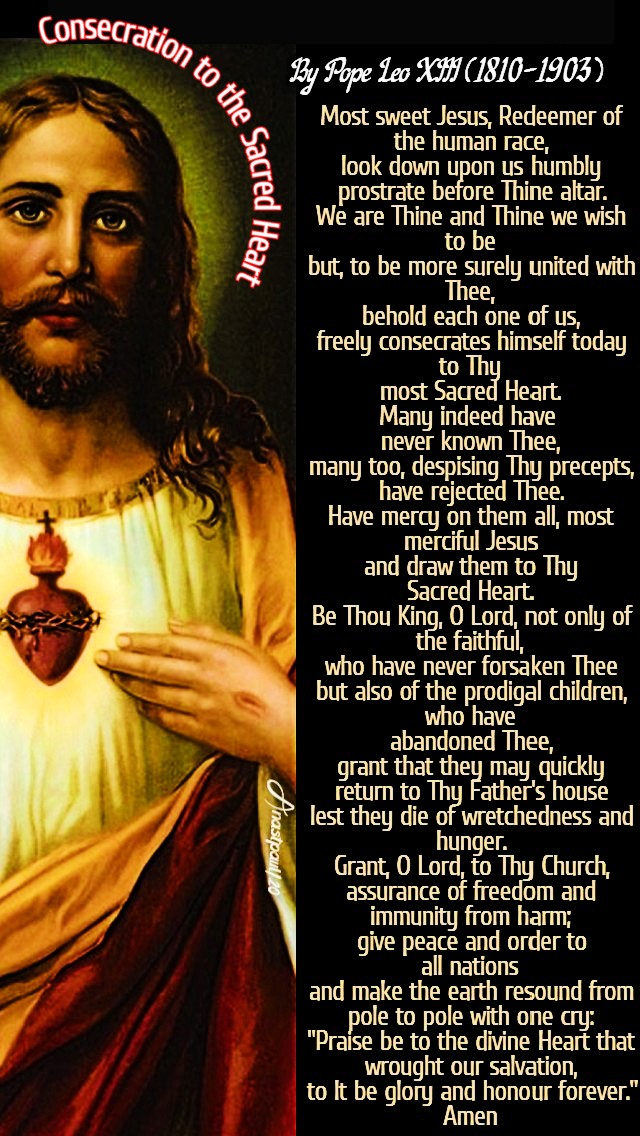
Consecration to the Sacred Heart By Pope Leo XIII (1810-1903) Pope from 1878-1903
Most sweet Jesus, Redeemer of the human race, look down upon us humbly prostrate before Thine altar. We are Thine and Thine we wish to be but, to be more surely united with Thee, behold each one of us, freely consecrates himself today to Thy most Sacred Heart. Many indeed have never known Thee, many too, despising Thy precepts, have rejected Thee. Have mercy on them all, most merciful Jesus and draw them to Thy Sacred Heart. Be Thou King, O Lord, not only of the faithful, who have never forsaken Thee but also of the prodigal children, who have abandoned Thee, grant that they may quickly return to Thy Father’s house lest they die of wretchedness and hunger. Be Thou King of those who are deceived by erroneous opinions, or whom discord keeps aloof and call them back to the harbour of truth and unity of faith, so that there may be but one flock and one Shepherd. Be Thou, King of all those. who are still involved in the darkness of idolatry or of Islamism and refuse not to draw them into the light and kingdom of God. Turn Thine eyes of mercy towards the children of the race, once Thy chosen people – of old they called down upon themselves the Blood of the Saviour; may it now descend upon them, a laver of redemption and of life. Grant, O Lord, to Thy Church, assurance of freedom and immunity from harm; give peace and order to all nations and make the earth resound from pole to pole with one cry: “Praise be to the divine Heart that wrought our salvation; to It be glory and honour forever.” Amen
The above prayer, composed by Pope Leo XIII was included in the 1899 Encyclical Annum Sacrum issued by Leo XIII as he Consecrated the entire world to the Sacred Heart of Jesus. The consecration was influenced by two letters written to the Holy Father by Blessed Sister Mary of the Divine Heart, who stated that in visions of Jesus Christ, she had been told to request the Consecration.
Saint of the Day – 28 June – Saint Pope Paul I (Died 767) Papacy 29 May 757-28 June 767, Confessor. He first served as a Roman Deacon and was frequently employed by his brother, Pope Stephen II, in many delicate negotiations and Ecclesiastical matters. Born at Rome, Italy and died on 28 June 767 at Saint Paul’s Outside the Walls, Rome, Italy of natural causes.
Paul was a Roman aristocrat. He and his brother, Stephen had been educated for the Priesthood at the Lateran Palace. Stephen, became Pope in 752. Stephen entrusted his brother, who approved of the Pope’s course in respect to King Pepin of the Franks, with many important ecclesiastical affairs, among others – with the restoration to the Roman States of the Cities which had been seized by the Lombards.
While Paul was with his dying brother at the Lateran, a party of the Romans gathered in the house of Archdeacon Theophylact in order to secure the latter’s succession to the papal see. However, immediately after the burial of Stephen (died 26 April, 757), Paul was elected by a large majority and received episcopal Consecration on 29 May. Paul continued his predecessor’s policy towards the Frankish King, Pepin and thereby, continued the Papal supremacy over Rome and the districts of central Italy in opposition to the efforts of the Lombards and the Eastern Empire.
Pepin sent a letter to the Roman people, exhorting them to remain steadfast to St Peter. In the reply sent by the Senate and the people of Rome, he was urged to complete the enlargement of the Roman province which he had wrested from the barbarians and to persevere in the work he had begun.
In 758 a daughter was born to Pepin and the King sent the pope the cloth used at the Baptism as a present, renewing, in this way, the Papal sponsorship. Paul returned thanks and informed Pepin of the hostile action of Desiderius, who had failed to deliver, as agreed, to Rome, the occupied Cities . A major crises ensued, with the Pope seeking assistance from King Pepin and the Lomba\rd King threatening war against Rome. King Pepin gave the Pope some support and acted as arbiter between the Roman and Lombard claims.
In 765, Papal privileges were restored in the duchies of Benevento and Tuscany and partially in Spoleto. Meanwhile, the alienation from Eastern Roman Empire grew greater. Several times, especially in 759, Paul feared that the Emperor would send an armament against Rome. Paul lived in continual dread lest Eastern Roman ambitions turn the Frankish influence in favour of the Lombards. This was actually attempted but Pepin held to his original foreign policy regarding Italy.
In 767 a Frankish synod was held at Gentilly, near Paris, at which the Church Doctrines concerning the Trinity and the veneration of images were maintained. Paul showed great activity and zeal in encouraging religious life at Rome. He turned his paternal home into a Monastery and built nearby the |Church of San Silvestro in Capite. The founding of this Church led to his holding a Synod at Rome in 761. To this Church and other Churches of Rome, Paul transferred the bones of numerous Martyrs from the decayed Sanctuaries in the Catacombs, devastated by the Lombards in 756. He transferred the relics of St Petronilla from the Catacomb of St Domitilla to a Chapel in St.Peter’s erected by his predecessor for this purpose. The legend of St Petronilla caused her, at that era, to be regarded as a daughter of St Peter and as such, she became the special Roman Patroness of the Frankish rulers.
Paul also built an Oratory of the Blessed Virgin in St Peter’s and a Church in honour of the Apostles on the Via Sacra beyond the Roman Forum. He died near the Church of St Paul’s Outside the Walls, where he had gone during the heat of summer. He was buried in this Church but after three months, his body was transferred to St Peter’s.
The “Liber Pontificalis” also praises the Christian charity and benevolence of the Pope which he united with firmness. His feast is celebrated today and he is listed in today’s Martyrology as Pope and Confessor.
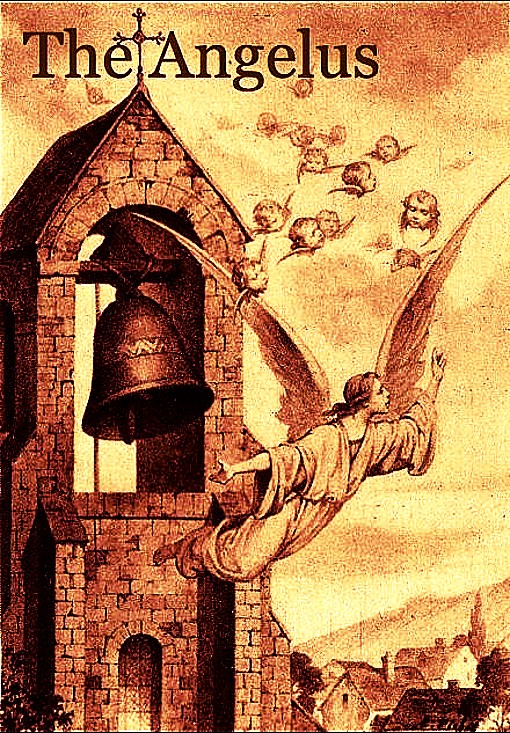
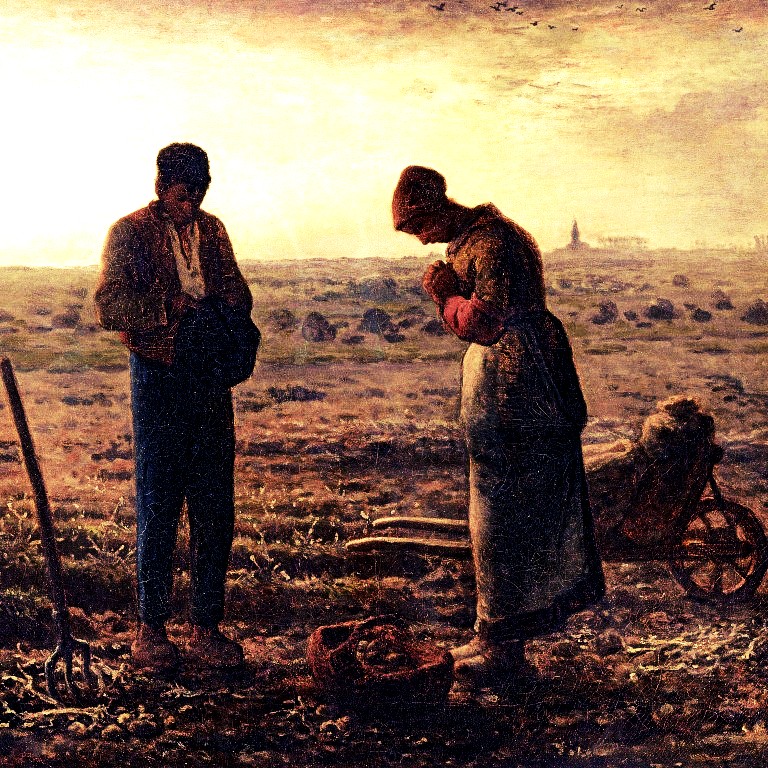
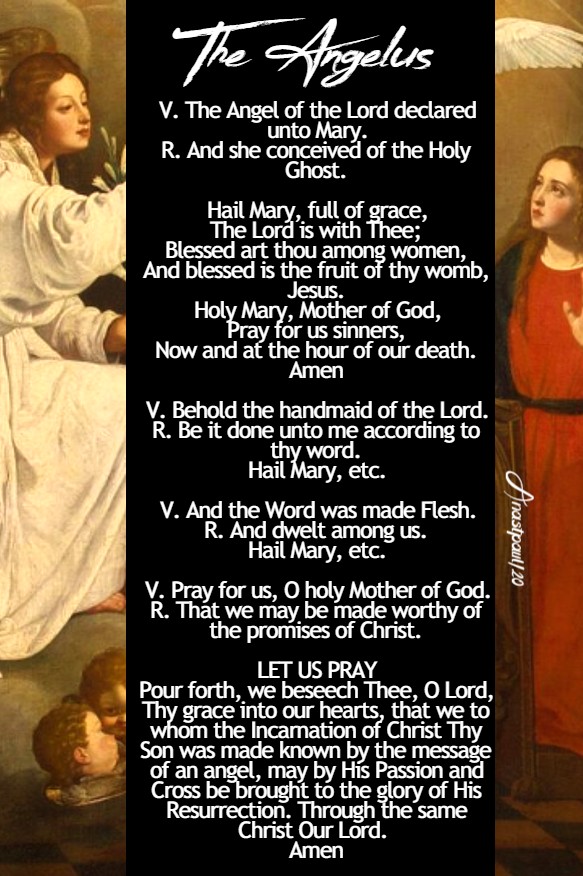
Angelus Domini nuntiavit Mariæ / Institution of the Angelus of Our Lady, Europe, (1456) – 28 June:
The institution of the Angelus occurred on 28-29 June about 1456 by Pope Callistus. The Turks had been threatening Europe and it was the Pope’s request that the Faithful recite the Angelus for the safety of Christendom against the Turks and for peace. The Angelus was first recited about sunset, a general practice throughout Europe in the first half of the 14th century, recommended by Pope John XXI. The morning Angelus seems to have started somewhat later, again, for peace. The recitation of the midday Angelus began sometime in the 14th or 15th century; it was called the “Peace Bell.” This present-day custom of reciting the Angelus is a short practice of devotion in honour of the Incarnation, repeated three times each day, morning, noon, and evening, at the sound of the Church bell.
It is curious how the Angelus is associated historically with the invasion of the Turks, again, in 1683, when they laid siege to Vienna. Emperor Leopold of Austria fled and begged for assistance and help from John Sobieski, a great Polish general, who gathered his army and hastened to the rescue, stopping at one of Our Lady’s Shrines in Poland, for blessing. On 11 September 1683, Sobieski was on the heights of Kahlenberg, near Vienna and the next day engaged in battle with the Turks. Brilliantly leading his troops, he forced the Turks into a trap but the number of the foe was so great, that he could not penetrate their ranks; then Sobieski’s cavalry turned in retreat, interpreted by the Turks as flight. The Turks rushed forward but were re-attacked. The shouts and cries of Sobieski’s men threw terror into the Turks, when they learned that Sobieski himself, “The Northern Lion,” was on the battlefield, for he had defeated the Turks in Poland on previous occasions and they feared him, therefore, the Turks fled panic-stricken. The battle raged for a time; all along the front was Sobieski commanding, fighting, encouraging his men and urging them forward. The Turks were finally defeated, Vienna and Christendom saved and the news was sent to Pope Innocent XI at Rome. Sobieski was a humble man, for in the height of his greatest victory, in a letter to Pope Innocent XI, he said it was God’s cause he was fighting for and Mary’s honour. His message to the Pope on the victory read: “I came, I saw but God and Mary conquered.” The day after the Battle, Sobieski entered Vienna victoriously. Later, he pursued the Turks into Hungary, again attacking and defeating them. The Turkish threat to Europe had been vanished forever, or at least until the 21st century.
Pope Innocent XI, after the battle of Vienna, requested the whole Christian world to recite the Angelus for peace. In our own time, we see the peaceful Moslem invasion of Europe, which once again, Poland is resisting.
The 500th anniversary of the Institution of the Angelus by Pope Callistus III, was a reminder to recite the centuries old prayer for peace and for the protection of the Christian world. Let us renew this pious practice if we have become lax in our devotion and let us pray the Angelus, for the protection of the Church in our own times, from the many menaces, on all fronts, internally and exteriorly facing the Faith and the world and the whole existence of the Catholic Church.
Bl Almus of Balmerino St Argymirus of Córdoba St Attilio of Trino St Austell of Cornwall St Benignus of Utrecht St Crummine Bl Damian of Campania St Egilo St Heimrad St Lupercio St Papias the Martyr
Martyrs of Africa – 27 saints: 27 Christians martyred together. The only details about them to survive are the names – Afesius, Alexander, Amfamon, Apollonius, Arion, Capitolinus, Capitulinus, Crescens, Dionusius, Dioscorus, Elafa, Eunuchus, Fabian, Felix, Fisocius, Gurdinus, Hinus, Meleus, Nica, Nisia, Pannus, Panubrius, Plebrius, Pleosus, Theoma, Tubonus and Venustus. Unknown location in Africa, date unknown.
Martyrs of Alexandria – 8 saints: A group of spiritual students of Origen who were martyred together in the persecutions of emperor Septimius Severus – Heraclides, Heron, Marcella, Plutarch, Potamiaena the Elder, Rhais, Serenus and Serenus. They were burned to death c.206 in Alexandria, Egypt.
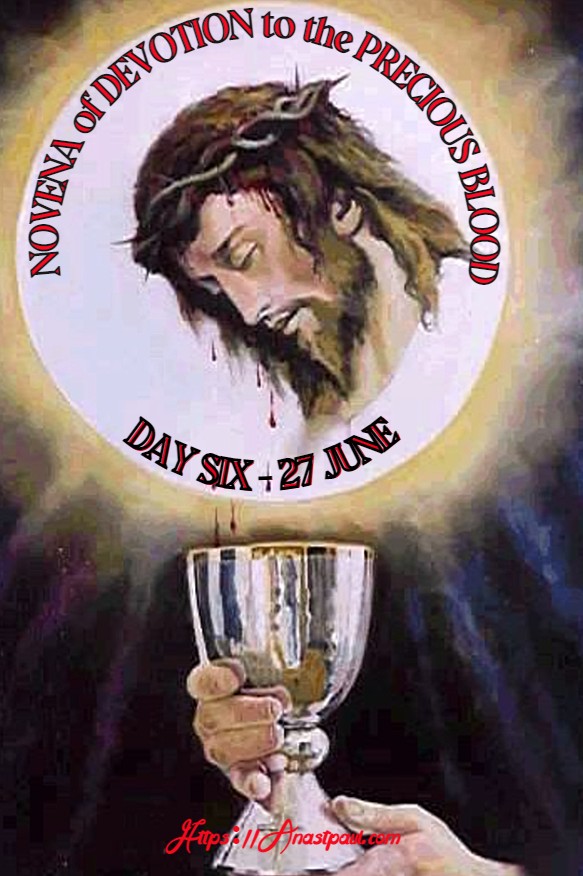
DAY SIX – NOVENA of DEVOTION to the PRECIOUS BLOOD of JESUS
Opening Prayer for each Day:
Grant me the grace to know You, to love You and to be truly sorry that I have offended You. I ask this grace by Your Precious Blood – By that Precious Blood, which bathed Your Sacred Body and trickled down to the ground in the Garden of Olives. By that Precious Blood, which poured forth from Your Sacred Body during the scourging. By that Precious Blood, which which covered Your Sacred Face when You were crowned with thorns. By that Precious Blood, which burst from Your hands and feet on Calvary. By that Precious Blood, which came forth from Your Sacred Heart after Your death. By that Precious Blood, which we drink in Holy Communion and of which You said: “He who feeds on My Flesh and drinks My Blood has life eternal.” Amen.
Day Six : Jesus Sheds Blood Carrying the Cross
Final prayer:
Eternal Father, we offer You the Precious Blood of Jesus shed on the way to Calvary, for all those in the world who suffer the consequences of sin. Grant them repentance and conversion, health to the sick and feed those who suffer from hunger, free from injustice the persecuted and ransom the imprisoned, give salvation to the dying. Do not forget the work that You have begun in us, so that our life is willingly given, in obedience and sacrifice, to Your Truth, Your Service and Your Will. Through Jesus Christ our Lord. Amen
Our Father … Glory be … V. Praise and thanksgiving be evermore to Jesus. R. Who with his blood has saved us. V. Glory to the Blood of Jesus! R. Now and forever. Amen
Thought for the Day – 27 June – Meditations with Antonio Cardinal Bacci (1881-1971)
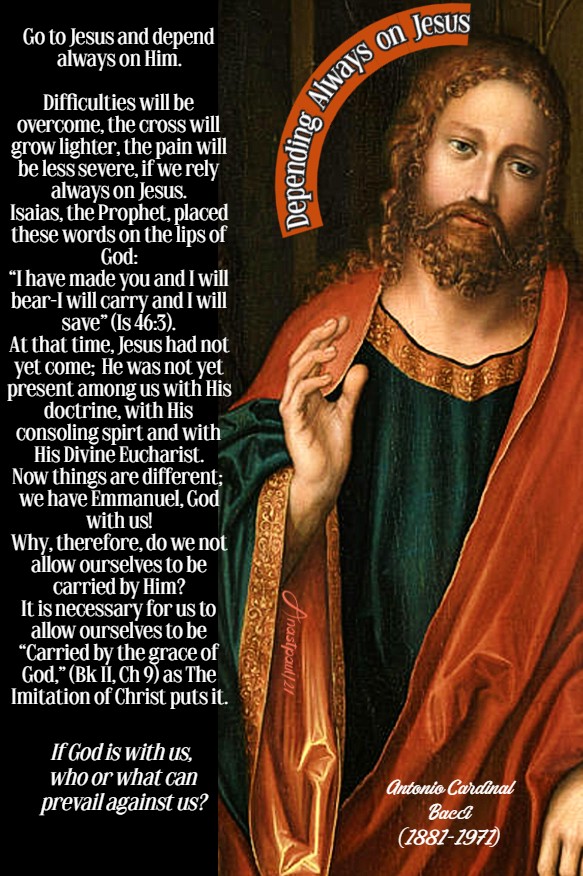
Depending Always on Jesus
“Virtue is difficult and life holds more trials than consolations. Sometimes, we feel discouraged because virtue seems impossible and we fall so often, in spite of our best resolutions or because, our cross seems too heavy and we feel that we are overburdened.
Where will we find comfort in our sufferings and strength in our weakness? “Come to me, all you who labour and are burdened and I will give you rest” (Mt 11:28). Go to Jesus and depend always on Him.
Difficulties will be overcome, the cross will grow lighter, the pain will be less severe, if we rely always on Jesus. Isaias, the Prophet, placed these words on the lips of God: “I have made you and I will bear-I will carry and I will save” (Is 46:3). At that time, Jesus had not yet come; He was not yet present among us with His doctrine, with His consoling spirt and with His Divine Eucharist. Now things are different; we have Emmanuel, God with us! Why, therefore, do we not allow ourselves to be carried by Him? It is necessary for us to allow ourselves to be “Carried by the grace of God,” (Bk II, Ch 9) as The Imitation of Christ puts it.
If God is with us, who or what can prevail against us?
We must, as St Francis de Sales writes, lean on the arm of Jesus, as the child leans securely on the arm of it’s mother. “It matters little,” he adds, “where she walks, on a grassy plain or on a steep path surrounded by precipices.” She, is his mother and she carries him; that is enough to make him happy and content. We must trust Jesus in this way, relying always on His support in joy and in sorrow, in moments of trial and in moments of satisfaction, in life and in death. Let us not be afraid; Jesus is better and stronger than our earthly mother. If He guides and supports us, we can be sure of Heaven, no matter what happens!”
Quote/s of the Day – 27 June – “Month of the Sacred Heart” – The Memorial of St Cyril of Alexandria (376-444) Father and Doctor of the Church ) – “The Pillar of Faith” & “Seal of all the Fathers” – Doctor Incarnationis (Doctor of the Incarnation)
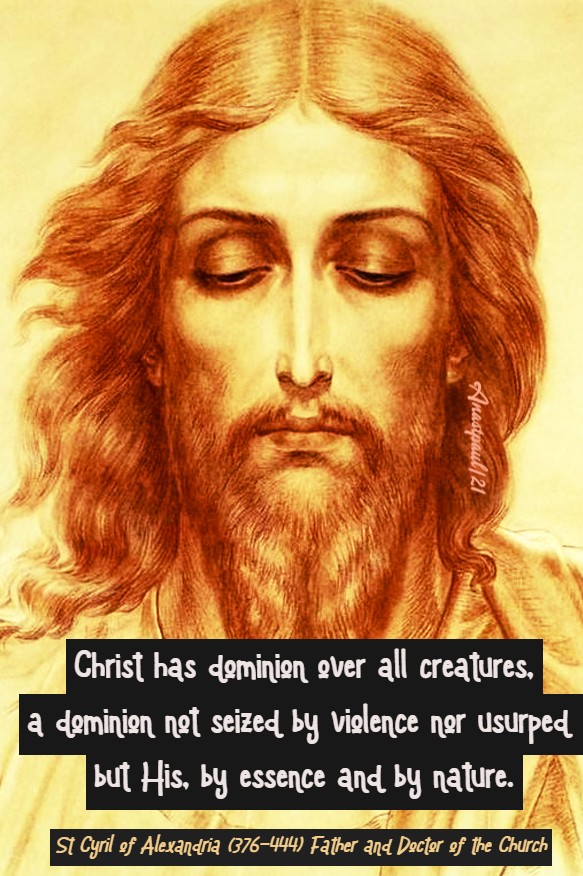
“Christ has dominion over all creatures, a dominion not seized by violence nor usurped but His, by essence and by nature.”
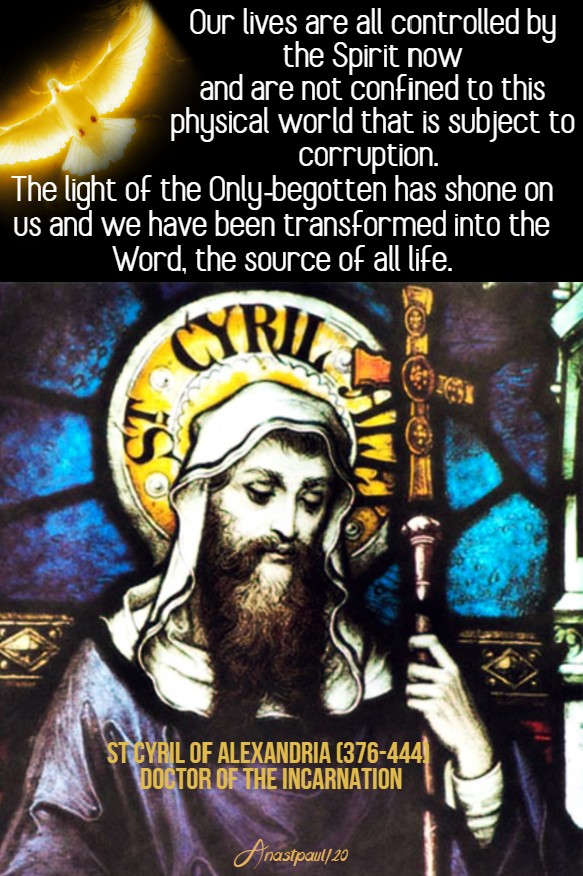
“Our lives are all controlled by the Spirit now and are not confined to this physical world that is subject to corruption. The light of the Only-begotten has shone on us and we have been transformed into the Word, the source of all life.”
“We must note, therefore, that he that does things pleasing to God, serves Christ but he that follows his own wishes, is a follower, rather of himself and not of God.”
“My sheep follow me,” says Christ. By a certain God-given grace, believers follow in the footsteps of Christ. No longer subject to the shadows of the Law , they obey the commands of Christ, and guided by His words, rise through grace, to His own dignity, for they are called children of God. When Christ ascends into heaven, they also follow Him.”
“The mark of Christ’s sheep is their willingness to hear and obey, just as disobedience is the mark of those who are not His. We take the word ‘hear’ to imply obedience to what has been said.”
“…[The Kingdom of God] … is within you. That is, it depends on your own wills and is in your own power, whether or not you receive it. Everyone, that has attained to justification, by means of faith in Christ and decorated by every virtue, is counted worthy, of the kingdom of heaven.”
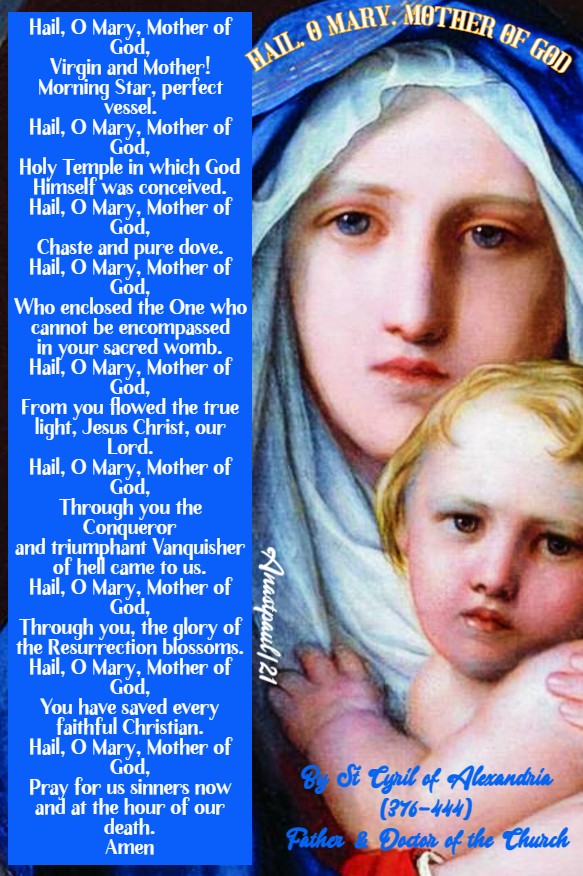
Hail, O Mary, Mother of God By St Cyril of Alexandria (376-444)
Hail, O Mary, Mother of God, Virgin and Mother! Morning Star, perfect vessel. Hail, O Mary, Mother of God, Holy Temple in which God Himself was conceived. Hail, O Mary, Mother of God, Chaste and pure dove. Hail, O Mary, Mother of God, who enclosed the One Who cannot be encompassed in your sacred womb. Hail, O Mary, Mother of God, From you flowed the true light, Jesus Christ, our Lord. Hail, O Mary, Mother of God, Through you the Conqueror and triumphant Vanquisher of hell, came to us. Hail, O Mary, Mother of God, Through you, the glory of the Resurrection blossoms. Hail, O Mary, Mother of God, You have saved every faithful Christian. Hail, O Mary, Mother of God, Pray for us sinners now and at the hour of our death. Amen
St Cyril of Alexandria (376-444) Father and Doctor of the Church
One Minute Reflection – 27 June – “Month of the Sacred Heart” – Readings: Wisdom 1: 13-15; 2: 23-24, Psalms 30: 2, 4, 5-6, 11, 12, 13 (2a), Corinthians 8: 7, 9, 13-15, Mark 5: 21-43
“If I but touch his garments, I shall be whole”…Mark 5:28
REFLECTION – “It is our faith that touches Christ; it is our faith that sees Him. It isn’t our body that touches Him; the eyes of our nature cannot seize Him. For seeing without perceiving, is not seeing; hearing without understanding, is not hearing, neither is touching if one doesn’t touch with faith…
If we consider the size of our faith and if we understand the greatness of the Son of God, we realise, that, in relation to Him, we only touch the fringe; we cannot reach the top of His garment. Therefore, if we too want to be healed by Him, let us touch, in faith, the fringe of Christ. He is aware of all those who touch His clothes, who touch Him while He has His back turned. For God doesn’t need eyes to see; He doesn’t have physical senses but He has, in Himself, the knowledge of all things. Happy then those who are able to touch at least the borders of the Word: for who can seize it entirely?” – St Ambrose (340-397) Father and Doctor of the Church – Commentary on St. Luke, 6, 57-59 ( SC 45)
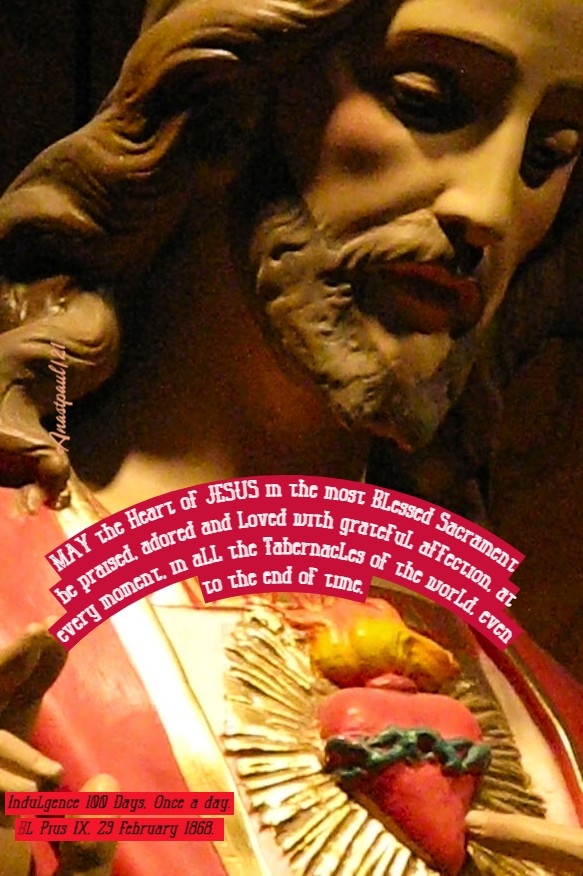
PRAYER – Almighty Father, grant that our trust and faith may grow each day. Help us to be secure in Your unfailing love and help. Even in our times of fear, pain and distress, give us the trust to know that You are always with us and that Your healing grace does indeed work miracles in our lives. Grant us strength, O Lord, to overcome all our fears with confidence in Your loving care. Through Jesus Christ in union with the Holy Spirit, one God forever, amen. MAY the Heart of JESUS in the most Blessed Sacrament be praised, adored and loved with grateful affection, at every moment, in all the Tabernacles of the world, even to the end of time. – Indulgence 100 Days, Once a Day. Raccolta 161 Blessed Pius IX, 29 February 1868.
Our Morning Offering – 27 June – “Month of the Sacred Heart” – Fifth Sunday after Pentecost
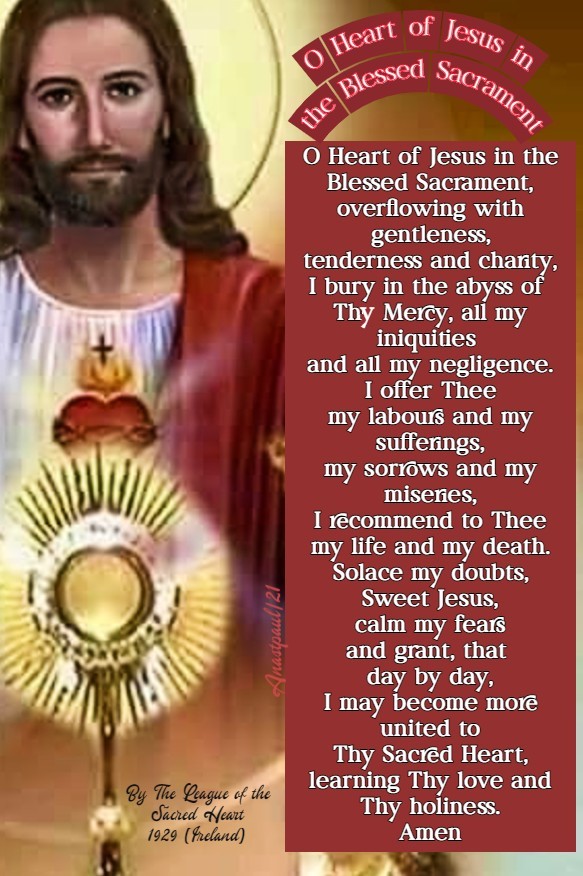
O Heart of Jesus in the Blessed Sacrament By The League of the Sacred Heart 1929 (Ireland)
O Heart of Jesus in the Blessed Sacrament, overflowing with gentleness, tenderness and charity, I bury in the abyss of Thy Mercy, all my iniquities and all my negligence. I offer Thee my labours and my sufferings, my sorrows and my miseries, I recommend to Thee my life and my death. Solace my doubts, Sweet Jesus, calm my fears and grant, that day by day, I may become more united to Thy Sacred Heart, learning Thy love and Thy holiness. Amen
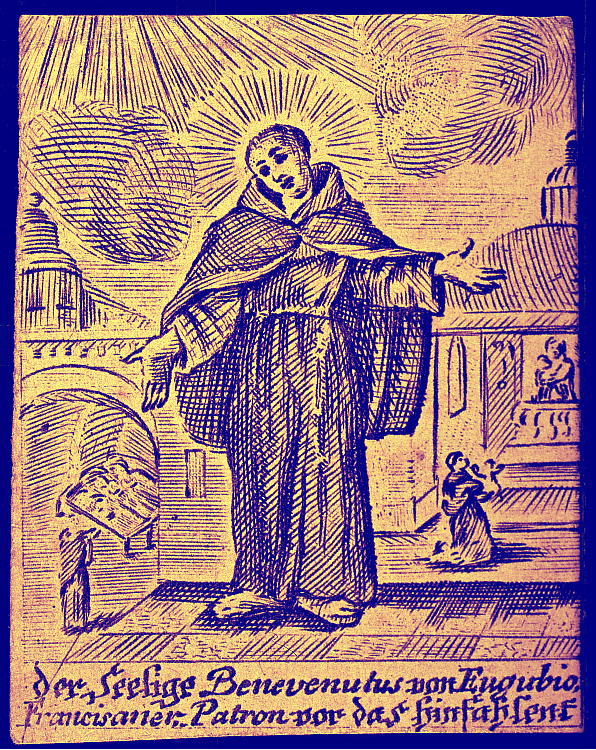
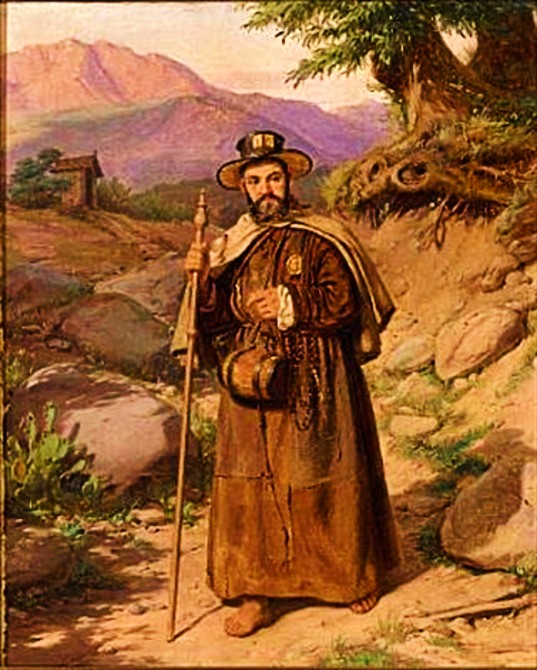
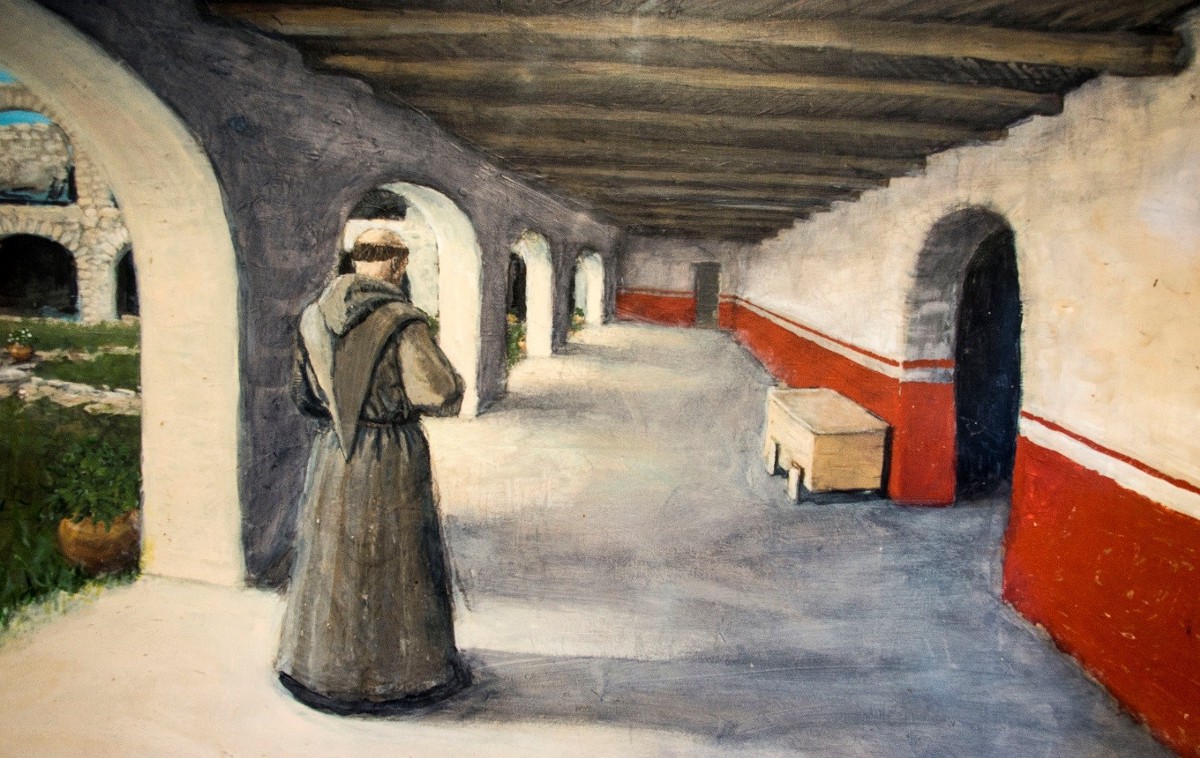
Saint of the Day – 27 June – Blessed Benvenutus of Gubbio OFM ) (Died 1232) Lay Brother of the Order of the Friars Minor of St Francis, ex-Soldier, apostle of the sick and of lepers. Benvenutus was graced with an ardent and mystical devotion to the Blessed Eucharist and to the Mother of God. So ardent was his faith and contemplation that he was seen to hold the Divine Infant in his arms. Born in the 12th-century Gubbio, Italy and died in 1232 in Corneto, Italy of natural causes. Also known as – Benvenuto.
In the Umbrian town of Gubbio, north of Assisi, there lived a Knight named Benvenutus, who had achieved great martial fame for his valour. When St Francis came to Gubbio in 1222 in order to preach in that vicinity, Benvenutus saw him and listened to him with astonishment. His martial spirit took great pleasure in the Saint’s perfect mortification and contempt of the world.
The grace of God so touched his heart, that, after a few days, Benvenutus presented himself to St Francis in complete knightly attire and entreated him humbly to admit him as a lay brother. Francis always had great esteem for soldiers who distinguished themselves in obedience, self-denial and fearless courage, for he considered such training a very good preparation for the religious life. Since Benvenutus evinced, in addition to these good qualities, a very profound humility, Francis recognised in him, the true soldier of Jesus Christ and gladly received him among his brethren.
Clad in a poor garment and girded with a cord, the stately warrior was now seen heroically overcoming himself. The poorest in clothing, dwelling and food was his choice. The purity of his heart shone in his countenance and in his entire external appearance. He seemed to have no will whatsoever of his own, so perfect in obedience was he at all times.
St Francis charged him with the care of the sick in a leper hospital. There he had, in truth, daily and hourly opportunities to practice heroic charity and self-denial. But Benvenutus was always seen, to wait upon the patients, even the most repulsive among them, with such cheerful devotion and care, as if he were serving his Divine Lord. Jesus Himself. Otherwise very serious and reserved, he was very sociable when he spoke to the sick and the depressed in order to cheer them up.
Benvenutus was also favoured by God with a high degree of contemplation. Sometimes he spent whole nights in prayer, pleading with God with burning tears ,for the conversion of sinners. Towards the Blessed Sacrament he entertained an ardent devotion filled with lively faith and frequently, our Diving Lord descended into his arms in the form of a charming child. He also had a very special devotion to Mary, the Blessed Mother of God.
The more completely, to purify his soul and increase his merit, God allowed Blessed Benvenutus to be seized with a severe illness, after he had himself tended the sick for many years. As his active charity formerly edified everybody, so his patience and perfect resignation to God’s holy will did so now in a greater degree. Blessed Benvenutusof Gubbio died ten years after his entrance into the Order, in 1232, in the City of Corneto.
Astonishing miracles wrought at the grave of Blessed Benvenutus gave evidence of his holiness, and attracted a great concourse of pilgrims, so that only a few years after his death, Pope Gregory IX sanctioned his public veneration in Corneto and the surrounding country. Pope Innocent XI extended the devotion to the entire Franciscan Order in the year 1697.
Matka Boża / Mother of God of Gietrzwald, Gietrzwałd, Olsztyński, Warmia, Poland, 1877 – 27 June, 8 September;
Our Lady appeared for the first time to Justyna Szafrynska (13) when she was returning home with her mother after having taken an examination prior to receiving the First Holy Communion. The next day, Barbara Samulowska (12) also saw the ‘Bright Lady’ sitting on the throne with Infant Christ among Angels over the maple tree in front of the church while reciting the rosary. The girls asked “Who are you?” she answered, “I am the Blessed Virgin Mary of the Immaculate Conception!” “What do you require, Mother of God?” they asked, the answer was: “I wish you recite the Rosary everyday!” There were 13 more apparitions from 27 June 1877 to 16 September 1877. 2 February 1970 – Pope Paul VI elevated the Church in Gietrzwald to the rank of Basilica Minor.
St Adeodato of Naples St Aedh McLugack St Anectus of Caesarea St Arialdus of Milan St Arianell of Wales Blessed Benvenutus of Gubbio OFM ) (Died 1232) Lay brother of the Order of the Friars Minor of St Francis St Brogan St Crescens of Galatia St Crescentius of Mainz Bl Daniel of Schönau Bl Davanzato of Poggibonsi St Desideratus of Gourdon St Dimman St Felix of Rome St Ferdinand of Aragon St Gudene of Carthage
Bl Hemma of Gurk St Joanna the Myrrhbearer St John of Chinon
Blessed Maria Pia Mastena St Sampson of Constantinople St Spinella of Rome St Tôma Toán St Zoilus of Cordoba — Martyrs Killed Under Communist Regimes in Eastern Europe: Among the thousands of Christians murdered by various Communist regimes in their hatred of the faith, there were 25 members of the Ukrainian Greek Catholic Church and Russian Byzantine Catholic Church, priests, bishops, sisters and lay people, whose stories are sufficiently well documented that we know they were murdered specifically for their faith in eastern Europe and whose Causes for Canonization were opened. Their Causes were combined and they were beatified together. They have separate memorials but are remembered together today. They are – • Andrii Ischak • Hryhorii Khomyshyn • Hryhorii Lakota • Ivan Sleziuk • Ivan Ziatyk • Klymentii Sheptytskyi • Leonid Feodorov • Levkadia Harasymiv • Mykola Konrad • Mykola Tsehelskyi • Mykolai Charnetskyi • Mykyta Budka • Oleksa Zarytskyi • Ol’Ha Bida • Ol’Ha Matskiv • Petro Verhun • Roman Lysko • Stepan Baranyk • Symeon Lukach • Vasyl Vsevolod Velychkovskyi • Volodomyr Bairak • Volodymyr Ivanovych Pryima • Yakym Senkivsky • Yosafat Kotsylovskyi • Zenon Kovalyk. Beatified – 27 June 2001 by Pope John Paul II in Ukraine.
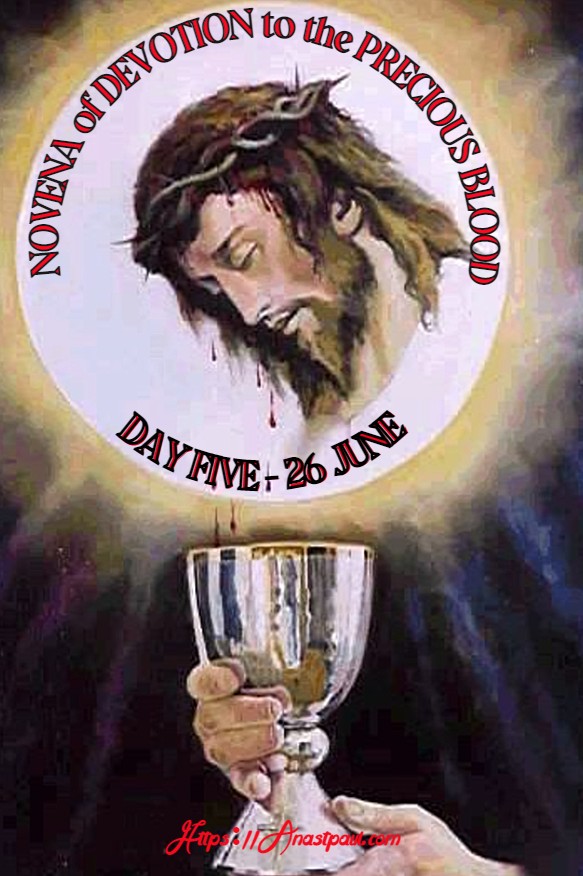
DAY FIVE – NOVENA of DEVOTION to the PRECIOUS BLOOD of JESUS
Opening Prayer for each Day:
Grant me the grace to know You, to love You and to be truly sorry that I have offended You. I ask this grace by Your Precious Blood – By that Precious Blood, which bathed Your Sacred Body and trickled down to the ground in the Garden of Olives. By that Precious Blood, which poured forth from Your Sacred Body during the scourging. By that Precious Blood, which which covered Your Sacred Face when You were crowned with thorns. By that Precious Blood, which burst from Your hands and feet on Calvary. By that Precious Blood, which came forth from Your Sacred Heart after Your death. By that Precious Blood, which we drink in Holy Communion and of which You said: “He who feeds on My Flesh and drinks My Blood has life eternal.” Amen.
Day Five : Jesus Sheds Blood in the Crowing of the Thorns
Final prayer:
Eternal Father, we offer You the Precious Blood of Jesus shed in the Crowning with Thorns. Make all creation, liberated from the slavery of sin, serve Your majesty and glorify You without end. Grant to all peoples the gift of peace and unity. Help us to recognise the Thorn-Crowned Jesus in those who suffer because of race, religion or the colour of their skin. Through Jesus Christ our Lord. Amen
Our Father … Glory be … V. Praise and thanksgiving be evermore to Jesus. R. Who with his blood has saved us. V. Glory to the Blood of Jesus! R. Now and forever. Amen
Thought for the Day – 26 June – Meditations with Antonio Cardinal Bacci (1881-1971)
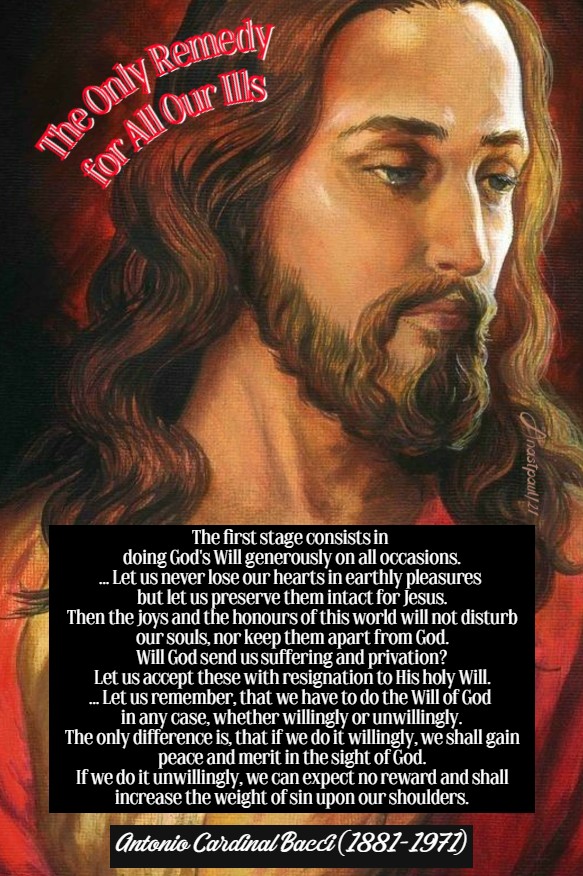
The Only Remedy for All Our Ills
“The first stage consists in doing God’s Will generously on all occasions. Will God give us a little happiness and satisfaction in the present life? Let us accept whatever He allows us without becoming excessively attracted by it. Let us never lose our hearts in earthly pleasures but let us preserve them intact for Jesus. Then the joys and the honours of this world will not disturb our souls, nor keep them apart from God.
Will God send us suffering and privation? Let us accept these with resignation to His holy Will. Our final end, which is eternal life, can be achieved equally well by means of joy or sorrow, as long as we accept everything from God’s Hands and offer it back to Him in accordance with His Will.
Let us remember, that we have to do the Will of God in any case, whether willingly or unwillingly. The only difference is that if we do it willingly, we shall gain peace and merit in the sight of God. If we do it unwillingly, we can expect no reward and shall increase the weight of sin upon our shoulders.”
Quote/s of the Day – 26 June – “Month of the Sacred Heart”- Readings: Genesis 18: 1-15, Luke 1: 46-47, 48-49, 50 and 53, 54-55, Matthew 8: 5-17
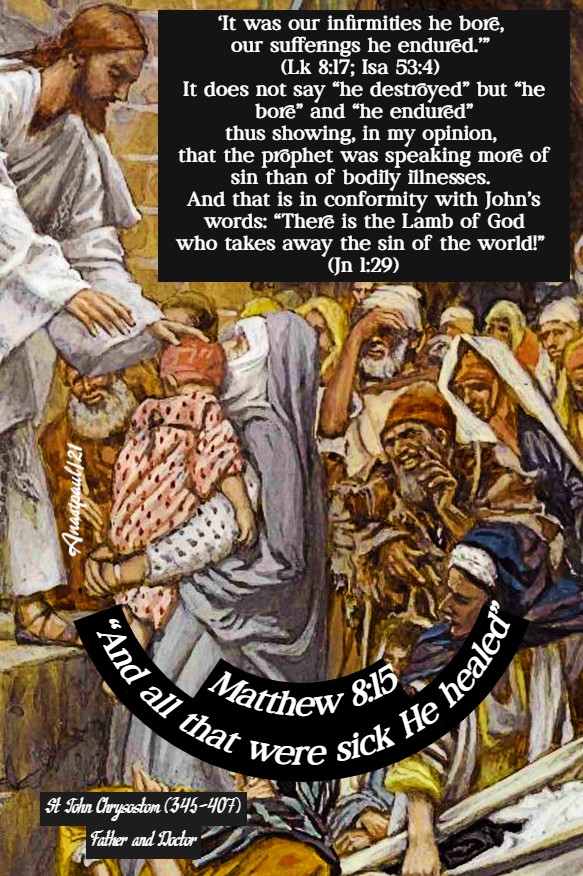
“And all that were sick He healed”
Matthew 8:15
“ Think of the many cures of which the evangelists do not speak. They do not tell us about all of them, one by one – rather, in a single sentence, they let us see an infinite ocean of miracles. … The gospel brings the testimony of the prophet, which is as extraordinary and as surprising as the deeds themselves: “ … thereby fulfilling what had been said through Isaiah the prophet: ‘It was our infirmities he bore, our sufferings he endured.’” (Lk 8:17; Isa 53:4) It does not say “he destroyed” but “he bore” and “he endured” thus showing, in my opinion, that the prophet was speaking more of sin than of bodily illnesses. And that is in conformity with John’s words: “There is the Lamb of God who takes away the sin of the world!” (Jn 1:29)
St John Chrysostom (345-407) Father and Doctor
Commentary on St Matthew’s Gospel, 27
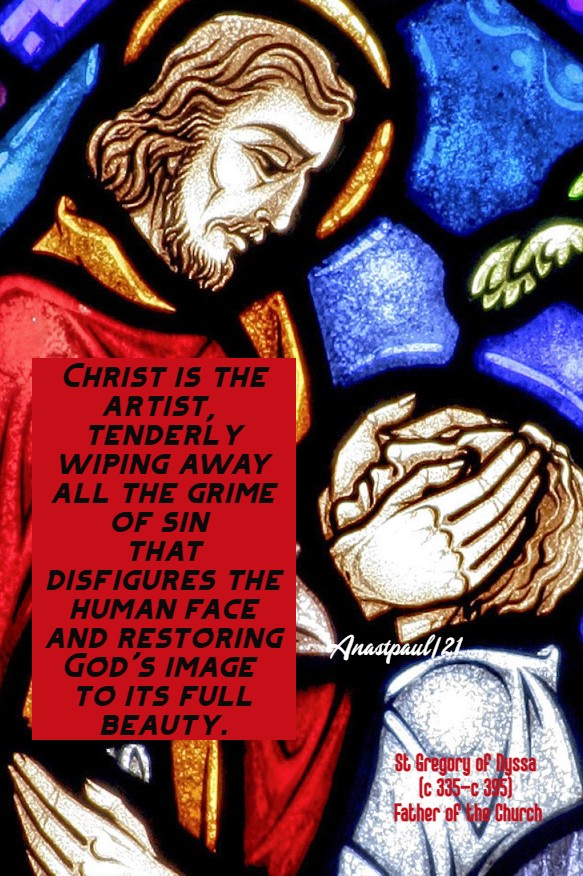
“Christ is the artist, tenderly wiping away all the grime of sin that disfigures the human face and restoring God’s image to its full beauty.”
St Gregory of Nyssa (c 335–C 395) Father of the Church
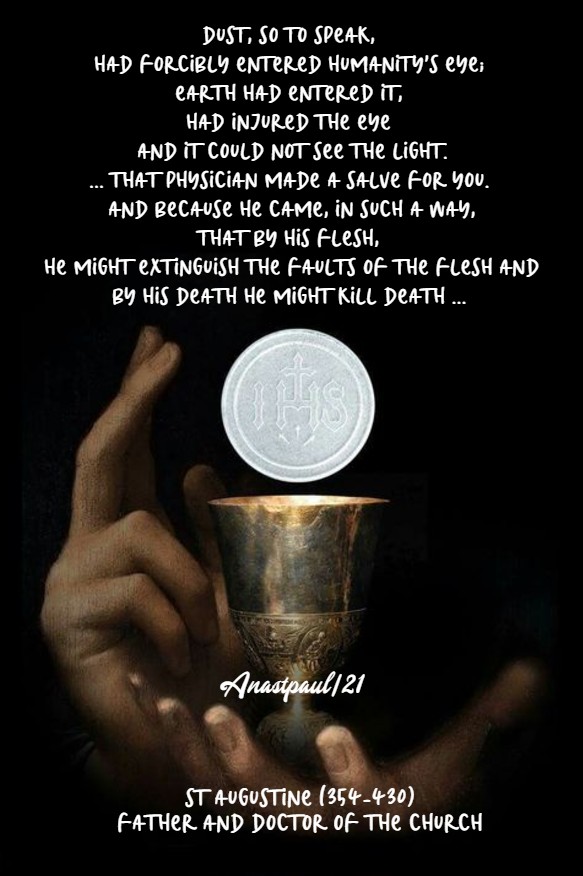
“Dust, so to speak, had forcibly entered humanity’s eye; earth had entered it, had injured the eye and it could not see the light. … That physician made a salve for you. And because He came, in such a way, that by His flesh, He might extinguish the faults of the flesh and by His death, He might kill death … ”
St Augustine (354-430) Father and Doctor of the Church
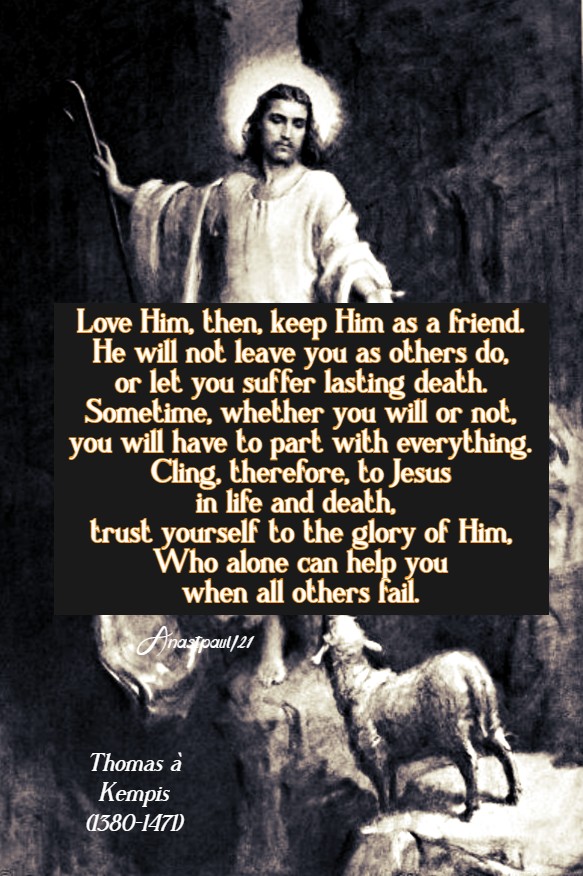
“Love Him, then, keep Him as a friend. He will not leave you as others do, or let you suffer lasting death. Sometime, whether you will or not, you will have to part with everything. Cling, therefore, to Jesus in life and death, trust yourself to the glory of Him, Who alone can help you when all others fail.“
Thomas à Kempis (1380-1471) (Book 2 Ch 7)
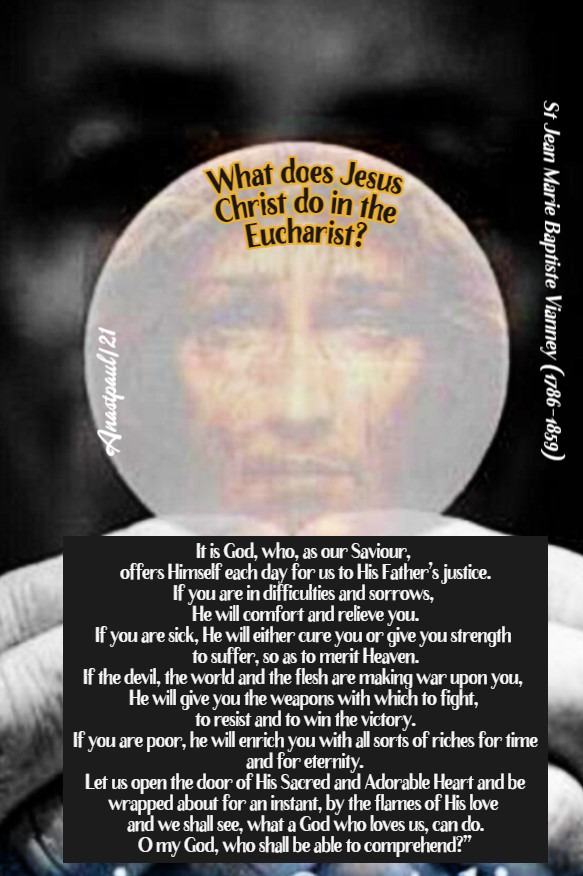
“What does Jesus Christ do in the Eucharist?
It is God, who, as our Saviour, offers Himself each day for us to His Father’s justice.
If you are in difficulties and sorrows, He will comfort and relieve you. If you are sick, He will either cure you or give you strength to suffer, so as to merit Heaven. If the devil, the world and the flesh are making war upon you, He will give you the weapons with which to fight, to resist and to win the victory. If you are poor, he will enrich you with all sorts of riches for time and for eternity. Let us open the door of His Sacred and Adorable Heart and be wrapped about for an instant, by the flames of His love and we shall see, what a God who loves us, can do. O my God, who shall be able to comprehend?”
One Minute Reflection – 27 June – “Month of the Sacred Heart”- Readings: Genesis 18: 1-15, Luke 1: 46-47, 48-49, 50 and 53, 54-55, Matthew 8: 5-17
“Many will come from the east and the west and shall sit down with Abraham, and Isaac and Jacob, in the kingdom of heaven” – Matthew 8:11
REFLECTION – “I have seen our Lord in the Gospel accomplish many miracles and, reassured by them, have strengthened my fearful words. I have seen the centurion throw himself at the Lord’s feet, nations send their firstfruits to Christ. The Cross has not yet been erected and already, pagans hasten towards their Master. The words “Go, teach all nations” have not yet been heard (Mt 28,19) but the nations are already hastening. Their race precedes their call, they are burning with desire for the Lord. The sound of preaching has not yet been heard but they are hurrying towards the one who preaches. Peter… they have now been instructed and they gather around the one who is teaching them; the light of Paul has not yet blazed beneath Christ’s standard and nations are coming with incense, to adore the King (Mt 2,11).
And now, see how a centurion begs Him and says to Him: “Lord, my servant is lying at home paralysed, suffering dreadfully.” Here is a new miracle indeed! The servant whose limbs are paralysed leads his master to the Lord; the slave’s sickness gives health to his owner. Seeking his servant’s healing, he finds our Lord and while he is seeking for his slave’s cure, he becomes Christ’s conquest.” – Basil of Seleucia (?-c 468), Bishop, Father of the Church – Homily 19 on the Centurion.
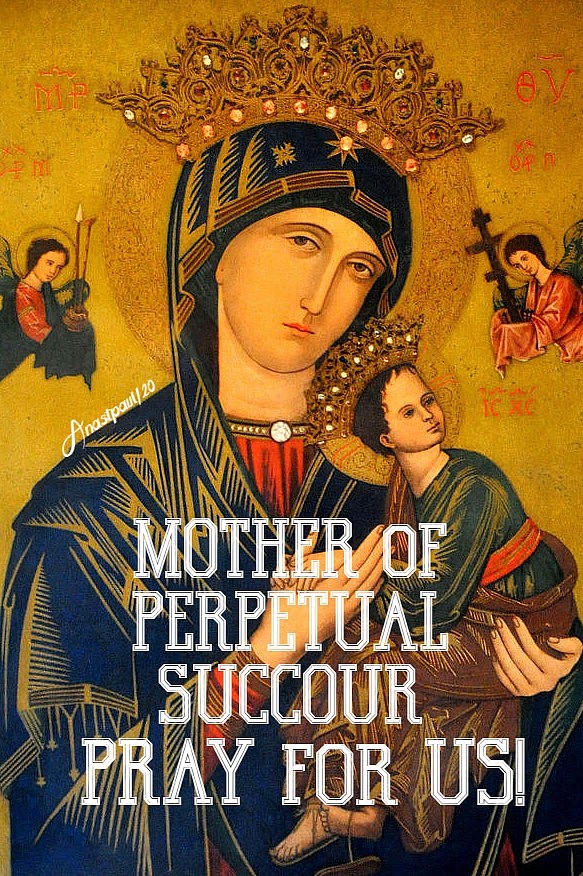
PRAYER – God our Father, You open the gates of the kingdom of heaven to those who are born again of water and the Holy Spirit. Increase the grace You have given, so that the people who have been purified from all sin, may not forfeit the promised blessing of Your love. Grant that we may ever keep Your Son, the Lord Jesus Christ, before our eyes and do all in Him and through Him and for Him and may the prayers of our Mother of Perpetual Succour ever guide and bear us in her care! We make our pray through Christ, our Lord, in union with You and the Holy Spirit, one God forever, amen.
Our Morning Offering – 26 June – “Month of the Sacred Heart”
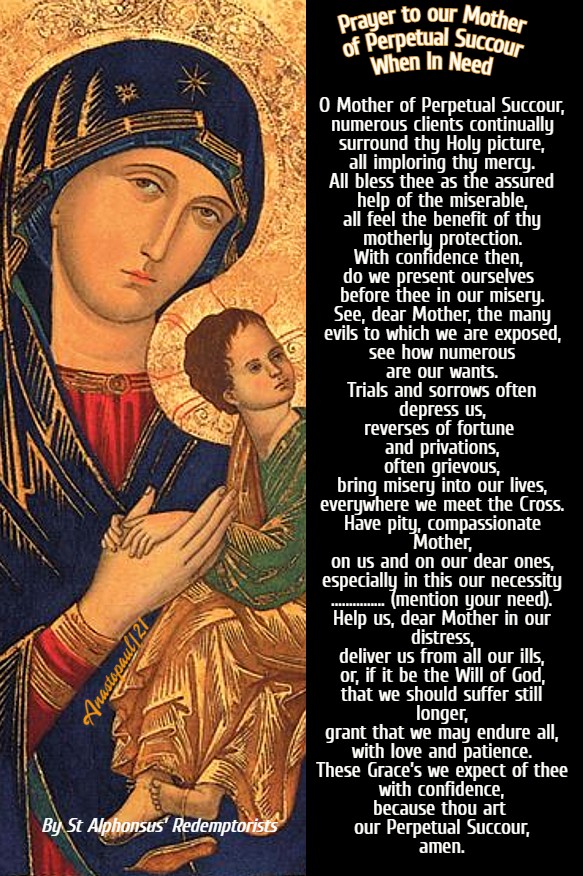
As the Feast day of Our Lady of Perpetual Succour falls tomorrow, being a Sunday, it is appropriate to remember her today instead. Let us remind ourselves of the great power of this Marian devotion.
Prayer to our Mother of Perpetual Succour, When In Need By St Alphonsus’ Redemptorists
O Mother of Perpetual Succour, numerous clients continually surround thy Holy picture, all imploring thy mercy. All bless thee as the assured help of the miserable, all feel the benefit of thy motherly protection. With confidence then, do we present ourselves before thee in our misery. See, dear Mother, the many evils to which we are exposed, see how numerous are our wants. Trials and sorrows often depress us, reverses of fortune and privations, often grievous, bring misery into our lives, everywhere we meet the Cross. Have pity, compassionate Mother, on us and on our dear ones, especially in this our necessity …………… (mention your need). Help us, dear Mother in our distress, deliver us from all our ills, or, if it be the Will of God, that we should suffer still longer, grant that we may endure all, with love and patience. These Grace’s we expect of thee with confidence, because thou art our Perpetual Succour, amen.
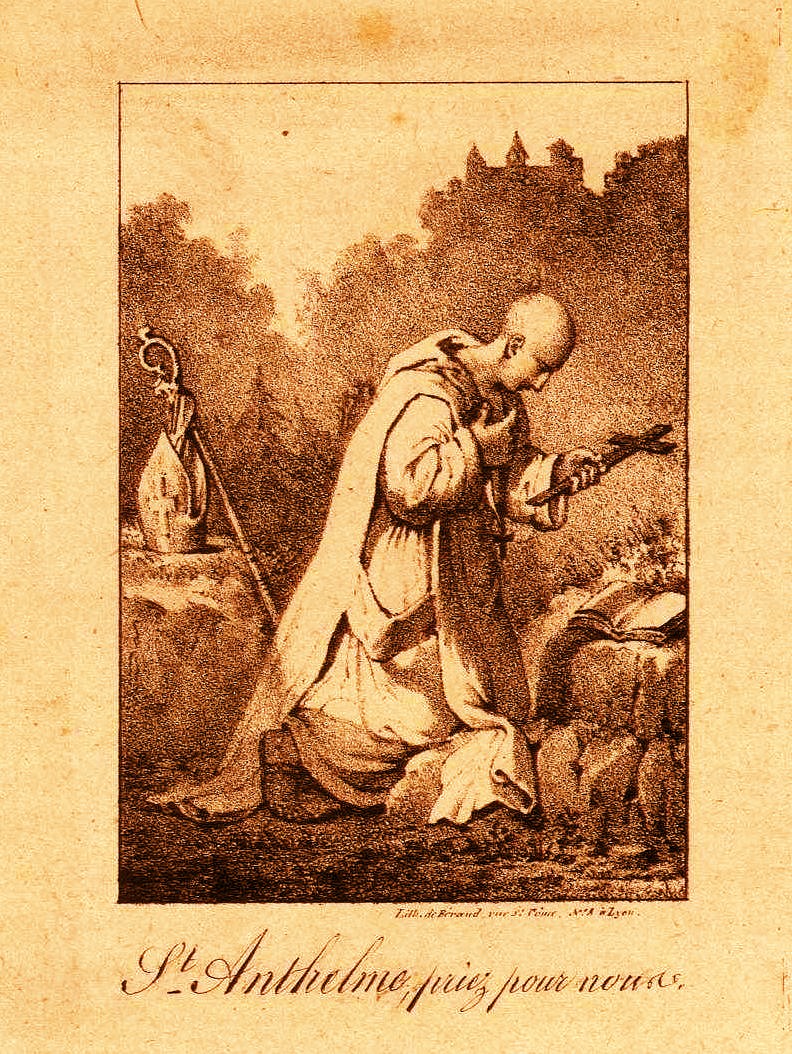
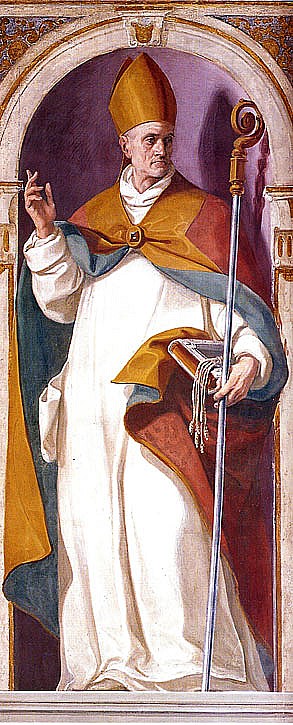
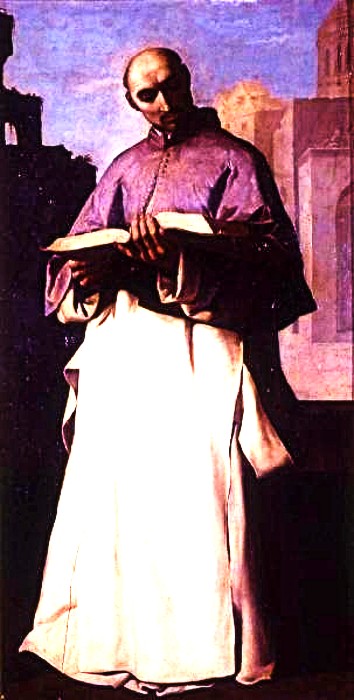
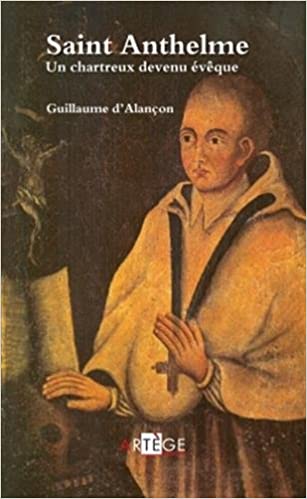
Saint of the Day – St Anthelm of Belley O. Cart. (c 1105-1178) Bishop of Belley, France, Prior of the Carthusian Grand Chartreuse. Reformer, talented Administrator, founder of the female Carthusians and originated of the Carthusian Rule (with the zealous and llearned assistance of Bless John the Spaniard whom we celebrated yesterday), Apostle of the poor, the sick and the needy. Born in c 1105 near Chambéry, Savoy, France. and died in 1178 at Belley, France. Also known as – Anthelm de Chignin and Anthelme, Anthelmus.
Anthelm was a nobleman, born in the Castle of Chignin. He became a Priest early in life but after visiting the tranquil Carthusian Monastery of Portes, he decided to become a Monk and joined the Carthusians about 1137.
He was elected as the 7th Prior of the Grande Chartreuse, two years later, in 1139. Anthelm was responsible for guiding the Carthusians in their evolution into a unique religious order separate from the Benedictines. Charter houses had previously been separate and independent, subject only to local Bishops. Not only did he revitalise the Order, he also restored the physical facilities of the Charterhouse.
He summoned the first General Chapter and Grande Chartreuse became the Motherhouse. Anthelm commissioned Blessed John the Spaniard to draw up a Constitution for a community of women who wished to live under Carthusian rule.
He resigned as Prior in 1152 to live as a Hermit but was made Prior of Portes Monastery instead. During this time (1154-1156) he ordered the bounty that had accumulated as a result of the Monastery’s prosperity. to be distributed to those in need.
He returned to Grande Chartreuse, still wishing to live a solitary life but then he actively entered the conflict over the nomination of Pope Alexander III, whom he supported, against Emperor Frederick Barbarossa’s choice, Victor IV. With the Cistercian Abbot Geoffrey, Anthelm galvanised support for Pope Alexander III, who then nominated him to the See of Belley in 1163.
There he set out to reform the clergy, a particular concern being that of celibacy because some Priests practiced their priestly duties, while, at the same time, being openly married. He also punished evil-doers. So much did Anthelm endear himself to the people, that, after his death, the City was renamed Athelmopolis.
When Count Humbert III of Maurienne violated the Church’s jurisdiction over the clergy by imprisoning a Priest, Anthelm sent a clergyman to handle the matter. After the Priest was killed in a scuffle to rearrest him, Anthelm excommunicated the Count. The Pope invalidated the ban but Anthelm would not relent and returned to Portes in protest. Relations between the Pope and Anthelm remained open, however. He was asked by the Pope to go to England to try to bring about a reconciliation between King Henry II and Saint Thomas a Becket but unfortunately was unable to travel due to ill health.
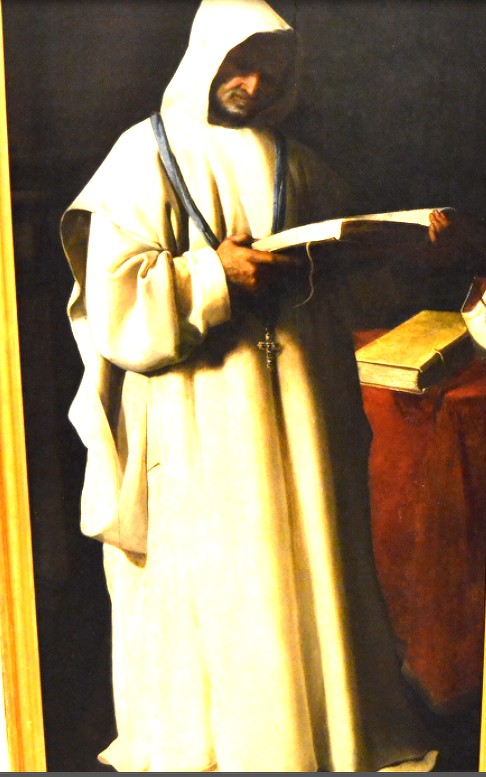
By Francisco de Zurbarán
Anthelm established a community for women solitaries. To the end of his life, his heart was in his beloved Charterhouse, which he visited on every possible occasion.
The good Bishop spent his last years tending to the lepers and the poor. He was distributing food in a famine when he was felled by fever. As Anthelm lay dying, he was visited by Count Humbert who sought his forgiveness.
Miracles occurred at his tomb, one being. that, as he was lowered into the tomb, a lamp lit only for great festivals kindled spontaneously and shone brightly for some weeks.
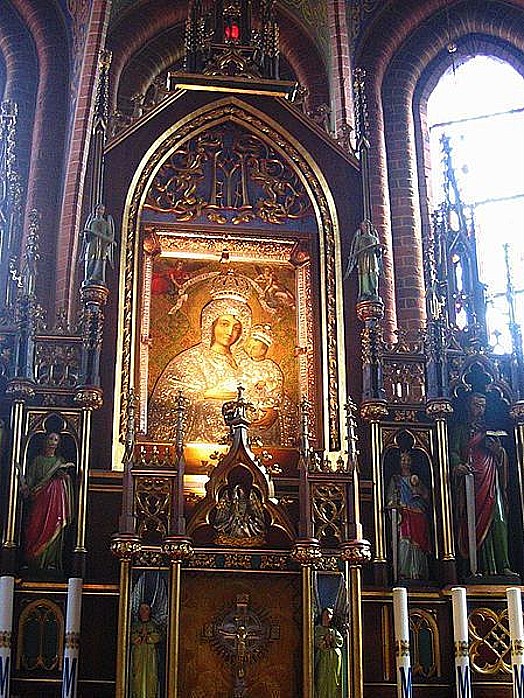
Matka Boża Tęskniąca / Longing Mother of God, Warsaw, Poland – 26 June:
One of the oldest Churches in the Archdiocese of Warsaw is St Elizabeth Powsin Located on the main Altar is a painting of th Longing Mother of God– artist unknown – from the first half of the seventeenth century. At either side, the image is surrounded by statues of Saints Adalbert and Stanislaus – Polish Bishops and Martyrs. The testimony of miracles and graces relating to the Longing Mother of God icon, have been collected at least since the mid-seventeenth century. On 28 June 1998, the image became the fourth image of Mary in the Archdiocese of Warsaw to be canonically Crowned.
Bl Andrii Ischak St Anthelm of Belley O. Cart. (c 1105-1178) Bishop, Prior St Babolenus of Stavelot-Malmédy St Barbolenus of Fossés Bl Bartholomew of Vir St Corbican St David of Thessalonica St Deodatus of Nola St Dionysius of Bulgaria St Edburga of Gloucester St Hermogius of Tuy St Iosephus Ma Taishun St John of Rome St John of the Goths St José Maria Robles Hurtado
Blessed Jacques Ghazir Haddad OFM Cap (1875-1954) the “St Vincent de Paul of Lebanon,” “the Apostle of the Cross” and “the Apostle of Lebanon.” Priest, Religious of the Order of Friars Minor as a Capuchin Friar, Founder of the Franciscan Sisters of the Holy Cross of which he is the Patron, noted Preacher and founder of many orphanages and schools across Lebanon. Beautiful Blessed Jacques: https://anastpaul.com/2019/06/26/saint-of-the-day-blessed-jacques-ghazir-haddad-ofm-cap-1875-1954/
St Maxentius of Poitou St Medico of Otricoli Bl Mykola Konrad St Paul of Rome St Pelagius of Oviedo St Perseveranda of Poitiers Bl Raymond Petiniaud de Jourgnac St Salvius Bl Sebastian de Burgherre St Soadbair St Superius St Terence of Rome St Vigilius of Trent Bl Volodymyr Ivanovych Pryima — Martyrs of Africa – 4 saints: Four Christians who were martyred together – Agapitus, Emerita, Felix and Gaudentius at an unknown location in Africa, date unknown.
Martyrs of Alexandria – 3 saints: Three Christians who were martyred together, but we really know little more that the names – Agatho, Diogenes and Luceja. They were martyred in Alexandria, Egypt, date unknown.
Martyrs of Cambrai – 4 beati: Four Daughters of Charity of Saint Vincent de Paul nuns at Arras, France. Imprisoned together in 1792 and executed together two years later in the anti-Catholic excesses of the French Revolution. They were: • Jeanne Gerard • Marie-Françoise Lanel • Marie-Madeleine Fontaine • Thérèse-Madeleine Fantou They were guillotined on 26 June 1794 at Cambrai, Nord, France and Beatified in June 1920 by Pope Benedict XV.
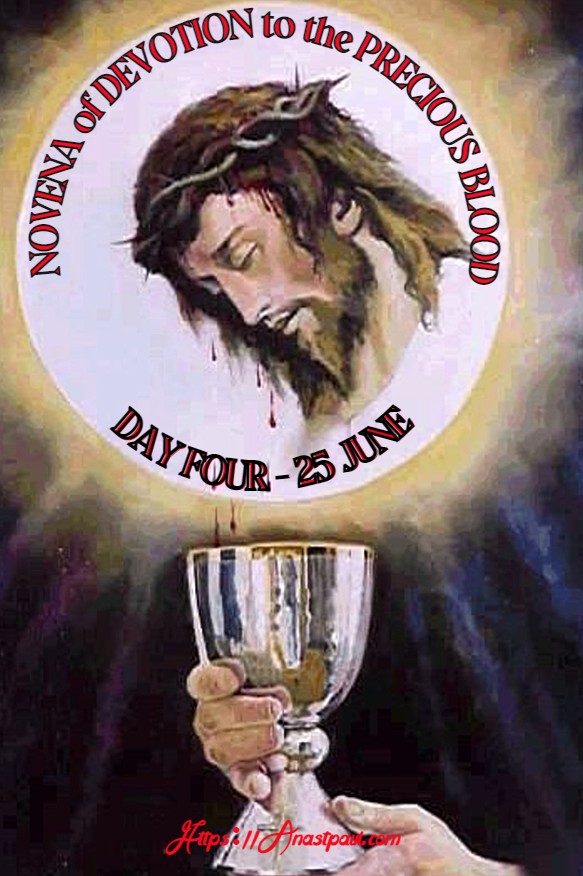
DAY FOUR – NOVENA of DEVOTION to the PRECIOUS BLOOD of JESUS
Opening Prayer for each Day:
Grant me the grace to know You, to love You and to be truly sorry that I have offended You. I ask this grace by Your Precious Blood – By that Precious Blood, which bathed Your Sacred Body and trickled down to the ground in the Garden of Olives. By that Precious Blood, which poured forth from Your Sacred Body during the scourging. By that Precious Blood, which which covered Your Sacred Face when You were crowned with thorns. By that Precious Blood, which burst from Your hands and feet on Calvary. By that Precious Blood, which came forth from Your Sacred Heart after Your death. By that Precious Blood, which we drink in Holy Communion and of which You said: “He who feeds on My Flesh and drinks My Blood has life eternal.” Amen.
Day Four : Jesus Sheds Blood in the Scourging
Final prayer
Eternal Father, we offer You the Nost Precious Blood of Jesus shed in the violent and bloody Scourging. Accept it in recompense, for the loss of so much innocent blood in the world. We ask for justice and peace. We understand that Your loving Son’s offered His life in total obedience and that each stroke that He received from the whips was an act of sacrifice and of love for the redemption of the world. Father of mercy, may Your mercy never abandon us. Through Jesus Christ our Lord. Amen
Our Father … Glory be … V. Praise and thanksgiving be evermore to Jesus. R. Who with his blood has saved us. V. Glory to the Blood of Jesus! R. Now and forever. Amen
Thought for the Day – 25 June – Meditations with Antonio Cardinal Bacci (1881-1971)
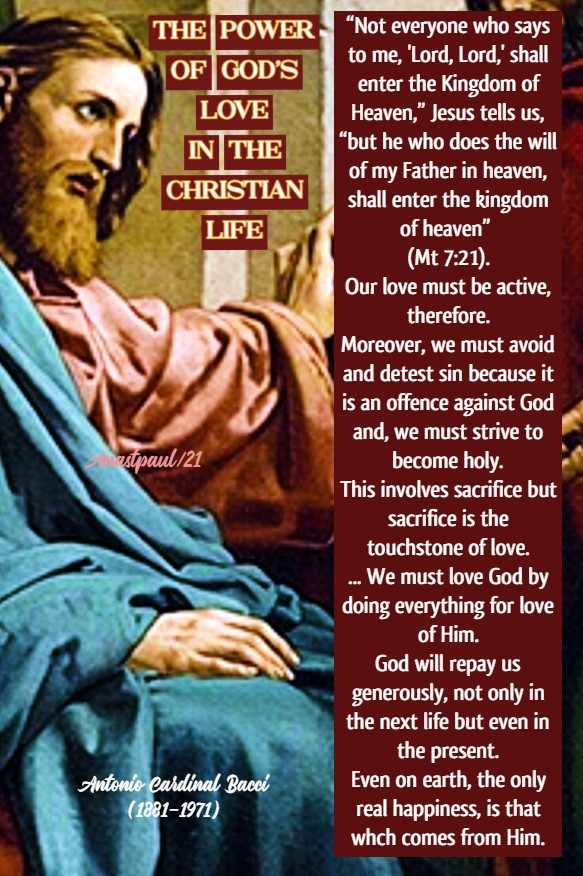
The Power of God’s Love in the Christian Life
“The love which we have for God, our Creator, Redeemer and Benefactor, should not be merely sentimental. It must be effective. When love is sincere, it is active. It is not enought to say: I love You, O my God. We must show by our actions, that we love Him. “Not everyone who says to me, ‘Lord, Lord,’ shall enter the Kingdom of Heaven,” Jesus tells us, “but he who does the will of my Father in heaven, shall enter the kingdom of heaven” (Mt 7:21). Our love must be active, therefore. Moreover, we must avoid and detest sin because it is an offence against God and, we must strive to become holy. This involves sacrifice but sacrifice is the touchstone of love. Anyone in love, is not afraid of sacrifice – in fact, he looks for it, in order to prove his love. Charity, like faith, is a lifeless thing, if it is not accompanied by actions (Cf Js 2:17). We must love God by doing everything for love of Him. God will repay us generously, ot only in the next life but even in the present. Even on earth, the only real happiness, is that whch comes from Him.”



















 AnaStpaul
You must be logged in to post a comment.