Day Seven of our Lenten Journey – 23 February – Tuesday of the First week of Lent, Readings: Isaiah 55:10-11, Psalms 34:4-5, 6-7,16-17, 18-19, Matthew 6:7-15
Imitating Christ with Thomas à Kempis (1380-1471)
In Your Light Lord, we see light
“Thy will be done, on earth, as it is in heaven.” – Matthew 6:10
WHATEVER I can desire or imagine for my own comfort, I look for not here but hereafter. For if I alone should have all the world’s comforts and could enjoy all its delights, it is certain, that they could not long endure. Therefore, my soul, you cannot enjoy full consolation or perfect delight except in God, the Consoler of the poor and the Helper of the humble. Wait a little, my soul, wait for the divine promise and you will have an abundance of all good things in heaven. If you desire these present things too much, you will lose those which are everlasting and heavenly. Use temporal things but desire eternal things. You cannot be satisfied with any temporal goods because you were not created to enjoy them.
Even if you possessed all created things, you could not be happy and blessed; for in God, Who created all these things, your whole blessedness and happiness consists — not indeed such happiness as is seen and praised by lovers of the world but such, as that for which the good and faithful servants of Christ wait and of which the spiritual and pure of heart, whose conversation is in heaven, sometime have a foretaste.
Vain and brief is all human consolation. But that which is received inwardly from the Truth is blessed and true. The devout man carries his Consoler, Jesus, everywhere with him and he says to Him: “Be with me, Lord Jesus, in every place and at all times. Let this be my consolation, to be willing to forego all human comforts. And if Your consolation be wanting to me, let Your will and just trial of me, be my greatest comfort. For You will not always be angry, nor will You threaten forever.” (Book 3 Ch 16:1-2)
Quote/s of the Day – 23 February – Tuesday of the First week of Lent, Readings: Isaiah 55:10-11, Psalms 34:4-5, 6-7,16-17, 18-19, Matthew 6:7-15
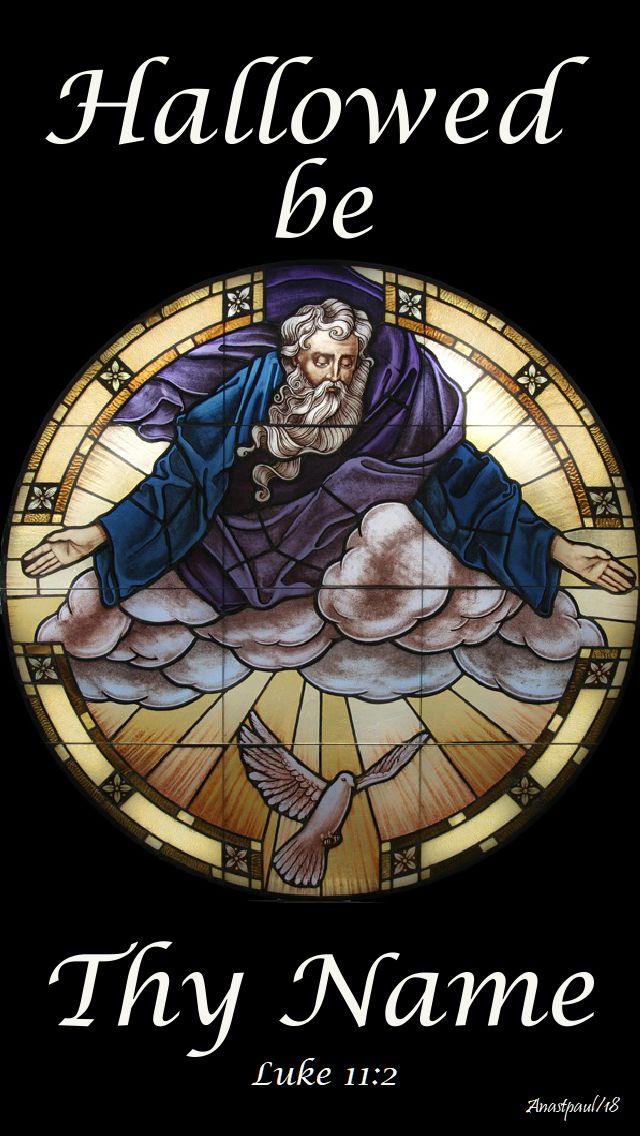
“Father, hallowed be thy name.”
Luke 11:2
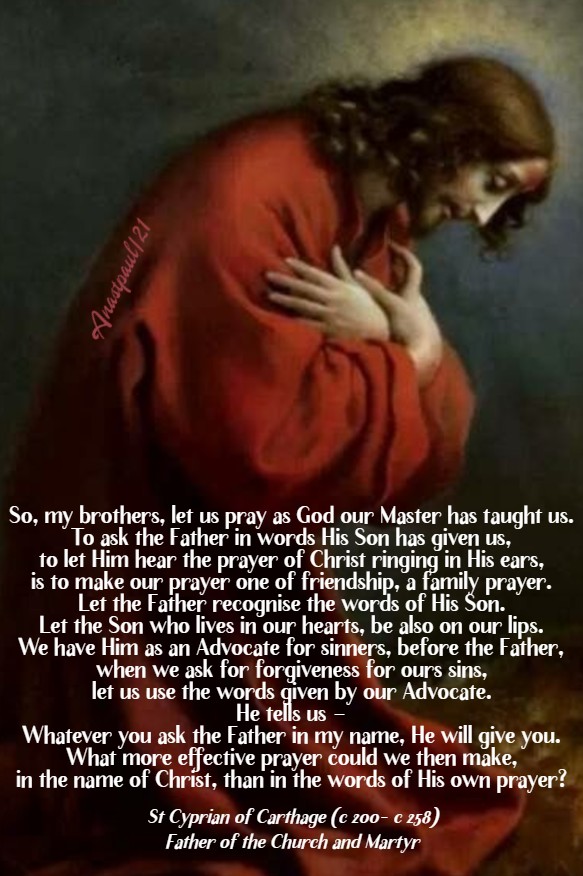
“So, my brothers, let us pray as God our master has taught us. To ask the Father in words His Son has given us, to let Him hear the prayer of Christ ringing in His ears, is to make our prayer one of friendship, a family prayer. Let the Father recognise the words of His Son. Let the Son who lives in our hearts, be also on our lips. We have Him as an Advocate for sinners, before the Father, when we ask for forgiveness for ours sins, let us use the words given by our Advocate. He tells us – Whatever you ask the Father in my name, He will give you. What more effective prayer could we then make, in the name of Christ, than in the words of His own prayer?”
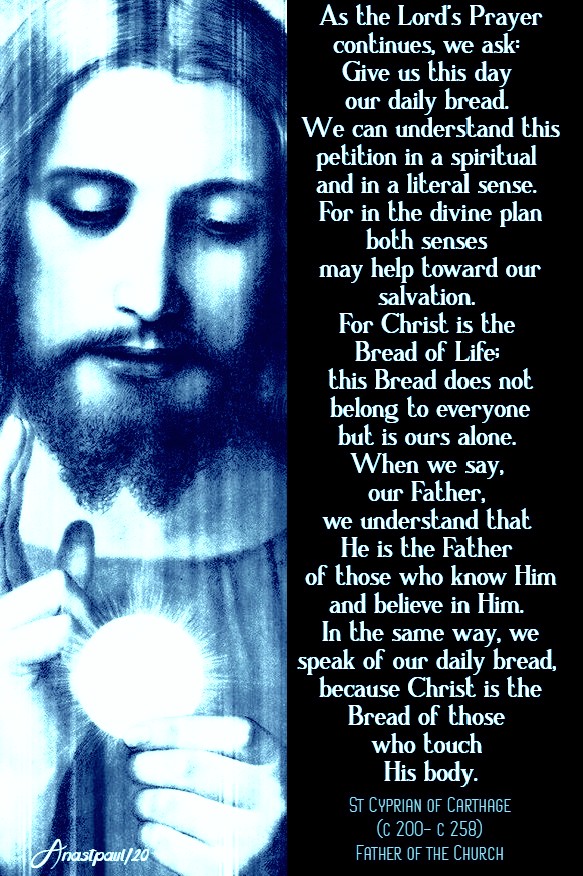
“As the Lord’s Prayer continues, we ask: Give us this day our daily bread. We can understand this petition in a spiritual and in a literal sense. For in the divine plan both senses may help toward our salvation. For Christ is the Bread of Life; this Bread does not belong to everyone but is ours alone. When we say, our Father, we understand that he is the Father of those who know Him and believe in Him. In the same way, we speak of our daily bread, because Christ is the Bread of those who touch His body.”
St Cyprian of Carthage (c 200- c 258) Bishop, Father of the Church and Martyr An excerpt from his “On the Lord’s Prayer”
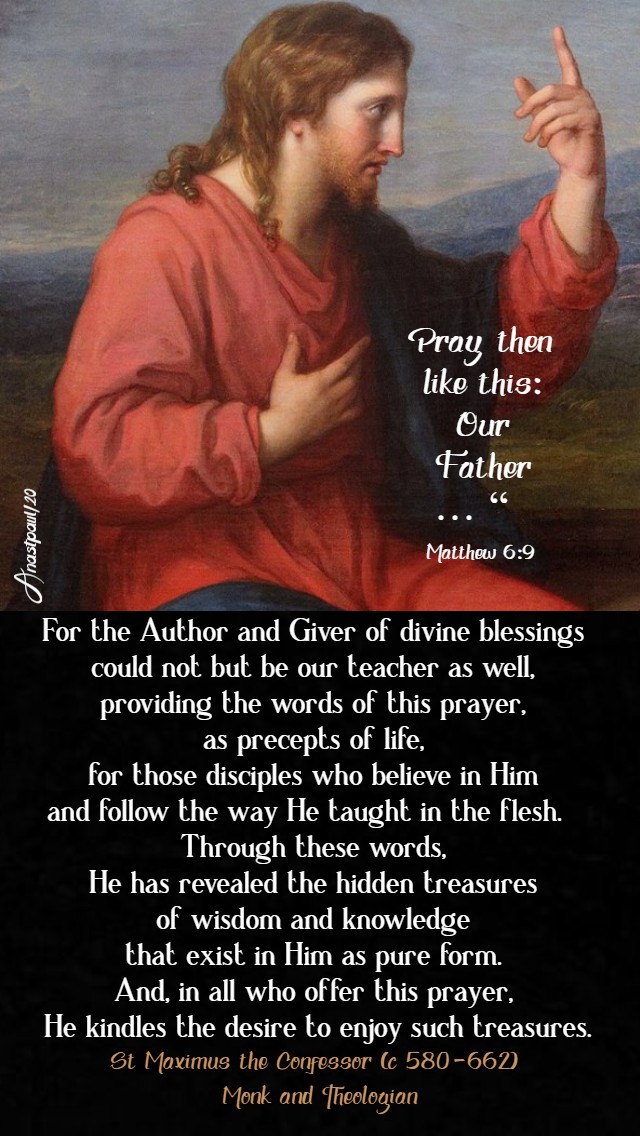
“For the author and giver of divine blessings could not but be our teacher as well, providing the words of this prayer, as precepts of life, for those disciples who believe in Him and follow the way He taught in the flesh. Through these words, He has revealed the hidden treasures of wisdom and knowledge (Col 2:3) that exist in Him as pure form. And, in all who offer this prayer, He kindles the desire to enjoy such treasures.”
St Maximus the Confessor (c 580-662) Monk and Theologian Interpretation of the Lord’s Prayer
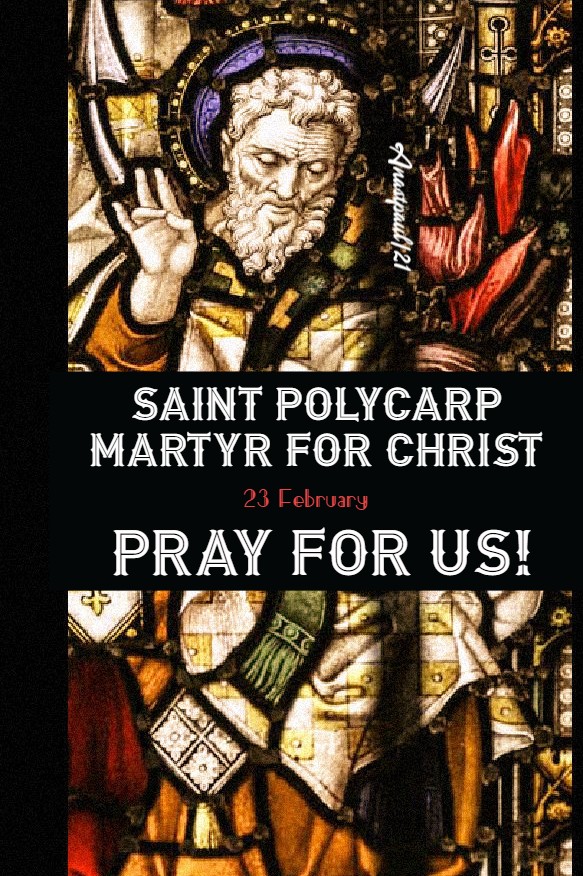
One Minute Reflection – 23 February – Tuesday of the First week of Lent, Readings: Isaiah 55:10-11, Psalms 34:4-5, 6-7,16-17, 18-19, Matthew 6:7-15 and the Memorial of St Polycarp Apostolic Father, Bishop and Martyr (c 69 – c 155)and St Willigis of Mainz (940-1011)
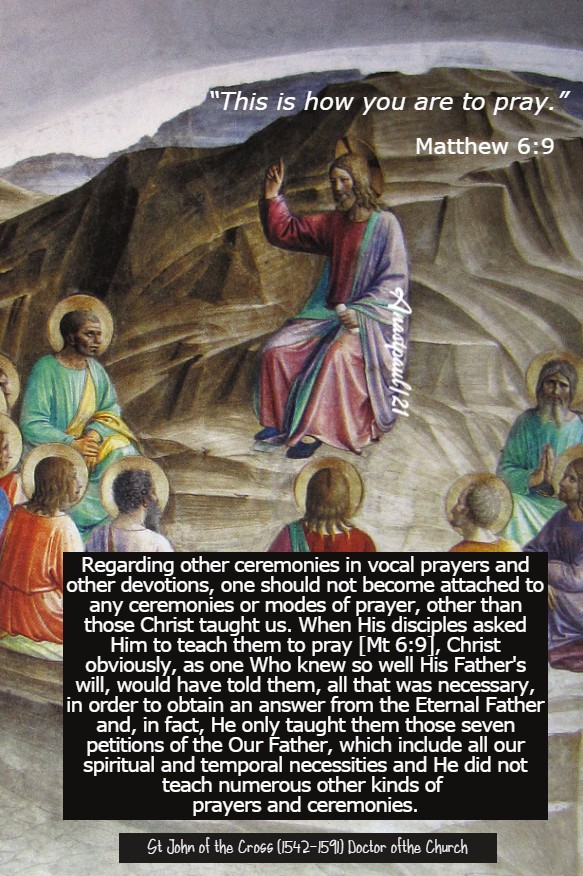
“This is how you are to pray.” – Matthew 6:9
REFLECTION– “Regarding other ceremonies in vocal prayers and other devotions, one should not become attached to any ceremonies or modes of prayer, other than those Christ taught us. When His disciples asked Him to teach them to pray [Lk 11:1], Christ obviously, as one Who knew so well His Father’s will, would have told them, all that was necessary, in order to obtain an answer from the Eternal Father and, in fact, He only taught them those seven petitions of the Our Father, which include all our spiritual and temporal necessities and He did not teach numerous other kinds of prayers and ceremonies. At another time, rather, He told them, that in praying, they should not desire much speaking because our heavenly Father clearly knows our needs.
He only charged us with great insistence to persevere in prayer – that is, in the Our Father – teaching, in another place, that one should pray and never cease. [Lk.18:1] He did not teach us a quantity of petitions but that these seven be repeated often and with fervour and care. For in these, as I say, are embodied everything that is God’s will and all that is fitting for us. Accordingly, when His Majesty had recourse three times to the Eternal Father, all three times He prayed with the same petition of the Our Father, as the evangelists recount: “Father, if it cannot be but that I drink this chalice, may your will be done.” [Mt. 26:42]
And He taught us only two ceremonies for use in our prayers. Our prayer should be made either in the concealment of our secret chamber [Mt 6:6] where without noise and without telling anyone we can pray with a more perfect and pure heart … Or, if not in one’s chamber, in the solitary wilderness and at the best and most quiet time of night, as He did..” [Lk. 6:12] – St John of the Cross (1542-1591) – Carmelite, Doctor of the Church – The Ascent of Mount Carmel Bk.III, ch.44
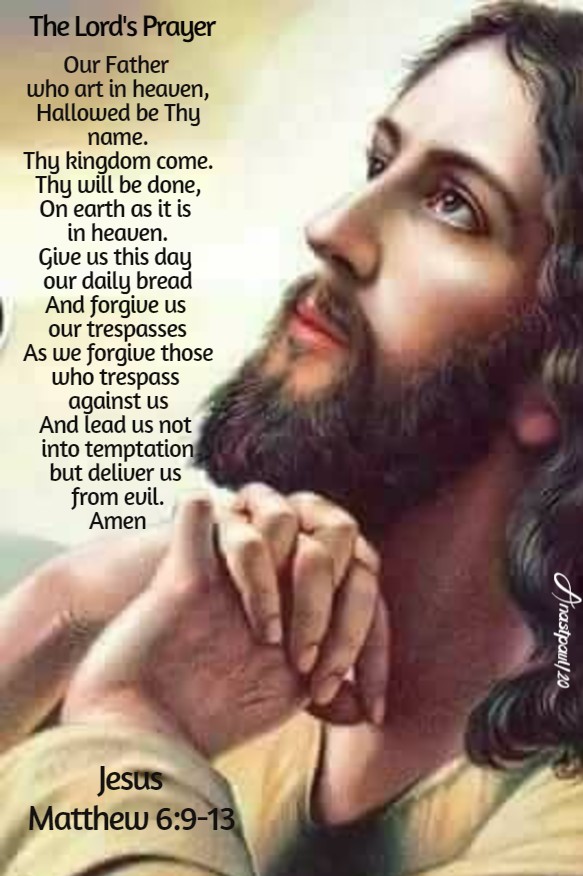
PRAYER – Our Father Who art in heaven, Hallowed be Thy name. Thy kingdom come. Thy will be done, On earth as it is in heaven. Give us this day our daily bread And forgive us our trespasses As we forgive those who trespass against us And lead us not into temptation but deliver us from evil. Amen
Our Morning Offering -23 February – Tuesday of the First week of Lent
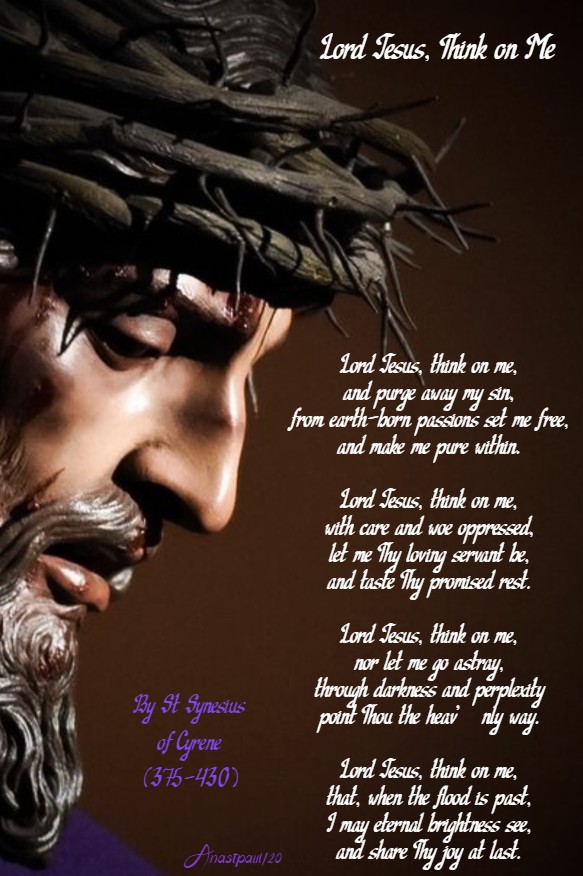
Lord Jesus, Think on Me By St Synesius of Cyrene (375-430) Bishop of Ptolemais
Lord Jesus, think on me, and purge away my sin, from earth-born passions set me free, and make me pure within. Lord Jesus, think on me, With care and woe oppressed, let me Thy loving servant be, and taste Thy promised rest. Lord Jesus, think on me, nor let me go astray, through darkness and perplexity point Thou the heav’nly way. Lord Jesus, think on me, that, when the flood is past, I may eternal brightness see, and share Thy joy at last.
St Synesius, a native of Cyrene, born circa 375. His descent was illustrious. His pedigree extended through seventeen centuries and in the words of Gibbon, “could not be equaled in the history of mankind.” He became distinguished for his eloquence and philosophy and as a statesman and patriot he took a noble stand. When the Goths were threatening his country he went to the court of Arcadius and for three years, tried to rouse it to the dangers that were coming on the empire. But Gibbon says, ”The court of Arcadius indulged the zeal, applauded the eloquence and neglected the advice of Synesius.” In 410 he was made Bishop of Ptolemaïs (modern Libya) but much against his will. He died in 430.We have extant one hundred and fifty-five epistles and ten hymns written at different periods of his life.
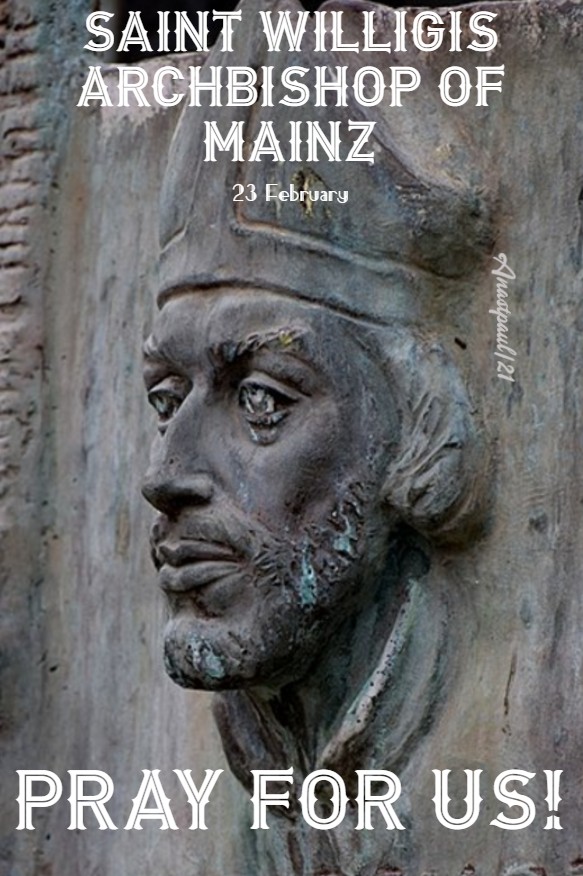
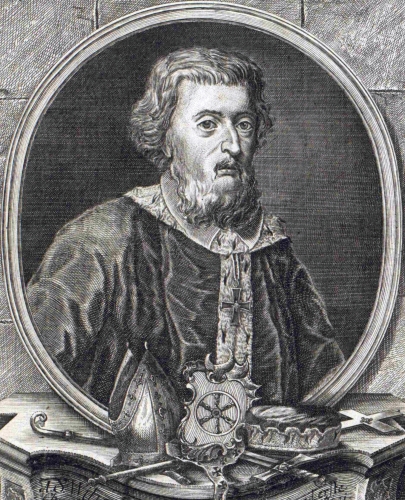
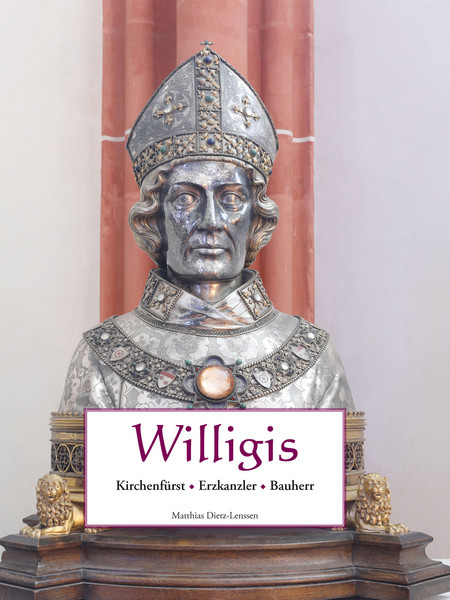
Saint of the Day – 23 February – Saint Willigis of Mainz (c 940-1011) Archbishop of Mainz, Reformer, builder of the Cathedral of Mainz and many Churches, bridges and roads throughout his Diocese, de facto Regent of Germany during the minority of Otto III, to whom he was Guardian. Born in c 940 at Schoningen, Germany and died on 23 February 1011 of natural causes. Patronage – Wheelwrights. Also known as Willigisus, Willigus, Willegis.
Willigis was born in the Duchy of Saxony, possibly at Schöningen, the son of simple, free and pious peasants. His father worked as a wheelwright, hence his patronage and attribute – the wheel also occured in his emblem as Bishop. The able and intelligent young man received a good education and was recommended by Bishop Volkold of Meissen to the service of Emperor Otto the Great. Willigis was appointed Chancellor, an office formerly held by the Emperor’s brother Archbishop Bruno of Cologne. He served Otto throughout the last years of his reign and at the height of his power.
In 975 Emperor Otto II appointed him Archbishop of Mainz and Archchancellor for Germany. Being of humble origin, Willigis had to cope with many objections but he immediately received Pope Benedict VII confirmation of his supremacy as metropolitan Bishop.
Soon he started to build the great Cathedral of Mainz. Willigis demanded solid learning in his clergy too. He was known as a good and fluent and zealous Precher. In March 975 he received the Pallium from Pope Benedict VII. In January 976 Willigis Consecrated the first Bishop of Prague, Thietmar (Dětmar) at Brumath in Alsace, whose Diocese was put under his jurisdiction.
In his Diocese, he laboured by building bridges, constructing roads and fostering commerce. In Mainz, he initiated the construction of Cathedral and consecrated it on 29 August 1009, dedicating it in honour of St Martin of Tours but on the same day, disastrously, it was destroyed by fire. Willigis immediately gave orders for reconstruction.
Mainz Cathedral
Willigis greatly helped the restoration of the old collegiateCchurch of St Victor and built that of St Stephan. He also built Churches at Brunnen in Nassau and Seesbach. He showed great solicitude for the religious and substantially aided the Monasteries of St Ferrutius at Bleidenstadt, of Disibodenberg and of Jechaburg in Thuringia.
At the 983 Reichstag of Verona, Otto II vested him with large territories in the Rheingau region, thereby laying the foundations for the Prince-Bishopric of Mainz. Upon the Emperor’s death, Willigis as Primas Germaniae (an historical title for the the most important Bishop in the German lands).
On Christmas day in 983 he assisted at the crowning of Otto II’s his three-year-old son Otto III at Aachen. After the Dowager Empress Theophanu died in 991, Willigis became the Guardian of the minor, thus making him, together with Otto’s Grandmother, Adelaide of Italy, de facto Regent of the Empire until Otto III reached his majority in 994.
In 996 he was in the retinue of the King on his journey to Italy. Together with Otto III he pushed the election of Pope Gregory V against the resistance of the Roman nobility led by Crescentius the Younger and was present at the Consecration and at the Synod convened a few days later. In this counsel Willigis strongly urged the return of Bishop Adalbert of Prague, who, unable to bear the conflicts with the Vršovci noble family and the ruling Přemyslid dynasty, had left his Diocese for a second time, to which, after much correspondence between the Holy See and Willigis, he had once already been forced to return in 993. In 997 Pope Gregory V sent the Decrees of a synod at Pavia to Willigis, “his vicar,” for publication.
He was on friendly terms with Rome, though the Papacy was going through a difficult time. These relations were somewhat disturbed by the dispute of Willigis with Bishop Bernward of Hildesheim, about jurisdiction in the house of secular canonesses at Gandersheim Abbey. The immediate monastery established in 852 was originally situated at Brunshausen in the Diocese of Hildesheim but was transferred to nearby Gandersheim within the territorial limits of the Archdiocese of Mainz. Both Bishops claimed jurisdiction, until Pope Sylvester II finally declared in favour of Hildesheim, against Willigis’ initial resistance.
His protégé was the scholarly and just Burchard, who was appointed Bishop of Worms by Emperor Otto III in 1000. Upon the Emperor’s early death, Archbishop Willigis, on 7 June 1002, crowned the Duke of Bavaria Henry IV as King of the Romans at Mainz, after the assassination of his rival Margrave Eckard I of Meissen. Willigis presided at the 1007 Synod at Frankfurt am Main, where thirty-five Bishops signed the bull of Pope John XVIII for the erection of the Diocese of Bamberg.
Though Willigis has never been formally Canonised, Roman Catholics celebrate his feast on 23 February, the day of his death in 1011. Because the rebuilding of the Cathedral had not yet been completed, he was buried in the Church of St Stephan, which he had also built.
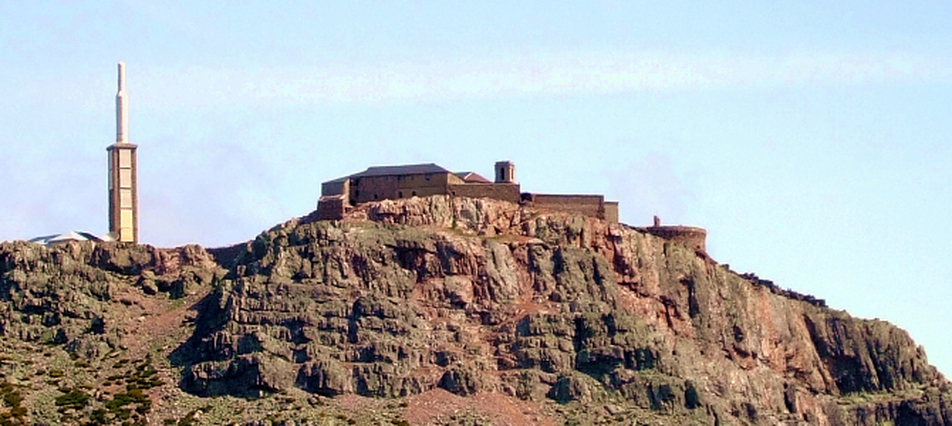
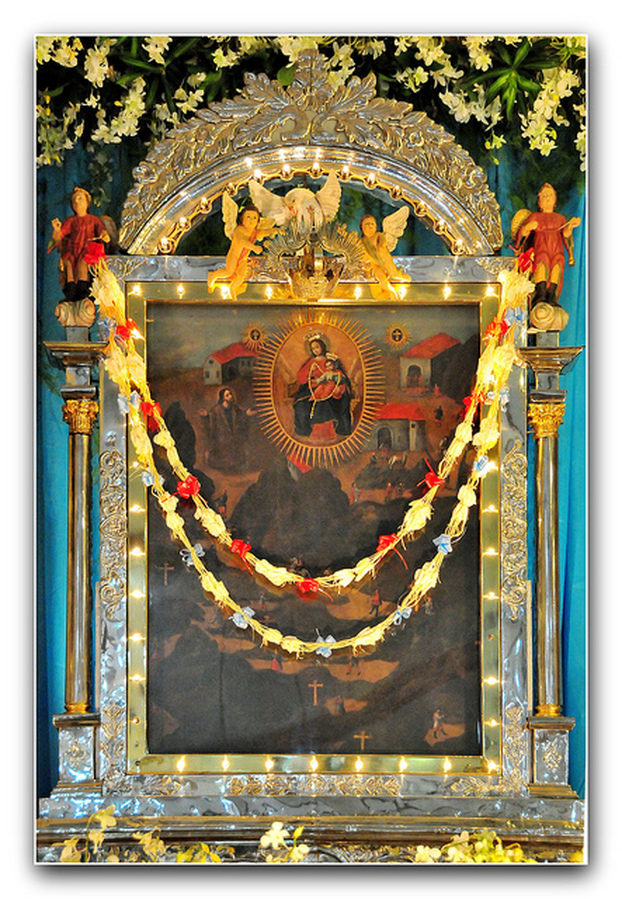
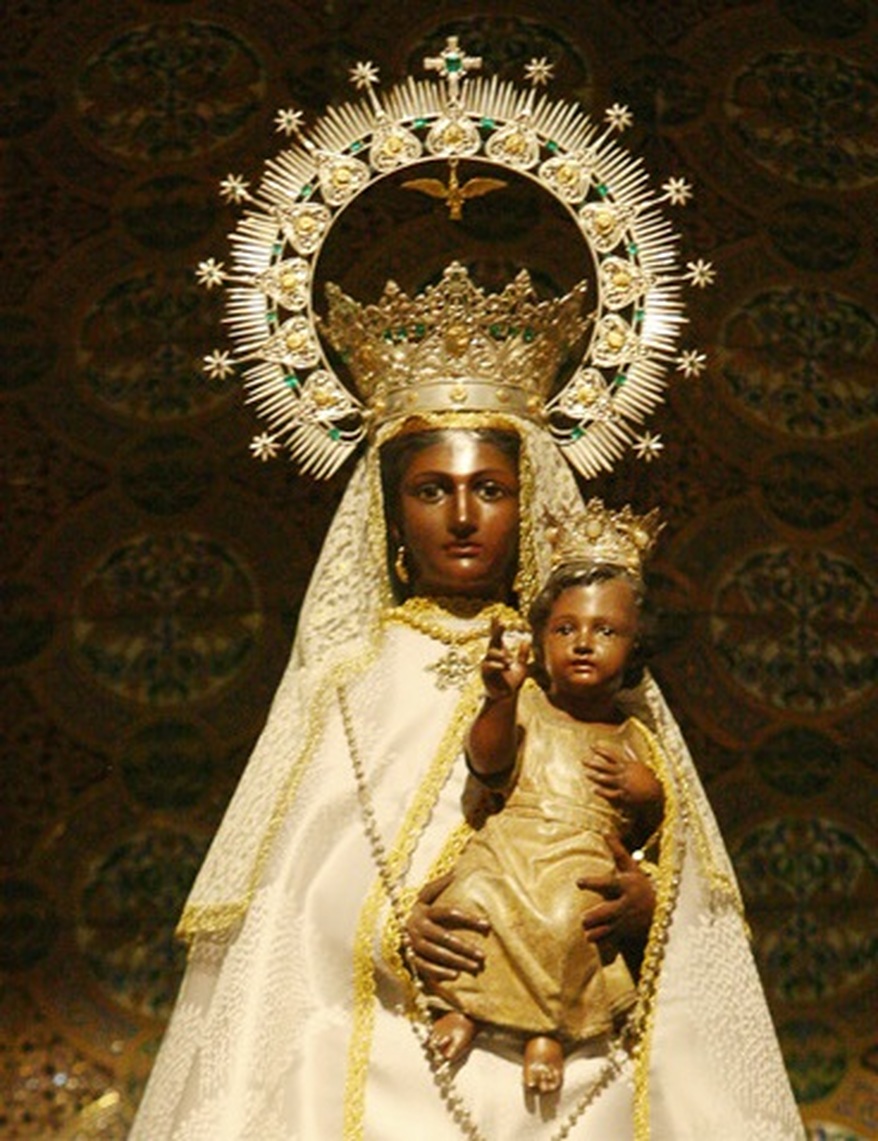
Nuestra Señora de la Peña / Our Lady of the Rock, Pena de Francia, near Salamanca, Spain (1434) – 23 February: The Abbot Orsini wrote: “Our Lady of Roches, near Salamanca, in Spain; an image is there venerated, which was found miraculously, in the year 434, by Simon Vela, who caused a Church to be built there.”
The Simon mentioned above by the Abbot Orsini, was actually born in the year 1401 in Paris, France. The incident that he states had occurred in the year 434 actually occurred in 1434 but that is getting ahead of our story. Simon was born on4 September 1401, in the City of Paris, France, to pious and wealthy parents. Growing up a good Catholic, Simon despised money and luxury, so that when he grew up and inherited his parents’ money and property, he recognised it for the threat to his eternal welfare that it was and gave all that he owned to the Church and to relieve the poor. Once the money was gone, he went to a Franciscan Monastery and took a position as a chamber boy. Simon naturally spent a great deal of time in prayer and was especially devoted to the Blessed Virgin Mary. Sometimes when he prayed he asked the Mother of God if there was anything he might do, that would be especially pleasing to her. On one of these occasions, he fell asleep while praying. He was suddenly awakened when he heard a voice speak to him from the empty Church: “Simon, wake up; be on the watch…From now on, your name will be Simon Vela. Go to Pena de Francia, for there you will find the Shrine of the Blessed Virgin Mary.” Simon travelled for five years over fields and mountains, searching through lonely valleys and gloomy caves, in his quest for this place called Pena de Francia but he could not even find anyone who had ever heard of the place. On the verge of giving up in frustration, he had already begun working his way back home from Spain, when the voice spoke to him from the darkness once again: “Simon, do not give up the search, do not give up what you have begun. Persevere and your labours will be recompensed.” Feeling that it was still the will of God, Simon was determined to continue the search. Simon was passing through the market square in Salamanca on his way to the Church of Santiago, when he observed two men who began shouting in a serious disagreement. Weapons flashed and one of the pair fell wounded at Simon’s feet. The other was restrained from finishing the man, by the crowd, who held him back. Unable to reach his adversary, he shouted: “Had I killed my enemy, I would have escaped to Pena de Francia where no-one, not even the king, could find me!” Simon’s heart leapt for joy when he heard this, for it was the first time he had heard the place spoken of, and now he was certain that his search would not be in vain.
THE STORY OF SIMON’S SEARCH SURROUNDS THE IMAGE OF OUR LADY OF THE ROCK
It was a short time later when Simon received a second bit of good news. He was on his way to the Church of Saint Martin when he happened upon a travelling merchant. Simon asked the man where he had come from and he answered, Pena de Francia. Thrilled to hear the name, he felt his search was nearly over but when he asked the man to take him there, he refused. He did not want to go back the way he had come, no matter how much Simon begged him. All he would do was point out the general direction. Simon went down the road from which he had seen the merchant approach, hoping he was not too far from his destination. The road led him to a villa named San Martin de Castanar, which he reached on 14 May 1434. He found a Church there and after Mass, he asked if anyone knew of a place called Pena de Francis. One man knew of it and when Simon kindly asked him to show him where it was, the man walked with him a good distance from the Church and then pointed out a hill in the far distance. That, he said, was Pena de Francia. Simon was elated, thanking God and the man for revealing to him the place that meant the end of his quest.
The place was far off but Simon went off at once, thinking the years he had spent in seeking, were nearly at an end. He gave no thought to his provisions and as the journey was long and arduous, he was far from any help when he realised how weakened his fast had made him. Suffering intense pangs of hunger, Simon did not despair, for he felt certain that God would not forsake him. He continued on his way and soon came across an abandoned pack that contained a loaf of bread and a piece of meat. Refreshed, he turned his attention to finding shelter as the night approached. Finding a suitable cave, he went inside and prayed for guidance until he dropped off into welcome slumber. Waking early in the morning, Simon began to search the area for the Shrine and quickly found that there were caves all over the hill where he had slept. He naturally became discouraged when it became apparent that it could take him weeks or even months to find what he sought and so, feeling that it was almost as if his quest had started all over again, he fell to his knees and prayed for the grace of perseverance. His prayer was quickly answered, as the now familiar voice said: “Simon, be awake: do not sleep.” Simon got up at once and continued his search, awakening with renewed enthusiasm the following morning. As he prepared to leave his cave a brilliant light struck his eyes, the source of which was a spot some distance away on a rocky hill. Trembling with joy, Simon approached the source of that light and found the Blessed Virgin Mary sitting on a golden throne with the Child Jesus in her arms. His heart overflowing with inexpressible joy, he knelt and said: “Oh, Lady, dream of my soul and inspiration of men and women! My labours are now ended. Many years have I travelled far and wide to seek you and to drink in the beauty of your eyes! Do not forsake me but be my protection.”
Our Lady answered sympathetically: “Simon, rejoice! Your constancy will be rewarded. Your dream will be realised. Your labours are now ended. Take heed and keep in your heart what I wish you to do. Dig in this spot and take what you can see and place it on the summit of this rocky hill. Build on this hill a beautiful Shrine. You are to begin it and others will come to finish it. This must come to pass as it has been the wish of my Child.” When the vision ended, Simon remained alone for some time, filled with wonder and awe. On the spot where the apparition of the Holy Virgin had appeared, Simon began the work of excavating. He had barely begun digging when he heard the same voice once again saying: “Simon, do not attempt to undertake this large of a task alone. Undertake it in the presence and with the help of two, three, or more persons.” Evidently this demand was made to ward off any suspicion about the veracity of the coming miracle, as well as Simon’s credibility. So Simon went back to San Martin de Castanar and asked five men to help him, and all of them agreed. Even though Simon told them the truth, these men believed that they were digging for hidden treasure. Simon repeated that they were after an objective worthier than merely worldly goods and that it was something their hearts would forever cherish. They dug for some time, until finally, on 19 May 1434, they removing a huge stone that was barring their way. They found beneath it, sheltered among several smaller rocks, the most coveted image of the Blessed Virgin Mary with the Divine Child in her arms, now known as Our Lady of Rocks.
THE IMAGE OF PENA DE FRANCIA,FOUND BY SIMON VELA AND HIS COMPANIONS IN 19 MAY 1434
St Alexander Akimetes St Boswell St Dositheus of Egypt St Felix of Brescia St Florentius of Seville St Giovanni Theristi (1049–1129) Monk Bl Giovannina Franchi Bl John of Hungary St Josephine Vannini (1859-1911) Bl Juan Lucas Manzanares Bl Ludwik Mzyk St Martha of Astorga St Medrald St Milburga Bl Nicolas Tabouillot St Ordonius St Polycarp of Rome Bl Rafaela Ybarra de Villalongo St Romana St Serenus the Gardener (Died 307) Martyr His story: https://anastpaul.com/2019/02/23/saint-of-the-day-23-february-st-serenus-the-gardener-died-307-martyr/ Bl Stefan Wincenty Frelichowski St Willigis of Mainz (c 940-1011) Bishop St Zebinus of Syria — Martyrs of Syrmium – 73 Christians who were martyred together in the persecutions of Diocletian. We know no details about them, and only six of their names – Antigonus, Libius, Rogatianus, Rutilus, Senerotas and Syncrotas.
Thought for the Day – 22 February – Meditations with Antonio Cardinal Bacci (1881-1971) – The Feast of the Chair of Saint Peter
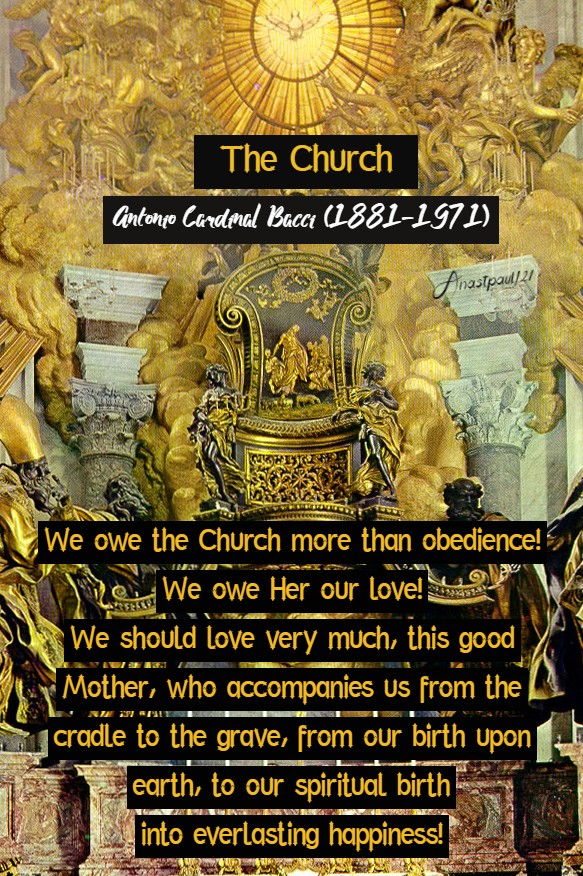
The Church
“Besides being our infallible teacher, the Church is also our affectionate Mother. Along with the inexhaustible treasury of His graces, it has inherited, from Jesus, His infinite love fo all mankind. Let us consider what the Church does and has done for us. As soon as we are born into this mortal life, She gives us, through the waters of Baptism, a second life, which is supernatural and everlasting. When we are a little older and exposed to the onslaughts of evil, She stengthens us in gace by means of another Sacrament and makes us soldiers of Christ. She raises us up. In the Sacament of Penance, She gives us God’s forgiveness and the spiritual strength to rise agin. Moeover, She gives us Jesus Christ Himself, in the Blessed Eucharist. By means of another Sacament, she elevates those who receive the power of Orders. In yet another, She blesses and consecrates matrimonial love and the pure marriage union. When we are dying, She comes, compassionately to our side again and, through the final Sacrament, gives us strength and purity of purpose, for the great journey into eternity. Nor is this enough. She is present with her prayers and blessings, even by our coffin nd by our graveside.
We owe the Church more than obedience! We owe Her our love! We should love very much, this good Mother, who accompanies us from the cradle to the grave, from our birth upon earth, to our spiritual birth into everlasting happiness!” Amen
Day Six of our Lenten Journey – 22 February – The Feast of the Chair of Saint Peter, Readings: 1 Peter 5:1-4, Psalm 23:1-3,4-5, Matthew 16:13-19
Imitating Christ with Thomas à Kempis (1380-1471)
In Your Light Lord, we see light
“He said to them, “But who do you say that I am?” Simon Peter said in reply, “You are the Messiah, the Son of the living God.” – Matthew 16:15-16
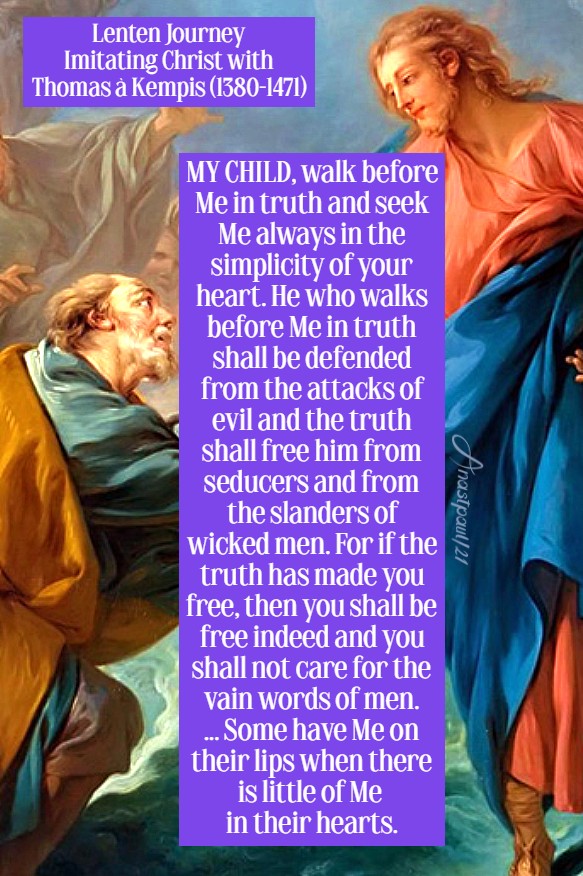
CHRIST: MY CHILD, walk before Me in truth and seek Me always in the simplicity of your heart. He who walks before Me in truth shall be defended from the attacks of evil and the truth shall free him from seducers and from the slanders of wicked men. For if the truth has made you free, then you shall be free indeed and you shall not care for the vain words of men.
DISCIPLE: O Lord, it is true. I ask that it be with me as You say. Let Your truth teach me. Let it guard me and keep me safe to the end. Let it free me from all evil affection and badly ordered love and I shall walk with You in great freedom of heart.
CHRIST: I shall teach you those things which are right and pleasing to Me. Consider your sins with great displeasure and sorrow and never think yourself to be virtuous because of your good works. You are truly a sinner. You are subject to many passions and entangled in them. Of yourself you always tend to nothing. You fall quickly, are quickly overcome, quickly troubled and quickly undone. You have nothing in which you can glory but you have many things for which you should think yourself vile, for you are much weaker than you can comprehend. Hence, let none of the things you do seem great to you. Let nothing seem important or precious or desirable except that which is everlasting. Let the eternal truth please you above all things and let your extreme unworthiness always displease you. Fear nothing so much, blame and abhor nothing so much as your own vices and sins; these should be more unpleasant for you than any worldly losses.
Some men walk before Me without sincerity. Led on by a certain curiosity and arrogance, they wish to know My secrets and to understand the high things of God, to the neglect of themselves and their own salvation. Through their own pride and curiosity and because I am against them, such men often fall into great temptations and sins. I leave them to their own devices without My help and counsel!
Fear the judgements of God! Dread the wrath of the Almighty! Do not discuss the works of the Most High but examine your sins — in what serious things you have offended and how many good things you have neglected.
Some carry their devotion only in books, some in pictures, some in outward signs and figures. Some have Me on their lips when there is little of Me in their hearts. Others, indeed, with enlightened understanding and purified affections, constantly long for everlasting things, they are unwilling to hear of earthly affairs and only with reluctance do they serve the necessities of nature. These sense what the Spirit of truth speaks within them, for He teaches them to despise earthly things and to love those of heaven, to neglect the world and each day and night, to desire heaven. (Book 3 Ch 4:1-4)
Quote/s of the Day – 22 February – The Feast of the Chair of Saint Peter
“The Church, instituted by the Lord and confirmed by the Apostles, is one for all men; but the frantic folly of the diverse impious sects, has cut them off from her. It cannot be denied, that this tearing asunder of the faith, has arisen from the defect of poor intelligence, which twists what is read, to confirm to its opinion, instead of adjusting its opinion to the meaning of what is read. However, while individual parties fight among themselves, the Church stands revealed, not only by her own doctrines but by those also, of her adversaries. And although they are all ranged against her, she confutes the most wicked error which they all share, by the very fact that she is alone and one. All the heretics, therefore, come against the Church but while all the heretics can conquer each other, they can win nothing for themselves. For their victory is the triumph of the Church over all of them. One heresy struggles against that teaching of another, which the faith of the Church has already condemned in the other heresy – for there is nothing which the heretics hold in common, – and, the result is that they affirm our faith, while fighting among themselves.”
St Hilary (315-368) Bishop of Poitiers Father and Doctor of the Divinity of Christ
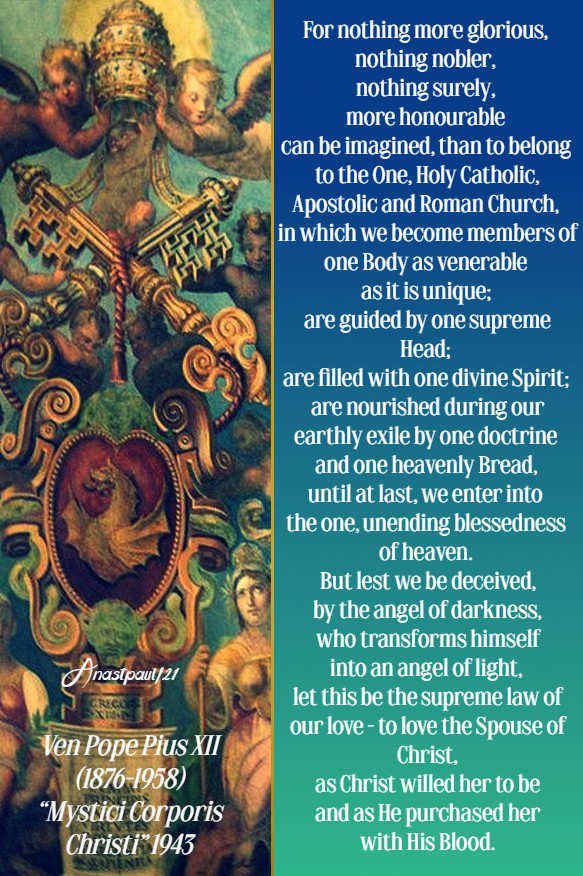
“For nothing more glorious, nothing nobler, nothing surely, more honourable can be imagined, than to belong to the One, Holy Catholic, Apostolic and Roman Church, in which we become members of one Body as venerable as it is unique; are guided by one supreme Head; are filled with one divine Spirit; are nourished during our earthly exile by one doctrine and one heavenly Bread, until at last, we enter into the one, unending blessedness of heaven. But lest we be deceived, by the angel of darkness, who transforms himself into an angel of light, let this be the supreme law of our love – to love the Spouse of Christ, as Christ willed her to be and as He purchased her with His blood.”
Pope Pius XII (1876-1958) “Mystici Corporis Christi” 1943
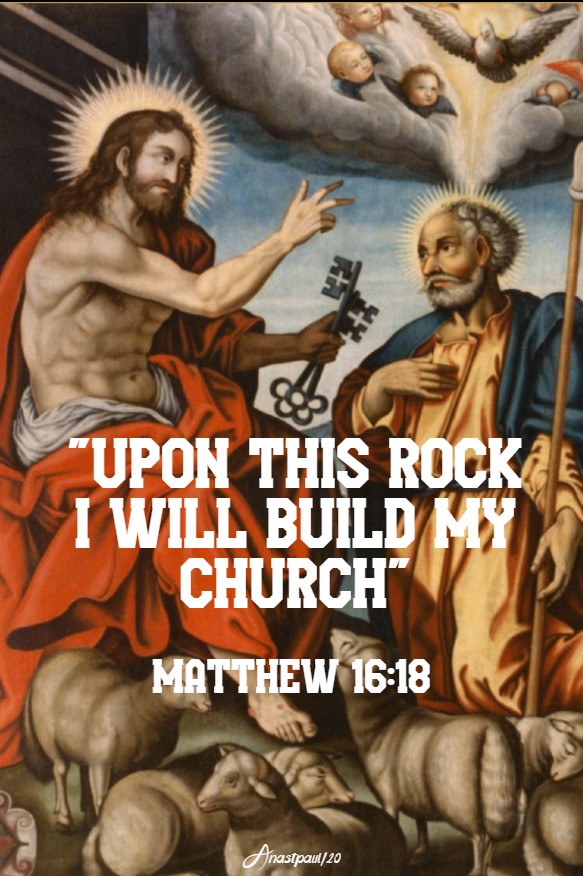
“Upon this rock I will build my church and the gates of hell shall not prevail against it. I will give you the keys of the kingdom of heaven and whatever you bind on earth shall be bound in heaven and, whatever you loose on earth, shall be loosed in heaven.” … Matthew 16:18-19
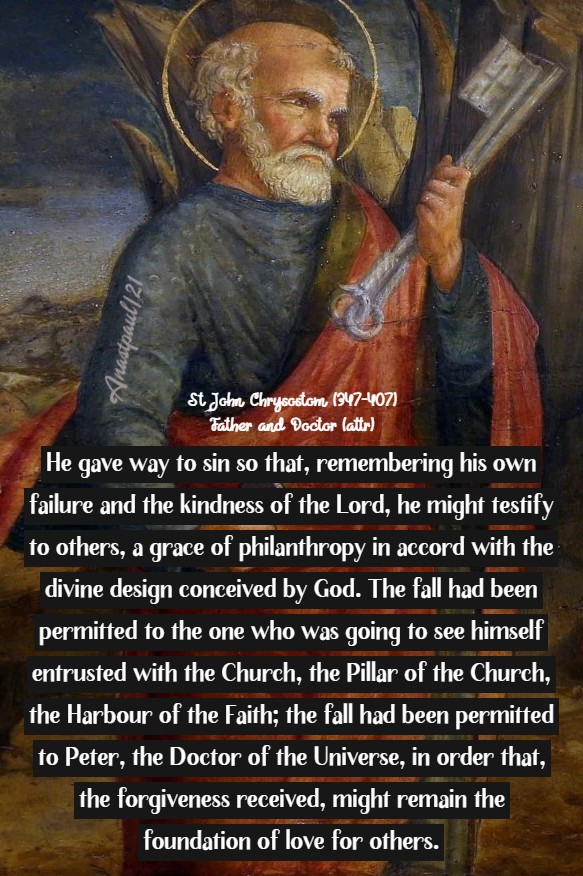
REFLECTION – “Peter was to receive on deposit, the keys of the Church, or rather the keys of heaven and, he should see himself entrusted with the numerous people. What did the Lord actually say to him? “Whatever you bind on earth shall be bound in heaven and whatever you loose on earth shall be loosed in heaven” (Mt 16:19). For Peter had a somewhat abrupt character; if he had been without sin what sort of forgiveness would the disciples have received from him? This is why divine grace allowed him to fall into a certain fault, in order that his own trial should make him benevolent towards others. Do you see how God can let someone fall into sin; this Peter, the leader of the Apostles, the unshakable foundation, indestructible rock, first in the Church, impregnable harbour, unshakable tower — this same Peter who had said to Christ: “Even though I should have to die with you, I will not deny you” (Mt 26:35), Peter who, by a divine revelation, had confessed the truth: “You are the Christ, Son of the Living God” (Mt 16:16). (…) But as I said, God arranged it in this way and allowed Peter to sin because he had it in mind, to confer numerous people on him and he feared, that his roughness, joined to his impeccability, might make him unsympathetic towards his brothers. He gave way to sin so that, remembering his own failure and the kindness of the Lord, he might testify to others, a grace of philanthropy in accord with the divine design conceived by God. The fall had been permitted to the one who was going to see himself entrusted with the Church, the Pillar of the Church, the Harbour of the Faith; the fall had been permitted to Peter, the Doctor of the Universe, in order that, the forgiveness received, might remain the foundation of love for others.” – (Attr) St John Chrysostom (347-407) Bishop of Constantinople, Father and Doctor of the Church – On the apostle Peter and the prophet Elijah
PRAYER – Holy Father, send Your Divine Enlightener into the hearts of all Your faithful, filling us with the strength to fulfil our mission as the followers of the Chair of St Peter. And most of all, we pray Lord Holy God, to inspire and light the way of our Holy Father, Francis. Sustain and guide him, keep him in health and strength, to lead Your people by the Light of the Way and the Truth. Holy Father, have mercy on us, Holy Spirit guide and lead us, Lord Jesus Christ be our intercessor and teacher, amen.
Our Morning Offering – 22 February – Feast of the Chair of St Peter
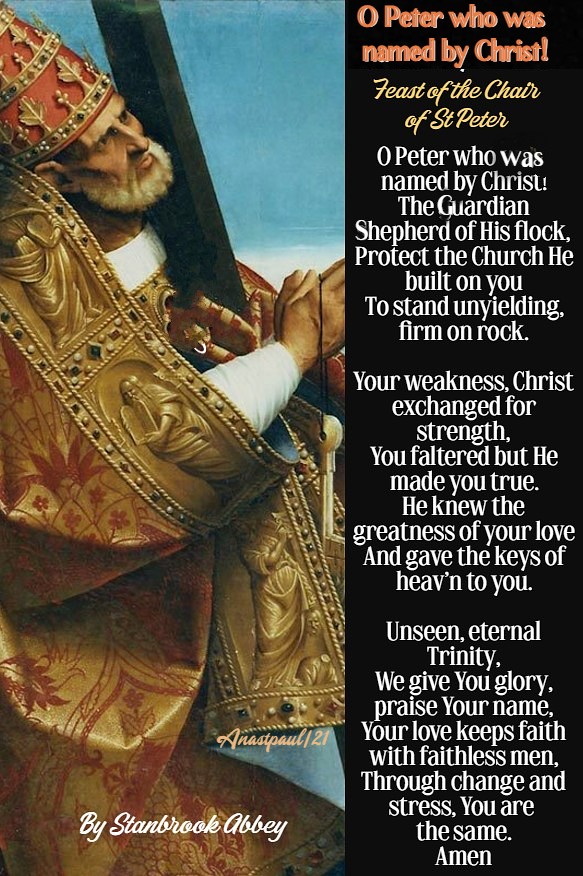
O Peter, who was Named by Christ! By Stanbrook Abbey For the Feast of the Chair of St Peter
O Peter who was named by Christ! The Guardian-Shepherd of His flock, Protect the Church He built on you To stand unyielding, firm on rock.
Your weakness, Christ exchanged for strength, You faltered but He made you true. He knew the greatness of your love And gave the keys of heav’n to you.
Unseen, eternal Trinity, We give You glory, praise Your name, Your love keeps faith with faithless men, Through change and stress, You are the same. Amen
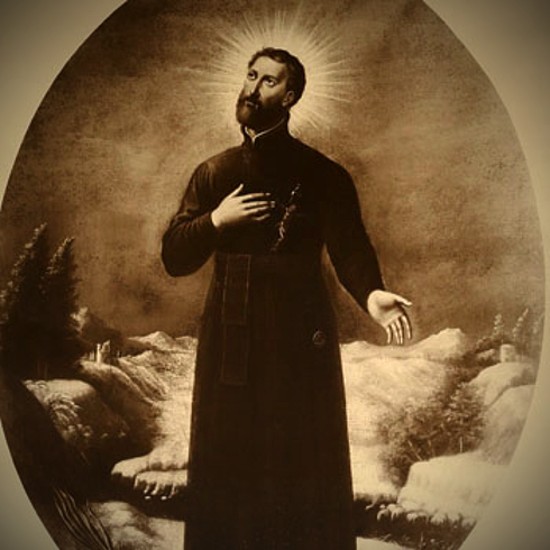
Saint of the Day – 22 February – Blessed Diego Carvalho SJ (1578-1624) Jesuit Priest and Martyr, Missionary to Japan. Born in 1578 in Coimbra, Portugal and died by exposure on 22 February 1624 at Sendai, Miyagi, Japan. Patronage Japanese miners.
Diego was born in Coimbra, Portugal, in 1578. After entering the Society of Jesus in his hometown in 1594, late in 1600 he arrived, after a long voyage with sixteen other Jesuits, in Goa, India.
The following year, 1608, he set out for Macau, where he was Ordained as Priest. In 1609, he arrived in Japan, where, after learning Japanese, he was a Missionary in the Amakusa Islands, before relocating to Kyōto around 1612. After the edict of proscription of 1614, in November that year, with seventy-two other Jesuits on three Chinese junks, he was deported to Macau.
Diogo’s heart remained in Japan, however and he secretly returned in 1616. Later he relocated in the north to serve refugees fleeing persecution in the south.
Carvalho’s ministry centred on the silver miners in the districts of Oshu and Dewa. Living conditions were difficult but conversions were abundant. In December 1623 he was working in Miwake when the local prince began to persecute the Christians and ordered soldiers to kill all who refused to apostatise. When the governor of Sendai learned of Father Carvalho, he went searching for him but the Jesuit and about 60 Christians fled into a deep valley seeking to escape. Unfortunately, their tracks in the snow led the soldiers to them and Carvalho gave himself up, in an attempt to allow his people to get away. He was able to save all but 12 of his companions. Then the Christians had to march for seven days through the cold to Sendai. Two who could not keep up, were killed on the spot and the rest were barely given enough food to eat to survive their month-long imprisonment once they reached the City.
Martyrdom came for Carvalho and his companions through the cold. The Hirose River flowed near the fortress where they had been imprisoned; on its bank the soldiers dug a hole and filled it with icy water from the river. The prisoners were forced first to sit naked in the freezing water and then stand up to let the wind hit them. Their captors promised to end the torture if they would renounce Christianity. None did and the cold slowly took away their life. Carvalho was the last to die, enduring the torture long into the night before he also finally perished. The names of his companions are sadly unknown, so they could not be Beatified with him but with God they are Blessed in His Heavenly Kingdom.
The decree of Martyrdom and Beatificztion, was confirmed on 7 May 1867 by Pope Blessed Pius IX.
Notre-Dame de Rennes / Our Lady of Miracles and Virtues, Rennes, France (1357) – 22 February:
The Statue of Our Lady of Miracles and Virtues in the Lady Chapel at Saint Sauveur at Rennes
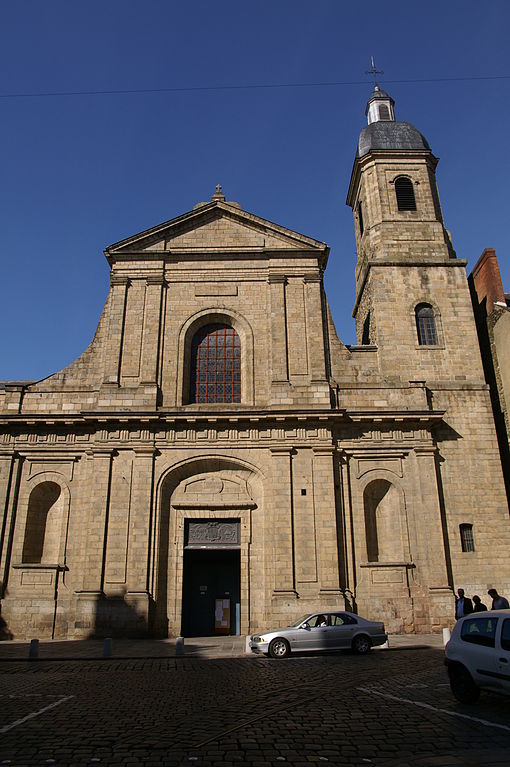
Our Lady of Rennes, in Britanny. The English, having made a mine to blow up the town, it is said that the candles in theCchapel were found miraculously lighted; the bells rung of themselves and the image of the Blessed Virgin was seen to stretch out its arms towards the middle of the Church, where the mine was, which, by that means was discovered. The people rushed to the spot and so, the plot was discovered and the entire town saved through the intervention of Our Lady of Rennes. Great was the rejoicing and deep the gratitude of the people. Known today as the Basilica of Saint Sauveur in Rennes, it is located in the heart of historic Rennes, which was once the capital of Brittany. It is situated at the termination of Saint-Sauveur Street on which its façade faces. As the original Gothic Church partially collapsed in the year 1682, the Classical style Church that can currently be seen, was constructed beginning in 1703 and consecrated in August of 1719. In the year 1793, during the French Revolution, the Church was made into a Temple of Reason and the miraculous statue of Our Lady was destroyed. It was not until 1802, after the end of the Terror, that the Church was opened again to worship. The Church was made into a minor Basilica in 1916 by Pope Benedict XV.
The Altar of Our Lady in the main body of the Basilica of Saint Sauveur at Rennes
According to popular tradition there was a famous miracle attributed to Our Lady at Rennes during the War of Succession at Brittany. As Rennes was being besieged by the invading English army under the Duke of Lancaster, the people of the city expected the English forces to mine their way under the walls into the City. On the night of 8 February 1357, the Church bells began to ring of their own accord and the candles were spontaneously lit. The Statue of Our Lady, known as Our Lady of Miracles and Virtues, pointed out a particular slab in the Church. The inhabitants of the city thus were alerted to the mine and the point of the English attack, and were able to repulse the invasion. The miracle was a popular subject for ballads, especially the troubadour Cavalier. In 1634 the miracle was officially recognised by the Bishop of Rennes, Pierre Cornulier. There are many miracles attributed to Our Lady, including the miraculous healing of Magdalene Morice in the year 1761. She had gangrene in her right foot which was instantly healed on Easter Sunday. The Statue of Our Lady of Miracles and Virtues currently displayed at the Basilica was placed there in February of 1876. In 1684 a boy of eleven left home for the City of Rennes, in hopes of enrolling at the Jesuit College of Thomas a Becket. The young Louis-Marie was an intelligent boy who was taken under the guidance of the Jesuit Priests and it was at Rennes that he began to consider a possible vocation to the Priesthood. It was here, at the Shrine of Our Lady at Rennes, that Saint Louis de Montfort made the final decision to become a Priest. Amen! We thank our Lady for giving us St Louis-Marie Grignion de Montfort!
St Maximian of Ravenna St Miguel Facerías Garcés St Mohammed Abdalla St Papias of Heirapolis St Paschasius of Vienne St Raynerius of Beaulieu St Thalassius — Martyrs of Arabia – A memorial for all the unnamed Christians martyred in the desert and mountainous areas south of the Dead Sea during the persecutions of Emperor Valerius Maximianus Galerius.
Thought for the Day – 21 February – Meditations with Antonio Cardinal Bacci (1881-1971)
Detachment from the World
“St John Bosco said, that we should ork as if we never had to die. But, we should also be as detached from worldly things, as if we had to die in one hour. A man who works like this, can accomplish wonders because, he is not working for himself but, for God. We should work and pray with our feet on the earth and our minds in heaven. We should seek God, not ourselves, in everything which we do. Let us remember, that one moment in Heaven, is worth infinitely more than all the pleasure, love and vanity of this world!”
Day Five of our Lenten Journey – 21 February – The First Sunday of Lent, Readings: Genesis 9:8-15, Psalms 25:4-5, 6-7,8-9, 1 Peter 3:18-22, Mark 1:12-15
Imitating Christ with Thomas à Kempis CRSA (1380-1471)
In Your Light Lord, we see light
“The kingdom of God is within you,” says the Lord (Luke 17:21).
Turn, then, to God with all your heart. Forsake this wretched world and your soul shall find rest. Learn to despise external things, to devote yourself to those that are within and you will see the kingdom of God come unto you, that kingdom which is peace and joy in the Holy Spirit, gifts not given to the impious. Christ will come to you offering His consolation, if you prepare a fit dwelling for Him in your heart, whose beauty and glory, wherein He takes delight, are all from within. His visits with the inward man are frequent, His communion sweet and full of consolation, His peace great and His intimacy wonderful indeed. Therefore, faithful soul, prepare your heart for this Bridegroom that He may come and dwell within you. He Himself says: “If anyone love Me, he will keep My word and My Father will love him and We will come to him and will make Our abode with him”. (John 14:23). Give place, then, to Christ but deny entrance to all others, for when you have Christ you are rich and He is sufficient for you. He will provide for you. He will supply your every want, so that you need not trust in frail, changeable men. Christ remains forever, standing firmly with us to the end. […] Place all your trust in God, let Him be your fear and your love. He will answer for you, He will do what is best for you. You have here no lasting home. You are a stranger and a pilgrim wherever you may be and you shall have no rest, until you are wholly united with Christ. Why do you look about here when this is not the place of your repose? Dwell rather upon heaven and give but a passing glance to all earthly things. They all pass away and you together with them. Take care, then, that you do not cling to them lest you be entrapped and perish. Fix your mind on the Most High, and pray unceasingly to Christ. If you do not know how to meditate on heavenly things, direct your thoughts to Christ’s passion and willingly behold His sacred wounds. If you turn devoutly to the wounds and precious stigmata of Christ, you will find great comfort in suffering, you will mind but little the scorn of men and you will easily bear their slanderous talk. (Book 2, Ch 1)
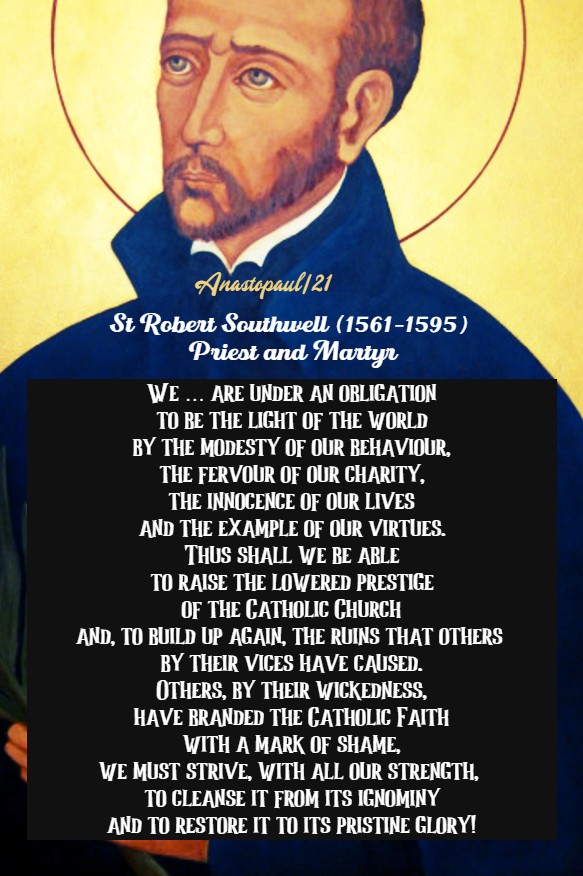
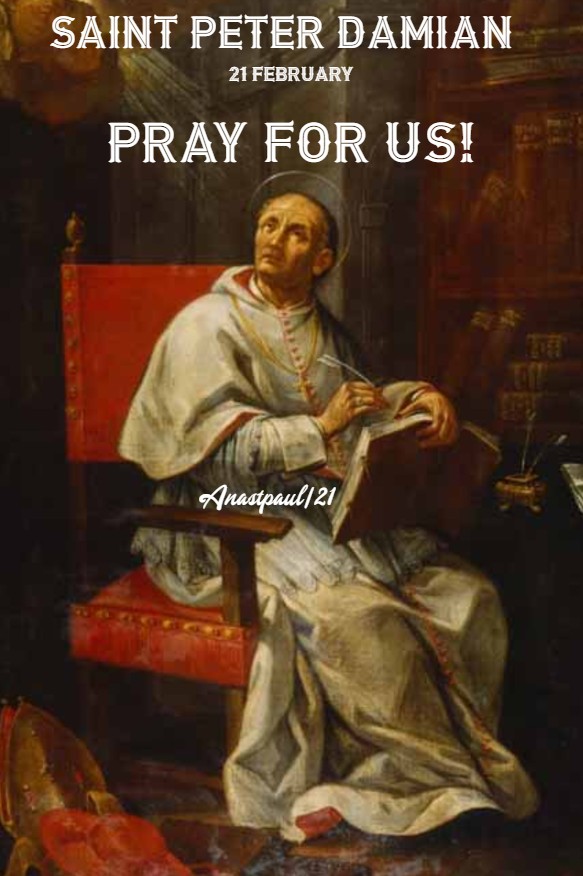
Quote/s of the Day – 21 February – First Sunday of Lent, Readings: Genesis 9:8-15, Psalms 25:4-5, 6-7,8-9, 1 Peter 3:18-22, Mark 1:12-15 and the Memorial of St Peter Damian OSB (1007-1072) Doctor of the Church and St Robert Southwell SJ (1561-1595) Priest and Martyr
“We … are under an obligation to be the light of the world by the modesty of our behaviour, the fervour of our charity, the innocence of our lives and the example of our virtues. Thus shall we be able to raise the lowered prestige of the Catholic Church and, to build up again, the ruins that others by their vices have caused. Others, by their wickedness, have branded the Catholic Faith with a mark of shame, we must strive, with all our strength, to cleanse it from its ignominy and to restore it to its pristine glory!”
St Robert Southwell SJ (1561-1595) Priest and Martyr
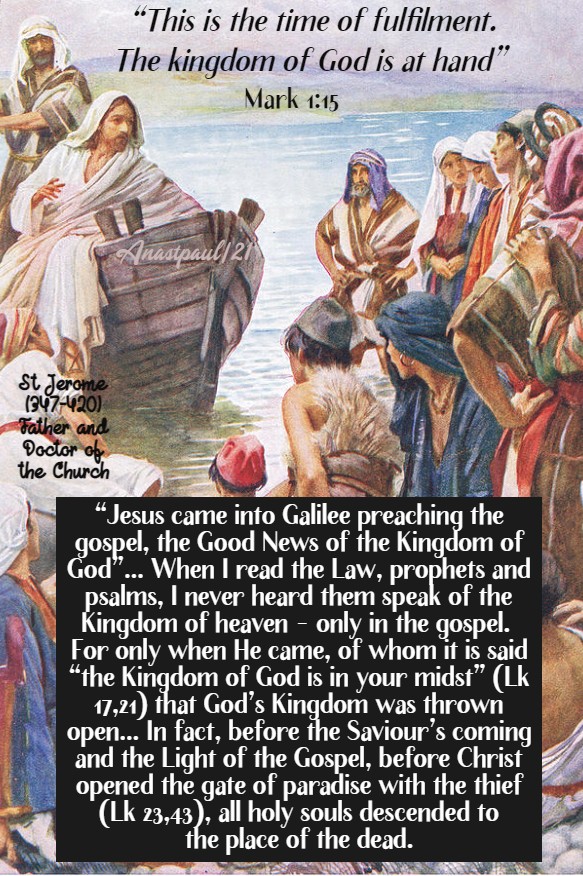
“This is the time of fulfilment. The kingdom of God is at hand” – Mark 1:14
REFLECTION – “After John had been arrested, Jesus came into Galilee…” According to our interpretation, John stands for the Law and Jesus the Gospel. Indeed, John says: “One mightier than I is coming after me…” (Mk 1,7) and elsewhere: “He must increase, I must decrease” (Jn 3,30): in this way he compares the Law with the Gospel. And afterwards he says: “I – that is, the Law – baptise you with water; he – that is the Gospel – will baptise you in the Holy Spirit” (Mk 1,8). And so Jesus comes because John had been put in prison. In effect, the Law is finished, it has been brought to an end, it no longer has its former freedom. But we have passed from the Law to the Gospel…
“Jesus came into Galilee preaching the gospel, the Good News of the Kingdom of God”… When I read the Law, prophets and psalms, I never heard them speak of the Kingdom of heaven – only in the gospel. For only when He came, of whom it is said “the Kingdom of God is in your midst” (Lk 17,21) that God’s Kingdom was thrown open… In fact, before the Saviour’s coming and the Light of the Gospel, before Christ opened the gate of paradise with the thief (Lk 23,43), all holy souls descended to the place of the dead. Jacob himself said: “I will go down weeping and mourning to the nether world” (Gn 37,35)… In the Law, Abraham rests with the dead; in the gospel, the thief is in paradise. We are not denigrating Abraham, we all want to rest in his bosom (Lk 16,23 but we prefer Christ to Abraham, the Gospel to the Law.
We read that after Christ’s Resurrection many saints appeared in the holy city (Mt 27,53). Our Lord and Saviour preached on earth and preached, too, to the underworld. He died and descended to hell to free the souls held captive there (1Pt 3,18f.).” – St Jerome (347-420), Priest, Translator of the Bible, Father and Doctor of the Church – Homilies on Saint Mark’s Gospel, no.2A ; SC 494
PRAYER – Through our annual Lenten observance Lord, deepen our understanding of the mystery of Christ and make it a reality in the conduct of our lives,. Teach us by the example and doctrine of St Peter Damian to prefer nothing whatever to Christ and to make the service of Your Church our chief concern and so, come to the joy of Your eternal Kingdom. We make our prayer through our Lord Jesus, in unity with the Holy Spirit, one God forever, amen.
Our Morning Offering – 21 February – First Sunday of Lent
Anima Christi
Soul of Christ, sanctify me Body of Christ, save me Blood of Christ, inebriate me Water from the side of Christ, wash me Passion of Christ, strengthen me Good Jesus, hear me Within Your wounds, shelter me from turning away, keep me From the evil one, protect me At the hour of my death, call me Into Your presence lead me to praise You with all Your saints Forever and ever, Amen
For many years the Anima Christi was popularly believed to have been composed by Saint Ignatius Loyola (1491-1556) , as he puts it at the beginning of his Spiritual Exercises and often refers to it. In the first edition of the Spiritual Exercises Ignatius merely mentions it, evidently supposing that the reader would know it. In later editions, it was printed in full. It was by assuming that everything in the book was written by Ignatius that it came to be looked upon as his composition. On this account the prayer is sometimes referred to as the Aspirations of St. Ignatius Loyola and so my image shows St Ignatius at prayer.
However, the prayer actually dates to the early fourteenth century and was possibly written by Pope John XXII but its authorship remains uncertain. It has been found in a number of prayer books printed during the youth of Ignatius and is in manuscripts which were written a hundred years before his birth. The English hymnologist James Mearns found it in a manuscript of the British Museum which dates back to about 1370. In the library of Avignon there is preserved a prayer book of Cardinal Pierre de Luxembourg (died 1387), which contains the prayer in practically the same form as we have it today. It has also been found inscribed on one of the gates of the Alcázar of Seville, which dates back to the time of Pedro the Cruel (1350–1369).
The invocations in the prayer have rich associations with Catholic concepts that relate to the Eucharist (Body and Blood of Christ), Baptism (water) and the Passion of Jesus (Holy Wounds).
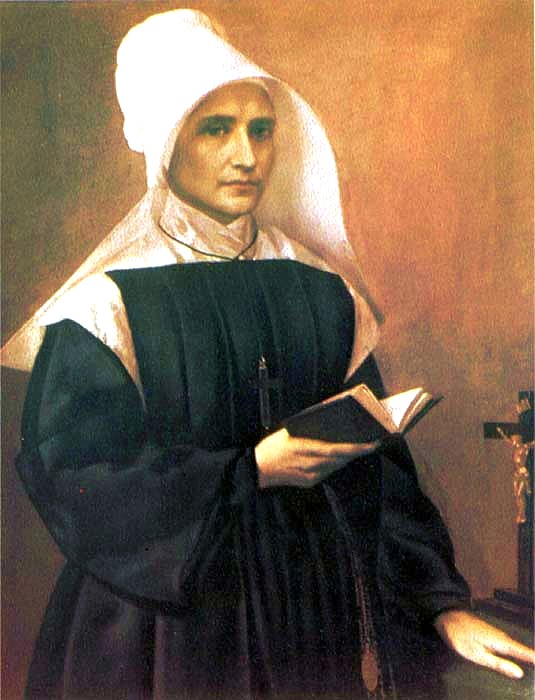
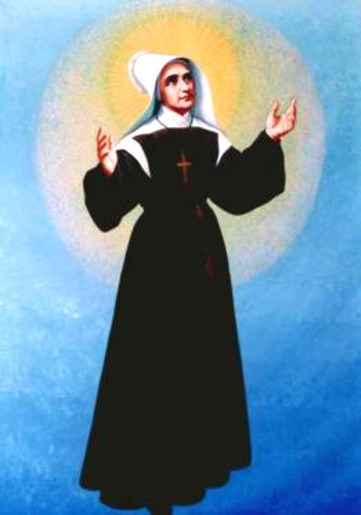
Saint of the Day – 21 February – Blessed Caterina Dominici/Maria Enrichetta (1829–1894) Nun of the Sisters of St Anne – whose main charism is the care and education of street children, Mystic with an extraordinary devotion to the Blessed Sacrament, close friend and adviser to St John Bosco in establishing the Rule of the Daughters of Mary Help of Christians, also “lending” two nuns to the new Congregation. During the 1854 Broad Street cholera outbreak, she cared for and ministered to countless people. She then went on to serve for over three decades as the Superior General of her Congregation. Born on 10 October 1829 in Borgo Salsasio, Carmagnola, Turin, Italy and died on 21 February 1894, aged 64, in Turin, Italy of natural causes. Also known as Mother Maria Enrichetta (her religious name), Anna Caterina, Maria Henrich Dominici, Mother Maria Enrica Dominici.
Caterina Dominici was born on 10 October 1829 near Turin, as the fourth daughter. One brother would become a Priest. She was four when her parents separated and she went with her mother and siblings to live with her Priest uncle.
As a child she grew into the habit of regular Confession and Holy Communion. She moved in 1848 and in November 1850 became a non-cloistered religious of the Sisters of Saint Anne. She assumed the name of “Maria Enrichetta.” Pope Pius IX visited Loreto in 1857 and Sr Maria was present along with St Madeleine Sophie Barat when the Pope met with the professed religious.
Sr Maria Enrichetta was appointed as the Superior General of her Congregation and she at first attempted to discourage her fellow sisters from the appointment.
Now Mother Maria, she founded about thirty houses, reaching Rome and Sicily. With each term of office confirmed, it did not seem possible to have another mother general. As a girl she had dreamed of becoming a missionary to India, now, she could fulfill the vow indirectly, sending her nuns. In February 1871 six of them left, which the Mother entrusted to the Holy Trinity of which she was very devoted. Her new foundation in India opened a path that would bear great fruit. In October 1879 she went in person to distant India, to Secunderabad, to visit the Institute’s first Missionary home.
On 14 July 1884 she was received at an audience by Pope Leo XIII.
Her health started to decline from November 1893 and Caterina was confined to bed. She continued to lead the institute, despite suffering and pain. She spent her last week in drowsiness and despite this, she continued to speak in a weak voice to those around her bedside.
Affable and kind, however, she was reserved and of a few words. She meditated for hours before the Tabernacle and she obtained permission from the Holy See, for her nuns to make daily communion.
Her writings, autobiography and copious letters, speak her total abandonment to God. She wrote: “Oh how happy lives the soul that lives totally abandoned in God. Oh if everyone knew this happiness …”
Sr Maria Enrichetta died in 1894 and her remains were transferred in 1926 to the chapel of the mother house.
The investigation for a miracle attributed to her intercession, spanned from 1949 to 1950 and was validated in 1952. Paul VI approved it in 1977 and Beatified her on 7 May 1978.
There are currently Houses of St Anne in Italy, Switzerland, Cameroon, Argentina, Peru, Philippines, Mexico, Brazil, USA. In India there are eighty houses, more than in Italy.
Notre-Dame de Bon-Port / Our Lady of Bon Port/Good Haven, Paimpol, France (1838) – 21 February:
In 1838, the crew of a vessel which had just arrived at Paimpol, in France, forty-eight in number, accomplished a vow they had made in a most perilous voyage from Newfoundland. A terrific tempest had arisen, their sails were tor, and for three days they were in continual danger of finding a watery grave. The ship began to fill with water and all hope of safety seemed lost, when the crew, by common consent, turned their eyes to Mary, Star of the Sea and asked for good haven. They promised if she saved them, they would visit in the most supplicant manner, the Church at Paimpol, where there is an image of Our Lady much venerated by the people. They had scarcely ended their prayer, when the weather became more calm and the waves began to subside. Profiting by this providential change, they repaired their sails and had a favourable wind, until they reached the coasts of Brittany. They landed in safety at Knod, toward the decline of day and their first act was to prostrate themselves on the ground and give God thanks for their safe return. They then intoned the Litany of the Blessed Virgin and advanced barefooted and bare-headed along the banks and through the streets of Paimpol, to the Church of the Good Haven. The people attracted in crowds by the novelty of the sight, followed them. There were parents who went to give thanks to Our Lady of Good Haven for the return of their sons and wives, to thank Mary for restoring their husbands to them. Tears streamed down from every eye, and the immense multitude knelt down before the Altar of that powerful Virgin, who had received from her Son, the power to command wind and wave. The torches shed a dim light on the recessed of the sanctuary, where stood the image of the Blessed Virgin, Our Lady of Good Haven, whose inclined head and exteneded arms seemed to say to all, “Come to me, I am your Mother.” These pious mariners with the most touching expression of sentiment, chanted the hymn, “Ave Maria Stella” in which they were joined in gratitude by the people.
“Bright Mother of our Maker, hail! Thou Virgin ever blest, The ocean’s star, by which we sail, And gain the port of rest.”
St Avitus II of Clermont Blessed Caterina Dominici/Maria Enrichetta SSA (1829–1894) Nun Bl Claudio di Portaceli St Daniel of Persia Bl Eleanora St Ercongotha St Eustathius of Antioch St Felix of Metz St George of Amastris St Germanus of Granfield St Gundebert of Sens Blessed Noel Pinot (1747-1794) Priest and Martyr His Life and Death: https://anastpaul.com/2020/02/21/saint-of-the-day-21-february-blessed-noel-pinot-1747-1794-priest-and-martyr/ St Paterius of Brescia (Died 606) Bishop St Pepin of Landen St Peter Mavimenus St Randoald of Granfield
St Severian of Scythopolis St Severus of Syrmium Bl Thomas Pormort St Valerius of San Pedro de Montes St Verda of Persia — Martyrs of Sicily – 79 saints – Seventy-nine Christians martyred together in the persecutions of Diocletian. They were martyred in c 303 on Sicily.
Martyrs of Hadrumetum – A group of 26 Christians martyred together by Vandals. We know little more than eight of their names – Alexander, Felix, Fortunatus, Saturninus, Secundinus, Servulus, Siricius and Verulus. c 434 at Hadrumetum (modern Sousse, Tunisia)
Martyrs Uchibori – Three Japanese laymen, all brothers, all sons of Paulus Uchibori Sakuemon, one a teenager, one only five years old and all martyred for their faith in the persecutions in Japan. 21 February 1627 in Shimabara, Nagasaki, Japan. Beatified 24 November 2008 by Pope Benedict XVI. Antonius Balthasar Ignatius
Thought for the Day – 20 February – Meditations with Antonio Cardinal Bacci (1881-1971)
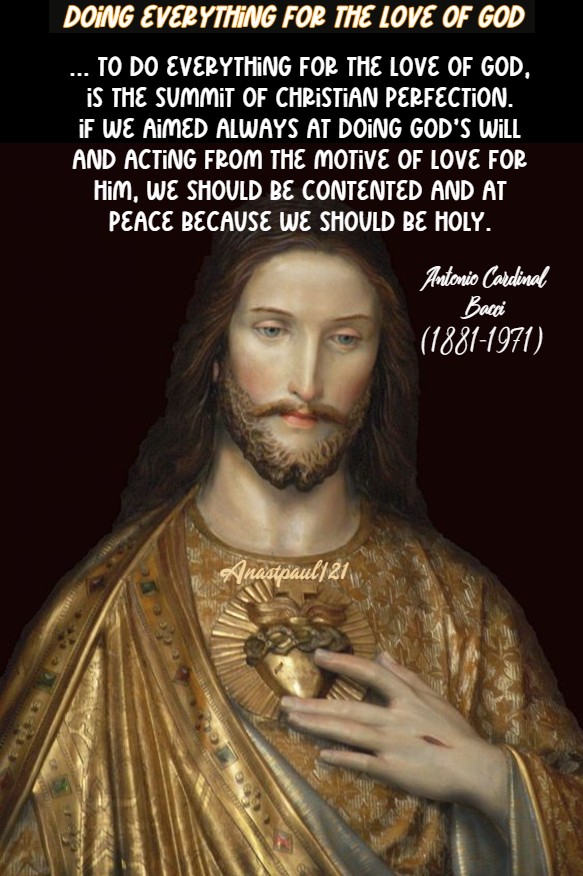
Doing Everything for the Love of God
“The beginning of perfection consists in doing the will of God, even in our smallest actions. But, to do everything for the love of God, is the summit of Christian perfection. If we aimed always at doing God’s will and acting from the motive of love for Him, we should be contented and at peace, because we should be holy. The saints are the only people who remain calm and undisturbed in the midst of worldly adversity. They are always content, because they live in God. Their lives are in full conformity with His Will, guided by His Love and dedicated to His Service. As a result, they live in a kind of spiritual stratosphere far above the storms of this world. There they are above the clouds of pride, ambition, avarice and all the other major vices. There they see and contemplate everything in the Light of God. Let us become saints. Then we shall have solved all the problems of life!.” Amen
Day Four of our Lenten Journey – 20 February – Saturday after Ash Wednesday, Readings: Isaiah 58: 9-14, Psalms 86:1-2, 3-4, 5-6, Luke 5:27-32
Imitating Christ with Thomas à Kempis CRSA (1380-1471)
In Your Light Lord, we see light
“Those who are well, have no need of a physician but those who are sick. I have not come to call the righteous but sinners to repentance.” – Luke 5:31-32
The holy Martyr, Lawrence, with his priest, conquered the world because he despised everything in it that seemed pleasing to him and for love of Christ patiently suffered the great high priest of God, Sixtus, whom he loved dearly, to be taken from him. Thus, by his love for the Creator, he overcame the love of man and chose instead of human consolation the good pleasure of God. So you, too, must learn to part with an intimate and much-needed friend for the love of God. Do not take it to heart when you are deserted by a friend, knowing that in the end we must all be parted from one another.
A man must fight long and bravely against himself before he learns to master himself fully and to direct all his affections toward God. When he trusts in himself, he easily takes to human consolation. The true lover of Christ, however, who sincerely pursues virtue, does not fall back upon consolations nor seek such pleasures of sense but prefers severe trials and hard labours for the sake of Christ. …
In what can I hope, then, or in Whom ought I trust, save only in the great mercy of God and the hope of heavenly grace? For though I have with me good men, devout brethren, faithful friends, holy books, beautiful treatises, sweet songs and hymns, all these help and please but little when I am abandoned by grace and left to my poverty. At such times there is no better remedy than patience and resignation of self to the will of God.
The devil does not sleep, nor is the flesh yet dead, therefore, you must never cease your preparation for battle, because on the right and on the left are enemies who never rest. (Book 2, Ch9, 2-3,6,8)
Quote/s of the Day – 20 February – Saturday after Ash Wednesday, Readings: Isaiah 58: 9-14, Psalms 86:1-2, 3-4, 5-6, Luke 5:27-32
“Follow me.”
Luke 5:27
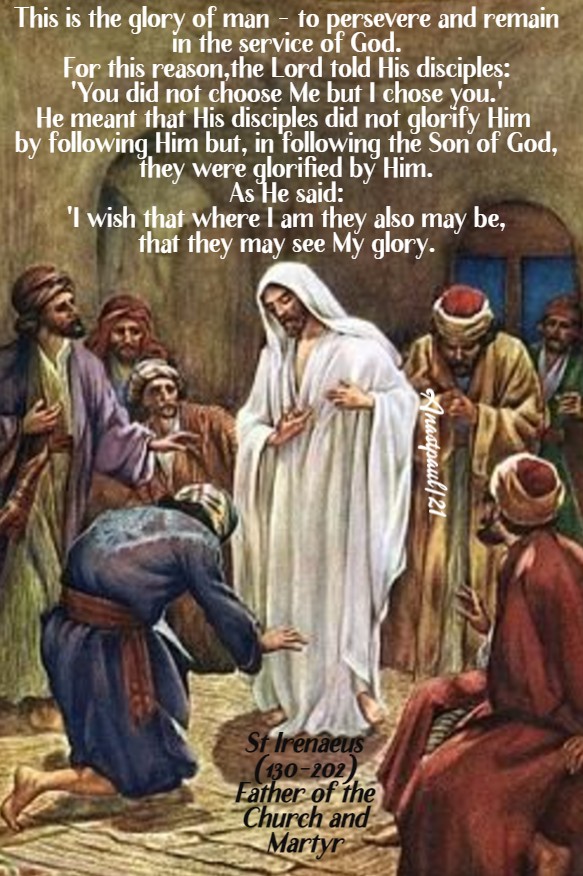
“This is the glory of man – to persevere and remain in the service of God. For this reason, the Lord told His disciples: ‘You did not choose Me but I chose you.’ He meant that His disciples did not glorify Him by following Him but, in following the Son of God, they were glorified by Him. As He said: ‘I wish that where I am they also may be, that they may see My glory.’”
St Irenaeus (130-202) Father of the Church and Martyr
From his Against Heresies (Book 4)
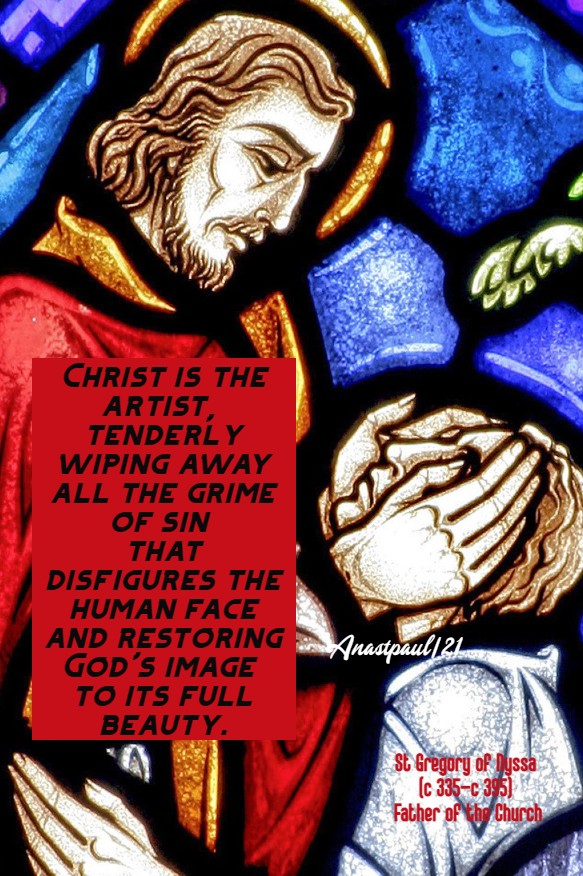
“Christ is the artist, tenderly wiping away all the grime of sin that disfigures the human face and restoring God’s image to its full beauty.”
St Gregory of Nyssa (c 335–C 395) Father of the Church
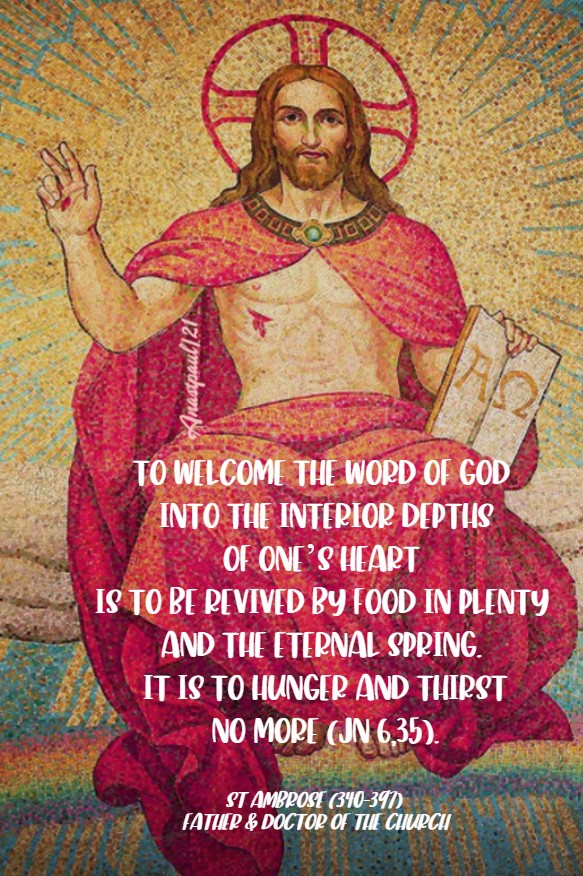
“To welcome the Word of God into the interior depths of one’s heart is to be revived by food in plenty and the eternal spring. It is to hunger and thirst no more (Jn 6,35).”
St Ambrose (340-397) Bishop of Milan Father & Doctor of the Church
Commentary on Saint Luke’s gospel, 5, 16 ; SC 45
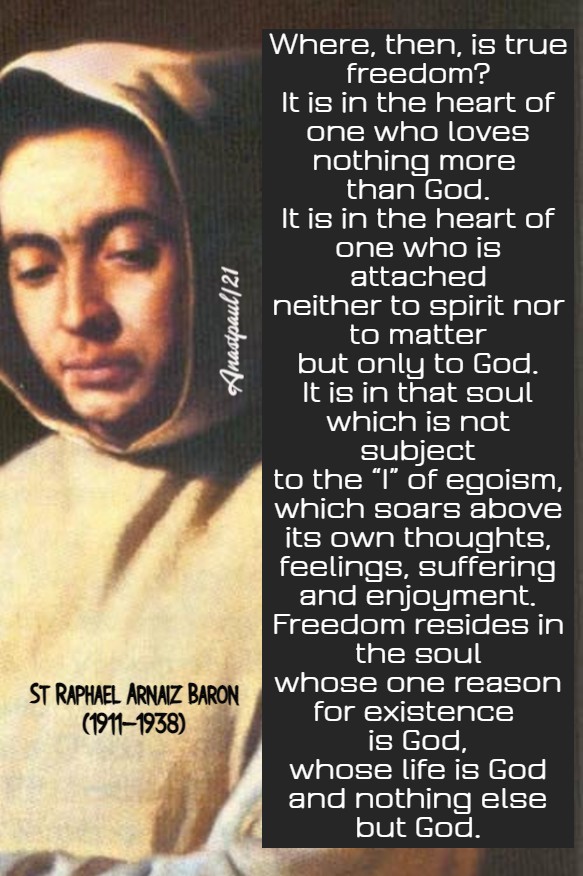
“Where, then, is true freedom? It is in the heart of one who loves nothing more than God. It is in the heart of one who is attached neither to spirit nor to matter but only to God. It is in that soul which is not subject to the “I” of egoism, which soars above its own thoughts, feelings, suffering and enjoyment. Freedom resides in the soul whose one reason for existence is God, whose life is God and nothing else but God.”
Saint Raphael Arnaiz Baron (1911-1938) Spanish Trappist Monk
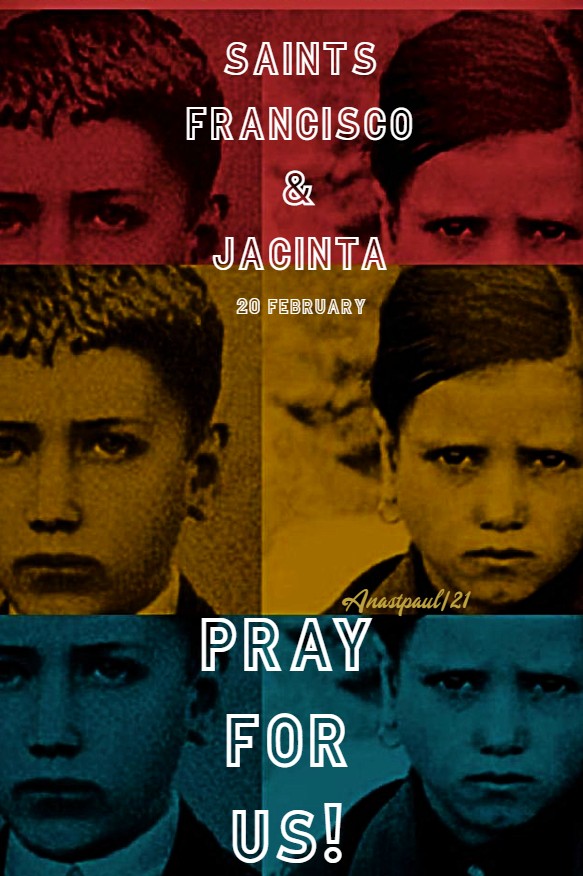
One Minute Reflection – 20 February – Saturday after Ash Wednesday, Readings Isaiah 58: 9-14, Psalms 86:1-2, 3-4, 5-6, Luke 5:27-32 and the Memorial of St Elutherius of Tournai (c 456-532) Bishop and Martyr and Saints Francisco (1908-1919) and Jacinta (1910-1920)
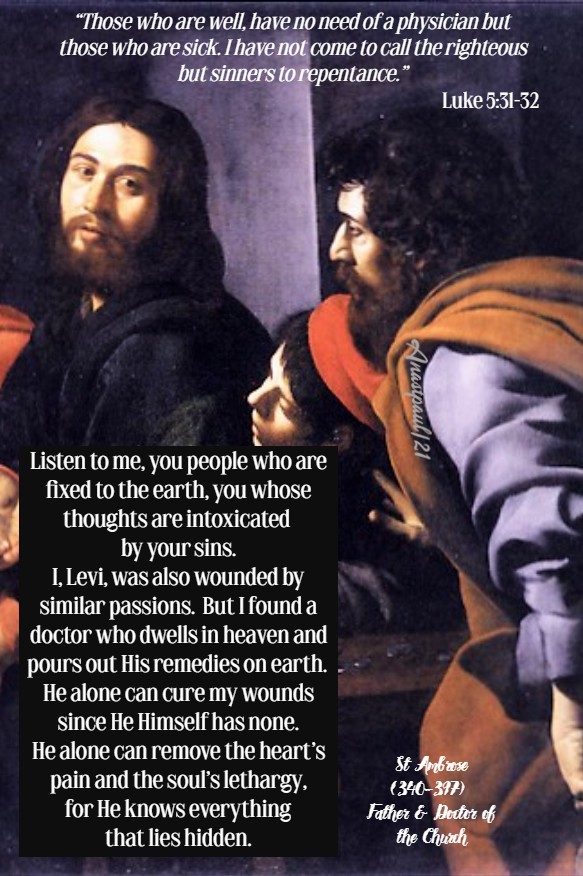
“Those who are well, have no need of a physician but those who are sick. I have not come to call the righteous but sinners to repentance.” – Luke 5:31-32
REFLECTION – “The Apostle Paul said: “Take off the old self with its practices and put on the new self” (Col 3,9-10)… This was the work Christ accomplished when He called Levi; He refashioned him into a new man. Similarly, it is as a new person, that the former publican prepares a banquet for Christ since Christ takes pleasure in him and he himself, merits to have a share in happiness with Christ… He followed him now, happy, light-hearted and overflowing with joy.
“I have the aspect of a publican no more,” he said, “I don’t carry around the old Levi any longer; I put off Levi when I put on Christ. I flee from my earlier life; my Lord Jesus, you alone, who heal my wounds, I desire to follow. Who shall separate me from the love of God … ? tribulation? anguish? hunger? (Cf Rom 8,35). I am bound to You by faith as by nails, I am held fast by the worthy bonds of love. All Your commandments will be like a cautery that I will apply firmly to my wound; the remedy stings but it takes away the ulcerous infection. Lord Jesus, with Your powerful sword, cut away the corruption of my sins: come quickly, lance my hidden and varied passions. Purge away all infection in the new bath.
“Listen to me, you people who are fixed to the earth, you whose thoughts are intoxicated by your sins. I, Levi, was also wounded by similar passions. But I found a doctor who dwells in heaven and pours out His remedies on earth. He alone can cure my wounds since He Himself has none. He alone can remove the heart’s pain and the soul’s lethargy, for He knows everything that lies hidden.” – St Ambrose (340-397) Bishop of Milan and Doctor of the Church – Commentary on Saint Luke’s Gospel, 5, 23.27
PRAYER – Come my all-powerful, ever-living God, look with compassion on our frailty and for our protection, stretch out to us Your strong right hand. Grant that by the prayers of Mary, our Mother and all your angels and saints we may change our ways, leave everything behind, proclaim the glory of Your kingdom and come safely home to You. St Eleutherius and Sts Jacinta and Francisco, pray for us. Through our Lord Jesus Christ, in the unity of the Holy Spirit, God forever, amen.
Our Morning Offering – 20 February – Saturday after Ash Wednesday and always a Marian Saturday
Most Holy Mary, Virgin Mother of God Act of Consecration By St Francis de Sales (1567-1622) Indulgence of 300 days, for each recitation St Pius X, 17 November 1906
Most Holy Mary, Virgin Mother of God, I ………., most unworthy though I am to be thy servant, yet touched by thy motherly care for me and longng to serve thee, do, in the presence of my Guardian Angel and all the court of heaven, choose thee this day to be my Queen, my Advocate and my Mother and I firmly purpose to serve thee evermore myself and, to do what I can, that all may render faithful service to thee. Therefore, most devoted Mother, through the Precious Blood thy Son poured out for me, I beg thee and beseech thee, deign to take me among thy clients and receive me as thy servant forever. Aid me in my every action and beg for me the grace never, by word or deed or thought, to be displeasing in thy sight and that of thy most holy Son. Think of me, my dearest Mother and desert me not at the hour of death. Amen
Saint of the Day – 20 February – Saint Eleutherius of Tournai (c 456-532) the first Bishop of Tournai, Martyr. Confessor. Born in c 456 at Tournai, western Belgium and died by being murdered by Arian heretics in 532 while leaving his Church in Tournai. Additional Memorial – 25 August (translation of relics). He was a lifelong friend of St. Medard (c 456-545) and the two saints had been courtiers before becoming Bishops. (St Medard’s life here: https://anastpaul.com/2020/06/08/saint-of-the-day-8-june-saint-medard-c-456-545-bishop/).
Eleutherius is venerated as a Martyr although this legend is considered an invention of the Canon Priest Henri of Tournai, who wrote a Vita of Eleutherius in 1141. At the end of the 11th century the Church of Tournai had been trying to become independent from the Diocese of Noyon and Henri had been motivated by the need to prove the antiquity of the Church of Tournai.
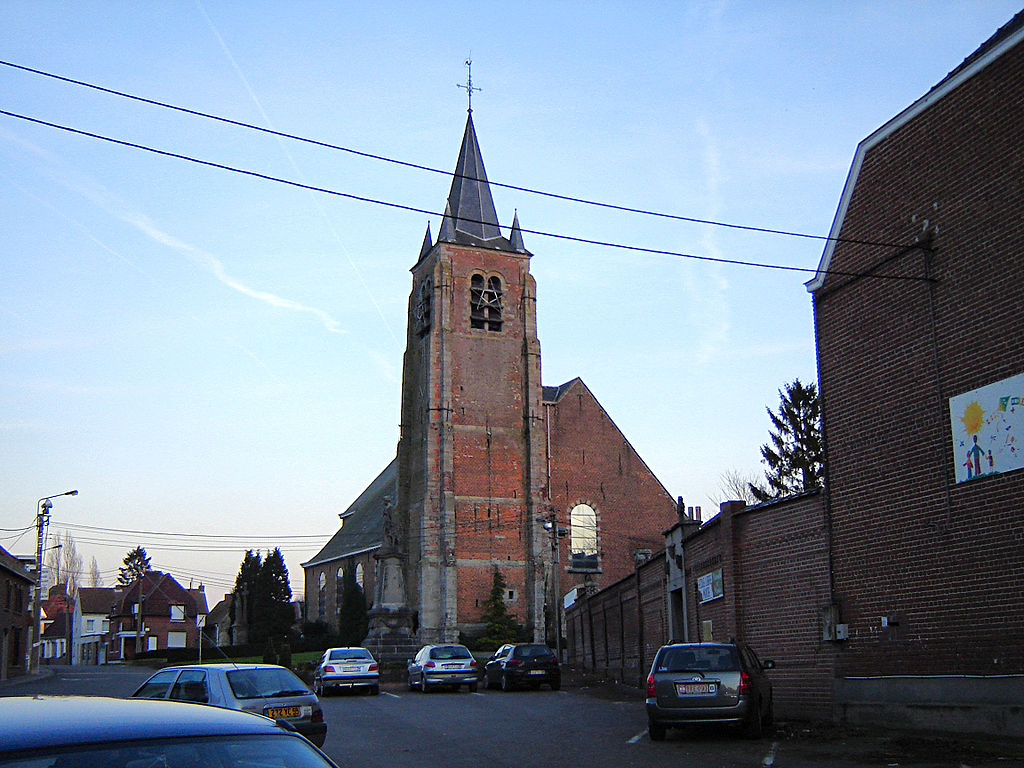
Henri’s account states that Eleutherius was a native of Tournai who was born during the reign of Childeric I. Eleutherius’ parents were Christians and were named Terenus and Blanda; Terenus was a descendant in the family of Irenaeus of Lyons. Persecutions of Christians forced the family to flee to a village named Blandain but after the conversion of Clovis to Christianity, the family built a Church at Blandain.
Church of Saint Eleuthère at Blandain
Eleutherius eventually became Bishop of Tournai and was consulted by Pope Hormisdas on the matter of eradicating Arianism. Eleutherius convened a Church Council and argued effectively against the Arians, who were angered by this.
The Cathedral of Tournai
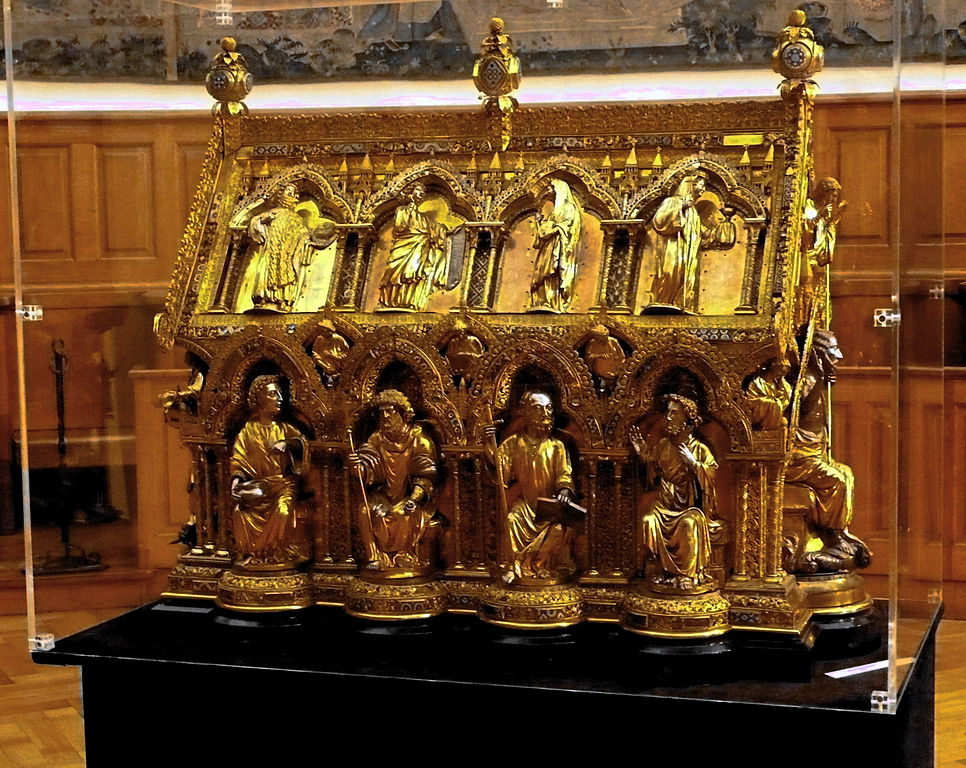
One day, as he was going to his Cathedral Church, he was beaten by a group of Arians and left for dead. He subsequently died from the wounds he received, on his death-bed confiding, his flock to St Medard. There exists a testimony recording the recovery of his relics during the episcopate of Bishop Hedilo of Tournai, in 897 or 898. Bishop Baudoin translated Eleutherius’ relics in 1064 or 1065. Eleutherius’ relics were translated again in 1247, when the great reliquary shrine was commissioned by Bishop Walter de Marvis. In its gable end. St Eleutherius appears, holding his crozier in one hand and in the other a model of the Cathedral with its five spires.
The Reliquary Shrine of Saint Eleutherius, 1247, in the Cathedral of Tournai
The Monastery of St. Martin at Tours and the Cathedral of Bruges, also claimed some of the saint’s relics.
Notre-Dame de Bolougne-sur-Mer / Our Lady of Bolougne-sur-Mer, France (633) – 20 February:
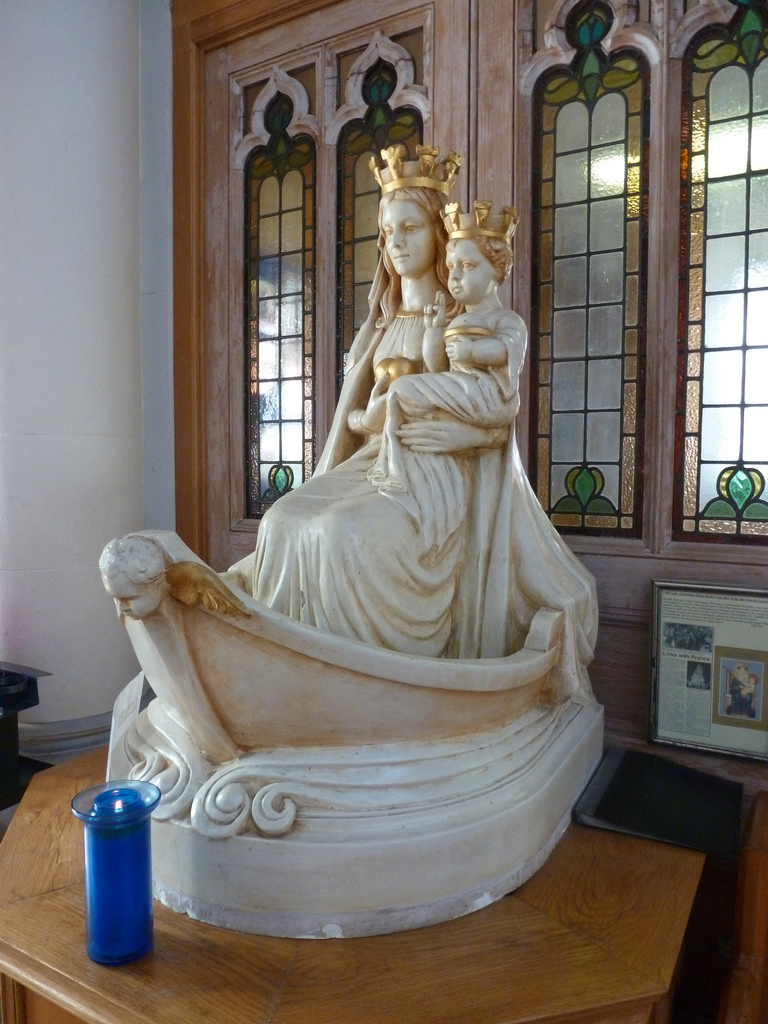
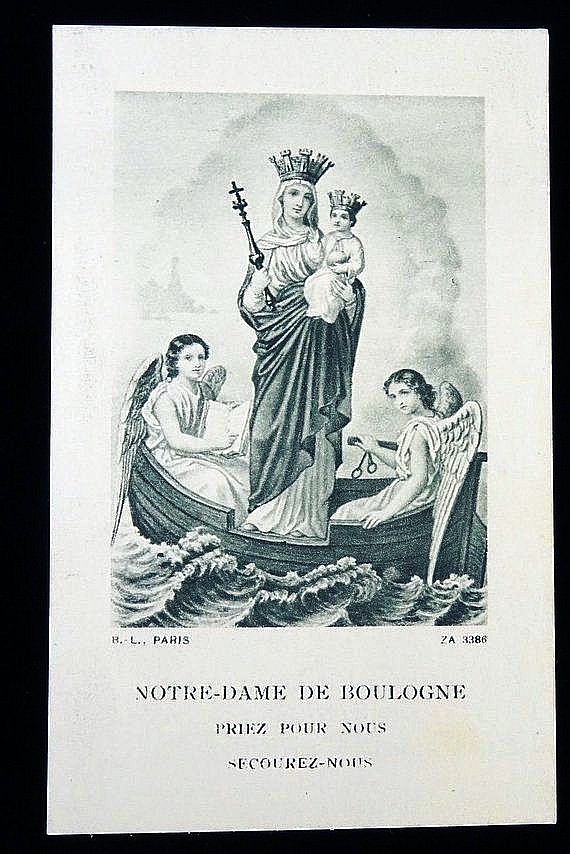
In the year 636, a small group of people standing on the seashore witnessed a ship without oars or sails came into the harbour of Boulogne. It finally came to rest in the estuary, seemingly of its own accord. One of the witnesses boarded the boat and confirmed that there was no-one aboard and that the vessel had no rudder, oars or sails. The ship, however, bore a luminous statue of Our Lady. Taking hold of it to bring it to land, a voice was heard saying, “I choose your City as a place of grace.” The citizens welcomed Mary to their city by erecting a Shrine to her, which reached its height of glory in the 12th Century.
King Henry VIII is reported to have stolen the Statue of Our Lady of Boulogne and taken it to England. After many negotiations, the French managed to get it back. The image had been stolen and hidden many other times but always saved and returned. World War II almost completely destroyed the Statue. In modern times, four exact replicas of Our Lady of Boulogne toured France for more than seven years, as a symbol of French devotion to Mary. One of these was taken to Walsingham, England in 1948 and carried in procession by the “Cross-bearing pilgrimate” when many other Statues and images of the Virgin visited England. Bologne was one of the most important Lady shrines of medieval France; among its noted pilgrims have been: Henry III, Edward II, the Black Prince, John of Gaunt. Marian Feast Day, 10 July: The dedication of a new Church built in honour of Our Lady of Boulogne was consecrated in the year 1469 by Bishop Chartier of Paris. The confraternity of Our Lady of Boulogne was so celebrated, that six French kings have chosen to belong to it.
At the French Revolution, the Statue was burnt to ashes and the Church pulled down. A new Shrine and Statue was made in 1803 and pilgrimages began again. The image represents the Mother with the Child in her arms, standing in a boat, with an angel on either side. At the Marian Congress in Bolougne in 1938, a custom began to take replicas of this Statue “in turn” in France and abroad. A branch of the Confraternity of Our Lady of Compassion at Bolougne has been established for the reconciliation of the Church of England. The Sanctuary Church at Bolougne was badly damaged during World War II and Mary’s image smashed but the return, the “Great Return” of one of the copies of the Statue which had been sheltered at Lourdes, took place in 1943 and the occasion will long be remembered by lovers of the Blessed Virgin Mary.
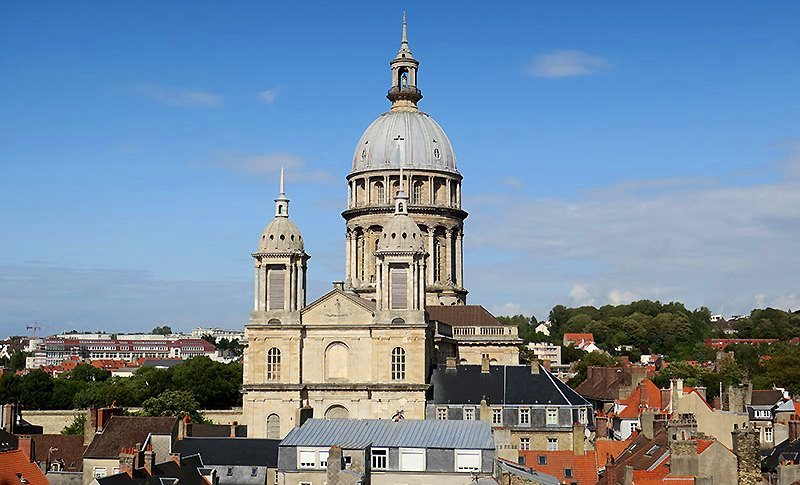
The shrine of Our Lady of Boulogne-sur-Mer, built in 1866.
Most remarkable about the Grand Return was the unprecedented avalanche of graces, especially of conversions and penance. Thousands upon thousands of atheists, communists, freemasons and fallen-away Catholics converted on the spot when they saw Our Lady enter their village. One bishop described the effect on the faithful:
“The passing of Our Lady in my Diocese is the most extraordinary contemporary religious event of our times and the most significant. Crowds of people rose up, motivated and enthusiastic. In fact, the confessionals and communion rails were besieged during the holy vigils, while the recitation of the mysteries of the Rosary kept the faithful praying in the Churches. In some Parishes, there were tremendous conversions like never seen before on the missions.”
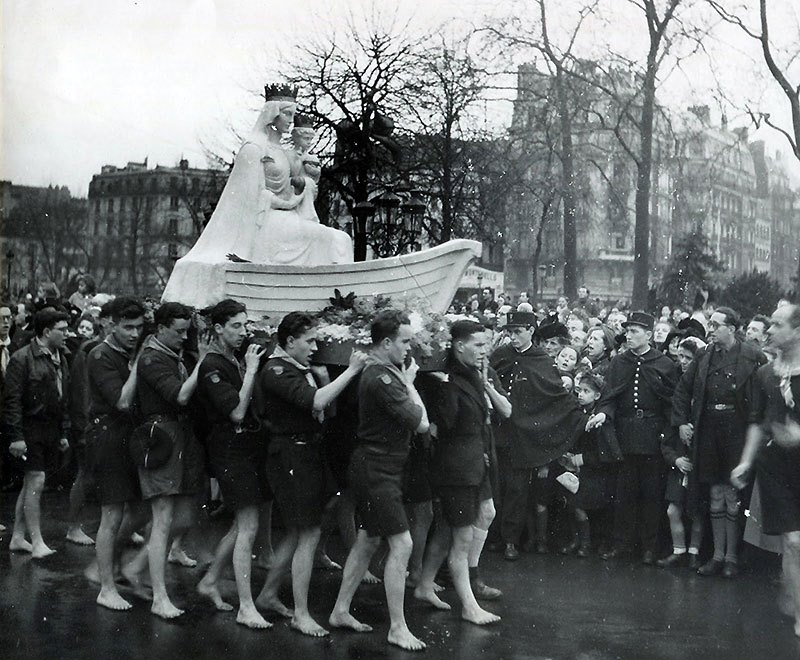
Young men of the French Boy Scouts, barefoot in the spirit of penance, carry Our Lady of the Grand Return in February 1946.
Thought for the Day – 19 February – Meditations with Antonio Cardinal Bacci (1881-1971)
Purification
“God has given us two supernatural means of purifying ourselves after we have sinned – the Sacrament of Penance and Indulgences. The Sacrament of Penance is the plank of salvation to which we can cling when we have been shipwrecked by sin and, by means of Indulgences, we can draw on the infinite treasury of the merits of Christ, the Blessed Virgin Mary and the Saints, in order to make partial or total satisfaction for the temporal punishment due to our sins. In this way, we can shorten our purgatory in this life and escape it in the next!
We should make good use of the Sacrament of Penance. If we fall into mortal sin, let us have recourse at once to this fount of grace. Even when we are not in mortal sin, let us be faithful to the practice of weekly or at least, fortnightly, confession.
We should not abuse this great gift simply because it seems such a simple method of obtaining pardon. God is infinitely just, we must remember and, He expects us to co-operate with His graces.”
Day Three of our Lenten Journey – 18 February – Friday after Ash Wednesday, Readings: Isaiah 58:1-9, Psalms 51:3-4, 5-6, 18-19, Matthew 9:14-15
Imitating Christ with Thomas à Kempis CRSA (1380-1471)
In Your Light Lord, we see light
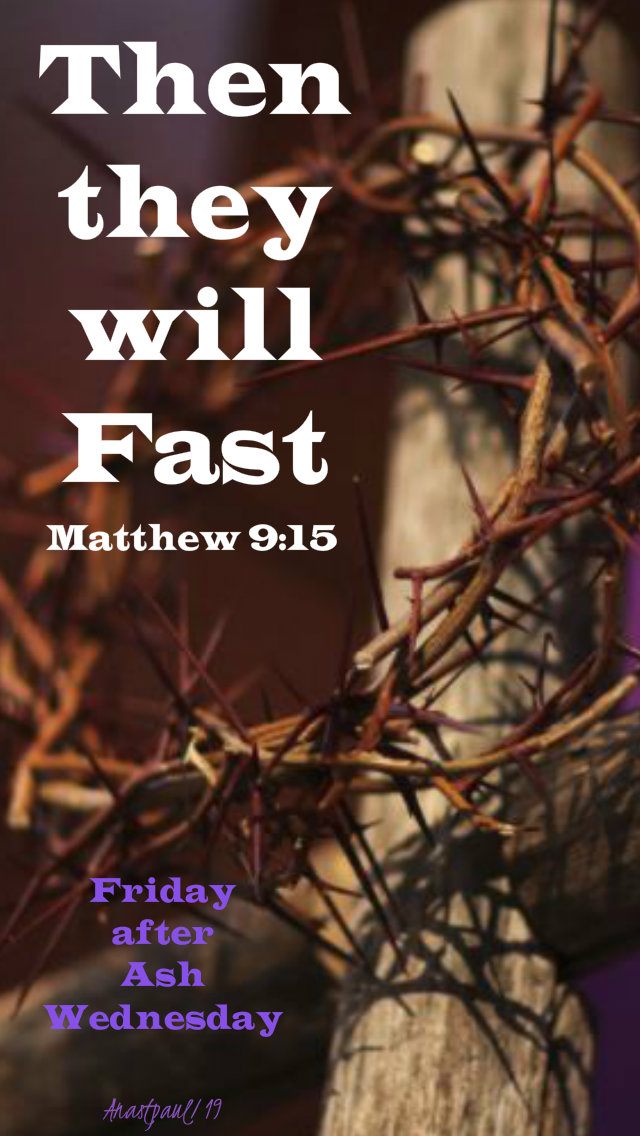
“Then they will fast” – Matthew 9:15
Consider the glowing examples of the holy Fathers, in whom shone true religion and perfection; compared with them, we do little or nothing. Alas, how can our life be compared with theirs! The Saints and friends of Christ served Our Lord in hunger and thirst, in cold and nakedness, in toil and weariness: in watching and fasting, in prayer and meditation, in persecutions and insults without number (Heb.9:38, 1 Cor.4:11).
How countless and constant were the trials endured by the Apostles, Martyrs, Confessors, Virgins and all those others, who strove to follow in the footsteps of Christ. These all hated their lives in this world, that they might keep them to life eternal (Jn 12:35). How strict and self-denying was the life of the holy Fathers in the desert! How long and grievous the temptations they endured! How often they were assaulted by the Devil! How frequent and fervent their prayers to God! How strict their fasts! How great their zeal and ardour for spiritual progress! How valiant the battles they fought to overcome their vices! How pure and upright their intention towards God!
All day long they laboured and the night they gave to continuous prayer; even as they worked, they never ceased from mental prayer. They spent all their time with profit, every hour seeming short in the service of God. They often forgot even their bodily needs in the great sweetness of contemplation. They renounced all riches, dignities, honours, friends and kindred; they desired to possess nothing in this world. Scarcely would they take the necessities of life and only with reluctance would they provide for the needs of the body. Thus, though destitute of earthly goods, they were abundantly rich in grace and all virtues. Outwardly they were poor but inwardly they were refreshed with grace and heavenly consolation. They were strangers to the world but to God, they were dear and familiar friends (Ex 33:11). To themselves they were nothing but in the eyes of God, they were precious and beloved. Grounded in true humility, they lived in simple obedience, they walked in charity and patience; (Eph 5:2) and thus daily increased in the Spirit, and received great grace from God.
… Oh, the carelessness and coldness of this present time! Sloth and lukewarmness makes life wearisome for us and we soon lose our early fervour! May the longing to grow in grace not remain dormant in you … (Book 1, Ch 18:1-4a,6)
Quote/s of the Day – 18 February – Friday after Ash Wednesday, Readings: Isaiah 58:1-9, Psalms 51:3-4, 5-6, 18-19, Matthew 9:14-15
“Then they will fast”
Matthew 9:15
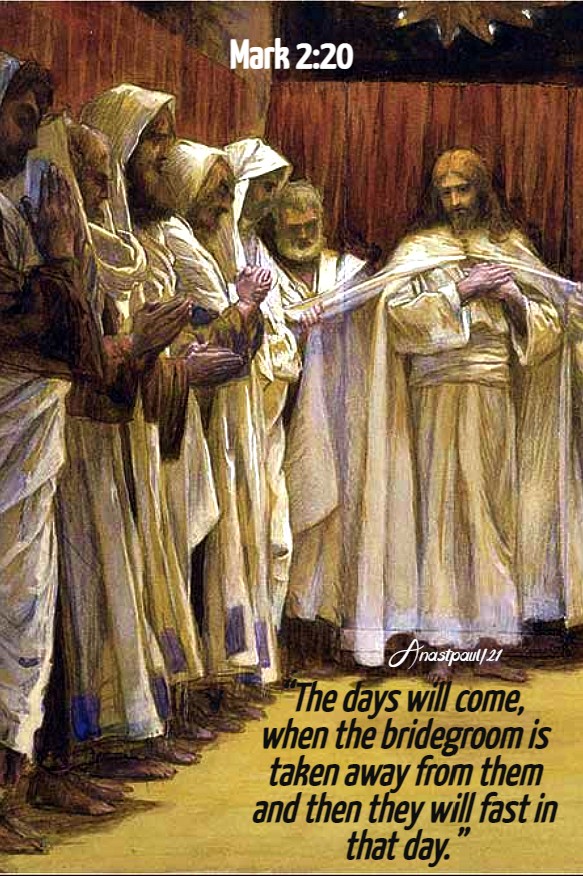
“The days will come, when the bridegroom is taken away from them and then they will fast in that day.”
Mark 2:20
“Fasting cleanses the soul, raises the mind, subjects one’s flesh to the spirit, renders the heart contrite and humble, scatters the clouds of concupiscence, quenches the fire of lust and kindles the true light of chastity. Enter again into yourself!”
St Augustine (354-430) Bishop of Hippo Father and Doctor of Grace
“Prayer, mercy and fasting: These three are one and they give life to each other. Fasting is the soul of prayer; mercy is the lifeblood of fasting. Let no-one try to separate them; they cannot be separated. If you have only one of them, or not all together, you have nothing.”
“So if you pray, fast; if you fast, show mercy; if you want your petition to be heared, hear the petition of others. When you fast, see the fasting of others. If you hope for mercy, show mercy. If you look for kindness, show kindness. If you want to receive, give.”
St Peter Chrysologus (400-450) Bishop of Ravenna Father and Doctor of Homilies
“Let my fasting be based on temperance, my soul in a state of grace, my intention solely to please God, then my efforts will ring true, fit to enlarge my store of charity.”
St Francis de Sales (1567-1622) Bishop of Geneva OFM, Cap. Doctor Caritatis





















 AnaStpaul
You must be logged in to post a comment.