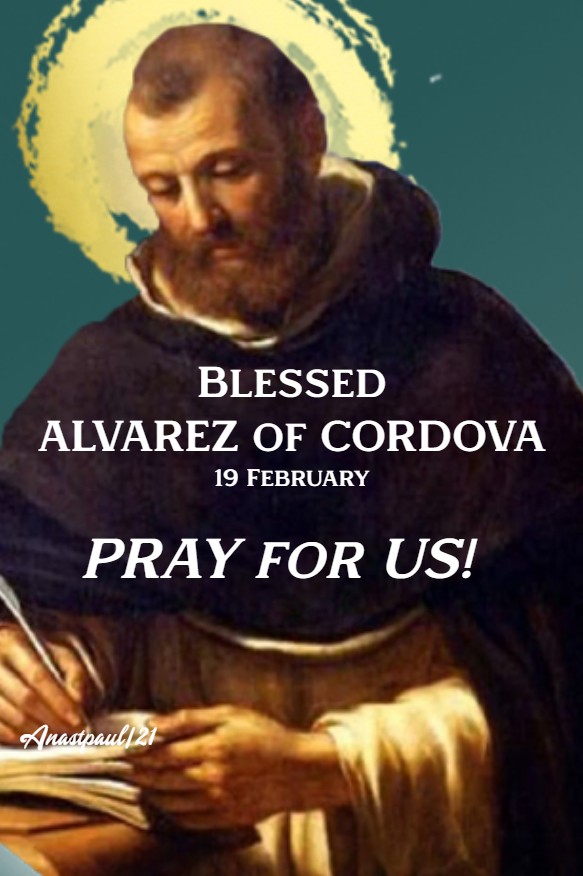
One Minute Reflection – 19 February – Friday after Ash Wednesday, Readings: Isaiah 58:1-9, Psalms 51:3-4, 5-6, 18-19, Matthew 9:14-15 and the Memorial of Blessed Alvarez of Cordova OP (c 1350–c 1430)
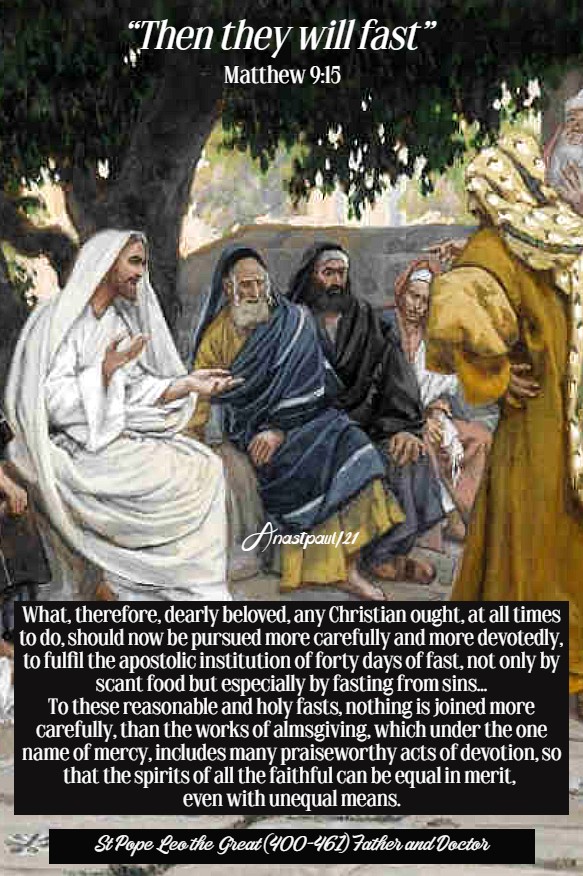
“Then they will fast” – Matthew 9:15
REFLECTION – “Although it is true, that the washing of regeneration is what chiefly makes “people new” (cf. Eph 4,24 – Col 3,10) nevertheless, because there is still for all of us, a daily renewal against the rust of mortality and in the path of progress, there is no-one, who ought not always to be better. In general, we still have to struggle, so that in the Day of Redemption, no-one may be found in sins of long standing.
What, therefore, dearly beloved, any Christian ought, at all times to do, should now be pursued more carefully and more devotedly, to fulfil the apostolic institution of forty days of fast, not only by scant food but especially by fasting from sins…To these reasonable and holy fasts, nothing is joined more carefully, than the works of almsgiving, which under the one name of mercy, includes many praiseworthy acts of devotion, so that the spirits of all the faithful can be equal in merit, even with unequal means.” – St Pope Leo the Great (400-461) Father and Doctor – 6th Sermon for Lent, 1-2; SC 49
PRAYER – Lord God, bestow a full measure of Your grace upon us, who seek to make our lenten journey fruitful. Confirm us in Your service and help us to bear witness to You in the society in which we live by our lives, our fasting and prayer, our gift of self. Listen kindly we pray, to the prayers of Bl Alvarez who so avidly followed in the footsteps of our Saviour, Lord Jesus Christ, in whose name, with the Holy Spirit, we pray, one God forever, amen.
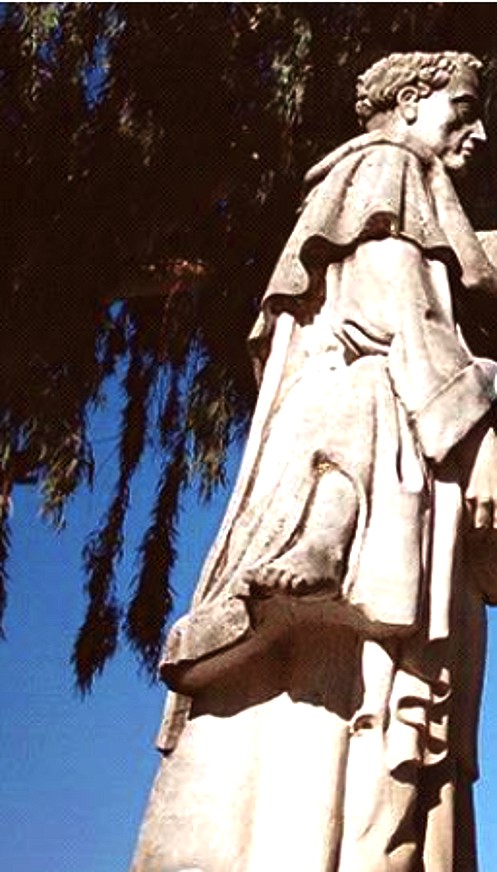
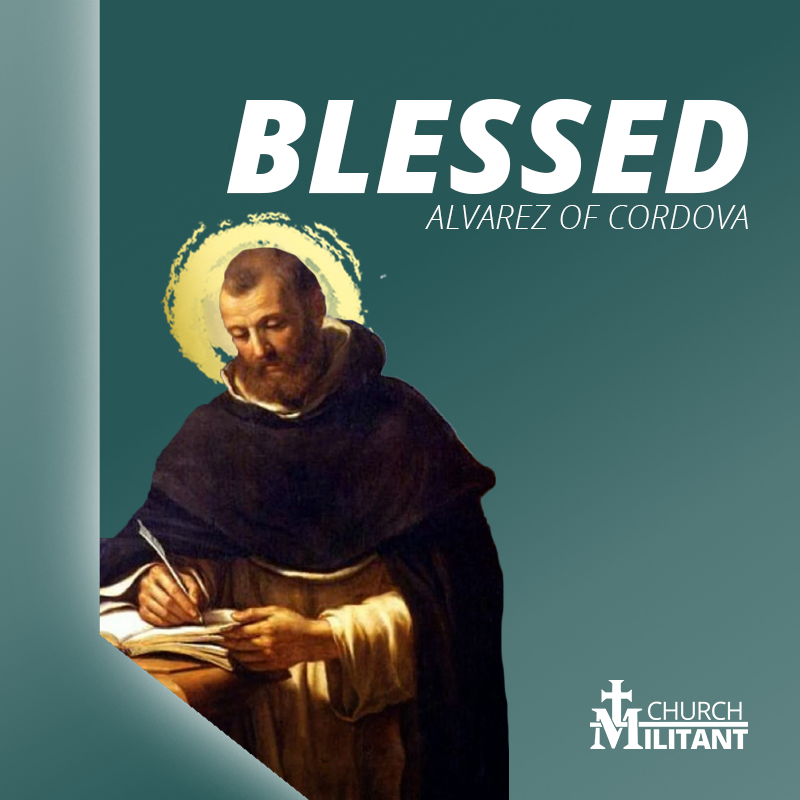
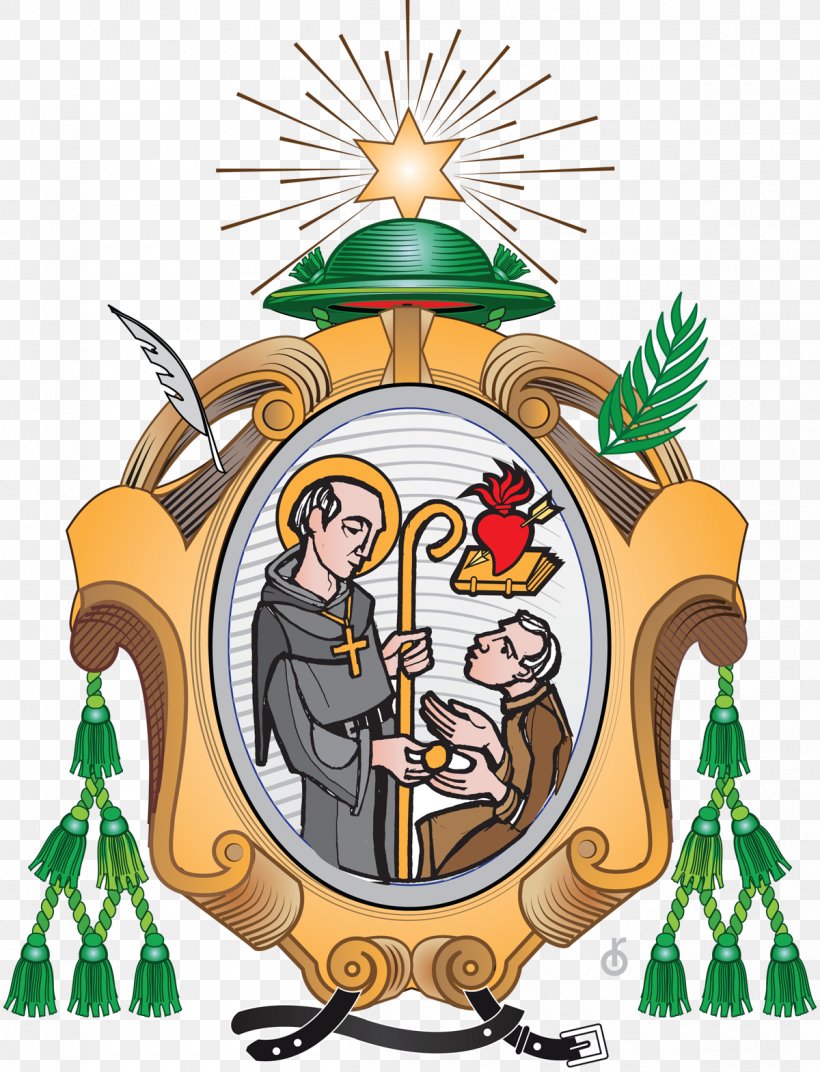
Saint of the Day – 19 February – Blessed Alvarez of Cordova OP (c 1350–c 1430) Priest of the Order of Preachers, Confessor, Ascetic, Royal Advisor and Tutor, founder of many Churches and Convents, miracle-worker – born in c 1350 in either Lisbon, Portugal or Cordova, Spain (sources vary) and died in c1430 at Escalaceli near Cordova, Spain of natural causes, aged around 80 and is buried there. By his preaching and contemplation of the Lord’s Passion he spread the practice of the Way of the Cross, throughout the West.
Blessed Alvarez is claimed by both Spain and Portugal. He received the habit in the Convent of Saint Paul in Cordova in 1368 and had been preaching there for some time in Castile and Andalusia, when Saint Vincent Ferrer began preaching in Catalonia. Having gone to Italy and the Holy Land on a pilgrimage, Alvarez returned to Castile and preached the crusade against the infidels. He was spiritual advisor to the Queen-mother of Spain, Catherine daughter of John of Gaunt and tutor to her son who would become King John II. Alvarez had the work of preparing the people spiritually, for the desperate effort to banish the Moors from Spain. He also opposed the Avignon Pope Peter de Luna nd encouraged all to resist him.
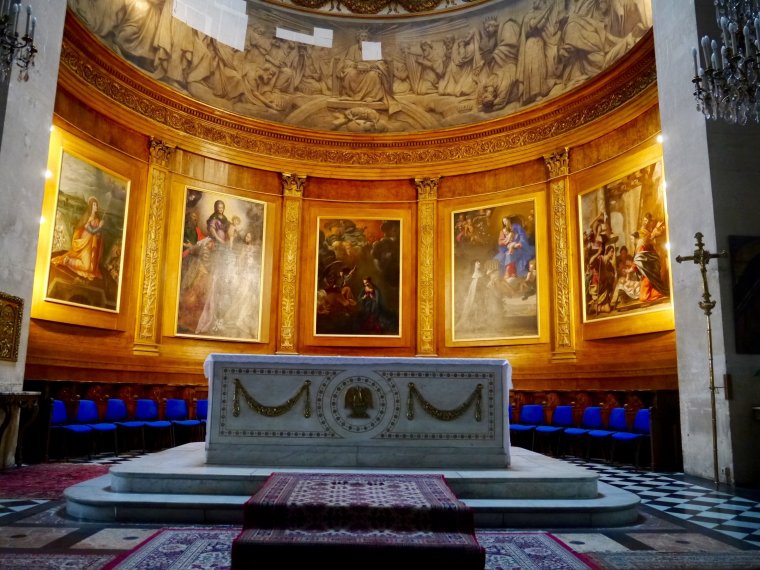
Blessed Alvarez is remembered and honoured as a builder of Churches and Convents, an activity which was symbolic of the work he did in the souls of those among whom he preached. He founded, in one place, a Convent to shelter a famous image of Our Lady, which had been discovered in a miraculous manner. Near Cordova he built the famous Convent of Scala Coeli, a haven of regular observance. It had great influence for many years. His building enterprises were often aided by the angels, who, during the night, carried wood and stones to spots convenient for the workmen.
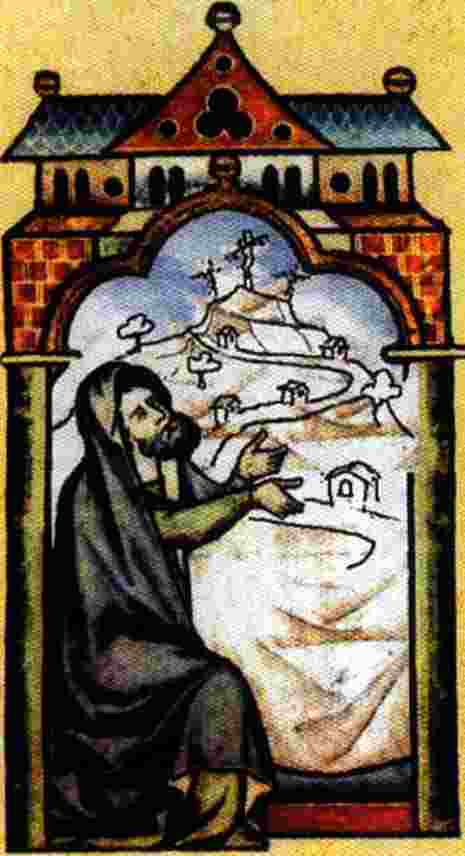
The austerities of Alvarez were all the more remarkable in that they were not performed by a hermit but by a man of action. He spent the night in prayer, as Saint Dominic had done; he wore a hairshirt and a penitential chain and he begged alms in the streets of Cordova, for the building of his churches, despite the fact, that he had great favour at court and could have obtained all the money he needed from the Queen. He had a deep devotion to the Passion and had scenes of the Lord’s sufferings made into small oratories in the garden of Scala Coeli.
On one occasion, when there was no food for the community but one head of lettuce, left from the night before, Blessed Alvarez called the community together in the refectory, said the customary prayers and sent the porter to the gate. There, the astonished brother found a stranger, leading a mule; the mule was loaded with bread, fish, wine and all things needed for a good meal. The porter turned to thank the benefactor and found that he had disappeared.
At another time, Blessed Alvarez was overcome with pity, at the sight of a dying man who lay untended in the street. Wrapping the man in his mantle, he started home with the sufferer and one of the brothers asked what he was carrying. “A poor sick man,” replied Alvarez. But when they opened the mantle, there was only a large Crucifix in his arms. This Crucifix is still preserved at Scala Coeli.
Blessed Alvarez died and was buried at Scala Coeli. An attempt wads made later to remove the relics to Cordova, but it could not be done because violent storms began each time the journey was resumed and stopped when the body was returned to its original resting place.
Blessed Alvarez founded Escalaceli (Ladder of Heaven), a Dominican house of strict observance in the mountains around Cordova. It became a well known centre of piety and learning. Alvarez spent his days there preaching, teaching, begging alms in the streets and spending his nights in prayer. In the gardens of the house, he set up a series of oratories with images of the Holy Lands and Passion, similar to modern Stations of the Cross.
A bell in the Chapel of Blessed Alvarez, in the Convent of Cordova, rings of itself when anyone in the Convent, or of special note in the Order, is about to die (Benedictines, Dorcy).
Alvarez was Beatified on 22 September 1741 At St Peter’s by Pope Benedict XIV.
Notre Dame-de-Bonne Nouvelle / Our Lady of Good Tidings, Lempdes, France (1500’s) – 18 February:
The Abbot Orsini wrote: “Our Lady of Good Tidings, near Rouen, where a great number of people are seen, particularly on Saturdays.”
It was on 23 December 1563, when the Bishop of Lucon, Jean-Baptiste Tiercelin, consecrated the Church under the patronage of the Blessed Virgin, Notre-Dame-de-Bonne-Nouvelle. This first Chapel came into the world in the midst of religious convulsions that were then taking place in Switzerland, Germany and England, by the leaders of the ‘Reformation’ and must necessarily be seen, as an action bravely going against the tide. The religious wars that began raging in France ten years after its erection, began to be another reason for some concern for faithful Catholics but the pilgrimages to the Church of Notre-Dame-de-Bonne-Nouvelle continued undisturbed. From time immemorial, there had been venerated at Notre Dame a Statue of the Blessed Virgin, holding in her arm the Infant Jesus. Many went to her in procession, especially children, who came each year to ask Mary for perseverance after their first Communion. The revolutionary turmoil in France, which was to take the throne and the altar, could not leave behind the parish of Our Lady of Good Tidings. In 1790 the National Assembly decreed a new law in which the Church of Our Lady of Good Tidings was dissolved. As the Priest, Fr M Fabre, had the courage to refuse the oath of the Civil Constitution of the Clergy, he was thrown into the street. A short time later, on 22 May 1791, the Abbot Fourquet de Damalis, convened in the Church an assembly of the faithful and there were very many who responded. This occurred under the noses of twelve national guardsmen and so the Police Commissioner, a man named Cafin, responded there quickly. He asked the Abbot why there was such a meeting and the Abbot answered him, that he was explaining to the faithful the decrees of the National Assembly for the public good. The Police Commissioner accepted the explanation and the meeting, having been perfectly peaceful, the police commissioner was obliged to agree to the monthly meetings and record it in his minutes. One might think that the worship would be suspended at Notre-Dame-de-Bonne-Nouvelle during the Terror but we have evidence to the contrary. As at Chartres, a great number of the faithful remained active and opposed the removal of the sacred ornaments of the Church and defended their Priests and eager to fulfil their religious duties, they were not to be intimidated by the fear of imprisonment and even death. From the registry of marriages and baptisms, including a few that date back to 1793, we know that there were religious ceremonies such as baptisms and weddings held there secretly, sometimes in an oratory, sometimes in the Church. In the year 1818, a severe epidemic was ravaging the country. The faithful vowed, with the agreement of their Bishop, to go in procession to Our Lady of Good Tidings and celebrate in perpetuity the feast of the Visitation, which was the feast of the Chapel. The procession took place and God quickly put an end to the scourge of the plague. At about that time, a young boy began making regular visits to the Church of Our Lady of Good Tidings, who was the patroness of the village. He was a poor boy materially, for Lempdes was one of the poorer villages in France and he had been born into a peasant family, that was struggling to eke out a living in the wreck of post-revolutionary France. He kept the faith and when he grew up, Jean Baptiste Lamy was Ordained a Priest, eventually becoming the first Archbishop of Sana Fe, New Mexico.
Bl Józef Zaplata St Lucia Yi Zhenmei St Mansuetus of Milan St Odran St Proclus of Bisignano St Quodvultdeus St Valerius of Antibes St Zambdas of Jerusalem
Thought for the Day – 18 February – A Meditations with Antonio Cardinal Bacci (1881-1971)
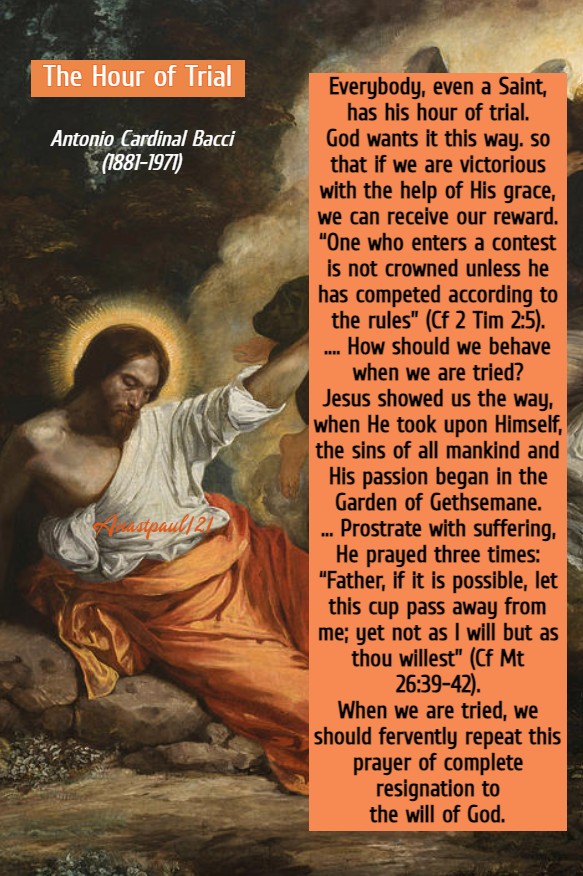
The Hour of Trial
“Everybody, even a Saint, has his hour of trial. God wants it this way. so that if we are victorious with the help of His grace, we can receive our reward. “One who enters a contest is not crowned unless he has competed according to the rules” (Cf 2 Tim 2:5). Even the Angels were put on trial and those haughty spirits who rebelled against God, were damned forever.
Our first parents were placed on trial and because they disobeyed God’s command, were deprived of their supernatural gifts and exiled from their earthly paradise. Even Jesus willed to endure His hour of trial in the Garden of Gethsemane, before the Sanhedrin, before the judgement seat of Pilate and on Mount Calvary. He desired to be tried in this way, in order to teach us how to be victorious.
Our trials are of various kinds, some of which recur frequently during our lives. They may be physical, such as suffering, disease, disgrace or poverty. They may be moral trials, which affect mainly the heart – the neglect of those whom we love, calumny, misunderstanding, or malice. There are also spiritual trials, such as discouraging lapses into sin, or aridity of soul when it seems that the Heavenly Father has abandoned us as He abandoned Jesus in His last agony on the Cross.
How should we behave when we are tried? Jesus showed us the way, when He took upon Himself, the sins of all mankind and His passion began in the Garden of Gethsemane. Even before He ascended Mount Calvary and was nailed to the Cross, He experienced here all the agony and terror of His redemptive mission. Prostrate with suffering, He prayed three times: “Father, if it is possible, let this cup pass away from me; yet not as I will but as thou willest” (Cf Mt 26:39-42). When we are tried, we should fervently repeat this prayer of complete resignation to the will of God.”
Day Two of our Lenten Journey – 18 February – Thursday after Ash Wednesday, Readings: Deuteronomy 30:15-20, Psalms 1:1-2, 3, 4 and 6, Luke 9:22-25
Imitating Christ with Thomas à Kempis CRSA (1380-1471)
In Your Light Lord, we see light
“Whoever wishes to come after me must deny himself, take up his cross and follow me” – Luke 9:23
To many the word seems harsh; “Deny yourself, take up your cross and follow Jesus”… (Mt 16:24) Why do you fear then to take up the cross, the way that leads to the kingdom? In the cross you are saved, revived, protected. In the cross you are showered with sweetness from on high, your mind is strengthened, your spirit rejoiced. In the cross is virtue’s sum and perfect holiness. In the cross alone, is the hope of life eternal, the soul’s salvation. So take up your cross and follow Jesus and you will enter eternal life… For if you die with Him, you shall also likewise live with Him. If you are His companion in punishment, so shall you be in glory.
Everything is founded on the cross… There is no other way to life, nor to true inner peace… Walk where you will, seek what you will, you will find neither a loftier way above, nor a safer way below but only the way of the Holy Cross.
Plan as you will, arrange as you see fit; all you will ever find is suffering, you cannot help but bear and so you will always find the cross. You will either have bodily pain or mental and spiritual affliction. Now God will leave you, again your fellow will provoke you and what is more, you will often weigh heavy on yourself. There is neither remedy to free you, nor comfort to ease you… For God will have you learn to endure affliction with total submission to Himself and become more humble… You must endure with patience everywhere, if you would be at peace within and earn the lasting crown. (Book II, Ch 12:1,2,3-4)
Quote/s of the Day – 18 February – Thursday after Ash Wednesday, Readings: Deuteronomy 30:15-20, Psalms 1:1-2, 3, 4 and 6, Luke 9:22-25
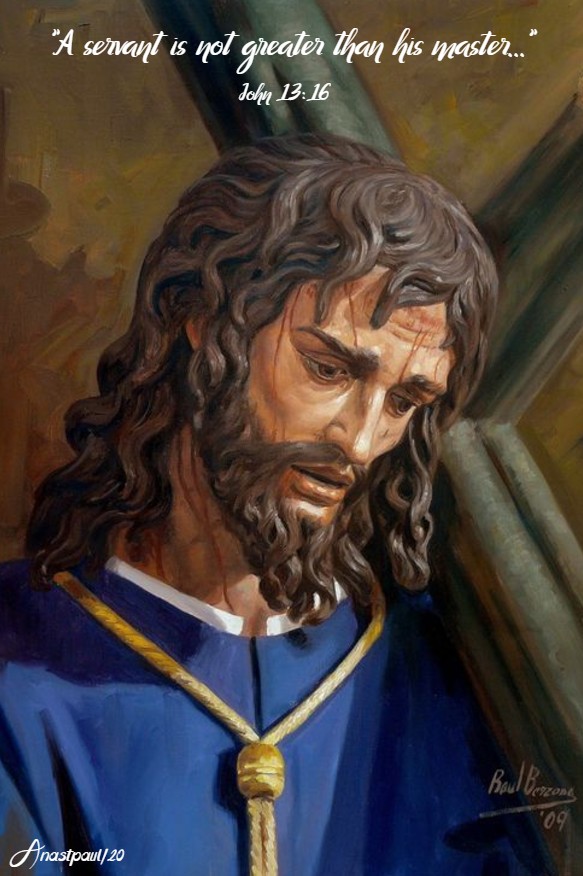
“The servant is not greater than his Master”
John 13:16
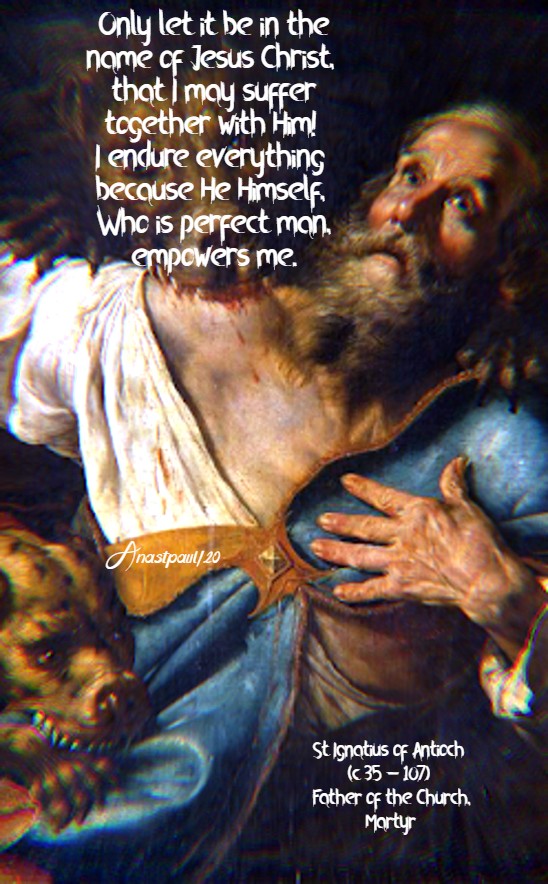
“Only let it be in the name of Jesus Christ, that I may suffer together with Him! I endure everything because He Himself, Who is perfect man, empowers me.”
St Ignatius of Antioch (c 35 – 107)
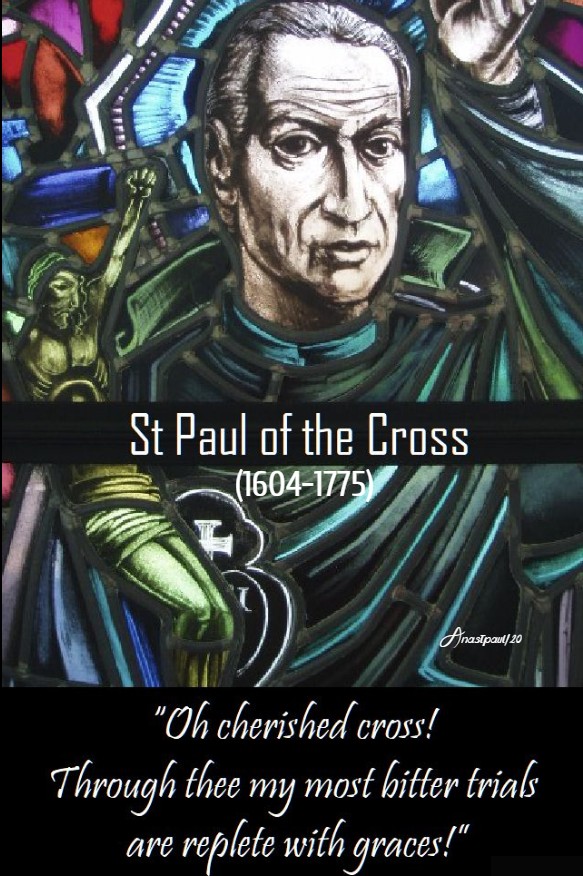
“Oh cherished cross! Through thee my most bitter trials are replete with graces!”
St Paul of the Cross (1604-1775)
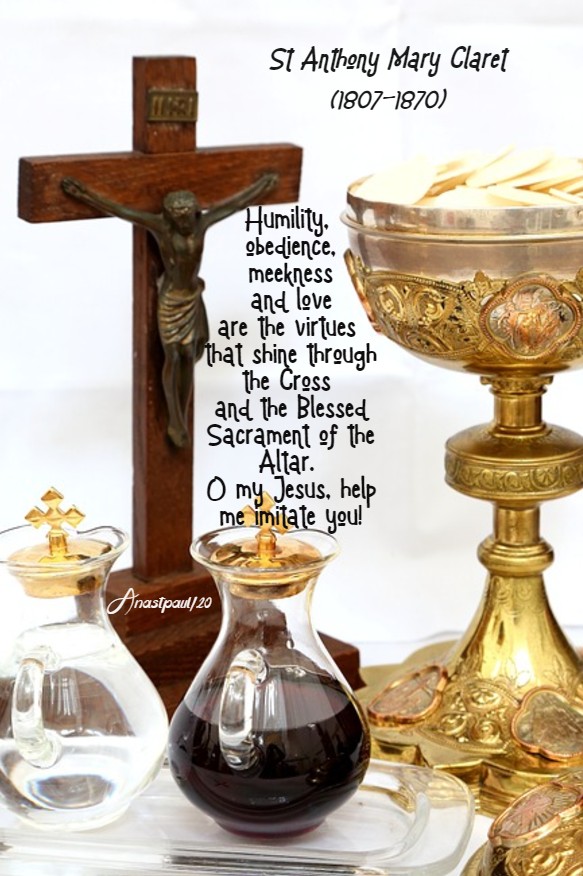
“Humility, obedience, meekness and love are the virtues that shine through the Cross and the Blessed Sacrament of the Altar. O my Jesus, help me imitate you!”
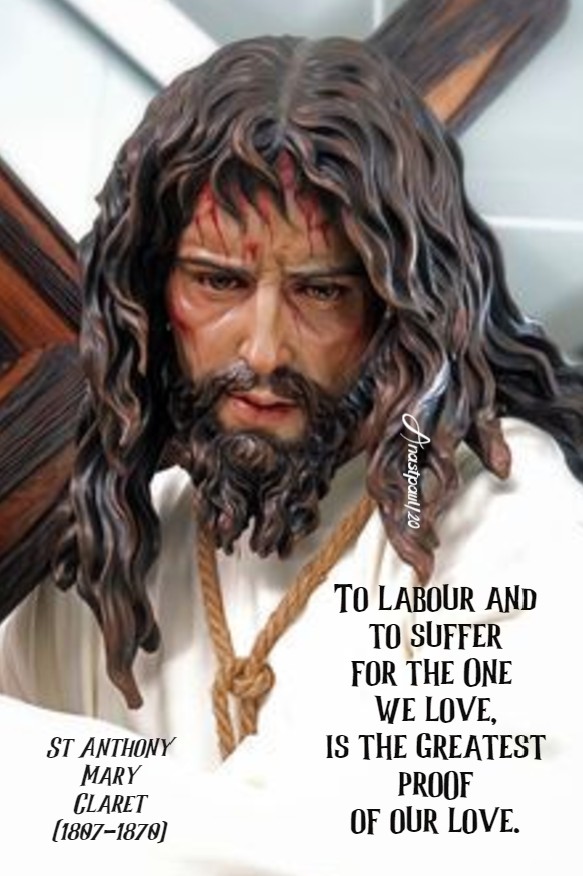
“To labour and to suffer for the One we love, is the greatest proof of our love.”
St Anthony Mary Claret (1807-1870)
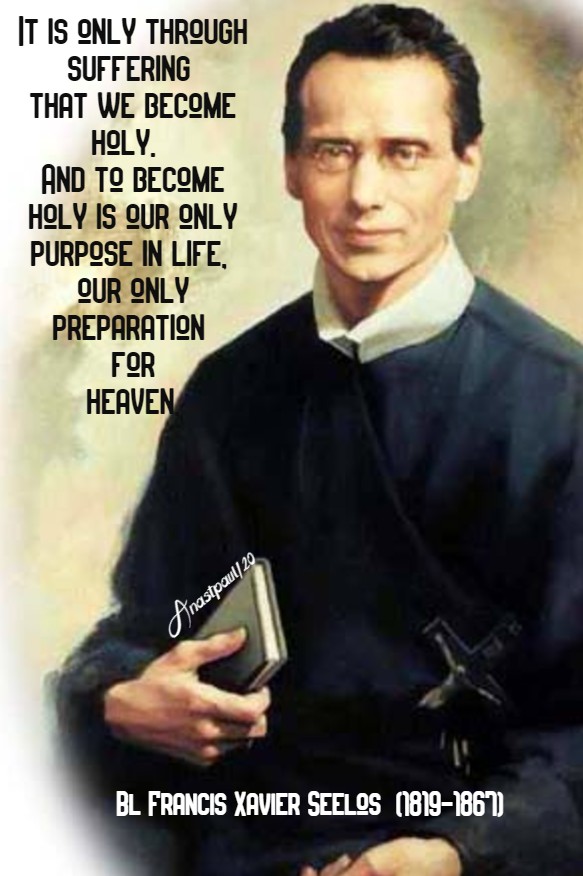
“It is only through suffering that we become holy. And to become holy is our only purpose in life, our only preparation for heaven.”
One Minute Reflection – 18 February – Thursday after Ash Wednesday, Readings Deuteronomy 30:15-20, Psalms 1:1-2, 3, 4, and 6, Luke 9:22-25 and the Memorial of St Theotinius (1082-1162) The First Saint of Portugal
“Whoever wishes to come after me must deny himself, take up his cross and follow me” – Luke 9:23
REFLECTION – “What joy to live in the Cross of Christ! Who could complain of suffering? Only the insensate man who does not adore the Passion of Christ, the Cross of Christ, the Heart of Christ, can in his own griefs, give way to despair… How good it is to live united with the Cross of Christ. Christ Jesus… teach me that truth, which consists in rejoicing in scorn, injury, degradation; teach me to suffer with that humble, silent joy of the saints; teach me to be gentle towards those who don’t love me or who despise me; teach me that truth, which from the mound of Calvary You reveal to the whole world. But I know: a very gentle voice within me explains it all; I feel something in me which comes from You and which I don’t know how to put into words; so much mystery is revealed that man cannot apprehend it. I, Lord, in my way, do understand it. It is love. In that is everything. I know it, Lord, nothing more is needed, nothing more, it is love! Who shall describe the love of Christ? Let men, creatures and all things, keep silent, so that we may hear in the stillness, the whisperings of love, meek, patient, immense, infinite, which from the Cross, Jesus offers us with His arms open. The world, mad, doesn’t listen.” – St Raphael Arnaiz Baron (1911-1938) a Spanish Trappist Monk – Spiritual writings 07/04/1938
PRAYER – God of mercy, teach us to live as You have ordained. Help us to follow Your commandments with courage and steadfast devotion. Let our Saviour be our Master, help us to learn from Him, the ways of prayer in silence, the ways of love. Fill us with the fire of the Holy Spirit, that we may learn. Grant blessed Trinity, that by the prayers of St Theotonius, we may grow in holiness. Through Jesus our Lord, in unity with the Holy Spirit, one God forever. Amen
Our Morning Offering – 18 February – Thursday after Ash Wednesday
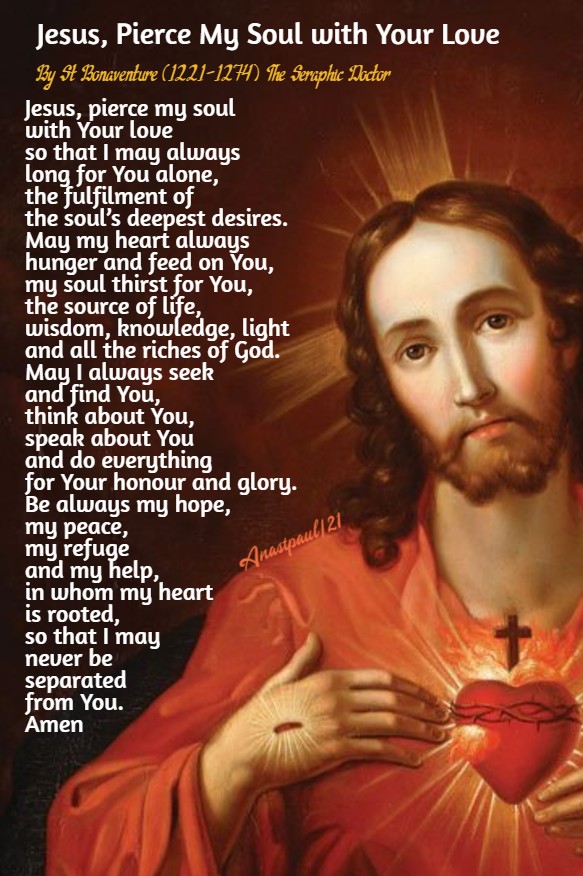
Jesus, Pierce My Soul with Your Love By St Bonaventure OFM (1221-1274) The Seraphic Doctor
Jesus, pierce my soul with Your love so that I may always long for You alone, the fulfilment of the soul’s deepest desires. May my heart always hunger and feed on You, my soul thirst for You, the source of life, wisdom, knowledge, light and all the riches of God. May I always seek and find You, think about You, speak about You and do everything for Your honour and glory. Be always my hope, my peace, my refuge and my help, in whom my heart is rooted, so that I may never be separated from You. Amen
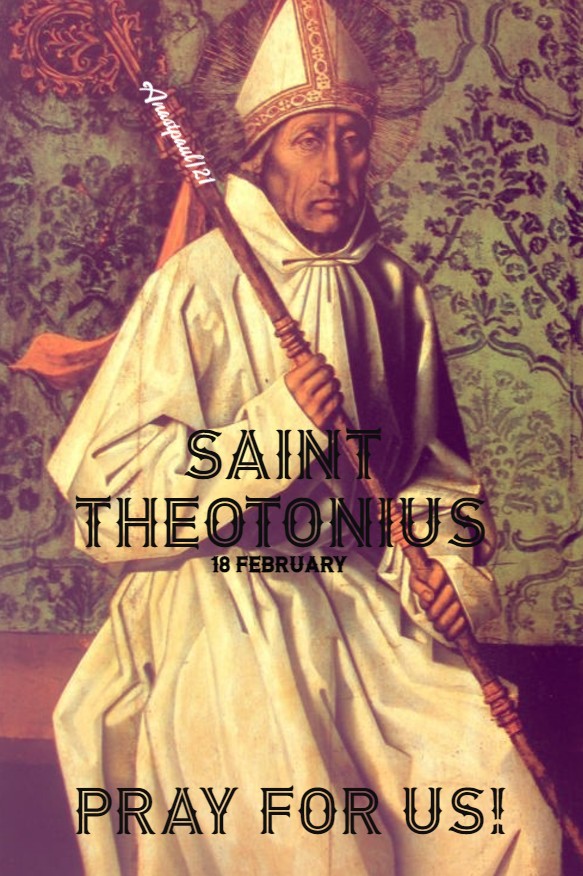
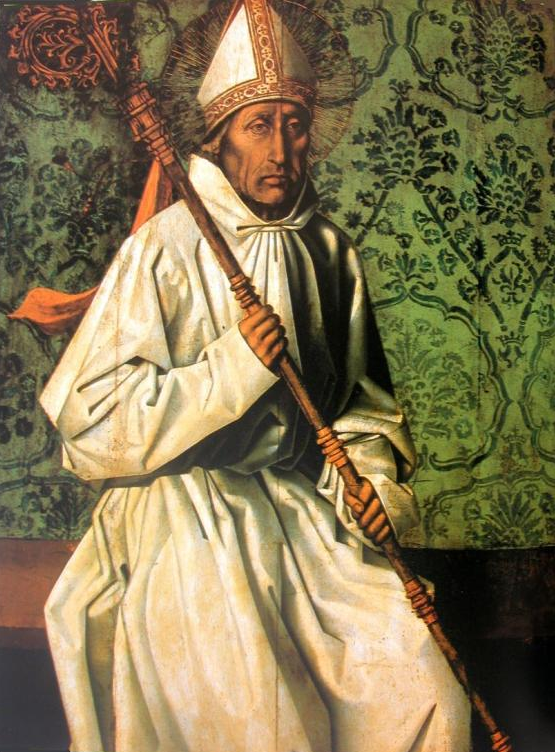
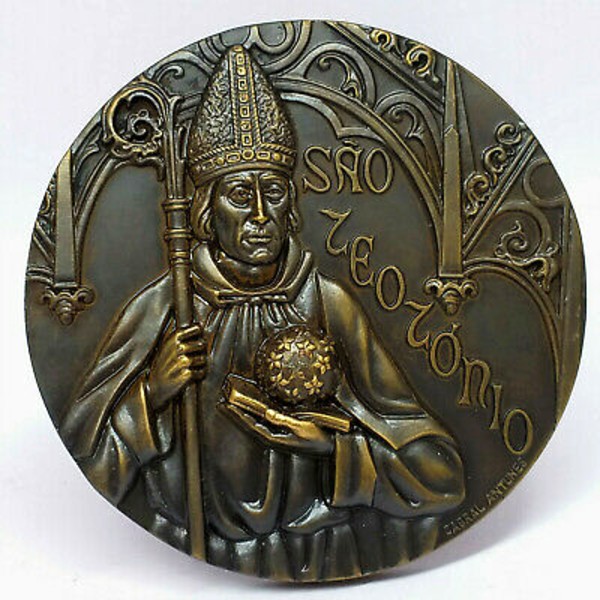
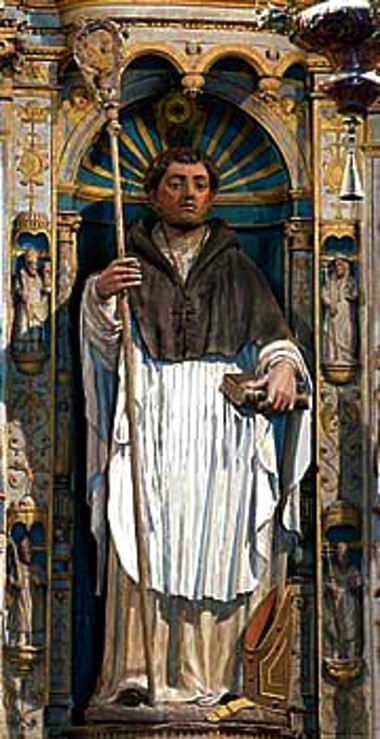
Saint of the Day – 18 February – Saint Theotinius OSC (1082-1162) Priest of the Canons Regular, Reformer of religious life in Portugal, Royal Counsellor, Apostle of the poor, Founder of the Canons Regular of the Holy Cross, now known as “The Crosiers,” abbreviation OSC..Theotinius had a great devotion to the Passion, the Blessed Virgin and to Holy Souls in Purgatory and instituted a regular Friday devotion. He is the first Portuguese Saint. Born in 1086 at Gonfeo, Spain and died in 1162 of natural causes. Patronages – the Cities of Viseu and Valença, Portugal.
Born in 1082 into a wealthy and pious family in northern Portugal. His parents, Oveco and Eugenia were both wealthy and pious. He was called “Theotonius,” a Greek name meaning ‘godly.’ His uncle Dom Crescónio, Abbot of the Benedictine Monastery near Tuy, was his first teacher. When Dom Crescónio became Bishop of Coimbra in 1092, he brought the ten-year-old Theotonius with him and entrusted his further education to the care of a young seminarian, Tello.
After the death of Bishop Crescónio in 1098, Theotonius went to Viseu, where his Uncle named Teodorico was Prior of the Cathedral Chapter of Santa Maria. During his time of preparation for the priesthood, Theotonius progressed through the minor ecclesiastic orders with great diligence and piety. The first of these was that of porter, with the responsibility to open the Church and Sacristy and ring the bell. After serving a period of time as a Lector, he became an Exorcist. One of the chief duties of Exorcists was to take part in the Baptismal Exorcism of Catechumens. Completing his term as an Acolyte, Theotonius was ordained a Sub-deacon. Holy Orders were conferred upon him sometime before the year 1109, by the Bishop of Coimbra. The young Priest was appointed a Canon of the Cathedral Chapter of Viseu – though not without reluctance – which was a college of clerics who served as Advisors to the Bishop.
The Countess Teresa of Portugal (referred to by Pope Paschal II in 1116 as “Queen,” a title that remained from that time onwards) and her husband, Henry of Burgundy, with the consent of the clergy and at the urging of the people, often sought to appoint Theotonius as Bishop of Coimbra but he always refused.
In an effort to dissuade the Queen from her intentions, Theotonius resigned his office as Prior of the Cathedral Chapter and made a pilgrimage to the Holy Land. After he returned to Portugal, he resumed his work as a Priest and Chapter member in Viseu but refused to take up again the office of Prior.
Theotonius was a trusted advisor of Portugal’s first King, Afonso Henriques (ruled 1139-85). The King attributed his success at the Battle of Ourique to the prayers of Theotonius, who was thus able to persuade the King to release Mozarabic Christians captured during forays into land held by the Moors.
Although his counsel was sought by Afonso Henriques, Theotonius did not hesitate to reprove the King or Queen if he thought them in the wrong. Theotonius was fearless in rebuking sinful behaviour, in public or in private. In one instance, the now widowed Queen was attending Holy Mass celebrated by Theotonius. She was accompanied by the Galician nobleman Fernando Pérez de Traba and the nature of their scandalous relationship had become well-known. Theotonius’ sermon, though not naming them, was clearly directed at their conduct.
On another occasion, Theotonius was about to begin Holy Mass when the Queen had a message sent asking him to say the Mass quickly. He replied simply that there was another Queen in heaven, far more noble, for whom he ought to say the Mass with the greatest reverence and devotion. If the Queen did not wish to stay, she was free to leave but he would not rush – Theotonius was ever insistent on the exact and reverent recitation of holy prayers.
Theotonius left his Parish with a large number of pilgrims and set out once more to Jerusalem. His experience in the Holy Land resulted in both an increased devotion to the Passion and an intention to found a religious order following the Augustinian Rule. Theotonius helped to found the Canons Regular of the Holy Cross in Coimbra. Archdeacon Tello (his former tutor), purchased the site of the Monastery. The construction gained the backing of the Infante and Bernardo, Bishop of Coimbra. Work began on the Monastery of the Holy Cross and of the Blessed Mary Mother of God, on 28 June 1131. On 22 February 1132, the Monastery was completed and the community took the habit and rule of Saint Augustine. It opened with 72 members, with Theotonius as Prior.
Theotonius’s priestly life was distinguished by a great love for the poor and for the Holy Souls in Purgatory, for whom he offered Mass every Friday. The Mass was followed by a procession to the cemetery and large sums were donated to the Priest but Theotonius distributed the money to the poor.
Theotonius retired from his pastoral office of Prior, after 30 years of service. He then became a Hermit in solitude. He kept with him through his old age a shepherd’s staff which St Bernard, the first Abbot of Clairvaux, had sent to him as a present when he heard of his sanctity. On Saturday, 18 February 1162, Theotonius died at the age of 80. The entire city of Coimbra showed their admiration and grief for him. King Afonso I of Portugal, Queen Teresa’s son and the first King of Portugal, who was a good friend of Theotonius’ was taken by such grief, that he said of him, “His soul will be in Heaven before his body is in the tomb.”
During his life, St Theotonius was known for his humility and piety. His cultus was approved and he was Canonised by Pope Benedict XIV. His feast day is 18 February. Portugal issued postal stamps with the image of St. Theotonius that circulated from July 1958 to October 1961.
The Royal Confraternity of Saint Theotonius, founded on 2 November 2000, under the Royal protection of Dom Miguel de Bragança, Duke of Viseu, Infante of Portugal, is a secular organisation of the faithful with common ends, a group of men willingly desiring to defend the origins and Christian values, maintain and honour the spirit of and remember and promote, devotion to Saint Theotonius.
Notre-Dame de Laon / Our Lady of Laon, Rheims, France (500), founded by St Remigius – 18 February:
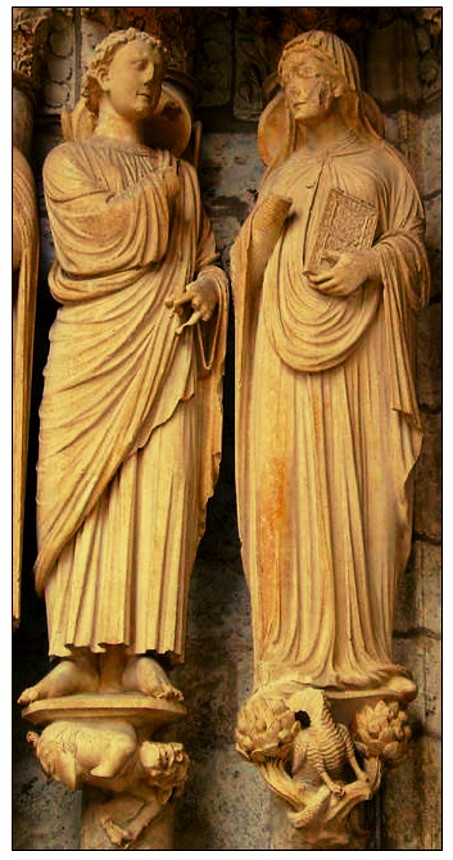
Our Lady with St Gabriel at the Annunciation on the North-west Entrance
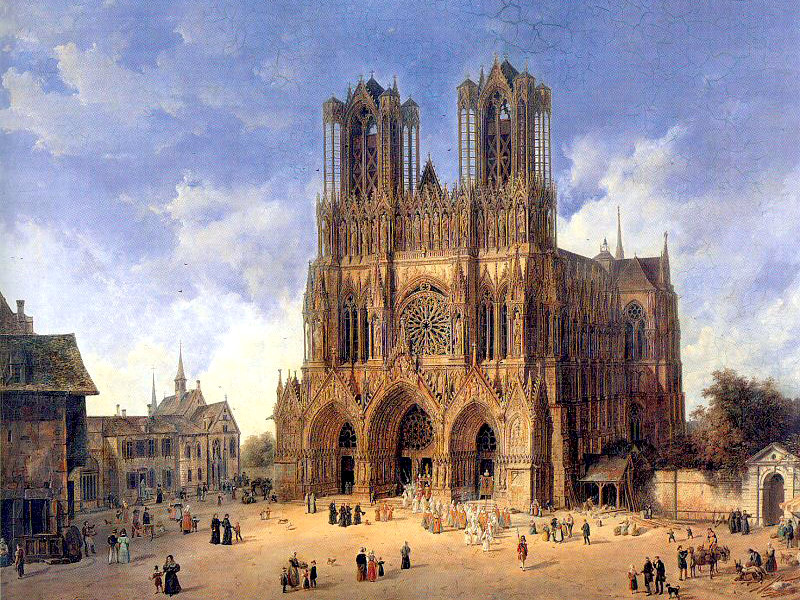
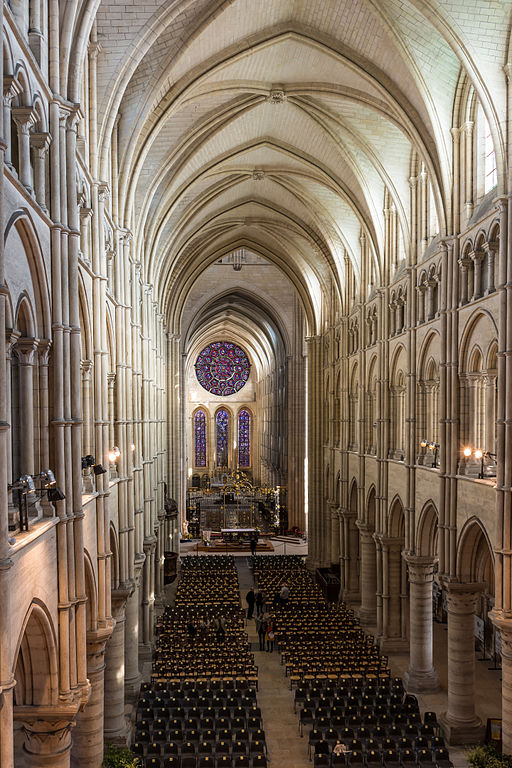
The Abbot Orsini wrote: “The Shrine or Chapel of Our Lady of Laon was erected into a Cathedral and founded by Saint Remigius, Archbishop of Rheims, about the year 500, where he consecrated as his first Bishop Saint Geneband, his nephew. Miracles were wrought there and, among others, we read that in the year 1395, there was seen on the steeple, the picture of a Crucifix, the wounds of which bled.” The present Cathedral located in Laon, Picardy, France, the Laon Cathedral, or Notre-Dame de Laon, was begun in about 1155 and completed in 1235. It was built on the foundation of an earlier Cathedral that was consecrated in the year 800 but burned to the ground in the year 1111 during an uprising, and was, therefore, not the same Cathedral founded by Saint Remigius. The people of Laon took pride in their Cathedral and tried to make it rival the great shrine of Chartres. They did not succeed but the result is the sum of an emotion, clear and strong as love and much stronger than logic and clearer; the charm of the Laon cathedral lies in its unstable balance; which without doubt Our Lady accepted in love as it was meant by her devoted children. It was one of the first Cathedrals constructed in the new Gothic style.
One other unusual aspect of the Cathedral, is that there are sixteen carved bullocks carved in stone like gargoyles. There is a tradition that once when some of the stone was being hauled up the slope for use in the construction of the Church, at one point, the animals hauling the wagon could go no further under the strain of the load. A huge ox appeared at that moment and assisted them in moving the load up into position but then disappeared as quickly as it had appeared.
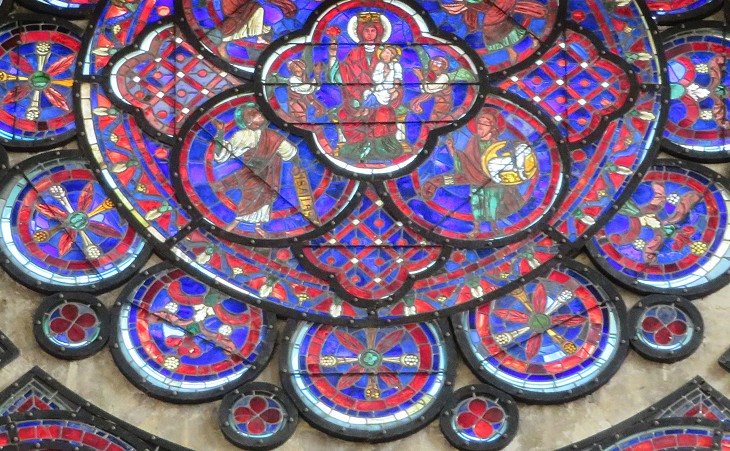
Much of the stained-glass is original and, as at Notre Dame Cathedral in Paris, there is a beautiful rose window dating from the 13th century. It depicts the Blessed Virgin seated on a throne with her Divine Child between Saint John the Baptist and the prophet Isaiah. The interior of the Cathedral was finished with white stone, it is considerably brighter than Notre Dame Cathedral in Paris.
St Gertrude Caterina Comensoli St Helladius of Toledo St Ioannes Chen Xianheng St Ioannes Zhang Tianshen St Jean-François-Régis Clet St Jean-Pierre Néel Bl Jerzy Kaszyra Bl John Pibush – one of the Martyrs of Douai St Leo of Patera St Martinus Wu Xuesheng Bl Matthew Malaventino St Paregorius of Patara St Sadoth of Seleucia St Simeon St Tarasius of Constantinople St Theotonius (1082-1162) Priest Bl William Harrington — Martyrs of North Africa – 7 saints: Group of Christians who were martyred together, date unknown. We know nothing else but seven of their names – Classicus, Fructulus, Lucius, Maximus, Rutulus, Secundinus and Silvanus. They were born and martyred in North Africa.
Martyrs of Rome – 5 saints: A group of Christians martyred together in the persecutions of Diocletian. We know nothing else but their names – Alexander, Claudius, Cutias, Maximus and Praepedigna. They were martyred in 295 in Rome, Italy.
Thought for the Day – 17 February – Ash Wednesday – Meditations with Antonio Cardinal Bacci (1881-1971)
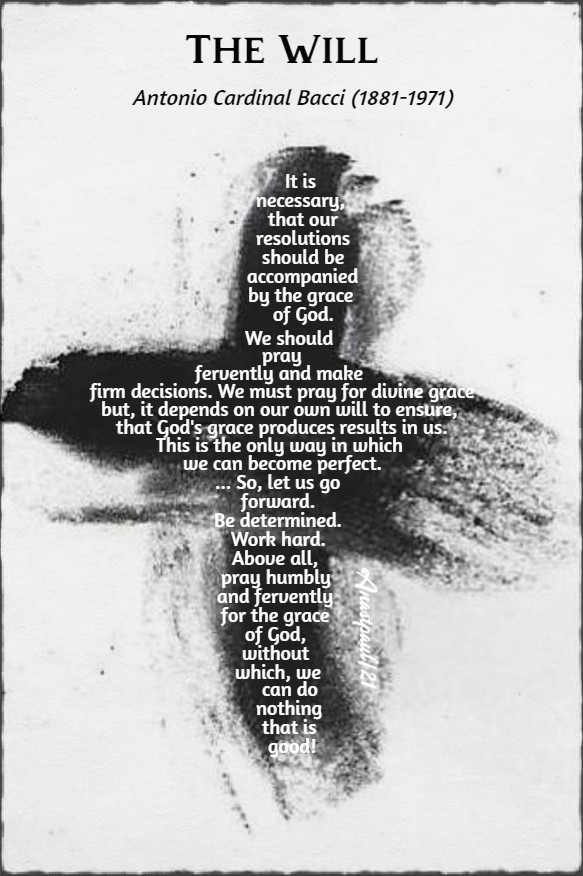
The Will
“It is necessary, that our resolutions should be accompanied by the grace of God. We should pray fervently and make firm decisions. We must pray for divine grace but, it depends on our own will to ensure, that God’s grace produces results in us. This is the only way in which we can become perfect.
We are assured of this by St Paul and by all the Saints. “I can do all things in him who strengthens me,” wrote the Apostle of the Gentiles (Phil 4:13). “By the grace of God, I am what I am and his grace in me has not been fruitless – in fact, I have laboured more than any of them, yet, not I but the grace of God with me” (1 Cor 15:10).
So, let us go forward. Be determined. Work hard. Above all, pray humbly and fervently for the grace of God, without which, we can do nothing that is good!”
Ash Wednesday – 17 February- Day One of our Lenten Journey
Imitating Christ with Thomas à Kempis CRSA (1380-1471)
In Your Light Lord, we see light
“HE WHO follows Me, walks not in darkness,” (John 8:12) says the Lord. By these words of Christ, we are advised to imitate His life and habits, if we wish to be truly enlightened and free from all blindness of heart. Let our chief effort, therefore, be to study the life of Jesus Christ. (Book 1, Ch 1:1)
DISCIPLE: IT IS the mark of a perfect man, Lord, never to let his mind relax in attention to heavenly things and to pass through many cares as though he had none; not as an indolent man does but, having by the certain prerogative of a free mind, no disorderly affection for any created being.
Keep me, I beg You, most merciful God, from the cares of this life, lest I be too much entangled in them. Keep me from many necessities of the body, lest I be ensnared by pleasure. Keep me from all darkness of mind, lest I be broken by troubles and overcome. I do not ask deliverance from those things, which worldly vanity desires so eagerly but, from those miseries which, by the common curse of humankind, oppress the soul of Your servant, in punishment and keep him from entering into the liberty of spirit as often as he would.
My God, Sweetness beyond words, make bitter all the carnal comfort that draws me from love of the eternal and lures me to its evil self, by the sight of some delightful good in the present. Let it not overcome me, my God. Let not flesh and blood conquer me. Let not the world and its brief glory deceive me, nor the devil trip me by his craftiness. Give me courage to resist, patience to endure and constancy to persevere. Give me the soothing unction of Your spirit, rather than all the consolations of the world and in place of carnal love, infuse into me the love of Your Name.
Behold, eating, drinking, clothing and other necessities that sustain the body are burdensome to the fervent soul. Grant me the grace to use such comforts temperately and not to become entangled in too great a desire for them. It is not lawful to cast them aside completely, for nature must be sustained but Your holy law forbids us to demand superfluous things and things that are simply for pleasure, else the flesh would rebel against the spirit. In these matters, I beg, let Your hand guide and direct me, so that I may not overstep the law in any way. (Book 3 Ch 26:1-4)
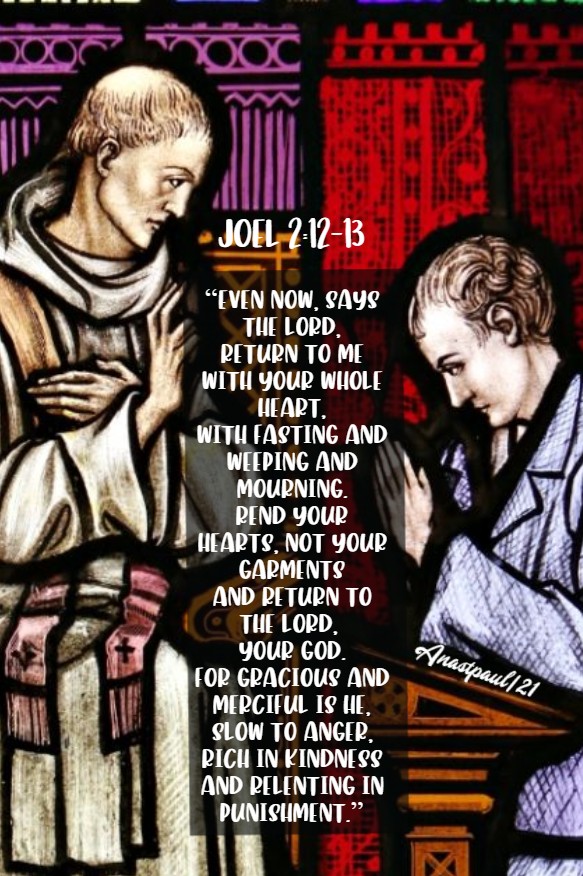
“Even now, says the LORD, return to me with your whole heart, with fasting and weeping and mourning. Rend your hearts, not your garments and return to the LORD, your God. For gracious and merciful is he, slow to anger, rich in kindness and relenting in punishment.”
Joel 2:12-13
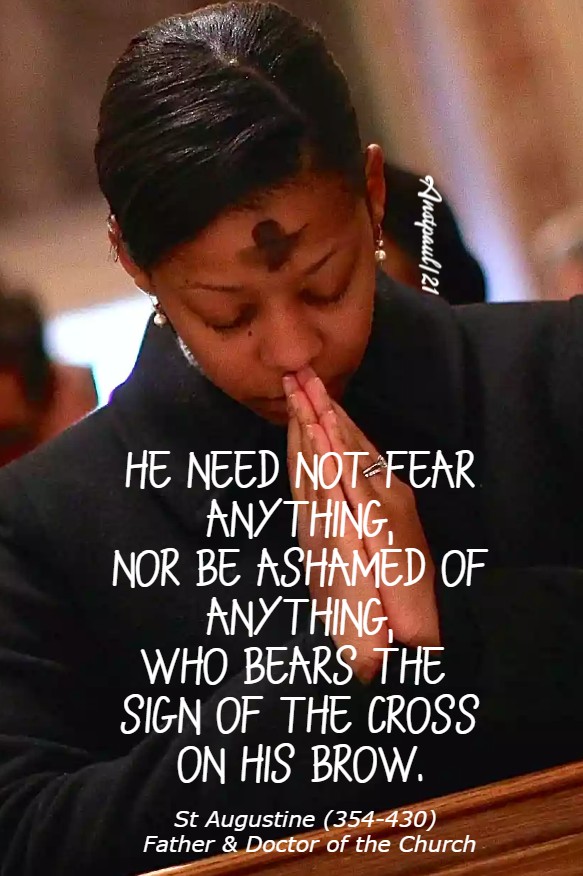
“He need not fear anything, nor be ashamed of anything, who bears the Sign of the Cross on his brow.”
St Augustine (354-430) Father & Doctor of the Church
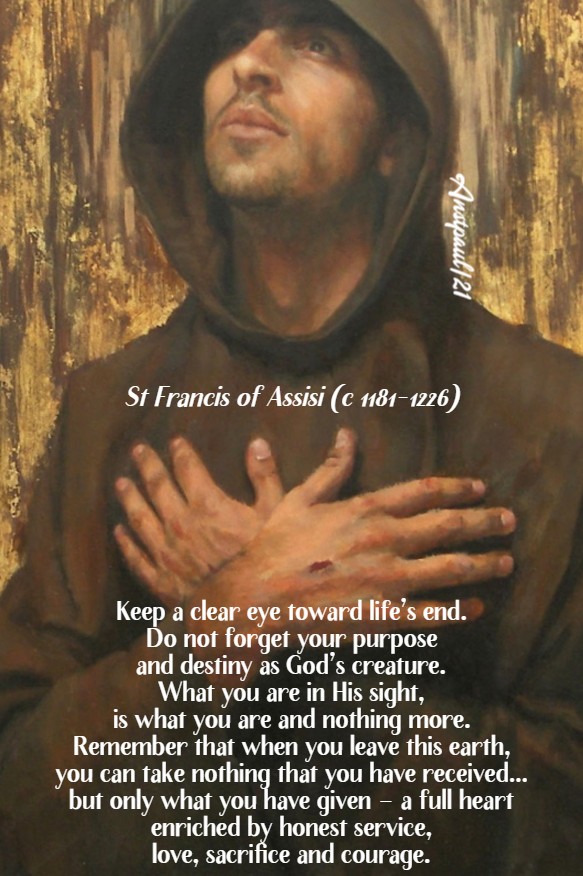
“Keep a clear eye toward life’s end. Do not forget your purpose and destiny as God’s creature. What you are in His sight, is what you are and nothing more. Remember that when you leave this earth, you can take nothing that you have received… but only what you have given – a full heart enriched by honest service, love, sacrifice and courage.”
St Francis of Assisi (c 1181-1226)
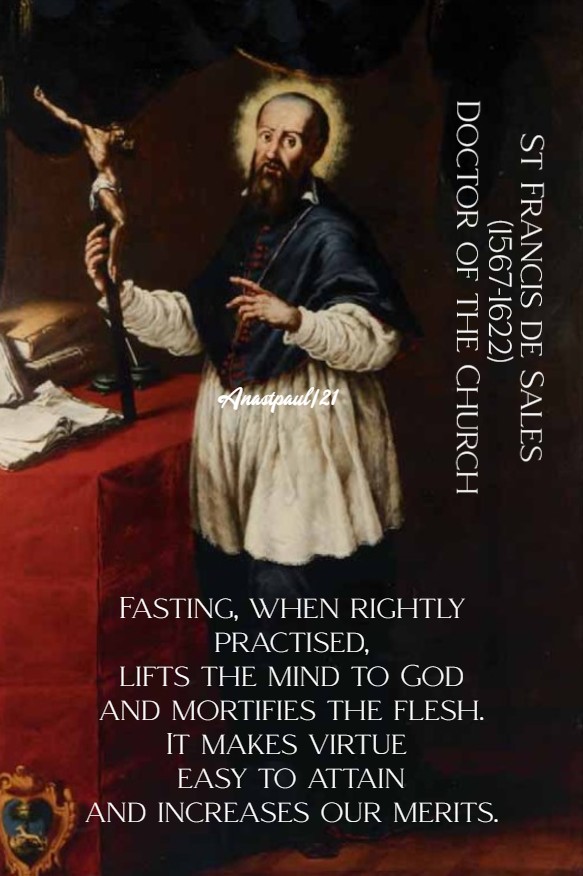
“Fasting, when rightly practised, lifts the mind to God and mortifies the flesh. It makes virtue easy to attain and increases our merits.”
St Francis de Sales (1567-1622) Doctor of the Church
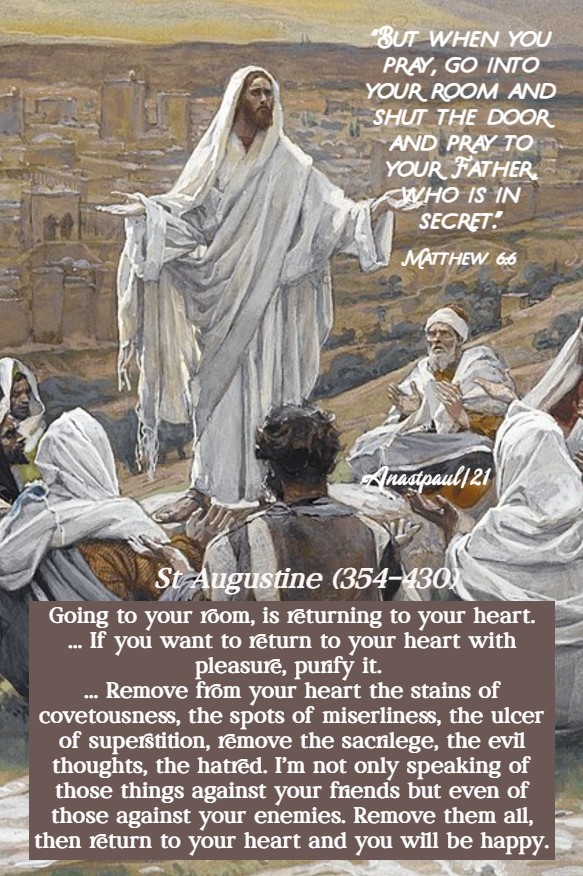
“But when you pray, go into your room and shut the door and pray to your Father who is in secret.” – Matthew 6:6
REFLECTION – “Going to your room, is returning to your heart. Blest are they who rejoice at returning to their heart and who find nothing bad there…
They are greatly to be pitied who, returning home, have to fear they will be chased away because of bitter fights with their family. But how much unhappier are they, who do not dare return to their own conscience, for fear of being chased away by remorse for their sins. If you want to return to your heart with pleasure, purify it. “Blest are the pure of heart for they shall see God.” (Mt 5,8) Remove from your heart the stains of covetousness, the spots of miserliness, the ulcer of superstition, remove the sacrilege, the evil thoughts, the hatred. I’m not only speaking of those things against your friends but even of those against your enemies. Remove them all, then return to your heart and you will be happy.” – St Augustine (354-430) Bishop of Hippo, Father & Doctor of the Church – 2nd Discourse on Psalm 33, <8; PL 36,312
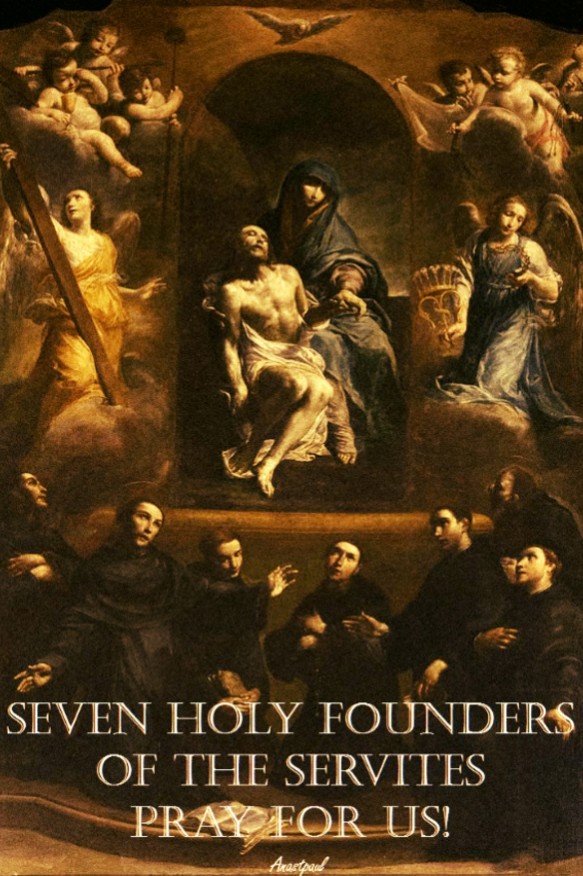
PRAYER – Heavenly Father, just as the Seven Holy Founders, were chosen to be messengers of Your love and forgiveness, grant we pray, that by their prayers, we too may bcome bearers of Your gracious love. Holy Father, You have given Yourself to us in the Face of Your Divine Son. You have given Him to us to be our food and our portion. You have consoled us with His presence on the Altar of Offering and washed us with His blood, day by day, You have sacrificed Him to save us. We pray for the assistance of our holy Mother, during our journey to the eternal glory of the kingdom. Through Jesus our Lord, with the Holy Spirit, one God forever, amen.
Our Morning Offering – 17 February – Ash Wednesday 2021
You Alone are my All and Every Good By Thomas à Kempis CRSA (1380-1471)
O Lord, my God, You are my all and every good. And what am I, that I should presume to address You? I am the poorest of Your servants and a wretched worm, far more poor and worthless, than I, can ever realise or express. Yet, Lord, remember that I am nothing, I have nothing and can do nothing. You alone are good, just and holy, You can do all things, fill all things, bestow all things, leaving only the wicked empty-handed. Remember Your mercies, Lord and fill my heart with Your grace, since it is Your will, that none of Your works, should be worthless. How can I endure this life of sorrows, unless You strengthen me with Your mercy and grace? Do not turn Your face from me, do not delay Your coming, nor withdraw Your consolation from me, lest my soul become like a waterless desert. Teach me, O Lord, to do Your will, teach me to live worthily and humbly in Your sight, for You are my wisdom, Who know me truly and who knew me before the world was made and before I had my being. Amen
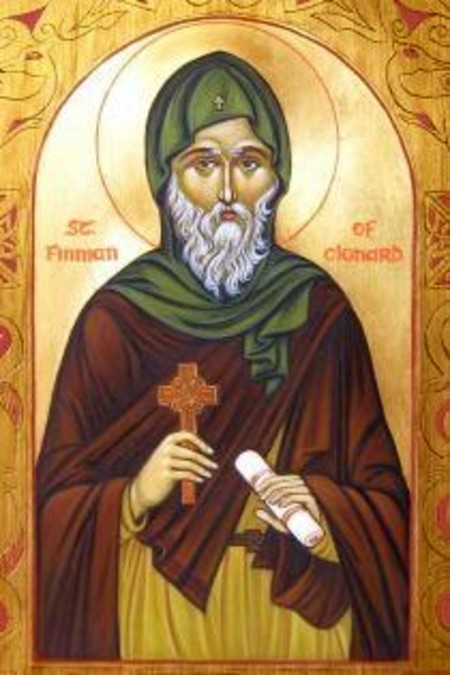
Saint of the Day – 17 February – Saint Fintan of Clonenagh (c 524 – 603) Abbot, disciple of St Columba of Iona (521-597), Hermit in Clonenagh, Leix, Ireland. When disciples gathered around his hermitage he became their Abbot. A miracle-worker, Fintan was granted the gifts of prophecy and miracles. He also performed very austere penances. Known as the “Father of the Irish Monks.” Patronage – County Laois.
Saint Fintan was born in Leinster about 52, the son of Christians. He received his religious formation in Terryglass, Co Tipperary under the Abbot Columba and was deeply influenced by his penitential practices and the severity of the Rule. Fintan spent his early years in Carlow before making his own foundation in Clonenagh, Co Laois. His disciples included St Colmán of Oughaval, St Comgall of Bangor, and St Aengus the Culdee. He has been compared by the Irish annalists to St Benedict and is styled “Father of the Irish Monks.” Though he is sometimes confused with Saint Fintán or Munnu, Abbot of Taghmon, they are distinct.
Fintan gave his Monks very strict rules not to consume any animal products. The community did not have even one cow and so they had neither milk nor butter. The Monks complained they couldn’t do hard work on so meagre a diet. A deputation of local clergy headed by Canice of Aghaboe came to urge him to improve it. He agreed for his Monks but he elected to keep to the strict diet himself. Fintan was reported to have lived on only “bread of woody barley and clayey water of clay.”
An ancient biography of St Fintan is extant, as well as that of his brother St Finlugh and it was published by Fr Colgan, the great hagiographer. It is thought that they were brought up in Co Limerick but little is known of their early lives. There are different accounts of their father, some naming him Pippan, others calling him Diman, who was a descendant of an Ulster King. Their mother was called, Aliuna (or Ailgend, daughter of Lenin) and was also of noble birth.
There is an account of an irreligious King who ordered his men to bar St Fintan from visiting him. However, a mighty tempest arose immediately and mature crops blazed with fire, thus blinding the men, who, thereafter, asked forgiveness of the saint. St Fintan blessed some water and after applying it to their eyes, their sight was restored and they bound themselves and their people to his service, including that King. This is one of several instances in the Lives of the Irish Saints, whereby individuals, families and even whole clans bound themselves and their posterity, to the service and support of a particular Saint. These services are not always defined precisely but would appear to include giving tribute in money or kind, for building and maintenance of Churches, Monasteries and Schools.
St Fintan is said to have been trained under St Comgal at Bangor, Co Down. While there, he is credited with many miracles: e.g. he miraculously gained a copy of the Gospels, which were extremely valuable in those days, when attacking pirates were overcome as a sudden storm uprooted a large tree and destroyed their ships with it. St Fintan recovered the Gospels from the pirates who had stolen them elsewhere.
During Springtime a leper asked for bread but the Monastery did not have any flour. St Fintan caused the corn seed to grow fully immediately, so that the bread could be made. He also exorcised demons. He caused a mill to grind for three days without the use of the usual water power.
St Fintan left Bangor and attempted to settle near a hill called Cabhair but an angel appeared to him and instructed him otherwise. However, in order that St Fintan should be honoured in that place, a bell miraculously came there through the air. It was called Dubh-labhar, meaning Black-toller and it and St Fintan, were venerated there, ever since.
St Fintan was known for his extraordinary sanctity. Peace, compassion and piety were enthroned in his heart. He maintained a heavenly serenity and equanimity of temper. He ministered to his guests and his brethren. He had no guile, no condemnation for anyone and was never angry or disturbed, he returned no evil for evil and he had no grief in any calamity.
He flourished in the second half of the 6th century and that most of his missionary work was confined to the Southern half of the country. He founded his Monastery and School at Dunbleisque, now Doon, Co Limerick, which the Lord had designated for his habitation. There is a Holy Well to his memory, where pilgrims still arrive and where miracles are still attested to but the exact site of his Monastery in nowadays uncertain.
Knowing his end awas pproaching, St Fintan assembled his Monks and named Fintan Maeldubh as his successor. He died on 17 February 603.
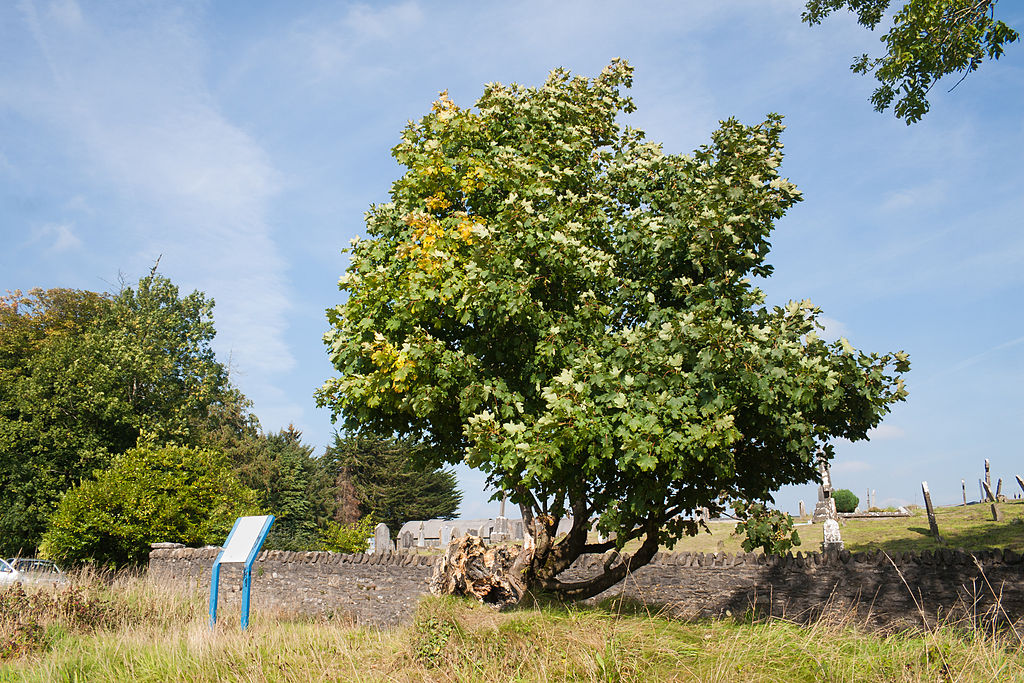
St Fintan’s Tree, Clonenagh – This tree, an acer pseudoplatanus, was planted in the late 18th or early 19th century at the site of the Early Christian monastic site of Clonenagh. The tree is dedicated to St Fintan and it became custom to insert coins into the tree, from which the tree suffered and was believed to be dead until the tree started to recover with some new shoots.
Our Lady of Constantinople, Bari, Turkey (566) – 17 February:
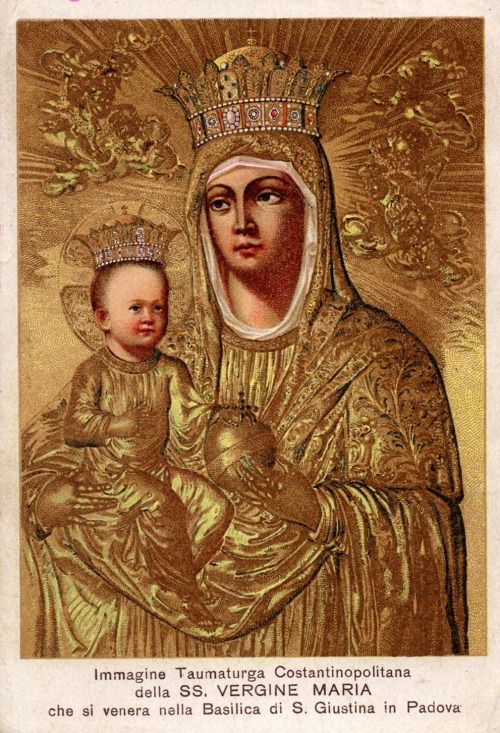
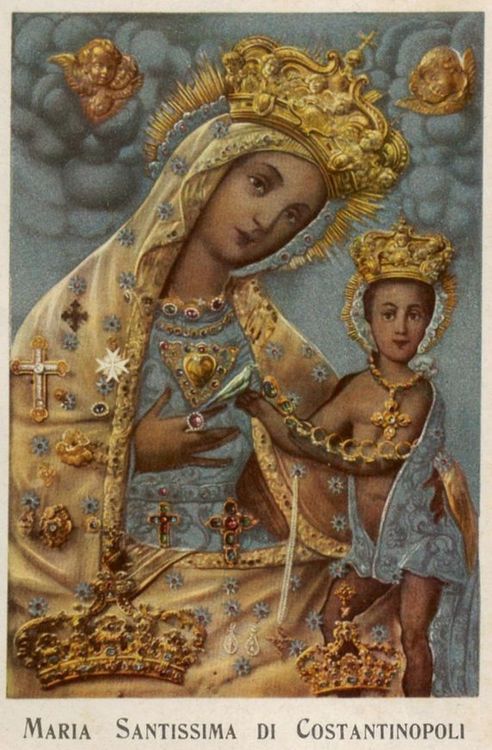
The Abbot Orsini wrote: “Our Lady of Constantinople, formerly the synagogue of the Jews, which was converted into a Church of the Blessed Virgin by the Emperor Justin the Younger, in the year 566.” The remains of the great Byzantine Church of Sainte-Marie-du-Rosaire, called Notre-Dame de Constantinople, which is encumbered by later wild constructions and debris of all kinds, are scarcely representative of what this important sanctuary had once been. In the 1930’s, Paul Schatzmann, a Swiss archaeologist, had made important discoveries here, supplemented by another archaeologist, Stephan Westphalen, a German, in the 1990’s. We do not know much about the Byzantine past of the building, we only know for certain, that the Church was transferred to the Dominicans in 1475 and it took the name of Our Lady of Constantinople and later, that of Saint Mary of the Rosary. In 1640 Our Lady of Constantinople was converted into a mosque in the name of Kemankes, then Odalar camii. Much of the substructure had been rebuilt before the fire of 1919, which led to its eventual abandonment. Despite the painstaking searches conducted by the two archaeologists, it is not easy to have a very clear idea of the scale of the building and its dependencies. However, the proximity of the mosque Kasim Aga, which also has Byzantine structures and the Aetius (Ipek Bodrumu) suggest that the Church belonged to a large monastery, whose name remains unknown. From the point of view of the two archaeologists, the foundations of the Church date from the seventh century but the final form of the Church was given after the fire of 1203. After the reconstruction and expansion of the Church in the thirteenth century, the foundations of the old Church were used as a mausoleum, while two slightly asymmetrical chapels were added in the apse. Part of the old Church was filled to construct the new Church with the Greek cross plan. Nothing suggests that the substructure of the second building was originally a funerary chapel, as its primary function was to provide a basis for a monumental Church. It appears the sub-structure was gradually used for tombs of the faithful. In the upper part, there are paintings of the life of the Blessed Virgin dating from the eleventh and twelfth centuries. Fragments of frescoes have been discovered on several walls. In the small central chamber of the crypt, a crowned Virgin surrounded by angels suggests that a Marian relic may have once been enshrined here.
__ Seven Founders of Servants of Mary (Optional Memorial) • St Alexis Falconieri (c (1200–1310) One of the Seven Founders of the Servites • St Bartholomew degli Amidei • St Benedict dell’Antella • St Buonfiglio Monaldi • St Gherardino Sostegni • St Hugh dei Lippi-Uguccioni • St John Buonagiunta Monetti
St Alexis Falconieri – SEVEN HOLY FOUNDERS (13th century –1310) His Life: https://anastpaul.com/2020/02/17/saint-of-the-day-17-february-saint-alexis-falconieri-13th-century-1310/ St Antoni Leszczewicz St Bartholomew degli Amidei – SEVEN HOLY FOUNDERS St Benedict dell’Antella – SEVEN HOLY FOUNDERS St Benedict of Cagliari St Buonfiglio Monaldi – SEVEN HOLY FOUNDERS St Bonosus of Trier Bl Constabilis of Cava St Donatus the Martyr Bl Elisabetta Sanna St Evermod of Ratzeburg St Faustinus the Martyr St Finan of Iona St Fintan of Clonenagh (c 524 – 603) Abbot, “Father of the Irish Monks” St Flavian of Constantinople St Fortchern of Trim St Gherardino Sostegni – SEVEN HOLY FOUNDERS St Guevrock St Habet-Deus St Hugh dei Lippi-Uguccioni – SEVEN HOLY FOUNDERS St John Buonagiunta Monetti – SEVEN HOLY FOUNDERS St Julian of Caesarea St Loman of Trim Blessed Luke Belludi (c 1200- c 1285) Biography: https://anastpaul.com/2019/02/17/saint-of-the-day-17-february-blessed-luke-belludi-ofm-c-1200-c-1285/ St Lupiano Bl Martí Tarrés Puigpelat St Mesrop the Teacher St Petrus Yu Chong-nyul St Polychronius of Babylon St Romulus the Martyr St Secundian the Martyr St Silvinus of Auchy St Theodulus of Caesarea Bl William Richardson
Thought for the Day – 19 February – Meditations with Antonio Cardinal Bacci (1881-1971)
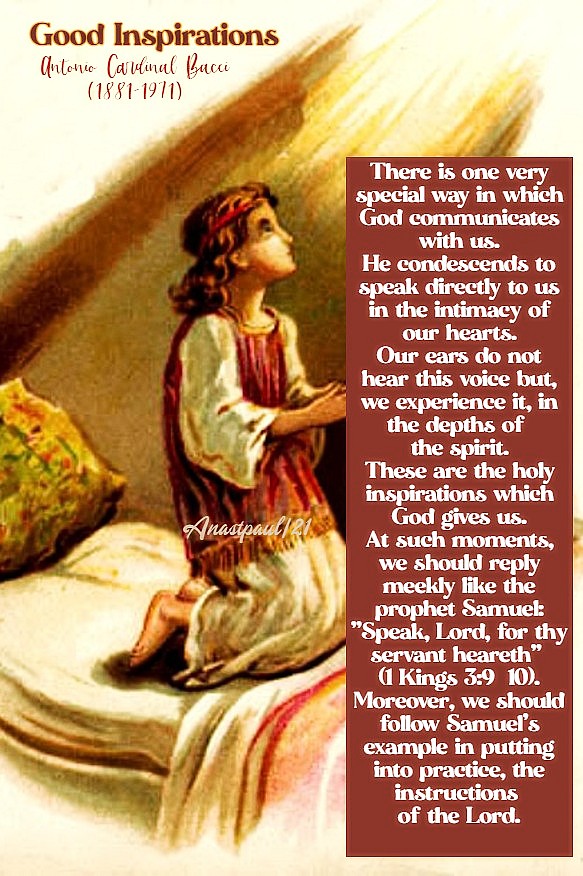
Good Inspirations
“There is one very special way in which God communicates with us. He condescends to speak directly to us in the intimacy of our hearts. Our ears do not hear this voice but, we experience it, in the depths of the spirit. When we are tempted to fall into sin, suddenly we hear its warning tones. Perhaps, when we have already fallen, this voice pursues us again, inviting us to return to God. Sometimes, after Holy Communion, we converse with God and He speaks gently, making us understand, that true happiness, can be found, only in His love and service. These are the holy inspirations which God gives us. At such moments, we should reply meekly like the prophet Samuel: “Speak, Lord, for thy servant heareth” (1 Kings 3:9-10).
Moreover, we should follow Samuel’s example in putting into practice, the instructions of the Lord.”
Quote/s of the Day – 16 February – Readings: Genesis 6:5-8; 7:1-5, 10, Psalms 29:1 and 2, 3-4, 3 and 9-10, Mark 8:14-21
Sacred Scripture – A Light for our Path
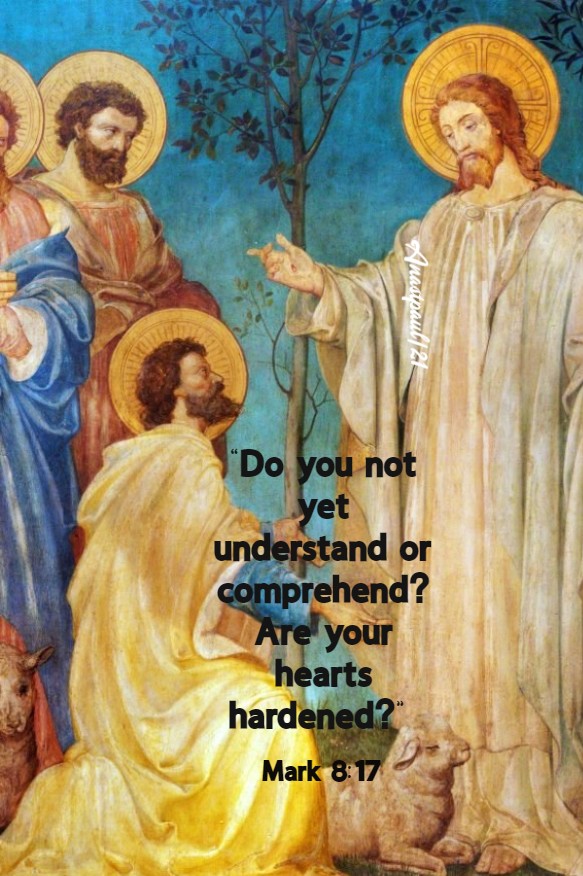
“Do you not yet understand or comprehend? Are your hearts hardened?”
Mark 8:17
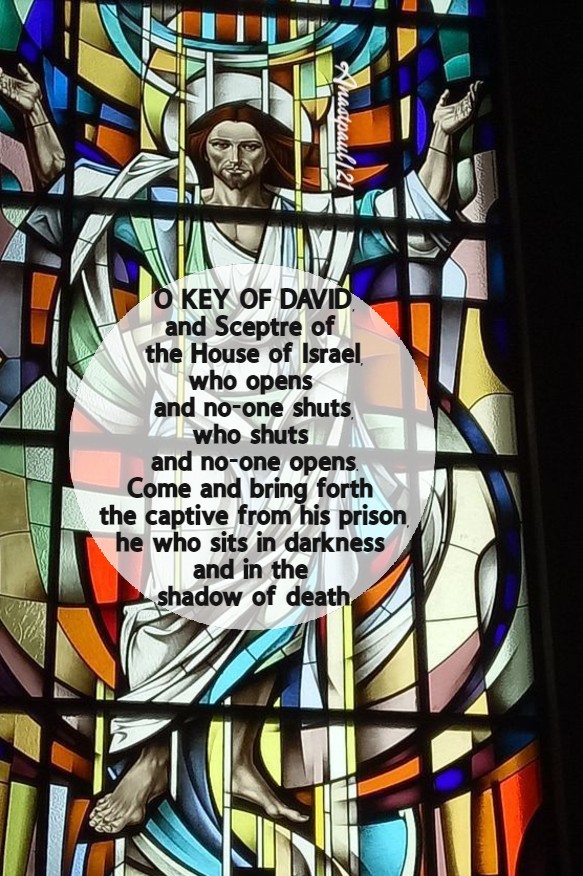
“O KEY OF DAVID, and Sceptre of the House of Israel, who opens and no-one shuts, who shuts and no-one opens. Come and bring forth the captive from his prison, he who sits in darkness and in the shadow of death.”
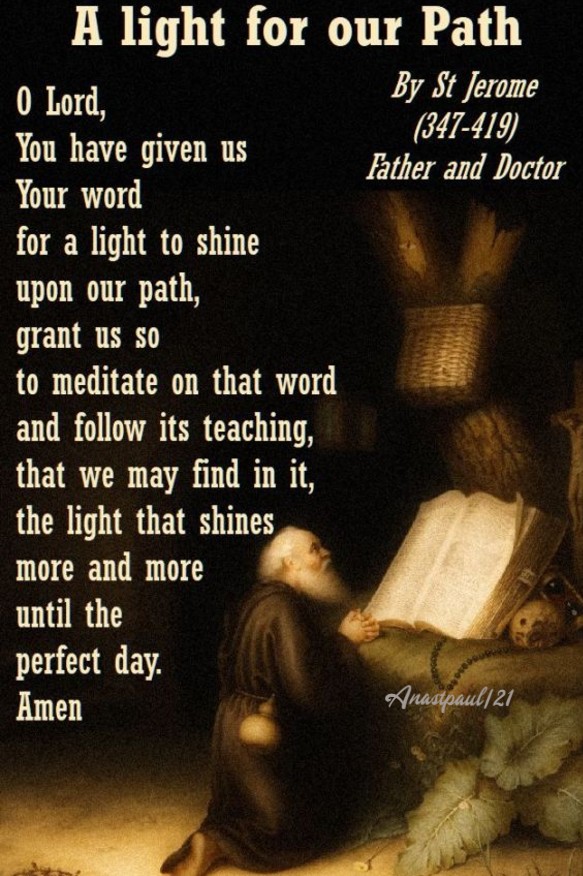
O Lord, You have given us Your word for a light to shine upon our path, grant us so to meditate on that word and follow its teaching, that we may find in it, the light that shines more and more until the perfect day. Amen
“Let sleep find you holding your Bible and when your head nods, let it be resting on the sacred page.”
St Jerome (343-420) “The Man of the Bible” Father and Doctor of the Church
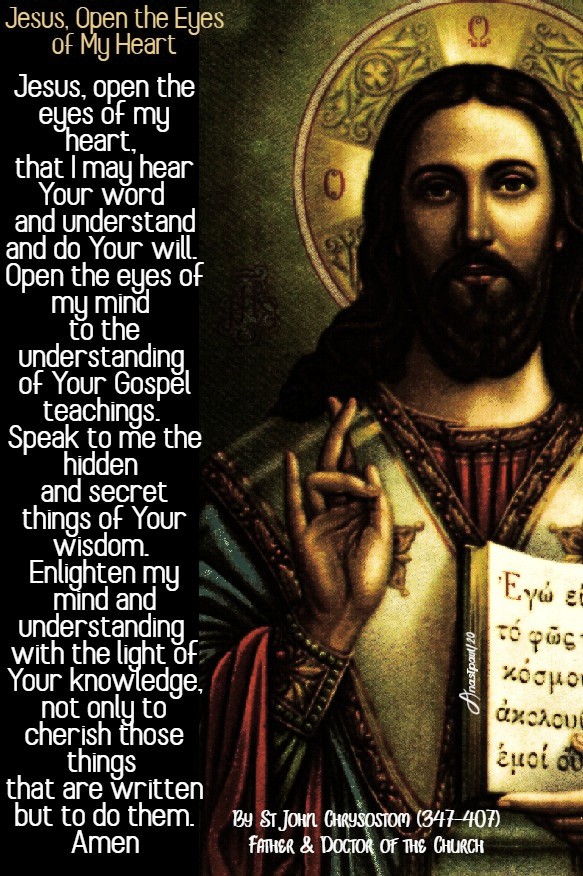
“Jesus, open the eyes of my heart, that I may hear Your word and understand and do Your will. Open the eyes of my mind to the understanding of Your Gospel teachings. Speak to me the hidden and secret things of Your wisdom. Enlighten my mind and understanding with the light of Your knowledge, not only to cherish those things that are written but to do them. Amen”
St John Chrysostom (347-407) Father and Doctor
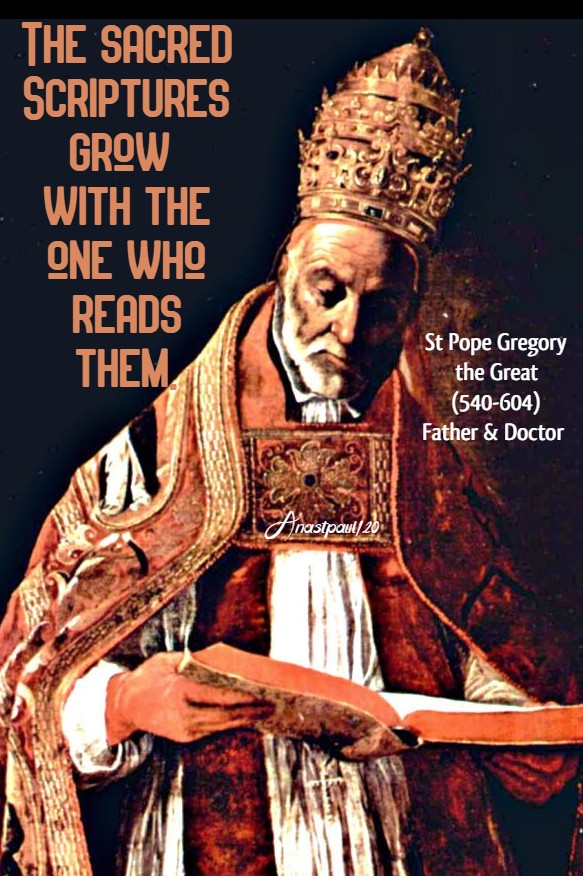
“The Sacred Scriptures grow with the one who reads them.”
St Pope Gregory the Great (540-604) “Father of the Fathers” and Doctor of the Church
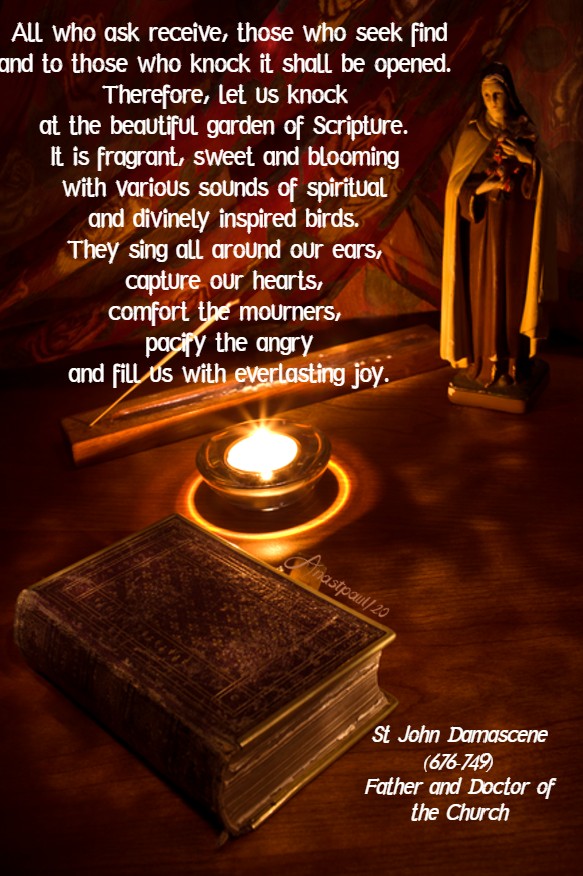
“All who ask receive, those who seek find and to those who knock it shall be opened. Therefore, let us knock at the beautiful garden of Scripture. It is fragrant, sweet and blooming with various sounds of spiritual and divinely inspired birds. They sing all around our ears, capture our hearts, comfort the mourners, pacify the angry and fill us with everlasting joy.”
St John Damascene (676-749) Father and Doctor of the Church
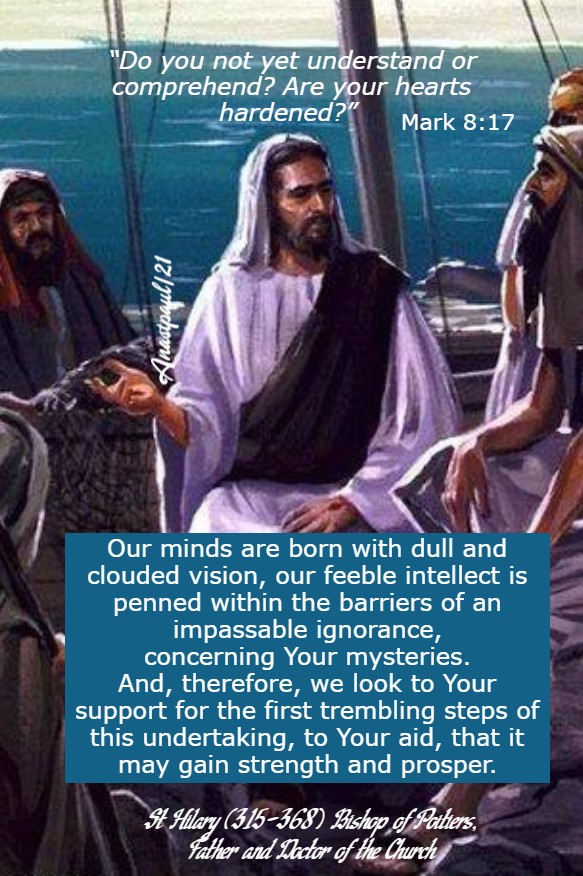
“Do you not yet understand or comprehend? Are your hearts hardened?” – Mark 8:17
REFLECTION – “I know, O Lord God Almighty, that I owe You, as the chief duty of my life, the devotion of all my words and thoughts, to Yourself… In our want we shall pray for the things we need. We shall bring an untiring energy to the study of Your prophets and apostles and we shall knock for entrance at every gate of hidden knowledge. But it is Yours to answer the prayer, to grant the thing we seek, to open the door on which we beat (Lk 11,9). Our minds are born with dull and clouded vision, our feeble intellect is penned within the barriers of an impassable ignorance concerning Your mysteries. But the study of Your revelation, elevates our soul to the comprehension of sacred truth and submission to the faith, is the path to a certainty beyond the reach of unassisted reason. And, therefore, we look to Your support for the first trembling steps of this undertaking, to Your aid, that it may gain strength and prosper. We look to You, to give us the fellowship of that Spirit who guided the prophets and apostles, that we may take their words in the sense in which they spoke and assign its right shade of meaning, to every utterance… Grant us, therefore, precision of language, soundness of argument, grace of style, loyalty to truth. Enable us to utter the things that we believe.” – St Hilary (315-368) Bishop of Poitiers, Father and Doctor of the Church – The Trinity, I, 37-38
PRAYER – God of mercy, teach us to live as You have ordained. Help us to follow Your commandments with courage and steadfast devotion. Let our Saviour, true Light of the world, be our master. Fill us with the fire of the Holy Spirit, that we grow in holiness. Grant blessed Trinity, that by the prayers of Bl Philippa Mareri, we may strive towards our heavenly home. Through Jesus our Lord, in unity with the Holy Spirit, one God forever. Amen
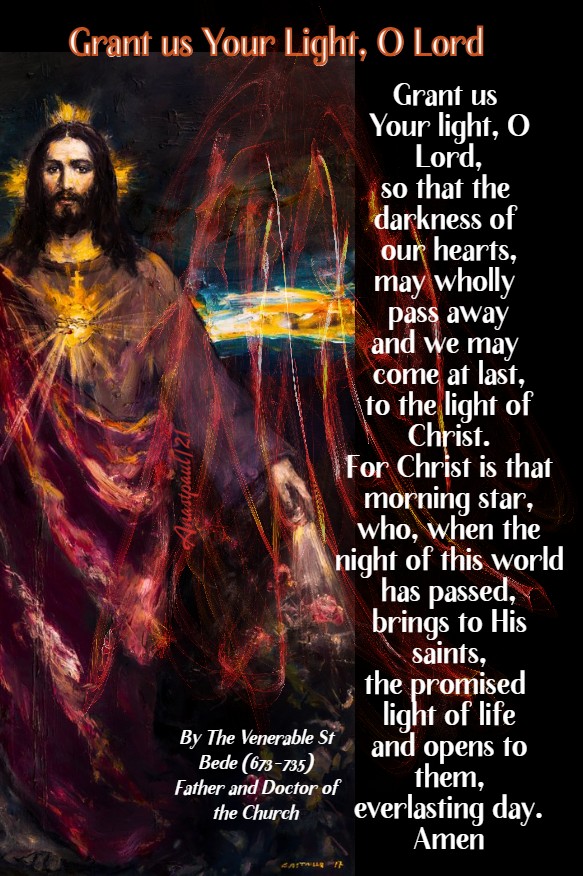
Grant us Your Light, O Lord By The Venerable St Bede (673-735) Father and Doctor of the Church
Grant us Your light, O Lord, so that the darkness of our hearts, may wholly pass away and we may come at last, to the light of Christ. For Christ is that morning star, who, when the night of this world has passed, brings to His saints, the promised light of life and opens to them, everlasting day. Amen
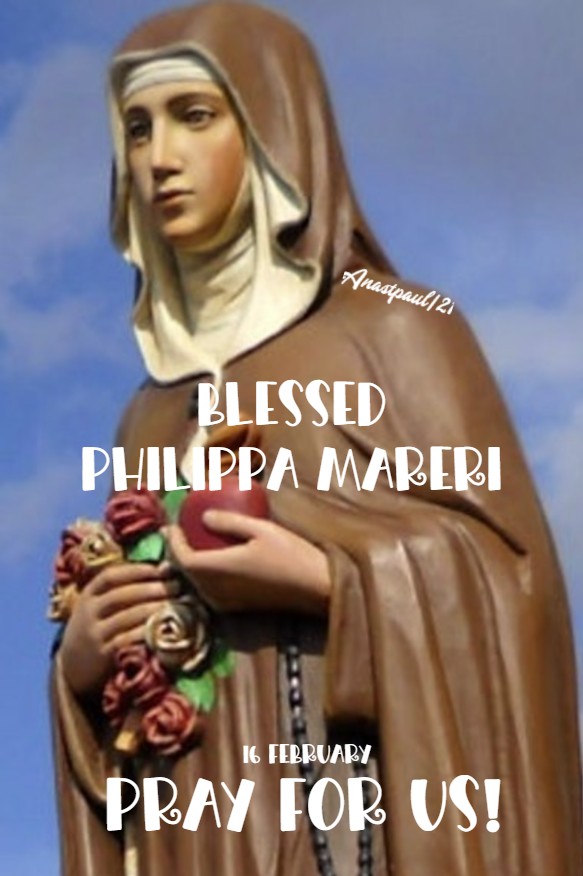
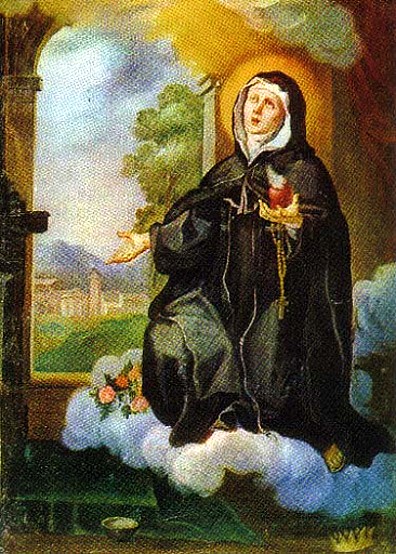
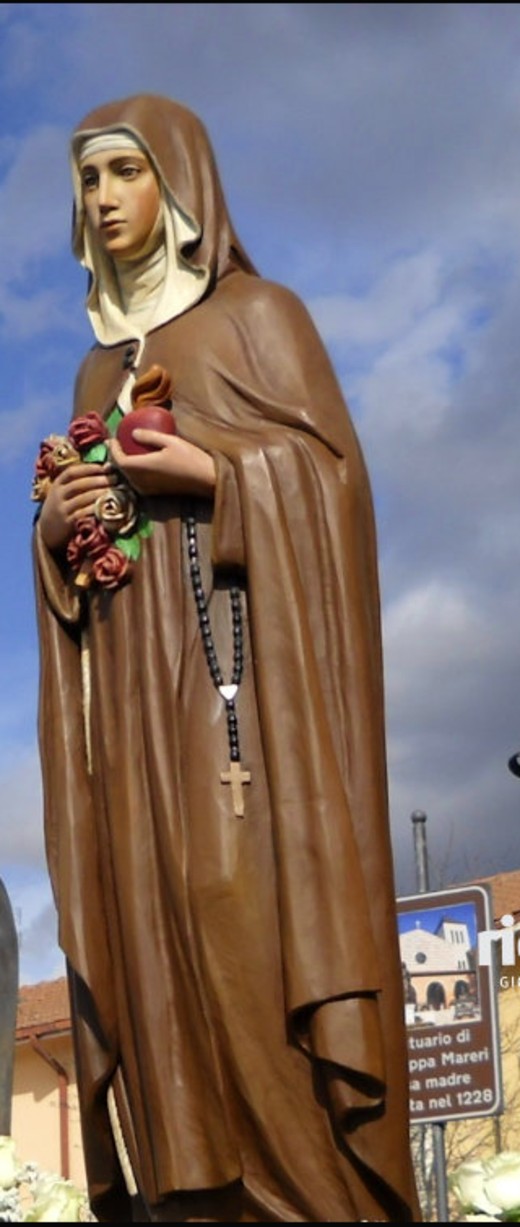
Saint of the Day – 16 February – Blessed Philippa Mareri OSC (c 1195-1236) Religious Nun of the Poor Clares, foundress of the monastery of Franciscan Sisters of Saint Philippa Mareri of the Poor Clares, Penitent and disciple of the teachings of St Francis of Assisi. Born in c 1195 in Mareri, Rieti, Italy and died on 16 February 1236 in Borgo San Pietro, Rieti, Italy of natural causes aged 41. Also known as Filippa Mareria. Patronage – Sulmona, Italy. Her heart is incorrupt.
Blessed Philippa Mareri, who belonged to the illustrious family of the Mareri, saw the light of day at the castle of her parents near Rieti in Italy, toward the close of the twelfth century. At a very early age she was the favourite of all who knew her, not only because of her natural gifts but principally because of her steady advancement in perfection. As a young woman she lived quietly at home, devoted to prayer and the cultivation of her high mental endowments. She took particular pleasure in reading the Holy Scriptures and studying the Latin language, in which she became very proficient.
About this time, St Francis often visited the valley of Rieti, where he established several convents and sometimes called at the home of the devout Mareri. His forceful admonitions, filled with holy simplicity and unction and his severe life of penance, made a deep impression on Philippa.
It was not long before Blessed Philippa Mareri resolved to imitate our holy Father, foregoing wealth and consecrating herself entirely to God. She rejected a proposal to marry with the words:
“I already have a spouse, the noblest and the greatest, Our Lord Jesus Christ.”
Neither the remonstrances of her parents, nor the ridicule of her brother Thomas, had any effect in changing her mind. She cut off her hair, donned a very coarse garmen, and with several companions withdrew to a cave in the rocks of a nearby mountain.
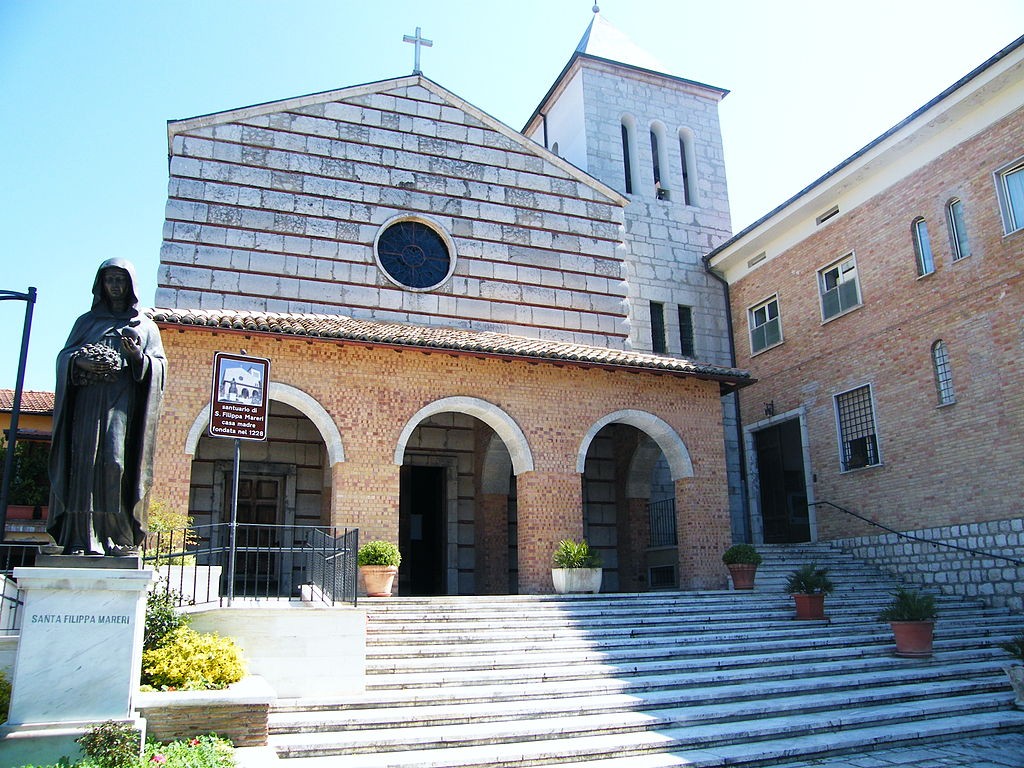
Her austere life of penance and intimate union with God changed the resentment and mockery of her family into admiration. Thomas visited the mountain recess to ask Philippa’s forgiveness and placed at her disposal, the Church of St Peter and an adjacent convent once occupied by the Benedictines, over which he was the patron. Full of joy, the young community took up its abode there, accepting the place as a gift from heaven. They lived according to the rule of St Clare under the direction of Blessed Roger of Todi, to whom St Francis had entrusted the care of their souls.
The new foundation flourished remarkably and many of the noblest young women joined their ranks. Philippa’s excellent example and loving manner were particularly instrumental in bringing about these results. Although she filled the capacity of Superior, she was the humblest member of the community. She had no equal in zeal for prayer and mortification, and, like St Francis and Blessed Roger, she held poverty in the highest esteem. Blessed Philippa Mareri exhorted her sisters to have no care for the morrow and more than once, in times of need, her trust in God was signally rewarded with miraculous assistance.
Blessed Philippa Mareri had lived and laboured and made sacrifices for God for many a year, when it was revealed to her that the time of her death was at hand. She was seized with a fatal illness. Gathering her sisters around her deathbed, she bade them farewell and exhorted them to persevere in their efforts toward perfection and to remain united in sisterly love. Having received the last sacraments at the hands of Blessed Roger, she addressed to her sisters the words of the Apostle:
“The peace of God which surpasses all understanding keep your hearts and minds in Christ Jesus.”
She then expired quietly and went home, on 16 February 1236.
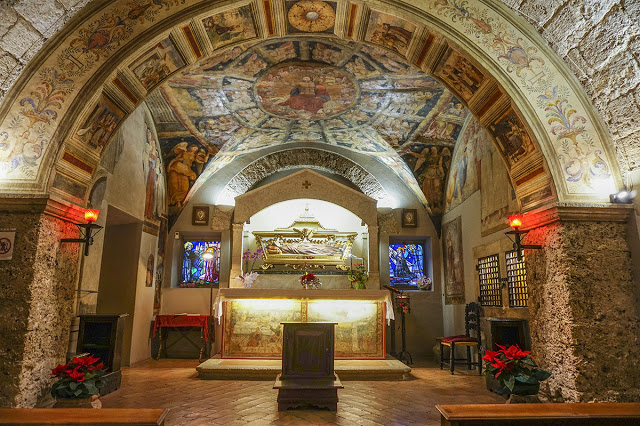
Striking miracles occurred on the very day of her burial and many more have occurred since then throughout the years. Shortly after her death Pope Innocent IV approved the veneration paid to her and on 30 April 1806 by Pope Pius VII (cultus confirmation; decree of heroic virtues) -renewed the approbation. Blessed Philippa’s incorrupt heart is preserved today in a silver reliquary, while her other remains are preserved in the Monastery of Borgo San Pietro in the Valle del Salto. Today, nearly eight centuries after her death, the devotion to the Saint and the Pilgrimage Site has kept on growing, not only in her homeland but also in many other countries and other continents.
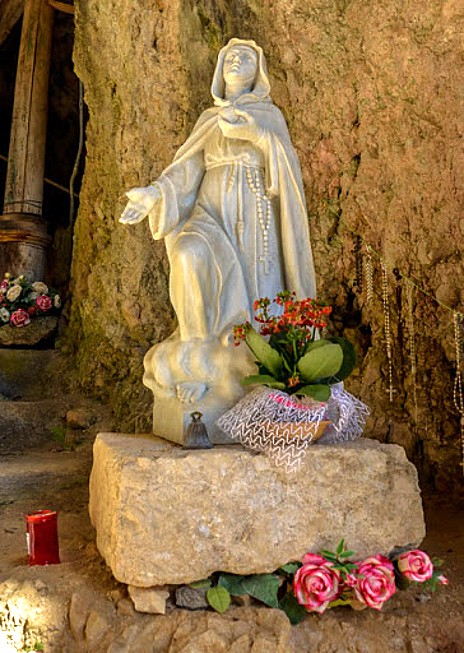
The Sanctuary and Statue of Blessed Philippa
The Grotta di Santa Philippa is the place where the noble woman, belonging to the important Mareri family, took refuge, when she abandoned luxury and comfort to follow her faith. Located near Petrella Salto, it is immersed in the green nature of the Valley. Here Philippa Mareri took refuge in the thirteenth century with some companions, to escape the pressures of family members who opposed her choice of religious life. Today the cave has been transformed into a graceful and simple rock church, the destination of many faithful and reachable via the pilgrim’s path. Inside there is a statue of the saint and a marble altar covered by a wooden canopy.
Notre-Dame de l’ Epine / Our Lady of the Thorn, Chalons-sur-Marne, France (1400) – 16 February:
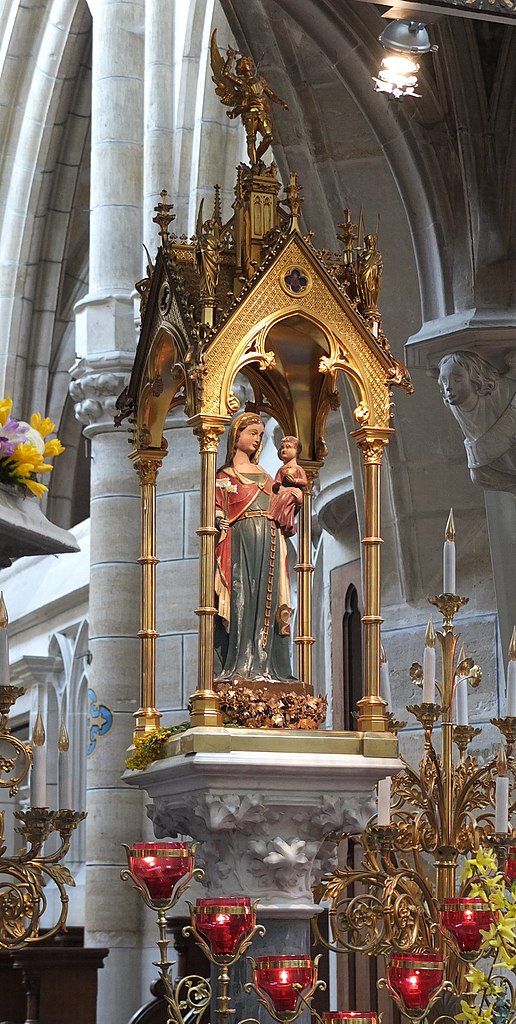
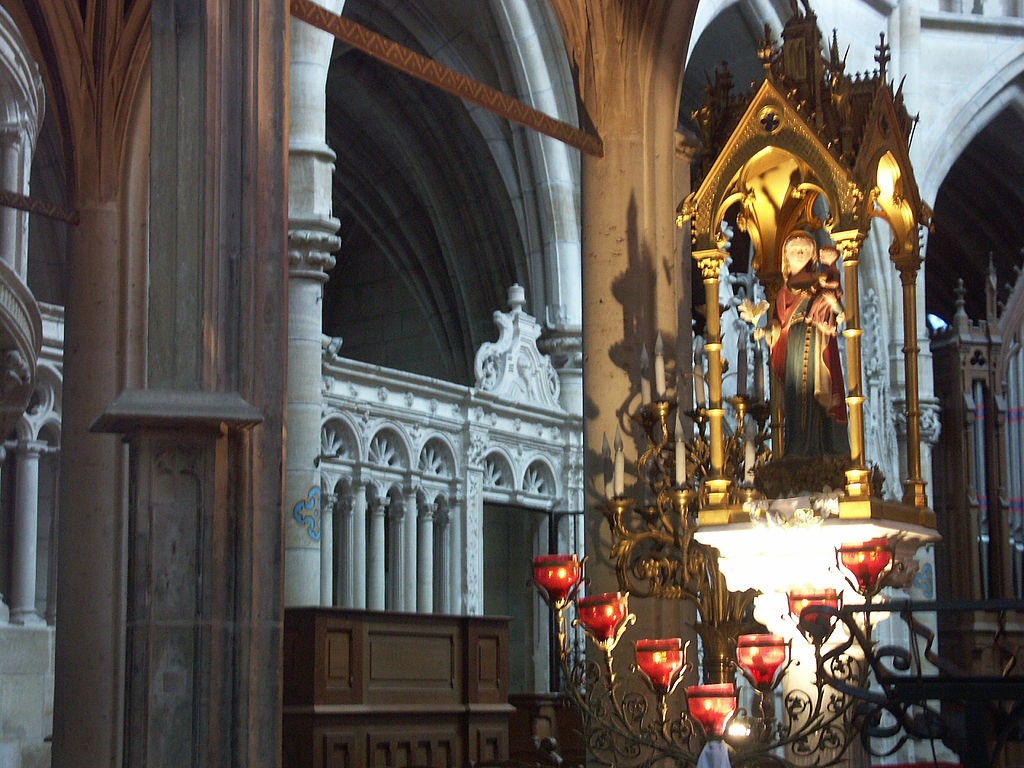
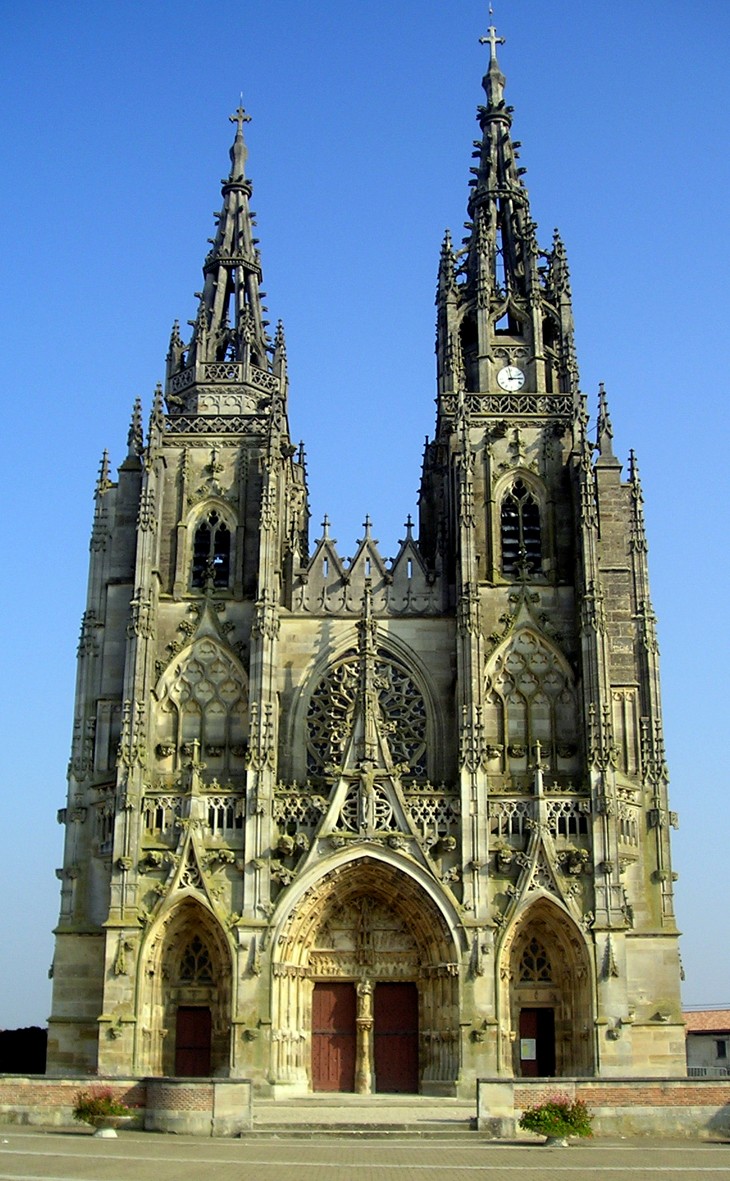
On the night of the Feast of the Annunciation, 24 March in the year 1400, some shepherds tending their flocks were attracted by a bright light coming from the Chapel of Saint John the Baptist near Chalons, France. As they approached the light, they saw that it was actually a thorn bush fully engulfed in flames and they discovered a statue of the Blessed Virgin standing unharmed in the midst of the flames. In fact, though the fire burned brightly, the branches and leaves of the thorn bush were unaffected by the flames. The miracle continued all that night and into the next day and news of the miracle spread quickly. Mobs of people crowded around the burning bush that was so reminiscent of the one witnessed by Moses on Mount Horeb. The Bishop of Chalons, Charles of Poiters, also witnessed the burning bush and the miraculous statue – both still unaffected by the fire. When the flames finally did die down, the bishop reverently took the statue and carried it in his own hands to the nearby Chapel of Saint John. On the very site of the miracle, construction of a Church was begun for the enshrinement of the miraculous statue. Since the Church was built so rapidly – in a little over 24 years – a charming local legend claims that angels continued the work at night after the labourers had left for home. Our Lady of the Thorn (Notre Dame de l’ Epine) became a place of pilgrimage very rapidly. Today, a minor Basilica, the Shrine proved to be so beautiful that the people considered it a worthy place to venerate the Blessed Virgin. The flamboyant Gothic church boasts majestic great doors, a splendid rosette decorating the principle entrance and two chiselled stone spires, rise high and imposing on the plain in Champagne. During the terrible French Revolution, the statue of Our Lady of Thorns was removed from the main altar and hidden for safekeeping. After it had ended, the statue was brought back out for veneration. Many miracles have also been reported at the Shrine, many verified by physicians. The beautiful Basilica of Our Lady of the Thorn has been recognised by several Popes, including Pope Calixtis III, Pius II and Gregory XV. Pope Leo XIII ordered the solemn coronation of the miraculous statue, saying, “Yes, Our Lady of the Thorn will be crowned in my name. Prepare for her a diadem worthy of the Mother of God and the people whom she protects…”
It is a place of grandeur where Christian souls can expand in adoration of the Son of God and many are the pilgrims of all descriptions, who have visited the Shrine over the years, including Saint Joan of Arc in 1429.
Martyrs of Cilicia – 12 saints: A group of Christians who ministered to other Christians who were condemned to work the mines of Cilicia in the persecutions of Maximus. They were arrested, tortured and martryed by order of the governor Firmilian. • Daniel • Elias • Isaias • Jeremy • Samuel The group also includes the three known have been sentenced to the mines – • Pamphilus • Paul of Jamnia • Valens of Jerusalem and those who were exposed as Christians as a result of these murders – • Julian of Cappadocia • Porphyrius of Caesarea • Seleucius of Caesarea • Theodule the Servant They were martyred in 309 in Cilicia, Asia Minor (in modern Turkey).
Thought for the Day – 15 February – Meditations with Antonio Cardinal Bacci (1881-1971)
The Spirit of Prayer
“The alchemists of old were searching for a legendary stone which would transform metal into gold. This stone, does not exist, of course but, in the supernatural order, the spirit of prayer really can change everything to gold. When they are accompanied by this spirit, all our actions are most pleasing to God and draw His further favours. Blessed Maria Assunta Pallotta, understood this truth clearly and put it into practice in her life. She tended animals, served in the kitchen and was a missionary in China but, no matter what she was doing, she was moved by the spirit of prayer and of the love of God. “I ask God,” she wrote to her parents, “to spread throughout the world that purity of intention which consists in performing our most ordinary actions for the love of God.” Let us follow this example. Let us put into practice this great rule of the spiritual life. Then, all our actions will be acceptable prayer ascending to God.”
Quote/s of the Day – 15 February – The Memorial of St Claude de la Colombiere SJ (1641-1682) “Apostle of the Sacred Heart”
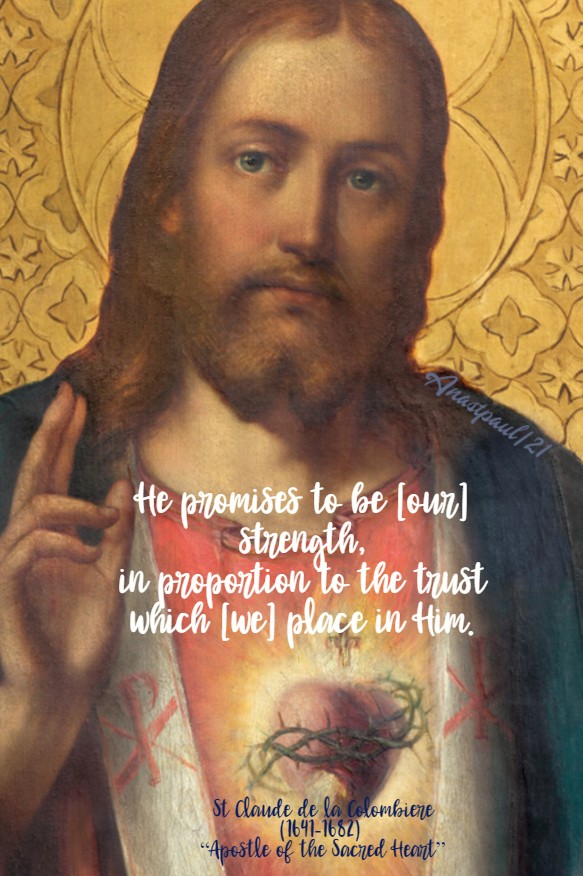
“He promises to be [our] strength, in proportion to the trust which [we] place in Him.”
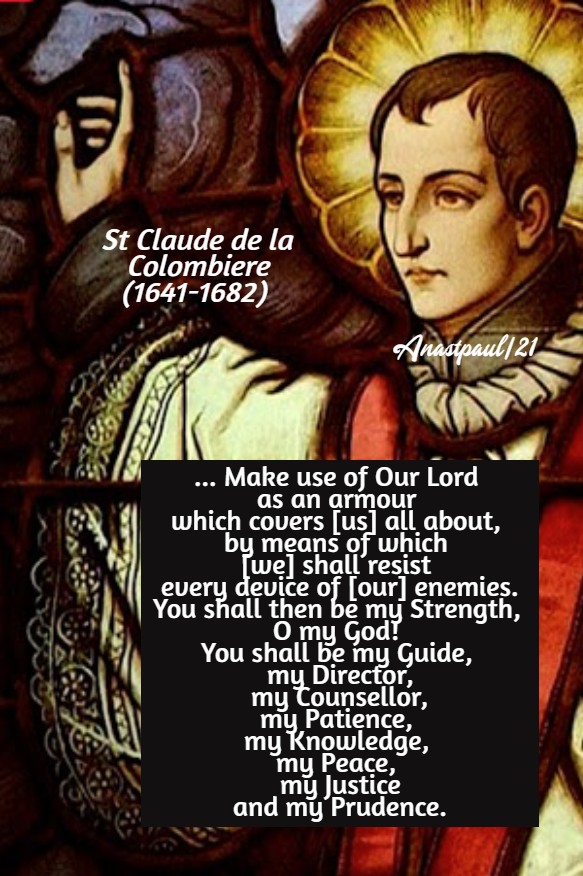
“… Make use of Our Lord as an armour which covers [us] all about, by means of which [we] shall resist every device of [our] enemies. You shall then be my Strength, O my God! You shall be my Guide, my Director, my Counsellor, my Patience, my Knowledge, my Peace, my Justice and my Prudence.”
“[Prayer] is the one means for our purification, the one way to union with God, the one channel by which God may unite Himself with us, that He may do anything with us, for His glory. To obtain the virtues of an apostle, we must pray; to make them of use to our neighbour, we must pray; to prevent our losing them, while we use them in His service, we must pray. The counsel, or rather the commandment: Pray always, seems to me extremely sweet and by no means impossible. It secures the practice of the presence of God …”
St Claude de la Colombiere (1641-1682) “Apostle of the Sacred Heart”
One Minute Reflection – 15 February – Readings: Genesis 4:1-15, 25, Psalms 50:1 and 8,16-17, 20-21, Mark 8:11-13 and the Memorial of St Claude de la Colombiere SJ (1641-1682) “Apostle of the Sacred Heart”
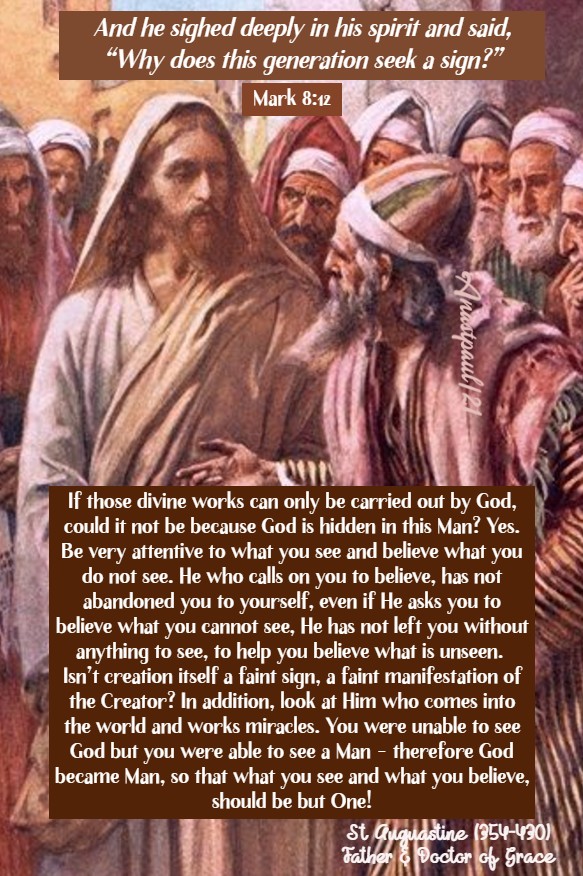
And he sighed deeply in his spirit and said, “Why does this generation seek a sign?” – Mark 8:12
REFLECTION – “Admire God’s wonderful work, come out of your sleep. Are you only going to admire extraordinary miracles? But are they any greater than those that daily take place before your eyes? Are people astonished because our Lord Jesus Christ satisfied several thousand persons with five loaves (Mt 14,19f) and are not surprised that a few seeds are enough to cover the ground with abundant harvests? They are filled with wonder when they see our Saviour change water into wine (Jn 2,19); isn’t it the same thing when rain goes through the roots of the vine? The author of both these miracles is the same…
Our Lord worked miracles and yet many despised him… They said to themselves : ‘The works are divine but, as for Him, he is only a man.’ Therefore, you see two things: divine works on the one hand and a Man on the other. If those divine works can only be carried out by God, could it not be because God is hidden in this Man? Yes. Be very attentive to what you see and believe what you do not see. He who calls on you to believe, has not abandoned you to yourself, even if He asks you to believe what you cannot see, He has not left you without anything to see, to help you believe what is unseen. Isn’t creation itself a faint sign, a faint manifestation of the Creator? In addition, look at Him who comes into the world and works miracles. You were unable to see God but you were able to see a Man – therefore God became Man, so that what you see and what you believe, should be but One!” – St Augustine (354-430) Bishop of Hippo (North Africa), Father and Doctor of the Church – Sermon 126, 4-5
PRAYER – Almighty Lord and God, protect us by Your power throughout the course of this day, even as You have enabled us to begin it. Your grace is all that we need, to see the loving kindness of Your Son, our Lord Jesus in all we see and do and think. Do not let us turn aside from His path but by the faith You have granted us, let us find meaning in all, which is the sign of Your glory. Do not let us turn aside to sin and may the intercession of St Claude de la Colombiere (1641-1682), grant us courage and peace. Through Jesus Christ, our Saviour, with the Holy Spirit, God now and forever, amen.
Our Morning Offering – 15 February – The Memorial of St Claude de la Colombiere SJ (1641-1682) “Apostle of the Sacred Heart”
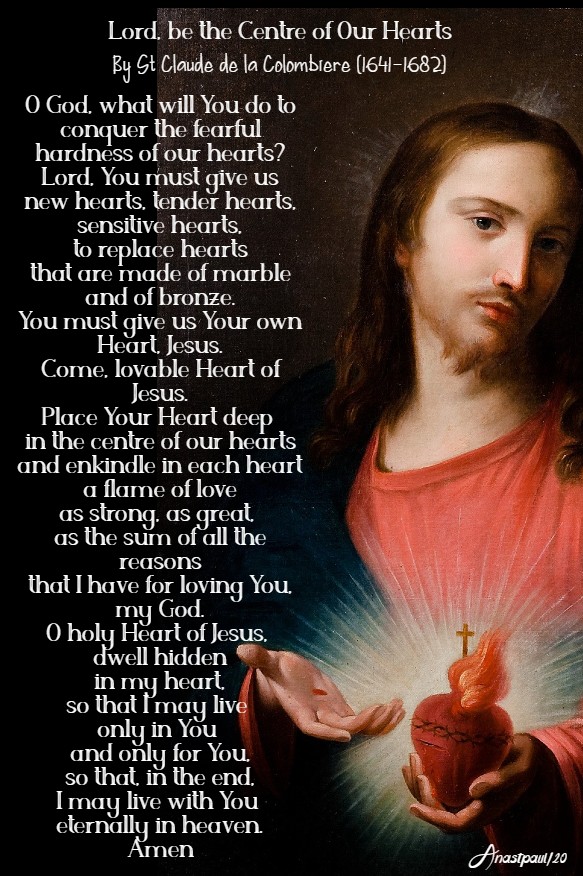
Lord, be the Centre of Our Hearts By St Claude de la Colombiere
O God, what will You do to conquer the fearful hardness of our hearts? Lord, You must give us new hearts, tender hearts, sensitive hearts, to replace hearts that are made of marble and of bronze. You must give us Your own Heart, Jesus. Come, lovable Heart of Jesus. Place Your Heart deep in the centre of our hearts and enkindle in each heart a flame of love as strong, as great, as the sum of all the reasons that I have for loving You, my God. O holy Heart of Jesus, dwell hidden in my heart, so that I may live only in You and only for You, so that, in the end, I may live with You eternally in heaven. Amen
Saint of the Day – 15 February – Blessed Angelus de Scarpetti OSA (Died c 1306) Religious of the Order of the Hermits of St Augustine, Missionary, miracle-worker. Born at Borgo San Sepolcro modern Sansepolcro, Italy and died in 1306 at Borgo San Sepolcro modern Sansepolcro, Italy. Also known as – Angelo de Scarpetti, Angelus of Sansepolcro, Angelo of Borgo San Sepolcro
Angelus was born into the Scarpetti family in Sansepolcro, Italy, in the first half of the thirteenth century. He entered the convent in his city of the Hermits of St John the Good in approximately 1254. In 1256 the convent passed to the new Order of the Hermit Friars of St Augustine. There he became a fellow-student with Saint Nicholas of Tolentino.
He was sent to England as a Missionary but we have little information of his time there.
His reputation for sanctity was endowed by some miraculous episodes that occurred during his lifetime, including the resurrection of an innocent man who was condemned to death. Angelus had made a formal request for the innocent man’s pardon but it was refused and the man was executed. However, by Angelus’ fervent entreaties to the only Judge, the man was raised to life.
Since the sixteenth century, Augustinian writers have noted his profound humility, unflinching charity and his spotless purity of spirit and body. All of these gained him, among his countrymen, renown as a man acceptable to God, who God made full of supernatural gifts.
Angelus died in Sansepolcro in 1306. In 1905 the local Diocese began the process for his Beatification, which reached a successful conclusion in 1922.
His body is currently kept in a carved, gilt wooden casket that is decorated with scenes from his life and is kept under the main altar of the Church of Sant’Agostino in Sansepolcro.
Angelus was Beatified on 27 July 1921 by Pope Benedict XV.
Notre-Dame de Paris / Our Lady of Paris, France (522) – 15 February:
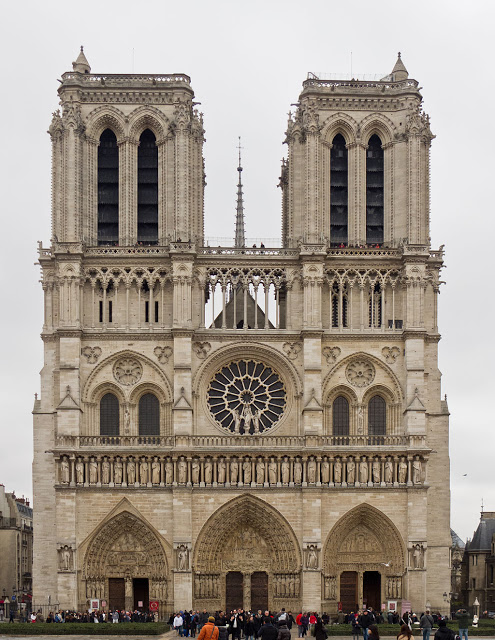
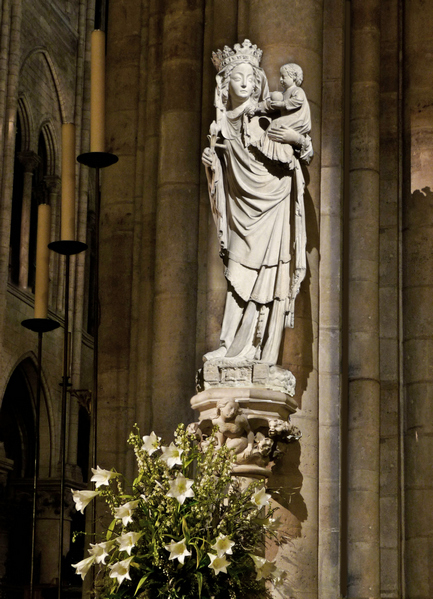
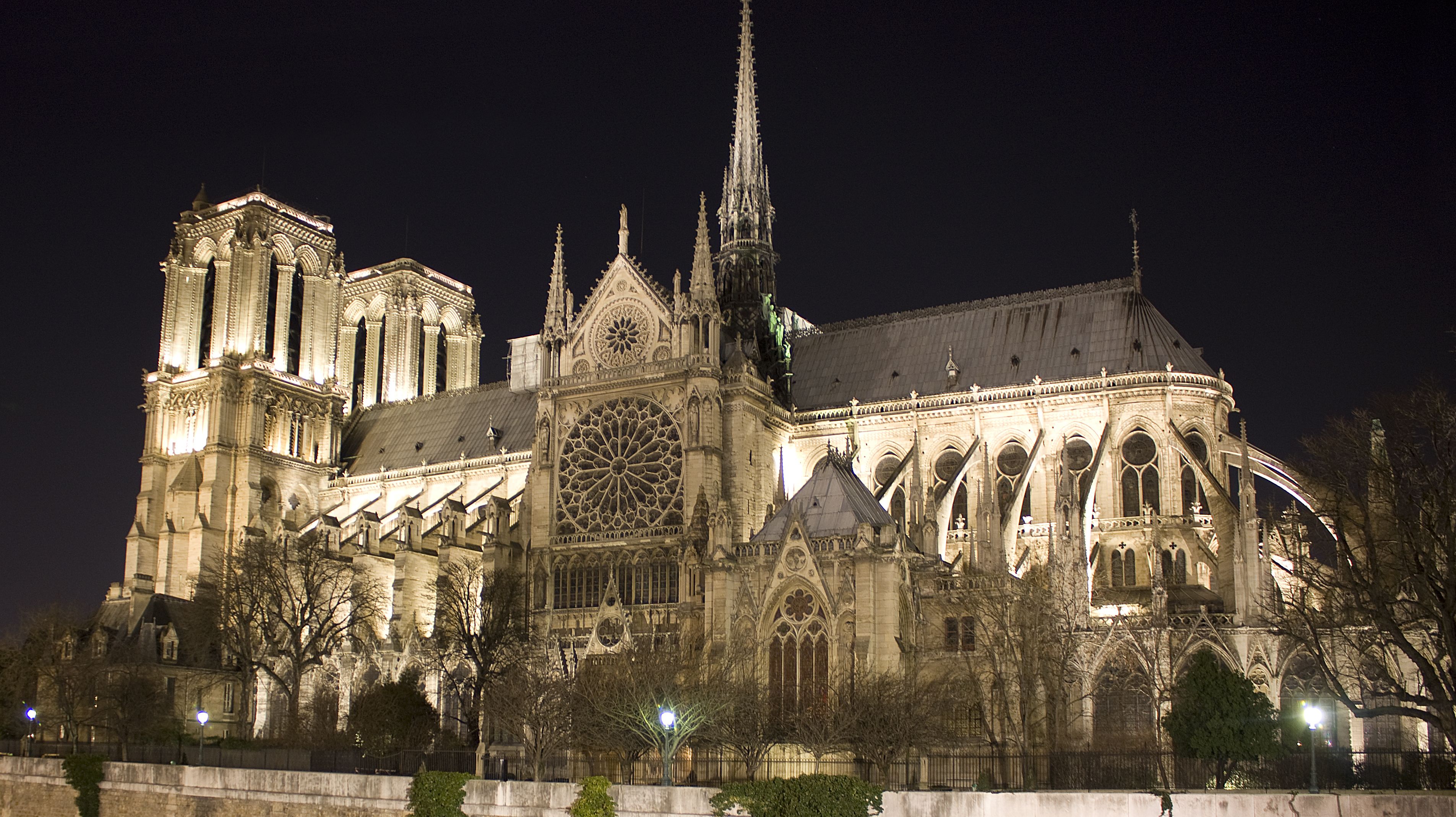
There does not seem to be a great deal of information about Our Lady of Paris; it is an ancient title and can be traced well back before the 12th Century, when the Cathedral of Notre Dame de Paris (Our Lady of Paris) was begun. Some authorities say that veneration of the Blessed Virgin in Paris can be traced to the first apostles of the city. Since Saint Paul was in Gaul (France) during his travels, it may be assumed that this veneration dates to the first century of the Christian era. And, if Mary was venerated in Paris at that early date, it is possible that she was, even then, known as Our Lady of Paris. Briefly, as long as Christian minds can remember, Paris was consecrated to the Virgin Mary, whom the inhabitants always venerated. It is known that Our Lady of Paris was a Church first built by King Childebert in the year 522. About the year 1257, the King, Saint Louis IX assisted in the construction of a larger Church carried on in the same place, on the foundations which King Philip Augustus had laid in the year 1191. The older Church built by King Childebert, which had been dedicated to the Blessed Virgin, had became too ruinous to be repaired, so Maurice, Bishop of Paris, decided to rebuild it and, at the same time, adorn Paris with a Cathedral that would outshine all those which had hitherto been built anywhere.
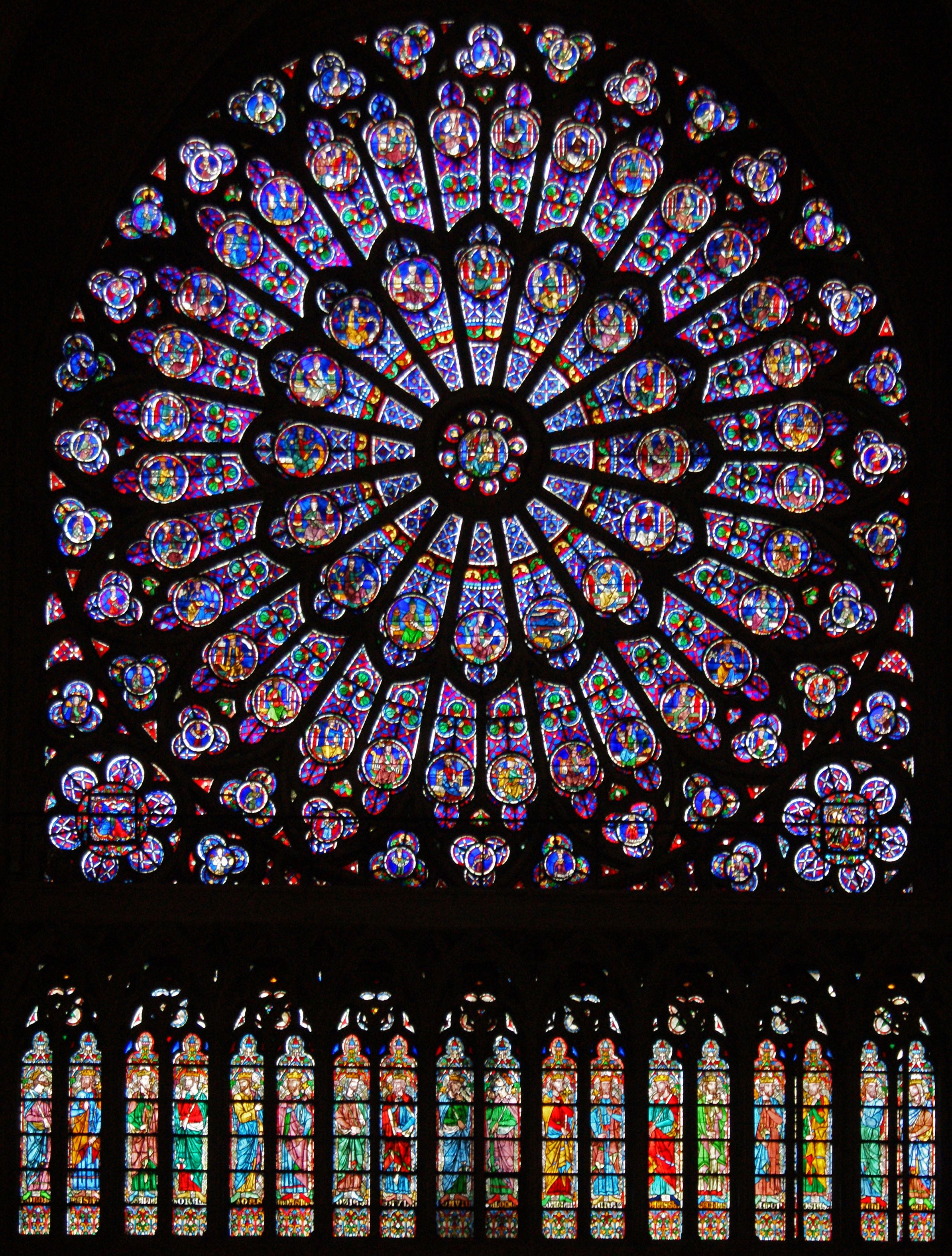
Plans were drawn up during the reign of King Louis VII and work had actually begun on Notre Dame de Paris, Notre Dame Cathedral, in 1162. The cornerstone was laid in the presence of Pope Alexander III. Notre Dame is a huge Gothic Cathedral on the Ile de la Cite, with beautiful flying buttresses to support the tremendous height of the walls and are adorned with stylish gargoyles. It is home to a reliquary which contains Christ’s Crown of Thorns. By the beginning of the fourteenth century, perhaps 1345, the Cathedral was finished, virtually as it stands today. Sometime during the building of the Cathedral, a statue of Our Lady was fashioned and installed in place. As was typical, the Cathedral was desecrated during the French Revolution and many of the religious artifacts were lost to future generations, although the incredible stained glass windows were not destroyed, including the three spectacular “rose window” that can still be seen today.
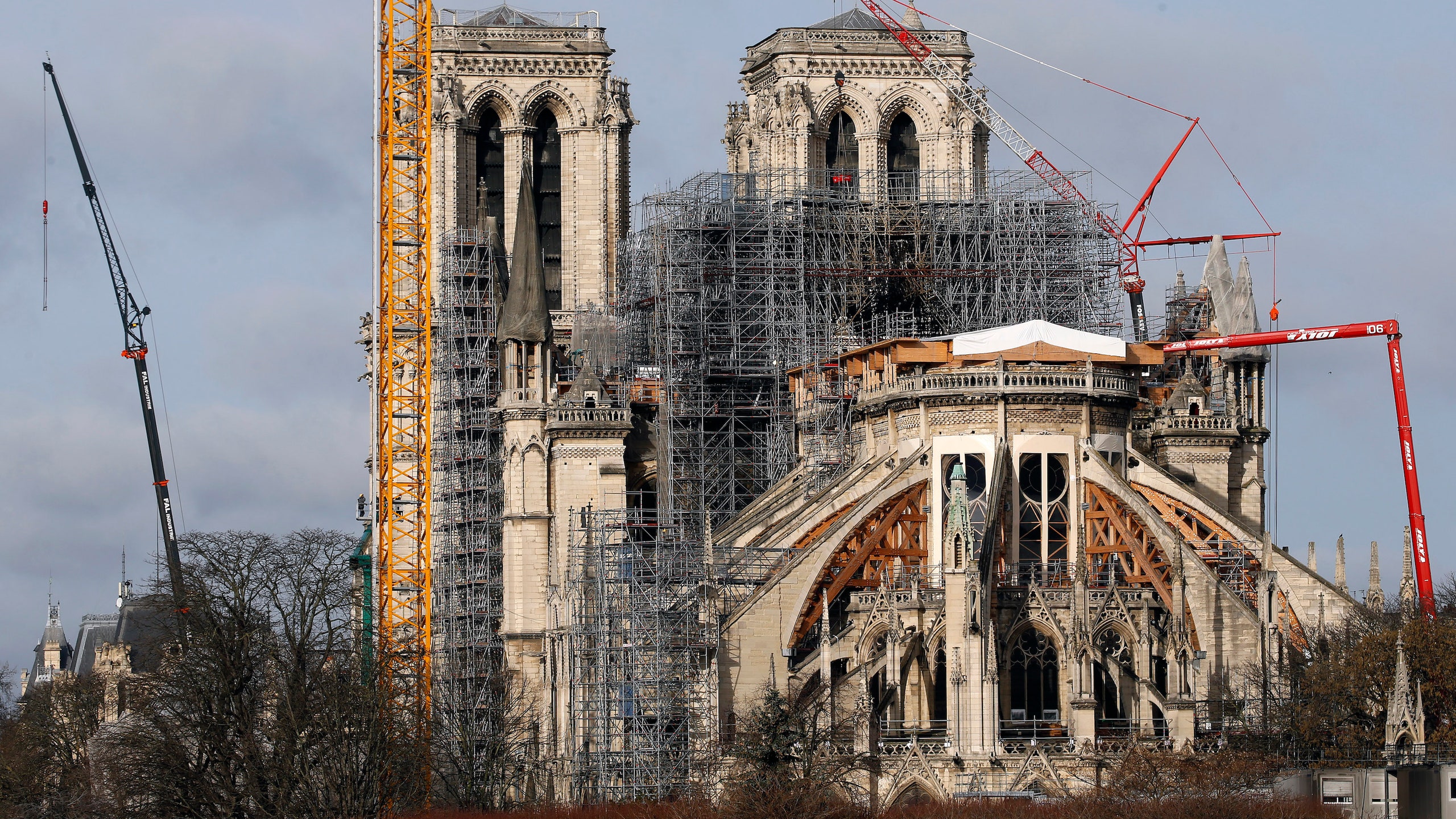
A smoke detector first alerted building staff to a fire beneath the roof at 6:18 pm on 15 April 2019, f Notre-Dame de Paris. By the time it was extinguished, the building’s spire collapsed and most of its roof had been destroyed and its upper walls severely damaged. Extensive damage to the interior was prevented by its stone vaulted ceiling, which largely contained the burning roof as it collapsed.
The restoration in early 2020
Many works of art and religious relics were moved to safety early in the emergency but others suffered some smoke damage and some exterior art was damaged or destroyed. The Cathedral’s altar, two pipe organs, and its three 13th-century rose windows suffered little to no damage.
The Nave before the fireThe Nave after the fire
Three emergency workers were injured. French President, Emmanuel Macron, said that the Cathedral would be restored by 2024 and launched a fundraising campaign which brought in pledges of over €1 billion as of 22 April 2019. A complete restoration could require twenty years or more. On 25 December 2019, the Cathedral did not host ChristmasMass for the first time since 1803.
Martyrs of Passae: Castulus Lucius Magnus Saturninus
Martyrs of Prague – 14 beati – Franciscan Friars Minor martyred together by a mob led by Lutherans – • Blessed Antonín of Prague • Blessed Bartolomeo Dalmasoni • Blessed Bedrich Bachstein • Blessed Christoffel Zelt • Blessed Didak Jan • Blessed Emmanuel of Prague • Blessed Gaspare Daverio • Blessed Giovanni Bodeo • Blessed Girolamo degli Arese • Blessed Jakob of Prague • Blessed Jan of Prague • Blessed Juan Martínez • Blessed Klemens of Prague • BlessedSimon of Prague They were martyred on • Shrove Tuesday 15 February 1611 at the Church of Our Lady of the Snows in Prague, Czech Republic • body dumped nearby but given Christian burial on 19 February 1611 in the monastery • re-interred in the side chapel of the church in 1616. Beatified 13 October 2012 by Pope Benedict XVI
Martyrs of Sweden: Sigfrid Sunaman Unaman Winaman
Martyred in the Spanish Civil War: Bl Pere Vallmitjana Abarca



















 AnaStpaul
You must be logged in to post a comment.