Our Morning Offering – 13 February – Thursday of the Fifth Week of Ordinary Time, Year A
Let Your will be mine By Thomas à Kempis (1380-1471)
Most kind Jesus, grant me Your grace, I pray,
let it dwell in me, work in me
and abide in me to the end.
Grant me always to will
and desire, whatever is most pleasing
and acceptable to You.
Let Your will be mine
and let my will ever follow
and be conformed wholly to Your own.
Let me ever will
and not will in union with Yourself
and be unable to will otherwise
than You will or do not will.
Grant that I may die to all things in this world
and for Your sake, love to be despised and unknown.
Grant me, above all else, to rest in You,
that my heart may find its peace in You alone,
for You are the heart’s true peace,
it’s sole abiding place
and outside Yourself, all is hard and restless.
In this true peace that is in You,
the sole, supreme and eternal Good,
I will dwell and take my rest.
Amen
Saint of the Day – 13 February – Blessed Archangela Girlani O.Carm (1460-1494) Virgin, Carmelite Nun, Mystic with the gift of levitation – born Elanor Girliani in 1460 at Trino, on Monte Ferrato in northern Italy and died on 25 January 1494 (aged 33) in Mantua, Milan, Italy. Blessed Archangela founded a new Carmelite monastery in Mantua. Her body is incorrupt.
Eleanor Girlani was born in the small Italian town of Trino (Piedmont). She demonstrated great piety and holiness as a child. Despite her family’s noble heritage, her only ambition in life was to become a Benedictine sister and together with some friends and relatives, she prepared to travel to the monastery of Rocca delle Donne, who had agreed to accept and raise her as a member of the Order. However, this was not to occur . Upon mounting her horse to travel, the animal refused to carry her to the monastery. As this particular horse was one of gentle and obedient spirit, the animal’s refusal to move was interpreted as a sign from the Lord and Eleanor returned home. Despairing, she prayed for guidance and contented herself in her own daily practices of contemplation, penance and service to others.
Eleanor soon encountered a Carmelite monk, who introduced her to the sisters of the Carmelite Order. Understanding this as divine intervention, Eleanor sought admission, and was accepted into the Order on her seventeenth birthday. She lived and served in the convent of Maria Maddalena in Parma, along with her sisters Mary and Scholastica.
Eleanor received the veil as a Carmelite sister at age eighteen, taking the name Archangela as her own. She was made Prioress of the abbey, given her nobility (as was the custom of the time) and became a model of Christian virtue to her sisters. Especially devoted to the Holy Trinity, Archangela spent hours in the chapel praying and contemplating the divinity of the Lord.
Sister Archangela soon was requested to found an additional abbey in Mantua, which was named Santa Maria del Paradiso (The Convent of Mary in Paradise). There, under her direction, sisters of the Order lived as if already absorbed into heaven. The monastery developed a reputation for great holiness, and received many new sisters. As prioress, Archangela experienced great ecstasies, some lasting well over 24 hours and on more than one occasion was discovered by her sisters to be levitating above the ground while contemplating the Holy Trinity. She further performed many miracles.
Only three years after founding the monastery at Mantua, Blessed Archangela fell gravely ill. Strengthened with the Sacraments and with her eyes fixed on an image of the Crucified Christ, she repeated her frequently uttered words: “Jesus, my Love”and peacefully died at the young age of thirty three. In fulfilment of her desire, she was buried in the simplicity of a common grave at the monastery. Three years later, when the tomb was re-opened to commit another sister to the earth, her remains were found incorrupt and exuding the fragrance of holiness. Great miracles were reported and her relics were enclosed in a crystal tomb and placed above the alter at the monastery.
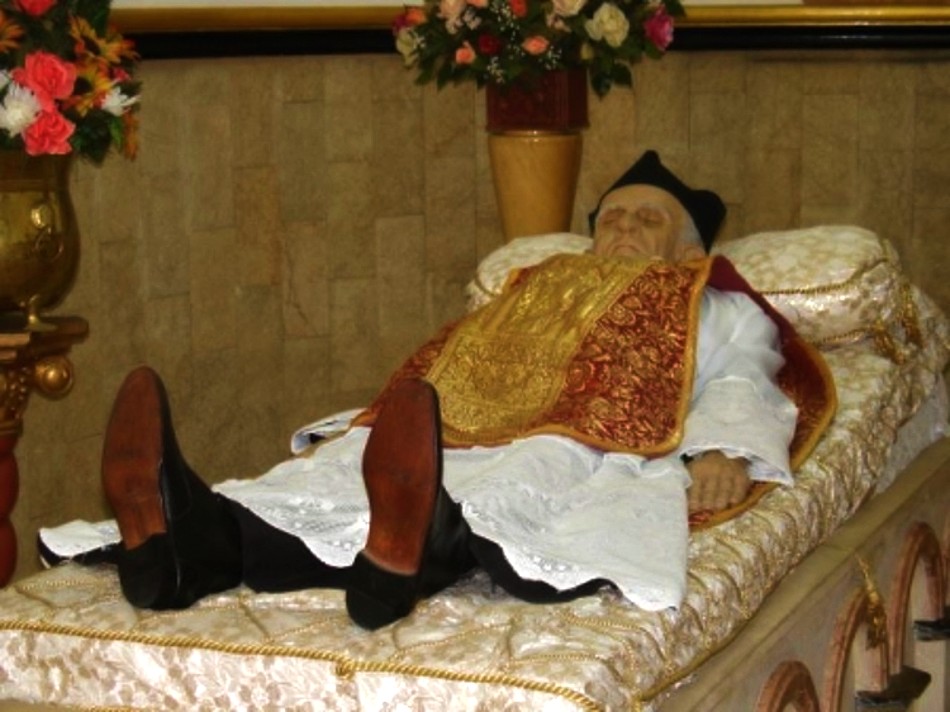
Nearly 300 years after her death, the monastery in Mantua was closed and Archangela’s relics were translated to Trino, where she had been born. Her relics, still venerated today, were placed in the church of Saint Lorenzo. There, her body rests, wearing the habit of Carmelites, in a casket of crystal. Pope Pius IX confirmed her cultus and Beatified her on 1 October 1864.
The life of Blessed Archangela is one of deep faith and commitment to the Lord. Willing to reconsider her own plans for those that the Lord placed before her, Archangela served and followed wherever the Holy Spirit led her.
Prayer
Father in heaven,
you gave the virgin Blessed Archangela Girlani
particular dedication to the mystery of the eternal Trinity.
Through her prayers
may we taste the delights of Your glory
already here on earth
and look upon You forever in heaven.
We ask this through Christ, our Lord.
St Julian of Lyon
St Lucinus of Angers
St Marice
St Martinian the Hermit
St Maura of Ravenna
St Modomnoc
St Paulus Lio Hanzuo
St Peter I of Vercelli
St Phaolô Lê Van Loc
St Stephen of Lyons
St Stephen of Rieti
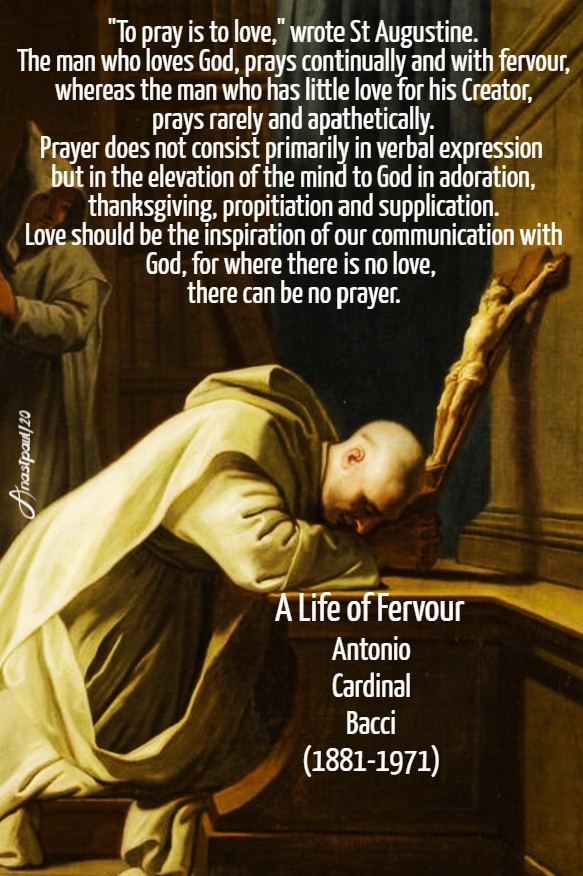
Thought for the Day – 12 February – Meditations with Antonio Cardinal Bacci (1881-1971)
Self-Love
“By self-love we mean here, an inordinate love of self. We are not forbidden to love ourselves. In fact, this is something natural to us and, therefore, intended by God. We should love ourselves, however, in a properly ordered manner. In the first place, we must love God above everything and, therefore, more than ourselves. God is our creator and our Redeemer and our final end. Everything comes to us from Him and for this reason, everything must return to Him. We should not be self-centred but, God-centred. In other words, we must direct all our actions towards God, not towards ourselves. We cannot set our own ego in the place which belongs to God, still less above Him. To do so, would be equivalent of robbing God, because everything is His and we ourselves belong to Him. If we have any intelligence at all, let us remember that God gave it to us. If we have sound health, strength, or good looks, let us remember, that these are His gifts. If we have amassed a great store of cultural or artistic learning as a result of our ability and study, let us not become too attached to it, nor look for praise and admiration. It is God who gave us this ability and the energy and enthusiasm to cultivate it. Honour and glory are due to God alone!“
Quote of the Day – 12 February – The Memorial of St Eulalia of Barcelona (c 290-c 303) Virgin and Martyr
Lord Jesus Christ, hear my prayer and perfect Thy merciful goodness in me and grant me to be received among the number of Thine elect into the rest of life eternal, making of me a sign of righteousness that men, believing in Thee, may behold and praise Thy power. Amen.
One Minute Reflection – 13 February – Wednesday of the Fifth week in Ordinary Time, Year A, Readings: 1 Kings10:1-10, Psalm 37:5-6, 30-31, 39-40, Mark7:14-23 and the Memorial of St Eulalia of Barcelona (c 290-c 303) Virgin and Martyr
And he said, “What comes out of a man is what defiles a man. For from within, out of the heart of man, come evil thoughts, fornication, theft, murder, adultery, coveting, wickedness, deceit, licentiousness, envy, slander, pride, foolishness. All these evil things come from within and they defile a man.” Mark 7:20-23
REFLECTION – “The boundary between good and evil does not pass outside of us but rather within us. We could ask ourselves: where is my heart? Jesus said: “Where your treasure is, there will your heart be also.” What is my treasure? Is it Jesus, is it His teaching? If so, then the heart is good. Or is my treasure something else? Thus it is a heart which needs purification and conversion. Without a purified heart, one cannot have truly clean hands and lips which speak sincere words of love — it is all duplicitous, a double life — lips which speak words of mercy, of forgiveness but only a sincere and purified heart can do this.”…Pope Francis – Angelus, 30 August 2015
PRAYER – God our Saviour, through the grace of Baptism, You made us children of light. Hear our prayer, that we may always walk in that light and work for truth, as Your witnesses before men. May our hearts be purified by You grace and may our hands and lips speak with sincere words of love. St Eulalia of Barcelona, child as you were, you bravely withstood all the assaults against Christ your Lord, with zeal and passion, please pray for us. We make our prayer, through Christ our Lord with the Holy Spirit, God forever, amen.
Our Morning Offering – 12 February – Wednesday of the Fifth Week in Ordinary Time, Year A
Only for You, in You, by You By St Augustine (354-430) Father & Doctor of the Church
Lord Jesus,
let me know myself and know You
and desire nothing save only You.
Let me hate myself and love You.
Let me do everything, for the sake of You.
Let me humble myself and exalt You.
Let me think of nothing, except You.
Let me die to myself and live in You.
Let me accept whatever happens, as from You.
Let me banish self and follow You
and ever desire to follow You.
Let me fly from myself and take refuge in You,
That I may deserve, to be defended by You.
Let me fear for myself.
Let me fear You
and let me be among those, who are chosen by You.
Let me distrust myself and put my trust in You.
Let me be willing to obey, for the sake of You.
Let me cling to nothing, save only to You,
And let me be poor, because of You.
Look upon me, that I may love You.
Call me, that I may see You
and forever enjoy You.
Amen
Saint of the Day – 12 February – Saint Eulalia of Barcelona (c 290-c 303) Virgin and Martyr, Sanctified Virgin, forerunner of professed nuns. She was martured at the aged of 13 or 14. Born c 290 in Barcelona, Spain and died on 12 February 304 in Barcelona. Patronages – Barcelona, Barcelona Cathedral, against drought, against dysentery, boatmen, mariners, pregnant women, for rain, safe sailing, safe seafaring, sailors, travellers, watermen.
Saint Eulalia (Aulaire, Aulazia, Olalla, Eulària) (c 290–12 February 303) was a 13-year-old Christian virgin who suffered martyrdom in Barcelona during the persecution of Christians in the reign of emperor Diocletian. There is some dispute as to whether she is the same person as Saint Eulalia of Mérida, whose story is similar.
For refusing to recant her Christianity, the Romans subjected her to thirteen tortures, including – putting her into a barrel with knives (or glass) stuck into it and rolling it down a street (according to tradition, the one now called Baixada de Santa Eulalia “Saint Eulalia’s descent”), cutting off her breasts, crucifixion on an X-shaped cross. She is depicted with this cross, the instrument of her martyrdom. Finally, she was decapitated. A dove is supposed to have flown forth from her neck following her decapitation.
This is one point of similarity with the story of Eulalia of Mérida, in which a dove flew from the girl’s mouth at the moment of her death. In addition, Eulalia of Mérida’s tortures are sometimes enumerated among the Barcelona martyrs and the two were similar in age and year of death. St Eulalia was Canonised in 633.
Eulalia is commemorated with statues and street names throughout Barcelona. Her body was originally interred in the church of Santa Maria de les Arenes (St Mary of the Sands, now Santa Maria del Mar, St Mary of the Sea). It was hidden in 713 during the Moorish invasion and only recovered in 878. In 1339, it was relocated to an alabaster sarcophagus in the crypt of the newly built Cathedral of of the Holy Cross and St Eulalia. The festival of Saint Eulalia is held in Barcelona for a week around her feast day on 12 February.
One of the most well-known and endearing parts of the Cathedral of the Holy Cross and Saint Eulalia of Barcelona is the crypt of Saint Eulalia. The magnificent Gothic tomb incorporates Romanesque elements from other sources, such as the bases and capitals holding up the structure of the polychromed marble sarcophagus solemnly inaugurated in 1339. The sculptor is known to have come from the region of Pisa.
St Eulalia’s the sarcophagus is crowned by five images – four angels with candlesticks and, in the centre, the image of the Eulalia. The crypt has a keystone representing the Saint Eulalia and the Christ Child placing a crown on the Saint of Barcelona.
Behind the Gothic sepulchre is the original sepulchre of Saint Eulalia, which was found by the bishop Frodoino in 878 in the cemetery of Santa María del Mar and a piece of broken marble with the original inscription commemorating her.
Madonna del Pilerio: is the patron of the city of Cosenza and of the archdiocese of Cosenza-Bisignano. The Madonna del Pilerio is depicted in an icon dating back to the twelfth century that is found since 1607 in the chapel built specifically within the cathedral of Cosenza , commissioned by Msgr Giovani Battista Costanzo ( 1591 – 1617 ). On 10 May 1981, the cathedral of Cosenza was raised to the shrine of Our Lady of Pilerio by the Archbishop Msgr Dino Trabalzini. The patronal feast of Cosenza is not celebrated on 8 September the feast of Our Lady of Pilerio and date to which the Nativity of the Virgin is recognised but 12 February to remember the devastating earthquake that hit Calabria on that date in 1854.
Official Prayer to the Madonna del Pilerio
Virgin of Pilerio, Mother of the Church,
You are for us Support, Help and Hope.
We thank you and bless you
but above all we love you.
You are our tender Mother,
given to us by Christ on the Cross.
Listen to your children’s prayer.
Do not let us ever turn away from you.
Strengthen our faith in us,
sustain hope, revive charity.
May you praise the Father, the Son and the Holy Spirit forever and ever.
Amen
O Madonna del Pilerio, our glorious Patron, pray for us
St Alexius of Kiev
St Ammonius of Alexandria
Bl Anthony of Saxony
St Anthony Kauleas St Benedict of Aniane OSB (747-821) About St Benedict: https://anastpaul.wordpress.com/2018/02/12/saint-of-the-day-12-february-st-benedict-of-aniane-747-821-the-second-benedict/
Bl Benedict Revelli
St Damian of Africa
St Damian of Rome
St Ethelwald of Lindisfarne St Eulalia of Barcelona (c 290-c 303) Virgin Martyr
St Gaudentius of Verona
St Goscelinus of Turin
Bl Gregory of Tragurio
Bl Humbeline of Jully
St Jak Bushati
St Julian of Alexandria St Julian the Hospitaller About St Julian: https://anastpaul.wordpress.com/2017/02/12/saint-of-the-day-12-february-st-julian-the-hospitaller/
Bl Ladislaus of Hungary
Bl Ludan
St Meletius of Antioch
St Modestus of Alexandria
St Modestus of Carthage
St Modestus the Deacon
Bl Nicholas of Hungary
St Sedulius
Bl Thomas of Foligno
—
Martyrs of Albitina – 46 saints:
During the persecutions of Diocletian, troops were sent to the churches of Abitina, North Africa on a Sunday morning; they rounded up everyone who had arrived for Mass and took them all to Carthage for interrogation by pro-consul Anulinus. The 46 who proclaimed their Christianity were executed. We know some of their names and stories. They were tortured to death in 304 in prison at Albitina, North Africa.
Martyred in England:
Bl George Haydock
Bl James Fenn
Bl John Nutter
Bl John Munden
Bl Thomas Hemeford
Martyred in the Spanish Civil War:
Josep Gassol Montseny
Thought for the Day – 11 February – Meditations with Antonio Cardinal Bacci (1881-1971)
The Love of Our Neighbour
“The Gospel not only commands us to love God above all things but also, to love our neighbour as ourselves (Cf Mt 13:35-40). The Christian love of our neighbour, flows necessarily from the love of God. Our Creator loves all men as His own sons. Therefore, we ought to love one another as brothers, even as Our Lord loves us. We should see, in our neighbour, especially if he is in need, the person of Christ Himself, our elder brother, “the first-born among many brethren” (Rom 8:29).
If men sincerely loved one another, not merely as brothers but as much as they love themselves, what problems would be solved! Who can say how many evils would be abated and how many sorrows would be assuaged? To transform the world, it would be enough to put into practice the first great commandment of the Gospel, which is the commandment of charity. Admittedly, the world would not become an earthly paradise, for any such Utopia is an impossibility. But, it would become a dignified dwelling place of brothers, loving and helping one another. “Love is the fulfilment of the law,” St Paul very truly says (Rom 13:10). “Have charity, which is the bond of perfection” (Col 3:14).
Quote/s of the Day – 11 February – The Memorial of Our Lady of Lourdes and St Pope Gregory II (669-731)
“I am the Immaculate Conception.”
Our Lady of Lourdes to St Bernadette
25 March 1858
St Pope Gregory II “Defender of Icons”
Here is an excerpt of one of his letters to the Emperor of the Eastern Roman Empire, Leo III the Isaurian, who became an iconoclast and issued an imperial decree forbidding the use of sacred images:
“The pious Emperors were submissive to the Pontiffs of the Church and never dishonoured them. You, on the contrary, since the day when you apostatised from the Faith, incurring the same curse that [in previous letters] you made against those who persecute sacred ministers and condemning yourself by your own decree, you have separated yourself from the Holy Ghost and you do persecute and tyrannise us, by the hands of your soldiers and earthly weapons. We do not have weapons or armies but we invoke the King of the whole Universe, Christ, Who is seated in Heaven over all the celestial powers and armies, to deliver you to Satan, as the Apostle says, in the flesh and the spirit.
We are travelling to the far East to assist those who are asking for Baptism. I had already sent Bishops and priests from my Church to them. The Princes of those places have not yet been washed in the waters of the Baptism and they have chosen me as Godfather. So, we need to be on our way, fearful lest one day God will ask an account for our negligence.
I pray God to give you prudence and repentance so that you will return to the truth that you left and bring the people to the bosom of the Catholic Church.”
One Minute Reflection – 11 February – Tuesday of the Fifth week in Ordinary Time, Year A, Readings: 1 Kings 8:22-23, 27-30, Psalm 84:3-5, 10-11, Mark 7:1-13 and the Memorial of Our Lady of Lourdes
“This people honours me with their lips but their hearts are far from me” … Mark 7:6
REFLECTION – “Well, let us imagine that within us is an extremely rich palace, built entirely of gold and precious stones, in sum, built for a lord such as this. Imagine, too, as is indeed so, that you have a part to play, in order for the palace to be so beautiful, for there is no edifice as beautiful as is a soul pure and full of virtues. The greater the virtues the more resplendent the jewels.
Imagine, also, that in this palace dwells this mighty King who has been gracious enough to become your Father and, that He is seated upon an extremely valuable throne, which is your heart. (…)
You will laugh at me, perhaps and say that what I’m explaining is very clear and you’ll be right, for me, though, it was obscure for some time. I understood well that I had a soul. But what this soul deserved and who dwelt within it I did not understand because I had covered my eyes with the vanities of the world. For, in my opinion, if I had understood as I do now, that, in this little palace of my soul dwelt so great a King, I would not have left Him alone so often. I would have remained with Him at times and striven more so as not to be so unclean.
But what a marvellous thing, that He who would fill a thousand worlds and many more with His grandeur, would enclose Himself in something so small!” … St Teresa of Avila (1515-1582) Doctor of the Church – The Way of Perfection, ch. 28, 9-11
PRAYER – Grant us, O merciful God, protection in our weakness, that we, who keep the Memorial of the Immaculate Mother of God, may, with the help of her intercession, rise up from our iniquities. Grant, we pray that our lives may be gifts to all those who cry out in pain. Through our Lord Jesus Christ, your Son, Who lives and reigns with you in the unity of the Holy Spirit, One God, forever and ever, amen.
Saint of the Day – 11 February – Saint Pope Gregory II (669-731) “Defender of Icons” – Papacy began 19 May 715 – Papacy ended 11 February 731 the day of his death of natural causes. Pope Gregory was a man of immense intellect and used his talents in negotiating peace in times of war and fought for the truth of the faith against heresies. He was a miracle-worker who placed all his trust in God ‘s Divine Providence.
Gregory was born to noble parents, Marcellus and Honesta, around 669. As a very young man, he was brought to the papal court. During the reign of Pope Sergius I (687-701), he served as Subdeacon and paymaster/almoner. Later, he became a Deacon and was placed in charge of the Vatican library. By the time of Pope Constantine, Gregory was noted for his superior intelligence. He became Papal Secretary and was the main negotiator in Constantinople for the pope regarding the Quinsext Council documents.
Pope Constantine died on 9 April 715. Gregory was quickly elected and consecrated on the 19 May. He immediately began the repair of the city walls, requested by Pope Sisinnius several years before. As the repairs were underway, storms and major flooding of the Tiber damaged much in the city in October 716. Gregory ordered litanies to be said for the protection of Rome. The waters stopped at the foot of the Capitoline Hill.
Right away, Gregory had to, once again, defend orthodoxy against Monothelitism, the teaching that Christ had only one nature. Finally, in 716, Theodo, Duke of Bavaria, met with Gregory to discuss the continuing Christian conversions. Gregory sent delegates to Bavaria with instructions. His continuing interest in this country led him to consecrate St Corbinian Bishop of Freising.
Two years after meeting Theodo, Gregory met with Winfred, the Anglo-Saxon missionary. He changed the priest’s name to Boniface and commissioned him to preach in Germany. Over the years, letters of interest and congratulations were exchanged between the two. By 726, they were discussing new churches being built.
Gregory supported the Benedictine Monks and helped restore Monte Cassino, which had been severely damaged by the Lombards in 584. The Lombards were still difficult to deal with. In 717, the Duchy of Benevento captured a key spot cutting Rome off from Naples. Gregory had to fund Duke John I of Naples to retake the town. When the Lombard Duke Faroald II of Spoleto captured the port of Ravenna, Gregory brokered a deal to get it returned. The Lombards continued to take Italian territory in bits. He tried to mobilise Charles Martel, the Frank ruler but he had no success. When the iconoclast decrees of the Byzantine emperor occurred in 727, fighting began between the Byzantine forces and the Lombards. Gregory brokered a deal between King Liutprand and the Exarch of Ravenna. In 729, Gregory and Liutprand met and reached a truce, referred to as the Sutri agreement. The towns of Sutri and the hill towns in Latium were given to the Papacy. This was the beginning of the Papal States.
The iconoclast controversy began round 726, when the new emperor, Leo III, demanded that all images of saints be destroyed. He insisted that they cease being venerated. His followers argued a prohibition against venerating images found in the Old Testament. It could lead to idolatry, was the argument. Gregory argued for a symbolic veneration, in much the same way that we are reminded of our loved ones through photographs, nowadays. Gregory persevered in his faith, standing against the Byzantine emperor. He made it a point to counsel the people to be submissive to the authority put over them, however, not to the point of denying their faith. The pope wrote to Emperor Leo III, saying, “I pray God to give you prudence and repentance so that you will return to the truth that you left and bring the people to the bosom of the Catholic Church.” This became one of the largest arguments between Rome and Constantinople, leading, a few centuries later, to a split between the two which has never healed.
One of Pope Gregory’s miracles concerns the victory over Muslim forces at the Battle of Toulouse. According to the Liber Pontificalis, in 720 Pope Gregory sent to Odo, Duke of Aquitaine, “three blessed sponges/baskets of bread”. The Duke kept these and just before the battle outside of Toulouse, he distributed small portions of these to be eaten by his troops. After the battle, it was reported that no-one who had eaten a part of the bread had been killed or wounded.
Pope Gregory died on 11 February 731 after an exhausting 16 year reign. He is considered a saint in the Church, though never formally Canonised (pre-congregation).
28th World Day of the Sick +2020
and the 7th Anniversary of the Resignation of Pope Benedict XVI (his health was the major cause of his resignation)
—
St Ampelius of Africa
St Ardanus of Tournus
Bl Bartholomew of Olmedo St Caedmon (Died c 680) Biography of St Caedmon:
St Calocerus of Ravenna
St Castrensis of Capua
St Dativus the Senator
Bl Elizabeth Salviati
St Etchen of Clonfad
St Eutropius of Adrianopolis
St Felix the Senator
St Gobnata St Pope Gregory II (669-731)
Bl Gaudencia Benavides Herrero
St Helwisa
St Jonas of Muchon
St Lucius of Adrianople
St Pope Paschal I
St Pedro de Jesús Maldonado-Lucero
St Saturninus of Africa
St Secundus of Puglia
St Severinus of Agaunum
St Soter of Rome
St Theodora the Empress
Bl Tobias Francisco Borrás Román
—
Guardians of the Holy Scriptures: Also known as –
• Anonymous Martyrs in Africa
• Martyrs of Africa
• Martyrs of Numidia
• Martyrs of the Holy Books
A large number of Christians tortured and murdered in Numidia (part of modern Algeria) during the persecutions of Diocletian, but whose names and individual stories have not survived. They were ordered to surrender their sacred books to be burned. They refused. Martyrs. c 303 in Numidia.
Martyrs of Africa – 5 saints: A group of five Christians who were martyred together; we know nothing else but the names of four of them – Cyriacus, Oecominius, Peleonicus and Zoticus.
Thought for the Day – 10 February – Meditations with Antonio Cardinal Bacci (1881-1971)
The Love of God
“God’s law is founded on love. We read in the Gospel how the Pharisees asked Jesus which was the greatest commandment of the Law. Jesus replied: “Thou shalt love the Lord thy God with thy whole heart and with thy whole soul and with thy whole mind. This is the greatest and the first commandment. And the second is like it. Thou shalt love thy neighbour as thyself. On these two commandments depend the whole Law and the Prophets” (Mt 22:37-40).
If a man wants to know if he is living a good Christian life, therefore, all he has to do is ask himself if he loves God above everything and his neighbour as himself. If he lacks this love, he is not a true Christian – everything else is insignificant, if not useless. “Love God,” says St Augustine “and do what you will.” Why so? Because, if anyone loves God sincerely, he does not offend Him. Moreover, he serves Him diligently and promotes His honour and glory by every means in his power. Nor does he find it very difficult to do this. Love gives wings to his feet and pours enthusiasm and fervour into his heart. “He who loves does not feel tired,” says St Augustine. “Where there is love,” adds St Bernard, “there is no weariness but a gentle pleasure instead.”
Quote of the Day – 10 February – The Memorial of St Scholastica (c 482-543) Twin sister of St Benedict (c 482-547)
When he entered the house, the blind men came to him and Jesus said to them, “Do you believe that I am able to do this?” They said to him, “Yes, Lord.” Then he touched their eyes, saying, “According to your faith be it done to you.” And their eyes were opened. …
Matthew 9:28-30
“When she heard her brother refuse her request, the holy woman joined her hands on the table, laid her head on them and began to pray. As she raised her head from the table, there were such brilliant flashes of lightning, such great peals of thunder and such a heavy downpour of rain that neither Benedict nor his brethren could stir across the threshold of the place where they had been seated. Sadly he began to complain: “May God forgive you, sister. What have you done?” “Well,” she answered, “I asked you and you would not listen, so I asked my God and He did listen. So now go off, if you can, leave me and return to your monastery.” … (St Pope Gregory the Great (540-604) on St Scholastica)
“I asked you and you would not listen, so I asked my God and He did listen.”
One Minute Reflection – 10 February – Monday of the Fifth Week of Ordinary Time, Year A, Readings: 1 Kings 8:1-7, 9-13, Psalm 132:6-10, Mark 6:53-56 and the Memorial of St Scholastica (c 482-547) Twin sister of St Benedict
“That they might touch only, the tassel on his cloak and as many as touched it were healed” … Mark 6:56
REFLECTION – “Jesus had planned a picnic for the tired apostles. What a picnic it turned out to be, for no sooner did they land at Gennesaret, than crowds recognised Him and ran to tell others about Him, so that wherever He went – to villages, towns or farms – they brought to Him the sick, lying on their mats and helped them to just touch the fringe of His cloak. This was profound personal faith, because all those who touched Him were cured. Such faith had to be fully and suitably blessed and rewarded.
Faith is not merely a series of formulae which we profess, nor is faith a bundle of pious practices.
Faith is touching and being touched by Jesus.
The more we believe, the more shall we receive!” … Msgr Alex Rebello – Wrexham, Wales – Daily Reflections 2020
PRAYER – O God, that You created the universe so wondrously but more wondrously you created redemption. To Your divine Son, who came to repair us and lead us to You, to take on our pain and heal us of our sin, we turn in trust and wonder and touch Him. May the prayers of St Scholastica help us to grow in faith. Through Christ our Lord, with the Holy Spirit, God forever, amen.
Our Morning Offering – 10 February – Monday of the Fifth Week of Ordinary Time, Year A
Prayer of Abandonment By Blessed Charles of Jesus de Foucauld (1858-1916) Martyr
Br Charles’ Meditation on the last words of Jesus
Father,
I abandon myself into Your hands.
Do with me what You will.
Whatever You may do,
I thank You.
I am ready for all,
I accept all.
Let only Your will be done in me
and in all Your creatures.
I wish no more than this, O Lord.
Into Your hands
I commend my soul.
I offer it to You
with all the love of my heart.
For, I love you, Lord,
and so need to give myself,
to surrender myself into Your hands
without reserve
and with boundless confidence.
For You are my Father.
Amen
What we know as the ‘Prayer of Abandonment’ is not a prayer which Brother Charles wrote for any eventual companions, or even one he prayed himself. Rather it came from one of his meditations on the Gospel in relation to the ‘cardinal virtues’. These texts were written by Brother Charles in 1896 towards the end of his time with the Trappists at Akbes (Syria). At that time he was still called by his monastic name Brother Marie-Alberic. In fact it is a prayer which he puts on the lips of Jesus and which cannot be said by anyone but Jesus. So it is only with Jesus that we can recite it.
If it has become such an important prayer for the members of his Spiritual Family, it is then, because they are aware that we can never say it alone. We pray it with Jesus. With Jesus’ help, let us grow in this spirit of abandonment uniting ourselves to Him in his trusting abandonment to the Father.
This prayer invites us to unite ourselves to Jesus. It seeks to trace a path for our life’s journey with God and with humanity. It is the path which Jesus travelled before us. We are encouraged to give ourselves in confident abandonment to the Father.
Saint of the Day – 10 February – Saint William the Hermit (Died 1157) Hermit, Penitent, Spiritual Director, Miracle-worker, gifted with the charism of Prophecy. Patronages – armourers, blacksmiths, tinsmiths, Laoag City – Diocese of, San Fernando – Diocese of. He is also known as St William of Maleval and St William the Great.
St William by Antonio Nasini (1643–1715)
St William neither founded a Religious Order nor wrote a Rule of life. But two of his followers formed the Order of Saint William, also known as Williamites, shortly after William’s death. One of them, named Albert, composed a Rule, which he entitled The Rule of St William. He also wrote the life of St William, which sadly has been lost.
At the time of the Augustinian Grand Union in 1256, when many diverse religious groups were incorporated into the Augustinian Order, the Williamites were among those who became Augustinians. However, this union did not work well and many former Williamites withdrew from the Augustinians a short time later. Nevertheless, Augustinians have venerated Saint William since the thirteenth century.
Little is known about the early life of William, who is thought to have been born in France. His youth and young adulthood were spent in the army, living freely and licentiously, common among soldiers of that time period. Through the grace of God, William came to understand the error of his ways and becoming penitent, made a pilgrimage to the tombs of the holy apostles in Rome. There, he begged an audience with Pope Eugenius III and upon receiving it, implored the Holy Father for pardon and prescriptive penance for his sinfulness.
Pope Eugenius encouraged William to make a pilgrimage to the Holy Land in 1145. William did as he was told and spent eight years journeying through the deserts of the Holy Land, visiting tombs, shrines, and holy places and communing with the desert hermits and learned scholars. Returning to Rome a changed man, he embraced the eremitical life, becoming a hermit on the isle of Lupacavio (near Pisa) in Tuscany. Wishing nothing more than to live in solitude and contemplate the Lord’s mercy and forgiveness, William found himself besieged by pilgrims and those seeking his spiritual counsel and guidance. He was convinced to lead and govern these pilgrims but found himself poorly suited for this task and failed to maintain discipline and austerity among the monks in his care. Unable to bear this, he travelled to Monte Bruno, where the same situation repeated itself. This time, he fared little better and organised the monks into an abbey.
Again, he withdrew from governing, realising that God’s plan for him was elsewhere. He embraced life as a hermit at Maleval (near Siena). There, he lived in an underground cave until a local lord built him a cell. William kept company with the wild beasts of the region and foraged for his food. He undertook extreme penances and austerities, in atonement for his earlier sinfulness. Sleeping only on the bare ground, eating only uncooked foods he could gather and drinking limited amounts of water, he devoted his waking moments to prayer, contemplation and manual labour. William also received the gifts of miracle-working and prophecy, for which he was frequently sought.
Saint William accurately predicted his death, on 10 February 1157 and he was buried by two disciples in his garden. These disciples, Albert and Renauld, continued to live and study together according to Saint William’s example. There numbers increased and they built a chapel and hermitage over their founder’s grave. The order, the Hermits of Saint William, spread throughout Europe and were known as the “Bare-Footed Friars” and the Williamites. Eventually, the order was incorporated into the Hermits of Saint Augustine but their tradition continues to this day.
St William’s cultus was confirmed, namely him Blessed by Pope Innocent III and Canonised by the same Pope in 1202.
Saint William’s life is marked by conversion, forgiveness and penance. We are reminded that we have all sinned, sometimes gravely but that through the grace of God, we are made new and forgiven. Throughout his life, Saint William never took the saving grace of the Lord for granted, spending his days in contemplation and wonder at the mercy and love of God. We are called to do the same, recognising our own sinfulness and humbly and contritely asking the Lord for forgiveness. Freed from the burden of our sins, like Saint William, we may find a world full of the beauty of God’s creation!
Bl Louise Bessay de la Voûte
Bl Louise Poirier épouse Barré
Bl Marie-Anne Hacher du Bois
Bl Marie-Louise du Verdier de la Sorinière
Bl Mikel Beltoja
Bl Paganus
Bl Paul of Wallachia
Bl Pierre Frémond
St Porfirio
St Prothadius of Besançon
St Salvius of Albelda
St Silvanus of Terracina
St Soteris the Martyr
St Troiano of Saintes
St Trumwin of Whitby St William the Hermit (Died 1157)
Martyred Soldiers in Rome: A group of ten Christian soldiers who were martyred together for their faith. We know little more about them but four of their names – Amantius, Hyacinth, Irenaeus and Zoticus. • 120 at Rome, Italy. They were buried on the Via Lavicana outside RomeAmantius, Hyacinth, Irenaeus, Zoticus.
Thought for the Day – 9 February – Meditations with Antonio Cardinal Bacci (1881-1971)
The Use of Creatures
“God has created all things for Himself, as He is the most perfect being and the final end of all things. He has made man supreme in the world, however and has made all other creatures subject to him (Cf Gen 1:28) This God-given supremacy over the universe continues, even after the fall of Adam. It can no longer be exercised without trouble and suffering, as it was in the state of innocence, however. Now, it must be acquired, by hard manual labour and by keen intellectual research and study. After man’s disobedience to God, even the relationship which existed between him and created things was disturbed. But these things are still a ladder which leads to God, if they are properly used. They are a distant reflection of His beauty and omnipotence. “The heavens,” says the Psalmist, “declare the glory of God and the firmament proclaims his handiwork” (Ps 18:2).
Let us listen to the voice of creation, for it speaks to us of God. St Therese of the Child Jesus wept when she beheld the fragile beauty of a flower and said, “How great is God’s love for us!” St Francis of Assisi saw the image of the common Creator everywhere around him and called all these things, including fire and water, his brothers and sisters. He even conversed with them in a simple way. He looked upon death itself, as the good sister who was to free him from the slavery of the body and unite him to God.”
Quote/s of the Day – 9 February – Fifth Sunday of the Year in Ordinary Time, Year A
“I am of the same family as Christ – what more could I want?”
St John XXIII (1881-1963)
Papacy began: 28 October 1958 Papacy ended: 3 June 1963
I believe in the surprises of the Holy Spirit. The story of the Church is a long story, filled with the wonders of the Holy Spirit. Why should we think that God’s imagination and love might be exhausted?
Sunday Reflection – 9 February – Fifth Sunday of the Year in Ordinary Time, Year A
Prayer of St. John Damascene (675-749)
Father and Doctor of the Church
God, my God, inextinguishable and invisible fire, You make Your angels flaming fire.
Out of Your inexpressible love You have given me Your divine Flesh as food and through this communion of Your immaculate Body and precious Blood, You receive me as a partaker of Your divinity.
Permeate all my body and soul, all my bones and sinews.
Consume my sins in fire.
Enlighten my soul and illumine my mind.
Sanctify my body and make Your abode in me, together with Your blessed Father and all-holy Spirit, that I may always abide in You, through the intercession of Your immaculate Mother and all Your saints.
One Minute Reflection – 9 February – Fifth Sunday of the Year in Ordinary Time, Year A, Readings: Isaiah 58:7-10, Psalm 112:4-9, 1 Corinthians 2:1-5, Matthew 5:13-16
“You are the salt of the earth …you are the light of the world…” …Matthew 5:13,16
REFLECTION – “Just as salt seasons our bread and other food and keeps certain meats from spoiling for quite a time, so the spiritual sweetness and marvellous working which result from the guarding of the intellect effect something similar. For in a divine manner they season and sweeten both the inner and the outer self, driving away the stench of evil thoughts and keeping us continually in communion with good thoughts. Many of our thoughts come from demonic provocation and from these derive our evil outward actions. If, with the help of Jesus, we instantly quell the thought, we will avoid its corresponding outward action. We will enrich ourselves with the sweetness of divine knowledge and so will find God, who is everywhere.
Holding the mirror of the intellect firmly towards God, we will be illumined constantly as pure glass is by the sun. Then the intellect, having reached the term of its desires, will, in Him, cease from all other contemplation. (…) Just as he who looks at the sun cannot but fill his eyes with light, so he who always gazes intently into his heart, cannot fail to be illumined. (…) When clouds are scattered, the air is clear and when the fantasies of passion are scattered by Jesus Christ, the Sun of righteousness, bright and star-like thoughts are born in the heart. For the heart is then illumined by Jesus.” … St Hesychios the Sinaite (c 5th century), Monk of the monastery at Vatos on Mount Sinai -sometimes identified with Hesychios of Jerusalem, Priest – Chapters “On watchfulness and holiness”, nos. 87, 88, 108 – St Hesychios the Sinaite’s Liturgical Memorial is on 3 October).
PRAYER – All-powerful, eternal God, splendour of true light and never-ending day, let our striving for Your kingdom not fall short through selfishness or fear, may the universe be alive with the Spirit and our homes be the pledge of the world redeemed. May our eyes see and our hearts have compassion, to all those who need us. May the intercession of our Holy Mother and all the saints, be a strength and a comfort. Through Jesus, our compassionate and loving Redeemer, with the Holy Spirit, one God with You forever, amen.
Our Morning Offering – 9 February – Fifth Sunday of the Year in Ordinary Time, Year A
Jesus, Open the Eyes of My Heart By St John Chrysostom (347-407) Father & Doctor of the Church
Jesus, open the eyes of my heart,
that I may hear Your word
and understand and do Your will.
Open the eyes of my mind
to the understanding
of Your Gospel teachings.
Speak to me the hidden
and secret things of Your wisdom.
Enlighten my mind and understanding
with the light of Your knowledge,
not only to cherish those things
that are written
but to do them.
Amen
Saint of the Day – 9 February – Blessed Giacomo Abbondo (1720-1788) Priest, Apostle of the poor, Spiritual guide, renowned Preacher – born on 27 August 1720 in Salomino, Duchy of Milan (in modern Italy) and died on 9 Febuary 1788 in Tronzano, Ducky of Milan, Italy of natural causes. Patronage – Tronzano, Italy.
Don Giacomo Abbondo was a true Parish Priest, father figure, shepherd and preacher of the Gospel, who cared for his faithful to the point of heroically practising charity. Pope Francis proclaimed him to be Venerable in 2014 and approved a miracle needed for his Beatification in 2015. This priest from Tronzano Vercellese was Beatified by Cardinal Angelo Amato, the Prefect of the Congregation for the Causes of Saints, who was representing Pope Francis, on Saturday, 11 June 2016, in Vercelli.
Giacomo Abbondo was born in Vercelli on 27 August 1720 as the second of six children to Carlo Benedetto Abbondo and Francesca Maria Naya.
The decisive factor in his Christian upbringing was the presence and example of his paternal uncle, Father Giovanni Carlo Abbondo. Giacomo attended school in Tronzano and received Confirmation from Cardinal Carlo Vincenzo Maria Ferreri on 15 December 1740. It was at this time his religious calling blossomed and his father had, on 11 August 1738, announced his son’s desire to become a priest. The same day as his Confirmation, the Cardinal gave him the first clerical tonsure and on 12 August admitted him to minor orders. On 27 May 1741, the cardinal also gave him the minor orders of exorcism and acolyte.
Msgr Giovanni Pietro Solaro elevated him to the Subdiaconate on 21 December 1743 and elevated him to the Diaconate on 29 February 1744. He commenced his theological studies in Vercelli where he was Ordained on 21 March 1744. He received a papal dispensation from Pope Clement XII for his Ordination, since he had not reached the canonical age for becoming a priest.
He obtained a degree in literature on 31 October 1748 in Turin and was assigned to teach in Vercelli. In 1757 he left teaching to remain as a simple Parish Priest.
He tried to help his parishioners to discover the goodness of God and to know and praise God. He believed that this was of greater importance since the previous Priest was a known Jansenist. He was devoted to the sacraments and was a renowned preacher. He loved the children and insisted that he be the one who admitted the Eucharist to them when the children were ten. He viewed his mission as a Priest as a service that had to be available to all people.
Abbondo would visit his parishioners in their homes in his role as the head of thirteen churches but also, did this, in order to maintain fruitful relationships and connections with the people. He scheduled lectures each Lent season and on 3 April 1759 obtained from Pope Clement XIII the privilege of indulgences, for those that partook of the spiritual exercises offered in Tronzano. He also referred to the spiritual exercises of St Ignatius of Loyola as a guide. He preached to the Sisters of Saint Agatha in 1775 and to the Sisters of the Holy Spirit in 1782.
He died in 1788 with a deep reputation for holiness and was well known across the area for the pious life that he led. Pilgrimages to his tomb became common and there were immediate calls for his Beatification to commence.
On Sunday 12 June at 10.30 in the parish church of Tronzano, the place where his mortal remains are kept, the Cardinal Angelo Amato will preside over the Eucharist of thanksgiving to God for the gift of the new Blessed, who, in the hamlet of Salomino, was born in 1720 and from where he exercised the priestly ministry as Parish Priest from 1757 to 1788.
The parish community of Tronzano prepared for this “moment of grace” throughout a year which coincided with the 250th anniversary of the consecration of the parish church, consecration that took place in 1766, while Don Giacomo was parish priest.
On Friday 10 June, on the eve of the Beatification, there will be the possibility of Confessions throughout the course of the day.
Saturday 2 July 2016 at 17.00 in the parish church of Salomino, Cardinal Angelo Amato will preside over the Eucharist which will begin in the courtyard of the birthplace of Don Giacomo, with the blessing of the Statue that will be placed in the Church of the hamlet.
St Attracta of Killaraght
St Brachio of Auvergne
St Cuaran the Wise
St Didymus of Membressa
St Donatus the Deacon
St Eingan of Llanengan
St Emilian of Membressa
Bl Erizzo
Bl Francisco Sanchez Marquez Blessed Giacomo Abbondo (1720-1788)
Bl Godeschalk of Želiv
St Lassa of Membressa
Bl Marianus Scotus
St Maro St Miguel Febres Cordero Muñoz FSC (1854-1910) About St Miguel: https://anastpaul.wordpress.com/2017/02/09/saint-of-the-day-9-february-st-miguel-febres-cordero-munozbrother-miguel/
St Nebridius of Egara
St Nicephorus of Antioch
St Poëmus of Membressa
St Primus the Deacon
St Raynald of Nocera
St Romanus the Wonder Worker
St Ronan of Lismore
St Sabino of Abellinum
St Sabinus of Canosa
St Teilo of Llandaff
—
Martyrs of Alexandria: An unknown number of Christians who were massacred in church in 4th century Alexandria, Egypt by Arian heretics for adhering to the orthodox faith.
Martyrs of Membressa: A group of 44 Christians martyred together. We know little else about them some names –
• Ammon
• Didymus
• Emilian
• Lassa
• Poemus
They were martyred in Membressa in Africa.
Second Thought for the Day – 8 February – The Memorial of Blessed Maria Esperanza de Jesus (1893-1983)
Extract from Blessed Esperanza’s Spiritual Testament
“In the name of the Father, of the Son and of the Holy Spirit, I write to my beloved sons and my beloved daughters this Testament.
I leave entrusted to the Most Holy Virgin, all my sons and daughters and my two beloved Congregations and all the poor people received in them.
I wish to leave to my sons and daughters the precious inheritance that I have, freely and without any merit, received from the Good Jesus.
Recommendations that I make to my beloved sons and to my beloved daughters:
Be humble, love one another, eradicate from your heart the rash judgements, never look for responsibilities or high positions, stay in the hands of obedience like little children; never have discussions or quarrels, never occupy yourselves with things for which you are not responsible, be very charitable and attached to prayer, because the means to obtain grace and glory is prayer; always follow the narrow path of mortification; work to acquire detachment and disdain with respect to yourselves; you will succeed in this with the knowledge of Our God, His love and the knowledge of your nothingness and your miseries; always and in everything, try to accomplish the Will of Our God and always seek His glory and not yours.
Keep yourselves free, my children, from all greed, try hard to have no attachment to earthly things, because the Son and Handmaid of Merciful Love must be occupied with charity, divine and spiritual things and you will arrive there easily if your hearts are strongly attached to the Good Jesus.
Walk with great attention in order to not become implicated in cares foreign to your vocation and to your state, never get involved in secular business contrary to your vocation, not even in the name of charity or prudence.
The Request I address to the Good Jesus, at the time of the death of my body and the life of my soul, by the mercy and the love of my God. I ask that the Good Jesus personally and the glory of God be the cause of the actions of all the sons and daughters and that He always be their Advocate and defend them against the enemies of the respective Congregations, always repeating in their favour: “Father, forgive them; they do not know what they are doing!”
Jesus, at the time of death, see to it that all the sons and daughters can say, full of love and confidence, what I say to You in these moments, with hope in Your charity, love and mercy: “Father, into your hands I commit my spirit.”
Thought for the Day – 8 February – Meditations with Antonio Cardinal Bacci (1881-1971)
Doing Everything for the Love of God
“The beginning of perfection consists in doing the will of God, even in our smallest actions. But, to do everything for the love of God, is the summit of Christian perfection. If we aimed always at doing God’s will and acting from the motive of love for Him, we should be contented and at peace, because we should be holy. The saints are the only people who remain calm and undisturbed in the midst of worldly adversity. They are always content, because they live in God. Their lives are in full conformity with His Will, guided by His Love and dedicated to His Service. As a result, they live in a kind of spiritual stratosphere far above the storms of this world. There they are above the clouds of pride, ambition, avarice and all the other major vices. There they see and contemplate everything in the Light of God. Let us become saints! Then we shall have solved all the problems of life!.” Amen
You must be logged in to post a comment.