Our Morning Offering – 18 June – Thursday of the Eleventh week in Ordinary Time, Year A
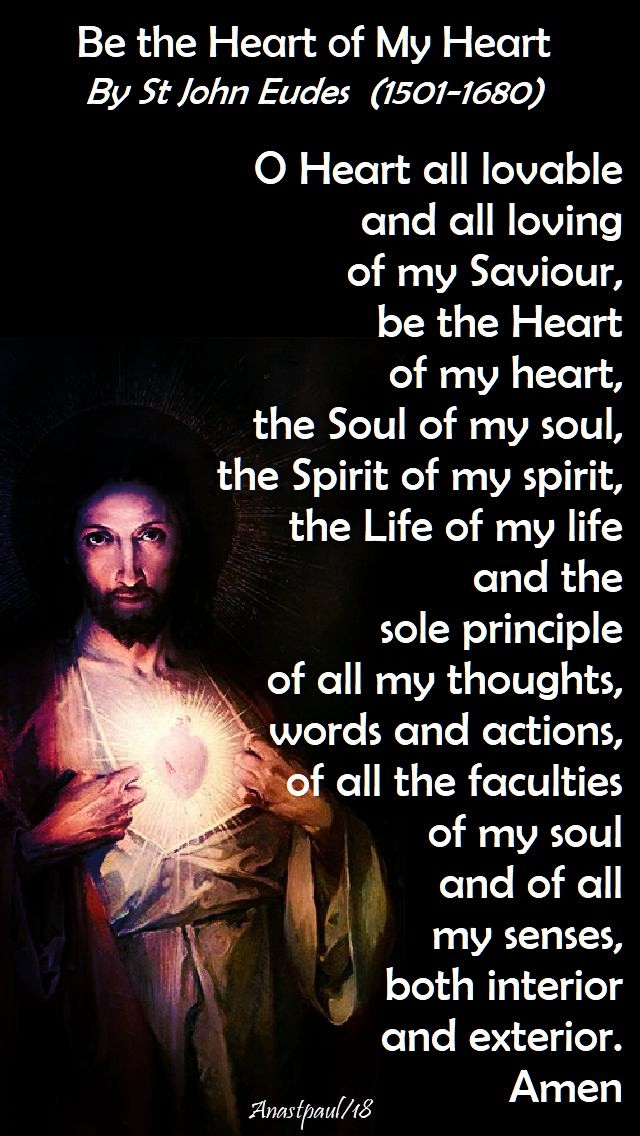
Be the Heart of My Heart By St John Eudes (1501-1680) Apostle of the Sacred Heart
O Heart all lovable
and all loving of my Saviour,
be the Heart of my heart,
the Soul of my soul,
the Spirit of my spirit,
the Life of my life
and the sole principle
of all my thoughts,
words and actions,
of all the faculties of my soul
and of all my senses,
both interior and exterior.
Amen
St John Eudes is the author of the Proper for the Mass and Divine Office of the Sacred Heart of Jesus Christ and the Immaculate Heart of the Blessed Virgin. St John was an ardent proponent of the Sacred Heart and dedicated himself to it’s promotion and celebration. The Masses he compiled for both the Sacred Heart of Jesus and for the Immaculate Heart of Mary, were both first celebrated during his lifetime. He preached missions across France, including Paris and Versailles, while earning recognition as a popular evangelist and confessor. St John Eudes was also a prolific writer and wrote on the two Holy Hearts despite opposition from the Jansenists.
St Eudes was Canonised on 31 May 1925 and his supporters are now petitioning to have him named, a Doctor of the Church. Those of the Eudists, managing the process, collected evidence needed to support the idea and compiled it into a Positio dossier, which included the reasons for the proposal, as well as those spiritual works that would support it. This dossier was submitted to the Congregation for the Causes of Saints in April 2017 for evaluation.
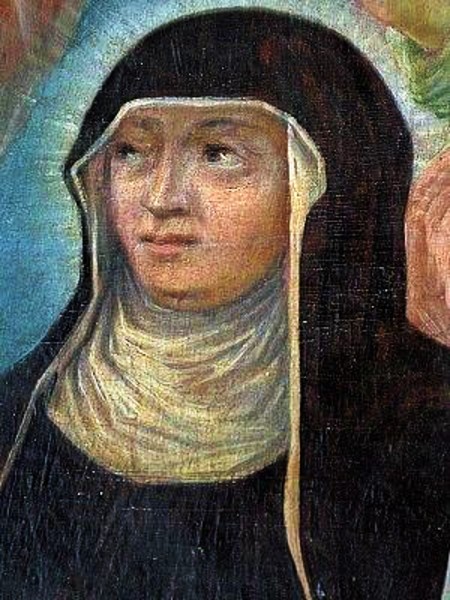
Saint of the Day – 18 June – Saint Elisabeth of Schönau (1129-1164) Abbess, Mystic, Ascetic, Writer, Spiritual Adivisor – born in 1126 in Bingen, Germany and died on 18 June 1164 at Bingen, Germany of natural causes.
In the mid 12th century, Elisabeth of Schönau blurred the conventional gender roles of the time, through the dissemination of her astonishing visions. Elisabeth lived during a time when women were viewed as the weaker sex, both mentally and physically. Unless a woman were to join a convent or a religious movement, she would be expected to marry and to bear children. Elisabeth of Schönau, however, was far from powerless, as her visions led her to acquire enough fame to be known far and wide. Elisabeth became, not only a local celebrity as a result of her visions but, gained popularity throughout other parts of Germany, as well as in France and England. This enabled Elisabeth to have her own voice, to be known as an individual and to be sought after in an effort to acquire heavenly advice by high order men, including Bishops and Abbots. For men of such high order to call upon Elisabeth, a mere woman, is extremely significant given the time period in which Elisabeth lived. Elisabeth’s visions, as well as her twenty-two letters to Bishops, Abbots and Abbesses, enabled her to transcend the traditional gender roles of the time by making her widely known and giving her an individual voice.
Elisabeth was born about 1129, of an obscure noble family named Hartwig. At the age of 12 she was given to the nuns for education in the St Florin double abbey founded a few years earlier. At the age of 18 she entered the women’s Congregation. She made her profession as a Benedictine in 1147. In 1157 she became Abbess of the nuns under the supervision of Abbot Hildelin.
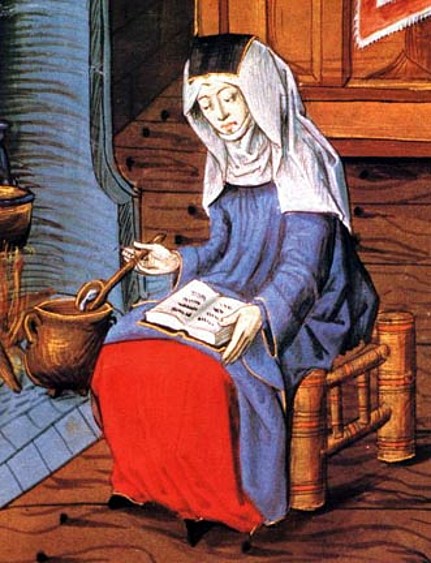
Her hagiography describes her as given to works of piety from her youth, much afflicted with bodily and mental suffering, a zealous observer of the Rule of Saint Benedict and of the regulation of her convent and devoted to practices of mortification. In the years 1147 to 1152 Elisabeth suffered recurrent disease, anxiety and depression as a result of her strict asceticism. St Hildegard von Bingen (1098-1179) Doctor of the Church admonished Elisabeth in letters to be prudent in the ascetic life. St Hildegard here: https://anastpaul.com/2018/09/17/saint-of-the-day-17-september-st-hildegard-von-bingen-osb-1098-1179-doctor-of-the-church/
At Pentecost in 1152, she first had spiritual experiences of a visionary nature, which she and the nuns and monks understood as the authentic message of God. These generally occurred on Sundays and Holy Days at Mass or Divine Office or after hearing or reading the lives of Saints. Christ, the Virgin Mary, an angel, or the special Saint of the day would appear to her and instruct her; or she would see quite realistic representations of the Passion, Resurrection and Ascension, or other scenes of the Old and New Testaments.
She died on 18 June 1164 at the age of only 35 and was buried in the St Florin Abbey Church. It is extremely remarkable that she was not buried in the Monastery cemetery or in the Chapel of the nuns but in a prominent place in the Abbey Church itself. This was unusual and testifies to absolute acceptance of her mystical life, writings and deep veneration. There has never been a formal Canonisation process (pre-congregation) but every year on the day after her death, that is, on 19 June her memory is celebrated in the Monastery and surrounding towns. It was not until the late 16th century that she was officially included in the list of Saints at the request of the Archbishop of Mainz and the monks of Schönau (Martyrologium Romanum).
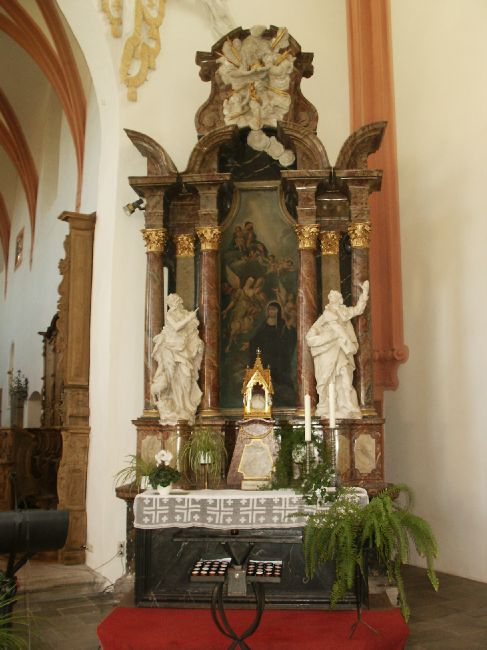
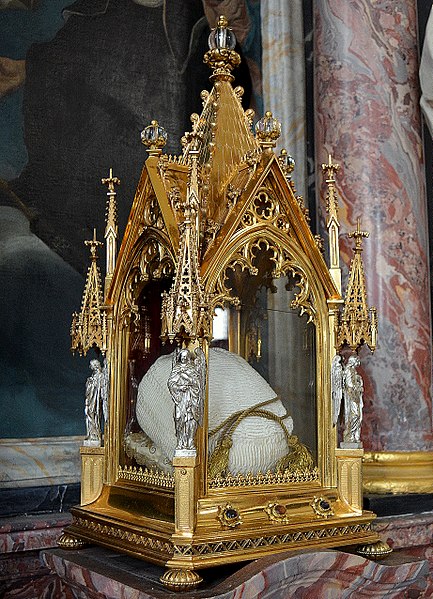
Shrine and Altar of St Elisabeth of Schönau (with the reliquary in which Elisabeth’s skull is kept – see below) in the Monastery Church of St Florin, Kloster Schönau im Taunus.
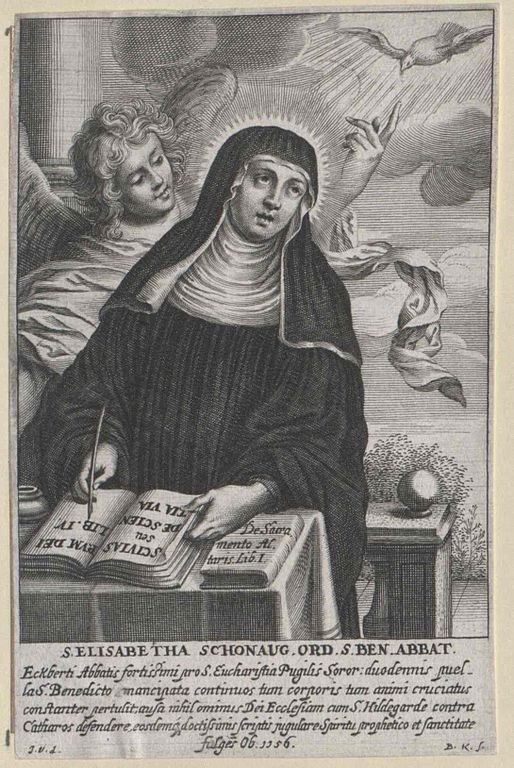
What Elisabeth saw and heard she put down on wax tablets. Her Abbot, Hildelin, told her to relate these things to her brother Eckbert, then a cleric at Saint Cassius in Bonn, who acted as an editor. At first she hesitated fearing lest she be deceived or be looked upon as a deceiver but she obeyed. Eckbert (who became a Monk of Schönau in 1155 and eventually succeeded Hildelin as second Abbot) put everything in writing, later arranged the material at leisure and then published all under his sister’s name.
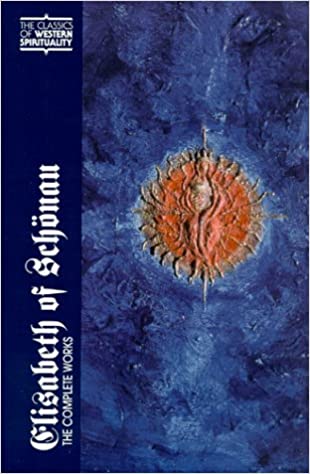
While this relationship between brother and sister allowed for Elisabeth’s wide broadcasting of her visionary experiences, it is evident that Eckbert attempted to have a degree of authority over Elisabeth. Elisabeth’s response to Eckbert’s efforts regarding certain visions is just one example of how Elisabeth’s actions blurred the conventional gender roles. The works are published in English in a Collected Works edition.
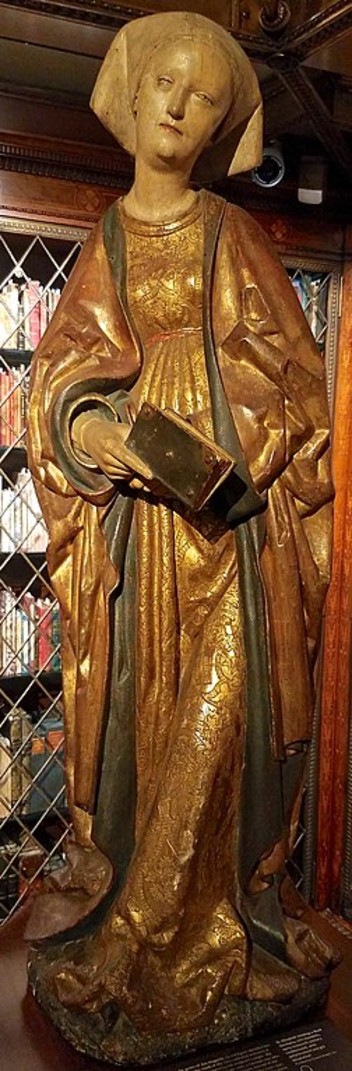
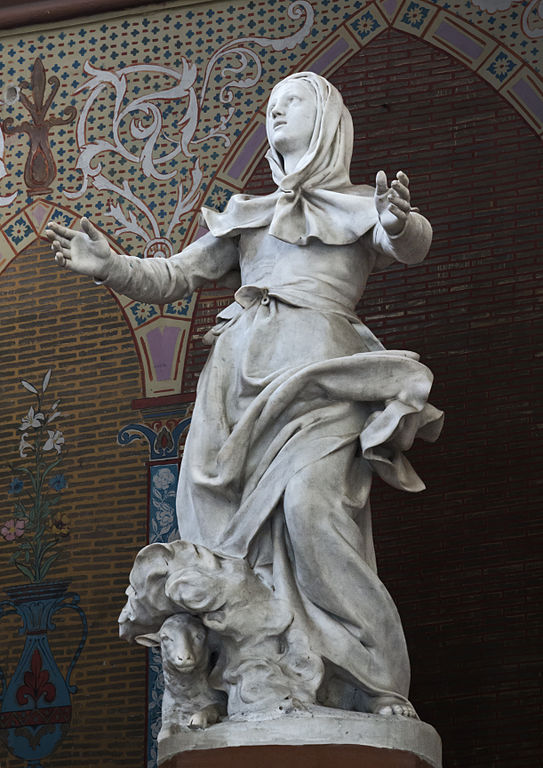
Statue of St Elisabeth on the south wall of the choir room of St Florin.
Schönau Monastery is a popular place of pilgrimage today. The Franciscan Minor Monastery is picturesquely situated in the Saale Valley in a river arch on the Franconian Saale. Steep mountain slopes flank the Monastery and the small town of Schönau.
St Abraham of Clermont
St Alena of Dilbeek
St Amandus of Bordeaux
St Arcontius of Brioude
St Athenogenes of Pontus
St Calogero of Sicily
St Calogerus of Fragalata
St Calogerus the Anchorite
St Colman mac Mici
St Cyriacus of Malaga
St Demetrius of Fragalata
St Edith of Aylesbury St Elisabeth of Schönau (1129-1164)
St Elpidius of Brioude
St Equizio of Telese
St Erasmo
St Etherius of Nicomedia
Bl Euphemia of Altenmünster
St Fortunatus the Philosopher
St Gerland of Caltagirone
St Gregory of Fragalata
St Guy of Baume
St Jerome of Vallumbrosa
St Marcellian
St Marina of Alexandria
St Marina of Bithynia
Bl Marina of Spoleto
St Marcus Bl Osanna Andreasi OP (1449-1505) Biography: https://anastpaul.com/2019/06/18/saint-of-the-day-18-june-blessed-osanna-andreasi-op-1449-1505/
St Osanna of Northumberland
St Osmanna of Jouarre
St Paula of Malaga
Bl Peter Sanchez
—
Hermits of Karden: A father (Felicio) and his two sons (Simplicio and Potentino)who became pilgrim to various European holy places and then hermits at Karden (modern Treis-Karden, Germany). (Born in Aquitaine (in modern France. ) Their relics transferred to places in the Eifel region of western Germany at some point prior to 930. They were canonised on 12 August 1908 by Pope Pius X (cultus confirmation).
Martyrs of Ravenna – 4 saints: A group of four Christians martyred together. We have no details but their names – Crispin, Cruciatus, Emilius and Felix. They were martyred in Ravenna, Italy, date unknown.
Martyrs of Rome – 3 saints: Three Christians martyred together . We have no details but their names – Cyriacus, Paul and Thomas. In Rome, Italy, date unknown.
Martyrs of Tripoli – 3 saints: Three imperial Roman soldiers, at last two of them recent converts, who were imprisoned, tortured and executed for their faith. Martyrs – Hypatius, Leontius and Theodulus. They were Greek born and they died c135 at Tripoli, Phoenicia (in modern Lebanon).
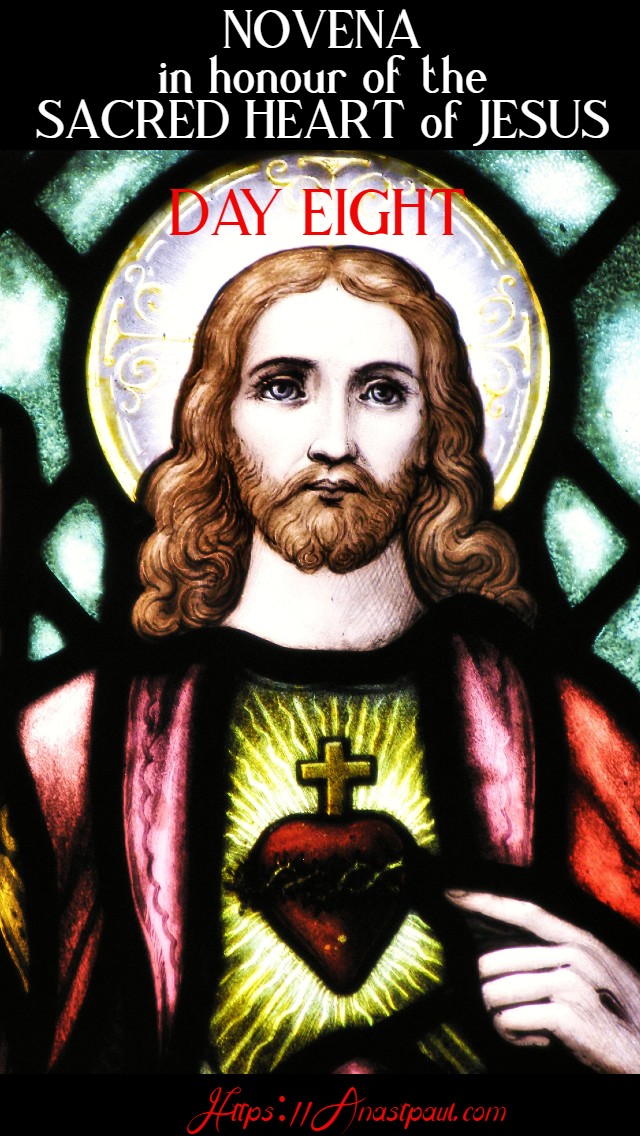
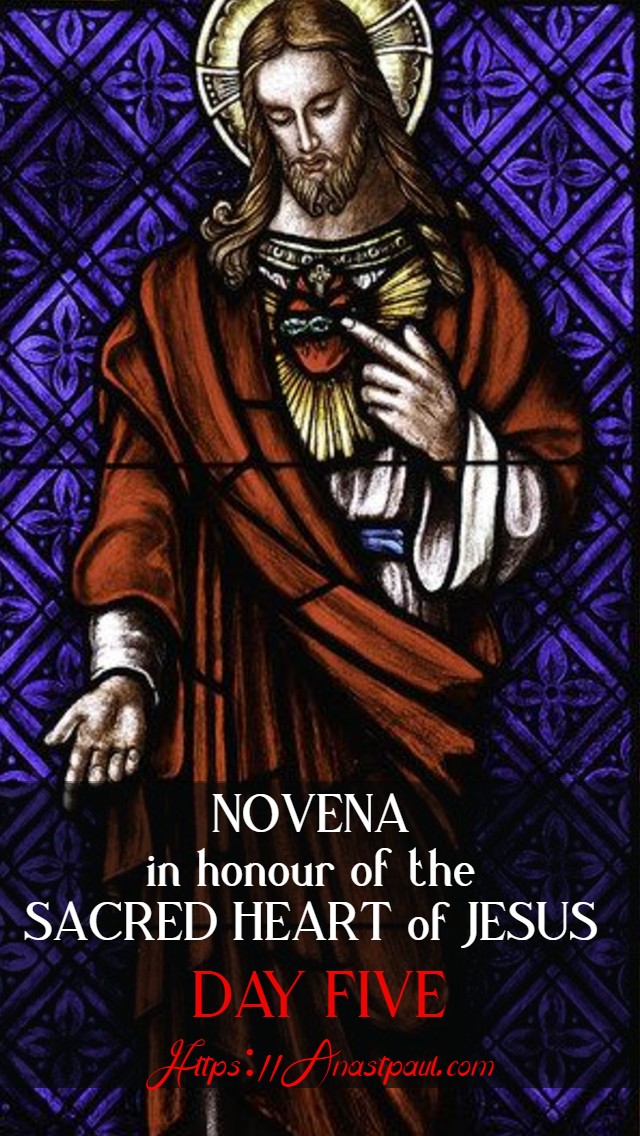
Novena in Honour of the Sacred Heart of Jesus
Day Eight – 17 June
Peace Be With You!
While they were talking about this, Jesus himself stood among them and said to them, ‘Peace be with you.’ They were startled and terrified and thought that they were seeing a ghost. He said to them, ‘Why are you frightened and why do doubts arise in your hearts? Look at my hands and my feet; see that it is I myself. Touch me and see; for a ghost does not have flesh and bones as you see that I have.’ … Luke 24: 36-39
Reflection for the Eighth Day Peace; Look; Listen; Go! Jesus greets the apostles with that soothing word, ‘Shalom’ (Peace) – it means I wish you the fullness of well-being of mind and body and soul. He then invites them to look at His hands and side. He encourages them to listen to what the scriptures say about Him and then to go and preach the Good News, that He is Risen.
Today’s Prayer
Lord, You see my poverty
and You love me better than I can love myself.
Supply my wants according to Your mercy.
Help me to accept Your will,
without seeking to understand.
Help me to resign myself entirely
and absolutely to You
and thus, I shall have Your peace.
Amen
Daily Invocation Sacred Heart of Jesus, I place all my trust in you.
Novena Prayer
Lord Jesus,
the needs of Your people open Your heart in love for each of us.
You care for us when we are lost,
sympathise with us in loneliness
and comfort us in mourning;
You are closest to us where we are weakest.
You love us most, when we love ourselves least;
You forgive us mos, when we forgive ourselves least
and You call us to spread Your love in whatever way we can.
Lord Jesus, Your heart is moved with compassion
when we are suffering,
when we need your help
and when we pray for each other.
I ask You to listen to my prayer during this Novena
and grant what I ask.
…………………………. (Mention your intention silently.)
If what I ask, is not for my own good and the good of others,
grant me what is best,
that I may build up Your kingdom of love in our world.
Amen
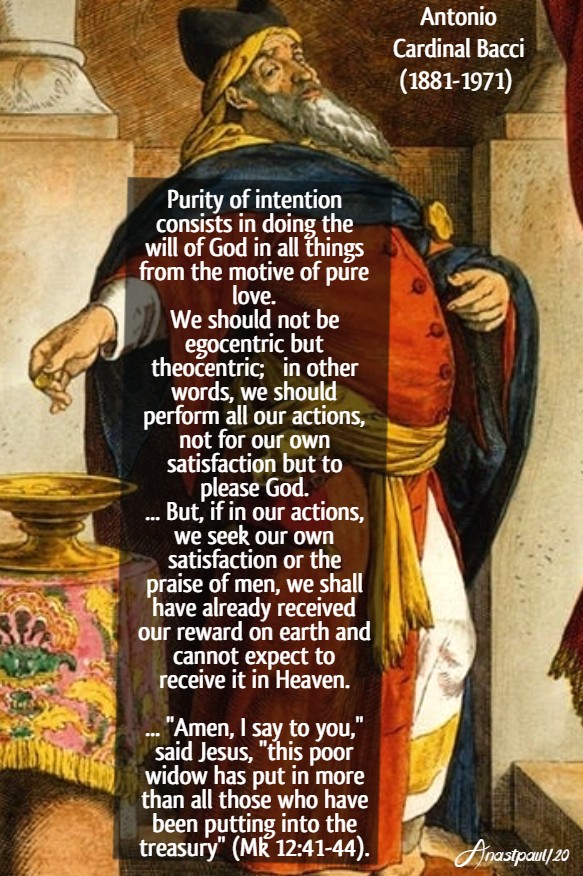
Thought for the Day – 17 June – Meditations with Antonio Cardinal Bacci (1881-1971)
Purity of Intention
“Purity of intention consists in doing the will of God in all things from the motive of pure love.
We should not be egocentric but theocentric; in other words, we should perform all our actions, not for our own satisfaction but to please God.
Since God is our final end, everything should be done for Him.
Why are we so often agitated and discontented?
It is because, we are looking for success and for the approval of men.
If we do not get these, we imagine that we have failed and have accomplished nothing.
Men judge the value of an enterprise by it’s external success and by the amount of work which went into it.
It is not so with God.
He judges the value of our actions from the sincerity of our desire to please Him ad to prove our love for Him.
This is enough for Him; success is not necessary.
If we do everything for the love of God, we shall always be content as the Saints were, whether our projects succeed or fail.
We shall have achieved our purpose, if we have pleased God.
Purity of Intention in our actions, is fundamental in the Christian life. “If thy eye be sound,” Jesus Himself tells us, “thy whole body will be full of life. But, if thy eye be evil, thy whole body will be full of darkness” (Mt 6:22) “Men see those things that appear but the Lord beholds the heart” (1 Kings 16:7).
A man who works solely for the love of God, will have great peace of soul in this life and an everlasting reward in the next.
But, if in our actions, we seek our own satisfaction or the praise of men, we shall have already received our reward on earth and cannot expect to receive it in Heaven. “They have received their reward” (Mt 6:2).
Purity of intention, inspired by the love of God, transforms even our most trivial actions and makes them pleasing to God.
Without it, we lose all merit in the sight of God.
Do you remember the Gospel incident of the poor widow who offered her last two coins in the Temple?
Others were there, offering up large sums of money but she could not have given more. “Amen, I say to you,” said Jesus, “this poor widow has put in more than all those who have been putting into the treasury” (Mk 12:41-44).”
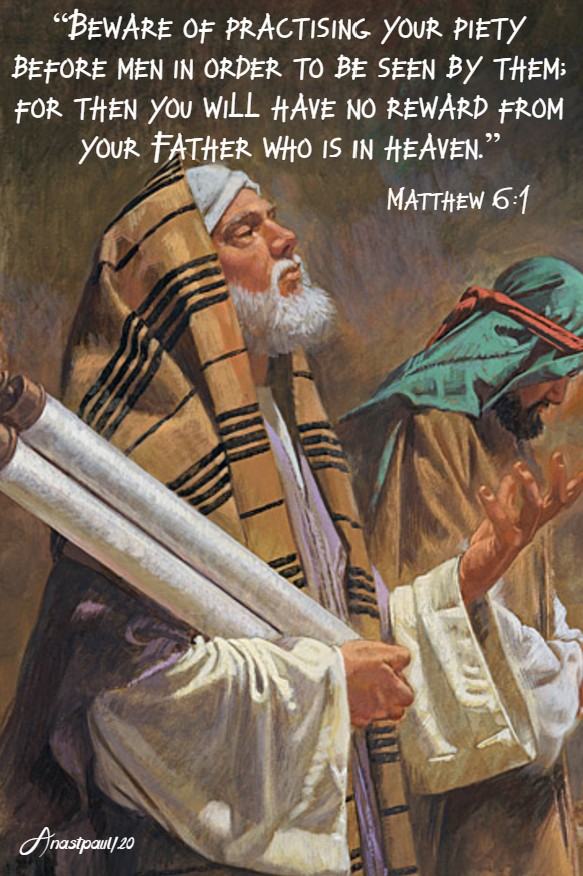
Quote/s of the Day – 17 June – “Month of the Sacred Heart” – Wednesday of the Eleventh Week in Ordinary Time, Year A, Readings: 2 Kings 2:1, 6-14, Psalm 31:20, 21, 24, Matthew 6:1-6, 16-18
Jesus said to his disciples: “Beware of practising your piety before men in order to be seen by them; for then you will have no reward from your Father who is in heaven.”
Matthew 6:1
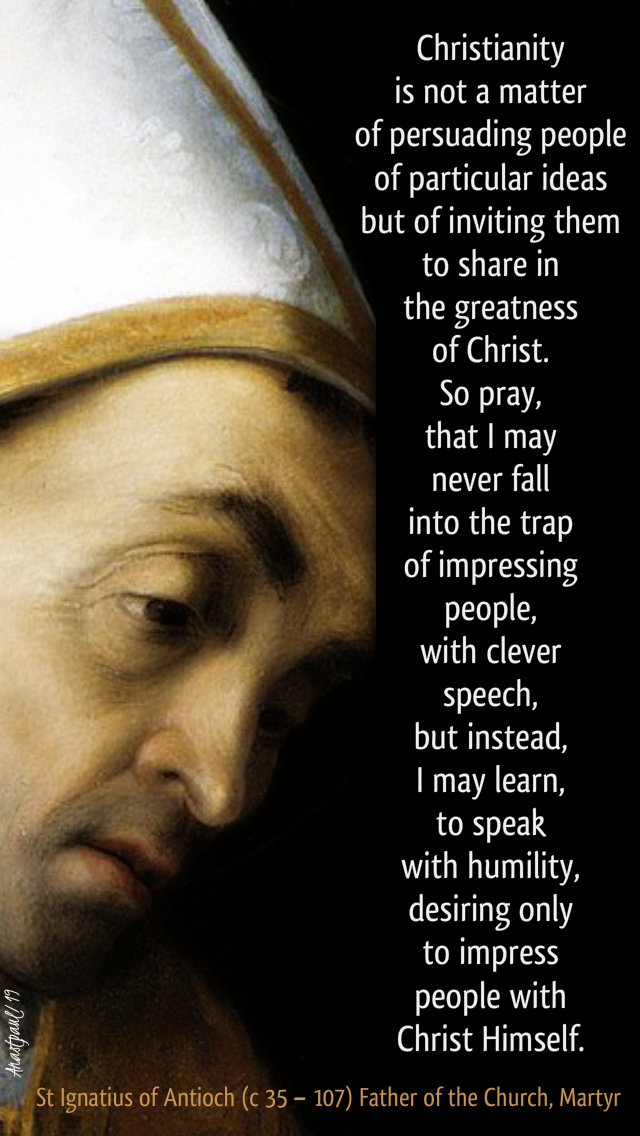
“Christianity is not a matter of persuading people of particular ideas but of inviting them to share in the greatness of Christ. So pray, that I may never fall into the trap, of impressing people, with clever speech but instead, I may learn, to speak with humility, desiring only to impress people with Christ Himself.”
St Ignatius of Antioch (c 35 – 107)
Father of the Church, Martyr
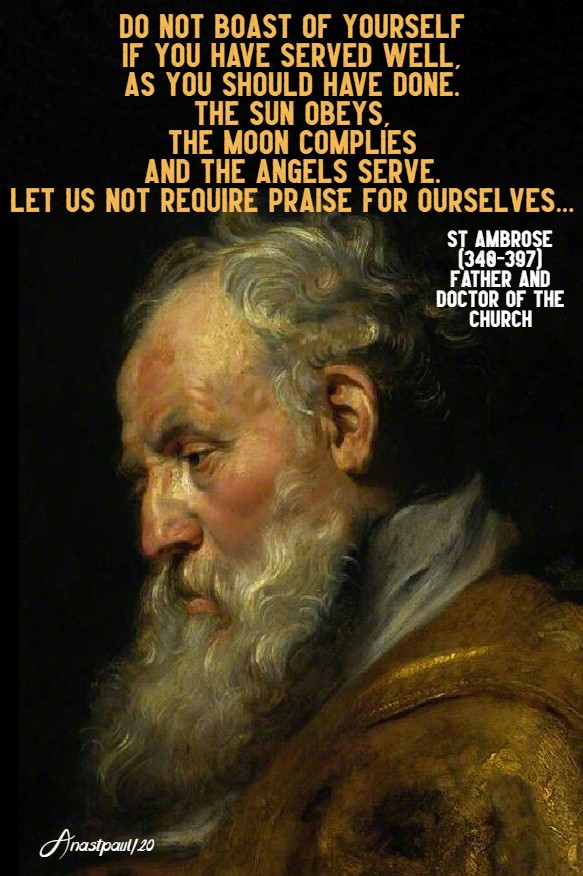
“Do not boast of yourself if you have served well, as you should have done. The sun obeys, the moon complies and the angels serve. Let us not require praise for ourselves…”
St Ambrose (340-397)
Father and Doctor of the Church
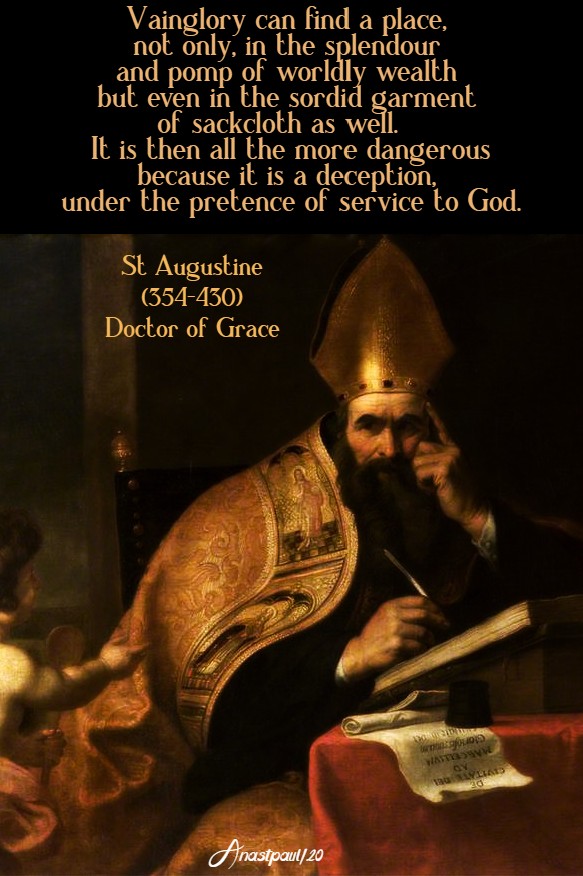
”Vainglory can find a place, not only, in the splendour and pomp of worldly wealth but even in the sordid garment of sackcloth as well. It is then all the more dangerous because it is a deception, under the pretence of service to God.”
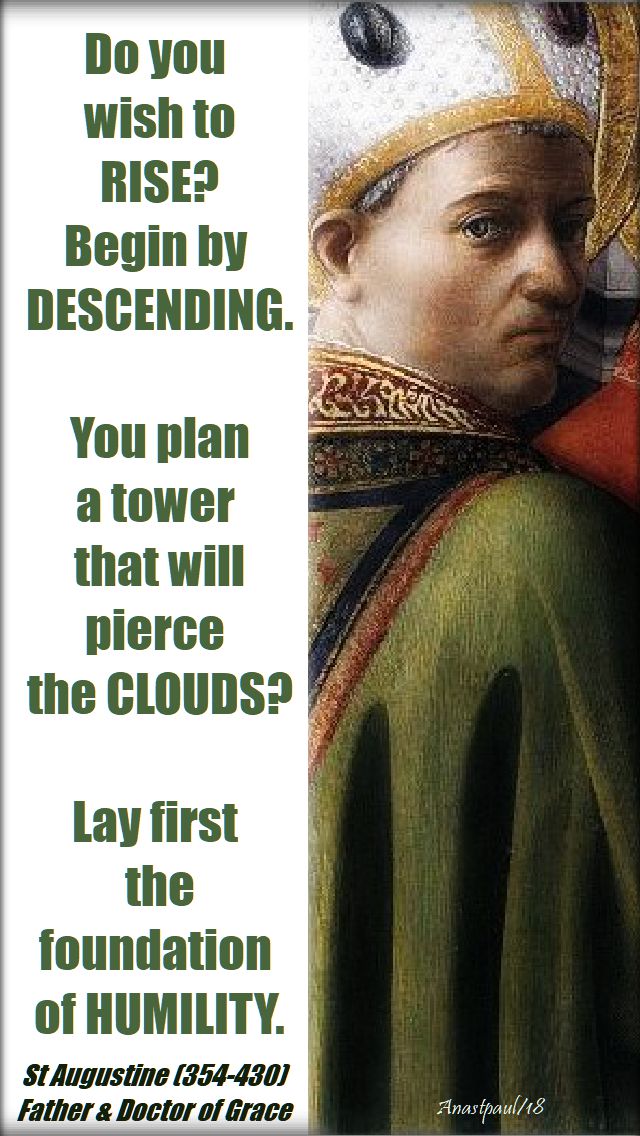
“Do you wish to RISE? Begin by DESCENDING. You plan a tower that will pierce the CLOUDS? Lay first the foundation of HUMILITY.”
“God looks at what is within, it is there He assesses, there He examines.”
St Augustine (354-430)
Doctor of Grace
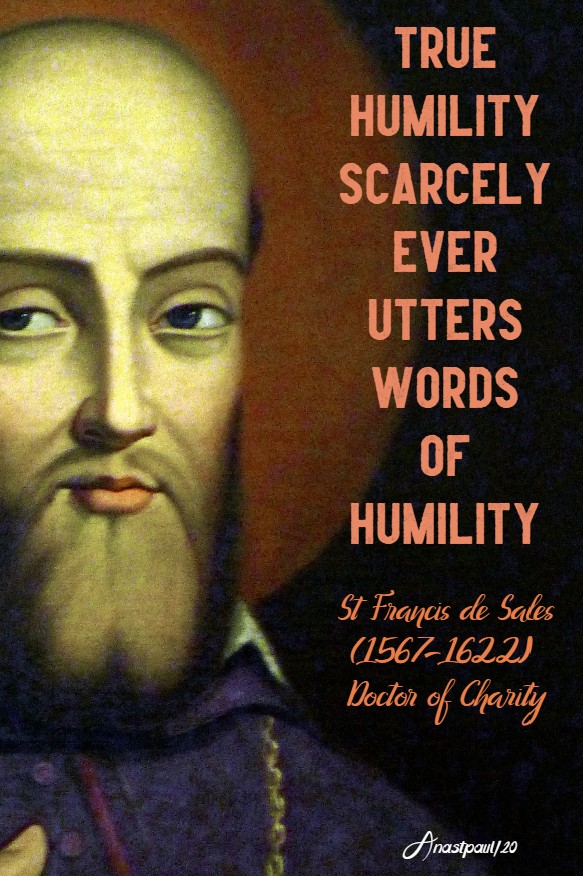
“True humility scarcely ever utters words of humility.”
St Francis de Sales (1567-1622)
Doctor of Charity
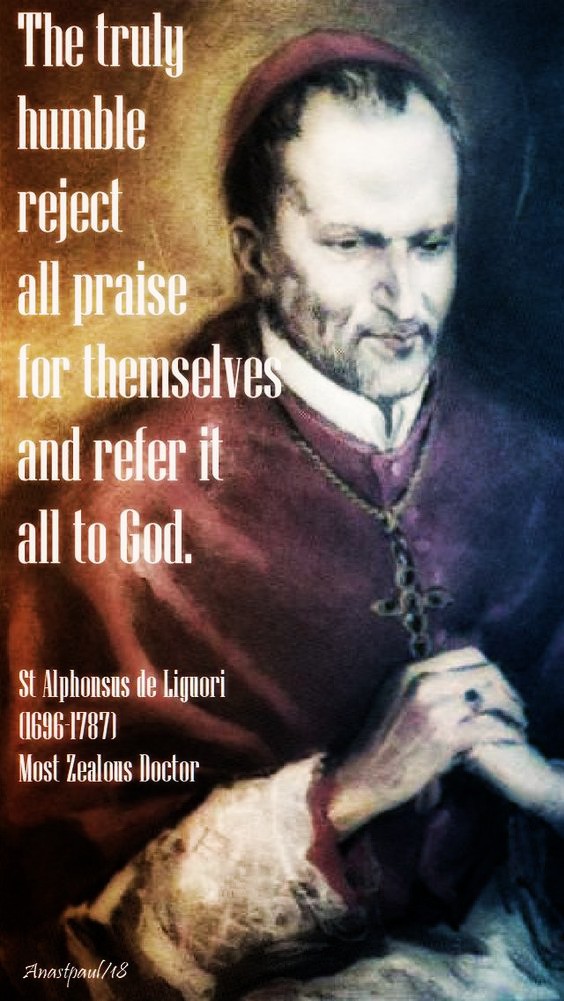
“The truly humble reject all praise for themselves and refer it all to God.”
St Alphonsus Maria de Liguori (1696-1787)
Most Zealous Doctor
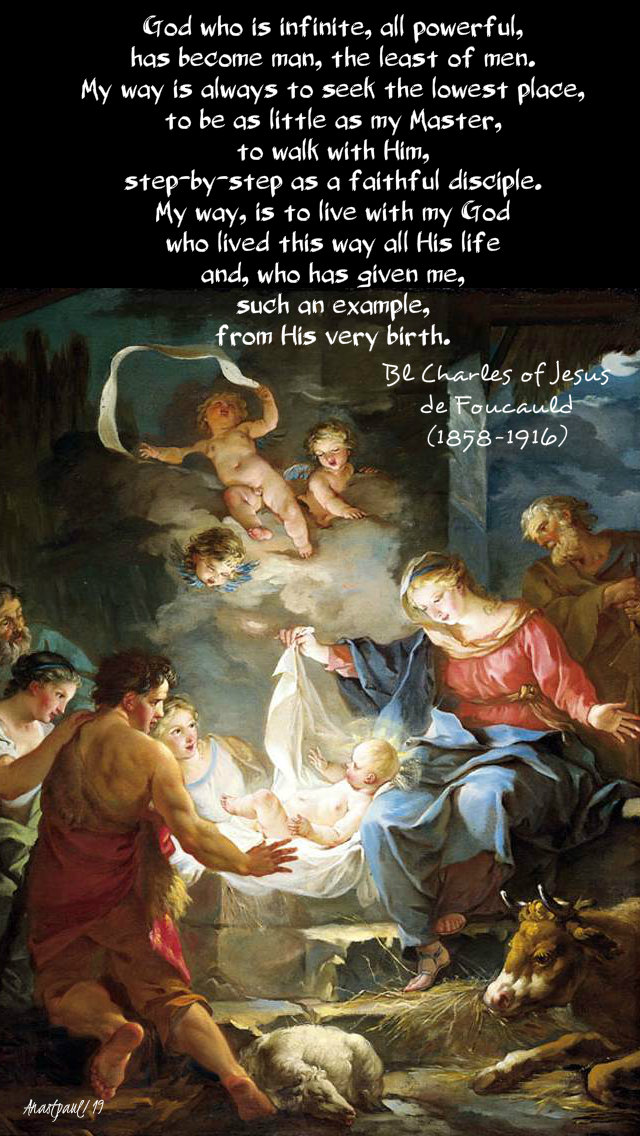
“God who is infinite, all powerful, has become man, the least of men. My way is always to seek the lowest place, to be as little as my Master, to walk with Him, step-by-step as a faithful disciple. My way, is to live with my God who lived this way all His life and, who has given me, such an example, from His very birth.
Blessed Charles of Jesus de Foucauld
(1858-1916)
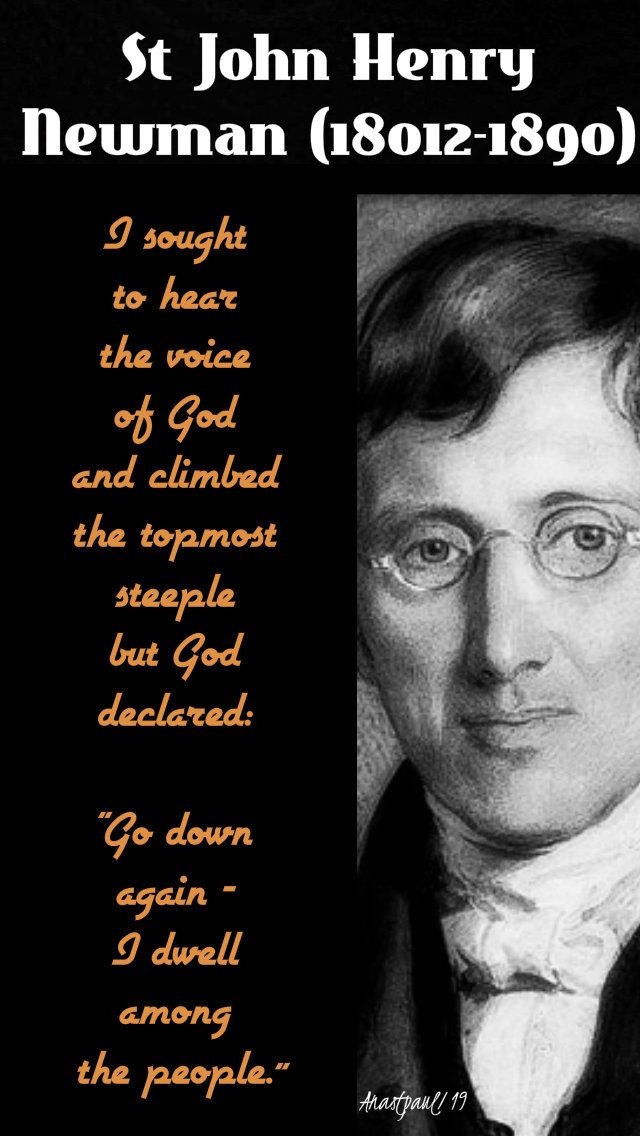
“I sought to hear the voice of God And climbed the topmost steeple. But God declared “Go down again – I dwell among the people.”
St John Henry Newman (1801-1890)
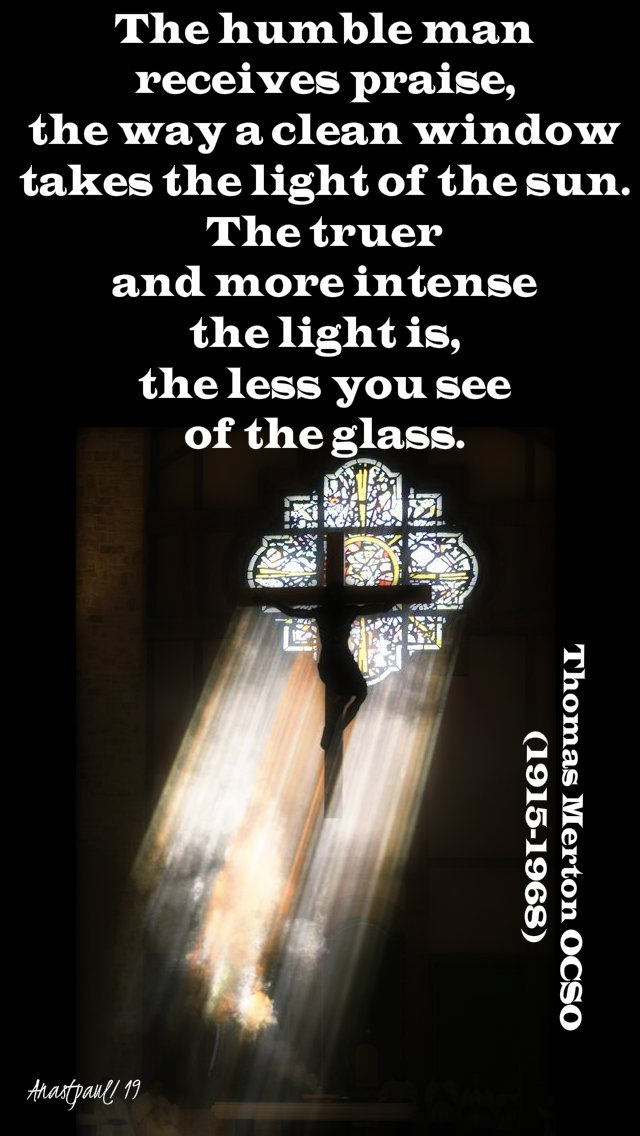
“The humble man receives praise, the way a clean window takes the light of the sun. The truer and more intense the light is, the less you see of the glass.”
One Minute Reflection – 17 June – “Month of the Sacred Heart” – Wednesday of the Eleventh Week in Ordinary Time, Year A, Readings: 2 Kings 2:1, 6-14, Psalm 31:20, 21, 24, Matthew 6:1-6, 16-18
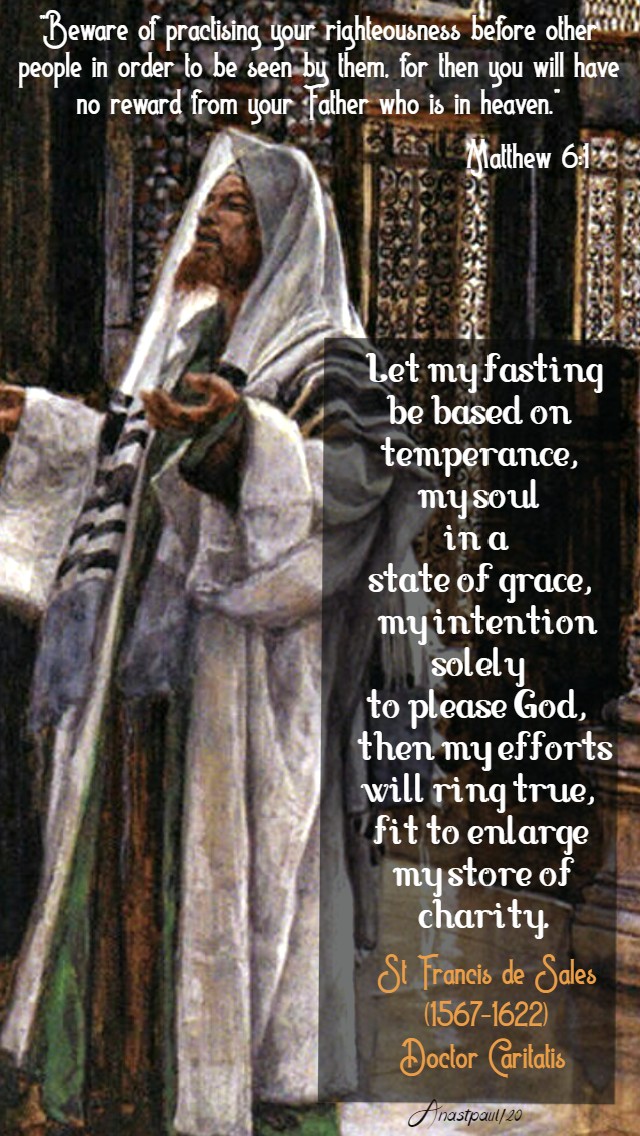
“Beware of practising your righteousness before other people in order to be seen by them, for then you will have no reward from your Father who is in heaven.” … Matthew 6:1
REFLECTION – “Our Lord, so the early Fathers say, used to tell His disciples to be well-proved bankers, proving all things, holding fast what is of value. No coin finds acceptance commercially if the gold is below standard, underweight, of it the piece is illegally struck; nor can our actions have any value spiritually, unless they are suitable, graced with charity and have a pious motive.
Take fasting, for instance – if I fast simply for the purpose of slimming, my fasting is for debased spiritual coinage; if temperance underlies it but I am not in a state of grace, it is still deficient, for charity alone gives weight to what we do; if I do it merely out of courtesy for the company in which I find myself, it lacks the stamp of right intention. Let my fasting be based on temperance, my soul in a state of grace, my intention solely to please God, then my efforts will ring true, fit to enlarge my store of charity.
Given utmost purity of intention and a firm resolve to please God, little actions are well done. In these circumstances they lead to great holiness. Some people, in spite of eating all they can, remain only skin and bone, weak, listless, their powers of digestion are poor. Others may eat next to nothing yet be fit as fiddles, full of energy — nothing is wrong with their digestion! Some folk there are, in the same way, who do many good things, yet have little extra charity to show for it – coldness and carelessness, or instinct and inclination rather than grace or zeal, is where the blame lies. On the other hand, there are those who accomplish little but to perfect is their will, their intention, however, that their growth in charity is great. They have only a little talent but they make such careful use of what they have that the Lord rewards them for it generously.” … St Francis de Sales (1567-1622) Bishop of Geneva, Doctor Caritatis
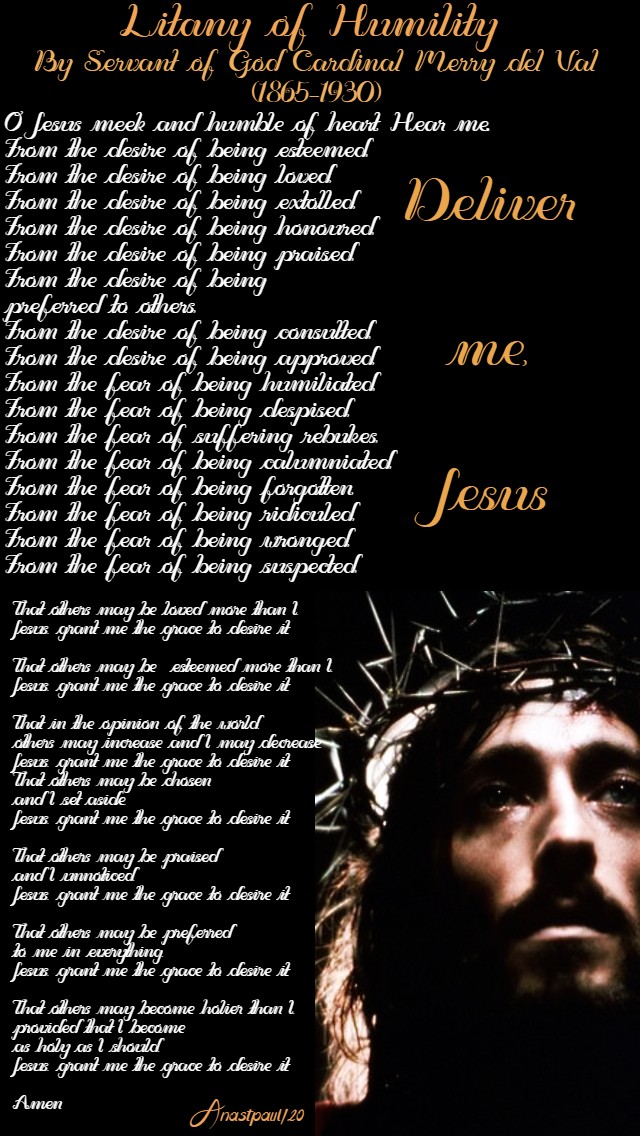
PRAYER – Litany of Humility
By Servant of God Cardinal Merry del Val (1865-1930) – who was accustomed to recite this prayer daily after the celebration of Holy Mass.
O Jesus meek and humble of heart, Hear me.
From the desire of being esteemed, Deliver me, Jesus.
From the desire of being loved, Deliver me, Jesus.
From the desire of being extolled, Deliver me, Jesus.
From the desire of being honoured, Deliver me, Jesus.
From the desire of being praised, Deliver me, Jesus.
From the desire of being preferred to others, Deliver me Jesus.
From the desire of being consulted, Deliver me, Jesus.
From the desire of being approved, Deliver me, Jesus.
From the fear of being humiliated, Deliver me, Jesus.
From the fear of being despised, Deliver me, Jesus.
From the fear of suffering rebukes, Deliver me, Jesus.
From the fear of being calumniated, Deliver, me, Jesus.
From the fear of being forgotten, Deliver me, Jesus.
From the fear of being ridiculed, Deliver me, Jesus.
From the fear of being wronged, Deliver me, Jesus.
From the fear of being suspected, Deliver me, Jesus.
That others may be loved more than I,
Jesus, grant me the grace to desire it.
That others may be esteemed more than I,
Jesus, grant me the grace to desire it.
That in the opinion of the world, others may increase
and I may decrease,
Jesus, grant me the grace to desire it.
That others may be chosen and I set aside,
Jesus, grant me the grace to desire it.
That others may be praised and I unnoticed,
Jesus, grant me the grace to desire it.
That others may be preferred to me in everything,
Jesus, grant me the grace to desire it.
That others may become holier than I,
provided that I become as holy as I should,
Jesus, grant me the grace to desire it.
Amen
Our Morning Offering – 17 June – “Month of the Sacred Heart” -Wednesday of the Eleventh Week in Ordinary Time, Year A
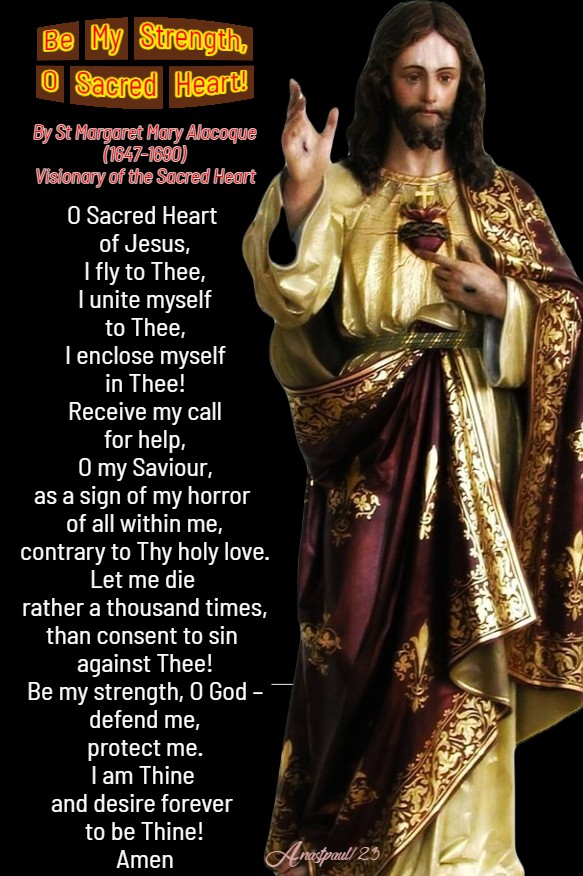
Be my Strength, O Sacred Heart! By St Margaret Mary Alacoque (1647-1690) Visionary of the Sacred Heart
O Sacred Heart of Jesus, I fly to Thee, I unite myself to Thee, I enclose myself in Thee! Receive my call for help, O my Saviour, as a sign of my horror of all within me, contrary to Thy holy love. Let me die rather a thousand times, than consent to sin against Thee! Be my strength, O God – defend me, protect me. I am Thine and desire forever to be Thine! Amen
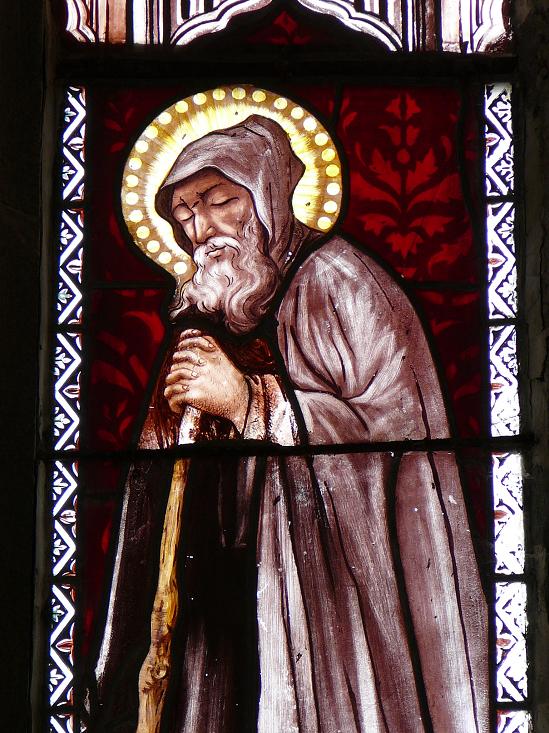
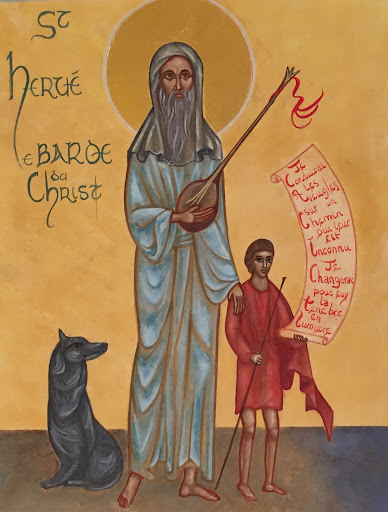
Saint of the Day – 17 June – St Hervé (c 521–c 556) Hermit, Abbot, Musician and singer, miracle-worker, blind from birth – also known as Erveo, Harvey, Herveus, Hervues, Hervé, Houarniaule, Huva – born in Guimiliau, Brittany, France or unknown location in Wales (sources vary) and died in c 556 to c 575 (sources vary) of natural causes. Patronages – the blind, bards, musician, invoked against eye problems and disease, invoked to cure sick horses. St Hervé, along with Saint Ives, is one of the most venerated of the Breton Saints and was considered a Saint during his lifetime and ever since.
Hervé was the son of a bard (a professional singer and story-teller) at the Court of one of Clovis’ successors, King Childebert 1. He would have been also the nephew of the Bourg-Blanc’s hermit Saint Urfold or, according to other sources, of Saint Rivoaré, the Patron Saint of Lanrivoaré. His father died while Hervé was still an infant.
His mother entrusted him to the care of his uncle, Urzel, a Monk, who had opened a school in Plouvein. Saint Hervé, like his uncle, would have lived in poverty and humility all his life. In time, Hervé was made superior of the school and small Monastery. He later moved the Monastery to Lanhorneau. St Hervé’s Hermitage itself, consisted of three elements – the ruins of a Chapel, a sacred fountain and a stone hut which would have been the cell of the saint, see below.
This slideshow requires JavaScript.
Hervé died around 556 and was celebrated for his holiness, powerful preaching and love of music. He is honoured as one of the Patron Saints of the blind.
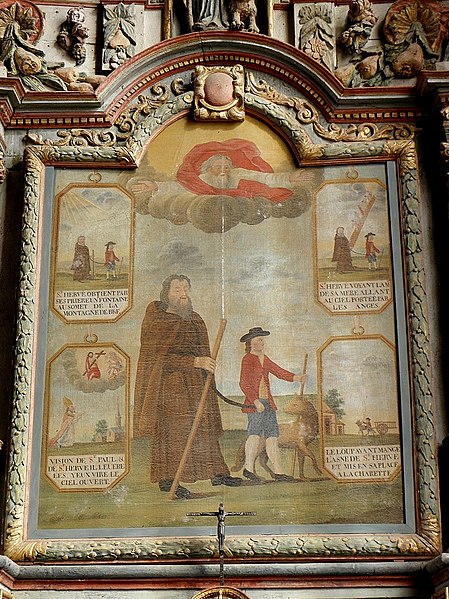
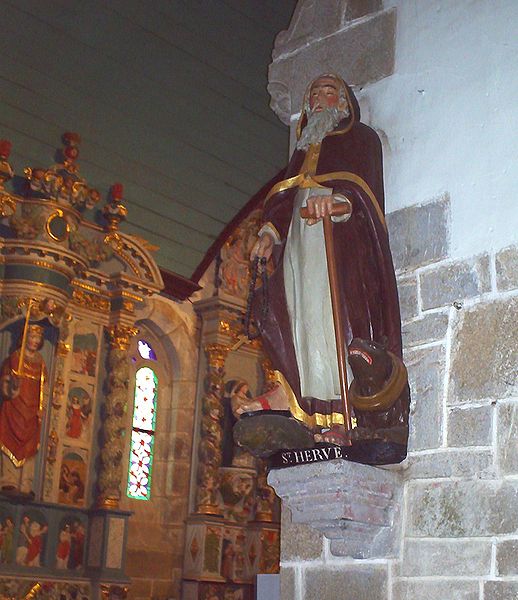
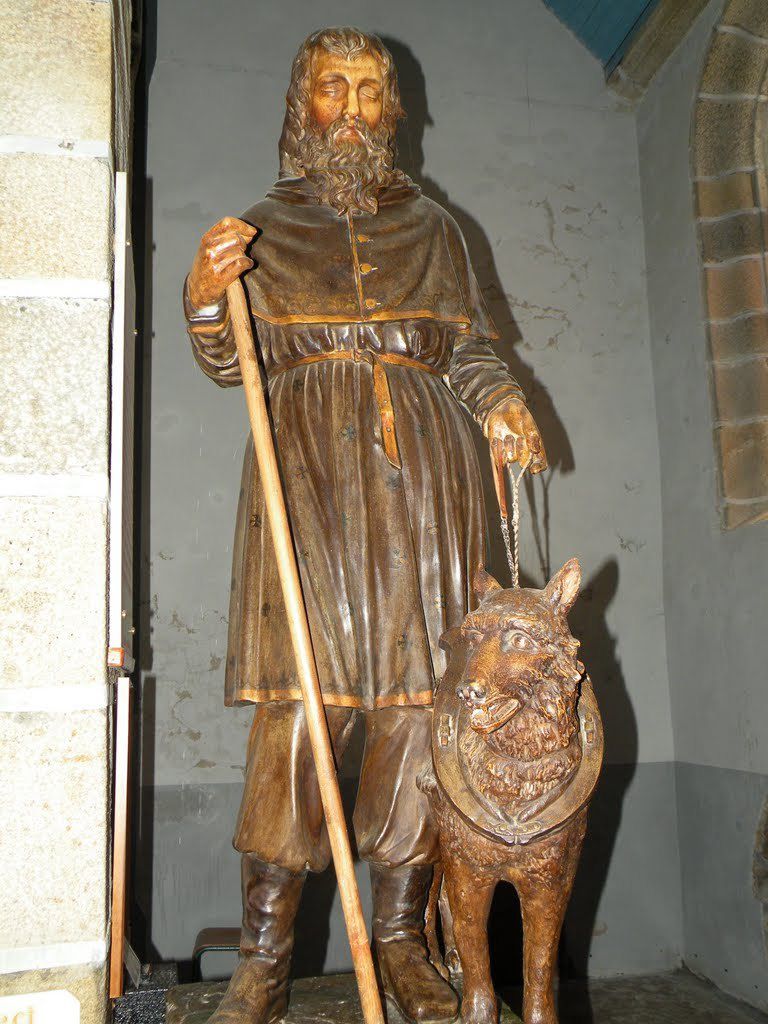
St Hervé is said to have had a special power over animals. It is related that he had a domesticated wolf as a pet. The dog guiding him having been devoured by a wolf, the hermit ordered the wild animal to take the role of his dog. One day Hervé’s wolf attacked and killed the ox that the Monks relied on to pull the plough in the fields. Hervé preached a powerful sermon and the wolf was so contrite it asked to be allowed to serve in place of the ox. For this reason, Hervé is often depicted with a wolf wearing a yoke.
He was joined by disciples and refused any Ordination or earthly honour, accepting only to be consecrated as an Exorcist. He died in 556 and was buried at Lanhouarneau, Brittany, France. Today there is a town in honour of him.
St Antidius of Besançon
Bl Arnold of Foligno
St Avitus of Perche
St Blasto of Rome
St Botolph of Ikanhoe
St Briavel of Gloucestershire
St David of Bourges
St Dignamerita of Brescia
St Diogenes of Rome
St Emily de Vialar
St Gundulphus of Bourges St Hervé (c 521–c 556)
St Himerius of Amelia
St Hypatius of Chalcedon
St Molling of Wexford
St Montanus of Gaeta
St Nectan of Hartland
Bl Paul Burali d’Arezzo
Bl Peter Gambacorta
St Phêrô Ða
Bl Philippe Papon Blessed Joseph-Marie /Pierre-Joseph Cassant OCSO (1878-1903) Biography:
St Prior
St Rambold of Ratisbon
Bl Ranieri Scaccero
St Theresa of Portugal
—
Martyrs of Apollonia – 7 saints: A group of Christians who fled to a cave near Apollonia, Macedonia to escape persecution for his faith, but were caught and executed. The names we know are – Basil, Ermia, Felix, Innocent, Isaurus, Jeremias and Peregrinus. They were beheaded at Apollonia, Macedonia.
Martyrs of Aquileia – 4 saints: Four Christian martyrs memorialised together. No details about them have survived, not even if they died together – Ciria, Maria, Musca and Valerian. c.100 in Aquileia, Italy.
Martyrs of Chalcedon – 3 saints: Three well-educated Christian men who were sent as ambassadors from King Baltan of Persia to the court of emperor Julian the Apostate to negotiate peace between the two states, and an end of Julian’s persecutions of Christians. Instead of negotiating, Julian imprisoned them, ordered them to make a sacrifice to pagan idols and when they refused, had them executed. Their names were Manuel, Sabel and Ismael. They were beheaded in 362 in Chalcedon (part of modern Istanbul, Turkey) and their bodies burned and no relics survive.
Martyrs of Fez – 4 beati: A group of Mercedarians sent to Fez, Morocco to ransom Christians imprisoned and enslaved by Muslims. For being openly Christian they were imprisoned, tortured, mutilated and executed. Martyrs – Egidio, John, Louis and Paul. They were martyred in Fez, Morocco.
Martyrs of Rome – 262 saints: A group of 262 Christians martyred in the persecutions of Diocletian. In c303 in Rome, Italy. They were buried on the old Via Salaria in Rome.
Martyrs of Venafro – 3 saints: Three Christian lay people, two of them imperial Roman soldiers, who were converts to Christianity and were martyred together in the persecutions of Maximian and Diocletian – Daria, Marcian and Nicander. They were beheaded c.303 in Venafro, Italy. By 313 a basilica had been built over their graves which were re-discovered in 1930. They are patrons of Venafro, Italy.
Novena in Honour of the Sacred Heart of Jesus Day Seven – 16 June
What Strange Friends You Have, O Lord!
Today’s Scripture “But I say to you listen, Love your enemies, do good to those who hate you, bless those who curse you, pray for those who abuse you.” … Luke 6: 27-28
Reflection for the Seventh Day
You know the old saying, ‘Show me your friends and I’ll tell you who you are’ ?
Well, Jesus had the strangest set of friends Levi (a hated tax-collector), Simon the Zealot (a revolutionary), women in prostitution and other ‘public sinners.’
Maybe I’m not such bad company for Jesus, after all.
Just remember, they all repented upon meeting Jesus!
Today’s Prayer
Jesus, You once said,
‘I’ve come not to call the virtuous but sinners to repentance.’
During Your apostolate, You sat and ate with sinners.
This practice of Yours gives me great hope
that Your love, will bid me welcome too!
And, You will help me to be holy!
Amen
Daily Invocation Sacred Heart of Jesus, I place all my trust in you.
Novena Prayer
Lord Jesus,
the needs of Your people open Your heart in love for each of us.
You care for us when we are lost,
sympathise with us in loneliness
and comfort us in mourning;
You are closest to us where we are weakest.
You love us most, when we love ourselves least;
You forgive us mos, when we forgive ourselves least
and You call us to spread Your love in whatever way we can.
Lord Jesus, Your heart is moved with compassion
when we are suffering,
when we need your help
and when we pray for each other.
I ask You to listen to my prayer during this Novena
and grant what I ask.
…………………………. (Mention your intention silently.)
If what I ask, is not for my own good and the good of others,
grant me what is best,
that I may build up Your kingdom of love in our world.
Amen
Thought for the Day – 16 June – Meditations with Antonio Cardinal Bacci (1881-1971)
Steadfastness in Suffering
“We are all obliged to suffer in soul and body.
Suffering begins at birth and ends at death. “The whole life of a Christian is a cross,” (Sermon 31) says St Augustine.
For this reason, we have to develop the virtue of patience. “Let patience have it’s perfect work,” says St James, “that you may be perfect and entire” (Js 1:4).
If we are to be perfect, we must accept suffering and trials from the hands of God and offer them to Him in a spirit of harmony with His holy will.
In this way, all our actions become valuable, for they are acts of reparation and of love, which will be rewarded in Heaven.
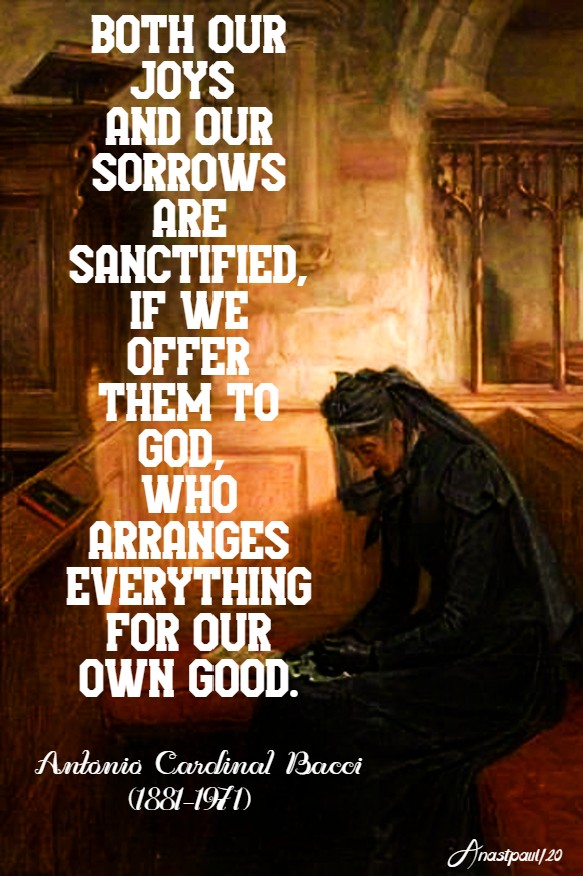
Both our joys and our sorrows are sanctified, if we offer them to God, Who arranges everything for our own good.
The Saints longed to suffer because, they loved God and knew that suffering is the only true way in which we can prove our love.
Suffering is the best medicine for the soul, for when it is endured with patience, it purifies us and prepares us for Heaven. “If God does not punish you for our sins,” says St Augustine, “it is a sign that you are no longer counted among His sons” (De Pastoribus liber unus, c 5). “Whom the Lord loves, he chastises,” St Paul writes “and, he scourges every son whom he receives” (Heb 12:6).
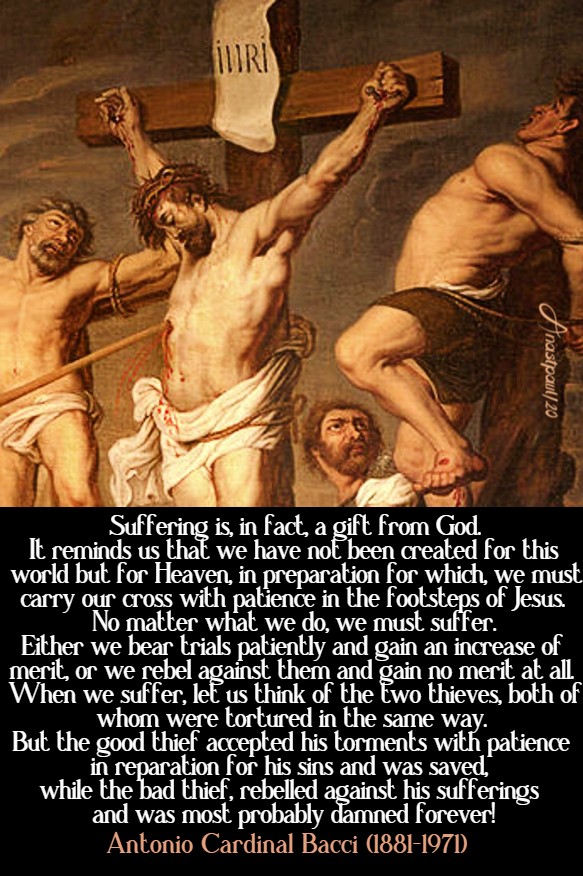
Suffering is, in fact, a gift from God.
It reminds us that we have not been created for this world but for Heaven, in preparation for which, we must carry our cross with patience in the footsteps of Jesus.
No matter what we do, we must suffer.
Either we bear trials patiently and gain an increase of merit, or we rebel against them and gain no merit at all.
When we suffer, let us think of the two thieves, both of whom were tortured in the same way.
But the good thief accepted his torments with patience in reparation for his sins and was saved, while the bad thief, rebelled against his sufferings and was most probably damned forever!”
Quote/s of the Day – 16 June – “Month of the Sacred Heart” – Tuesday of the Eleventh week in Ordinary Time, Year A, Readings: 1 Kings 21:17-29, Psalm 51:3-6, 11, 16, Matthew 5:43-48
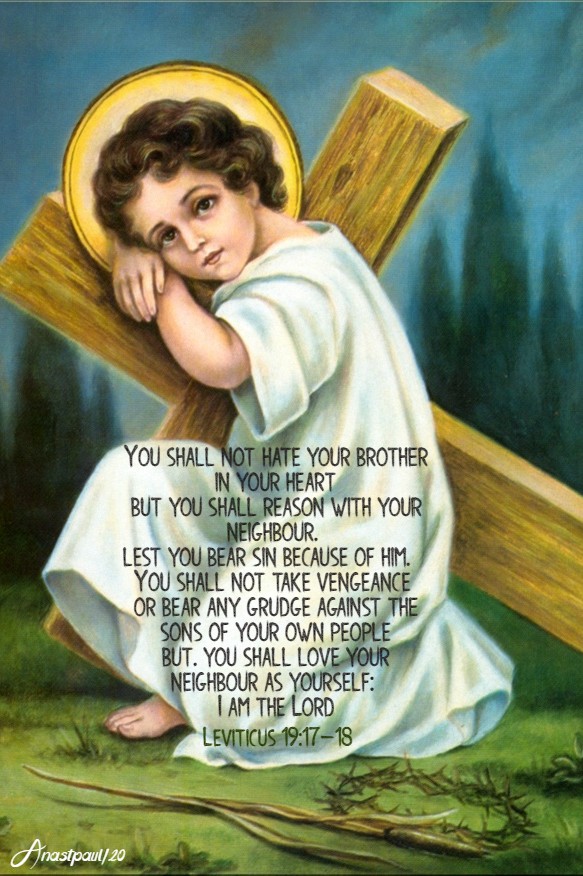
“You shall not hate your brother in your heart but you shall reason with your neighbour, lest you bear sin because of him. You shall not take vengeance or bear any grudge against the sons of your own people but, you shall love your neighbour as yourself: I am the Lord”
Leviticus 19:17-18
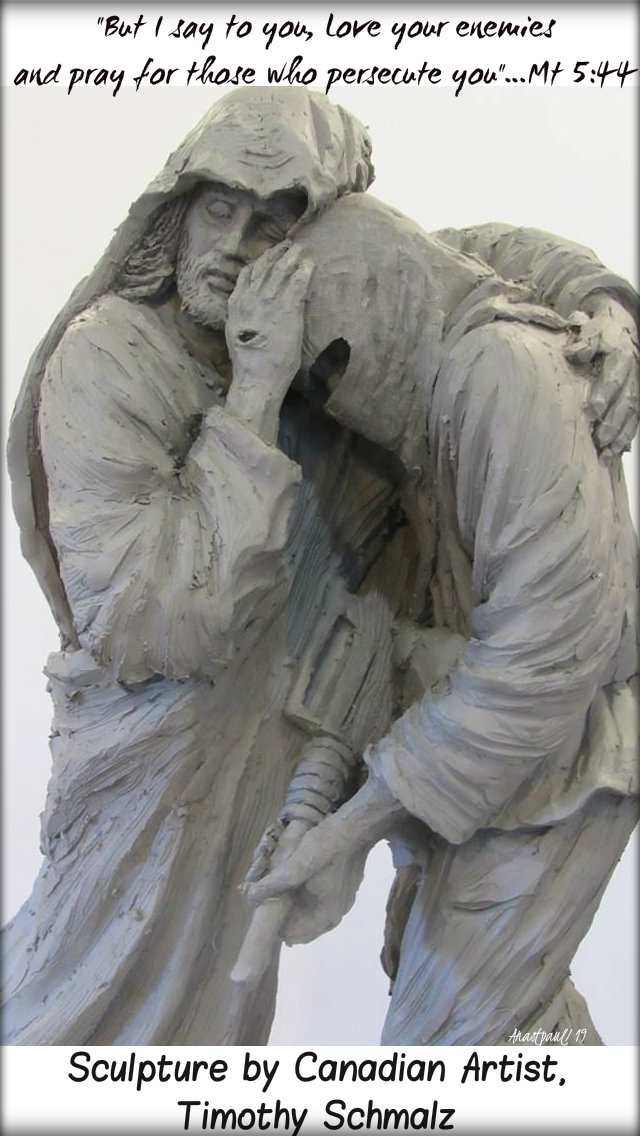
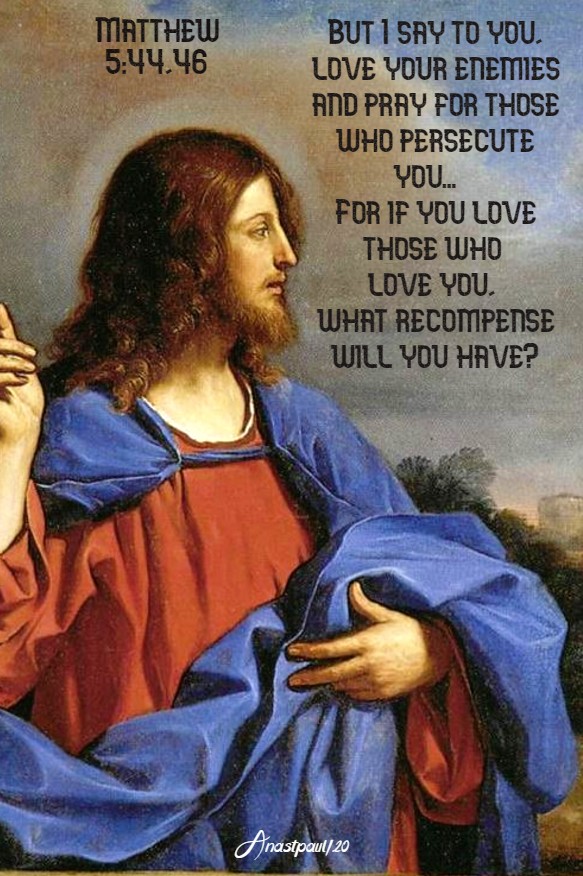
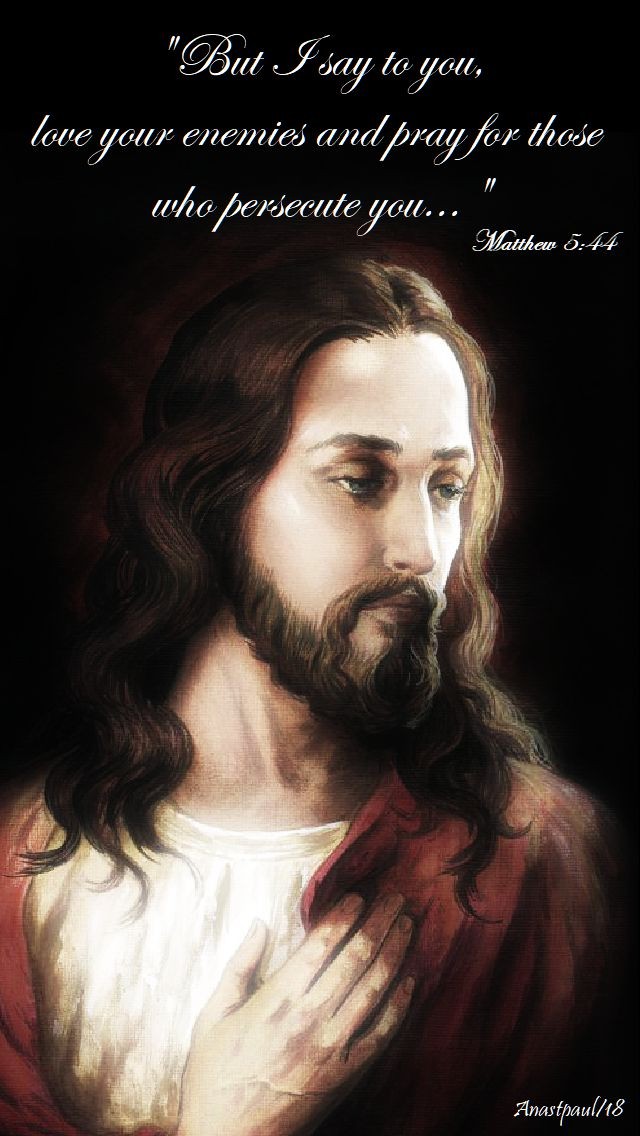
“But I say to you, love your enemies and pray for those who persecute you…”
Matthew 5:44
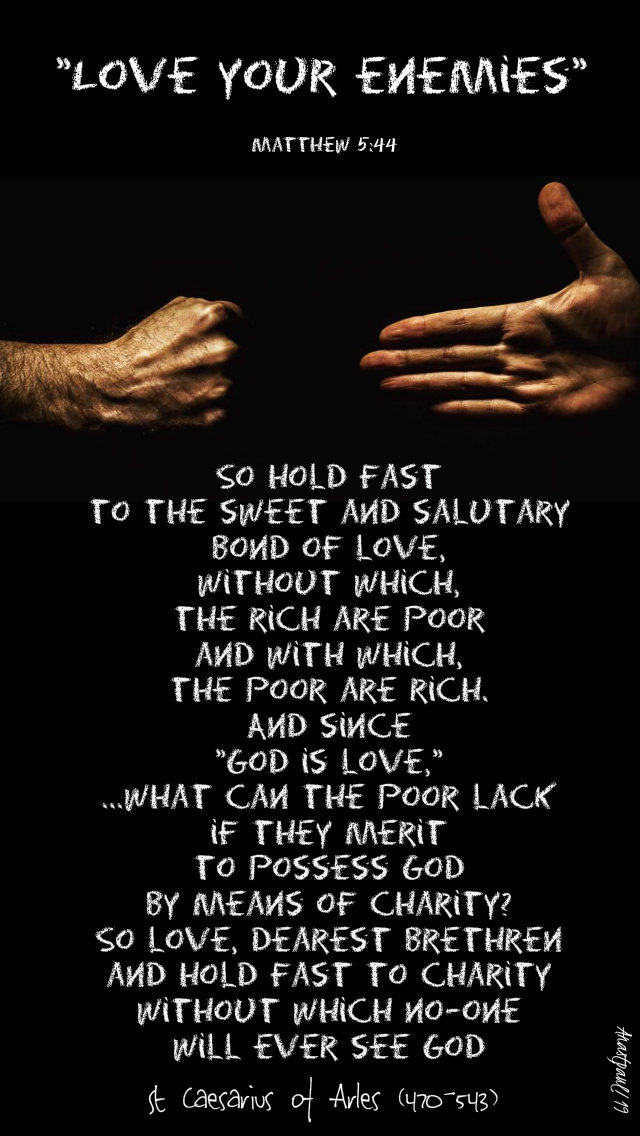
“So hold fast to the sweet and salutary bond of love, without which, the rich are poor and with which the poor are rich. What do the rich possess if not charity? … And since “God is love,” (1 Jn 4:8) as John the evangelist says, what can the poor lack, if they merit to possess God by means of charity? … So love, dearest brethren and hold fast to charity without which, no-one will ever see God.”
St Caesarius of Arles (470-543)
Monk and Bishop
Sermons addressed to the people, no. 23, 3
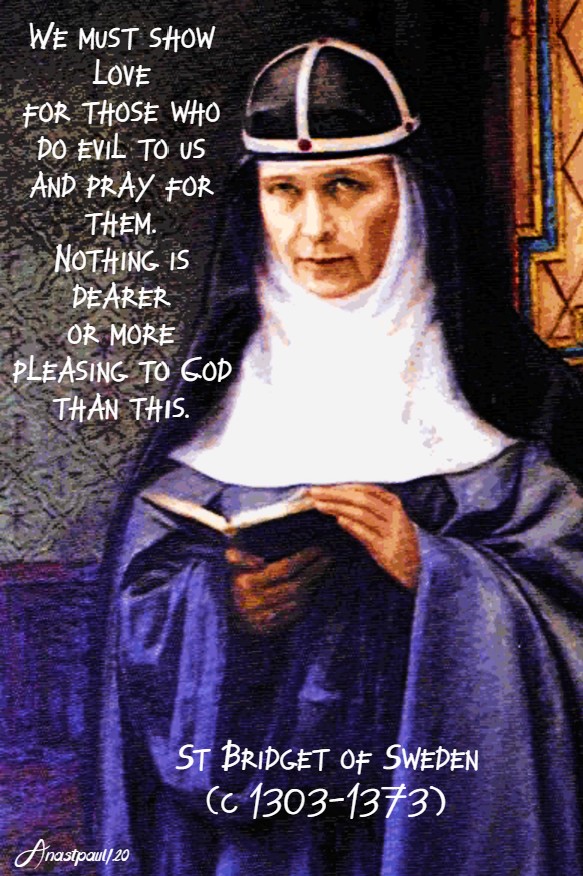
“We must show love for those who do evil to us and pray for them. Nothing is dearer or more pleasing to God than this.”
St Bridget of Sweden (c 1303-1373)
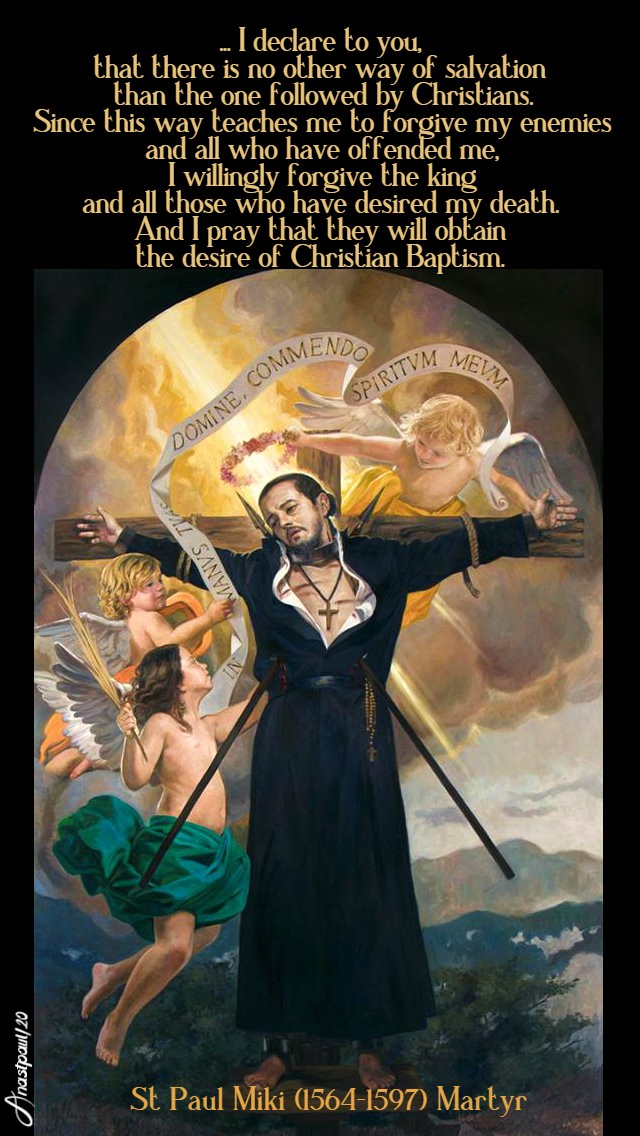
“… I declare to you, that there is no other way of salvation than the one followed by Christians. Since this way teaches me to forgive my enemies and all who have offended me, I willingly forgive the king and all those who have desired my death. And I pray that they will obtain the desire of Christian Baptism.”
St Paul Miki SJ (1564-1597) Martyr
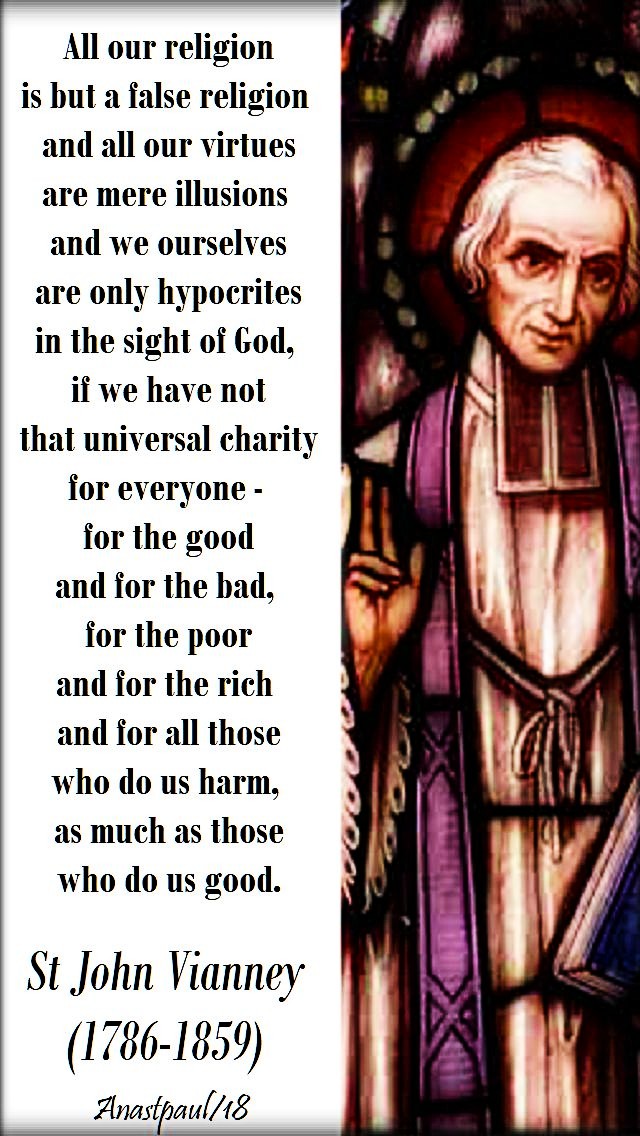
“All our religion is but a false religion and all our virtues are mere illusions and we ourselves are only hypocrites in the sight of God, if we have not that universal charity for everyone – for the good and for the bad, for the poor and for the rich and for all those who do us harm, as much as those who do us good.”
St John Vianney (1786-1859)
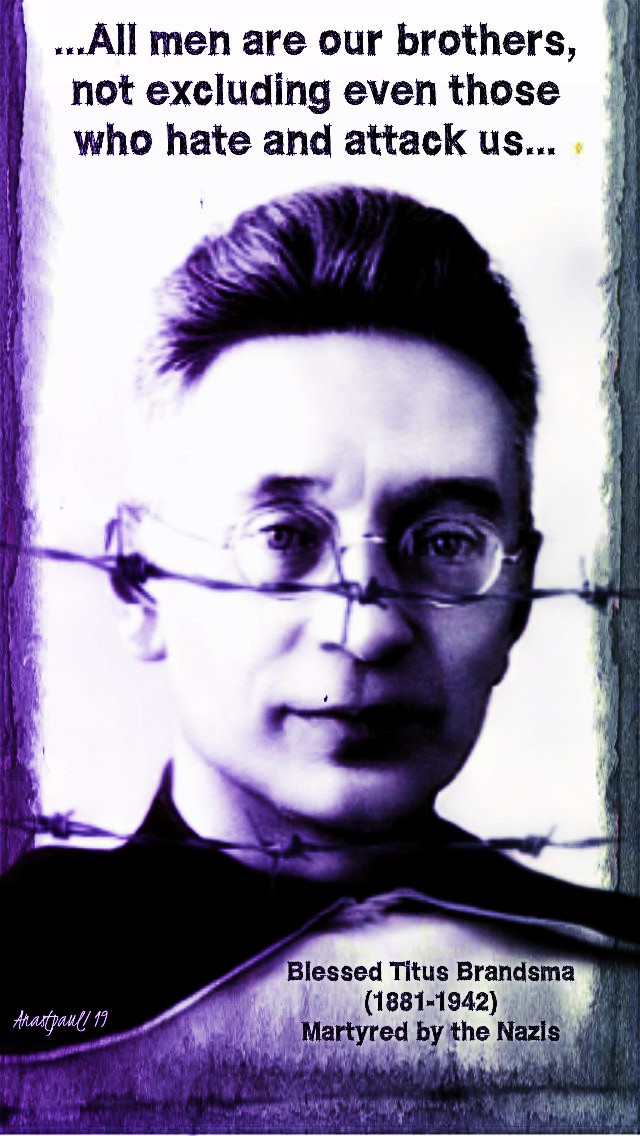
“When we talk about the coming of the Kingdom and pray for its coming, we are not thinking of a discrimination according to race or blood but of the brotherhood of all, for all men are our brothers – not excluding even those who hate and attack us – in a close bond with the One, who causes the sun to rise on the good and the bad alike (Mt 5:45).”
Blessed Titus Brandsma (1881-1942) Martyr
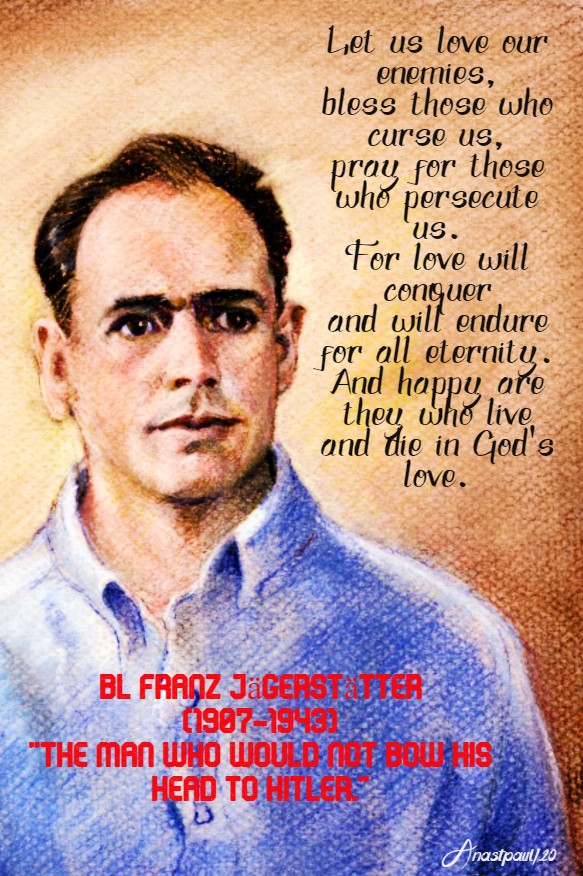
“Let us love our enemies, bless those who curse us, pray for Those who persecute us. For love will conquer and will endure for all eternity. And happy are they who live and die in God’s love.”
Blessed Franz Jägerstätter (1907-1943)
“Called-up to a Higher Order”
Martyr of Conscientious Objection
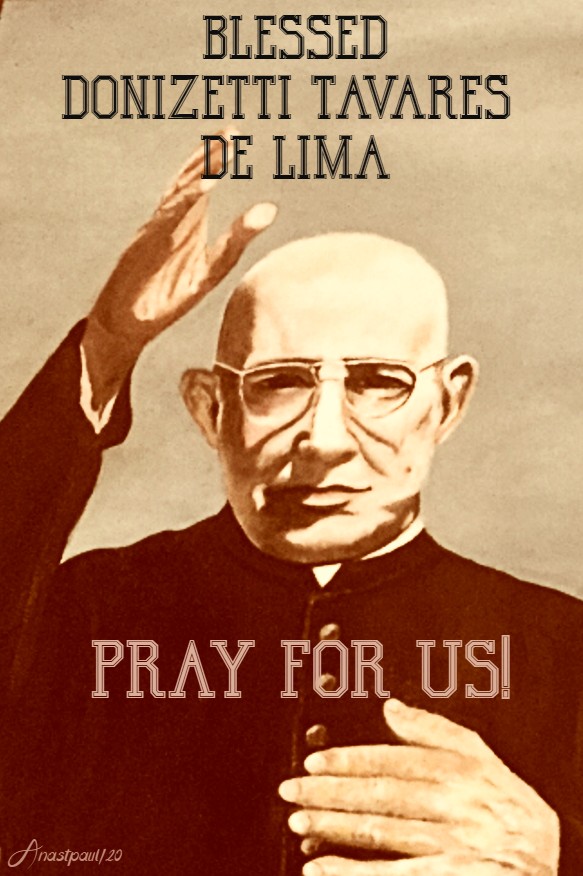
One Minute Reflection – 16 June – “Month of the Sacred Heart” – Tuesday of the Eleventh week in Ordinary Time, Year A, Readings: 1 Kings 21:17-29, Psalm 51:3-6, 11, 16, Matthew 5:43-48 and the Memorial of Bl Donizetti Tavares de Lima (1882-1961)
“But I say to you, love your enemies and pray for those who persecute you… For if you love those who love you, what recompense will you have?” … Matthew 5:44,46
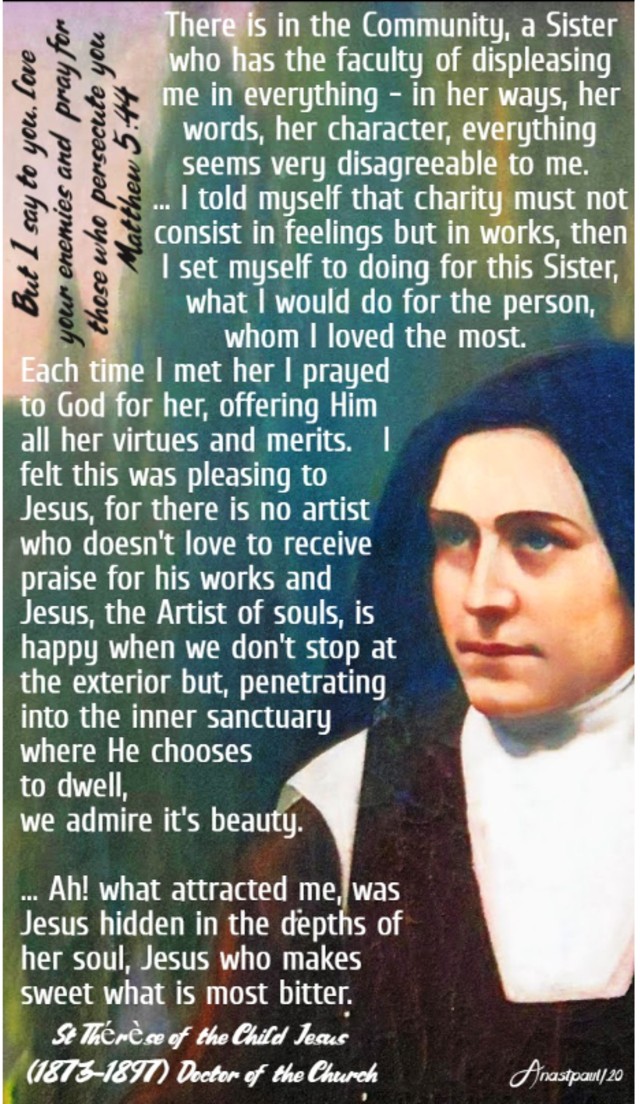
REFLECTION – “There is in the Community, a Sister who has the faculty of displeasing me in everything – in her ways, her words, her character, everything seems very disagreeable to me. And still, she is a holy religious who must be very pleasing to God. Not wishing to give into the natural antipathy I was experiencing, I told myself that charity must not consist in feelings but in works, then I set myself to doing for this Sister, what I would do for the person, whom I loved the most. Each time I met her I prayed to God for her, offering Him all her virtues and merits. I felt this was pleasing to Jesus, for there is no artist who doesn’t love to receive praise for his works and Jesus, the Artist of souls, is happy when we don’t stop at the exterior but, penetrating into the inner sanctuary where He chooses to dwell, we admire it’s beauty.
I wasn’t content simply with praying very much for this Sister, who gave me so many struggles but I took care to render her all the services possible and when I was tempted to answer her back in a disagreeable manner, I was content with giving her my most friendly smile and with changing the subject of the conversation. … Frequently, when… I had occasion to work with this Sister, I used to run away like a deserter, whenever my struggles became too violent. As she was absolutely unaware of my feelings for her, never did she suspect the motives for my conduct and she remained convinced that her character was very pleasing to me. One day, at recreation, she asked in almost these words: “Would you tell me, Sister Therese of the Child Jesus, what attracts you so much toward me, every time you look at me, I see you smile?” Ah! what attracted me, was Jesus hidden in the depths of her soul, Jesus who makes sweet what is most bitter.” … St Thérèse of the Child Jesus (1873-1897) Doctor of the Church
PRAYER – Almighty God, to whom this world, with all it’s goodness and beauty belongs, give us grace joyfully, to begin this day for Christ Your Son, in Him and with Him and to fill it, with an active love for all Your children, even those who may not like or who do us harm. Help us to love as You do, so that we may become like You. Bl Donizetti Tavares de Lima, you who spread your charity far and wide, pray for us. Through Christ our Lord, with the Holy Spirit, one God, forever, amen.
Our Morning Offering – 16 June – “Month of the Sacred Heart” – Tuesday of the Eleventh week in Ordinary Time, Year A
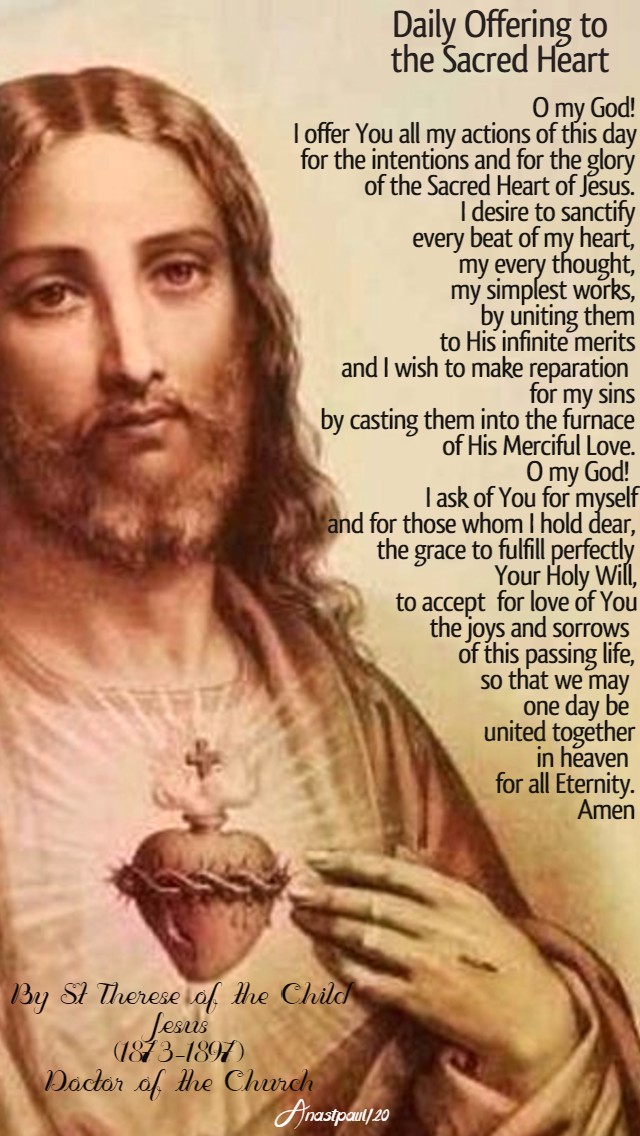
Daily Offering to the Sacred Heart By St Therese of the Child Jesus/Lisieux (1873-1897) Doctor of the Church
O my God!
I offer You all my actions of this day
for the intentions and for the glory
of the Sacred Heart of Jesus.
I desire to sanctify
every beat of my heart,
my every thought,
my simplest works,
by uniting them
to His infinite merits
and I wish to make reparation for my sins
by casting them into the furnace
of His Merciful Love.
O my God! I ask of You for myself
and for those whom I hold dear,
the grace to fulfil perfectly
Your Holy Will,
to accept for love of You
the joys and sorrows of this passing life,
so that we may one day be united together
in heaven for all Eternity.
Amen
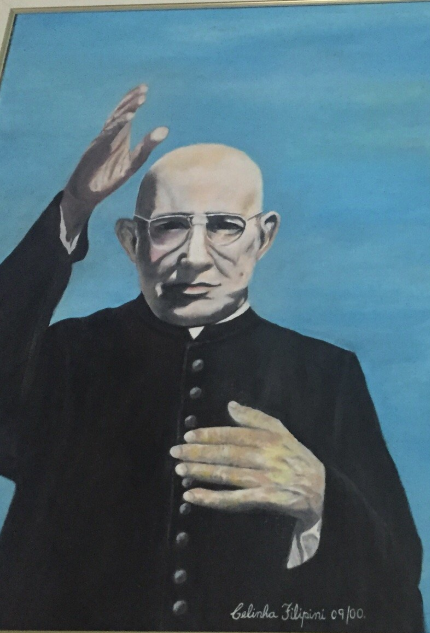
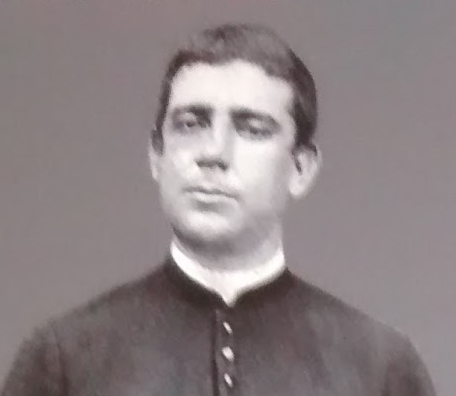
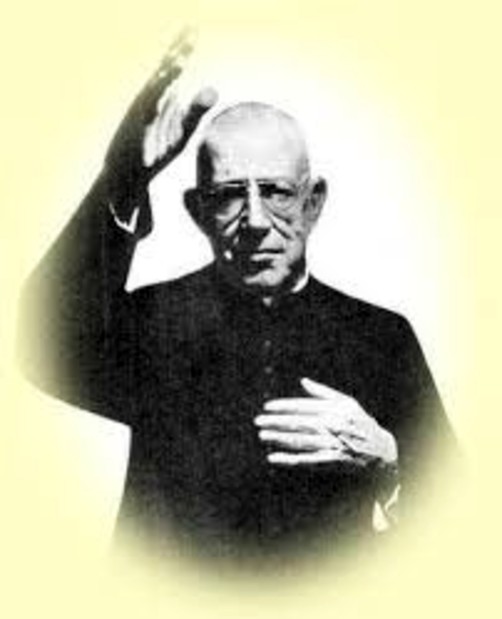
Saint of the Day – 16 June – Blessed Donizetti Tavares de Lima (1882-1961) Priest, Apostle of the poor, the elderly and the sick, miracle-worker, known to bilocate – born on 3 January 1881 in Cássia, Brazil and died at 11.15am on 16 June 1961 in at the parish hall in Tambaú, Brazil of natural causes,he was 80 years old.
Donizetti was born in 1882 to Minas Gerais de Tristão and Francisca Cândida Tavares de Lima. He was one of eight brothers. His father worked in law and his mother worked as a professor. In 1886, the Tavares de Limas family relocated to Franca in São Paulo, where he attended school and learned music.
In 1894 he commenced his ecclesial studies where he soon became the organist at the institute where he studied and later started to teach music to the seminarians. In 1897 he moved to a college to further his education but later returned to teach music to seminarians. In 1900 he commenced a law course and in 1903 his philosophical and theological formation in preparation for the priesthood.
He received his Ordination as a Priest on 12 July 1908 from the Bishop of Pouso Alegre. He began work in the San Gaetano Parish and then spent time in the Campinas Diocese where he served as an auxiallary Priest.
In 1909, he was appointed as the Parish Priest for the Sant’Ana Church Vargem Grande do Sul in the Ribeirão Preto Diocese, where he defended the rights of the poor. This staunch advocacy for the poor led to the rich and his other detractors to accuse him of being a communist. He also helped construct Chapels to Nossa Senhora Aparecida and to Saint Benedict of Nursia. He was stationed at the Sant’Ana church from 20 April to 8 August 1909 before being transferred again. On 24 May 1926 he was appointed as the newest Parish Priest for the Church of St Anthony in Tambaú. He arrived in the town on 12 June and was inaugurated at the parish with his first Mass there on 13 June. It was there, that he oversaw the establishment of the Saint Vincent de Paul Sanatorium for the abandoned and for elderly people who lived alone. The first miracle attributed to him occurred in 1927 – torrential rain threatened a procession of a statue of Our Lady of Aparecida but the storm subsided and was quieted when Fr Donizetti led the procession himself.
In 1960, the Archbishop of Ribeirão Preto city, Dom Luiz do Amaral Mousinho, went to Tambau, to visit the parish of Saint Anthony and met Fr Donizetti. As soon as he saw the Archbishop, he told him:
“Archbishop, I had a terrible nightmare! I saw the demon entering in the Cathedral of Saint Sebastian (in Ribeirão Preto city-SP) with some priests with him and all of them were armed with picks in hand. They were walking to the side altars of the Cathedral, screaming loudly. When they reached the altar of St Anthony, the image of the holy Friar of Lisbon looked with authority to the devil and his minions, then they left the place fast. Archbishop, for goodness sake, do not let them overthrow the altars of the Cathedral!”
At that moment, the Archbishop told him that it was just a dream, a nightmare and no one would remove the altars but Fr Donizetti told again:
“No, no, Archbishop! We won’t see this disgrace (prophesying that they both would die soon) but it will come! This was not just a dream, nor a nightmare! The darkness will fall over this world! I beg you: don’t let them destroy the altars!”
Kindly, as usual he was, the Archbishop smiled and told to him: “Fr Donizetti, I promise you, I won’t let anyone destroy the altars of our Cathedral!”
A few years later, after the introduction of the New Mass, Fr Agmar Marques remembered this fact and he avoided the removal of the altars of Saint Sebastian Cathedral.
Father Horacio Longo also remembered the “nightmare of the altars” prophesied by Father Donizetti when they removed the side altars of the parish of Franca city, now the Our Lady of Conception Cathedral.
Father Saverio Brugnara reported that Father Donizetti received a picture of St Pope John XXIII in 1959. At that momen,t Fr Donizetti looked for a time at the picture, smiled and said to an acolyte that they both should pray a lot for the Pope and for the Church. One of the acolytes wanted to remove the old picture of Pope Pius XII on the wall and put the picture of the new Pope, John XXIII but Fr Donizetti said: “No, my son! Leave the picture there! Soon I will meet him! As for the new Pope’s picture, leave it there, where it is.”
The picture of Pope John XXIII was placed on a dresser and Pius XII’s picture continued on the wall, at the main place of the sacristy.
Many miracles were witness through the piety and devotion of Father Donizetti. He was just a living saint and he used to be called as “the thaumaturge of Tambau.” One of the miracles which Father Donizetti always attributed to the intercession of Our Lady of Aparecida, was witnessed by one of the most respected journalists in Brazil, Joelmir Beting (1936-2012) who was born and lived in Tambau. Local officials came to him to seek out his advice on social matters. Even President Getúlio Vargas spoke with Fr Donizetti about social matters, that culminated legislation governing proper work ethics
On a radio program the journalist told that on the Easter Sunday of 1953, Fr Donizetti prayed the Mass in the church of Saint Anthony for thousands people and at the same time, he was seen by about 2 thousand people in the City of São Pedro dos Morrinhos, attending an auction of cattle to raise money for his sanatorium. This was one of the many miracles that made him known in the state of São Paulo and other states of the country.
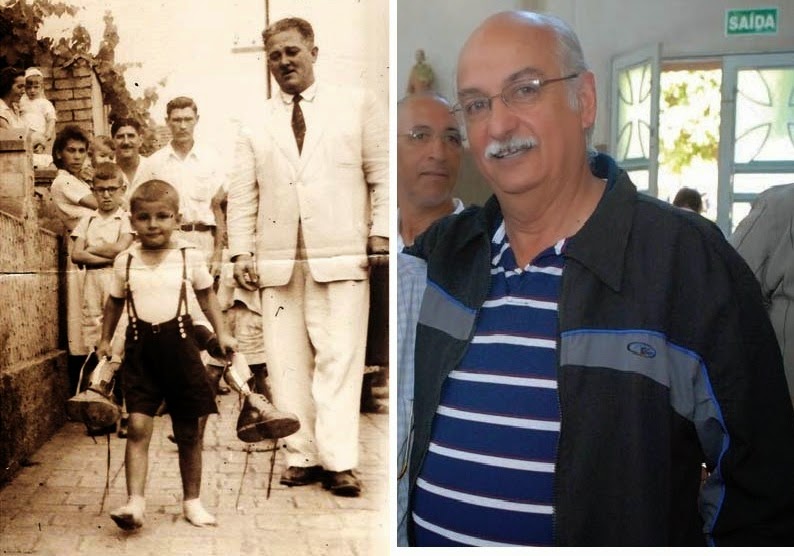
Another famous miracle happened in 1955 when José Alexandre Braga, a boy of 5 years old, was cured of osteochondritis, a disease that prevented him from walking.
José Alexandre Braga (the child in the picture left) after he was cured. In the picture right a most recent photo.
About the miracles, Father Donizetti used to say that the most important were not the cures but the conversions to Catholicism.
Fr Donizetti died in Tambaú on 16 June 1961 due to cardiac complications and diabetic complications that had caused several hospitalisations in the past. He died in the morning at 11:15 am while seated in a chair. His remains were interred on 17 June and exhumed on 7–8 May 2009 in Tambaú for canonical inspection and relocation, which was done at night to avoid a large crowd forming. Later his body was moved to his old parish church and now attract, between 10 and 12 thousand people per month who come as pilgrims. Thousands also visit the ‘House of Father Donizetti’ (in Portuguese “casa do Padre Donizetti”). Inside the house, there are many objects related to the miracles, such as crutches, etc.
This slideshow requires JavaScript.
The Priest had been hailed as a Saint his entire life and efforts to launch a Beatification process started in 1991. The cause opened towards the decade’s end and he became titled as a Servant of God. Pope Francis confirmed his heroic virtue on 9 October 2017 and named him as Venerable. Pope Francis also signed a decree on 6 April 2019 that recognised a miracle attributed to his intercession which made it possible for him to be Beatified in Tambaú on 23 November 2019. He was Beatified on 23 November 2019 by Pope Francis. The Beatification ceremony was celebrated by Cardinal Giovanni Angelo Becciu.
St Actinea of Volterra
St Aitheachan of Colpe
St Amandus of Beaumont
Bl Antoine Auriel
St Aurelian of Arles
St Aureus of Mainz St Benno of Meissen (1010-1106) Biography: https://anastpaul.com/2018/06/16/saint-of-the-day-st-benno-1010-1106/
St Berthaldus
St Ceccardus of Luni
St Cettin of Oran
St Colman McRhoi
St Crescentius of Antioch
St Cunigunde of Rapperswil
St Curig of Wales
St Cyriacus of Iconium Blessed Donizetti Tavares de Lima (1882-1961)
St Elidan
St Felix of San Felice
St Ferreolus of Besançon
St Ferrutio of Besançon
Bl Gaspare Burgherre
St Graecina of Volterra
St Ismael of Wales
St Julitta of Iconium
St Justina of Mainz St Lutgarde of Aywières (1182-1246) Her Life: https://anastpaul.com/2017/06/16/saint-of-the-day-16-june-st-lutgarde-of-aywieres-the-first-known-woman-stigmatic-of-the-church-and-one-of-the-first-promoters-of-devotion-to-the-sacred-heart/
St Maurus of San Felice
St Palerio of Telese
St Similian of Nantes
Bl Thomas Redyng
St Tycho of Amathus
—
Martyrs of Africa: A group of five Christians martyred together. We know nothing else but the names – Cyriacus, Diogenes, Marcia, Mica, Valeria. They were martyred in an unknown location in Africa, date unknown.
Martyrs of Làng Cóc: A group of five Christian laymen, four farmers and a doctor, from the same village in the apostolic vicariate of Central Tonkin (in modern Vietnam). During the persecutions of emperor Tu Duc, they were each ordered to stomp on a cross to show their contempt for Christianity; they each refused. Imprisoned, tortured and martyred.
• Anrê Tuong
• Ðaminh Nguyen
• Ðaminh Nguyen Ðuc Mao
• Ðaminh Nhi
• Vinh Son Tuong
The were beheaded on 16 June 1862 in Làng Cóc, Nam Ðinh, Vietnam and canonised on 19 June 1988 by St Pope John Paul II.
Novena in Honour of the Sacred Heart of Jesus Day Six – 15 June
Honesty in Prayer
Today’s Scripture When Jesus arrived, he found that Lazarus had already been in the tomb for four days. Now Bethany was near Jerusalem, some two miles away and many of the Jews had come to Martha and Mary to console them about their brother. When Martha heard that Jesus was coming, she went and met him, while Mary stayed at home. Martha said to Jesus, ‘Lord, if you had been here, my brother would not have died. But even now I know that God will give you whatever you ask of him.’ Jesus said to her, ‘Your brother will rise again.’ Martha said to him, ‘I know that he will rise again in the resurrection on the last day.’ … John 11:17-24
Reflection for the Sixth Day
St Ignatius Loyola said that we should always speak to Jesus in prayer just as one close friend would speak to another.
Don’t be afraid to express your real feelings to Jesus – anger, hurt, joy, sorrow, etc.
When you’ve made your complaint or expressed your joy, don’t forget one thing Listen for God’s response!
It may come in surprising ways.
If, you concentrate on Him all day, at every task, you will hear Him!
Today’s Prayer
Jesus, I have to be honest and tell You,
that there have been times when I’ve been angry with You
and I feel that You’ve let me down.
Help me to trust
that You really do have a loving plan for me
and for everyone,
a plan that most times I find hard to fathom.
I love and trust You Lord,
help me to love and trust You more each day!
Amen
Daily Invocation Sacred Heart of Jesus, I place all my trust in you.
Novena Prayer
Lord Jesus,
the needs of Your people open Your heart in love for each of us.
You care for us when we are lost,
sympathise with us in loneliness
and comfort us in mourning;
You are closest to us where we are weakest.
You love us most, when we love ourselves least;
You forgive us mos, when we forgive ourselves least
and You call us to spread Your love in whatever way we can.
Lord Jesus, Your heart is moved with compassion
when we are suffering,
when we need your help
and when we pray for each other.
I ask You to listen to my prayer during this Novena
and grant what I ask.
…………………………. (Mention your intention silently.)
If what I ask, is not for my own good and the good of others,
grant me what is best,
that I may build up Your kingdom of love in our world.
Amen
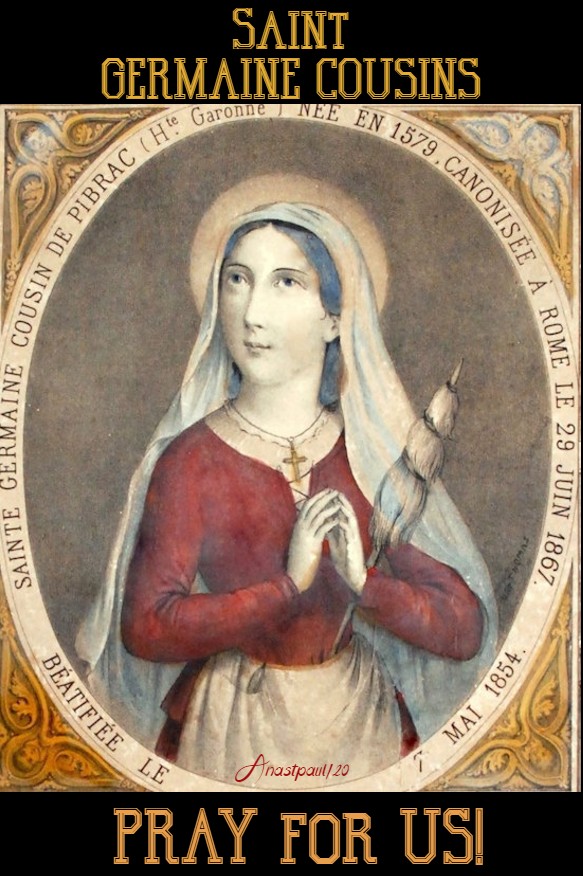
Thought for the Day – 15 June – Meditations with Antonio Cardinal Bacci (1881-1971) and the Memorial of St Germaine Cousin (1579–1601) Shepherdess
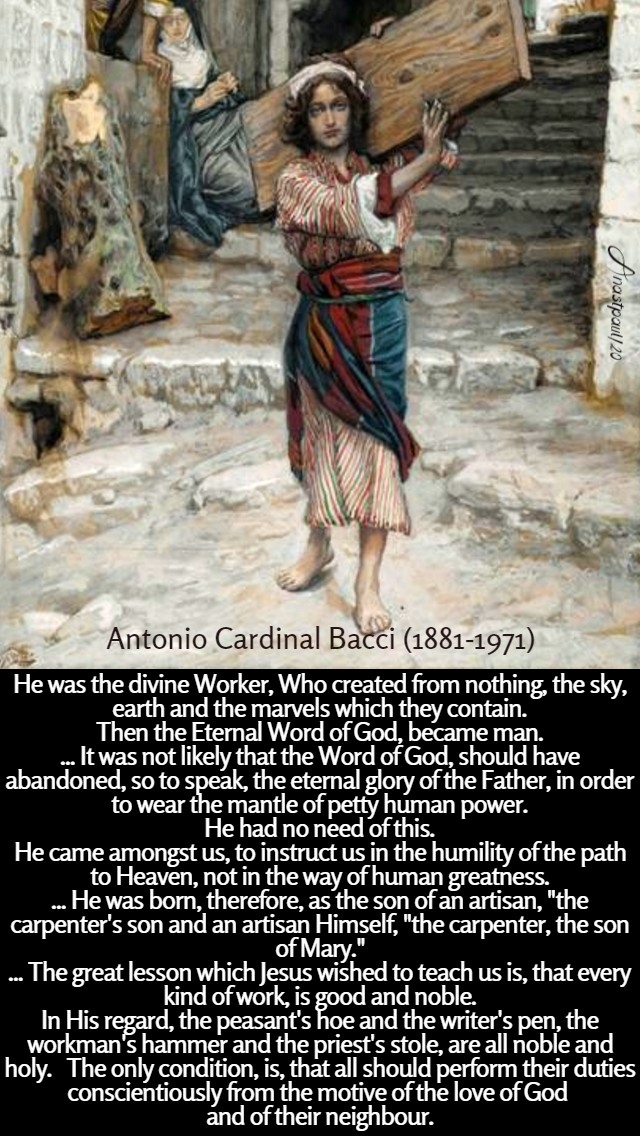
The Divine Worker
“Let us open the Gospel of St John.
“In the beginning was the Word and the Word was with God and the Word ws God. He was in the beginning with God. All things were made through him and without him, was made nothing that has been made” (John 1:1-3).
The work of creation is attributed in a special way, to the Eternal Word, the Son of God.
He was the divine Worker, Who created from nothing, the sky, earth and the marvels which they contain.
Then the Eternal Word of God, became man (Jn 1:14).
But what position did He choose to occupy amongst us?
He could have been born heir to the illustrious throne of Rome, the most powerful in history.
He could have been born in Athens amongst the philosophers of the Areopagus, who handed down, through the centuries, the light of human wisdom and beauty.
But, it was not likely that the Word of God, should have abandoned, so to speak, the eternal glory of the Father, in order to wear the mantle of petty human power.
He had no need of this.
He came amongst us, to instruct us in the humility of the path to Heaven, not in the way of human greatness.
He was born, therefore, as the son of an artisan, “the carpenter’s son, (Mt 13:55) and an artisan Himself, “the carpenter, the son of Mary” (Mk 6:3).
According to the most ancient and most reliable tradition, He was one of the many carpenters in the Palestinian countryside who were prepared to adapt themselves to whatever job arose, whether it was the making of a door, a handle for a hoe, or a plough (Cf Justin Martyr, Dialogue with Trypho, 88:8).
From His youth, therefore, Jesus was a carpenter’s apprentice and, when St Joseph died, He carried on His trade and earned a livelihood for His Mother Mary and Himself.
It was only after many years of manual labour that Jesus ceased to be an artisan and dedicated Himself to work of the mind and heart.
In the three years of His public life, He was an Apostle of truth and goodness.
In this way, He sanctified every type of work, manual, intellectual and spiritual.
The great lesson which Jesus wished to teach us is, that every kind of work, is good and noble.
The manual labour of the farm-hand and of the artisan, is, a co-operation in the work of the Redemption.
Both were made holy by Jesus.
Let those who work with their hands take inspiration from Jesus, Who subjected Himself, for thirty years to all the sacrifices involved in manual labour.
Let intellectuals and apostolic workers look to Jesus also, for when His Hour had come, He sacrificed Himself in His apostolate and gave His life for us.
In His regard, the peasant’s hoe and the writer’s pen, the workman’s hammer and the priest’s stole, are all noble and holy.
The only condition, is that, all should perform their duties conscientiously from the motive of the love of God and of their neighbour.”
Antonio Cardinal Bacci
Cardinal Bacci and I did not plan that this post should fall on the Feast day of little St Germaine Cousins, the Shepherdess who gave every second of her labour and her life, for the love of God and His Will. She teaches us to sanctify the meanest of tasks, to constantly remember our daily offering of each and every form of our work for the glory of God and to honour His Divine Will and Providence.
Quote/s of the Day – 15 June – “Month of the Sacred Heart” – Monday of the Eleventh Week of Ordinary Time, Year A, Readings: 1 Kings 21:1-16, Psalm 5:2-3, 4-7, Matthew 5:38-42 and the Memorial of St Germaine Cousin (1579–1601)
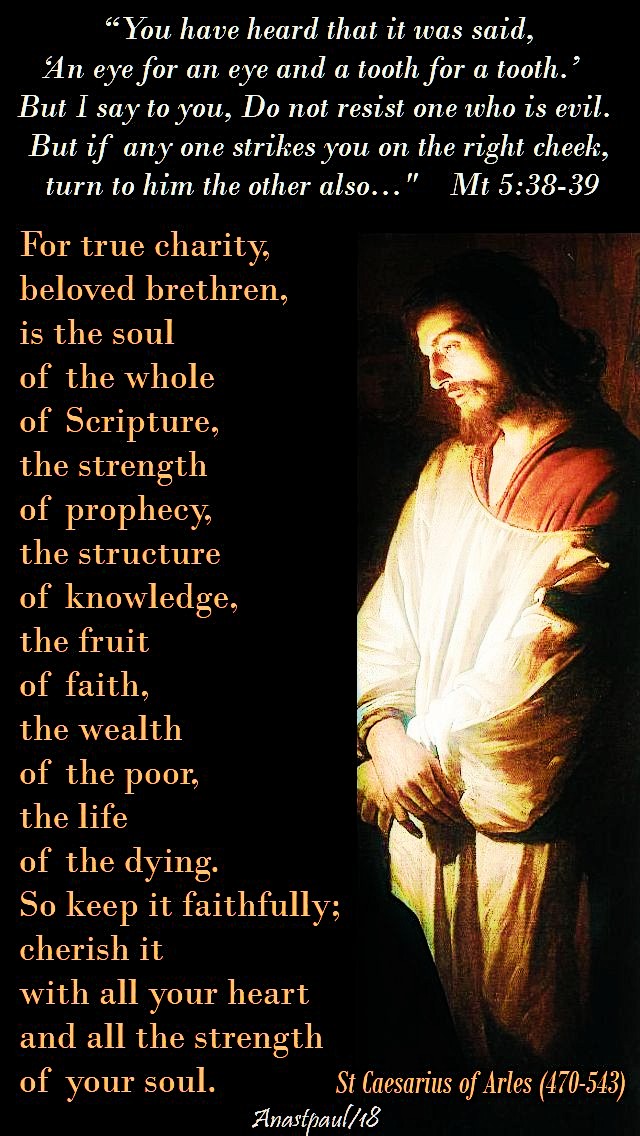
“But I say to you, offer no resistance to one who is evil. When someone strikes you on your right cheek, turn the other one to him as well.”
Matthew 5:39
“But I say to you, love your enemies and pray for those who persecute you”
Matthew 5:44
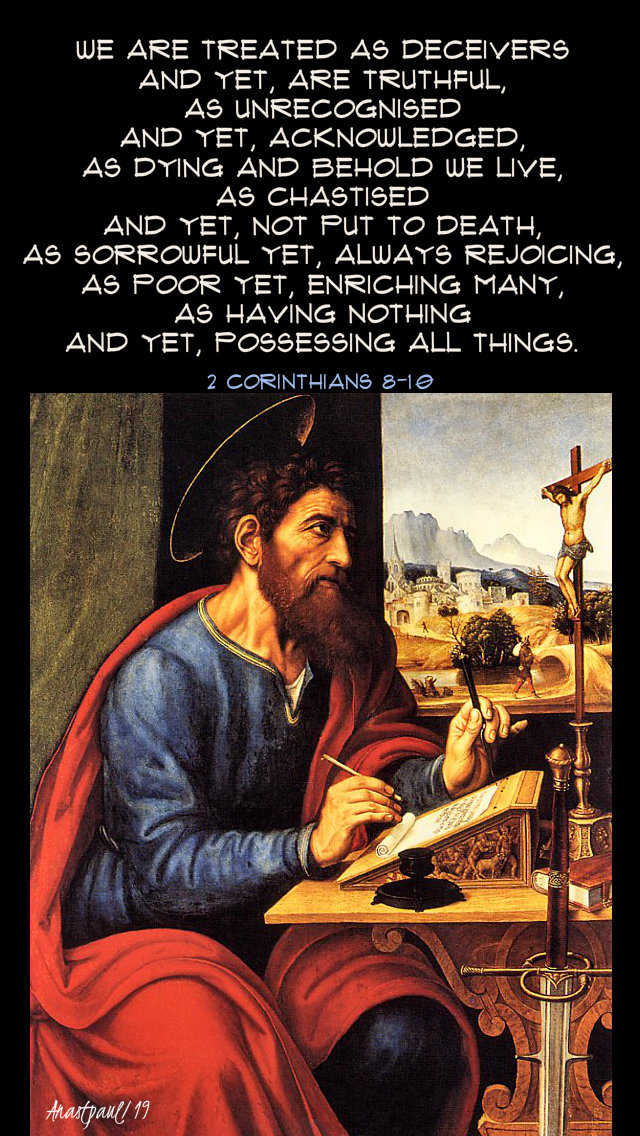
“We are treated as deceivers and yet, are truthful, as unrecognised and yet, acknowledged, as dying and behold we live, as chastised and yet, not put to death, as sorrowful yet, always rejoicing, as poor yet, enriching many, as having nothing and yet, possessing all things.”
2 Corinthians 8-10
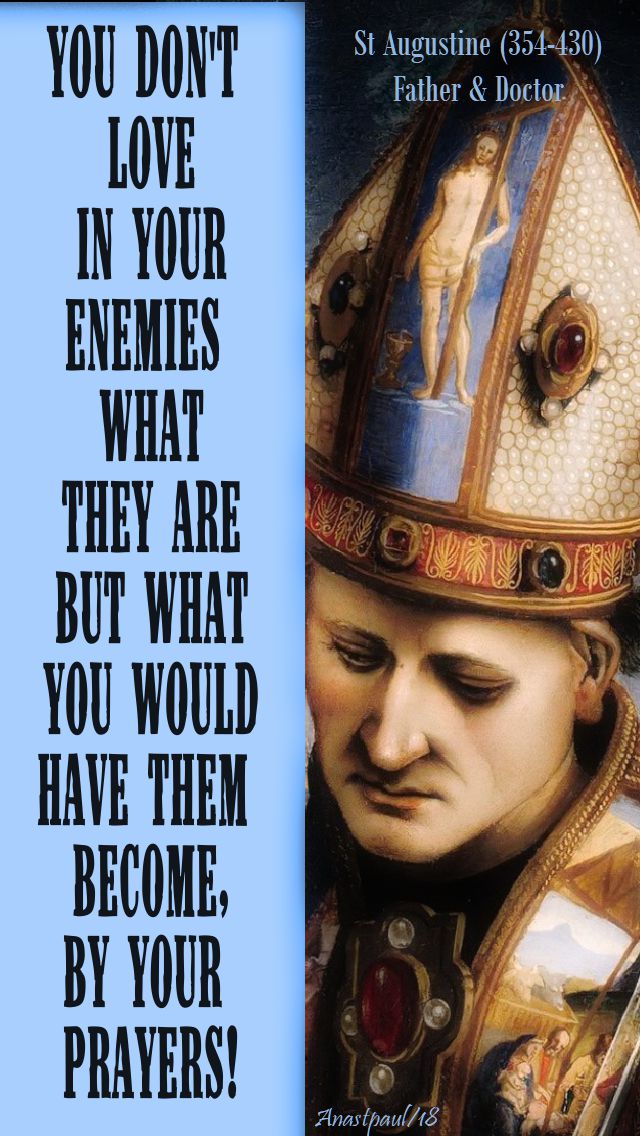
“You don’t love in your enemies what they are but what you would have them become, by your prayers!”
St Augustine (354-430) Father & Doctor
“For true charity, beloved brethren, is the soul of the whole of Scripture, the strength of prophecy, the structure of knowledge, the fruit of faith, the wealth of the poor, the life of the dying. So keep it faithfully; cherish it with all your heart and all the strength of your soul (cf Mk 12:30).”
St Caesarius of Arles (470-543)
Bishop and Monk
(Sermons to the people, no. 23, 4-5, which draws its inspiration from Saint Augustine)
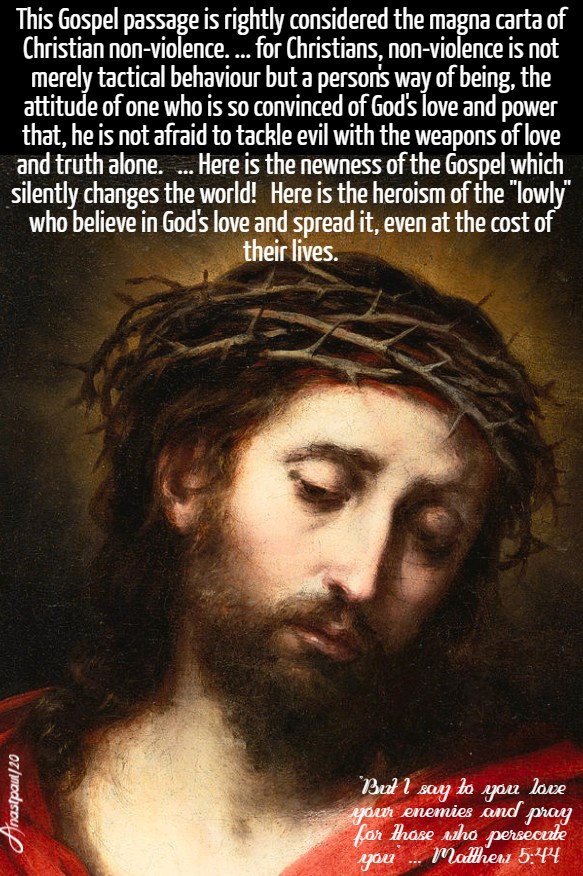
“This Gospel passage is rightly considered, the magna carta of Christian non-violence. One then understands that for Christians, non-violence is not merely tactical behaviour but a person’s way of being, the attitude of one who is so convinced of God’s love and power that, he is not afraid to tackle evil with the weapons of love and truth alone. … Here is the newness of the Gospel which silently changes the world! Here is the heroism of the “lowly” who believe in God’s love and spread it, even at the cost of their lives.”
Pope Benedict XVI
Angelus, St Peter’s Square, Sunday, 18 February 2007
One Minute Reflection – 15 June – “Month of the Sacred Heart” – Monday of the Eleventh Week of Ordinary Time, Year A, Readings: 1 Kings 21:1-16, Psalm 5:2-3, 4-7, Matthew5:38-42 and the Memorial of St Germaine Cousin (1579–1601)
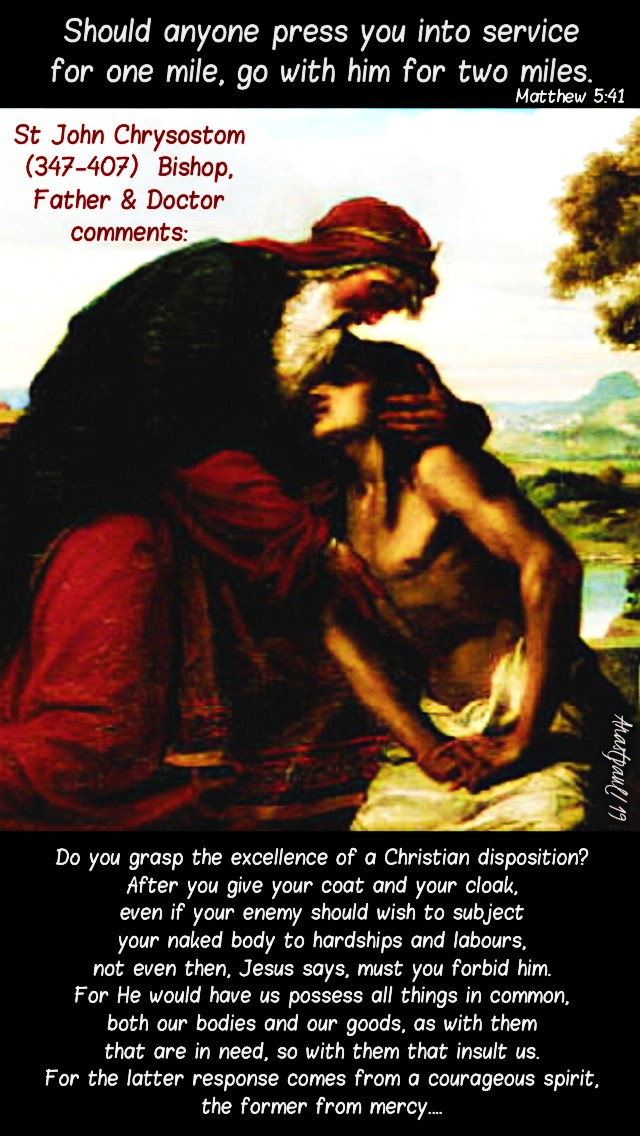
“Should anyone press you into service for one mile, go with him for two miles.” … Matthew 5:41
REFLECTION – “Do you grasp the excellence of a Christian disposition? After you give your coat and your cloak, even if your enemy should wish to subject your naked body to hardships and labours, not even then, Jesus says, must you forbid him. For He would have us possess all things in common, both our bodies and our goods, as with them that are in need, so with them that insult us. For the latter response comes from a courageous spirit, the former from mercy. Because of this, Jesus said, “If any one shall compel you to go one mile, go with him two.” Again He leads you to higher ground and commands you to manifest the same type of aspiration. For if the lesser things He spoke of at the beginning receive such great blessings, consider what sort of reward awaits those who duly perform these and what they become even before we hear of receiving rewards. You are winning full freedom from unworthy passions in a human and passible body.” … St John Chrysostom (347-407) Bishop, Father & Doctor (The Gospel of Matthew: Homily 18)
PRAYER – King of heaven and earth, Lord God, rule over or hearts and bodies this day. Sanctify us and guide our every thought, word and deed according to the commandments of Your law, so that now and forever, Your grace may free and save us. Teach us Lord to walk in the ways of the Cross of Your Son, our Saviour, as St Germaine Cousin so lovingly and willingly inspires us to do. Through Christ our Lord, with the Holy Spirit, God, forever, amen
Our Morning Offering – 15 June – “Month of the Sacred Heart” – Monday of the Eleventh Week of Ordinary Time, Year A
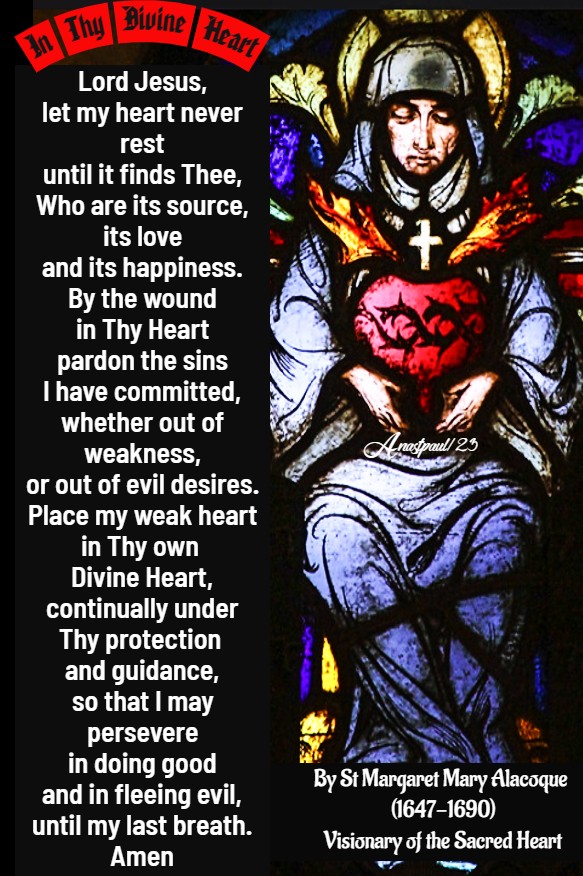
In Thy Divine Heart By St Margaret Mary Alacoque (1647-1690) Visionary of the Sacred Heart
Lord Jesus, let my heart never rest until it finds Thee, Who are its source, its love and its happiness. By the wound in Thy Heart pardon the sins I have committed, whether out of weakness, or out of evil desires. Place my weak heart in Thy own Divine Heart, continually under Thy protection and guidance, so that I may persevere in doing good and in fleeing evil, until my last breath. Amen
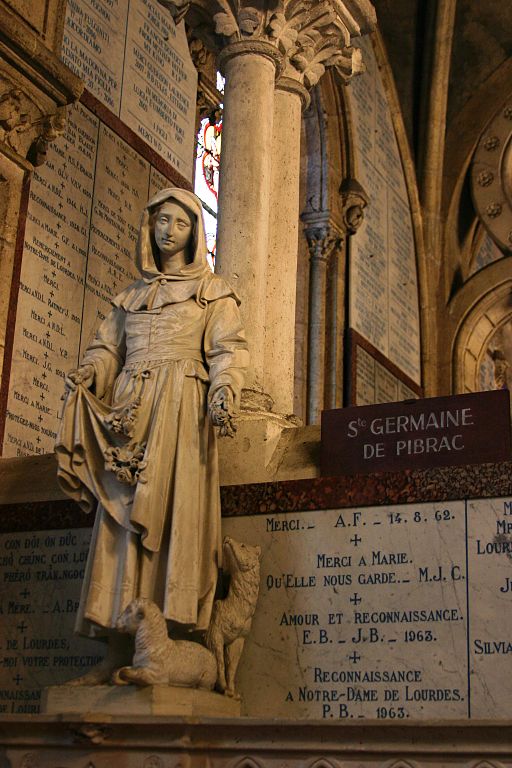
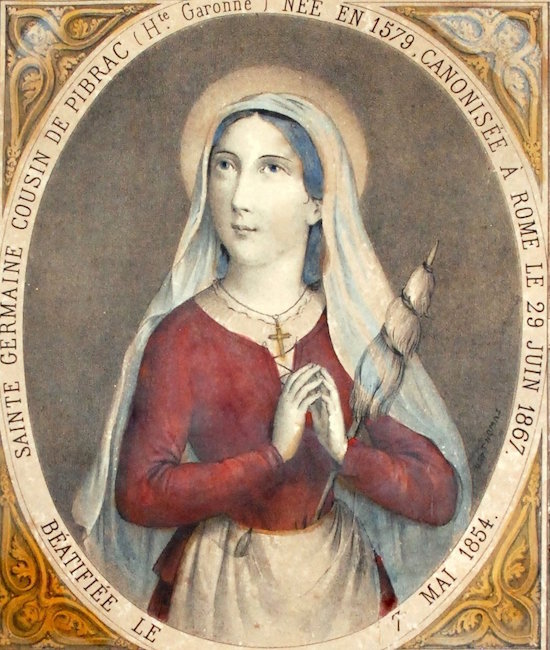
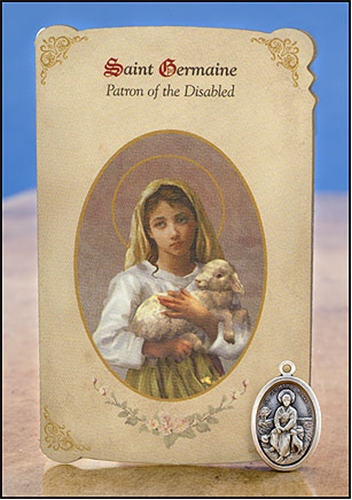
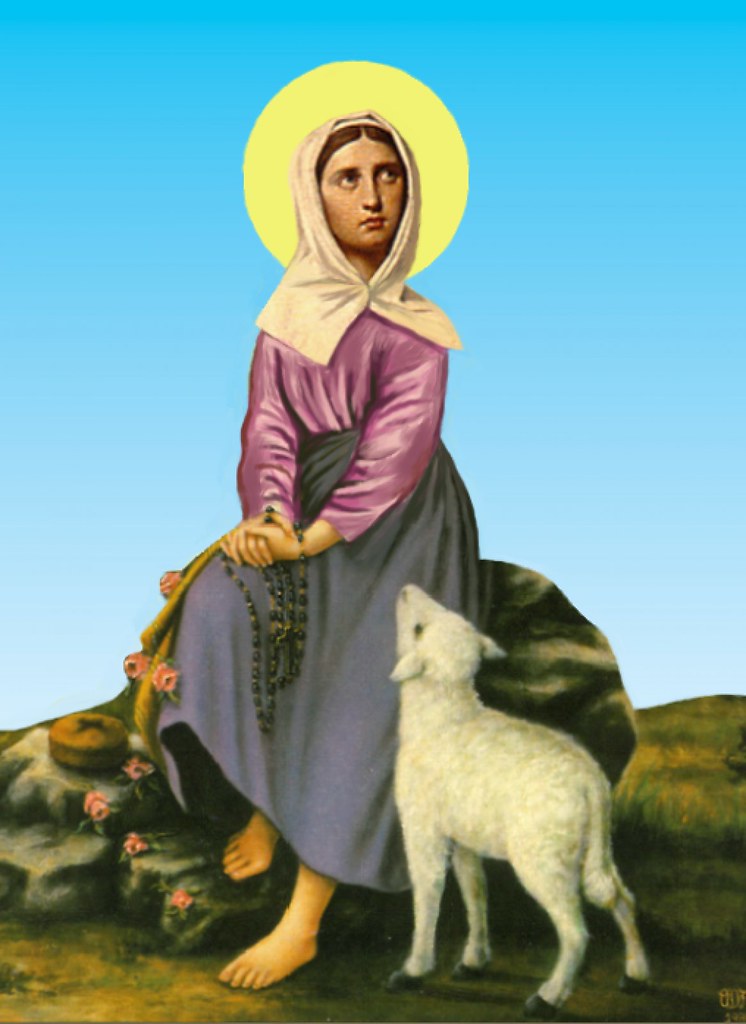
Saint of the Day – 15 June – Saint Germaine Cousin (1579–1601) Laywoman, Penitent, Apostle of Charity, miracle-worker – born in 1579 at Pibrac, France and died in 1601 in her parents’ home in Pibrac, France, apparently of natural causes, aged 22. Also known as Germana Cousin, Germaine of Pibrac. Patronages – abandoned people, abuse victims, child abuse victims, against poverty, disabled and handicapped, people, girls from rural areas, illness, impoverishment, loss of parents, shepherdesses, people disfigured by disease, physical therapists. Her body is incorrupt.
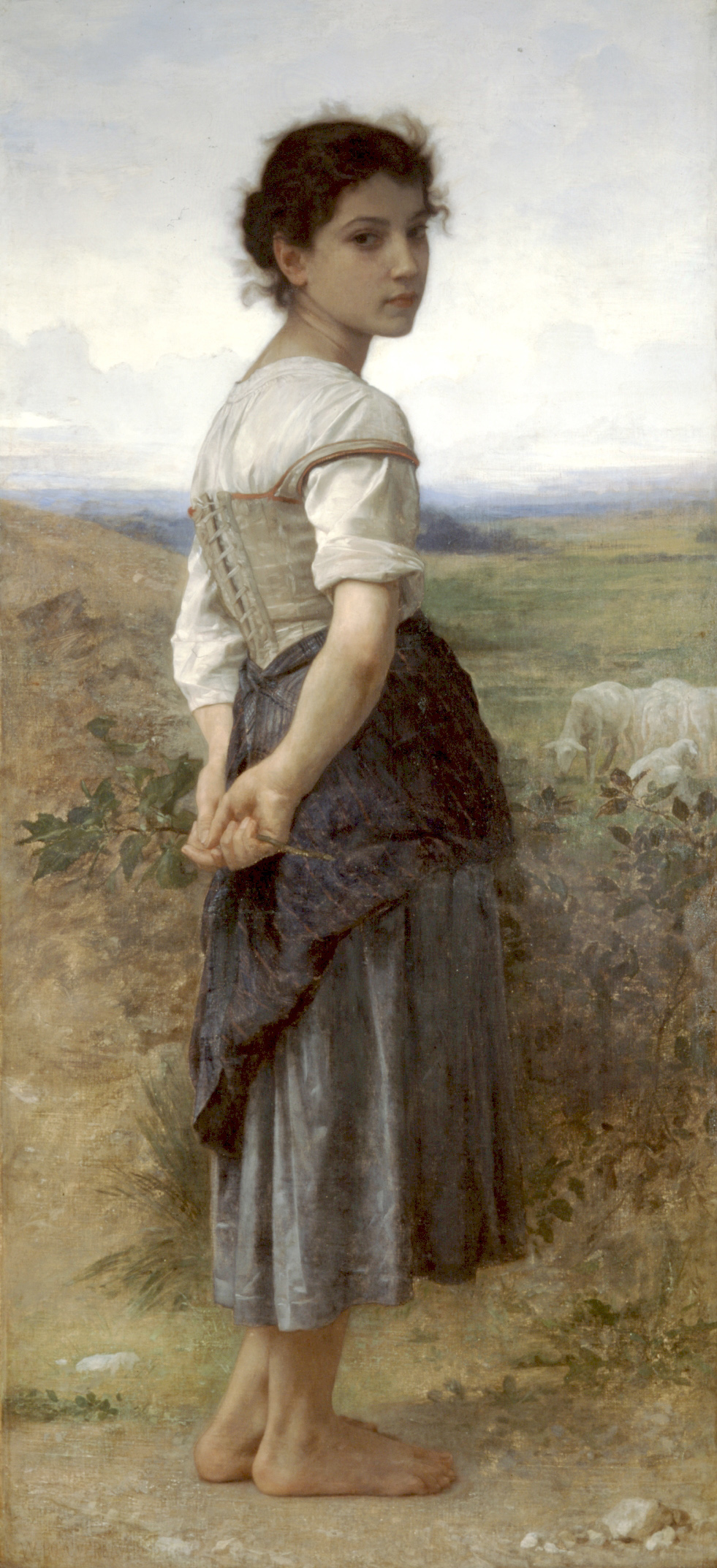
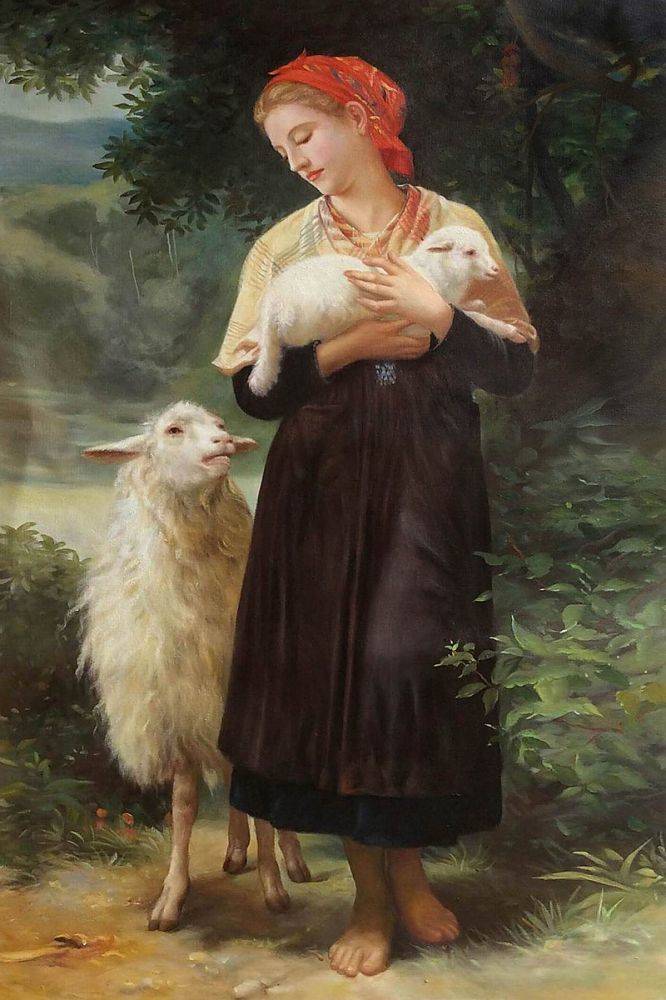
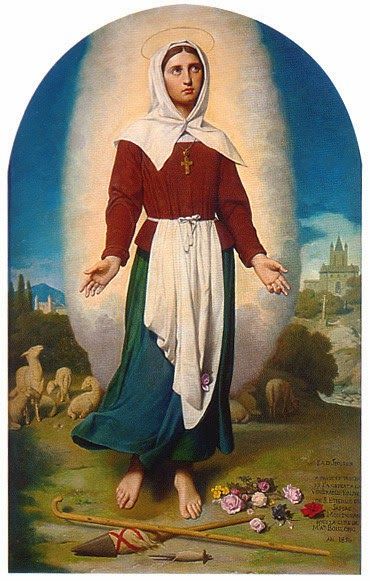
These two “Shepherdesses” by William-Adolphe Bougereau are believed to be depictions of St Germaine
Germaine Cousin was a 16th-century shepherdess who lived from 1579 to 1601. Born with a lame right hand and the disease scrofula (a non-tuberculous infection of the lymph nodes of the neck), she projected quite an unsightly appearance. The only child of Laurent Cousin and Marie Laroche, Germaine lived about 1.5 miles west of Pibrac, France. When she was just five years old, the plague suddenly took her dear mother and her father soon after remarried. Germaine was physically and mentally abused by her new stepmother, Armande de Rajols.
Armande’s hatred of little Germaine was so intense that she forced her to live for 17 years in the family barn and to watch the sheep near the wolf-infested La Bouconne forest, hoping the wolves would kill her. Isolated, cold and lonely, Germaine embraced a life of prayer, penance, and almsgiving, she assisted the poor and hungry, even though she herself was malnourished. She offered up her suffering to God.
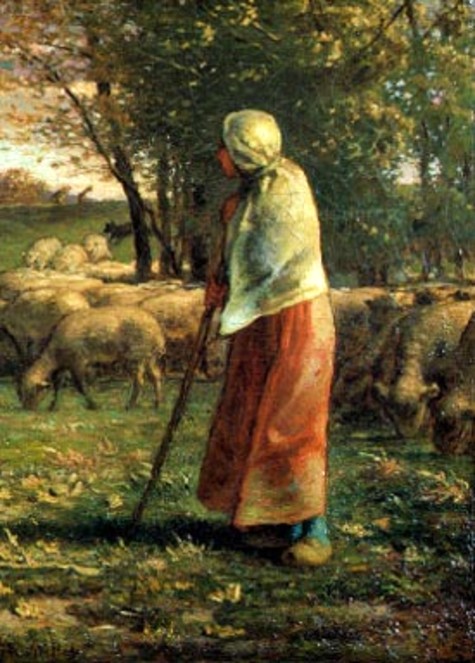
By Jean F Millet artist of “The Angelus”
She is practised many austerities as reparation for the sacrileges perpetrated by heretics in the neighbouring churches. She frequented the Sacraments of Penance and the Holy Eucharist and it was observed that her piety increased on the approach of every feast of Our Lady. The Rosary was her only book and her devotion to the Angelus was so great that she used to fall on her knees at the first sound of the bell, even though she heard it when crossing a stream. The villagers are said to have inclined at first to treat her piety with mild derision, until certain signs of God’s signal favour made her an object of reverence and awe.
It was while these abuses were taking place that miraculous wonders began to surround Germaine. People from the village witnessed her, on several occasions, parting the turbulent spring waters of the Courbet, which she had to cross to get to Mass in the morning.
On another occasion, Germaine had filled her apron with surplus bread from her meagre daily rations so that she may feed the poor. Her stepmother pursued her into town, hoping to expose her to the townspeople as a miscreant and a thief, who was stealing from her household pantry. After catching up with her in the public square, she forced her to reveal the contents of her apron. When Germaine opened her apron, it wasn’t bread that came flowing out but summer flowers. It was the middle of winter. Everyone was amazed and began to see Germaine in a different light. The stepmother, however, was unmoved and continued to persecute the young girl until her death. This wasn’t for much longer, as Germaine soon died alone in the barn where she had been forced to live for 17 years.
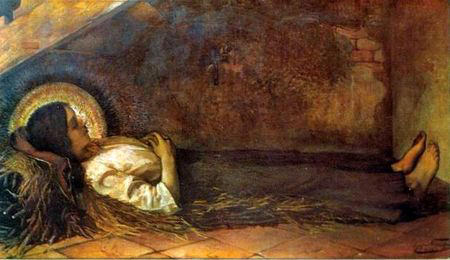
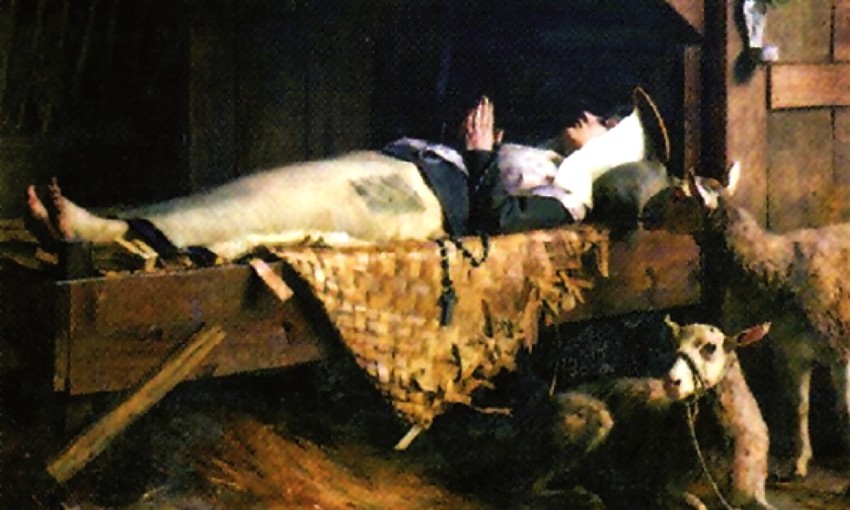
Her father at last came to a sense of his duty, forbade her stepmother henceforth to treat her harshly and wished to give her a place in the home with his other children but Germaine begged to be allowed to remain in the humbler position. At this point, when men were beginning to realise the beauty of her life, she died. One morning in the early summer of 1601, her father found that she had not risen at the usual hour and went to call her, finding her dead on her pallet of vine-twigs. She was 22 years old at the time.
Mysterious lights enveloped the barn the night she died. Two monks who were travelling from Gascony noticed the light from far off. Approaching cautiously, they witnessed angels descending upon the barn in large numbers and taking a soul robed in a virgin’s gown, up to heaven. It was only at Germaine’s deathbed that the stepmother finally began to weep bitterly for her mistreatment of the girl she eventually repented.
But, the story of Germaine’s life was soon forgotten.
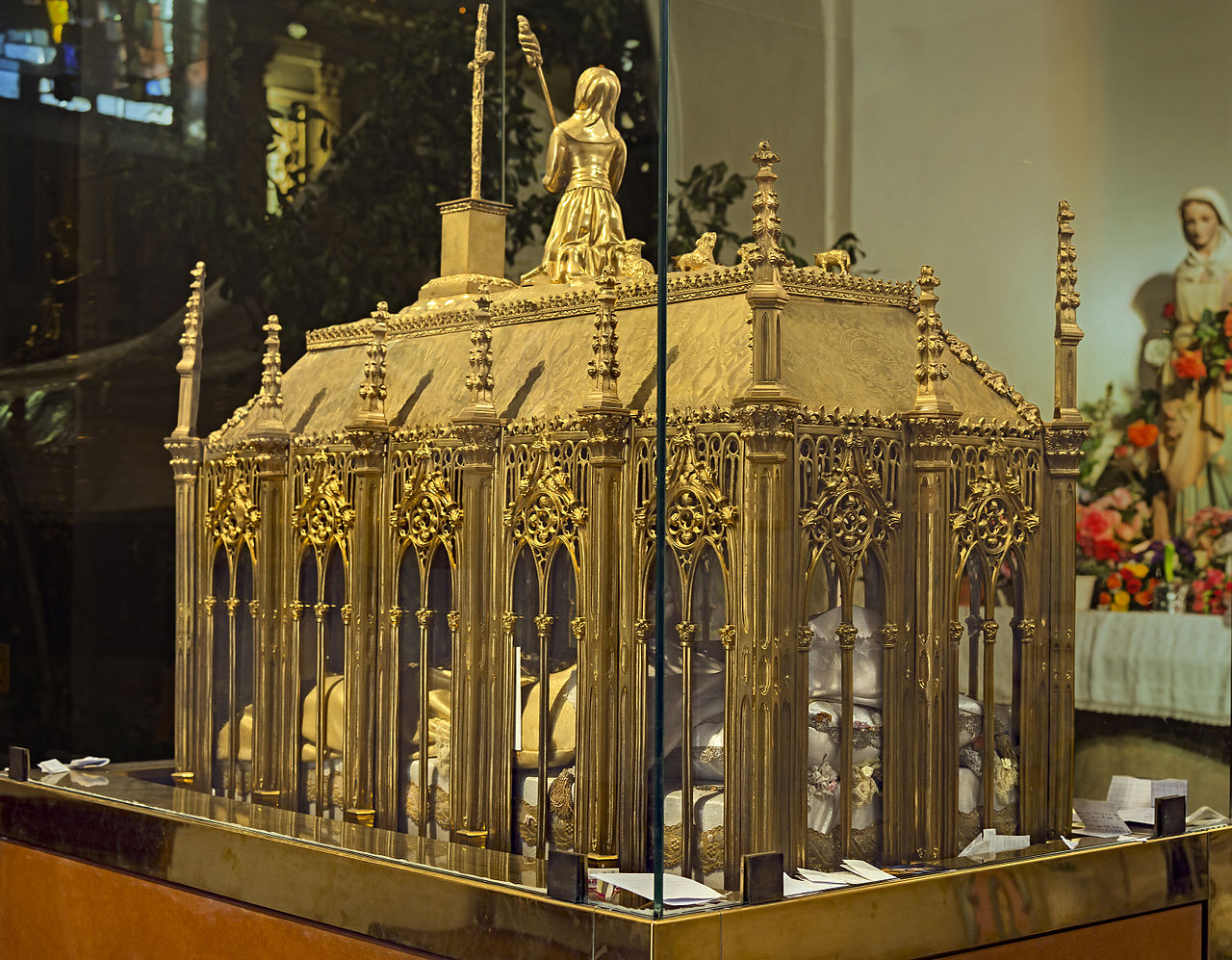
In 1644, some 43 years following her death, the body of a noblewoman was being interred in front of the sanctuary of the church, when a workman accidentally exhumed Germaine’s incorrupt body from under the flagstone floor. Her body looked and smelled as fresh as the day she had passed away. News spread like wildfire throughout the town. Her body was exposed in the Church in the hopes of eliciting religious fervour.
Madame de Beauregard, a prominent lady, put a stop to this. She complained to the Parish Priest about the disgusting exhibit of a corpse near her pew. She threatened to withhold alms if Germaine’s corpse continued to be exposed. The Priest complied with her request and removed the casket. Not long after, Madame de Beauregard was stricken with a fatal disease. Distressed by his wife’s condition and her irreverence toward a possible saint, her husband pleaded for her life before the Tabernacle, requesting that Germaine intercede. Moments later, Germaine appeared in spirit to Madame de Beauregard and healed her instantly of her ailment.
Despite these apparent signs of sanctity and several attempts at initiating the cause of her Canonisation, Germaine wasn’t Beatified until May 7, 1854 – 210 years after her incorrupt body had been found. Her Canonisation finally took place on 29 June 1867 By Pope Pius IX.
Saint Germaine was forgotten, neglected and unloved for most of her life. Even after her death, it seemed that the Lord purposely kept her well hidden. Most Catholics have never heard of her and that includes Religious and Priests. In our complex and fast-paced world, Germaine’s simplicity, charity and piety don’t seem to fit in anywhere.
The reason is, that we have now brought up entire generations of entitled young people, who see themselves as central to the universe’s purpose. They are the first to complain if things don’t go their way. In recent news, is it not surprising to learn about a woman stabbing her fiancé over their wedding colour scheme? We are witnessing the consequences of a narcissistic culture that seeks pleasure without any kind of moral compass to guide the conscience.
How could Germaine’s life story fit into such a culture? It would seem, that we are not quite ready yet.
We and our children were brought up on the idea that our “self-esteem” needed to be enhanced. In this way, we’ve made an entire generation incapable of seeing it’s own darkness, empowered with the perception of its own strength and unique gifts. At the same time, this generation’s children, disconnected from any moral compass, think they can do no harm. Meanwhile, a mother in her thirties was sucker-punched while walking with her daughter. No apparent reason was reported, but the public was outraged that such random acts of violence could take place. It was part of the “knockout game,” a depraved form of entertainment for young people.
It is imperative that we begin, once again, to talk to our children about living virtuous lives of self-effacement and not self-empowerment – lives of temperance and not overindulgence. It is pressing, that we share with our children, the idea of living a simpler life that is rooted in love, penance, almsgiving and prayer.
Our children need to hear that the Lord Jesus is drawn to those who are small, hidden and pure, not just to those who are smart, rich, attractive and self-empowered.
In the book Germaine: Requiem of a Soul, Andrew St-James recounts the full history of Saint Germaine. She was a pure soul who abandoned herself completely to divine providence, who learned to surrender her will completely to God.
This inspirational story shatters all the conventional theories modern man may have about God and about the modern concepts of self-empowerment . For when Jesus approaches, He does not strengthen and empower the individual, as most Protestant evangelists claim. Instead, as Jean-Pierre de Caussade writes, “when the Lord approaches, he weakens.”
God is not distant from the suffering of man. The story of Germaine Cousin attests to that truth. The events that surround the life of Saint Germaine have been clearly documented and can be regarded as a reliable historical record of her most remarkable life. It’s a story that has been lost but it is time now for it be told to our children and loved ones. Amen
St Constantine of Beauvais
St Domitian of Lobbes
St Edburgh of Winchester
St Eigil
St Eutropia of Palmyra
St Fortunatus of Corinth St Germaine Cousin (1579–1601) Incorrupt
St Hadelinus of Lobbes
St Hesychius of Durostorum
St Hilarion of Espalion
Bl Juan Rodriguez
St Julius of Durostorum
St Landelin of Crespin
St Leonides of Palmyra
St Libya of Palmyra
St Lotharius of Séez
St Melan of Viviers
St Orsisius
Bl Pedro da Teruel
Bl Peter Snow
St Pierre de Cervis
Bl Ralph Grimston
St Tatian of Cilicia
Bl Thomas Scryven
St Trillo of Wales
St Vaughen of Ireland St Vitus (c 290-c 303) – Martyr, One of the Seven Holy Helpers His very short life: https://anastpaul.com/2017/06/15/saint-of-the-day-15-june-st-vitus/
Novena in Honour of the Sacred Heart of Jesus Day Five – 14 June
Has no-one condemned you?
Today’s Scripture Jesus straightened up and said to her, ‘Woman, where are they? Has no-one condemned you?’ She said, ‘No-one, sir.’ And Jesus said, ‘Neither do I condemn you. Go your way and from now on do not sin again.’… John 8:10-11
Reflection for the Fifth Day
I read something recently which went like this: ‘You do not have to be good before God will love you, you do not have to repent before you will be absolved by God. It is all the other way around. If you are good, it is because God’s love has already made you so, if you want to be forgiven, that is because God is forgiving you because you want to be forgiven!’
Today’s Prayer
Jesus, as I reflect upon Your Sacred Heart,
help me to have a deep felt knowledge
that You long to forgive my sins.
Your Sacred Heart is love made visible.
I need to love Your love and repent and repair.
Daily Invocation Sacred Heart of Jesus, I place all my trust in you.
Novena Prayer
Lord Jesus,
the needs of Your people open Your heart in love for each of us.
You care for us when we are lost,
sympathise with us in loneliness
and comfort us in mourning;
You are closest to us where we are weakest.
You love us most, when we love ourselves least;
You forgive us mos, when we forgive ourselves least
and You call us to spread Your love in whatever way we can.
Lord Jesus, Your heart is moved with compassion
when we are suffering,
when we need your help
and when we pray for each other.
I ask You to listen to my prayer during this Novena
and grant what I ask.
…………………………. (Mention your intention silently.)
If what I ask, is not for my own good and the good of others,
grant me what is best,
that I may build up Your kingdom of love in our world.
Amen
Thought for the Day – 14 June – Meditations with Antonio Cardinal Bacci (1881-1971)
The Feast of Corpus Christi
“St Thomas Aquinas refers to the Blessed Eucharist as the greatest of all Jesus Christ’s miracles.
All the other miracles were accomplished in an instant or, at the most, protracted over a few years, like the raising to live of Lazarus, or the widow’s son at Naim.
The Eucharist, on the contrary, is a miracle which continues throughout the centuries and all over the world!
The other miracles, moreover, gave us a part of the power and goodness of Jesus.
But, the Eucharist gives us Jesus Himself with all His graces and gifts.
It was not enough for Our Lord to offer Himself on Calvary as a propitiary host for our sins.
It was not enough for Him to shed His precious Blood for our redemption.
It was not enough to give us the Church to instruct us and to guide us on the way to Heaven.
He wished to give us Himself in addition.
He wished to remain with us as our companion on our mortal pilgrimage and as the spiritual nourishment of our souls.
The power of Jesus is as infinite as His charity.
Nevertheless, in the Eucharist, this power and charity are, as it were, exhausted.
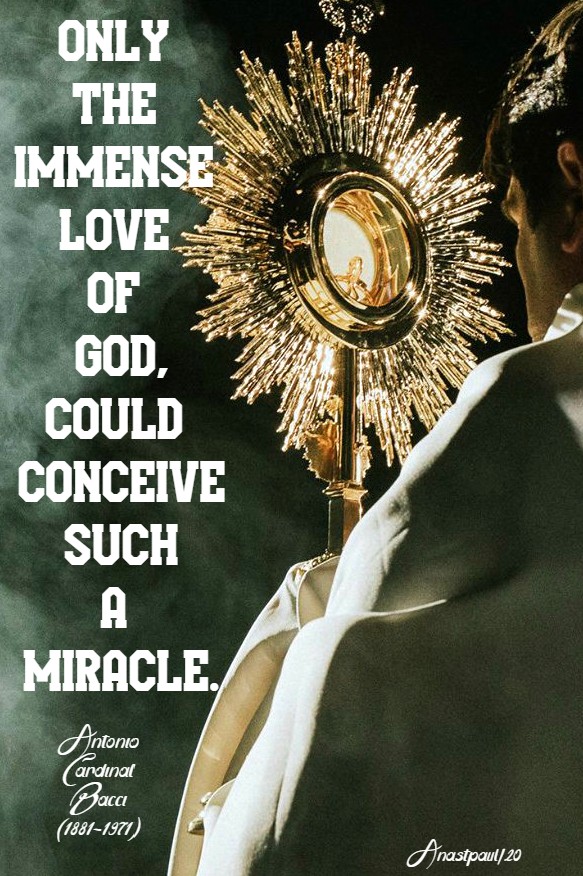
Only the immense love of God, could conceive such a miracle.
When we consider this mysterious gift which Jesus has given to each of us, we cannot say that it is too difficult for us to conquer the perverse inclinations of our corrupted nature and that we lack the strength to continue on the way of perfection.
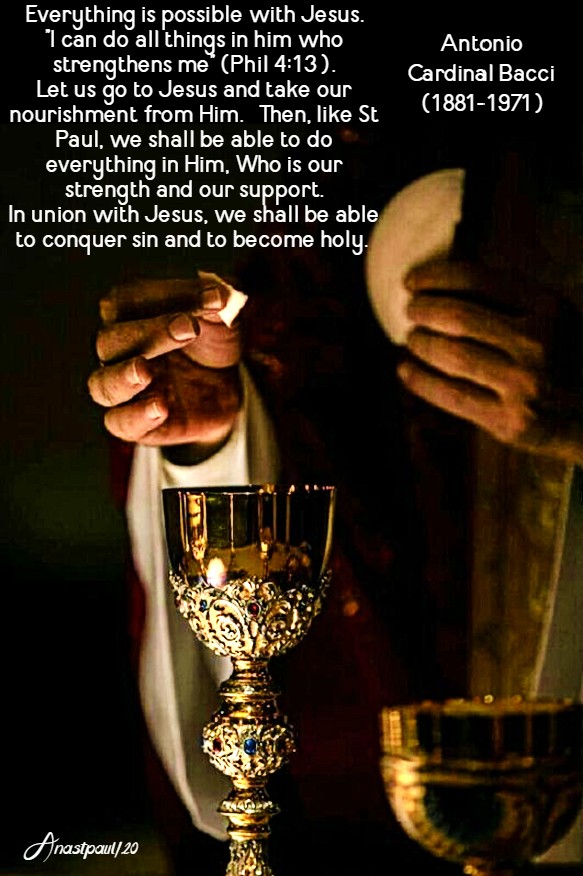
Everything is possible with Jesus.
“I can do all things in him who strengthens me” (Phil 4:13).
Let us go to Jesus and take our nourishment from Him.
Then, like St Paul, we shall be able to do everything in Him, Who is our strength and our support.
In union with Jesus, we shall be able to conquer sin and to become holy. amen.”
Quote/s of the Day – 14 June – “Month of the Sacred Heart” – Corpus Christi, The Solemnity of The Most Holy Body and Blood of Christ, Readings: Deuteronomy 8:2-3, 14-16, Psalm 147:12-15, 19-20, 1 Corinthians 10:16-17, John 6:51-58
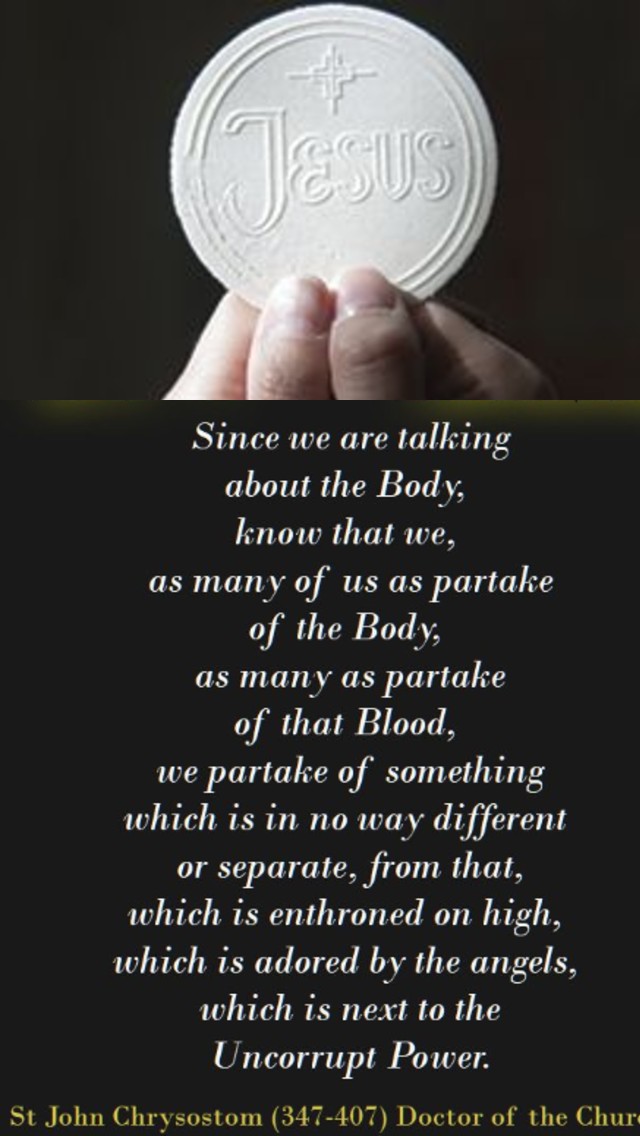
“Since we are talking about the Body, know that we, as many of us as partake of the Body, as many as partake of that Blood, we partake of something which is in no way different or separate from that which is enthroned on high, which is adored by the angels, which is next to Uncorrupt Power.”
St John Chrysostom (347-407)
Father & Doctor of the Church
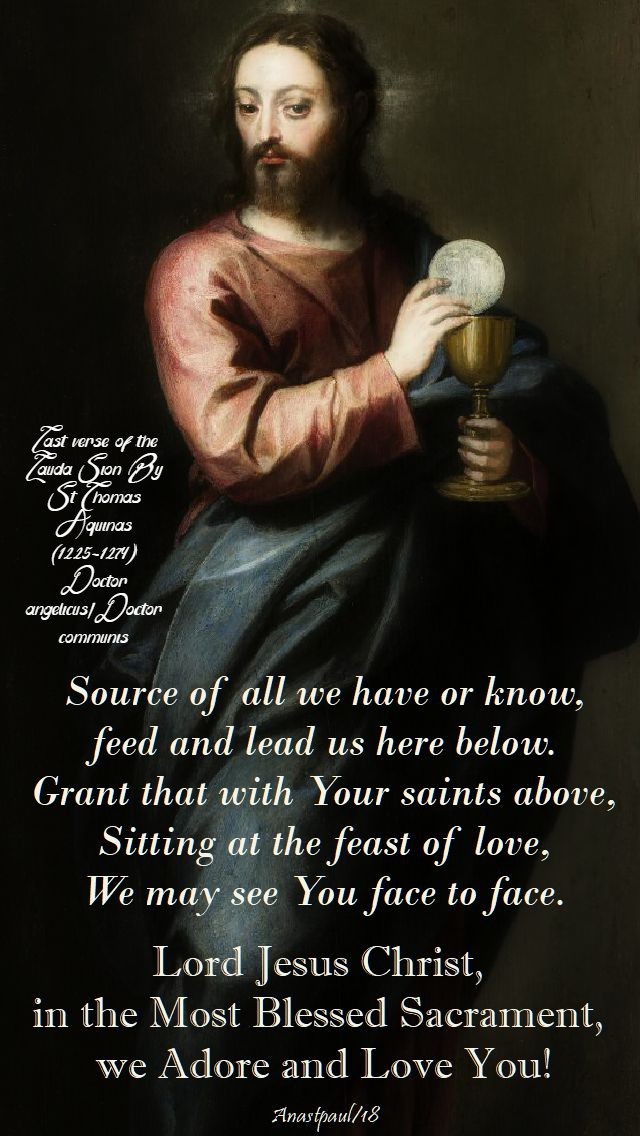
“Source of all we have or know, feed and lead us here below. Grant that with Your saints above, Sitting at the feast of love, We may see You face to face.
Amen Alleluia!
St Thomas Aquinas (1225-1274)
Doctor angelicus/Doctor communis
(Last verse of the Lauda Sion)
Lord Jesus Christ, in the Most Blessed Sacrament,
we Adore and Love You!
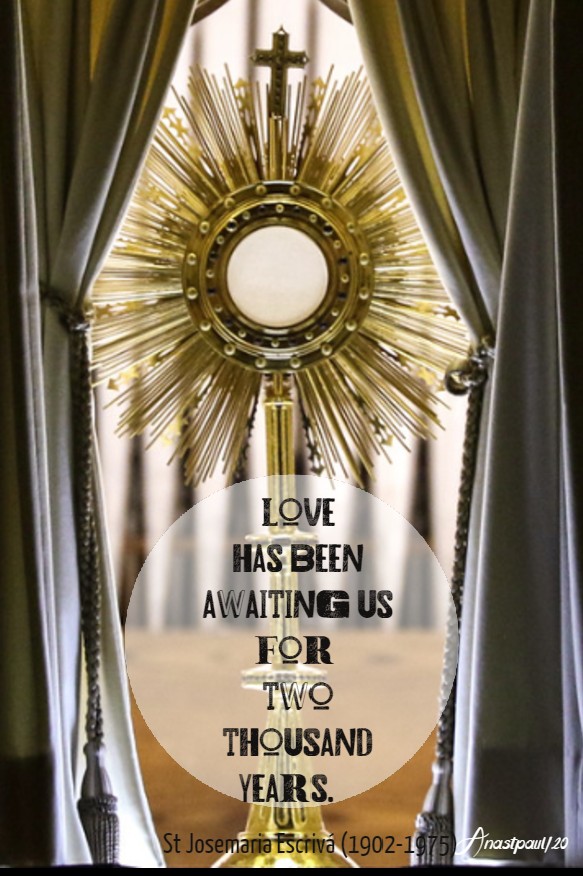
“Perfect God and perfect man, Lord of heaven and earth, He offers Himself to us as nourishment in the most natural and ordinary way. Love has been awaiting us for two thousand years. That’s a long time and yet it’s not, for when you are in love time flies.”
St Josemaria Escrivá (1902-1975)
“Christ is PassingBy”
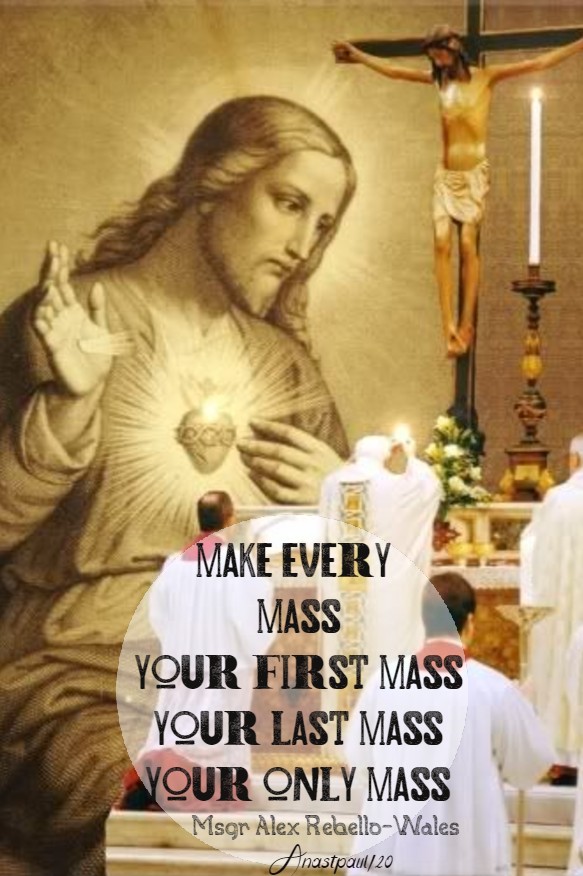
“Make every Mass your FIRST Mass, your LAST Mass your ONLY Mass.”
Sunday Reflection – 14 June – “Month of the Sacred Heart” – Corpus Christi, The Solemnity of The Most Holy Body and Blood of Christ, Readings: Deuteronomy 8:2-3, 14-16, Psalm 147:12-15, 19-20, 1 Corinthians 10:16-17, John 6:51-58
Moments with St John XXIII (1881-1963)
Sacrament of Love
When the Christians of the first centuries met around the Table of the Eucharist, they prayed with hearts full of love and longing:
“To You, O Lord, be glory forever! As this Bread we have broken together, was once scattered in ears of corn on the hills and became one, when it was harvested, so let Your Church be gathered from the ends of the earth into Your Kingdom. For Yours is the glory and the power, through Jesus Christ, forever.”
The doctrine of the Mystical Body, has cast gleams of shining light on this question of the union of Christians with Christ and, for their union with each other.
It has resulted in an amazing understanding of the union of the masses of the faithful, through the power of the Body and Blood of Christ, drawn together to scale the heights of Christian perfection.
In the light of this teaching, we find the truest conception of human, and Catholic brotherhood, inspired and renewed by the Holy Eucharist.
O Sacrament of love, may You always remain inviolate at the summit of Catholic doctrine and devotion!
Open our minds to soaring flights of thought and our hearts to the impulses of charity.
Lead us onto the fulfilment of the supreme ideals of justice and social peace.
Amen
ENGLISH TRANSLATIONS OF THE “PANGE LINGUA” but still using the tune in the Gregorian Chant, Mode III
Hail Our Saviour’s Glorious Body By St Thomas Aquinas Aquinas (1225-1274)
Doctor angelicus/Doctor communis Translated by Fr James Quinn SJ (1919-2010)
Hail our Saviour’s glorious Body,
which His Virgin Mother bore.
Hail the blood which bled for sinners,
did a broken world restore.
Hail the sacrament most holy,
flesh and blood of Christ adore!
To the Virgin, for our healing,
His own Son, the Father sends.
From the Father’s love proceeding
sower, seed and word descends;
wondrous life of Word Incarnate
with His greatest wonder ends.
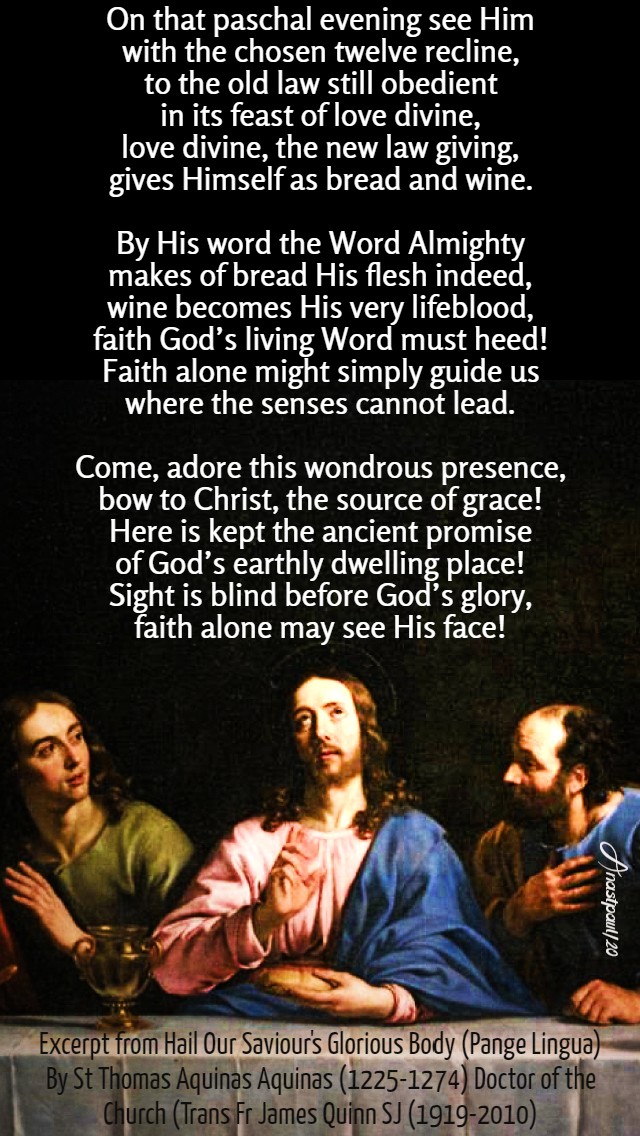
On that paschal evening see Him
with the chosen twelve recline,
to the old law still obedient
in its feast of love divine,
love divine, the new law giving,
gives Himself as bread and wine.
By His word the Word Almighty
makes of bread His flesh indeed,
wine becomes His very lifeblood,
faith God’s living Word must heed!
Faith alone might simply guide us
where the senses cannot lead.
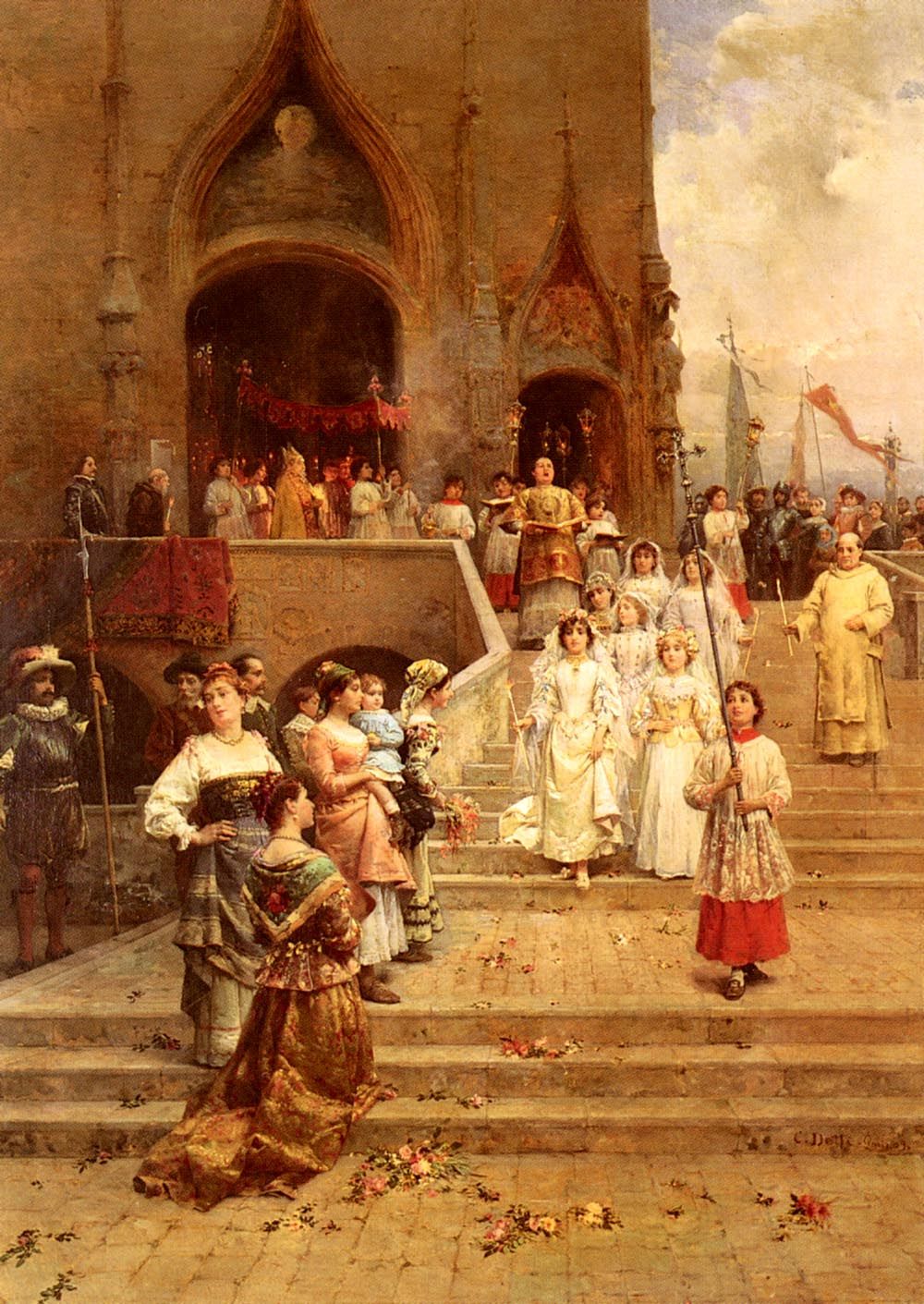
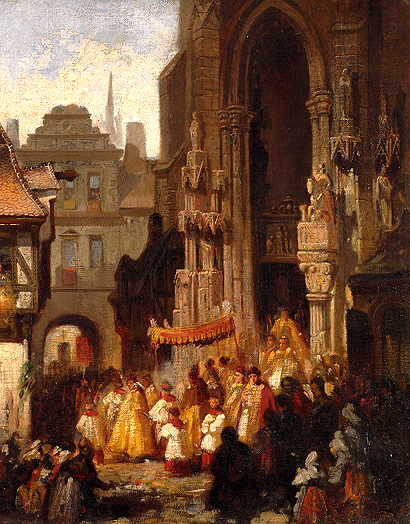
When the Procession reaches the place of Benediction, the priest sets the Monstrance down. Then he puts incense in the thurible and, kneeling, incenses the Blessed Sacrament, while Tantum ergo Sacramentum is sung.
Come, adore this wondrous presence,
bow to Christ, the source of grace!
Here is kept the ancient promise
of God’s earthly dwelling place!
Sight is blind before God’s glory,
faith alone may see His face!
Glory be to God the Father,
praise to His co-equal Son,
Adoration to the Spirit,
bond of love, in God-head one!
Blest be God by all creation
joyously while ages run!
(Fr James Quinn SJ (21 April 1919 – 8 April 2010) was a Scottish Jesuit Priest, Theologian and Hymnist.
One Minute Reflection – 14 June – Corpus Christi, The Solemnity of The Most Holy Body and Blood of Christ, Readings: Deuteronomy 8:2-3, 14-16, Psalm 147:12-15, 19-20, 1 Corinthians 10:16-17, John 6:51-58
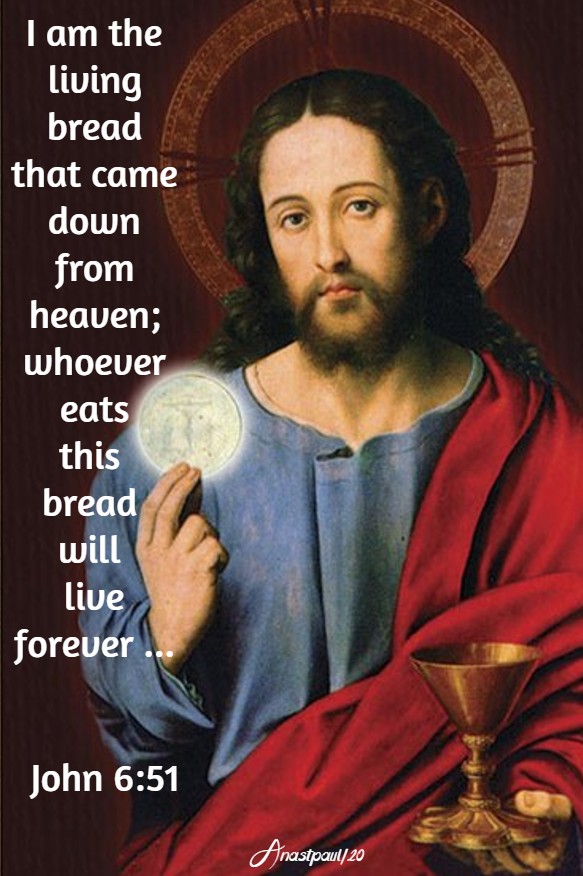
“I am the living bread that came down from heaven; whoever eats this bread will live forever and the bread that I will give, is my flesh for the life of the world.” ... John 6:51
REFLECTION – “God elaborates on a suitable and wholesome new diet for the newly-formed and newborn babe. He says it consists of the one who nourishes and who is the Father of all, that are generated and regenerated—just as manna, the celestial food of angels, flowed down from heaven on the ancient Hebrews.
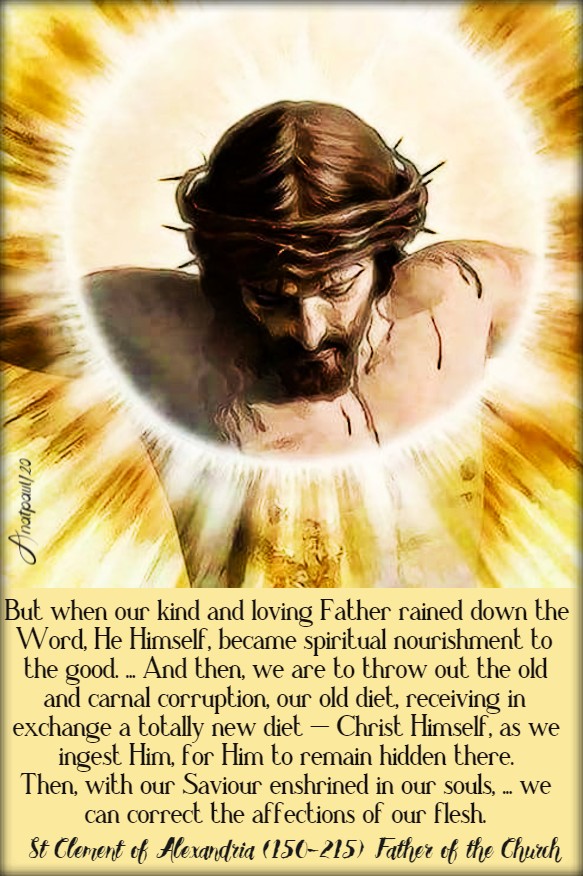
But when our kind and loving Father rained down the Word, He Himself, became spiritual nourishment to the good.
This is a truly amazing mystery because, this is the kind of diet the Lord administers, He offers His flesh and pours out His blood so that nothing is lacking for His children’s growth. This is almost too much to take in!
And then, we are to throw out the old and carnal corruption, our old diet, receiving in exchange a totally new diet — Christ Himself, as we ingest Him for Him to remain hidden there.
Then, with our Saviour enshrined in our souls, as it were, we can correct the affections of our flesh.” … St Clement of Alexandria (150-215) Father of the Church – Christ the Educator, 1
PRAYER – Lord Jesus Christ, You gave Your Church, an admirable Sacrament as the abiding memorial of Your Passion. Teach us to worship the sacred mystery of Your Body and Blood, that it’s redeeming power may sanctify us always. Who live and reign with the Father and the Holy Spirit, God, forever, amen.

 Eckbert (who became a Monk of Schönau in 1155 and eventually succeeded Hildelin as second Abbot) put everything in writing, later arranged the material at leisure and then published all under his sister’s name.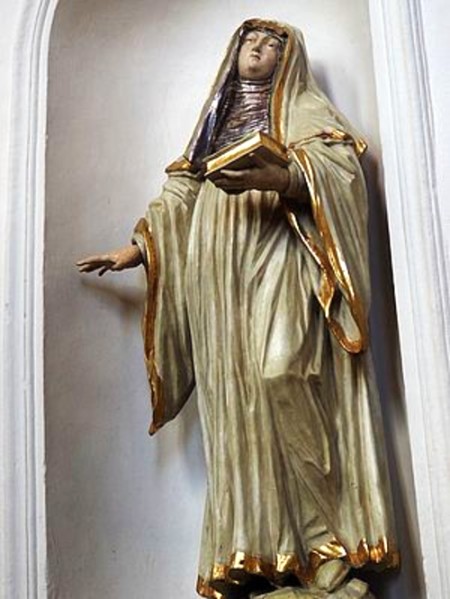











You must be logged in to post a comment.