Posted in CATHOLIC-PRAYERS OF THE CHURCH, CHRISTMASTIDE!, HYMNS, MORNING Prayers, POETRY, PRACTISING CATHOLIC, PRAYERS of the CHURCH, The CHRIST CHILD, The NATIVITY of JESUS

Thought for the Day – 24 December – Today, the 200th anniversary of the first performance of the beloved carol ‘Silent Night’

Thought for the Day – 24 December

Today, the 200th anniversary of the first performance

of the beloved carol ‘Silent Night’

Exactly 200 years ago today, 24 December 1818 — in a little church in what is now Austria, the world heard for the first time a poem set to music that eventually would be hailed as one of the most popular and beloved Christmas carols of all time.

“Silent Night” was sung for the first time that Christmas Eve at a Midnight Mass at St Nicholas Church in Oberndorf, a village in the Austrian Empire.   The lyrics were written by a young Catholic priest, Father Joseph Mohr (1792–1848) and the music was composed by his friend, the local organist and schoolmaster, Francis Xavier Gruber (1787–1863).1024px-Stille_Nacht_Kapelle_Glasfenster_Josef_Mohr

Silent night, holy night!
All is calm, all is bright,
Round yon Virgin Mother and Child!
Holy Infant so tender and mild,
Sleep in heavenly peace,
Sleep in heavenly peace.

Silent night, holy night!
Son of God, how the light
Radiates love from Thy heavenly face,
At the dawn of redeeming grace,
Jesus, Lord at Thy birth,
Jesus, Lord at Thy birth.Silent Night by Fr Joseph Mohr 1792-1848 24 dec 2018

Fr Joseph Mohr’s final resting place is a tiny Alpine ski resort, Wagrain.   He was born into poverty in Salzburg in 1792 and died penniless in Wagrain in 1848, where he had been assigned as pastor of the church.   He had donated all his earnings to be used for elder care and the education of the children in the area.   His memorial from the townspeople is the Joseph Mohr School located a dozen yards from his grave.   The overseer of St Johann’s, in a report to the bishop, described Mohr as “a reliable friend of mankind, toward the poor, a gentle, helping father.”

Many generations of the Mohr family lived in the Lungau region, in the southern part of the Province of Salzburg.   The pilgrimage church of St Nicholas in Mariapfarr, the little church where Father Mohr was the curate, is within walking distance of the former home of Joseph’s grandfather.   The climate is so invigorating and the Alpine air so clean, the town has become a major vacation destination for Europeans who want to get away from city life.   The pilgrimage church where Mohr celebrated Mass is undergoing the restoration of its centuries-old frescos.

The carol is believed to have caused a somewhat miraculous and well-documented Christmas truce during World War I.   On Christmas Eve 1914, British and French troops were encamped in trenches in a face-off against German troops in Ypres in Flanders, Belgium.   The two sides began singing Christmas carols to each other and “Silent Night” was the only hymn all the combatants knew.   Singing it together broke the ice and led to a temporary cease-fire with soldiers from both sides meeting in the middle “No Man’s Land” to trade tobacco and candy, play soccer and sing carols.

An early copy of Silent Night written by Joseph Mohr

As it marks its 200th anniversary, “Silent Night” remains as beloved as ever.   I am sure that all of us who attend Midnight Mass tonight, wherever we are in the world, will be singing Silent Night in one of the 300 languages into which it has been translated.

May this Holy Infant so tender and mild, bless us all!Holy infant so tender and mile bless us all 24 dec 2018

Posted in ADVENT, CHRISTMASTIDE!, DOCTORS of the Church, MORNING Prayers, PRACTISING CATHOLIC, The CHRIST CHILD, The NATIVITY of JESUS, The WORD

Advent and Christmas Wisdom with St Alphonsus Liguori (1696-1787) – Today’s Gospel: Luke 2:1–14

Advent and Christmas Wisdom with St Alphonsus Liguori (1696-1787) – Today’s Gospel:  Luke 2:1–14 (Midnight Mass)

24 December

Saint Joseph goes to Bethlehem with his holy spouse

“Consider that God had decreed that His Son be born, not in Joseph’s house but in a cavern and stable of beasts, in the poorest and most painful way a child can be born. For this reason, God caused Caesar to publish an edict, by which people were commanded to go and register each member of their family, in their place of origin. When Joseph heard this order, he was agitated and unsure whether or not the Virgin Mother should take the trip with him. But Mary, knowing of his dilemma and being well versed in the prophet, Micheas, responded, “Do not fear, I will go with you and the Lord will assist us.”
She then gathered together the swaddling clothese and the other miserable garments already prepared for the journey and departed with Joseph.
Let us accompany Mary and Joseph, on their journey and await the appearance of the King.
My beloved Redeemer, I know that in this journey, the angels in heaven accompanied You but I also wish to accompany You, O my only love. My soul has become filled with love for You, O my amiable Infant God. Unite and bind me to Yourself.”

Scripture

And Joseph also went up from Galilee, from the city of Nazareth, to Judea, to the city of David, which is called Bethlehem, because he was of the house and lineage of David, to be enrolled with Mary, his betrothed, who was with child. And while they were there, the time came for her to be delivered.
Luke 2:4-6advent with st alphonsus - luke 2 4-5 and joseph also went up - let us accompany 24 dec 2018

Prayer

Rejoice! Rejoice! Emmanuel
Shall come to thee, O Israel!
May the Lord bless us,
protect us from all evil
and bring us to everlasting life.
Amenrejoice rejoice emmanuel shall come to thee o israel-19-dec-2017

Advent Action
Today we are also pregnant with the fullness of the Advent season.   It is almost time for us to participate in the birthing of the Lord.   We ponder, like Mary, in our hearts, what this will mean for our lives.   We listen more intently to Scripture to hear the advice and directions that God is giving to us.   This day is the change we have been waiting for – this is the day promised us – this is the day which will alter our lives – everything, forever! Lord, grant me the grace to introduce You to the world in the place and time that You have assigned to me.   “I will sing praises to my God, all my life long.” (Psalm 146:2)advent with alphonsus - 24 dec 2018 -psalm 146 2 - i will sing praises to my god

Posted in CHRISTMASTIDE!, Our MORNING Offering, PAPAL PRAYERS, PRAYERS for SEASONS, PRAYERS of the SAINTS, The CHRIST CHILD, The NATIVITY of JESUS

Our Morning Offering – 24 December – O Sweet Child of Bethlehem

Our Morning Offering – 24 December – The Eve of the Nativity of our Lord Jesus Christ

O Sweet Child of Bethlehem
By St Pope John XXIII (1881-1963)

O sweet Child of Bethlehem,
grant that we may share with all our hearts,
in this profound mystery of Christmas.
Put into the hearts of men and women,
this peace for which they seek so desperately
and which You alone can give to them.
Help them to know one another better
and to live as brothers and sisters,
children of the same Father.
Reveal to them, also Your beauty,
holiness and purity.
Awaken in their hearts,
love and gratitude
for Your infinite goodness.
Join them altogether in Your love
and give us Your heavenly peace.
Ameno sweet child of bethlehem by st pope john XXIII 24 dec 2018

Posted in SAINT of the DAY

Saints of the Day – 24 December – Saints Tarsilla and Emiliana (died sixth century) Virgins

Saints of the Day – 24 December – Saints Tarsilla and Emiliana (died sixth century) Virgins

Today we celebrate the feast day of Saints Emiliana and Tarsilla, Virgins of the Church and aunts of Saint Pope Gregory the Great (540-604).   What we know of their lives was recorded by the holy pope, who was deeply moved by their model of Christian life and virtue.

Born in Rome, Emiliana and Tarsilla were the daughters of senator Gordian and Saint Silvia.   Nieces of Pope Saint Felix III, the young women were destined for lives of holiness and together, while quite young, renounced the world.   As young women, they together consecrated themselves to the Lord, desiring to stay pure.   Their house was as a convent and the two spent so much time kneeling in prayer that their knees and elbows arthritically locked in the position of prayer.   Living as hermits, they encouraged one another in the ways of the faith, drawing deeper and deeper into the spiritual life.1224emilianaandtarsilla

Tarsilla and Emiliana had a third sister, Gordiana, who had initially made the same vows and consecrated herself to the Lord.   Gradually, however, she withdrew from her sisters, returning to the world.   Their reproaches fell on deaf ears and caused them significant sadness and grief.

Saint Tarsilla died prior to Saint Emiliana but not before she received a vision of her uncle, Pope Saint Felix.   In her vision, the pope appeared to her, showing her a place of great beauty.   He said, “Come, I will receive you into this habitation of light.” Immediately, she fell ill with fever.   Her sister ministered to her but to no avail.   By the following day, her illness had grown worse.  Saint Tarsilla, in agonising pain, called out to those around her;  “Make way! Jesus is coming!”   With her eyes fixed firmly on heaven, she died soon thereafter and a heavenly fragrance filled the room, confirming her visions.

Saint Emiliana was deeply saddened, made more difficult by missing her sister on Christmas.   Emiliana received consolation in the form of a vision of her sister, however. In this vision, Tarsilla encouraged,  “My sister, come! I did not celebrate with you the birth of the Lord but together we will celebrate the feast of the Epiphany.” “If you call only me,” Emiliana replied, “what will become of our sister, Gordiana?”   “Come,” Tarsilla sadly answered. “Our sister has decided to remain with the world.”   Soon thereafter, Saint Emiliana fell ill and promptly joined her sister in heaven.   Their relics are kept at the Oratory of Saint Andrew on the Celian Hill in Rome.img-Pictorial-Saints-Thrasilla-and-Emiliana-Virgins

Pope Saint Gregory the Great recounted the tale of his aunts throughout his lifetime.   He used it to illustrate the point that we must work constantly to save our souls, repenting for our actions.   To Saint Gregory, there is no point in beginning the work of salvation, if we do not plan to see it through to the end.   As we prepare for the birth of Our Lord, we look to our own commitments.   Are we ready to greet the infant Christ, come to redeem and save us?

Tonight, we echo the sentiment of Saint Tarsilla:  “Make way! Jesus is coming!”   How might we use this dark night—lit by the choirs of angels—to prepare for the coming of the Lord?

Posted in CHRISTMASTIDE!, The CHRIST CHILD, The NATIVITY of JESUS

Midnight Mass and Memorials of the Saints – 24 December

24 December – Vigil of the Nativity of the Lord/Mass at Midnight
In many Western Christian traditions Midnight Mass is the first liturgy of Christmastide that is celebrated on the night of Christmas Eve, traditionally beginning at midnight when Christmas Eve gives way to Christmas Day. This popular Christmas custom is a jubilant celebration of the Mass in honour of the Nativity of Jesu,; even many of those Christian denominations that do not regularly employ the word “Mass” uniquely use the term “Midnight Mass” for their Christmas Eve liturgy.

St Adam the Patriarch
St Adela of Pfalzel
Bl Alberic of Gladbach
Bl Brocard of Strasbourg
St Bruno of Ottobeuren
St Caran of Scotland
St Delphinus of Bordeaux
St Emiliana and St Trasilla (died sixth Century)
St Euthymius of Nicomedia
St Eve the Matriarch
Bl Francesco dei Maleficii
St Gregory of Spoleto
St Hanno of Worms
Bl Ignacio Caselles García
St Irmina of Oehren
St Mochua of Timahoe
Bl Pablo Meléndez Gonzalo
St Paola Elisabetta Cerioli
Bl Peter de Solanes
Bl Venerandus of Clermont

All the Holy Ancestors of Jesus: A commemoration of all the holy ancestors of Jesus Christ.
• Blessed Dionysius Roneo
• Blessed Philip Claro
• Blessed Giulio Pons
• Blessed Peter of Valladolid

Blessed Mercedarian Sisters – (6 beati): Six cloistered Mercedarian nuns at the convent of Vera Cruz in Berriz, Spain. Noted for their devotion to the rules of the Order and for their deep prayer lives.
• Blessed Anna Maria Prieto
• Blessed Anna de Arrano
• Blessed Orsola de Larisgoizia
• Blessed Maguna Mary
• Blessed Margaret
• Blessed Mary of the Assumption Sarria

Martyred Maidens of Antioch – (40 saints): A group of forty virgins martyred in the persecutions of Decius. None of their names have come down to us. They were martyred in 250 in Antioch, Syria.

Martyrs of Tripoli – (6 saints): A group of Christians martyred together, date unknown. The only details that have surived are six of the names – Drusus, Lucian, Metrobius, Paul, Theotimus and Zenobius. They were martyred in Tripoli, Libya.

Posted in ADVENT, DOCTORS of the Church, NOVENAS, The CHRIST CHILD, The INCARNATION

Christmas Novena to the Christ Child – Day Eight – 23 December

Christmas Novena to the Christ Child

Day Eight
The Life Of The Child Jesus In Egypt And In Nazareth.

Reflection:
Our Blessed Redeemer spent the first part of His childhood in Egypt, leading there for several years, a life of poverty and humiliation.   In that land Joseph and Mary were foreigners and strangers, having there neither relatives nor friends.
Only with difficulty could they earn their daily bread by the labour of their hands.
Their home was poor, their bed was poor, their food was poor.   Here Mary weaned Jesus, dipping a piece of bread in water, she would put it in the sacred mouth of her Son.
Here she made His first little garments and clothed Him with them.
Here the Child Jesus took His first steps, stumbling and falling as other children first do.
Here too He spoke His first words but stammeringly. O wonder of wonders!
To what has not God lowered Himself for love of us!
A God stumbling and falling as He walks! A God stammering in His speech!

Not unlike this was the poor and humble life that Jesus led in Nazareth after His return from Egypt.   There, until He was thirty years old, He lived as a simple servant or workman in a carpenter shop, taking orders form Joseph and Mary.   “And He was subject to them.”   Jesus went to fetch the water, He opened and closed the shop, He swept the house, gathered the fragments of wood for the fire and toiled all day long, helping Joseph in his work.
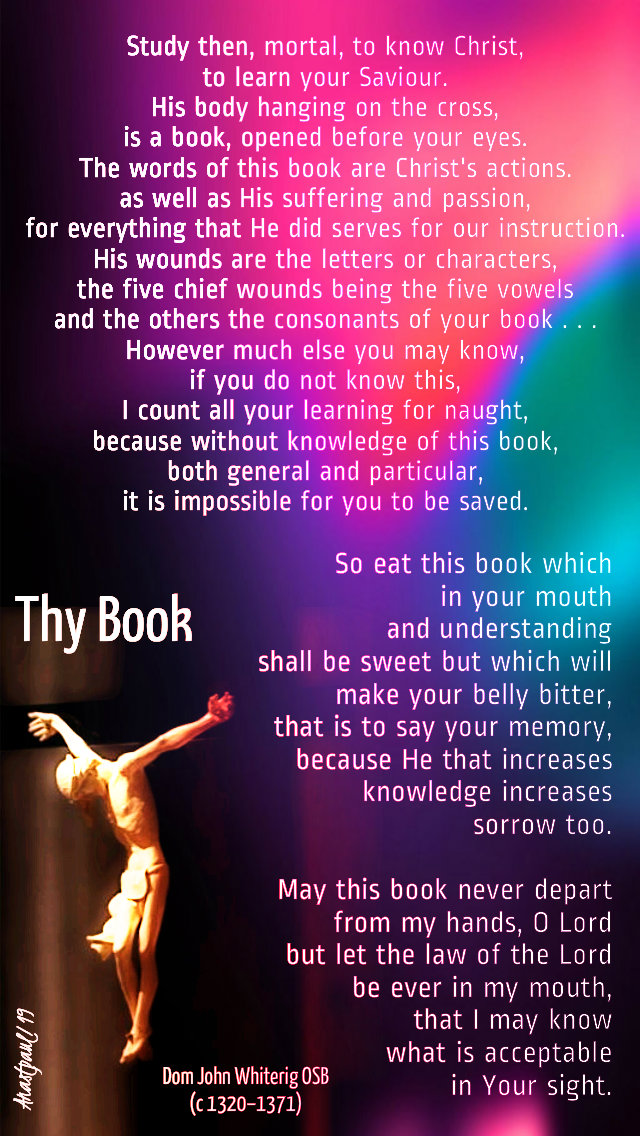
Yet who is this?   God Himself, serving as a apprentice!
The omnipotent God, who with less than a flick of His finger created the whole universe, here sweating at the task of planing a piece of work!   Should not the mere thought of this move us to love Him?

Prayer:
O Jesus, my Saviour!
When I consider how, for love of me, You didst spend thirty years of Your life hidden
and unknown in a poor workshop, how can I desire the pleasures and honours and riches of the world?
Gladly do I renounce all these things, since I wish to be Your companion on this earth,
poor as you were, mortified and humble as You were,
so that I may hope to be able one day to enjoy Your companionship in heaven.
What are all the treasures and kingdoms of this world?
You, O Jesus, are my only treasure, my only Good!
I keenly regret the many times in the past when I spurned
Your friendship in order to satisfy my foolish whims.
I am sorry for them with all my heart.
For the future I would rather lose my life a thousand times
than lose Your grace by sin.
I wish never to offend You again but always to love You.
Help me to remain faithful to You until death.
O Mary, you are the refuge of sinners, you are my hope. Amen

Posted in EUCHARISTIC Adoration, MORNING Prayers, QUOTES - J R R Tolkien and MORE, SUNDAY REFLECTIONS, The HOLY EUCHARIST / The HOLY MASS, The INCARNATION

Sunday Reflection – 23 December – The Eucharistic Humility of God (Excerpt)

Sunday Reflection – 23 December – The Fourth Sunday of Advent – The Eucharistic Humility of God (Excerpt)

Because humility belongs to God alone
who made it His own in the mystery of the Incarnation,
and who continues to make it His own
so often as the mystic words are uttered by a priest
over a little bread and a little wine mixed with water:
“This is My Body. This is the chalice of My Blood.”
Here is the Mysterium Fidei:
the Eucharistic Humility of God.
Eat the Body of Christ and digest the Divine Humility.
Drink the Blood of Christ;
it is the elixir of those who would hide themselves with Christ in God.
Since the event of the Incarnation
–the descent of God into the Virgin’s womb,
in view of His descent into death’s dark tomb–
and so often as Holy Mass is celebrated
–the descent of God into the frail appearance of Bread
and into the taste and fragrance and wetness
of a few drops of wine–
humility can be found nowhere else.
The very least and last of the guests
has become The Host,
and The Host
has made Himself the very least and last of the guests.
Tremble, then, to adore Him,
and having adored Him, receive Him,
that your soul may become the throne of the Humble Hidden God
and His humility your most cherished treasure.
“Learn from Me,” He says,
“for I am meek and humble of heart” (Matthew 11:29),
and again,
“Everyone that exalts himself shall be humbled,
and he that humbles himself shall be exalted” (Luke 14:11).

Fr ‘Dom’ Marktremble then to adore him - fr dom mark vultus christi 23 dec 2018 sun reflection

Posted in ADVENT, DOCTORS of the Church, MARIAN QUOTES, MORNING Prayers, PRACTISING CATHOLIC, QUOTES of the SAINTS, The BLESSED VIRGIN MARY, The CHRIST CHILD, The HOLY EUCHARIST / The HOLY MASS, The INCARNATION, The WORD

Thought for the Day – 23 December – Today’s Gospel: Luke 1:39-45

Thought for the Day – 23 December – The Fourth Sunday of Advent – Today’s Gospel: Luke 1:39-45

In those days, Mary arose and went with haste into the hill country, to a city of Judah and she entered the house of Zechariah and greeted Elizabeth.
Luke 1:39-40

“When the Holy Spirit touches a heart, He puts to flight all tepidity.   He loves diligence and promptitude and is the enemy of procrastination and delays in the performance of the divine will… “Mary set out in haste”…

What graces and favours must have descended upon Zechariah’s house when the Virgin entered it?   If Abraham received so many graces for having given hospitality to three angels in his tent… what graces and how many heavenly blessings must have descended upon the house of Zechariah into which entered the Angel of the Great Counsel (Is 9:5, Septuagint), that true Jacob and Divine Prophet, the true Ark of the Covenant, Our Lord enclosed within the womb of Mary!   Indeed, the whole house was overcome with joy; the infant leapt with joy, the father recovered his speech, the mother was filled with the Holy Spirit and received the gift of prophecy, for on seeing this blessed Lady enter her house she exclaimed:  “Who am I that the Mother of my Lord should come to visit me?”… And Mary, hearing what her kinswoman, Elizabeth, said in her praise, humbled herself and referred all the glory to God.   Then declaring that all her happiness came from the fact that God had looked upon His servant in her lowliness, she intoned that beautiful and wonderful canticle, the Magnificat.

Oh, how overwhelmed with joy we should be when visited by this divine Saviour in the most Blessed Sacrament of the altar and by the interior graces we receive daily through the many inspirations and words He speaks to our hearts!”…St Francis de Sales (1567-1622) Doctor of the Church

Come, Lord Jesus Come!come-lord-jesus-come-23 DEC 2018 HOLY COMMUNION AND ADVENT

Holy Mary, Mother of God, Pray for Us!holy mary mother of god pray for us sinners - 4 may 2018

Posted in ADVENT, DOCTORS of the Church, EUCHARISTIC Adoration, FATHERS of the Church, MORNING Prayers, QUOTES of the SAINTS, The HOLY EUCHARIST / The HOLY MASS, The INCARNATION, The PASSION

Quote of the Day – 23 December – The Fourth Sunday of Advent

Quote of the Day – 23 December – The Fourth Sunday of Advent

“Jesus Christ, the God-Man,
was born in a manger and is spiritually reborn on the altar.
He suffered on Calvary
and continues to offer Himself on the altar.
In His earthly life, He spread His teaching
and worked miracles among the crowds.
In the Eucharist, He spans the centuries
and communicates Himself to all.”

St John Chrysostom (347-407) Father & Doctor of the Churchjesus-christ-the-god-man-st-john-chrysostom-23-dec-20171

Posted in ADVENT, DOCTORS of the Church, MORNING Prayers, The BLESSED VIRGIN MARY, The CHRIST CHILD, The INCARNATION, The NATIVITY of JESUS, The WORD

Advent and Christmas Wisdom with St Alphonsus Liguori (1696-1787)

Advent and Christmas Wisdom with St Alphonsus Liguori (1696-1787) Today’s Gospel:  Luke 1:39-45

23 December

God’s love is demonstrated by the birth of Jesus

“Consider the love of God.   It was always present but did not always appear.    It was first promised in many prophecies and foreshadowed by many figures but, at the birth of our Redeemer, this divine love did indeed appear.   But despite the birth of Jesus, why is it that so many people have not known God’s love and so many people seem ignorant of His love? This is the reason – “The light of the world has come into the world and humanity loves darkness rather than the light.” They have not known Him and they do not know Him because they do not wish to know Him, loving rather the darkness of sin than the light of grace.   Let each one determine this day not to be numbered among those unhappy souls who prefer the darkness.

O my holy Infant, now I see You lying on the straw, poor, afflicted and forsaken.   I have been one of those ungrateful ones who do not know You.    Help me never to forget You again.”

Scripture

Restore us, O God;
let thy face shine, that we may be saved!

Psalm 80:3advent with st alphonsus psalm 80 3 restore us o lord -23dec2018

Prayer

O Emmanuel,
King and Lawgiver
Desire of the nations,
Saviour of all people,
Come and set us free,
Lord, our God!emmanuel-king-and-lawgiver-23-dec-2017

Advent Action
Carrying You in her womb, Your mother rushes to meet Elizabeth.   What an awesome moment that meeting turns out to be!   You are already on duty as our Redeemer, sanctifying John in his mother’s womb. In fact, the child in Elizabeth’s womb, responds to Your presence, as the mother, filled with the Holy Spirit, bears witness to it.
As these final days of this preparatory Season draw to a close, there is still time to allow body, mind and heart to be attuned to the transforming intervention of Jesus, God-in-the-flesh.   There is still time to permit body, mind and heart to see “the plan” already at work in life, especially in those dark and difficult moments of life.   There is still time for body, mind and heart to cry out to the Holy Spirit for a zealous and determined connection with the Person Jesus, who pours His abundant joy into every aspect of our lives.
Lord, grant me the grace, to bring Your joy to all I meet along the path of life.  May Your presence in my heart, as in Mary’s womb, bring salvation to all!
“Being awake for God and for other people – that is the kind of ‘waking’ that Advent has in mind, the wakefulness which discovers the light and brightens the world!” (Pope Benedict XVI – The Light of a new humanity p 19)

Posted in Our MORNING Offering, PRAYERS of the SAINTS, The HOLY EUCHARIST / The HOLY MASS, Thomas a Kempis

Our Morning Offering – 23 December – The Fourth Sunday of Advent

Our Morning Offering – 23 December – The Fourth Sunday of Advent

Act of Oblation before Holy Communion
By Thomas à Kempis (1380-1471)

Lord, all things in heaven and on earth
are Yours,
I desire to give myself to You
in willing abandonment
and to remain Yours forever.
Lord, in simplicity of heart,
I offer myself to You this day,
always to be Your obedient servant
and a sacrifice of perpetual praise.
Accept me with the Holy Sacrifice
of Your precious Body,
which I offer You today
in the presence of Your assisting Angels,
for my salvation
and that of all Your people.
Amenact of oblation before holy comm thomas a kempis 23 dec 2018 4 advent

Posted in SAINT of the DAY

Saint of the Day – 23 December – St John of Kanty (1390-1473) Patron of Poland and Lithuania

Saint of the Day – 23 December – St John of Kanty (1390-1473) Patron of Poland and Lithuaniajohn Jan-Kanty-1024x803

To most Catholics, St John of Kanty—otherwise known as John Kanty or John Cantius—is an obscure saint but even in Europe, probably few people know of Pope John Paul II’s deep and lifelong devotion to this professor saint.   Only 13 miles from the Holy Father’s own birthplace, John was born in the small southern Polish town of Kanty on June 24, 1390.   At the age of 23, he registered for studies at the Jagiellonian University, located in the not too distant city of Krakow—then, the capital of the Polish Kingdom.   Founded 1364 by royal decree, it was the same university at which astronomer, Nicolas Copernicus, would study almost 80 years later.   Enrolled in the Department of Liberal Arts, John became a doctor of philosophy in 1418.   During the following three years, he undertook further studies in preparation for the priesthood, while supporting himself by conducting philosophy classes at the university.

Immediately following ordination, he accepted a position as rector at the prestigious school of the Canons Regular of the Most Holy Sepulchre in Miechow.   That such a school would offer him this position at his relatively young age was evidence of John’s exceptional intellect and talents.   It was there in conducting formation classes for the young novices that he became firmly grounded in the writings and spirituality of St Augustine.snip st john of kanty graphic

In 1429, a position became vacant in the Philosophy Department at the Jagiellonian University.   John quickly returned to Krakow for the Job, taking up residence at the university where he remained until his death.   He also began studies in theology and after 13 long years of study intertwined with teaching and administrative duties as head of the Philosophy Department, he finally received his doctorate.   Later, after the death of his mentor, the eminent theologian Benedykt Hesse, John assumed directorship of the university’s Theology Department.

As most learned men of his day, John spent many of his free hours hand copying manuscripts of the Holy Scriptures, theological tracts and other scholarly works. Although only 26 volumes have survived to our time, their total of over 18,000 pages is a testament to his exceptional industriousness.Jan-Kanty

During the course of his life in Krakow, John became well known among the city’s residents for his generosity and compassion toward the poor, always sacrificing his own needs in order to help those less fortunate.   He felt a special affinity toward needy students at the university, helping to care for their spiritual, physica, and academic needs.   Whether it was in the classroom or in the pulpit, everyone knew him as a staunch defender of the faith and enemy of heretics.St john cantinus my edit

By the time the Master from Kanty died on 24 December 1473, the people of Krakow already considered him a very holy man.   That his opinion was wholly justified can be evidenced by the numerous favours and miracles attributed to John’s intercession beginning immediately following his death.   Before long, John from Kanty became known widely throughout Europe, drawing pilgrims from many countries to his tomb in the university’s Collegiate Church of St Anne.   Despite this, the process for his beatification did not begin until 150 years later.   Finally, in 1676, Pope Clement XIII declared him a saint of the Roman Catholic Church, proclaiming 20 October as his feast day.

Throughout his many years in Krakow, our philosopher Pontiff drew much inspiration at the grave of his patron saint of learning.   It was no surprise, therefore, that during his 1997 pilgrimage to Poland, he once more prayed at the Saint’s tomb.   There, during a special gathering with professors from the Jagiellonian -both his and S. John’s alma mater— he alluded to the Master from Kanty when he stated:  “Knowledge and wisdom seek a covenant with holiness.”st john of kanty statue

Saint John Kanty’s feast day was moved in 1969 it was to 23 December the day before the anniversary of his death, which occurred on Christmas Eve, 1473.st john kanty

Posted in SAINT of the DAY

Memorials of the Saionts – 23 December

St John of Kanty/Cantius (1390-1473) (Optional Memorial)
Full Biography: https://anastpaul.wordpress.com/2017/12/23/saint-of-the-day-23-december-st-john-of-kanty-cantius-1390-1473/

St Besa of Egypt
Bl Bincema
St Dagobert II of Austrasia
Bl Epifanio Gómez Alvaro
St Frithbert of Hexham
Bl Hartmann of Brixen
Bl Herman of Scheda
Bl James Aymerich
St John Cirita
St John Stone
St Joseph Cho Yun-ho
St Mardonius of Rome
St Mazota of Abernethy
St Migdonius of Rome
St Nicolás Factor-Estaña
St Servulus of Rome
St Thorlac Thorhallsson
St Victoria
St Vintila of Orensee

Martyred Dominicans of Santander – (9 beati) – Martyred in the Spanish Civil War:
• Blessed Bernardino Irurzun Otermín
• Blessed Eleuterio Marne Mansilla
• Blessed Eliseo Miguel Lagro
• Blessed Enrique Cañal Gómez
• Blessed Enrique Izquierdo Palacios
• Blessed Epifanio Gómez Alvaro
• Blessed José María García Tabar
• Blessed Manuel Gutiérrez Ceballos
• Blessed Miguel Rodríguez González
• Blessed Pedro Luís y Luís

Martyrs of Crete – (10 saints): A group of ten Christians who died in the persecutions of Decius. They were –
• Agathopus
• Basilides
• Cleomenes
• Eunician
• Euporus
• Evaristus
• Gelasius
• Saturninus
• Theodulus
• Zeticus
They were martyred in 250 on the island of Crete.

Posted in ADVENT PRAYERS, NOVENAS, The CHRIST CHILD

Christmas Novena to the Christ Child – Day Seven – 22 December

Christmas Novena to the Christ Child – Day Seven – 22 December

Day Seven

Flight Of The Child Jesus Into Egypt

Reflection:
Although the Son of God came from heaven to save men, scarcely was He born when men began to persecute Him to death.
Herod, fearing that this Child would deprive Him of his kingdom, seeks to destroy His life.  But St Joseph is warned by an angel in a dream to take the Infant and His Mother and flee into Egypt.   Joseph obeys at once and tells Mary about it.
He takes the few tools of his trade, that he may use them to gain a livelihood in Egypt for himself and his poor family.
Mary wraps up a small bundle of clothes for the use of her little Son and then, going to the crib, she says with tears in her eyes to her sleeping Child, “O my Son and my God!
You have come from heaven to save men but hardly are You born when they seek to take Your life.”
Lifting Him meanwhile in her arms and continuing to weep, she sets out that same night with Joseph on the road to Egypt.

Let us consider how much these holy wanderers must have suffered in making so long a journey, deprived of every comfort.   The divine Child was not yet able to walk and so Mary and Joseph had to take turns in carrying Him in their arms.
During their journey through the desert towards Egypt they had to spend several nights in the open air, with the bare ground for their bed.
The cold makes the Infant cry and Mary and Joseph weep in pity for Him.
And who would not weep at thus seeing the Son of God poor and persecuted, a fugitive on earth, that He might not be killed by His enemies!

Prayer:
Dear Infant Jesus, crying so bitterly!
Well have You reason to weep in seeing Yourself persecuted by men
whom You loved so much.
I, too, O God, have once persecuted You by my sins.
But You know that now I love You more than myself
and that nothing pains me more, than the thought
that I have so often spurned You, my sovereign Good.
Forgive me, O Jesus and let me bear You with me, in my heart
in all the rest of the journey that I have still to make through life,
so that together with You, I may enter into eternity.
So often have I driven You from my soul by my sins.
But now I love You above all things
and I regret above other misfortunes,
that I have offended You.
I wish to leave You no more, my beloved Lord.
But do You give me the strength to resist temptations.
Never permit me to be separated from You again.
Let me rather die than ever again lose Your good grace.
O Mary, my hope, make me always live in God’s love
and then die in loving Him.   Amen

Posted in ADVENT, CATHOLIC-PRAYERS OF THE CHURCH, MARIAN QUOTES, MORNING Prayers, PAPAL ENCYLICALS, PRACTISING CATHOLIC, The BLESSED VIRGIN MARY, The INCARNATION, The WORD

Thought for the Day – 22 December – – Today’s Gospel Luke 1:46-56 – The Canticle of the Magnificat

Thought for the Day – 22 December – – Today’s Gospel Luke 1:46-56 – The Canticle of the Magnificat

Pope Benedict XVI – Encyclical “Deus Caritas Est” 541

Mary’s Magnificat—a portrait, so to speak, of her soul—is entirely woven from threads of Holy Scripture, threads drawn from the Word of God.   Here we see, how completely at home Mary is, with the Word of God, with ease she moves in and out of it.   She speaks and thinks with the Word of God;  the Word of God becomes her word and her word issues from the Word of God.   Here we see how her thoughts are attuned to the thoughts of God, how her will is one with the will of God.   Since Mary is completely imbued with the Word of God, she is able to become the Mother of the Word Incarnate.since mary is completely imbued with the word - pope benedict the magnificat 22dec2018

Finally, Mary is a woman who loves.   How could it be otherwise?   As a believer who in faith thinks with God’s thoughts and wills with God’s will, she cannot fail to be a woman who loves.   We sense this in her quiet gestures, as recounted by the infancy narratives in the Gospel.   We see it in the delicacy with which she recognises the need of the spouses at Cana and makes it known to Jesus.   We see it in the humility with which she recedes into the background during Jesus’ public life, knowing that the Son must establish a new family and that the Mother’s hour will come only with the Cross…   At the hour of Pentecost, it will be the disciples who gather around her as they wait for the Holy Spirit (cf. Acts 1:14).

Holy Mary, Mother of God, Pray for Us!holy mary mother of god - pray for us - 7 may 2018

Posted in ADVENT, CATHOLIC-PRAYERS OF THE CHURCH, MARIAN PRAYERS, MARIAN QUOTES, MORNING Prayers, PAPAL SERMONS, PRACTISING CATHOLIC, PRAYERS of the CHURCH, The BLESSED VIRGIN MARY, The INCARNATION

Quote of the Day – 22 December – Today’s Gospel Luke 1:46-56

Quote of the Day – 22 December – Today’s Gospel Luke 1:46-56

“The exultation of the humble maiden of Galilee,
expressed in the Canticle of the Magnificat,
becomes the song of all humanity,
which sees with satisfaction,
the Lord stoop over all men and all women,
humble creatures and assume them with Him into heaven.”

Pope Francis – Angelus, 15 August 2016the exultation of the humble maiden of galilee -popefrancis - 22dec2018

Posted in ADVENT, CATHOLIC-PRAYERS OF THE CHURCH, DOCTORS of the Church, MARIAN QUOTES, MORNING Prayers, PRAYERS of the CHURCH, The BLESSED VIRGIN MARY, The CHRIST CHILD, The INCARNATION, The WORD

Advent and Christmas Wisdom with St Alphonsus Liguori – 22 December

Advent and Christmas Wisdom with St Alphonsus Liguori (1696-1787))

22 December

The sorrow that the ingratitude of humankind has caused Jesus

“Consider that Saint Francis of Assisi, during the days of the holy Nativity, went about the highways and woods with sighs and tears and inconsolable lamentations.   When asked the reason, he responded, “Why should I not weep when I see that love is not loved! I see a God who became human for the love of humanity and humanity that is ungrateful to this God.” Now, if this ingratitude caused so much sorrow in the heart of St Francis, consider how much more it must have afflicted the heart of Jesus Christ.   The loving infant does not deserve this response.   He came from heaven to suffer and die for us, so that we might love Him.   How can we remain ungrateful?

O my Jesus, I love You and will always love You.   Inflame my heart every day with the memory of Your love for me.   Mary, my mother, help me to live a life grateful to God, who has loved me, even after I have so greatly offended Him.”

Scripture

“…For he who is mighty has done great things for me and holy is his name.”…Luke 1:49

Prayer

O KING OF ALL NATIONS
and keystone of the Church
come and save man,
whom You formed from the dust!o-king-of-all-nations-22-dec-2017

Advent Action
“The Almighty has done great things for me, and holy is his name.”   Mary looks back to the beginning of her song, where she said:  My soul proclaims the greatness of the Lord. Only that soul for whom the Lord in His love does great things can proclaim His greatness with fitting praise and encourage those who share her desire and purpose, saying – ‘join with me in proclaiming the greatness of the Lord, let us extol His name together.'”…St Bede the Venerable (673-735) – Father & Doctor

Have you ever been overcome by the goodness of God?   Today’s Scripture presents the images of Hannah and Mary, who are both overcome by God’s goodness.   Lord, today, I too want to join Your mother in her hymn of thanksgiving.   On the threshold of Christmas, this is the best prayer that we humans can raise to the Almighty God.   Let us make this song our own – our continual song of gratitude!   Together with Mary, let us rejoice for the fulfilment of the promise of which You, already in her womb, are the fruit and proof.   Lord, make us too partners in the revolution that You begin, with Your incarnation – the revolution that pulls down the mighty and exalts the poor and the powerless.advent with st alphonsus - luke 1 49 for he who is mighty 22 dec 2018

Posted in ADVENT PRAYERS, CATHOLIC-PRAYERS OF THE CHURCH, MARIAN PRAYERS, Our MORNING Offering, PRAYERS of the CHURCH, The BLESSED VIRGIN MARY, The WORD

Our Morning Offering – 22 December – The Magnificat, The Canticle of Mary

Our Morning Offering – 22 December

The Magnificat
The Canticle of Mary
Luke 1:46-55

My soul glorifies the Lord,
my spirit rejoices in God, my Saviour
He looks on His servant in her lowliness
Henceforth all ages will call me blessed:
The Almighty works marvels for me,
holy is his Name!
His mercy is from age to age,
on those who fear Him.
He puts forth His arm in strength
and scatters the proud-hearted.
He casts the mighty from their thrones
and raises the lowly.
He fills the starving with good things,
sends the rich away empty.
He protects Israel, His servant,
remembering His mercy,
the mercy promised to our fathers,
to Abraham and his sons forever.the-magnificat-luke-1-46-55-22dec2018 today's gospel

Posted in SAINT of the DAY

Saint of the Day – 22 December – Blessed Jutta of Disibodenberg OSB (c 1084-1136)

Saint of the Day – 22 December – Blessed Jutta of Disibodenberg OSB (c 1084-1136) – Religious Nun of the Benedictine Order, Foundress and Abbess, Spiritual Director (most notably of St Hildegard of Bingen), Mystic, miracle worker – born c 1084 in Spanheim, Rhineland-Palatinate (in modern Germany) and died on 22 December 1136 at Disibodenberg Abbey, Germany of natural causes.

“Jutta was like a river with many tributaries, overflowing with the grace of God.” – St Hildegard of Bingen OSB (1098-1179) Doctor of the Church.

Jutta, anchoress and foundress of the women’s cloister at Disibodenberg and spiritual mother to Hildegard, was born to Count Stephan II of Sponheim and his wife Sophia of Formbach in 1092.

Her father died when she was three and she was “nurtured with great care by her widowed mother”.   At the age of twelve when “she was laid low by a severe illness, . . . she vowed to God that if she survived she would undertake a holy way of life”.   After recovering, the beautiful girl had many suitors.   “Many nobles and wealthy landowners were coming to her, even from far-off places, panting to be joined to her in the marriage union.”

640px-Kloster_Disibodenberg_02
Disibodenberg ruins

Jutta kept her vow and at the age of twenty, with two companions, she was enclosed as an anchoress attached to the monastery at Disibodenberg.   Jutta, instead of entering the convent at an early age, became an “anchoress,” a symbolic “anchor” for the world to God and thus she closed herself for life in a one-room shelter, with only a small window through which food was passed in, and refused to be taken out.   This hut was next to the Benedictine monastery on Disibodenberg, where she was abbess.   She tutored several female pupils from wealthy families and they lived with her in her hermitage.   She taught and raised them all, but most notably the child Hildegard of Bingen.   On the Day of All Saints, 1 November 1112, Hildegard was given over as an oblate into the care of Jutta of Sponheim, who was only six years Hildegard’s elder.

Jutta taught Hildegard to write, to read the collection of psalms used in the liturgy and to chant the Opus Dei (‘work of God’), the weekly sequential recitation of the Canonical hours.   She probably also taught Hildegard to play the zither-like string instrument called the psaltery.

JDie_achtjährige_Hildegard_von_Bingen_(Mitte)_wird_zu_Jutta_von_Sponheim_(Mitte_rechts)_auf_den_Disibodenberg_gebracht
Eight-year-old Hildegard von Bingen is brought to Jutta

Throughout her religious life, Jutta practised extraordinary penance and became known as a healer.   “Through her consoling words, many were restored from all kinds of wretched conditions.”   She was so renowned for her wisdom that “all those from round about of whatever rank, nobles or common people, rich or poor, pilgrims or tenants, were asking only after the anchoress, the lady Jutta; they waited on her alone as on a heavenly oracle”.

On 2 December 1136, Jutta had a vision of a saint beloved by the Germans.   “Do not be afraid, for I am Oswald, once king of the English people and I have now come to you, that I might let you know the day of your departure, which you have obtained today from the Lord by your daily prayers.”

For the next twenty days, suffering with fever, Jutta comforted her ten disciples.   She received Viaticum almost every day and on 22 December she died.   Hildegard and two other disciples prepared her body for burial.

Hildegard succeeded Jutta as abbess and when she left Disibodenberg to found her own convent at Rupertsberg, it was with the financial assistance of Jutta’s brother, Count Meinhard.

Posted in SAINT of the DAY

Memorials of the Saints – 22 December

St Frances Xavier Cabrini (1850-1917) – Universal optional memorial (except in the USA which is on 13 November)
About St Frances: https://anastpaul.wordpress.com/2017/12/22/saint-of-the-day-22-december-st-frances-xavier-cabrini-m-s-c-1850-1917/

St Abban of New Ross
Bl Adam of Saxony
St Amaswinthus of Málaga
St Athernaise of Fife
St Bertheid of Münster
St Chaeremon of Nilopolis
St Flavian of Acquapendente
St Honoratus of Toulouse
St Hunger of Utrecht
St Ischirione of Alexandria
Bl Jutta of Disibodenberg OSB (c 1084-1136)
Bl Ottone of Toulouse
Bl Thomas Holland
St Zeno of Nicomedia

Martyrs of Ostia – (3 saints): A group of Christians martyred together. The only details about them to survive are three names – Demetrius, Florus and Honoratus. They were martyred at Ostia, Italy.

Martyrs of Rhaitu – (43 saints): 43 monks martyred by Blemmyes, in Raíthu, Egypt, date unknown.

Martyrs of Via Lavicana – (30 saints): A group of 30 Christians martyred together in the persecutions of Diocletian.
c 303 in Rome, Italy and were buried between two bay trees on the Via Lavicana outside Rome.

Posted in ADVENT, NOVENAS, The CHRIST CHILD, The NATIVITY of JESUS, Uncategorized

Christmas Novena to the Christ Child – Day Six – 21 December

Christmas Novena to the Christ Child – Day Six – 21 December

Day Six 
God’s Mercy Revealed In His Coming Down From Heaven To Save Us.

Reflection:
Saint Paul says, “The goodness and kindness of God, our Saviour, has appeared.”
When the Son of God made Man appearedon earth, then was it seen how great is God’s goodness towards us.
Saint Bernard says that first of God’s power was manifested in the creation of the world
and His wisdom in its conservation but His merciful goodness was especially manifested later in His taking human nature on Himself, in order to save fallen mankind by His sufferings and death.
For what greater proof of His kindness towards us could the Son of God show us,
than in taking on Himself the punishment we had deserved?

See Him as a weak, newborn infant, wrapped in swaddling clothes and lying in a manger.   Unable to move or feed Himself, He has need of Mary to give Him a little milk to sustain His life.
Or see Him again in Pilate’s courtyard, tied with fast bonds to a column and there scourged from head to foot.
Behold Him on the way to Calvary, falling down from weakness under weight of the cross that He must carry.
Finally behold Him nailed to this tree of shame, on which He breathes His last amid pain and anguish.
Because Jesus Christ wished that His love for us should win all the love of our hearts for Himself,
He would not send an angel to redeem us but chose to come Himself, to save us by His Passion and death.
Had an angel been our redeemer, men would have had to divide their hearts
in loving God as their Creator and an angel as their redeemer;  but God, who desires men’s whole hearts, as He was already their Creator, wished also to be their Redeemer.

Prayer:
O my Dear Redeemer!
Where should I be now, if You had not borne with me so patiently
but had called me from life while I was in the state of sin?
Since You have waited for me till now, forgive me quickly, O my Jesus,
before death finds me still guilty of so many offences
that I have committed against You.
I am so sorry for having vilely despised You, my sovereign Good,
that I could die of grief.
But You can not abandon a soul that seeks You.
If hitherto, I have forsaken You,
I now seek You and love You.
Yes, my God, I love You above all else;
I love You more than myself.
Help me, Lord, to love You always during the rest of my life.
Nothing else do I seek of You.
But this I beg of You, this I hope to receive from You.
Mary, my hope, do you pray for me.
If you pray for me, I am sure of grace.   Amen

Posted in CATHOLIC-PRAYERS OF THE CHURCH, DOCTORS of the Church, MARIAN DEVOTIONS, MARIAN PRAYERS, MORNING Prayers, PRACTISING CATHOLIC, PRAYERS of the CHURCH, PRAYERS of the SAINTS, SAINT of the DAY, The BLESSED VIRGIN MARY

Thought for the day – 21 December – St Peter Canisius and the Hail Mary

Thought for the day – 21 December – The Memorial of St Peter Canisius S.J. (1521-1597) Doctor of the Church

St Peter Canisius and the Hail Mary
“Holy Mary Mother of God pray for us sinners now and at the hour of our death”

On today’s feast of St Peter Canisius S. J., Catholics may wish to thank this Doctor of the Church for giving us the second half of the Hail Mary prayer.

This 16th-century saint, known as the second Apostle of Germany, followed in the giant footsteps of St Boniface, who evangelised Germany a thousand years earlier.   He was also quite active at the Council of Trent and wrote much on the Blessed Virgin Mary.

The first half of the Hail Mary, of course, comes from Scripture.   What many Catholics don’t know is that the second half of this Catholic prayer is due to the intervention of St Peter Canisius at the Council of Trent.   St Peter began adding on to the scriptural part of the Hail Mary the second half of this familiar prayer, “Holy Mary Mother of God pray for us sinners, now, and at the hour of our death.”   It was Trent that officially accepted the prayer and included it in their famous Catechism of the Council of Trent in 1566.hail mary and ave maria -stpetr canisius holy mary - 21dec2018

This learned saint was declared a Doctor of the Church by Pope Pius XI in 1925.   He was a holy and learned Jesuit, who wrote catechisms based on Trent’s Roman Catechism, which he helped generate.   He also wrote a breviary and many works on Mary.

Saint Peter’s main mission was to counter the Protestant revolt in Germany.   He was providentially born just four years after Martin Luther penned his 95 theses.   To withstand the errors of the Protestant deformers, St Peter wrote his catechism in 1555, which was called a Summary of Christian Doctrine.   This catechism basically enshrined what came to be known as the Counter-Reformation.

St Peter Canisius, Pray for Us!canisius-pray-for-us-2016

Posted in ADVENT, DOCTORS of the Church, MARIAN QUOTES, QUOTES of the SAINTS, SAINT of the DAY, The BLESSED VIRGIN MARY, The CHRIST CHILD, The INCARNATION, The NATIVITY of JESUS, The WORD

Quote/s of the Day – 21 December – The Memorial of St Peter Canisius (1521-1597) Doctor of the Church

Quote/s of the Day – 21 December – The Memorial of St Peter Canisius (1521-1597) Doctor of the Church

“While remaining the Mother of our Judge,
Mary is a mother to us, full of mercy.
She constitutes our protection.
She keeps us close to Christ
and she faithfully takes
the matter of our salvation
into her charge.”while-remaining-the-mother-of-our-judge-st-peter-canisius-21 dec 2016-image

“Never was a whimpering bit of humanity
so powerful that,
while lying on His bed of straw,
He could command the very stars
to direct whom He wished to visit Him.
Never a child so wise or so rich as this little Infant
who was full of grace and incarnate truth.
Never anyone so marvellous as to be at once so small
and so great, true God and true Man,
the Uncreated Word and weak human flesh,
mighty King and a lowly slave.
Never had any child so emptied Himself of all that He really was,
in order to become a tiny, speechless, naked, unknown babe.”

St Peter Canisius (1521-1397) Doctor of the Church

Posted in ADVENT, ADVENT PRAYERS, CATHOLIC-PRAYERS OF THE CHURCH, DOCTORS of the Church, MARIAN QUOTES, MORNING Prayers, PRAYERS of the CHURCH, The BLESSED VIRGIN MARY, The CHRIST CHILD, The INCARNATION, The WORD

Advent and Christmas Wisdom with St Alphonsus Liguori – 21 December

Advent and Christmas Wisdom with St Alphonsus Liguori (1696-1787))

21 December

Jesus is a prisoner in the womb of Mary

“Consider the painful life that Jesus Christ led in the womb of His mother and the long-confined and dark imprisonment that He suffered there for nine months.   He had His senses but He could not use them.   A tongue but He could not speak.   Eyes but he could not see.   Hands but He could not stretch them out.   Feet but He could not walk.   For nine months, He had to remain the womb of Mary, a voluntary prison but also a prison of love. He was innocent but He had offered Himself to make payment for our debts and our crimes.

What gratitude and love we should demonstrate for our Lord in return for the love and goodness that He has given us.   He has put Himself into chains, in order to deliver us from the chains of evil.

O my Jesus, You are the innocent one. I implore You to bind my poor soul to Your feet by Your holy love, so that it may never again be separated from You.”

Scripture

“Blessed are you among women
and blessed is the fruit of your womb!”

Luke 1:42luke 1 42 blessed are you among woman - o raidant dawn 21dec2018

Prayer

O Radiant Dawn,
splendour of eternal light, sun of justice!
Come and shine on those
who dwell in darkness and in the
shadow of death.o-radiant-dawn-21-dec-2017

Advent Action
Dawn never happens quickly.   Long before dawn, while it is quite dark, the birds start their sounds of joy.   Slowly the night changes from dark, to charcoal, to haze, to light. Today’s Scripture presents to us the image of waiting.   In the Gospel, Mary and Elizabeth, wait and wonder together and the Lord waits, St John the Baptist waits.   Oftentimes, we are called to wait.   We must believe that in our waiting, the dawning also exists. We know that the Lord will always draw us from darkness into His cleansing light. Patience is a virture – displayed so wonderfully and painfully by the Lord.   How can we give into our impatience?   Rest in Me, remember me in the womb of My mother Mary and learn patience!

Posted in DOCTORS of the Church, Our MORNING Offering, PRAYERS of the SAINTS, SAINT of the DAY

Our Morning Offering – 21 December – Pope Benedict’s Favourite Prayer

Our Morning Offering – 21 December – Pope Benedict’s Favourite Prayer – The Memorial of St Peter Canisius (1521-1397) Doctor of the Church

The Universal Prayer
By Saint Peter Canisius

Almighty, eternal God, Lord, heavenly Father,
look with Your eyes of undeserved compassion
on our sorrow, misery and need.
Have mercy on all the Christian faithful,
for whom Your only-begotten Son,
our Lord and Saviour, Jesus Christ, was content to give Himself
into the hand of sinners
and shed His precious Blood on the wood of the Holy Cross.
For the sake of the Lord Jesus, most gracious Father,
avert our well-deserved punishments,
present danger and future threats, harm and outrage,
arms and warfare, dearth and misfortune,
sickness and sorrowful, miserable times.
Enlighten and strengthen in all goodness our spiritual leaders
and earthly rulers, that they may do everything
to further Your honour as God, our salvation,
the common peace and the welfare of all Your people.
Grant us, O God of peace, a true unity in faith,
free of all division and separation.
Convert our hearts to true repentance and amendment of life.
Kindle in us the fire of Your love; give us hunger and zeal
for justice in all things, so that we, as obedient children
through life unto death, may be pleasing to You
and find favour in Your sight.
We also pray, O God, as You willed that we should pray,
for our friends and enemies, for the healthy and the sick,
for all Christians in sadness and distress,
for the living and the dead.
To You, O Lord, be entrusted whatever we do,
whatever our path, our work and our dealings,
our living and dying.
Let us delight in Your grace here in this world
and attain the next with all Your chosen ones,
to praise, honour and extol You in unending joy and blessedness.
Grant us this, O Lord, heavenly Father,
through Jesus Christ, Your beloved Son,
Who lives and reigns with You and the Holy Spirit,
one God, forever and ever.
Amen.the universal prayer by st peter canisius 21dec2018 no 4

“The [prayer] I like most…the ‘General Prayer’ by Peter Canisius from the sixteenth century. It remains unchangingly pertinent and beautiful.”
From Pope Benedict, Last Testament, New York, Bloomsbury, 2016, 8.

Posted in CATHOLIC PRESS, DOCTORS of the Church, Of Catechists, ON the SAINTS, PAPAL SERMONS, QUOTES of the SAINTS, SAINT of the DAY

Saint of the Day – 21 December – St Peter Canisius SJ (1521-1597) The “Second Apostle of Germany” – Doctor of the Church

Saint of the Day – 21 December – St Peter Canisius SJ. (1521-1597) The “Second Apostle of Germany” – Doctor of the Church

Catechesis of Pope Benedict XVI – 9 February 2011saint-peter-canisius glass lg

He was born on 8 May 1521 in Wijmegen, Holland.   His father was Burgomaster of the town.   While he was a student at the University of Cologne he regularly visited the Carthusian monks of St Barbara, a driving force of Catholic life and other devout men who cultivated the spirituality of the so-called devotio moderna [modern devotion].

He entered the Society of Jesus on 8 May 1543 in Mainz (Rhineland — Palatinate), after taking a course of spiritual exercises under the guidance of Bl (now Saint) Pierre Favre, Petrus [Peter] Faber, one of St Ignatius of Loyola’s first companions.   He was ordained a priest in Cologne.   Already the following year, in June 1546, he attended the Council of Trent, as the theologian of Cardinal Otto Truchsess von Waldburg, Bishop of Augsberg, where he worked with two confreres, Diego Laínez and Alfonso Salmerón.   In 1548, St Ignatius had him complete his spiritual formation in Rome and then sent him to the College of Messina to carry out humble domestic duties.

He earned a doctorate in theology at Bologna on 4 October 1549 and St Ignatius assigned him to carry out the apostolate in Germany.   On 2 September of that same year he visited Pope Paul III at Castel Gandolfo and then went to St Peter’s Basilica to pray.   Here he implored the great Holy Apostles Peter and Paul for help to make the Apostolic Blessing permanently effective for the future of his important new mission.   He noted several words of this prayer in his spiritual journal.

He said:  “There I felt that a great consolation and the presence of grace had been granted to me through these intercessors [Peter and Paul].   They confirmed my mission in Germany and seemed to transmit to me, as an apostle of Germany, the support of their benevolence.   You know, Lord, in how many ways and how often on that same day you entrusted Germany to me, which I was later to continue to be concerned about and for which I would have liked to live and die”.Canisius_smlframe

We must bear in mind that we are dealing with the time of the Lutheran Reformation, at the moment when the Catholic faith in the German-speaking countries seemed to be dying out in the face of the fascination of the Reformation.   The task of Canisius — charged with revitalising or renewing the Catholic faith in the Germanic countries — was almost impossible.   It was possible only by virtue of prayer.   It was possible only from the centre, namely, a profound personal friendship with Jesus Christ, a friendship with Christ in His Body, the Church, which must be nourished by the Eucharist, His Real Presence.

In obedience to the mission received from Ignatius and from Pope Paul III, Canisius left for Germany.   He went first to the Duchy of Bavaria, which for several years was the place where he exercised his ministry.   As dean, rector and vice chancellor of the University of Ingolstadt, he supervised the academic life of the Institute and the religious and moral reform of the people.   In Vienna, where for a brief time he was diocesan administrator, he carried out his pastoral ministry in hospitals and prisons, both in the city and in the countryside and prepared the publication of his Catechism.   In 1556 he founded the College of Prague and, until 1569, was the first superior of the Jesuit Province of Upper Germany.   In this office he established a dense network of communities of his Order in the Germanic countries, especially colleges, that were starting points for the Catholic Reformation, for the renewal of the Catholic faith.st peter canisius engraving

At that time he also took part in the Colloquy of Worms with Protestant divines, including Philip Melanchthon (1557);  He served as Papal Nuncio in Poland (1558);  he took part in the two Diets of Augsberg (1559 and 1565); he accompanied Cardinal Stanislaw Hozjusz, Legate of Pope Pius IV, to Emperor Ferdinand (1560);  and he took part in the last session of the Council of Trent where he spoke on the issue of Communion under both Species and on the Index of Prohibited Books (1562).

In 1580 he withdrew to Fribourg, Switzerland, where he devoted himself entirely to preaching and writing.   He died there on 21 December 1597.   Bl Pius IX Beatified him in 1864 and in 1897 Pope Leo XIII proclaimed him the “Second Apostle of Germany”. Pope Pius XI Canonised him and proclaimed him a Doctor of the Church in 1925.

St Peter Canisius spent a large part of his life in touch with the most important people of his time and exercised a special influence with his writings.   He edited the complete works of Cyril of Alexandria and of St Leo the Great, the Letters of St Jerome and the Orations of St Nicholas of Flüe.   He published devotional books in various languages, biographies of several Swiss Saints and numerous homiletic texts.peter-canisius

However, his most widely disseminated writings were the three Catechisms he compiled between 1555 and 1558.   The first Catechism was addressed to students who could grasp the elementary notions of theology;  the second, to young people of the populace for an initial religious instruction;  the third, to youth with a scholastic formation of middle and high school levels.   He explained Catholic doctrine with questions and answers, concisely, in biblical terms, with great clarity and with no polemical overtones.

There were at least 200 editions of this Catechism in his lifetime alone!   And hundreds of editions succeeded one another until the 20th century.   So it was, that still in my father’s generation people in Germany were calling the Catechism simply “the Canisius”.   He really was the Catechist of Germany for centuries, he formed people’s faith for centuries.   This was a characteristic of St Peter Canisius – his ability to combine harmoniously fidelity to dogmatic principles with the respect that is due to every person. St Canisius distinguished between a conscious, blameworthy apostosy from faith and a blameless loss of faith through circumstances.106_Canisius

Moreover, he declared to Rome that the majority of Germans who switched to Protestantism were blameless.   In a historical period of strong confessional differences, Canisius avoided — and this is something quite extraordinary — the harshness and rhetoric of anger — something rare, as I said, in the discussions between Christians in those times — and aimed only at presenting the spiritual roots and at reviving the faith in the Church.   His vast and penetrating knowledge of Sacred Scripture and of the Fathers of the Church served this cause, the same knowledge that supported his personal relationship with God and the austere spirituality that he derived from the Devotio Moderna and Rhenish mysticism.

Characteristic of St Canisius’ spirituality was his profound personal friendship with Jesus.   For example, on 4 September 1549 he wrote in his journal, speaking with the Lord:  “In the end, as if You were opening to me the heart of the Most Sacred Body, which it seemed to me I saw before me, You commanded me to drink from that source, inviting me, as it were, to draw the waters of my salvation from Your founts, O my Saviour”.

Then he saw that the Saviour was giving him a garment with three pieces that were called peace, love and perseverance.   And with this garment, made up of peace, love and perseverance, Canisius carried out his work of renewing Catholicism.   His friendship with Jesus — which was the core of his personality — nourished by love of the Bible, by love of the Blessed Sacrament and by love of the Fathers, this friendship was clearly united with the awareness of being a perpetuator of the Apostles’ mission in the Church. And this reminds us that every genuine evangeliser is always an instrument united with Jesus and with His Church and is fruitful for this very reason.

Friendship with Jesus had been inculcated in St Peter Canisius in the spiritual environment of the Charterhouse of Cologne, in which he had been in close contact with two Carthusian mystics – Johannes Lansperger, whose name has been Latinized as “Lanspergius” and Nikolaus van Esche, Latinized as “Eschius”.

He subsequently deepened the experience of this friendship, familiaritas stupenda nimis, through contemplation of the mysteries of Jesus’ life, which form a large part of St Ignatius’ Spiritual Exercises.   This is the foundation of his intense devotion to the Heart of the Lord, which culminated in his consecration to the apostolic ministry in the Vatican Basilica.

The Christocentric spirituality of St Peter Canisius is rooted in a profound conviction – no soul anxious for perfection fails to practice prayer daily, mental prayer, an ordinary means that enables the disciple of Jesus to live in intimacy with the divine Teacher.

For this reason in his writings for the spiritual education of the people, our Saint insists on the importance of the Liturgy with his comments on the Gospels, on Feasts, on the Rite of Holy Mass and on the sacraments;  yet, at the same time, he is careful to show the faithful the need for and beauty of personal daily prayer, which should accompany and permeate participation in the public worship of the Church.   This exhortation and method have kept their value intact, especially after being authoritatively proposed anew by the Second Vatican Council in the Constitution Sacrosanctum Concilium, Christian life does not develop unless it is nourished by participation in the Liturgy — particularly at Sunday Mass — and by personal daily prayer, by personal contact with God.x20150427_1canisius.jpgqitokakfklhqp.pagespeed.ic.pv_ky19fua

Among the thousands of activities and multiple distractions that surround us, we must find moments for recollection before the Lord every day, in order to listen to Him and speak with Him.

At the same time, the example that St Peter Canisius has bequeathed to us, not only in his works but especially with his life, is ever timely and of lasting value.   He teaches clearly that the apostolic ministry is effective and produces fruits of salvation in hearts only if the preacher is a personal witness of Jesus and an instrument at His disposal, bound to Him closely by faith in His Gospel and in His Church, by a morally consistent life and by prayer as ceaseless as love.   And this is true for every Christian who wishes to live his adherence to Christ with commitment and fidelity.

Posted in SAINT of the DAY

Memorials of the Saints -21 December

St Peter Canisius S.J. (1521-1397) Doctor of the Church (Optional Memorial)
Biography: https://anastpaul.wordpress.com/2017/12/21/saint-of-the-day-21-december-st-peter-canisius-s-j-1521-1397-doctor-of-the-church/

Bl Adrian of Dalmatia
St Anastasius II of Antioch
St Anrê Tran An Dung
St Baudacarius of Bobbio
St Beornwald of Bampton
Bl Bezela of Göda
Bl Daniel of the Annunciation
St Dioscorus
St Festus of Tuscany
St Glycerius of Nicomedia
St James of Valencia
St John of Tuscany
St John Vincent
St Micah the Prophet
St Phêrô Truong Van Thi
St Severinus of Trèves
Bl Sibrand of Marigård
St Themistocles of Lycia

Posted in ADVENT PRAYERS, NOVENAS, The CHRIST CHILD, The INCARNATION, The NATIVITY of JESUS

Christmas Novena to the Christ Child – Day Five – 20 December

Christmas Novena to the Christ Child – Day Five – 20 December

Day Five
The Life Of Sorrow Which Jesus Led From His Birth.

Reflection:
Jesus Christ could have saved mankind without suffering and dying.
Yet, in order to prove to us how much He loved us, He chose for Himself a life full of tribulations.
Therefore the prophet Isaias called Him “a man of sorrows,” His whole life was filled with suffering.
His Passion began, not merely a few hours before His death but from the the first moment of His birth.
He was born in a stable where everything served to torment Him.
His sense of sight was hurt by seeing nothing but the rough, black walls of the cave;
His sense of smell was hurt by the stench of the dung from the beasts in the stable;
His sense of touch was hurt by the prickling straw on which He lay.
Shortly after His birth He was forced to flee into Egypt, where He spent several years of His childhood in poverty and misery. His boyhood and early manhood in Nazareth were passed in hard work and obscurity.
And finally, in Jerusalem, He died on a cross, exhausted with pain and anguish.

Thus, then, was the life of Jesus but one unbroken series of sufferings, which were doubly painful because He had ever before His eyes all the sufferings He would have to endure till His death.
Yet, since our Lord had voluntarily chosen to bear these tribulations for our sake, they did not afflict Him as much as did the sight of our sins, by which we have so ungratefully repaid Him for His love towards us.
When the confessor of Saint Margaret of Cortona saw that she never seemed satisfied with all the tears she had already shed for her past sins, he said to her, “Margaret, stop crying and cease your lamenting, for God has surely forgiven you your offenses against Him.”
But she replied, “Father, how can I cease to weep, since I know that my sins kept my Lord Jesus in pain and suffering during all His life?”

Prayer:
O Jesus, my sweet Love!
I too have kept You suffering through all Your life.
Tell me, then, what I must do in order to win Your forgiveness.
I am ready to do all You ask of me.
I am sorry, O sovereign Good, for all the offences I have committed against You.
I love You more than myself, or a least I feel a great desire to love You.
Since it is You who have given me this desire, grant me too the strength to love You exceedingly.
It is only right that I, who have offended You so much, should love You very much.
Always remind me of the love You have borne me, in order that my soul may ever burn with love of You
and long to please You alone.
O God of love, I, who was once a slave of hell, now give myself all to You.
Graciously accept me and bind me to Yourself with the bonds of Your love.
My Jesus, from this day and forever in loving You will I live and in loving You will I die.
O Mary, my Mother and my hope, help me to love your dear God and mine.
This is the only favour I ask of you and through you I hope to receive it. Amen

Posted in ADVENT, DOCTORS of the Church, MARIAN QUOTES, MORNING Prayers, PRACTISING CATHOLIC, QUOTES of the SAINTS, The BLESSED VIRGIN MARY, The INCARNATION

Thought for the Day – 20 December – St Bernard “And behold, you will conceive in your womb and bear a son and you shall call his name Jesus.”

Thought for the Day – 20 December – “And behold, you will conceive in your womb and bear a son and you shall call his name Jesus.” – Today’s Gospel Luke 1:26-38

Saint Bernard of Clairvaux (1090-1153)
Abbot and Doctor of the Church

An excerpt from Homily 4

” In the sixth month, the angel Gabriel was sent from God to a city of Galilee named Nazareth, to a virgin betrothed to a man whose name was Joseph, of the house of David; and the virgin’s name was Mary.   And he came to her and said, “Hail, full of grace, the Lord is with you!”   But she was greatly troubled at the saying and considered in her mind what sort of greeting this might be.   And the angel said to her, “Do not be afraid, Mary, for you have found favour with God.   And behold, you will conceive in your womb and bear a son, and you shall call his name Jesus.”…Luke1:26-31

You have heard, O Virgin, that you will conceive and bear a son – you have heard that it will not be by man but by the Holy Spirit.   The angel awaits an answer – it is time for him to return to God who sent him.   We too are waiting, O Lady, for your word of compassion, the sentence of condemnation weighs heavily upon us.

The price of our salvation is offered to you.   We shall be set free at once if you consent. In the eternal Word of God we all came to be and behold, we die.   In your brief response we are to be remade in order to be recalled to life.

Tearful Adam with his sorrowing family begs this of you, O loving Virgin, in their exile from Paradise.   Abraham begs it, David begs it.   All the other holy patriarchs, your ancestors, ask it of you, as they dwell in the country of the shadow of death.  This is what the whole earth waits for, prostrate at your feet.   It is right in doing so, for on your word depends comfort for the wretched, ransom for the captive, freedom for the condemned, indeed, salvation for all the sons of Adam, the whole of your race.

Answer quickly, O Virgin.   Reply in haste to the angel, or rather through the angel to the Lord.   Answer with a word, receive the Word of God.   Speak your own word, conceive the divine Word.   Breathe a passing word, embrace the eternal Word.

Why do you delay, why are you afraid?   Believe, give praise and receive.   Let humility be bold, let modesty be confident.  This is no time for virginal simplicity to forget prudence.   In this matter alone, O prudent Virgin, do not fear to be presumptuous. Though modest silence is pleasing, dutiful speech is now more necessary.   Open your heart to faith, O blessed Virgin, your lips to praise, your womb to the Creator.   See, the desired of all nations is at your door, knocking to enter.   If He should pass by because of your delay, in sorrow, you would begin to seek Him afresh, the One whom your soul loves.   Arise, hasten, open.   Arise in faith, hasten in devotion, open in praise and thanksgiving.

Behold the handmaid of the Lord, she says, be it done to me according to your word.luke 1 38 and mary said behold - the price of our salvation - st bernard 20dec2018

Holy Mary, Mother of God, Pray for Us!Holy Mary Mother of God pray for us 20dec2018

Posted in ADVENT, MORNING Prayers, QUOTES of the SAINTS, The CHRIST CHILD, The HOLY CROSS, The HOLY EUCHARIST / The HOLY MASS, The INCARNATION, The NATIVITY of JESUS, The PASSION, The SIGN of the CROSS

Quote of the Day – 20 December

Quote of the Day – 20 December

“Christ…took our nature, when He would redeem it,
He redeemed it by making it suffer in His own Person –
He purified it, by making it pure in His own Person.
He first sanctified it in Himself,
made it righteous,
made it acceptable to God,
submitted it to an expiatory passion
and then, He imparted it to us.
He took it,
consecrated it,
broke it
and said,
“Take and divide it among yourselves.”

Blessed John Henry Newman (1801-1890)christ took our nature when he would redeem it bl john henry 20dec2018