Posted in MORNING Prayers, QUOTES of the SAINTS, QUOTES on DEATH, SAINT of the DAY

Thought for the Day – 20 September – The Memorial of the Korean Martyrs – Sts Andrew Kim Taegon, Paul Chong Hasang & Companions – 103 saints and beati

Thought for the Day – 20 September – The Memorial of the Korean Martyrs – Sts Andrew Kim Taegon, Paul Chong Hasang & Companions – 103 saints and beati

Andrew Kim waged his last combat on 16 September 1846.   He faced it with the same intrepid calm he had always shown in every trial of his life.   Fastened to a chair with his arms in chains, he was borne to the river’s edge some distance from Seoul.   A company of soldiers surrounded him, followed by a large crowd.   The sentence was read to the condemned man at the execution site.   Andrew then protested in a loud voice that if he had communicated with the French, it had been for his religion and his God.   “It is for Him that I die!” he cried out.   Then, after exhorting all those who heard him to become Christians if they desired to escape a miserable eternity, he gave himself up to the executioners for the long and cruel preparatory steps that were to precede his death.

The torturers pierced both his ears with arrows and left them in the wounds, raised up the hair on his neck and covered his face with lime in order to give him a grotesque and repulsive appearance.   His arms were then pulled back and bound from behind.   The soldiers passed long sticks under his armpits, lifted him up and circled the attending crowd three times, each time drawing closer to the execution post.   Commanded to kneel down, he obeyed and stretched out his neck.   As calm as though this were the most ordinary action of his life, he asked, “Am I well positioned like this? Can you strike easily?”

“No, not like that,” the soldiers answered. “Turn to the side a little. There, that’s fine!

“Strike, then,” said Andrew. “I am ready.”

They began their savage dance, whirling round him and working themselves up with a sort of death chant, brandishing their large sabres and striking at will.  The martyr’s head fell only at the eighth blow.

Thus did young Andrew Kim the first Korean priest, live and die.   He was scarcely twenty-five years old.   He received the finest funeral prayers – the tears of his bishop and all his brethren, who at his venerated tomb wept over so many eminent gifts, pledges of a fruitful apostolate, cut off by the sabres.

But he is not altogether dead.   His memory lives on in every heart and it is in the contact with his sacred bones that Korean priests come to seek the lights and generous inspirations of charity which will one day transform Korea and you and I!

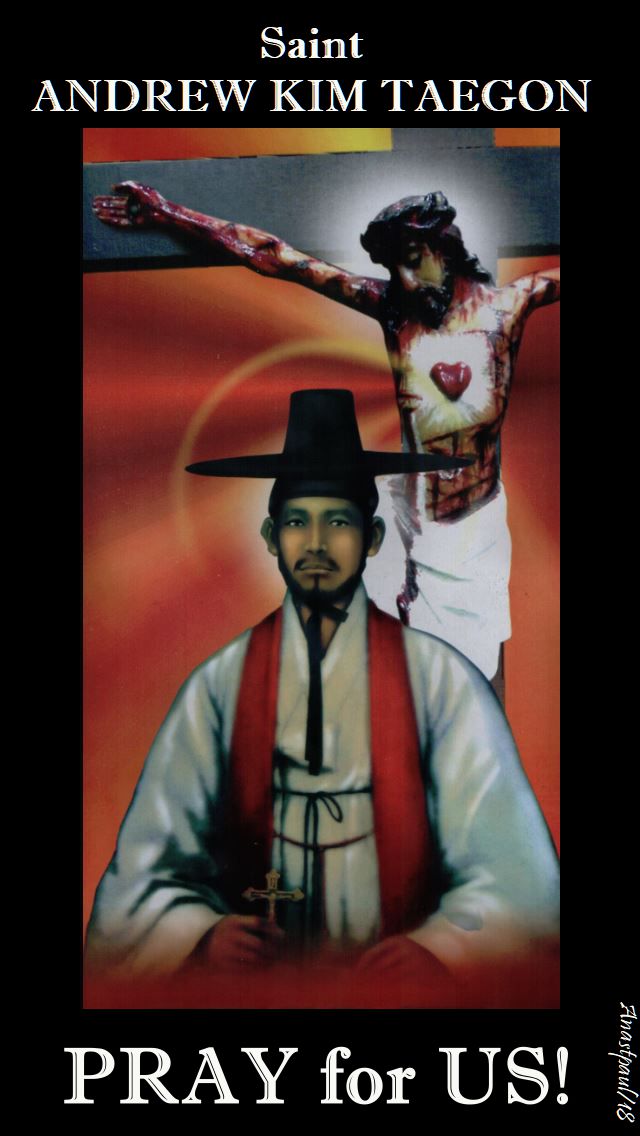
St Andrew Kim Taegon (1821-1846)

Beautiful Holy Martyr for Christ, Pray for us!st andrew kim taegon pray for us 20 sept 2018

Posted in MORNING Prayers, QUOTES of the SAINTS, QUOTES on ETERNAL LIFE, QUOTES on FAITH, QUOTES on SUFFERING, SAINT of the DAY

Quote/s of the Day – 20 September – The Memorial of the Korean Martyrs

Quote/s of the Day – 20 September – The Memorial of the Korean Martyrs – Sts Andrew Kim Taegon, Paul Chong Hasang & Companions – 103 saints and beati

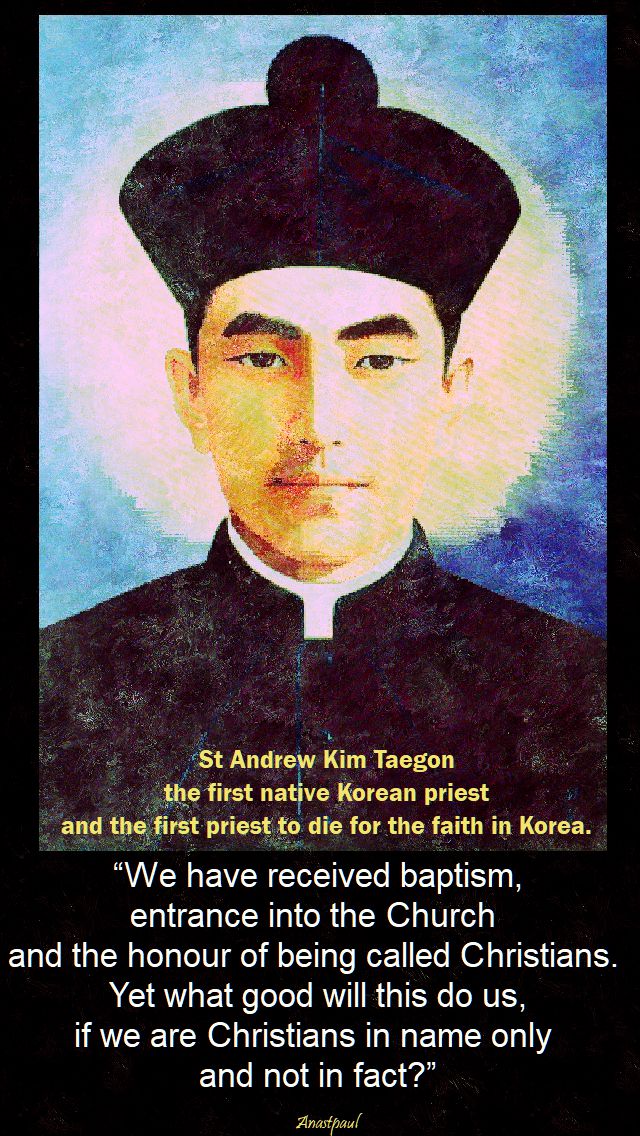
“We have received baptism, entrance into the Church
and the honour of being called Christians.
Yet what good will this do us,
if we are Christians in name only and not in fact?”we-have-received-baptism-st-andrew-kim-taegon-20-sept-2017

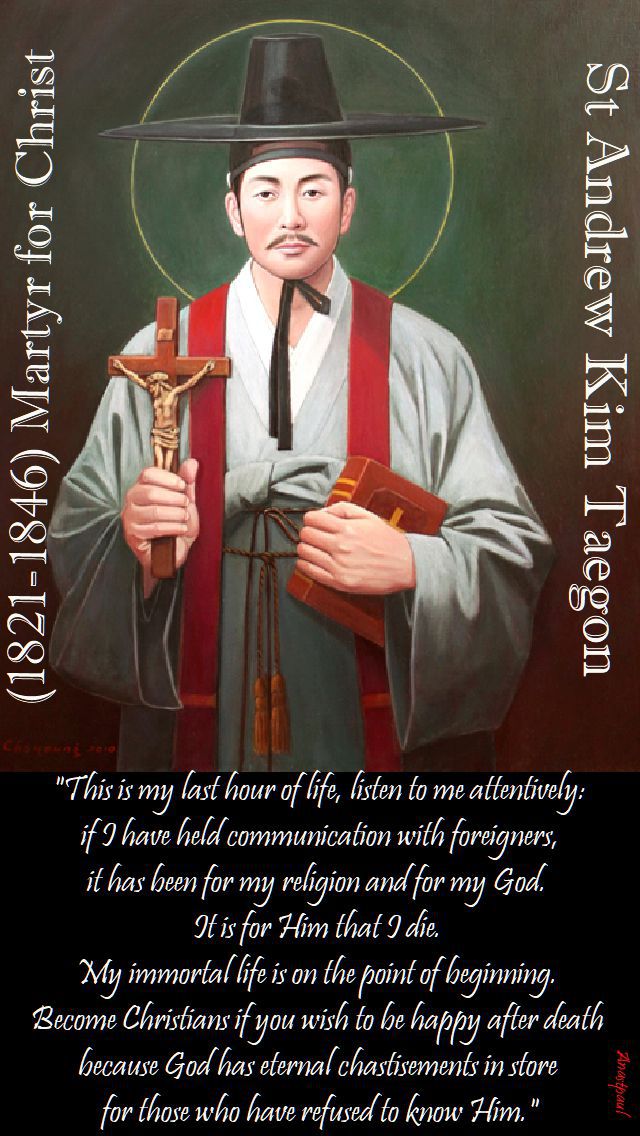
“This is my last hour of life, listen to me attentively:
if I have held communication with foreigners,
it has been for my religion and for my God.
It is for Him that I die.
My immortal life is on the point of beginning.
Become Christians if you wish to be happy after death
because God has eternal chastisements in store
for those who have refused to know Him.”

St Andrew Kim Taegon (1821-1846)

the first native Korean priest

and the first priest to die for Christ in Korea.this-is-my-last-hour-of-life-st-andrew-kim-taegon-20-sept-2018

Posted in MORNING Prayers, PAPAL SERMONS, SAINT of the DAY, The WORD

One Minute Reflection – 20 September – Today’s Gospel: Luke 7:36–50

One Minute Reflection – 20 September – Today’s Gospel: Luke 7:36–50 – Thursday of the Twenty-fourth week in Ordinary Time, Year B and The Memorial of the Korean Martyrs – Sts Andrew Kim Taegon, Paul Chong Hasang & Companions – 103 saints and beati & St Eustachius & family (died 2nd century) – Martyrs

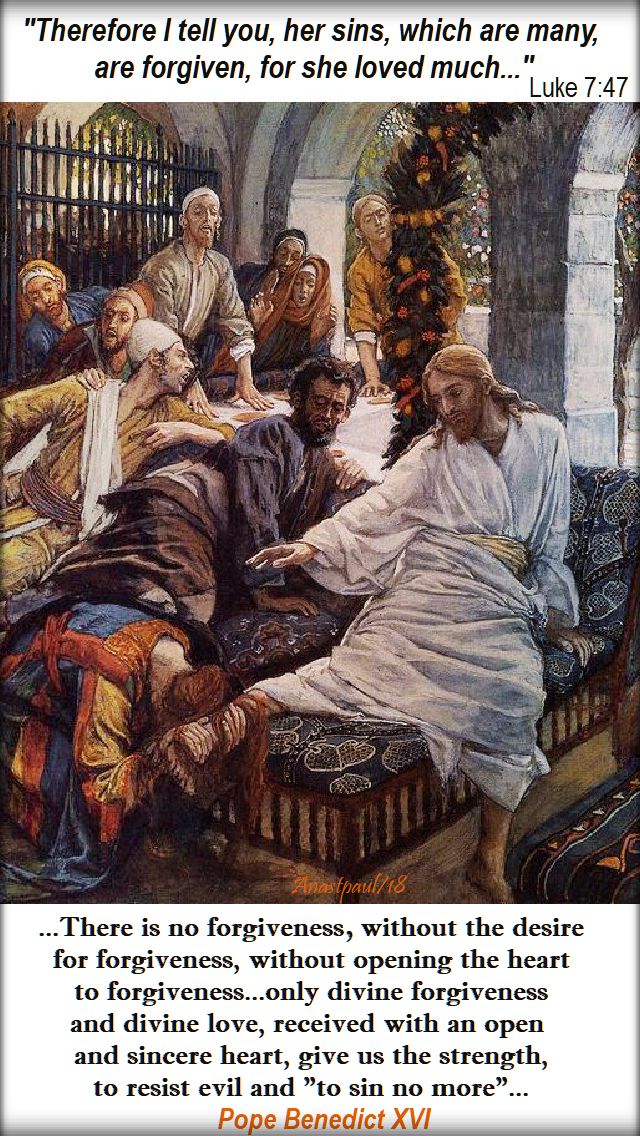
“Therefore I tell you, her sins, which are many, are forgiven, for she loved much”….Luke 7:47

REFLECTION – “Today, in particular, Jesus brings us to inner conversion:  He explains why He forgives us and teaches us to make forgiveness received from and given to, our brothers and sisters – the “daily bread” of our existence.
…Dear friends, from the Word of God we have just heard emerge practical instructions for our life.   Jesus does not enter into a theoretical discussion with His interlocutors on this section of Mosaic Law;  He is not concerned with winning an academic dispute about an interpretation of Mosaic Law but His goal is to save a soul and reveal that salvation is only found in God’s love.   This is why He came down to the earth, this is why He was to die on the Cross and why the Father was to raise Him on the third day.
Jesus came to tell us, that He wants us all in Paradise and that hell, about which little is said in our time, exists and is eternal for those who close their hearts to His love. …it is stressed that there is no forgiveness without the desire for forgiveness, without opening the heart to forgiveness – here it is highlighted, that only divine forgiveness and divine love, received with an open and sincere heart, give us the strength to resist evil and “to sin no more”, to let ourselves be struck by God’s love so that it becomes our strength.   Jesus’ attitude, thus becomes a model to follow, for every community, which is called to make love and forgiveness the vibrant heart of its life.”…Pope Benedict XVI – Sunday, 25 March 2007her sins which are many - luke 7 47 and there is no forgiveness without - pope benedict - 20 sept 2018

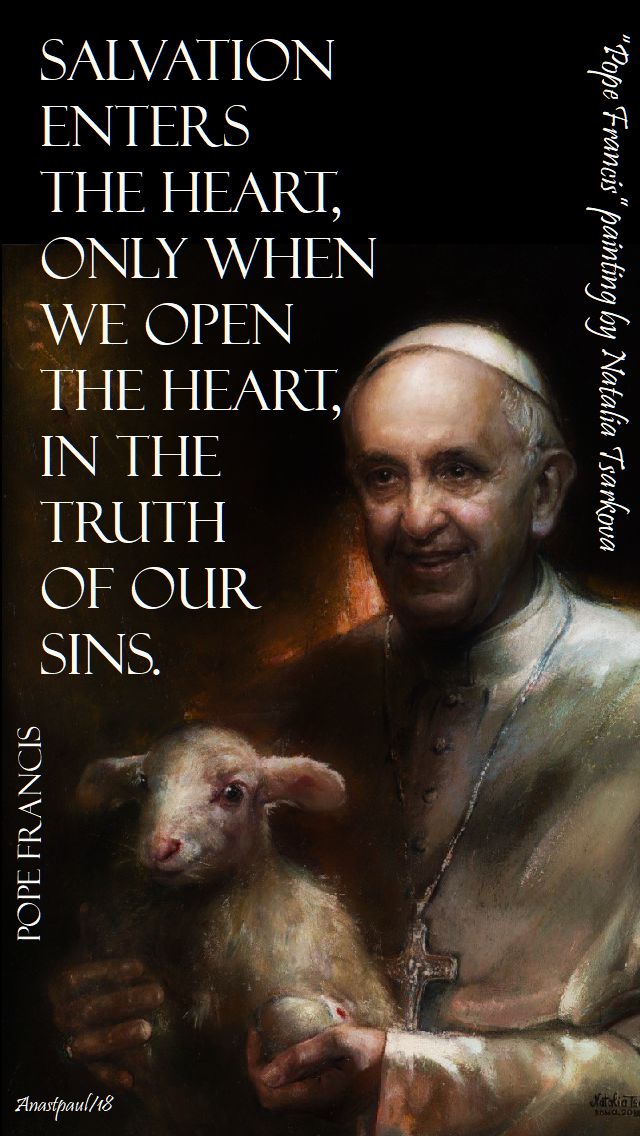
” Salvation enters the heart, only when we open the heart, in the truth of our sins.”…Pope Francis – Santa Marta, 18 Sept 2014 (“Pope Francis” painting by Natalia Tsarkova)salvation enters the heart only when we - pope francis 20 sept 2018

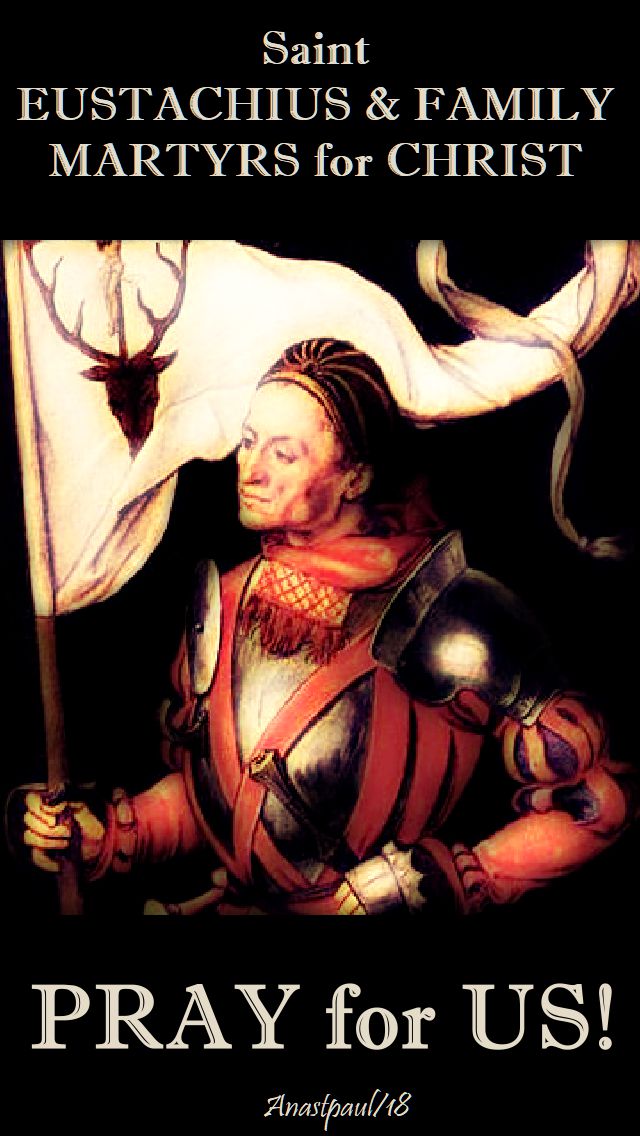
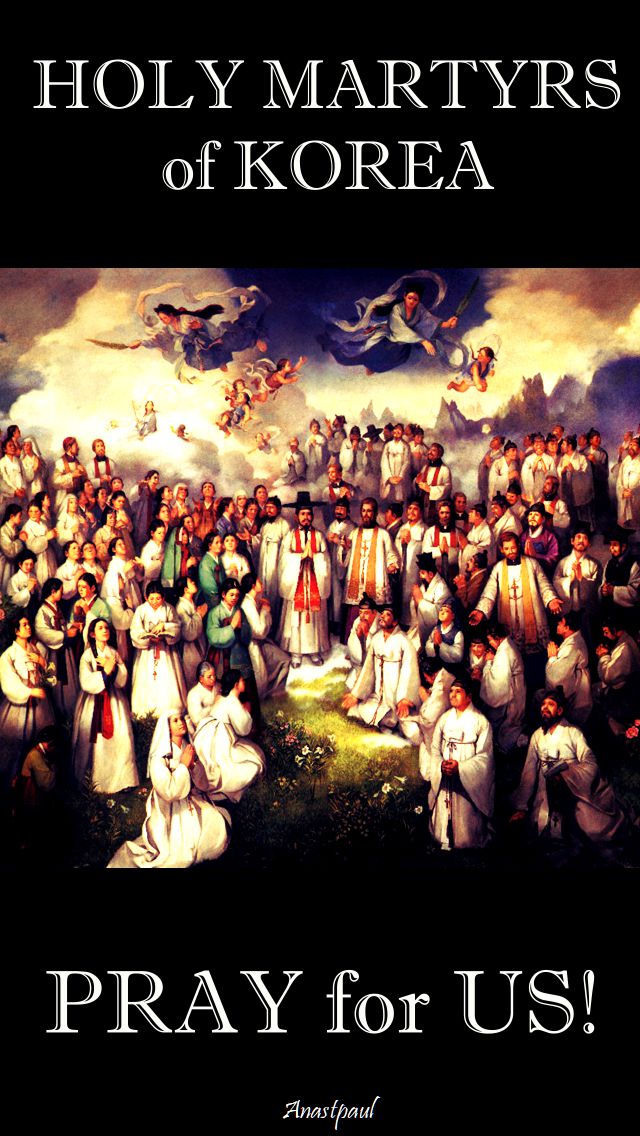
PRAYER – Grant us Lord, a true knowledge of salvation, so that, freed from fear and from the power of our foes, we may serve You faithfully, all the days of our life.   Give us Holy Father, a true desire for repentance and forgiveness and teach us each day, to forgive all with love.   Holy Martyrs, St Eustachius and family and those who so filled with love, died for the faith in Korea, please pray for us that we too may be filled with holy love and courage.   We make our prayer through our Lord, Jesus Christ in union with the Holy Spirit, one God, forever, amen.st eustachius and family martyrs - pray for us - 20 sept 2018holy-martyrs-of-korea-pray-for-us-20-sept-2017

Posted in DOCTORS of the Church, FATHERS of the Church, Our MORNING Offering, PRAYERS for VARIOUS NEEDS, PRAYERS of the SAINTS

Our Morning Offering – 20 September – 

Our Morning Offering – 20 September

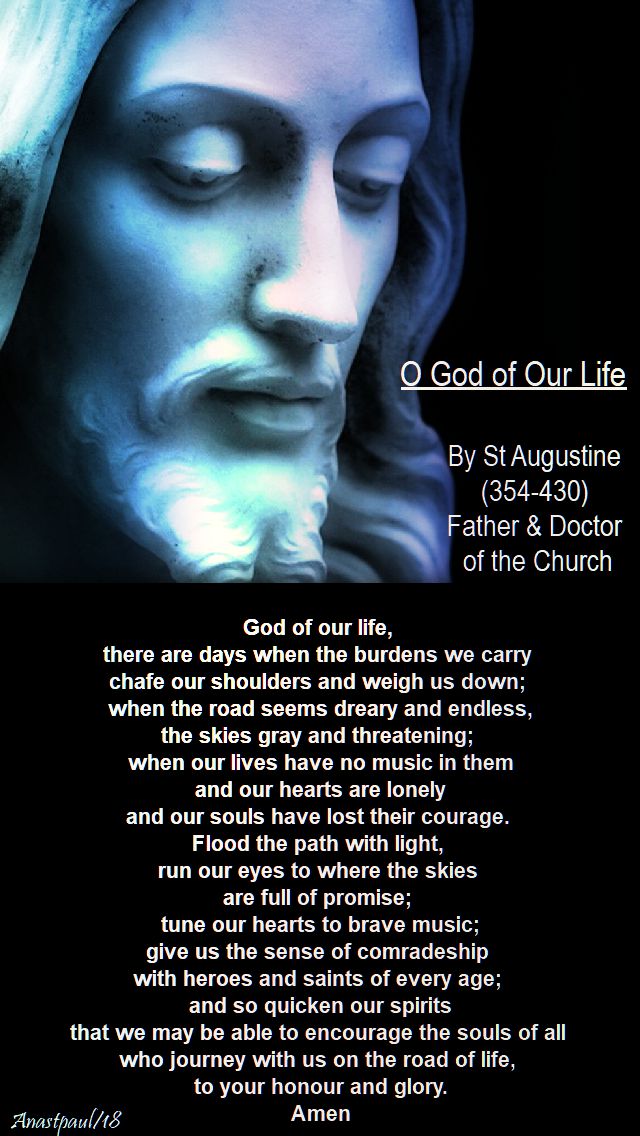
God of Our Life
St Augustine (354-430) 
Father & Doctor of the Church

God of our life,
there are days when the burdens we carry
chafe our shoulders and weigh us down;
when the road seems dreary and endless,
the skies gray and threatening;
when our lives have no music in them
and our hearts are lonely
and our souls have lost their courage.
Flood the path with light,
run our eyes to where the skies are full of promise;
tune our hearts to brave music;
give us the sense of comradeship
with heroes and saints of every age;
and so quicken our spirits
that we may be able to encourage the souls of all
who journey with us on the road of life,
to Your honour and glory.
Amengod of our life there are days when the burdens - st augustine - 4 april 2018

Posted in SAINT of the DAY, Uncategorized

Saint of the Day – 20 September -St Eustachius, Wife and Sons – Martyrs (Died c 188)

Saint of the Day – 20 September -St Eustachius born as Placidas, Wife and Sons – Martyrs (Died c 188) One of the Fourteen Holy Helpers – Patronages – against fire, difficult situations, fire prevention, firefighters, hunters, hunting, huntsmen, Madrid, torture victims, trappers.st euchasius lg

The remarkable story of Saint Eustachius, is a lesson given by God Himself on the marvels of His Divine Providence.   He was a distinguished and very wealthy officer of the Roman army under the Emperor Trajan, in the beginning of the second century.   He practised generous charity to the poor, although he had not yet perceived the errors of idolatry.

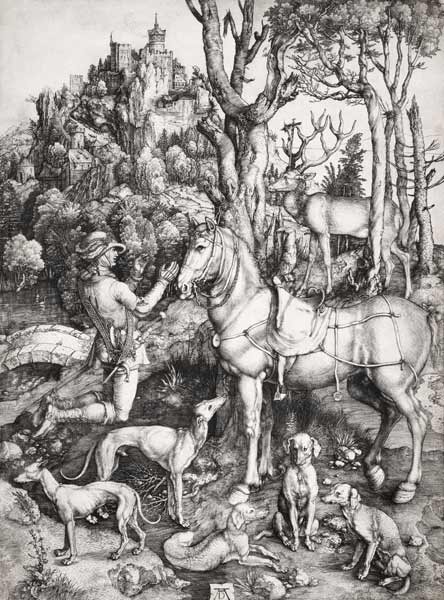
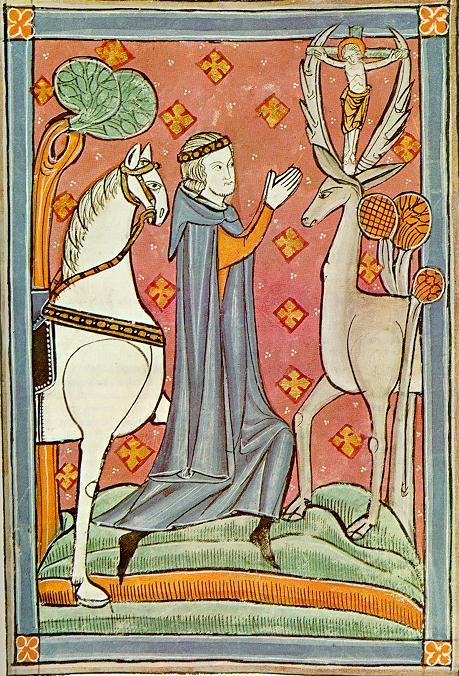
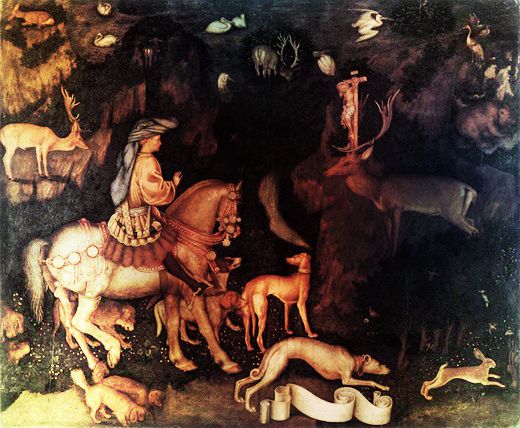
One day, while this distinguished officer was vainly pursuing a deer, the animal suddenly stood immobile before him in the light of a hilltop and he perceived between its horns a luminous cross.   On the cross was the image of the crucified Saviour and a voice said to him, ‘I am the Christ whom you honour without knowing it;  the alms you give to the poor have reached Me.’   Like Saint Paul, he fell from his horse and remained inert for a time.   Coming to himself, he said interiorly, What is this voice I have heard?   You who speak to me, who are you, that I may believe in you?   And the Lord told him interiorly that He was the Creator of the light, of the seasons, of man and all things visible, that He had suffered to save the human race, died and been buried but had risen the third day.

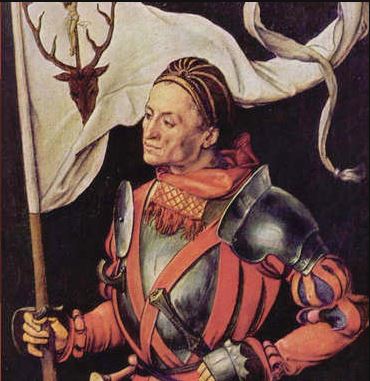
-Eustachius - durer

This was sufficient and the officer went home to fulfil the prescription he had received to be baptised with his wife and two young sons.   His spouse had received a similar revelation at the same time as himself and they all went to the Christian authority of the region in secret, to be baptised the same night.

In a short time he lost all his possessions through natural catastrophes and robbers.   But he had been advised beforehand that the Lord wanted to make of him another Job, that already the ancient enemy had plotted against him and that he was not to allow any thought of blasphemy to arise in his heart amid the sufferings that were awaiting him. He prayed for strength and retired from the region after the calamities, with his wife and children.   When by unforeseeable and extraordinary accidents, his wife and children were also taken from him and he believed the children dead, he was close to despair and wished his life might end but the warning of the Lord returned to his mind and he entered into the service of a land-owner of a village called Badyssus, to tend the fields. He remained for fifteen years in this occupation.   During this time his loved ones were well and safe, all spared in the perilous circumstances which had removed them from his sight but separated, each one like himself, from the three others.Saint_Eustace

In those days the empire was suffering greatly from the ravages of barbarians and was sinking under the assaults.   The emperor Trajan had Eustachius sought out and when he was found, had him clothed in splendid garments to give him command over the troops he intended to send against the invaders.   During the celebration that accompanied his return, he related to the emperor all that had occurred to him.   When the troops were being assembled, his own sons were conscripted.   Seeing them, he noticed them as young men taller than most and of great nobility of bearing and countenance and kept them near him without yet recognising them.   One of the two, while on bivouac near the very house of his own mother, who like Eustachius had taken employment in the garden of a landowner, related the confused memories of his childhood to his companion. Suddenly, the two brothers recognised one another and embraced in an effusion of joy.

Their mother, by a delicate attention of Providence, had chanced to overhear them and reflecting on what she heard, became certain they were her own sons.   She went to the captain of the campaign to inquire about them and immediately recognised him.   Not wishing to startle him, she began to relate her story, identifying herself as the wife of a certain Placidus and saying she believed she was now in the presence of her two sons from whom she had been separated and whom she had not seen for long years.   One must imagine the sentiments of the captain on hearing this narration, the reunion which followed and the prayers of thanksgiving sent up to God by the family and also the troops, who joined them in their joy and prayers.

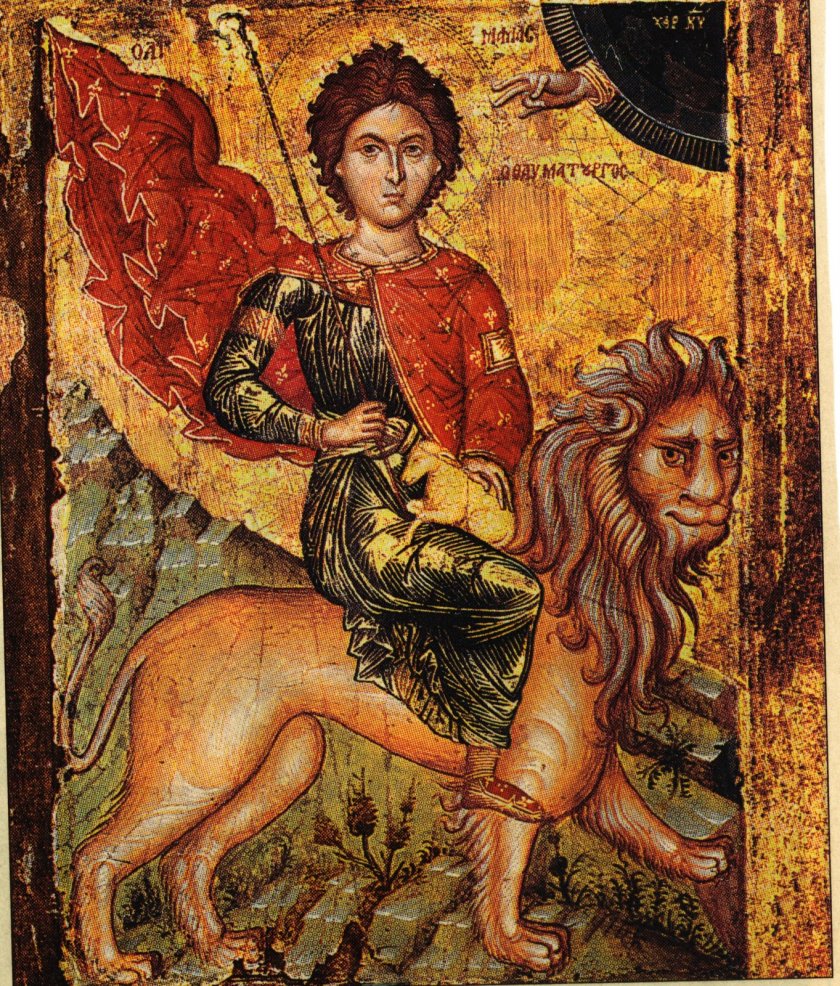
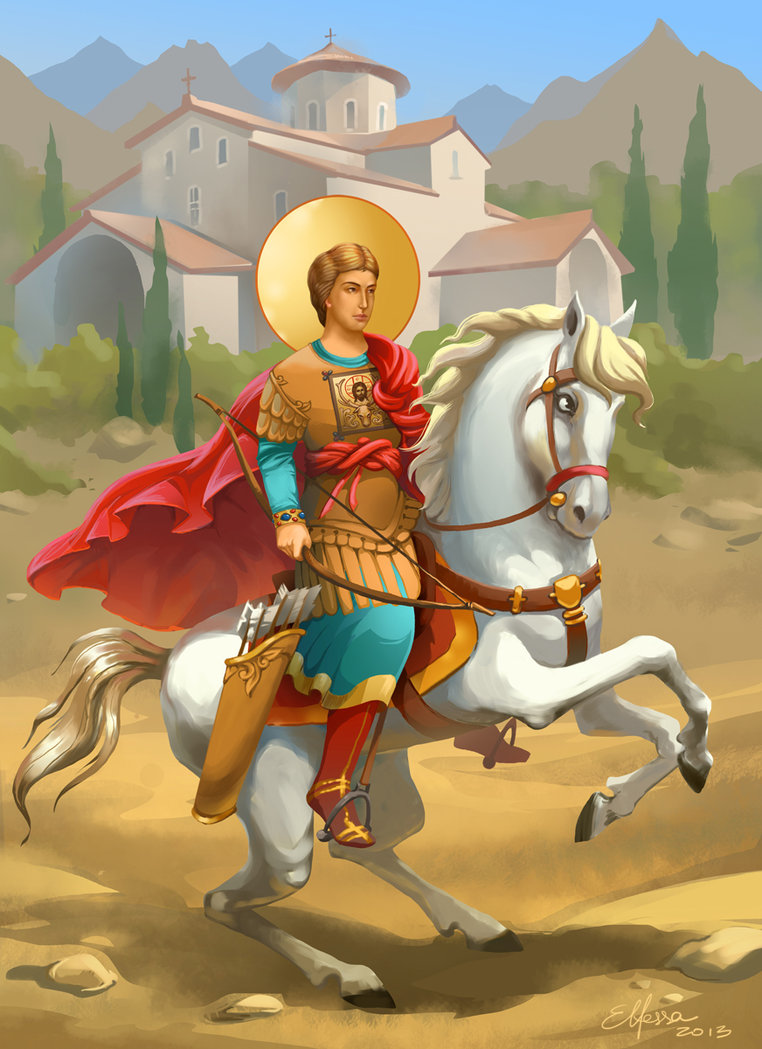
Returning to Rome victorious, Eustachius was received in triumph and greatly honoured, but when commanded to sacrifice during the celebration to the false gods, refused.   The infuriated emperor Adrian — for Trajan had died — ordered him with his wife and children to be exposed to a starved lion.   But instead of harming these servants of God, the beast came up to them, lowered its head as if in homage and left the arena.   The emperor, more furious still, caused the martyrs to be shut up inside a brazen bull, under which a fire was to be kindled, that they might be roasted to death.   Saint Eustachius prayed aloud and thanked God, asking Him who had reunited them to cause that their lives end at the same time, so they might be received together by Him into the happiness of His presence.   They expired but neither their bodies nor even their hair was injured. They were found entire the next day and at first it was believed they were still alive. Many believed in Christ through this final miracle, which to us today seems perhaps less miraculous than the story of their existence while alive.   A church in honour of the martyrs still exists in Rome:  Saint-Eustachius in Thermis.st_eustachius_by_elfessa-d5uoekm

Eustachius became known as a patron saint of hunters and firefighters and also of anyone facing adversity;  he was traditionally included among the Fourteen Holy Helpers. He is one of the patron saints of Madri  d, Spain. The island of Sint Eustatius in the Caribbean Netherlands is named after him.   The d’Afflitto, one of the oldest princely families in Italy, claim to be direct descendants of Saint Eustachius.

The novels “The Herb of Grace” (US title: Pilgrim’s Inn) (1948) by British author Elizabeth Goudge and Riddley Walker (1980) by American author Russell Hoban, incorporate the legend into their plot.   It has also inspired the film Imagination.

The saint’s cross-and-stag symbol is featured on bottles of Jägermeister, a German alcoholic digestif.   This is related to his status as patron of hunters; a Jägermeister was a senior foresters and gamekeeper in the German civil service until 1934, prior to the drink’s introduction in 1935.   Jägermeister has a round logo of a shining cross between the antlers of a deer/stag referring to two persons who had seen such a vision: Saint Hubertus and Saint Eustachius.

st eustachius

Saint Eustachius has a church dedicated to him in the southern part of India – he is called Saint Esthak in this part of the world and in County Kildare, Ireland.   There is a church dedicated to him on the campus of Newbridge College in Newbridge, County Kildare and the schools’ logo and motto is influenced by the vision of Saint Eustachius;  a nearby village is named Ballymore Eustace.

Sant’Eustachio is also honoured in Tocco da Casauria, a town in the Province of Pescara in the Abruzzo region of central Italy.   The town’s church, built in the twelfth century, was dedicated to Saint Eustachius.   It was rebuilt after being partially destroyed by an earthquake in 1706.

About the 14 Holy Helpers hereSt. Eustace

Posted in SAINT of the DAY, Uncategorized

Memorials of the Saints – 20 September

Martyrs of Korea:  St Andrew Kim Taegon, St Paul Chong Hasang & Companions – 103 saints and beati (Memorial)

St Agapitus of Rome
St Candida of Carthage
St Dionysius of Phrygia
St Dorimedonte of Synnada
St Eusebia of Marseilles
St Eustachius
St Evilasius of Cyzicum
St Fausta of Cyzicum
Bl Francisco Martín Fernández de Posadas
St Glycerius of Milan
St John Charles Cornay
Bl John Eustace
St Jose Maria de Yermo y Parres
St Lawrence Mary Joseph Imbert
Bl Marie Therese of Saint Joseph (1855-1938)
St Paul Chong Hasang
St Priscus
Susanna of Eleutheropolis
Bl Thomas Johnson

Martyrs of Constantinople – 3 saints: A priest and two bishops who were imprisoned, tortured and martyred for the defense of icons in the iconoclast persecutions of emperor Leo the Isaurian. – Andrea, Asiano and Hypatius. They were martyred in 735 in Constantinople (modern Istanbul, Turkey) and their bodies were thrown to the dogs.

Martyrs of Pergen – 6 saints: A group of lay people martyred in the persecutions of Emperor Elagabalus. The names that have come down to us are Dionysius, Dioscorus, Philippa, Privatus, Socrates and Theodore. They were crucified c 220 at Pergen, Pamphylia, Asia Minor (in modern Turkey).

Martyred in the Spanish Civil War:
• Blessed Cristobal Iturriaga-Echevarría Irazola
• Blessed Santiago Vega Ponce
• Blessed Juan Antonio López Pérez

Posted in MORNING Prayers, NOVENAS

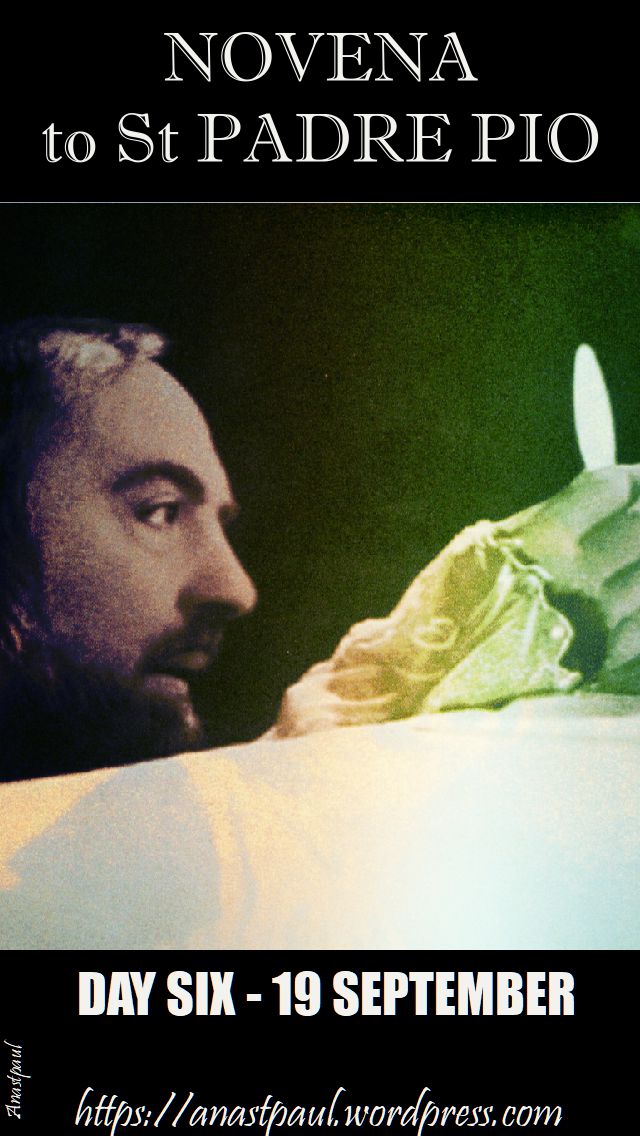
NOVENA to St Padre Pio/St Pius of Pietrelcina – DAY SIX – 19 September

NOVENA to St Padre Pio/St Pius of Pietrelcina – DAY SIX – 19 September

St Padre Pio you have said:

In the most Holy Sacrament of the Eucharist, in this sacrament of Love, we have true life, a blessed life and true sacrament of Love;  we have true life, a blessed life and true happiness Because in it we receive not only those graces that perfect us but the very Author of those graces.

Let us Pray:

Gracious God, You generously blessed Your servant, Padre Pio, with the gifts of the Spirit.
You marked his body with the five wounds of Christ Crucified,
as a powerful witness to the saving Passion and Death of Your Son
and as a stirring inspiration to many people of Your infinite mercy, forgiveness and love.
Through his powerful intercession, many who suffered were healed of sickness and disease.
Endowed with the gift of discernment, he could read people’s hearts.
With dignity and intense devotion, he celebrated daily Mass,
inviting countless men and women to a greater union with Jesus Christ,
in the Sacrament of the Holy Eucharist.
Gracious God, St Pio lived totally for You
teach us too this great act of self-giving and complete oblation.
Grant us the grace of approaching the Altar of Sacrifice
with thanksgiving and complete reverence.
Through the intercession of Saint Pio,
we confidently beseech You to to grant us the grace of
………………. (state your petition here).
Help us to imitate his example of prayerful holiness and compassion,
so that we, too, may faithfully follow the Risen Lord
and one day rejoice in the Kingdom,
where You live and reign forever and ever.
Amenday-six-novena-to-st-padre-pio-19-sept (1)

Posted in DOCTORS of the Church, FATHERS of the Church, QUOTES of the SAINTS, QUOTES on FAITH, QUOTES on GRATITUDE, QUOTES on HOPE, QUOTES on HUMILITY, QUOTES on LOVE, QUOTES on PRAYER, QUOTES on SANCTITY, QUOTES on TRUST and complete CONFIDENCE in GOD, SAINT of the DAY, SPEAKING of .....

Quote/s of the Day – The Memorial of St Alonso de Orozco O.S.A. (1500 – 1591) Augustinian Priest

Quote/s of the Day – The Memorial of St Alonso de Orozco O.S.A. (1500 – 1591) Augustinian Priest

Speaking of:  Seeking Augustine

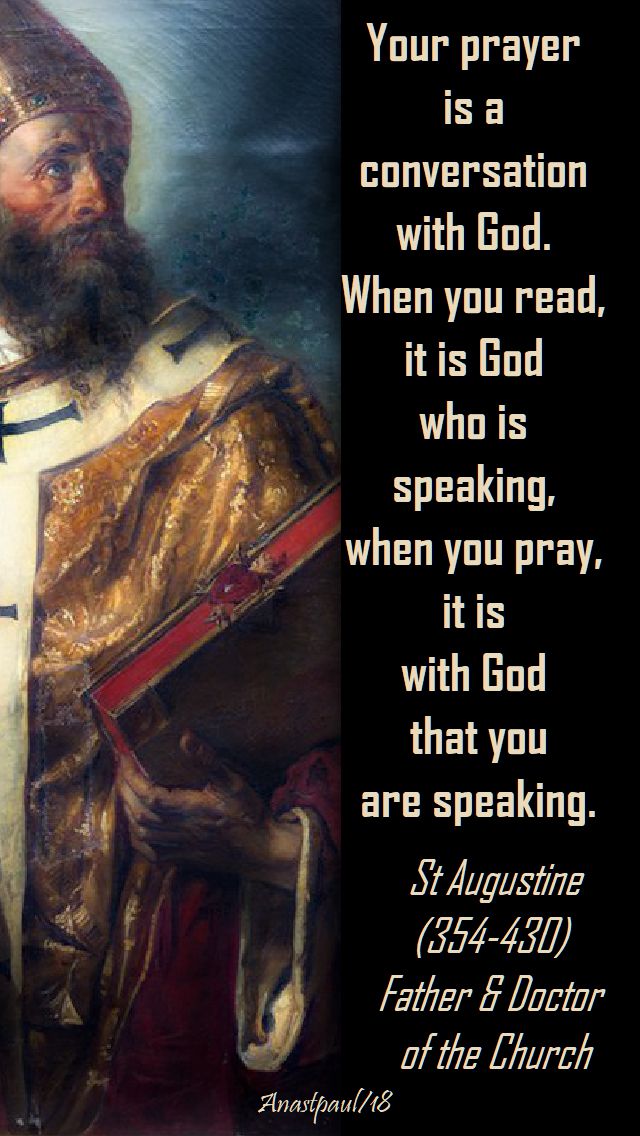
“Your prayer is a conversation with God.
When you read, it is God who is speaking,
when you pray, it is with God that you are speaking.”your prayer is a conversation - st augustine - 19 sept 2018

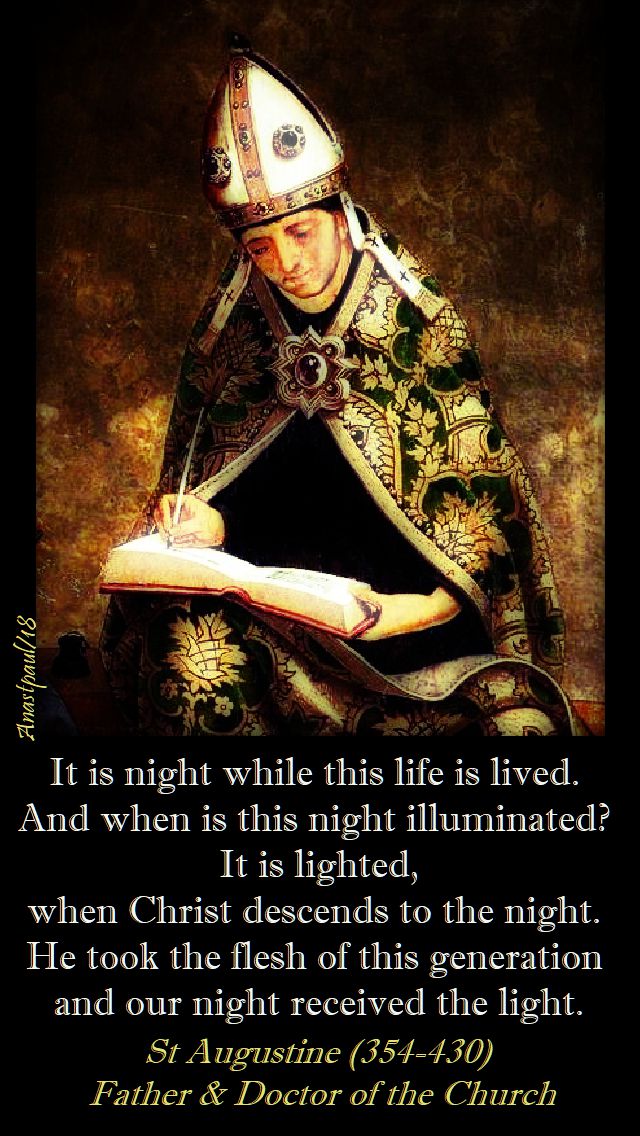
“It is night while this life is lived.
And when is this night illuminated?
It is lighted when Christ descends to the night.
He took the flesh of this generation
and our night received the light.”
(En. in ps. 138,14)it is night while this life is livd - st augustine - 19 sept 2018

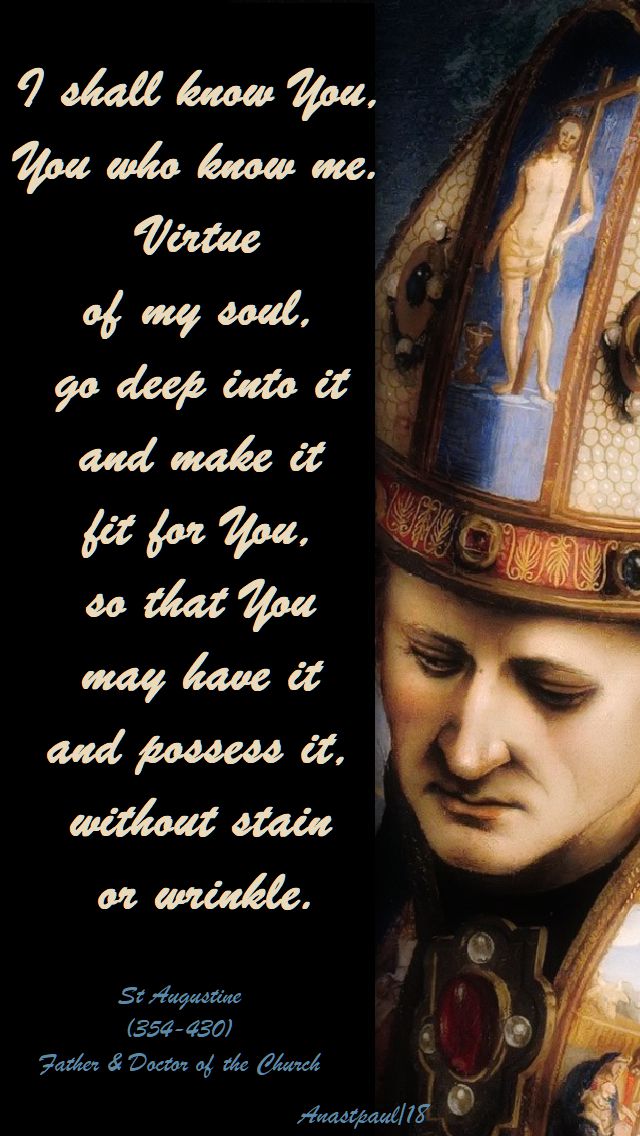
“I shall know You,
You who know me.
Virtue of my soul,
go deep into it
and make it fit for You,
so that You may have it
and possess it,
without stain or wrinkle.”i shall know you - st augustine - 19 sept 2018

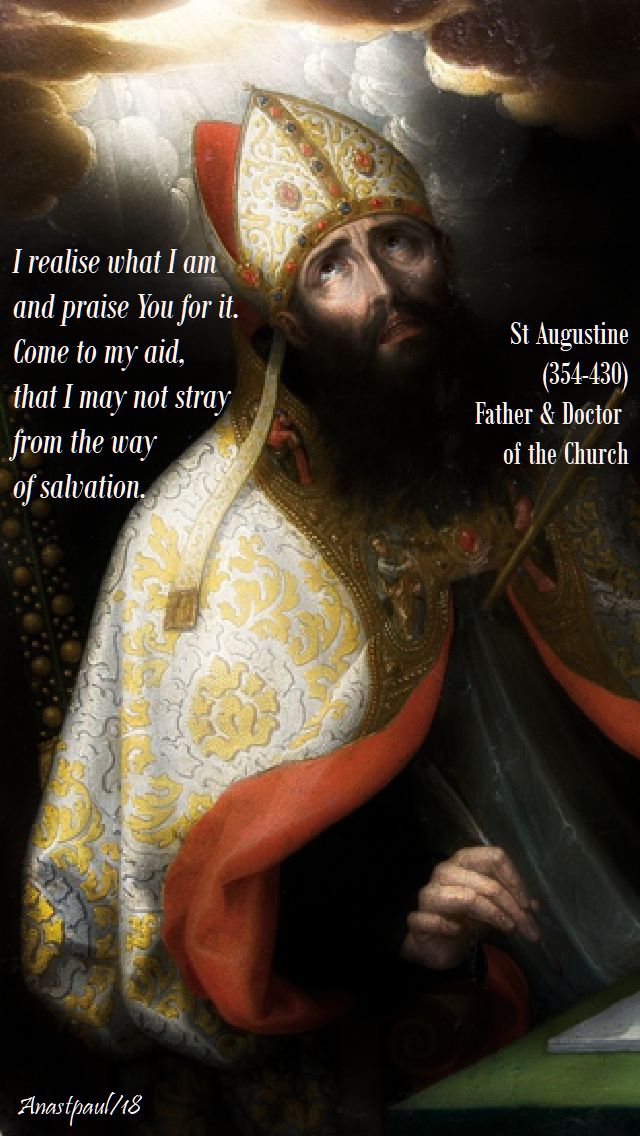
“I realise what I am
and praise You for it.
Come to my aid,
that I may not stray
from the way of salvation.”
(Sermo 67, 9)i realise what i am and i praise you - st augustine -19 sept 2018

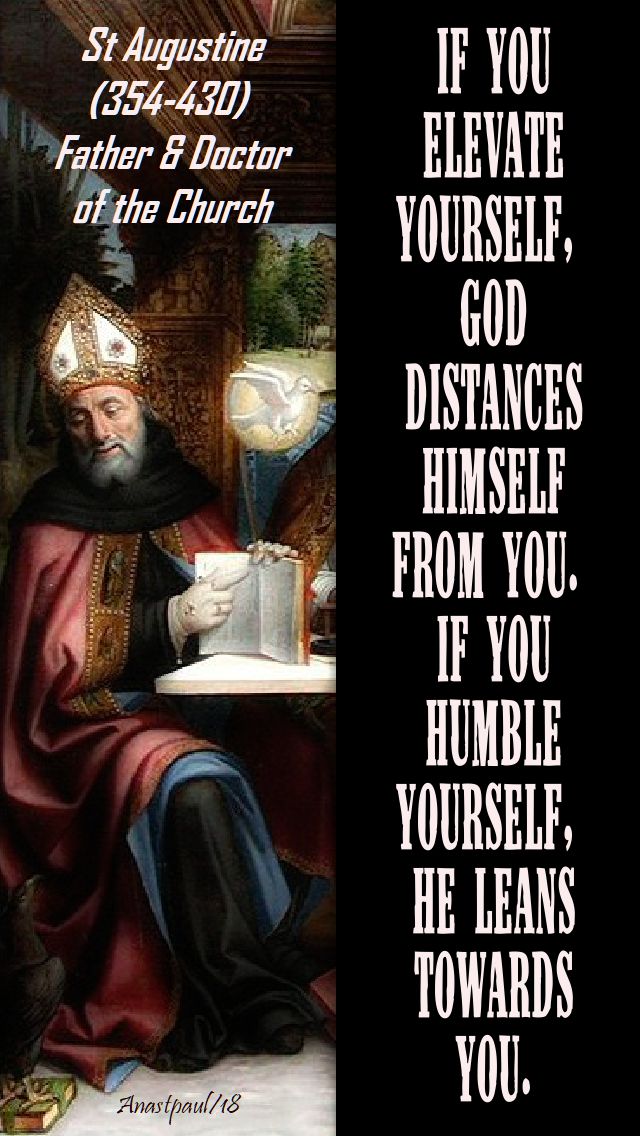
“If you elevate yourself,
God distances Himself from you.
If you humble yourself,
He leans towards you.”if you elevate yourself - st augustine - 19 sept 2018

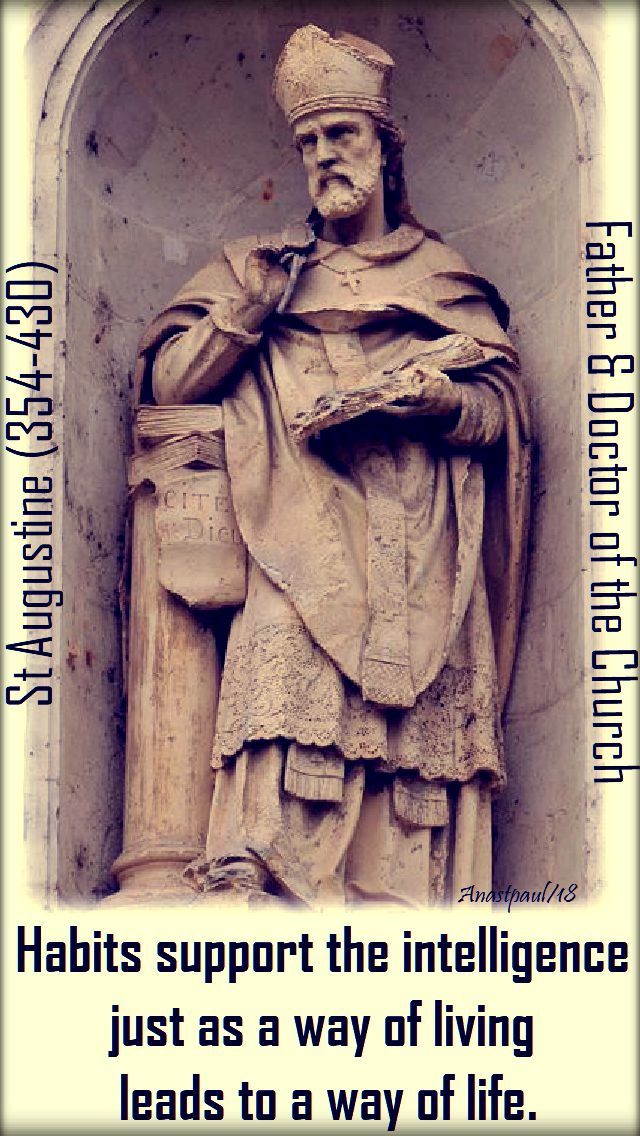
“Habits support the intelligence
just as a way of living
leads to a way of life.”
(In Io. Ev. XVIII, 7)

St Augustine (354-430) Father & Doctor of the Churchhabits support the intelligence - st augustine - 19 sept 2018

Posted in DOCTORS of the Church, FATHERS of the Church, MORNING Prayers, QUOTES of the SAINTS, SAINT of the DAY, Uncategorized

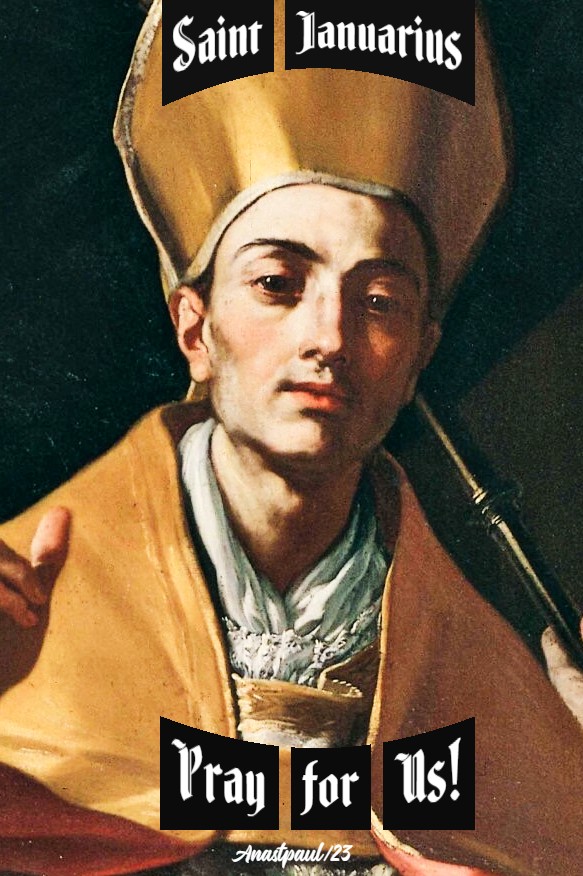
Thought for the Day – 19 September – The Memorial of St Januarius – Martyr (Died c 304)

Thought for the Day – 19 September – The Memorial of St Januarius – Martyr (Died c 304)

Many centuries ago, St Januarius died for the Faith in the persecution of Diocletian and, to this day, God confirms the faith of his Church and works a continual miracle, through the blood which Januarius shed for Him.

Little did the heathen Governor think that he was the instrument, in God’s Hand, of ushering in the long succession of miracles which attest to the faith of St Januarius.

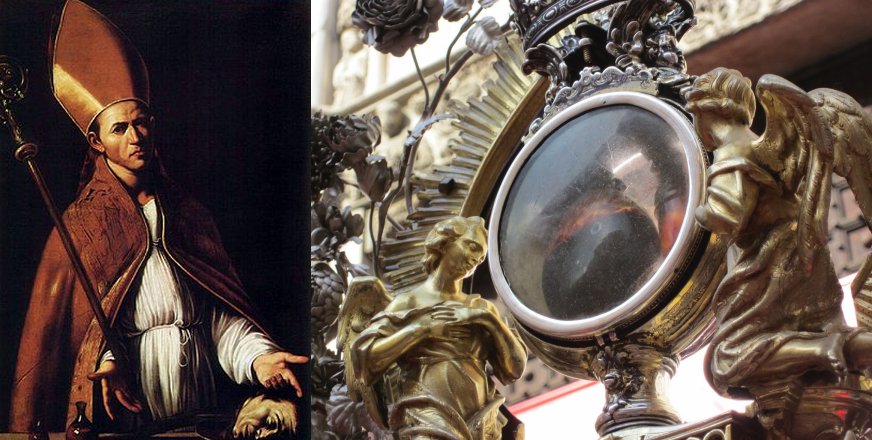
The Relics of St Januarius rest in the Cathedral of Naples and it is there that the liquefying of his blood occurs.   The blood is congealed in two glass vials but when it is brought near the Martyr’s head it melts and flows like the blood of a living man.

St Alphonsus Liguori wrote regarding St Januarius

“The Neapolitans honour this Saint as the principal Patron of their City and nation and the Lord Himself has continued to honour him, by allowing many miracles to be wrought through his intercession, particularly when the frightful eruptions of Mount Vesuvius, have threatened the City of Naples with utter destruction.   

While the Relics of St Januarius were being brought in procession towards this terrific volcano, the torrents of lava and liquid fire which it emitted have ceased, or turned their course from the City. But, the most stupendous miracle and that which is greatly celebrated in the Church, is the liquefying and effervescence, of this blessed Martyr’s blood whenever the Relic Vials are brought into the sight of his head.   

This miracle is renewed many times in the year, in the presence of all who desire to witness it;  yet, some heretics have endeavoured to throw a doubt upon its authenticity by frivolous and incoherent explanations but, no-one can deny the effect to be miraculous, unless he be prepared to question the evidence of his senses!”

Tertullian said, “The blood of the Martyrs is the seed of the Church.”   Sometimes, that blood is bubbling!

Posted in MORNING Prayers, PAPAL SERMONS, SAINT of the DAY, The WORD

One Minute Reflection – 19 September – Today’s Gospel: Luke 7:31–35

One Minute Reflection – 19 September – Today’s Gospel: Luke 7:31–35 – Wednesday of the Twenty-fourth week in Ordinary Time and the Memorial of St Alonso de Orozco (1500 – 1591)

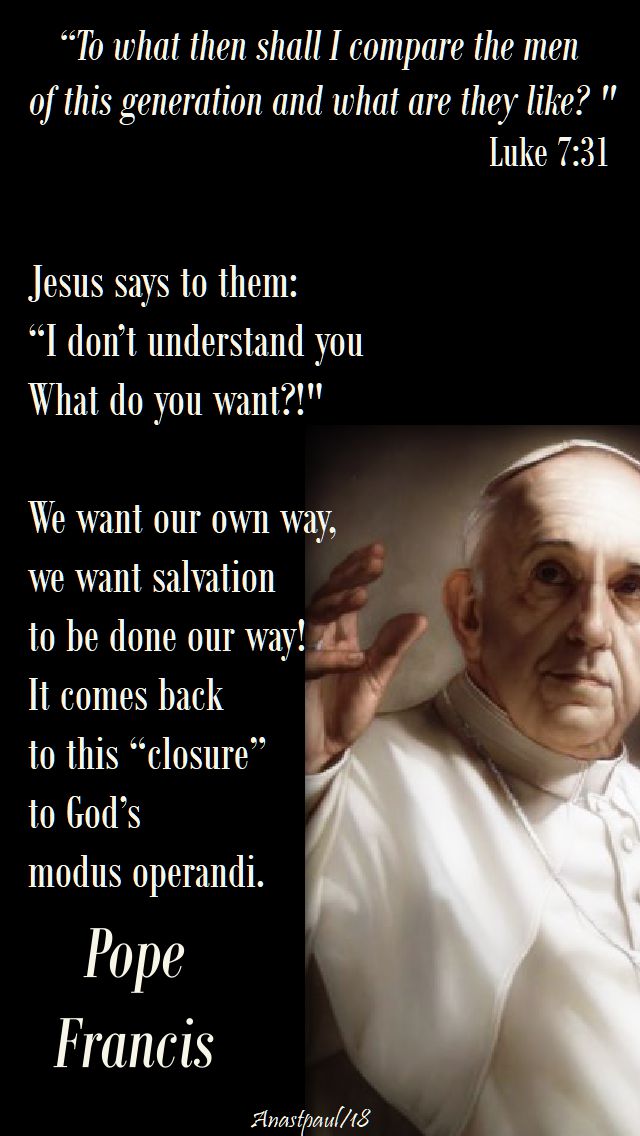
“To what then shall I compare the men of this generation and what are they like? “…Luke 7:31

REFLECTION – “It is actually the ruling class that closes the doors to the way that God wants to save us.   In this sense the powerful dialogues between Jesus and the ruling class of His time are understandable:  they argue, they put Him to the test, they lay traps to see if he falls, because they have resistance to being saved.   Jesus says to them: “I don’t understand you!   You are like those children:  we played the flute for you and you didn’t dance;  we sang a sad song for you and you didn’t weep.   What do you want?”.

We want our own way, we want salvation to be done our way.   It comes back to this “closure” to God’s modus operandi.” …Pope Francis – Santa Marta, 3 October 2014luke 7 31 - to what shall I compare - pope francis - we want our way! - 19 sept 2018

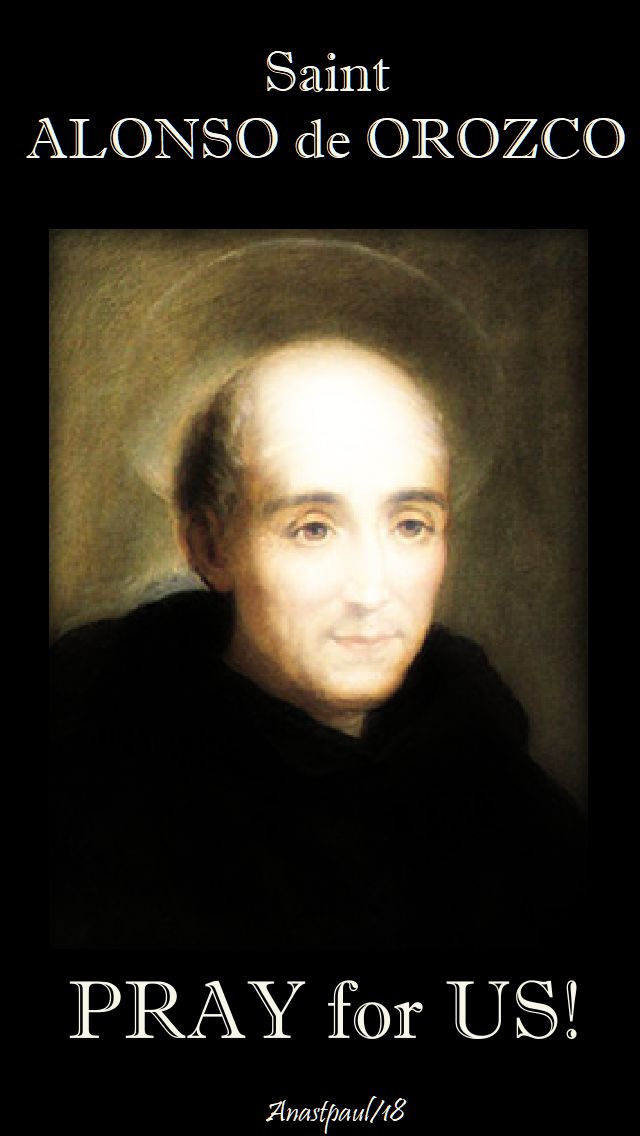
PRAYER – Remember Lord, Your solemn covenant, renewed and consecrated by the blood of the Lamb, so that Your people may obtain forgiveness for their sins and a continued growth in grace.   Turn our hearts from stone to flesh, grant that we may want only Your will.   St Alonso de Orozco, You constantly sought the will of God, please pray for us.   We make our prayer through Christ, the Lamb of God, with the Holy Spirit, one God forever, amen.st alonso de orozco pray for us - 19 sept 2018

Posted in DOCTORS of the Church, FATHERS of the Church, Our MORNING Offering, PRAYERS of the SAINTS, SAINT of the DAY

Our Morning Offering – 19 September – The Memorial of St Alonso de Orozco O.S.A. (1500 – 1591) Augustinian Priest

Our Morning Offering – 19 September – The Memorial of St Alonso de Orozco O.S.A. (1500 – 1591) Augustinian Priest

Prayer to Seek God Continually
By St Augustine (354-430) Father & Doctor

O Lord my God, I believe in You,
Father, Son and Holy Spirit.
Insofar as I can,
insofar as You have given me the power,
I have sought You.
I became weary and I laboured.
O Lord my God, my sole hope,
help me to believe
and never to cease seeking You.
Grant that I may always
and ardently seek out Your countenance.
Give me the strength to seek You,
for You help me to find You
and You have more and more given me,
the hope of finding You.
Here I am before You
with my firmness and my infirmity.
Preserve the first and heal the second.
Here I am before You
with my strength and my ignorance.
Where You have opened the door to me,
welcome me at the entrance;
where you have closed the door to me,
open to my cry;
enable me to remember You,
to understand You
and to love You.
Amen.prayer to seek god continually by st augustine - o lord my god I believe in You - 19 sept 2018

Painting: Jeffrey A Gomez – The Confession of St Augustine

Posted in SAINT of the DAY, VATICAN Resources

Saint of the Day – 19 September – St Alonsus de Orozco Mena O.S.A. (1500 – 1591)

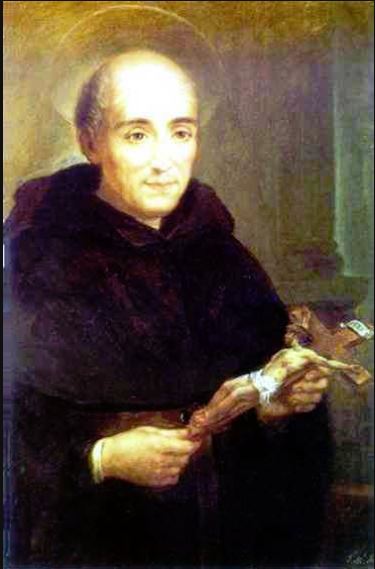
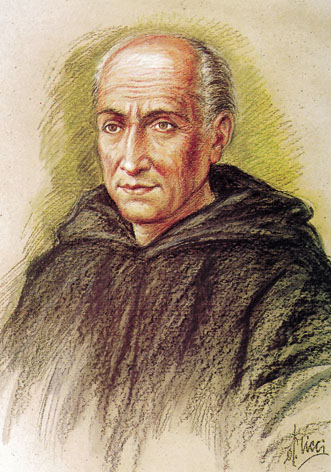
Saint of the Day – 19 September – St Alonso de Orozco Mena O.S.A. (1500 – 1591) Religious Priest, Preacher, Writer, Apostle of Charity, Spiritual Director, Marian Devotee, Ascetic – born on 17 October 1500 at Oropesa, Toledo, Spain and died on 19 September 1591 in the College of the Incarnation, Madrid, Spain of natural causes.st alonso de orozco 2 snip

Alphonsus de Orozco was born in Oropesa, Province of Toledo, Spain, on the 17th of October 1500, where his father was governor of the local castle.   He began his studies in the nearby Talavera de la Reina and for three years he was a choir boy in the Cathedral of Toledo, where he made progress in the study of music.   At the age of fourteen his parents sent him to the University of Salamanca, where an elder brother was already studying.

During the Lenten sermons preached by Thomas of Villanova in 1520, on the psalm “In exitu Israel de GYPTO”, his vocation to the religious life was brought to maturity and a little later, attracted by the religious atmosphere of the Friary of Saint Augustine, he entered that community and there made his profession of vows at the hands of Saint Thomas of Villanova (1486-1555).

When ordained a priest in 1527 his superiors detected in him such deep spirituality and a capacity for proclaiming the Word of God, that very soon they appointed him to the ministry of preaching.   From the age of thirty he held many offices but in spite of his own austere life, his style of governing always showed him to be full of understanding. Inspired by a desire for martyrdom, he set off for Mexico as a missionary in 1549 but on his way, in the Canary Islands, he suffered a severe bout of arthritis and the doctors, fearing for his life, forbade him to continue his journey.ALONSO

In 1554, when he was Prior of the Convent in Valladolid, a city which was for many decades the seat of the royal court, Alphonsus was appointed “royal preacher” to the court of the emperor Charles V.   When the court was moved to Madrid in 1561, Alphonsus also had to move to the new capital of the Kingdom and he took up his residence in the convent of Saint Philip the Royal.

In spite of the fact that he was now exercising an office which was outside the jurisdiction of his superiors and which also carried a stipend, he renounced all privileges and only wished to live as a humble friar in obedience to his superiors.   He lived in austere poverty.   He took only one daily meal at midday, he slept no more than three hours, because he said that was enough for the tasks of the new day.   A table was his bed;  cut vines his pillow.   His room had just one chair, a candle, a broom and some books.   By choice, the room was near the door so that he could better attend to the poor who used to come there to ask his help.   Without neglecting his daily attendance in choir for prayer, he used to visit the sick in hospitals, the prisoners in the goals and the poor in the streets and in their homes.   He spent the day in prayer, in writing his books and preparing his sermons.   He was very popular with members of every social class. Personages of society and culture were witnesses in his process for Canonisation, such as the Princess Isabel Clara Eugenia, the Dukes of Alba and of Lerma, the writer Lope de Vega, Francisco de Quevedo and González Dávila. Association with the upper classes did not divert him from his simple lifestyle.   His fame spread throughout Madrid.   The people who used to call him, much to his displeasure, the “saint of Saint Philip’s”, loved him for his gentle sensitivity in getting close to everyone without distinction.

He wrote many works, both in Latin as well as in Spanish.   The simplicity of the titles indicate that they were written with a view to pastoral ministry:   Rule for a Christian life (1542), Garden of prayer and the mount of contemplation (1544), Memorial of holy love (1576), Spiritual treasury (1551), The art of loving God and neighbour (1567), The book of the gentleness of God (1576), Tract on the crown of Our Lady (1588).   Like his own life, these writings sprung from a spirit of contemplation and a study of sacred scripture. Such was his great devotion to the Virgin Mary, that he was convinced that he was writing in obedience to her command.

He was also fervently attached to the love of his own religious Order, writing about its history and spirituality, in the hope of encouraging good men to imitate the Augustinian way of life.   Along these lines, led by a desire of internal reform, which would later develop into a movement of recollection in the Order, he was responsible for the foundation of Augustinian monasteries, both of friars and of contemplative nuns.

In August 1591, Friar Alphonsus fell ill of a fever but this did not prevent him from celebrating his daily Mass, as he never, in spite of any illness, failed to celebrate the Holy Sacrifice, saying with a certain humour, “God does no harm to anybody”.   During his illness, he was visited by the king, Philip II, by the heir to the throne and Princess Isabel and by the Cardinal Archbishop of Toledo, Gaspar de Quiroga, who personally fed him and then asked for his blessing.

News of his death, which occurred on the 19 of September 1591 in the College of the Incarnation, which he had founded two years before and which today is the seat of the Spanish Senate, brought sadness to the whole city.   The people of Madrid, as testified by Quevedo, filed past the chapel of rest and rushed the doors of the church of the college, knocking down the doors seeking some relic, a splinter of the bed, or a fragment of his clothes, his shoes or of his hair shirt.   For many years the Cardinal Archbishop kept for himself the wooden cross which the “saint of Saint Philip’s” used to carry with him.

He was beatified by Pope Leo XIII on the 15th January of 1882 and Canonised on 19 May 2002 by Pope John Paul II.

Posted in Uncategorized

Memorials of the Saints and the Feast of Our Lady of La Salette – 19 September

St Januarius of Naples Martyr (Died c 304) (Optional Memorial)
About St Januarius here: https://anastpaul.wordpress.com/2017/09/19/saint-of-the-day-19-september-st-januarius/

Our Lady of La Salette (1846) :
Mary appeared to two small children, Melanie Mathieu and Maximin Giraud, on the mountain of La Salette in the French Alps. She was crying and around her neck was a crucifix, with a hammer and pincers on either side – 19 September 1846.   Approved by the diocesan bishop in 1851.

Read the whole story here: https://anastpaul.wordpress.com/2017/09/19/feast-of-our-lady-of-la-salette-19-september/

St Alonso de Orozco Mena O.S.A. (1500 – 1591)

St Arnulph of Gap
St Carolus Hyon Song-Mun
St Constantia of Nocera
St Desiderius of Pozzuoli
St Emily de Rodat
St Eustochius of Tours
St Felix of Nocera
St Festus of Pozzuoli
St Goeric of Metz
Bl Mary de Cerevellon
St Pomposa
St Sequanus
St Sosius of Puzzuoli
St Theodore of Canterbury
St Trophimus of Synnada

Martyrs of Antioch – (3 saints): Christians imprisoned, tortured and executed in various ways in the persecutions of Emperor Probus; some names have come down to us – Dorymedon, Sabbatius and Trophimus. c 277 at Antioch (in modern Turkey).

Martyrs of Phunon – (4 saints): Four bishops in Egypt who were sentenced to forced labour in a rock quarry and martyred in the persecution of Diocletian. Noted for celebrating Mass in prison. – Elias, Nilus, Patermuzio and Peleus. They were burned to death in 310 at Phunon, near Petra in Palestine.

Martyred in the Spanish Civil War:
• Blessed Consuelo Aguiar-Mella Díaz
• Blessed Herman José Fernández Sáenz
• Blessed Juan Pérez Rodrigo
• Blessed Lucas Martín Puente
• Blessed María de La Encarnación de La Yglesia de Varo
• Blessed María Dolores Aguiar-Mella Díaz
• Blessed Miguel Faúndez López
• Blessed Sebastián Obeso Alario

Posted in MORNING Prayers, NOVENAS, Uncategorized

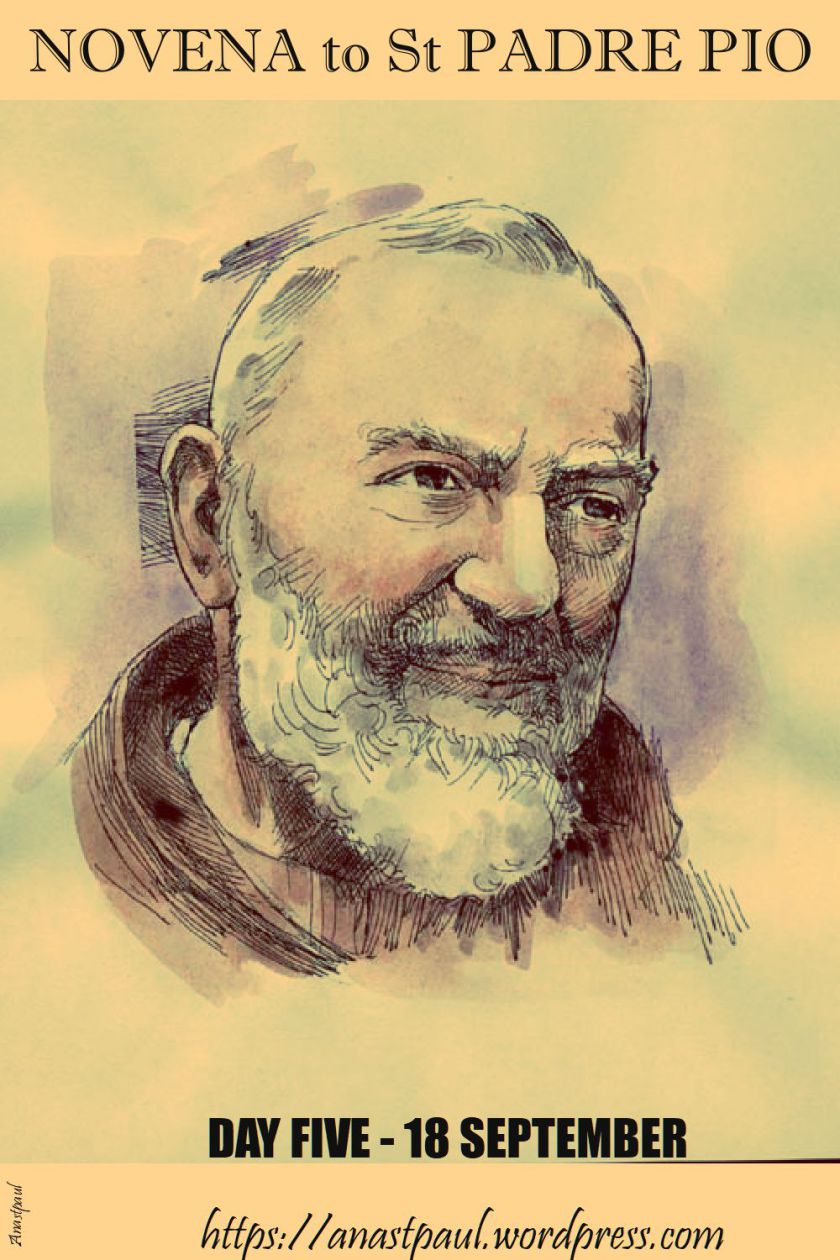
NOVENA to St Padre Pio/St Pius of Pietrelcina – DAY FIVE – 18 September

NOVENA to St Padre Pio/St Pius of Pietrelcina – DAY FIVE – 18 September

St Padre Pio you have said:

St Therese of the Child Jesus used to say, “I don’t want to choose either to die or to live but let Jesus do as He likes with me.”   I see clearly that this is the image of all souls who are stripped of self and filled with God… What St Therese has said ought to be said by every soul inflamed with love of God.

Let us Pray:

Gracious God, You generously blessed Your servant, Padre Pio, with the gifts of the Spirit.
You marked his body with the five wounds of Christ Crucified,
as a powerful witness to the saving Passion and Death of Your Son
and as a stirring inspiration to many people of Your infinite mercy, forgiveness and love.
Through his powerful intercession, many who suffered were healed of sickness and disease.
Endowed with the gift of discernment, he could read people’s hearts.
With dignity and intense devotion, he celebrated daily Mass,
inviting countless men and women to a greater union with Jesus Christ,
in the Sacrament of the Holy Eucharist.
Gracious God, St Pio lived totally for You
teach us too this great act of self-giving and complete oblation.
Through the intercession of Saint Pio,
we confidently beseech You to to grant us the grace of
………………. (state your petition here).
Help us to imitate his example of prayerful holiness and compassion,
so that we, too, may faithfully follow the Risen Lord
and one day rejoice in the Kingdom,
where You live and reign forever and ever.
Amenday-five-novena-st-pio-18-sept

Posted in DOMINICAN OP, MORNING Prayers, SAINT of the DAY, The WORD

Thought for the Day – 18 September – The Memorial of St Juan Macias O.P. (1585-1645)

Thought for the Day – 18 September – The Memorial of St Juan Macias O.P. (1585-1645)

St Juan Macias reflects the life of the many immigrants who come seeking better living conditions.   His life helps us to realise that as immigrants, we have a greater mission – to share the richness of our faith with other people in simple ways.   According to his biographers, St Juan Macias constantly meditated on the verse from the Book of Revelation:  “I saw a new heaven and a new earth” (Rev 21:1).

Faith is a journey on this earth in which all of us are immigrants who seek the new heaven and the new earth.   The life of St Juan Macias teaches us to walk this journey of faith in simple ways – being generous at all times, especially with the poor, the sick and the elderly;  being humble, embracing the reality that we are on this earth only for a while and doing the works of charity, the surest way to salvation.

The life of St Juan Macias teaches, that immigrants go to new worlds to find a better life through giving themselves for the greater mission of sharing the Gospel.   Indeed, this is a very effective way in which our life conditions will really become better, by sharing the Gospel, the Word of God, the life and death of our Saviour, Jesus Christ, in whatever way we can, where we find ourselves!

St Juan Macias, pray for us!st juan macias pray for us - no 2 - 18 sept 2018

Posted in DOCTORS of the Church, FATHERS of the Church, MORNING Prayers, QUOTES of the SAINTS, QUOTES on EVANGELISATION, QUOTES on FAITH, QUOTES on SANCTITY, QUOTES on TRUTH, The WORD

Quote/s of the Day – 18 September – Today’s Gospel: Luke 7:11–17

Quote/s of the Day – 18 September – Today’s Gospel: Luke 7:11–17, Tuesday of the Twenty-fourth week in Ordinary Time and the Memorial of St Juan Macias O.P. (1585-1645) and St Joseph of Cupertino O.F.M. Conv. (1603-1663)

Speaking of:  Living the Word

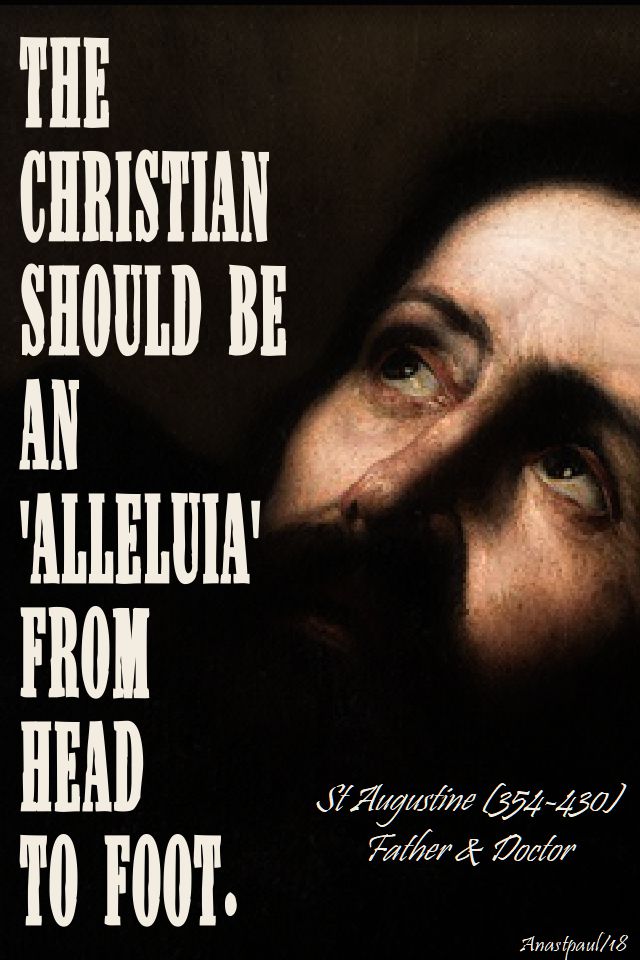
“The Christian should be an
‘alleluia’
from head to foot.

St Augustine (354-430) Father & Doctor of the Churchthe christian should be an alleluia - st augustine - 10 april 2018 - speaking of evangelisation

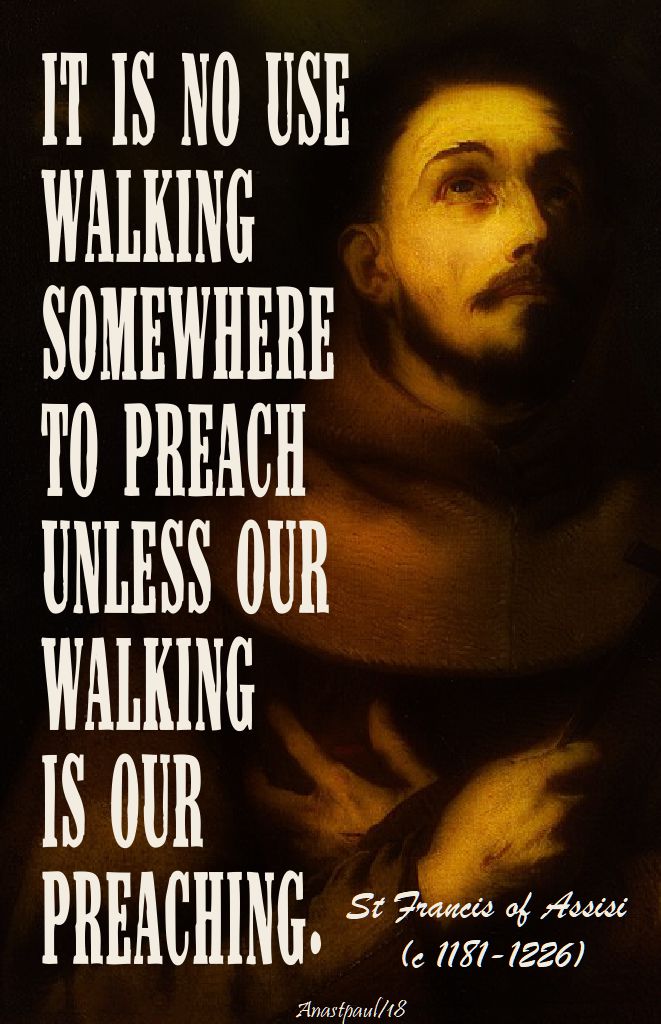
“It is no use walking somewhere to preach,
unless our walking is our preaching.”

St Francis of Assisi (c 1181-1226)it is no use walking - st francis of assisi - 10 april 2018 - speaking of evangelisation

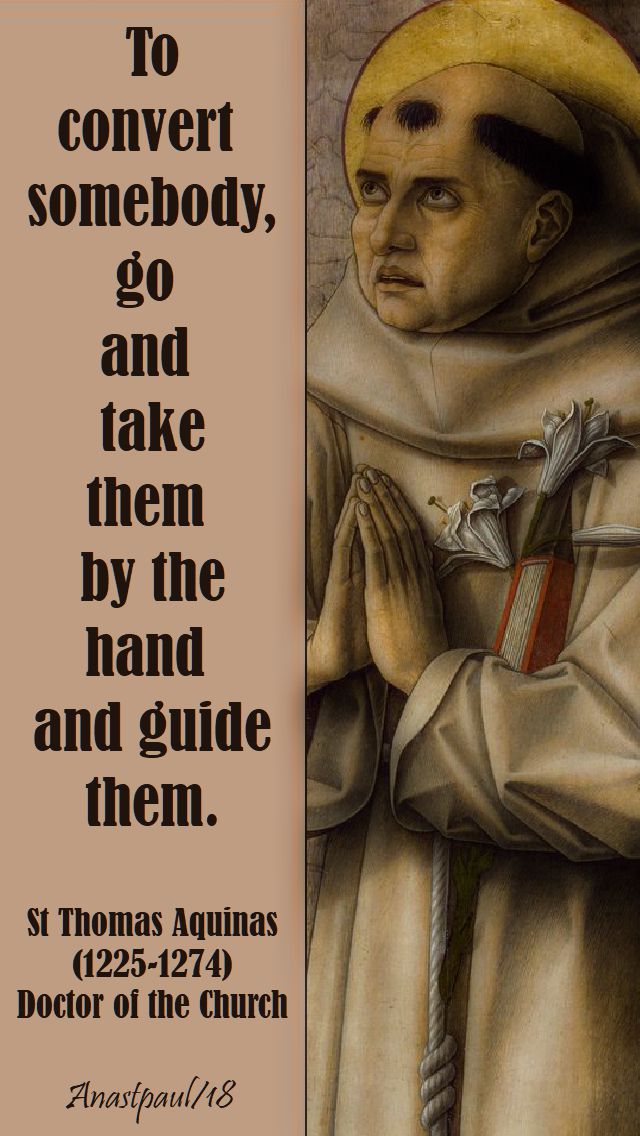
“To convert somebody,
go and take them by the hand
and guide them.”

St Thomas Aquinas (1225-1274) Doctor of the Churchto convert somebody - st thomas aquinas - 18 sept 2018

“Cook the truth in charity,
until it tastes sweet.”

St Francis de Sales (1567-1622) Doctor of the Churchcook the truth in charity until it tastes sweet - st francis de sales - 23 may 2018

“We must speak to them with our hands
before we try to speak with our lips.”

St Peter Claver (1580-1654)we must speak to them with our hands - st peter claver - 23 may 2018

“Modern man listens
more willingly to witnesses,
than to teachers
and if he does listen to teachers,
it is because they are witnesses.”

Blessed Pope Paul VI (1897-1978)modern man listens more willingly to witnesses than to teachers - bl pope paul VI no 2 - 18 sept 2018

“The only way to win audiences,
is to tell people about the life
and death of Christ.
Every other approach is a waste.”

Ven Archbishop Fulton Sheen (1895-1979)the only way to win audiences - ven fulton sheen - 18 sept 2018

“Stay where you are – find your own Calcutta.”

St Mother Teresa (1910-1997)stay where you are find your own calcutta - st mother teresa - 18 sept 2018

“Your faith will grow,
only in the measure,
that you give it away.”

Bishop Robert Barronyour faith will grow - bishop barron - 18 sept 2018

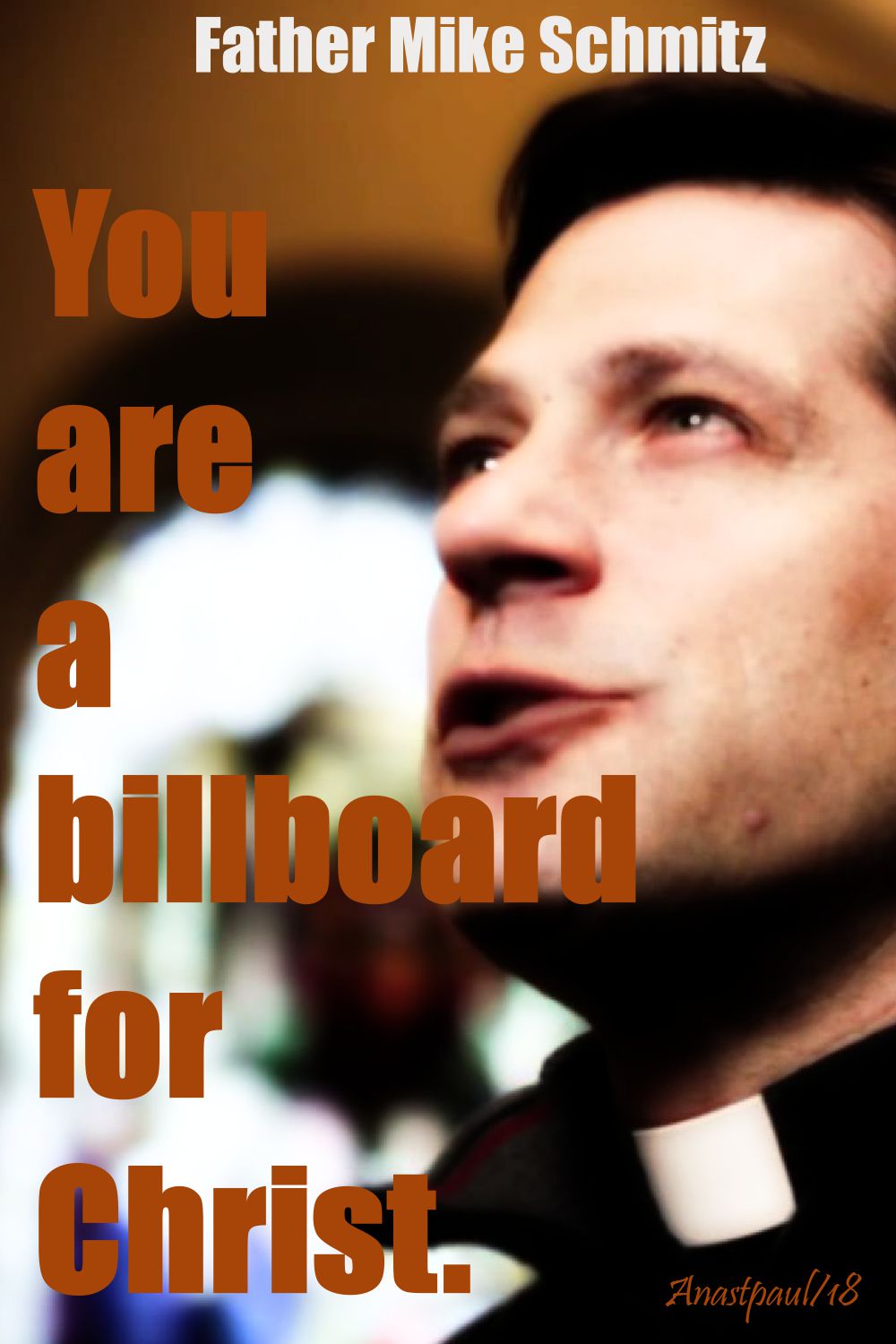
“You are a billboard for Christ.”

Father Mike Schmitzyou are a billboard for christ - fr mike schmitz - 10 april 2018 - speaking of evang

Posted in DOCTORS of the Church, DOMINICAN OP, FATHERS of the Church, franciscan OFM, MORNING Prayers, PAPAL SERMONS, QUOTES of the SAINTS, QUOTES on CONVERSION, SAINT of the DAY, The WORD

One Minute Reflection – 18 September – Today’s Gospel: Luke 7:11–17

One Minute Reflection – 18 September – Today’s Gospel: Luke 7:11–17, Tuesday of the Twenty-fourth week in Ordinary Time and the Memorial of St Juan Macias O.P. (1585-1645) and St Joseph of Cupertino O.F.M. Conv. (1603-1663)

And he said, “Young man, I say to you, arise.”...Luke 7:14byoung man i say to arise - luke 7 14b - 18 sept 2018

REFLECTION – “Even if the signs of death have removed all hope of life, even if the bodies of the dead lie beside the tomb, yet, at the voice of God, the corpses of those ready to decompose will rise and recover speech.   The son is restored to his mother, he is called back from the tomb, snatched out of it.   And what is this tomb?   Your own.   Your bad habits, your lack of faith.  This is the tomb from which Christ delivers you, this is the tomb from which you will return to life if you listen to the Word of God.  Even if your sin is so grave that you are unable to wash it clean for yourself with your tears of repentance, the Church, your mother, she who intercedes for each one of her children like a widowed mother for her only son, will weep for you.   For she feels for it with a kind of spiritual suffering natural to her when she sees her offspring dragged down to death by lamentable vices…
Let her weep, then, this pious mother; let the crowd accompany her – and not just a crowd but a large crowd – and may it show compassion towards this tender mother. Then you will come to life again in your tomb and will be delivered, the bearers will stop and you will start to speak the words of the living; everyone will be astonished.   The example of one will correct the many and they will praise God for having granted such remedies to us for escaping death.”…St Ambrose (c 340-397) Father & Doctor (A treatise on the Gospel of Saint Luke)young man i say to you arise luke 7 14b - the son is restored to his mother - st ambrose 18 sept 2018

God wants us to stand upright.   He created us to be on our fee,: for this reason, Jesus’ compassion leads to that gesture of healing, to heal us, of which the key phrase is:  “Arise! Stand up, as God created you!”.   Standing up.   “But Father, we fall so often” — “Onward, arise!”.   This is Jesus’ word, always.   His word revives us, gives us hope, refreshes weary hearts, opens us to a vision of the world and of life which transcends suffering and death…Pope Francis – General audience, 10 August 2016young man i say to arise - luke 7 14b - pope francis - god wants us to stand upright - 18 sept 2018

PRAYER – Heavenly Father, help me to be holy in the way that You have laid out for me. Let me stand upright and carry out my duties of my state of life to the full.   Only in You may I attain holiness, learning to give myself, my will, my heart and my to You.   St Joseph of Cupertino, you who were so disadvantaged, achieved by the grace of God, sanctity in this life and now behold His Face through all eternity.   St Juan, in your lowly work, you stood in the Light of Christ, allowing the lowly and rich, to see Him who saved us.   We ask You Holy Father, that You grant, by the intercession pf St Joseph and Juan, that we may reach our heavenly home.   We make our prayer through Christ our Lord, with the Holy Spirit, one God forever, amen.st-joseph-of-cupertino-pray-for-us-18 sept 2017

st juan macias pray for us 18 sept 2018

Posted in DOMINICAN OP, Our MORNING Offering, SAINT of the DAY

Our Morning Offering – 18 September – The Memorial of St Juan Macias O.P. (1585-1645)

Our Morning Offering – 18 September – The Memorial of St Juan Macias O.P. (1585-1645)

Note:  I am a Lay Dominican so I should be signing Anastpaul O.P. 

Breaking (down) The Habit

For the past 800 years, Dominican Friars (and Sisters, of course) have donned the white habit, the familiar robes, the brand unique of the Order of Preachers.   Each day whilst dressing, they quietly recite prayers as they do so.   This is a glimpse into a rarely seen Dominican ritual.

First is the tunic, a long white cotton/wool robe worn over any set of plain clothes.

Clothe me, O Lord, with the garments of salvation.   By Your grace may I keep them pure and spotless, so that clothed in white, I may be worthy to walk with You in the Kingdom of God. Amen.

The cincture is a belt, generally black leather, simple.

Gird me, O Lord, with the cincture of justice and the cord of purity that I may unite the affections of my heart in the love of You alone. Amen.

Over the belt, a 10-15 decade rosary, in adoration for Mary Magdalene.   Worn on the left hip because that was wear soldiers wore their weapons in 1216 when St Dominic founded the Order of Preachers, saying, “Arm yourself with prayer rather than a sword;  wear humility rather than fine clothes”.

O God, whose only-begotten Son, by His life, death and resurrection, has purchased for us the rewards of eternal life, grant we beseech Thee, that meditating upon the mysteries of the Most Holy Rosary of the Blessed Virgin Mary, we may imitate what they contain and obtain what they promise, through the same Christ our Lord, Amen.

The scapular is akin to a large white poncho, a long vest without sleeves.

Show yourself a mother, He will hear your pleading whom your womb has sheltered and whose hand brings healing.

A white capuce looks like the original hoody but only comes down past the shoulders to a point between the arm pit and the elbow.

Lord, You have set your sign upon my head that I should admit no lover but you. Amen.

The sixth layer is a black cappa, a cape of sorts.

We fly to your patronage, O Holy Mother of God, do not despise our prayers in our necessity, but free us from all peril, O Blessed Virgin. Amen.

The black capuce is the seventh and final layer.   It is generally only worn for formal occasions.

Heavenly Father, Who were with Your great servants Moses and Joshua and used them to bring Your children out of bondage, fill us with that same grace that we may preach Your word boldly and with authority for the deliverance of those under the bondages of sin.   We ask this through Christ our Lord, Amen.

Dominican Prayer whilst donning the Habit

Clothe me, O Lord, with the garments of salvation.
By Your grace. may I keep them pure and spotless,
so that clothed in white,
I may be worthy to walk with You in the Kingdom of God
Gird me, O Lord, with the cincture of justice
and the cord of purity,
that I may unite the affections of my heart
in the love of You alone.
O God, whose only-begotten Son,
by His life, death and resurrection,
has purchased for us the rewards of eternal life,
grant we beseech Thee,
that meditating upon the mysteries of the Most Holy Rosary
of the Blessed Virgin Mary, we may imitate
what they contain and obtain what they promise,
through the same Christ our Lord
Show yourself a mother,
He will hear your pleading whom your womb
has sheltered and whose hand brings healing.
Lord, You have set Your sign upon my head
that I should admit no lover but You.
We fly to Your patronage, O Holy Mother of God,
do not despise our prayers in our necessity
but free us from all peril, O Blessed Virgin.
Heavenly Father,
Who were with Your great servants Moses and Joshua
and used them to bring Your children out of bondage,
fill us with that same grace,
that we may preach Your word boldly
and with authority for the deliverance of those
under the bondages of sin.
We ask this through Christ our Lord,
Amen.dominican prayer - clothing prayer no 2 with St Juan macias- 18 sept 2018

Posted in DOMINICAN OP, SAINT of the DAY

Saint of the Day – 18 September – St Juan Macias O.P. (1585-1645)

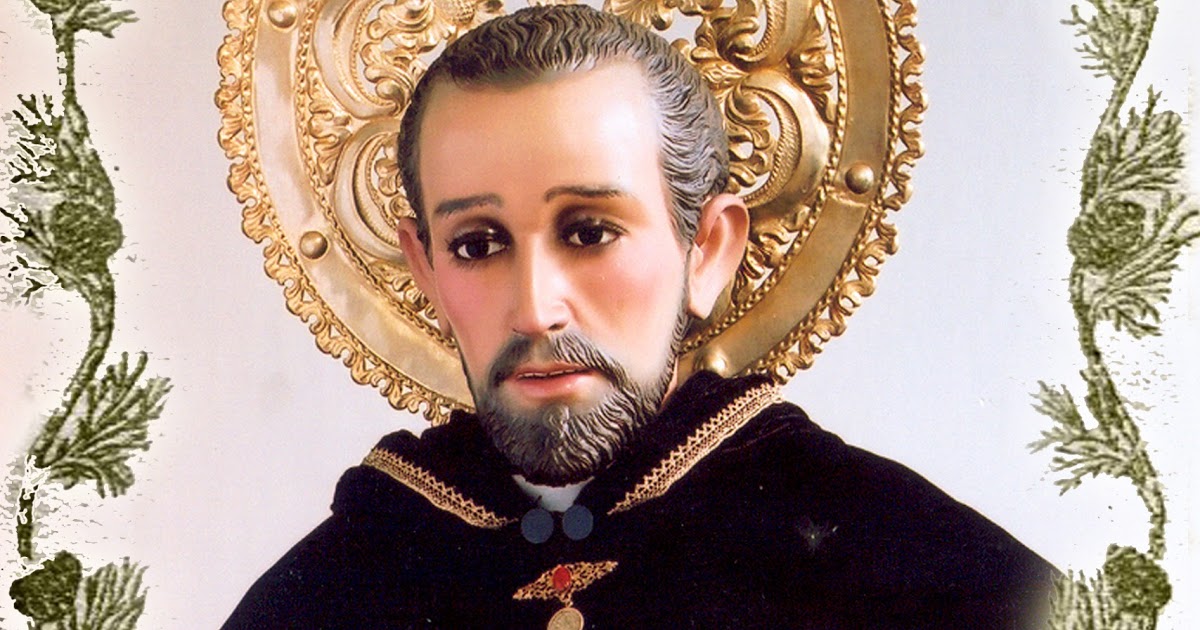
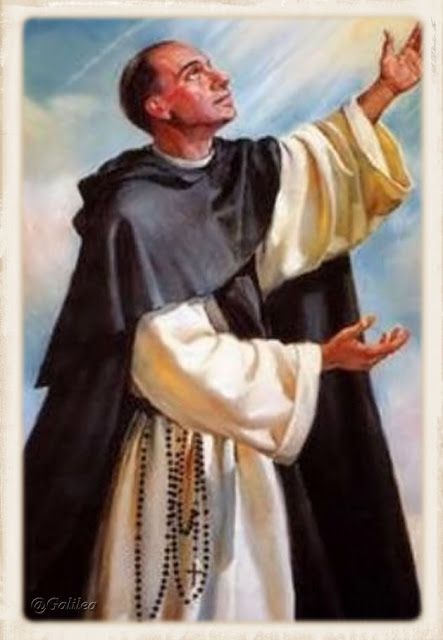
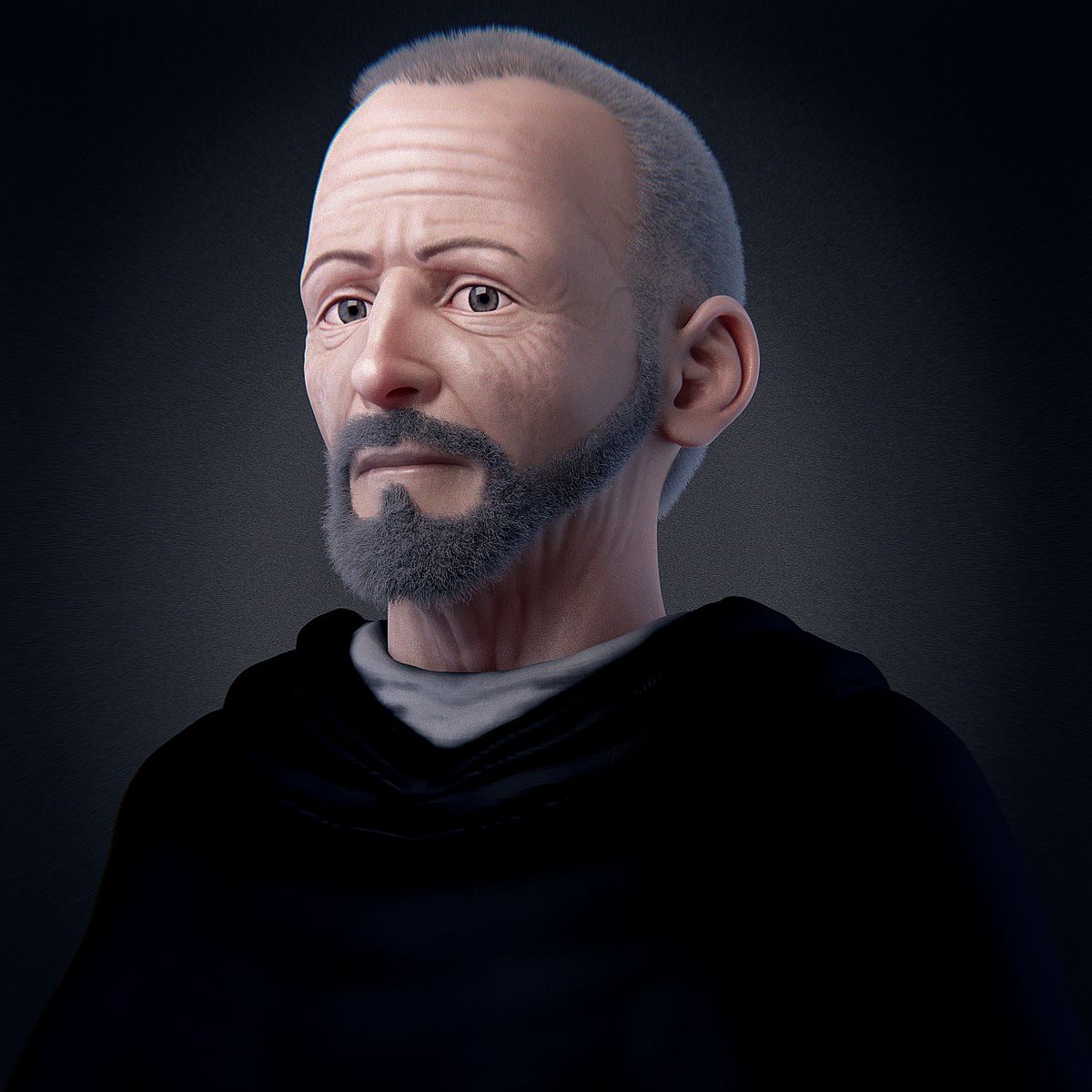
Saint of the Day – 18 September – St Juan Macias O.P. (1585-1645) – vowed Dominican Lay Friar, Mystic, Apostle of Charity and Prayer, MiracleWorker – St Juan was born on 2 March 1585 Ribera del Fresno in Extremadura, Spain and died on 16 September 1645 in Lima, Peru.   He was Beatified in 1837 together with his close friend, St Martin de Porres, by Pope Gregory XVI and Canonised in 1975 by Pope Paul VI.   His main image is located at the main altar of the Basilica of Our Lady of the Rosary of Lima and is venerated by the local laity in Peru.   A church was built in his honour in 1970 in San Luis, Lima, Peru.header - st juan macias

St Juan Macias is a saint dear to the heart of Dominicans.   To the chorus of Dominican saints, this humble lay brother adds his characteristic notes of contemplation and spiritual friendship, a living example of the Dominican motto, “to contemplate and to give to others the fruits of our contemplation.”

Juan Macias was born on 2 March 1585 in a small village in southwestern Spain.   His parents were poor farmers – both died when Juan and his sister Agnes were young.   The two children were raised by their uncle whose last name, “Macias,” they took as their own.

st juan macias

When he was sixteen, Juan met a Dominican priest while attending Mass in a neighbouring village.   Like most young people, Juan was full of wonder about what his future would hold.   This experience made a new impression on Juan and opened his heart to the possibility of a Dominican vocation.   Unlike most young people, Juan received another special grace – it is said that as he began to seek God’s will for his life, he was frequently visited by the Blessed Virgin Mary and by his patron, St John the Evangelist.

At the age of 35, Juan still felt drawn to the Dominican Order.   St John told him that it was not to be in Spain that he would become a Dominican, but in Lima, Peru.   In 1622, Juan Macias entered the Dominican convent of St Mary Magdalene in Lima, Peru. H  e entered as a lay brother, a non-ordained friar who, instead of preaching, would do the manual labour necessary in the monastery.   Juan was the assistant Porter (doorkeeper) until his death in 1646.   Although he was uneducated, Juan Macias exemplified the Dominican charism.   Like St Dominic, he learned the most sublime theology by studying the “book of charity,” the Cross.    Juan Macias’ entire life preached the Word of God to those he met.st juan macias beautiful statue

One of Juan Macias’ chief duties was to meet the poor who came to the convent seeking material or spiritual assistance, often over two hundred people every day.   Besides his cheerful disposition and encouraging manner, Juan Macias became known for the sometimes miraculous nature of his service to the poor.   Everyone knew that Juan worked extremely hard to collect alms for distribution.   Still, he would often return empty handed.   Yet, somehow Juan never turned anyone away.   From what he had been able to collect, he would have enough to feed all who came to him for help.St.-Juan-Macias

Juan Macias knew that he must help meet the physical needs of those who came to him, but he also knew that their spiritual hunger was much greater.   Juan was an instrument of conversion for many.

Juan Macias is well known for his close friendship with another Dominican saint, Martin de Porres  (1579–1639).   The two saints often met on their daily rounds of the city and became close spiritual friends as well.   They were a constant source of encouragement and ideas for one another.   The two were beatified together in a single ceremony by Pope Gregory XVI in 1837.st martin de porres and st juan macias

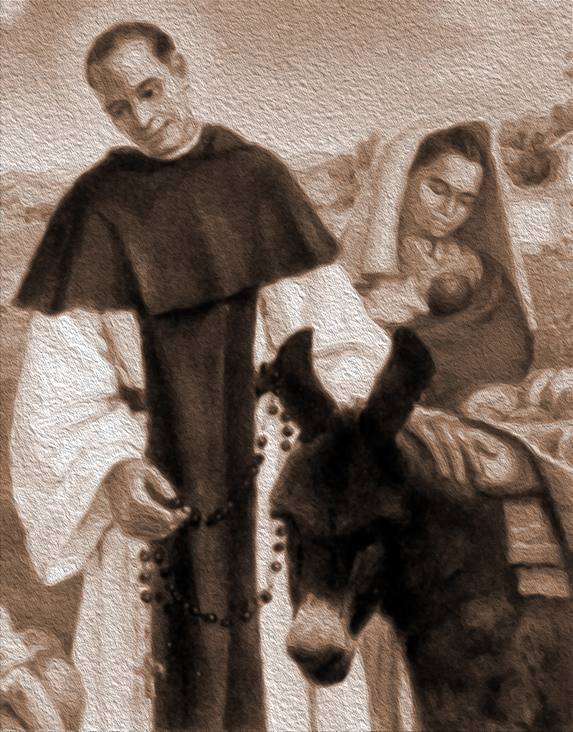
John Macias was well known mainly for two things during his life.   First, he was known to love the rosary, which he began to pray as a child in Spain while he shepherded his uncle’s flock of sheep.   Secondly, he was known for his generosity to the poor, 200 of whom he fed every day.   He was greatly aided in this by a little donkey that he sent through Lima.   He had a small sign put on it asking for donations for the poor.   The donkey, knowing his route perfectly, would travel through the streets and come back with benefactions for the city’s poor.   Often the donkey would stop at certain locations and make loud noises so that the people inside would come out to make their donations.ST-JUAN-MACIAS

At the priory, Macías’s life was filled with fervent prayer, frequent penance and charity. As a result of his austerity, he quickly fell ill and had to have a risky surgery. Nevertheless, he continued to care for other sick and needy as they waited at the friary gates.   Beggars, disabled people and other disadvantaged people were commonplace throughout Lima where they flocked to him at the monastery gates for counsel and comfort.   The poor came for food and the rich for advice.st juan macias engraving

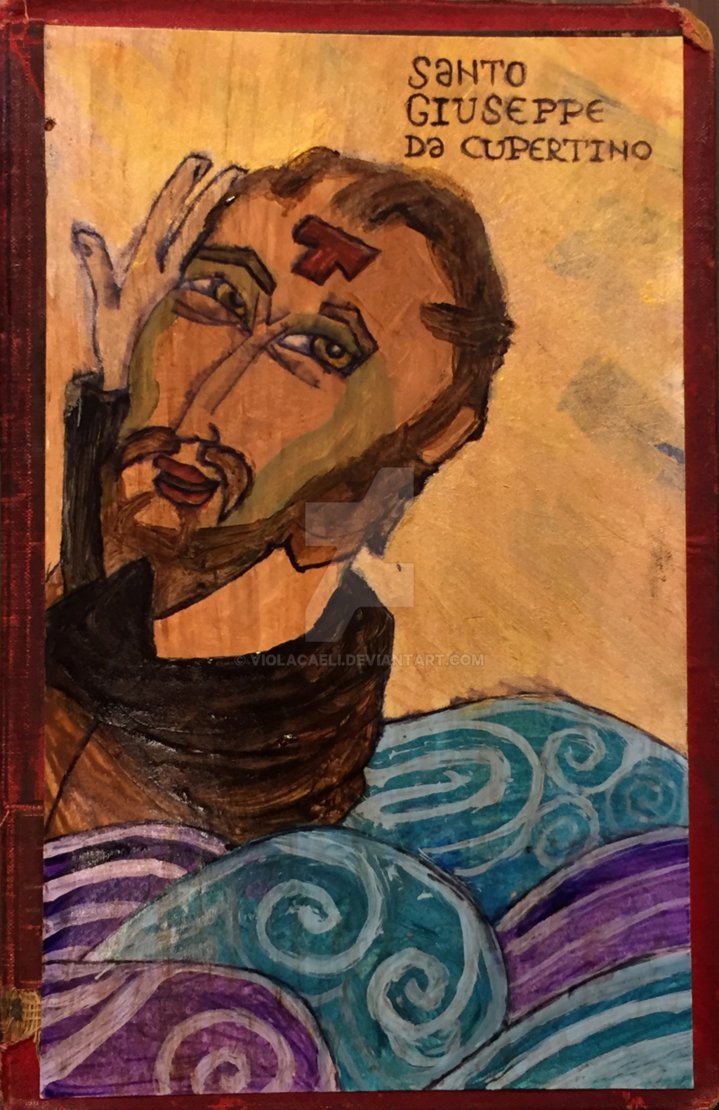
Macias, however, expressed a greater desire to spend more time in contemplative solitude rather than engage in conversational activities with others.   He confessed this to Father Abbot Ramírez who said, “If he were to never follow his vow of obedience, nobody would have ever seen his face.”   But his official position as the priory’s porter, which he held for over 20 years and went against his natural inclinations of solitude, served to continue disciplining his vow of obedience.   This filled him with a joyful sense of fulfillment.   He died of natural causes in 1645.San_Juan_Macias_official_sidest__joseph_of_cupertino___icon_by_violacaeli-d99myw4

Posted in Uncategorized

Memorials of the Saints – 18 September

St Ariadne
St Dominic Trach Doai
St Eumenius Thaumaturgus
St Eustorgius of Milan
St Ferreolus the Tribune
St Ferreolus of Limoges
St Hygbald
St Irene of Egypt
St Joseph of Cupertino O.F.M. Conv. (1603-1663)

All about the this holy Flying Saint here:  https://anastpaul.wordpress.com/2017/09/18/saint-of-the-day-18-september-st-joseph-of-cupertino-o-f-m-conv-1603-1663/

St Józef Kut
St Juan Macias O.P. (1585-1645)
St Oceano of Nicomedia
St Richardis of Andlou
St Sophia of Egypt

Martyred in the Spanish Civil War:
• Blessed Carlos Eraña Guruceta
• Blessed Fernando García Sendra
• Blessed Jacinto Hoyuelos Gonzalo
• Blessed Jesus Hita Miranda
• Blessed José García Mas
• Blessed José María Llópez Mora
• Blessed Justo Lerma Martínez
• Blessed Salvador Chuliá Ferrandis
• Blessed Salvador Fernández Pérez
• Blessed Vicente Gay Zarzo
• Blessed Vicente Jaunzarás Gómez

Posted in DOCTORS of the Church, franciscan OFM, JESUIT SJ, MORNING Prayers, SAINT of the DAY

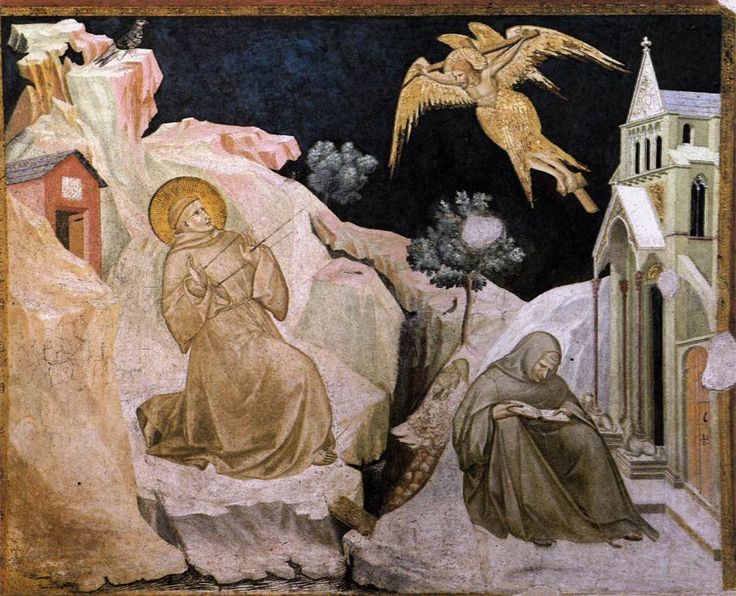
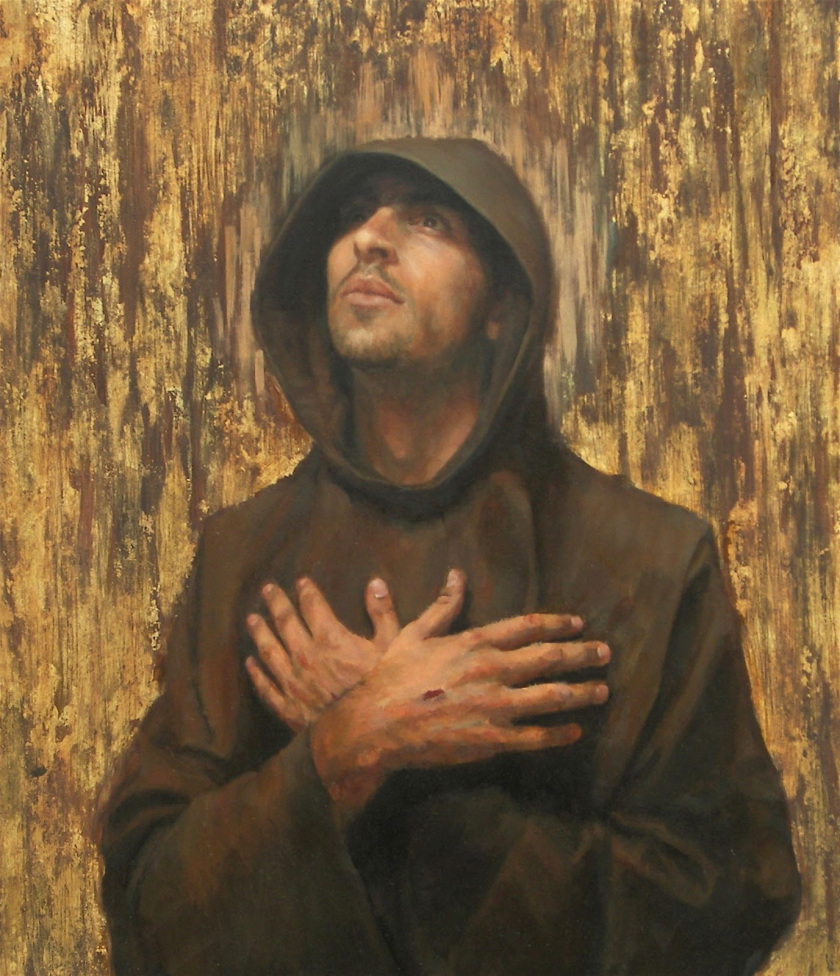
Thought for the Day – 17 September 2018 – The Memorial of Stigmata of St Francis of Assisi & St Robert Bellarmine SJ (1542-1621)

Thought for the Day – 17 September 2018 – The Memorial of Stigmata of St Francis of Assisi & St Robert Bellarmine SJ (1542-1621)

The glory of the Saints and of the Church never ceases to amaze me in every finer detail of the arrangement of our communal life together with them, thus confirming the presence of the Holy Spirit and the Divinity of this Mystical Body of Christ!

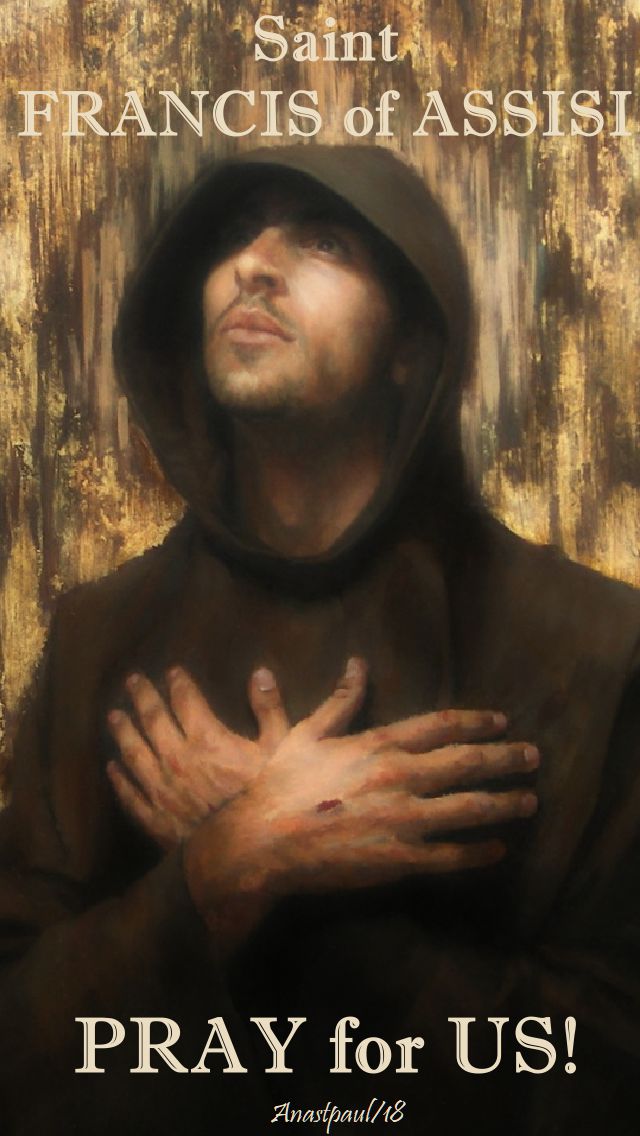
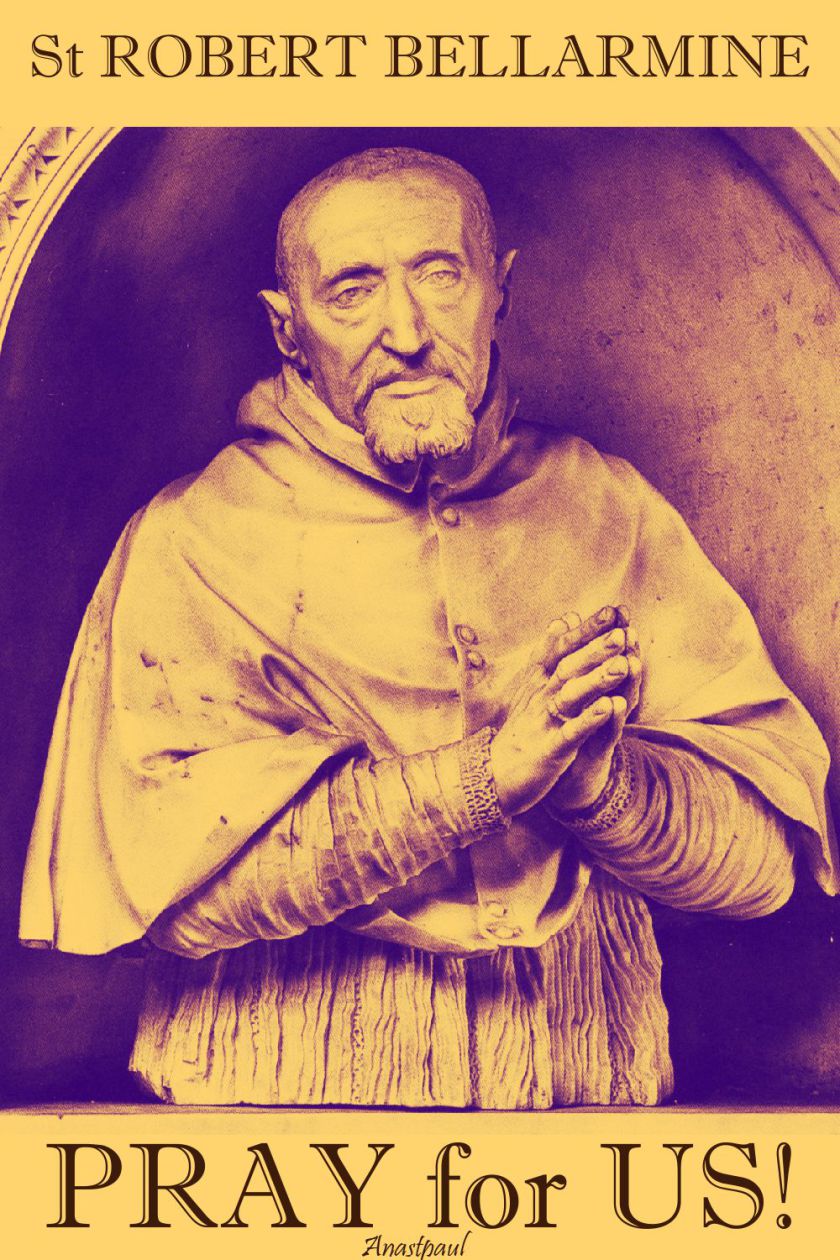
St Robert Bellarmine had a great devotion to St Francis of Assisi and was especially devoted to honouring Francis’ stigmata.   Bellarmine urged that there be a special feast in honour of the five stigmata of St Francis.   Bellarmine had an important position in the Vatican and he made sure that the feast was introduced in the Church, despite strong opposition.

As Providence arranged, Robert Bellarmine died on the feast of the Stigmata of St Francis, 17 September.   And in the revised liturgical calendar St Bellarmine’s feast, which used to be celebrated on 13 May, has been moved to 17 September.   In the Universal Church today is the feast of both!

St Francis of Assisi and St Robert Bellarmine, pray for us, your family here on earth and in great need of your prayers!st francis of assisi - pray for us - 17 sept 2018st-robert-bellarmine-pray-for-us-17-sept-2017

Posted in DOCTORS of the Church, GOD the FATHER, MARIAN QUOTES, MORNING Prayers, QUOTES of the SAINTS, QUOTES on CHARITY, QUOTES on FAITH, QUOTES on GRATITUDE, QUOTES on JOY, QUOTES on LOVE, QUOTES on PEACE, QUOTES on SANCTITY, QUOTES on SILENCE, QUOTES on the CHURCH, SAINT of the DAY, The BLESSED VIRGIN MARY, The WORD

Quote/s of the Day – 17 September – The Memorial of St Robert Bellarmine SJ (1542-1621) and St Hildegard von Bingen OSB (1098-1179) both Doctors of the Church

Quote/s of the Day – 17 September – The Memorial of St Robert Bellarmine SJ (1542-1621) and St Hildegard von Bingen OSB (1098-1179) both Doctors of the Church

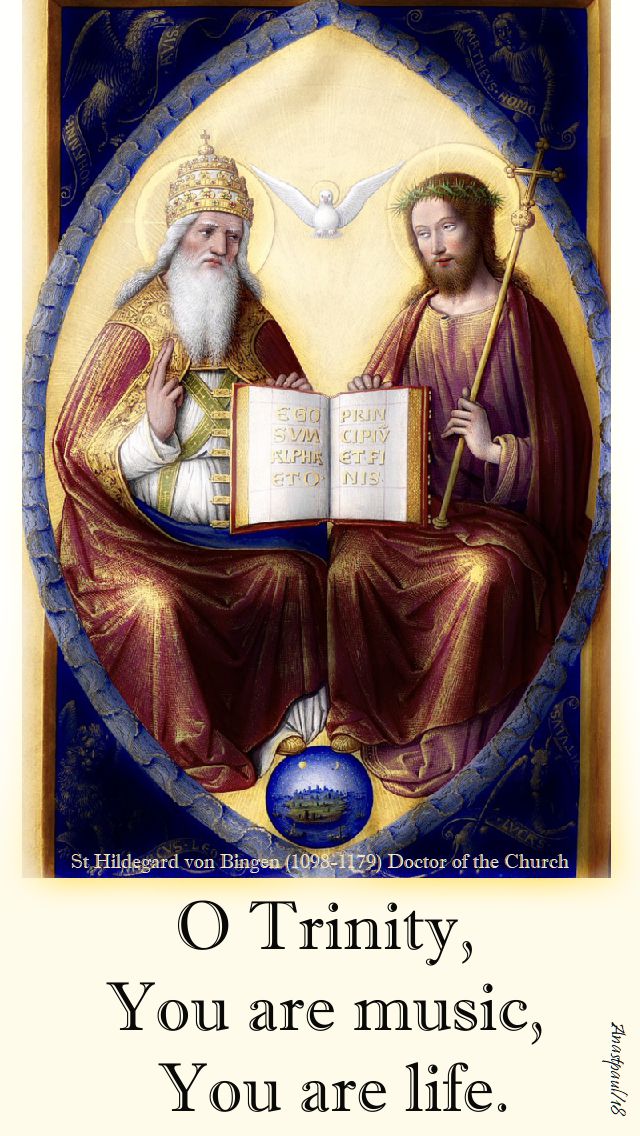
“O Trinity,
You are music,
You are life.”o trinity you are music you are life - st hildegard von bingen - 17 sept 2018

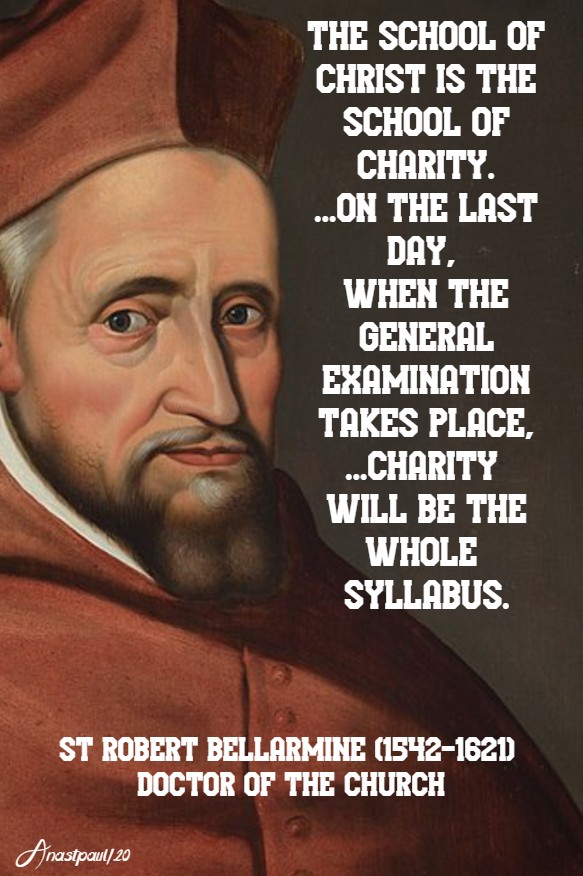
“The school of Christ,
is the school of love.
In the last day,
when the general examination takes place…
Love will be the whole syllabus.”

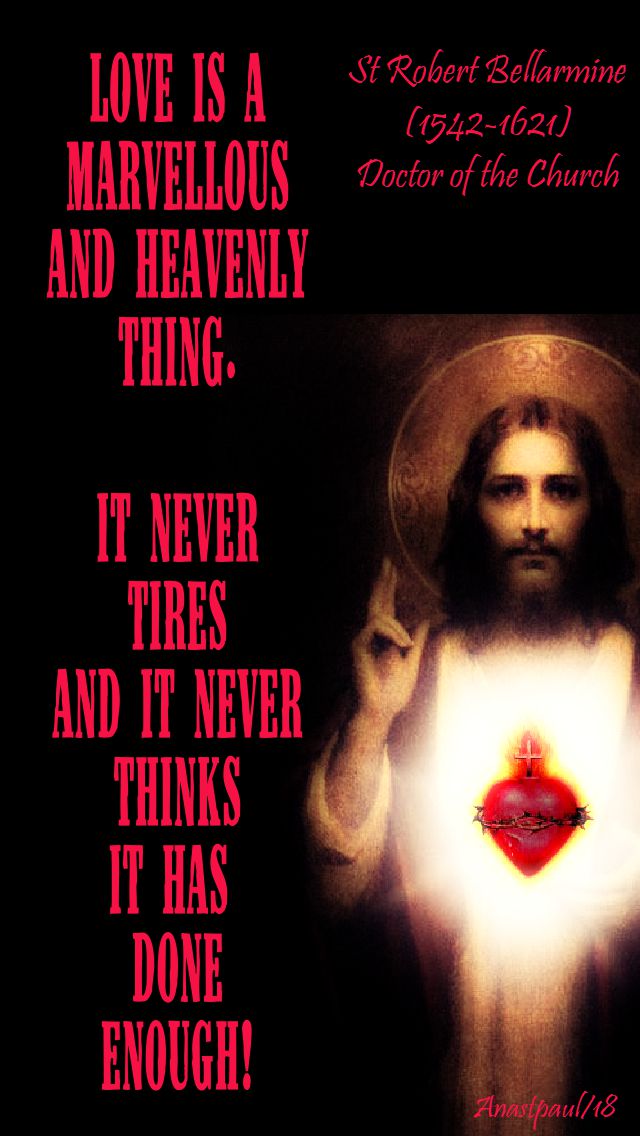
“LOVE is a marvellous
and heavenly thing.
It never tires
and it never thinks
it has done enough!”love is a marvellous - st robert bellarmine - 17 sept 2018

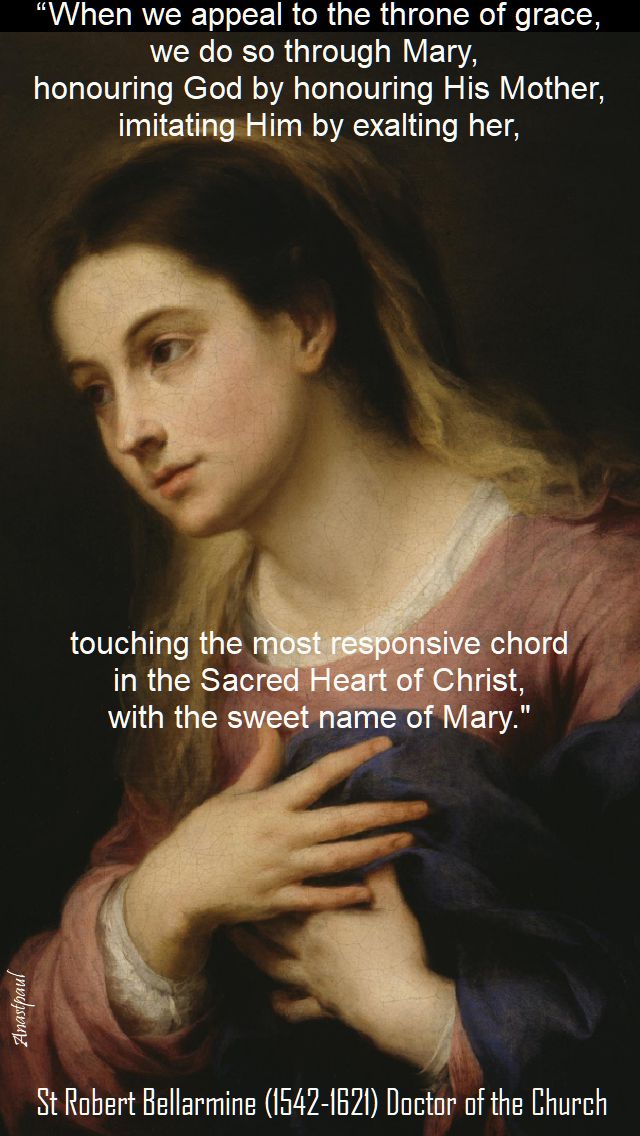
“When we appeal to the throne of grace,
we do so through Mary,
honouring God by honouring His Mother,
imitating Him by exalting her,
touching the most responsive chord
in the Sacred Heart of Christ,
with the sweet name of Mary.”

St Robert Bellarmine (1542-1621) Doctor of the Churchwhen-we-appeal-st-robert-bellarmine-17-sept-2017 (1)

Posted in MORNING Prayers, NOVENAS

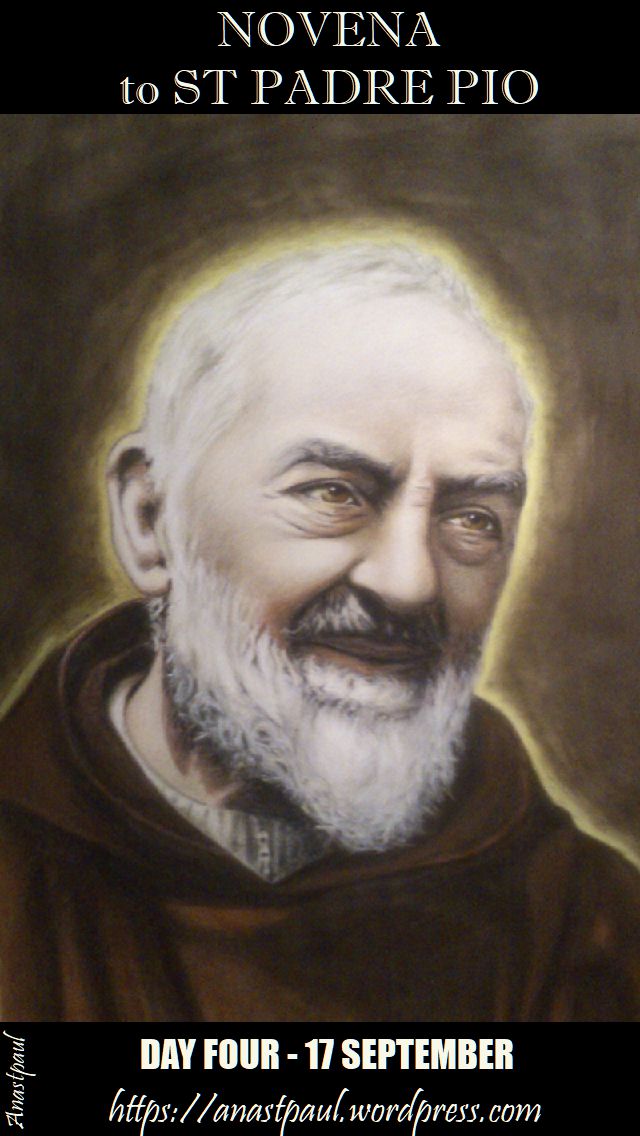
NOVENA to St Padre Pio/St Pius of Pietrelcina – DAY FOUR – 17 September

NOVENA to St Padre Pio/St Pius of Pietrelcina – DAY FOUR – 17 September

St Padre Pio you have said:

I often think that there is only one thing in this base world which can soothe the most acute pain which pierces the heart when we see ourselves far from God, the source and consolation of distressed souls.

That one thing is solitude, for here the soul enjoys sweet rest in the One who is its true peace.   I want the heavenly Father to grant you the grace of stability in all your resolutions, not least of all your resolution to grow in holiness and to be silent and reduce to silence everything around you, so that you may hear the divine voice of the Beloved and establish with Him a tranquil and everlasting dialogue.
Recollect yourself continually and may your whole life be hidden in Jesus and with Jesus in the Garden of Gethsemane, that is to say, in the silence of meditation and prayer.
Try to be always more docile to grace and more and more generous with Jesus, making absolutely everything around you and within you to be silent.   on’t worry, rest trustfully in the divine Mercy.
Silently adore the delicacy of the workings of divine grace.

Let us Pray:

Gracious God, You generously blessed Your servant, Padre Pio, with the gifts of the Spirit.
You marked his body with the five wounds of Christ Crucified,
as a powerful witness to the saving Passion and Death of Your Son
and as a stirring inspiration to many people of Your infinite mercy, forgiveness and love.
Through his powerful intercession, many who suffered were healed of sickness and disease.
Endowed with the gift of discernment, he could read people’s hearts.
With dignity and intense devotion, he celebrated daily Mass,
inviting countless men and women to a greater union with Jesus Christ,
in the Sacrament of the Holy Eucharist.
Through the intercession of Saint Pio,
we confidently beseech You to to grant us the grace of
………………. (state your petition here).
Help us to imitate his example of prayerful holiness and compassion,
so that we, too, may faithfully follow the Risen Lord
and one day rejoice in the Kingdom,
where You live and reign forever and ever.
Amenday-four-novena-st-pio-17-sept

Posted in DOCTORS of the Church, FATHERS of the Church, MORNING Prayers, PAPAL SERMONS, QUOTES of the SAINTS, QUOTES on CONVERSION, QUOTES on FAITH, SAINT of the DAY, The WORD

One Minute Reflection – 17 September – Today’s Gospel: Luke 7:1-10

One Minute Reflection – 17 September – Today’s Gospel: Luke 7:1-10 – Monday of the Twenty-fourth week in Ordinary Time and the Memorial of St Robert Bellarmine SJ (1542-1621) and St Hildegard von Bingen OSB (1098-1179) both Doctors of the Church

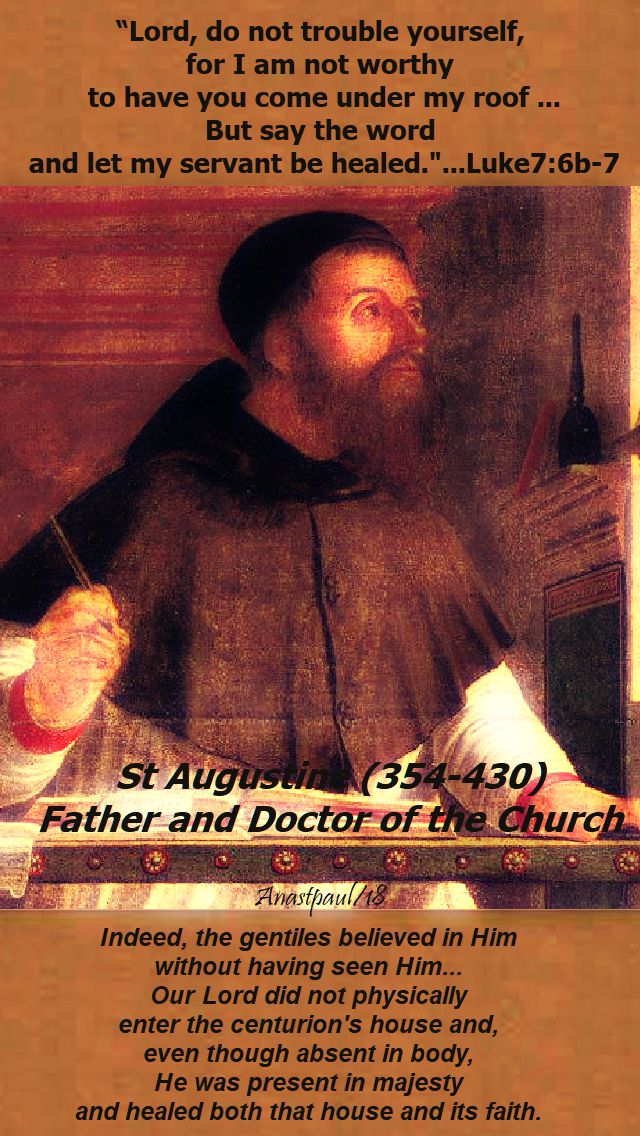
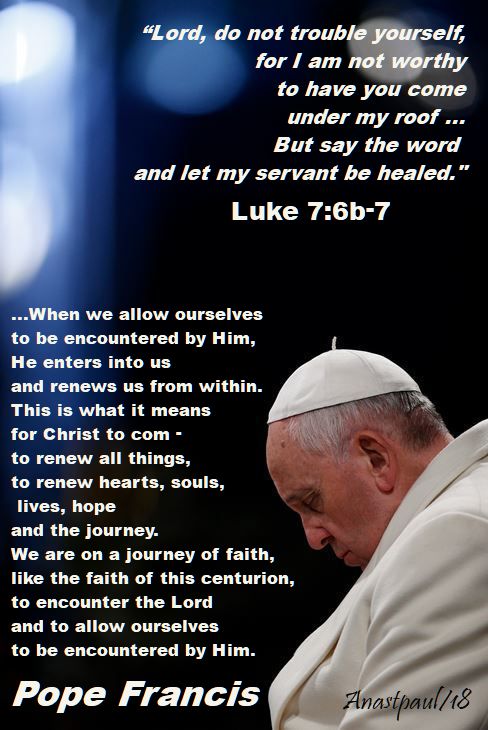
“Lord, do not trouble yourself, for I am not worthy to have you come under my roof; therefore I did not presume to come to you. But say the word, and let my servant be healed.”…Luke7:6b-7

REFLECTION – “This man was a pagan, for the Jewish people were occupied by the Imperial Roman army at that time.   So it was as a centurion in Judaea that he was commanding his soldiers…
But our Lord, although he was in the midst of the people of Judaea, was already talking about the Church being spread all over the earth wherever His apostles were to be sent (Mt 8:11).   Indeed, the gentiles believed in Him without having see Him… Our Lord did not physically enter the centurion’s house and, even though absent in body, He was present in majesty and healed both that house and its faith.   Similarly, our Lord stood physically only amongst the people of Judaea -other peoples did not see His being born of a virgin, or suffering, or walking, or subject to the condition of human nature, or carrying out divine miracles.   None of these things were done amongst the gentiles and yet it was amongst them that what was said about Him was fulfilled:  “A people I did not know have served me.”   In what way did they serve Him?   The Psalm continues:  “As soon as they heard me, they obeyed me” (Ps 18[17]:44-45).”…St Augustine (354-430) Father and Doctor of the Churchlord i am not worth - luke 7 6b-7 and indeed the gentiles believed - st augustine - 17 sept 2018

“When we go out to meet the Lord, we in some sense are masters of the moment. However, when we allow ourselves to be encountered by Him, He enters into us and renews us from within.   This is what it means for Christ to come, to renew all things, to renew hearts, souls, lives, hope and the journey.   We are on a journey of faith, like the faith of this centurion, to encounter the Lord and to allow ourselves to be encountered by Him.”…Pope Francis – Santa Marta, 2 December 2013lord i am not worth - luke 7 6b-7 and this is what it means pope francis - 17 sept 2018

PRAYER – Lord God and holy Father, guard our faith we pray and grace us with Your mercy.   Keep us every faithful to Your precepts and bring us to Your home, to look upon Your Face.   May the prayers of Your saints assist us on our journey.   In your untiring life of trust in God, St Hildegard von Bingen, you sought to make Him the goal of all and the love of all, please pray that we may imitate your zeal and love.   St Robert Bellarmine, as you worked tirelessly for the salvation of souls, so now pray for us all, as tirelessly, that we may achieve eternal joy.   We ask all this through Christ, our Lord with the Holy Spirit, one God forever, amen.st hildegard von bingen pray for us 17 sept 2018st-robert-bellarmine-pray-for-us-17-sept-2017-no-2

Posted in CATHOLIC-PRAYERS OF THE CHURCH, DOCTORS of the Church, JESUIT SJ, Our MORNING Offering, SAINT of the DAY

Our Morning Offering/s – 17 September – The Memorial of St Robert Bellarmine SJ (1542-1621) and St Hildegard von Bingen OSB (1098-1179) both Doctors of the Church

Our Morning Offering/s – 17 September – The Memorial of St Robert Bellarmine SJ (1542-1621) and St Hildegard von Bingen OSB (1098-1179) both Doctors of the Church

Holy Spirit, Giver of Life
By St Hildegard von Bingen (1098-1179) Doctor of the Church

Holy Spirit,
giving of life to all life,
moving all creatures,
root of all things,
washing them clean,
wiping out their mistakes,
healing their wounds,
You are our true life,
luminous, wonderful,
awakening the heart
from its ancient sleep.
Amenholy spirit giving of life to all life - st hildegard von bingen 17 sept 2018

Act of Contrition
By St Robert Bellarmine (1542-1621) Doctor of the Church

O my God,
I am exceedingly grieved for having offended thee
and with my whole heart
I repent of the sins I have committed.
I hate and abhor them above every other evil,
not only because, by so sinning,
I have lost heaven and deserved hell
but still more, because I have offended thee,
O infinite Goodness,
who are worthy to be loved above all things.
I most firmly resolve,
by the assistance of thy grace,
never more to offend thee for the time to come
and to avoid those occasions
which might lead me into sin.
Amen

Note:  It is little known that St Robert is the Author of this, one of our most widely used prayersact of contrition written by st robert bellarmine o m god, I am exceedingly grieved - 17 sept 2018

Posted in SAINT of the DAY

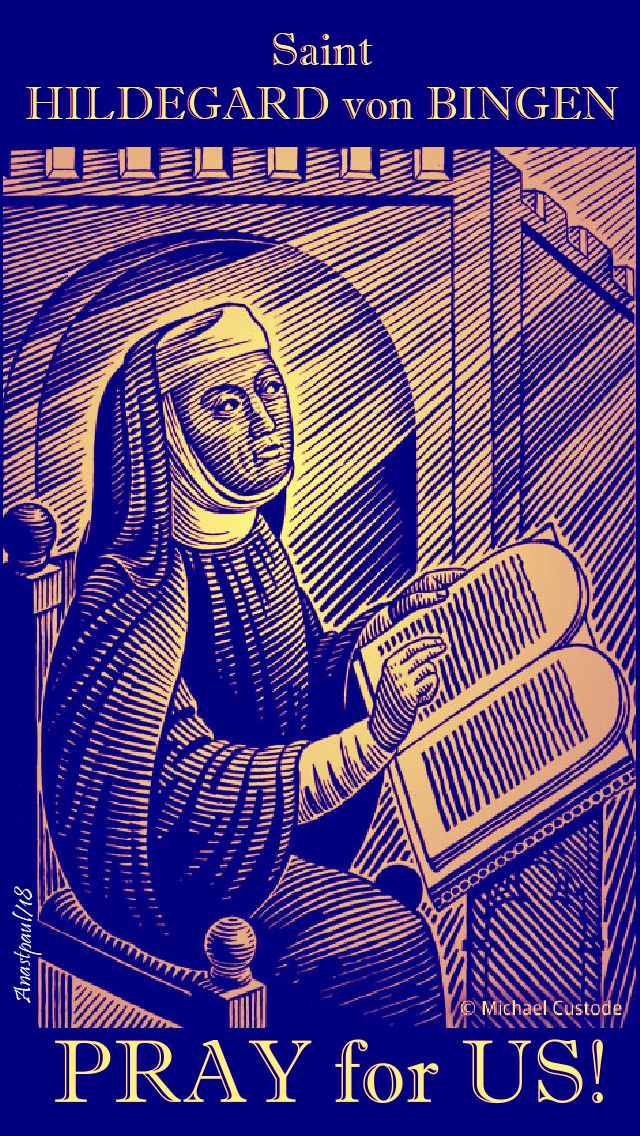
Saint of the Day – 17 September – Blessed Hildegard (1098-1179) Abbess

Saint of the Day – 17 September – Blessed Hildegard Abbess at Bingen OSB (1098-1179).   Born in 1098 at Bermersheim, Rhineland Palatinate (modern Germany) and died on 17 September 1179 at Bingen, Rhineland Palatinate (modern Germany) of natural causes.   She was Beatified on 26 August 1326 by Pope John XXII.   St Hildegard is also known as Saint Hildegard and Sibyl of the Rhine, was a German Benedictine Abbess, Theologian, Writer, Composer, Philosopher, Poet, Mystic, Visionary, Founder, Scientist, Artist and Polymath. She is considered to be the founder of scientific natural history in Germany.    Hildegard was elected magistra by her fellow nuns in 1136; she founded the Monasteries of Rupertsberg in 1150 and Eibingen in 1165.   One of her works as a composer, the Ordo Virtutum, is an early example of liturgical drama and arguably the oldest surviving morality play.   She wrote theological, botanical and medicinal texts, as well as letters, liturgical songs and poems, while supervising miniature illuminations in the Rupertsberg manuscript of her first work, Scivias.   She is also noted for the invention of a constructed language known as Lingua Ignota.st hildegard bio infoHILDEGARD VON BINGEN

1. A “light for her people and her time”:  in these words Blessed John Paul II, my Venerable Predecessor, described Saint Hildegard of Bingen in 1979, on the occasion of the eight-hundredth anniversary of the death of this German mystic.   This great woman truly stands out crystal clear against the horizon of history for her holiness of life and the originality of her teaching.   And, as with every authentic human and theological experience, her authority reaches far beyond the confines of a single epoch or society; despite the distance of time and culture, her thought has proven to be of lasting relevance.

In Saint Hildegard of Bingen there is a wonderful harmony between teaching and daily life.   In her, the search for God’s will in the imitation of Christ was expressed in the constant practice of virtue, which she exercised with supreme generosity and which she nourished from biblical, liturgical and patristic roots in the light of the Rule of Saint Benedict.   Her persevering practice of obedience, simplicity, charity and hospitality was especially visible.   In her desire to belong completely to the Lord, this Benedictine Abbess was able to bring together rare human gifts, keen intelligence and an ability to penetrate heavenly realities.514px-Engraving;_German_abbess_and_physician_Hildegard_von_Bingen_Wellcome_L0005783
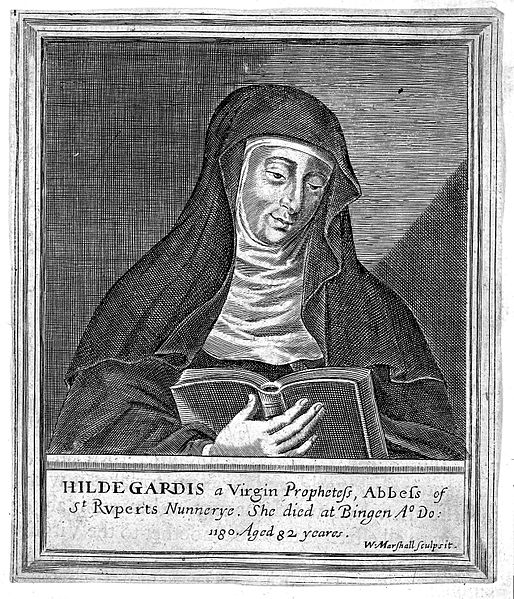
2. Hildegard was born in 1098 at Bermersheim, Alzey, to parents of noble lineage who were wealthy landowners.   At the age of eight she was received as an oblate at the Benedictine Abbey of Disibodenberg, where in 1115 she made her religious profession. Upon the death of Jutta of Sponheim, around the year 1136, Hildegard was called to succeed her as magistra.   Infirm in physical health but vigorous in spirit, she committed herself totally to the renewal of religious life.   At the basis of her spirituality was the Benedictine Rule which views spiritual balance and ascetical moderation as paths to holiness.   Following the increase in vocations to the religious life, due above all to the high esteem in which Hildegard was held, around 1150 she founded a monastery on the hill of Rupertsberg, near Bingen, where she moved with twenty sisters.   In 1165, she established another monastery on the opposite bank of the Rhine.   She was the Abbess of both.

Within the walls of the cloister, she cared for the spiritual and material well-being of her sisters, fostering in a special way community life, culture and the liturgy.   In the outside world she devoted herself actively to strengthening the Christian faith and reinforcing religious practice, opposing the heretical trends of the Cathars, promoting Church reform through her writings and preaching and contributing to the improvement of the discipline and life of clerics  . At the invitation first of Hadrian IV and later of Alexander III, Hildegard practised a fruitful apostolate, something unusual for a woman at that time, making several journeys, not without hardship and difficulty, to preach even in public squares and in various cathedral churches, such as at Cologne, Trier, Liège, Mainz, Metz, Bamberg and Würzburg.   The profound spirituality of her writings had a significant influence both on the faithful and on important figures of her time and brought about an incisive renewal of theology, liturgy, natural sciences and music. Stricken by illness in the summer of 1179, Hildegard died in the odour of sanctity, surrounded by her sisters at the monastery of Rupertsberg, Bingen, on 17 September 1179.

3. In her many writings Hildegard dedicated herself exclusively to explaining divine revelation and making God known in the clarity of His love.   Hildegard’s teaching is considered eminent both for its depth, the correctness of its interpretation and the originality of its views.   The texts she produced are refreshing in their authentic “intellectual charity” and emphasise the power of penetration and comprehensiveness of her contemplation of the mystery of the Blessed Trinity, the Incarnation, the Church, humanity and nature as God’s creation, to be appreciated and respected.

These works were born from a deep mystical experience and propose a perceptive reflection on the mystery of God.   The Lord endowed her with a series of visions from childhood, whose content she dictated to the Benedictine monk Volmar, her secretary and spiritual advisor and to Richardis von Stade, one of her women religious.   But particularly illuminating are the judgements expressed by Saint Bernard of Clairvaux, who encouraged her and especially by Pope Eugene III, who in 1147 authorised her to write and to speak in public.   Theological reflection enabled Hildegard to organise and understand, at least in part, the content of her visions.   In addition to books on theology and mysticism, she also authored works on medicine and natural sciences.   Her letters are also numerous — about four hundred are extant;  these were addressed to simple people, to religious communities, popes, bishops and the civil authorities of her time.   She was also a composer of sacred music.   The corpus of her writings, for their quantity, quality and variety of interests, is unmatched by any other female author of the Middle Ages.

Her main writings are the Scivias, the Liber Vitae Meritorum and the Liber Divinorum Operum.   They relate her visions and the task she received from the Lord to transcribe them. In the author’s view her Letters were no less important, they bear witness to the attention Hildegard paid to the events of her time, which she interpreted in the light of the mystery of God.   In addition there are 58 sermons, addressed directly to her sisters. They are her Expositiones Evangeliorum, containing a literary and moral commentary on Gospel passages related to the main celebrations of the liturgical year.   Her artistic and scientific works focus mainly on music, in the Symphonia Harmoniae Caelestium Revelationum;  on medicine, in the Liber Subtilitatum Diversarum Naturarum Creaturarum and in the Causae et Curae and on natural sciences in the Physica.   Finally her linguistic writings are also noteworthy, such as the Lingua Ignota and the Litterae Ignotae, in which the words appear in an unknown language of her own invention but are composed mainly of phonemes present in German.

Hildegard’s language, characterised by an original and effective style, makes ample use of poetic expressions and is rich in symbols, dazzling intuitions, incisive comparisons and evocative metaphors.HILDEGARD ICON
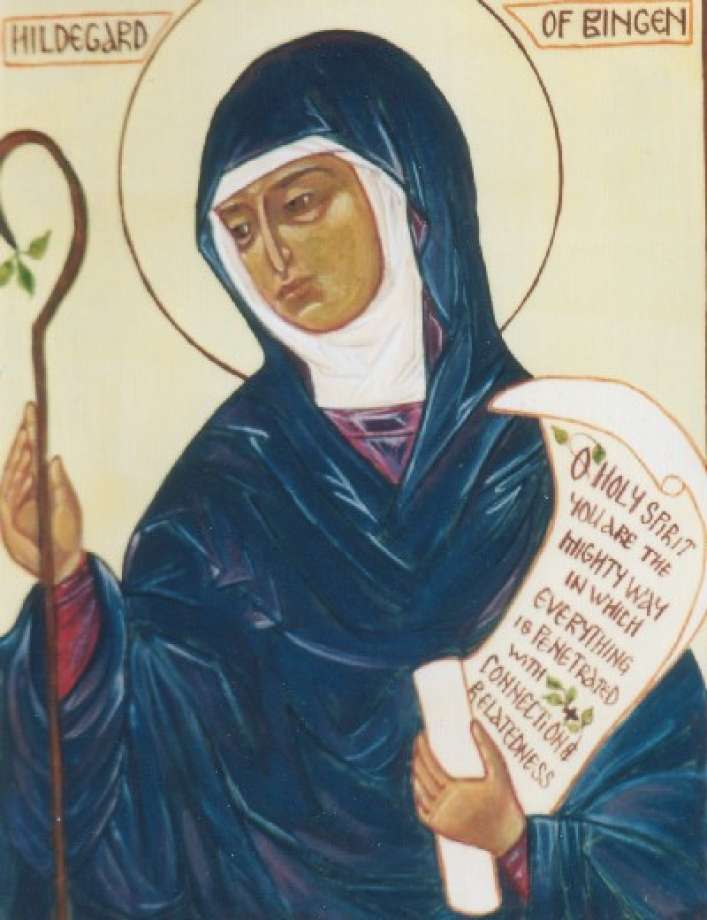
4. With acute wisdom-filled and prophetic sensitivity, Hildegard focused her attention on the event of revelation.   Her investigation develops from the biblical page in which, in successive phases, it remains firmly anchored.   The range of vision of the mystic of Bingen was not limited to treating individual matters but sought to offer a global synthesis of the Christian faith.   Hence in her visions and her subsequent reflections she presents a compendium of the history of salvation from the beginning of the universe until its eschatological consummation.   God’s decision to bring about the work of creation is the first stage on this immensely long journey which, in the light of sacred Scripture, unfolds from the constitution of the heavenly hierarchy until it reaches the fall of the rebellious angels and the sin of our first parents.

This initial picture is followed by the redemptive Incarnation of the Son of God, the activity of the Church that extends in time the mystery of the Incarnation and the struggle against Satan.   The definitive Coming of the Kingdom of God and the Last Judgement crown this work.

Hildegard asks herself and us the fundamental question, whether it is possible to know God:  This is theology’s principal task.   Her answer is completely positive: through faith, as through a door, the human person is able to approach this knowledge.   God, however, always retains his veil of mystery and incomprehensibility  . He makes himself understandable in creation but, creation itself is not fully understood when detached from God.   Indeed, nature considered in itself provides only pieces of information which often become an occasion for error and abuse.   Faith, therefore, is also necessary in the natural cognitive process, for otherwise knowledge would remain limited, unsatisfactory and misleading.

Creation is an act of love by which the world can emerge from nothingness.   Hence, through the whole range of creatures, divine love flows as a river.   Of all creatures God loves man in a special way and confers upon him an extraordinary dignity, giving him that glory which the rebellious angels lost.   The human race may thus be counted as the tenth choir of the angelic hierarchy.   Indeed human beings are able to know God in Himself, that is, His one nature in the Trinity of Persons. Hildegard approached the mystery of the Blessed Trinity along the lines proposed by Saint Augustine.   By analogy with his own structure as a rational being, man is able to have an image at least of the inner life of God.   Nevertheless, it is solely in the economy of the Incarnation and human life of the Son of God that this mystery becomes accessible to human faith and knowledge.   The holy and ineffable Trinity in supreme Unity was hidden from those in the service of the ancient law.   But in the new law of grace it was revealed to all who had been freed from slavery.   The Trinity was revealed in a special way in the Cross of the Son.

A second “space” in which God becomes known is His word, contained in the Books of the Old and New Testament.   Precisely because God “speaks”, man is called to listen.   This concept affords Hildegard the opportunity to expound her doctrine on song, especially liturgical song.   The sound of the word of God creates life and is expressed in his creatures.   Thanks to the creative word, beings without rationality are also involved in the dynamism of creation.   But man of course is the creature who can answer the voice of the Creator with his own voice.   And this can happen in two ways:  in voce oris, that is, in the celebration of the liturgy, and in voce cordis, that is, through a virtuous and holy life.   The whole of human life may therefore be interpreted as harmonic and symphonic.Museum - Hildegard von Bingen

5. Hildegard’s anthropology begins from the biblical narrative of the creation of man (Gen 1:26), made in the image and likeness of God.   Man, according to Hildegard’s biblically inspired cosmology, contains all the elements of the world because the entire universe is recapitulated in him;  he is formed from the very matter of creation.   The human person can therefore consciously enter into a relationship with God.   This does not happen through a direct vision, but, in the words of Saint Paul, as “in a mirror” (1 Cor 13:12).   The divine image in man consists in his rationality, structured as intellect and will.   Thanks to his intellect, man can distinguish between good and evil;  thanks to his will, he is spurred to action.

Human beings are seen as a unity of body and soul. The German mystic shows a positive appreciation of corporeity and providential value is given even to the body’s weaknesses. The body is not a weight from which to be delivered.   Although human beings are weak and frail, this “teaches” them a sense of creatureliness and humility, protecting them from pride and arrogance.   Hildegard contemplated in a vision the souls of the blessed in paradise waiting to be rejoined to their bodies.   Our bodies, like the body of Christ, are oriented to the glorious resurrection, to the supreme transformation for eternal life.   The very vision of God, in which eternal life consists, cannot be definitively achieved without the body.

The human being exists in both the male and female form.   Hildegard recognised that a relationship of reciprocity and a substantial equality between man and woman is rooted in this ontological structure of the human condition.   Nevertheless the mystery of sin also dwells in humanity and was manifested in history for the first time precisely in the relationship between Adam and Eve.   Unlike other medieval authors who saw Eve’s weakness as the cause of the Fall, Hildegard places it above all in Adam’s immoderate passion for her.

Even in their condition as sinners, men and women continue to be the recipients of God’s love, because God’s love is unconditional and, after the Fall, acquires the face of mercy. Even the punishment that God inflicts on the man and woman brings out the merciful love of the Creator.   In this regard, the most precise description of the human creature is that of someone on a journey, homo viator.   On this pilgrimage towards the homeland, the human person is called to a struggle in order constantly to choose what is good and avoid evil.

The constant choice of good produces a virtuous life.   The Son of God made man is the subject of all virtues, therefore the imitation of Christ consists precisely in living a virtuous life in communion with Christ.   The power of virtue derives from the Holy Spirit, poured into the hearts of believers, who brings about upright beha  viour. This is the purpose of human existence.   In this way man experiences his Christ-like perfection.vonbingenhildeg
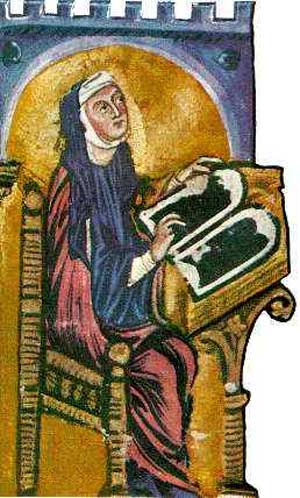
6. So as to achieve this goal, the Lord has given his Church the sacraments.   Salvation and the perfection of the human being are not achieved through the effort of the will alone but rather through the gifts of grace that God grants in the Church.

The Church herself is the first sacrament that God places in the world so that she may communicate salvation to mankind.   The Church, built up from “living souls”, may rightly be considered virgin, bride and mother and thus resembles closely the historical and mystical figure of the Mother of God.  The Church communicates salvation first of all by keeping and proclaiming the two great mysteries of the Trinity and the Incarnation, which are like the two “primary sacraments” and then through administration of the other sacraments.   The summit of the sacramental nature of the Church is the Eucharist. The sacraments produce the sanctification of believers, salvation and purification from sin, redemption and charity and all the other virtues.   However, to repeat, the Church lives because God within her has manifested his intraTrinitarian love, which was revealed in Christ.   The Lord Jesus is the mediator par excellence.   From the Trinitarian womb He comes to encounter man and from Mary’s womb He encounters God.   As the Son of God, He is love incarnate;  as the Son of Mary, He is humanity’s representative before the throne of God.

The human person can have an experience of God.   Relationship with Him, in fact, is not lived solely in the sphere of rationalit but involves the person totally.   All the external and internal senses of the human being are involved in the experience of God.   “But man was created in the image and likeness of God, so that he might act through the five bodily  senses;  he is not divided by them, rather through them he is wise, knowledgeable and intelligent in doing his work (…). For this very reason, because man is wise, knowledgeable and intelligent, he knows creation;  he knows God — whom he cannot see except by faith — through creation and his great works, even if with his five senses he barely comprehends them” (Explanatio Symboli Sancti Athanasii in PL 197, 1073).   This experiential process finds once again, its fullness in participation in the sacraments.

Hildegard also saw contradictions in the lives of individual members of the faithful and reported the most deplorable situations.   She emphasised in particular that individualism in doctrine and in practice on the part of both lay people and ordained ministers is an expression of pride and constitutes the main obstacle to the Church’s evangelising mission to non-Christians.

One of the salient points of Hildegard’s magisterium was her heartfelt exhortation to a virtuous life addressed to consecrated men and women.   Her understanding of the consecrated life is a true “theological metaphysics”, because it is firmly rooted in the theological virtue of faith, which is the source and constant impulse to full commitment in obedience, poverty and chastity.   In living out the evangelical counsels, the consecrated person shares in the experience of Christ, poor, chaste and obedient and follows in his footsteps in daily life.   This is fundamental in the consecrated life.hildegard statue
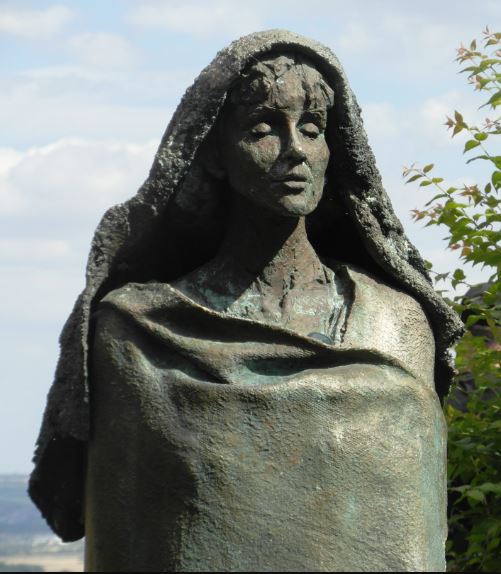
7. Hildegard’s eminent doctrine echoes the teaching of the Apostles, the Fathers and writings of her own day, while it finds a constant point of reference in the Rule of Saint Benedict.   The monastic liturgy and the interiorisation of sacred Scripture are central to her thought which, focusing on the mystery of the Incarnation, is expressed in a profound unity of style and inner content that runs through all her writings.

The teaching of the holy Benedictine nun stands as a beacon for homo viator.   Her message appears extraordinarily timely in today’s world, which is especially sensitive to the values that she proposed and lived.   For example, we think of Hildegard’s charismatic and speculative capacity, which offers a lively incentive to theological research;  her reflection on the mystery of Christ, considered in its beauty;  the dialogue of the Church and theology with culture, science and contemporary art;  the ideal of the consecrated life as a possibility for human fulfilment; her appreciation of the liturgy as a celebration of life;  her understanding of the reform of the Church, not as an empty change of structure but as conversion of heart;  her sensitivity to nature, whose laws are to be safeguarded and not violated.

For these reasons the attribution of the title of Doctor of the Universal Church to Hildegard of Bingen has great significance for today’s world and an extraordinary importance for women.   In Hildegard are expressed the most noble values of womanhood – hence the presence of women in the Church and in society is also illumined by her presence, both from the perspective of scientific research and that of pastoral activity.   Her ability to speak to those who were far from the faith and from the Church make Hildegard a credible witness of the new evangelisation.

By virtue of her reputation for holiness and her eminent teaching, on 6 March 1979 Cardinal Joseph Höffner, Archbishop of Cologne and President of the German Bishops’ Conference, together with the Cardinals, Archbishops and Bishops of the same Conference, including myself as Cardinal Archbishop of Munich and Freising, submitted to Blessed John Paul II the request that Hildegard of Bingen be declared a Doctor of the Universal Church. In that petition, the Cardinal emphasized the soundness of Hildegard’s doctrine, recognized in the twelfth century by Pope Eugene III, her holiness, widely known and celebrated by the people, and the authority of her writings. As time passed, other petitions were added to that of the German Bishops’ Conference, first and foremost the petition from the nuns of Eibingen Monastery, which bears her name. Thus, to the common wish of the People of God that Hildegard be officially canonized, was added the request that she be declared a “Doctor of the Universal Church”.

With my consent, therefore, the Congregation for the Causes of Saints diligently prepared a Positio super Canonizatione et Concessione tituli Doctoris Ecclesiae Universalis for the Mystic of Bingen.   Since this concerned a famous teacher of theology who had been the subject of many authoritative studies, I granted the dispensation from the measures prescribed by article 73 of the Apostolic Constitution Pastor Bonus.   The cause was therefore examined and approved by the Cardinals and Bishops, who met in Plenary Session on 20 March 2012.   The proponent (ponens) of the cause was His Eminence Cardinal Angelo Amato, Prefect of the Congregation for the Causes of Saints. At the audience of 10 May 2012, Cardinal Amato informed us in detail about the status quaestionis and the unanimous vote of the Fathers at the above-mentioned Plenary Session of the Congregation for the Causes of Saints.   On 27 May 2012, Pentecost Sunday, I had the joy of announcing to the crowd of pilgrims from all over the world gathered in Saint Peter’s Square the news of the conferral of the title of Doctor of the Universal Church upon Saint Hildegard of Bingen and Saint John of Avila at the beginning of the Assembly of the Synod of Bishops and on the eve of the Year of Faith.

Today, with the help of God and the approval of the whole Church, this act has taken place.   In Saint Peter’s Square, in the presence of many Cardinals and Prelates of the Roman Curia and of the Catholic Church, in confirming the acts of the process and willingly granting the desires of the petitioners, I spoke the following words in the course of the Eucharistic sacrifice:  “Fulfilling the wishes of numerous brethren in the episcopate and of many of the faithful throughout the world, after due consultation with the Congregation for the Causes of Saints, with certain knowledge and after mature deliberation, with the fullness of my apostolic authority I declare Saint John of Avila, diocesan priest and Saint Hildegard of Bingen, professed nun of the Order of Saint Benedict, to be Doctors of the Universal Church.   In the name of the Father, and of the Son, and of the Holy Spirit.”HILDEGARD VON BINGEN-LG

Posted in SAINT of the DAY

Memorials of the Saints – 17 September

St Robert Bellarmine SJ (1542-1621) Doctor of the Church (Optional Memorial)
Full details here: https://anastpaul.wordpress.com/2017/09/17/saint-of-the-day-17-september-st-robert-bellarmine-s-j-doctor-of-the-church/

Stigmata of St Francis of Assisi
Two years before the great Saint Francis of Assisi died and when he was forty-two years old — one year after he had built the first crib in honour of Our Lord — he went off to a lonely mountain called Mount Alvernia, to prepare himself by forty days of fasting and prayer for the feast of Saint Michael, the greatest of God’s angels, whose feast day is 29 September.   On the feast of the Exaltation of the Holy Cross on 14 September, Saint Francis received in his hands, feet and side the Sacred Wounds from Our Lord’s own body.

Never was a saint more beautifully loved by Jesus than Saint Francis of Assisi.   The wounds Jesus gave him stayed in his hands, feet and side and continually bled for two more years, until he died in 1226.   The day on which Saint Francis received the Five Wounds of Our Lord was 14 September but so, that this beautiful event might have a feast day for itself, the Stigmata of Saint Francis are commemorated today, on 17 September.   The simple liturgy of this holy saint’s life might be put this way –  the crib in 1223, and the Cross in 1224.stigmata-of-st-francis-by-pietro-lorenzettifrancis

St Agathoclia
St Brogan of Ross Tuirc
St Columba of Cordova
St Crescentio of Rome
St Emmanuel Nguyen Van Trieu
St Flocellus
St Hildegard von Bingen OSB (1098-1179)

St Justin of Rome
St Lambert of Maastricht
St Narcissus of Rome
St Peter Arbues
St Rodingus
St Satyrus of Milan
St Socrates
Bl Stanislaus of Jesus and Mary
St Stephen
St Theodora
St Uni of Bremen
St Zygmunt Sajna
St Zygmunt Szcesny Felinski

Martyred in the Spanish Civil War
• Blessed Álvaro Santos Cejudo Moreno Chocano
• Blessed Juan Ventura Solsona
• Blessed Timoteo Valero Pérez

Posted in NOTES to Followers

Internet problems!

Apologies for the late posts today dear friends.

no internet - better late than never - 16 sept 2018

Posted in MORNING Prayers, PAPAL SERMONS, The WORD

Thought for the Day – 16 September –  Today’s Gospel: Mark 8:27–35

Thought for the Day – 16 September –  Today’s Gospel: Mark 8:27–35 – Twenty-fourth Sunday in Ordinary Time, Year B

“But who do you say that I am?”

Peter answered him, “You are the Christ.”...Mark 8:29

These same questions are proposed to each of us today:  “Who is Jesus for the people of our time?” and more importantly:  “Who is Jesus for each of us?”, for me, for you,…? Who is Jesus for each one of us?

We are called to make Peter’s answer our own response, joyfully professing that Jesus is the Son of God, the Eternal Word of the Father, who became man to redeem mankind, pouring out the abundance of divine mercy upon it.

The world needs Christ more than ever:  His salvation, His merciful love.

Pope Francis – Angelus, 19 June 2016but who do YOU say that I am mark 8 29a 16 sept 2018

Posted in FATHERS of the Church, MORNING Prayers, QUOTES of the SAINTS, QUOTES on CHARITY, QUOTES on HUMILITY, QUOTES on LOVE, QUOTES on PEACE, QUOTES on the CHURCH, SAINT of the DAY

Quote/s of the Day – 16 September – The Memorial of Sts Cornelius and Cyprian Martyrs

Quote/s of the Day – 16 September – The Memorial of Sts Cornelius and Cyprian Martyrs

“We must carry out the will of God
rather than our own.
This is what we pledge to do in the “Our Father”,
which we recite every day.
What a travesty it would be if,
after praying that God’s will be done,
we should carry out that will halfheartedly
and only because we are obliged to do so!we-must-carry-out-the-will-of-god-rather-than-our-own-st-cyprian-of-carthage-190-258

“We have solemnly renounced the world
and therefore, whilst we continue in it,
we should behave like strangers and pilgrims.”we have solemnly renounced the world - st cyprian - 16 sept 2018

“You cannot have God for your Father
if you do not have the Church for your mother….
God is one and Christ is one and His Church is one;
one is the faith and one is the people cemented together
by harmony into the strong unity of a body….
If we are the heirs of Christ, let us abide in the peace of Christ;
if we are the sons of God, let us be lovers of peace.”you-cannot-have-god-for-your-father-st-cyprian-of-carthage-16 sept 2017

“You who are envious, let me tell you
that however often you may seek
for the opportunity of injuring him whom you hate,
you will never be able to do him so much harm,
as you do harm to yourselves.
He whom you would punish through the malice of your envy,
may probably escape but you will never
be able to fly from yourselves.” (St Cyprian from The Unity of the Catholic Church)you-who-are-envious- st cyprian - 16 sept 2017
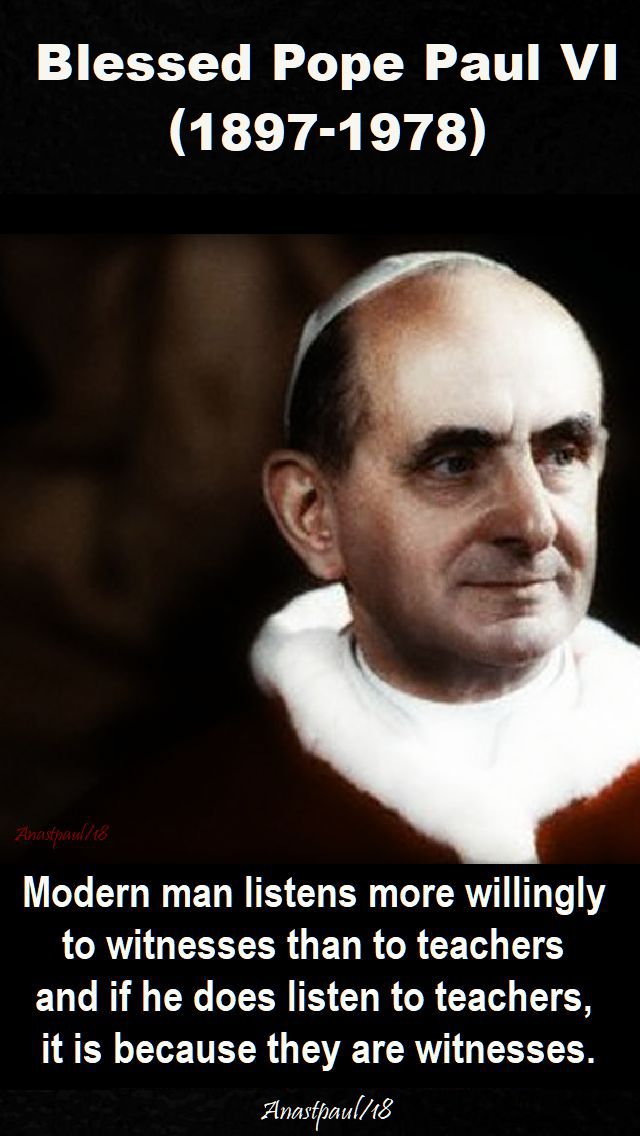
“Let us remember one another in concord and unanimity.
Let us on both sides of death always pray for one another.
Let us relieve burdens and afflictions by mutual love,
that if one of us, by the swiftness of divine condescension,
shall go hence the first, our love may continue in the presence
of the Lord and our prayers for our brethren and sisters
not cease in the presence of the Father’s mercy.”
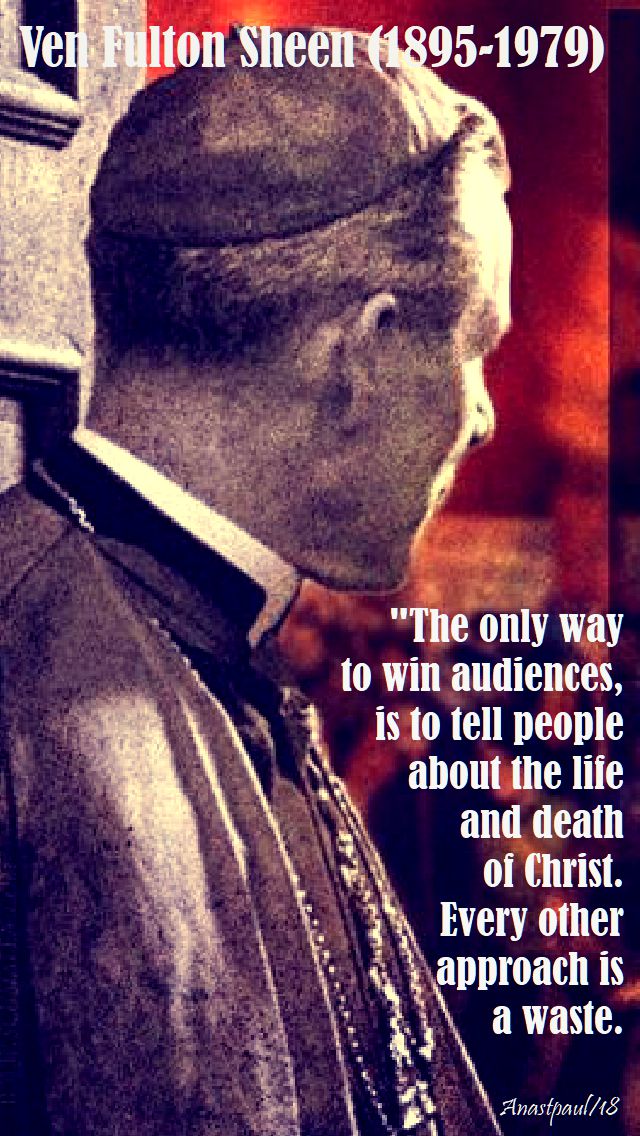
St Cyprian from letters (to St Pope Cornelius no 253)

St Cyprian of Carthage (190-258)let-us-remember-one-another-st-cyprian-of-carthage-190-258-16 sept 2017