Posted in SAINT of the DAY

Memorials of the Saints – 29 August

The Beheading/Passion of John the Baptist (Memorial)
Here: https://anastpaul.wordpress.com/2017/08/29/saint-of-the-day-the-beheading-of-st-john-the-baptist-29-august/

St Adelphus
St Adausia of Rome
St Alberic of Bagno de Romagna
St Basilia of Sirmium
St Candida of Rome
Bl Dominik Jedrzejewski
Bl Edmund Rice
St Edwold the Hermit
St Eufrasia of the Sacred Heart of Jesus Eluvathingal
St Euthymius of Perugia
Bl Filippa Guidoni
Bl John of Perugia
St Louis-Wulphy Huppy
St Maximian of Vercelli
St Medericus
St Nicaeus of Antioch
St Paul of Antioch
Bl Peter of Sassoferrato
St Repositus of Velleianum
Bl Richard Herst
St Sabina of Rome
St Sabina of Troyes
Bl Sancja Szymkowiak
St Sator of Velleianum
St Sebbe of Essex
Bl Teresa Bracco
St Velleicus
St Victor of La Chambon
St Vitalis of Velleianum

Martyred in the Spanish Civil War:
• Blessed Constantino Fernández Álvarez
• Blessed José Almunia López-Teruel
• Blessed Josep Maria Tarín Curto
• Blessed Pedro Asúa Mendía

Posted in DOCTORS of the Church, FATHERS of the Church, MORNING Prayers, ON the SAINTS, PAPAL SERMONS, QUOTES - J R R Tolkien and MORE, QUOTES on CONVERSION, SAINT of the DAY

Thought for the Day – 28 August – The Memorial of St Augustine (354-430) Father and Doctor of Grace

Thought for the Day – 28 August – The Memorial of St Augustine (354-430) Father and Doctor of Grace (sorry it’s long but absolutely worth the effort)

ON CONVERSION AND ST AUGUSTINE
Papal Homily – Pastoral Visit to Vigevano and Pavia, Italy
H.H. Benedict XVI
Third Sunday of Easter
22 April 2007

The path we must take – the path that Jesus points out to us – is called “conversion”.   But what is it?   What must we do?   In every life conversion has its own form, because every human being is something new and no one is merely a copy of another.

But in the course of history, the Lord has sent us models of conversion to whom we can look to find guidance.   We could thus look at Peter himself to whom the Lord said at the Last Supper:  “[W]hen you have turned again, strengthen your brethren” (Lk 22: 32).

We could look at Paul as a great convert.   The City of Pavia speaks of one of the greatest converts in the history of the Church – St Aurelius Augustine.   He died on 28 August in 430 in the port town of Hippo, in Africa, at that time surrounded and besieged by the Vandals.   After the considerable turmoil of a turbulent history, the King of the Longobards acquired Augustine’s remains for the City of Pavia so that today they belong to this City in a special way and, in it and from it, have something special to say to all of us, to humanity but to all of us here in particular.

In his book, Confessions, Augustine touchingly described the development of his conversion which achieved its goal with Baptism, administered to him by Bishop Ambrose in the Cathedral of Milan.   Readers of his Confessions can share in the journey that Augustine had to make in a long inner struggle to receive at last, at the baptismal font on the night before Easter 387, the Sacrament which marked the great turning point in his life.   A careful examination of the course of St Augustine’s life enables one to perceive that his conversion was not an event of a single moment but, precisely, a journey.   And one can see that this journey did not end at the baptismal font.

Just as prior to his baptism Augustine’s life was a journey of conversion, after it too, although differently, his life continued to be a journey of conversion – until his last illness, when he had the penitential Psalms hung on the walls so that he might have them always before his eyes and when he excluded himself from receiving the Eucharist in order to go back once again over the path of his repentance and receive salvation from Christ’s hands as a gift of God’s mercy.

Thus, we can rightly speak of Augustine’s “conversions”, which actually consisted of one important conversion in his quest for the Face of Christ and then in the journeying on with him.   I would like to mention briefly three important landmarks in this process of conversion, three “conversions”.

The first fundamental conversion was the inner march towards Christianity, towards the “yes” of the faith and of Baptism.   What was the essential aspect of this journey?

On the one hand, Augustine was a son of his time, deeply conditioned by the customs and passions prevalent then as well as by all the questions and problems that beset any young man.   He lived like all the others, yet with a difference, he continued to be a person constantly seeking.   He was never satisfied with life as it presented itself and as so many people lived it.   The question of the truth tormented him ceaselessly.   He longed to discover truth. He wanted to succeed in knowing what man is, where we ourselves come from, where we are going and how we can find true life.

He desired to find the life that was right and not merely to live blindly, without meaning or purpose.   Passion for truth is the true key phrase of his life.   Passion for the truth truly guided him.

There is a further peculiarity: anything that did not bear Christ’s Name did not suffice for him.   Love for this Name, he tells us, he had tasted from his mother’s milk (cf. Confessions, 3, 4, 8).   And he always believed – sometimes rather vaguely, at other times, more clearly – that God exists and takes care of us (cf. Confessions, 6, 5, 8).   But to truly know this God and to become really familiar with this Jesus Christ and reach the point of saying “yes” to Him with all its consequences – this was the great interior struggle of his youthful years.

St Augustine tells us that through Platonic philosophy he learned and recognised that “in the beginning was the Word” – the Logos, creative reason.   But philosophy, which showed him that the beginning of all things was creative reason, did not show him any path on which to reach it; this Logos remained remote and intangible.   Only through faith in the Church did he later find the second essential truth – the Word, the Logos, was made flesh.

Thus, he touches us and we touch him.   The humility of God’s Incarnation – this is the important step – must be equalled by the humility of our faith, which lays down its self-important pride and bows upon entering the community of Christ’s Body; which lives with the Church and through her alone can enter into concrete and bodily communion with the living God.

I do not have to say how deeply all this concerns us:  to remain seekers; to refuse to be satisfied with what everyone else says and does;  to keep our gaze fixed on the eternal God and on Jesus Christ;  to learn the humility of faith in the corporeal Church of Jesus Christ, of the Logos Incarnate.

Augustine described his second conversion at the end of the 10th book of his Confessions with the words:  “Terrified by my sins and the pile of my misery, I had racked my heart and had meditated, taking flight to live in solitude.   But You forbade me and comforted me, saying:  “That is why Christ died for all, so that those who live should not live for themselves, but for him who died for them’ (II Cor 5: 15)”; Confessions, 10, 43, 70).

What had happened?   After his baptism, Augustine had decided to return to Africa and with some of his friends had founded a small monastery there.   His life was then to be totally dedicated to conversation with God and reflection on and contemplation of the beauty and truth of his Word.    Thus, he spent three happy years in which he believed he had achieved the goal of his life, in that period, a series of valuable philosophical and theological works came into being.

In 391, four years after his baptism, he went to the port town of Hippo to meet a friend whom he desired to win over for his monastery.   But he was recognised at the Sunday liturgy in the cathedral in which he took part.   It was not by chance that the Bishop of the city, a man of Greek origin who was not fluent in Latin and found preaching rather a struggle, said in his homily that he was hoping to find a priest to whom he could entrust the task of preaching.   People instantly grabbed hold of Augustine and forced him forward to be ordained a priest to serve the city.

Immediately after his forced ordination, Augustine wrote to Bishop Valerius:  “I was constrained… to accept second place at the helm, when as yet I knew not how to handle an oar…. And from this derived the tears which some of my brethren perceived me shedding in the city at the time of my ordination” (cf. Letter 21, 1ff.).

Augustine’s beautiful dream of a contemplative life had vanished.   As a result, his life had fundamentally changed.   He could now no longer dedicate himself solely to meditation in solitude.   He had to live with Christ for everyone.   He had to express his sublime knowledge and thoughts in the thoughts and language of the simple people in his city.   The great philosophical work of an entire lifetime, of which he had dreamed, was to remain unwritten.   Instead, however, we have been given something far more precious – the Gospel translated into the language of everyday life and of his sufferings.

These were now part of his daily life, which he described as the following: “reprimanding the undisciplined, comforting the faint-hearted, supporting the weak, refuting opponents… encouraging the negligent, soothing the quarrelsome, helping the needy, liberating the oppressed, expressing approval to the good, tolerating the wicked and loving all” (Sermon 340, 3).   “Continuously preaching, arguing, rebuking, building God’s house, having to manage for everyone – who would not shrink from such a heavy burden?” (Sermon 339, 4).

This was the second conversion which this man, struggling and suffering, was constantly obliged to make – to be available to everyone, time and again and not for his own perfection, time and again, to lay down his life with Christ so that others might find him, true Life.

Further, there was a third, decisive phase in the journey of conversion of St Augustine.   After his Ordination to the priesthood he had requested a vacation period to study the Sacred Scriptures in greater detail.

His first series of homilies, after this pause for reflection, were on the Sermon on the Mount;  he explained the way to an upright life, “the perfect life”, pointed out by Christ in a new way.   He presented it as a pilgrimage to the holy mountain of the Word of God.   In these homilies it is possible to further perceive all the enthusiasm of faith newly discovered and lived;  his firm conviction that the baptised, in living totally in accordance with Christ’s message, can precisely be “perfect” in accordance with the Sermon on the Mount.

Approximately 20 years later, Augustine wrote a book called the Retractations, in which he critically reviewed all the works he had thus far written, adding corrections wherever he had in the meantime learned something new.

With regard to the ideal of perfection in his homilies on the Sermon on the Mount, he noted:  “In the meantime, I have understood that one alone is truly perfect and that the words of the Sermon on the Mount are totally fulfilled in one alone: Jesus Christ Himself.  “The whole Church, on the other hand – all of us, including the Apostles – must pray every day:  forgive us our trespasses as we forgive those who trespass against us” (cf. Retract. I 19, 1-3).

Augustine had learned a further degree of humility – not only the humility of integrating his great thought into the humble faith of the Church, not only the humility of translating his great knowledge into the simplicity of announcement but also the humility of recognising that he himself and the entire pilgrim Church needed and continually need the merciful goodness of a God who forgives every day.

And we, he added, liken ourselves to Christ, the only Perfect One, to the greatest possible extent when we become, like Him, people of mercy.

Let us now thank God for the great light that shines out from St Augustine’s wisdom and humility and pray the Lord to give to us all, day after day, the conversion we need and thus lead us toward true life. Amen.

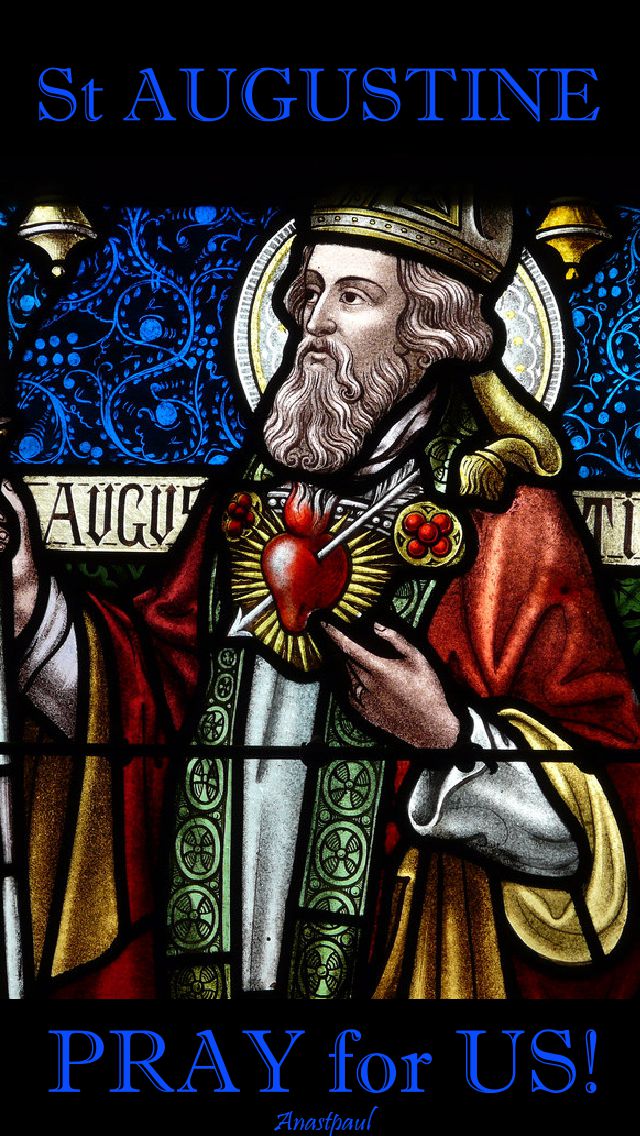
St Augustine, Pray for Us!st-augustine-pray-for-us
Posted in DOCTORS of the Church, FATHERS of the Church, MORNING Prayers, QUOTES of the SAINTS, QUOTES on CHARITY, QUOTES on CONVERSION, QUOTES on FAITH, QUOTES on HUMILITY, QUOTES on LOVE, QUOTES on SANCTITY, SAINT of the DAY

Quote/s of the Day – 28 August – The Memorial of St Augustine (354-430) – Father and Doctor of Grace

Quote/s of the Day – 28 August – The Memorial of St Augustine (354-430)
Father and Doctor of Grace

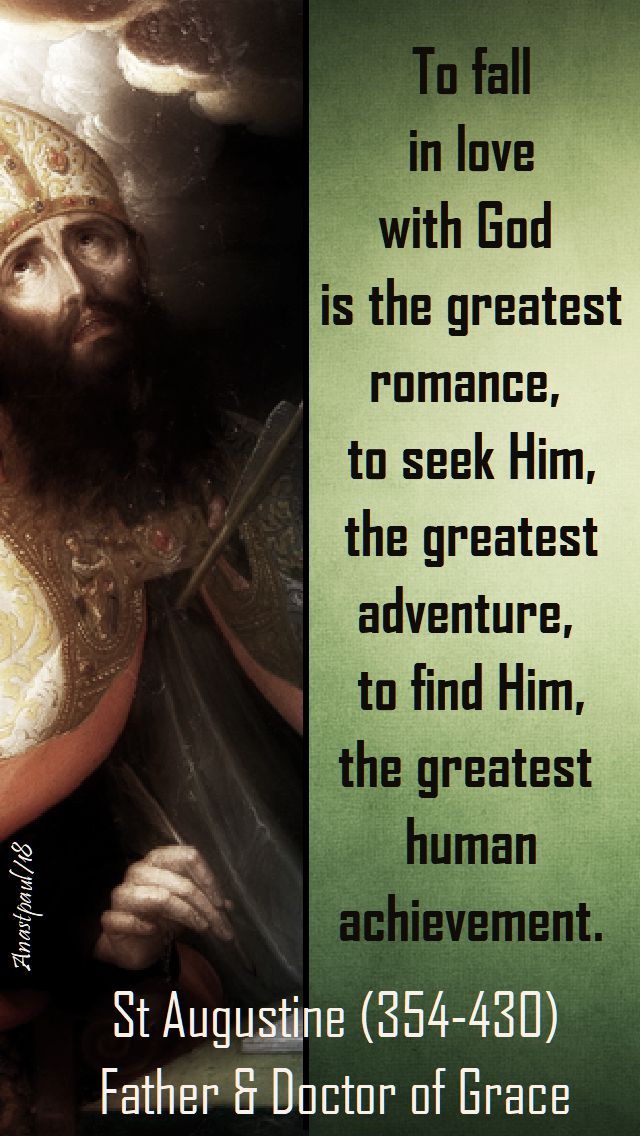
“To fall in love with God is the greatest romance;
to seek Him the greatest adventure;
to find Him the greatest human achievement.”to fall in love with god - st augustine - 28 aug 2018

“Only the “new” person
can sing a new song to the Lord:
the person restored
from a fallen condition,
through the grace of God.
Let us sing a new song –
not with our lips
but with our lives!”only-the-new-person-no-2-st-augustine-15-aug-2017-mem-of-simpliacianus

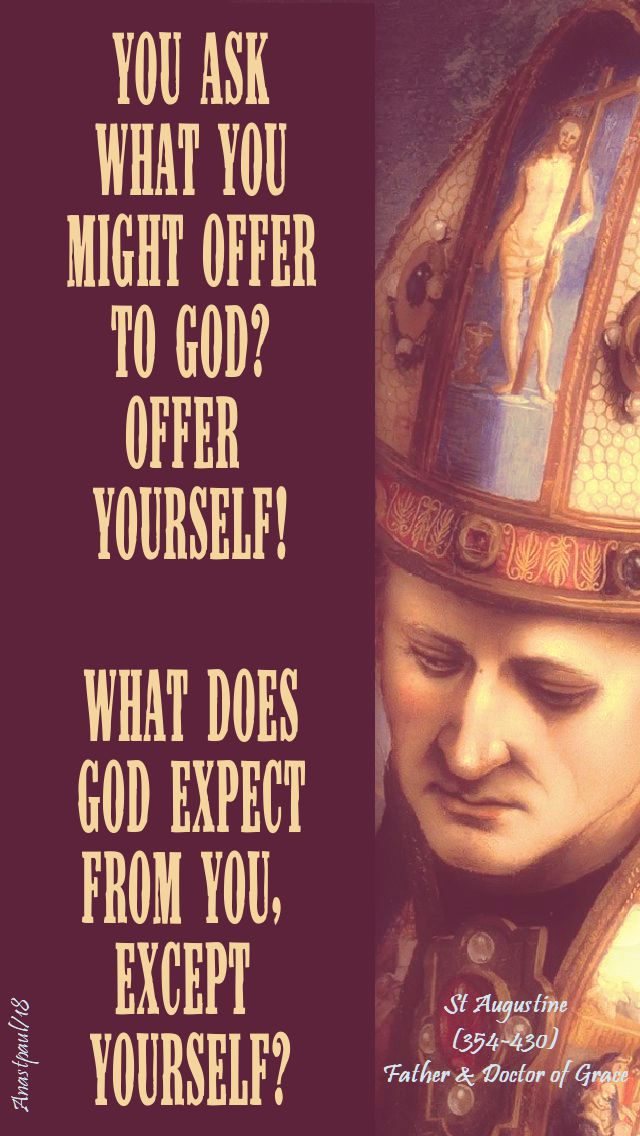
“You ask what you might offer to God?
Offer yourself!
What does God expect from you,
except yourself?”you ask what you might offer to god - st augustine - 28 aug 2018 no 2

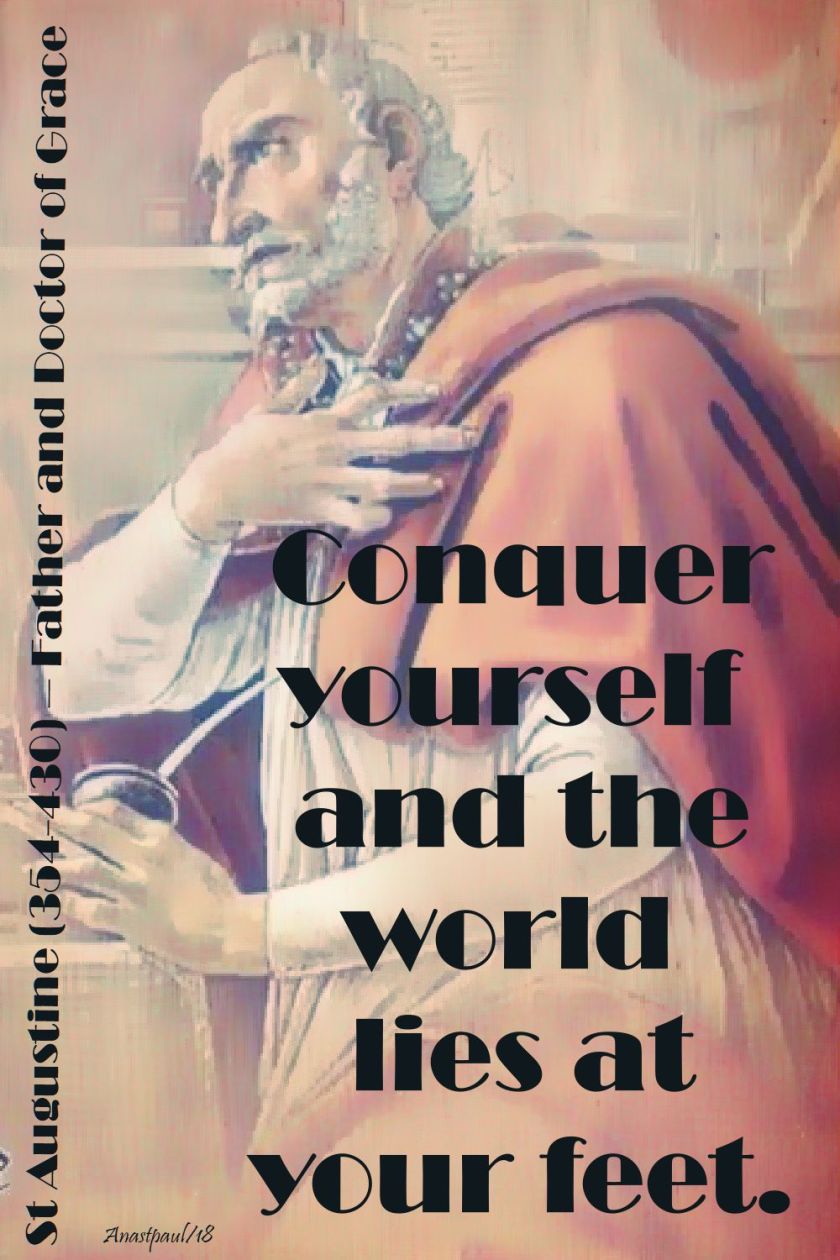
“Conquer yourself
and the world
lies at your feet.”conquer yourself - st augustine - 28 aug 2018

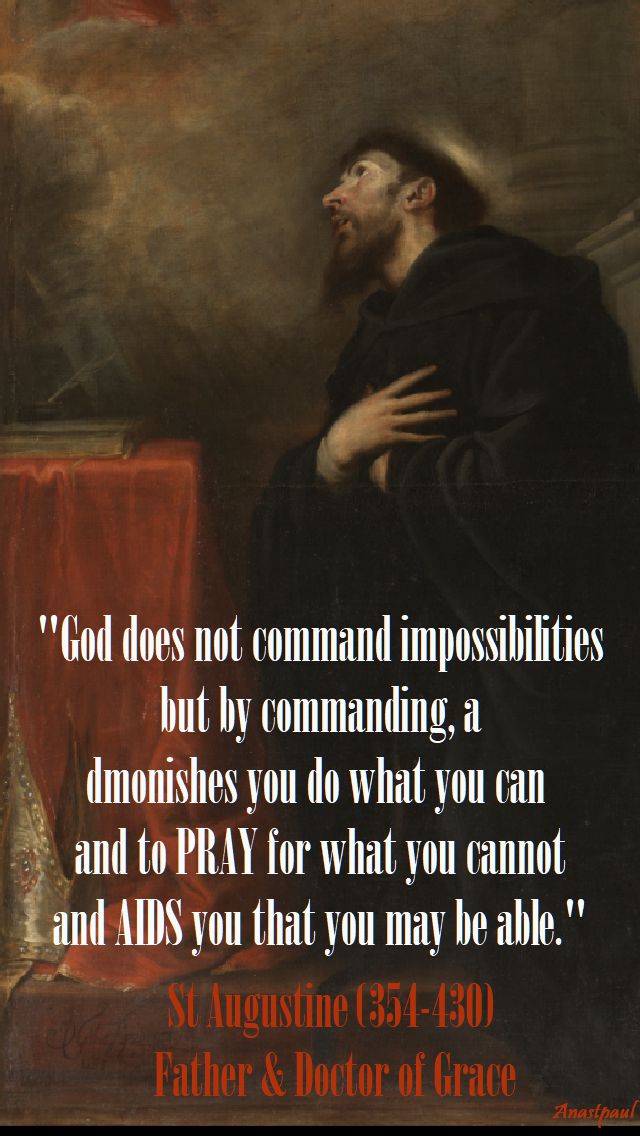
“God does not command impossibilities
but by commanding,
admonishes you do what you can
and to PRAY for what you cannot
and AIDS you that you may be able.”god-does-not-comman-st-augustine28 aug 2017

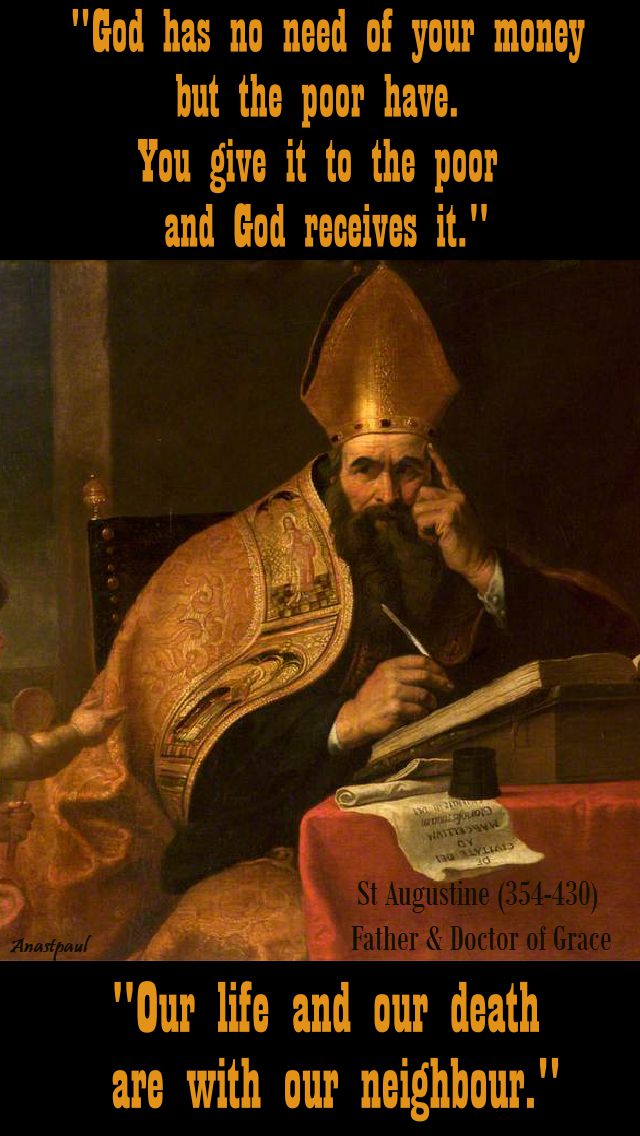
“God has no need of your money
but the poor have.
You give it to the poor and God receives it.”

“Our life and our death are with our neighbour.”god-has-no-need-and-our-life-and-our-death-st-augustine 28 aug 2017

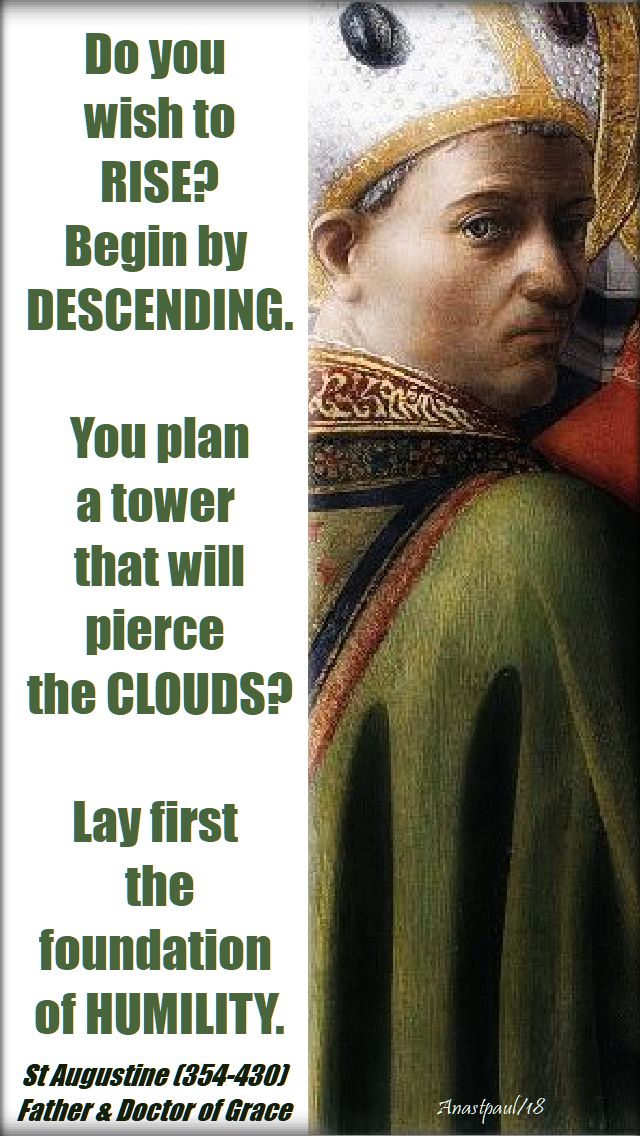
“Do you wish to RISE?
Begin by DESCENDING.
You plan a tower
that will pierce the CLOUDS?
Lay first the foundation
of HUMILITY.”

St Augustine (354-430) Father & Doctor of Gracedo you wish to rise, begin by descending - st augustine - 28 aug 2018

Posted in CONFESSION/PENANCE, DOCTORS of the Church, FATHERS of the Church, MORNING Prayers, QUOTES on CONVERSION, QUOTES on FORGIVENESS, QUOTES on SIN, SAINT of the DAY, The WORD

One Minute Reflection – 28 August – Today’s Gospel: Matthew 23:23–26 and The Memorial of St Augustine (354-430) – Doctor of Grace

One Minute Reflection – 28 August – Tuesday of the Twenty-first week in Ordinary Time, Year B – Today’s Gospel: Matthew 23:23–26 and The Memorial of St Augustine (354-430) – Doctor of Grace

“You blind Pharisee! first cleanse the inside of the cup and of the plate, that the outside also may be clean.”…Matthew 23:26

REFLECTION – “You are before God.   Question your heart:  see what you have done and what you have been yearning for there—your salvation or the windy praise of men.   Look within, for a person cannot judge one whom he cannot see.   If we are assuring our heart, let us assure it in his presence.
“Because if our heart thinks badly”—that is, if it accuses us within, because we aren’t acting with the spirit with which we should be acting —“God is greater than our heart, and he knows all things” (v.20).   You hide your heart from man – hide it from God if you can.   How will you hide it from Him to whom it was said by a certain sinner in fear and confession:  “Where shall 1 go from your spirit, and where shed!   I flee from your face?”… For where does God not exist?   “If,” he said, “I go up to heaven, you are there;  if I go down to hell, you are present” (Ps 139[138]:7-8).   Where will you go?   Where will you flee?   Do you want to hear some advice?   If you want to flee from Him, flee to Him.   Flee to Him by Confessing, not from Him by hiding, for you cannot hide, but you can Confess.   Tell Him.   “You are my refuge” (Ps 32[31]:7) and let there be nursed in you the love that alone leads to life.”…St Augustine (354-430) – Doctor of Graceyou blind pharisee - matthew 23 25 - you hide your heart from man - augustine - 28 aug 2018

PRAYER – Lord God, renew Your Church with the Spirit of wisdom and love which You gave to St Augustine.   Lead us by that same Spirit, to seek You, the only fountain of true wisdom and the source of everlasting love.   Through our Lord Jesus Christ, Your Son, in union with the Spirit, one God, forever and ever.    St Augustine, pray for the Church and for us all, amen.st augustine - pray for us - 28 aug 2018

Posted in Our MORNING Offering, PRAYERS of the SAINTS, SAINT of the DAY, Uncategorized

Our Morning Offering – 28 August – The Memorial of St Edmund Arrowsmith S.J. (1585 – 1628) – Martyr

Our Morning Offering – 28 August – The Memorial of St Edmund Arrowsmith S.J. (1585 – 1628) – Martyr

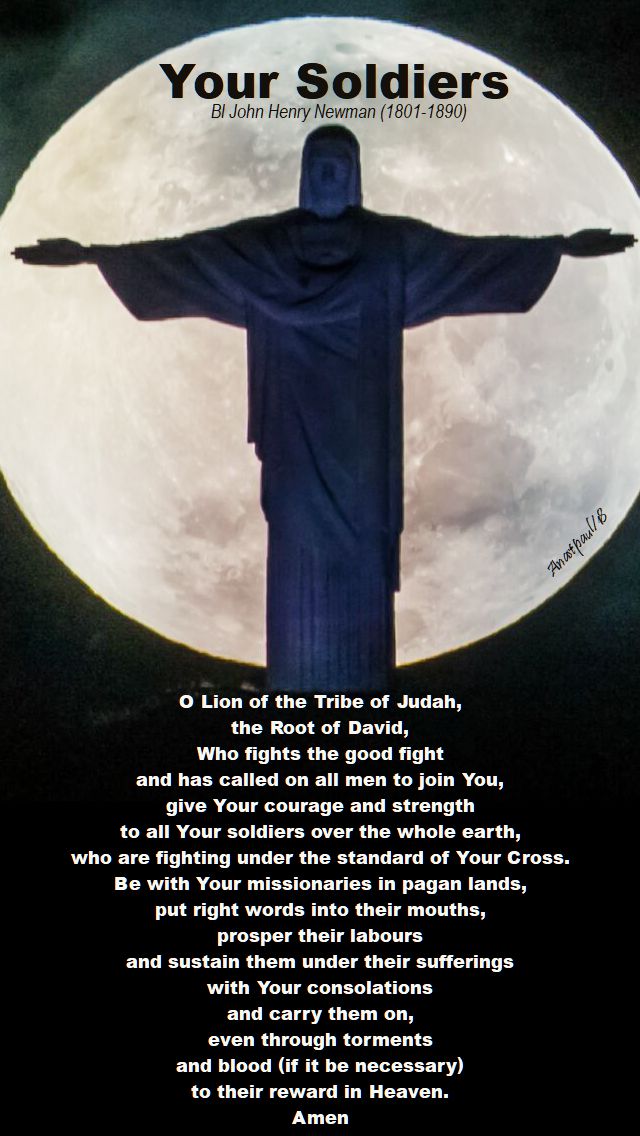
Your Soldiers
Blessed John Henry Newman (1801-1890)

O Lion of the Tribe of Judah,
the Root of David,
Who fights the good fight
and has called on all men to join You,
give Your courage and strength
to all Your soldiers over the whole earth,
who are fighting under the standard of Your Cross.
Be with Your missionaries in pagan lands,
put right words into their mouths,
prosper their labours
and sustain them under their sufferings
with Your consolations
and carry them on,
even through torments
and blood (if it be necessary)
to their reward in Heaven.
Ameno lion of the tribe of judah - your soldiers - bl john henry newman - prayer for martyrs - 28 aug 2018 and 24 march 2018

Posted in SAINT of the DAY

Saint of the Day – 28 August – St Edmund Arrowsmith S.J. (1585 – 1628) Martyr

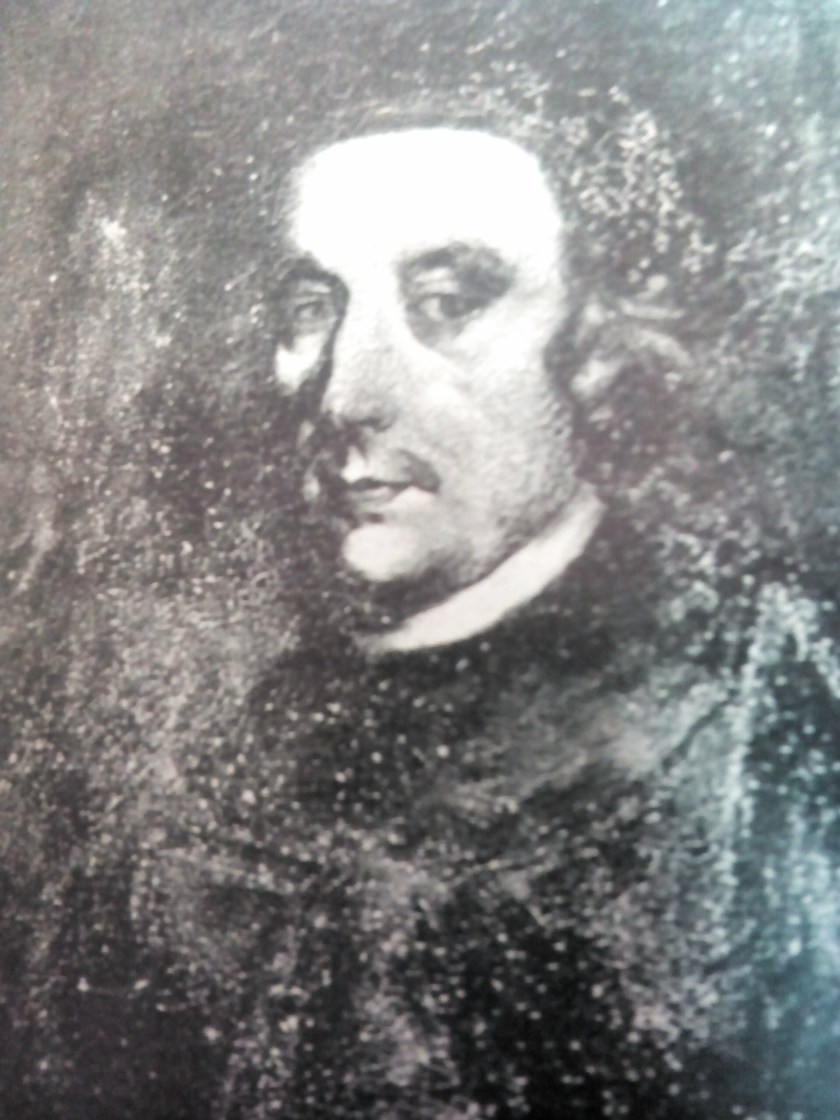
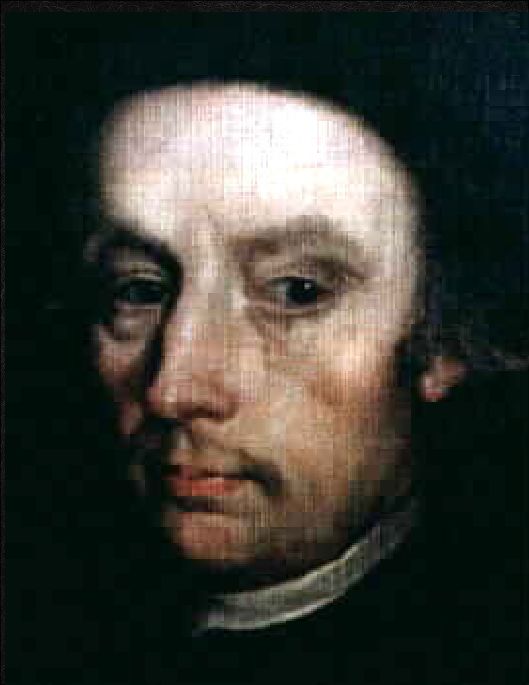
Saint of the Day – 28 August – St Edmund Arrowsmith S.J. (1585 – 1628) Priest & Martyr – born in 1585 at Haydock, Lancashire, England as Brian Arrowsmith, his confirmation name was Edmund and he preferred to use it – died by being hanged, drawn and quartered on 28 August 1628 at Lancaster, England.   Additional Memorials – 25 October as one of the Forty Martyrs of England and Wales, 7 August as one of the Lancashire Martyrs and 29 October as one of the Martyrs of Douai.St-Edmund-Arrowsmith-SJ

The main source of information on St Edmund is a contemporary account written by an eyewitness and published a short time after his death.   This document, conforming to the ancient style of the “Acts of Martyrs” includes the story of the execution of another 17th-century Recusant martyr, Blessed Richard Herst (died 1628).

Bryan Arrowsmith was born at Haydock, Lancashire, England, in 1585, the eldest child of Robert Arrowsmith, a yeoman farmer, who had served in Sir William Stanley’s regiment which fought for Spain in the Low Countries.   His mother was Margery Gerard, a member of the Lancashire Gerard family.   Among his mother’s relations was Father John Gerard, who wrote The Diary of an Elizabethan Priest, as well as another martyr, the Blessed Miles Gerard.   He was baptised Brian, but always used his confirmation name of Edmund, after an uncle who trained English priests in France.   The family was constantly harassed for its adherence to Roman Catholicism.   One of his grandfathers died a confessor in prison.   On one occasion, as a child, he was left shivering in his night-clothes by the pursuivants, who carried his parents off to Lancaster jail;  he and his three siblings were cared for by neighbours

Education
In 1605, at the age of twenty, Edmund left England and went to the English College, Douai, to study for the priesthood.   He was soon forced to return to England due to ill health but recovered and returned to Douai in 1607.st edmund arrowsmith old

Ecclesiastical career
He was ordained in Arras on 9 December 1612 and sent on the English mission a year later.    He ministered to the Catholics of Lancashire without incident until around 1622, when he was arrested and questioned by the Anglican Bishop of Chester.    Edmund was released when King James I of England ordered an amnesty for all arrested priests, in furtherance of negotiations to arrange a Spanish marriage for his son Prince Charles.   St Edmund joined the Jesuits in 1624.st edmund arrowsmith - my enlgmnt

In the summer of 1628, Fr Edmund was reportedly betrayed by a man named Holden, who denounced him to the authorities.    Arrowsmith ministered to Catholics of Lancashire at the still-standing Arrowsmith House, located in Hoghton before being arrested and questioned on Brindle Moss where his horse refused to jump a ditch.   He was convicted of being a Roman Catholic priest in England.   He was sentenced to death, and hanged, drawn and quartered at Lancaster on 28 August 1628.   His final confession was heard by Saint John Southworth (1592-1654) Martyr, who was imprisoned along with Edmund.

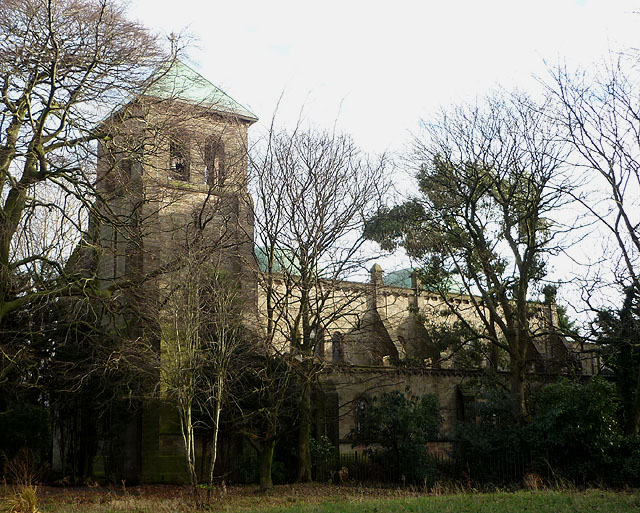
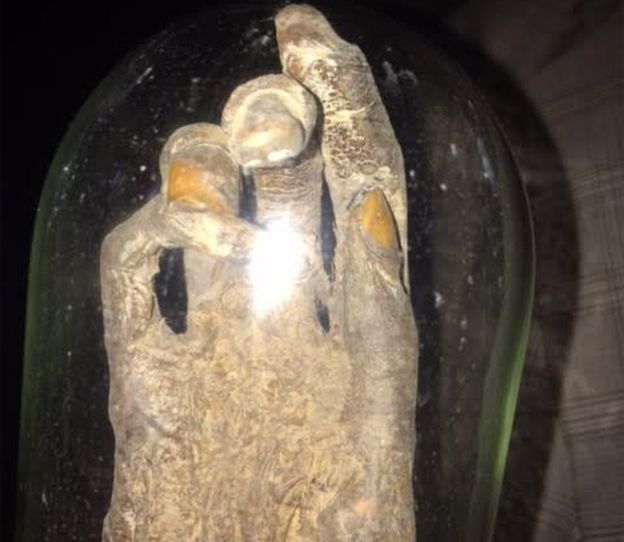
Edmund Arrowmith’s beatification occurred in 1929.   He was canonszed as one of the Forty Martyrs of England and Wales by Pope Paul VI in 1970.   His hand was preserved and kept by the Arrowsmith family as a relic until he was beatified and it now rests in the Catholic Church of St Oswald and St Edmund Arrowsmith, Ashton-in-Makerfield (see images below).   Stonyhurst College retains the small trunk of vestments and equipment which he carried from house to house.Church_of_St_Oswald_and_St_Edmund_Arrowsmith.jpg

_89816788_holyhand2st oswalds

Posted in SAINT of the DAY

Memorials of the Saints – 28 August

St Augustine of Hippo (354-430) – Doctor of Grace and one of the original Four Fathers & Doctors of the Latin Church(Memorial)
Wonderful St Augustine here: https://anastpaul.wordpress.com/2017/08/28/saint-of-the-day-28-august-st-augustine-354-430-doctor-of-grace-and-one-of-the-original-four-fathers-doctors-of-the-latin-church/

Adelindis of BuchauSt Agnes of CologneSt Alexander of ConstantinopleBl Alfons Maria MazurekSt Ambrose of SaintesBl Angelo da Pesche d’IserniaSt Anthes of SalernoBl Charles-Arnold HanusSt Edmund Arrowsmith S.J. (1585 – 1628) Martyr

St Facundinus of Taino
St Felix of Venosa
St Fortunatus of Salerno
St Gaius of Salerno
St Gorman of Schleswig
Bl Henry Webley
St Hermes of Rome
Bl Hugh More
Bl James Claxton
St Januarius of Venosa
St Joaquina Vedruna de Mas
St Julian of Auvergne
St Moses the Black
St Pelagius of Istria
St Restitutus of Carthage
St Rumwold the Prince
St Septiminus of Venosa
St Vivian of Saintes
Bl William Dean

Martyred in the Spanish Civil War:
Martyrs of Griñon – 10 beati
Martyrs of Tarragona – 6 beati
• Blessed Agustín Bermejo Miranda
• Blessed Alejandro Iñiguez De Heredia Alzola
• Blessed Andrés Merino Báscones
• Blessed Antonio Solá Garriga
• Blessed Arturo Ros Montalt
• Blessed Aurelio da Vinalesa
• Blessed Celestino Ruiz Alegre
• Blessed Cesáreo España Ortiz
• Blessed Eladi Peres Bori
• Blessed Evencio Castellanos López
• Blessed Francisco López Navarette
• Blessed Germán Arribas y Arribas
• Blessed Graciliano Ortega Narganes
• Blessed Isidre Fábregas Gils
• Blessed Jaume Tarragó Iglesias
• Blessed Javier Pradas Vidal
• Blessed Joan Tomás Gibert
• Blessed Joaquim Oliveras Puljarás
• Blessed José Gorastazu Labayen
• Blessed Josep Camprubí Corrubí
• Blessed Juan Bautista Faubel Cano
• Blessed Lázaro Ruiz Peral
• Blessed Manoel José Sousa de Sousa
• Blessed Modest Godo Buscato
• Blessed Modest Pamplona Falguera
• Blessed Nicolás Rueda Barriocanal
• Blessed Serviliano Solá Jiménez
• Blessed Teodoro Pérez Gómez

Posted in CATHOLIC-PRAYERS OF THE CHURCH, MORNING Prayers, PRAYERS for CANONISATION, PRAYERS for VARIOUS NEEDS, PRAYERS of the CHURCH, SAINT of the DAY

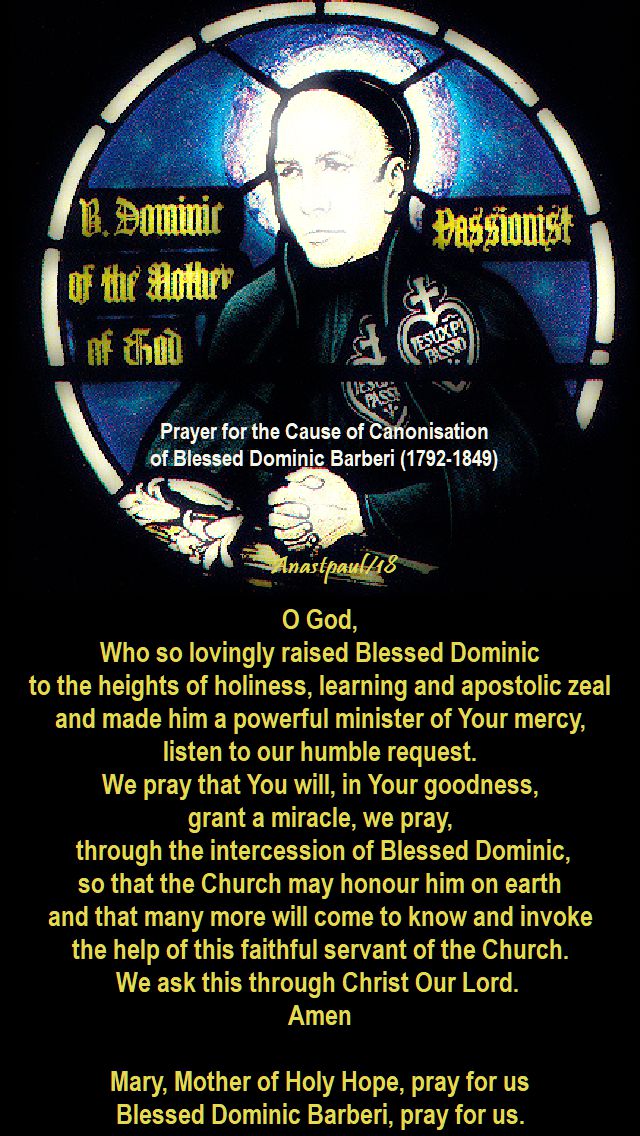
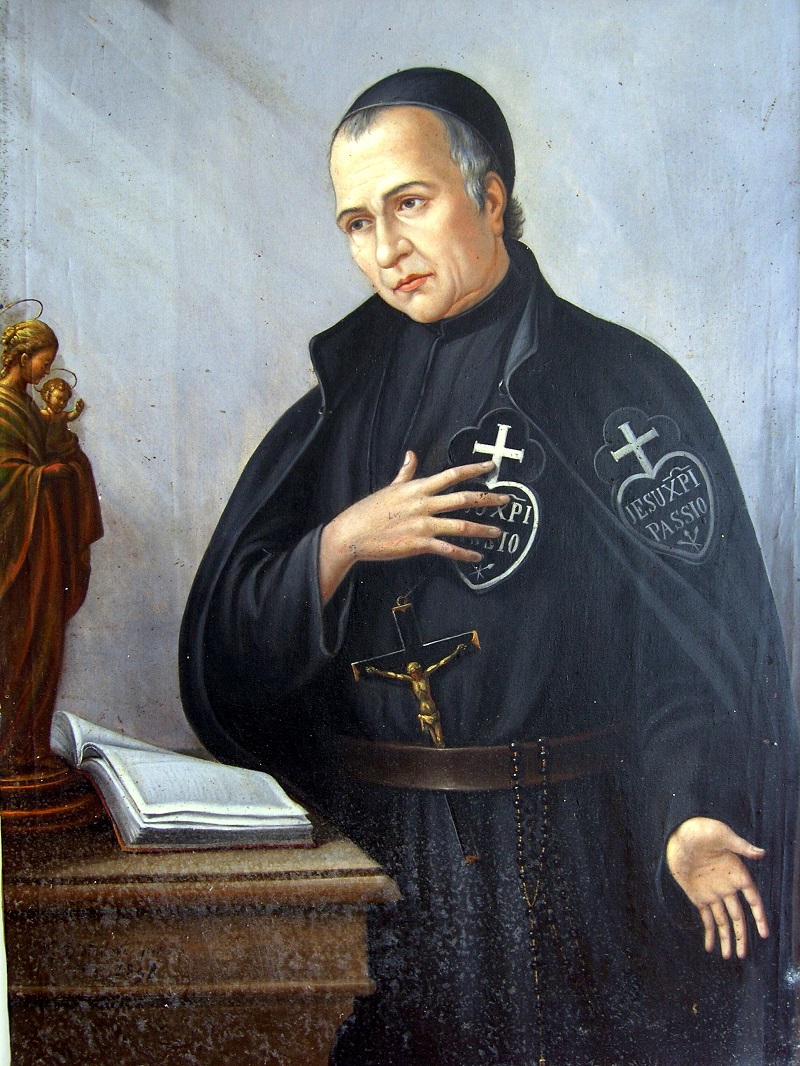
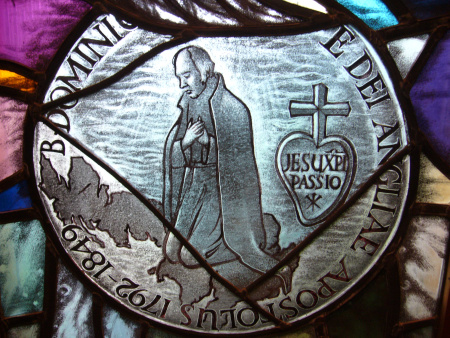
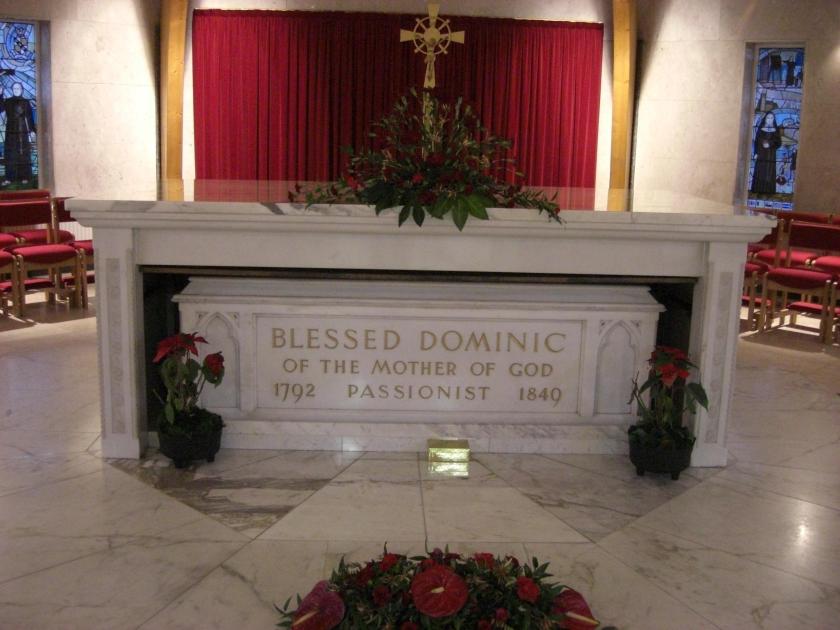
The Memorial of Blessed Dominic Barberi of the Mother of God C.P. (1792-1849) Apostle of England, Prayer for his Cause of Canonisation

The Memorial of Blessed Dominic Barberi of the Mother of God C.P. (1792-1849) Apostle of England, Prayer for his Cause of Canonisation

As we celebrate the Memorial of Blessed Dominic Barberi, he who converted so many to the bosom of the Church in England, let us pray for his Canonisation and for that of his greatest convert, Blessed Cardinal John Henry Newman (1801-1890), these two, forever linked in history.

Prayer for the Cause of Canonisation
of Blessed Dominic Barberi (1792-1849)

O God,
Who so lovingly raised Blessed Dominic
to the heights of holiness, learning and apostolic zeal
and made him a powerful minister of Your mercy,
listen to our humble request.
We pray that You will, in Your goodness,
grant a miracle, we pray, through the intercession of Blessed Dominic,
so that the Church may honour him on earth
and that many more will come to know and invoke
the help of this faithful servant of the Church.
We ask this through Christ Our Lord.
Amen
Mary, Mother of Holy Hope, pray for us
Blessed Dominic Barberi, pray for us.o god who so lovingly raised - prayer for the canonisation of bl dominic barberi - 27 aug 2018

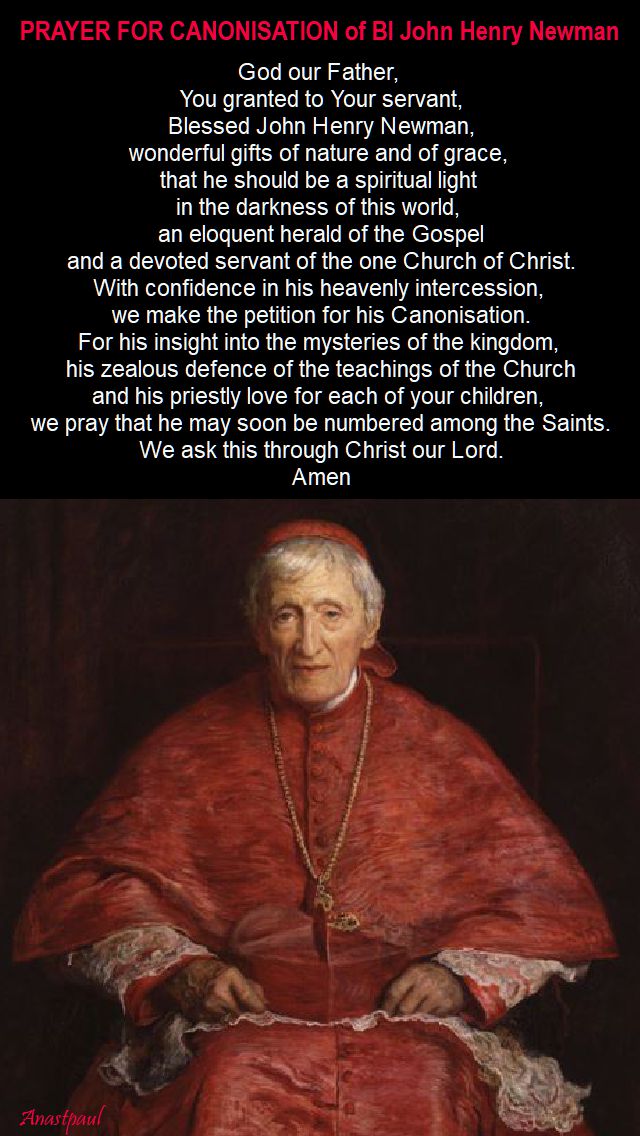
PRAYER FOR CANONISATION of Blessed John Henry Newman (1801-1890)

God our Father,
You granted to Your servant,
Blessed John Henry Newman,
wonderful gifts of nature and of grace,
that he should be a spiritual light
in the darkness of this world,
an eloquent herald of the Gospel
and a devoted servant of the one Church of Christ.
With confidence in his heavenly intercession,
we make the petition for his Canonisation.
For his insight into the mysteries of the kingdom,
his zealous defence of the teachings of the Church
and his priestly love for each of your children,
we pray that he may soon be numbered among the Saints.
We ask this through Christ our Lord.
Amen

Nihil Obstat: Fr Pat McKinney S.T.L.

Imprimatur: + Bernard Longley, Archbishop of Birmingham

30th March 2010pray-for-the-canonisation-bl-john-henry-9-oct-2017

Posted in MORNING Prayers, QUOTES of the SAINTS, SAINT of the DAY

Thought for the Day – 27 August – The Memorial of Blessed Dominic Barberi of the Mother of God C.P. (1792-1849) Apostle of England

Thought for the Day – 27 August – The Memorial of Blessed Dominic Barberi of the Mother of God C.P. (1792-1849) Apostle of England

Blessed Dominic Barberi, as described by the great English convert, Blessed Cardinal John Henry Newman (1801-1890).

“On the Apennines, near Viterbo, there dwelt a shepherd-boy, in the first years of this century, whose mind had early been drawn heavenward and, one day, as he prayed before an image of the Madonna, he felt a vivid intimation that he was destined to preach the Gospel under the northern sky.

“There appeared no means by which a Roman peasant should be turned into a missionary; nor did the prospect open, when this youth found himself, first a lay brother, then a Father, in the Congregation of the Passion.

“Yet, though no external means appeared, the inward impression did not fade, on the contrary it became more definite and, in process of time, instead of the dim north, England was engraved on his heart.

“And, strange to say, as years went on, without his seeking, for he was simply under obedience, our peasant found himself at length upon the very shore of the stormy northern sea, whence Caesar of old looked out for a new world to conquer;  yet that he should cross the strait was still as little likely as before.

“However, it was as likely as that he should ever have got so near it and he used to eye the restless, godless waves and wonder with himself whether the day would ever come when he should be carried over them.

“And come it did, not however by any determination of his own, but by the same Providence which thirty years before had given him the anticipation of it…The thought of England came into his ordinary prayers and in his last years, after a vision during Mass, as if he had been Augustine or Mellitus, he talked of his ‘sons’ in England.”

Fr Dominic of the Mother of God was a spiritual son of St Paul of the Cross (1694-1775), the founder of the Passionists.

John Henry Newman, Loss and Gain: The Story of a Convert, Oxford: Oxford University Press 1986, pp.291-292.

The work of Dominic with Newman and the new converts of Littlemore was not limited to receiving them into the Church.   The esteem that Dominic had, even before the conversion of Newman, for the little group of Littlemore was impressive.   He touchingly and lovingly wrote to Dalgairns in September 1845:

“Dear Littlemore, I love Thee!   A little more still and we shall see happy results from Littlemore.   When the learned and holy Superior of Littlemore will come, then I hope we shall see again the happy days of Augustine, of Lanfranc and Thomas.   England will be once more the Isle of Saints and the nurse of new Christian nations, destined to carry the light of the Gospels coram gentibus et regibus et filiis Israel”.

His compassion, kindness and love are our lessons today!

Blessed Dominic Barberi, Pray for us!bl domini barberi - no 2 pray for us 27 aug 2018

Posted in MORNING Prayers, ON the SAINTS, QUOTES of the SAINTS, SAINT of the DAY

Quote/s of the Day – 27 August – The Memorial of Blessed Dominic Barberi of the Mother of God C.P. (1792-1849)

Quote/s of the Day – 27 August – The Memorial of Blessed Dominic Barberi of the Mother of God C.P. (1792-1849) Apostle of England

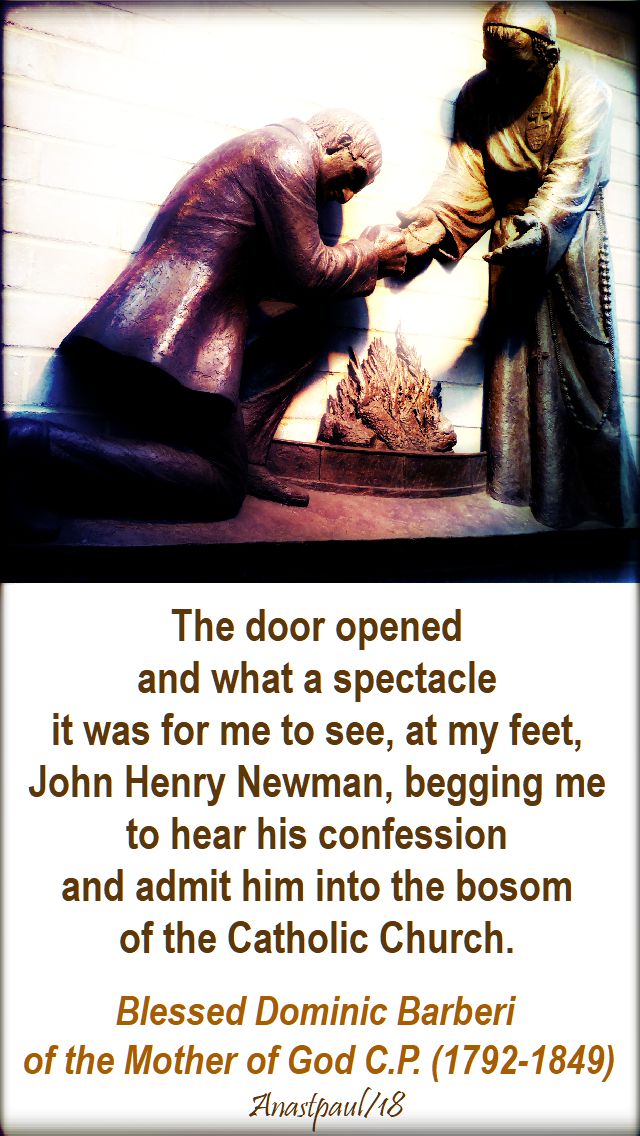
“The door opened and what a spectacle
it was for me to see, at my feet,
John Henry Newman, begging me
to hear his confession
and admit him into the bosom
of the Catholic Church.”

Blessed Dominic Barberi of the Mother of God C.P. (1792-1849)the door opened and what a spectacle - bl dominic barberi 27 aug 2018-no 2

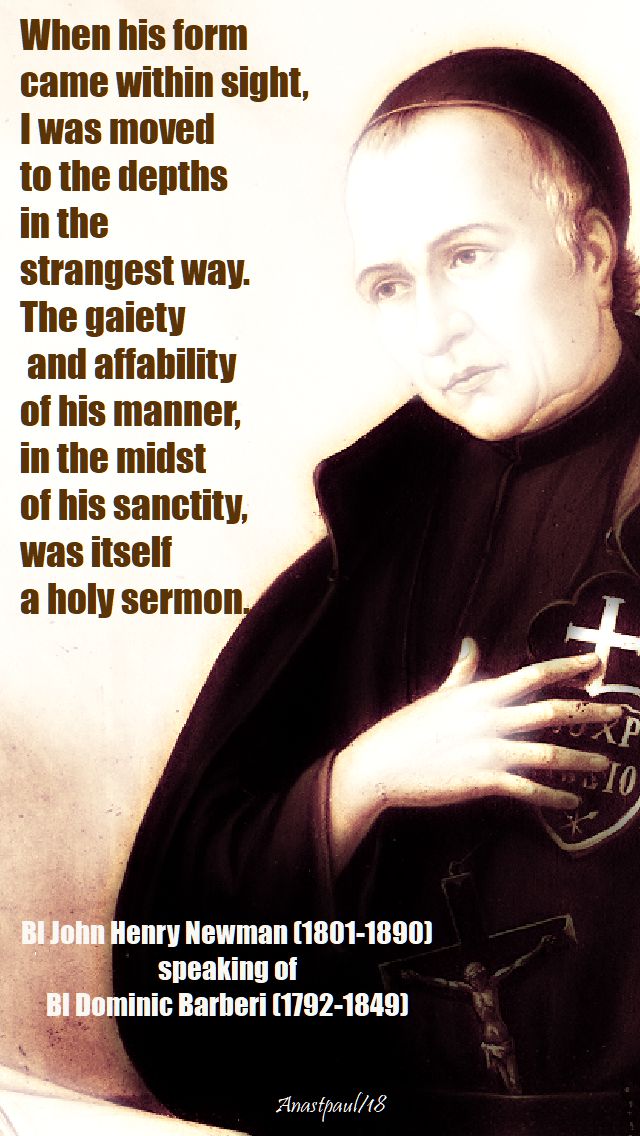
“When his form came within sight,
I was moved to the depths in the strangest way.
The gaiety and affability of his manner,
in the midst of his sanctity,
was itself a holy sermon.”

Blessed John Henry Newman (1801-1890) speaking of
Blessed Dominic Barberi (1792-1849)when his form came within sight - bl john henry on bl dominic barberi - 27 aug 2018-2

Posted in MORNING Prayers, QUOTES of the SAINTS, SAINT of the DAY, The HOLY EUCHARIST / The HOLY MASS, The WORD

One Minute Reflection – 27 August – The Memorial of Blessed Dominic Barberi of the Mother of God C.P. (1792-1849)

One Minute Reflection – 27 August – The Memorial of Blessed Dominic Barberi of the Mother of God C.P. (1792-1849)

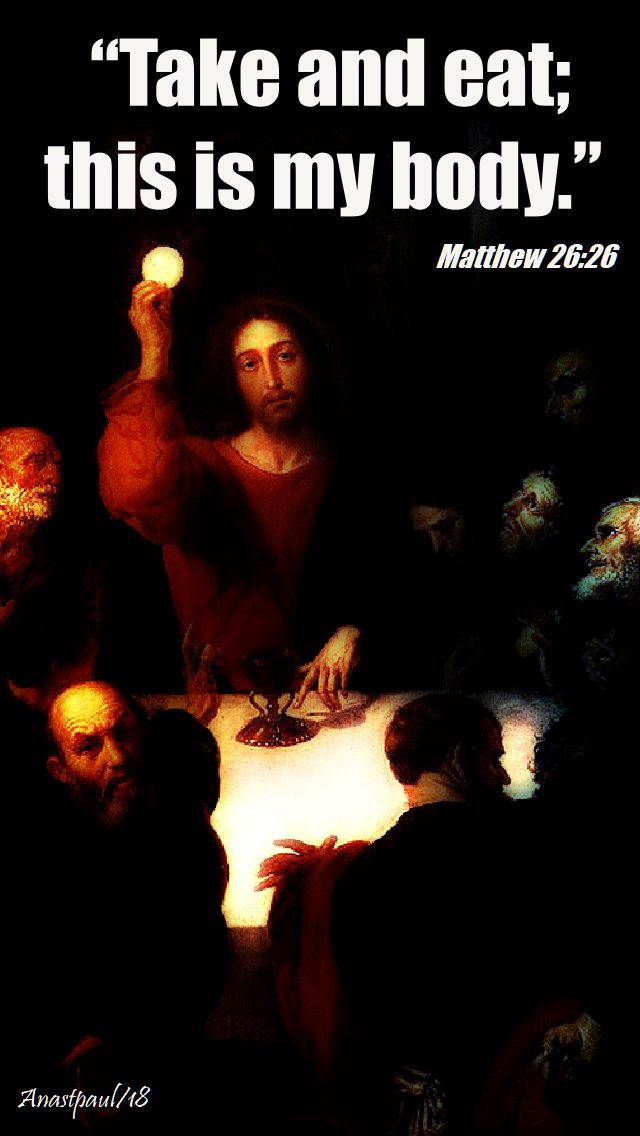
While they were eating, Jesus took bread, said the blessing, broke it and giving it to his disciples said, “Take and eat; this is my body.”…Matthew 26:26take and eat this is my body matthew 26 26 - 27 aug 2018

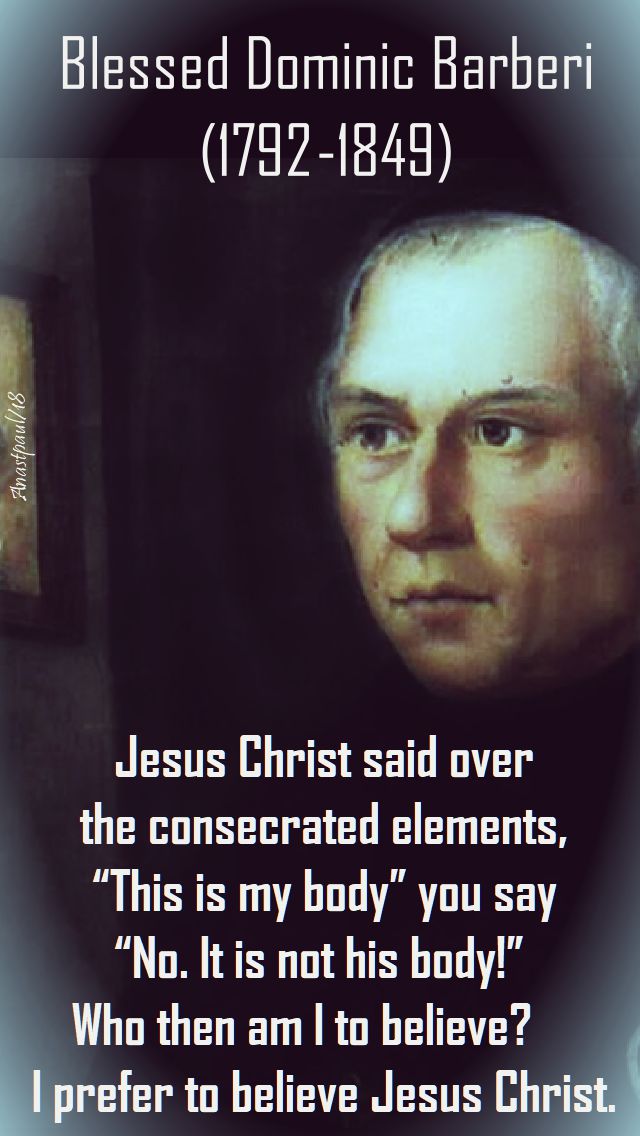
REFLECTION – “Jesus Christ said over the consecrated elements, “This is my body” you say “No. It is not his body!”   Who then am I to believe?   I prefer to believe Jesus Christ.”…Blessed Dominic Barberi (1792-1849)jesus christ said over the consecrated elements - bl dominic barberi - 27 aug 2018

PRAYER – O God, who so lovingly raised Blessed Dominic to the heights of holiness, learning and apostolic zeal and made him a powerful minister of Your mercy for the return of many of our separated brethren to the Catholic Church, grant to us here below, an abundant share of his virtues and deign, through his intercession, to grant us this particular grace.   May we too, according to our state, contribute to the realisation of his desire for the union of all Christians in the one True Fold under the one Shepherd.   We ask this through our Lord Jesus, with the Holy Spirit, one God forever, amen.bl dominic barberi pray for us 27 aug 2018


Posted in Our MORNING Offering, PRAYERS of the SAINTS, SAINT of the DAY

Our Morning Offering – 27 August – The Memorial of Blessed Dominic Barberi of the Mother of God C.P. (1792-1849)

Our Morning Offering – 27 August – The Memorial of Blessed Dominic Barberi of the Mother of God C.P. (1792-1849)

One of Bl Dominic’s major Conversions, Bl John Henry, will do the honours today.

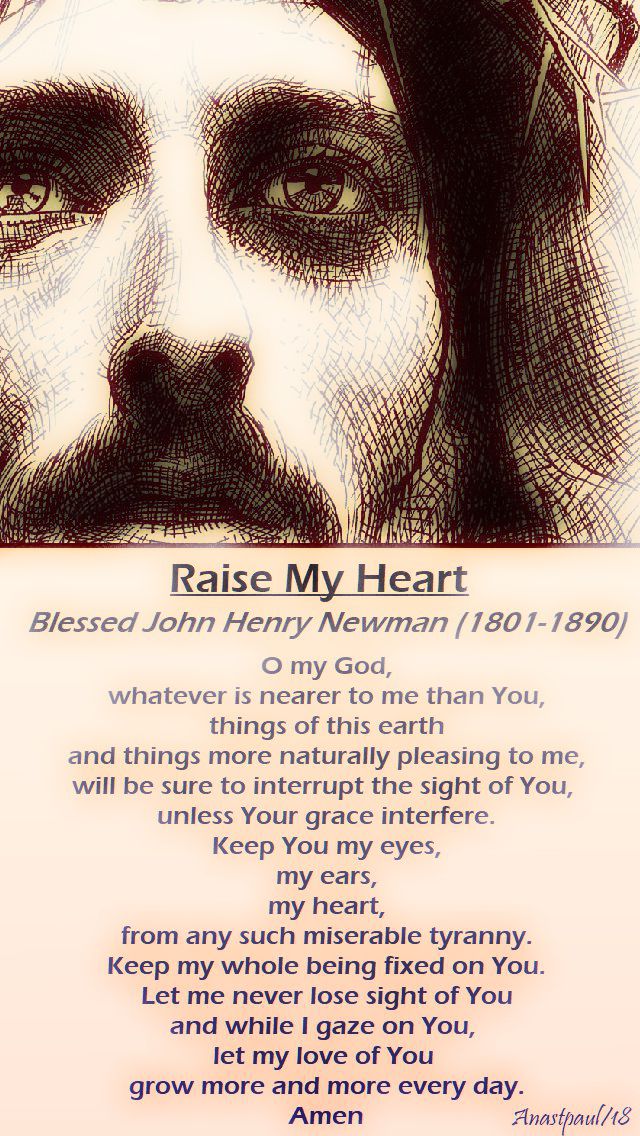
Raise My Heart
Blessed John Henry Newman (1801-1890)

O my God,
whatever is nearer to me than You,
things of this earth
and things more naturally pleasing to me,
will be sure to interrupt the sight of You,
unless Your grace interfere.
Keep You my eyes,
my ears,
my heart,
from any such miserable tyranny.
Keep my whole being fixed on You.
Let me never lose sight of You
and while I gaze on You,
let my love of You
grow more and more every day.
Amenraise-my-heart-bl-john-henry-newman-26-march 2018 -mon-of-holy-week-o-my-god-whatever-is-nearer1-RECOLOURED - 27 aug 2018

Posted in SAINT of the DAY

Saint of the Day – 27 August – Blessed Dominic Barberi of the Mother of God C.P. (1792-1849) Apostle to England

Saint of the Day – 27 August – Blessed Dominic Barberi of the Mother of God C.P. (1792-1849) Apostle to England – Passionist Priest, Theologian, Confessor, Teacher, Spiritual Direcotor, Writer, Missionary, Evangelist – born on 22 June 1792 at Viterbo, Italy and died at 3pm  on 27 August 1849 at Reading, Berkshire, England of a heart attack.   Patronage – England.   St Dominic was an Italian, a member of the Passionist Congregation and was extremely prominent in spreading Catholicism in England.   He was a very positive influence on and instrumental in, the conversion of Blessed Cardinal John Henry Newman (1801-1890). bl dominic barberi - lg  Dominic was born to a poor family of Italian farmers in 1792.   He was orphaned at the tender age of eight and an uncle and aunt raised him in the town of Merlano.   Young Dominic was not sent to school but instead was taught to shepherd sheep.   But the child always found time to pray as he tended the sheep and he also diligently taught himself to read and write.
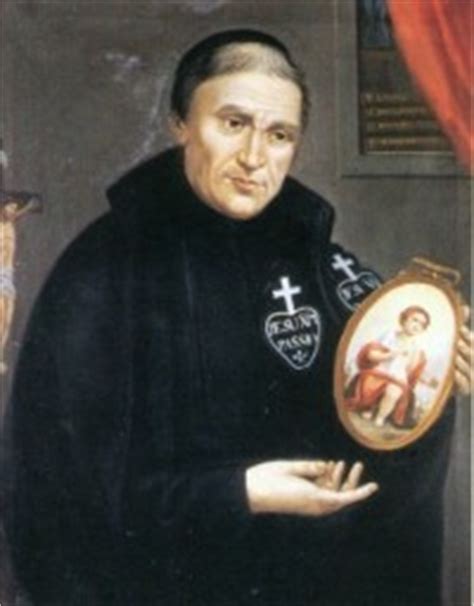
When Napoleon closed all the religious houses in Italy, Dominic became acquainted with several Passionists living in exile near his town.   During this time, Dominic experienced a divine message to join the Passionists and one day go to England.

Dominic had promised God that if he were not drafted, he would become a Passionist. Dominic’s uncle and aunt had also planned a marriage for him.   But just before the arranged marriage was to take place, he slipped away and instead entered the nearby Passionist monastery at Vetralla.   Dominic studied eagerly, for he had a brilliant mind.   He was ordained in Rome on 1 March 1821.   For the next nineteen years he shared the life and ministries of the Passionists in Italy but his heart was in England.

Mission in England
In 1833, Dominic became a delegate to the General Chapter.   In this capacity, he was able to plant the seed to send missionaries to England.    By the time of the 1839 General Chapter, changes in the Congregation were afoot.   The new General Superior was the charismatic Father Anthony Testa.   By April of 1840, Father Testa decided that Dominic should go to England, though he worried for Dominic’s failing health.   He sent him with three companions to Belgium to make a foundation in that country with the hope that from Belgium the mission to England could be realised.   Dominic established the first Passionist monastery outside of Italy in 1840, at Ere in Belgium.bl dominic 3

Finally, the time came to establish the first Passionist residence in England.   Father Dominic and a companion went to England and obtained a house at Aston Hall in Staffordshire.   One of his first ministries was the celebration of the 1842 Holy Week services.
While in Italy and later in Belgium, Barberi had always kept up a keen interest in the Oxford Movement.   In 1841 a letter by John Dobree Dalgairns appeared in L’Univers explaining the position of the Anglican High Church party.   Barberi decided to respond to this letter in the mistaken belief that it represented the views of the entire faculty of Oxford University.   (Dalgairns was an undergraduate when he wrote the letter.) Barberi’s “Letter to University Professors at Oxford” describes his long hopes for the conversion of England and his belief that the men of Oxford would be instrumental in such a conversion.   The letter, through the help of Ignatius Spencer, eventually ended up in the hands of Dalgairns, who was residing with John Henry Newman at Littlemore. Barberi repudiated the Anglican claim that the 39 Articles could be interpreted in a Catholic light.   In their continued correspondence Dalgairns and Barberi debated the Catholic position and Dalgairns requested copies of the Passionist Rule and Dominic’s ‘The Lament of England’.   Eventually Dalgairns was received into the Catholic Church by Barberi at Aston in September 1845.

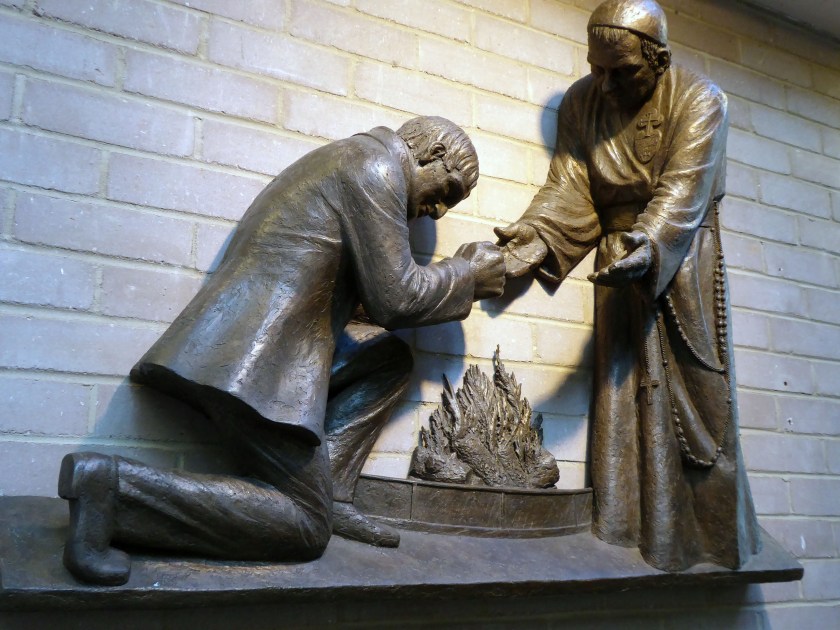
In October of that same year Barberi visited Littlemore, where Newman made his confession to him.   Newman relates in his “Apologia” how Barberi arrived soaked from the rain and as was drying himself by the fire when Newman knelt and asked to be received into the Catholic Church.   This event is marked by a sculpture in the Catholic Church of Blessed Dominic Barberi at Littlemore.   Two of Newman’s companions at Littlemore were also received, and Barberi celebrated Mass for them the following morning.   Subsequently, Newman and Barberi always took note of each other’s careers.

Dominic felt immensely blessed to have received the famous Anglican into the Catholic Church.   “What a spectacle it was for me to see Newman at my feet!   All that I have suffered since I left Italy has been well compensated by this event. I hope the effects of such a conversion may be great.”  blesseds dominic and john henry

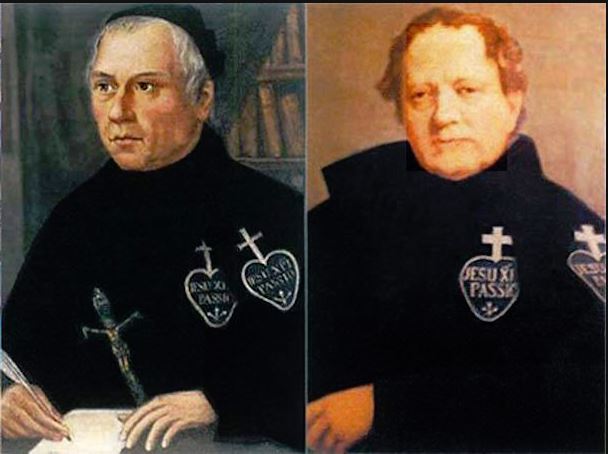
English vocations were few but Dominic was deeply consoled by the arrival of Father George Spencer who received the habit on 5 January 1847.   Spencer was a convert of some years and already ordained, when Dominic came to England in 1841.   Now as a fellow Passionist, he proved a great comfort to Dominic and the Passionists.   A little note of interest – Venerable Ignatius Spencer of St Paul (1799-1864) born as Hon George Spencer, was a son of the Second Earl Spencer.   He converted from Anglicanism to the Roman Catholic Church, entered the Passionist Order in 1841 at the age of 31, scandalising some in the Victorian society and spent his life working for the conversion of England to the Catholic faith.   He is also known as the ‘Apostle of Prayer for England’ and the great-great uncle of Princess Diana (died 1997).

bl dominic and ven spencer
Blessed Dominic Barberi and Venerble Ignatius Spencer


In August, 1849, Dominic was returning to Aston Hall from London.   About five miles from Reading, Dominic got desperately sick.   He was taken off the train to be attended by a doctor but there was not a room for him at the small station of Pangbourne.   Father Louis put him back on the train for Reading.   He died there from a heart attack at 3:00 p.m., 27 August 1849.

In the tradition of Blessed Dominic (he was beatified by Pope Paul VI in 1963), Passionists would be aware that ecumenism is an essential part of their heritage.   At the time of the Second Vatican Council, Passionists accepted with joy the call to engage in ecumenical ministries.   The “renewal” of the Congregation in the spirit of Vatican II would challenge the modern Passionist to this ecumenical mission.

In his years in England Dominic established three churches and several chapels, preached innumerable missions and received hundreds of converts, not only Newman but others such as Spencer and Dalgairns and many unknown by name.bl dominic medalBlesseddom2-shrine


Posted in SAINT of the DAY

Memorials of the Saints -27 August

St Monica (322-387) (Memorial)
Celebrating St Monica: https://anastpaul.wordpress.com/2017/08/27/saint-of-the-day-27-august-st-monica-of-hippo/

St Agilo of Sithin
Bl Angelus of Foligno
St Anthusa the Younger
St Arontius of Potenza
St Baculus of Sorrento
St Caesarius of Arles
St Carpophorus
St David Lewis
St Decuman
Bl Dominic Barberi of the Mother of God C.P. (1792-1849)

St Ebbo of Sens
St Etherius of Lyons
St Euthalia of Leontini
St Fortunatus of Potenza
Bl Gabriel Mary
St Gebhard of Constance
St Giovanni of Pavia
St Honoratus of Potenza
Bl Jean Baptiste Guillaume
Bl Jean-Baptiste Souzy
St John of Pavia
St Licerius of Couserans
St Malrubius of Merns
Bl Maria del Pilar Izquierdo Albero
St Narnus of Bergamo
St Phanurius
St Poemen
Bl Roger Cadwallador
St Rufus of Capua
St Sabinian of Potenza
St Syagrius of Autun

Martyrs of Tomi – 5 saints: A group of 17 Christians imprisoned and excuted for their faith during the persecutions of Diocletian. They miraculously were unburned by fire and untouched by wild animals. We know the names and a few details on five of them – John, Mannea, Marcellinus, Peter and Serapion. They were tied to stakes and burned alive; they emerged unharmed – thrown to wild animals in the amphitheatre; the animals ignored them; they were beheaded in 304 in Tomi, Mesia (modern Costanza, Romania).

Martyred in the Spanish Civil War:
• Blessed Buenaventura Gabika-Etxebarria Gerrikabeitia
• Blessed Esteban Barrenechea Arriaga
• Blessed Fernando González Añon
• Blessed Francisco Euba Gorroño
• Blessed Hermenegildo Iza Aregita
• Blessed José María López Carrillo
• Blessed Juan Antonio Salútregui Iribarren
• Blessed Pedro Ibáñez Alonso
• Blessed Pelayo José Granado Prieto
• Blessed Plácido Camino Fernández
• Blessed Quirino Díez del Blanco
• Blessed Ramón Martí Soriano

Posted in EUCHARISTIC Adoration, MORNING Prayers, PAPAL SERMONS, SUNDAY REFLECTIONS, The HOLY EUCHARIST / The HOLY MASS

Sunday Reflection – 13 August

Sunday Reflection – 13 August – 21st Sunday of the Year in Ordinary Time, Year B – Today’s Gospel: John 6:60–69

Eucharistic Meditation by Pope Benedict XVI (Excerpt)
Lourdes, 14 September 2008

Do Not Refuse His Love
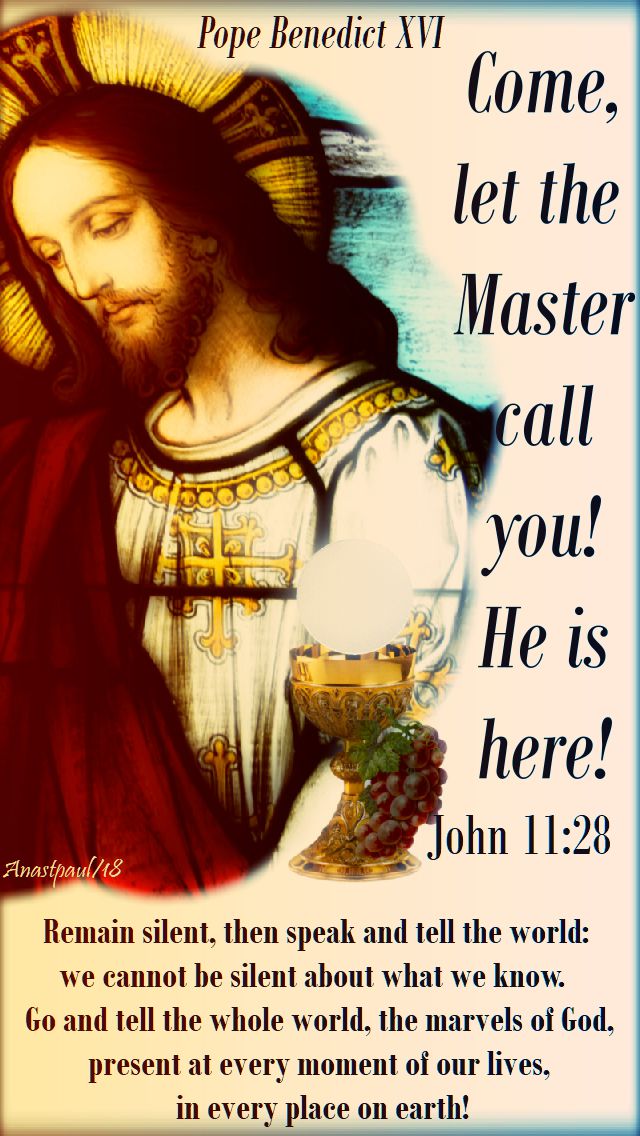
This evening, we do not see them but we hear them saying to us, to every man and to every woman among us:  “Come, let the Master call you! He is here!   He is calling you” (cf. Jn 11:28)!   He wants to take your life and join it to His.   Let yourself be embraced by Him!   Gaze no longer upon your own wounds, gaze upon His.   Do not look upon what still separates you from Him and from others;  look upon the infinite distance that He has abolished by taking your flesh, by mounting the Cross which men had prepared for Him and by letting Himself be put to death so as to show you His love.   In His wounds, He takes hold of you;   in His wounds, He hides you.   Do not refuse His Love!”

Contemplate the Wounds of Christ
The immense crowd of witnesses who have allowed themselves to be embraced by His Love, is the crowd of saints in heaven who never cease to intercede for us.   They were sinners and they knew it but they willingly ceased to gaze upon their own wounds and to gaze only upon the wounds of their Lord, so as to discover there the glory of the Cross, to discover there the victory of Life over death.   Saint Pierre-Julien Eymard (1811-1868) tells us everything when he cries out:  “The holy Eucharist is Jesus Christ, past, present and future” (Sermons and Parochial Instructions After 1856, 4-2.1, “On Meditation”).

Jesus Christ Past
Jesus Christ, past, in the historical truth of the evening in the Upper Room, to which every celebration of holy Mass leads us back.

Jesus Christ Present
Jesus Christ, present, because He said to us:  “Take and eat of this, all of you, this is my Body, this is my Blood.”   “This is”, in the present, here and now, as in every here and now throughout human history.   The Real Presence, the Presence which surpasses our poor lips, our poor hearts, our poor thoughts.   The Presence offered for us to contemplate as we do here, this evening, close to the grotto where Mary revealed herself as the Immaculate Conception.

Jesus Christ Coming
The Eucharist is also Jesus Christ, future, Jesus Christ to come.   When we contemplate the Sacred Host, His glorious transfigured and risen Body, we contemplate what we shall contemplate in eternity, where we shall discover that the whole world has been carried by its Creator during every second of its history.   Each time we consume Him but also each time we contemplate Him, we proclaim Him until he comes again, “donec veniat”. That is why we receive Him with infinite respect.

Remain Silent, Then Speak
Beloved brothers and sisters, day pilgrims and inhabitants of these valleys, brother Bishops, priests, deacons, men and women religious, all of you who see before you the infinite abasement of the Son of God and the infinite glory of the Resurrection, remain in silent adoration of your Lord, our Master and Lord Jesus Christ.   Remain silent, then speak and tell the world:  we cannot be silent about what we know.   Go and tell the whole world the marvels of God, present at every moment of our lives, in every place on earth.   May God bless us and keep us, may He lead us on the path of eternal life, He who is Life, forever and ever. Amen.come, let the master call you - remain silent - pope benedict - 26 aug 2018 sunday reflection

Posted in CATHOLIC-PRAYERS OF THE CHURCH, EUCHARISTIC Adoration, MORNING Prayers, POETRY, PRAYERS for PRIESTS, PRAYERS for VARIOUS NEEDS

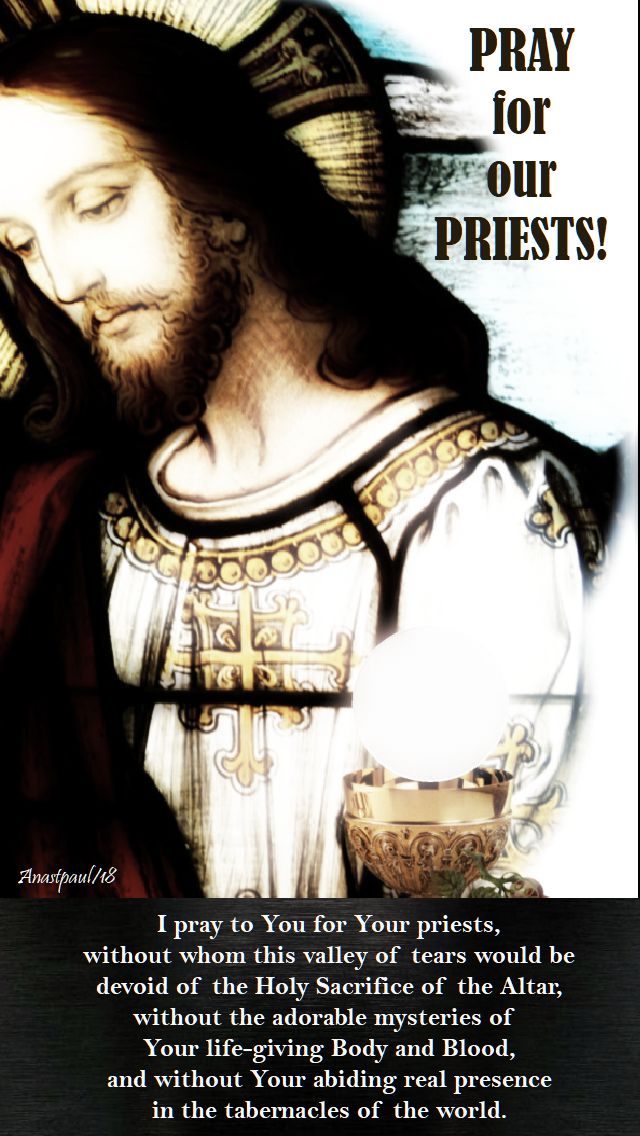
Second Thoughts for the Day – 26 August – Pray for our Priests

Second Thoughts for the Day – 26 August – 21st Sunday of the Year in Ordinary Time, Year B – Today’s Gospel: John 6:60–69

May we offer our Sunday Communion for all the Priests of the World, who bring us the Sacrament which gives us life.

O my beloved Jesus,
Son of the Father and His Eternal High Priest,
offering Yourself to Him perpetually in the sanctuary of heaven
and here in the Sacrament of Your Redeeming Love,
I adore You.

I praise You that here I find Your Eucharistic Heart,
open, ever-beating with love,
and covering with a flood of Blood and of Water
those who draw near to You in this Sacrament.

I praise You that here I behold Your Eucharistic Face,
filling the shadows of this world with Your deifying light,
and shining into the hearts of those who approach You
in faith, in hope and in love.

I pray to You for Your priests,
without whom this valley of tears would be
devoid of the Holy Sacrifice of the Altar,
without the adorable mysteries of Your life-giving Body and Blood,
and without Your abiding real presence in the tabernacles of the world.

Sanctify Your priests, O Jesus!
Wash them in the Blood and Water gushing at every moment
from Your Sacred Side
Heal them in the light of Your Eucharistic Face and,
to do this, draw them all into Your sacramental presence.

Let Your tabernacles magnetise their souls,
and the desire to abide before Your Eucharistic Face
hold sway over their hearts.
Let Your Sacred Body exposed in the monstrance
exercise over them the most compelling of all attractions.

Look today upon those priests who, for whatever reason,
have forgotten the way to Your tabernacles
and rarely, if ever, stop all else
to rest their tired bodies and still their minds
before Your Eucharistic Face,
and to adore You simply because . . . You are there.

Save Your priests in danger of falling into sin,
and lift those who have fallen,
so that, having confessed their faults and received absolution,
they may return to Your altar and to the joy of their youth.

Let not one of Your priests remain outside the radiance of Your Eucharistic Face.
Draw them all out of this world’s darkness
into Your wonderful light,
that with the psalmist they might say not once,
but again and again:
“Look to Him and be radiant
and on your faces there will be no trace of shame.”
Amen.

I pray especially for my own Priest, Fr Enrico Parry and Catholic Priest Media – https://catholicpriestmedia.com/pray for our priests - i pray to you for your priests - 26 aug 2018sanctify your priests o jesus - 26 aug 2018 pray for our priests

Posted in MARIAN QUOTES, MARIAN TITLES, MORNING Prayers, QUOTES of the SAINTS, SAINT of the DAY, The BLESSED VIRGIN MARY

Quote/s of the Day – 26 August – The Feast of Our Lady of Czestochowa, Queen of Poland

Quote/s of the Day – 26 August – The Feast of Our Lady of Czestochowa,

Queen of Poland

“Let Mary never be far from your lips
and from your heart.
Following her, you will never lose your way.
Praying to her, you will never sink into despair.
Contemplating her, you will never go wrong.”

St Bernardine of Siena (1380-1444)let mary never be far from our lips - st bernardine - 26 aug 2018

Posted in franciscan OFM, MORNING Prayers, PAPAL SERMONS, QUOTES of the SAINTS, QUOTES on FAITH, QUOTES on HUMILITY, SAINT of the DAY, The BLESSED VIRGIN MARY, The WORD

One Minute Reflection – 26 August – Today’s Gospel: John 6:60–69

One Minute Reflection – 26 August – 21st Sunday of the Year in Ordinary Time, Year B – Today’s Gospel: John 6:60–69

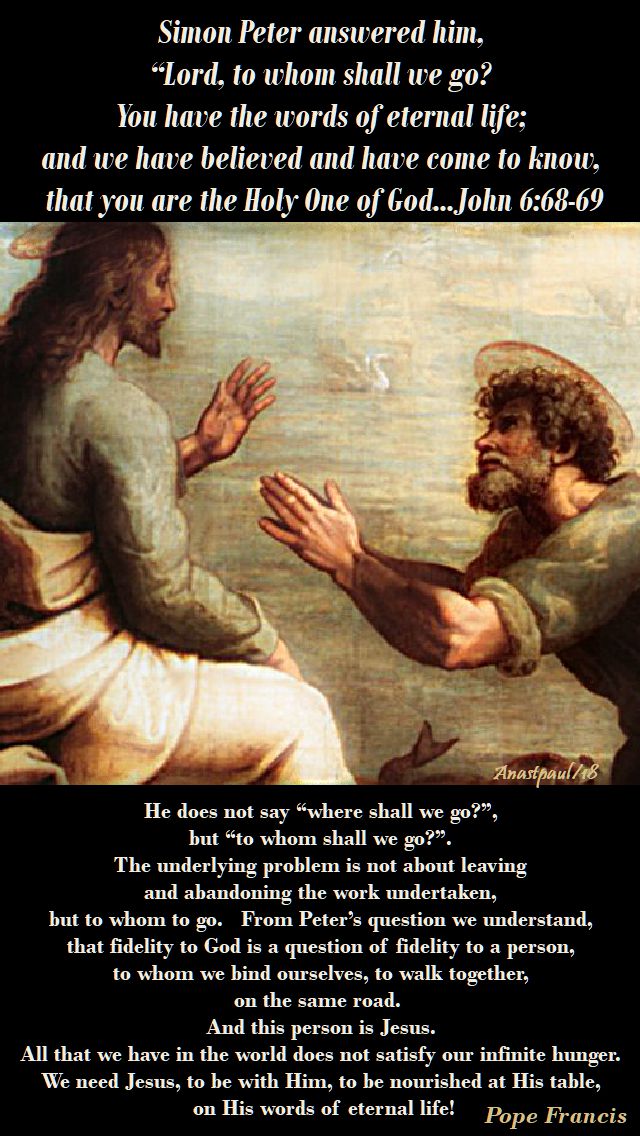
Simon Peter answered him, “Lord, to whom shall we go? You have the words of eternal life and we have believed, and have come to know, that you are the Holy One of God.”...John 6:68-69

REFLECTION – “He does not say “where shall we go?” but “to whom shall we go?”   The underlying problem, is not about leaving and abandoning the work undertaken but to whom to go.   From Peter’s question, we understand, that fidelity to God is a question of fidelity to a person, to whom we bind ourselves, to walk together on the same road.   And this person is Jesus.   All that we have in the world does not satisfy our infinite hunger. We need Jesus, to be with Him, to be nourished at His table, on His words of eternal life!”…Pope Francis (Angelus, 23 August 2015)to whom shall we go - john 6 68-69 - he does not say where shall we go - pope francis - 26 aug 2018

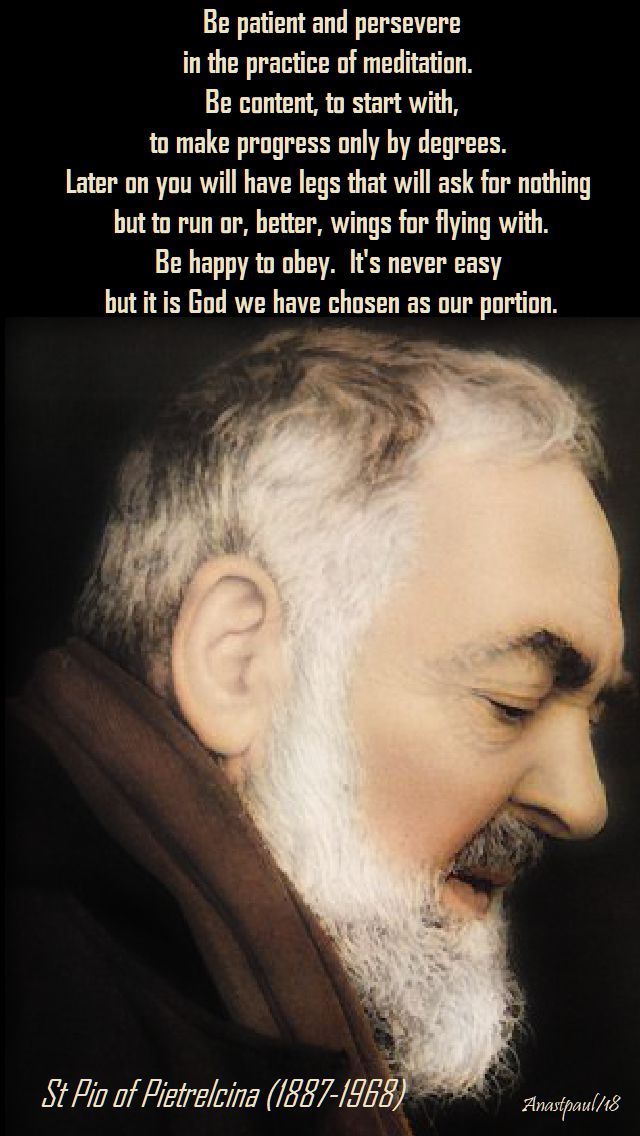
“Be patient and persevere in the practice of meditation.   Be content, to start with, to make progress only by degrees.   Later on you will have legs that will ask for nothing but to run or, better, wings for flying with.
Be happy to obey.   It’s never easy but it is God we have chosen as our portion.   Accept that, as yet, you are only a little bee in its nest but, very quickly, it will become one of those wonderful workers so skilful in making honey.   Always remain humble before God and men, in love.   Then our Lord will speak to you in truth and enrich you with His gifts.”…St Pio of Pietrelcina “Padre Pio” (1887-1968)be patient and persevered - st pio - 26 aug 2018

PRAYER – Lord, by Your grace, we are made one in mind and heart.   Give us a love for what You command and a longing for what You promise, so that, amid this world’s changes, our hearts may be set on the world of lasting joy.   May the intercession of Your faithful servant, St Pope Zephyrinus, bring us strength and courage.   As it was Your will heavenly Father, that, at the angel’s message, Your Word should be conceived by the Blessed Virgin Mary, grant that as we believe her to be truly the Mother of God, so may we be helped always, by her intercession.   Through our Lord, Jesus Christ, in union with the Holy Spirit, ‘totus tuus’ Maria – please pray for us, amen.immaculate-mary-pray-for-us-26 aug 2017

Posted in EUCHARISTIC Adoration, Our MORNING Offering, PRAYERS of the SAINTS, The HOLY EUCHARIST / The HOLY MASS, Thomas a Kempis

Our Morning Offering – 25 August – A Eucharistic Offering

Our Morning Offering – 25 August – 21st Sunday of the Year in Ordinary Time, Year B

A Eucharistic Offering
By Thomas à Kempis (1380-1471)

Lord, all things in heaven and earth are Yours.
I desire to offer myself to You
in free and perpetual oblation,
so that I may forever be with You.
Lord, in simpliciy of heart,
I offer myself this day to You,
to be Your servant in service
and sacrifice of perpetual praise.
Accept me with the oblation of Your precious Body,
which this day I offer You in the presence
of Your holy angels, here invisibly present,
so that it may be to my salvation
and to the salvation of all people.
Amena eucharistic offering - thomas a kempis - lord all things in heaven-26 august 2018

Posted in SAINT of the DAY

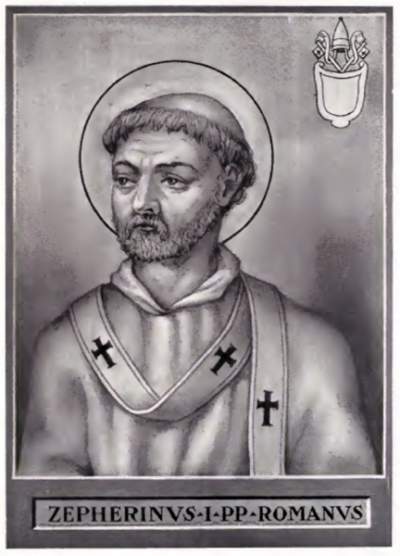
Saint of the Day – 25 August – St Pope Zephyrinus (died 217) Martyr

Saint of the Day – 25 August – St Pope Zephyrinus (died 217) Martyr, he was Bishop of Rome or Pope from 199 to his death in 217. He was born in Rome. His predecessor was Pope Victor I. Upon his death on 20 December 217, he was succeeded by his principal advisor, Pope Callixtus I. He is known for combatting heresies and defending the divinity of Christ.zeph

Saint Zephyrinus, a native of Rome, succeeded Victor I in the pontificate in the year 198. In 202 Septimus Severus, a military despot, raised the fifth and most bloody persecution against the Church, which continued for nine years until the death of the emperor in 211. Until this furious storm ended, the holy pastor remained concealed for the sake of his flock, supporting and comforting the distressed disciples of Christ.   He suffered by charity and compassion, what every confessor underwent.   The triumphs of the martyrs were indeed his joy but his heart received many deep wounds from the fall of apostates and heretics.   Nor did this latter affliction cease, when peace was restored to the Church.Zephyrinus2

The holy Pope had the affliction of witnessing the fall of Tertullian.   He saw to his joy, however, the conversion of Natalis, who had become a heretical bishop when he lapsed into the Theodotian heresy.   God, wishing to bring him back to the Church, sent him a solid correction which opened his eyes and he came to kneel at the feet of the Vicar of Christ, wearing a hair shirt and humbly asking pardon for his revolt.

Eusebius tells us that this holy Pope exerted his zeal so strenuously against the blasphemies of the heretics, that they treated him with the utmost contempt.   To his glory, however, they also called him the principal defender of Christ’s divinity.st pope zephyrius

St Zephyrinus filled the pontifical chair nineteen years, dying in 217  . He was buried in his own cemetery, on the 26th of August.   He is, in some Martyrologies, styled a martyr, which title he might deserve by what he suffered in the persecution, though he perhaps did not die by the executioner.header st pope zephyrinus

Posted in MARIAN TITLES, SAINT of the DAY

Feast of Our Lady of Czestochowa, Queen of Poland & Memorials of the Saints – 26 August

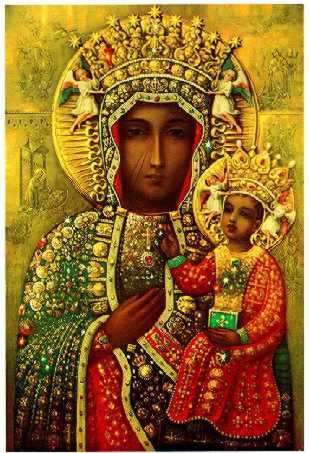
Our Lady of Czestochowa, Queen of Poland

Czestochowa
Visit our Mother here: https://anastpaul.wordpress.com/2017/08/26/blessed-feast-of-our-lady-of-czestochowa-queen-of-poland-26-august/

St Abundius the Martyr
St Alexander of Bergamo
St Anastasius the Fuller
St Bregwin of Canterbury
St Elias of Syracuse
St Eleutherius of Auxerre
St Felix of Pistoia
Bl Herluin
Bl Ioachim Watanabe Jirozaemon
St Irenaeus of Rome
Bl Jacques Retouret
St Jeanne Elizabeth des Bichier des Anges
Bl Jean Bassano
Bl Jean of Caramola
Bl Juan Urgel
Bl Levkadia Herasymiv
Bl Margaret of Faenza
St Mary of Jesus Crucified
St Maximilian of Rome
St Melchizedek the Patriarch
St Orontius of Lecce
St Pandwyna
St Rufinus of Capua
St Secundus the Theban
Bl Stanislaus Han Jeong-Heum
St Teresa de Gesu, Jornet y Ibars
St Victor of Caesarea
St Victor the Martyr
St Vyevain of York
St Pope Zephyrinus (died 217) Martyr

Martyrs of Celano – 3 saints: Three Christians, Constantius, Simplicius and Victorinus, martyred in the same area at roughly the same time. That’s really all we know, though it didn’t stop writers in later centuries from inventing colourful histories, making them a father and sons, adding saintly family members, earthquakes, close escapes, etc.
They were martyred in c 159 in the Marsica region of Italy. At some point their relics were interred under the main altar of the San Giovanni Vecchio church in the Collegiata di Celano and were authenticated in 1057 by Pope Stephen IX. The city was depopulated in 1222; when it was re-built, the relics were re-enshrined in the church of San Vittorino on 10 June 1406. Patronage – Celano, Italy.

Martyred in the Spanish Civil War:
• Blessed Emilio Serrano Lizarralde
• Blessed Francesc Casademunt Ribas
• Blessed Josep Maria Tolaguera Oliva
• Blessed Luis Valls Matamales
• Blessed María de Los Ángeles Ginard Martí
• Blessed Pere Sisterna Torrent

Posted in MORNING Prayers, SAINT of the DAY

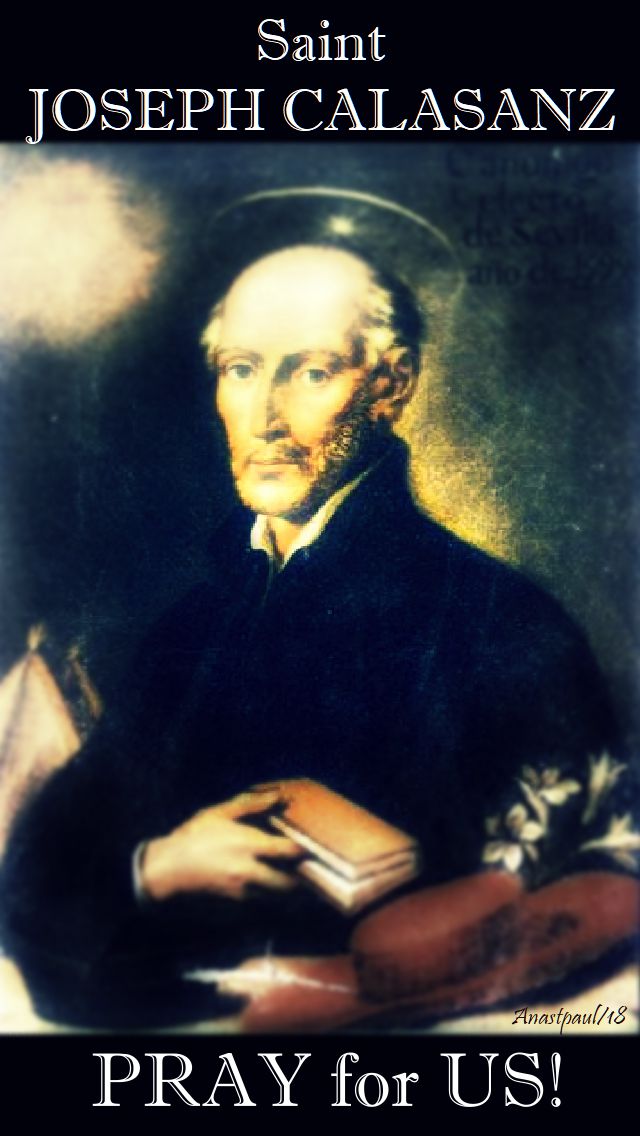
Thought for the Day – 25 August – The memorial of St Joseph Calasanz (1557-1648) Founder

Thought for the Day – 25 August – The memorial of St Joseph Calasanz (1557-1648) Founder

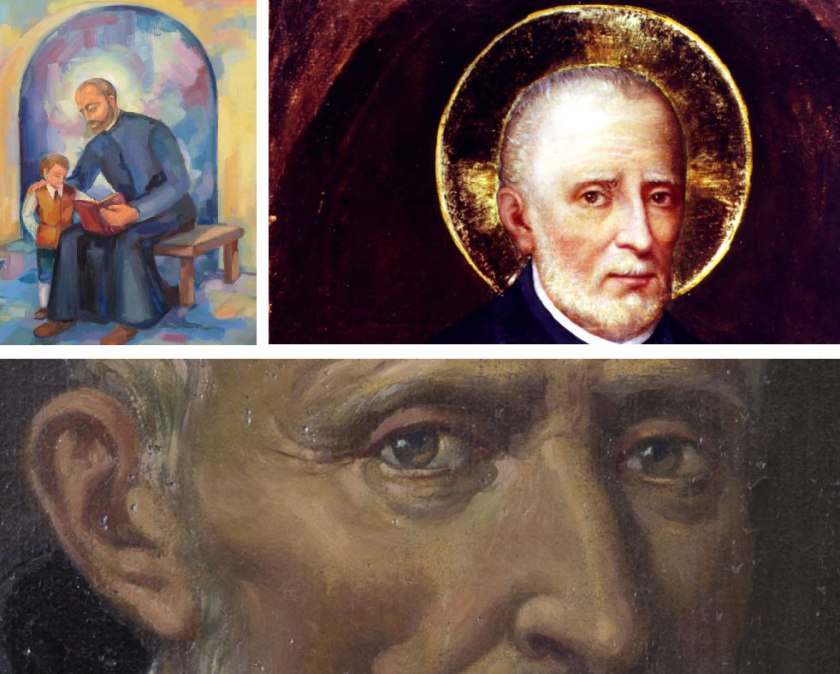
St Joseph Calasanz followed the inner indications of God in his heart.   Besides the service of the school, he was open to help at any time, especially when circumstances were adverse.   For example, when the river Tiber was over flooded, there he was saving lives.

In 1601, King Philip III sent a messenger to share the good news that he had granted Joseph a canonry in Seville, one of the most important and beautiful cities in Spain.   But he declined the offer, and said NO, with this words:  “I have found the definitive to serve God doing good to these little ones and I will never leave it for anything in the world.”

Calasanz had burned the boats of his first dreams and ambitions and he never again went back to his native land.   He remained in Rome giving education to poor children, for the rest of his life.   Much of his strength came from his great devotion to Mary, the Mother of God.   He signed his letters – ‘Joseph of the Mother of God’.   A clear and powerful sign that his congregation and his person, were placed under the loving
protection of the Mother of Jesus Christ, God‐with‐us.   Saint Joseph Calasanz, wanted that all meetings and gatherings finished with this beautiful prayer:

“We fly to thy patronage, oh Holy Mother of God,
Despise not our petitions in all our necessities,
But from all kind of dangers always deliver us
Oh, ever blessed Virgin Mary.”

Calasanz gave an order to build a sanctuary dedicated to the Mother of God in Frascati, where the Piarists had the first foundation outside Rome, in 1616.   He brought the image of our Lady personally.   It consists in an icon of Mary, crowned as Queen, holding tenderly her Son Jesus. Joseph urged his sons to pray constantly to Mary, for her patronage and protection is the stronghold of those loved by God.

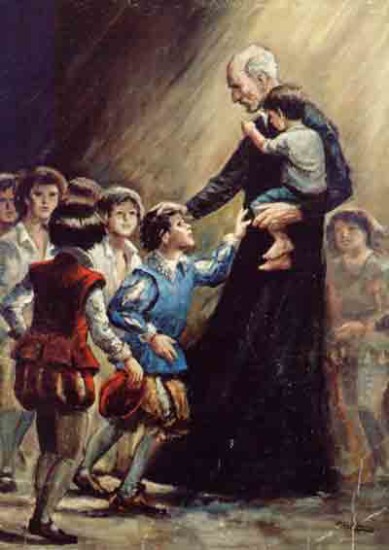
He was a humble and simple person, ready to abase himself and do whatever necessary for love of the little ones:  he swept the classrooms, prepared the ink in the inkwells, had prepared the fountain pens, went to the streets begging for alms for the schools, washed the dishes took care of the order and discipline of the schools, and he liked to visit the students –above all little ones‐ in the classrooms.   Besides he accompanied them back home after the school period.   For Calasanz, a Piarist plays the role of the guardian angel we all have from the moment of our conception and birth.

This was Saint Joseph Calasanz:  without evading the sweetness of heart he remained persistent in his inner convictions in favour of the needy, for whom he became their voice, a sheer opportunity to improve themselves through the exceptional gift of the
education for all, beginning by the least and the last, the poorest among the poor.   He never lost hope that one day his religious order would be restored and poor children would be served through it throughout the world.

The Piarist Fathers, are a beautiful reality today, through which the Risen Lord is proclaimed alive, following the footsteps of their Holy Founder.   To be a Piarist is a way to a joyful holiness, ministering generously to children and young people, especially the poorest.   The Piarists do not seek honours and privileges, their life is simple and they prepare themselves to be good educators and evangelisers, according to the present circumstances of our time.

Today they are present in 35 different countries.   They are about 1400 religious, distributed in 250 communities.   Though their most natural ambience is the school, they also give importance to missions, to non‐formal education, youth groups, parishes, small Christian communities, development programs, Calasanzian Fraternities, schools of Christian leadership, etc.   All this in communion with the Church, for they are her children.  They ask you all to lean on our Mother, to run to her, to ask and pray for humility that you too may serve all who are in need of your love!

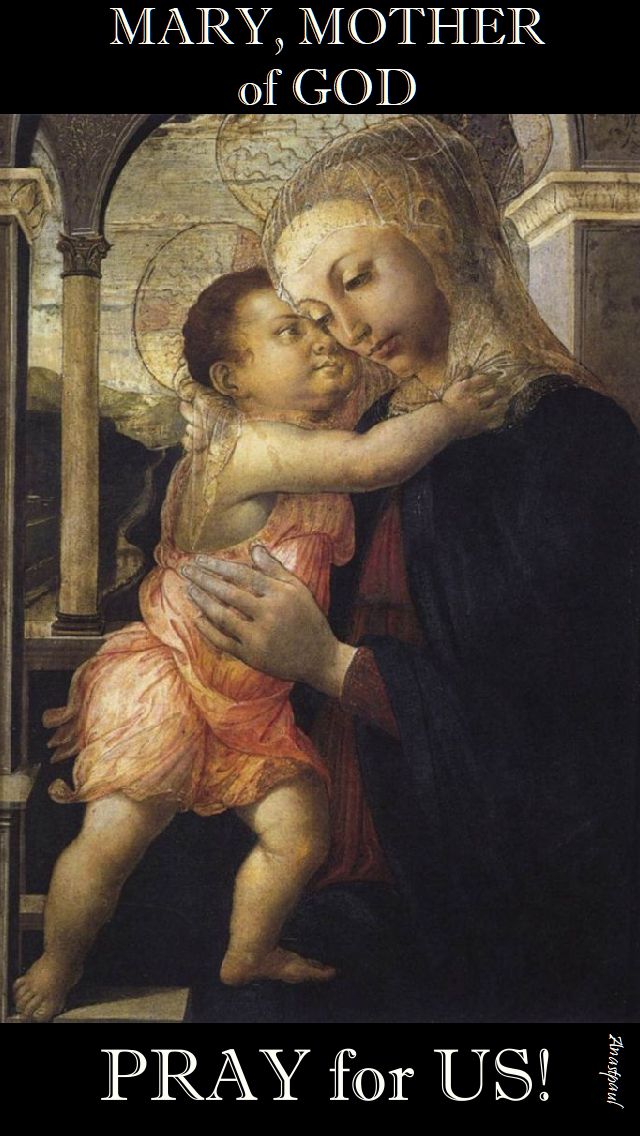
Mary, Mother of God, Pray for us!mary mother of god pray for us

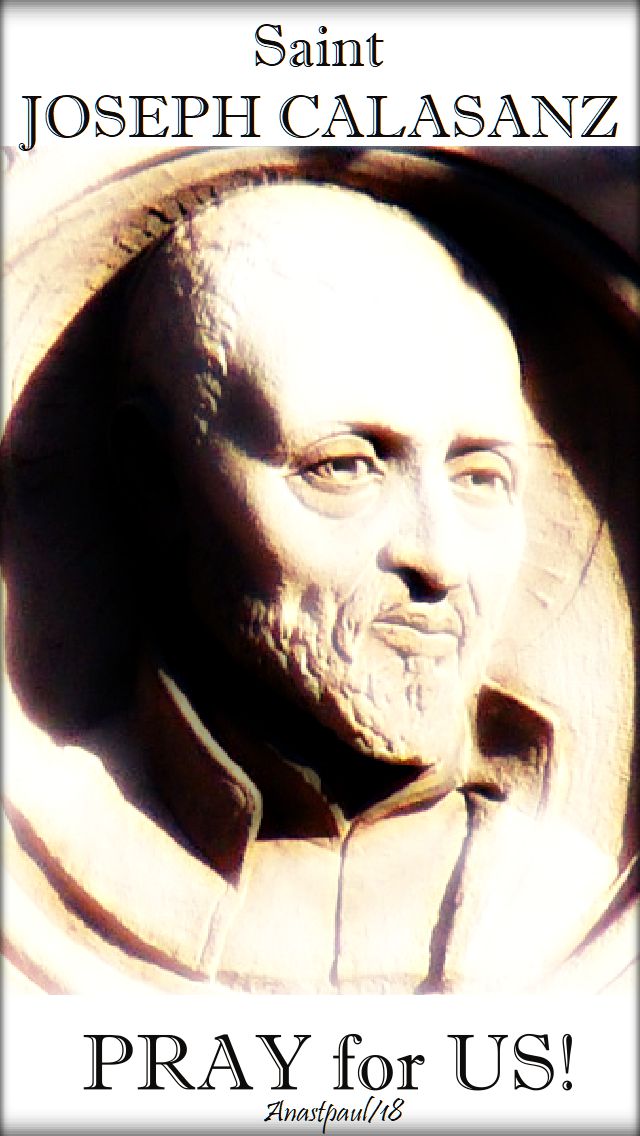
St Joseph Calasanz, Pray for Us!st joseph calasanz pray for us no 2 - 25 aug 2018

Posted in MORNING Prayers, QUOTES of the SAINTS, QUOTES on CHARITY, QUOTES on HUMILITY, QUOTES on LOVE, QUOTES on OBEDIENCE, SAINT of the DAY

Quote of the Day – 25 August – The Memorial of St Joseph Calasanz (1557-1648) Founder

Quote of the Day – 25 August – The Memorial of St Joseph Calasanz (1557-1648) Founder

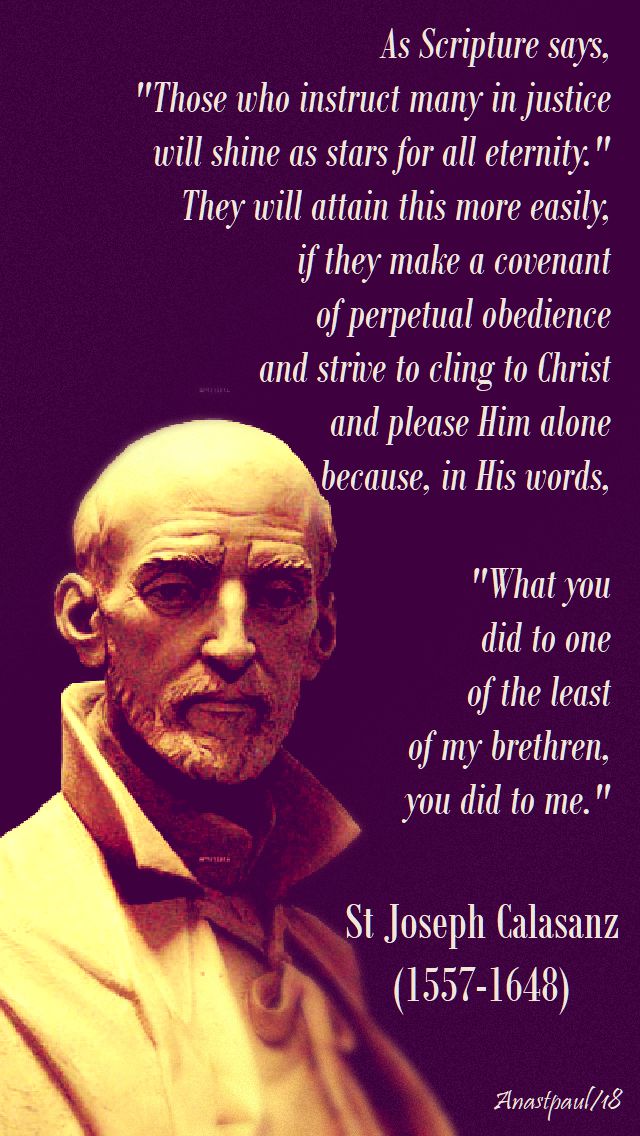
“As Scripture says,
“Those who instruct many in justice
will shine as stars for all eternity.”
They will attain this more easily,
if they make a covenant of perpetual obedience
and strive to cling to Christ
and please Him alone
because, in His words,
“What you did to one of the least
of my brethren, you did to me.”

  1. St Joseph Calasanz (1557-1648)as scripture says - st joseph calasanz - 25 aug 2018

Posted in DOCTORS of the Church, MORNING Prayers, QUOTES of the SAINTS, QUOTES on HUMILITY, QUOTES on TRUTH, SAINT of the DAY, The WORD

One Minute Reflection – 25 August – Today’s Gospel: Matthew 23:1–12

One Minute Reflection – 25 August – Saturday of the Twentieth week in Ordinary Time, Year B, Today’s Gospel:   Matthew 23:1–12 – The Memorials of Sts Louis IX, (1214-1270) King of France and St Joseph Calasanz (1557-1648) Founder

“….so practice and observe whatever they tell you, but not what they do; for they preach but do not practice.”...Matthew 23:3

REFLECTION – “Someone who is filled with the Holy Spirit speaks different languages (Acts 2:4).   These different languages are differing testimonies to Christ, such as humility, poverty, patience and obedience.   We speak them when, in practising them ourselves, we show them to others.   The word is alive when it is our actions that speak.   Please, I beg you, let words be silenced and actions speak!   We are full of words but empty of deeds and because of this the Lord curses us just as he cursed the fig tree on which he found no fruit but only leaves (Mk 11:13f.).   Saint Gregory says that: “The Law has been made known to the preacher so that he might practice what he preaches.”   A person who spoils his teaching by his deeds is wasting his time spreading knowledge of the law.
But the apostles spoke according to the Spirit’s gift.   Happy are those who speak according to the Spirit’s gift and not according to their own feelings…  So let us speak as the Spirit gives us utterance.   Let us humbly and devoutly ask Him to shed His grace within us.”..St Anthony of Padua (1195-1231) Doctor of the Church (Sermons)the word is alive when it is our actions - st anthony of padua - 25 aug 2018

“All who undertake to teach must be endowed with deep love, the greatest of patience and, most of all, profound humility.   They must perform their work with earnest zeal. Then, through their humble prayers, the Lord will find them worthy to become fellow workers with Him in the cause of truth.”…St Joseph Calasanzall who undertake to teach - st joseph calasanz - 25 aug 2018

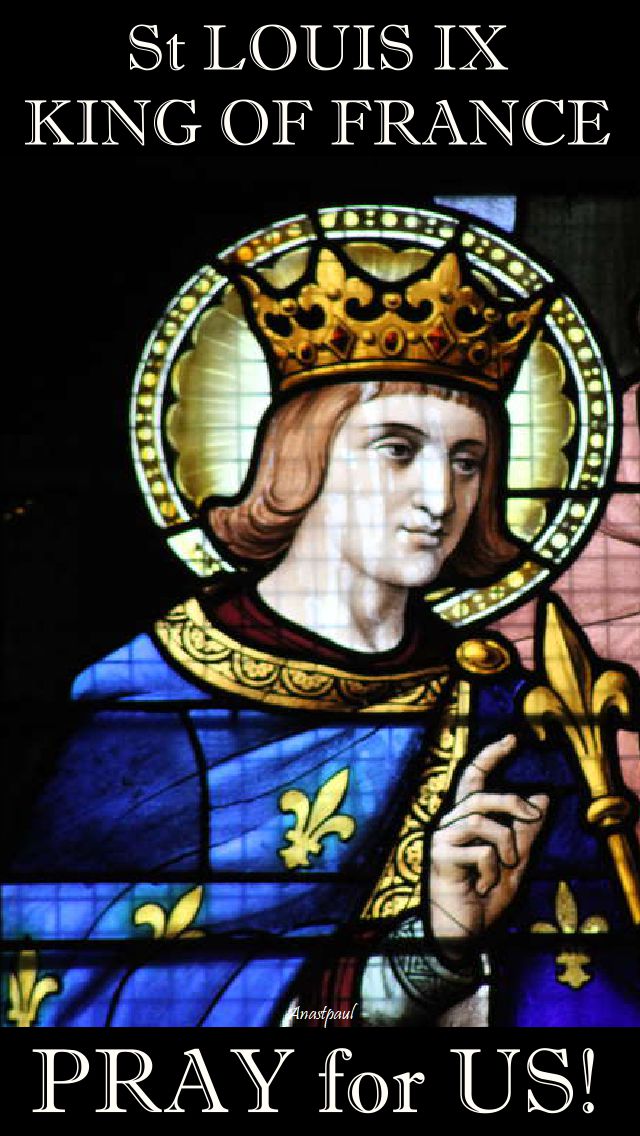
PRAYER – God our Father, help us to teach others about You by our example as well as our words.   Grant that we may spread Your truth and Your light wherever we go. St Louis, this is exactly what you sought to do, constantly serving God in penitence and prayer, ever mindful of His people.   You lived the greatest commandment and strove always to be an example to your people through your great love for our Lord and for His Church.   You gave St Joseph of Calasanz, remarkable gifts of priestly charity and patience.   Grant that while we honour him as a master of wisdom, we may imitate him, by teaching the truth by our way of life.   St Louis, St Joseph, please pray for our Priests and for us all! Amenst-louis-pray-for-us-2-25 aug 2017st joseph calasanz pray for us - 25 aug 2018

Posted in Our MORNING Offering, PRAYERS of the SAINTS, SAINT of the DAY

Our Morning Offering – 25 August – The Memorial of St Louis IX (1214-1270) – King of France

Our Morning Offering – 25 August – The Memorial of St Louis IX (1214-1270) – King of France

Prayer inspired by St Louis’ Last Instructions
to his Eldest Son, Philip

(Perhaps Philip prayed thus)

O God, we love You.
We want to do nothing to displease You.
If we have troubles, let us thank You.
If we don’t, we also humbly thank You.
Let us look for ways to grow closer to You,
whether in Confession, prayer, or at Mass.
Let us open our hearts to afflicted people
and do what we can to comfort them.
Let us look for ways to improve our society.
Thank You for friends who help us bear
our burdens and help us grow in holiness.
Let us turn away from gossip or swearing.
Let us always do what is right for those
we serve and promote peace among our neighbours.
Let us be quick to defend our Faith.
O Holy Trinity, all You holy saints,
please defend us from all evils.
Please give us grace to do Your will always,
so that You are honoured
and so we may be with You forever.
Amenprayer-inspired-by-st-louis-last-instructions-st-louis-king-of-france-25 aug 2018

Posted in Of Catholic Education, Students, Schools, Colleges etc, SAINT of the DAY

Saint of the Day – 25 August – St Joseph Calasanz Sch.P. (1557-1648)

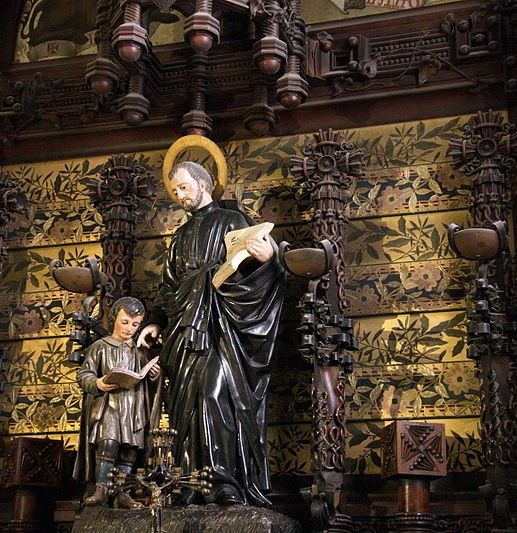
Saint of the Day – 27 August – St Joseph Calasanz Sch.P. (1557-1648) (Also known as:  Joseph Calasanctius,  Joseph of Our Lady, Josephus a Matre Dei, Joseph Calsanza) was a Spanish Catholic Priest, Teacher, Lawyer, Founder of the Pious Schools, (providing free education to the sons of the poor) and the Religious Order that ran them, commonly known as the Piarists.   He was born on 11 September 1556 at Peralta, Barbastro, Aragon, Spain in his father’s castle and died on 25 August 1648 at Rome, Italy of natural causes.   Patronages – Catholic schools (proclaimed on 13 August 1948 by Pope Pius XII), schools, colleges, universities, students, schoolchildren, the Piarists and the Congregation of Christian Workers of Saint Joseph Calasanz.St. Joseph Calasanz at the Monastery of Montserrat.

Joseph  Calasanz was born in Aragon, Spain, in 1556 of a noble family, who gave him a very Christian education.   When only five years old, he led a troop of children through the streets to find the devil and slay him.   He became a lawyer and then a Priest (after a serious illness caused his father to relent in his opposition) and was engaged in various reforms when he heard a voice saying, “go to Rome, Joseph” and had a vision of many children who were being taught by him and by a company of Angels.   When he reached the Holy City, his heart was moved by the vice and ignorance of the children of the poor and he saw clearly that ignorance was the mother of vice and misery.   Sunday Catechism lessons were insufficient to remedy the situation.   When he could find no collaboration under the existing frameworks, the children’s need mastered his profound humility and he undertook to found personally, the Order of Clerks Regular of the Pious Schools, or the Piarists.CopiadeCalasanzRD2001.jpgSt-Joseph-Calasanz-e1440632416712

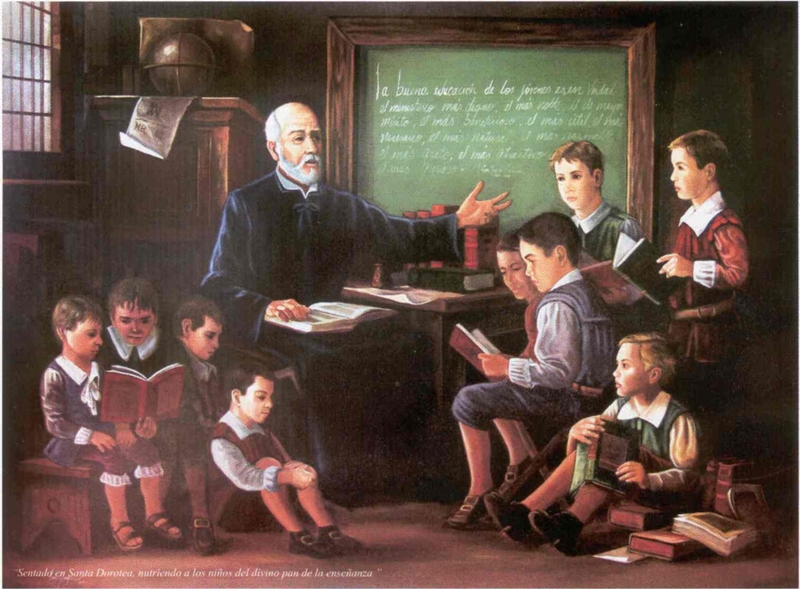
The parish priest of Saint Dorothy’s Church in Trastevere, placed two rooms at his disposition and assisted him in all things.   Two other good priests joined the founders, and the school soon had several hundred children.   He taught the children catechism, reading, writing and arithmetic and he himself provided all that was necessary for the program of instruction, receiving nothing in payment.   Other schools were organised elsewhere in Rome and the holy priest had scholars of every rank under his care.   Each lesson began with prayer.   Every half-hour, piety was renewed by acts of faith, hope and charity.   At the end of the day the children were escorted home by the masters, so as to escape all harm on the way.   An annual retreat was given them during the Easter season. Clement XIII approved the new Congregation, which became an Order with the ordinary three vows and in addition a definitive commitment to the instruction of the indigent.

Calasanz was a friend of Galileo Galilei and sent some distinguished Piarists as disciples of the great scientist.   He shared and defended his controversial view of the cosmos.  When Galileo fell into disgrace, Calasanz instructed members of his congregation to provide him with whatever assistance he needed and authorised the Piarists to continue studying mathematics and science with him.   Unfortunately, those opposed to Calasanz and his work used the Piarists’ support and assistance to Galileo as an excuse to attack them.   Despite such attacks, Calasanz continued to support Galileo.   When, in 1637, Galileo lost his sight, Calasanz ordered the Piarist Clemente Settimi to serve as his secretary.   But enemies arose against Saint Joseph, however, from among his own subjects, thus imposing on the Founder the most sorrowful of all crosses, resembling that of the Lord Himself.   They accused him to the Holy Office and at the age of eighty-six he was led through the streets to prison, where he was briefly held and interrogated by the Inquisition.

The Order was reduced to a simple Congregation under local episcopal authority and was not restored to its former privileges until after the Saint’s death.   Yet he died full of hope.   My work, he said, was done solely for the love of God.   Saint Joseph is the first to have given gratuitous instruction to the children of the people.   Religion can claim for its own the instruction of the poor, both by birthright and by right of conquest. st joseph statue larger my edit

St Joseph died at the age of 90 having always remained faithful in all things, admired for his holiness and courage by his students, their families, his fellow Piarists and the people of Rome.  The body of Saint Joseph  Calasanz reposes in the church of Saint Pantaleon in Rome, his heart and tongue are conserved incorrupt in a devotional chapel in the Piarist Motherhouse in Rome.  Eight years after his death, Pope Alexander VII cleared the name of the Pious Schools. Joseph Calasanz was beatified on 7 August 1748, by Pope Benedict XIV.   He was Canonised by Pope Clement XIII in 1767 and on 13 August 1948, Ven Pope Pius XII declared him to be the “Universal Patron of all Christian schools in the world.”

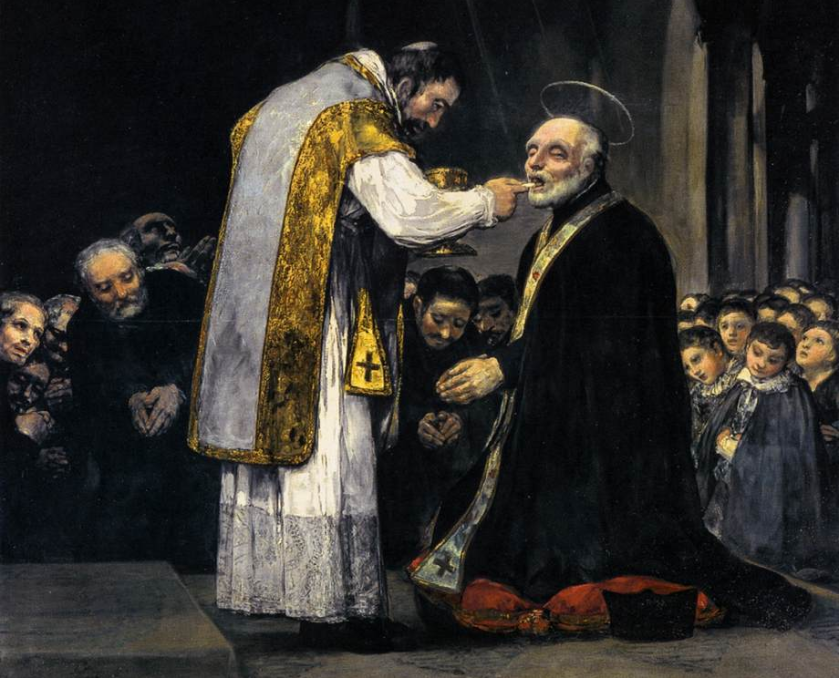
st joseph last communion
The last Holy Communion of St Joseph

Calasanz.header

Posted in SAINT of the DAY, Uncategorized

Memorials of the Saints – 25 August

St Joseph Calasanz Sch.P. (1557-1648) (Optional Memorial)

St Louis IX (1214-1270) King of France (Optional Memorial)
All about this wonderful Saint here: https://anastpaul.wordpress.com/2017/08/25/saint-of-the-day-25-august-st-louis-king-of-france/

St Alessandro Dordi
Bl Andrea Bordino
St Andreas Gim Gwang-Ok
St Aredius of Limoges
St Ebbe the Elder
Bl Eduard Cabanach Majem
St Eusbius of Rome
Bl Fermí Martorell Vies
Bl Francesc Llach Candell
St Genesius of Arles
St Genesius of Brescello
St Genesius of Rome
St Gennadius of Constantinople
St Geruntius of Italica
St Gregory of Utrecht
St Gurloes of Sainte Croix
St Hermes of Eretum
St Hunegund of Homblieres
St Julian of Syria
St Julius of Eretum
Bl Ludovicus Baba
Bl Ludovicus Sasada
Bl Luis Cabrera Sotelo
St Maginus
St Marcian of Saignon
Bl María del Tránsito de Jesús Sacramentado
Bl Maria Troncatti
St Menas of Constantinople
Bl Miguel Carvalho
St Nemesius of Rome
St Patricia of Naples
Bl Paul-Jean Charles
Bl Pedro de Calidis
St Peregrinus of Rome
St Petrus Gim Jeong-Duk
St Pontian of Rome
St Severus of Agde
St Thomas of Hereford
St Vincent of Rome

Martyred in the Spanish Civil War:
• Blessed Antoni Prenafeta Soler
• Blessed Antoni Vilamassana Carulla
• Blessed Enric Salvá Ministral
• Blessed Florencio Alonso Ruiz
• Blessed Fortunato Merino Vegas
• Blessed Josep Maria Panadés Terré
• Blessed Juan Pérez Rodríguez
• Blessed Luis Gutiérrez Calvo
• Blessed Luis Urbano Lanaspa
• Blessed Manuel Fernández Ferro
• Blessed Miguel Grau Antolí
• Blessed Pere Farrés Valls
• Blessed Ramon Cabanach Majem
• Blessed Salvi Tolosa Alsina
• Blessed Vicente álvarez Cienfuegos

Posted in VATICAN Resources

Vatican Pharmacy Launches Its First Collection of Perfumes

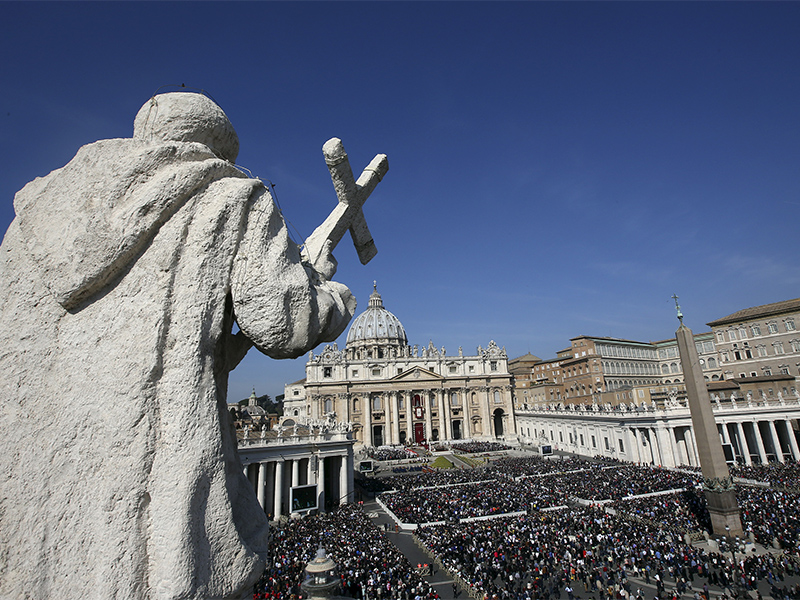
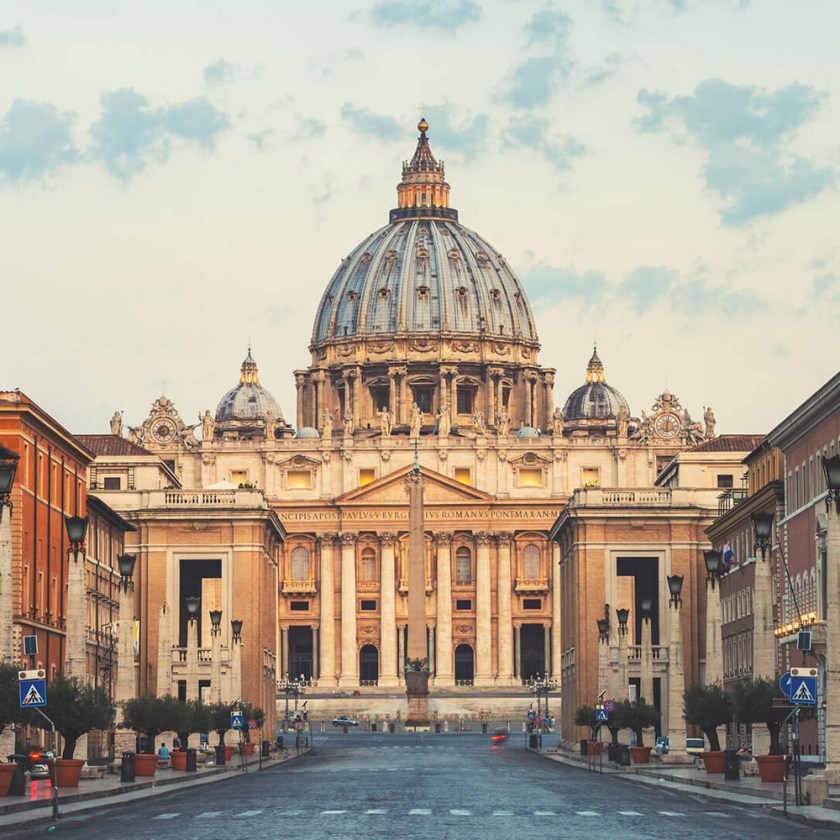
The Vatican Pharmacy launched its first range of perfumes produced by the apothecaries of the order of Saint John of God (Fatebenefratelli), who provide the service.   The new essences, inspired by the Bible, are called:  gold, incense, myrrh and mystical rose, reported L’Osservatore Romano on August 22, 2018.A general view is seen of Pope Francis leading the Easter mass in St. Peter's square at the Vatican

The four bottles are sold in a case that bears the inscription 2018 in Roman numerals (MMXVIII), as the Director Thomas Binish Mulackal explains, 2018 is a particularly important year for the Vatican Pharmacy, which has launched a great restructuring project in order to receive better the thousands of daily clients (between 2,000 and 2,500 a day).

The new perfumes aim to rediscover the role of fragrances in Christian life.   The researchers discovered ancient perfumes mentioned in the Holy Scriptures (the Magi offered incense and myrrh to Jesus) and they go back to their plants of origin, in the Mediterranean tradition and that of the Holy Land:  aloes, nard, galbanum, myrtle, saffron, roses, hyssop, sandalwood, aromatic reeds, cinnamon, geranium, bergamot.

It’s about “entrusting to perfume a message that refers to the meeting between the sacred and nature, between divinity and humanity, in order to transmit sensations that also invite to reflection”, incense, with its typical smell, refers to the presence of God, to purification  <and> to the sense of sacrifice.” Myrrh was used “as aroma and to preserve the mortal remains of the dead.” Both were also used as healing remedies. Gold is also “an effective method to combat certain pathologies, to the point that one speaks of gold therapy.”

There is “a long tradition that links the mystics to perfumes,” underscores L’Osservatore Romano “Beginning with the Virgin Mary, also called by the title “Mystical Rose,” to which the perfume of the same name makes reference. Suffice it to recall the ecstasies of dozens of women and men Saints, of whom the closest to us is Padre Pio of Pietrelcina.   The intense perfume that one perceived on certain occasions, according to the witnesses, was a mixture of emanations of flowers such as roses, violets and jasmine, to the point that one speaks of osmogenesie as the charism proper to his holiness.”

vatican-tour

Posted in GOD the FATHER, MORNING Prayers, OPEN HOUSE...Conversations with..., QUOTES of the SAINTS

Open House….Conversations with ….

Open House….Conversations with ….24 August

Little weekly reflections from those ‘minds alive’, our friends and intercessors waiting on our arrival.

Blessed John Henry, does created beauty reflect Divine Beauty?

“Leave, then, the prison of your own reasonings, leave the town, the work of man, the haunt of sin – go forth, my Brethren, far from the tents of Cedar and the slime of Babylon, with the patriarch, go forth to meditate in the field and from the splendours of the work, imagine the unimaginable glory of the Architect.

Mount some bold eminence and look back, when the sun is high and full upon the earth, when mountains, cliffs and sea rise up before you like a brilliant pageant, with outlines noble and graceful and tints and shows soft, clear and harmonious, giving depth and unity to the whole and then go through the forest, or fruitful field, or along meadow and stream and listen to the distant country sounds and drink in the fragrant air which is poured around you in spring or summer;  or go among the gardens and delight your senses with the grace and splendour and the various sweetness of the flowers you find there – then think of the almost mysterious influence upon the mind of particular scents, or the emotion which some gentle, peaceful strain excites in us, or how soul and body are rapt and carried away captive by the concord of musical sounds, when the ear is open to their power – and then, when you have ranged through sights and sounds and odours and your heart kindles and your voice is full of praise and worship, reflect – not that they tell you nothing of their Maker – but that they are the poorest and dimmest glimmerings of His glory and the very refuse of His exuberant riches and but the dusky smoke which precedes the flame, compared to Him Who made them!

Such is the Creator, in His Eternal Uncreated Beauty, that, were it given to us to behold it, we should die of very rapture at the sight!”

“The Mystery of Divine Condescension” Discourses addressed to mixed congregations – Blessed John Henry Cardinal Newman Cong. Orat. (1801-1890)

such is the creator - bl john henry newman - 1st conversations with....24 aug 2018.jpg

Posted in MORNING Prayers, SAINT of the DAY, The APOSTLES & EVANGELISTS

Thought for the Day – 24 August – The Feast of St Bartholomew, Apostle of Christ – Today’s Gospel: John 1:45–51

Thought for the Day – 24 August – The Feast of St Bartholomew, Apostle of Christ – Today’s Gospel: John 1:45–51

Bartholomew or Nathanael?   We are confronted again with the fact that we know almost nothing about most of the apostles.   Yet the unknown ones were also foundation stones, the 12 pillars of the new Israel whose 12 tribes now encompass the whole earth.   Their personalities were secondary—without thereby being demeaned—to their great office of bearing tradition from their firsthand experience, speaking in the name of Jesus, putting the Word Made Flesh into human words for the enlightenment of the world.   Their holiness was not an introverted contemplation of their status before God.   It was a gift that they had to share with others.   The Good News, was that, all are called to the holiness of being Christ’s members, by the gracious gift of God.

The simple fact is that humanity is totally meaningless unless God is its total concern.   Then humanity, made holy with God’s own holiness, becomes the most precious creation of God…(via Franciscan Media)

Note:   the name “Nathanael” means “God has given”.

St Bartholomew, Pray for us!st bartholomew pray for us - 24 aug 2018