Posted in NOVENAS, PRAYERS of the SAINTS, The HOLY GHOST

Our Morning Offering – 14 July

Our Morning Offering – 14 July – Saturday of the 14th Week in Ordinary Time, Year B

Sweet Light!
By St Teresa Benedicta of the Cross (1891-1942)

Who are You,
sweet Light, that fills me
And illumines
the darkness of my heart?
You lead me like a mother’s hand,
And should You let go of me,
I would not know
how to take another step.
You are the space
That embraces my being
and buries it in Yourself.
Away from You,
it sinks into the abyss
Of nothingness,
from which You raised it to the light.
You, nearer to me than I to myself
And more interior
than my most interior
And still impalpable
and intangible
And beyond any name,
Holy Spirit eternal love!
Amensweet light - who are you sweet light that fills me - prayer of st teresa benedicta - 14 july 2018

Posted in SAINT of the DAY

Saint of the Day – 14 July – St Camillus de Lellis M.I. (1550-1614) “The Giant of Charity”

Saint of the Day – 14 July – St Camillus de Lellis M.I. (1550-1614) Priest and Founder, known as “The Giant of Charity”.

st camillus flooding of the tiber
St Camillus assisting during the flooding of the Tiber

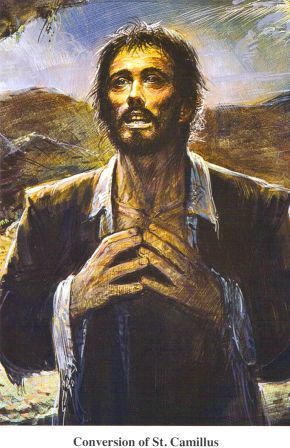
The early years of Camillus gave no sign of sanctity.   At the age of nineteen he took service with his father, an Italian noble, against the Turks and after four years hard campaigning found himself, through his violent temper, reckless habits and inveterate passion for gambling, a discharged soldier and in such straitened circumstances that he was obliged to work as a labourer on a Capuchin convent which was then being built.   A few words from a Capuchin friar brought about his conversion and he resolved to become a religious.

st camillus conversion

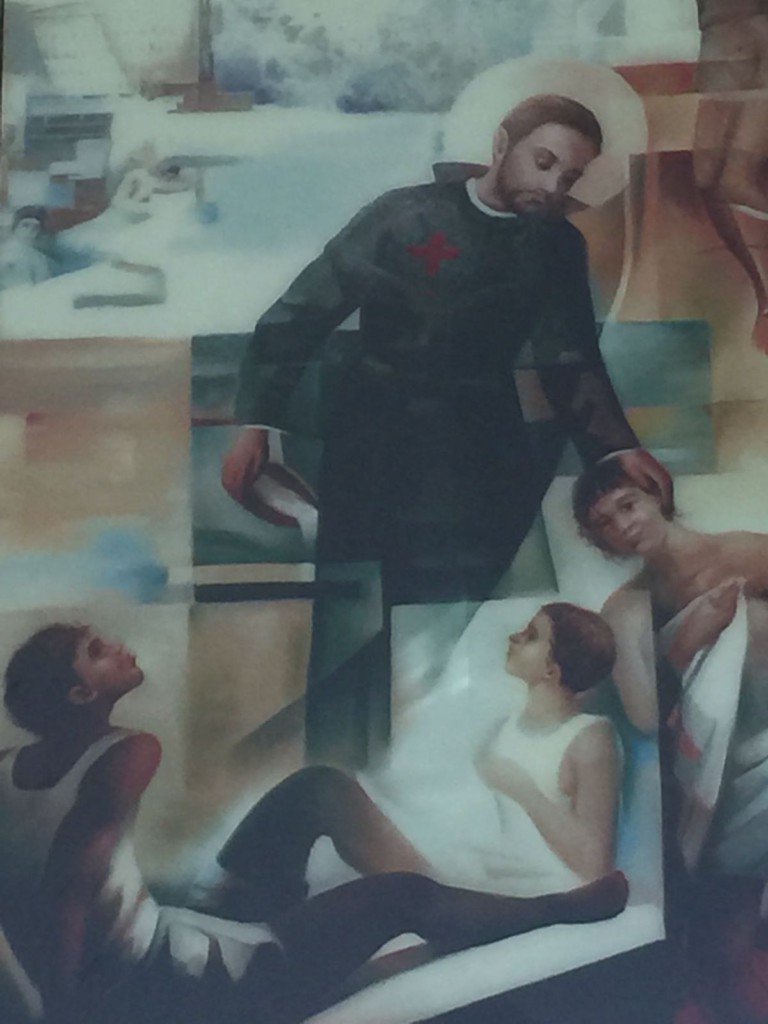
Thrice he entered the Capuchin novitiate but each time an obstinate wound in his leg forced him to leave.   He repaired to Rome for medical treatment and there took St Philip as his confessor and entered the hospital of St Giacomo, of which he became in time the superintendent.   The carelessness of the paid chaplains and nurses towards the suffering patients now inspired him, with the thought of founding a congregation to minister to patients.   header st camillusMembers of his order worked in hospitals, prisons and in the homes of those afflicted by disease.   The order’s original name, the “Fathers of a Good Death,” reflected the desire to aid in their spiritual salvation and prepare the dying to receive their last rites.   Later known as the Order of the Ministers of the Sick, or simply as the “Camillians,” the group received papal approval in 1586 and was confirmed as a religious order in 1591.   In addition to the traditional vows of poverty, chastity and obedience, they took a vow of unfailing service to the sick.

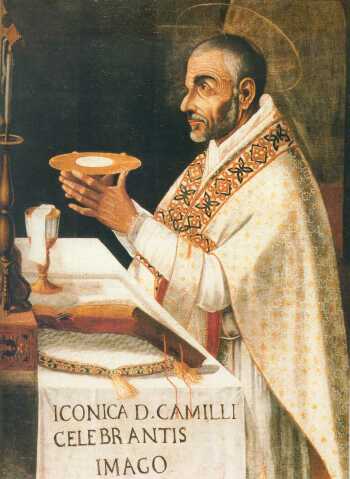
Camillus- saying mass

Summoned at every hour of the day and night, the devotion of Camillus never grew cold.   With a woman’s tenderness he attended to the needs of his patients.   He wept with them, consoled them and prayed with them.   He knew miraculously, the state of their souls and St Philip saw angels whispering to two Servants of the Sick who were consoling a dying person.   One day a sick man said to the Saint, “Father, may I beg you to make up my bed?  it is very hard.” Camillus replied, “God forgive you, brother!   You beg me! Don’t you know yet that you are to command me, for I am your servant and slave.” “Would to God,” he would cry, “that in the hour of my death one sigh or one blessing of these poor creatures might fall upon me!”


Camillus himself suffered physical ailments throughout his life.   His leg wound failed to heal over the course of almost five decades, in addition to which he suffered from sores and severe kidney trouble.   But he is said to have spent time with the sick even while unable to walk, by crawling from bed to bed.

The founder of the Ministers of the Sick lived to assist at a general chapter of his order in Rome during 1613 and to make a last visitation of many of their hospitals.    Learning that he himself was incurably ill, Camillus responded:  “I rejoice in what has been told me. We shall go into the house of the Lord.”apostle_camillusdelellis

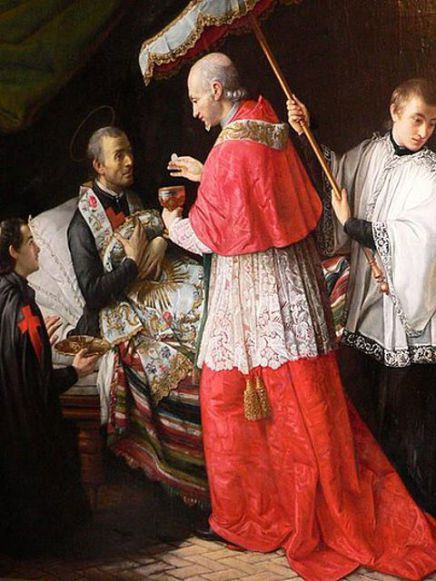
Receiving the Eucharist for the last time, he declared: “O Lord, I confess I am the most wretched of sinners, most undeserving of your favour but save me by your infinite goodness.   My hope is placed in your divine mercy through your precious blood.”

After giving his last instructions to his fellow Ministers of the Sick, St Camillus de Lellis died on 14 July 1614.   He was Canonised by Benedict XIV in 1746 and later named – along with Saint John of God – as one of the two main co-patrons of nurses and nursing associations in 1930.

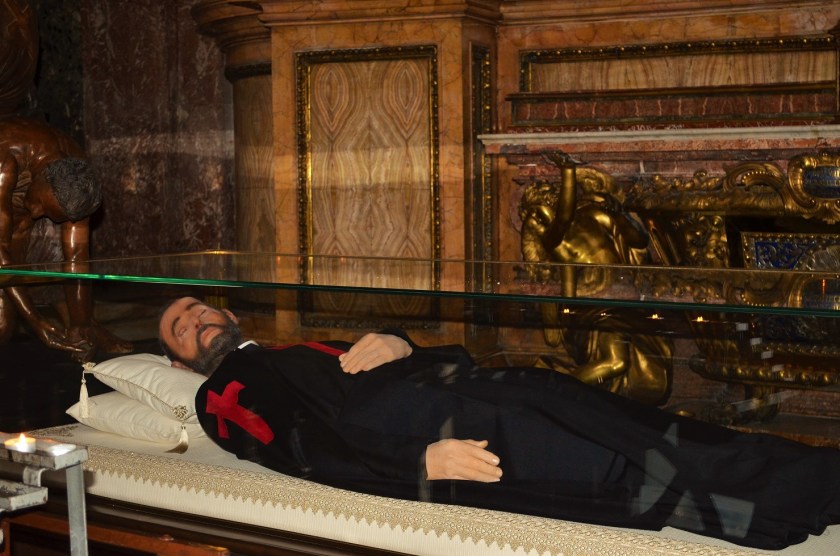
st camillus last ritesThe Transit the last Days on Earth of St. Camillus de Lellisbody of st camillusthe giant of charity

More on St Camillus here:    https://anastpaul.wordpress.com/2017/07/14/saint-of-the-day-14-july-st-camillus-de-lellis-m-i/

Posted in SAINT of the DAY, The BLESSED VIRGIN MARY

Feasts of Our Lady and Memorials of thne Saints – 14 July

St Camillus de Lellis (Optional Memorial)

Mare de Déu de Canòlich/Mother of God of Canolich:   Read further – http://www.mariancalendar.org/mare-de-deu-de-canolich-canolich-sant-julia-de-loria-andorra/canolich-fac3a7ana

Our Lady of Dromon:   Saint-Geniez, Alpes de Haute-Provence, Provence-Alpes-Côte d’Azur, France
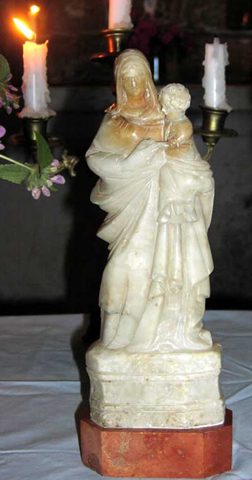
In 1656, about 2.5 miles from the alpine village of Saint-Geniez, as 12-year-old herder Honoré was praying before a wooden cross on a stone mound, he heard the voice of the Blessed Virgin asking him to dig there to uncover chapels dedicated to her long ago. Excavations on the mountain located a crypt chapel dating back to around 1000, on the site of the ancient city of Theopolis.   The upper chapel holds an alabaster statue of the Virgin and Child from the 1600s.   The annual pilgrimage takes place on Bastille Day, 14 July.

dromon-stgeniez1

Bl Angelina di Marsciano
Bl Boniface of Canterbury
St Colman of Killeroran
St Cyrus of Carthage
St Deusdedit of Canterbury
St Donatus of Africa
Bl Dorotea Llamanzares Fernández
St Francis Solano
Bl Giorgio of Lauria
Bl Hroznata of Bohemia
Bl Humbert of Romans
St Idus of Ath Fadha
St Ioannes Wang Kuixin
St Just
St Justus of Rome
St Kateri Tekakwitha (Optional Memorial USA)
St Liebert
St Marchelm
Bl Michael Ghebre
St Optatian of Brescia
St Papias of Africa
Bl Toscana of Verona
St Ulric of Zell

Posted in MORNING Prayers, PAPAL SERMONS, The WORD

Thought for the Day – 13 July

Thought for the Day – 13 July – Friday of the Fourteenth Week in Ordinary Time, Year B – Today’s Gospel: Matthew 10:16-23.

“Jesus said to his Apostles:

“Behold, I am sending you like sheep in the midst of wolves”

Matthew 10:16

Jesus’ sending disciples on mission does not guarantee their success, just as it does not protect them from failure and suffering.   They have to take into account both the possibility of rejection and that of persecution.   This is somewhat frightening but it is the truth.
The disciple is called to conform his life to Christ who was persecuted by men, knew rejection, abandonment and death on the cross.   There is no Christian mission marked by tranquility!   Difficulties and tribulations are part of the work of evangelisation and we are called to find in them the opportunity to test the authenticity of our faith and of our relationship with Jesus.   We must consider these difficulties as the opportunity to be even more missionary and to grow in that trust toward God our Father, who does not abandon His children during the storm.
Even in our day, brothers and sisters, persecution against Christians is present.
Their example helps us not to hesitate in taking the position in favour of Christ, bearing witness bravely in everyday situations.
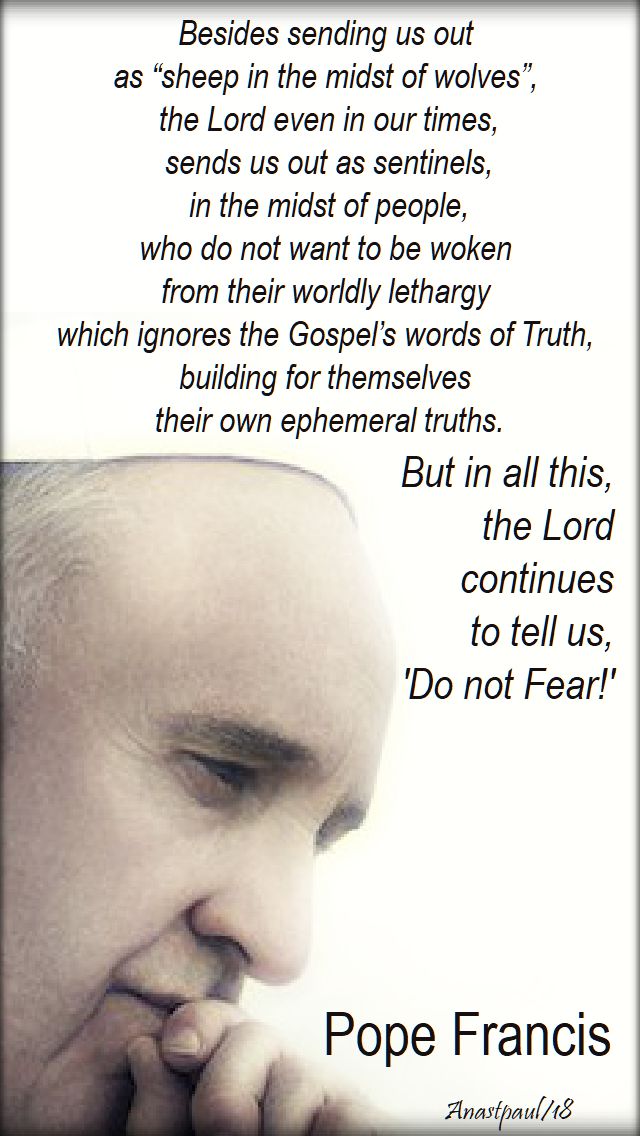
Besides sending us out as “sheep in the midst of wolves”, the Lord even in our times sends us out as sentinels in the midst of people who do not want to be woken from their worldly lethargy which ignores the Gospel’s words of Truth, building for themselves their own ephemeral truths.   And if we go to or live in these contexts and we proclaim the Words of the Gospel, this is bothersome and they will look at us unkindly.
But in all this, the Lord continues to tell us, as He did to the disciples of His time:  “Do not fear!”…Pope Francis (Angelus, 25 June 2017)

“When they deliver you up, do not be anxious how you are to speak or what you are to say;  for what you are to say will be given to you in that hour;  for it is not you who speak but the Spirit of your Father, speaking through you.”…Matthew 10:19-20besides sending us out - pope francis - 13 july 2018

Posted in MORNING Prayers, QUOTES - J R R Tolkien and MORE, QUOTES on DIVINE PROVIDENCE

Quote of the Day – 13 July

Quote of the Day – 13 July – Friday of the Fourteenth Week in Ordinary Time, Year B -Today’s Gospel: Matthew 10:16-23.

“Jesus said to his Apostles:  “Behold, I am sending you like sheep in the midst of wolves” … Matthew 10:16

“We must offer ourselves to God,
like a clean, smooth canvas
and not worry ourselves,
about what God
may choose to paint on it
but at each moment,
feel only the stroke of His brush.”

Father Jean-Pierre de Caussade S.J. (1675-1751)we must offer ourselves to god - fr jean pierre de caussade - 13 july 2018

Posted in DOCTORS of the Church, FATHERS of the Church, MORNING Prayers, QUOTES of the SAINTS, SAINT of the DAY, The WORD

One Minute Reflection – 13 July – The Memorial of St Henry (972-1024) Holy Roman Emperor

One Minute Reflection – 13 July – The Memorial of St Henry (972-1024) Holy Roman Emperor

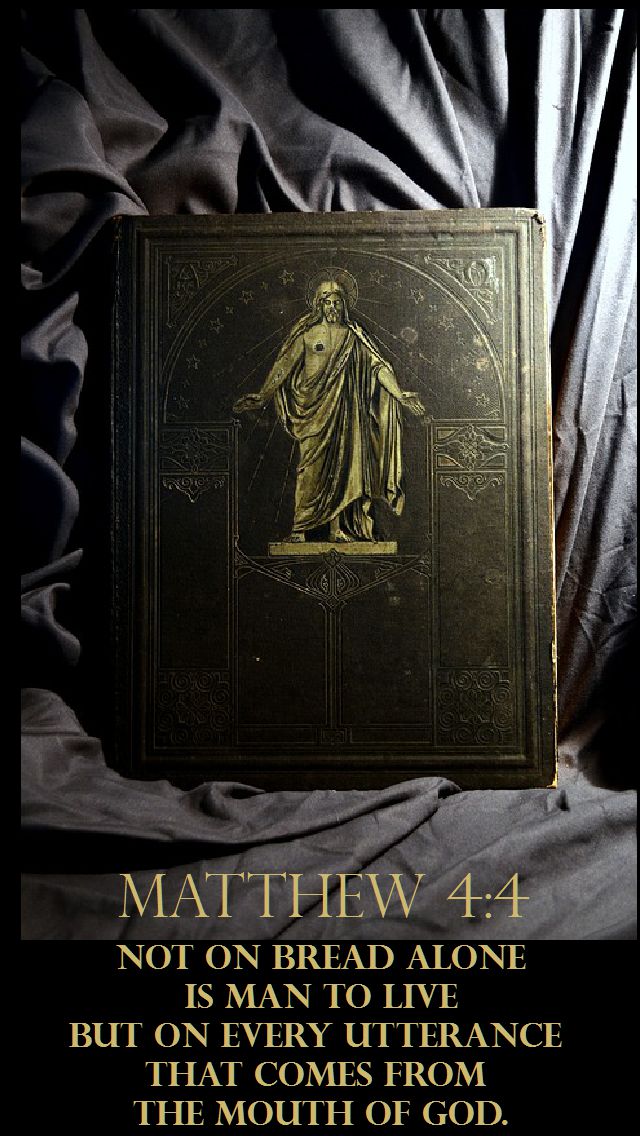
Not on bread alone is man to live but on every utterance that comes from the mouth of God………….Matthew 4:4matthew-4-4- not on bread alone is man to live - 13 july 2017 - mem of st henry

REFLECTION – “These are fountains of salvation, that they who thirst, may be satisfied, with the living words they contain.   In these is proclaimed the doctrine of godliness.   Let no man add to these, neither let him take out from these.”…….St Athanasius of Alexandria (297-373) Father and Doctor of the Churchthese are fountains of salvation - st athanasius - 13 july 2018

PRAYER – Heavenly Father, inspire me to meditate on Your holy words every day and fill me with Your Holy Spirit, that I might not only understand them but be filled with the desire to follow and live their instructions.   May they be a consolation, a strength and an assistance on my journey to You.   St Henry – you were inspired and strove to live by the Holy Scriptures, please pray for us all, amen.st-henry-pray-for-us - 13 july 2017

Posted in DOCTORS of the Church, MORNING Prayers, POETRY, PRAYERS of the SAINTS

Our Morning Offering – 13 July

Our Morning Offering – 13 July – Friday of the Fourteenth Week in Ordinary Time, Year B – Today’s Gospel :  Matthew 10:16-23.

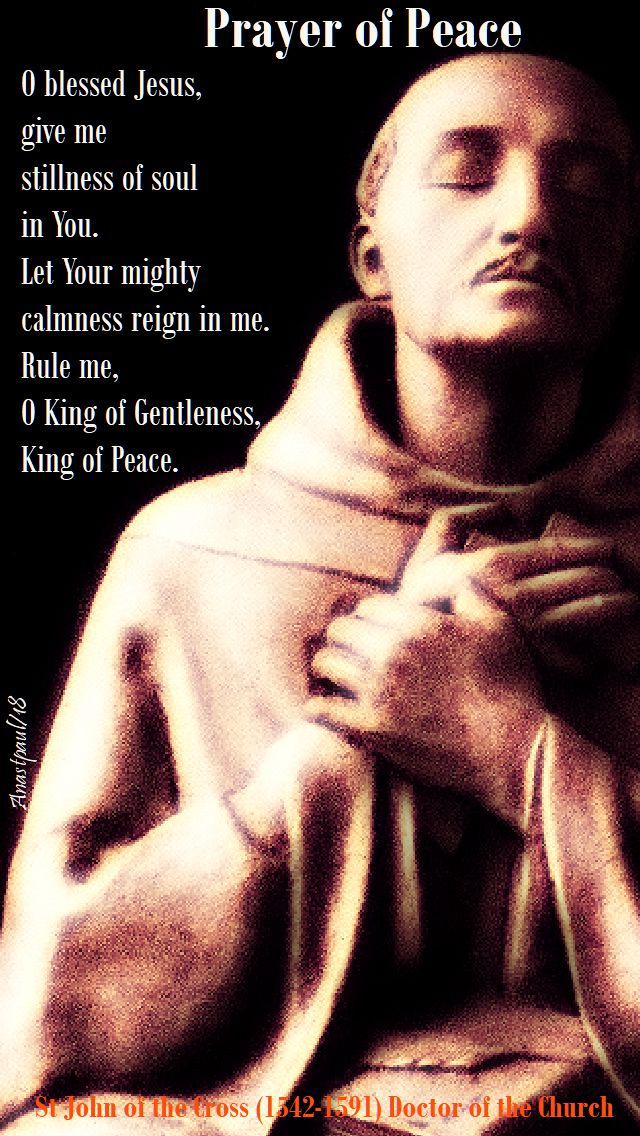
Prayer of Peace
St John of the Cross (1542-1591) Doctor of the Church

O blessed Jesus,
give me stillness of soul in You.
Let Your mighty calmness reign in me.
Rule me, O King of Gentleness,
King of Peace.prayer of peace - st john of the cross - o blessed jesus - 13 july 2018

People of Easter
By Daryl Madden

He issued a call
For holiness true
Let Gods light appear
Flow through me and through you

Do not abandon
Yourself to despair
We are people of Easter
Hallelujah we share

In difficult times
Let this be our song
Binding in Word
Through the One we belong

We are people of joy
One of the light
We’ve nothing to fear
Lords’ love shining bright

Hold fast to our faith
Proclamation to cope
God will not disappoint
Through His promise of hope

https://darylmadden.wordpress.com/2018/04/08/people-of-easter/comment-page-1/#comment-2261people of easter - daryl madden - 13 july 2018

Posted in SAINT of the DAY, VATICAN Resources

Saint of the Day – 13 July – Saint Clelia Barbieri (1847-1870) – Foundress of the Congregation of the Little Sisters of the Mother of Sorrows

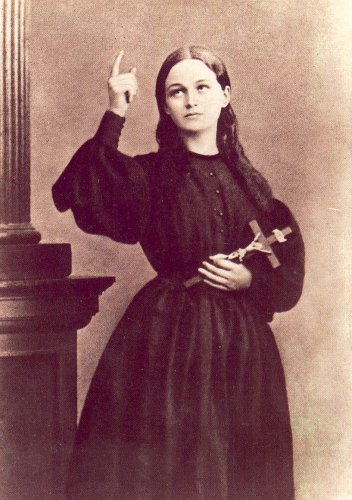
Saint of the Day – 13 July – Saint Clelia Barbieri (1847-1870) – Foundress of the Congregation of the “Suore Minime dell’Addolorata”  Little Sisters of the Mother of Sorrows, Catechist, Mystic – Born on 13 February 1847 in Le Budrie di Persiceto, Bologna, Papal States and died on 13 July 1870 (aged 23) in Le Budrie di Persiceto, Bologna, Kingdom of Italy.   Patronages – Little Sisters of the Mother of Sorrows, Catechists, People ridiculed for their piety.

Clelia Barbieri (1847-1870)

Clelia Barbieri was born to Giacinta Nannetti and Giuseppe Barbieri, on 13 February 1847 in a village called “Budrie” of St Giovanni in Persiceto in the outskirts of Bologna, Italy and in the Archdiocese of Bologna.

Her parents were of different origins:  Giuseppe Barbieri came from perhaps the poorest family of “Budrie” while Giacinta from the most important family in town: he worked as servant for Giacinta’s uncle, the district’s medical doctor, while she was the daughter of the well-to-do Pietro Nannetti.   After her much-contested wedding, the wealthy Giacinta accepted the poverty of a labourer’s life and moved from a comfortable home to the humble cottage of her father-in-law, Sante Barbieri;  nevertheless forming a family built on the rock of faith and a totally Christian life.

In line with her mother’s expressed wish, she was baptised Clelia Rachele Maria on the very day of her birth.   Her mother taught Clelia to love God early in her life placing in her heart the desire for sanctity.   One day Clelia asked her, “Mother, how can I become a saint?”   In the meantime Clelia also learned the art of sewing, spinning and weaving kemp which was the most important work of the district.

In 1855, during a cholera epidemic the then eight-year-old Clelia lost her father and through the generosity of her uncle, the doctor, she, her mother and younger sister Ernestina moved into a more comfortable house near the parish church.   For Clelia the days became more saintly and dedicated.   Anyone who wanted to see her could always find her either at home weaving and sewing or in church praying.   Although it was usual at that time to receive First Communion almost at adulthood, Clelia due to her unusual catechistic preparation and spirituality, made hers on 17 June 1858, at only eleven years of age.   This was a decisive day for Clelia’s future since it was then that she had her first mystic experience:  exceptional contrition and repentance for her own sins and those of the world.   She underwent anguish and suffering for the sins that crucified Christ and for the sorrows of Our Lady.   From the day of her First Communion, the crucifix and Our Lady of Sorrows inspired her saintly soul.

At the same time she had a first inspiration as to her future which she perceived as based on prayer and good works.

In adoration before the Holy Tabernacle she was motionless, rapt in prayer, while at home she was the companion and model for the other working girls.   Far more mature than her years, she found in her work the first contact with the girls of “Budrie” where working hemp fibers was the main occupation and where all were engaged in this hard work.      Clelia brought something particularly personal to her little world, she worked with joy and love, praying and thinking of God at all times and even speaking of Him to her companions.

While Clelia was not Martha, (completely devoted to the cares of the world), yet she dedicated herself lovingly to the service of those most loved by Our Lord, the very poor, to the extent that her delicate hands were marked early in her short life with the hard labours she undertook.     While Clelia was not Mary who abandoned, excluded and neglected everything to prostrate herself in love and devotion, yet Clelia had no other thought, no other love than that for Our Lord whom she carried in her heart and soul as she walked with Him through life as if already in His world.    She lived in charity, completely dedicated to loving her fellowmen without restraint.   She forgot and even ignored her body.   She was happy to belong to the Lord and her happiness rested, in fact, in thinking only of Him.   Something, however, compelled her to turn towards her fellowmen, the poorest and most tried, who often waited in vain for some small sign of love and brotherhood.    A fervent faith burned inside her and she felt that she “must go” to give herself to all of God’s poor.   She loved that solitude which would permit her to reach God more fully but she left the protection of her home and went forth inspired by her all-consuming love for mankind.clelia - liturgy
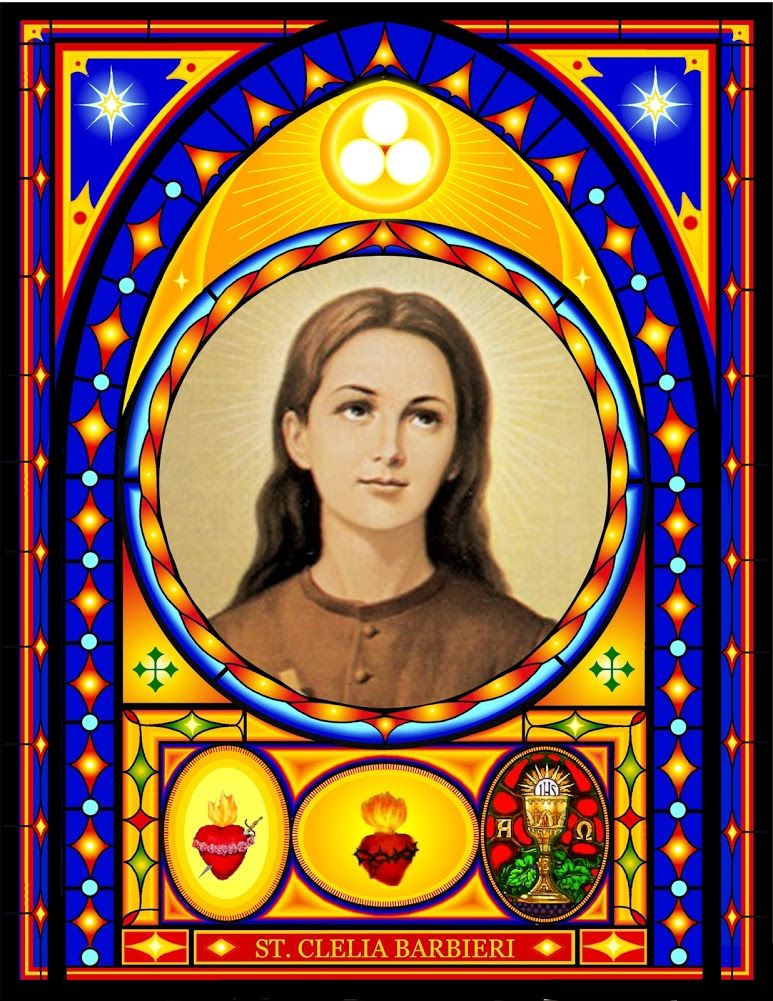
At this time in history, there existed in the Church a group called “The Christian Catechism Workers” who were mainly men whose aim it was to combat the prevalent religious negligence of the times.   At “Budrie” the group was led by an elderly schoolteacher.  Clelia became one of the Christian Catechism Workers.    Then, at “Budrie” with her acceptance, the catechism group was reborn and attracted others with her very same dedication and faith.   At first, Clelia was admitted as an assistant teacher and was the least important member but soon her surprising talents and preparation evidenced themselves, so that the senior members placed themselves under her leadership.

Having rejected several flattering marriage proposals, the group of young ladies which had sprung up from the Catechism group, elected Clelia as their leader and conceived the idea of a community devoted to an apostolic and contemplative way of life.   This was to be a life of service which would spring from the Eucharist with daily Holy Communion and would ennoble itself with the teaching of catechism to the farmers and labourers of the area.     The idea could not become a reality immediately due to the political situation at the time of Italy’s unification (1866-67).   However, it was finally realised on 1 May 1868 when with the bureaucratic and local problems solved, Clelia and her young friends moved into the so-called “teacher’s house” where the Workers for Christian Catechism had formerly met.   This was the humble beginning of Clelia Barbieri’s religious family which later was to be named the religious community of the “Suore Minime dell’Addolorata”, Little Sisters of the Mother of Sorrows.   “Minime” because of Clelia’s devotion to the saint, Minimo Romito di Paola, St Francesco, patron and provident protector of the young community;   “dell’Addolorata” because this title of Our Lady of Sorrows was the most loved of all of Our Lady’s titles by Clelia Barbieri.

After moving into “the teacher’s house”, a series of extraordinary events in the form of assistance to the young community occurred which were undoubtedly the work of Divine Providence and without which the group could never have survived.   The small group was inspired by Clelia’s physical and moral sufferings in her darkest hours and in the absurd humiliations she endured at the hands of those who should have been more understanding.    However, her faith and devotion in prayer were always extraordinary.  In the small “Budrie” community there was faith, a desire for God and a missionary zeal full of creativity and imagination by no means based on any external support which was virtually nonexistent.     Clelia was the moving spirit.     The small initial group grew as well as the number of poor, sick and young boys and girls needing catechism and religious instruction.

Slowly, the people began to see Clelia as a leader and teacher of the faith.   They started calling her “Mother” although she was only twenty-two years old.   They called her with this title until her death which came about very shortly.     The dormant tuberculosis she had always carried, suddenly flared up only two years after she had founded the order.

Clelia died prophesying to the sister at her bedside, “I’m leaving but I’ll never abandon you.   When in that alfalfa field next to the church there will be a new community house, I will no longer be with you … You will grow in number and you will expand over plains and mountains to work in the vineyard of the Lord.   The day will come when here at ‘Budrie’ many will arrive with carriages and horses …”    And she added, “I’m going to Heaven and all those who will die in our community will enjoy eternal life”.Santa Clélia Barbieri8
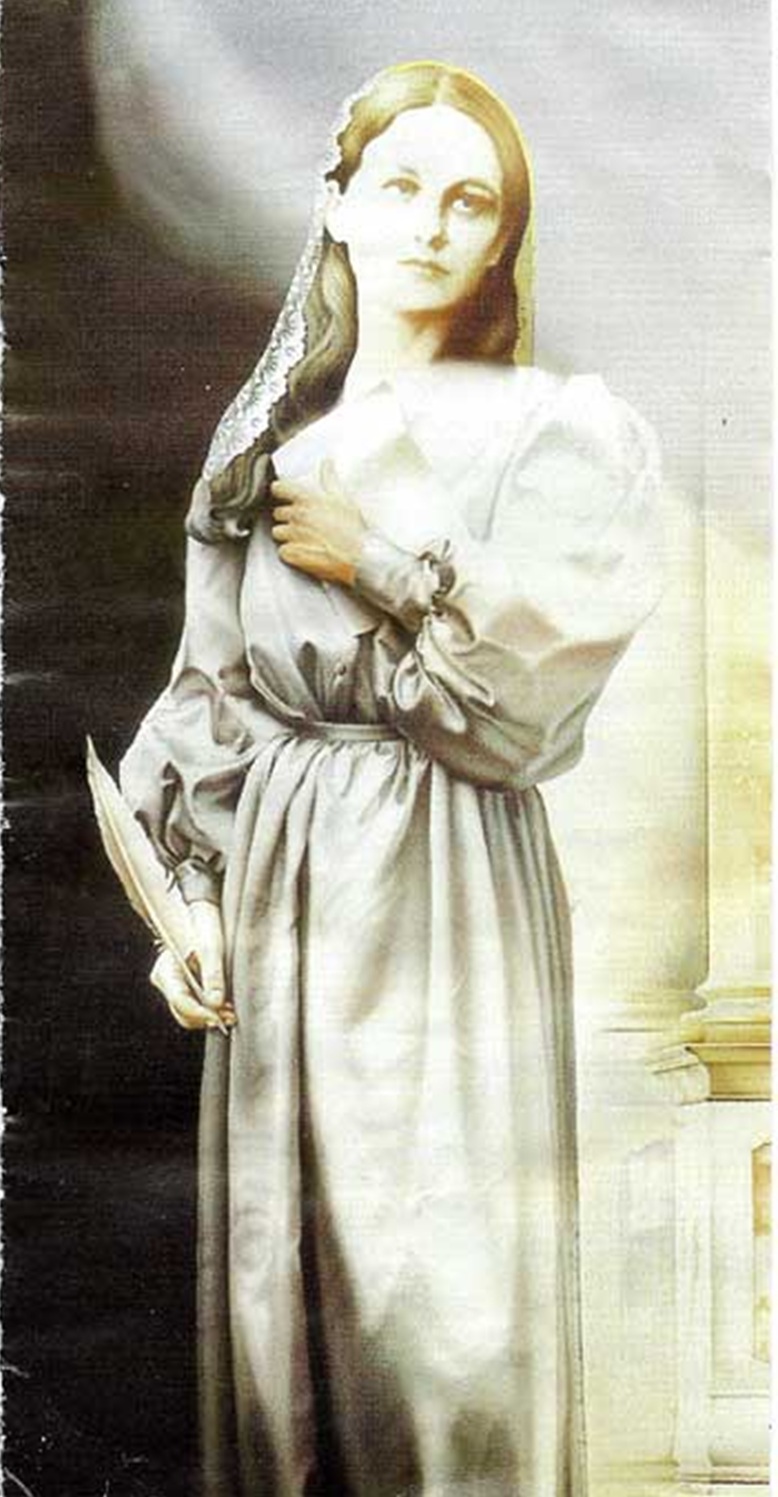
She died on 13 July 1870 with the happiness of one going to meet her Spouse and beloved Lord.   Clelia’s death prophecy has been fulfilled.

Her religious order has expanded and continues to grow.   It extends throughout Italy, in India and in Tanzania.   Today, the sisters following in Clelia’s footsteps, humbly continue their useful work of assistance to all in need and now number hundreds spread over thirty-five community houses.

Being only twenty three at the time of her death, Clelia Barbieri is the youngest founder of a religious community in the history of the Church.

She was Canonised at Rome on 9 April 1989 by St Pope John Paul II...vatican.vaSanta Clélia Barbieri6
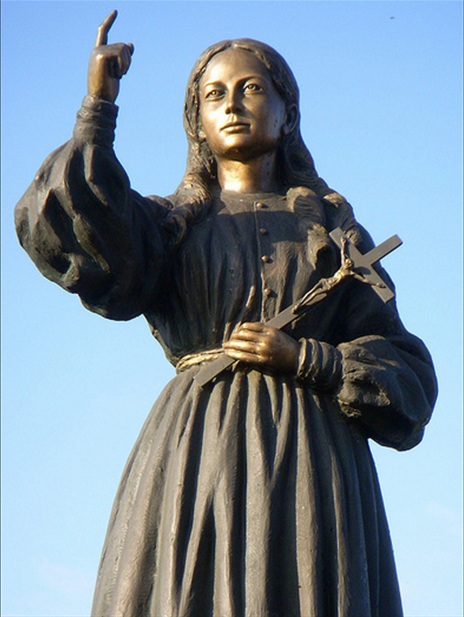
Barbieri’s death soon resulted in an unusual and unexplained occurrence that has often been reported in the various parishes that she visited and in the houses in which her order is located at.   Her voice is often heard during scriptural readings and songs and this voice never speaks alone but is heard as part of a group.   People from various backgrounds have reported hearing the voice which is described to be unlike any they have ever heard.   The first reported occurrence happened in 1871 when the sisters of her congregation were in their usual evening meditation.


.



Posted in MARIAN TITLES, SAINT of the DAY, The BLESSED VIRGIN MARY

Feast of Our Lady of Valsorda and Our Lady of Soccorso and Memorials of the Saints – 13 July

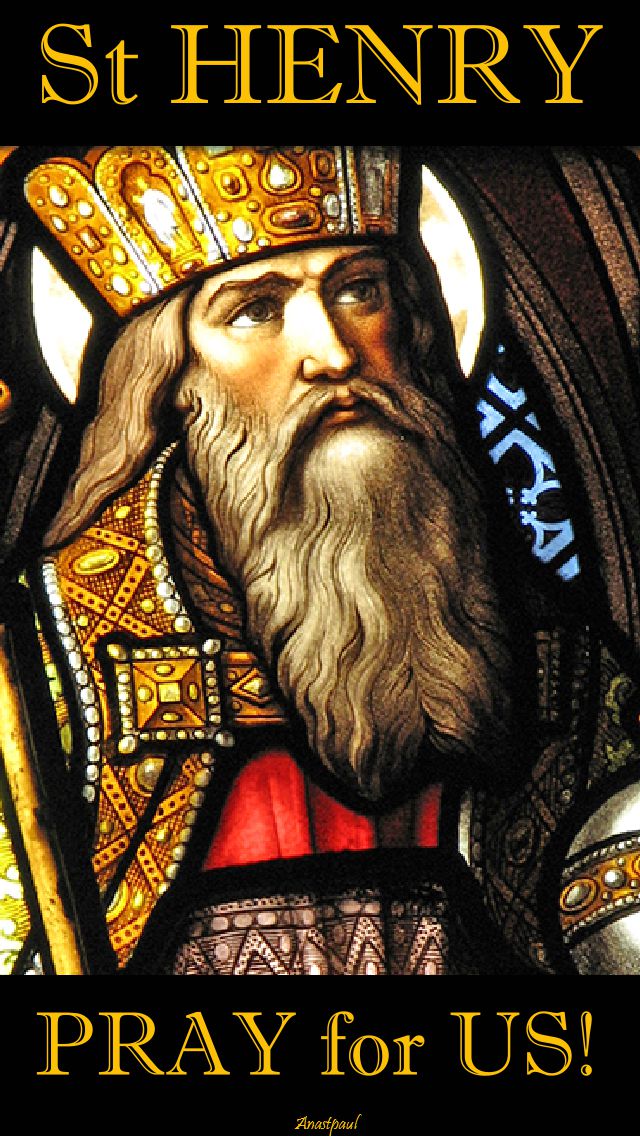
St Henry II (972-1024) Holy Roman Emperor (Optional Memorial)

https://anastpaul.wordpress.com/2017/07/13/saint-of-the-day-13-july-st-henry-ii-holy-roman-emperor/

Our Lady of Grace of Valsorda: – Read about Our Lady of Valsorda here: http://mariancalendar.org/madonna-delle-grazie-di-valsorda-/-our-lady-of-grace-of-valsorda-garessio-valsorda-italy/

Our Lady of Soccorso/Our Lady of Help: Read here: http://wdtprs.com/blog/2012/03/beating-the-devil-the-madonna-del-soccorso/

Bl Anne-Andrée Minutte
St Arno of Würzburg
Bl Barthélemy Jarrige de la Morelie de Biars
Bl Berthold of Scheide
St Clelia Barbieri (1847-1870)

St Dogfan
Bl Élisabeth Verchière
St Emanuele Lê Van Phung
St Esdras the Prophet
St Eugene of Carthage
Bl Ferdinand Mary Baccilleri
St Iosephus Wang Kuiju
Bl James of Voragine
Bl Jean of France
St Joel the Prophet
Bl Louis-Armand-Joseph Adam
Bl Mariano de Jesus Euse Hoyos (1845-1926)
Bl Marie-Anastasie de Roquard
Bl Marie-Anne Depeyre
Bl Marie-Anne Lambert
St Mildred of Thanet
St Muritta of Carthage
St Myrope
St Paulus Liu Jinde
St Salutaris of Carthage
St Sarra of Egypt
St Serapion of Alexandria
Serapion of Macedonia
Bl Thérèse-Henriette Faurie
Bl Thomas Tunstal
St Turiaf

Martyrs of Cyprus – 300 saints: 300 Christians who retired to Cyprus to live as cave hermits, devoting themselves to prayer and an ascetic life devoted to God. Tortured and martyred for their faith and their bodies dumped in the various caves in which they had lived. We know the names of five of them but no other details even about them – Ammon, Choulélaios, Epaphroditus, Eusthénios and Héliophotos. They were beheaded in the 12th century on Cyprus and their bodies dumped in the cave where they had lived and only rediscovered long afterwards.

Martyrs of Philomelio – 31 saints: 31 soldiers martyred for their faith in the persecutions of prefect Magno, date unknown. The only name that has come down to us is Alexander. In Philomelio, Phrygia (in modern Turkey).

Posted in MORNING Prayers, POETRY, QUOTES of the SAINTS, SAINT of the DAY, The HOLY FACE

Thought for the Day – 12 July – The Memorial of St Veronica

“Veronica?”

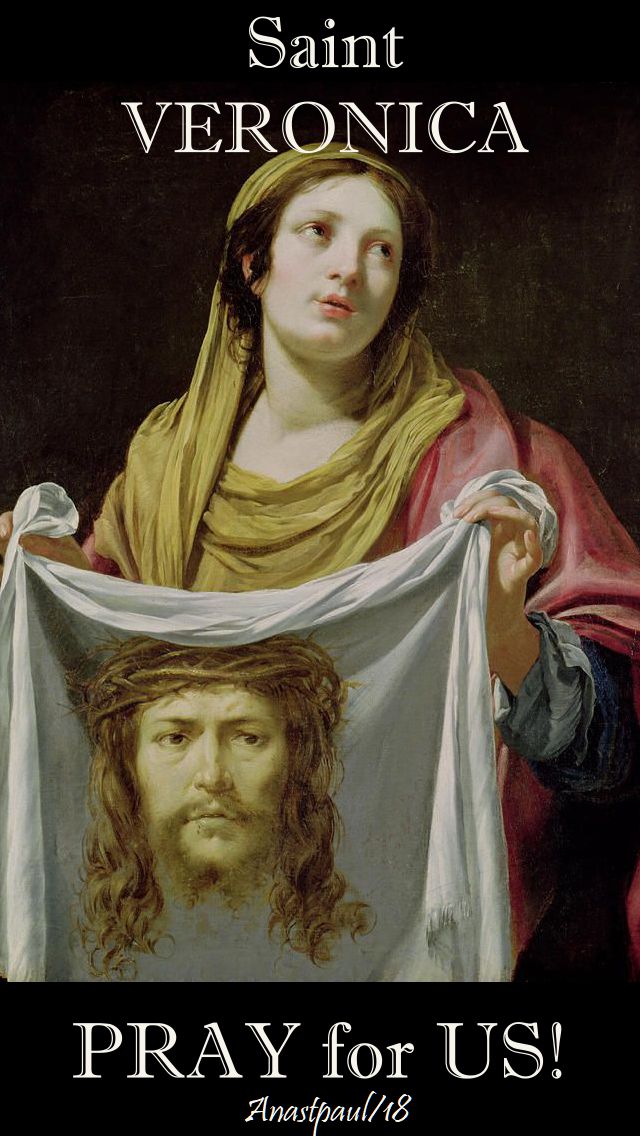
“Bernice Veronica” – both names referring to the Woman who wiped the Face of Jesus, commonly depicted in every Catholic church, at the Sixth Station of the Cross.

Did she exist?   And what does it mean to be “a Veronica?”

The Catholic Church tells us that a veil bearing a miraculous image of the Face of Jesus has existed since the earliest centuries, recorded in history and in art.   About the time this miraculous veil first appeared in Rome, in the Middle Ages, the name “Veronica” referred to the veil itself–“Veronica” meaning “vera” or true, and “icon” meaning image, or even more precisely, “to be present.”   Those who gazed upon the veil bearing the true Face of Jesus stood in God’s presence.   They were turned toward His Face.
Legends sprang up sometime later about a woman named “Veronica,” who was sometimes associated with the woman “Berenice” or “Bernice,” the bleeding woman who touches the hem of Jesus’s garment in the Gospel.
“These pious traditions cannot be documented but there is no reason why the belief that such an act of compassion did occur should not find expression in the veneration paid to one called Veronica.” —The Catholic Encyclopedia.
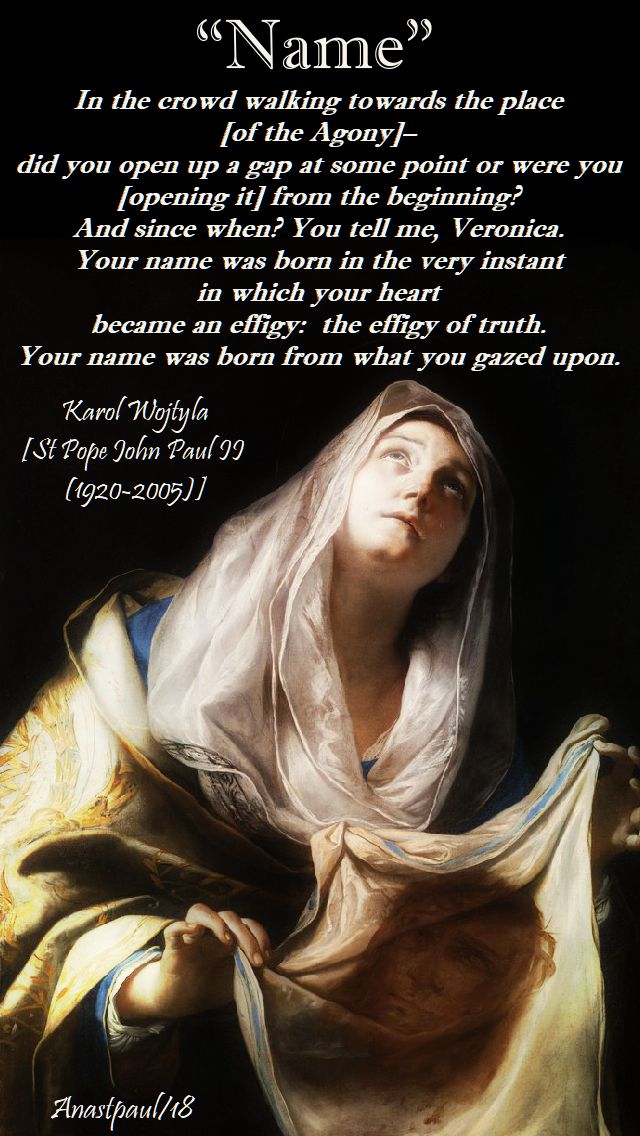
St Pope John Paul II expressed the answer to the question of Veronica most beautifully in his poem,

“Name”

In the crowd walking towards the place

[of the Agony]–

did you open up a gap at some point or were you

[opening it] from the beginning?

And since when? You tell me, Veronica.

Your name was born in the very instant

in which your heart

became an effigy:  the effigy of truth.

Your name was born from what you gazed upon.

–Karol Wojtylaname - st veronica - karol wotyla - st john paul - 12 july 2018

When a soul performs an “act of compassion,” Jesus leaves His image on the “veil” of the soul.   In other words, while contemplating the Face of Jesus in an image, in the Word of God in the Scriptures, in a person made in the image and likeness of God, or above all, in the Eucharist, the soul places itself in the Presence of God.   When we are turned completely toward the Face of God, through a daily face-to-face encounter in prayer–by the power of the Holy Spirit–God gradually transforms the soul into the “True Image” of His Son, Jesus Christ.   As Pope St. John Paul II says, our hearts must become an “effigy of truth,” a “true icon.”   

Then our name too will be born from what we gaze upon.  It will be “Veronica.”

St Veronica pray for us!st-veronica-pray-for-us-21 - 12 JULY 2017

Posted in DOCTORS of the Church, MORNING Prayers, ON the SAINTS, PAPAL ENCYLICALS, QUOTES of the SAINTS

Quote/s of the Day – 12 July – The Memorial of Sts Louis & Zelie Martin

Quote/s of the Day – 12 July – The Memorial of Sts Louis & Zelie Martin

– Parents of St Thérèse of the Child Jesus

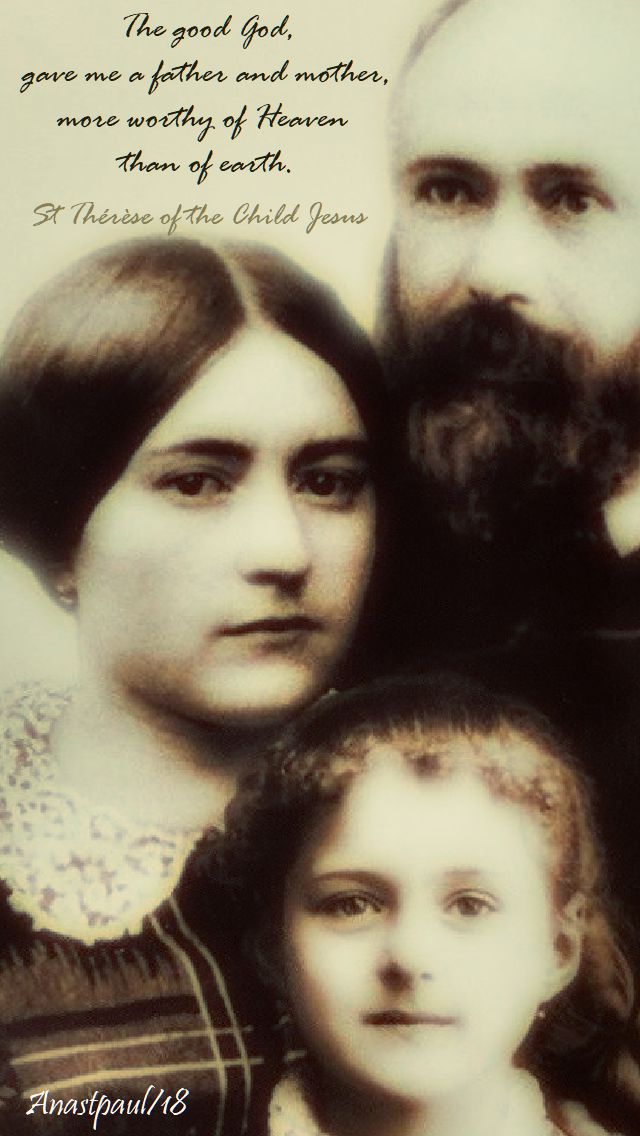
“The good God,
gave me a father and mother,
more worthy of Heaven than of earth.”

St Thérèse of the Child Jesus (1873-1897)

Doctor of the Churchthe good god - st t of l - 12 july 2018

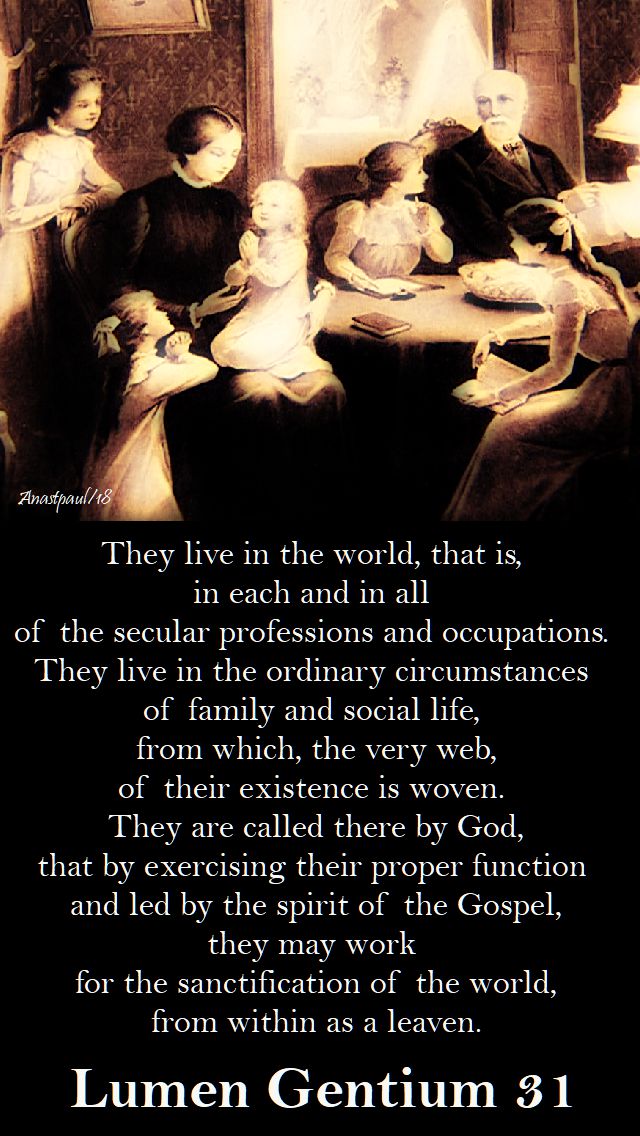
“They live in the world, that is,
in each and in all
of the secular professions and occupations.
They live in the ordinary circumstances of family and social life,
from which, the very web, of their existence is woven.
They are called there by God,
that by exercising their proper function
and led by the spirit of the Gospel,
they may work for the sanctification of the world,
from within as a leaven.”

Lumen Gentium 31they live in the world - lumen gentium 31

Posted in MORNING Prayers, SAINT of the DAY, The HOLY FACE, The WORD

One Minute Reflection – 12 July – The Memorial of St Veronica

One Minute Reflection – 12 July – The Memorial of St Veronica

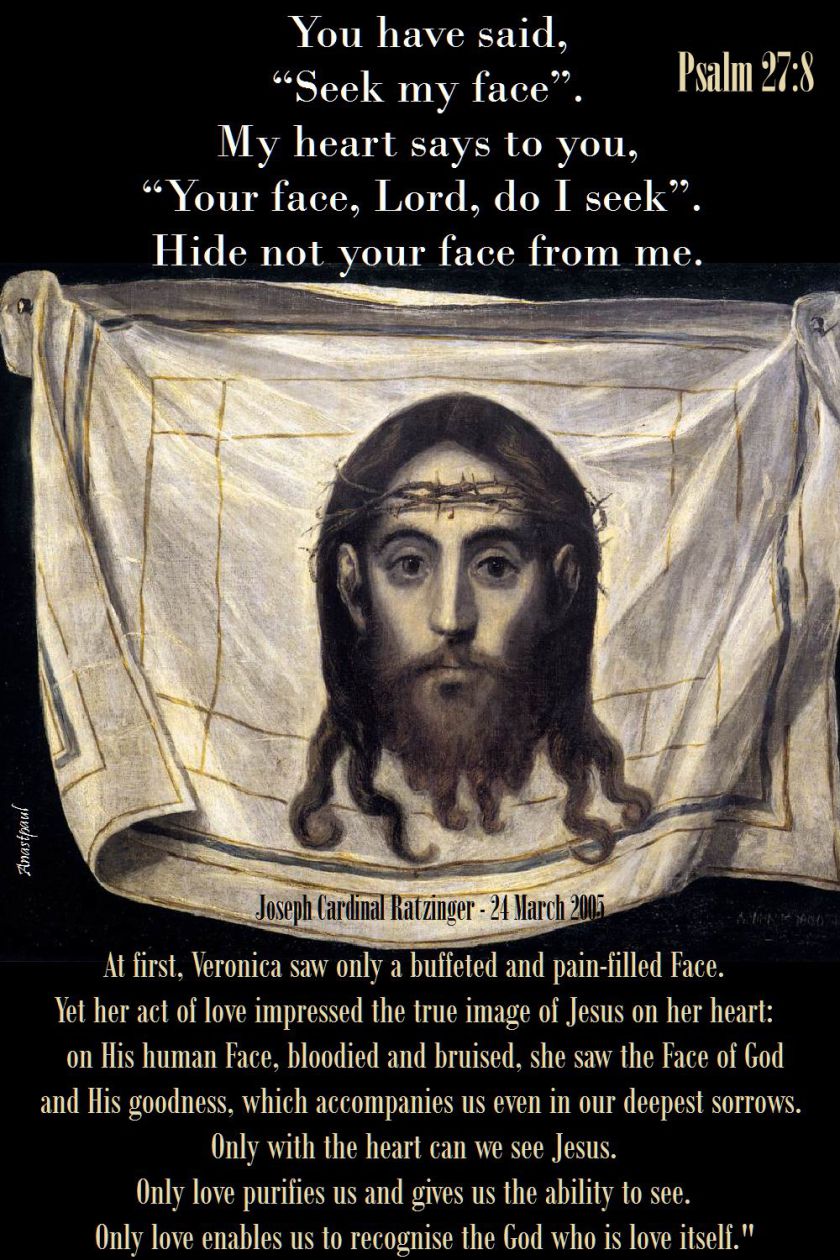
You have said, “Seek my face”.   My heart says to you, “Your face, Lord, do I seek”.   Hide not your face from me.   Turn not your servant away in anger, you who have been my help.   Cast me not off, forsake me not, O God of my salvation………Psalm 27:8-9

REFLECTION – “Veronica- ‘Bernice’ in the Greek tradition, embodies the universal yearning of the devout men and women of the Old Testament, the yearning of all believers to see the Face of God.   On Jesus’ Way of the Cross, though, she at first did nothing more than perform an act of womanly kindness – she held out a facecloth to Jesus.   She did not let herself be deterred by the brutality of the soldiers or the fear which gripped the disciples.   She is the image of that good woman, who, amid turmoil and dismay, shows the courage born of goodness and does not allow her heart to be bewildered.   “Blessed are the pure in heart”, the Lord had said in his Sermon on the Mount, “for they shall see God” (Mt 5:8).   At first, Veronica saw only a buffeted and pain-filled Face.   Yet her act of love impressed the true image of Jesus on her heart: on His human Face, bloodied and bruised, she saw the Face of God and His goodness, which accompanies us even in our deepest sorrows.   Only with the heart can we see Jesus.  Only love purifies us and gives us the ability to see.   Only love enables us to recognise the God who is love itself.”…………..Joseph Cardinal Ratzinger (24 March 2005)at-first-veronica-saw-only-a-joseph-card-ratzinger-24-march-2005- 12 july 2017

PRAYER – Lord God, grant us restless hearts, hearts which seek Your Face.   Keep us from the blindness of heart which sees only the surface of things.   Give us the simplicity and purity which allow us to recognise Your presence in the world.   When we are not able to accomplish great things, grant us the courage which is born of humility and goodness. Impress Your Face on our hearts.   May we encounter You along the way and show Your image to the world.   St Veronica, Pray for us! Amen.st veronica - pray for us - 12 july 2018

Posted in DOCTORS of the Church, MORNING Prayers, PRAYERS of the SAINTS, SACRED and IMMACULATE HEARTS, SAINT of the DAY

Our Morning Offering – 12 July – The Memorial of Sts Louis & Zelie Martin

Our Morning Offering – 12 July – The Memorial of Sts Louis & Zelie Martin – Parents of St Thérèse of the Child Jesus

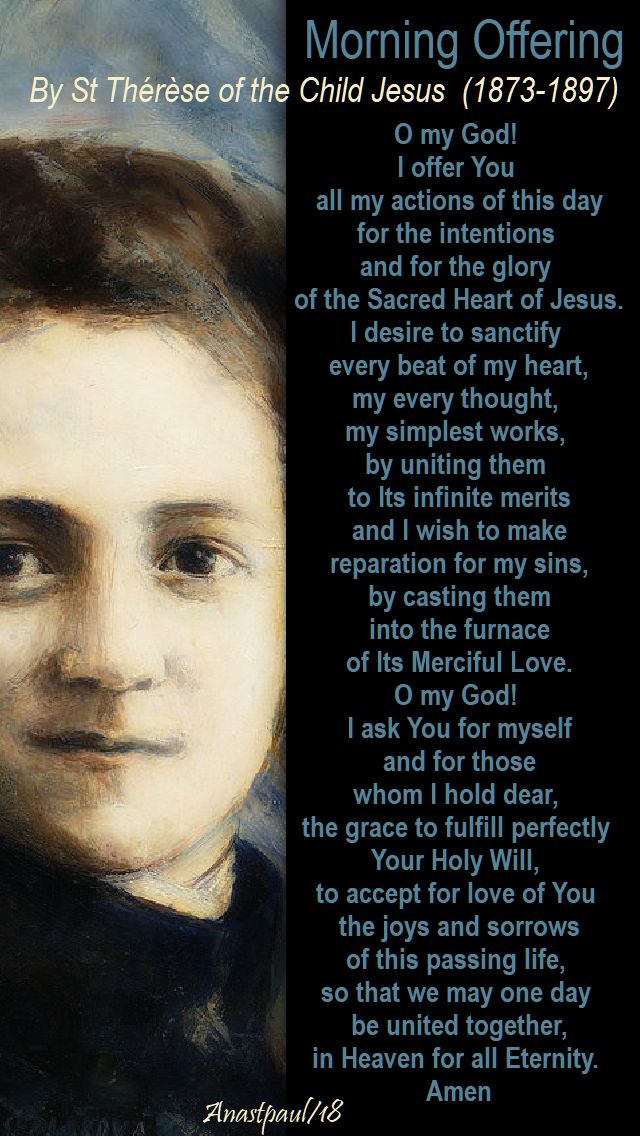
Morning Offering
By St Thérèse of the Child Jesus (1873-1897)

O my God!
I offer You all my actions of this day
for the intentions and for the glory
of the Sacred Heart of Jesus.
I desire to sanctify
every beat of my heart,
my every thought,
my simplest works,
by uniting them to Its infinite merits
and I wish to make reparation for my sins,
by casting them into the furnace
of Its Merciful Love.
O my God!
I ask You for myself and for those
whom I hold dear,
the grace to fulfill perfectly
Your Holy Will,
to accept for love of You
the joys and sorrows of this passing life,
so that we may one day be united together,
in Heaven for all Eternity.
Amenmorning offering - o my god, i offer you all my actions of this day - st therese lisieux - 12 july 2018 - mem of louis and zelie

Posted in SAINT of the DAY

Saints of the Day – Sts Louis & Zelie Martin – Parents of St Thérèse of the Child Jesus/of Lisieux (1873-1897 – Doctor of the Church)

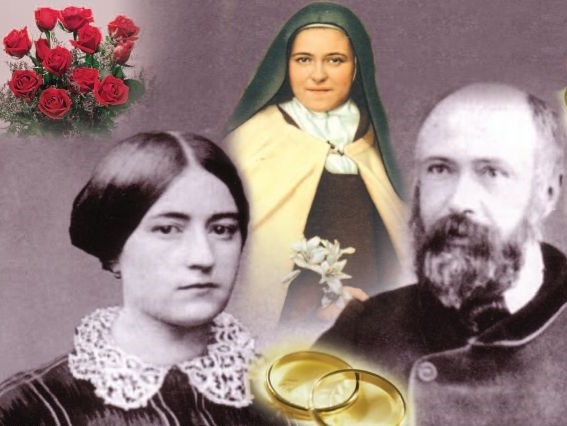
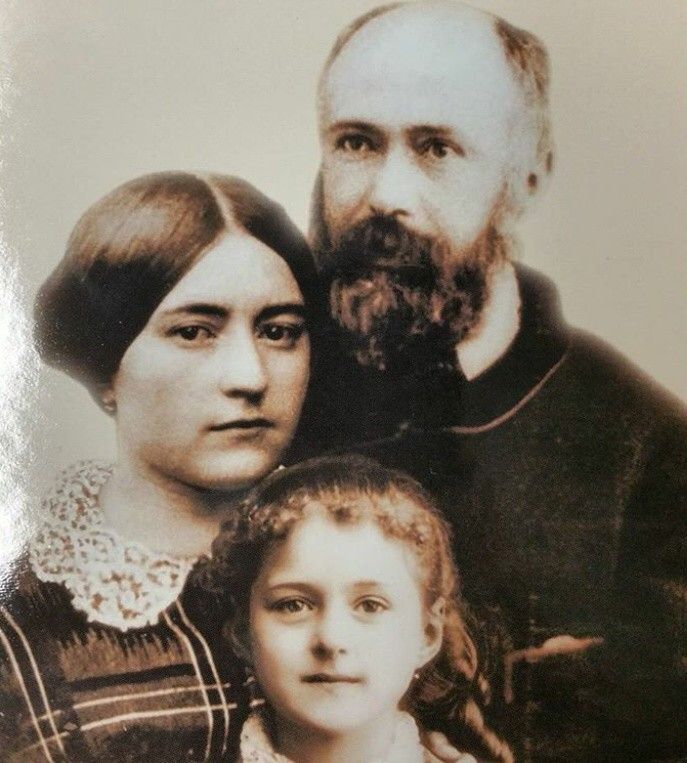
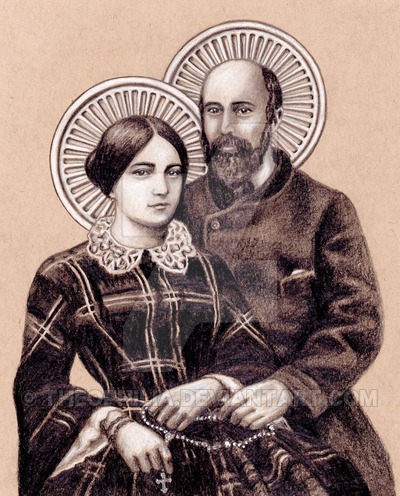
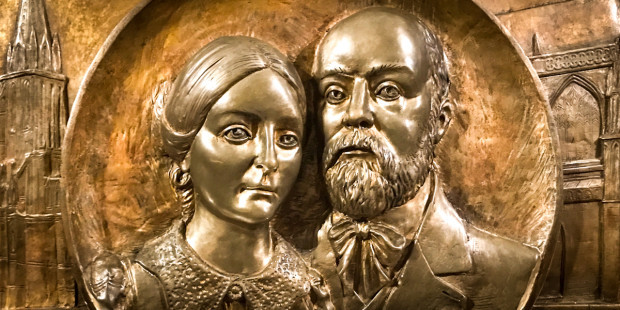
Saints of the Day – Sts Louis (1823-1894) & Zelie (1831–1877) Martin – Parents of St  Thérèse of the Child Jesus/of Lisieux (1873-1897 – Doctor of the Church).   Sts Louis and Zelie two married French laypeople and the parents of five nuns, including Thérèse of Lisieux, a Carmelite nun who was Canonised as a saint in 1925 and added as one of the only 36 Doctors of the Church by St Pope John Paul in 1997.   On 18 October 2015, the couple were also Canonised, becoming the first spouses in the church’s history to be canonised as a couple.

header - louis, zelie, thereselouis zelie therese as a childmartin family

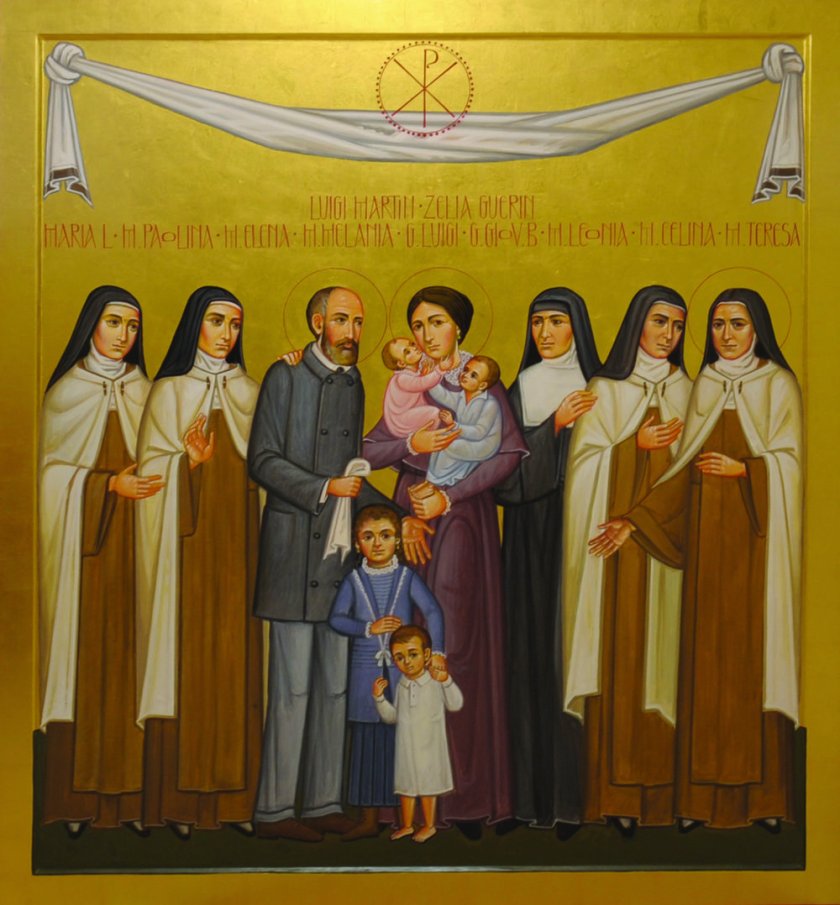
The simple, hard-working and prayerful Martin family from the small French town of Alençon was anything but ordinary.   Not only is one of the family’s daughters the great St Thérèse of the Child Jesus — the Carmelite Doctor of the Church known for her “little way” — and another daughter, Sister Leonie, under consideration for Canonisation but the parents became the first married couple ever to be Canonised saints.  Sts Louis and Zélie Martin built a family that shines throughout the world today as a beacon of ideal family life.

Neither had intended to marry.  Both had seriously considered religious life but doors had been closed to them as they moved closer to that vocation.   God’s will became increasingly clear to them, ending up as the perfect Catholic love story that, beginning when they met on Alençon’s St Leonard’s Bridge, was bookended with their 2015 Canonisation.

It was love at first sight that day on the bridge.   A brief courtship resulted in their 13 July 1858, marriage.   On that day, Sts Louis and Zélie established a family grounded in a love for God and a commitment to do His will, not immune from the everyday troubles of family life nor the pains and sorrows that few families know.

The couple complemented each other well.   Louis was reserved and contemplative, while Zélie was outgoing and social.   Both put their children ahead of themselves and wanted nothing but their best.   Prayerful and discerning, these holy parents had the clear-headed vision to know that the best for their children was to help them grow in a relationship with God.

Numerous challenges that the Martins faced was the stuff that has driven many away from God and religion.   Four of the Martins’ children died at an early age and Zélie suffered a lengthy bout with breast cancer that resulted in her death at the age of 45.
When understood improperly, one is prone to seeing suffering as a reason to doubt their faith and to give up on God.   Throughout it all, the Martins confidently proclaimed a profound love of God and an undying trust in His providence.

The Little Way of St Thérèse posits a simple spirituality of doing little things exceedingly well.   She learned this first and foremost from her parents as a girl  . As she said herself, “The good Lord gave me a father and a mother more worthy of heaven than of earth.”

In good times and in bad, the Martins were faithful to each other and to God.   They embraced their vocation as spouses and parents with joy and they dedicated their entire selves to their calling.   They worked hard to provide for their family — Louis eventually gave up his watch shop to join Zélie in her lucrative lace-making business.   But they knew that their success was found in putting God first, as evidenced by their daily habit of attending Mass together.

saints_louis_and_zelie_martin_by_theophilia-d9k91g7

Their family life is a model for families the world over.   The Martin home was filled with laughter and joy just as much as it was with prayer and love.   It was a home of affection, tenderness and mercy.   And it was a home where holiness was desired above all else. They wanted what God wanted and nothing more.   They did not give in to the temptations and weaknesses that came with trials and suffering, but relied on Christ’s example and His grace in the sacraments to fortify them.

In the end, the sole desire of the Martins for themselves and for their children was to become saints.   And now Canonised, Sts Louis and Zélie provide a clear blueprint for families today who share that same goal. (OSV Newsweekly).web3-louis-zelie-martyin-parenting-advice-mercy-mcnab-photography

Louis and Zélie were declared “venerable” on 26 March 1994 by St Pope John Paul II. They were Beatified on 19 October 2008 by José Saraiva Cardinal Martins, the legate of Pope Benedict XVI in the Basilica of Saint Thérèse, Lisieux.   A few months earlier, the Church had recognised the miracle of Pietro Schiliro, an Italian child cured of lung illness, at their intercession.   For Louis and Zélie to be Canonised, the church needed to find that God worked a second miracle at their intercession.

On 7 January 2013, Carlos Osoro Sierra, Archbishop of Valencia, presided at the opening of the canonical process to inquire into the healing in 2008 of a girl named Carmen, who was born in Valencia four days before Louis and Zélie were beatified  .Eight doctors testified that there was no scientific explanation for her cure.

The diocesan tribunal held its closing session on 21 May 2013 and the file was sent to Rome for review by the Congregation for the Causes of Saints.

On 3 March 2015 Angelo Cardinal Amato announced informally that Louis and Zélie Martin would be declared saints during the Synod of Bishops.   The Congregation accepted and promulgated the miracle on 18 March 2015.

On 26 June 2015, Miracle of Life in Valencia, a film produced by the Archdiocese of Valencia about the Canonisation miracle was released online in English.    The next day, at a consistory of cardinals in Rome, Pope Francis approved the decree for the Canonisation of Louis and Zélie Martin and announced that the ceremony would take place in October in Rome.

On 18 October 2015, Louis and Azélie-Marie Martin were Canonised as saints by Pope Francis.Vatican French SaintsLouis_and_Marie-Azélie_Martin (1)

For more on Sts Louisd and Zelie here: https://anastpaul.wordpress.com/2018/07/08/thought-for-the-day-8-july-the-memorial-of-sts-priscilla-and-aquila/


Posted in SAINT of the DAY

Memorials of the Saints – 12 July

St Agnes De
St Andreas the Soldier
St Ansbald of Prum
St Balay
St Clement Ignatius Delgado Cebrian
Bl David Gonson
St Epiphana
St Faustus the Soldier
St Felix of Milan
St Fortunatus of Aquileia
St Hermagorus of Aquileia
St Hilarion of Ancyra
St Jason of Tarsus
Bl Jeanne-Marie de Romillon
St John Gualbert
St John Jones
St John the Georgian
Bl Lambert of Cîteaux

St Louis Martin (18231894)
St Marie-Azélie Guérin / ZELIE Martin (1831 –1877)

Bl Madeleine-Thérèse Talieu
Bl Marguerite-Eléonore de Justamond
Bl Marie Cluse
St Menas the Soldier
St Menulphus of Quimper
St Nabor of Milan
St Paternian of Bologna
St Paulinus of Antioch
St Phêrô Khan
St Proclus of Ancyra
St Proculus of Bologna
St Uguzo of Carvagna
St Veronica

https://anastpaul.wordpress.com/2017/07/12/saint-of-the-day-12-july-st-veonica/

St Viventiolus of Lyons

Martyrs of Nagasaki – 8 beati: Additional Memorial – 10 September as one of the 205 Martyrs of Japan
Eight lay people, many them related to each other, who were martyred together:
• Catharina Tanaka
• Ioannes Onizuka Naizen
• Ioannes Tanaka
• Ludovicus Onizuka
• Matthias Araki Hyozaemon
• Monica Onizuka
• Petrus Araki Chobyoe
• Susanna Chobyoe
12 July 1626 in Nagasaki, Japan
Beatified on 7 May 1867 by Pope Blessed Pius IX.

Posted in CONTEMPLATIVE Prayer, JESUIT SJ

The Gift of Contemplative Prayer

The Gift of Contemplative Prayer

by Margaret Silf

Probably most of us, if we think of contemplative prayer at all, regard it as something that is beyond us and practiced only by a few contemplative monks and nuns whose whole lives are devoted to prayer.   Yet I have heard respected and experienced spiritual guides say that contemplation is often given to those you would least expect—to harassed mothers and people who think they can’t pray, to children, to the sick and dying, to people with no academic learning about prayer or Scripture or theology.   God sometimes seems to speak, heart to heart, in this mysterious way, to the untaught and unpracticed. None of us should imagine that the ways of contemplative prayer are closed to us because God is always infinitely larger than our expectations.

I suggest that creation itself gives us a gateway.   In every moment of our lives, a silent, invisible miracle of exchange is taking place.   We breathe out the air that our bodies no longer need, which is mainly carbon dioxide, a waste product for us but the very thing that the green leaves on the trees and plants need to produce their own energy.   So they receive our carbon dioxide and, through the process of photosynthesis, produce not only their own life energy, but also oxygen—a waste product for them but the very thing we need to live.   Whenever I stop my busyness for a few moments to look around me, I am amazed at this arrangement and it makes me think of prayer.

So perhaps a good way to open our hearts up to the gift of contemplation is simply to become still, and, quite literally, to breathe out our waste—all that clogs us and deadens us—and to breathe in God’s renewing life, as we breathe in the fresh oxygen that the plants have made for us.   This simple, deliberate breathing exercise can become something like what the French peasant was doing as he looked at God and God looked at him.   We are becoming aware of the mysterious exchange of life between ourselves and God.   And there is no reason that any period of quiet might not become prayer of this kind.

There may be other creatures who can help you cross the threshold of contemplation. If there is a baby in the family, try simply holding her in your arms as she sleeps and letting God hold both of you in his.   Nothing more.   No deep thoughts.   No search for meaning.   Just be there.

A cat (if you are not allergic to them!) can also be a great aid to prayer.   My own cat loves to sleep round my neck.   At first I found this disturbing but when he has settled into a particular hollow (perhaps where he can feel my pulse), he will lie there, quite still, just purring deeply, until he falls asleep and the purring ceases.   When he does this, I let myself find a hollow close to God’s pulse and let my own prayer become just a sleepy purr and then the silence of content.   Or you might discover prayer on a park bench.   The other day I was in Hyde Park and I spent a few minutes listening to the deep-throated cooing of the pigeons. I wanted to join them because, in their way, they were engaged in contemplative prayer, simply expressing, in this peaceful murmur, the song of their beings.
In your own home, prayer awaits you in the opening of a flower, the rising of your bread dough, or the steady, imperceptible development of a child.   Spend time in silence, aware of the wonder that is being unfolded in your cakes and your children, your houseplants or your garden.   For this is the essence of contemplative prayer—simple awareness, allowing God to be God, without trying to put the limitations of shape or meaning around him.

Contemplation, like all prayer, is pure gift and not anything we can achieve.   It happens when prayer becomes, wholly and utterly, the flow of God’s grace, transforming the land it flows through, like Ezekiel’s stream.   Or it happens when we lose consciousness of our own part in it and become simply receptors and carriers of grace.   It happens when we realise that our transformation depends on nothing but God’s grace and love, and, like the chrysalis, let go of all activity to try to achieve our own redemption.

When we try to describe it, we fail, for it lies beyond the world of words.   We can open our hearts to it by the practice of awareness but we cannot bring it about, any more than we can force a flower to open or an egg to hatch.   And in our silent, trustful waiting, we are acknowledging that God is God, the source and the destination, the means and the end of all our prayer, whatever form it may take.

from Close to the Heart: A Practical Approach to Personal Prayer

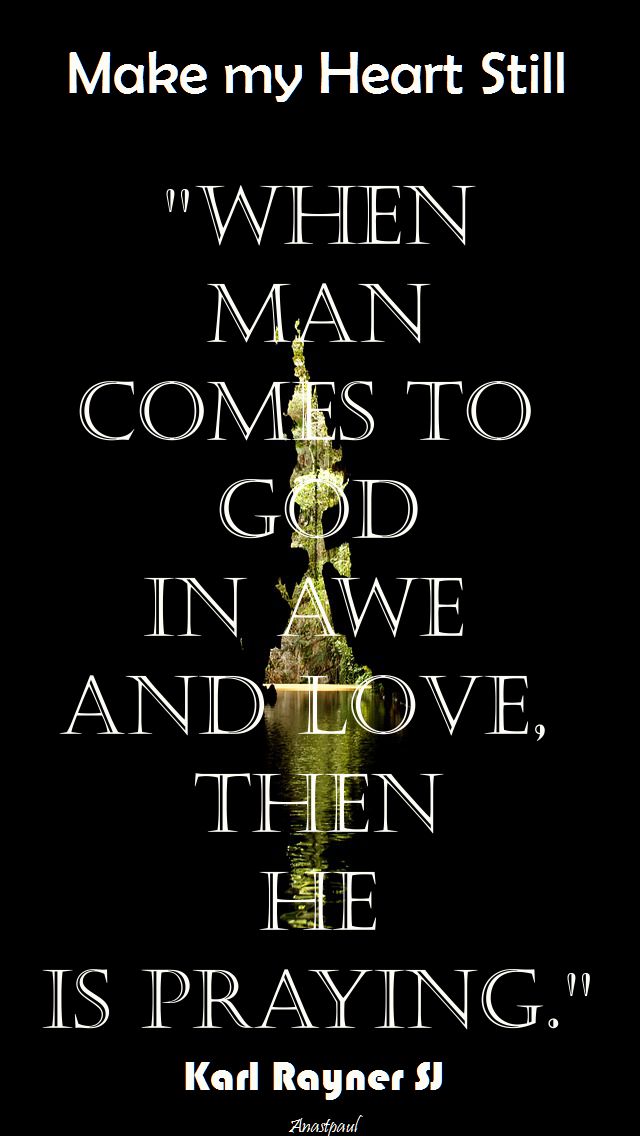
Make my Heart Still

“Lord take my poor heart.   It is often so far from You, lost in a thousand things and in the trifles that fill up my everyday life.   Lord, only You can collect the thoughts of my heart and have it concentrate on You, You who are the centre of all hearts, the Lord of all souls.   Only You can bestow the spirit of prayer, only Your grace is able to allow me to find You amidst this multitude of things, amidst the distractions of everyday life, YOU, the one necessity, the one person with whom my heart can become still.”

“When man comes to God in awe and love, then he is praying.”

Karl Rayner SJ – The Mystical Way in Everyday Lifewhen-man-comes-to-god-in-awe-and-love-karl-rayner-sj-11 july 2017

Posted in MORNING Prayers, PAPAL SERMONS, QUOTES of the SAINTS, QUOTES on PRAYER, QUOTES on SILENCE, QUOTES on WORK/LABOUR, SAINT of the DAY

Thought for the Day – 11 July – The Memorial of St Benedict of Nursia OSB (c 480-547)

Thought for the Day – 11 July – The Memorial of St Benedict of Nursia OSB (c 480-547)

Excerpt from the Homily of Pope Benedict

General Audience, 9 April 2008

“Today, I would like to speak about Benedict, the Founder of Western Monasticism and also the Patron of my Pontificate.

I begin with words that St Gregory the Great wrote about St Benedict:  “The man of God who shone on this earth among so many miracles was just as brilliant in the eloquent exposition of his teaching” (cf. Dialogues II, 36).   The great Pope wrote these words in 592 AD.   The holy monk, who had died barely 50 years earlier, lived on in people’s memories and especially in the flourishing religious Order he had founded.   St Benedict of Nursia/Norcia, with his life and his work, had a fundamental influence on the development of European civilisation and culture.   The most important source on Benedict’s life is the second book of St Gregory the Great’s Dialogues.   It is not a biography in the classical sense.   In accordance with the ideas of his time, by giving the example of a real man – St Benedict, in this case – Gregory wished to illustrate the ascent to the peak of contemplation which can be achieved by those who abandon themselves to God.   He therefore gives us a model for human life in the climb towards the summit of perfection.   St Gregory the Great also tells in this book of the Dialogues of many miracles worked by the Saint and here too he does not merely wish to recount something curious but rather to show how God, by admonishing, helping and even punishing, intervenes in the practical situations of man’s life.   Gregory’s aim was to demonstrate that God is not a distant hypothesis placed at the origin of the world but is present in the life of man, of every man.

Throughout the second book of his Dialogues, Gregory shows us how St Benedict’s life was steeped in an atmosphere of prayer, the foundation of his existence.   Without prayer there is no experience of God.   Yet Benedict’s spirituality was not an interiority removed from reality.   In the anxiety and confusion of his day, he lived under God’s gaze and in this very way never lost sight of the duties of daily life and of man with his practical needs.   Seeing God, he understood the reality of man and his mission.   In his Rule he describes monastic life as “a school for the service of the Lord” (Prol. 45) and advises his monks, “let nothing be preferred to the Work of God” [that is, the Divine Office or the Liturgy of the Hours] (43, 3).

However, Benedict states that in the first place prayer is an act of listening (Prol. 9-11), which must then be expressed in action.   “The Lord is waiting every day for us to respond to his holy admonitions by our deeds” (Prol. 35).   Thus, the monk’s life becomes a fruitful symbiosis between action and contemplation, “so that God may be glorified in all things” (57, 9).   In contrast with a facile and egocentric self-fulfilment, today often exalted, the first and indispensable commitment of a disciple of St Benedict is the sincere search for God (58, 7) on the path mapped out by the humble and obedient Christ (5, 13), whose love he must put before all else (4, 21; 72, 11) and in this way, in the service of the other, he becomes a man of service and peace  . In the exercise of obedience practised by faith inspired by love (5, 2), the monk achieves humility (5, 1), to which the Rule dedicates an entire chapter (7).   In this way, man conforms ever more to Christ and attains true self-fulfilment as a creature in the image and likeness of God.

Benedict describes the Rule he wrote as “minimal, just an initial outline” (cf. 73, 8);  in fact, however, he offers useful guidelines not only for monks but for all who seek guidance on their journey toward God.   For its moderation, humanity and sober discernment between the essential and the secondary in spiritual life, his Rule has retained its illuminating power even to today.

By proclaiming St Benedict Patron of Europe on 24 October 1964, Paul VI intended to recognise the marvellous work the Saint achieved with his Rule for the formation of the civilisation and culture of Europe.

Having recently emerged from a century that was deeply wounded by two World Wars and the collapse of the great ideologies, now revealed as tragic utopias, Europe today is in search of its own identity.   Of course, in order to create new and lasting unity, political, economic and juridical instruments are important, but it is also necessary to awaken an ethical and spiritual renewal which draws on the Christian roots of the Continent, otherwise a new Europe cannot be built.   Without this vital sap, man is exposed to the danger of succumbing to the ancient temptation of seeking to redeem himself by himself – a utopia which in different ways, in 20th-century Europe, as Pope John Paul II pointed out, has caused “a regression without precedent in the tormented history of humanity” (Address to the Pontifical Council for Culture, 12 January 1990).

Today, in seeking true progress, let us also listen to the Rule of St Benedict as a guiding light on our journey.   The great monk is still a true master at whose school we can learn to become proficient in true humanism.

Here is a PDF of the Rule for downloading:  http://www.documentacatholicaomnia.eu/03d/0480-0547,_Benedictus_Nursinus,_Regola,_EN.pdf

St Benedict, Pray for Europe, Pray for the World,

Pray for the Church, Pray for us all!st-benedict-pray-for-us-11 july 2017 - 3

Posted in MORNING Prayers, PRACTISING CATHOLIC, QUOTES of the SAINTS, QUOTES on CHARITY, QUOTES on PRAYER, QUOTES on WORK/LABOUR, SAINT of the DAY

Quote/s of the Day – 11 July – The Memorial of St Benedict of Nursia OSB (c 480-547)

Quote/s of the Day – 11 July – The Memorial of St Benedict of Nursia OSB (c 480-547)

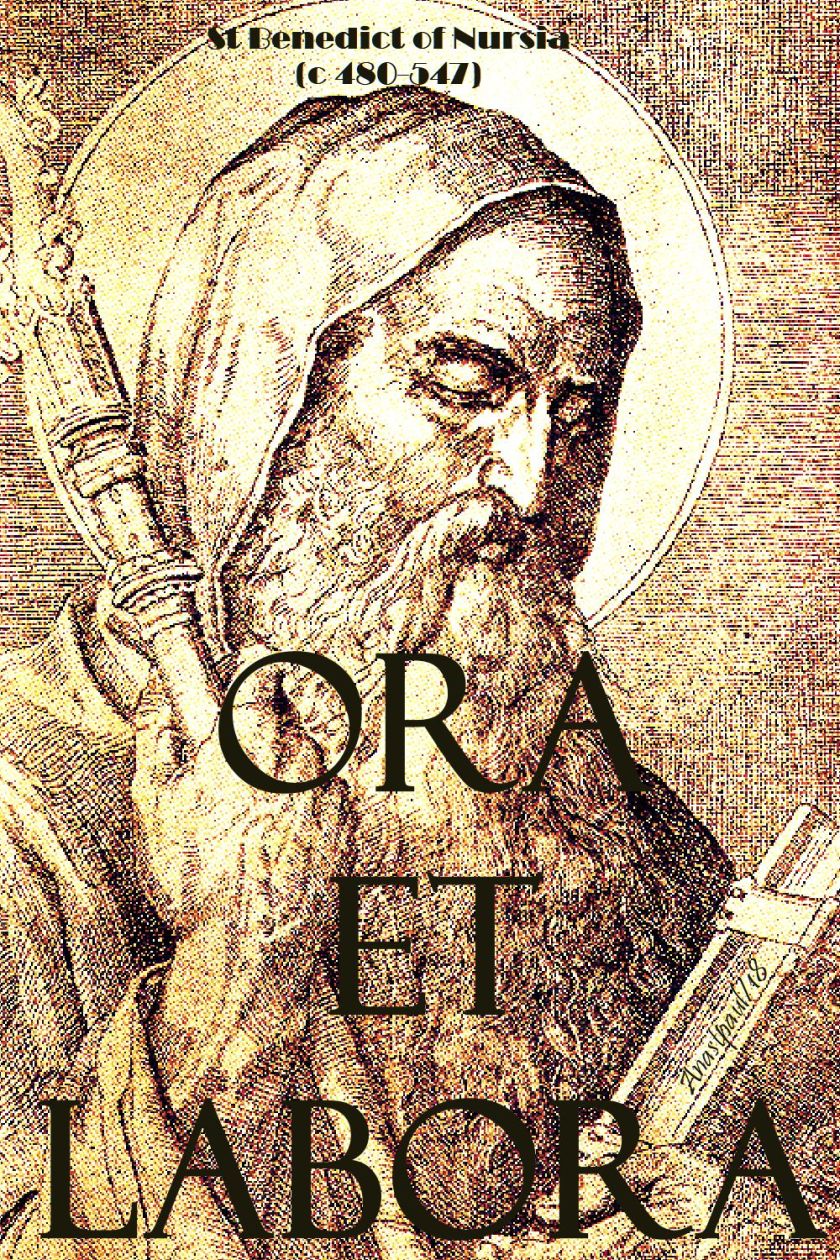
“Ora et labora.”ora et labora - st benedict - 11 july 2018

“Be careful to be gentle,
lest in removing the rust,
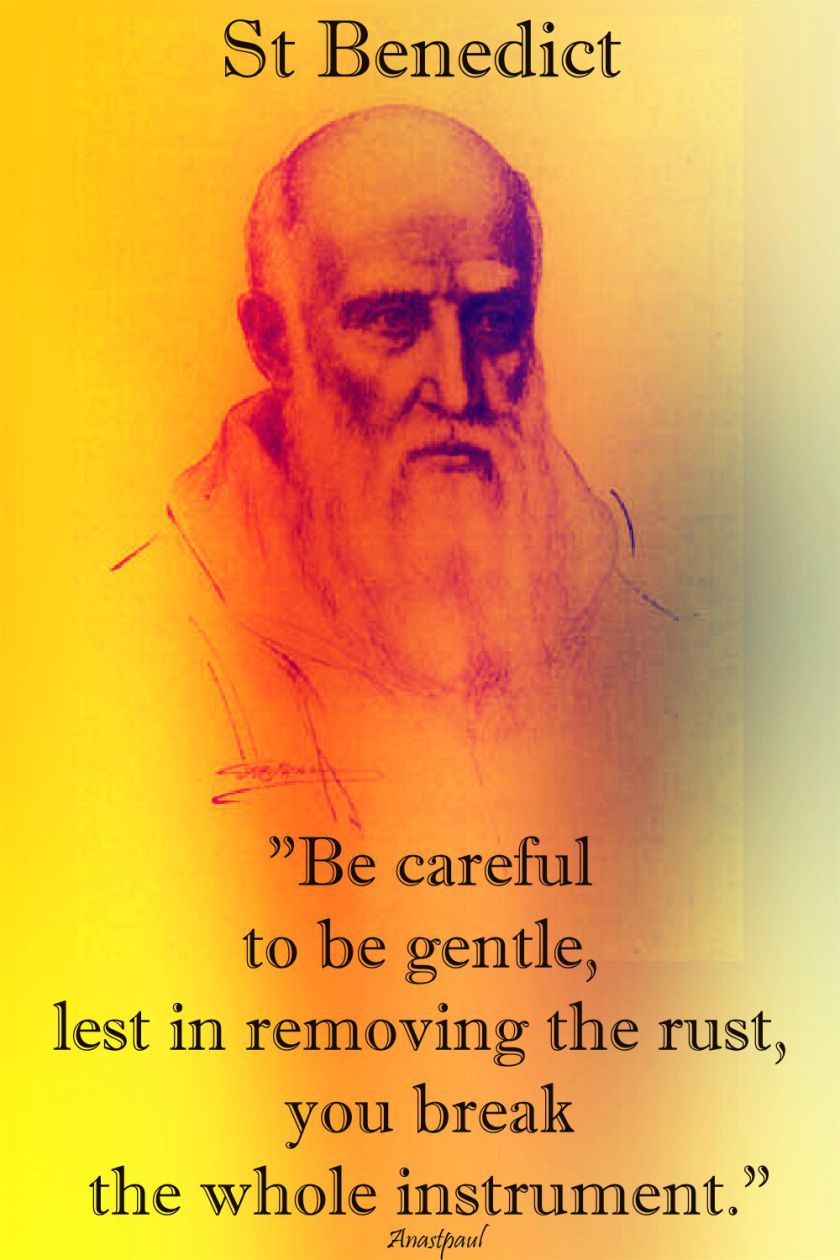
you break the whole instrument.”becareful-to-be-gentle-st-benedict-11 july 2017

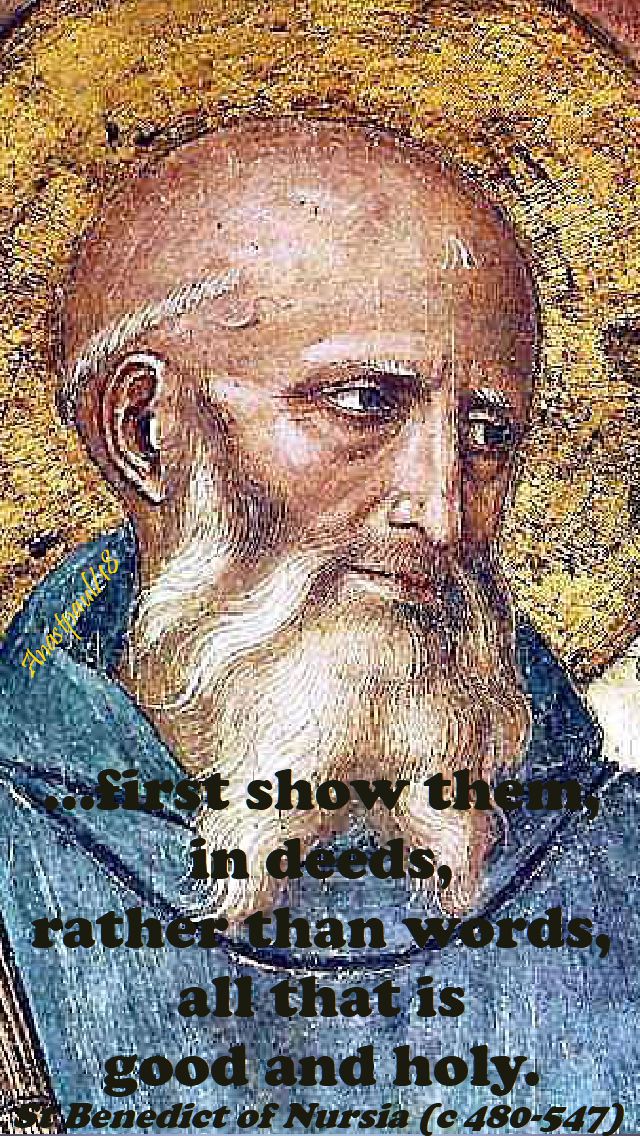
“He should first show them,
in deeds,
rather than words,
all that is good and holy.”first show them in deeds - 11 july 2018

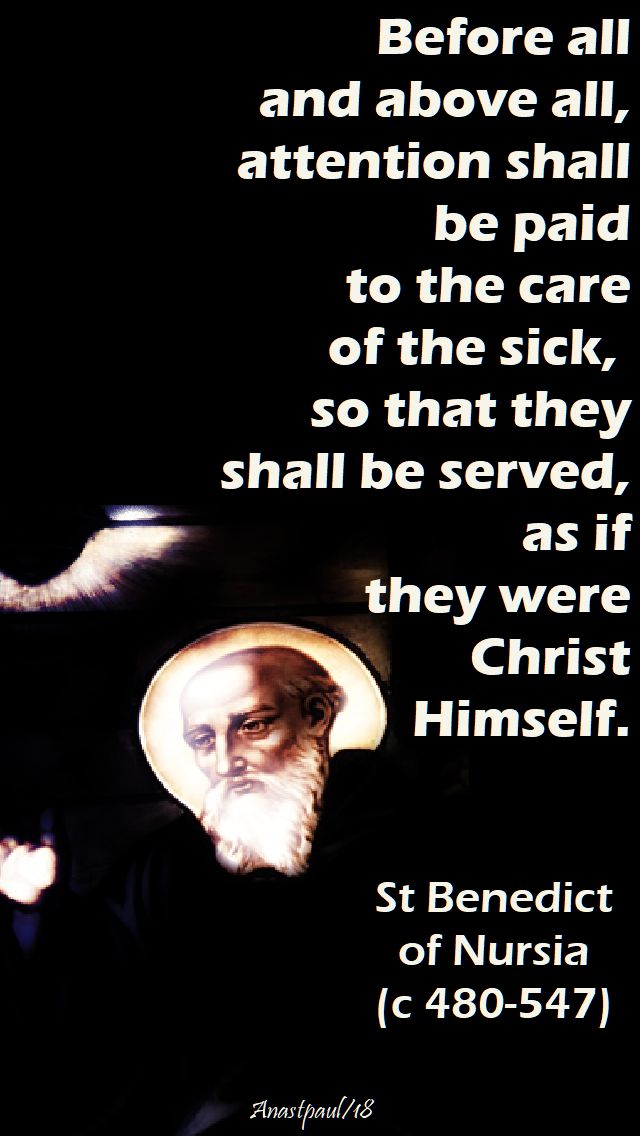
“Before all
and above all,
attention shall be paid
to the care of the sick,
so that they shall be served,
as if they were Christ Himself.”before all and above all - st benedict - 11 july 2018

“He who labours as he prays,
lifts his heart to God with his hands.”

“Whenever you begin any good work,
you should first of all,
make a most pressing appeal
to Christ our Lord,
to bring it to perfection.”

St Benedict of Nursia (c 480-547)he-who-labours-as-he-prays-st-benedict-11 july 2017

Posted in MORNING Prayers, QUOTES of the SAINTS, SAINT of the DAY, The WORD

One Minute Reflection – 11 July – The Memorial of St Benedict of Nursia OSB (c 480-547)

One Minute Reflection – 11 July – The Memorial of St Benedict of Nursia OSB (c 480-547)

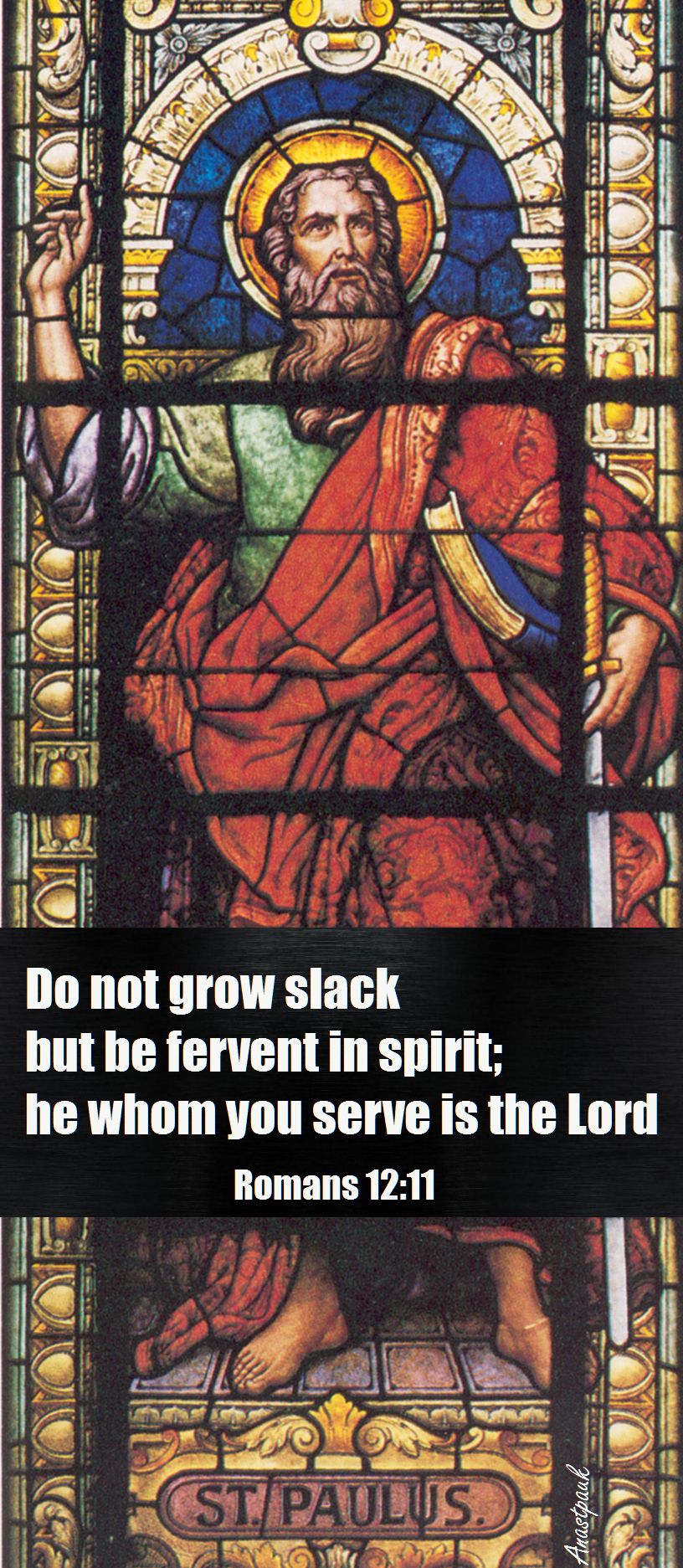
Do not grow slack but be fervent in spirit; he whom you serve is the Lord…….Romans 12:11romans-12-11- 11 july 2017

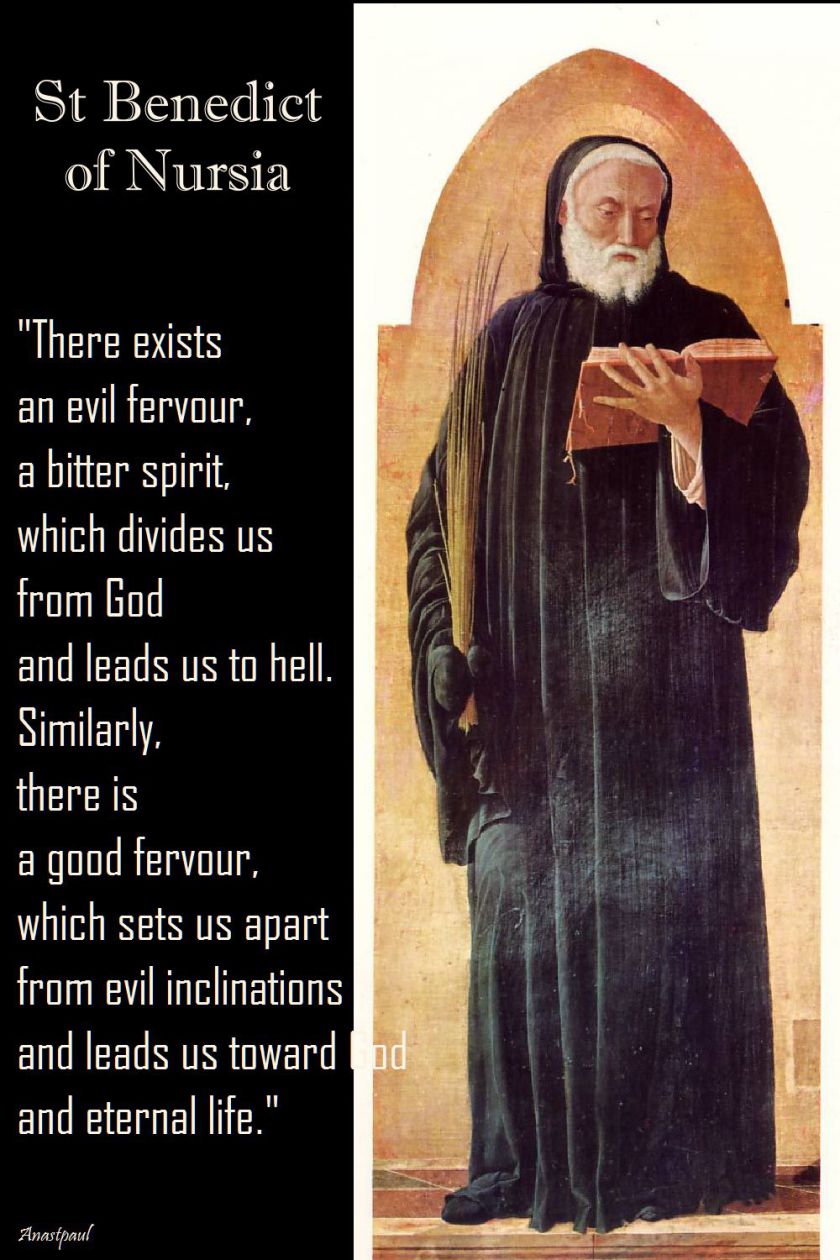
REFLECTION – “There exists an evil fervour, a bitter spirit, which divides us from God and leads us to hell.   Similarly, there is a good fervour, which sets us apart from evil inclinations and leads us toward God and eternal life.”…St Benedictst-benedict-there-exists-an-evil-fervour- 11 july 2017

PRAYER – Loving Father, grant me to have a true fervour in Your service.   Let me never tire of following Your Son’s example and avoiding evil.   Grant that by the intercession of St Benedict, we may grow in holiness and attain our eternal home with You.   We ask this through our Lord, Jesus Christ and the Holy Spirit, God forever, amen.st-benedict-pray-for-us-11 july 2017 -2

Posted in MORNING Prayers, PRAYERS of the SAINTS, SAINT of the DAY

Our Morning Offering – 11 July – St Benedict of Nursia OSB (c 480-547)

Our Morning Offering – 11 July – St Benedict of Nursia OSB (c 480-547)

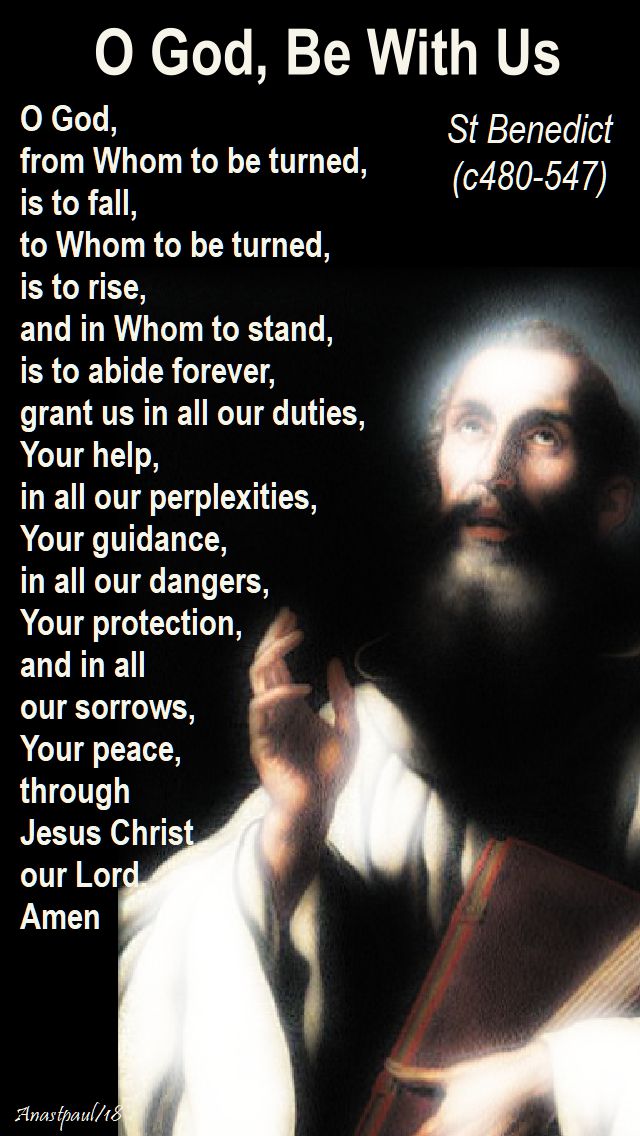
O God, Be With Us
St Benedict (c480-547)

O God,
from Whom to be turned, is to fall,
to Whom to be turned, is to rise,
and in Whom to stand, is to abide forever,
grant us in all our duties, Your help,
in all our perplexities, Your guidance,
in all our dangers, Your protection,
and in all our sorrows, Your peace,
through Jesus Christ our Lord.
Ameno god from whom to be turned is to fall - st benedict - 11 july 2018

Posted in Against SNAKE BITES / POISON, Of a Holy DEATH & AGAINST A SUDDEN DEATH, of the DYING, FINAL PERSEVERANCE, DEATH of CHILDREN, DEATH of PARENTS, Of Catholic Education, Students, Schools, Colleges etc, Of GARDENERS, Horticulturists, Farmers, Of MONKS, OF RELIGIOUS ORDERS, PATRONAGE-ENGINEERS, Electrical, Mechanical etc, SAINT of the DAY

Saint of the Day – 11 July – St Benedict of Nursia OSB (c 480-547) Patron of Europe and Founder of Western Monasticism

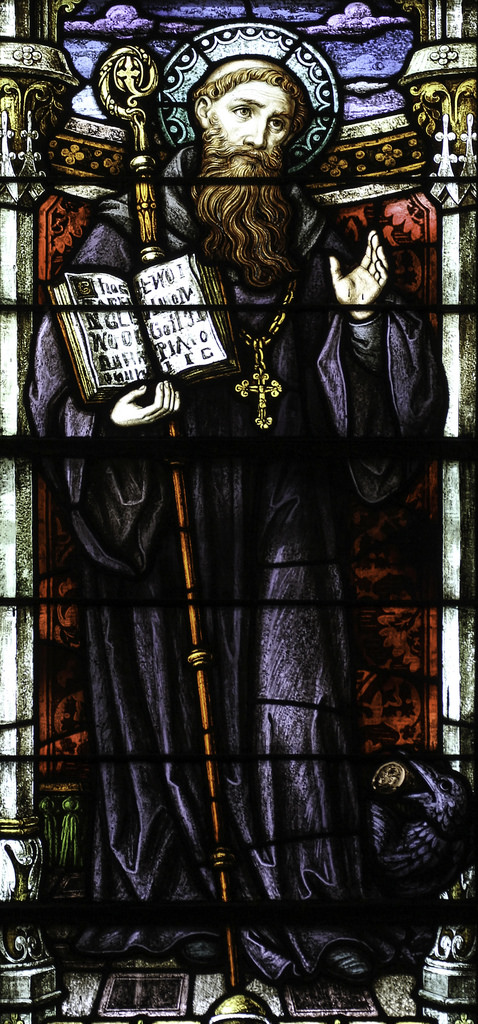
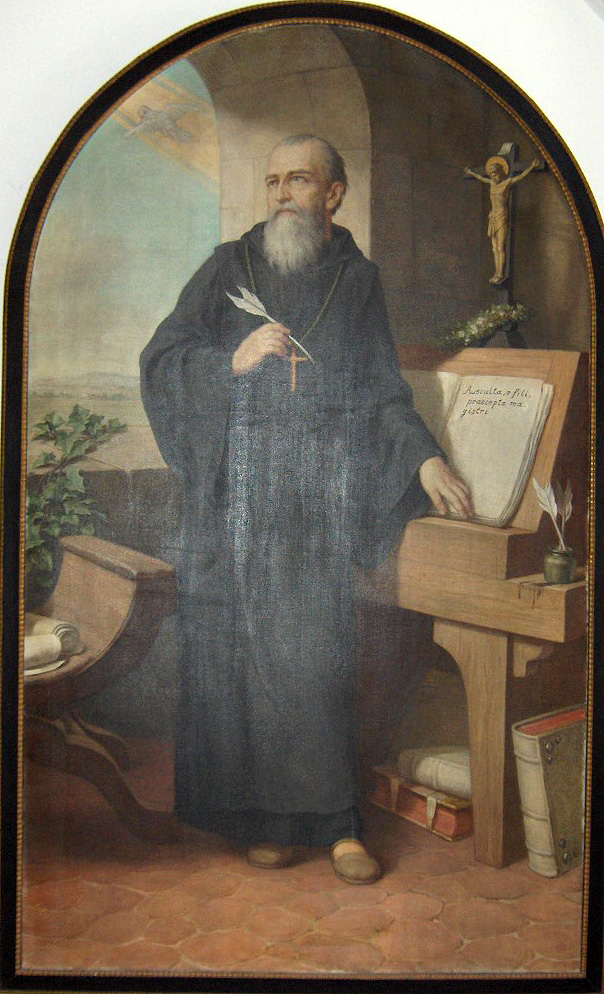
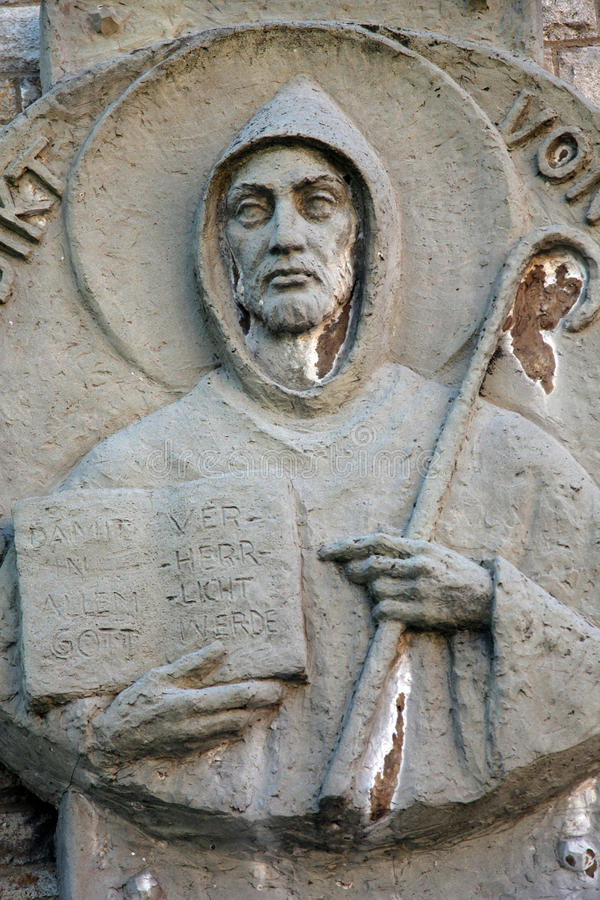
Saint of the Day – 11 July – St Benedict of Nursia OSB (c 480-547) Patron of Europe and Founder of Western Monasticism.   Some of his many Patronages – of Europe, Against Poison, Against Witchcraft, Agriculture, Cavers, Civil Engineers, Coppersmiths, Dying People, Farmers, Fevers, Inflammatory Diseases, Kidney Disease, Monks, Religious Orders, Schoolchildren, Temptations.BenedictinosSaint_Bendict_of_Nurcia

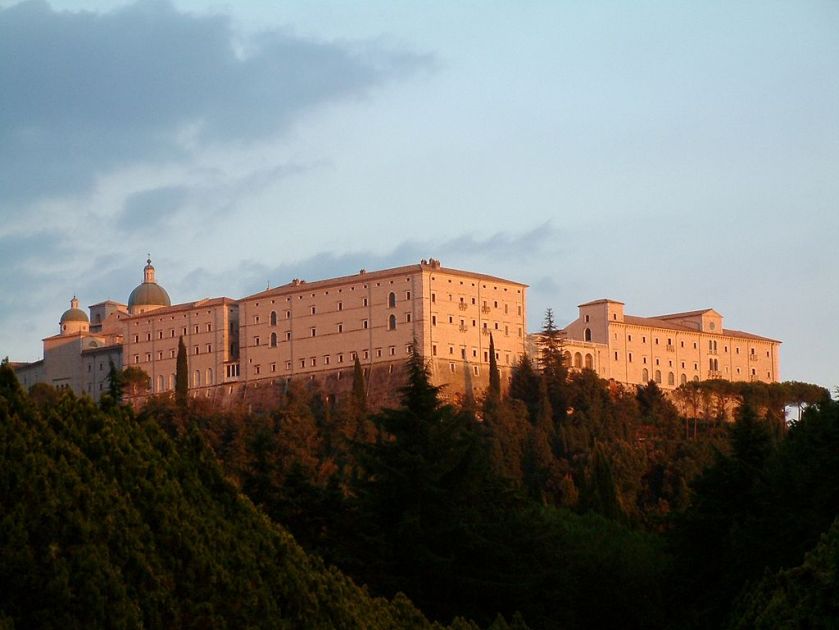
St Benedict founded twelve communities for monks about 40 miles east of Rome, before moving to Monte Cassino, in the mountains of southern Italy.   St Benedict’s main achievement is his “Rule”, containing precepts for his monks.    The unique spirit of balance, moderation and reasonableness influences it and this persuaded most religious communities founded throughout Middle Ages, to adopt it.    As a result, the Rule of St Benedict became one of the most influential religious rules in western Christendom.    For this reason, Benedict is often called the “founder” of western Christian Monasticism. Heiligenkreuz.St._Benedict

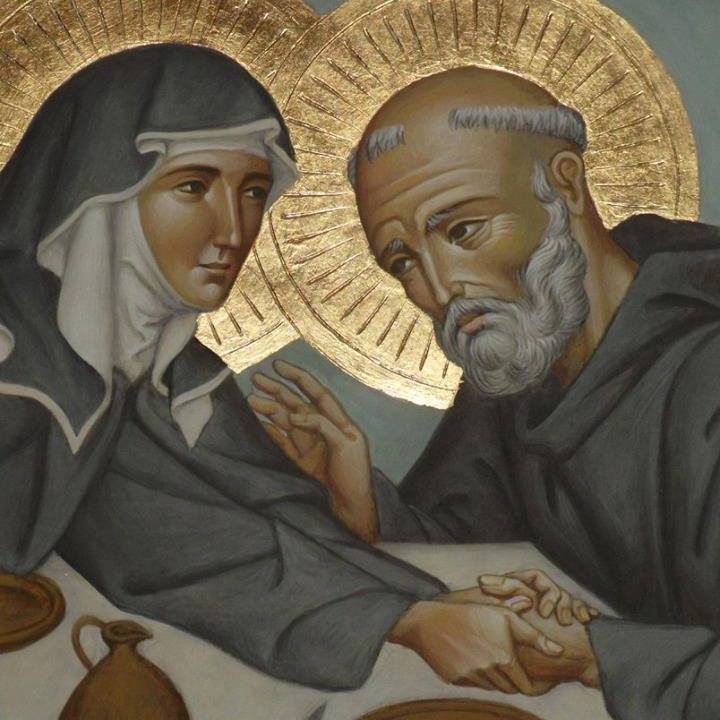
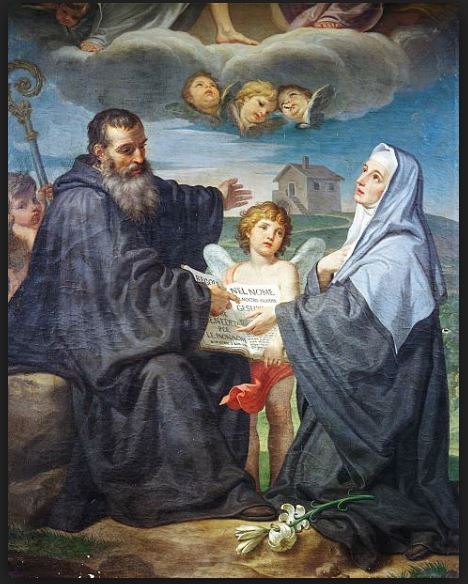
St Benedict is the twin brother of St Scholastica and is considered patron of many things.    He was born in Nursia, Italy and educated in Rome.Scholastica-and-Benedictmy snip - benedict and scholastica - domenico corvi 1721-1803

benedict and schalastica
St Benedict and hisd twin sister, St Scholastica

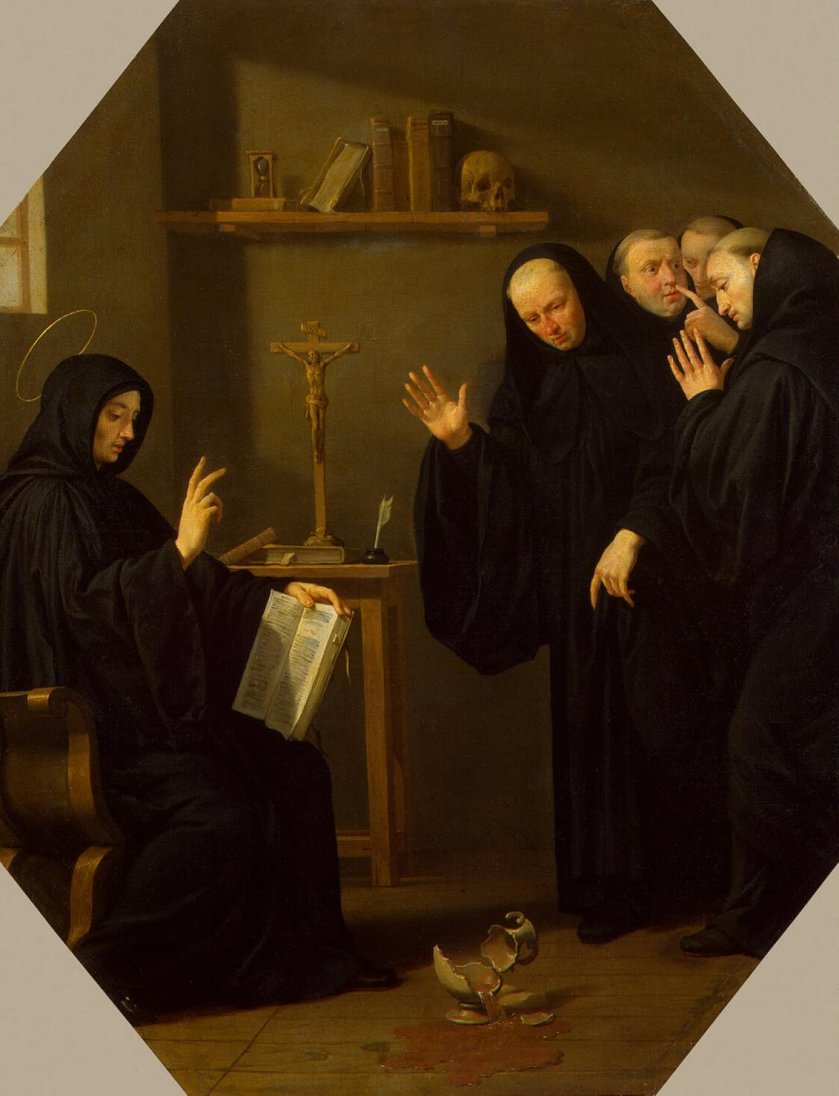
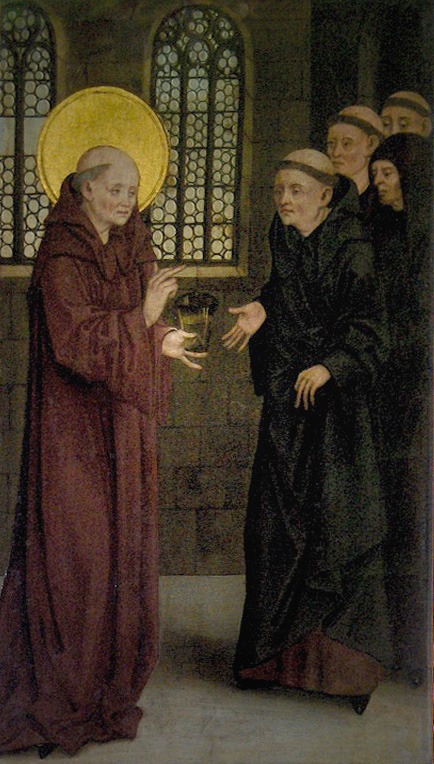
He was repelled by the vices of the city and around 500, fled to Enfide – thirty miles away.    He decided to live the life of a hermit and lived in a cave for three years.    Despite Benedict’s desire for solitude, his holiness became known and he was asked to be the Abbot by a community of monks at Vicovaro.    He accepted but when the monks resisted his strict rule and tried to poison him, he returned to Subiaco and became a centre of spirituality and learning. champaigne_philippe_dezzzscene_from_the_life_of_st_benedict-_the_poisoned_cup_of_wine

st benedict and the cup of poison
St Benedict and the Cup of Poison

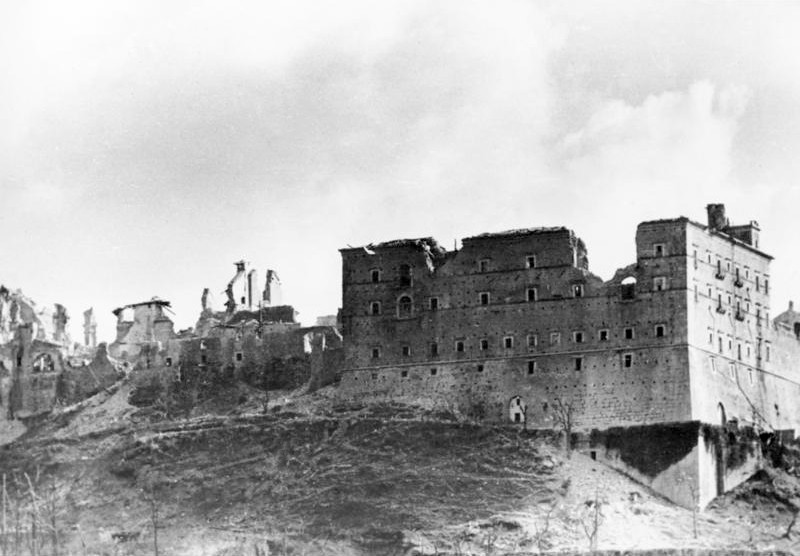
He eventually moved back to Monte Cassino and destroyed a temple to Apollo on its crest and brought the people of the neighbouring area back to Christianity.    In 530 he began to build the monastery that was to be the birthplace of western monasticism.  data=dfJwSHpr2UU2dqoWYuGhCM6f93gIUaI8nJa4qy1CkuUIECsLTKt97nBY-VhQhXiVd_QY-L05N6sf2u3rW46w2dOiTQnblInFmXtgNjvDhRy3fFbi1V8nbtijMOtdHPafZzrH1YTVpMw1z2hkH7TuHn4S98gGrYdfEAmGGjSfyVFG-Zr-PNRk8

Bundesarchiv_Bild_146-2005-0004,_Italien,_Monte_Cassino
Monte Cassino in ruins after Allied bombing in February 1944.
1024px-Monte_Cassino_Opactwo_1
Rebuilt Abbey

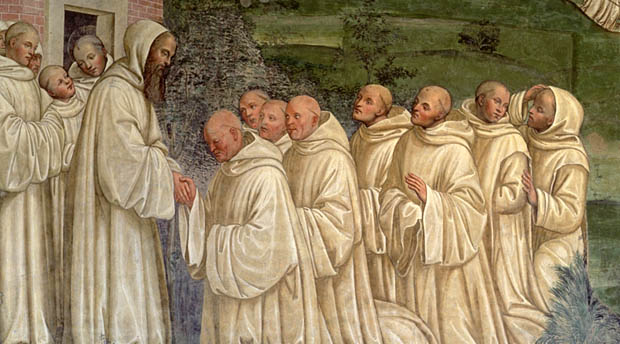
Soon, disciples again flocked to him as his reputation for holiness, wisdom and miracles spread far and wide.    It wasn’t long and he organised his monks into a single monastic community and wrote his official Rule, prescribing common sense, a life of moderate asceticism, prayer, study, work and community under one superior.    It stressed obedience, stability, zeal and had the Divine Office as the centre of monastic life.    While ruling his monks, most of whom – including Benedict, were not ordained, he counselled rulers and Popes and ministered to the poor and destitute.    He died at Monte Cassino on 21 March 547 and was named patron protector of Europe by Pope Paul VI in 1964.    The Universal Church celebrates his feast day today. San_Benedetto_da_Norcia_ABst benedict and monks

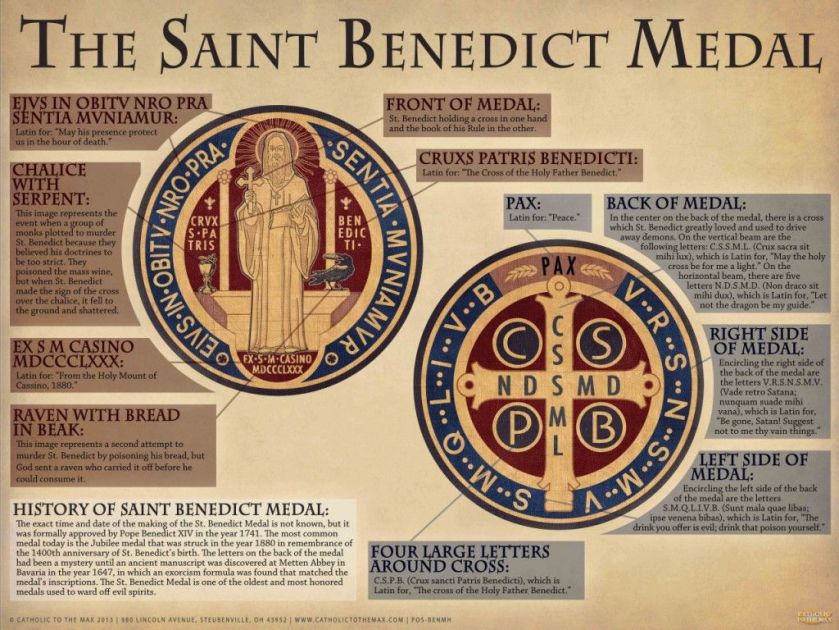
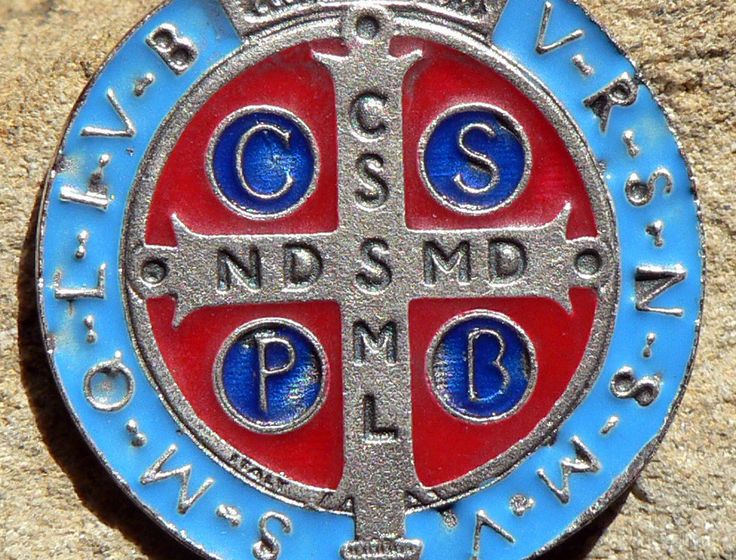
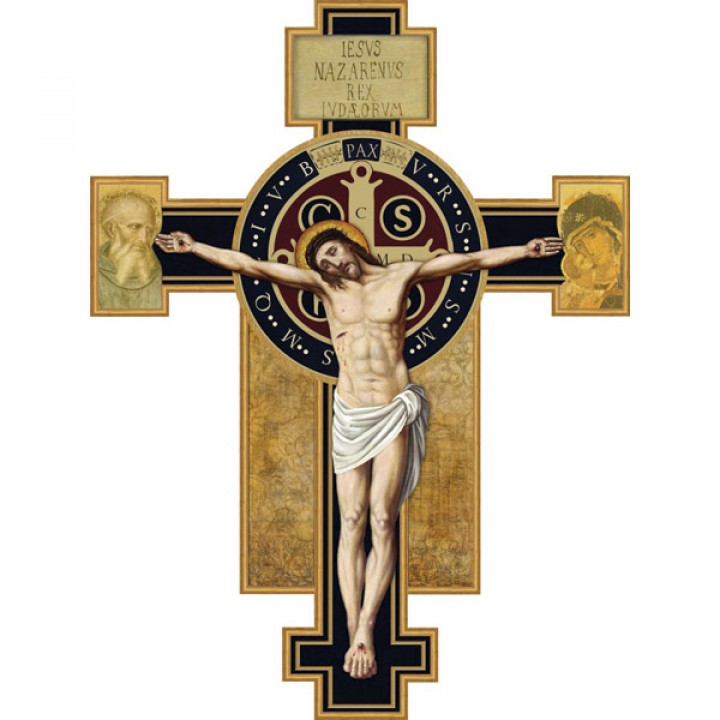
The St Benedict medal is very popular among Christians to this day and are hung above doors and windows, for protection against evil.    It is believed that evil cannot enter your house if you protect every opening with a St Benedict medal and Crucifix.    The medal has an image of St Benedict, holding the Holy Rule in his left hand and a cross in his right.    There is a raven on one side of him, with a cup on the other side.    Around the medal’s outer margin are the words “Eius in obitu nostro praesentia muniamur” – “May we, at our death, be fortified by His presence”.   The other side of the medal has a cross with the initials CSSML on the vertical bar which signify “Crux Sacra Sit Mihi Lux” “May the Holy Cross be my light” and on the horizontal bar are the initials NDSMD which stand for “Non Draco Sit Mihi Dux” “Let not the dragon be my overlord”.   The initials CSPB stand for “Crux Sancti Patris Benedicti” “The Cross of the Holy Father Benedict” and are located on the interior angles of the cross.   Either the inscription “PAX” Peace or the Christogram “HIS” may be found at the top of the cross in most cases.   Around the medal’s margin on this side are the initials VRSNSMV which stand for “Vade Retro Satana, Nonquam Suade Mihi Vana” ”Begone Satan, do not suggest to me thy vanities” then a space followed by the initials SMQLIVB which signify “Sunt Mala Quae Libas, Ipse Venena Bibas” “Evil are the things thou profferest, drink thou thy own poison”.st benedict medalst benedict medal 2st benedict crucifix and medal

The Medal of St Benedict can serve as a constant reminder of the need for us to take up our cross daily and “follow the true King, Christ our Lord,” and thus learn “to share in his heavenly kingdom,” as St. Benedict urges us in the Prologue of his Rule.

More on St Benedict, his Rule and the Medal here:  https://anastpaul.wordpress.com/2017/07/11/saint-of-the-day-11-july-st-benedict-of-nursia-o-s-b-abbot-patron-of-europe-patronus-europae/saint-benedict-nursia-munsterschwarzach-germany-83888371768px-Einsiedeln_-_St._Benedikt_2013-01-26_13-50-02_(P7700)

Posted in SAINT of the DAY

Memorials of the Saints – 11 July

St Benedict of Nursia OSB (c 480-547) (Memorial) Patron of Europe and Founder of Western Monasticism

St Abundius of Ananelos
St Amabilis of Rouen
St Anna An Jiaoshi
St Anna An Xingshi
Bl Antonio Muller
St Berthevin of Lisieux
St Cindeus
St Cowair
St Cyprian of Brescia
St Cyriacus the Executioner
St Drostan
St Hidulf of Moyenmoutier
St Januarius
St John of Bergamo
Bl Kjeld of Viborg
St Leontius the Younger
St Marcian of Lycaonia
St Marciana of Caesarea
Maria An Guoshi
Maria An Linghua
Bl Marie-Clotilde Blanc
Bl Marie-Elisabeth Pélissier
Bl Marie-Marguerite de Barbégie d’Albrède
St Olga of Kiev
St Pelagia
St Pius I, Pope
St Placid of Dissentis
Bl Rosalie-Clotilde Bes
St Sabinus of Brescia
St Sabinus of Poitiers
St Sidronius
St Sigisbert of Dissentis
Bl Thomas Hunt
Bl Thomas Sprott
St Thurketyl

Posted in DOCTORS of the Church, FATHERS of the Church, MORNING Prayers, QUOTES of the SAINTS, QUOTES on EVANGELISATION, The WORD

Thought for the Day – 10 July – Tuesday of the Fourteenth Week of Ordinary Time, Year B – Today’s Gospel: Matthew 9:32-38

Thought for the Day – 10 July – Tuesday of the Fourteenth Week of Ordinary Time, Year B – Today’s Gospel: Matthew 9:32-38

“The harvest is abundant…Matthew 9:37”
St John Chrysostom (347-407) Father & Doctor

“All the farmer’s work naturally leads towards the harvest.   So how could Christ call a ‘harvest’ a work that was still in its initial stages?   Idolatry reigned over all the earth… Everywhere there was fornication, adultery, debauchery, greed, theft, wars…  The earth was filled with so many evils!   No seed had yet been sown there.   The thorns, thistles and weeds that covered the ground had not yet been pulled up.   The ground had not yet been ploughed, no furrow had yet been drawn.

So how could Jesus say that the harvest was abundant? … The apostles were probably distressed and frustrated:  “How are we going to be able to say anything, to stand upright before so many people?   How can we, the Eleven, correct all the inhabitants of the earth?   Will we who are so ignorant be able to approach scholars;  will we who are so stripped of everything be able to meet armed men; will we who are subordinates be able to approach people in authority?   We know only one language – will we be able to argue with the barbarians who speak foreign languages?   Who will bear with us if they don’t even understand our language?”

Jesus did not want such reasoning to discourage them.   So He called the Gospel a harvest.   It is as if He told them:  “Everything is prepared, all the preparations have been made.   I am sending you out to harvest the ripe grain.   You will be able to sow and reap on the same day.”

When the farmer leaves his home to go out and gather the harvest, he is brimming over with joy and shining with happiness.   He thinks neither of the suffering nor the difficulties that he might encounter…  Christ says, lend me your tongue and you will see the ripe grain going into the king’s granaries.   And so He then sends them out, telling them:  “I am with you always, until the end of the world.” (Mt 28:20)christ says, lend me your tongue - i am with you always - matthew 28 20 - st john chrysostom - 10 july 2018

Posted in DOCTORS of the Church, FATHERS of the Church, MORNING Prayers, QUOTES - J R R Tolkien and MORE, QUOTES of the SAINTS, QUOTES on SUFFERING, SPEAKING of .....

Quote/s of the Day – 10 July – “Speaking of:  Suffering”

Quote/s of the Day – 10 July

“Speaking of:  Suffering”

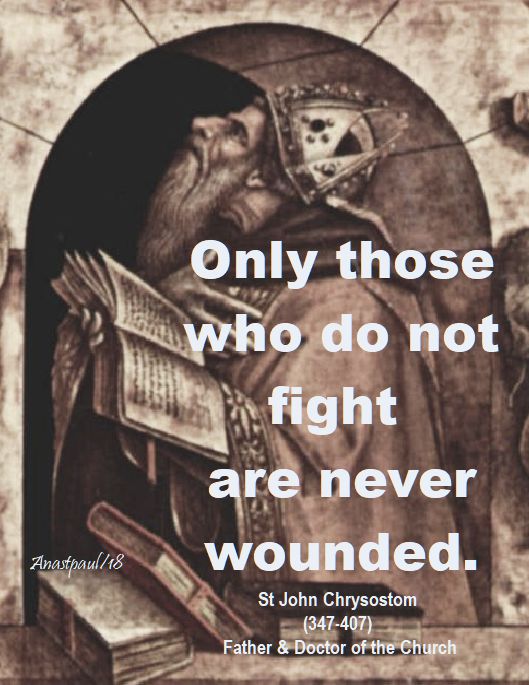
“Only those who do not fight are never wounded.”

St John Chrysostom (347-407) Father & Doctoronly those who do not fight - st john chrysostom - 27 april 2018

“God whispers to us in our pleasures,
speaks in our conscience
but shouts in our pains –
it is His megaphone to rouse a deaf world.”god whispers to us in our pleasures - c s lewis - 10 july 2018

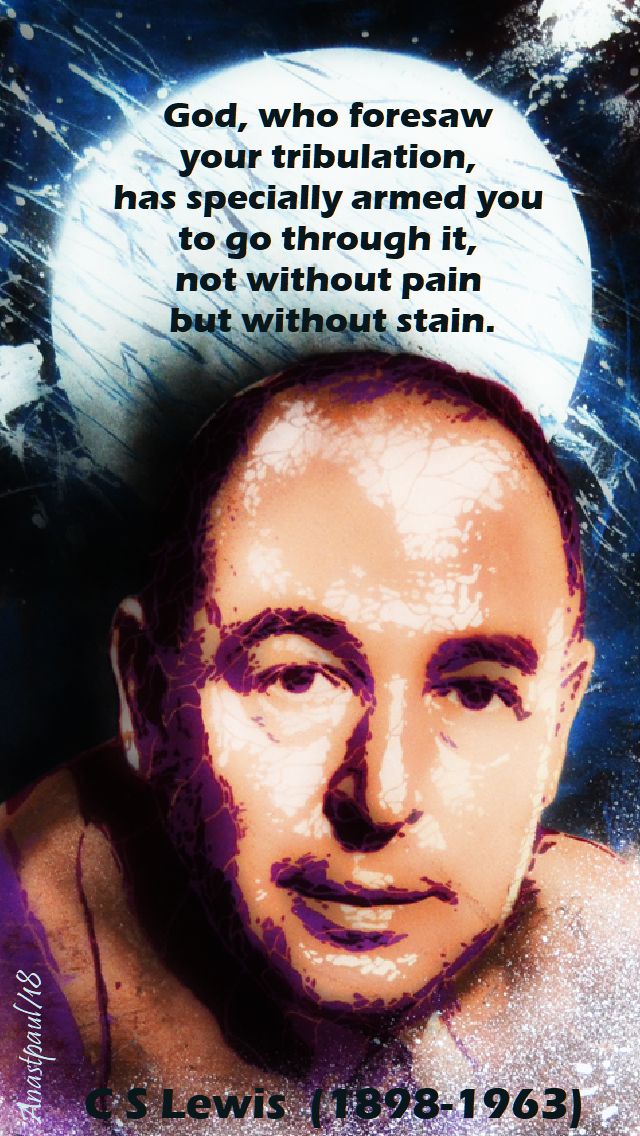
“God, who foresaw your tribulation,
has specially armed you to go through it,
not without pain but without stain.”

C S Lewis (1898-1963)god, who foresaw your tribulation - c s lewis - 10 july 2018

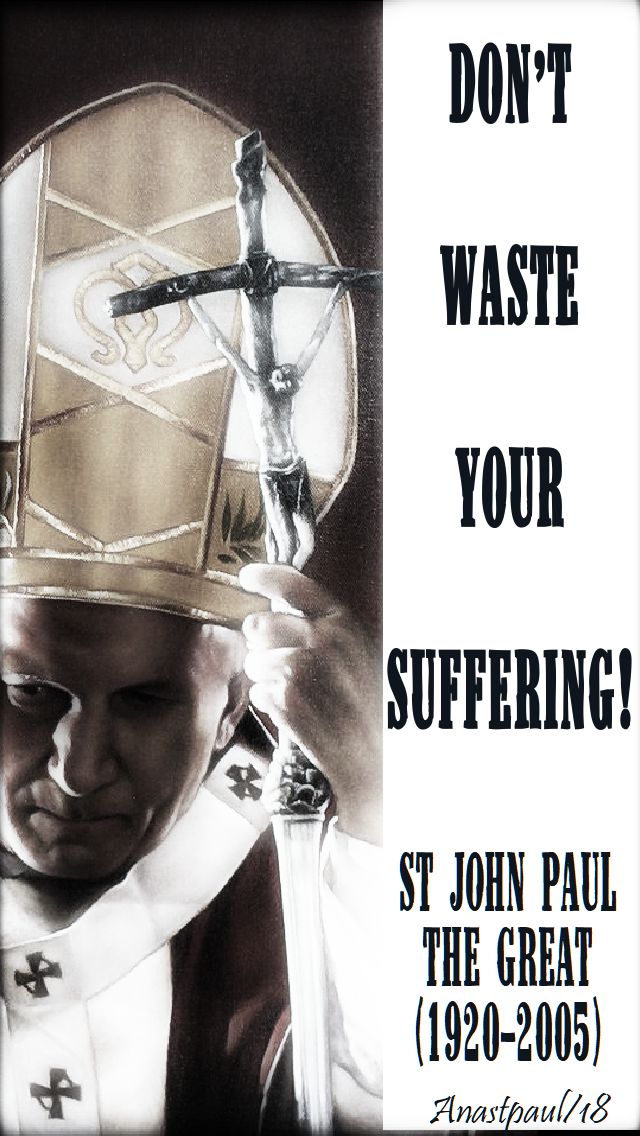
“Don’t waste your suffering.”

St John Paul the Great (1920-2005)don't waste your suffering - st john paul - 27 april 2018

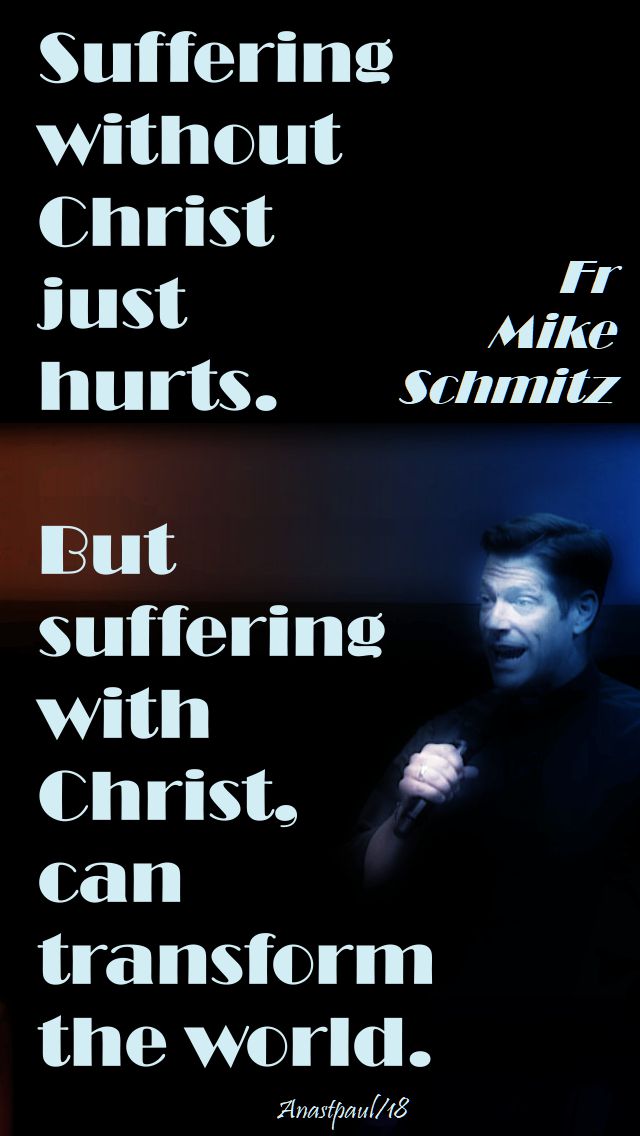
“Suffering without Christ just hurts.
But suffering with Christ,
can transform the world.”

Father Mike Schmitzsuffering without christ - fr mike - 10 july 2018


Posted in MORNING Prayers, PAPAL SERMONS, SAINT of the DAY, The WORD

One Minute Reflection – 10 July – Tuesday of the Fourteenth Week of Ordinary Time, Year B – Today’s Gospel: Matthew 9:32-38

One Minute Reflection – 10 July – Tuesday of the Fourteenth Week of Ordinary Time, Year B – Today’s Gospel: Matthew 9:32-38

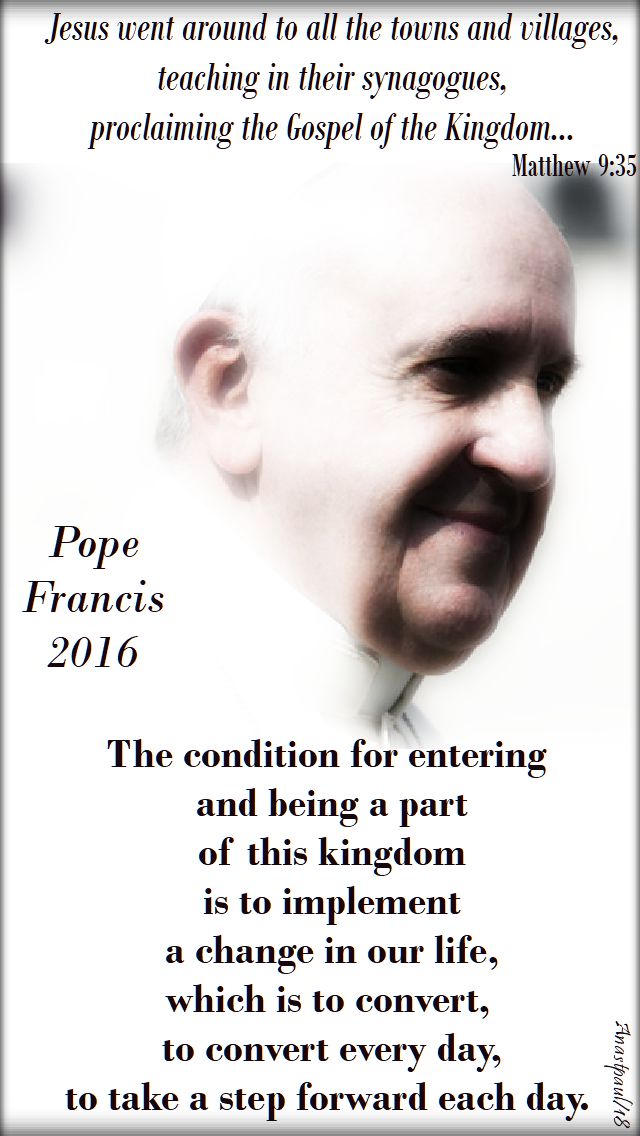
Jesus went around to all the towns and villages, teaching in their synagogues, proclaiming the Gospel of the Kingdom..…Matthew 9:35

REFLECTION – “This is the central message of every Christian mission.   When a missionary goes, a Christian goes to proclaim Jesus, not to proselytise, as if he were a fan trying to drum up new supporters for his team.   No, he goes simply to proclaim:  “The kingdom of God is in our midst!”.
But what is this kingdom of God, this kingdom of heaven?   They are synonymous.   We think immediately of the afterlife:  eternal life.   Of course this is true, the kingdom of God will extend without limit beyond earthly life but the good news that Jesus brings us — and that John predicts — is that we do not need to wait for the kingdom of God in the future:  it is at hand.   In some way it is already present and we may experience spiritual power from now on.
The condition for entering and being a part of this kingdom, is to implement a change in our life, which is to convert, to convert every day, to take a step forward each day.   It is a question of leaving behind the comfortable but misleading ways of the idols of this world:  success at all costs, power to the detriment of the weak, the desire for wealth, pleasure at any price.   And instead, preparing the way of the Lord:  this does not take away our freedom but gives us true happiness…Pope Francis (Angelus, Dec 4, 2016)matthew 9 35 - jesus went around - the condition for entering - pope francis - 10 july 2018

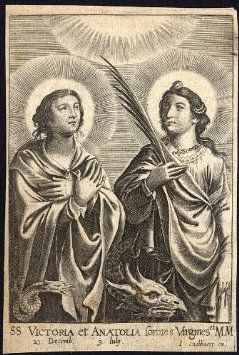
PRAYER – All-powerful God, to serve You is to reign.   Your love gave the saints Victoria and Anatolia the courage to proclaim the truth of Christ and by their mission of preaching of the Kingdom, to suffer a cruel martyrdom.   Grant that by their prayers, our lives bear witness to the faith we profess and our love bring others, to the peace and joy of your gospel.   Through our Lord Jesus Christ, Your Son, who lives and reigns with You in the unity of the Holy Spirit, one God, forever and ever. Amensts victoria and anatolia pray for us 10 july 2018

Posted in MORNING Prayers, PRAYERS to the SAINTS, Thomas a Kempis

Our Morning Offering – 10 July

Our Morning Offering – 10 July – Tuesday of the Fourteenth Week of Ordinary Time, Year B

A Prayer for Fulfilling
the Will of God
Thomas à Kempis (1380-1471)

O most merciful Jesus,
grant me Your grace,
that it may remain with me always
and persevere with me to the end.
Grant me always to will and desire,
what is more pleasing and acceptable to You.
Let Your will be mind
and let my will always follow Yours
in perfect conformity with it.
Let my will and desires always be one with Yours
and let me be unable to will or not to will,
except as You will or do not will.
Grant that I may die to all worldly things
and that I may be despised and unknown
for love of You.
Grant, above all things to be desired,
that I may find rest in You
and that in Your Heart alone may be my peace.
You, O Lord, give true peace to the heart
and perfect rest to body and soul.
Apart from You, all is difficult and never still.
In that peace, in You Who are the one,
supreme and eternal Good,
I will sleep and take my rest.
Amena prayer for fulfilling the will of god - thomas a kempis -10 july 2018

Posted in SAINT of the DAY

Saints of the Day – St Anatolia & Victoria (Died 250) Martyrs – Sisters who gave their lives for Christ

Saints of the Day – St Anatolia & Victoria (Died 250) Martyrs – Sisters who gave their lives for Christ.

Patronages – against earthquakes, against lightning, against severe weather, 18 cities.   Anatolia was first mentioned in the De Laude Sanctorum composed in 396 by Victrice (Victricius), bishop of Rouen (330-409) and they are both mentioned together in the Martyrologium Hieronymianum under 10 July.   The two saints appear in the famous  mosaics of Basilica of Sant’Apollinare Nuovo, at Ravenna (see image below – 22 martyrs shown offering their crowns of martyrdom to the Christ. ), between Saints Paulina and Christina.   A Passio Saints Anatoliae et Audacis et Saint Victoriae of the 6th or seventh century, which added the name of Audax, was mentioned by Aldhelm (died 709) and Bede (died 735), who list the saints in their martyrologies.   Caesar Baronius lists Anatolia and Audax under 9 July and Victoria under 23 December.800px-Ravenna,_sant'apollinare_nuovo_Sante_Vergini_(seconda_metà_del_VI_secolo)

Saint Victoria and her sister Saint Anatolia are remembered as beautiful Catholic noble women who lived during the reign of Emperor Decius 249-251.    They were promised in marriage to noble pagan men who were far from pleased at having heard that they were practising Catholics.   Saint Victoria was initially content with marrying the pagan, as she hoped that she would be able to convert him but her sister refused to marry and convinced St Victoria to do the same.   They both sought to devote their lives solely to God.

victoria and anatolia

The noble pagan suitors both managed to strike a deal with Roman authorities that allowed them to imprison each sister in their respective houses, in order to hopefully convince them to denounce their faith.   Both sisters responded by selling all of their possessions, giving all of their money to the poor and devoting themselves to God.   Both sisters, during their imprisonment, converted all of the guards, maids and servants in their respective houses.

Needless to say, the suitors were both furious at the sister’s failure to denounce their faith and acts of converting the guards, maids, etc.   Saint Anatolia’s suitor, Titus Aurelius, was furious and hired St Audace, to execute her.   He initially locked her in a room with a venomous snake which failed to harm her.   Upon seeing this, St Audace converted and was later martyred.   Saint Anatolia’s suitor was violently angry and became her murderer himself, by stabbing her to death.

Saint Victoria’s suitor,  Eugenius, soon heard of this murder of Anatolia but continued to try and convince Victoria to aposthasise.   He went through periods of great kindness towards her followed with periods of extreme ill-treatment.   Eventually he renounced his suite and stabbed her to death himself, in a fit of rage.   According to legend, he was instantly struck with leprosy and died 6 days later eaten by worms.

The relics of Saint Victoria are enshrined in the church of Santa Vittoria in Metanano, Italy and the relics of Saint Anatolia, as well as those of Saint Audace, are enshrined in the Basilica of Saint Scholastica in Subiaco.

Posted in SAINT of the DAY

Memorials of the Saints – 10 July

St Amalberga of Mauberge (Died 690)
St Anatolia & Victoria (Died 250) Martyrs
St Antôn Nguyen Huu Quynh
St Apollonius of Sardis
Bl Arnold of Camerino
St Bianor of Pisidia
St Cuán of Airbhre
St Elilantus
St Etto
Bl Euménios
St Knud of Denmark
St Lantfrid
Bl Marie-Gertrude de Ripert d’Alauzier
Bl Parthenios
St Pascharius of Nantes
St Peter Vincioli
St Phêrô Nguyen Khac Tu
St Rufina of Rome
St Secunda of Rome
St Sylvanus of Pisidia
Bl Sylvie-Agnès de Romillon
St Waltram

Martyrs of Africa – 4 saints: A group of Christians martyred together in Africa. The only information that has survived are four of their names – Felix, Januarius, Marinus and Nabor.

Martyrs of Antioch – 10 saints: A group of ten Christians martyred together. We have no details about them but the names – Diogenes, Domnina, Esicius, Macarius, Maxima, Maximus, Rodigus, Timoteus, Veronia and Zacheus. They were martyred in Antioch, date unknown.

Martyrs of Damascus – 11 beati: A group of Franciscans and laymen ordered by Druz Muslims to convert to Islam. They refused and were hacked to pieces.
• ‘Abd Al-Mu’ti Masabki
• Carmelo Bolta Bañuls
• Engelbert Kolland
• Francisco Pinazo Peñalver
• Fransis Masabki
• Juan Jacobo Fernández y Fernández
• Manuel Ruiz López
• Nicanor Ascanio de Soria
• Nicolás María Alberca Torres
• Pedro Soler Méndez
• Rufayil Masabki
They were cut to pieces on 9-10 July 1860 in Damascus, Syria.
Beatified on 10 October 1926 by Pope Pius XI.

Martyrs of Nicopolis – 45 saints: A group of 45 Christians tortured and martyred together in the persecutions of emperor Licinius. We know nothing else but six of their names – Anicetus, Anthony, Daniel, Leontius, Mauritius and Sisinno. c 329 in Nicopolis, Armenia (modern Koyulhisar, Turkey).

Martyrs of Nitria – 5 saints: Fathers of Nitria – Four monks and the bishop of Alexandria, Egypt who were martyred by heretics. Saint John Chrysostom wrote about them but their names have not come down to us. They were martyred in the 4th century in Nitria, Egypt.

Posted in MORNING Prayers, PRACTISING CATHOLIC, QUOTES of the SAINTS, The SIGN of the CROSS

Thought for the Day – 9 July – Monday of the Fourteenth Week in Ordinary Time, Year B

Thought for the Day – 9 July – Monday of the Fourteenth Week in Ordinary Time, Year B

THE GIFT OF EVERY DAY
St John Vianney (1786-1859)

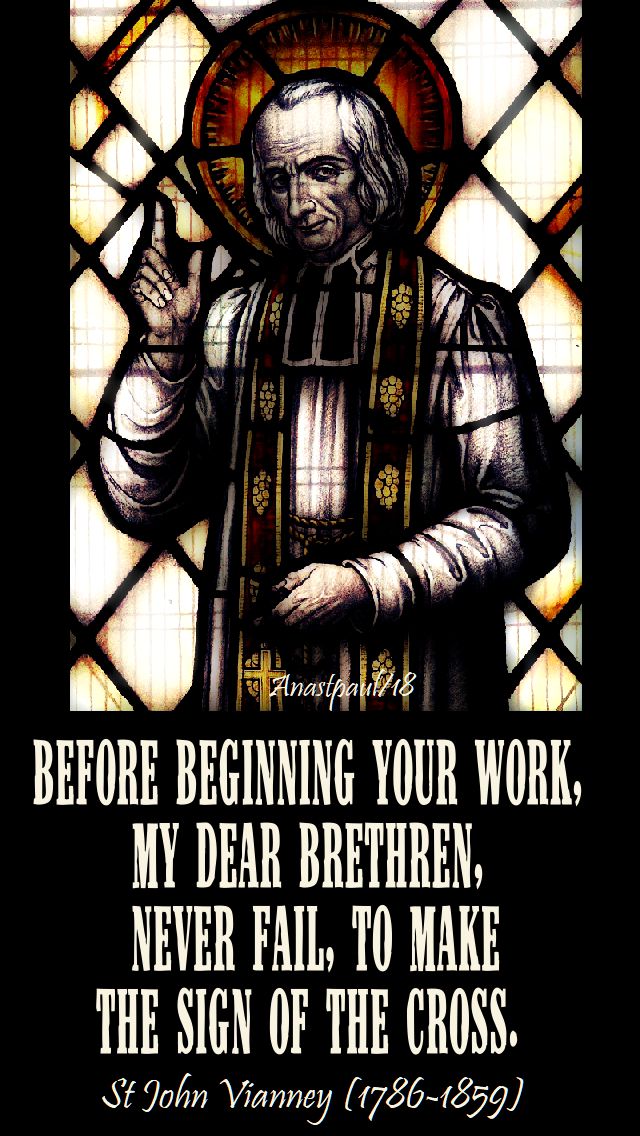
Before beginning your work, my dear brethren, never fail to make the Sign of the Cross.before beginning your work - st john vianney - 9 july 2018

Do not imitate those people without religion who dare not do this because they are in company.

Offer quite simply all your difficulties to God and renew from time to time this offering, for by that means you will have the happiness of drawing down the blessing of Heaven on yourself and on all you do.

Just think, my dear brethren, how many acts of virtue you can practice by behaving in this way, without making any change in what you are actually doing.   

If you work with the object of pleasing God and obeying His Commandments, which order you to earn your bread by the sweat of your brow, that is an act of obedience.   

If you want to expiate your sins, you are making an act of penance.

If you want to obtain some grace for yourself or for others, it is an act of hope and of charity.   

Oh, how we could merit Heaven every day, my dear brethren, by doing just our ordinary duties, but by doing them for God and the salvation of our souls!   Who stops you, when you hear the chimes striking, from thinking on the shortness of time and of saying in your minds:

“Time passes and death comes closer.   I am hastening towards eternity. Am I really ready to appear before the tribunal of God?Am I not in a state of sin?”

St John Vianney, Pray for us!st john vianney pray for us - 9 july 2018

Posted in DOMINICAN OP, MORNING Prayers, QUOTES of the SAINTS, QUOTES on CHARITY, QUOTES on FAITH, QUOTES on HUMILITY, QUOTES on LOVE, QUOTES on MERCY, QUOTES on PATIENCE, QUOTES on PRAYER, QUOTES on SILENCE, QUOTES on TEMPTATION, QUOTES on TRUST and complete CONFIDENCE in GOD, SAINT of the DAY, The HOLY GHOST

Quote/s of the Day – 9 July – The Memorial of Blessed Adrian Fortescue T.O.S.D. (1476-1539) Martyr

Quote/s of the Day – 9 July – The Memorial of Blessed Adrian Fortescue T.O.S.D. (1476-1539) Martyr

“In Husbands Bosworth Hall, the residence of Miss Fortescue-Turville, the last direct descendant of the blessed martyr, was found some years ago a very precious relic, being nothing less than the Book of Hours which he habitually used.
The manuscript has suffered a good deal from time and careless handling but on the outer leaf can still be read another series of maxims, a kind of rule of life written and signed by the martyr’s own hand.   It will be seen how, while yet in the days of his prosperity, this truly Christian knight was preparing all unconsciously for the martyr’s crown and palm.
The Book of Hours is now reverently preserved as a relic in the beautiful little Catholic church adjoining the old hall of Husbands Bosworth :”

Quotations (slightly updated – from his famous Book of Hours)

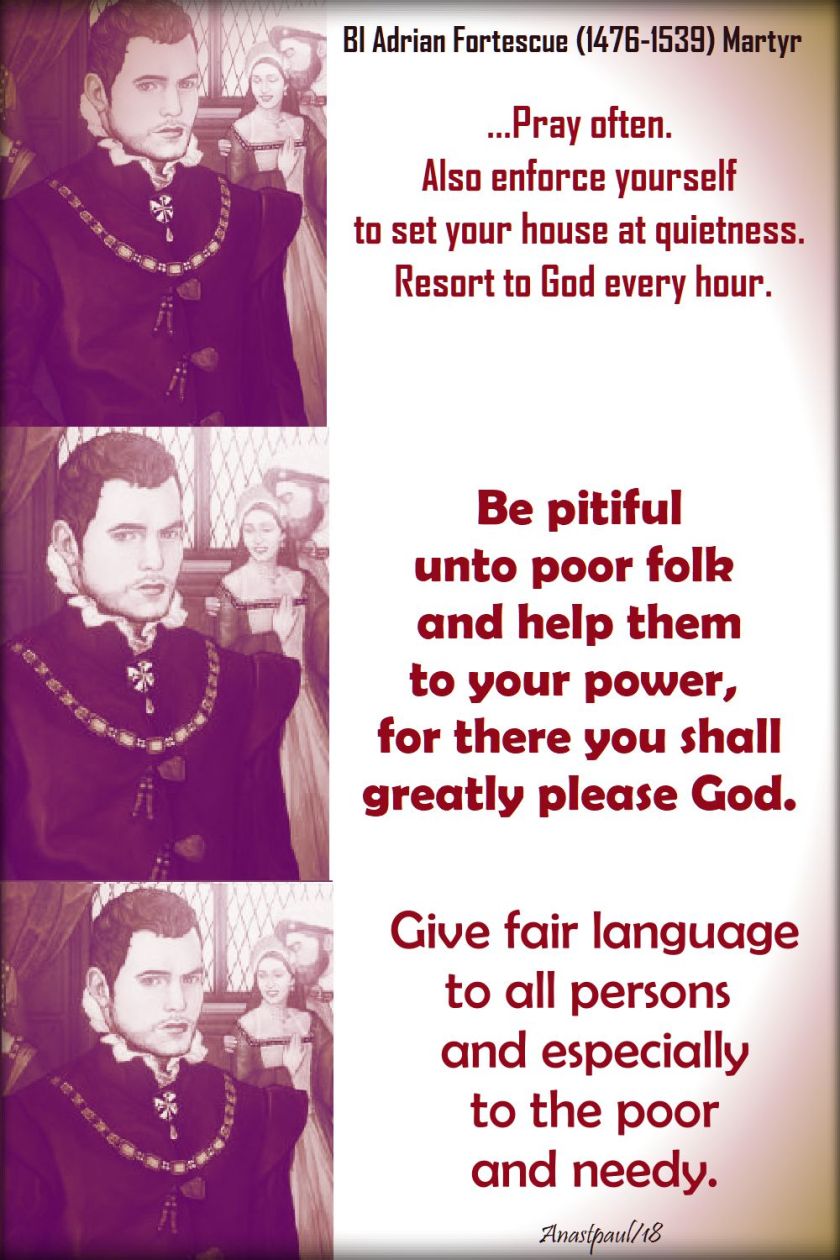
…”Pray often.
Also enforce yourself
to set your house at quietness.
Resort to God every hour.”

“Be pitiful unto poor folk and help them to your power,
for there you shall greatly please God.”

“Give fair language to all persons
and especially to the poor and needy.”pray often - be pitiful unto poor folk - give fair language - bl adrian fortescue - 9 july 2018

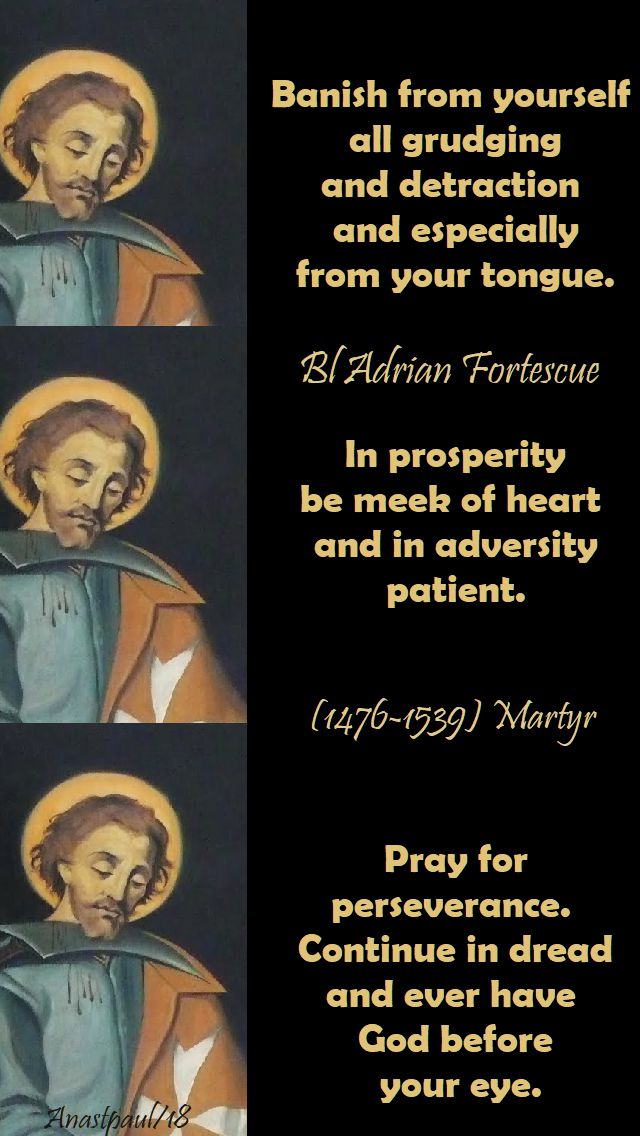
“Banish from yourself all grudging and detraction
and especially from your tongue.”

“In prosperity be meek of heart
and in adversity patient.”

“Pray for perseverance.
Continue in dread
and ever have
God before your eye.”banish from yourself - in prosperity - pray for perseverance - bl adrian fortescue - 9 july 2018

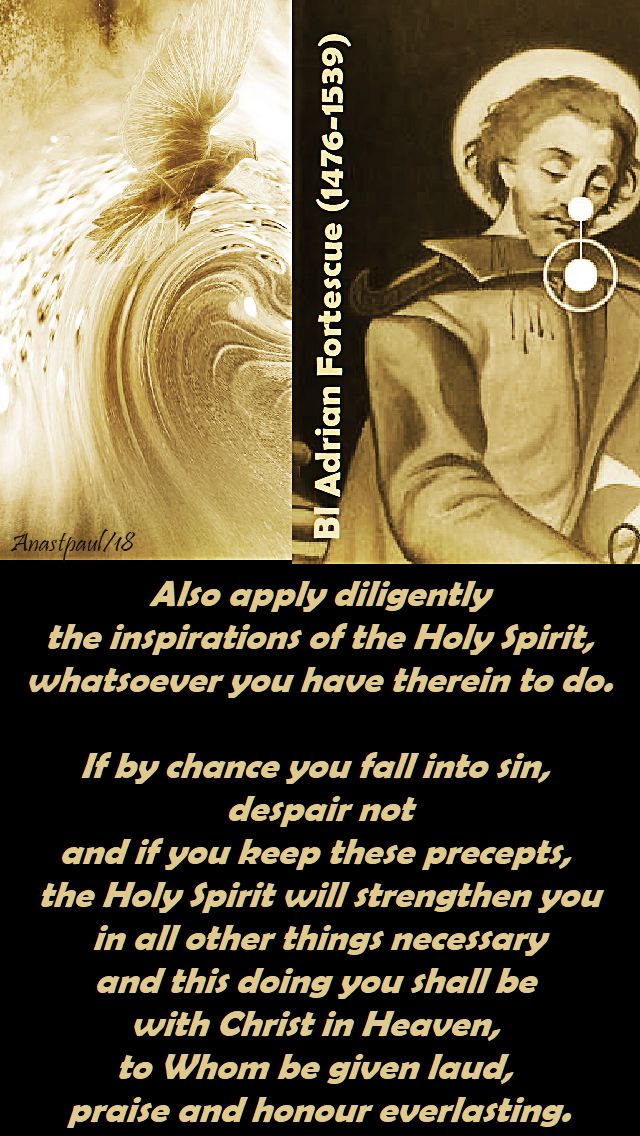
“Also apply diligently
the inspirations of the Holy Spirit,
whatsoever you have therein to do.”

“If by chance you fall into sin,
despair not
and if you keep these precepts,
the Holy Spirit will strengthen you
in all other things necessary
and this doing you shall be
with Christ in Heaven,
to Whom be given laud,
praise and honour everlasting.”

Blessed Adrian Fortescue (1476-1539)also apply diligently - if by chance - bl adrian fortescue - 9 july 2018.jpg