
Quote of the Day – 12 May – Saturday of the Sixth Week of Eastertide
“My TV is the tabernacle.”
Quote of the Day – 12 May – Saturday of the Sixth Week of Eastertide
“My TV is the tabernacle.”

One Minute Marian Reflection – 12 May “Mary’s Month!” – Saturday of the Sixth Week of Eastertide
…he has looked on his servant in her lowliness…Luke 1:48
REFLECTION – MARY: HE HAS LOOKED ON HIS SERVANT IN HER LOWLINESS : “The mystery of Mary helps us to see that in order to approach God, we must become little. Christ said to his disciples: ‘Believe me, unless you become like little children again, you shall not enter the kingdom of heaven.’ To become children, we must renounce our pride and self-sufficiency, recognising that we can do nothing by ourselves. We must realise that we need grace and the help of God our Father to find our way and keep to it.” … St Josemaría Escrivá (1902-1975) “To Jesus through Mary” Christ is Passing By, 143.
Let us offer to our Mother today:
A visit to a lonely person to share the joy of trusting in God alone.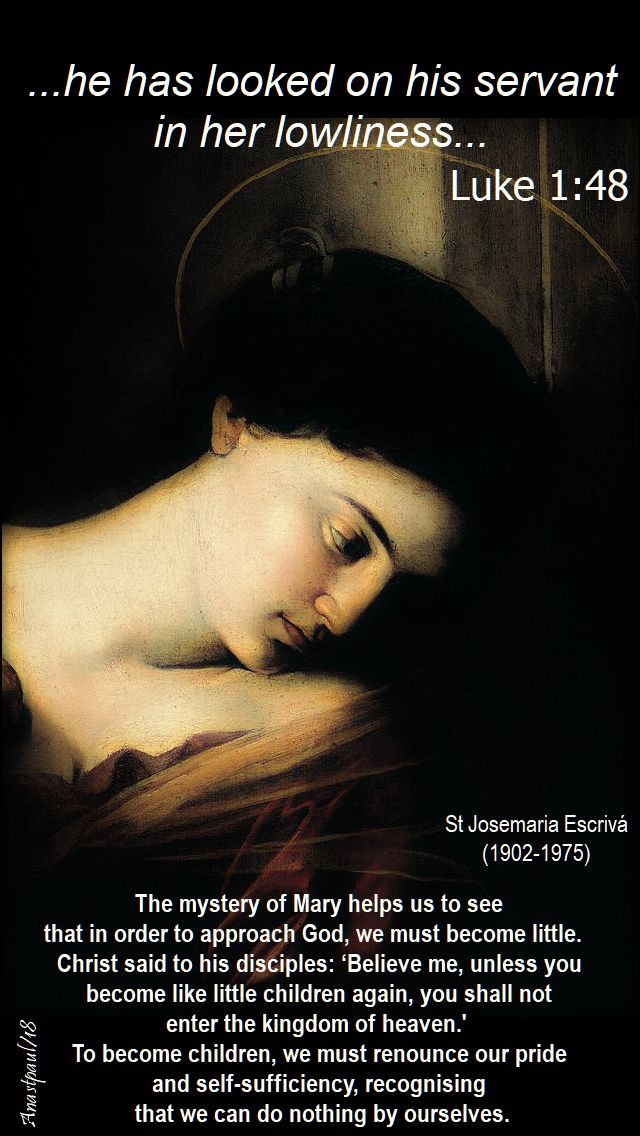
PRAYER – Grant us, Lord, we pray, that through the intercession of the Blessed Virgin Mary, we may become like little children, trusting in You, our Father, following Your Son and finally arriving safely home with by the guidance of the Holy Spirit. Mary, Immaculata pray for us. Through Jesus Christ our Lord, in union with the Holy Spirit, one God forever, amen.
Our Morning Offering – 12 May “Mary’s Month!” – Saturday of the Sixth Week of Eastertide
Mary, I Beg You
By St Anselm (1033-1109)
Doctor magnificus (Magnificent Doctor);
Doctor Marianus (Marian Doctor)
Mary, I beg you,
by that grace through which,
the Lord is with you
and you will to be with Him,
let your mercy be with me.
Let love for you always be with me,
and the care for me, be always with you.
Let the cry of my need,
as long as it persists,
be with you,
and the care of your goodness,
as long as I need it,
be with me.
Let joy in your blessedness
be always with me,
and compassion for my wretchedness,
where I need it,
be with you.
Amen
Saints of the Day – 12 May – Sts Nereus and Achilleus
Little is known about Saints Nereus and Achilleus but we know is engraved in stone. Damasus, one of the first popes and later a saint himself, wrote the epitaph for the tombstone of Saints Nereus and Achilleus. In this epitaph he proclaimed that it was love for Christ and a desire to witness to their new faith that inspired Nereus and Achilleus to “throw away their shields, their armour and their bloody spears.”

It seems that both men were Roman soldiers who obeyed orders in the persecution of Christians until they themselves were converted to Christianity. Because Christians were not allowed to bear arms, they resigned from the emperor’s army and escaped from Rome. Eventually Nereus and Achilleus were captured and were removed to the island of Terracina, where they were martyred. Their bodies were buried in a family vault, later known as the cemetery of Domitilla. They were among the first martyrs to be venerated as saints. Excavations by De Rossi in 1896 resulted in the discovery of their empty tomb in the underground church built by Pope Siricius in 390.
Two hundred years after their deaths, St Pope Gregory the Great (540-604) Doctor of the Church, delivered his 28th homily on the occasion of their feast. “These saints, before whom we are assembled, despised the world and trampled it under their feet when peace, riches and health gave it charms.”
“O miracle of faith!” wrote Damasus. “Suddenly they cease from their fury, they become converted, they flee from the camp of their wicked leader. Professing the faith of Christ, they are happy to witness to its triumph. Learn from the words of Damasus what great things the glory of Christ can accomplish.”


St Achilleus of Terracina (Optional Memorial)
St Nereus of Terracina (Optional Memorial)
St Pancras of Rome (Optional Memorial)
—
St Crispoldus
St Cyril of Galatz
St Dedë Malaj
St Diomma of Kildimo
St Dionysius of Asia
St Dominic de la Calzada
St Ejëll Deda
St Ephrem of Jerusalem
St Epiphanius of Salamis
St Erc Nasca of Tullylish
St Ethelhard of Canterbury
St Euphrosyna of Terracina
Bl Francis Patrizzi of Siena
Bl Gemma of Goriano
St Germanus of Constantinople
Bl Jane of Portugal
Bl Juan de Segalars
St Lucien Galan
St Modoald of Trier
St Palladius of Rome
St Philip of Agira
St Richrudis of Marchiennes
St Theodora of Terracina
St Thomas Khampheuane Inthirath
Pentecost Novena to the Holy Spirit for the Seven Gifts
Day One – 11 May 2018
ACT OF CONSECRATION TO THE HOLY SPIRIT
To be recited daily during the Novena
On my knees, I before the great multitude of heavenly witnesses, offer myself, soul and body to You, Eternal Spirit of God. I adore the brightness of Your purity, the unerring keenness of Your justice and the might of Your love. You are the Strength and Light of my soul. In You I live and move and am. I desire never to grieve You by unfaithfulness to grace and I pray with all my heart to be kept from the smallest sin against You. Mercifully guard my every thought and grant that I may always watch for Your light, listen to Your voice and follow Your gracious inspirations. I cling to You and give myself to You and ask You, by Your compassion, to watch over me in my weakness. Holding the pierced Feet of Jesus, looking at His Five Wounds and trusting in His Precious Blood and adoring His opened Side and stricken Heart, I implore You, Adorable Spirit, Helper of my infirmity, to keep me in Your grace that I may never sin against You. Give me grace O Holy Spirit, Spirit of the Father and the Son to say to You always and everywhere, “Speak Lord for Your servant hears.” Amen.
PRAYER FOR THE SEVEN GITS OF THE HOLY SPIRIT
To be recited daily during the Novena
O Lord Jesus Christ Who, before ascending into heaven did promise to send the Holy Spirit to finish Your work in the souls of Your Apostles and Disciples, deign to grant the same Holy Spirit to me, that He may perfect in my soul, the work of Your grace and Your love.
Grant me the Spirit of Wisdom that I may despise the perishable things of this world and aspire only after the things that are eternal, the Spirit of Understanding, to enlighten my mind with the light of Your divine truth, the Spirit on Counsel, that I may ever choose the surest way of pleasing God and gaining heaven, the Spirit of Fortitude, that I may bear my cross with You and that I may overcome with courage all the obstacles that oppose my salvation, the Spirit of Knowledge, that I may know God and know myself and grow perfect in the science of the Saints, the Spirit of Piety, that I may find the service of God sweet and amiable and the Spirit of Fear, that I may be filled with a loving reverence towards God and may dread in any way to displease Him. Mark me, dear Lord with the sign of Your true disciples and animate me in all things with Your Spirit. Amen.
FIRST DAY (Friday after Ascension or Friday of 6th Week of Easter)
Holy Spirit! Lord of Light! From Your clear celestial height, Your pure beaming radiance give!
The Holy Spirit
Only one thing is important — eternal salvation. Only one thing, therefore, is to be feared–sin. Sin is the result of ignorance, weakness and indifference. The Holy Spirit is the Spirit of Light, of Strength and of Love. With His sevenfold gifts, He enlightens the mind, strengthens the will and inflames the heart, with love of God. To ensure our salvation we ought to invoke the Divine Spirit daily, for “The Spirit helps our infirmity. We know not what we should pray for as we ought. But the Spirit Himself asks for us.”
Prayer
Almighty and eternal God, Who has vouchsafed to regenerate us by water and the Holy Spirit and has given us forgiveness of all sins, vouchsafe to send forth from heaven upon us, your sevenfold Spirit, the Spirit of Wisdom and Understanding, the Spirit of Counsel and fortitude, the Spirit of Knowledge and Piety and fill us with the Spirit of Holy Fear. Amen.
Our Father and Hail Mary ONCE. Glory be to the Father SEVEN TIMES.
Act of Consecration, Prayer for the Seven Gift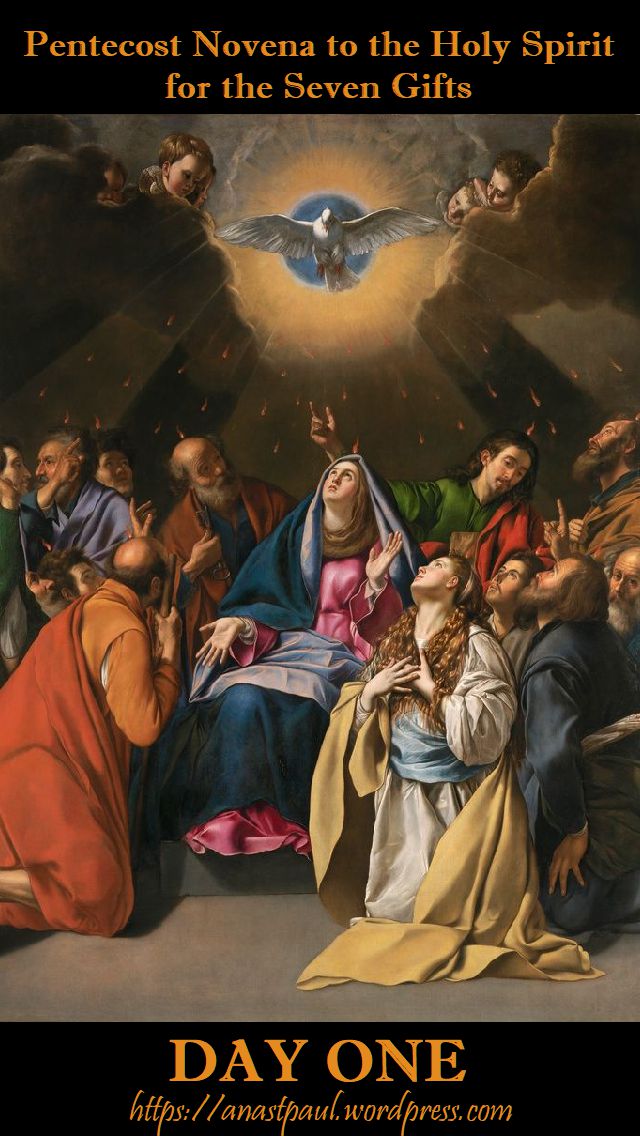
Info on the Novena: https://anastpaul.wordpress.com/2018/05/09/announcing-a-novena-to-the-holy-spirit-for-the-seven-gifts-from-ascension-to-pentecost-begins-friday-11-may/
Marian Thought for the Day – 11 May – “Mary’s Month!” – Friday of the Sixth Week of Eastertide
THIS great title may be fitly connected with the Maternity of Mary, that is, with the coming upon her of the Holy Ghost at Nazareth after the Angel Gabriel’s annunciation to her and with the consequent birth of our Lord at Bethlehem. She, as the Mother of our Lord, comes nearer to Him than any angel; nearer even than the Seraphim who surround Him and cry continually, “Holy, Holy, Holy.”
The two Archangels who have a special office in the Gospel are St Michael and St Gabriel—and they both of them are associated in the history of the Incarnation with Mary: St Gabriel, when the Holy Ghost came down upon her and St Michael, when the Divine Child was born.
St. Gabriel hailed her as “Full of grace” and as “Blessed among women” and announced to her that the Holy Ghost would come down upon her and that she would bear a Son who would be the Son of the Highest.
Of St Michael’s ministry to her, on the birth of that Divine Son, we learn in the Apocalypse, written by the Apostle St John. We know our Lord came to set up the Kingdom of Heaven among men and hardly was He born, when He was assaulted by the powers of the world, who wished to destroy Him. Herod sought to take His life but he was defeated by St Joseph’s carrying His Mother and Him off into Egypt. But St John in the Apocalypse tells us that Michael and his angels, were the real guardians of Mother and Child, then and on other occasions.
First, St John saw in vision “a great sign in heaven” (meaning by “heaven” the Church, or Kingdom of God), “a woman clothed with the sun and with the moon under her feet and on her head a crown of twelve stars; and when she was about to be delivered of her Child, there appeared “a great red dragon,” that is, the evil spirit, ready “to devour her son” when He should be born. The Son was preserved by His own Divine power but next the evil spirit persecuted her; St Michael, however and his angels, came to the rescue and prevailed against him.
“There was a great battle,” says the sacred writer; “Michael and his Angels fought with the dragon and the dragon fought and his angels and that great dragon was cast out, the old serpent, who is called the devil.”
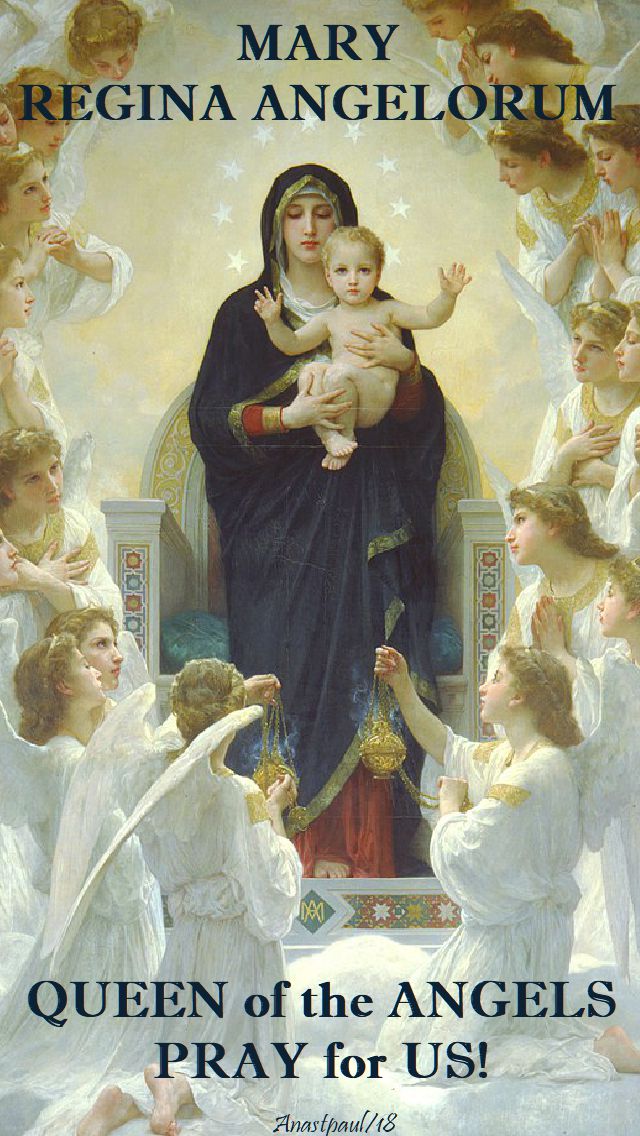
Now, as then, the Blessed Mother of God has hosts of angels, who do her service and she is their Queen.
Quote/s of the Day – 11 May – “Mary’s Month!” – Friday of the Sixth Week of Eastertide
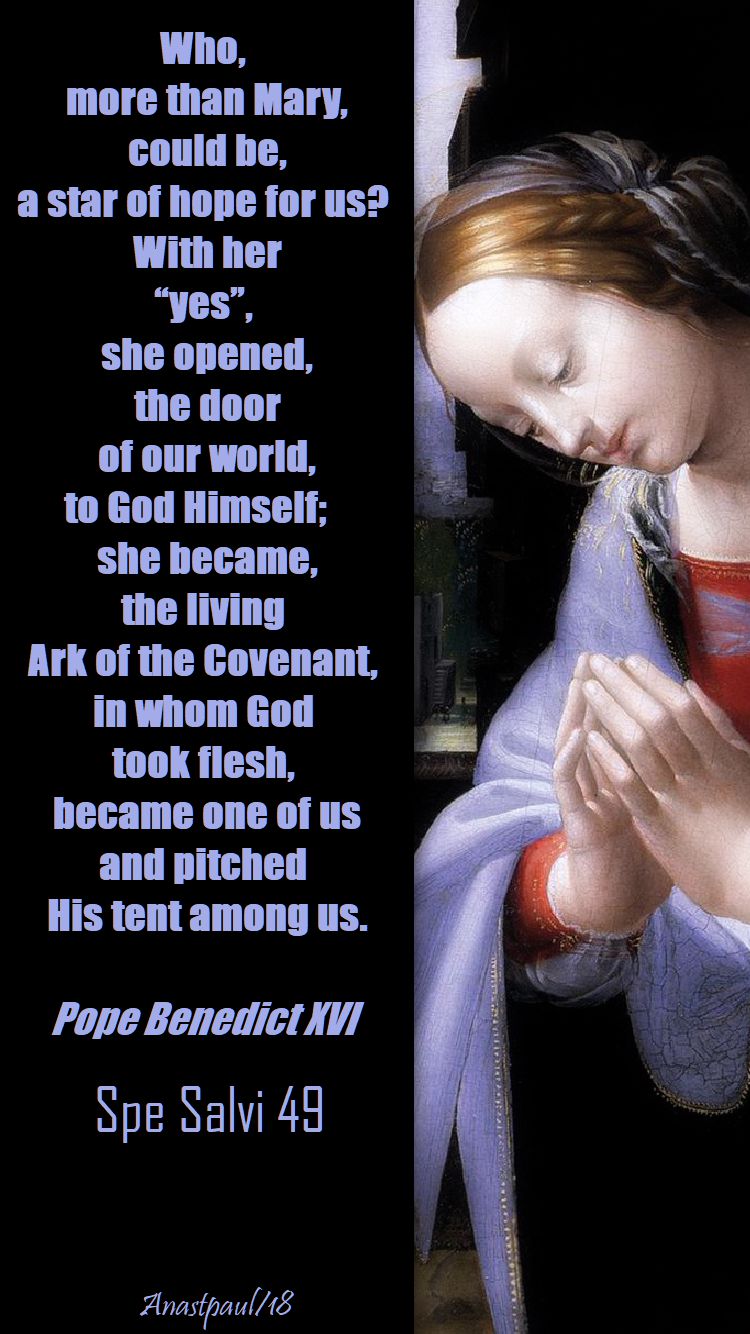
“Who, more than Mary, could be, a star of hope for us?
With her “yes”, she opened the door of our world,
to God Himself; she became the living Ark of the Covenant,
in whom God took flesh, became one of us
and pitched His tent among us.”
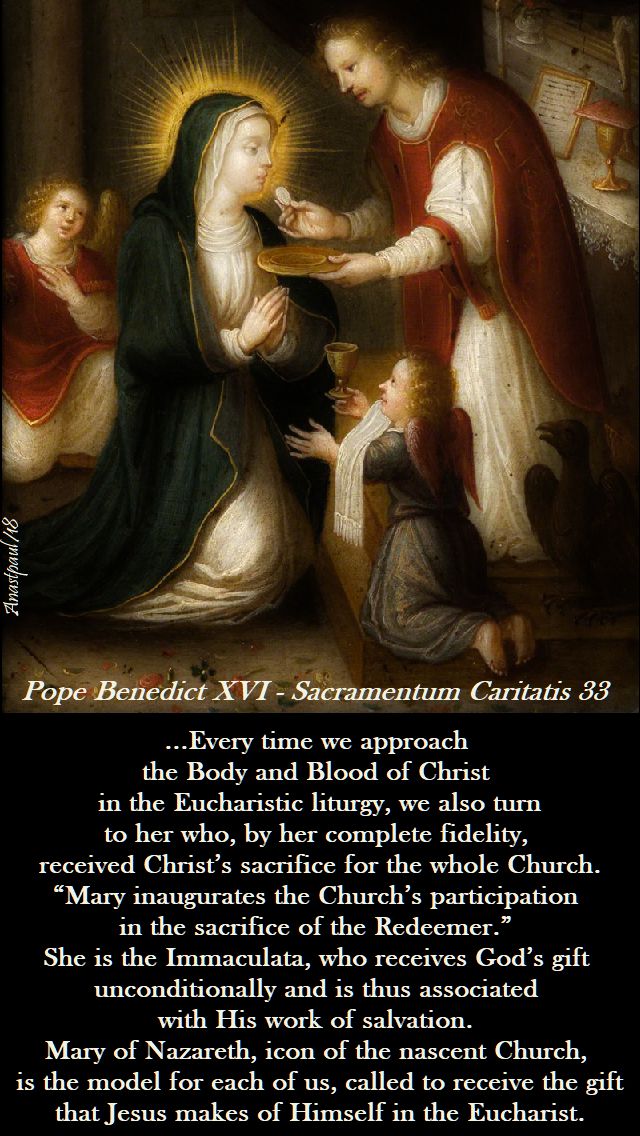
“Consequently, every time we approach
the Body and Blood of Christ in the Eucharistic liturgy,
we also turn to her who, by her complete fidelity,
received Christ’s sacrifice for the whole Church.
The Synod Fathers rightly declared that
“Mary inaugurates the Church’s participation
in the sacrifice of the Redeemer.”
She is the Immaculata, who receives God’s gift
unconditionally and is thus associated with His work of salvation.
Mary of Nazareth, icon of the nascent Church,
is the model for each of us, called to receive the gift
that Jesus makes of Himself in the Eucharist.”
One Minute Marian Reflection 11 May – “Mary’s Month!” – Friday of the Sixth Week of Eastertide
Having listened to what the king had to say, they set out. And suddenly the star they had seen rising went forward and halted over the place where the child was…Matthew 2:9
REFLECTION – “MARY: WELCOMING THE MAGI: “‘Going into the house, they saw the child with Mary, his mother.’ Our Lady is always near her Son. The Magi are not received by a king on a high throne but by a child in the arms of His mother. Let us ask the Mother of God, who is our mother, to prepare for us the way that leads to the fullness of love …. Her sweet heart knows the surest path for finding Christ.” …St Josemaria Escrivá (1902-1975) “The Epiphany of Our Lord,” Christ is Passing By, 38.
Let us offer to our Mother today:
A visit to a poor person to communicate
our Lady‘s concern for that person.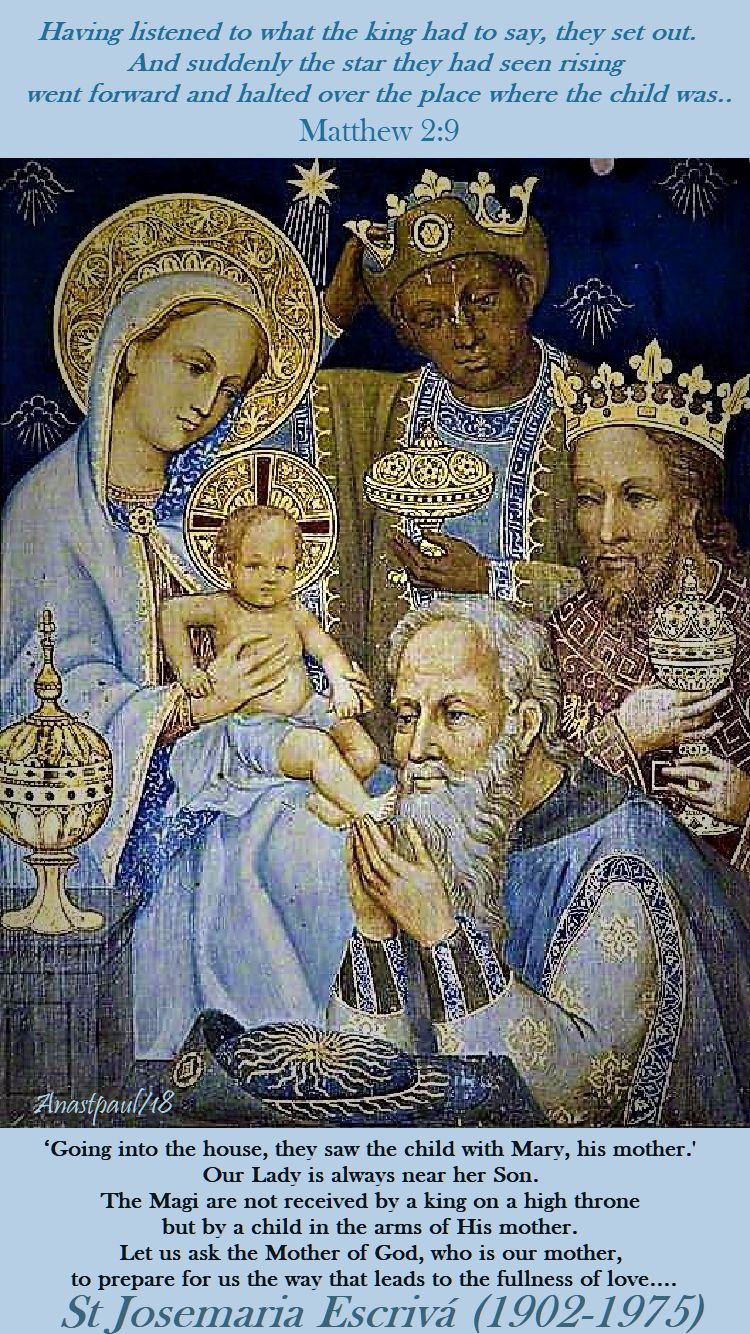
PRAYER – Heavenly Father, Your plans are always the Truth. So in Your wisdom, You gave us Mary as our Mother, to help us home to You. Grant that by her prayers we finally arrive with You in Your eternal Kingdom. Through Jesus our Lord, in union with the Holy Spirit, one God forever, amen.
Our Morning Offering – 11 May “Mary’s Month” – Friday of the Sixth Week of Eastertide
Alma Redemptoris Mater
Loving mother of the Redeemer
Prayers of the Church from the Breviary
Loving mother of the Redeemer,
gate of heaven, star of the sea,
assist your people who have fallen,
yet strive to rise again.
To the wonderment of nature
you bore your Creator,
Yet remained a virgin after as before.
You who received Gabriel’s joyful greeting,
have pity on us poor sinners.
Alma Redemptoris Mater,
quae pervia caeli porta manes,
et stella maris, succurre cadenti,
surgere qui curat, populo:
tu quae genuisti, natura mirante,
tuum sanctum Genitorem,
Virgo prius ac posterius,
Gabrielis ab ore,
sumens illud Ave, peccatorum miserere.
This is one of four Marian antiphons, with following versicles and prayers, traditionally said or sung after night prayer, immediately before going to sleep. It is said from the beginning of Advent (from night before the fourth Sunday before Christmas) through 1 February.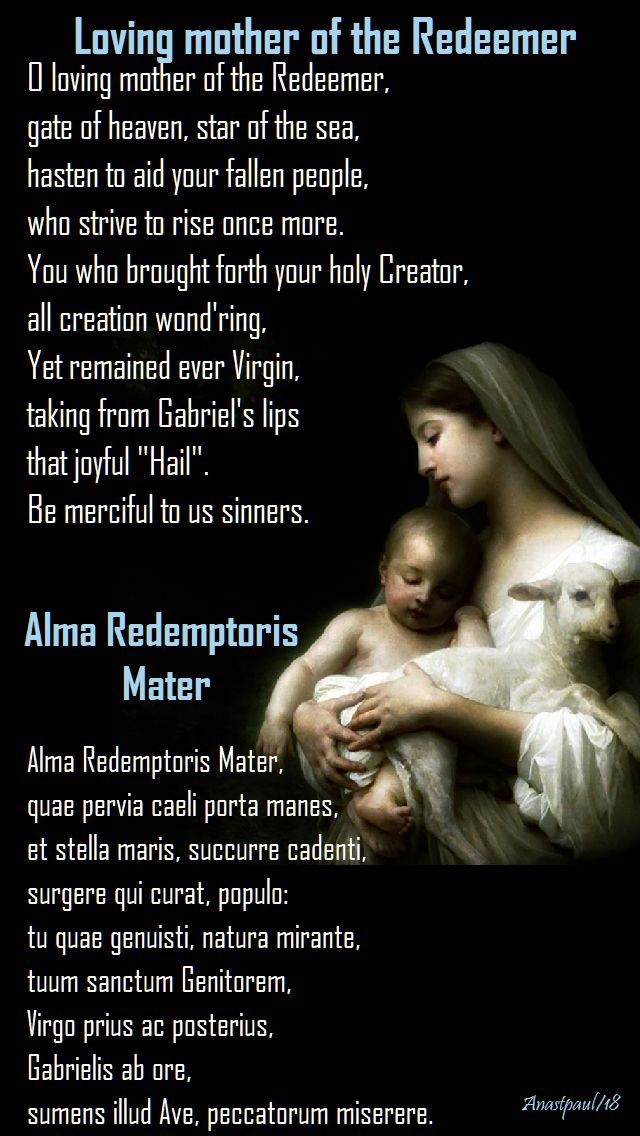
Saint of the Day – 11 May – St Ignatius of Laconi O.F.M. Cap. (1701-1781) Franciscan of the Order of Friars Minor Capuchin born as Vincenzo Peis on 17 December 1701 at Laconi, Nuoro, Italy and died on 11 May 1781 in Cagliari, Italy of natural causes. Known as “the Holy Friar,” “the Apostle of the Streets, “ “the Wonder-worker”, “the Miracle-Worker” and “Padre Santo.” His conquering a serious illness prompted him to consecrate his life to God and therefore entered the religious life though not as an ordained priest. Peis was better known in Sardinia for his humble demeanour coupled with his concern for those who were poor. He mingled with all people he met and was generous towards those who were ill. But he became known as something of a wonder worker during his life and he had performed 121 miracles during his life. Patronages-Oristano, Students, Beggars.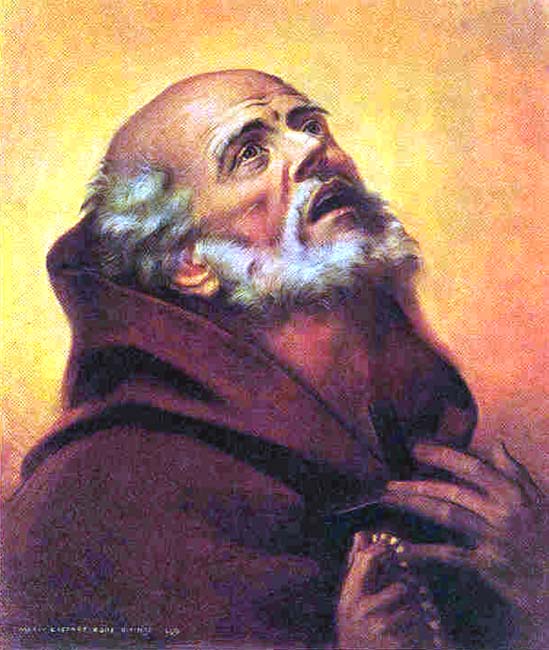
Vincenzo Peis was born on 10 December 1701 in Sardinia as one of seven children to the poor peasants Mattia Peis Cadello and Anna Maria Sanna Casu. He was baptised as “Francesco Ignazio Vincenzo” since he was born out of a difficult pregnancy in which her mother invoked the intercession of Saint Francis of Assisi.
Ignatius worked on the fields to support his parents. He suffered a serious illness circa 1719 (aged seventeen) that made him vow that he would consecrate himself to God and join the Order of Friars Minor Capuchin if he managed to recover from it. He did so recover but put off the fulfilment of his vow after his father convinced him to wait; his father was anxious about it because he depended on Ignatius for support in the fields. But there seems to be some indication that his parents objected to his entering the order. In 1721 he was in danger once more when the horse he was riding panicked. He could have been thrown off but he called upon the assistance of Saint Francis of Assisi and renewed the vow he had made during his illness. This time his parents did not raise objections to his becoming a friar and granted him their blessing. In his childhood he often called the local church his “home” and took St Lawrence of Brindisi (1559-1619) as his personal role model.
He asked for admission at the convent in Cagliari but the superiors there hesitated because of his delicate health. He then called upon an influential friend who interceded for him and he was allowed to be received into the novitiate on 10 November 1721. Ignatius made his profession on 10 November 1722. Despite his infirmities his ardour allowed him to attend the spiritual exercises of the order and to excel in perfection of his observance of the order’s Rule. From 1722 until 1737 he worked at the house’s weaving shed and from 1737 onwards was an alms beggar.
Ignatius spent his time in a number of different occupations and was later appointed as the quester of alms due to his humble and modest conduct. He had good relations with the people in Cagliari who realised that although he was begging alms, he was also giving back to them in a spiritual manner. His modest demeanour was seen as a quiet sermon for all who saw him going about which made him a noted figure.,, He seldom spoke; when required he spoke with exceptional kindness and great affection. He would also instruct the children and the uneducated that he came across as well as going out to comfort the sick and urging sinners to be converted and to do penance.


There is a legend that he was known for his strict and total obedience to his superiors even when it required the denial of his own will. He was accustomed to go to the house of an usurer because he feared that in accepting an alms from him he would share the guilt of this man’s injustices. But when the man complained and the superior commanded him he accepted alms from the man. It was when he returned that he opened the sack that the usurer offered and blood started to flow out. To those around him the saint said: “This is the blood of the poor squeezed from them by usury”.
His sister had often written to him asking him to visit her so that she could get his advice in certain matters. Brother Ignatius had no mind to heed her request but when his superior ordered him to do so he at once undertook the visit. But he left again as soon as he had given the required advice. His brother was sent to prison and it was hoped that – in view of reputation of Brother Ignatius – the latter could obtain his brother’s release. His superior sent him to speak to the governor but he asked that his brother be dealt with according to justice.
Despite his poor health and other infirmities he continued on in his work no matter how arduous it seemed. Even after he became blind in 1779, he continued to work on for the benefit of those around him. Ignatius died on 11 May 1781 at 3:00pm in Cagliari where his remains were interred.
St Ignatius’ grave soon became a place in which miracles flourished and this was one dimension towards the opening of his cause for canonisation. He was beatified on 16 June 1940 and was Canonised on 21 October 1951 by Pope Pius XII. 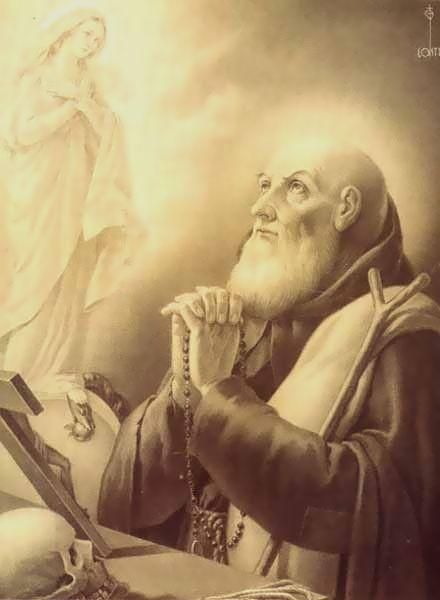
St Anastasius of Lérida
St Anthimus of Rome
St Bassus of Sabina
St Bertilla
St Criotan of MacReddin
Bl Diego of Saldaña
St Evellius of Pisa
St Fabius of Sabina
St Francis of Girolamo
St Fremund of Dunstable
St Gengulphus of Burgundy
St Gjon Koda
St Gualberto
St Ignatius of Laconi (1701-1781)
Bl Illuminatus
St Illuminatus of San Severino
Bl James Walworth
Bl John Rochester
St Maiulo of Hadrumetum
St Majolus of Cluny
St Mamertus of Vienne
St Maximus of Sabina
St Mayeul
St Mozio of Constantinople
St Possessor of Verdun
St Principia of Rome
St Tudy
St Vincent L’Hénoret
Bl Vivaldus
St Walbert of Hainault
—
Martyrs of Camerino: An imperial Roman official, his wife, their children and servants, all of whom were converts and martyrs: Anastasius, Aradius, Callisto, Eufemia, Evodius, Felice, Primitiva, Theopista.
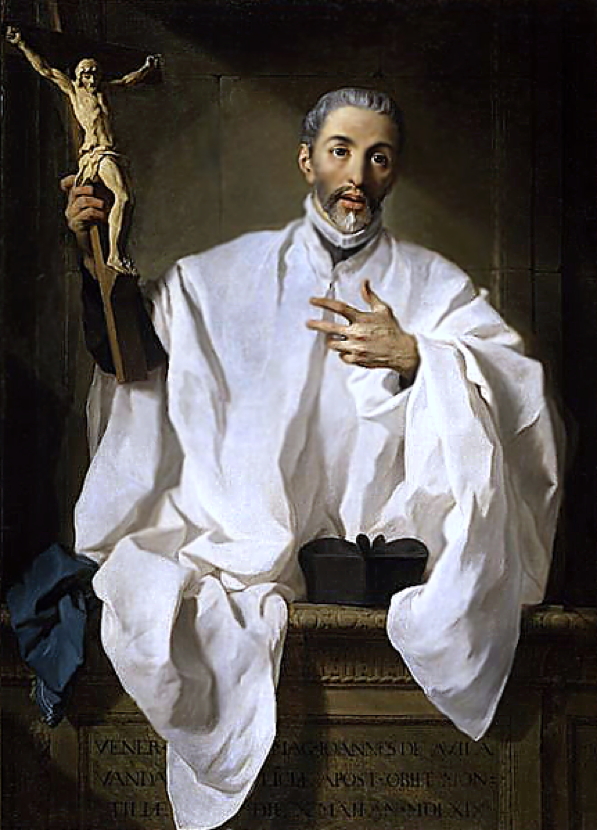
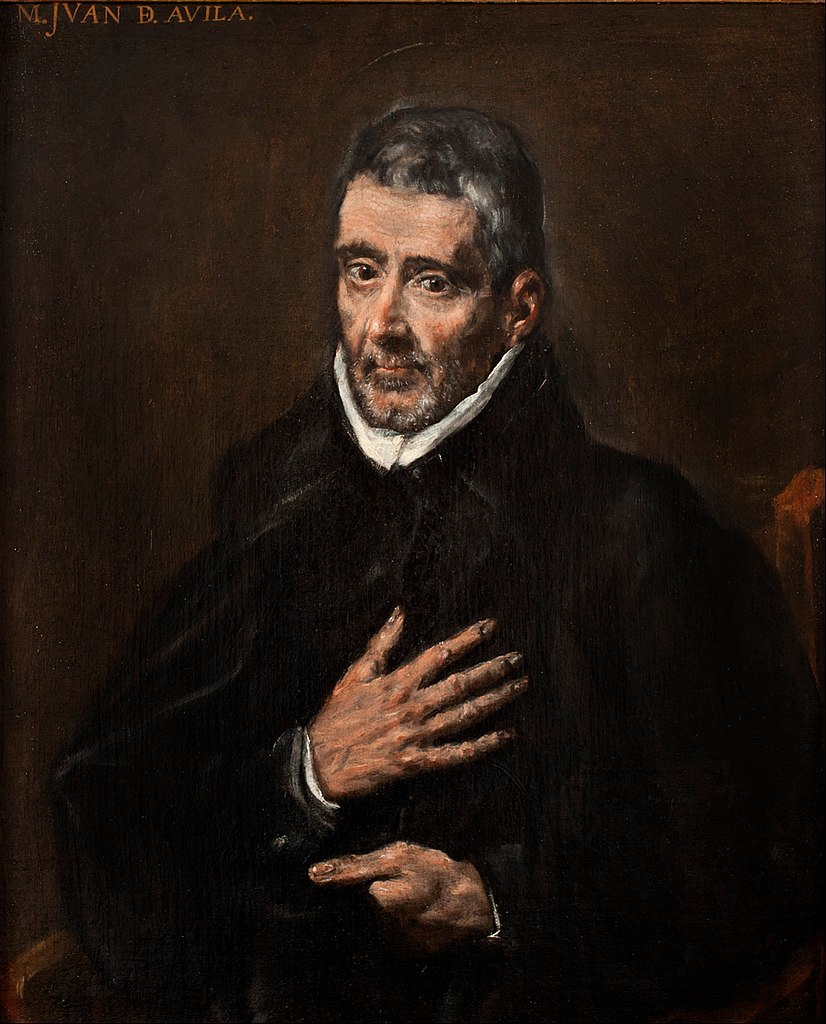
Thought for the Day – 10 May – Thursday of the Sixth Week of Eastertide, the Memorials of St John of Avila (1499-1569) Doctor of the Church
The first grade is that, recognising his own
baseness, a man should treat his own will with
contempt.The second is outwardly to show this self-
contempt both in dress and manners and by
choosing work of a mean and servile character.The third is to be patient when despised by
others.The fourth is to rejoice in being despised.
The fifth is to desire with the whole heart to
be despised by others.Twelve other degrees of humility.
The first degree is the fear of God.
The second, is to deny our own will.
The third, is obedience.
The fourth, is patience.
The fifth, is the confession of sins.
The sixth, is contempt of oneself.
The seventh, is to prefer others to oneself,
esteeming them more highly.The eighth, is to avoid singularity in outward
things.The ninth, is to be silent unless spoken to.
The tenth, is not to be prompt to laughter.
The eleventh, is to speak little and with
gravity.The twelfth, is to prefer a low estate and
occupation.
And to Divide the week into stages of the Passion of Christ: – read here – https://anastpaul.wordpress.com/2017/05/10/thought-for-the-day-10-may/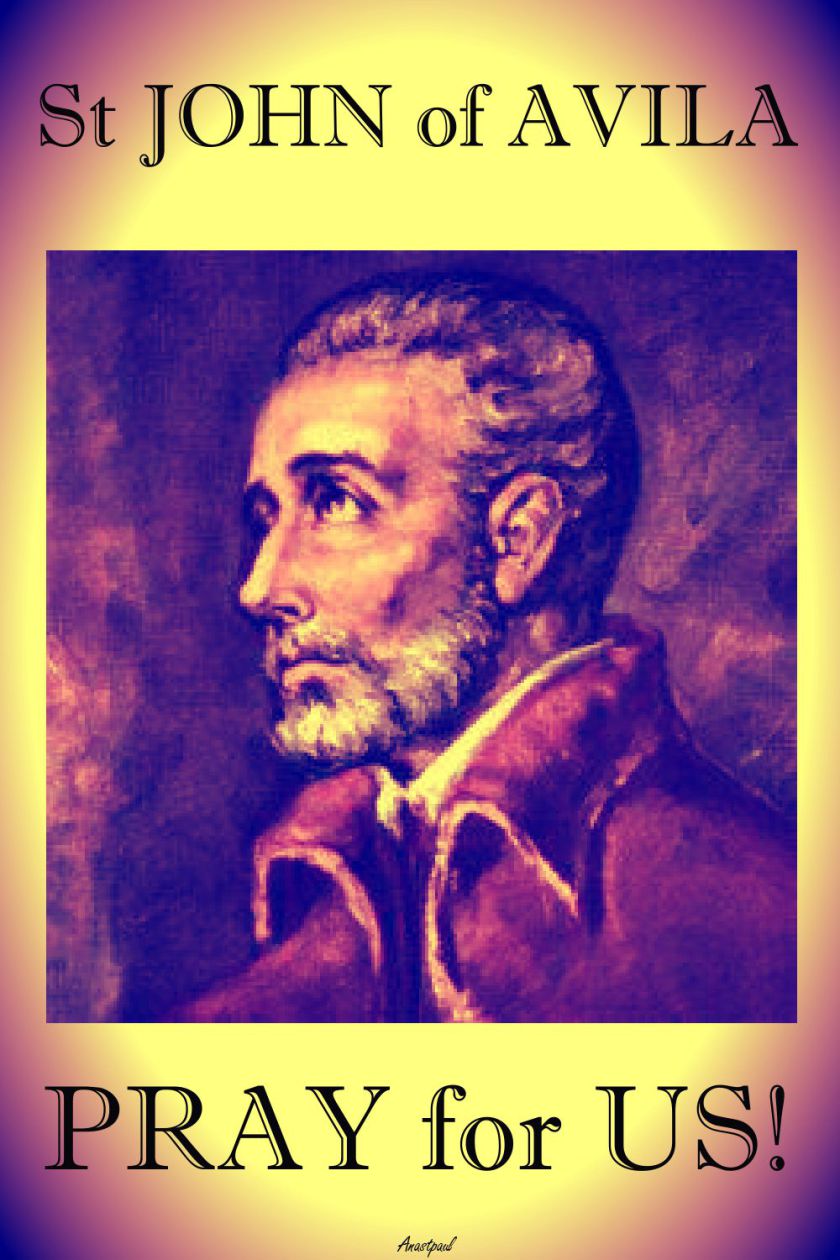
Marian Thought for the Day – 10 May “Mary’s Month” and Thursday of the Sixth Week of Eastertide
GOD alone can claim the attribute of holiness. Hence we say in the Hymn, “Tu solus sanctus,” “Thou only art holy.” By holiness we mean the absence of whatever sullies, dims and degrades a rational nature; all that is most opposite and contrary to sin and guilt.
We say that God alone is holy, though in truth all His high attributes are possessed by Him in that fullness, that it may be truly said that He alone has them. Thus, as to goodness, our Lord said to the young man, “None is good but God alone.” He too alone is Power, He alone is Wisdom, He alone is Providence, Love, Mercy, Justice, Truth. This is true but holiness is singled out as His special prerogative, because it marks more than His other attributes, not only His superiority over all His creature but emphatically, His separation from them. Hence we read in the Book of Job, “Can man be justified compared with God, or he that is born of a woman appear clean? Behold, even the moon doth not shine and the stars are not pure, in His sight.” “Behold, among His saints none is unchangeable and the Heavens arc not pure in His sight.”
This we must receive and understand in the first place but secondly, we know too, that, in His mercy, He has communicated in various measures His great attributes to His rational creatures and, first of all, as being most necessary, holiness. Thus Adam, from the time of his creation, was gifted, over and above his nature as man, with the grace of God, to unite him to God and to make him holy. Grace is therefore called holy grace; and, as being holy, it is the connecting principle between God and man. Adam in Paradise might have had knowledge and skill and many virtues; but these gifts did not unite him to his Creator. It was holiness that united him, for it is said by St Paul, “Without holiness no man shall see God.”
And so again, when man fell and lost this holy grace, he had various gifts still adhering to him; he might be, in a certain measure, true, merciful, lovin, and just but these virtues did not unite him to God. What he needed was holiness and, therefore, the first act of God’s goodness to us in the Gospel, is to take us out of our unholy state by means of the sacrament of Baptism and by the grace then given u, to re-open the communications, so long closed, between the soul and heaven.
We see then the force of our Lady’s title, when we call her “Holy Mary.” When God would prepare a human mother for His Son, this was why He began by giving her an immaculate conception. He began, not by giving her the gift of love, or truthfulness, or gentleness, or devotion, though according to the occasion she had them all. But He began His great work before she was born, before she could think, speak, or act, by making her holy and thereby, while on earth, a citizen of heaven. “Tota pulchra es, Maria!” Nothing of the deformity of sin was ever hers. Thus she differs from all saints. There have been great missionaries, confessors, bishops, doctors, pastors. They have done great works and have taken with them numberless converts or penitents to heaven. They have suffered much and have a superabundance of merits to show. But Mary in this way resembles her Divine Son, that, as He, being God, is separate by holiness from all creatures, so she is separate from all Saints and Angels, as being “full of grace.”
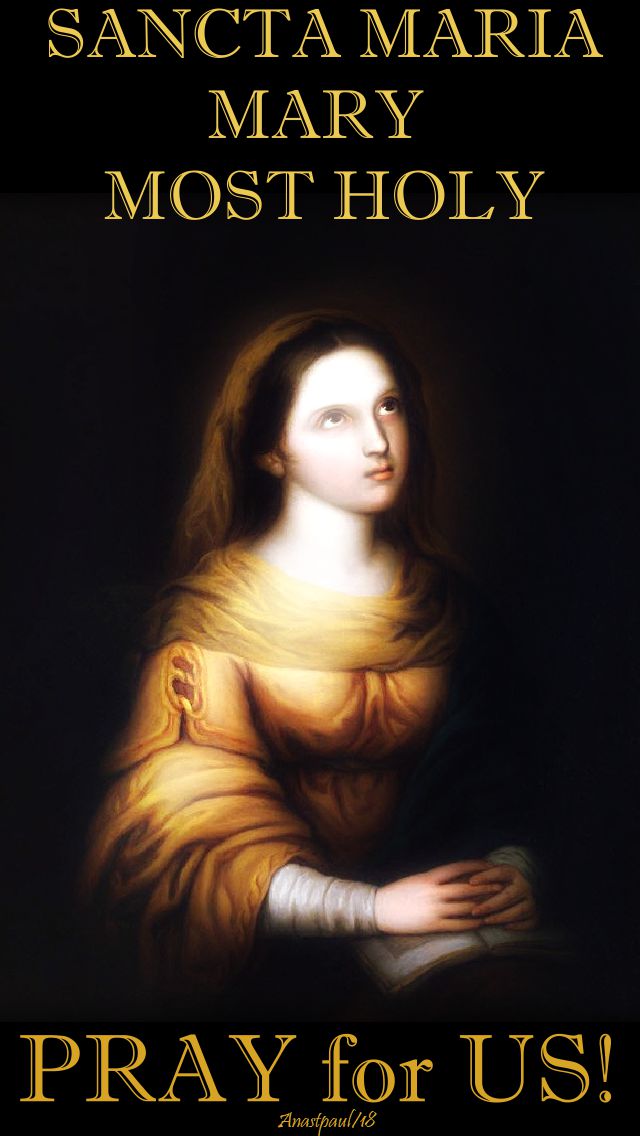
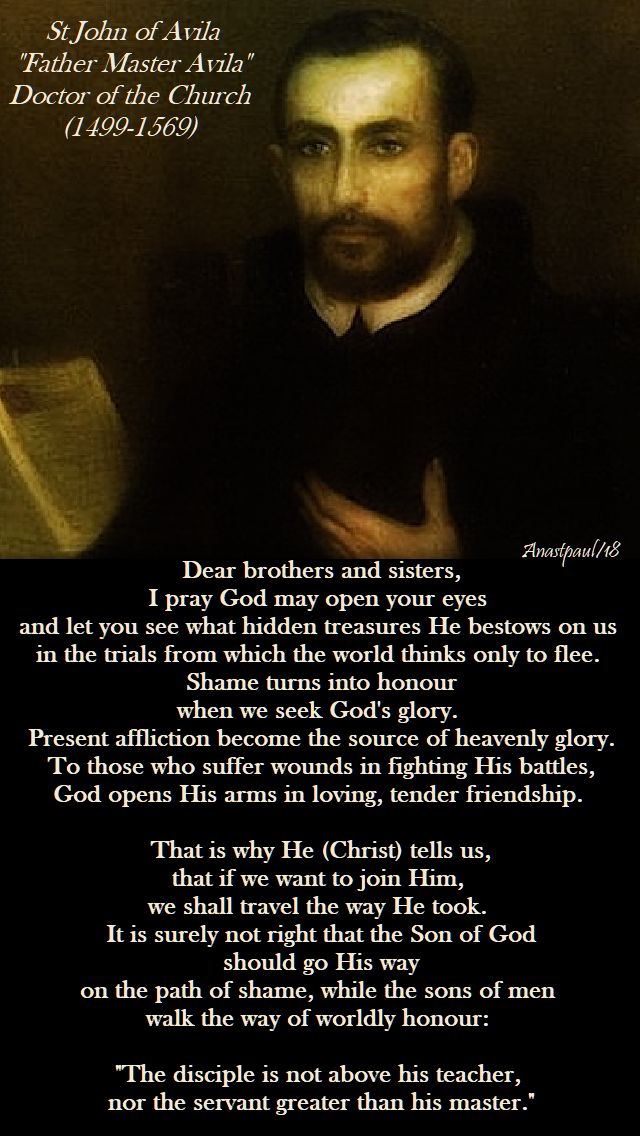
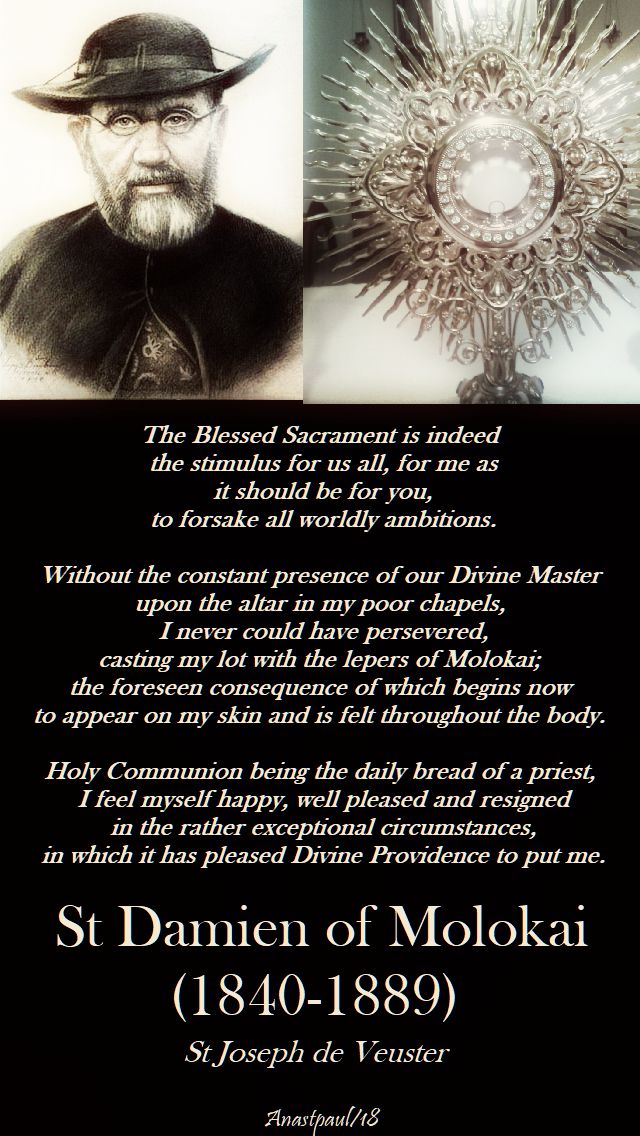
Quote/s of the Day – 10 May – Thursday of the Sixth Week of Eastertide, the Memorials of St John of Avila (1499-1569) “Apostle of Andalusia” “Father Master Avila” – Doctor of the Church and St Joseph de Veuster (1840-1889) – St Damian of Molokai
“Turn yourself round like a piece of clay and say to the Lord:
I am clay, and You, Lord, the potter.
Make of me what You will.”
“Withdraw your heart from the world
before God takes your body from it.”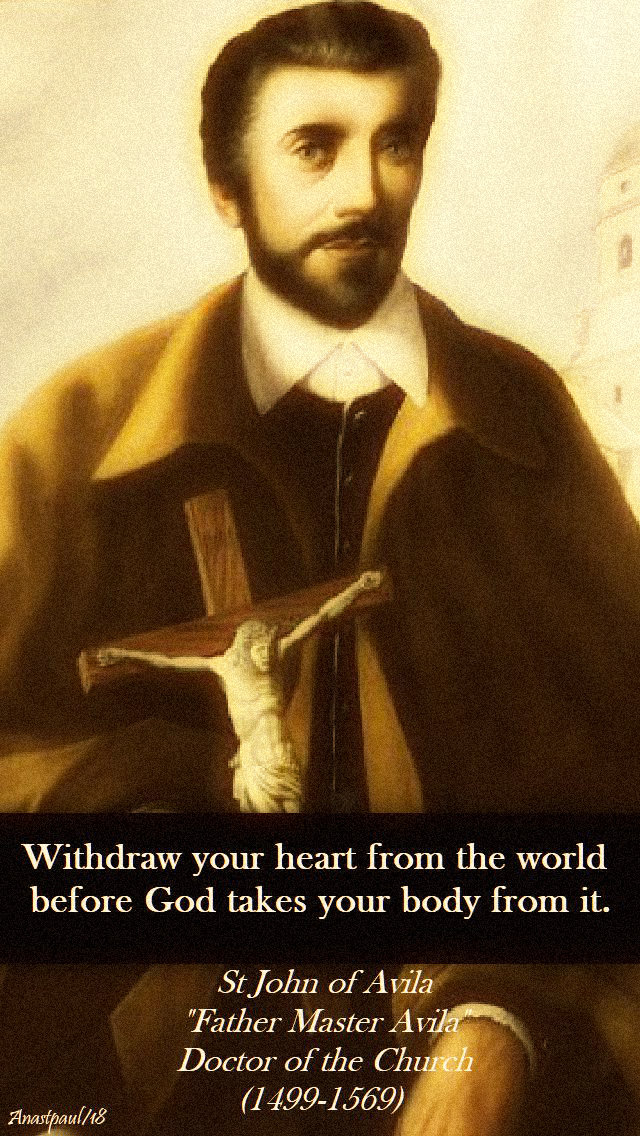
Dear brothers and sisters, I pray God may open your eyes
and let you see what hidden treasures He bestows on us
in the trials from which the world thinks only to flee.
Shame turns into honour when we seek God’s glory.
Present affliction become the source of heavenly glory.
To those who suffer wounds in fighting His battles,
God opens His arms in loving, tender friendship.
That is why He (Christ) tells us, that if we want to join Him,
we shall travel the way He took.
It is surely not right that the Son of God should go His way
on the path of shame, while the sons of men
walk the way of worldly honour:
“The disciple is not above his teacher,
nor the servant greater than his master.”
“The Blessed Sacrament is indeed the stimulus for us all, for me as it should be for you, to forsake all worldly ambitions. Without the constant presence of our Divine Master upon the altar in my poor chapels, I never could have persevered casting my lot with the lepers of Molokai, the foreseen consequence of which, begins now to appear on my skin and is felt throughout the body. Holy Communion being the daily bread of a priest, I feel myself happy, well pleasedand resigned in the rather exceptional circumstances, in which it has pleased Divine Providence to put me.”
One Minute Marian Reflection – 10 May “Mary’s Month” and Thursday of the Sixth Week of Eastertide
The parents of Jesus, took him up to Jerusalem, to present him to the Lord…Luke 2:22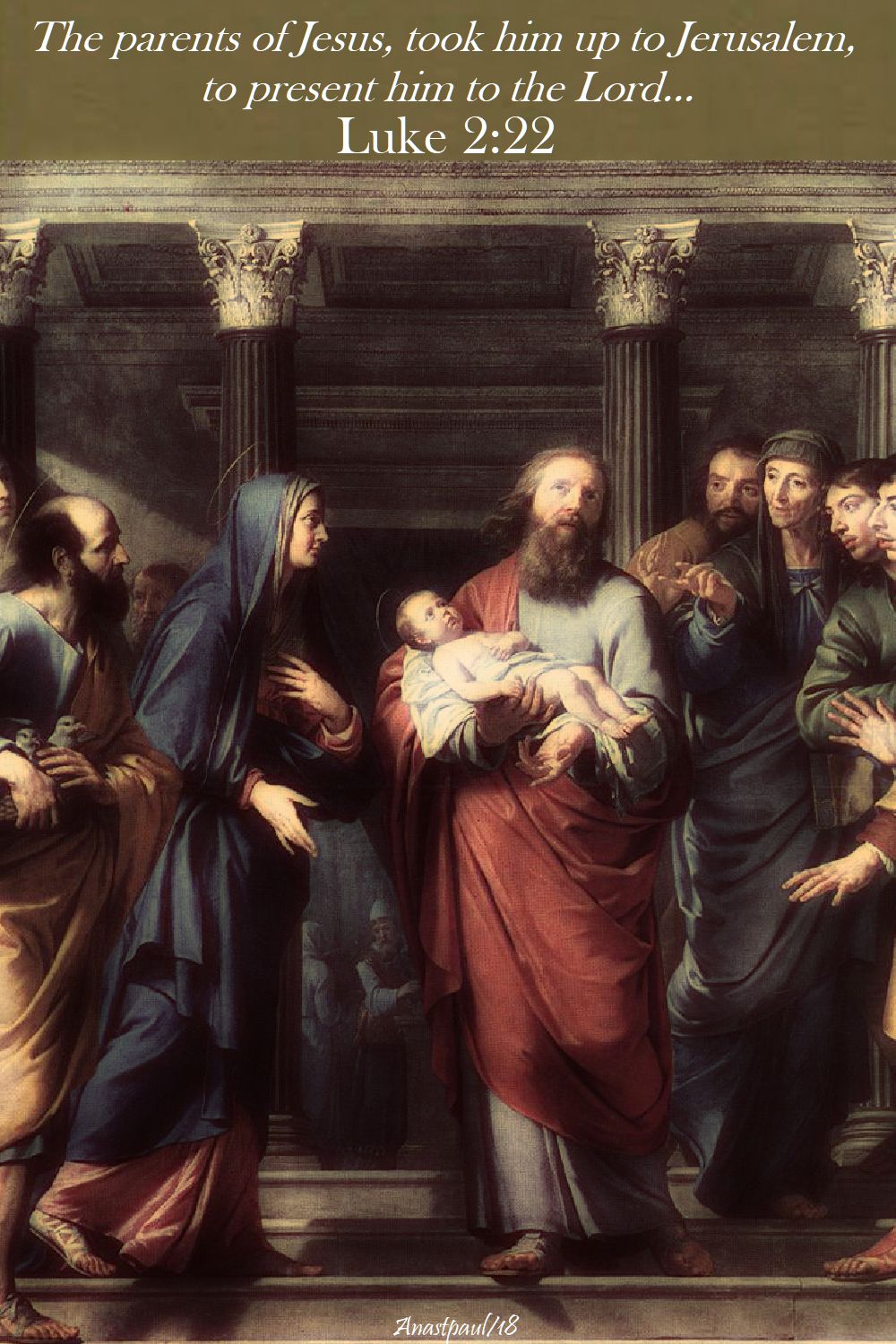
REFLECTION – MARY: PRESENTING JESUS IN THE TEMPLE: “She teaches us to have charity. Remember the scene of the presentation of Jesus in the temple. An old man, Simeon, said to Mary, ‘Behold: This child is destined to bring about the fall of many and the rise of many in Israel and to be a sign, which people will refuse to acknowledge, so that the thoughts of many hearts shall be made manifest. As for your own soul, it shall have a sword pierce it.’ So great is Mary’s love for all mankind that she, too, fulfilled Christ’s words: ‘Greater love has no man than this, that he should lay down his life for his friends.’ “… St Josemaría Escrivá (1902-1975) – “Mother of God and Our Mother,” Friends of God, 287.
Let us offer to our Mother today:
A pilgrimage to one of her shrines, or at least such a pilgrimage in prayer.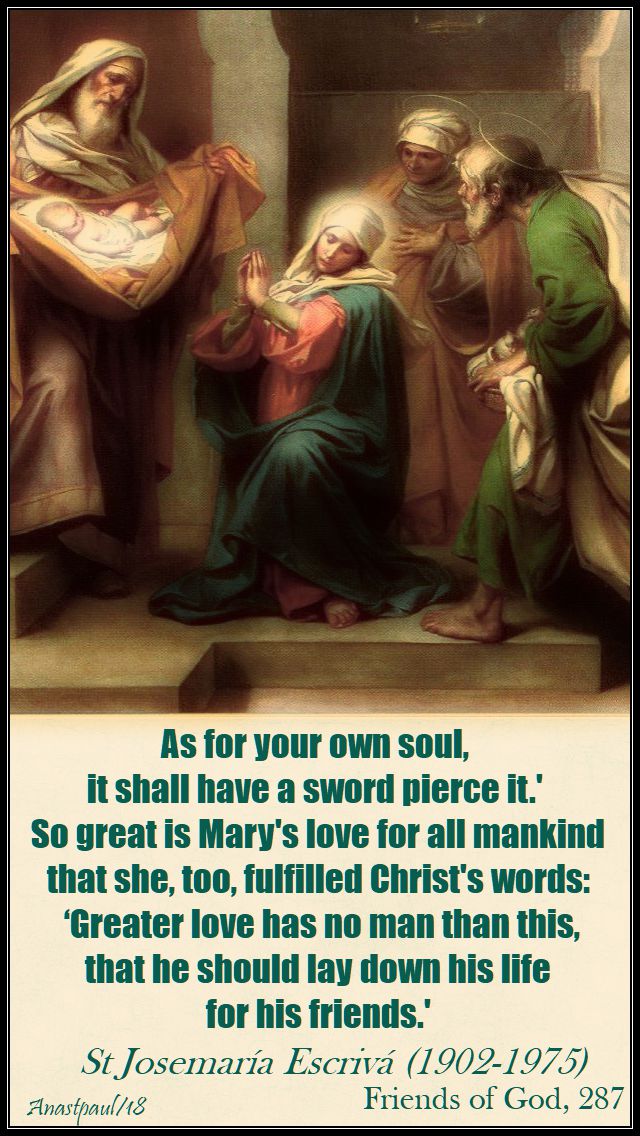
PRAYER – Our Father, Your Son was ransomed with the offering of 2 turtledoves and Mary, in obedience and with immense love in heart was submissive and offered herself too, for all mankind. Her sorrows were to come and she pondered them whilst she manifested her love and charity through her son. Grant us we pray, through her intercession, that we may grow in charity and through the offering of our sorrows, for the sins of all the world. Through our Lord Jesus Christ in the unity of the Holy Spirit, one God forever, amen.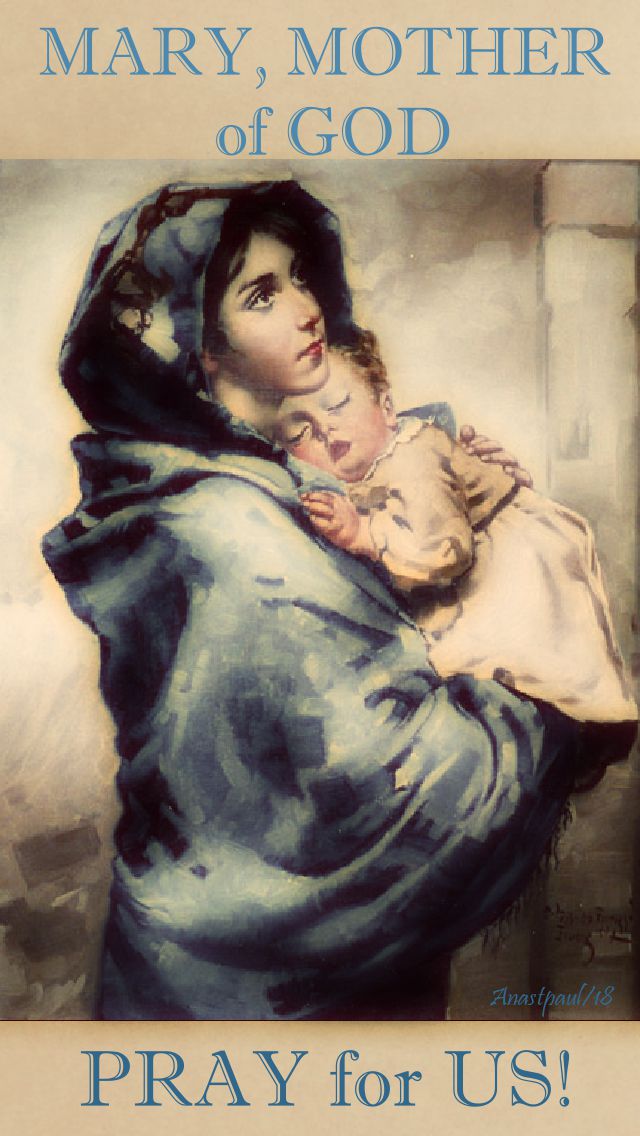
Our Morning Offering – 10 May “Mary’s Month” and Thursday of the Sixth Week of Eastertide
Easter Act of Consecration
Prayers of the Church
Mary,
We sing our Alleluias today, for Jesus is risen.
Our souls proclaim the greatness of God,
Our spirits rejoice in our Risen Saviour.
May your song be sung in our lives
At every moment of this day, so that God’s power,
Which can do far more than we can ask or imagine,
May continue to call life from death
and light from darkness,
Transforming our meager efforts
Into your Son’s victory over death.
Holy Mother of God,
Mary ever Virgin,
intercede for us with the Lord our God.
Amen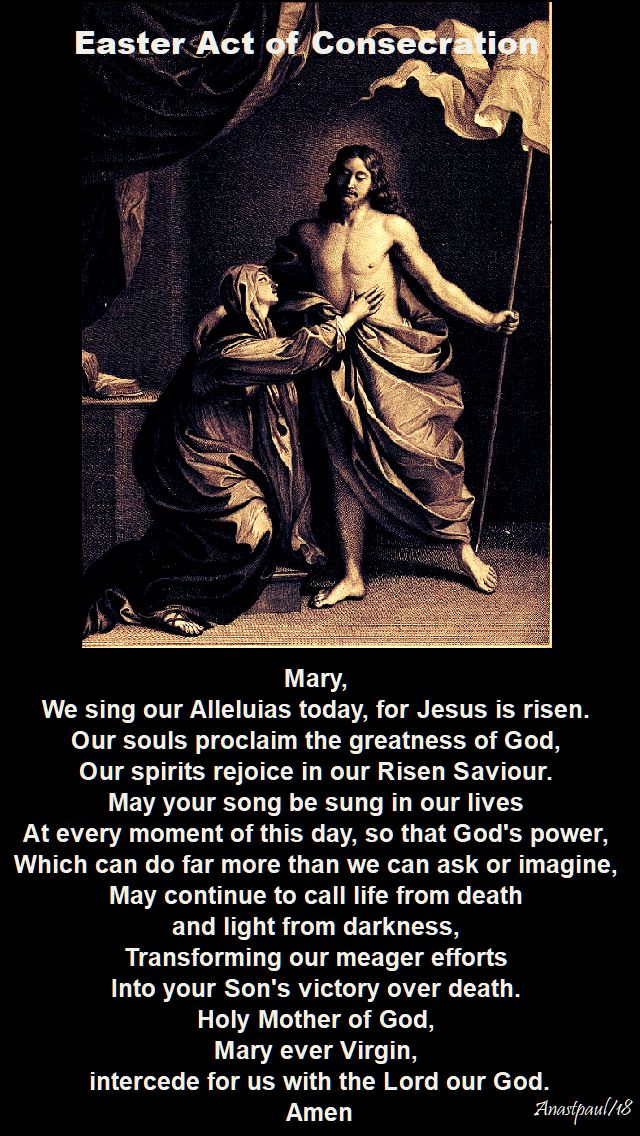
St John of Avila (1499-1569) “Apostle of Andalusia”– Doctor of the Church
St Joseph de Veuster (1840-1889) – St Damian of Molokai (Optional Memorial)
—
St Alphius of Lentini
Bl Amalarius of Metz
Bl Antonio of Norcia
St Aurelian of Limoges
Bl Beatrix d’Este the Elder
St Blanda of Rome
St Calepodius of Rome
St Catald of Taranto
St Comgall of Bangor
St Cyrinus of Lentini
St Dioscorides of Smyrna
Bl Enrico Rebuschini
St Epimachus of Rome
St Felix of Rome
Bl Giusto Santgelp
St Gordian the Judge
Bl Ivan Merz
St Job the Patriarch
Bl Nicholas Albergati
St Palmatius of Rome
St Philadelphus of Lentini
St Quartus of Capua
St Quintus of Capua
St Simplicius of Rome
St Solange of Bourges
St Thecla
Bl William of Pontnoise
Saint of the Day – 9 May – Blessed Theresa of Jesus/Karolina Gerhardinger (1797-1879). – Religious nun, Foundress, Teacher. Born on 20 June 1797 at Stadtamhof, Bavaria, Germany as Caroline Gerhardinger and died on 9 May 1879 in München, Bavaria, Germany of natural causes. She was Beatified on 17 November 1985 by St Pope John Paul II. Patronages – The School Sisters of Notre Dame and Teachers.
Karolina Gerhardinger was born in Bavaria on 20 June 1797 as the sole child of Willibard and Franziska Gerhardinger.
Karolina lived during turbulent times in Bavaria. At the age of 15, she was already a certified teacher in the school for girls in Stadtamhof near Regensburg. She was a very gifted educator whose enthusiastic and encouraging acceptance of the children soon made her a beloved teacher. Under the spiritual guidance of Bishop George Michael Wittmann (1760-1833), Karolina gradually recognised God’s call to found a religious community in order to respond to the needs of the times through education.


On 16 November 1835, Karolina professed her religious vows and took the name, Mary Theresa of Jesus. Her love for God, nourished and strengthened by her devotion to the Blessed Sacrament, enkindled the burning desire of her life: to know God and to do God’s will. God’s cause was the only concern of her heart. Blessed Theresa anchored her community in poverty and dedicated it to Mary.
In 1822, Karolina had written, “The love of Jesus sees into the future.” As foundress, she endeavoured to give the new congregation a future. She sent her sisters in communities of twos and threes to small towns and villages where they taught girls who would have been deprived of an adequate education. This brought about the development of a new form of apostolic religious life whereby all the sisters and houses were governed by a member of the congregation, a general superior. As a result, the congregation experienced rapid growth and acceptance but Blessed Theresa and her sisters also suffered great hardship and painful struggle. In 1865, the rule and constitutions of the School Sisters of Notre Dame were finally approved by Pope Pius IX. Blessed Theresa then continued to govern the congregation as its general superior until her death in Munich on May 9, 1879.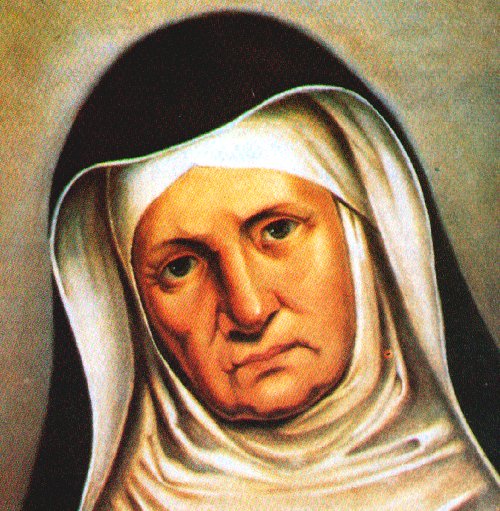
On 17 November 1985, Theresa of Jesus was declared “Blessed” by St Pope John Paul II in St Peter’s Basilica in Rome.
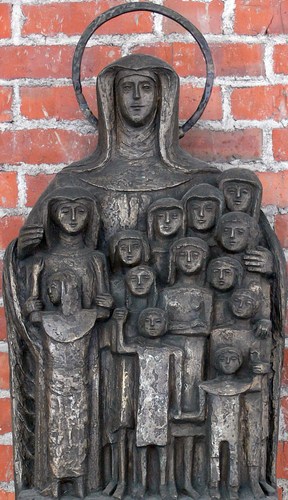
Announcing a Novena to the Holy Spirit for the Seven Gifts – from ASCENSION to PENTECOST
Begins Friday 11 May
As we continue to celebrate Easter in the Catholic World, we also begin to look forward to the pivotal moment in Church history, the day everything changed, the moment that Christ sent His followers the Holy Spirit.
The Novena begins on the Friday of the 6th Week of Easter, which is the day after the Solemnity of the Ascension (Ascension Thursday). Even where this Solemnity is transferred to the 7th Sunday of Easter, this Novena still begins on the Friday before. We all know that Jesus told his Apostles that He would send them a helper, that even though He would return to the Father, He would always be with us. “And eating together with them, he commanded them, that they should not depart from Jerusalem, but should wait for the promise of the Father…” Acts 1:4
This Pentecost Novena in honour of the Holy Spirit is in a sense the first Novena ever taken by followers of Christ and it was Christ Himself who instructed His followers to undertake it. While the Apostles and Mary were gathered in the upper room they waited and they prayed, trusting in the promise that Christ made to them, not knowing what to expect but waiting with expectant hearts. Now more than ever, we too need to pray and wait for the power of the Holy Spirit to guide us and empower us to face the challenges of every day.
JOHN 16:5-11 – Bishop Robert Barron
“Friends, once again in today’s Gospel Jesus promises to send us the Holy Spirit. The Spirit is the fuel of the Church, the energy and life force of the Body of Christ. And we can’t get Him through heroic effort. We can only get Him by asking for Him. That’s why, for the past two thousand years, the Church has begged for this power from on high.
Jesus told us that the Father would never refuse someone who asked for the Holy Spirit. So ask! And ask again! Realise that every liturgy is a begging for the Holy Spirit. Fr Hesburgh of Notre Dame once commented that the one prayer that is always appropriate—whether one is experiencing success or failure, whether one is confident or afraid, whether one is young or old— is “Come, Holy Spirit!”
He’s right, for this is the fundamental prayer of the Church. Mind you, we pray it, as the first Apostles did, in the presence of Mary and with her support. In the Hail Mary, we say, “Pray for us sinners, now and at the hour of our death.” What are we asking her to pray for but the Holy Spirit?”
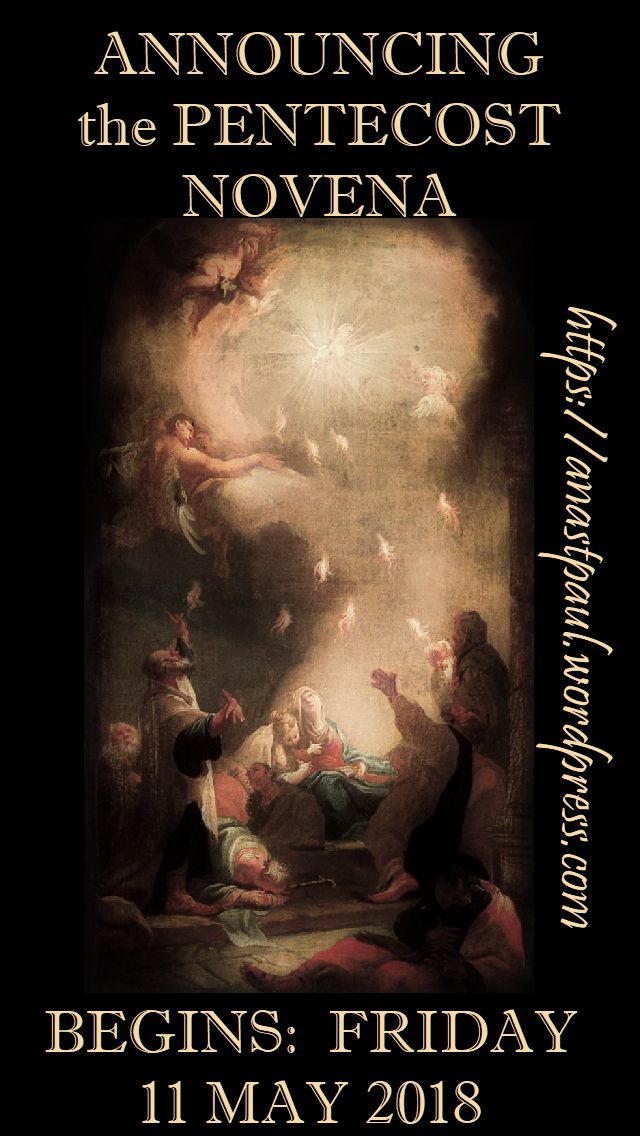
Marian Thought for the Day – 9 May “Mary’s Month!” – Wednesday of the Sixth Week of Eastertide
WE use the word “Venerable” generally of what is old. That is because only what is old has commonly those qualities which excite reverence or veneration.
It is a great history, a great character, a maturity of virtue, goodness, experience, that excite our reverence and these commonly, cannot belong to the young.
But this is not true when we are considering Saints. A short life with them is a long one. Thus Holy Scripture says, “Venerable age is not that of long time, nor counted by the number of years but it is the understanding of a man that has gray hairs and a spotless life is old age. The just man, if he be cut short by death, shall be at rest; being made perfect in a short time, he fulfilled a long time.” [Wisdom v.]
Nay, there is a heathen writer, who knew nothing of Saints, who lays it down that even to children, to all children, a great reverence should be paid and that on the ground of their being as yet innocent. And this is a feeling very widely felt and expressed in all countries; so much so that the sight of those who have not sinned (that is, who are not yet old enough to have fallen into mortal sin) has, on the very score of that innocent, smiling youthfulness, often disturbed and turned the plunderer or the assassin in the midst of his guilty doings, filled him with a sudden fear and brought him, if not to repentance, at least to change of purpose.
And, to pass from the thought of the lowest to the Highest, what shall we say of the Eternal God (if we may safely speak of Him at all) but that He, because He is eternal, is ever young, without a beginning and therefore without change and, in the fullness and perfection of His incomprehensible attributes, now just what He was a million years ago? He is truly called in Scripture the “Ancient of Days,” and is therefore infinitely venerable; yet He needs not old age to make him venerable; He has really nothing of those human attendants on venerableness which the sacred writers are obliged figuratively to ascribe to Him, in order to make us feel that profound abasement and reverential awe which we ought to entertain at the thought of Him.
And so of the great Mother of God, as far as a creature can be like the Creator; her ineffable purity and utter freedom from any shadow of sin, her Immaculate Conception, her ever-virginity—these her prerogatives (in spite of her extreme youth at the time when Gabriel came to her) are such as to lead us to exclaim in the prophetic words of Scripture both with awe and with exultation, “Thou art the glory of Jerusalem and the joy of Israel; thou art the honour of our people; therefore hath the hand of the Lord strengthened thee and therefore art thou blessed forever.”
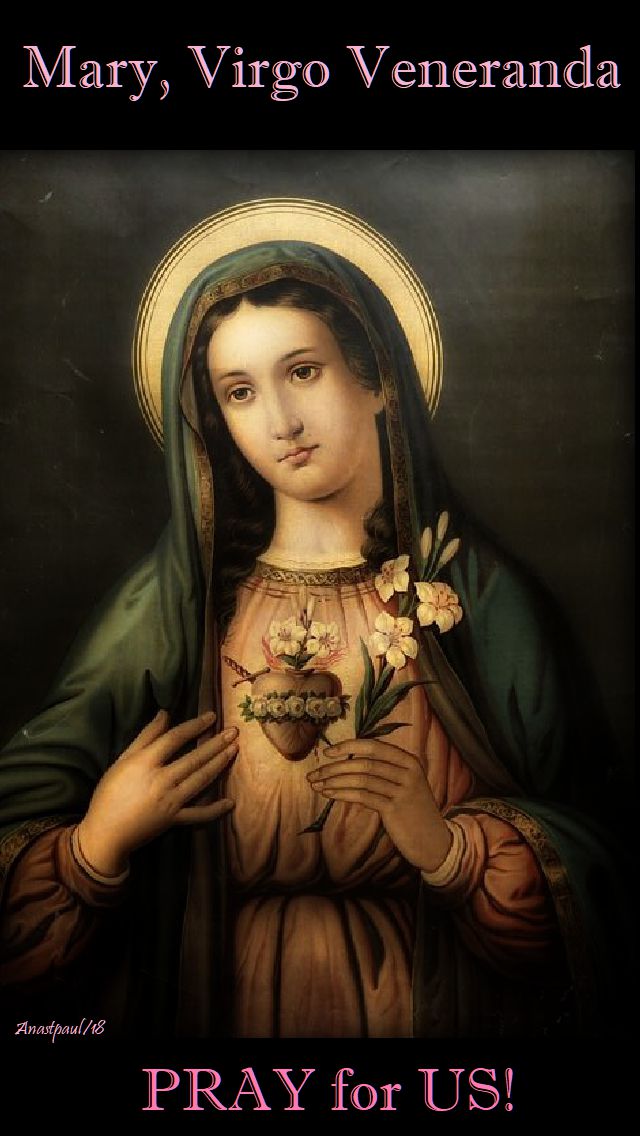
Quote/s of the Day – 9 May “Mary’s Month!” – Wednesday of the Sixth Week of Eastertide and the Memorial of Blessed Theresa of Jesus/Karolina Gerhardinger (1797-1879)
“All the works of God proceed slowly and in pain
but then, their roots are the sturdier
and their flowering the lovelier.”
“Love gives everything gladly,
everything
again and again, daily!”
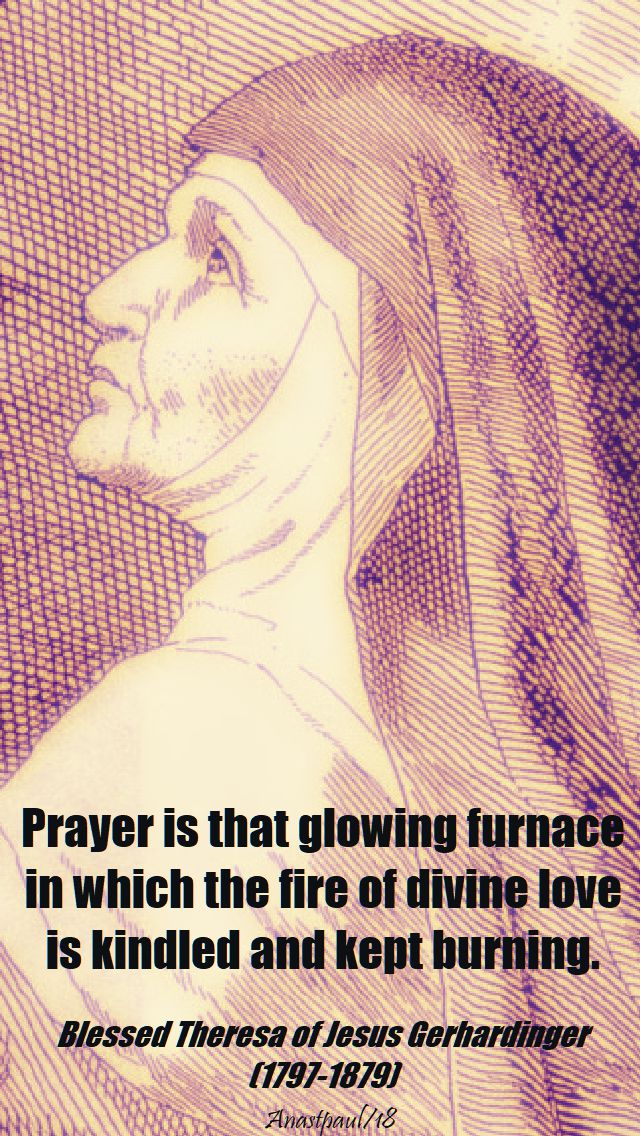
“Prayer is that glowing furnace
in which the fire of divine love
is kindled and kept burning.”
One Minute Marian Reflection – 9 May “Mary’s Month!” – Wednesday of the Sixth Week of Eastertide
The angel said to them, “Do not be afraid; for behold, I proclaim to you good news of great joy that will be for all the people. For today in the city of David, a saviour has been born to you, who is Messiah and Lord...Luke 2:10-11
REFLECTION – MARY: WELCOMING THE SHEPHERDS: “You must look at the Child in the manger. He is our Love. Look at Him, realising that the whole thing is a mystery. We need to accept this mystery on faith and use our faith to explore it very deeply. To do this, we must have the humble attitude of a Christian soul.” …St Josemaría Escrivá (1902-1975) “Christ Triumphs through Humility,” Christ is Passing by 13.
Let us offer to our Mother today:
Small hidden sacrifices,
especially those that go against the grain.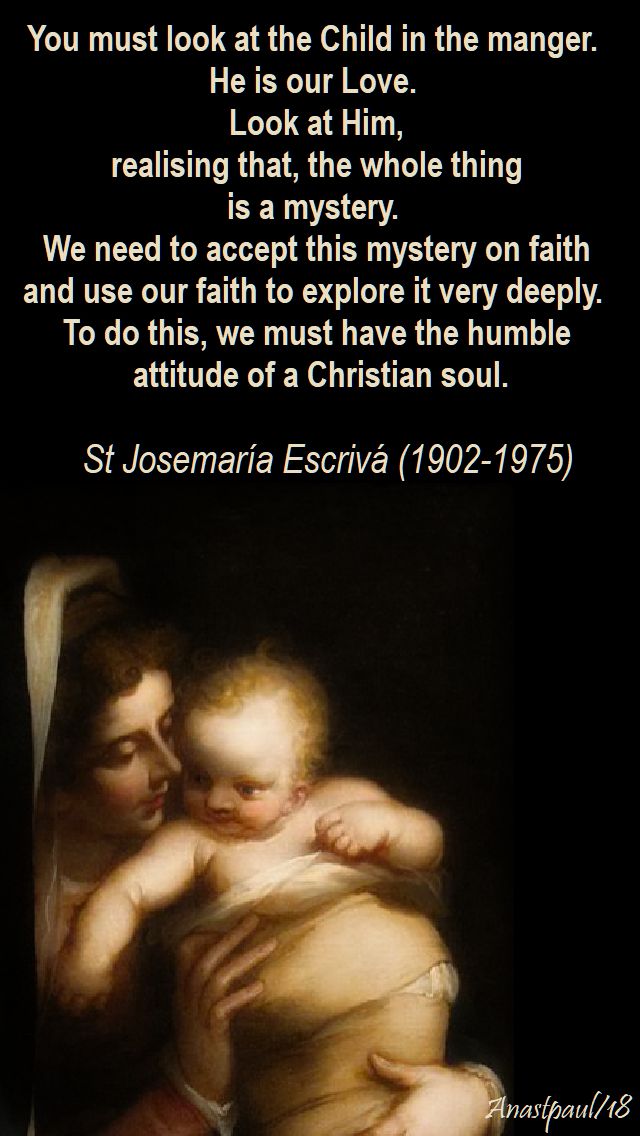
PRAYER – Almighty God, Your incarnate Word fills us with the new light He brought to men. Let the light of faith in our hearts shine through all that we do and say. Grant that through Mary, mother of Christ and our mother and protector, by her prayers and solace, we may learn humility and true faith. We make our prayer through Jesus, our Lord, with You and the Holy Spirit, one God forever, amen.
St Banban the Wise
St Beatus of Laon
St Beatus of Lungern
Bl Benincasa of Montepulciano
St Brynoth of Scara
St Dionysius of Vienne
Bl Fortis Gabrielli
St Gerontius of Cervia
St Giuse Hien
St Gorfor of Llanover
St Gregory of Ostia
St Hermas of Rome
Isaiah the Prophet
St John of Châlon
Bl Theresa of Jesus/Karolina Gerhardinger (1797-1879)
St Maria del Carmen Rendiles Martinez
St Pachomius of Tabenna
St Sanctan of Kill-da-Les
Bl Stefan Grelewski
Bl Thomas Pickering
St Vincent of Montes
Martyrs of Persia: 310 Christians murdered together for their faith in Persia. No details about them have survived.
20 Mercedarian Martyrs of Riscala: 20 Mercedarian friars who were murdered by Huguenot heretics for refusing to denounce their faith. 16th century at the Santa Maria convent at Riscala, France.
Our Morning Offering – 9 May “Mary’s Month!” – Wednesday of the Sixth Week of Eastertide
Easter Act of Consecration
Marian Prayers of the Church
Mary,
In the brilliant light of Easter,
Teach us, too, that nothing is impossible with God.
All our struggles with self and others,
All our disappointments and shames,
All our failures and sinfulness
Are as nothing in this healing, life-giving light.
Accept, then, our all.
May God look upon it,
As once did the Mighty One upon your lowliness,
So that we might be gifted with that blessedness
Promised to all sons and daughters of the Resurrection.
Holy Mother of God,
Mary, ever Virgin,
intercede for us, with the Lord our God.
Amen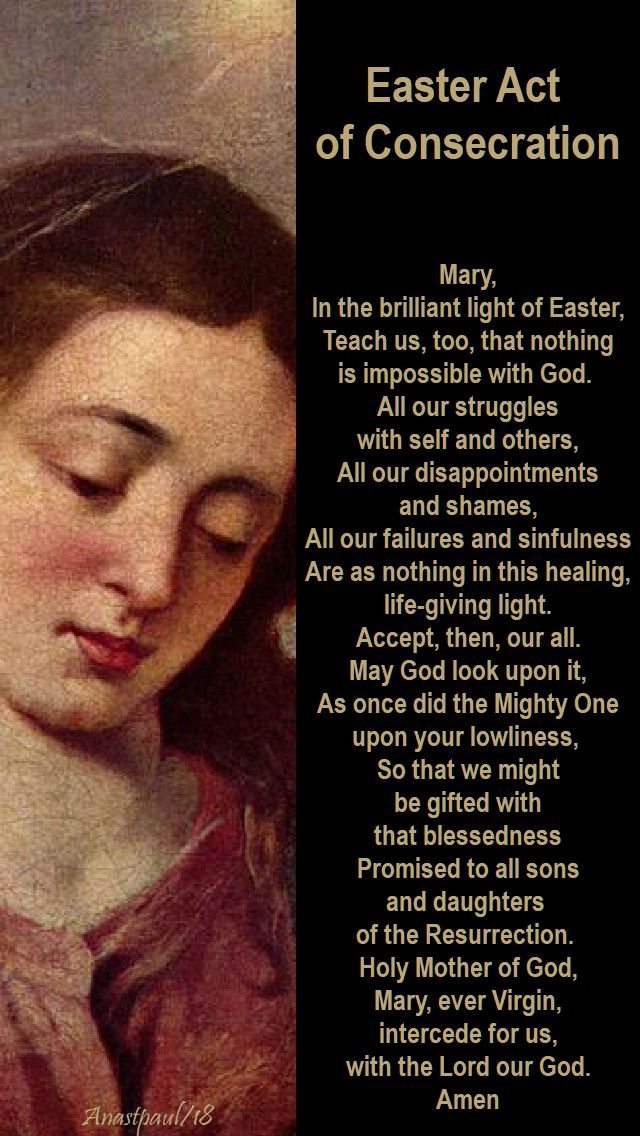
Marian Thought for the Day – 8 May – “Mary’s Month!” – Tuesday of the Sixth Week of Eastertide
HOW did Mary become the Rosa Mystica, the choice, delicate, perfect flower of God’s spiritual creation? It was by being born, nurtured and sheltered in the mystical garden or Paradise of God. Scripture makes use of the figure of a garden, when it would speak of heaven and its blessed inhabitants. A garden is a spot of ground set apart for trees and plants, all good, all various, for things that are sweet to the taste or fragrant in scent, or beautiful to look upon, or useful for nourishment; and accordingly in its spiritual sense, it means the home of blessed spirits and holy souls dwelling there together, souls with both the flowers and the fruits upon them, which by the careful husbandry of God, they have come to bear, flowers and fruits of grace, flowers more beautiful and more fragrant than those of any garden, fruits more delicious and exquisite than can be matured by earthly husbandman.
All that God has made speaks of its Maker;, the mountains speak of His eternity;, the sun of His immensity and the winds of His Almightiness. In like manner flowers and fruits speak of His sanctity, His love and His providence; and such as are flowers and fruits, such must be the place where they are found. That is to say, since they are found in a garden, therefore a garden has also excellences which speak of God because it is their home. For instance, it would be out of place if we found beautiful flowers on the mountain-crag, or rich fruit in the sandy desert. As then by flowers and fruits are meant, in a mystical sense, the gifts and graces of the Holy Ghost, so by a garden is meant mystically, a place of spiritual repose, stillness, peace, refreshment and delight.
Thus our first parents were placed in “a garden of pleasure” shaded by trees, “fair to behold and pleasant to eat of,” with the Tree of Life in the midst and a river to water the ground. Thus our Lord, speaking from the cross to the penitent robber, calls the blessed place, the heaven to which He was taking him, “paradise,” or a garden of pleasure. Therefore St John, in the Apocalypse, speaks of heaven, the palace of God, as a garden or paradise, in which was the Tree of Life giving forth its fruits every month.
Such was the garden in which the Mystical Rose, the Immaculate Mary, was sheltered and nursed to be the Mother of the All Holy God, from her birth to her espousals to St Joseph, a term of thirteen years. For three years of it, she was in the arms of her holy mother, St Anne and then for ten years she lived in the temple of God. In those blessed gardens, as they may be called, she lived by herself, continually visited by the dew of God’s grace and growing up a more and more heavenly flower, till at the end of that period she was meet for the inhabitation in her of the Most Holy. This was the outcome of the Immaculate Conception. Excepting her, the fairest rose in the paradise of God has had upon it blight and has had the risk of canker-worm and locust. All but Mary; she from the first was perfect in her sweetness and her beautifulness and at length, when the angel Gabriel had to come to her, he found her “full of grace,” which had, from her good use of it, accumulated in her, from the first moment of her being.

Thought for the Day – 8 May – Tuesday of the Sixth Week of Eastertide – Today’s Gospel: John 16:5–11
” 5 But now I am going to him who sent me; yet none of you asks me, ‘Where are you going?’ 6 But because I have said these things to you, sorrow has filled your hearts. 7 Nevertheless I tell you the truth: it is to your advantage that I go away, for if I do not go away, the Counsellor will not come to you; but if I go, I will send him to you. 8 And when he comes, he will convince the world concerning sin and righteousness and judgment: 9 concerning sin, because they do not believe in me; 10 concerning righteousness, because I go to the Father, and you will see me no more; 11 concerning judgment, because the ruler of this world is judged.” (RSV-Catholic ed)
The Holy Spirit overshadowed the Virgin Mary (Lk 1:35) and strengthened the apostles on the day of Pentecost. In her case it was to soften the impact on her virginal body of the coming of the divinity and, in theirs, to “clothe them with power from on high” (Lk 24:49), that is with burning charity… In their weakness how could they have fulfilled their mission of conquering death without that “love as strong as death” or not allowed the “gates of hell to prevail against them” without that “passion fierce as Sheol” ? (Mt 16:18; Sg 8:6). However, when they saw such enthusiasm, some thought they were drunk (Acts 2:13).
They were indeed drunk but with new wine…, that which the “true Vine” poured down from the heights of heaven, that which “gladdens the human heart” (Jn 15:1; Ps 104[103]:15)… This was a new wine for the dwellers on earth but it is found in abundance in heaven…, it runs in streams in the streets and squares of the holy city where it spreads gladness of heart…
And so in heaven, there was a special wine of which earth was ignorant. Yet earth, too, had something of its own that was its glory – Christ’s flesh – and heaven thirsted for the presence of that flesh. Could anyone stand in the way of so reliable and grace-filled an exchange, between heaven and earth, angels and apostles, as that by which earth possesses the Holy Spirit and heaven the flesh of Christ?…
“If I do not go away,” Jesus says, “the Advocate will not come to you.” That is to say, if you do not allow what you love to leave you, you will not obtain what you desire. “It is to your advantage that I go” and that I should carry you over from earth to heaven, from flesh to spirit, for the Father is spirit, the Son is spirit and the Holy Spirit is also spirit… And the Father “who is spirit seeks worshippers who will worship him in spirit and in truth” (Jn 4:23-24).
Come O Holy Spirit, Come!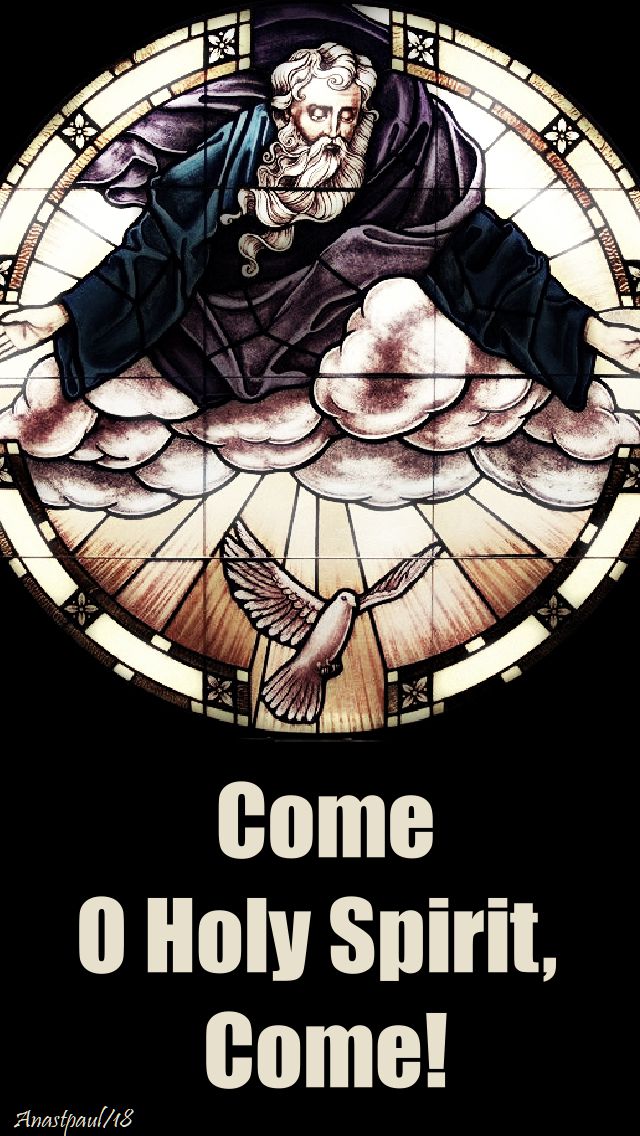
Quote/s of the Day – 8 May – Tuesday of the Sixth Week of Eastertide
English Catholic Convert, writer, poet, philosopher, dramatist, journalist, orator, lay theologian, biographer, and literary and art critic. Chesterton is often referred to as the “prince of paradox” (Part One – https://anastpaul.wordpress.com/2018/04/18/quote-s-of-the-day-18-april-wednesday-of-the-third-week-of-eastertide/)
“Among the rich you will never find,
a really generous man even by accident.
They may give their money away
but they will never give themselves away,
they are egotistic, secretive, dry as old bones.
To be smart enough to get all that money,
you must be dull enough to want it.”
A Miscellany of Men, 1912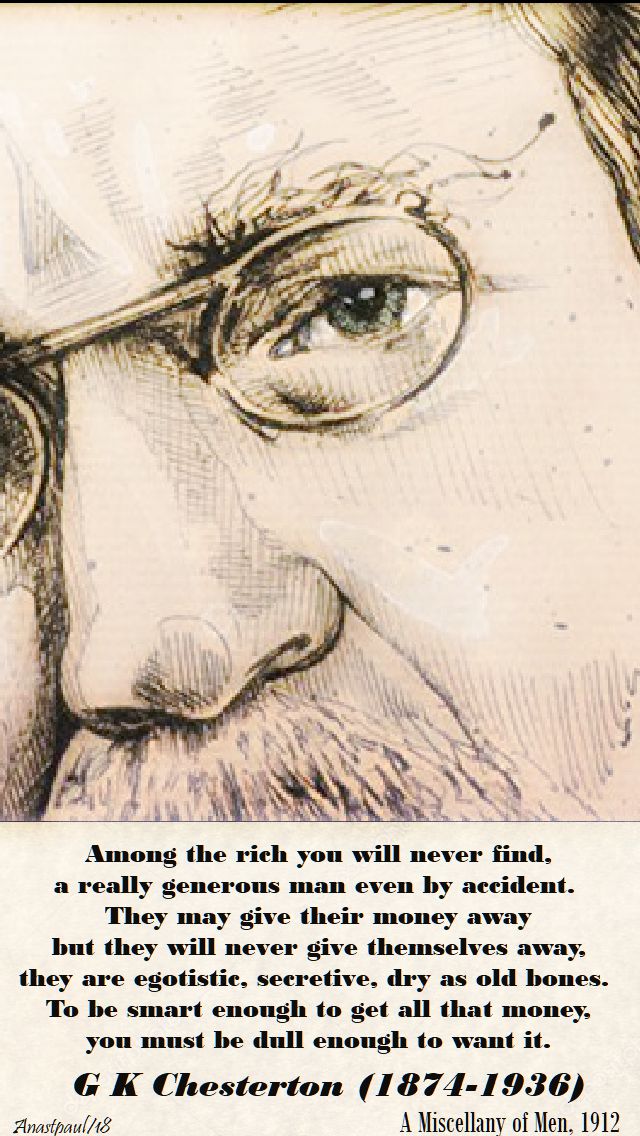
“To have a right to do a thing,
is not at all the same,
as to be right in doing it.”
A Short History of England, 1917
“Once abolish the God
and the government
becomes the God.”
Christendom in Dublin, 1933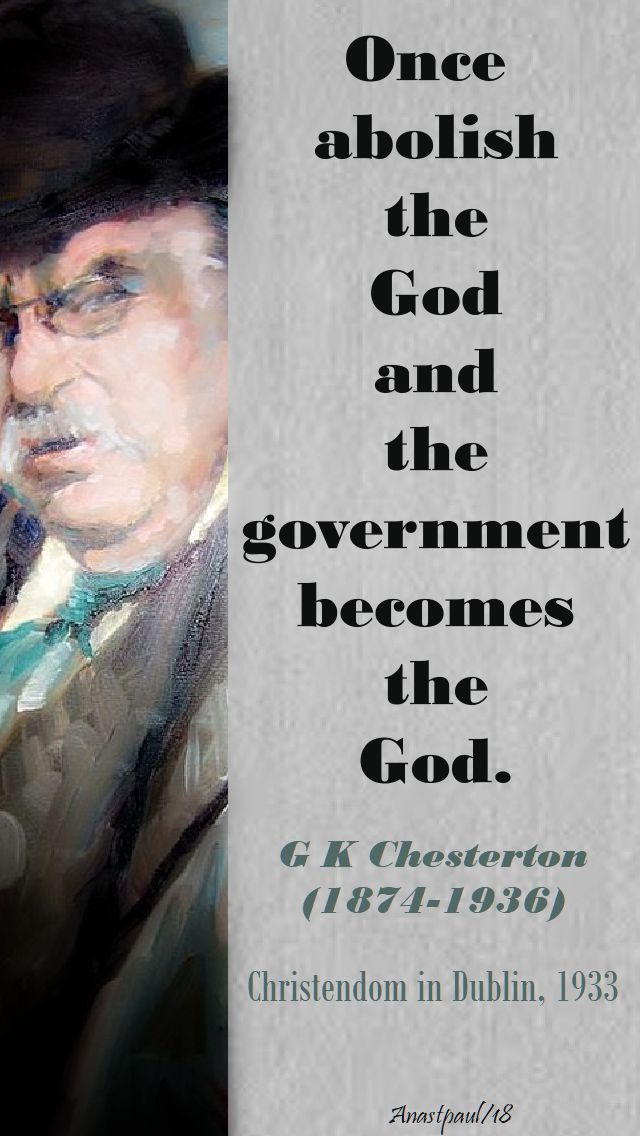
“If there were no God,
there would be no atheists.”
Illustrated London News, Where All Roads Lead, 1922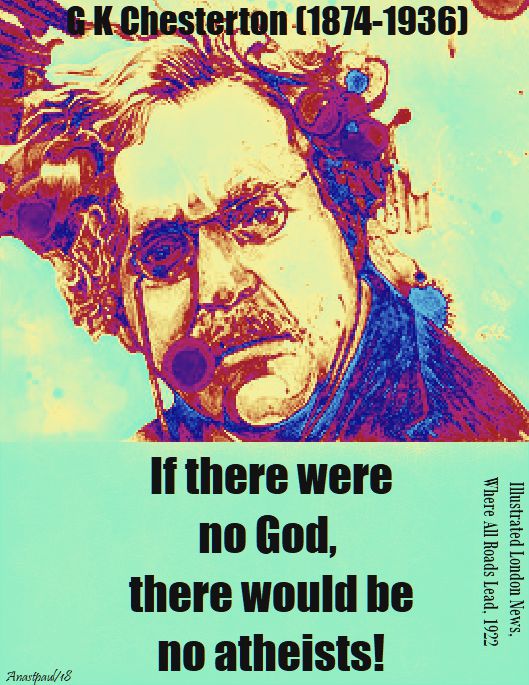
“There are those who hate Christianity
and call their hatred
an all-embracing love for all religions.”
Illustrated London News, 1906
“These are the days,
when the Christian is expected,
to praise every creed except his own.”
Illustrated London News, 1928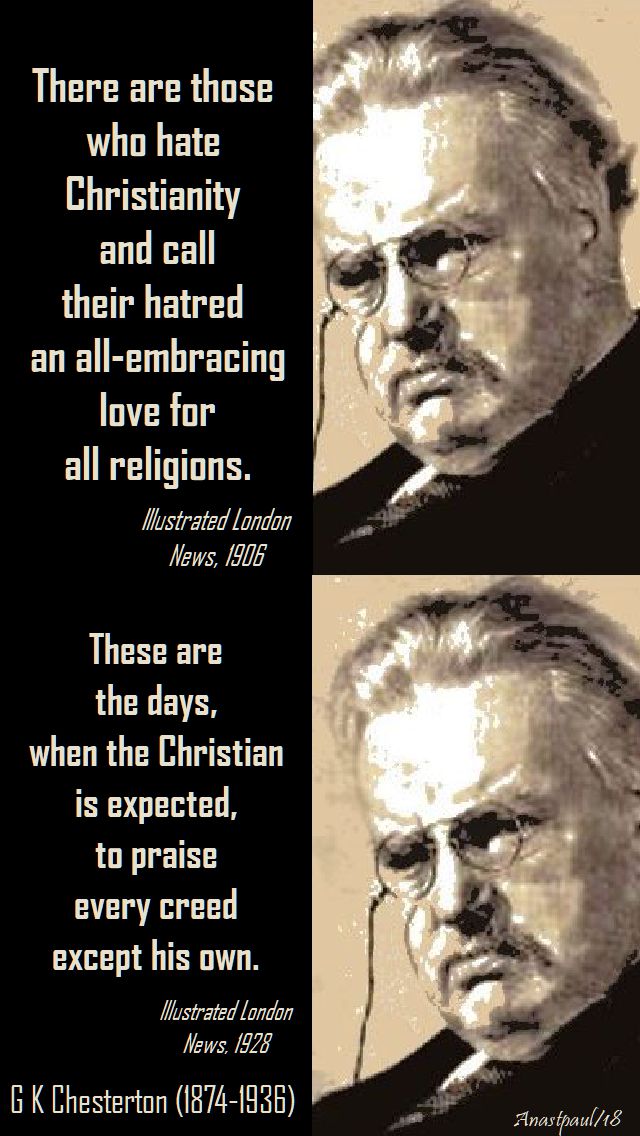
“A Catholic is a person,
who has plucked up courage,
to face the incredible and inconceivable idea,
that something else may be wiser than he is.”
The Surrender on Sex, 1934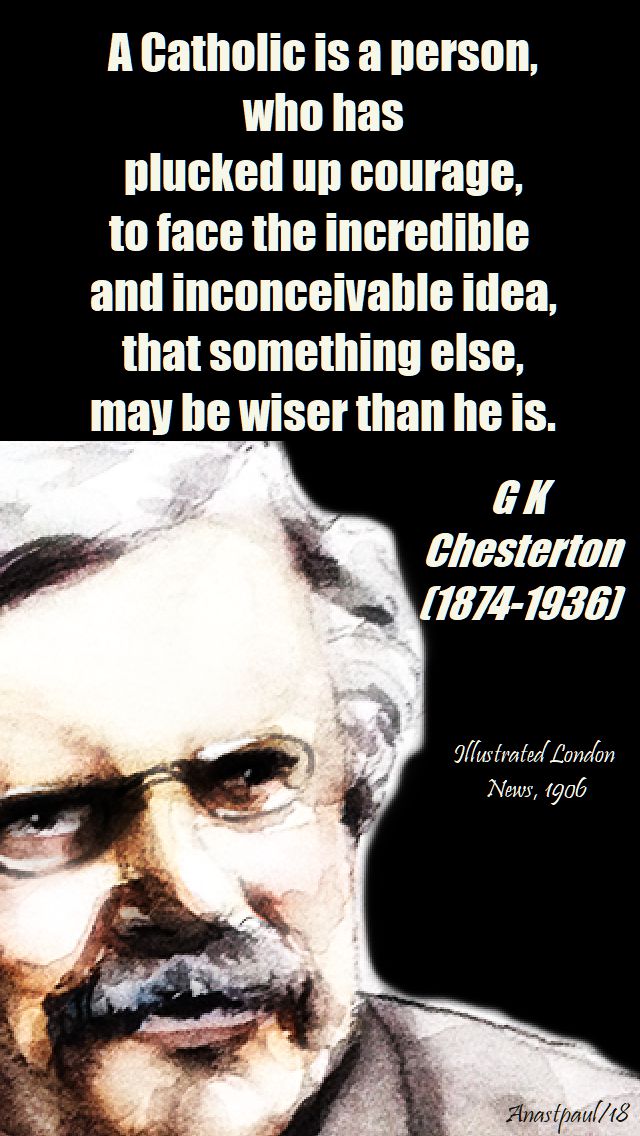
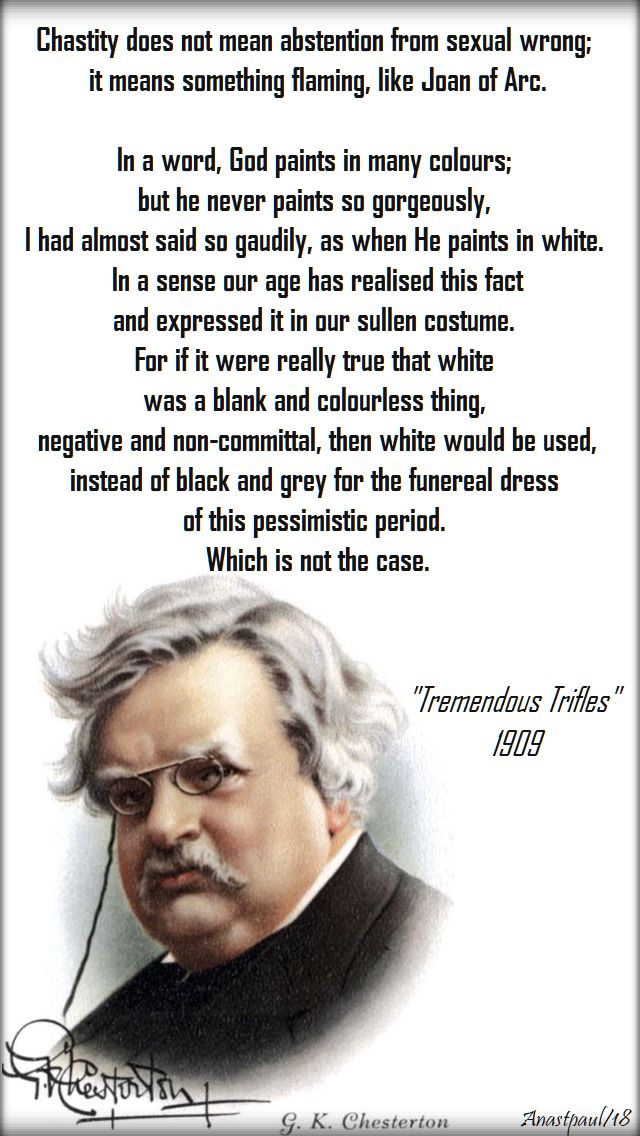
“Chastity does not mean abstention from sexual wrong;
it means something flaming, like Joan of Arc.
In a word, God paints in many colours;
but he never paints so gorgeously,
I had almost said so gaudily, as when He paints in white.
In a sense our age has realised this fact
and expressed it in our sullen costume.
For if it were really true that white
was a blank and colourless thing,
negative and non-committal, then white would be used,
instead of black and grey for the funereal dress
of this pessimistic period.
Which is not the case.”
“Tremendous Trifles” 1909
One Minute Marian Reflection – 8 May – “Mary’s Month!” – Tuesday of the Sixth Week of Eastertide
And the angel said to her in reply, “The holy Spirit will come upon you, and the power of the Most High will overshadow you. Therefore the child to be born will be called holy, the Son of God…Luke 1:35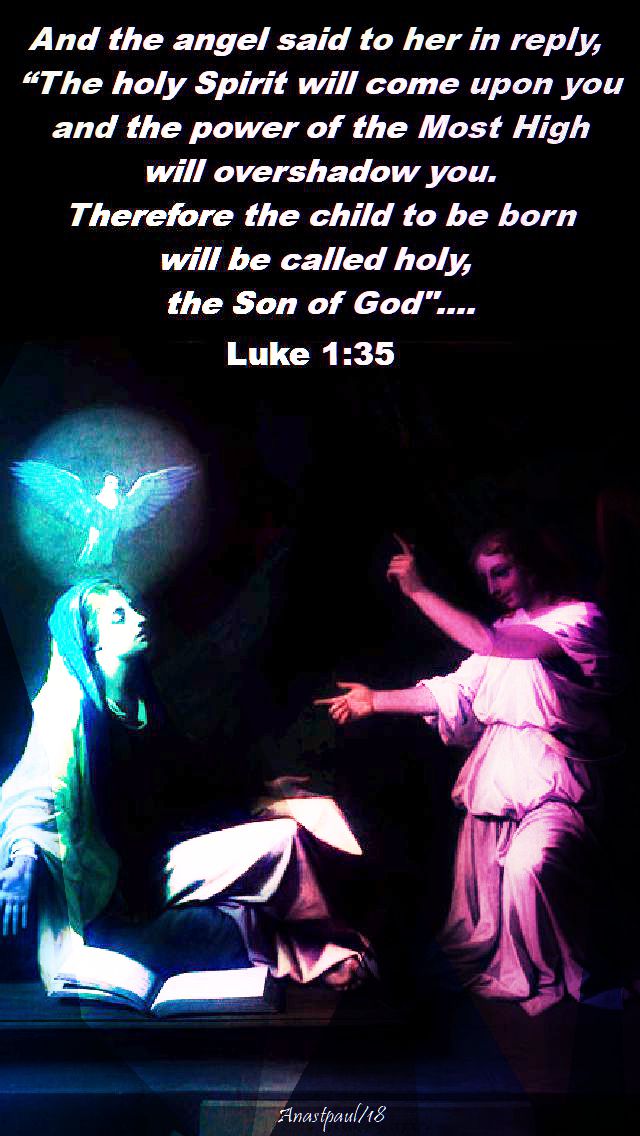
REFLECTION – MARY: MOTHER OF CHRIST – “Jesus Christus, Deus homo: Jesus Christ, God man. This is one of the ‘mighty works of God,’ which we should reflect upon and thank Him for. He has come to bring ‘peace on earth to men of good will,’ to all who want to unite their wills to the holy will of God – not just the rich, not just the poor but everyone, all the brethren. We are all brothers in Jesus, children of God, brothers of Christ. His mother is our mother .”…St Josemaría Escrivá (1902-1975) – “Christ Triumphs through Humility” – “Christ is Passing By – 13”
Let us offer to our Mother today:
Jesus Himself, when we receive Him in Holy Communion.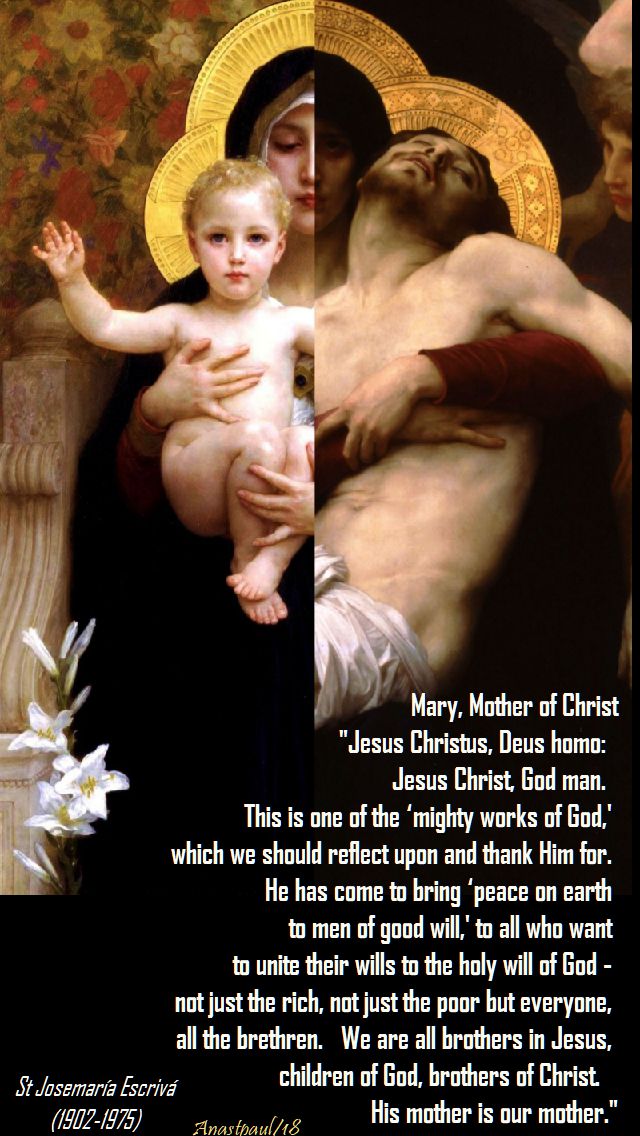
PRAYER – Shape us in the likeness of the divine nature of our Redeemer, whom we believe to be true God and true man, since it was Your will, Lord God, that He, Your Word, should take to Himself our human nature in the womb of the Blessed Virgin Mary. Grant, we pray, that by intercession of the Mother of our Lord Jesus Christ, we may reach eternal life. We make our prayer, through Christ, our Lord, in union with You and the Holy Spirit, one God, forever, amen.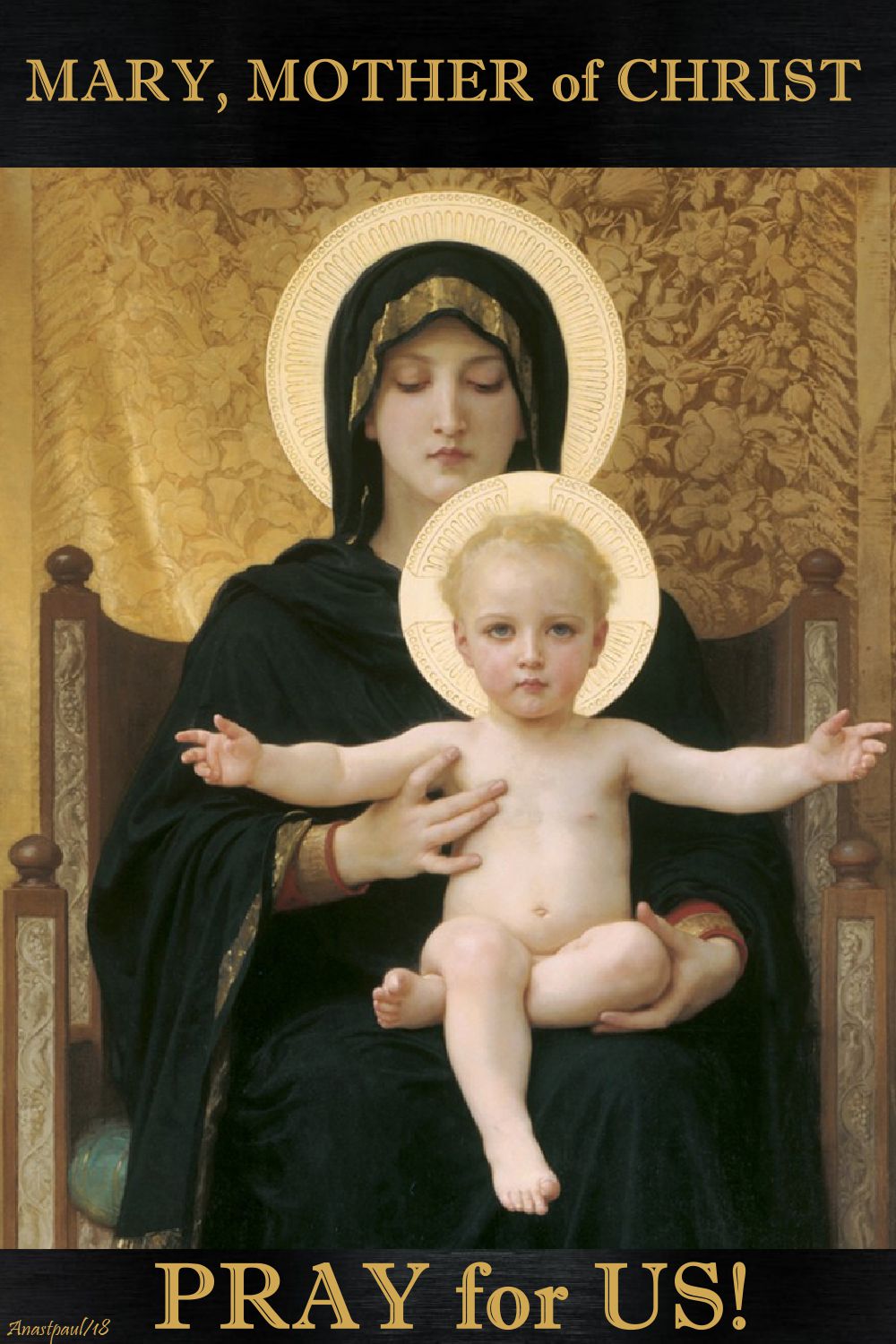
 AnaStpaul
You must be logged in to post a comment.