Posted in CATHOLIC DEVOTIONS of the Month, MARIAN DEVOTIONS, MARIAN QUOTES, MARIAN TITLES, QUOTES of the SAINTS, The BLESSED VIRGIN MARY

Marian Thought for the Day – 7 May “Mary’s Month” – Monday of the Sixth week of Eastertide

Marian Thought for the Day – 7 May “Mary’s Month” – Monday of the Sixth week of Eastertide

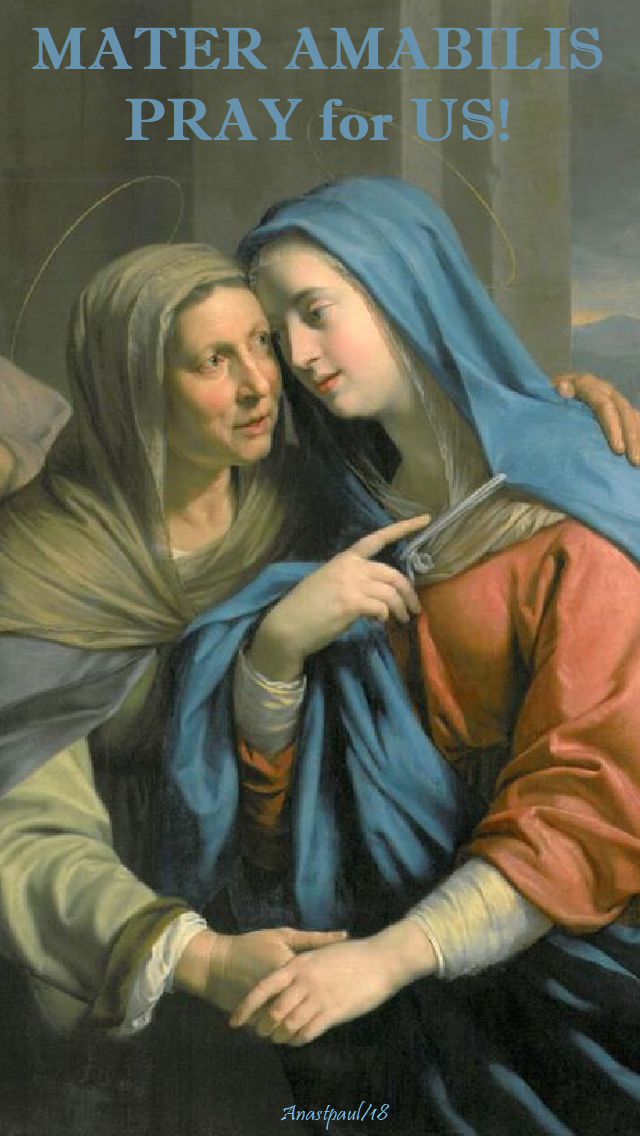
Mary is the “Mater Amabilis”
the Lovable or Dear Mother
Blessed John Henry Newman (1801-1890)

WHY is she “Amabilis” thus specially?   It is because she was without sin.   Sin is something odious in its very nature and grace is something bright, beautiful, attractive.

However, it may be said that sinlessness was not enough to make others love her, or to make her dear to others and that for two reasons:   first, because we cannot like anyone that is not like ourselves and we are sinners;   and next, because her being holy would not make her pleasant and winning because holy persons whom we fall in with, are not always agreeable and we cannot like them, however we may revere them and look up to them.

Now as to the first of these two questions, we may grant that bad men do not, cannot like good men but our Blessed Virgin Mary is called Amabilis, or lovable, as being such to the children of the Church, not to those outside of it, who know nothing about her and no child of Holy Church but has some remains of God’s grace in his soul which makes him sufficiently like her, however greatly wanting he may be, to allow of his being able to love her.   So we may let this question pass.

But as to the second question, viz., How are we sure that our Lady, when she was on earth, attracted people round her and made them love her merely because she was holy?—considering that holy people sometimes have not that gift of drawing others to them.

To explain this point we must recollect that there is a vast difference between the state of a soul such as that of the Blessed Virgin, which has never sinned and a soul, however holy, which has once had upon it Adam’s sin;   for, even after baptism and repentance, it suffers necessarily from the spiritual wounds which are the consequence of that sin. Holy men, indeed, never commit mortal sin, nay, sometimes have never committed even one mortal sin in the whole course of their lives.   But Mary’s holiness went beyond this. She never committed even a venial sin and this special privilege is not known to belong to anyone but Mary.

Now, whatever want of amiableness, sweetness, attractiveness, really exists in holy men arises from the remains of sin in them, or again from the want of a holiness powerful enough to overcome the defects of nature, whether of soul or body but, as to Mary, her holiness was such, that if we saw her and heard her, we should not be able to tell to those who asked us anything about her except simply that she was angelic and heavenly.

Of course, her face was most beautiful but we  should not be able to recollect whether it was beautiful or not, we should not recollect any of her features because it was her beautiful sinless soul, which looked through her eyes and spoke through her mouth and was heard in her voice and compassed her all about.   When she was still, or when she walked, whether she smiled, or was sad, her sinless soul, this it was, which would draw all those to her who had any grace in them, any remains of grace, any love of holy things.

There was a divine music in all she said and did—in her mien, her air, her deportment, that charmed every true heart that came near her.   Her innocence, her humility and modesty, her simplicity, sincerity, and truthfulness, her unselfishness, her unaffected interest in everyone who came to her, her purity—it was these qualities which made her so lovable and were we to see her now, neither our first thought nor our second thought would be, what she could do for us with her Son, (though she can do so much) but our first thought would be, “Oh, how beautiful!” and our second thought would be, “Oh, what ugly hateful creatures are we!”

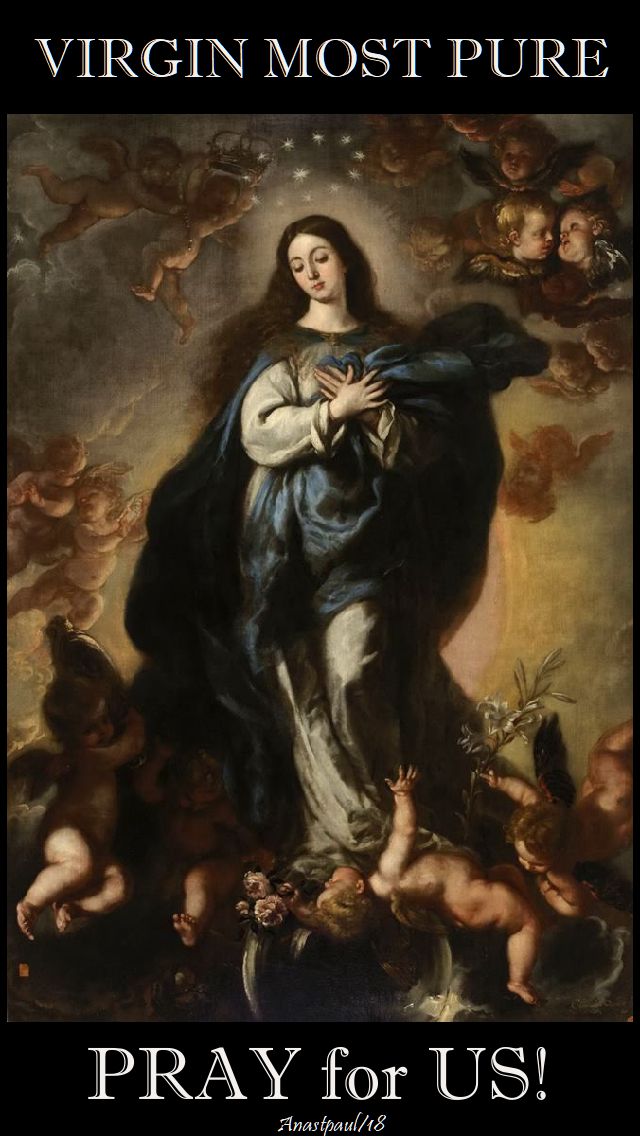
Mater Amabilis, Pray for us!mater amabilis - lovable mother - dear mother - the visitation - pray for us - 7 may 2018

Posted in MORNING Prayers, SAINT of the DAY

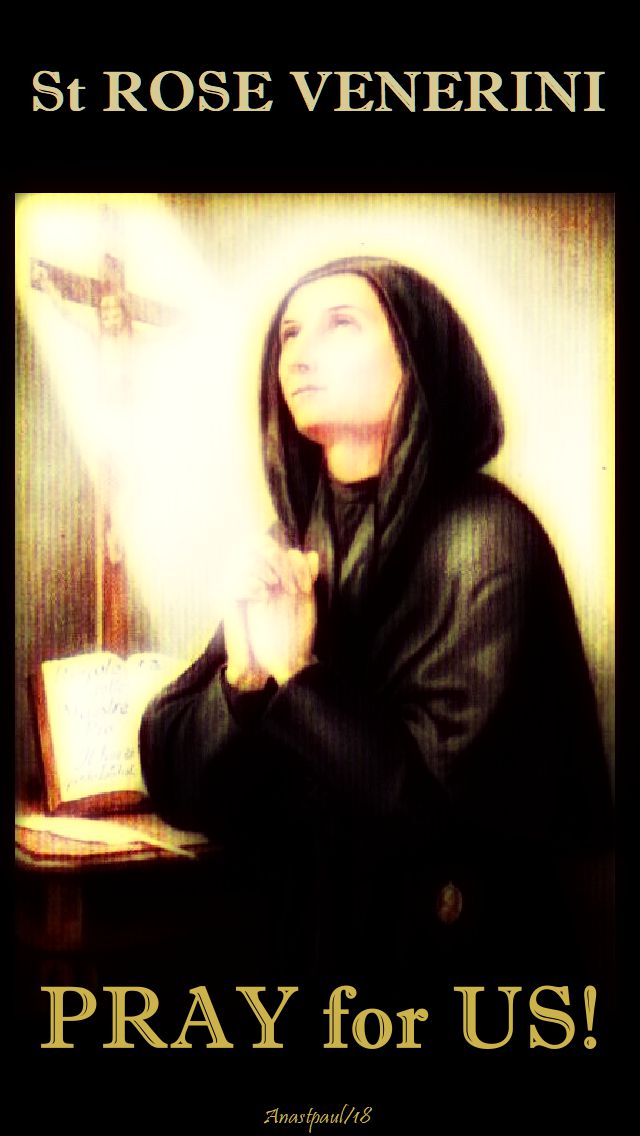
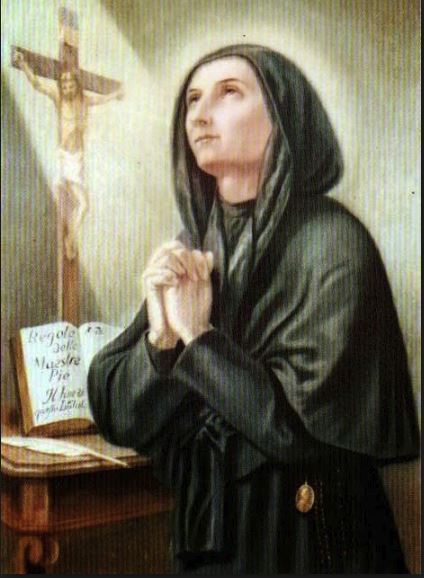
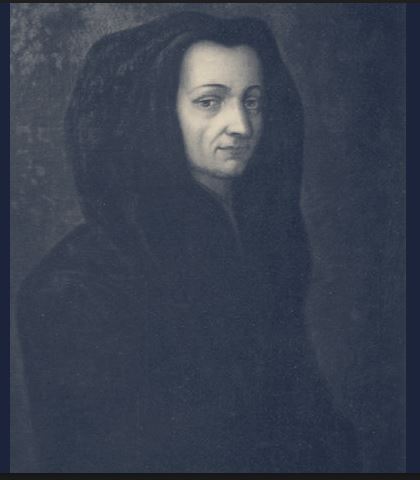
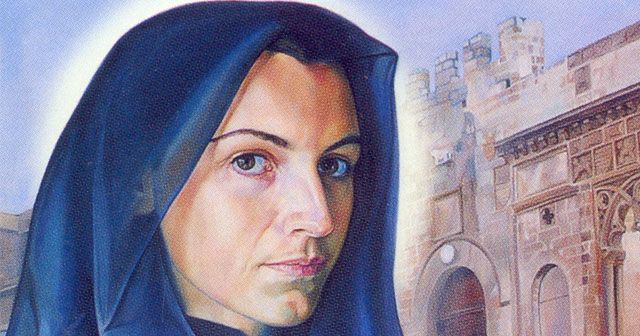
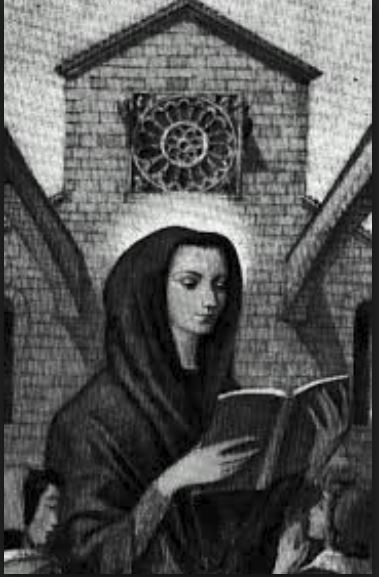
Thought for the Day – 7 May – Monday of the Sixth week of Eastertide and the Memorial of St Rose Venerini (1656-1728)

Thought for the Day – 7 May – Monday of the Sixth week of Eastertide and the Memorial of St Rose Venerini (1656-1728)

Prayer was the breath of her day.   Rose did not impose on herself or her Daughters long vocal prayers but recommended that the life of the Maestre, in the practice of the precious education ministry, be a continuous speaking with God, of God and for God.

Intimate communion with the Lord was nourished by mental prayer, which the Saint considered “essential nourishment of the soul”.   In meditation, Rosa listened to the Teacher who taught along the roads of Palestine and in a particular way from the height of the Cross.   With her gaze upon the crucifix, Rosa always felt more strongly her passion for the salvation of souls.   For this reason, she celebrated and lived daily the Eucharist in a mystical way.   In her imagination, the Saint saw the world as a great circle;   she placed herself in the centre of it and contemplated Jesus, the immaculate victim, who offered Himself from every part of the world to the Father through the Eucharistic Sacrifice.

She called this means of elevating herself to God “The Greatest Circle”.   With incessant prayer, she participated spiritually in all the Masses being celebrated in every part of the world.   She united with love the sufferings, hard work and joys of her own life to the sufferings of Jesus Christ, concerned that His Precious Blood would not be shed in vain…vatican.va

St Rose Venerini, pray for us!st rose venerini - pray for us - 7 may 2018

Posted in MORNING Prayers, QUOTES of the SAINTS, QUOTES on DIVINE PROVIDENCE, QUOTES on TRUST and complete CONFIDENCE in GOD, SAINT of the DAY

Quote of the Day – 7 May – Monday of the Sixth week of Eastertide and the Memorial of St Rose Venerini (1656-1728)

Quote of the Day – 7 May – Monday of the Sixth week of Eastertide and the Memorial of St Rose Venerini (1656-1728)

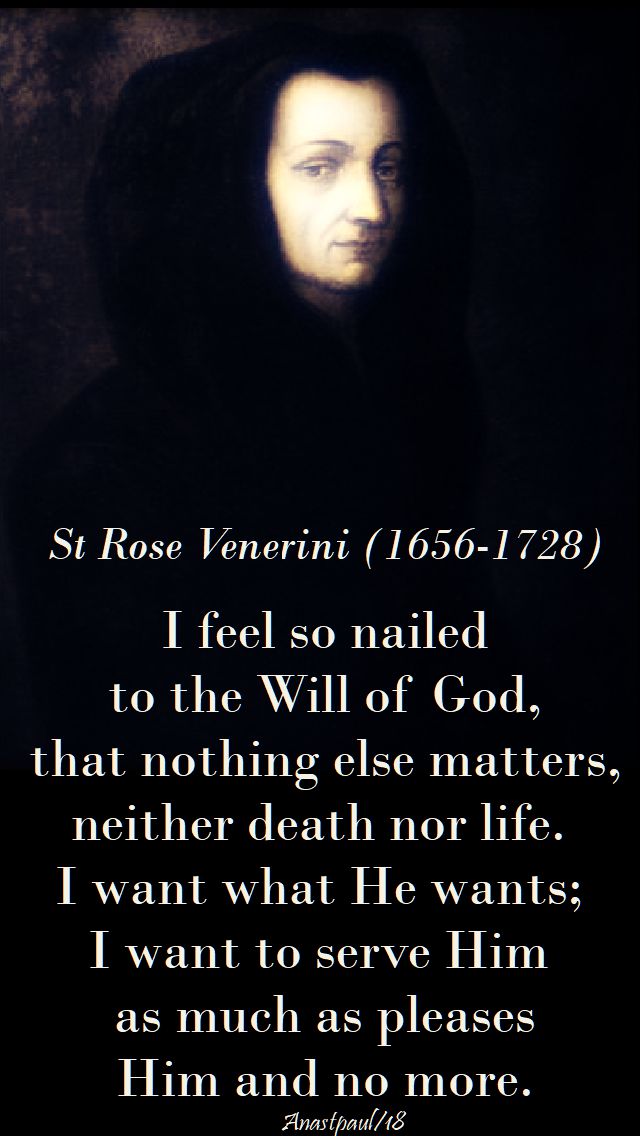
“I feel so nailed to the Will of God,
that nothing else matters, neither death nor life.
I want what He wants;
I want to serve Him
as much as pleases Him and no more.”

St Rose Venerini M.P.V. (1656-1728)i feel so nailed to the will of god - st rose venerini - 7 may 2018

Posted in CATHOLIC DEVOTIONS of the Month, MARIAN DEVOTIONS, MARIAN PRAYERS, MARIAN QUOTES, MORNING Prayers, QUOTES of the SAINTS, The WORD

One Minute Marian Reflection – 7 May “Mary’s Month” – Monday of the Sixth week of Eastertide

One Minute Marian Reflection – 7 May “Mary’s Month” – Monday of the Sixth week of Eastertide

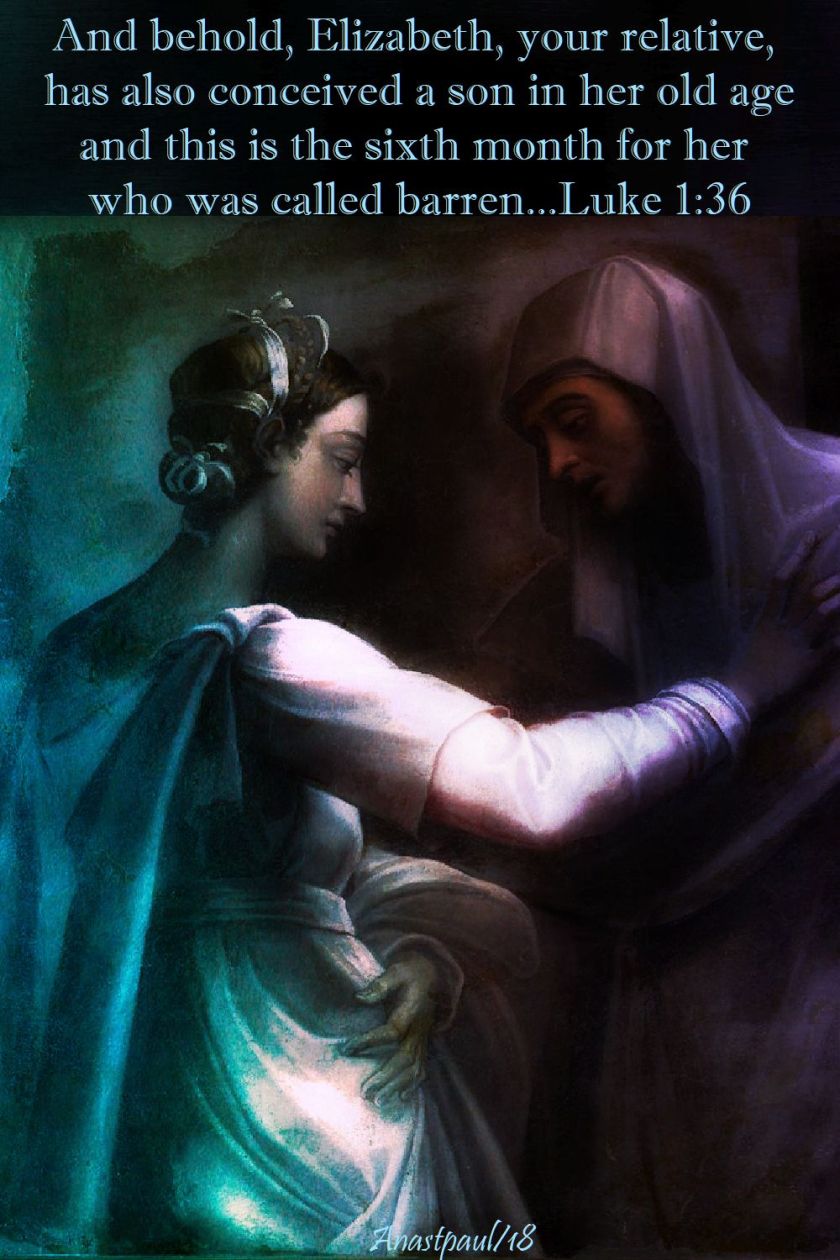
And behold, Elizabeth, your relative, has also conceived a son in her old age and this is the sixth month for her who was called barren...Luke 1:36luke 1 36 - and behold elizabeth your relative - 7 may 2018

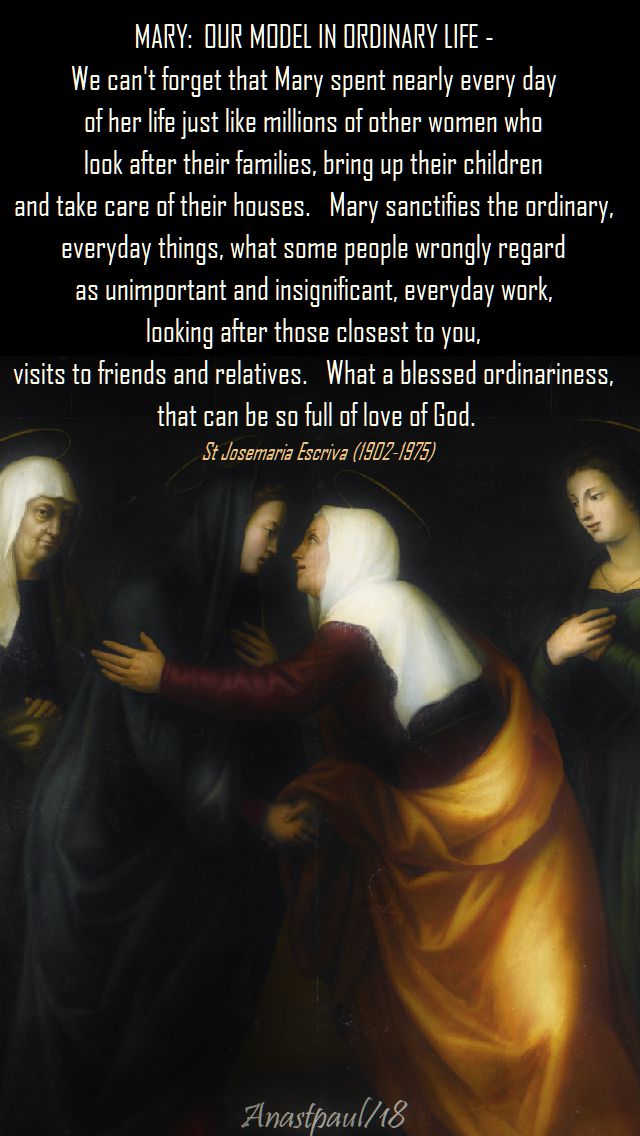
REFLECTION – “MARY:  OUR MODEL IN ORDINARY LIFE – “We can’t forget that Mary spent nearly every day of her life just like millions of other women who look after their families, bring up their children and take care of their houses.   Mary sanctifies the ordinary, everyday things.what some people wrongly regard as unimportant and insignificant, everyday work, looking after those closest to you, visits to friends and relatives.   What a blessed ordinariness, that can be so full of love of God.” …St Josemaria Escriva (1902-1975) – “To Jesus through Mary” – Christ is Passing By 144
Let us offer to our Mother today:
Affectionate details of service and attention to those closest to us.mary - our model inordinary life - st josemaria - 7 may 2018

PRAYER – Almighty, ever-living God, You inspired the Blessed Virgin Mary, when she was carrying Your Son, to visit her cousin, St Elizabeth.   Grant that, always docile to the voice of the Spirit, we may, together with our Lady, glorify Your name and serve our neighbour.   Mary, you who are kindness and mercy, help us to fulfil our duties with love and please pray for us.   We make our prayer through Jesus Christ, our Lord, in union with You, holy Father and the Holy Spirit, one God, forever, amen.holy mary mother of god - pray for us - 7 may 2018

Posted in CATHOLIC DEVOTIONS of the Month, EASTER, MARIAN PRAYERS, MORNING Prayers, PRAYERS of the CHURCH, The RESURRECTION

Our Morning Offering – 7 May “Mary’s Month” – Monday of the Sixth week of Eastertide

Our Morning Offering – 7 May “Mary’s Month” – Monday of the Sixth week of Eastertide

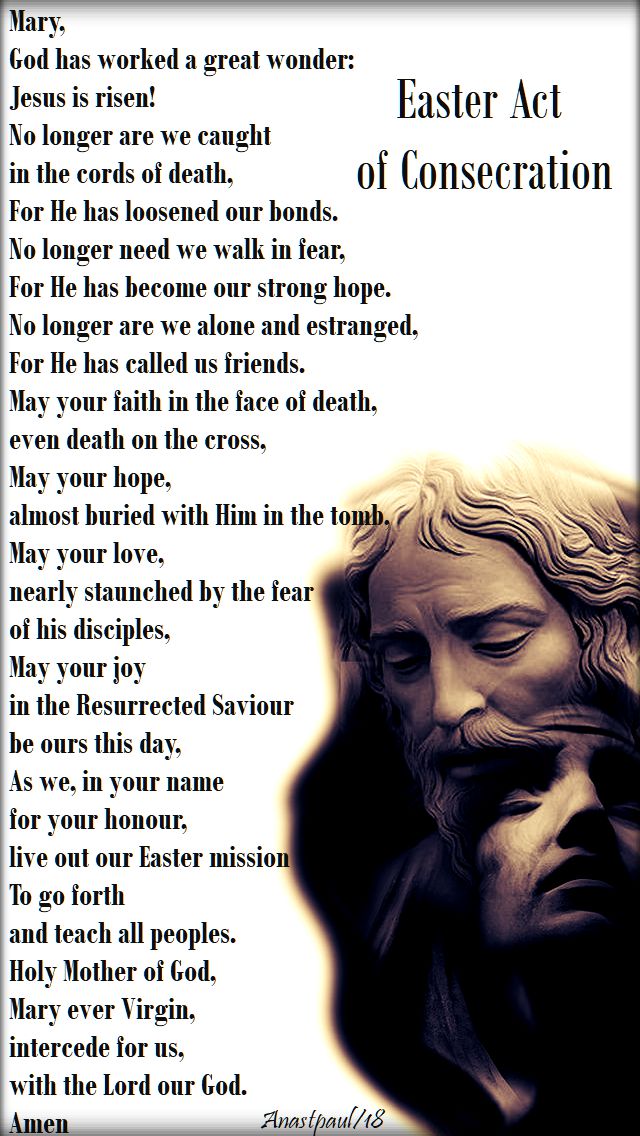
Easter Act of Consecration

Mary,
God has worked a great wonder:
Jesus is risen!
No longer are we caught in the cords of death,
For He has loosened our bonds.
No longer need we walk in fear,
For He has become our strong hope.
No longer are we alone and estranged,
For He has called us friends.
May your faith in the face of death,
even death on the cross,
May your hope,
almost buried with Him in the tomb,
May your love,
nearly staunched by the fear of his disciples,
May your joy in the Resurrected Saviour
be ours this day,
As we, in your name, for your honour,
live out our Easter mission.
To go forth and teach all peoples.
Holy Mother of God,
Mary ever Virgin,
intercede for us, with the Lord our God.
Ameneaster act of consecration - 7 may 2018

Posted in SAINT of the DAY, VATICAN Resources

Saint of the Day – 7 May – St Rose Venerini (1656-1728)

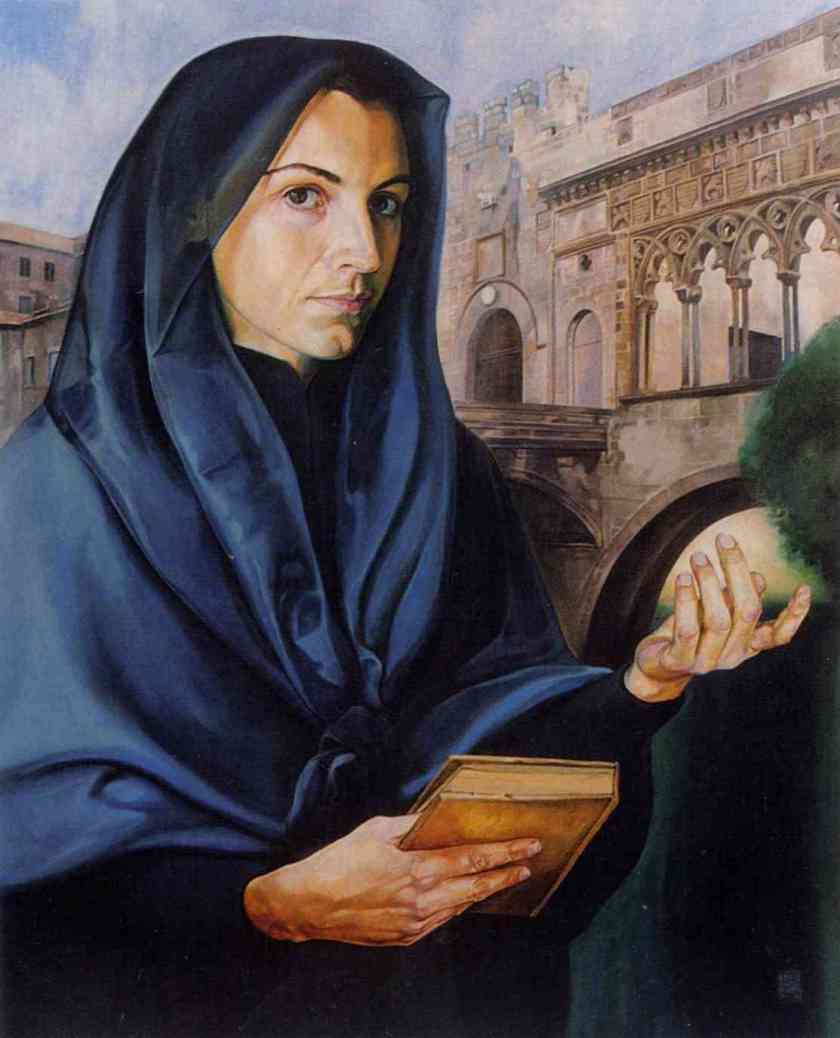
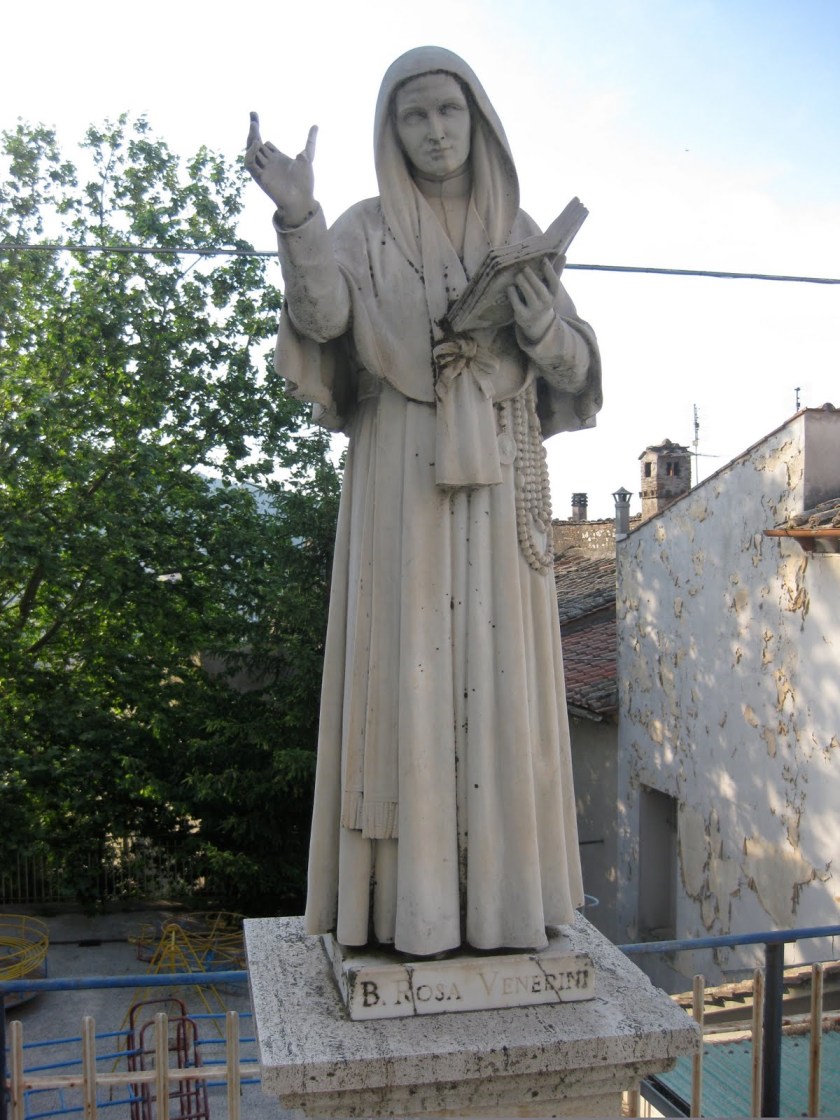
Saint of the Day – 7 May – St Rose Venerini M.P.V. (1656-1728) Religious, Foundress, Teacher, Innovator and Pioneer, Apostle of Charity – born (Rosa Venerini) on 9 February 1656 at Viterbo, Italy and died on 7 May 1728 at Rome, Italy of natural causes.   St Rose was a pioneer in the education of women and girls in 17th-century Italy and the foundress of the Religious Teachers Venerini (Italian: Maestre Pie Venerini), an religious order of women, often simply called the Venerini Sisters.   She was canonised by Pope Benedict XVI on 15 October 2006.Santa_Rosa_Venerini

Rosa Venerini, was born in Viterbo, on 9 February 1656.   Her father, Goffredo, originally from Castelleone di Suasa (Ancona), after having completed his doctorate in medicine at Rome, moved to Viterbo where he practised the medical profession brilliantly in the Grand Hospital.   From his marriage to Marzia Zampichetti, of an ancient family of Viterbo, four children were born:   Domenico, Maria Maddalena, Rosa and Orazio.

Rosa was naturally gifted with intelligence and an uncommon human sensibility.   The education that she received in her family allowed her to develop her many talents of mind and heart, forming her in steadfast Christian principles.   According to her first biographer, Father Girolamo Andreucci, S.I., she made a vow to consecrate her life to God at the age of seven.   During the early years of her youth, she lived through a conflict between the attractions of the world and the promise made to God.   Rosa overcame this crisis with trusting prayer and mortification.

At age twenty, Rosa raised questions about her own future.   The women of her time could choose only two orientations for their live:  marriage or the cloister.   Rosa esteemed both but she felt called to realise another project for the good of the Church and the society of her time.   Urged on by prophetic interior occurrences, she committed much time in suffering and searching before reaching a resolution that was completely innovative.

In the autumn of 1676, on the advice of her father, Rosa entered the Dominican Monastery of St Catherine, with the prospect of fulfilling her vow.   With her Aunt Anna Cecilia beside her, she learned to listen to God in silence and in meditation.   She remained in the monastery for only a few months because the sudden death of her father forced her to return to her suffering mother.   In the years immediately following, Rosa had to bear the burden of serious events for her family:  her brother Domenico died at only twenty-seven years of age;  a few months later her mother died, unable to bear the sorrow.

In the meantime, Maria Maddalena married.   There remained at home only Orazio and Rosa, by now twenty-four years old.   Challenged by the desire to do something great for God, in May of 1684, the Saint began to gather the girls and women of the area in her own home to recite the rosary.  The way in which the girls and women prayed and above all, their conversation before and after the prayer, opened the mind and heart of Rosa to a sad reality:  the woman of the common people was a slave of cultural, moral and spiritual poverty.   She then understood that the Lord was calling her to a higher mission which she gradually identified in the urgent need to dedicate herself to the instruction and Christian formation of young women, not with sporadic encounters but with a school understood in the real and true sense of the word.ST ROSE VENERINI 4

On 30 August 1685, with the approval of the Bishop of Viterbo, Cardinal Urbano Sacchetti and the collaboration of two friends, Gerolama Coluzzelli and Porzia Bacci, Rosa left her father’s home to begin her first school, according to an innovative plan that had matured in prayer and her search for the will of God.   The first objective of the Foundress was to give the girls of the common people a complete Christian formation and prepare them for life in society.   Without great pretence, Rosa opened the first “Public School for Girls in Italy”.   The origins were humble but the significance was prophetic, the human promotion and spiritual uplifting of woman was a reality that did not take long to receive the recognition of the religious and civil authorities.

The initial stages were not easy.   The three Maestre (teachers) had to face the resistance of clergy who considered the teaching of the catechism as their private office.   But the harshest suspicion came from conformists who were scandalised by the boldness of this woman of the upper middle class of Viterbo who had taken to heart the education of ignorant girls.   Rosa faced everything for the love of God and with her characteristic strength, continuing on the path that she had undertaken, by now sure that she was truly following the plan of God.   The fruits proved her to be right.   The same clergy soon recognised the moral improvement that the work of education generated among the girls and mothers.

The validity of this initiative was acknowledged and its fame went beyond the confines of the Diocese.   Cardinal Mark Antonio Barbarigo, Bishop of Montefiascone, understood the genius of the Viterbo project and he called the Saint to his diocese.   The Foundress, always ready to sacrifice herself for the glory of God, responded to the invitation.   From 1692 to 1694, she opened ten schools in Montefiascone and the villages surrounding Lake Bolsena.   The cardinal provided the material means and Rosa made the families aware, trained the teachers and organised the schools.   When she had to return to Viterbo to attend to the strengthening of her first school, Rosa entrusted the schools and the teachers to the direction of a young woman, St Lucia Filippini (1672-1732), in whom she has seen particular gifts of mind, heart and spirit.

After the openings in Viterbo and Montefiascone, other schools were started in Lazio. Rosa reached Rome in 1706 but the first experience in Rome was a real failure which marked her deeply and caused her to wait six long years before regaining the trust of the authorities.   On 8 December 1713, with the help of Abate Degli Atti, a great friend of the Venerini family, Rosa was able to open one of her schools in the centre of Rome at the foot of the Campidoglio.

On 24 October 1716, they received a visit from Pope Clement XI, accompanied by eight Cardinals, who wanted to attend the lessons.   Amazed and pleased, at the end of the morning he addressed these words to the Foundress: Signora Rosa, you are doing that which we cannot do.   We thank you very much because with these schools you will sanctify Rome ”.

ST ROSE VENERINI 3

From that moment on, Governors and Cardinals asked for schools for their areas.   The duties of the Foundress became intense, consisting of travels and hard work interwoven with joys and sacrifices for the formation of new communities.   Wherever a new school sprang up, in a short time a moral improvement could be noted in the youth.

Rosa Venerini died a saintly death in the community of St Mark’s in Rome on the evening of 7 May 1728.   She had opened more than forty schools.   Her remains were entombed in the nearby Church of the Gesù, so loved by her.   In 1952, on the occasion of her Beatification, they were transferred to the chapel of the Generalate in Rome.

We can summarise the charism of Rosa Venerini in a few words.   She lived consumed by two great passions:  passion for God and passion for the salvation of souls.   When she understood that the girls and women of her time needed to be educated and instructed in the truths of the faith and of morality, she spared nothing of time, hard work, struggle and difficulties of every kind, as long as it responded to the call of God.   She knew that the proclamation of the Good News could be received if people were first liberated from the darkness of ignorance and error.   Moreover, she intuited that professional training could give woman a human promotion and affirmation in society.   This project required an educating Community and Rosa, without pretense and well before its time in history, offered to the Church the model of the Apostolic Religious Community.st rosa end note

Rosa did not practice her educational mission only in the school but took every occasion to announce the love of God.   She comforted and cured the sick, raised the spirits of the discouraged, consoled the afflicted, called sinners back to a new life, exhorted to fidelity consecrated souls not observing their call, helped the poor and freed people from every form of moral slavery.

Educate to save became the motto that urged the Maestre Pie Venerini to continue the Work of the Lord intended by their Foundress and radiate the charism of Rosa to the world:  to free from ignorance and evil so that the project of God which every person carries within can be visible.

ST ROSE VENERINI 5

This is the magnificent inheritance that Rosa Venerini left her Daughters.   Wherever the Maestre Pie Venerini strive to live and transmit the apostolic concern of their Mother, in Italy as in other lands, they give preference to the poor.

After having made its contribution to the Italian immigrants to the USA from 1909 and in Switzerland from 1971 to 1985, the Congregation extended its apostolic activity to other lands:  India, Brazil, Cameroon, Romania, Albania, Chile, Venezuela and Nigeria.RoseVenerini

Posted in The HOLY CROSS

Apparition of the Holy Cross over Jerusalem and Memorials of the Saints – 7 May

Apparition of the Holy Cross over Jerusalem: Commemorates the appearance on 7 May 351, Pentecost that year, of a luminous image of the Holy Cross in Jerusalem.   It stretched from Mount Golgotha to the Mount of Olives (about two miles / three kilometers), was brighter than the sun, lasted several hours and was seen by the entire city.   It led to many conversions and was reported in a letter attribued to Saint Cyril of Jerusalem.

St Abba
St Agostino Roscelli
Bl Albert of Bergamo
Bl Antonio de Agramunt
St Augustine of Nicomedia
St Augustus of Nicomedia
St Cerenico of Spoleto
St Domitian of Huy
St Duje
St Flavia Domitilla of Terracina
St Flavius of Nicomedia
Bl Francesco Paleari
Bl Gisela of Ungarn
Bl Jan Eugeniusz Bajewski
St John of Beverley
St Juvenal of Benevento
St Maurelius of Voghenza-Ferrara
Bl Miqael of Ulompo
St Peter of Pavia
St Placid of Autun
St Quadratus of Herbipolis
St Quadratus of Nicomedia
St Rose Venerini (1656-1728)

St Serenicus of Hyesmes
St Serenus of Hyesmes
Bl Villanus of Gubbio


Posted in EUCHARISTIC Adoration, MORNING Prayers, SUNDAY REFLECTIONS, The HOLY EUCHARIST / The HOLY MASS

Sunday Reflection – 6 May – Sixth Sunday of Eastertide B

Sunday Reflection – 6 May – Sixth Sunday of Eastertide B

We Offer to Jesus the Adoration of our Whole Being
By Fr Vincent Martin Luca

Lay your whle being, your faculties and all your works in homage at the foot of the Eucharistic Altar and Throne and say to the Lord:
“To You alone be love and glory!”

Offer Him the homage of your thoughts, desiring the Divine Eucharist to be the dominant thought of your life;
the homage of your affections, calling Jesus, the King and God of your heart;
the homage of your will, desiring henceforth to have no other law,
no other end than His service,
His love
and His glory;
the homage of your memory, in order to remember Him alone and thus to live
in Him,
by Him
and for Him alone.

Then contemplate the greatness of the love of Jesus as He institutes, multiplies and perpetuates His Divine Eucharist, to the end of time.
Marvel at His wisdom in the Divine invention which excites the wonder of the angels themselves.
Praise His power which has triumphed over every obstacle and exalt His goodness,
which has determined the gifts of that power.

On realising that you are the very end of the greatest and the holiest of Sacraments,
break forth into a transport of joy and love,
for you alone,
what He has done for all!
What LOVE!sunday reflection - 6 may - fr vincent luca page 242 come to me

Posted in CATHOLIC DEVOTIONS of the Month, MARIAN QUOTES, MARIAN TITLES, MORNING Prayers, QUOTES of the SAINTS, The BLESSED VIRGIN MARY, The HOLY EUCHARIST / The HOLY MASS

Marian Thought for the Day – 6 May “Mary’s Month!” – Sixth Sunday of Eastertide B

Marian Thought for the Day – 6 May “Mary’s Month!” – Sixth Sunday of Eastertide B

Mary is the “Domus Aurea,” the House of Gold
Blessed John Henry Newman (1801-1890)

WHY is she called a House?   And why is she called Golden?   Gold is the most beautiful, the most valuable, of all metals. Silver, copper and steel may in their way be made good to the eye but nothing is so rich, so splendid, as gold.   We have few opportunities of seeing it in any quantity but anyone who has seen a large number of bright gold coins knows how magnificent is the look of gold.   Hence it is that in Scripture the Holy City is, by a figure of speech, called Golden.   “The City,” says St. John, “was pure gold, as it were transparent glass.”   He means of course to give us a notion of the wondrous beauty of heaven, by comparing it with what is the most beautiful of all the substances which we see on earth.

Therefore, it is that Mary too, is called golden because her graces, her virtues, her innocence, her purity, are of that transcendent brilliancy and dazzling perfection, so costly, so exquisite, that the angels cannot, so to say, keep their eyes off her any more than we could help gazing upon any great work of gold.

But observe further, she is a golden house, or, I will rather say, a golden palace.   Let us imagine we saw a whole palace or large church all made of gold, from the foundations to the roof;  such, in regard to the number, the variety, the extent of her spiritual excellences, is Mary.

But why called a house or palace?   And whose palace?   She is the house and the palace of the Great King, of God Himself.   Our Lord, the Co-equal Son of God, once dwelt in her. He was her Guest, nay, more than a guest, for a guest comes into a house as well as leaves it.   But our Lord was actually born in this holy house.   He took His flesh and His blood from this house, from the flesh, from the veins of Mary.   Rightly then was she made to be of pure gold because she was to give of that gold to form the body of the Son of God.   She was golden in her conception, golden in her birth.   She went through the fire of her suffering like gold in the furnace and when she ascended on high, she was, in the words of our hymn,

Above all the Angels in glory untold,
Standing next to the King in a vesture of gold.mary is the house of gold

Holy Mary, Mother of God, pray for us!HOLY MARY MOTHER OF GOD - PRAY FOR US

Posted in CATHOLIC DEVOTIONS of the Month, DOCTORS of the Church, FATHERS of the Church, MARIAN QUOTES, MORNING Prayers, QUOTES of the SAINTS, The BLESSED VIRGIN MARY, The HOLY EUCHARIST / The HOLY MASS

Quote of the Day – 6 May “Mary’s Month!” – Sixth Sunday of Eastertide B

Quote of the Day – 6 May “Mary’s Month!” – Sixth Sunday of Eastertide B

The great St Hilary (315-368) , Father and Doctor of the Church (Doctor of the Divinity of Christ), wrote this excellent passage:

“The greatest joy that we can give Mary
is that of bearing Jesus in the Blessed Sacrament
within our breast.”

Her motherly union with Jesus becomes a union also with whoever is united to Jesus, especially in Holy Communion. And what can give as much joy to one who loves, as union with the person loved? And we—–do we not happen to be beloved children of the heavenly Mother?the greatest joy that we can give mary - st hilary - 6 may 2018

Posted in CATHOLIC DEVOTIONS of the Month, MARIAN DEVOTIONS, MARIAN PRAYERS, MARIAN QUOTES, MORNING Prayers, QUOTES of the SAINTS

One Minute Marian Reflection – 6 May “Mary’s Month!” – Sixth Sunday of Eastertide B

One Minute Marian Reflection – 6 May “Mary’s Month!” – Sixth Sunday of Eastertide B

Behold, you will conceive in your womb and bear a son, and you shall name him Jesus…Luke 1: 31behold you will conceive in your womb - luke 1 31 - 6 may 2018

REFLECTION – “If you seek Mary, you will find Jesus.   And you will learn a bit more about what is in the heart of God, who humbles Himself, discarding all manifestations of His power and majesty to take the form of a servant.   Speaking in human terms, we could say that God outdoes Himself, because He goes much further than He needs to go in order to save us.   The only way to measure what He does is to say that it cannot be measured;  it comes from a madness of love which leads Him to take on our flesh and bear the weight of our sins.”…..St Josemaría Escrivá (1902-1975) To Jesus Through Mary – Christ is Passing By 144  Let us offer to our Mother today:
The Regina Coeli recited punctually at six, noon, six and with great affection.if you seek mary you will find jesus - st josemaria - 6 may 2018

PRAYER – Heavenly Father, we thank You for giving us Mary as our help and guide. Enable us to colloborate with her in praising You and in saving our souls and those of all. For mothers always know and love best, give all for the love of their children.   Mary through you, we learn to love, teach us, pray for us!   Through our Lord, Jesus Christ, with You our Father, in the unity of the Holy Spirit, one God forever, amen.mother mary - pray for us - 6 may 2018

Posted in EUCHARISTIC Adoration, MORNING Prayers, The HOLY EUCHARIST / The HOLY MASS

Our Morning Offering – 6 May – The Sixth Sunday of Easter, Year B

Our Morning Offering – 6 May – The Sixth Sunday of Easter, Year B

Prayer to the Eucharistic Heart of Jesus
By Fr Vincent Martin Luca

With all my heart, I love You, Jesus
because You are all good
and deserving of all my love,
for You died for my sins,
the just man for the sake of the unjust,
that You may lead me to God the Father.
From Your Eucharistic Heart,
the Source of all Love,
renew Your Spirit within me
that I may love others,
with a new heart
made from Your very own Love.
Amenwith all my heart I love you Jesus - by fr vincent martin luca - 6th sunday of easter B - 6 may 2018

Posted in QUOTES of the SAINTS, SAINT of the DAY, VATICAN Resources

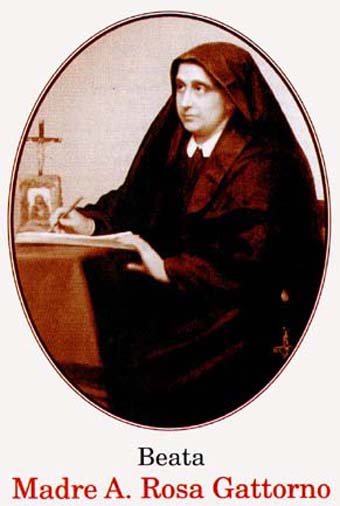
Saint of the Day – 6 May – Blessed Anna Rosa Gattorno (1831-1900)

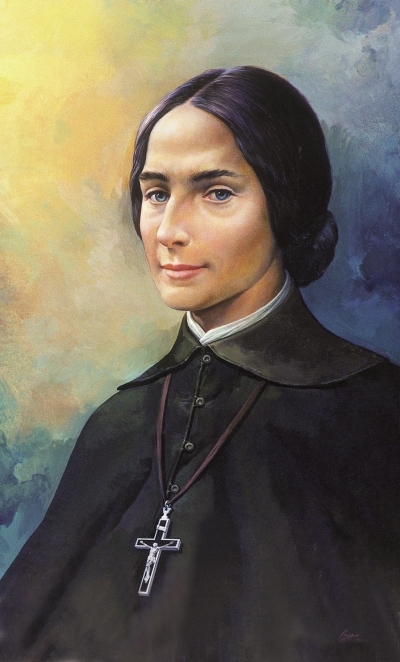
Saint of the Day – 6 May – Blessed Anna Rosa Gattorno (1831-1900) Wife, Mother, Widow, Religious, Foundress of the Daughters of St Anne, Stigmatist, Mystic.  Born on 14 October 1831 at Genoa, Italy as Rose Maria Benedetta – Died at 9am on 6 May 1900 at Rome, Italy of influenza.  Bl Anna Rosa was Beatified on 9 April 2000 by St Pope John Paul II.   Patronages – Daughters of Saint Anne, Widowers, Mothers.rosa-maria-benedetta-gattorno-custo-18a4852c-af01-4fa8-914d-4d8517aef9d-resize-750
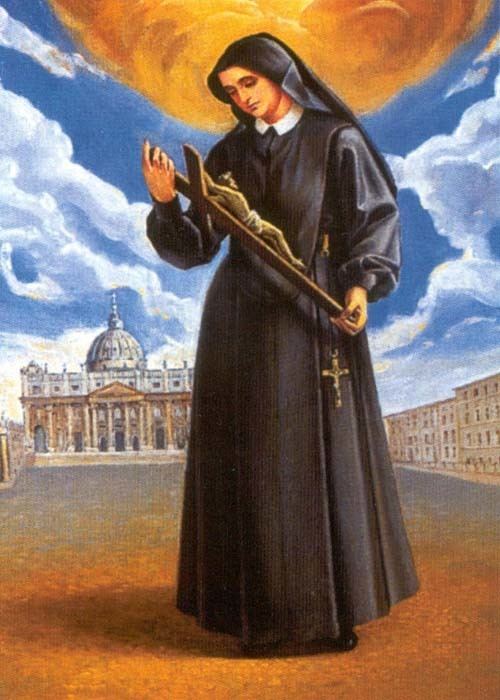
“My love, what can I do to make the whole world love you? … Make use once again of this wretched instrument to renew the faith and the conversion of sinners”.

This generous outburst, uttered at the feet of her ‘Supreme Good’ – who drew her ever closer to Him – constituted the deepest yearning of Anna Rosa Gattorno’s heart, leading her to offer her life totally in a continuous sacrifice for the glory and pleasure of the Father.
She was born in Genoa on 14 October 1841 into a deeply Christian, well-to-do family of good name.   She was baptised the same day in the parish of St Donato and received the names Rosa, Maria, Benedetta.
In her father Francesco and her mother Adelaide Campanella, like their other five children, she found the first models for her moral and Christian life.   When she was 12 years old, she was confirmed at St Maria delle Vigne by Cardinal Archbishop Tadini.
As a young girl she was educated at home, as was the custom in rich families at that time. With her serene and loveable character, open to piety and charity, she was nonetheless firm and knew how to react to the confrontations of the political and anticlerical climate of the time, which did not spare even some members of the Gattorno family.
At the age of 21 Rosa married her cousin Gerolamo Custo (5 November 1852), and moved to Marseilles.   Unforeseen financial difficulties very soon upset the happiness of the new family which was forced to return to Genoa in a state of poverty.   More serious misfortunes were looming:  their first child, Carlotta, after a sudden illness was left deaf and dumb for life;  Gerolamo’s attempt to find fortune abroad ended with his return, aggravated by a fatal illness;  the happiness of the other two children was deeply disturbed by her husband’s disappearance which left her a widow less than six years after their marriage (9 March 1858) and, a few months later, by the loss of her youngest little son.
The succession of so many sad events in her life marked a radical change which she called her “conversion” to the total gift of herself to the Lord, to his love and to love of neighbour.   Purified by her trials and strengthened in spirit, she understood the true meaning of pain and was confirmed in the certainty of her new vocation.
Under the guidance of her confessor, Fr Giuseppe Firpo, she made private perpetual vows of chastity and obedience on the Feast of the Immaculate Conception 1858, followed by vows of poverty (1861) in the spirit of St Francis of Assisi, as a Franciscan tertiary.   Since 1855, she had also obtained the benefit of daily communion, which was uncommon in those days.   She remained constantly anchored to this source of grace and, encouraged by ever growing intimacy with the Lord, she found support, missionary fervour, strength and zeal in service to her brothers and sisters.
In 1862, she received the gift of hidden stigmata, perceived most intensely on Fridays.
As a faithful wife and exemplary mother, never depriving her children of anything – always following and loving them tenderly – with greater availability she learned to share in the sufferings of others, giving herself in apostolic charity:  “I dedicated myself with greater zeal to pious works and to visiting hospitals and the poor sick at home, helping them by meeting their needs as much as I could and serving them in all things”.


The Catholic associations in Genoa competed for her, so that although she loved silence and concealment, her genuinely evangelising way of life was remarked by all.
Progressing on this path, she was made president of the “Pious Union of the New Ursulines Daughters of Holy Mary Immaculate”, founded by St Paula Frassinetti (1809-1882) and was entrusted with the revision of the Rule destined for the Union at the express wish of Archbishop Charvaz.
On that precise occasion (February 1864), redoubling her prayers to Christ Crucified, she received the inspiration for a new Rule, her own specific Foundation.
Fearful of being forced to abandon her children she prayed, made acts of penance and asked advice.   Fra Francis of Camporosso (1804-1866), a lay Capuchin, who is himself, a saint, to whom she also expressed her apprehension before the serious troubles that were imminent, supported and encouraged her, as did her confessor and the Archbishop of Genoa.
However, feeling her maternal duties more and more acutely, she sought authoritative confirmation in the words of Pius IX, with the secret hope of being relieved.   The Pontiff, at an audience on 3 January 1866, instead enjoined her to start her foundation immediately, adding:  “This Institute will spread in all the parts of the world as swiftly as the flight of the dove. God will take care of your children: you must think of God and his work”   She therefore accepted to do the Lord’s will and as she then wrote in her Memoirs:  “I generously offered them to God and repeated to him Abraham’s words: ‘Here I am, ready to do your divine will’.… Having offered myself for His Work, I received immense consolations…”.
Overcoming the resistance of her relatives and, to the disappointment of her Bishop, leaving the associations in Genoa, she founded her new religious family in Piacenza and named it definitively “Daughters of St. Anne, mother of Mary Immaculate” (8 December 1866).   She was clothed on 26 July 1867 and on 8 April 1870 made her religious profession, together with 12 sisters.
Fr Tornatore, a priest of the Congregation of the Mission, collaborated with her in the Institute’s development.   Expressly requested, he wrote the Rule and was then considered Co-Founder of the Institute.
Entrusting herself totally to divine Providence and motivated from the start by a courageous charitable impulse, Rosa Gattorno began with a spirit of motherly dedication to consolidate God’s Work as the Pope had called it and as she too, chosen to co-operate in it, would always call it, attentively caring for any form of suffering and moral or material poverty, with the one intention of serving Jesus in His painful and injured members and of “evangelising first and foremost with life”.
Various works came into being for the poor and the sick with any form of illness, for lonely, elderly or abandoned persons, the little and the defenceless, adolescents and young girls “at risk” for whom she arranged appropriate instruction and subsequent integration in the working world.   In addition, she soon opened schools for the people and for the education of the children of the poor and other works of human and evangelical advancement in accordance with the greatest needs of the time and with an effective presence in ecclesial and civil life.   “Servants of the poor and ministers of mercy” she called her daughters and she urged them to accept, as a sign of the Lord’s favour to serve their brethren with love and humility:   “Be humble … only think that you are the lowliest and the most wretched of all creatures who render service to the Church… and have the grace to belong to her”.bl anna rosa gattorno
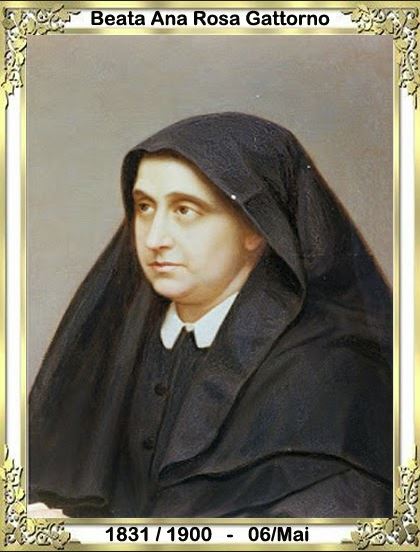
Less than 10 years after its foundation, the Institute obtained the Decree of Praise (1876), and its definitive approval in 1879.   For the Rule, it had to wait until 1892.
Highly esteemed and appreciated by all, she also worked in Piacenza with Bishop Scalabrini (1839-1905), who has now been beatified and in particular in the institute for deaf-mutes which he founded.
However Mother Rosa Gattorno was not spared humiliations, difficulties and tribulations of all kinds.   Despite this, the Institute spread rapidly, in Italy and abroad, thus achieving the Foundress’ ardent missionary desire:  “Oh my Love! How I feel myself burning with the desire to make you known and loved by all! I would like to attract all the world, to give to all, to appease all … I would like to go everywhere and shout out for everybody to come and love you”.   To be “Jesus’ voice” and to bring all people the message of the love that saves was and always remained her heart’s deepest desire.   In 1878, she was already sending the first Daughters of St Anne to Bolivia, then to Brazil, Chile, Peru, Eritrea, France and Spain.   In Rome, where her work began in 1873, she organised boys’ and girls’ schools for the poor, nursery schools, assistance for the new-born babies of workers in the tobacco factory, houses for former prostitutes, serving women, nurses for home care, etc.   There she also had the Generalate built, with its adjacent church.
In all, at her death there were 368 houses in which 3,500 sisters were carrying out their mission.
The secret of her journey of holiness, of the dynamism of her charity and of the strength of mind with which she could face all obstacles with firm faith and guide the Institute with full dedication, courage and far-sightedness for 34 years, was her continuous union with God and total, trusting abandonment in him:  “Although I am in the midst of such a torrent of things to do, I am never without the union with my Good”; her attention and docility to the impulses of the Spirit;  her deep and loving participation in Christ’s Passion;  her ceaseless prayers for the conversion of sinners and the sanctification of all mankind.
She had a deep sense of belonging to Church and was ever humble, devout and obedient to the directives of the Pope and the hierarchy.
With her fondness of St Anne, she had a special love for Mary, to whom she entirely entrusted herself, in order to belong totally to God and totally to her brethren.
A pure and simple instrument in the hands of the “superfine Craftsman”, conformed to the Poor Christ and with Him, a victim of love, she fulfilled in her life the desire she inculcated in her daughters:  “To live for God, to die for him and to spend life for love”.
She lived like this until February 1900, when she caught a dangerous form of influenza and rapidly deteriorated.  Her health, sorely tried by her acts of penance, frequent exhausting journeys and an enormous mass of correspondence, worries and serious disappointments, no longer resisted.   On 4 May she received the sacrament of the Anointing of the Sick and two days later, on 6 May, at 9.00 a.m., having ended her earthly pilgrimage, she died a holy death in the Generalate.
The fame of holiness which had surrounded her during her life, spread after her death and grew unimpeded all over the world.
As an expression of a rare plan of God, in her three-fold experience of wife and mother, widow and then religious and Foundress, in her mission of service to humanity and to extending the kingdom Rosa Gattorno brought great honour to the “feminine genius”. Although she was ever faithful to God’s call and a genuine teacher of Christian and ecclesial life, she remained essentially a mother:  of her own children, whom she constantly followed, of the Sisters, whom she deeply loved and of all the needy, the suffering and the unhappy, in whose faces she contemplated the face of Christ, poor, wounded and crucified.
Her charism has spread in the Church with the birth of other forms of evangelical life: Sisters of Contemplative Life; a Religious Association of Priests;  the Secular Institute and the Ecclesial Movement for the Laity, which are active in the Church in almost all the parts of the world….Vatican.va

Beata_Anna_Rosa_Gattorno


Posted in SAINT of the DAY

Memorials of the Saints – 6 May

St Acuta
Bl Anna Rosa Gattorno (1831-1900)
Bl Anthony Middleton
Bl Bartolomeo Pucci-Franceschi
St Benedicta of Rome
St Colman Mac Ui Cluasigh of Cork
St Colman of Loch Eichin
St Edbert of Lindisfarne
Bl Edward Jones
St Evodius of Antioch
St Francis de Montmorency Laval
St Heliodorus
Bl Henryk Kaczorowski
St James of Numidia
St Justus of Vienne
Bl Kazimierz Gostynski
St Lucius of Cyrene
Bl Maria Catalina Troiani
St Marianus of Lambesa
Bl Peter de Tornamira
St Petronax of Monte Cassino
St Protogenes of Syria
Bl Prudence Castori
St Theodotus of Kyrenia
St Venerius of Milan
St Venustus of Africa
St Venustus of Milan
Bl William Tandi

Posted in CATHOLIC DEVOTIONS of the Month, MARIAN DEVOTIONS, MARIAN QUOTES, MARIAN TITLES, MORNING Prayers, QUOTES of the SAINTS, The BLESSED VIRGIN MARY

Marian Thought for the Day – 5 May “Mary’s Month!” – Saturday of the Fifth Week of Eastertide

Marian Thought for the Day – 5 May “Mary’s Month!” – Saturday of the Fifth Week of Eastertide

Mary is the “Mater Admirabilis,” the Wonderful Mother
Blessed John Henry Newman (1801-1890)

WHEN Mary, the Virgo Prædicanda, the Virgin who is to be proclaimed aloud, is called by the title of Admirabilis, it is thereby suggested to us what the effect is of the preaching of her as Immaculate in her Conception.  The Holy Church proclaims, preaches her, as conceived without original sin and those who hear, the children of Holy Church, wonder, marvel, are astonished and overcome by the preaching.   It is so great a prerogative.

Even created excellence is fearful to think of when it is so high as Mary’s.  As to the great Creator, when Moses desired to see His glory, He Himself says about Himself, “Thou canst not see My face, for man shall not see Me and live;” and St. Paul says, “Our God is a consuming fire.”   And when St John, holy as he was, saw only the Human Nature of our Lord, as He is in Heaven, “he fell at His feet as dead.”   And so as regards the appearance of angels.   The holy Daniel, when St Gabriel appeared to him, “fainted away and lay in a consternation, with his face close to the ground.”   When this great archangel came to Zacharias, the father of S. John the Baptist, he too was troubled and fear fell upon him. But it was otherwise with Mary when the same St Gabriel came to her  . She was overcome indeed and troubled at his words, because, humble as she was in her own opinion of herself, he addressed her as “Full of grace,” and “Blessed among women” but she was able to bear the sight of him.

Hence we learn two things:  first, how great a holiness was Mary’s, seeing she could endure the presence of an angel, whose brightness smote the holy prophet Daniel even to fainting and almost to death;  and secondly, since she is so much holier than that angel, and we so much less holy than Daniel, what great reason we have to call her the Virgo Admirabilis, the Wonderful, the Awful Virgin, when we think of her ineffable purity!

There are those who are so thoughtless, so blind, so grovelling as to think that Mary is not as much shocked at wilful sin as her Divine Son is and that we can make her our friend and advocate, though we go to her without contrition at heart, without even the wish for true repentance and resolution to amend.   As if Mary could hate sin less and love sinners more, than our Lord does!   No: she feels a sympathy for those only who wish to leave their sins else, how should she be without sin herself?   No, if even to the best of us she is, in the words of Scripture, “fair as the moon, bright as the sun and terrible as an army set in array,” what is she to the impenitent sinner?

Mater Admirabilis, Wonderful Mother, Pray for us!mater admirabilis - pray for us - 5 may 2018

Posted in CATHOLIC DEVOTIONS of the Month, DOCTORS of the Church, FATHERS of the Church, MARIAN QUOTES, MORNING Prayers, QUOTES of the SAINTS, The BLESSED VIRGIN MARY

Quote/s of the Day – 5 May “Mary’s Month!” – Saturday of the Fifth Week of Eastertide

Quote/s of the Day – 5 May “Mary’s Month!” – Saturday of the Fifth Week of Eastertide

“If anyone does not believe,
that Holy Mary is the Mother of God,
such a one is a stranger to the Godhead.”

St Gregory Nazianzen (330-390) Father and Doctor of the Churchif anyone does not believe - st gregory of nazianzen - 5 may 2018

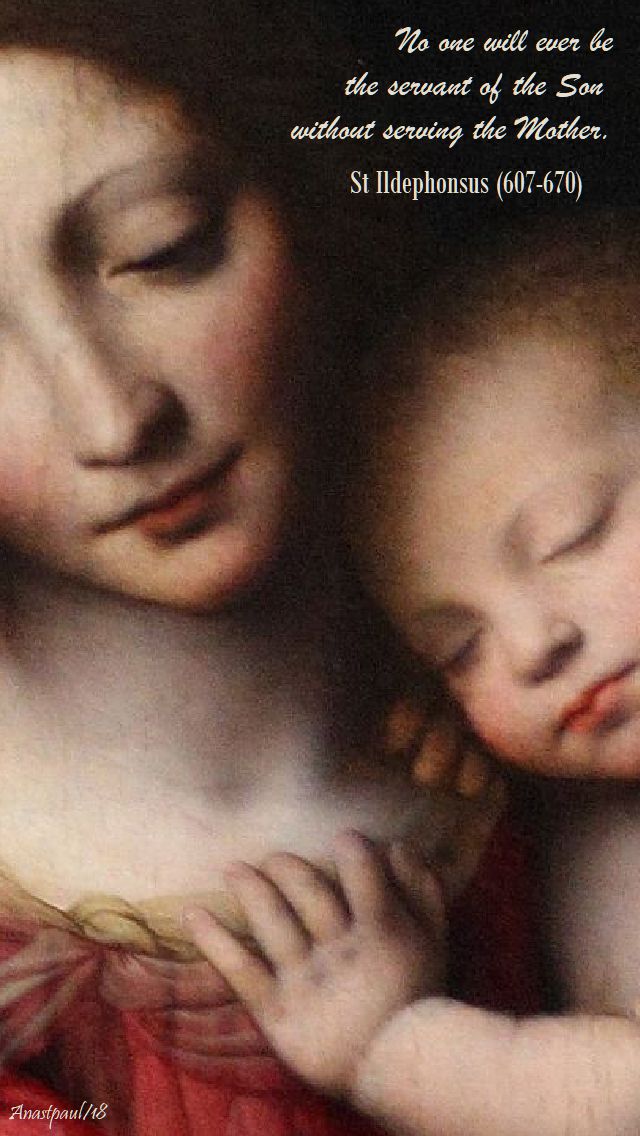
“No one will ever be the servant of the Son
without serving the Mother.”

St Ildephonsus (607-670)no one will ever be a servant of the son - st ildephonsus - 5 may 2018

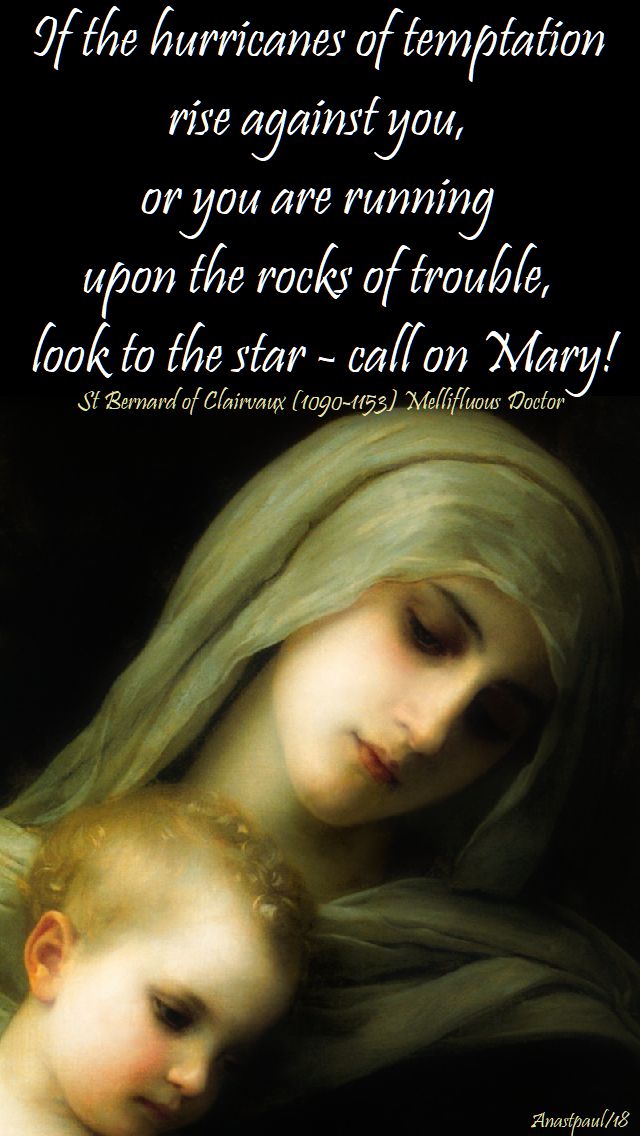
“If the hurricanes of temptation rise against you,
or you are running upon the rocks of trouble,
look to the star – call on Mary!”

St Bernard of Clairvaux (1090-1153) Mellifluous Doctorif the hurricanes of temptation - st bernard - 5 may 2018

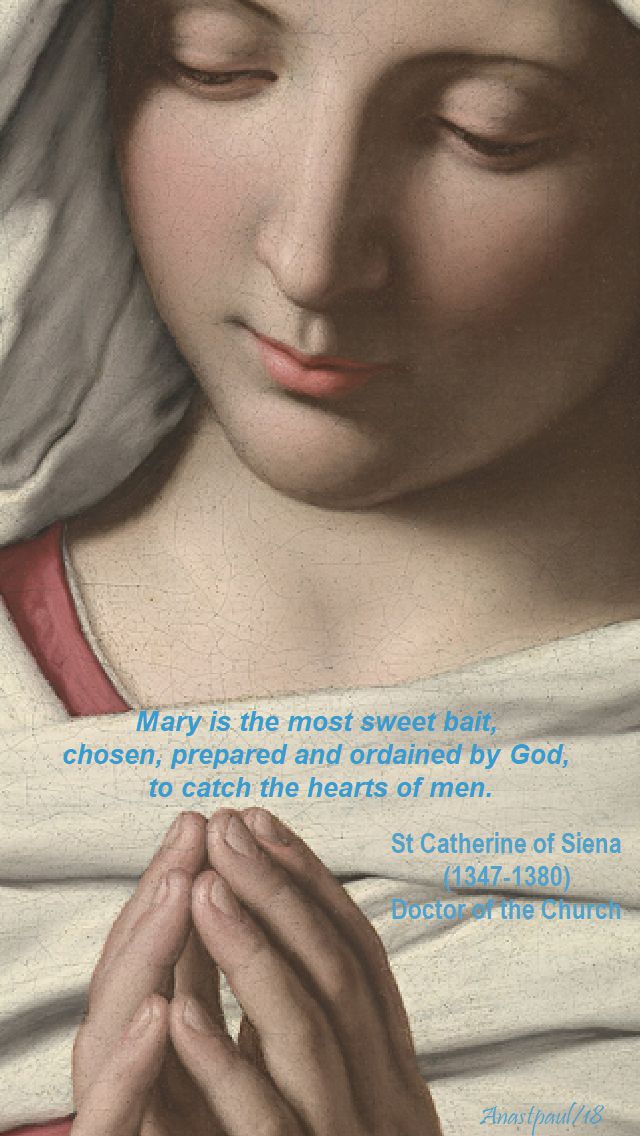
“Mary is the most sweet bait, chosen, prepared
and ordained by God, to catch the hearts of men.”

St Catherine of Siena (1347-1380) Doctor of the Churchmary is the most swet bait - st catherine of siena - 5 may 2018

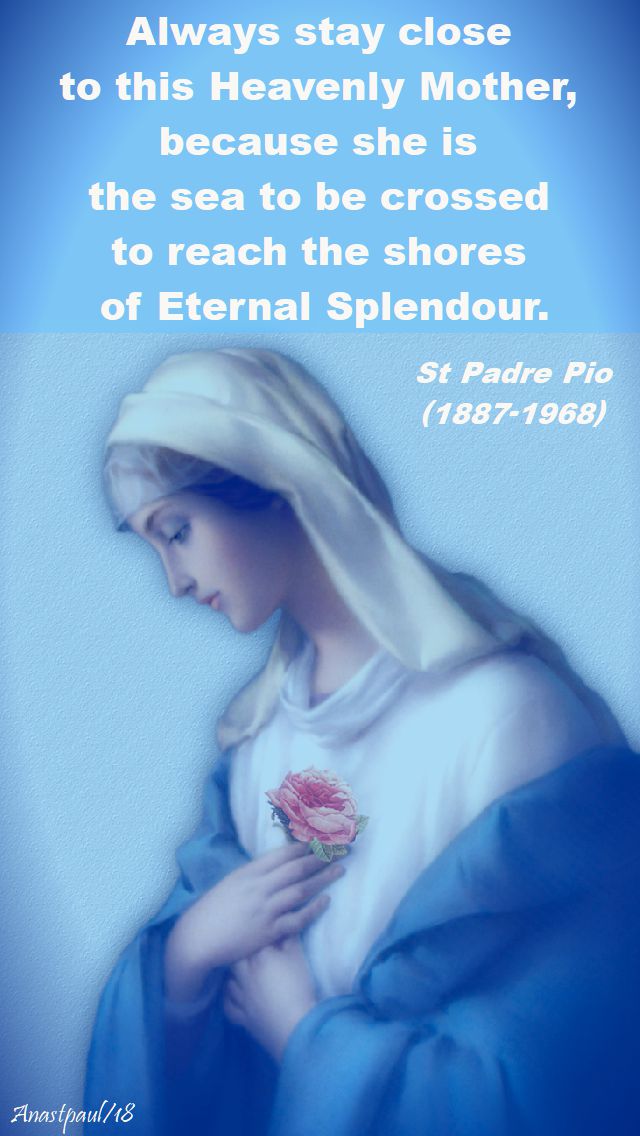
“Always stay close to this Heavenly Mother,
because she is the sea to be crossed
to reach the shores of Eternal Splendour.”

St Padre Pio (1887-1968)always stay close to this heavenly mother - st padre pio - 5 may 2018


Posted in CATHOLIC DEVOTIONS of the Month, MARIAN DEVOTIONS, MARIAN PRAYERS, MARIAN QUOTES, MARIAN TITLES, MORNING Prayers, PRAYERS of the SAINTS, QUOTES of the SAINTS, The BLESSED VIRGIN MARY

One Minute Marian Reflection – 5 May “Mary’s Month!” – Saturday of the Fifth Week of Eastertide

One Minute Marian Reflection – 5 May “Mary’s Month!” – Saturday of the Fifth Week of Eastertide

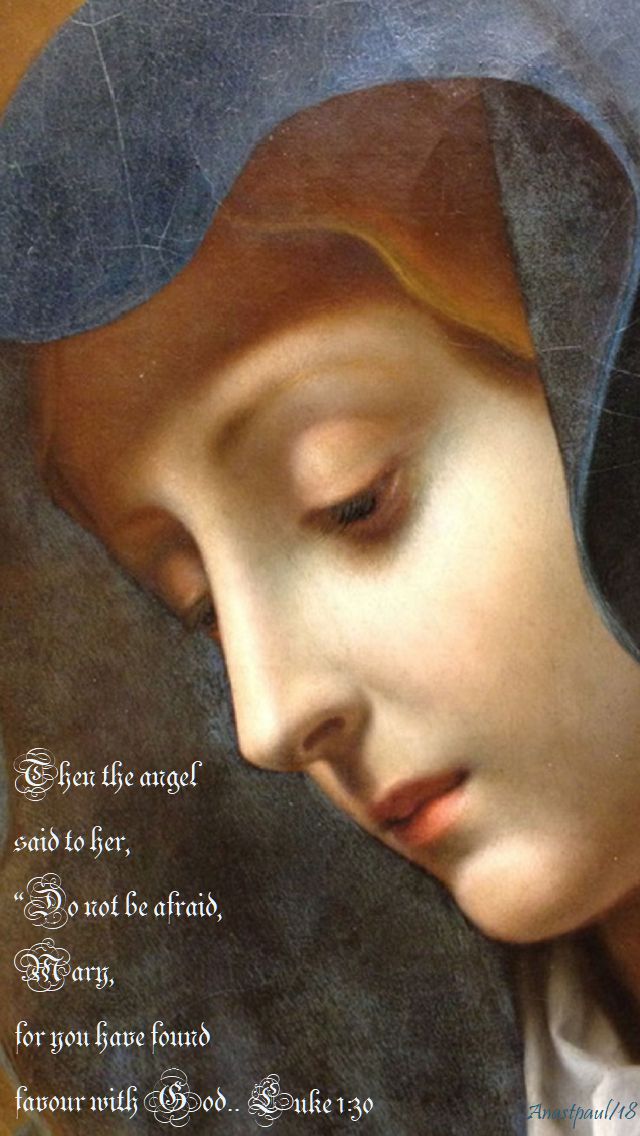
Then the angel said to her, “Do not be afraid, Mary, for you have found favour with God…Luke 1:30then the angel said to her - luke 1 30 - 5 may 2018

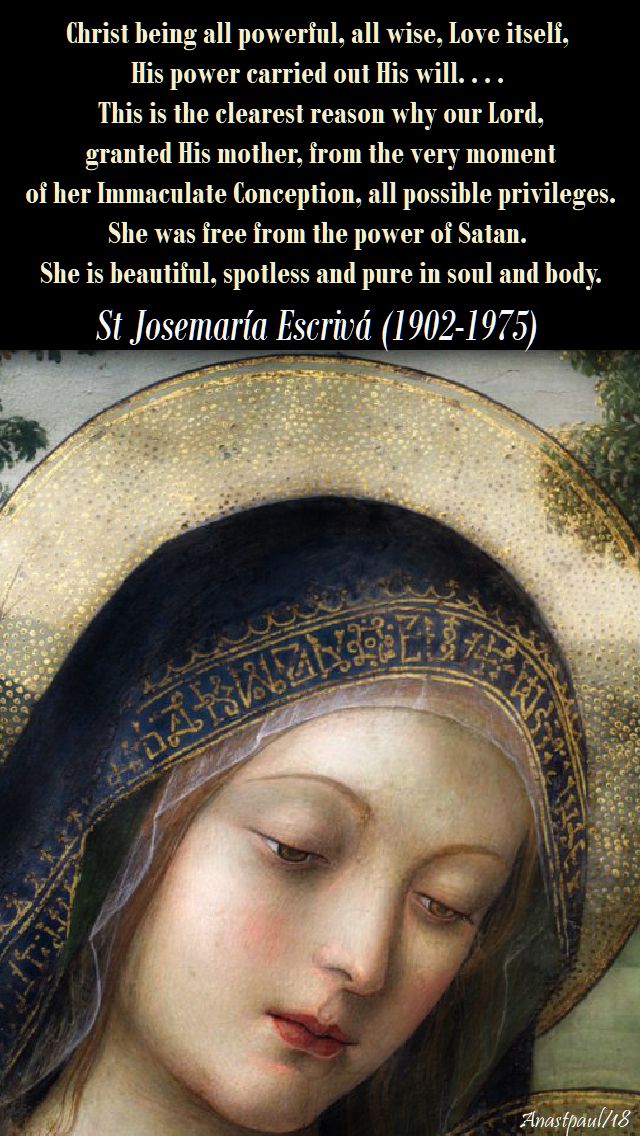
REFLECTION – “MARY: HER IMMACULATE CONCEPTION: “How would we have acted, if we could have chosen our own mother? I’m sure we would have chosen the one we have, adorning her with every possible grace. That is what Christ did. Christ being all powerful, all wise, Love itself, His power carried out His will. . . . This is the clearest reason why our Lord granted His mother , from the very moment of her Immaculate Conception, all possible privileges. She was free from the power of Satan. She is beautiful, spotless and pure in soul and body.” …St Josemaría Escrivá (1902-1975) – “Cause of our Joy” – Christ is Passing By – 171
Let us offer to our Mother today:
The renewal of our baptismal vows.christ being all-powerful, all wise, love itself - st josemaria - marian reflection - 5 may 2018

PRAYER – Almighty God, grant that Your faithful, who rejoice in the protection of the Blessed Virgin Mary, may be delivered from every evil here on earth, through her prayer and come to the enduring joys of heaven. We make our prayer through her Son, our Lord Jesus Christ, one God with You, in the union of the Holy Spirit, forever amen.immaculate mary - pray for us - 5 may 2018

Posted in CATHOLIC DEVOTIONS of the Month, DOCTORS of the Church, MARIAN DEVOTIONS, MARIAN PRAYERS, MORNING Prayers, PRAYERS of the SAINTS, The BLESSED VIRGIN MARY

Our Morning Offering – 5 May “Mary’s Month!” – Saturday of the Fifth Week of Eastertide

Our Morning Offering – 5 May “Mary’s Month!” – Saturday of the Fifth Week of Eastertide

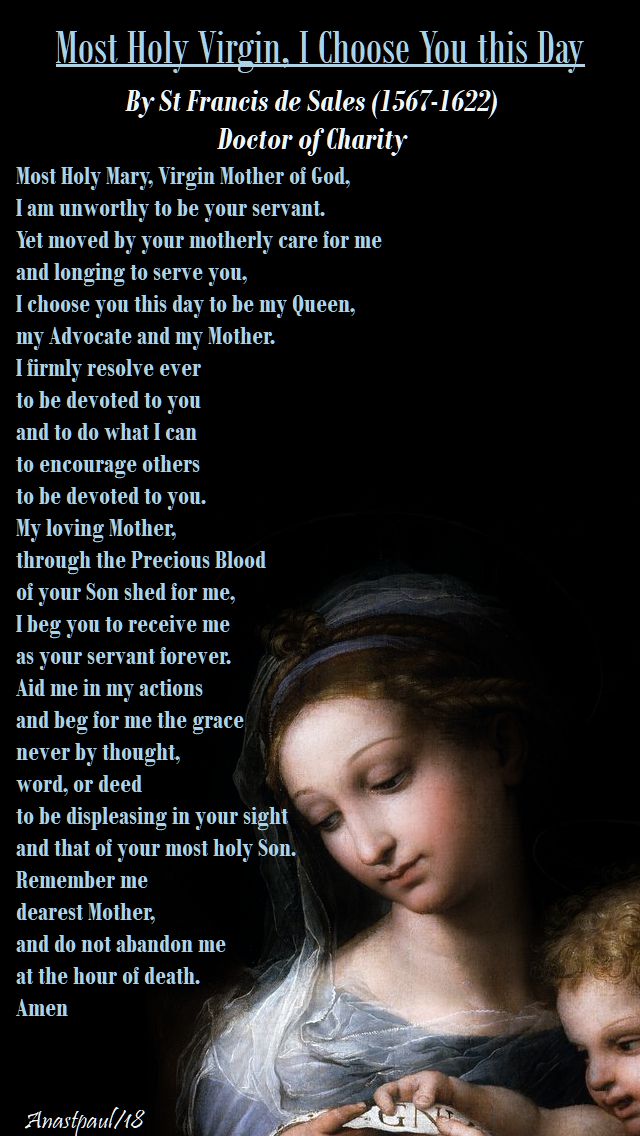
Most Holy Virgin, I Choose You this Day
By St Francis de Sales (1567-1622) Doctor of Charity

Most Holy Mary, Virgin Mother of God,
I am unworthy to be your servant.
Yet moved by your motherly care for me
and longing to serve you,
I choose you this day to be my Queen,
my Advocate and my Mother.
I firmly resolve ever
to be devoted to you
and to do what I can
to encourage others
to be devoted to you.
My loving Mother,
through the Precious Blood
of your Son shed for me,
I beg you to receive me
as your servant forever.
Aid me in my actions
and beg for me the grace
never by thought, word, or deed
to be displeasing in your sight
and that of your most holy Son.
Remember me, dearest Mother,
and do not abandon me at the hour of death.
Amenmost holy virgin I choose you this day - st francis de sales - 5 may 2018

Posted in SAINT of the DAY, VATICAN Resources

Saint of the Day – 5 May – Blessed Caterina Cittadini (1801-1857)

Saint of the Day – 5 May – Blessed Caterina Cittadini (1801-1857) Religious, Teacher, Founder  – (28 September 1801 – 5 May 1857) was an Italian Roman Catholic religious from Bergamo who established the Ursuline Sisters of Saint Jerome Emiliani.   The order was dedicated to the education of girls in Bergamo and in the surrounding areas and has since expanded outside of the Italian nation. Cittadini was orphaned as a child and cultivated her faith among fellow children in an orphanage where the spiritual direction was strong.   Her order came in part of her devotion to Saint Jerome Emiliani (1486-1537) as well as the Blessed Mother.   Patronages – Ursuline Sisters of St Jerome Emiliani, Orphans, Teachers.

bl Caterina Cittadini

Cittadini’s reputation increased as the decades went on due to her fame as a passionate and inspiring educator who instilled in girls both a civic and a religious education that was the basis of her educational career and her beliefs.

Her beatification was celebrated on 29 April 2001 once Pope John Paul II recognised a miracle that was attributed to Cittadini’s direct intercession.

Caterina Cittadini was born in Bergamo on 28 September 1801 to Giovanni Battista Cittadini and Margherita Lanzani.   Her sister was Giuditta (1803-1840).    She was baptised on 30 September in the parish of San Alessandro in Colonna.   Her mother died in 1808 and her father abandoned the sisters after being widowed.   The sisters were taken in and grew up in the orphanage of Bergamo where both sisters developed a strong and ardent faith;  in her case it meant a strong devotion to both the Blessed Mother and to Saint Jerome Emiliani.   The sisters left the orphanage in 1823 in order to live with their paternal cousins Giovanni and Antonio Cittadini in Calolzio.

Cittadini became a teacher at a public girls school in Somasca in 1824 at the time she and Giuditta felt called to the religious life.   Their spiritual director Giuseppe Brena – from their time at the orphanage – advised them to remain in Somasca to instead become the basis of a new religious congregation devoted to the education of girls both children and adolescents.   To that end the pair bought a house in Somasca in 1826 and also bought and furnished a building that became a female boarding school in October 1826. Cittadini taught the students religious education and managed the school on a simultaneous level;  at this stage word of her success spread and she attracted dozens of students from the surrounding areas.   The Cittadini sisters opened two private schools in 1832 and in 1836.


Giuditta directed these schools until her sudden death in 1840 which had put an emotional strain upon her older sister.   This was exacerbated with the death of her cousin Antonio in 1841 and her spiritual director not long after that.   The rapid losses that she incurred ruined her health to the point where she neared death in 1842 but was cured through the intercession of Saint Jerome Emiliani (1486-1537)

She quit public teaching in 1845 in order to just manage the schools themselves and she also took three companions under her wing to assist her in both that task and also in the care of orphans.   In 1850 she received the papal approval of Pope Pius IX to build a chapel to house the Eucharist at her boarding school and in 1851 applied for the approval of a new religious congregation to the Bishop of Bergamo, Carlo Gritti Morlacchi.   In 1854 the new Bishop Pietro Luigi Speranza encouraged her work and instructed her to write the Rule of her new order – her first attempt was based on those of the Milanese Ursulines and was rejected.   She persisted in writing the Rule once more which was accepted on 17 September 1854 bearing the name of her new congregation, The Ursuline Sisters of Saint Jerome Emiliani. 

Cittadini died in 1857 after a period of ill health;  her reputation for holiness and for her ardent faith spread across the northern Italian cities and led to calls for her cause of beatification to be introduced.   Six months after her death – on 14 December 1857 – the Bishop of Bergamo gave his approval for the order to be recognised of diocesan right while on 8 July 1927 the congregation received the official papal approval of Pope Pius XI;  this meant the congregation was now universal and was recognised of pontifical right to exercise its functions.

The order now operates in Asia in nations such as India and the Philippines and in Europe in both Belgium and Switzerland amongst others.


Posted in SAINT of the DAY

Memorials of the Saints – 5 May

St Angelus of Jerusalem
St Avertinus of Tours
Bl Benvenuto Mareni
St Britto of Trier
Bl Caterina Cittadini (1801-1857)
St Crescentiana
St Echa of Crayke
St Eulogius of Edessa
St Euthymius of Alexandria
St Geruntius of Milan
St Godehard of Hildesheim
Bl Grzegorz Boleslaw Frackowiak
St Hilary of Arles
St Hydroc
St Irenaeus of Thessalonica
St Irenes of Thessalonica
Bl John Haile
St Jovinian of Auxerre
St Jutta Kulmsee
St Leo of Africo
St Maurontius of Douai
St Maximus of Jerusalem
St Nectarius of Vienne
St Nicetas of Vienne
Bl Nuntius Sulprizio
St Peregrinus of Thessalonica
St Sacerdos of Limoges
St Sacerdos of Saguntum
St Silvanus of Rome
St Theodore of Bologna
St Waldrada of Metz

Posted in CATHOLIC DEVOTIONS of the Month, MARIAN DEVOTIONS, MARIAN QUOTES, MARIAN TITLES, MORNING Prayers, The BLESSED VIRGIN MARY, Thomas a Kempis, Uncategorized

Marian Thought for the Day – 4 May – Mary’s Month! – Friday of the Fifth Week of Eastertide

Marian Thought for the Day – 4 May – Mary’s Month! – Friday of the Fifth Week of Eastertide

Mary is the “Virgo Prædicanda,” the Virgin who is to be Proclaimed
Blessed John Henry Newman (1801-1890)

MARY is the Virgo Prædicanda, that is, the Virgin who to be proclaimed, to be heralded, literally, to be preached.

We are accustomed to preach abroad that which is wonderful, strange, rare, novel, important.   Thus, when our Lord was coming, St John the Baptist preached Him;  then, the Apostles went into the wide world and preached Christ.   What is the highest, the rarest, the choicest prerogative of Mary?   It is that she was without sin.   When a woman in the crowd cried out to our Lord, “Blessed is the womb that bare Thee!” He answered, “More blessed are they who hear the word of God and keep it.”   Those words were fulfilled in Mary.   She was filled with grace in order to be the Mother of God.   But it was a higher gift than her maternity to be thus sanctified and thus pure.   Our Lord indeed would not have become her son unless He had first sanctified her but still, the greater blessedness was to have that perfect sanctification.   This then is why she is the Virgo Prædicanda; she is deserving to be preached abroad because she never committed any sin, even the least;  because sin had no part in her;  because, through the fullness of God’s grace, she never thought a thought, or spoke a word, or did an action, which was displeasing, which was not most pleasing, to Almighty God;  because in her was displayed the greatest triumph over the enemy of souls.

Wherefore, when all seemed lost, in order to show what He could do for us all by dying for us;  in order to show what human nature, His work, was capable of becoming;  to show how utterly He could bring to naught the utmost efforts, the most concentrated malice of the foe and reverse all the consequences of the Fall, our Lord began, even before His coming, to do His most wonderful act of redemption, in the person of her who was to be His Mother.   By the merit of that Blood which was to be shed, He interposed to hinder her incurring the sin of Adam, before He had made on the Cross atonement for it. And therefore it is that we preach her who is the subject of this wonderful grace.

But she was the Virgo Prædicanda for another reason.   When, why, what things do we preach?   We preach what is not known, that it may become known.   And hence the Apostles are said in Scripture to “preach Christ.”   To whom?   To those who knew Him not—to the heathen world.   Not to those who knew Him but to those who did not know Him.

Preaching is a gradual work, first one lesson, then another.   Thus were the heathen brought into the Church gradually.   And in like manner, the preaching of Mary to the children of the Church and the devotion paid to her by them, has grown, grown gradually, with successive ages.   Not so much preached about her in early times as in later.   First she was preached as the Virgin of Virgins—then as the Mother of God—then as glorious in her Assumption—then as the Advocate of sinners—then as Immaculate in her Conception.   And this last has been the special preaching of the present century and thus that which was earliest in her own history is the latest in the Church’s recognition of her.

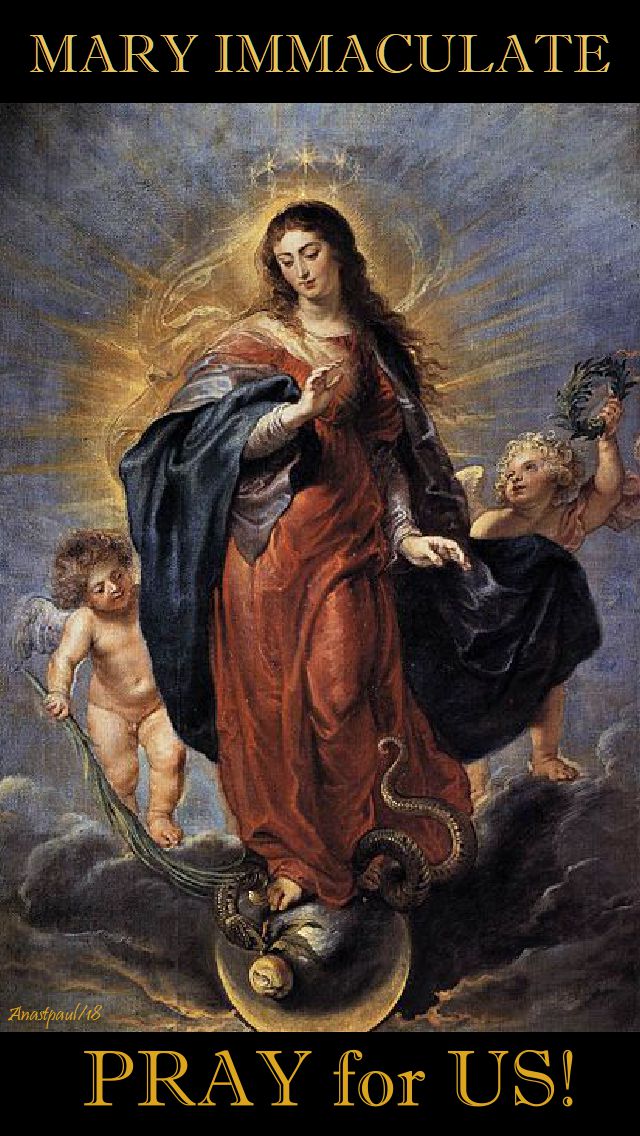
Mary Immaculate, Pray for us!mary immaculate - pray for us - 4 mary 2018.jpg

Posted in MORNING Prayers, PRAYERS of the SAINTS, QUOTES on DIVINE PROVIDENCE, SAINT of the DAY

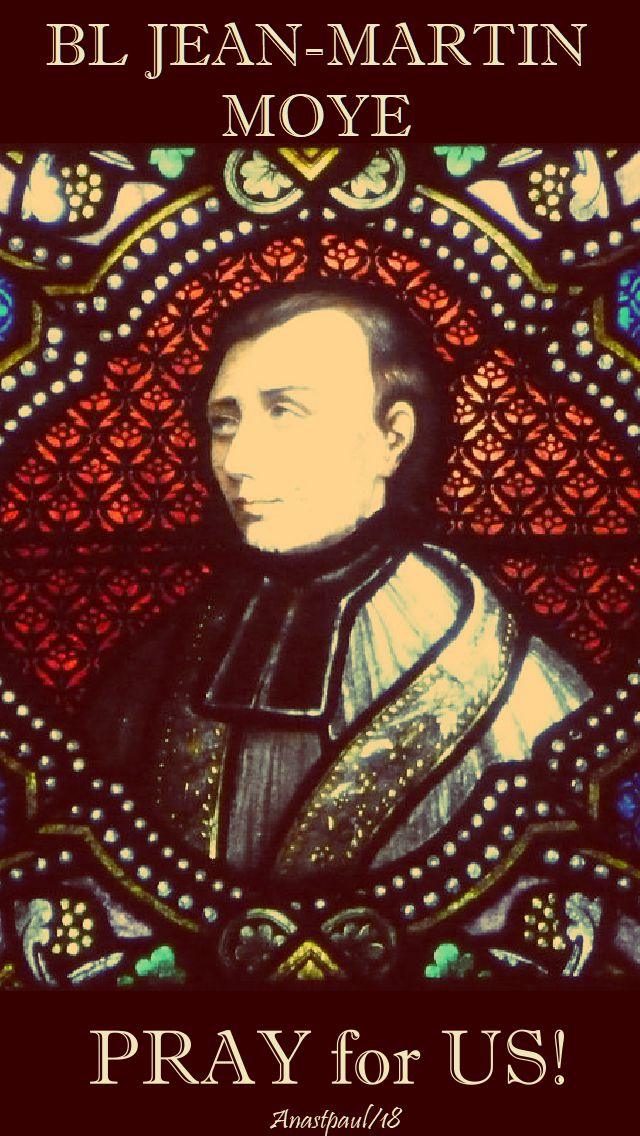
Thought for the Day – 4 May – Friday of the Fifth Week of Eastertide and the Memorial of Bl Jean-Martin Moyë (1730-1793)

Thought for the Day – 4 May – Friday of the Fifth Week of Eastertide and the Memorial of Bl Jean-Martin Moyë (1730-1793)

The heart of Jean-Martin Moye, a parish priest in Northeast France, was touched by the poverty and spiritual hunger of villagers living in Lorraine’s countryside.   He was particularly moved by the lack of educational opportunities for women as well as the absence of faith formation in the region.

On 14 January 1762, Father Moye sent a group of women to these abandoned places to teach and to carry out the works of mercy. This was the beginning of the Congregation of Divine Providence.

Marguerite LeComte and three other women went to these isolated hamlets to educate and evangelise.   The women travelled without provisions;  their only security was an abiding faith in God.  Village residents called the four “Sisters of Divine Providence” because they saw in the women the face of God – a tender God who is present at the very centre of creation and in the most ordinary and mundane events of life.

Fr Moye saw Emmanuel – God-with-us, the face of Love and wasted no time or effort in spreading love everywhere, regardless of all opposition and persecution.   This is what love is!

Blessed Jean-Martin, pray for us!bl jan-martin moye - pray for us - 4 may 2018

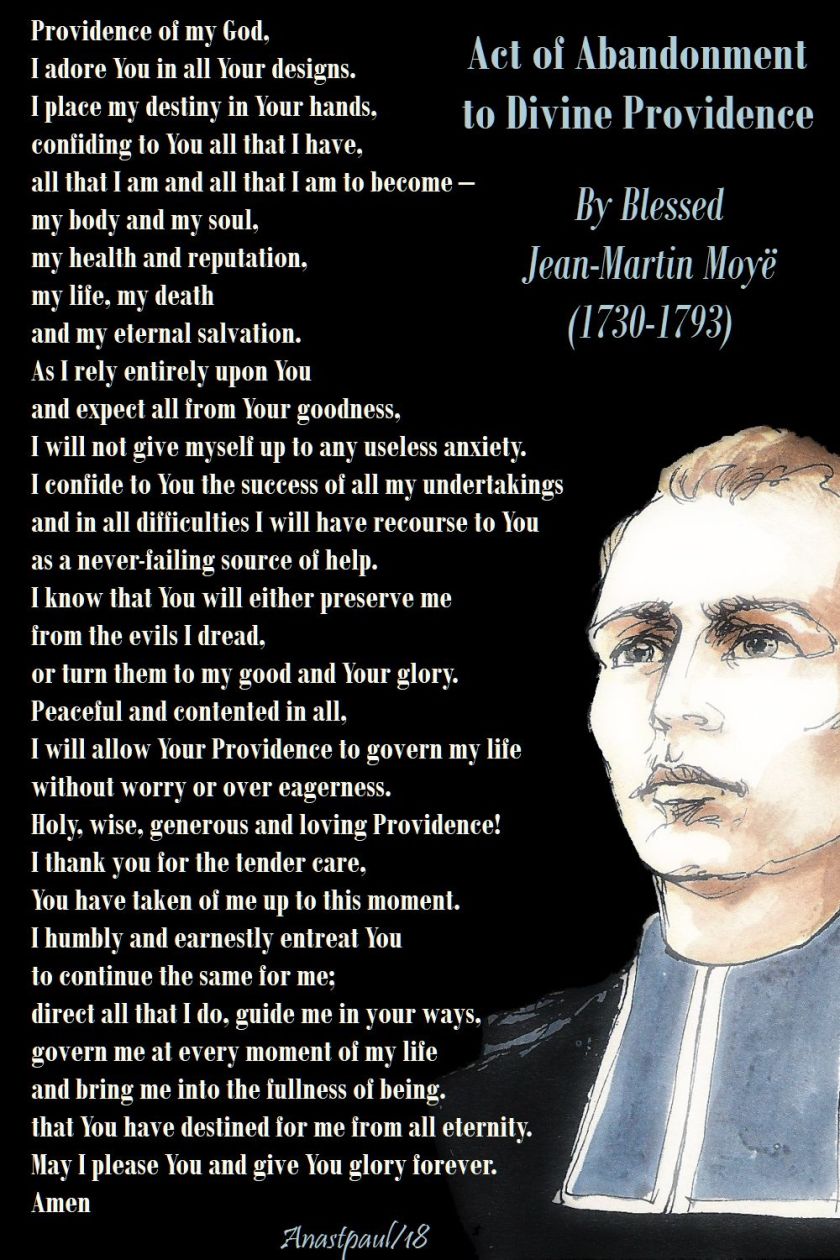
Act of Abandonment to Divine Providence

Providence of my God,
I adore You in all Your designs.
I place my destiny in Your hands,
confiding to You all that I have,
all that I am and all that I am to become –
my body and my soul,
my health and reputation,
my life, my death
and my eternal salvation.
As I rely entirely upon You
and expect all from Your goodness,
I will not give myself up to any useless anxiety.
I confide to You the success of all my undertakings
and in all difficulties I will have recourse to You
as a never-failing source of help.
I know that You will either preserve me
from the evils I dread,
or turn them to my good and Your glory.
Peaceful and contented in all,
I will allow Your Providence to govern my life
without worry or over eagerness.
Holy, wise, generous and loving Providence!
I thank you for the tender care,
You have taken of me up to this moment.
I humbly and earnestly entreat You
to continue the same for me;
direct all that I do, guide me in your ways,
govern me at every moment of my life
and bring me into the fullness of being.
that You have destined for me from all eternity.
May I please You and give You glory forever.
Amen

Blessed Jean-Martin Moye (1730-1793)act of abandonment to div providence - bl jean-martin moye - 4 may 2018


Posted in DOCTORS of the Church, EASTER, FATHERS of the Church, PRACTISING CATHOLIC, QUOTES of the SAINTS, QUOTES on LOVE, SPEAKING of ....., The WORD, Thomas a Kempis

Quote/s of the Day – 4 May – Friday of the Fifth Week of Eastertide: Today’s Gospel John 15:12-17

Quote/s of the Day – 4 May – Friday of the Fifth Week of Eastertide: Today’s Gospel John 15:12-17

Speaking of:  LOVE

“This is my commandment, that you love one another as I have loved you…

John 15:12this is my commandment - john 15 12

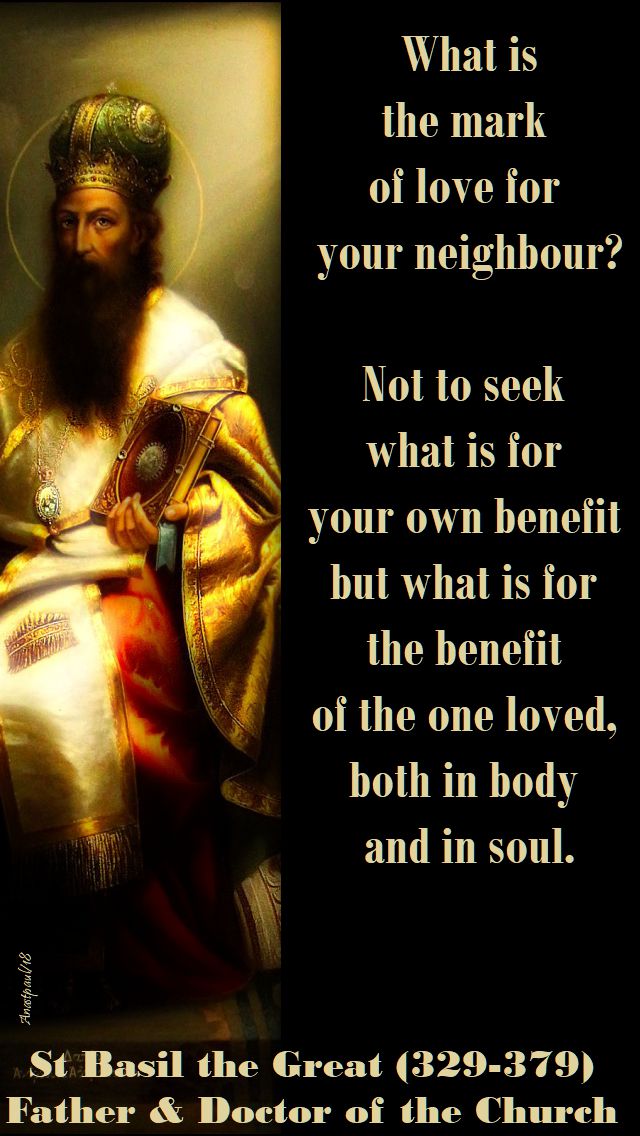
“What is the mark of love for your neighbour?
Not to seek what is for your own benefit
but what is for the benefit of the one loved,
both in body and in soul.”

St Basil the Great (329-379) Father & Doctor of the Churchwhat is the mark of love for your neighbour - st basil the great - 4 may 2018 - speaking of love

“Love is watchful.
Sleeping, it does not slumber.
Wearied, it is not tired.
Pressed, it is not straitened.
Alarmed, it is not confused
but like a living flame,
a burning torch,
it forces its way upward
and passes unharmed
through every obstacle.”

love is watchful - st thomas a kempis - 6 april 2018

“Nothing is sweeter than love,
nothing stronger or higher or wider;
nothing is more pleasant, nothing fuller
and nothing better in heaven or on earth,
for love is born of God
and cannot rest except in God,
Who is above all created things.”

Thomas a Kempis (1380-1471) – Imitation of Christnothing is sweeter than love - thomas a kempis - 6 april 2018

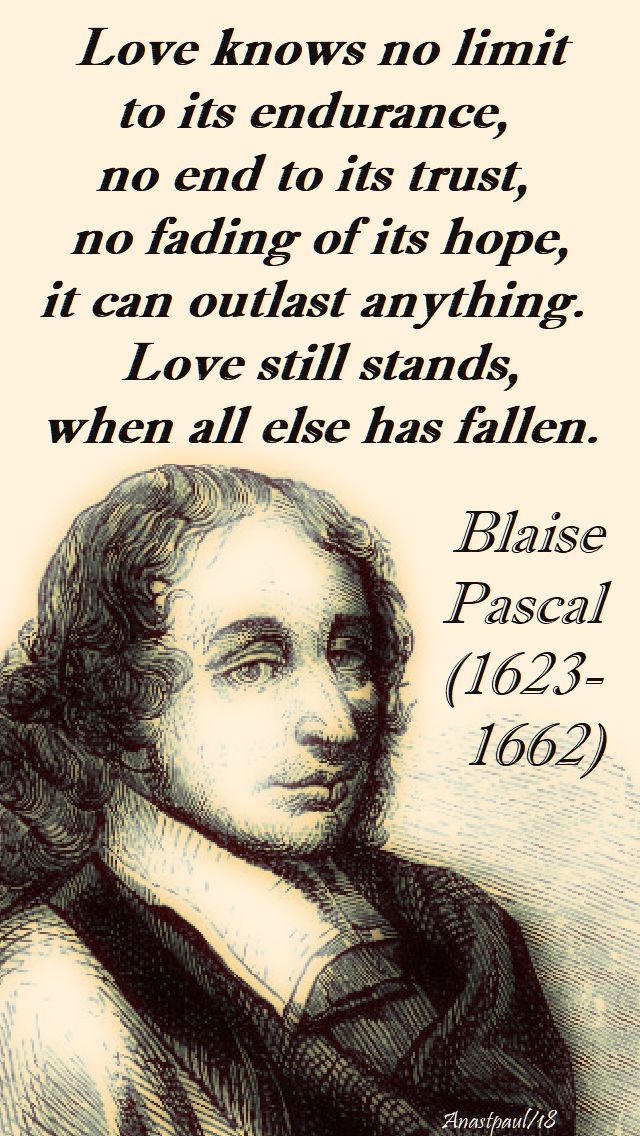
“Love knows no limit
to its endurance,
no end to its trust,
no fading of its hope,
it can outlast anything.
Love still stands,
when all else has fallen.”

Blaise Pascal (1623-1662)love knows no limits - blaise pascal - 6 april 2018

Posted in CATHOLIC DEVOTIONS of the Month, MARIAN DEVOTIONS, MARIAN QUOTES, QUOTES of the SAINTS, The WORD

One Minute Marian Reflection – 4 May Mary’s Month! – Friday of the Fifth Week of Eastertide

One Minute Marian Reflection – 4 May Mary’s Month! – Friday of the Fifth Week of Eastertide

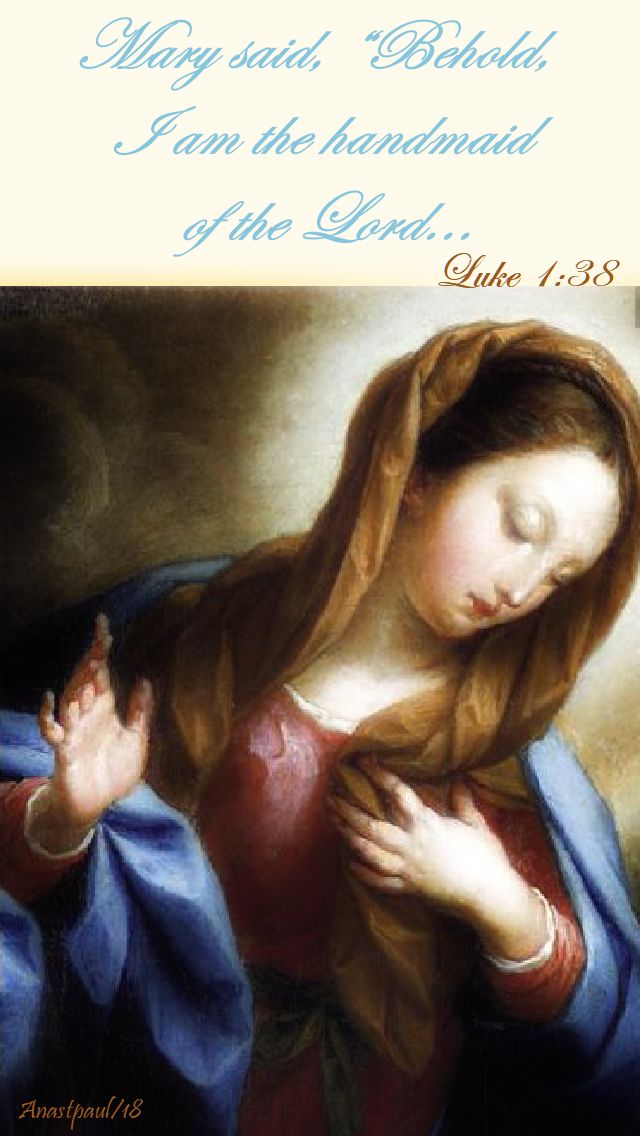
Mary said, “Behold, I am the handmaid of the Lord…Luke 1:38luke 1 38 - mary said, behold i am the heandmaid of the lord - 4 may 2018

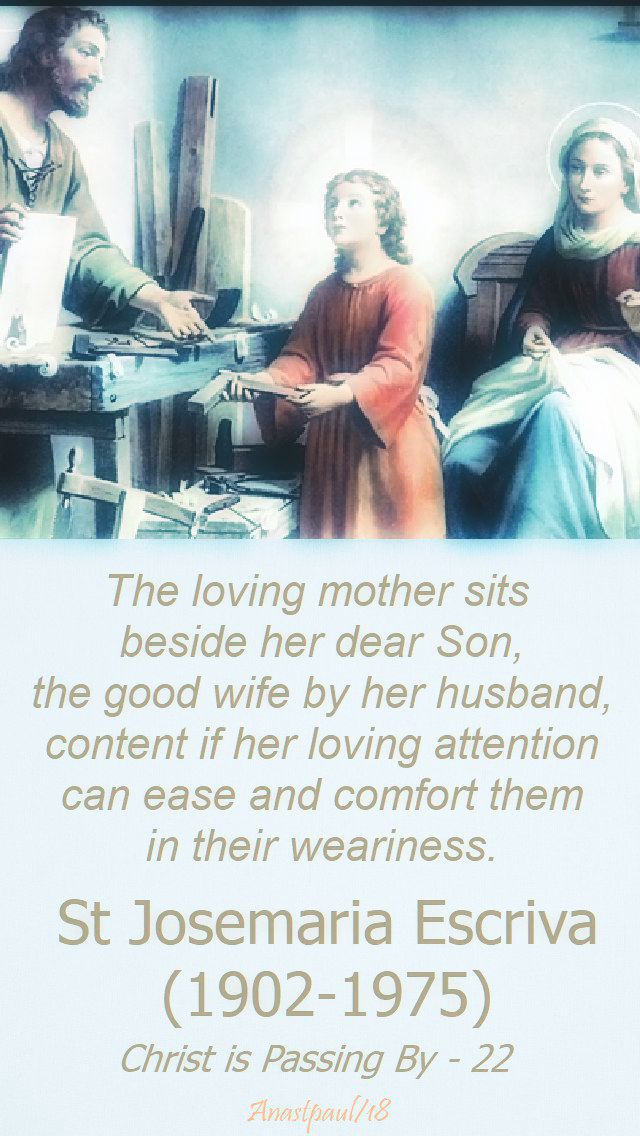
REFLECTION“MARY ‘S FAMILY:  THE TRINITY ON EARTH   It is only natural that the Church rejoice as one contemplates the modest home of Jesus, Mary, and Joseph.   We read in the hymn from Matins on the feast of the Holy Family:  ‘It is pleasing to recall the humble house of Nazareth and its slender resources.   It is pleasing to tell again in song Jesus’ hidden life.
Jesus grows up in hidden seclusion, to be trained in Joseph’s unpretentious trade.   The loving mother sits beside her dear Son, the good wife by her husband, content if her loving attention can ease and comfort them in their weariness.’ “…St Josemaria Escriva (1902-1975) – “Marriage: a Christian Vocation,” Christ is Passing By, 22
Let us offer to our Mother today:
A loving review of her life with Jesus,
as we recite the Joyful Mysteries of the Rosary.the loving mother - st josemaria - 4 may 2018.jpg

PRAYER – Hail Mary, full of grace, the Lord is with thee.   Blessed are thy among women and blessed is the fruit of thy womb Jesus.   Holy Mary, Mother of God, pray for us sinners, now and at the hour of our death, amen.holy mary mother of god pray for us sinners - 4 may 2018

Posted in CATHOLIC DEVOTIONS of the Month, DOCTORS of the Church, FATHERS of the Church, MARIAN PRAYERS, MORNING Prayers, PRAYERS of the SAINTS, The BLESSED VIRGIN MARY

Our Morning Offering – 4 May Mary’s Month! – Friday of the Fifth Week of Eastertide

Our Morning Offering – 4 May Mary’s Month! – Friday of the Fifth Week of Eastertide

A Prayer of Praise to the Blessed Virgin Mary
By St Ephrem the Syrian (306-373) Father & Doctor of the Church

O pure and immaculate and likewise blessed Virgin,
who are the sinless Mother of your Son,
the mighty Lord of the universe,
you who are inviolate and altogether holy,
the hope of the hopeless and sinful,
we sing your praises.
We bless you, as full of every grace,
you who did bear the God-Man,
we all bow low before you,
we invoke you and implore your aid.
Rescue us, O holy and inviolate Virgin,
from every necessity that presses upon us
and from all the temptations of the devil.
Be our intercessor and advocate
at the hour of death and judgement,
deliver us from the fire that is not extinguished
and from the outer darkness.
Make us worthy of the glory of your Son,
O dearest and most clement Virgin Mother.
You indeed are our only hope,
most sure and sacred in God’s sight,
to whom be honour and glory,
majesty and dominion,
forever and ever, world without end.
Ameno pure and immaculate - prayer of praise to the blessed virgin by st ephrem - 4 may 2018

Posted in SAINT of the DAY

Saint of the Day – 4 May – Blessed Jean-Martin Moyë (1730-1793)

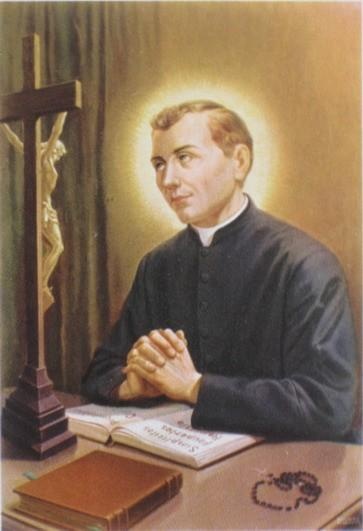
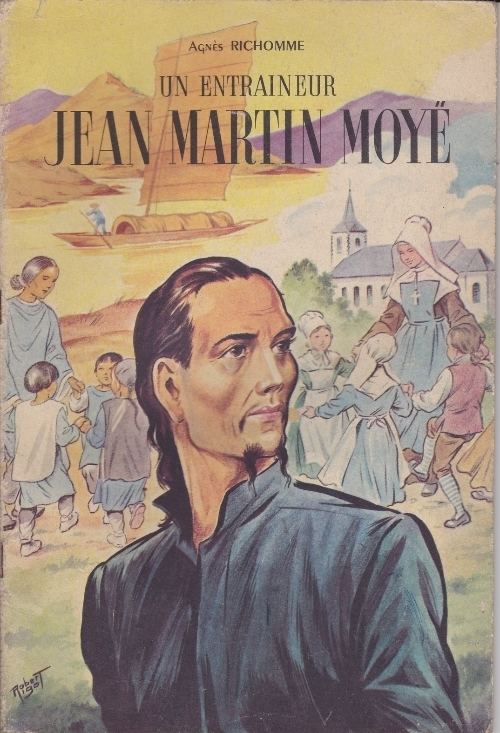
Saint of the Day – 4 May – Blessed Jean-Martin Moyë (1730-1793) Priest, Missionary, Founder, Writer, Teacher, Innovator, Evangelist – born on 27 January 1730 in Cutting, Meurthe, France and died on 8 February 1793 in Trier, Rhineland Palatinate (modern Germany) of typhoid fever.   Bl Jean-Martin was Beatified on 21 November 1954 by Pope Pius XII.   Blessed Jean-Martin was a French Catholic priest who was served as a Missionary in China and was the Founder of the Sisters of the Congregation of Divine Providence, the first expression of consecrated life among the women of China. Header - beautiful large - Young moye

Moye was the sixth of the thirteen children of Jean Moye and Anne Catharine Demange, part of a long-established and prosperous farming family of the region.   The fervent Catholic faith of the family can be seen in the fact that, apart from Jean-Martin, a younger brother also became a priest, as well as five of his first cousins and later two of his nephews.

Moye had an uneventful childhood, growing up on his family’s extensive holdings.   He received his basic education from his older brother, Jean-Jacques, a seminarian, who taught him until his untimely death in 1744 at the age of 24.   Jean-Martin completed his education at the College of Pont-à-Mousson, following which he studied philosophy at the Jesuit College of Strasbourg.   In the fall of 1751 he then entered the local diocesan Seminary of Saint-Simon in Metz, the same one at which his brother had studied.   There one of his professors included Canon François Thiébaut, a noted Biblical scholar of the era, who would later serve as the representative of the local clergy to the Estates General.

He was ordained a priest on 9 March 1754 by Louis-Joseph de Montmorency-Laval, the Bishop of Metz.   Upon his ordination, he was granted a benefice by King Stanislas Leszczynski, the last Duke of Lorraine, of the income generated from the Chapel of St. Andrew in the cemetery of Dieuze.   This income allowed him to accept the poorly paid office of Vicar for three different parishes in Metz, one of which, the Parish of the Holy Cross (French: Sainte-Croix), had Canon Thiébaut as pastor.   He then undertook a number of different ministries as part of his service, among them acting as confessor for the seminarians of Saint-Simon.

The parish extended well beyond the city limits and Moye undertook the spiritual care of the members of the parish living in the small and isolated hamlets in the countryside. Through this service he became aware of the need of education by the girls of the region, who lacked any access to schools. He conceived of a project to remedy this situation by placing volunteer teachers in these rural locations.   The first volunteer was a working class woman, Marguerite Lecomte, whom he stationed in the hamlet of Saint-Hubert on 14 January 1762.   She would remain in this post without disturbance throughout the upheavals of the French Revolution.   Volunteers were quickly sent out to various other locations, going out as far as Freiburg im Breisgau, then in the Habsburg dominion.

Out of the desire to provide the faithful of the parish with means to deepen their spiritual lives, Moye began to publish some tracts, in collaboration with a younger colleague, the Abbé Louis Jobal de Pagny (1737-1766).   The first, in 1762, was a pamphlet entitled Du soin extrème qu’on doit avoir du Baptême des enfants (Extreme Care on the Baptism of Infants).   It treated the baptism of newborn infants, especially stillborn babies.   It was a development of Abrégé de l’Embryologie sacrée, a work by a Sicilian moral theologian, Francesco Cangiamiglia, which had just been published in Paris, having originally been published in Sicily in 1745 with ecclesiastical approval.

Moye’s work with rural education and his writings provoked criticism from certain elements of the city.   He was accused with recklessness for his sending young women to live in the isolated hamlets of the countryside. He was further accused of rigorism in his dealing with penitents, as well as making unfair criticisms of both the clergy and of midwives in his writings on Baptism.   They prevailed on Bishop de Montmorency-Laval to take action against the two authors.   As a result, in May 1762, the bishop ordered Moye to suspend the sending out of volunteers—though those already in the countryside were left in their situations.   He further transferred him from Metz to serve as vicar of Dieuze.   As this was his native region, Moye did not consider it a punishment but worried about the future of his volunteers, who were coming to be called the “poor Sisters”.   His coworkers in the project assured him that the setback was only temporary.bl jean-martin moye 2

Moye was again accused of an extreme rigidity in his dealing with the people of the parish, such as those who came to him for confession.   He also opposed the traditional festivities celebrated by the peasants during the year.   This time the bishop responded more severely, and, during Holy Week of 1767, the most sacred period of the Christian year, Moye was suspended from his post.   Over the course of the next year and a half, until 1768, he moved from parish to parish, providing the pastors with what help he could provide.   Finally he was given refuge by the Grand Prior of the Abbey of Saint-Dié, an abbey nullius, independent of local bishops, where he was asked to help run a kind of minor seminary.

During his time at the abbey, Moye had two important developments in his life, the first being making the acquaintance of a local priest, Antoine Raulin, who had worked to develop education in the region.   He also came to the decision to offer his services as a missionary to Asia.   That following October he enrolled in the seminary of the Foreign Missions Society of Paris, which specialised in that work.   He returned to Lorraine the following spring, where he visited the volunteers, now a religious institute called the Sisters of Providence, as well as preaching parish missions throughout the region. Apparently believing that he would not return from China, where he was to be sent, he formally renounced his family inheritance.

After completing the training period at the seminary, Moye was assigned to serve in the Apostolic Vicariate of Sichuan.   He then put the care of the Sisters of Providence in the hands of two colleagues who were admirers of their work, one of them being Raulin.   He also appointed Marie Morel as their first Mother Superior.   He left France for China on 30 December 1771.   He would spend ten years in the Chinese missions, not returning to Paris until 6 June 1784.   Nine years of mission work, frequently interrupted by persecution and imprisonment, made him realise the necessity of Chinese help.   In 1782 he founded the “Christian Virgins”, religious women following the rules of the Congregation of Providence at home, devoting themselves to the care of the sick and to the Christian instruction of Chinese women and children in their own homes.jean-martin-moye-29ad2563-7a28-4a71-a0c4-2376f7f3935-resize-750

Exhausted and ill, Moye returned to France in 1784.   He resumed the direction of the Sisters of Divine Providence and evangelised Lorraine and Alsace by preaching missions. The French Revolution of 1791 drove him into exile and with his Sisters he retired to Trier.   After the capture of the city by the French troops, typhoid fever broke out and, helped by his Sisters, he devoted himself to hospital work.   He contracted the disease and died in 1793.

Moye was buried in the cemetery of the cathedral.   The cemetery, however, was closed in 1808 and paved over to form the Konstantinsplatz of the city.   His grave has never been identified.

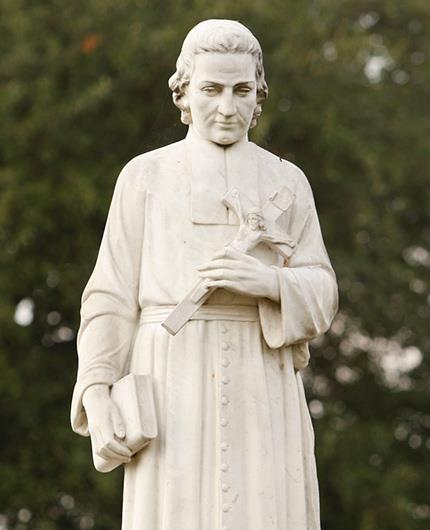
bl jean-martin moye - statue

Posted in SAINT of the DAY

Memorials of the Saints – 4 May

St Albian of Albée
Bl Angela Bartolomea dei Ranzi
Bl Angela Isabella dei Ranzi
St Antonia of Constantinople
St Antonina of Nicaea
St Antonia of Nicomedia
St Antonius of Rocher
St Arbeo of Freising
St Augustine Webster
St Cunegund of Regensburg
St Curcodomus of Auxerre
St Cyriacus of Ancona
St Enéour
St Ethelred of Bardney
St Florian of Lorch
Bl Hilsindis
Bl Jean-Martin Moyë (1730-1793)
St Judas Cyriacus
Bl Ladislas of Gielniów
St Luca da Toro
Bl Margareta Kratz
Bl Michal Giedroyc
St Nepotian of Altino
Bl Paolino Bigazzini
St Paulinus of Cologne
St Paulinus of Senigallia
St Pelagia of Tarsus
St Porphyrius of Camerino Rino
St Richard Reynolds
St Robert Lawrence
St Silvanus of Gaza

Carthusian Martyrs: A group of Carthusian monks who were hanged, drawn and quartered between 19 June 1535 and 20 September 1537 for refusing to acknowledge the English royalty as head of the Church:
• Blessed Humphrey Middlemore
• Blessed James Walworth
• Blessed John Davy
• Blessed John Rochester
• Blessed Richard Bere
• Blessed Robert Salt
• Blessed Sebastian Newdigate
• Blessed Thomas Green
• Blessed Thomas Johnson
• Blessed Thomas Redyng
• Blessed Thomas Scryven
• Blessed Walter Pierson
• Blessed William Exmew
• Blessed William Greenwood
• Blessed William Horne
• Saint Augustine Webster
• Saint John Houghton
• Saint Robert Lawrence

Martyrs of Cirta: Also known as
• Martyrs of Cirtha
• Martyrs of Tzirta
A group of clergy and laity martyred together in Cirta, Numidia (in modern Tunisia) in the persecutions of Valerian. They were – Agapius, Antonia, Emilian, Secundinus and Tertula, along with a woman and her twin children whose names have not come down to us.

Martyrs of England: 85 English, Scottish and Welsh Catholics who were martyred during the persecutions by Protestants in the 16th and 17th centuries. They are commemorated together on 22 November.
• Blessed Alexander Blake • Blessed Alexander Crow • Blessed Antony Page • Blessed Arthur Bell • Blessed Charles Meehan • Blessed Christopher Robinson • Blessed Christopher Wharton • Blessed Edmund Duke • Blessed Edmund Sykes • Blessed Edward Bamber • Blessed Edward Burden • Blessed Edward Osbaldeston • Blessed Edward Thwing • Blessed Francis Ingleby • Blessed George Beesley • Blessed George Douglas • Blessed George Errington • Blessed George Haydock • Blessed George Nichols • Blessed Henry Heath • Blessed Henry Webley • Blessed Hugh Taylor • Blessed Humphrey Pritchard • Blessed John Adams • Blessed John Bretton • Blessed John Fingley • Blessed John Hambley • Blessed John Hogg • Blessed John Lowe • Blessed John Norton • Blessed John Sandys • Blessed John Sugar • Blessed John Talbot • Blessed John Thules • Blessed John Woodcock • Blessed Joseph Lambton • Blessed Marmaduke Bowes • Blessed Matthew Flathers • Blessed Montfort Scott • Blessed Nicholas Garlick • Blessed Nicholas Horner • Blessed Nicholas Postgate • Blessed Nicholas Woodfen • Blessed Peter Snow • Blessed Ralph Grimston • Blessed Richard Flower • Blessed Richard Hill • Blessed Richard Holiday • Blessed Richard Sergeant • Blessed Richard Simpson • Blessed Richard Yaxley • Blessed Robert Bickerdike • Blessed Robert Dibdale • Blessed Robert Drury • Blessed Robert Grissold • Blessed Robert Hardesty • Blessed Robert Ludlam • Blessed Robert Middleton • Blessed Robert Nutter • Blessed Robert Sutton • Blessed Robert Sutton • Blessed Robert Thorpe • Blessed Roger Cadwallador • Blessed Roger Filcock • Blessed Roger Wrenno • Blessed Stephen Rowsham • Blessed Thomas Atkinson • Blessed Thomas Belson • Blessed Thomas Bullaker • Blessed Thomas Hunt • Blessed Thomas Palaser • Blessed Thomas Pilcher • Blessed Thomas Pormort • Blessed Thomas Sprott • Blessed Thomas Watkinson • Blessed Thomas Whitaker • Blessed Thurstan Hunt • Blessed William Carter • Blessed William Davies • Blessed William Gibson • Blessed William Knight • Blessed William Lampley • Blessed William Pike • Blessed William Southerne • Blessed William Spenser • Blessed William Thomson •
They were Beatified on 22 November 1987 by Pope John Paul II.

Martyrs of Novellara: A bishop and several his flock who were martyred together in the persecutions of Diocletian and whose relics were kept and enshrined together. We know nothing else about them but the names – Apollo, Bono, Cassiano, Castoro, Damiano, Dionisio, Leonida, Lucilla, Poliano, Tecla, Teodora and Vespasiano. They were Martyred on 26 March 303. Their relics were enshrined in the parish of Saint Stephen in Novellara, Italy in 1603.

Posted in CATECHESIS, CATHOLIC DEVOTIONS of the Month, DOGMA, MARIAN QUOTES, MARIAN TITLES, MORNING Prayers, QUOTES of the SAINTS, The BLESSED VIRGIN MARY

Marian Thought for the Day – 3 May – Mary’s Month! – Thursday of the Fifth Week of Eastertide and the Feast of Sts Philip and James Apostles and Martyrs

Marian Thought for the Day – 3 May – Mary’s Month! – Thursday of the Fifth Week of Eastertide and the Feast of Sts Philip and James Apostles and Martyrs

On the Immaculate Conception
Mary is the “Virgo Purissima,” the Most Pure Virgin
By Blessed John Henry Newman (1801-1890)

BY the Immaculate Conception of the Blessed Virgin is meant the great revealed truth that she was conceived in the womb of her mother, St Anne, without original sin.

Since the fall of Adam all mankind, his descendants, are conceived and born in sin. “Behold,” says the inspired writer in the Psalm Miserere—“Behold, I was conceived in iniquity and in sin did my mother conceive me”.   That sin which belongs to every one of us and is ours, from the first moment of our existence, is the sin of unbelief and disobedience, by which Adam lost Paradise.   We, as the children of Adam, are heirs to the consequences of his sin and have forfeited in him, that spiritual robe of grace and holiness, which he had given him by his Creator at the time that he was made.   In this state of forfeiture and disinheritance we are all of us conceived and born and the ordinary way, by which we are taken out of it, is the Sacrament of Baptism.

But Mary never was in this state, she was by the eternal decree of God exempted from it. From eternity, God, the Father, Son and Holy Ghost, decreed to create the race of man and, foreseeing the fall of Adam, decreed to redeem the whole race by the Son’s taking flesh and suffering on the Cross.   In that same incomprehensible, eternal instant, in which the Son of God was born of the Father, was also the decree passed of man’s redemption through Him.   He who was born from Eternity was born by an eternal decree to save us in Time and to redeem the whole race and Mary’s redemption, was determined in that special manner which we call the Immaculate Conception.   It was decreed, not that she should be cleansed from sin but that she should, from the first moment of her being, be preserved from sin, so that the Evil One never had any part in her.   Therefore, she was a child of Adam and Eve as if they had never fallen, she did not share with them their sin, she inherited the gifts and graces (and more than those) which Adam and Eve possessed in Paradise.   This is her prerogative and the foundation of all those salutary truths, which are revealed to us concerning her.

Let us say then with all holy souls, Virgin most pure, conceived without original sin, Mary, pray for us.virgin most pure - pray for us - 3 may 2018

Posted in MORNING Prayers, SAINT of the DAY, The APOSTLES & EVANGELISTS

Thought for the Day – 3 May – Thursday of the Fifth Week of Eastertide and the Feast of Sts Philip and James Apostles and Martyrs

Thought for the Day – 3 May – Thursday of the Fifth Week of Eastertide and the Feast of Sts Philip and James Apostles and Martyrs

As in the case of the other apostles, we see in James and Philip human men who became foundation stones of the Church and we are reminded again that holiness and its consequent apostolate are entirely the gift of God, not a matter of human achieving.   All power is God’s power, even the power of human freedom to accept His gifts.   “You will be clothed with power from on high,” Jesus told Philip and the others.   Their first commission had been to expel unclean spirits, heal diseases, announce the kingdom. They learned, gradually, that these externals were sacraments of an even greater miracle inside their persons—the divine power to love like God.

Sts Philip and James, pray for us!sts-philip-and-james-pray-for-us.3 may 2017

Posted in CATECHESIS, DOCTORS of the Church, FATHERS of the Church, MORNING Prayers, PRACTISING CATHOLIC, QUOTES of the SAINTS, QUOTES on CONVERSION, QUOTES on DIVINE PROVIDENCE, QUOTES on ETERNAL LIFE, QUOTES on FAITH, QUOTES on LOVE, QUOTES on SANCTITY, QUOTES on SIN, QUOTES on the DEVIL/EVIL, QUOTES on TRUST and complete CONFIDENCE in GOD, QUOTES on TRUTH, SPEAKING of .....

Quote/s of the Day – 3 May – Thursday of the Fifth Week of Eastertide and the Feast of Sts Philip and James Apostles and Martyrs

Quote/s of the Day – 3 May – Thursday of the Fifth Week of Eastertide and the Feast of Sts Philip and James Apostles and Martyrs

Speaking of:  Seeking Augustine

A Christian is:
a mind through which Christ thinks,
a heart through which Christ loves,
a voice through which Christ speaks
and a hand through which Christ helps.a christian is - st augustine - 3 may 2018

Since love grows within you,
so beauty grows.
For love is the beauty of the soul.since love grows within you - st augustine - 3 may 2018

Remember this.
When people choose to withdraw far from a fire,
the fire continues to give warmth
but they grow cold.
When people choose to withdraw far from light,
the light continues to be bright in itself
but they are in darkness.
This is also the case when people withdraw from God.remember this - st augustine - 3 may 2018

He who denies the existence of God,
has some reason for wishing
that God did not existhe who denies - st augustine - 3 may 2018

It is no advantage
to be near the light,
if the eyes are closed.it is no advantage - st augustine - 3 may 2018

Faith is to believe
what you do not see.
The reward of this faith,
is to see what you believe.faith is to believe what you do not see - st augustine - 3 may 2018

God provides the wind,
man must raise the sail.god provides the wind man must raise the sail - st augustine - 3 may 2018

God is always trying to give good things to us
but our hands are too full to receive them.

St Augustine (354-430) Father and Doctor of Gracegod is always trying - st augustine - 3 may 2018