Posted in DEVOTIO, MORNING Prayers, The HOLY NAME

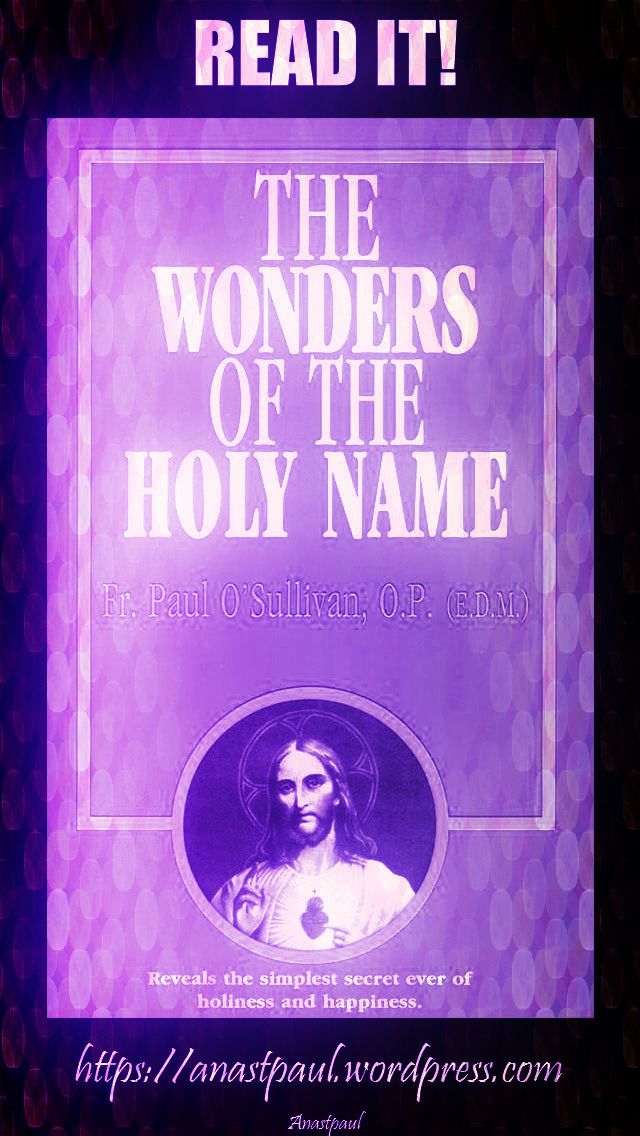
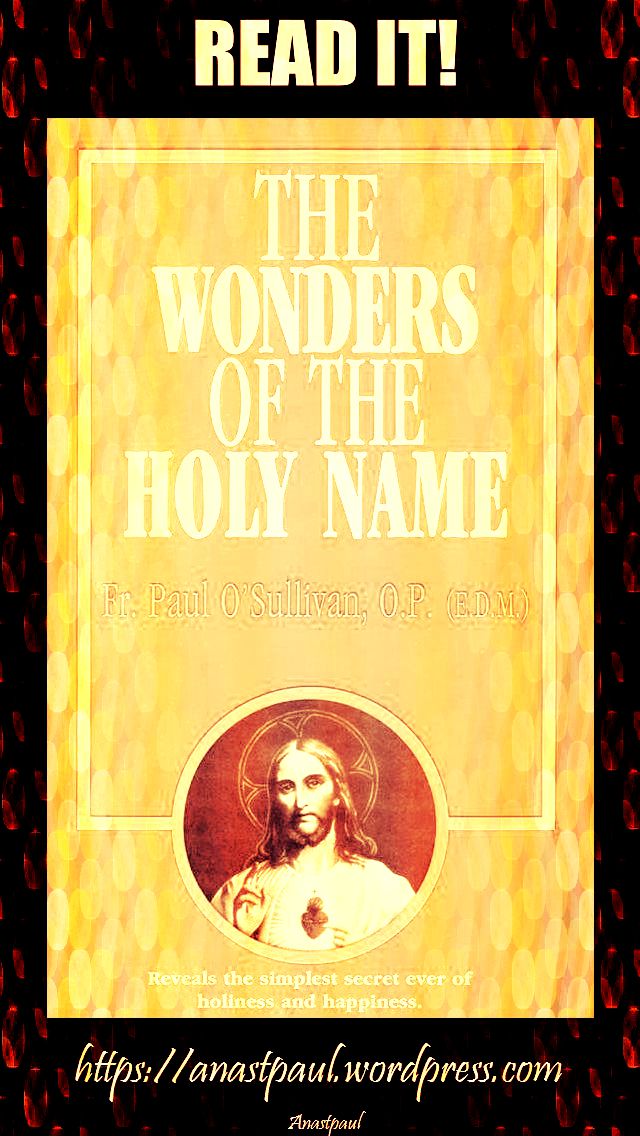
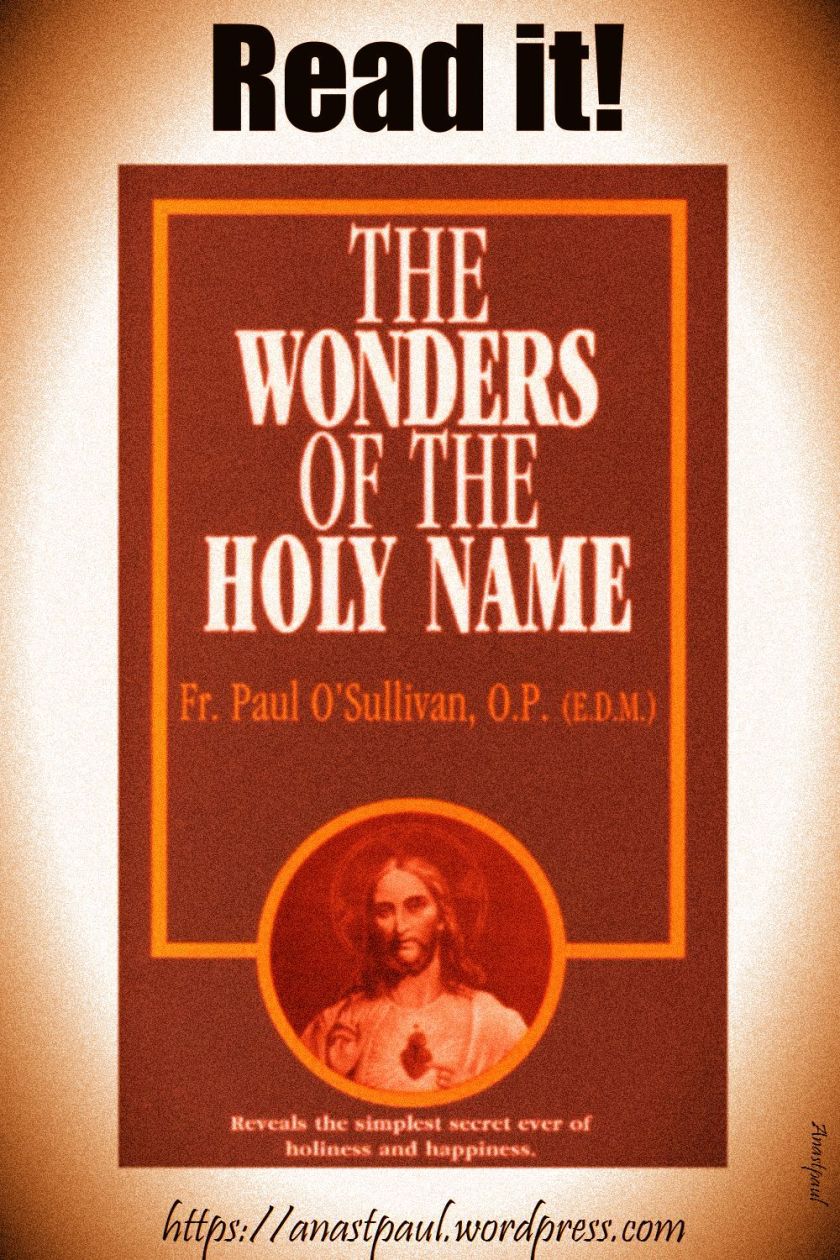
The Wonders of the Holy Name – Fr Paul O’Sullivan, O.P. – “Revealing the Simplest Secret Ever of Holiness and Happiness.” Part Twelve – 21 July

Previous – here: https://anastpaul.wordpress.com/category/the-holy-name/

the wonders of the holy name-day twelve-21 july

The Doctrine of the Holy Name contd:

The Incarnation
God became man for love of us but what does
it avail us if we do not understand this love.
God the Infinite, Immense, Eternal, all-powerful,
God, the mighty Creator, the God that fills Heaven
with His Majesty hid all His power, His Majesty,
His greatness and became a little child in order
to become like us and so to gain our love.
He entered into the pure womb of the Virgin
Mary and there lay hidden for nine whole months.
Then He was born in a stable between two
animals.   He was weak and defenseless like every
child.    He was poor and humble.   He passed 33
years working, suffering, praying, teaching His
beautiful Religion, working miracles, doing good
to all.   He did all this to prove His love for each
of us and so constrain us to love Him.
This stupendous act of love was so great that
not even the highest Angels in Heaven could
have conceived it possible had not God revealed
it to them.
It was so great that the Jews, God’s chosen
people, who were expecting a saviour were
scandalised at the thought that God could humble
Himself so much.
The Gentile Philosophers, notwithstanding their
vaunted wisdom, said that it was madness to think
that the Almighty God could do so much for love
of man.
St. Paul says that God exhausted all His power,
wisdom and goodness in becoming man for us,
“He emptied Himself out.”
Our Lord confirms the words of the Apostle for
He says: “What more could I do?”
All this God did not do for all men in general but
for each one of us in particular.   Think; think
of this.
Do you believe, do you understand. dear reader,
that God loves you so much, that He loves you
so intimately, so personally?   What a joy, what
a consolation if you really knew and felt that the
great God loves you – you so sincerely.
He has done still more for He has made over
to us all His infinite merits so that we can offer
them to the Eternal Father as often as we like, a
hundred, a thousand times a day.
And that is what we can do each time we
say Jesus, if only we remember what we are
saymg.
A Doctrine, you may have never heard it before?
But now at least that you know the infinite
wonders of the Name of Jesus say this Holy
Name constantly, say it devoutly.
And in future when you say Jesus remember that
you are offering to God all the infinite love and
merits of His Son.   You are offering Him His own
Divine Son, You cannot offer Him anything holier,
anything better, anything more pleasing to Him,
anything more meritorious for yourself .
How ungrateful are those Christians who never
thank God for all He has done for them.   Men
and women live 30, 50, 70 years and never think
of thanking God for all His wonderful love.
When you say the Name of Jesus remember, too,
to thank Our Sweet Lord for His Incarnation.
When He was on Earth He cured ten lepers of
their loathsome disease.   They were delighted and
went away full of joy and happiness but only one
came back to thank Him!   He was very hurt and
said: “Where are the other nine?”
Has He not much more reason to feel grieved
and hurt with you and me who thank Him so
little for all He has done for us in the Incarnation
and in His Passion.
St. Gertrude was wont to thank God often with
a little ejaculation for His goodness in becoming
man for her.   Our Lord appeared to her one day
and said:  “My dear Child every time you honour
my Incarnation with that little prayer I turn to
my Eternal Father and I offer all the merits of
the Incarnation for you and for all those who do
as you do”.
Shall we not then try to say often Jesus, Jesus,
Jesus sure of receiving a like wonderful grace.

Posted in DOCTORS of the Church, franciscan OFM, MORNING Prayers, QUOTES of the SAINTS, SAINT of the DAY

Thought for the Day – 21 July – The Memorial of St Lawrence of Brindisi (1559-1619) Apostolic Doctor

Thought for the Day – 21 July – The Memorial of St Lawrence of Brindisi (1559-1619) Apostolic Doctor

“It is surprising that St Lawrence of Brindisi was able to continue without interruption his work as an appreciated and unflagging preacher in many cities of Italy and in different countries, in spite of holding other burdensome offices of great responsibility. Indeed, within the Order of Capuchins he was professor of theology, novice master, for several mandates minister provincial and definitor general, and finally, from 1602 to 1605, minister general. In the midst of this mountain of work,   Lawrence cultivated an exceptionally fervent spiritual life.   He devoted much time to prayer and, especially, to the celebration of Holy Mass — often protracted for hours — caught up in and moved by the memorial of the Passion, death and Resurrection of the Lord.
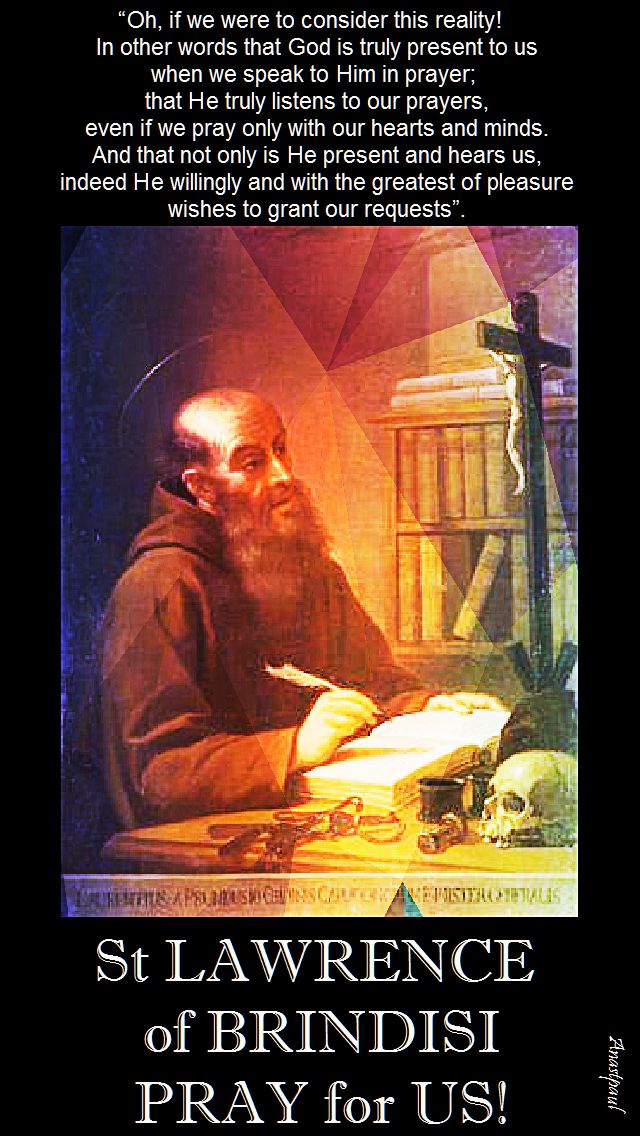
Moreover, with the unmistakable ardour of his style, Lawrence urged everyone and not only priests, to cultivate a life of prayer, for it is through prayer that we speak to God and that God speaks to us: “Oh, if we were to consider this reality!”, he exclaimed. “In other words that God is truly present to us when we speak to Him in prayer;  that He truly listens to our prayers, even if we pray only with our hearts and minds. And that not only is He present and hears us, indeed He willingly and with the greatest of pleasure wishes to grant our requests”.
St Lawrence of Brindisi teaches us to love Sacred Scripture, to increase in familiarity with it, to cultivate daily relations of friendship with the Lord in prayer, so that our every action, our every activity, may have its beginning and its fulfilment in Him.   This is the source from which to draw so that our Christian witness may be luminous and able to lead the people of our time to God.”…….Pope BENEDICT XVI (General Audience) – St. Peter’s Square, Wednesday, 23 March 2011

St Lawtence of Brindisi, pray for us!

of if we were to consider this reality!-st lawrence of brindisi

Posted in DOCTORS of the Church, franciscan OFM, MORNING Prayers, QUOTES of the SAINTS, The WORD

Quote/s of the Day – 21 July

Quote/s of the Day – 21 July

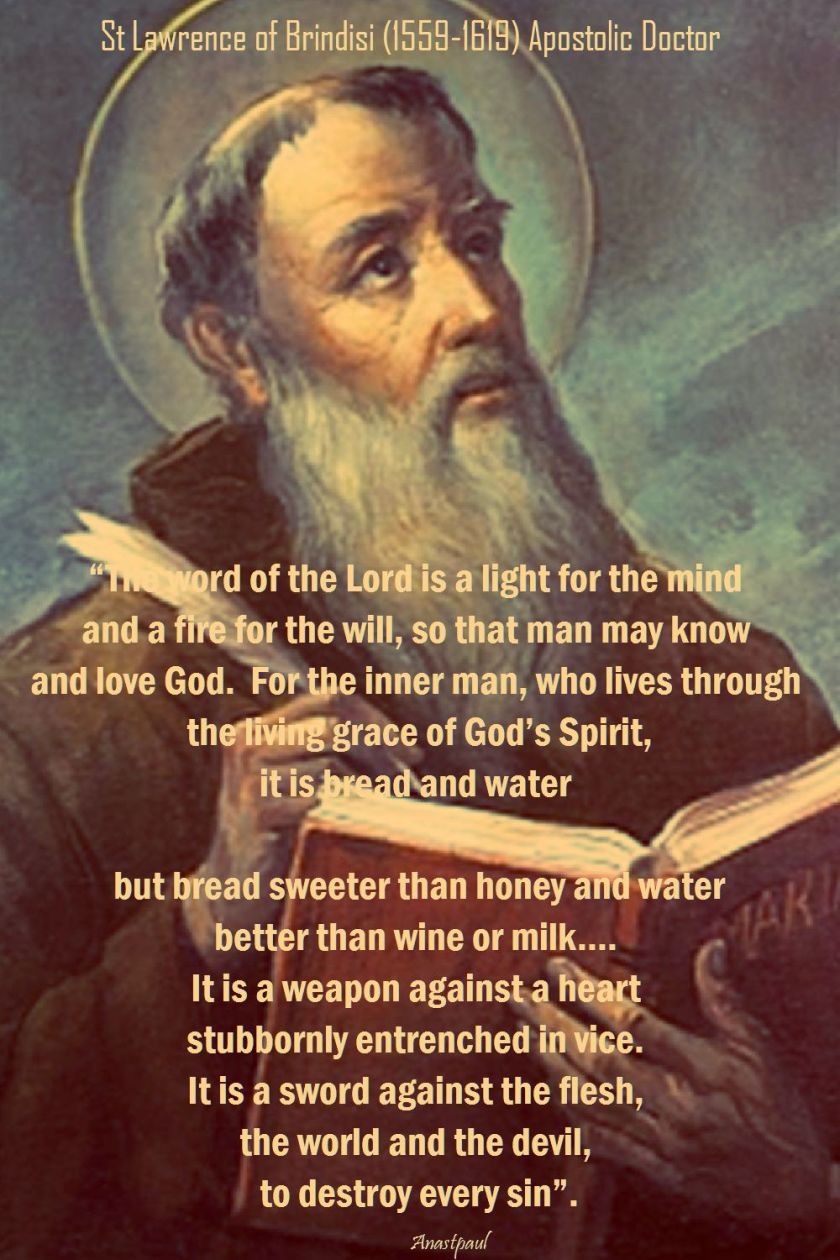
“The word of God is replete with manifold blessings, since it is, so to speak, a treasure of all goods.   It is the source of faith, hope, charity, all virtue, all the gifts of the Holy Spirit, all the beatitudes of the Gospel, all good works, all the rewards of life, all the glory of paradise…For the word of God is a light to the mind and a fire to the will.   It enables man to know God and to love Him.   And for the interior man who lives by the Spirit of God through grace, it is bread and water, but a bread sweeter than honey and the honeycomb, a water better than wine and milk.   For the soul it is a spiritual treasure of merits yielding an abundance of gold and precious stones.   Against the hardness of a heart that persists in wrongdoing, it acts like a hammer.   Against the world, the flesh and the devil it serves as a sword that destroys all sin.”

the word of the lord - st lawrence of brindisi

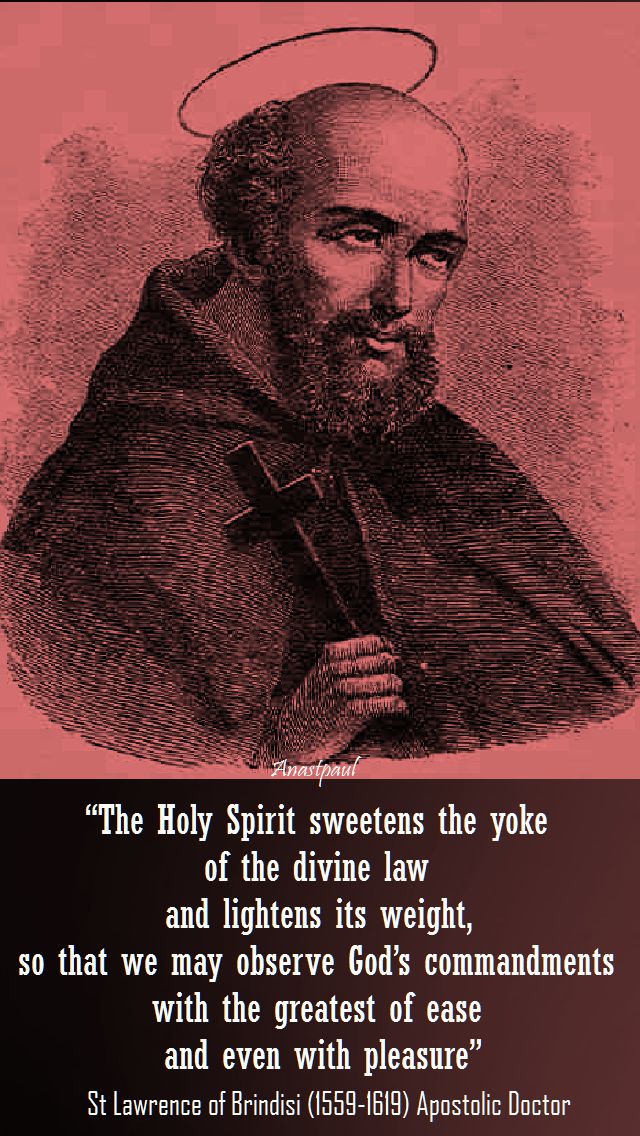
“The Holy Spirit sweetens the yoke
of the divine law and lightens its weight,
so that we may observe God’s commandments
with the greatest of ease and even with pleasure”

the holy spirit - st lawrence of brindisi

St Lawrence of Brindisi (1559-1619) Apostolic Doctor

Posted in DOCTORS of the Church, EUCHARISTIC Adoration, franciscan OFM, MORNING Prayers, QUOTES of the SAINTS, SAINT of the DAY, The HOLY EUCHARIST / The HOLY MASS, The WORD

One Minute Reflection – 21 July

One Minute Reflection – 21 July

“I tell you, something greater than the temple is here.”………..Matthew 12:6

REFLECTION – “My dear souls, let us recognize, I pray you, Christ’s infinite charity towards us in the institution of this Sacrament of the Eucharist.  In order that our love be a spiritual love, He wills a new heart, a new love, a new spirit for us.  It is not with a carnal heart but with a spiritual one, that Christ has loved us with a gratuitous love, a supreme and most ardent love, by way of pure grace and charity.  Ah!  One needs to love Him back with one’s whole, whole, whole, living, living, living and true, true, true heart!!” …… St Lawrence of Brindisi (1559-1619) Apostolic Doctor

my dear souls - st lawrence of brindisi

PRAYER – Lord God, You bestowed on St Lawrence of Brindisi the spirit of counsel and fortitude, so that Your name might be glorified and souls be saved.  At the intercession of St Lawrence, grant that we may see what we have to do and, in Your mercy give us the strength to do it and the courage, love and charity to persevere.  Grant above all, that by his prayers we may love You above all and with all we are. St Lawrence pray for us, amen.

ST LAWRENCE OF BRINDISI PRAY FOR US

Posted in franciscan OFM, MORNING Prayers, PRAYERS of the SAINTS

Our Morning Offering – 21 July

Our Morning Offering – 21 July

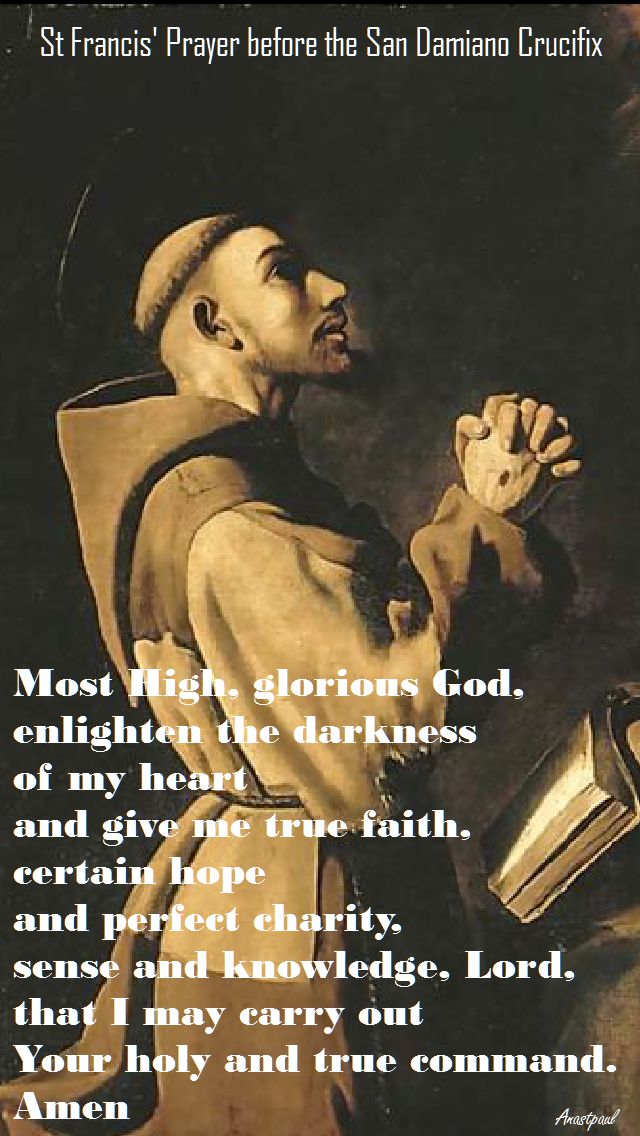
St Francis’s Prayer Before the San Damiano Crucifix

Most High, glorious God,
enlighten the darkness of my heart
and give me
true faith,
certain hope
and perfect charity,
sense and knowledge,
Lord, that I may carry out
Your holy and true command.
Amen

SAN DAMIANO PRAYER - ST FRANCIS

Posted in DOCTORS of the Church, franciscan OFM, SAINT of the DAY

Saint of the Day – 21 July – St Lawrence of Brindisi O.F.M. Cap – Doctor of the Church

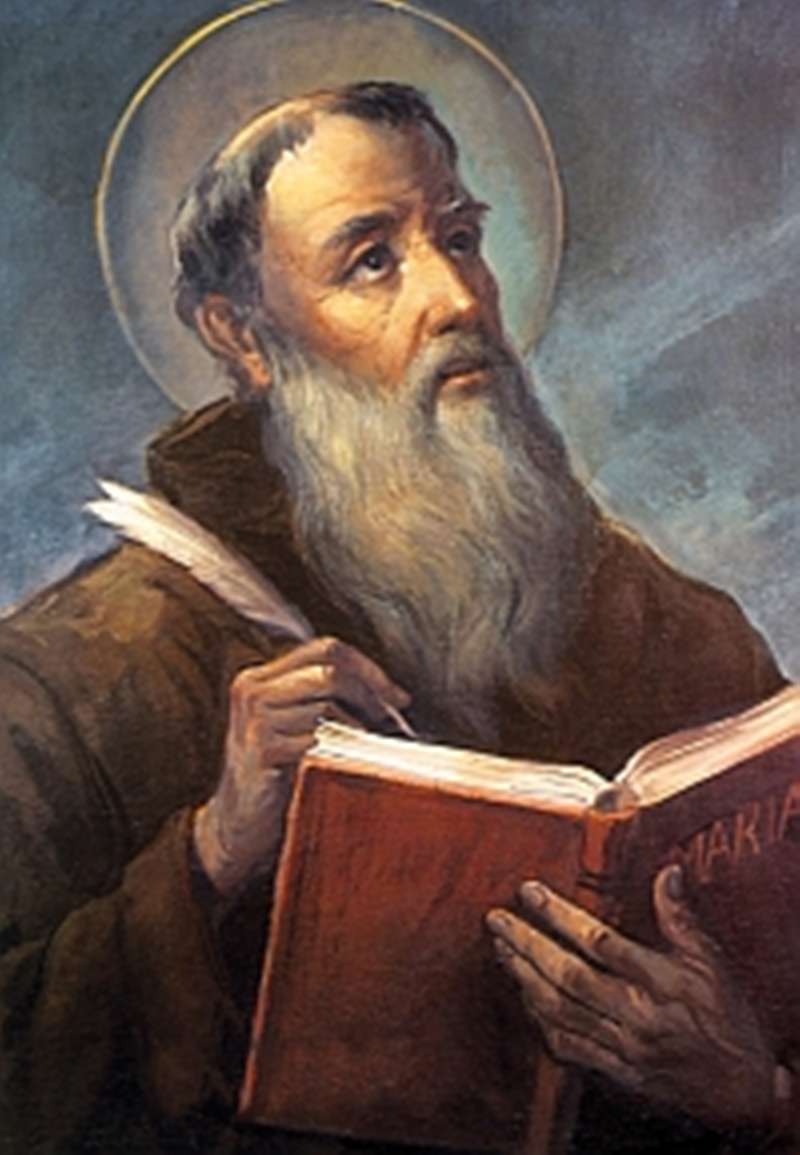
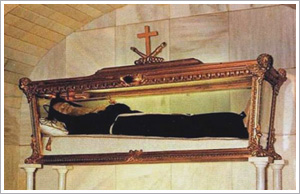
Saint of the Day – 21 July – St Lawrence of Brindisi O.F.M. Cap – Doctor of the Church – (22  July 1559 at Brindisi, Italy as Julius Caesar Rossi –  22 July 1619 at Lisbon, Portugal of natural causes).   His remains are buried in the cemetery of the Poor Clares in Villafranca, Spain.   He was Beatified on 1 June 1783 by Pope Pius VI and Canonised on 8 December 1881 by Pope Leo XIII.   He was created a Doctor of the Church by Blessed Pope John XXIII in 1959 with the title Doctor apostolicus (Apostolic Doctor).   Patronages – of Brindisi, Italy.   Attributes – leading the Christian army against the Turks, receiving the embrace of the Child Jesus.   He is known as the “Franciscan Renaissance Man”  – he was a Religious member of the Franciscan Friars Minor Capuchin, a Priest, Theologian, Vicar General of the Franciscans, Language scholar, Humanist, Philosopher, Biblicist, Preacher, Missionary, Professor, International Administrator, Confidant of Popes, Emperors, Kings and Princes, Diplomatic envoy, Army Chaplain, Military Strategist and Morale builder, Polemicist, Prolific writer.

st lawrence FIRST IMAGE

Despite Saint Lawrence of Brindisi’s later fame, little is known of his early years.   His father was William Russo, a well-to-do Venetian merchant and his mother was Elizabeth Masella.   He was born in the Southern Italian port city of Brindisi on the 22nd of July 1559.   He received his early education at a day school run by the Conventual Franciscans and made rapid progress in his studies.   At the tender age of six, following the Italian custom of the time, he publicly preached a short Christmastide sermon on the Child Jesus.  However, by the time he was 14 he had lost both his parents and his education was entrusted to his uncle, a high-ranking cleric at Venice’s Saint Mark’s Cathedral.   It was at Saint Mark’s College, a private school run by his uncle, that Julius Caesar received an excellent secondary education.

In Venice he came to know the Capuchin Friars Minor who had a small church dedicated to saint Mary of the Angels on the island of Giudeca.   Impressed by their austere life of Poverty, he asked for admission to the Order and was invested with the habit as a novice at the Verona Capuchin novitiate friary of on the 18th of February 1575.  At this time, Julius Caesar was given the religious name Brother Lawrence.     He made his perpetual profession on the 24th of March the following year.

His writings fill fifteen volumes and his knowledge of Hebrew allowed him to preach so effectively to the Jewish people in Italy that the rabbis were certain that Lawrence must have been a Jew who had become a Christian.   His skills in dealing with people meant that he served as a papal emissary to many countries but he never forgot that he was first and foremost a priest.

There is a very special title accorded by the Church to certain saints, who are named “Doctor of the Church” and this title indicates that the writings and preaching of such a person are useful to Christians “in any age of the Church.”   Such men and women are also particularly known for the depth of understanding and the orthodoxy of their theological teachings.   St. Lawrence of Brindisi was given this title and he is one of the thirty-six saints to be named “Doctor.”

doctors

While still a deacon, St. Lawrence of Brindisi became known as an excellent preacher and after his ordination captured the whole of northern Italy with his amazing sermons. He was sent into Germany by the pope to establish Capuchin houses.   While there, he became chaplain to Emperor Rudolf II and had a remarkable influence on the Christian soldiers fighting the Muslims who were threatening Hungary in 1601.   Through his efforts, the Catholic League was formed to unify Catholics for the purpose of strengthening the Catholic cause in Europe.   Sent by the emperor to persuade Philip III of Spain to join the League, he established a Capuchin friary in Madrid.   He also brought peace between Spain and the kingdom of Savoy.

His compassion for the poor, the needy and the sick was legendary.   Elected minister-general of his order in 1602, he made the Capuchins a major force in the Catholic Restoration, visiting every friary in the thirty-four provinces of the order and directing the work of nine thousand friars.   He himself was a dominant figure in carrying out the work of the Council of Trent and was described by Pope Benedict XV as having earned “a truly distinguished place among the most outstanding men ever raised up by Divine Providence to assist the Church in time of distress.”

Yet in the midst of all this feverish activity, Brother Lawrence found peace and strength to keep going by taking refuge in prayer.   Sometimes his Masses which were usually celebrated in private could last for up to twelve hours.   He wept copious tears as he celebrated the Holy Sacrifice and was even witnessed being lifted into the air as he prayed at the Altar.   When he entered the Order in 1575, he told the Provincial Minister who tried to dissuade him by describing in detail the rigours of the Capuchin lifestyle: “Nothing will be difficult for me as long as there is a Crucifix in my room.”   Pictures of Saint Lawrence often show him contemplating the Crucifix.

ST LAWRENCE OF BRINDISI - 2.JULY 21

To Mary he attributed his vocation, his restoration to health as a student, his knowledge of Hebrew and all his successes.   He went to her in all his needs.   When elected Vicar General of the Order, he first went to the Shrine of Our Lady’s Holy House at Loreto and returned there at the end of his term of office.   From his formation days onward, he prayed the Rosary and the Little Office of the Blessed Virgin daily.   His favourite greeting for the Brothers was: “Nos, cum prole pia, benedicat Virgo Maria! May the Virgin Mary bless us with her loving Child!”


In 1619, at the request of the Pope, Brother Lawrence had to travel once more to Spain to make known to the Spanish King the plight of Naples’s citizens under the tyrannical rule of the Spanish Viceroy of the region, the Duke of Ossuna.   He managed to escape the Duke’s attempts to block his mission and set sail secretly from Genoa.   He had to go to Lisbon in Portugal to meet the King of Spain.   His diplomatic mission was successfully concluded but worn out by the journey he fell critically ill.   Having received the Last Sacraments, Brother Lawrence of Brindisi died in Lisbon, Portugal before he could board a ship to return home on the 22nd of July 1619.   Saint Lawrence entered heaven the same date as he entered this world sixty years previously.

law_17_s

O God, who didst bestow on blessed Lawrence of Brindisi, Your Confessor and Doctor, the spirit of wisdom and fortitude to endure every labour for the glory of Your Name and the salvation of souls:  grant us, in the same spirit, both to perceive what we ought to do, and by his intercession to perform the same;  through Jesus Christ thy Son our Lord, who lives and reigns with You, in the unity of the Holy Spirit, ever one God, world without end, amen.

St Lawrence pray for us!

Lawrence_of_Brindisi

Posted in SAINT of the DAY, The BLESSED VIRGIN MARY

Saints’ Memorials and the Feast of Our Lady of Kazan – 21 July

St Lawrence of Brindisi (Optional Memorial)

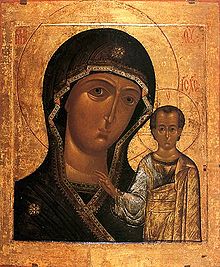
Our Lady of Kazan:  This miraculous icon, also known as the Theotokos of Kazan, is thought to have originated in Constantinople in the 13th century before it was taken to Russia.   When the Turks took Kazan in 1438, the icon may have been hidden.   Ivan the Terrible liberated Kazan in 1552, and the town was destroyed by fire in 1579.
The icon was eventually found in the ruins of a burnt-out house at Kazan on the River Volga on July 8th in 1579.   According to tradition, the location of the icon was revealed during a dream by the Blessed Virgin Mary to a ten year old girl named Matrona. Matrona told the local bishop of her dream, but he did not believe her.   There were two more similar dreams, after which Matrona and her mother went to the place indicated by the Blessed Virgin and dug in the ruins what had been a house until the uncovered the icon.   It appeared untouched by the flames, with the colors as vivid and brilliant as if it were new.   The bishop took the icon to the Church of Saint Nicholas, and immediately there was a miracle of a blind man’s sight being restored to him.   A monastery was built over the place where the icon had been found.
Known as the Holy Protectress of Russia, the icon was stolen on June 29th, 1904.   The thieves were later caught and claimed that they had destroyed the icon after taking the gold frame and jewels attached to the image. In any event, the original has never been found, though there are many copies in existence, thanks to the popularity of the icon. Many of the copies are known to be miracle working.
In 1993 a copy of the icon was given to Pope John Paul II, who kept it in his personal study before it was given to representatives of the Russian Orthodox Church in 2004.

220px-Kazan_moscow

Bl Agrícola Rodríguez García de Los Huertos
St Alberic Crescitelli
St Arbogast of Strasbourg
St Barhadbescialas
St Benignus of Moyenmoutier
Bl Claudius of Avignon
St Claudius of Troyes
St Corona of Marceille
Bl Cristóbal López de Valladolid Orea
Bl Daniel Molini
St Daniel the Prophet
St Eleutherius of Marseille
St Eternus of Evreaux
Bl Gabriel Pergaud
St Iosephus Wang Yumei
St John of Edessa
St John of Moyenmoutier
Bl Juan de Las Varillas
Bl Juan de Zambrana
St Jucundinus of Troyes
St Julia of Troyes
St Justus of Troyes
Bl Parthenius of Thessaly
St Praxides of Rome
St Simeon Salus
St Victor of Marseilles
St Wastrada
St Zoticus of Comana

Martyrs of Africa – 6 saints: Six Christians who were martyred together. We know no other details about them but the names – Emilian, Hugal, Motanus, Saphus, Stercorius and Victor. They were martyred in an unknown location in Africa, date unknown.


Posted in MORNING Prayers, SAINT of the DAY

Thought for the Day – 20 July – Memorial of St Apollinaris

Thought for the Day – 20 July – Memorial of St Apollinaris

Following Jesus involves risks—sometimes the supreme risk of life itself.   Martyrs, like St Apollinaris, are people who would rather accept the risk of death than deny the cornerstone of their whole life:  faith in Jesus Christ.
Everyone will die eventually—the persecutors and those persecuted.
The question is what kind of a conscience people will bring before the Lord for judgment.   Remembering the witness of past and present martyrs can help us make the often small sacrifices that following Jesus today may require.
There are no patterns and the saints break all molds.
God is interested in us right where we are and our own particular circumstances are as good a place as any to be a saint.   Holiness is within our reach!

St Apollinaris and all you saints in heaven, pray for us!

st apollinaris pray for us.2


Posted in DOCTORS of the Church, FATHERS of the Church, MORNING Prayers, QUOTES of the SAINTS, The WORD

Quote/s of the Day – 20 July

Quote/s of the Day – 20 July

“Let sleep find you holding your Bible
and when you head nods let it be resting
on the sacred page.”
St Jerome (343-420) One of the Original 4 Doctors

le sleep find you - st jerome

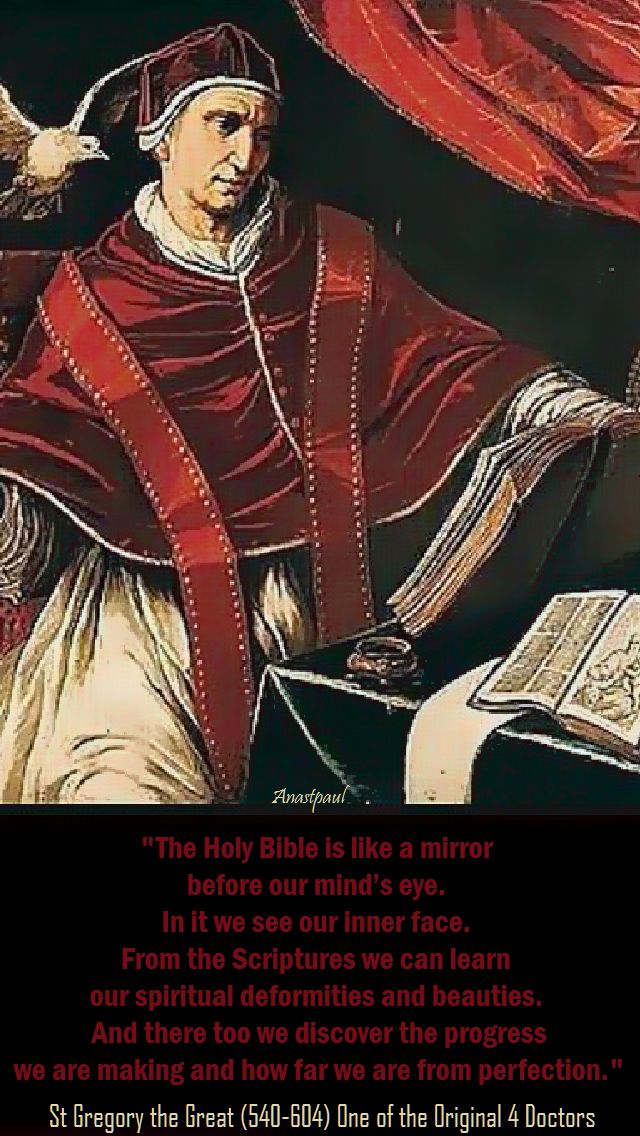
“The Holy Bible is like a mirror before our mind’s eye.
In it we see our inner face.
From the Scriptures we can learn
our spiritual deformities and beauties.
And there too we discover the progress
we are making and how far we are from perfection.”
St Gregory the Great (540-604) One of the Original 4 Doctors

the holy bible is like a mirror - st gregory he great

“The Old Testament is like a radio
with its hidden voice
announcing the One to come.
The New Testament is like a television
because the Word became both audible and visible.”
Venerable Archbishop Fulton Sheen

the old testament - fulton sheen

Posted in MORNING Prayers, The HOLY NAME

The Wonders of the Holy Name – Fr Paul O’Sullivan, O.P. – “Revealing the Simplest Secret Ever of Holiness and Happiness.” Part Eleven – 20 July

Previous – here: https://anastpaul.wordpress.com/category/the-holy-name/

the wonders of the holy name-day ten-12 july

The Doctrine of the Holy Name:

We shall now explain the doctrine of the Holy
Name – the most important chapter in this booklet
– in order to show our readers whence comes
the power and the divine value of this Name and
how the Saints worked their wonders with it and
how we ourselves can obtain by its means every
grace and blessing.
You may ask, dear reader, how it is that one
word can work such prodigies?
I answer that with a word God made the World.
With His word He called out of nothing the Sun,
the Moon, the Stars, the high .Mountains and the
vast Oceans.   By His word He sustains the whole
Universe.
Does not the priest, too, in Holy Mass, work a
prodigy of prodigies, does He not transform the
little white host into the God of Heaven and
Earth by the words of Consecration and though
God alone can pardon sin, does not the priest also
in the confessional pardon the blackest sins and
the most awful crimes?
How? because God gives to His words this infinite
power.
So, too, God in His immense goodness gives to
each of us an all -powerful word with which
we can do wonders for Him, for ourselves and for
the World.   That word is Jesus.
Remember what St. Paul tells us about It.
That it is “a Name above all Names” and that:
“In the Name of Jesus every knee shall bend in
Heaven, on Earth and in Hell”.
But why?
Because Jesus signifies God-made-man – viz the
Incarnation.  When the Son of God became man
He was called Jesus so that when we say Jesus
we offer to the Eternal Father the infinite love,
the infinite merits of Jesus Christ, in a word, we
offer Him His own Divine Son Himself, we offer
Him the great mystery of the Incarnation.   Jesus
is the Incarnation.
How few Christians have any adequate idea of
this sublime mystery and yet it is the greatest
proof that God has given or could give us of His
personal love for us.   It is everything to us.


Posted in MORNING Prayers, QUOTES - J R R Tolkien and MORE, SAINT of the DAY, The WORD

One Minute Reflection – 20 July

One Minute Reflection – 20 July

All scripture is inspired by God and is useful for teaching, for refutation, for correction and for training in righteousness,so that one who belongs to God may be competent, equipped for every good work……..2 Timothy 3:16-17

REFLECTION – “We therefore grossly deceive ourselves in not allotting more time to the study of divine truths. It is not enough barely to believe them and let our thoughts now and then glance upon them: that knowledge which shows us heaven, will not bring us to the possession of it and will deserve punishments, not rewards, if it remain slight, weak and superficial. By serious and frequent meditation it must be concocted, digested, and turned into the nourishment of our affections, before it can be powerful and operative enough to change them, and produce the necessary fruit in our lives. For this all the saints affected solitude and retreats from the noise and hurry of the world, as much as their circumstances allowed them.” – St. Apollinaris

we therefore grossly deceive ourselves - st apollinaris

PRAYER – Heavenly Father, St Apollinaris fought unto death for the law of his God. He was not afraid of the words of evil men, for he was like a house that is founded on rock. Grant that we too, may be founded on rock and be planted in good saoil to yield many fruits. St Apollinaris, please pray for us, amen.

st apollinaris pray for us

Posted in MORNING Prayers, PRAYERS of the SAINTS

Our Morning Offering – 20 July

Our Morning Offering – 20 July

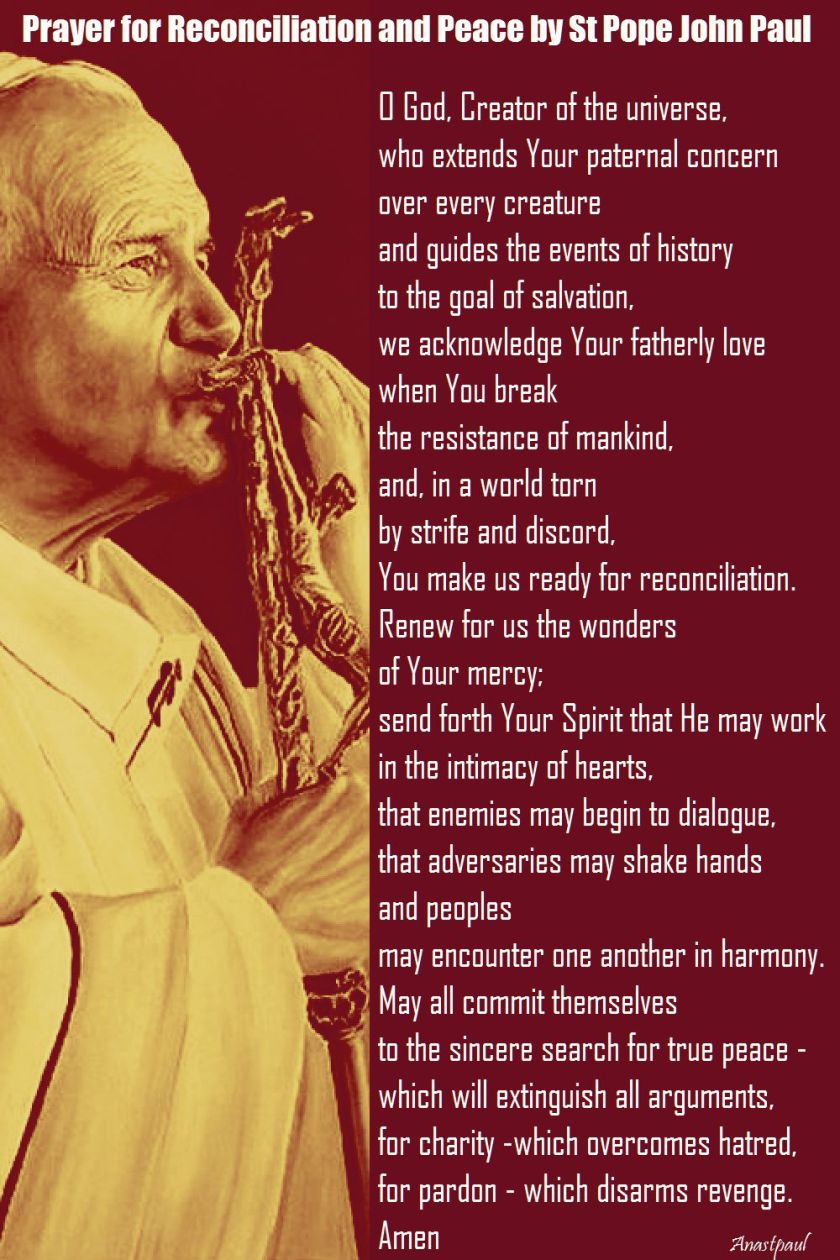
Prayer for Reconciliation and Peace
St Pope John Paul

O God, Creator of the universe,
who extends Your paternal concern
over every creature
and guides the events of history
to the goal of salvation,
we acknowledge Your fatherly love
when You break the resistance of mankind,
and, in a world torn by strife and discord,
You make us ready for reconciliation.
Renew for us the wonders of Your mercy;
send forth Your Spirit that He may work
in the intimacy of hearts,
that enemies may begin to dialogue,
that adversaries may shake hands and peoples
may encounter one another in harmony.
May all commit themselves
to the sincere search for true peace –
which will extinguish all arguments,
for charity -which overcomes hatred,
for pardon – which disarms revenge.
Amen

prayer for reconciliation and peace by st john paul

Posted in SAINT of the DAY

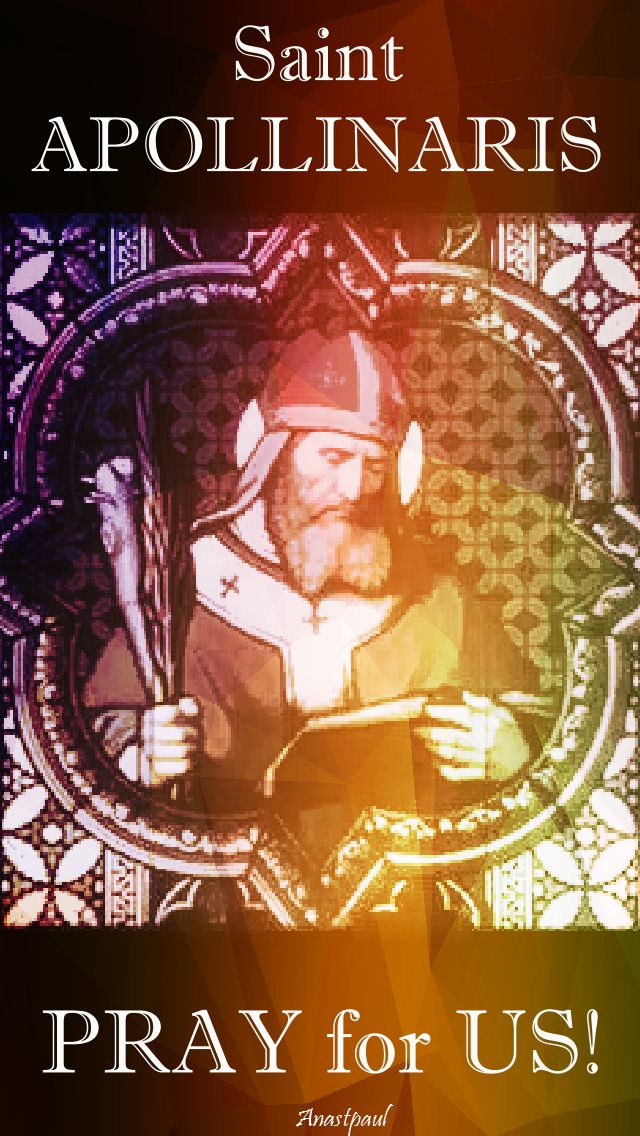
Saint of the Day – 23 July – St Apollinaris Bishop Martyr, Disciple of St Peter

Saint of the Day – 23 July – St Apollinaris (1st Century) – Bishop Martyr, Disciple of St Peter (born in Antioch, Turkey and was Martyred by being stabbed with a sword c 79 at Ravenna, Italy).   His relics are at the Benedictine abbey of Classe, Ravenna and in Saint Lambert’s Church, Düsseldorf, Germany.  Patronages – epilepsy; gout, archdiocese of Ravenna-Cervia, Italy and 6 cities.

NO 1 ST APOLLINARIS

St Apollinaris was a native of Antioch in Roman Province of Syria.   As the first Bishop of Ravenna, he faced nearly constant persecution.   He and his flock were exiled from Ravenna during the persecutions of Emperor Vespasian (or Nero, depending on the source).
He was made Bishop of Ravenna, Italy, by Saint Peter himself.   The miracles he wrought there soon attracted official attention, for they and his preaching won many converts to the Faith, while at the same time bringing upon him the fury of the idolaters, who beat him cruelly and drove him from the city.   He was found half-dead on the seashore and kept in concealment by the Christians but was captured again and compelled to walk on burning coals and a second time expelled.   But he remained in the vicinity and continued his work of evangelisation.   We find him then journeying in the Roman province of Aemilia [in Italy].   A third time he returned to Ravenna.   Again he was captured, hacked with knives, had scalding water poured over his wounds, was beaten in the mouth with stones because he persisted in preaching and was flung into a horrible dungeon, loaded with chains, to starve to death;  but after four days he was put on board a ship and sent to Greece.   There the same course of preachings, miracles and sufferings continued and when his very presence caused the oracles to be silent, he was, after a cruel beating, sent back to Italy.

San Pietro sends Saint Apollinaris to Ravenna to convert the city

All this continued for three years and a fourth time he returned to Ravenna.   By this time Vespasian was Emperor, and he, in answer to the complaints of the pagans, issued a decree of banishment against the Christians.   Apollinaris was kept concealed for some time but as he was passing out of the gates of the city, was set upon and savagely beaten and stabbed but he lived for seven days, foretelling meantime that the persecutions would increase but that the Church would ultimately triumph.

StApollinarisST APOLLINARIS.3.jpgMartyrdom of St Apollinaris Lattanzio Querena ––19th. century

Posted in SAINT of the DAY

Saints – 20 July

St Apollinaris of Ravenna (Optional Memorial) – https://www.youtube.com/watch?v=pT8-SE1NAQg

Bl Anne Cartier
St Ansegisus
St Aurelius of Carthage
St Bernward of Hildesheim
St Cassian of Saint Saba
St Chi Zhuze
St Elijah the Prophet
St Elswith
Bl Gregory Lopez
St José María Díaz Sanjurjo
St Joseph Barsabas
Bl Luigi Novarese
St Margaret of Antioch
St Maria Fu Guilin
St Mère
St Paul of Saint Zoilus
St Rorice of Limoges
St Severa of Oehren
St Severa of Saint Gemma
St Wulmar

Martyrs of Corinth – 22 saints: 22 Christians who were martyred together. We know nothing else about them but the names – • Appia • Calorus • Cassius • Celsus • Cyriacus • Donatus • Emilis • Felix • Fructus • Magnus • Maximus • Nestita • Partinus • Pasterus • Paul • Romanus • Spretus • Tertius • Theodolus • Ueratia • Valerian • Victor. They were martyred in Corinth, Greece.

Martyrs of Damascus – 16 saints: 16 Christians who were martyred together. We know the names of six of then, but no details about any of them – Cassia, Julian, Macrobius, Maximus, Paul and Sabinus. They were martyred in Damascus, Syria, date unknown.

Martyrs of Seoul – 8 saints: Eight lay native Koreans in various states of life who were murdered together for their faith.
• Anna Kim Chang-gum
• Ioannes Baptista Yi Kwang-nyol
• Lucia Kim Nusia
• Magdalena Yi Yong-hui
• Maria Won Kwi-im
• Martha Kim Song-im
• Rosa Kim No-sa
• Theresia Yi Mae-im
They were martyred on 20 July 1839 at the Small West Gate, Seoul, South Korea and Canonised on 6 May 1984 by St Pope John Paul.

Martyrs of Zhaojia – 3 saints: Married lay woman and her two daughters in the apostolic vicariate of Southeastern Zhili, China. During the persecutions of the Boxer Rebellion, the three of them hid in a well to avoid being raped. They were found, dragged out, and killed for being Christian. Martyrs. They were – Maria Zhao Guoshi (mother), Maria Zhao and Rosa Zhao (sisters). They were martyred in late July 1900 in Zhaojia, Wuqiao, Hebei, China.

Martyrs of Zhujiahe – 4 saints: Two Jesuit missionary priests and two local lay people who supported their work who were martyred together in the Boxer Rebellion during and immediately after Mass.
• Léon-Ignace Mangin
• Maria Zhu Wushi
• Paul Denn
• Petrus Zhu Rixin
They were martyred on 20 July 1900 in church in Zhujiahe, Jingxian, Hebei, China and Canonised on 1 October 2000 by St Pope John Paul.

Martyred in the Spanish Civil War
Bl Abraham Furones y Furones
Antoni Bosch Verdura
Bl Francisca Aldea y Araujo
Bl Jacinto García Riesco
Joan Páfila Monllaó
Josep Tristany Pujol
Bl Matías Cardona-Meseguer
Bl Rita Josefa Pujalte y Sánchez
Bl Vicente López y López

Posted in MORNING Prayers, QUOTES of the SAINTS, SAINT of the DAY

Thought for the Day – 19 July

Thought for the Day – 19 July

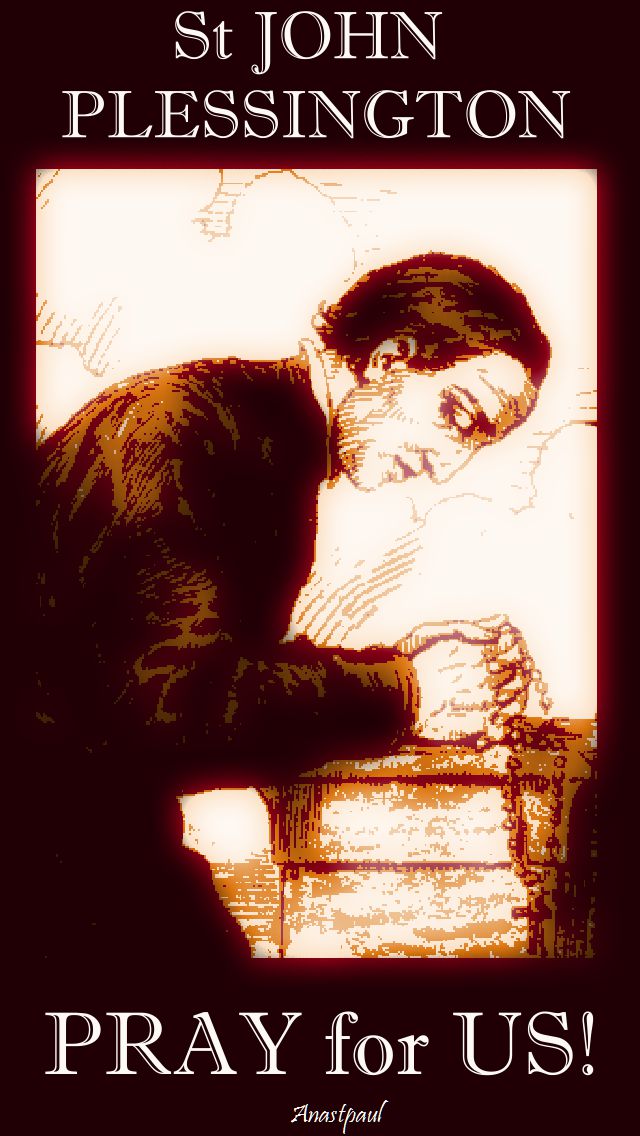
Today is the Feast of St John Plessington, one of the Forty Martyrs of England and Wales, he was imprisoned for two months and then hung, drawn and quartered on 19 July 1679. Here are the words of the speech the saint gave before his martyrdom:

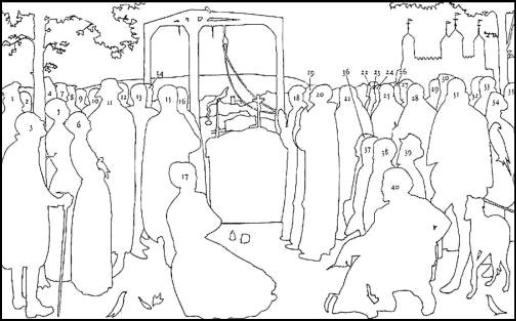
display_image-php (1)
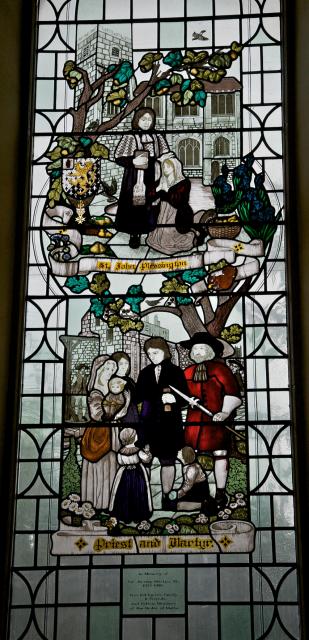
Stained glass window in St Winifrede’s Church Holywell depicting St John Plessington ministering to a kneeling woman and below with a group at his execution.

The scaffold speech of Fr John Plessington

Dear Countrymen.

I am here to be executed, neither for Theft, Murder, nor anything against the Law of God, nor any fact or Doctrine inconsistent with Monarchy or Civil Government. I suppose several now present heard my trial the last Assizes and can testify that nothing was laid to my charge but Priesthood and I am sure that you will find that Priesthood is neither against the Law of God nor Monarchy, or Civil Government. If you will consider either the Old or New Testament (for it is the Basis of Religion […], St Paul tells us in Hebrews 7:12 that the Priesthood being changed, there is made of necessity a change of the Law, and consequently the Priesthood being abolished, the Law and Religion is quite gone.

But I know it will be said that a Priest ordained by authority derived from the See of Rome is by the Law of Nation to die as a Traitor, but if that be so what must become of all the Clergymen or England, for the first Protestant Bishops had their Ordination from those of the Church of Rome, or none at all, as appears by their own writers, so that Ordination comes derivatively to those now living.

As in the Primitive times, Christians were esteemed Traitors and suffered as such by National Law, so are the Priests of the Roman Church here esteemed, and suffer such.   But as Christianity then was not against the law of God, Monarchy or Civil Policy, so now there is not any one Point of the Roman Catholic Faith (of which Faith I am) that is inconsistent therewith, as is evident by induction in each several point.

That the Pope hath power to depose or give licence to Murder Princes is no point of our Belief.    And I protest in the sight of God and the Court of Heaven that I am absolutely innocent of the Plot so much discoursed of, and abhor such bloody and damnable designs.   And although it be Nine Weeks since I was sentenced to die, there is not anything of that laid to my charge, so that I may take comfort in St. Peter’s words, 1 Peter 14-16, “Let none of you suffer as a Murderer, or as a Thief, or as an Evil doer, or as a Busy Body in other men’s matters, yet if any man suffer as a Christian let him not be ashamed or Sorry”. I have deserved a worse death, for though I have been a faithful and true Subject to my King, I have been a grievous sinner against God;  [others would have lived] in a greater perfection [than] I have done had they received so many favours and graces from him as I have.

But as there was never sinner who truly repented and heartily called to Jesus for mercy, to whom he did not show mercy, so I hope by the merits of His Passion, He will have mercy on me, who am heartily sorry that ever I offended him.

Bear witness, good hearers, that I profess that I undoubtedly and firmly believe all the Articles of the Roman Catholic Faith, and for the truth of any of them (by the assistance of God) I am willing to die, and I had rather die than doubt of any Point of Faith, taught by our Holy Mother the Roman Catholic Church.

In what condition Margaret Plat one of the chiefest witnesses against me was before and after she was with me, let her nearest relations declare.   George Massey, another witness, swore falsely when he swore I gave him the Sacrament, and said Mass at the time and place he mentioned, and [I] verily think that he never spoke to me, or I to him, or saw each other but at the Assizes week. The third witness, Robert Wood, was suddenly killed but of the Dead why should I speak? These were all the witnesses against me, unless those that only declared what they heard from others.   I heartily and freely forgive all that have been or are any way instrumental to my Death, and heartily desire that those that are living may heartily repent.

God bless the King and the Royal Family and grant his Majesty a prosperous Reign here and a crown of glory hereafter, God grant peace to the Subjects and that they live and die in true Faith, Hope, and Charity.  

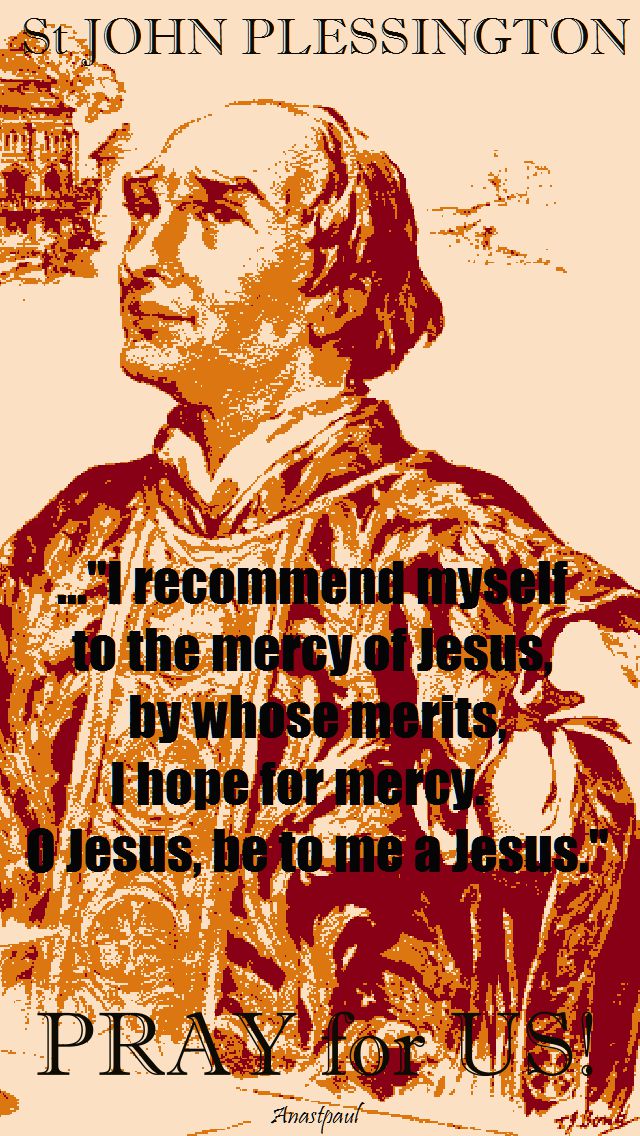
That which remains is that I recommend my self to the mercy of Jesus, by whose merits, I hope for mercy.    O Jesus, be to me a Jesus.

FINIS

And we too, recommend ourselves to the mercy of Jesus, now and at the hour of our death, amen.    St John Plessington, pray for us!

i recommend myself to the mercy of jesus - st john plessington


Posted in MORNING Prayers, QUOTES of the SAINTS, SAINT of the DAY

Quote/s of the Day – 19 July

Quote/s of the Day – 19 July

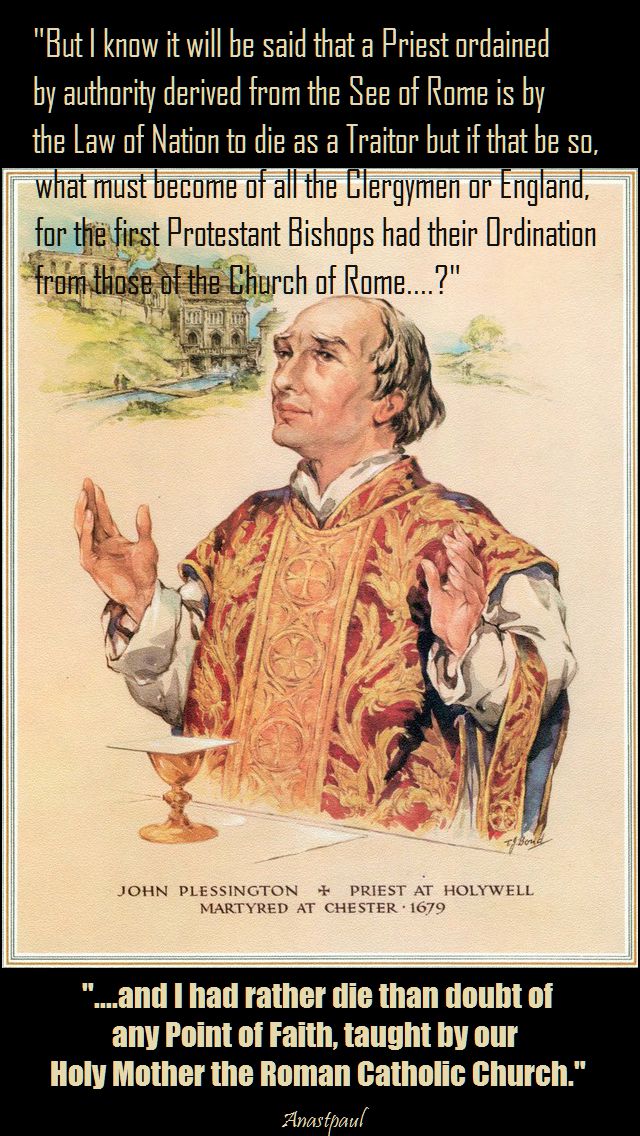
“But I know it will be said that a Priest ordained by authority derived from the See of Rome is by the Law of Nation to die as a Traitor but if that be so, what must become of all the Clergymen or England, for the first Protestant Bishops had their Ordination from those of the Church of Rome….?”

“Bear witness, good hearers, that I profess that I undoubtedly and firmly believe all the Articles of the Roman Catholic Faith and for the truth of any of them (by the assistance of God) I am willing to die and I had rather die than doubt of any Point of Faith, taught by our Holy Mother the Roman Catholic Church.”

St John Plessington
Martyred because he was a Priest by Elizabeth I of England

and I had rather die - st john plessington

Posted in MORNING Prayers, SAINT of the DAY

One Minute Reflection – 19 July

One Minute Reflection – 19 July

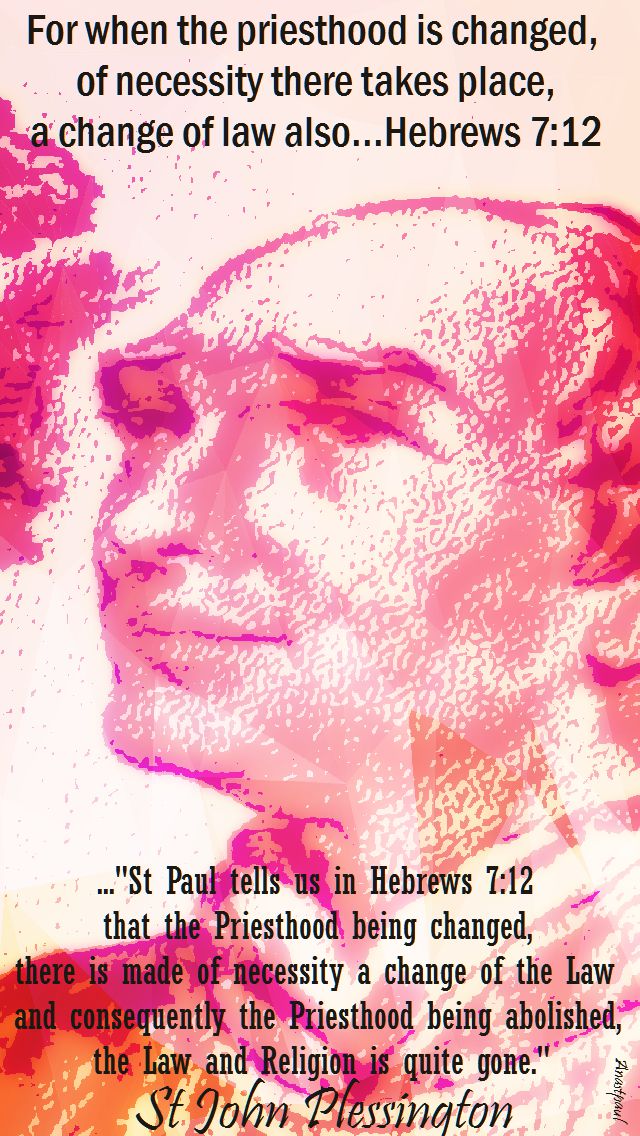
For when the priesthood is changed, of necessity there takes place a change of law also…Hebrews 7:12

REFLECTION – ” If you will consider either the Old or New Testament (for it is the Basis of Religion […], St Paul tells us in Hebrews 7:12 that the Priesthood being changed, there is made of necessity a change of the Law and consequently the Priesthood being abolished, the Law and Religion is quite gone.”…….St John Plessington

st Paull tells us in hebrews 7 12-st john plessington

PRAYER – Holy God, help us to pray continually for our priests, to respect them and consider them as representatives of You. Grant that the law of our lands may never regard them as men of God and of the law. St John Plessington, you were martyred because you were a priest of God, please pray for all our priests and for us, amen.

st john plessington - pray for us

Posted in CATHOLIC DEVOTIONS of the Month, DEVOTIO, MORNING Prayers, The HOLY NAME

The Wonders of the Holy Name – Fr Paul O’Sullivan, O.P. – “Revealing the Simplest Secret Ever of Holiness and Happiness.” Part Ten – 19 July

Previous – here: https://anastpaul.wordpress.com/category/the-holy-name/

the wonders of the holy name-day ten-17 july

The Saints and the Holy Name contd.

Blessed Gonzalo de Amarante:  reached a very
eminent degree of sanctity by the frequent repetition
of the Holy Name.

The Blessed Giles of Santarem:  felt so much
love and delight in saying the Holy Name that he
was raised in the air in ecstasy.
Those who repeat frequently the Name of Jesus
feel a great peace in their souls “that peace which
the World cannot give”, which God alone gives,
a peace “that surpasses all understanding”.

St Leonard of Portmaurlce:  cherished a tender
devotion to the Name of Jesus and in his continual
missions taught the people who thronged to
listen to him the wonders of the Holy Name.
This he did with such love that tears flowed from
his eyes and from the eyes of all who heard him.
He begged them to put a card with this Divine
Name on their doors.   This was attended with the
happiest results for many were thus saved from
sickness and disasters of various kinds.
One, unfortunately, was prevented from doing
so as a Jew who was part-owner of the house in
which he lived sternly refused to have the Name
of Jesus placed on the door.   His fellow lodger then
decided that he would write it on his windows,
which he accordingly did.   Some days after a
fierce fire broke out in the building which destroyed
all the appartments belonging to the Jew while
the rooms belonging to his Christian neighbour in
no wise suffered from the conflagration.
This fact was made public and increased a
hundred fold the faith and trust in the Holy Name
of Our Saviour.   In fact the whole city of Ferrajo
was a witness of this extraordinary protection.

St Edmund:  had special devotion to the Name
of Jesus which Our Lord Himself taught him.
One day when he was in the country and separated
from his companions a beautiful child stood
by him and asked: “Edmund do you not know
me?”   Edmund replied that he did not.    Then
replied the child:  “Look at me and you will see
who I am.”   Edmund looked as he was bidden
and saw written on the Child’s forehead:  “Jesus
of Nazareth. King of the Jews” “Know now who
I am” said the child “every night make the sign
of the cross and say these. words: “Jesus of Nazareth
King of the Jews.”   “If you do so this
prayer will deliver you and all who say it from
sudden and unprovided-for deaths.”
Edmund faithfully did as Our Lord told him.
The devil once tried to prevent him and held his
hands so that he could not make the holy sign.
Edmund invoked the Name of Jesus and the devil
fled in terror leaving him unmolested for the
future.
Many people practise this easy devotion and so
save themselves from unhappy deaths.   Others
with their forefinger imprint with holy water on
their foreheads the four letters I. N. R. I. to signify
Jesus Nazarenus Rex Judeorum. the words
written by Pilate for the cross of Our Lord.
St Alphonsus earnestly recommends both these
devotions.

St Frances of Rome:  enjoyed the extraordinary
privilege of constantly seeing and speaking to her
Angel Guardian.   When she pronounced the Name
of Jesus the Angel was radiant with happiness and
bent down in loving adoration.
Sometimes the devil dared to appear to her
seeking to frighten her and do her harm.   But
when she pronounced the Holy Name he was filled
with rage and hatred and fled in terror from her
presence.

St Jane of Chantal:  that most lovable friend
of St. Francis de Sales, had many beautiful devotions
taught her by this holy Doctor who acted
as her spiritual adviser for many years.   She so
loved the Name of Jesus that she actually wrote
it with a hot iron on her breast.

Blessed Henry Suso – had done the same with a pointed steel
rod.

We may not aspire to this holy daring, we may
with reason lack the courage of inscribing the
Holy Name on our breasts.   This needs a special
inspiration from God.   But we may follow the
example of another dear St B. Catherine of
Racconigi, a daughter of St. Dominic, who repeated
frequently and lovingly the Name of Jesus so
that after her death the Name of Jesus was found
engraved in letters of gold on her heart.   We
all can do as she did and thus the Name of Jesus
will be emblazoned on our souls for all Eternity
in sight of the Saints and Angels in Heaven.

St Gemma Galganl:   Almost in our own days this
dear girl Saint also had the privilege of frequent
and intimate converse with her Angel Guardian.
Sometimes the Angel and Gemma entered into a
holy contest as to which of them could say more
lovingly the Name of Jesus.

Posted in MORNING Prayers, PRAYERS of the SAINTS

Our Morning Offering – 19 July

Our Morning Offering – 19 July

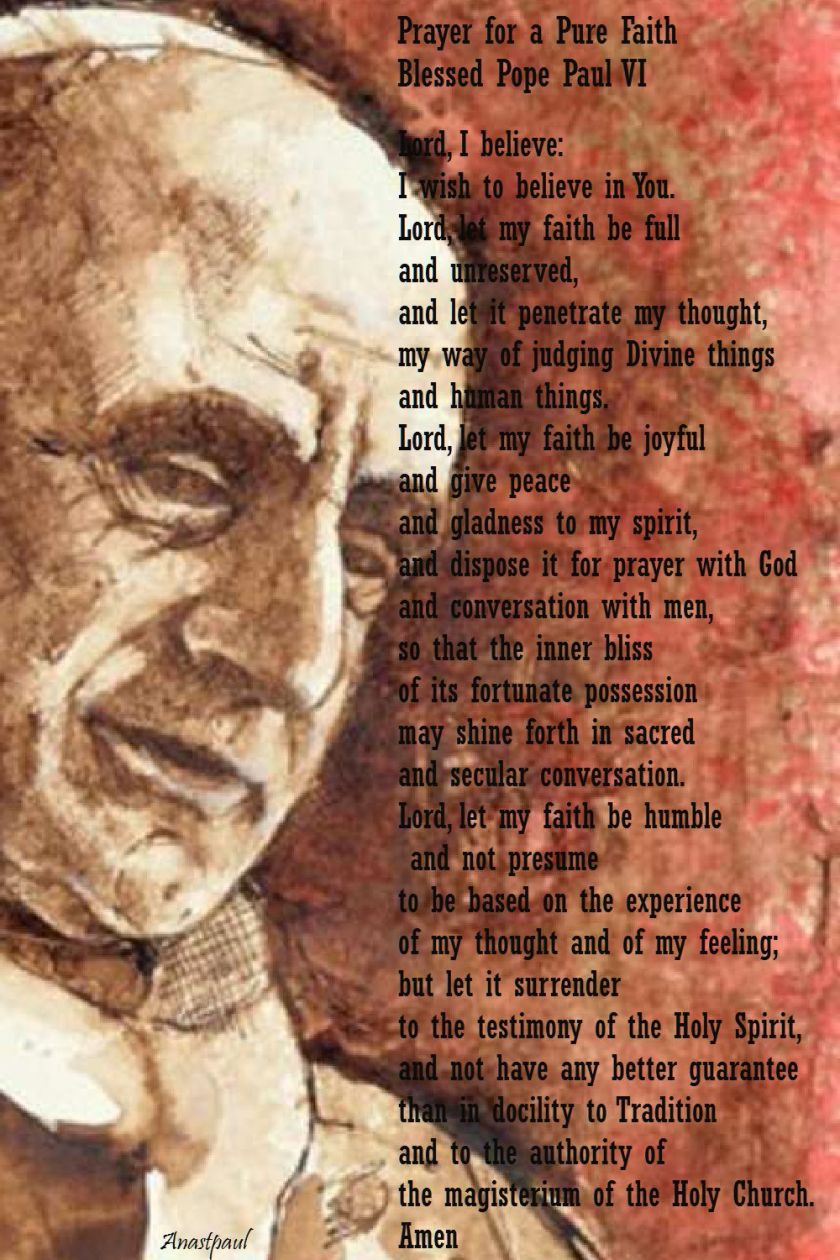
Prayer for a Pure Faith
Blessed Pope Paul VI

Lord, I believe:
I wish to believe in You.
Lord, let my faith be full
and unreserved,
and let it penetrate my thought,
my way of judging Divine things
and human things.
Lord, let my faith be joyful
and give peace
and gladness to my spirit,
and dispose it for prayer with God
and conversation with men,
so that the inner bliss
of its fortunate possession
may shine forth in sacred
and secular conversation.
Lord, let my faith be humble
and not presume
to be based on the experience
of my thought and of my feeling;
but let it surrender
to the testimony of the Holy Spirit,
and not have any better guarantee
than in docility to Tradition
and to the authority of
the magisterium of the Holy Church.
Amen

prayer of bl pope paul VI - lord I believe

Posted in SAINT of the DAY

Saint of the Day – 19 July – St John Plessington

Saint of the Day – 19 July – St John Plessington – Priest and Martyr – also known as  John Plesington, William Scarisbrick, William Pleasington.   Additional Memorial – 25 October as one of the Forty Martyrs of England and Wales – (c 1637 at Dimples Hall, Lancashire, England – hanged, drawn and quartered on 19 July 1679 at Barrows Hill, Boughton, England).   He was buried in the local cemetery of Burton, England.   He was beatified in 1929 by Pope Pius XI  and canonised on 25 October 1970 by Pope Paul VI.

st john plessington BIG

He was born at Dimples Hall, Garstang, Lancashire, the son of Robert Plessington, a Royalist Roman Catholic and Alice Rawstone, a family thus persecuted for both their religious and political beliefs.

He was educated by the Jesuits at Scarisbrick Hall, then at the Royal College of Saint Alban at Valladolid, Spain and then at Saint Omer Seminary in France.   He was ordained in Segovia, Spain, on 25 March 1662.   He returned to England in 1663 ministering to covert Catholics in the areas of Holywell and Cheshire, often hiding under the name John Scarisbrick.   He was also tutor at Puddington Old Hall near Chester.   Upon arrest in Chester during the Popish Plot scare caused by Titus Oates, he was imprisoned for two months and then hanged, drawn and quartered for the crime of being a Catholic priest.

40 martyrs painting.2jpg

40 martyrs
No 8 is our Saint today St John Plessington

english martyrs

It would be another 200 years until the bones were found in a trunk in the Old Star Inn in the village of Holywell close to St Winefride’s Well, a medieval pilgrimage site visited by Henry V after Agincourt, and where John Plessington himself had ministered during his lifetime.

It was known that the building had doubled as a secret headquarters for the Jesuits, and the obvious signs of violent death made it seem likely that the bones were those of murdered Catholics.   They were taken to the nearby St Bueno’s Jesuit retreat house at nearby Tremeirchion and venerated as those unknown martyrs until recently but went largely forgotten to the wider world.
At the time, no-one considered the possibility they could be those of John Plessington, not least because there was already a grave thought to have been his in the village of Burton on the Wirral.   It was not until 1962, as moves were afoot to canonise the executed priest, that it was exhumed and remains removed for study by experts at Liverpool University but found to be those of a younger man and therefore ruled out.
Then more recently, after the bones had been returned to Holywell, a group of forensic pathologists were asked to investigate them.
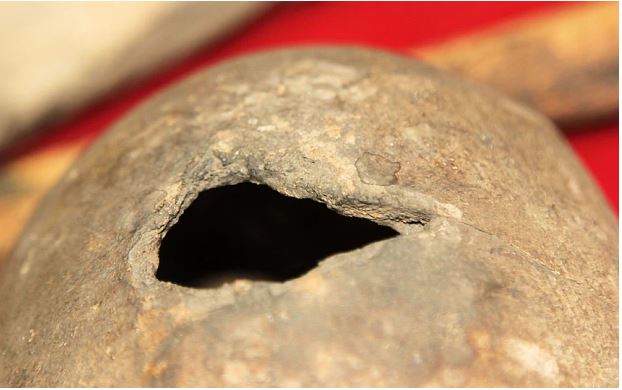
They singled out a portion of skull with a large hole apparently cut from inside – consistent with having been impaled on a spike after the person was beheaded.
It matched vertebrae from a neck which they concluded appeared to have been hacked off and a section of leg which linked to bone from a pelvis also bearing the marks of being cut.
Together, the report concluded, the presence of what appeared to be one of the quarters of a body and the fact that had been preserved in a Catholic context, as well as date of the clothing they were wrapped in meant they were almost certainly those of an executed priest.

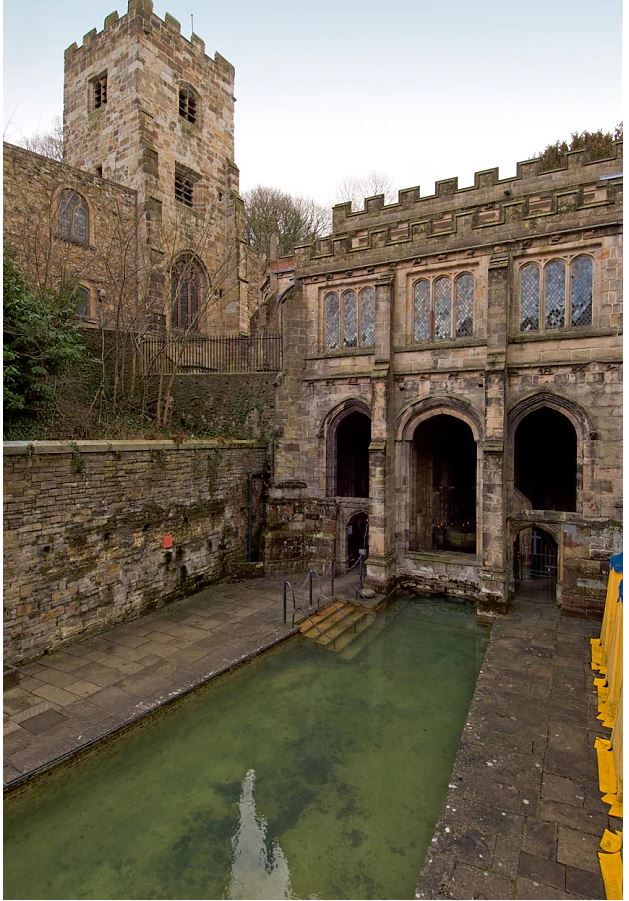
st winyfrides well
St Winefride’s Well in Holywell, Flintshire
skull st john
The Skull believed to be that of St John Plessington

St John Plessington’s close connection with the area, the date of his death and the mystery over his supposed grave now point to the possibility that the remains are his.
Bishop Davis is hoping to raise tens of thousands of pounds for new research including DNA testing which could connect them to a lock of hair which has also attributed to St John Plessington.
“By his faithfulness to the point of death, St John Plessington stands out as the great witness to the priestly life and mission in Shrewsbury Diocese,” said the bishop.
“As one of England’s 40 martyrs he points to the long continuity of our Catholic faith and our unswerving loyalty to the See of Peter.
“If funds could be found to identify and authenticate his relics it would allow our connection to his heroic ministry and martyrdom to become visible and tangible in a new way for generations to come.”

Posted in CATHOLIC DEVOTIONS of the Month, DEVOTIO, MORNING Prayers, The HOLY NAME

The Wonders of the Holy Name – Fr Paul O’Sullivan, O.P. – “Revealing the Simplest Secret Ever of Holiness and Happiness.” Part Nine – 18 July

Previous – here: https://anastpaul.wordpress.com/category/the-holy-name/

the wonders of the holy name-day nine-18 july

The Saints and the Holy Name contd

St Francis of Asslsi:  that burning Seraph of
love found his delights in repeating the loved Name
of Jesus.   St. Bonaventure says that his face lit
up with joy and his voice showed by its tender
accents how much he loved to invoke this all-Holy
Name.
No ‘wonder then that he received on his hands
and feet and side the marks of the Five Wounds
of Our Lord, a reward of his burning love.

St Ignatius of Loyola:  was second to none in
his love for the Holy Name.   He gave to his great
Order not his own name but called it the Society
of Jesus.   This Divine Name has been, as it
were a shield and defence of the · Order against
its enemies and a guarantee of the holiness and
sanctity of its members.   Glorious, indeed is the
great Society of Jesus.  And now, our present Holy Father , too is a Jesuit.

St Francis de Sales:   has no hesitation in saying
that those who have the custom of repeating
the Holy Name frequently may feel certain of
dying a holy and happy death.
And, indeed, there can be no doubt of this
because every time we say Jesus we apply the
saving Blood of Jesus to our Souls, at the same
time we implore God, to do as He has promised,
granting us everything we ask in His Name.   All
who desire a holy death can secure it by repeating
the Name of Jesus.   Not only will this practice
obtain for us a holy death but it will lessen
notably our time in Purgatory and may very possibly
deliver us altogether from that dreadful fire.
Many saints spent their last days repeating
constantly Jesus, Jesus.
ALL the doctors of the Church agree in telling
us that the devil reserves his fiercest temptations
for our last moments and then he fills the minds
of the dying person with doubts, fears and
dreadful temptations in the hope of, at last,
carrying the unfortunate . soul to Hell.   Happy
those who in life have made sure of acquiring
the habit of calling on the Name of Jesus.
Facts like these we have just mentioned are to
be found in the 1ives of all the great servants of
God who became saints and reached the highest
degrees of sanctity by this simple and easy
means.
St Vincent Ferrer:  one of the most famous
preachers that the World has ever seen, converted
the most abandoned criminals and transformed
them into the most fervent Christians.   He converted
80000 Jews, and 70000 Moors, a prodigy
we read of in the life of no other saint.   He
worked an incredible number of miracles.  Three
miracles are demanded by the Church for the
canonisation of the saints, whereas in the bull of
canonisation of St. Vincent 873 are mentioned.
This great saint burned with love for the Name
of Jesus and with this Divine Name worked
extraordinary wonders. .
We, therefore, sinful as we are, can with this
Omnipotent Name obtain every favour and every
grace.   The weakest mortals become strong, the
most afflicted find in it consolation and joy.
Who then can be so foolish or negligent as not
to acquire the habit of repeating Jesus, Jesus, Jesus
constantly.   It robs us of no time, presents no
difficulty and is an infallible remedy for every evil.

Posted in MORNING Prayers, QUOTES of the SAINTS, SAINT of the DAY, The WORD

Thought for the Day – 18 July

Thought for the Day – 18 July

Commentary Saint Bruno of Segni on Mark 16:17-18

The Lord said to the Eleven: “These signs will accompany those who believe: in my name they will drive out demons, they will speak new languages. They will pick up serpents in their hands and if they drink any deadly thing, it will not harm them. They will lay hands on the sick and they will recover”. ..Mark 16:17-18
In the primitive Church all the signs the Lord lists here were fulfilled to the letter, not only by the apostles but many other of the saints.  The Gentiles would not have abandoned the worship of idols if the gospel preaching had not been confirmed with so many signs and wonders.   Indeed, did not the disciples preach “a crucified Christ, a stumbling block to Jews and foolishness to Gentiles,” according to Saint Paul’s saying? (1Cor 1,23)…
As for us, from now on signs and wonders are no longer needed:  it is enough for us to read or hear an account of those that have happened. For we believe in the Gospel, we believe in the Scriptures that relate them.   And yet signs still take place daily and, if we would mark them well, we would acknowledge that they have far more worth than the concrete miracles of former times:

Every day priests administer baptism and call to conversion:  isn’t this to cast out demons?

Every day they speak a new language when they explain holy Scripture by replacing the old letter with the newness of its spiritual sense.

They put serpents to flight when they free sinners’ hearts from their attachment to evil with gentle exhortation…

They heal the sick when they reconcile weak souls to God with their prayers.

Such are the signs the Lord had promised his saints –  it is these they accomplish even today.

St Bruno of Segni – pray for us!

st bruno of segni pray for us.2

Posted in EUCHARISTIC Adoration, QUOTES of the SAINTS, The HOLY EUCHARIST / The HOLY MASS

Quote of the Day – 18 July

Quote of the Day – 18 July

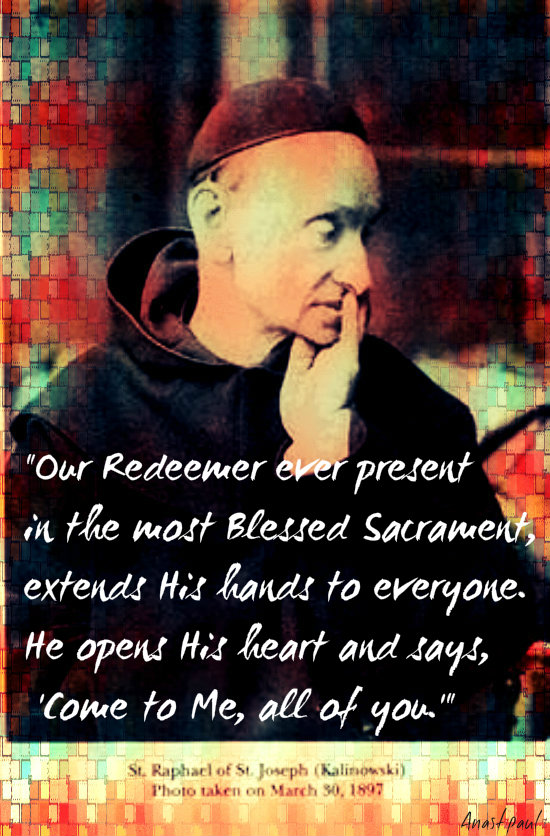
“Our Redeemer ever present in the most Blessed Sacrament, extends His hands to everyone.
He opens His heart and says, ‘Come to Me, all of you.’ “

QUOTE OF THE DAY

St Raphael Kalinowski

Posted in EUCHARISTIC Adoration, MORNING Prayers, PAPAL ENCYLICALS, QUOTES of the SAINTS, SAINT of the DAY, The HOLY EUCHARIST / The HOLY MASS, The WORD

One Minute Reflection – 18 July

One Minute Reflection – 18 July

Lo, I am with you always, to the close of the age……Matthew 28:20

REFLECTION – “For the most holy Eucharist contains the Church’s entire spiritual wealth:  Christ Himself, our Passover and living bread.   Through His own flesh, now made living and life-giving by the Holy Spirit, He offers life to men………The sacrifice of Christ and the sacrifice of the Eucharist are one single sacrifice.”…….St John Paul (Ecclesia de Eucharistia 1 &12)

through his own flesh - st john paul

PRAYER – Lord, let me live each day in joy – for You are with us to end of time.   We have the joy of receiving Your Body and thus we live in You and You in us.   Help us to give thanks and praise for the Holy Mass and Your saving Passion.   St Bruno of Segni, your great love of the Holy Sacrament, led you to zealous efforts to spend your life in growing in others, understanding of the great Eucharistic grace we receive, please pray for us, amen.

st bruno of segni pray for us

Posted in EUCHARISTIC Adoration, MORNING Prayers, PRAYERS of the SAINTS, The HOLY EUCHARIST / The HOLY MASS

Our Morning Offering – 18 July

Our Morning Offering – 18 July

Eucharistic Lord Jesus
St Pope John Paul – Cremona,Italy, June 21,1992

Lord Jesus,
who in the Eucharist make Your dwelling among us
and become our travelling companion,
sustain Our Christian communities
so that they may be ever more open to listening
and accepting Your Word.
May they draw from the Eucharist
a renewed commitment to spreading in society,
by the proclamation of Your Gospel,
the signs and deeds of an attentive and active charity.
Lord Jesus, in Your Eucharist
make Christian spouses
the “signs” of Your nuptial love among us:
make families communities of people who,
living in dialogue with God and each other,
do not fear life
and become responsible for sowing the seeds
of priestly, religious and missionary vocations.
Lord Jesus, from Your altar
illuminate this world with light and grace,
so that it may reject the seduction
of a materialistic conception of life,
and defeat the selfishness that threatens it,
the injustices that upset it,
and the divisions with which it is affliicted.
Lord Jesus: give us Your joy, give us Your peace.
Stay with us, Lord!
You alone have the words of eternal life! Amen

eucharistic lord jesus by st john paul


Posted in DOMINICAN OP, SAINT of the DAY

Saint of the Day – 18 July – St Bruno of Segni (1049-1123)

Saint of the Day – 18 July – St Bruno of Segni OSB (1049-1123) – Benedictine Bishop, Confessor, Missionary, Papal Advisor, Theologian, (1049 at Solero, Piedmont, Italy – 1123 of natural causes).   He was Canonised on 5 September 1183 by Pope Lucius III.  Patron of Segni, Italy.

San_Bruno

St Bruno was of the illustrious family of the lords of Asti in Piemont and born near that city.   From his cradle he considered that man’s happiness is only to be found in loving God:  and to please Him in all his actions was his only and his most ardent desire.    He made his studies in the monastery of St Perpetuus, in the diocess of Asti.

In the Roman council in 1079, he defended the doctrine of the Catholic Church concerning the blessed eucharist against Berengarius;   and Pope Gregory VII nominated him bishop of Segni in the ecclesiastical state in 1081.   Bruno, who had been compelled to submit to the appointment, after a long and strenuous resistance, served his flock and on many important occasions the universal church with unwearied zeal.   Gregory VII who died in 1085, Victor III formerly abbot of mount Cassino, who died in 1087 and Urban II who had been scholar to St. Bruno (afterwards institutor of the Carthusians) at Rheims, then a monk at Cluni and afterwards bishop of Ostia, had the greatest esteem for our saint.

He attended Urban II into France in 1095 and assisted at the council of Tours in 1096. After his return into Italy he continued to labour for the sanctification of his soul and that of his flock, till not being able any longer to resist his inclination for solitude and retirement, he withdrew to mount Cassino and put on the monastic habit.   The people of Segni demanded him back;  but Oderisus, abbot of mount Cassino and several cardinals, whose mediation the saint employed, prevailed upon the pope to allow his retreat.   The abbot Oderisus was succeeded by Otho in 1105 and this latter dying in 1107, the monks chose bishop Bruno abbot.   He was often employed by the pope in important commissions and by his writings laboured to support ecclesiastical discipline and to extirpate simony.   This vice he looked upon as the source of all the disorders which excited the tears of all zealous pastors in the church, by filling the sanctuary with hirelings, whose worldly spirit raises an insuperable opposition to that of the gospel.

Paschal II formerly a monk of Cluni, succeeded Urban II in the pontificate in 1099.   By his order St. Bruno having been abbot of mount Cassino about four years, returned to his bishopric and left his abbatial crozier on the altar.  He continued faithfully to discharge the episcopal functions to his death, which happened at Segni on the 31st of August in 1125.   He was canonized by Lucius III in 1183.

The works of St. Bruno of Segni, or of Asti, with a preliminary dissertation of Dom Maur Marchesi, were printed at Venice in 1651, in two vols. folio and in the Bibl. Patr. at Lyons in 1677, t. 20.   They consist of comments on several parts of scripture, one hundred and forty-five sermons, several dogmatical treatises and letters; and a life of St Leo IX and another of St Peter, bishop of Anagnia, whom Paschal II canonised.  Most importantly Bruno’s theologial work on the Holy Eucharist set the standard for centuries and he is considered one of the greatest biblical commentators of his era.

Fr Alban Butler (1711–73). Volume VII: The Lives of the Saints. 1866

Posted in SAINT of the DAY, The BLESSED VIRGIN MARY

Saints’ Memorials and Feast of the Blessed Virgin

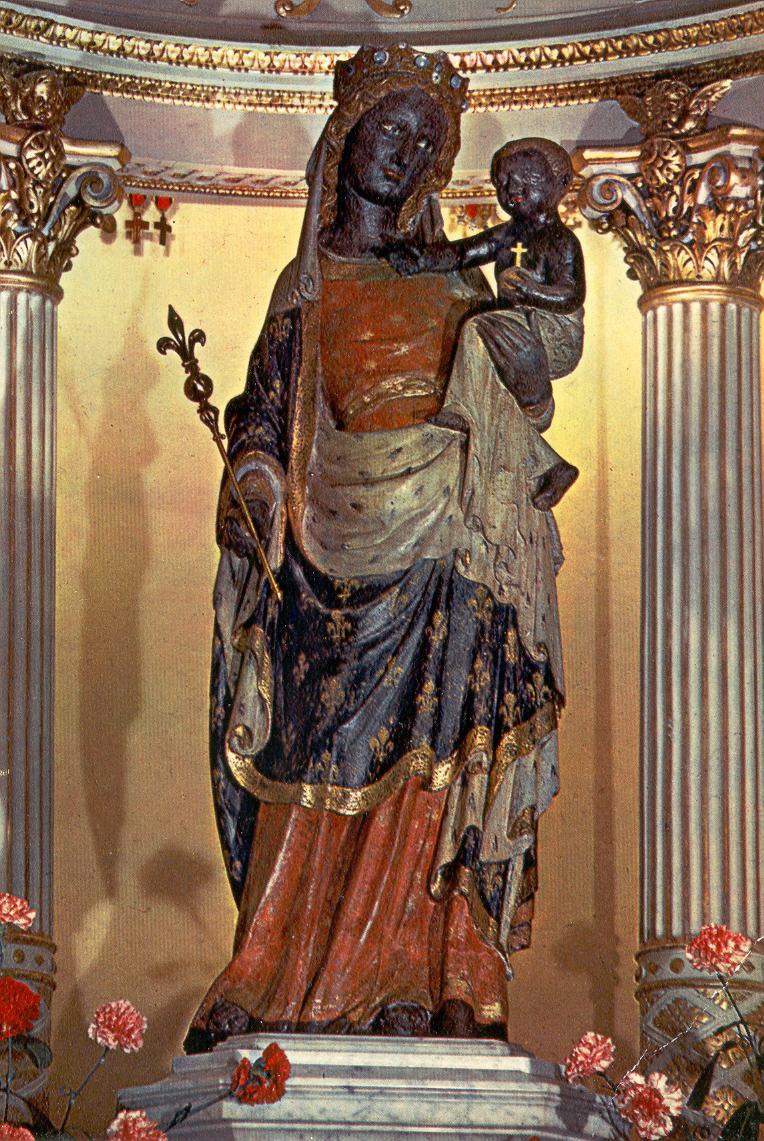
Our Lady of Good Deliverance:   Since the 1000s, the Church of Saint-Etienne-des-Grès in the old Latin Quarter of Paris had a chapel to Our Lady of Good Deliverance, where, across the centuries, pilgrims sought the Virgin’s help with all kinds of sufferings.   During the Wars of Religion and counter-Reformation, her confraternity had 12,000 members, including the King and Queen of France.   In 1587, young Francis de Sales, feeling himself damned, recovered confidence and joy after saying the prayer that had been pasted to a tablet before her statue, the Memorare.
In 1790, the revolutionary government closed the Church of Saint-Etienne-des-Grès. In 1791, when the church’s furnishings were advertised for sale, a devoted countess, Madame de Carignan Saint Maurice, bought the statue of the Black Virgin and moved it to her lodgings in Paris.   The following year, St.-Etienne’s was destroyed.   In 1793, the countess was sent to prison, where she met the Sisters of St. Thomas of Villanova.   They all got out the next year but when the government threatened to disband the Sisters, Mme de Carignan vowed to give them the statue if they were spared.   In 1806, she fulfilled the vow.   The image was installed in the Sisters’ chapel in Paris, moving with them in 1908 to their present motherhouse in the suburb of Neuilly-sur-Seine.
On a pedestal above the altar, the life-size polychrome limestone statue dates from the 1300s:   a classic Gothic standing mother and child, but both coal-black.   The Black Virgin wears a white veil and dark blue mantle ornamented with fleurs-de-lys over a red robe. Every day, the Sisters gather in the chapel to pray on behalf of families, the sick, religious vocations, those who have entrusted themselves to the Virgin and peace in the world.
The feast of Our Lady of Good Deliverance, is set for July 18, the date when the Vatican officially approved the congregation of Soeurs de Saint Thomas de Villenueve in 1873. The May 1 procession formerly held by her confraternity has been revived in recent years by the Chapter of Our Lady of Good Deliverance, Neuilly’s branch of Notre-Dame de Chrétienté.

our lady of good dliverance - 18 july

St Aemilian of Dorostorium
St Alanus of Sassovivo
St Alfons Tracki
Bl Arnold of Amiens
St Arnoul the Martyr
St Arnulf of Metz
St Athanasius of Clysma
Bl Bernard de Arenis
Bl Bertha de Marbais
St Bruno of Segni
St Ðaminh Ðinh Ðat
St Edburgh of Bicester
St Elio of Koper
St Frederick of Utrecht
St Goneri of Treguier
St Gundenis of Carthage
Bl Herveus
Bl Jean-Baptiste de Bruxelles
St Marina of Ourense
St Maternus of Milan
St Minnborinus
St Pambo of the Nitrian Desert
St Philastrius of Brescia
St Rufillus of Forlimpopoli
St Scariberga of Yvelines
St Szymon of Lipnicza
St Theneva
St Theodosia of Constantinople

Martyrs of Silistria – 7 saints: Seven Christians who were martyred together. No details about them have survived but the names – Bassus, Donata, Justus, Marinus, Maximus, Paulus and Secunda. They were martyred in Silistria (Durostorum), Moesia (in modern Bulgaria), date unknown.

Martyrs of Tivoli – 8 saints: A widow, Symphorosa and her seven sons ( Crescens, Eugene, Julian, Justin, Nemesius, Primitivus and Stracteus) martyred in Tivoli, Italy in the 2nd-century persecutions of Hadrian.

Posted in CATHOLIC DEVOTIONS of the Month, MORNING Prayers, The HOLY NAME

The Wonders of the Holy Name – Fr Paul O’Sullivan, O.P. – “Revealing the Simplest Secret Ever of Holiness and Happiness.” Part Eight – 17 July

Previous – here: https://anastpaul.wordpress.com/category/the-holy-name/

the wonders of the holy name-day eight-17 july

The Saints and the Holy Name

St Augustine:
This great Doctor of the Church,
found his delights in repeating the Holy Name.
He himself tells us that he found much pleasure
in books which made frequent mention of this all-consoling
Name.
St Bernard – felt a wonderful joy and consolation
in repeating the Name of Jesus.   He felt it, as he
says, like honey in his mouth and a delicious
peace in his heart.   We, too, shall feel immense
consolation and peace steal into our souls if we
imitate St. Bernard and repeat frequently this
Holy Name.
St Dominic – spent his days preaching
and discussing with the heretics.   He always went on
foot from place to place as well in the oppressive
heats of the summer as in the cold and rain of
winter.   The Albigensian heretics whom he tried to
convert were more like demons let loose from Hell
than mortal men.   Their doctrine was infamous
and their crimes enormous.   Yet, as another St.
Paul, he converted 100.000 of these wicked men so
that many of them became eminent for sanctity.
Wearied at night with his labours he asked only
for one reward which was to pass the night before
the Blessed Sacrament pouring out his soul in love
for Jesus.   When his poor body could resist no
longer he leaned his head against the Altar and
rested a little, after which he began once more his
intimate converse with Jesus.   In the morning he
celebrated Mass with the ardour of a seraph so that
at times his body was raised in the air in an
ecstasy of love.   The Name of Jesus filled his soul
with joy and delight.
Blessed Jordan of Saxony –  who succeeded St
Dominic as Master General of the Order, was a
preacher of great renown.   His words went straight
to the heart of his hearers above all when he spoke
to them of Jesus.   Learned professors of the University cities came
with delight to hear him and so many of them be~
came Dominican friars that others feared to come,
lest they, too, should be induced to join his Order.
So many were drawn by his irresistible eloquence
that when his visit to a city was announced the Prior
of the convent bought at once a great quantity of
white cloth to make habits for those who were
sure to seek entrance to the Order.   Blessed Jordan
himself received one thousand postulants to the
habit among whom were the most eminent professors
of the European Universities.

Posted in CARMELITES, CATHOLIC DEVOTIONS of the Month, CATHOLIC-PRAYERS OF THE CHURCH, HYMNS, MORNING Prayers, POETRY, QUOTES of the SAINTS, SAINT of the DAY

Thought for the day – 17 July – THE SIXTEEN CARMELITE MARTYRS OF COMPIEGNE

Thought for the day – THE SIXTEEN CARMELITE MARTYRS OF  COMPIEGNE

The French Revolution reveals the titanic struggle between good and evil.   During the terror, over 40,000 Frenchmen were executed just for holding fast to the Catholic Faith and objecting to the worst excesses of the Committee of Public Safety.   The blood lost in the years of 1792-1794 staggers the imagination even in the retelling and the campaign against the Church was as diabolical as it was cruel.

Contemplative religious communities had been among the first targets of the fury of the French Revolution against the Catholic Church.   Less than a year from May 1789 when the Revolution began with the meeting of the Estates-General, these communities had been required by law to disband.   But many of them continued in being, in hiding. Among these were the community of the Carmelite nuns of Compiegne, in northeastern France not far from Paris – the fifty-third convent in France of the Carmelite sisters who followed the reform of  St. Teresa of Avila, founded in 1641, noted throughout its history for fidelity and fervour.   Their convent was raided in August 1790, all the property of the sisters was seized by the government and they were forced to discard their habits and leave their house.   They divided into four groups which found lodging in four different houses all near the same church in Compiegne and for several years they were to a large extent able to continue their religious life in secret.   But the intensified surveillance and searches of the “Great Terror” revealed their secret and in June 1794 most of them were arrested and imprisoned.

They had expected this; indeed, they had prayed for it.   At some time during the summer of 1792, very likely just after the events of August 10 of that year that marked the descent into the true deeps of the Revolution, their prioress, Madeleine Lidoine, whose name in religion was Teresa in honour of the founder of their order, by all accounts a charming  perceptive and highly intelligent woman, had foreseen much of what was to come.   At Easter of 1792, she told her community that, while looking through the archives she had found the account of a dream a Carmelite had in 1693.   In that dream, the Sister saw the whole Community, with the exception of 2 or 3 Sisters, in glory and called to follow the Lamb. In the mind of the Prioress, this mean martyrdom and might well be a prophetic announcement of their fate.

Mother Teresa had said to her sisters: “Having meditated much on this subject, I have thought of making an act of consecration by which the Community would offer itself as a sacrifice to appease the anger of God, so that the divine peace of His Dear Son would be brought into the world, returned to the Church and the state.”   The sisters discussed her proposal and all agreed to it but the two oldest, who were hesitant.   But when the news of the September massacres came, mingling glorious martyrdom with apostasy, these two sisters made their choice, joining their commitment to that of the rest of the community.   All made their offering; it was to be accepted.

After their lodgings were invaded again in June, their devotional objects shattered and their tabernacle trampled underfoot by a Revolutionary who told them that their place of worship should be transformed into a dog kennel, the Carmelite sisters were taken to the Conciergerie prison, where so many of the leading victims of the guillotine had been held during their last days on earth.   There they composed a canticle for their martyrdom, to be sung to the familiar tune of the Marseillaise.   The original still exists, written in pencil and given to one of their fellow prisoners, a lay woman who survived.

On July 17 the sixteen sisters were brought before Fouquier-Tinville.   All cases were now being disposed of within twenty-four hours as Robespierre had wished;  theirs was no exception.   They were charged with having received arms for the émigrés; their prioress, Sister Teresa, answered by holding up a crucifix. “Here are the only arms that we have ever had in our house.”   They were charged with possessing an altar-cloth with designs honouring the old monarchy (perhaps the fleur-de-lis) and were asked  to deny any attachment to the royal family.   Sister Teresa responded: “If that is a crime, we are all guilty of it; you can never tear out of our hearts the attachment for Louis XVI and his family. Your laws cannot prohibit feeling; they cannot extend their empire to the affections of the soul; God alone has the right to judge them.”   They were charged with corresponding with priests forced to leave the country because they would not take the constitutional oath; they freely admitted this.   Finally they were charged with the catch–all indictment by which any serious Catholic in France could be guillotined during the Terror: “fanaticism.”   Sister Henriette, who had been Gabrielle de Croissy, challenged Fouguier-Tinvile to his face:  “Citizen, it is your duty to respond to the request of one condemned;  I call upon you to answer us and to tell us just what you mean by the word ‘fanatic.”   “I mean,” snapped the Public Prosecutor of the Terror, “your attachment to your childish beliefs and your silly religious practices.”   “Let us rejoice, my dear Mother and Sisters, in the joy of the Lord,” said Sister Henriette, “that we shall die for our holy religion, our faith, our confidence in the Holy Roman Catholic Church.”

Give over our hearts to joy, the day of glory has arrived.
Far from us all weakness, seeing the standard come;
We prepare for the victory, we all march to the true conquest,
Under the flag of the dying God we run, we all seek the glory;
Rekindle our ardour, our bodies are the Lord’s,
We climb, we climb the scaffold and give ourselves back to the Victor.

O happiness ever desired for Catholics of France,
To follow the wondrous road
Already marked out so often by the martyrs toward their suffering,
After Jesus with the King, we show our faith to Christians,
We adore a God of justice; as the fervent priest, the constant faithful,
Seal, seal with all their blood faith in the dying God….

Holy Virgin, our model, August queen of martyrs, deign to strengthen our zeal
And purify our desires, protect France even yet, help; us mount to Heaven,
make us feel even in these places, the effects of your power. Sustain your children,
Submissive, obedient, dying, dying with Jesus and in our King believing.

While in prison, they asked and were granted permission to wash their clothes.   As they had only one set of lay clothes, they put on their religious habit and set to the task. Providentially, the revolutionaries picked that “wash day” for their transfer to Paris.   As their clothes were soaking wet, the Carmelites left for Paris wearing their “outlawed” religious habit.   They celebrated the feast of Our Lady of Mount Carmel in prison, wondering whether they would die that day.

It was only the next day they went to the guillotine.   The journey in the carts took more than an hour.   All the way the Carmelite sisters sang: the “Miserere,” “Salve Regina,” and “Te Deum.”   Beholding them, a total silence fell on the raucous, brutal crowd, most of them cheapened and hardened by day after day of the spectacle of public slaughter.   At the foot of the towering killing machine, their eyes raised to Heaven, the sisters sang “Veni Creator Spiritus.”   One by one, they renewed their religious vows.   They pardoned their executioners.   One observer cried out: “Look at them and see if they do not have the air of angels!   By my faith, if these women did not all go straight to Paradise, then no one is there!

Sister Teresa, their prioress, requested and obtained permission to go last under the knife.   The youngest, Sister Constance, went first.   She climbed the steps of the guillotine With the air of a queen going to receive her crown,” singing Laudate Dominum omnes gentes, all peoples praise the Lord.”   She placed her head in the position for death without allowing the executioner to touch her.   Each sister followed her example, those remaining singing likewise with each, until only the prioress was left, holding in her hand a small figure of the Blessed Virgin Mary.   The killing of each martyr required about two minutes.   It was about eight o’clock in the evening, still bright at midsummer. During the whole time the profound silence of the crowd about the guillotine endured unbroken.

Two years before when the horror began, the Carmelite community at Compiegne had offered itself as a holocaust, that peace might be restored to France and the Church.   The return of full peace was still twenty-one years in the future.   But the Reign of Terror had only ten days left to run.   Years of war, oppression and persecution were yet to come but the mass official killing in the public squares of Paris was about to end.

The Cross had vanquished the guillotine.

These sixteen holy Carmelite nuns have all been beatified by our Holy Father, the Pope, (Pope St. Pius X, 27 May 1906) which is the last step before canonisation.    Blessed Carmelites of Compiegne, pray for us!
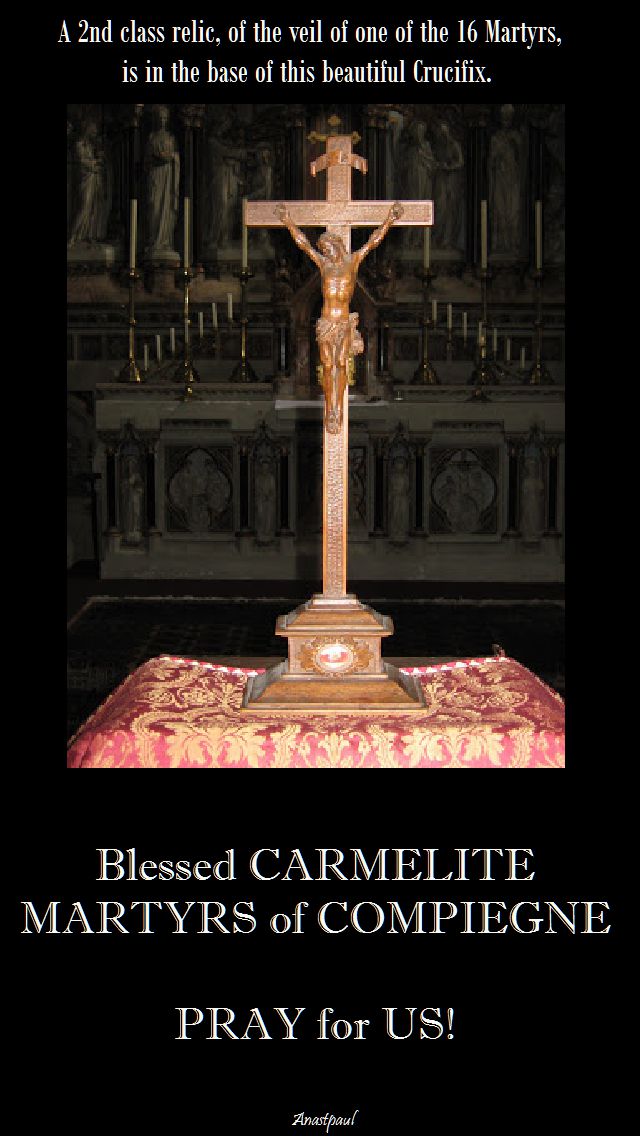
relic of the 16 martyrs of compiegne - pray for us!
Posted in CATHOLIC DEVOTIONS of the Month, DEVOTIO, DOCTORS of the Church, MORNING Prayers, QUOTES of the SAINTS, SAINT of the DAY, The HOLY EUCHARIST / The HOLY MASS

Quote/s of the Day – 17 July – Memorial of the 16 Carmelite Martyrs of Compiegne and July – the Month of the Most Precious Blood

Quote/s of the Day – 17 July – Memorial of the 16 Carmelite Martyrs of Compiegne

“This Blood, that but one drop of, has the power to win All the world, forgiveness of its world of sin.”

“If, then, you are looking for the way by which you should go, take Christ, because He Himself is the way.”

St. Thomas Aquinas

this blood-st thomas aquinas