Posted in PURGATORY, SAINT of the DAY, The HOLY SOULS

The Commemoration of All the Holy Souls in Purgatory – 2 November

The Commemoration of All the Holy Souls in Purgatory – 2 NovemberPurgatoryweb

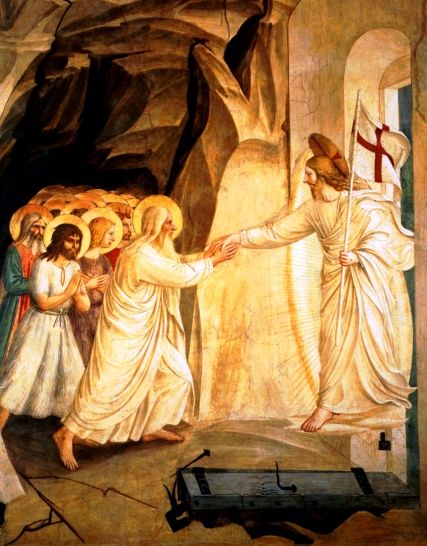
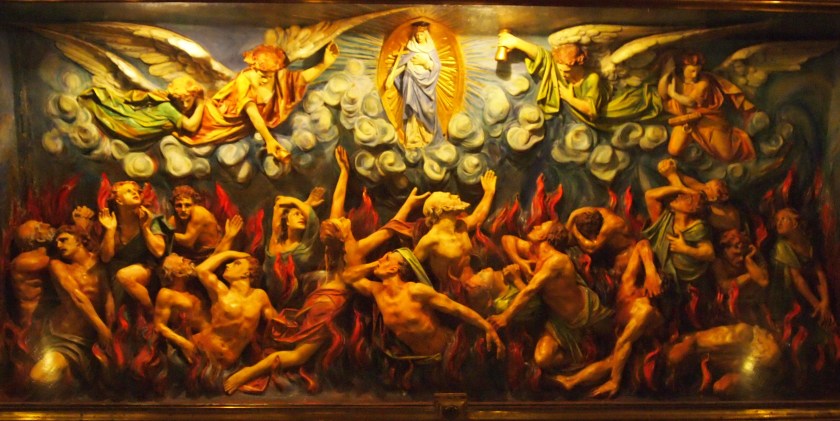
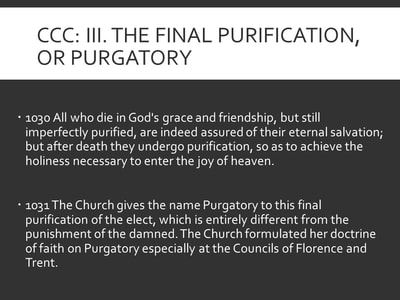
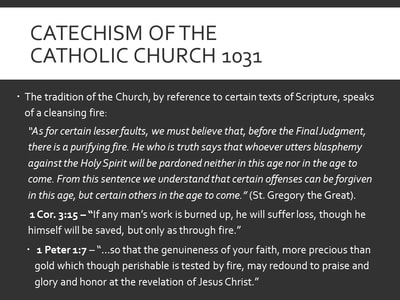
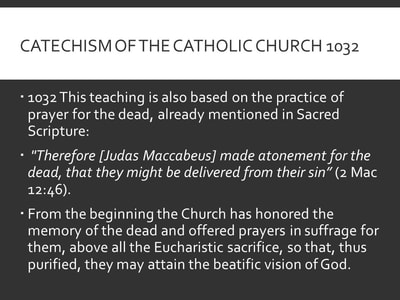
All Souls Day is a solemn celebration in the Roman Catholic Church commemorating all of those who have died and are now in Purgatory, being cleansed of their venial sins and the temporal punishments for the mortal sins that they had confessed and being made pure before entering into the presence of God in Heaven.1074-Souls-in-PurgatoryOLYMPUS DIGITAL CAMERA

THE HISTORY OF ALL SOULS DAY
The importance of All Souls Day was made clear by Pope Benedict XV (1914-1922), when he granted all priests the privilege of celebrating three Masses on All Souls Day:  one for the faithful departed;  one for the priest’s intentions; and one for the intentions of the Holy Father.   On only a handful of other very important feast days are priests allowed to celebrate more than two Masses.

While All Souls Day is now paired with All Saints Day (1 November), which celebrates all of the faithful who are in Heaven, it originally was celebrated in the Easter season, around Pentecost Sunday (and still is in the Eastern Catholic Churches).

By the tenth century, the celebration had been moved to October;  and sometime between 998 and 1030, St Odilo of Cluny decreed that it should be celebrated on 2 November in all of the monasteries of his Benedictine congregation.   Over the next two centuries, other Benedictines and the Carthusians began to celebrate it in their monasteries as well and soon the commemoration of all the Holy Souls in Purgatory spread to the entire Church.

OFFERING OUR EFFORTS ON BEHALF OF THE HOLY SOULS
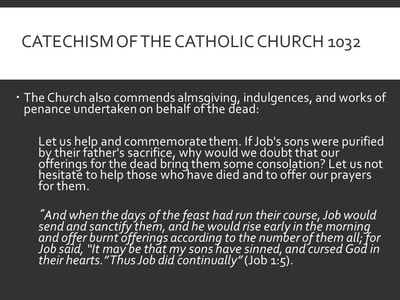
On All Souls Day, we not only remember the dead but we apply our efforts, through prayer, almsgiving and the Mass, to their release from Purgatory.   There are two plenary indulgences attached to All Souls Day, one for visiting a church and another for visiting a cemetery. (The plenary indulgence for visiting a cemetery can also be obtained every day from November 1-8, and, as a partial indulgence, on any day of the year.)   While the actions are performed by the living, the merits of the indulgences are applicable only to the souls in Purgatory.   Since a plenary indulgence removes all of the temporal punishment for sin, which is the reason why souls are in Purgatory in the first place, applying a plenary indulgence to one of the Holy Souls in Purgatory means that the Holy Soul is released from Purgatory and enters Heaven.

Praying for the dead is a Christian obligation.   In the modern world, when many have come to doubt the Church’s teaching on Purgatory, the need for such prayers has only increased.   The Church devotes the month of November to prayer for the Holy Souls in Purgatory and participation in the Mass of All Souls Day is a good way to begin the month.

slide9_3slide10_4slide11_3slide12_3

Posted in CATHOLIC DEVOTIONS of the Month, SAINT of the DAY

All Souls’ Day and Memorials of the Saints – 2 November

All Souls Day (Commemoration): Feast in commemoration of the faithful departed in Purgatory. Abbot Odilo of Cluny instituted it in the monasteries of his congregation in 998, other religious orders took up the observance and it was adopted by various dioceses and gradually by the whole Church. The Office of the Dead must be recited by the clergy on this day and Pope Benedict XV granted to all priests the privilege of saying three Masses of requiem –
• one for the souls in Purgatory
• one for the intention of the Holy Father
• one for the priest’s
If the feast should fall on Sunday it is kept on 3 November.
Patronage: Monselice, Italy
—
St Ambrose of Agaune
St Amicus of Fonte Avellana
St Amicus of Rambone
St Baya of Scotland
St Domninus of Grenoble
St Erc of Slane
St Eustochium of Tarsus
St George of Vienne
Bl John Bodey
St Jorandus of Kergrist
St Justus of Trieste
Bl Luigi Campidello
St Marcian of Chalcis
Bl Margaret of Lorraine
St Mateo López y López
St Maura of Scotland
St Theodotus of Laodicea
St Victorinus of Pettau
St Willebald of Bavaria
—
Martyrs of Isfahan – 5+ saints: Acindynus, Pegasius and Anempodistus were Persian priests who were imprisoned, tortured, interrogated and martyred in the persecutions of king Sapor II of Persia; he considered any Christian to be a Roman spy and anti-Persian. The three were brought back to life, miraculously healed, freed from their chains and began preaching Christianity, miraculously healing Sapor II in the process. This defiance enraged Sapor so much that he ordered them executed again; they were thrown into a cauldron of molten lead, but walked out unharmed. This miracle brought one of the torturers, Aphthonius, to convert; he was immediately martyred. Other attempts were made to kill them, and they emerged each time unharmed. Senator Elpidiphorus led a group speaking in favour of the Christians for their courage and faith; he was immediately executed. In the end the original three Christians were burned to death. Martyrs all – Acindynus, Anempodistus, Aphthonius, Elpidephorus and Pegasius.
They were born ibn Persia and Died:
• c.350 in Isfahan, Persia
• relics transferred to Constantinople and enshrined in a church dedicated to them
• some relics taken to France in 1204 during the 4th Crusade
• relics in France were lost when hidden from anti-Christian forces in the French Revolution
• relics in France re-discovered in 1892 in Grozon.

Martyrs of Sebaste – 10 saints: A group of ten soldiers in the imperial Roman army of Emperor Licinius Licinianus who were executed together for refusing to burn incense as a sacrifice to the emperor. The only details that have survived are five of their names – Agapius, Cartherius, Eudoxius, Styriacus and Tobias. They were burned at the stake in 315 in Sebaste (in modern Turkey).

Posted in CHRIST the KING, FEASTS and SOLEMNITIES, MORNING Prayers, NOVENAS

Announcing a Novena in Preparation for the Solemnity of Christ the King – 26 November 2017

Announcing a Novena in Preparation for the Solemnity of Christ the King – 26 November 2017

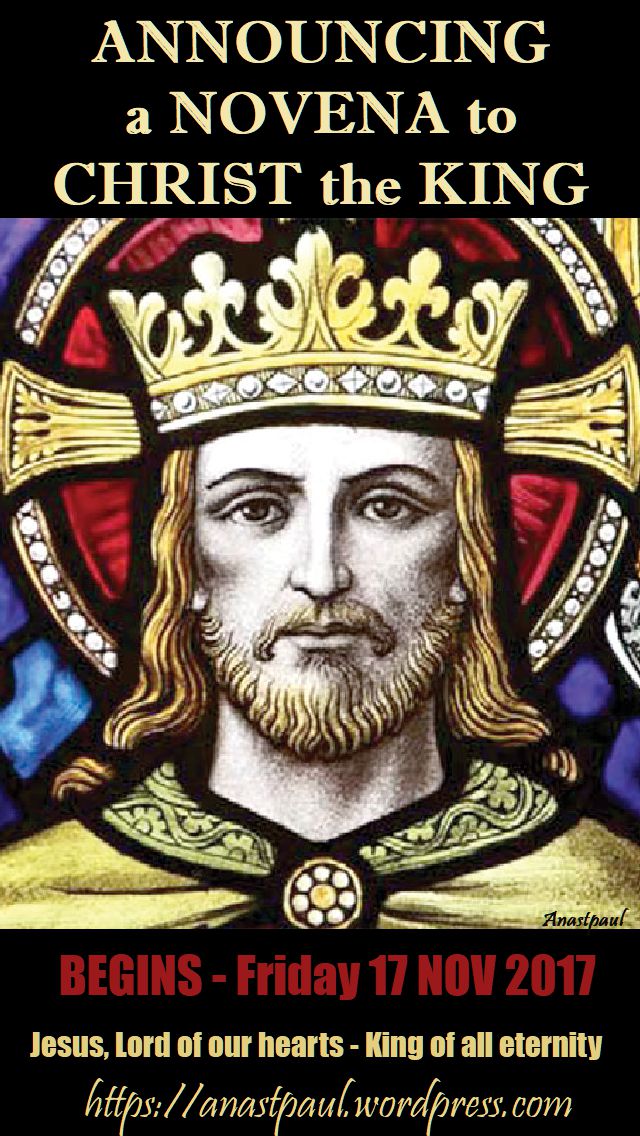
Let us enter into Nine days of prayer which will focus on Jesus as the Universal King.  The Roman Catholic Church sets aside the last Sunday of the liturgical year as the Feast of Christ the King, this year 2017, the Feast is on 26 November.

The Feast of Christ the King is, as Catholic feasts go, a relatively recent one.  It was established by Pope Pius XI in 1925, to remind Catholics (and the world generally) that Jesus Christ is Lord of the Universe, both as God and as Man.   Pius XI announced the feast in his encyclical Quas Primas, which was delivered on 11 December 1925.   At the end of the encyclical, he declared that he expected three “blessings” to flow from the celebration of the feast:   first, that “men will doubtless be reminded that the Church, founded by Christ as a perfect society, has a natural and inalienable right to perfect freedom and immunity from the power of the state”;   second, that “Nations will be reminded by the annual celebration of this feast that not only private individuals but also rulers and princes are bound to give public honour and obedience to Christ”;   and third, that “The faithful, moreover, by meditating upon these truths, will gain much strength and courage, enabling them to form their lives after the true Christian ideal.”

ANNOUNCING A NOVENA TO CHRIST THE KING - BEGINS FRIDAY 17 NOV


Posted in MORNING Prayers, PRAYERS for VARIOUS NEEDS, PRAYERS of the CHURCH

The HOLY FATHER’S PRAYER INTENTION for NOVEMBER 2017

The HOLY FATHER’S PRAYER INTENTION for NOVEMBER 2017

CHRISTIANS in ASIA:
That Christians in Asia, bearing witness to the Gospel
in word and deed, may promote dialogue, peace
and mutual understanding, especially with those of other religions.

the holy father's prayer intention november 2017

Posted in CATHOLIC-PRAYERS OF THE CHURCH, DEVOTIO, MORNING Prayers, ON the SAINTS

THE LITANY OF THE SAINTS – 1 November – The SOLEMNITY of ALL SAINTS

THE LITANY OF THE SAINTSPIC - LITANY 1- 1 nov 2017litany contd 2 - 1 nove 2017LITANY CONTD 3 - 1 NOV 2017

Posted in CATHOLIC DEVOTIONS of the Month, DEVOTIO, MORNING Prayers, PRACTISING CATHOLIC, PRAYERS for VARIOUS NEEDS, PRAYERS of the CHURCH, PURGATORY, The HOLY SOULS

Devotion for the Month of November – The Holy Souls/The Faithful Departed

Devotion for the Month of November – The Holy Souls/The Faithful Departednovember - the month of the holy souls

As Christmas approaches, it is natural that our thoughts turn to those whom we have loved who are no longer with us.

How appropriate, then, that the Catholic Church offers us November, which begins with All Saints Day and All Souls Day, as the Month of the Holy Souls in Purgatory—those who have died in grace, yet who failed in this life to make satisfaction for all of their sins.

In recent years, perhaps no Catholic doctrine has been more misunderstood by Catholics themselves than the doctrine of Purgatory.   Consequently, we tend to downplay it, even seem a little embarrassed by it and it is the Holy Souls who suffer because of our discomfort with the doctrine.

Purgatory is not, as many people think, one last trial.   All of those who make it to Purgatory will one day be in Heaven.   Purgatory is where those who have died in grace but who have not fully atoned for the temporal punishments resulting from their sins, go to finish their atonement before entering Heaven.   A soul in Purgatory may suffer but he has the assurance that he will ultimately enter Heaven when his punishment is complete.   Catholics believe Purgatory is an expression of God’s love, His desire to cleanse our souls of all that might keep us from experiencing the fullness of joy in Heaven.

As Christians, we don’t travel through this world alone.   Our salvation is wrapped up with the salvation of others and charity requires us to come to their aid.   The same is true of the Holy Souls.   In their time in Purgatory, they can pray for usand we should pray for the faithful departed that they may be freed from the punishment for their sins and enter into Heaven.

We should pray for the dead throughout the year, especially on the anniversary of their death but in this Month of the Holy Souls, we should devote some time every day to prayer for the dead.   We should start with those closest to us—our mother and father, for instance—but we should also offer prayers for all the souls,and especially for those most forsaken.

We believe that those Holy Souls for whom we pray will continue to pray for us after they have been released from Purgatory.   If we live Christian lives, we too will likely find ourselves in Purgatory someday and our acts of charity toward the Holy Souls there now will ensure that they remember us before the throne of God when we are most in need of prayers.   It’s a comforting thought and one that should encourage us, especially in this month of November, to offer our prayers for the Holy Souls.

Let us Pray:

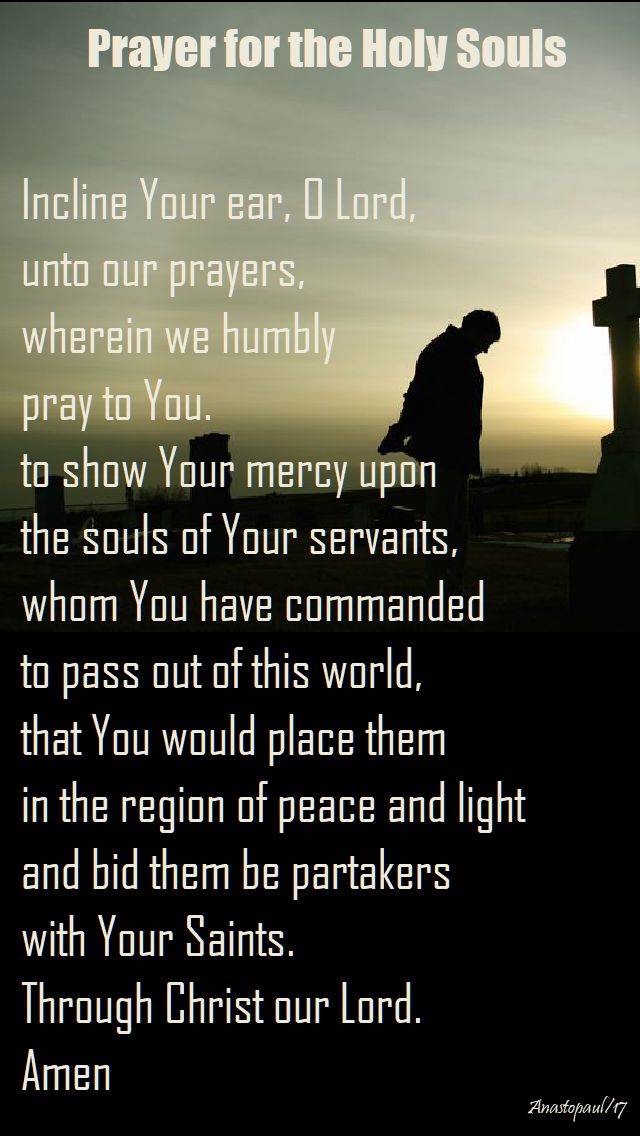
Incline Your ear, O Lord, unto our prayers,
wherein we humbly pray to You.
to show Your mercy upon the souls of Your servants,
whom You have commanded to pass out of this world,
that You would place them in the region of peace and light
and bid them be partakers with Your Saints.
Through Christ our Lord.   Amen incline your ear o lord - nov month of the holy souls

Posted in MORNING Prayers, ON the SAINTS, QUOTES - J R R Tolkien and MORE, SAINT of the DAY

Thought for the Day – 1 November – The Solemnity of All the Saints: “What is a Saint?”

Thought for the Day – 1 November – The Solemnity of All the Saints:

“What is a Saint?”

Saints are not freaks or exceptions, they are the standard operating model for human beings.   Because, as Charles Péguy put it, “life holds only one tragedy, ultimately: not to have been a saint.” 

Why does the Church include All Saints’ Day (1 Nov) in her calendar of solemn feasts? Why does the Apostles’ Creed include “the communion of saints” as one of the 12 essential articles of our faith?

Because, as Charles Péguy (1873-1914) put it, “life holds only one tragedy, ultimately: not to have been a saint.”

Saints are not freaks or exceptions:  They are the standard operating model for human beings.   In fact, in the biblical sense of the word, all believers are saints.   “Sanctity” means holiness.  All men, women and children, born or unborn, beautiful or ugly, straight or gay, are holy, for they bear the image of God.

Saints are not the opposite of sinners:  There are no opposites of sinners in this world. There are only saved sinners and unsaved sinners.   Thus holy does not mean “sinless” but “set-apart:”  called out of the world to the destiny of eternal ecstasy with God.

What is a saint?   First of all, one who knows he is a sinner.   A saint knows all the news, both the bad news of sin and the good news of salvation.   A saint is a true scientist, a true philosopher:

A saint knows the truth:   A saint is a seer, one who sees what’s there. A saint is a realist.

A saint is also an idealist:  A saint embraces heroic suffering out of heroic love.   A saint also embraces heroic joy.   (This is one of the criteria for canonisation:  Saints must have joy.)

A saint is a servant of Christ:  A saint is also a conqueror greater than Alexander, who only conquered the world.   A saint conquers himself.   What does it profit a man if he conquers the whole world but does not conquer himself?

A saint is so open that he can say, with Paul:   “I have learned, in whatever situation I find myself, to be self-sufficient.   I know how to live in humble circumstances;  I know also how to live with abundance” (Phil. 4:11-12).

A saint marries God:  “for better or for worse, for richer or for poorer, in sickness and in health, till death.”   A saint is also so determined, so stubborn, that he will die before compromising the truth and will write credo in the sand with his own blood as he dies.   (One saint actually did this.)

A saint is a sworn enemy of the world, the flesh and the devil:   He is locked in mortal combat with principalities and powers.   A saint is also a friend and lover of the world. He kisses this sin-cancered world with the tender lips of the God of John 3:16.   A saint declares God’s war on this world, sinking the cross into the enemy occupied earth like a sword, the hilt held by heaven.   At the same time he stretches his arms out on that very cross as if to say,  “See?   This is how wide my love is for you!”

A saint is Christ’s bride, totally attached, faithful, dependent:   A saint is also totally independent, detached from idols and from other husbands.   A saint works among these others money, power, pleasure as a married woman works with other men but will not marry them or even flirt with them.

A saint is higher than anyone else in the world:   A saint is the real mountain climber. A saint is also lower than anyone else in the world:   As with water, he flows to the lowest places like Calcutta.

A saint’s heart is broken by every little sorrow and sin:   A saint’s heart is also so strong that not even death can break it.   It is indestructible because it’s so breakable.

A saint takes his hands off the steering wheel of his life and lets God steer:   That’s scary, for God is invisible.   A saint also has hands that move the world.   He has feet that move through the world with a sure step.

A saint does not let others play God to him:   A saint takes his orders from the General, not from the army.   A saint also does not play God to others.

A saint is a little Christ:   Not only do we see Christ through His saints, as we see a light through a stained glass window but we also understand the saints only through Christ, as we understand eggs only through chickens.

The saints are our family:   We are one Body.   They are our legs and we are theirs. That’s why their feast is our feast.   As Pascal says, “Examples of noble deaths of Spartans and others hardly affect us… but the example of the deaths of martyrs affects us, for they are our members… we do not become rich through seeing a rich stranger, but through seeing a father or husband rich.”

We become saints not by thinking about it, and not (certainly) by writing about it, but simply by doing it.   There comes a time when the “how?” question stops and we just do it.   If the one we love were at our door knocking to come in, would we wonder how the door lock works and how we could move our muscles to open it?

Francis of Assisi once told his monks that if they were in the midst of the Beatific Vision and a tramp knocked at their door asking for a cup of cold water, turning away from the heavenly vision to help the tramp would be the real heaven and turning away from the tramp to keep the blissful vision would be turning from God’s face.

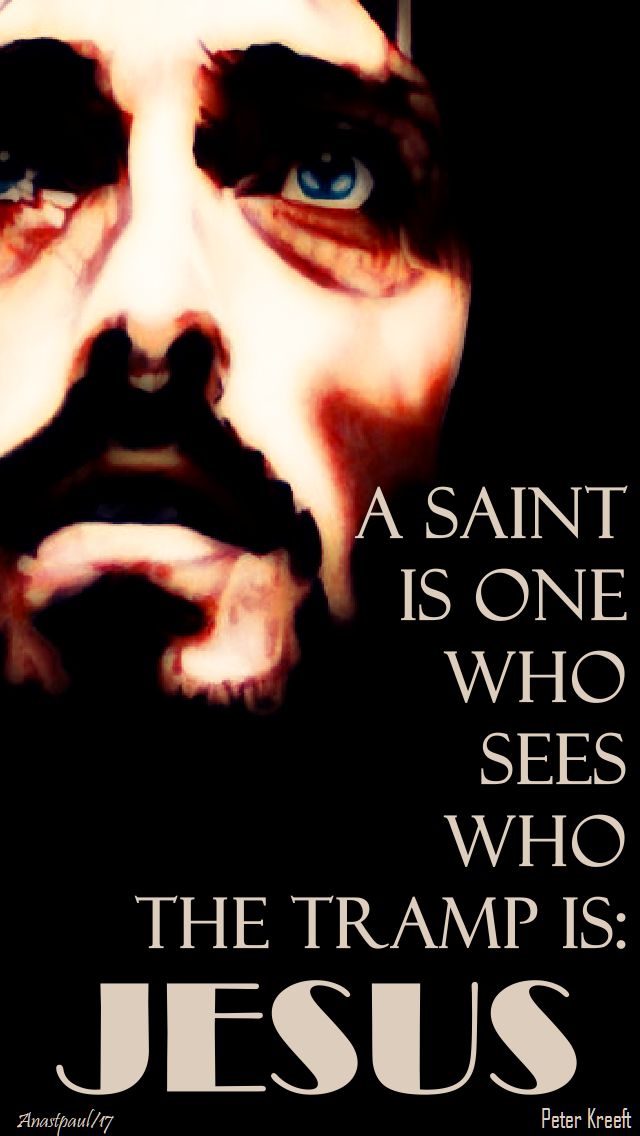
A saint is one who sees who the tramp is:   Jesusa saint is one who sees who the tramp is - jesus - 1 nove 2017

  • PETER KREEFT

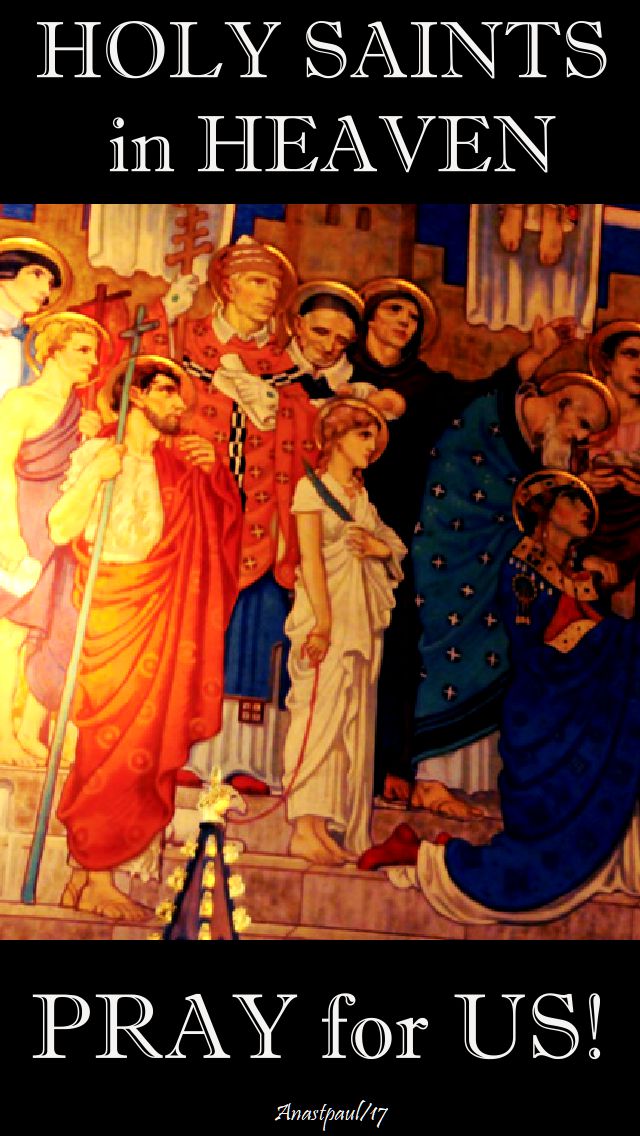
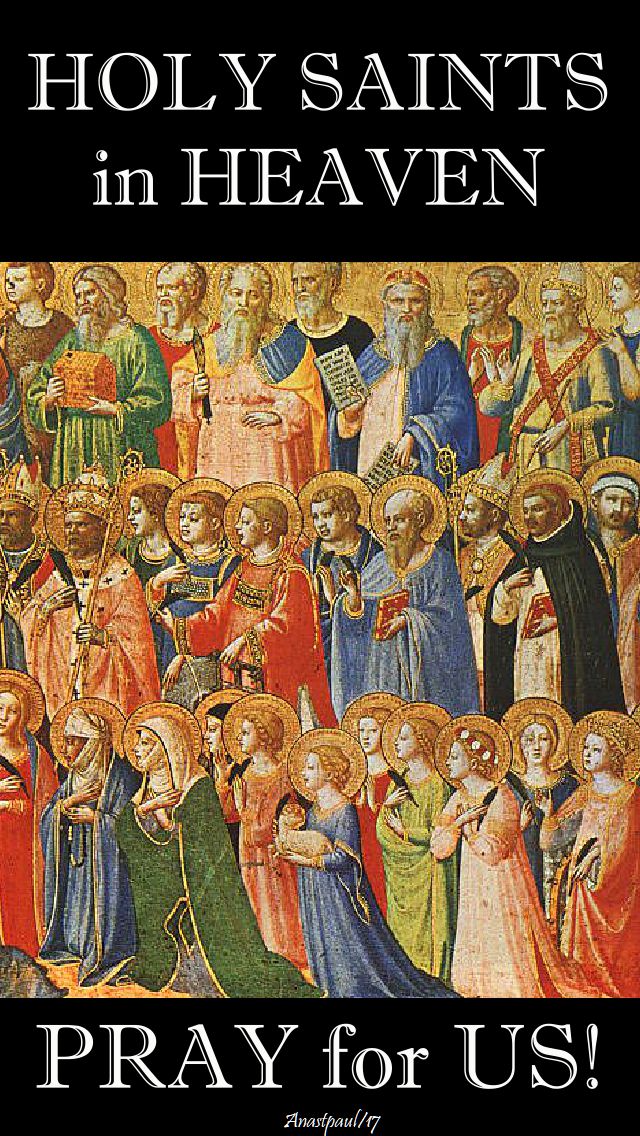
All you holy saints in heaven pray for us!holy saints in heaven pray for us no 2 - 1 nov 2017

Posted in CATHOLIC Quotes, FEASTS and SOLEMNITIES, MORNING Prayers, ON the SAINTS, QUOTES - J R R Tolkien and MORE, QUOTES of the SAINTS, SAINT of the DAY

Quote/s of the Day – 1 November – – The Solemnity of All the Saints

Quote/s of the Day – 1 November – – The Solemnity of All the Saints

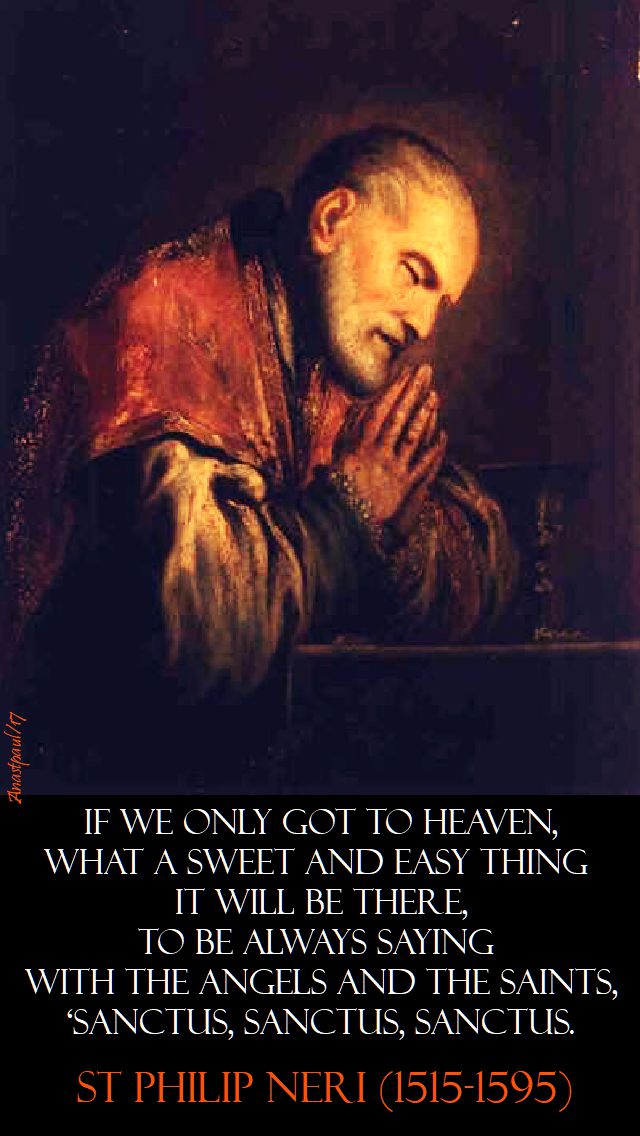
“If we only got to heaven,
what a sweet and easy thing it will be there,
to be always saying with the angels and the saints,
‘Sanctus, sanctus, sanctus.’”

St Philip Neri (1515-1595) if we only got top heaven - st philip neri - all saints day 2017

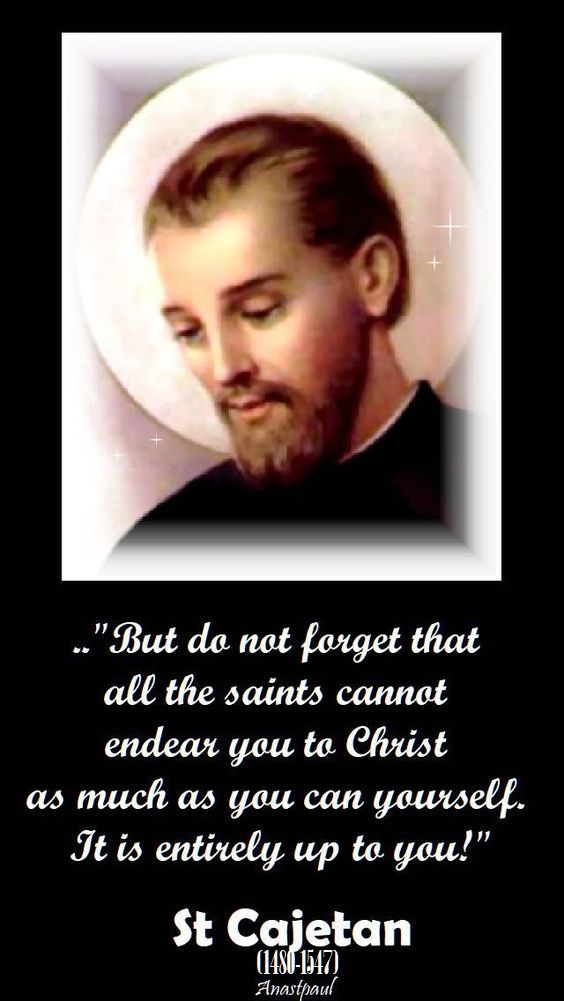
...”But do not forget that all the saints
cannot endear you to Christ
as much as you can yourseIf.
It is entirely up to You!”

St Cajetan (1480-1547) Founder of the Theatinesbut do not forget that all the saints cannot endear you to christ - st cajetan

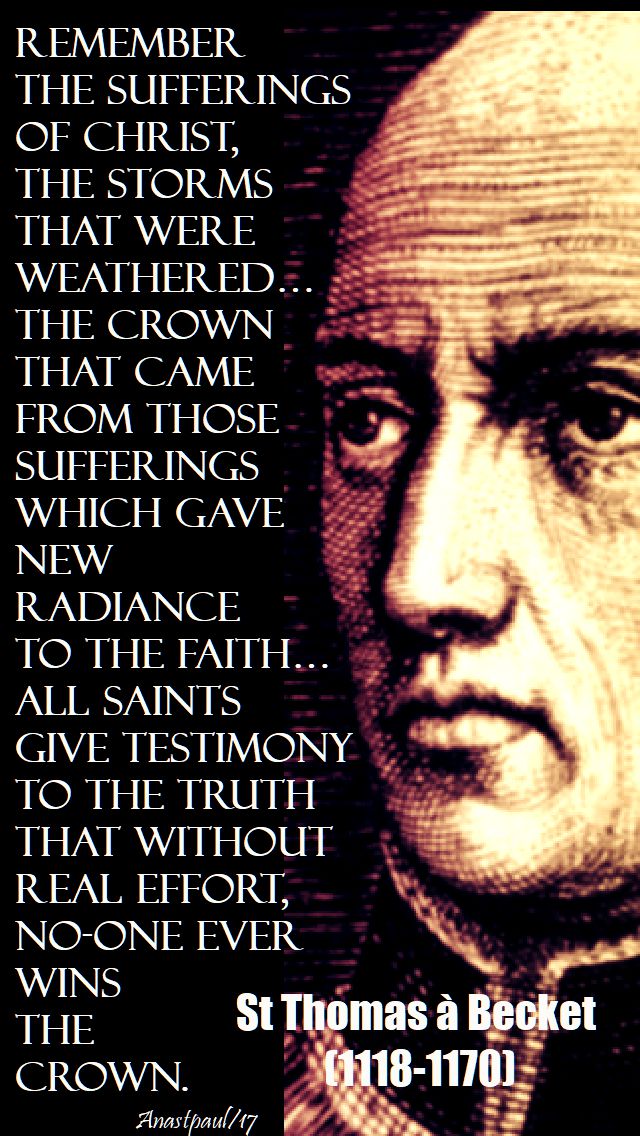
“Remember the sufferings of Christ,
the storms that were weathered…
the crown that came from those sufferings
which gave new radiance to the faith…
All saints give testimony to the truth
that without real effort,
no-one ever wins the crown.”

St Thomas à Becket (1118-1170)remember the sufferings - st thomas a becket - 1 nov 2017

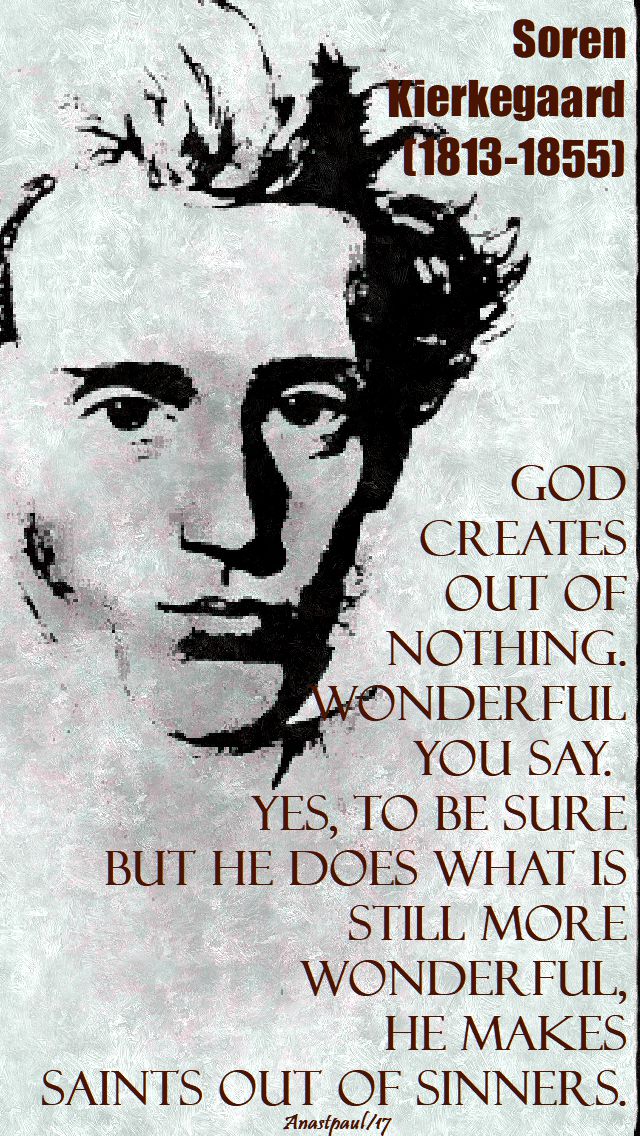
“God creates out of nothing.
Wonderful you say.
Yes, to be sure but He does.
what is still more wonderful,
He makes saints out of sinners.”

Soren Kierkegaardgod creates out of nothing - soren kierkegaard - 1 nov 2017

Posted in DOCTORS of the Church, FEASTS and SOLEMNITIES, MORNING Prayers, QUOTES of the SAINTS, SAINT of the DAY, The WORD

One Minute Reflection – 1 November – The Solemnity of All the Saints

One Minute Reflection – 1 November – The Solemnity of All the Saints

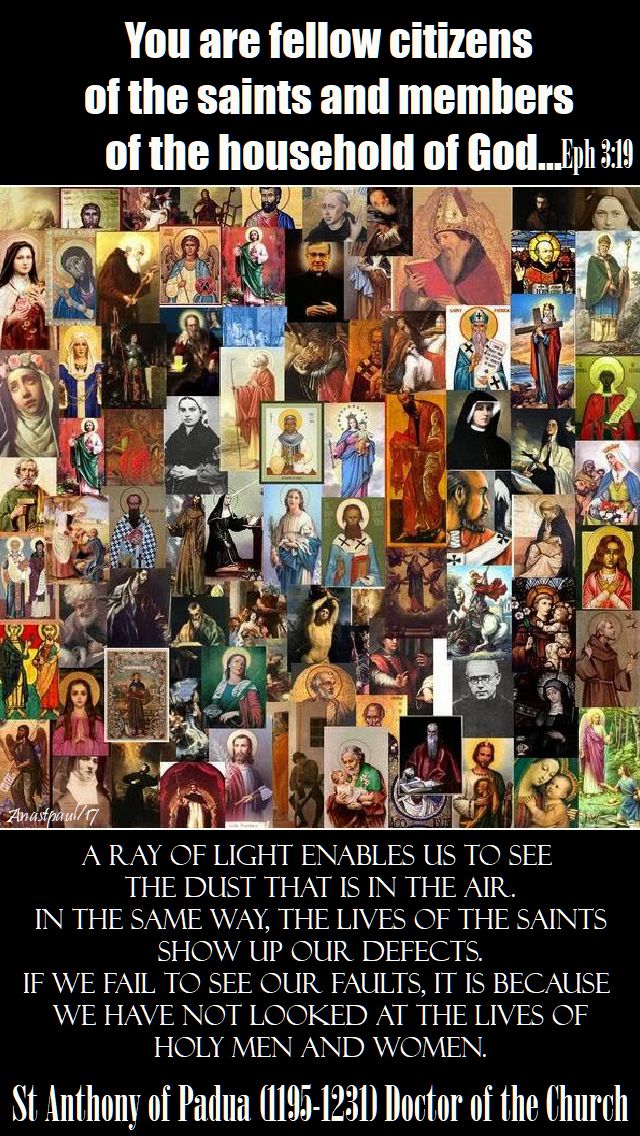
You are fellow citizens of the saints and members of the household of God………Eph 3:19

REFLECTION – “A ray of light enables us to see the dust that is in the air.
In the same way, the lives of the Saints show up our defects.
If we fail to see our faults, it is because we have not looked at the lives of
holy men and women.”…St Anthony of Paduaa ray of light enables us to see - st anthony of padua - 1 nov 2017

PRAYER – Heavenly Father, help me to love and respect Your Saints.   Grant me to obtain an example from their way of life, fellowship in their communion and aid through their intercession.   Holy Saints in Heaven, Pray for us. Amenholy saints in heaven pray for us - 1 nov 2017

Posted in DEVOTIO, FEASTS and SOLEMNITIES, MORNING Prayers, ON the SAINTS, PRAYERS of the SAINTS, SAINT of the DAY, Uncategorized

Our Morning Offering – 1 November – The Solemnity of All the Saints

Our Morning Offering – 1 November – The Solemnity of All the Saints

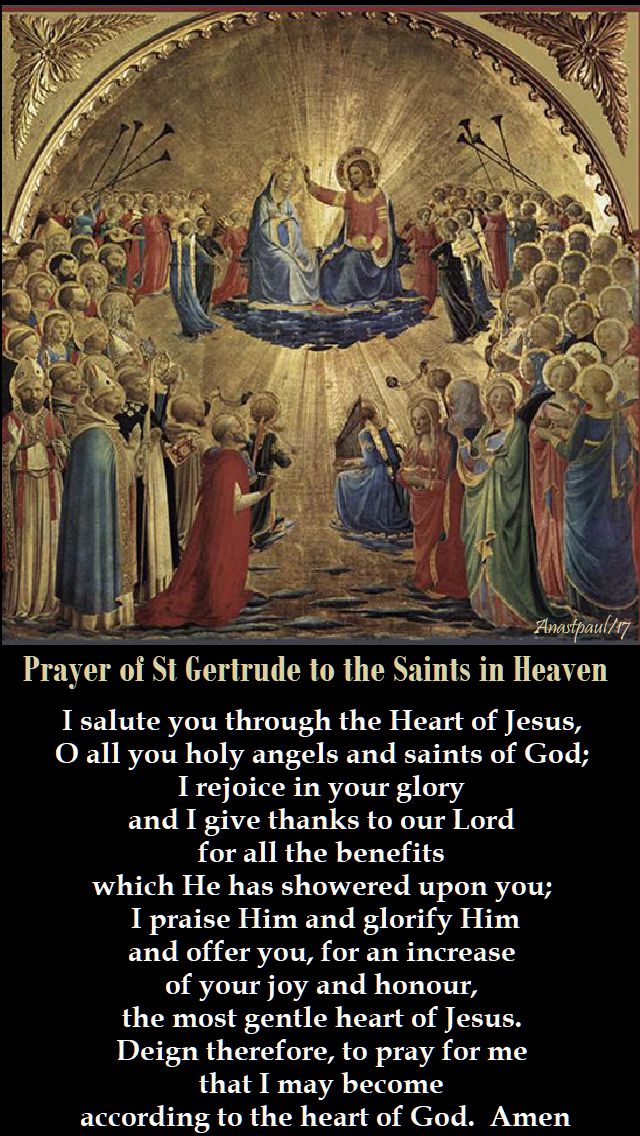
Prayer of St Gertrude to the Saints in Heaven

I salute you through the Heart of Jesus,
O all you holy angels and saints of God;
I rejoice in your glory and I give thanks to our Lord
for all the benefits which He has showered upon you;
I praise Him and glorify Him
and offer you, for an increase of your joy and honour,
the most gentle heart of Jesus.
Deign therefore, to pray for me
that I may become
according to the heart of God. Amenprayer of st gertrude to the saints in heaven - 1 nov 2017

Posted in FEASTS and SOLEMNITIES, SAINT of the DAY, Uncategorized

1 November – The Feast of All the Saints

1 November – The Feast of All the Saints:

All Saints Day is a special feast day on which Catholics celebrate all the saints, known and unknown.   While most saints have a particular feast day on the Catholic calendar (usually, though not always, the date of their death), not all of those feast days are observed.   And saints who have not been canonised—those who are in Heaven but whose sainthood is known only to God—have no particular feast day.   In a special way, All Saints Day is their feast.

QUICK FACTS ABOUT ALL SAINTS DAY
Date: 1 November
Type of Feast: Solemnity; Holy Day of Obligation
Readings: Revelation 7:2-4, 9-14; Psalm 24:1bc-2, 3-4ab, 5-6; 1 John 3:1-3; Matthew 5:1-12a
Prayers: Litany of the Saints
Other Names for the Feast: All Saints’ Day, Feast of All Saints, Solemnity of All Saints

THE HISTORY OF ALL SAINTS DAY
All Saints Day is a surprisingly old feast.   It arose out of the Christian tradition of celebrating the martyrdom of saints on the anniversary of their martyrdom.   When martyrdoms increased during the persecutions of the late Roman Empire, local dioceses instituted a common feast day in order to ensure that all martyrs, known and unknown, were properly honoured.   By the late fourth century, this common feast was celebrated in Antioch and Saint Ephrem the Syrian mentioned it in a sermon in 373.

In the early centuries, this feast was celebrated in the Easter season and the Eastern Churches, both Catholic and Orthodox, still celebrate it then, tying the celebration of the lives of the saints in with Christ’s Resurrection.

WHY 1 NOVEMBER?
The current date of November 1 was instituted by Pope Gregory III (731-741) when he consecrated a chapel to all the martyrs in Saint Peter’s Basilica in Rome.   Gregory ordered his priests to celebrate the Feast of All Saints annually.   This celebration was originally confined to the diocese of Rome but Pope Gregory IV (827-844) extended the feast to the entire Church and ordered it to be celebrated on November 1.

HALLOWEEN, ALL SAINTS DAY AND ALL SOULS DAY
In English, the traditional name for All Saints Day was All Hallows Day.  (A hallow was a saint or holy person.)   The vigil or eve of the feast, 31 October, is still commonly known as All Hallows Eve, or Halloween.   Despite concerns among some Christians (including some Catholics) in recent years about the “pagan origins” of Halloween the vigil was celebrated from the beginning—long before Irish practices, stripped of their pagan origins (just as the Christmas tree was stripped of similar connotations), were incorporated into popular celebrations of the feast.

In fact, in post-Reformation England, the celebration of Halloween and All Saints Day were outlawed not because they were considered pagan but because they were Catholic. Later, in the Puritan areas of the Northeastern United States, Halloween was outlawed for the same reason, before Irish Catholic immigrants revived the practice as a way of celebrating the vigil of All Saints Day.

allsaints.jpg

Posted in FEASTS and SOLEMNITIES, SAINT of the DAY, Uncategorized

Solemnity of All Saints and Memorials of the Saints – 1 November

All Saints Day (Solemnity):  (a Holy Day of Obligation)  Instituted to honour all the saints, known and unknown.   It owes its origin in the Western Church to the dedication of the Roman Pantheon in honour of the Blessed Virgin Mary and all the martyrs by Pope Saint Boniface IV in 609, the anniversary of which was celebrated at Rome on 13 May.   Pope Saint Gregory III consecrated a chapel in the Vatican basilica in honour of All Saints, designating 1 November as their feast.   Pope Gregory IV extended its observance to the whole Church. It has a vigil and octave and is a holy day of obligation;   the eve is popularly celebrated as Hallowe’en. Patronage – Arzignano, Italy.
—
St Amabilis of Auvergne
St Austremonius
St Benignus of Dijon
St Cadfan
St Caesarius of Africa
St Caesarius of Damascus
St Ceitho
St Cledwyn of Wales
Bl Clemens Kyuemon
St Cyrenia of Tarsus
St Dacius of Damascus
St Deborah the Prophetess
St Dingad
Bl Dionysius Fugixima
St Floribert of Ghent
St Gal of Clermont
St Genesius of Lyon
St Germanus of Montfort
St Harold the King
St James of Persia
St Jerome Hermosilla
St John of Persia
St Julian of Africa
St Juliana of Tarsus
St Lluís Estruch Vives
St Marcel of Paris
St Mary the Slave
St Mathurin
St Meigan
St Nichole
St Nuño de Santa Maria Alvares Pereira
St Pabiali of Wales
St Pere Josep Almató Ribera Auras
St Peter Absalon
Bl Peter Paul Navarra
Bl Petrus Onizuka Sadayu
St Rachel the Matriarch
St Ruth the Matriarch
St Salaun of Leseven
St Severinus of Tivoli
Bl Teodor Jurij Romza
St Valentin Faustino Berri Ochoa
St Vigor of Bayeux

Posted in NOTES to Followers, Uncategorized

Working at my Parish Spring Festival

Dear friends

I am organising, which of course means doing everything, for our Spring Festival this coming Saturday 28 October.

Please forgive my absence until after the weekend, I am absolutely run off my feet.

Your prayers for its success are entreated – our Parish is in great needs of Funds.

I’ll miss you…God bless

Ana

proef

Posted in CONFESSION/PENANCE, MORNING Prayers

Thought for the Day – 25 October – St John Vianney on Confession

Thought for the Day – 25 October – St John Vianney on Confession

We come to confession quite preoccupied with the shame that we shall feel.   We accuse ourselves with hot air.   It is said that many confess and few are converted.   I believe it is so, my childrenbecause few confess with tears of repentance.

See, the misfortune is, that people do not reflect.   If one said to those who work on Sundays, to a young person who had been dancing for two or three hours, to a man coming out of an alehouse drunk,  “What have you been doing? You have been crucifying Our Lord!”  they would be quite astonished, because they do not think of it. My children, if we thought of it, we should be seized with horror;  it would be impossible for us to do evil.  For what has the good God done to us that we should grieve Him thus, and put Him to death again — Him, who has redeemed us from Hell?

It would be well if all sinners, when they are going to their guilty pleasures, could, like St Peter, meet Our Lord on the way, who would say to them, “I am going to that place where you are going yourself, to be there crucified again.”   Perhaps that might make them reflect. – St Jean Marie Baptiste Vianney, the Cure of Ars (1786-1859)

St John Vianney, Pray for us!what have you been doing - st john vianney - 25 oct 2017

Posted in CONFESSION/PENANCE, DOCTORS of the Church, FATHERS of the Church, MORNING Prayers, PRACTISING CATHOLIC, QUOTES of the SAINTS

Quote/s of the Day on Confession – 25 October

Quote/s of the Day on Confession – 25 October

“The confession of evil works, 
is the first beginning of good works.
You do the truth
and come to the light.”

St Augustine (354-430) Doctor & Father of the Churchthe confession of evil - st augustine - 25 oct 2017

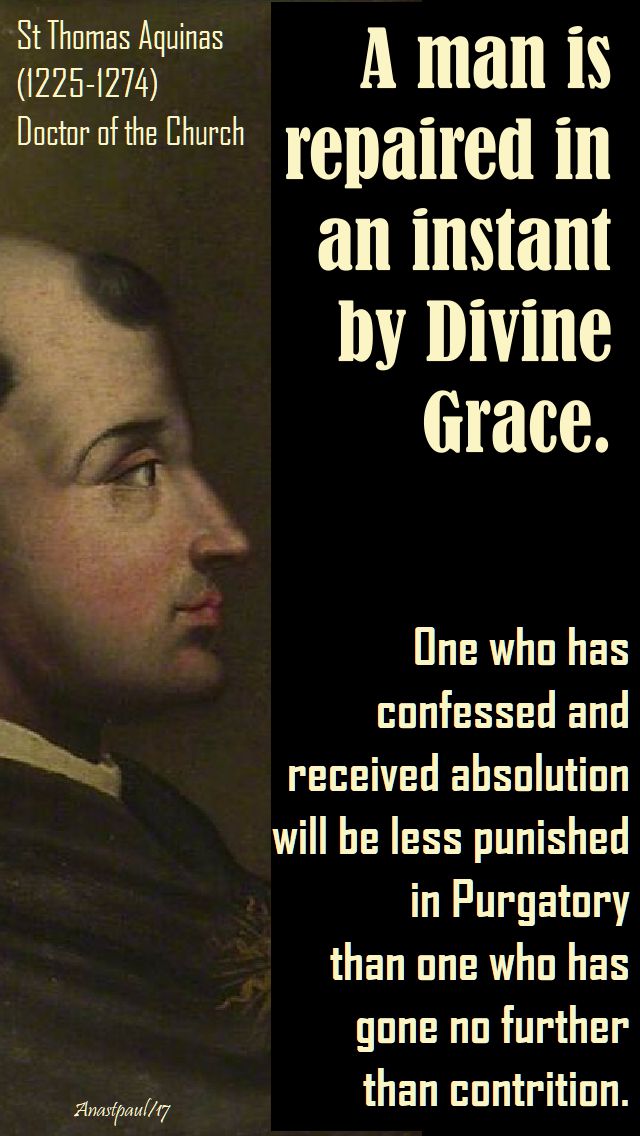
“A man is repaired in an instant by Divine grace.”

“One who has confessed and received absolution,
will be less punished in Purgatory than one
who has gone no further than contrition.”

St Thomas Aquinas (1225-1274) Doctor of the Churcha man is repaired - st thomas aquinas - 25 oct 2017

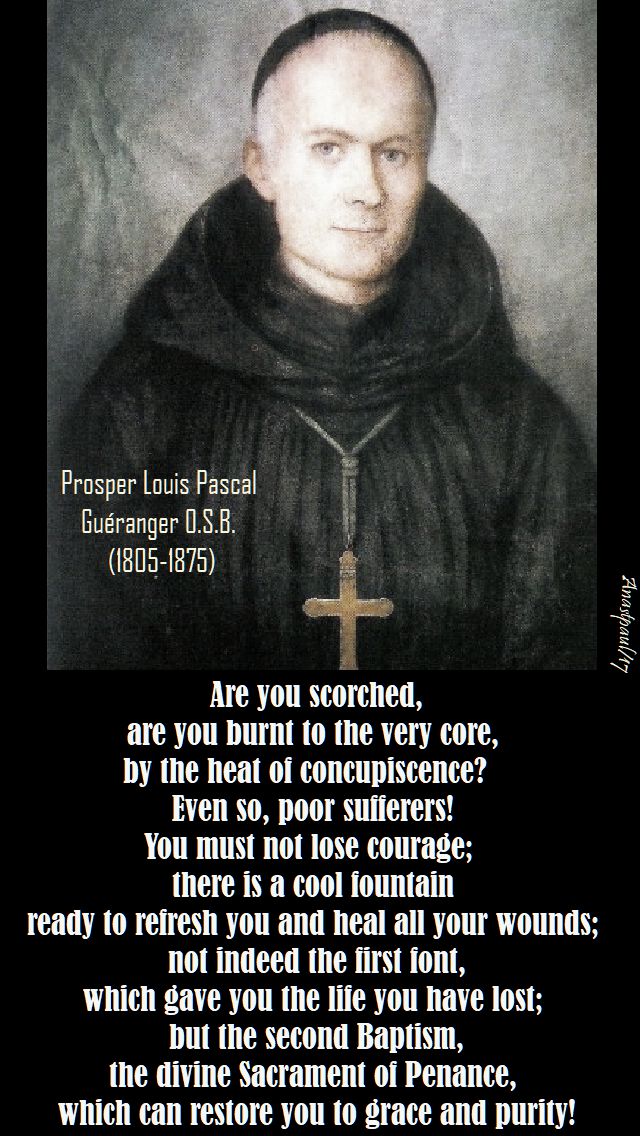
“Are you scorched, are you burnt to the very core,
by the heat of concupiscence? Even so, poor sufferers!
You must not lose courage; there is a cool fountain
ready to refresh you and heal all your wounds;
not indeed the first font, which gave you the life you have lost;
but the second Baptism, the divine Sacrament of Penance,
which can restore you to grace and purity!”

Prosper Louis Pascal Guéranger O.S.B. (1805-1875)are you scorched - abbot gueranger - 25 oct 2017

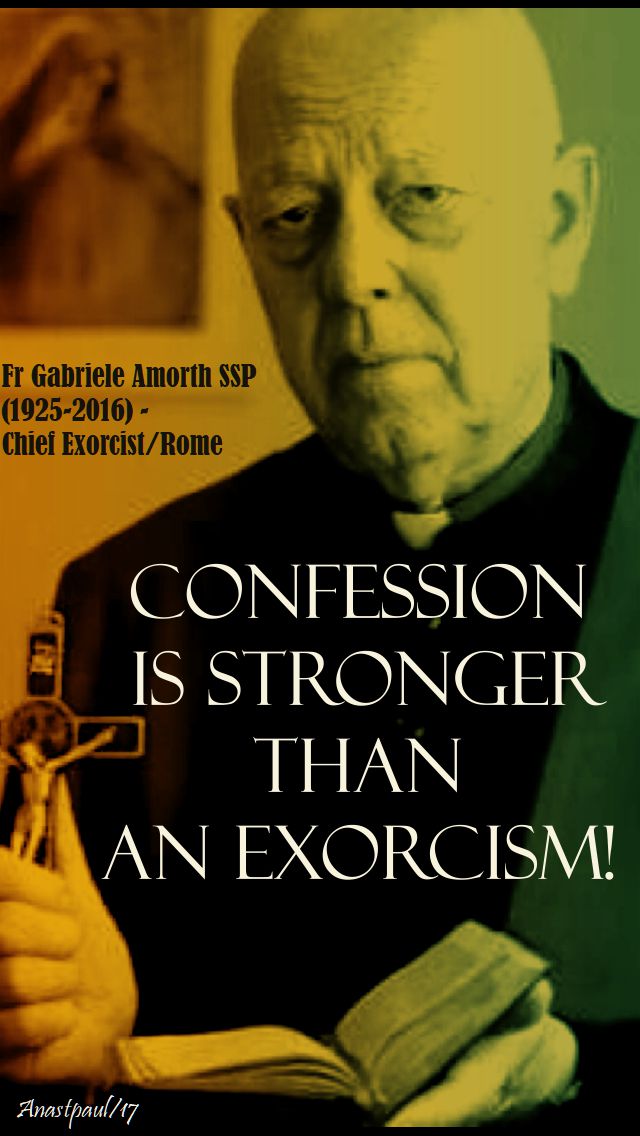
“Confession is stronger than an exorcism!”

Fr Gabriele Amorth, SSP (1925-2016) – Chief Exorcist/Romeconfession is stronger - fr armorth - 25 oct 2017


Posted in MORNING Prayers, PRAYERS of the SAINTS

Our Morning Offering – 25 October

Our Morning Offering – 25 October

Prayer for the Grace of Devotion
By Thomas à Kempis

O Lord, my God,
You are my all and every good.
And what am I, that I should presume
to address You?
I am the poorest of Your servants
and a wretched worm,
far more poor and worthless
than I can ever realise or express.
Yet, Lord, remember that I am nothing,
I have nothing and can do nothing.
You alone are good, just and holy;
You can do all things, fill all things,
bestow all things,
leaving only the wicked empty-handed.
Remember Your mercies, Lord
and fill my heart with Your grace,
since it is Your will that none of Your works
should be worthless.
How can I endure this life of sorrows,
unless You strengthen me
with Your mercy and grace?
Do not turn Your face from me;
do not delay Your coming,
nor withdraw Your consolation from me,
lest my soul become like a waterless desert.
Teach me, O Lord, to do Your will;
teach me to live worthily
and humbly in Your sight;
for You are my wisdom, who know me truly
and who knew me before the world was made
and before I had my being. Amenprayer for the grace of devotion by thomas a kempis - 25 oct 2017

Posted in CONFESSION/PENANCE, DOCTORS of the Church, MORNING Prayers, QUOTES of the SAINTS, The WORD

One Minute Reflection – 25 October

One Minute Reflection – 25 October

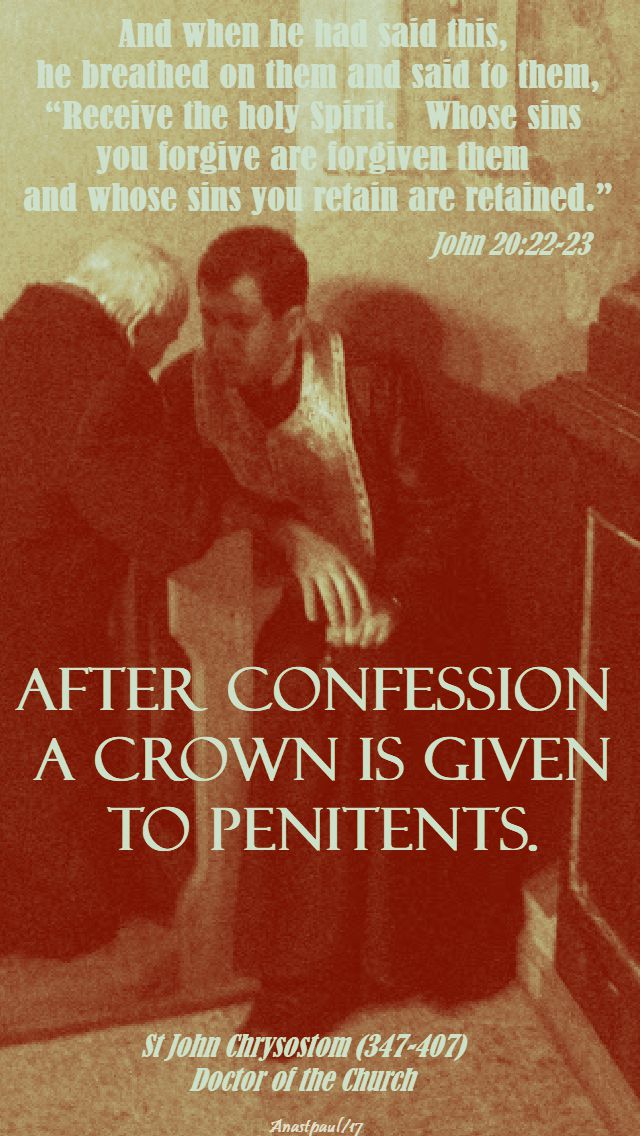
And when he had said this, he breathed on them and said to them, “Receive the holy Spirit.   Whose sins you forgive are forgiven them and whose sins you retain are retained.”…John 20:22-23

REFLECTION – “After confession a crown is given to penitents.”… St John Chrysostom (347-407) Doctor of the Churchafter confession - st john chrysostom - 25 oct 2017

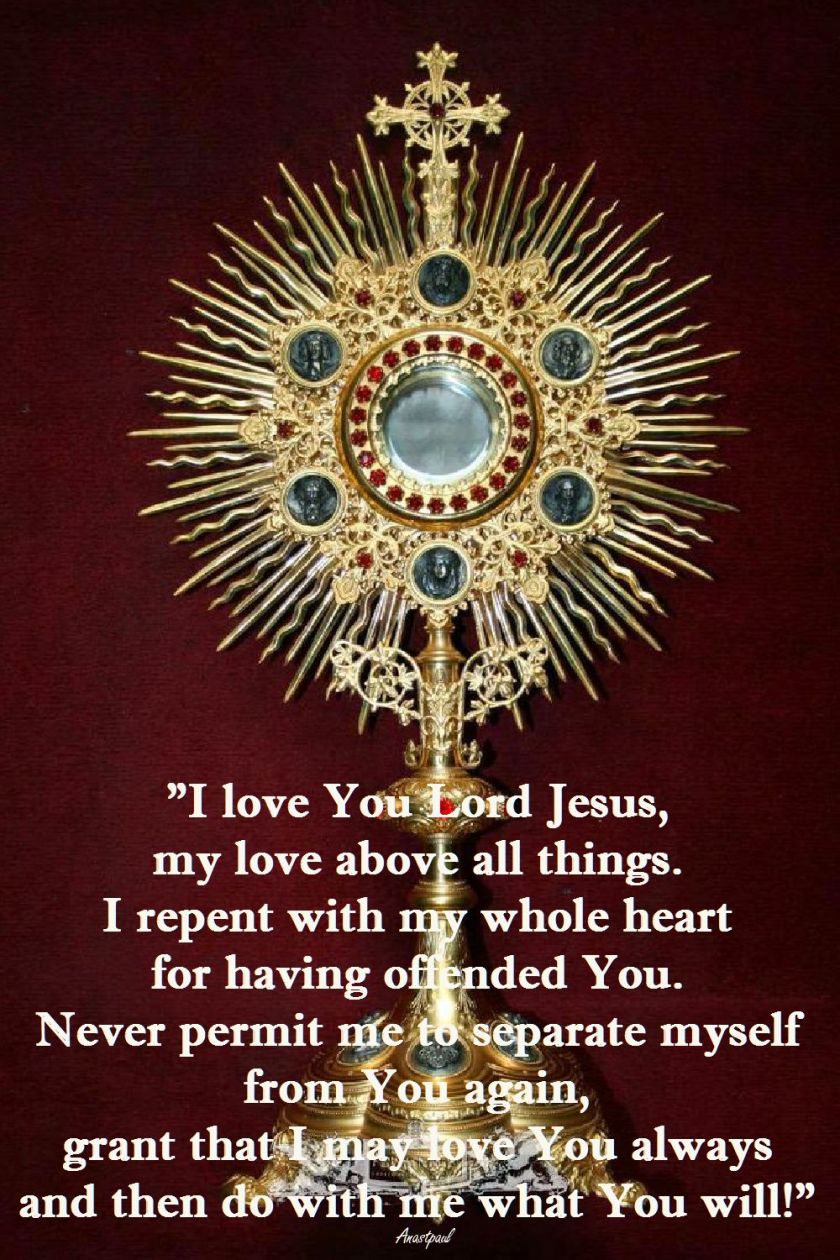
PRAYER – Lord God, hear my prayer, forgive my sins, teach me true repentance, help me to renew my life and live only in Your love.
I wish now and every day, sorrow for my sins and the willingness to make reparation for them. Show me how, dear Lord, teach me Your ways. For my sins crucified my Lord, on my God, forgive me! Lord Jesus, I love You, grant that I may never separate myself from You again! AmenI LOVE YOU LORD JESUS

Posted in SAINT of the DAY

Saints of the Day – 25 October – St Crispin & Crispian – Martyrs

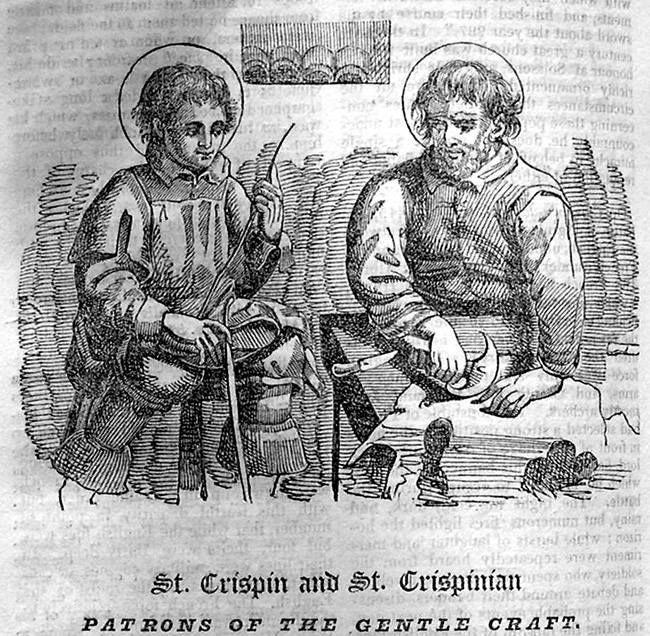
Saints of the Day – 25 October – St Crispin & Crispian – Martyrs – tortured and beheaded c 286 at Rome, Italy in the reign of Diocletian.   Patronages – cobblers;  curriers;  glove makers;  lace makers;  lace workers;  leather workers;  saddle makers;  saddlers; shoemakers;  tanners;  weavers, San Crispin, San Pablo City, Philippines.   Attributes -depicted holding shoes.

st-crispin-crispinian

Born to a noble Roman family in the 3rd century AD, Saints Crispin and Crispinian fled persecution for their faith, ending up at Soissons, where they preached Christianity to the Gauls whilst making shoes by night.   While it is stated that they were twin brothers, that has not been positively proved.

They earned enough by their trade to support themselves and also to aid the poor.   Their success attracted the ire of Rictus Varus, governor of Belgic Gaul, who had them tortured and thrown into the river with millstones around their necks.   Though they survived, they were beheaded by the Emperor c 285-286.

An alternative account gives them to be sons of a noble Romano-Briton family who lived in Canterbury, following their father’s murder for displeasing the Roman Emperor.   As they were approaching maturity their mother sent them to London to seek apprenticeship and to avoid coming to the attention of their father’s killer.   Travelling there, the brothers came across a shoemaker’s workshop at Faversham and decided to travel no further and stayed in Faversham.   This account fails to explain how the brothers came to be venerated and martyred.

The feast day of Saints Crispin and Crispinian is 25 October.   Although this feast was removed from the Roman Catholic Church’s universal liturgical calendar following the Second Vatican Council, the two saints are still commemorated on that day in the most recent edition of the Roman Church’s martyrology.

In the sixth century a stately basilica was erected at Soissons over the graves of these saints and St Eligius, a famous goldsmith, made a costly shrine for the head of St. Crispinian.

Saint Crispin is often associated with the Battle of Agincourt since the battle was fought on his feastday.   It has been immortalised by Shakespeare’s St Crispin’s Day Speech from his play Henry V.   Also, for the Midsummer’s Day Festival in the third act of Die Meistersinger, Wagner has the shoemakers’ guild enter singing a song of praise to St Crispin.

A plaque at Faversham commemorates their association with the town.   They are also commemorated in the name of the old pub “Crispin and Crispianus” at Strood.

Posted in SAINT of the DAY

Memorials of the Saints – 25 October

Dedication of all Churches where the Consecration Date is Unknown
—
St Alfons Arimany Ferrer
St Canna verch Tewdr Marw
St Chrysanthus
St Crispin and Crispian
St Cyrinus of Rome
St Daria
St Dulcardus
Bl Edmund Daniel
St Engratia of Segovia
St Francis Serrano
St Fronto of Périgueux
St Fructus of Segovia
St Gaudentius of Brescia
St George of Périgueux
St Goeznoveus of Leon
St Guesnoveus
Bl Henry of Segusio
St Hilary of Mende
St Hildemarca of Fecamp
St Januarius of Sassari
St Lucius of Rome
St Lupus of Bayeux
St Marciano of Constantinople
St Mark of Rome
St Martirio of Constantinople
St Miniato of Florence
St Peter of Rome
St Protus of Sassari
St Recaredo Centelles Abad
St Tabitha
Bl Thaddeus McCarthy
St Theodosius of Rome
St Valentine of Segovia
—
Martyrs of Cruz Cubierta – 5 beati: A mother, Blessed María Teresa Ferragud Roig de Masiá, and her four daughters, Blessed María Joaquina Masiá Ferragud, Blessed María Vicenta Masiá Ferragud, Blessed María Felicidad Masiá Ferragud and Blessed Josefa Ramona Masiá Ferragud, all nuns, who were Martyred in the Spanish Civil War. They were martyred on 25 October 1936 in Cruz Cubierta, Alzira, Valencia, Spain and Beatified on 11 March 2001 by St Pope John Paul II.

Martyrs of England and Wales – 40 saints: Following the dispute between the Pope and King Henry VIII in the 16th century, faith questions in the British Isles became entangled with political questions, with both often being settled by torture and murder of loyal Catholics. In 1970, the Vatican selected 40 martyrs, men and women, lay and religious, to represent the full group of perhaps 300 known to have died for their faith and allegiance to the Church between 1535 and 1679. They each have their own day of memorial, but are remembered as a group on 25 October. They were Canonised on 25 October 1970 by Blessed Pope Paul VI.

Martyrs of Rome – 67 saints: A group of 46 soldiers and 21 civilians martyred together in the persecutions of Claudius II. 269 in Rome, Italy.

Martyred in the Spanish Civil War:
• Blessed Alfons Arimany Ferrer
• Blessed Recaredo Centelles Abad

Posted in MORNING Prayers, SAINT of the DAY

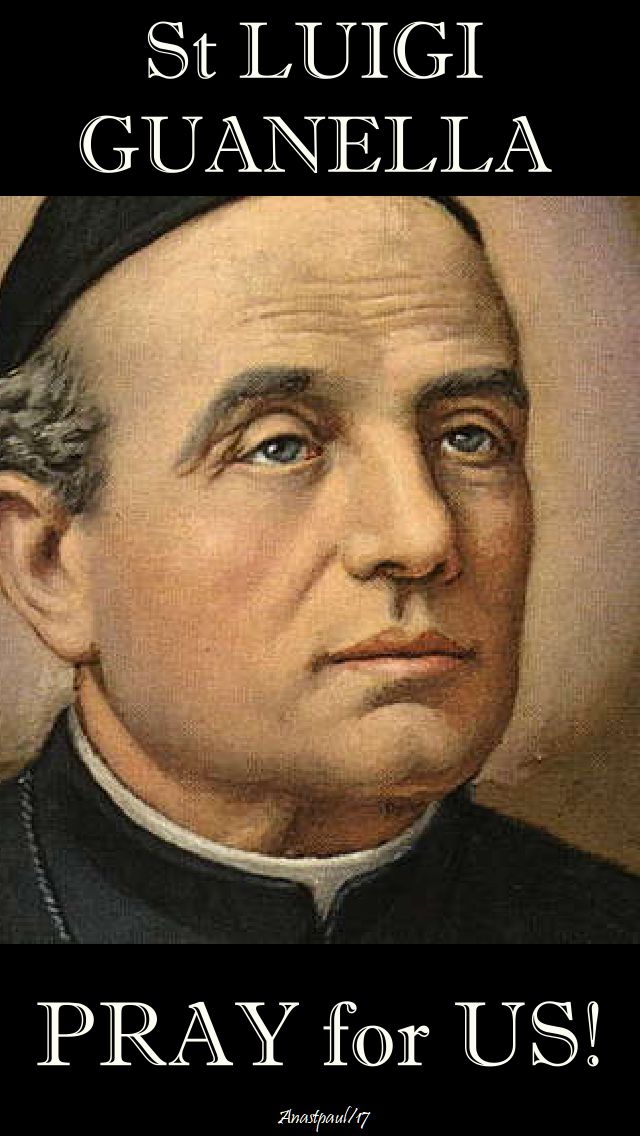
Thought for the Day – 24 October – The Memorial of St Luigi Guanella (1842-1915)

Thought for the Day – 24 October – The Memorial of St Luigi Guanella (1842-1915)

The human and spiritual testimony of St Luigi Guanella is a special gift of grace for the whole Church.   During his earthly life he lived with courage and determination the Gospel of Love and the “great commandment”, which today too, the Word of God has recalled.   Thanks to the profound and continuing union with Christ, in the contemplation of his love, Don Guanella, led by Divine Providence, became a companion and teacher, comfort and support to the poorest and weakest.   The love of God aroused in him the desire for the good of the people who were entrusted to him in the routine of daily life.   He paid caring attention to each one and respected the pace of their development.   He cultivated the hope in his heart that every human being, created in the image and likeness of God, by tasting the joy of being loved by him — Father of all — can receive and give to others the best of himself.

Today, let us praise and thank the Lord, who gave us a prophet and an apostle of love in St Luigi Guanella.   In his testimony, so full of humanity and attention to the least, we recognise a bright sign of the presence and charitable action of God, the God — as we heard in the First Reading — who defends the stranger, the widow, the orphan, the poor person obliged to give his garment in pledge… his only covering for the night (cf. Ex 22:20-26).

May this new Saint of love be for everyone, especially for the members of the Congregations founded by him, a model of profound and fruitful synthesis between contemplation and action that he himself lived and put into practice.   We can summarise his whole human and spiritual life in his last words on his death-bed:  “in caritate Christi” “in Christ’s charity.”.   It is Christ’s love that illumines the life of every person, revealing through the gift of himself to others that nothing is lost but is fully realized for our happiness.   May St Luigi Guanella obtain that we may grow in friendship with the Lord to be bearers of the fullness of God’s love in our time, to promote life in all of its forms and conditions and to ensure that human society increasingly become the family of God’s children…… HOMILY OF HIS HOLINESS BENEDICT XVI – Saint Peter’s Square, Canonisation of St Luigi Guanella, Sunday, 23 October 2011

St Luigi Guanella, Pray for us!st luigi guanella - pray for us.2

Posted in MORNING Prayers, QUOTES of the SAINTS, SAINT of the DAY, The BLESSED VIRGIN MARY, The HOLY CROSS, The HOLY EUCHARIST / The HOLY MASS

Quote/s of the Day – 24 October – The Memorials of St Anthony Mary Claret (1807-1870) and St Luigi Guanella (1842-1915)

Quote/s of the Day – 24 October – The Memorials of St Anthony Mary Claret (1807-1870) and St Luigi Guanella (1842-1915)

“Although the sinner does not believe in Hell,
he shall nevertheless go there,
if he has the misfortune to die in mortal sin.”

“Christian perfection
consists in three things:
praying heroically
working heroically
and suffering heroically.”

“The Christian who desires to follow Jesus
carrying His cross must bear in mind,
that the name “Christian” means
“learner or imitator of Christ”
and that if he wishes to bear that noble title worthily,
he must above all do as Christ charges us in the Gospel –
we must oppose or deny ourselves,
take up the cross
and follow Him.”althought the sinner - st anthony mary claret - 24 oct 2017

“When I am before the Blessed Sacrament.
I feel such a lively faith that I can’t describe it.
Christ in the Eucharist is almost tangible to me…
When it is time for me to leave,
I have to tear myself away
from His sacred presence.”when I am before - st anthony mary claret - 24 oct 2017

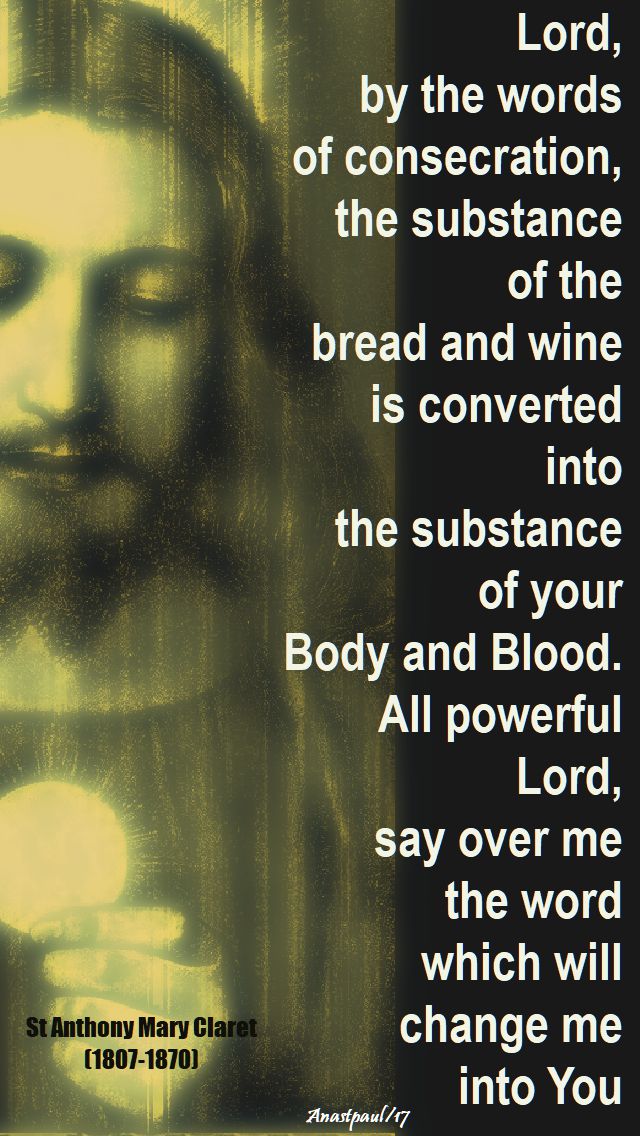
“Lord, by the words of consecration,
the substance of the bread and wine is converted
into the substance of your Body and Blood.
All powerful Lord, say over me the word
which will change me into You.”

St Anthony Mary Claret (1807-1870) lord by the words - st anthony mary claret 24 oct 2017

“The sun of our lives is the Eucharist.
…Live each day with the Eucharistic Christ.”

“Plant your heart in Jesus Crucified
and all the thorns will seem like roses.”the sun of our lives - st luigi guanella - 24 oct 2017

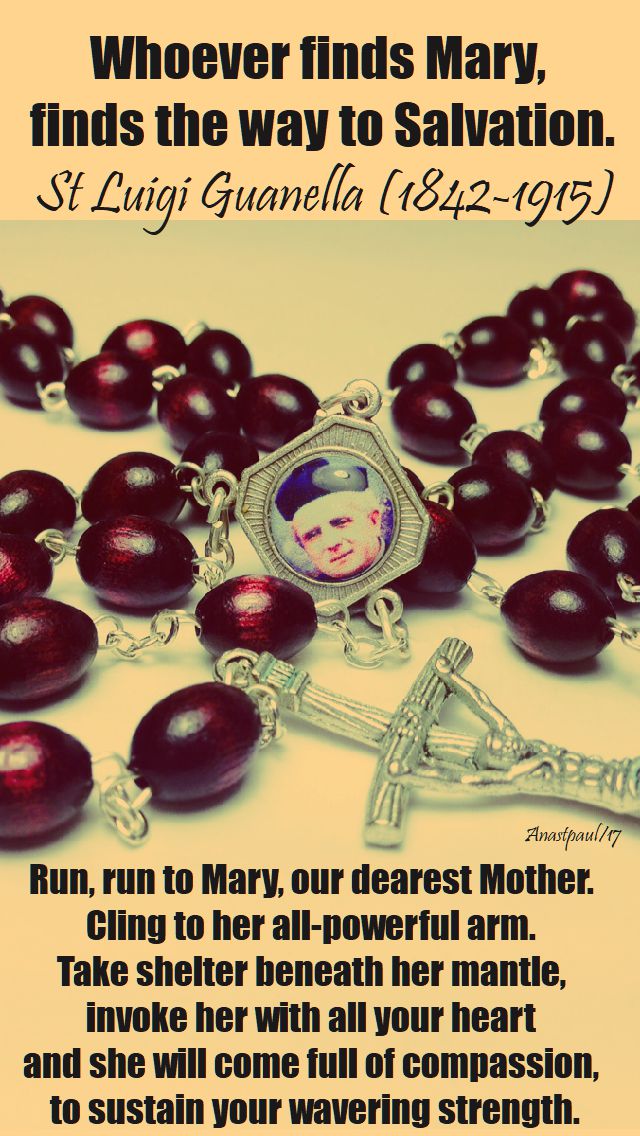
“Whoever finds Mary,
finds the way to Salvation.”

…Run, run to Mary, our dearest Mother.
Cling to her all-powerful arm.
Take shelter beneath her mantle,
invoke her with all your heart
and she will come full of compassion,
to sustain your wavering strength.”

St Luigi Guanella (1842-1915)whoeverfindsa mary - st luigi guanella - 24 oct 2017

Posted in MORNING Prayers, QUOTES of the SAINTS, SAINT of the DAY, The WORD

One Minute Reflection – 24 October – The Memorial of St Luigi Guanella (1842-1915)

One Minute Reflection – 24 October – The Memorial of St Luigi Guanella (1842-1915)

For the Son of Man will come with his angels in his Father’s glory
and then he will repay everyone according to his conduct...Matthew 16:27

REFLECTION – “There is need of living well but there is even more need of dying well. A good death is everything, especially today where people think only of things and enjoyment here on earth, rejecting eternity.” … St Luigi Guanella (1842-1915)there is need of living well - st luigi guanella - 24 oct 2017

PRAYER – Heavenly Father, help me to keep my death constantly before my eyes, for this is my final account. I pray You for a holy life that my death may be holy and that I may come to You and live for all eternity with You. When my hour is come, bid me come to You, Lord. St Luigi Guanella, you lived each moment of your life for the glory of the Kingdom, please pray for us, amen.st luigi guanella - pray for us

Posted in SAINT of the DAY

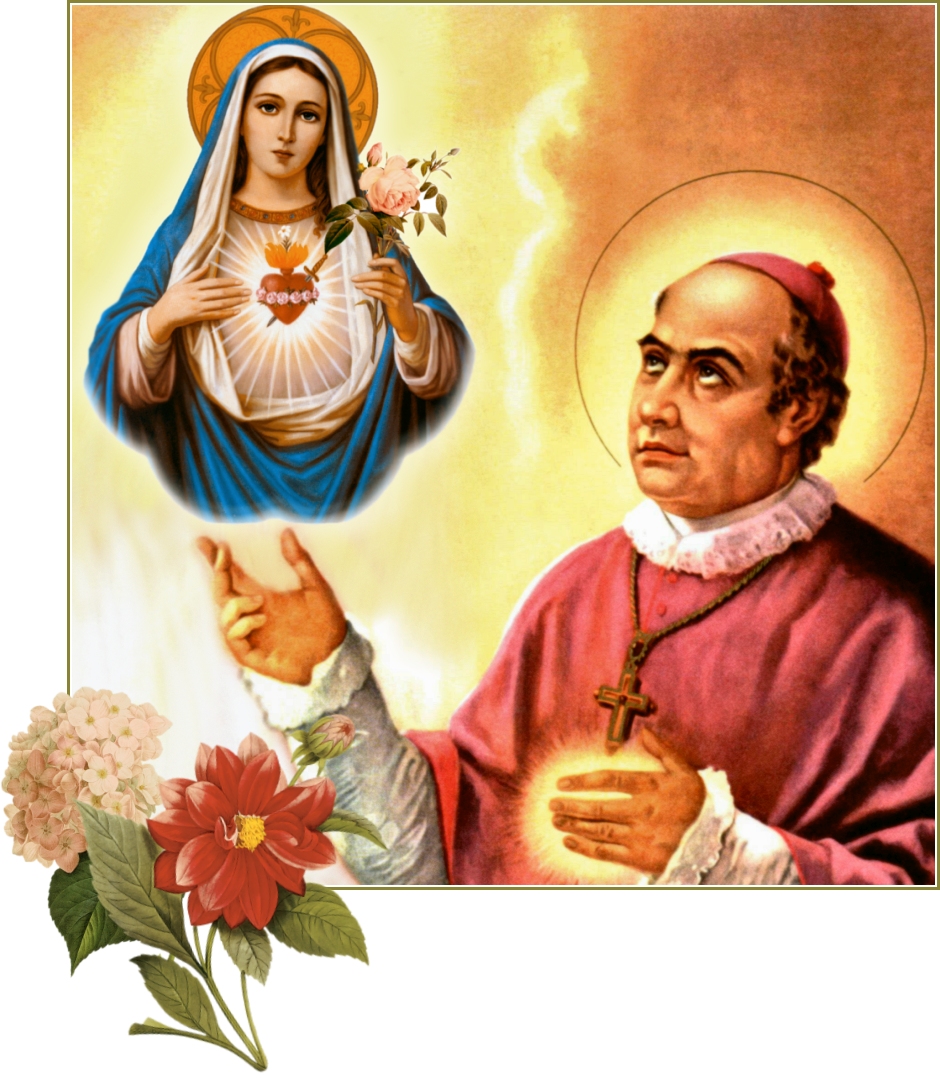
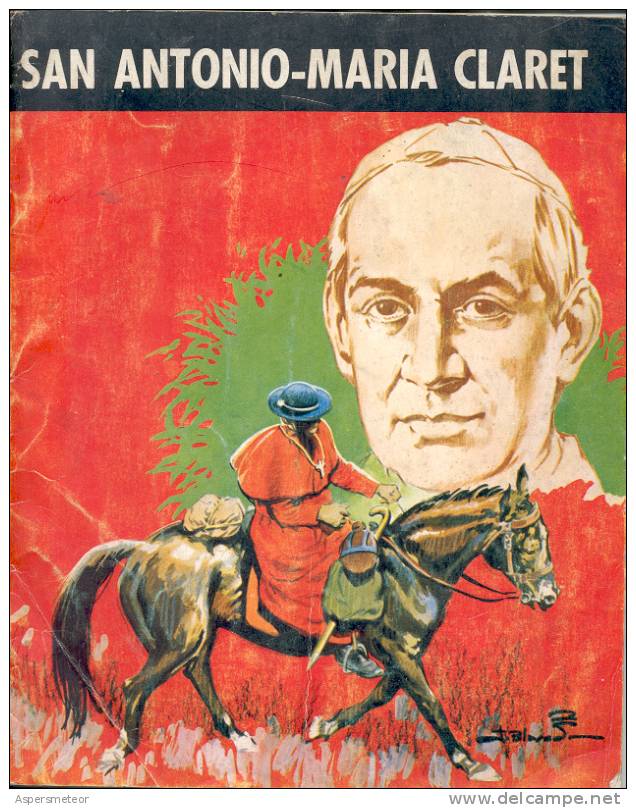
Saint of the Day – 24 October – St Anthony Mary Claret (1807-1870) CMF

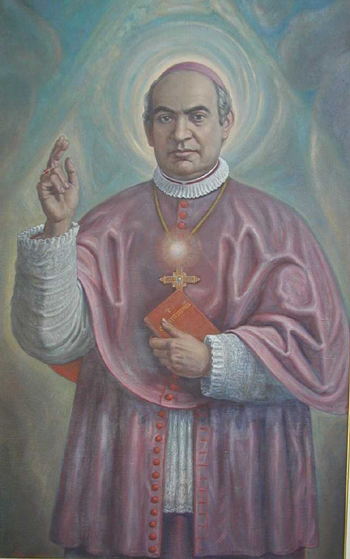
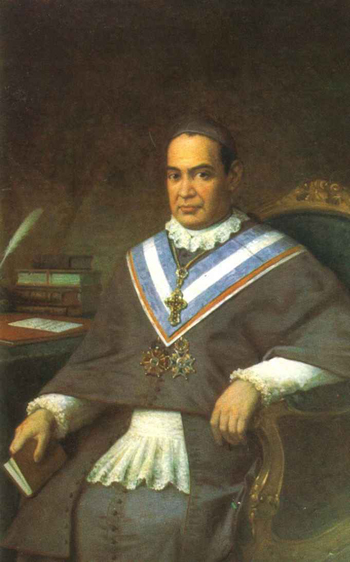
Saint of the Day – 24 October – St Anthony Mary Claret (1807-1870) CMF – Archbishop, Missionary, Founder, Confessor, Mystic, Social Reformer, Queen’s Chaplain, Spiritual Director, Writer, Publisher, Preacher, Apostle of Charity.  Known as “the Spiritual Father of Cuba”. He founded the Congregation of Missionary Sons of the Immaculate Heart of Mary, commonly called the Claretians.  Born Antonio María Claret y Clarà on 23 December 1807 at Sallent, Catalonia, Spain and Died on 24 October 1870 in a Cistercian monastery at Fontfroide, Narbonne, France.   Patronages – Textile merchants, weavers, savings (taught the poor the importance of savings), Catholic press, Claretians, Dioceses of the Canary Islands, Claretian students, Claretian educators and Claretian educational institutions and foundations.  Attributes – Bishop’s robe, crozier, an open book, catechism, 2 students beside him at his side and having his bent arm pointing to the heavens.

st anthony mary claret

Childhood:  St Anthony Mary Claret was born in Catalonia, the northeastern corner of Spain, in a town called Sallent on 23 December 1807.   He was the fifth son of Juan Claret and Josefa Clará’s eleven children.   His father owned a small textile factory but was not rich. Anthony grew up in a Christian environment and at a very early age had a strong sense of the eternal life that Christ wanted all men and women to enjoy.   He wanted to spare sinners eternal unhappiness and felt moved to work for their salvation.   When he was about eleven years old, a bishop visited his school and asked him what he wanted to be when he grew up. Without hesitation he responded: “A priest.”

Weaver:  As soon as Anthony was old enough, he began working as an apprentice weaver.   When he turned 17, his father sent him to Barcelona to study the latest techniques in textile manufacturing and to work in the large textile mills.   He did so well in the textile design school that he began receiving offers from large textile companies. Even though he had the talent to succeed, he turned down the offers and returned home after experiencing the emptiness of worldly achievements.

Vocation:  The words of the Gospel kept resounding in his heart: “what good is it for man to win the world if he loses his soul?”   He began to study Latin to prepare to enter the Seminary.   He wanted to be a Carthusian Monk.   His father was ready to accept the will of God but preferred to see him become a diocesan priest.   Anthony decided to enter the local diocesan seminary in the city of Vic.   He was 21 years old. After a year of studies, he decided to pursue his monastic vocation and left for a nearby monastery.   On the way there, he was caught in a big storm.   He realised that his health was not the best and withdrew from his decision to go to the monastery.

He was ordained a priest at 27 years of age and was assigned to his hometown parish. The town soon became too small for his missionary zeal and the political situation -hostile to the Church- limited his apostolic activity.   He decided to go to Rome to offer himself to serve in foreign missions.   Things did not work out as expected and he decided to join the Jesuits to pursue his missionary dream.   While in the Jesuit Novitiate, he developed a strange illness, which led his superiors to think that God might have other plans for him.   Once again, he had to return home to keep searching for God’s will in his life.

“Apostolic Missionary” in Catalonia and Canary Islands:  Back in a parish of Catalonia, Claret began preaching popular missions all over.   He traveled on foot, attracting large crowds with his sermons.   Some days he preached up to seven sermons in a day and spent 10 hours listening to confessions.   He dedicated to Mary all his apostolic efforts. He felt forged as an apostle and sent to preach by Mary.claret2-3

The secret of his missionary success was LOVE. In his words: “Love is the most necessary of all virtues.   Love in the person who preaches the word of God is like fire in a musket.   If a person were to throw a bullet with his hands, he would hardly make a dent in anything;  but if the person takes the same bullet and ignites some gunpowder behind it, it can kill.   It is much the same with the word of God.   If it is spoken by someone who is filled with the fire of charity- the fire of love of God and neighbour- it will work wonders.” (Autobiography #438-439).

His popularity spread- people sought him for spiritual and physical help.   By the end of 1842, the Pope gave him the title of “apostolic missionary.”   Aware of the power of the press, in 1847, he organised with other priests a Religious Press.   Claret began writing books and pamphlets, making the message of God accessible to all social groups.   The increasing political restlessness in Spain continued to endanger his life and curtail his apostolic activities.   So, he accepted an offer to preach in the Canary Islands, where he spent 14 months.   In spite of his great success there too, he decided to return to Spain to carry out one of his dreams: the organization of an order of missionaries to share in his work.

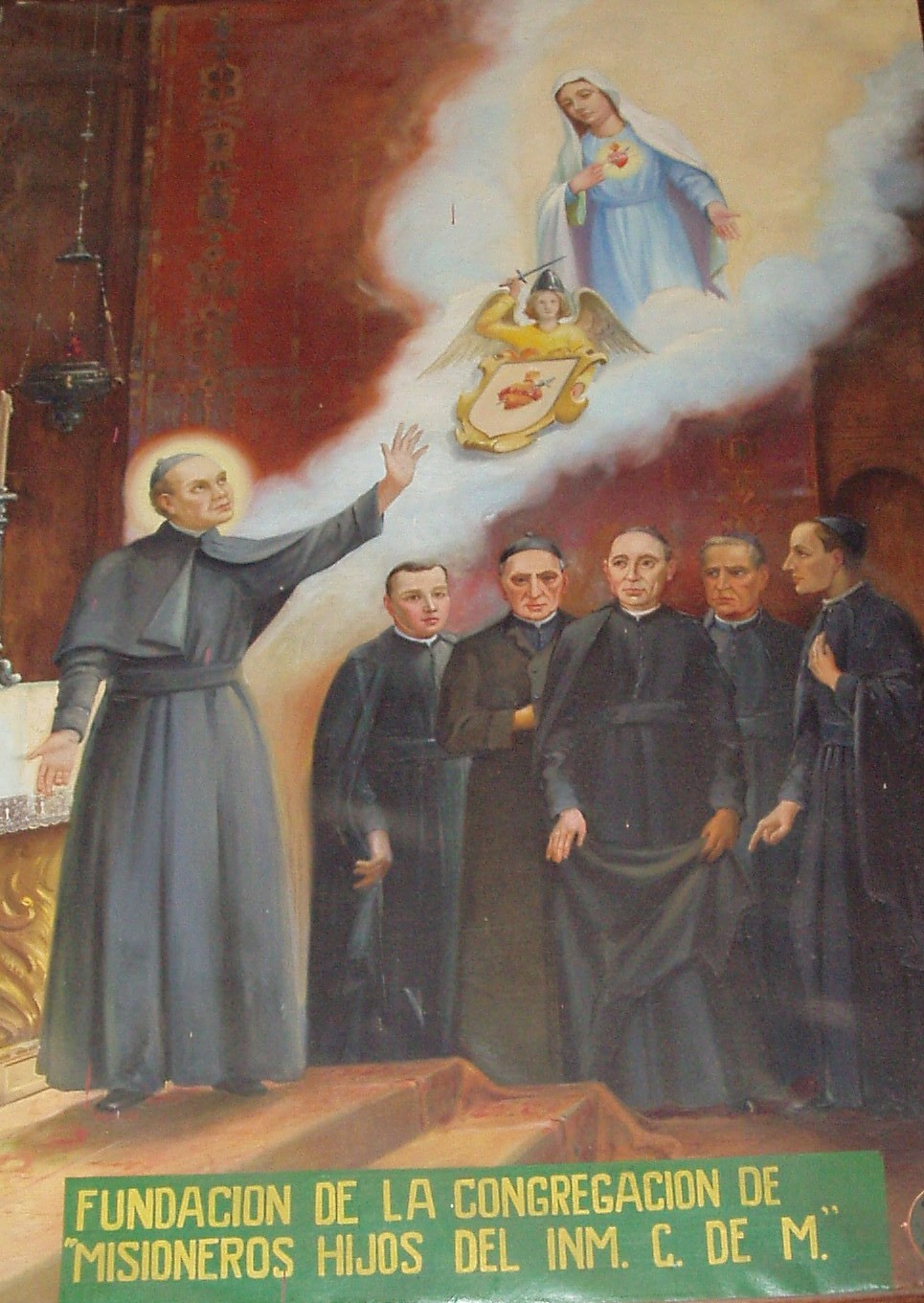
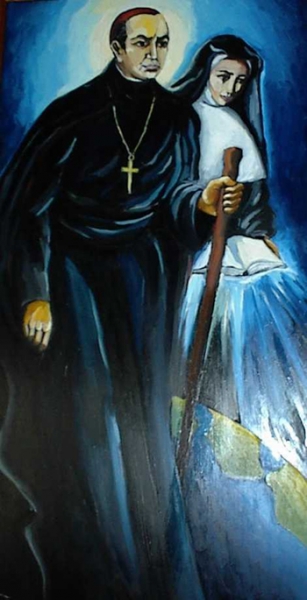
Founder and Archbishop of Cuba:  On July 16, 1849, he gathered a group of priests who shared his dream   This is the beginning of the Missionary Sons of the Immaculate Heart of Mary, today also known as Claretian Fathers and Brothers.   Days later, he received a new assignment:  he was named Archbishop of Santiago de Cuba.   He was forced to leave the newly founded community to respond to the call of God in the New World. After two months of travel, he reached the Island of Cuba and began his episcopal ministry by dedicating it to Mary.   He visited the church where the image of Our Lady of Charity, patroness of Cuba was venerated.   Soon he realized the urgent need for human and Christian formation, specially among the poor.  He called Antonia Paris to begin there the religious community they had agreed to found back in Spain.   He was concerned for all aspects of human development and applied his great creativity to improve the conditions of the people under his pastoral care.AA new foundation

st antony in cuba

Among his great initiatives were:  trade or vocational schools for disadvantaged children and credit unions for the use of the poor.   He wrote books about rural spirituality and agricultural methods, which he himself tested first.   He visited jails and hospitals, defended the oppressed and denounced racism.   The expected reaction came soon.   He began to experience persecution and finally when preaching in the city of Holguín, a man stabbed him on the cheek in an attempt to kill him.   For Claret this was a great cause of joy.  He writes in his Autobiography:  “I can´t describe the pleasure, delight, and joy I felt in my soul on realising that I had reached the long desired goal of shedding my blood for the love of Jesus and Mary and of sealing the truths of the gospel with the very blood of my veins.” (Aut. # 577).   During his 6 years in Cuba he visited the extensive Archdiocese three times…town by town.   In the first years, records show, he confirmed 100,000 people and performed 9,000 sacramental marriages.

Confessor to the Queen of Spain:  Claret was called back to Spain in 1857 to serve as confessor to the Queen of Spain, Isabella II.   He had a natural dislike for aristocratic life. He loved poverty and the simplest lifestyle.  He accepted in obedience but requested to be allowed to continue some missionary work.   Whenever he had to travel with the Queen, he used the opportunity to preach in different towns throughout Spain.   In a time where the Queens and Kings chose the bishops for vacant dioceses, Claret played an important role in the selection of holy and dedicated bishops for Spain and its colonies.
The eleven years he spent as confessor to the Queen of Spain were particularly painful, because the enemies of the Church directed toward him all kinds of slanders and personal ridicule.   In 1868 a new revolution dethroned the Queen and sent her with her family into exile.   Claret’s life was also in danger, so he accompanied her to France.   This gave him the opportunity to preach the Gospel in Paris.   He stayed with them for a while, then went to Rome where he was received by Pope Pius IX in a private audience.

First Vatican Council:  On December 8, 1869, seven hundred bishops from all over the world gathered in Rome for the First Vatican Council.   Claret was one of the Council Fathers.   His presence became noticeable when the subject of papal infallibility was discussed, which Claret defended vehemently.   This teaching became a dogma of faith for all Catholics at this Council.   The Italian revolution interrupted the process of the Council, which was never concluded.   Claret’s health deteriorated, so he returned to France accompanied by the Superior General of the Sons of the Immaculate Heart of Mary, his congregation.

Last Days in Exile:  In France, Claret joined his missionaries who were also in exile. Soon he found out, that there was a warrant for his arrest.   He decided to go into hiding in a Cistercian Monastery in the French southern town of Fontfroide.   There he died on 24October 1870 at the age of 62.   As his last request, he dictated to his missionaries the words that are to appear on his tombstone: “I have loved justice and hated iniquity; therefore I die in exile.”   His zealous life and the wonders he wrought, both before and after his death, testified to his sanctity.   Information was sought in 1887 and he was declared venerable by Pope Leo XIII in 1899.   His relics were transferred to the mission house at Vic in 1897, at which time his heart was found incorrupt.   His grave is visited by many pilgrims.  Claret was beatified in 1934 and in 1950 canonised by Pope Pius XII.

 
Posted in DOMINICAN OP, MORNING Prayers, PRAYERS of the SAINTS

Our Morning Offering – 24 October

Our Morning Offering – 24 October

Our Lord, King of all!
St ALBERT the GREAT O.P.

We pray to You, O Lord,
who are the surpeme Truth,
and all truth is from You.
We beseech You, O Lord,
who are the highest Wisdom,
and all the wise
depend on You for their wisdom.
You are the supreme Joy,
and all who are happy owe it to You.
You are the Light of minds,
and all receive
their understanding from You.
We love, we love You above all.
We seek You, we follow You,
and we are ready to serve You.
We desire to dwell under Your power
for You are the King of all. Amenour lord, king of all - st albert the geat op


Posted in Uncategorized

Memorials of the Saints – 24 October

St Anthony Mary Claret (1807-1870) (Optional Memorial) – https://www.youtube.com/watch?v=cbBMzR-J8R8
—
Bl Amado García Sánchez
St Audactus of Thibiuca
St Cadfarch
St Ciriacus of Hierapolis
St Claudian of Hierapolis
St Ebregislus of Cologne
St Felix of Thibiuca
St Fortunatus of Thibiuca
St Fromundus of Coutances
St Giuse Lê Dang Thi
Bl Giuseppe Baldo
St Januarius of Thibiuca
St Luigi Guanella
St Maglorius of Wales
St Marcius of Monte Cassino
St Martin of Vertou
St Proclus of Constantinople
St Senoch
St Senócus of Tours
St Septimus of Thibiuca
—
Martyrs of Ephesus – 3 saints: Three Christians martyred together. All we know about them are the names Mark, Sotericus and Valentina.
They were stoned to death near Ephesus, Asia Minor (in modern Turkey). Their relics are enshrined on the island of Tasos.

Posted in JESUIT SJ, POETRY

THE HOUND OF HEAVEN – By Francis Thompson, (1859-1907)

“The Hound of Heaven” is a 182-line poem written by English Catholic poet Francis Thompson (1859–1907).   The poem became famous and was the source of much of Thompson’s posthumous reputation.   The poem was first published in Thompson’s first volume of poems in 1893.   It was included in the Oxford Book of English Mystical Verse (1917).   Thompson’s work was praised by G K Chesterton and it was also an influence on J R R Tolkien, who presented a paper on Thompson in 1914.

This Christian poem has been described as follows:

“The name is strange.   It startles one at first.   It is so bold, so new, so fearless.   It does not attract, rather the reverse.   But when one reads the poem this strangeness disappears.   The meaning is understood.   As the hound follows the hare, never ceasing in its running, ever drawing nearer in the chase, with unhurrying and imperturbed pace, so does God follow the fleeing soul by His Divine grace.   And though in sin or in human love, away from God it seeks to hide itself, Divine grace follows after, unwearyingly follows ever after, till the soul feels its pressure forcing it to turn to Him alone in that never ending pursuit.”    Fr JFX. O’Conor, S.Jthe hound of heaven - francis thompson - 23 oct 2017
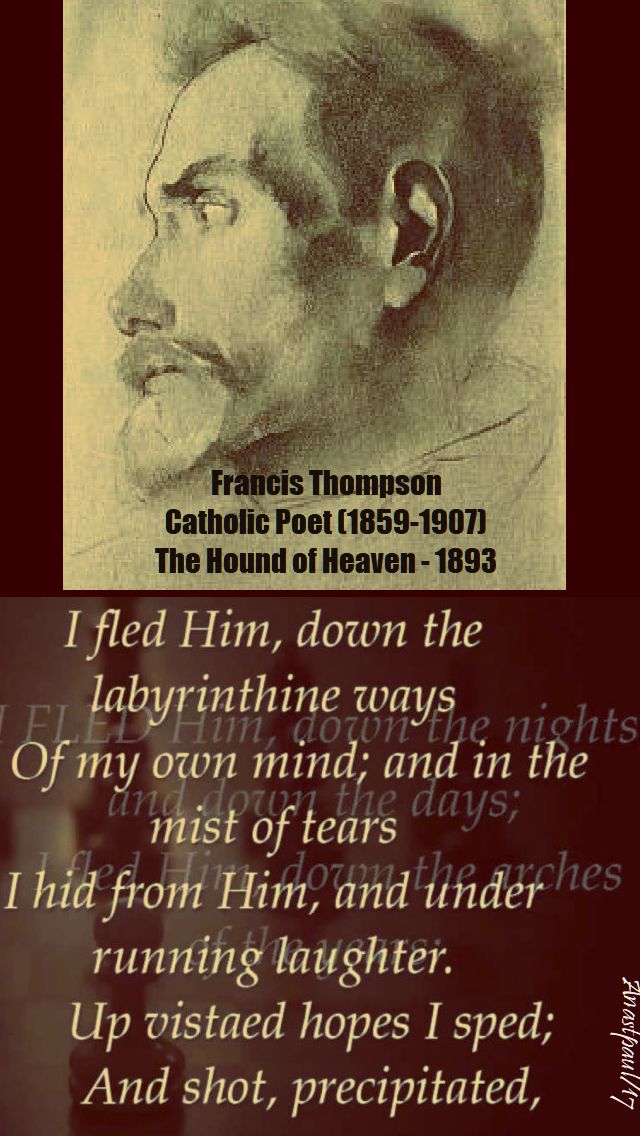
THE HOUND OF HEAVEN (1893)  – By Francis Thompson (16 December 1859 – 13 November 1907)

https://youtu.be/gToj6SLWz8Q (Richard Burton – a beautiful version)

I fled Him, down the nights and down the days;
I fled Him, down the arches of the years;
I fled Him, down the labyrinthine ways
Of my own mind; and in the midst of tears
I hid from Him, and under running laughter.
Up vistaed hopes I sped;
And shot, precipitated,
Adown Titanic glooms of chasmed fears,
From those strong Feet that followed, followed after.
But with unhurrying chase,
And unperturbèd pace,
Deliberate speed, majestic instancy,
They beat—and a Voice beat
More instant than the Feet—
‘All things betray thee, who betrayest Me’.

I pleaded, outlaw-wise,
By many a hearted casement, curtained red,
Trellised with intertwining charities;
(For, though I knew His love Who followed,
Yet was I sore a dread
Lest, having Him, I must have naught beside.)
But, if one little casement parted wide,
The gust of His approach would clash it to:
Fear wist not to evade, as Love wist to pursue.
Across the margent of the world I fled,
And troubled the gold gateway of the stars,
Smiting for shelter on their clanged bars;
Fretted to dulcet jars
And silvern chatter the pale ports o’ the moon.
I said to Dawn: Be sudden—to Eve: Be soon;
With thy young skiey blossom heap me over
From this tremendous Lover—
Float thy vague veil about me, lest He see!
I tempted all His servitors, but to find
My own betrayal in their constancy,
In faith to Him their fickleness to me,
Their traitorous trueness, and their loyal deceit.
To all swift things for swiftness did I sue;
Clung to the whistling mane of every wind.
But whether they swept, smoothly fleet,
The long savannahs of the blue;
Or, whether, Thunder-driven,
They clanged his chariot ‘thwart a heaven,
Plashy with flying lightnings round the spurn o’ their feet:—
Fear wist not to evade as Love wist to pursue.
Still with unhurrying chase,
And unperturbed pace,
Deliberate speed, majestic instancy,
Came on the following Feet,
And a Voice above their beat—
‘Naught shelters thee, who wilt not shelter Me.’

I sought no more after that which I strayed
In face of man or maid;
But still within the little children’s eyes
Seems something, something that replies,
They at least are for me, surely for me!
I turned me to them very wistfully;
But just as their young eyes grew sudden fair
With dawning answers there,
Their angel plucked them from me by the hair.
Come then, ye other children, Nature’s—share
With me’ (said I) ‘your delicate fellowship;
Let me greet you lip to lip,
Let me twine with you caresses,
Wantoning
With our Lady-Mother’s vagrant tresses,
Banqueting
With her in her wind-walled palace,
Underneath her azured dais,
Quaffing, as your taintless way is,
From a chalice
Lucent-weeping out of the dayspring.’
So it was done:
I in their delicate fellowship was one—
Drew the bolt of Nature’s secrecies.
          I knew all the swift importings
On the wilful face of skies;
I knew how the clouds arise
Spumèd of the wild sea-snortings;
All that’s born or dies
Rose and drooped with; made them shapers
Of mine own moods, or wailful divine;
With them joyed and was bereaven.
I was heavy with the even,
When she lit her glimmering tapers
Round the day’s dead sanctities.
I laughed in the morning’s eyes.
I triumphed and I saddened with all weather,
Heaven and I wept together,
And its sweet tears were salt with mortal mine:
Against the red throb of its sunset-heart
I laid my own to beat, And share commingling heat;
But not by that, by that, was eased my human smart.
In vain my tears were wet on Heaven’s grey cheek.
For ah! we know not what each other says,
These things and I; in sound I speak—
Their sound is but their stir, they speak by silences.
Nature, poor stepdame, cannot slake my drouth;
Let her, if she would owe me,
Drop yon blue bosom-veil of sky, and show me
The breasts o’ her tenderness:
Never did any milk of hers once bless
My thirsting mouth.
Nigh and nigh draws the chase,
With unperturbed pace,
Deliberate speed, majestic instancy;
And past those noisèd Feet
A voice comes yet more fleet—
‘Lo! naught contents thee, who content’st not Me.’

Naked I wait Thy love’s uplifted stroke!
My harness piece by piece Thou has hewn from me,
And smitten me to my knee;
I am defenceless utterly.
I slept, methinks, and woke,
And, slowly gazing, find me stripped in sleep.
In the rash lustihead of my young powers,
I shook the pillaring hours
And pulled my life upon me; grimed with smears,
I stand amidst the dust o’ the mounded years—
My mangled youth lies dead beneath the heap.
My days have crackled and gone up in smoke,
Have puffed and burst as sun-starts on a stream.
Yea, faileth now even dream
The dreamer, and the lute the lutanist;
Even the linked fantasies, in whose blossomy twist
I swung the earth a trinket at my wrist,
Are yielding; cords of all too weak account
For earth with heavy griefs so overplussed.
Ah! is Thy love indeed
A weed, albeit an amarinthine weed,
Suffering no flowers except its own to mount?
Ah! must—
Designer infinite!—
Ah! must Thou char the wood ere Thou canst limn with it?
My freshness spent its wavering shower i’ the dust;
And now my heart is as a broken fount,
Wherein tear-drippings stagnate, spilt down ever
From the dank thoughts that shiver
Upon the sighful branches of my mind.
Such is; what is to be?
The pulp so bitter, how shall taste the rind?
I dimly guess what Time in mists confounds;
Yet ever and anon a trumpet sounds
From the hid battlements of Eternity;
Those shaken mists a space unsettle, then
Round the half-glimpsed turrets slowly wash again.
But not ere him who summoneth
I first have seen, unwound
With glooming robes purpureal, cypress-crowned;
His name I know and what his trumpet saith.
Whether man’s heart or life it be which yields
Thee harvest, must Thy harvest-fields
Be dunged with rotten death?

Now of that long pursuit
Comes on at hand the bruit;
That Voice is round me like a bursting sea:
‘And is thy earth so marred,
Shattered in shard on shard?
Lo, all things fly thee, for thou fliest Me!

‘Strange, piteous, futile thing!
Wherefore should any set thee love apart?
Seeing none but I makes much of naught’ (He said),
‘And human love needs human meriting:
How hast thou merited—
Of all man’s clotted clay the dingiest clot?
Alack, thou knowest not
How little worthy of any love thou art!
Whom wilt thou find to love ignoble thee,
Save Me, save only Me?
All which I took from thee I did but take,
Not for thy harms,
But just that thou might’st seek it in My arms.
All which thy child’s mistake
Fancies as lost, I have stored for thee at home:
Rise, clasp My hand, and come!’

Halts by me that footfall:
Is my gloom, after all,
Shade of His hand, outstretched caressingly?
‘Ah, fondest, blindest, weakest,
I am He Whom thou seekest!
Thou dravest love from thee, who dravest Me.’
FRANCIS THOMPSON - MY SNIP

Posted in franciscan OFM, MORNING Prayers, SAINT of the DAY

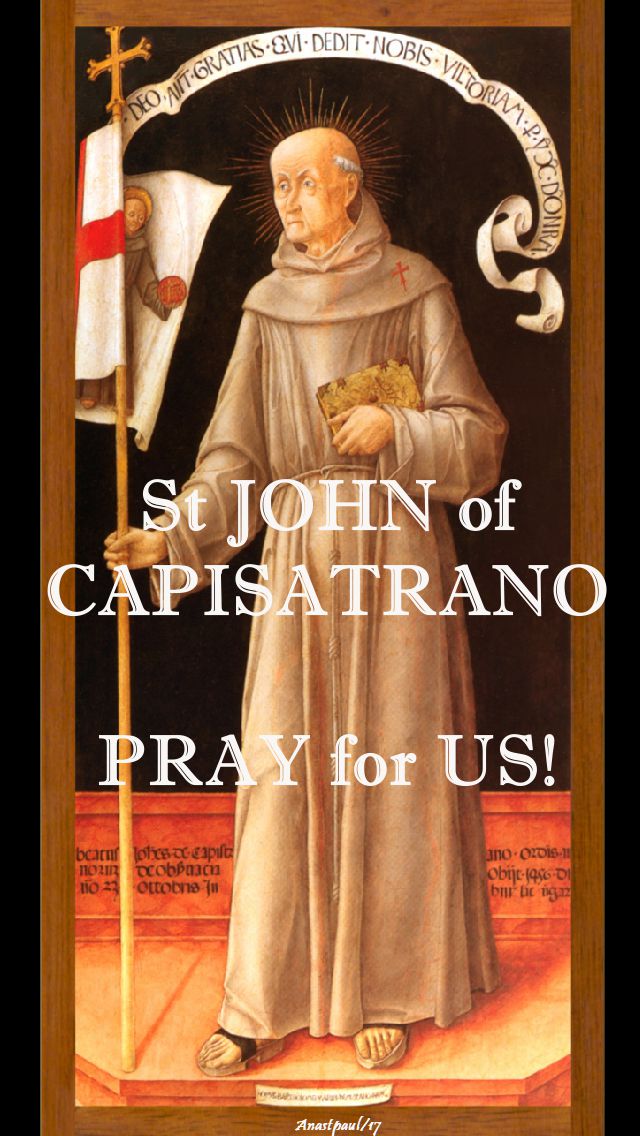
Thought for the Day – 23 October – The Memorial of St John of Capistrano (1386-1456)

Thought for the Day – 23 October – The Memorial of St John of Capistrano (1386-1456)

John was a Franciscan friar and priest, but not of the good-natured variety of Franciscans that holds the popular imagination.   To describe John as zealous would be an understatement.   He walked the fine line between zeal and fanaticism, allowing God to write straight with the crooked lines he drew throughout his life.   Some might wonder why such a man is even a saint but he is, and the lesson in that might be that being a saint is about more than just being nice and friendly.   Sanctity is an uncanny quality that can be as off-putting as it is attractive.

We might be “put off” by a saint like John Capistrano.  Perhaps the lesson there is that if he made it, there is hope for us all.

John Hofer, a biographer of John Capistrano, recalls a Brussels organization named after the saint.   Seeking to solve life problems in a fully Christian spirit, its motto was: “Initiative, Organisation, Activity.”   These three words characterised John’s life.   He was not one to sit around.   His deep Christian optimism drove him to battle problems at all levels with the confidence engendered by a deep faith in Christ.

We are not Christians because we build and maintain institutions.   We are Christians because people experience in us an invitation to know Jesus Christ and find in His Church the reality of His divine life and presence.

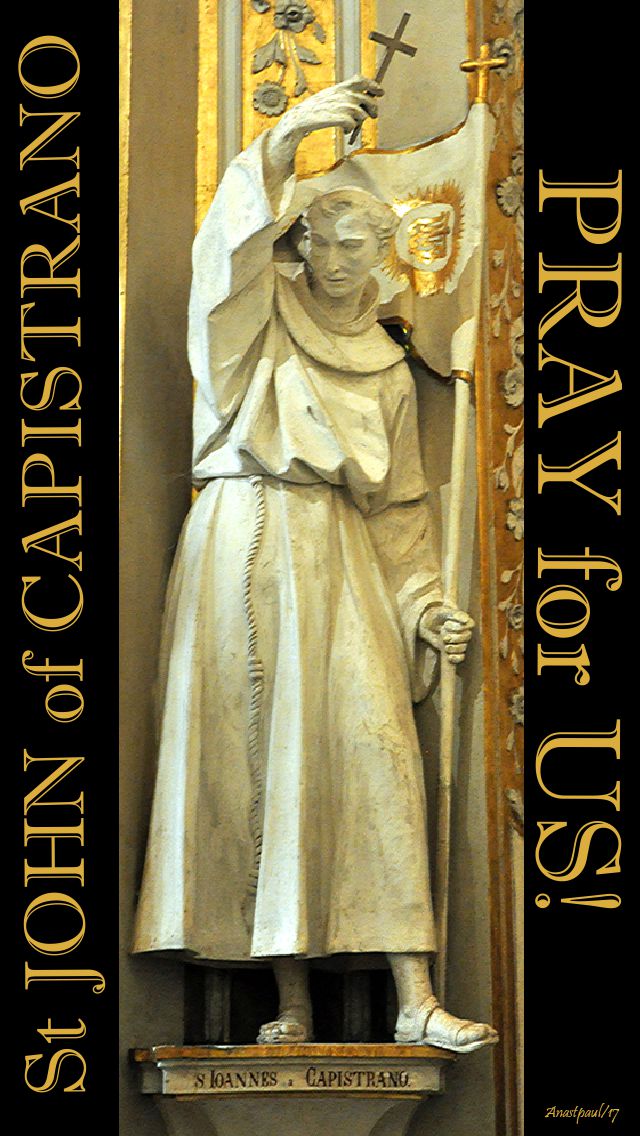
St John of Capistrano, pray for us!st john of capistrano pray for us 2 - 23 oct 2017

Posted in franciscan OFM, MORNING Prayers, QUOTES of the SAINTS, SAINT of the DAY

Quote of the Day – 23 October – The Memorial of St John of Capistrano (1386-1456)

Quote of the Day – 23 October – The Memorial of St John of Capistrano (1386-1456)

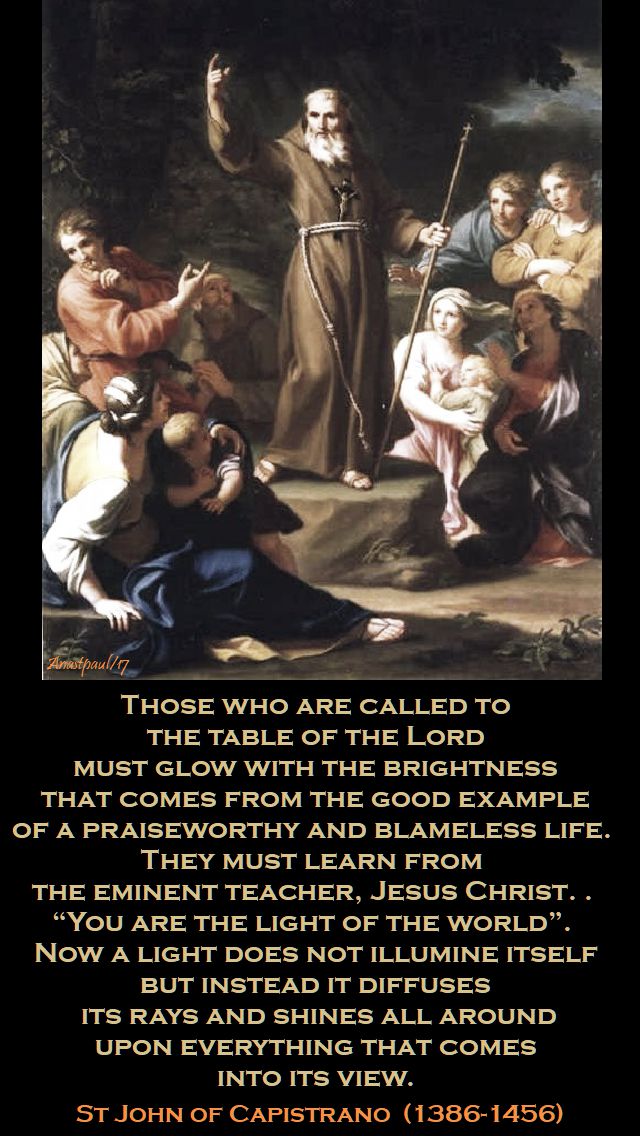
“Those who are called to the table of the Lord
must glow with the brightness that comes from
the good example of a praiseworthy and blameless life.
They must learn from the eminent teacher, Jesus Christ. .
“You are the light of the world” (see Matthew 5:14).
Now a light does not illumine itself but instead it diffuses
its rays and shines all around upon everything that comes
into its view..“

St John of Capistranothose who are called - st john of capistrano - 23 oct 2017

Posted in MORNING Prayers, PRAYERS of the SAINTS

Our Morning Offering – 23 October

Our Morning Offering – 23 October

Prayer to God for Guidance
By St Pope John Paul II

With all my heart
I seek You;
let me not stray
from Your commands…
Open my eyes,
that I may consider
the wonders
of Your law.
I am a wayfarer
of earth;
hide not Your commands
from me…
Make me understand
the way of Your precepts,
and I will meditate
on Your wondrous deeds…
Your compassion
is great, O Lord…
Amenprayer to god for guidance - 22 oct 2017

Posted in franciscan OFM, MORNING Prayers, SAINT of the DAY, The WORD

One Minute Reflection – 23 October – The Memorial of St John of Capistrano (1386-1456)

One Minute Reflection – 23 October – The Memorial of St John of Capistrano (1386-1456)

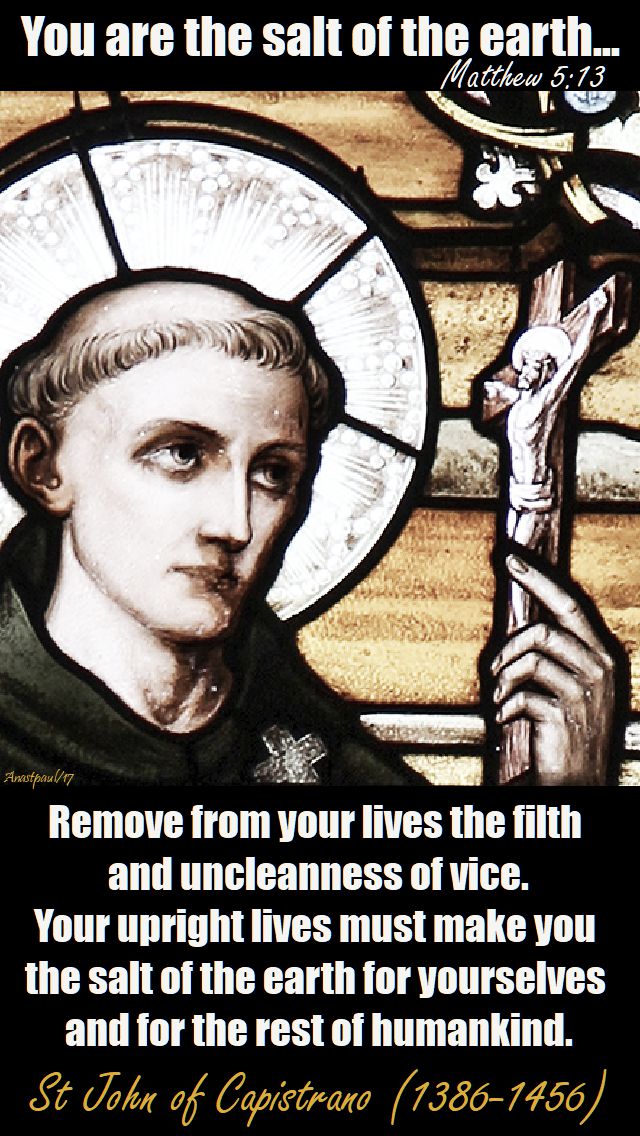
You are the salt of the earth.……Matthew 5:13

REFLECTION – Remove from your lives the filth and uncleanness of vice.
Your upright lives must make you the salt of the earth for yourselves
and for the rest of humankind…….St John of Capistranoremove from your lives - st john of capistrano - 23 oct 2017

PRAYER – Heavenly Father, enable me both to practice and to preach Your Message to all those I meet.   Grant that – in accord with Your Son’s mandate – I may be the salt of the earth.   St John of Capistrano, you lived a zealous life endlessly becoming “salt” to all.
Please pray for us that we may grow in zeal to glorify the Kingdom by our lives! Amenst john pray for us - 23 oct 2017