Well done, you are an industrious and reliable servant…..come share your master’s joy……..Matthew 25:21
REFLECTION – “It is not enough to pray: “Thy kingdom come” but to work, so that the Kingdom of God will exist among us today.”…………St Ursula Ledóchowska
PRAYER – Heavenly Father, help me to accept the tasks you have given me to do in life. Let me be faithful all my days and be able to attain Your eternal reward in heaven. St Ursula Ledóchowska, you accepted all work given you, no matter the circumstances and undergoing immense hardships to fulfil your mission and do the work of God, please pray for us, that we too, may be faithful at all times and in all circumstances, amen.
Mary, Full of Grace! By St ATHANASIUS (c296-373) Doctor of the Church
It is becoming for you, O Mary,
to be mindful of us,
as you stand near Him
who bestowed upon you all graces,
for you are the Mother of God and our Queen.
Come to our aid for the sake of the King,
the Lord God and Master who was born of you.
For this reason you are called “full of grace.”
Be mindful of us, most holy Virgin,
and bestow on us gifts
from the riches of your graces,
O Virgin full of grace. Amen
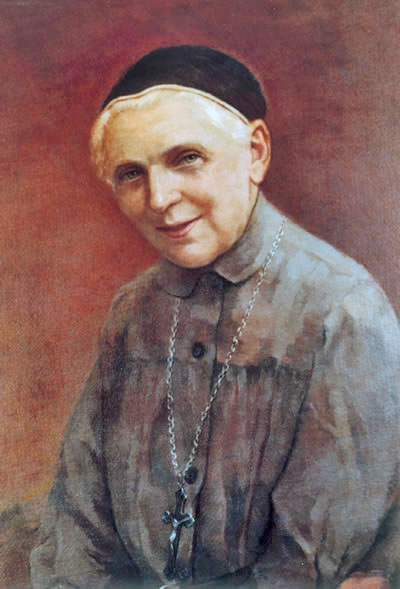
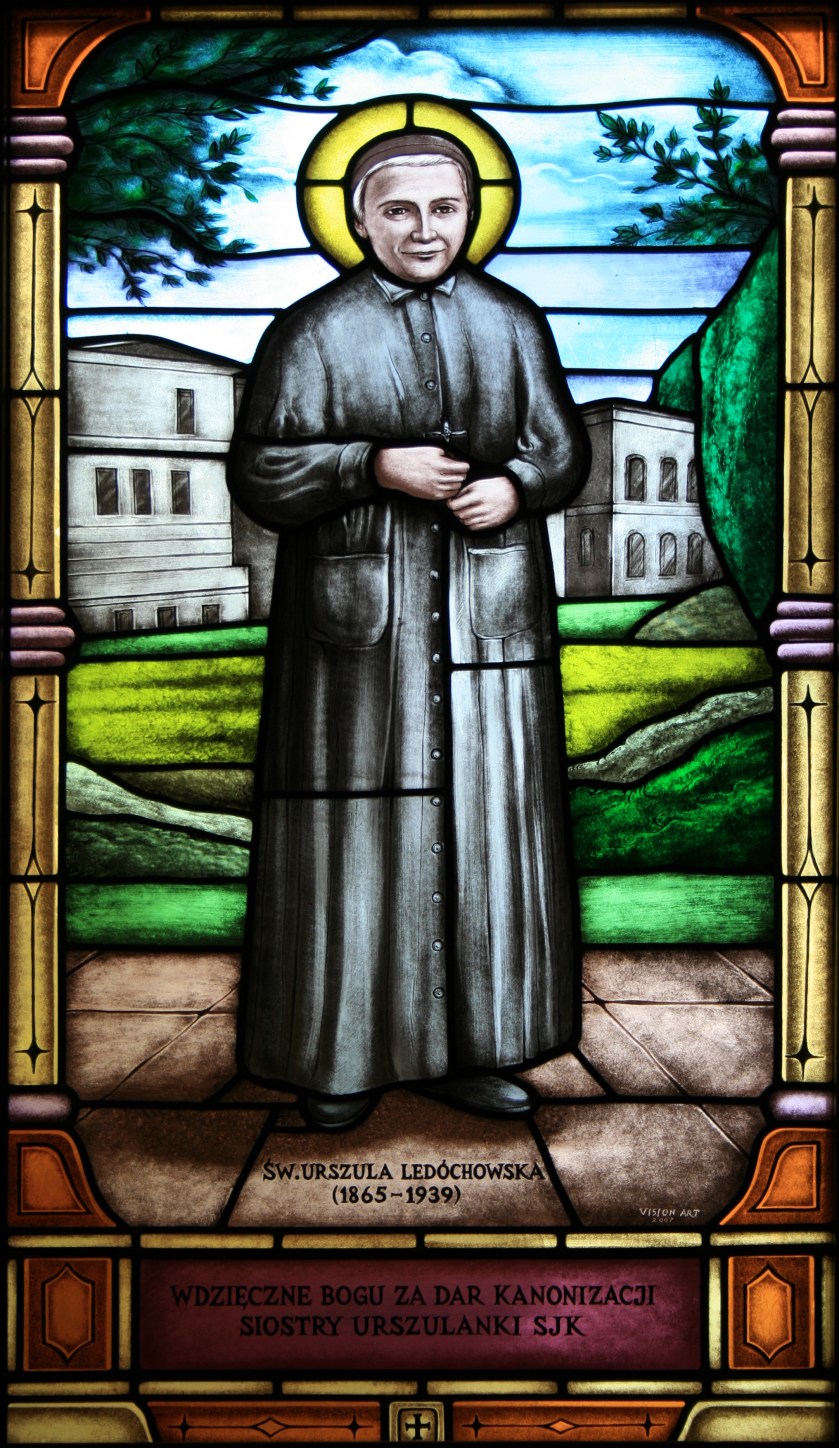
Saint of the Day – 29 May – St Ursula Ledóchowska (1865-1939) religious name – Maria Ursula of Jesus – Religous and Foundress of the Institute of Ursuline Sisters of the Sacred Heart of Jesus in Agony (17 April 1865 at Loosdoor, Austria as Julia Ledóchowska – 29 May 1939 in the Gray Ursuline convent, Via del Casalet, Rome, Italy of natural causes) . Canonised 18 May 2003 by Pope John Paul II at Vatican Basilica. Her body is incorrupt, it was transferred to the Gray Ursuline motherhouse in Pniewy, Poland on 29 May 1989.
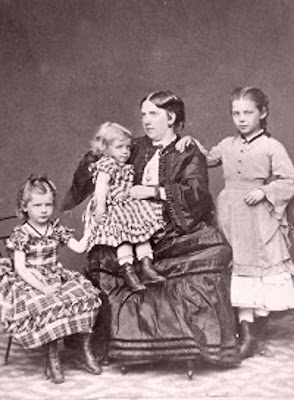
Born in Austria, Julia was born into a privileged family, the daughter of a Polish count and a Swiss noblewoman. She was one of five children born into the family. Her elder sister, Blessed Maria Teresa Ledóchowska, founded the Missionary Sisters of Saint Peter Claver and is affectionately known as the “Mother of Africa.”
Julia (at left), her mother, and sisters
Julia’s uncle, the Cardinal Mieczyslaw Ledóchowski, the Primate of Poland, was persecuted and imprisoned for his opposition to the policies of the Prussian “culture war.” For this reason and for reasons of finances, Julia’s father moved the family back to his native Poland, where he fell ill. Before his death, he gave his daughter his blessing to enter the Convent of Ursuline Sisters in Krakow. Taking the name of Maria Ursula of Jesus, she dedicated herself to service of those in need. Sister Maria Ursula was especially drawn to youth, specifically young women who were in need of education. She founded the first Polish residence for female university students and both watched over them and assisted them in their spiritual and academic studies.
Sister Maria Ursula became prioress of the convent in which she lived and later received a request from Monsignor Constantine Budkiewicz, a Polish nobleman living and priest of Saint Catherine’s Church. His wish was for Mother Maria Ursula to found a boarding school in Russia, for Polish girls wishing to study in Saint Petersburg. Having received approval from Pope Saint Pius X, she traveled to Russia and founded a convent there to work among Catholic immigrants. Given the state of Russian politics at that time, the nuns wore lay clothing and conducted themselves appropriately, but were under constant threat and surveillance by the Russian secret police.
As World War I dawned, Mother Ursula was expelled from Russia, given her Austrian birth. Monsignor Budkiewicz was eventually martyred for the faith, during the fall and renaming of Saint Petersburg as Leningrad. Having been expelled from Russia, Mother Ursula fled to Sweden. There, she organised relief efforts for war victims, charitable enterprises for those (like herself) living in exile from Poland. She further founded a monthly Catholic newspaper.
In 1920, Mother Ursula and her growing community made its way back into Poland, bringing with her dozens of orphaned youth. Upon their return, Mother Ursula found that her community had developed a separate and unique identity, mission and charism from the Ursuline community, given their exile and separation and as a result, she founded her own congregation: The Institute of Ursuline Sisters of the Sacred Heart of Jesus in Agony. Having obtained Vatican approval, she dedicated herself and her congregation to “the education and training of children and youth and service to the poorest and the oppressed among our brethren.”
From that time on, the Ursulines founded congregations in working class towns, organizing a “Eucharistic Crusade” by which to educate the factory workers and their families in the ways of the faith. With tireless energy and faith, Mother Ursula continued to lead her community until 1939, when she passed away quietly at the general house of her community in Rome. Her incorrupt body was translated to the Gray Ursuline motherhouse in Pniewy, Poland in 1989. She was canonised in 2003 by Pope John Paul II. At her canonization, the pontiff proclaimed:
“Mother Ursula Ledóchowska made her life a mission of mercy for the most deprived. Wherever Providence took her, she found young people in need of instruction and spiritual formation, poor, sick or lonely people, battered by life in various ways, who expected of her understanding and concrete help. In accordance with her means, she never refused help to anyone. Her work of mercy will remain engraved forever in the message of holiness, which yesterday became part of the whole Church.”
Miracles
The first miracle that led to her beatification involved the cure of Jan Kołodziejski on 26 March 1946 while the second miracle leading to beatification involved the cure of the nun (from Ledóchowska’s own order) Magdalene Pawlak (in religious “Maria Danuta”) on 16 April 1946. The decisive miracle that led to her canonisation was the cure of Daniel Gajewski (b. 1982) who avoided electrocution in circumstances where he would otherwise would have been killed had it not been for the late nun whom he saw moments before fading into unconsciousness on 2 August 1996.
St Bona of Pisa
St Conon the Elder
St Conon the Younger
St Daganus
St Eleutherius of Rocca d’Arce
St Felix of Atares
St Gerald of Mâcon
Bl Gerardesca of Pisa
Bl Giles Dalmasia
St Hesychius of Antioch
St John de Atarés
BL Joseph Gerard
St Maximinus of Trier
St Maximus of Verona
St Restitutus of Rome
Bl Richard Thirkeld
St Theodosia of Caesarea and Companions
St Ursula Ledochowska
St Votus of Atares
St William of Cellone
—
Martyrs of Toulouse: A group of eleven Dominicans, Franciscans, Benedictines, clergy and lay brothers who worked with the Inquisition in southern France to oppose the Albigensian heresy. Basing their operations in a farmhouse outside Avignonet, France, he and his brother missioners worked against heresy. Murdered by Albigensian heretics while singing the Te Deum on the eve of Ascension. They werebeaten to death on the night of 28 to 29 May 1242 in the church of Avignonet, Toulouse, France and Beatified on 1 September 1866 by Pope Pius IX (cultus confirmation).
• Adhemar
• Bernard of Roquefort
• Bernard of Toulouse
• Fortanerio
• Garcia d’Aure
• Pietro d’Arnaud
• Raymond Carbonius
• Raymond di Cortisan
• Stephen Saint-Thibery
• William Arnaud
• the prior of Avignonet whose name unfortunately has not come down to us.
The church in which they died was placed under interdict as punishment to the locals for the offense. Shortly after the interdict was finally lifted, a large statue of the Blessed Virgin Mary was found on the door step of church. Neither the sculptor nor the patron was ever discovered, nor who delivered it or how. The people took it as a sign that they were forgiven, but that they should never forget, and should renew their devotion to Our Lady. They referred to the image as “Our Lady of Miracles”.
Until recently there was a ceremony in the church on the night of the 28th to 29th of May, the anniversary of the martyrdom. Called “The Ceremony of the Vow”, parishioners would gather in the church, kneel with lit candles, and process across the church on their knees, all the while praying for the souls of the heretics who had murdered the martyrs.
Martyrs of Trentino: Three missionaries to the Tyrol region of Austria, sent by Saint Ambrose of Milan and welcomed by Saint Vigilius of Trent. All were martyred – Alexander, Martyrius and Sisinius. They were born in Cappadocia and died in 397 in Austria.
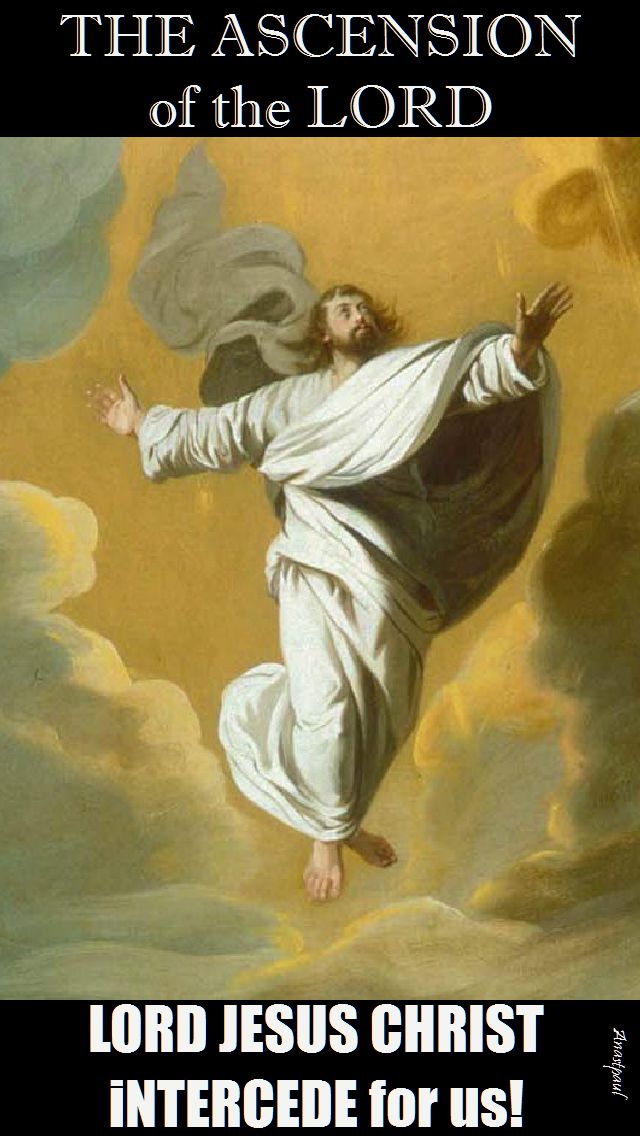
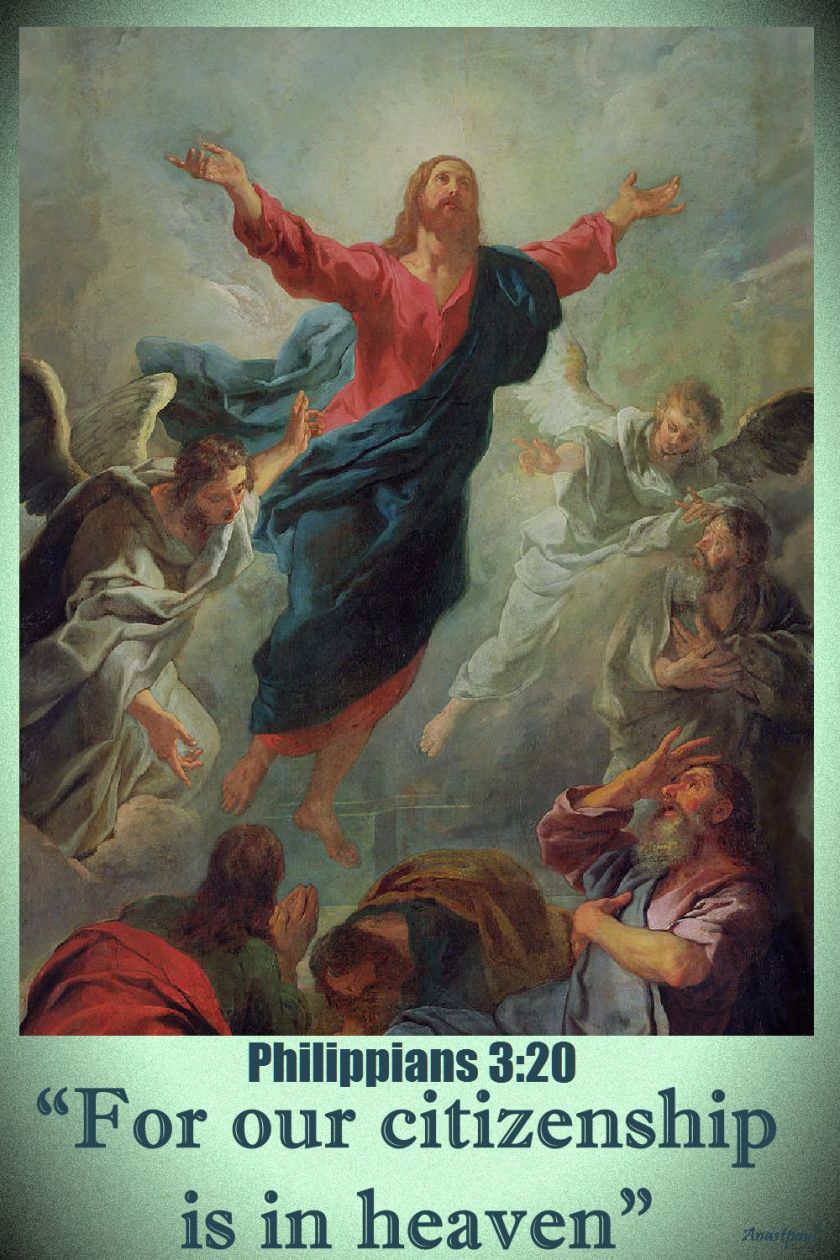
Thought for the Day – 28 May – The Ascension of the Lord
“As a mother who teaches her children to speak and so to understand and communicate, the Church our Mother teaches us the language of faith in order to introduce us to the understanding and the life of faith” (CCC No. 71, excerpt). The life of true faith. It is a stimulating and vigorous Catholic life of love and brightness; one which cannot be shaken nor injured nor destroyed by the appearance of any earthly catastrophe so long as we ourselves remain in the Light, remembering what we have heard from the beginning, never turning from our Beloved who ascended into heaven in order to appear in the presence of God on our behalf!
Lord Jesus Christ, seated at the Right Hand of the Father, intercede for us!
“For our citizenship is in heaven” (Philippians 3:20)
“The Lord opening the way to heaven, gives us a foretaste of divine life, already on this earth.”
“Christ’s Ascension means … that He belongs entirely to God. He, the Eternal Son, led our human existence into God’s presence, taking with Him flesh and blood in a transfigured form. The human being finds room in God; through Christ, the human being was introduced into the very life of God.”
Pope Benedict XVI
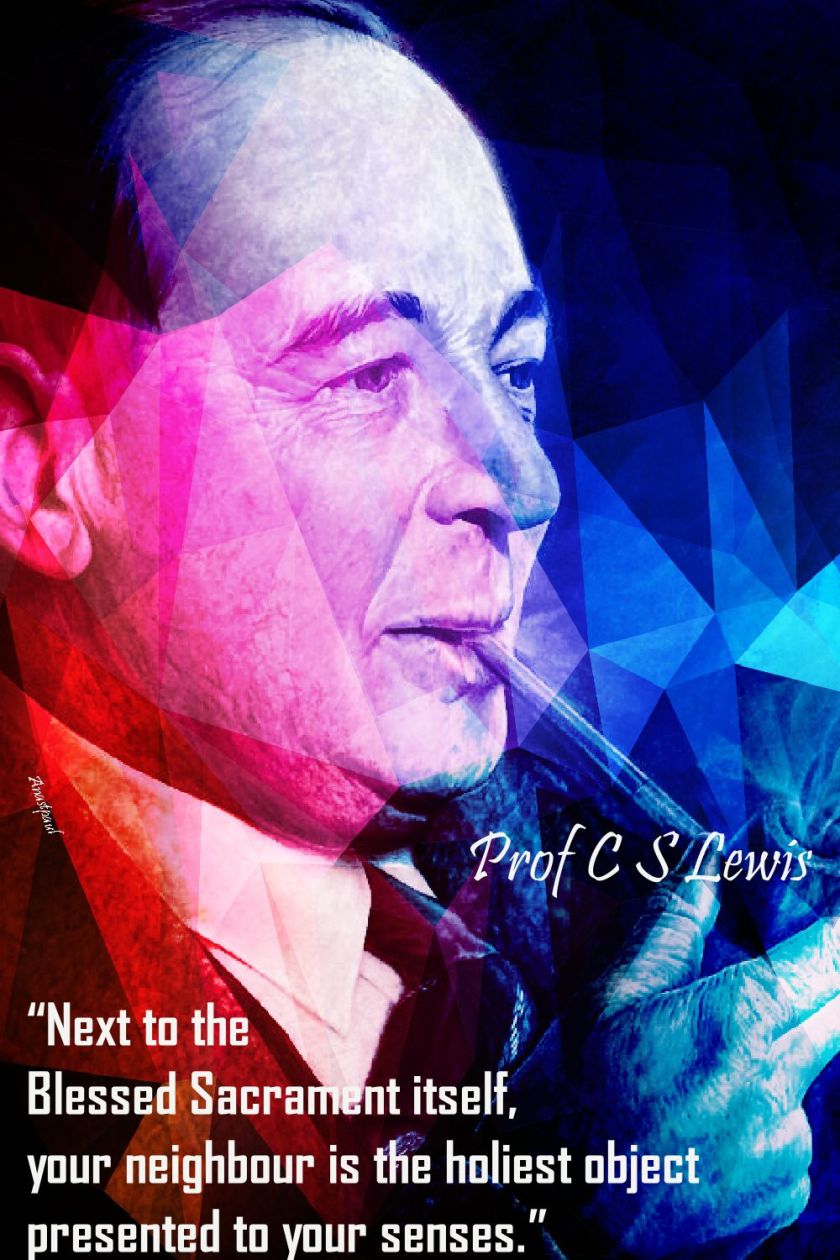
“Next to the Blessed Sacrament itself, your neighbour is the holiest object presented to your senses.”
C S Lewis
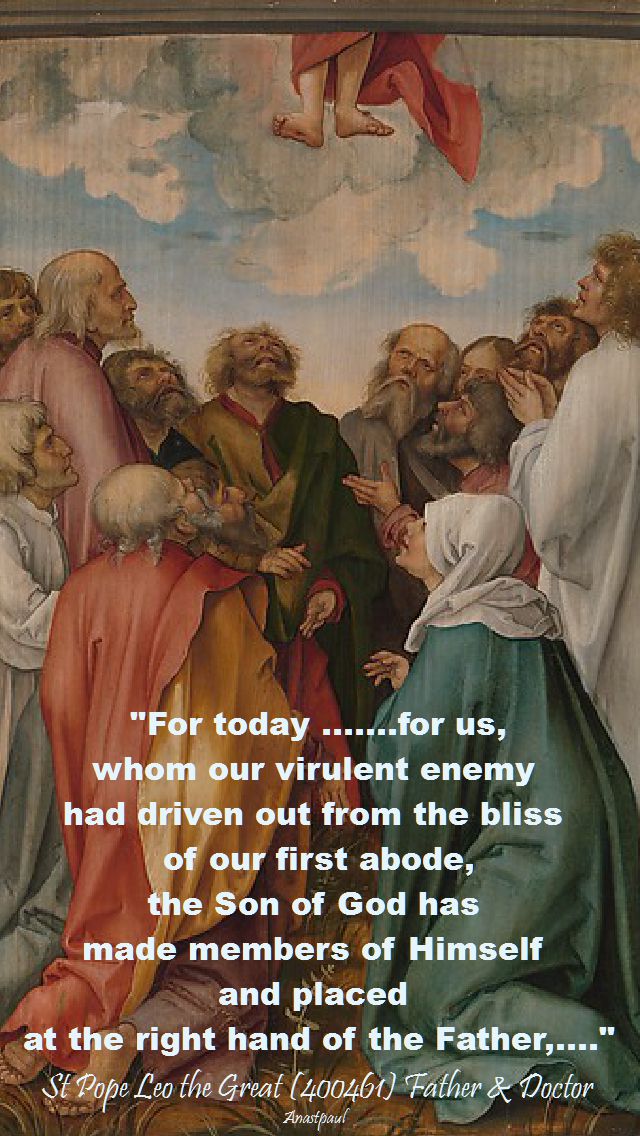
“For today …….for us, whom our virulent enemy had driven out from the bliss of our first abode, the Son of God has made members of Himself and placed at the right hand of the Father, with Whom He lives and reigns in the unity of the Holy Spirit, God for ever and ever. Amen.”
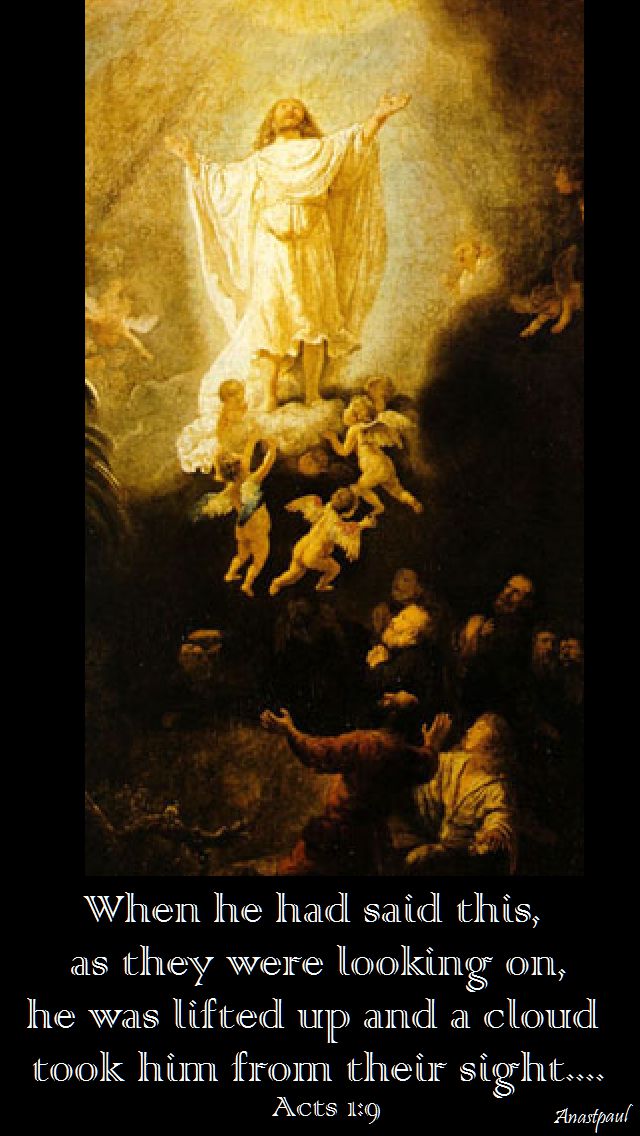
When he had said this, as they were looking on,
he was lifted up and a cloud took him from their sight……….Acts 1:9
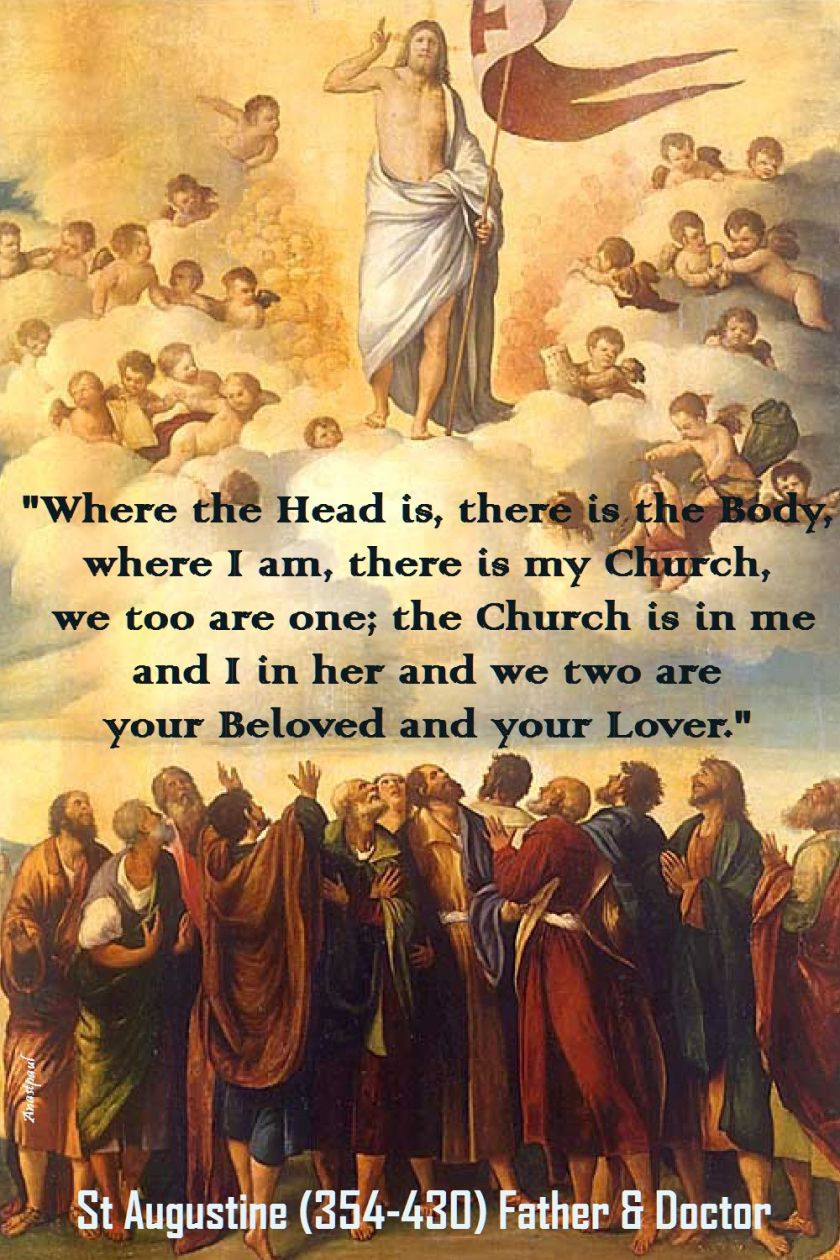
REFLECTION – “Today our Lord Jesus Christ ascended into heaven; let our hearts ascend with Him. Listen to the words of the Apostle: If you have risen with Christ, set your hearts on the things that are above where Christ is, seated at the right hand of God; seek the things that are above, not the things that are on earth. For just as He remained with us even after His ascension, so we too are already in heaven with Him, even though what is promised us has not yet been fulfilled in our bodies.”………………………St. Augustine
When we went down into the Font of Baptism we were incorporated into Jesus Christ, made members of His Body, the Church. Therefore, as Augustine also wrote, “Where the Head is, there is the Body, where I am, there is my Church, we too are one; the Church is in me and I in her and we two are your Beloved and your Lover.” In other words, we have ascended with the Lord!
PRAYER – Holy Father, teach me and help me to ‘abide’ in Your Son, who by ascending to You, took me too with Him. For He is my root and my foundation and I live only in Him! My Saviour and Redeemer, Jesus Christ my Lord, be with me always and intercede for us all with our Father. Amen
O Holy Mary, My Mother St Aloysius Gonzaga (1568-1591)
O Holy Mary, my mother,
into your blessed trust and custody,
and into the care of your mercy
I this day, every day,
and in the hour of my death,
commend my soul and my body.
To you I commit
all my anxieties and miseries,
my life and the end of my life,
that by your most holy intercession
and by your merits
all my actions may be directed
and disposed
according to your will
and that of your Son.
Amen
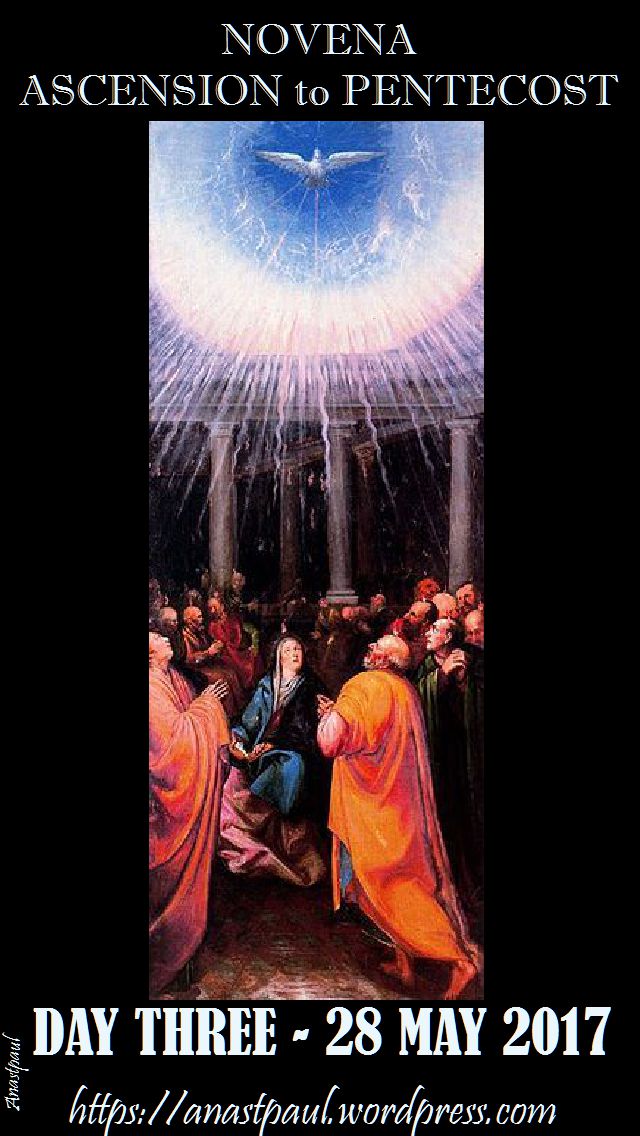
NOVENA from ASCENSION to PENTECOST DAY THREE – SUNDAY 28 MAY 2017
The Holy Spirit
Only one thing is important: eternal salvation. Only one thing, therefore, is to be feared: sin. Sin is the result of ignorance, weakness and indifference. The Holy Spirit is the Spirit of Light, of Strength and of Love. With His sevenfold gifts He enlightens the mind, strengthens the will and inflames the heart with the love of God. To ensure our salvation we ought to invoke the Divine Spirit daily, because the Spirit comes to us in our needs. When we don’t know what to say, it is the Spirit who speaks within us.
The Gift of Piety
The gift of Piety creates in our hearts a deep affection for God as our most loving Father. It inspires us to love and respect for His sake all people and things consecrated to him, as well as those who act with His Divine authority, Mary Mother of the Saviour and the Saints, the Church and its visible head the Pope, our parents and superiors, our country and its rulers. The person who is filled with the gift of Piety finds the practice of the faith, not a burdensome duty but a delightful service. Where there is love, there is no labour.
Prayer
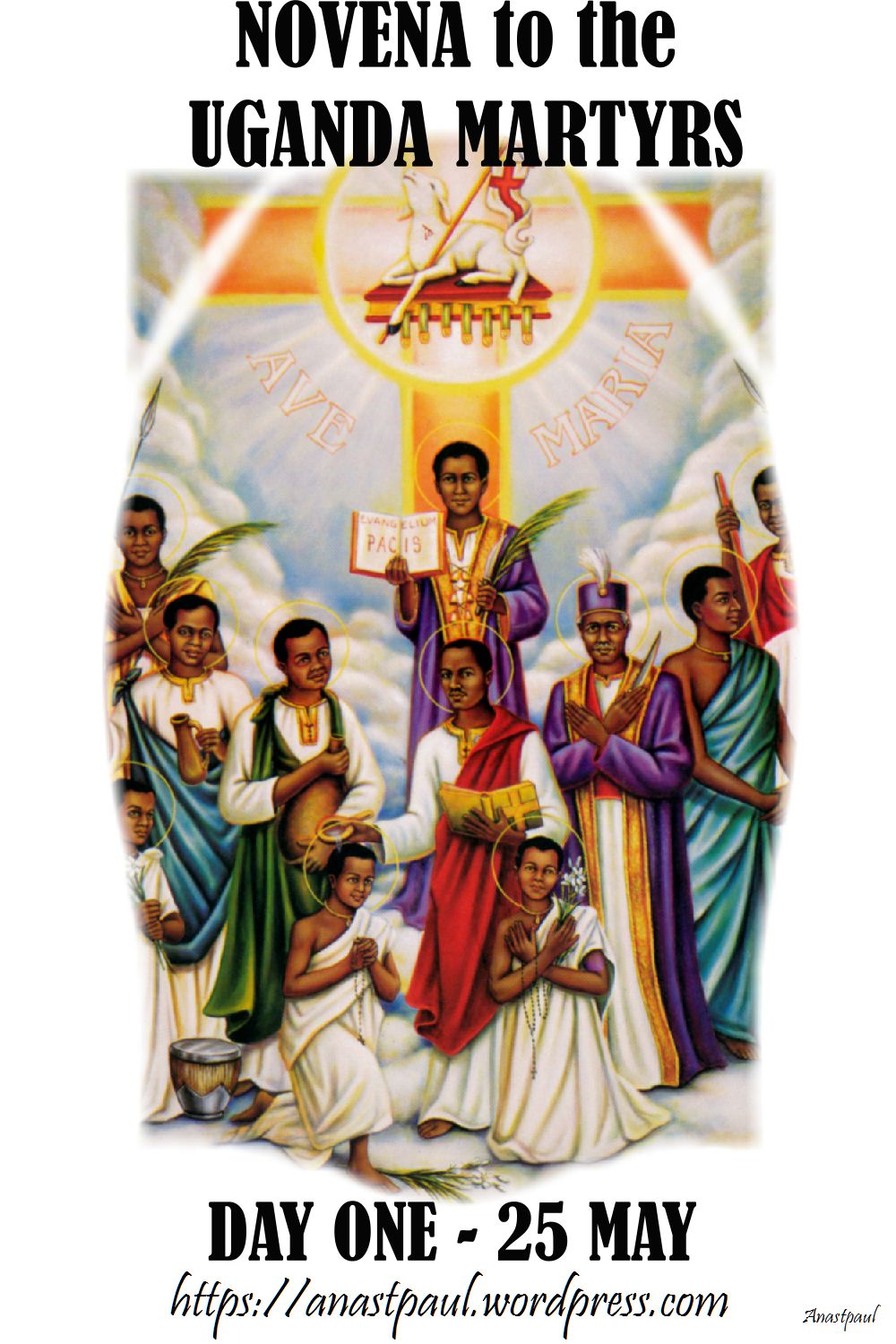
Come and fill me, O Blessed Spirit of Piety. Possess my heart. Purify me. Humble me. Enkindle in me such a love for God that I may be satisfied only in His service and lovingly submit to all legitimate authority for the sake of Your kingdom. Make me increasingly uncomfortable with everything that is evil, so that I turn away from it and live only in You. Amen.
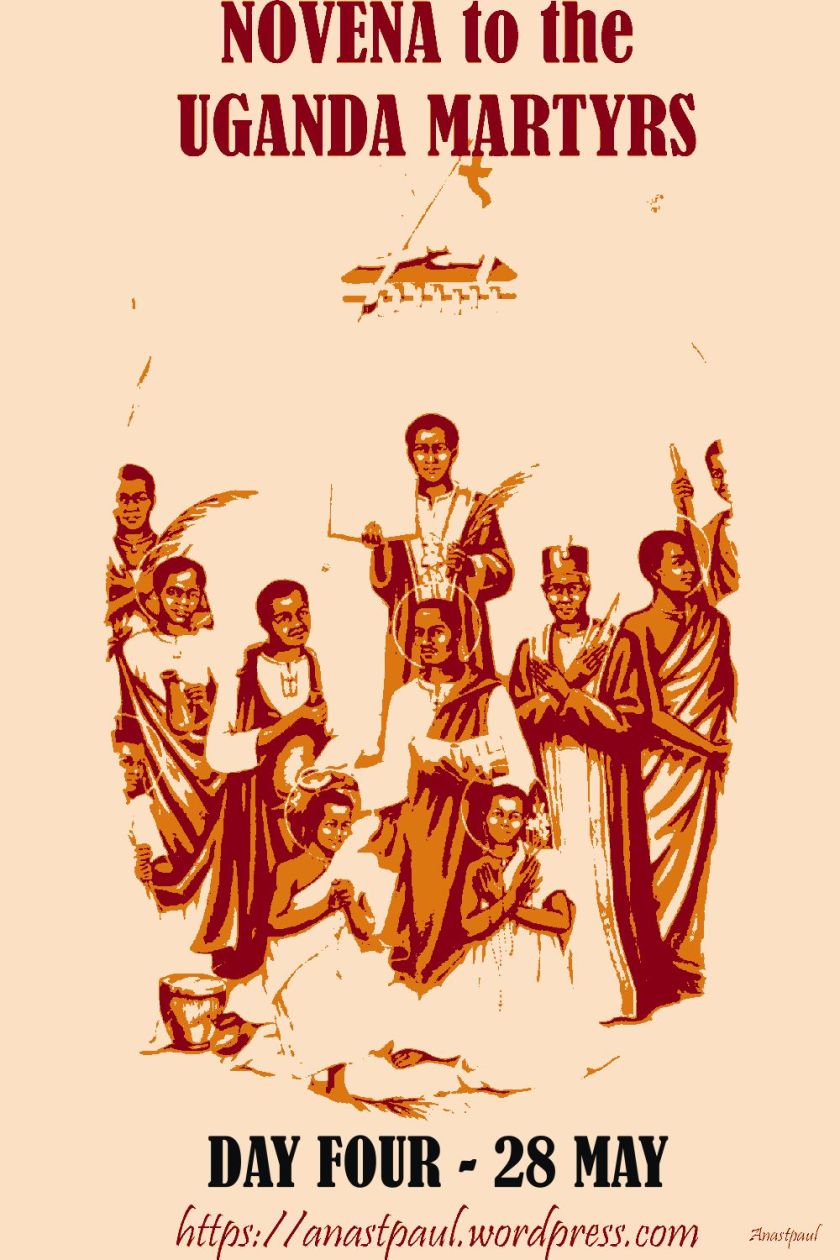
O God, who in Your love and mercy
was pleased to send missionaries to Uganda
to bring the light of Christ to all the peoples,
we thank You for the gift of the
Holy Martyrs of Uganda, our ancestors in faith,
whom You gave the strength to overcome sin and the
anguish of torture and to bear witness to the truth.
Mary, Mother of all who believe!
May all Christ’s followers in universal Church
draw ever closer together in a spirit
of mutual respect and cooperation.
May they bear ever more fraternal witness
to the reconciling love of Jesus the Redeemer.
Impelled by the Spirit of love,
may they help spread the light of the Gospel
to all the people of Uganda and all the world..
To the Holy Martyrs, we beg for intercession,
be pleased to hear our prayer and pray for us that this,
our special request may be granted
(make your intention)
Holy Martyrs of Uganda, we honour and praise you!
Please pray for us!
O heavenly Father, we make our prayer
through our Lord, Jesus Christ, in union with the Holy Spirit,
one God forever and ever, amen.
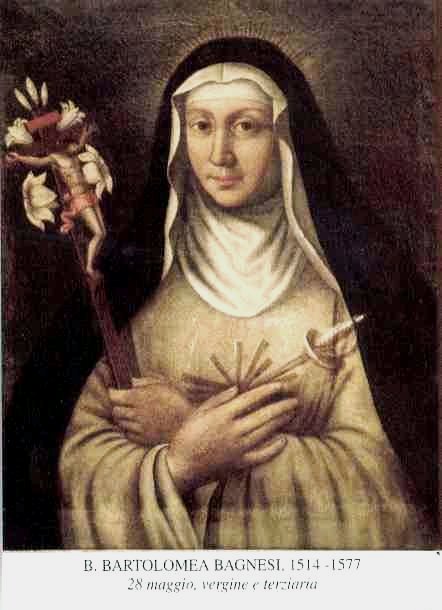
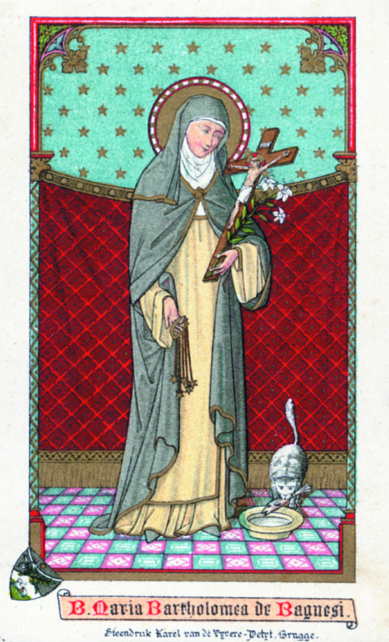
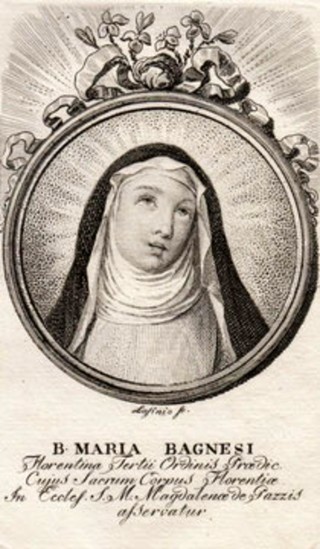
Saint of the Day – 28 May – Blessed Maria Bartolomea Bagnesi OP (1514-1577) Virgin, Third Order Dominican, Mystic, Ecstatic, with the gift of levitation – born as Maria Bagnesi but always called “Marietta” because of her tiny frame, on 15 August 1514 at Florence, Italy and died on 28 May 1577 at Florence, Italy of natural causes, agd 62. Patronages – abuse victims, ill people, against the death of parents, Dominican tertiaries. Her body is incorrupt.
Maria Bagnesi was born in Florence on 15 August 1514 – the Feast of the Assumption – to Carlo Bagnesi and Alessandra Orlandini. Bagnesi was a neglected child and her mother often left her in the care of others which included one of Bagnesi’s sisters who was a nun from the Order of Preachers so she spent most of her childhood in her sister’s convent. Four of her sisters would end up in the religious life.
Her father organised a marriage for her when she turned seventeen and she fainted in horror upon learning this. The thought made Bagnesi so ill she could not walk and was thus confined to her bed. Her father turned to con men and charlatans – for he could be manipulated with ease – and put his daughter through over three decades of non-stop “treatment”. Being bedridden meant that she could not follow her sisters into the religious life but she nevertheless became a member of the Third Order of Saint Dominic in 1544 and made her profession in 1545. She made her profession into the hands of and received the habit from Vittorio di Mattheo who allowed for this to take place in Bagnesi’s room. Bl Maria developed a deep devotion to Saint Bartholomew the Apostle and she assumed the name of “Bartolomea” as part of her actual name as a sort of middle name when she made her profession. After she professed she found that she could get out of her bed for brief periods of time. The combination of asthma and these quack treatments immobilised her just as she began to heal and she started to have visions and converse with angels and demons alike. Neighbours began to believe she was under demonic possession and summoned a local priest – who became her spiritual advisor who assured the locals she was not possessed or in need of an exorcism. People also claim to have seen her levitate. She was also granted the special privilege of having Mass celebrated in her room at times.
Her room soon became a place for pilgrims to go to in order to seek her wisdom and counsel and her room became a place for cats to roam – some remained with her and even slept on her bed while guarding her pet songbirds. She also came to know Saint Maria Maddalena de’ Pazzi and shared her visions with her; the saint would herself be cured due to Bagnesi’s intercession on 16 June 1584. Bagnesi received the Eucharist three to six times a week and prepared beforehand with docile care and spent the time following her reception of it in deep reflection. Her confessors were the Priests Alessandro Capocchi and Agostino Campi.
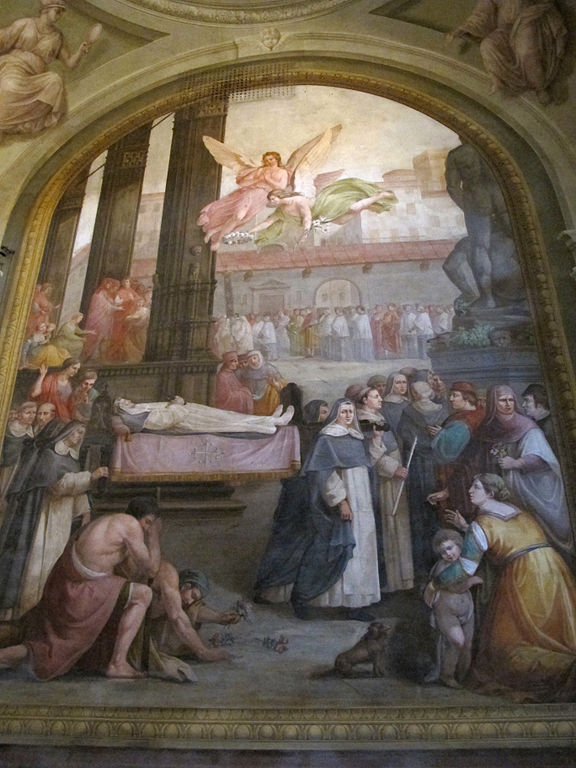
Bagnesi died in Florence in 1577 and at the end of her life, five Priests were present at her deathbed and one of them read to her one of the Gospel accounts of the Passion of Jesus Christ. Her remains were taken in procession for her funeral from Santa Maria Novella to Santa Maria degli Angeli where she was interred.
Painting depicting her funeral.
Let us Pray: O God, the lover of souls, who in Blessed Mary Bartholomew, Thy Virgin, didst unite wonderful endurance of illness with equal innocence of mind, grant , that we who are afflicted according to our deserts may be refreshed with the comfort of Thy grace. Through Christ our Lord. Amen.
7th Sunday of Easter (2017) or ASCENSION Sunday in many parts of the world where the Solemnity is transferred
—
St Accidia
Bl Albert of Csanád
Bl Antoni Julian Nowowiejski
St Bernard of Menthon
St Caraunus of Chartres
St Caraunus the Deacon
St Crescens of Rome
St Dioscorides of Rome
Eoghan the Sage
Gemiliano of Cagliari
Germanus of Paris
Bl Heliconis of Thessalonica
Helladius of Rome
Herculaneum of Piegaro
Bl John Shert
Justus of Urgell
Bl Lanfranc of Canterbury
Luciano of Cagliari
Bl Luigi Biraghi
Bl Margaret Plantagenet Pole
Bl Maria Bagnesi
Bl Mary of the Nativity
Moel-Odhran of Iona
Paulus of Rome
Phaolô Hanh
Podius of Florence
Bl Robert Johnson
Senator of Milan
Bl Thomas Ford
Ubaldesca Taccini
William of Gellone
Bl Wladyslaw Demski
—
Martyrs of Palestine: A group of early 5th century monks in Palestine who were martyred by invading Arabs.
Martyrs of Sardinia – 6 saints: A group of early Christians for whom a church on Sardinia is dedicated; they were probably martyrs, but no information about them has survived except the names Aemilian, Aemilius, Emilius, Felix, Lucian and Priamus. Patrons of the diocese of Alghero-Bosa, Italy.
Martyred in the Spanish Civil War: Lluís Berenguer Moratona
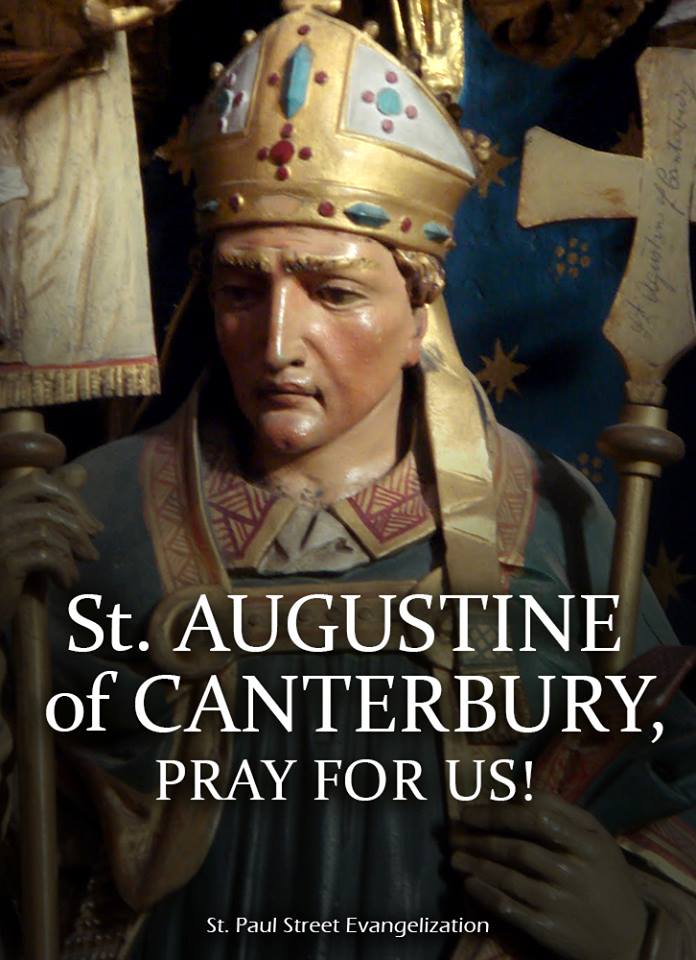
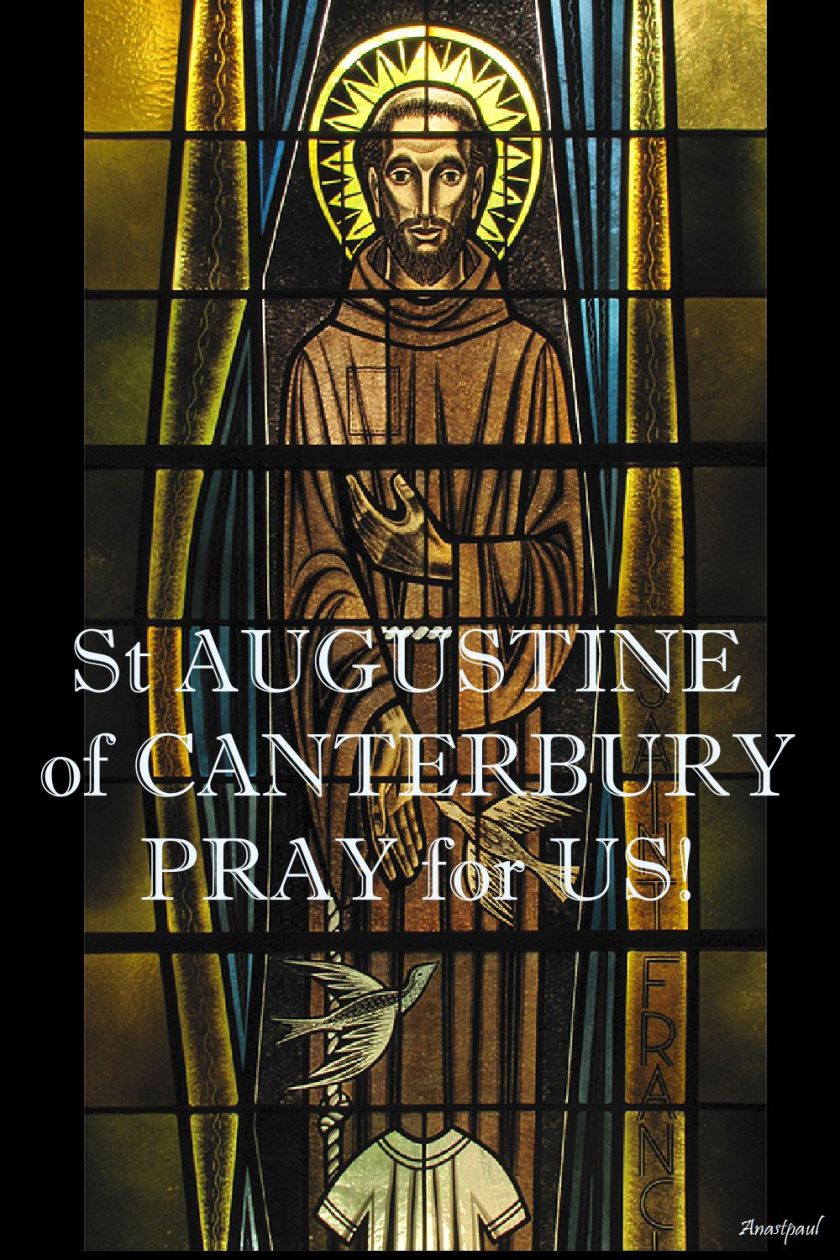
St Augustine of Canterbury comes across today as a very human saint, one who could suffer like many of us from a failure of nerve. For example, his first venture to England ended in a big U-turn back to Rome. He made mistakes and met failure in his peacemaking attempts with the Briton Christians. He often wrote to Rome for decisions on matters he could have decided on his own had he been more self-assured. He even received mild warnings against pride from Pope Gregory, who cautioned him to “fear lest, amidst the wonders that are done, the weak mind be puffed up by self-esteem.” Augustine’s perseverance amidst obstacles and only partial success teaches today’s apostles and pioneers to struggle on despite frustrations and be satisfied with gradual advances. by Fr. Don Miller, OFM
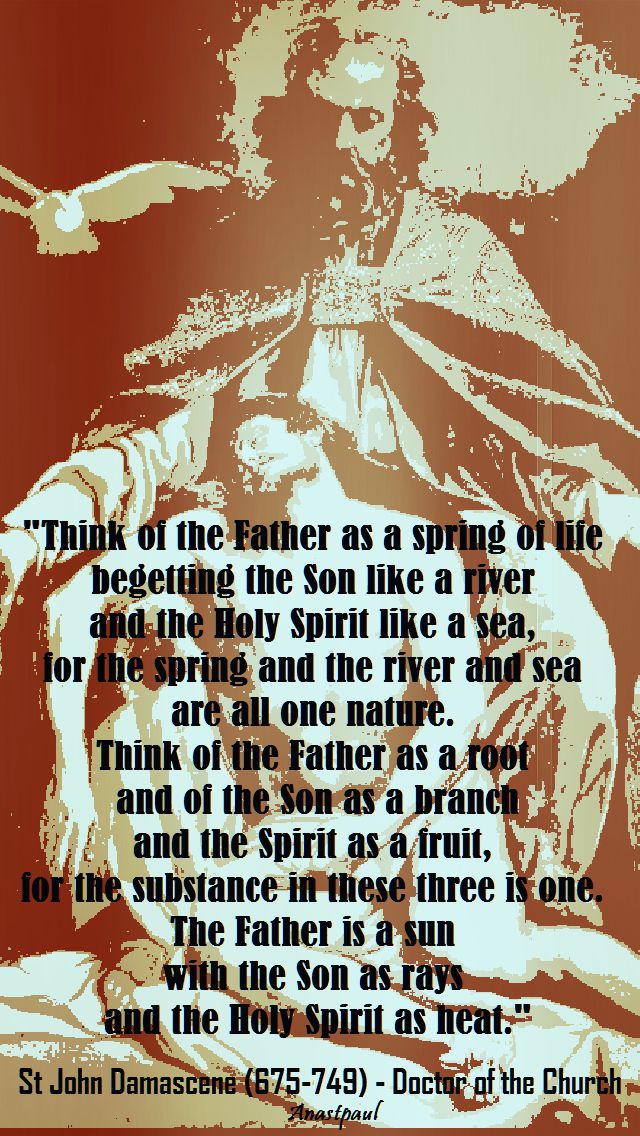
“Think of the Father as a spring of life begetting the Son like a river and the Holy Spirit like a sea, for the spring and the river and sea are all one nature. Think of the Father as a root and of the Son as a branch and the Spirit as a fruit, for the substance in these three is one. The Father is a sun with the Son as rays and the Holy Spirit as heat.”
St John Damascene (675-749) – Doctor of the Church
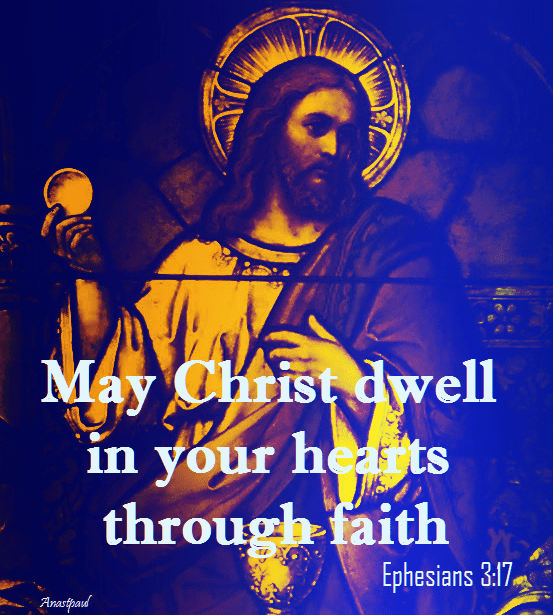
May Christ dwell in your hearts through faith……Ephesians 3:17
REFLECTION – “Bear Christ in heart, mind and will.
Bear Him in your mind by His teaching.
Bear Him in your will by your observance of the Law.
Bear Him in your heart by the Holy Eucharist.”…………Venerable Servant of God Pope Pius XII
PRAYER – Heavenly Father, let me be true bearer of Christ, Your Son, by doing always the things that are in imitation of and pleasing to Him. Help me to bear witness to Him in the world, one just as pagan as that approached by St Augustine of Canterbury in trepidation. But in Your light and by Your Holy Spirit, he succeeded and pleased You, help me too I beg, to work for the salvation of souls. St Augustine of Canterbury, pray for us all, amen.
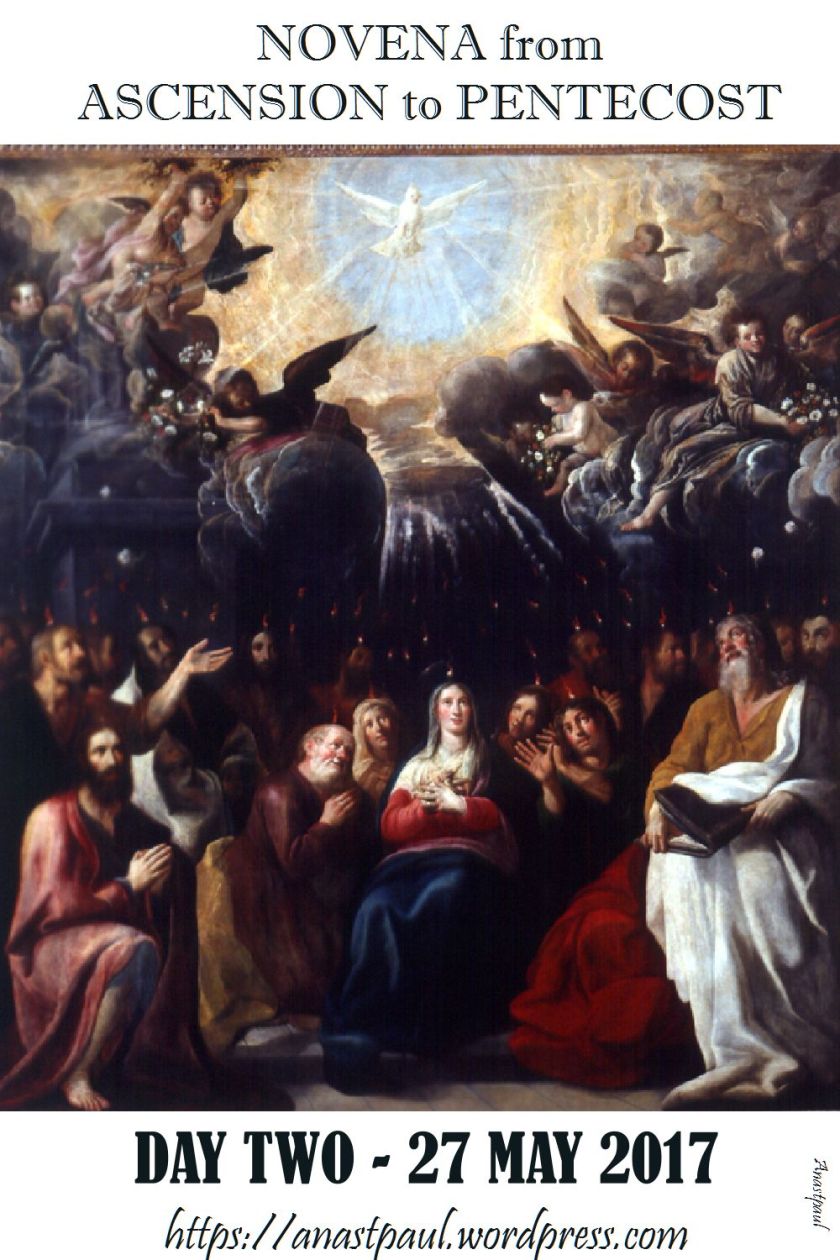
NOVENA from ASCENSION to PENTECOST DAY TWO – SATURDAY 27 MAY
The Holy Spirit
Only one thing is important: eternal salvation. Only one thing, therefore, is to be feared: sin. Sin is the result of ignorance, weakness and indifference. The Holy Spirit is the Spirit of Light, of Strength and of Love. With His sevenfold gifts He enlightens the mind, strengthens the will and inflames the heart with the love of God. To ensure our salvation we ought to invoke the Divine Spirit daily, because the Spirit comes to us in our needs. When we don’t know what to say, it is the Spirit who speaks within us.
The Gift of Fear
The gift of Fear fills us with a profound respect for God and makes us continually avoid the weakness of sin. It is a fear that arises, not from the thought of hell but the living presence of God within us and a desire to respond to His immense love for us. It is the fear that is the beginning of wisdom, detaching us from immersing ourselves in the worldly pleasures that could in any way separate us from God. “They that fear the Lord will prepare their hearts and in His sight will sanctify their souls.”
Prayer
Come and fill me, O blessed Spirit of Holy Fear. Penetrate my inmost heart so that I may honour, obey and prefer You and my Lord Jesus and my Father God above all else. Help me to despise all things that offend You and make me worthy to appear before the pure eyes of your Divine Majesty in heaven, where you live and reign forever in the unity of the ever Blessed Trinity. Amen
Our Father, Hail Mary, Glory be to the Father
The following Three Prayers to be recited daily during the Novena
ACT OF CONSECRATION TO THE HOLY SPIRIT
I offer myself, soul and body to You, Eternal Spirit of God. I adore the brightness of Your purity, the unerring keenness of Your justice and the might of Your love. You are the Strength and Light of my soul. In You I live and move and am. I desire never to grieve You by unfaithfulness to grace and I pray with all my heart to be kept from the smallest sin against You. Mercifully guard my every thought and grant that I may always watch for Your light and listen to Your voice and follow Your inspirations. I give myself to You and ask You, by Your compassion, to watch over me in my weakness. Mindful of the wounds of Jesus and with trust in His Precious Blood I implore You, Holy Spirit, Helper in my need, to keep me in Your grace that I may never sin against You. Give me grace O Holy Spirit, Spirit of the Father and the Son to say to You always and everywhere, “Speak Lord your servant is listening.” Amen
PRAYER TO THE HOLY SPIRIT
Come, Holy Spirit,
fill the hearts of Your faithful
and enkindle in them the fire of Your love.
Send forth Your Spirit and we shall be created,
and You will renew the face of the earth.
Father, You taught the hearts of Your faithful people by sending them the light of the Holy Spirit. In that Spirit give us right judgement and the joy of His comfort and guidance.
We make this prayer through Christ our Lord. Amen.
PRAYER FOR THE SEVEN GIFTS OF THE HOLY SPIRIT
Lord Jesus Christ, before you ascended into heaven You promised to send the Holy Spirit to bring to completion Your work in the hearts, minds and lives of Your Apostles and Disciples. Fill me with the presence of the same Holy Spirit that He may perfect in my soul, the work of Your grace and Your love. Grant me the Spirit of Wisdom that I may never be bound to the passing things of this world and aspire only after the things that are eternal. Fill me with:
the Spirit of Understanding to enlighten my mind with the light of Your divine truth, the Spirit on Counsel that I may ever choose the surest way of pleasing God and gaining heaven, the Spirit of Fortitude that I may bear the crosses of my life with You and that I may overcome with courage all the obstacles that oppose my salvation, the Spirit of Knowledge that I may know God and know myself and grow perfect in the imitation of the Saints, the Spirit of Piety that I may find the service of God joyful and desirable and the Spirit of Fear that I may be filled with a loving reverence towards God and avoid all that would displease Him. Mark me, dear Lord with the sign of Your true disciples, and help me to grow and live in all things with Your Spirit. Amen.
O God, who in Your love and mercy
was pleased to send missionaries to Uganda
to bring the light of Christ to all the peoples,
we thank You for the gift of the
Holy Martyrs of Uganda, our ancestors in faith,
whom You gave the strength to overcome sin and the
anguish of torture and to bear witness to the truth.
Mary, Queen of Martyrs!
To you we commend the Christians of this country.
May the noble example of Saints Charles Lwanga
and the Uganda’s Martyrs
inspire them to offer their lives
as a sacrifice pleasing to God.
May their faith in Christ be seen
in the holiness of their lives
and in their charity towards their brothers and sisters.
To the Holy Martyrs, we beg for intercession,
be pleased to hear our prayer and pray for us that this,
our special request may be granted
(make your intention)
Holy Martyrs of Uganda, we honour and praise you!
Please pray for us!
O heavenly Father, we make our prayer
through our Lord, Jesus Christ, in union with the Holy Spirit,
one God forever and ever, amen.
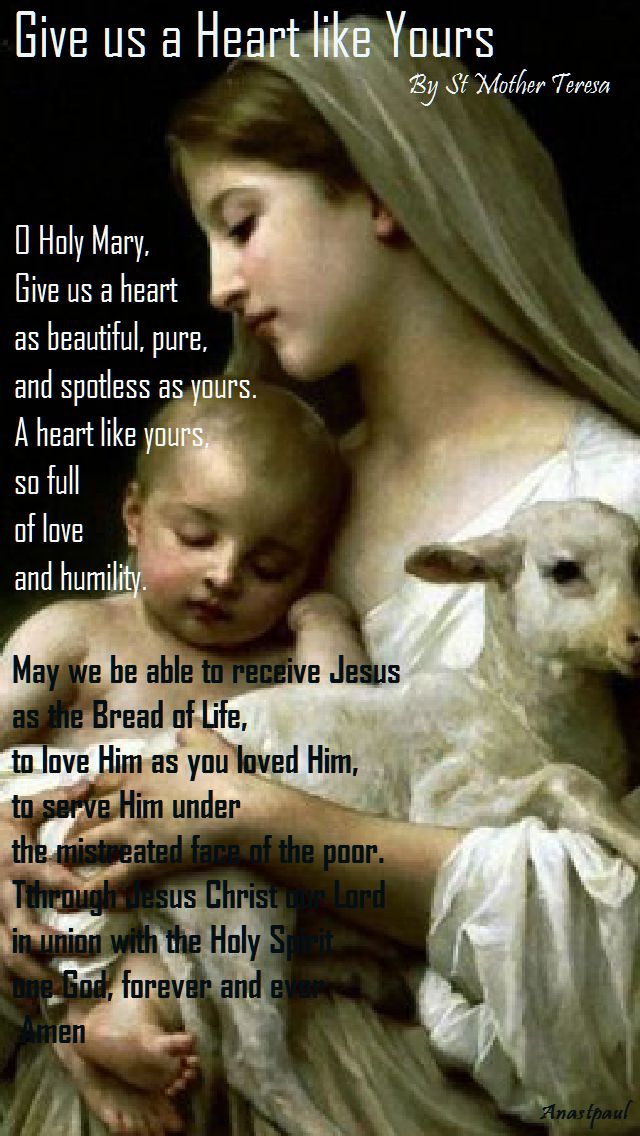
Give us a Heart like Yours
By St Mother Teresa of Calcutta
O Holy Mary,
Give us a heart as beautiful, pure,
and spotless as yours.
A heart like yours,
so full of love and humility.
May we be able to receive Jesus
as the Bread of Life,
to love Him as you loved Him,
to serve Him under the mistreated face of the poor.
We ask this through Jesus Christ our Lord.
Amen.
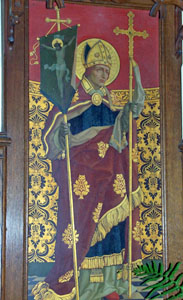
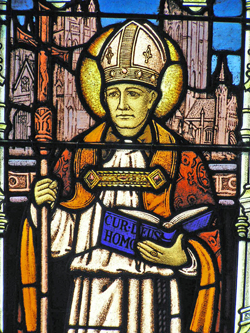
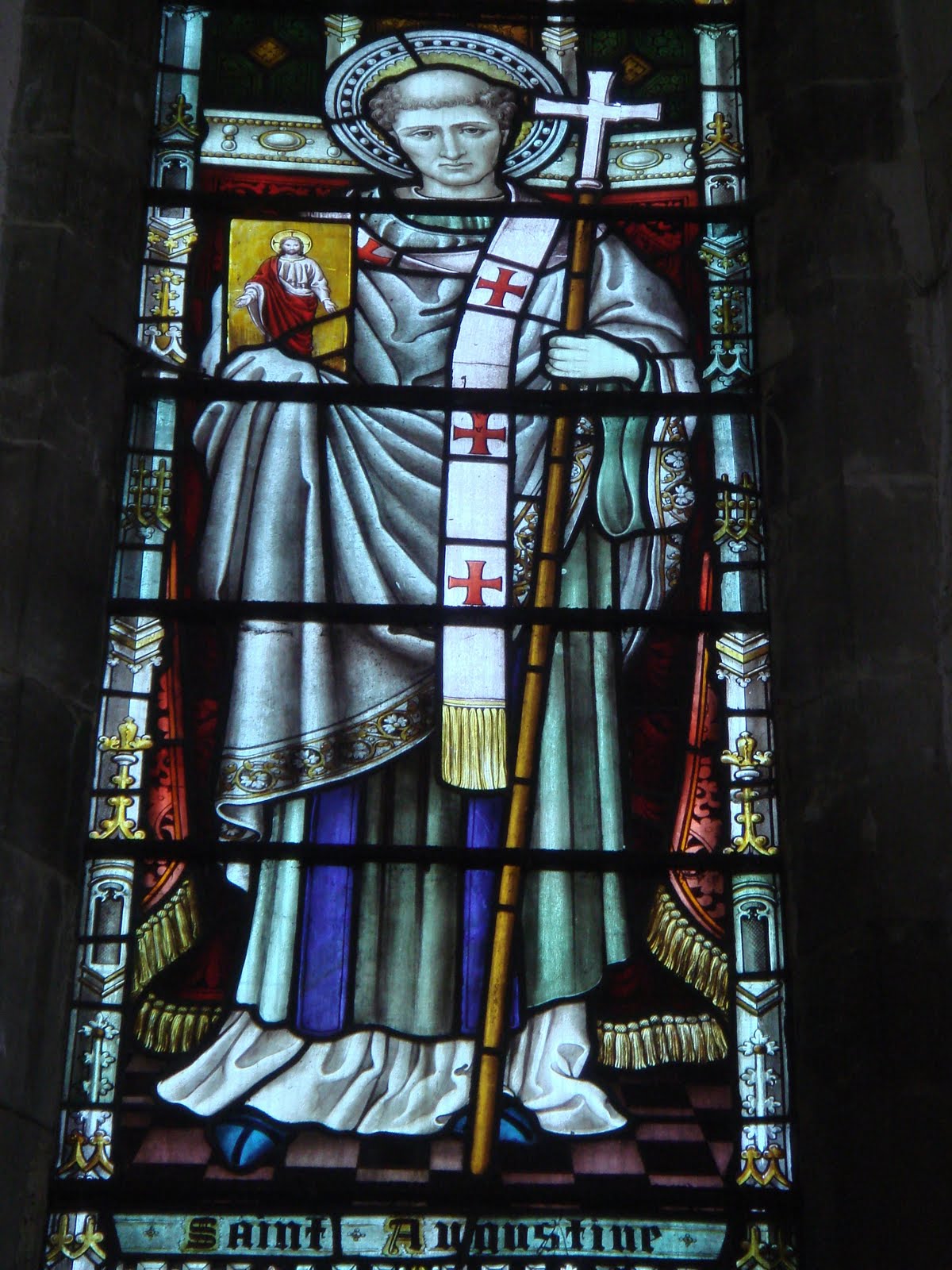
Saint of the Day – 27 May – St Augustine of Canterbury (Died c 605) – ArchBishop, Benedictine Monk, “The Apostle to the English” who became the first Archbishop of Canterbury, Father of the Church, Missionary – born in Rome first third of the 6th century – died probably 26 May 605 in Canterbury, England of natural causes. His relics interred outside the Church of Saints Peter and Paul, Canterbury, a building project he had started. He is considered “The Apostle to the English” and the founder of the English Church.
Augustine was the Prior of a Monastery in Rome when Pope Gregory the Great chose him in 595, to lead a mission, usually known as the Gregorian Mission, to Britain to Christianize King Æthelberht and his Kingdom of Kent from Anglo-Saxon paganism.
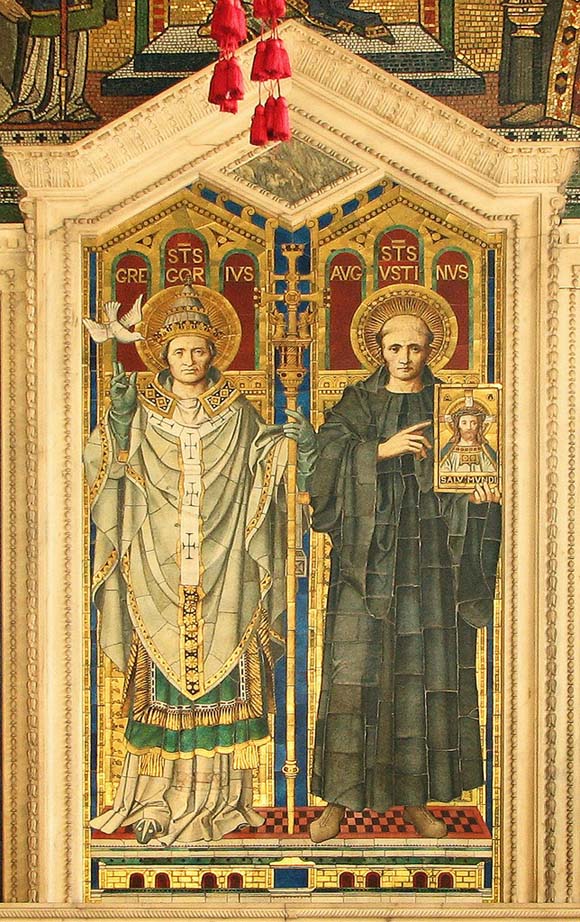
St Pope Gregory the Great and St Augustine of Canterbury
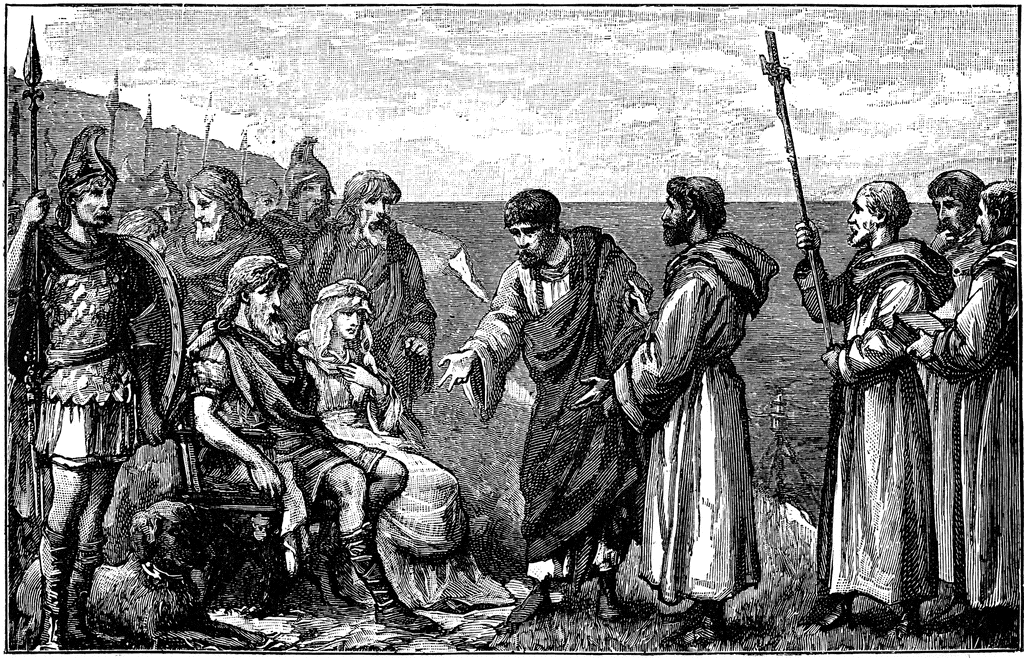
Kent was probably chosen because Æthelberht had married a Christian princess, Bertha, daughter of Charibert I the King of Paris, who was expected to exert some influence over her husband. Before reaching Kent, the missionaries had considered turning back, but Gregory urged them on and in 597, Augustine landed on the Isle of Thanet and proceeded to Æthelberht’s main town of Canterbury.
Augustine before Ethelbert and Bertha
King Æthelberht converted to Christianity and allowed the missionaries to preach freely, giving them land to found a monastery outside the city walls. Augustine was Coonsecrated as a Bishop and converted many of the king’s subjects, including thousands during a mass baptism on Christmas Day in 597.
Pope Gregory sent more Missionaries in 601, along with encouraging letters and gifts for the churches, although attempts to persuade the native Celtic bishops to submit to Augustine’s authority failed. Roman Bishops were established at London and Rochester in 604 and a school was founded to train Anglo-Saxon Priests and Missionaries. Augustine also arranged the consecration of his successor, Laurence of Canterbury. The Archbishop probably died in 604 and was soon revered as a saint.
St Augustine of Canterbury (Optional Memorial)
—
St Acculus of Alexandria
St Antanansio Bazzekuketta
St Barbara Kim
St Barbara Yi
St Bruno of Würzburg
Bl Dionysius of Semur
Bl Edmund Duke
St Eutropius of Orange
St Evangelius of Alexandria
St Frederick of Liège
Bl Gausberto of Montsalvy
St Gonzaga Gonza
St James of Nocera
Bl John Hogg
St Julius the Veteran and Companions
St Liberius of Ancona
St Matiya Mulumba
Bl Matthias of Nagasaki
St Melangell
St Ranulphus of Arras
St Restituta of Sora and Companions
Bl Richard Hill
Bl Richard Holiday
St Secundus of Troia
NOVENA from ASCENSION to PENTECOST DAY ONE – FRIDAY 26 MAY
The following Three Prayers to be recited daily during the Novena
ACT OF CONSECRATION TO THE HOLY SPIRIT
I offer myself, soul and body to You, Eternal Spirit of God. I adore the brightness of Your purity, the unerring keenness of Your justice and the might of Your love. You are the Strength and Light of my soul. In You I live and move and am. I desire never to grieve You by unfaithfulness to grace and I pray with all my heart to be kept from the smallest sin against You. Mercifully guard my every thought and grant that I may always watch for Your light and listen to Your voice and follow Your inspirations. I give myself to You and ask You, by Your compassion, to watch over me in my weakness. Mindful of the wounds of Jesus and with trust in His Precious Blood I implore You, Holy Spirit, Helper in my need, to keep me in Your grace that I may never sin against You. Give me grace O Holy Spirit, Spirit of the Father and the Son to say to You always and everywhere, “Speak Lord your servant is listening.” Amen
PRAYER TO THE HOLY SPIRIT
Come, Holy Spirit,
fill the hearts of Your faithful
and enkindle in them the fire of Your love.
Send forth Your Spirit and we shall be created,
and You will renew the face of the earth.
Father, You taught the hearts of Your faithful people by sending them the light of the Holy Spirit. In that Spirit give us right judgement and the joy of His comfort and guidance.
We make this prayer through Christ our Lord. Amen.
PRAYER FOR THE SEVEN GIFTS OF THE HOLY SPIRIT
Lord Jesus Christ, before you ascended into heaven You promised to send the Holy Spirit to bring to completion Your work in the hearts, minds and lives of Your Apostles and Disciples. Fill me with the presence of the same Holy Spirit that He may perfect in my soul, the work of Your grace and Your love. Grant me the Spirit of Wisdom that I may never be bound to the passing things of this world and aspire only after the things that are eternal. Fill me with:
the Spirit of Understanding to enlighten my mind with the light of Your divine truth, the Spirit on Counsel that I may ever choose the surest way of pleasing God and gaining heaven, the Spirit of Fortitude that I may bear the crosses of my life with You and that I may overcome with courage all the obstacles that oppose my salvation, the Spirit of Knowledge that I may know God and know myself and grow perfect in the imitation of the Saints, the Spirit of Piety that I may find the service of God joyful and desirable and the Spirit of Fear that I may be filled with a loving reverence towards God and avoid all that would displease Him. Mark me, dear Lord with the sign of Your true disciples, and help me to grow and live in all things with Your Spirit. Amen.
The Holy Spirit
Only one thing is important: eternal salvation. Only one thing, therefore, is to be feared: sin. Sin is the result of ignorance, weakness and indifference. The Holy Spirit is the Spirit of Light, of Strength and of Love. With His sevenfold gifts He enlightens the mind, strengthens the will and inflames the heart with the love of God. To ensure our salvation we ought to invoke the Divine Spirit daily, because the Spirit comes to us in our needs. When we don’t know what to say, it is the Spirit who speaks within us.
Prayer
Almighty and eternal God, You have given us a new birth by water and the Holy Spirit and You have given us forgiveness of all sins. We ask You to pour upon us Your sevenfold Spirit, the Spirit of Wisdom and Understanding, the Spirit of Counsel and Fortitude, the Spirit of Knowledge and Piety and fill us with the Spirit of Adoration and Reverence. Amen.
O God, who in Your love and mercy
was pleased to send missionaries to Uganda
to bring the light of Christ to all the peoples,
we thank You for the gift of the
Holy Martyrs of Uganda, our ancestors in faith,
whom You gave the strength to overcome sin and the
anguish of torture and to bear witness to the truth.
Mary, Queen of Peace!
To you we commend the men,
women and children of Uganda.
Through your prayers,
may the Spirit of God grant lasting peace
and prosperity to their nation.
May the light of Christ cast out the spiritual darkness
which breeds selfishness,
violence, hatred for others
and contempt for their rights.
May all hearts be opened to the power of God’s love.
To the Holy Martyrs, we beg for intercession,
be pleased to hear our prayer and pray for us that this,
our special request may be granted
(make your intention)
Holy Martyrs of Uganda, we honour and praise you!
Please pray for us!
O heavenly Father, we make our prayer
through our Lord, Jesus Christ, in union with the Holy Spirit,
one God forever and ever, amen.
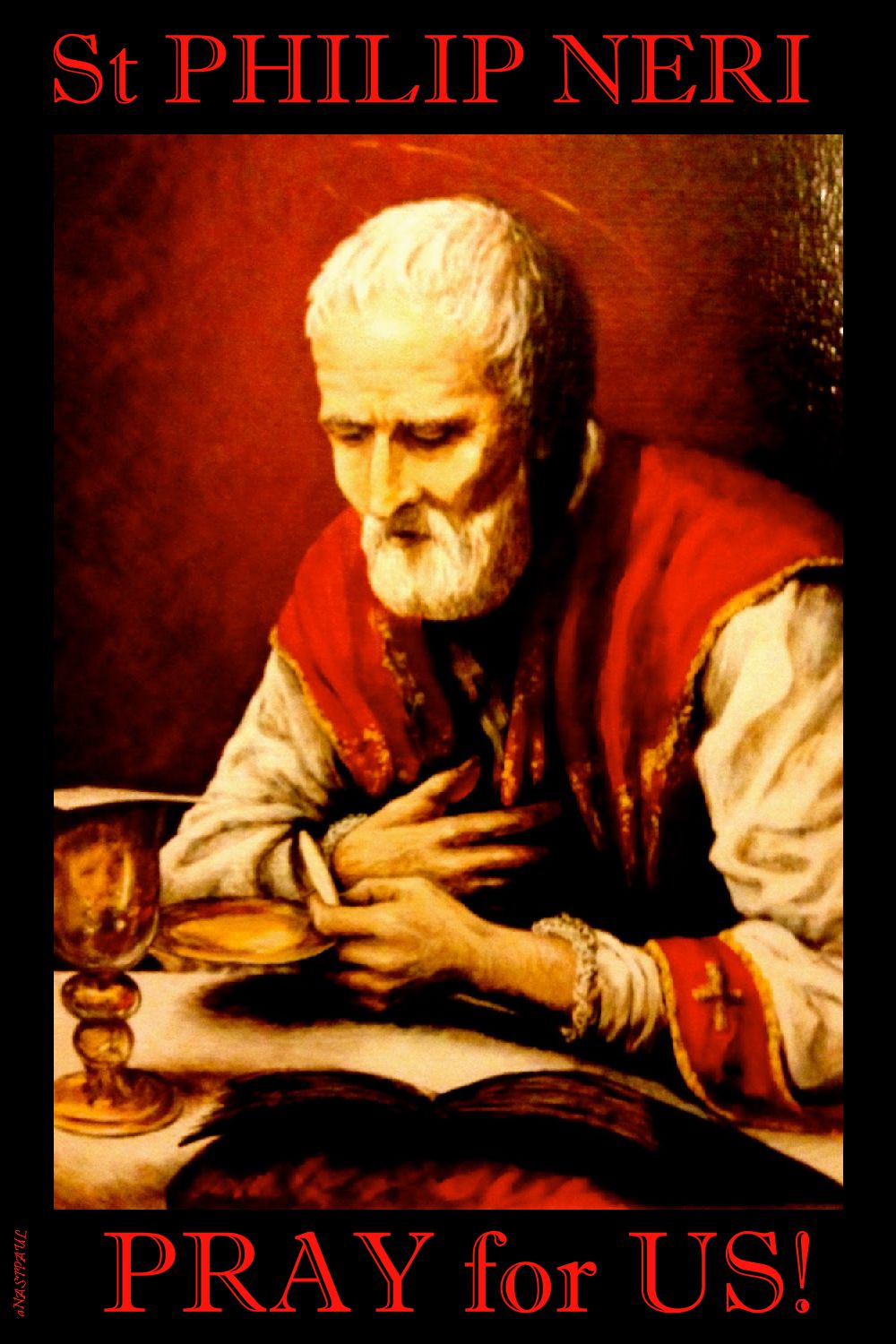
St Philip Neri was one of those rare religious geniuses who leave the familiar paths and create something entirely new. He is the kind of saint that you simply cannot put into a category, for what he did was completely unique and totally unprecedented. His personality and “heart brimming with love” were most attractive to all – his friends were saints and highly creative men but the people of the streets loved him just as much as he loved them, from beggars to cardinals, he was a friend.
He too is the patron saint of joy countered with great humility and with this in mind, he could become a powerful intercessor for people who have periods of depression. We pray to St Valentine and St Raphael – so that these saints may find us romantic partners who will love us. But we might do well to pray to St Philip Neri that he inspires us with the ability to cherish others and to be filled with the joy of love… Perhaps most acutely for our selfie age, he could become an intercessor for people who agonise over how they look, who spend all their free time finding flattering selfies to post on Facebook and find that narcissism is beginning to rule their lives and indeed, is this not exactly true of the age of relativism, when it is only “I’ that count?
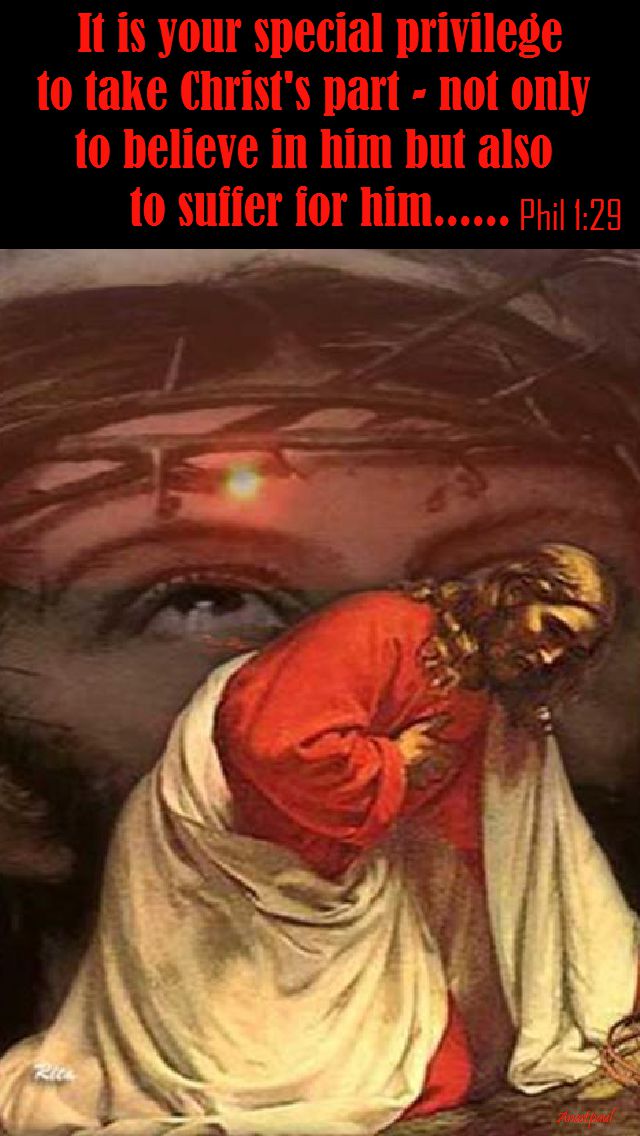
It is your special privilege to take Christ’s part – not only to believe in him but also to suffer for him……..Phil 1:29
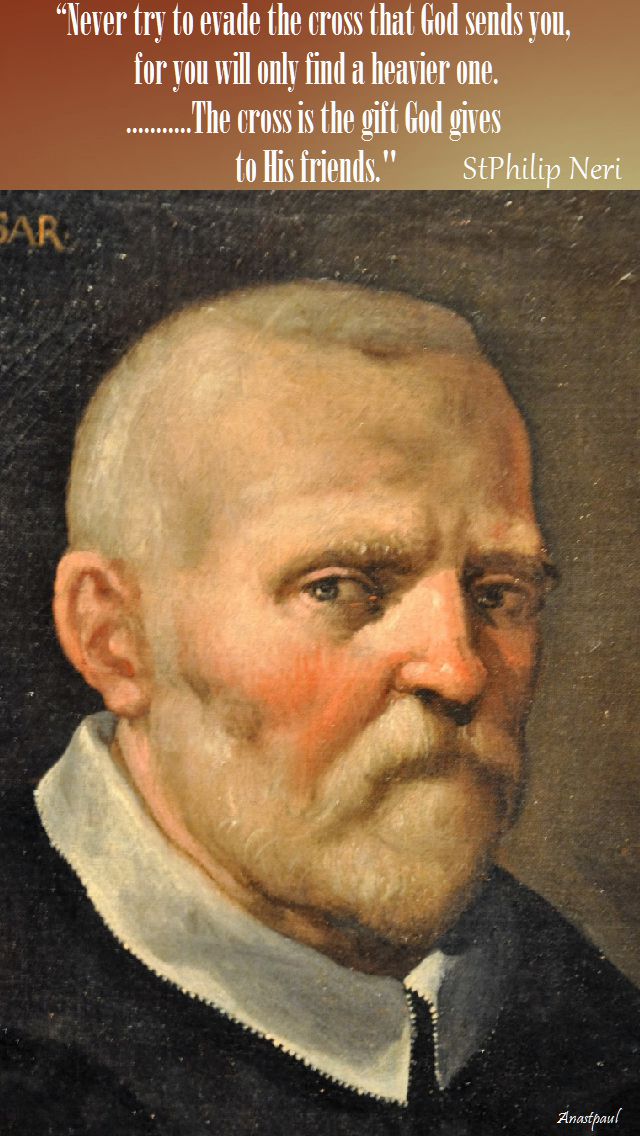
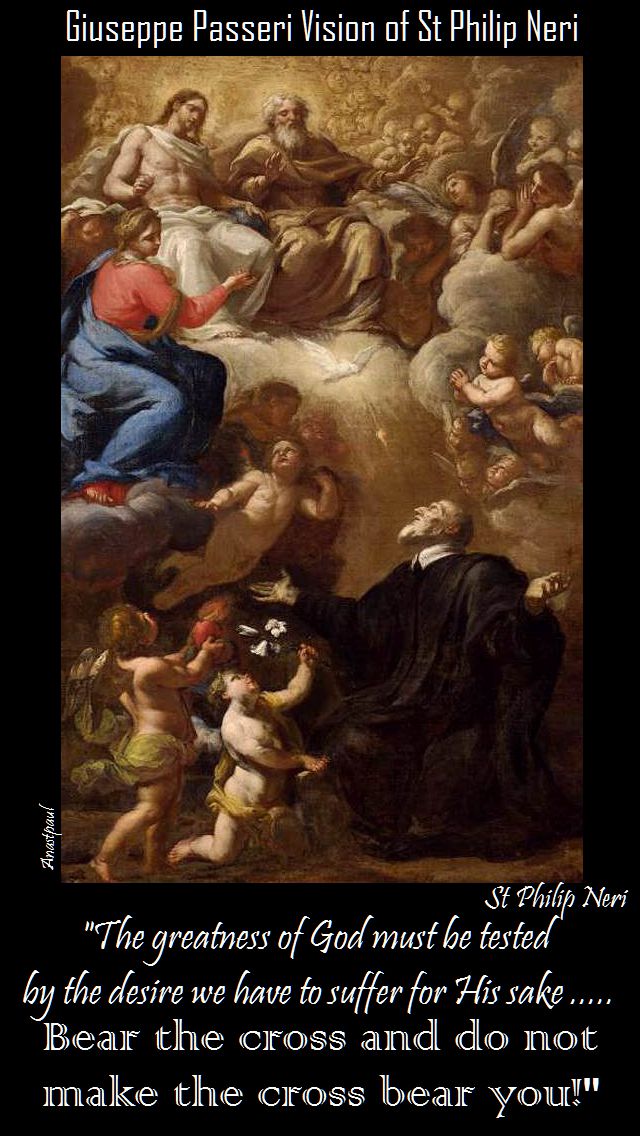
REFLECTION – “The greatness of God must be tested by the desire we have to suffer for His sake …..
Bear the cross and do not make the cross bear you!”……………………..St Philip Neri
PRAYER – Lord Jesus Christ, let me be closely united with You in all things. Grant that I may carry my cross willingly and seek to carry Yours! Because of You and in union with You. St Philip Neri, pray for us all, amen.
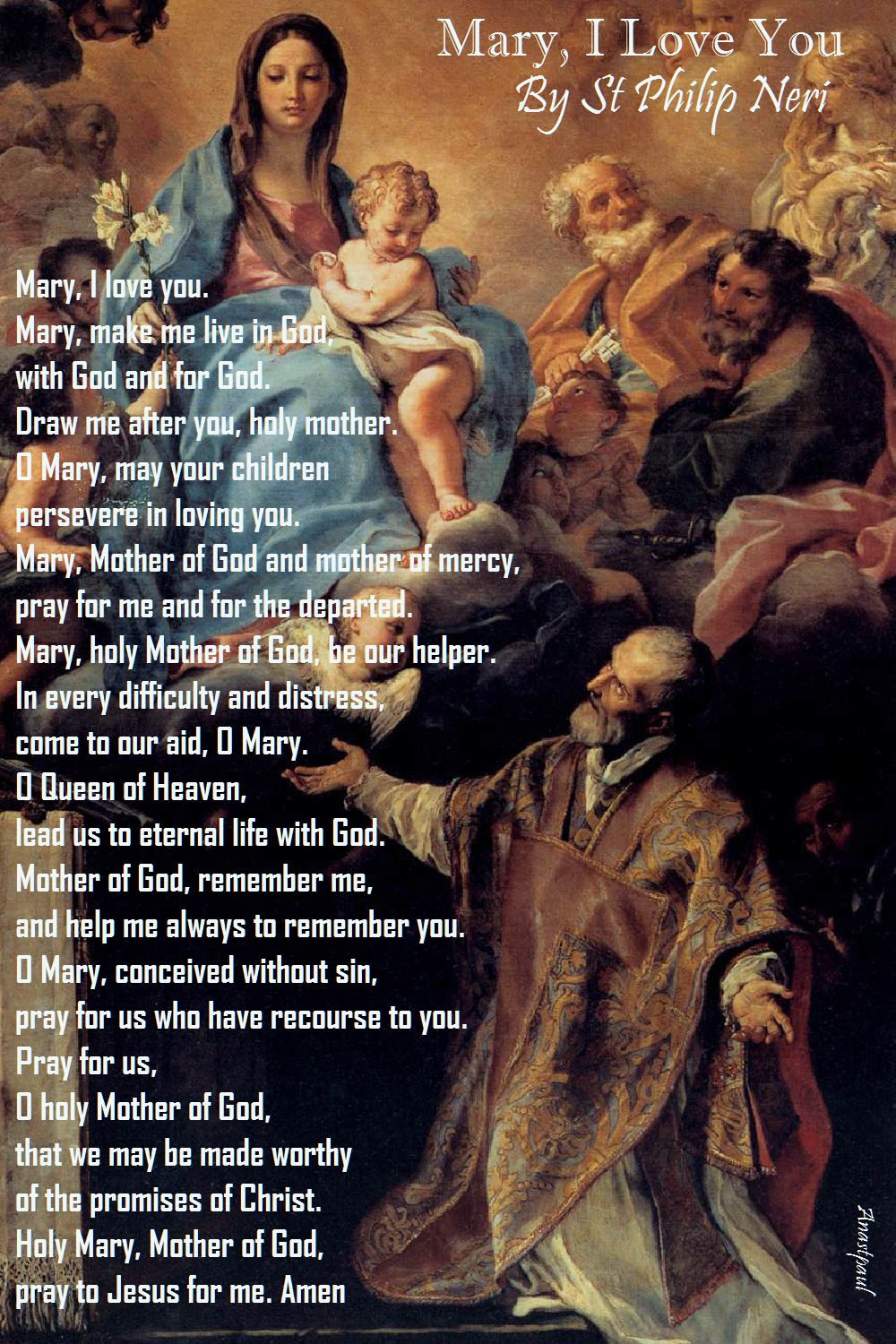
Mary, I love you.
Mary, make me live in God,
with God and for God.
Draw me after you, holy mother.
O Mary, may your children persevere in loving you.
Mary, Mother of God and mother of mercy,
pray for me and for the departed.
Mary, holy Mother of God,
be our helper.
In every difficulty and distress,
come to our aid, O Mary.
O Queen of Heaven,
lead us to eternal life with God.
Mother of God,
remember me,
and help me always to remember you.
O Mary, conceived without sin,
pray for us who have recourse to you.
Pray for us,
O holy Mother of God,
that we may be made worthy of the promises of Christ.
Holy Mary, Mother of God,
pray to Jesus for me.
Amen
Saint of the Day – 26 May – St Philip Neri Cong. Orat. Priest and Founder, Mystic, Missionary of Charity, also known as: “The Third Apostle of Rome,” after Saints Peter and Paul, Philip Romolo Neri. Born on 22 July 1515 at Florence, Italy -and died on 27 May 1595 at the Church of San Maria in Vallicella, Italy of natural causes). Canonised: 12 March 1622 by Pope Gregory XV . Patronages – of Gravina, Italy, Rome, Italy, laughter, humour, Archdiocese of Manfredonia-Vieste-San Giovanni Rotondo, Italy, United States Army Special Forces. When summoned to hear confessions or to see someone who had called, Neri came down instantly with the words “We must leave Christ for Christ”. Philip was a mystic of the highest order, a man of ecstasies and visions, whose greatest happiness was to be alone with God. Yet at the call of charity he gave up the delight of prayer and, instead, sought God by helping his neighbour. His whole life is that of the contemplative in action.
He was the son of Francesco di Neri, a lawyer and his wife Lucrezia da Mosciano, whose family were nobility in the service of the Italian state. He was carefully brought up and received his early teaching from the friars at San Marco, the famous Dominican monastery in Florence. He was accustomed in later life to ascribe most of his progress to the teaching of two of them, Zenobio de’ Medici and Servanzio Mini. At the age of 18, Philip was sent to his uncle, Romolo, a wealthy merchant at San Germano, a Neapolitan town near the base of Monte Cassino, to assist him in his business and with the hope that he might inherit his uncle’s fortune. He gained Romolo’s confidence and affection but soon after coming to San Germano Philip had a religious conversion – he no longer cared for things of the world and chose to relocate to Rome in 1533.
After arriving in Rome, Neri became a tutor in the house of a Florentine aristocrat named Galeotto Caccia. After two years he began to pursue his own studies (for a period of three years) under the guidance of the Augustinians. Following this, he began those labours amongst the sick and poor which, in later life, gained him the title of “Apostle of Rome”. He also ministered to the prostitutes of the city. In 1538 he entered into the home mission work for which he became famous; traveling throughout the city, seeking opportunities of entering into conversation with people and of leading them to consider the topics he set before them. For seventeen years Philip lived as a layman in Rome, probably without thinking of becoming a priest. Around 1544, he made the acquaintance of Ignatius of Loyola. Many of Neri’s disciples found their vocations in the infant Society of Jesus.
In 1548, together with his confessor, Persiano Rossa, Neri founded the Confraternity of the Most Holy Trinity of Pilgrims and Convalescents whose primary object was to minister to the needs of the thousands of poor pilgrims who flocked to Rome, especially in jubilee years and also to relieve the patients discharged from hospitals but who were still too weak for labour. Members met for prayer at the church of San Salvatore in Campo where the devotion of the Forty Hours of Exposition of the Blessed Sacrament was first introduced into Rome
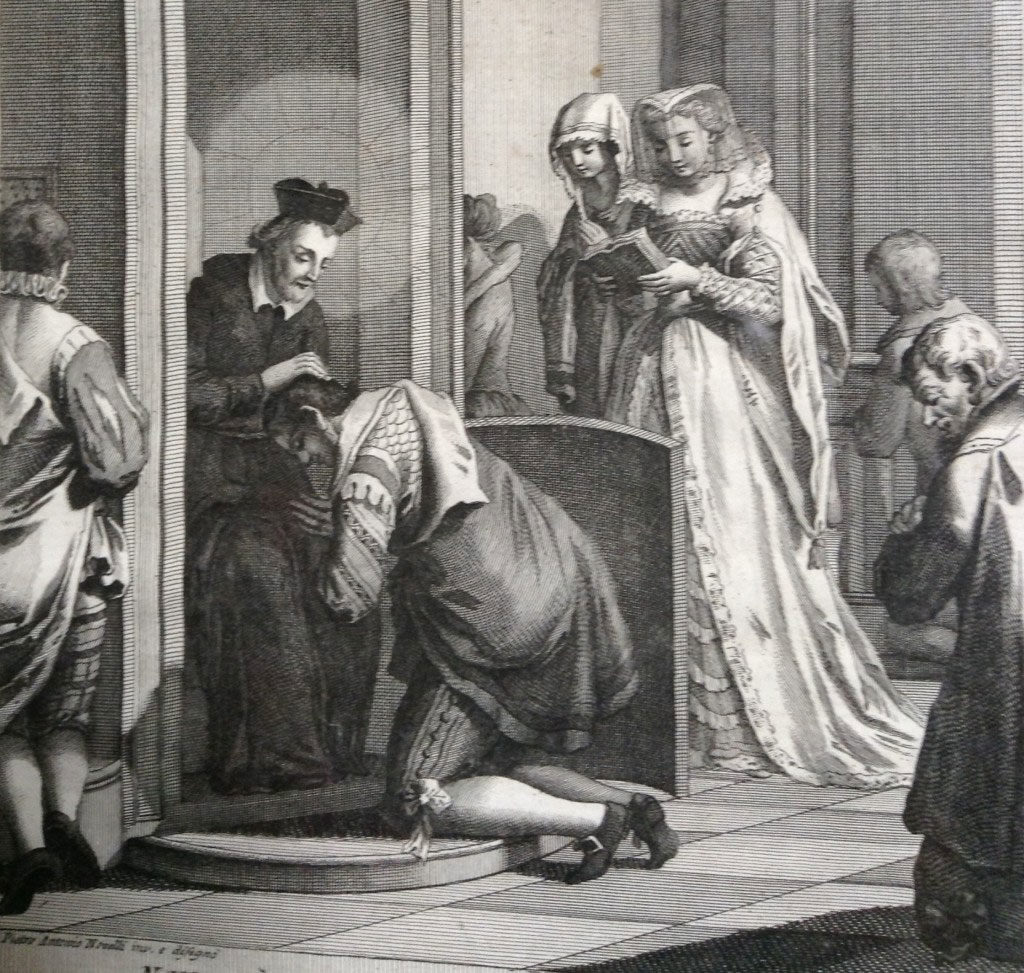
In 1551 Neri received all the minor orders and was ordained deacon and finally priest (on 23 May). He thought of going to India as a missionary but was dissuaded by his friends who saw that there was abundant work to be done in Rome. Accordingly, he settled down, with some companions, at the Hospital of San Girolamo della Carità, and while there tentatively began, in 1556, the institute with which his name is more especially connected, that of the Oratory. The scheme at first was no more than a series of evening meetings in a hall (the Oratory), at which there were prayers, hymns, and readings from Scripture, the church fathers and the Martyrology, followed by a lecture, or by discussion of some religious question proposed for consideration. The musical selections (settings of scenes from sacred history) were called oratorios. Giovanni Palestrina was one of Philip’s followers and composed music for the services. The scheme was developed and the members of the society undertook various kinds of mission work throughout Rome, notably the preaching of sermons in different churches every evening, a completely new idea at that time. He also spent much of his time hearing confessions, and effected many conversions in this way. Neri sometimes led “excursions” to other churches, often with music and a picnic on the way.
St Philip Neri Hearing Confessions
In 1564 the Florentines requested that Neri leave San Girolamo to oversee their newly built church in Rome, San Giovanni dei Fiorentini. He was at first reluctant but by consent of Pope Pius IV he accepted, while remaining in charge of San Girolamo, where the exercises of the Oratory were kept up. At this time the new society included among its members Caesar Baronius, the ecclesiastical historian, Francesco Maria Tarugi, afterwards Archbishop of Avignon and Ottavio Paravicini, all three of whom were subsequently cardinals, and also Gallonius (Antonio Gallonio), author of a well-known work on the Sufferings of the Martyrs, Ancina, Bordoni, and other men of ability and distinction. In 1574, the Florentines built a large oratory or mission-room for the society, next to San Giovanni, in order to save them the fatigue of the daily journey to and from San Girolamo and to provide a more convenient place of assembly and the headquarters were transferred there.
San Giovanni dei Fiorentini Rome – the home of the First Oratory
As the community grew and its mission work extended, the need for a church entirely its own made itself felt and the offer of the small parish church of Santa Maria in Vallicella, conveniently situated in the middle of Rome, was made and accepted. The building, however, not large enough for their purpose, was pulled down and a splendid church erected on the site. It was immediately after taking possession of their new quarters that Neri formally organized, under permission of a papal bull dated 15 July 1575, a community of secular priests, called the Congregation of the Oratory. The new church was consecrated early in 1577 and the clergy of the new society at once resigned the charge of San Giovanni dei Fiorentini; Neri himself did not leave San Girolamo until 1583 and then only by virtue of an injunction of the pope that he, as the superior, should reside at the chief house of his congregation. He was at first elected for a term of three years (as is usual in modern societies) but in 1587 was nominated superior for life. He was, however, entirely free from personal ambition and had no desire to be superior general over a number of dependent houses, so he desired that all congregations formed on his model outside Rome should be autonomous, governing themselves and without endeavouring for Neri to retain control over any new colonies they might themselves send out—a regulation afterwards formally confirmed by a brief of Gregory XV in 1622.
Santa Maria in Vallicella after being rebuilt for the Oratory
Philip Neri embodied a number of contradictions, combining popular venerations with intensely individual piety. He became embedded in the church hierarchy while seeking to reform a corrupt Rome and an uninterested clergy. He possessed a playful humour, combined with a shrewd wit. He considered a cheerful temper to be more Christian than a melancholy one and carried this spirit into his whole life: “A joyful heart is more easily made perfect than a downcast one.” This was the secret of Neri’s popularity and of his place in the folklore of the Roman poor. Many miracles were attributed to him. When his body was autopsied it was found that two of his ribs had been broken, an event attributed to the expansion of his heart while fervently praying in the catacombs about the year 1545. ] Benedict XIV, who reorganised the rules for canonisation, decided that Philip’s enlarged heart was caused by an aneurism. Ponnelle and Bordet, in their 1932 biography St. Philip Neri and the Roman Society of His Times (1515-1595), conclude that it was partly natural and partly supernatural. What is certain is that Philip himself and his penitents associated it with divine love.
“Practical commonplaceness,” says Frederick William Faber in his panegyric of Neri, “was the special mark which distinguishes his form of ascetic piety from the types accredited before his day. He looked like other men … he was emphatically a modern gentleman, of scrupulous courtesy, sportive gaiety, acquainted with what was going on in the world, taking a real interest in it, giving and getting information, very neatly dressed, with a shrewd common sense always alive about him, in a modern room with modern furniture, plain, it is true but with no marks of poverty about it—In a word, with all the ease, the gracefulness, the polish of a modern gentleman of good birth, considerable accomplishments, and a very various information.”
Accordingly, Neri was ready to meet the needs of his day to an extent and in a manner which even the versatile Jesuits, who much desired to enlist him in their company, did not rival; and, though an Italian priest and head of a new religious order, his genius was entirely unmonastic and unmedieval, frequent and popular preaching, unconventional prayer and unsystematized, albeit fervent, private devotion.
Neri prayed, “Let me get through today and I shall not fear tomorrow.”
When summoned to hear confessions or to see someone who had called, Neri came down instantly with the words “We must leave Christ for Christ”. Philip was a mystic of the highest order, a man of ecstasies and visions, whose greatest happiness was to be alone with God. Yet at the call of charity he gave up the delight of prayer and, instead, sought God by helping his neighbour. His whole life is that of the contemplative in action.
Neri died around the end of the day on 25 May 1595, the Feast of Corpus Christi that year, after having spent the day hearing confessions and receiving visitors. ] About midnight he began hemorrhaging and Baronius read the commendatory prayers over him. Baronius asked that he would bless his spiritual sons before dying and though he could no longer speak, he blessed them with the sign of the cross and died.
Neri was beatified by Paul V in 1615, and canonized by Pope Gregory XV in 1622. His memorial is celebrated on 26 May. His body is in the Chiesa Nuova (“New Church”) in Rome.
Neri is one of the influential figures of the Counter-Reformation, mainly for converting to personal holiness many of the influential people within the Church itself.
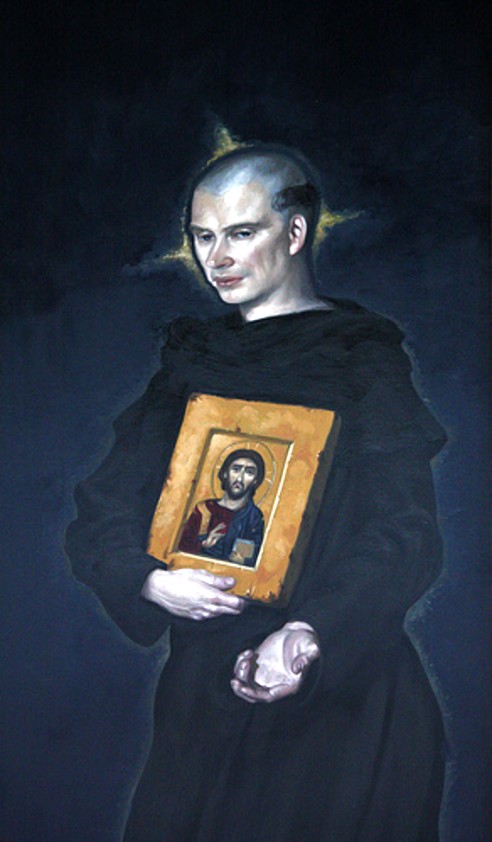
A modern image of St. Philip Neri by Salvo Russo is one of 550 color images in a new book, “The Catholic Priest — Image of Christ through Fifteen Centuries of Art.” In gratitude to God for his conversion to Catholicism, Danish author Steen Heidemann spent seven years traveling the world to collect images for the book. (CNS photo/courtesy of Edizioni Cantagalli, publisher) (March 23, 2010) See PRIESTHOOD-ART March 23, 2010.
Oratory
The congregation Neri founded is of the least conventional nature, rather resembling a residential clerical club than a monastery of the older type and its rules (never written by Neri, but approved by Pope Paul V in 1612) would have appeared incredibly lax. In fact its religious character would seem almost doubtful to men such as Bruno, Stephen Harding, Francis of Assisi or Saint Dominic. It admits only priests aged at least 36, or seminarians who have completed their studies and are ready for ordination, supported by lay brothers. The members live in community and each pays his own expenses, having the usufruct of his private means—a startling innovation on the monastic vow of poverty. They have indeed a common table but it is kept up precisely as a regimental mess, by monthly payments from each member. Nothing is provided by the society except the bare lodging and the fees of a visiting physician. Everything else—clothing, books, furniture, medicines—must be defrayed at the private charges of each member. There are no vows and every member of the society is at liberty to withdraw when he pleases and to take his property with him. The government, strikingly unlike the Jesuit autocracy, is of a republican form; and the superior, though first in honour, has to take his turn in discharging all the duties which come to each priest of the society in the order of his seniority, including that of waiting at table, which is not entrusted in the Oratory to lay brothers, according to the practice in most other communities. Four deputies assist the superior in the government and all public acts are decided by a majority of votes of the whole congregation, in which the superior has no casting voice. To be chosen superior, 15 years of membership are requisite as a qualification, and the office is tenable, as all the others, for but 3 years at a time. No one can vote until he has been three years in the society; the deliberative voice is not obtained before the eleventh year.
There are thus three classes of members: novices, triennials and decennials. Each house can call its superior to account, can depose and can restore him, without appeal to any external authority, although the bishop of the diocese in which any house of the Oratory is established is its ordinary and immediate superior, though without power to interfere with the rule. Their churches are non-parochial and they can perform such rites as baptisms, marriages, etc., only by permission of the parish priest, who is entitled to receive all fees due in respect of these ministrations.
The Oratory chiefly spread in Italy and in France, where in 1760 there were 58 houses all under the government of a superior-general. Nicolas Malebranche, Louis Thomassin, Jules Mascaron and Jean Baptiste Massillon were members of the famous branch established in Paris in 1611 by Bérulle (later cardinal), which had a great success and a distinguished history. It fell in the crash of the French Revolution but was revived by Père Pététot, curé of St Roch, in 1852, as the “Oratory of Jesus and the Immaculate Mary”; the Church of the Oratory near the Louvre belongs to the Reformed Church.
Neri encouraged the singing of the lauda spirituale (laude) in his oratory services. The prominent composers Tomás Luis de Victoria and Giovanni Pierluigi da Palestrina probably participated in this music. His unique and varied aesthetic experience has been highlighted in a study by the Italian historian Francesco Danieli.
Our Lady of Caravaggio/Nostra Signora di Caravaggio: Title given to the Blessed Virgin Mary who appeared in an apparition on 26 May 1432 in the countryside outside Caravaggio, Lombardy, Italy. Giannetta de’ Vacchi: Varoli was cutting hay in a field when the Virgin appeared. Mary requested penance from and a chapel built by the locals. A new spring of healing water appeared in the hay field. The apparition anniversary became a day of pilgrimage to the shrine of Santa Maria del Fonte built at the site and devotion to the Madonna of Caravaggio spread through the region and eventually around the world. In 1879, Italians from Lombardy built a chapel for their settlement in southern Brazil. As it was the only sacred art that any of them possessed, they dedicated the chapel to the Madonna di Caravaggio. Today the shrine hosts over a million pilgrims annually. Patronage – diocese of Cremona, Italy
—
St Alphaeus
St Anderea Kaggwa
Bl Andrea Franchi
St Becan of Cork
Bl Berengar of Saint-Papoul
St Damian the Missionary
St Desiderius of Vienne
St Pope Eleuterus
St Felicissimus of Todi
St Fugatius the Missionary
St Gioan Ðoàn Trinh Hoan
St Guinizo of Monte Cassino
St Heraclius of Todi
Bl Lambert Péloguin of Vence
St Mariana de Paredes y Flores of Quito
St Odulvald of Melrose
St Paulinus of Todi
St Peter Sanz
St Ponsiano Ngondwe
St Priscus of Auxerre and Companions
St Quadratus of Africa
St Quadratus the Apologist
St Regintrudis of Nonnberg
St Simitrius of Rome and Companions
St Zachary of Vienne
O God, who in Your love and mercy
was pleased to send missionaries to Uganda
to bring the light of Christ to all the peoples,
we thank You for the gift of the
Holy Martyrs of Uganda, our ancestors in faith,
whom You gave the strength to overcome sin and the
anguish of torture and to bear witness to the truth.
We ask You O Lord,
through the intercession of St Charles Lwanga
and his companions, that we may imitate their deep faith,
hope, ardent charity, spirit of prayer, heroic chastity
and constant fidelity to Christ and to Your Church.
Grant us Your grace, that we may too, courageously witness to Christ.
To the Holy Martyrs, we beg for intercession,
be pleased to hear our prayer and pray for us that this,
our special request may be granted
(make your intention)
Holy Martyrs of Uganda, we honour and praise you!
Please pray for us!
O heavenly Father, we make our prayer
through our Lord, Jesus Christ, in union with the Holy Spirit,
one God forever and ever, amen.
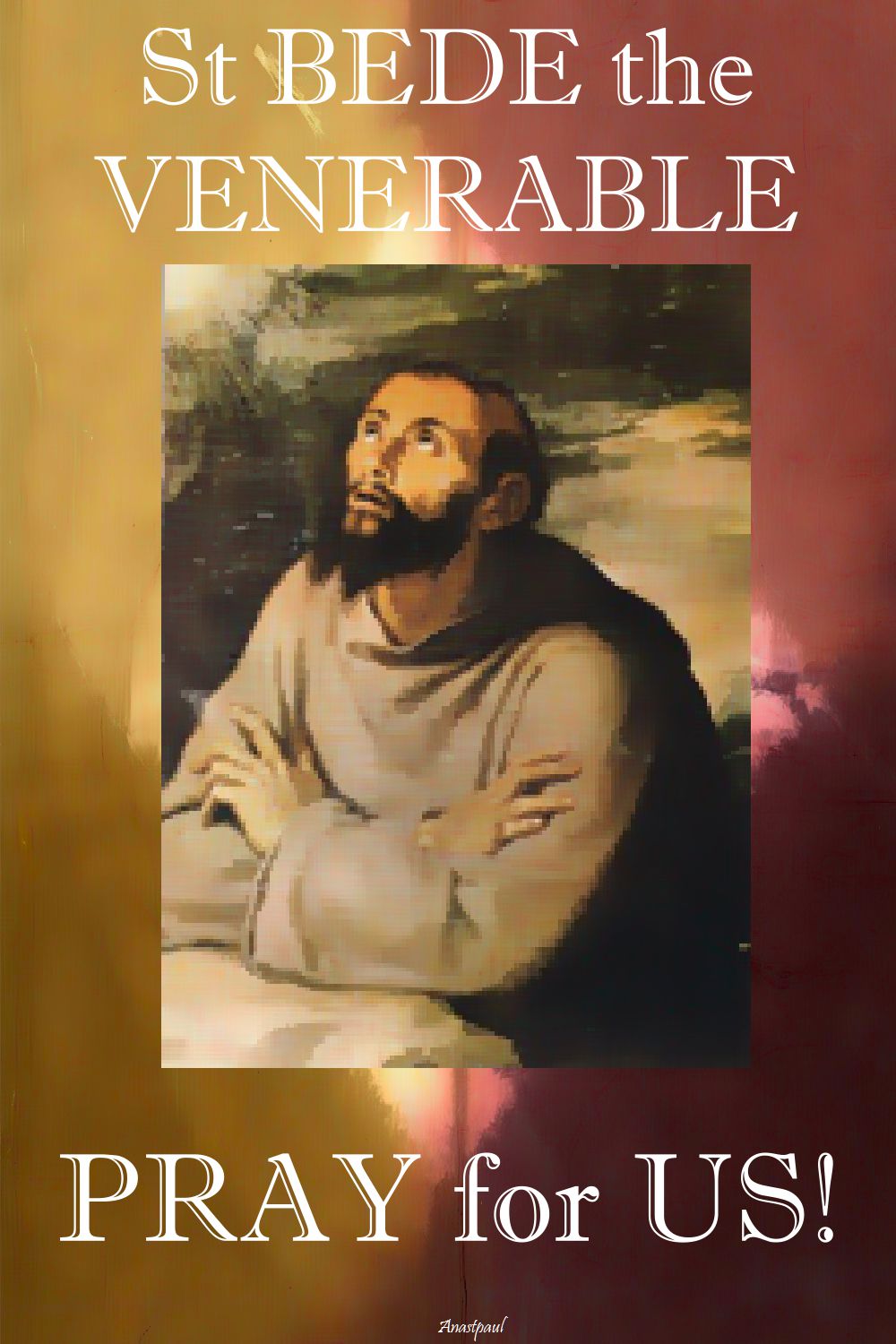
This St Bede, this is a life of total self-giving in love!
It sounds to our ears to be a boring, closed, narrow existence –
ever occupied with learning, writing and teaching.
Almost from the time of his entry to study in the monastery as a young child,
until he died, he managed to remain in his own monastery,
although eagerly sought by kings and other notables, even Pope Sergius
Only once did he leave for a few months in order to teach in the school
of the Archbishop of York.
And amazingly, here was a saint who worked no miracles,
saw no visions and found no new way to God BUT
he is one of the few saints honoured as such even during his lifetime.
His writings were filled with such faith and learning
that even while he was still alive, a Church council
ordered them to be read publicly in the churches.
And he said of his life, “I have spent the whole of my life . . . devoting all of my pains to the study of the Scriptures and amid the observances of monastic discipline and the daily task of singing in church, it has ever been my delight to learn or teach or write.”
St Bede died in 735 praying his favourite prayer: “Glory be to the Father and to the Son and to the Holy Spirit. As in the beginning, so now, and forever.”
We remember and honour him as a Doctor of the Church,
so many centuries have gone by, the world in which we live is such a different place and still he teaches us from his eternal monastery in heaven!









 Our Father, Hail Mary, Glory be to the Father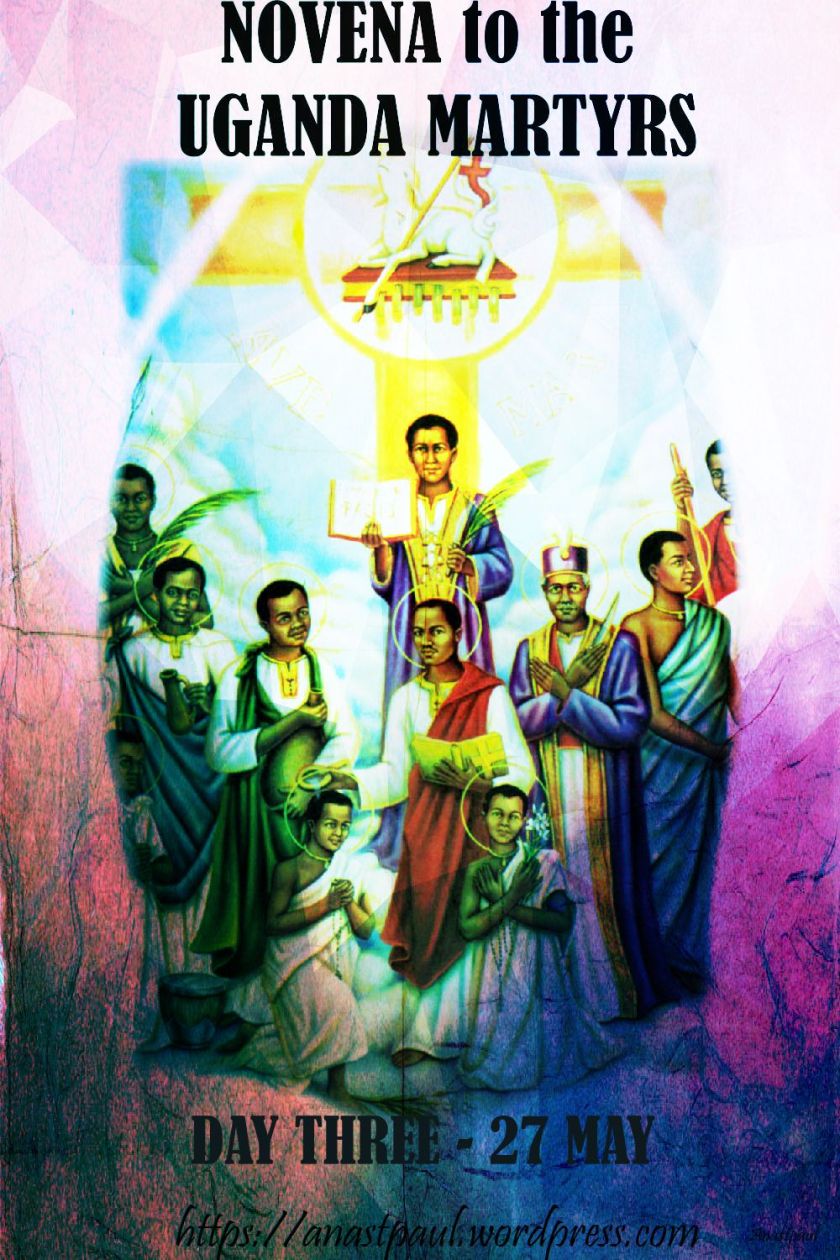








 AnaStpaul
You must be logged in to post a comment.