Posted in MORNING Prayers, PRAYERS of the SAINTS, The BLESSED VIRGIN MARY

Our Morning Offering – 21 May

Our Morning Offering – 21 May

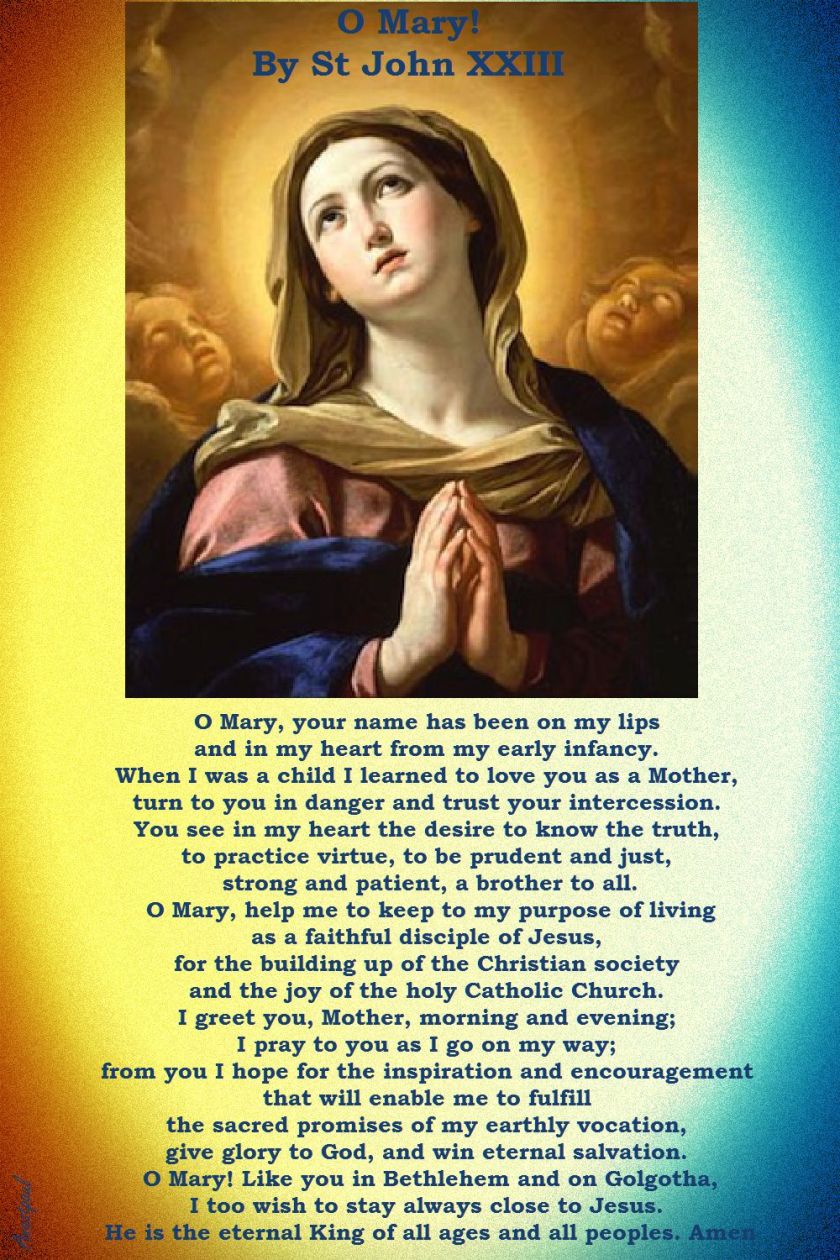
O Mary!
By St John XXIII

O Mary, your name has been on my lips
and in my heart from my early infancy.
When I was a child I learned to love you as a Mother,
turn to you in danger and trust your intercession.
You see in my heart the desire to know the truth,
to practice virtue, to be prudent and just, strong and patient, a brother to all.
O Mary, help me to keep to my purpose of living as a faithful disciple of Jesus,
for the building up of the Christian society and the joy of the holy Catholic Church.
I greet you, Mother, morning and evening;
I pray to you as I go on my way;
from you I hope for the inspiration and encouragement
that will enable me to fulfill the sacred promises of my earthly vocation,
give glory to God, and win eternal salvation.
O Mary! Like you in Bethlehem and on Golgotha,
I too wish to stay always close to Jesus.
He is the eternal King of all ages and all peoples.
Amen

o mary - st john XXIII

Posted in SAINT of the DAY

Saint of the Day – 21 May – St Eugene de Mazenod O.M.I.

Saint of the Day – 21 May – St Eugene de Mazenod O.M.I. (1 August 1782 at Aix-en-Provence, southern France as Charles Joseph Eugene de Mazenod – • 21 May 1861 at Marseille, France of cancer)  • on 12 December 1936, his body was exhumed and found to be intact;  • part of his heart is venerated at Blessed Sacrament Chapel at the Oblate-owned Lourdes Grotto of the Southwest in San Antonio, Texas, USA.  Bishop, Founder of the Congregation of Missionaries Oblates of Mary Immaculate, Missionary, Writer, Preacher, Evangeliser.  Known as a “second Paul”.

CHARLES JOSEPH EUGENE DE MAZENOD came into a world that was destined to change very quickly.   Born in Aix-en-Provence in the south of France on August 1, 1782, he seemed assured of position and wealth from his family, who were of the minor nobility. However, the turmoil of the French Revolution changed all that forever.   When Eugene was just eight years old his family fled France, leaving their possessions behind, and started a long and increasingly difficult eleven year exile.

The Years in Italy

The Mazenod family, political refugees, trailed through a succession of cities in Italy.    His father, who had been President of the Court of Accounts, Aids and Finances in Aix, was forced to try his hand at trade to support his family.   He proved to be a poor businessman and as the years went on the family came close to destitution.   Eugene studied briefly at the College of Nobles in Turin but a move to Venice meant the end to formal schooling.    A sympathetic priest, Don Bartolo Zinelli, living nearby, undertook to educate the young French emigre.    Don Bartolo gave the adolescent Eugene a fundamental education but with a lasting sense of God and a regimen of piety which was to stay with him always, despite the ups and downs of his life.    A further move to Naples, because of financial problems, led to a time of boredom and helplessness.    The family moved again, this time to Palermo where, thanks to the kindness of the Duke and Duchess of Cannizzaro, Eugene had his first taste of noble living and found it very much to his liking.    He took to himself the title of “Count” de Mazenod, did all the courtly things, and dreamed of a bright future.


Return to France: the Priesthood

In 1802, at the age of 20, Eugene was able to return to his homeland – and all his dreams and illusions were quickly shattered.    He was just plain “Citizen” de Mazenod, France was a changed world, his parents had separated, his mother was fighting to get back the family possessions.    She was also intent on marrying off Eugene to the richest possible heiress.    He sank into depression, seeing little real future for himself.    But his natural qualities of concern for others, together with the faith fostered in Venice began to assert themselves.    He was deeply affected by the disastrous situation of the French Church, which had been ridiculed, attacked and decimated by the Revolution.    A calling to the priesthood began to manifest itself and Eugene answered that call.    Despite opposition from his mother, he entered the seminary of St. Sulpice in Paris and on December 21, 1811, he was ordained a priest in Amiens.


Apostolic endeavours: Oblates of Mary Immaculate

Returning to Aix-en-Provence, he did not take up a normal parish appointment but started to exercise his priesthood in the care of the truly spiritually needy-prisoners, youth, servants, country villagers.   Often in the face of opposition from the local clergy, Eugene pursued his course.   Soon he sought out other equally zealous priests who were prepared to step outside the old, even outmoded, structures.   Eugene and his men preached in Provencal, the language of the common people, not in “educated” French. From village to village they went, instructing at the level of the people, spending amazingly long hours in the confessional.   In between these parish missions the group joined in an intense community life of prayer, study and fellowship. T  hey called themselves “Missionaries of Provence”.   However, so that there would be an assured continuity in the work, Eugene took the bold step of going directly to the Pope and asking that his group be recognised officially as a Religious Congregation of pontifical right.   His faith and his persistence paid off-and on February 17d, 1826, Pope Leo XII approved the new Congregation, the “Oblates of Mary Immaculate”.   Eugene was elected Superior General and continued to inspire and guide his men for 35 years, until his death. Together with their growing apostolic endeavours-preaching, youth work, care of shrines, prison chaplaincy, confessors, direction of seminaries, parishes – Eugene insisted on deep spiritual formation and a close community life.   He was a man who loved Christ with passion and was always ready to take on any apostolate if he saw it answering the needs of the Church.   The “glory of God, the good of the Church and the sanctification of souls” were impelling forces for him.

Bishop o f Marseilles

The Diocese of Marseilles had been suppressed after the 1802 Concordat and when it was re-established, Eugene’s aged uncle, Canon Fortune de Mazenod, was named Bishop.   He appointed Eugene Vicar General immediately and most of the difficult work of re-building the Diocese fell to him.   Within a few years, in 1832, Eugene himself was named auxiliary bishop.   His Episcopal ordination took place in Rome, in defiance of the pretensions of the French Government that it had the right to sanction all such appointments.   This caused a bitter diplomatic battle and Eugene was caught in the middle, with accusations, misunderstandings, threats and recriminations swirling around him.   It was an especially devastating time for him, further complicated by the growing pains of his religious family.   Though battered, Eugene steered ahead resolutely, and finally the impasse was broken.   Five years later, he was appointed to the See of Marseilles as its Bishop, when Bishop Fortune retired.

A heart as big as the world

Whilst he had founded the Oblates of Mary Immaculate primarily to serve the spiritually needy and deprived of the French countryside, Eugene’s zeal for the Kingdom of God and his devotion to the Church moved the Oblates to the advancing edge of the apostolate. His men ventured into Switzerland, England, Ireland.   Because of his zeal, Eugene had been dubbed “a second Paul,” and bishops from the missions came to him asking for Oblates for their expanding mission fields.   Eugene responded willingly despite small initial numbers and sent his men out to Canada, to the United States, to Ceylon (Sri Lanka), to South Africa, to Basutoland (Lesotho).   As missionaries in his mould, they fanned out preaching, baptising, caring.   They frequently opened up previously uncharted lands, established and manned many new dioceses and in a multitude of ways they “left nothing undared that the Kingdom of Christ might be advanced.”   In the years that followed, the Oblate mission thrust continued, so that today the impulse of Eugene de Mazenod is alive in his men in 68 different countries.

Pastor of his Diocese

During all this ferment of missionary activity, Eugene was an outstanding pastor of the Church of Marseilles-ensuring the best seminary training for his priests, establishing new parishes, building the city’s cathedral and the spectacular Shrine of Notre Dame de la Garde above the city, encouraging his priests to lives of holiness, introducing many Religious Congregations to work in the diocese, leading his fellow Bishops in support of the rights of the Pope. He grew into a towering figure in the French Church.   In 1856, Napoleon III appointed him a Senator and at his death he was the senior bishop of France.

Legacy of a Saint

May 21, 1861, saw Eugene de Mazenod returning to his God, at the age of 79, after a life crowded with achievements, many of them born in suffering.   For his religious family and for his diocese, he was a founding and life-giving source:  for God and for the Church, he was a faithful and generous son.   As he lay dying he left his Oblates a final testament, “Among yourselves-charity, charity, charity: in the world-zeal for souls.” The Church in declaring him a saint on December 3, 1995, crowns these two pivots of his living-love and zeal.   His life and his deeds remain for all a window unto God Himself. And that is the greatest gift that Eugene de Mazenod, Oblate of Mary Immaculate, can offer us.

Posted in SAINT of the DAY

Saints – 21 May

Martyrs of the Mexican Revolution (Optional Memorial): The 1917 Mexican constitution was pointedly anti-clerical and anti-Church, and its adoption instituted years of violent religious persecution including expulsion of foreign priests, closing of parochial schools, and the murders of several priests and lay leaders who work to minister to the faithful and support religious freedom. 25 of them who died at different times and places but all as a result of this persecution were celebrated together. They each have separate memorials, but are also remembered as a group.

• Saint Agustin Caloca Cortes
• Saint Atilano Cruz Alvarado
• Saint Cristobal Magallanes Jara
• Saint David Galván-Bermúdez
• Saint David Roldán-Lara
• Saint David Uribe-Velasco
• Saint Jenaro Sánchez DelGadillo
• Saint Jesús Méndez-Montoya
• Saint Jose Isabel Flores Varela
• Saint José María Robles Hurtado
• Saint Julio álvarez Mendoza
• Saint Justino Orona Madrigal
• Saint Luis Batiz Sainz
• Saint Manuel Moralez
• Saint Margarito Flores-García
• Saint Mateo Correa-Magallanes
• Saint Miguel de la Mora
• Saint Pedro de Jesús Maldonado-Lucero
• Saint Pedro Esqueda Ramírez
• Saint Rodrigo Aguilar Alemán
• Saint Roman Adame Rosales
• Saint Sabas Reyes Salazar
• Saint Salvador Lara Puente
• Saint Toribio Romo González
• Saint Tranquilino Ubiarco Robles

Canonized: 21 May 2000 by Pope John Paul II

St Adalric of Bèze
Bl Adilio Daronch
St Ageranus of Bèze
St Ansuinus of Bèze
St Antiochus of Caesarea Philippi
St Bairfhion of Killbarron
St Berard of Bèze
St Collen of Denbighshire
St Donatus of Caesarea
St Eugene de Mazenod
St Eutychius of Mauretania
Bl Franz Jägerstätter
St Genesius of Bèze
St Godric of Finchale
Bl Hemming of Åbo
St Hospitius of Cap-Saint-Hospice
Bl Hyacinth-Marie Cormier
St Isberga of Aire
Bl Jean Mopinot
Bl Lucio del Rio
St Mancio of Évora
Bl Manuel Gómez González
St Nicostratus of Caesarea Philippi
Bl Pietro Parenzo
St Polieuctus of Caesarea
St Polius of Mauretania
St Restituta of Corsica
St Rodron of Bèze
St Secundinus of Cordova
St Secundus of Alexandria
St Serapion the Sindonite
St Sifrard of Bèze
Bl Silao
St Synesius
St Theobald of Vienne
St Theopompus
St Timothy of Mauretania
St Valens of Auxerre
St Vales
St Victorius of Caesarea

Martyrs of Egypt: Profile

Large number of bishops, priests, deacons and lay people banished when the Arian heretics seized the diocese of Alexandria, Egypt in 357 and drove out Saint Athanasius and other orthodox Christians. Many were old, many infirm, and many, many died of abuse and privations while on the road and in the wilderness. Very few survived to return to their homes in 361 when Julian the Apostate recalled all Christians; and then many of those later died in the persecutions of Julian.

Martyrs of Pentecost in Alexandria: An unspecified number of Christian clerics and lay people who, on Pentecost in 338, were rounded up by order of the Arian bishop and emperor Constantius, and were either killed or exiled for refusing to accept Arian teachings. 339 in Alexandria, Egypt

Posted in CONSECRATION Prayers, DEVOTIO, franciscan OFM, MORNING Prayers, SAINT of the DAY, Uncategorized

Thought for the Day – 20 May

Thought for the Day – 20 May

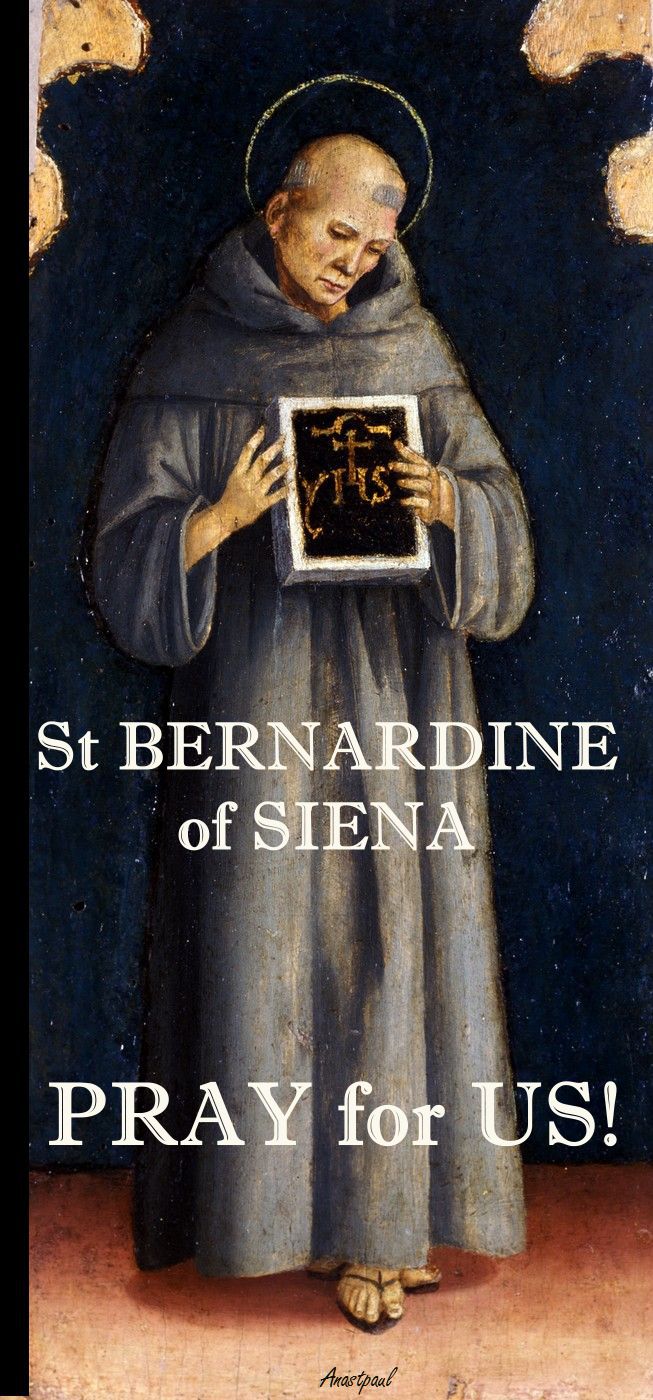
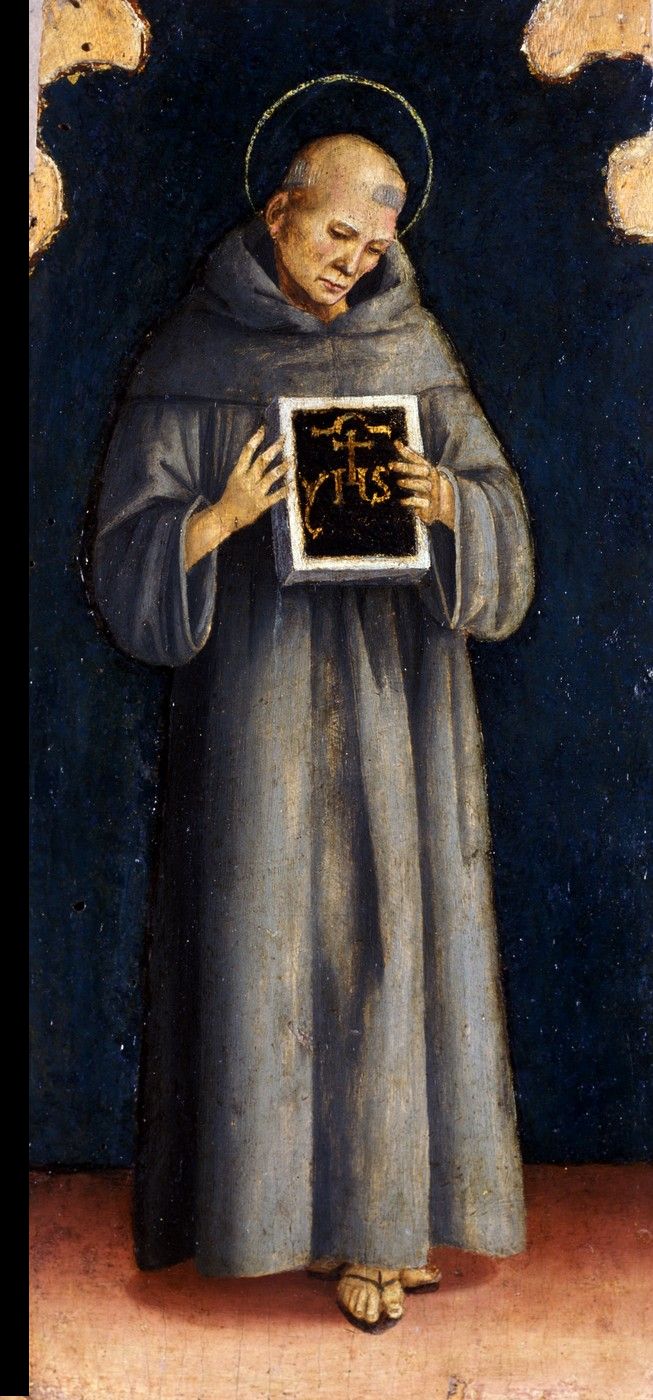
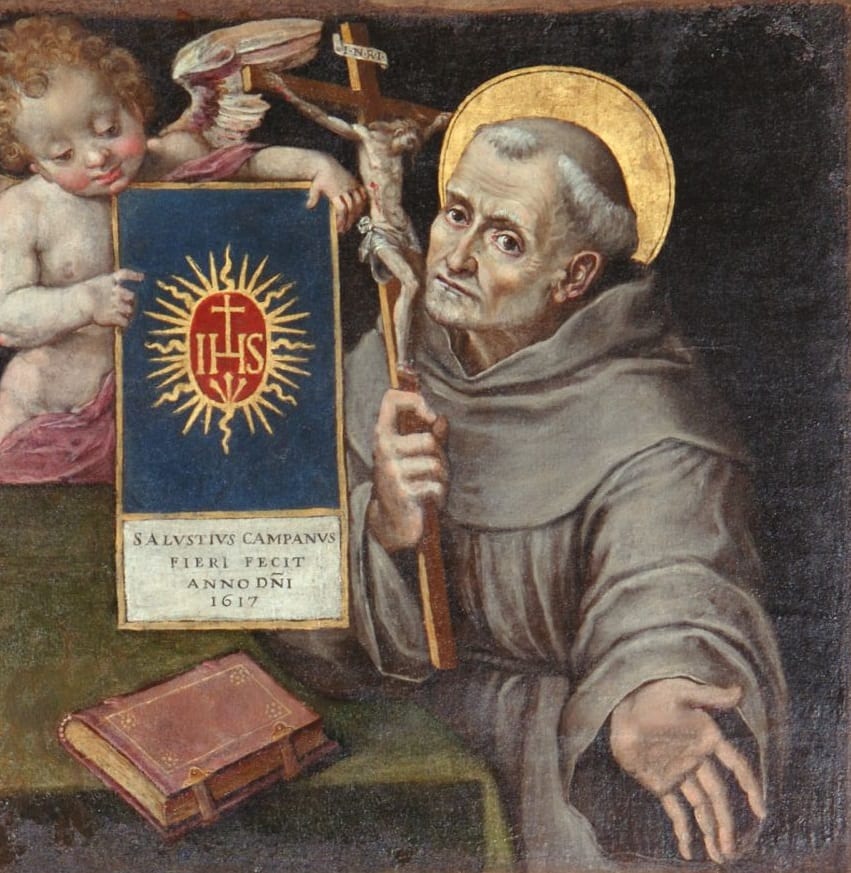
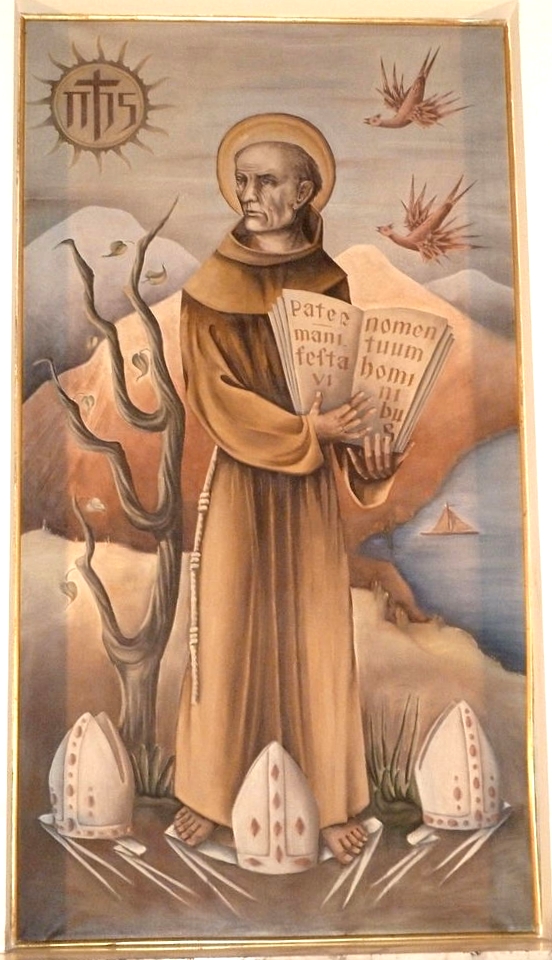
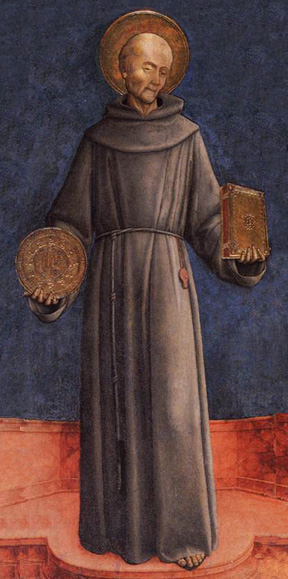
In St Bernardine’s day, cursing was almost part of the common speech and he combated it by promoting devotion to the Holy Name of Jesus.
He even had cards printed inscribed with the Holy Name and they were more popular than playing cards..
He knew that you do not root out an evil merely preaching against it, instead you must put something good in its place.
That is a piece of wisdom it would do us well to follow.   Perhaps our attempts should be garnered universally to root out the sacrilegious habit of great portions of the world, which use the name of God and of Jesus in vain, so often with every sentence, so much so, that in public it is now an accepted practice!

St Bernardine of Siena, please pray for us!

st bernardine of siena-pray for us.jpg 2

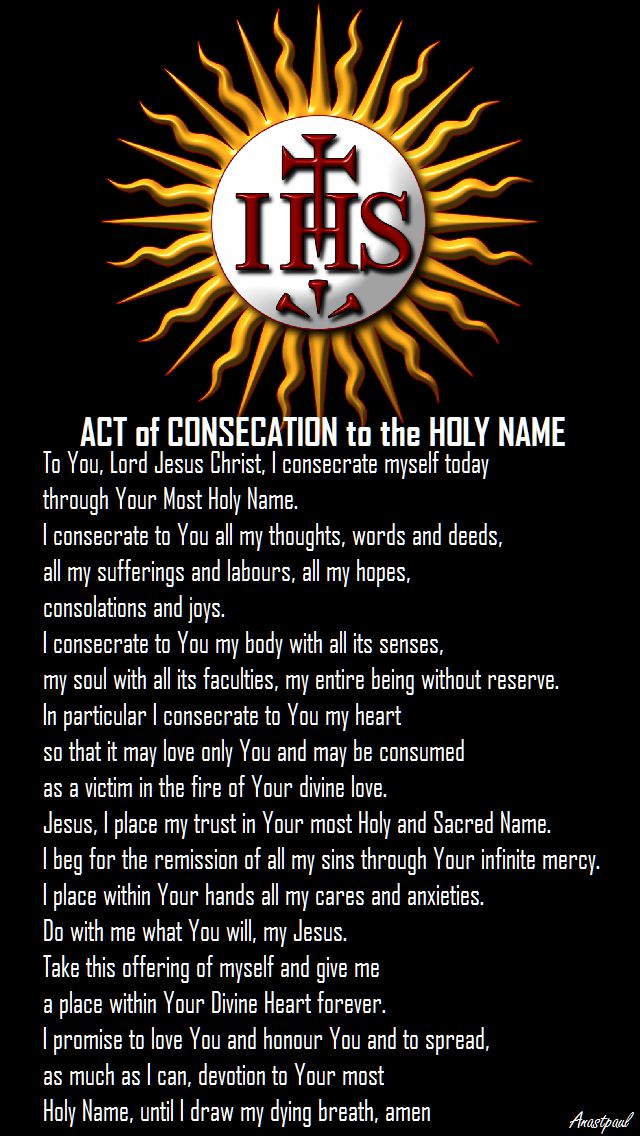
CONSECRATION HOLY NAMEf1bc989243ef8f0d43b071bc162c831f

Posted in DEVOTIO, franciscan OFM, MORNING Prayers, QUOTES of the SAINTS, SAINT of the DAY

Quote of the Day – 20 May

Quote of the Day – 20 May

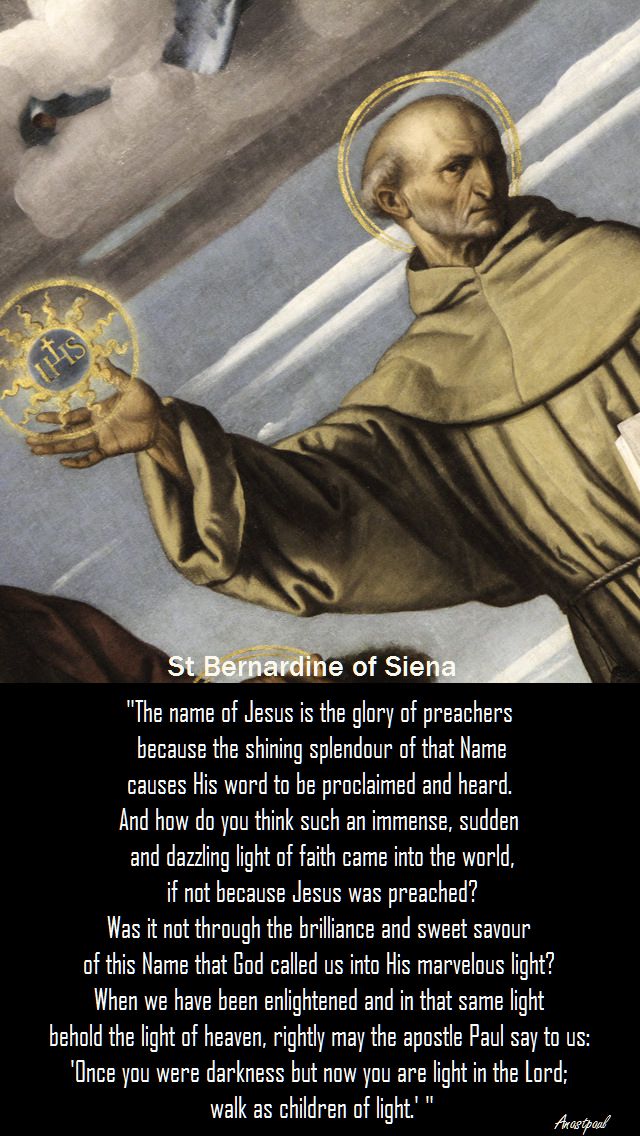
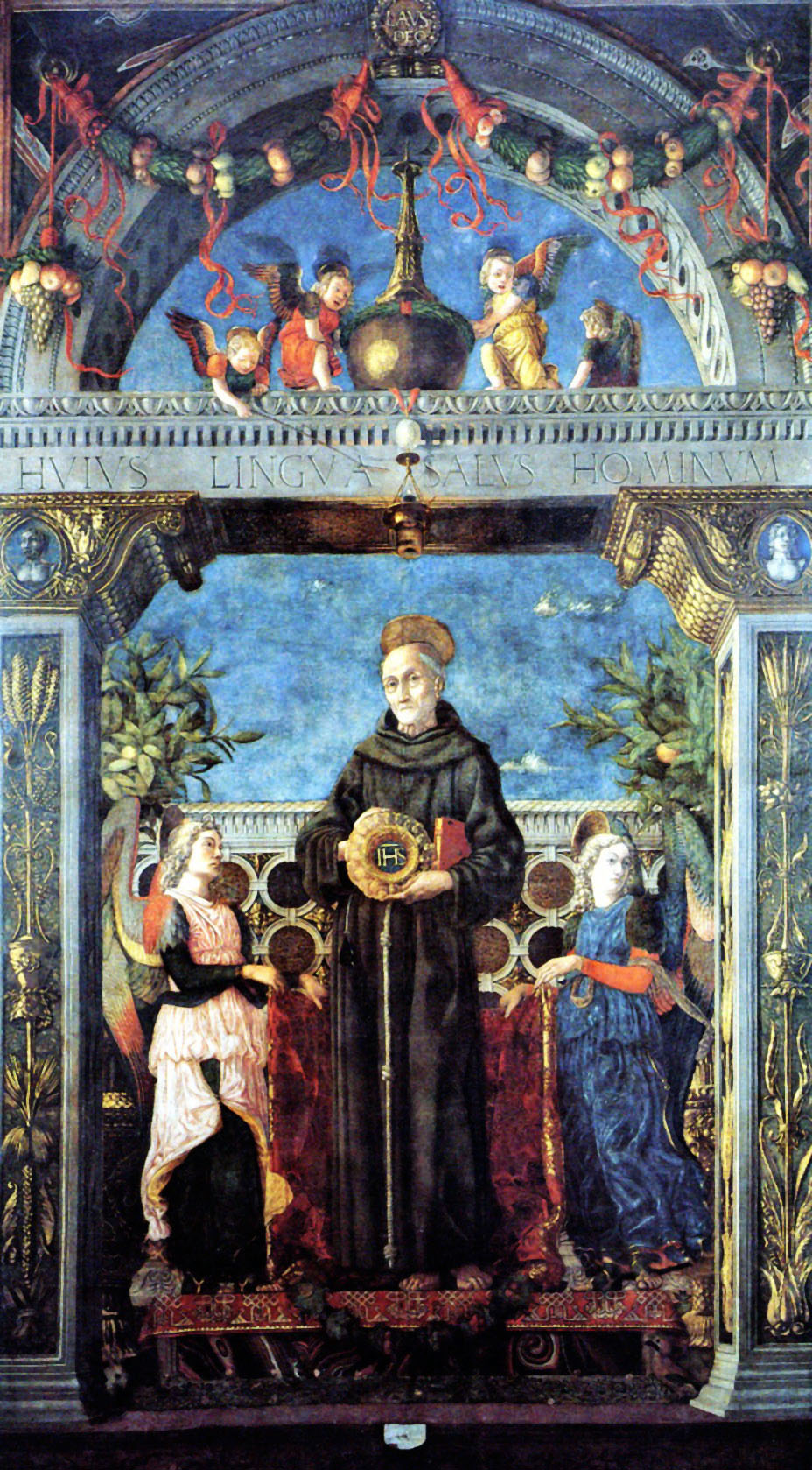
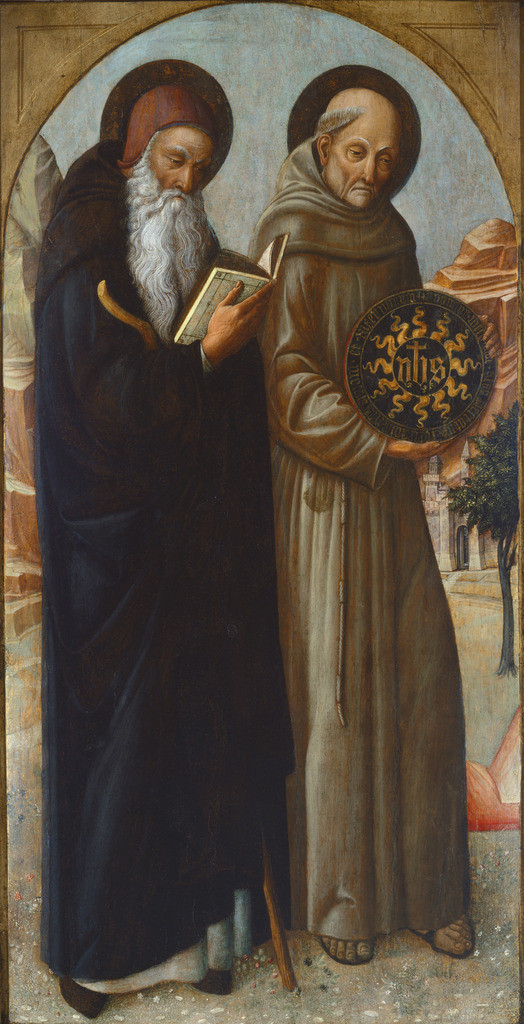
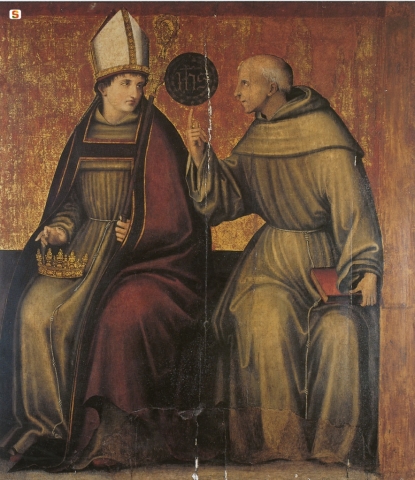
Especially known for his devotion to the Holy Name of Jesus, Bernardine devised a symbol—IHS, the first three letters of the name of Jesus in Greek–in Gothic letters on a blazing sun.   This was to displace the superstitious symbols of the day, as well as the insignia of factions:  for example, Guelphs and Ghibellines.   The devotion spread and the symbol began to appear in churches, homes and public buildings.

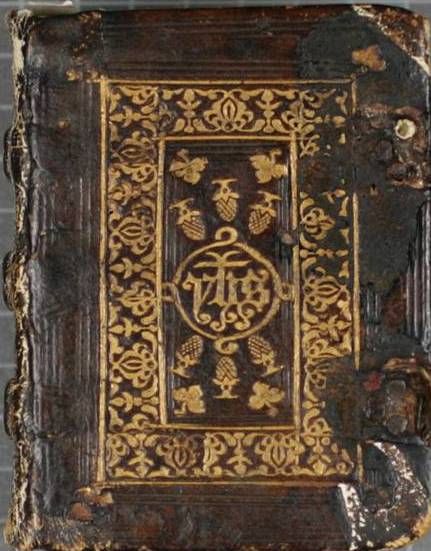
breviary_tuscany
The provenance of this item indicates that the prayer book belonged to Franciscan communities in Tuscany during the lifetime of Saint Bernardine of Siena.

“The name of Jesus is the glory of preachers
because the shining splendour of that Name
causes His word to be proclaimed and heard.
And how do you think such an immense, sudden
and dazzling light of faith came into the world,
if not because Jesus was preached?
Was it not through the brilliance and sweet savour
of this Name that God called us into His marvelous light?
When we have been enlightened and in that same light
behold the light of heaven, rightly may the apostle Paul say to us:
‘Once you were darkness but now you are light in the Lord;
walk as children of light.’ “

the name of jesus - st bernardine of siena

Posted in franciscan OFM, MORNING Prayers, QUOTES of the SAINTS, SAINT of the DAY, The BLESSED VIRGIN MARY, The WORD

ONE MINUTE REFLECTION – 20 May

ONE MINUTE REFLECTION – 20 May

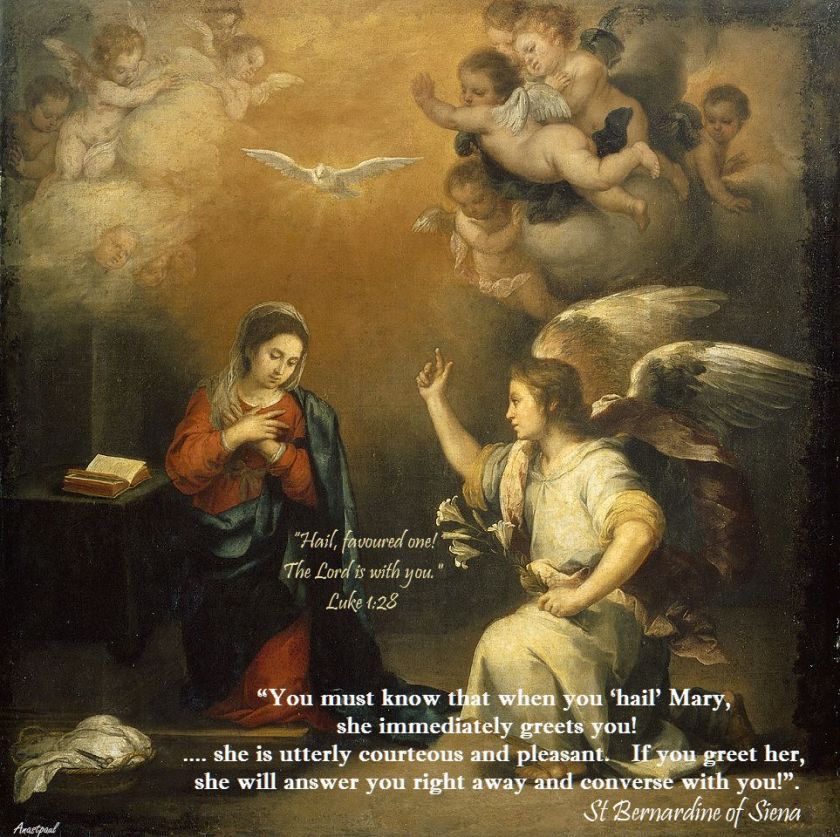
And coming to her, he said, “Hail, favoured one! The Lord is with you.”………..Luke 1:28

REFLECTION -“You must know that when you ‘hail’ Mary, she immediately greets you! Don’t think that she is one of those rude women of whom there are so many — on the contrary, she is utterly courteous and pleasant. If you greet her, she will answer you right away and converse with you!”……..St Bernardine of Siena

you must know that when you hail mary- st bernadine

PRAYER – Lord God, You sent your angel to Mary and Your divine Son became man when she gave her consent to the angel’s announcement.  Help me to give a perpetual consent to all that You will for me and a perpetual refusal to all that only I, in my pride, wish. Help me to see and understand and pray unceasingly to discern Your will.   Holy Mary, Mother of God and our Mother, help us all.   St Bernardine of Siena, please pray for us, amen.

st bernardine of siena-pray for us

Posted in DOCTORS of the Church, MORNING Prayers, PRAYERS of the SAINTS, The BLESSED VIRGIN MARY

Our Morning Offering – 20 May

Our Morning Offering – 20 May

I Call Upon You, Mother of God
By St Bonaventure (1217-1274) – Seraphic Doctor

I shall call upon you, Mother of God
and you will hear me;
your praises will gladden my heart.
I have called to you in trouble
and you have heard me at your throne in heaven.
Take up my cause, Mother,
for I have departed from my innocence;
but because I have hoped in you,
I shall not lose my soul.
To you, Mother, have I pleaded,
after having wandered from God
and I was saved by the power of your intercession.
In you, Mother, I place all my hope
because of your most loving compassion.
Into your hands I entrust my soul and body,
my whole life and the hour of my death.
Intercede for us, Mother of God and Mediatrix,
who have brought salvation to mankind. Amen

i call upon you mother of god, st bonaventure

Posted in ADVERTISING, PUBLIC RELATIONS, COMMUNICATIONS, franciscan OFM, PATRONAGE - LUNG and RESPIRATORY illness, QUOTES of the SAINTS, SAINT of the DAY

Saint of the Day – 20 May – St Bernardine of Siena OFM (1380-1444) “Apostle of the Most Holy Name of Jesus,”

Saint of the Day – 20 May – St Bernardine of Siena OFM (1380 at Massa di Carrara, Italy to 1444 at Aquila, Italy of natural causes) “Apostle of the Most Holy Name of Jesus,” Priest, Missionary, Preacher, known as the “Apostle of Italy,” the “Star of Tuscany,” and the “Second Paul.”  Saint Bernadine is one of the most renowned Franciscan preachers and reformers, a prolific writer who graced the Church with countless sermons and writings and is largely responsible for increasing the popular devotion to the Holy Name of Jesus.    St Bernadine is also remembered for his ardent devotion to Our Blessed Mother and the Holy Family. His numerous Patronages include – against chest and lung problems, respiratory illnesses, of Advertising and Communications and Public Relations workers, against gambling and gambling addictions, of Italy, Diocese of San Bernardino, California, of the Diocese of Capri, Italy, of the Italian Cities of Altavilla Irpina, Aquila, Camaiore, Carpi, Castelspina, Alessandria, Montecchio, Trevignano Romano
Venice.

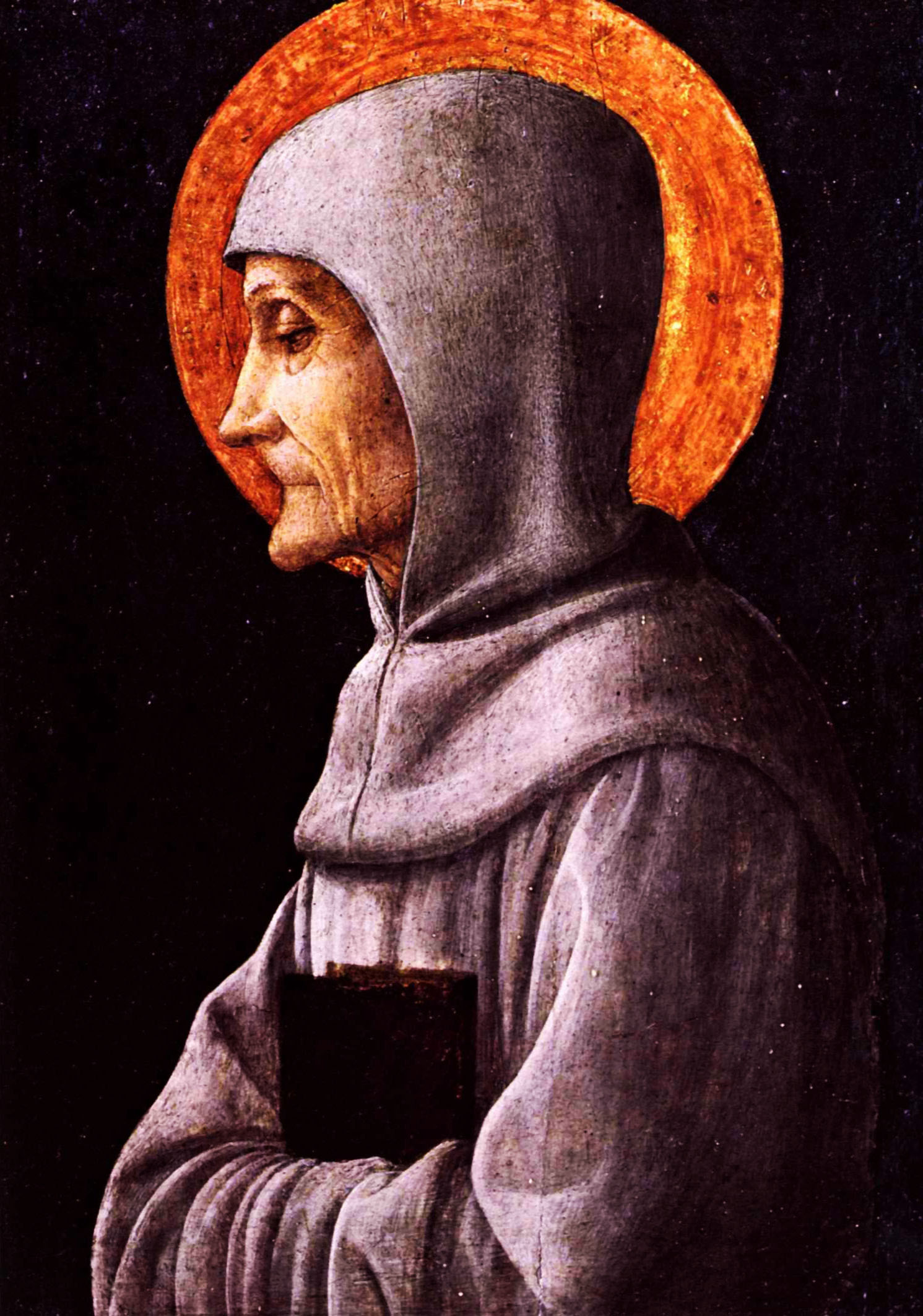
saint-bernardine-of-siena-1450

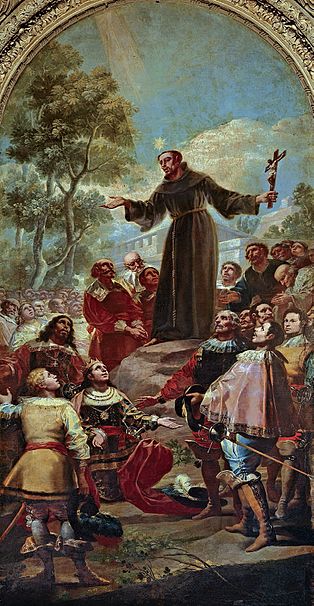
Saint Bernadine was the greatest preacher of his time, journeying across Italy, bringing peace to areas ridden with strife, attacking the paganism he found rampant.   When he preached, he would attract large crowds of nearly 30,000 listeners, converting many on the spot.   Above all, he followed St. Francis’s admonition to preach about “vice and virtue, punishment and glory.”   Saint Antoninus described him as “a new star in the midst of the murky darkness of the earth; to shine with the brightness of Divine gifts; to beam far and wide the bright rays of his glorious life and teachings; to lead in the fear of God, by the holiness of his example, a people whose blindness had removed it from the straight path of the heavenly Homeland.”

San_Bernardino_de_Siena_(Goya)

He was born on the Feast of the Nativity of Mary in Siena, Italy.  StBernadine entered the world in nobility, the son of a governor.   At age six, he lost both his parents and thus orphaned, was raised by a pious aunt who attended to both his physical and spiritual needs.   Bernadine excelled at school, demonstrating both intelligence and diligence, holiness and piety, and was well-liked and popular.   At age 17, he entered a Marian confraternity at the La Scala hospital, beginning a secluded religious life devoted to prayer and meditation.   At that time, the plague raged throughout Europe and Bernadine left seclusion to aid the sick, placing himself at great risk and assuming administration of the hospital.   While he never contracted the plague, he fell ill from exhaustion and was confined to bed for several months.   While he never fully recovered, his voice—hoarse and weak from his sickness- was fully restored through his devotion to Our blessed Mother, allowing him to develop profound preaching skills. Following his own sickness, his aunt fell ill and he nursed her until her death, never leaving her side.   Upon her death, Saint Bernadine turned to fasting and prayer, spending his days seeking the will of the Lord in his life.

One day while he was kneeling at the foot of his crucifix, praying for guidance, Bernadine heard the voice of Jesus say to him:   “My son Bernardine, you see Me hanging on the Cross, in a state of total denudation.   If you love Me and want to walk in My footsteps, fasten yourself also to the cross, divested of everything.” Following this divine message, Bernadine joined the Franciscan Order, distinguishing himself through obedience, which he considered the virtue of highest import.

Bernadine was assigned to preaching, having a natural gift given by the Holy Spirit. Over the next decade of his life, he traveled throughout Italy, preaching in major cities, a natural successor to Saint Vincent Ferrer.   The Adorable Name of Jesus was the usual theme of his sermons, stemming from his aunt’s instruction as a child.   Wherever he traveled, he carried a tablet on which the Holy Name of Jesus (IHS) was written, adopting it as his standard and his “sole weapon.”   He firmly held only in this Name could man be saved, as Saint Peter had instructed the elders in the Synagogue.

One of Bernadine’s listeners in Siena was to become Pope Pius II.   In his notes, the Pope tells of one of Bernardine’s addresses:   “One day, as he was preaching in the square in Siena, a thick cloud formed and threatened rain. Everyone wanted to run off.  ‘Friends, remain in peace,’ exclaimed the orator.   He knelt down and prayed, ordering the cloud, by virtue of the Name of Jesus, to go away.   Scarcely had he spoken when the cloud scattered without a drop of rain, and the weather turned as fair as it had been before.”

Bernardine was a preacher of inspired eloquence.   He has been called the Doctor of the Heart of Mary due to his writings on Mary’s heart.   He wrote, “from her heart, as from a furnace of Divine Love, the Blessed Virgin spoke the words of the most ardent love.”   He was also a distinguished master in the science of all things sacred, as is proved by the writings he has left us.
Bernadine’s watchword, like Saint Francis, was peace. He preached peace wherever he went, balancing the social climate of the day with the teachings of the Church. Mass reconciliations were reported as he celebrated Mass, given his encouragement of the kiss of peace between attendees.

Numerous miraculous occurrences were reported in his presence.   One day, preaching in praise of the Blessed Virgin, he applied to Her the verse of the Apocalypse: “A great sign appeared in heaven, a Woman clothed with the sun…”   At once a brilliant star appeared over his head.   On other occasions, Bernadine was understood by all present when he spoke in Italian—even by those who didn’t speak Italian! He obtained miraculous conversions and reformed the greater part of Italy by his burning words and by the power of the Holy Name of Jesus.
Bernardine was appointed Vicar General of his Order in 1438, an office he held for five years.   After five years, he began preaching again until, worn out from his missionary labors, he died on the Eve of the Ascension.   At his death, his brothers surrounded him, chanting, “Father, I have manifested Thy Name to men.” Saint Bernadine was buried at Aquila in the Abruzzi.   The miracles reported at his tomb encouraged Pope Nicholas V to canonise him only six years later.
Posted in SAINT of the DAY

Saints – 20 May

St Bernadine of Siena (Optional Memorial)

St Abercius
Bl Albert of Bologna
St Alexander of Edessa
St Althryda
St Anastasius of Brescia
St Aquila of Egypt
St Arcangelo Tadini
Bl Arnaldo Serra and Companions
St Asterius of Edessa
St Austregisilus of Bourges
St Basilla of Rome
St Baudelius of Nîmes
St Codrato
Bl Columba of Rieti
St Ethelbert of East Anglia
BlGuy de Gherardesca
St Helena
St Hilary of Toulouse
St José Pérez Fernández
St Lucifer of Caglieri
St Marcello
Bl Maria Angelica Perez
St Plautilla of Rome
St Protasius Chong Kuk-bo
St Rafaél García Torres
St Talaleo of Egea
St Thalalaeus of Edessa
St Theodore of Pavia
St Tomás Valera González

Posted in DOCTORS of the Church, MORNING Prayers, The BLESSED VIRGIN MARY

The Saint Who Influenced Pope St. John Paul II’s Profound Devotion to Mary

The Saint Who Influenced Pope St. John Paul II’s Profound Devotion to Mary

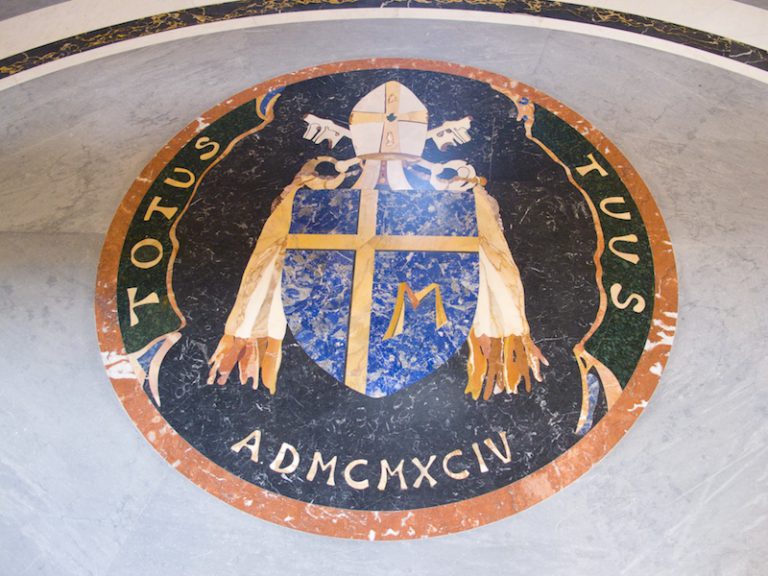
Pope St. John Paul II was well known for having a deep and abiding love for the Blessed Virgin Mary. His devotion to her was evident in all that he did: his teaching, his prayer life, even his papal motto and coat of arms were dedicated to the Blessed Mother.

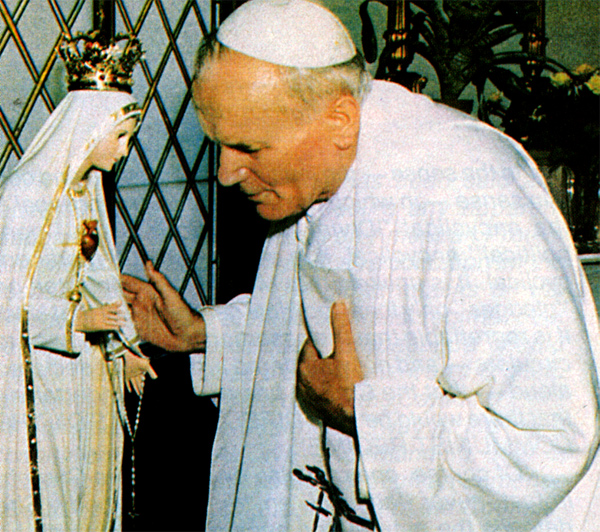
When he was nearly fatally shot during his papacy he credited the intercession of the Virgin Mary, specifically Our Lady of Fatima, with the miraculous save of his life.

cr16pg08
Pope St. John Paul II with an Our Lady of Fatima statue after the assasination attempt on his life

But how did he develop this life-long devotion to Mary?

In his book, Gift and Mystery, Blessed Pope John Paul II credits his home parish and the nearby Carmelites for their early influence on him. He also had a very devout father who regularly took him on pilgrimages to local Marian shrines.

However, as he matured in his faith as a young adult, he singles out one overwhelming influence which changed his life. He gleaned his profound devotion to Mary largely through the writings of one man: St. Louis de Montfort.

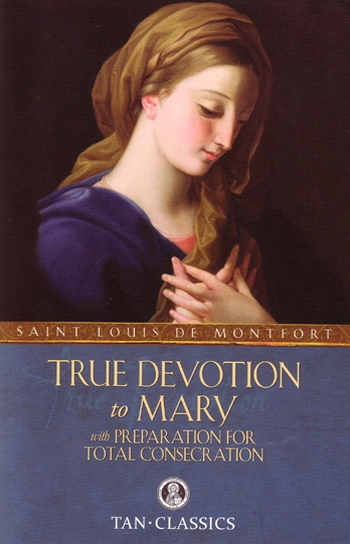
The book that changed Karol Wojtyla’s life was True Devotion to Mary. The Pope relates that,

“At one point I began to question my devotion to Mary, believing that, if it became too great, it might end up compromising the supremacy of the worship owed to Christ.  At that time, I was greatly helped by a book by Saint Louis Marie Grignion de Montfort…

There I found the answers to my questions, Yes, Mary does bring us closer to Christ; she does lead us to him, provided that we live her mystery in Christ… The author was an outstanding theologian.  His Mariological thought is rooted in the mystery of the Trinity and in the truth of the Incarnation of the Word of God”.

Pope John Paul II thought so highly of the writing of St. Louis De Montfort that he spoke about the saint on many occasions. In addition, on December 8, 2003, he wrote a special letter on the occasion of the 160th Anniversary of De Montfort’s publication. In this letter he wrote: “I myself, in the years of my youth, found reading this book a great help.”

1003301

True Devotion to Mary had such a lasting influence on him that when he was elected Supreme Pontiff in 1978, he chose his papal motto, Totus Tuus, from words written by St. Louis De Montfort, as he describes below:

“As is well known, (in) my episcopal coat of arms … the motto Totus tuus is inspired by the teaching of St. Louis Marie Grignion de Montfort.  These two words express total belonging to Jesus through Mary: “Tuus totus ego sum, et omnia mea tua sunt.” (“I am all Yours, and all that I have is Yours.”) . . . “This Saint’s teaching has had a profound influence on the Marian devotion of many of the faithful and on my own life.”

163-768x576

There is no better way to advance quickly in holiness, no better way to please God, and no better way to guarantee one’s present sanctity and eternal salvation than with a true devotion to Mary.   Pope John Paul II learned this and demonstrated this truth in his life, proven now that he has been raised to the altars and numbered with the saints in heaven.

Posted in CONTEMPLATIVE Prayer, MORNING Prayers

Catholic Meditation and Contemplative Prayer: What’s the Difference?

Catholic Meditation and Contemplative Prayer: What’s the Difference?

To answer this question, let’s look at the Catechism of the Catholic Church. In the glossary, we find the following definitions (I’ve highlighted several words and phrases in each definition to help us parse out the difference):

First, for meditation:

MEDITATION: An exercise and a form of prayer in which we try to understand God’s revelation of the truths of faith and the purpose of the Christian life, and how it should be lived, in order to adhere and respond to what the Lord is asking.

And now, for contemplation:

CONTEMPLATION: A form of wordless prayer in which mind and heart focus on God’s greatness and goodness in affective, loving adoration; to look on Jesus and the mysteries of his life with faith and love.

So immediately we can see that Catholic meditation is a cognitive exercise — prayer seeking understanding; whereas contemplative prayer sets aside that kind of mental effort, seeking instead a wordless, loving adoration of Christ and his mysteries.

Put another way:  in meditation we think; in contemplation we rest our thoughts and simply love (and respond to love).

To unpack this a bit further, we can look into the body of the Catechism itself, for further insight into both meditation and contemplation.    In sections 2705-8 of the Catechism we find further insight into a Catholic understanding of meditation.    In the interest of brevity I’m only going to post a few key phrases but look it up in the Catechism and read the entire section:

Meditation is above all a quest.  The mind seeks to understand the why and how of the Christian life, in order to adhere and respond to what the Lord is asking… To meditate on what we read helps us to make it our own by confronting it with ourselves… To the extent that we are humble and faithful, we discover in meditation the movements that stir the heart and we are able to discern them… Meditation engages thought, imagination, emotion, and desire… This form of prayerful reflection is of great value but Christian prayer should go further: to the knowledge of the love of the Lord Jesus, to union with him.

Immediately following this (sections 2709-19) is the Catechism’s discussion of contemplative prayer.   Once again, here are just a few key phrases:

ccc2709-2719


Contemplative prayer seeks him “whom my soul loves.” … We seek him, because to desire him is always the beginning of love… In this inner prayer we can still meditate, but our attention is fixed on the Lord himself…. One cannot always meditate but one can always enter into inner prayer, independently of the conditions of health, work, or emotional state.   The heart is the place of this quest and encounter, in poverty and in faith… Entering into contemplative prayer is like entering into the Eucharistic liturgy:   we “gather up” the heart, recollect our whole being under the prompting of the Holy Spirit, abide in the dwelling place of the Lord which we are, awaken our faith in order to enter into the presence of him who awaits us… Contemplative prayer is the poor and humble surrender to the loving will of the Father in ever deeper union with his beloved Son… It is a gift, a grace; it can be accepted only in humility and poverty. Contemplative prayer is a covenant relationship established by God within our hearts. Contemplative prayer is a communion in which the Holy Trinity conforms man, the image of God, “to his likeness.”
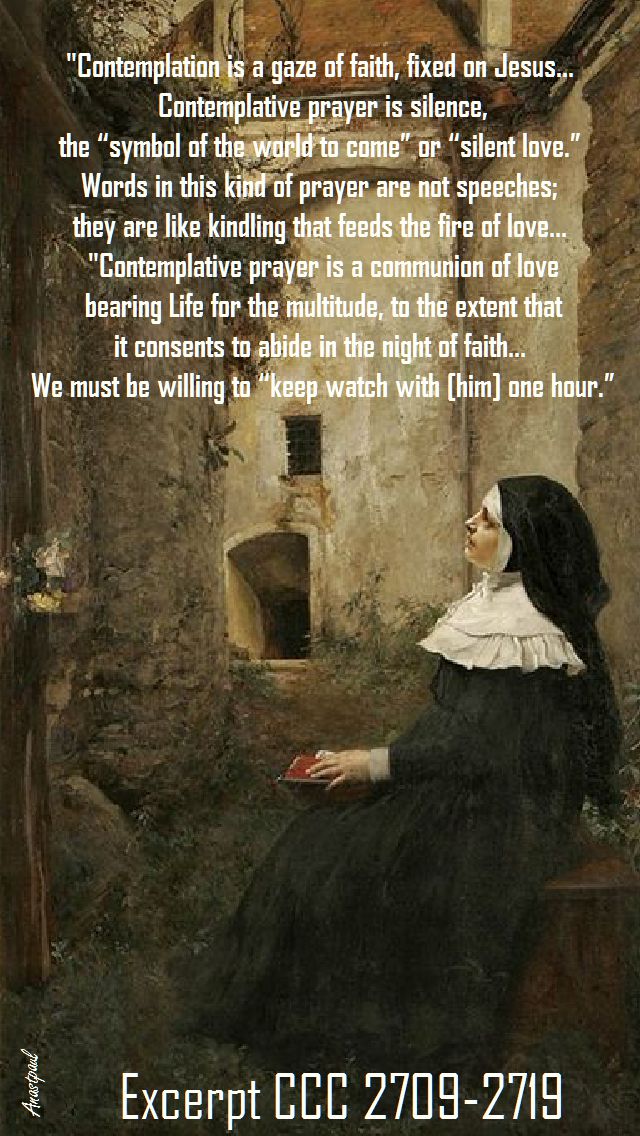
Contemplation is a gaze of faith, fixed on Jesus… Contemplative prayer is silence, the “symbol of the world to come” or “silent love.” Words in this kind of prayer are not speeches; they are like kindling that feeds the fire of love… Contemplative prayer is a communion of love bearing Life for the multitude, to the extent that it consents to abide in the night of faith… We must be willing to “keep watch with [him] one hour.”

The Catechism refuses to draw a hard and fast distinction between meditation and contemplation:  “in [contemplation] we can still meditate.”   Head and heart are both intimate parts of one being.   We may seek in contemplation to love and behold God in silence but thoughts will still dance in our minds.   But as “The Cloud of Unknowing” so helpfully teaches us, when meditative thoughts emerge during contemplative prayer, seek to be non-attached.   Let them arise and let them fall. Keep our focus “fixed on the Lord himself” — in contemplation our intent is to love God, not to think about God;   to know God rather than merely know about God.

Nevertheless, because meditation is an effortful prayer, there are times when we are simply too tired, or too angry, anxious, or whatever, to meditate.   Yet contemplative prayer, emphasising rest and silence, is always available to us.    Perhaps most important of all is the recognition that meditation is not the highest form of prayer: contemplation is.   Yet true contemplation is always a gift, a grace.   It’s not something we achieve, it’s something we receive.

To summarise:

  • Meditation is a quest;   contemplation involves rest.
  • Meditation is mental, cognitive, discursive;   contemplation is silent, heart-centered, beholding
  • Meditation is important, contemplation even more so.
Posted in MORNING Prayers, SAINT of the DAY

Thought for the Day – 19 May

Thought for the Day – 19 May

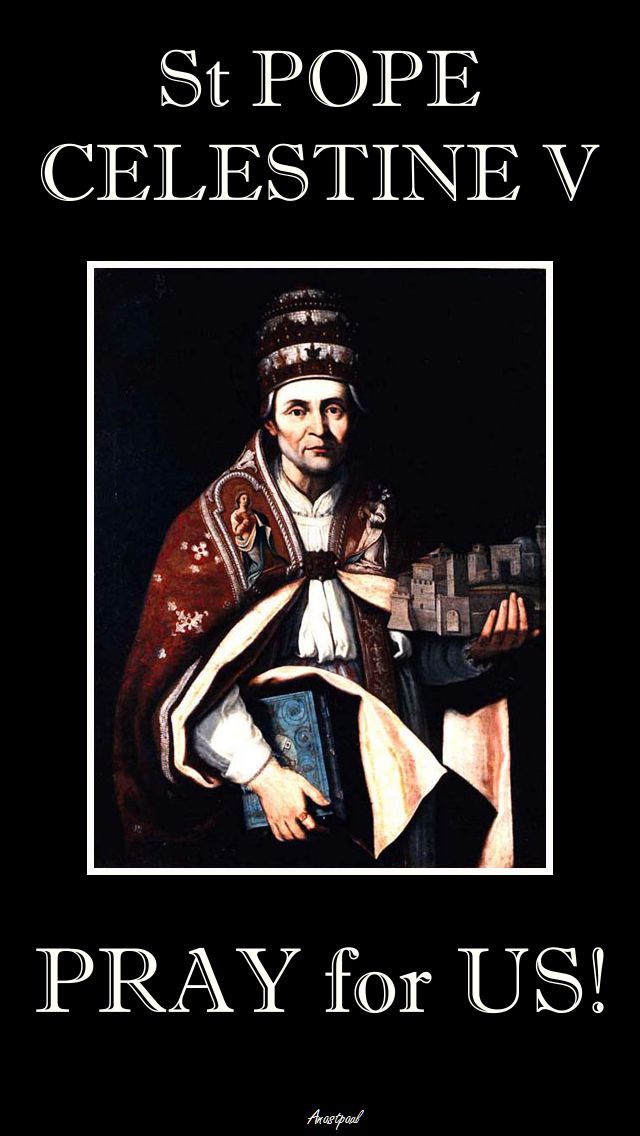
St Celestine V tasted bitterly his own failure but this did not prevent him from being a saint.   When he realised that he was in the wrong place, he quickly did something about it, whatever the consequences.   To admit failure, particularly in a place of importance and public scrutiny, takes a rare kind of courage and that kind of courage is the stuff that saints are made of.  Say no more!

St Pope Celestine V, please pray for us, that we may have the courage to admit our failures.

ST CELESTINE V-PRAY FOR USST POPE CELESTINE V - MAY 19 ST PAULS

Posted in CATHOLIC DEVOTIONS of the Month, MORNING Prayers, QUOTES of the SAINTS, The BLESSED VIRGIN MARY

Quote of the Day – 19 May

Quote of the Day – 19 May

“All our perfection consists in being conformed,
united and consecrated to Jesus Christ;
and therefore the most perfect of all devotions is,
without any doubt, that which the most perfectly
conforms, unites and consecrates us to Jesus Christ.
Now Mary being the most conformed of all creatures to Jesus Christ,
it follows that, of all devotions that which most consecrates
and conforms the soul to Our Lord is devotion to His holy Mother
and the more a soul is consecrated to Mary,
the more it is consecrated to Jesus.
Hence it comes to pass that the most perfect consecration
to Jesus Christ is nothing else than a perfect and entire
consecration of ourselves to the Blessed Virgin.”

St Louis de Montfort

ALL OUR PERFECTION-ST LOUIS DE MONTFORT

Posted in CATHOLIC DEVOTIONS of the Month, DOCTORS of the Church, FATHERS of the Church, MORNING Prayers, The BLESSED VIRGIN MARY, The WORD

One Minute Reflection – 19 May

One Minute Reflection – 19 May

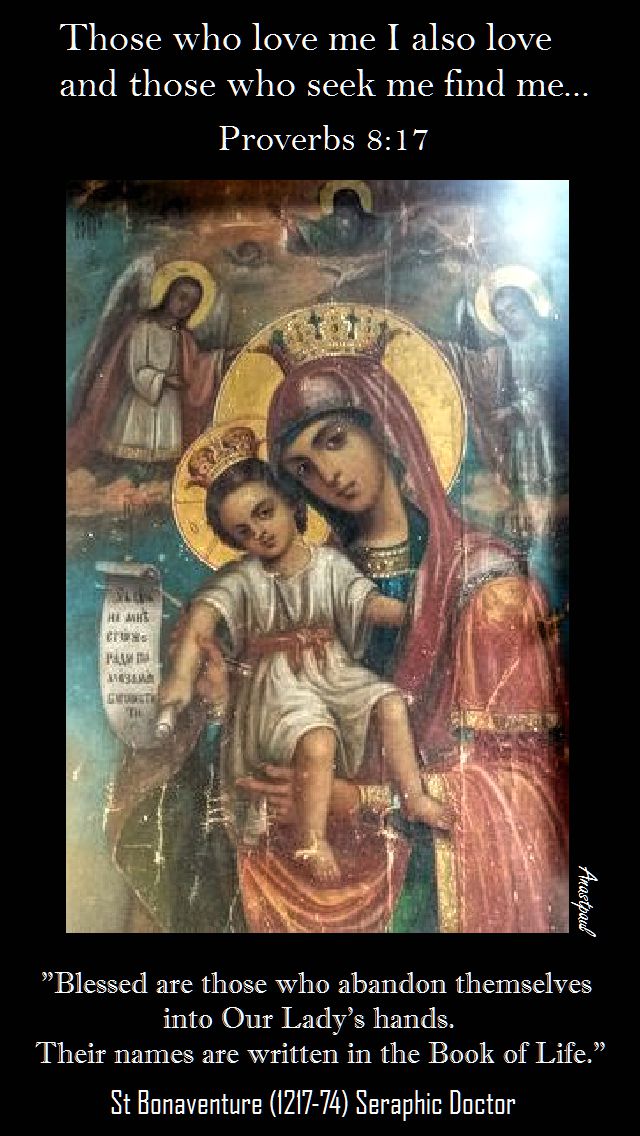
Those who love me I also love and those who seek me find me…….Proverbs 8:17

REFLECTION – “Blessed are those who abandon themselves into Our Lady’s hands. Their names are written in the Book of Life.”………………St Bonaventure (1217-74) Doctor seraphicus (Seraphic Doctor)

blessed are those who abandon-st bonaventure

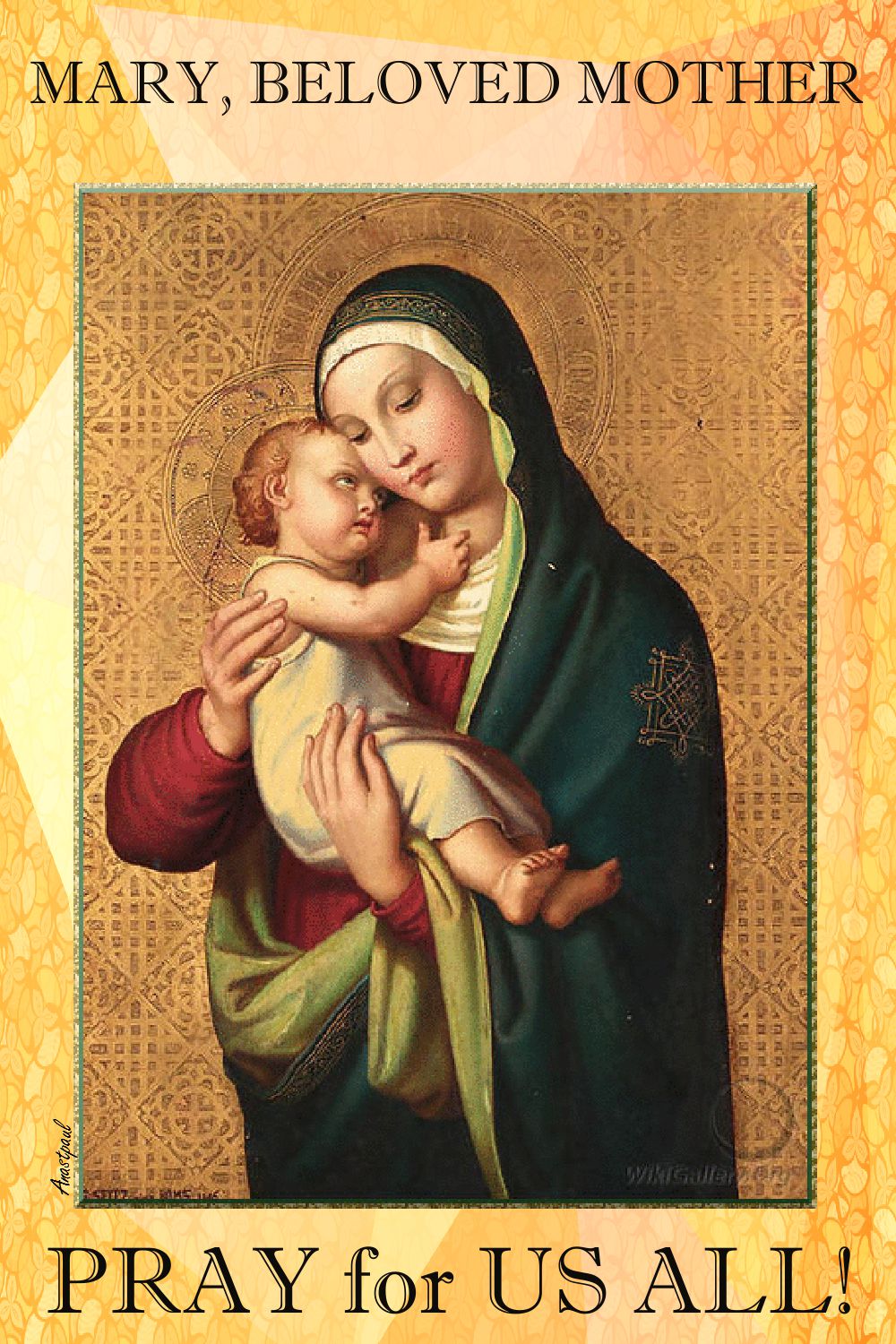
PRAYER – Heavenly Father, make a devoted client of Your beloved Daughter, Mary.   Let me entrust myself always into her hands so that she may protect me as she took cate of Your Son, Our Lord Jesus Christ, in His infancy, childhood and throughout His life.   Make me unto her, Lord my God!   Mary, my beloved Mother, give me your spirit and pray for us all amen!

mary beloved mother-pray for us all

Posted in CATHOLIC DEVOTIONS of the Month, MORNING Prayers, PRAYERS of the SAINTS, The BLESSED VIRGIN MARY

Our Morning Offering – 19 May

Our Morning Offering – 19 May

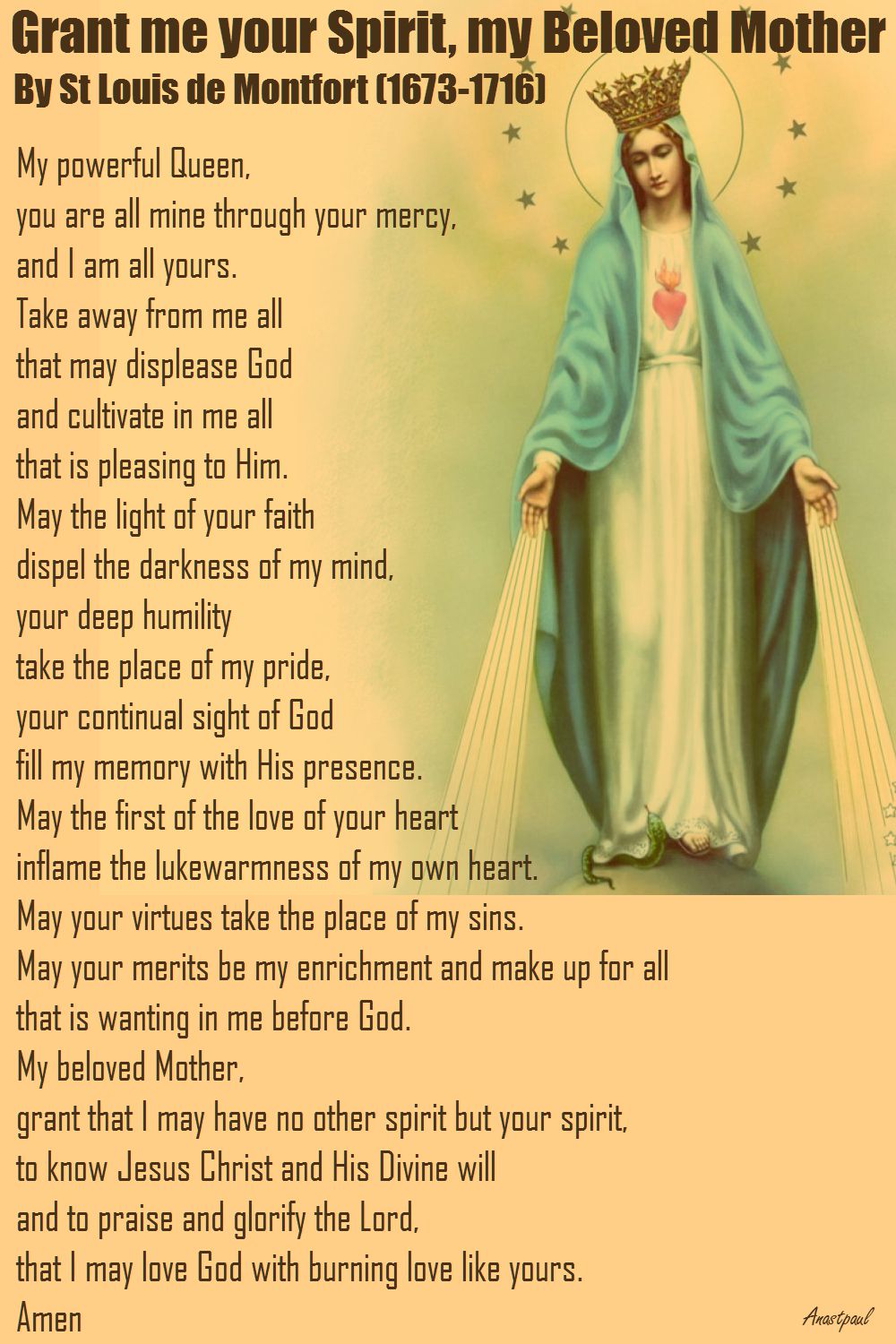
Grant me your Spirit, my Beloved Mother
By ST LOUIS DE MONTFORT (1673-1716)

My powerful Queen,
you are all mine through your mercy,
and I am all yours.
Take away from me all that may displease God
and cultivate in me all that is pleasing to Him.
May the light of your faith
dispel the darkness of my mind,
your deep humility
take the place of my pride,
your continual sight of God
fill my memory with His presence.
May the first of the love of your heart
inflame the lukewarmness of my own heart.
May your virtues take the place of my sins.
May your merits be my enrichment
and make up for all
that is wanting in me before God.
My beloved Mother,
grant that I may have no other spirit but your spirit,
to know Jesus Christ and His Divine will
and to praise and glorify the Lord,
that I may love God with burning love like yours.
Amen

grant me your spirit-st louis de montfort

Posted in SAINT of the DAY

Saint of the Day – 19 May – St Pope Celestine V

Saint of the Day – 19 May – St Pope Celestine V  Born 1210 at Isneria, Abruzzi, Italy as Pietro del Morrone;  Papal Ascension – 5 July 1294 – Papal Abdication – 13 December 1294.  Died:  • 19 May 1296 in Rome, Italy of natural causes.  St Celestine is buried in the church of Saint Agatha, Ferentino, Italy and re-interred in the Church of Saint Maria di Collemaggio, Aquila, Italy.  Monk, Hermit, Pope, Founder.  Patron of Bookbinders,Papal resignations, Aquila, Urbino, Molisem Sant’Angelo Limosano.   Attributes – Papal vestments, Papal tiara, Book

B_Colestin_V

Peter Celestine, was Pope for five months from 5 July to 13 December 1294, when he resigned.   He was also a monk and hermit who founded the order of the Celestines as a branch of the Benedictine order.
He was elected pope in the Catholic Church’s last non-conclave papal election, ending a two-year impasse.   Among the only edicts of his to remain in force was the confirmation of the right of the pope to abdicate;  nearly all of his other official acts were annulled by his successor, Boniface VIII.   On 13 December 1294, a week after issuing the decree, Celestine resigned, stating his desire to return to his humble, pre-papal life.   He was subsequently imprisoned by Boniface in the castle of Fumone in the Campagna region, in order to prevent his potential installation as antipope.   He died in prison on 19 May 1296 at the age of 81.
St Celestine was canonized on 5 May 1313 by Pope Clement V.   No subsequent pope has taken the name Celestine.

celestine_full_size_clour

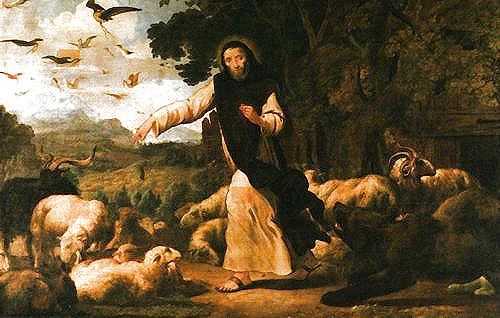
Pietro Angelerio was born to parents Angelo Angelerio and Maria Leone in a town called Sant’Angelo Limosano, in the Kingdom of Sicilia (Sicily).   After his father’s death he began working in the fields.   His mother Maria was a key figure in Pietro’s spiritual development:  she imagined a different future for her deeply beloved son than becoming just a farmer or a shepherd.   From the time he was a child, he showed great intelligence and love for others.   He became a Benedictine monk at Faifoli in the Diocese of Benevento when he was 17.   He showed an extraordinary disposition toward asceticism and solitude and in 1239 retired to a solitary cavern on the mountain Morrone, hence his name (Peter of Morrone).   Five years later he left this retreat and went with two companions to a similar cave on the even more remote Mountain of Maiella in the Abruzzi region of central Italy, where he lived as strictly as possible according to the example of St. John the Baptist.   Accounts exist of the severity of his penitential practices.

cel-as-Shepherd

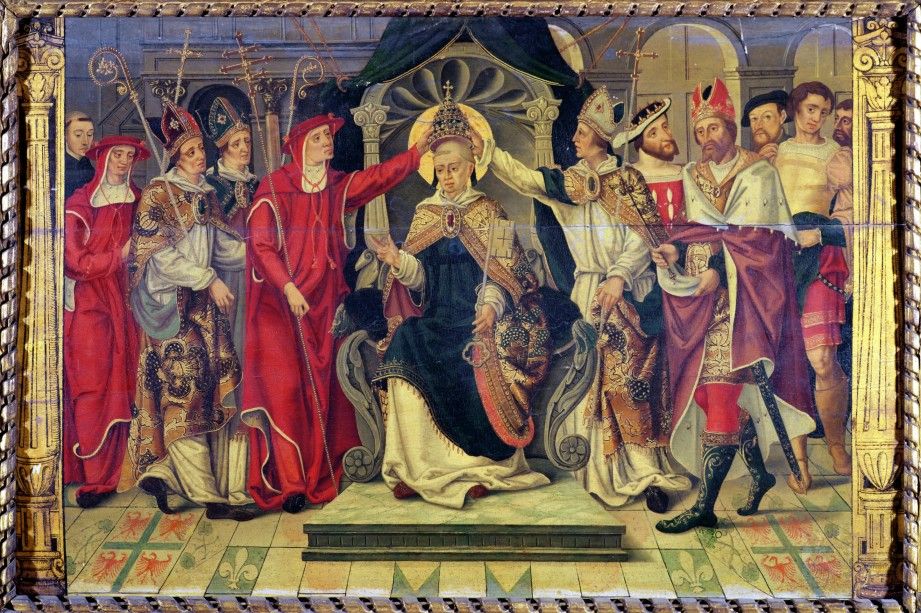
The cardinals assembled at Perugia after the death of Pope Nicholas IV in April 1292. After more than two years, a consensus had still not been reached.   Pietro, well known to the cardinals as a Benedictine hermit, sent the cardinals a letter warning them that divine vengeance would fall upon them if they did not quickly elect a pope.   Latino Malabranca, the aged and ill dean of the College of Cardinals cried out, “In the name of the Father, the Son, and the Holy Ghost, I elect brother Pietro di Morrone.” The cardinals promptly ratified Malabranca’s desperate decision.   When sent for, Pietro obstinately refused to accept the papacy and even, as Petrarch says, tried to flee, until he was finally persuaded by a deputation of cardinals accompanied by the king of Naples and the pretender to the throne of Hungary.   Elected on 5 July 1294, at age 79, he was crowned at Santa Maria di Collemaggio in the city of Aquila in the Abruzzo on 29 August, taking the name Celestine V.

St Celestinus V 4

Shortly after assuming office, Celestine issued a papal bull granting a rare plenary indulgence to all pilgrims visiting Santa Maria di Collemaggio through its holy door on the anniversary of his papal coronation.   The Perdonanza Celestiniana festival is celebrated in L’Aquila every 28–29 August in commemoration of this event.

With no political experience, Celestine proved to be an especially weak and ineffectual pope.   He held his office in the Kingdom of Naples, out of contact with the Roman Curia and under the complete power of King Charles II.    He appointed the king’s favorites to church offices, sometimes several to the same office.   One of these was Louis of Toulouse, whom Celestine ordered given clerical tonsure and minor orders, although this was not carried out.   He renewed a decree of Pope Gregory X that had established stringent rules for papal conclaves after a similarly prolonged election.   In one decree, he appointed three cardinals to govern the church during Advent while he fasted, which was again refused.  Realizing his lack of authority and personal incompatibility with papal duties, he consulted with Cardinal Benedetto Caetani (his eventual successor) about the possibility of resignation.   This resulted in one final decree declaring the right of resignation, which he promptly exercised after five months and eight days in office, thus on 13 December 1294, Celestine V resigned.   In the formal instrument of renunciation, he recited as the causes moving him to the step: “The desire for humility, for a purer life, for a stainless conscience, the deficiencies of his own physical strength, his ignorance, the perverseness of the people, his longing for the tranquility of his former life”.   Having divested himself of every outward symbol of papal dignity, he slipped away from Naples and attempted to retire to his old life of solitude.

The next pope to resign of his own accord was Pope Benedict XVI in 2013, 719 years later.

The former Celestine, now reverted to Pietro Angelerio, was not allowed to become a hermit once again.   Various parties had opposed his resignation and the new Pope Boniface VIII had reason to worry that one of them might install him as an antipope.  To prevent this he ordered Pietro to accompany him to Rome.   Pietro escaped and hid in the woods before attempting to return to Sulmona to resume monastic life.   This proved impossible and Pietro was captured after an attempt to flee to Dalmatia was thwarted when a tempest forced his ship to return to port. Boniface imprisoned him in the castle of Fumone near Ferentino in Campagna, attended by two monks of his order, where Pietro died after 10 months at about the age of 81.   His supporters spread the allegation that Boniface had treated him harshly and ultimately executed Pietro but the historical evidence is lacking.   Pietro was buried at Ferentino but his body was subsequently removed to the Basilica Santa Maria di Collemaggio in Aquila.

Philip IV of France, who had supported Celestine and bitterly opposed Boniface, nominated Celestine for sainthood following the election of Pope Clement V.   The latter signed a decree of dispensation on 13 May 1306 to investigate the nomination.   He was canonised on 5 May 1313 after a consistory.   Most modern interest in Celestine V has focused on his resignation.   He was the first pope to formalise the resignation process and is often said to have been the first to resign.   In fact he was preceded in this by Pope Pontian (235), John XVIII (1009), Benedict IX (1045) and Gregory VI (1046).   As noted above, Celestine’s own decision was brought about by mild pressure from the Church establishment.   His reinstitution of Gregory X’s conclave system established by the papal bull Ubi periculum has been respected ever since.

A 1966 visit by Pope Paul VI to Celestine’s place of death in Ferentino along with his speech in homage of Celestine prompted speculation that the Pontiff was considering retirement.

Celestine-V-remains-new-silver-mask

Celestine’s remains survived the 2009 L’Aquila earthquake with one Italian spokesman saying it was “another great miracle by the pope”.   They were then recovered from the basilica shortly after the earthquake.   While inspecting the earthquake damage during a 28 April 2009 visit to the Aquila, Pope Benedict XVI visited Celestine’s remains in the badly damaged Santa Maria di Collemaggio and left the woolen pallium he wore during his papal inauguration in April 2005 on his glass casket as a gift.

To mark the 800th anniversary of Celestine’s birth, Pope Benedict XVI proclaimed the Celestine year from 28 August 2009 through 29 August 2010.   Benedict XVI visited the Sulmona Cathedral, near Aquila, on 4 July 2010 as part of his observance of the Celestine year and prayed before the altar consecrated by Celestine containing his relics, on 10 October 1294.

Posted in SAINT of the DAY

Saints – 19 May

St Alcuin of York
Bl Augustine Novello
St Calocerus of Rome
St Pope Celestine V
St Crispin of Viterbo
St Cyriaca of Nicomedia and Companions
St Cyril of Trèves
St Dunstan of Canterbury
St Evonio of Auvergne
St Hadulph of Saint-Vaast
Bl Humiliana de’ Cerchi
St Ivo Hélory of Kermartin
Bl Jean-Baptiste-Xavier Loir
Bl Józef Czempiel
Bl Juan of Cetina
Bl Louis Rafiringa
Bl Lucinio Fontanil Medina
St Parthenius of Rome
Bl Peter de Duenas
Bl Peter Wright
St Philoterus of Nicomedia
St Pudens of Rome
St Pudentiana of Rome
St Theophilus of Corte
Bl Verena Bütler

Posted in CONTEMPLATIVE Prayer, MORNING Prayers

Contemplative Prayer – Making a Start

“Contemplation is a gaze of faith, fixed on Jesus” (Catechism of the Catholic Church, No 2715).

Contemplation is the prayer of the heart and not of the mind.   Contemplative prayer may focus on a word or a saying or one may simply be in the presence of God.   It is the prayer of the listening heart.   The goal of contemplative prayer is to enter into the presence of God where there are no words, concepts or images.  It is the prayer of being in love.

HOW:  Before the Blessed Sacrament – sit or kneel.   Gaze into the Tabernacle or look into the Monstrance.   Be still.   Focus on your breathing.   Ask Mary to help you to pray. Pray to the Holy Spirit.   Then peacefully repeat a word or a phrase:   ‘Jesus; Jesus I love you; Jesus I trust in you; Father; Father, into your hands I commend my spirit’, etc.   Don’t continue to repeat the word or the words over and over again.   Only use the word or the phrase when your mind begins to wander.   Focus your gaze on the Eucharist.   Be open to whatever Jesus is asking of you.

At home – sit or kneel.   Close your eyes.   Again, be still and focus on your breathing.   Ask Mary to help you to pray.   Pray to the Holy Spirit.   As before, repeat a word or a phrase, rooted in the scripture, the creed, a prayer or an aspect of our Christian faith.   Do not repeat the word or words over and over again.   Remember to use the word only when your mind begins to wander.   Focus your gaze on the loving presence of God within you.  If you begin to feel embraced by God, be still and be silent.   Just allow the Holy Spirit to pray within you.

Jesuit Father William Johnston who has written much about contemplative prayer said: “Properly understood, contemplation shakes the universe, topples the powers of evil, builds a great society and opens the doors that lead to eternal life”.

What are the practical steps that we can take in order to incorporate into our busy lives daily contemplative prayer?

  • First of all, we need balance in our lives.   When was the last time that we enjoyed dinner with family and friends, or turned off our cell phone and refrained from checking our email at every moment?   Excessive work and travel, excessive involvement in sports and entertainment are tearing us apart.
  • Secondly, contemplation requires the capacity to be alone.   It is difficult to be alone in our contemporary society.   Even when we are alone, the noise of our own worries and fears drown out the silence of God’s voice.   Many people are incapable of being alone and they immediately feel an obsession to talk with someone on a cell phone or check their email.
  • We all need moments of solitude.   Spending a quiet time before the Eucharist, reading the Scriptures during a peaceful moment at home, taking tranquil walks through the woods or along the beach all are necessary for our soul.   In order to be with God, we must develop the ability to be alone with ourselves.

Excerpt from Fr James Farfaglia’s Homily on Contemplative Prayer

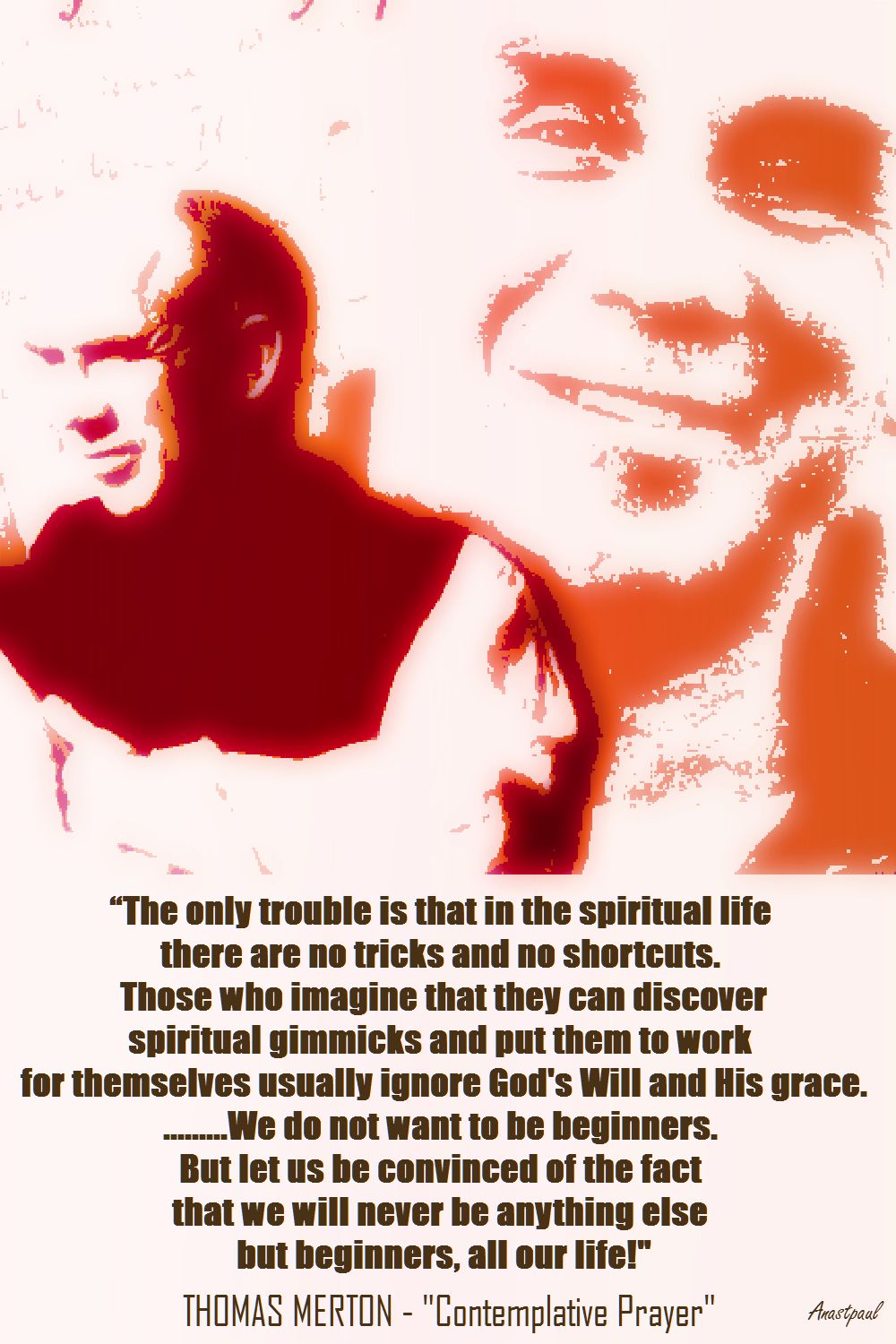
“The only trouble is that in the spiritual life there are no tricks and no shortcuts.   Those who imagine that they can discover spiritual gimmicks and put them to work for themselves usually ignore God’s will and his grace.”

“We do not want to be beginners.   But let us be convinced of the fact that we will never be anything else but beginners, all our life!”

“Hence monastic prayer, especially meditation and contemplative prayer, is not so much a way to find God as a way of resting in Him whom we have found, who loves us, who is near to us, who comes to us to draw us to Himself.”

― Thomas Merton, Contemplative Prayer

THOMAS MERTON ON CONTEMPLATIVE PRAYER NO 1

Posted in MORNING Prayers, SAINT of the DAY

Thought for the Day – 18 May

Thought for the Day – 18 May

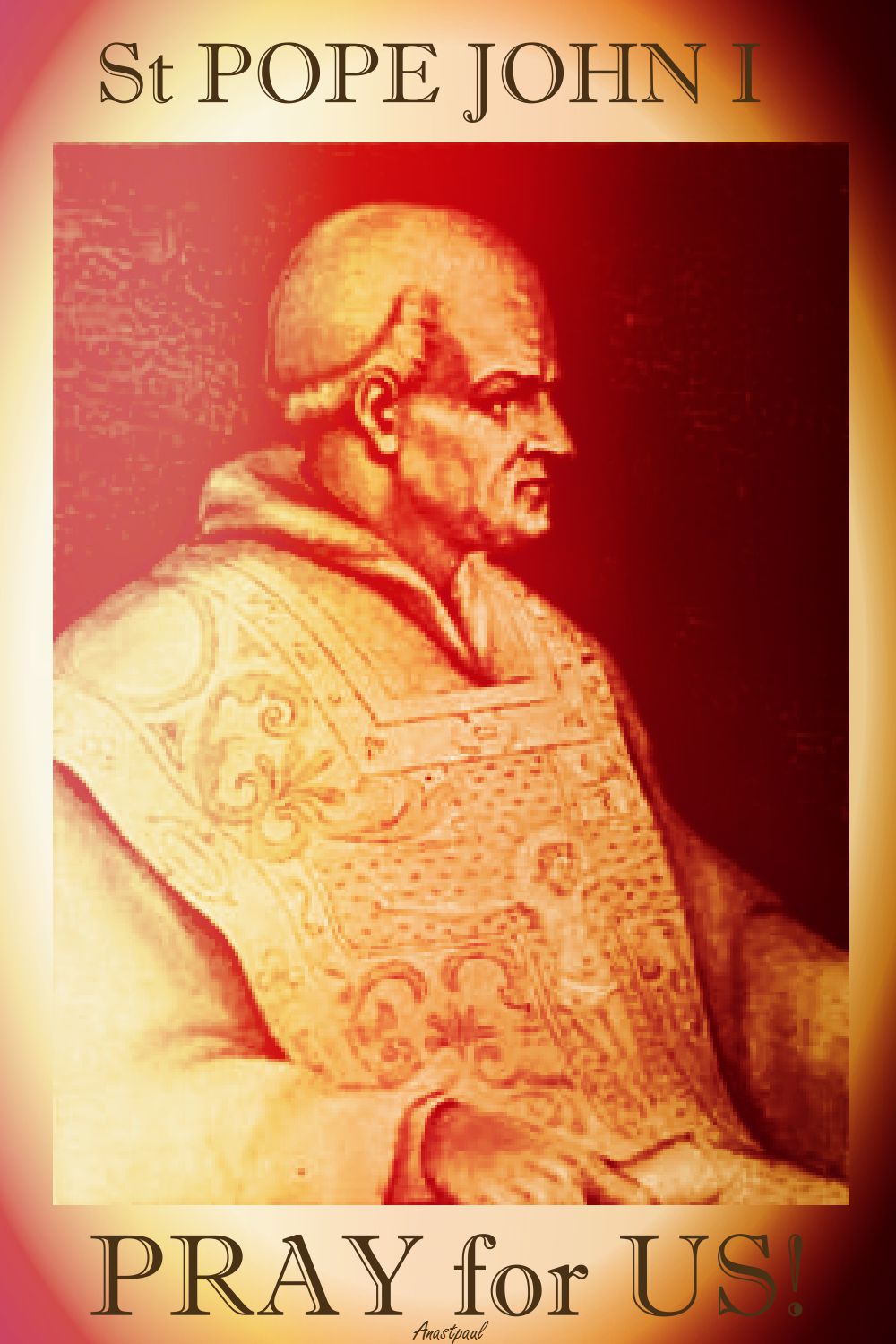
St Pope John I tried to bring peace between king and emperor but succeeded also in endangering his own life.    So it seems to be lot of peacemakers.   However, he was willing to take the risk and so should we be in trying to reconcile others.   Sometimes, we succeed but oftentimes, both sides turn against the striving peacemaker.   That is the risk we take but that is also the challenge of being a Christian. “If you find that the world hates you, know it has hated me before you” (John 15:18). St Pope John I, please pray for us that we too might have your courage in the face of adversity and persecution.

st pope john I - pray for us - MY VERSION

Posted in CATHOLIC DEVOTIONS of the Month, MORNING Prayers, QUOTES of the SAINTS, The BLESSED VIRGIN MARY

Quote of the Day – 18 May

Quote of the Day – 18 May

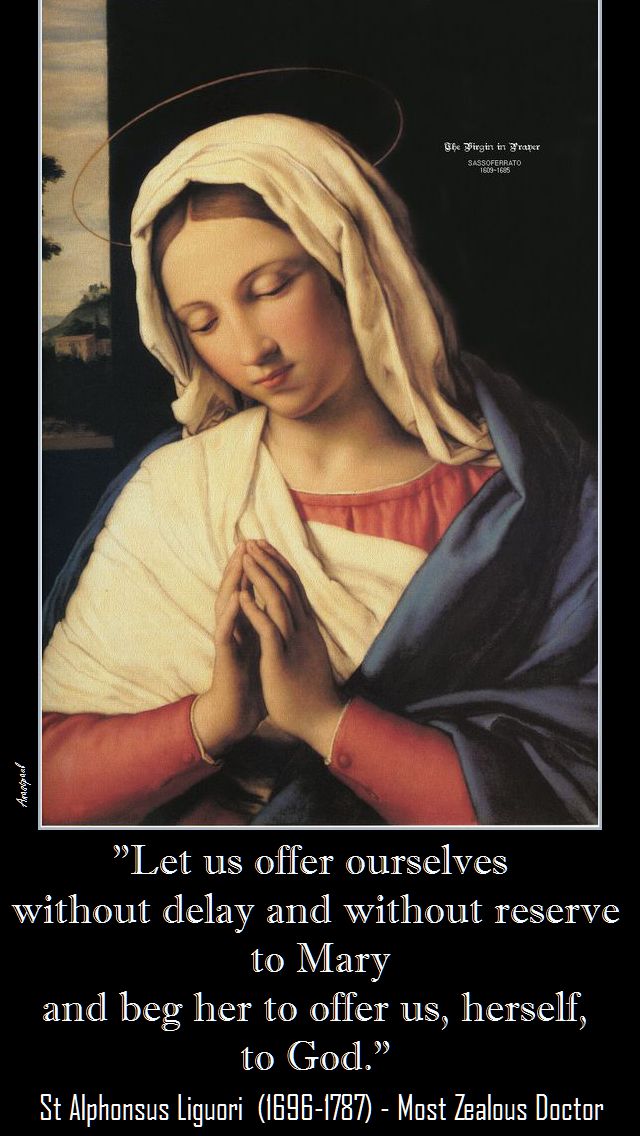
“Let us offer ourselves without delay
and without reserve to Mary
and beg her to offer us, herself, to God.”

St Alphonsus Liguori  (1696-1787)
Doctor zelantissimus (Most Zealous Doctor)

let us offer ourselves-stalphonsus

Posted in CATHOLIC DEVOTIONS of the Month, MORNING Prayers, QUOTES of the SAINTS, The BLESSED VIRGIN MARY, The WORD

One Minute Reflection – 18 May

One Minute Reflection – 18 May

“You are the glory of Jerusalem!
You are the great pride of Israel!
You are the great boast of our nation!……Judith 15:9

JUDITH 15-9

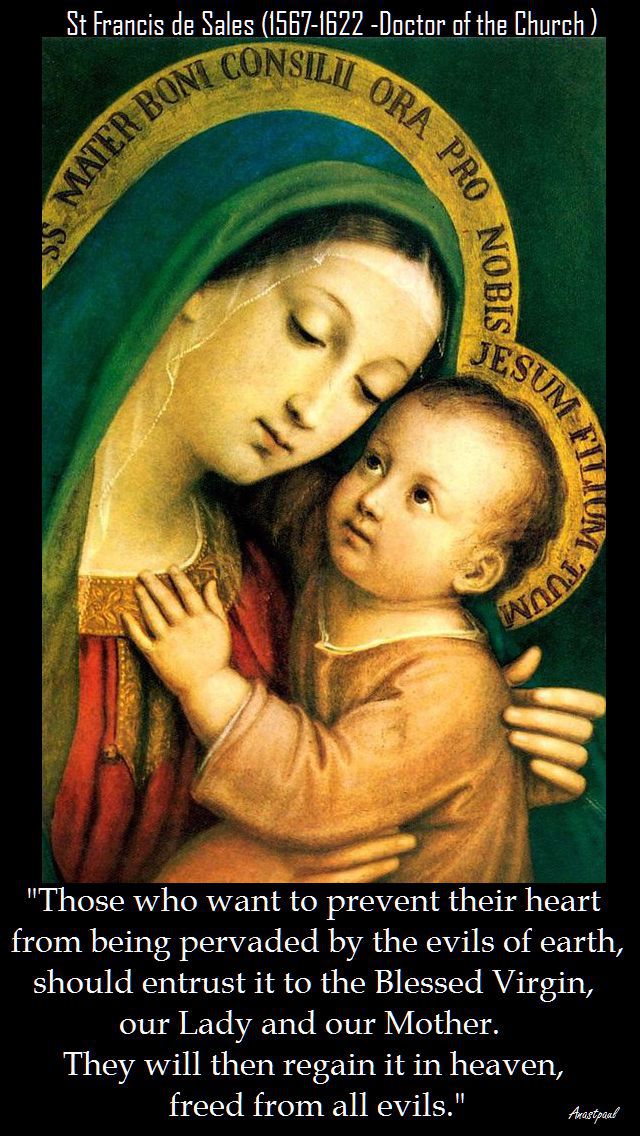
REFLECTION – “Those who want to prevent their heart from being pervaded by the evils of earth, should entrust it to the Blessed Virgin, our Lady and our Mother. They will then regain it in heaven, freed from all evils.”……………St Francis de Sales

those who want to prevent their heart-st francis de sales


PRAYER – Lord Jesus, move me to entrust my heart and my affections to Your Holy Mother. Grant that her prayers may keep me from all evil and firmly attached to You forever. Holy Mary, Holy Mother, pray for us, amen.

holy mary holy mother - pray for us

Posted in CATHOLIC DEVOTIONS of the Month, DOCTORS of the Church, FATHERS of the Church, MORNING Prayers, PRAYERS of the SAINTS, The BLESSED VIRGIN MARY

Our Morning Offering – 18 May

Our Morning Offering – 18 May

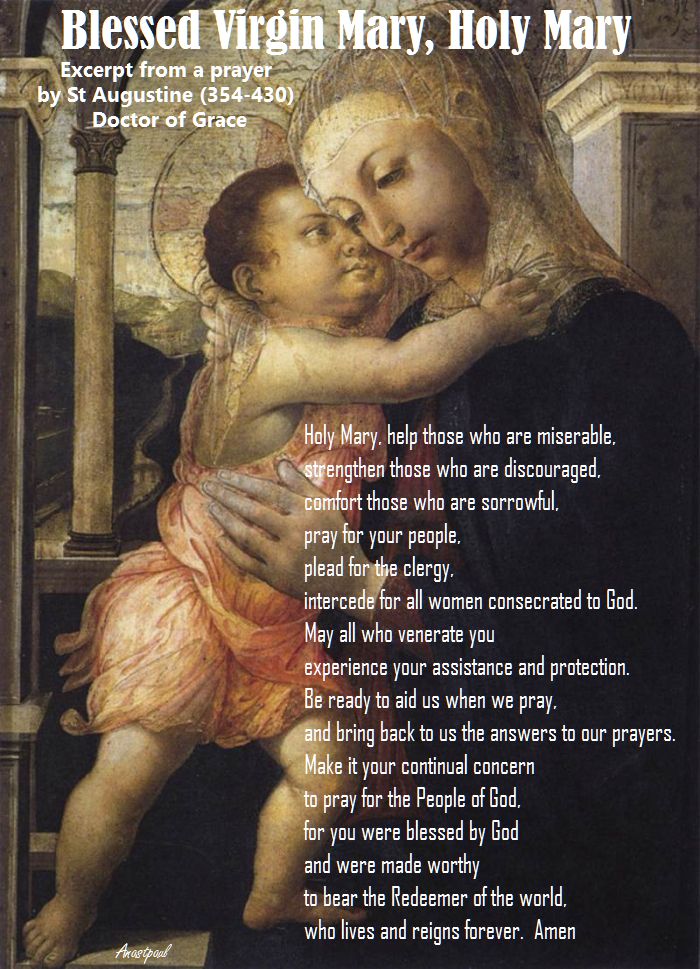
Blessed Virgin Mary, Holy Mary
Excerpt from a prayer by St Augustine (354-430)
Doctor gratiae (Doctor of Grace)

Holy Mary, help those who are miserable,
strengthen those who are discouraged,
comfort those who are sorrowful,
pray for your people,
plead for the clergy,
intercede for all women consecrated to God.
May all who venerate you
experience your assistance and protection.
Be ready to aid us when we pray,
and bring back to us the answers to our prayers.
Make it your continual concern
to pray for the People of God,
for you were blessed by God
and were made worthy
to bear the Redeemer of the world,
who lives and reigns forever.
Amen.

blessed virgin mary, holy mary - st augustine

Posted in SAINT of the DAY

Saint of the Day – 18 May – St Pope John I

Saint of the Day – 18 May – St Pope John I (c 470 – 526) He
was Pope from 13 August 523 to his death in 526.

He was a priest in Rome and was elected the 53rd pope in 523.   Italy’s ruler, Theodoric the Goth, was an Arian and for a while he let Catholics alone but in later life he became suspicious of everyone, imagining conspiracies and attempts to seize his throne.    He tried to involve Pope John in his political machinations.    John led a delegation to Constantinople to negotiate with Emperor Justin I;   he was the first pope to travel to Constantinople and while there crowned Justin.   The mission was successful but Theodoric thought John and Justin I had plotted against him.   While returning to Rome, John was kidnapped and imprisoned by Theodoric’s soldiers at Ravenna, where he died of neglect and ill treatment.    His body was transported to Rome and buried in the Basilica of St. Peter.   St Pope John I is depicted in art as looking through the bars of a prison or imprisoned with a deacon and a subdeacon.    He is venerated at Ravenna and in Tuscany.


Posted in SAINT of the DAY

Saints – 18 May

St Pope John I, (Optional Memorial)

Bl Burchard of Beinwil
St Dioscorus of Kynopolis
St Elgiva of Shaftesbury
St Eric of Sweden
St Felix of Cantalice
St Felix of Spoleto
St Feredarius of Iona
Bl Jan Oprzadek
St Merililaun
St Ortasio of Alexandria
St Potamon of Heraclea
St Serapione of Alexandria
Bl Stanislaw Kubski
St Venantius of Camerino
Bl William of Toulouse

Martyrs of Ancyra – 8 saints: Seven nuns martyred in the persecutions of Diocletian and the innkeeper who was executed for giving them a Christian burial: Alexandria, Claudia, Euphrasia, Julitta, Matrona, Phaina, Thecusa and Theodatus. c.304 in Ancyra, Galatia (in modern Turkey)

Posted in EUCHARISTIC Adoration, franciscan OFM, MORNING Prayers, SAINT of the DAY

Thought for the Day – 17 May

Thought for the Day – 17 May

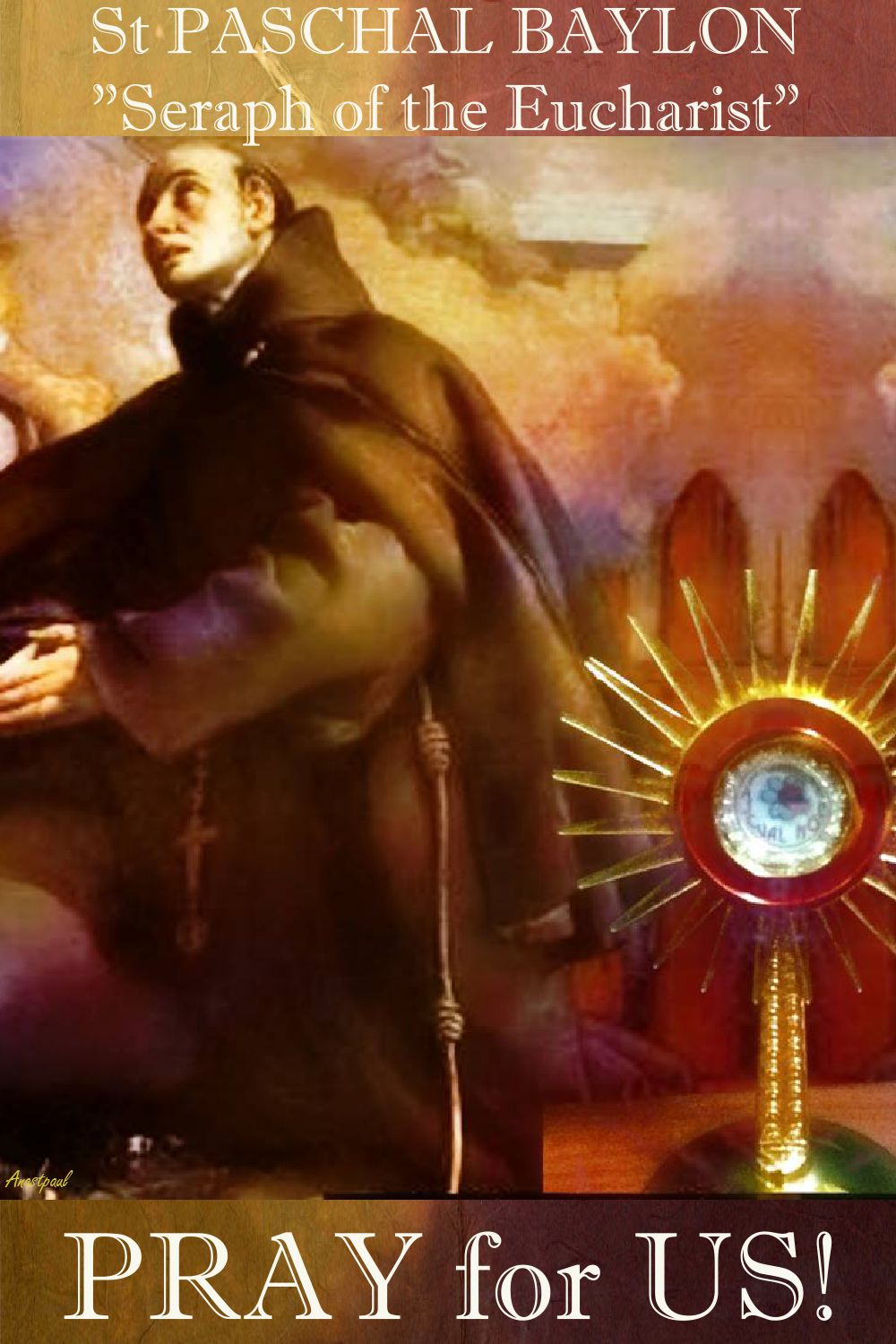
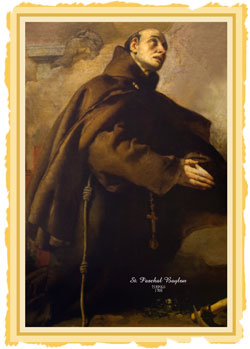
The life of St Paschal Baylon is one of simple adoration of the Lord.   He recognised the importance of spending time before Our Saviour, in contemplation of His passion, love, and sacrifice—in the earthly presence of God.   Through his devotion to the Blessed Sacrament, St Paschal was graced with wisdom beyond his education and obedience and charity beyond measure.   His life inspires us to greater communion with the Lord, leading us to His spiritual treasures. As prayer before the Blessed Sacrament occupied much of Saint Francis’ energy.   Most of his letters were to promote devotion to the Eucharist. St Paschal shared this concern.   An hour in prayer before our Lord in the Eucharist could teach all of us a great deal!   Many holy and busy Catholics today, across the world, find that their lives in every respect, are enriched by these minutes regularly spent in prayer and meditation.

st paschal baylon pray for us.jpg 2

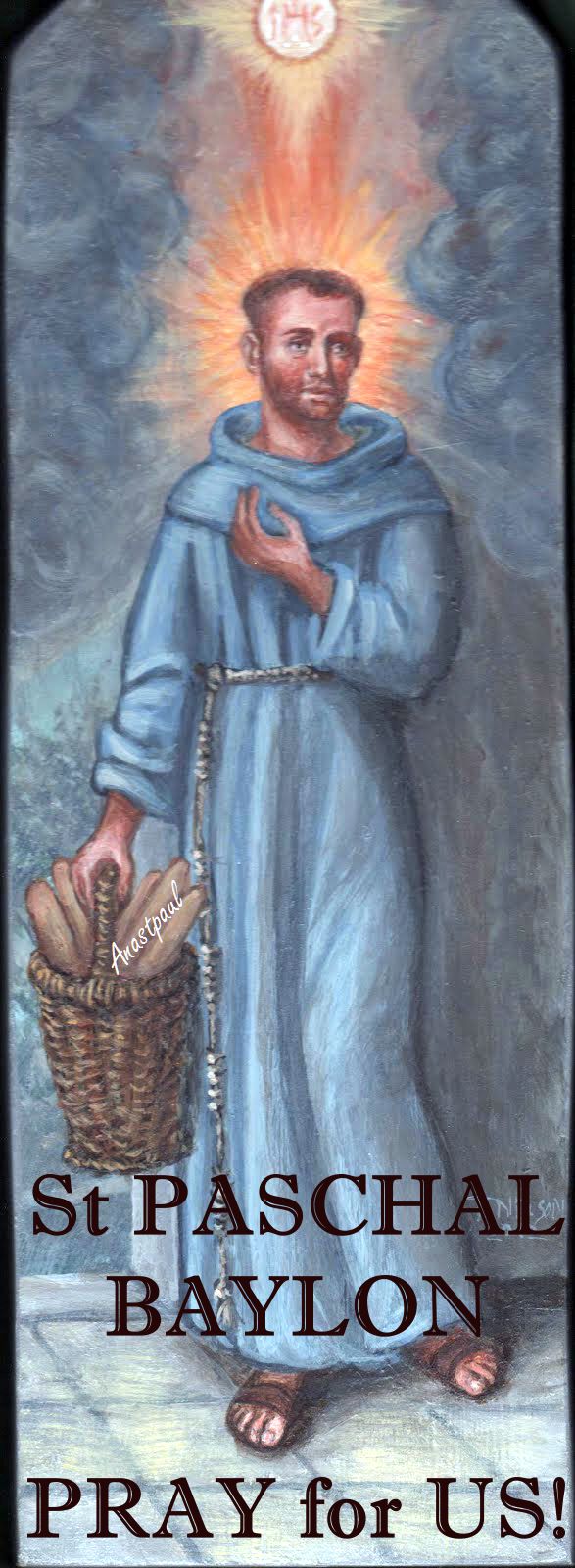
O God, You filled St. Paschal with a wondrous love for the sacred mysteries of Your Body and Blood.   May we draw from this Divine Banquet the same spiritual riches he received.   St Paschal Baylon Pray for us amen!

st paschal baylon pray for us

Posted in EUCHARISTIC Adoration, franciscan OFM, MORNING Prayers, QUOTES of the SAINTS, SAINT of the DAY

Quote of the Day – 17 May

Quote of the Day – 17 May

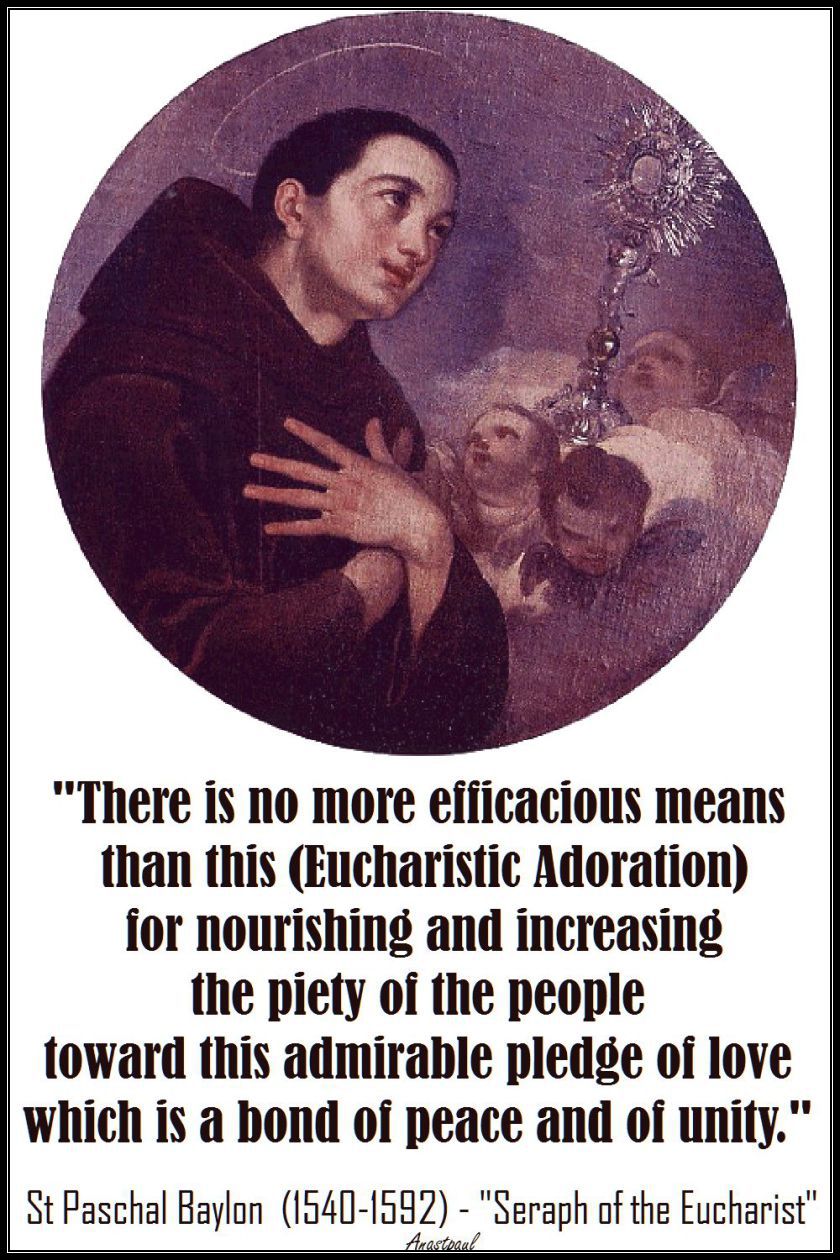
“There is no more efficacious means than this (Eucharistic Adoration)
for nourishing and increasing the piety of the people
toward this admirable pledge of love
which is a bond of peace and of unity.”

St Paschal Baylon

there-is-no-more-efficacious-means-st-baylon.17 may 2017

Posted in EUCHARISTIC Adoration, franciscan OFM, MORNING Prayers, QUOTES of the SAINTS, SAINT of the DAY, The WORD

One Minute Reflection – 17 May

One Minute Reflection – 17 May

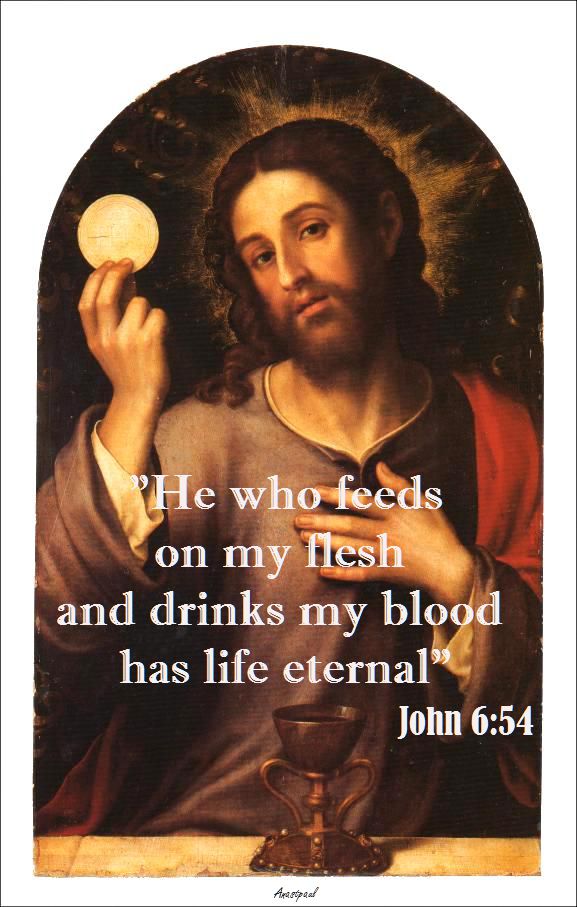
“He who feeds on my flesh and drinks my blood has life eternal”……………….John 6:54

JOHN 6-54

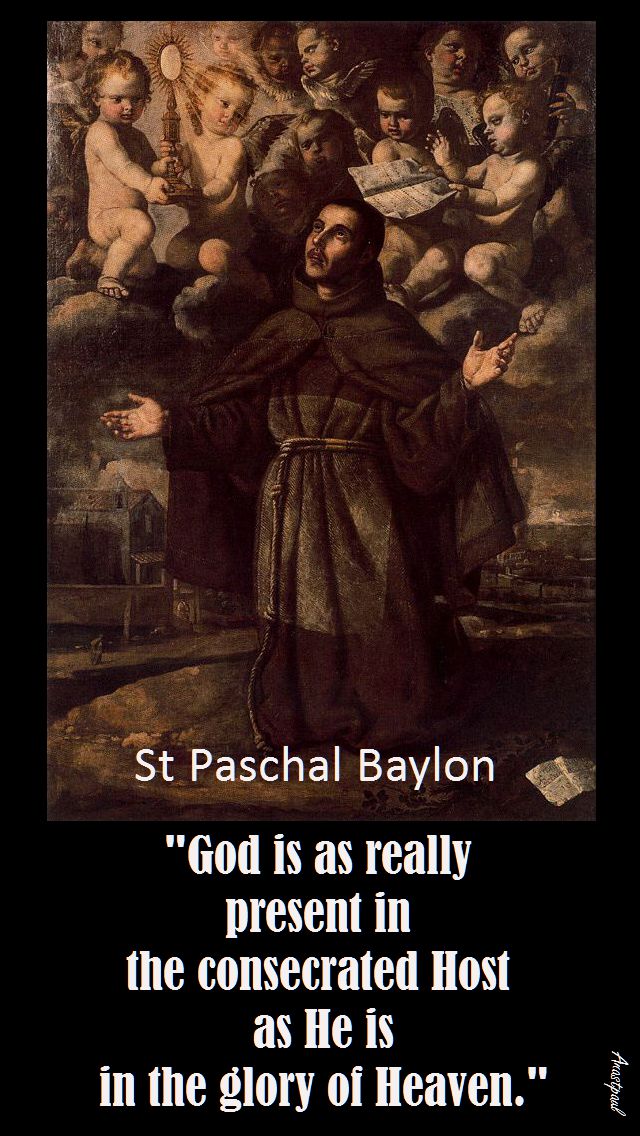
REFLECTION – “God is as really present in the consecrated Host as He is in the glory of Heaven”…..St Paschal Baylon

GOD IS REALLY PRESENT-ST PASCHAL BAYLON

PRAYER – Lord Jesus Christ, never let me abstain from receiving You in Holy Communion and let me always find the time to visit You in the Tabernacle. Lord teach enlighten my mind with a fuller love and understanding of Your Eucharistic Heart. St Paschal Baylon, Seraph of the Eucharist, pray for us all! Amen

2

Posted in CATHOLIC DEVOTIONS of the Month, franciscan OFM, MORNING Prayers, PRAYERS of the SAINTS, SAINT of the DAY, The BLESSED VIRGIN MARY

Our Morning Offerings – 17 May

Our Morning Offerings – 17 May

MARY, LET ME LOVE YOUR JESUS

By St ILDEPHONSUS OF SPAIN – 677

Virgin Mary, hear my prayer:
through the Holy Spirit
you became the Mother of Jesus;
from the Holy Spirit may I too have Jesus.
Through the Holy Spirit your flesh conceived Jesus;
through the same Spirit may my soul receive Jesus.
Through the Holy Spirit you were able to know Jesus,
to possess Jesus,
and to bring Him into the world.
Through the Holy Spirit may I too come to know your Jesus.
Imbued with the Spirit,
Mary, you could say:
“I am the handmaid of the Lord,
be it done unto me according to your word”;
in the Holy Spirit,
lowly as I am,
let me proclaim the great truths about Jesus.
In the Spirit you now adore Jesus as Lord
and look on Him as Son;
in the same spirit,
Mary, let me love your Jesus. Amen

MARY LET ME LOVE YOUR JESUS - ST ILDEPHONSUS

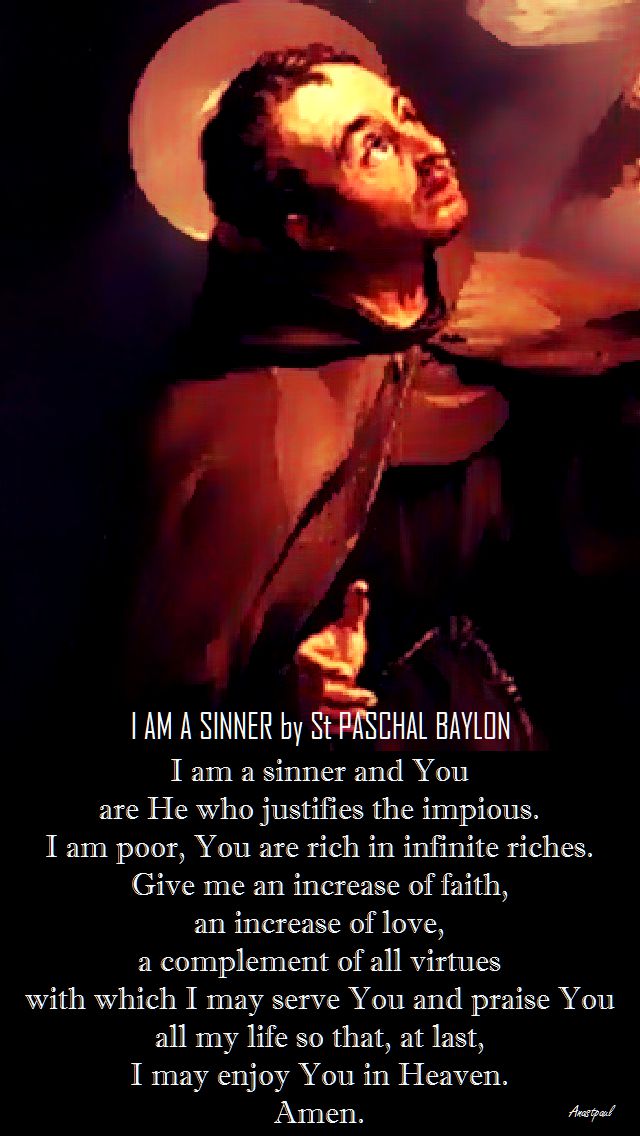
I AM A SINNER by ST PASCHAL BAYLON (Memorial today 17 May)

I am a sinner and You
are He who justifies the impious.
I am poor, you are rich in infinite riches.
Give me an increase of faith,
an increase of love,
a complement of all virtues
with which I may serve You and praise You
all my life so that, at last,
I may enjoy You in Heaven.
Amen.

i am a sinner by st paschal baylon

Posted in EUCHARISTIC Adoration, franciscan OFM, PRAYERS of the SAINTS, QUOTES of the SAINTS, SAINT of the DAY

Saint of the Day – 17 May – St Paschal Baylon OFM (1540-1592) “Servant of the Eucharist”

Saint of the Day – 17 May – St Paschal Baylon (1540 (feast of Pentecost) at Torre Hermosa, Aragon, (modern Spain) – 15 May 1592 (feast of Pentecost) at Villa Reale, Spain of natural causes) Franciscan lay brother, Mystic, Contemplate, known as the “Seraph of the Eucharist,” “Saint of the Blessed Sacrament,“Servant of the Eucharist.”     Patron of  cooks, shepherds, Eucharistic congresses and organisations (proclaimed by Pope Leo XIII on 28 November 1897), Diocese of Segorbe-Castellón de la Plana, Spain, Obado, Bulacan, Philippines.  Attributes – The Eucharist, Monstrance, Franciscan habit.

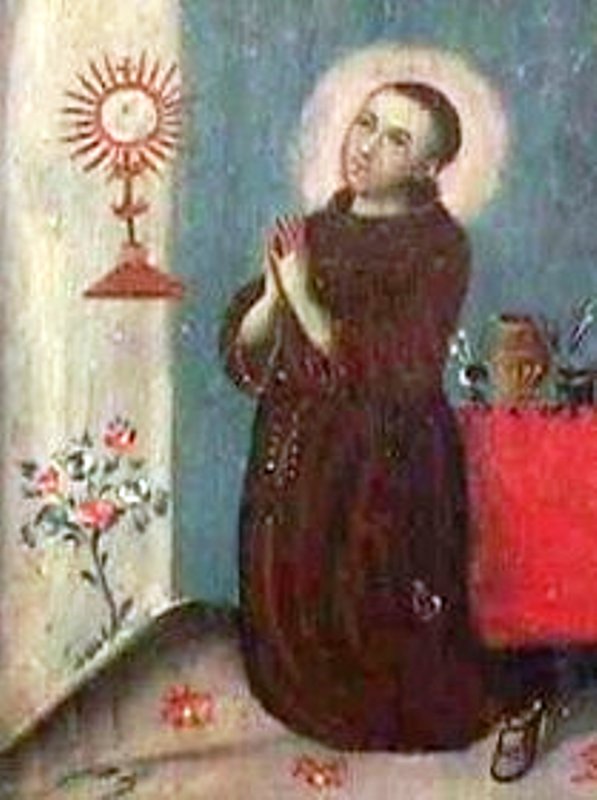
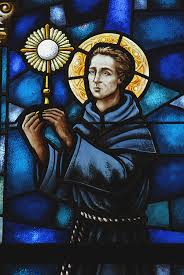
Today, 17 May marks the Feast Day of Saint Paschal Baylon, mystic, known for his profound devotion to the Blessed Sacrament. While Saint Paschal never became a priest, he is the saint most often thought of in relation to the Holy Eucharist and Pope Leo XIII declared him the patron saint of Eucharistic congresses and associations. He wrote, “There is no more efficacious means than this for nourishing and increasing the piety of the people toward this admirable pledge of love, which is a bond of peace and of unity.”  Among all those most devoted to the Eucharist, Paschal Baylon seemed to the Pope to be the greatest.”

st paschal baylon.jpg 2

As a youth, Paschal Baylon tended his family’s sheep. He taught himself to read so that he could pray the Little Office of the Blessed Virgin, the popular prayer book of his day. Paschal disciplined himself to endure the harshness and loneliness of a shepherd’s work. And when his sheep trod on others’ vines, he scrupulously paid for the damage out of his own meager resources.

At twenty-one, St Paschal joined the reformed Franciscans of St. Peter of Alcántara at Loreto.    As a lay brother, Paschal for many years served as porter and guestmaster with patience and good humor.    John Ximenes, his biographer, reports that he was a model friar, always the first at prayer and never once behaving badly in a relationship. “In no single case,” said Ximenes, “do I remember to have noted even the least fault in him, though I lived with him in several of our houses and was his companion on two long journeys.”

Like other saintly doorkeepers Brother André and Solanus Casey, Paschal gained a reputation for miracles.

For example, Martin Crespo once told how the saint freed him from his determination to take vengeance on his father’s murderers:

“One Good Friday there was a lifelike representation of the descent from the cross.    Along with everyone else in town, I followed the crucifix borne in triumph through the streets.    In a last ditch effort to get me to repent, my friends boxed me in and forced me to endure the preacher’s address.   He concluded his eloquent speech in a pathetic peroration, urging me to forgiveness in memory of our Saviour’s passion.   His fine discourse left me unmoved and cold.

“Quit tormenting me,” I exclaimed angrily. “It’s no use. I will not forgive them.”   Brother Paschal, whom I had not noticed before, stepped forward.   He took me by the arm and drew me aside. “My son,” he said, “have you not just now seen a representation of our Lord’s passion?” Then with a glance that penetrated my soul he said: “For the love of Jesus Crucified, my son, forgive them.

“Yes, Father,” I replied, hanging my head and weeping.   “For the love of God I forgive them with all my heart.”   I no longer felt the same person. The crowd anxiously awaited the outcome of our mysterious conference.   When Paschal announced that I had forgiven my enemies, they burst into applause.”

We remember Paschal Baylon most as the “Saint of the Blessed Sacrament.”   Typically he spent as many hours a day as he could worshiping before the Tabernacle.   Because of his faithful devotion, the Church has named him Patron of Eucharistic Congresses and conferences.   He died in 1592 at the age of fifty-two.

Saint Paschal exhibited an ardent love for Christ and was especially devoted to the Eucharistic Mystery.   He traveled from church to church, always on foot, visiting and praying before the Blessed Sacrament, referring to his encounters with “the real presence of Jesus” in these moments.   During his prayers, he would often levitate above the floor, so much was his love and zeal for Christ.

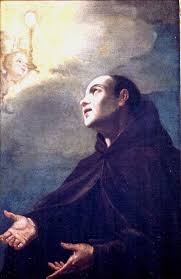
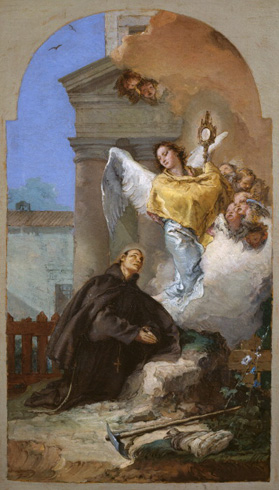
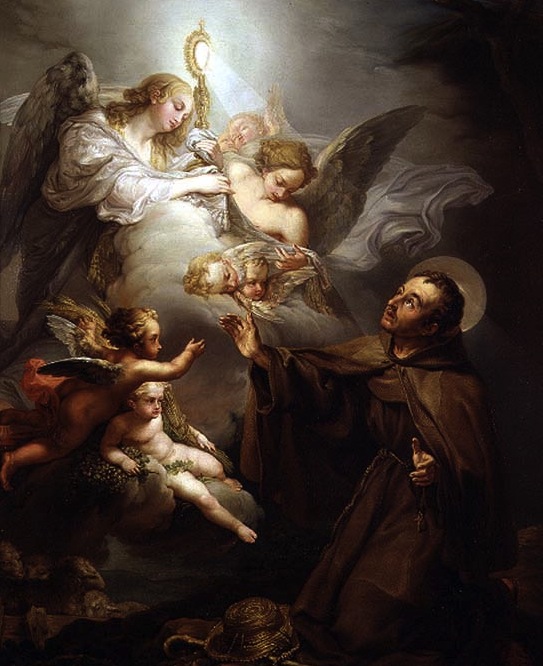
Many miracles are attributed to Saint Paschal, including creating fresh-flowing streams by striking the ground, healing, and miraculous charity.   Saint Paschal also experienced mystical visions.   On one such occasion, while he was out in the fields with his sheep and unable to go to Mass at the nearby monastery, Paschal was waiting for the sound of the Consecration Bell which he always observed in prayer.   In his longing to be present at the Holy sacrifice of the Mass, he cried out,My Master, My adorable Master, Oh that I might see Thee!”   Suddenly before him he saw Angels bowed down before a Chalice, with the Blessed Sacrament floating above it. In the Divine Presence of Our Lord, Paschal fell flat on his face and adored God. Then taking courage he gazed upon the beautiful vision.

The “Servant of the Eucharist,” as he was commonly called, died on 17 May Pentecost Sunday, in 1592.   His tomb at the Royal Chapel in Villareal, Valencia, Spain immediately became the object of innumerable pilgrimages, even by the king and the nobles of Spain. At his funeral Mass, Saint Paschal’s eyes miraculously opened during the Consecration, adoring the Blessed Sacrament even in death.   Since his death, strange occurrences have continued to be reported, known as the “Knocks of St. Paschal.”   At first, the knocks came from Paschal’s tomb.   Later they came from relics and pictures of the saint.   The knocking sound is believed to come as a kind of warning, to let people know that a terrible event was about to take place.   It is also said that in Spain and Italy, those who are devoted to Saint Paschal, are warned about their death, days before, so that they may have a chance to receive the Last Sacraments.    Beatified by Pope Paul V in 1618, he was Canonised by Pope Alexander VIII on 16 October 1690.

Posted in SAINT of the DAY

Saints – 17 May

St Adrione of Alexandria
Bl Antonia Messina
Bl Bernard of Verdun
St Cathan of Bute
St Fionnchan of Druim-Eanaigh
St Giulia Salzano
St Heraclius of Noviodunum
Bl Ivan Ziatyk
St Madron of Cornwall
St Maildulf of Malmesbury
St Maw
St Paschal Baylon
St Paul of Noviodunum
St Peter Lieou
St Rasso of Grafrath
St Restituta of Carthage
St Silaus of Lucca
St Solochanus of Chalcedon
St Thethmar
St Victor Roma

Martyrs of Alexandria – 3 saints: Three Christians martyred together; no details about them have survived except their names: Adrio, Basilla and Victor.
4th century Alexandria, Egypt

Martyrs of Nyon: A group of Christians martyred together in the persecutions of Diocletian. We know little more than three of their names: Aquilinus, Heradius and Paul. 303 at Noyon, Switzerland