Quote/s of the Day – 3 March – Tuesday in the Second Week of Lent – Feruial Day – 3 Kings 17:8-16; Matthew 23:1-12 – Scripture search here: https://www.drbo.org/
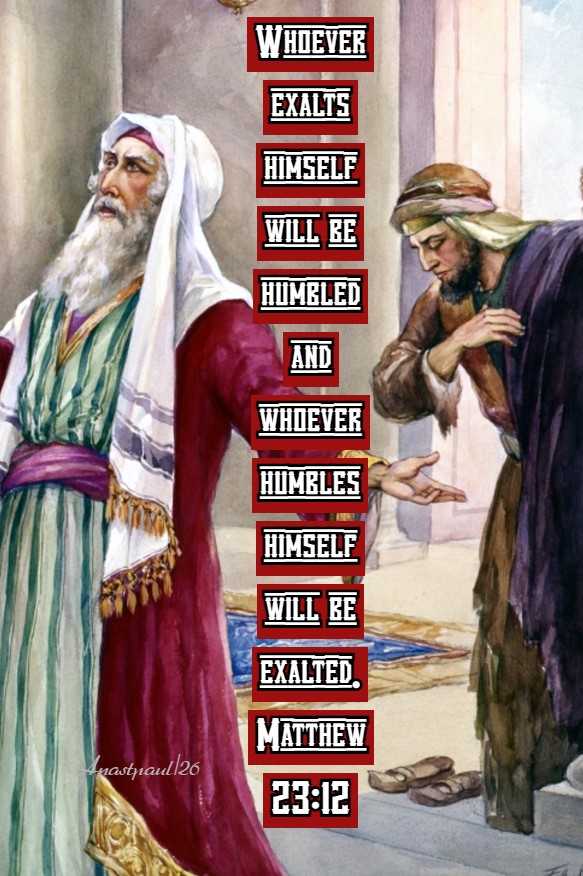
“Whoever exalts himself will be humbled and whoever humbles himself will be exalted.”
Matthew 23:12
“The one sole thing, in myself, in which I glory, is that I see in myself, nothing, in which I can glory.”
St Catherine of Genoa (1447-1510)
“Humility is not just about self-mistrust but about the entrusting of ourselves to God. Distrusting ourselves and our own strength produces trust in God and from that trust, generosity of soul is born.”
St Francis de Sales (1567-1622) Doctor of Charity
“Keep your heart in peace and let nothing trouble you, not even your faults. You must humble yourself and amend them peacefully, without being discouraged or cast down, for God’s dwelling, is in peace.”
St Margaret Mary Alacoque (1647-1690) “Visionary and Apostle of the Sacred Heart“
Our Morning Offering – 3 March – Tuesday of the Second Week of Lent –
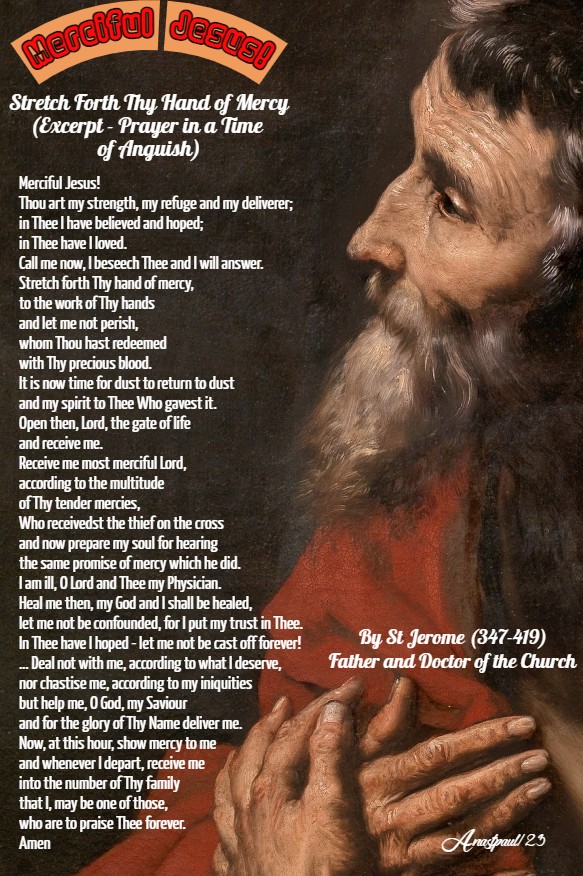
Merciful Jesus! Stretch Forth Thy Hand of Mercy (Excerpt – Prayer in a Time of Anguish) By St Jerome (347-419) Father and Doctor of the Church
Merciful Jesus! Thou art my strength, my refuge and my deliverer; in Thee I have believed and hoped; in Thee have I loved. Call me now, I beseech Thee and I will answer. Stretch forth Thy Hand of mercy, to the work of Thy Hands and let me not perish, whom Thou hast redeemed with Thy Precious Blood. It is now time for dust to return to dust and my spirit to Thee Who gavest it. Open then, Lord, the Gate of Life and receive me. Receive me most merciful Lord, according to the multitude of Thy tender mercies, Who receivedst the thief on the cross and now prepare my soul for hearing the same promise of mercy which he did. I am ill, O Lord and Thee my Physician. Heal me then, my God and I shall be healed, let me not be confounded, for I put my trust in Thee. In Thee have I hoped – let me not be cast off forever! … Deal not with me, according to what I deserve, nor chastise me, according to my iniquities but help me, O God, my Saviour and for the glory of Thy Name deliver me. Now, at this hour, show mercy to me and whenever I depart, receive me into the number of Thy family that I, may be one of those, who are to praise Thee forever. Amen
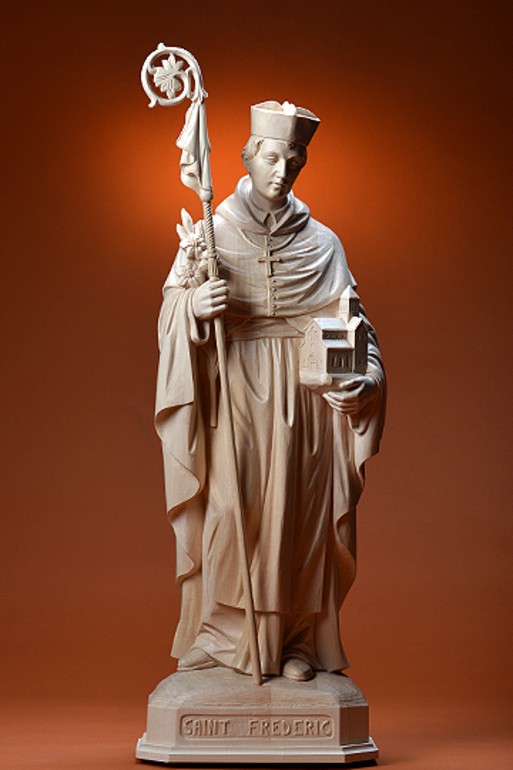
Saint of the Day – 3 March – St Frederick (c1121-1175) O.Praem of Hallum Priest and Regular Canon, the Founder and 1st Abbot of Mariengaarde Abbey in Friesland in the Netherlands. Born in Münster, Germany in 1121 and died in Hallum in Holland in 1175, Patronages – against Rheumatism and Paralysis. Also known as – Frederick Feikone, Frederick of Mariengaarde, Friederich, Federico.
Frederick was a Premonstratensian Priest and Abbot who, thanks to his piety, charity and attention to the poor and sick, was prominent as an example of Christian virtue.
He was the son of a nobleman and received a religious education and was Ordained a Priest. After serving for several years as Parish Priest in the Town of Hallum, he was elected as the Abbot of the Premonstratensian Monastery of Mariengaarde, where he fervently devoted himself to the spiritual care of the Monks and the evangelisation of the Faith.
His charity was boundless and he did his utmost to help the poor and needy, donating money and his time to alleviate their suffering. He was also a man of great piety and spent long hours in prayer and meditation.
In 1175, Frederick visited the Monastery of Bethlehem, where he was struck by a serious illness. He returned to Hallum, where he died on 3 March of the same year. He was buried in a Chapel he had built himself. So many miracles were reported at his Tomb that it became a site of pilgrimage and he was soon venerated as a Saint. In 1938 his Relics were transferred to Leffe, Dinant, Belgium.
He was Canonised on 8 March 1728 by Pope Benedict XIII. and St Frederick is invoked against rheumatics and paralytics.
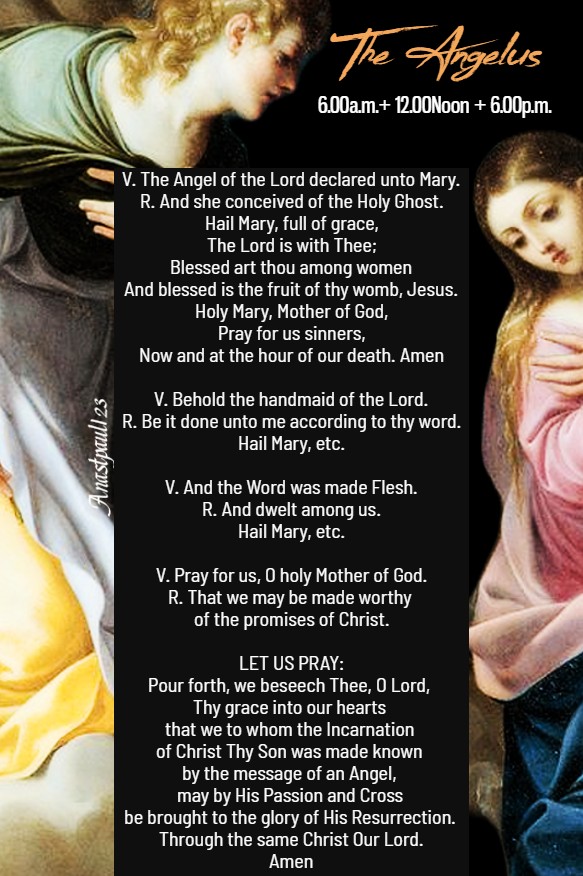
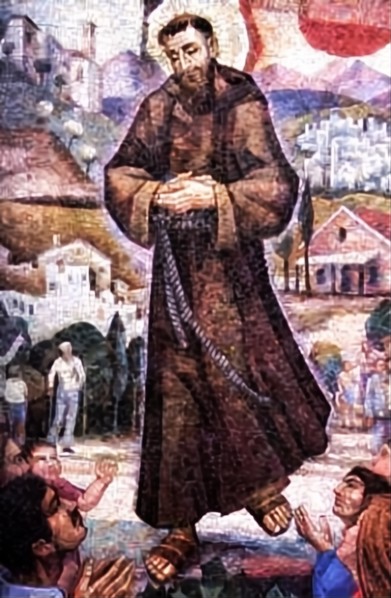
Blessed Benedetto Sinigardi da Arezzo OFM (1190-1282) Friar of the Order of Friars Minor, who received the Habit directly from St Francis of Assisi. Although rarely mentioned, Blessed Benedetto is the Author of the Angelus! Furthermore, the beautiful custom of reciting the Marian Antiphon “The Angelus Domini” is attributed to Blessed Benedetto, meditating on the saving Mystery of the Incarnation of the Son of God in Mary’s virginal womb. The Angelus Domini became a pious practice firstly to the entire Franciscan Order, then to the whole Church, as it still is today. Lovely Fr Benedetto!: https://anastpaul.com/2023/03/03/saint-of-the-day-3-march-blessed-benedetto-sinigardi-da-arezzo-ofm-c1190-1282-the-author-of-the-angelus/
St Anselm of Nonantola St Arthelais of Benevento St Calupan St Camilla St Cele-Christ
St Cunegundes (c975-1040) Empress of the Holy Roman Empire, Nun, she took a vow of Virginity before her marriage, which, after a miracle was upheld by her husband, the King (also a Saint). Founder of Monasteries and Churches, Nun in one of her Convents, Apostle of Charity. Born in c 975 and died in 1040 of natural causes. Her Fervent Life: https://anastpaul.com/2022/03/03/saint-of-the-day-3-march-st-cunegundes-c-975-1040/
St Foila St Frederick (c1121-1175) O.Praemof Hallum Priest, Abbot St Gervinus
40 Martyrs in North Africa – A group of Christians Martyred together in North Africa, date unknown. No details have survived, but we know these names – Antonius, Artilaus, Asclipius, Astexius, Basil, Bosimus, Carissimus, Castus, Celedonius, Claudianus, Cyricus, Donata, Emeritus, Emeterius, Euticus, Felix, Fortunatus, Frunumius, Gajola, Georgius, Gorgonius, Hemeterus, Isicus, Janula, Julius, Luciola, Luciolus, Marcia, Marinus, Meterus, Nicephorus, Papias, Photius, Risinnius, Sabianus, Savinianus and Solus
Martyrs of Pontus – 3+ Saints – A large group of Christians Martyred together in the persecutions of Emperor Maximian Galerius and governor Ascleopiodato. We have some details on three of them – Basiliscus, Cleonicus and Eutropius. 308 in Pontus (in modern Turkey) Martyrs of Caesarea; Asterius Marinus
Martyrs of Calahorra: Cheledonius Emeterius
Martyrs of Gondar, Ethiopia: Bl Antonio Francesco Marzorati Bl Johannes Laurentius Weiss Bl Michele Pío Fasol
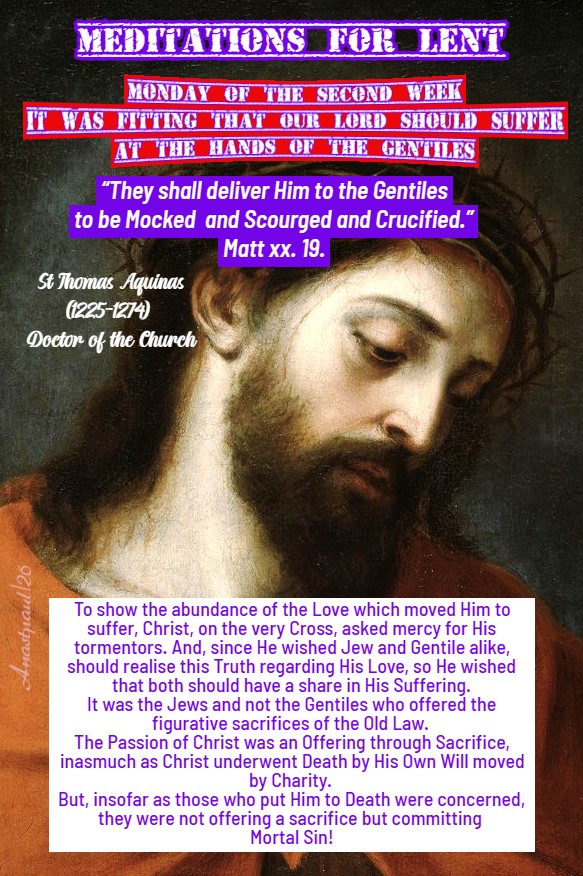
Monday of the Second Week of Lent – 2 March – Our Lenten Journey With St Thomas Aquinas (1225-1274) Doctor of the Church
Monday of the Second Week It was fitting that our Lord should Suffer at the hands of the Gentiles
“They shall deliver Him to the Gentiles to be Mocked and Scourged and Crucified.” Matt xx. 19
In the very manner of the Passion of Our Lord its effects are foreshadowed. In the first place, the Passion of Our Lord had, for its effect , the salvation of Jews, many of whom were baptised in His death.
Secondly, by the preaching of these Jews, the effects of the Passion passed to the Gentiles too. There was thus, a certain fitness in Our Lord’s Passion beginning with the Jews and then, the Jews handing Him on, that it should be completed at the hands of the Gentiles.
To show the abundance of the Love which moved Him to suffer, Christ, on the very Cross, asked mercy for His tormentors. And, since He wished Jew and Gentile alike, should realise this Truth regarding His Love, so He wished that both should have a share in His Suffering.
It was the Jews and not the Gentiles who offered the figurative sacrifices of the Old Law. The Passion of Christ was an Offering through Sacrifice, inasmuch as Christ underwent Death by His Own Will moved by Charity. But, insofar as those who put Him to Death were concerned, they were not offering a sacrifice but committing a Mortal Sin!
When the Jews declared, “It is not lawful for us to put any man to death” (John xix. 31), they may have had many areas of concern in mind. It was not lawful for them to put anyone to death on account of the holiness of the Feast they had begun to keep. Perhaps they wished Christ to be killed not as a transgressor of their own law but as an enemy of the state, because He had made Himself a King, a charge concerning which they had no jurisdiction. Or again, they may have meant that they had no power to crucify which was what they longed for but only to stone, as they later stoned St Stephen. Or, the most likely thing of all, that their Roman Conquerors had taken away their power of life and death!
ST THOMAS AQUINAS (1225-1274) Priest, Theologian, Dominican Doctor Angelicus (Angelic Doctor) Doctor Communis (Common Doctor) Added by Pope Saint Pius V in 1568
Quote/s of the Day – 2 March – “The Month of St Joseph”
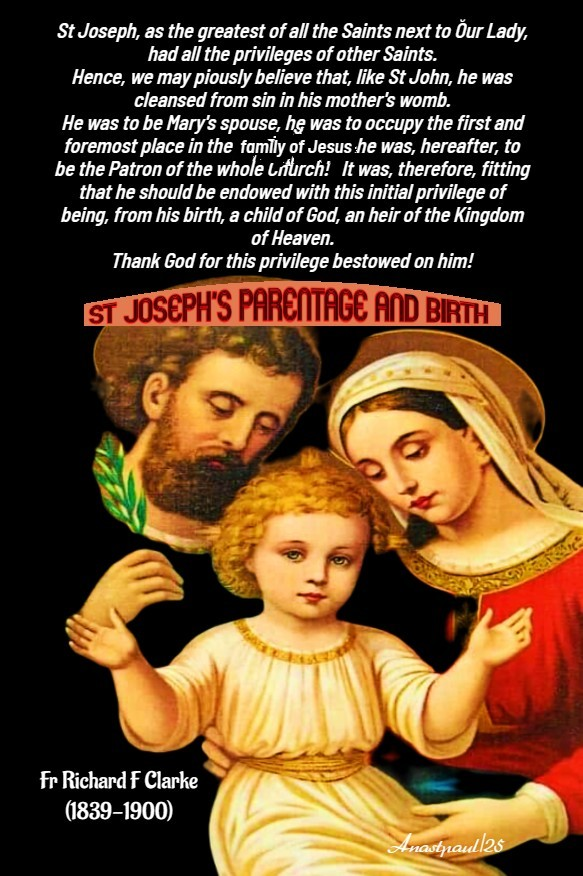
“St Joseph, as the greatest of all the Saints next to Our Lady, had all the privileges of other Saints. Hence, we may piously believe that, like St John, he was cleansed from sin in his mother’s womb. He was to be Mary’s spouse, he was to occupy the first and foremost place in the family of Jesus, he was, hereafter, to be the Patron of the whole Church! It was, therefore, fitting that he should be endowed with this initial privilege of being, from his birth, a child of God, an heir of the Kingdom of Heaven. Thank God for this privilege bestowed on him!”
Fr Richard Frederick Clarke SJ (1839-1900) From “The Devout Year”
Our Morning Offering – 2 March – Monday of the Second Week of Lent
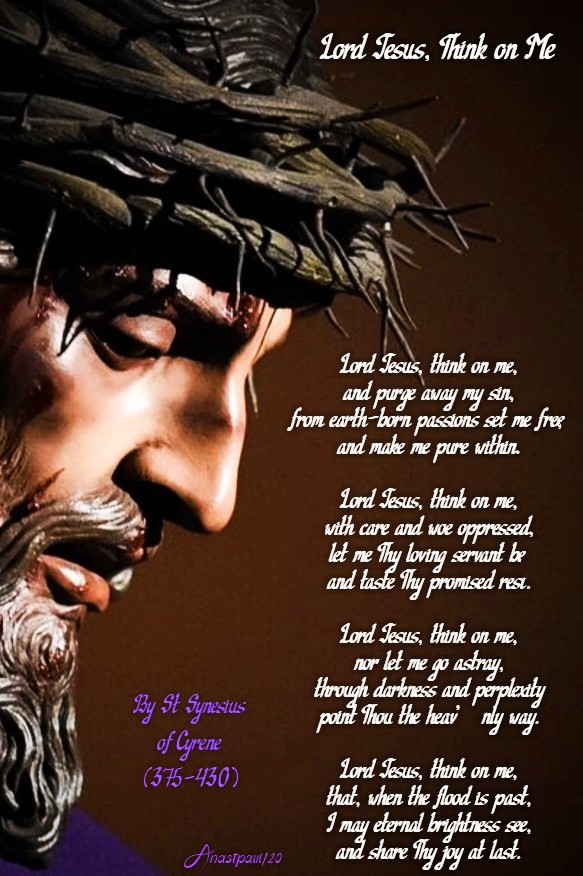
Lord Jesus, Think on Me By St Synesius of Cyrene (375-430) Bishop of Ptolemais, Father
Lord Jesus, think on me and purge away my sin, from earth-born passions set me free, and make me pure within. Lord Jesus, think on me, With care and woe oppressed, let me Thy loving servant be and taste Thy promised rest. Lord Jesus, think on me, nor let me go astray, through darkness and perplexity point Thou the heav’nly way. Lord Jesus, think on me, that, when the flood is past, I may eternal brightness see and share Thy joy at last. Amen
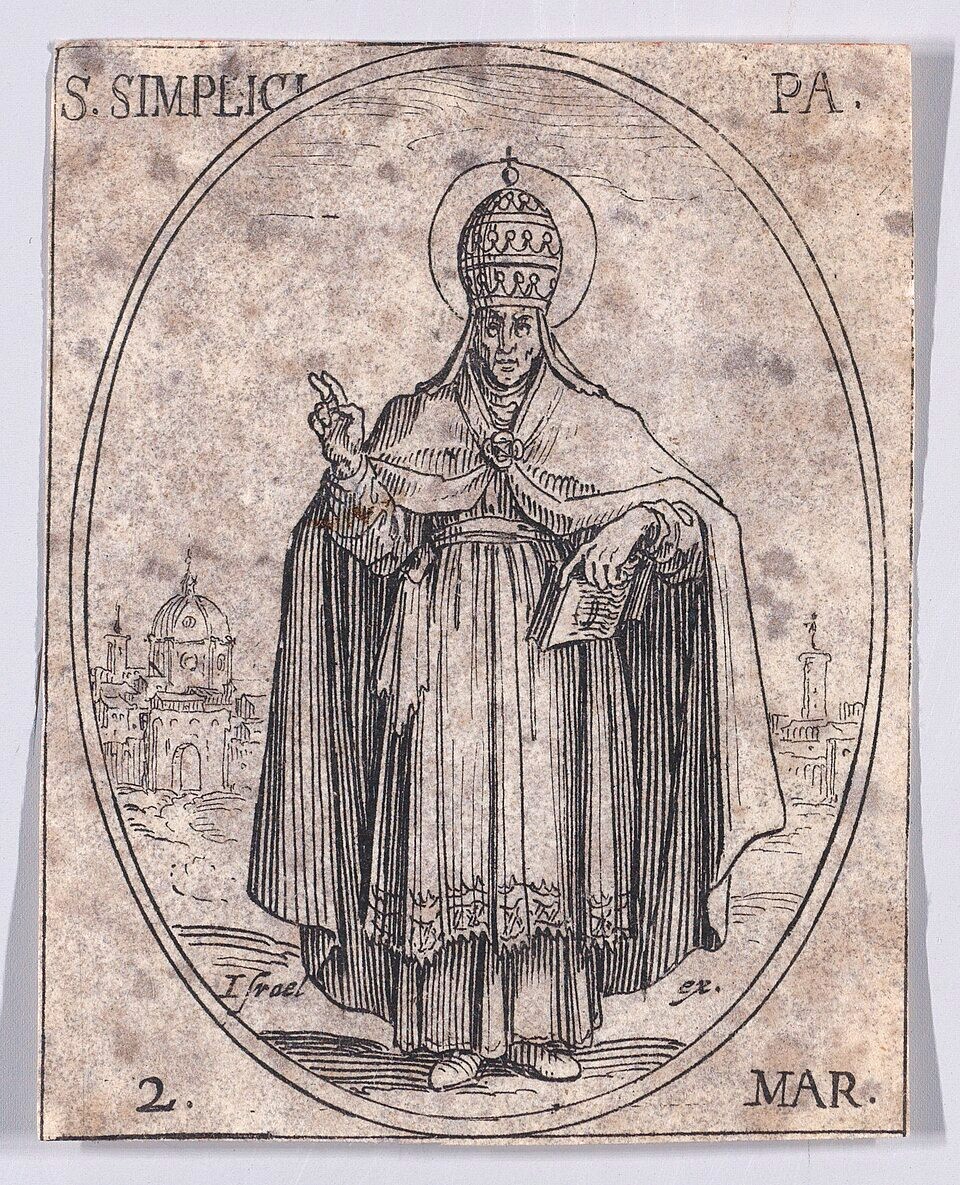
Saint of the Day – 2 March – St Simplicius (c395-483) Pope and Confessor. His Papacy began on 25 February 468 and ended on 2 or 10 March 483. He combated the Eutychian heresy, ended the practice of Consecrating bBshops only in December and sought to offset the effects of Germanic invasions and contain the rebellion of Eastern Prelates who sought private power.
The Roman Martyrology reads today: “At Rome, St Simplicius, Pope and Confessor.”
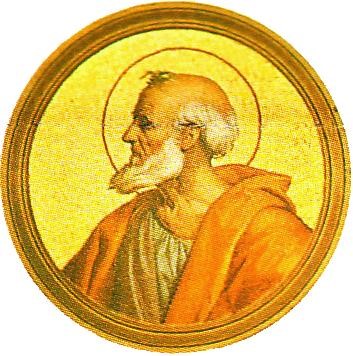
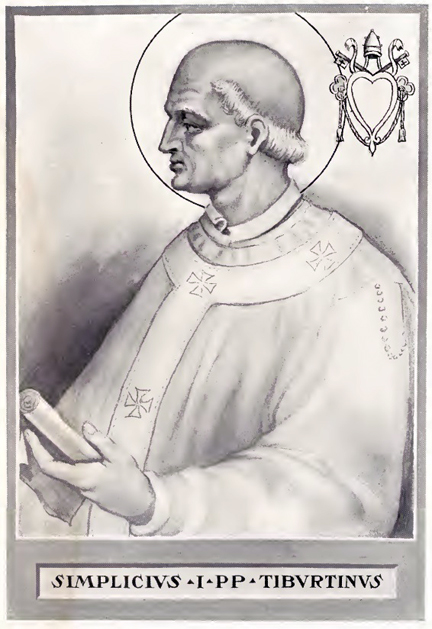
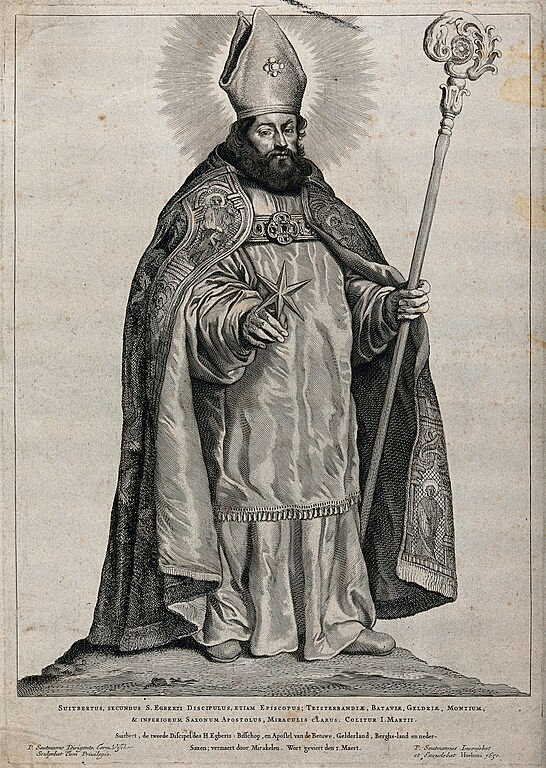
Etching of Pope Simplicius, 1636
SIMPLICIUS was the ornament of the Roman Clergy under Sts Leo the Great (400-461) and Hilarius (Died 468) and succeeded the latter as Pontiff in 468.
He was raised by God to comfort and support His Church amidst the greatest storms. All the Provinces of the Western Empire, had fallen into the hands of barbarians. The Emperors for many years, were rather shadows of power than sovereigns and, in the 8h year of the Pontificate of Simplicius, Rome itself fell a prey to foreigners. Italy, by oppressions and the ravages of barbarians, was left almost a desert without inhabitants and the Imperial armies consisted chiefly of barbarians, hired under the name of auxiliaries. These soon saw that their masters were in their power.
The Heruli demanded one third of the Italian lands and upon refusal chose for their leader Odoacer, one of the lowest extraction but a resolute and intrepid man, who was proclaimed King of Rome in 476. He put to death Orestes, who was Regent of the Empire for his son Augustulus, whom the Senate had advanced to the Imperial throne. Odoacer spared the life of Augustulus, appointed him a salary of six thousand pounds of gold and permitted him to live at full liberty near Naples.
Pope Simplicius was wholly taken up in comforting and relieving the afflicted and in sowing the seeds of the Catholic Faith among the barbarians. The East gave his zeal no less employment and concern. Peter Cnapheus, a violent Eutychian heretic, was made Patriarch of Antioch by the heretics and Peter Mengus, one of the most profligate men, Patriarch of Alexandria.
Acacius, the Patriarch of Constantinople, supported Mengus against Pope Simplicius and the Catholic Church. Pope Simplicius, at length discovered his artifices and redoubled his zeal to maintain the Holy Faith, which he saw betrayed on every side, whilst the patriarchal Sees of Alexandria and Antioch were occupied by furious wolves and there was not one Catholic King in the whole world.
St Simplicius, having reigned in faithful strife for 15 years, 11 months and 6 days, went to receive the reward of his labours in 483. He was buried in St Peter’s Basilica.
Blessed Charles the Good (c1083-1127) Martyr, Duke, Apostle, protector and defender of the poor, selling his and his kingdom’s riches to help those in need, wherever he could, a fair and just Ruler who made laws to accommodate the poor rather than the rich (the eventual cause of his Martyrdom), Knight who assisted in Secomd Crusade. Blessed Charles cultus was officially confirmed by his Beatification in 1883 by Pope Leo XIII. His Life and Death: https://anastpaul.com/2023/03/02/saint-of-the-day-2-march-blessed-charles-the-good-c1083-1127-martyr/
St Cynibild of Laestingaeu St Felix of Treves St Fergna the White
Martyrs of Campania – Approximately 400 northern Italian Christians Martyred for their faith by pagan Lombards. Their story was recorded by Pope Saint Gregory the Great, who reports that they people spent their final days supporting each other with prayer. c 579 in Camnpania, Italy.
Martyrs of Porto Romano – 4 Saints – Group of Christians Martyred in the persecution of Diocletian. The only other information that survives are the names of four of them – Heraclius, Januaria, Paul and Secondilla. c305 at Porto Romano at the mouth of the River Tiber, Rome.
DISCLAIMER: Please note: I cannot control the content of the Advertisements on this Site, or of pop-ups which may appear, The revenue from the Advertisements, however, does provide a little assistance in the support of the Site. I do apologise for any inappropriate content.
Quote of the Day – 1 March – The Second Sunday in Lent – Thessalonians 5:14-23, Matthew 17:1-9 – Scripture search here: https://www.drbo.org/
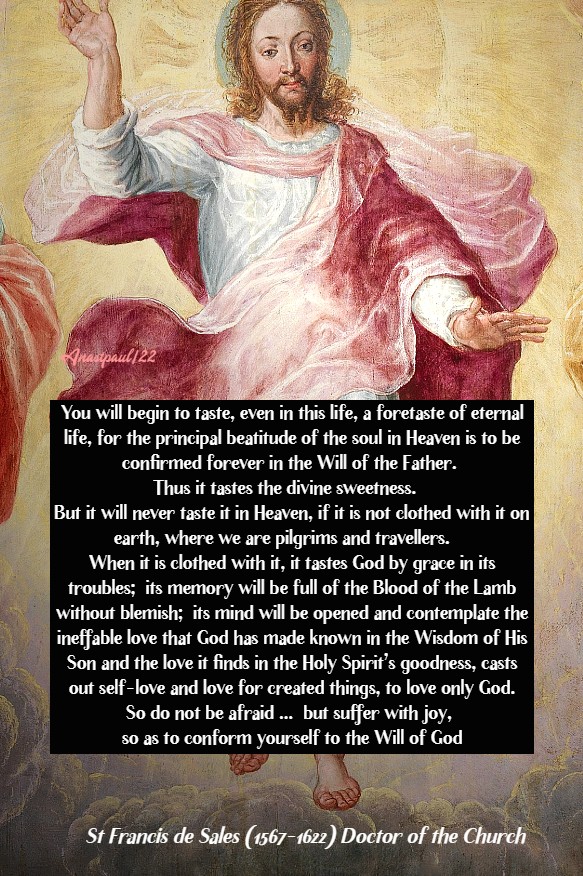
“You will begin to taste, even in this life, a foretaste of eternal life, for the principal beatitude of the soul in Heaven, is to be confirmed forever in the Will of the Father. Thus, it tastes the Divine sweetness. But it will never taste it in Heaven, if it is not clothed with it on earth, where we are pilgrims and travellers. When it is clothed with it, it tastes God by grace in its troubles; its memory will be full of the Blood of the Lamb without blemish; its mind will be opened and contemplate the ineffable Love that God has made known in the Wisdom of His Son and the love it finds, in the Holy Spirit’s goodness, casts out self-love and love for created things, to love only God. So do not be afraid … but suffer with joy, so as to conform yourself to the Will of God.””
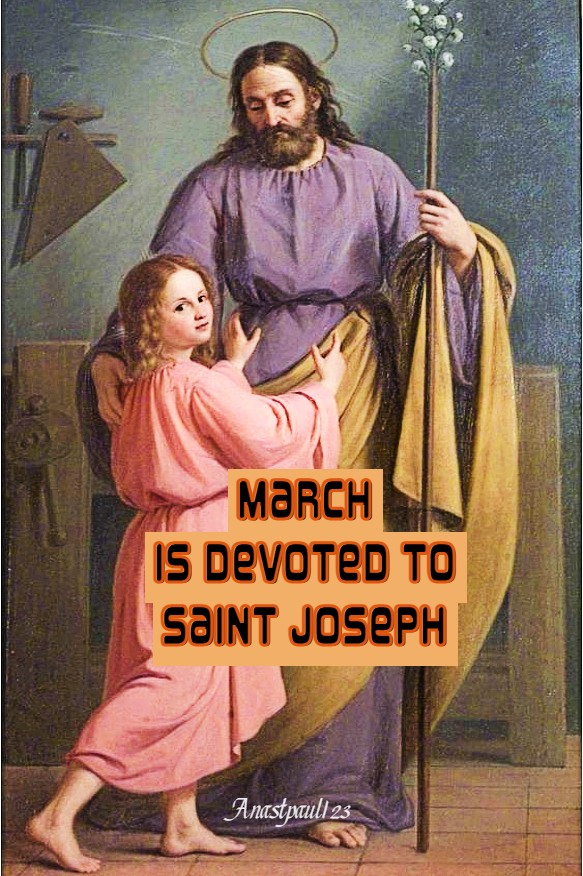
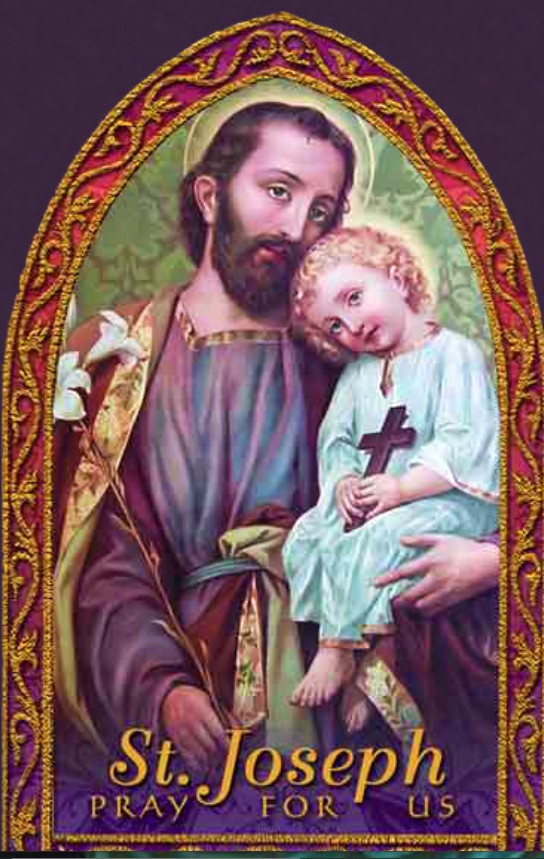
The beloved Foster-Father and Guardian of Jesus and Protector of the Holy Family, is celebrated for this whole month and his Feast Day falls on 19 March .
“Quamquam Pluries” On the Devotion to St Joseph Pope Leo XIII
“On 10 March, we begin the Novena to St Joseph, entrusting so many of our woes and cares to his holy and fatherly care and intercession. His Patronages are numerous, as we know, one of them will fit our needs perfectly and if not, then we should all ask him to intercede on our behalf for our families and for a Happy and Holy Death.”
Indulgenced Prayer to St Joseph O St Joseph! Pray for Us Daily O Joseph! virgin father of Jesus, pure Spouse of the Virgin Mother, pray for us daily to the Son of God, that, armed with the weapons of His grace, we may fight as we ought in life and be crowned by Him in death. Amen (Indulgence of 100 days, twice a day St Pius X 26 November 1906)
Patronages in Alphabetical Order:
of Accountants • Bursars • Cabinetmakers • Carpenters • Catholic Church • Cemetery Workers • Children • Civil Engineers • against Communism • Confectioners • Craftsmen • against Doubt and Hesitation • the Dying • Emigrants • Exiles • Expectant Mothers • Families • Fathers • Furniture Makers • Grave diggers • Happy Death • Holy Death • House Hunters • House Sellers • Immigrants • Joiners • Labourers • all the Legal Profession • Married Couples • Oblates of Saint Joseph • Orphans • Pioneers • Social Justice • Teachers • Travellers • the Unborn • Wheelwrights • Workers • Americas • Austria • Belgium • Bohemia • Canada • China • Croatian people • Korea • Mexico • New France • New World • Peru • Philippines • Vatican City • VietNam • Canadian Armed Forces • Papal States • 46 Diocese • 26 Cities,States and Regions.
The Second Sunday of Lent – 1 March – Our Lenten Journey With St Thomas Aquinas (1225-1274) Doctor of the Church
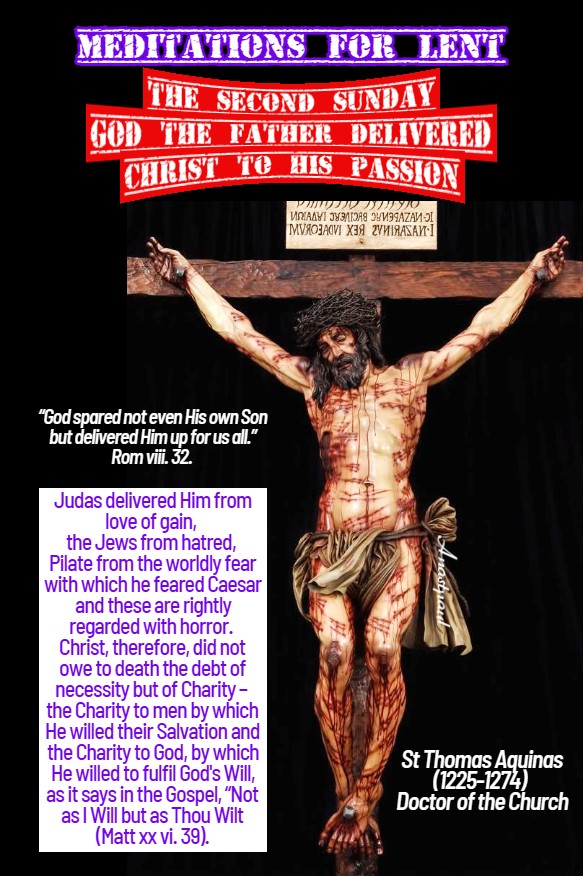
The Second Sunday God the Father Delivered Christ to His Passion
“God spared not even His own Son but delivered Him up for us all.” Rom viii. 32.
Christ suffered willingly, moved by obedience to His Father. Wherefore, God the Father delivered Christ to His Passion and this, in three ways:
Because the Father, of His Eternal Will, preordained the Passion of Christ as the means whereby to free the human race. So it is said in Isaias, “The Lord hath laid on Him the iniquity of us all” (Isa liii. 6) and again, “The Lord was pleased to bruise Him in infirmity” (ibid liii. 10).
Because He inspired Our Lord with the willingness to suffer for us, pouring into His Soul the Love which produced the will to suffer. Whence the Prophet goes on to say, “He was offered because it was His Own Will” (Isa liii. 7).
Because He did not protect Our Lord from the Passion but exposed Him to His persecutors. Whence we read in St Matthew’s Gospel: as He hung on the cross Christ said, “My God, My God, why hast thou forsaken Me” (Matt xxvii. 46). For God the Father, that is to say, had left Him at the mercy of His torturers.
To hand over an innocent man to suffering and to death, against his will, compelling him to die as it were, would indeed be cruel and wicked. But it was not in this way God the Father delivered Christ. He delivered Christ by inspiring Him with the Will to suffer for us. By so doing, the severity of God is made clear – no sin is forgiven without punishment! which St Paul again teaches when he says, God spared not His Own Son.
At the same time God’s kindness and goodness is exhibited in the fact that whereas man could not, no matter what his punishment, sufficiently make satisfaction, God has given man someone Who is able to make that satisfaction for him. Which is what St Paul means by, He delivered Him up for us all and again when he says, God hath proposed Christ to be an appeasement through faith in His Blood (Rom iii. 25). The same activity in a good man and in a bad man is differently judged, inasmuch as the root from which it proceeds is different. The Father, for example, delivered Christ and Christ delivered Himself and this from love and, therefore, They are praised.
Judas delivered Him from love of gain, the Jews from hatred, Pilate from the worldly fear with which he feared Caesar and these are rightly regarded with horror. Christ, therefore, did not owe to death the debt of necessity but of Charity – the Charity to men by which He willed their Salvation and the Charity to God, by which He willed to fulfil God’s Will, as it says in the Gospel, “Not as I Will but as Thou Wilt (Matt xx vi. 39).
ST THOMAS AQUINAS (1225-1274) Priest, Theologian, Dominican Doctor Angelicus (Angelic Doctor) Doctor Communis (Common Doctor) Added by Pope Saint Pius V in 1568
Our Morning Offering – 1 March– “The Month of the St Joseph” – The Second Sunday of Lent
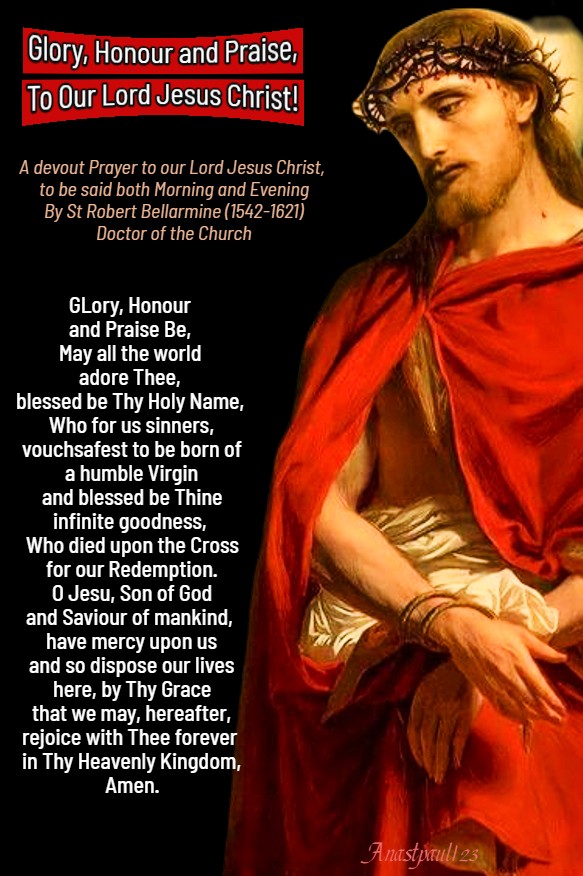
Glory, Honour and Praise, To Our Lord Jesus Christ! A devout Prayer to our Lord Jesus Christ, to be said both Morning and Evening By St Robert Bellarmine (1542-1621) Doctor of the Church (From His “A Brief Christian Doctrine”)
GLory, Honour and Praise Be, May all the world adore Thee, blessed be Thy Holy Name, Who for us sinners, vouchsafest to be born of a humble Virgin and blessed be Thine Infinite Goodness, Who died upon the Cross for our Redemption. O Jesu, Son of God and Saviour of mankind, have mercy upon us and so dispose our lives here, by Thy Grace that we may, hereafter, rejoice with Thee forever in Thy Heavenly Kingdom, Amen.
Saint of the Day – 1 March – St Siviard (Died 687) Priest and the 5th Abbot of the Moinastery of Saint-Calais in Maine, France, Author, a man of great humility and leadership skills. Also known as – Siard, Siviardus, Siviardo.
The Roman Martyrology reads today: “At Le Mans, St Siviard, Abbot.”
Siviard’s biographer, Jean-Barthélemy Hauréau, was one of his contemporaries, a 7th-century Monk.
According to the narrator, he had known the holy Abbot ,not only in the Monastery, where he had had him as his father but during his childhood and, therefore, in his native village.
Siviard’s father was Sigiram, a Frankish noble and his mother was Adda. Since Bertrand du Mans, the Bishop of Le Mans, had donated lands to his beloved nephew Sigiram in the Diablintic region. It is assumed that Sigiram was himself a Cleric and Abbot.
In Siviard’s life, he tells us only of his childhood passion for study, his vocation to religious life, where he wished to be buried among the most obscure Monks, the choice of his superiors who elevated him to the Priesthood, the virtues he practiced, worthy of all the praise that Scripture bestows on the holy ministers of the Lord and his eventual election to the Abbatial chair after his father’s death.
King Thierry III, who named Siviard, confirmed his possession of the Monastery’s property in 676. Siviard built the house of God magnificently, both in material structure and spiritual discipline. Siviard received the places of Villiers and Lantion from Bishop Aigilbert and built a villa and probably a small Monastery on the grounds of Saint-Georges-de-la-Coué.
St Siviard died without sadness, without regret, on the first day of March 687. One of the Monks was warned of this death, by a vision in which the Abbot was shown to him in celestial light accompanied by Saints Peter and Paul and recommended that he carry to his sister the Eulogies he had prepared.
A diploma of Charlemagne from 774 expressly states that Siviard’s body rests in the villa of Savonnières in Saint-Georges-db-la-Coué, the last foundation of the holy Abbot. It was here that his bones were removed and then transported to Sens during the Norman invasions. The Church of Laval has occupied a significant part of the site since 1883.
At the behest of several Bishops, Siviard wrote the life of Saint Calais, founder of the Abbey he had governed.
St David of Wales (c542-c601) Bishop, Prince, Monk, Confessor, Missionary, Founder of Monasteries. Uncle of King Arthur. David studied under Saint Paul Aurelian. Worked with Saint Columbanus, Saint Gildas the Wise and Saint Finnigan. He was officially Canonised in 1120 by Pope Callistus II. Beloved St David: https://anastpaul.com/2017/03/01/saint-of-the-day-1-march-st-david-of-wales/
St Abdalong of Marseilles St Adrian of Numidia St Agapios of Vatopedi St Agnes Cao Guiying
St Albinus of Vercelli St Amandus of Boixe St Antonina of Bithynia Bl Aurelia of Wirberg Bl Bonavita of Lugo St Bono of Cagliari Bl Christopher of Milan Bl Claudius Gabriel Faber St Domnina of Syria St Domnina of Syria St Donatus of Carthage St Eudocia of Heliopolis Bl George Biandrate Bl Giovanna Maria Bonomo Bl Gonzalo de Ubeda St Hermes of Numidia St Jared the Patriarch St Leo of Rouen
St Leolucas OBas (c815-c915) Abbot of the Basilian Order, Mystic, Ascetic, Miracle-worker. He lived as a Monk for more than 80 years. The Roman Martyrology reads: “In the Monastery of Avena between the slopes of Mount Mercurio in Calabria, St Leone Luca, Abbot of Monte Mula, who shone in the hermitic life, as in the cenobitic life, following the rules of the oriental Monks.” His Life of Grace: https://anastpaul.com/2023/03/01/saint-of-the-day-1-march-saint-leolucas-of-corleone-obas-c815-c915-abbot/
St Lupercus St Marnock St Monan Bl Pietro Ernandez Bl Roger Lefort St Rudesind St Simplicius of Bourges St Siviard (Died 687) Abbot
Martyrs of Africa – A group of 13 Christians executed together for their faith in Africa. The only details about them to survive are ten names – Abundantius, Adrastus, Agapius, Charisius, Donatilla, Donatus, Fortunus, Leo, Nicephorus and Polocronius. c290
Martyrs of Antwerp – A group of 14 Christians Martyred together, buried together and whose Relics were transferred and enshrined together. We know nothing else but their names – Benignus, Donatus, Felician, Fidelis, Filemon, Herculanus, Julius, Justus, Maximus, Pelagius, Pius, Primus, Procopius and Silvius. Died in the 2nd Century in Rome. They are buried in the St Callixtus Catacombs and their Relics were enshrined in the Jesuit Church in Antwerp on 28 February 1600.
Martyrs of the Salarian Way – A group of 260 Christians who, for their faith, were condemned to road work on the Salarian Way in Rome, Italy during the persecutions of Claudius II. When they were no longer needed for work, they were publicly murdered in the amphitheatre. Martyrs. c269 in Rome.
Martyrs Under Alexander – A large but unspecified number of Christians Martyred in the persecutions of Emperor Alexander Severus and the praefect Ulpian who saw any non-state religion to be a dangerous treason. c 19.
Saturday of the First Week of Lent – 28 February – Our Lenten Journey With St Thomas Aquinas (1225-1274) Doctor of the Church
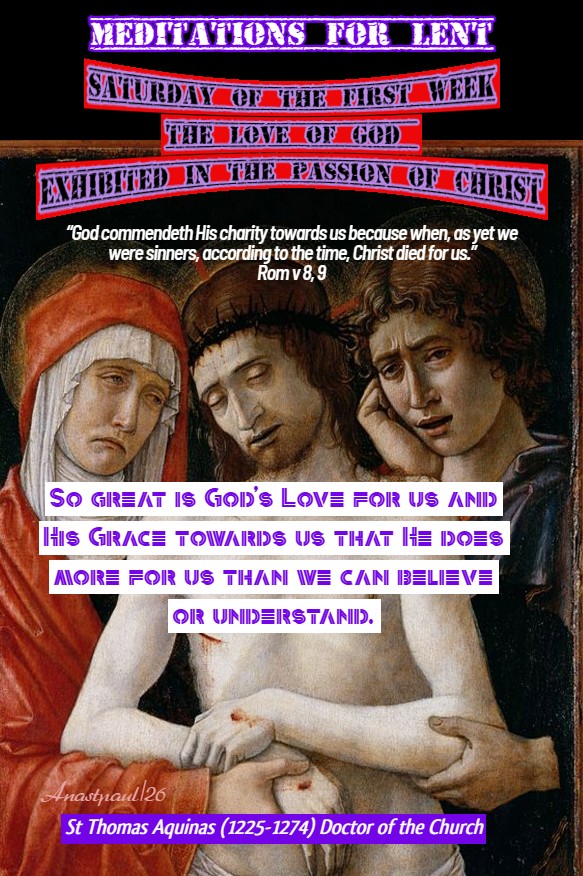
Saturday of the First Week The Love of God Exhibited in the Passion of Christ
“God commendeth His charity towards us because when, as yet we were sinners, according to the time, Christ died for us.” Rom v 8, 9
“Christ died for the ungodly” (ibid 6 This is a great thing if we consider Who it is Who died, a great thing too if we consider on whose behalf He died. For scarcely for a just man, will one die (ibid 6), that is to say that you will not find anyone who will die even to set free a man who is innocent, nay even, it is said, “The just perisheth and no man layeth it to heart” (Isaias l vii).
Rightly, therefore, does St.Paul say scarcely will one die. There might perhaps be found one, someone rare person, who out of sa uperabundance of courage, would be so bold as to die for a good man. But this is rare, for the simple reason that so to act is the greatest of all things. “Greater love than this, no man hath, says Our Lord Himself, that a man lay down his life for his friends (John xv. 13).
But the like of that which Christ Himself did, to die for evildoers and the wicked, has never been seen. Wherefore rightly do we ask in wonderment, why Christ did this.
If in fact it be asked, why Christ died for the wicked, the answer is that God, in this way, commendeth His Charity towards us. He exhibits to us in this way that He Loves us with a Love which knows no limits, for while we were as yet sinners, Christ died for us.
The very death of Christ for us, depicts the Love of God, for it was His Son Whom He gave to die that satisfaction might be made for us. God so Loved the world, as to give His Only Begotten Son (John iii. 16). And thus, as the Love of God the Father for us is proved in His giving us His Holy Spirit, so also is it proved in this way, by His Gift of His Only Son.
The Apostle says, God commendeth, signifying thereby that the Love of God cannot be measured. This is exhibited by the very fact of the matter, namely the fact that He gave His Son to die for us and it is proved too by reason of the kind of people we are, for whom He died. “Christ was not stirred up to die for us by any merits of ours, when as yet we were sinners. God (who is rich in mercy) for His exceeding Charity wherewith He Loved us, even when we were dead in sins, hath quickened us together in Christ ” (Eph ii. 4).
All this is almost too much to be believed. “A work is done in your days which no man will believe when it shall be told” (Habac i. 5). This Truth that Christ died for us is so difficult a Truth that scarcely can our intellect grasp it. Nay it is a Truth which our intellect can, in no way understand. And St Paul preaching, makes echo to Habacuc, I work a work in your days, a work which you will not believe, if any man shall tell it to you (Acts xiii 14).
So great is God’s Love for us and His Grace towards us that He does more for us than we can believe or understand.
ST THOMAS AQUINAS (1225-1274) Priest, Theologian, Dominican Doctor Angelicus (Angelic Doctor) Doctor Communis (Common Doctor) Added by Pope Saint Pius V in 1568
“If you wish to reach high, then begin at the lowest level. If you are trying to construct some mighty edifice in height, you will begin with the lowest foundation. This is humility. However great the mass of the building you may wish to design or erect, the taller the building is to be, the deeper you will dig the foundation. The building in the course of its erection, rises up high but he who digs its foundation, must first go down very low. So then, you see even a building is low before it is high and the tower is raised, only after humiliation.”
Our Morning Offering – 28 February – “The Month of the Most Holy and Blessed Trinity” – Saturday of the First Week of Lent
The Golden Arrow
This prayer was revealed by Jesus Himself to a Carmelite Nun of Tours in 1843 as a Reparation for Blasphemy. “This Golden Arrow will wound My Heart delightfully” He said “and heal the wounds, inflicted by blasphemy.”
May the Most Holy, Most Sacred, Most Adorable, Most Mysterious and Unutterable Name of God be always praised, blessed, loved, adored and glorified in Heaven. on earth and under the earth, by all the creatures of God and by the Sacred Heart of our Lord Jesus Christ in the most Holy Sacrament of the Altar. Amen
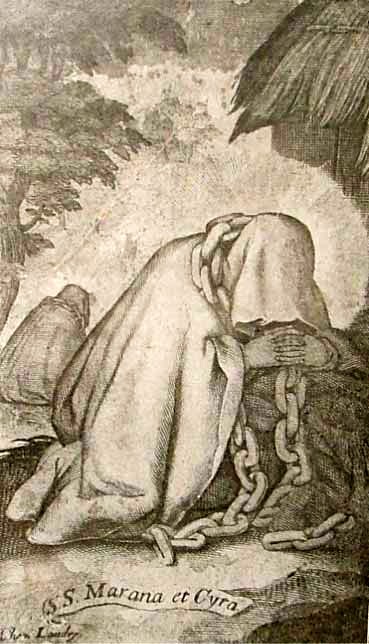
Saint/s of the Day – 28 February – St Cyra AND St Marana (Circa Mid 5th Century) Virgins and Hermits of Beroea in Syria. Two female Syrian Hermits of noble lineage who led an austere life of fasting, prayer, and silence for 42o years. They also made pilgrimages to holy places in Jerusalem and Isauria.
St Theodoret (c393-c457) devotes a Chapter (the 29th) of his Religiosa Historia to Marana and Cyra, who were still alive when he wrote his work in around 440.
In his word: “Their country is Beroea (modern Aleppo), where they descended from an illustrious race and were educated according to their condition and birth. But despising all the advantages granted them by nature, they shut themselves up in a small site near the City, having the gate walled up.
Wishing to imitate them in this way of life, some of their female servants built them a small house, adjacent to the hermitage, in which they ordered them to live; observing their actions through a small window, they often made them do prayer exercises and inflamed them with the love of God…
Instead of the door, they had a small window through which they received what was necessary for their life and spoke with the women who came to visit them only during the time of the ‘cinquantin’ (= Easter time), spending the rest of the year in constant silence, I mean with regard to Marana, the only one who speaks to these women. As for Cyra, in fact, no one has ever heard her utter the slightest word.
Cyra, who is of a more delicate constitution than the other, is always bent to the ground, unable to stand up. They wear dresses so long that they cover their feet and in front they have a kind of veil that comes down to the waist and completely covers the face, hands and stomach.”
When Teodoreto wrote these lines, Marana and Cyra had already been leading this life of Hermits for 42 years, making it even more painful by wearing heavy chains and sometimes prolonging the fast up to forty days.
“Driven by the desire to see the holy places whichJesus Christ honoured with His sufferings, they went fasting to Jerusalem, eating only after worshiping God. On their return, they resumed fasting, even though it would have taken them no less than 20 days to make such a long journey.”
Another time, they similarly travelled to Isauria to visit the Church of Saint Thecla, the first Martyr of that region. As time passed, Marana and Cyra did not slow domn in this way of life; on the contrary, they continued with ever-renewed ardour toward the crown which Christ would place upon their heads after their victory.
We do not know the date of Marana and Cyra’s death, since Theodoret is our only source.
Martyrs of Alexandria – A number of clerics and layman who died as Martyrs of charity for ministering to the sick during a plague that ravaged Alexandria, Egypt in 261.
Martyrs of Antwerp – 14 Christians who were Martyred together. We know nothing about them but the names Alexander, Anicetus, Cyriacus, Eulalia, Faustus, Genesius, Hirena, Macarius, Mauritius, Modestus, Placidus, Rochus, Symforian and Victorinus. Died in Rome, Italy, date unknown. Their Relics were transferred and enshrined in Antwerp, Belgium.
Martyrs of Corinth – A group of Christians Martyred together in Corinth, Greece. The only information we have about them are the names Basilia, Betha, Caius, Claudius, Diodorus, Donatus, Enuclus, Felix, Hermes, Januaria, Januarius, Maccaris, Maninlia, Mansuetus, Nicophorus, Papias, Quinquianus, Rufunia, Serapion, Servilia, Silvana, Stercola, Tella, Veneria, Victor and Victorinus.
Friday of the First Week of Lent – 27 February – Our Lenten Journey With St Thomas Aquinas (1225-1274) Doctor of the Church
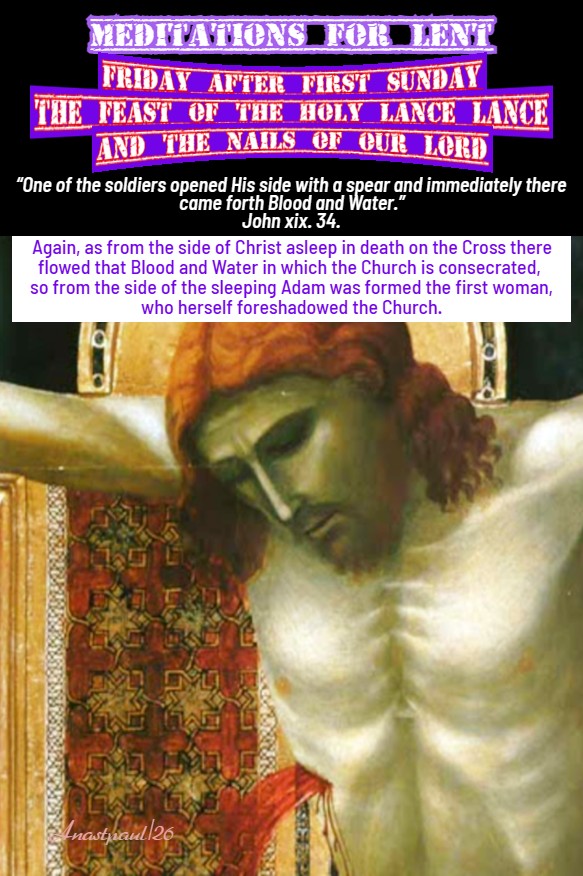
Friday After First Sunday The Feast of the Holy Lance Lance and the Nails of Our Lord
“One of the soldiers opened His side with a spear and immediately there came forth Blood and Water.” John xix. 34.
The Gospel deliberately says opened and not wounded because, through Our Lord’s Side, there was opened to us the Gate of Eternal Life. “ After these things I looked and behold, a gate was opened in heaven,” (Apoc iv. i). This is the door opened in the ark, through which enter the animals who will not perish in the flood.
But this door is the cause of our salvation. Immediately there came forth Blood and Water a thing truly miraculous that, from a dead body, in which the blood congeals, Blood should come forth!
This was done to show that by the Passion of Christ we receive a full absolution, an absolution from every sin and every stain. We receive this absolution from sin through that Blood which is the price of our redemption. You were not redeemed with corruptible things as gold or silver, from your vain conversation with the tradition of your fathers but with the Precious Blood of Christ, as of a lamb unspotted and undefiled (i Pet i. 18).
We were absolved from every stain by the Water which is the laver of our redemption. In the Prophet Ezechiel, it is said, “I will pour upon you clean water and you shall be cleaned from all your filthiness” (Ezech xxxvi. 28) and in Zacharias, “There shall be a fountain open to the house of David and to the inhabitants of Jerusalem for the washing of the sinner and the unclean woman” (Zach xiii. i).
And so, these two things may be thought of in relation to two of the Sacraments, the Water to Baptism and the Blood to the Holy Eucharist. Or both may be referred to the Holy Eucharist since, in the Mass, water is mixed with the wine. Although the water is not of the substance of the Sacrament.
Again, as from the side of Christ asleep in death on the Cross there flowed that Blood and Water in which the Church is consecrated, so from the side of the sleeping Adam was formed the first woman, who herself foreshadowed the Church.
ST THOMAS AQUINAS (1225-1274) Priest, Theologian, Dominican Doctor Angelicus (Angelic Doctor) Doctor Communis (Common Doctor) Added by Pope Saint Pius V in 1568
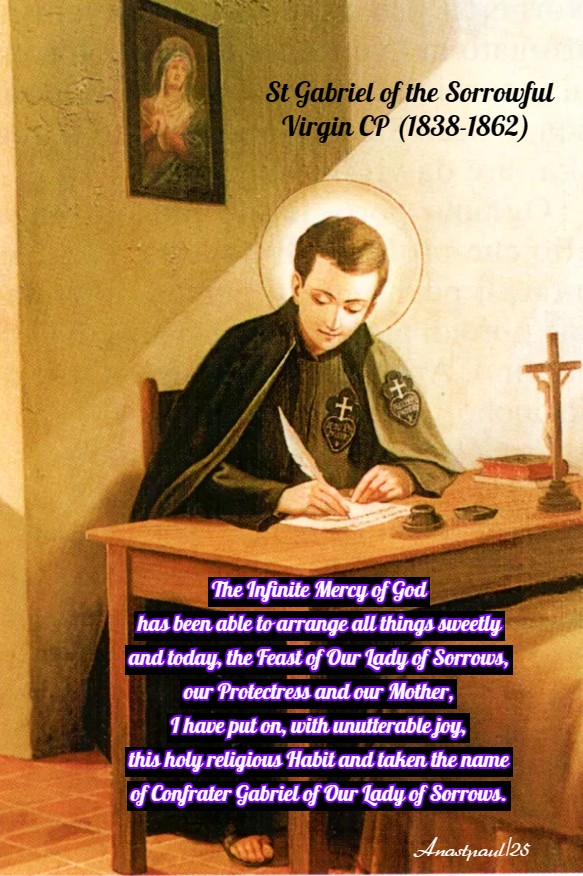
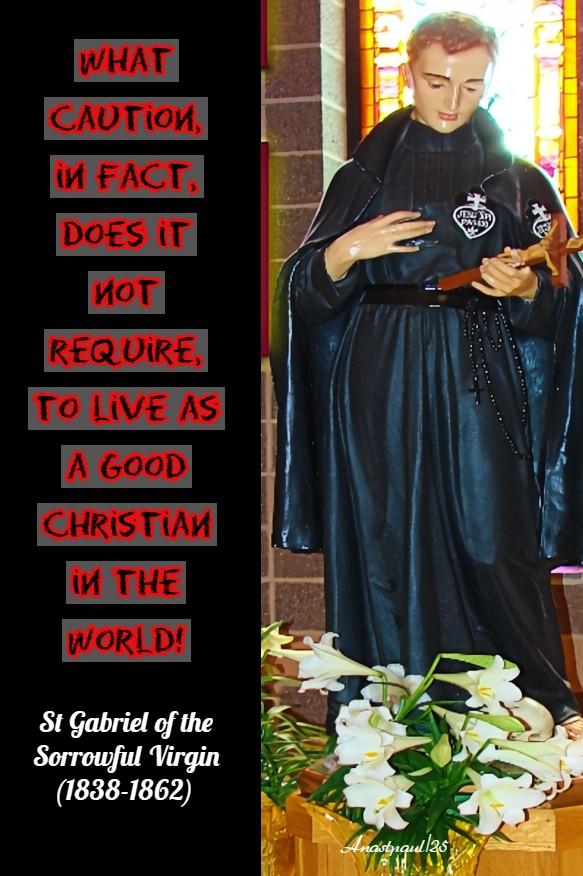
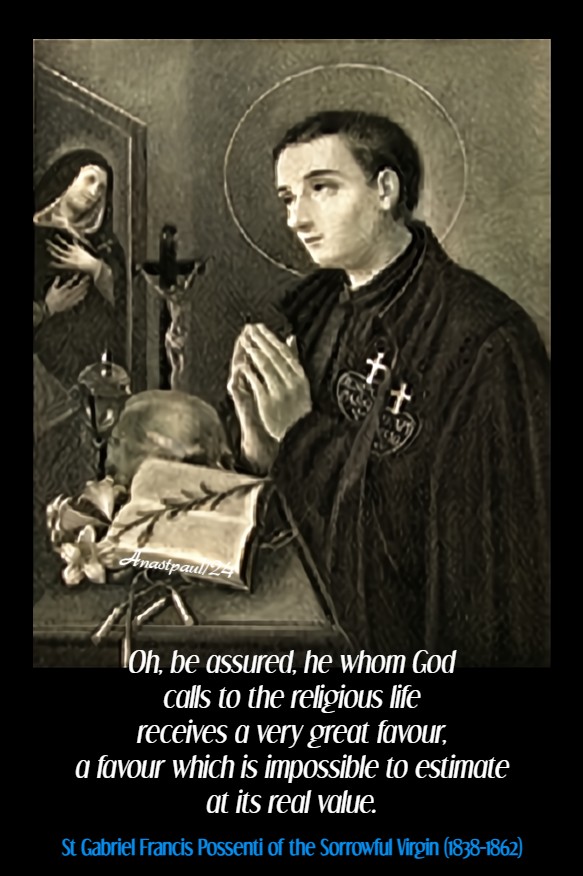
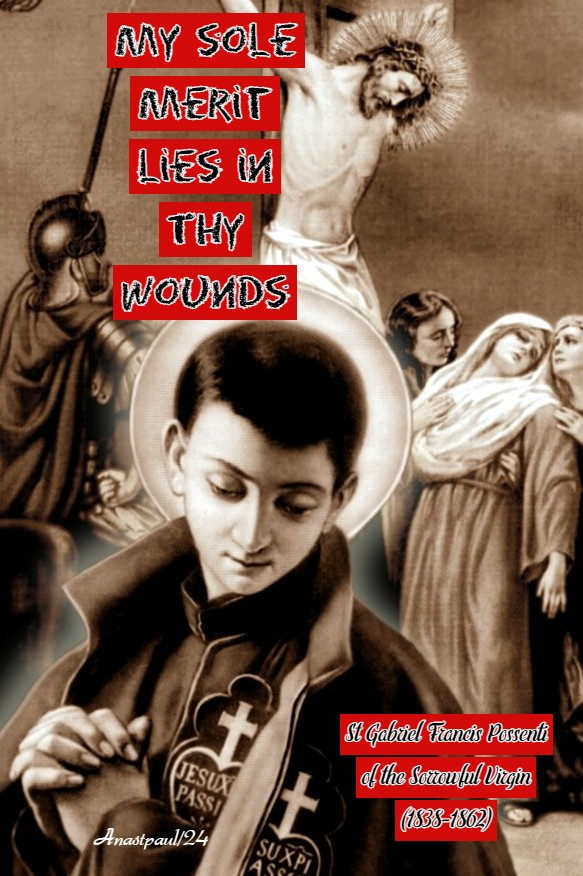
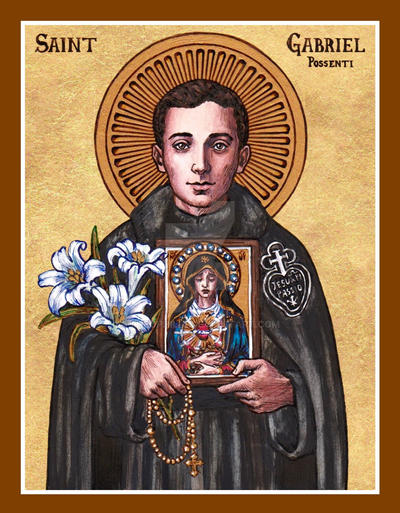
Quote/s of the Day – 27 February – St Gabriel of the Sorrowful Virgin/Gabriel Possenti CP (1838-1862) Confessor
“The Infinite Mercy of God has been able to arrange all things sweetly and today, the Feast of Our Lady of Sorrows, our Protectress and our Mother, I have put on, with unutterable joy, this holy religious Habit and taken the name of Confrater Gabriel of Our Lady of Sorrows.”
(Letter to his Father, From Morrovalle on 21 September 1856)
“What caution, in fact, does it not require, to live as a good Christian in the world!”
(Letter to his Father, From Morrovalle on 21 September 1856)
“Oh, be assured, he whom God calls to the religious life receives a very great favour, a favour which is impossible to estimate at its real value.”
Our Morning Offering – 27 February – Friday of the First week of Lent, the Memorial of St Gabriel Francis Possenti of Our Lady of Sorrows (1838-1862) and a Marian Saturday
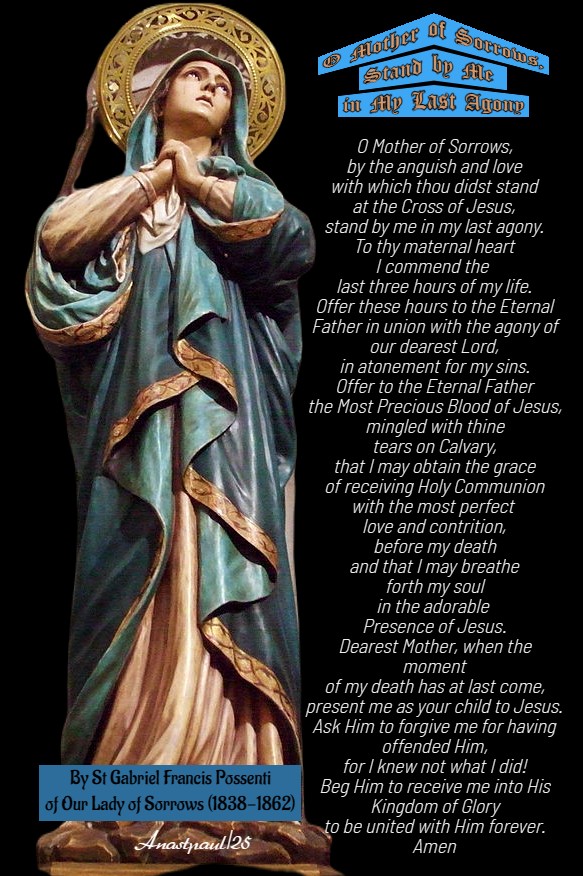
O Mother of Sorrows, Stand by Me in My Last Agony By St Gabriel Francis Possenti of Our Lady of Sorrows (1838-1862)
O Mother of Sorrows, by the anguish and love with which thou didst stand at the Cross of Jesus, stand by me in my last agony. To thy maternal heart I commend the last three hours of my life. Offer these hours to the Eternal Father in union with the agony of our dearest Lord, in atonement for my sins. Offer to the Eternal Father the Most Precious Blood of Jesus, mingled with thine tears on Calvary, that I may obtain the grace of receiving Holy Communion with the most perfect love and contrition, before my death and that I may breathe forth my soul in the adorable Presence of Jesus. Dearest Mother, when the moment of my death has at last come, present me as your child to Jesus. Ask Him to forgive me for having offended Him, for I knew not what I did! Beg Him to receive me into His Kingdom of Glory to be united with Him forever. Amen
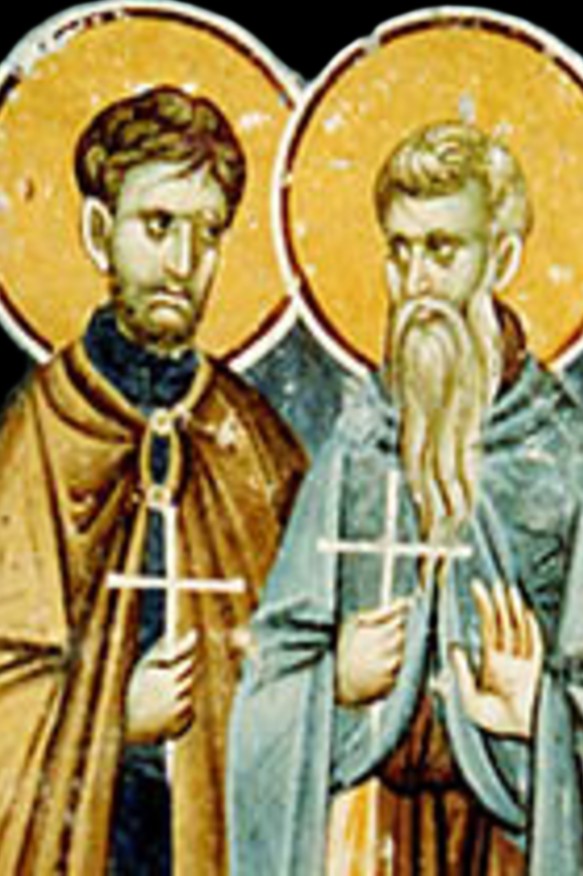
Saint/s of the Day – 27 February – St Basil (8th Century) Monk of Constantinople AND St Procopius (8th Century) Monk of Decapolis defenders of Sacred images. Both struggled against and were tortured and imprisoned in their fight against those who denied the veneration of Sared images. Some sources declare them as Martyrs but the Martyrology quoted below does not. Basil did probably die of his sufferings, having survived only a short time after their cessation but Procopius survived to carry on his work as a servant of Christ.
The Roman Martyrology reads today: “At Constantinople, in the time of the Emperor Leo, the holy Confessors Basil and Procoppius, who fought courageously for the worship of holy images.”
Saints Basil and Procopius were Monks, who lived in Constantinople in the 8th Century, during the reign of Emperor Leo III the Isaurian.
Basil was from a noble family, while Procopius was a Soldier who, after leaving the army, had retired to monastic life.
The two Monks were united by a deep devotion to Christ and the belief that the veneration of Sacred images was a fundamental tool and element in the growth of the Christian Faith.
In 726, Emperor Leo III issued an Edict prohibiting the veneration of Sacred images. This decision was strongly contested by the Church, which considered Sacred images a way to honour God and the Saints.
Basil and Procopius joined the fight against the Imperial Edict. They were arrested and subjected to harsh torture but never renounced their Faith. They were eventually imprisoned, where they spent several years.
Upon the death of Leo III in 741, Basil Procopius were freed. Basil died shortly thereafter, while Procopius continued to live and preach the Gospel of Christ.
In the 8th Century, the veneration of Sacred images was the subject of a controversy that divided the Church. Emperor Leo III and his supporters considered Sacred images a form of idolatry, while the Church maintained that they were a legitimate way to honour God and the Saints.
The controversy ended with the Second Council of Nicaea, which in 787 established that the veneration of Sacred images was devotional and in accordance with theteachings of Holy Church.
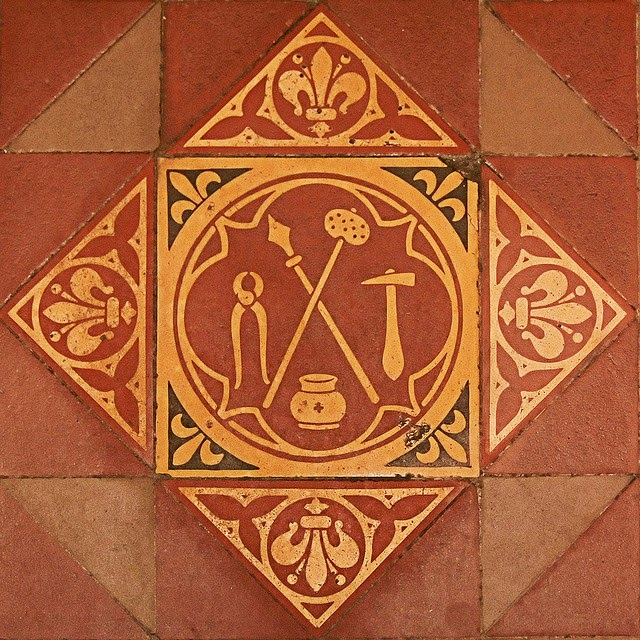
The Feast of the Sacred Lance and Nails – Friday after the 1st Sunday in Lent: The Supreme Pontiff, Innocent VI, in his Decree establishing the Feast and Office of the Lance and Nails which pierced the Body of our Crucified Lord Jesus Christ, exhorts all the faithful to have a special veneration for and devotion to, all the Sacred Instruments of our Saviour’s Passion. The following are the Holy Father’s words: “We should honour the most holy Passion of our Lord and Redeemer, Jesus Christ, in such manner that, meditating on all the mysteries and merits of the same Passion, we venerate also each Sacred Instrument thereof.” Then this holy and zealous Pontiff, coming more directly to the honour due to the Lance and Nails, says: “Although the Lance and Nails and the other Sacred Instruments of the Passion, should be enerated everywhere, by the faithful of Christ and although every year the Church celebrates the Solemn Offices of the same Passion, yet, we deem it proper and fitting, that a special Solemn Feast should be instituted and celebrated in honour of those particular Instruments of the Passion, more especially, in those places wherein these salutary Instruments are preserved. Hence, we wish to encourage this devotion by a special Office and privileges.” (Innocent VI in Decret. de Fest. Lane, et Clav. Domini).
The Lance, also known as “The Spear of Longinus” is kept in the Vatican Basilica, given to Innocent VIII in 1492. The Nails were kept with the Crown of Thorns, along with a small piece of the Lance of Longinus at Saint Chapelle, France and were subsequently lost during the French Revolution. The Crown of Thorns was the only Relic saved and is now kept at Notre Dame Cathedral.
St Basil (8th Century) Monk of Constantinople AND St Procopius (8th Century) Monk of Decapolis St Comgan Bl Emmanuel of Cremona Bishop St Fortunatus of Rome St Herefrith of Lindsey St Honorina
Blessed William Richardson (1572–1603) English Priest, Martyr. He was Beatified on 15 December 1929 by Pope Pius XI. Born in Yorkshire and died by being hanged, drawn and quartered on 27 February 1603 at Tyburn, London, aged just 31. William owns the dubious honour of being the last Martyr under Elizabeth I’s barbaric policy of murdering Catholics and especially Priests, in this manner. His Life and Death: https://anastpaul.com/2023/02/27/saint-of-the-day-27-february-blessed-william-richardson-1572-1603-english-priest-martyr/
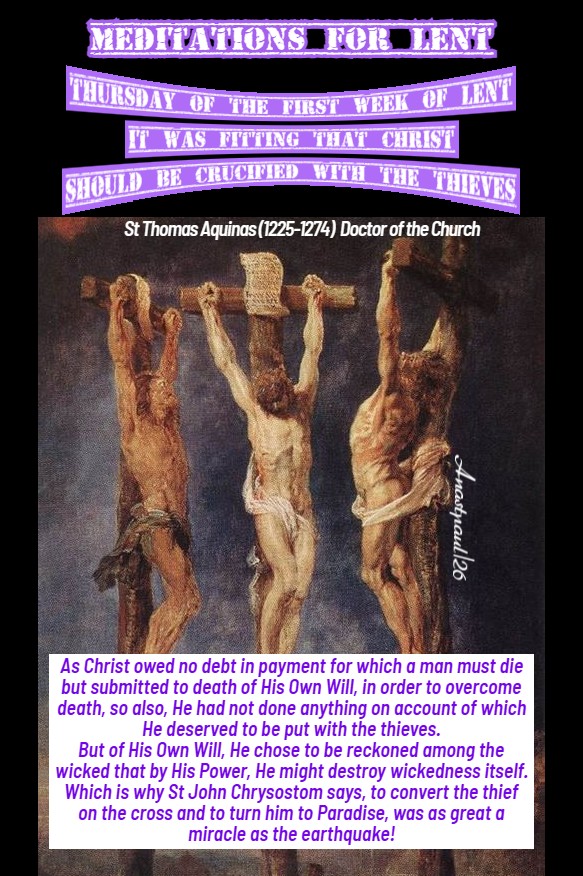
Thursday of the First Week of Lent – 26 February – Our Lenten Journey With St Thomas Aquinas (1225-1274) Doctor of the Church
Thursday of the First Week of Lent It was fitting that Christ should be Crucified with the Thieves
Christ was Crucified between the thieves because such was the will of the Jews and also because, this was part of God’s Design. But the reasons why this was appointed, were not the same in each of these cases.
As far as the Jews were concerned, Our Lord was Crucified with the thieves on either side to encourage the suspicion that He too was a criminal. But it transpired otherwise! The thieves themselves have left not a trace in the remembrance of man, while His Cross is everywhere held in honour. Kings lying their crowns aside, have embroidered the Cross on their Royal robes. They have placed it on their crowns; on their armiur. It has its place on the very Altars. Everywhere, throughout the world, we behold the splendour of the Cross.
In God’s Plan, Christ was Crucified with the thieves in order, for our sakes, He became accursed of the Cross, so, for our salvation, He is Cucified like an evil Man amongst evil men.
The Pope, St Leo the Great, says that the thieves were crucified, one on either side of Our Lord, so that, in the very appearance of the scene of His Suffering, there might be set forth that distinction which should be made in the judgement of each one of us. St Augustine has the same thought. “The Cross itself,” he says, “was a tribunal. In the centre was the Judge. To the one side a man who believed and was set free, to the other side, a scoffer and he was condemned.” Already there was made clear the final fate of the living and the dead, the one class placed at His Right, the other on His Left.
According to St Hilary, the two thieves, placed to right and to left, typify that the whole of mankind is called to the mystery of Our Lord’s Passion. And, since division of things, according to right and left is made with reference to believers and those who will not believe, one of the two, placed on the right, is saved by justifying faith.
As St Bede says, the thieves who were crucified with Our Lord, represent those who, for the faith and to confess Christ, undergo the agony of martyrdom or the severe discipline of a more perfect life. Those who do this for the sake of eternal glory are typified by the thief on the Right Hand. Those whose motive is the admiration of whoever beholds them, imitate the spirit and the act of the thief on the Left Hand.
As Christ owed no debt in payment for which a man must die but submitted to death of His Own Will, in order to overcome death, so also, He had not done anything on account of which He deserved to be put with the thieves. But of His Own Will, He chose to be reckoned among the wicked that by His Power, He might destroy wickedness itself. Which is why St John Chrysostom says, to convert the thief on the cross and to turn him to Paradise, was as great a miracle as the earthquake!
ST THOMAS AQUINAS (1225-1274) Priest, Theologian, Dominican Doctor Angelicus (Angelic Doctor) Doctor Communis (Common Doctor) Added by Pope Saint Pius V in 1568
Our Morning Offering – 26 February – Thursday of the First Week of Lent – Ferial Day
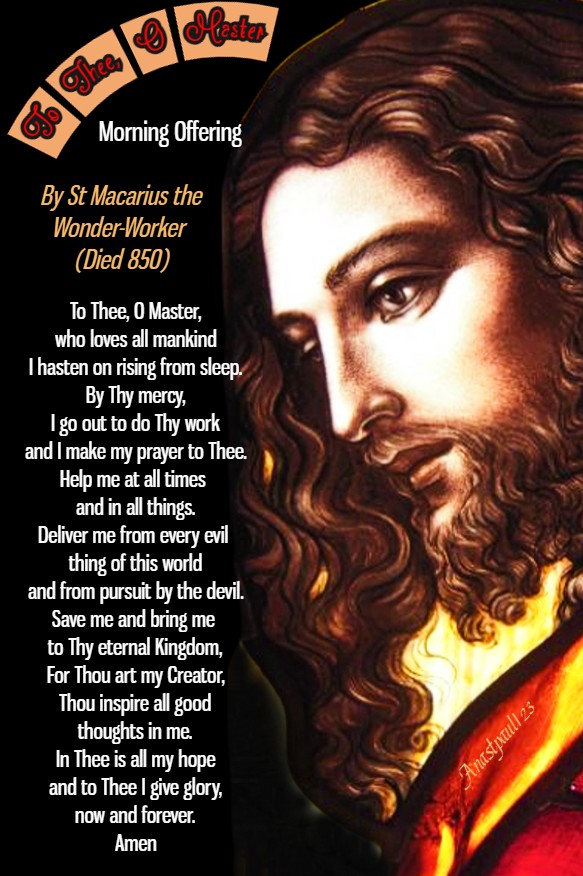
To Thee, O Master Morning Offering By St Macarius the Wonder-Worker (Died 850)
To Thee, O Master, Who loves all mankind I hasten Mn rising from sleep. By Thy Mercy, I go out to do Thy Work and I make my prayer to Thee. Help me at all times and in all things. Deliver me from every evil thing of this world and from pursuit by the devil. Save me and bring me to Thy eternal Kingdom, For Thou art my Creator, Thou inspire all good thoughts in me. In Thee is all my hope and to Thee I give glory, now and forever. Amen
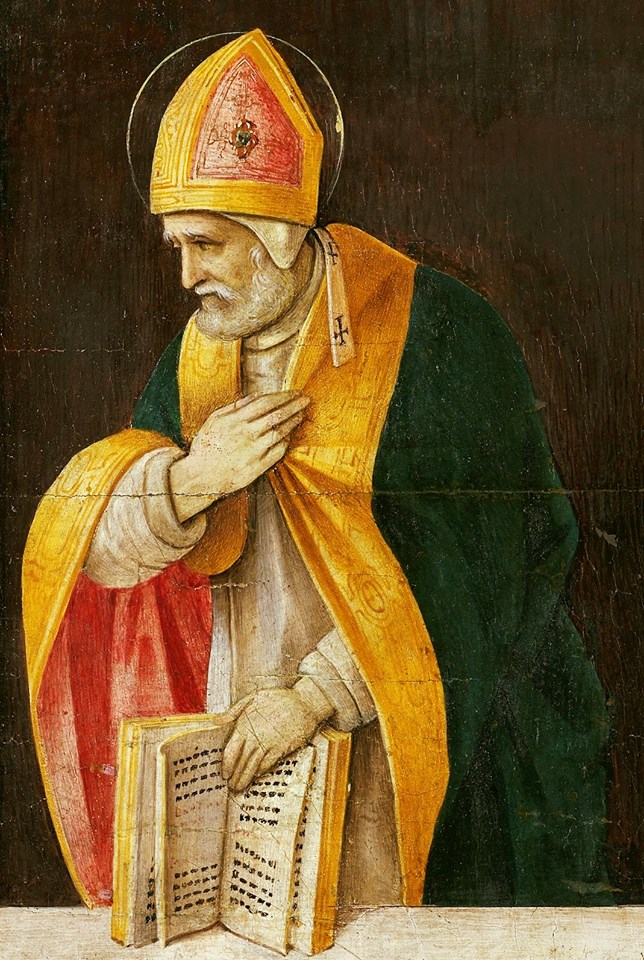
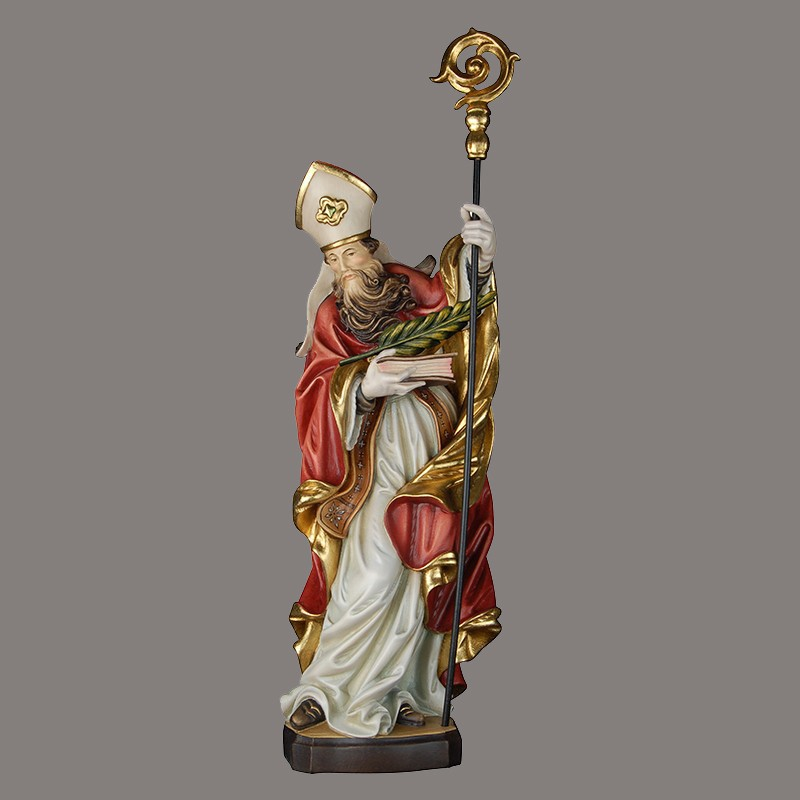
Saint of the Day – 26 February – St Andrew (9th Century) Bishop and Confessor of Florence. Also known as – Andrea.
The Roman Martyrology reads today: “At Florence, St Andrew, Bishop and Confessor.”
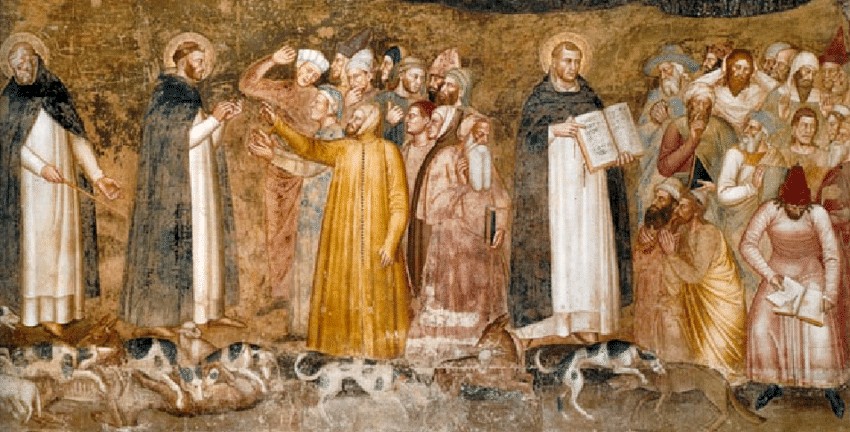
Andrea da Firenze, Spanish Chapel, Santa Maria Novella, Florence, Fresco, 1365-1367.
Information regarding St Andrew’s life is scarce and fragmentary. According to tradition, he lived in the 9th Century and was the Bishop of Florence.
The first documented record dates to 18 December 871, when he is mentioned as an Imperial Envoy attended at Court with Margrave Adalbert. In 874, he obtained from Emperor Louis II the German, the privilege of immunity for the Bishop’s property. On 1 March 893, his Envoys are reported to have handed his niece to Bertha, Abbess of the Abbey of Sant’Andrea, to be educated and trained to succeed the Abbess.
This scant information does not allow us to reconstruct Saint Andrew’s life. However, it is possible to hypothesise that he was a man of great faith and profound culture. His presence in Florence is attested by several documents and by his Liturgical Feast celebrated today.
Saint Andrew is considered the protector of the City of Florence. His figure has been depicted in several works of art, including a 15th Century Altarpiece preserved in the Church of Sant’Andrea in Florence.
A Church dedicated to him existed as early as the 13th Century, located in the Square of the same name in the historic center of the City. This Church was replaced and today, the memory of Saint Andrew is preserved in the Cathedral of Florence. A Chapel is also dedicated to him in the Church of San Lorenzo, where the Relics of his predecessor, Saint Zenobius, are preserved.
St Alexander of Alexandria (Died c326) Bishop of Alexandria, Confessor, Defender of the True Faith against heresies, in particular the Arians. The Roman Martyrology states of him today: “At Alexandria, the Bishop St Alexander, an aged man held in great honour who was a successor of the blessed Peter as Bishop of the City. He expelled from the Church, Arius, one of his Priests, tainted with heretical impiety and convicted by Divine Truth and, subsequently, was one of the three hundred and eighteen Fathers, who condemned him at the Council of Nicea.” Holy Father St Alexander: https://anastpaul.com/2022/02/26/saint-of-the-day-26-february-st-alexander-of-alexandria-died-c-326/
St Andrew (9th Century) Bishop and Confessor of Florence St Dionysius of Augsburg



















 AnaStpaul
You must be logged in to post a comment.