Posted in DIVINE Mercy, Goodness, Patience, DOCTORS of the Church, FATHERS of the Church, PAPAL SERMONS, QUOTES of the SAINTS, QUOTES on CONVERSION, QUOTES on DEATH, QUOTES on ETERNAL LIFE, QUOTES on FAITH, QUOTES on FEAR, QUOTES on GRACE, QUOTES on HEAVEN, QUOTES on HOPE, QUOTES on LOVE, QUOTES on REPENTANCE, QUOTES on SANCTITY, QUOTES on SUFFERING, QUOTES on TEMPTATION, QUOTES on TRUST and complete CONFIDENCE in GOD, SAINT of the DAY

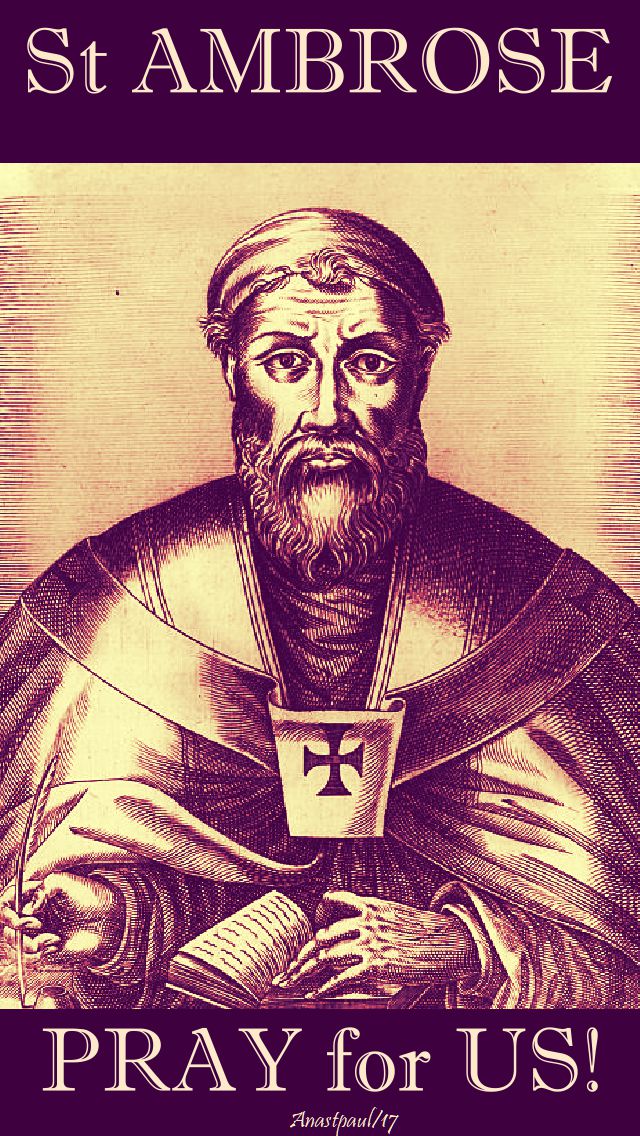
Thought for the Day – 7 December – The Memorial of St Ambrose (c 340-397)- Father and Doctor of the Church

Thought for the Day – 7 December – The Memorial of St Ambrose (c 340-397)- Father and Doctor of the Church

“Holy Bishop Ambrose – about whom I shall speak to you today – died in Milan in the night between 3 and 4 April 397.   It was dawn on Holy Saturday.   The day before, at about five o’clock in the afternoon, he had settled down to pray, lying on his bed with his arms wide open in the form of a cross.   Thus, he took part in the solemn Easter Triduum, in the death and Resurrection of the Lord.   “We saw his lips moving”, said Paulinus, the faithful deacon who wrote his Life at St Augustine’s suggestion, “but we could not hear his voice”.   The situation suddenly became dramatic.   Honoratus, Bishop of Vercelli, who was assisting Ambrose and was sleeping on the upper floor, was awoken by a voice saying again and again, “Get up quickly! Ambrose is dying…”.   “Honoratus hurried downstairs”, Paulinus continues, “and offered the Saint the Body of the Lord.   As soon as he had received and swallowed it, Ambrose gave up his spirit, taking the good Viaticum with him.   His soul, thus refreshed by the virtue of that food, now enjoys the company of Angels” (Life, 47).

On that Holy Friday 397, the wide open arms of the dying Ambrose expressed his mystical participation in the death and Resurrection of the Lord.   This was his last catechesis – in the silence of the words, he continued to speak with the witness of his life.

Like the Apostle John, Bishop Ambrose – who never tired of saying: “Omnia Christus est nobis! To us Christ is all!” – continues to be a genuine witness of the Lord.   Let us thus conclude our Catechesis with his same words, full of love for Jesus:  “Omnia Christus est nobis!   If you have a wound to heal, He is the doctor;  if you are parched by fever, He is the spring;  if you are oppressed by injustice, He is justice;  if you are in need of help, He is strength;  if you fear death, He is life;  if you desire Heaven, He is the way;  if you are in the darkness, He is light….   Taste and see how good is the Lord, blessed is the man who hopes in Him!” (De Virginitate, 16, 99).   Let us also hope in Christ.   We shall thus be blessed and shall live in peace.”

Pope Benedict – Excerpt, General Audience, Catechesis on St Ambrose, 24 October 2007

St Ambrose, Pray for us!st-ambrose-pray-for-us-2- 7dec2017

Posted in FEASTS and SOLEMNITIES, ON the SAINTS, PAPAL SERMONS, PRAYERS for PRIESTS, SAINT of the DAY, The APOSTLES & EVANGELISTS

Thought for the Day – 30 November – The Feast of St Andrew, Apostle of Christ

Thought for the Day – 30 November – The Feast of St Andrew, Apostle of Christ

Excerpt from Pope Benedict’s Catechesis on St Andrew
Wednesday, 14 June 2006

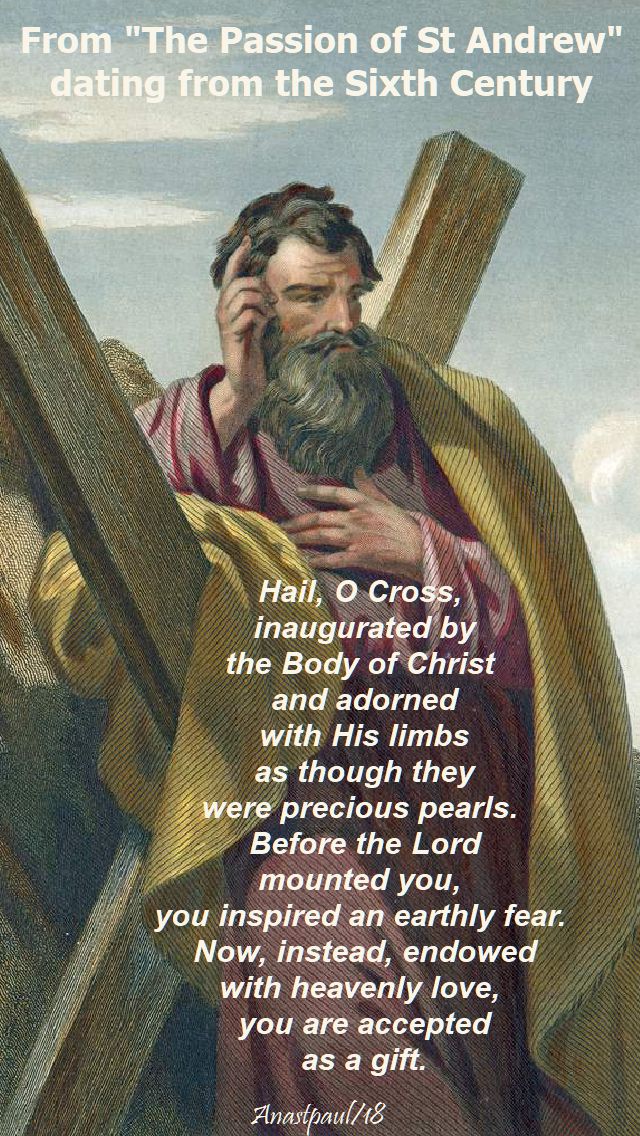
“This is what the Apostle is claimed to have said on that occasion, according to an ancient story (which dates back to the beginning of the sixth century), entitled The Passion of Andrew:

“Hail, O Cross, inaugurated by the Body of Christ and adorned with His limbs as though they were precious pearls.   Before the Lord mounted you, you inspired an earthly fear.   Now, instead, endowed with heavenly love, you are accepted as a gift.

Believers know of the great joy that you possess and of the multitude of gifts you have prepared.   I come to you, therefore, confident and joyful, so that you too may receive me exultant as a disciple of the One who was hung upon you…. O blessed Cross, clothed in the majesty and beauty of the Lord’s limbs!…

Take me, carry me far from men, and restore me to my Teacher, so that, through you, the one who redeemed me by you, may receive me.

Hail, O Cross; yes, hail indeed!”.hail o cross - from the passion of st andrew - 30nov2018

Here, as can be seen, is a very profound Christian spirituality.   It does not view the Cross as an instrument of torture but rather as the incomparable means for perfect configuration to the Redeemer, to the grain of wheat that fell into the earth.

We have a very important lesson to learn, our own crosses acquire value if we consider them and accept them as a part of the Cross of Christ, if a reflection of His light illuminates them.   It is by that Cross alone that our sufferings too are ennobled and acquire their true meaning.

The Apostle Andrew, therefore, teaches us to follow Jesus with promptness (cf. Mt 4: 20; Mk 1: 18), to speak enthusiastically about Him to those we meet and especially, to cultivate a relationship of true familiarity with Him, acutely aware that in Him alone, can we find the ultimate meaning of our life and death.”

St Andrew, Pray for your Church, Pray for Us all!st andrew apostle pray for us-30nov2018

Posted in Against SORE THROATS, COUGHS, WHOOPING COUGH,, FEASTS and SOLEMNITIES, Of FISHERMEN, FISHMONGERS, Of MUSICIANS, Choristors, Of the SICK, the INFIRM, All ILLNESS, ON the SAINTS, PAPAL SERMONS, PREGNANCY, SAINT of the DAY, The APOSTLES & EVANGELISTS

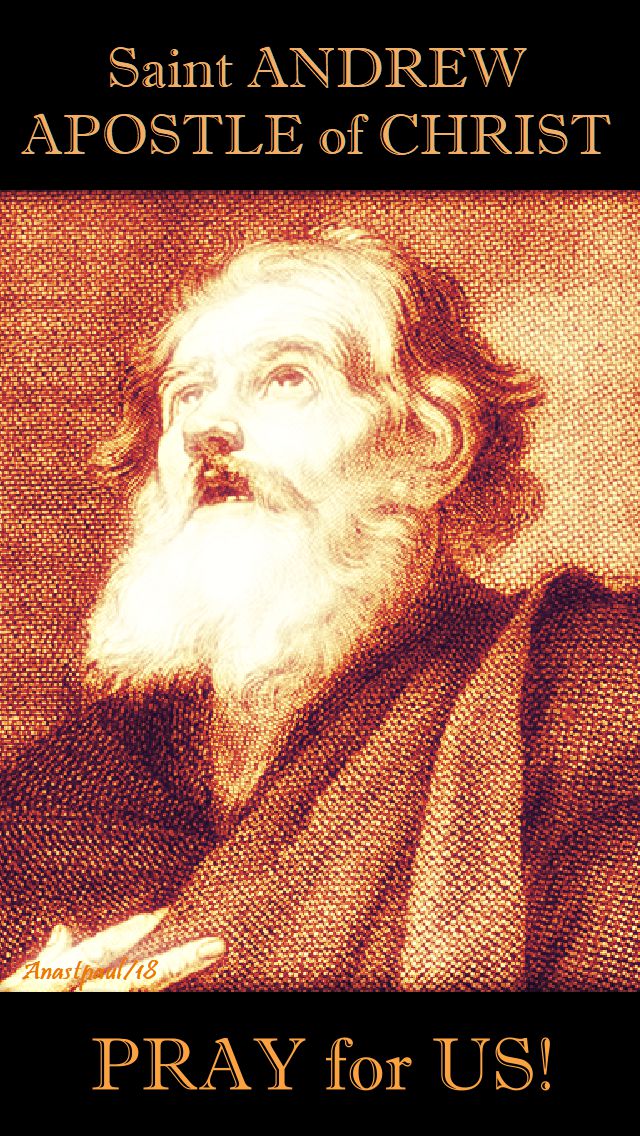
Saint of the Day – 30 November – St Andrew, Apostle of Christ, Martyr

Saint of the Day – 30 November – St Andrew, Apostle of Christ, Martyr – Called the “First Called ” – born at Bethsaida, Galilee and was Martyred by crucifixion on a saltire (x-shaped) cross in Patras Greece (around the year 62) – Patronages:  fishermen, fishmongers and rope-makers, textile workers, singers, miners, pregnant women, butchers, farm workers, protection against sore throats, protection against convulsions, protection against fever, protection against whooping cough, Scotland, Barbados, Georgia, Ukraine, Russia, Sicily, Greece, Cyprus, Romania, Patras, Burgundy, San Andrés (Tenerife), Diocese of Parañaque, Telhado, Amalfi, Luqa (Malta) and Prussia; Diocese of Victoria.ANDREW - GLASS maxresdefault
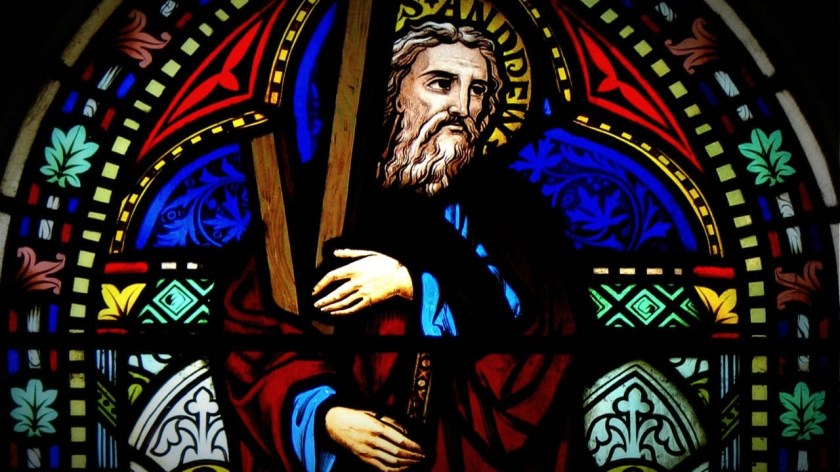
The first striking characteristic of Andrew is his name – it is not Hebrew, as might have been expected but Greek, indicative of a certain cultural openness in his family that cannot be ignored.   We are in Galilee, where the Greek language and culture are quite present.   Andrew comes second in the list of the Twelve, as in Matthew (10: 1-4) and in Luke (6: 13-16); or fourth, as in Mark (3: 13-18) and in the Acts (1: 13-14).   In any case, he certainly enjoyed great prestige within the early Christian communities.   The kinship between Peter and Andrew, as well as the joint call that Jesus addressed to them, are explicitly mentioned in the Gospels.   We read:  “As he walked by the Sea of Galilee, he saw two brothers, Simon who is called Peter and Andrew his brother, casting a net into the sea; for they were fishermen.   And he said to them, “Follow me and I will make you fishers of men'” (Mt 4: 18-19; Mk 1: 16-17).

From the Fourth Gospel we know another important detail:  Andrew had previously been a disciple of John the Baptist and this shows us that he was a man who was searching, who shared in Israel’s hope, who wanted to know better the word of the Lord, the presence of the Lord.   He was truly a man of faith and hope and one day he heard John the Baptist proclaiming Jesus as, “the Lamb of God” (Jn 1: 36), so he was stirred and with another unnamed disciple followed Jesus, the one whom John had called “the Lamb of God”.   The Evangelist says that “they saw where he was staying and they stayed with him that day…” (Jn 1: 37-39).   Thus, Andrew enjoyed precious moments of intimacy with Jesus.   The account continues with one important annotation:  “One of the two who heard John speak and followed him, was Andrew, Simon Peter’s brother.   He first found his brother Simon and said to him, “We have found the Messiah’ (which means Christ). He brought him to Jesus” (Jn 1: 40-43), straightaway showing an unusual apostolic spirit.

Andrew, then, was the first of the Apostles to be called to follow Jesus.   Exactly for this reason the liturgy of the Byzantine Church honours him with the nickname: “Protokletos”, [protoclete] which means, precisely, “the first called”.Sant_Andrea_S
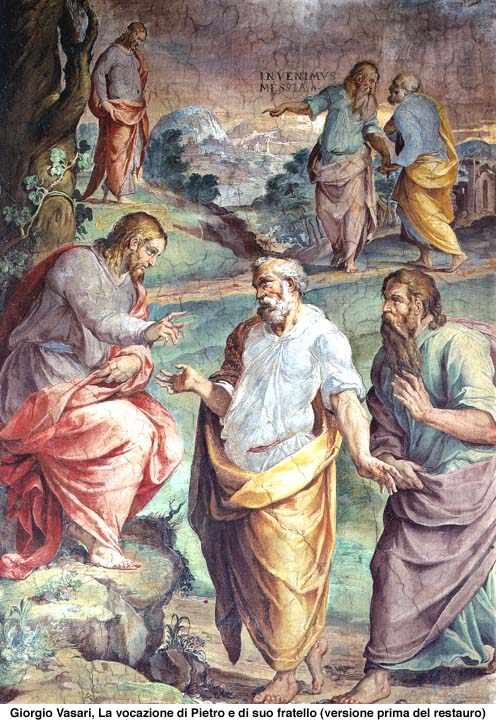
The Gospel traditions mention Andrew’s name in particular on another three occasions that tell us something more about this man.   The first is that of the multiplication of the loaves in Galilee. On that occasion, it was Andrew who pointed out to Jesus the presence of a young boy who had with him five barley loaves and two fish, not much, he remarked, for the multitudes who had gathered in that place (cf. Jn 6: 8-9). In this case, it is worth highlighting Andrew’s realism.   He noticed the boy, that is, he had already asked the question: “but what good is that for so many?” (ibid) and recognised the insufficiency of his minimal resources.   Jesus, however, knew how to make them sufficient for the multitude of people who had come to hear Him.

The second occasion was at Jerusalem.   As He left the city, a disciple drew Jesus’ attention to the sight of the massive walls that supported the Temple.   The Teacher’s response was surprising:  He said that of those walls not one stone would be left upon another.   Then Andrew, together with Peter, James and John, questionedHhim: “Tell us, when will this be, and what will be the sign when these things are all to be accomplished?” (Mk 13: 1-4). In answer to this question Jesus gave an important discourse on the destruction of Jerusalem and on the end of the world, in which He asked His disciples to be wise in interpreting the signs of the times and to be constantly on their guard.   From this event we can deduce that we should not be afraid to ask Jesus questions but at the same time that we must be ready to accept even the surprising and difficult teachings that He offers us.andrew snip
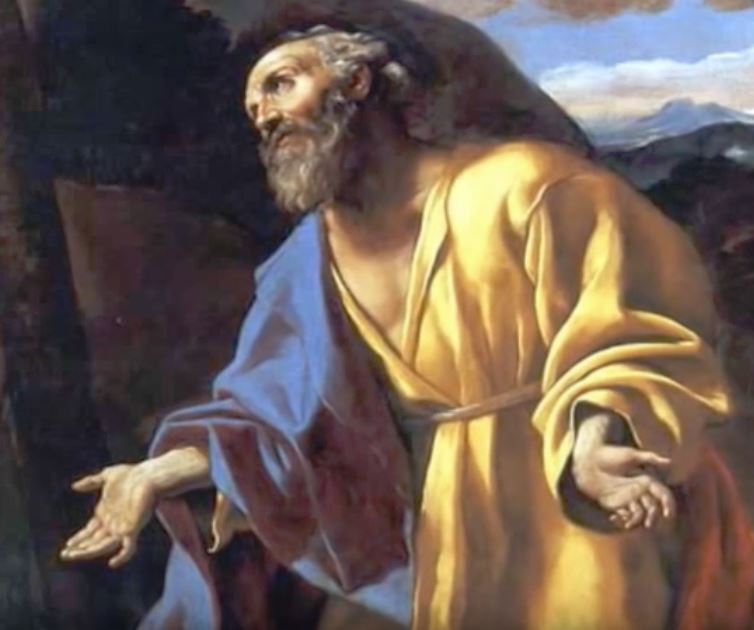
Lastly, a third initiative of Andrew is recorded in the Gospels:  the scene is still Jerusalem, shortly before the Passion.   For the Feast of the Passover, John recounts, some Greeks had come to the city, probably proselytes or God-fearing men who had come up to worship the God of Israel at the Passover Feast.   Andrew and Philip, the two Apostles with Greek names, served as interpreters and mediators of this small group of Greeks with Jesus.   The Lord’s answer to their question – as so often in John’s Gospel – appears enigmatic but precisely in this way proves full of meaning.   Jesus said to the two disciples and, through them, to the Greek world:  “The hour has come for the Son of man to be glorified.   I solemnly assure you, unless a grain of wheat falls to the earth and dies, it remains just a grain of wheat but if it dies, it produces much fruit” (12: 23-24). Jesus wants to say:  Yes, my meeting with the Greeks will take place but not as a simple, brief conversation between myself and a few others, motivated above all by curiosity.   The hour of my glorification will come with my death, which can be compared with the falling into the earth of a grain of wheat.   My death on the Cross will bring forth great fruitfulness, in the Resurrection the “dead grain of wheat” – a symbol of myself crucified – will become the bread of life for the world, it will be a light for the peoples and cultures. Yes, the encounter with the Greek soul, with the Greek world, will be achieved in that profundity to which the grain of wheat refers, which attracts to itself the forces of heaven and earth and becomes bread. In other words, Jesus was prophesying about the Church of the Greeks, the Church of the pagans, the Church of the world, as a fruit of His Pasch.

Some very ancient traditions not only see Andrew, who communicated these words to the Greeks, as the interpreter of some Greeks at the meeting with Jesus recalled here but consider him the Apostle to the Greeks in the years subsequent to Pentecost.   They enable us to know that for the rest of his life he was the preacher and interpreter of Jesus for the Greek world.ANDREW ICON
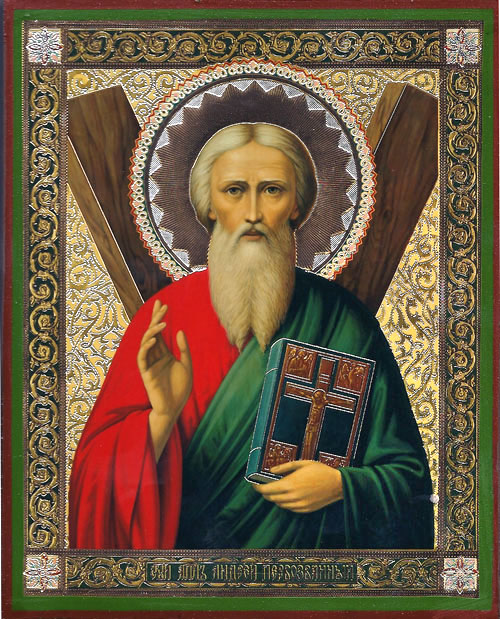
Peter, his brother, travelled from Jerusalem through Antioch and reached Rome to exercise his universal mission, Andrew, instead, was the Apostle of the Greek world.   So it is that in life and in death they appear as true brothers – a brotherhood that is symbolically expressed in the special reciprocal relations of the See of Rome and of Constantinople, which are truly Sister Churches.

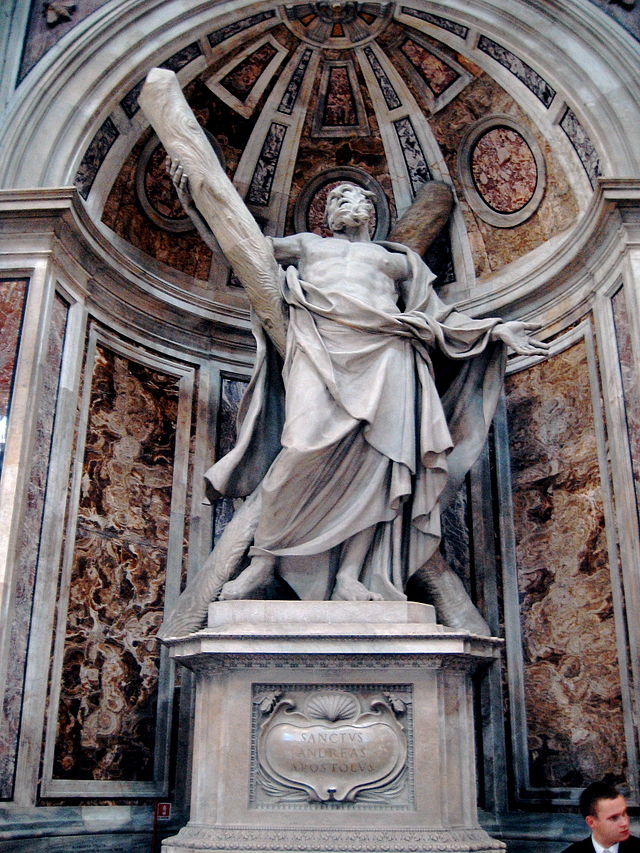
A later tradition, as has been mentioned, tells of Andrew’s death at Patras, where he too suffered the torture of crucifixion.   At that supreme moment, however, like his brother Peter, he asked to be nailed to a cross different from the Cross of Jesus.   In his case it was a diagonal or X-shaped cross, which has thus come to be known as “St Andrew’s cross”….Pope Benedict XVI – 14 June 2006
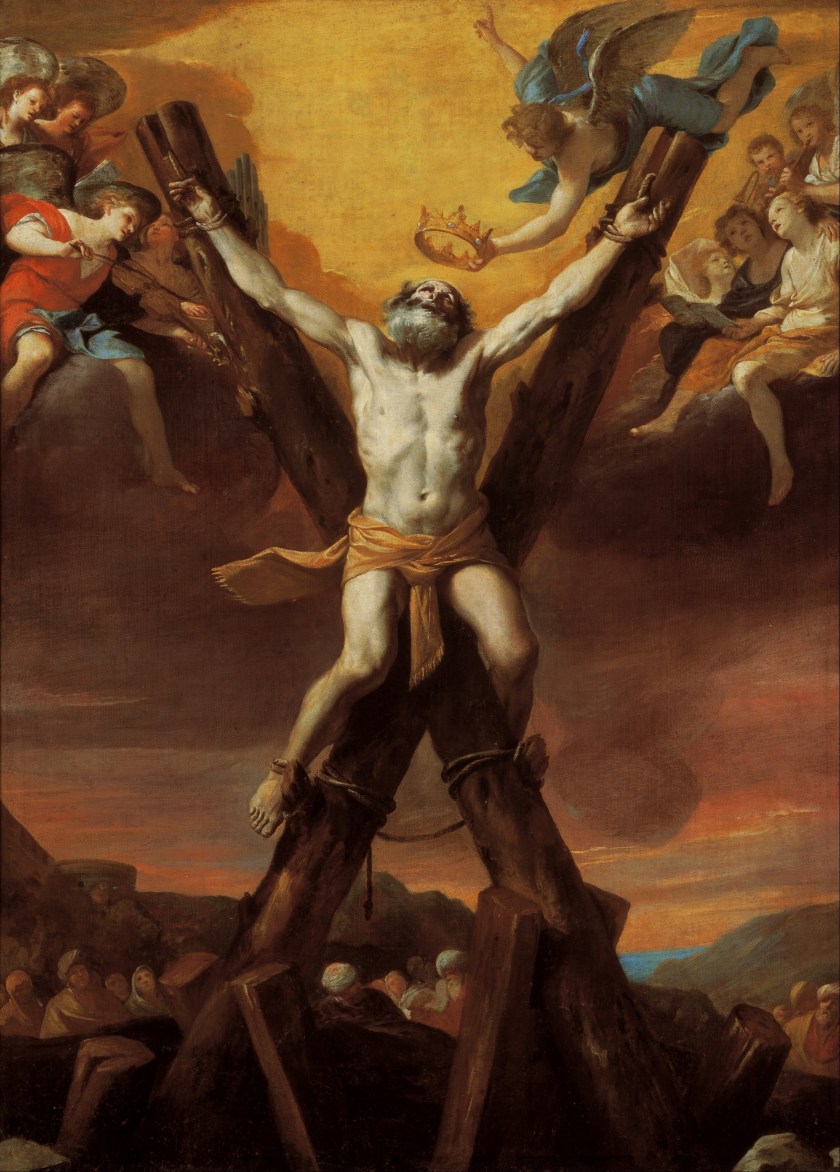
Mattia_Preti_-_The_crucifixion_of_St_Andrew_-_Google_Art_Project-Public-Domain-Image

Andrew is the patron saint of several countries and cities and is the patron saint of Prussia and of the Order of the Golden Fleece.  He is considered the founder and the first bishop of the Church of Byzantium and is consequently the patron saint of the Ecumenical Patriarchate of Constantinople.   The flag of Scotland (and consequently the Union Flag and those of some of the former colonies of the British Empire) feature Saint Andrew’s saltire cross. The saltire is also the flag of Tenerife, the former flag of Galicia and the Russian Navy Ensign.

The feast of Andrew is observed on 30 November in both the Eastern and Western churches and is the national day of Scotland.   In the traditional liturgical books of the Catholic Church, the feast of Saint Andrew is the first feast day in the Proper of Saints.VATICAN - ANDREW STATUE -640px-Saint_Andreas
Posted in CHRIST the KING, FEASTS and SOLEMNITIES, MORNING Prayers, PAPAL SERMONS, SAINT of the DAY, The SIGN of the CROSS

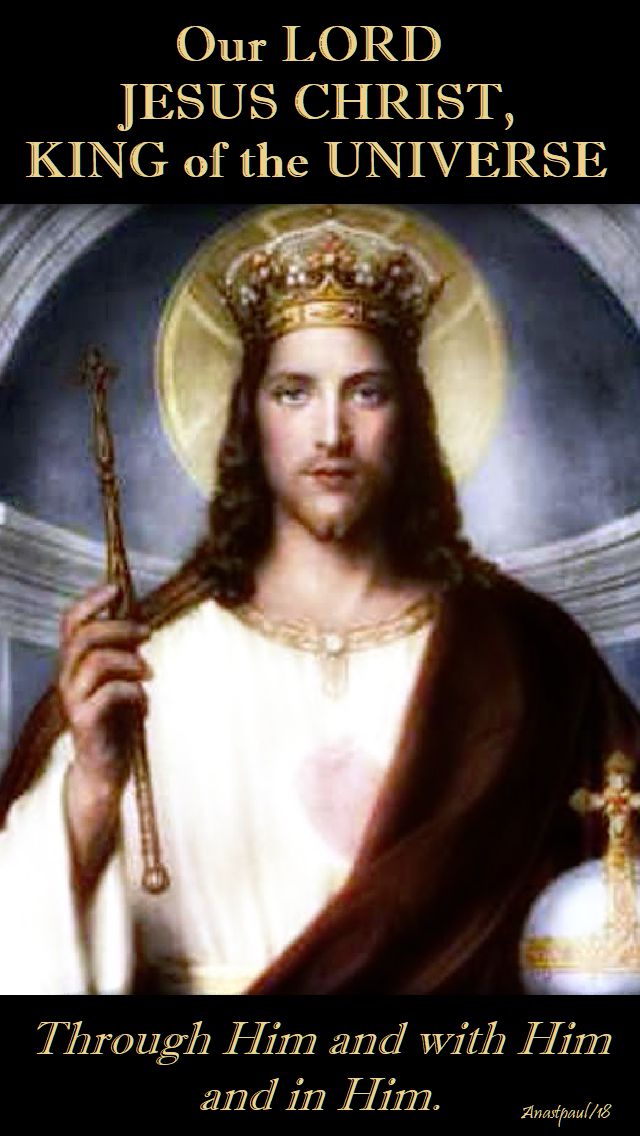
One Minute Reflection – 25 November – The Solemnity of Our Lord Jesus Christ, King of the Universe

One Minute Reflection – 25 November – Today’s Gospel: John 18:33–37 – The Solemnity of Our Lord Jesus Christ, King of the Universe

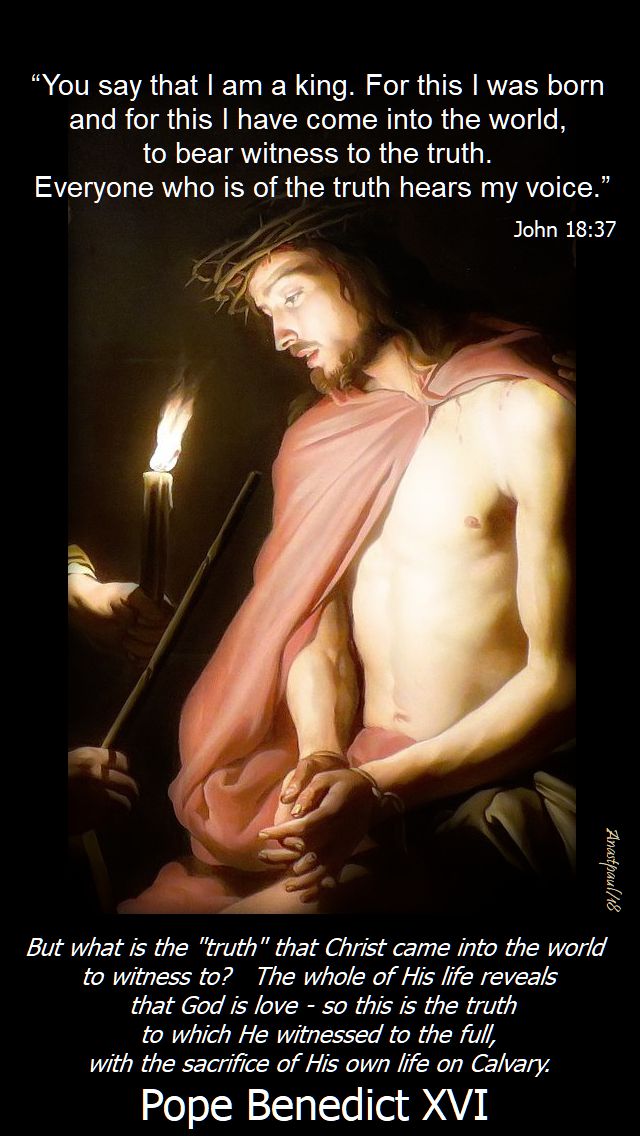
“You say that I am a king.   For this I was born and for this I have come into the world, to bear witness to the truth.   Everyone who is of the truth hears my voice.”...John 18:37

REFLECTION – “But what is the “truth” that Christ came into the world to witness to?   The whole of His life reveals that God is love – so this is the truth to which He witnessed to the full, with the sacrifice of His own life on Calvary.
The Cross is the “throne” where He manifested His sublime kingship as God Love, by offering Himself in expiation for the sin of the world, He defeated the “ruler of this world” (Jn 12: 31) and established the Kingdom of God once and for all.   It is a Kingdom that will be fully revealed at the end of time, after the destruction of every enemy and last of all, death (cf. I Cor 15: 25-26).   The Son will then deliver the Kingdom to the Father and God will finally be “everything to everyone” (I Cor 15: 28).
The way to reach this goal is long and admits of no short cut, indeed, every person must freely accept the truth of God’s love.   He is Love and Truth and neither Love nor Truth are ever imposed, they come knocking at the doors of the heart and the mind and where they can enter they bring peace and joy.   This is how God reigns, this is His project of salvation, a “mystery” in the biblical sense of the word, a plan that is gradually revealed in history.”….Pope Benedict XVI 26 November 2006john 18 37 - for this i was born - but what is this truth - pope benedict - 25 nov 2018 - christ the king

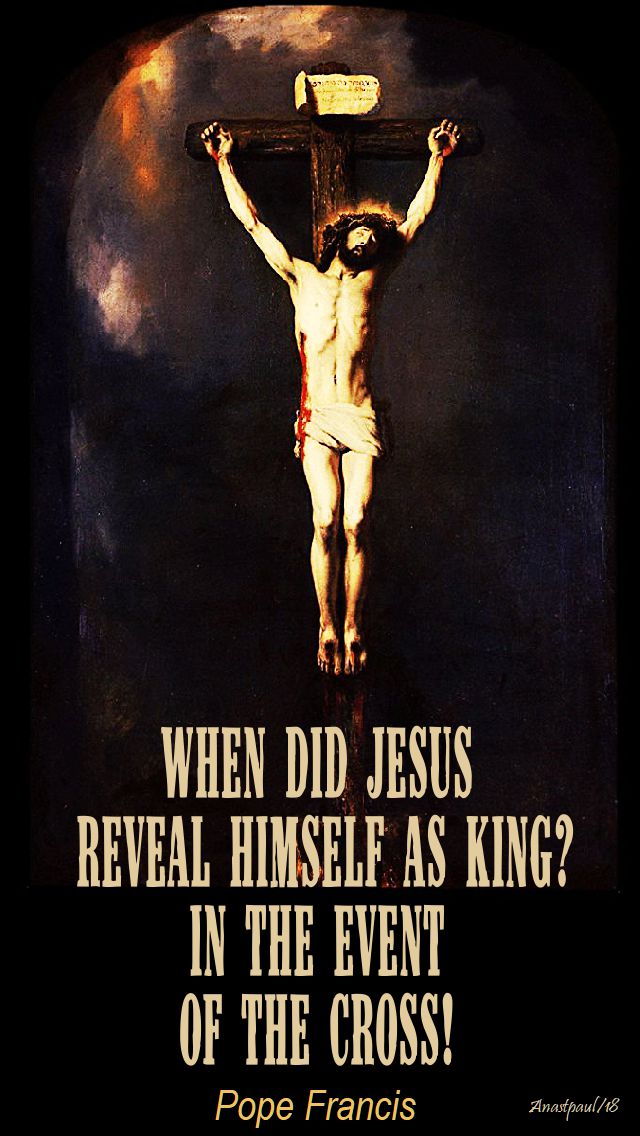
“When did Jesus reveal Himself as king?   In the event of the Cross!   Those who look at the Cross cannot but see the astonishing gratuitousness of love.   One of you could say, “Father, that was a failure!”.   It is precisely in the failure of sin — sin is a failure — in the failure of human ambitions – the triumph of the Cross is there, the gratuitousness of love is there.   In the failure of the Cross, love is seen, a love that is gratuitous, which Jesus gives us.”…Pope Francis – Angelus, 22 November 2015when did jesus reveal himself as king - pope francis - 25 nov 2018 christ the king no 2

PRAYER – Lord God, You gave the peoples of the world as the inheritance of Your only Son;  You crowned Him as King of Zion, Your holy city and gave Him Your Church to be His Bride.   As He proclaims the law of Your eternal kingdom, may we serve Him faithfully and so share His royal power forever.   We make our prayer, through Him and with Him and in Him, our King and our Redeemer, with the Holy Spirit, God forever, amen.our lord jesus christ king of the universe - 25 nov 2018.no 2

Posted in CATHOLIC Quotes, MORNING Prayers, PRACTISING CATHOLIC, QUOTES on UNITY/with GOD, SUNDAY REFLECTIONS, The HOLY EUCHARIST / The HOLY MASS

Sunday Reflection – 11 November – “Standing before the Lord” – Pope Benedict XVI

Sunday Reflection – 11 November

“Standing before the Lord” (Excerpt)

Pope Benedict XVI

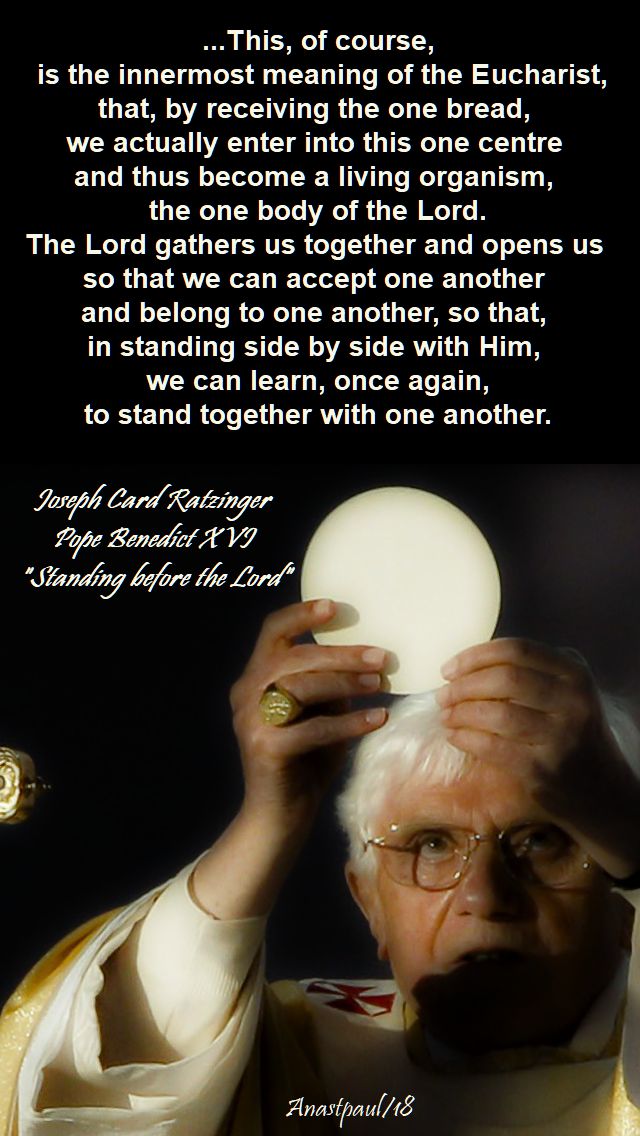
In the Church of former times, the word for this was statio. …From the very beginning, when Christianity spread throughout the world, its heralds laid the greatest importance on there being only one bishop and only one altar in every town.   This was meant to express the unity of the one Lord, who unites us all in His embrace from the Cross, an embrace that goes beyond the frontiers drawn by earthly life and forms us into one body. And this, of course, is the innermost meaning of the Eucharist, that, by receiving the one bread, we actually enter into this one centre and thus become a living organism, the one body of the Lord.
The Eucharist is not a private matter among friends, taking place in a club of like-minded people where congenial spirits meet together.   On the contrary, just as the Lord allowed Himself to be crucified publicly outside the city walls, stretching out His hands to all, the Eucharist is the public worship celebrated by all, whom the Lord calls….
It was fundamental to the Eucharist in the Mediterranean world, which first saw the growth of Christianity, that the aristocrat who had found his way to Christianity should sit down with the Corinthian dock-worker, the miserable slave who, according to Roman law, was not even held to be a human being and was dealt with as chattel.   It is of the very nature of the Eucharist, that the philosopher should sit beside the illiterate man, the converted prostitute and the converted tax-collector beside the ascetic who has found his way to Jesus Christ.
In Rome, for instance, even during the era of persecution, the titular churches came into being as predecessors of the later parishes…..the Eucharist continued to unite people who would otherwise not mix.   Consequently, the statio was introduced – here, particularly during Lent, the Pope, as the single Bishop of Rome, goes among the individual titular churches and celebrates the liturgy for the whole city of Rome.
Christians gather together and go to church together, thus, in the individual churches, the whole Church is visible and is manifest at the individual level.
The Lord gathers us together and opens us so that we can accept one another and belong to one another, so that, in standing side by side with Him, we can learn once again to stand together with one another. ….What binds us together is not the private interest of this or that group but the interest which God takes in us.   And we can calmly and confidently, entrust all our interests to Him.   We commit ourselves to the Lord.   And the more we commit ourselves to the Lord and stand before Him, the more we stand together with one another and the more power we discover to understand each other, to recognise each other as human beings, as brothers and sisters.   In this way, in this fellowship with one another, we are building the foundations for humanity and making it possible.

Joseph Card Ratzinger/Pope Benedict XVI “Seek that Which is Above”this of course is the innermost meaning of the eucharist - sun reflection - 11 nov 2018

Posted in FEASTS and SOLEMNITIES, PAPAL SERMONS, SAINT of the DAY, The BLESSED VIRGIN MARY

Thought for the Day – 9 November – Pope Benedict on the Feast of the Dedication of St John Lateran

Thought for the Day – 9 November – Pope Benedict on the Feast of the Dedication of St John Lateran

In a sense, St John Lateran is the parish church of all Catholics, because it is the pope’s cathedral.   This church, is the spiritual home, of the people who are the Church.

Excerpt of Pope Benedict’s

Angelus Address 9 November 2008

“The Word of God during this Solemnity recalls an essential truth – the stone temple is the symbol of the living Church, the Christian community, that the Apostles Peter and Paul had, in their Letters, already understood as a “spiritual building”, constructed by God with the “living stones” that are the Christians, upon the one foundation that is Jesus Christ, who is in turn compared to the “cornerstone” cf. 1 Cor 3: 9-11, 16-17; 1 Pt 2: 4-8; Eph 2: 20-22).   “Brethren,… you are God’s building”, St Paul writes and he adds, “God’s temple is holy, and you are that temple” (1 Cor 3: 9c, 17).

The beauty and the harmony of churches, destined to render praise to God, invites us human beings too, though limited and sinful, to convert ourselves to form a “cosmos”, a well-ordered construction, in close communion with Jesus, who is the true Holy of Holies.   This reaches its culmination in the Eucharistic liturgy, in which the “ecclesia” that is, the community of baptised finds itself again united to listen to the Word of God and nourish itself on the Body and Blood of Christ.   Gathered around this twofold table, the Church of living stones builds herself up in truth and in love and is moulded interiorly by the Holy Spirit, transforming herself into what she receives, conforming herself ever more to her Lord Jesus Christ.   She herself, if she lives in sincere and fraternal unity, thus becomes a spiritual sacrifice pleasing to God.

Dear friends, today’s feast celebrates an ever current mystery – that God desires to build himself a spiritual temple in the world, a community that adores Him in spirit and truth (cf. Jn 4: 23-24).

But this occasion reminds us also of the importance of the concrete buildings in which the community gathers together to celebrate God’s praises.   Every communit,y therefore, has the duty to carefully guard their holy structures, which constitute a precious religious and historical patrimony.   For this we invoke the intercession of Mary Most Holy, so that she might help us to become, like her, a “house of God”, living temple of his love.”

gods-desire-to-build-pope-benedict-9-nov-2017

mary most holy pray for us - 9 nov 2018

Posted in CATECHESIS, franciscan OFM, MARIAN QUOTES, MARIAN TITLES, PAPAL SERMONS, SAINT of the DAY, The BLESSED VIRGIN MARY

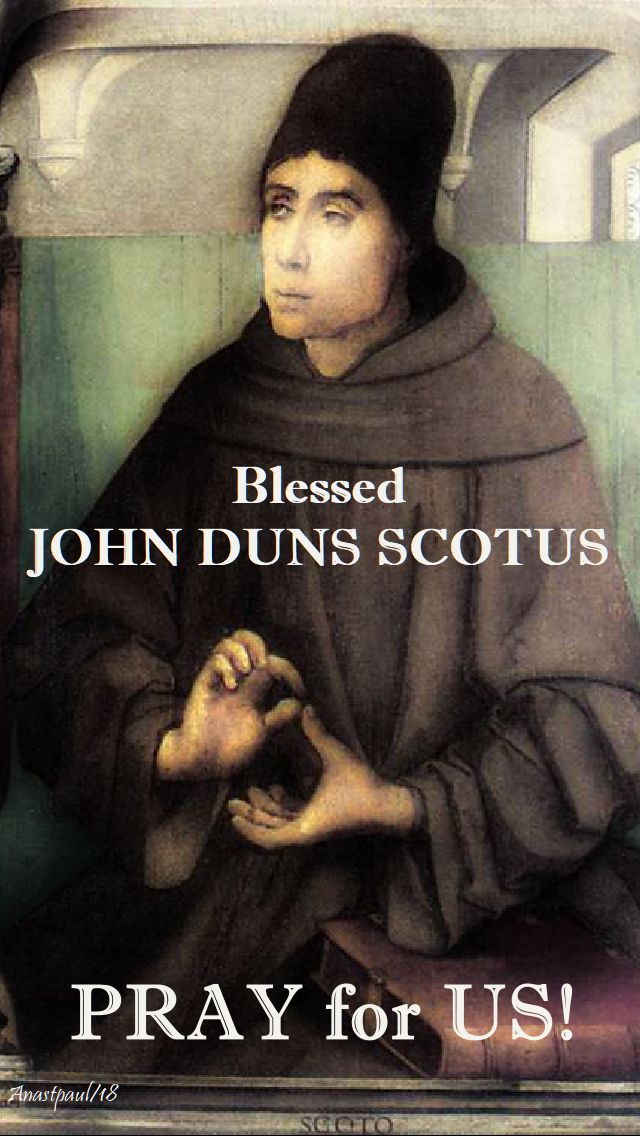
Thought for the Day – 8 November – Pope Benedict on Blessed John Duns Scotus

Thought for the Day – 8 November – The Memorial of Blessed John Duns Scotus OFM (c 1265-1308)

Excerpt from Pope Benedict XVI’s

Catechesis on Blessed John Duns Scotus
General Audience – 7 July 2010

“The Immaculate Conception”

This morning, after several Catecheses on various great theologians, I would like to present to you another important figure in the history of theology.   He is Blessed John Duns Scotus, who lived at the end of the 13th century.   An ancient epitaph on his tombstone sums up the geographical coordinates of his biography:  “Scotland bore me, England received me, France taught me, Cologne in Germany holds me”.   We cannot disregard this information, partly because we know very little about the life of Duns Scotus.   He was probably born in 1266 in a village called, precisely, “Duns”, near Edinburgh.
Attracted by the charism of St Francis of Assisi, he entered the Family of the Friars Minor and was ordained a priest in 1291.   He was endowed with a brilliant mind and a tendency for speculation, which earned him the traditional title of Doctor subtilis, “Subtle Doctor”.

Mary is the subject of the Doctor subtilis’ thought.   In the times of Duns Scotus the majority of theologians countered with an objection that seemed insurmountable, the doctrine which holds that Mary Most Holy was exempt from original sin from the very first moment of her conception – in fact, at first sight the universality of the Redemption brought about by Christ might seem to be jeopardised by such a statement, as though Mary had had no need of Christ or His redemption.   Therefore the theologians opposed this thesis.   Thus, to enable people to understand this preservation from original sin Duns Scotus developed an argument that was later, in 1854, also to be used by Bl Pope Pius IX when he solemnly defined the Dogma of the Immaculate Conception of Mary.   And this argument is that of “preventive Redemption”, according to which the Immaculate Conception is the masterpiece of the Redemption brought about by Christ because the very power of His love and His mediation obtained, that the Mother be preserved from original sin.   Therefore Mary is totally redeemed by Christ but already before her conception.   Duns Scotus’ confreres, the Franciscans, accepted and spread this doctrine enthusiastically and other theologians, often with a solemn oath, strove to defend and perfect it.

In this regard I would like to highlight a fact that I consider relevant.   Concerning the teaching on the Immaculate Conception, important theologians like Duns Scotus enriched what the People of God already spontaneously believed about the Blessed Virgin and expressed in acts of devotion, in the arts and in Christian life in general with the specific contribution of their thought.   Thus faith both in the Immaculate Conception and in the bodily Assumption of the Virgin was already present in the People of God, while theology had not yet found the key to interpreting it in the totality of the doctrine of the faith.   The People of God therefore precede theologians and this is all thanks to that supernatural sensus fidei, namely, that capacity infused by the Holy Spirit that qualifies us to embrace the reality of the faith with humility of heart and mind. In this sense, the People of God is the “teacher that goes first” and must then be more deeply examined and intellectually accepted by theology.

May theologians always be ready to listen to this source of faith and retain the humility and simplicity of children!   I mentioned this a few months ago saying: “There have been great scholars, great experts, great theologians, teachers of faith who have taught us many things.   They have gone into the details of Sacred Scripture… but have been unable to see the mystery itself, its central nucleus…. The essential has remained hidden!… On the other hand, in our time there have also been “little ones” who have understood this mystery.   Let us think of St Bernadette Soubirous; of St Thérèse of Lisieux, with her new interpretation of the Bible that is “non-scientific’ but goes to the heart of Sacred Scripture”

Dear brothers and sisters, Bl Duns Scotus teaches us that in our life the essential is to believe that God is close to us and loves us in Jesus Christ and, therefor,e to cultivate a deep love for Him and for His Church.   We on earth are witnesses of this love.   May Mary Most Holy help us to receive this infinite love of God, which we will enjoy eternally to the full in Heaven, when our soul is at last united to God for ever in the Communion of Saints.
Blessed John Duns Scotus, Pray for Us!bl john duns scotus pray for us - 8 nov 2018 no 2

Posted in CONFESSION/PENANCE, DIVINE Mercy, Goodness, Patience, EUCHARISTIC Adoration, MORNING Prayers, PAPAL SERMONS, PRACTISING CATHOLIC, QUOTES of the SAINTS, QUOTES on MERCY, SAINT of the DAY

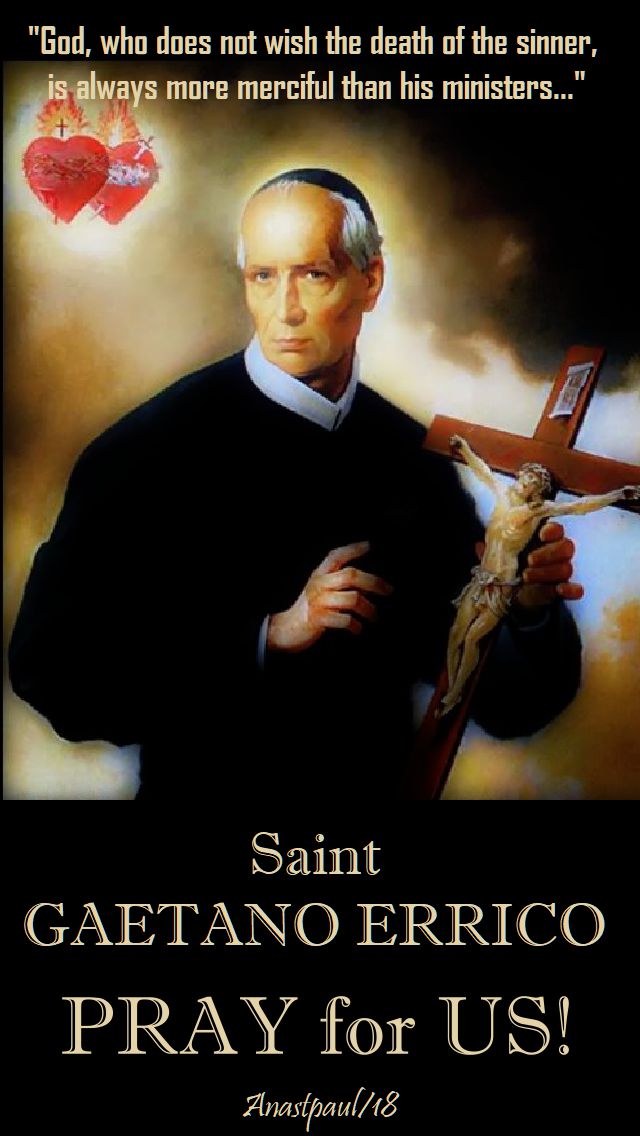
Thought for the Day – 29 October – The Memorial of St Gaetano Errico (1791-1860)

Thought for the Day – 29 October – The Memorial of St Gaetano Errico (1791-1860), Founder of the Missionaries of the Sacred Hearts of Jesus and Mary

Day by day, city to city, village to village, among both the poorest and those of high esteem, he saw the hunger each possessed to know that sin was forgiven, that God’s mercy was infinite and that they were loved.   Countless souls found a merciful listener, the embodiment of God’s promise of peace and renewal, in Fr Gaetano, in the Confessional.

“The priest, Gaetano Errico, dedicated himself to this sacrament with diligence, assiduity and patience, never refusing it nor counting the cost. He thus entered among the group of other extraordinary priests who tirelessly made the confessional a place to dispense God’s mercy, helping men to rediscover themselves, to fight against sin and make progress in the spiritual life.

The street and the confessional were the two particular places of Gaetano Errico’s pastoral work.   The street was the place that permitted him to offer his customary invitation:  “God loves you, when shall we meet?” and in the confession he made their encounter with the mercy of the heavenly Father possible.   How many wounded souls did he heal in this way! How many people did he help to be reconciled with God through the sacrament of forgiveness!

In this way St. Gaetano Errico became an expert in the “science” of forgiveness, and concerned himself with teaching it to his missionaries:   “God, who does not wish the death of the sinner, is always more merciful than his ministers;  so be as merciful as you can and you will find mercy with God!”

Pope Benedict XVI, Homily at Canonisation Mass, October 2008

He found his own encouragement on his knees in prayer . . . indeed it was prayer and the hours he spent in adoration of the Blessed Sacrament that strengthened and renewed him and kept the fire of his love for God ever burning.

Let us rediscover the great grace of the Confessional and the immense joy of Eucharistic Adoration for ourselves!

St Gaetano Errico, Pray for Us!god who does not wish the death of a sinner - st gaetano errico pray for us no 2 - 29 oct 2018

Posted in DOCTORS of the Church, FATHERS of the Church, PAPAL SERMONS, QUOTES of the SAINTS, SUNDAY REFLECTIONS, The HOLY EUCHARIST / The HOLY MASS

Sunday Reflection – 28 October – Thirtieth Sunday in Ordinary Time, Year B

Sunday Reflection – 28 October – Thirtieth Sunday in Ordinary Time, Year B

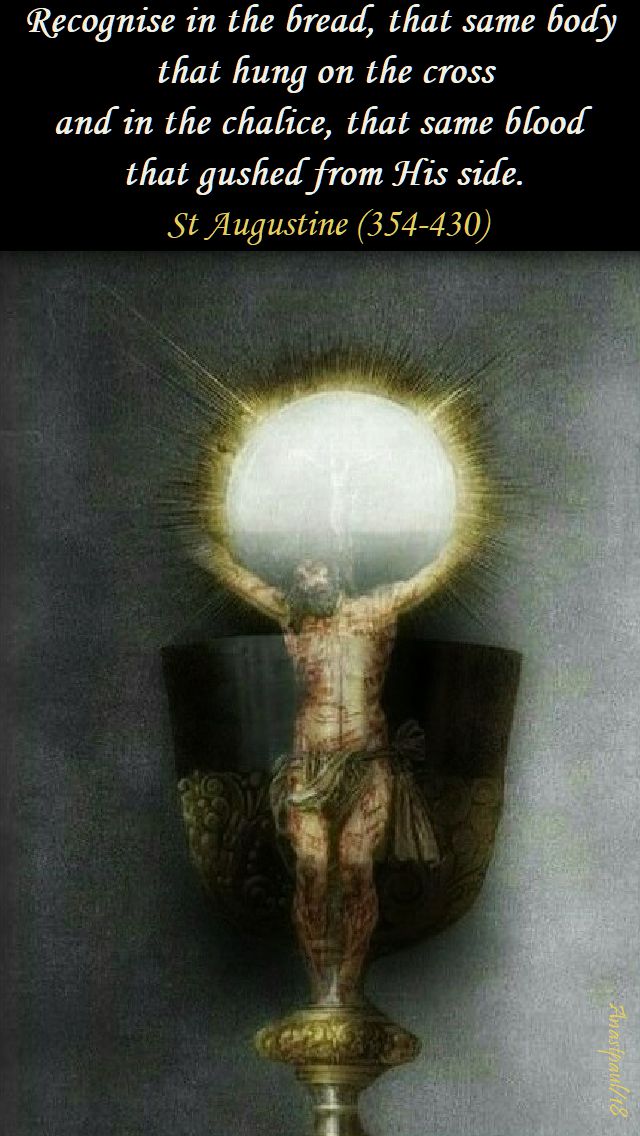
Recognise in the bread, that same body that hung on the cross 
and in the chalice, that same blood that gushed from His side.

Saint Augustine (354-430)

Transubstantiation
In the offering that Jesus makes of Himself we find all the novelty of Christian worship. In ancient times men offered in sacrifice to the divinity the animals or first fruits of the earth.   Jesus, instead, offers Himself, His body and His whole existence – He Himself, in person, becomes the sacrifice that the liturgy offers in the Holy Mass.
In fact, with the consecration of the bread and wine they become His true body and blood.
Saint Augustine invited his faithful, not to pause on what appeared to their sight but to go beyond:  “Recognise in the bread — he said — that same body that hung on the cross and in the chalice that same blood that gushed from His side” (Disc. 228 B, 2).
To explain this transformation, theology has coined the word “transubstantiation,” a word that resounded for the first time in this Basilica during the IV Lateran Council, of which in five years will be the 8th centenary.   On that occasion the following expressions were inserted in the profession of faith:  “his body and his blood are truly contained in the sacrament of the altar, under the species of bread and wine, because the bread is transubstantiated into the body and the wine into the blood by divine power” (DS, 802).
Therefore, it is essential to stress, in the itineraries of education of children in the faith, of adolescents and of young people, as well as in “centres of listening” to the Word of God, that in the sacrament of the Eucharist, Christ is truly, really and substantially present.recognise in the bread - st augustine - 28 oct 2018

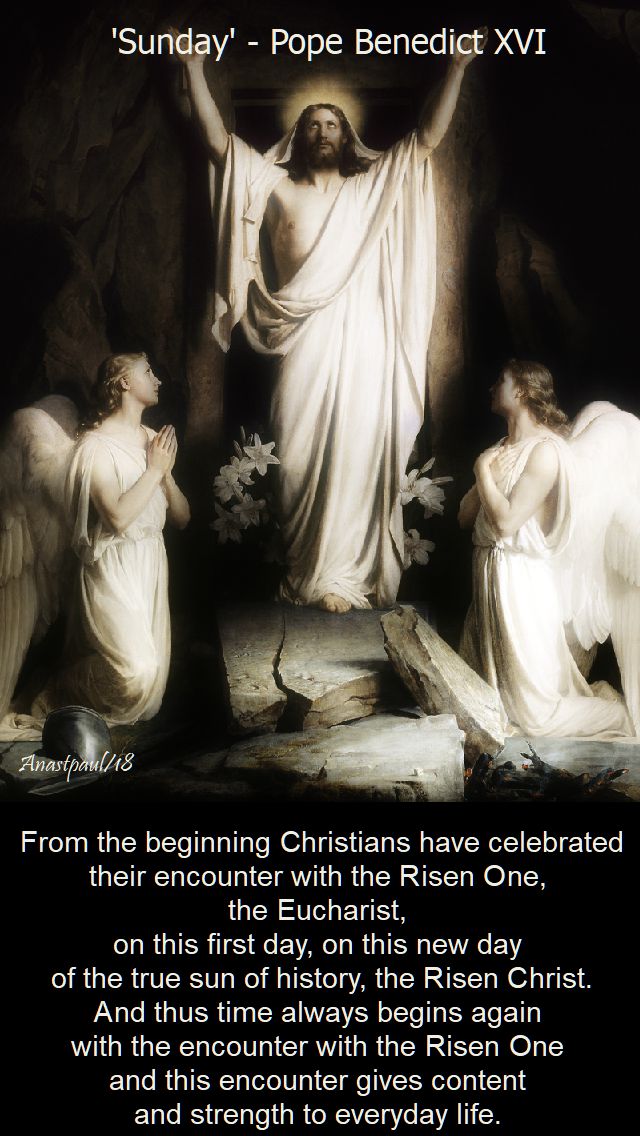
Sunday
And let us also keep present that the Eucharist, joined to the cross and resurrection of the Lord, has dictated a new structure to our time.

The Risen One was manifested the day after Saturday, the first day of the week, day of the sun and of creation.   From the beginning, Christians have celebrated their encounter with the Risen One, the Eucharist, on this first day, on this new day of the true sun of history, the Risen Christ.

And thus time always begins again with the encounter with the Risen One and this encounter gives content and strength to everyday life.   Because of this, it is very important for us Christians, to follow this new rhythm of time, to meet with the Risen One on Sunday and thus “to take” with us His presence, which transforms us and transforms our time.

Pope Benedict XVI – 17 June 2010from the beginning, Christians have celebrated - pope benedict - 28 oct 2018

Posted in DOCTORS of the Church, MARIAN QUOTES, MORNING Prayers, QUOTES of the SAINTS, QUOTES on MOTHERHOOD, SPEAKING of ....., The BLESSED VIRGIN MARY, The HOLY ROSARY/ROSARY CRUSADE

Quote/s of the Day – 27 Oct – Saturday of the Twenty Ninth week in Ordinary Time, Year B

Quote/s of the Day – 27 Oct – Saturday of the Twenty Ninth week in Ordinary Time, Year B

Speaking of:  Marian Gems

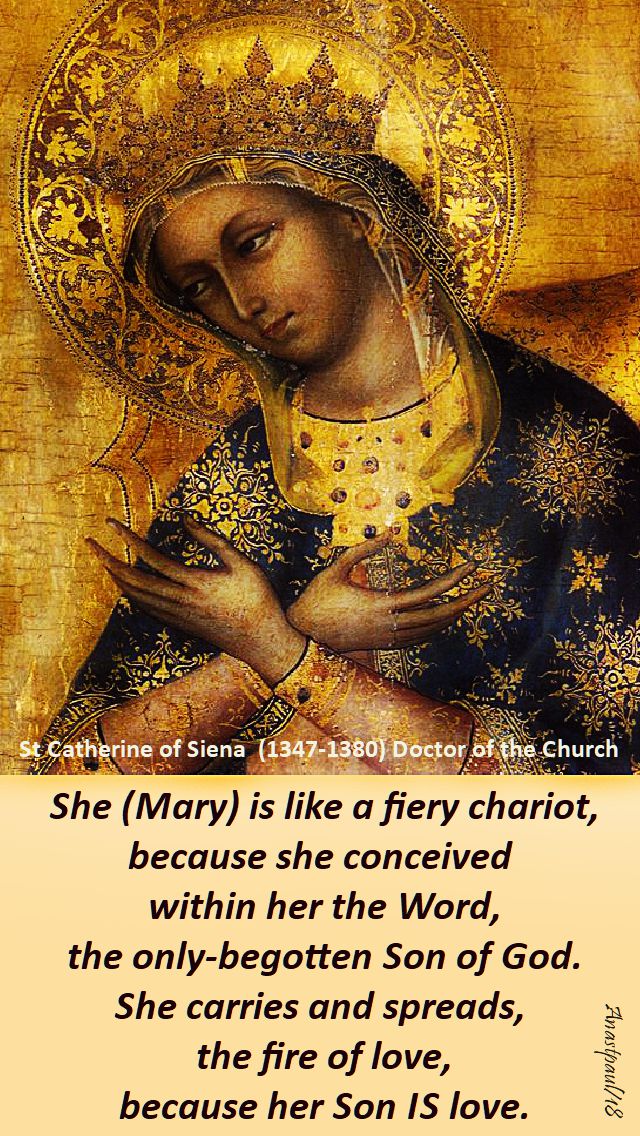
“She (Mary) is like a fiery chariot,
because she conceived within her the Word,
the only-begotten Son of God.
She carries and spreads,
the fire of love,
because her Son IS love.”

St Catherine of Siena (1347-1380) Doctor of the Churchshe mary is like a fiery chariot - st catherine of asiena - 27 oct 2018

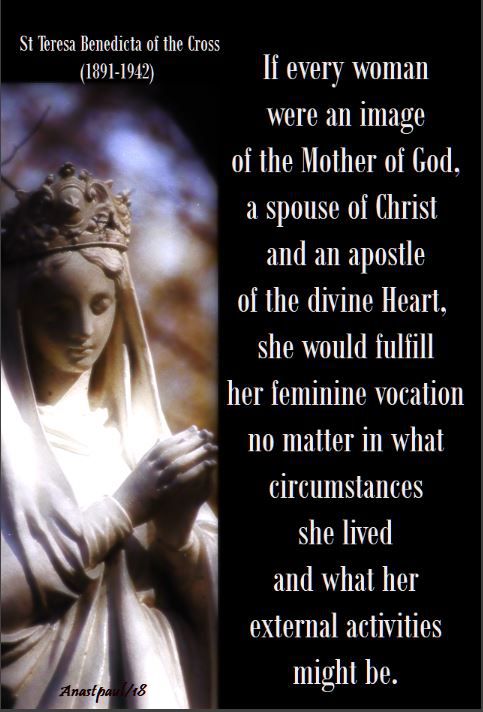
“If every woman were an image
of the Mother of God, a spouse of Christ
and an apostle of the divine Heart,
she would fulfil her feminine vocation
no matter in what circumstances she lived
and what her external activities might be.”

St Teresa Benedicta of the Cross/Edith Stein (1891-1942)

if every woman - st teresa benedicta no 2 - 27 oct 2018

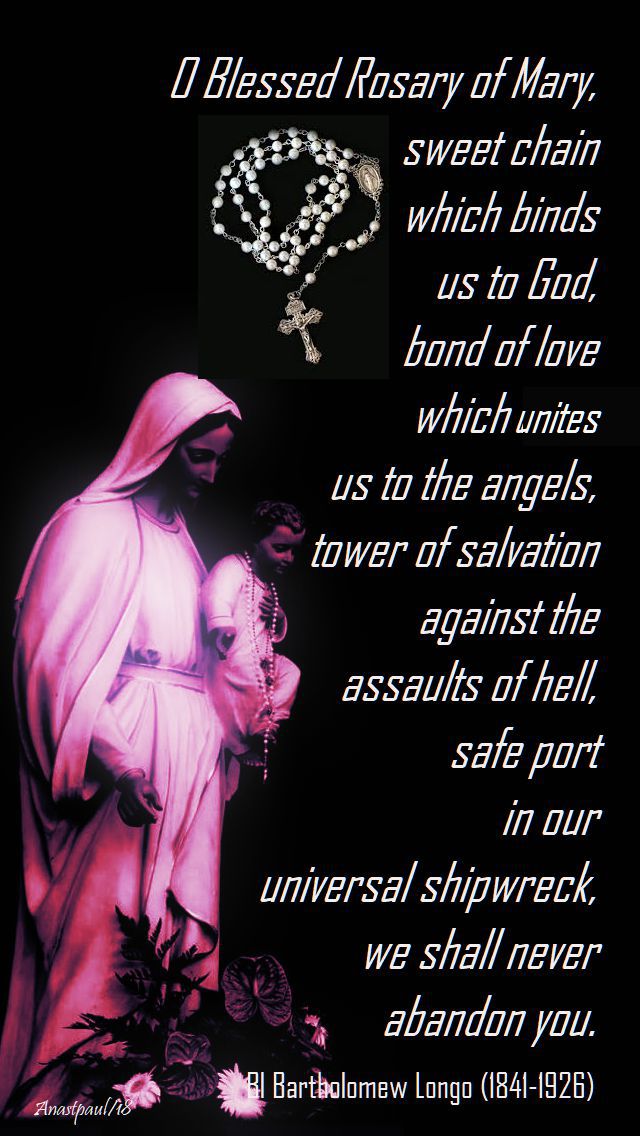
“O Blessed Rosary of Mary,
sweet chain which binds us to God,
bond of love which unites us to the angels,
tower of salvation against the assaults of hell,
safe port in our universal shipwreck,
we shall never abandon you.”

Bl Bartholomew Longo (1841-1926)o blessed rosary - bl bartholomew longo - 27 oct 2018

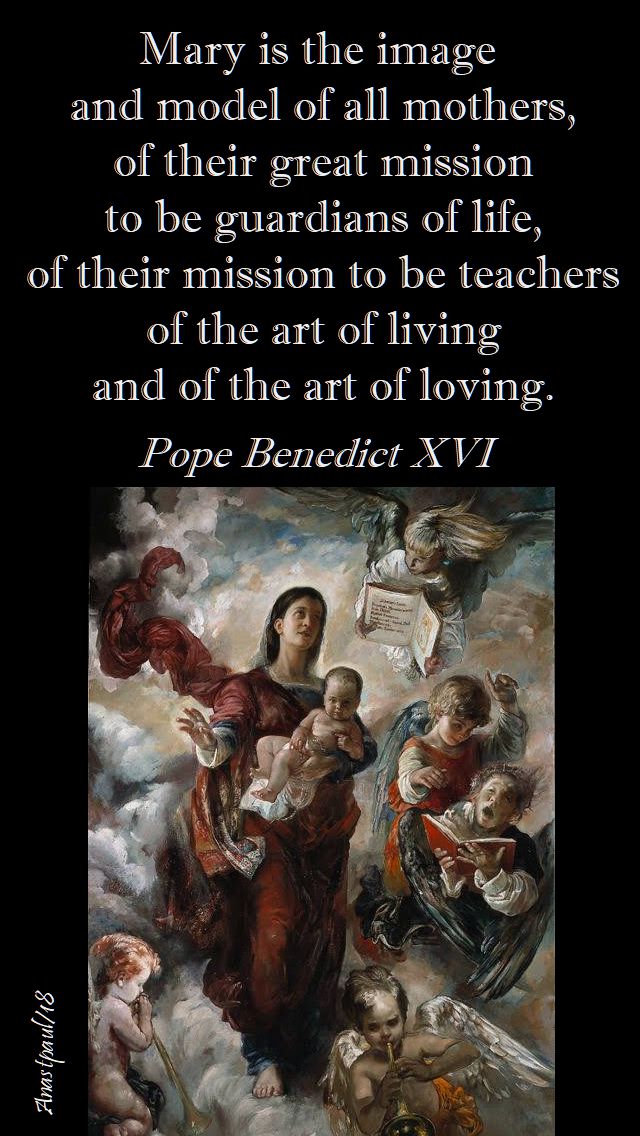
“Mary is the image and model of all mothers,
of their great mission to be guardians of life,
of their mission to be teachers
of the art of living
and of the art of loving.”

Pope Benedict XVImary is the image and model of all mothers - pope benedict - 27 oct 2018

Posted in Our MORNING Offering, PAPAL PRAYERS, The HOLY FACE

Our Morning Offering – 26 October

Our Morning Offering – 26 October

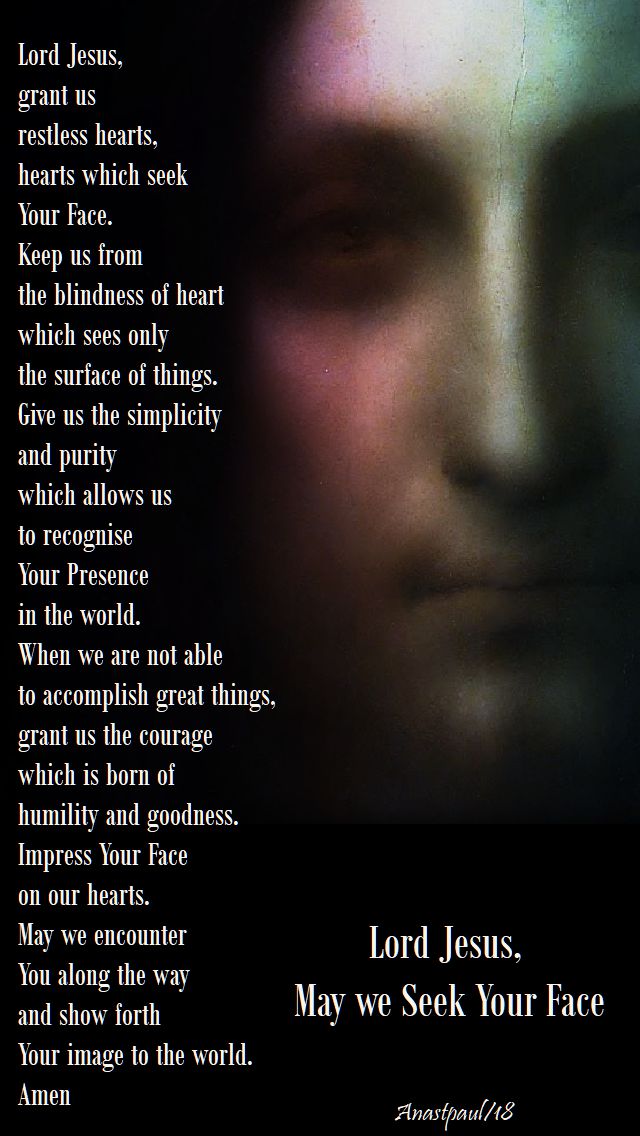
Lord Jesus, May we Seek Your Face
By Pope Benedict XVI

Lord Jesus,
grant us restless hearts,
hearts which seek Your Face.
Keep us from the blindness of heart
which sees only the surface of things.
Give us the simplicity and purity
which allows us to recognise
Your Presence in the world.
When we are not able
to accomplish great things,
grant us the courage
which is born of humility and goodness.
Impress Your Face on our hearts.
May we encounter You along the way
and show forth Your image to the world.
Amenlord jesus may we seek your face - pope benedict - DA VINCI FACE OF CHRIST no 2 - 26 oct 2018

Posted in MORNING Prayers, PAPAL SERMONS, QUOTES of the SAINTS, QUOTES on DEATH, QUOTES on ETERNAL LIFE, SAINT of the DAY, The WORD

One Minute Reflection – 22 October – Today’s Gospel: Luke 12:13–21

One Minute Reflection – 22 October – Today’s Gospel:  Luke 12:13–21 – Monday of the Twenty Ninth week in Ordinary Time, Year B and The Memorial of St Pope John Paul II (1920-2005)

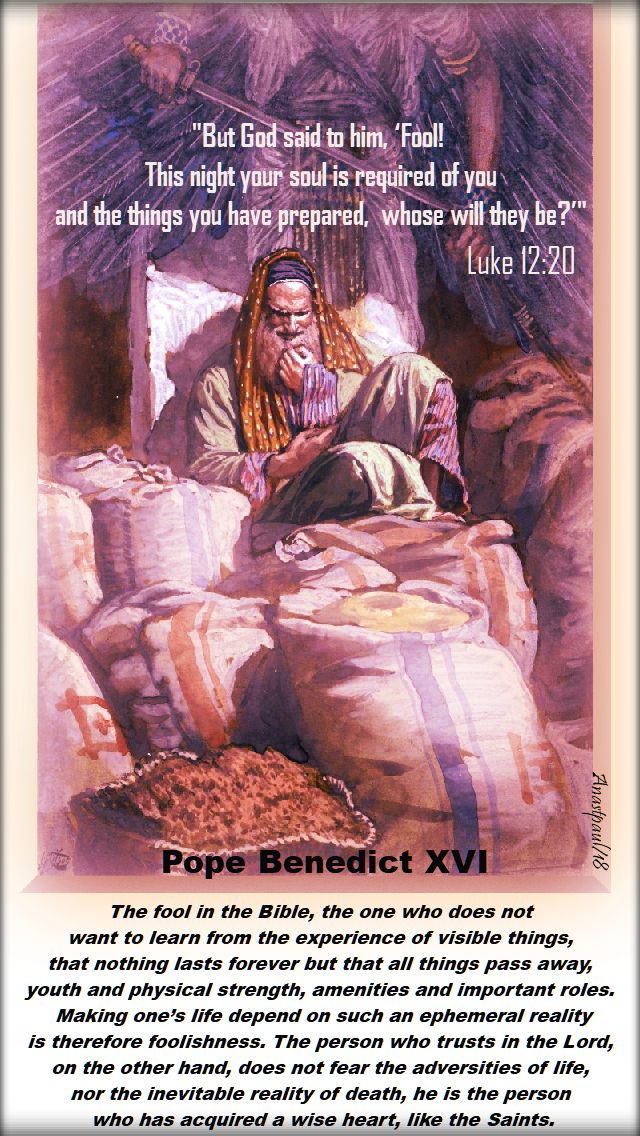
“But God said to him, ‘Fool!   This night your soul is required of you and the things you have prepared, whose will they be?’“…Luke 12:20

REFLECTION – “The fool in the Bible, the one who does not want to learn from the experience of visible things, that nothing lasts forever but that all things pass away, youth and physical strength, amenities and important roles.   Making one’s life depend on such an ephemeral reality is therefore foolishness.   The person who trusts in the Lord, on the other hand, does not fear the adversities of life, nor the inevitable reality of death, he is the person who has acquired a wise heart, like the Saints.”…Pope Benedict XVI – Angelus 1 August 2010but god said to him - luke 12 20 - the fool in the bible - pope benedict - 22 oct 2018

“The rich man, clinging to his immense fortune, is convinced that he will succeed in overcoming death….Indeed, like all other men and women, rich and poor, wise and foolish alike, he is doomed to end in the grave, as happens likewise to the powerful and he will have to leave behind on earth that gold so dear to him and those material possessions he so idolised.” – St Pope John Paul II 20 October 2004but god said to him fool - luke 12 20 - the rich man - st john paul - 22 oct 2018

PRAYER – Almighty ever-living God, grant that we may always conform our will to Yours and serve Your majesty in sincerity of heart. Teach us to lay up riches in heaven and may the prayers of St John Paul assist us in our daily struggles against the idols of the world. Through our Lord Jesus Christ, Your Son, who lives and reigns with You in the unity of the Holy Spirit, one God, forever and ever, amen.st pope john paul pray for us 22 oct 2018

Posted in MORNING Prayers, NOVENAS, PAPAL SERMONS, QUOTES of the SAINTS, QUOTES on MERCY, QUOTES on the CROSS of CHRIST, The HOLY CROSS, The RESURRECTION

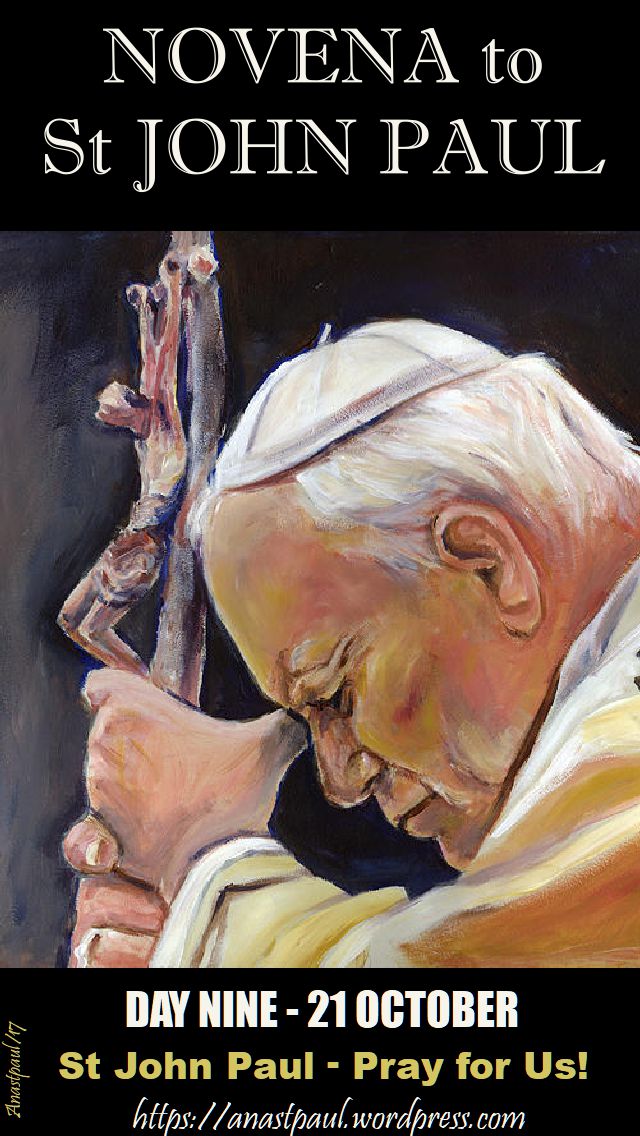
NOVENA to St John Paul the Great: DAY NINE – 21 OCTOBER

NOVENA to St John Paul the Great: DAY NINE – 21 OCTOBER

Little Known Fact #9:   While visiting the United States in 1976, Cardinal Karol Wojtyla spent a few days in Pomfret, Vermont with philosopher Anna-Teresa Tymieniecka and her family.   His main purpose was to work on the English translation of Osobo I Czyn (The Acting Person) but he also used it as a time to relax and enjoy nature.  For example, he was often late for lunch because he had been swimming in the neighbour’s pond. Additionally, he didn’t want to be treated like a guest but instead insisted that he cut the grass and help bale hay.   He was truly in his element in Vermont and remarked that it reminded him of the Tatras in Poland.   Wojtyla spent most of his time outdoors, working on the English translation while sitting on the trunk of a tree that had fallen.

REFLECTION:   “This was his message:  man is the way of the Church and Christ is the way of man.  With this message, which is the great legacy of the Second Vatican Council and of its “helmsman”, the Servant of God Pope Paul VI, John Paul II led the People of God across the threshold of the Third Millennium, which thanks to Christ he was able to call “the threshold of hope”.   Throughout the long journey of preparation for the great Jubilee he directed Christianity once again to the future, the future of God, which transcends history while nonetheless directly affecting it.   He rightly reclaimed for Christianity that impulse of hope which had in some sense faltered before Marxism and the ideology of progress.  He restored to Christianity its true face as a religion of hope, to be lived in history in an “Advent” spirit, in a personal and communitarian existence directed to Christ, the fullness of humanity and the fulfillment of all our longings for justice and peace.”   Pope Benedict XVI at the Beatification Ceremonyday-nine-novena-st-john-paul-21-oct

Let us Pray:

O Holy Trinity, we thank You for having given to the Church Pope John Paul II and for having made him shine with Your fatherly tenderness, the glory of the Cross of Christand the splendour of the Spirit of love.

He, trusting completely in Your infinite mercy and in the maternal intercession of Mary, has shown himself in the likeness of Jesus the Good Shepherd and has pointed out to us the way of holiness as the path to reach eternal communion with You Grant us, through his intercession, according to Your will, the grace that we implore,

………………….. [state your intention here].

Continue, beloved St John Paul, we implore you, to sustain from heaven the faith of God’s people. We praise and thank You Father that St John Paul has been numbered among Your saints and make our prayer through our Lord Jesus Christ with the Holy Spirit, one God forever.

Totus Tuus, Amen.

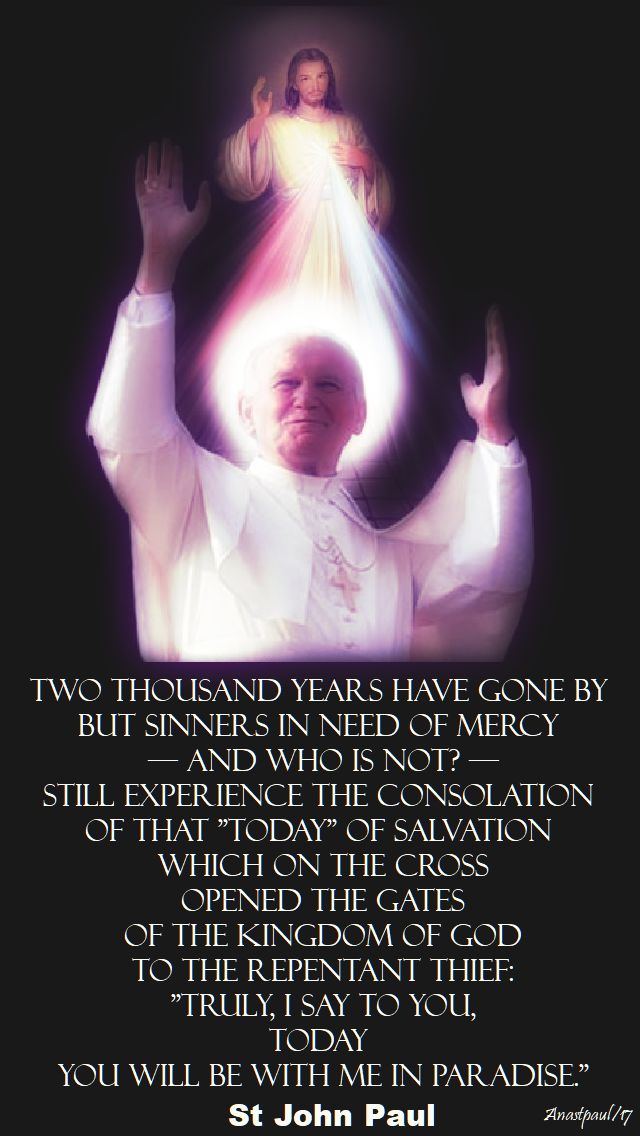
Quote Day 9:   “Two thousand years have gone by but sinners in need of mercy — and who is not? — still experience the consolation of that “today” of salvation which on the Cross opened the gates of the Kingdom of God to the repentant thief: “Truly, I say to you, today you will be with me in Paradise” (Lk 23:43).” St John Paultwo-thousand-years-st-john-paul-21-oct-2017-no-1

Posted in MORNING Prayers, NOVENAS, PAPAL SERMONS, QUOTES of the SAINTS

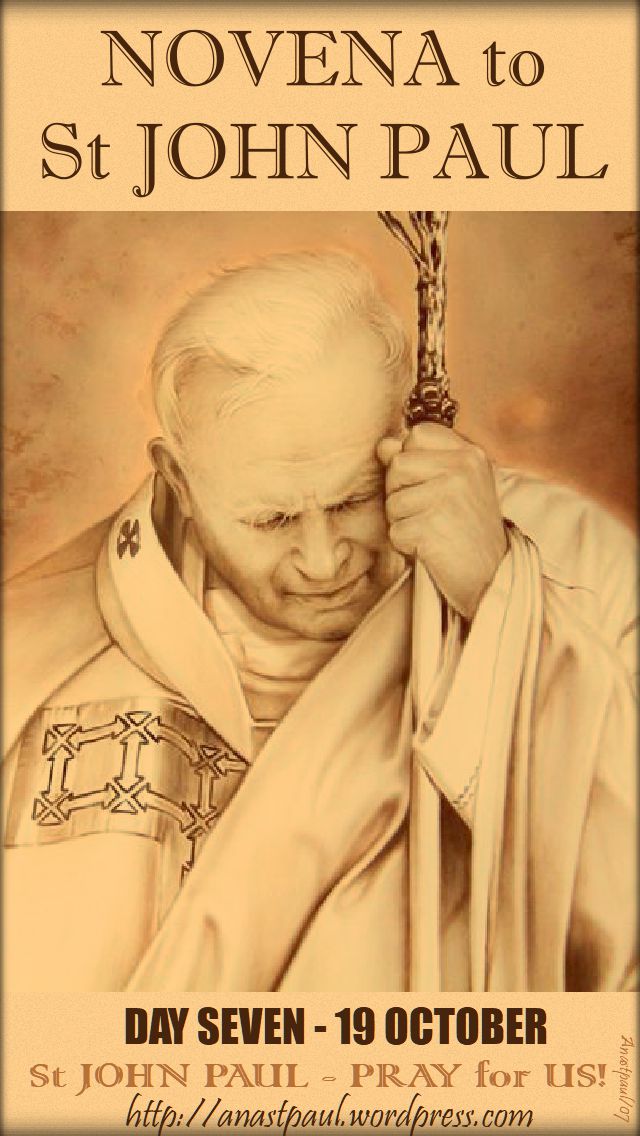
NOVENA to St John Paul the Great: DAY SEVEN – 19 OCTOBER

NOVENA to St John Paul the Great: DAY SEVEN – 19 OCTOBER

Little Known Fact #7:  While he was Bishop of Kraków, Karol Wojtyla visited many of sick people in his archdiocese during the Lenten season.   Additionally, whenever he visited parishes he always visited the parishioners who were most gravely ill in their homes.   This also extended to every convent he visited, whereby he would always visit the sisters in the infirmary.   He did all of this not only to minister to their needs but also to ask for their prayers. He told one group of sisters:
Although I am young and strong, although I fly in airplanes, climb mountains, ski, I still turn to the weakest, so that by the riches of their suffering they may bring down the strength and power of the Holy Spirit and the blessing of God upon my work in the Archdiocese.”

REFLECTION:   “Blessed are those who have not seen and yet have come to believe” (Jn 20:29). In today’s Gospel Jesus proclaims this beatitude: the beatitude of faith.   For us, it is particularly striking because we are gathered to celebrate a beatification but even more so because today the one proclaimed blessed is a Pope, a Successor of Peter, one who was called to confirm his brethren in the faith.   John Paul II is blessed because of his faith, a strong, generous and apostolic faith.   We think at once of another beatitude: “Blessed are you, Simon, son of Jonah!   For flesh and blood has not revealed this to you, but my Father in heaven” (Mt 16:17).   What did our heavenly Father reveal to Simon?   That Jesus is the Christ, the Son of the living God.   Because of this faith, Simon becomes Peter, the rock on which Jesus can build his Church.   The eternal beatitude of John Paul II, which today the Church rejoices to proclaim, is wholly contained in these sayings of Jesus:  “Blessed are you, Simon” and “Blessed are those who have not seen and yet have come to believe!”   It is the beatitude of faith, which John Paul II also received as a gift from God the Father for the building up of Christ’s Church.” ….. Pope Benedict XVI on the Beatification of St John Paul.day-seven-novena-st-john-paul-19-oct-2017

Let us Pray:

O Holy Trinity, we thank You for having given to the Church Pope John Paul II and for having made him shine with Your fatherly tenderness, the glory of the Cross of Christand the splendour of the Spirit of love.

He, trusting completely in Your infinite mercy and in the maternal intercession of Mary, has shown himself in the likeness of Jesus the Good Shepherd and has pointed out to us the way of holiness as the path to reach eternal communion with You Grant us, through his intercession, according to Your will, the grace that we implore,

………………….. [state your intention here].

Continue, beloved St John Paul, we implore you, to sustain from heaven the faith of God’s people. We praise and thank You Father that St John Paul has been numbered among Your saints and make our prayer through our Lord Jesus Christ with the Holy Spirit, one God forever.

Totus Tuus, Amen.

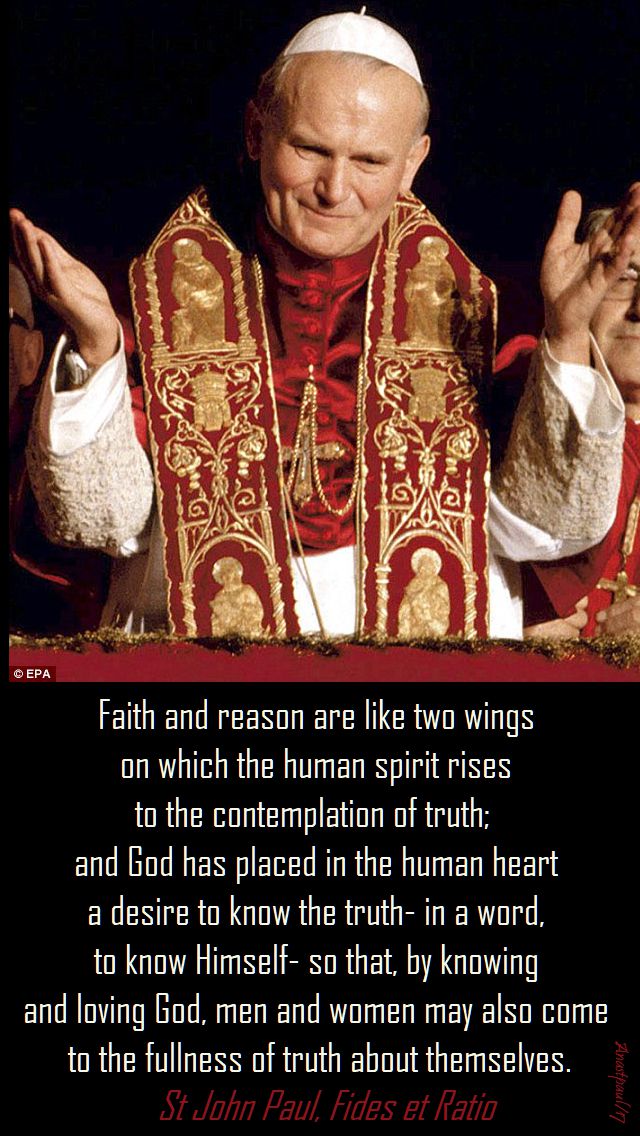
Quote Day Seven:   “Faith and reason are like two wings on which the human spirit rises to the contemplation of truth; and God has placed in the human heart a desire to know the truth- in a word, to know Himself- so that, by knowing and loving God, men and women may also come to the fullness of truth about themselves.”  ― John Paul II, Fides et Ratio: On the Relationship Between Faith and Reasonfaith-and-reason-st-john-paul-19-oct-2017

Posted in MARIAN QUOTES, MORNING Prayers, NOVENAS, ON the SAINTS, PAPAL SERMONS, QUOTES of the SAINTS, The BLESSED VIRGIN MARY

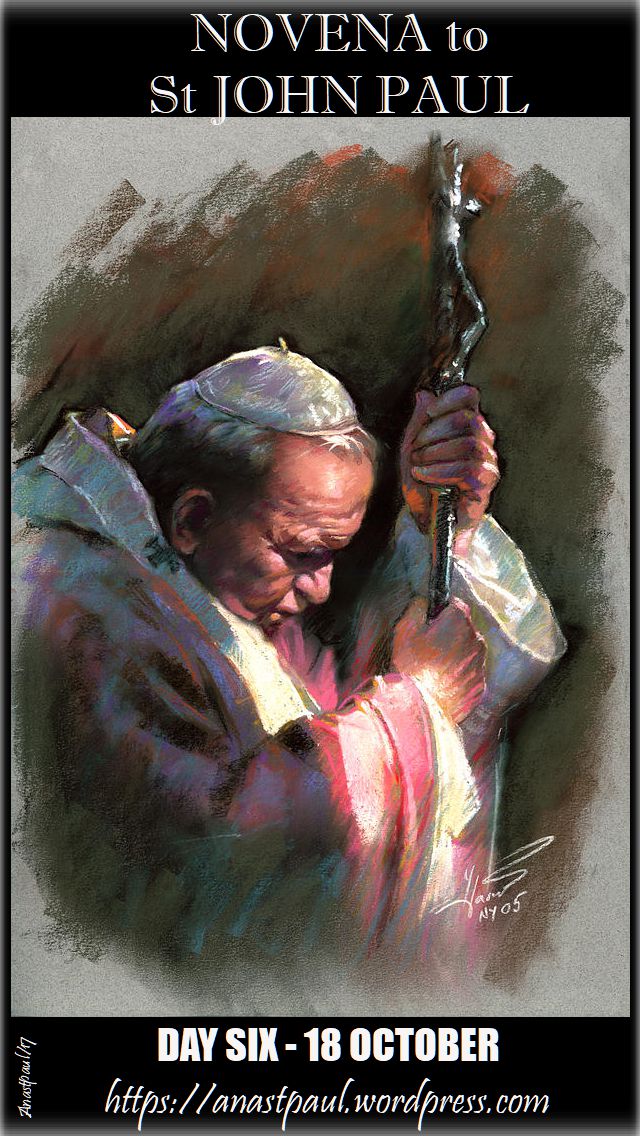
NOVENA to St John Paul the Great: DAY SIX – 18 OCTOBER

NOVENA to St John Paul the Great: DAY SIX – 18 OCTOBER

Little Known Fact #6:   In 1954, Father Karol Wojtyla was awarded a “Bronze Badge for Hiking Tourism.” Wojtyla won this badge for hiking on foot on multiple occasions during that year, totalling 166 km (103 miles).   More than half of these excursions were completed during the winter (November 1 – March 31).   Needless to say, Father Wojtyla enjoyed hiking.

REFLECTION:   “Divine Mercy: the Holy Father found the purest reflection of God’s mercy in the Mother of God.   He, who at an early age had lost his own mother, loved his divine mother all the more.   He heard the words of the crucified Lord as addressed personally to him:  “Behold your Mother.”   And so he did as the beloved disciple did:   he took her into his own home” (eis ta idia: Jn 19:27) – Totus tuus.   And from the mother he learned to conform himself to Christ.” – Pope Benedictday-six-novena-st-john-paul-18-oct-2017

Let us Pray:

O Holy Trinity, we thank You for having given to the Church Pope John Paul II and for having made him shine with Your fatherly tenderness, the glory of the Cross of Christand the splendour of the Spirit of love.

He, trusting completely in Your infinite mercy and in the maternal intercession of Mary, has shown himself in the likeness of Jesus the Good Shepherd and has pointed out to us the way of holiness as the path to reach eternal communion with You Grant us, through his intercession, according to Your will, the grace that we implore,

………………….. [state your intention here].

Continue, beloved St John Paul, we implore you, to sustain from heaven the faith of God’s people. We praise and thank You Father that St John Paul has been numbered among Your saints and make our prayer through our Lord Jesus Christ with the Holy Spirit, one God forever.

Totus Tuus, Amen.

Quote Day Six:   “Mary, who was present on the day of Pentecost, at the beginning of the life of the Church, with the Apostles, disciples and pious women, always remains present in the Church, she, the first woman missionary, is Mother and support, of all those who proclaim the Gospel!” (Rome, 12 Oct 1979)mary who was present on the day of pentecost - 18 oc 2018

Posted in MORNING Prayers, NOVENAS, QUOTES of the SAINTS, QUOTES on DEATH, QUOTES on PEACE, QUOTES on PRAYER

NOVENA to St John Paul the Great: DAY FIVE – 17 OCTOBER

NOVENA to St John Paul the Great: DAY FIVE – 17 OCTOBER

Little Known Fact #5:  Father Karol Wojtyla was only 38 when he was made a Bishop.   It did not change his lifestyle at all.   True, instead of walking everywhere he had a bicycle  and even a rather ancient car and chauffeur to get around the diocese and in order not to waste time, he had a table and a light fixed into the car, to allow him to read and work on necessary journeys.

REFLECTION:  ” ………reflecting on the assassination attempt, he said: “In sacrificing himself for us all, Christ gave a new meaning to suffering, opening up a new dimension, a new order:  the order of love … It is this suffering which burns and consumes evil with the flame of love and draws forth even from sin a great flowering of good” (pp. 189-190). Impelled by this vision, the Pope suffered and loved in communion with Christ and that is why the message of his suffering and his silence proved so eloquent and so fruitful.” – Pope Benedict at St John Paul’s Funeralday-five-novena-st-john-paul-17-oct-2917

Let us Pray:

O Holy Trinity, we thank You for having given to the Church Pope John Paul II and for having made him shine with Your fatherly tenderness, the glory of the Cross of Christand the splendour of the Spirit of love.

He, trusting completely in Your infinite mercy and in the maternal intercession of Mary, has shown himself in the likeness of Jesus the Good Shepherd and has pointed out to us the way of holiness as the path to reach eternal communion with You Grant us, through his intercession, according to Your will, the grace that we implore,

………………….. [state your intention here].

Continue, beloved St John Paul, we implore you, to sustain from heaven the faith of God’s people. We praise and thank You Father that St John Paul has been numbered among Your saints and make our prayer through our Lord Jesus Christ with the Holy Spirit, one God forever.

Totus Tuus, Amen.

Quote Day Five:  “I find great peace in thinking of the time when the Lord will call me: from life to life!   And so I often find myself saying, with no trace of melancholy, a prayer recited by priests after the celebration of the Eucharist:   In hora mortis meae voca me, et iube me venire ad te – at the hour of my death, call me and bid me come to you.  This is the prayer of Christian hope, which in no way detracts from the joy of the present, while entrusting the future to God’s gracious and loving care.”i-find-great-peace-st-john-paul-no 2 - 17-oct-2017

Posted in FATHERS of the Church, MORNING Prayers, PAPAL SERMONS, QUOTES of the SAINTS, QUOTES on UNITY/with GOD, SAINT of the DAY

Thought for the Day 17 October – St Ignatius of Antioch (c 35 – 107) Father of the Church

Thought for the Day 17 October – St Ignatius of Antioch (c 35 – 107) Father of the Church, Martyr – “Doctor of Unity”

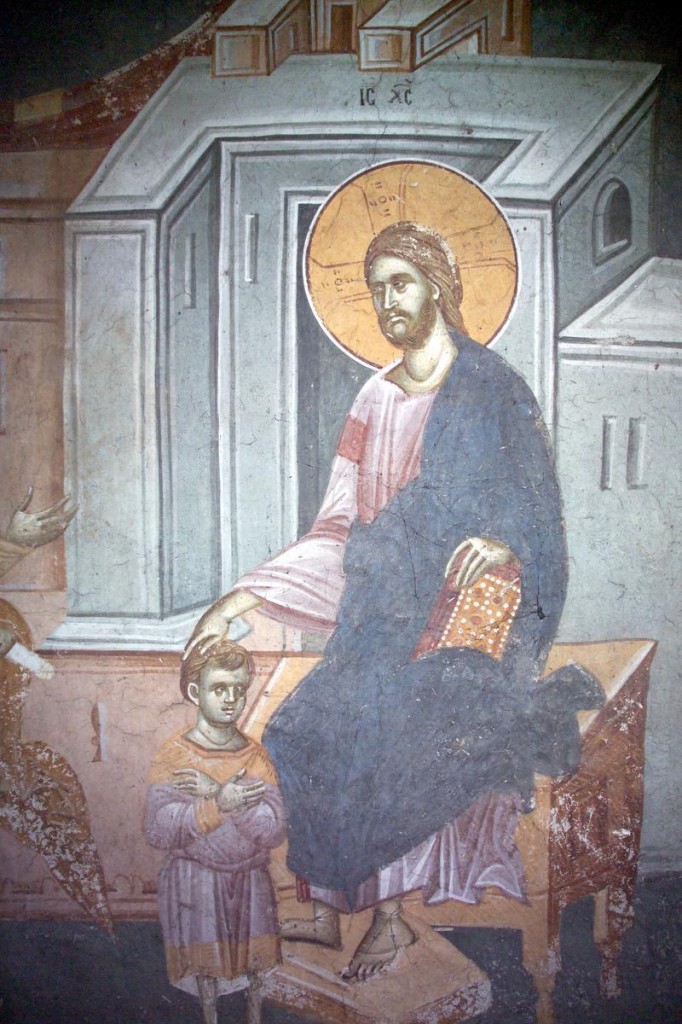
Note:  St John Chrysostom (347-407) , who grew up in Antioch, taught that St Ignatius had been ordained at the hands of St Peter.   According to ancient tradition, St Ignatius was the child whom Christ had held, as described in Matthew 18:4, as depicted in the fresco below from the Gračanica.

StIgnatiusChild-682x1024
Detail from a fresco depicting Christ picking up the child St Ignatius, from the account in the Gospel of St Matthew 18:4.

Excerpt from Pope Benedict’s Catechesis on St Ignatius
Wednesday, 14 March 2007

For Ignatius unity was first and foremost a prerogative of God, who, since he exists as Three Persons, is One in absolute unity.   Ignatius often used to repeat that God is unity and that in God alone is unity found in its pure and original state.   Unity to be brought about on this earth by Christians is no more than an imitation as close as possible to the divine archetype.

Overall, it is possible to grasp in the Letters of Ignatius a sort of constant and fruitful dialectic between two characteristic aspects of Christian life: on the one hand, the hierarchical structure of the Ecclesial Community and on the other, the fundamental unity that binds all the faithful in Christ.
Consequently, their roles cannot be opposed to one another. On the contrary, the insistence on communion among believers and of believers with their Pastors was constantly reformulated in eloquent images and analogies – the harp, strings, intonation, the concert, the symphony. The special responsibility of Bishops, priests and deacons in building the community is clear.

This applies first of all to their invitation to love and unity.   “Be one”, Ignatius wrote to the Magnesians, echoing the prayer of Jesus at the Last Supper:  “one supplication, one mind, one hope in love…. Therefore, all run together as into one temple of God, as to one altar, as to one Jesus Christ who came forth from one Father and is with and has gone to one” (7: 1-2).

Imploring from the Lord this “grace of unity” and in the conviction that the whole Church presides in charity (cf. Romans, Prologue), I address to you yourselves the same hope with which Ignatius ended his Letter to the Trallians:  “Love one another with an undivided heart.   Let my spirit be sanctified by yours, not only now but also when I shall attain to God…. In [Jesus Christ] may you be found unblemished” (13).

And let us pray that the Lord will help us to attain this unity and to be found at last unstained, because it is love that purifies souls.

St Ignatius, Pray for us!st-ignatius-of-antioch-pray-for-us-17-oct-2017-no-2

Posted in CATECHESIS, FATHERS of the Church, PAPAL SERMONS, SAINT of the DAY

Saint of the Day – 17 October – St Ignatius of Antioch (c 35 – 107) Father of the Church

Saint of the Day – 17 October – St Ignatius of Antioch (c 35 – 107) Father of the Church, Martyr

Excerpt from Pope Benedict’s Catechesis on St Ignatius
Wednesday, 14 March 2007

Today, we will be speaking of St Ignatius, who was the third Bishop of Antioch from 70 to 107, the date of his martyrdom. At that time, Rome, Alexandria and Antioch were the three great metropolises of the Roman Empire.   The Council of Nicea mentioned three “primacies”: Rome but also Alexandria and Antioch participated in a certain sense in a “primacy”.

St Ignatius was Bishop of Antioch, which today is located in Turkey.   Here in Antioch, as we know from the Acts of the Apostles, a flourishing Christian community developed.   Its first Bishop was the Apostle Peter – or so tradition claims – and it was there that the disciples were “for the first time called Christians” (Acts 11: 26). Eusebius of Caesarea, a fourth-century historian, dedicated an entire chapter of his Church History to the life and literary works of Ignatius (cf. 3: 36).

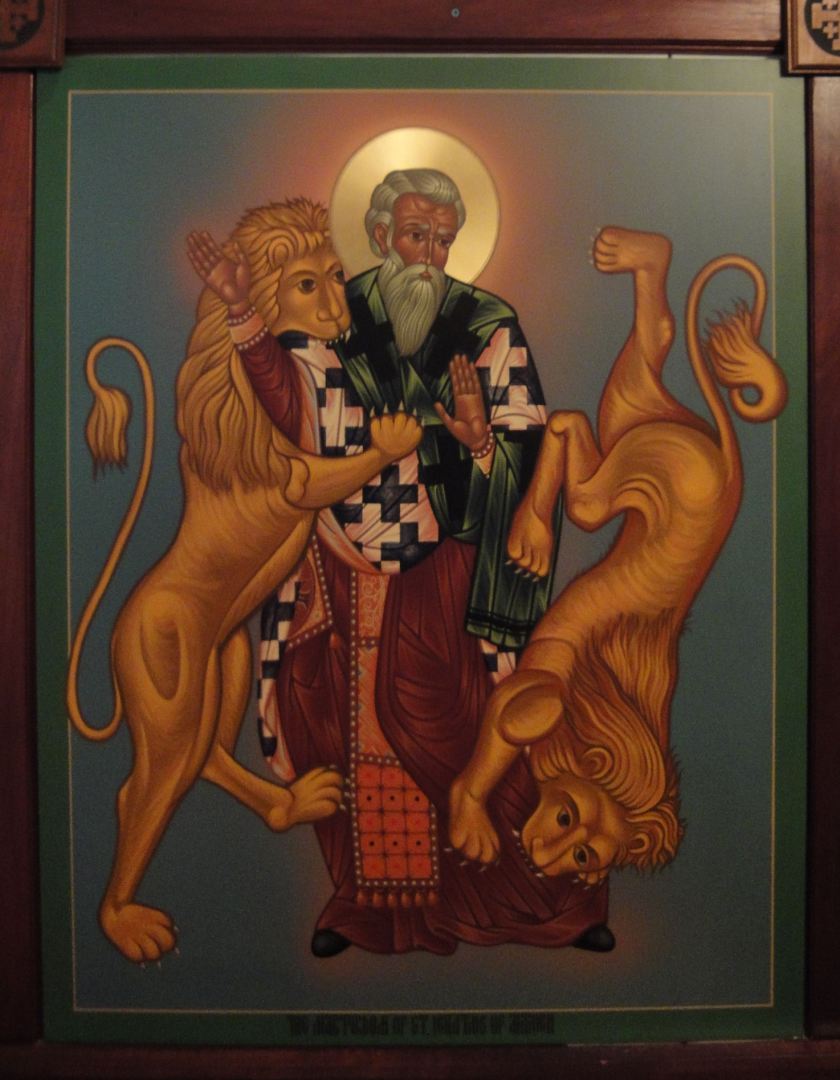
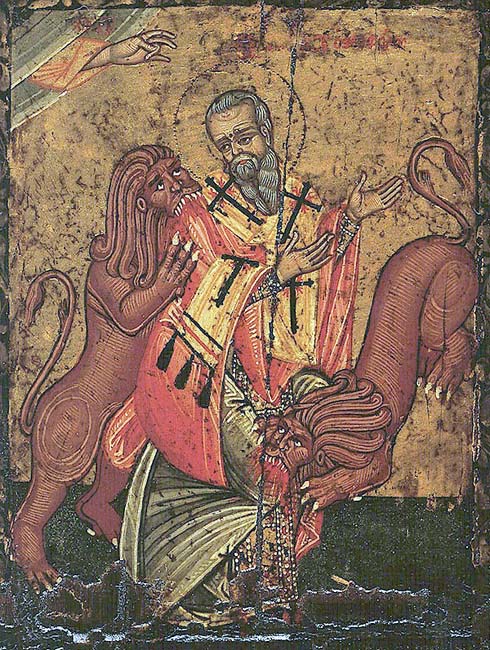
Eusebius writes:  “The Report says that he [Ignatius] was sent from Syria to Rome and became food for wild beasts on account of his testimony to Christ.   And as he made the journey through Asia under the strictest military surveillance” (he called the guards “ten leopards” in his Letter to the Romans, 5: 1), “he fortified the parishes in the various cities where he stopped by homilies and exhortations and warned them above all to be especially on their guard against the heresies that were then beginning to prevail, and exhorted them to hold fast to the tradition of the Apostles”.header - st ignatius

The first place Ignatius stopped on the way to his martyrdom was the city of Smyrna, where St Polycarp, a disciple of St John, was Bishop.   Here, Ignatius wrote four letters, respectively to the Churches of Ephesus, Magnesia, Tralli and Rome.   “Having left Smyrna”, Eusebius continues, Ignatius reached Troas and “wrote again”:  two letters to the Churches of Philadelphia and Smyrna and one to Bishop Polycarp.   Thus, Eusebius completes the list of his letters, which have come down to us from the Church of the first century as a precious treasure.   In reading these texts one feels the freshness of the faith of the generation which had still known the Apostles.   In these letters, the ardent love of a saint can also be felt.

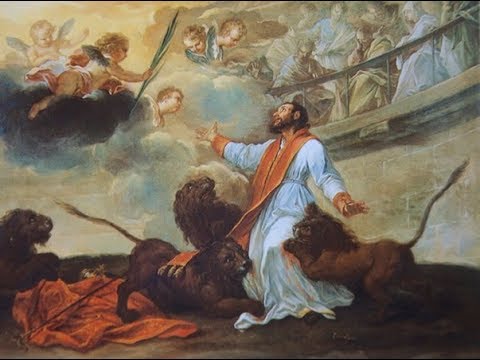
Lastly, the martyr travelled from Troas to Rome, where he was thrown to fierce wild animals in the Flavian Amphitheatre.st ignatius of antioch 2

No Church Father has expressed the longing for union with Christ and for life in Him with the intensity of Ignatius.   We therefore read the Gospel passage on the vine, which according to John’s Gospel is Jesus.   In fact, two spiritual “currents” converge in Ignatius, that of Paul, straining with all his might for union with Christ and that of John, concentrated on life in Him.   In turn, these two currents translate into the imitation of Christ, whom Ignatius several times proclaimed as “my” or “our God”.

Thus, Ignatius implores the Christians of Rome not to prevent his martyrdom since he is impatient “to attain to Jesus Christ”.   And he explains, “It is better for me to die on behalf of Jesus Christ than to reign over all the ends of the earth…. Him I seek, who died for us:  Him I desire, who rose again for our sake…. Permit me to be an imitator of the Passion of my God!” (Romans, 5-6).Sant_Ignazio_di_Antiochia_E

One can perceive in these words on fire with love, the pronounced Christological “realism” typical of the Church of Antioch, more focused than ever on the Incarnation of the Son of God and on His true and concrete humanity:  “Jesus Christ”, St Ignatius wrote to the Smyrnaeans, “was truly of the seed of David”, “he was truly born of a virgin” “and was truly nailed [to the Cross] for us” (1: 1).   Ignatius’ irresistible longing for union with Christ was the foundation of a real “mysticism of unity”.   He describes himself:  “I therefore did what befitted me as a man devoted to unity” (Philadelphians, 8: 1).

For Ignatius unity was first and foremost a prerogative of God, who, since He exists as Three Persons, is One in absolute unity.   Ignatius often used to repeat that God is unity and that in God alone is unity found in its pure and original state.   Unity to be brought about on this earth by Christians is no more than an imitation as close as possible to the divine archetype.ST IGNATIUS OF ANTIOCH MYPIC

Ignatius was the first person in Christian literature to attribute to the Church the adjective “catholic” or “universal” –  “Wherever Jesus Christ is”, he said, “there is the Catholic Church” (Smyrnaeans, 8: 2).   And precisely in the service of unity to the Catholic Church, the Christian community of Rome exercised a sort of primacy of love: “The Church which presides in the place of the region of the Romans and which is worthy of God, worthy of honour, worthy of the highest happiness… and which presides over love, is named from Christ and from the Father…” (Romans, Prologue).

StIgnatius-SouthColonnade-a
St Ignatius on the South Colonnade St Peter’s Basilica c 1669-1670

As can be seen, Ignatius is truly the “Doctor of Unity” – unity of God and unity of Christ (despite the various heresies gaining ground which separated the human and the divine in Christ), unity of the Church, unity of the faithful in “faith and love, to which nothing is to be preferred” (Smyrnaeans, 6: 1).

Ultimately, Ignatius’ realism invites the faithful of yesterday and today, invites us all, to make a gradual synthesis between configuration to Christ (union with Him, life in Him) and dedication to His Church (unity with the Bishop, generous service to the community and to the world).

Posted in MORNING Prayers, NOVENAS, ON the SAINTS, PAPAL SERMONS, QUOTES of the SAINTS, QUOTES on ABORTION, QUOTES on HUMAN DIGNITY

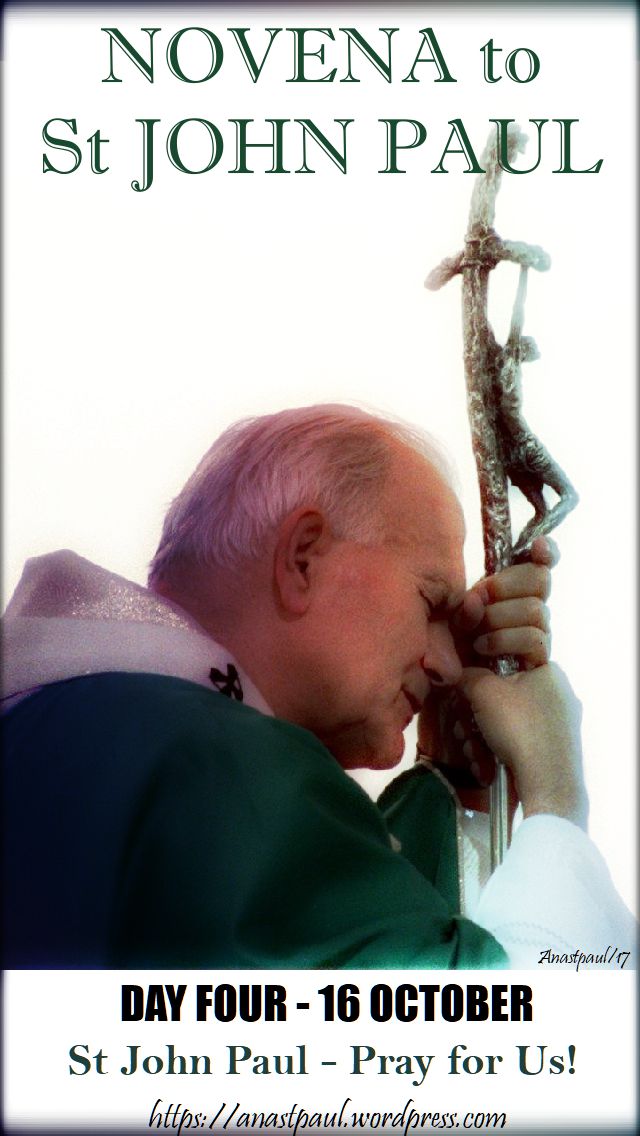
NOVENA to St John Paul the Great: DAY FOUR – 16 OCTOBER

NOVENA to St John Paul the Great: DAY FOUR – 16 OCTOBER

Little Known Fact #4:  In his second assignment as a newly ordained priest, Father Karol Wojtyla took a new approach to training altar boys.   He would hold frequent evenings of instruction, whereby one priest would give catechesis to the boys while another priest taught the parents educational psychology as well as catechesis in the liturgy.   In addition to these meetings, Father Wojtyla and the other parish priests would take the boys on outings.   This model proved to be a great success as the number of altar boys went from 10 in 1946 to 100 in 1952.

REFLECTION:   ” In the first years of his pontificate, still young and full of energy, the Holy Father went to the very ends of the earth, guided by Christ.   But afterwards, he increasingly entered into the communion of Christ’s sufferings;  increasingly he understood the truth of the words:  “Someone else will fasten a belt around you.”   And in this very communion with the suffering Lord, tirelessly and with renewed intensity, he proclaimed the Gospel, the mystery of that love which goes to the end (cf Jn 13:1).” – Pope Benedictday-four-novena-to-st-john-paul-16-oct-2017

Let us Pray:

O Holy Trinity, we thank You for having given to the Church Pope John Paul II and for having made him shine with Your fatherly tenderness, the glory of the Cross of Christand the splendour of the Spirit of love.

He, trusting completely in Your infinite mercy and in the maternal intercession of Mary, has shown himself in the likeness of Jesus the Good Shepherd and has pointed out to us the way of holiness as the path to reach eternal communion with You Grant us, through his intercession, according to Your will, the grace that we implore,

………………….. [state your intention here].

Continue, beloved St John Paul, we implore you, to sustain from heaven the faith of God’s people. We praise and thank You Father that St John Paul has been numbered among Your saints and make our prayer through our Lord Jesus Christ with the Holy Spirit, one God forever.

Totus Tuus, Amen

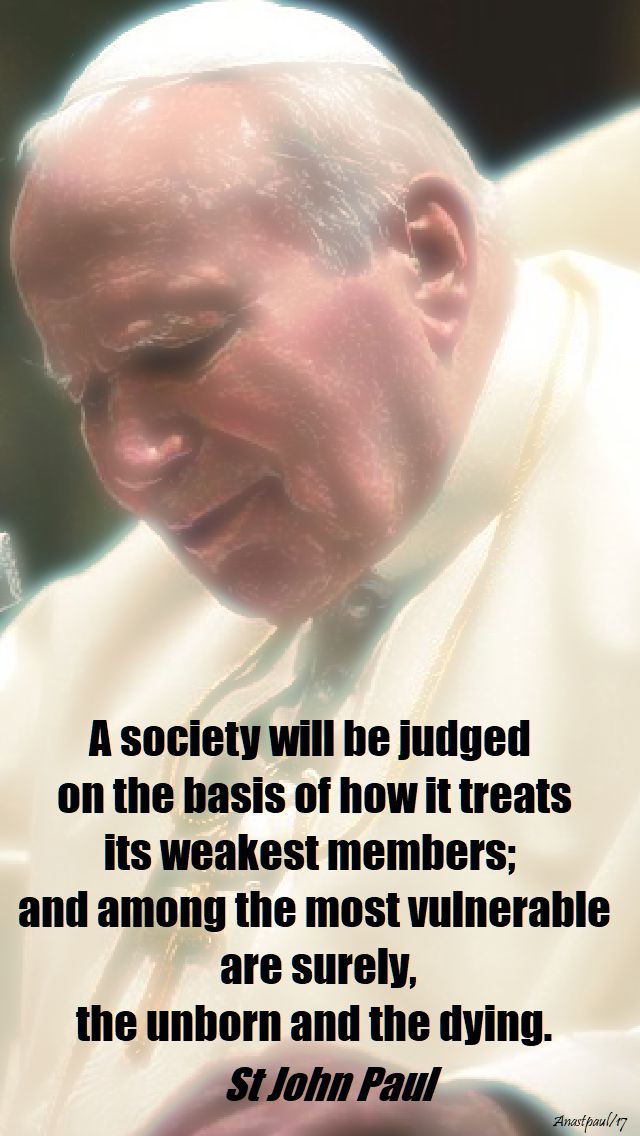
Quote Day Four:  “A society will be judged on the basis of how it treats its weakest members;  and among the most vulnerable are surely the unborn and the dying.”a-society-will-be-judged-st-john-paul-16-oct-2017

Posted in GOD the FATHER, MORNING Prayers, NOVENAS, QUOTES of the SAINTS, QUOTES on HUMAN DIGNITY, QUOTES on LOVE

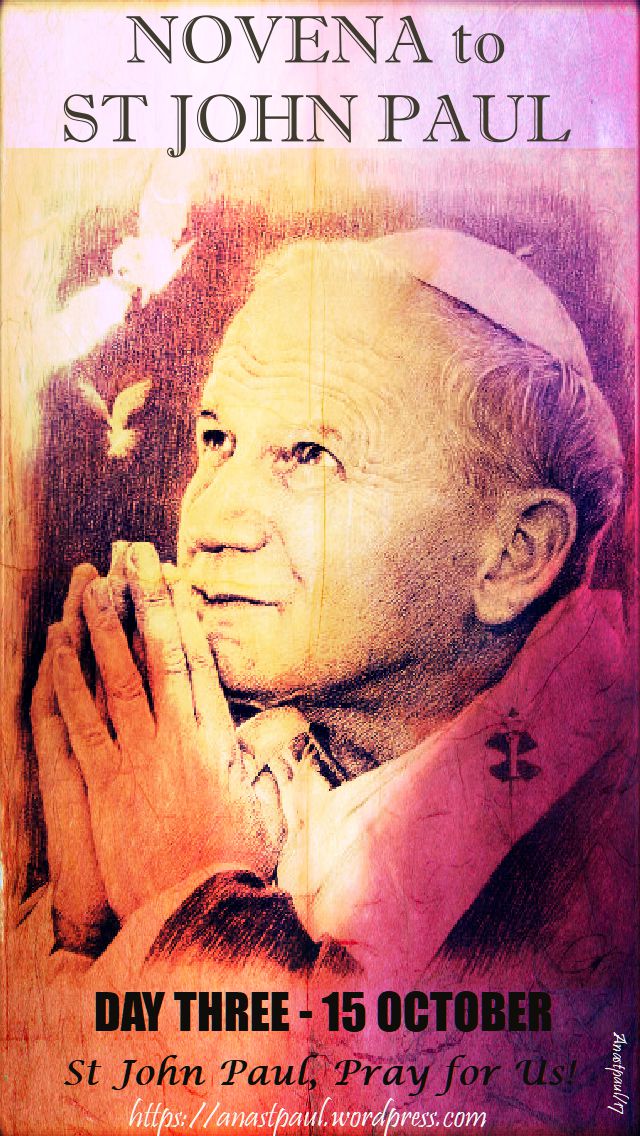
NOVENA to St John Paul the Great:  DAY THREE – 15 OCTOBER

NOVENA to St John Paul the Great:  DAY THREE – 15 OCTOBER

Little Known Fact #3:  During his fourth year of Theological studies, Karol Wojtyla felt an increasing call to enter a Carmelite monastery.   In the same year, one of his good friends, Br Leonard Kowalowka, was appointed Novice Master at a Carmelite monastery.  This appointment of his friend prompted Wojtyla to pursue his desire to be a Carmelite. Wojtyla applied to enter the monastery at Czerna but transferring from the Diocesesan seminary to a religious monastery needed the approval of the bishop.   Cardinal Sapieha did not give his approval and instead told Wojtyla to “finish what he started.”   Wojtyla did exactly that and stayed the path of a Diocesesan priest.

REFLECTION DAY THREE:  “In October 1978 Cardinal Wojtyla once again heard the voice of the Lord.   Once more there took place that dialogue with Peter reported in the Gospel of this Mass: “Simon, son of John, do you love me?   Feed my sheep!”  To the Lord’s question, “Karol, do you love me?,” the Archbishop of Krakow answered from the depths of his heart:  “Lord you know everything; you know that I love you.”   The love of Christ was the dominant force in the life of our beloved Holy Father.   Anyone who ever saw him pray, who ever heard him preach, knows that.   Thanks to his being profoundly rooted in Christ, he was able to bear a burden which transcends merely human abilities: that of being the shepherd of Christ’s flock, his universal Church.”……..Pope Benedictday-three-novena-st-john-paul-15-oct-2017

Let us Pray:

O Holy Trinity, we thank You for having given to the Church Pope John Paul II and for having made him shine with Your fatherly tenderness, the glory of the Cross of Christand the splendour of the Spirit of love.

He, trusting completely in Your infinite mercy and in the maternal intercession of Mary, has shown himself in the likeness of Jesus the Good Shepherd and has pointed out to us the way of holiness as the path to reach eternal communion with You Grant us, through his intercession, according to Your will, the grace that we implore,

………………….. [state your intention here].

Continue, beloved St John Paul, we implore you, to sustain from heaven the faith of God’s people. We praise and thank You Father that St John Paul has been numbered among Your saints and make our prayer through our Lord Jesus Christ with the Holy Spirit, one God forever.   Totus Tuus, Amen.

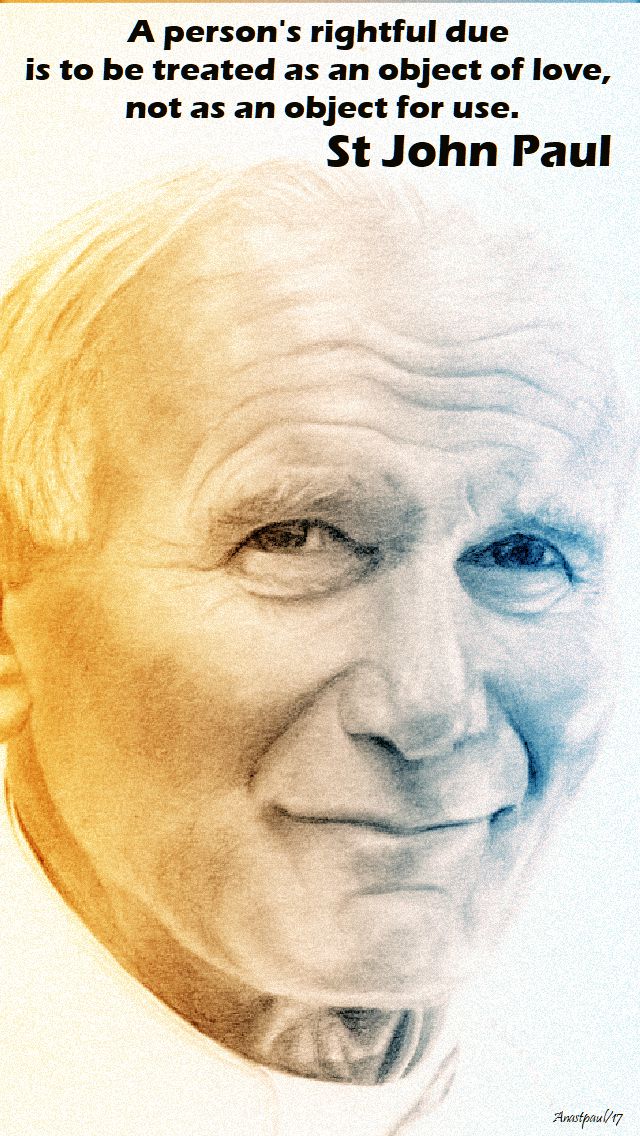
Quote Day Three:   “A person’s rightful due is to be treated as an object of love, not as an object for use.”a-persons-rightful-due-st-john-paul-14-oct-2017

Posted in CARMELITES, DOCTORS of the Church, GOD the FATHER, MORNING Prayers, MYSTICS, ON the SAINTS, PAPAL SERMONS, QUOTES of the SAINTS, QUOTES on CHARITY, QUOTES on CONVERSION, QUOTES on FAITH, QUOTES on LOVE, QUOTES on PRAYER, QUOTES on SANCTITY, SAINT of the DAY

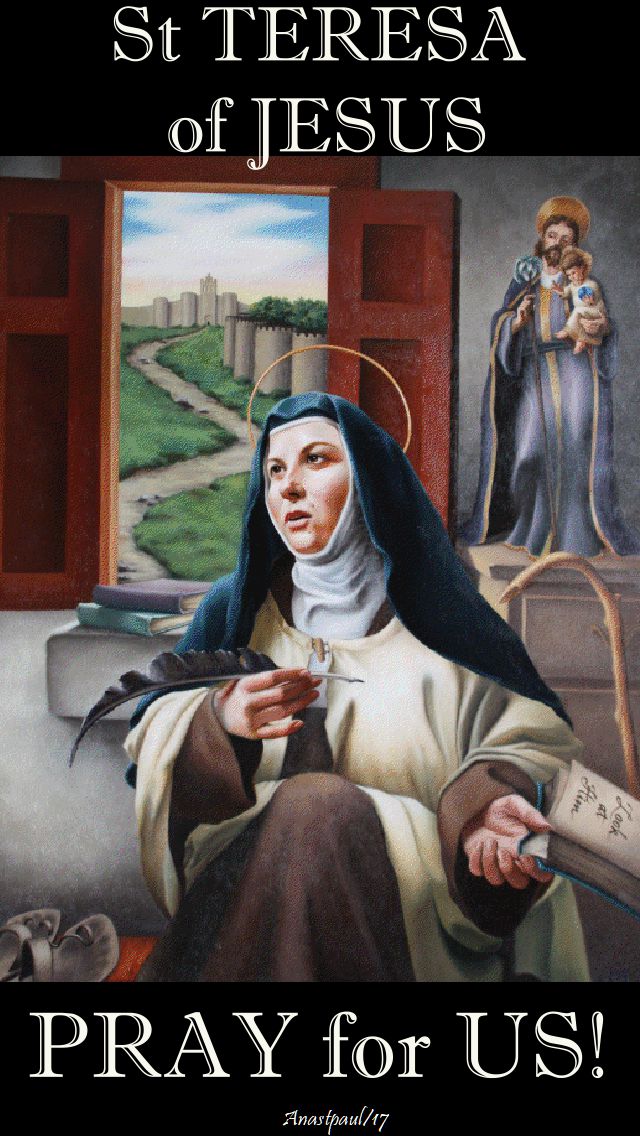
Thought for the Day – 15 October – The Memorial of St Teresa of Jesus/Avila (1515-1582) Doctor of the Church

Thought for the Day – 15 October – The Memorial of St Teresa of Jesus/Avila (1515-1582) Doctor of the Church “Doctor of Prayer”

Excerpt of Pope Benedict’s Catechesis
on the Doctors of the Church
Wednesday, 2 February 2011

“It is far from easy to sum up in a few words Teresa’s profound and articulate spirituality.   I would like to mention a few essential points.   In the first place St Teresa proposes the evangelical virtues as the basis of all Christian and human life and in particular, detachment from possessions, that is, evangelical poverty and this concerns all of us;  love for one another as an essential element of community and social life; humility as love for the truth;  determination as a fruit of Christian daring;  theological hope, which she describes as the thirst for living water.   Then we should not forget the human virtues: affability, truthfulness, modesty, courtesy, cheerfulness, culture.

Secondly, St Teresa proposes a profound harmony with the great biblical figures and eager listening to the word of God.   She feels above all closely in tune with the Bride in the Song of Songs and with the Apostle Paul, as well as with Christ in the Passion and with Jesus in the Eucharist.   The Saint then stresses how essential prayer is.   Praying, she says, “means being on terms of friendship with God frequently conversing in secret with Him who, we know, loves us” (Vida 8, 5).  St Teresa’s idea coincides with Thomas Aquinas’ definition of theological charity as “amicitia quaedam hominis ad Deum”, a type of human friendship with God, who offered humanity His friendship first – it is from God that the initiative comes (cf. Summa Theologiae II-II, 23, 1).

Prayer is life and develops gradually, in pace with the growth of Christian life – it begins with vocal prayer, passes through interiorisation by means of meditation and recollection, until it attains the union of love with Christ and with the Holy Trinity. Obviously, in the development of prayer climbing to the highest steps does not mean abandoning the previous type of prayer.  Rather, it is a gradual deepening of the relationship with God that envelops the whole of life.

Dear brothers and sisters, St Teresa of Jesus is a true teacher of Christian life for the faithful of every time.   In our society, which all too often lacks spiritual values, St Teresa teaches us to be unflagging witnesses of God, of His presence and of His action.   She teaches us truly to feel this thirst for God that exists in the depths of our hearts, this desire to see God, to seek God, to be in conversation with Him and to be His friends.

This is the friendship we all need that we must seek anew, day after day.   May the example of this Saint, profoundly contemplative and effectively active, spur us too every day to dedicate the right time to prayer, to this openness to God, to this journey, in order to seek God, to see Him, to discover His friendship and so to find true life – indeed, many of us should truly say:  “I am not alive, I am not truly alive because I do not live the essence of my life”.

Therefore time devoted to prayer is not time wasted, it is time in which the path of life unfolds, the path unfolds to learning from God an ardent love for Him, for His Church and practical charity for our brothers and sisters.    Many thanks.”

St Teresa, Pray for Us!st-teresa-of-jesus-pray-for-us-215 oct 2017

Posted in DOCTORS of the Church, ON the SAINTS, PAPAL SERMONS, SAINT of the DAY

Saint of the Day – 15 October – St Teresa of Avila/of Jesus (1515-1582) Doctor of the Church

Saint of the Day – 15 October – St Teresa of Avila/of Jesus (1515-1582) Doctor of the Church – Full Biography here: https://anastpaul.wordpress.com/2017/10/15/saint-of-the-day-15-october-st-teresa-of-jesusof-avila-1515-1582-doctor-of-the-church/

Excerpt of Pope Benedict’s Catechesis
on the Doctors of the Church
Wednesday, 2 February 2011

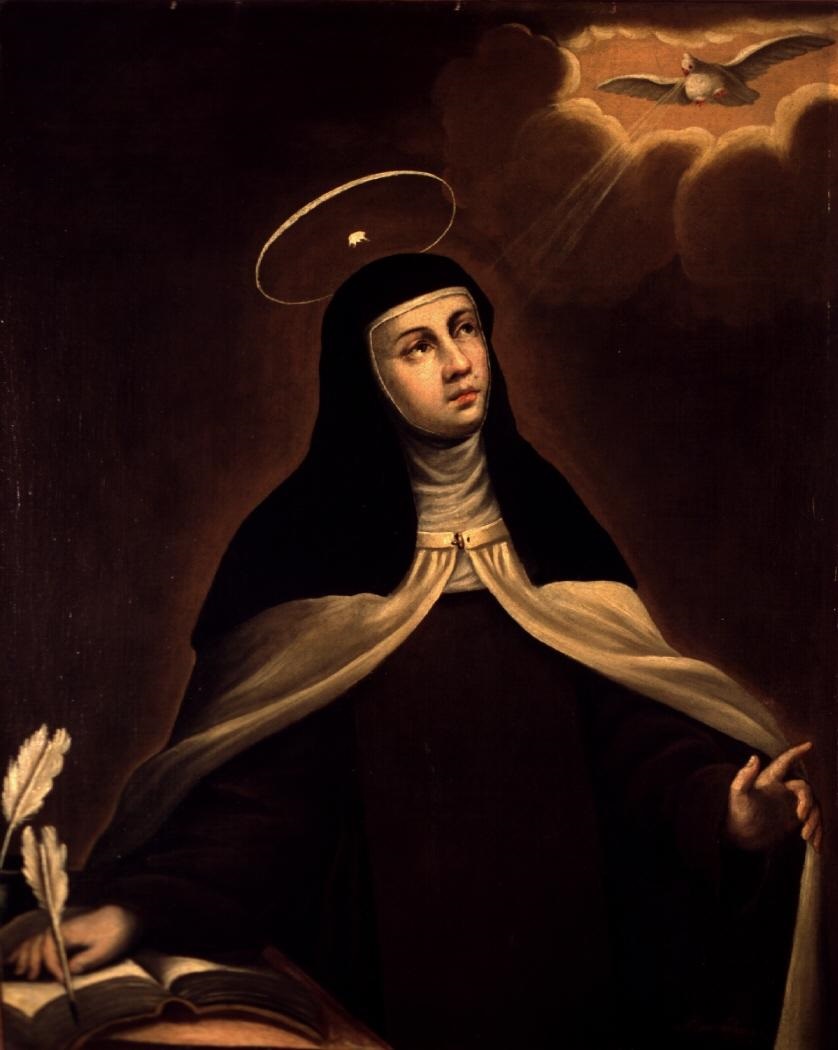
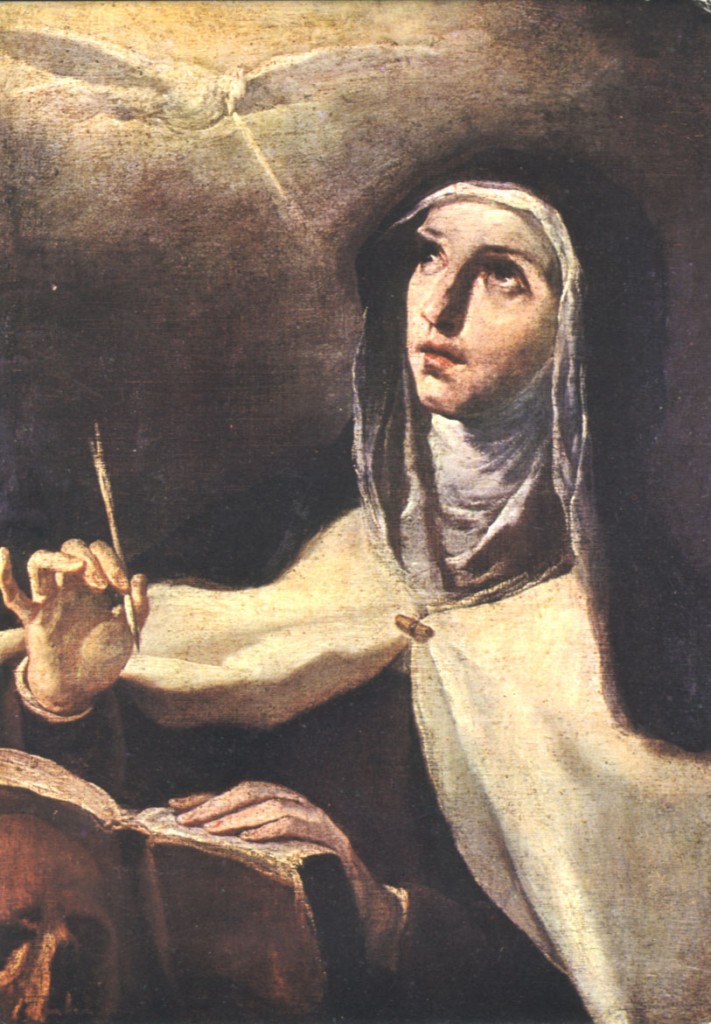
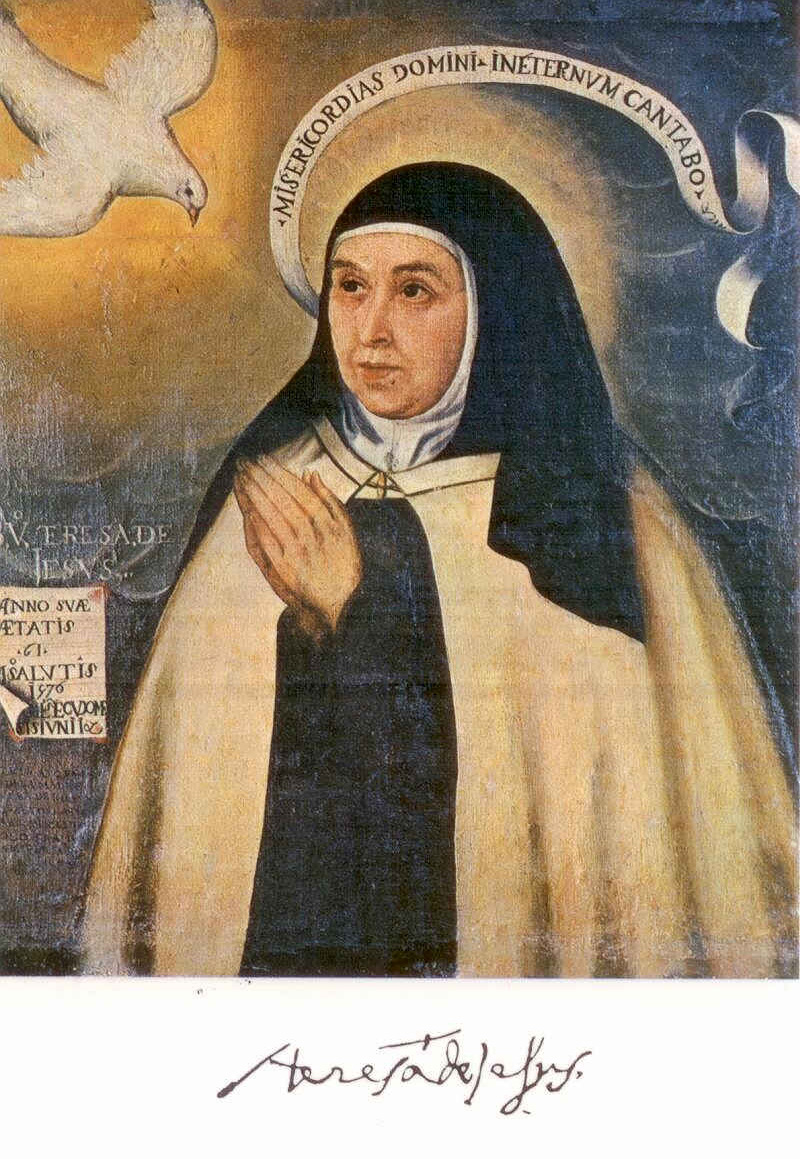
St Teresa, whose name was Teresa de Cepeda y Ahumada, was born in Avila, Spain, in 1515.   In her autobiography she mentions some details of her childhood – she was born into a large family, her “father and mother, who were devout and feared God”.   She had three sisters and nine brothers.SantaTeresa

While she was still a child and not yet nine years old she had the opportunity to read the lives of several Martyrs which inspired in her such a longing for martyrdom that she briefly ran away from home in order to die a Martyr’s death and to go to Heaven (cf. Vida, [Life], 1, 4) – “I want to see God”, the little girl told her parents.

A few years later Teresa was to speak of her childhood reading and to state that she had discovered in it the way of truth which she sums up in two fundamental principles.   On the one hand was the fact that “all things of this world will pass away” while on the other God alone is “forever, ever, ever”, a topic that recurs in her best known poem: “Let nothing disturb you, Let nothing frighten you, all things are passing away: God never changes.   Patience obtains all things.   Whoever has God lacks nothing, God alone suffices”.   She was about 12 years old when her mother died and she implored the Virgin Most Holy to be her mother (cf. Vida, I, 7).

When she was 20 she entered the Carmelite Monastery of the Incarnation, also in Avila. In her religious life she took the name “Teresa of Jesus”.   Three years later she fell seriously ill, so ill that she remained in a coma for four days, looking as if she were dead (cf. Vida, 5, 9).   In the fight against her own illnesses too, the Saint saw the combat against weaknesses and the resistance to God’s call:  “I wished to live”, she wrote, “but I saw clearly that I was not living but rather wrestling with the shadow of death, there was no one to give me life and I was not able to take it.   He who could have given it to me had good reasons for not coming to my aid, seeing that He had brought me back to Himself so many times and I as often had left Him” (Vida, 7, 8).teresa-avila-711x1024

In 1543 she lost the closeness of her relatives, her father died and all her siblings, one after another, emigrated to America.   In Lent 1554, when she was 39 years old, Teresa reached the climax of her struggle against her own weaknesses.   The fortuitous discovery of the statue of “a Christ most grievously wounded”, left a deep mark on her life (cf. Vida, 9).   The Saint, who in that period felt deeply in tune with the St Augustine of the Confessions, thus describes the decisive day of her mystical experience:  “and… a feeling of the presence of God would come over me unexpectedly, so that I could in no wise doubt either that He was within me, or that I was wholly absorbed in Him” (Vida, 10, 1).

st terea of avila de corrado yaquinto
Artist – Yaquinto de Corrado

Parallel to her inner development, the Saint began in practice to realise her ideal of the reform of the Carmelite Order – in 1562 she founded the first reformed Carmel in Avila, with the support of the city’s Bishop, Don Alvaro de Mendoza and shortly afterwards also received the approval of John Baptist Rossi, the Order’s Superior General.   In the years that followed, she continued her foundations of new Carmelite convents, 17 in all.   Her meeting with St John of the Cross was fundamental.   With him, in 1568, she set up the first convent of Discalced Carmelites in Duruelo, not far from Avila.   In 1580 she obtained from Rome the authorisation for her reformed Carmels as a separate, autonomous Province.   This was the starting point for the Discalced Carmelite Order.Teresa_de_Jesús

Indeed, Teresa’s earthly life ended while she was in the middle of her founding activities. She died on the night of 15 October 1582 in Alba de Tormes, after setting up the Carmelite Convent in Burgos, while on her way back to Avila.   Her last humble words were: “After all I die as a child of the Church” and “O my Lord and my Spouse, the hour that I have longed for has come. It is time to meet one another”.

Teresa spent her entire life for the whole Church although she spent it in Spain.   She was beatified by Pope Paul V in 1614 and Canonised by Pope Gregory XV in 1622  . The Servant of God (now Canonised yesterday, 14 October 2018) Paul VI proclaimed her a “Doctor of the Church” in 1970.

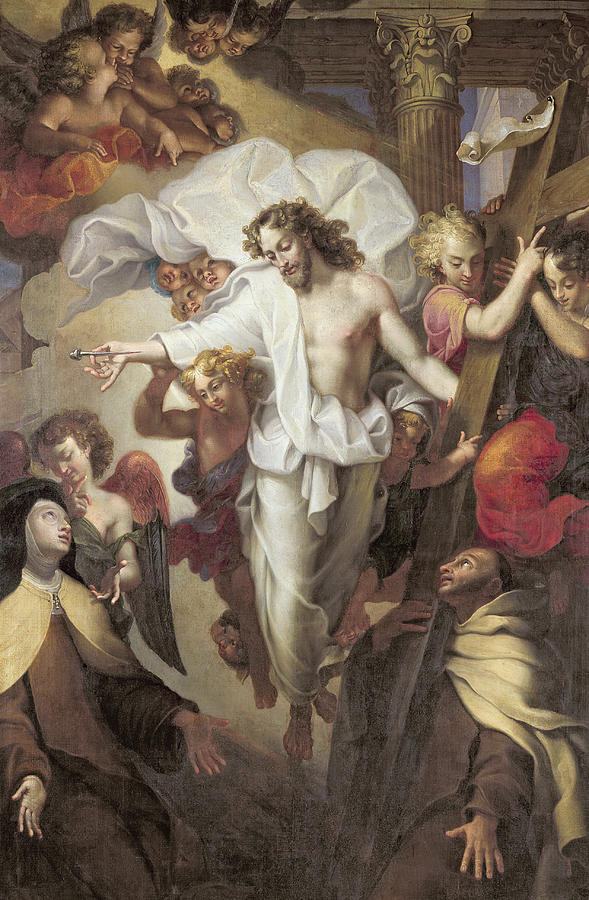
christ-resurrected-between-st-teresa-of-avila-michel-des-gobelins-corneille
Christ Resurrected Between St Teresa Of Avila & St John of the Cross by Michel des Gobelins Corneille
Posted in MARIAN DEVOTIONS, MARIAN PRAYERS, MARIAN QUOTES, MARIAN TITLES, MORNING Prayers, PRACTISING CATHOLIC, SACRED and IMMACULATE HEARTS, SAINT of the DAY, The BLESSED VIRGIN MARY, VATICAN Documents, VATICAN Resources

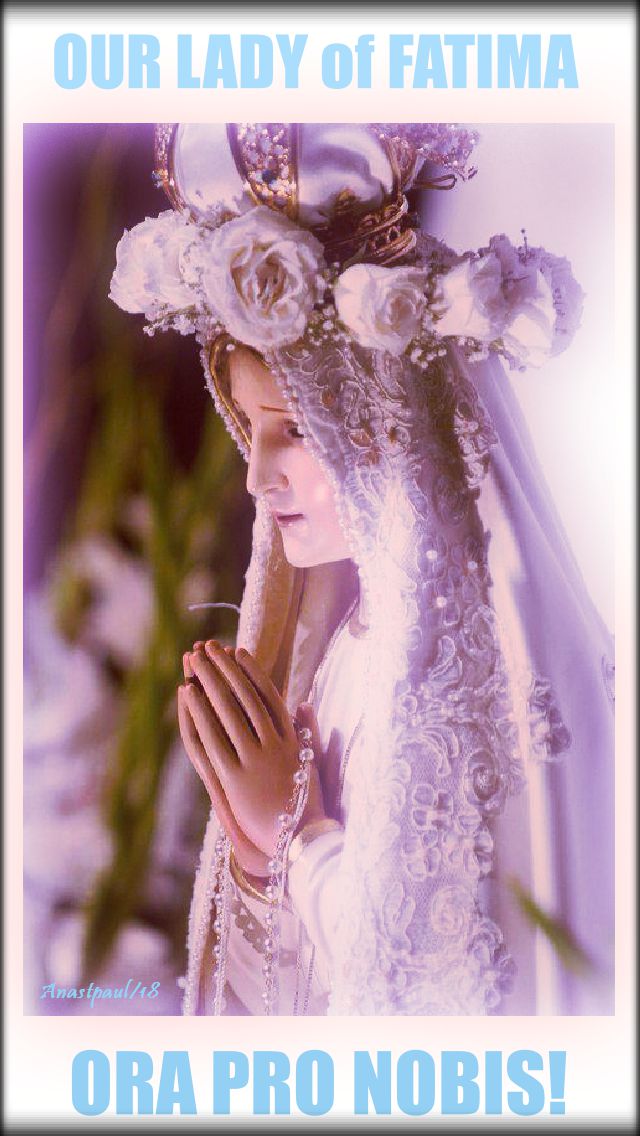
Thought for the Day – 13 October – The Memorial of the Sixth and Final Apparition of Our Lady of Fatima 1917

Thought for the Day – 13 October – The Memorial of the Sixth and Final Apparition of Our Lady of Fatima 1917

Excerpt from the Congregation of the Doctrine of the Faith – 26 June 2000
The Message of Fatima (Joseph Cardinal Ratzinger)

“As the second millennium gives way to the third, Pope John Paul II has decided to publish the text of the third part of the “secret of Fatima”.

“Behold, as we stand before you, Mother of Christ, before your Immaculate Heart, we desire, together with the whole Church, to unite ourselves with the consecration which, for love of us, your Son made of Himself to the Father:   ‘For their sake’, He said, ‘I consecrate myself that they also may be consecrated in the truth’ (Jn 17:19).  We wish to unite ourselves with our Redeemer in this His consecration for the world and for the human race, which, in his divine Heart, has the power to obtain pardon and to secure reparation.

The power of this consecration lasts for all time and embraces all individuals, peoples and nations.   It overcomes every evil that the spirit of darkness is able to awaken and has in fact awakened in our times, in the heart of man and in his history.

How deeply we feel the need for the consecration of humanity and the world—our modern world—in union with Christ Himself!   For the redeeming work of Christ must be shared in by the world through the Church.

The present Year of the Redemption shows this – the special Jubilee of the whole Church.

Above all creatures, may you be blessed, you, the Handmaid of the Lord, who in the fullest way obeyed the divine call!

Hail to you, who are wholly united to the redeeming consecration of your Son!

Mother of the Church!   Enlighten the People of God along the paths of faith, hope and love!   Enlighten especially the peoples whose consecration and entrustment by us you are awaiting.   Help us to live in the truth of the consecration of Christ for the entire human family of the modern world.

In entrusting to you, O Mother, the world, all individuals and peoples, we also entrust to you this very consecration of the world, placing it in your motherly Heart.

Immaculate Heart!   Help us to conquer the menace of evil, which so easily takes root in the hearts of the people of today, and whose immeasurable effects already weigh down upon our modern world and seem to block the paths towards the future!

From famine and war, deliver us.

From nuclear war, from incalculable self-destruction, from every kind of war, deliver us.

From sins against the life of man from its very beginning, deliver us.

From hatred and from the demeaning of the dignity of the children of God, deliver us.

From every kind of injustice in the life of society, both national and international, deliver us.

From readiness to trample on the commandments of God, deliver us.

From attempts to stifle in human hearts the very truth of God, deliver us.

From the loss of awareness of good and evil, deliver us.

From sins against the Holy Spirit, deliver us, deliver us.

Accept, O Mother of Christ, this cry laden with the sufferings of all individual human beings, laden with the sufferings of whole societies.

Help us with the power of the Holy Spirit to conquer all sin – individual sin and the ‘sin of the world’, sin in all its manifestations.

Let there be revealed, once more, in the history of the world the infinite saving power of the Redemption – the power of merciful Love!   May it put a stop to evil   May it transform consciences!   May your Immaculate Heart reveal for all the light of Hope!”.

Sister Lucia personally confirmed that this solemn and universal act of consecration corresponded to what Our Lady wished (“Sim, està feita, tal como Nossa Senhora a pediu, desde o dia 25 de Março de 1984”:  “Yes it has been done just as Our Lady asked, on 25 March 1984”:   Letter of 8 November 1989).    Hence any further discussion or request is without basis…vatican.va 

read the entire Message here:  http://www.vatican.va/roman_curia/congregations/cfaith/documents/rc_con_cfaith_doc_20000626_message-fatima_en.html

Immaculate Mary, Our Lady of Fatima, Pray for us!our lady of fatima pray for us no 2 - 13 oct 2018

Posted in EUCHARISTIC Adoration, MORNING Prayers, PAPAL SERMONS, PRACTISING CATHOLIC, SUNDAY REFLECTIONS, The HOLY EUCHARIST / The HOLY MASS

Sunday Reflection – 7 October – Twenty-seventh Sunday in Ordinary Time, Year B

Sunday Reflection – 7 October – Twenty-seventh Sunday in Ordinary Time, Year B

The Beating Heart of the Church –

the Eucharistic Heart of Christ.

This is what Pope Benedict XVI said on 10 June 2007:

“Today’s solemnity of Corpus Christi, which was celebrated last Thursday in the Vatican and in other countries, invites us to contemplate the supreme Mystery of our faith – the Most Holy Eucharist, the Real Presence of our Lord Jesus Christ in the Sacrament of the altar.   Every time that the priest renews the Eucharistic Sacrifice, in the prayer of consecration he repeats:  ‘This is my Body…this is my Blood.’   He lends his voice, his hands and his heart to Christ, who wanted to remain with us in order to be the beating Heart of the Church.

But even after the Celebration of the Divine Mysteries the Lord Jesus remains present in the tabernacle.   For this reason, praise is rendered to Him especially through Eucharistic Adoration, as I sought to remind everyone in the recent Apostolic Exhortation Sacramentum Caritatis (see nos. 66-69) following the Synod on this topic.   In fact, there is an intrinsic connection between celebration and adoration.   The Holy Mass is in itself already the greatest act of adoration on the part of the Church.   ‘No one eats this flesh,’ St Augustine wrote, ‘unless he has first adored it’ (Com. on Psalms 98,9; CCL XXXIX, 1385).  Adoration, apart from the Holy Mas, prolongs and intensifies what has taken place in the liturgical celebration and makes it possible, to receive Christ in a real and profound way.”adoration, apart from the holy mass - pope benedict - 7 oct 2018

Posted in CATHOLIC DEVOTIONS of the Month, MARIAN DEVOTIONS, MARIAN PRAYERS, MARIAN QUOTES, MARIAN TITLES, MORNING Prayers, PAPAL SERMONS, PRACTISING CATHOLIC, PRAYERS of the CHURCH, SAINT of the DAY, The BLESSED VIRGIN MARY, The HOLY ROSARY/ROSARY CRUSADE, The WORD

Quote/s of the Day – 7 October – Our Lady of the Rosary

Quote/s of the Day – 7 October – Our Lady of the Rosary

Open your petals, like roses planted near running waters…Sirach 39:13
“To discover whether people are of God,
I have found no better way than the following.
Observe whether they say the Hail Mary and the Rosary.”to-discover-whether-people-st-louis-de-montfort-7 oct 2017

“The Rosary is the most powerful weapon
to touch the Heart of Jesus, Our Redeemer,
who loves His Mother.”the rosary is the most powerful - st louis de montfort 7 oct 2018

THE SEVEN BLESSINGS OF THE ROSARY

“The Rosary, recited with meditation on the mysteries, brings about the following marvellous results:

1. It gradually gives us a perfect knowledge of Jesus Christ;
2. It purifies our souls, washing away sin;
3. It gives us victory over all our enemies;
4. It makes it easy for us to practice virtue;
5. It sets us on fire with love of Our Blessed Lord;
6. It enriches us with graces and merits;
7. It supplies us with what is needed to pay,
all our debts to God and to our fellow men
and finally, it obtains all kinds of graces for us from Almighty God.”

St Louis Marie Grignion De Montfort (1673-1716)the-seven-blessings-of-the-rosary-st-louis-de-montfort-7 oct 2017

“When reciting the Rosary,
the important and meaningful moments
of salvation history are relived.
The various steps of Christ’s mission are traced.
With Mary the heart is oriented
toward the mystery of Jesus.
Christ is put at the centre of our life,
of our time, of our city,
through the contemplation and meditation
of His holy mysteries
of joy, light, sorrow and glory.”

Pope Benedict XVIwhen reciting the rosary - pope benedict - 7 oct 2018

Basilica of Saint Mary Major – Saturday, 3 May 2008

“Mary joins us, she fights at our side.
She supports Christians in the fight
against the forces of evil… through the Rosary.”mary joins us in the fights against evil - opope francis - 7 oct 2018

“Do you pray the Rosary each day?”

Pope Francisdo you pray the rosary each day - pope francis 7 oct 2018

Posted in MARIAN TITLES, MORNING Prayers, PAPAL ENCYLICALS, QUOTES on MARRIAGE, MARRIED LOVE, SAINT of the DAY, The BLESSED VIRGIN MARY, The WORD

One Minute Reflection – 7 October – Today’s Gospel – Mark 10:2–16 – Twenty Seventh Sunday in Ordinary Time, Year B and the Memorial of Our Lady of the Rosary

One Minute Reflection – 7 October – Today’s Gospel – Mark 10:2–16 – Twenty Seventh Sunday in Ordinary Time, Year B and the Memorial of Our Lady of the Rosary

“…The two shall become one flesh.”...Mark 10:8

REFLECTION – “In the world of the Bible, God’s relationship with Israel is described using the metaphors of betrothal and marriage – idolatry is thus adultery and prostitution… But God’s eros for man is also totally agape.   This is not only because it is bestowed in a completely gratuitous manner, without any previous merit but also because it is love which forgives… In this biblical vision, on the one hand we find ourselves before a strictly metaphysical image of God:  God is the absolute and ultimate source of all being but this universal principle of creation—the Logos, primordial reason—is at the same time a lover with all the passion of a true love.   Eros is thus supremely ennobled, yet at the same time it is so purified as to become one with agape…  The first novelty of biblical faith consists… in its image of God.   The second, essentially connected to this, is found in the image of man.
The biblical account of creation speaks of the solitude of Adam, the first man and God’s decision to give him a helper… The idea is certainly present that man is somehow incomplete, driven by nature to seek in another the part that can make him whole, the idea that only in communion with the opposite sex can he become “complete”.   The biblical account thus concludes with a prophecy about Adam:  “Therefore a man leaves his father and his mother and cleaves to his wife and they become one flesh” (Gen 2:24).
Two aspects of this are important.   First, eros is somehow rooted in man’s very nature; Adam is a seeker, who “abandons his mother and father” in order to find woman, only together do the two represent complete humanity and become “one flesh”.   The second aspect is equally important.   From the standpoint of creation, eros directs man towards marriage, to a bond which is unique and definitiv, thus and only thus, does it fulfil its deepest purpose.   Corresponding to the image of a monotheistic God is monogamous marriage.   Marriage based on exclusive and definitive love, becomes the icon of the relationship between God and His people and vice versa.   God’s way of loving becomes the measure of human love…Pope Benedict XVI – Encyclical letter “Deus caritas est”, # 9-11mark 10 8 the two shall become one flesh-marriage based on exclusive and definitive love - pope benedict XVI

PRAYER – Almighty, everliving God, whose love surpasses all that we ask or deserve, open up for us, the treasures of Your mercy.   Teach us the truth of love and forgive us all that weighs on our conscience.   Grant us even more than we dare to ask and grant us the merciful and guiding assistance of the Blessed Virgin Mary.   Through Him who redeemed us in unity with the Holy Spirit, one God forever, amen.our-lady-of-the-rosary-pray-for-us-7 oct 2017oly Spirit, one God forever and ever.   Our Lady of the Holy Rosary, pray for us, amen.

Posted in franciscan OFM, MARIAN PRAYERS, MARIAN QUOTES, MARIAN TITLES, MORNING Prayers, ON the SAINTS, PAPAL SERMONS, PRAYERS of the SAINTS, QUOTES of the SAINTS, SAINT of the DAY, The BLESSED VIRGIN MARY, The WORD

Thought for the Day – 4 October – The Memorial of St Francis of Assisi OFM (1181/2–1226)

Thought for the Day – 4 October – The Memorial of St Francis of Assisi OFM (1181/2–1226)

Dear friends, Francis was a great Saint and a joyful man.   His simplicity, his humility, his faith, his love for Christ, his goodness towards every man and every woman, brought him gladness in every circumstance.   Indeed, there subsists an intimate and indissoluble relationship between holiness and joy.   A French writer once wrote that there is only one sorrow in the world – not to be saints, that is, not to be near to God.   Looking at the testimony of St Francis, we understand that this is the secret of true happiness: -to become saints, close to God!

May the Virgin, so tenderly loved by Francis, obtain this gift for us.   Let us entrust ourselves to her with the words of the Poverello of Assisi himself:

“Blessed Virgin Mary, no one like you among women has ever been born in the world, daughter and handmaid of the Most High King and heavenly Father, Mother of our Most Blessed Lord Jesus Christ, spouse of the Holy Spirit.

Pray for us… to your most blessed and beloved Son, Lord and Master”

(Francesco di Assisi, Scritti, 163)….Excerpt from Pope Benedict XV’s Catechesis on St Francis – General Audience, 27 January 2010

Blessed Virgin, Holy Mother, Pray for us!blessed virgin holy mother pray for us
St Francis of Assisi, Pray for us!st francis pray for us - 4 oct 2018

St Francis leaves us with his blessing:

May the Lord bless you and keep you.
May the Lord make His face to shine upon you
and be gracious to you.
May the Lord lift up His countenance upon you
and give you peace.

st-francis-prayer-may-the-lord-bless-you-and-keep-you- no 2


Posted in franciscan OFM, MORNING Prayers, ON the SAINTS, PAPAL SERMONS, QUOTES of the SAINTS, SAINT of the DAY, The WORD

One Minute Reflection – 4 October – Today’s Gospel: Luke 10:1-12- The Memorial of St Francis of Assisi OFM (1181/2–1226)

One Minute Reflection – 4 October – Today’s Gospel: Luke 10:1-12 – Thursday of the Twenty-sixth week in Ordinary Time – The Memorial of St Francis of Assisi OFM (1181/2–1226)

“Carry no purse, no bag, no sandals and salute no one on the road. Whatever house you enter, first say, ‘Peace be to this house!’”...Luke 10:4-5

REFLECTION – “Three times Christ on the Cross came to life and told him:  “Go, Francis, and repair my Church in ruins”.   This simple occurrence of the word of God heard in the Church of St Damian, contains a profound symbolism.   At that moment, St Francis was called to repair the small church but the ruinous state of the building, was a symbol of the dramatic and disquieting situation of the Church herself…. it is important to note that St Francis does not renew the Church without, or in opposition, to the Pope but only in communion with him.   Authentic renewal grew from these together….
Francis, standing before the Bishop of Assisi, in a symbolic gesture, stripped off his clothes, thus showing he renounced his paternal inheritance.   Just as at the moment of creation, Francis had nothing, only the life that God gave him, into whose hands he delivered himself….
The truth is that St Francis really did have an extremely intimate relationship with Jesus and with the word of God, that he wanted to pursue sine glossa just as it is, in all its radicality and truth.   It is also true, that initially he did not intend to create an Order with the necessary canonical forms.   Rather he simply wanted, through the word of God and the presence of the Lord, to renew the People of God, to call them back to listening to the word and to literal obedience to Christ.”…Pope Benedict XVI – Catechesis on St Francis – General Audience, 27 January 2010luke 10 4-5 - st francis really did have - pope benedict - 4 oct 2018

“Remember that when you leave this earth, you can take with you nothing that you have received—only what you have given: a full heart, enriched by honest service, love, sacrifice and courage.”….St Francis of Assisiremember-that-when-you-leave-st-francis-4-oct-2017

PRAYER – Lord God, You made St Francis of Assisi, Christ-like in his poverty and humility, his gentleness and charity, his love and courage.   Help us to walk in his ways that, with joy and love, we may follow Christ Your Son and be united with You.   May the intercession of St Francis, be an assistance on our journey.   Through Christ our Lord, with the Holy Spirit, one God forever, amen.st-francis-pray for us - 4-oct-2018

Posted in CARMELITES, CATECHESIS, DOCTORS of the Church, MORNING Prayers, ON the SAINTS, PAPAL SERMONS, PRACTISING CATHOLIC, QUOTES of the SAINTS, QUOTES on LOVE, QUOTES on MERCY, QUOTES on SANCTITY, QUOTES on TRUST and complete CONFIDENCE in GOD, SAINT of the DAY, The WORD

Thought for the Day – 1 October – The Memorial of St Thérèse of Lisieux O.C.D. (1873 – 1897) Doctor of the Church

Thought for the Day – 1 October – The Memorial of St Thérèse of Lisieux O.C.D. (1873 – 1897) Doctor of the Church

Excerpt from Pope Benedict’s Catechesis on St Thérèse – 6 April 2011

“Today I would like to talk to you about St Thérèse of Lisieux, Thérèse of the Child Jesus and of the Holy Face, who lived in this world for only 24 years, at the end of the 19th century, leading a very simple and hidden life but who, after her death and the publication of her writings, became one of the best-known and best-loved saints. “Little Thérèse” has never stopped helping the simplest souls, the little, the poor and the suffering who pray to her.
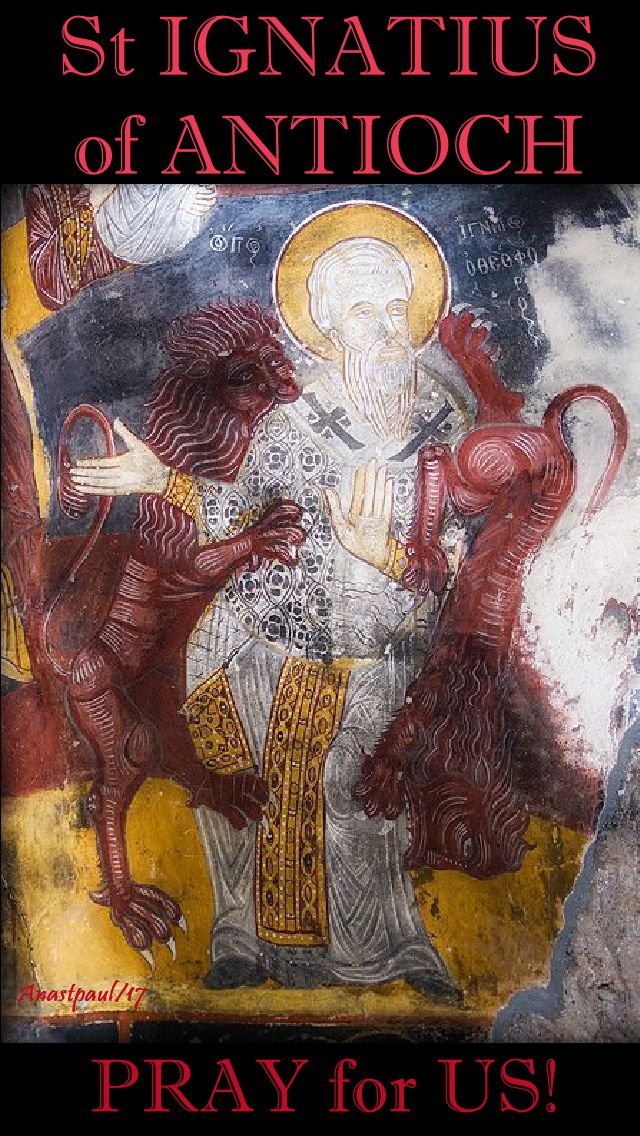
I would like to invite you to rediscover this small-great treasure, this luminous comment on the Gospel lived to the full!   The Story of a Soul, in fact, is a marvellous story of Love, told with such authenticity, simplicity and freshness that the reader cannot but be fascinated by it!   But what was this Love that filled Thérèse’s whole life, from childhood to death?   Dear friends, this Love has a Face, it has a Name, it is Jesus!   The Saint speaks continuously of Jesus.
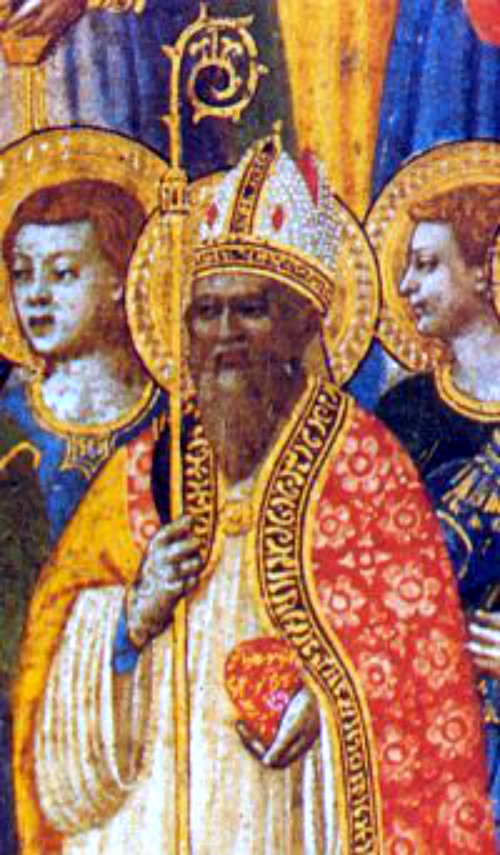
Dear friends, we too, with St Thérèse of the Child Jesus must be able to repeat to the Lord every day that we want to live of love for Him and for others, to learn at the school of the saints to love authentically and totally.  Thérèse is one of the “little” ones of the Gospel who let themselves be led by God to the depths of his Mystery.   A guide for all, especially those who, in the People of God, carry out their ministry as theologians.   With humility and charity, faith and hope, Thérèse continually entered the heart of Sacred Scripture which contains the Mystery of Christ.   And this interpretation of the Bible, nourished by the science of love, is not in opposition to academic knowledge.   The science of the saints, in fact, of which she herself speaks on the last page of her The Story of a Soul, is the loftiest science.
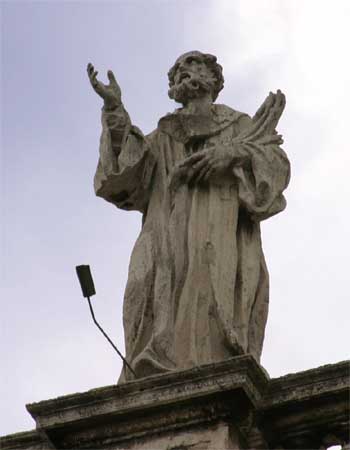
In the Gospel Thérèse discovered above all the Mercy of Jesus, to the point that she said: “To me, He has given His Infinite Mercy and it is in this ineffable mirror, that I contemplate His other divine attributes.   Therein all appear to me radiant with Love.   His Justice, even more perhaps than the rest, seems to me to be clothed with Love” (Ms A, 84r).

In these words she expresses herself in the last lines of The Story of a Soul:   “I have only to open the Holy Gospels and at once I breathe the perfume of Jesus’ life and then I know which way to run;  and it is not to the first place but to the last, that I hasten…. I feel that even had I on my conscience every crime one could commit… my heart broken with sorrow, I would throw myself into the arms of my Saviour Jesus, because I know that He loves the Prodigal Son” who returns to Him. (Ms C, 36v-37r).

“Trust and Love” are therefore the final point of the account of her life, two words, like beacons, that illumined the whole of her journey to holiness, to be able to guide others on the same “little way of trust and love”, of spiritual childhood (cf. Ms C, 2v-3r; LT 226).

Trust, like that of the child who abandons himself in God’s hands, inseparable from the strong, radical commitment of true love, which is the total gift of self for ever, as the Saint says, contemplating Mary:   “Loving is giving all, and giving oneself” (Why I love thee, Mary, P 54/22).

Thus Thérèse points out to us all that Christian life consists in living to the full the grace of Baptism in the total gift of self to the Love of the Father, in order to live like Christ, in the fire of the Holy Spirit, His same love for all the others.”…Pope Benedict XVI

“Trust and trust alone,
should lead us to love”trust and trust alone - st t of l - 1 oct 2018

St Thérèse of Lisieux, Pray for Us!st t of l pray for us - 1 oct 2018

Posted in CATECHESIS, DOCTORS of the Church, FATHERS of the Church, MORNING Prayers, PAPAL SERMONS, QUOTES of the SAINTS, SAINT of the DAY, The WORD

Thought for the Day – 30 September – The Memorial of St Jerome (347-419) Father and Doctor

Thought for the Day – 30 September – The Memorial of St Jerome (347-419) Father and Doctor

Pope Benedict XVI – 7 November 2007 –

Catechesis on St Jerome (1)

What can we learn from St Jerome?   It seems to me, this above all – to love the Word of God in Sacred Scripture.

St Jerome said:  “Ignorance of the Scriptures is ignorance of Christ”.   It is therefore important that every Christian live in contact and in personal dialogue with the Word of God given to us in Sacred Scripture.   This dialogue with Scripture must always have two dimensions:  on the one hand, it must be a truly personal dialogue because God speaks with each one of us through Sacred Scripture and it has a message for each one.   We must not read Sacred Scripture as a word of the past but as the Word of God that is also addressed to us and we must try to understand what it is that the Lord wants to tell us. However, to avoid falling into individualism, we must bear in mind that the Word of God has been given to us precisely in order to build communion and to join forces in the truth on our journey towards God.   Thus, although it is always a personal Word, it is also a Word that builds community, that builds the Church.   We must, therefore, read it in communion with the living Church.   The privileged place for reading and listening to the Word of God is the liturgy, in which, celebrating the Word and making Christ’s Body present in the Sacrament, we actualise the Word in our lives and make it present among us.   We must never forget that the Word of God transcends time  . Human opinions come and go.   What is very modern today will be very antiquated tomorrow.   On the other hand, the Word of God is the Word of eternal life, it bears within it eternity and is valid for ever.   By carrying the Word of God within us, we therefore carry within us eternity, eternal life.ignorance of the scriptures is ignorance of christ - st jerome - 30 sep 2018

I thus conclude with a word St Jerome once addressed to St Paulinus of Nola (354-431).  In it the great exegete expressed this very reality, that is, in the Word of God we receive eternity, eternal life.   St Jerome said: “Seek to learn on earth those truths which will remain ever valid in Heaven” (Ep. 53, 10)…. Pope Benedict XVI – 7 November 2007 – Catechesis on St Jerome (1)

St Jerome, Pray for us!st-jerome-pray-for-us-30-sept-2017