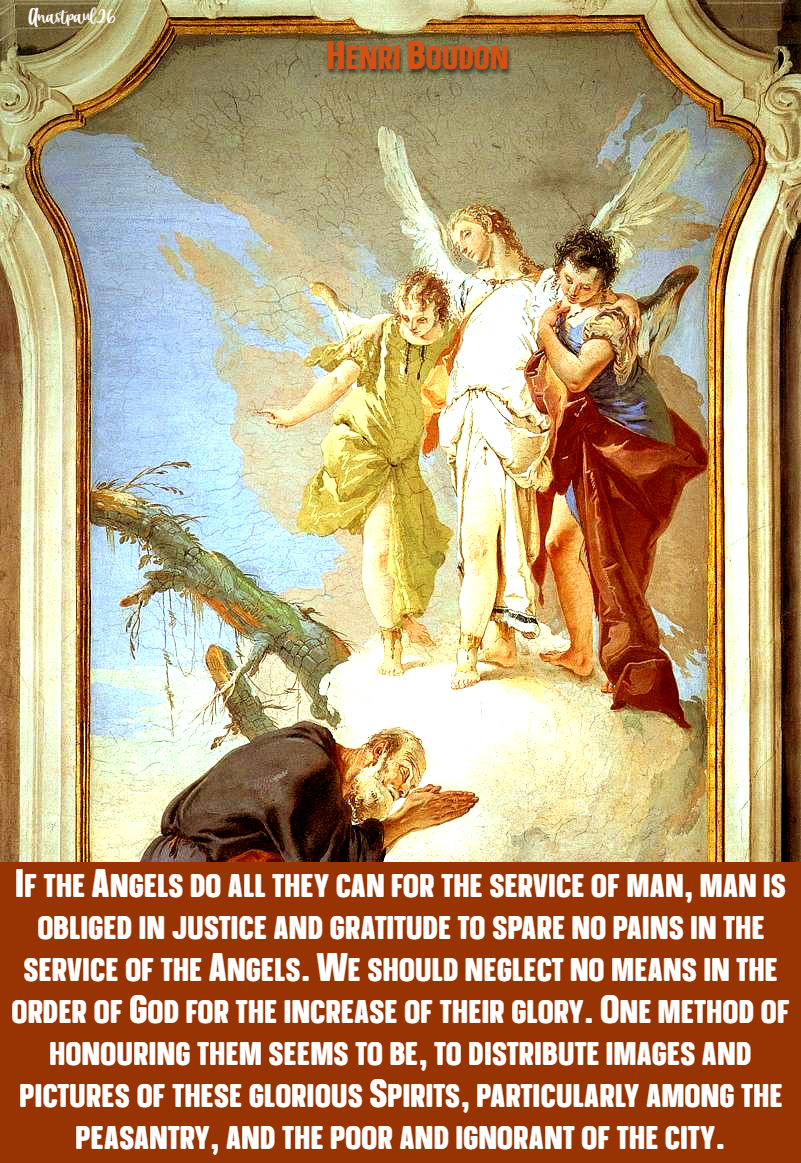
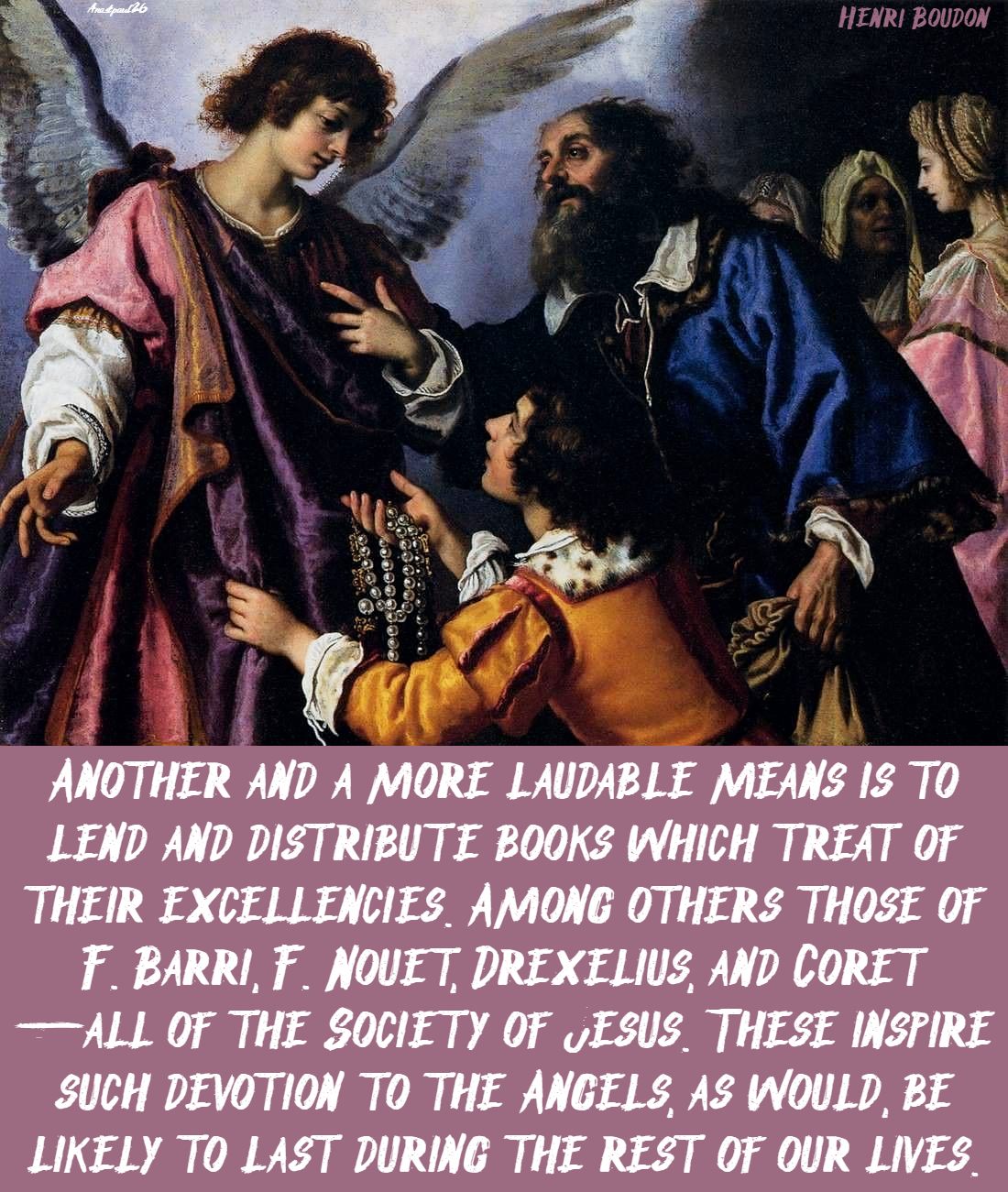
If the Angels do all they can for the service of man, man is obliged in justice and gratitude to spare no pains in the service of the Angels. We should neglect no means in the order of God for the increase of their glory. One method of honouring them seems to be, to distribute images and pictures of these glorious Spirits, particularly among the peasantry, and the poor and ignorant of the city. It would be well to recommend our friends to set up such pictures in their chambers or oratories—as also to make presents of them to some Chapel or Altar. Constantine the Great caused four images of the Angels to be wrought, and in the most exquisite manner. Another and a more laudable means is to lend and distribute books which treat of their excellencies. Among others those of F. Barri, F. Nouet, Drexelius, and Coret —all of the Society of Jesus. These inspire such devotion to the Angels, as would, be likely to last during the rest of our lives.
Preachers could greatly serve this devotion, by instructing their auditors in it from time to time—Seculars, by explaining it to their friends—a Master, in his house—a Father or Mother to their Children—a person in the country, to the peasants—a teacher, to his pupils—a friend, to his friend. But the best way to honour the Angels is to procure the establishment of some little sodality in their honour.
To labour for the Conversion of Sinners and the release of Souls from Purgatory—and to practise Virtue in honour of the Angels.
What can we do more agreeable to the Angels than to labour with them for the glory of our common Master? It is his glory which causes this almost infinite number of blessed Spirits to watch so indefatigably over us poor sinners ; and what wonder, when even the shadow of the interests of this divine being should be upheld at the risk of the annihilation of all creatures. O my God ! why are you not known by us ! This world is indeed a land of forgetfulness in your regard. A God-man having sacrificed his life, in the midst of an infinity of sufferings, for your divine interest, we should either renounce Christianity, or endeavour to advance it by every possible means. Here it is we should pour out floods of tears over the insensibility and blindness of men.
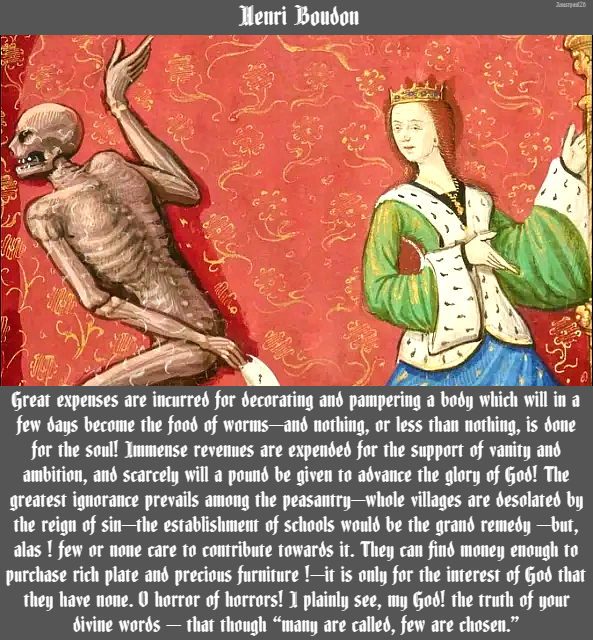
Great expenses are incurred for decorating and pampering a body which will in a few days become the food of worms—and nothing, or less than nothing, is done for the soul! Immense revenues are expended for the support of vanity and ambition, and scarcely will a pound be given to advance the glory of God! The greatest ignorance prevails among the peasantry—whole villages are desolated by the reign of sin—the establishment of schools would be the grand remedy —but, alas ! few or none care to contribute towards it. They can find money enough to purchase rich plate and precious furniture !—it is only for the interest of God that they have none. O horror of horrors! I plainly see, my God! the truth of your divine words — that though “many are called, few are chosen.”
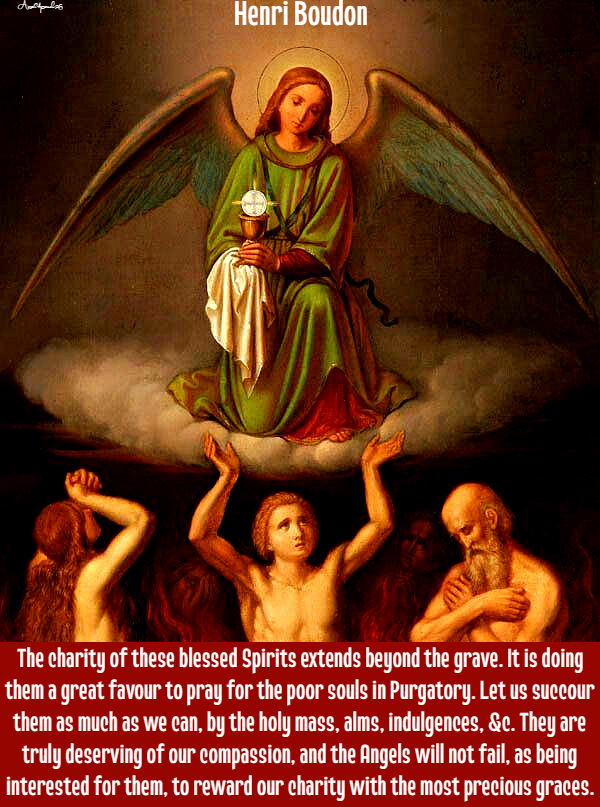
The example of the blessed Spirits should animate us to do and suffer all, in order to save our souls : it should also encourage us to labour for the salvation of others. Let us act in concert with these blessed Spirits for this end. The holy Angels faithfully continue their labours, and care for us during 40, or 60, or 80 years, or whatever be the term of our lives, though they are sure the object of them will reap no fruit or advantage, through his own malice. Hence, confessors, preachers, and all who labour in any shape for the extension of the reign of God, should be singularly devout to these holy Spirits. The charity of these blessed Spirits extends beyond the grave. It is doing them a great favour to pray for the poor souls in Purgatory. Let us succour them as much as we can, by the holy mass, alms, indulgences, &c. They are truly deserving of our compassion, and the Angels will not fail, as being interested for them, to reward our charity with the most precious graces.
The practice of chastity is absolutely necessary to gain the friendship of the Angels. Virginity is their favourite virtue, as it has been of Jesus, Mary, Joseph, and the two St. Johns. O Virgins! whoever you may be, remember you possess a treasure of inestimable price—one which assimilates you to the Angels. But, as in proportion to its excellence, you should have a more lively apprehension of its loss, so adopt more earnestly the necessary means in order to its preservation. These are mortification, guard of the senses, flight of the world, and true and sincere humility. This virtue of humility is one which the Angels require in those devoted to them; they cannot bear the proud. The practice of recollection and prayer is also most pleasing to them; they have been visibly seen assisting persons in this holy exercise. St. Bernard saw them noting the manner in which his religious made their prayer. But if we would be truly devout to the Angels, we should once for all take the resolution of avoiding deliberate faults and imperfections, of searching out and overcoming our predominant passion, the source of our most frequent irregularities.
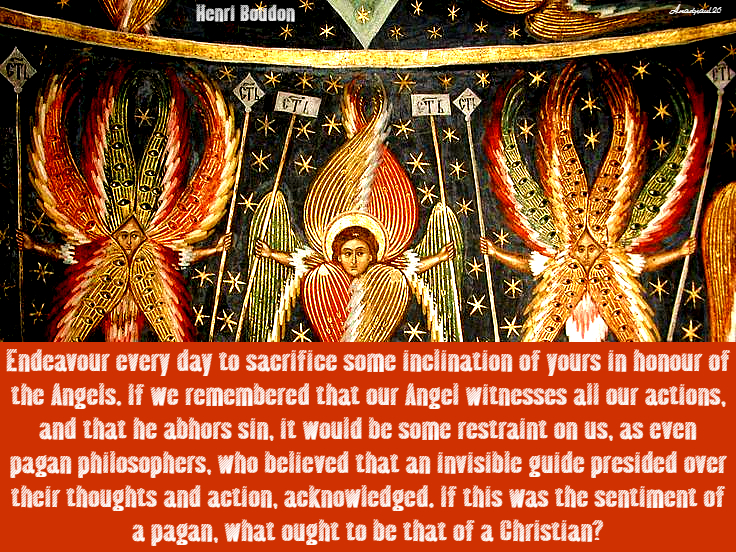
Endeavour every day to sacrifice some inclination of yours in honour of the Angels. If we remembered that our Angel witnesses all our actions, and that he abhors sin, it would be some restraint on us, as even pagan philosophers, who believed that an invisible guide presided over their thoughts and action, acknowledged. If this was the sentiment of a pagan, what ought to be that of a Christian?
To have a great Confidence in the Angels, and recur to them in all necessities.
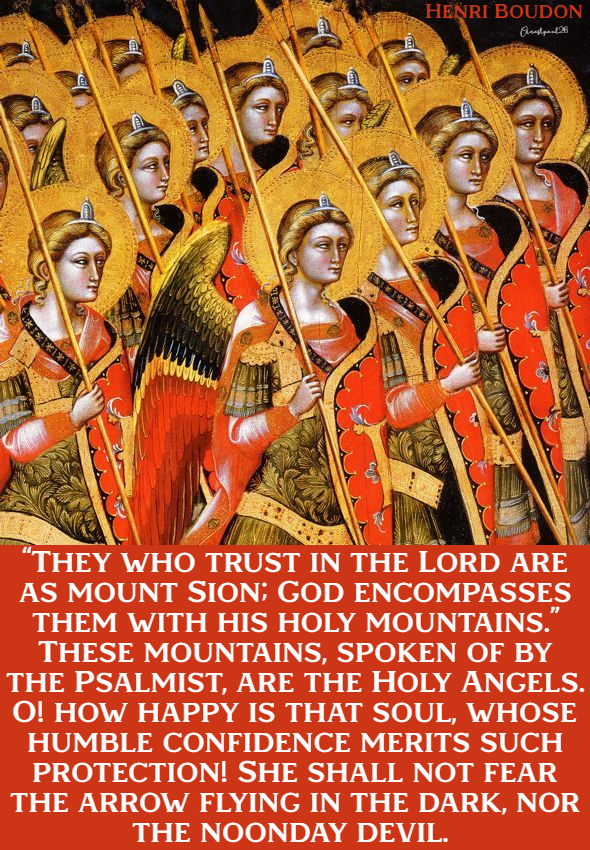
“They who trust in the Lord are as mount Sion; God encompasses them with his holy mountains.” These mountains, spoken of by the Psalmist, are the Holy Angels. O! how happy is that soul, whose humble confidence merits such protection! She shall not fear the arrow flying in the dark, nor the noonday devil.
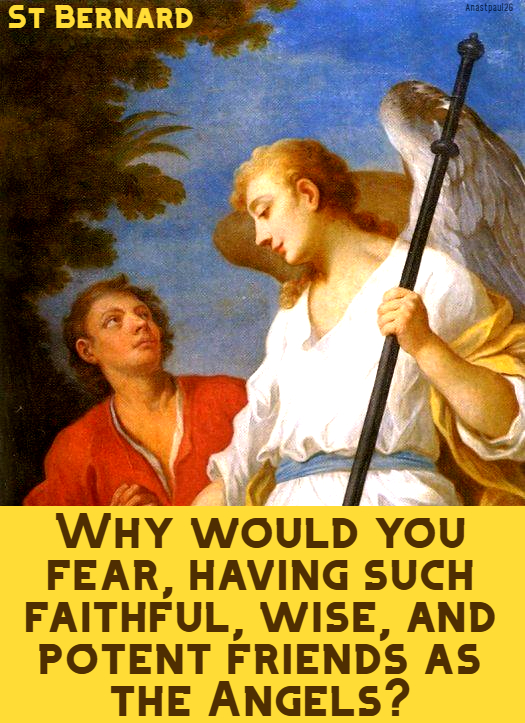
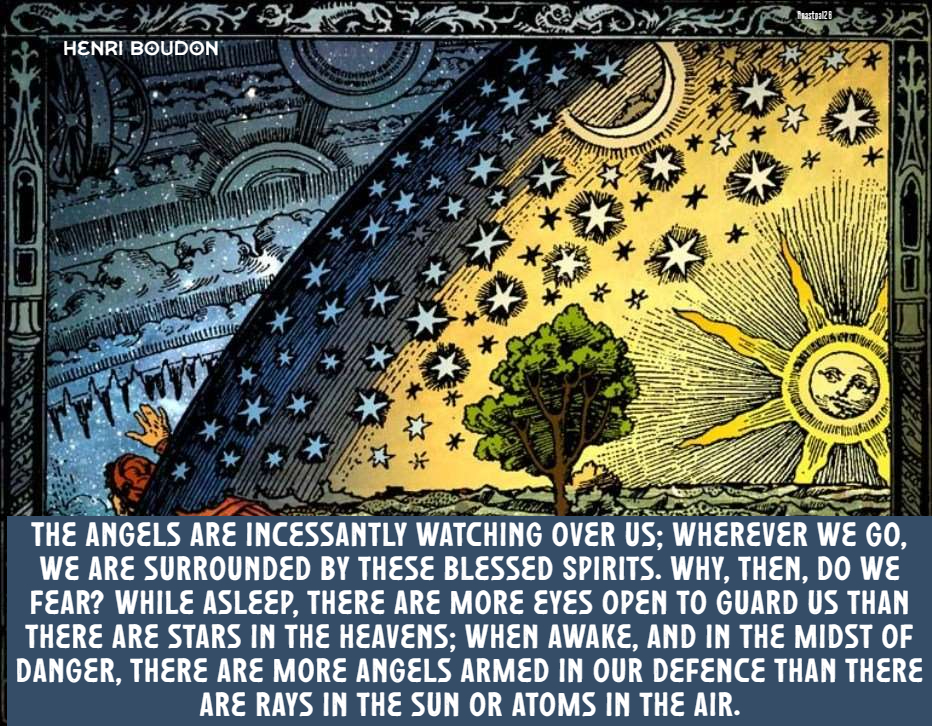
After all we have said, it would seem that you should not want a great confidence in the Angels. “Why would you fear,” says St. Bernard, “having such faithful, wise, and potent friends as the Angels?” “May joy be always with you,” said Raphael to Tobias; “I shall conduct you thither, and reconduct you hither.” The Angels are incessantly watching over us; wherever we go, we are surrounded by these blessed Spirits. Why, then, do we fear? While asleep, there are more eyes open to guard us than there are stars in the heavens; when awake, and in the midst of danger, there are more angels armed in our defence than there are rays in the sun or atoms in the air.
But, unhappy creatures !—nothing moves us but what strikes our senses. Here I must confess my utter astonishment at the little confidence of men in the protection of Heaven. O ! the avariciousness of the human heart! said our Lord once to St. Teresa. It seems to it that the whole world cannot supply its wants; it feels nothing but inquietude, both for temporal and spiritual things. Although there were no Providence, we could not place more reliance on human means. What a pity to see even spiritual persons counting so much on their own industry, and so much occupied with what concerns them. Let us place all our hope in the Lord, and all our confidence in his Providence. Let us beg of him to open our eyes to the protection of the Angels, as he did those of the servant of Elias.
Then seeing that “there is more for us than against us’ we cannot help confiding in such powerful patronage, nor fail to lift our hands, in our spiritual and corporeal dangers, to those holy mountains which the Lord has set for our defence, and appointed for our protection, through a marvellous excess of incomprehensible love.
To make Novenas in honour of the holy Angels—to take certain days to honour them—and to celebrate their Feasts with particular devotion.
The Catholic Church teaches, that we should not superstitiously attach ourselves to certain numbers; but there are some mysterious ones, consecrated by the piety of the faithful, which she sanctions and authorizes as that of three, which is the number of the holy Trinity; that of forty, which is the number of days our Lord spent in the wilderness; that of nine, which corresponds with the number of the angelic Choirs.
Any devotion practised for nine days is termed a Novena. St. Teresa was very partial to this practice, as she herself tells us. It is most useful to perform such a one in honour of the Angels; we ourselves have seen miraculous things effected by it.
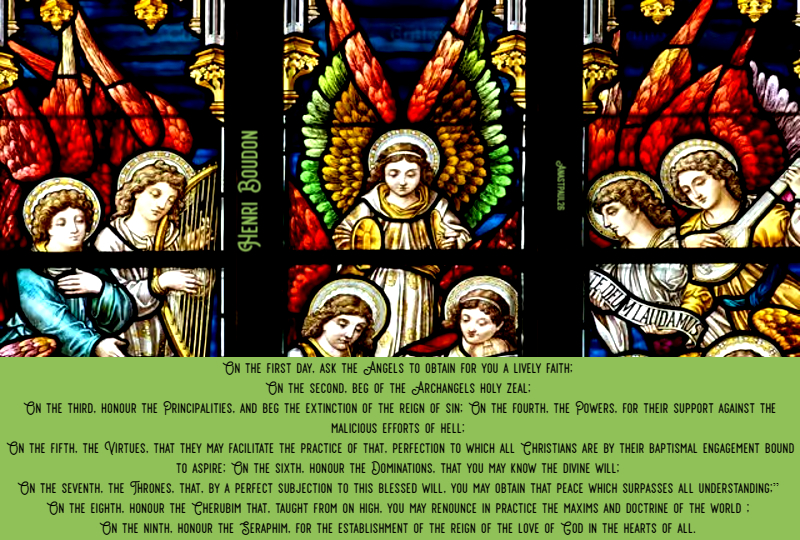
It may be as follows : the first day, honour the Angels of the last Choir by some prayer— nine Gloria Patris, for example—and ask them for the grace or favour you want; and thus ascend to all the choirs successively. If your object be the graces peculiar to each Choir, you can on the first day, ask the Angels to obtain for you a lively faith; on the second, beg of the Archangels holy zeal; on the third, honour the Principalities, and beg the extinction of the reign of sin; on the fourth, the Powers, for their support against the malicious efforts of hell; on the fifth, the Virtues, that they may facilitate the practice of that, perfection to which all Christians are by their baptismal engagement bound to aspire; on the sixth, honour the Dominations, that you may know the divine will; on the seventh, the Thrones, that, by a perfect subjection to this blessed will, you may obtain that peace which surpasses all understanding;” on the eighth, honour the Cherubim that, taught from on high, you may renounce in practice the maxims and doctrine of the world ; and, finally, on the ninth, honour the Seraphim, for the establishment of the reign of the love of God in the hearts of all.
This devotion of Novenas is also a useful preparation for the feasts of our Lord and his blessed Mother, as well as of the Angels. It may consist of any pious practice, as of nine acts of mortification, nine genuflections, nine visits to the Holy Sacrament, or nine Ave Marias, a devotion which our Lord revealed to St. Mechtilde. It is well to commence by receiving the Holy Sacraments, that our souls being cleansed from sin, God may be more ready to hear and grant our requests. Thus much for the devotion of the Novena.
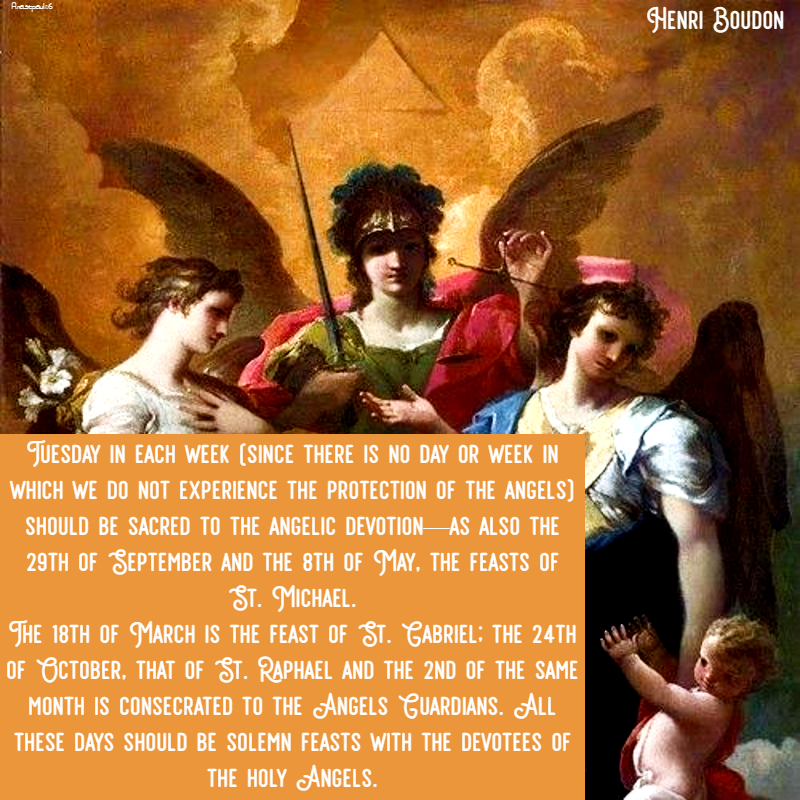
Tuesday in each week (since there is no day or week in which we do not experience the protection of the angels) should be sacred to the angelic devotion—as also the 29th of September and the 8th of May, the feasts of St. Michael. In Normandy, they devote the 16th of October to honour the apparition of this glorious Archangel on the Mount of Tornbe, commonly called Mount St. Michael. The church built there in his honour is frequented by crowds of pilgrims on this day, and numberless miracles are operated by his intercession.
The 18th of March is the feast of St. Gabriel; the 24th of October, that of St. Raphael and the 2nd of the same month is consecrated to the Angels Guardians. All these days should be solemn feasts with the devotees of the holy Angels. They would do well to prepare for them by some act of mortification, (St. Francis fasted forty days to prepare for the feast of St. Michael,) or by the Novena, and to celebrate the feast itself by approaching the Sacraments, reciting the Office of and Litany and Beads of these blessed Spirits, each one according to his time and devotion.
Behold another way of honouring the Angels : when about to celebrate the festival of a Saint, form the intention of honouring his or her guardian; thus you will keep a perpetual holiday in honour of the Angels. Love to visit churches and altars dedicated to them; you will thereby obtain, through their intercession, the most precious gifts and graces.
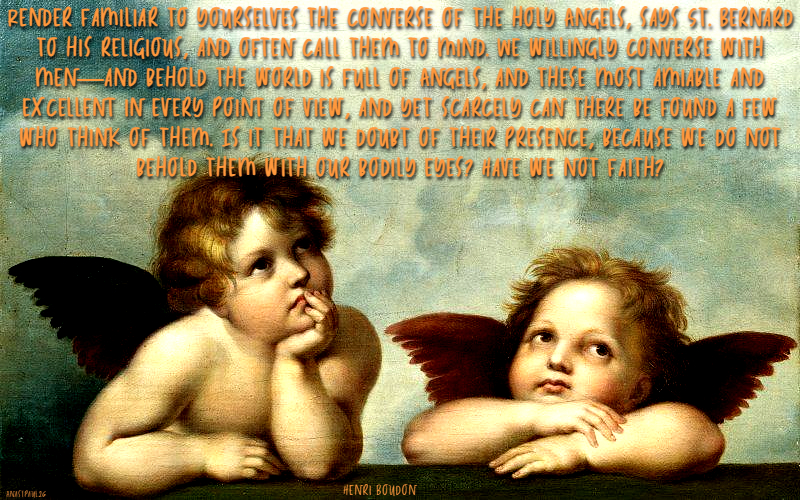
Render familiar to yourselves the converse of the holy Angels, says St. Bernard to his religious, and often call them to mind. We willingly converse with men—and behold the world is full of Angels, and these most amiable and excellent in every point of view, and yet scarcely can there be found a few who think of them. Is it that we doubt of their presence, because we do not behold them with our bodily eyes? Have we not faith?
When you walk through town, salute interiorly the Angels of those whom you meet. When you go to the country, pay homage to the blessed Spirits who are there even more neglected, because of the ignorance of the poor peasantry. When you enter into a church, or a public assembly, let holy faith manifest to you the presence of the Angels. When you make a journey, entertain yourself with the Angels of those who travel with you. When among your friends, say from time to time a little word to their Angels—and when alone with yourself, speak to and entertain these blessed Spirits.
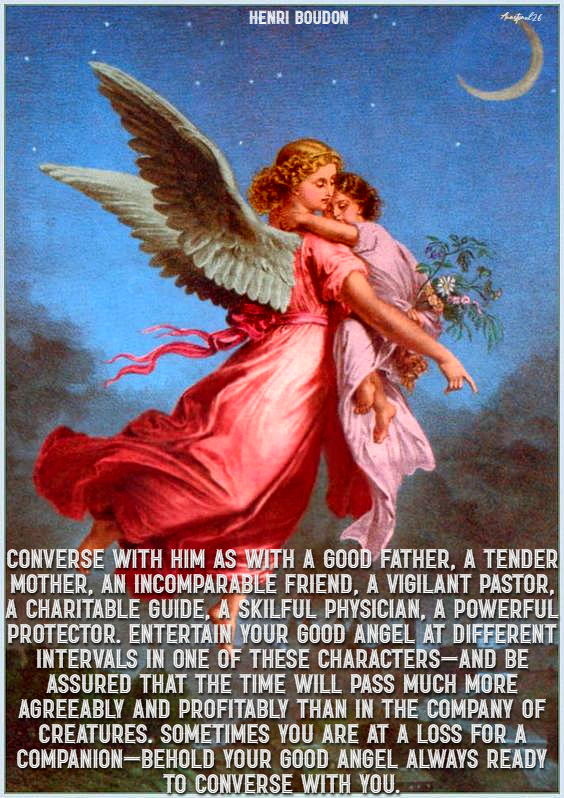
If we exhort you to be familiar with and devout to all the Angels, we are still more pressing in inviting you to honour that holy Spirit to whose care God committed you at the moment of your birth. He thinks continually of you; never lose sight of him. A little prayer, said morning and night, is too slight a testimony of your gratitude towards him. Take then, a quarter or half an hour sometimes to pay this good Angel your homage. Prostrate yourself before him; crave pardon for your past ingratitude; ask his blessing : tell him all you would wish to say to a most faithful friend.: Now speak to him of your weaknesses, miseries, temptations—and then of the obligations you have to him, of his beauty, his perfections, his admirable qualifications. Converse with him as with a good father, a tender mother, an incomparable friend, a vigilant pastor, a charitable guide, a skilful physician, a powerful protector. Entertain your good Angel at different intervals in one of these characters—and be assured that the time will pass much more agreeably and profitably than in the company of creatures. Sometimes you are at a loss for a companion—behold your good Angel always ready to converse with you.
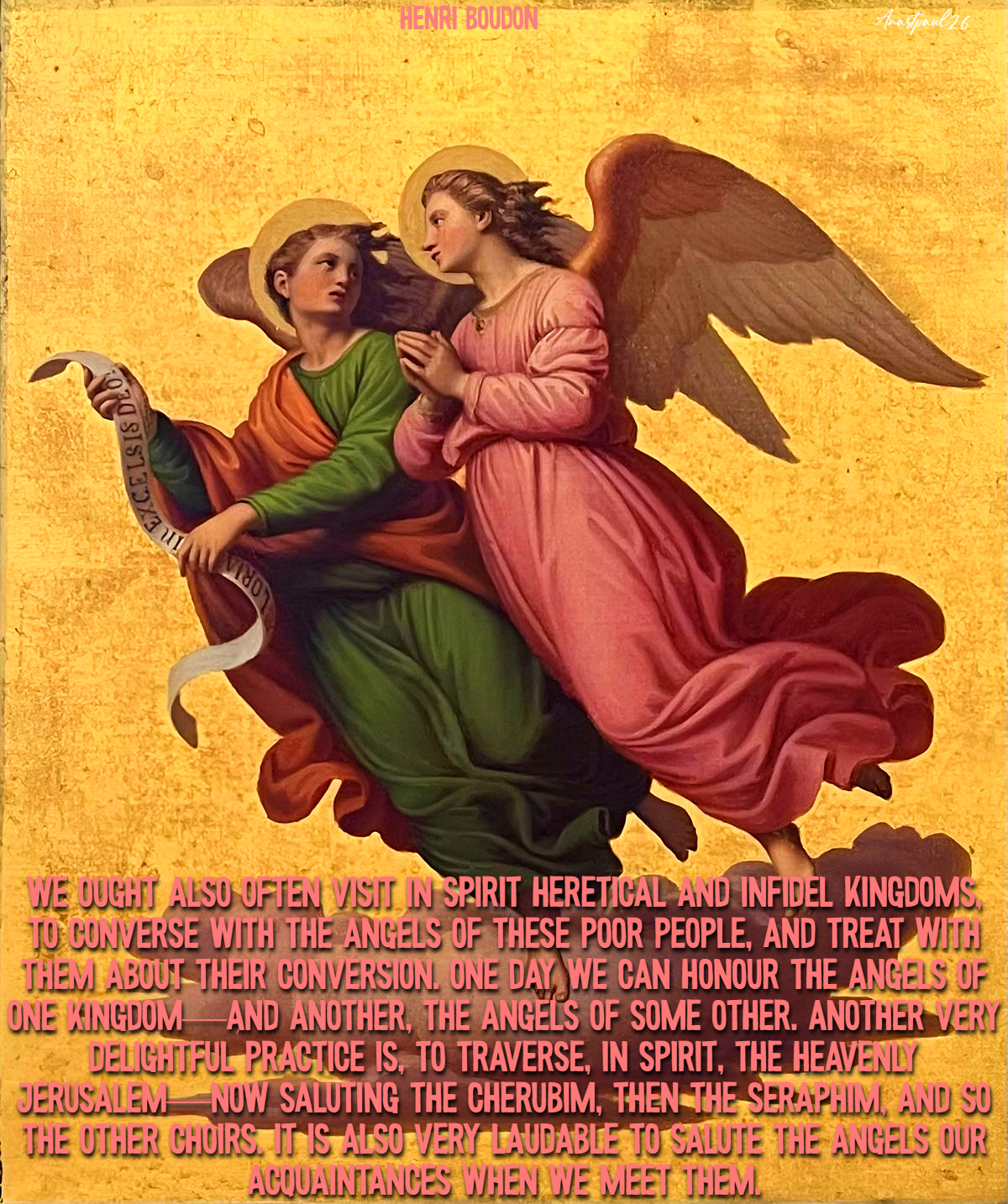
We ought also often visit in spirit heretical and infidel kingdoms, to converse with the Angels of these poor people, and treat with them about their conversion. One day we can honour the Angels of one kingdom—and another, the Angels of some other. Another very delightful practice is, to traverse, in spirit, the Heavenly Jerusalem—now saluting the Cherubim, then the Seraphim, and so the other Choirs. It is also very laudable to salute the Angels our acquaintances when we meet them. This is easier than some may imagine; it is only necessary to make a little compact with yourself, which you will renew at least every month, that, as often as you salute any person, you will also salute his Angel Guardian. On these occasions, when you remember it, say interiorly to these holy Angels, that you salute them.
By this means, the recollection of these blessed Spirits will be gradually facilitated. Some, when writing to friends, salute their Angel Guardians. I know it will be said, that these practices are rare. I admit that they are so—but maintain that they ought to be general. It is an extraordinary thing to see a real Saint: but as this deplorable truth should not hinder us from aspiring to sanctity—so, that want of devotion to the Angels, which is so general, cannot warrant us to refuse them our love and veneration.
To have a great Devotion to the Seven Spirits who are before the Throne.
The Holy Scriptures assure us, that there are seven of the holy Angels specially appointed to assist before the Throne, and stand continually in the presence of the Most High. In the 1st chapter of the Apocalypse, grace and peace are given in the name of these sublime Spirits. We only know the names of three of them—St. Michael, St. Gabriel, St. Raphael. Some say that the fourth is called Uriel, of whom there is mention made in the Book of Esdras. E.
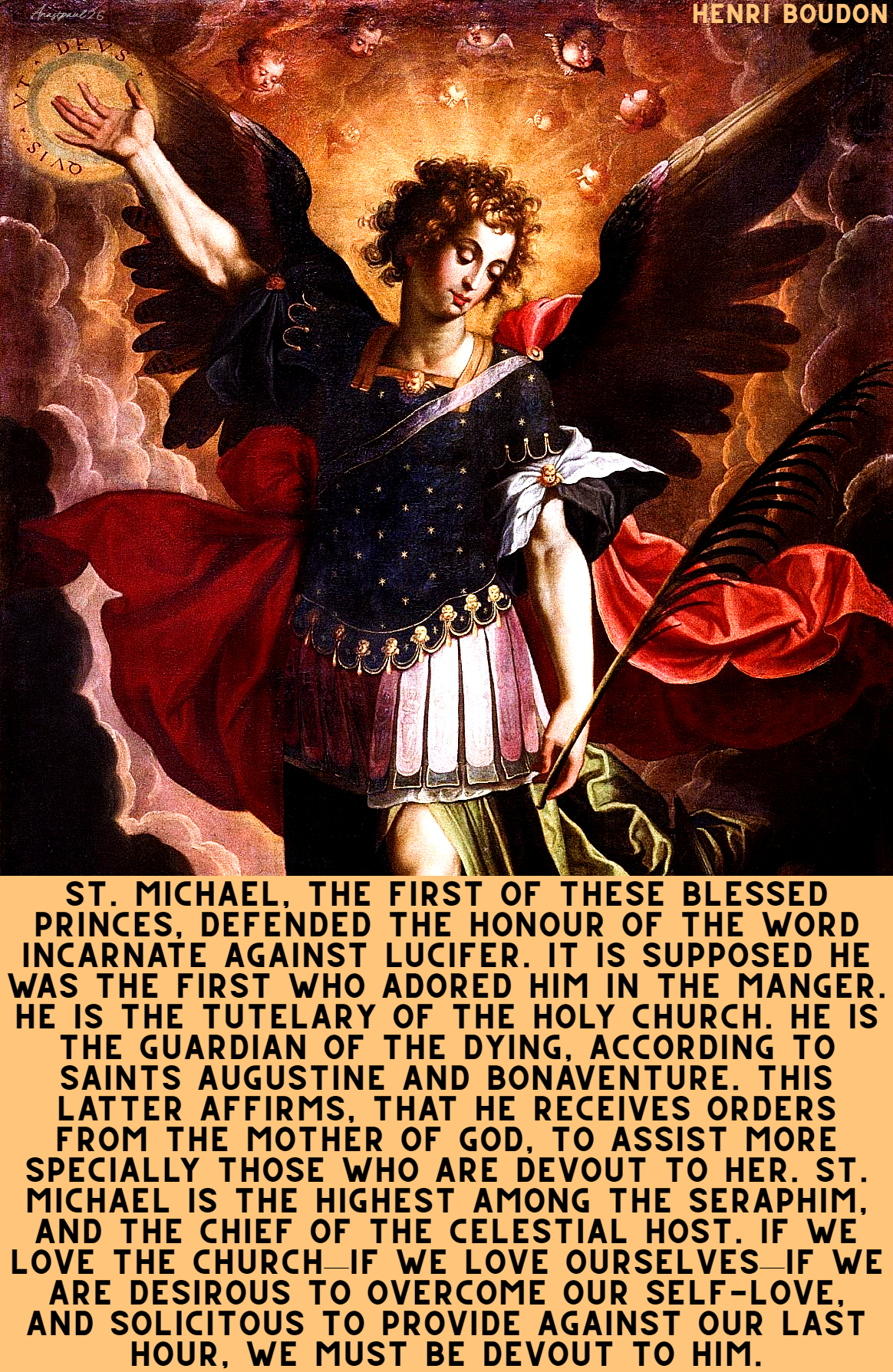
But to say something of each in particular: St. Michael, the first of these blessed princes, defended the honour of the Word incarnate against Lucifer. It is supposed he was the first who adored him in the manger. He is the tutelary of the holy Church. He is the guardian of the dying, according to Saints Augustine and Bonaventure. This latter affirms, that he receives orders from the Mother of God, to assist more specially those who are devout to her. St. Michael is the highest among the Seraphim, and the chief of the celestial host. If we love the Church—if we love ourselves—if we are desirous to overcome our self-love, and solicitous to provide against our last hour, we must be devout to him.
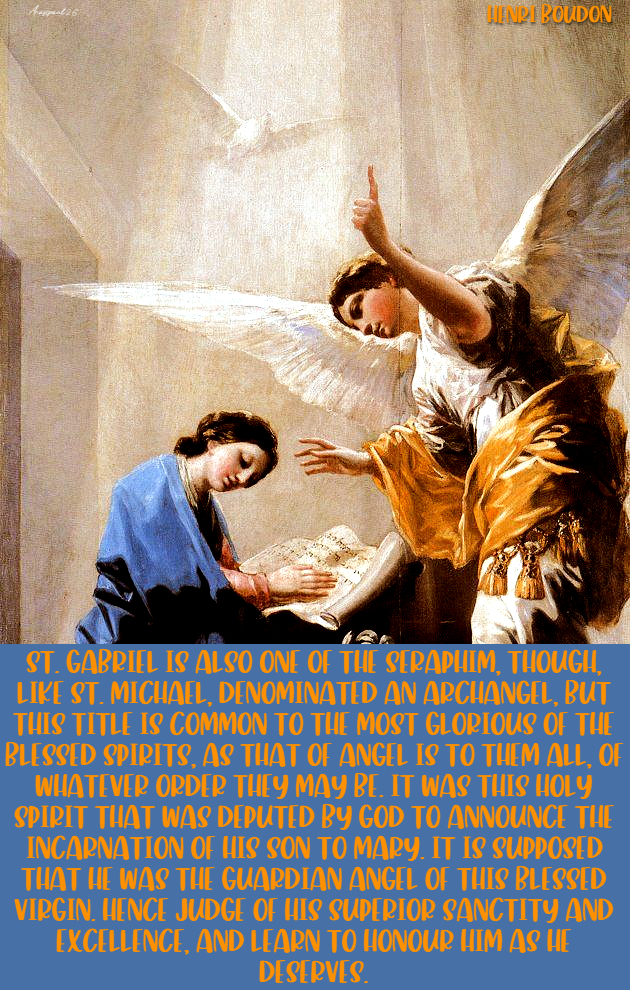
St. Gabriel is also one of the Seraphim, though, like St. Michael, denominated an archangel, but this title is common to the most glorious of the blessed Spirits, as that of Angel is to them all, of whatever order they may be. It was this holy spirit that was deputed by God to announce the incarnation of his Son to Mary. It is supposed that he was the Guardian Angel of this blessed Virgin. Hence judge of his superior sanctity and excellence, and learn to honour him as he deserves.
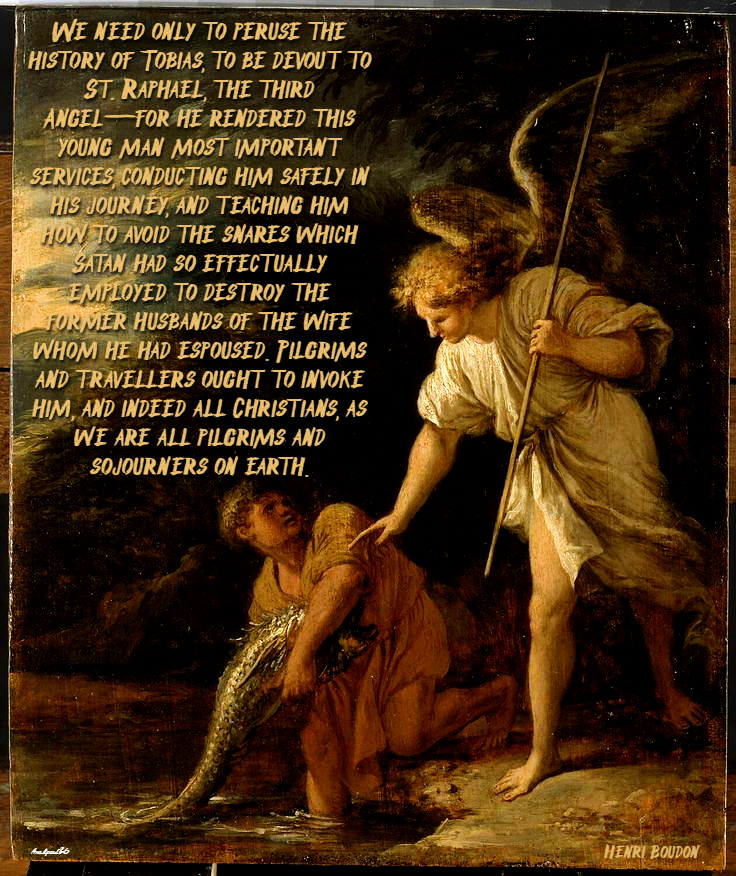
We need only to peruse the history of Tobias, to be devout to St. Raphael, the third Angel—for he rendered this young man most important services, conducting him safely in his journey, and teaching him how to avoid the snares which Satan had so effectually employed to destroy the former husbands of the wife whom he had espoused. Pilgrims and travellers ought to invoke him, and indeed all Christians, as we are all pilgrims and sojourners on earth.
Let us honour all these blessed Seven—let us be but truly devout to them let us beg their prayers, in order that we may avoid the seven capital sins, and obtain the seven gifts of the Holy Ghost.
To entertain a profound respect and extraordinary love for the Thrones, the Cherubim and Seraphim.
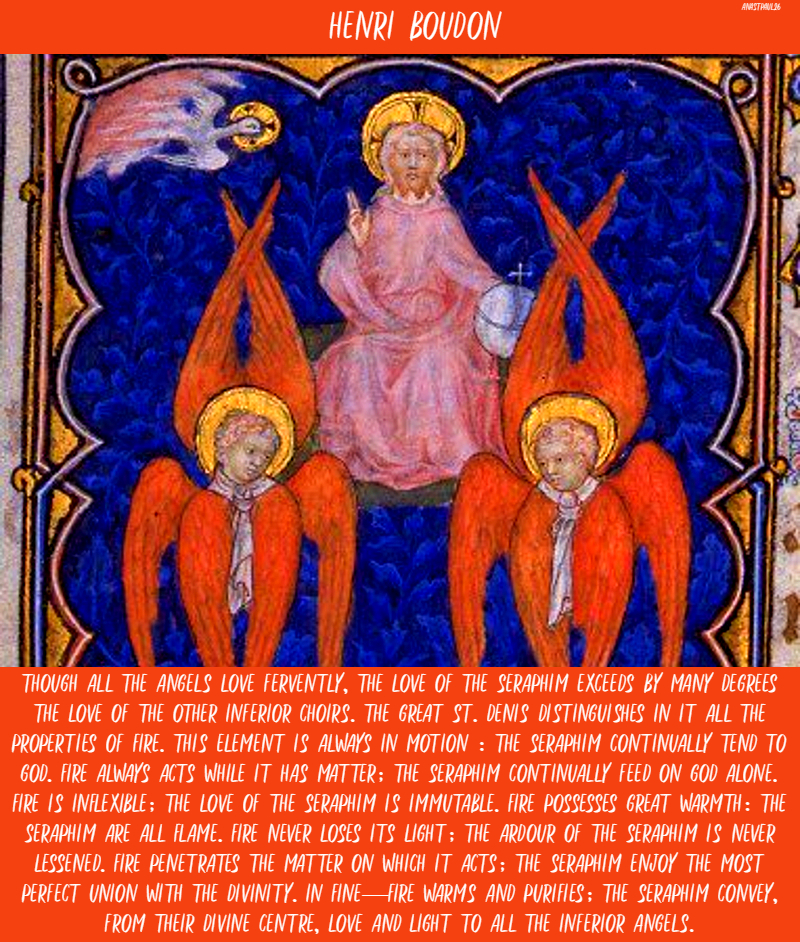
The first Hierarchy of the Angels is composed of the Thrones, the Cherubim and Seraphim. The latter excel in love—hence their name, Seraphim, which signifies ardour. Though all the Angels love fervently, the love of the Seraphim exceeds by many degrees the love of the other inferior choirs. The great St. Denis distinguishes in it all the properties of fire. This element is always in motion : the Seraphim continually tend to God. Fire always acts while it has matter; the Seraphim continually feed on God alone. Fire is inflexible; the love of the Seraphim is immutable. Fire possesses great warmth: the Seraphim are all flame. Fire never loses its light; the ardour of the Seraphim is never lessened. Fire penetrates the matter on which it acts; the Seraphim enjoy the most perfect union with the Divinity. In fine—fire warms and purifies; the Seraphim convey, from their divine centre, love and light to all the inferior Angels.
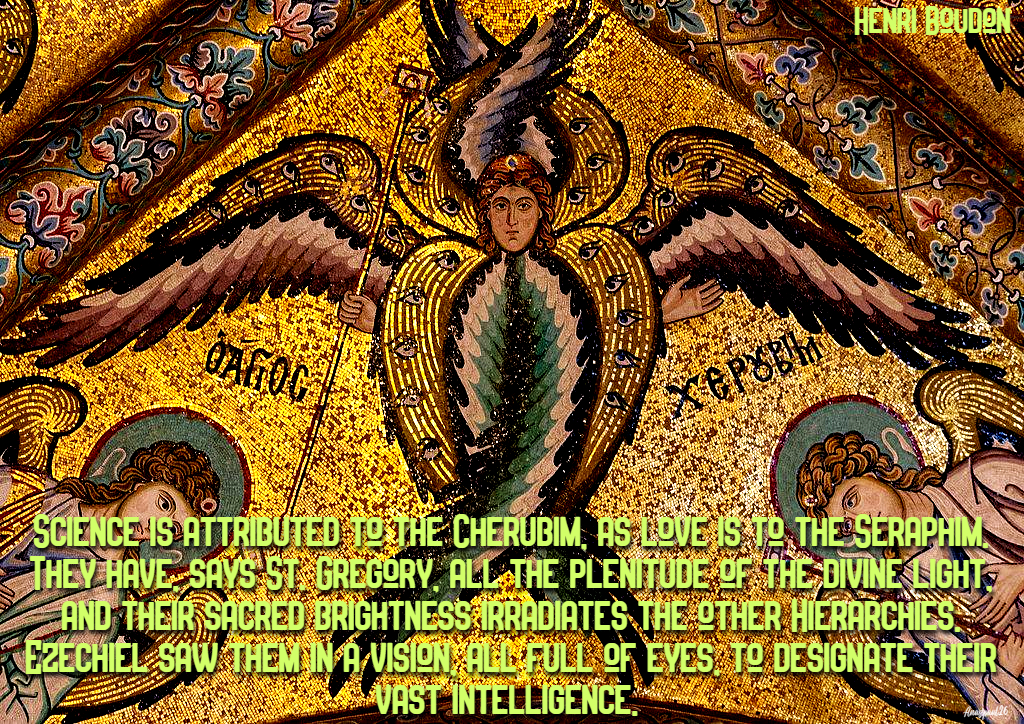
Science is attributed to the Cherubim, as love is to the Seraphim. They have, says St. Gregory, all the plenitude of the divine light, and their sacred brightness irradiates the other Hierarchies. Ezechiel saw them in a vision, all full of eyes, to designate their vast intelligence.
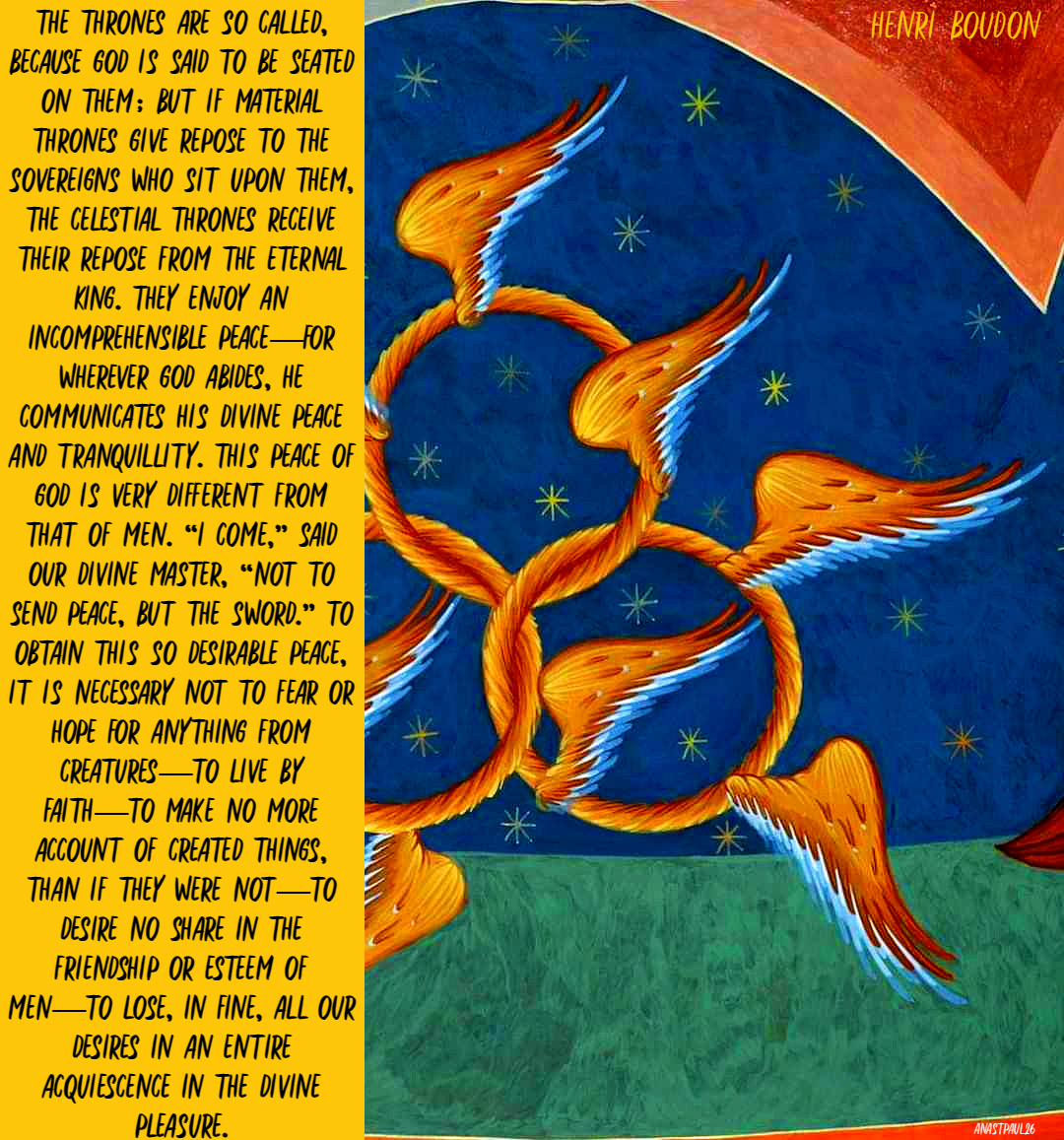
The Thrones are so called, because God is said to be seated on them; but if material thrones give repose to the Sovereigns who sit upon them, the celestial Thrones receive their repose from the Eternal King. They enjoy an incomprehensible peace—for wherever God abides, he communicates his divine peace and tranquillity. This peace of God is very different from that of men. “I come,” said our divine Master, “not to send peace, but the sword.” To obtain this so desirable peace, it is necessary not to fear or hope for anything from creatures—to live by faith—to make no more account of created things, than if they were not—to desire no share in the friendship or esteem of men—to lose, in fine, all our desires in an entire acquiescence in the divine pleasure. Be devout to the Thrones, and they will exert themselves in obtaining for you this greatest of all blessings. In like manner with the Cherubim.
It is said, that in the way of virtue we know more than we do but it is certain that perfect knowledge is rare. We speak of that of the saints. Few persons are practically convinced of the excellence of poverty and humiliation—of the advantages of the hidden and suffering life. It is in the school of a God, and at the feet of the crucifix, that this divine lesson is to be learned. Let us frequent it under the auspices of the Cherubim, the spirits of light, and we shall soon be illumined, and walk in the brightness of the children of God.
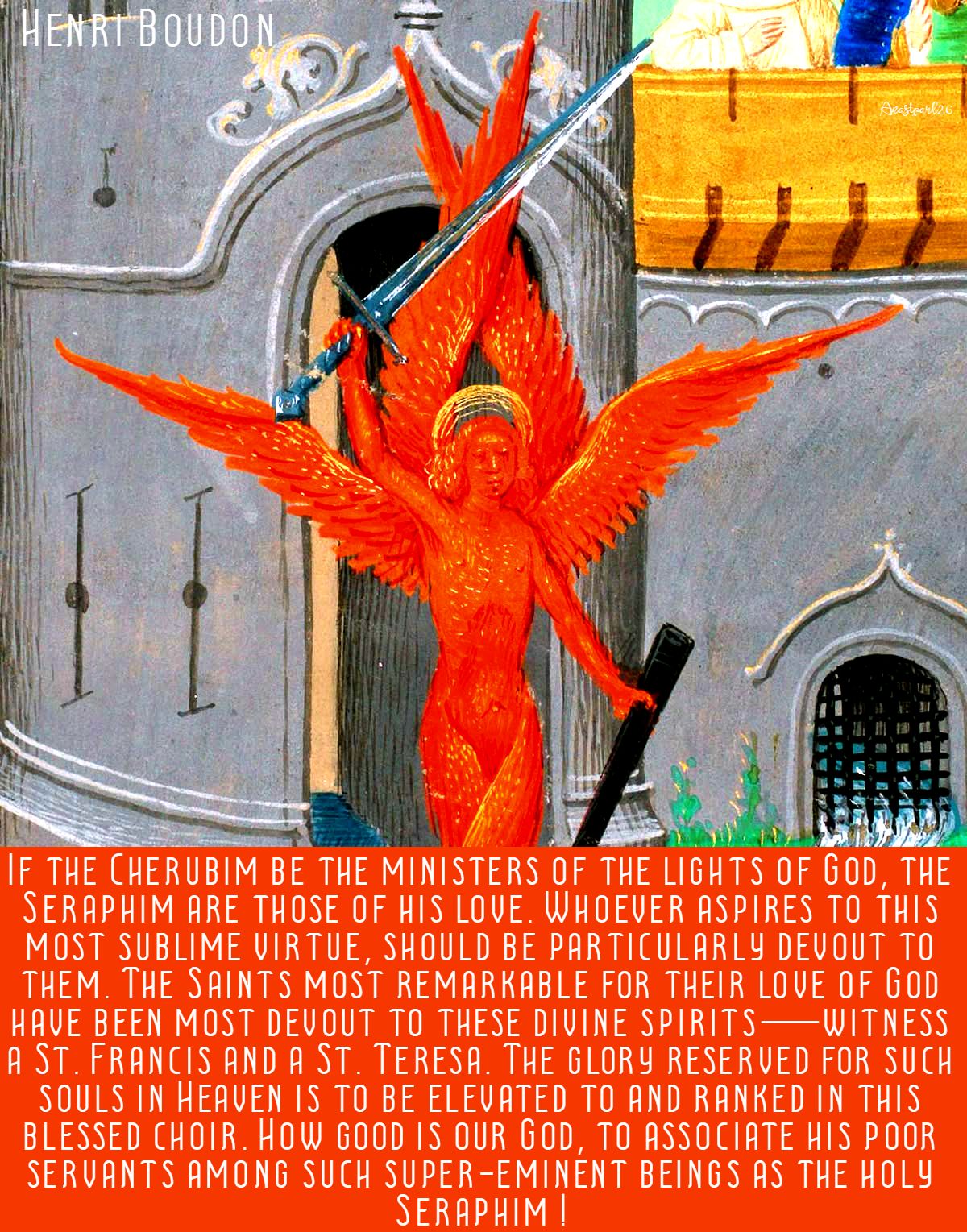
If the Cherubim be the ministers of the lights of God, the Seraphim are those of his love. Whoever aspires to this most sublime virtue, should be particularly devout to them. The Saints most remarkable for their love of God have been most devout to these divine spirits—witness a St. Francis and a St. Teresa. The glory reserved for such souls in Heaven is to be elevated to and ranked in this blessed choir. How good is our God, to associate his poor servants among such super-eminent beings as the holy Seraphim !
To honour specially the Powers, Virtues, and Dominations.
The Second Hierarchy of Angels is composed of the Powers, Virtues, and Dominations. The Dominations, as the principal Choir, give or dispense the orders which they receive from the higher Angels—the Virtues enable us to execute them— and the Powers to surmount the obstacles which the Devils oppose thereto. We have elsewhere demonstrated the malicious arts of these wicked spirits; it is to the Powers that God has given the special grace to defeat them. Hence it is of the greatest importance in the spiritual life to honour these blessed spirits. We cannot detail the happy effects which proceed from it. When we see storms raised in the Church, or opposition excited against those who labour for the increase of divine glory—if we recur to the holy Powers, we shall soon perceive how wonderful they are in overturning; and defeating the machinations of hell.
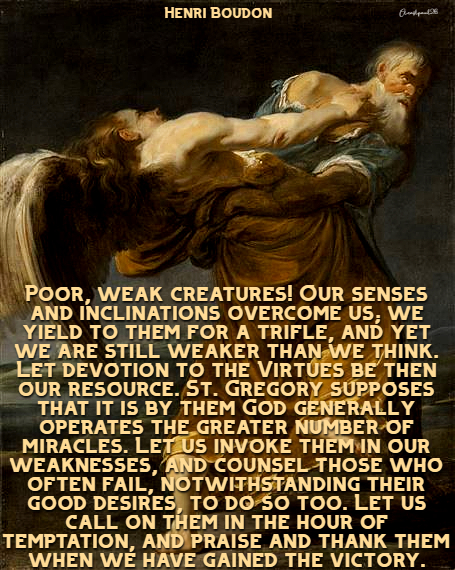
With all our good desires, we do very little; our tongues are longer than our arms. It seems as if nothing could arrest our course—and when we make a few steps, we grow tired and think of reposing. Poor, weak creatures! Our senses and inclinations overcome us; we yield to them for a trifle, and yet we are still weaker than we think. Let devotion to the Virtues be then our resource. St. Gregory supposes that it is by them God generally operates the greater number of miracles. Let us invoke them in our weaknesses, and counsel those who often fail, notwithstanding their good desires, to do so too. Let us call on them in the hour of temptation, and praise and thank them when we have gained the victory.
If the Dominations dispense the orders of God to the other Angels, they manifest his holy will to man. O! how happy should we be, if we always discerned this blessed will! But alas ! we often mistake for it the will of the creature, and still oftener, when we know it, we find it difficult to submit to it. We wish that the will of God may be done, but in such a manner as we wish. This is not true conformity. A soul touched with the love of God would fly to the remotest corner of the earth at his nod; she wishes that God may be absolute in her and in all creatures—that his will may be done as he pleases, and because he pleases. If at any time she is ignorant of this will, and prays to the Dominations, they will not fail to manifest it to her, being Secretaries of State to the great King Jesus.
O my God ! how just it appears, that all should serve and be subject to you ! “All the nations are before you as a drop of dew.” He who knows your will, and does it not, deserves punishment indeed. O! may it be done in all things—and may we seek our peace only in its accomplishment. Amen.
To have a singular Devotion to the holy Spirits of the First Choir—the Angels, Archangels, and Principalities.
The third or last Hierarchy of the Holy Angels is formed of three Choirs Angels, Archangels, and Principalities. They are particularly applied to the affairs of kingdoms and provinces, and in general to all that regards the happiness of man. Their goodness and kindness is so great, that we can never make them a suitable return. The principalities are so called, says St. Gregory, because they are the princes of the other two choirs, and communicate to them those lights and intelligences which they receive from the higher Hierarchies. The Archangels watch over kingdoms and provinces and the Angels are appointed the guardians of men.
Let us have a great devotion to this blessed choir, honouring not only our own Angels but also those of others. Let us honour the Angels of Infidels, and often go in spirit to the countries they inhabit, to pay our respects to them. These poor blind people know not even that there are Angels, and behold the unwearied patience and love of these blessed Spirits in guarding and defending them. Do make atonement to them, communicate sometimes, give alms, hear mass, for this intention—and let your heart often salute these holy Angels. The more they are slighted, the more they will love and acknowledge your services. If a great king, in the revolt of his subjects, received considerable services from foreigners, he would not fail to acknowledge them gratefully, when reinstated in his dominions : hence judge what you may expect from the princes of the celestial realm. Do the same for the Angels of Heretics—for those of uninstructed Catholics, the greater number of whom know as little about these holy Spirits, as Pagans and Infidels. Pray for their conversion, that knowing the adorable Jesus, whom God has sent, and Mary his amiable mother, they may also know and honour the Angels.
Be devout to the Angels of your friends; these often render you services, which you would not receive from your own guardian. As, in the number of your friends, your confessor holds the first place, honour particularly his Angel, and pray him to bear on his mind a perfect knowledge of the designs of God on those whom he directs. Honour the Angels of your parents, relations, benefactors, and- of all with whom you have to do; they have more part than you think in the favours you receive by means of those persons. Be devout to the Angels of your enemies—it is the true way to gain them—or, if God wills that you should suffer the effects of their hatred, it is the best means of obtaining grace to love them cordially and make a good use of your sufferings. In fine, revere the Angels of the Sovereign Pontiff, the Bishops, the Clergy, and all persons in authority—that they may fitly discharge their obligations.
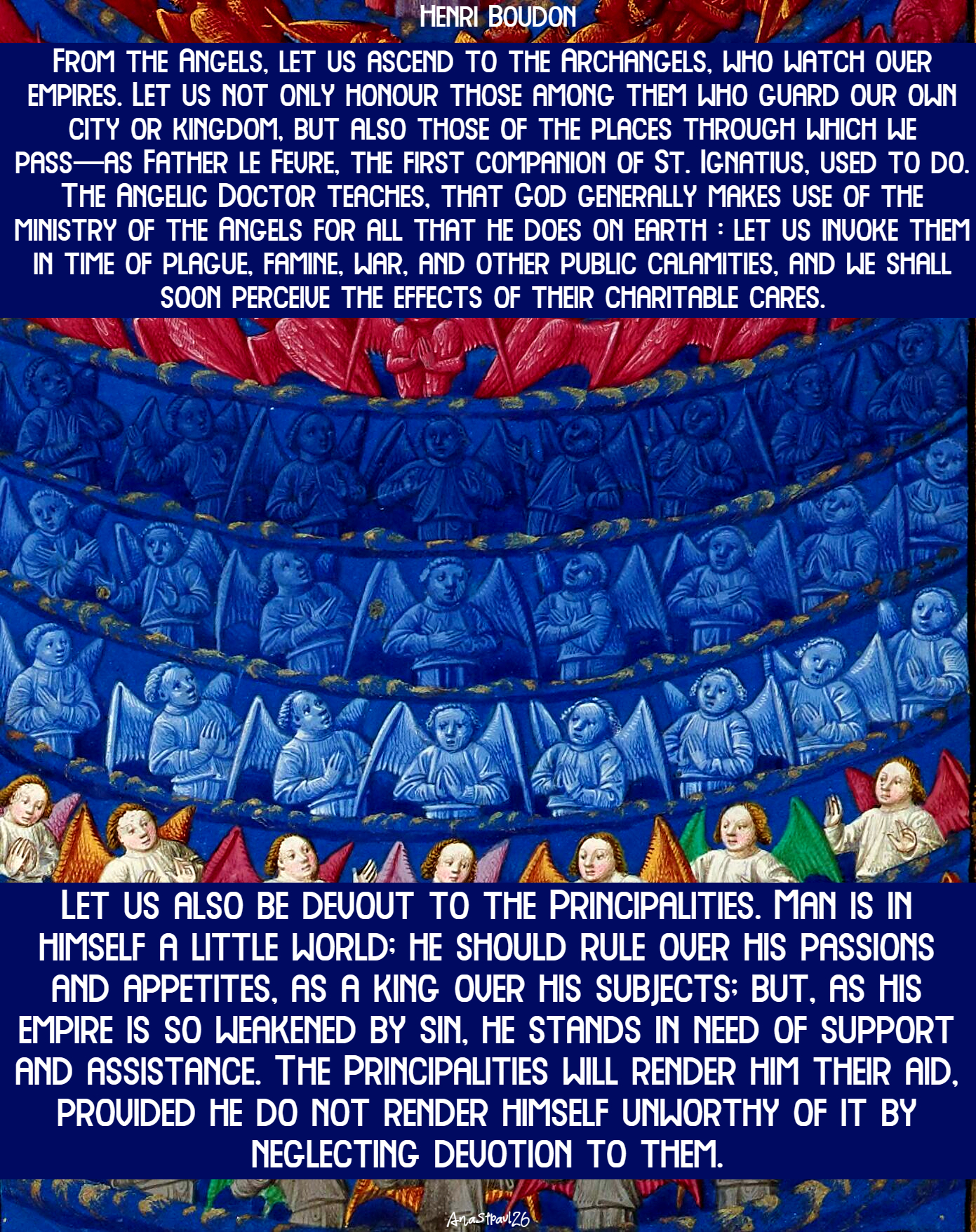
From the Angels, let us ascend to the Archangels, who watch over empires. Let us not only honour those among them who guard our own city or kingdom, but also those of the places through which we pass—as Father le Fevre, the first companion of St. Ignatius, used to do. The Angelic Doctor teaches, that God generally makes use of the ministry of the Angels for all that he does on earth : let us invoke them in time of plague, famine, war, and other public calamities, and we shall soon perceive the effects of their charitable cares.
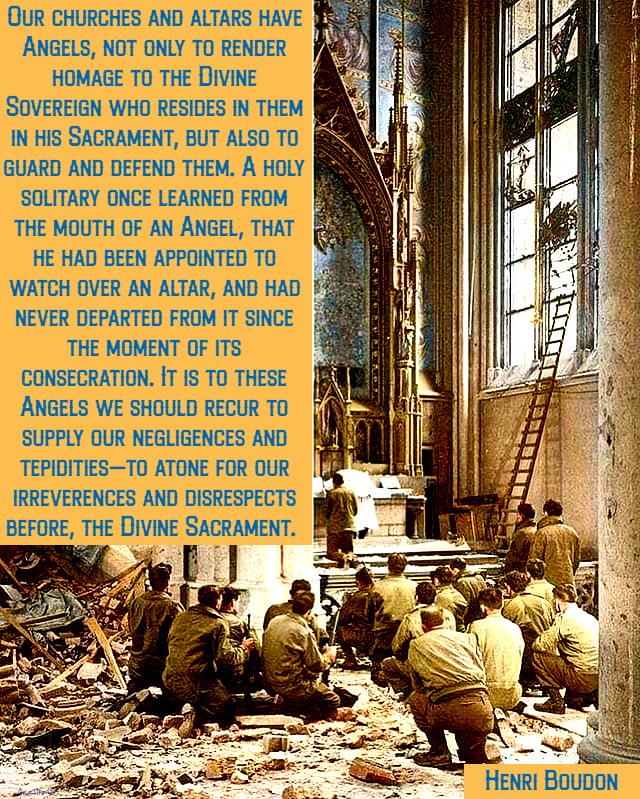
Our churches and altars have Angels, not only to render homage to the Divine Sovereign who resides in them in his Sacrament, but also to guard and defend them. A holy solitary once learned from the mouth of an Angel, that he had been appointed to watch over an altar, and had never departed from it since the moment of its consecration. It is to these Angels we should recur to supply our negligences and tepidities—to atone for our irreverences and disrespects before, the Divine Sacrament. It is well to unite in the love and homage which they continually render to it, and like the Psalmist, to “sing canticles of praise to our God in the presence of his Angels.”
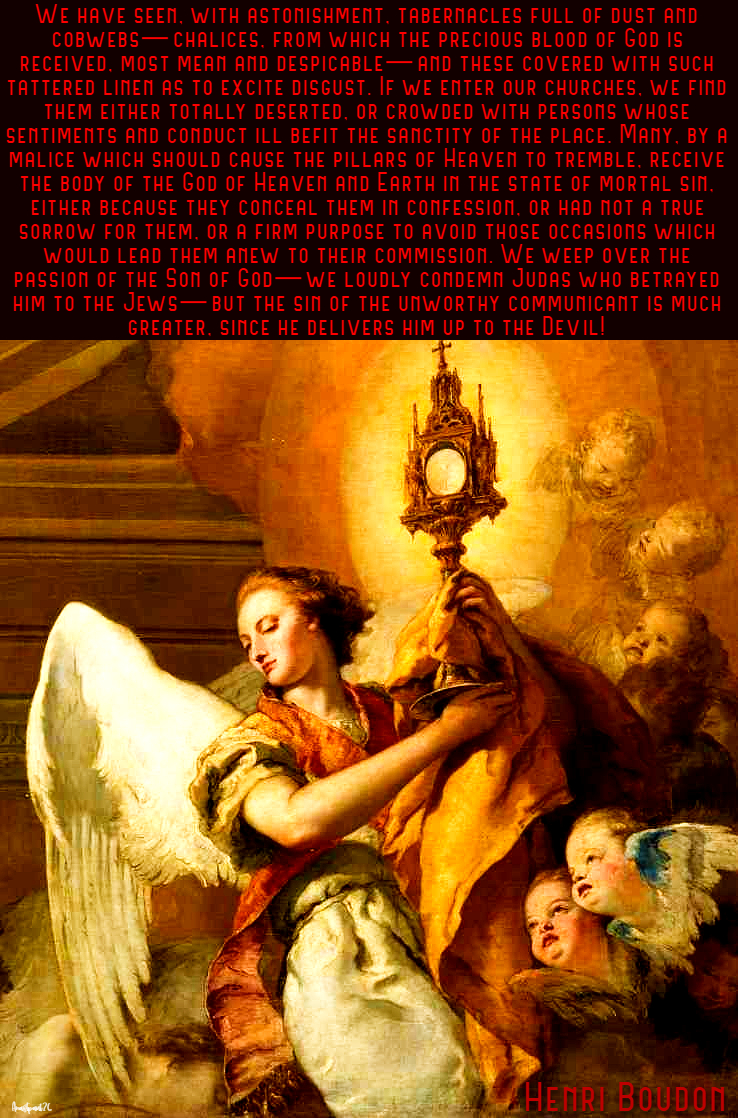
O my Lord and my God! here permit me to bewail, in the presence of your Divine Majesty, the deplorable blindness of Christians, who are the children of light, regarding your holy Sacrament. Is it then true, that they still believe you to be really present in this adorable mystery and behave as they do ? We are seized with horror when we reflect on the irreverences committed against you by Heretics and Infidels but those offered to you by Christians, who profess themselves ready to sacrifice their lives in defence of this adorable truth, are inconceivable. We have seen, with astonishment, tabernacles full of dust and cobwebs—chalices, from which the precious blood of God is received, most mean and despicable—and these covered with such tattered linen as to excite disgust. If we enter our churches, we find them either totally deserted, or crowded with persons whose sentiments and conduct ill befit the sanctity of the place. This is not all—the sufferings which love has imposed on our Sovereign stop not here. Many, by a malice which should cause the pillars of Heaven to tremble, receive the body of the God of Heaven and Earth in the state of mortal sin, either because they conceal them in confession, or had not a true sorrow for them, or a firm purpose to avoid those occasions which would lead them anew to their commission. We weep over the passion of the Son of God—we loudly condemn Judas who betrayed him to the Jews—but the sin of the unworthy communicant is much greater, since he delivers him up to the Devil!
O ! Angels of Paradise ! I address myself to you—knowing the obduracy of men, inspire them with all that respect for the adorable body of your Sovereign, which they are capable of conceiving—give them a knowledge of the dispositions with which it should be received:—that this abominable crime, this sin more hellish than human, may be no more committed. Inspire the rich to provide churches and altars, with suitable decorations—and repair, by your unceasing homage, the insults which have been offered to this mystery of inconceivable love.
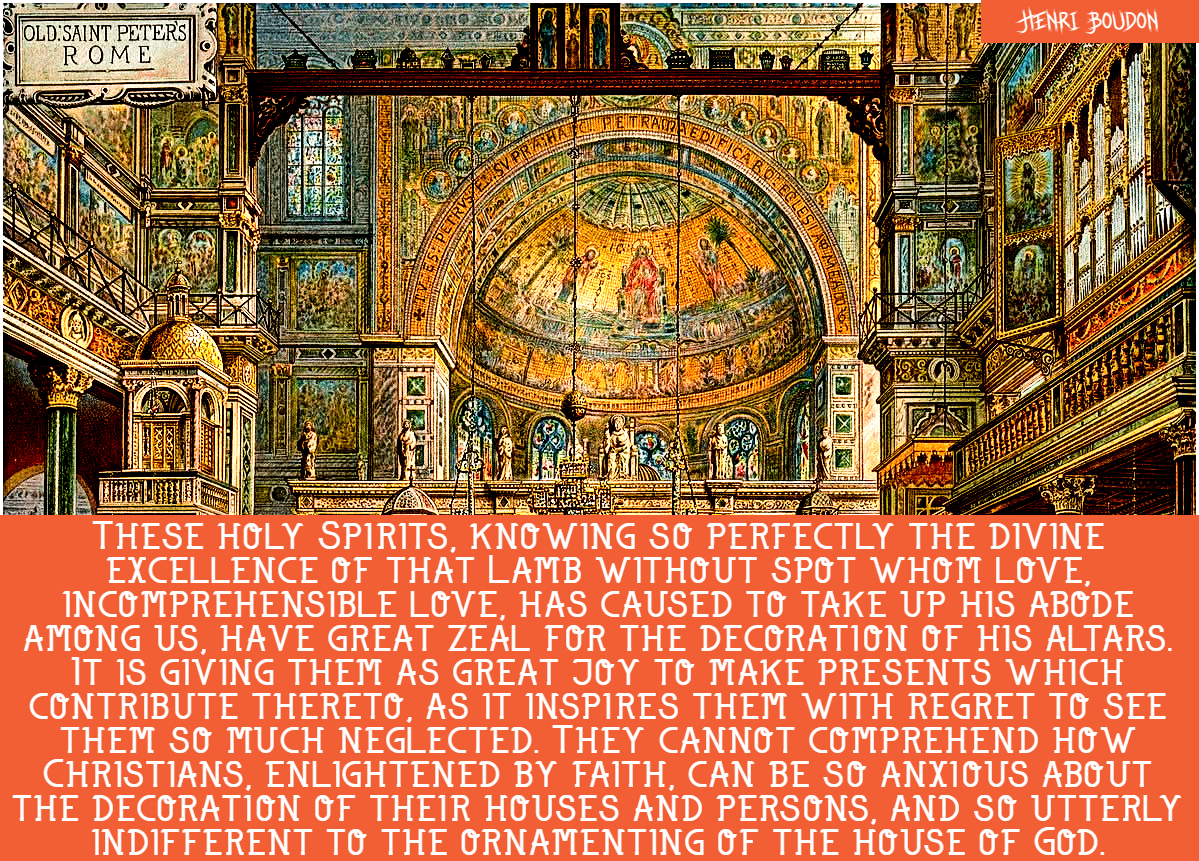
These holy Spirits, knowing so perfectly the divine excellence of that Lamb without spot whom love, incomprehensible love, has caused to take up his abode among us, have great zeal for the decoration of his altars. It is giving them as great joy to make presents which contribute thereto, as it inspires them with regret to see them so much neglected. They cannot comprehend how Christians, enlightened by faith, can be so anxious about the decoration of their houses and persons, and so utterly indifferent to the ornamenting of the house of God.
Let us also be devout to the Principalities. Man is in himself a little world; he should rule over his passions and appetites, as a king over his subjects; but, as his empire is so weakened by sin, he stands in need of support and assistance. The Principalities will render him their aid, provided he do not render himself unworthy of it by neglecting devotion to them.
The Honour of God alone in connected with the Devotion to the Holy Angels.
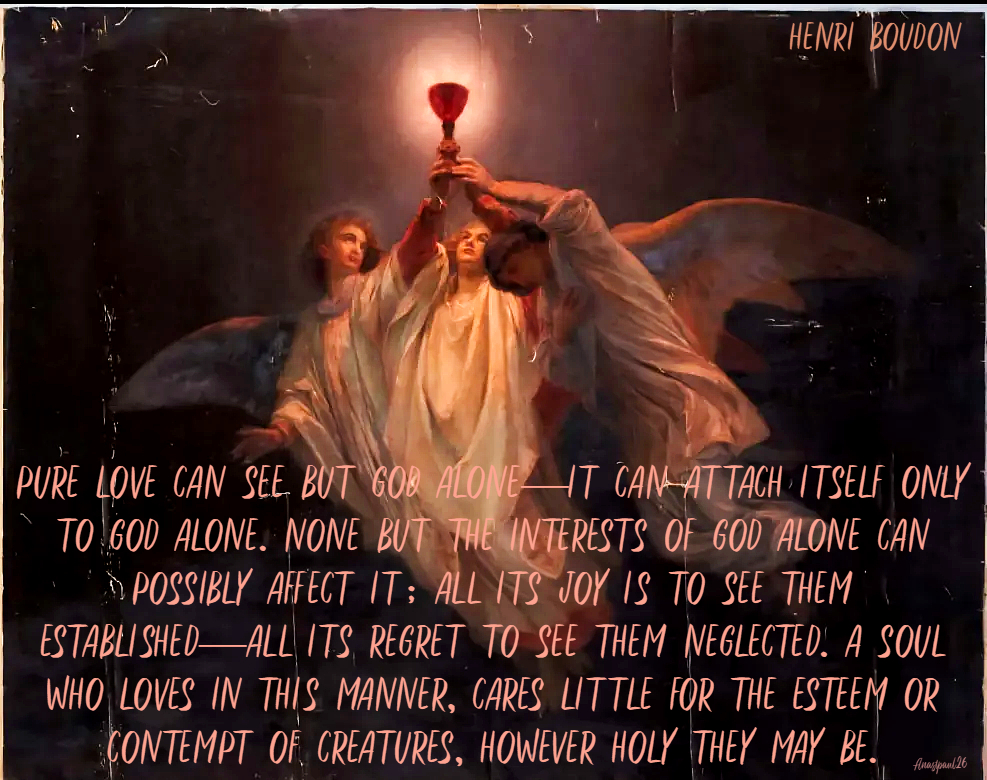
When a person has said “God,” he has said all. A true lover of this Divine Being can say nothing more, since he knows nothing more. “ What have I in heaven, or on earth,” exclaims such a one, “ but thee, my God ! I care not for honours, or riches, or pleasures; in Heaven itself, I regard but God alone—He is my only all in all things.” Such was St. Catherine of Genoa; she could not bear the word “ mine;” that is, she could not bear to regard self-interest, even in good things.” “O my God, and my all !” used the humble St. Francis to exclaim; and in repeating these words of love, he frequently passed the days and nights. Pure love can see but God alone—it can attach itself only to God alone. None but the interests of God alone can possibly affect it; all its joy is to see them established—all its regret to see them neglected. A soul who loves in this manner, cares little for the esteem or contempt of creatures, however holy they may be. The contradictions it meets from the servants of God, and the censure heaped on such actions as grace inspires it to perform, give it no concern; on the contrary, as its abandonments increase, its joy becomes more great—its repose more calm—its peace more profound—for its greatest felicity is to be freed from the creature, in order to be wholly occupied with the Creator.
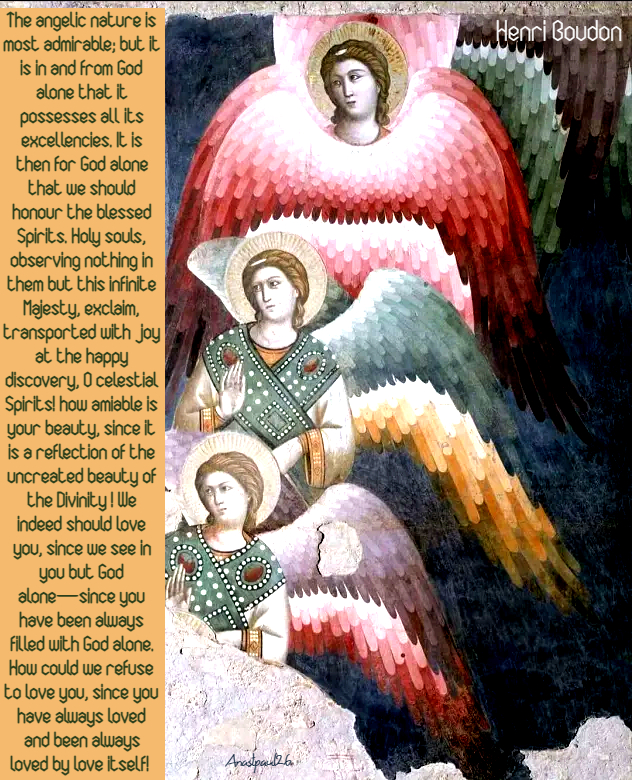
This uncreated Being, God alone, makes all the occupation of the blessed in heaven—and it were but just that he made that of men on earth ; but alas ! they seek their treasure, their delight, elsewhere. Even those who are freed from grosser attachments are not without their petty desires and little interests. A holy soul one day saw in spirit, that, among a thousand, scarcely one hundred love God—and of this number not one almost who loved him purely for his own sake. The angelic nature is most admirable; but it is in and from God alone that it possesses all its excellencies. It is then for God alone that we should honour the blessed Spirits. Holy souls, observing nothing in them but this infinite Majesty, exclaim, transported with joy at the happy discovery, O celestial Spirits! how amiable is your beauty, since it is a reflection of the uncreated beauty of the Divinity ! We indeed should love you, since we see in you but God alone—since you have been always filled with God alone. How could we refuse to love you, since you have always loved and been always loved by love itself!
O my soul ! God wills and ordains that we love his Angels. Let us then regulate our inclinations by his, and make these glorious princes the objects of our love, for God alone ! God alone ! God alone !
The Blessed Virgin is glorified by our Devotion to the Angels.
The increase of the glory of the admirable Mother of God is a motive not a little powerful with those who love her. We read that many persons, vicious in other respects, have been so touched with the honour of this blessed Mother, as to protest that they would willingly sacrifice their lives for it. Now, if rebellious souls were so zealous for the honour of this august Queen of the sweets of Paradise, with much more reason should pious souls be induced to labour in so holy a cause. We can never sufficiently honour her. According to the testimony of the great Saint Bridget of Hungary, the Angels, from the commencement of the world, conceived so warm a love and so pure a zeal for the interests of Mary, that they were more pleased that she should receive existence than that they themselves had been created.
How many persons, in imitation of these blessed Spirits, and by their powerful succour, have since preferred the interest of this blessed Virgin to their own interest—her honour to their own honour! I have known several who were willing to sacrifice their life a thousand times for her honour, and who would remain amid the fire and flames of Purgatory till the day of judgment, to preserve her the least degree of glory. There is nothing which a good heart would not be willing to do and suffer for this Holy Virgin; all would appear little to it when done for her who deserved to be the Mother of God. This it is which persuades me that the motive of her glory will induce men to be devout to the Angels.
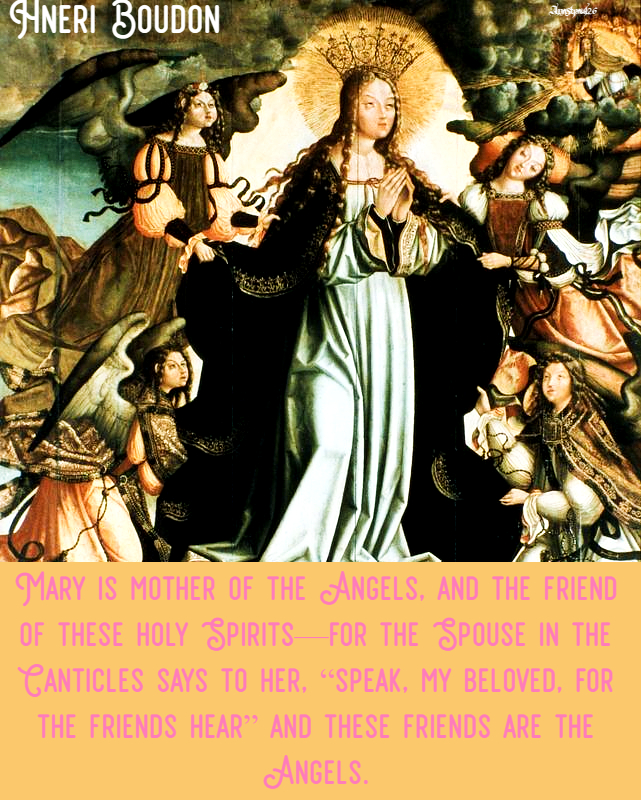
Being mistress general of the celestial host, the Angels are the soldiers of her who alone “is terrible as an enemy set in battle array.” They have vigorously combatted for her glory from the beginning, opposing themselves against Lucifer and his adherents, who refused to submit to her dominion, when God had revealed to them that she would one day become their Queen. Being the august Empress of Paradise, the Angels are her subjects, and consider it a great honour to be obedient to her laws. As lady or mistress of the Angels, these pure spirits are her servants, and so faithful that they fly at the least intimation of her will. According to the opinion of Theologians, Mary is mother of the Angels, and the friend of these holy Spirits—for the Spouse in the Canticles says to her, “speak, my beloved, for the friends hear” and these friends are the Angels.
Now, do not all these titles, which connect Mary with the Angels, show that her glory is concerned in their veneration? The servants, subjects, and soldiers of so great a Queen, have all manner of claims on our homage and devotion. Let us then praise and bless the holy Angels, because this most pure Virgin, our amiable Mother, is praised and blessed in them and by them) but let us, above all, praise that Lord, who has operated all that is good or great in our Lady of the Angels and the Angels themselves—God alone! God alone! God alone!
The great helps the Holy Angels afford us at the Hour of Death & Devotion to the Holy Angels is a sign of predestination to singular glory in Heaven
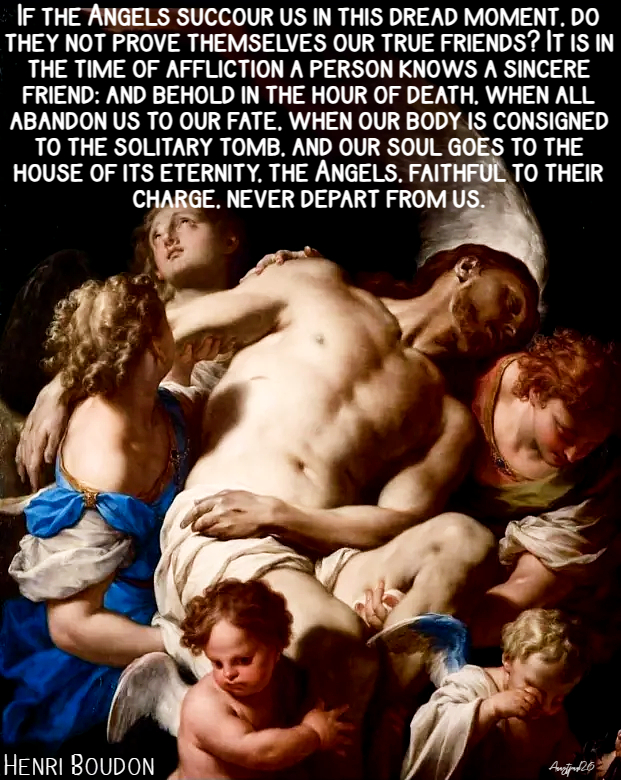
If to a pagan philosopher death appeared of all terrible things the most terrible, in what light should it be viewed by a Christian, to whom God has revealed its consequences ? When a person thinks seriously, that on the moment of death depends a happy or miserable eternity, his heart must be obdurate indeed, if he be not struck with fear; for “if the just be scarcely saved, where will the sinner appear?” O Lord ! “ enter not into judgment with thy servant, for no one living can be justified in thy sight!” The holy abbot Agatho, being seized with trembling at his last hour, and his religious having asked him the cause—he replied, that though by the great mercy of God, his conscience did not reproach him with anything, yet that the divine judgments being very different from those of men, he was in great alarm. No wonder he should have felt so—all our good works being imperfect in the sight of the Divine Majesty. If the Angels succour us in this dread moment, do they not prove themselves our true friends? It is in the time of affliction a person knows a sincere friend; and behold in the hour of death, when all abandon us to our fate, when our body is consigned to the solitary tomb, and our soul goes to the house of its eternity, the Angels, faithful to their charge, never depart from us.
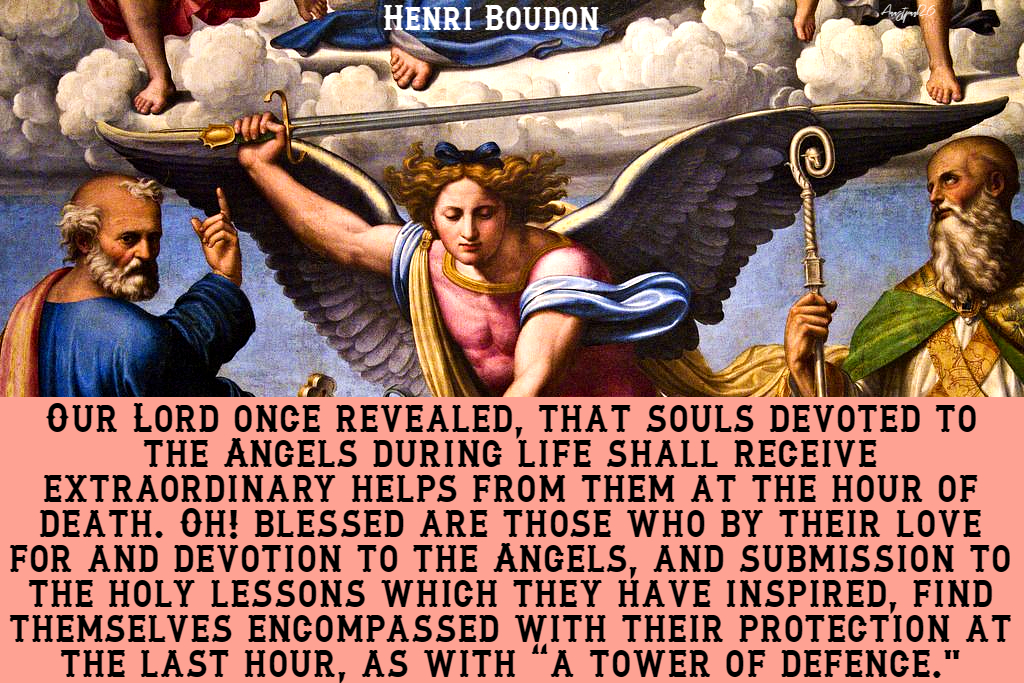
—Our Lord once revealed, that souls devoted to the Angels during life shall receive extraordinary helps from them at the hour of death. And it is most just that the King of kings should thus evince his sense of the honours paid to his courtiers. Oh! blessed are those who by their love for and devotion to the Angels, and submission to the holy lessons which they have inspired, find themselves encompassed with their protection at the last hour, as with “a tower of defence.”
Woe to those, who have seldom thought Heaven ! How many say, that they care not, provided they may be in Heaven at all, what place they hold there. No doubt, the last place there is too high for persons who once deserved an everlasting hell; but since our merciful God calls us to aspire after the highest, it would betray great baseness of soul to be indifferent about it.
Be ambitious of the better gifts says the Holy Ghost. St. Teresa and St. Francis Borgia declared, that for one sole degree of increased glory in heaven, they would consent to burn in the flames of Purgatory till the day of judgment. These enlightened souls well knew its excellence—whereas we are incapable of discerning it, our sight being obscured by the vapours of flesh and blood. If it be asked, are not all the blessed perfectly content?—we reply, they are—but their joy is not equal. As one star differs from another in brightness, so the resurrection of the dead. The great spiritualist, Thaulerus, says, that there is more difference between one of the blessed who holds the first rank in the celestial empire, and another in an inferior degree, than between a mighty sovereign and an abject peasant. This should excite us to great and noble exertions, although there were no other motive than that by our greater glory and happiness God will be more glorified eternally. One sole degree of the glory of God would cause a soul who truly loves him to endure ten thousand deaths; and here it is not only one degree there is question of, but as many as there are moments in that eternity which is to be the term of our happiness.
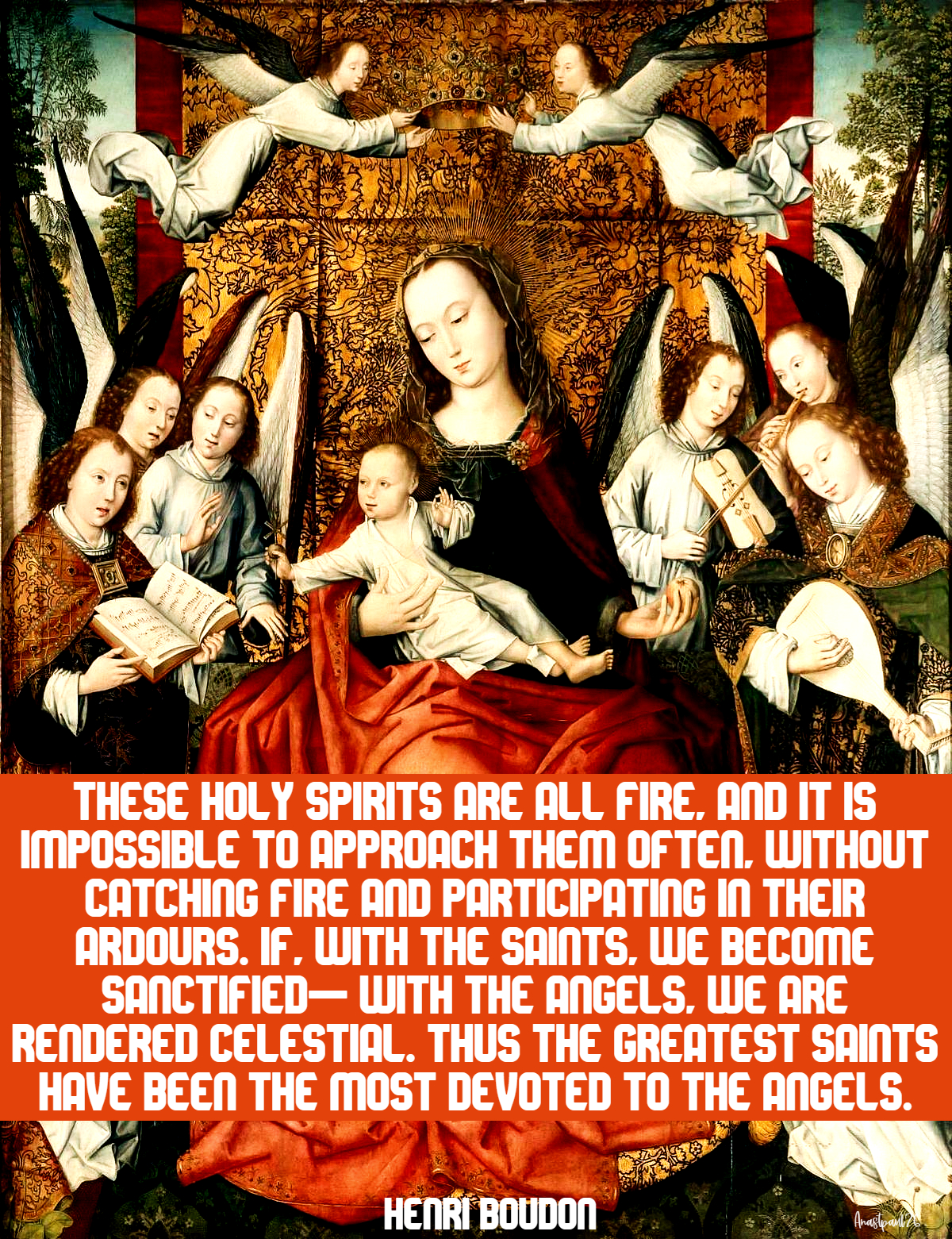
Devotion to the Angels contributes wonderfully to the perfection of divine love, and consequently to the increase of glory in Heaven. These holy Spirits are all fire, and it is impossible to approach them often, without catching fire and participating in their ardours. If, with the Saints, we become sanctified— with the Angels, we are rendered celestial.
When St. Teresa was about to enter a more perfect life, a celestial voice said to her, that she should no longer hold converse with men, but with Angels. If intercourse with men be an obstacle to sanctity, familiarity with the Angels helps to our progress in it. Thus the greatest Saints have been the most devoted to the Angels. Let us endeavour to become so too, and we shall speedily advance in the ways of true sanctity, and enjoy in Heaven an eminent degree of glory.
The Protection afforded to us by the Angels against the enemies of our Salvation.
The life of man is a warfare; he has to fight against temptations within and temptations without—temptations from the world, and temptations from himself. It is a strange thing, that we ourselves are our most dangerous enemies, and that it would give us quite enough to do to wage war against ourselves. Yet this is not all; we have other combats to sustain. We must combat against the devils, powerful in might, cruel in rage, countless in number, indefatigable in pursuit.—Being spiritual beings, they strike invisibl —enter all places—see all things—leave no art, no wile, untried, to effect our ruin, and triumph in our defeat. O ! you who read these lines ! do you not tremble at the idea of such combats? On your victory depends your eternal fate. Consider what it is to be damned for ever, and the danger in which you are of being so, by the malice of the devils—and then you will be convinced of the necessity of being devout to their powerful adversaries, the holy Angels.
The devils are cruel in their rage; the destruction of our corporeal existence would not suffice to glut their malice: they unceasingly seek to take away the life of our souls, and “ go about” continually “ seeking whom they may devour.” This infuriate malice is accompanied by such power, that, as we learn from the Book of Job, no force on earth can be compared to it: millions of armed men could do nothing against the efforts of a single evil spirit. The Scripture calls them the powers and princes of this world and of darkness the greater part of mankind being subject to their detestable tyranny.
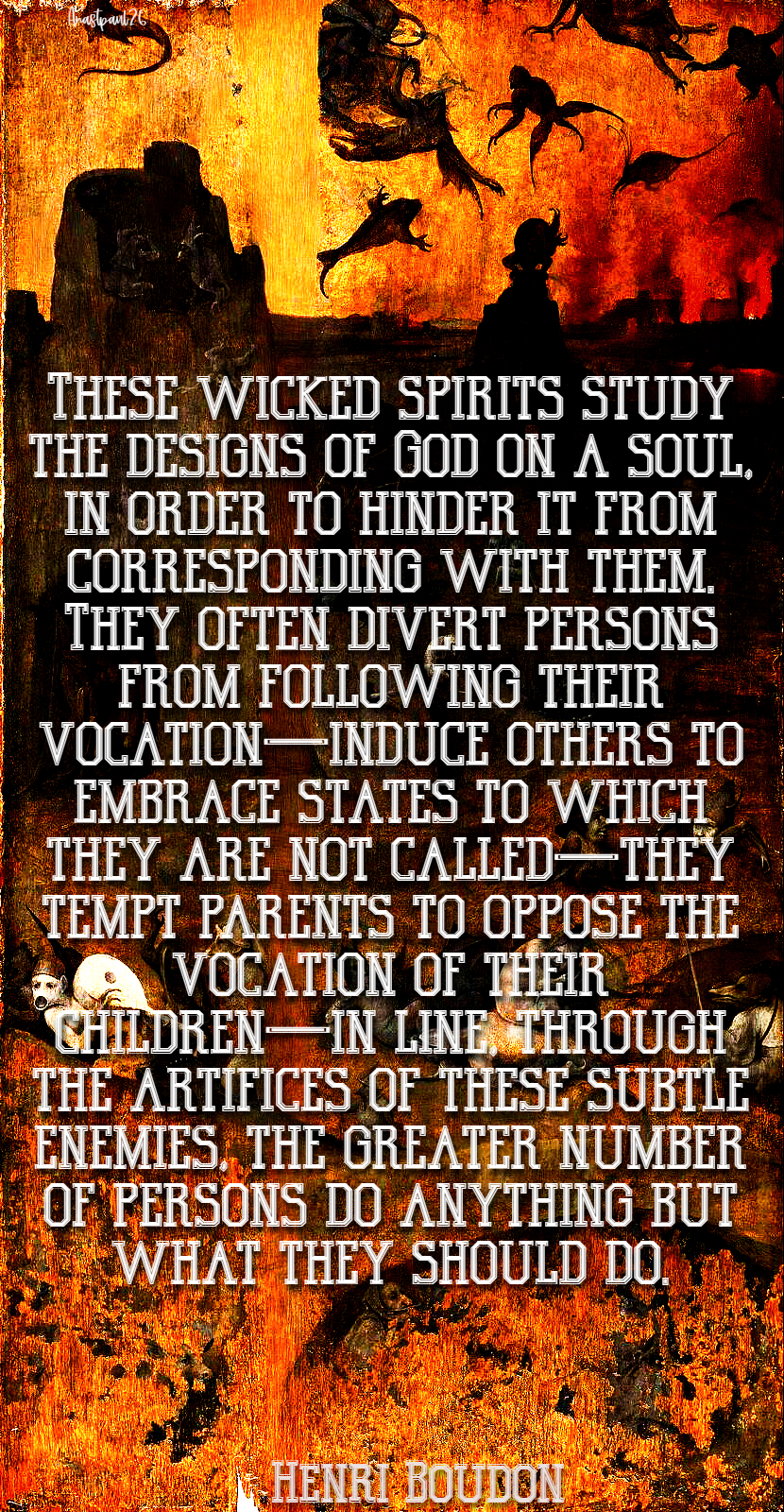
These wicked spirits study the designs of God on a soul, in order to hinder it from corresponding with them. They often divert persons from following their vocation—induce others to embrace states to which they are not called—they tempt parents to oppose the vocation of their children—in line, through the artifices of these subtle enemies, the greater number of persons do anything but what they should do.
If they cannot turn us from the ways of grace, they try to mingle in them ; prompting us to pray, when God will have us labour for him; to be angry and impatient when hindered from a good work; to be disquieted at our faults; to confess and communicate through imperfect motives; to irritate ourselves with an unquiet zeal at the faults of others, and to forget our own. As they are without peace or order among themselves, they labour all they can to render us so too—often exciting scruples, doubts, anxieties—inspiring us with fears as to the validity of our past confessions—prompting us to make them all anew, and still to be dissatisfied. They give false ideas of piety—and if they see true devotion gain ground in any place, by means of prayer and frequent communion, they will cause some of those who use these means to fall into great faults, to furnish others with a pretext for declaiming against them.
These wicked spirits, as we have already said, often represent things to us quite differently from what they are. They persuade persons in the world, that devotion is only for those who live in monasteries, and quite incompatible with their state. They not only persecute those who are employed actively in gaining souls to God, but those also who live in solitude, when possessed of extraordinary virtue, knowing that, by their prayers, and constant union with God, they will help to save and sanctify many other persons.
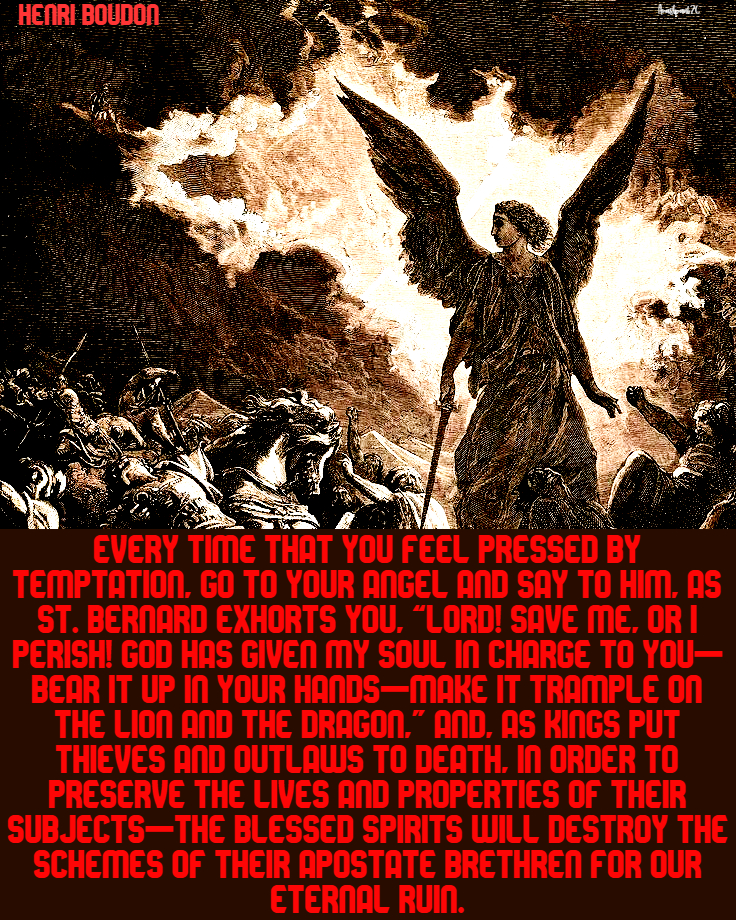
Are you not now convinced of your want of superior force against such enemies, in order to be victorious ? Having seen so many wiles laid for your destruction, are you not resolved to make use of that succour which our good God has provided for you in his holy Angels? Every time that you feel pressed by temptation, go to your Angel and say to him, as St. Bernard exhorts you, “Lord! save me, or I perish! God has given my soul in charge to you— bear it up in your hands—make it trample on the lion and the dragon,” and, as kings put thieves and outlaws to death, in order to preserve the lives and properties of their subjects—the blessed spirits will destroy the schemes of their apostate brethren for our eternal ruin; and with them we shall sing a canticle of joy and a psalm of jubilation, because we shall have obtained the victory.
MOTIVE SEVENTH The Angels assist us in spiritual things.
Properly speaking, man has but one affair—that of eternity. All that tends not to this great end is not worth a single thought. O ! how wretched and contemptible are all things which the world calls great! how unworthy the occupation of a Christian soul are its honours and pleasures ! It were well that this truth, “the world and its concupiscence passes away,” never departed from our minds: eternity would then occupy us, and the means of acquiring a happy one, among which the patronage of the Angels is not the least, would be more fully appreciated.
It is indeed true, that these blessed Angels do all that they can to procure for us a glorious immortality. They have been known to press apostolic men, as St. Paul and St. Francis Xavier, to announce the Gospel to those who sat in the shades of death.” They have often assisted evangelical labourers. How many children receive baptism by their means, who would otherwise perish in original sin ! Behold a wonderful example : In January, 1634, in the city of Vienna, three souls, freed from Purgatory, appeared, says Father Loret, of the Society of Jesus, to one of our religious, to thank him, for having by his prayers and mortifications, procured their release. On the day of your birth, said they, our good angels revealed to us, that you would one day be our liberator; and know that you are greatly indebted to your Angel Guardian, for without his care you would have been suffocated, through the carelessness of the attendant, before you received baptism.
After procuring for us the life of grace, the Angels endeavour to conserve us therein; and hence they prompt us to receive often the adorable Eucharist, which is the life of lives. They have often carried this vivifying sacrament to solitaries and recluses—St. Stanislas Kotska, S. J., received this favour. Nor do they forget the other means of our salvation. Prayer is one of the most powerful ; and it is by the Angels our petitions are carried before the throne of God : there is no exercise in which they are more present with us than this. Mortification is the sister of prayer—and what have not the Angels done to engage us to practise it? They have often visibly given their clients instructions thereon, suitable to their great lights, and convinced them of the absolute necessity of this virtue in all true Christians.
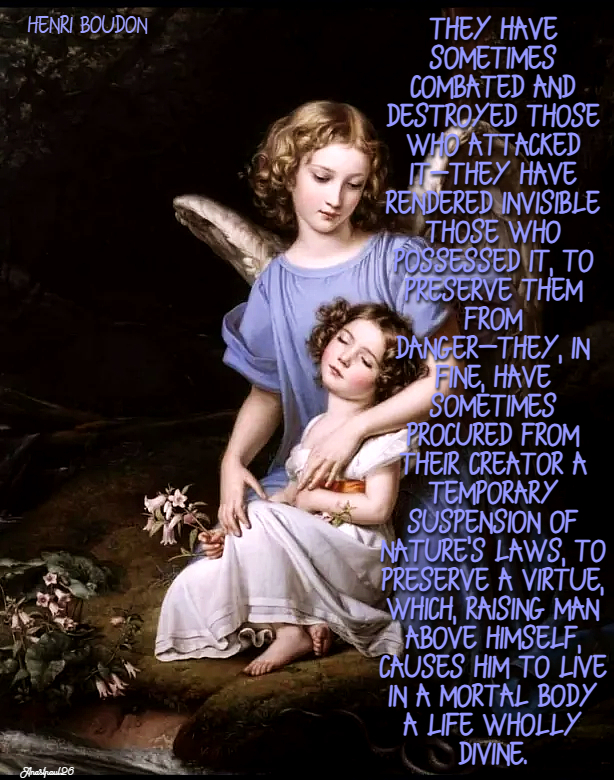
They are most anxious to inspire us with a love for that virtue which assimilates us to them, virginal purity.—What have they not done in its defence ? They have sometimes combated and destroyed those who attacked it—they have rendered invisible those who possessed it, to preserve them from danger—they, in fine, have sometimes procured from their Creator a temporary suspension of nature’s laws, to preserve a virtue, which, raising man above himself, causes him to live in a mortal body a life wholly divine.
But their great object is to inspire us with love for Jesus and his amiable Mother, knowing that the love of these sacred persons is the source of all good to our souls. St. Dominic, being one of the most fervent lovers of Jesus and Mary that ever existed, was in consequence the great favourite of the Angels. He received from them all sorts of assistance, during the long nights that love chained him to the altar steps, whilst pouring out his soul in the presence of his good Master, and invoking the patronage of his glorious Mistress. They were once seen, when the Saint happened to lodge in the house of the Bishop, lighting him with flambeaux from his chamber to and from the church, the doors of which they opened for him.
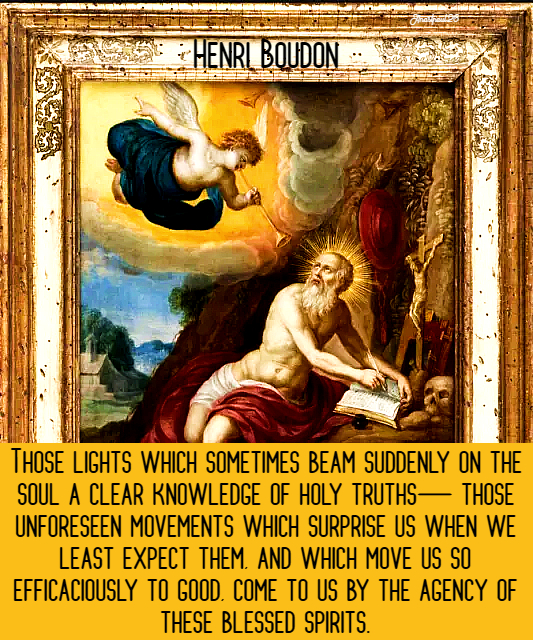
But this is not all. As for the practice of virtue, it is necessary that the will should be moved and the understanding enlightened, they often effect both. Thus they reveal the sublimest mysteries. It was an Angel who gave the law to Moses—an Angel who announced to the glorious Virgin the incarnation of the Word—to the Marys his resurrection, and to the apostles his last coming. They endeavour to preserve us from sin, or to free us from it, after having fallen into it.—Those lights which sometimes beam suddenly on the soul a clear knowledge of holy truths— those unforeseen movements which surprise us when we least expect them, and which move us so efficaciously to good, come to us by the agency of these blessed spirits.
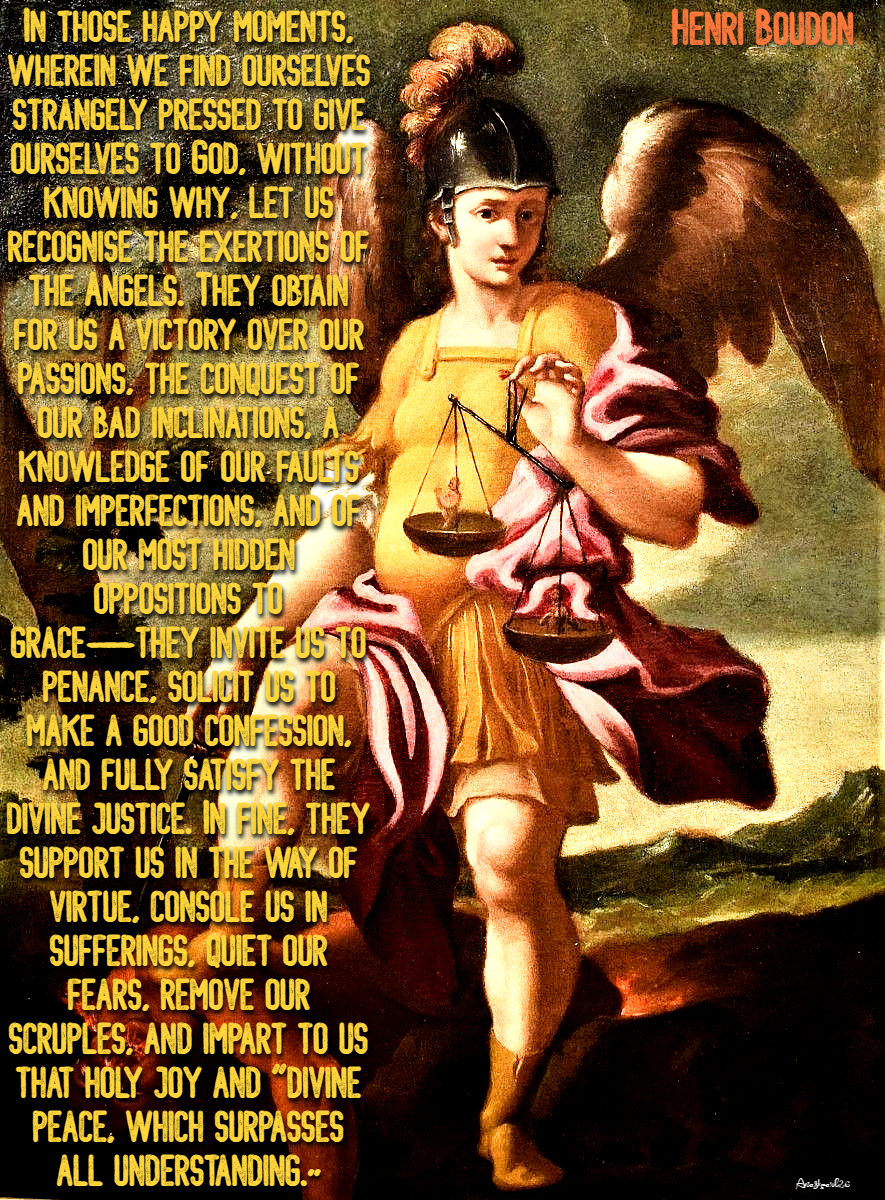
In those happy moments, wherein we find ourselves strangely pressed to give ourselves to God, without knowing why, let us recognise the exertions of the Angels. They obtain for us a victory over our passions, the conquest of our bad inclinations, a knowledge of our faults and imperfections, and of our most hidden oppositions to grace—they invite us to penance, solicit us to make a good confession, and fully satisfy the divine justice. In fine, they support us in the way of virtue, console us in sufferings, quiet our fears, remove our scruples, and impart to us that holy joy and “divine peace, which surpasses all understanding.” When Raphael met Tobias, he wished him continual joy, and in leaving him, everlasting peace – Let us disengage ourselves from all created things, and the wishes of these holy Spirits for our happiness will be accomplished. To enjoy true and continual peace, it is necessary to live to God alone.
After having spoken in a general way of the benefits accruing to us from the Angels, let us descend to particulars, that the hearts of men may be inexcusable, and be obliged to love these amiable spirits. If favours be to love, what wood is to fire with what ardour should we not burn for the holy Angels, overwhelmed as we are with their kindnesses and benefactions, even in temporal things.
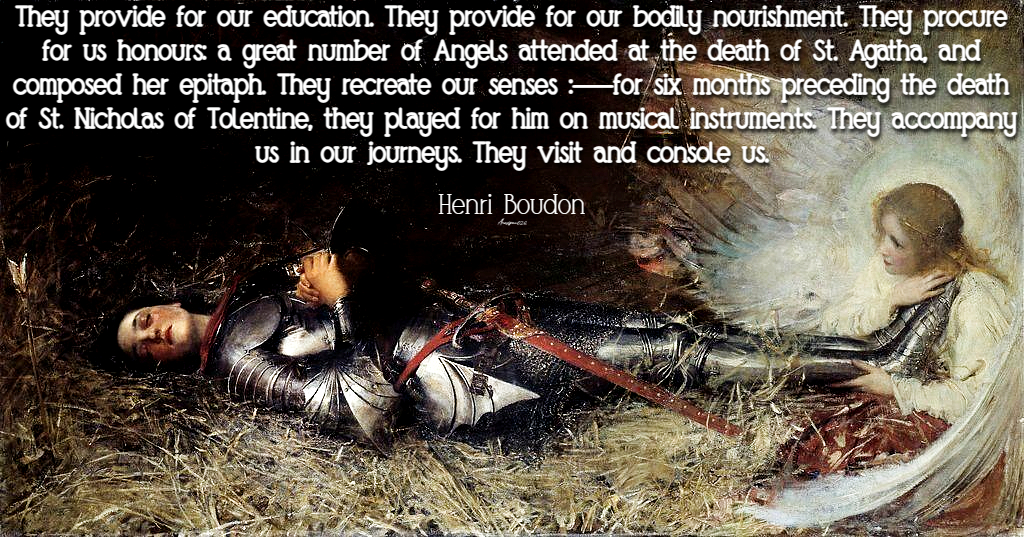
They provide for our education—They were these glorious spirits who trained up the little Baptist in the desert, after the death of his holy mother, which took place forty days after she had fled with him from the persecution of Herod. They provide for our bodily nourishment—as in the case of the holy martyrs Firminian and Busticus, and the prophets Elias and Daniel. They procure for us honours: a great number of Angels attended at the death of St. Agatha, and composed her epitaph. They recreate our senses :—for six months preceding the death of St. Nicholas of Tolentine, they played for him on musical instruments. And during the three days that intervened between the death of the Holy Virgin and her Assumption into Heaven, they made most melodious concerts near her sacred remains, for the consolation of those who approached them. They accompany us in our journeys—as is evident from the case of Tobias. They visit and console us—as the lives of the Fathers of the desert, and those of St. Lidwine and St. Francis testify, as well as the acts of the martyrs. And think not, says Abbe Kupert, that they never visited these servants of God, but when they visibly appeared; they have often been invisibly present, supporting them in their trials, consoling them in their sorrows, and assuaging their torments.
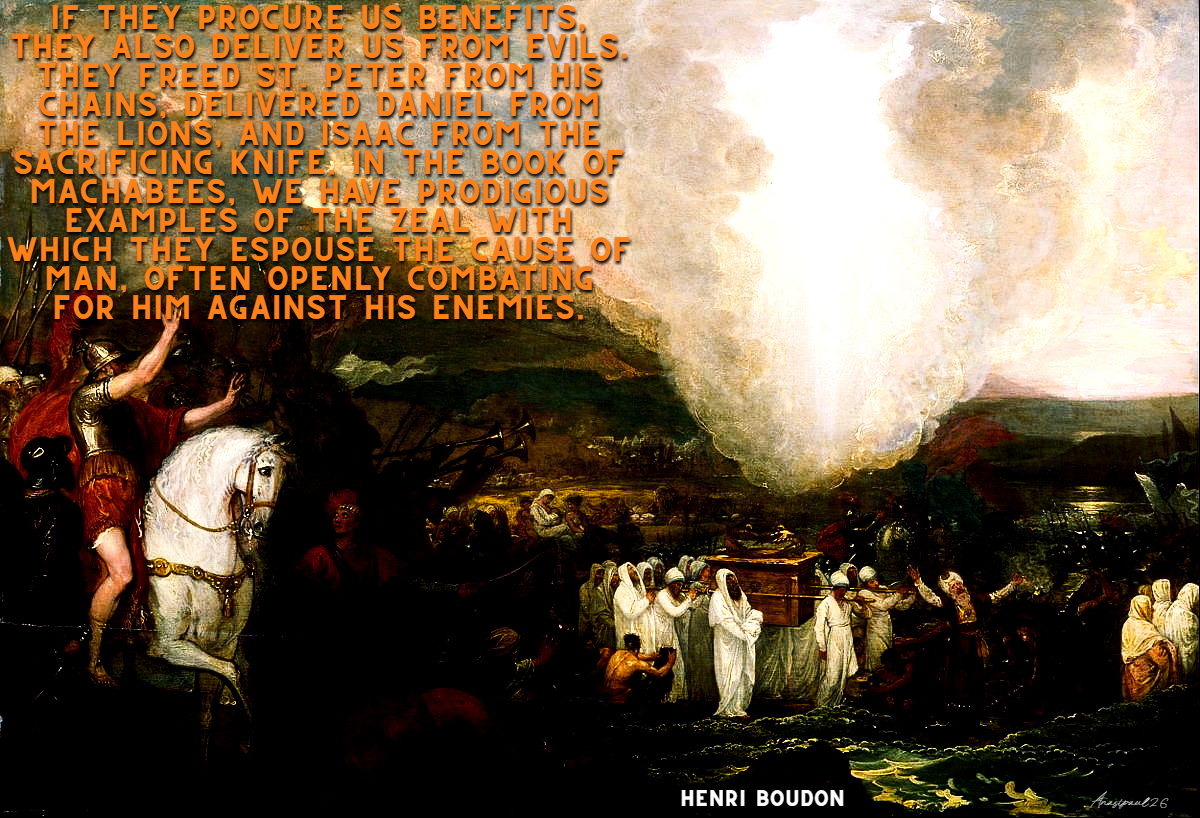
If they procure us benefits, they also deliver us from evils. They freed St. Peter from his chains, delivered Daniel from the lions, and Isaac from the sacrificing knife. In the Book of Machabees, we have prodigious examples of the zeal with which they espouse the cause of man, often openly combating for him against his enemies. In fine, there is no want, natural, moral, or physical, in which the holy Angels do assist us. Let us here consider and admire the protection afforded by the Angels to the Hebrew people. It was an Angel who conducted them in the wilderness for the space of forty years, by means of a cloud during the day, and a pillar of fire by night—and by the movement given to it by him, they were sheltered from the scorching rays of the sun, and preserved from the hands of Pharaoh and his Egyptians.
I leave it to the piety of those who read these truths, to reflect at leisure on this admirable conduct. However slightly they are considered, it is impossible not to be convinced that the services rendered to man by the Angels are incomparable—and that the name of the Lord should be magnified, who operates these wonders by the agency of the ministers of his celestial court.
A pious woman having one night received information that a poor person in the suburbs was lying in extreme necessity, and none of her domestics being within, sent her son with something for her relief. The boy being very young, was greatly afraid, going, by himself to such a lonely place, until a page appeared, bearing a flambeau, and conducted him safely to his destination. His mother doubted not that it might be his good Angel who had rendered him the charitable office. These blessed Spirits have often appeared visibly to man. The learned interpreter of the Holy Scripture, Cornelius a Lapide, supposes, that after the resurrection, they will sometimes assume bodies of exquisite beauty to recreate us. It is amazing to see them take every form to render services to us. They have appeared in various shapes, as pilgrims, &c., to serve and benefit man, who does almost nothing to testify his gratitude.
If it were only at certain times they rendered us assistance, it would not be so wonderful; but to be conferring favours on us every moment we exist, is inconceivable—and it is this our good Angel does for us. If a prince of the royal blood came and spent some time in waiting on an humble peasant, in a poor cabin, every one would be amazed; but if this peasant was his enemy, one from whom he could expect nothing like gratitude—if, moreover, he not only passed some months with him, but even resolved on remaining in his service as long as he lived, notwithstanding all the vicious propensities and vile habits which he discovered in him, the wonder would be infinitely greater. Yet it is in this manner, O my soul! thy good Angel guards thee.
O excessive bounty !—even while we sleep, they watch over us they are always at our side—though we are sinners, and consequently their enemies—though our interior deformity is so great, that if we saw it we could not support the sight— though we spend our lives in sin, or in such frivolous occupations as certainly excite the pity of these blessed spirits—though we corrupt our best actions by numberless defects, they are never weary of our company. Even after death, they visit us in Purgatory, and render us in its flames very great consolations. Is not this to be our slaves ? Where would we be able to find persons who would sacrifice their liberty so perfectly in the service of kings ? O bounty of our God ! the Princes of Paradise our slaves and servants! Well, indeed, did the holy Vincent of Caraffe say, that the life of a Christian was a life of astonishment.
But the Angels not only protect man, they also give their cares to everything that is destined for his service. According to St. Augustine, these blessed Spirits preside over every animate and inanimate thing in this visible world. The stars and the firmament have their Angels—the fire, the air, the water, have their Angels—kingdoms have their Angels, as is seen in the Scriptures provinces have their Angels, for the Angels who appeared to Jacob, says Genesis, were the guardians of the provinces through which he passed towns and cities have their Angels—altars, churches, nay, even particular families, have their Angels. Thus the world is full of Angels, and it seems that the sweetness of Divine Providence renders it necessary; for if, as some say, there be in the air so great a number of evil spirits, that if they were permitted to assume bodies, they would obscure the light of the sun, how could men be safe from their malicious arts, unless protected by the Angels ?
Whatever Eliseus might say to his servant of the protection of these blessed Spirits, the poor man could not believe it, until God miraculously opened his eyes, and manifested them to him under visible forms. If the same favour is not given to us, still have we not faith ? and can we not behold with our interior eyes these amiable spirits, and acknowledge them as our greatest benefactors, and the faithful ministers of God alone, whom we adore, who is admirable in all his works, and deserves for them eternal, everlasting praise ?
The Glories of the Holy Angels Venerable Henri Boudon, Archdeacon of Evreux
MOTIVE FOURTH All Men are assisted by the Angels
It is unnecessary to seek any other motive to love God than love itself—as our Lord revealed to Mother Magdalen of St. Joseph, a Carmelite religious. But why does God love men so much? Let it be published among the nations, says St. Bernard, and let them confess that the Lord has determined to treat them magnificently. O my God ! what is man, that you condescend to give him your only Son, to send him your Holy Spirit, and depute your Angels to guard and defend him ! ‘ Behold then an Angel, who is as a great king, endowed with all imaginable glory and perfection, in the service of man—a being compounded of misery and imperfection—a worm of the earth—dust and ashes ! But that man, when in the state of sin, should still be protected by the Angels, is far more wonderful. If we say we have no sin, we deceive ourselves: the greatest saints have fallen, through weakness or inadvertence, into venial faults— and would to God that there were no greater committed Hell itself being less terrible than a single offence against the Divine Majesty; but, alas ! men in general have little horror of mortal sin, and easily fall into it.
The Angels, though struck with amazement at these diabolical excesses, are nevertheless not deterred from assisting these unhappy beings. O soul! who readest these truths, is it not wonderful that the blessed Spirits should lend their aid to those who offend God, considering the knowledge they possess of his unspeakable greatness ? Is it not amazing that they are content to remain with those who every day trample on the blood of their God, “and make void the sufferings by which they have been redeemed.’
Let us go further : Heretics and Infidels have Angels who guard them, though their sin be so incomprehensible, that we can never in this world attain anything like a notion of it. The Turks, the professed enemies of the Christian name, have their Angels—nay, Antichrist himself will have an Angel Guardian, says St. Thomas, who will hinder him from committing several evils. The Angels serve all these people as their masters, though they know them to be slaves of the devil and victims of hell. Where is the gardener who would water a tree, if he knew it would never produce fruit! Where is the friend who would continue to demonstrate his friendship, after repeated insults and affronts ? Yet all the injuries, revolts, contempt and ingratitude of men diminish not in the least degree the charity of these blessed Spirits. They go to seek them in the forests of Canada, in the remotest deserts, in the most gloomy caverns, at the extremities of the earth.
You would say that they are beside themselves with love for men, who have nothing of man but the shape and appearance, their lives being wholly earthly and sensual. These celestial beauties give their affections to deformity itself, and yet meet with no other return than ingratitude and contempt. How shocking—how deplorable!
I confess that continuing to write of the Angels, my heart is insensibly touched with their love; and no wonder if it all were liquefied before these blessed spirits, who are, as the Psalmist says, “a devouring fire.” O amiable Spirits ! here permit my poor soul to sigh for love. Either suffer me to die, or to live as you wish. May I love you with a love according to the heart of Jesus, the King of love, and of Mary, the Queen of holy love. We should cease to live, or breathe only the purity of this love. To resume—Are not the foregoing motives sufficiently powerful to engage us to love the Angels ? But we can furnish many others. It is not one, nor a certain number, of these celestial spirits that are employed in our service. St. Paul says, that they are all deputed for our salvation. All the Angels, says St. Augustine, are employed in our defence, since they and we make but one same city of God. It is not alone the Angels of the last choir, says St. Chrysostom, that watch for the safety of men; the higher choirs are also deputed to defend them.
Some question if the higher Angels descend upon earth to assist man; but how will these explain the testimonies which the holy Scripture gives us to this effect? St. Raphael, who guided Tobias when going to Rages, said of himself, that he was one of the seven spirits who stand before the throne. They were the Cherubim who appeared to Ezechiel. It was to a Cherub that God committed the care of the terrestrial Paradise—and it was a Seraph who purified the lips of Isaiah. Ecclesiastical History, too, teaches the same truth: It was one of the highest Angels who imprinted the sacred stigmas of our Lord’s passion on the body of St. Francis, and another who wounded, with a golden dart, the heart of St. Teresa. But this is not the essential point : it is quite enough for us to know, that in some manner or another, all the Angels are in our service. And what a host of defenders for us ! Holy Job says, that their number is without number. Some writers affirm, that it surpasses that of the stars of Heaven, of the birds of the air, of the drops of water in the ocean, and of all visible creatures. St. Gregory of Nyssa says that there is an infinity of millions of Angels: and St. Dionysius the Areopagite, that God alone knows the number of these holy Spirits.
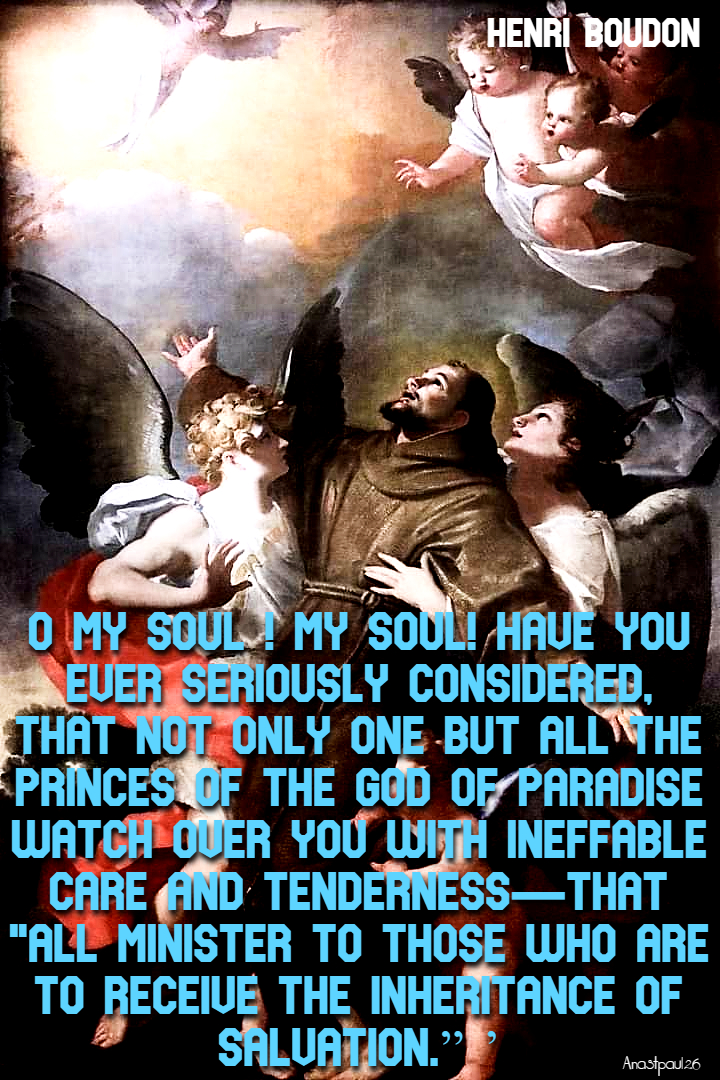
What movements of love—what sentiments of consolation do not these truths, if well penetrated, impart to our poor hearts! If it were said to you who read these lines, that the King had deputed to your service one of his principal courtiers, with strict orders to render to you all the manner of favours and services, what would be your gratitude, your amazement, your joy ! But history furnishes no such instance of kindness; it is only the King of kings who operates such a prodigy of love. O my soul ! my soul! have you ever seriously considered, that not only one but all the princes of the God of Paradise watch over you with ineffable care and tenderness—that “all minister to those who are to receive the inheritance of salvation.” ’
O the love of that God who has sent them ! O the love of those Spirits whom he has sent ! What consolation for us! Why, after this, should we be sad or troubled? One alone of these blessed princes is more than sufficient to defend us, and behold millions of millions—nay, an infinity of millions of them watching for our safety ! But remember, if such powerful protection places you in security, that the friendship of these illustrious princes should serve you for occupation. It is better to form acquaintance with these pure spirits than to amuse one’s self with creatures. Their friendship is so much the more holy and advantageous, as there is nothing in them but God alone.
AN EXHORTATION TO THE LOVE AND HONOUR OF THE HOLY ANGELS
The science of the sage, says the Holy Ghost, is like in its abundance to an inundation of waters : for, as the land is sometimes overspread by the swelling of the sea over its boundaries—so the mind of a Christian is sometimes so penetrated with the lights of faith, that it is absorbed in wonder and amazement. This assertion is fully verified in the knowledge which revelation gives of the Holy angels. However slightly we consider what it teaches of them, we discover so many and such powerful reasons to love these blessed Spirits, that we cannot refuse to do so.
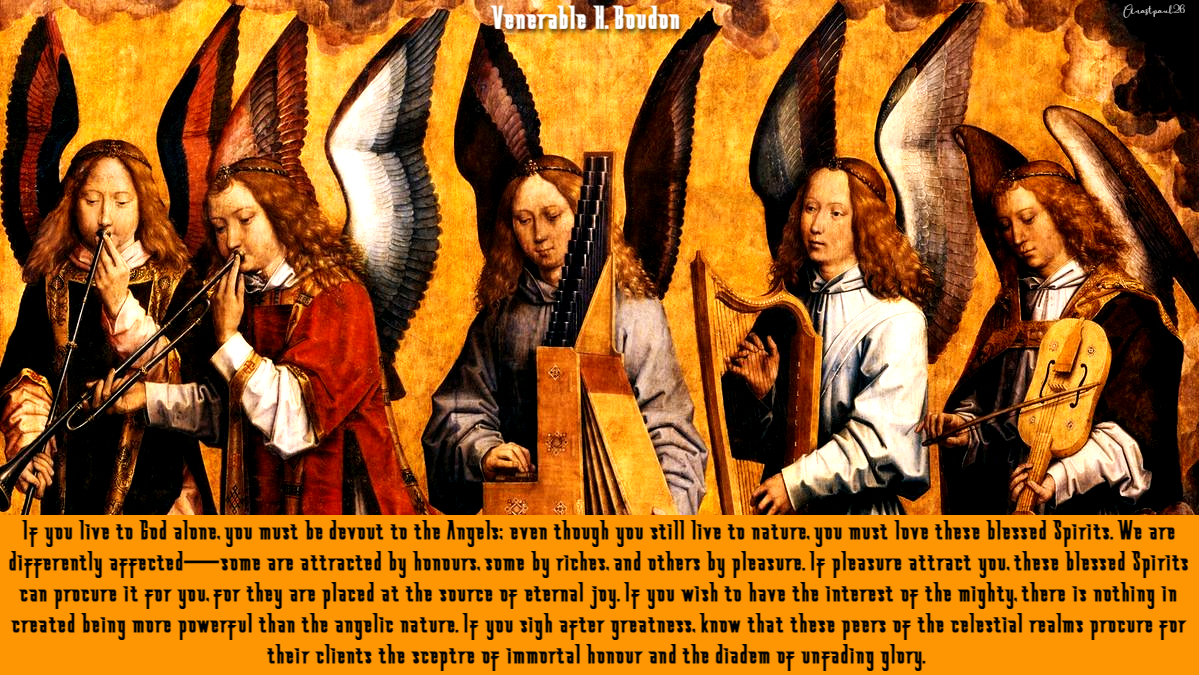
All possible motives concur in pressing you to love these Spirits of love. If you regard God, you must love his Angels; if you regard yourself, you must love the Angels. Pure love commands it— interested love requires it—God alone wishes it— the holy Virgin and all the Saints desire it. If you live to God alone, you must be devout to the Angels; even though you still live to nature, you must love these blessed Spirits. We are differently affected—some are attracted by honours, some by riches, and others by pleasure. If pleasure attract you, these blessed Spirits can procure it for you, for they are placed at the source of eternal joy. If you wish to have the interest of the mighty, there is nothing in created being more powerful than the angelic nature. If you sigh after greatness, know that these peers of the celestial realms procure for their clients the sceptre of immortal honour and the diadem of unfading glory.
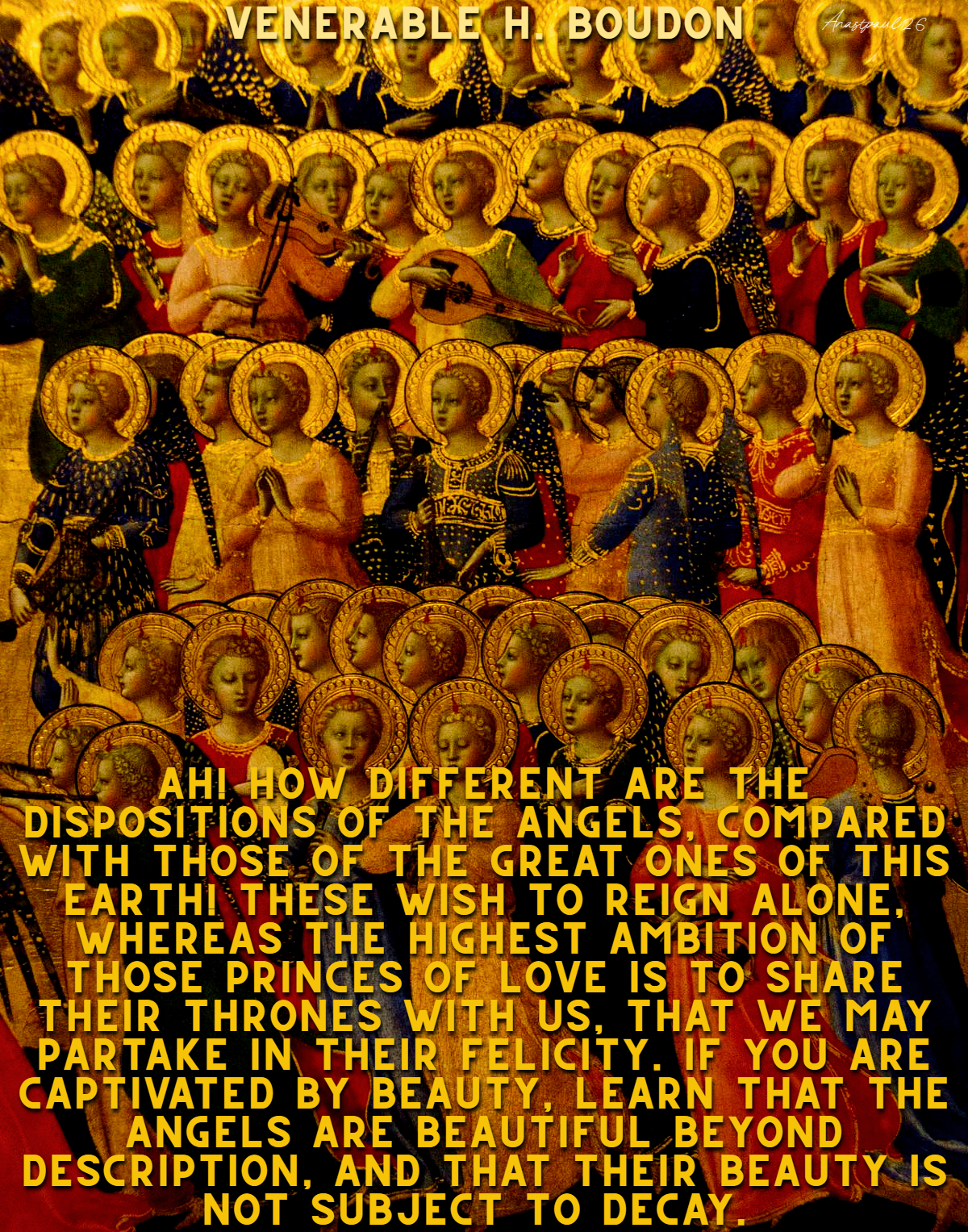
Ah! how different are the dispositions of the Angels, compared with those of the great ones of this earth! These wish to reign alone, whereas the highest ambition of those princes of love is to share their thrones with us, that we may partake in their felicity. If you are captivated by beauty, learn that the Angels are beautiful beyond description, and that their beauty is not subject to decay. Besides, the love and constancy of these amiable friends are incomparable ; the former includes every species of love—the latter is so great that whatever ingratitude we evince towards them, they seem to overlook it, incessantly watching over all that concerns us, defending us against our enemies, and rendering us every service. If you are of those souls who act by the movements of grace, and live to God alone, you must love the Angels. If the motive of the will of God influence you, you must be devout to them, since these blessed Spirits are the objects of his complacency and the masterpieces of his love.
If the kings of the earth were willing to receive you into their friendship, surely you would not refuse it. Now, consider that it depends on yourself to form an eternal alliance with the heavenly Princes, and by their influence to be one day crowned with them in the celestial empire.
Love the Angels, apostolic men ! for they are the missionaries of paradise.
Love the Angels, preachers of the world, they are profoundly skilled in the science of eternity.
Love the Angels, priests! for it is by their ministry the divine oblation is made.
Love the Angels, religious ! those admirable spirits are always retired in God.
Love the Angels, seculars ! those good intelligences pity you in the dangers to which you are continually exposed.
Love the Angels, married persons! the succour afforded Tobias by the Archangel Raphael, evinces the care of your state.
Love the Angels, widows and orphans! they are indefatigable in providing for persons in distress.
Love the Angels, virgins; again I say to you, love the Angels ! they are great friends of virginity, being charmed to see frail mortals live on earth as they live in heaven.
Love the Angels, just souls ! they are infallible guides in the way to God
Love the Angels, sinners ! they will obtain your pardon.
Love the Angels, afflicted souls! they are the consolation of the miserable, and the help of the distressed.
Love the Angels, ye rich and great! they will teach you that nothing is worth regarding but eternity.
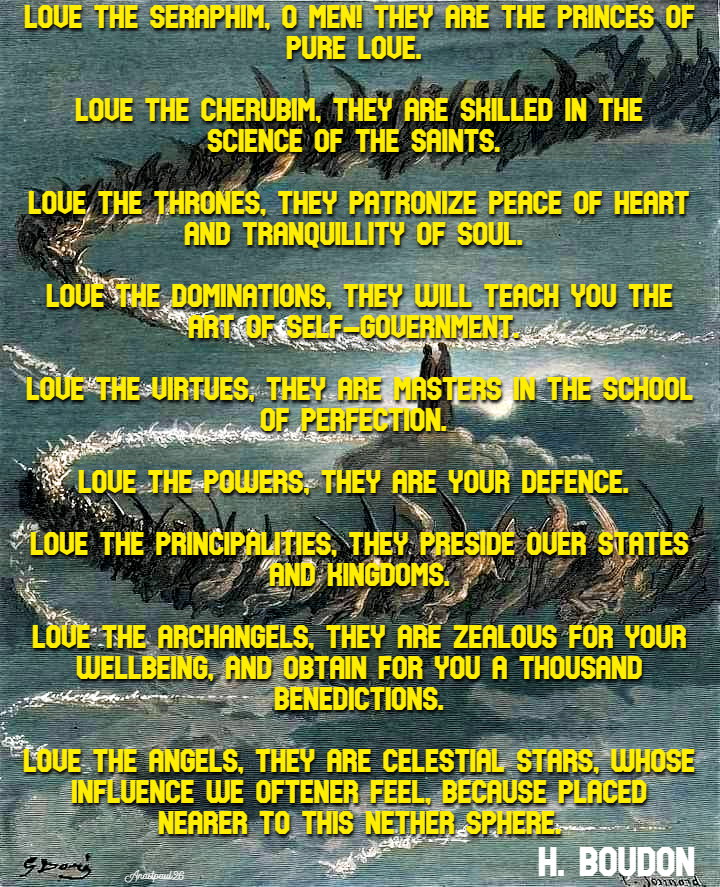
Love the Seraphim, O men! they are the princes of pure love.
Love the Cherubim, they are skilled in the science of the saints.
Love the Thrones, they patronize peace of heart and tranquillity of soul.
Love the Dominations, they will teach you the art of self-government.
Love the Virtues,they are masters in the school of perfection.
Love the Powers, they are your defence.
Love the Principalities, they preside over states and kingdoms.
Love the Archangels, they are zealous for your wellbeing, and obtain for you a thousand benedictions.
Love the Angels, they are celestial stars, whose influence we oftener feel, because placed nearer to this nether sphere.
Henceforward be all love for those blessed spirits, who so ardently love you. Bless them, my God! those who are devout to your Angels. Bless those who on reading this poor little work will give themselves to this devotion. Bless them with the benedictions of the just, making them walk in your ways. Bless them with the benediction of Abraham, the spirit of sacrifice—with the benediction of Isaac, the spirit of conformity— with the spirit of Jacob, the spirit of lively faith Bless them -with the benediction of the elect. Bless them with the benediction of the Angels, making them sharers in your neverending joys ! Great and august Queen of Paradise, bless them with your protection that, being all united in seeking the interest of God alone, God alone may reign in their hearts for ever. Amen.













You must be logged in to post a comment.